Redbanded Thrips Confirmed in Texas By Eric Putnam, ISA Board Certified Master Arborist; Shane M. Krajnik, ISA Certified Arborist; and Gabriella Putnam-Krajnik, ISA Certified Arborist, Eric Putnam BCMA Inc. | Houston, Texas
Houston Arborists Document a New State Pest
Redbanded Thrips (Selenothrips rubrocinctus) have been confirmed in Texas for the first time, following an investigation of premature leaf loss on young and mature sweetgum trees, including the cultivar ‘Slender Silhouette’ in the Houston area. On October 5, 2026, the U.S. Department of Agriculture issued a positive identification of specimens submitted by our team at Eric Putnam BCMA Inc. A corrected USDA notice made the significance explicit: “This is a New State Record for Texas.” [1, 2] The discovery expands the species’ documented continental U.S. distribution beyond Florida, the only mainland state listed in the extension references that guided our investigation. The species is documented in Hawaii and tropical regions elsewhere. The Texas finding gives arborists across the Gulf Coast and in other regions a reason to examine unexplained leaf injury and premature defoliation more closely. [3]
An Unfamiliar Pattern on Sweetgum
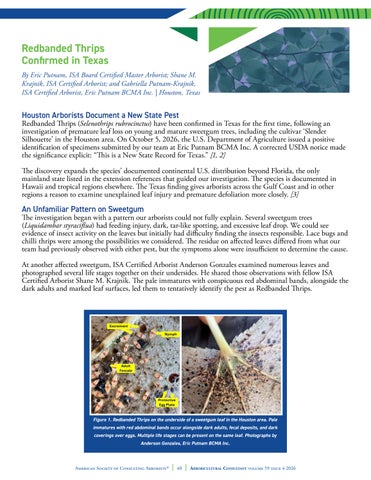
The investigation began with a pattern our arborists could not fully explain. Several sweetgum trees (Liquidambar styraciflua) had feeding injury, dark, tar-like spotting, and excessive leaf drop. We could see evidence of insect activity on the leaves but initially had difficulty finding the insects responsible. Lace bugs and chilli thrips were among the possibilities we considered. The residue on affected leaves differed from what our team had previously observed with either pest, but the symptoms alone were insufficient to determine the cause. At another affected sweetgum, ISA Certified Arborist Anderson Gonzales examined numerous leaves and photographed several life stages together on their undersides. He shared those observations with fellow ISA Certified Arborist Shane M. Krajnik. The pale immatures with conspicuous red abdominal bands, alongside the dark adults and marked leaf surfaces, led them to tentatively identify the pest as Redbanded Thrips.
Figure 1. Redbanded Thrips on the underside of a sweetgum leaf in the Houston area. Pale immatures with red abdominal bands occur alongside dark adults, fecal deposits, and dark coverings over eggs. Multiple life stages can be present on the same leaf. Photographs by Anderson Gonzales, Eric Putnam BCMA Inc.
American Society of Consulting Arborists®
40
Arboricultural Consultant volume 59 issue 4 2026
Redbanded Thrips Confirmed in Texas continued
At first, we thought we had identified another pest to recognize in our daily work. Preparing an entry for our Arborist Observation blog changed that. As we checked published descriptions and distribution information, we found that Texas was absent from the references. A public explanation for damaged sweetgums now pointed to a pest not previously documented in Texas! That finding prompted us to preserve specimens for outside identification. Krajnik worked with Gonzales and Avery Henderson, our senior lead plant health care and integrated pest management technician, to gather material from affected trees. Krajnik prepared the specimens for shipment to various organizations.
From Field Samples to USDA Confirmation
On September 10, Krajnik contacted Heena Mir at the Texas Department of Agriculture, who directed him to USDA’s local identifier in College Station. Samples were shipped September 14 and received the next morning. Krajnik also delivered material to James Boone Holladay, the Galveston County extension agent with Texas A&M AgriLife Extension Service. The samples followed two identification routes. Holladay reported positive identifications from Wizzie Brown, an entomology program specialist with Texas A&M AgriLife Extension in Travis County, and from the Texas A&M University Department of Entomology. USDA forwarded specimens to its National Identification Services taxonomic specialist. The USDA notice identified 15 immature specimens and 15 adults as Selenothrips rubrocinctus. It recorded the collection as September 9, 2026, in Houston, Harris County, under record TXCOLDOM26090001-DR01. The corrected notice explicitly designated the finding a new Texas state record. [2] Material submitted through Texas A&M was retained by the Texas A&M University Insect Collection. USDA advised that specimens sent to the national taxonomist would likely be deposited at the Smithsonian National Museum of Natural History with the collection data. That deposit remained pending when we prepared this article.
Observations Across the Houston Area
As the identification process continued, we encountered the same pest on additional trees across our service area. Our early September observations involved three sites, with the farthest two 18.5 miles apart. By September 15, our field observations extended across multiple cities, with the most widely separated sites 71.9 miles apart. Additional observations continued into October. We also observed Redbanded Thrips on common persimmon (Diospyros virginiana). This adds a local host association worth monitoring alongside sweetgum. Published accounts describe the insect as a devastating pest of a broad range of fruiting plants, including avocado, mango, and guava. Our observations on persimmon in Texas raise questions about which additional landscape and fruit trees may be affected and warrant closer inspection. [3, 4] Our public observation map, updated October 13, shows selected locations where we have encountered the pest. We now add points primarily to document a new city or a farther extent of our observations. The map records geographic reach rather than every affected tree, and the distances between sites do not establish how quickly the insect spread or when it arrived in Texas.
American Society of Consulting Arborists®
41
Arboricultural Consultant volume 59 issue 4 2026
Redbanded Thrips Confirmed in Texas continued
On affected sweetgums, premature defoliation has been the most concerning symptom. Losing leaves removes photosynthetic tissue and adds to the burden on trees already coping with other landscape stresses. Photographs of affected Slender Silhouette sweetgums show substantial thinning and leaf loss in the lower portions of their crowns. The effects of repeated infestations under Texas conditions will require continued observation.
Figure 2. Slender Silhouette sweetgum trees with premature leaf loss and thinning in the lower portions of their crowns, documented during the Redbanded Thrips investigation. Photographs by Avery Henderson, Eric Putnam BCMA Inc.
Recognizing the Insect and Its Damage
Look closely at the undersides of symptomatic leaves, especially the foliage closer to the ground as the infestation seems to start on the lowest foliage. Adult females are approximately 1.2 millimeters long and dark brown to black. The red bands are easier to see on the pale yellow to orange immatures. Eggs are inserted into leaf tissue and covered with a secretion that dries into a dark, disc-like cover. Several life stages may occur together on the same leaf, sometimes in large numbers. [3, 4] Lace bug feeding can produce similar pale stippling and dark fecal deposits beneath leaves. Look for adults with lace-like wings or flattened, spiny nymphs to distinguish them from these thrips. Chilli thrips commonly attack young leaves and buds, causing bronzing, curling, and distorted growth. In the sweetgums we examined, redbanded thrips feeding produced a gray or silvery discoloration of the affected leaves instead of distorting or curling the leaves. Adult chilli thrips are pale yellow with dark wings, unlike the dark brown to black adults of redbanded thrips. [4] For a suspected occurrence: • Contact an extension diagnostic service or plant health authority for collection, preservation, and submission instructions before preparing specimens. • Photograph both leaf surfaces, close views of the insects, and the tree’s overall condition. • Record the host species and cultivar when known, location, collection date, and extent of injury. • Collect, preserve, label, and submit specimens according to the receiving service’s instructions. Clear photographs helped guide our investigation, and preserved specimens allowed specialists to confirm the identification.
American Society of Consulting Arborists®
42
Arboricultural Consultant volume 59 issue 4 2026
Redbanded Thrips Confirmed in Texas continued
Management and Continued Monitoring
Management decisions should reflect active infestation levels, tree condition, and the severity of defoliation. Extension guidance describes natural enemies, including predatory bugs, lacewings, mites, and other thrips, and notes that these can often keep populations in check. [3, 4] However, their effectiveness against redbanded thrips under Texas conditions remains uncertain. Research is ongoing to determine which natural enemies are associated with local infestations, including whether parasitic wasps known to attack this pest elsewhere are present. We have observed lacewing larvae on some of the same leaves where redbanded thrips were feeding. Given their documented role as predators, we consider a feeding relationship plausible, but we have not confirmed that these larvae are feeding on redbanded thrips. Our field response has included broadcast applications of contact and systemic insecticides as an emergency response to severe infestations. The extensive feeding injury and defoliation we observed threatened, in our assessment, the health and survival of the affected trees. We do not yet have local guidance establishing whether predatory insects can provide adequate control of this pest under these conditions. This uncertainty, together with the severity of the damage, informed our decision to intervene while research continues. Where chemical intervention is warranted, product selection and application must follow the label for the host, site, and intended use, with consideration for effects on natural enemies because insecticides will likely reduce beneficial insect populations. Alongside these treatments, we are taking measures to improve soil and tree conditions, including applications of biostimulants containing humic acid and molasses. These measures are intended to support recovery, improve overall tree vigor, and help the trees maintain their natural defenses. Follow-up inspections will track live thrips, fresh feeding injury, continued leaf loss, and the presence and activity of potential natural enemies, including lacewing larvae. These observations can help determine whether additional treatment is needed and whether natural enemies are contributing to control. Further applications should be guided by continued pest activity and injury, with attention to conserving beneficial insects. Soil moisture, irrigation, and overall tree condition should also be assessed to identify additional stresses that may affect recovery. The effectiveness of sanitation or pruning specifically for managing redbanded thrips in Texas still needs evaluation. However, neither sanitation nor pruning currently appear practical for the affected trees we have assessed. The confirmed record raises practical questions for the next season: how widely the pest occurs, which hosts sustain populations, and whether it can overwinter in Texas. Those questions make observations from working arborists especially valuable. Documented findings can help researchers and plant health agencies determine the extent and consequences of its presence in Texas and assess its potential for further spread. Our discovery began with familiar trees showing damage that did not fit our initial diagnosis. Taking a closer look at the undersides of their leaves, documenting the insects, and submitting specimens turned that field problem into a confirmed state record. We encourage Texas and Gulf Coast arborists to document suspected redbanded thrips and submit specimens through their extension or plant health contacts. More broadly, we encourage arborists to document unfamiliar injury and maintain communication with diagnostic laboratories and plant health agencies so that new findings contribute to earlier detection and a better understanding of emerging pests of any species.
American Society of Consulting Arborists®
43
Arboricultural Consultant volume 59 issue 4 2026
Redbanded Thrips Confirmed in Texas continued
References
[1] Eric Putnam BCMA Inc. 2026. Liriope’s Muse: Arborist Observation: Redbanded Thrip. Updates through October 13, 2026. Includes field observations, photographs, maps, and reproduced identification correspondence. https://www.ericputnambcma.com/arborist-observation-red-banded-thrip [2] U.S. Department of Agriculture, Animal and Plant Health Inspection Service, Plant Protection and Quarantine, National Identification Services. 2026. Positive identification and corrected New State Record notice for Selenothrips rubrocinctus from Houston, Harris County, Texas. Record TXCOLDOM26090001-DR01. Notice signed by Tesfamariam Mengistu; correspondence reproduced in reference 1. [3] Denmark, H. A., and D. O. Wolfenbarger. n.d. Redbanded Thrips, Selenothrips rubrocinctus (Giard) (Insects: Thysanoptera: Thripidae). EENY-099/IN256. University of Florida, IFAS Extension. Accessed October 13, 2026. https://ask.ifas.ufl.edu/publication/IN256 [4] Baker, J. 2017. Redbanded Thrips on Ornamental Plants. NC State Extension. Revised July 6, 2022. Accessed October 13, 2026. https://content.ces.ncsu.edu/redbanded-thrips-on-ornamental-plants
Author Information
Eric Putnam is an ISA Board Certified Master Arborist and the Owner and CEO of Eric Putnam BCMA Inc., a leading Arboricultural Firm serving the Houston area and Texas Gulf Coast. Correspondence: contact@ericputnambcma.com. Shane M. Krajnik is an ISA Certified Arborist and the General Manager of Eric Putnam BCMA Inc. Email: skrajnik@ericputnambcma.com. Gabriella Putnam-Krajnik is an ISA Certified Arborist and the Head of Education at Eric Putnam BCMA Inc. Email: gkrajnik@ericputnambcma.com.
New for 2026! Wear a Ribbon. Start a Conversation. At the ASCA Annual Conference members wearing an Ambassador ribbon have volunteered to be approachable for questions and conversation. Look for the ribbon and say hello, or pick one up at registration and wear it yourself. No training, no commitment, just a friendly welcome.
American Society of Consulting Arborists®
44
Arboricultural Consultant volume 59 issue 4 2026