SIM TALK c/o the Register One Genetics Way, Bozeman, MT 59718 USA
www.simmental.org Printed in USA
10ST-Front Cover fp 4c.qxp_Layout 1 10/5/26 10:25 AM Page 1
10ST-Jewels of the Northland Sale fp 4c.qxp_Layout 1 10/4/26 10:40 AM Page 1
10ST-ABS Global, Inc. fp 4c.qxp_Layout 1 10/4/26 10:43 AM Page 1
11-26 ST_Table of Contents.qxp_Layout 1 10/5/26 12:08 PM Page 2
VOLUME 34 – NO. 4
CHECK US OUT ONLINE
Linking SimGenetics to Commercial Cattle
Table of Contents
IN THIS ISSUE 10
Performance Advocate Program Enters Seventeenth Year
The Performance Advocate program recognizes breeders who go above and beyond in collecting and submitting important data.
by Lilly Platts
20
Building a Business: Valigura Simmental’s First-Generation Journey
Valigura Simmental is dedicated to genetic improvement, and is increasing the awareness of the Simmental breed in New Mexico.
by Lilly Platts
26
Finding the Balance: Cow Efficiency and Carcass Value in the Updated $API and $TI
Updates to $API and $TI better capture and balance the pull between cow efficiency and carcass peformance.
by Dr. Jon DeClerck
www.simmental.org
Have you visited simmental.org lately?
Measuring Beef Cow Productivity and Performance
For commercial producers, the goal is to produce more valuable pounds from every cow exposed, using the resources available and maintaining a cow herd that can remain productive for years to come.
by Dr. Ben Crites
40
Fall Focus 2026: Reflections on the Past and Future
Fall Focus 2026 brought 200 Simmental producers, industry leaders, and experts to Bozeman, Montana.
by Rose Oie
The entire website has a new look highlighting cattle sales, industry events, ASA’s programs, marketing opportunities, and breeders’ resources.
DEPARTMENTS
simmental.org makes it easy for you. Breeders’ resources include information on: © SimGenetics © Simple trait selection © Genetic improvement tools © Frequently asked questions
2
34
SIMTALK
6
From the Editor
48
Industry Update
78
Calendar of Events
82
Rates & Policies
84
Ad Index
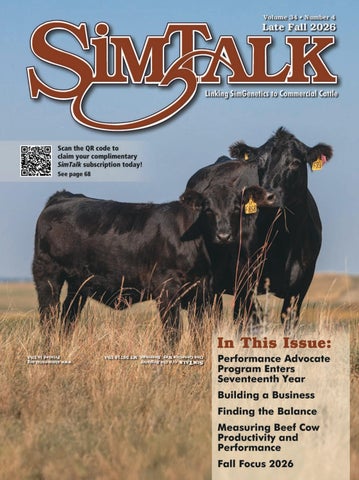
A SimGenetics pair at Quandt Cattle Company, Oakes, North Dakota. Photo by Addison Rall, Addison K Creative.
10ST-Select Sires fp 4c.qxp_Layout 1 10/5/26 9:02 AM Page 1
11-26 ST_Masthead.qxp_Layout 1 10/4/26 10:47 AM Page 2
ASA Board of Trustees
Linking SimGenetics to Commercial Cattle published by ASA Publication, Inc.
One Genetics Way, Bozeman, Montana 59718 USA 406-587-2778 fax: 406-587-9301 www.simmental.org email: register@simmgene.com
Canada Publications Agreement Number: 1875183
ASA Publication, Inc., Board of Trustees
Scott Trennepohl, Chairman Greg Burden, Vice Chairman Ryan Thorson Chris Ivie Greg Walthall Dr. Jon DeClerck, Executive Secretary-Treasurer CEO Dr. Jon DeClerck
Business Manager Dr. Ben Crites
Managing Editor Lilly Platts
Advertising/Editorial Coordinator Rebecca Price
Sales Manager Nancy Chesterfield
Media/Website Administrator Kathy Shafer
Design/Production Jenna Haughian Gretchen Jensen
American Simmental Association
One Genetics Way, Bozeman, Montana 59718 USA 406-587-4531 fax: 406-587-9301 www.simmental.org email: simmental@simmgene.com
4
SIMTALK
Executive Committee Ryan Thorson, Chairman Scott Trennepohl, Vice Chairman Greg Burden, Treasurer Chris Ivie Greg Walthall Dr. Jon DeClerck, Executive Vice President North Central Region Tim Clark (2027) 1999 18th St NW Turtle Lake, ND 58575 701.799.7752 Timc@westriv.com Loren Trauernicht (2028) 901 E Pine Rd Wymore, NE 68466 402.230.0812 mtrauernicht@diodecom.net Chris Effling (2029) PO Box 23 Highmore, SD 57345 605.769.0142 keffling@gmail.com Chris Nicholson (2029) 6235 23rd Ave SE Kintyre, ND 58549 701.391.6904 CNN2005@hotmail.com
Western Region Chad Cook (2027) PO Box 174 Walsh, CO 81090 719.529.0564 bridlebitsimm@gmail.com Maureen Mai (2028) 427 Peaceful Way Bonners Ferry, ID 83805 208.660.2726 rymocattle@gmail.com Ryan Thorson (2028) 1725 Road 261 Glendive, MT 59330 406.694.3722 ryanthorson7@gmail.com Quin LaFollette (2029) 1476 Hwy 14A Powell, WY 82435 307.899.3553 Quin@Blacksummitcattle.com
Eastern Region Chris Ivie (2027) PO Box 264 Summertown, TN 38483 931.215.0316 iviejc@usit.net Mark Smith (2027) 304 Moeller Rd Picayune, MS 39466 601.310.6695 smith5785@bellsouth.net Brandi Karisch (2029) 648 Polly Bell Rd Starkville, MS 39759 225.717.3324 mbkcattle@gmail.com Scott Trennepohl (2029) 6591 W 625 N Middletown, IN 47356 765.620.1700 sttrennepohl@yahoo.com
South Central Region Victor Guerra (2027) PO Box 92 Linn, TX 78563 956.607.5515 vgg03@aol.com Greg Walthall (2027) 1051 NE 500 Rd Windsor, MO 65360 660.525.9921 gregwalthall@gmail.com Joseph Hensgens (2028) 136 Deer Park Ln Rayne, LA 70578 985.992.9119 joehensgens@yahoo.com Greg Burden (2029) 890 VZ CR 2205 Canton, TX 75103 405.780.0372 greg.gbcattle@gmail.com
10ST-River Creek Farms #1 fp 4c.qxp_Layout 1 10/5/26 11:16 AM Page 1
11-26 ST_From the Editor.qxp_Layout 1 9/30/26 10:12 AM Page 2
FROM THE EDITOR by Lilly Platts, managing editor
This issue of SimTalk might be my favorite that we’ve done in a while. Working with people who know so much about this industry makes my job easy, especially when I can talk them into writing for our publications. This issue is proof of that. Dr. Ben Crites wrote a piece about cow productivity that I hope you’ll read. One of the best and most challenging things about the beef industry is that no two operations look the same. When you start talking about input costs, available resources, and other factors, even operations next door to one another are going to have a different set of expectations and needs. With this in mind, Dr. Crites breaks down how to identify the best cow for an individual operation, and shares some valuable advice. Over the last few months, we have been very focused on the updates to ASA’s two economic selection indexes, $API and $TI. Knowledge and use of indexes and EPD vary in the commercial sector, but these updates will have an impact on bull sale season,
whether it’s through your own selection or the advice your seedstock provider offers. The team leading this update has put together a significant amount of valuable information about these updates. We could fill an entire issue with educational content related to these updates, but wanted to be intentional about which piece we shared here in SimTalk. Cow efficiency, carcass traits, and the increasing pressure to do more with less is topof-mind for every producer. Dr. Jon DeClerck wrote a piece on how this factors into the new All Purpose Index ($API) and Terminal Index ($TI), and what that means for you. If you want to learn more about these updates, please visit simmental.org, go to the “Breeder Resources” tab, and click on “New EPD Updates.” Dr. DeClerk shared some insight on navigating these changes in the November Register, and has also shared several pieces on social media. If you are feeling any hesitation or worry about these changes, I would encourage you to find one of these pieces. If you don’t receive the Register, Dr. DeClerck’s piece will be shared online in November. This summer, our communications team had the pleasure of working with Rose Oie. Rose signed on as a summer intern, and attended several events over her internship. She has been creating content for social media, taking photos, and most recently, writing pieces for our publications. Rose wrote a great recap of Fall Focus 2026, which was held at the end of August in Bozeman. We are already making plans for Fall Focus 2027 in Sioux Falls, South Dakota, which I am very excited about. Fall Focus is my favorite industry event, and I hope you’ll make plans to attend. Lastly, this issue includes our yearly Performance Advocate feature. I have been putting this piece together for many years now, and occasionally, there is a new name that stands out. This year as I was scrolling through, I noticed someone from New Mexico. I looked them up, asked a few questions, and quickly realized they had a neat story. Jordan and Amy Valigura have built an operation from scratch, and are first-generation producers. They are very focused on collecting, submitting, and analyzing data. When I spoke to Jordan and Amy, it was clear that they have a larger vision, and that they are extremely passionate about the Simmental breed. I love talking to people like Jordan and Amy who have figured out how to start from square one. There is no easy way to get started as a young person, and I really hope that stories like this will encourage anyone in the same position.
ST
6
SIMTALK
10ST-Clear Springs Cattle fp 4c.qxp_Layout 1 10/4/26 10:48 AM Page 1
10ST-ASA FPC & IGS Know Guess fp 4c.qxp_Layout 1 9/29/26 12:47 PM Page 1
10ST-Yardley Cattle Co fp 4c.qxp_Layout 1 10/4/26 10:48 AM Page 1
ST_F_Performance Advocate 2026.qxp_Layout 1 10/1/26 10:42 AM Page 2
Performance Advocate Program enters Seventeenth Year by Lilly Platts
PA Recognizes Dedicated and Driven Data-Reporting Operations For seventeen years, the Performance Advocate Program (PA) has recognized cattle producers who maintain a commitment to data reporting. The 2026 program marked the seventh year under new guidelines, developed to identify the dedicated data reporting that fuels ASA’s genetic evaluation. A Driven Performance Advocate submits records on at least 10 of the 14 traits, and 90% of the contemporary group. A Dedicated Performance Advocate submits records on 90% of the contemporary group, and records on 8 of the 14 traits. Producers listed here are for the fall 2024 and spring 2025 calf crops. The operations featured below represent a selection of the operations that qualified as Performance Advocates.
Black Summit Cattle Company • Powell, Wyoming Black Summit Cattle was founded in 1990 by Quin and Tracy LaFollette. In 2009, the operation shifted from raising Angus genetics to SimAngus, with the goal of offering their customers cattle that thrive in the West. The family has since homed in on their SimAngus program, raising cattle that offer the best of both breeds, from calving ease to growth. Quin and Tracy raised their family in the industry, and their son, Gavin, is now a part of the operation. All females at Black Summit are DNA tested through the Cow Herd DNA Roundup and bulls are DNA, performance, and PAP tested. Black Summit Cattle holds an annual bull sale the third Friday in March. They frequently purchase and feed customer calves in order to acquire carcass data, sharing that data in order to help customers and guide their own genetic decisions. Quinn and Tracy LaFollette started their family-run Black Summit Cattle in 1990.
10
SIMTALK
ST_F_Performance Advocate 2026.qxp_Layout 1 10/1/26 10:42 AM Page 3
Far Out Cattle Ranch • Walsh, Colorado Jerrid and Katie Brisendine and their children Chelsea, Trace, and Taylor live on the fourth-generation farm and ranch located in southeast Colorado and the panhandle of Oklahoma. They began their registered Simmental herd, Far Out Cattle Ranch, in 2005. What started with three head of registered cows has expanded to over 50 registered Simmental females, and 50 commercial cows. They strive to produce sound cattle that will excel in areas of shortgrass conditions. Artificial insemination is utilized, and in 2022, embryo transfer was introduced through the purchase of 50 additional cows. Data collection begins as soon as the first calf hits the ground and continues until it is sold as a mature bull or female. Birth weight, yearling weight, carcass, feed intake, and more is collected. Bulls and females selected to market are developed at Bridle Bit Simmental, where data continues to be collected, including through their feed intake system. Bulls and a select group of females are marketed through the Bridle Bit Simmental All Terrain Bull sale.
The Brisendine family has been recognized for several years as a Performance Advocate because of their dedication to data collection.
Andy and Kim Kratzer • Marquette, Kansas Andy and Kim Kratzer run Simmental-influenced commercial cattle in the Smoky Hills region of Kansas. With a background in computer science, data collection and reporting comes naturally to Andy, and he places a high priority on it in the cattle operation. The operation is enrolled in ASA’s commercial THE option, and they also obtain carcass data by retaining ownership on weaned calves. Andy was first introduced to the breed when his father purchased Simmental bulls in the 1970s. He carried his passion for the beef industry through college, running cows with his father’s herd. After college he was able to strike out on his own, and has been improving his cow herd ever since. Andy goes above and beyond as a commercial producer, submitting data and participating in ASA programs. The commercial THE option allows the Kratzers to receive performance data, better manage their herd, and increase profitability.
Andy and Kim Kratzer utilize data to make progress on their commercial cow herd.
(continued on page 12)
SIMTALK
11
ST_F_Performance Advocate 2026.qxp_Layout 1 10/1/26 10:43 AM Page 4
Performance Advocate Program Enters Seventeenth Year (continued from page 11)
Little Bitterroot Simmental • Hot Springs, Montana Shannon and Jen Carr’s Little Bitterroot Simmental Ranch is based near Hot Springs, Montana. Named after their home in the Little Bitterroot Valley, the operation raises purebred and percentage Simmental cattle. Shannon and Jen both grew up involved with the breed, participating in 4-H, livestock judging, and the American Junior Simmental Association. Little Bitterroot Simmental maintains a focus on the female, selecting cows with excellent udders, feet, and traits that will keep them in the herd for many years. To maintain balance, Little Bitterroot Simmental selects moderate-sized females that calve easily while maximizing growth through weaning. Their customer base is both commercial and seedstock, which requires a balanced focus on a wide range of traits. The Carrs utilize genetic testing, and keep an eye on carcass traits. Little Bitterroot Simmental is a member of the Bulls of the Big Sky group, which will hold its 18th Annual Bull Sale February 15, 2027, in Billings, Montana. The Carr family is focused on raising balanced SimGenetics seedstock for commercial and seedstock producers alike.
Mairs Livestock • Ironton, Missouri Mairs Livestock is dedicated to utilizing the latest technology in genetic improvement, and takes the task of collecting and submitting data seriously. Danny and Gwen Mairs relocated from California to southeast Missouri in 2019 after building a successful family trucking business, and have set out to fulfill their goal of raising high-quality, profitable cattle. Their son, Matt, is also helping build the business, as well as Brandi Fitzgerald, who handles much of the record keeping and data submission. Initially, their cattle were mostly Angus. Danny knew early on that they wanted to harness the benefits of crossbreeding. The Mairs family is focused on breeding cattle that are strong maternally, and also perform in the feedlot and on the rail. Missouri is prime cattle country, but does come with challenges like humidity, fescue, and parasites. Danny has seen the benefits of crossbreeding in this environment, and also maintains a diligent herd health protocol. The Mairs family also works with Allied Genetic Resources. Currently, they are focused on raising high-quality females, which Danny foresees a major demand for. Danny Mairs dove headfirst into the beef industry after building a successful family trucking company.
12
SIMTALK
ST_F_Performance Advocate 2026.qxp_Layout 1 10/1/26 10:43 AM Page 5
Red Hill Farms • Lafayette, Tennessee Red Hill Farms has been consistently recognized as a Performance Advocate, highlighting a dedication to data collection and submission. The operation consists of Red Angus, Simmental, SimAngus, Charolais, and Angus cows, purebred sows, and row crops that support the livestock enterprises. The business is family owned and operated, with Bart and Sarah Jones at the helm; their son Ty is the seventh generation at Red Hill Farms. Data reporting is of utmost importance to Red Hill Farms, and they use extensive performance records and DNA analysis when selecting the bulls and females. Their sales are held annually on the third Saturday of March and last Saturday of October. Bart and Sarah have deep roots in the area and in agriculture. The original farm was purchased in the late 1860s by Bart’s great-great-great grandmother. Sarah utilizes her professional background in accounting, managing all of the financial records, cattle records, and marketing, in addition to being involved in the day-today management of the cow herd. Bart grew up on a purebred hog operation, and Red Hill Farms continues
to raise hogs. This background, and the data-driven nature of the hog business, has influenced his emphasis on recording data on the cow herd and participating in Total Herd Enrollment.
Red Hill Farms was named the Seedstock Producer of the Year by the Beef Improvement Federation in 2024.
Traits Reported to ASA Calving ease Birth weight Weaning weight Yearling weight Yearling hip height Ultrasound Docility scores Genomic test on birth group
Feet and leg score Mature cow weight Mature cow body condition or Mature cow hip height Cow herd genomics Udder score Feed intake data (coming soon)
(continued on page 14)
SIMTALK
13
ST_F_Performance Advocate 2026.qxp_Layout 1 10/1/26 10:43 AM Page 6
Performance Advocate Program Enters Seventeenth Year (continued from page 13)
Driven Performance Advocate (reported 10 or more traits)
Dedicated Performance Advocate (reported 8 to 9 traits)
14
SIMTALK
BREEDER
SEASON
TOTAL TRAITS
2024 F
11
Bata Brothers
Adams, ND
BGibbs Farms
Ranburne, AL
2025 S
10
Bridle Bit Simmentals
Walsh, CO
2025 S
13
Clear Springs Cattle Co
Starbuck, MN
2025 S
13
Double B Acres
Sterling, OH
2025 S
10
J-C Simmentals
Clare, MI
2024 F
11
J-C Simmentals
Clare, MI
2025 S
10
J Davis Cattle LLC
Westminster, SC
2024 F
10
Kirlin Simmentals
Avoca, MN
2025 S
10
Lathrdrum Cattle
Ankeny, IL
2025 F
12
Mairs Livestock Co LP
Ironton, MO
2025 F
13
McDonald Farms
Blacksburg, VA
2025 S
10
Red Hill Farms
Lafayette, TN
2025 S
11
Riveredge Farms
Chilton, WI
2025 S
10
Roth Farms
Sterling, KS
2025 S
10
Spring Valley Farms
Castalia, IL
2024 F
10
University of Illinois
Baylis, IL
2025 S
10
University of Nebraska
Ithaca, NE
2025 S
10
Auburn University Beef Teaching Unit
Auburn, AL
2024 F
9
Andy Kratzer
Marquette, KS
2025 S
9
Andy Kratzer
Marquette, KS
2024 F
9
B&B Simmental Cattle
Burke, SD
2025 S
8
Black Summit Cattle
Powell, WY
2025 S
8
Circle M Cattle Company
Burlington, NC
2024 F
9
CLM Ranch
Olean, MO
2024 F
8
CLM Ranch
Olean, MO
2025 S
8
Dixon Farms
Thomasville, AL
2024 F
9
Far Out Cattle Ranch
Walsh, CO
2025 S
8
Forseth Livestock
Fairfield, MT
2025 S
8
Four Corner Farms, LLC
Eufaula, AL
2024 F
8
Gibbs Farms
Ranburne, AL
2024 F
8
Joseph Konesky
Sand Coulee, MT
2025 S
9
Hardrock Beef Cattle
Graninte, NC
2024 F
8
Harper Thorson
Glendive, MT
2024 F
9
Keller’s Broken Heart Ranch
Mandan, ND
2025 S
8
Lassle Simmentals
Glendive, MT
2024 F
8
Lassle Simmentals
Glendive, MT
2025 S
9
Lathrdrum Cattle
Ankeny, IA
2025 S
9
Little Bitterroot Simmentals
Hot Springs, MT
2025 S
9
Martin Farms
Lyles, TN
2024 F
8
ST_F_Performance Advocate 2026.qxp_Layout 1 10/4/26 10:50 AM Page 7
Dedicated Performance Advocate
BREEDER
(reported 8 to 9 traits)
(continued)
SEASON
TOTAL TRAITS
2025 S
8
Massey Farms
Burlington, NC
Miller Simmentals
Gildford, MT
2024 F
9
Moffitt Farms
Enola, AR
2025 S
8
Neidig Farms
Battle Creek, NE
2025 S
9
Quandt Brothers
Oakes, ND
2025 S
9
Red Hill Farms
Lafayette, TN
2024 F
8
Robert Anderson
Ryder, ND
2025 S
9
Rocking B
Oakdale, IL
2025 S
9
Roger Eakins
Jackson, MO
2024 F
9
Roller Ranch
Hewitt, MN
2025 S
8
Rolling W Simmentals
Herber Springs, AR 2024 F
8
Salinas Farms
Marion, MI
2025 S
9
Slayton Farms
West Plains, MO
2024 F
8
Sleepy Creek Farms
Summit, MO
2024 F
8
Sleiter Cattle
Morris, MN
2025 S
9
Toad Holler Simmentals
Burlington Junction, MO 2025 S
8
Valigura Simmentals
Estancia, NM
9
2025 S
ST
TM
SIMTALK
15
10ST-ASA Pub Digital Advertising Options fp 4c.qxp_Layout 1 9/29/26 1:00 PM Page 1
10ST-Rydeen Farms fp 4c.qxp_Layout 1 10/4/26 10:51 AM Page 1
10ST-ASA IGS Empowering Commercial Cattlemen fp 4c.qxp_Layout 1 9/29/26 12:48 PM Page 1
10ST-Keller Broken Heart Ranch fp 4c.qxp_Layout 1 10/5/26 10:56 AM Page 1
ST_F_Valigura Simmental's First-Generation Journey.qxp_Layout 1 9/30/26 9:51 AM Page 2
Building a Business:
Valigura Simmental’s First-Generation Journey by Lilly Platts
Jordan and Amy Valigura are first-generation producers from central New Mexico. The young couple has been quick to pivot, learn about the business, and take advantage of the tools available to them. Valigura Simmental is dedicated to tracking and submitting data, and qualified to be an ASA Performance Advocate for the Spring 2025 season.
J
ordan and Amy Valigura were raised in the suburbs of Albuquerque, New Mexico. A serious injury at the age of 11 took sports out of Jordan’s life, and forced him to change his interests. After he learned to walk again, he found a job at a miniature horse facility. “That’s what brought me into agriculture,” he recalled. A search for horse hay led Jordan to Steve and Laura Pargin — farmers from Ignacio, Colorado — who would eventually sell the couple their first cows. These early experiences solidified a love for agriculture, and Jordan knew he wanted to pursue a career in the industry. “I have always loved cows, and always loved animals,” he recalled. Jordan first started farming a small plot with his parents, but had visions of a much more substantial business. Just a few short months after getting married, Jordan shared with Amy that he wanted to buy a farm. “I didn’t even know what that looked like, but he did,” Amy recalled. “He had the vision, and he just has a knack for it. He has a very good business mindset.”
20
SIMTALK
On a budget, Jordan started with 20 cows on the cull list from the Pargin family. As these cows started producing income, Jordan and Amy were able to purchase ground and start building their operation. The couple chose to relocate to Estancia, around an hour east of Albuquerque. The environment in the area is harsh, but as Jordan explained, “We ended up here because we could afford it.” The couple was able to find irrigated farm ground, which they have since added on to. Farming was an important part of the operation’s growth, with the dairy industry driving demand for feed in the area. The Valiguras continued growing the cow herd while farming until around a decade ago, when they realized the beef business wasn’t helping their bottom line. “We gutted the cow herd from around 100 head down to 40,” Jordan shared. The COVID-19 pandemic was hard on the dairy industry, which caused the couple to reevaluate their operation again. “We lost a lot of dairies around here,” Amy recalled. “We had to rethink our program, and started gravitating more towards cattle.” With rebuilding the cow herd on the table, the Valiguras decided to look closely at the direction they wanted to go. A bad experience with a bull that was supposed to be suited for heifers, and inevitably led to what Jordan called a “wreck,” led the couple to focus on building a registered herd. “We decided we were going to spend a little more money, and buy a bull with genomics that we knew was a heifer bull,” Jordan recalled. “We decided to work toward being a registered herd with all of the data, and wanted to do everything right.”
ST_F_Valigura Simmental's First-Generation Journey.qxp_Layout 1 9/30/26 9:51 AM Page 3
Building a Program Jordan was familiar with the Simmental breed because of friends in the industry, and he saw an opportunity to raise cattle better suited to their environment. “We really loved the crossbred cow, and we’ve always believed that the crossbred animal is superior,” Jordan shared. “When we started bringing in the Simmental cattle you could see the difference.” The SimAngus cross has stood out to the Valiguras, striking the balance between thriftiness and growth. The couple works with a neighboring Angus producer, which has allowed them to see the benefits of crossbreeding. “We see the weaning weights, and everything, and in our opinion crossbreeding is always a good choice,” Jordan shared. That same bull that caused calving problems in their heifers pushed the Valiguras to get serious about collecting data. “My mind really went to using data,” Jordan said. “I learned really quickly that in the registered business honesty is what makes it. If you’re not submitting honest, accurate numbers to your association, then your data has no integrity.” Data Genie became a valuable partner for the Valiguras in 2022. Jordan emphasized their budget, and decided to try genomic testing. Since then, they have participated in Total Herd Enrollment, ASA’s Calf Crop Genomics program, and submitted data on a wide range of traits. Jordan emphasizes the importance of submitting data on everything, pushing against the misconception that recording a low-performing animal will hurt an operation. “It makes the outliers or the better animals even better when they rise above 100 head, instead of ten,” he explained. While data collection is critical at Valigura Simmental, it is not complicated. Each piece of data is written down, submitted to Data Genie, and referenced through Herdbook. “We don’t even own a computer,” Jordan laughed. Valigura Simmental goes above and beyond, collecting and submitting data on harder-to-collect traits. Recently, they weighed their cows, providing valuable data to the Association. Seeing their cow weights was also informative. “We run a herd that is very diverse, with mature cows ranging from 1,000 to 1,800 pounds, and we feel we can serve both the terminal and maternal sides of the breed,” Jordan shared. (continued on page 22)
Opposite: Jordan and Amy’s early focus on farming allowed them to purchase irrigated ground. From top: Jordan and Amy Valigura. Valigura Simmental has participated in the Tucumcari Bull Test for the past five years, with their bulls topping the test several times. Autumn, Aubrey, and Theodore Valigura help their parents with daily tasks on the ranch.
SIMTALK
21
ST_F_Valigura Simmental's First-Generation Journey.qxp_Layout 1 9/30/26 9:51 AM Page 4
Building a Business: Valigura Simmental’s First-Generation Journey (continued from page 21)
Valigura Simmental believes in the power of crossbreeding, and has found Simmental to be a valuable base for their program.
Elevating Simmental The Simmental breed is less common in New Mexico, which is something the Valiguras want to change. “It’s a common misconception in our state that Simmental is this big orange cow with calving problems,” Jordan said. The state is especially arid and harsh, which Jordan sees as a major opportunity for the breed. “All around us, even the Angus breeders around us, are bucking the trends,” he said. Selling high-quality bulls and participating in the Tucumcari Bull Test are two things the Valiguras are actively doing to increase the prevalence of Simmental in New Mexico. “Bulls are put on a feed efficiency test, and then marketed through a sale in March. They test around 220 bulls per year, and we get to see how ours compete against the other breeds,” Jordan said. The Tucumcari Bull Test, organized by New Mexico State University, is the longest-running test in the country. Their bulls have excelled at the test, topping it several times. Valigura Simmental has participated in the test for five years now, and it is something they plan to continue having a strong presence in. Additionally, Valigura Simmental sells 15 to 30 head of bulls by private treaty. While feed efficiency is just one of many traits Jordan finds value in, he sees the program as a way to make sure their genetics are stacking up against other producers. While gain and final product are a common focus, Jordan maintains a focus on balance and maternal traits, leaning toward the belief that one animal or set of genetics cannot do everything. “I’m more of the mindset that you have maternally focused animals, and more terminal animals,” Jordan explained. 22
SIMTALK
At home, bulls are developed to fit their future environments on commercial operations. “They are prepared to go anywhere in the state of New Mexico. Last year, we sold two bulls to a friend running 200 cows on 80,000 acres. He has been really happy with them. Our bulls have to travel, and they have to work for it. I don’t want them to be fat and lazy, so I don’t feed them that way,” Jordan explained.
For the Family Family is at the heart of everything Jordan and Amy do. Their three children, Autumn, Aubrey, and Theodore, are homeschooled and extremely involved in their daily tasks. Docility is nonnegotiable in the cow herd because of this. “We do it ourselves, as a family,” Amy said. “We set things up so our kids can help. Our cattle are great, so we don’t have to worry about the kids.” Jordan and Amy also value the lessons their children are learning by growing up in agriculture. “We’re getting so caught up in technology, and I feel like we’re losing the heart of everything,” Jordan shared. “We need to know how to grow food, and how to feed ourselves. It’s our job as parents to teach our kids that.” The road to building a place in the beef industry has required resilience and creativity, but the Valigura family sees it as a part of a larger picture. “We have always felt like God brought us here,” Amy concluded. “We really feel like we belong here, even when it gets hard.”
ST
10ST-Roller Ranch fp 4c.qxp_Layout 1 10/5/26 9:03 AM Page 1
10ST-ASA IGS Future Starts Now (Grant) fp 4c.qxp_Layout 1 9/29/26 12:49 PM Page 1
10ST-Ellingson Simmentals fp 4c.qxp_Layout 1 10/4/26 10:54 AM Page 1
TNT Assurance J455 ASA# 3942173 CE BW WW YW ADG MCE MILK MWW MARB REA $API $TI 5 3.9 114 182 .42 4 29 86 .15 1.16 140 94 Adj. WW: 833 lbs. Adj. YW: 1,490 lbs.
RF Caliber 014G ASA# 4017365 CE BW WW YW ADG MCE MILK MWW MARB REA $API $TI 3 5.7 107 167 .37 2 20 74 -.07 1.03 112 85 Adj. WW: 893 lbs. Adj. YW: 1,538 lbs.
KBHR Homelander J071 ASA# 3943783 CE BW WW YW ADG MCE MILK MWW MARB REA $API $TI 12 -.9 107 168 .38 9 28 81 1.76 1.23 223 134 Adj. WW: 810 lbs. Adj. YW: 1,533 lbs.
LOOKING FOR PERFORMANCE? ELLINGSON SIMMENTAL PERFORMANCE BULL & FEMALE SALE
Friday, January 22, 2027 • 1:00 pm CST Bridle Bit Recharge K256 ASA# 4058272 CE BW WW YW ADG MCE MILK MWW MARB REA $API $TI 16 -2 85 142 .35 9 31 73 .68 1.28 183 103 Adj. WW: 728 lbs. Adj. YW: 1,232 lbs.
Sale Location: At the farm, Dahlen, ND
Selling: 65 Yearling and 4 18-month Simmental and SimAngus™ Bulls 25 Open Yearling Heifers Other sires included: Ellingson Ace J183, SVS Captain Morgan 11Z, Cinderella Man, Ellingson Growth Fund M461, RFS Credentials L49, LCDR Patriot 8K, TERS Kodiak 206K and Schooley Krown 28K Bulls will be SEMEN TESTED and GUARANTEED BREEDERS.
KBHR Revolution H071 ASA# 3789458 CE BW WW YW ADG MCE MILK MWW MARB REA $API $TI 11 1.8 107 166 .37 4 22 76 .35 1.21 160 102 Adj. WW: 797 lbs. Adj. YW: 1,515 lbs.
For catalogs and information: LBRS Genesis G69 ASA# 3603651 CE BW WW YW ADG MCE MILK MWW MARB REA $API $TI 6 2.8 113 171 .36 5 26 82 .95 1.11 184 118 Adj. WW: 767 lbs. Adj. YW: 1,329 lbs.
Hook`s Galileo 210G ASA# 3563620 CE BW WW YW ADG MCE MILK MWW MARB REA $API $TI 16 -2.3 91 140 .3 11 39 84 1.17 .63 200 114 Adj. WW: 714 lbs. Adj. YW: 1,329 lbs.
WFL Mountain View 4J ASA# (4531683) CE BW WW YW ADG MCE MILK MWW MARB REA $API $TI 8 3.7 104 149 .28 .9 16 68 .14 1.17 131 91 Adj. WW: 869 lbs. Adj. YW: 1,440 lbs. CANSM - 1360297
Erixon Bloodstone 7M ASA# 4722192 CE BW WW YW ADG MCE MILK MWW MARB REA $API $TI 15 -1 88 132 .28 8 29 73 -.05 1.06 139 85 Adj. WW: 789 lbs. Adj. YW: 1,376 lbs.
Terry Ellingson & Family Phone: 701-384-6225 Cell: 701-741-3045 5065 125th Ave. NE • Dahlen, ND 58224
email: tellings@polarcomm.com Guest Consignor:
Strommen Simmentals, Arthur, ND • 701-967-8320
The catalog and updated information (homozygous polled test, ultrasound and scrotal measurements) will be available online.
EPD as of 9.2.26
www.ellingsonsimmentals.com or www.simmental.org
ST_F_Finding the Balance_Cow Efficiency and Carcass Value in the Updated API and TI.qxp_Layout 1 10/2/26 1:16 PM Page 2
Finding the Balance: Cow Efficiency and Carcass Value in the Updated $API and $TI by Dr. Jon DeClerck, ASA EVP
As we have shared more information about the updated $API and $TI, three changes have received a lot of attention: $API places downward pressure on mature cow weight, carcass weight carries more relative emphasis, and marbling carries less relative emphasis than before.
I
n many ways, those changes reflect a larger challenge facing the beef industry. We are being asked to produce more pounds of product while also keeping cow size, maintenance cost, and forage use in check. That creates an obvious tension. If we want more carcass weight, are we simply going to make mature cows bigger too? And if moderate, cost-efficient cows are important, why not build an index that stops at weaning and focuses solely on the cow-calf producer? These are fair questions that highlight what I like most about the updated $API: it balances cow efficiency with downstream terminal value.
Marbling Still Matters When $API and $TI debuted over 20 years ago, carcass quality was a major challenge across the industry, with the percentage of cattle grading Choice and Prime near historic lows. Improving marbling offered substantial economic opportunity.
26
SIMTALK
Simmental breeders responded. Over the next two decades, breeders submitted carcass and ultrasound data, used the Marbling EPD, and embraced $API and $TI as selection tools. Today’s population is far better positioned to capture grid premiums than it was in 2005. In short, the indexes did their job. Think of a basketball player who works relentlessly on his weakest skill (his three-point shot) until he becomes a great shooter. He doesn’t stop shooting threes, but he no longer spends every practice focused solely on them. That is where we are. (See Figure 1.) Marbling remains economically important and still carries substantial weight in the indexes. But the progress we have made allows us to shift some emphasis toward other traits. At the same time, the industry has continued moving toward substantially heavier carcasses, a long-term trend that has accelerated sharply in recent years. In work by Dr. Tatum and colleagues, although quality grade mattered, carcass weight was by far the biggest driver of carcass value, accounting for roughly 77–84% of the difference in revenue. That makes intuitive sense. On most grids, I would rather market a 950-pound Choice carcass than an 800pound Prime carcass. Prime premiums are important, but so are pounds. In this case, I still have another 150 pounds of product to sell.
ST_F_Finding the Balance_Cow Efficiency and Carcass Value in the Updated API and TI.qxp_Layout 1 9/29/26 12:34 PM Page 3
Figure 1: Breed-average Marbling EPD trends, 2005–2024, illustrating Simmental’s substantial genetic progress.
Figure 2: Breed-average Carcass Weight EPD trends, 2005–2024.
Genetic trends remind us that selection indexes work. While Simmental breeders made substantial progress in marbling, other breeds have emphasized carcass weight. (See Figure 2.) The takeaway is not that Simmental should chase maximum carcass weight. Extremes rarely serve the cattle industry well. The opportunity is to create more carcass weight efficiently while balancing the other traits that drive profitability — exactly what $API and $TI are designed to do.
Why Not Stop at Weaning? If most cow-calf producers sell calves at or near weaning, why doesn’t ASA simply build a maternal index that maximizes profitability at that point?
Because the cattle industry only works when the next owner still wants to buy your calves. If cattle underperform for backgrounders, feedyards, or packers, eventually those buyers discount them — or buy something else. That loss in confidence ultimately flows back upstream to both the cow-calf and seedstock producer. That is why $API considers profitability across the production chain. SimGenetics need to create value for the cow-calf producer, but they also need to work for the next owner. $API can reward value beyond weaning without letting mature cow size get out of bounds, and the fixed land base is what makes that possible. (continued on page 28)
SIMTALK
27
ST_F_Finding the Balance_Cow Efficiency and Carcass Value in the Updated API and TI.qxp_Layout 1 9/29/26 12:42 PM Page 4
Finding
Balance: Cow Efficiency
Carcass Value
Updated $API
$TI
(continued from page 27)
The Fixed Land Base Keeps Us Honest $API uses a fixed land base. In other words, the model assumes the amount of forage available does not increase just because cows get bigger. As mature cow size increases, carrying capacity declines, meaning fewer cows can be maintained on the same acres. Because mature cow weight directly drives maintenance costs, the updated model creates a natural economic check against inflating cow size just to add carcass weight. This is where the updated $API excels. It challenges us to keep cows efficient, fertile, and well adapted to their environment while producing calves that generate profit after leaving the ranch. Finding that balance is the paradox facing the industry today — and exactly the kind of challenge SimGenetics should embrace.
28
SIMTALK
There will be multiple ways to create a high-$API animal. Some will generate value through Stayability and lower cow cost; others through growth and carcass merit. The goal is not one visual mold. The goal is profit. The better question is not, “What should high$API cattle look like?” but, “How do these cattle make money?” Our responsibility is not to preserve yesterday’s rankings. It is to build cattle that create value for tomorrow’s beef industry.
ST
10ST-Trauernicht Simmentals fp 4c.qxp_Layout 1 10/4/26 10:57 AM Page 1
10ST-ASA All Purpose All You Need fp 4c.qxp_Layout 1 9/29/26 12:43 PM Page 1
10ST-Prickly Pear Simmental Ranch fp 4c.qxp_Layout 1 10/4/26 10:57 AM Page 1
10ST-Bulls of the Big Sky (Legacy of the Big Sky) fp 4c.qxp_Layout 1 10/4/26 10:58 AM Page 1
10ST-Montana Simm Assoc Western Choice Sale fp 4c.qxp_Layout 1 10/4/26 10:59 AM Page 1
ST_F_Measuring Beef Cow Productivity and Performance.qxp_Layout 1 9/29/26 12:38 PM Page 2
Productivity and Performance by Dr. Ben Crites, Director of Commercial and Industry Relations
The best cow isn’t necessarily the one that produces the biggest calf. She is the cow that consistently and efficiently converts the resources available to her into a marketable calf, breeds back quickly, calves early in the calving season, and does it profitably — year after year.
What Does a “Good” Cow Look Like? For many producers, the answer comes down to what is easiest to see and measure. Common points of discussion include calf weaning weight, body condition score, pregnancy status, or overall visual appearance. Those measurements are important, but without any context each only tells part of the story. A cow that weans a heavy calf once may not necessarily be more productive than a cow that consistently raises a calf with an average weight year after year. Similarly, a larger cow may wean a heavier calf, but she’ll likely require considerably more feed to maintain herself. Ultimately, cow productivity should be evaluated over time and in the context of the production system. The most useful measurements consider reproduction, calf performance, cow size, resource requirements, longevity, and profitability.
34
SIMTALK
Reproductive Performance: Why it Matters A cow cannot produce a calf, and ultimately pounds of beef, if she doesn’t become pregnant. Reproductive performance is the foundation of a productive cow herd. Pregnancy rate, calving rate, calving interval, age at first calving, and the number of calves produced during a cow’s lifetime are all useful measures. Perhaps most importantly, reproductive performance should be evaluated over multiple years. A cow that becomes pregnant and raises a calf every year is fundamentally different from one that produces an impressive calf but occasionally misses a breeding season. This is one reason reproductive failure can have such a significant impact on herd productivity and profit potential. When a cow fails to become pregnant, the opportunity to sell a calf from that cow is lost entirely. Small differences in calf weight don’t compensate for a missing calf. To quote a good friend at the University of Tennessee, Dr. Justin Rhinehart, “the return on investment of an open cow is depressingly low.”
Calf Performance: Context Matters Calf performance remains a critical component of cow productivity. Birth weight, weaning weight, average daily gain, yearling weight, and carcass performance can all provide valuable information.
ST_F_Measuring Beef Cow Productivity and Performance.qxp_Layout 1 9/29/26 12:38 PM Page 3
However, a 600-pound weaning weight does not mean the same thing across every environment or management system. Calf age, dam age, sex, contemporary group, and environmental conditions can all influence observed performance. Using adjusted weights and contemporary-group comparisons where appropriate helps producers make more meaningful evaluations and management decisions. The goal isn’t necessarily to produce the biggest calf possible. The goal is to produce a calf every year within the resources and environment of the operation in a profitable manner. A producer operating in a highinput environment likely has a different optimal cow than a producer relying heavily on their forage base. The same genetic selection decision can produce very different outcomes when the feed resources and environment change. That is why performance needs to be measured relative to the system in which cattle are expected to perform.
The goal isn’t necessarily to produce the biggest calf possible. The goal is to produce a calf every year within the resources and environment of the operation in a profitable manner.
Don’t Forget the Cow behind the Calf In commercial cow-calf settings it is easy to focus on the calf because the calf is marketed and is a primary revenue source. But the cow herself is consuming resources every day of the year. Mature cow weight, body condition scores, and feed intake measurements can help producers understand the feed inputs required to maintain the cow herd. Cow size is particularly important. Two cows may wean calves of similar weight, but if one cow requires substantially more feed to maintain herself, those cows are not equally efficient. Larger cows can have greater production potential, but they also generally have greater maintenance requirements. The important question isn’t simply, “How much does her calf weigh?” It is also, “What did it take to keep this cow productive?”
Measuring Pounds of Calf Weaned Per Cow Exposed One of the most useful measurements for evaluating herd productivity is pounds of calf weaned per cow exposed. I was trained in reproductive physiology, and
Above: Cow productivity should be evaluated over time and in the context of the production system. Opposite: Cow productivity and profitability always hinges on input costs.
my mentor, Dr. Les Anderson, instilled in me the importance of pounds of calf weaned per cow exposed, as this metric combines calf performance and reproductive efficiency of the cow herd. It goes beyond looking at conception rate, pregnancy rate, calving rate, and weaning rate individually. Rather, pounds of calf weaned per cow exposed provides an opportunity for a bigger picture overview on the performance of a cow herd. The calculation is simple: Total pounds of calf weaned ÷ number of cows exposed
For example, consider two herds that each have 100 cows. Herd A exposes 100 cows. Ninety calves are weaned at an average of 600 pounds. 90 calves × 600 pounds = 54,000 pounds weaned 54,000 ÷ 100 cows exposed = 540 pounds per cow exposed
Now consider Herd B. They also expose 100 cows, the average weaning weight is higher at 675 pounds, BUT the herd only weans 75 calves. 75 calves × 675 pounds = 50,625 pounds weaned 50,625 ÷ 100 cows exposed = 506 pounds per cow exposed
Herd B has the heavier average calf, but Herd A produces more pounds of calf per cow exposed because of its increased reproductive performance. I recognize this (continued on page 36)
SIMTALK
35
ST_F_Measuring Beef Cow Productivity and Performance.qxp_Layout 1 9/29/26 12:39 PM Page 4
Measuring Beef Cow Productivity
Performance
(continued from page 35)
Above: There is no single measurement that defines the ideal beef cow. Evaluating what matters most for an individual operation is critical. Opposite: Due to the variability of operations, performance needs to be measured relative to the system in which cattle are expected to perform.
example may seem extreme, but it helps illustrate the importance of looking at the bigger picture. Again, this measure is valuable because it combines reproduction and calf growth into a single number. It is not a complete measure of profitability, because it does not account for the additional costs associated with achieving greater output. But tracking the number over time can provide a good indication of whether changes in genetics or management are actually increasing herd productivity.
Other Metrics for Productivity and Performance The example above demonstrates how pounds of calf weaned per cow exposed provides more context of the performance of a cow herd compared to an average weaning weight alone. But what are other ways, likely uncommon ways, that we can measure cow or land productivity? We could evaluate the pounds of calf weaned per pound of cow exposed. For example, let’s say we have ten cows that weigh 1,500 pounds on average and they wean nine calves with an average weaning weight of 600 pounds. 9 calves × 600 pounds = 5,400 pounds weaned 10 cows × 1,500 pounds = 15,000 pounds of cows exposed 5,400 pounds weaned ÷ 15,000 pounds of cows exposed = 0.36 pounds of calf weaned per pound of cow exposed
Pounds of calf weaned per acre is a metric that can be used to analyze the productivity of a farm or ranch. Many of us deal with land constraints daily and it’s a real, continual problem for production agriculture. Let’s say we have a 50-acre farm and we use the same nine calves in the previous example. 5,400 pounds of calf weaned ÷ 50 acres = 108 pounds of calf weaned per acre. 36
SIMTALK
At the recent Fall Focus Symposium, Drs. Ryan Rathmann and Troy Rowan shared information in their presentations on cow size and its impact on productivity, stocking rates, and ultimately profitability. One of the interesting pieces in their presentation was modeling a fixed land base. In other words, they didn’t assume that they had more acres to graze or feed resources available just because the cows in their model got bigger. The All-Purpose Index ($API) is a powerful tool provided by International Genetic Solutions that is used when retaining replacements and is an expression of dollars per cow exposed. One of the unique attributes of the All-Purpose Index ($API) is that it uses a fixed land base for the modeled cow herd. Essentially, if the cows get smaller you can run more of them, and if they get bigger, then you can run fewer of them.
Genetic Tools Available and the Importance of Data Once producers know what they want to improve, genetic tools can help move the herd in the desired direction. Expected progeny differences, economic indexes, genomic information, and individual performance records provide different pieces of the puzzle. Traits such as calving ease, stayability, mature weight, weaning weight, average daily gain, feed efficiency, and carcass merit can all contribute to selection decisions. Collecting, analyzing, and submitting these phenotypes on entire contemporary groups is especially important data that fuels the genetic evaluation. Similarly, cow removal or culling records can add another important layer of information. If cows consistently leave the herd because of reproductive failure, foot and leg problems, udder issues, inability to shed, disposition issues, or poor calf performance, those records can identify opportunities for both management and genetic improvement.
ST_F_Measuring Beef Cow Productivity and Performance.qxp_Layout 1 9/29/26 12:39 PM Page 5
Genetic evaluations predict differences in genetic potential. On-farm records demonstrate how cattle actually perform within their environment and management system. The combination is powerful: measure performance, identify the traits that are important to you, and use genetic selection to create the next generation of cattle capable of meeting those goals.
You Can’t Manage What You Don’t Measure There is no single measurement that defines the ideal beef cow. A productive cow must first reproduce. She must raise a valuable calf. She must do so without requiring excessive resources. And she must repeat that process every year for many years.
A productive cow must first reproduce. She must raise a valuable calf. She must do so without requiring excessive resources. And she must repeat that process every year for many years.
At a minimum, consider tracking: 1. Pregnancy status — Did she become pregnant? 2. Calving status and date — Did she calve and when? 3. Calf weaning weight — How much did she produce? 4. Mature cow weight — What does it take to maintain her? 5. Cow longevity — How many years does she remain productive? The answers to those questions provide a much more complete picture of cow performance. From there, producers can calculate pounds of calf weaned per cow exposed, pounds of calf weaned per pound of cow exposed, and lifetime productivity. The key is consistency. A single year’s data may be interesting, but several years of records can reveal trends and separate true differences from environmental noise. For commercial producers, the goal is not simply to produce more pounds. It is to produce more valuable pounds from every cow exposed, using the resources available and maintaining a cow herd that can remain productive for years to come. The best cow isn’t necessarily the one that produces the biggest calf. She is the cow that consistently and efficiently converts the resources available to her into a marketable calf, breeds back quickly, calves early in the calving season, and does it profitably — year after year.
ST
Producers don’t need to collect hundreds of measurements to improve their herd. Start with a few numbers that directly relate to the operation’s goals and record them consistently.
SIMTALK
37
10ST-Cattle Visions (All the Bulls) 2 fp 4c.qxp_Layout 1 9/29/26 1:08 PM Page 2
HIGH $API
NEW LCDR Anthem 33K
By HHS Entourage EPD: CE: 12 $API: 174 $TI: 111
KBHR Revolution H071
By HHS Mr 847D EPD: CE: 11 $API: 163 $TI: 102
KSU Bald Eagle 53G
By Hook`s Eagle 6E EPD: CE: 16 $API: 190 $TI: 104
KBHR Keynote K229
By CLRS Guardian EPD: CE: 17 $API: 224 $TI: 118
HLTS/CLRWTR Ahead of Time K1 HTG Perfection 463M By ES Right Time FA 110-4 EPD: CE: 15 $API: 159 $TI: 90
By LBRS Genesis G69 EPD: CE: 11 $API: 199 $TI: 109
KLER Maximus M3
By KBHR Revolution H071 EPD: CE: 9 $API: 156 $TI: 98
OMF Rest Assured J18
By OMF Epic E27 EPD: CE: 15 $API: 161 $TI: 83
Bar CK Red Empire 9153G
By IR Imperial EPD: CE: 17 $API: 169 $TI: 93
NEW Gibbs Culmination 2411K
By LBRS Genesis G69 EPD: CE: 11 $API: 200 $TI: 117
TERS Kodiak 206K
By Gibbs Essential EPD: CE: 16 $API: 165 $TI: 92
LCDR Patriot 8K
By HHS Mr Entourage 867B EPD: CE: 12 $API: 158 $TI: 94
% BULLS
5/8 SimAngus™
HA Magnifique 72L
By Hook`s Galileo 210G EPD: CE: 19 $API: 218 $TI: 117
3/4 SimAngus™
Schooley Krown 28K
By KBHR Revolution H071 EPD: CE: 12 $API: 163 $TI: 101
3/4 SimAngus™
LLSF Vantage Point F398
By CCR Anchor 9071B EPD: CE: 12 $API: 114 $TI: 84
1/2 SimAngus™
W/C Style 69E
By Style 9303 EPD: CE: 13 $API: 129 $TI: 75
3/4 NAILE and NWSS Champ
3/4 SimAngus™
Reckoning 711F
By W/C Relentless 32C EPD: CE: 6 $API: 108 $TI: 69
3/4 SimAngus™
CLRS Jet Black 706J
By Redhill 231A EPD: CE: 15 $API: 144 $TI: 86 EPD as of 7/22/26
3/4 SimAngus™
BKC Redeemed M89
By Second Chance EPD: CE: 8 $API: 99 $TI: 64
3/4 SimAngus™
3/4 SimAngus™
LTS Succession 29J
By W/C Relentless 32C EPD: CE: 14 $API: 97 $TI: 66
1/2 SimAngus™
Harkers Medicine Man 0105L TSN Architect J618 By SO Remedy EPD: CE: -.1 $API: 81 $TI: 72
by GAR Home Town EPD: CE: 13 $API: 174 $TI: 98
3/4 SimAngus™
WHF/JS/CSS Woodford J001
By EGL Firesteel EPD: CE: 15 $API: 142 $TI: 82
3/4 SimAngus™
Hook`s Galileo 210G
By Bridle Bit Eclipse EPD: CE: 16 $API: 203 $TI: 115
10ST-Cattle Visions (All the Bulls) 2 fp 4c.qxp_Layout 1 9/29/26 1:09 PM Page 3
NEW HOTTIES
NEW GCC Night Owl 3104L
By Rocking P Private Stock H010 EPD: CE: 13 $API: 167 $TI: 92
FRKG Classic 948K
By SO Remedy 7F EPD: CE: 10 $API: 117 $TI: 75
LLSF Dauntless K07
By HPF/HILL Uprising C104
EPD: CE: 7 $API: 101 $TI: 66
NEW WINC All Right 213K
By OMF Epic EPD: CE: 11 $API: 141 $TI: 86
Reserve Show Bull of the Year
SFI High Velocity K7F
By WLE Copacetic E02 EPD: CE: 13 $API: 113 $TI: 76
Only One 905K By SFI Platinum F5Y EPD: CE: 7 $API: 90 $TI: 61
KLER DFS1 Majority Rules M140 By KLER Greater Good 2064K EPD: CE: 6 $API: 123 $TI: 91
Pays To Win L38
By SC Pay The Price C11 EPD: CE: 3 $API: 111 $TI: 77
I Reckon 043J
By Reckoning 711F EPD: CE: 8 $API: 125 $TI: 77
SFI Lone Wolf N2
By Woodford EPD: CE: 15 $API: 153 $TI: 87
JWC Western Feel 354M
By OMF Journeyman EPD: CE: 8 $API: 115 $TI: 73
Winslow`s Redman 85J
By Bailey`s One Of A Kind EPD: CE: 9 $API: 112 $TI: 75
PROVEN
THSF Lover Boy B33
Holtkamp Clac Change Is Coming 7H
Rocking P Private Stock H010 SSC Shell Shocked 44B
EPD: CE: 13 $API: 146 $TI: 91
By WLE Copacetic E02 EPD: CE: 8 $API: 97 $TI: 77
WLE Black Mamba G203
WHF/JS/CCS Double Up G365 LLSF Pays To Believe ZU194
By HTP/SVF Duracell T52
By WLE Copacetic E02 EPD: CE: 14 $API: 133 $TI: 85
By W/C Double Down EPD: CE: 8 $API: 98 $TI: 70
By WLE Copacetic E02 EPD: CE: 14 $API: 154 $TI: 93
By CNS Pays To Dream T759 EPD: CE: 8 $API: 130 $TI: 80
By Remington Secret Weapon 185 EPD: CE: 17 $API: 122 $TI: 74
Next Level 4014J
By KRJ Dakota Outlaw G974 EPD: CE: 5 $API: 103 $TI: 73
Call for your free book
573-641-5270 Entire lineup online at:
W/C Night Watch 84E
By CCR Anchor 9071B EPD: CE: 17 $API: 154 $TI: 83 EPD as of 7/22/26
Mr SR 71 Right Now E1538 By Hook`s Bozeman 8B EPD: CE: 14 $API: 138 $TI: 93
TL On the Run 106K
By Second Chance EPD: CE: 14 $API: 123 $TI: 71
www.cattlevisions.com Semen available on the best Angus and Clubbie sires too.
ST_F_Fall Focus 2026_Reflections on the Past and Future.qxp_Layout 1 9/29/26 1:15 PM Page 2
Fall Focus 2026:
Reflections on the Past and Future
by Rose Oie
The American Simmental Association’s 2026 Fall Focus brought ASA members, staff, and trustees together in Bozeman, Montana, August 28 through September 1. Over the five days, attendees moved through mixed farm tours, a full day of industry education, a recognition dinner with some real breed history in the room, and the ASA Board of Trustees fall board meeting.
F
all Focus opened Friday with tours of Montana State University and the Bozeman Agricultural Research and Teaching (BART) Farm. The BART Farm tour gave attendees a look at the research, teaching, and Extension work taking place on the 474-acre facility, including the Steer-A-Year program, virtual fencing systems, Calan gate facility, and SmartFeed system. The night continued with a social hour and dinner at ASA headquarters. For many attendees, the evening offered an opportunity to see where the Association’s daily activities take place. Saturday’s Educational Symposium covered a wide range of topics, but the conversations consistently came back to a question that producers face every breeding season: How can genetic and industry information be used to make better decisions in the cow herd?
Saturday morning began with a look back. Moderated by former ASA Executive Vice President Dr. Jerry Lipsey, “A Reflection on Defining Moments in Simmental History,” brought breed pioneers together to discuss the decisions and turning points that helped shape Simmental in the United States. The value of the session was not simply in revisiting dates or accomplishments. The people involved were able to explain why certain decisions mattered at the time and how those choices influenced the direction of the breed. It gave attendees a chance to hear parts of Simmental history directly from people who helped shape it. From there, the symposium took off with insights from guest speakers. Dr. Dale Woerner of Texas Tech University opened the first technical session with “Red Meat Yield: A New Era,” addressing the continued importance of understanding carcass value and yield grade. Dr. Andrew Griffith, a livestock economist at the University of Tennessee, followed with a discussion of beef demand, consumers, and the economic outlook facing the industry. The two joined Dr. Jon DeClerck, ASA EVP, for a roundtable discussion before lunch, giving attendees an opportunity to continue the conversation beyond the presentations.
Fall Focus 2026 was held in Bozeman, Montana. Opposite: The Montana Simmental Association hosted a dinner at the ASA Headquarters.
40
SIMTALK
ST_F_Fall Focus 2026_Reflections on the Past and Future.qxp_Layout 1 9/29/26 1:16 PM Page 3
After lunch, attention turned to International Genetic Solutions (IGS) and the tools available to ASA members. Dr. Ryan Boldt discussed updates to the IGS Multi-breed Genetic Evaluation and new trait development, while Dr. Elizabeth Dressler focused on practical application for ASA members. Dr. Jackie Atkins joined Boldt and Dressler for a panel discussion that allowed the technical information to move into questions about how breeders can successfully use it in their own programs. Dr. Ryan Rathmann focused on female selection and what cow efficiency looks like from the commercial producer’s perspective, using mature cow size, milk production, and forage resources to show how breeding decisions can affect profitability. Dr. Troy Rowan followed with “More Than Just a Weight: The Complex Challenge of Breeding More Efficient Cows,” covering closely related questions about cow size, body capacity, and efficiency. Both presentations challenged breeders to consider how the cow fits her environment and how genetics can help producers make the most of the resources they have. For longtime Fall Focus attendee Bruce Holmquist, that kind of information is exactly why producers continue to make the trip. Holmquist has attended the event for years, dating back to a gathering in Kansas City in 2002, before it carried the Fall Focus name. He said attending provides an opportunity to see the amount of information available to seedstock producers and breeders, information that not every producer takes advantage of. “The people that take advantage of it are in the top 5% for awareness, education, and knowledge about genetic improvement for the industry,” Holmquist said. “That’s something that differentiates the people who attend this from the rest of the crowd.” Holmquist also touched on the importance of keeping the commercial producer at the forefront of breed
improvement. “I think it goes back quite a few years, and I hope it continues, but it’s the understanding that the customer of the American Simmental Association and all breed associations is the commercial producer,” he said. “It’s the commercial beef producers that put meat on the plate. We need to do it more efficiently and create more profitability in that area.” That perspective connected several of Saturday’s presentations. Saturday evening shifted the focus from education to recognition as attendees gathered for the recognition dinner. John B. Collier of Stephenville, Texas, and Gibbs Farms of Ranburne, Alabama, were recognized with World Simmental-Fleckvieh Federation Golden Book Awards. Collier played an important role in the early development of Simmental in the United States. Gibbs Farms has spent decades developing Simmental and SimAngus cattle while collecting data from its herd to support genetic improvement. The evening also recognized Doug Parke of Paris, Kentucky, and Jim Butcher of Lewistown, Montana, with Lifetime Promoter Awards. Both have contributed to the breed through breeding goals, leadership, and promotion. Butcher’s family has an especially long connection to Simmental, having bred Hereford cows to Parisien, the first Simmental bull in North America, in 1968. With the educational and recognition portions of Fall Focus complete, Sunday morning brought attendees into the Association’s board meetings. The Town Hall opened the day, followed by committee meetings covering Activities and Events, Breed Improvement, Growth and Development, and Policy and Procedures. The meetings provided an opportunity for members to hear updates, ask questions, and participate in discussions with trustees and staff. (continued on page 42)
SIMTALK
41
ST_F_Fall Focus 2026_Reflections on the Past and Future.qxp_Layout 1 9/29/26 1:16 PM Page 4
Fall Focus 2026: Reflections
Past
Future
(continued from page 41)
Above: Dr. Jon DeClerck addressed the crowd gathered for the Saturday Educational Symposium. Below, clockwise from L: A highlight of the event was past ASA EVP Dr. Jerry Lipsey’s history panel. Producers and industry professionals gathered on Saturday for a day of industry education. The Cash Cow fundraiser raised funds for Fall Focus 2027.
The ASA Board of Trustees then met Sunday afternoon and continued through Monday and Tuesday morning. Committee reports, financial and Association reports, directives, and resolutions were addressed, followed by voting on Association business before the meeting adjourned Tuesday morning. The open board meeting gave members the opportunity to ask questions, interact with the ASA Board of Trustees and staff, and voice questions and ideas. A week full of history, food for thought, and new breed improvement make the trip well worth it, putting producers in a room where they can ask questions and talk through what it means for their own operations. As the 2026 Fall Focus came to a close, attendees left Bozeman with new information to consider and conversations to continue for a better understanding of the work taking place across the Association and the beef industry.
ST
42
SIMTALK
ST_F_Fall Focus 2026_Reflections on the Past and Future.qxp_Layout 1 9/29/26 1:16 PM Page 5
Above: Attendees gathered to recognize the WSFF Golden Book and ASA Lifetime Promoter recipients. Below: ASA hosted an open Town Hall, allowing members to voice their questions, ideas, and thoughts to the ASA Board of Trustees and staff.
Save the Date Fall Focus 2027 ● Sioux Falls, South Dakota, August 20–24 ● Co-hosted by the South Dakota Simmental Association ● Host hotel: Holiday Inn City Centre
SIMTALK
43
10ST-ASA Build, Breed, Achieve Genetic Goals 2pg 4c.qxp_Layout 1 9/29/26 12:44 PM Page 2
10ST-ASA Build, Breed, Achieve Genetic Goals 2pg 4c.qxp_Layout 1 9/29/26 12:44 PM Page 3
10ST-ASA PTP Shows #1 of 2 - Calendar dates fp 4c.qxp_Layout 1 9/29/26 12:57 PM Page 2
Mark Your Calendars for 2026–27 National PTP Open Shows Visit event websites for show schedules. American Royal October 2026 www.americanroyal.com North American International Livestock Exposition November 2026 www.livestockexpo.org Cattlemen’s Congress January 2027 www.cattlemenscongress.com National Western Stock Show January 2027 www.nationalwestern.com Fort Worth Stock Show January 2027 www.fwssr.com Dixie National Livestock Show February 2027 www.dixienational.org
The American Simmental Association is proud to sanction high-quality Purebred Simmental, Percentage Simmental, Fullblood Simmental, and Simbrah Progress Through Performance (PTP) shows throughout the country. The PTP program is designed to promote multi-level progress within the SimGenetics industry. PTP shows effectively combine the assessment of statistical data, such as EPD and actual measurements, with traditional phenotype evaluation. PTP Judges PTP approved judges have been deemed as respectable and knowledgeable cattle evaluators by the ASA Board of Trustees Activities & Events (A&E) Committee. View the PTP approved judges list at: www.simmental.org.
Official Results Event results and current PTP Ring of Champions standings are available at: www.simmental.org > Programs > Progress Through Performance.
10ST-ASA PTP Shows #2 of 2 Ring of Champs fp 4c.qxp_Layout 1 9/29/26 12:59 PM Page 1
Only the National PTP Shows involved in the National Show rotation are eligible for ASA PTP RING OF CHAMPIONS 2026–2027. Shows include: 2026 American Royal 2026 North American International Livestock Exposition 2027 Cattlemen’s Congress 2027 National Western Stock Show 2027 Fort Worth Stock Show 2027 Dixie National Livestock Show
Award Divisions u Purebred Simmental Female and Bull of the Year u Percentage Simmental Female and Bull of the Year u Simbrah Female and Bull of the Year u Percentage Simbrah Female and Bull of the Year u Fullblood Simmental Female and Bull of the Year If fewer than three animals earn points at multiple events, no winners will be recognized. If fewer than three shows recognize a breed division, that division will be excluded.
Qualifications u Exhibitors must be active members in good standing with the American Simmental Association u Animals and their exhibitors must abide by the rules of the show(s) in which they participate u All ASA Ring of Champions award winners must be genotyped before awards are given
Additional information PTP Coordinator Chance Ujazdowski 920-740-7536 chanceu@simmgene.com
11-26 ST_Industry Update.qxp_Layout 1 10/1/26 10:51 AM Page 2
INDUSTRY UPDATE Research Advances Fertility Understanding for the Cattle Sector by Geitner Simmons, University of Nebraska–Lincoln Each calf, like each human, begins as an embryo. But important questions remain about the complex factors that shape bovine fertility and development during the earliest stages of life. Bit by bit, Jennifer Wood and her Husker colleagues in the Department of Animal Science are unraveling those mysteries. The findings of Wood, a PhD in molecular physiology and the immediate past president of the Society for the Study of Reproduction, and her colleagues deepen understanding of bovine reproduction and help producers more effectively use assisted reproductive technologies (ART) to improve cow reproductive success and calf health. Collaborative efforts are also identifying ways to pick better replacement heifers. Innovative research by Wood, a professor in the department, has resulted in a range of notable basic science findings about bovine fertility and embryo quality. Maintaining consistent nutrition and appropriate body condition is clearly beneficial for the animal overall, but Wood has found it provides an important added benefit — increased chances that cows will produce healthy eggs capable of establishing pregnancy. “It’s harder for a cow to get pregnant if she’s metabolically unstable,” Wood said. Dairy cows can face nutritional deficits when they’re lactating, for example. “On the beef cattle side, if there are changes in forage, you can get fluctuations in nutrient availability that could really impact the metabolism of the animal.” Wood’s research shows that environmental stresses reduce the quality of a cow’s immature egg cells, or oocytes. Under ideal conditions, Wood said, the mother’s genes and proteins support conception and the early stages of development. These factors are eventually cleared out to allow for continued development as the embryo grows. Environmental stresses, however, often disrupt these processes. Wood’s work aims to identify ways to prevent or fix these stress-related complications, improve pregnancy success, support healthier embryo development and ultimately enhance calf performance. Her work offers promise, too, for helping the cattle sector improve its assisted reproductive technologies. “In vitro production of embryos has really taken off in the cattle industry,” she said. “People want to collect embryos from genetically superior cows and fertilize them with sperm from a genetically superior bull. People may think that it works perfectly — but it does not. We haven’t figured out the best ways to fertilize eggs and culture embryos in vitro that are optimized to get good development.”
On average, only a tenth of artificially fertilized eggs come to maturity. “You have the idea, ‘I’m going to get 50 eggs from this really great cow,’” Wood said. “But then only five of those eggs are actually going to produce a calf.” When lab technicians prepare bovine oocytes for in vitro fertilization, a range of lab conditions may wind up affecting the eggs, including fluctuations in temperature, pH of the media they’re in, and lighting conditions. Wood and colleagues are working to understand why lab-fertilized embryos often fail and how culture conditions can be improved. More recently, Wood has begun studying how nutrition, heat stress, and assisted reproduction procedures influence the developing placenta, which has implications for calf growth during pregnancy and long-term health. The takeaway for producers: From nutrition and heat stress to embryo culture techniques, Wood’s research is uncovering ways to boost a cow’s reproductive success, helping producers achieve higher conception rates and the birth of healthy calves. Another reproductive challenge involves heifers that naturally produce excessive androgens (steroid hormones), preventing normal ovulation. Wood collaborates with lead researcher Andrea Cupp, another reproduction-focused professor in the department, to study the biological causes and identify genetic markers for the condition. As the Husker scientists expand such understanding, producers may be better able to identify replacement heifers with poor reproductive prospects. Because human and bovine reproductive systems share important similarities, Wood’s findings may also inform research on Polyendocrine Metabolic Ovarian Syndrome, a condition associated with excess androgens and infertility that affects up to 10% of women of reproductive age. Wood is passionate about translating basic science into real-world impact, an interest rooted in her early research on androgen-related fertility complications in women. She was impressed by the close interaction between basic and clinical scientists at the University of Pennsylvania Center for Research on Reproduction and Women’s Health and appreciates that university animal science departments are set up in a similar way. Wood also finds it rewarding to mentor undergraduate and graduate students, especially helping them discover their passion for basic and applied research and turn it into a career. Looking ahead, she sees great promise in an interdisciplinary, multi-institutional effort to study the range of reproductive and environmental factors that shape development during the first 1,000 days of life, which span pregnancy through the first two years after birth. continued on page 50
48
SIMTALK
10ST-T-Heart Ranch #1 - Colorado fp 4c.qxp_Layout 1 10/5/26 9:40 AM Page 1
11-26 ST_Industry Update.qxp_Layout 1 10/4/26 11:00 AM Page 3
INDUSTRY UPDATE She believes that researchers could identify early-life factors that shape health for years to come. The goal, Wood says, “is not simply to understand development but to identify opportunities to give both children and animals the healthiest possible start to life.” “It is becoming clear,” she said, “that these early life events have the potential to set that tiny human or animal for good lifelong health.”
Retaining Ownership to Get Paid for Genetic Selection by Paul Beck, Oklahoma State University The price at an auction market is the market's estimate of what a calf is worth that day, based on the information buyers can see and trust. There are no real visual indications of the calf's genetic potential for growth, feed efficiency, or carcass value. Calves sired by proven sires may have the potential for high rates of gain, improved feed efficiency, and exceptional marbling and carcass quality. However, if the calf is sold at weaning there is no way for the cow-calf producer to capture that potential value unless they take steps to market their genetics. A two-year comparison makes this point exceptionally well. In this example calves were sired by Angus
CONTINUED
bulls either by artificial insemination from top bulls in the breed or natural service clean-up bulls purchased from reputable Angus seedstock producers. Calves produced through timed artificial insemination were 69 pounds heavier at weaning than natural-service calves, but much of that difference came from being born earlier. The adjusted 205-day weaning weights for AI sired calves were only nine pounds heavier than calves from natural service sires. As ownership continued, however, differences in performance associated with genetics became greater. AI-sired steers were 109 pounds heavier as long yearlings after grazing wheat pasture. During finishing, the AI sired steers gained faster (3.74 versus 3.56 pounds per day) and produced 50-pound heavier carcasses. The analysis estimated $150/head greater net return from the AI-sired steers, including $82 less feed, using prices and costs from that time. Our recent Oklahoma State University research underscores why “true value” must be defined carefully. Steers that were sired by bulls selected for high growth based on yearling-weight EPD had the same weaning weight as moderate-growth contemporaries. By harvest, high-growth steers were 73 pounds heavier, produced 26 pounds more hot carcass weight, and reached harvest seven days sooner. However, they also ate more feed and had lower feed efficiency. Moderate-growth steers continued on page 52
50
SIMTALK
10ST-Bichler Simmentals fp 4c.qxp_Layout 1 10/4/26 11:01 AM Page 1
11-26 ST_Industry Update.qxp_Layout 1 10/5/26 12:36 PM Page 4
INDUSTRY UPDATE ASA# 223253 34178 287th Street Gregory, SD 57533 605-835-8420 Betsy: 605-830-1948 Email: senterb@soexpphoto.com Website: www.bandbsimmentals.com Sale: March 11, 2027 at the Farm Yearling Bulls and Open Heifers
Located in south central South Dakota. We have been raising Simmental and SimAngus™ cattle since 1997. Our emphasis is quality, performance, and quiet disposition for our customers. Our cow herd is DNA tested offering genomically enhanced EPDs with accuracy. We run a whole-herd AI program emphasizing performance. Our yearling bulls along with some open heifers will be sold live via DVAuction on sale day. Check out our website and Facebook. Visitors always welcome!
CONTINUED
tended to produce more USDA Prime quality grade carcasses. Selection for growth added productivity, but it did not produce universal superiority in feed efficiency or carcass quality. To get our calves’ full value we first must create value by early castration and dehorning, a sound health program, and nutrition that allows genetics to be expressed. Second, capture value by marketing uniform groups, documenting genetics and management. Finally, choosing a marketing outlet whose buyers value superior genetics or retaining ownership when feeding resources, health, finances, risk tolerance, and the market outlook justify it. Retained ownership reveals calves’ real value; to benefit from it you need to know where the value of your calves is, prove it, and sell where buyers recognize it.
From Dead Heifers to a Herd-Wide Discovery
by Andrea Bedford, Bovine Veterinarian The first clue was a Sunday-night phone call. Dr. Dan Goehl, large-animal veterinarian and owner at Canton Veterinary Clinic, was at home when one of his regular producers called in a panic. A group of yearling heifers had been turned out on grass after breeding. When the producer checked them that evening, eight were dead and several more were missing. The initial suspicion wasn’t Theileria orientalis. “We immediately talked about toxins,” Goehl says. “That was kind of my immediate assumption.” The cattle were brought in from pasture the next morning for examination. That’s when the investigation took an unexpected turn. They found an extraordinary tick burden. “There were thousands and thousands of ticks on those animals to the point that some of them could barely hold their ears up,” Goehl recalls. The finding shifted the investigation toward Theileria, a tick-borne protozoal infection that can cause severe anemia in cattle. The team treated the cattle to reduce the tick burden, collected ticks for testing and submitted cattle for diagnostic testing. The results confirmed Theileria. At the time, it was the first recognized case in Iowa for Goehl’s practice area. There had been scattered cases in Missouri, but the severity of this outbreak raised questions about both where the infection came from and how long it had been present.
The herd consisted of 67 yearling heifers turned out to pasture. Seventeen ultimately died. The deaths weren’t evenly distributed. Fifty of the heifers had been brought in from Wyoming earlier that winter. Every heifer death came from that group. None of the native heifers died. That translated to 32% mortality among the Wyoming heifers. The group also included a bull that died, adding another complication to the pattern. Goehl describes the outbreak as a potential “perfect storm.” His working hypothesis was that the Wyoming cattle may have been naive to the infection, encountered a higher parasite burden than they had previously experienced and were exposed to an extraordinary number of Asian longhorned ticks. The case provided an opportunity to investigate something that was even more important than the original deaths: how widespread was Theileria exposure across the operation? The veterinary team soon realized the problem extended beyond the pasture where the deaths occurred. They went back and tested cattle across the operation, finding Theileria positivity in every pasture they examined. In one pasture, all 40 cattle tested positive. Other pastures had positivity rates of 87%, 95%, 99%, and 81%. A pasture containing calves was particularly revealing. When the calves were initially tested, 46% tested positive. Thirty days later, 97% tested positive. The team then continued on page 54
52
SIMTALK
10ST-Circle Ranch fp 4c.qxp_Layout 1 10/5/26 9:06 AM Page 1
11-26 ST_Industry Update.qxp_Layout 1 10/1/26 10:52 AM Page 5
INDUSTRY UPDATE
CONTINUED
turned their attention to the pastures themselves, conducting tick drags with white sheets through areas where they suspected ticks might be concentrated. The results helped demonstrate how difficult it could be to identify the source of exposure by looking for ticks alone. In the pasture associated with the original outbreak, 93% of the ticks they collected were Asian longhorned ticks. Yet in some pastures where cattle tested positive for Theileria, the team did not recover an Asian longhorned tick during their sampling. “Just because you don’t see the tick doesn’t mean you don’t have it,” Goehl says. That became one of his strongest take-home messages from the investigation. The Asian longhorned tick can be difficult to detect because of its small size, particularly in its larval and nymphal stages. The ticks also appeared to cluster in localized areas of pasture. Cattle could encounter a heavily infested “hot spot” without the producer realizing how much exposure had occurred. The field experience made the scale of the problem more apparent. When cattle were gathered on horseback, riders could pick up thousands of ticks on their chaps after moving through some areas. Goehl’s conclusion was that the infection likely had been present in the area well before the dramatic mortality event brought it to everyone’s attention. The case also highlights a challenge veterinarians face when Theileria is on the differential. Clinical signs can be relatively nonspecific. Goehl describes affected cattle as off-feed, depressed animals with pale mucous membranes, sometimes with icterus. Packed cell volume can fall below 15%. The disease can resemble anaplasmosis, another cause of severe anemia, although Goehl says there are differences in how the cattle present. Theileria has also shown up more often in younger cattle in his practice, including feeder calves. In calves, the clinical picture can look like chronic bovine respiratory disease, making it difficult to determine whether Theileria is contributing to poor performance or mortality. That same diagnostic challenge came up when Goehl’s practice investigated a group of 107 newly received cattle from southeast Missouri. The calves were experiencing more morbidity and mortality than the practice expected, but there was an obvious competing explanation: respiratory disease is common in newly received cattle. Then one calf died after appearing to have chronic respiratory disease. When Goehl performed a necropsy, however, the lungs were “beautiful.” There was no obvious lung disease to explain why the calf had continued to struggle. By that point, Goehl had already seen Theileria in calves in the area, so the team added it to the investigation. They began testing the cattle for both Theileria and anaplasmosis. The team later compared Theileria-positive cattle with their treatment histories to see whether positivity was associated with cattle that had been treated for respiratory disease. They did not find a clear pattern. The case highlights the importance of broadening the differential when a calf shows signs of chronic respiratory disease but lacks the expected lung lesions, particularly in an area where Theileria is present. A positive test should then be interpreted alongside the animal’s clinical presentation, degree of anemia, exposure history, and other potential causes of disease. Once cattle develop severe clinical disease, options become limited. Goehl’s practice has used ivermectin-class products to reduce tick burdens, along with supportive approaches and, in selected severe cases, whole-blood transfusions. The practice has not seen a consistently high success rate with transfusion, which Goehl believes may partly reflect how late treatment is initiated. “For the cows that we’ve performed transfusions on, we’ve started too late,” he says. That leaves tick management as one of the most practical tools available. Pasture burning can be highly effective where it is feasible. Managing brush, broadleaf vegetation and continued on page 56
54
SIMTALK
10ST-Fullbood Fleckvieh Simmental Federation fp 4c.qxp_Layout 1 9/29/26 1:10 PM Page 1
11-26 ST_Industry Update.qxp_Layout 1 10/4/26 11:07 AM Page 6
INDUSTRY UPDATE moist areas can also reduce habitats favorable to ticks. Rotational grazing may help by managing vegetation and reducing favorable tick habitats. Chemical control can be more complicated. Spraying may have limited effectiveness because it is difficult to penetrate the vegetation where ticks are concentrated. Goehl suggests organophosphates may provide better tick control than pyrethrins, although product selection and use need to fit the operation and label. Biosecurity is another piece of the puzzle. The Asian longhorned tick is the primary biological transmission concern, but blood-transfer routes such as stable flies, needles, tattoo equipment, and other shared equipment can contribute to mechanical transmission. However, the greater concern may be on the western edge of the tick’s range, where an infected animal could enter a population that has little or no previous exposure. Goehl expects Theileria to become endemic in his region. As exposure becomes more common, he believes the disease may eventually resemble anaplasmosis, becoming another endemic cause of anemia that veterinarians routinely consider.
CONTINUED
That doesn’t mean producers should ignore the disease. Instead, the Iowa case suggests that the biggest risk may come from assuming the problem isn’t present because the evidence isn’t obvious. “The big take-home to our producers is that just because you don’t see the tick doesn’t mean you don’t have it,” Goehl says. That means keeping Theileria on the differential when cattle present with unexplained anemia, poor performance, or death, particularly in younger or newly introduced cattle. It also means looking beyond the individual animal and asking where the cattle came from, what pastures they have occupied, and whether tick exposure could have occurred even when ticks aren’t readily visible. The disease may already be moving through a herd long before the first dramatic mortality event makes it impossible to ignore. Goehl’s advice is therefore less about panicking over the next dead animal and more about recognizing a slower-moving change in the disease landscape: improve surveillance, manage tick habitat, reduce opportunities for blood transfer, and use diagnostics when the clinical picture doesn’t fit. The ticks may be small. The lesson from this herd was not. continued on page 58
56
SIMTALK
10ST-Great Lakes Female Sale fp 4c.qxp_Layout 1 10/4/26 11:08 AM Page 1
11-26 ST_Industry Update.qxp_Layout 1 10/4/26 11:09 AM Page 7
INDUSTRY UPDATE
CONTINUED
Creep Feeding: Let’s Run the Numbers! by Dr. Jason Warner, Kansas State University Providing supplemental creep feed is often done in response to drought or when grass quality starts to decline during late summer and early fall. Creep feeding can be an effective strategy for the cow-calf enterprise to increase calf weight gain while calves are still nursing their dams. While certainly helpful in increasing calf performance, creep feeding is also a management practice in which the broader impacts, from both a production and financial aspect to the cow-calf system, are often easily overlooked. If creep feeding is commonly part of your management program, it is important to establish your objectives for doing so and have a clear picture of the economics. Here we will review a few key aspects to keep in mind when making creep feeding decisions this fall as well as do some “cowboy math” using current calf and feed prices.
While we most commonly think of creep feed as being a commercial pelleted or texturized feed, those are certainly not the only forms in which it can be provided. By definition, creep feed refers to any source of supplemental nutrients offered to calves in addition to the milk they receive from the dam and their direct forage intake. It can be provided as a grain or commodity blend that is mixed directly on the farm or ranch using a grinder mixer. If cows and calves are managed in a drylot or confinement situation, creep feed can consist of additional feed delivered in a section of the bunk or in an area accessible only to calves. Creep grazing is an effective means of providing additional nutrition through forage quality by allowing calves to graze a forage source that cows cannot. Allowing calves to walk under a single strand of electric fence and graze forages such as small cereal grains or summer annuals while cows are maintained in an adjacent pasture or feeding area can be a practical strategy. Despite our best efforts as managers and caretakers to minimize animal stress, the simple act of weaning creates many stressors on calves. When we abruptly separate a calf from its dam, relocate it to a new environment, and ask it to eat something it’s not accustomed to, we ultimately create a very stressful situation. Introducing calves to creep feed the last 30–45 days prior to weaning to allow them to become familiar with the feed and build intake, and then moving the feeders into pens and providing creep feed and free choice hay upon weaning is a sound practice. This method helps minimize stress by allowing for dietary consistency during a time when calves are being exposed to new pen mates and water sources. Research data suggest that creep feeding does not take lactation pressure off the cow by substituting milk for creep intake. Rather, the calf goes back and nurses just as much as a non-creep-fed calf. Therefore, early weaning, as opposed to creep feeding, in response to drought is one of the most effective ways to preserve forage because 1) forage intake by the cow is decreased when she is nonlactating and 2) forage intake by the calf is removed. Equally important, early weaning allows for cow body condition and weight to be added more gradually and cost effectively prior to the next calving season. Studies evaluating cow and calf forage intake generally indicate that every two and a half days the calf is weaned allows enough forage savings for one more day of grazing for a nonlactating cow. continued on page 60
58
SIMTALK
10ST-Next Step Cattle Co. fp 4c.qxp_Layout 1 10/4/26 11:10 AM Page 1
11-26 ST_Industry Update.qxp_Layout 1 10/1/26 10:52 AM Page 8
INDUSTRY UPDATE Years when calf prices are high relative to feed prices are when creep feeding is typically most feasible. For any management decision, we need a clear understanding of the costs and returns to determine whether it pays to creep feed. Consider the following assumptions from a recent, real-world scenario: • Base creep feed price = $350/ton + $20/ton for delivery • Expected performance of calves over non-creep fed calves = 0.45 lb/day • Length of the feeding period = 75 days • Expected feed conversion (F:G) = 8:1 • Expected calf weight and price without creep feeding = 525 lb @ $4.15/lb • Expected calf weight and price with creep feeding = 559 lb @ $3.95/lb • Value of the Added Weight Gain = $0.84/lb • Cost of the Added Weight Gain = $1.48/lb Based on the expected conversion and length of the feeding period, the total feed intake per calf would be 270 pounds with a feed cost of $49.95. Using the assumed calf prices, the additional calf value after creep feeding would be $29.31 per calf. These values equate to a cost of additional gain of $1.48/lb and a value of additional gain of 0.84/lb. Because the value of the additional gain is less than the cost of gain, the return to creep feeding in this scenario would be negative at -$21.64 per calf. This does not account for the costs of the feeders themselves or for the costs of either picking them up or having them delivered to the pastures. It is important to remember that among calves of similar genetics and management, calves that are creep fed will nearly always be heavier at weaning than their noncreep fed contemporaries. This is simply due to increased energy and protein intake. However, data suggest that this advantage is not always maintained post-weaning due to compensatory gain by non-creep fed calves. Thus, the decision to creep feed pre-weaning also needs to be made in the context of how the calves will be managed post-weaning if you retain and grow your calves after that point. Keep in mind calves that are fleshy due to creep feeding are typically discounted at marketing, and fertility can be impacted in both heifers and bulls that are overly conditioned early in their development. Accurate estimates of both the cost and value of additional gain are needed to determine the economic feasibility of creep feeding for your operation.
CONTINUED
AI Research Focuses on Optimizing Herd Growth by Chabella Guzman, University of Nebraska–Lincoln Expanding a cattle herd can be costly, particularly when developing replacement heifers. A research project at the University of Nebraska–Lincoln (UNL) Panhandle Research, Extension, and Education Center Research Feedlot is exploring the AI breeding efficacy of using either fresh or frozen semen and single or multiple sires within the same straw. Rick Funston, Nebraska Extension Beef Reproductive Specialist, is collaborating with Bryan Palm, Owner and Manager of 2Bar Ranches, on the project. Artificial insemination (AI) pregnancy rates in beef heifers can vary substantially. Even with good reproductive management and estrus synchronization, conception may fail. “Previous research suggests that using multi-sire semen may increase pregnancy rates by roughly nine to 11.5 percent, potentially because combining sperm from multiple bulls could improve overall semen quality,” Funston said. Palm, who currently leases the UNL Research Feedlot, uses the facility to develop heifers for their cow herd. “Our biggest concern right now is to breed as many heifers as we possibly can. We're trying to build our cow herd substantially,” Palm said. “I mean, we have a closed herd, so every percentage rate we can get better in our AI is money ahead for us.” The study investigates whether multi-sire semen, which includes semen from three bulls, can improve pregnancy rates in beef heifers compared with singlesire semen, and whether fresh semen performs better than frozen semen. Research comparing fresh versus frozen semen has produced mixed results, so the study also tests whether the semen storage method affects fertility. “We’re hypothesizing that fresh semen from three bulls mixed together will produce higher AI pregnancy rates than semen from a single bull in beef heifers,” Funston said. The project has 339 Angus heifers and three unrelated Angus bulls at the feedyard leased by Palm, plus 534 Angus crossbred heifers with one Simmental bull and two unrelated Angus bulls at the Kelly ranches north of Sutherland, Nebraska. “There was a lot of logistics involved in getting the fresh semen to the heifers. You know, when using frozen, it can be there months before you need it,” Palm said. “With the fresh, they have to collect it and get it to you in 48 hours.”
continued on page 62
60
SIMTALK
10ST-Walking 5 Ranch fp 4c.qxp_Layout 1 10/4/26 11:11 AM Page 1
11-26 ST_Industry Update.qxp_Layout 1 10/4/26 11:11 AM Page 9
INDUSTRY UPDATE The research project is in its first of three years, and there have already been some positive results. In 2026, Palm and Funston have seen bred heifers on fresh pooled semen up by almost 11 percent. After the calves are weaned next year, they will go into Palm’s feed yard, where their DNA will be tested for direct parentage to show which bulls contributed the most to animal reproduction. Funston expects fresh multi-sire semen to have the highest fertility, potentially because combining sperm from multiple bulls increases the likelihood that viable, fertile sperm will be present at ovulation. This research provides a real-world evaluation of applied AI management practices that will inform opportunities for developing heifers in the western Great Plains.
Stillbirth Is More than a Difficult Calving by Andrea Bedford, Bovine Veterinarian A difficult birth is an obvious place to look for answers, but it isn’t necessarily the whole story. A calf can die around birth for reasons that aren’t immediately apparent from the calving itself. Sometimes the clues are
CONTINUED
in the cow’s history. Sometimes they’re in the circumstances surrounding the birth. Sometimes they aren’t visible until the calf is examined after death. Recent beef cattle research is taking a closer look at those clues. When a calf is born dead, how much can we learn by looking beyond the calving event? One place to start is with the herd itself. Researchers studying Japanese Black cattle analyzed 94,569 calving records from 24,821 cows across 1,001 farms in Kyushu. The overall stillbirth rate was 1.91%, giving the researchers enough data to look for patterns that might be difficult to see in an individual herd or a handful of calvings. Several factors stood out: • First-calf cows had greater stillbirth risk than cows in later parities. • Winter calving was associated with higher risk. • Previous stillbirth was associated with recurrence. • Herd size was associated with stillbirth, with smaller herds generally showing lower rates. • Sire also appeared to influence risk, with noticeable differences among individual sires. continued on page 64
62
SIMTALK
10ST-Powerline Genetics fp 4c.qxp_Layout 1 10/4/26 11:19 AM Page 1
11-26 ST_Industry Update.qxp_Layout 1 10/4/26 11:19 AM Page 10
INDUSTRY UPDATE HOME OF PRACTICAL GENETICS
Bart, Sarah, and Gordon Jones ASA# 250581 466 Red Hill Road Lafayette, TN 37083-4055 615-666-3098
Email: mail@redhillfarms.net
Website: www.redhillfarms.net
Sale Dates: Bulls and Females of Fall XII Sale Day: October 31, 2026 More Than a Bull XXII Sale Day: March 20, 2027
Cattle are selected to improve economically relevant traits to optimize the practicality and profitability for our customers.
CONTINUED
The previous-stillbirth finding could be particularly useful in practice. A cow that has already lost a calf may warrant more attention during her next calving rather than having that loss treated as an isolated event. The researchers specifically suggest enhanced calving management for these animals and considering previous stillbirths when making replacement decisions. The sire finding is more complicated. Stillbirth had a heritability estimate of just 0.037, meaning additive genetics accounted for a relatively small portion of the overall variation. The researchers therefore emphasized environmental management as the primary opportunity for reducing losses. Still, individual sires did not all look the same. Of 43 major sires evaluated, seven had stillbirth rates more than one percentage point above the overall 1.9% average, while 13 were more than one point below it. Genetics may not determine the outcome, but they may shift the odds. The next question is harder to answer: What actually killed the calf? A 2020 study of beef herds in Orkney approached perinatal mortality from that direction. Researchers collected calving data from 11 herds, covering 1,101 calves, while 23 herds in total contributed calves for postmortem investigation. Among the 54 calves submitted for investigation, researchers reached a definitive diagnosis in 85% of cases. Parturition-related death was the largest category, accounting for 20 calves. But the investigators also identified 13 intrauterine infections, six congenital malformations, and six postpartum infections. However, all of those calves ultimately end up in the same broad category: perinatal loss. The circumstances of birth also mattered. Male calves had 2.5 times the odds of perinatal loss compared with females, while twins had 3.5 times the odds of singletons. Births requiring hard assistance, veterinary assistance, or cesarean section had 3.2 times the odds of loss compared with unobserved births. The postmortem findings add another layer. Among the parturition-related deaths, investigators found evidence of bradytocia, trauma, malpresentation, and twin birth. The intrauterine infections included Bacillus licheniformis, Aspergillus species, Aeromonas hydrophila, E. coli, and Leptospira hardjo. Dystocia clearly remains an important pathway to calf death, but this work makes it harder to treat dystocia as the default explanation for every loss. The Japanese study raises another question. If individual sires differ in stillbirth rates, what is behind that variation? A large Irish genomic study provides some context. Researchers examined Angus, Charolais, and Limousin sires representing 5.87 million calving events and identified genomic regions associated with direct calving difficulty, maternal calving difficulty, and perinatal mortality. Most of the associations were breed- and trait-specific. Some of the strongest signals involved the myostatin (MSTN) gene region in Charolais and Limousin cattle. But MSTN wasn’t the whole story. The researchers identified multiple genomic regions associated with calving difficulty and perinatal mortality, with most of the genetic variation appearing to come from many variants with relatively small effects. The Charolais results offer an especially interesting wrinkle. Several genomic regions remained associated with perinatal mortality after researchers accounted for genetic merit for direct calving difficulty. SCN4B, a gene related to sodium channel location and function, emerged as a novel candidate associated with perinatal mortality but not dystocia. That doesn’t mean there is a simple set of “stillbirth genes.” The Japanese study’s low heritability estimate argues against that. Instead, the findings suggest that genetic risk for calf mortality can involve more than the genetics of an easy or difficult birth. continued on page 66
64
SIMTALK
page 65.qxp_Layout 1 10/4/26 11:22 AM Page 3
SIMTALK
65
11-26 ST_Industry Update.qxp_Layout 1 10/1/26 10:53 AM Page 11
INDUSTRY UPDATE None of these studies produces a single formula for preventing stillbirth. What they offer is a reason to pay closer attention to patterns that can disappear when every loss is simply recorded as “stillbirth.” When investigating a loss, useful questions might include: • Has the cow experienced a previous stillbirth? • Are multiple losses occurring in the same herd? • Are losses associated with a particular sire? • Did the calf die despite an apparently normal calving? • Did the calf have unusual physical abnormalities? • Are losses clustered by season or parity? • Is there evidence of infection rather than trauma or anoxia? The answers won’t necessarily point to one cause. They can help determine whether a loss looks isolated or whether it belongs to a larger pattern that deserves a closer look.
Late Season Burning: A Tool for Range Management by Dr. Colin Tobin, Kansas State University With the dog days of summer over, we can finally “relax” and focus on other parts of the operation, such as harvest, weaning, fall calving, fall planting, and field work. Prescribed burning may deserve a place on the late summer/fall to-do list. Though traditionally associated with springtime, late season burning can provide advantages in managing invasive plants while maintaining rangeland diversity. Spring burning has been part of Flint Hills grazing management since the late 1800s, with a transition in the 1970s and 80s to annual spring burning coupled with intensive early stocking of yearling cattle. Removing old plant growth promotes uniform grazing, shifts plant growth curves, and supports improved gain efficiency of stocker cattle. Depending on management objectives, moving prescribed burns later in the growing season may provide producers with another useful tool. Late-season burning generally refers to burning during the latter part of the growing season and even into fall. Several studies from K-State have evaluated burns conducted from August to October. Although grouped into the same term for this article, burning dates shouldn’t be interchangeable. Burning during August allows more time for regrowth before dormancy, while a fall burn reduces plant recovery time and regrowth available for winter grazing. Additionally, planning burning for late season burns will require attention to available fuel, current and expected weather, and the operation’s needs.
66
SIMTALK
CONTINUED
Covering approximately 500,000 acres in Kansas, Sericea lespedeza degrades native rangelands as it has low grazing palatability to cattle due to condensed tannin concentrations. Additionally, spring fires have been shown to stimulate germination. However, research from the Flint Hills has shown a reduction in standing biomass, seed production, and frequency with August and September burns compared to spring burns. Also, species diversity, and native forb and native shrub cover increased with late season burns compared to spring burns. Because Sericea lespedeza and other invasive species’ seed remains viable in the soil for years, late-season burning won’t act as a one-time eradication treatment but rather a suppression strategy. The potential benefits of late season burning aren’t limited to Sericea lespedeza. A single September 2006 burn in central Texas reduced the relative frequency of yellow bluestem from 74% to 9% in 2007 and remained comparably lower through 2009. Also, biannual fall burnings near Stillwater, Oklahoma, halted juniper encroachment over the course of 13 years. Late season burn may help suppress Old World bluestems and woody plants, but it should not be viewed as a stand-alone treatment. Repeated fire, targeted herbicide application, grazing, or reseeding may be needed to achieve long-term control and restore native vegetation. Spring burning remains valuable when maximizing early-season forage quality and stocker cattle gain is the primary objective. However, burning in August or September may provide greater benefits when controlling invasive species encroachment is the priority. Producers must weigh those benefits against the loss of standing fall forage, reduced time for plant regrowth, and the potential for modest reductions in subsequent cattle gain. Starting with a portion of the operation may provide a practical way to evaluate the response. The appropriate time to burn should be determined not by tradition alone, but by what the producer needs the fire to accomplish. Ultimately, the use of fire in spring or fall, in concert with herbicide and grazing management, can provide the most effective strategy to meet the unique land management needs of each operation.
ST
10ST-T-Heart Ranch #2 - Oklahoma fp 4c.qxp_Layout 1 10/5/26 9:07 AM Page 1
10ST-ASA SimTalk Sign Up Promotion fp 4c.qxp_Layout 1 9/29/26 1:06 PM Page 1
10ST-ASA Calf Crop Genomics fp 4c.qxp_Layout 1 9/29/26 12:45 PM Page 1
10ST-ASA CMP If Beef is Your Business fp 4c.qxp_Layout 1 9/29/26 12:46 PM Page 1
ASA# 4461863 Bar CK Pacific 4094M CMP Class of 2026
The American Simmental Association Carcass Merit Program (CMP) is the beef industry’s most demanding and informative young sire test. The program is a hallmark of ASA breed improvement for economically relevant carcass traits. Commercial producers play an integral part in this project. To learn more about the CMP visit www.simmental.org, then click Carcass Merit Program under the ASA Programs tab. Questions, contact cmp@simmgene.com for more information regarding this program.
Participants receive: u $200 for each AI-sired calf with carcass information u Free semen on top young herdsires u Free ASA Genetic Evaluation on your cow herd u Free genotyping on terminal progeny u Keep any or all replacement females Become a Carcass Merit Program test herd today *The CMP is a structured young sire progeny test. Participating cooperator herds will random sample their cow herd with CMP semen, and the resulting male (or female) progeny will be harvested with individual carcass data gathered. ASA Staff will work with cooperator herds to provide bulls that fit the general criteria of your management program; however, only bulls nominated into the CMP program may be used. Producers are encouraged to be somewhat proficient in Microsoft Excel for accurate and consistent record-keeping.
10ST-River Creek Farms #2 fp 4c.qxp_Layout 1 10/5/26 9:08 AM Page 1
10ST-ASA Pub Sale Packages - Built for Seedstock Producers fp 4c.qxp_Layout 1 9/29/26 1:05 PM Page 1
• 2 full-page ads placed in the Register and/or SimTalk • Business card ad placed in the Register or SimTalk • 1 eBlast • Included in weekly Sales Call email and simmental.org • Sale catalog included on simmental.org
• 1 full-page ad and 1 halfpage ad placed in the Register and/or SimTalk • Business card ad placed in the Register or SimTalk • 1 eBlast • 1 Facebook ad • Included in weekly Sales Call email and simmental.org • Sale catalog included on simmental.org
• 1-full page ad placed in the Register or SimTalk • Business card ad placed in the Register or SimTalk • 1 eBlast • 1 Facebook ad • 1 banner ad placed on the ASA website • Included in weekly Sales Call email and simmental.org • Sale catalog included on simmental.org
10ST-ASA THE Your Data His Future (Version #2) fp 4c.qxp_Layout 1 9/29/26 1:07 PM Page 1
10ST-State Market Place 4 fp 4c.qxp_Layout 1 10/5/26 9:34 AM Page 2
State Marketplace American Simbrah Breeders
Indiana
Idaho LANTING ENTERPRISES
Colorado Altenburg Super Baldy Ranch Triangle J Ranch Annual Bull Sale • 150 bulls 3rd Saturday of March Fort Collins, Colorado
Iowa
John - 208-731-2697 Todd - 208-358-0188 Chase - 208-539-4371 LANTINGENTLLC@HOTMAIL.COM Simmental and SimAngus™ Sires
Illinois
Flint Drake 27910 Centerville Road La Motte, IA 52054 563-580-1053 (cell) flint@ironcreekcattle.com www.ironcreekcattle.com
Willie Altenburg 970-481-2570 Darby Line 308-627-5085
Jeff & Lynda Springer Michelle, Todd, Eli & Noah Christensen Steve, Bri, Paisley & Porter Springer 3119 310th St • Cresco, IA 52136
641-330-6654 sprinsim@iowatelecom.net WWW.SPRINGERSIMMENTAL.COM
Commercially Targeted Seedstock
Phoenix Cattle Company Fleckvieh and Fleck x Black and Red Angus
Roger Schager PO Box 596 Louisville, CO 80027 303-550-5592 cows_1@q.com
74
SIMTALK
Jim Berry Family 6502 Rt. 84 South Cattle Manager: Hanover, IL 61041 Ben Lehman 815-297-5562 563-920-0315 Wildberry Farm Simmentals on Facebook
Kansas Cow Camp Ranch Kent, Mark and Nolan Brunner 3553 Upland Rd. • Lost Springs, KS 785-466-6475 Kent 785-466-1129 Nolan 785-258-0173 Mark nolan@cowcampbeef.com
Spring Bull Sale –Saturday, January 23, 2027 Spring Turn-Out Sale – April 3, 2027
10ST-State Market Place 4 fp 4c.qxp_Layout 1 10/5/26 9:34 AM Page 3
Dixson Farms, Inc. Carol Dixson, Kevin Dixson, & Lyle Dixson, D.V.M.
13703 Beaver Creek Rd • Atwood, KS 67730 785-626-3744 • drlyle@live.com www.dixsonfarms.com
DX
Watch for our Annual Bull Sale February 8, 2027
5831 Highway 7, Wibaux, MT 406-588-3371 nlcsim@midrivers.com www.nelsonlivestockco.com
Missouri www.gerloffcattle.com
3162 Hwy A • Bland, MO 65014 573.437.3751 • 573.437.2507 573.680.9117 cell • khuebler@fidnet.com
Nebraska
LUCAS CATTLE CO.
FORSTER FARMS
Verlouis Forster Family 74096 Road 434 Smithfield, NE 68976-1039 Ph 308-472-5036 Verlouis 308-991-2208 Alan Cell Email: alan_forster@hotmail.com
Registered Simmentals, SimAngusTM & Angus Cattle
Joe & Kim Mertz 785-458-9494 Abram & Dani Mertz 785-456-3986 7160 Zeandale Road Manhattan, KS 66502
L
Forrest & Charlotte Lucas, Owners 26511 County Rd. 50 Cross Timbers, MO 65634 Office 417-998-6512 www.lucascattlecompany.com Visitors Always Welcome
Cleo Fields 417-399-7124 Jeff Reed 417-399-1241
Just 20 minutes off I-80
“Red and Black, Polled, Pigmented Simmentals”
www.rivercreekfarms.com
Black Simmental Bulls & Females Purebred to Percentage
Bull Sale • Thursday, March 4, 2027
Jay 402-720-7596 • Clark 402-720-3323
Matt Aggen Mobile: 701-866-3544 Home: 507-772-4522 Email: mattaggen@hotmail.com
Jay & Kim Volk Clark & Leslie Volk
hillssimmentalmt@yahoo.com • www.hillsimmental.com
20604 US Hwy 30 • Arlington, NE 68002 volkjk@aol.com • www.jandcsimmentals.com
Little Bitterroot Ranch
J&C Annual Bull Sale – January 23, 2027
Frank & Marilynn Carr
Performance with Quality
J&C SIMMENTALS
Hill’s Ranch Simmentals
Box 186 Stanford, MT 59479 406-566-2479
Dr. Lynn Aggen Office: 507-886-6321 Mobile: 507-421-3813 Home: 507-886-4016
JC
Minnesota
Montana
JC
35th Annual “Built to Work” SimAngus Bull Sale, February 10, 2027
748 Little Bitterroot Rd • Hot Springs, MT 59845 406-741-2523 • lbrsimmental@gmail.com Simmental, SimAngusTM – Since 1972 • Longevity with Legacy View data and videos at littlebitterrootranch.com Private Treaty Sale: February 9-10, 2027
Harmony, MN 55939 www.oakmfarm.com
Nebraska continued on page 76
SIMTALK
75
10ST-State Market Place 4 fp 4c.qxp_Layout 1 10/5/26 9:35 AM Page 4
State Marketplace Nebraska cont.
North Dakota
402-641-2936 Cell Nick and Andrea 303 Northern Heights Drive • Seward, NE 68434 sloupsimmentals@gmail.com • sloupsimmentals.com
SRF Simmentals
Join us at the Farm, October 17, 2026 for our 30th Annual Production Sale.
Triangle J Ranch
Phone: 701-384-6225 Cell: 701-741-3045
Roger Roger and and Susan Susan Finke Finke family family 35500 35500 114th 114th Ave. Ave. NW NW • • Berthold, Berthold, ND ND 58718 58718 701-453-3157 701-453-3157 Roger Roger • • 701-453-3105 701-453-3105 Todd Todd email: email: srf@srt.com srf@srt.com
5065 125th Ave. NE • Dahlen, ND 58224 tellings@polarcomm.com • www.ellingsonsimmentals.com Annual Production Sale, January 22, 2027
SYS SIMMENTALS
Terry Ellingson & Family
Darby & Annette Line 35355 Arrow Road • Miller, NE 68858 308-627-5085 Darby Cell www.trianglejranch.com
Bull Sale last Sunday in January and Female Sale first Sunday in November.
)
Western Cattle Source
(
JF
Jock & Brenda Beeson 100 Wohlers Drive Crawford, NE 69339 308-665-1111 (home) 308-430-2117 (mobile) 308-430-0668 (mobile) Email:wcsbeeson@bbc.net
Kaelberer Family Simmentals
4241 County Road 85 • New Salem, ND 58563 701-400-7323 Conner • 701-220-3124 Claye Production Sale 2nd Tuesday in February
Genetic Edge Production Sale February 4, 2027 • Mandan, ND
Gary Sys 9400 205th Ave. SW Douglas, ND 58735 701-722-3244
TNT Simmental Ranch
42nd Annual “Carrying On” The Genetic Explosion Bull Sale! Friday, February 12, 2027 • At The Ranch, Lehr, ND www.tntsimmentals.com
DVAuction.com
Shanon & Gabe Erbele Kevin & Lynette Thompson Almont, ND Lehr, ND H 701-843-8454 • K 701-391-1631 S 701-527-5885 • G 701-426-9445 kevinandlynette@westriv.com gserbele@hotmail.com facebook.com/tntsimmentalranch
North Carolina
Oklahoma
K R KENNER SIMMENTALS
www.kennersimmental.com
Roger, Jeanette, & Erika Kenner 5606 57th St. NE Leeds, ND 58346 Phone 701-466-2800 Erika 406-581-1188 erika.kenner@gmail.com Fax 701-466-2769
Willis Simmentals 5759 Enville Road Marietta OK 73448 willissimmentals@arbuckleonline.com
Quality Simmental Breeding Cattle 10 miles east on Hwy. 32, 1/4 mile north on Enville Road.
Bobby 580-276-2781 (ph. & fax)
76
SIMTALK
Jon 580-795-4601
10ST-State Market Place 4 fp 4c.qxp_Layout 1 10/5/26 9:35 AM Page 5
Oregon
Clay Ekstrum 605-778-6185 (H) 605-730-1511 (C)
qçã=mêáÅÉ=~åÇ=c~ãáäó PO Box 487 • Pendleton, OR 97801 541-969-8970 • tom@pricecattlecompany.com
South Dakota’s Source for Outcross Performance Simmentals!
Wyoming
John Ekstrum – Specializing in Hard to Find 605-778-6414 Red Breeding Stock – 36220 257th St., Kimball, SD 57355 clayekstrum@midstatesd.net • ekstrumsimmentals.com
Since 1984 • Best Quality Angus and SimAngus™ Bulls and Females. Sale • Stanfield, Oregon • Fourth Wednesday in February
South Dakota
Livestock Services
Benda Simmentals Jim and Jay Benda 26106 366th Ave. Kimball, SD 57355 605-778-6703 www.bendaranch.com
Black & Red Breeding Stock Jim: 605-730-6703 (Cell) Jay: 605-730-0215 (Cell) bendaranch@midstatesd.net
Christensen H Dunsmore
3C Christensen Ranch
John Christensen, Cam & Tyler Fagerhaug 37273 216th Street • Wessington, SD 57381 605-458-2218 home • 605-458-2231 fax 605-350-1278 cell 458-350-2018 Cam
3 C
Tennessee
Auctioneers and Marketing
Annual Production Sale March 19, 2027 • Wessington, SD
NLC Simmental Ranch Rick & Nalani L. Christensen Dunsmore & NaLea, Chase & Swayzee 21830 372nd Ave • Wessington, SD 57381 605-458-2425 • 605-354-7523 cell 605-350-5216 cell
NLC
Genetics
Steve & Cathy Eichacker 605-425-2391 or 605-421-1152 email: es@triotel.net 25446 445th Ave Salem, SD 57058 Annual Bull Sale • March 5, 2027
Semen Available on Today’s Hottest AI Sires 573-641-5270 www.cattlevisions.com
SIMTALK
77
11-26 ST_Calendar.qxp_Layout 1 10/5/26 12:06 PM Page 2
CALENDAR OF EVENTS OCTOBER 30 31 31 31
32nd Annual Hokie Harvest Sale — Blacksburg, VA Chestnut Family and Friends Production Sale — Headland, AL M4 Simmentals’ Inaugural Production Sale — Westmoreland, KS Red Hill Farms’ “Bulls of Fall XII” Sale — Lafayette, TN (pgs. 64, 77, 88)
NOVEMBER 1 Triangle J Ranch’s Annual Female Sale — Miller, NE (pg. 76) 3–4 River Creek Farms’ Frozen Genetics and Production Sale — Manhattan, KS (pg. 5) 7 Cason’s Pride and Joy Female Sale — Albia, IA 7 Irvine Ranch’s Annual Production Sale — Manhattan, KS 13 Boyle Ranch’s Red White and Beautiful Fleckvieh Female Sale — Washta, IA (pg. 50) 13 Keller Broken Heart Ranch’s Annual Sale — Mandan, ND (pgs. 19, 76) 14 Gibbs Farms’ 21st Annual Bull & Replacement Female Sale — Ranburne, AL (pg. 87) 14 Strickland Cattle and Guest 15th Annual Bull and Female Sale — Glennville, GA (pg. 6) 16 Bichler Simmentals’ 22nd Annual Production Sale — Linton, ND (pg. 51) 21 Next Step Cattle Co.’s 14th Annual Sale — Livingston, AL (pg. 59) 21 Stanley Martins’ Farms Bred Female Sale — Decorah, IA (pg. 4) 27 Heishman Cattle Company’s Black Friday Bull Sale — Mt. Jackson, VA (pg. 86) 28 Breeding For The Future 15th Bull and Female Sale — Rockfield, KY (pg. 58) 28 Great Lakes Beef Connection Bred Female Sale — Clare, MI (pg. 57) 29 Jewels of the Northland — Clara City, MN (IFC)
DECEMBER 1 4 5 5 5 5 10 11 11 12 13 18 18–19
Reflected R Ranch’s Complete Female Dispersal — Ordway, CO (pgs. 74, 85) Yardley Cattle Co.’s 49th Annual Focus on the Female Sale — Beaver, UT (pg. 9) Boyert and Core’s Bred Female and Show Heifer Sale — Pleasantville, IA Legacy of the Big Sky Simmental Sale — Billings, MT (pgs. 32, 33) T-Heart Ranch and L-Cross Ranch’s High Altitude Female Sale — La Garita, CO (pgs. 49, 67) Western Choice Female Sale — Billings, MT (IBC, pgs. 32, 33) University of Tennessee Annual Performance Tested Bull Sale — Lewisburg, TN (pg. 15) JS Simmentals’ Midwest Made Elite Female Sale — Prairie City, IA NDSA’s Simmental Classic Sale — Mandan, ND (pg. 65) T-Heart Ranch and L-Cross Ranch’s Bull and Female Sale — Ada, OK (pgs. 49, 67) Trauernicht Simmental’s Nebraska Platinum Standard Sale — Beatrice, NE (pg. 29) Buck Creek Cattle’s Grand Event Sale — Yale, OK Griswold Cattle’s Classic — Stillwater, OK
JANUARY 2027 8 Diamond Bar S’s Annual Bull Sale — Great Falls, MT 19 Powerline Genetics’ Arapahoe Sale — Arapahoe, NE (pg. 63) 20 Wicks Cattle SimAngus and Simmental Age-Advantage Bull Sale — Richardton, ND 21 Walking 5 Ranch’s Annual Bull Sale — Lavina, MT (pgs. 61, 75) 22 Double J Farms’ 53rd Annual Bull and Female Sale — Garretson, SD (pg. 77) 22 Ellingson Simmentals’ Annual Production Sale — Dahlen, ND (pgs. 25, 76) 23 Cow Camp Ranch’s Annual Spring Bull Sale — Lost Springs, KS (pg. 74) 30 J&C Simmentals’ Annual Bull Sale — Arlington, NE (pg. 75) 31 Triangle J Ranch’s Annual Bull Sale — Miller, NE (pg. 76)
FEBRUARY 2027 1 1 1 2 3 3 4 4 4
78
SIMTALK
47th Annual Gateway “Breeding Value” Bull Sale — Lewistown, MT (IBC) APEX Cattle’s ‘Heterosis Headquarters’ Annual Sale — Dannebrog, IL Long Simmental’s 7th Annual Production Sale — Creston, IA Koepplin’s Black Simmental’s 39th Annual Bull Sale — Mandan, ND Begger’s Diamond V Big Sky Genetic Source Bull Sale — Wibaux, MT Lazy C Diamond Ranch’s Annual Production Sale — Kintyre, ND Genetic Edge Production Sale — Mandan, ND (pg. 76) K-LER Cattle’s Annual Production Sale — St. Charles, MN Stavick Simmental’s Annual Sale — Veblen, SD (pg. 77) continued on page 80
10ST-ASA Natural Service Sire DNA Rule fp 4c.qxp_Layout 1 9/29/26 12:55 PM Page 1
11-26 ST_Calendar.qxp_Layout 1 10/5/26 12:07 PM Page 3
CALENDAR OF EVENTS FEBRUARY ( Continued) 5 6 7 8 8 8 9 9 9–10 10 10 11 12 12 13 13 14 15 18 19 19 20 20 22 24 27 27 27–3/6
Silver Dollar Simmentals’ Annual Bull Sale — Rugby, ND (pg. 76) Klain Simmental Ranch’s 45th Annual Production Sale — Ruso, ND Springer Simmental’s Sale of Value Based Genetics — Decorah, IA Bell Simmentals’ Annual Bull and Female Sale — Fordville, ND (pg. 76) Nelson Livestock Company’s Production Sale — Wibaux, MT (pgs. 65, 75) Prickly Pear Simmental Ranch’s Sale — Helena, MT (pg. 31) Kaelberer Ranch’s Production Sale — Mandan, ND (pg. 76) Werning Cattle Company’s 46th Annual Production Sale — Emery, SD Little Bitterroot Ranch’s Private Treaty Sale — dvauction.com (pg. 75) Quandt Cattle and Traxinger Simmental Joint Production Sale — Oakes, ND (pg. 54) River Creek Farms’ Annual Production Sale — Manhattan, KS (pg. 75) Lassle Ranch Simmentals’ 34th Annual Bull Sale — Glendive, MT Bred For Balance Sale — Clear Springs, MN (pgs. 7, 75) TNT Simmentals’ Annual “Explosive Difference” Sale — Lehr, ND (pg. 76) RL Fleckvieh Limerock Ranch’s 44th Annual Bull and Bred Female Sale — Russell, IA Rydeen Farms’ Annual “Vision” Sale — Clearbrook, MN (pgs. 17, 75) Trauernicht Simmental’s Nebraska Platinum Bull Sale — Beatrice, NE Bulls of the Big Sky — Billings, MT (pgs. 32, 75) IPT Bull Sale — Springfield, IL Dakota Xpress Annual Bull and Female Sale — Mandan, ND (pg. 76) Sandy Acres Simmental’s Bull Sale — Creighton, NE (pg. 76) Rhodes Angus Open House Bull Sale — Carlinville, IL The Right Choice Production Sale — Aberdeen, SD Raatz Farms’ Annual Production Sale — Jasper, MN (pg. 81) Price Cattle Company’s Annual Sale — Stanfield, OR KY Beef Expo Simmental Sale — Louisville, KY Power of Genetics Sale — Laurel, MS Hofmann Simmental Farms’ “Buy Your Way” Bull Sale — Clay Center, KS
MARCH 2027 4 Hill’s Ranch Production Sale — Stanford, MT (pg. 75) 5 Eichacker Simmentals’ Annual Bull Sale — Salem, SD (pg. 77) 6 Cason’s Pride and Joy Bull Sale — Albia, IA 6 Mason Angus and SimAngus Annual Bull and Female Sale — Broken Bow, NE 6 Powerline Genetics’ PAP-Tested Bull Sale — Castle Dale, UT (pg. 63) 10 R.A. Brown Ranch Bull Sale — Throckmorton, TX 11 B&B Simmental Cattle’s Sale — Gregory, SD (pg. 52) 12 Illini Elite Spring Bull and Female Sale — Shelbyville, IL 12 Powerline Genetics’ March Edition Sale — Arapahoe, NE (pg. 63) 13 Carcass Performance Partners Annual Bull Sale — Lucedale, MS
80
SIMTALK
CONTINUED
13 Clear Choice Bull Sale — Milan, IN (pg. 74) 19 3C Christensen Ranch and NLC Simmental Ranch 56th Annual Production Sale — Wessington, SD (pg. 77) 19 Black Summit’s Annual Bull Sale — Powell, WY (pg. 83) 20 Colorado Select Bull Sale — Fort Collins, MT (pg. 74) 20 Red Hill Farms’ “More Than a Bull XXII” Bull Sale — Lafayette, TN (pgs. 64, 77, 88) 22 Bridle Bit Simmentals’ All Terrain Bull Sale — Walsh, CO (pg. 74) 24 Diamond H Ranch’s Annual Production Sale — Victoria, KS 27 T-Heart Ranch’s High-Altitude Bull Sale — La Garita, CO (pgs. 49, 67) 31 Roller Ranch’s 4th Annual Bull and Female Sale — Hewitt, MN (pgs. 23, 75)
APRIL 2027 3
Cow Camp Ranch’s Grass Time Sale — Lost Springs, KS (pg. 74) 3 The Gathering at Shoal Creek — Excelsior Springs, MO 24 Clear Choice Customer Sale — Milan, IN (pg. 74)
MAY 2027 22
8th Annual Back to Grass Sale — Henderson, TX
JUNE 2027 23–26
AJSA Eastern Regional Classic — Bloomsburg, PA
JULY 2027 17–23
AJSA National Classic — Louisville, KY
OCTOBER 2027 11
Burlap and Barbed Wire Vo. IX Female Sale — Clay Center, KS 13 R.A. Brown Ranch Bull Sale — Throckmorton, TX 16 The New Direction Sale — Seward, NE (pg. 76)
ST
10ST-Raatz Farms fp 4c.qxp_Layout 1 10/4/26 11:25 AM Page 1
11-26 ST_Rates and Policies.qxp_Layout 1 9/29/26 1:20 PM Page 2
RATES & POLICIES S
imTalk is an 8 1/8 x 10 7/8-inch publication produced by the Register, the official publication of the American Simmental Association. Published four times annually, SimTalk is a glossy, fullcolor publication with a circulation that targets commercial users of SimGenetics. Advertising in SimTalk provides a unique opportunity to brand and trademark your program to thousands of potential customers. If you are serious about communicating with the commercial beef business, consider an advertising presence in every one of our four annual issues.
Ad Sales Staff For All Your Advertising Needs
Nancy Chesterfield
406-587-2778 nchesterfield@simmgene.com
Space and four-color rates for SimTalk: Space Rates
1 page 2/3 page 1/2 page 1/3 page 1/4 page 1/8 page 3-inch mini 2-inch mini 2-inch card 1-inch card
Non-Contract
Subscriptions SimTalk subscriptions are always free.
One Genetics Way Bozeman, Montana 59718 406-587-2778 register@simmgene.com
82
SIMTALK
Four Color
$800 $700 $460 $350 $230
$300 $200 $150 $100 $75 $50 $30 $15 $60 $40
SimTalk deadlines for publication: Nov 19 Jan 19 March 2 July 20 Sept 17
Ad Materials Due Camera Ready Due
Nov 24 Jan 22 March 3 July 23 Sept 22
Dec 2 Jan 29 March 12 July 30 Sept 30
In-Home*
Jan 2–7 Feb 27–March 4 April 10–15 Aug 28–Sept 2 Oct 28–Nov 2
Send all ad materials to: register@simmgene.com A non-refundable $50.00 fee will be assessed if a client does not meet deadlines or if the client commits to advertising and cancels after the deadline or if the ad must be dropped to ensure on-time publication. Ad materials (including photos) must be in the SimTalk office by the dates listed above. SimTalk, which mails by bulk rate, assumes no responsibility for actual receipt date. Digital Advertising The ASA offers a variety of digital advertising options. For more details, visit simmental.org.
ASA PUBLICATION, INC.
4X Contract
Advertising rates are for camera-ready ads only. Additional design charges will apply to any ad designed by ASA Publication, Inc.
January (Winter) 2027 March (Spring) 2027 Sire Source 2027 Early Fall 2027 Late Fall 2027 *USPS delivery varies 406-587-2778 rprice@simmgene.com
2X Contract
$890 $840 $760 $730 $510 $480 $380 $370 $260 $250 $150 $115 $85 $289/year, 4 insertion $220/year, 4 insertions
Reserve By
Rebecca Price
ST
Layouts & Proofs Every effort will be made to provide proofs on all ads, if all ad materials arrive in the SimTalk office prior to the deadline and a correct email address or fax number is provided. Terms All accounts are due and payable when invoiced. Interest charges of 1.5% per month (18% APR) will be added to accounts 30 days past due. If an account becomes 60 days delinquent, all ASA Publication, Inc., work may be suspended until full payment is made. After review by the ASA Executive Committee, ASA
privileges may be denied to those with accounts over 90 days delinquent. Advertising Content SimTalk and its staff assume no responsibility or obligation to verify the accuracy and truthfulness of advertising copy submitted to SimTalk. However, SimTalk reserves the right to reject any advertising copy or photo which SimTalk deems unsuitable for publication for any reason, including copy or photographs that are false or misleading. SimTalk assumes no responsibility for the accuracy and truthfulness of submitted print-ready ads. Advertisers shall indemnify and hold harmless SimTalk for any claims concerning advertising content as submitted. Advertising containing pedigrees or statements regarding performance must conform to records kept by the American Simmental Association. Copy deviating from official records may be changed as necessary without advertiser consent. Editorial Policy Opinions expressed are the writers’ and not necessarily those of SimTalk. Photographs are welcome, but no responsibility is assumed for material while in transit or while in the office.
10ST-Black Summit Cattle (Quin LaFollette) fp 4c.qxp_Layout 1 10/4/26 11:24 AM Page 1
11-26 ST_Ad Index.qxp_Layout 1 10/5/26 12:04 PM Page 2
AD INDEX Alabama
Illinois
Kentucky
Gibbs Farms . . . . . . . . . . . . . . . . . . . . . . . . . 87
Allied Genetic Resources . . . . . . . 7, 17, 32, 33, 49, 57, 59, 65, 67, 77, 83, 85, 87, 88, IBC
Kentucky Proud . . . . . . . . . . . . . . . . . . . . . . . 58
Rhodes Angus . . . . . . . . . . . . . . . . . . . . . . . . 74
North American International Livestock Expo . . . . . . . . . . . . . . . . . . 46, 47
Barnes, Tommy . . . . . . . . . . . . . . . . . . . . . . . 15 Lonesome Pine Farm. . . . . . . . . . . . . . . . . . . 17 Mobley Livestock Marketing . . . . . . . . . . . . . . 6 Next Step Cattle Co. . . . . . . . . . . . . . . . . . . . 59
Arkansas
Fullblood Simmental Fleckvieh Federation. . . 55
All Beef. . . . . . . . . . . . . . . . . . . . . . . . . . . . . . 17
Rincker Simmentals. . . . . . . . . . . . . . . . . . . . 74 Wildberry Farms . . . . . . . . . . . . . . . . . . . . . . 74
Indiana
White Wing Simmentals . . . . . . . . . . . . . . . . IFC
Clear Water Simmentals . . . . . . . . . . . . . . . . 74
California
Trennepohl Farms . . . . . . . . . . . . . . . . . . . . . . .
Circle Ranch . . . . . . . . . . . . . . . . . . . . . . . . . 53
Colorado
Altenburg Super Baldy Ranch, LLC . . . . . . . . 74 Bridle Bit Simmentals . . . . . . . . . . . . . . . 17, 74 L-Cross Ranch. . . . . . . . . . . . . . . . . . . . . 49, 67 Lechleiter Simmentals . . . . . . . . . . . . . . . . . . 74 National Western Stock Show . . . . . . . . . 46, 47 Phoenix Cattle Company. . . . . . . . . . . . . . . . 74 Reflected R Ranch . . . . . . . . . . . . . . . . . . 74, 85 T-Heart Ranch . . . . . . . . . . . . . . . . . . 49, 67, 74
Georgia
JRC Cattle . . . . . . . . . . . . . . . . . . . . . . . . . . . . 6 Strickland Cattle . . . . . . . . . . . . . . . . . . . . . . . 6
Idaho
Iowa
Boyle Ranch . . . . . . . . . . . . . . . . . . . . . . . . . 50 Brink Genetics . . . . . . . . . . . . . . . . . . . . . . . . 56 Iron Creek Cattle Co. . . . . . . . . . . . . . . . . . . . 74 Jass Simmentals . . . . . . . . . . . . . . . . . . . . . IFC RL Fleckvieh Limerock Ranch . . . . . . . . . . . . 74 Springer Simmental . . . . . . . . . . . . . . . . . . . . 74 Stanley Martins Farms . . . . . . . . . . . . . . . . . . . 4
Kansas
Cow Camp Ranch . . . . . . . . . . . . . . . . . . . . . 74
SIMTALK
Nolan and Bagby . . . . . . . . . . . . . . . . . . . . . . 58
Michigan
Great Lakes Beef Connection . . . . . . . . . . . . 57 Green Valley Farm . . . . . . . . . . . . . . . . . . . . . 57 J/C Simmentals . . . . . . . . . . . . . . . . . . . . 17, 57 Salinas Farms . . . . . . . . . . . . . . . . . . . . . . . . 57 SD Simmentals . . . . . . . . . . . . . . . . . . . . . . . 57
Minnesota
Bred For Balance . . . . . . . . . . . . . . . . . . . . . . . 7 Clear Springs Cattle Company . . . . . . . . . 7, 75 Eberspacher Enterprises Inc. . . . . . . IFC, 29, 81 Highland Acres . . . . . . . . . . . . . . . . . . . . . . . . 7 Hilbrands Cattle Co.. . . . . . . . . . . . . . . . . . . IFC Latzig Cattle . . . . . . . . . . . . . . . . . . . . . . . . . IFC Oak Meadow Farms . . . . . . . . . . . . . . . . . . . 75 Raatz Farms. . . . . . . . . . . . . . . . . . . . . . . . . . 81 Roller Simmental Ranch . . . . . . . . . . . . . 23, 75
Dixson Farms, Inc. . . . . . . . . . . . . . . . . . . . . . 75
Rydeen Farms . . . . . . . . . . . . . . . . . . . . . 17, 75
Hofmann Simmental Farms . . . . . . . . . . . . . . 75
Willow Creek Cattle . . . . . . . . . . . . . . . . . . . IFC
Innovation AgMarketing, LLC . . . . . . . . . . . . 23 Rains Simmental . . . . . . . . . . . . . . . . . . . . . . 75
Lanting Enterprises . . . . . . . . . . . . . . . . . . . . 74
84
KiK Farms LLC. . . . . . . . . . . . . . . . . . . . . . . . 74
Breeding for the Future . . . . . . . . . . . . . . . . . 58
River Creek Farms . . . . . . . . . . . . . 5, 17, 71, 75
Continued on page 86
10ST-Reflected R Ranch fp 4c.qxp_Layout 1 10/5/26 11:52 AM Page 1
11-26 ST_Ad Index.qxp_Layout 1 10/5/26 12:05 PM Page 3
AD INDEX Mississippi
CONTINUED
Powerline Genetics . . . . . . . . . . . . . . . . . 63, 75
Dixie National Livestock Show. . . . . . . . . 46, 47
Sandy Acres Simmental. . . . . . . . . . . . . . . . . 75
Missouri
Trauernicht Simmentals . . . . . . . . . . . . . . . . . 29
American Royal . . . . . . . . . . . . . . . . . . . . 46, 47 Cattle Visions . . . . . . . . . . . . . . . . . . . 38, 39, 77 Gerloff Farms . . . . . . . . . . . . . . . . . . . . . . . . . 75 Lucas Cattle Company . . . . . . . . . . . . . . 75, 78 Steaks Alive . . . . . . . . . . . . . . . . . . . . . . . . . BC
Montana
Bulls of the Big Sky . . . . . . . . . . . . . . . . . . . . 32 Gateway Simmental & Lucky Cross. . . . . . . IBC Hill’s Ranch Simmentals . . . . . . . . . . . . . . . . 75 Little Bitterroot Ranch . . . . . . . . . . . . . . . . . . 75 Little Bitterroot River Simmental . . . . . . . . . . 75 Miller Simmentals . . . . . . . . . . . . . . . . . . . . . 75 MLK Angus . . . . . . . . . . . . . . . . . . . . . . . . . . 31 Montana Simmental Association . . . . . . . . . . 33 Nelson Livestock Company . . . . . . . . . . . 65, 75 Prickly Pear Simmental Ranch . . . . . . . . . . . 31 Walking 5 Ranch . . . . . . . . . . . . . . . . . . . . . . 61 Wight Mountain Simmental . . . . . . . . . . . . . . 31
Nebraska
Sloup Simmentals . . . . . . . . . . . . . . . . . . . . . 75 Triangle J Ranch . . . . . . . . . . . . . . . . . . . . . . 75 Western Cattle Source. . . . . . . . . . . . . . . . . . 75
North Carolina Fred Smith Company Ranch . . . . . . . . . . . . . 76
North Dakota Bell Simmentals . . . . . . . . . . . . . . . . . . . . . . . 76 Bichler Simmentals . . . . . . . . . . . . . . . . . . . . 51 Dakota Xpress . . . . . . . . . . . . . . . . . . . . . . . . 76 Ellingson Simmentals. . . . . . . . . . . . . . . . 25, 76 Kaelberer Simmental Ranch . . . . . . . . . . . . . 76 Keller Broken Heart Ranch. . . . . . . . . 17, 19, 76 Kenner Simmentals . . . . . . . . . . . . . . . . . . . . 76 Klain Simmental Ranch . . . . . . . . . . . . . . . . . 76 North Dakota Simmental Association . . . . . . 65 Quandt Brothers . . . . . . . . . . . . . . . . . . . . . . 54 Rust Mountain View Ranch . . . . . . . . . . . . . . 76 Silver Dollar Simmentals . . . . . . . . . . . . . . . . 76 SRF Simmentals . . . . . . . . . . . . . . . . . . . . . . 76
Forster Farms . . . . . . . . . . . . . . . . . . . . . . . . 75
Strommen Simmentals . . . . . . . . . . . . . . . . . 25
J&C Simmentals . . . . . . . . . . . . . . . . . . . . . . 75
SYS Simmentals . . . . . . . . . . . . . . . . . . . . . . 76
Platinum Standard . . . . . . . . . . . . . . . . . . . . . 29
TNT Simmental Ranch. . . . . . . . . . . . . . . . . . 76
Ohio
Select Sires®, Inc. . . . . . . . . . . . . . . . . . . . . . . 3
Oklahoma
Cattlemen’s Congress . . . . . . . . . . . . . . . 46, 47 L-Cross Ranch. . . . . . . . . . . . . . . . . . . . . 49, 67 T-Heart Ranch . . . . . . . . . . . . . . . . . . . . . 49, 67 Willis Simmentals. . . . . . . . . . . . . . . . . . . . . . 76
Oregon
Price Cattle Company . . . . . . . . . . . . . . . . . . 77
South Dakota
3C Christensen Ranch. . . . . . . . . . . . . . . . . . 77 B&B Simmental Cattle . . . . . . . . . . . . . . . . . . 52 Benda Simmentals. . . . . . . . . . . . . . . . . . . . . 77 Double J Farms Simmental Cattle . . . . . . . . . 77 Eichacker Simmentals . . . . . . . . . . . . . . . . . . 77 Ekstrum Simmentals . . . . . . . . . . . . . . . . . . . 77 NLC Simmental Ranch . . . . . . . . . . . . . . . . . 77 South Dakota Simmental Association . . . . . . 28 Stavick Simmental . . . . . . . . . . . . . . . . . . . . . 77 Traxinger Simmental . . . . . . . . . . . . . . . . . . . 54 Werning Cattle Company. . . . . . . . . . . . . . . . 77
Tennessee
Martin Farms . . . . . . . . . . . . . . . . . . . . . . . . . 77 Red Hill Farms . . . . . . . . . . . . . . . . . . 64, 77, 88 University of Tennessee Bull Development and Evaluation Program . . . . . . . . . . . . . . 15
Texas
Fort Worth Stock Show . . . . . . . . . . . . . . 46, 47 Monte Christo Cattle Company . . . . . . . . . . . 62 Pine Ridge Ranch, LLC . . . . . . . . . . . . . . . . . 74 Shipman, Jered . . . . . . . . . . . . . . . . . . . . . . . 77
Utah
Yardley Cattle Co. . . . . . . . . . . . . . . . . . . . . . . 9
Virginia
Heishman Cattle Company . . . . . . . . . . . . . . 86
Wisconsin
ABS® Global, Inc.. . . . . . . . . . . . . . . . . . . . 1, 77 Elm Mound Farms . . . . . . . . . . . . . . . . . . . . IFC Trails End Cattle. . . . . . . . . . . . . . . . . . . . . . . . 7 Trails End Simmentals . . . . . . . . . . . . . . . . . . . 7
Wyoming
Black Summit. . . . . . . . . . . . . . . . . . . . . . 77, 83
Associations
American Simmental Association . . . . 2, 16, 28, 30, 44, 45, 46, 47, 69, 70, 73, 79 Fullblood Simmental Fleckvieh Federation. . . 55 International Genetic Solutions (IGS). . . 8, 18, 24 Montana Simmental Association . . . . . . . . . . 33 North Dakota Simmental Association . . . . . . 65 South Dakota Simmental Association . . . . . . 28
86
SIMTALK
Continued on page 88
10ST-Gibbs Farms fp 4c.qxp_Layout 1 9/29/26 1:10 PM Page 1
11-26 ST_Ad Index.qxp_Layout 1 10/5/26 12:05 PM Page 4
AD INDEX
CONTINUED
Livestock Services
CCI.live . . . . . . . . . . . . . . . . . . . . . . . . . . 23, 86
Mobley Livestock Marketing . . . . . . . . . . . . . . 6
Cow Herd DNA Roundup (CHR) . . . . . . . 45, 52
Progress Through Performance (PTP) . . . 46, 47
Allied Genetic Resources . . . . . . . 7, 17, 32, 33, 49, 57, 59, 65, 67, 77, 83, 85, 87, 88, IBC
DVAuction . . . . . . . . . . . 7, 9, 17, 19, 25, 32, 33, 54, 57, 58, 65, 85, 87, 88
ASA Performance Advocate . . . . . . . . . . 52, 64, 75, 85, 88
Eberspacher Enterprises Inc. . . . . . . IFC, 29, 81
Sexcel® . . . . . . . . . . . . . . . . . . . . . . . . . . . . . . 1
IGS Feeder Profit Calculator™ . . . . . . . . . . . . 8
Calf Crop Genomics (CCG) . . . . . . . . 45, 52, 69
Innovation AgMarketing, LLC . . . . . . . . . . . . 23
Carcass Expansion Project (CXP) . . . . . . . . . 45
International Genetic Solutions™ (IGS) 8, 18, 24
ABS® Global, Inc.. . . . . . . . . . . . . . . . . . . . 1, 77
Carcass Merit Program (CMP) . . . 45, 70, 76, 77 Cattle Visions . . . . . . . . . . . . . . . . . . . 38, 39, 77
LiveAg . . . . . . . . . . . . . . . . . . . . . . . . . . . . . . 59 LiveAuctions.TV . . . . . . . . . . . . . . IFC, 6, 15, 29
Select Sires®, Inc. . . . . . . . . . . . . . . . . . . . . . . 3 Shipman, Jered . . . . . . . . . . . . . . . . . . . . . . . 77 Superior Livestock Auction . . . . . . . . . . 65, IBC Superior Purebred Auctions . . . . . . IFC, 29, 49, 67, 83, 87 Total Herd Enrollment (THE) . . . . . . . 17, 45, 52, 73, 75, 85
Miscellaneous
All Purpose Index ($API) . . . . . . . . . . . . . . . . 30 All Purpose. All You Need. . . . . . . . . . . . . . . . 30 American Royal . . . . . . . . . . . . . . . . . . . . 46, 47 ASA Performance Advocate . . . . . . . . . . 52, 64, 75, 85, 88 ASA Publication, Inc. . . . . . . . . . . 16, 68, 72, 84 Build, Breed, Achieve. . . . . . . . . . . . . . . . 44, 45 Calf Crop Genomics (CCG) . . . . . . . . 45, 52, 69 Carcass Expansion Project (CXP) . . . . . . . . . 45 Carcass Merit Program (CMP) . . . 45, 70, 76, 77 Cattlemen’s Congress . . . . . . . . . . . . . . . 46, 47 Check Us Out Online . . . . . . . . . . . . . . . . . . . . 2 Cow Herd DNA Roundup (CHR) . . . . . . . 45, 52 Dixie National Livestock Show. . . . . . . . . 46, 47 DNA Requirement for Herd Sires . . . . . . . . . . 79 eBlasts . . . . . . . . . . . . . . . . . . . . . . . . . . . . . . 16 Empowering Commercial Cattlemen . . . . . . . 18 Fall Focus . . . . . . . . . . . . . . . . . . . . . . . . . . . 28 Focused On The Cow . . . . . . . . . . . . . . . . . . 61 Fort Worth Stock Show . . . . . . . . . . . . . . 46, 47 If Beef is Your Business . . . . . . . . . . . . . . . . . 70 IGS Feeder Profit Calculator™ . . . . . . . . . . . . 8 International Genetic Solutions™ (IGS) 8, 18, 24 Know. Or Guess. . . . . . . . . . . . . . . . . . . . . . . . 8 National Western Stock Show . . . . . . . . . 46, 47 North American International Livestock Expo . . . . . . . . . . . . . . . . . . 46, 47 Reach, Promote, Grow . . . . . . . . . . . . . . . . . 16 Register, the . . . . . . . . . . . . . . . . . . . . . . . . . . 72 Reserve Your Space . . . . . . . . . . . . . . . . . . . 84 Ring of Champions . . . . . . . . . . . . . . . . . . . . 47 Sales Call . . . . . . . . . . . . . . . . . . . . . . . . . . . . 72 Sale Packages . . . . . . . . . . . . . . . . . . . . . . . . 72 SimTalk. . . . . . . . . . . . . . . . . . . . . . . . 68, 72, 84 The Future Starts Now . . . . . . . . . . . . . . . . . . 24 Total Herd Enrollment (THE) . . . . . . . . 17, 45, 52, 73, 75, 85 Your Data. His Future. . . . . . . . . . . . . . . . . . . 73 Your Success Our Passion®. . . . . . . . . . . . . . . 3
ST
88
SIMTALK
10ST-Gateway Simmentals fp 4c.qxp_Layout 1 10/4/26 10:41 AM Page 1
10ST-Steaks Alive fp 4c.qxp_Layout 1 10/4/26 10:43 AM Page 1