SIM TALK c/o the Register One Genetics Way, Bozeman, MT 59718 USA
www.simmental.org Printed in USA
9ST-Front Cover fp 4c.qxp_Layout 1 8/4/26 11:44 AM Page 1
9ST-Cason's Pride and Joy (Eberspacher) fp 4c.qxp_Layout 1 8/5/26 10:49 AM Page 1
9ST-ABS Global fp 4c.qxp_Layout 1 8/4/26 2:57 PM Page 1
ST_9-26 Table of Contents.qxp_Layout 1 8/4/26 11:49 AM Page 2
VOLUME 34 – NO. 3
CHECK US OUT ONLINE
Linking SimGenetics to Commercial Cattle
Table of Contents
IN THIS ISSUE 10
Cut Considerations in a Changing Industry
Beef carcass size continues increasing. While this trend is making some popular cuts more difficult to process, there may also be opportunities to elevate lesser-known cuts.
by Lilly Platts
16
Record Prices, Historic Opportunity: Balancing Growth and Efficiency in the Rebuild
The US beef herd invenotry is at a historic low. Genetic decisions made today will have a lasting impact as producers across the country work toward rebuilding.
by Dr. Jon DeClerck
20
ASA Represented at BIF 2026
The Simmental breed had a strong precense at the 2026 BIF Syposium, from award recipients to leadership positions.
by Lilly Platts
24
www.simmental.org
Collecting the Data that Powers Genetic Evaluation
Genomics and advanced technologies are accerating genetic progress, but there is no replacement for the real-world phenotypes collected by individual producers.
by Dr. Elizabeth Dressler
Have you visited simmental.org lately? The entire website has a new look highlighting cattle sales, industry events, ASA’s programs, marketing opportunities, and breeders’ resources.
simmental.org makes it easy for you. Breeders’ resources include information on: © SimGenetics © Simple trait selection © Genetic improvement tools © Frequently asked questions
2
SIMTALK
.
DEPARTMENTS 6
From the Editor
28
Industry Update
74
Calendar of Events
80
Rates & Policies
82
Ad Index
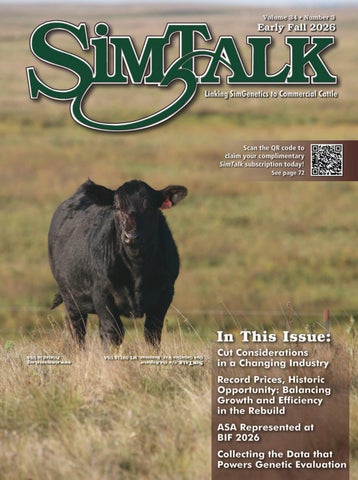
A SimGenetics female at the Lazy C Diamond Ranch near Kintyre, North Dakota. Photo by Chris Nicholson.
9ST-Select Sires fp 4c.qxp_Layout 1 8/4/26 2:57 PM Page 1
ST_9-26 Masthead.qxp_Layout 1 7/31/26 11:46 AM Page 2
ASA Board of Trustees
Linking SimGenetics to Commercial Cattle published by ASA Publication, Inc.
One Genetics Way, Bozeman, Montana 59718 USA 406-587-2778 fax: 406-587-9301 www.simmental.org email: register@simmgene.com
Canada Publications Agreement Number: 1875183
ASA Publication, Inc., Board of Trustees
Scott Trennepohl, Chairman Greg Burden, Vice Chairman Ryan Thorson Chris Ivie Greg Walthall Dr. Jon DeClerck, Executive Secretary-Treasurer CEO Dr. Jon DeClerck Managing Editor Lilly Platts
Advertising/Editorial Coordinator Rebecca Price
Sales Manager Nancy Chesterfield
Media/Website Administrator Kathy Shafer
Design/Production Joel Coleman Jenna Haughian Gretchen Jensen
American Simmental Association
One Genetics Way, Bozeman, Montana 59718 USA 406-587-4531 fax: 406-587-9301 www.simmental.org email: simmental@simmgene.com
4
SIMTALK
Executive Committee Ryan Thorson, Chairman Scott Trennepohl, Vice Chairman Greg Burden, Treasurer Chris Ivie Greg Walthall Dr. Jon DeClerck, Executive Vice President North Central Region Tim Clark (2027) 1999 18th St NW Turtle Lake, ND 58575 701.799.7752 Timc@westriv.com Loren Trauernicht (2028) 901 E Pine Rd Wymore, NE 68466 402.230.0812 mtrauernicht@diodecom.net Chris Effling (2029) PO Box 23 Highmore, SD 57345 605.769.0142 keffling@gmail.com Chris Nicholson (2029) 6235 23rd Ave SE Kintyre, ND 58549 701.391.6904 CNN2005@hotmail.com
Western Region Chad Cook (2027) PO Box 174 Walsh, CO 81090 719.529.0564 bridlebitsimm@gmail.com Maureen Mai (2028) 427 Peaceful Way Bonners Ferry, ID 83805 208.660.2726 rymocattle@gmail.com Ryan Thorson (2028) 1725 Road 261 Glendive, MT 59330 406.694.3722 ryanthorson7@gmail.com Quin LaFollette (2029) 1476 Hwy 14A Powell, WY 82435 307.899.3553 Quin@Blacksummitcattle.com
Eastern Region Chris Ivie (2027) PO Box 264 Summertown, TN 38483 931.215.0316 iviejc@usit.net Mark Smith (2027) 304 Moeller Rd Picayune, MS 39466 601.310.6695 smith5785@bellsouth.net Brandi Karisch (2029) 648 Polly Bell Rd Starkville, MS 39759 225.717.3324 mbkcattle@gmail.com Scott Trennepohl (2029) 6591 W 625 N Middletown, IN 47356 765.620.1700 sttrennepohl@yahoo.com
South Central Region Victor Guerra (2027) PO Box 92 Linn, TX 78563 956.607.5515 vgg03@aol.com Greg Walthall (2027) 1051 NE 500 Rd Windsor, MO 65360 660.525.9921 gregwalthall@gmail.com Joseph Hensgens (2028) 136 Deer Park Ln Rayne, LA 70578 985.992.9119 joehensgens@yahoo.com Greg Burden (2029) 890 VZ CR 2205 Canton, TX 75103 405.780.0372 greg.gbcattle@gmail.com
9ST-River Creek Farms #1 of 2 fp 4c.qxp_Layout 1 8/4/26 2:58 PM Page 1
ST_9-26 From the Editor.qxp_Layout 1 8/4/26 11:46 AM Page 2
FROM THE EDITOR by Lilly Platts, managing editor
It is great to be sharing another issue of SimTalk with you! Summer flew by, and the ASA staff has been very busy at home in Bozeman, and across the country. In June, I had the pleasure of attending the Beef Improvement Federation (BIF) Symposium in Boise, Idaho. Part of my dad’s family settled in southern Idaho, and I have many memories of traveling to Bruneau to spend time with family friends. Being back in the high desert for a minute was really fun. I had a wild travel day on my way there, which made for a rough start to the first day. It was very much worth the trouble getting there, though. I have utilized BIF’s educational content for years now, and am so appreciative of the environment they have fostered. This year was jam-packed with useful information. BIF records and posts these educational talks, which I encourage you to check out. As a communicator, this event is a treasure trove of information. All of the educational talks apply to both the American Simmental Association’s breed-specific
Scan the QR code to learn about how SimGenetics fit into the Munger family’s operation.
audience, and the larger commercial industry. I draw on the information throughout the year, and beyond. For example, this issue of SimTalk features a story based on a 2025 BIF presentation. I bookmarked Dr. Trent Schwartz’s talk on beef processing in relation to increased carcass size, and finally decided to write an article about it. Dr. Schwartz, who led a tour of the new meat lab at West Texas A&M University during ASA’s 2024 Fall Focus event, shared about what is changing in relation to beef processing as carcass size increases. He covered the history of beef processing, and moved into how different cuts are changing as carcasses get bigger. Carcass size is a frequent topic today, and not always a positive one. I found it interesting that Dr. Schwartz didn’t just identify challenges; he also pointed to opportunities that could come from this trend. This issue also features an article from Dr. Elizabeth Dressler, ASA Lead Geneticist, about data collection in relation to the International Genetic Solutions Multibreed Genetic Evaluation. Whether you operate a seedstock business or are running commercial cows, data is at the core of every decision. Dr. Dressler reminds us that while genomics and other advancements are accelerating genetic progress, real phenotypes cannot be replaced. Commercial producers can play a major role in data collection, and ASA has programs available for progressive operations wanting to fully harness this information. Dr. Jon DeClerck, ASA EVP, wrote an article about the US cow herd inventory and rebuilding opportunities for a spring issue of the Register. His evaluation of the current situation and opportunities applies throughout the industry, so I wanted to share it in this publication as well. As I write this, ASA staff is in the final month of planning for the 2026 Fall Focus event. This year we are gathering in Bozeman, Montana, at ASA’s national headquarters. One of the first ASA events I attended was the 2018 Fall Focus event, and I am really excited to be returning to our home base. This year ’s event features a Montana Simmental Association showcase, day-long educational symposium, and ASA Board of Trustees meeting. Pairing this event with the fall board meeting gives members and producers an opportunity to interact with leadership and participate in conversations. Fall Focus rotates throughout the country in partnership with state Simmental associations, and the 2027 event will be held in Sioux Falls, South Dakota. The next issue of SimTalk will feature the 2026 Performance Advocate feature, so please keep an eye out. I hope everyone has a great start to fall!
ST 6
SIMTALK
9ST-Cow Camp Ranch fp 4c.qxp_Layout 1 8/4/26 2:59 PM Page 1
9ST-Circle Ranch 2pg 4c.qxp_Layout 1 8/4/26 3:00 PM Page 2
9ST-Circle Ranch 2pg 4c.qxp_Layout 1 8/4/26 3:00 PM Page 3
ST_F_Cut Considerations in a Changing Industry.qxp_Layout 1 8/4/26 11:39 AM Page 2
Cut Considerations by Lilly Platts
Changing Industry
The processing and utilization of beef carcasses has changed significantly in the last 50 years. Technology, transportation, and consumer demand are just a few of the things that have shaped how finished carcasses are cut and processed. Finished weights—and the continual push for larger cattle—are a current challenge for the industry, with efficient utilization being a concern. Larger carcasses will make it more difficult to cut and utilize some standard cuts, but it also presents an opportunity to better utilize other cuts and even find new ones.
D
r. Trent Schwartz, assistant professor of animal science at West Texas A&M University, shared about the history of beef processing in the United States and considerations for how to best utilize the larger carcasses that are becoming standard during the Beef Improvement Federation’s (BIF) 2025 Symposium. Into the 1950s, a large portion of the population processed meat in the home. In the 1960s, a more centralized system started taking shape, with a focus on processing beef on a larger scale. During this time, a 600-pound carcass was common. Both size and processing methods have changed significantly today. “You
wouldn’t see the big weights that we’re seeing now. A 600-pound carcass was more likely to be found. If we walked into the cooler today, we probably would not find the 600-pound carcass,” Schwartz said. “And then again, home processing today is less than 1%. It’s not very common.” In-store cutting was the next evolution. Whole carcasses were loaded on refrigerated trucks and shipped to grocery stores. Skilled meat cutters in grocery stores would process beef on-site. This created the issue of selling all of the cuts that come from an individual carcass. This was a daily issue that became increasingly challenging during holidays when cuts like prime rib are in high demand. “If they brought in ten sides to cut for that week, and on day one they sold out of prime rib, guess what? Everybody else is out of luck,” Schwartz explained. “So we had to move away from that system because we weren’t getting the products we needed.” In the 1970s and 1980s, boxed beef became standard, with subprimals cut to fit in shippable boxes. For retailers, being able to purchase different portions of each cut of beef was revolutionary. Skilled meat cutters were no longer in demand for most grocers. Some stores still cut specialty steaks and other high-end cuts in-store, but whole beef carcasses were no longer processed on-site. “You would be hard-pressed today to have a local grocery store that has a skilled butcher who knows how to cut in the back of the house,” Schwartz shared.
Below: The ribeye is one of the most popular cuts of beef. As finished weights continue increasing, cutting the ribeye roll into steaks of a desirable size and thickness is becoming more challenging. Opposite: Larger finished cattle are presenting challenges during processing, but may also offer new opportunities to identify other desirable cuts.
10
SIMTALK
ST_F_Cut Considerations in a Changing Industry.qxp_Layout 1 8/4/26 11:39 AM Page 3
A whole beef can be broken down differently, and how this is done dictates if the carcass is utilized to its fullest potential. A whole beef can be broken down differently, and how this is done dictates if the carcass is utilized to its fullest potential. What Schwartz considers “old school” cutting, or using a bandsaw to break the carcass up into large roasts and steak sections, doesn’t fully optimize the carcass. “There’s no extra cuts that you’re pulling — think ribeye, New York strip, sirloin, and tenderloin. You’re going to get roast from the quarters. And in a lot of cases, thin meats are cut up and thrown into ground beef,” Schwartz explained. “The consumer we have today does not want this. They want the specialty cuts, and if they’re going to the mom-and-pop shop, they don’t want these massive bone-in roasts to take home and have to try to figure out how to cook. The generation we have now, if you gave them that, they wouldn't know what to do with it.” Boneless cutting is now the most popular method. Grocers, restaurants, and consumers prefer a boneless ribeye over bone-in, for example. There is still debate, however, over the most reasonable and desirable method. Among small processors, the more traditional method is standard. In large plants, the more intricate “fabrication” method allows for the best utilization of a carcass, and best meets mainstream consumer demand. Large hanging weights are a major consideration for how a carcass is processed today. Schwartz shared that a 900-pound carcass is now common, and that this will continue to trend upward. The bigger these carcasses get, the larger the specialty cuts are, too. Figuring out how to process cuts like ribeye will be important since a larger surface area will lead to a thinner steak, which isn’t desirable. “We’re having to get a lot more creative on how we cut these steaks, and we’re having to sort ribeye rolls and strip loins in a more progressive manner to get them to the ounce requirements that [grocers and food service] need on their menu,” Schwartz said. While bigger carcasses mean more product, the nation’s historically low cow herd inventory still means there could be a strain on production. “We have to get better at breaking these cattle down. We have a reduced cattle population. We have to utilize them in the best possible manner,” Schwartz explained. New technology will be essential in better utilizing each carcass. 3D imaging is an emerging technology in the industry, and while Schwartz shared that it will be some time before it can be utilized at scale, it could be promising. For example, cattle could be scanned and sorted based on the cuts they are best suited for. Currently, large processors are using new technology to
better portion cut beef, which has greatly reduced waste. “I can take a slab out of a sirloin, put it on the belt, and the machine will scan it,” Schwartz explained. “And if I need to produce six-, eight-, ten-, and twelve-ounce sirloin steaks, it will scan it, run it through the portioner, and cut the steaks best fit to optimize those settings. Then it will sort those ounce requirement steaks at the end of the chain into sixes, eights, tens, and twelves.”
Currently, large processors are using new technology to better portion cut beef, which has greatly reduced waste. The strip and ribeye roll present challenges in this system as carcasses get larger. Schwartz shared that breaking down other cuts will not be an issue with larger carcasses. Restaurants offer ribeye and New York Strip steaks at standard weights, but these subprimals cannot be cut to a desirable thickness if the surface area is too large. (continued on page 12)
SIMTALK
11
ST_F_Cut Considerations in a Changing Industry.qxp_Layout 1 8/4/26 11:40 AM Page 4
Cut Considerations
Changing Industry
(continued from page 11)
While some subprimals can be cut differently to still fit in the standard portions, the ribeye roll cannot simply be cut down the middle. The spinalis dorsi, or ribeye cap, is the most desirable part of the cut. If a meat case was filled with ribeyes and half didn’t have the cap, consumers would be unhappy. Some specialty sellers have started selling the cap separately, at a very high price. The remainder of the ribeye can be marketed differently as well. Another potential solution is to consider other highquality cuts that don’t currently have the same clout as the ribeye or strip. “I preach that we have to do more creative things with the chuck. There are so many good cuts of beef, especially steaks that come from the chuck. And most of the time, they end up as a roast or ground beef,” Schwartz said. The chuck roll, which can yield the chuckeye for example, is rarely sold in grocery stores but is called the “poor man’s ribeye” because of the marbling and tenderness of the cut. This cut doesn’t present the same size challenges with increasing carcass size, and could become a new menu item if the system shifted. Consumers often learn about cuts of beef, and place value on them, based on food service experiences. What restaurants put on a menu influences consumer choice, and Schwartz shared that education in this space could
12
SIMTALK
help expand demand for other cuts. For example, the flatiron, which is a tender, affordable cut, could find its way to more menus and grocery store shelves.
Larger carcasses present challenges, as well as potential. Larger carcasses present challenges, as well as potential. A bigger tenderloin, for example, is seen as a positive throughout the industry. Other cuts are also being utilized more efficiently since size has increased. “The tri-tip, the bottom flap, bottom sirloin flap, and the ball tip are sections of the loin that would not have been even utilized 20 years ago,” Schwartz explained. With Beef Checkoff funding, Schwartz and his team are studying minor cuts of beef in relation to carcass size, with the goal of finding more options for consumers and the export market. “For the longest time we have looked at carcass size as a bad thing, and we’ve evaluated all the things that get worse as carcass size increases,” Schwartz said. “This is the first instance that I can think of where a project has been funded to look at what a big carcass does better.”
ST
9ST-Clear Springs Cattle fp 4c.qxp_Layout 1 8/4/26 3:01 PM Page 1
9ST-ASA IGS Trust the Original (Grant) fp 4c.qxp_Layout 1 7/31/26 11:30 AM Page 1
9ST-Illini Elite Sale (Rincker) fp 4c.qxp_Layout 1 8/4/26 3:01 PM Page 1
ST_F_Record Prices, Historic Opportunity - Balancing Growth and Efficiency in the Rebuild.qxp_Layout 1 8/4/26 11:41 AM Page 2
Record Prices, Historic Opportunity: Balancing Growth
Efficiency
Rebuild
by Dr. Jon DeClerck, ASA EVP
If there is one word that defines the cattle business right now, it is opportunity. After several years of drought-driven liquidation and supply chain disruption, the US beef cow herd now sits below 28 million head, the smallest inventory since the early 1960s. At the same time, cattle prices are not just strong, they are setting records. The signal from the marketplace is clear: there is real opportunity for expansion.
B
ut this rebuild will not look like the last one. Elevated interest rates and drought uncertainty are slowing expansion, but they are also creating an opportunity to rebuild more deliberately. Producers now have tools to make smarter genetic decisions than ever before. Over the last six decades, carcass weights have climbed by roughly 4.8 pounds per year, enabling three steers to now generate the amount of red meat that once required four. But mature cow size has also climbed roughly 7.7 pounds per year, bringing higher maintenance requirements and long-term cost implications (Peel, 2024). The next rebuild will not be about replacing numbers. It will be about producing more beef with fewer cows. That means capturing growth where the market rewards it while maintaining cows that fit real-world production systems. The sustainability of the next cattle cycle is being written in the breeding decisions made today.
16
SIMTALK
Efficiency Still Pays The appeal of larger cows is understandable. In many seedstock systems, bigger cows often generate the growth-oriented sires that command a premium on sale day. But for commercial cow-calf producers operating in forage-based environments, the economic reality can be very different. Research helps quantify that trade-off. Lalman et al. (2019) reported that each additional pound of mature cow weight produced only about 0.06 lb. more calf weaning weight. In practical terms, a cow that weighs 100 pounds more at maturity may wean just six additional pounds of calf, often not enough to offset the added annual forage required to maintain the larger female, even during historically strong calf markets. Larger cows consume more forage, increase winter feed costs, and reduce management flexibility during drought cycles. Moderate-framed cows, by contrast, frequently wean a higher percentage of their body weight and tend to remain in production longer. This balance between performance and long-term efficiency is precisely what the All Purpose Index ($API) was designed to address. During herd rebuilding, selecting replacements that convert forage into pounds of calf, rather than simply increasing mature cow weight, becomes a critical driver of sustainable profitability.
ST_F_Record Prices, Historic Opportunity - Balancing Growth and Efficiency in the Rebuild.qxp_Layout 1 8/4/26 11:42 AM Page 3
The US cow herd inventory is currently at its lowest level since the early 1960s. Efficiency is more important than ever, with cows being asked to produce more with the same resources.
The Pressure for Growth Is Not Going Away Meanwhile, downstream market forces continue to reward added performance. One of the most consequential shifts in modern beef production has been the rapid rise in fed cattle carcass weights. With hot carcass weights increasing more than 20 pounds in 2024, and another 24 pounds in 2025, the industry has effectively added nearly one billion pounds of beef annually, the equivalent of harvesting roughly two million additional cattle without expanding the national cow herd (LMIC, 2024). But added pounds come with biological trade-offs. Genetics that drive carcass performance can also increase mature cow size and long-term maintenance costs if selection is not managed intentionally.
New Traits Allow More Intentional Selection Today’s breeders have more tools than ever to manage the balance between performance and long-term cow herd efficiency. The release of Mature Weight (MW), Cow Energy Requirement (CER), and Heifer Pregnancy (HP) EPD provide producers with clearer insight into how growth genetics translate into real-world production outcomes.
To learn more about the new Mature Weight (MW), Cow Energy Requirement (CER), and Heifer Pregnancy (HP) EPD please scan the QR code.
While growth traits and mature size remain strongly correlated, the relationship is not absolute (Smith et al., 1994). This creates opportunity. The goal is not to avoid selecting for performance, but to manage its long-term consequences more strategically. Sex differences often matter in how traits are expressed phenotypically. Biologists refer to this as sexual dimorphism. In cattle populations, some lines of genetics may generate more growth in male calves, adding pounds and market value, while producing heifers that develop into more moderate, cost-efficient cows. In practical terms, this reinforces the importance of balanced selection. Tools like the Terminal Index ($TI) allow producers to emphasize growth and carcass merit where the market rewards it, while MW and CER help ensure retained females remain functional within forage-based production systems. At the same time, HP strengthens the ability to build fertility and longevity into the next generation of cows, critical advantages during a rebuilding phase. Cattle that rank favorably for both $API and $TI may represent the kind of “curve-bending” genetics needed in today’s industry. Strategic use of these tools allows producers to generate pounds where they are paid for without building cows that outgrow their environment.
Structured Crossbreeding Drives Reproductive Efficiency Few strategies can improve whole-herd productivity as quickly as structured crossbreeding. At its core, the International Genetic Solutions (IGS) philosophy recognizes that breeds are not competitors — they are crossbreeding partners. When breed strengths are combined intentionally, heterosis becomes a true game-changer. (Continued on page 18)
SIMTALK
17
ST_F_Record Prices, Historic Opportunity - Balancing Growth and Efficiency in the Rebuild.qxp_Layout 1 8/4/26 11:42 AM Page 4
Record Prices, Historic Opportunity: Balancing Growth
Efficiency
Rebuild
(Continued from page 17)
Research from the US Meat Animal Research Center shows that crossbred cows can produce 20–25% more lifetime pounds of calf than straightbred females, driven by improvements in fertility, calf survival, and longevity (Cundiff et al., 1992; Ritchie and Troxel, 2007). High cattle prices make rebuilding easier, but they can also make mistakes more expensive. The replacements retained in this cycle will likely still be in production when the market softens. Producers who leverage heterosis, building herds around reproductive efficiency and longevity, will be positioned to remain profitable, while others may simply be trying to survive.
A Strategic Reset for the Cow-Calf Sector The drought conditions affecting large portions of cattle country may slow the pace of herd expansion compared to previous cycles. Higher interest rates and forage uncertainty are already encouraging more cautious rebuilding decisions. That may ultimately prove beneficial. This time, producers have better tools and better genetics to rebuild with intention. The heifers retained over the next several years will shape herd efficiency and profitability for the next decade. Producers who focus on balanced selection, using tools like Mature Weight (MW), Cow Energy Requirement (CER), Heifer Pregnancy (HP), $API, and structured crossbreeding can position their operations to excel in an environment that demands more production from fewer cows. Rebuilding the national cow herd is largely inevitable. The real question is whether it rebuilds better. CattleFax. 2025. Market outlook and price trend commentary. CattleFax, Centennial, CO. Cundiff, L. V., R. Núñez-Domínguez, G. E. Dickerson, K. E. Gregory, and R. M. Koch. 1992. “Heterosis for lifetime production in Hereford, Angus, Shorthorn, and crossbred cows.” Journal of Animal Science 70:2397– 2410. Lalman, D. L. 2019. “Balancing scale: Matching genetics to forage resources.” Drovers. Livestock Marketing Information Center (LMIC). 2024. “U.S. fed cattle carcass weight trends and beef production implications.” LMIC, Lakewood, CO. Peel, D. S. 2024. “Why bigger cows aren’t the only reason for record carcass weights.” Drovers. Ritchie, H. D., and T. C. Troxel. 2007. “Crossbreeding systems for beef cattle.” Michigan State University Extension. Smith, G. M., L. V. Cundiff, and K. E. Gregory. 1994. “Characterization of biological types of cattle. II. Postweaning growth and puberty of heifers.” Journal of Animal Science 72:1962–1977.
Crossbreeding will play an important role in future herd rebuilding. Photo by Chris Nicholson.
18
SIMTALK
ST
9ST-Bulls of the Big Sky fp 4c.qxp_Layout 1 7/31/26 11:39 AM Page 1
ST_F_ASA Represented at BIF 2026.qxp_Layout 1 8/4/26 11:32 AM Page 2
ASA
at
by Lilly Platts
The American Simmental Association was well represented at the 2026 Beef Improvement Federation Symposium (BIF) held in Boise, Idaho. More than 400 beef producers, academics, and industry representatives attended the event. BIF’s mission is to help improve the industry by promoting greater acceptance of beef cattle performance evaluation. Dr. Ken Odde began his term as president of the BIF Board of Directors. Odde works closely with ASA as a SimSpecialist, and currently leads the Feeder Profit Calculator program. Odde and his wife, Arlene, run a commercial SimAngus cow herd near Pollock, South Dakota. Odde has been involved with the Simmental breed for many years, participating in research, interviews, and industry events. Gordon Hodges, a past member of the ASA Board of Trustees, served as president of the BIF Board of Directors last year, and will continue serving the organization. Dr. Ryan Boldt, International Genetic Solutions Lead Geneticist, will continue serving as a breed association representative. Dr. Jackie Atkins and Steve McGuire received awards from BIF. Atkins, ASA Director of Science, received the Continuing Service Award. She has been deeply engaged with BIF, serving two terms on the Board of Directors as a breed representative. She has consistently championed research and innovation, advancing the industry’s understanding of economically relevant traits and strengthening the tools available to producers. Just as importantly, she is committed to developing people, investing her time in mentoring others and fostering both personal and professional growth across the industry. Through her leadership within International Genetic Solutions (IGS), Dr. Atkins has been a steady advocate for collaboration across breed lines, helping align diverse organizations around a shared mission of improving the accuracy and relevance of genetic predictions. In an industry where independent interests can often compete, she has worked to foster cooperation, recognizing that collective data and shared science create stronger outcomes for all.
20
SIMTALK
Dr. Atkins has played an important role in facilitating communication among IGS partners, helping maintain alignment across a broad network of associations spanning multiple breeds and countries. Her ability to connect people, navigate differing perspectives, and reinforce the broader purpose of the work has been central to the continued success and growth of the IGS platform. As Director of Science for the American Simmental Association, Dr. Atkins has also provided leadership across genetic evaluation, DNA programs, and research initiatives. During her tenure, ASA has continued to advance its genetic tools and strengthen its position as a leader in multi-breed evaluation. Continuing Service Award winners have made major contributions to the BIF organization. This includes serving on the board of directors, speaking at BIF conventions, working on BIF guidelines and participating in other behind-the-scenes activities. As BIF is a volunteer organization, it is this contribution of time and passion for the beef cattle industry that moves BIF forward.
Atkins and current BIF President, Dr. Ken Odde.
ST_F_ASA Represented at BIF 2026.qxp_Layout 1 8/4/26 11:32 AM Page 3
McGuire and BIF President, Gordon Hodges.
Steve McGuire received the Pioneer Award. In 1973, McGuire was hired by Don Vaniman to computerize ASA’s growing data system. Still in school at Montana State University, McGuire worked part-time for two years until he graduated with a degree in engineering, and then became a full-time employee. In 1975, McGuire was placed in charge of databasing, registrations, and
computer systems. McGuire went on to have a 46-year career at ASA, where he was involved in every major technical advancement in the Association’s genetic evaluation program, from its inception through the evolution of International Genetic Solutions. Early in McGuire’s career, ASA was one of the first to begin using computers. Punch cards were flown to Boeing Aircraft weekly to process, which was a major undertaking for McGuire and the ASA staff. Under Earl Peterson’s leadership, the computer system was moved in-house. McGuire led these efforts, which positioned ASA as a leader in data management. McGuire continued keeping ASA’s data management and genetic evaluation efforts at the forefront of the industry, leading a team and guiding critical decisions for decades. Before retiring, McGuire was at the helm of moving the International Genetic Solutions (IGS) evaluation to a pooled weekly analysis. With IGS partner breeds in the evaluation, this process involved developing a universal numbering system, and a portal to automatically upload data from each association every week. The Pioneer Award recognizes individuals who have made lasting contributions to the improvement of beef cattle and honors those who have had a major role in acceptance of performance reporting and documentation as the primary means to make genetic change in beef cattle.
The Simmental breed was well represented by staff, members of the ASA Board of Trustees, and industry partners. Pictured left to right: Chip Kemp, 701X; Dr. Brandi Karisch; Dr. Jackie Atkins; Dr. Lane Giess, Zoetis; Dr. Elizabeth Dressler; Steve McGuire; Molly Diefenbach; Dr. Ryan Boldt; Kathy Shafer; John Irvine; Jacki McGuire; Dr. Jon DeClerck; Lilly Platts; Quin LaFollette; and Dr. Wade Shafer.
ST SIMTALK
21
9ST-ASA Stay Ahead Stay Connected fp 4c.qxp_Layout 1 7/31/26 11:37 AM Page 1
9.26 Wells Farm fp 4c.qxp_Layout 1 7/31/26 11:51 AM Page 1
Semen available from owner.
WF Bitcoin J2 EXTREME CALVING EASE EXTREMELY DOCILE BULL AND PROGENY
Bitcoin bull calf
EXTREME BUYER ACCEPTANCE EXTREMELY EASY-KEEPING,
WELL-MUSCLED, AND LARGE VOLUME CATTLE
EXTREMELY CONSISTENT
Bitcoin heifer
CALVES OVER A THREE-YEAR PERIOD
WELLS FARM
Mike Wells Huntsville, AL 35741 334-412-2280 wellsfs@yahoo.com
ST_F_Collecting the Data that Powers Genetic Evaluation.qxp_Layout 1 8/4/26 11:35 AM Page 2
Collecting
Data
Powers
Genetic Evaluation
by Dr. Elizabeth Dressler, ASA Lead Geneticist
As rapidly as technology is advancing, it might be tempting to think that genetic progress happens automatically, somewhere behind the scenes without you. But that is far from the truth. While genomics and advanced statistical models used by International Genetic Solutions (IGS) help accelerate genetic progress, those technologies can’t create it on their own. Every genetic evaluation still depends on one thing: phenotypes. The real-world performance of real cattle reported by real cattle producers, both seedstock and commercial.
• Phenotypes anchor genomic predictions. In the era of genomics, phenotypes are even more important. DNA information (SNP markers) are only meaningful if we know what effect they have on actual animal performance. If we stop recording phenotypes today, our genomic “map” will quickly become outdated. We can’t have genomics without phenotypes. • You can’t improve what you don’t measure. It’s a fundamental law of animal breeding. Without phenotypes, you’re “eyeballing” your way toward genetic progress, which is slow, inefficient, and expensive. To get where you want to go, you must first assess where you are currently.
Data Collection Opportunities this Fall The Role of Phenotypes in Genetic Evaluation Collectively, member-reported data supplies the genetic evaluation system with the information necessary to calculate expected progeny differences (EPD). Every phenotype reported adds another piece to the puzzle. In other words, EPD aren’t just something that gets delivered back to you. They’re something that you help build. • Phenotypes are the evidence that power EPD. An EPD is a prediction of future progeny performance. The evidence backing that prediction is the reported performance of relatives, the individual animal itself, eventually its progeny. As more data points are reported, the accuracy of that animal’s EPD improves, meaning you can feel more confident in your breeding decisions.
24
SIMTALK
As fall data collection approaches for spring-calving herds, several traits deserve particular attention due to recent updates and new EPD releases.
Docility
You are likely already planning on reporting weaning weights, but do you plan to report docility scores? While approximately 60% of animals reported to ASA have a weaning weight, only about 20% have a docility score. The docility evaluation was updated in April 2026 as part of an ongoing series of updates to the IGS genetic evaluation. As more breeders place greater emphasis on docility in selection decisions, reporting docility phenotypes is becoming increasingly important to maintain and improve the accuracy of docility EPD. Information on the docility genetic evaluation updates and how to collect docility scores is available on the ASA website.
ST_F_Collecting the Data that Powers Genetic Evaluation.qxp_Layout 1 8/4/26 11:35 AM Page 3
Above: With the release of the new Heifer Pregnancy EPD, THE dam inventory reporting is more important than ever. Photo by Chris Nicholson. Opposite: Phenotypes and real-world performance data are the foundation of genetic progress. Photo by the Grant Company.
A few tips for collecting docility scores: • It is important to collect docility scores on the entire calf crop at the same time. So, collect a docility score on your entire calf crop this fall during weaning, instead of collecting some at weaning and others at yearling. • Since docility is subjectively measured, consistency in scoring is very important. The same person should score all animals. • It is not likely that every single animal should score a 1. There should be some variation in docility scores among a group. Scores should be reported without worry that one poor score will have a drastic negative effect on a sire’s docility EPD. This fall during weaning, why not also collect and report a docility score in addition to a weaning weight? Let’s see if we can increase the percentage of animals reported to ASA with a docility phenotype from 20% to 25%, 30%, or higher!
Mature weight
Released in February 2026, the mature weight (MW) EPD and cow energy requirement (CER) EPD are new tools that breeders can use to evaluate cow size and efficiency. Collecting and reporting mature cow weights will increase the accuracy of the MW and CER EPD for your animals while continuing to add valuable data to the genetic evaluation. It is critical that mature cow weights are taken at the right time. Cow weights must be taken within 45 days of weaning a calf. Collecting weights at a standardized
point in the production cycle helps reduce non-genetic differences in mature cow weights. Because the MW EPD is now available for ASA members, this fall is the perfect opportunity to begin submitting MW phenotypes for your herd. Submitting MW phenotypes continues to add valuable data, which fuels the genetic evaluation generating this new EPD.
Heifer pregnancy
The release of the heifer pregnancy (HP) EPD this May is another step forward in the development of genetic selection tools for maternal traits. The HP EPD characterizes differences in the percentage of daughters that become pregnant during their first breeding season as heifers. Development of this EPD wouldn’t be possible without the data submitted by ASA breeders through the Total Herd Enrollment (THE) program. THE is a dam inventory program that facilitates data reporting on complete contemporary groups. If you are not already a participant, more information about the THE program can be found on the ASA website. For spring-calving herds, THE enrollment opens on October 15 for the following spring calving season. It is vitally important that dams are properly enrolled in THE and that productivity and removal codes are used correctly. It is the data submitted through THE that makes it possible to to calculate maternal EPD, including stayability and HP. (continued on page 26)
SIMTALK
25
ST_F_Collecting the Data that Powers Genetic Evaluation.qxp_Layout 1 8/4/26 11:35 AM Page 4
Collecting
Data
Powers Genetic Evaluation
(continued from page 25)
This fall, there may be an opportunity to collect one more trait than you have typically done in years past. Breeders committed to the phenotype reporting that fuels the genetic evaluation for 14 high-priority traits are recognized as Performance Advocates. You can check your progress toward earning performance advocacy status on your Herdbook account online.
Genetic progress doesn’t originate in Bozeman, Montana, at ASA’s headquarters. Genetic progress begins on the ranch with the collection and reporting of the critical phenotypes that fuel the genetic evaluation.
Total Herd Enrollment — Commercial Option ASA’s Total Herd Enrollment (THE) Commercial Option is designed specifically for serious commercial beef operations. Enrolling in THE gives commercial producers the opportunity to report data, and in return receive Expected Progeny Difference (EPD). Understanding the genetic merit and potential of individual animals accelerates genetic progress, and helps producers make critical selection and mating decisions. For a flat fee of $500, regardless of herd size, commercial producers can utilize the full suite of management tools available through Herdbook.org. To learn more, visit simmental.org.
Performance Advocate Program Each fall, ASA’s Performance Advocate Program recognizes Simmental breeders who go above and beyond in collecting and reporting data. These producers not only utilize this in-depth data reporting and analysis on their own operations, but also play a critical role in the larger International Genetic Solutions Multi-breed Genetic Evaluation. From calving data to mature cow weights and cow herd genomics, these producers are committed to utilizing data and providing their customers with the most accurate EPD possible. The 2026 Performance Advocates will be recognized in the Late Fall issue of SimTalk.
ST
26
SIMTALK
9.26 APEX Cattle fp 4c.qxp_Layout 1 7/31/26 11:20 AM Page 1
ST_9-26 Industry Update.qxp_Layout 1 8/4/26 12:10 PM Page 2
INDUSTRY UPDATE Cattle on Feed Up; Beef Production Down by Derrell S. Peel, Oklahoma State University Extension The June Cattle on Feed report showed a feedlot inventory 2.1% larger year-over-year. This was the second consecutive month of larger feedlot totals — May was up 1.8% year-over-year — after 17 months of yearover-year decreases in cattle on feed inventories. However, a bigger feedlot total does not mean that cattle numbers are increasing. Feedlot inventories increased year-over-year in May and June because feedlot marketings have decreased more than feedlot placements. In the past 12 months, feedlot placements have decreased 6.1% while feedlot marketings have decreased 7.8%. Figure 1 shows that average feedlot placements and marketings have decreased sharply in recent months.
late 2016. Total beef production is projected to be down 4.5–5% in 2026 compared to last year, and is expected to decrease again in 2027 to the lowest beef production since 2015 (Figure 2).
The Current Cattle Market Offers Opportunity to Build Working Capital
The 2025 calf crop was the eighth consecutive smaller calf crop, and was the smallest in 84 years. The resulting slowdown in feedlot production, while maintaining feedlot inventories, is accomplished by an increase in average feedlot days on feed and heavier final weights for fed cattle. The Kansas Focus on Feedlots data shows an average of 188 days on feed for the last year, with recent months up to 198 days. Final fed steer weights in Kansas feedlots have increased 105 pounds in the past 18 months, currently averaging 1,523 pounds. Lower feedlot production means declining cattle slaughter and beef production. Fed cattle (steer and heifer) slaughter in the first half of 2026 is down 8.7% year-over-year. Decreased fed cattle slaughter is partially offset by increased carcass weights. Steer carcass weights are currently at 968 pounds. Steer carcass weights have averaged 35 pounds heavier thus far in 2026. Heifer carcass weights are currently 884 pounds, and are averaging 26.6 pounds more than one year ago. Cow slaughter is down 5.3% this year, leading to total cattle slaughter down 8.1% for the year to date. Total beef production is down 5.5% year-over-year through the first half of 2026. Average fed beef production is currently at the lowest level since 2017, and average nonfed (cull cow and bull) beef production is now at the lowest level since 2006. Average monthly commercial beef production is at the lowest level since
by Jonathan Shepherd and Kenny Burdine, University of Kentucky Extension Strong cattle prices are giving cow-calf producers a rare window to strengthen their financial position. While every operation will respond differently, producers should aim to look back on this period and feel confident about the decisions they make. The financial formula for working capital is current assets minus current liabilities. In simple terms, it refers to the amount of readily available assets beyond what is needed for short-term obligations. Current assets include cash and marketable commodities (livestock, grain, etc.) that can be converted to cash quickly. A farm business should always have at least enough current assets to cover current liabilities, and depending on the type of business, as much as two to three times the current liabilities may be recommended. When the opportunity presents itself, there are substantial benefits to growing working capital beyond just meeting typical current liability needs. A few of these benefits are discussed briefly below.
With stronger working capital, producers can pay cash for expenses instead of relying on operating loans. This reduces interest costs, which is a valuable advantage in today’s higher-rate environment. The current environment also offers more attractive returns on working capital kept in liquid investments such as money markets and high-yield savings accounts. Building increased working capital can also have financial benefits by improving the financial position of the operation. As working capital increases, the farm’s current ratio (current assets divided by current liabilities) continued on page 30
28
SIMTALK
9ST-ASA Pub Sale Packages - Built for Seedstock Producers fp 4c.qxp_Layout 1 8/4/26 3:53 PM Page 1
• 2 full-page ads placed in the Register and/or SimTalk • Business card ad placed in the Register or SimTalk • 1 eBlast • Included in weekly Sales Call email and simmental.org • Sale catalog included on simmental.org
• 1 full-page ad and 1 halfpage ad placed in the Register and/or SimTalk • Business card ad placed in the Register or SimTalk • 1 eBlast • 1 Facebook ad • Included in weekly Sales Call email and simmental.org • Sale catalog included on simmental.org
• 1-full page ad placed in the Register or SimTalk • Business card ad placed in the Register or SimTalk • 1 eBlast • 1 Facebook ad • 1 banner ad placed on the ASA website • Included in weekly Sales Call email and simmental.org • Sale catalog included on simmental.org
ST_9-26 Industry Update.qxp_Layout 1 8/5/26 10:55 AM Page 3
INDUSTRY UPDATE RAISING CATTLE IS AS POLITICAL AS WASHINGTON D.C. Some feel it is all about the numbers. Some feel it is all about performance. Some feel it is all about the ribbons.
_áÖ pâó dÉåÉíáÅ pçìêÅÉ _ìää p~äÉ
cÉÄK=PI=OMOTI=NOWPM=mj= ~í=íÜÉ=ê~åÅÜI=táÄ~ìñI=jq Bill & Darlene Begger: 406-796-2326 John & Alicia Begger: 406-956-0151 ASA# 028998 482 Custer Trail Road Wibaux, MT 59353 darbegger@gmail.com johnpbegger@gmail.com At Begger’s Diamond V Ranch, we feel it is all about efficiency and profit. Our Black Simmental, SimAngus™ and Angus breeding program is a balanced approach that puts the cow/calf man first. You will find our homozygous black and polled cattle to be easy calving, easy fleshing, deep bodied, maternal, efficient, productive, and profitable. We pay attention to all the economically relevant traits that may or may not be measured by numbers alone. Our cattle are bred to withstand harsh environments and extreme temperatures.
When you invest in Begger’s Diamond V Ranch genetics you can expect eye-appealing, low-maintenance, moderateframed cattle with excellent maternal instinct, and udder quality, tolerable dispositions and cattle that have what it takes to weigh up at sale time and demand sale-topping prices. They will possess top feedlot performance and acceptable carcass values, and most importantly produce a tender, enjoyable eating experience for the consumer that knows very little about raising cattle. 30
SIMTALK
CONTINUED
improves. Holding all else constant, this makes the farm more attractive to lenders. An improved financial position can lead to increased borrowing opportunities and more attractive borrowing terms. Working capital also acts as a built-in risk management tool. By stockpiling some cash reserves during good times, the operation will be in a better position to weather the downtimes. When markets turn or costs rise, a financial cushion allows producers to ride out the downturn without taking on more debt. Just as importantly, it buys time to make thoughtful decisions instead of rushed ones. Time to process and evaluate options can be very important when dealing with financial stress. Working capital can also improve an operation’s ability to be opportunistic, which can be a key to growth over time. There will be times when ground comes up for sale that has always been wanted, a set of heifers is a good buy, or a piece of equipment is priced below what it is worth. The best operations positioned to take advantage of these opportunities are often those with strong liquidity, as they either have the cash to make the purchase or can quickly secure attractive financing. Working capital also serves as a baseline for long-run investment. A growing cowcalf operation typically sees lower income levels because they are selling fewer females or expanding through the purchase of cows or heifers. Working capital can be a source of funds to offset the reduction in heifer sales or the purchase of additional breeding stock. The same can be said of land acquisition and other investments in facilities and infrastructure. Having a pool of funds to draw from and/or leverage makes long-term investments much easier to approach. The current cattle market offers opportunities, and how an individual operation chooses to capitalize on them will depend on that operation’s goals. Some may choose to retire, while others may choose to expand. Some may make long-term investments, while others pay down debt. The purpose of this article was simply to focus on the benefits of increased working capital as a financial strategy. By building working capital today, the operation can be more prepared for the uncertainty of tomorrow.
A New Look at Embryo Freezing Could Improve IVF Outcomes in Cattle
by Andrea Bedford, Bovine Veterinarian An embryo can appear perfectly preserved after freezing. According to new research, the real damage may not occur until the moment it begins to thaw. Embryo vitrification has become a cornerstone of modern cattle reproduction, helping producers preserve valuable genetics, expand embryo transfer programs and accelerate genetic progress through in-vitro fertilization (IVF). Yet despite decades of refinement, pregnancy rates following embryo transfer remain inconsistent. New research suggests one reason may be hiding in plain sight. Scientists from Cornell University, Dr. Jingyue Ellie Duan and Dr. Robert E. Thorne, have found that the greatest threat to embryo survival may not occur during freezing, as many have long assumed. Instead, significant ice formation may occur during warming, damaging embryos that appeared successfully vitrified during cooling. The findings challenge a long-held assumption in cryopreservation and could lead to improved methods for preserving embryos, oocytes, and other reproductive tissues.
The goal of vitrification is simple: cool an embryo rapidly enough that water does not form damaging ice crystals. Instead of freezing into crystalline ice, the embryo enters a glass-like state that protects cells during storage in liquid nitrogen. continued on page 34
9ST-3C Christensen & NLC Simmental fp 4c.qxp_Layout 1 8/5/26 10:46 AM Page 1
9ST-ASA Americas Cow (Lone Black Cow) fp 4c.qxp_Layout 1 7/31/26 11:22 AM Page 1
9ST-Fred Smith Company Ranch fp 4c.qxp_Layout 1 7/31/26 11:40 AM Page 1
ST_9-26 Industry Update.qxp_Layout 1 8/4/26 12:14 PM Page 4
BRINK FULLBLOOD FLECKVIEH SIMMENTAL Top Performance
Brink Handle J1067 Herdsire
Brink Mel E781 (donor) Dam of Jr Herdsire Brink Pol Melbert N527
Contact us: Jerry Brink 23098 Gunder Rd Elkader, IA 52043 Jerry: 563-245-2048 Jerry cell: 563-880-1470 Preston cell: 563-880-2075
Email: jbrink@alpinecom.net
Website: Progeny Data www.brinkgenetics.com
Sale:
March 2027 Horned & Polled 18-month-Yearling Bulls and Females Semen & Embryos Available Year-Round
INDUSTRY UPDATE
CONTINUED
B ecause ice crystals can damage cellular structures, vitrification has become the preferred method for preserving embryos used in IVF and embryo transfer programs. For years, researchers focused primarily on preventing ice formation during cooling. Previous work, however, hinted that warming rates might play an equally important role. “The question then was: Are cryopreservation agent concentrations, cooling rates, and warming rates in current cryopreservation practice adequate to prevent formation of significant ice during both cooling and warming/thawing?” Thorne says. The question emerged from earlier work showing that the warming rates required to prevent ice formation are often dramatically higher than the cooling rates needed to achieve vitrification. In some cases, critical warming rates were found to be 100 to 1,000 times greater than critical cooling rates. That raised a troubling possibility: embryos could survive the freezing process without forming ice, only to sustain damage during warming. To answer that question, the team used time-resolved X-ray diffraction and highspeed imaging to observe what was happening inside bovine embryos during vitrification and warming. “ Using time-resolved X-ray diffraction and high frame rate imaging we showed that while significant ice did not form during cooling, nearly all the free water inside bovine oocytes crystallized during warming. Most of the ice-related damage occurred during warming,” Thorne explains. In other words, embryos that appeared successfully vitrified during freezing were still experiencing substantial ice formation during thawing. Current vitrification protocols rely on cryoprotective agents, specialized handling techniques, and rapid cooling to avoid ice crystal formation. The new findings suggest that even when those measures successfully prevent ice during cooling, embryos may remain vulnerable if warming occurs too slowly. According to Thorne and Duan, the warming phase may provide enough time for ice crystals to form as embryos transition out of the vitrified state. Those crystals can damage cellular structures and reduce post-thaw viability. This work builds on findings first reported by the team in 2024, strengthening evidence that warming-related ice formation may be a major source of cryopreservation injury. The findings could help explain why cryopreservation outcomes remain variable despite decades of improvements in embryo production and transfer technologies. Perhaps most importantly, the research challenges a common assumption about vitrification success. An embryo that appears completely ice-free after cooling may still undergo substantial crystallization during warming. If embryos sustain damage during thawing, even after a successful vitrification process, that injury could contribute to reduced survival rates and less predictable pregnancy outcomes following embryo transfer. The findings highlight warming as a potential target for improving reproductive success. The implications may be especially significant for dairy producers, who have become major users of IVF and embryo transfer technologies. “The dairy cattle sector would benefit the most from improved embryo vitrification since it has extensive use of IVF and embryo transfer in elite dairy cattle,” Duan says. Modern dairy breeding programs increasingly rely on IVF combined with sexed semen to accelerate genetic progress. Many operations also implant beef embryos into lower-tier dairy cows, producing beef-on-dairy calves that provide an additional revenue stream. Improving embryo survival after thawing could increase the efficiency and consistency of these programs while reducing losses associated with failed transfers. The researchers also see opportunities to improve the preservation and distribution of female genetics. “These methods should be particularly useful for preserving and propagating elite female genetics, thereby driving livestock improvements,” Duan says. continued on page 38
34
SIMTALK
9ST-M4 Simmentals fp 4c.qxp_Layout 1 8/4/26 3:03 PM Page 1
9ST-ASA Pub Catalog Posts on Website fp 4c.qxp_Layout 1 8/4/26 3:54 PM Page 1
9ST-New Day Genetics fp 4c.qxp_Layout 1 8/5/26 10:43 AM Page 1
ST_9-26 Industry Update.qxp_Layout 1 8/4/26 12:18 PM Page 5
INDUSTRY UPDATE
ASA# 251646 Mark Smith 1605 Hwy 11 North Suite A Picayune, MS 39466 601-310-6695
Email: smith5785@bellsouth.net
Sales: Carcass Performance Partners Bull Sale – 2nd Saturday in March 25th Annual Sale March 13, 2027 Gulf Regional Stockyard 157 Rocky Creek Road Lucedale, MS 39452 Simmental, SimAngus™, SimAngus™HT, Simbrah Bulls and Stocker Sale. Stockyard: 601-947-3352 or 601-947-6304 Moley 601-673-0273
Ranch Information:
Triple S Land & Cattle 304 Moeller Rd Picayune, MS 39466
CONTINUED
While superior male genetics can be widely distributed through semen, preserving and transporting elite female genetics remains more challenging. Improved cryopreservation could help expand access to those genetics while improving reproductive efficiency. Although dairy producers may be among the first beneficiaries, Duan and Thorne believe the same principles could improve outcomes in human fertility clinics and conservation programs focused on preserving endangered species. The project has roots outside reproductive biology and represents nearly two decades of work on cryobiology and cooling technology. Beginning in the mid-2000s, the team studied cryocooling techniques used in protein crystallography. Their work led to the development of specialized sample holders and methods for dramatically increasing cooling rates using liquid nitrogen. Because protein crystals and mammalian embryos share similar sizes and water content, researchers believed techniques developed for one field might benefit the other. In 2018, the team connected with the late Dr. Soon Hon Cheong of Cornell University’s College of Veterinary Medicine. “He suggested using the bovine model because its lipid content and success rates are intermediate between humans and swine,” Thorne remembers. Supported by USDA funding awarded in 2022, the collaboration ultimately led to the studies reported in 2024 and 2026. These researchers are not only identifying a problem; they also believe they have tools that may help solve it. “Using better sample holding technology can increase cooling and warming rates by a factor of three to five. Better cryocooling technology can increase cooling rates by an additional factor of ten. These allow completely ice-free cryopreservation of oocytes and embryos,” Thorne explains. Before those technologies can move into routine commercial use, additional work will be needed to adapt them to existing IVF and embryo transfer workflows. That includes refining sample holders, storage systems, and tracking procedures for industry applications. The team hopes to work with commercial users to determine how the technology can be integrated into real-world reproductive programs. This study highlights an important shift in thinking. Rather than focusing exclusively on what happens during freezing, researchers are increasingly asking what happens during warming. Thorne and Duan’s conclusion is direct: “Using current industry-standard vitrification solutions, cooling methods, and warming methods, ice always forms in your oocytes and embryos during warming, even when they appear ice-free after cooling. This ice is the main cause of sub-optimal cryopreservation outcomes.” Eliminating ice formation may also help researchers better understand other causes of cryopreservation injury, including protein and lipid damage.
Technologies to Improve Prediction of Beef Carcass Red Meat Yield SSS Redemption 670H
Mark Z. Johnson, Oklahoma State University Extension The United States Department of Agriculture (USDA) uses two distinct grades for beef carcasses. Quality Grades, based on marbling and maturity of the carcass, indicate the eating satisfaction (tenderness, juiciness, and flavor) of cooked beef. Yield Grades estimate the red meat yield (cutability) of a beef carcass. These grades enable differentiation of beef carcass quality and yield in the value transaction between producers and continued on page 42
38
SIMTALK
9ST-Bichler Simmentals fp 4c.qxp_Layout 1 8/4/26 3:03 PM Page 1
9ST-ASA Calf Crop Genomics fp 4c.qxp_Layout 1 7/31/26 11:26 AM Page 1
page 41.qxp_Layout 1 7/31/26 11:43 AM Page 3
SIMTALK
41
ST_9-26 Industry Update.qxp_Layout 1 8/4/26 4:41 PM Page 6
INDUSTRY UPDATE
CONTINUED
processors. Grading serves to establish the value of cattle and beef products in the market place.
Denny Cason 641-814-3332 Landon Cason 641-799-7350 ASA# 036712 2077 715th Avenue Albia, IA 52531
Sales: Fall Female Sale November 7, 2026 Spring Bull Sale March 6, 2027
Email: cdcason@sirisonline.com
Website: breedingcattlepage.com/ Simmental/dcason/ index.htm
T he USDA Yield Grade system was introduced in 1965. This system, based on a population of cattle that were small and early-maturing, determined cutability could be predicted based on external fat thickness, ribeye area, carcass weight, and the percentage of kidney, heart, and pelvic fat. Despite genetic and management advancements, the system has remained unchanged for over 60 years. The system’s inaccuracy is due to outdated models that do not account for modern cattle size, composition, and processing practices. Modern cattle are significantly larger, with carcass weights now similar to the live finished weights of cattle from the early 1960s. Advances in genetics and growth-promoting technologies have increased carcass size and altered composition. Accordingly, research shows that yield grades currently explain less than 35% of the variation in the true red meat yield of a modern beef carcass. Current premiums and discounts based on outdated yield grades no longer accurately reflect carcass value from the red meat yield aspect. There is a need for more precise, objective measurement tools that can operate at commercial speeds. Modern technologies and data analysis capabilities provide an opportunity to capture absolute measurements of carcass composition and modernize the yield grade system. Recent studies indicate technologies like 3D imaging, computed tomography (CT), and radar can accurately predict beef carcass cutability, explaining over 70–90% of variation in red meat. Processed CT data has been utilized to measure carcass cutability with near-perfect accuracy, but processing speed and carcass size remain as limitations with this technology. The timeline for when a new yield grading system will be in place remains to be determined, but validation of the technologies is happening at a rapid pace. Development of these tools is an industry priority as their implementation will modernize yield assessment, improve market signals, and enhance industry efficiency. The tools developed will be applicable to live cattle production and serve to inform management and genetic decisions made at the seedstock and cow-calf level.
Separating Common Myths from the Reality of Bovine Viral Diarrhea
by Andrea Bedford, Bovine Veterinarian Bovine viral diarrhea (BVD), caused by the bovine viral diarrhea virus (BVDV), is one of the cattle industry’s most economically important diseases. Despite its name, diarrhea is rarely the defining feature of the disease. Instead, BVD quietly undermines herd health by suppressing the immune system, contributing to reproductive losses and increasing susceptibility to respiratory disease and other infections. Because many infected animals appear healthy, misconceptions about the disease can leave costly gaps in prevention and control programs. Vaccination, diagnostic testing and strong biosecurity all play important roles, but no single tool is enough on its own. Here are five common myths about BVD and the facts producers and veterinarians should know.
T he name bovine viral diarrhea may be misleading. In reality, diarrhea is a relatively uncommon symptom of the disease. BVD is primarily a reproductive and respiratory disease, with early signs of more virulent infections often resembling influenza, including fever and depression. Oral ulcers, particularly on the hard palate, along with nasal discharge, may also be observed. When asked about the name of the disease, Dr. Robert Larson, Kansas State University veterinarian and professor, said: “It’s kind of unfortunate because diarrhea is continued on page 46
42
SIMTALK
9ST-ASA Simbrah Built To Last V2 fp 4c.qxp_Layout 1 7/31/26 11:36 AM Page 1
9ST-ASA Build, Breed, Achieve Genetic Goals 2pg 4c.qxp_Layout 1 7/31/26 11:25 AM Page 2
9ST-ASA Build, Breed, Achieve Genetic Goals 2pg 4c.qxp_Layout 1 7/31/26 11:25 AM Page 3
ST_9-26 Industry Update.qxp_Layout 1 8/4/26 12:26 PM Page 7
INDUSTRY UPDATE
CONTINUED
actually relatively uncommon, but when it first showed up in the 1940s, it was common. So it must have mutated. Diarrhea was a significant and obvious clinical sign that didn’t last long.” He suggests that changes in the virus, or adaptation of the cattle population, likely contributed to the shift in clinical presentation.
ASA# 004441 Steve and Cathy Eichacker 25446 445th Avenue Salem, SD 57058 605-421-1152 Steve’s cell
Email: es@triotel.net
Website: www.eichackersimmentals.com
Sale: Bull and Female Sale March 5, 2027 Salem, SD
Ranch Information: Eichacker Simmentals is located in Salem, just off Interstate 90 between Sioux Falls and Mitchell.
Vaccination remains one of the most effective tools for reducing the impact of BVD and is a routine component of most herd health programs. Vaccines help protect against reproductive losses in breeding animals and reduce respiratory disease in growing cattle. However, Larson cautions that vaccination alone cannot eliminate the disease. “The vaccines are actually pretty helpful at reducing the risk of abortion in a cow group. And in stocker and feedlot cattle, they’re pretty effective at reducing the risk of respiratory disease. But they’re not good enough to control the disease with vaccines only,” he says. The biggest challenge is the persistently infected (PI) animal. If a pregnant cow becomes infected between approximately 60 and 120 days of gestation, the developing fetus may become immunotolerant to the virus and be born persistently infected. These calves shed large amounts of virus throughout their lives, continually exposing herdmates. “ Sometimes when we discover a few of these PI calves, they are in a vaccinated herd. So the vaccine has kept it from being obvious, where it provides some level of protection to the cattle so that they don’t look sick, but there’s still some PI animals in there,” Larson says. “The vaccines are actually pretty decent, but I don’t want to oversell vaccines. They always leave a window of opportunity, those PI calves.” For that reason, vaccination should be paired with diagnostic testing and surveillance, particularly when reproductive losses or respiratory outbreaks raise suspicion of BVD. It is also important to recognize not all vaccines are identical. There are at least two major viral genotypes circulating in North America, each containing multiple subgenotypes. Vaccine protection can vary depending on which strains are included. “ In North America, we have genotypes 1 and 2, and then the basic subtypes we have of Type 1 are A and B,” explains Dr. Christopher Chase, South Dakota State University veterinarian and professor emeritus. “The thing is, there are some Type 1A vaccines that give you good protection against 1B, and some that don’t.” Because predominant strains can shift over time and vary by region, veterinarians should consider local disease patterns when developing vaccination protocols. A ccording to Larson, today’s diagnostic tests are highly reliable and are essential for identifying the animals responsible for maintaining BVD within a herd. “Our diagnostic tests for this disease are quite good,” he says. “When we work up a case using diagnostic tests, what we’re really asking is ‘Help me find all the persistently infected animals on the farm.’” PI cattle carry extremely high concentrations of virus in their tissues. While blood and fecal samples can be used, ear-notch testing has become one of the preferred methods because viral levels in skin are exceptionally high in PI animals. U sing the same ear-notching tool commonly used in swine, veterinarians can collect a small tissue sample for laboratory testing. “If it’s a persistently infected animal, that skin will be just loaded with the BVD virus. If it’s a temporarily infected animal, I’d expect none or a few viral particles in the skin,” Larson explains. “It’s not only ‘Yes, they have BVD’, but ‘Yes, this is a persistently infected animal.’” Accurate diagnostics allow the identification and removal of PI animals before they continue spreading virus throughout the herd. Successfully eliminating BVD from a herd is a major accomplishment, but it doesn’t continued on page 50
46
SIMTALK
9ST-Schooley Cattle Co fp 4c.qxp_Layout 1 8/4/26 3:04 PM Page 1
9ST-ASA No Lightweights Black Calves (Grant) fp 4c.qxp_Layout 1 7/31/26 11:30 AM Page 1
9ST-Table Rock Simmentals fp 4c.qxp_Layout 1 7/31/26 11:49 AM Page 1
ST_9-26 Industry Update.qxp_Layout 1 8/4/26 12:27 PM Page 8
INDUSTRY UPDATE
CONTINUED
mean the job is finished. “If you have eliminated BVD from your herd, unless you’re living in a castle, you still need to keep testing,” Chase says. “The usual way the virus gets into a herd is through transient infection. If you’re buying bred animals, there’s no way to know for sure whether or not that calf in utero is persistently infected or not until it’s born. We don’t have a good test for that.” Completely closed herds are uncommon. Dairy operations routinely add replacement animals, while beef producers may use community pastures or introduce outside cattle. Wildlife, including white-tailed deer, can also carry BVD. The overall risk depends on management practices, but it is never zero. Continued surveillance and thoughtful biosecurity remain important even after a herd has achieved BVD-free status. Unlike many infectious diseases, cattle cannot become persistently infected with BVD after birth. PI animals are created only when infection occurs during a specific window of fetal development. “It’s one of the reasons why we have good control programs for this disease,” Larson says. “An animal can never change their test status. If they test positive, they’re positive for all their life. If they test negative for persistently infected status, they’re negative for all their life.” Although PI calves often experience poor growth, increased susceptibility to disease, and shortened lifespans, identifying these animals provides one of the greatest opportunities for disease control. Because PI cattle continuously shed virus throughout their lives, removing them from the herd dramatically reduces viral transmission and helps protect the health of the remaining animals. While no single management practice can eliminate BVD risk, combining several proven strategies can dramatically reduce the virus’ impact on herd health. 1. Vaccinate strategically. Vaccination remains one of the best tools for reducing reproductive losses and respiratory disease, but it should be viewed as one component of a comprehensive BVD control program rather than a stand-alone solution. 2. Identify and remove PI animals. PI cattle are the primary source of virus transmission within a herd. Finding and removing these animals is one of the most effective ways to reduce disease spread. 3 . Use diagnostics when BVD is suspected. Modern diagnostic tests are highly accurate and can help identify PI animals before they continue exposing the rest of the herd. 4. Maintain biosecurity. Even herds that have successfully eliminated BVD remain vulnerable to reintroduction through purchased animals, community grazing situations and wildlife reservoirs. Ongoing surveillance and thoughtful biosecurity help reduce that risk. 5 . Work as a team to develop a plan. Every herd has different management practices and disease risks. Developing a vaccination, testing, and biosecurity plan provides the best opportunity to keep BVD from gaining a foothold in the herd.
Conservation Easements as Part of a Succession Plan
by Jennifer Friedel, Virginia Tech; originally published by Southern Ag Today In planning for the future of your land, conservation easements can be an effective tool for preserving the character and limiting use types. However, conservation easements won’t be right for everyone or in every circumstance. To determine whether a conservation easement is a good fit for your succession plan, consider how these agreements work, the financial implications, and your ultimate goals. At their core, conservation easements are voluntary, permanent agreements that restrict certain uses of land in order to protect its conservation values. Importantly, continued on page 54
50
SIMTALK
9ST-Walking 5 Ranch fp 4c.qxp_Layout 1 7/31/26 11:50 AM Page 1
9.26 ASA CMP If Beef is your business fp 4c.qxp_Layout 1 7/31/26 11:28 AM Page 1
ASA# 4471765 IR Ranch Maker M787 CMP Class of 2026
The American Simmental Association Carcass Merit Program (CMP) is the beef industry’s most demanding and informative young sire test. The program is a hallmark of ASA breed improvement for economically relevant carcass traits. Commercial producers play an integral part in this project.
Participants receive: u $200 for each AI-sired calf with carcass information u Free semen on top young herdsires u Free ASA Genetic Evaluation on your cow herd u Free genotyping on terminal progeny u Keep any or all replacement females Become a Carcass Merit Program test herd today To learn more about the CMP visit www.simmental.org, then click Carcass Merit Program under the ASA Programs tab. Questions, contact cmp@simmgene.com for more information regarding this program.
*The CMP is a structured young sire progeny test. Participating cooperator herds will random sample their cow herd with CMP semen, and the resulting male (or female) progeny will be harvested with individual carcass data gathered. ASA Staff will work with cooperator herds to provide bulls that fit the general criteria of your management program; however, only bulls nominated into the CMP program may be used. Producers are encouraged to be somewhat proficient in Microsoft Excel for accurate and consistent record-keeping.
9ST-Great Lakes Female Sale fp 4c.qxp_Layout 1 8/4/26 3:05 PM Page 1
ST_9-26 Industry Update.qxp_Layout 1 8/4/26 12:27 PM Page 9
INDUSTRY UPDATE
CONTINUED
landowners retain private ownership of the property and many traditional rights, such as the ability to live on, farm, timber, sell, or transfer the land subject to the specific terms of the easement. However, some property rights such as subdivision or development may be restricted. Conservation easements are individualized and can be tailored to the property’s characteristics, conservation objectives, and the landowner’s preferences. Landowners should first carefully consider their long-term objectives such as whether the goal is environmental protection, capitalizing on tax incentives, or preservation for future generations and land use types. Factors such as economic impact, permanence, and future land use all play a critical role in this evaluation. When considering the ultimate goal, landowners should take into account how the land is currently being used and how heirs or successors may desire to use it in the future. Current land uses can easily be accounted for in conservation easements so long as they are consistent with conservation values. However, landowners wishing to expand current facilities and improvements for expansion purposes may run into roadblocks once a conservation easement is in place. Financial incentives are the carrot of conservation easements, and the financial benefits hinge on the property’s valuation. The value of an easement is determined through a “before-and-after” appraisal method. First, the fair market value of the property as-is without a conservation easement is determined and then compared to the anticipated property value after the easement is in place. The difference between these two values represents the easement’s monetary value. This valuation must be supported by market data and considers the property’s “highest and best use,” defined as what is legally permissible, physically possible, financially feasible, and maximally productive. In many states, landowners may receive both state land preservation tax credits and federal income tax deductions. Generally, financial incentives are greatest in areas of high development pressure and/or sensitive environmental or conservation value. Preparing a conservation easement involves a financial analysis, drafting and approving the easement, addressing any liens on the property, recording the agreement, and subsequently registering for tax credits. Existing lienholders must be subordinate to the easement deed. During the process, it is important to consult a team of professionals including appraisers, attorneys, conservation organizations, and financial advisors. Ultimately, conservation easements are a once-in-a-lifetime decision that permanently governs the future of a property. While protecting natural resources, maintaining working lands, and preserving family or community heritage, landowners retain ownership and are entitled to financial benefits. However, landowners do forego certain property rights pursuant to the terms of the easement. There are no takebacks should a landowner or successor change their mind or wish to utilize the property in a way that the conservation easement prohibits. One of the most common points of contention are limitations on imperviable surfaces. This can mean a limitation on an agricultural producer’s ability to expand operations. While some concerns can be resolved during drafting a conservation easement, they cannot be undone once the conservation easement is in place. If you are considering placing your land in a conservation easement, consult experienced counsel, read the fine print, and ensure that a conservation easement is the right tool for your specific goals.
Sexed Semen Surge Meets Beef-on-Dairy Stability
by Taylor Leach, Bovine Veterinarian T oday’s dairies are asking every pregnancy to do more. The best cows are producing the next generation of replacement heifers through sexed semen, while the rest of the herd is often bred to beef bulls to bring in more value from strong calf prices. Behind those decisions are genomics, changing markets, and a breeding strategy that’s become far more intentional than simply filling replacement pens. The latest numbers from the National Association of Animal Breeders (NAAB) show 45.8 million continued on page 58
54
SIMTALK
9ST-ASA API Profit Predictor (Grant) fp 4c.qxp_Layout 1 8/4/26 3:56 PM Page 1
9ST-ASA THE Your Data His Future (Version #1) fp 4c.qxp_Layout 1 8/4/26 3:56 PM Page 1
9ST-Gingerich Family Farm fp 4c.qxp_Layout 1 8/4/26 3:07 PM Page 1
ST_9-26 Industry Update.qxp_Layout 1 8/4/26 4:43 PM Page 10
INDUSTRY UPDATE
ASA# 067567 Tim Ishee 4337 Sharon Road Laurel, MS 39443-8442 601-580-6972
Email:
timishee@comcast.net
Website: www.isheesimmentals.com
Sale: February 27, 2027, 11:00 AM
Mr. Ishee Triple Trail Blazer 018H
Ranch Information: To produce outstanding performance Simmentals and SimAngus™ that are easy calving, muscular with great maternal ability, and possess outstanding carcass characteristics that will make our customers money! We are fourth-generation cattle producers in southern Mississippi. We started A.I.ing our cows to the very best performance Simmental bulls in the world in 1981. Our formula for success is a multi-trait approach of selecting cattle for: Calving Ease + Performance + Maternals + Carcass = $$$$.
Call now for Fall bull offering!
CONTINUED
units of semen were sold or collected in 2025, down about 6% from 2024. But according to NAAB President Jay Weier, that doesn’t mean demand for dairy genetics is slowing. “We’re not just looking at total units anymore,” Weier says during a recent Council on Dairy Cattle Breeding Cowcast episode. “The way producers are using genetics has changed dramatically.” Rather than producing as many dairy replacements as possible, the goal has shifted to getting the most value out of every pregnancy. Today, sexed semen makes up 64% of all dairy semen sold domestically. According to Weier, that growth is closely tied to genomic testing. “Producers are obviously genomic testing a lot of their cows and heifers,” Weier says. “So, they know which animals they want to use to generate replacement females.” Rather than producing replacement heifers from every cow, many producers now focus on generating replacements only from the genetically elite portion of the herd. The remaining cows are often bred to beef sires, creating higher-value beef-cross calves while limiting the number of dairy heifers entering the replacement pipeline. This strategy has become attractive as beef prices remain historically strong. Five years ago, beef and cull cow sales represented a relatively small share of dairy income on many farms. Today, beef-on-dairy calves have become an important revenue stream, giving producers another way to improve margins while keeping replacement numbers in check. But this shift has contributed to one of the biggest challenges facing the industry today: a shortage of dairy replacement heifers. As more lower-genetic-merit cows are bred to beef, fewer dairy heifers are entering the national herd, pushing replacement values to record highs. While sexed semen continues to grow, beef-on-dairy has become a major part of today’s dairy breeding programs. Beef semen sales to dairy producers have climbed dramatically over the past five years, and dairies now purchase more than 80% of all beef semen sold in the US. Weier also points to growing interest in heterospermic beef semen, which combines semen from multiple bulls in one straw. “The benefit of using heterospermic semen is that you reduce the lows and maximize the highs,” he says. For producers, the goal isn’t necessarily identifying which bull sired each calf. Instead, it’s improving conception rates while producing consistent, high-quality beefcross calves that fit feedlot demand. While US producers purchased just under 17 million dairy semen units in 2025, exports accounted for roughly 28 million units — about 63% of the market. That means nearly two out of every three dairy semen units produced in the US are destined for international markets. Those exports are made possible through a rigorous certification process. “These units would be produced at a CSS-audited facility to be eligible for export,” Weier says, explaining that Certified Semen Services and USDA oversight help US genetics reach more than 120 countries. Reliable quality has earned US genetics a strong reputation worldwide, helping exports stay strong even when individual markets fluctuate. Weier notes that China was the largest buyer of US semen in 2024, and exports remained strong in 2025 despite a sharp decline in shipments to the country. Demand shifted to other countries, reinforcing the global reputation US genetics have built over decades. “Success leads to more success,” he says. While total semen sales declined slightly in 2025, the numbers point to greater efficiency rather than weaker demand. Improved fertility and better reproductive continued on page 62
58
SIMTALK
9ST-Roller Ranch fp 4c.qxp_Layout 1 7/31/26 11:45 AM Page 1
9ST-ASA Pub Digital Advertising Options fp 4c.qxp_Layout 1 8/4/26 3:59 PM Page 1
9ST-Triangle J Ranch fp 4c.qxp_Layout 1 8/4/26 3:08 PM Page 1
ST_9-26 Industry Update.qxp_Layout 1 8/4/26 2:52 PM Page 11
INDUSTRY UPDATE
ASA# 222422 Seth Kaehler 23913 County Road 39 Saint Charles, MN 55972 507-272-5403
Email: klercattle@gmail.com
Website: www.kaehlercattle.com
Ranch Information: For more than 105 years, K-LER Cattle has been committed to raising quality registered cattle with integrity, performance, and longevity in mind. As a fifth-generation family operation, we are proud to continue the traditions and values that have shaped our program while continually striving to improve each generation of cattle we produce. We invite you to join us on the first Thursday in February for our annual Structured for Success Production Sale. Whether you're a longtime customer or visiting the ranch for the first time, we look forward to sharing our program, our cattle, and our passion for the beef industry with you.
CONTINUED
management and genomic selection mean producers need fewer semen units to achieve pregnancies than they did a decade ago. Every breeding decision has become more intentional. “There’s a strong motivation for semen companies to provide a good product,” Weier says. A sked what has changed the dairy genetics industry more than anything else, Weier doesn’t hesitate. “I think without a doubt it has to be genomic selection,” he says. “I think that has moved the needle much more than anything else in the past.” G enomic testing, sexed semen, and beef-on-dairy have fundamentally changed how producers build the next generation of their herd. Today’s dairies are matching genetics to business goals, producing replacement females from their best animals while creating more valuable beef-cross calves from the rest. The result is a dairy genetics industry where success is no longer measured simply by how many semen units are sold, but by how strategically each one is used.
Selecting the Right Calving Season for Your Ranch David Lalman, Oklahoma State University Extension One of the most important management decisions in a cow-calf operation is determining when cows should calve. Yet, there is no single “best” calving season for every ranch. The ideal system depends on forage resources, labor availability, weather patterns, marketing plans, and overall management goals. Regardless of whether producers choose spring calving, fall calving, or even a combination of both, having a defined and controlled calving season is one of the most effective ways to improve efficiency and profitability. Research and standardized performance analysis (SPA) data collected from nearly 400 herds in Texas, Oklahoma, and New Mexico demonstrated that longer breeding seasons increased cost of production. In fact, each additional day in the breeding season increased cost per hundredweight of calf weaned. Herds that reduced breeding seasons from year-round exposure to approximately 75 days substantially lowered production costs while also improving calf uniformity. Uniform groups of calves are generally worth more at sale time because buyers prefer cattle that are similar in age, size, and management background. Controlled breeding and calving seasons also simplify management. Vaccination schedules, nutritional management, pregnancy diagnosis, weaning, and marketing can all be streamlined when cows calve within a relatively short window. In contrast, yearround calving often creates nutritional and labor challenges because cows are in different stages of production simultaneously. Spring calving remains the most common system in Oklahoma and much of the Southern Plains. One advantage of spring calving is that cows are typically dry (not producing milk) and pregnant during winter feeding. The dry, gestating period represents lower nutritional requirements compared to post-calving when cows are producing milk. Thus, wintering costs are generally lower for spring-calving cows. Calving too early (January and February) in Oklahoma offsets some of this advantage. Spring-calving systems are not without challenges. Severe late-winter and earlyspring storms can result in newborn calf losses. Another disadvantage is that cows can slip in body condition during early spring forage green-up. They tend to burn a lot of energy “chasing” bits of tender green forage and ignore available low-quality standing forage or hay provided, resulting in inadequate forage intake and weight loss. This challenge is exacerbated when the early green-up period coincides with peak lactation. Finally, delaying the calving season too long exposes females and herdsires to extreme late-summer heat stress during the breeding season. F all-calving systems offer a different set of advantages and disadvantages. Fall-calving cows are usually in excellent body condition at calving because they have recovered body reserves during summer grazing. Calves are also generally older and continued on page 66
62
SIMTALK
9ST-Lucas Cattle Company fp 4c.qxp_Layout 1 8/4/26 3:09 PM Page 1
9ST-ASA Balance The Scales Spread (Grant) 4c.qxp_Layout 1 7/31/26 11:24 AM Page 2
9ST-ASA Balance The Scales Spread (Grant) 4c.qxp_Layout 1 7/31/26 11:24 AM Page 3
ST_9-26 Industry Update.qxp_Layout 1 8/4/26 2:55 PM Page 12
INDUSTRY UPDATE Ranch Logo ASA# 243531 Larry Rhodes 9350 Rte 108 Carlinville, IL 62626 217-473-5868 Cell 217-854-5200 Office
Email: rhodesangus@royell.org
Website: www.rhodesangus.com
Sale: Open House and Bid Off Bull & Female Sale Saturday February 20, 2027 12:30 PM (CT)
Ranch Information: Our focus is to produce seedstock that will improve our customers’ bottom line.
Grading Information: Grading information on our SimAngus™ and Angus steers sent to Creekstone Farms in 2024 and 2025 is as follows:
% Prime 42.6 % Upper Choice 57., Avg YG: 3.42 Avg HCW: 970.4 The above mentioned steers are from the same program as our bulls and heifers, but didn’t meet our standards for becoming seedstock.
Simmental Herd Sire SF Bold Arrow N10 ASA# 4559857.
66
SIMTALK
CONTINUED
heavier at weaning. However, on most ranch operations in Oklahoma, winter supplementation costs are greater in fall-calving cows. Increased nutrient requirements for lactation in combination with lower-quality winter forage or hay results in a dramatic gap in nutrient supply. Without proper adjustments in the nutritional program, cows can experience rapid weight and body condition loss during the breeding season. In addition, if calving starts too early, extreme heat during late summer can lead to weak or even stillborn calves. Heat stress deserves increasing attention in Southern beef systems. Breeding cattle during periods of high heat and humidity can reduce conception rates, lengthen the postpartum interval, and negatively impact bull fertility. In some regions, pregnancy rates may decline substantially when cows are bred during late July through early September. Adjusting breeding and calving seasons to avoid predictable periods of extreme heat may improve reproductive performance. Regardless of calving season, body condition management remains critical. Mature cows should generally calve in a body condition score (BCS) of approximately 5, while first-calf heifers should be closer to a BCS 6. Long-term data consistently show that pregnancy rates decline dramatically in thin cows. Producers should evaluate whether their calving season aligns with forage availability and allows cows to maintain adequate body condition economically. Adoption of synchronization and artificial insemination (AI) is gradually increasing in the commercial beef cattle operations. Recent research indicates that pregnancy rates to AI are improved when cows are slightly gaining weight and condition during the breeding season. This is most economically achieved through timing of the calving season and selection for cattle that are a good match to the forage system. There are also tradeoffs between operating one calving season versus two. A single calving season simplifies management and creates larger, more uniform groups of calves to market. Multiple calving seasons may spread marketing risk and increase bull utilization, but they also complicate labor, nutrition, and herd health programs. Ultimately, the “best” calving season is the one that best matches the ranch environment and available resources. Producers should design systems that minimize purchased feed, maintain reproductive efficiency, and fit local forage resources.
ST
9ST-River Creek Farms #2 of 2 fp 4c.qxp_Layout 1 8/4/26 3:09 PM Page 1
9ST-State Market Place 4 fp 4c.qxp_Layout 1 8/5/26 9:12 AM Page 2
State Marketplace American Simbrah Breeders
Indiana
Idaho LANTING
Pine Ridge Ranch Pine Ridge Ranch Pine Ridge Ranch LLC
ATHENS, TX
Jane and Bill Travis billtravis@simbrah.com
www.simbrah.com
9876 PLANO RD. DALLAS, TX 75238 Cell: 214-850-6308
Colorado
ENTERPRISES John - 208-731-2697 Todd - 208-358-0188 Chase - 208-539-4371 LANTINGENTLLC@HOTMAIL.COM Simmental and SimAngus™ Sires
Illinois
Iowa Flint Drake 27910 Centerville Road La Motte, IA 52054 563-580-1053 (cell) flint@ironcreekcattle.com www.ironcreekcattle.com
Altenburg Super Baldy Ranch Triangle J Ranch Annual Bull Sale • 150 bulls 3rd Saturday of March Fort Collins, Colorado Willie Altenburg 970-481-2570 Darby Line 308-627-5085
Commercially Targeted Seedstock
Jim Berry Family 6502 Rt. 84 South Cattle Manager: Hanover, IL 61041 Ben Lehman 815-297-5562 563-920-0315 Wildberry Farm Simmentals on Facebook
Phoenix Cattle Company
Fleckvieh and Fleck x Black and Red Angus
Roger Schager PO Box 596 Louisville, CO 80027 303-550-5592 cows_1@q.com
68
SIMTALK
Jeff & Lynda Springer Michelle, Todd, Eli & Noah Christensen Steve, Bri, Paisley & Porter Springer 3119 310th St • Cresco, IA 52136
641-330-6654 sprinsim@iowatelecom.net WWW.SPRINGERSIMMENTAL.COM
Kansas Cow Camp Ranch Kent, Mark and Nolan Brunner 3553 Upland Rd. • Lost Springs, KS 785-466-6475 Kent 785-466-1129 Nolan 785-258-0173 Mark nolan@cowcampbeef.com
Spring Bull Sale –Saturday, January 23, 2027 Spring Turn-Out Sale – April 3, 2027
9ST-State Market Place 4 fp 4c.qxp_Layout 1 8/5/26 9:12 AM Page 3
Dixson Farms, Inc. Carol Dixson, Kevin Dixson, & Lyle Dixson, D.V.M.
13703 Beaver Creek Rd • Atwood, KS 67730 785-626-3744 • drlyle@live.com www.dixsonfarms.com
DX
Mississippi Watch for our Annual Bull Sale February 8, 2027
Missouri www.gerloffcattle.com
3162 Hwy A • Bland, MO 65014 573.437.3751 • 573.437.2507 573.680.9117 cell • khuebler@fidnet.com Joe & Kim Mertz 785-458-9494 Abram & Dani Mertz 785-456-3986 7160 Zeandale Road Manhattan, KS 66502 www.rivercreekfarms.com
L
Forrest & Charlotte Lucas, Owners 26511 County Rd. 50 Cross Timbers, MO 65634 Office 417-998-6512 www.lucascattlecompany.com Visitors Always Welcome
Cleo Fields 417-399-7124 Jeff Reed 417-399-1241
Montana Hill’s Ranch Simmentals
Box 186 Stanford, MT 59479 406-566-2479
Bull Sale • Thursday, March 4, 2027
FORSTER FARMS
Verlouis Forster Family 74096 Road 434 Smithfield, NE 68976-1039 Ph 308-472-5036 Verlouis 308-991-2208 Alan Cell Email: alan_forster@hotmail.com
Just 20 minutes off I-80
“Red and Black, Polled, Pigmented Simmentals”
JC
Minnesota
Registered Simmentals, SimAngusTM & Angus Cattle
Nebraska
JC
35th Annual “Built to Work” SimAngus Bull Sale, February 10, 2027
LUCAS CATTLE CO.
5831 Highway 7, Wibaux, MT 406-588-3371 nlcsim@midrivers.com www.nelsonlivestockco.com
J&C SIMMENTALS Black Simmental Bulls & Females Purebred to Percentage
Jay & Kim Volk Clark & Leslie Volk
Jay 402-720-7596 • Clark 402-720-3323 20604 US Hwy 30 • Arlington, NE 68002 volkjk@aol.com • www.jandcsimmentals.com
J&C Annual Bull Sale – January 23, 2027
hillssimmentalmt@yahoo.com • www.hillsimmental.com Dr. Lynn Aggen Office: 507-886-6321 Mobile: 507-421-3813 Home: 507-886-4016
Performance with Quality
Matt Aggen Mobile: 701-866-3544 Home: 507-772-4522 Email: mattaggen@hotmail.com
Little Bitterroot Ranch Frank & Marilynn Carr
Harmony, MN 55939 www.oakmfarm.com
748 Little Bitterroot Rd • Hot Springs, MT 59845 406-741-2523 • lbrsimmental@gmail.com Simmental, SimAngusTM – Since 1972 • Longevity with Legacy View data and videos at littlebitterrootranch.com Private Treaty Sale - February of 2027
Nebraska continued on page 70
SIMTALK
69
9ST-State Market Place 4 fp 4c.qxp_Layout 1 8/5/26 9:12 AM Page 4
State Marketplace Nebraska cont.
North Dakota
402-641-2936 Cell Nick and Andrea 303 Northern Heights Drive • Seward, NE 68434 sloupsimmentals@gmail.com • sloupsimmentals.com
SRF Simmentals
Join us at the Farm, October 17, 2026 for our 30th Annual Production Sale.
Triangle J Ranch
Phone: 701-384-6225 Cell: 701-741-3045
Roger Roger and and Susan Susan Finke Finke family family 35500 35500 114th 114th Ave. Ave. NW NW • • Berthold, Berthold, ND ND 58718 58718 701-453-3157 701-453-3157 Roger Roger • • 701-453-3105 701-453-3105 Todd Todd email: email: srf@srt.com srf@srt.com
5065 125th Ave. NE • Dahlen, ND 58224 tellings@polarcomm.com • www.ellingsonsimmentals.com Annual Production Sale, January 22, 2027
SYS SIMMENTALS
Terry Ellingson & Family
Darby & Annette Line 35355 Arrow Road • Miller, NE 68858 308-627-5085 Darby Cell www.trianglejranch.com
Bull Sale last Sunday in January and Female Sale first Sunday in November.
)
Western Cattle Source
(
JF
Jock & Brenda Beeson 100 Wohlers Drive Crawford, NE 69339 308-665-1111 (home) 308-430-2117 (mobile) 308-430-0668 (mobile) Email:wcsbeeson@bbc.net
Kaelberer Family Simmentals
4241 County Road 85 • New Salem, ND 58563 701-400-7323 Conner • 701-220-3124 Claye Production Sale 2nd Tuesday in February
Genetic Edge Production Sale February 4, 2027 • Mandan, ND
Gary Sys 9400 205th Ave. SW Douglas, ND 58735 701-722-3244
TNT Simmental Ranch
42nd Annual “Carrying On” The Genetic Explosion Bull Sale! Friday, February 12, 2027 • At The Ranch, Lehr, ND www.tntsimmentals.com
North Carolina
K ENNE R SIMMENTALS
www.kennersimmental.com
Roger, Jeanette, & Erika Kenner 5606 57th St. NE Leeds, ND 58346 Phone 701-466-2800 Erika 406-581-1188 erika.kenner@gmail.com Fax 701-466-2769
Oklahoma Willis Simmentals 5759 Enville Road Marietta OK 73448 willissimmentals@arbuckleonline.com
Quality Simmental Breeding Cattle 10 miles east on Hwy. 32, 1/4 mile north on Enville Road.
Bobby 580-276-2781 (ph. & fax)
70
SIMTALK
DVAuction.com
Shanon & Gabe Erbele Kevin & Lynette Thompson Almont, ND Lehr, ND H 701-843-8454 • K 701-391-1631 S 701-527-5885 • G 701-426-9445 kevinandlynette@westriv.com gserbele@hotmail.com facebook.com/tntsimmentalranch
Jon 580-795-4601
9ST-State Market Place 4 fp 4c.qxp_Layout 1 8/5/26 9:13 AM Page 5
Oregon
Clay Ekstrum 605-778-6185 (H) 605-730-1511 (C)
qçã=mêáÅÉ=~åÇ=c~ãáäó PO Box 487 • Pendleton, OR 97801 541-969-8970 • tom@pricecattlecompany.com
South Dakota’s Source for Outcross Performance Simmentals!
Wyoming
John Ekstrum – Specializing in Hard to Find 605-778-6414 Red Breeding Stock – 36220 257th St., Kimball, SD 57355 clayekstrum@midstatesd.net • ekstrumsimmentals.com
Since 1984 • Best Quality Angus and SimAngus™ Bulls and Females. Sale • Stanfield, Oregon • Fourth Wednesday in February
South Dakota TRAXINGER SIMMENTAL
Benda Simmentals Jim and Jay Benda 26106 366th Ave. Kimball, SD 57355 605-778-6703 www.bendaranch.com
Black & Red Breeding Stock Jim: 605-730-6703 (Cell) Jay: 605-730-0215 (Cell) bendaranch@midstatesd.net
Reds, Blacks • Bulls and Females Private Treaty Sales
Mike and Terri Traxinger 11176 – 406th Avenue Houghton, SD 57449 Home: 605.885.6347 Mike’s cell: 605.294.7227 mtrax@nvc.net www.traxinger.com
Christensen H Dunsmore
3C Christensen Ranch
John Christensen, Cam & Tyler Fagerhaug 37273 216th Street • Wessington, SD 57381 605-458-2218 home • 605-458-2231 fax 605-350-1278 cell 458-350-2018 Cam
3 C
Livestock Services Auctioneers and Marketing
Annual Production Sale March 19, 2027 • Wessington, SD
NLC Simmental Ranch Rick & Nalani L. Christensen Dunsmore & NaLea, Chase & Swayzee 21830 372nd Ave • Wessington, SD 57381 605-458-2425 • 605-354-7523 cell 605-350-5216 cell
NLC
Tennessee Genetics
Steve & Cathy Eichacker 605-425-2391 or 605-421-1152 email: es@triotel.net 25446 445th Ave Salem, SD 57058 Annual Bull Sale • March 5, 2027
Semen Available on Today’s Hottest AI Sires 573-641-5270 www.cattlevisions.com
SIMTALK
71
9ST-ASA SimTalk Sign Up Promotion fp 4c.qxp_Layout 1 8/4/26 3:13 PM Page 1
9ST-Reflected R Ranch fp 4c.qxp_Layout 1 8/4/26 3:14 PM Page 1
ST_9-26 Calendar.qxp_Layout 1 8/4/26 3:38 PM Page 2
CALENDAR OF EVENTS
SEPTEMBER ASA# 032617 Curt and Pam Rincker Brent Rincker Cari Rincker 997 N 2050 East Road Shelbyville, IL 62565 Curt’s Cell: 217-871-5741 Brent’s Cell: 217-246-3550 Cari’s Cell: 646-717-2659 Home: 217-774-5741
Email: curt@rincker.com
Website: www.rincker.com Cari B. Rincker, Esq. Principal Attorney, Rincker Law, PLLC Illinois Offices: 301 N. Neil Street, Suite 400 Champaign, IL 61820 229 E Main Street Shelbyville, IL 62565 O: 217-531-2179
Email:
cari@rinckerlaw.com
Website:
www.rinckerlaw.com
Bar licensed in Illinois, New York, New Jersey, Connecticut, Kentucky, Texas & Washington D.C. We help with: Renewable Energy Leases (Wind, Solar, Transmission Lines) Farm & Ranch Estate Planning Business Planning Trademarks Farm & Ranch Divorces and Prenuptial Agreements Farm & Ranch Real Estate Closings
Sales: Illini Elite Simmental Sale Sunday, September 20, 2026 Rincker Sale Facility Shelbyville, IL Expo IPT Bull Sale Thursday, February 18, 2027 Illinois State Fairgrounds Springfield, IL Illini Elite Spring Bull and Female Sale Friday, March 12, 2027 Go to www.rincker.com for update Rincker Sale Facility Shelbyville, IL Check Website for Special Consignment Sales and Private Treaty Offering
Ranch Information: Rincker Simmentals is a seedstock cow-calf operation located in east-central Illinois. The primary herd raises seedstock replacement and show heifers along with select performance and promotional bulls. Several cows are targeted for show-quality steer and heifer calves, and our customers’ success is our focus. Annually, Rincker Simmentals makes available the top selections from its calf crop, along with quality AI bred heifers. Please feel free to contact us anytime for more information on our cattle, sales or upcoming events. Visitors are welcome anytime.
5 12 19 19 20 24 24 26
OCTOBER 2 3 3 10 10 10 17 17 23 24 24 24 30 31 31 31
SIMTALK
Birk Genetics’ Fall Production Sale — Jackson, MO Boyert and Core’s Heifer Sale — www.sconlinesales.com Lucas Cattle Company’s Fall Bull Sale — Cross Timber, MO (pg. 63) The Magnolia Classic — Starkville, MS New Day Genetics’ Fall Bull Sale — Salem, MO (pg. 37) Trinity Farms’ Fall Female Sale — Ellensburg, WA Fred Smith Company’s Extra Effort Sale — Clayton, NC (pgs. 33, 50, 70) Sloup Simmentals’ New Direction Sale — Seward, NE (pg. 70) Schooley Cattle’s Elite Female Sale — Bloomfield, IA (pg. 47) Clear Choice Female Sale — Milan, IN (pg. 68) Gingerich Family Farms’ Silent Sale — Jonesville, VA (pg. 57) PA Fall Classic Sale — Waynesburg, PA 32nd Annual Hokie Harvest Sale — Blacksburg, VA Chestnut Family and Friends Production Sale — Headland, AL (pg. 77) M4 Simmentals’ Inaugural Production Sale — Westmoreland, KS (pg. 35) Red Hill Farms’ “Bulls of Fall XII” Sale — Lafayette, TN (pgs. 71, 75)
NOVEMBER 1 3–4 7 7 14 14 14 16 21 21 27 28 29
74
North Carolina Fall Harvest Sale — Union Grove, NC Schaeffer Tice Show Cattle’s Elite Female Sale — Hagerstown, IN Boyert and Core’s Pasture Sale — www.sconlinesales.com Fleckvieh Heritage Sale — Roland, OK Illini Elite Sale — Shelbyville, IL (pgs. 15, 74) Circle Ranch’s Beef Solutions Bull Sale — Ione, CA (pgs. 8, 9) Werning Cattle Company’s Pasture Sale — www.sconlinesales.com Seedstock Connection Sale — Lyles, TN (pg. 85)
Triangle J Ranch’s Annual Female Sale — Miller, NE (pgs. 61, 70) River Creek Farms’ Frozen Genetics and Production Sale — Manhattan, KS (pg. 67) Cason’s Pride and Joy Female Sale — Albia, IA (pgs. IFC, 42) Irvine Ranch’s Annual Production Sale — Manhattan, KS (pg. 88) Gibbs Farms’ 21st Annual Bull & Replacement Female Sale — Ranburne, AL (pg. 87) Lazy C Diamond Ranch’s Annual Production Sale — Kintyre, ND Strickland Cattle and Guest 15th Annual Bull and Female Sale — Glennville, GA Bichler Simmentals’ 22nd Annual Production Sale — Linton, ND (pg. 39) Next Step Cattle Co.’s 14th Annual Sale — Livingston, AL (pg. 41) Stanley Martins’ Farms Bred Female Sale — Decorah, IA (pg. 4) Heishman Cattle Company’s Black Friday Bull Sale — Mt. Jackson, VA (pg. 86) Great Lakes Beef Connection Bred Female Sale — Clare, MI (pg. 53) Jewels of the Northland — Clara City, MN (pg. IFC) continued on page 76
9ST-Red Hill Farms fp 4c.qxp_Layout 1 7/31/26 11:43 AM Page 1
ST_9-26 Calendar.qxp_Layout 1 8/4/26 3:38 PM Page 3
CALENDAR OF EVENTS
CONTINUED
DECEMBER 1 5 5 5 5 11 11 12 13 18 18–19
Reflected R Ranch’s Complete Female Dispersal — Ordway, CO (pg. 73) Boyert and Core’s Bred Female and Show Heifer Sale — Pleasantville, IA Legacy of the Big Sky Simmental Sale — Billings, MT (pg. 19) T-Heart Ranch and L-Cross Ranch’s High Altitude Female Sale — La Garita, CO (pgs. 78, 82) Western Choice Female Sale — Billings, MT (pg. 19) JS Simmentals’ Midwest Made Elite Female Sale — Prairie City, IA NDSA’s Simmental Classic Sale — Mandan, ND T-Heart Ranch and L-Cross Ranch’s Bull and Female Sale — Ada, OK (pg. 78) Trauernicht Simmental’s Nebraska Platinum Standard Sale — Beatrice, NE (pg. IFC) Buck Creek Cattle’s Grand Event Sale — Yale, OK Griswold Cattle’s Classic — Stillwater, OK
JANUARY 2027 8 21 22 22 23 30 31
Diamond Bar S’s Annual Bull Sale — Great Falls, MT Walking 5 Ranch’s Annual Bull Sale — Lavina, MT (pg. 51) Double J Farms’ 53rd Annual Bull and Female Sale — Garretson, SD (pg. 71) Ellingson Simmentals’ Annual Production Sale — Dahlen, ND (pg. 70) Cow Camp Ranch’s Annual Spring Bull Sale — Lost Springs, KS (pgs. 7, 68) J&C Simmentals’ Annual Bull Sale — Arlington, NE (pg. 69) Triangle J Ranch’s Annual Bull Sale — Miller, NE (pg. 70)
FEBRUARY 2027 1 1 1 3 4 4 4 5 6 7 8 8 9 9 10 10 11 12
76
SIMTALK
47th Annual Gateway “Breeding Value” Bull Sale — Lewistown, MT (pg. IBC) APEX Cattle’s ‘Heterosis Headquarters’ Annual Sale — Dannebrog, IL Long Simmental’s 7th Annual Production Sale — Creston, IA Begger’s Diamond V Big Sky Genetic Source Bull Sale — Wibaux, MT (pg. 30) Genetic Edge Production Sale — Mandan, ND (pg. 70) K-LER Cattle’s Annual Production Sale — St. Charles, MN (pg. 62) Stavick Simmental’s Annual Sale — Veblen, SD (pg. 71) Silver Dollar Simmentals’ Annual Bull Sale — Rugby, ND (pg. 70) Klain Simmental Ranch’s 45th Annual Production Sale — Ruso, ND Springer Simmental’s Sale of Value Based Genetics — Decorah, IA (pg. 82) Bell Simmentals’ Annual Bull and Female Sale — Fordville, ND (pg. 70) Nelson Livestock Company’s Production Sale — Wibaux, MT (pg. 69) Kaelberer Ranch’s Production Sale — Mandan, ND (pg. 70) Werning Cattle Company’s 46th Annual Production Sale — Emery, SD Quandt Brothers Cattle Company’s Annual Production Sale — Oakes, ND River Creek Farms’ Annual Production Sale — Manhattan, KS (pgs. 67, 69) Lassle Ranch Simmentals’ 34th Annual Bull Sale — Glendive, MT Bred For Balance Sale — Clear Springs, MN (pgs. 13, 69) continued on page 78
page 41.qxp_Layout 1 8/4/26 3:16 PM Page 4
ASA# 078376 Ed & Kathi Rule 9402 Cameron Road Excelsior Springs, MO 64024 David Vest – Cattle Manager 660-620-1141 Scott Akey – Farm Manager 816-835-5332 Cell
Email:
shoalcreekcattle@aol.com
Website:
www.shoalcreekland/ andcattle.com
Sales:
The Gathering at Shoal Creek, First Saturday in April
Ranch Information: Shoal Creek Land and Cattle is located in Excelsior Springs, MO, just a short drive outside of Kansas City. We are a purebred cattle operation producing Simmental, SimAngus™, and Red Angus genetics for both the registered producer as well as the commercial industry. Take some time to browse our site and if you have any questions please contact us, or better yet stop by the ranch. We have an “Open Gate” policy, visitors are always welcome. And don’t forget to “Like” us on Facebook for regular updates on sale offerings and what’s going on at Shoal Creek.
SIMTALK
77
ST_9-26 Calendar.qxp_Layout 1 8/4/26 3:39 PM Page 4
CALENDAR OF EVENTS
CONTINUED
FEBRUARY ( continued) 12 13 13 14 15 18 19 19 20 20 24 27 27–3/6
TNT Simmentals’ Annual “Explosive Difference” Sale — Lehr, ND (pg. 70) RL Fleckvieh Limerock Ranch’s 44th Annual Bull and Bred Female Sale — Russell, IA (pg. 26) Rydeen Farms’ Annual “Vision” Sale — Clearbrook, MN Trauernicht Simmental’s Nebraska Platinum Bull Sale — Beatrice, NE Bulls of the Big Sky — Billings, MT (pgs. 19, 69) IPT Bull Sale — Springfield, IL (pg. 74) Dakota Xpress Annual Bull and Female Sale — Mandan, ND (pg. 70) Sandy Acres Simmental’s Bull Sale — Creighton, NE (pg. 70) Rhodes Angus Open House Bull Sale — Carlinville, IL (pgs. 66, 68) The Right Choice Production Sale — Aberdeen, SD Price Cattle Company’s Annual Sale — Stanfield, OR Power of Genetics Sale — Laurel, MS (pg. 58) Hofmann Simmental Farms’ “Buy Your Way” Bull Sale — Clay Center, KS (pg. 12)
MARCH 2027 4 Hill’s Ranch Production Sale — Stanford, MT (pg. 69) 5 Eichacker Simmentals’ Annual Bull Sale — Salem, SD (pgs. 46, 71) 6 Cason’s Pride and Joy Bull Sale — Albia, IA (pg. 42) 12 Illini Elite Spring Bull and Female Sale — Shelbyville, IL (pg. 74) 13 Carcass Performance Partners Annual Bull Sale — Lucedale, MS (pg. 38) 13 Clear Choice Bull Sale — Milan, IN (pg. 68) 19 3C Christensen Ranch and NLC Simmental Ranch 56th Annual Production Sale — Wessington, SD (pgs. 31, 71) 20 Colorado Select Bull Sale — Fort Collins, MT (pg. 68) 20 Red Hill Farms’ “More Than a Bull XXII” Bull Sale — Lafayette, TN (pg. 71) 22 Bridle Bit Simmentals’ All Terrain Bull Sale — Walsh, CO (pgs. 68, 76) 24 Diamond H Ranch’s Annual Production Sale — Victoria, KS 27 T-Heart Ranch’s High-Altitude Bull Sale — La Garita, CO (pgs. 68, 78, 82) 31 Roller Ranch’s 4th Annual Bull and Female Sale — Hewitt, MN (pg. 59)
APRIL 2027 3
Cow Camp Ranch’s Grass Time Sale — Lost Springs, KS (pgs. 7, 68) 3 The Gathering at Shoal Creek — Excelsior Springs, MO (pg. 77) 24 Clear Choice Customer Sale — Milan, IN (pg. 68)
JUNE 2027 23–26
AJSA Eastern Regional Classic — Bloomsburg, PA
JULY 2027 17–23
AJSA National Classic — Louisville, KY
OCTOBER 2027 11
Burlap and Barbed Wire Vo. IX Female Sale — Clay Center, KS (pg. 12)
ST
78
SIMTALK
9ST-ASA FPC & IGS Know Guess fp 4c.qxp_Layout 1 8/4/26 3:18 PM Page 1
ST_9-26 Rates and Policies.qxp_Layout 1 8/4/26 11:18 AM Page 2
RATES & POLICIES S
imTalk is an 8 1/8 x 10 7/8-inch publication produced by the Register, the official publication of the American Simmental Association. Published four times annually, SimTalk is a glossy, fullcolor publication with a circulation that targets commercial users of SimGenetics. Advertising in SimTalk provides a unique opportunity to brand and trademark your program to thousands of potential customers. If you are serious about communicating with the commercial beef business, consider an advertising presence in every one of our four annual issues.
Ad Sales Staff For All Your Advertising Needs
Nancy Chesterfield
406-587-2778 nchesterfield@simmgene.com
Space and four-color rates for SimTalk: Space Rates
1 page 2/3 page 1/2 page 1/3 page 1/4 page 1/8 page 3-inch mini 2-inch mini 2-inch card 1-inch card
Non-Contract
Subscriptions SimTalk subscriptions are always free.
One Genetics Way Bozeman, Montana 59718 406-587-2778 register@simmgene.com
80
SIMTALK
Four Color
$800 $700 $460 $350 $230
$300 $200 $150 $100 $75 $50 $30 $15 $60 $40
SimTalk deadlines for publication: Sept 17 Nov 19 Jan 19 March 2 July 20
Ad Materials Due Camera Ready Due
Sept 22 Nov 24 Jan 22 March 3 July 23
Sept 30 Dec 2 Jan 29 March 12 July 30
In-Home*
Oct 29–Nov 3 Jan 2–7 Feb 27–March 4 April 10–15 Aug 28–Sept 2
Send all ad materials to: register@simmgene.com A non-refundable $50.00 fee will be assessed if a client does not meet deadlines or if the client commits to advertising and cancels after the deadline or if the ad must be dropped to ensure on-time publication. Ad materials (including photos) must be in the SimTalk office by the dates listed above. SimTalk, which mails by bulk rate, assumes no responsibility for actual receipt date. Digital Advertising T he ASA offers a variety of digital advertising options. For more details, visit simmental.org.
ASA PUBLICATION, INC.
4X Contract
Advertising rates are for camera-ready ads only. Additional design charges will apply to any ad designed by ASA Publication, Inc.
Late Fall 2026 January (Winter) 2027 March (Spring) 2027 Sire Source 2027 Early Fall 2027 *USPS delivery varies 406-587-2778 rprice@simmgene.com
2X Contract
$890 $840 $760 $730 $510 $480 $380 $370 $260 $250 $150 $115 $85 $289/year, 4 insertion $220/year, 4 insertions
Reserve By
Rebecca Price
ST
Layouts & Proofs Every effort will be made to provide proofs on all ads, if all ad materials arrive in the SimTalk office prior to the deadline and a correct email address or fax number is provided. Terms All accounts are due and payable when invoiced. Interest charges of 1.5% per month (18% APR) will be added to accounts 30 days past due. If an account becomes 60 days delinquent, all ASA Publication, Inc., work may be suspended until full payment is made. After review by the ASA Executive Committee, ASA
privileges may be denied to those with accounts over 90 days delinquent. Advertising Content SimTalk and its staff assume no responsibility or obligation to verify the accuracy and truthfulness of advertising copy submitted to SimTalk. However, SimTalk reserves the right to reject any advertising copy or photo which SimTalk deems unsuitable for publication for any reason, including copy or photographs that are false or misleading. SimTalk assumes no responsibility for the accuracy and truthfulness of submitted print-ready ads. Advertisers shall indemnify and hold harmless SimTalk for any claims concerning advertising content as submitted. Advertising containing pedigrees or statements regarding performance must conform to records kept by the American Simmental Association. Copy deviating from official records may be changed as necessary without advertiser consent. Editorial Policy Opinions expressed are the writers’ and not necessarily those of SimTalk. Photographs are welcome, but no responsibility is assumed for material while in transit or while in the office.
9ST-Irvine Ranch #2 Bovabytes fp 4c.qxp_Layout 1 8/5/26 10:42 AM Page 1
ST_9-26 Ad Index.qxp_Layout 1 8/4/26 3:45 PM Page 2
AD INDEX Alabama
Travis Farms . . . . . . . . . . . . . . . 15
Chestnut Family Farms . . . . . . . 77
Indiana
Chattahoochee Ride Cattle Company. . . . . . . . . . . . . . . . 77
ASA# 040241 Jeff and Lynda Springer 3119 310th Street Cresco, IA 52136-9362 641-330-6654
Email: sprinsim@gmail.com
Website: www.springersimmental.com
Sale: Value Based Genetics Sale February 7, 2027 Decorah, IA. Herd improving bulls, females, and embryo matings available at all times.
Gibbs Farms . . . . . . . . . . . . . . . 87
Email: shane@t-heartranch.com
Website: www.t-heartranch.com
Sales:
SAS Landman L423
Ranch Information: Our mission statement has become simply: “VALUEBASED GENETICS.” Years of selection for economically relevant traits has produced our current cow herd of heavily muscled 6-frame production cattle. We are proud of our cow herd and sires produced and would love to show them to you if in our area.
Fall Female Sale SimAngusTM replacement heifers AI bred and ultrasound fetal sexed December 5, 2026 La Garita, CO High Altitude Bull Sale 175 High Altitude PAP tested Simmental and SimAngusTM Bulls March 27, 2027 La Garita, CO
Ranch Information: Multiple generations of PAP testing by Dr Tim Holt at our lowest elevation of 8,000 feet. We are dedicated to being your supplier for TRUE high altitude cattle.
KiK Farms LLC . . . . . . . . . . . . . 68
Next Step Cattle Co. . . . . . . . . . 41
Iowa
California
Bruin Ranch . . . . . . . . . . . . . . . 8, 9 Circle Ranch . . . . . . . . . . . . . . 8, 9 Lucas Oil Products . . . . . . . . . . 63 Shasta View Genetics, LLC . . . 8, 9
Colorado
Altenburg Super Baldy Ranch, LLC . . . . . . . . . . . . . . 68 Bridle Bit Simmentals . . . . . 68, 76
Brink Genetics . . . . . . . . . . . 34, 84 Cason’s Pride and Joy Simmentals . . . . . . . . . . IFC, 42 Iowa State University. . . . . . . . . 84 Iron Creek Cattle Co. . . . . . . . . . 68 Lucas County Cattlemen. . . . . . 26 RL Fleckvieh Limerock Ranch . . . . . . . . . . . . . . . 26, 68 Schooley Cattle . . . . . . . . . . . . . 47 Springer Simmental . . . . . . . 68, 82 Stanley Martins Farms. . . . . . . . . 4
Far Out Cattle Ranch. . . . . . . . . 76
Value Based Genetics . . . . . . . . 82
Holt, Tim, Dr. . . . . . . . . . . . . . . . 82
Kansas
Lechleiter Simmentals . . . . . . . . 68 Phoenix Cattle Company . . . . . 68 Reflected R Ranch. . . . . . . . . . . 73 T-Heart Ranch . . . . . . . . 68, 78, 82
Cow Camp Ranch . . . . . . . . . 7, 68 Creekstone Farms . . . . . . . . . . . 66 Dixson Farms, Inc.. . . . . . . . . . . 69
Wait, Megan. . . . . . . . . . . . . . . . 76
Hofmann Simmental Farms . . . . . . . . . . . . . . . 12, 69
Whitby Canyon Livestock Co. . . 76
Innovation AgMarketing, LLC . . . 35
Florida
Mitchell Marketing Services . . . 77
Idaho
Lanting Enterprises . . . . . . . . . . 68 Table Rock Simmentals . . . . . . . 49
Irvine Ranch. . . . . . . . . . . . . 81, 88 M4 Simmentals . . . . . . . . . . . . . 35 Rains Simmental . . . . . . . . . . . . 69 River Creek Farms . . . . . . 5, 67, 69
Kentucky
Gottschalk Farms . . . . . . . . . . . 15
Illinois
Simms Farms . . . . . . . . . . . . . . 15
Allied Feeding Partners, LLC. . . 13
Great Lakes Beef Connection. . . 53
All Beef, LLC . . . . . . . . . . . . . . . 41 Allied Genetic Resources . . . 7, 15, 19, 33, 37, 41, 47, 53, 61, 63, 71, 73, 75, 76, 78, 85, 87, IBC Black Diamond Genetics. . . . . . 15 Fox Creek Cattle . . . . . . . . . . . . 15 Gen 3 Genetics . . . . . . . . . . . . . 15 Hillstown Farms. . . . . . . . . . . . . 15 Huenefeld Simmentals Farms . . . 15 Illini Elite. . . . . . . . . . . . . . . . 15, 74 JC Coleman Cattle . . . . . . . . . . 15 JR Simmentals . . . . . . . . . . . . . 15
Please call or stop in anytime. We love to talk cows !
Clear Water Simmentals . . . . . . 68
JJ&N Cattle Company . . . . . . . . 77 Wells Farm . . . . . . . . . . . . . . . . . 23
ASA# 271162 and 304208 Shane and Beth Temple 41150 County Road G Del Norte, CO 81132 719-850-3082 (Shane) 719-850-3083 (Beth)
Wildberry Farms . . . . . . . . . . . . 68
Michigan
Green Valley Farm . . . . . . . . . . . 53 JC Simmentals . . . . . . . . . . 41, 53 Salinas Farms . . . . . . . . . . . . . . 53 SD Simmentals . . . . . . . . . . . . . 53
Minnesota
Bred For Balance. . . . . . . . . 13, 85 Clear Springs Cattle Company. . . . . . . . . . . . . 13, 69 Eberspacher Enterprises Inc.. . IFC Hilbrands Cattle Company . . . IFC
Lewis, Jeff and Justin . . . . . . . . 15
K-LER Cattle . . . . . . . . . . . . . . . 62
Norman/Ripberger/ Murphy Cattle . . . . . . . . . . . . 15
Oak Meadow Farms . . . . . . . . . 69 Roller Ranch . . . . . . . . . . . . . . . 59
Rhodes Angus . . . . . . . . . . . 66, 68
Rydeen Farms . . . . . . . . . . . . . . 69
Rincker Law, PLLC . . . . . . . . . . 74 Rincker Simmentals. . . . 15, 68, 74 Continued on page 84
82
SIMTALK
9ST-ASA IGS Empowering Commercial Cattlemen fp 4c.qxp_Layout 1 8/4/26 3:20 PM Page 1
ST_9-26 Ad Index.qxp_Layout 1 8/4/26 3:44 PM Page 3
AD INDEX
CONTINUED
Mississippi
Nebraska
Ishee Bred Simmentals . . . . . . . . . . . . . . . . . 58
Forster Farms . . . . . . . . . . . . . . . . . . . . . . . . . 69
Rockhill Ranch . . . . . . . . . . . . . . . . . . . . . . . . 69
J&C Simmentals . . . . . . . . . . . . . . . . . . . . . . . 69
Triple S Land & Cattle . . . . . . . . . . . . . . . . . . . 38
Powerline Genetics . . . . . . . . . . . . . . . . . . . . 69
Carcass Performance Partners . . . . . . . . . . . 38
Missouri
Cattle Visions . . . . . . . . . . . . . . . . . . . . . . 27, 71 Gerloff Farms . . . . . . . . . . . . . . . . . . . . . . . . . 69 Lucas Cattle Company . . . . . . . . . . . . . . . 63, 69 New Day Genetics . . . . . . . . . . . . . . . . . . . . . 37 Shoal Creek Land & Cattle . . . . . . . . . . . . . . . 77 Steaks Alive. . . . . . . . . . . . . . . . . . . . . . . . . . BC US Premium Beef® . . . . . . . . . . . . . . . . . . . . . . 7
Montana
APEX Cattle . . . . . . . . . . . . . . . . . . . . . . . . . . 27
Sandy Acres Simmental . . . . . . . . . . . . . . . . . 70 Sloup Simmentals . . . . . . . . . . . . . . . . . . . . . 70 Trauernicht Simmentals . . . . . . . . . . . . . . . . IFC Triangle J Ranch . . . . . . . . . . . . . . . . . . . . 61, 70 Western Cattle Source . . . . . . . . . . . . . . . . . . 70
North Carolina
SYS Simmentals. . . . . . . . . . . . . . . . . . . . . . . 70 TNT Simmental Ranch . . . . . . . . . . . . . . . . . . 70
Ohio
Select Sires®, Inc.. . . . . . . . . . . . . . . . . . . . . . . 3
Oklahoma
T-Heart Ranch . . . . . . . . . . . . . . . . . . . . . . . . 78 Willis Simmentals . . . . . . . . . . . . . . . . . . . . . . 70
Oregon
Price Cattle Company . . . . . . . . . . . . . . . . . . 71
Fred Smith Company Ranch . . . . . . . 33, 50, 70
South Dakota
North Dakota
Benda Simmentals . . . . . . . . . . . . . . . . . . . . . 71
Bell Simmentals . . . . . . . . . . . . . . . . . . . . . . . 70
Begger’s Diamond V Ranch . . . . . . . . . . . . . . 30
Bichler Simmentals . . . . . . . . . . . . . . . . . . . . 39
Bulls of the Big Sky. . . . . . . . . . . . . . . . . . 19, 69
Dakota Xpress . . . . . . . . . . . . . . . . . . . . . . . . 70
Gateway Simmental & Lucky Cross . . . . . . . IBC
Ellingson Simmentals . . . . . . . . . . . . . . . . . . . 70
Hill’s Ranch Simmentals . . . . . . . . . . . . . . . . . 69
Kaelberer Simmentals . . . . . . . . . . . . . . . . . . 70
Little Bitterroot Ranch . . . . . . . . . . . . . . . . . . 69
Keller Broken Heart Ranch . . . . . . . . . . . . . . . 70
Little Bitterroot River Simmental. . . . . . . . . . . 69
Kenner Simmentals . . . . . . . . . . . . . . . . . . . . 70
Miller Simmentals . . . . . . . . . . . . . . . . . . . . . . 69
Klain Simmental Ranch . . . . . . . . . . . . . . . . . 70
Nelson Livestock Company . . . . . . . . . . . . . . 69
Rust Mountain View Ranch . . . . . . . . . . . . . . 70
ORIgen . . . . . . . . . . . . . . . . . . . . . . . . . . . 27, 49
Silver Dollar Simmentals. . . . . . . . . . . . . . . . . 70
Walking 5 Ranch. . . . . . . . . . . . . . . . . . . . . . . 51
SRF Simmentals. . . . . . . . . . . . . . . . . . . . . . . 70
3C Christensen Ranch . . . . . . . . . . . . . . . 31, 71 C-Lock Inc.. . . . . . . . . . . . . . . . . . . . . . . . . . . 76 Double J Farms Simmental Cattle . . . . . . . . . 71 Eagle Pass Ranch . . . . . . . . . . . . . . . . . . . . . . 6 Eichacker Simmentals . . . . . . . . . . . . . . . 46, 71 Ekstrum Simmentals . . . . . . . . . . . . . . . . . . . 71 Millborn Seeds and Agspire . . . . . . . . . . . . . . 13 NLC Simmental Ranch . . . . . . . . . . . . . . . 31, 71 Stavick Simmental . . . . . . . . . . . . . . . . . . . . . 71 Traxinger Simmental. . . . . . . . . . . . . . . . . . . . 71 Werning Cattle Company . . . . . . . . . . . . . . . . 71 Continued on page 86
84
SIMTALK
9ST-Martin Farms (Tennessee Seedstock Connection) fp 4c.qxp_Layout 1 8/4/26 3:57 PM Page 1
ST_9-26 Ad Index.qxp_Layout 1 8/5/26 9:05 AM Page 4
AD INDEX
CONTINUED
Tennessee
Associations
IGS Feeder Profit Calculator™ . . . . . . . . . 48, 79
American Angus Association . . . . . . . . . . . . . 27
Hawkeye Breeders . . . . . . . . . . . . . . . . . . . . . 27
Red Hill Farms . . . . . . . . . . . . . . . . . . . . . 71, 75
American Simmental Association . . . . . 2, 6, 22, 27, 29, 32, 36, 40, 43, 44, 45, 48, 52, 55, 60, 64, 65
Innovation AgMarketing, LLC. . . . . . . . . . . . . 35
International Genetic Solutions™ (IGS) . . . . . . . . . . . . . . . . . . . . . 13, 14, 79, 83
LiveAg™ . . . . . . . . . . . . . . . . . . . . . . . . 7, 41, 77
Martin Farms . . . . . . . . . . . . . . . . . . . . . . 71, 85 Running Springs Cattle Company . . . . . . . . . 85 Tennessee Seedstock Connection . . . . . . . . . 85
Texas
Boening Bros.. . . . . . . . . . . . . . . . . . . . . . . . . 54
Livestock Services
Estes Ranch . . . . . . . . . . . . . . . . . . . . . . . . . . 54
ABS® Global, Inc. . . . . . . . . . . . . . . . . . 1, 71, 88
La Muñeca Cattle Co.. . . . . . . . . . . . . . . . . . . 54
Allied Feeding Partners, LLC . . . . . . . . . . . . . 13
LiveAg™ . . . . . . . . . . . . . . . . . . . . . . . . 7, 41, 77 Monte Christo Cattle Company . . . . . . . . . . . 41 Pine Ridge Ranch, LLC . . . . . . . . . . . . . . . . . 68 Shipman, Jered, Auctioneer . . . . . . . . . . . . . . 71
Virginia
Heishman Cattle Company . . . . . . . . . . . . . . 86
Wisconsin
Allied Genetic Resources. . . . . . . . 7, 15, 19, 33, 37, 41, 47, 53, 61, 63, 71, 73, 75, 76, 78, 85, 87, IBC Bovabytes™ . . . . . . . . . . . . . . . . . . . . . . . 81, 88 Burlap and Barbed Wire Vol. IX . . . . . . . . . . . 12 C-Lock Inc.. . . . . . . . . . . . . . . . . . . . . . . . . . . 76 Calf Crop Genomics (CCG) . . . . . . . . . . . 40, 45 Carcass Expansion Project (CXP) . . . . . . . . . 45 Carcass Merit Program (CMP) . . . 45, 52, 70, 71
International Genetic Solutions™ (IGS) . . . . . . . . . . . . . . . . . . . . . 13, 14, 79, 83 Millborn Seeds and Agspire . . . . . . . . . . . . . . 13 ORIgen . . . . . . . . . . . . . . . . . . . . . . . . . . . 27, 49 RightChoice . . . . . . . . . . . . . . . . . . . . . . . . 7, 41 Select Sires®, Inc.. . . . . . . . . . . . . . . . . . . . . . . 3 Sexcel® . . . . . . . . . . . . . . . . . . . . . . . . . . . . . . . 1 SmartFeed . . . . . . . . . . . . . . . . . . . . . . . . . . . 37 Superior Livestock Auction . . . . . . . . . . . . . . 78 Superior Preferred Auctions . . . . . . . . 7, 87, IBC Total Herd Enrollment (THE). . . . . . . . 45, 56, 69, 71, 73, 76, 77 US Premium Beef® . . . . . . . . . . . . . . . . . . . . . . 7
Miscellaneous
All Purpose Index ($API) . . . . . . . . . . . . . . . . . 55
ABS® Global, Inc. . . . . . . . . . . . . . . . . . 1, 71, 88
Cattle Visions . . . . . . . . . . . . . . . . . . . . . . 27, 71
Double J Ranch . . . . . . . . . . . . . . . . . . . . . . . 15
CCI.Live . . . . . . . . . . . . . . . . . . . . 15, 35, 59, 86
Reiny Way Acres. . . . . . . . . . . . . . . . . . . . . . . 15
Cow Herd DNA Roundup (CHR). . . . . . . . . . . 45
ASA Performance Advocate . . . . . . . . 69, 73, 76
DVAuction . . . . . . . . . . . . 19, 33, 37, 41, 47, 53, 61, 63, 75, 87, 88
ASA Publication, Inc. . . . . . . . . . . . . . 29, 36, 60 Balance The Scales . . . . . . . . . . . . . . . . . 64, 65
Eberspacher Enterprises Inc. . . . . . . . . . . . . IFC
Build, Breed, Achieve . . . . . . . . . . . . . . . . 44, 45
Wyoming
Black Summit . . . . . . . . . . . . . . . . . . . . . . . . . 71
America’s Cow . . . . . . . . . . . . . . . . . . . . . . . . 32
Built To Last . . . . . . . . . . . . . . . . . . . . . . . . . . 43 Calf Crop Genomics (CCG) . . . . . . . . . . . 40, 45 Carcass Merit Program (CMP) . . . 45, 52, 70, 71 Carcass Expansion Project (CXP) . . . . . . . . . 45 Catalogs . . . . . . . . . . . . . . . . . . . . . . . . . . 29, 36 Check Us Out Online . . . . . . . . . . . . . . . . . . . . 2 Cow Herd DNA Roundup (CHR). . . . . . . . . . . 45 Empowering Commercial Cattlemen . . . . . . . 83 If Beef is Your Business . . . . . . . . . . . . . . . . . 52 IGS Feeder Profit Calculator™ . . . . . . . . . 48, 79 Know. Or Guess. . . . . . . . . . . . . . . . . . . . . . . 79 Lucas Oil Products Inc. . . . . . . . . . . . . . . . . . 63 No Lightweights . . . . . . . . . . . . . . . . . . . . . . . 48 Profit Predictor . . . . . . . . . . . . . . . . . . . . . . . . 55 Reach, Promote, Grow . . . . . . . . . . . . . . . . . . 60 Register, the . . . . . . . . . . . . . . . . . . . . . . . . . . 29 Sales Call . . . . . . . . . . . . . . . . . . . . . . 22, 29, 68 Sale Packages . . . . . . . . . . . . . . . . . . . . . . . . 29 SimGenetics Profit Through Science. . . . 45, 48, 52, 56, 64 SimTalk . . . . . . . . . . . . . . . . . . . . . . . . . . . 29, 72 Sire Source . . . . . . . . . . . . . . . . . . . . . . . . . . . 72 Stay Connected. Stay Ahead. . . . . . . . . . . . . 22 Total Herd Enrollment (THE). . . . . . . . 45, 56, 69, 71, 73, 76, 77 Trust The Original . . . . . . . . . . . . . . . . . . . . . . 14 Your Data. His Future. . . . . . . . . . . . . . . . . . . 56 Your Success Our Passion® . . . . . . . . . . . . . . . 3
ST 86
SIMTALK
9ST-Gibbs Farms fp 4c.qxp_Layout 1 8/4/26 3:21 PM Page 1
9ST-Irvine Ranch #1 fp 4c.qxp_Layout 1 8/5/26 10:42 AM Page 1
9ST-Gateway Simmental fp 4c.qxp_Layout 1 8/4/26 3:53 PM Page 1
9ST-Steaks Alive FP 4c.qxp_Layout 1 7/31/26 11:47 AM Page 1