10-Front Cover fp 4c.qxp_Layout 1 9/1/26 12:32 PM Page 1
10-CattleMax Software - Service PJ fp 4c.qxp_Layout 1 9/1/26 11:17 AM Page 1
10-ABS fp 4c.qxp_Layout 1 9/1/26 10:01 AM Page 1
10-26 TOC.qxp_Layout 1 9/1/26 11:15 AM Page 2
CHECK US OUT ONLINE
CONTENTS the Register u October 2026 u Volume 40, Number 2
12
ASA Spotlight
Estes Ranch: Where Hardiness Meets Performance by Lilly Platts
www.simmental.org
Have you visited simmental.org lately? The entire website has a new look highlighting cattle sales, industry events, ASA’s programs, marketing opportunities, and breeders’ resources.
simmental.org makes it easy for you. Breeders’ resources include information on: © SimGenetics © Simple trait selection © Genetic improvement tools © Frequently asked questions
2
Register / October 2026
On the Oklahoma-Texas border, Estes Ranch has found success harnessing the hardiness, growth, and adaptability of Simbrah cattle. Their cattle have graded Choice at a rate of 92% or better the last five years, pushing against the belief that Simbrah fall short on the rail.
18
Investing in the Future by Lilly Platts The Simbrah-Simmental Superbowl has awarded over $1.3 million to youth since its inception through scholarships, prize money, and premiums.
22
The Simbrah Story by Lilly Platts As the Simmental breed gained footing in the US, breeders in the South saw an opportunity to cross with Brahman. The Simbrah composite became a part of the ASA registry in 1977.
26
Building on Progress: Why It’s Time to Update $API and $TI by Dr. Jon DeClerck Updates to ASA’s economic indexes will make them more accurate at predicting progeny profitability.
30
ASA Launches Herdbook Tutorials by ASA Staff Herdbook tutorials offer step-by-step guidance on a variety of topics, from animal registration to ownership transfers.
10-Select Sires fp 4c.qxp_Layout 1 9/1/26 10:06 AM Page 1
10-26 TOC.qxp_Layout 1 9/2/26 8:46 AM Page 3
COW SENSE
CONTENTS the Register u October 2026 u Volume 40, Number 2
Ten questions to test your beef industry knowledge: 1. How many members serve on the AJSA Board of Trustees each term? 2. What percentage of Brahman blood is found in a purebred Simbrah? 3. Where was the 2006 World Simmental-Fleckvieh Federation Congress held? 4. The thick area on the neck of a bull is commonly referred to as what term? 5. As a calf nurses, into which stomach compartment does the milk flow? 6. What is the proper name of the disease known as “red nose”? 7. Name the four quality grades that animals over 42 months of age are eligible for on the rail. 8. What term also means “milk sugar”? 9. Acute Bovine Pulmonary Emphysema is generally associated with which environmental issue? 10. A feed constituent that functions in support of life is known by what term?
.
ASA Voices
Sales & Shows
8 From the Headquarters 10 Trustee Viewpoint
66 Date Book
Cattle Trivia
Data & DNA
4 Cow Sense
64 ASA Fee Schedule
ASA & State Updates 34 Bulletins 48 New Members
The Fine Print 68 Rates & Policies 70 Advertiser Index
Industry Insight 36 40 42 44 46
Beef Business Corporate Report Cutting Edge International Newsmakers
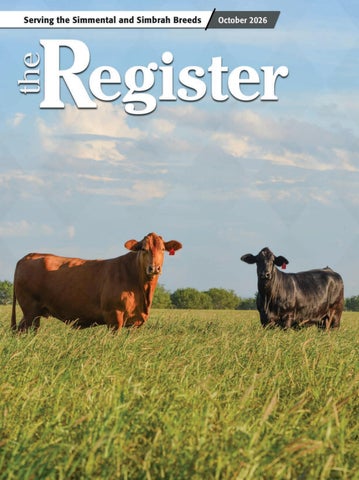
Answers: 1. Sixteen; 2. 37.5%; 3. Calgary, AB; 4. The crest; 5. Abomasum; 6. Infections Bovine Rhinotracheitis; 7. Commercial, Utility, Cutter, and Canner; 8. Lactose; 9. Abrupt diet change; 10. Nutrient. Simbrah females at Reavis Farms, Mission, Texas. Photo by Hannah Wine.
About the Cover
the Register (Issn: 0899–3572) is the official publication of the American Simmental Association, published monthly, except bimonthly, in December/January, May/June, and July/August by ASA Publication, Inc., One Genetics Way, Bozeman, Montana 59718, and is a wholly owned, for-profit subsidiary of the American Simmental Association. Member of
Periodicals Postage paid at Bozeman, MT, and at additional mailing offices. Subscription Rates: $50 (US), $100 (US) First-Class, $150 (US) All International Subscriptions. POSTMASTER: Send address changes to the Register, One Genetics Way, Bozeman, Montana 59718.
Printed in USA
4
Register / October 2026
10-Roller Ranch fp 4c.qxp_Layout 1 9/1/26 10:05 AM Page 1
10-26_Masthead.qxp_Layout 1 9/1/26 10:08 AM Page 2
the
ASA Board of Trustees Executive Committee Ryan Thorson, Chairman Scott Trennepohl, Vice Chairman Greg Burden, Treasurer Chris Ivie Greg Walthall Dr. Jon DeClerck, Executive Vice President
published by ASA Publication, Inc.
One Genetics Way, Bozeman, Montana 59718 USA 406-587-2778 fax: 406-587-9301 www.simmental.org email: register@simmgene.com
Canada Publications Agreement Number: 1875183
ASA Publication, Inc., Board of Trustees
Scott Trennepohl, Chairman Greg Burden, Vice Chairman Ryan Thorson Chris Ivie Greg Walthall Dr. Jon DeClerck, Executive Secretary-Treasurer CEO Dr. Jon DeClerck
Business Manager Dr. Ben Crites
Managing Editor Lilly Platts
Advertising/Editorial Coordinator Rebecca Price
Sales Manager Nancy Chesterfield
Media/Website Administrator Kathy Shafer
Design/Production Jenna Haughian Gretchen Jensen
American Simmental Association
One Genetics Way, Bozeman, Montana 59718 USA 406-587-4531 fax: 406-587-9301 www.simmental.org email: simmental@simmgene.com
6
Register / October 2026
North Central Region Tim Clark (2027) 1999 18th St NW Turtle Lake, ND 58575 701.799.7752 Timc@westriv.com Loren Trauernicht (2028) 901 E Pine Rd Wymore, NE 68466 402.230.0812 mtrauernicht@diodecom.net Chris Effling (2029) PO Box 23 Highmore, SD 57345 605.769.0142 keffling@gmail.com Chris Nicholson (2029) 6235 23rd Ave SE Kintyre, ND 58549 701.391.6904 CNN2005@hotmail.com
Western Region Chad Cook (2027) PO Box 174 Walsh, CO 81090 719.529.0564 bridlebitsimm@gmail.com Maureen Mai (2028) 427 Peaceful Way Bonners Ferry, ID 83805 208.660.2726 rymocattle@gmail.com Ryan Thorson (2028) 1725 Road 261 Glendive, MT 59330 406.694.3722 ryanthorson7@gmail.com Quin LaFollette (2029) 1476 Hwy 14A Powell, WY 82435 307.899.3553 Quin@Blacksummitcattle.com
Eastern Region Chris Ivie (2027) PO Box 264 Summertown, TN 38483 931.215.0316 iviejc@usit.net Mark Smith (2027) 304 Moeller Rd Picayune, MS 39466 601.310.6695 smith5785@bellsouth.net Brandi Karisch (2029) 648 Polly Bell Rd Starkville, MS 39759 225.717.3324 mbkcattle@gmail.com Scott Trennepohl (2029) 6591 W 625 N Middletown, IN 47356 765.620.1700 sttrennepohl@yahoo.com
South Central Region Victor Guerra (2027) PO Box 92 Linn, TX 78563 956.607.5515 vgg03@aol.com Greg Walthall (2027) 1051 NE 500 Rd Windsor, MO 65360 660.525.9921 gregwalthall@gmail.com Joseph Hensgens (2028) 136 Deer Park Ln Rayne, LA 70578 985.992.9119 joehensgens@yahoo.com Greg Burden (2029) 890 VZ CR 2205 Canton, TX 75103 405.780.0372 greg.gbcattle@gmail.com
10-APEX Cattle fp 4c.qxp_Layout 1 9/2/26 8:55 AM Page 1
10-26 From the HQ.qxp_Layout 1 9/2/26 8:50 AM Page 2
FROM THE HEADQUARTERS by Lilly Platts, managing editor This issue of the Register is being assembled as the ASA team is putting the final touches on our 2026 Fall Focus event. To say the team has been busy would be an understatement. Whether it’s a big event like Fall Focus or a regular board meeting, staff throughout ASA’s departments help put all of the pieces together. I know I would not be able to do any of my work without the help of these awesome teammates. They all deserve a huge thank you! This October issue of the Register is focused on the Simbrah breed. You will see several features focused on the breed, as well as advertisements from a group of seedstock providers. The primary feature in this issue is about the Estes Ranch, located on the Texas/Oklahoma border. Ben Estes and his family have harnessed the power of data collection to refine their genetics, and have made huge strides in improving the carcass quality of their cattle. They are on a mission to share about the positive things Simbrah brings to the table, and I really enjoyed learning about their operation. Additionally, I spoke to Tim Smith about the SimbrahSimmental Superbowl, which is one of the premier youth beef events in the South. The Simbrah focus is rounded out with a
short history piece about Simbrah. My main source for this was Dr. Bob Hough’s Simmental’s American Journey book, which is always fun to crack open. If you’ve ever wondered how the Simmental-Brahman cross went from a crossbred animal to an official composite in the ASA registry, check this article out. I have had the pleasure of learning more about the Simbrah breed and southern producers through the ASA Board of Trustees. I am also a transplanted Texan, which has given me firsthand experience living in the same environment that Simbrah thrives in. Everything here is tougher, and I have grown to appreciate the hardiness and adaptability required to survive and thrive in a climate like this. Simbrah cattle exemplify that hardiness, with all of the positive traits of Simmental as a bonus. I hope you will check out the stories about Simbrah, and the advertisements featured in this issue. This issue also features a piece by ASA EVP Dr. Jon DeClerck and ASA’s economic indexes $API and $TI. We will be sharing a lot more about this update in the coming months through all of our print and digital channels, so please keep an eye out!
Statement of Ownership, Management, and Circulation Required by 39 USC 3685 Publication title: the Register 2. Publication number: 0899-3572 3. Filing date: 08/17/2026 Issue frequency: 9 times annually 5. Number of issues published annually: 9 Annual subscription price: $100.00 domestic, $150.00 international Complete mailing address of office of publication: One Genetics Way, Bozeman, MT 59718 Complete mailing address of headquarters or general business office of publisher: One Genetics Way, Bozeman, MT 59718 9. Full names and complete mailing addresses of publisher, editor and managing editor: Publisher: Dr. Jon DeClerck, One Genetics Way, Bozeman, MT 59718 Managing Editor: Lilly Platts, One Genetics Way, Bozeman, MT 59718 10. Owner: American Simmental Association (a non-profit organization), One Genetics Way, Bozeman, MT 59718 11. Known bondholders, mortgages and other security holders owning or holding one percent or more of total amount of bonds, mortgages or other securities: None 12. Tax Status: Has not changed during preceding 12 months 13. Publication name: the Register 14. Issue date for circulation data below: September 2026 15. Extent and nature Average no. of copies No. copies of of circulation each issue during the single issue published preceding 12 months nearest to filing date. a. Total number of copies (net press run): 6,126 6,752 b. Paid and/or requested circulation: 1) Paid/requested outside-county mail subscriptions stated on Form 3541. (include advertisers’ prior and exchange copies): 25 23 2) Paid in-county subscriptions stated on Form 3541 (include advertisers’ proof copies and exchange copies): 6,035 6,661 3) Sales through dealers and carriers, street vendors and counter sales and other non-USPS paid distribution: 0 0 4) Other classes mailed through the USPS 0 0 c. Total paid and/or requested circulation: [sum of 15b (1), (2), (3) and (4)] 6,060 6,684 d. Free distribution by mail (samples, complimentary and other free): 1) Outside-county as stated on Form 3541 0 0 2) In-county as stated on Form 3541 0 0 3) Other classes mailed through the USPS 0 0 4) Free distribution outside the mail (carriers or other means) 3 3 e. Total free distribution [sum of 15d (1), (2), (3) and (4)]: 3 3 f. Total distribution (sum of 15c and 15e): 6,063 6,687 g. Copies not distributed: 100 100 h. Total (sum of 15f and g): 6,163 6,787 i. Percent Paid and/or requested circulation (15c / 15f x 100): 99.95% 99.95% 17. Publication of statement of ownership required: Will be printed in the October 2026 issue of this publication. I certify that the statements made by me above are correct and complete. Dr. Jon DeClerck Dated: 08/17/2026 1. 4. 6. 7. 8.
8
Register / October 2026
.
10-ASA IGS Trust the Original (Grant) fp 4c.qxp_Layout 1 9/1/26 11:38 AM Page 1
10-26 Trustee Viewpoint.qxp_Layout 1 9/1/26 2:34 PM Page 2
TRUSTEE VIEWPOINT by Victor Guerra, South Central Region As the end of my second consecutive term approaches, I take pause and reflect on the past six years that I have been blessed to serve the American Simmental Association. Serving the ASA on the Board of Trustees has been a fulfilling and gratifying experience. Yes, I believe we have accomplished much from a policy standpoint, and we have had the opportunity to attend numerous events across the country. It is the relationships that have been established that I will fondly remember. I want to thank my fellow trustees and breeders for supporting this issue of the Register focusing on the Simbrah breed. Simbrah cattle offer heat tolerance, hybrid vigor, and diversify our SimGenetic umbrella. They capitalize on the many positive traits of the Brahman and Simmental breeds, two of the most populous in the world. It is our hope that this publication will increase awareness of their value and continue to be an annual opportunity for Simbrah breeders to highlight their programs. I believe the diversification of the operations represented on the board during my tenure has been a key component to the success that we have been able to accomplish since our inception.
Dr. Jon DeClerck, along with certain members of the ASA and International Genetics Solutions staff, have been working diligently to update numerous traits to ensure that we continue to utilize the soundest tools available. With these updates it is natural that some changes will occur; however, it should make our operations more efficient and effective resulting in the most productive stock we can produce. If my experience on the board has taught me anything, it is to embrace change regardless if it comes in the form and time that we prefer. Thus, I hope you will join me in being understanding of the updates to the evaluation and welcome them as they should make us better breeders. I would like to wish the new American Junior Simmental Association Board of Trustees much success, and we appreciate all your support of ASA. Speaking of their support, the new ASA Ring of Champions season will kick off this month at the American Royal in Kansas City. We wish all the exhibitors safe travels and much success, we appreciate all that you do to promote SimGenetics. Be sure and take advantage of the many American Simmental-Simbrah Foundation opportunities available to you throughout the season including fundraisers at Cattlemen’s Congress, Fall Focus, and more. We thank you in advance for your support in supporting our mission. The fall sale season is also underway; we are anticipating another successful season as the demand for SimGenetics continues to increase thanks to the meticulous decision-making, record-keeping, and perseverance of our fellow members. We appreciate all the members taking advantage of ASA programs like Calf Crop Genomics and the Carcass Expansion Program that are driving predictability, as well as increasing consumer demand. I also encourage you to consider the opportunities available to you through ASA Publications, Inc., to promote your sale and/or program. As my dad always says, “no see, No Tell, equals NO SELL.” When I first joined the board, I may have viewed ASA primarily through the lens of my own operation and region. Six years later, I have a much greater appreciation for the diversity of our membership and the responsibility that comes with making decisions for an Association that serves so many different types of breeders. It is my hope that future boards will continue to prioritize unity among membership, remaining commercially relevant, and be innovative to expand our footprint in the industry. If you are or have ever considered serving the ASA, I strongly encourage you to do so as I believe you will have a fulfilling experience. In closing, I would like to thank my family and the crew at home for filling in the gaps for me and making this opportunity to serve an Association I hold so dear to me possible. I want to thank Dr. Jon DeClerck for his leadership, along with the staff, for their commitment to us members. Finally, to my fellow trustees since 2020, the opportunity to serve alongside you and get to know each of you has been a pleasure that I will frequently look back on with deep appreciation. As we press forward, there are many challenges that lie ahead as the beef industry evolves; however, ASA members have always risen to meet the moment, and I believe we are equipped to continue to do so. I wish you all continued success and May God Bless You.
.
10
Register / October 2026
10-Cason's Pride and Joy Simmentals fp 4c.qxp_Layout 1 9/1/26 11:16 AM Page 1
R_F_Estes Ranch.qxp_Layout 1 9/1/26 10:57 AM Page 2
Estes Ranch Where Hardiness Meets Performance by Lilly Platts
Located on the Oklahoma-Texas border, Estes Ranch has found success harnessing the hardiness, growth, and adaptability of Simbrah cattle. Through intense culling, detailed data collection, and a focus on value-added traits, Estes Ranch is producing cattle that have graded Choice at a rate of 92% or better the last five years, pushing against the belief that Simbrah cattle fall short on the rail. The addition of purebred Simmental and Fleckvieh cattle has made Estes Ranch a trusted source for genetics, with their market share growing each year. Ben Estes is the sixth generation of the family operation, and is raising his family on the ranch.
Oklahoma and Texas Roots The Estes family settled on the Oklahoma-Texas line, near Wellington, Texas, and Vinson, Oklahoma, in 1897. Like many ranches in the West, Hereford cattle made up the majority of the herd for many years, in the 1960s Angus bulls were purchased to add the first dose of hybrid vigor to the calves. In 1978, wanting to add growth to the commercial cow herd, the family purchased their first Simmental bulls. The hybrid vigor from the Simmental was notable compared to the English cross the family had relied on. The Simmental breed offered both the performance and color the Estes family was looking for. Ben’s family wanted to add growth to their herd. “Cows were pretty small, and didn’t have much growth or performance,” he recalled his family sharing. “They sought out a breed that they thought
12
Register / October 2026
would add this growth, but they also wanted to keep the red-and-white-face characteristics of the Hereford, which seemed to work better in our climate.” This cross added growth to the calf crop, and also improved the cows. “The females were really good, and formed the base of our cow herd,” Ben added. “Some of our genetics to this day trace back to those original cows.” Around this time, the family leased adjoining land to the ranch, and Ben’s grandfather Bill stocked those pastures with Brahman-influenced cows. “Those cows performed and did really well when mated to our Simmental bulls,” Ben recalled. “They noticed the heat tolerance, insect resistance, and just how durable and efficient they were for this country.”
R_F_Estes Ranch.qxp_Layout 1 9/1/26 10:57 AM Page 3
Estes Ranch vs. USDA National Average Choice Quality Grade (2005–2026)
Percent Choice Quality Grade (%)
Estes Ranch has been closely tracking carcass data for many years, and through careful selection has drastically improved carcass quality.
97%
98% (peak)
Estes Ranch Choice %
100
USDA National Average Choice %
80
60
40
20
0
2005
2010
During this period, Ben’s father, Paul, was finishing college, and returning to the family ranch. He purchased a group of registered Simmental females to start the seedstock herd. Simbrah cattle are known for their hardiness and adaptability, especially in arid environments. The Texas Panhandle and western Oklahoma will experience long bouts of hot, dry weather with no rain during a normal year, and drought can be especially challenging. In 1986, the Estes family purchased two three-quarter Brahman, one-quarter Simmental bulls from the RA Brown Ranch, solidifying their focus on Simbrah cattle. Today, the Estes Ranch runs 150 registered Fleckvieh and purebred Simmental females, and 300 registered and commercial Simbrah cows.
Refining the Program Matching cattle to their environment without sacrificing performance is a consistent focus for all producers, and can be especially challenging in harsh areas. In the South, drought, insects, and heat can be especially challenging. The Simbrah cross — Simmental and Brahman — started as a way to combine the growth, carcass quality, and maternal strengths of the Simmental breed with the adaptability, hardiness, longevity, and heat tolerance of Brahman cattle. Refining Simbrah genetics to perform on the ranch and the rail has been a consistent focus at the Estes Ranch. The family first started retaining ownership and feeding out calves in the 1990s as a way to participate in valueadded programs. One of the first programs the family
2015 Year
2020
2025
participated in required a Choice grade or better. The first set of data they received on a calf crop revealed that only 26% of the calf crop was meeting this requirement. This initiated an intense focus on improving their carcass quality without sacrificing the other positive attributes of the Simbrah cattle. “A negative stereotype of Brahmaninfluenced cattle is that they don’t grade,” Ben explained. “We decided we were going to fix that.” Their approach included sourcing carcass-oriented genetics, intense culling, and detailed data collection. Ben’s affinity for data started early, and went hand-inhand with the ranch’s goals. “During my freshman year of high school, gathering carcass data and information on our cow herd was my supervised agriculture experience for FFA. I received the Star Farmer award for Oklahoma by the time I was a senior because of how much data I had collected,” he recalled. From birth through weaning, data was collected on each calf and tied to the dam and sire. Each calf was weighed individually at weaning, and followed through the feeding process. At the end, this information was tied to the final carcass data on the rail. “We knew how each calf performed, and would make culling decisions in the cow herd based on that information,” Ben explained. If a female’s calf underperformed, she was given the benefit of the doubt, assuming the wrong mating was chosen or an environmental factor hindered her calf’s performance. If her calf fell short the second year, the female would be culled. Each first-calf heifer’s calf was sent to the feedlot, regardless of sex, which prevented any underperforming females from slipping into the program early on. (Continued on page 14) October 2026 / Register
13
R_F_Estes Ranch.qxp_Layout 1 9/1/26 10:58 AM Page 4
Estes Ranch: Where Hardiness Meets Performance (Continued from page 13) The result has been cattle that grade at 95% Choice or better, with last year’s group grading 30% Prime. As the quality grades have gone up, Ben has shifted more focus to other carcass traits, like yield grade. Throughout the years, Estes Ranch rarely has Yield Grade 5s, and is currently focusing on no longer seeing a Yield Grade 4. While data and performance are paramount at Estes Ranch, phenotype is still a priority. “I want an animal you can look at first, and then they have to perform,” Ben said.
Identifying Opportunities Having proved that Simbrah cattle can perform in the feedlot and grade, Ben sees an opportunity for other producers to add the cross to their programs. “We have found that compared to other breeds, and especially other Brahman crosses, the Simbrah cow does the best. The Simbrah cow is the best female on Earth,” he shared. Input costs are critical in areas where resources are limited, and Simbrah cows are especially thrifty. “We are very low-input, and live in an arid, minimal rainfall area. Our cows are extremely low-maintenance. We do not feed hay,” Ben said. Simbrah calves consistently outperform their purebred counterparts, weighing 100 to 150 pounds more at weaning, with their mothers requiring less input. “They require less maintenance than the purebred cows, and the purebred cows probably require a bit more feed to do the same job,” Ben explained. Ben sees an opportunity for producers in the South and other regions to take advantage of the performance and thriftiness of Simbrah cattle. He also believes these
The Estes family markets seedstock by private treaty, and through select sales like the annual Back to Grass Sale.
cattle could be more widely used in the South. “Promoting the Simbrah cow to the rest of the country is something we’re passionate about,” Ben shared. “We feel like it’s a hidden secret.” In the South, Brahman cattle are common, but planned crossbreeding systems are underutilized. “A lot of producers are just running crossbred cows, and if they ran more of a straight F1 Simbrah cow, with two breeds, they could better maximize their heterosis,” Ben shared.
The Simmental-Brahman cross combines the growth, carcass quality, and maternal strengths of the Simmental breed with the adaptability, hardiness, longevity, and heat tolerance of Brahman cattle.
14
Register / October 2026
R_F_Estes Ranch.qxp_Layout 1 9/1/26 1:15 PM Page 5
Ben Estes sees a big opportunity for Simbrah cattle to be better utilized in commercial operations.
In the feedlot, Simbrah cattle put on muscle and fat differently than the standard Angus feeder calf, which Ben also sees as a positive. The industry-wide push for larger carcasses presents challenges, but Simbrah cattle have the capacity to carry more weight than the standard Angus feeder calf. Additionally, Ben shared that these cattle put on less backfat, which improves cutability. The hardiness that makes Simbrah cows excel in harsh environments also crosses over to feedlot. “We’ve noted almost zero death loss in our Simbrah cattle due to sickness in the feedlot each year,” Ben said. Brahman-influenced cattle stand out at the sale barn and in the feedlot, and are sometimes at a disadvantage. Ben shared that the random crossbreeding that many commercial producers in the South rely on has contributed to this negative stereotype. A solution for producers who are hesitant to add any ear to their cattle is to breed these F1 Simbrah females to a purebred Red Angus bull. “We have found that if you run a Red Angus bull back on those cows, it basically takes away the ear, and you still have the added benefit of heterosis,” Ben explained. Docility is a common concern with Brahman-influenced cattle. Ben believes that this is another stereotype, and one that shouldn’t be an issue if genetics are sourced from a trusted provider. Any animals that display concerning aggression at Estes Ranch are culled. “On the female side, the quickest way to end up in the feedlot is a bad attitude,” Ben said. “With our bulls, we are very strict on that. If a bull has a bad attitude or even looks at me wrong, they will likely become a steer because we just don’t need that,” he added. Increasing the acceptance of Simbrah cattle throughout the industry is something Ben and his family are passionate about. Collecting data in other herds and proving the
The entire Estes family is involved with the cattle operation.
(Continued on page 16) October 2026 / Register
15
R_F_Estes Ranch.qxp_Layout 1 9/2/26 8:56 AM Page 6
Estes Ranch: Where Hardiness Meets Performance (Continued from page 15)
A Family Affair
Drought tolerance is extremely important at Estes Ranch.
breed’s performance in other programs will be an important part of this process. Ben emphasizes that commercial producers don’t need to overthink the process of focusing on a cross like Simbrah. “A lot of people don’t make a decision because it’s overwhelming, and they get caught in the fractions,” Ben shared. “We have been pretty openminded with our Simbrah cattle and how we’ve introduced new genetics. We’re not afraid to breed cattle up, or introduce other breeds.”
16
Register / October 2026
In addition to his role at Estes Ranch, Ben works as a large animal veterinarian with a focus on beef cattle. His decision to become a veterinarian was driven by his passion for the beef industry, and a desire to help fellow producers. “I always wanted to work with animals, and especially with cattle,” he shared. His work reaches beyond helping producers with the general health of their cattle. Ben is frequently asked about mating decisions, how to read EPD, and more, drawing on his knowledge of the seedstock business. Ben’s wife, Sara, is also a veterinarian. Their children, James and Savannah, are actively involved in the ranch, and are members of the American Junior Simmental Association. Ben’s parents, Paul and Amy, and grandparents, Bill and Alcie, are on the ranch. His brother, Will; sister-in-law, Abbie; their daughter, Emma; sister, Lucy Brown; brother-in-law, Cole; and their children, Brooks, Libby, Whitley, and Tinley, are also actively involved with the ranch. “It’s very tight-knit and family-oriented,” Ben shared.
.
10-AJSA American Royal fp 4c.qxp_Layout 1 9/1/26 10:03 AM Page 1
R_F_Investing in the Future_Simbrah-Simmental Superbowl.qxp_Layout 1 9/1/26 11:00 AM Page 2
Investing in the Future by Lilly Platts
The Simbrah-Simmental Superbowl has awarded over $1.3 million to youth since its inception through scholarships, prize money, and premiums. The popular breeder-sponsored program continues to grow, supporting the future of the Simmental and Simbrah breeds.
A Team Effort
More Than a Show
The Simbrah-Simmental Superbowl started as an idea among Texas producers and friends, Tim Smith, Carlos Guerra, and Billy Wentz. The group wanted to support youth in the breed while also promoting their fellow Simbrah and Simmental producers. The answer was an annual event supported by $1,000 breeder sponsorships. In return, any heifers purchased from these breeders would be eligible to show at the yearly event. The group started reaching out to their fellow breeders, and soon had a group of sponsors and an inaugural event to plan. The first event was a success, and for 34 years now the Simbrah-Simmental Superbowl has been supporting youth and promoting the Lone Star State’s Simbrah and Simmental breeders. With an average of 35 to 40 breeders sponsoring the event every year, the $1,000 sponsorships have allowed for generous prize money, scholarships, and premiums to be handed out to participating youth. The first Superbowl events were held in conjunction with the Belt Buckle Bonanza in Austin, and later Waco, Texas. The large multi-species event exposed the Superbowl and cattle to a larger audience. For the last 20 years, the Superbowl has been held during the San Antonio Livestock Show and Rodeo, which has further elevated the event’s popularity and success. Many participants are also able to enter their animals in breed shows, and this partnership also allows for the Simbrah and Simmental breeds to be featured during the national event.
The organization is entirely volunteer-run, with an emphasis on bringing in new youth and breeders. Smith continues helping lead the organization, alongside Guerra. He shared that the funds touch as many participants as possible, with classes like showmanship being placed and awarded down to tenth place. A random drawing for $250 scholarships, where every participant throws their name in the hat, shares these funds with everyone, no matter their competitiveness in the show ring. “We want to make it worthwhile for all kids,” Smith said. The group has maintained a focus on showmanship, and skills that reach beyond the show ring. Participants are split into over a dozen showmanship groups, with the winner of each group coming back for the final drive. Winning overall grand and reserve-place showman at the Superbowl is a serious accomplishment, and something Smith and the group want to emphasize. First and second place are awarded $1,500 and $1,000, respectively. “It isn’t about how much you paid for your heifer, but also how hard you worked,” he said. The breed shows at the Superbowl are extremely competitive. One of the organization’s founding goals was to promote and elevate Simbrah and Simmental breeders in the state of Texas. Youth have long played a critical role in promoting individual seedstock programs, traveling to shows throughout the country, and ultimately placing genetics in new herds. Breeders who sponsor the Superbowl are the beneficiaries of this, with their females competing at the event and beyond. Many sponsors attend the Superbowl, which brings breeders together while also allowing participating youth to build relationships in the industry. Breeders who sponsor and sell heifers eligible for the Superbowl must reside in Texas, but youth are allowed to live outside of the state. The Superbowl is solely funded by breeder sponsorships, with no additional funds accepted from other producers, organizations, or businesses. This structure has maintained an emphasis on breeder participation and partnerships. Sponsors have become involved with the Superbowl in a variety of ways, from industry relationships to learning about the program from their junior customers.
Tim Smith at the 2026 event.
18
Register / October 2026
R_F_Investing in the Future_Simbrah-Simmental Superbowl.qxp_Layout 1 9/1/26 11:01 AM Page 3
Other participation and support is not discouraged, however. The American Simmental Association has been a longtime supporter of the Superbowl, with leadership attending the event and participating in educational opportunities. ASA EVP Dr. Jon DeClerck attended the 2026 Superbowl event. Education is a priority at the Superbowl, with attendees having the opportunity to connect with industry leaders, and also participate in things that may be new to them. DNA testing has been standard at the Superbowl for many years, with all winners being required to collect a sample on their animal for parent verification. Participants also have the opportunity to collect DNA on other heifers, exposing them to the process, and also supporting the overall integrity of the breed. “It’s about keeping the database accurate,” Smith explained. “It gives the Association a larger amount of DNA, and supports ASA’s mission.”
judged the purebred Simbrah show. The breed classes and showmanship were extremely competitive, with the top places representing Simbrah and Simmental programs throughout Texas. The scholarships, prize money, and premiums handed out at the 2026 show pushed the total funds shared through the Superbowl over the $1.3 million mark. The Simbrah-Simmental Superbowl will celebrate its 35th anniversary in February of 2027 during the San Antonio Livestock Show and Rodeo. To learn more about the event and organization, visit simbrah-simmentalsuperbowl.net.
.
A Lasting Legacy Smith is proud of the event’s success and the impact it has had on youth in the Simbrah and Simmental breeds. “What we set out to do has been accomplished,” he said. “It’s a very talked-about show here in Texas, and among Simbrah breeders, and it’s the longest-running show sponsored by breeders for youth across all breeds. It has a very positive reputation.” The 2026 event drew 109 entries, with 40 individual breeder sponsors. Eli Smallwood and Will Shelby judged the showmanship classes, percentage Simmental, percentage Simbrah, and purebred Simmental shows. PJ Budler
Above: Youth compete for prize money, scholarships, premiums, and other prizes at the annual Simbrah-Simmental Superbowl. Below: The 2026 Simbrah-Simmental Superbowl drew 109 entries.
October 2026 / Register
19
10-ASA Build, Breed, Achieve Genetic Goals 2pg 4c.qxp_Layout 1 8/31/26 3:42 PM Page 2
10-ASA Build, Breed, Achieve Genetic Goals 2pg 4c.qxp_Layout 1 8/31/26 3:42 PM Page 3
R_F_The Simbrah Story.qxp_Layout 1 9/1/26 11:11 AM Page 2
The
Simbrah Story
by Lilly Platts
As the Simmental breed gained footing in the United States, breeders in the South quickly saw an opportunity to cross the breed with Brahman. The cross was successful, with breeders soon marketing composite bulls to commercial producers. The Simbrah composite became a part of the American Simmental Association registry in 1977.
W
hen Simmental semen became available in the United States, breeders throughout the country started experimenting with a variety of crosses. In the South, many saw an opportunity with Brahman cattle. Straight Brahman, or Zebu, cattle have long been a popular choice in areas where heat, humidity, drought, and other harsh conditions present challenges. Zebu cattle are the most populous in the world because of this hardiness. While survival is always the number one priority, these cattle usually lacked growth, milking ability, fertility, and other economically relevant traits. Simmental offered a solution to this, with the added benefit of heterosis. One of the names most commonly associated with Simbrah cattle is Sally Buxkemper. Early on, Buxkemper identified the need to ensure that Simbrah cattle were meeting carcass standards. She developed her herd using the Brahman bull “Red Jake Manso 19,” a Performance Registry International Certified Meat Sire. Buxkemper was a leader in the breed, serving on the ASA Board of Trustees, and her influence helped establish the standards for Simbrah cattle. Today, carcass traits continue to be a focus for Simbrah cattle, with many leading breeders currently focused on making sure the composite performs in the feedlot.
22
Register / October 2026
Other early breeders of Simbrah cattle included Texans Edmund Tom, Bud Wentz, and Rob Brown. In the early years, the Simmental-Brahman cross cattle were largely experimental, but as these producers started seeing success, they focused on refining the genetics. With a new market opportunity and desire to sell seedstock, these breeders also started looking for a registry. Bud Wentz approached ASA about developing a registry. The Association was receptive, and he formally presented his case to the ASA Board of Trustees in 1975. Calling the cross “Brahmental” at the time, Wentz appealed to the Board during the January Annual Meeting. President [Chairman] Lou Chestnut appointed an exploratory committee, which included Rob Brown, Colville Jackson, Bobby Lawrence, and Jess Kilgore. The committee drafted potential guidelines for registration, including breed composition. The Board approved the addition of the composite in 1977. The name “Brahmental” was used for two years, but was changed to Simbrah after a producer in Texas claimed ownership over the term. The Association and Board chose not to fight the claim, changing the name to Simbrah.
R_F_The Simbrah Story.qxp_Layout 1 9/1/26 11:11 AM Page 3
With a registry in place, Simbrah breeders now had a framework for data collection, pedigree management, marketing, and more. The inclusion of Bos indicus composite cattle also opened up opportunities abroad, with these cattle being especially fit for other parts of the world like Mexico, South America, Australia, and beyond. The ASA Board of Trustees added an official Simbrah committee in 1988 to better assess policies, rules, promotion, and other Simbrah-specific matters. This committee continues playing a critical role within the Board. In 1987, the ASA published the first Simbrah Sire Evaluation. Several publications were also developed to promote Simbrah cattle, including Simbrah International and American Simbrah. These publications also targeted international audiences, and were published in other languages for a time. These Simbrah-specific publications were published for a number of years. Publications like Simbrah World, published by Southern Livestock Publishing, continue sharing Simbrah sale results, news, stories, and more. Today, the Simbrah breed is an important part of the ASA registry, with the largest number of producers residing in south Texas. While the breed is best known for its ability to thrive in hot environments, producers have also seen success in colder climates. Simbrah cattle are on display at shows across the nation, and are offered at production sales throughout the year.
.
Above: Simbrah International was printed both in English and Spanish to target an international audience. Right: An early ASA advertisement promoting Simbrah cattle. Opposite: Simbrah cattle continue playing an important role in the ASA registry and larger beef industry. Photo by Hannah Wine.
October 2026 / Register
23
10-ASA Pub Sale Packages - Built for Seedstock Producers fp 4c.qxp_Layout 1 9/1/26 12:37 PM Page 1
• 2 full-page ads placed in the Register and/or SimTalk • Business card ad placed in the Register or SimTalk • 1 eBlast • Included in weekly Sales Call email and simmental.org • Sale catalog included on simmental.org
• 1 full-page ad and 1 halfpage ad placed in the Register and/or SimTalk • Business card ad placed in the Register or SimTalk • 1 eBlast • 1 Facebook ad • Included in weekly Sales Call email and simmental.org • Sale catalog included on simmental.org
• 1-full page ad placed in the Register or SimTalk • Business card ad placed in the Register or SimTalk • 1 eBlast • 1 Facebook ad • 1 banner ad placed on the ASA website • Included in weekly Sales Call email and simmental.org • Sale catalog included on simmental.org
10-ASA Simbrah Strong V2 fp 4c.qxp_Layout 1 9/1/26 12:39 PM Page 1
R_F_Building on Progress_Why It's Time to Update API and TI.qxp_Layout 1 9/2/26 8:33 AM Page 2
Building on Progress: Why It ’s Time to Update $API and $TI by Dr. Jon DeClerck, ASA EVP
Updates to ASA’s economic indexes, $API and $TI, will better reflect the current beef market, making them more accurate at predicting progeny profitability.
T
wenty years ago, the American Simmental Association (ASA) took an important step forward in how breeders used genetic information. $API and $TI were first published in the Spring 2005 Sire Summary. At the time, Dr. Wade Shafer described economic indexes as a way to turn a growing collection of EPD into a roadmap for genetic progress. His analogy was simple: EPD without indexes were like superhighways without maps — you could move fast but not always know whether you were headed in the right direction. That philosophy still holds today. Over the last two decades, Simmental cattle have made tremendous progress in calving ease, marbling, growth, and carcass performance. $API and $TI helped encourage breeders to think beyond individual EPD and instead consider how multiple traits influence profitability across an entire production system. During that same period, ASA registrations have grown by roughly 54 percent. That growth reflects many factors — breeders, commercial customers, improved genetic tools, marketing efforts, and changing industry demand
26
Register / October 2026
among them. $API and $TI are only one part of that story, but they helped drive clear genetic progress and increase the demand for Simmental cattle in the commercial beef industry. So why update $API and $TI? Because the industry around them has changed — and so have the tools available to us. Updating $API and $TI is not about moving away from what has worked. It is about building on that success with better data, better technology, and a better ability to model the biology and economics of today’s cattle industry.
New Traits Create New Opportunities When $API and $TI were developed, ASA was already focused on economically relevant traits that directly influence profitability. The familiar $API pyramid reflects that philosophy, with factors such as cow herd intake, heifer pregnancy, carcass weight, feedlot intake, and salvage value included in the model.
R_F_Building on Progress_Why It's Time to Update API and TI.qxp_Layout 1 9/2/26 8:33 AM Page 3
$API Stayability Cow Herd Intake, Calf Survival, Heifer Pregnancy, Marbling Carcass Weight, Feedlot Intake, Weaning Weight Yield Grade, Salvage Value, Milk Original All-Purpose Index ($API) framework.
The challenge was that ASA could not directly predict those traits at the time. Instead, the indexes relied on known genetic relationships with traits such as growth and milk to estimate them indirectly. Today, we can do more. In roughly the past year, International Genetic Solutions (IGS) has added Mature Cow Weight, Cow Energy Requirement, Heifer Pregnancy, Dry Matter Intake, and $Gain to the genetic toolbox. These advances allow more economically important traits — including heifer pregnancy, dry matter intake, and mature weight — to be incorporated more directly into the updated indexes rather than estimated through correlated traits. Direct predictions improve index accuracy by incorporating actual performance records, rather than relying strictly on correlated stand-ins. This allows us to more precisely evaluate the traits that directly drive profitability, giving maximum value to the data breeders submit. That is exactly the kind of progress our economic indexes should take advantage of.
The Cattle Business Has Changed At their core, economic indexes attempt to answer a relatively simple question: Which genetics are expected to create the most value in a defined production system? The challenge is that the cattle industry does not stand still. We have all heard the same conversations: cow numbers are historically low, cattle are being fed longer, and carcass weights are increasing as the industry looks to produce more beef from fewer animals. At the same time, feed costs, cattle values, replacement costs, and interest rates have all shifted.
When the economics and production system change, the indexes guiding selection need to evolve with them. This time, however, we are doing more than simply updating old prices with new prices. Historical CattleFax data remain an important foundation, but the updated work also incorporates forwardlooking economic models designed to project prices across the next cattle cycle. We want these indexes to reflect where the cattle industry is headed, not simply where it has been.
Technology Has Changed What We Can Model Think about the phone you carried in 2005. The first iPhone had not even been introduced. There is a good chance it was a flip phone. It probably made calls, sent text messages, and did those jobs pretty well. But nobody would expect that same phone to have facial recognition, run today’s applications, provide turnby-turn navigation, or perform the countless other tasks we now take for granted. The same principle applies here. The original $API and $TI were sophisticated tools built with the best computing power available at the time. But technology has advanced enormously over the last twenty years. We now have more records, more genomic information, improved software, better simulation capability, and more sophisticated estimates of heterosis and breed effects. That greater precision allows the updated models to better account for one of the foundations of Simmental’s success: the power of crossbreeding. At ASA, we have long believed breeds are not competitors; they are crossbreeding partners. The value of Simmental genetics is not simply measured by how they perform in isolation, but by the added value they bring to a complementary breeding system through breed strengths and heterosis. The updated models more accurately account for heterosis, allowing $API and $TI to more closely reflect how Simmental genetics are used in the commercial industry and to better recognize the traits that create value in those production systems.
Building the Next Version One of Dr. Shafer’s early articles described economic indexes as a “genetic business plan,” combining an animal’s genetic profile with input costs and output values to project profitability. And just like any business plan, they should occasionally be revisited when the assumptions, technology, and operating environment change. (Continued on page 28) October 2026 / Register
27
R_F_Building on Progress_Why It's Time to Update API and TI.qxp_Layout 1 9/2/26 8:34 AM Page 4
Building Progress: Why It’s Time Update $API
$TI
(Continued from page 27) That is where we are today. The work is not finished simply because the initial modeling is complete. ASA and IGS will continue developing educational materials, sharing research results, and creating opportunities for feedback before final implementation. We feel good about the direction of the work, but these indexes are ultimately built to serve breeders and commercial producers. It is important that we explain the changes clearly, listen to the people who use these tools, and incorporate that feedback as the process moves forward. For now, the important message is simple. $API and $TI helped move the Simmental breed forward for the last twenty years. Updating them is not a departure from that success. It is the next step.
.
What are $API and $TI? Economic ($) Indexes: $ Indexes blend EPD for economically relevant traits and the economics associated with cattle production into a single value. $ Indexes estimate an animal’s overall impact on your bottom line. If you’re keeping replacement females, use $API. If not, then use $TI. All-Purpose Index ($API): Expressed as dollars per cow exposed under an all-purpose-sire scenario. Evaluates sires for use on the entire cow herd (bred to both Angus first-calf heifers and mature cows) with the portion of their daughters required to maintain herd size retained and the remaining heifers and steers put on feed and sold on a grid (grade and yield). Terminal Index ($TI): Expressed as dollars per cow exposed under a terminal-sire scenario. Evaluates sire for use on mature Angus cows with all offspring put on feed and sold on a grid (grade and yield).
The updates to $API and $TI will reflect progress and change in the Simmental breed and larger industry.
28
Register / October 2026
A percentile-ranking chart is required to determine where an animal’s EPD and $ Indexes rank relative to other animals in the breed. For percentile rankings or more detailed information about EPD and $ Indexes visit www.simmental.org.
10-Reavis Farms fp 4c.qxp_Layout 1 9/1/26 10:04 AM Page 1
R_F_ASA Launches Herdbook Tutorials.qxp_Layout 1 9/1/26 10:49 AM Page 2
ASA Launches Herdbook Tutorials by ASA Staff
A new resource is now available to support members in navigating Herdbook. Recently added to the ASA website, Herdbook tutorials offer step-by-step guidance on a variety of topics, from animal registration to ownership transfers. Additional tutorials will continue to be added, ensuring members have access to the most up-to-date information and support. The following is a step-by-step guide for using the new tool.
Helpful Tips • Each tutorial can be paused and used as a guide
while completing a Herdbook job under a membership account. Simply open the tutorial page in one window, and the Herdbook job in another. A split screen can be especially helpful. • Navigate forward and backward using the arrows at the bottom of the frame.
Step One Visit simmental.org, and navigate to the “Animal Info” tab. Choose “Herdbook Tutorials.”
30
Register / October 2026
• Use the zoom-out function at the bottom of the
frame to look at the tutorial page from a wider view.
• Videos can be shared through a link by clicking the button on the far-right (three dots). • New videos are being added periodically that will cover more Herdbook functions.
R_F_ASA Launches Herdbook Tutorials.qxp_Layout 1 9/1/26 10:49 AM Page 3
Step Two The Herdbook Tutorial platform will launch. Choose from “Animal Data and Registrations,” “DNA,” “THE,” and “Transfers.”
Step Three Clicking on each subject will expand the selection, with a number of options available. For example, there are four DNA-specific tutorials available.
(Continued on page 32) October 2026 / Register
31
R_F_ASA Launches Herdbook Tutorials.qxp_Layout 1 9/1/26 10:50 AM Page 4
ASA Launches Herdbook Tutorials (Continued from page 31)
Step Four Each option will launch a narrated video-style tutorial walking through the steps for each process. As an example, the “Viewing and Interpreting the DNA Detail Report”
Step Five The tutorial videos will play through as a video, but can also be paused, and navigated through using the left and right arrows at the bottom of the frame. Also note
32
Register / October 2026
tutorial walks through the process of looking up an animal on Herdbook.org, navigating to the DNA Detail, and interpreting the information displayed.
.
that the narrated information is shared as text, which can be expanded.
10-Estes Ranches fp 4c.qxp_Layout 1 8/31/26 3:53 PM Page 1
10-26 Bulletins.qxp_Layout 1 9/2/26 8:38 AM Page 2
BULLETINS DNA Testing Requirements for Herdsires In January, ASA membership voted to require a DNA test (GGP-100K genomic panel) on all herd bulls/natural service sires born on or after January 1, 2025. This new rule mimics the current DNA requirement for AI sires and donor dams. Although the rule change isn’t immediately affecting membership, it is never too early to prepare. By collecting and submitting DNA samples on bull calves born this spring and beyond if they'll go on to sire registered calves, producers can avoid future issues.
ASA Conducts Internal Parentage Audit As part of our ongoing commitment to industry’s best practices and continuous improvement, ASA is conducting an audit of its DNA parentage verification processes. This effort includes a review of historical parentage records to ensure consistency and reliability as our database continues to evolve with additional testing over time. Through this audit, we identified a small number of parentage inconsistencies affecting a limited fraction of DNA-tested animals. These cases primarily stem from historical practices in which parentage was verified at a single point in time, often against only one parent, and subsequent additions of a second parent’s DNA did not automatically trigger re-verification. Importantly, this review has no impact on other DNA-based services. Genomically enhanced EPD and trait testing remain unaffected. If any of your animals are involved in this review, you will be contacted directly by the ASA DNA team with specific information and recommended next steps. The vast majority of these cases are straightforward and can be resolved through standard collaboration, and we are confident in reaching appropriate outcomes. Members are encouraged to ensure their contact information is current, including email address, mailing address, and phone numbers on all associated accounts, so that ASA staff can communicate efficiently if needed. Keeping this information up-to-date helps ensure timely and accurate communication. If you have questions, please feel free to contact the ASA office at 406-587-4531 and select Option 1.
DNA Test Now Available for Hydrops The American Simmental Association is now offering a DNA test for the Hydrops condition. Beginning July 14, 2026, members can order the $34 stand-alone test on the DNA order form at simmental.org. The expected turnaround time will be four weeks. Descendants of WS All Aboard B80 (ASA# 2852207) are at risk for carrying the genetic abnormality. Females who carry the mutation may develop a serious condition during late gestation that results in excess fluid in the fetal membrane. This typically causes the loss of the calf and occasionally the dam. With the support of the ASA Board of Trustees, ASA staff has been working closely with the University of Nebraska–Lincoln to identify the mutation responsible for Hydrops, and now GeneSeek has developed a commercially available test based on these findings. As part of developing the test, GeneSeek tested a batch of DNA samples from WS All Aboard descendants and those results were loaded into Trait Trac. The Hydrops test is available to ASA members at cost. This decision — made by the ASA Board of Trustees and ASA leadership — supports the identification of this serious, costly
34
Register / October 2026
condition. The Association has invested significant funding and time in the development of this test, and wanted to ensure that testing is as accessible as possible for members and commercial producers who may have purchased a SimGenetics bull with potential carrier daughters in their herd. For questions regarding established WS All Aboard B80 genetics, Hydrops symptoms, reporting an active case, or additional information, please visit the Hydrops Information Center or reach out to Jackie Atkins at jatkins@simmgene.com. To order a test, visit simmental.org.
DNA Test for Bovine Congestive Heart Failure (BCHF) Risk Now Available A test estimating a genomic prediction for risk for development of Bovine Congestive Heart Failure (BCHF) is now available as an add-on the GGP100K ($9.50) or a standalone test ($19.50). This is not an IGS prediction but molecular breeding value based on the Simplot and Neogen partnership studying heart failure in feedlot cattle. Because this is a molecular breeding value, results will be based solely on the DNA marker information and will not include other pertinent information that goes into EPD like pedigree, breed, and performance records. The test returns a molecular breeding value for risk of progeny developing heart scores correlated to BCHF (lower number is better). The average accuracy of animals tested is 0.32 (standard deviation 0.09). At this time the results will be reported through an email but not uploaded to Herdbook. Please contact Jackie Atkins at jatkins@simmgene.com with any questions.
Seeking Sire Nominations for CMP Looking to test your top young sire across different environments? Want to enhance accuracy and gain valuable data on your young sire? The Carcass Merit Program (CMP) is for you! Since 1997, the CMP has relied on select cooperator herds to test sires; however, ASA recently added a new CMP testing avenue, which will allow for MORE SIRES to be tested annually. CMP collects vital carcass data on calves, which improves carcass trait predictions and DNA marker predictions for all cattle in the IGS genetic evaluation, and supports breeders in evaluating their young sires and advancing their genetic programs. If you’re interested in nominating a sire, fill out the nomination form at simmental.org (Programs, ASA Programs, CMP).
Steps to Keep Your Account in Active Status ASA’s fiscal year ended on June 30, which means you likely noticed the Annual Service Fee (ASF) charged to your Herdbook account. There are two important steps to remain an active member: 1. Pay your Annual Service Fee. 2. Register and/or transfer at least one animal record within two years. Your account must be in an active status in order to elect trustees from your region and to vote on Rule and Bylaw amendments. If you have any questions, contact ASA’s Membership Department at 406-587-4531 or members@simmgene.com.
10-26 Bulletins.qxp_Layout 1 9/2/26 8:38 AM Page 3
Check-Off Bonus Program Reminder While the July 15 deadline to submit all state association program requests seems far away, it’s a good time for state associations to familiarize themselves with the check-off bonus program. Aside from the quarterly check-off money states can receive, state associations are also eligible for additional money in the form of yearly bonus checks if certain activities are completed throughout the year. Examples include hosting a field day with ASA representation and participating in the cost share program. To learn about the check-off bonus program, visit simmental.org and contact stateassoc@simmgene.com with any questions.
2026 Year-Letter is P In accordance with the Beef Improvement Federation guidelines, the year- letter animal identification for 2026 is P, and will be followed by R in 2027, and S in 2028. The letter N was the year-letter designated during 2025. Per BIF guidelines, the following letters are not used: I, O, Q, and V.
Office Holiday Schedule Thursday, November 26 & Friday, November 27 Thanksgiving Wednesday, December 23, Thursday, December 24 & Friday, December 25 Christmas
.
October 2026 / Register
35
10-26 Beef Business.qxp_Layout 1 9/2/26 8:36 AM Page 2
BEEF BUSINESS
Reiterating the Importance of Record-Keeping by Kellie Curry Raper, Livestock Marketing Economist, Oklahoma State University Records. Win-loss records; personal best records; Guinness World Records for… well, for nearly anything. Fun fact: My Arizona cousin once held the Guinness World Record for producing the World’s Heaviest Chile Pepper and held that record for several years. He has since been dethroned, but nevertheless. We humans love a good “record” story. But we don’t always love keeping good records. This is true of a lot of cattle producers. But good records play a crucial role in cattle production.
Good record-keeping is another input into your operation. A good set of production and management records can enhance decision-making by providing production benchmarks and by documenting the impact of management decisions, whether those decisions are related to herd replacements, animal health, reproduction, forage, or calf management. In the case of animal health records, tracking vaccinations and medical treatments helps document individual animal health, helps prevent duplication of treatment, and may also sometimes serve as a marketing tool. In the big picture, good records on the physical performance impact of decisions will help you see what is and isn’t working over time.
Good record-keeping is good business. Cattle production can be a lifestyle, but it is also a business. The long-term sustainability of beef operations depends on being efficient and profitable. Tracking the physical performance impacts of management decisions is also the first step in tracking the economic impacts of those decisions. Some of those impacts are evident right away, while others take time to see. But good records are essential in both cases. It is important to take the next step of translating physical performance impacts into cost and profitability impacts for your operation. This feedback should be on a continuous loop!
Good record-keeping helps others help you. Good records facilitate loan applications and financial reporting to loan officers and financial institutions. They are also key in the ability to gather information quickly and efficiently for government program paperwork or disaster relief applications with short deadlines.
Good record-keeping can help you learn from others. Good records make benchmarking possible. That is, good records allow you to seek out information on operations similar to yours and compare physical performance, costs, and other important measures. These comparisons give you feedback on the effectiveness of your current management and are useful for goal-setting and reassessment — an important practice for any successful business. Extension personnel regularly promote the importance of specific management practices to producers, including recordkeeping, to improve cow-calf decision-making and ultimately, profitability. Management practices typically promoted for the cow-calf phase of beef production are those that positively affect health and performance in subsequent phases of production; that document information such as age, origin, feed ingredients, or medical treatments for use in herd management decisions; or that meet needs for specific marketing strategies. Recommended
36
Register / October 2026
record-keeping practices generally include financial, production, and herd health records. And don’t forget forage as part of your production input record-keeping! The ability to examine the impact of calf health management practices is dependent on good records, including vaccination and medical records. Medical treatment records involve documenting dates, products and types of medical treatments administered to animals, number of animals treated, and the person who administered treatment. Ideally, records are also linked to a specific animal. These health records can aid in tracking the effectiveness of specific treatment protocols or vaccination types across the herd, in addition to documenting treatment frequency for specific animals — all useful information for both short-term and longterm herd management strategies. What worked? What didn’t? Were treatments more frequent this year than in past years? Although it is difficult to assign a particular value to recordkeeping, its contribution to management is an important one. Why don’t many producers keep medical and vaccination records? The two most cited reasons in the Oklahoma Beef Management and Marketing survey were doubts about the economic value of those records, and uncertainty about how to go about it. As an economist, I’m trained to assign value to action (or inaction). While it proves difficult to assign a specific dollar value to the habit of good record-keeping, there is no doubt that it makes an important contribution to your operation. As for how to go about it, your local Extension educator is a good resource and there are also tremendous resources online, and some even include a printable record book if you prefer paper. Record-keeping is a critical task. If you are among the record-keeping group, consider what you are not yet tracking and strive for improvement. If you are currently not in that group, grab a computer, tablet, or a notebook, and get started!
Knowledge is power What useful information are you missing out on that might improve decision-making, outcomes, and ultimately the bottom line? What can you learn from comparing your operation’s data to others? Good record-keeping enables a mindset and culture of continuous improvement. That’s good for your operation — and good for the beef industry.
Using Drought-Stressed Corn for Forage: Evaluating Options and Managing Nitrate Risk by Mary Drewnoski and Ben Beckman, University of Nebraska Extension Drought can leave producers with non-irrigated corn that is unlikely to produce a profitable grain crop. Before terminating the crop, consider whether it has value as livestock forage. The best option depends on crop stage, expected yield, harvest logistics, herbicide restrictions, and nitrate risk. While drought-stressed corn often contains elevated nitrate concentrations, nitrate risk can usually be managed successfully with the right harvest and feeding strategy.
Herbicide Restrictions: Start Here Before making plans to graze or harvest drought-stressed corn, review the label for each herbicide applied to the field. Many herbicides include restrictions on grazing, haying, green (Continued on page 38)
10-Guerra, Victor fp 4c.qxp_Layout 1 8/31/26 3:56 PM Page 1
10-26 Beef Business.qxp_Layout 1 9/2/26 8:36 AM Page 4
BEEF BUSINESS (Continued from page 36)
chop, or silage use, and these restrictions vary considerably among products. Remember that: • Tank mixes can complicate decisions because the most restrictive label always applies. • If multiple herbicides were used, each label should be reviewed before feeding the forage. • If you’re uncertain about a product or restriction, consult your agronomist or local Extension office before harvesting or grazing. Only after herbicide restrictions have been met should the corn be considered as a feed source.
Crop Insurance Before harvesting drought-stressed corn as forage, contact your crop insurance agent. Harvesting or grazing the crop before it is released by your insurance provider may affect your claim or future Actual Production History (APH).
Grazing Grazing is often the most practical option for short, vegetative, drought-stressed corn. Although these plants may contain high nitrate concentrations, grazing generally presents a lower risk of nitrate toxicity than harvesting the crop as hay. Cattle consume the forage more gradually and can selectively graze the leaves and upper portions of the plant, where nitrate concentrations are typically lower. The risk of nitrate toxicity depends on more than just the nitrate concentration of the forage. It is also influenced by how rapidly nitrate is released in the rumen and whether rumen microbes have sufficient energy to convert nitrate into microbial protein. Vegetative corn is a high-quality, lush forage that contains abundant moisture and digestible energy. The high moisture content slows nitrate release in the rumen, while readily available energy supports microbial conversion of nitrate. Together, these factors help reduce the risk of toxicity compared with feeding the same nitrate concentration as dry hay. Management is still important. Turn cattle onto the field with a full rumen to reduce their initial rate of intake. Allowing cattle access to the entire field, rather than strip grazing, encourages selective grazing. It also reduces the likelihood that cattle will be forced to consume the lower stalk, where nitrate concentrations are highest. Gradually adapting cattle to higher-nitrate forages can further reduce risk by allowing the rumen microbial population to adjust. Once ears begin developing, the situation changes. Nitrate concentrations often decline as the plant matures. However, the presence of grain also increases starch intake. If cattle consume large amounts of grain without adequate adaptation, there is a risk of ruminal acidosis. At that stage, strip grazing or controlled forage allocation may be desirable to manage grain intake.
Silage Ensiling drought-stressed corn is often one of the best options when there is sufficient forage yield to justify harvest. Because nitrate concentrations are typically greatest in the lower eight to 12 inches of the stalk, raising the cutter bar at harvest can substantially reduce the nitrate concentration of the harvested forage. Additionally, proper fermentation generally reduces nitrate concentrations by 30%–60%, making silage a lower-risk feeding option than green chop or hay. However, the amount of nitrate
38
Register / October 2026
reduction is variable, so fermentation should not be relied upon to eliminate nitrate risk. Drought-stressed silage should always be tested for nitrate concentration before feeding. Yield is about one ton per acre of silage for each harvested foot of earless corn (not counting the tassel). Feeding value is about 70%–80% of well-eared corn silage. Corn with some grain (less than 50 bushels per acre) tends to produce about one ton of silage for every five bushels of grain with a feed value of about 80–90% of regular corn silage. Successful ensiling depends on harvesting the crop at the proper moisture. Whole-plant moisture should generally be about 65% for bunker or pile silage (slightly lower for upright silos). Immature, earless corn often remains too wet for proper fermentation, even after leaves have dried, because the stalk retains a large amount of moisture. In these situations, delaying harvest until the crop reaches the proper moisture content will improve fermentation and silage preservation. Once harvested, allow the silage to ferment for at least three to four weeks before feeding to maximize fermentation and nitrate reduction.
Hay Harvesting drought-stressed corn as hay is generally the least desirable forage option. Corn stalks are thick and retain moisture, making it difficult for the forage to dry sufficiently for safe baling. Baling before the stalks are adequately dry can result in heating, mold, and substantial dry matter losses during storage. Unlike silage, the haying process does not reduce nitrate concentrations. In addition, unlike grazing, cattle cannot selectively avoid the lower portions of the plant where nitrate concentrations are often greatest. As a result, the risk of nitrate toxicity is generally higher with hay than with grazing or properly fermented silage. If drought-stressed corn is baled, collect a representative sample with a hay probe after baling and have it analyzed for nitrate concentration before developing a feeding plan. The results can be used to determine whether the hay can be fed directly, diluted with other feeds, or should be avoided altogether.
Making the Best Decision Drought-stressed corn can be a valuable forage resource, but the best harvest option depends on the condition of the crop and the available livestock enterprise. Grazing vegetative corn is often the simplest option and may reduce nitrate risk through selective grazing. If sufficient forage is available, silage provides another excellent alternative because fermentation typically reduces nitrate concentrations. Hay is generally the least desirable option because it can be difficult to dry properly and does not reduce nitrate concentrations. A nitrate analysis is relatively inexpensive and provides valuable information for developing a safe feeding plan. Hay and silage should be sampled after harvest using appropriate sampling methods. If the corn will be grazed, clip the portions of the plant cattle are expected to consume and submit those samples for analysis. The results can then be used to determine whether the forage can be fed directly, whether it should be diluted with lower-nitrate feeds, or whether another harvest or feeding strategy would be more appropriate.
.
10-J&L Cattle Services fp 4c.qxp_Layout 1 9/2/26 11:19 AM Page 1
10-26 Corporate Report.qxp_Layout 1 9/2/26 8:39 AM Page 2
CORPORATE REPORT JBS Seeks Full Acquisition of Pilgrim’s Pride
Tyson Foods Announces Closure of Illinois and Utah Plants
JBS Foods has submitted a bid to acquire the remaining stake in Pilgrim’s Pride that it doesn’t already own. The company currently owns 82% of the US chicken producer. This is the second attempt by the Brazilian-based company to take full control of Pilgrim’s Pride in the last five years. Meat packers are seeing an increase in profits from chicken, which, coupled with the recordhigh price of beef, presents an opportunity to improve profits. JBS said the full acquisition would simplify the organizational structure of the companies, and eliminate the costs associated with operating a standalone public company. Experts warn that if the deal progresses, it could run up against antitrust concerns, especially as the current administration focuses on targeting the foreign control of agricultural businesses.
Tyson Foods recently announced the closure of plants in Joslin, Illinois, and Eagle Mountain, Utah. Additionally, the company announced plans to seek the sale of its beef processing facility in Pasco, Washington. The closures are attributed to record-high beef prices and historically low beef cattle inventory in the US. The news has been concerning throughout the beef supply chain. The Joslin plant was closed with no notice, instead of the standard two-month warning period for producers. Feeders who relied on the Joslin plant will now be required to travel 160–400 miles to reach a processing facility. This lack of notice put these feeders in a difficult position as they scrambled to find room for finished animals to be processed. The Joslin plant employed 2,500 people, and had a daily harvest capacity of 3,000 head. Employees, who are also reacting to the sudden notice, were sent a letter stating their employment would end in August, and compensation would continue into October. The Eagle Mountain, Utah, facility employs over 700 people, processing case-ready beef products. The company called the closures a “shift” that will center beef business around plants in Dakota City, Nebraska; Holcomb, Kansas; and Amarillo, Texas.
Cargill Workers Return After Negotiating New Contract Unionized workers at Cargill’s Fort Morgan, Colorado, beef processing plant voted to approve a new contract. The agreement resolves a labor dispute and clears the way for the facility to resume cattle slaughter after a pause since April. A new five-year contract raises base pay for workers by $1.40 per hour in year one. Employees returned in late August, with slaughter operations resuming the week of September 7, restoring a key piece of processing capacity to the region.
40
Register / October 2026
.
10-Wild Track Cattle Co. #2 of 2 fp 4c.qxp_Layout 1 9/1/26 10:13 AM Page 1
10-26 Cutting Edge.qxp_Layout 1 9/2/26 8:48 AM Page 2
CUTTING EDGE
Ground Beef Prices Rising Fastest by Derrell S. Peel, Oklahoma State University Extension Much has been said and written about rising beef prices, and especially ground beef prices, for many months. Since 2022, the year of record beef production, and the beginning of the current bull market, wholesale and retail beef prices have risen with strong beef demand and declining beef production. Choice wholesale boxed beef prices have increased by 44.1% from the 2022 average, and all-fresh retail beef prices are up 29.8%. Total beef production has decreased 10.5% from the 2022 average to current levels. Beef consists of many products, each in individual markets, and not all change at the same rate, reflecting differences in supply and demand for each product. Across the range of beef products, Figure 1 shows monthly wholesale values for beef tenderloin and a representative ground beef formulation of a 7:1 mixture of 90% and 50% lean trimmings resulting in an 85% lean product. The trend lines for each price series confirm that ground beef prices have been rising faster than tenderloin (and most all other muscle cuts).
The production of nonfed beef is down more sharply than fed beef because cow slaughter has decreased 30.5% since 2022, while fed slaughter is down 12.7%. Moreover, declining fed slaughter is partially offset by a sharp increase in steer and heifer carcass weights, while cow carcass weights have increased modestly. Going forward, nonfed beef production may decrease more slowly as the beef cow herd and cow slaughter stabilize. However, fed beef production is expected to continue decreasing with tighter fed cattle supplies expected through 2027 at least.
USDA Funds Processors through $500 Million SPUR Program
The relatively faster increase in ground beef prices is a function of demand and supply factors. In general, as beef prices increase, consumers are likely to rely even more heavily on ground beef to blunt the impact of higher beef prices, thus increasing ground beef demand relative to other beef products. In Figure 1, wholesale beef tenderloin prices have increased an average of 26.6% since 2022, and 85% lean ground beef prices are up 60.7%. On average, prices for the highest-value steak cuts including tenderloin, ribeye, and strip loin are up 33.6%, while prices for cuts including flank steak, tri-tip, top sirloin, and top round are up an average of 42.7%. Not only is the demand for ground beef higher, but the supply of ground beef has decreased faster than for fed beef. Ground beef relies heavily on lean processing beef from cull cow and bull slaughter. Figure 2 shows that the supply of nonfed beef (cull cows and bulls) has decreased faster than the production of fed (steer and heifer) beef.
In August, Undersecretary for Farm Production and Conservation Richard Fordyce announced that applicants for the Strengthening Processing for US Ranchers (SPUR) program would be contacted, with completed applications being returned by early September. The program will provide temporary support for eligible beef processing establishments. The SPUR program provides up to $500 million in payments to eligible entities to support stronger and more stable market opportunities for American ranchers. “America's ranchers deserve a strong, competitive marketplace that rewards their hard work and preserves opportunity for generations to come,” said Undersecretary Fordyce. “By opening the SPUR program application process and streamlining it to help ensure expedited payments, USDA is delivering timely, muchneeded support to small and mid-sized beef processors while strengthening domestically owned processing capacity. This is another important step in our Plan to Fortify the American Beef Industry by expanding market opportunities for ranchers, building a more competitive and resilient beef supply chain, supporting rural communities, and ensuring American families continue to have access to safe, high-quality American beef.” The SPUR program is authorized under the Commodity Credit Corporation Charter Act and will be administered by USDA’s Farm Service Agency (FSA) at the national office level.
SPUR Eligibility USDA is using Food Safety Inspection Service (FSIS) data to determine eligible establishments and payment amounts.
42
Register / October 2026
10-26 Cutting Edge.qxp_Layout 1 9/2/26 8:48 AM Page 3
Eligible processing establishments must be: • Federally inspected or a participant in the Talmadge-Aiken Cooperative Inspection Program or the Cooperative Interstate Shipment Program. • Operational at the time of SPUR application. University, state-owned entities, and the four largest beef processing entities are ineligible to receive SPUR payments.
The Future of Herd Decision-Making May Be Virtual by Andrea Bedford, Bovine Veterinarian Veterinarians make herd-level decisions with imperfect information. A reproductive program may affect the herd for years. A nutrition change can alter production as well as manure and nutrient flows. A heat-stress intervention may look different depending on the farm, the animals, and the weather. What if some of those decisions could be tested before they were implemented? That is the long-term vision behind RuFaS, the Ruminant Farm Systems model, an open-source whole-farm simulation platform developed by University of Wisconsin–Madison researchers. The model is designed to connect the major components of a dairy operation, including animals, manure, soil and crops, and feed storage, allowing researchers to simulate how changes in one area can affect the rest of the farm. Ultimately, however, the goal is bigger than simulation. “The long-term vision is that we will be able to connect data back and forth from real farms with the model. So we have a version of the real model in the field and we have a virtual version on the side that can share data back and forth so we have good estimates and we can do very important what-if scenarios and research before it’s done in the field,” says Victor Cabrera, professor and Extension specialist at the University of Wisconsin–Madison. That concept is known as a digital twin: a virtual representation of a real farm that is continually informed by data from the operation itself.
Moving Beyond the Average Herd One of the most interesting aspects of RuFaS is its ability to represent variation among individual animals. Rather than simply modeling an “average cow,” RuFaS simulates individual animals with differences in performance and requirements. That creates an opportunity to examine how decisions could affect not just a theoretical herd, but the distribution of animals within it. That distinction could become increasingly important as more farms collect individual-animal data through activity monitors, milk systems, weighing equipment, and other technologies. The current model can work from farm-level information and simulated animal distributions, but Cabrera envisions eventually incorporating actual individual-animal records. In that scenario, a virtual farm could begin with the same animals as the real operation and continually compare predicted outcomes with what is actually happening.
Testing Management Decisions Virtually RuFaS has already been used to examine reproductive management, including the interaction between heifer and cow reproductive programs. The model can accommodate approaches such as estrus detection, synchronization, and activity-monitoring technologies, allowing researchers to examine how decisions made earlier in an animal’s life could affect later herd outcomes. Heat stress is another potential application. RuFaS can incorporate environmental data including temperature, relative humidity, precipitation, and solar radiation. Cabrera said those data can be used to simulate heat stress and its potential effects on animal performance. “We will need daily data. And once we have those data we can use it to simulate the heat stress of the animals, and how that would potentially impact the performance of the animal.” For a veterinarian, the value of that approach isn’t necessarily predicting exactly what will happen. It is creating another way to evaluate possible outcomes before making a change. A veterinarian could eventually ask questions such as: What happens if this reproductive protocol changes? What happens if heat abatement is increased? What happens if a different feeding strategy is implemented? Which outcomes improve, and which may deteriorate elsewhere in the system? That whole-farm perspective is central to RuFaS. The model is designed so information moves between its different components, allowing an intervention in one area to produce simulated downstream effects in others.
The Challenge of Making a Digital Twin Useful The concept comes with a significant challenge: data. A highly detailed RuFaS simulation can involve roughly 1,200 inputs per farm, and more than 12,000 outputs. That creates questions about data availability, accuracy, standardization, and validation. Not every output can realistically be compared with a realworld measurement. Instead, Cabrera says the team expects to identify key performance indicators that can be used to evaluate how closely the model tracks the actual farm. That validation process will be critical if digital twins eventually move from research environments into routine farm decision-making. There is also a deliberate effort to keep RuFaS interpretable. Although the team is exploring ways AI could help optimize scenarios, interact with the model, and assist with development, AI is not currently driving the underlying simulation. The researchers want the equations and functions behind the outputs to remain transparent. That may ultimately be one of the most important characteristics of a veterinary decision-support system. A digital twin won’t replace the veterinarian standing in the barn, examining cows and interpreting what is happening on a particular operation. Instead, it could give that veterinarian something they currently have limited ability to access: a way to explore potential futures for the herd before committing to one.
.
October 2026 / Register
43
10-26 International.qxp_Layout 1 9/2/26 8:51 AM Page 2
INTERNATIONAL
What to Expect from Mexican Cattle Imports by Derrell S. Peel, Oklahoma State University Extension There is lots of speculation on both sides of the border about what to expect with the resumption of cattle trade between the US and Mexico. How many cattle? What type of cattle? How fast? There are many questions about if and how much the world has changed since the border closed and whether the impacts are long-lasting or perhaps permanent. We can’t be sure, but history is probably still the best guide on what to expect. Mexican cattle imports averaged 1.17 million head in the twenty years from 2004–2023 with a minimum of 702.6 thousand head in 2008 to a maximum of 1.47 million head in 2012. Mexican cattle imports are highly correlated to drought conditions in Mexico, with severe drought causing unsustainable spikes in cattle imports which tend to average out. A five-year moving average of Mexican cattle imports only shows about 222 thousand head variation across years. On average, 36% of annual Mexican cattle imports cross from September through December. If the border was fully open, the average of 1.17 million head annually implies that roughly 421,000 head could cross by the end of the year. Based on history, it might be possible for 90–100 thousand head of cattle to
cross at the Douglas port in the last four months of the year. If we suppose that Santa Teresa and Columbus, New Mexico, open one month later, an additional 125–175 thousand head could be imported by the end of the year. It is unlikely that many, if any, spayed heifers will be imported initially, so the above estimates are likely too high. It will likely take several weeks for ports to return to full capacity. For the remainder of 2026, up to 250,000 head total might be possible, but 150,000 head is probably a more reasonable estimate of Mexican cattle imports by the end of the year. The majority of Mexican cattle imports are feeder cattle and generally lightweight. Table 1 shows the breakdown of Mexican cattle imports in 2023. Feeder cattle weighing less than 700 pounds accounted for 98.7% of Mexican cattle imports, including 29% under 440 pounds. Many of the lightweight feeders will be utilized in stocker programs before feedlot placement. Tight feeder cattle supplies in the US may mean that more and lighter Mexican cattle may be placed immediately in feedlots. These cattle will be on feed for six to eight months with the first animals potentially available for slaughter by March 2027.
Class
Weight group
Steers
Heifers
Total
% of grand total
Feeder cattle
< 200 lbs 200–440 lbs 440–700 lbs > 700 lbs total
0 325,418 584,713 8,312 918,443
57 35,879 283,735 1,624 321,295
57 361,354 868,448 9,936 1,239,738
0 29.0 69.7 0.8 99.5
Fed
3,132
2,899
6,031
0.48
Slaughter bulls/cows
562
223
785
0.06
Grand total
1,246,554 Table 1. The breakdown of Mexican cattle imports in 2023.
US Gains Market Access to Nigeria Nigeria is now open to a wide range of US beef and pork products. Previously, Nigeria only accepted a limited number of processed meat items from the US. The country will continue not accepting beef or pork offal, and smoked, dried, and cured beef and pork products. Nigeria has the sixth largest population in the world at more than 240 million. It is the third largest economy in Africa, behind South Africa and Egypt. US Meat Export Federation President and CEO Dan Halstrom said this is an important breakthrough in a market that holds excellent long-term potential for the US red meat industry. “There are certainly challenges that must be overcome, and it will take some time to gain a foothold in the Nigerian retail and
44
Register / October 2026
foodservice sectors,” Halstrom said. “But the first step in developing a new market is to secure meaningful access, and USMEF thanks the US Department of Agriculture and the Office of the US Trade Representative for their persistent efforts to open Nigeria and other promising markets throughout the world.” USMEF Africa representative Matt Copeland shared that the access came after discussions over the past couple of years with key Nigerian policymakers coordinated by USDA’s Foreign Agricultural Service.
.
10-Pine Ridge Ranch fp 4c.qxp_Layout 1 8/31/26 4:00 PM Page 1
10-26 Newsmakers.qxp_Layout 1 9/2/26 8:53 AM Page 2
NEWSMAKERS
In Memoriam… William “Bill” Travis
Dallas, Texas William Barrett “Bill” Travis of Dallas, Texas, died on July 11, 2026, at the age of 89. He was born on November 20, 1936, in Dallas, Texas, and graduated from the University of Texas at Austin with a bachelor’s degree in architectural engineering in 1958. Upon his graduation, he married Jane Alice Mooney. The couple celebrated their 68th wedding anniversary this year. He worked as an engineer in Dallas while they started their family. Travis was accepted to the Harvard Business School and graduated with an MBA in finance in 1962. His entrepreneurship began soon after returning to Dallas, where he founded his commercial maintenance company. He developed innovative methods to provide high-quality services. He focused on personalized service to expand into multiple states over the next 50 years. He loved to find people willing to work in his maintenance business. He structured the business so that people could excel and be promoted with a path to ownership. He went into the cattle business in 1972 with the same ingenuity and enthusiasm as his maintenance business. Using Simmental bulls on his commercial cattle increased his production tremendously. Bill and Jane then spent the next four decades dedicated to breeding a unique line of Simbrah beef cattle under the name of Pine Ridge Ranch. He described his cattle as “the ultimate hot-weather cow.” Genetically refining their cattle by
selecting for red coats, dark skin, polled trait, and a blaze face, as well as other important production traits, he further refined his cattle, spending years analyzing ultrasound and feedlot testing data on the cattle to determine which bloodlines produce the best beef product most efficiently. The couple enjoyed traveling the world promoting their cattle and selling their genetics. His passion for his cows and the cattle industry will be continued by Jane and their daughter, Diane. In 2017, Pine Ridge Ranch was recognized with the prestigious World Simmental-Fleckvieh Federation Golden Book Award. Travis was an active member of his community and made many friends through his church and businesses. He was a longstanding member of Lake Highlands United Methodist Church and also attended Athens First Methodist, located near their ranch in Athens, Texas. Their community services focused on supporting the Dallas Council of the Arts, Dallas Children’s Theater, and mentoring teens and their families to show cattle. He was preceded in death by his parents; his brother, John Preston Travis, III; his sister, Carolyn Travis Cleaveland; and brother-in-law, Jack McRae Cleaveland, Sr. He is survived by his wife, Jane M. Travis; his brother, Michael Travis (Laura); his daughters, Toby Travis, Karen Travis, and Diane Travis; his son, Bryan Travis (Roya); his grandchildren, Elizabeth (Zach) and Russell Jolly, Taylor and Evan Zachary, and Ariana Travis; along with numerous nieces and nephews.
ASA Welcomes Marcia Jedry as Director of Finance & Operations The American Simmental Association (ASA) is pleased to welcome Marcia Jedry as Director of Finance & Operations. Marcia brings extensive leadership experience in association management, finance, operations, marketing, communications, and nonprofit leadership. Her career has included executive leadership roles with organizations across Idaho, providing her with a diverse background in organizational management and a strong understanding of the relationships and partnerships that drive successful associations. Marcia most recently served as Executive Director of the Wyakin Foundation, a nonprofit organization focused on helping transitioning military veterans successfully move into civilian careers. Previously, she served as Executive Director of National Association of Insurance and Financial Advisors (NAIFA) Idaho and as Director of Finance, Operations & Marketing for Idaho Association of Commerce and Industries (IACI). During her time with IACI, Jedry gained valuable insight into Idaho’s business and agriculture industries and the significant role agriculture plays in the state’s economy. Her connection to agriculture became particularly strong during her time as Executive Director of Idaho FFA. Combined with
46
Register / October 2026
her family’s farming background, the experience strengthened a lifelong appreciation for agriculture and the people who make the industry successful. Marcia was honored with the Honorary State FFA Degree for outstanding service and support to the Idaho FFA Association and agricultural education in Idaho. Through her work with Idaho FFA, Idaho businesses, and agriculture-related organizations, she developed a deep connection to the Idaho agricultural community. Marcia graduated from the University of Delaware with a bachelor of science in business administration, with a concentration in finance. Throughout her career, she has combined her financial background with leadership, strategic planning, marketing, relationship development, and organizational operations. “I am excited to return to the agriculture industry and to have the opportunity to support an organization and an industry I care deeply about,” Marcia said. “Agriculture has been woven throughout many chapters of my career, and I am especially excited to bring my leadership and business experience to ASA and to support the producers who are helping move the beef industry forward.” Marcia and her family reside in Star, Idaho. Outside of work, she enjoys boating, fishing, exploring the mountains, riding sideby-sides, and spending time with family.
.
10-26 Newsmakers.qxp_Layout 1 9/2/26 8:58 AM Page 3
October 2026 / Register
47
10-26 New Members.qxp_Layout 1 9/2/26 8:52 AM Page 2
SIMBRAH The First SimGenetic Hybrid The one that can take the heat, humidity, and insects — and thrive. ASA’s open herdbook and rules for registering Simbrah are flexible to allow for this SimGenetic hybrid to thrive in different environments and for different markets. We started with Brahman cross and Red Brangus heifers and bred them to purebred Simbrah bulls in our initial breed-up program. We then bred many of our Simbrah females to red PB Simmental and SimAngusTM to improve the carcass quality, fix the color, and produce cattle that will work in all facets of the beef industry. We acquired a Brangus herd and bred the females to black bulls including SimAngusTM, PB Simmental, and Simbrah to produce black composite hybrids, many homozygous black and homozygous polled. We concentrate on producing Simbrah cattle that contribute positive traits to the beef industry. Consider using Simbrah if the cattle in your program can’t take the heat!
NEW MEMBERS
IDAHO
OKLAHOMA
Warren Ranch 5199 S 4600 W Malad City, ID 83252
Fallen Oaks Ranch 8004 Martin Rd Dillsboro, IN 47018
McGlocklin Farm 6831 E Chickasaw Rd Milburn, OK 73450 Boys Ranch Town 5100 E 33rd Street Edmond, OK 73013 Knuffman Livestock 6606 E 19th Ave Stillwater, OK 74074
IOWA
PENNSYLVANIA
Friesth Show Cattle 1111 9th Ave SW Humboldt, IA 50548 Breeze Hill Angus 59211 300th Street Cambridge, IA 50046 Clark Farms 2073 175th St Grand Mound, IA 52751
HB Cattle Company 6418 School House Rd Hershey, PA 17033
KANSAS
TEXAS
Coal Valley Angus LLC 2595 NW Coal Valley Rd Cherokee, KS 66724 Long, Carter 1091 16th Road Clay Center, KS 67432
Smith & Sustaire PO Box 330 Giddings, TX 78942 Coker, Tennille 10769 FM 937 Thornton, TX 76687
KENTUCKY
VIRGINIA
Blaydes Cattle Company 4200 Elizaville Rd Ewing, KY 41039
Sheppard Farm 147 Serenity Dr Pilot, VA 24138
INDIANA
MINNESOTA Sievert Farms 64525 250th St Gibbon, MN 55335
MISSOURI Half Blood Simbrah dam with PB Simbrah Heifer
Selling both black and red Purebred and Composite Simbrah Replacement Heifers and DNA and performance tested Herd Bull Prospects
ZZ
FILEGONIA CATTLE COMPANY
Beth Mercer: 956-802-6995 327 CR 459 Lott, Texas 76656 bethmercer1974@gmail.com www.filegoniacattle.com
48
Register / October 2026
Benefiel Livestock 9581 County Lane 190 Carthage, MO 64836
MONTANA Dye Ranch 1825 Windham Benchland Rd Stanford, MT 59479
OHIO Cow Power Genetics 5216 Heywood Rd Sandusky, OH 44870
TENNESSEE Harris, Justin 131 Gray Road Jonesborough, TN 37659
.
10-ASA Simbrah Built To Last V2 fp 4c.qxp_Layout 1 9/1/26 12:38 PM Page 1
10-Cattle Visions #9AB- COOL Additions 2 fp 4c.qxp_Layout 1 8/31/26 3:48 PM Page 2
$API: 106 $TI: 72
TJSC H-Town 131L
STCC Tecumseh 058J x TJSC Diamond 312H ASA# 4274275 • Black • Polled 2024 NWSS Champion Bull by STCC Tecumseh
$API: 91 $TI: 69
RJ Trust Fund 212K
W/C Bankroll 811D x Hara`s Kim Kardashian 1C ASA# 4147173 • Black • Polled Exciting, NEW, 3/4 Bankroll x Broker x Harietta for elite type!
$API: 134 $TI: 88
OMF Journeyman J24
Mr SR Mic Drop G1534 x OMF Deka D23 ASA# 3953637 • Homo Black • Homo Polled Hot outcross producing high sellers!
TL Off The Record 11M
TL Ledger x RJ Miss Ellie 7052E ASA# 4486508 • Black • Polled New, exciting sire from Tree Lane/Griswold
Herbster Dynamic 451M
4/B Dynamo x FRKG Countess 924J ASA# 4450609 • Homo Black • Homo Polled 2025 Hartman Sale Feature to Bailey, ND! Ultrasound with wild phenotype! Dam was $225,000 Freking record-seller.
$API: 171 $TI: 102
$API: 107 $TI: 75
EGL Firesteel 103F x WS Miss Sugar C4 ASA# 3812282 • Homo Black • Homo Polled Use him to make those next generation Purebreds. Excellent foot shape and depth of heel.
CRBI Landman 010M
SRH Hannibal x Silver Lake Gold Digger ASA# 4265277 • Hetero Black • Homo Polled $55,000 high-seller at Springer Simmentals 2024. Add mass & outcross pedigree. EPD as of 7.22.26
LLSF Point of Proof M741
WHF Point Proven H45 x HPF Rite 2 Luv 398D ASA# 4443743 • Hetero Black • Homo Polled Improving calving ease, build, and eye appeal!
Brand New Man 001H
W/C Relentless 32C x Mr HOC Broker ASA# 3770588 • Black • Polled Ultra flexible joints with awesome design!
TL Revenant 35 x CSCX Bandwagon 513A ASA# 4153090 • Black • Polled $200,000 exciting outcross to improve all!
$API: 133 $TI: 81
STCC Tecumseh 058J
VCL Foresight x HL Serena ASA# 3958195 • Homo Black • Polled Newly available to the public after Embryos on Snow!
$API: 123 $TI: 78
Felt Perseverance 302F
W/C Executive Order 8543B x Rubys Rhythm Z231 ASA# 3493800 • Hetero Black • Homo Polled Perseverance is a new, exciting baldy Executive Order son with tremendous maternal genetics behind him. The first dozen calves out of him have been born light and easily out of first calf heifers.
$API: 91 $TI: 71
Rocking P Legendary C918 x JBSF 402B ASA# 3462584 • Black • Polled Newly available and producing extremely valuable progeny across the nation!
W/C Night Watch 84E x ZTGC The Blaze ASA#: 4063644 • Black • Homo Polled Jared Werning’s new & exciting balanced sire for profile & function!
Revelation 2K
$API: 106 $TI: 68
$API: 140 $TI: 88
ZTGC Just Cuz 52K
$API: 96 $TI: 69
$API: 136 $TI: 85
JBSF Berwick 41F
Mr HOC Broker x RJ PF Penny 010H ASA# 4452194 • Black • Polled Exciting, new phenotype sire!
$API: 129 $TI: 82
SAS Black Majic L334
Bet on Red x WLE Big Deal ASA# 4256400 • Red • Homo Polled ATO has foot size, excellent design & body dimension! His dam was a popular champion for Walsh, WI.
$API: 95 $TI: 70
EGL Firesteel 103F x WHF Summer 365C ASA# 4068398 • Homo Black • Homo Polled 3/4 Simmental. NEW and exciting calving ease and outcross pedigree with outstanding phenotype out of fantastic donor Summer 365C!
LCDR Affirmed 212H
Walsh Against The Odds
$API: 114 $TI: 72
$API: 142 $TI: 82
WHF/JS/CCS Woodford J001
$API: 109 $TI: 73
API: 151 $TI: 104
HL Tommy Boy K65
CLRS Guardian 317G x HL Ms Smooth Criminal E174 ASA# 4167626 • Homo Black • Homo Polled Blaze Calving ease Guardian son at Echard, IA, and Heartland.
$API: 120 $TI: 77
GOE Lets Roll 749J
W/C Bankroll 811D x W/C RJ Miss 8543 6105D ASA# 4141350 • Hetero Black • Homo Polled Lots of neck extension in a complete package!
$API: 121 $TI: 72
WHF Entourage H450
KCC1 Exclusive 116E x WHF Delilah 45D by TJ Main Event ASA# 3924201 • Hetero Black • Homo Polled WHF & Boyert’s exciting new herdsire!
10-Cattle Visions #9AB- COOL Additions 2 fp 4c.qxp_Layout 1 8/31/26 3:49 PM Page 3
$API: 94 $TI: 67
TJSC Coping with Destiny 9K
WLE Copacetic E02 x TJSC Diamonds Destiny 134C ASA# 4103854 • Black • Polled 2023-2024 dominante Grand Champion!
$API: 123` $TI: 84
4/B Motion 40M
JWC Engage 144M
4/B Dynamo x 4/B Miss EO 252F ASA# 4492619 • Black • Polled Captivating new sire from Elmore!
Mr Hoc Broker x Miss Werning 8543U ASA# 4389117 • Hetero Black • Hetero Polled $230,000 JWC 2025 high seller!
$API: 154 $TI: 93
$API: 135 $TI: 89
RP/BCR Eminence H005
Rocking P Private Stock H010
WLE Copacetic x Rubys Wide Open ASA# 3701500 • Homo Black• Homo Polled Power & profile highlight at Buck Creek & RJ’s!
WLE Copacetic E02 x Rubys Wide Open 909W ASA# 3775641 • Homo Black • Homo Polled Private Stock was the 2022 Fort Worth Champion Bull and the 2021 NAILE Champion Bull.
$API: 154 $TI: 97
$API: 107 $TI: 63
CLWTR Clear Advantage H4G LLSF Vantage Point F398 x Miss Sugar C4 ASA# 3858588 • Homo Black • Homo Polled Exciting, new sire that's ultra-complete out of one of the hottest donors!
JSUL Proud Papa 4759M
Reckoning x Proud Mary ASA# 4497620 • Black • Polled Maternal brother to SAM & sib to bannerwinning females!
$API: 117 $TI: 95
SAS Infra-Red H804
All Aboard x Erixon Bitten ASA# 3803257 • Red • Homo Polled One of the hottest red bulls to sell in 2021!
B C R Dialed In L111
RP/BCR Eminence H005 x DWC Becca 35F ASA# 4323168 • Homo Black • Homo Polled New, exciting ¾ bull at Beshears!
W/C Double Down x W/C RJ Miss 8543 6105D ASA# 4154132 • Homo Black •Homo Polled Exciting calving ease 3/4 blood in the top 2% for low BW. $40,000 second top seller in JWC’s 2024 Bull sale.
SO Remnant 418J
SO Remedy 7F x STCC Ms Persistant 7161 ASA# 4035943 • Black • Polled Great Remedy son who was Reserve Champ at NAILE & Cattlemen’s Congress!
W/C Relentless x WLE Shez It D056 ASA# 4129329 • Homo Polled • Hetero Black JS & Stephens new addition, exciting red gene Relentless son!
$API: 152 $TI: 90
Potter Artisan L358
OMF Journeyman J24 x Hook`s Eagle 6E ASA# 4262152 • Homo Black• Homo Polled New, exciting spread genetics with ideal build.
$API: 89 $TI: 68
R/C SFI Creedence 417J
SAM x SFI Love Me Later A9X ASA# 3980387 • Homo Black • Homo Polled 2023 Cattlemen’s Congress Grand Champion Purebred Simmental Bull!
$API: 140 $TI: 90
W/C Right Now 2302K
Mr SR 71 Right Now E1538 x W/C Miss Werning 899F ASA# 4122781• Homo Black • Homo Polled Werning’s calving ease replacement for Right Now!
$API: 106 $TI: 72
WLSF Firehouse 911K
Double Up G365 x CCR Wide Range 9005A ASA# 4178795 • Homo Black • Homo Polled New calving ease sire at JS with type!
$API: 98 $TI: 81
$API: 93 $TI: 66
S B C Buffalo Trace
573-641-5270 www.cattlevisions.com
$API: 105 $TI: 77
$API: 108 $TI: 73
$API: 142 $TI: 73
2/F JWC Unassisted 675K
$API: 103 $TI: 65
RP/CMFM John B J104
$API: 131 $TI: 76
WHF/JS The Deuce
WHF/JS/CCS Double Up G365 x WHF Delilah 45D ASA# 4144750 • Homo Black • Homo Polled New calving ease sire at WHF/JS combining Summer & Delilah!
$API: 97 $TI: 68
S&S TSSC Limitless 041H (1/2)
HPF Quantum Leap Z952 x RP/BCR Stylish Love F158 Conley No Limit x WS Revival ASA# 4109070 • Hetero Black • Homo Polled ASA# 3776857 • Black • Polled Current 2023 Champion PTP % Bull! Champ at Calf champion at 2020 NAILE and 2021 Royal! Ft. Worth, OKC, Am Royal! EPD as of 7.22.26
10-ASA Pub Catalog Posts on Website fp 4c.qxp_Layout 1 9/1/26 12:41 PM Page 1
10-ASA Calf Crop Genomics fp 4c.qxp_Layout 1 8/31/26 3:45 PM Page 1
10-ASA PTP Shows #1 of 2 - Calendar dates fp 4c.qxp_Layout 1 9/1/26 11:41 AM Page 2
Mark Your Calendars for 2026–27 National PTP Open Shows Visit event websites for show schedules. American Royal October 2026 www.americanroyal.com North American International Livestock Exposition November 2026 www.livestockexpo.org Cattlemen’s Congress January 2027 www.cattlemenscongress.com National Western Stock Show January 2027 www.nationalwestern.com Fort Worth Stock Show January 2027 www.fwssr.com Dixie National Livestock Show February 2027 www.dixienational.org
The American Simmental Association is proud to sanction high-quality Purebred Simmental, Percentage Simmental, Fullblood Simmental, and Simbrah Progress Through Performance (PTP) shows throughout the country. The PTP program is designed to promote multi-level progress within the SimGenetics industry. PTP shows effectively combine the assessment of statistical data, such as EPD and actual measurements, with traditional phenotype evaluation. PTP Judges PTP approved judges have been deemed as respectable and knowledgeable cattle evaluators by the ASA Board of Trustees Activities & Events (A&E) Committee. View the PTP approved judges list at: www.simmental.org.
Official Results Event results and current PTP Ring of Champions standings are available at: www.simmental.org > Programs > Progress Through Performance.
10-ASA PTP Shows #2 of 2 Ring of Champs fp 4c.qxp_Layout 1 9/1/26 12:28 PM Page 1
Only the National PTP Shows involved in the National Show rotation are eligible for ASA PTP RING OF CHAMPIONS 2026–2027. Shows include: 2026 American Royal 2026 North American International Livestock Exposition 2027 Cattlemen’s Congress 2027 National Western Stock Show 2027 Fort Worth Stock Show 2027 Dixie National Livestock Show
Award Divisions u Purebred Simmental Female and Bull of the Year u Percentage Simmental Female and Bull of the Year u Simbrah Female and Bull of the Year u Percentage Simbrah Female and Bull of the Year u Fullblood Simmental Female and Bull of the Year If fewer than three animals earn points at multiple events, no winners will be recognized. If fewer than three shows recognize a breed division, that division will be excluded.
Qualifications u Exhibitors must be active members in good standing with the American Simmental Association u Animals and their exhibitors must abide by the rules of the show(s) in which they participate u All ASA Ring of Champions award winners must be genotyped before awards are given
Additional information PTP Coordinator Chance Ujazdowski 920-740-7536 chanceu@simmgene.com
10-ASA CMP If Beef is Your Business fp 4c.qxp_Layout 1 9/2/26 9:04 AM Page 1
ASA# 4485267 LCDR Marshal Dillon 23M CMP Class of 2026
The American Simmental Association Carcass Merit Program (CMP) is the beef industry’s most demanding and informative young sire test. The program is a hallmark of ASA breed improvement for economically relevant carcass traits. Commercial producers play an integral part in this project. To learn more about the CMP visit www.simmental.org, then click Carcass Merit Program under the ASA Programs tab. Questions, contact cmp@simmgene.com for more information regarding this program.
Participants receive: u $200 for each AI-sired calf with carcass information u Free semen on top young herdsires u Free ASA Genetic Evaluation on your cow herd u Free genotyping on terminal progeny u Keep any or all replacement females Become a Carcass Merit Program test herd today *The CMP is a structured young sire progeny test. Participating cooperator herds will random sample their cow herd with CMP semen, and the resulting male (or female) progeny will be harvested with individual carcass data gathered. ASA Staff will work with cooperator herds to provide bulls that fit the general criteria of your management program; however, only bulls nominated into the CMP program may be used. Producers are encouraged to be somewhat proficient in Microsoft Excel for accurate and consistent record-keeping.
10-ASA IGS Video Library-Built on Science Proven in the Pasture fp 4c.qxp_Layout 1 9/1/26 11:39 AM Page 1
10-State Marketplace Livestock Services bus card ads.qxp_Layout 1 9/1/26 10:17 AM Page 2
State Marketplace Colorado
Dixson Farms, Inc. Carol Dixson, Kevin Dixson, & Lyle Dixson, D.V.M.
13703 Beaver Creek Rd • Atwood, KS 67730 785-626-3744 • drlyle@live.com www.dixsonfarms.com
DX
JENSEN SIMMENTALS
Iowa
Steven A. Jensen • 913-636-2540 40532 John Brown Highway Osawatomie, KS 66064 jensensimmentals@gmail.com
Illinois
H
In our 6th decade breeding Simmental cattle.
www.jensensimmentals.com
Commercially Targeted Seedstock
Jim Berry Family 6502 Rt. 84 South Cattle Manager: Hanover, IL 61041 Ben Lehman 815-297-5562 563-920-0315 Wildberry Farm Simmentals on Facebook
Indiana
Kansas Cow Camp Ranch Kent, Mark and Nolan Brunner 3553 Upland Rd. • Lost Springs, KS 785-466-6475 Kent 785-466-1129 Nolan 785-258-0173 Mark nolan@cowcampbeef.com
Spring Bull Sale –Saturday, January 23, 2027 Spring Turn-Out Sale – April 3, 2027 Joe & Kim Mertz 785-458-9494 Abram & Dani Mertz 785-456-3986 7160 Zeandale Road Manhattan, KS 66502 www.rivercreekfarms.com
Hope Indiana
Dan 812-371-6880 Luke 812-371-7976 Chase 812-603-5371 John 812-371-6881 Ben 812-371-2926
John & Barbara, Ben, Ashley, Gracie, Laynie & Hudson, Danny, Jill, Luke & Chase
35th Annual “Built to Work” SimAngus Bull Sale, February 10, 2027
THE PERFORMANCE IS BRED IN – BEFORE THE BRAND GOES ON!
DICKINSON SIMMENTAL AND ANGUS RANCH Kirk • 785-998-4401 (phone & fax) 2324 370th Ave. Gorham, Kansas 67640 www.dickinsonranch.com
58
Register / October 2026
March 2027 55th Annual Production Sale At the Ranch
10-State Marketplace Livestock Services bus card ads.qxp_Layout 1 9/1/26 10:17 AM Page 3
Minnesota
Montana
180 Black Simmental, SimAngusTM and Angus Bulls to Sell
Bill Begger 482 Custer Trail Road Wibaux, MT 59353 Bill: 406-796-2326 John: 406-795-9914 darbegger@gmail.com
Nebraska FORSTER FARMS
Verlouis Forster Family 74096 Road 434 Smithfield, NE 68976-1039 Ph 308-472-5036 Verlouis 308-991-2208 Alan Cell Email: alan_forster@hotmail.com
Just 20 minutes off I-80
“Red and Black, Polled, Pigmented Simmentals” Wednesday, February 3, 2027 • at the ranch, Wibaux, MT
Matt Aggen Mobile: 701-866-3544 Home: 507-772-4522 Email: mattaggen@hotmail.com
J&C SIMMENTALS Black Simmental Bulls & Females Purebred to Percentage
Harmony, MN 55939 www.oakmfarm.com
Jay & Kim Volk Clark & Leslie Volk
Missouri
Jay 402-720-7596 • Clark 402-720-3323 20604 US Hwy 30 • Arlington, NE 68002 volkjk@aol.com • www.jandcsimmentals.com
J&C Annual Bull Sale – January 30, 2027
LUCAS CATTLE CO. Registered Simmentals, SimAngusTM & Angus Cattle
L
Forrest & Charlotte Lucas, Owners 26511 County Rd. 50 Cross Timbers, MO 65634 Office 417-998-6512 www.lucascattlecompany.com Visitors Always Welcome
Cleo Fields 417-399-7124 Jeff Reed 417-399-1241
JC
Performance with Quality
JC
Dr. Lynn Aggen Office: 507-886-6321 Mobile: 507-421-3813 Home: 507-886-4016
lassleranchsimmentals.com
Clay & Marianne Lassle Sarah & Ryan Thorson 42 Road 245 Glendive, Montana Clay: 406.486.5584 Ryan: 406.694.3722 lrsbeef@midrivers.com
402-641-2936 Cell Nick and Andrea 303 Northern Heights Drive • Seward, NE 68434 sloupsimmentals@gmail.com • sloupsimmentals.com
Join us at the Farm, October 17, 2026 for our 32nd Annual Production Sale.
Triangle J Ranch Darby & Annette Line 35355 Arrow Road • Miller, NE 68858 308-627-5085 Darby Cell www.trianglejranch.com
Bull Sale last Sunday in January and Female Sale first Sunday in November.
October 2026 September 2026 / Register
59 00
10-State Marketplace Livestock Services bus card ads.qxp_Layout 1 9/1/26 10:18 AM Page 4
State Marketplace Nebraska
North Dakota
Continued
)
Western Cattle Source
(
JF
Jock, Brenda and Skye Beeson 100 Wohlers Drive Crawford, NE 69339 308-665-1111 (home) 308-430-2117 (mobile) 308-430-0668 (mobile) Email:wcsbeeson@bbc.net
Terry and Cathy Schlenker Family 7649 49th Street SE Montpelier, ND 58742 701-489-3583 (home) 701-320-2171 (cell) www.wilkinsonfarmssimmentals.com
Ohio Phone: 701-384-6225 Cell: 701-741-3045
Terry Ellingson & Family
North American Fullblood Breeders
Wilkinson Farms Simmentals
5065 125th Ave. NE • Dahlen, ND 58224 tellings@polarcomm.com • www.ellingsonsimmentals.com Annual Production Sale, January 22, 2027
Kaelberer Family Simmentals
BRINK FLECKVIEH
4241 County Road 85 • New Salem, ND 58563 701-400-7323 Conner • 701-220-3124 Claye
23098 Gunder Rd • Elkader, IA 52043 Jerry: 563-245-2048 • Preston: 563-880-2075 jbrink@alpinecom.net Visit our website: www.brinkgenetics.com
Production Sale 2nd Tuesday in February
JENSEN SIMMENTALS Steven A. Jensen • 913-636-2540 40532 John Brown Highway Osawatomie, KS 66064 jensensimmentals@gmail.com
H
In our 6th decade breeding Simmental cattle.
www.jensensimmentals.com
K
R
ENNE
Roger, Jeanette, & Erika Kenner
5606 57th St. NE Leeds, ND 58346 Phone 701-466-2800 Erika 406-581-1188 erika.kenner@gmail.com Fax 701-466-2769 www.kennersimmental.com
SIMMENTALS
Quandt Cattle Company Jason Quandt 701-710-0080 Gabe Quandt 701-408-9154 Oakes, ND Fleckvieh & Fleckvieh-Based Simmentals • SimAngusTM • Simbrah
15th Annual Bull Sale
February 10, 2027 Scott Riddle Fred Schuetze 817-894-0563 2649 Pear Orchard Road Granbury, Texas 76048 Website: simmentalsoftexas.com • Email: sotsimmentals@yahoo.com
60
Register / October 2026
Oklahoma Willis Simmentals 5759 Enville Road Marietta OK 73448 willissimmentals@arbuckleonline.com
Quality Simmental Breeding Cattle 10 miles east on Hwy. 32, 1/4 mile north on Enville Road.
Bobby 580-276-2781 (ph. & fax)
Jon 580-795-4601
10-State Marketplace Livestock Services bus card ads.qxp_Layout 1 9/1/26 10:18 AM Page 5
South Dakota
Tennessee
Benda Simmentals Jim and Jay Benda 26106 366th Ave. Kimball, SD 57355 605-778-6703
Jim: 605-730-6703 (Cell) Jay: 605-730-0215 (Cell) bendaranch@midstatesd.net
Bruce and Sandra Flittie
11913 342nd Ave • Hosmer, SD 57448 605-283-2662 • flittiesimm@valleytel.net
Black and Red Breeding Stock Harley – 605-680-0845 Dawn – 605-680-4224 Kari – 605-680-4386 Home – 605-894-4464 Simmental Cattle – Club Calves Harley, Dawn and Kari Cable 2344 Rocky Road • Pukwana, SD hdcable@midstatesd.net
Christensen H Dunsmore
3C Christensen Ranch
John Christensen, Cam & Tyler Fagerhaug 37273 216th Street • Wessington, SD 57381 605-458-2218 home • 605-458-2231 fax 605-350-1278 cell 458-350-2018 Cam
3 C
Annual Production Sale
Justin Hart
605-216-6469 10904 387th Avenue • Frederick, SD 57441 4hooves@nvc.net • www.hartsimmentals.com
Texas
ZZ
Simbrah, SimAngusTM HT, SimAngusTM & Simmental
FILEGONIA
Joe & Beth Mercer 327 CR 459 CATTLE COMPANY Lott, TX 76656 Cell: 956-802-6995 bethmercer1974@gmail.com www.filegoniacattle.com
Jud and Margie Flowers
March 19, 2027 • Wessington, SD
12111 N. Bryan Road • Mission, TX 78573-7432 956-207-2087 email: judf@lonestarcitrus.com
NLC Simmental Ranch Rick & Nalani L. Christensen Dunsmore & NaLea, Chase & Swayzee 21830 372nd Ave • Wessington, SD 57381 605-458-2425 • 605-354-7523 cell 605-350-5216 cell
NLC
“No Nonsense” Simbrah Cattle
Utah
PO Box 1059 Beaver, UT 84713 yardleyy1@gmail.com
435-310-1725 – Steven 435-691-8688 - Gib yardleycattleco.com
Steve & Cathy Eichacker 605-425-2391 or 605-421-1152 email: es@triotel.net 25446 445th Ave Salem, SD 57058 Annual Bull Sale • March 5, 2027
Clay Ekstrum 605-778-6185 (H) 605-730-1511 (C)
South Dakota’s Source for Outcross Performance Simmentals!
John Ekstrum 605-778-6414
– Specializing in Hard to Find Red Breeding Stock – 36220 257th St., Kimball, SD 57355 clayekstrum@midstatesd.net • ekstrumsimmentals.com
October 2026 / Register
61
10-State Marketplace Livestock Services bus card ads.qxp_Layout 1 9/1/26 10:18 AM Page 6
Livestock Services Genetics Semen Available on Today’s Hottest AI Sires
Auctioneers and Marketing
Insurance
573-641-5270 www.cattlevisions.com
ROGER JACOBS
Auctioneer P.O. Box 270 Shepherd, MT 59079 406-373-6124 Home 406-698-7686 Cell 406-373-7387 Fax auctions@jacobslivestock.com
62
Register / October 2026
4812 McBreyer Pl Fort Worth, Texas 76244-6083 817-562-8980 Office • 817-562-8981 Fax 815-762-2641 Cell jim@jamesfbessler.com
www.jamesfbessler.com
10-ASA THE Your Data His Future Version #3 fp 4c.qxp_Layout 1 8/31/26 3:46 PM Page 1
10-26 ASA Fee Schedule.qxp_Layout 1 9/1/26 10:27 AM Page 2
ASA FEE SCHEDULE DNA Services (Contact ASA For Testing Kits) Genomic Tests:
Genetic Conditions Panel . . . . . . . . . . . . . . . . . $5 (Must run with GGP-100K)
*GGP-100K . . . . . . . . . . . . . . . . . . . . . . . . . . . . . . . . . . . $45
Arthogryposis Multiplex (AM) Neuropathic Hydrocephalus (NH) Developmental Duplication (DD) Tibial Hemimelia (TH) Pulmonary Hypoplasia with Anasarca (PHA) Osteopetrosis (OS) Contractural Arachnodactyly (CA)
*Add-on tests available Stand-alone Add-on SNP Parental Verification . . . . . . . . . . . . . . . . $20 Free STR Parental Verification . . . . . . . . . . . . . . . . . . $36 $16 Coat Color . . . . . . . . . . . . . . . . . . . . . . . . . . . . . $22 $2 Red Charlie . . . . . . . . . . . . . . . . . . . . . . . . . . . . $26 $8 Horned/Polled . . . . . . . . . . . . . . . . . . . . . . . . . $38 $2 PMel (Diluter) . . . . . . . . . . . . . . . . . . . . . . . . . . $22 $2 Oculocutaneous Hypopigmentation (OH) . . . $29 $9 BVD PI. . . . . . . . . . . . . . . . . . . . . . . . . . . . . . . . . . $6 Bovine Congestive Heart Failure (BCHF) . . . $19.50 $9.50 Hydrops . . . . . . . . . . . . . . . . . . . . . . . . . . . . . . . $34
(Individual defect tests can be ordered for $29.) **Research Fee charged at $1.00/min – Includes but is not limited to: DNA re-checks to more than 2 additional parents, multi-sire pastures, excess time spent to confirm parentage, mis-identified samples, and samples arriving at lab without proper ASA paperwork. ***Prices are subject to change
DNA Collector Fees: AllFlex TSU – $23.00 (box of 10) • AllFlex Applicator – $90.00 • Blood Cards – $1.00 ea. (processing fee) Hair Cards – $5.00 ea. (processing fee) • Semen Sample Processing Fee – $10.00 ea. • Sample Pull Fee – $3.00 ea.
THE Enrollment Spring 2026 THE Enrollment — (dams calve January 1–June 30) — Early enrollment open October 15 through December 15, 2025. Late enrollment available until February 15, 2026.
A re-enrollment fee of $35.00 applies to any dam that is removed from inventory and re-enters the herd at a later date.
Fall 2026 THE Enrollment — (dams calve July 1–December 31) — Early enrollment open April 15 through June 15, 2026. Late enrollment available until August 15, 2026. Option A (TR)
Option B (SR)
Option C
Option D (CM)
Early Enrollment
$15.00
FREE
$7.50
$500/herd
*Late Enrollment
$16.00
$1.00
$8.50
$500/herd
A member who has dropped out of THE and wishes to return, may do so for the next enrollment season. Re-enrollment fee is $35 per animal (maximum of $350) plus enrollment fees. Non-THE registration fees will apply to the calendar year when a member did not participate in THE.
American Simmental Association Fees First Time Membership Fee: Adult First Time Membership Fee* . . . . . . . . . . . . . . $160 (Includes: $50 set-up fee and $110 AMF)
Junior First Time Membership Fee* . . . . . . . . . . . . . . $40 Prefix Registration . . . . . . . . . . . . . . . . . . . . . . . . . . . . $10 *After January 1: $105 for Adults and $40 for Juniors
Annual Service Fee (ASF)*: Adult Membership . . . . . . . . . . . . . . . . . . . . . . . . . . . $110 Junior Membership . . . . . . . . . . . . . . . . . . . . . . . . . . . $40 Fiscal year runs from July 1 – June 30
Registration Fees: Registration Fees enrolled in THE Enrolled in Option A . . . . . . . . . . . . . . . . . . . . No Charge Enrolled in Opt B or C <10 months . . . . . . . . . . . . . . $30 Enrolled in Opt B or C 10 months <15 months. . . . $40 Enrolled in Opt B or C >15 months . . . . . . . . . . . . . $50
64
Register / October 2026
Transfer Fees: First Transfer . . . . . . . . . . . . . . . . . . . . . . . . . . . No Charge Subsequent Transfers Within 60 calendar days of sale . . . . . . . . . . . . . . . . $10 Over 60 calendar days after sale . . . . . . . . . . . . . . . $30
Additional Transactions: Priority Processing
(not including shipping or mailing) . . . . . . . . . . . . . . . . . . . $50
Corrections . . . . . . . . . . . . . . . . . . . . . . . . . . . . . . . . . . . $5
Registration Foreign/Foundation Fees: Register Foundation Cow . . . . . . . . . . . . . . . . . . . . . . . $5 Register Foundation Bull . . . . . . . . . . . . . . . . . . . . . . $25
Registration Fees not enrolled in THE: Non-THE <10 months . . . . . . . . . . . . . . . . . . . . . . . . $42 Non-THE 10 months <15 months . . . . . . . . . . . . . . $52 Non-THE >15 months . . . . . . . . . . . . . . . . . . . . . . . . $62
10-ASA Natural Service Sire DNA Rule fp 4c.qxp_Layout 1 9/1/26 12:43 PM Page 1
10-26 Date Book.qxp_Layout 1 9/2/26 9:44 AM Page 2
DATE BOOK OCTOBER 2 3 3 9 10 10 10 10 17 17 23 24 24 24 30 31 31 31
Birk Genetics’ Fall Production Sale — Jackson, MO Boyert and Core’s Heifer Sale — www.sconlinesales.com Lucas Cattle Company’s Fall Bull Sale — Cross Timber, MO Ladies of the Lone Star — Grand Saline, TX The Magnolia Classic — Starkville, MS New Day Genetics’ Fall Bull Sale — Salem, MO Pleasant Hill Farms’ Fall Production Sale — Rockfield, KY Trinity Farms’ Fall Female Sale — Ellensburg, WA Fred Smith Company’s Extra Effort Sale — Clayton, NC Sloup Simmentals’ New Direction Sale — Seward, NE (pg. 59) Schooley Cattle’s Elite Female Sale — Bloomfield, IA Clear Choice Female Sale — Milan, IN (pgs. 58, 69) Gingerich Family Farms’ Silent Sale — Jonesville, VA PA Fall Classic Sale — Waynesburg, PA 32nd Annual Hokie Harvest Sale — Blacksburg, VA Chestnut Family and Friends Production Sale — Headland, AL M4 Simmentals’ Inaugural Production Sale — Westmoreland, KS (pg. 71) Red Hill Farms’ “Bulls of Fall XII” Sale — Lafayette, TN
NOVEMBER 1 3–4 7 7 14 14 16 21 21 27 28 29
Triangle J Ranch’s Annual Female Sale — Miller, NE (pg. 59) River Creek Farms’ Frozen Genetics and Production Sale — Manhattan, KS Cason’s Pride and Joy Female Sale — Albia, IA (pgs. 11, 58) Irvine Ranch’s Annual Production Sale — Manhattan, KS Gibbs Farms’ 21st Annual Bull & Replacement Female Sale — Ranburne, AL Strickland Cattle and Guest 15th Annual Bull and Female Sale — Glennville, GA Bichler Simmentals’ 22nd Annual Production Sale — Linton, ND Next Step Cattle Co.’s 14th Annual Sale — Livingston, AL Stanley Martins’ Farms Bred Female Sale — Decorah, IA (pg. 6) Heishman Cattle Company’s Black Friday Bull Sale — Mt. Jackson, VA Great Lakes Beef Connection Bred Female Sale — Clare, MI Jewels of the Northland — Clara City, MN
DECEMBER 1 5 5 5 5 11 11 12 13 18 18–19
Reflected R Ranch’s Complete Female Dispersal — Ordway, CO Boyert and Core’s Bred Female and Show Heifer Sale — Pleasantville, IA Legacy of the Big Sky Simmental Sale — Billings, MT T-Heart Ranch and L-Cross Ranch’s High Altitude Female Sale — La Garita, CO Western Choice Female Sale — Billings, MT JS Simmentals’ Midwest Made Elite Female Sale — Prairie City, IA NDSA’s Simmental Classic Sale — Mandan, ND T-Heart Ranch and L-Cross Ranch’s Bull and Female Sale — Ada, OK Trauernicht Simmental’s Nebraska Platinum Standard Sale — Beatrice, NE Buck Creek Cattle’s Grand Event Sale — Yale, OK Griswold Cattle’s Classic — Stillwater, OK
JANUARY 2027 8 21 22 22 23 30 31
66
Register / October 2026
Diamond Bar S’s Annual Bull Sale — Great Falls, MT (pg. 59) Walking 5 Ranch’s Annual Bull Sale — Lavina, MT Double J Farms’ 53rd Annual Bull and Female Sale — Garretson, SD (pg. 61) Ellingson Simmentals’ Annual Production Sale — Dahlen, ND (pg. 60) Cow Camp Ranch’s Annual Spring Bull Sale — Lost Springs, KS (pg. 58) J&C Simmentals’ Annual Bull Sale — Arlington, NE (pg. 59) Triangle J Ranch’s Annual Bull Sale — Miller, NE (pg. 59)
10-26 Date Book.qxp_Layout 1 9/2/26 9:44 AM Page 3
FEBRUARY 2027 1 47th Annual Gateway “Breeding Value” Bull Sale — Lewistown, MT 1 APEX Cattle’s ‘Heterosis Headquarters’ Annual Sale — Dannebrog, IL 1 Long Simmental’s 7th Annual Production Sale — Creston, IA 3 Begger’s Diamond V Big Sky Genetic Source Bull Sale — Wibaux, MT (pg. 59) 3 Lazy C Diamond Ranch’s Annual Production Sale — Kintyre, ND (BC) 4 Genetic Edge Production Sale — Mandan, ND 4 K-LER Cattle’s Annual Production Sale — St. Charles, MN (pg. 59) 4 Stavick Simmental’s Annual Sale — Veblen, SD (pg. 61) 5 Silver Dollar Simmentals’ Annual Bull Sale — Rugby, ND 6 Klain Simmental Ranch’s 45th Annual Production Sale — Ruso, ND 7 Springer Simmental’s Sale of Value Based Genetics — Decorah, IA 8 Bell Simmentals’ Annual Bull and Female Sale — Fordville, ND 8 Nelson Livestock Company’s Production Sale — Wibaux, MT 9 Kaelberer Ranch’s Production Sale — Mandan, ND (pg. 60) 9 Werning Cattle Company’s 46th Annual Production Sale — Emery, SD 10 Quandt Brothers Cattle Company’s Annual Production Sale — Oakes, ND (pg. 60) 10 River Creek Farms’ Annual Production Sale — Manhattan, KS (pg. 58) 11 Lassle Ranch Simmentals’ 34th Annual Bull Sale — Glendive, MT 12 Bred For Balance Sale — Clear Springs, MN
12 TNT Simmentals’ Annual “Explosive Difference” Sale — Lehr, ND 13 RL Fleckvieh Limerock Ranch’s 44th Annual Bull and Bred Female Sale — Russell, IA 13 Rydeen Farms’ Annual “Vision” Sale — Clearbrook, MN 14 Trauernicht Simmental’s Nebraska Platinum Bull Sale — Beatrice, NE 15 Bulls of the Big Sky — Billings, MT (pg. 59) 18 IPT Bull Sale — Springfield, IL 19 Dakota Xpress Annual Bull and Female Sale — Mandan, ND (pg. 60) 19 Sandy Acres Simmental’s Bull Sale — Creighton, NE (pg. 59) 20 Rhodes Angus Open House Bull Sale — Carlinville, IL 20 The Right Choice Production Sale — Aberdeen, SD 24 Price Cattle Company’s Annual Sale — Stanfield, OR 27 Power of Genetics Sale — Laurel, MS 27–3/6 Hofmann Simmental Farms’ “Buy Your Way” Bull Sale — Clay Center, KS
MARCH 2027 4 5 6 12 13
Hill’s Ranch Production Sale — Stanford, MT Eichacker Simmentals’ Annual Bull Sale — Salem, SD (pg. 61) Cason’s Pride and Joy Bull Sale — Albia, IA (pg. 58) Illini Elite Spring Bull and Female Sale — Shelbyville, IL Carcass Performance Partners Annual Bull Sale — Lucedale, MS 13 Clear Choice Bull Sale — Milan, IN (pg. 58) 19 3C Christensen Ranch and NLC Simmental Ranch 56th Annual Production Sale — Wessington, SD (pg. 61)
.
October 2026 / Register
67
10-26 Rates and Policies.qxp_Layout 1 9/1/26 10:25 AM Page 2
RATES & POLICIES Serving as American Simmental Association’s (ASA) official publication, the Register is mailed nine times annually, has a circulation of 5,500+, and is focused primarily on ASA’s paid membership. the Register is an 8 1/8 x 10 7/8 inch glossy, full-color publication that provides a direct and consistent line of communication to the ASA membership.
Ad Sales Staff For All Your Advertising Needs
Nancy Chesterfield
406-587-2778 nchesterfield@simmgene.com
Rebecca Price
Space Rates
Register / October 2026
Four Color
$730 $630 $420 $315 $210
$700 $600 $400 $300 $200
$300 $200 $150 $100 $75 $50 $30 $15
$135 $90
the Register Deadlines for Publication: Reserve By
Ad Materials Due
Camera Ready Due
In-Home*
November ’26 2027 Calendar Dec ’26/Jan ’27 February ’27 March ’27 April ’27 Sire Source 2027 May/June ’27 July/August ’27 September ’27
Sept 28 Oct 25 Oct 26 Dec 18 Jan 29 Feb 26 March 2 March 30 May 27 August 3
Sept 30 Oct 27 Oct 28 Dec 22 Feb 3 March 3 March 3 April 2 June 3 August 6
Oct 9 Nov 5 Nov 10 Jan 4 Feb 11 March 11 March 12 April 9 June 10 August 13
Nov 7–12 Dec 10–15 Dec 10–15 Jan 30–Feb 4 March 11–16 April 8–12 April 10–15 May 8–13 July 8–12 Sept 11–16
*USPS delivery varies
Send all ad materials to: register@simmgene.com A non-refundable fee of $50.00 will be assessed if a client does not meet deadlines or if the client commits to advertising and cancels after the deadline or if the ad must be dropped to ensure on time publication. Advertising materials (including photos) must be in the Register office by the dates listed above. the Register, which mails by periodicals rate, assumes no responsibility for actual receipt date.
Layouts & Proofs
One Genetics Way Bozeman, Montana 59718 USA 406-587-2778 • Fax 406-587-8853 register@simmgene.com
9X Contract
Issue
Subscriptions
ASA Publication, Inc
5X Contract
Advertising rates are for camera-ready ads only. Additional design charges will apply to any ad that is designed by ASA Publication, Inc.
Digital Advertising
• All International $150/year (US)
Non-Contract
1 page $770 2/3 page $660 1/2 page $440 1/3 page $330 1/4 page $220 1/8 page $150 3-inch mini $100 2-inch mini $85 2-inch card $700/year, 9 insertion 1-inch card $390/year, 9 insertions
406-587-2778 rprice@simmgene.com
• Domestic $100/year
68
Space and four-color rates for the Register:
The ASA offers a variety of digital advertising options. For more details, visit simmental.org. Every effort will be made to provide proofs on all ads — if all ad material arrive in the Register office prior to the deadline and a correct email address or fax number is provided.
Advertising Content the Register and its staff assume no responsibility or obligation to verify the accuracy and truthfulness of advertising copy submitted to the Register. However, the Register reserves the right to reject any advertising copy or photo which the Register deems unsuitable for publication for any reason, including copy or photographs which are false or misleading.
the Register assumes no responsibility for the accuracy and truthfulness of submitted print ready ads. Advertisers shall indemnify and hold harmless the Register for any claims concerning advertising content as submitted. Advertising containing pedigrees or statements regarding performance must conform to records kept by the American Simmental Association. Copy deviating from official records may be changed as necessary without advertiser consent.
Editorial Policy Opinions expressed are the writers’ and not necessarily those of the Register. Photographs are welcome, but no responsibility is assumed for material while in transit or while in the office.
Terms All accounts are due and payable when invoiced. Interest charges of 1.5 percent per month (18 percent APR) will be added to accounts 30 days past due. If an account becomes 60 days delinquent, all ASA Publication, Inc. work may be suspended until full payment is made. After review by the ASA Executive Committee, ASA privileges may be denied to those with accounts over 90 days delinquent.
10-Clear Water Simmentals Clear Choice Sale fp 4c.qxp_Layout 1 8/31/26 3:50 PM Page 1
10-26 Advertiser Index.qxp_Layout 1 9/1/26 10:21 AM Page 2
ADVERTISER INDEX 3C Christensen Ranch. . . . . . . . . . . . . 61
Dixson Farms, Inc.. . . . . . . . . . . . . . . . 58
La Muñeca Cattle Co. . . . . . . . . . . . . . 37
Sale Packages . . . . . . . . . . . . . . . . . . . 24
ABS® Global, Inc. . . . . . . . . . . . . . . 1, 61
DNA Requirement for Herd Sires. . . . 65
Lassle Ranch Simmentals . . . . . . . . . . 59
Sales Call . . . . . . . . . . . . . . . . . . . . 10, 24
Allied Genetic Resources (AGR) . . . 7, 48
Double J Farms . . . . . . . . . . . . . . . . . . 61
Lazy C Diamond Ranch . . . . . . . . . . . BC
Sandy Acres Simmental . . . . . . . . . . . 59
American Junior Simmental Association (AJSA). . . . 17
Douglas Cattle Company . . . . . . . 28, 35
Little Bitterroot River Simmental . . . . 59
Schnabel Ranch Simmentals . . . . . . . 61
DP Sales Management, LLC . . . . . . . . 69
LiveAuctions.TV . . . . . . . . . . . . . . . . . . 11
Secondino Krieger, Jame . . . . . . . . . . 62
DVAuction . . . . . . . . . . . . . . . . . . . 41, 69
Livestock Services . . . . . . . . . . . . . . . . 62
Select Sires® . . . . . . . . . . . . . . . . . . . . . 3
Eberspacher Enterprises, Inc. . . . . . . . 11
Lucas Cattle Company . . . . . . . . . 59, 66
Shipman, Jered, Auctioneer . . . . . . . . 62
eBlasts . . . . . . . . . . . . . . . . . . . . . . 10, 47
Lucky Penny Cattle Company. . . . . . . 69
Shoal Creek Land & Cattle, LLC . . . . . 59
Eichacker Simmentals. . . . . . . . . . . . . 61
M4 Simmentals . . . . . . . . . . . . . 3, 58, 71
Simbrah Strong . . . . . . . . . . . . . . . . . . 25
Ekstrum Simmentals . . . . . . . . . . . . . . 61
Martin Farms. . . . . . . . . . . . . . . . . . . . 61
Simmentals of Texas . . . . . . . . . . . . . . 60
Ellingson Simmentals . . . . . . . . . . . . . 60
Maternally Inspired. . . . . . . . . . . . . . . 11
SimTalk . . . . . . . . . . . . . . . . . . . . . . . . 24
Estes Ranch . . . . . . . . . . . . . . . . . . . . . 33
Miller Simmentals . . . . . . . . . . . . . . . . 59
Sloup Simmentals . . . . . . . . . . . . . . . . 59
Fall Focus. . . . . . . . . . . . . . . . . . . . . . . 16
Minnesota Simmental Breeders. . . . . 59
Feeder Profit Calculator™ (FPC) . . . . . . . . . . . . . . . . . . . . . 61, 62
Missing Rail Simmentals . . . . . . . . . . . 60
South Dakota Simmental Association. . . . . . . . . . 16
American Live Stock Inc.. . . . . . . . . . . 62 American Royal. . . . . . . . . . . . 17, 54, 55 American Simmental Association (ASA) . . . . . 2, 10, 16, 17, 20, 21, 25, 37, 49, 53, 54, 55, 56, 62, 63, 65, IFC Anchor D Ranch . . . . . . . . . . . . . . . . . 47 APEX Cattle . . . . . . . . . . . . . . . . . . . . . . 7 ASA Performance Advocate . . . . . . . . 59 ASA Publication, Inc.. . . . . 24, 47, 52, 67 Back To Grass . . . . . . . . . . . . . . . . . . . 41 Begger’s Diamond V . . . . . . . . . . . . . . 59 Benda Simmentals . . . . . . . . . . . . . . . 61 Beshears Simmentals . . . . . . . . . . . . . 69 Bessler Inc., James F . . . . . . . . . . . . . . 62 Bielenberg Simmental . . . . . . . . . . . . . 3 Bridle Bit Simmentals . . . . . . . . . . . . . 58 Brink Fleckvieh . . . . . . . . . . . . . . . . . . 60 Brush Country Bulls . . . . . . . . . . . . . . 61 Build, Breed, Achieve . . . . . . . . . . 20, 21 Built To Last . . . . . . . . . . . . . . . . . . . . . 49 Bulls of the Big Sky . . . . . . . . . . . . . . . 59 Cable Ranch . . . . . . . . . . . . . . . . . . . . 61 Calf Crop Genomics (CCG). . . . . . 21, 53 Carcass Expansion Project (CXP) . . . . 21 Carcass Merit Program (CMP) . . . . . . . . 21, 56, 58, 59, 60, 62
Missouri Simmental Association . . . . 17
South Dakota Simmental Breeders. . . . . . . . . . . . 61
Missouri Simmental Breeders . . . . . . 59
Stanley Martins Farms . . . . . . . . . . . . 6C
Montana Simmental Breeders . . . . . . 59
Stavick Simmental. . . . . . . . . . . . . . . . 61
Flittie Simmental . . . . . . . . . . . . . . . . . 61
Monte Christo Cattle Company . . 35, 61
Stay Ahead. Stay Connected. . . . . . . . 10
Forster Farms . . . . . . . . . . . . . . . . . . . 59
National Western Stock Show . . . 54, 55
Steaks Alive . . . . . . . . . . . . . . . . . . . . . 59
Fort Worth Stock Show. . . . . . . . . 54, 55
Neal Brothers . . . . . . . . . . . . . . . . . . . 69
Superior Purebred Auctions . . . . . . . . 11
Gibbs Farms . . . . . . . . . . . . . . . . . . . . . 3
T-Heart Ranch . . . . . . . . . . . . . . . . . . . 58
Haley Farms . . . . . . . . . . . . . . . . . . . . 60
Nebraska Simmental Breeders. . . . . . . . . 59, 60
Harker Simmentals . . . . . . . . . . . . . . . 58
NLC Simmental Ranch . . . . . . . . . . . . 61
Harl, Tracy Auction Company . . . . . . 62
North American Fullblood Breeders . . . . . . . . . . . . . 60
Ferguson Show Cattle. . . . . . . . . . . . . 60 Filegonia Cattle Company . . . . . . 48, 61
Hart Simmentals . . . . . . . . . . . . . . . . . 61 Heartland Simmentals . . . . . . . . . . . . . 3 Hofmann Simmental Farms . . . . . . . . 58
North American International Livestock Exposition . . . . . . . . . 54, 55
Oak Meadow Farms . . . . . . . . . . . . . . 59
Triangle J Ranch . . . . . . . . . . . . . . . . . 59
Ohio Simmental Breeders . . . . . . . . . 60
Illinois Simmental Breeders . . . . . . . . 58
ORIgen. . . . . . . . . . . . . . . . . . . . . . . . . 62
Springer Simmental . . . . . . . . . . . . . . 58
Indiana Simmental Breeders . . . . . . . 58
Pine Ridge Ranch, LLC . . . . . . . . . . . . 45
Cattle Max Software. . . . . . . . . . . . . . IFC
Innovation AgMarketing, LLC. . . . . 5, 71
Powerline Genetics . . . . . . . . . . . . . . . 59
Cattle Visions . . . . . 7, 50, 51, 62, 72, IBC
International Genetic Solutions™ (IGS) . . . . . . . . . . . . . . . . . . . 9, 61, 62
Prickly Pear Simmental Ranch . . . . . . 59
Clear Water Simmentals. . . . . . . . 58, 69 Colorado Simmental Breeders. . . . . . 58 Cow Camp Ranch . . . . . . . . . . . . . . . . 58 Cow Herd DNA Roundup (CHR) . . . . 21 Dakota Xpress . . . . . . . . . . . . . . . . . . . 60 Diamond Bar S . . . . . . . . . . . . . . . . . . 59 Diamond H Ranch. . . . . . . . . . . . . . . . 58 Dickinson Simmental and Angus Ranch . . . . . . . . . . . . . . 58 Dixie National Livestock Show . . . 54, 55
70
Register / October 2026
Total Herd Enrollment (THE). . . . . . 21, 48, 58, 59, 60, 61, 63
IGS Multi-breed Genetic Evaluation . . . . . . . . . . . . . 57
Oklahoma Simmental Breeders . . . . . 60
Check Us Out Online. . . . . . . . . . . . . . . 2
the Register . . . . . . . . . . . . . . . . . . 24, 67
Trennepohl Farms. . . . . . . . . . . . . . . . 58
If Beef Is Your Business. . . . . . . . . . . . 56
IGS TV . . . . . . . . . . . . . . . . . . . . . . . . . 57
CCi.Live . . . . . . . . . . . . . . . . . . . . . . 5, 71
Texas Simmental & Simbrah Breeders . . . . . . . . . . . . 61
North Dakota Simmental Breeders. . . . . . . . . . . . 60
Cason’s Pride & Joy Simmentals . . . . . . . . . . . . . . . . 11, 58
Cattlemen’s Congress . . . . . . . . . . 54, 55
Tennessee Simmental Breeders. . . . . 61
Triple S Land & Cattle . . . . . . . . . . . . . 40 Trust the Original . . . . . . . . . . . . . . . . . 9 Utah Breeders . . . . . . . . . . . . . . . . . . . 61 Werning Cattle Company . . . . . . . . . . 61 Western Cattle Source . . . . . . . . . . . . 60 Wild Track Cattle Co.. . . . . . . . . . . . . . 47 Wildberry Farms . . . . . . . . . . . . . . . . . 58
Iowa Simmental Breeders . . . . . . . . . 58
Progress Through Performance (PTP) . . . . . . . . . . . . . . . . . . 17, 54, 55
J & C Simmentals. . . . . . . . . . . . . . . . . 59
PTP Ring of Champions . . . . . . . . . . . 55
Willis Simmentals . . . . . . . . . . . . . . . . 60
J&L Cattle Services . . . . . . . . . . . . . . . 39
Quandt Cattle Company. . . . . . . . . . . 60
Yardley Cattle Co. . . . . . . . . . . . . . . . . 61
Jacobs, Roger, Auctioneer . . . . . . . . . 62
Rains Simmental . . . . . . . . . . . . . . . . . 58
Your Data. Their Future. . . . . . . . . . . . 63
Jensen Simmentals . . . . . . . . . . . . 58, 60
Reavis Farms, Inc. . . . . . . . . . . . . . . . . 29
Your Success Our Passion® . . . . . . . . . 3
K-LER Cattle. . . . . . . . . . . . . . . . . . . . . 59
Reserve Your Space . . . . . . . . . . . . . . 67
Kaelberer Simmentals . . . . . . . . . . . . 60
Rincker Simmental . . . . . . . . . . . . . . . 58
Kansas Simmental Breeders. . . . . . . . 58
River Creek Farms. . . . . . . . . . . . . . . . 58
Keller Broken Heart Ranch . . . . . . . . . 60
Roller Ranch . . . . . . . . . . . . . . . . . . . . . 5
Kenner Simmentals. . . . . . . . . . . . . . . 60
Ruby Cattle Company . . . . . . . . . . . . . . 3
KiK Farms LLC . . . . . . . . . . . . . . . . . . . 58
Rust Mountain View Ranch. . . . . . . . . 60
Kulp Genetics . . . . . . . . . . . . . . . . . . . 60
Sale Catalogs . . . . . . . . . . . . . . . . . . . . 52
Wilkinson Farms Simmentals . . . . . . . 60
.
10-M4 Simmentals fp 4c.qxp_Layout 1 8/31/26 3:58 PM Page 1
10-Cattle Visions (All the Bulls) 2 fp 4c.qxp_Layout 1 8/31/26 3:47 PM Page 2
HIGH $API
NEW LCDR Anthem 33K
By HHS Entourage EPD: CE: 12 $API: 174 $TI: 111
KBHR Revolution H071
By HHS Mr 847D EPD: CE: 11 $API: 163 $TI: 102
KSU Bald Eagle 53G
By Hook`s Eagle 6E EPD: CE: 16 $API: 190 $TI: 104
KBHR Keynote K229
By CLRS Guardian EPD: CE: 17 $API: 224 $TI: 118
HLTS/CLRWTR Ahead of Time K1 HTG Perfection 463M By ES Right Time FA 110-4 EPD: CE: 15 $API: 159 $TI: 90
By LBRS Genesis G69 EPD: CE: 11 $API: 199 $TI: 109
KLER Maximus M3
By KBHR Revolution H071 EPD: CE: 9 $API: 156 $TI: 98
OMF Rest Assured J18
By OMF Epic E27 EPD: CE: 15 $API: 161 $TI: 83
Bar CK Red Empire 9153G
By IR Imperial EPD: CE: 17 $API: 169 $TI: 93
NEW Gibbs Culmination 2411K
By LBRS Genesis G69 EPD: CE: 11 $API: 200 $TI: 117
TERS Kodiak 206K
By Gibbs Essential EPD: CE: 16 $API: 165 $TI: 92
LCDR Patriot 8K
By HHS Mr Entourage 867B EPD: CE: 12 $API: 158 $TI: 94
% BULLS
5/8 SimAngus™
HA Magnifique 72L
By Hook`s Galileo 210G EPD: CE: 19 $API: 218 $TI: 117
3/4 SimAngus™
Schooley Krown 28K
By KBHR Revolution H071 EPD: CE: 12 $API: 163 $TI: 101
3/4 SimAngus™
LLSF Vantage Point F398
By CCR Anchor 9071B EPD: CE: 12 $API: 114 $TI: 84
1/2 SimAngus™
W/C Style 69E
By Style 9303 EPD: CE: 13 $API: 129 $TI: 75
3/4 NAILE and NWSS Champ
3/4 SimAngus™
Reckoning 711F
By W/C Relentless 32C EPD: CE: 6 $API: 108 $TI: 69
3/4 SimAngus™
CLRS Jet Black 706J
By Redhill 231A EPD: CE: 15 $API: 144 $TI: 86 EPD as of 7/22/26
3/4 SimAngus™
BKC Redeemed M89
By Second Chance EPD: CE: 8 $API: 99 $TI: 64
3/4 SimAngus™
3/4 SimAngus™
LTS Succession 29J
By W/C Relentless 32C EPD: CE: 14 $API: 97 $TI: 66
1/2 SimAngus™
Harkers Medicine Man 0105L TSN Architect J618 By SO Remedy EPD: CE: -.1 $API: 81 $TI: 72
by GAR Home Town EPD: CE: 13 $API: 174 $TI: 98
3/4 SimAngus™
WHF/JS/CSS Woodford J001
By EGL Firesteel EPD: CE: 15 $API: 142 $TI: 82
3/4 SimAngus™
Hook`s Galileo 210G
By Bridle Bit Eclipse EPD: CE: 16 $API: 203 $TI: 115
10-Cattle Visions (All the Bulls) 2 fp 4c.qxp_Layout 1 8/31/26 3:47 PM Page 3
NEW HOTTIES
NEW GCC Night Owl 3104L
By Rocking P Private Stock H010 EPD: CE: 13 $API: 167 $TI: 92
FRKG Classic 948K
By SO Remedy 7F EPD: CE: 10 $API: 117 $TI: 75
LLSF Dauntless K07
By HPF/HILL Uprising C104
EPD: CE: 7 $API: 101 $TI: 66
NEW WINC All Right 213K
By OMF Epic EPD: CE: 11 $API: 141 $TI: 86
Reserve Show Bull of the Year
SFI High Velocity K7F
By WLE Copacetic E02 EPD: CE: 13 $API: 113 $TI: 76
Only One 905K By SFI Platinum F5Y EPD: CE: 7 $API: 90 $TI: 61
KLER DFS1 Majority Rules M140 By KLER Greater Good 2064K EPD: CE: 6 $API: 123 $TI: 91
Pays To Win L38
By SC Pay The Price C11 EPD: CE: 3 $API: 111 $TI: 77
I Reckon 043J
By Reckoning 711F EPD: CE: 8 $API: 125 $TI: 77
SFI Lone Wolf N2
By Woodford EPD: CE: 15 $API: 153 $TI: 87
JWC Western Feel 354M
By OMF Journeyman EPD: CE: 8 $API: 115 $TI: 73
Winslow`s Redman 85J
By Bailey`s One Of A Kind EPD: CE: 9 $API: 112 $TI: 75
PROVEN
THSF Lover Boy B33
Holtkamp Clac Change Is Coming 7H
Rocking P Private Stock H010 SSC Shell Shocked 44B
EPD: CE: 13 $API: 146 $TI: 91
By WLE Copacetic E02 EPD: CE: 8 $API: 97 $TI: 77
WLE Black Mamba G203
WHF/JS/CCS Double Up G365 LLSF Pays To Believe ZU194
By HTP/SVF Duracell T52
By WLE Copacetic E02 EPD: CE: 14 $API: 133 $TI: 85
By W/C Double Down EPD: CE: 8 $API: 98 $TI: 70
By WLE Copacetic E02 EPD: CE: 14 $API: 154 $TI: 93
By CNS Pays To Dream T759 EPD: CE: 8 $API: 130 $TI: 80
By Remington Secret Weapon 185 EPD: CE: 17 $API: 122 $TI: 74
Next Level 4014J
By KRJ Dakota Outlaw G974 EPD: CE: 5 $API: 103 $TI: 73
Call for your free book
573-641-5270 Entire lineup online at:
W/C Night Watch 84E
By CCR Anchor 9071B EPD: CE: 17 $API: 154 $TI: 83 EPD as of 7/22/26
Mr SR 71 Right Now E1538 By Hook`s Bozeman 8B EPD: CE: 14 $API: 138 $TI: 93
TL On the Run 106K
By Second Chance EPD: CE: 14 $API: 123 $TI: 71
www.cattlevisions.com Semen available on the best Angus and Clubbie sires too.
10-Lazy C Diamond Ranch fp 4c.qxp_Layout 1 9/2/26 9:47 AM Page 1