11-Front Cover fp 4c.qxp_Layout 1 10/13/26 1:05 PM Page 1
11-CattleMax Software - Service PJ fp 4c.qxp_Layout 1 10/8/26 2:14 PM Page 1
11-ABS Global, Inc. fp 4c.qxp_Layout 1 10/13/26 12:59 PM Page 1
11-26 TOC.qxp_Layout 1 10/14/26 10:22 AM Page 2
CHECK US OUT ONLINE
CONTENTS the Register u November 2026 u Volume 40, Number 3
12
ASA Spotlight Staying the Course by Rose Oie Nebraska’s Triangle J Ranch is known throughout the country for producing cattle that perform throughout the beef supply chain.
Have you visited simmental.org lately? The entire website has a new look highlighting cattle sales, industry events, ASA’s programs, marketing opportunities, and breeders’ resources.
16
by Dr. Elizabeth Dressler Updates to ASA’s economic indexes will incorporate current technology and reflect the modern beef business.
22
Rethinking Female Selection Through an Economic Lens by Rose Oie Shifting the focus from individual cow performance to whole-herd productivity can help producers find the “best” cow for their operation.
simmental.org makes it easy for you. Breeders’ resources include information on: © SimGenetics © Simple trait selection © Genetic improvement tools © Frequently asked questions
Updating $API and $TI
28
Fall Focus 2026: Reflections on the Past and Future by Rose Oie Fall Focus 2026 brought 200 Simmental producers, industry leaders, and experts to Bozeman, Montana.
34
Nominations Open for ASA Producer of the Year Awards by ASA Staff Two new awards will recognize seedstock and commercial producers who exemplify the practical application of performance-oriented cattle production.
2
Register / November 2026
11-Stanley Martins Farm fp 4c.qxp_Layout 1 10/14/26 9:25 AM Page 1
11-26 TOC.qxp_Layout 1 10/14/26 10:22 AM Page 3
CONTENTS the Register u November 2026 u Volume 40, Number 3
ASA Voices
Industry Insight
10 8 36 38 43
46 48 52 44
Trustee Viewpoint From the Headquarters AJSA Connection Mindset and Momentum Our Roots
Sales & Shows
Data & DNA
STAND STRONG
SIMMENTAL
Scan the QR code to learn more about the Munger family's operation.
Beef Business Cutting Edge International Corporate Report
60 ASA Fee Schedule
52 Show Circuit 62 Date Book
ASA & State Updates
The Fine Print
42 Bulletins 40 Fleckvieh Forum 54 New Members
64 Rates & Policies 66 Advertiser Index
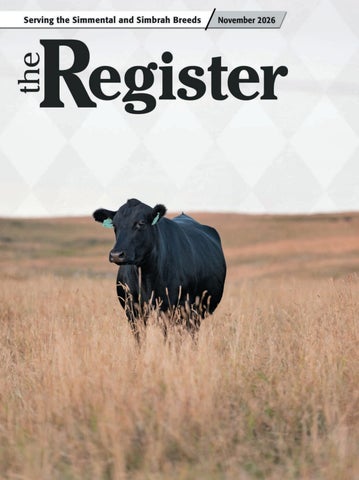
Fall work is in full swing for many producers, with winter and calving just around the corner. Photo captured at Gateway Simmental, Lewistown, Montana, by the Grant Company.
About the Cover
the Register (Issn: 0899–3572) is the official publication of the American Simmental Association, published monthly, except bimonthly, in December/January, May/June, and July/August by ASA Publication, Inc., One Genetics Way, Bozeman, Montana 59718, and is a wholly owned, for-profit subsidiary of the American Simmental Association. Member of
Periodicals Postage paid at Bozeman, MT, and at additional mailing offices. Subscription Rates: $50 (US), $100 (US) First-Class, $150 (US) All International Subscriptions. POSTMASTER: Send address changes to the Register, One Genetics Way, Bozeman, Montana 59718.
Printed in USA
4
Register / November 2026
11-Yardley Cattle fp 4c.qxp_Layout 1 10/13/26 1:03 PM Page 1
11-26 Masthead.qxp_Layout 1 10/14/26 9:27 AM Page 2
the
ASA Board of Trustees Executive Committee Ryan Thorson, Chairman Scott Trennepohl, Vice Chairman Greg Burden, Treasurer Chris Ivie Greg Walthall Dr. Jon DeClerck, Executive Vice President
published by ASA Publication, Inc.
One Genetics Way, Bozeman, Montana 59718 USA 406-587-2778 fax: 406-587-9301 www.simmental.org email: register@simmgene.com
Canada Publications Agreement Number: 1875183
ASA Publication, Inc., Board of Trustees
Scott Trennepohl, Chairman Greg Burden, Vice Chairman Ryan Thorson Chris Ivie Greg Walthall Dr. Jon DeClerck, Executive Secretary-Treasurer CEO Dr. Jon DeClerck
Business Manager Dr. Ben Crites
Managing Editor Lilly Platts
Advertising/Editorial Coordinator Rebecca Price
Sales Manager Nancy Chesterfield
Media/Website Administrator Kathy Shafer
Design/Production Jenna Haughian Gretchen Jensen
American Simmental Association
One Genetics Way, Bozeman, Montana 59718 USA 406-587-4531 fax: 406-587-9301 www.simmental.org email: simmental@simmgene.com
6
Register / November 2026
North Central Region Tim Clark (2027) 1999 18th St NW Turtle Lake, ND 58575 701.799.7752 Timc@westriv.com Loren Trauernicht (2028) 901 E Pine Rd Wymore, NE 68466 402.230.0812 mtrauernicht@diodecom.net Chris Effling (2029) PO Box 23 Highmore, SD 57345 605.769.0142 keffling@gmail.com Chris Nicholson (2029) 6235 23rd Ave SE Kintyre, ND 58549 701.391.6904 CNN2005@hotmail.com
Western Region Chad Cook (2027) PO Box 174 Walsh, CO 81090 719.529.0564 bridlebitsimm@gmail.com Maureen Mai (2028) 427 Peaceful Way Bonners Ferry, ID 83805 208.660.2726 rymocattle@gmail.com Ryan Thorson (2028) 1725 Road 261 Glendive, MT 59330 406.694.3722 ryanthorson7@gmail.com Quin LaFollette (2029) 1476 Hwy 14A Powell, WY 82435 307.899.3553 Quin@Blacksummitcattle.com
Eastern Region Chris Ivie (2027) PO Box 264 Summertown, TN 38483 931.215.0316 iviejc@usit.net Mark Smith (2027) 304 Moeller Rd Picayune, MS 39466 601.310.6695 smith5785@bellsouth.net Brandi Karisch (2029) 648 Polly Bell Rd Starkville, MS 39759 225.717.3324 mbkcattle@gmail.com Scott Trennepohl (2029) 6591 W 625 N Middletown, IN 47356 765.620.1700 sttrennepohl@yahoo.com
South Central Region Victor Guerra (2027) PO Box 92 Linn, TX 78563 956.607.5515 vgg03@aol.com Greg Walthall (2027) 1051 NE 500 Rd Windsor, MO 65360 660.525.9921 gregwalthall@gmail.com Joseph Hensgens (2028) 136 Deer Park Ln Rayne, LA 70578 985.992.9119 joehensgens@yahoo.com Greg Burden (2029) 890 VZ CR 2205 Canton, TX 75103 405.780.0372 greg.gbcattle@gmail.com
11-Reflected R Ranch fp 4c.qxp_Layout 1 10/8/26 2:28 PM Page 1
11-26 From the HQ.qxp_Layout 1 10/9/26 10:25 AM Page 2
FROM THE HEADQUARTERS
by Dr. Jon DeClerck, ASA EVP
The Responsibility to Improve There are moments in an association’s history when standing still is the easier choice. This is one of them. The updated $API and $TI are going to bring change. Some cattle are going to move, and animals that looked outstanding under the old indexes may not look quite as shiny under the new ones. Some breeders will be frustrated, and I understand why. Years of selection decisions, pedigrees, marketing, and pride can be tied to those cattle. A re-ranking is not just a number on a screen when you have invested part of your program in that animal. Before we decide that discomfort means we are headed in the wrong direction, it is worth remembering who we are. The American Simmental Association was not built by people who were afraid to question convention. From the beginning, this Association has been willing to measure cattle, collect records, follow the facts, and use science to build genetics that matter to the commercial beef industry. That willingness to challenge ourselves has been one of the defining characteristics of ASA. We have not gotten every turn right. There were periods when the breed, like much of the industry, chased extremes. The frame race is one example. But some of the most important moments in our history came when breeders and staff were willing to ask whether the direction of the breed still matched the needs of the cattle business. For the first time in more than a decade, Dr. Jerry Lipsey joined us at an ASA meeting during Fall Focus. I asked him to speak because Dr. Lipsey is someone I have long admired, particularly for the way he led. He understood that you do not move a breed simply by issuing a directive. You do it through education, conversations, persistence, and sometimes one handshake at a time. He helped steer this breed back toward science, objective information, and cattle built to serve the commercial industry. As he walked us through major turning points in ASA history, a common thread became clear: this Association has made its greatest progress when it has been willing to learn, adapt, and follow where science leads. That history feels especially relevant today. “Profit Through Science” cannot simply be something printed beneath a logo. It has to describe how we operate when the science challenges what is familiar. There will be times when answers are uncomfortable, rankings change, and leaving things alone would be easier. Those are the moments when that philosophy matters most.
8
Register / November 2026
For 21 years, $API and $TI have helped move this breed forward. They worked. But the industry has changed, and science has changed with it. Today, we can estimate profitability more precisely. That means our yardstick needs to improve. When you improve the yardstick, rankings change. A bull did not become genetically different overnight because his percentile moved. What changed is our ability to estimate how his genetics fit the economic realities of the beef business. If a better measuring stick gives us a different answer, our responsibility is not to sand down the marks until we get the old answer back. Our responsibility is to learn from it. The updated indexes ask us to keep pressure on cow cost and mature size while producing cattle with value beyond the ranch gate. They will require us to consider carcass weight, efficiency, fertility, longevity, and breed complementarity together rather than chase a single trait. There will still be more than one way to create a profitable Simmental animal. That is a strength, not a weakness. The commercial producer does not owe Simmental their business. We have to earn it. We earn it when our females stay in the herd. We earn it when our calves perform. We earn it when our cattle create value for the next owner, and when the product at the end of the chain hits the mark. That is the benchmark. We can respect our history without freezing it in place. We can be proud of the cattle that brought us here without insisting yesterday’s rankings must remain today’s rankings. The people who built this Association used the best information they had to make the breed better. We owe them more than nostalgia. We owe them the same courage. Our job is not to protect yesterday’s rankings. It is to give breeders the best tools we can to build tomorrow’s cattle. Change is uncomfortable. Progress usually is. But this is not a departure from who we are. This is who we are.
.
11-Buck Creek Ranch fp 4c.qxp_Layout 1 10/13/26 1:01 PM Page 1
11-26 Trustee Viewpoint.qxp_Layout 1 10/9/26 10:40 AM Page 2
TRUSTEE VIEWPOINT by Chris Ivie, Eastern Region As I try to gather my thoughts for my last Viewpoint as an ASA Trustee, thoughts are running through my head about how much I have learned over the past six years. One of the biggest reality checks for me was just how much more there is to the American Simmental Association, beyond registering cattle. The ASA is such a dynamic operation, and until you spend time behind the scenes, you cannot truly appreciate what all goes on day to day. The ASA has something to offer to anyone producing beef today, which includes everything from raising registered seedstock to running commercial cattle. We have gone through some changes over the last 18 months with Dr. Shafer retiring, and the hiring of his successor, Dr. Jon DeClerck. As expected, it takes a little time for things to fall into place, but the Board of Trustees, staff, partners, and membership have embraced the direction this organization is going. With this momentum, it’s almost impossible to stop the locomotive from barreling down the tracks. Since I started serving as a trustee six years ago, we have heard our membership and partners express concerns over our “speed of commerce.” The trustees and staff of the ASA have heard you loud and clear! As many — if not all of you — know, the ASA has launched five new EPD over the last year, and have just launched a research release of the updated
$API and $TI indexes. All these new tools not only give SimGenetics breeders more firepower, but they also give our partners (and more importantly the commercial breeders) that same added firepower when making breeding and purchasing decisions. It’s a win-win for the entire beef industry. The AJSA National Classic continues to be a premier event each and every year, and 2026 was as good as it gets. Our staff, along with an army of volunteers, put on a first-class event for all ages. My eight-year-old granddaughter, Eleanor, attended her first National Classic this year as a novice, and had an absolute blast. I must also say that this year’s theme was great, and in my opinion, the music used in the background was the best ever. The depth of quality in the cattle was remarkable on both days! The Owned division is always competitive, but I want to give a shout-out to the Bred and Owned division, which has become very competitive. My hat goes off to all these amazing young Simmental breeders who are the future of this breed. A big thank you to Mia Bayer, Chance Ujazdowski, and their crew for always knocking it out of the park! What an honor and privilege it has been to serve the ASA membership over the past six years. It has been humbling to say the least! I believe God put all of us here to be good stewards of what he has given us, and we know he owns the cattle on a thousand hills. I strive each and every day to do just that — be a good steward — and my prayer is that I have been a good steward to this membership during my tenure as a trustee. One of the best things about serving on the ASA Board of Trustees is the people it has allowed me to meet along the way, many whom I would likely have never gotten to know. I’m thankful for the opportunity to make new lifelong friends. In closing I want to thank Dr. DeClerck for agreeing to become our EVP. Jon has done a remarkable job and works tirelessly to not just maintain the status quo, but he has demonstrated that he and his staff are looking ahead years down the road to make improvements for the betterment of the ASA membership, as well as the global beef industry. One of the most obvious ways to see Dr. DeClerck’s great work is through the recruitment of talented people, adding to the depth of ASA’s already talented staff. I’m a baseball guy, and when I served as Chairman, my slogan for the year was: “You will never steal second base if you keep your foot on first base.” In my opinion, as I look at the progress the ASA is making, I think we have not only stolen second base as an organization, but we have hit a grand slam! John 3:16
.
10
Register / November 2026
11-ASA IGS Better Together (Grant) fp 4c.qxp_Layout 1 10/14/26 9:28 AM Page 1
R_F_Staying the Course_Line Triangle J.qxp_Layout 1 10/8/26 1:49 PM Page 2
Staying the Course by Rose Oie
Nebraska’s Triangle J Ranch is known throughout the country for producing cattle that perform throughout the beef supply chain. The Line family has been building this family business for seven generations, with a steady focus on the future.
D
arby Line is the first to tell you he’s all about looking ahead while still appreciating all that was built before him. At Triangle J Ranch near Miller, Nebraska, seven generations of the Line family have made their living through the cattle business. The operation began in 1887, when making breeding decisions to retain and grow a herd looked far different than it would today. Cattle have changed over the years and so has the way the Lines go about progressive ranching. What’s stayed constant is the emphasis on producing cattle for the people who buy them. Darby and his wife, Anette, have five sons, Travis, Dillan, Jason, Creyton, and Braxton. Several sons have returned to the ranch to contribute to the family business and help carry it to the next generation. For Darby, the opportunity to continue the family’s legacy and build on more than a century of cattle production is something he does not take lightly. “My parents, my grandparents, left me a tremendous base and stability,” Darby said. “I think that’s about all I can leave them [my kids]. It’s a start because it’s so hard to get started in the cattle business, if you don’t have a little bit of help.” Triangle J began with Shorthorn cattle before Darby’s grandfather transitioned to Herefords. His father later added Angus genetics and began working with crossbred cattle. Darby’s own path into the Simmental breed began while he was still in high school.
12
Register / November 2026
He purchased his first Simmental bull and later bought several 4-H projects, bringing Simmental cattle into the operation at a time when the breed looked quite different than it does today. “We bought some Simmental cattle back when they were more red and white spotted cattle at that time,” Darby said. The Lines soon had an opportunity to acquire some of the early black Simmental genetics available in the breed, including genetics from breeders such as Jim Lehman as those herds dispersed. From there, the operation continued to develop its own direction. Today, Triangle J works with both purebred Simmental and SimAngus genetics, with goals to provide commercial producers with bulls that fit a wide range of production systems. Darby sees flexibility as one of the breed’s greatest strengths. “I think the breed is very diversified, especially now,” he said. “We’re able to find calving ease genetics, along with low birth weights now, where maybe it was strictly more of a growth-oriented breed earlier in time.” That change has allowed Triangle J to satisfy customers with very different goals. Some are looking for growth and carcass performance. Others need heifer bulls or want to maintain a percentage of Simmental influence in their cow herd. “There’s just so many ways that you can use a Simmental bull, whether it’s a half-blood or a purebred, to satisfy your customer’s needs,” Darby said.
R_F_Staying the Course_Line Triangle J.qxp_Layout 1 10/8/26 1:50 PM Page 3
Cattle have changed over the years and so has the way the Lines go about progressive ranching. What’s stayed constant is the emphasis on producing cattle for the people who buy them. Darby recognizes that there is no single type of commercial cow herd across the region. Even within Nebraska, customers can have dramatically different environments, cow sizes, and management systems. “Everybody needs something just a little bit different,” he said. That means the job of a seedstock producer does not end when a bull leaves the ranch. Darby spends considerable time visiting customers, particularly in the fall after their calves have had an opportunity to develop. He wants to see what the cattle are doing outside of his own pastures. “I try to spend a month or two at least in the fall visiting customers,” Darby said. “I don’t make it everywhere, but I sure try to do my best to at least make a phone conversation with those people, or a farm visit when possible.” Darby appreciates feedback. If a customer needs more growth, additional maternal value, or a different type of bull altogether, he wants to hear about it. The information coming back from commercial herds is another piece of the selection process at Triangle J. Artificial insemination and embryo transfer have been part of the program for years, helping Darby to multiply genetics from the females he considers the most valuable. By combining top donor females with selected AI sires, Triangle J can make more progress in the traits it wants to emphasize. DNA testing has added another advantage to their toolbox. Darby was initially hesitant about genomic technology, but years of using DNA testing have changed his perspective. “As I’ve seen our herd grow since we started DNA testing and total herd testing, I see the differences,” he said. The value, he explained, is apparent when comparing full siblings and embryo calves. Genetic differences that once may have taken several years to become obvious can now be identified much earlier. “You see those subtle differences among your full sibs and embryo projects, whereas maybe before it would have taken you two, three, four years to see that level of growth,” Darby said. Even with more data available than ever, Darby does not believe the numbers should replace cattle evaluation. For Triangle J, the goal is to use the information together. “We’re not out here looking for the extremes,” he said. “We’re trying to find that balance and to find the cattle that are more in the middle.”
Opposite: Nebraska is the second largest beef-producing state in the US, and the Triangle J Ranch program has a major impact on the state’s seedstock and commercial producers. Above: Darby Line operates Triangle J Ranch alongside his family. Below: Triangle J Ranch utilizes many technologies, from embryo transfer and AI, to DNA testing, with the goal of multiplying their top-performing genetics.
That mindset carries into addressing environment specifics surrounding the ranch. In central Nebraska, Triangle J sits close enough to feedlots and abundant grain resources to see what cattle can do in a high-energy finishing environment. At the same time, many of the ranch’s customers operate in the Nebraska Sandhills, where feed resources can be much more limited. Darby sees value in having experience with both sides. “We want to make sure that we’re raising cattle that can survive in both environments,” he said. For him, functional cattle are especially important when customers are working in tougher environments. Cattle need the ability to maintain when high-energy feed sources are not readily available. “They have to be really sound and functional,” Darby said. “We want to eliminate those hard-doers that are not going to survive in those environments for our customers.”
(Continued on page 14) November 2026 / Register
13
R_F_Staying the Course_Line Triangle J.qxp_Layout 1 10/8/26 1:50 PM Page 4
Staying
Course
(Continued from page 13) The operation has begun developing TJ Feeders to help commercial customers gain more information about where their cattle go after sale and how those cattle perform through the feeding and harvest process. Darby views the effort as a way to bridge a gap that can exist between seedstock producers, commercial producers, and the feeding sector. Connecting the dots between genetics and end-product performance gives both Triangle J and its customers information they can use to make better decisions.
Connecting the dots between genetics and end-product performance gives both Triangle J and its customers information they can use to make better decisions. Triangle J also buys back some customer calves to feed, but Darby said much of the information the operation receives comes directly from commercial customers. Those cattle provide a larger pool of performance and carcass information that can help make future decisions. For Darby, those numbers are valuable because it brings the breeding program back to its purpose: producing cattle that work in someone else’s herd. That same idea carries into the way he approaches the future of Triangle J. If Darby could sit down with himself at 20 years old, there is one lesson he would emphasize: patience.
Looking back, he said he would have been more careful about following short-term trends and more deliberate about evaluating what fit the program. “I think just being able to analyze those things, making quicker decisions, and then following through with those decisions to make sure we stayed on course,” he said. It is advice that seems fitting for an operation seven generations in. The cattle industry will continue to change, and Darby expects Triangle J will change with it. New technologies will bring more information. Customers will have different needs. Markets and production systems will continue to evolve. The challenge is deciding what belongs in the program and what does not. For Darby, that means listening, evaluating and continuing to learn. Most importantly, he wants to give the next generation something to work from. “I hope to give them some stability and guidance,” Darby said. “A solid starting point, and then it’s up to them.” After more than 135 years in the cattle business, the goal is not to have every answer figured out. It is to leave the next generation with enough of a foundation that they can keep asking the right questions. And, perhaps, look back at the mistakes made along the way and learn from them. “Hopefully they can look back and see, ‘Hey, this is where dad made a mistake. I’ll try not to make that same one,’ Darby said. “That’s about as good as you could ask for.”
.
The Line family produces both Simmental and SimAngus genetics.
14
Register / November 2026
11-ASA Calf Crop Genomics fp 4c.qxp_Layout 1 10/14/26 9:28 AM Page 1
R_F_ASA to Update API and TI.qxp_Layout 1 10/8/26 2:02 PM Page 2
Updating $API
$TI
by Dr. Elizabeth Dressler, ASA Lead Geneticist
Economic selection indexes are a valuable tool for selection and mating decisions. One major benefit is that selection indexes combine several traits into one number that estimates expected progeny profitability for a specific production system.
W
hen you open a sale catalog to compare two bulls, economic indexes are designed to help answer a practical question: “Which bull is expected to sire the more profitable set of calves within this production system?” ASA publishes two economic selection indexes: the all-purpose index ($API) and the terminal index ($TI). These indexes help Simmental breeders make more informed decisions by bringing the economic importance of several traits together in one easy-to-use tool.
Why is ASA updating $API and $TI? $API and $TI are valuable tools for Simmental breeders and have helped make meaningful genetic progress in the breed. If you are a Simmental breeder who has used $API or $TI over the years, you have likely seen the value of these selection tools in your own herd. In other words,
16
Register / November 2026
the previous indexes were not wrong. Simmental breeders have made progress using them, and they have served the breed well. ASA is making key updates so the indexes will be even better selection tools. The beef industry has changed in recent years, and our technology and ability to analyze data have also advanced significantly. Together, these changes give ASA an opportunity to build on what has worked and make the indexes even more accurate at predicting progeny profitability. Dr. Jon DeClerck covered the reasons for updating $API and $TI in more detail in his recent articles, including his article titled “Building on Progress: Why It’s Time to Update $API and $TI.” As he explained, “Updating $API and $TI is not about moving away from what has worked. It is about building on that success with better data, better technology, and a better ability to model the biology and economics of today’s cattle industry.”
R_F_ASA to Update API and TI.qxp_Layout 1 10/8/26 2:03 PM Page 3
What is being updated? 1. Direct Incorporation of New EPD It has been a busy and productive time on the IGS science team since I joined just one year ago. In the last year and a half, IGS has released five new predictions for members, including dry matter intake (DMI), $Gain, mature weight (MW), cow energy requirements (CER), and heifer pregnancy (HP). The release of these five new predictions reflects the hard work of not only the IGS science team, but also the Simmental breeders dedicated to reporting phenotypic data for these traits. It is something ASA members should be excited about and proud of. With the release of these new EPD came the opportunity to directly include carcass weight (CW), DMI, MW, and HP into the indexes. Previously, this information was approximated based on the relationships between these traits and others like growth. Think of it like estimating the weight of an animal based on its age and size. An experienced cattleman can often get surprisingly close. But actually putting that animal on a scale gives you a much more accurate measurement. In much the same way, using information from related traits allowed the previous indexes to make fairly good predictions of CW, DMI, MW, and HP. Now, integration of the new EPD into the indexes leads to a more direct, accurate measure of genetic potential for these traits.
number of acres, which means the number of replacement females retained depends on the resources available from that land. The $API simulation plays out for 50 years. The production scenario simulated for $TI also begins with a 500-head Angus cow herd, but no replacements are retained and all progeny are sold on a carcass basis. The $TI simulation plays out for two years, focusing on the short-term economic returns of terminal calves. Another benefit of the updated indexes is that the simulation was developed in-house at IGS. This means economic parameters can be updated with greater frequency than they were previously, allowing the indexes to align with changes in the beef market going forward.
2. In-House Simulation Building an index requires more than knowing the EPD. IGS also has to determine what changes in those traits are worth economically. This is called an economic weighting. Establishing the economic weightings for each EPD is one of the more challenging aspects of developing an economic selection index. We can’t simply guess what the economic value of increasing marbling, or any other trait, by one unit would be. Instead, we use what’s called a simulation. Think of this like the popular Farming Simulator video game where players manage and grow their own virtual farms. In a similar way, IGS created a simulation that models a cattle operation. We could think of it like our own “Cattle Ranch Simulator,” although no video game controllers were involved. The simulation plays out the index production scenario over a specified period of time and uses the results to generate the economic weightings needed for the index. The production scenario simulated for $API begins with a 500-head Angus cow herd where replacements are retained and all non-replacements are sold on a carcass basis. The simulation models a fixed land base. In other words, the “Cattle Ranch Simulator” operates on a fixed
$API and $TI are valuable tools for selection and genetic progress.
3. More Precise Accounting of Heterosis Another improvement to the indexes is the way they account for heterosis. ASA has long been an advocate for crossbreeding, promoting the performance gains from heterosis and breed complementarity. The previous indexes accounted for heterosis in a more general way. Animals were categorized into broad breed groups, and then a heterosis adjustment factor was applied at the end. The updated indexes account for heterosis more precisely within the simulation itself. The simulation described above was repeated multiple times using bulls at different percentages of Simmental (or more specifically nonBritish or dairy), in 10% increments ranging from 0% Simmental to 100% Simmental. This results in a different set of marginal economic values and relative emphasis of traits (discussed below) for each 10% Simmental group.
(Continued on page 18) November 2026 / Register
17
R_F_ASA to Update API and TI.qxp_Layout 1 10/13/26 2:12 PM Page 4
Updating $API
$TI
(Continued from page 17) In other words, the relative emphasis of traits changes depending on the percentage of Simmental genetics being used. This allows the updated indexes to more accurately account for heterosis, breed advantages, and breed complementarity when Simmental bulls are bred to an Angusbased cow herd.
4. Updated Economics The economics of the cattle industry have evolved, and they will continue to evolve over time. Economic selection indexes are designed to be robust, meaning they are intended to remain useful despite short-term fluctuations in the market. Because $API and $TI were being updated in other ways, this was also an opportunity to update the economic assumptions of the index. Just like the Farming Simulator game has built-in economic assumptions, such as how much players are paid per bushel of corn, the “Cattle Ranch Simulator” also needs the underlying economic assumptions to generate the economic weightings discussed above under update #2. The economic inputs for the index simulation were based on historical CattleFax data and projected into the future using those pricing trends and relationships among inputs. The economic assumptions cover all the major aspects of cattle production from cow and backgrounding assumptions to feedyard economics and carcass premiums and discounts. As a result of these updates, the amount of influence a trait has in the index, or the relative emphasis, has changed. You may be familiar with the $API pyramid, which showed the relative emphasis of traits for the previous $API. The relative emphasis of traits for the updated $API and $TI is shown in the pie charts. As described under update #3, the relative emphasis differs based on the incremental 10% Simmental groups; the 0%, 50%, and 100% Simmental groups are shown.
Figure 1. Relative emphasis, or the amount of influence a trait has in the index, pie charts for the All-Purpose Index ($API). STAY=Stayability; CW=carcass weight; MARB= marbling; DMI=dry matter intake; CED=calving ease direct; MW=mature weight; HP=heifer pregnancy; REA=ribeye area; BFAT= backfat; WW=weaning weight; CEM=calving ease maternal; WWM=weaning weight maternal; and YW=yearling weight.
Key Takeaways • $API and $TI are being updated to provide a more accurate prediction of progeny profitability using improved data, technology, and modeling.
• New EPD are now directly incorporated into the
indexes, giving the indexes more accurate information for CW, MW, HP, and DMI.
• Heterosis is accounted for more precisely by modeling different levels of Simmental genetics rather than applying a broad adjustment factor.
18
Register / November 2026
• Updated economic assumptions better reflect
today’s cattle industry, accounting for factors across the cow-calf, backgrounding, feedlot, and packing sectors.
• The updated indexes should be utilized just as the
previous indexes were: use $API when retaining replacements and $TI when all offspring are marketed as terminal cattle. Use the updated percentile rankings when evaluating animals.
R_F_ASA to Update API and TI.qxp_Layout 1 10/8/26 2:03 PM Page 5
to help simplify selection across multiple economically important traits. Individual EPD and other selection criteria can be used alongside the indexes to further refine selection based on your breeding objectives. The table below outlines the average $API and $TI for the Simmental breed sub-groups for animals born after January 1, 2024, and provides context for interpreting the updated index values. Because of the updates, comparison of an animal’s previous index value and updated index value would not be meaningful. Instead, look at the animal’s updated percentile rankings to understand how it compares with other animals in the population. Simmental Sub-Group
Average $API
Average $TI
Purebred Hybrid Simbrah Fullblood
304 300 259 263
179 175 135 146
Table 1. Average $API and $TI for animals born after January 1, 2024, by Simmental breed sub-groups.
Figure 2. Relative emphasis, or the amount of influence a trait has in the index, pie charts for the Terminal Index ($TI). CW=carcass weight; MARB= marbling; DMI=dry matter intake; CED=calving ease direct; REA=ribeye area; BFAT= backfat; and PWG= post weaning gain.
How should I use the updated indexes? The updated indexes can be used in selection and mating decisions just as the previous indexes were used. The same rule of thumb applies: If you are retaining replacements, use $API. If you are not retaining replacements, use $TI. $API: Evaluates sires for use on the entire cow herd with a portion of their daughters retained and the remaining heifers and steers put on feed and sold on a grid. $TI: Evaluates sires for use on the entire cow herd with all offspring put on feed and sold on a grid. Both $API and $TI are expressed in dollars per cow exposed and represent expected progeny profitability under the production scenario of each index. Indexes should be used as a comparison tool. When comparing two index values, a higher value indicates greater expected progeny profitability and is favorable. Indexes are designed
It’s also important to remember that there is not only one recipe for a high $API or $TI. There are different paths to profitability. Because an index combines multiple EPD, animals with different EPD profiles can still arrive at a similar $API or $TI. This allows producers to use the indexes to identify profitable animals while still having the flexibility to fit their individual operation.
What does this mean for me and my animals? The updated indexes better reflect the current beef market and the industry we are moving toward. They incorporate current and projected economics, more EPD directly into the index, and more sophisticated modeling. These updates improve the ability of the indexes to predict progeny profitability and provide members with more effective tools for selection. With these updates, some animals will rank differently. We recognize that change can be difficult, particularly when members have been making selection decisions based on the previous indexes. However, the goal of these updates is not to change the rankings. It is to provide a more accurate prediction of progeny profitability and a better selection tool for the industry moving forward.
.
November 2026 / Register
19
11-ASA Pub Catalog Posts on Website fp 4c.qxp_Layout 1 10/14/26 9:29 AM Page 1
11-ASA CMP If Beef is Your Business fp 4c.qxp_Layout 1 10/14/26 10:23 AM Page 1
ASA# 4461924 Bar CK IM UR Huckleberry 4015M CMP Class of 2026
The American Simmental Association Carcass Merit Program (CMP) is the beef industry’s most demanding and informative young sire test. The program is a hallmark of ASA breed improvement for economically relevant carcass traits. Commercial producers play an integral part in this project. To learn more about the CMP visit www.simmental.org, then click Carcass Merit Program under the ASA Programs tab. Questions, contact cmp@simmgene.com for more information regarding this program.
Participants receive: u $200 for each AI-sired calf with carcass information u Free semen on top young herdsires u Free ASA Genetic Evaluation on your cow herd u Free genotyping on terminal progeny u Keep any or all replacement females Become a Carcass Merit Program test herd today *The CMP is a structured young sire progeny test. Participating cooperator herds will random sample their cow herd with CMP semen, and the resulting male (or female) progeny will be harvested with individual carcass data gathered. ASA Staff will work with cooperator herds to provide bulls that fit the general criteria of your management program; however, only bulls nominated into the CMP program may be used. Producers are encouraged to be somewhat proficient in Microsoft Excel for accurate and consistent record-keeping.
R_F_Rethinking Female Selection Through an Economic Lens.qxp_Layout 1 10/9/26 10:00 AM Page 2
Rethinking Female Selection Economic Lens by Rose Oie
Shifting the focus from individual cow performance to whole-herd productivity can help producers find the “best” cow for their operation.
F
emale selection is often discussed through individual traits, but building a profitable cow herd requires looking beyond any one measurement. During Fall Focus 2026 in Bozeman, Montana, Dr. Ryan Rathmann of Texas Tech University and Dr. Troy Rowan of the University of Tennessee gave insight on what cow efficiency really means, and how female selection decisions affect the entire operation. The conversation brought up a familiar challenge in the beef industry. Market signals on the terminal side continue to reward cattle with added gain and frame size with an end result to produce heavier carcasses. At the same time, those same genetic changes can increase the size and maintenance requirements of the females being retained in the cow herd. Both professors described this as a “tug of war” between the terminal and maternal sides of the industry. Genetic progress has contributed to heavier cattle and improvements in carcass value, but it has also been accompanied by increases in mature cow size, milk production, and maintenance requirements.
22
Register / November 2026
“The problem is that, again, some of this gets kind of gray in the cow herd,” Rathmann said. “Because what we have done is we have unfortunately created a female in our industry that is somewhat built on current extremes.” For the commercial cow-calf producer, the question becomes whether those additional inputs are generating enough additional revenue to justify them.
Finding the Balance Rathmann used a series of economic comparisons to show how cow size and milk production can affect the number of cows an operation can support on a fixed land base. The handout compared mature cow weights ranging from 1,100 to 1,400 pounds, and peak milk production levels of 11, 18, and 25 pounds. The exercise held the amount of forage available constant, allowing the comparison to show how different types of cows would use the same resource.
R_F_Rethinking Female Selection Through an Economic Lens.qxp_Layout 1 10/9/26 10:01 AM Page 3
Maximizing output is not necessarily the same as maximizing profitability.
The comparison illustrates why looking only at weaning weight per cow can miss part of the economic picture. “Cow efficiency” has to be considered at the herd and ranch level.
More Milk Is Not Automatically More Profitable
Above: Dr. Ryan Rathmann discussed the various factors producers must consider when determining the best cow for their operation. Opposite: Finding the balance between cow size and productivity is a challenge for all producers.
Rathmann framed the exercise around a simple question: “What combination makes the commercial producer the most money, utilizing the same amount of grass?” A larger cow may produce a heavier calf, but she also requires more forage to maintain herself. If the additional pounds of calf do not offset the additional resources required to produce them, increasing cow size could ultimately hurt you more economically in the long run. Rathmann reminds us that maximizing output is not necessarily the same as maximizing profitability. “It’s not so much about who is maximizing the output value of their cattle. It’s who is minimizing the input of their cattle,” he said. His simulation showed the effect clearly. Moving from a 1,100-pound cow to a 1,400-pound cow increased annual forage requirements while reducing the number of cows that could be maintained on the same land base. The smaller cows produced lighter calves individually, but the greater number of cows supported on the fixed forage supply resulted in more total pounds of calf produced across the ranch.
Milk production presented a similar question. Rathmann’s analysis compared cows producing 11, 18, or 25 pounds of peak milk. Increasing milk production requires additional nutrients, but the relationship between milk and profitability is not necessarily linear. His simulation found that the most favorable level depended on whether the additional milk affected pregnancy rates. When a reduction in reproductive performance was included in the model, the intermediate milk level provided the highest gross return per acre. When pregnancy rate was held constant, the higher milk level performed differently. The larger takeaway was not that one milk level is universally correct. Milk production needs to be considered within the environment where the cow will be expected to work. Rathmann said producers need to be cautious about relying too heavily on any one measurement without considering the trait and environmental limitations of their individual herds. The same principle applies to other traits. Producers have to determine where their own thresholds are and how individual traits fit into their production system. “That's your job to figure out, as the breeder, how you balance all of that.” Rathmann said.
Producers have to determine where their own thresholds are and how individual traits fit into their production system.
(Continued on page 24)
November 2026 / Register
23
R_F_Rethinking Female Selection Through an Economic Lens.qxp_Layout 1 10/9/26 10:01 AM Page 4
Rethinking Female Selection
Economic Lens
(Continued from page 23) Rathmann pointed to this as an area where the industry still has work to do. “We have to figure out technologically how to start capturing this information on cows on grass,” he said, “so we can start to identify these genetics.” Being able to measure individual intake and identify cows that use forage more efficiently could give producers a better tool for making replacement and mating decisions.
Efficiency Without Sacrifice Rowan’s research also examined differences in body capacity and frame size, finding differences in intake and energetic efficiency among the cattle studied. But the findings did not singly point toward selecting the smallest or shallowest cow. Instead, the study supported the idea that female selection involves finding a balance between production and maintenance requirements. Rathmann made a similar point throughout his presentation. The objective is not to eliminate milk, growth or other productive traits. It is to find animals that can combine desirable performance with the ability to function within the resources available to them. Dr. Troy Rowan shared about the challenges of measuring individual cow intake, emphasizing the importance of future research.
Efficiency Is More than a Mature Weight Rowan built on the discussion by looking beyond mature size and maintenance requirements. Fertility, longevity, structural soundness, immune function, the ability to convert forage into a weaned calf, and the ability to remain productive within a specific environment all contribute to the value of a cow. The challenge is that some of these traits are easier to measure than others. For example, mature weight can be recorded and incorporated into genetic evaluations. Individual cow intake on pasture is much more difficult to measure. Rowan’s research focused on why intake may deserve more attention. Research evaluating individual cow appetite found considerable variation among cows of similar size. In one study, cows of approximately the same weight consumed substantially different amounts of dry matter during a 49day period. Rowan used the example to show that body weight alone does not tell the whole story of how much forage an individual cow will consume.
Body weight alone does not tell the whole story of how much forage an individual cow will consume. 24
Register / November 2026
The objective is to find animals that can combine desirable performance with the ability to function within the resources available to them.
“There’s an antagonistic relationship between fleshing ability and energetic efficiency,” Rathmann explained. “We’re trying to reach that compromise. We’re trying to find that happy medium in regard to body volume.” With these things in mind, balance will look different from ranch to ranch. A cow working in an environment with abundant, high-quality forage has different nutritional challenges than one expected to travel long distances for limited forage and water. Rathmann pointed to grazing activity itself as another factor affecting a cow's maintenance requirements.
Selection Decisions Have to Fit Each System For seedstock producers, the discussion adds another layer to the responsibility of selecting and marketing genetics. The bulls and females produced today influence the cows that commercial producers will be managing for years. Rathmann encouraged breeders to keep in mind
R_F_Rethinking Female Selection Through an Economic Lens.qxp_Layout 1 10/9/26 10:01 AM Page 5
Input costs and feed availability are among the many factors that affect female selection.
how traits like mature size and milk production will be expressed in the daughters retained by commercial herds, instead of focusing exclusively on traits that increase terminal performance. At the same time, neither speaker suggested abandoning growth or carcass traits. Instead, they want you to find a better balance between the traits that generate value at harvest and the traits that determine how efficiently a cow uses resources throughout her productive life.
Think about how genetics can be combined rather than viewing maternal and terminal traits as opposing choices.
For producers making replacement decisions, that means asking a bigger question than “Which heifer is the biggest?” or even “Which heifer has the highest genetic value?” The more useful question may be: Which female is most likely to remain productive and profitable in the environment where she will spend her life? This question brings female selection back to the economics of the entire cow herd. When land, forage, and other inputs are limited, the most productive individual cow is not necessarily the one that generates the greatest return for the ranch. Sometimes, efficiency comes from producing a little less per head while producing more from the resources available to the entire herd.
.
Rathmann also encourages breeders to think about how genetics can be combined rather than viewing maternal and terminal traits as opposing choices. “Is it possible to select for genetics that have downward pressure on mature weight while you simultaneously have upward pressure on carcass weight?” he asked. “They’re pretty closely related, but they’re not one to one.” That opens the door to what Rathmann described as “curve benders”; cattle that can deliver strong growth early in life without continuing to increase in mature size at the same rate. The end goal is not to make a “small cow.” It is to select a female that can become pregnant, raise a calf, remain productive and make efficient use of the resources available to her. November 2026 / Register
25
11-ASA Build, Breed, Achieve Genetic Goals 2pg 4c.qxp_Layout 1 10/14/26 9:30 AM Page 2
11-ASA Build, Breed, Achieve Genetic Goals 2pg 4c.qxp_Layout 1 10/14/26 9:30 AM Page 3
R_F_Fall Focus 2026_Reflections on the Past and Future.qxp_Layout 1 10/8/26 1:54 PM Page 2
Fall Focus 2026: by Rose Oie
The American Simmental Association’s 2026 Fall Focus brought ASA members, staff, and trustees together in Bozeman, Montana, August 28 through September 1. Over the five days, attendees moved through mixed farm tours, a full day of industry education, a recognition dinner with some real breed history in the room, and the ASA Board of Trustees fall board meeting.
F
all Focus opened Friday with tours of Montana State University and the Bozeman Agricultural Research and Teaching (BART) Farm. The BART Farm tour gave attendees a look at the research, teaching, and Extension work taking place on the 474-acre facility, including the Steer-A-Year program, virtual fencing systems, Calan gate facility, and SmartFeed system. The night continued with a social hour and dinner at ASA headquarters. For many attendees, the evening offered an opportunity to see where the Association’s daily activities take place. Saturday’s Educational Symposium covered a wide range of topics, but the conversations consistently came back to a question that producers face every breeding season: How can genetic and industry information be used to make better decisions in the herd? Saturday morning began with a look back. Moderated by former ASA Executive Vice President Dr. Jerry Lipsey, “A Reflection on Defining Moments in Simmental History,” brought breed pioneers together to discuss the decisions
and turning points that helped shape Simmental in the United States. The value of the session was not simply in revisiting dates or accomplishments. The people involved were able to explain why certain decisions mattered at the time and how those choices influenced the direction of the breed. It gave attendees a chance to hear parts of Simmental history directly from people who helped shape it. From there, the symposium took off with insights from guest speakers. Dr. Dale Woerner of Texas Tech University opened the first technical session with “Red Meat Yield: A New Era,” addressing the continued importance of understanding carcass value and yield grade. Dr. Andrew Griffith, a livestock economist at the University of Tennessee, followed with a discussion of beef demand, consumers, and the economic outlook facing the industry. The two joined Dr. Jon DeClerck, ASA EVP, for a roundtable discussion before lunch, giving attendees an opportunity to continue the conversation beyond the presentations.
Fall Focus 2026 was held in Bozeman, Montana. Opposite: The Montana Simmental Association hosted a dinner at the ASA Headquarters.
28
Register / November 2026
R_F_Fall Focus 2026_Reflections on the Past and Future.qxp_Layout 1 10/8/26 1:54 PM Page 3
After lunch, attention turned to International Genetic Solutions (IGS) and the tools available to ASA members. Dr. Ryan Boldt discussed updates to the IGS Multi-breed Genetic Evaluation and new trait development, while Dr. Elizabeth Dressler focused on practical application for ASA members. Dr. Jackie Atkins joined Boldt and Dressler for a panel discussion that allowed the technical information to move into questions about how breeders can successfully use it in their own programs. Dr. Ryan Rathmann focused on female selection and what cow efficiency looks like from the commercial producer’s perspective, using mature cow size, forage resources, and milk production to show how breeding decisions can affect profitability. Dr. Troy Rowan followed with “More Than Just a Weight: The Complex Challenge of Breeding More Efficient Cows,” covering closely related questions about cow size, body capacity, and efficiency. Both presentations challenged breeders to consider how the cow fits her environment and how genetics can help producers make the most of the resources they have. For longtime Fall Focus attendee Bruce Holmquist, that kind of information is exactly why producers continue to make the trip. Holmquist has attended the event for years, dating back to a gathering in Kansas City in 2002, before it carried the Fall Focus name. He said attending provides an opportunity to see the amount of information available to seedstock producers and breeders, information that not every producer takes advantage of. “The people that take advantage of it are in the top 5% for awareness, education, and knowledge about genetic improvement for the industry,” Holmquist said. “That’s something that differentiates the people who attend this from the rest of the crowd.” Holmquist also touched on the importance of keeping the commercial producer at the forefront of breed improvement. “I think it goes back quite a few years, and I hope it
continues, but it’s the understanding that the customer of the American Simmental Association and all breed associations is the commercial producer,” he said. “It’s the commercial beef producers that put meat on the plate. We need to do it more efficiently and create more profitability in that area.” That perspective connected several of Saturday’s presentations. Saturday evening shifted the focus from education to recognition as attendees gathered for the recognition dinner. John B. Collier of Stephenville, Texas, and Gibbs Farms of Ranburne, Alabama, were recognized with World Simmental-Fleckvieh Federation Golden Book Awards. Collier played an important role in the early development of Simmental in the United States. Gibbs Farms has spent decades developing Simmental and SimAngus cattle while collecting data from its herd to support genetic improvement. The evening also recognized Doug Parke of Paris, Kentucky, and Jim Butcher of Lewistown, Montana, with Lifetime Promoter Awards. Both have contributed to the breed through breeding goals, leadership, and promotion. Butcher’s family has an especially long connection to Simmental, having bred Hereford cows to Parisien, the first Simmental bull in North America, in 1968. With the educational and recognition portions of Fall Focus complete, Sunday morning brought attendees into the Association’s board meetings. The Town Hall opened the day, followed by committee meetings covering Activities and Events, Breed Improvement, Growth and Development, and Policy and Procedures. The meetings provided an opportunity for members to hear updates, ask questions, and participate in discussions with trustees and staff. (Continued on page 30)
November 2026 / Register
29
R_F_Fall Focus 2026_Reflections on the Past and Future.qxp_Layout 1 10/8/26 1:55 PM Page 4
Fall Focus 2026: Reflections
Past
Future
(Continued from page 29)
Above: Dr. Jon DeClerck addressed the crowd gathered for the Saturday Educational Symposium. Below, clockwise from L: A highlight of the event was past ASA EVP Dr. Jerry Lipsey’s history panel. Producers and industry professionals gathered on Saturday for a day of industry education. The Cash Cow fundraiser raised funds for Fall Focus 2027.
The ASA Board of Trustees then met Sunday afternoon and continued through Monday and Tuesday morning. Committee reports, financial and Association reports, directives, and resolutions were addressed, followed by voting on Association business before the meeting adjourned Tuesday morning. The open board meeting gave members the opportunity to ask questions, interact with the ASA Board of Trustees and staff, and voice questions and ideas. A week full of history, food for thought, and new breed improvement make the trip well worth it, putting producers in a room where they can ask questions and talk through what it means for their own operations. As the 2026 Fall Focus came to a close, attendees left Bozeman with new information to consider and conversations to continue for a better understanding of the work taking place across the Association and the beef industry.
.
30
Register / November 2026
R_F_Fall Focus 2026_Reflections on the Past and Future.qxp_Layout 1 10/8/26 1:55 PM Page 5
Above: Attendees gathered to recognize the WSFF Golden Book and ASA Lifetime Promoter recipients. Below: ASA hosted an open Town Hall, allowing members to voice their questions, ideas, and thoughts to the ASA Board of Trustees and staff.
Save the Date Fall Focus 2027 ● Sioux Falls, South Dakota, August 20–24 ● Co-hosted by the South Dakota Simmental Association ● Host hotel: Holiday Inn City Centre
November 2026 / Register
31
11-ASA Pub Sale Packages - Built for Seedstock Producers fp 4c.qxp_Layout 1 10/14/26 10:19 AM Page 1
• 2 full-page ads placed in the Register and/or SimTalk • Business card ad placed in the Register or SimTalk • 1 eBlast • Included in weekly Sales Call email and simmental.org • Sale catalog included on simmental.org
• 1 full-page ad and 1 halfpage ad placed in the Register and/or SimTalk • Business card ad placed in the Register or SimTalk • 1 eBlast • 1 Facebook ad • Included in weekly Sales Call email and simmental.org • Sale catalog included on simmental.org
• 1-full page ad placed in the Register or SimTalk • Business card ad placed in the Register or SimTalk • 1 eBlast • 1 Facebook ad • 1 banner ad placed on the ASA website • Included in weekly Sales Call email and simmental.org • Sale catalog included on simmental.org
11-ASA THE Spring Enrollment 2pg 4c insert.qxp_Layout 1 10/14/26 9:33 AM Page 1
HOW TO UPDATE YOUR INVENTORY Start with your Preliminary Inventory by accessing it online
See Enrollment Template below (see reverse for instructions or use paper packet received in mail/email)
1
Confirm that ALL spring-calving cows are listed on the form. This should include any cow enrolled in the previous year, first-time heifers, purchased cows, and cows in associated junior accounts that run with your herd.
2 Enroll or Remove each dam. Enter an enrollment or removal code in the Primary Code column. 3 A/B/C/D/N — Enter an enrollment option: A, B, C, or D for each cow. If a cow is being removed, enter “N.” Enrollment Template AnmReg Nbr
1
AnmTatt
Primary Code
2
AddtnlCode
A/B/C/D/N
Season
Animal Name
BrdCds
EnrYear
BillCode
3
Do you still own the dam? 0 1 2 3 4 5 6 44
BirthDt
THE Enrollment Codes Cow Bred to Calve During the Season Heifer Bred to Calve During the Season Not Exposed – Moved to Next Season Exposed and Failed to Conceive – Moved to Next Season Exposed and Failed to Conceive – Moved to Next Year Donor Cow Recipient Cow Not Exposed – Moved to Next Year
Optional Columns • Additional Code (secondary reason for removal) only to be used if the first removal code is already in the primary code column. • Remarks are for member use only. Enrollment will not be adjusted from this column. • If you enter “H” in the Bill Code column, you will be billed half now and half later in the year. • If you need to add a commercial dam, enter her tattoo (AnmTatt), date of birth (BirthDt), and breed codes (BrdCds).
Send Your 2027 Spring Inventory to ASA by December 15, 2026 • Online: using Data Entry section of Herdbook Services: www.simmental.org • Email: THE@simmgene.com • Mail: One Genetics Way, Bozeman, MT 59718
Has the dam been sold, culled or died? 60 61 62 63 64 65 66 67 68 69 70 71 72 73 74 75 76 77 78 79 80 81 82
THE Removal Codes Exposed and Failed to Conceive Aborted Age Appearance Calf Loss at Calving Calf Loss Post-Calving Color Died – Calving Died – Other Died – Sickness/Disease Disposition Herd Reduction Hoof Condition Horned Injury Production/Performance Prolapse Sickness/Disease Sold, Breeding Purposes, Paper Not Transferred Sold, Breeding Purposes, Paper Transferred Structural Soundness Udder Quality Genetic Defect Status
Remarks
11-ASA THE Spring Enrollment 2pg 4c insert.qxp_Layout 1 10/14/26 9:33 AM Page 2
Total Herd Enrollment Payment Options Option A (TR)
Option B (SR)
Option C (LR)
Total Registration
Selective Registration
Limited Registration
Commercial
$15.00 $0.00
$0.00 a $30/$40/$50
$7.50 a $30/$40/$50
$390/herd a $42/$52/$62
aDepending on age of calf
aDepending on age of calf
aDepending on age of calf
Enrollment Fees: Registration Fees: Choosing the best options: If you register > 45% of your calf crop. If you register < 45% of your calf crop and don’t use EPD for selection decisions. If you register < 20% and use EPD for selection decisions. If you have a commercial herd.
Option D (CM)
3 3 3 3
Benefits of enrolling: EPD to make informative selective decisions. Herd participates in genetic evaluation. Reproductive record on every cow enrolled. Commercial cows or cows of other breeds are eligible.
3 3 3 3
Reg. Animals Only 3 3 3
3 3 3 3
Females Only 3 3 3
Requirements when enrolled: Every registered SM/SI dam must be enrolled. Each dam enrolled must have calf or productivity reported/year. Deadlines to be met for enrollment and calf data.
3 3 3
3 3 3
3 3 3
3 3
Instructions for Online Enrollment www.simmental.org 1. Go to www.simmental.org and select Herdbook 2. Log In by entering • 6-digit member number (zero filled example: 000317) • Password 3. Under Data Entry select Online 4. Select the Inventory tab • Click Spring • Make sure year shows 2027 5. Select Update Cow Inventory Online -ORSelect file type, then Download to load your preliminary inventory into an Excel spreadsheet 6. See front for Inventory instructions and codes for both methods of entry 7. To upload completed Excel spreadsheet: • Save file to desktop and log in to Herdbook. m Under Data Entry select Upload m Enter a Job Title such as “(Year/Season) THE Upload” m Under Type select Animal Enrollment m Click Browse – attach saved THE file m Click Upload File
Job must be submitted by December 15, 2026, to avoid late fees.
8. Review Errors and/or Warnings • Errors (indicated by red triangle at left side of line) m Select the Errors tab – errors will be listed and MUST be resolved before submitting m Herds in Option D must email job number to THE@simmgene.com for final processing • Warnings (indicated by a purple triangle at left side of line) m Select the Warnings tab – review each warning listed, correct if needed m Job may be submitted without resolving all warnings 9. Select Submit Data • If Edit Job button shows, select button, resolve the error(s) and submit again • Select Proceed to Billing for billing summary (After December 15, 2026, all options will have a balance due reflecting the $1.00 non-refundable late fee per animal) • Select Add Payment. Enter credit card information. Select Confirm • Select FINAL SUBMIT (Enrollment will not be completed without this step) • The Invoice Status will change to Complete. Print and store for your records 10. To save job and return later, click Save and Exit. The job will remain in an incomplete status under your account. Please note that billing is based on the submission date, not the date it was started. Job must be submitted by December 15, 2026, to avoid late fees.
11-ASA IGS Future Starts Now (Grant) fp 4c.qxp_Layout 1 10/14/26 9:34 AM Page 1
R_F_New ASA Producer of the Year Awards.qxp_Layout 1 10/9/26 10:42 AM Page 2
ASA Producer
Year Awards
by ASA Staff
The American Simmental Association (ASA) is introducing two new annual awards designed to recognize producers who exemplify the practical application of performance-oriented cattle production: the ASA Seedstock Producer of the Year and the ASA Commercial Producer of the Year. These awards will complement the Golden Book and Lifetime Promoter awards that will continue to recognize breeders for their lifetime commitment to the betterment of the breed and the greater beef industry.
T
hese new awards are designed to shine a light on Simmental breeders and commercial cattle producers who are using objective information, genetic selection, and sound management decisions to create value in their own operations and throughout the beef industry.
Seedstock Producer of the Year The ASA Seedstock Producer of the Year will recognize an ASA Performance Advocate whose operation demonstrates excellence in genetic selection, performance evaluation, breeding decisions, record-keeping, marketing, and continued improvement. Consideration will also be given to how producers incorporate tools and data from ASA and International Genetic Solutions into their genetic and management decisions.
Commercial Producer of the Year The ASA Commercial Producer of the Year will recognize a commercial cattle producer utilizing Simmental genetics who demonstrates excellence in cattle production, genetic selection, management, efficiency, and profitability. The award will also recognize producers who use performance information to make informed decisions and effectively integrate Simmental genetics into a productive and profitable commercial beef operation.
34
Register / November 2026
Nominate a Producer The first ASA Seedstock and Commercial Producers of the Year will be selected in 2027. Nominations for the inaugural awards are due to ASA by December 18, 2026. The ASA award winners will also serve as the Association’s preferred nominees for the national Beef Improvement Federation Producer of the Year awards, creating a direct connection between ASA’s producer recognition efforts and one of the beef industry’s premier producer recognition programs. Additionally, the selected recipients will be recognized at the 2027 Fall Focus Banquet in Sioux Falls, SD. The future of the beef industry will be built by producers who are willing to measure, learn, and improve. The team at the American Simmental Association looks forward to recognizing those producers who are putting performance to work. If you know an ASA member or commercial cattle producer who is putting performance principles into practice, making data-driven decisions, and continually looking for ways to improve their operation, we encourage you to consider nominating them for one of these new awards. To learn more about these awards and to find nomination details, please visit simmental.org.
.
11-ASA Foundation Female fp 4c.qxp_Layout 1 10/14/26 9:35 AM Page 1
11-26 AJSA Connection.qxp_Layout 1 10/9/26 10:06 AM Page 2
AJSA CONNECTION Developing leaders through friendship, networking, and communication skills!
by Brennir Peterson With fair season wrapped up and school well on its way, it’s important to pause and remember what truly keeps our industry strong: faith, family, and education. At the heart of agriculture lies a deep connection to God, reminding us that stewardship of the land and care for livestock are blessings and responsibilities. Every sunrise over a pasture is a reminder of the Creator’s design that hard work, compassion, and perseverance are part of a greater purpose. My faith keeps me grounded when challenges arise and it’s a reminder that our work feeds not just ourselves, but communities. Another vital strength of the beef industry is agricultural education. As fewer people grow up on farms, the connection between consumers and producers continues to fade. Many Americans have never seen where their food comes from, yet they make choices every day that impact the agricultural community. That’s why education matters: it builds understanding, appreciation, and trust. Through classroom lessons, youth programs, and hands-on experiences, we can share the story of the beef industry in a way that inspires curiosity and respect. Amy Kirkland states, “What they want to hear from us is how we care for our animals,
and how we steward the land and how we produce this high-quality protein. They want that connection.” When we teach people about the dedication behind raising livestock, they begin to see agriculture not as just a concept, but a part of their daily lives. Agricultural education doesn’t stop at the gate or the show ring; it continues through conversations, mentorship, and community outreach. Every teacher, producer, student, and advocate plays a role in bridging the gap between rural and urban perspectives. By teaching others about animal welfare, sustainability, and the value of hard work, we ensure that the next generation understands the importance of agriculture in feeding the world. Knowledge builds trust, and trust sustains our way of life. Finally, we must never forget the power of family and our connections within the industry. From multi-generation ranches to young showmen learning the ropes, agriculture thrives on relationships. It’s the neighbor who helps bale hay before a storm, the mentor who teaches a student to judge cattle, and the families who gather around the show ring each summer. These bonds form the backbone of rural America and ensure that the next generation carries forward the values that built it. As we move into another season, let’s continue to honor our faith, invest in education, and strengthen the ties that make the beef industry not just an occupation but a lifestyle.
.
2026–2027 American Junior Simmental Association Board of Trustees Hailey Cornett Ohio 937-661-4303 hailey.cornett@greenfieldmcclain.org Chase Harker Indiana 812-603-5371 chaseharker1902@gmail.com JJ Jackson Kentucky 859-707-1174 littlejimmyjackson09@gmail.com Riley Mahaffey New York 845-396-3388 Rileymahaffey6@gmail.com Ella Miller Nebraska 402-810-0749 ellamariem2027@gmail.com Brennir Peterson Minnesota 320-510-5877 brennirp@gmail.com Josie Phillips Kentucky 606-956-9600 josie.rockingplivestock@gmail.com Audrey Redalen Minnesota 507-421-6552 audrey.redalen@gmail.com Conley Schick Illinois 217-937-9402 conley.schick@gmail.com Anna Sweat Arkansas 870-200-7600 anna.sweat.06@gmail.com Grace Thorson Montana 406-598-6052 gracethorson7@gmail.com Anna Webel Illinois 309-351-9223 anna.g.webel@gmail.com
www.juniorsimmental.org 36
Register / November 2026
11-ASA PTP NAILE Schedule fp 4c.qxp_Layout 1 10/14/26 9:36 AM Page 1
11-26 Mindset and Momentum.qxp_Layout 1 10/9/26 10:29 AM Page 2
MINDSET AND MOMENTUM
by Dr. Jackie Atkins, director of Science and IGS Operations
Life Does Life Things “Then, life does life things” I heard this phrase recently from a woman sharing about some challenging times in her life. It immediately struck a chord. I knew instantly what she meant. Loss, illness, injury, career shifts, unexpected setbacks — things entirely out of our control — disrupt our perfectly laid plans when life “does life things.” It’s not enough to say that life can be hard; life will be hard. There is no recipe for a life without pain, failure, or challenges. The key to navigating these moments isn't avoiding hardship, but equipping ourselves to meet challenges with self-respect and intentionality. Waiting for the “perfect time”—whether that’s a career milestone, financial goal, or life event—to feel fulfilled creates an endless cycle of striving and the reality that a perfectly easy and comfortable life without challenges will never occur. Cultivating a mindset that chooses appreciation and joy, even amid uncertainty, enables a sense of living a good life at this moment despite the hardships. Building resilience starts with self-awareness. When discomfort strikes, our bodies usually send an early warning signal: a pit in the stomach, sweaty palms, a tight neck, or a sudden headache. Recognizing physical cues allows us to pause before reacting impulsively to the challenge out of fear or frustration. Taking a pause gives us space to choose a constructive path forward—whether that means taking a walk, reflecting on our emotions, waiting 24 hours before sending a message, or consulting a trusted mentor. Recently, my daughter received her driver’s permit. Man, do I wish I could put her car in a bubble of protection and safety and never have her face a scary driving challenge. Recently she was navigating a tight, curvy mountain road and took a corner a bit too fast. Another car came from the opposite direction, making for an uncomfortable close call. Though everyone was safe, my daughter was visibly shaken, initially viewing the experience as proof that she shouldn't drive. But it offered an invaluable lesson: we encountered a challenge in a manageable environment, learned from it, and gained the confidence to navigate similar situations better next time. Our resilience “muscle” is built from frequently doing challenging things and knowing we can manage in those situations. It’s best to build this resilience muscle in navigable situations as often as possible so when life really throws a doozy, we are ready with a well-formed sense of resilience and knowledge that we can do hard things. I am happy my daughter had that close encounter. She swerved into the other lane on dry roads at a slow speed in a safe car with people in the car who could help support her. What a great way to learn how fast to take a tight mountain corner. Instead of using this discomfort as a reason to stop learning — I think it exemplifies how to manage the discomfort and learn with some safety. How to recover when you mess up. How not to overreact. How to give your own self grace to learn. How to build resilience.
38
Register / November 2026
We all face moments that challenge our comfort zones. When things go wrong, natural instincts might urge us to respond in a less than healthy way: to withdraw, avoid conflict, stay silent to preserve short-term peace, or find your favorite numbing agent. I suffer from this instinct. The trick is to catch yourself in those moments — not so that you will never have them, but to notice as soon as possible when they do happen. Recognize the misstep, and course-correct by asking yourself what’s the self-honoring response, not the self-protecting response. Often, the best path forward is something we subconsciously know, but loud internal doubts—fear of judgment, need for control, or past anxieties—can make it hard to “hear.” When we are aware of these self-protecting and self-limiting thoughts, as exactly what they are — hurdles of our own making — we can quiet the unhelpful and fear-based reaction. Then with thoughtful responses, move forward with the self-honoring next right thing. And at any moment when we realize we didn’t handle a situation well, we can always realign our actions with our core values, course-correct, make things right, and take the next right step. The next time life does life things, pause. Ground yourself in your strengths, values, and integrity. Set aside external demands for perfection, control, or validation and trust yourself. Believe in your ability to navigate the next right thing — to find the selfhonoring way to thrive in this messy, uncertain, one chance we have at living. I hope you take a moment to pause after reading this to ask and answer the following: What hardship are you facing? What is the self-honoring next right thing to do?
.
Dr. Jackie Atkins is known throughout the beef industry for her expertise in animal breeding and genetics. Beyond her role as Director of Science and IGS Operations, Dr. Atkins is trained in leadership and professional development. This new, regular column in the Register will combine these two passions, offering valuable insights on building a positive, grounded life in the beef industry and beyond.
11-ASA THE Your Data His Future (Version #1) fp 4c.qxp_Layout 1 10/13/26 1:48 PM Page 1
11-26 Fleckvieh Forum.qxp_Layout 1 10/9/26 10:27 AM Page 2
FLECKVIEH FORUM
by Larry H. Maxey, founder, NAILE Fullblood Simmental Shows
Our Pioneers — The Unsung By the time you read this article, Thanksgiving will be near. Each of us has long lists of things to be grateful for on this special holiday. We are so fortunate to have this wonderful country to call home. May the holiday season bring blessings to all. In this 55th edition of the “Our Pioneers” series, I want to remind our many readers that this column is a forum, or “public square,” where we encourage feedback. This includes your own stories about people, places, and things that have had an impact on your lives as it relates to farming and ranching. We have received some interesting stories over the years, and many have been featured here. Sometimes, I fear that I have created a misconception about the nature of the subjects we cover to only include great things, people, or achievements. That is not the case. There are many remarkable people who formed the backbone of this great nation who may never have received rewards or honors, but were nonetheless as important as those who did. In an effort to provide an example of this, and perhaps spawn your own memories of similar people, I offer these two stories. You won’t find these people on any lists of the rich and famous, but they are foundational to our great society. He was born in 1892. By the time I met him he was already over 70 years old. The only name he went by was “Happy.” Once you knew him you quickly realized why he received that nickname. From his persona, one would never know of his extremely difficult life. As a neighbor, I would help him with farm chores from time to time. At rest, he would recount the many stories of his struggles. He raised cattle, grew tobacco, and was still farming with a team of mules. I must admit the only instances where he would lose his temper was dealing with those mules. Of course, I wasn’t any help in that department at all. But somehow the mules eventually did what he wanted, and they were friends at the end of the day when it was time for their grain. In the early 1900s, he and his family were tending tobacco tracts. He said one was lucky to get five cents per pound. Then, World War I came around. The US mobilized millions of soldiers once we entered that war and free cigarettes were provided by the government. Demand for tobacco skyrocketed. Thus, supply and demand created a sudden spike in the price of tobacco that the farmers received. Happy said he sold tobacco for a dollar per pound in 1918. He and countless other farmers received a windfall that year. With his proceeds, he purchased his first farm. He and his young family did well for a few years. After the war, the demand for tobacco fell, as well as prices. When the Great Depression hit, still owing $500 on his farm, he went bust and lost it all. He said, “there wasn’t $500 in the whole county.” In spite of the setbacks, he persevered. Price stabilization for tobacco and other crops was established in the 1930s and this provided some relief. Happy continued, always with a positive attitude. Tobacco and cattle were his mainstay. He had many stories of hardships but at the conclusion of each, he would laugh and just chalk it up as a lesson learned. Above all else, he remained optimistic and grateful for his blessings.
40
Register / November 2026
She was born in 1910. Everyone knew her as “Bea,” short for Beatrice. I came to know her in the 1970s as our neighbor. She lived alone. Her husband had died and her son lived far away. She was unable to continue farming. For many years we leased her property for grazing, cropping, and hay. I would see her and have long conversations on a regular basis. Her stories were endless and interesting. She lost her father due to an accident when she was only a child. Her mother moved with her from the city to be with her family in the country. They were not wealthy people, but got along fairly well. Somehow, they managed to send Bea to college. Very rare in those days and especially in these parts. Life as a young girl was filled with farm chores. To survive, everyone worked, and it was hard. But there were no complaints, she said. It was what was expected. I recall her stories of getting to and from college. Every Sunday evening, she would travel by buggy to the train station in Morning View. The train took her to Eastern Kentucky University in Richmond. Her mother prepared food packed in a small basket, which was meant to last a week. On Friday evening, she would reboard the train and return to Morning View and the waiting buggy. This cycle was repeated weekly over the years until she graduated. She received her degree in education and became a teacher. Eventually, she became principal of the elementary school. She was well known and respected by all. Farming was a big part of her life as well. She chuckled telling me about how she and her husband started a dairy. With the back seat of their car removed, they went to Pennsylvania and purchased four bucket calves, all straight-bred Brown Swiss heifers. They returned with the calves packed in the area where the seat should have been. That turned out to be the foundation of their Brown Swiss dairy herd. I believe that dairy lasted for over 50 years. They also ran a beef herd of mostly Hereford cattle. Bea lived into her mid-90s. She was always cheerful with a quick wit and eager to carry on conversation. In spite of her hardship-filled life, she remained optimistic to the end, just like Happy. While Bea and Happy never made it to a hall of fame, or public acclaim, these individuals deserve to be recognized here in our “Pioneers” series along with countless other unsung pioneers who were the backbone of our great nation. We hope to hear from our readers with similar stories they might share with us. Have a happy and wonderful Thanksgiving.
.
Editor’s note: This is the fifty-fifth in the series Our Pioneers.
Is there a Simmental pioneer who you would like to see profiled in this series? Reach out to Larry Maxey or the editor to submit your suggestions: larryhmaxey@gmail.com
•
editor@simmgene.com
11-ASA Clarity is Cash fp 4c.qxp_Layout 1 10/14/26 10:01 AM Page 1
11-26 Bulletins.qxp_Layout 1 10/8/26 2:11 PM Page 2
BULLETINS DNA Testing Requirements for Herdsires In January, ASA membership voted to require a DNA test (GGP-100K genomic panel) on all herd bulls/natural service sires born on or after January 1, 2025. This new rule mimics the current DNA requirement for AI sires and donor dams. Although the rule change isn’t immediately affecting membership, it is never too early to prepare. By collecting and submitting DNA samples on bull calves born this spring and beyond if they'll go on to sire registered calves, producers can avoid future issues.
ASA Conducts Internal Parentage Audit As part of our ongoing commitment to industry’s best practices and continuous improvement, ASA is conducting an audit of its DNA parentage verification processes. This effort includes a review of historical parentage records to ensure consistency and reliability as our database continues to evolve with additional testing over time. Through this audit, we identified a small number of parentage inconsistencies affecting a limited fraction of DNA-tested animals. These cases primarily stem from historical practices in which parentage was verified at a single point in time, often against only one parent, and subsequent additions of a second parent’s DNA did not automatically trigger re-verification. Importantly, this review has no impact on other DNA-based services. Genomically enhanced EPD and trait testing remain unaffected. If any of your animals are involved in this review, you will be contacted directly by the ASA DNA team with specific information and recommended next steps. The vast majority of these cases are straightforward and can be resolved through standard collaboration, and we are confident in reaching appropriate outcomes. Members are encouraged to ensure their contact information is current, including email address, mailing address, and phone numbers on all associated accounts, so that ASA staff can communicate efficiently if needed. Keeping this information up-to-date helps ensure timely and accurate communication. If you have questions, please feel free to contact the ASA office at 406-587-4531 and select Option 1.
DNA Test Now Available for Hydrops The American Simmental Association is now offering a DNA test for the Hydrops condition. Beginning July 14, 2026, members can order the $34 stand-alone test on the DNA order form at simmental.org. The expected turnaround time will be four weeks. Descendants of WS All Aboard B80 (ASA# 2852207) are at risk for carrying the genetic abnormality. Females who carry the mutation may develop a serious condition during late gestation that results in excess fluid in the fetal membrane. This typically causes the loss of the calf and occasionally the dam. With the support of the ASA Board of Trustees, ASA staff has been working closely with the University of Nebraska–Lincoln to identify the mutation responsible for Hydrops, and now GeneSeek has developed a commercially available test based on these findings. As part of developing the test, GeneSeek tested a batch of DNA samples from WS All Aboard descendants and those results were loaded into Trait Trac. The Hydrops test is available to ASA members at cost. This decision — made by the ASA Board of Trustees and ASA leadership — supports the identification of this serious, costly
42
Register / November 2026
condition. The Association has invested significant funding and time in the development of this test, and wanted to ensure that testing is as accessible as possible for members and commercial producers who may have purchased a SimGenetics bull with potential carrier daughters in their herd. For questions regarding established WS All Aboard B80 genetics, Hydrops symptoms, reporting an active case, or additional information, please visit the Hydrops Information Center or reach out to Jackie Atkins at jatkins@simmgene.com. To order a test, visit simmental.org.
DNA Test for Bovine Congestive Heart Failure (BCHF) Risk Now Available A test estimating a genomic prediction for risk for development of Bovine Congestive Heart Failure (BCHF) is now available as an add-on the GGP100K ($9.50) or a standalone test ($19.50). This is not an IGS prediction but molecular breeding value based on the Simplot and Neogen partnership studying heart failure in feedlot cattle. Because this is a molecular breeding value, results will be based solely on the DNA marker information and will not include other pertinent information that goes into EPD like pedigree, breed, and performance records. The test returns a molecular breeding value for risk of progeny developing heart scores correlated to BCHF (lower number is better). The average accuracy of animals tested is 0.32 (standard deviation 0.09). At this time the results will be reported through an email but not uploaded to Herdbook. Please contact Jackie Atkins at jatkins@simmgene.com with any questions.
Seeking Sire Nominations for CMP Looking to test your top young sire across different environments? Want to enhance accuracy and gain valuable data on your young sire? The Carcass Merit Program (CMP) is for you! Since 1997, the CMP has relied on select cooperator herds to test sires; however, ASA recently added a new CMP testing avenue, which will allow for MORE SIRES to be tested annually. CMP collects vital carcass data on calves, which improves carcass trait predictions and DNA marker predictions for all cattle in the IGS genetic evaluation, and supports breeders in evaluating their young sires and advancing their genetic programs. If you’re interested in nominating a sire, fill out the nomination form at simmental.org (Programs, ASA Programs, CMP).
Steps to Keep Your Account in Active Status ASA’s fiscal year ended on June 30, which means you likely noticed the Annual Service Fee (ASF) charged to your Herdbook account. There are two important steps to remain an active member: 1. Pay your Annual Service Fee. 2. Register and/or transfer at least one animal record within two years. Your account must be in an active status in order to elect trustees from your region and to vote on Rule and Bylaw amendments. If you have any questions, contact ASA’s Membership Department at 406-587-4531 or members@simmgene.com.
11-26 Bulletins.qxp_Layout 1 10/14/26 9:57 AM Page 3
OUR ROOTS Check-Off Bonus Program Reminder While the July 15 deadline to submit all state association program requests seems far away, it’s a good time for state associations to familiarize themselves with the check-off bonus program. Aside from the quarterly check-off money states can receive, state associations are also eligible for additional money in the form of yearly bonus checks if certain activities are completed throughout the year. Examples include hosting a field day with ASA representation and participating in the cost share program. To learn about the check-off bonus program, visit simmental.org and contact stateassoc@simmgene.com with any questions.
Remembering the history of the Simmental breed and its people. Following the import of Parisien, the first Simmental bull in North America, leaders in the new breed continued efforts to bring in new genetics. Semen companies like ABS were instrumental in this effort, supporting both the sourcing and future business of these genetics. Ray Woodard, a member of the founding ASA Board of Trustees, imported Bismark, registration number “2,” for ABS in 1967. Bismark became an extremely influential sire in the breed.
.
2026 Year-Letter is P In accordance with the Beef Improvement Federation guidelines, the year- letter animal identification for 2026 is P, and will be followed by R in 2027, and S in 2028. The letter N was the year-letter designated during 2025. Per BIF guidelines, the following letters are not used: I, O, Q, and V.
Office Holiday Schedule Thursday, November 26 & Friday, November 27 Thanksgiving Wednesday, December 23, Thursday, December 24 & Friday, December 25 Christmas
.
Scan this QR code to view Larry Becker's full video in the Stand Strong series.
November 2026 / Register
43
11-26 Corporate Report.qxp_Layout 1 10/13/26 1:00 PM Page 2
CORPORATE REPORT
Cargill Profits Drop
Fake USDA Stamp Causes Recall
Cargill’s first-quarter profit was $927 million, dropping by more than half. Two of the company’s inputs were identified as driving this drop: beef and cocoa. With the US cattle herd at a historic low, Cargill’s input cost has been at a record high. Cargill cited “market-to-market” losses — a misalignment between input costs and finished goods — as the reason for losses in cocoa. Futures for the commodity climbed over 70% from June to August, which followed already record-high prices. This killed demand, which has not bounced back.
The USDA recalled more than 83 tons of meat, including beef, after inspectors discovered a fake USDA stamp on the products. The products were shipped to a Georgia distributor, A&D Foods, which then sent products to restaurants and retail locations across the nation. The USDA cited potential allergens, bacteria, and other food safety concerns as reasons for the recall, and said the products should be considered misbranded and unsafe to eat. The establishment number “EST. 1363” was identified as the false USDA marker. Star Meat Delivery, based out of Lucama, North Carolina, recalled thousands of pounds of product, but pushed back on the recall, claiming that the stamp in question was “legitimately reserved” as a part of the company’s USDA application process while it seeks approval to process and package meat for A&D Foods.
Price-fixing Case Challenged by Packers National Beef, Tyson Foods, and Cargill are challenging a Minnesota judge’s certification of a nationwide beef price-fixing antitrust case. Ranchers are pushing back, urging the court to reject these efforts to derail the case. The packers argue that the district court shifted the burden from the plaintiffs to the defendants in their attempt to prove injury. One of these specific claims pointed to the use of feedlot data instead of data from individual cattle owners, who make up the class in the lawsuit. In their appeal, the packers said that by analyzing feedlot data, which includes people and businesses who only buy and sell cattle on behalf of others, the information was skewed away from the actual class in the lawsuit. A series of lawsuits have been filed against packers, beginning in 2019.
44
Register / November 2026
.
11-ASA Pub eBlast Promo fp 4c.qxp_Layout 1 10/14/26 9:58 AM Page 1
11-26 Beef Business.qxp_Layout 1 10/9/26 10:10 AM Page 2
BEEF BUSINESS
Improving Weaned Calf Health through Genetics by Audrey Tarochione, Iowa State University Beef Center Every producer knows that sinking feeling of spotting a calf that looks like he just doesn’t feel good. Even if we use good management practices and cross our fingers, calves still get sick every now and then. Bovine respiratory disease (BRD) is a multifactorial disease caused by a culmination of stress, viral agents, and bacterial infections. Especially relevant to weaned calf health, BRD costs the US feedlot industry approximately $1 billion annually in production losses. Management is key to minimizing the impacts of stress around weaning, but some of these stressors are intrinsic to the beef industry: separation from the dam, diet changes, transportation, etc. There is a genetic component to respiratory health, meaning selection for BRD resilience is possible. In a recent study on calf health in weaned seedstock calves, disease incidence was defined as a binary phenotype, where a calf either remained healthy during the post-weaning period or required one or more treatments for BRD. The heritability of BRD incidence was estimated to be 0.074. As with most health traits, heritability estimates of BRD traits are generally low, but this estimate is still meaningful. Progress will be slow, but over time, permanent improvement can be made in the health of your calves through genetic selection. Currently there are no BRD EPD published by breed associations. Multiple challenges contribute to this limitation: 1. Loss of data when calves are sold: When ownership of calves is transferred, data is lost, including pedigree and early-life information. The majority of calves are sold less than 45 days after weaning, when they are still at risk of BRD. While feedlots can maintain solid treatment records, this information is not enough to run a genetic evaluation. Pedigree and/or genotype data, in conjunction with phenotypes, are necessary to develop an EPD. 2. No phenotyping guidelines: Due to limited research, it is still unclear how BRD should be evaluated. A variety of terminology is used, such as BRD incidence, resilience, number of treatments, and severity. Each of these traits differs slightly in definition, phenotype collection, and statistical analysis. More research is needed to determine the trait that provides the most benefit to genetic improvement. 3. Detecting BRD can be difficult: Cattle are adept at hiding illness, making visual detection of sick calves both an art and a science. Even the best pen rider can’t catch all BRD cases in a timely manner. Subclinical BRD is also known to depress feedlot performance. However, these cases go undetected unless lung lesions are scored at harvest. Advances in technology now make it easier to find sick calves. Detection aids, like wearable sensors, can flag BRD cases multiple days before visual observation and pick up a portion of subclinical illness. The development of a BRD EPD is not out of the question, but challenges in data collection and trait definition need to be addressed. It will take effort and teamwork throughout all sectors of the beef industry. What can producers do? It starts with good record-keeping! At the cow-calf level, animal identification and
46
Register / November 2026
pedigree information are critical. For feedlots, this includes BRD detection and individual animal treatment records. Beyond this, we need to improve connectivity and data flow between the segments of the beef industry. Tools like EID tags can help tie health events to a verified ID and follow that animal through each segment of the industry. Working with breed associations, marketing programs, feedlots, and data management providers can help to generate connected datasets. Over time, that consistency and data accumulation will make a reliable and practical BRD EPD achievable.
When to Cull Bulls by Amanda L Cauffman, University of Wisconsin Extension It is common practice this time of year to evaluate our cows to make culling decisions, but this is also a good time to evaluate our bulls to determine which sires we are going to feed through the winter and which have come to the end of their genetic contribution to the operation. Bulls, much like cows, can live ten to 12 years. Most bulls will remain active in the herd for closer to four or five years due to feet and leg, structural, and fertility problems, temperament concerns, or injuries. The decision to cull many bulls happens in the spring after failing a breeding soundness exam. However, producers can save input costs by culling bulls in the fall if they or their offspring have any undesirable characteristics that would make them unsuitable for the next breeding season. Most mature breeding bulls can maintain condition with the same winter management as the cow herd. However, since mature bulls tend to weigh more than our average cow, you can expect their per head dry matter intake to be more as well. If we assume a bull will consume roughly 2% of his body weight in dry matter per day and that a mature bull weighs about 1,800 pounds, they will consume about 36 pounds of dry matter daily for the nine months they are not actively breeding cows. If we know a bull has a problem it is best to cull him sooner rather than later instead of sinking more input costs into him. Attitude problems and feet and leg issues are two reasons why bulls should be culled sooner rather than later. If a bull is aggressive it may be in the best interest to our operation and to the safety of ourselves, employees, and other livestock to cull the bull. It is important to understand that docility is a heritable trait. As a bull matures and gains weight they may develop feet and structural issues that may limit their ability to effectively breed cows. It may be advantageous to cull those bulls now instead of waiting to see how they pull through the winter season. Culling bulls with undesirable traits allows producers to invest in genetics that will have a genetic improvement to the cow herd. It is important to understand that the bull contributes to 90% of the gene pool and has more of a genetic contribution to the herd in one year than a cow will have in her lifetime. There is a concept among some producers where the thought process is, “the bull is paid for and regardless of his issues I am going to continue to use him.” The problem with this concept is that every year the bull is allowed to contribute his genetics to the herd he is passing along his negative traits as well. Buying a new bull has the potential to be more profitable if the new bull possesses the genetics to improve reproductive performance, growth rate, or carcass traits to name a few.
11-26 Beef Business.qxp_Layout 1 10/9/26 10:10 AM Page 3
Culling bulls this fall that have reached the end of their genetic contribution to the operation not only has a positive impact on this year’s income but can lead to long-term profitability in the cow herd.
Managing First-Calf Heifers: Setting Two-Year-Old Cows Up for Success by Haley Linder, PhD, Ohio State University Our expectations of first-calf heifers are high. We ask a twoyear-old cow to calve for the first time, rebreed on time to maintain a 365-day calving interval, and continue growing all at the same time. On top of that, there is significant financial pressure on this animal. She has not yet generated income in the form of a weaned calf, and every input to this point has been an investment. First-calf heifers are typically the highest-need animals in the herd. The question producers should be asking is: are they getting the attention they deserve? Nutrient requirements for a two-year-old cow are greater than those of a mature cow because she is still undergoing structural growth. At the same time, lactation places a substantial demand on energy and nutrients. Milk production pulls nutrients away from the cow to support calf growth, and when resources are limited, the cow must prioritize where nutrients are allocated. Cattle follow a biological hierarchy for nutrient use. Maintenance and lactation come first, followed by growth, with reproduction at the bottom of the list. If a first-calf heifer cannot meet her nutritional requirements for maintenance, milk production, and continued growth, reproductive performance will suffer. This often shows up as delayed estrus, lower conception rates, or failure to rebreed altogether. Body condition score (BCS) is one of the most effective tools producers have for evaluating whether first-calf heifers are nutritionally prepared to rebreed. Because reproduction sits low on the nutrient priority list, body condition at calving and during early lactation plays a major role in determining how quickly a heifer resumes estrous cycles. For first-calf heifers, a BCS of 6 at calving is the target. This slightly higher condition compared to mature cows helps buffer the heifer against the energy demands of early lactation and continued growth. Heifers that calve too thin have limited reserves to draw from and are more likely to lose additional condition after calving. By the start of the breeding season, first-calf heifers should ideally be at BCS 5 or greater. Heifers below this threshold often experience delayed return to estrus, reduced conception rates, or require additional time and expense to get bred. It is important to remember that it is far easier and cheaper to maintain condition than to rebuild it, especially during early lactation when nutrient demands are at their peak. When first-calf heifers enter the breeding season thin or actively losing condition, nutritional intervention is needed quickly. The goal is not rapid weight gain, but rather to slow or stop condition loss and improve energy balance.
1.
is immature and intake is restricted. Testing hay or pasture can help identify whether energy or protein is limiting performance. Thin heifers often need more energy, not just more protein.
2.
Prioritize Energy Supplementation
Energy is typically the first limiting nutrient for lactating, growing heifers. Supplement options may include: • Corn or other cereal grains • Byproduct feeds such as distillers grains, soy hulls, or corn gluten feed • Energy-dense commercial supplements The most effective supplements are those that increase total dietary energy without significantly reducing forage intake.
3.
Separate Management Pays Off
Managing first-calf heifers separately allows producers to: • Reduce social and feed competition • Provide supplements more consistently • Monitor body condition more closely This targeted approach is often one of the most cost-effective management tools for improving reproductive success in young cows. First-calf heifers operate with little margin for error. They are growing, lactating, and expected to rebreed. Maintaining adequate body condition through calving and into the breeding season is one of the strongest predictors of success. Strategic nutritional management, especially for thin heifers, can pay dividends through improved conception rates, tighter calving intervals, and greater lifetime productivity.
.
Evaluate Forage Quality and Intake
Spring forage may look abundant, but energy intake can still be limiting, particularly early in the grazing season when forage
November 2026 / Register
47
11-26 Cutting Edge.qxp_Layout 1 10/9/26 10:23 AM Page 2
CUTTING EDGE
Won’t Buy Discolored Meat? You Might be Adding to Significant Global Waste by Christopher Outcalt, Colorado State University Each year, about one-third of the food produced globally is lost or wasted — a staggering statistic given the increasing demands to feed a growing population and the strain on water, labor, and other critical resources needed to produce food worldwide. The waste amounts to an estimated 429 million pounds each year in the United States alone, and there are many factors contributing to the problem. Meat is a particular concern because it’s perishable, and is generally more resource intensive to produce than other types of food. Mahesh Nair, associate professor of animal sciences in Colorado State University’s (CSU) College of Agricultural Sciences, is focused on solving one aspect of this wasted-meat equation: beef that is discolored, not spoiled, but is nevertheless discarded from grocery stores and homes. “I hope by the end of my career I’ll have made a real dent in this,” said Nair, who has researched this topic extensively since arriving at CSU in 2017. Nair researches consumer habits and preferences, options for alternative packaging, and the role of bacteria play in meat discoloration. Consumers, particularly in the US, prefer products such as steaks and ground beef that have a bright, cherry-red color; they tend not to buy meat that is at all brownish, even just in spots. The problem is that most slightly discolored meat remains safe. However, because consumers won’t buy it, stores will either heavily discount the meat or throw it away altogether. “This is a major challenge, and retailers are really starting to recognize this,” said Scott Howard, director of quality assurance and process improvement at Meyer Natural Foods in Loveland. “Having people like Mahesh working on the science and, more importantly, understanding consumer perception, is critical to solving this problem.” In a recent study in which Nair was involved, the authors estimated that $2.55 billion is lost annually due to discolored meat being discarded from retail stores in the US. They estimated another $1.18 billion is lost due to stores needing to discount prices. “That’s really the challenge — that this discoloration can start before the meat is actually spoiled,” Nair said. “Color alone is not an indicator of spoilage. But stores won’t take the chance; they don’t want to have a bunch of brown meat sitting in their case.” Consumers who are concerned about deciphering whether meat has gone bad, Nair said, should focus on odor and slime: If the meat smells bad or is slimy, it’s not good to consume. Vacuum sealing is a packaging option that can delay discoloration but is not preferred by consumers. Over the years, Nair’s work on this topic has focused on three main areas: surveying consumer habits and preferences, investigating options for alternative packaging, and better understanding the role bacteria play in meat spoilage and discoloration. All three, he said, could help reduce food waste. Nair has conducted multiple consumer-preference studies to learn more about what might influence shoppers to purchase meat that is slightly discolored. Overall, Nair said, studies show that 20% discoloration on the surface of a steak will cause consumers
48
Register / November 2026
to begin to consider another option; at 40% discoloration, consumers likely reject the meat altogether. Another challenge, Nair said, is that some steaks will brown more quickly than others; for instance, a tenderloin browns faster than a New York strip. Notably, Nair said, in a recent study, nearly all the consumers who participated indicated they would consider buying a discolored beef steak after someone explained that color alone is not an indicator of the quality of the meat or whether it is safe to consume. Nair has also found in studies that men tend to be more forgiving than women when it comes to purchasing slightly brown meat. “We really want to understand what is driving these purchasing decisions so that we can consider how we can better educate consumers,” Nair said. Nair has extensively studied the issue of meat discoloration in his lab at CSU. Altering how meat is packaged is another option. Exposure to oxygen, which interacts with a protein in the meat called myoglobin, leading to its oxidation, is part of what causes meat to brown. Vacuum packaging can help delay the effect. This type of packaging is more common in Europe, but is not widely used in the US. The beef industry, Nair said, is hesitant to adopt something consumers might not be familiar or comfortable with. Moving away from the traditional overwrap Styrofoam tray packaging used on most ground beef, Howard said, would greatly improve the situation, helping not only with financial losses but also with industry efforts to become more sustainable. “There is no single thing we could do that would have a bigger impact than this change that Mahesh is investigating,” Howard said. “I’m fully convinced of that.” The relationship between bacterial growth and discoloration is a key focus of research for Nair, who monitors bacteria in petri dishes in his lab. Nair is also conducting experiments in his lab at CSU to better understand whether there might be a way to manipulate bacteria to delay the browning process. “One of the bigger projects we’re doing right now is trying to better understand the relationship between bacterial growth and color,” Nair said. “We used to treat bacteria and color separately, but our data is showing there’s crossover. This might be an area where we can move the needle on discoloration, and we have several follow-up studies in the pipeline.” Nair is also in the process of collaborating with the National Cattleman’s Beef Association to conduct a nationwide consumer survey on these topics to dig further into consumer preference and behavior. “There’s a lot of interest in this topic,” Nair said. “Whenever we talk to industry leaders, they all want a solution.”
Two Bacterial Pathogens Linked to Severe Liver Abscesses in Cattle by Andrea Bedford, Bovine Veterinarian Liver abscesses remain a challenge in feedlot cattle, affecting carcass value and production efficiency. New research suggests that the bacterial species found together in an abscess may help explain differences in lesion severity. (Continued on page 50)
11-ASA Pub Business Card TREG November fp 4c.qxp_Layout 1 10/14/26 9:58 AM Page 1
11-26 Cutting Edge.qxp_Layout 1 10/9/26 10:23 AM Page 4
CUTTING EDGE (Continued from page 48)
Researchers examined liver abscesses of varying severity, along with ruminal and colonic epithelial tissues, to investigate the prevalence and concentrations of major bacterial pathogens. Their findings point to differences in bacterial combinations between mild and severe abscesses, although the reasons for those differences remain unclear.
How Bacterial Combinations May Influence Liver Abscess Severity Fusobacterium necrophorum was detected in nearly all liver abscesses, regardless of severity. Using quantitative polymerase chain reaction (qPCR), researchers detected the bacterium in 96.7% of severe abscesses and 90.9% of mild abscesses. Concentrations did not differ significantly between the two groups. These findings suggest that the presence or concentration of F. necrophorum alone may not explain why some abscesses become more severe. Researchers also examined Trueperella pyogenes, another bacterium associated with liver abscesses. Culture-based testing identified T. pyogenes in 42.1% of severe abscesses, compared with 26.1% of mild abscesses. Quantitative PCR showed a similar trend, although the difference did not reach statistical significance. The combination of F. necrophorum, subsp. necrophorum, and T. pyogenes was more common in severe abscesses. Researchers observed a similar pattern involving F. necrophorum and Salmonella enterica. Together, these findings suggest that bacterial combinations may be associated with lesion severity. Further research is needed to determine whether these combinations contribute directly to disease progression or reflect other factors influencing abscess development.
Do Ruminal and Colonic Bacteria Predict Liver Abscess Severity? Because liver abscess development is linked to bacteria moving from the gastrointestinal tract to the liver, researchers also evaluated ruminal and colonic epithelial tissues. They found no significant associations between abscess severity and the prevalence or concentration of the pathogens measured in either tissue. The results did not reveal a clear relationship between these bacterial measurements and the severity of liver lesions. The findings do not rule out a role for gastrointestinal health or barrier function in abscess development. They indicate that the specific bacterial measurements used in this study did not explain differences in lesion severity.
What Liver Abscess Research Means for Feedlot Veterinarians The findings add to the understanding of liver abscess development, but they do not establish a new diagnostic test or prevention protocol. Several practical considerations emerge from the research: • Review slaughter data. Tracking liver abscess prevalence and severity across groups can help identify patterns over time and support herd-level management discussions. • Interpret bacterial findings in context. F. necrophorum was common in both mild and severe abscesses, while T. pyogenes was more frequently identified in severe cases. These associations do not establish that either bacterium causes more severe lesions.
50
Register / November 2026
• Keep emerging diagnostic tools in perspective. Blood-based
biomarkers have shown some potential, but further validation is needed before they can reliably guide individual-animal decisions. Because the bacterial findings came from abscesses collected at slaughter, the study does not establish a way to identify affected animals before harvest.
Can Blood Tests or Genetics Predict Liver Abscesses in Cattle? Other research supported by the Foundation for Food & Agriculture Research (FFAR) has explored blood biomarkers, genetic susceptibility and gastrointestinal tissue characteristics as potential ways to better understand liver abscess risk. In a 2024 study, researchers evaluated blood samples from 207 beef-on-dairy heifers, including 94 with liver abscesses and 113 without. Heifers with abscesses had lower white blood cell and lymphocyte concentrations and a higher platelet-to-lymphocyte ratio. Serum chemistry measurements did not differ according to abscess presence or severity. A multivariable model combining white blood cell, basophil, and red blood cell measurements with procalcitonin achieved 80.65% accuracy and 85.71% specificity. The authors noted that model performance, blood sampling costs, and practical considerations could limit its usefulness. Further validation is needed before this approach can be applied routinely. Genetic research has also investigated whether susceptibility to liver abscesses could be inherited. A preliminary study of 1,492 beef-on-dairy heifers estimated heritability at effectively zero. However, the analysis included a limited number of sires and lacked complete dam pedigree information, limiting the conclusions that could be drawn. A separate study compared ruminal papillae morphology in heifers with and without liver abscesses. Researchers found no significant differences in papillae number, average area, or absorptive surface area. Abscess severity and location were also unrelated to the measured characteristics. Collectively, these studies have not yet identified a reliable way to predict which animals will develop liver abscesses. Blood markers, genetic susceptibility, and gastrointestinal tissue characteristics remain research areas rather than established tools for routine risk assessment.
What’s Next for Liver Abscess Prevention in Feedlot Cattle? The bacterial findings raise new questions about the relationship between the organisms present in an abscess and the progression of the lesion. Future research will need to determine whether particular bacterial combinations contribute to more severe disease and whether those patterns can help identify opportunities for prevention. Until then, veterinarians can use slaughter outcomes to monitor abscess prevalence and severity over time, alongside established herd health, feeding, and rumen-management practices. Connecting emerging microbiological findings with practical management approaches remains an important next step in reducing liver abscesses and their production costs.
.
11-ASA All Purpose All You Need fp 4c.qxp_Layout 1 10/14/26 10:02 AM Page 1
11-26 International.qxp_Layout 1 10/9/26 10:16 AM Page 2
INTERNATIONAL Recent Australian Beef Import Trends by Dr. Charley Martinez, King Ranch Institute for Ranch Management; Southern Ag Today Australian beef has become an increasingly significant presence in the US import market. In 2022, Australia contributed 401.8 million pounds, roughly 12% of total US beef imports. Australia’s share of imports has steadily grown since then, reaching 25% of total imports in 2025, and the trend shows no signs of reversing in 2026. Australia’s beef imports as a share of total monthly US beef imports in 2025, 2026, and the five-year average from 2020 to 2024. Historically, Australian beef represented a relatively steady 13% to 21% of monthly US imports. In 2025, that share climbed well above that historical norm, rising sharply through the second half of the year and peaking near 32% before finishing December around 31%. So far in 2026, the pattern has followed a similar seasonal trend, dipping in the early months before recovering, with recent months tracking above the same period in 2025. Taken together, the data makes clear that Australian beef now occupies a structurally larger share of the US import market than what was considered normal just a few years ago.
Trade Ports Understanding where this beef originates can also help producers and market watchers track future import flows. Australian beef exports to the US move primarily through ports on Australia’s east coast. Based on the most recent available data, which captures all Australian red meat exports but is largely driven by beef, the Port of Melbourne, Victoria,
accounted for 41% of exports. Melbourne serves as a major export gateway given the high concentration of packing facilities in the surrounding region. The Port of Brisbane, Queensland, handled 35% of exports and is one of Australia’s most active meat-loading ports, home to JBS Dinmore, the largest beef processing plant in the Southern Hemisphere, along with Cargill and several other major processors in the Brisbane Valley. Port Botany in Sydney, New South Wales, accounted for 19% of exports, while the Port of Adelaide, South Australia, and the Port of Fremantle, Western Australia, represented just 3% and 1%, respectively. The concentration of export activity through Melbourne and Brisbane reflects the infrastructure and processing capacity those regions have built to supply export markets, including an increasingly hungry US import market.
What Does This Mean? More imported beef means more competition for space in the domestic market, especially for cull cows and bulls. While the majority of imports have been lean beef trimmings for ground beef, muscle cuts are also imported, which would compete more directly with fed beef. Imports are of particular interest now, as the US cow herd sits near historic lows following years of liquidation driven by drought and high input costs. Domestic producers might have rebuilding in their plans, but rebuilding takes years and requires producer expectations of cattle prices to remain financially viable. At a time when tighter domestic beef supplies would normally support even stronger prices, the surge in Australian (and other countries’) imports is a counterweight, tempering some of the price signals US producers are counting on to invest.
.
SHOW CIRCUIT Colorado State Fair Date: August 31– September 2, 2026 Location: Pueblo Judges: Taylor Frank, El Dorado, KS (Junior Show); Saige Ward, Laramie, WY (Open Show)
Reserve Grand Champion PB SM Female “WLKR Nostalgia,” s. by Next Level, exh. by Collins Kurtz, Steamboat Springs.
Grand Champion Percentage SM Female “Miss Supergirl 703N,” s. by Mr HOC Broker, exh. by Lear Hansen, Burlington.
52
Grand Champion PB SM Female “WF Creighton N1000,” s. by WF Trump Card F16, exh. by August Emberton, Boulder. Grand Champion Percentage SM Female “A-C Next Girl N2550,” s. by EC Rebel 156F, exh. by Joey Patton, Frederick.
Junior Breeding Beef Show
Grand Champion PB SM Female “AJ-B Zinna,” s. by WLE Uno Mas X549, exh. by Adley Blach, Eckley.
Open Breeding Beef Show
Reserve Grand Champion Percentage SM Female “A-C Next Girl N2550,” s. by EC Rebel 156F, exh. Joey Patton, Frederick.
Register / November 2026
Reserve Grand Champion Percentage SM Female “Daj For The Boys 141N,” s. by Brand New Man 001H, exh. by Wyatt Emberton, Boulder. Grand Champion PB SM Bull “Mr Amstel 2503N,” s. by OHL Land Slide 6265L, exh. by Jason Dias, Fort Morgan.
.
11-ASA Pub Digital Advertising Options fp 4c.qxp_Layout 1 10/14/26 10:06 AM Page 1
11-26 New Members.qxp_Layout 1 10/9/26 10:34 AM Page 2
NEW MEMBERS
ALABAMA
KANSAS
NEW YORK
TEXAS
Sheppard Farms 3394 Union Hill Road Laceys Spring, AL 35754
Double C Livestock 1465 318th Rd Horton, KS 66439 2B Ranch 20395 Hessdale Rd Alma, KS 66401 Martin, Eric & Holly 13060 Ridge Road Bucklin, KS 67834
Hessian Hill Farm LLC 576 Treadlemire Road Berne, NY 12023 Dyn, Dylan 229 Boyle Road Westport, NY 12993
Yarbrough, Derek 15320 Fir Rd Santa Fe, TX 77517 D12 Simmental 4578 CR 3121 Long Branch, TX 75669 Pixley, Michael 983 Tony Peebles Rd Livingston, TX 77351 Rodriguez, Kyhran 12235 Private Road 1260 Sinton, TX 78387
ARKANSAS J & J Farms 91 Busch Run Rd Mammoth Spring, AR 72554
NORTH DAKOTA
IDAHO
LOUISIANA
Lemere, Evan 1675 35th St N Velva, ND 58790
Lydic, Gannon 2990 W Idaho Blvd Emmett, ID 83617
Bergeron, Paul 222 Gisele Street New Roads, LA 70760
OHIO
WEST VIRGINIA
Dettwiller, Charlie 10905 Bridges Rd Leesburg, OH 45135 Scott, Erika 3776 State Route 43 Kent, OH 44240 Hake, Sawyer 5383 SR 49 Edgerton, OH 43517
Johnson, Nataleigh 19505 Northwestern Turnpike Elk Garden, WV 26717 Windy Acres Farm 65 Edward Drive Martinsburg, WV 25404
ILLINOIS
MICHIGAN
Hank Land & Livestock 1175 Highway 94 Aledo, IL 61231 Jones, Andrew 33277 E 1975 North Rd Colfax, IL 61728
Gentner, Jenna 5241 Buhl Rd Ruth, MI 48470
INDIANA Kelly, Aron 15105 Oriole Rd Leopold, IN 47551 Robertson, Trace 7201 W Co Rd 300 N Greencastle, IN 46135
IOWA Burkenbine, Jay 29369 210th St Dallas Center, IA 50063 Metli Livestock 951 Creekside Trl Woodbine, IA 51579 Ackerman, Hunter 1066 238th Street Shell Rock, IA 50670 Primmer Cattle 1989 58th St Vinton, IA 52349 Klockgether Cattle Company 2170 120th Street Charter Oak, IA 51439 Aaron S McGregor LLC 29204 Larch Ave Bloomfield, IA 52537 Peters, Nathan 6341 340th St Hartley, IA 51346
54
MISSISSIPPI May, Heather 131 Austin Guy Road Tylertown, MS 39667
OKLAHOMA
MISSOURI
Hogan, Heath 2102 Country Springs McAlester, OK 74501
Mobrays Cattle Company/ Wes Mobray 4204 N Hwy 19 Salem, MO 65560 Heard, Morgan 26573 S 1400 Rd Sheldon, MO 64784
NEBRASKA Lambert, Lance 22086 Church Rd Greenwood, NE 68366
NEW HAMPSHIRE Robinson Family Farm 2328 Halls Stream Rd Pittsburg, NH 3592
NEW JERSEY Twin Brook Cattle Co 173 Little York Pattenburg Rd Milford, NJ 8848
Register / November 2026
OREGON Bierly, Lacey 32 Denmark Loop Silverton, OR 97381
PENNSYLVANIA Kalie Farms 238 Hetcheltooth Road Shickshinny, PA 18655
RHODE ISLAND 1810 Cattle Company 1559 Elmwood Ave Cranston, RI 02910
SOUTH CAROLINA The Ridge at Summit Farms PO Box 627 Westminster, SC 29693
SOUTH DAKOTA Wuestewald, Paige 235 Harris St E Wessington, SD 57381
WYOMING Jordan, Gabriella 240 Mona Rd A Alva, WY 82711
.
11-State Marketplace Livestock Services bus card ads.qxp_Layout 1 10/14/26 10:36 AM Page 3
State Marketplace Colorado Hope Indiana
Dan 812-371-6880 Luke 812-371-7976 Chase 812-603-5371 John 812-371-6881 Ben 812-371-2926
John & Barbara, Ben, Ashley, Gracie, Laynie & Hudson, Danny, Jill, Luke & Chase
THE PERFORMANCE IS BRED IN – BEFORE THE BRAND GOES ON!
DICKINSON SIMMENTAL AND ANGUS RANCH Kirk • 785-998-4401 (phone & fax) 2324 370th Ave. Gorham, Kansas 67640 www.dickinsonranch.com
March 2027 55th Annual Production Sale At the Ranch
Dixson Farms, Inc. Carol Dixson, Kevin Dixson, & Lyle Dixson, D.V.M.
13703 Beaver Creek Rd • Atwood, KS 67730 785-626-3744 • drlyle@live.com www.dixsonfarms.com
DX
Iowa Illinois
JENSEN SIMMENTALS Steven A. Jensen • 913-636-2540 40532 John Brown Highway Osawatomie, KS 66064 jensensimmentals@gmail.com
H
In our 6th decade breeding Simmental cattle.
www.jensensimmentals.com
Commercially Targeted Seedstock
Jim Berry Family 6502 Rt. 84 South Cattle Manager: Hanover, IL 61041 Ben Lehman 815-297-5562 563-920-0315 Wildberry Farm Simmentals on Facebook
Indiana
Kansas Cow Camp Ranch Kent, Mark and Nolan Brunner 3553 Upland Rd. • Lost Springs, KS 785-466-6475 Kent 785-466-1129 Nolan 785-258-0173 Mark nolan@cowcampbeef.com
Spring Bull Sale –Saturday, January 23, 2027 Spring Turn-Out Sale – April 3, 2027 Joe & Kim Mertz 785-458-9494 Abram & Dani Mertz 785-456-3986 7160 Zeandale Road Manhattan, KS 66502 www.rivercreekfarms.com
35th Annual “Built to Work” SimAngus Bull Sale, February 10, 2027
November September2026 2026 / Register
55 00
11-State Marketplace Livestock Services bus card ads.qxp_Layout 1 10/14/26 10:37 AM Page 4
State Marketplace Minnesota
Montana
180 Black Simmental, SimAngusTM and Angus Bulls to Sell
Bill Begger 482 Custer Trail Road Wibaux, MT 59353 Bill: 406-796-2326 John: 406-795-9914 darbegger@gmail.com
Nebraska FORSTER FARMS
Verlouis Forster Family 74096 Road 434 Smithfield, NE 68976-1039 Ph 308-472-5036 Verlouis 308-991-2208 Alan Cell Email: alan_forster@hotmail.com
Just 20 minutes off I-80
“Red and Black, Polled, Pigmented Simmentals” Wednesday, February 3, 2027 • at the ranch, Wibaux, MT
Matt Aggen Mobile: 701-866-3544 Home: 507-772-4522 Email: mattaggen@hotmail.com
JC
Performance with Quality
JC
Dr. Lynn Aggen Office: 507-886-6321 Mobile: 507-421-3813 Home: 507-886-4016
J&C SIMMENTALS Black Simmental Bulls & Females Purebred to Percentage
Harmony, MN 55939 www.oakmfarm.com
Jay & Kim Volk Clark & Leslie Volk
Jay 402-720-7596 • Clark 402-720-3323 20604 US Hwy 30 • Arlington, NE 68002 volkjk@aol.com • www.jandcsimmentals.com
J&C Annual Bull Sale – January 30, 2027
Missouri LUCAS CATTLE CO. Registered Simmentals, SimAngusTM & Angus Cattle
lassleranchsimmentals.com
Clay & Marianne Lassle Sarah & Ryan Thorson 42 Road 245 Glendive, Montana Clay: 406.486.5584 Ryan: 406.694.3722 lrsbeef@midrivers.com
L
Forrest & Charlotte Lucas, Owners 26511 County Rd. 50 Cross Timbers, MO 65634 Office 417-998-6512 www.lucascattlecompany.com Visitors Always Welcome
Cleo Fields 417-399-7124 Jeff Reed 417-399-1241
402-641-2936 Cell Nick and Andrea 303 Northern Heights Drive • Seward, NE 68434 sloupsimmentals@gmail.com • sloupsimmentals.com
Join us at the Farm, October 17, 2026 for our 32nd Annual Production Sale.
Triangle J Ranch Darby & Annette Line 35355 Arrow Road • Miller, NE 68858 308-627-5085 Darby Cell www.trianglejranch.com
Bull Sale last Sunday in January and Female Sale first Sunday in November.
56
Register / November 2026
11-State Marketplace Livestock Services bus card ads.qxp_Layout 1 10/14/26 10:37 AM Page 5
)
Western Cattle Source
(
JF
Jock, Brenda and Skye Beeson 100 Wohlers Drive Crawford, NE 69339 308-665-1111 (home) 308-430-2117 (mobile) 308-430-0668 (mobile) Email:wcsbeeson@bbc.net
North American Fullblood Breeders
North Dakota
Wilkinson Farms Simmentals
Terry and Cathy Schlenker Family 7649 49th Street SE Montpelier, ND 58742 701-489-3583 (home) 701-320-2171 (cell) www.wilkinsonfarmssimmentals.com
Ohio Phone: 701-384-6225 Cell: 701-741-3045
Terry Ellingson & Family
5065 125th Ave. NE • Dahlen, ND 58224 tellings@polarcomm.com • www.ellingsonsimmentals.com Annual Production Sale, January 22, 2027
BRINK FLECKVIEH 23098 Gunder Rd • Elkader, IA 52043 Jerry: 563-245-2048 • Preston: 563-880-2075 jbrink@alpinecom.net Visit our website: www.brinkgenetics.com
Kaelberer Family Simmentals
4241 County Road 85 • New Salem, ND 58563 701-400-7323 Conner • 701-220-3124 Claye Production Sale 2nd Tuesday in February
JENSEN SIMMENTALS Steven A. Jensen • 913-636-2540 40532 John Brown Highway Osawatomie, KS 66064 jensensimmentals@gmail.com
H
In our 6th decade breeding Simmental cattle.
www.jensensimmentals.com
K
R
ENNE
Roger, Jeanette, & Erika Kenner
5606 57th St. NE Leeds, ND 58346 Phone 701-466-2800 Erika 406-581-1188 erika.kenner@gmail.com Fax 701-466-2769 www.kennersimmental.com
SIMMENTALS
Fleckvieh & Fleckvieh-Based Simmentals • SimAngus • Simbrah TM
Scott Riddle Fred Schuetze 817-894-0563 2649 Pear Orchard Road Granbury, Texas 76048 Website: simmentalsoftexas.com • Email: sotsimmentals@yahoo.com
Quandt Cattle Company Jason Quandt 701-710-0080 Gabe Quandt 701-408-9154 Oakes, ND
Oklahoma Willis Simmentals 5759 Enville Road Marietta OK 73448 willissimmentals@arbuckleonline.com
Quality Simmental Breeding Cattle 10 miles east on Hwy. 32, 1/4 mile north on Enville Road.
Bobby 580-276-2781 (ph. & fax)
Jon 580-795-4601
15th Annual Bull Sale
February 10, 2027
November 2026 / Register
57
11-State Marketplace Livestock Services bus card ads.qxp_Layout 1 10/14/26 10:38 AM Page 6
State Marketplace South Dakota
Tennessee
Benda Simmentals Jim and Jay Benda 26106 366th Ave. Kimball, SD 57355 605-778-6703
Jim: 605-730-6703 (Cell) Jay: 605-730-0215 (Cell) bendaranch@midstatesd.net
Bruce and Sandra Flittie
11913 342nd Ave • Hosmer, SD 57448 605-283-2662 • flittiesimm@valleytel.net
Black and Red Breeding Stock Harley – 605-680-0845 Dawn – 605-680-4224 Kari – 605-680-4386 Home – 605-894-4464 Simmental Cattle – Club Calves Harley, Dawn and Kari Cable 2344 Rocky Road • Pukwana, SD hdcable@midstatesd.net
Christensen H Dunsmore
3C Christensen Ranch
John Christensen, Cam & Tyler Fagerhaug 37273 216th Street • Wessington, SD 57381 605-458-2218 home • 605-458-2231 fax 605-350-1278 cell 458-350-2018 Cam
3 C
Annual Production Sale
Justin Hart
605-216-6469 10904 387th Avenue • Frederick, SD 57441 4hooves@nvc.net • www.hartsimmentals.com
Texas
ZZ
Simbrah, SimAngusTM HT, SimAngusTM & Simmental
FILEGONIA
Joe & Beth Mercer 327 CR 459 CATTLE COMPANY Lott, TX 76656 Cell: 956-802-6995 bethmercer1974@gmail.com www.filegoniacattle.com
Jud and Margie Flowers
March 19, 2027 • Wessington, SD
12111 N. Bryan Road • Mission, TX 78573-7432 956-207-2087 email: judf@lonestarcitrus.com
NLC Simmental Ranch Rick & Nalani L. Christensen Dunsmore & NaLea, Chase & Swayzee 21830 372nd Ave • Wessington, SD 57381 605-458-2425 • 605-354-7523 cell 605-350-5216 cell
NLC
“No Nonsense” Simbrah Cattle
Utah
PO Box 1059 Beaver, UT 84713 yardleyy1@gmail.com
Steve & Cathy Eichacker 605-425-2391 or 605-421-1152 email: es@triotel.net 25446 445th Ave Salem, SD 57058 Annual Bull Sale • March 5, 2027
Clay Ekstrum 605-778-6185 (H) 605-730-1511 (C)
South Dakota’s Source for Outcross Performance Simmentals!
John Ekstrum 605-778-6414
– Specializing in Hard to Find Red Breeding Stock – 36220 257th St., Kimball, SD 57355 clayekstrum@midstatesd.net • ekstrumsimmentals.com
58
Register / November 2026
435-310-1725 – Steven 435-691-8688 - Gib yardleycattleco.com
11-State Marketplace Livestock Services bus card ads.qxp_Layout 1 10/14/26 10:42 AM Page 7
Livestock Services Genetics Semen Available on Today’s Hottest AI Sires
Auctioneers and Marketing
Insurance
573-641-5270 www.cattlevisions.com
ROGER JACOBS
Auctioneer P.O. Box 270 Shepherd, MT 59079 406-373-6124 Home 406-698-7686 Cell 406-373-7387 Fax auctions@jacobslivestock.com
4812 McBreyer Pl Fort Worth, Texas 76244-6083 817-562-8980 Office • 817-562-8981 Fax 815-762-2641 Cell jim@jamesfbessler.com
www.jamesfbessler.com
November 2026 / Register
59
11-26 ASA Fee Schedule.qxp_Layout 1 10/8/26 2:09 PM Page 2
ASA FEE SCHEDULE DNA Services (Contact ASA For Testing Kits) Genomic Tests:
Genetic Conditions Panel . . . . . . . . . . . . . . . . . $5 (Must run with GGP-100K)
*GGP-100K . . . . . . . . . . . . . . . . . . . . . . . . . . . . . . . . . . . $45
Arthogryposis Multiplex (AM) Neuropathic Hydrocephalus (NH) Developmental Duplication (DD) Tibial Hemimelia (TH) Pulmonary Hypoplasia with Anasarca (PHA) Osteopetrosis (OS) Contractural Arachnodactyly (CA)
*Add-on tests available Stand-alone Add-on SNP Parental Verification . . . . . . . . . . . . . . . . $20 Free STR Parental Verification . . . . . . . . . . . . . . . . . . $36 $16 Coat Color . . . . . . . . . . . . . . . . . . . . . . . . . . . . . $22 $2 Red Charlie . . . . . . . . . . . . . . . . . . . . . . . . . . . . $26 $8 Horned/Polled . . . . . . . . . . . . . . . . . . . . . . . . . $38 $2 PMel (Diluter) . . . . . . . . . . . . . . . . . . . . . . . . . . $22 $2 Oculocutaneous Hypopigmentation (OH) . . . $29 $9 BVD PI. . . . . . . . . . . . . . . . . . . . . . . . . . . . . . . . . . $6 Bovine Congestive Heart Failure (BCHF) . . . $19.50 $9.50 Hydrops . . . . . . . . . . . . . . . . . . . . . . . . . . . . . . . $34
(Individual defect tests can be ordered for $29.) **Research Fee charged at $1.00/min – Includes but is not limited to: DNA re-checks to more than 2 additional parents, multi-sire pastures, excess time spent to confirm parentage, mis-identified samples, and samples arriving at lab without proper ASA paperwork. ***Prices are subject to change
DNA Collector Fees: AllFlex TSU – $23.00 (box of 10) • AllFlex Applicator – $90.00 • Blood Cards – $1.00 ea. (processing fee) Hair Cards – $5.00 ea. (processing fee) • Semen Sample Processing Fee – $10.00 ea. • Sample Pull Fee – $3.00 ea.
THE Enrollment Spring 2026 THE Enrollment — (dams calve January 1–June 30) — Early enrollment open October 15 through December 15, 2025. Late enrollment available until February 15, 2026.
A re-enrollment fee of $35.00 applies to any dam that is removed from inventory and re-enters the herd at a later date.
Fall 2026 THE Enrollment — (dams calve July 1–December 31) — Early enrollment open April 15 through June 15, 2026. Late enrollment available until August 15, 2026. Option A (TR)
Option B (SR)
Option C
Option D (CM)
Early Enrollment
$15.00
FREE
$7.50
$500/herd
*Late Enrollment
$16.00
$1.00
$8.50
$500/herd
A member who has dropped out of THE and wishes to return, may do so for the next enrollment season. Re-enrollment fee is $35 per animal (maximum of $350) plus enrollment fees. Non-THE registration fees will apply to the calendar year when a member did not participate in THE.
American Simmental Association Fees First Time Membership Fee: Adult First Time Membership Fee* . . . . . . . . . . . . . . $160 (Includes: $50 set-up fee and $110 AMF)
Junior First Time Membership Fee* . . . . . . . . . . . . . . $40 Prefix Registration . . . . . . . . . . . . . . . . . . . . . . . . . . . . $10 *After January 1: $105 for Adults and $40 for Juniors
Annual Service Fee (ASF)*: Adult Membership . . . . . . . . . . . . . . . . . . . . . . . . . . . $110 Junior Membership . . . . . . . . . . . . . . . . . . . . . . . . . . . $40 Fiscal year runs from July 1 – June 30
Registration Fees: Registration Fees enrolled in THE Enrolled in Option A . . . . . . . . . . . . . . . . . . . . No Charge Enrolled in Opt B or C <10 months . . . . . . . . . . . . . . $30 Enrolled in Opt B or C 10 months <15 months. . . . $40 Enrolled in Opt B or C >15 months . . . . . . . . . . . . . $50
60
Register / November 2026
Transfer Fees: First Transfer . . . . . . . . . . . . . . . . . . . . . . . . . . . No Charge Subsequent Transfers Within 60 calendar days of sale . . . . . . . . . . . . . . . . $10 Over 60 calendar days after sale . . . . . . . . . . . . . . . $30
Additional Transactions: Priority Processing
(not including shipping or mailing) . . . . . . . . . . . . . . . . . . . $50
Corrections . . . . . . . . . . . . . . . . . . . . . . . . . . . . . . . . . . . $5
Registration Foreign/Foundation Fees: Register Foundation Cow . . . . . . . . . . . . . . . . . . . . . . . $5 Register Foundation Bull . . . . . . . . . . . . . . . . . . . . . . $25
Registration Fees not enrolled in THE: Non-THE <10 months . . . . . . . . . . . . . . . . . . . . . . . . $42 Non-THE 10 months <15 months . . . . . . . . . . . . . . $52 Non-THE >15 months . . . . . . . . . . . . . . . . . . . . . . . . $62
11-North Dakota Simmental Association fp 4c.qxp_Layout 1 10/8/26 2:27 PM Page 1
11-26 Date Book.qxp_Layout 1 10/14/26 9:15 AM Page 2
DATE BOOK NOVEMBER 1 3–4 7 7 13 13 14 14 16 21 21 27 28 28 29
Triangle J Ranch’s Annual Female Sale — Miller, NE (pg. 56) River Creek Farms’ Frozen Genetics and Production Sale — Manhattan, KS Cason’s Pride and Joy Female Sale — Albia, IA (pg. 55) Irvine Ranch’s Annual Production Sale — Manhattan, KS Boyle Ranch’s Red White and Beautiful Fleckvieh Female Sale — Washta, IA Keller Broken Heart Ranch’s Annual Sale — Mandan, ND (pg. 57) Gibbs Farms’ 21st Annual Bull & Replacement Female Sale — Ranburne, AL Strickland Cattle and Guest 15th Annual Bull and Female Sale — Glennville, GA Bichler Simmentals’ 22nd Annual Production Sale — Linton, ND Next Step Cattle Co.’s 14th Annual Sale — Livingston, AL Stanley Martins’ Farms Bred Female Sale — Decorah, IA (pg. 3) Heishman Cattle Company’s Black Friday Bull Sale — Mt. Jackson, VA (pg. 10) Breeding For The Future 15th Bull and Female Sale — Rockfield, KY Great Lakes Beef Connection Bred Female Sale — Clare, MI Jewels of the Northland — Clara City, MN
DECEMBER 1 4 5 5 5 5 10 11 11 12 12 13 18 18–19
Reflected R Ranch’s Complete Female Dispersal — Ordway, CO (pgs. 7, 55) Yardley Cattle Co.’s 49th Annual Focus on the Female Sale — Beaver, UT (pg. 5) Boyert and Core’s Bred Female and Show Heifer Sale — Pleasantville, IA Legacy of the Big Sky Simmental Sale — Billings, MT (pg. 65) T-Heart Ranch and L-Cross Ranch’s High Altitude Female Sale — La Garita, CO Western Choice Female Sale — Billings, MT (pg. 65) University of Tennessee Annual Performance Tested Bull Sale — Lewisburg, TN JS Simmentals’ Midwest Made Elite Female Sale — Prairie City, IA NDSA’s Simmental Classic Sale — Mandan, ND (pg. 61) Sandeen Genetics’ Buildin’ A Brand Production Sale — Blakesburg, IA (pg. 67) T-Heart Ranch and L-Cross Ranch’s Bull and Female Sale — Ada, OK Trauernicht Simmental’s Nebraska Platinum Standard Sale — Beatrice, NE Buck Creek Cattle’s Grand Event Sale — Yale, OK (pg. 9) Griswold Cattle’s Classic — Stillwater, OK
JANUARY 2027 8 19 20 21 22 22 23 24 30 31
Diamond Bar S’s Annual Bull Sale — Great Falls, MT (pg. 56) Powerline Genetics’ Arapahoe Sale — Arapahoe, NE Wicks Cattle SimAngus and Simmental Age-Advantage Bull Sale — Richardton, ND Walking 5 Ranch’s Annual Bull Sale — Lavina, MT Double J Farms’ 53rd Annual Bull and Female Sale — Garretson, SD (pg. 58) Ellingson Simmentals’ Annual Production Sale — Dahlen, ND (pg. 57) Cow Camp Ranch’s Annual Spring Bull Sale — Lost Springs, KS (pg. 55) Reck Brothers-N-Sons Genetic Advantage Production Sale — Blakesburg, IA J&C Simmentals’ Annual Bull Sale — Arlington, NE (pg. 56) Triangle J Ranch’s Annual Bull Sale — Miller, NE (pg. 56)
FEBRUARY 2027 1 1 1 2 3 3 4 4 4 5 6 6 7 8
62
Register / November 2026
47th Annual Gateway “Breeding Value” Bull Sale — Lewistown, MT APEX Cattle’s “Heterosis Headquarters” Annual Sale — Dannebrog, IL Long Simmental’s 7th Annual Production Sale — Creston, IA Koepplin’s Black Simmental’s 39th Annual Bull Sale — Mandan, ND Begger’s Diamond V Big Sky Genetic Source Bull Sale — Wibaux, MT (pg. 56) Lazy C Diamond Ranch’s Annual Production Sale — Kintyre, ND (BC) Genetic Edge Production Sale — Mandan, ND K-LER Cattle’s Annual Production Sale — St. Charles, MN (pg. 56) Stavick Simmental’s Annual Sale — Veblen, SD (pg. 58) Silver Dollar Simmentals’ Annual Bull Sale — Rugby, ND Blue River Gang’s 44th Annual Production Sale — Rising City, NE Klain Simmental Ranch’s 45th Annual Production Sale — Ruso, ND Springer Simmental’s Sale of Value Based Genetics — Decorah, IA Bell Simmentals’ Annual Bull and Female Sale — Fordville, ND
11-26 Date Book.qxp_Layout 1 10/14/26 9:16 AM Page 3
8 8 9 9
Nelson Livestock Company’s Production Sale — Wibaux, MT Prickly Pear Simmental Ranch’s Sale — Helena, MT Kaelberer Ranch’s Production Sale — Mandan, ND (pg. 57) Werning Cattle Company’s 46th Annual Production Sale — Emery, SD 9–10 Little Bitterroot Ranch’s Private Treaty Sale — dvauction.com 10 Quandt Cattle and Traxinger Simmental Joint Production Sale — Oakes, ND (pg. 57) 10 River Creek Farms’ Annual Production Sale — Manhattan, KS (pg. 55) 11 Lassle Ranch Simmentals’ 34th Annual Bull Sale — Glendive, MT 12 Bred For Balance Sale — Clear Springs, MN 12 TNT Simmentals’ Annual “Explosive Difference” Sale — Lehr, ND 13 RL Fleckvieh Limerock Ranch’s 44th Annual Bull and Bred Female Sale — Russell, IA 13 Rydeen Farms’ Annual “Vision” Sale — Clearbrook, MN 14 Trauernicht Simmental’s Nebraska Platinum Bull Sale — Beatrice, NE 15 Bulls of the Big Sky — Billings, MT (pg. 56) 17 Hart Simmental’s Beef Builder Bull Sale — Frederick, SD 18 IPT Bull Sale — Springfield, IL 19 Dakota Xpress Annual Bull and Female Sale — Mandan, ND (pg. 57) 19 Sandy Acres Simmental’s Bull Sale — Creighton, NE (pg. 56) 20 Rhodes Angus Open House Bull Sale — Carlinville, IL 20 The Right Choice Production Sale — Aberdeen, SD (pg. 58) 22 Raatz Farms’ Annual Production Sale — Jasper, MN 24 Price Cattle Company’s Annual Sale — Stanfield, OR 27 KY Beef Expo Simmental Sale — Louisville, KY 27 Power of Genetics Sale — Laurel, MS 27–3/6 Hofmann Simmental Farms’ “Buy Your Way” Bull Sale — Clay Center, KS
APRIL 2027 3 3 24 24
Cow Camp Ranch’s Grass Time Sale — Lost Springs, KS (pg. 55) The Gathering at Shoal Creek — Excelsior Springs, MO Clear Choice Customer Sale — Milan, IN (pg. 55) Heartland Performance with Class Production Sale — Waverly, IA
MAY 2027 22 8th Annual Back to Grass Sale — Henderson, TX
JUNE 2027 23–26 AJSA Eastern Regional Classic — Bloomsburg, PA
JULY 2027 17–23 AJSA National Classic — Louisville, KY
OCTOBER 2027 11 Burlap and Barbed Wire Vo. IX Female Sale — Clay Center, KS 13 R.A. Brown Ranch Bull Sale — Throckmorton, TX 16 The New Direction Sale — Seward, NE (pg. 56)
.
MARCH 2027 4 5 6 6 6 10 11 12 12 13 13 14 19 19 20 20 20 22 24 27 31
Hill’s Ranch Production Sale — Stanford, MT Eichacker Simmentals’ Annual Bull Sale — Salem, SD (pg. 58) Cason’s Pride and Joy Bull Sale — Albia, IA (pg. 55) Mason Angus and SimAngus Annual Bull and Female Sale — Broken Bow, NE Powerline Genetics’ PAP-Tested Bull Sale — Castle Dale, UT R.A. Brown Ranch Bull Sale — Throckmorton, TX B&B Simmental Cattle’s Sale — Gregory, SD Illini Elite Spring Bull and Female Sale — Shelbyville, IL Powerline Genetics’ March Edition Sale — Arapahoe, NE Carcass Performance Partners Annual Bull Sale — Lucedale, MS Clear Choice Bull Sale — Milan, IN (pg. 55) Gonsior Simmental’s Production Sale — Fullerton, NE 3C Christensen Ranch and NLC Simmental Ranch 56th Annual Production Sale — Wessington, SD (pg. 58) Black Summit’s Annual Bull Sale — Powell, WY Colorado Select Bull Sale — Fort Collins, MT Red Hill Farms’ “More Than a Bull XXII” Bull Sale — Lafayette, TN Rockin H Simmental’s Production Sale — Canby, MN Bridle Bit Simmentals’ All Terrain Bull Sale — Walsh, CO (pg. 55) Diamond H Ranch’s Annual Production Sale — Victoria, KS (pg. 55) T-Heart Ranch’s High-Altitude Bull Sale — La Garita, CO (pg. 55) Roller Ranch’s 4th Annual Bull and Female Sale — Hewitt, MN (pg. 56)
November 2026 / Register
63
11-26 Rates and Policies.qxp_Layout 1 10/8/26 2:08 PM Page 2
RATES & POLICIES Serving as American Simmental Association’s (ASA) official publication, the Register is mailed nine times annually, has a circulation of 5,500+, and is focused primarily on ASA’s paid membership. the Register is an 8 1/8 x 10 7/8 inch glossy, full-color publication that provides a direct and consistent line of communication to the ASA membership.
Ad Sales Staff For All Your Advertising Needs
Nancy Chesterfield
406-587-2778 nchesterfield@simmgene.com
Rebecca Price
Space Rates
Register / November 2026
Four Color
$730 $630 $420 $315 $210
$700 $600 $400 $300 $200
$300 $200 $150 $100 $75 $50 $30 $15
$135 $90
the Register Deadlines for Publication: Reserve By
Ad Materials Due
Camera Ready Due
In-Home*
February ’27 March ’27 April ’27 Sire Source 2027 May/June ’27 July/August ’27 September ’27 October ’27 November ’27 2028 Calendar
Dec 18 Jan 29 Feb 26 March 2 March 30 May 27 August 3 August 17 Sept 28 Oct 26
Dec 22 Feb 3 March 3 March 3 April 2 June 3 August 6 August 20 Oct 1 Oct 29
Jan 4 Feb 11 March 11 March 12 April 9 June 10 August 13 August 27 Oct 8 Nov 8
Jan 30–Feb 4 March 11–16 April 8–12 April 10–15 May 8–13 July 8–12 Sept 11–16 Sept 25–30 Nov 6–11 Dec 9–14
*USPS delivery varies
Send all ad materials to: register@simmgene.com A non-refundable fee of $50.00 will be assessed if a client does not meet deadlines or if the client commits to advertising and cancels after the deadline or if the ad must be dropped to ensure on time publication. Advertising materials (including photos) must be in the Register office by the dates listed above. the Register, which mails by periodicals rate, assumes no responsibility for actual receipt date.
Layouts & Proofs
One Genetics Way Bozeman, Montana 59718 USA 406-587-2778 • Fax 406-587-8853 register@simmgene.com
9X Contract
Issue
Subscriptions
ASA Publication, Inc
5X Contract
Advertising rates are for camera-ready ads only. Additional design charges will apply to any ad that is designed by ASA Publication, Inc.
Digital Advertising
• All International $150/year (US)
Non-Contract
1 page $770 2/3 page $660 1/2 page $440 1/3 page $330 1/4 page $220 1/8 page $150 3-inch mini $100 2-inch mini $85 2-inch card $700/year, 9 insertion 1-inch card $390/year, 9 insertions
406-587-2778 rprice@simmgene.com
• Domestic $100/year
64
Space and four-color rates for the Register:
The ASA offers a variety of digital advertising options. For more details, visit simmental.org. Every effort will be made to provide proofs on all ads — if all ad material arrive in the Register office prior to the deadline and a correct email address or fax number is provided.
Advertising Content the Register and its staff assume no responsibility or obligation to verify the accuracy and truthfulness of advertising copy submitted to the Register. However, the Register reserves the right to reject any advertising copy or photo which the Register deems unsuitable for publication for any reason, including copy or photographs which are false or misleading.
the Register assumes no responsibility for the accuracy and truthfulness of submitted print ready ads. Advertisers shall indemnify and hold harmless the Register for any claims concerning advertising content as submitted. Advertising containing pedigrees or statements regarding performance must conform to records kept by the American Simmental Association. Copy deviating from official records may be changed as necessary without advertiser consent.
Editorial Policy Opinions expressed are the writers’ and not necessarily those of the Register. Photographs are welcome, but no responsibility is assumed for material while in transit or while in the office.
Terms All accounts are due and payable when invoiced. Interest charges of 1.5 percent per month (18 percent APR) will be added to accounts 30 days past due. If an account becomes 60 days delinquent, all ASA Publication, Inc. work may be suspended until full payment is made. After review by the ASA Executive Committee, ASA privileges may be denied to those with accounts over 90 days delinquent.
11-Montana Simmental Assoc Western Choice Sale fp 4c.qxp_Layout 1 10/13/26 1:02 PM Page 1
11-26 Advertiser Index.qxp_Layout 1 10/14/26 9:11 AM Page 2
ADVERTISER INDEX 3C Christensen Ranch. . . . . . . . . . . . . . 5
Diamond Bar S . . . . . . . . . . . . . . . . . . 56
Lehrman, Cash . . . . . . . . . . . . . . . . . . . 9
Sandeen Genetics . . . . . . . . . . . . . . . . 67
ABS® Global Inc. . . . . . . . . . . . . . . . 1, 58
Diamond H Ranch. . . . . . . . . . . . . . . . 55
Little Bitterroot River Simmental . . . . 56
Sandy Acres Simmental . . . . . . . . . . . 56
Dickinson Simmental and Angus Ranch . . . . . . . . . . . . . . 55
Livestock Services . . . . . . . . . . . . . . . . 59
Schnabel Ranch Simmentals . . . . . . . 58
Lucas Cattle Company . . . . . . . . . 56, 62
sconlinesales.com. . . . . . . . . . . . . . . . BC
M4 Simmentals . . . . . . . . . . . . . . . . . . 55
Secondino Krieger, Jame . . . . . . . . . . 59
Martin Farms. . . . . . . . . . . . . . . . . . . . 58
Select Sires® . . . . . . . . . . . . . . . . . . . . BC
Miller Simmentals . . . . . . . . . . . . . . . . 56
Shipman, Jered, Auctioneer . . . . . . . . 59
Miller, Ella . . . . . . . . . . . . . . . . . . . . . . . 9
Shoal Creek Land & Cattle, LLC . . . . . 56
Minnesota Simmental Breeders . . . . 56
SimGenetics Profit Through Science. . . . . . . . . 21, 37, 39
All Purpose Index ($API). . . . . . . . . . . 51 All Purpose. All You Need. . . . . . . . . . 51 Allied Genetic Resources (AGR) . . . 7, 65 American Junior Simmental Association (AJSA). . . . 37
Dixson Farms, Inc.. . . . . . . . . . . . . . . . 55 Double J Farms . . . . . . . . . . . . . . . . . . 58 DVAuction . . . . . . . . . . . . . 3, 5, 7, 61, 65
American Live Stock Inc.. . . . . . . . . . . 59
Dwyer Cattle Services . . . . . . . . . . . . . 67
American Simmental Association (ASA) . . . . . . . IFC, 2, 4, 6, 15, 20, 21, 26, 27, 32, 33, 37, 39, 41, 43, 51, 53, 59, 63
eBlasts . . . . . . . . . . . . . . . . . . . 45, 53, 63
Eichacker Simmentals. . . . . . . . . . . . . 58
Missouri Simmental Breeders . . . . . . 56
American Simmental-Simbrah Foundation (ASF) . . . . . . . . . . . . . . 35
Ekstrum Simmentals . . . . . . . . . . . . . . 58
Montana Simmental Association . . . . 65
Ellingson Simmentals . . . . . . . . . . . . . 57
Montana Simmental Breeders . . . . . . 56
Fall Focus. . . . . . . . . . . . . . . . . . . . . . . . 6 Feeder Profit Calculator™ (FPC) . . . 58, 59
Monte Christo Ranch & Investments . . . . . . . . . . . 58
Becker, Larry . . . . . . . . . . . . . . . . . . . . . 3
Ferguson Show Cattle. . . . . . . . . . . . . 57
Munger, AJ. . . . . . . . . . . . . . . . . . . . . . . 4
South Dakota Simmental Breeders. . . . . . . . . . . . 58
Begger’s Diamond V . . . . . . . . . . . . . . 56
Filegonia Cattle Company . . . . . . . . . 58
Nebraska Simmental Breeders. . . 56, 57
Springer Simmental . . . . . . . . . . . . . . 55
Benda Simmentals . . . . . . . . . . . . . . . 58
Flittie Simmental . . . . . . . . . . . . . . . . . 58
NLC Simmental Ranch . . . . . . . . . . . . 58
Stanley Martins Farms . . . . . . . . . . . . . 3
Bessler Inc., James F . . . . . . . . . . . . . . 59
Forster Farms . . . . . . . . . . . . . . . . . . . 56
North American Fullblood Breeders . . . . . . . . . . . . . 57
Stavick Simmental. . . . . . . . . . . . . . . . 58
Better Together . . . . . . . . . . . . . . . . . . 11
Foundation Female. . . . . . . . . . . . . . . 35
Bridle Bit Simmentals . . . . . . . . . . . . . 55
Haley Farms . . . . . . . . . . . . . . . . . . . . 57
Brink Fleckvieh . . . . . . . . . . . . . . . . . . 57
Harker Simmentals . . . . . . . . . . . . . . . 55
Brush Country Bulls . . . . . . . . . . . . . . 58
Harl, Tracy Auction Company . . . . . . 59
ASA Performance Advocate . . . . . . . . 56 ASA Publication, Inc. . . . . . . . . . . 20, 32, 44, 45, 49, 53
eNews . . . . . . . . . . . . . . . . . . . . . . . . . 63
Missing Rail Simmentals . . . . . . . . . . . 57
North American International Livestock Exposition . . . . . . . . . . . . 37 North Dakota Simmental Association. . . . . . . . . . 61
Buck Creek Ranch . . . . . . . . . . . . . . . . . 9
Hart Simmentals . . . . . . . . . . . . . . . . . 58
North Dakota Simmental Breeders. . . . . . . . . . . . 57
Build, Breed, Achieve . . . . . . . . . . 26, 27
Heishman Cattle Company. . . . . . . . . 10
Oak Meadow Farms . . . . . . . . . . . . . . 56
Bulls of the Big Sky . . . . . . . . . . . . . . . 56
Hofmann Simmental Farms . . . . . . . . 55
Ohio Simmental Breeders . . . . . . . . . 57
Business Card Ads. . . . . . . . . . . . . . . . 49
If Beef Is Your Business. . . . . . . . . . . . 21
Oklahoma Simmental Breeders . . . . . 57
Byers, Benjamin . . . . . . . . . . . . . . . . . . 9
Illinois Simmental Breeders . . . . . . . . 55
ORIgen. . . . . . . . . . . . . . . . . . . . . . . . . 59
Cable Ranch . . . . . . . . . . . . . . . . . . . . 58
Indiana Simmental Breeders . . . . . . . 55
Pembrook, Bret . . . . . . . . . . . . . . . . . . . 9
Calf Crop Genomics (CCG). . . . . . 15, 27
Innovation AgMarketing LLC . . . . . . . . 9
Performance Advocate . . . . . . . . . . . . . 7
Carcass Expansion Project (CXP) . . . . 27
International Genetics Solutions (IGS) . . . . . . . . . . . . . . . . . . 11, 33, 58
Powerline Genetics . . . . . . . . . . . . . . . 56
Carcass Merit Program (CMP) . . . . . . . . . . . 21, 27, 56, 57, 59
Simmentals of Texas . . . . . . . . . . . . . . 57 SimTalk . . . . . . . . . . . . . . . . . . . . . . . . 32 Sloup Simmentals . . . . . . . . . . . . . . . . 56 South Dakota Simmental Association. . . . . . . . . . . 6
Stay Ahead. Stay Connected. . . . . . . . 63 Steaks Alive . . . . . . . . . . . . . . . . . . . . . 56 T-Heart Ranch . . . . . . . . . . . . . . . . . . . 55 Tennessee Simmental Breeders. . . . . 58 Texas Simmental & Simbrah Breeders . . . . . . . . . . . . 58 The Future Starts Now . . . . . . . . . . . . 33 Top Hat Simmentals . . . . . . . . . . . . . . 35 Total Herd Enrollment (THE) . . . . . . . . . . . . 7, 27, 32, 33, 39, 55, 56, 57, 58 Trennepohl Farms. . . . . . . . . . . . . . . . 55 Triangle J Ranch . . . . . . . . . . . . . . . . . 56 Utah Breeders . . . . . . . . . . . . . . . . . . . 58
Iowa Simmental Breeders . . . . . . . . . 55
Progress Through Performance (PTP) . . . . . . . . . . . . . . . . . . . . . . . . 37
Cason’s Pride & Joy Simmentals . . . . 55
J & C Simmentals. . . . . . . . . . . . . . . . . 56
Quandt Cattle Company. . . . . . . . . . . 57
Western Cattle Source . . . . . . . . . . . . 57
Cattle Visions. . . . . . . . . . 59, 68, IBC, BC
Jacobs, Roger, Auctioneer . . . . . . . . . 59
Rains Simmental . . . . . . . . . . . . . . . . . 55
Western Choice. . . . . . . . . . . . . . . . . . 65
CattleMax®. . . . . . . . . . . . . . . . . . . . . IFC
Jarr, Kennedy . . . . . . . . . . . . . . . . . . . . 9
Reach, Promote, Grow . . . . . . . . . . . . 53
Wildberry Farms . . . . . . . . . . . . . . . . . 55
CCi.Live . . . . . . . . . . . . . . . . . . . 9, 10, 67
Jensen Simmentals . . . . . . . . . . . . 55, 57
Reflected R Ranch . . . . . . . . . . . . . . . . . 7
Wilkinson Farms Simmentals . . . . . . . 57
Check Us Out Online. . . . . . . . . . . . . . . 2
K-LER Cattle. . . . . . . . . . . . . . . . . . . . . 56
Register, the . . . . . . . . . . . . . . . . . 32, 44
Willis Simmentals . . . . . . . . . . . . . . . . 57
Circle M Farms . . . . . . . . . . . . . . . . . . . 9
Kaelberer Simmentals . . . . . . . . . . . . 57
Reserve Your Space . . . . . . . . . . . . . . 44
Yardley Cattle Co. . . . . . . . . . . . . . . . . . 5
Clarity Is Cash . . . . . . . . . . . . . . . . . . . 41
Kansas Simmental Breeders. . . . . . . . 55
Rincker Simmental . . . . . . . . . . . . . . . 55
Yardley Cattle Co. . . . . . . . . . . . . . . . . 58
Clark, Carlee . . . . . . . . . . . . . . . . . . . . . 9
Keller Broken Heart Ranch . . . . . . . . . 57
Ring of Champions . . . . . . . . . . . . . . . 37
Your Data. His Future.. . . . . . . . . . . . . 39
Clear Water Simmentals. . . . . . . . . . . 55
Kenner Simmentals. . . . . . . . . . . . . . . 57
River Creek Farms. . . . . . . . . . . . . . . . 55
Colorado Simmental Breeders. . . . . . 55
Kentucky Simmental Association . . . . 37
Roller Ranch . . . . . . . . . . . . . . . . . . . . 56
Coor, Stokely . . . . . . . . . . . . . . . . . . . . . 9
KiK Farms LLC . . . . . . . . . . . . . . . . . . . 55
Rust Mountain View Ranch. . . . . . . . . 57
Cow Camp Ranch . . . . . . . . . . . . . . . . 55
Kulp Genetics . . . . . . . . . . . . . . . . . . . 57
Sale Catalogs . . . . . . . . . . . . . . . . . 20, 53
Cow Herd DNA Roundup (CHR) . . . . 27
Lassle Ranch Simmentals . . . . . . . . . . 56
Sale Packages . . . . . . . . . . . . . . . . . . . 32
Dakota Xpress . . . . . . . . . . . . . . . . . . . 57
Lazy C Diamond Ranch . . . . . . . . . . . BC
Sales Call . . . . . . . . . . . . . . . . . . . . 32, 63
66
Register / November 2026
Werning Cattle Company . . . . . . . . . . 58
.
11-Sandeen SimAngus Genetics fp 4c.qxp_Layout 1 10/14/26 10:18 AM Page 1
11-Cattle Visions (All the Bulls) 2 fp 4c.qxp_Layout 1 10/8/26 2:13 PM Page 2
HIGH $API
NEW LCDR Anthem 33K
By HHS Entourage EPD: CE: 12 $API: 174 $TI: 111
KBHR Revolution H071
By HHS Mr 847D EPD: CE: 11 $API: 163 $TI: 102
KSU Bald Eagle 53G
By Hook`s Eagle 6E EPD: CE: 16 $API: 190 $TI: 104
KBHR Keynote K229
By CLRS Guardian EPD: CE: 17 $API: 224 $TI: 118
HLTS/CLRWTR Ahead of Time K1 HTG Perfection 463M By ES Right Time FA 110-4 EPD: CE: 15 $API: 159 $TI: 90
By LBRS Genesis G69 EPD: CE: 11 $API: 199 $TI: 109
KLER Maximus M3
By KBHR Revolution H071 EPD: CE: 9 $API: 156 $TI: 98
OMF Rest Assured J18
By OMF Epic E27 EPD: CE: 15 $API: 161 $TI: 83
Bar CK Red Empire 9153G
By IR Imperial EPD: CE: 17 $API: 169 $TI: 93
NEW Gibbs Culmination 2411K
By LBRS Genesis G69 EPD: CE: 11 $API: 200 $TI: 117
TERS Kodiak 206K
By Gibbs Essential EPD: CE: 16 $API: 165 $TI: 92
LCDR Patriot 8K
By HHS Mr Entourage 867B EPD: CE: 12 $API: 158 $TI: 94
% BULLS
5/8 SimAngus™
HA Magnifique 72L
By Hook`s Galileo 210G EPD: CE: 19 $API: 218 $TI: 117
3/4 SimAngus™
Schooley Krown 28K
By KBHR Revolution H071 EPD: CE: 12 $API: 163 $TI: 101
3/4 SimAngus™
LLSF Vantage Point F398
By CCR Anchor 9071B EPD: CE: 12 $API: 114 $TI: 84
1/2 SimAngus™
W/C Style 69E
By Style 9303 EPD: CE: 13 $API: 129 $TI: 75
3/4 NAILE and NWSS Champ
3/4 SimAngus™
Reckoning 711F
By W/C Relentless 32C EPD: CE: 6 $API: 108 $TI: 69
3/4 SimAngus™
CLRS Jet Black 706J
By Redhill 231A EPD: CE: 15 $API: 144 $TI: 86 EPD as of 7/22/26
3/4 SimAngus™
BKC Redeemed M89
By Second Chance EPD: CE: 8 $API: 99 $TI: 64
3/4 SimAngus™
3/4 SimAngus™
LTS Succession 29J
By W/C Relentless 32C EPD: CE: 14 $API: 97 $TI: 66
1/2 SimAngus™
Harkers Medicine Man 0105L TSN Architect J618 By SO Remedy EPD: CE: -.1 $API: 81 $TI: 72
by GAR Home Town EPD: CE: 13 $API: 174 $TI: 98
3/4 SimAngus™
WHF/JS/CSS Woodford J001
By EGL Firesteel EPD: CE: 15 $API: 142 $TI: 82
3/4 SimAngus™
Hook`s Galileo 210G
By Bridle Bit Eclipse EPD: CE: 16 $API: 203 $TI: 115
11-Cattle Visions (All the Bulls) 2 fp 4c.qxp_Layout 1 10/8/26 2:13 PM Page 3
NEW HOTTIES
NEW GCC Night Owl 3104L
By Rocking P Private Stock H010 EPD: CE: 13 $API: 167 $TI: 92
FRKG Classic 948K
By SO Remedy 7F EPD: CE: 10 $API: 117 $TI: 75
LLSF Dauntless K07
By HPF/HILL Uprising C104
EPD: CE: 7 $API: 101 $TI: 66
NEW WINC All Right 213K
By OMF Epic EPD: CE: 11 $API: 141 $TI: 86
Reserve Show Bull of the Year
SFI High Velocity K7F
By WLE Copacetic E02 EPD: CE: 13 $API: 113 $TI: 76
Only One 905K By SFI Platinum F5Y EPD: CE: 7 $API: 90 $TI: 61
KLER DFS1 Majority Rules M140 By KLER Greater Good 2064K EPD: CE: 6 $API: 123 $TI: 91
Pays To Win L38
By SC Pay The Price C11 EPD: CE: 3 $API: 111 $TI: 77
I Reckon 043J
By Reckoning 711F EPD: CE: 8 $API: 125 $TI: 77
SFI Lone Wolf N2
By Woodford EPD: CE: 15 $API: 153 $TI: 87
JWC Western Feel 354M
By OMF Journeyman EPD: CE: 8 $API: 115 $TI: 73
Winslow`s Redman 85J
By Bailey`s One Of A Kind EPD: CE: 9 $API: 112 $TI: 75
PROVEN
THSF Lover Boy B33
Holtkamp Clac Change Is Coming 7H
Rocking P Private Stock H010 SSC Shell Shocked 44B
EPD: CE: 13 $API: 146 $TI: 91
By WLE Copacetic E02 EPD: CE: 8 $API: 97 $TI: 77
WLE Black Mamba G203
WHF/JS/CCS Double Up G365 LLSF Pays To Believe ZU194
By HTP/SVF Duracell T52
By WLE Copacetic E02 EPD: CE: 14 $API: 133 $TI: 85
By W/C Double Down EPD: CE: 8 $API: 98 $TI: 70
By WLE Copacetic E02 EPD: CE: 14 $API: 154 $TI: 93
By CNS Pays To Dream T759 EPD: CE: 8 $API: 130 $TI: 80
By Remington Secret Weapon 185 EPD: CE: 17 $API: 122 $TI: 74
Next Level 4014J
By KRJ Dakota Outlaw G974 EPD: CE: 5 $API: 103 $TI: 73
Call for your free book
573-641-5270 Entire lineup online at:
W/C Night Watch 84E
By CCR Anchor 9071B EPD: CE: 17 $API: 154 $TI: 83 EPD as of 7/22/26
Mr SR 71 Right Now E1538 By Hook`s Bozeman 8B EPD: CE: 14 $API: 138 $TI: 93
TL On the Run 106K
By Second Chance EPD: CE: 14 $API: 123 $TI: 71
www.cattlevisions.com Semen available on the best Angus and Clubbie sires too.
11-Lazy C Diamond Ranch fp 4c.qxp_Layout 1 10/14/26 9:17 AM Page 1