The Tabar Island Rainmakers
The Dr A. A. Schiessel Collection of New Ireland and Oceanic Art
Including selected Māori, African and other works of art
Specialists
Single-Owner Auctions
Paul Sumner +61 412 337 827
Sandy Bruce +61 421 920 387
Chinese and Asian Arts
Donald Lee +61 455 888 080
Yang Yang +61 466 112 688
Paul Sumner +61 412 337 827
Indigenous Australian Art
Shaun Dennison +61 410 501 857
Arts of the Middle East
Dr Susan Scollay +61 418 175 694
design + decoration & Interior Decorator Auctions
Amanda Swanson +61 414 592 234
Australian and International Art
Paul Sumner +61 412 337 827
Michael O’Meara +61 418 505 519
Ethnographic Arts
James Parkinson james@artvisory.com.au
Melissa Parkinson melissa@artvisory.com.au
Regional Representatives
Western Australia
Julie Smetana +61 427 921 756
South Australia
Judith Quigley +61 417 841 355
Brisbane
Dominic Katter +61 7 3003 1850
New Zealand
James Parkinson james@artvisory.com.au
Melissa Parkinson melissa@artvisory.com.au
For all email enquiries please email mail@artvisory.com.au
The Tabar Island Rainmakers
The Dr A. A. Schiessel Collection of New Ireland and Oceanic Art
In association with Found Objects, NZ
Registered auctioneers: Licensed to trade in Taonga Tuturu License number 852025
LIVE AUCTION
VIEWING
COLLECTIONS
Monday 27 July 2026, 6.30pm
Saturday 25 July 10am–5pm
Sunday 26 July 10am–5pm
Monday 27 July 10am–5pm
Tuesday 28 July 10am–5pm
Wednesday 29 July 10am–5pm
Thursday 30 July 10am–5pm
ADDRESS SO/ Auckland Hotel, 67 Customs Street East, Auckland CBD
ONLINE View catalogue online at www.artvisory.com.au
SPECIALIST ENQUIRIES
ADMINISTRATION ENQUIRIES
James Parkinson +64 220 288 541 james@artvisory.com.au
Accounts & auction administration: Amanda Swanson +61 414 592 234 amanda@artvisory.com.au
Melissa Parkinson +64 211 581 454 melissa@artvisory.com.au
Collections & Shipping: Jennifer Hirst +61 410 777 996 jennifer@artvisory.com.au
THE INDIGENOUS ARTS OF THE SOUTHERN HEMISPHERE
AUCKLAND · 24 NOVEMBER 2025
Through Known Hands
Provenance and the Value of Ethnographic Art
In our December 2025 Auckland auction provenance proved the decisive measure of value among works of genuine quality, the element that builds confidence, drives competition, and ultimately defines the market for ethnographic art. Collectors responded not only to age and artistry, but to documented lineage, cultural continuity, and the integrity of long term custodianship.
Equally important was the role of careful cataloguing: rigorous research, transparent provenance histories, and detailed cultural context allowing buyers to engage with each piece with clarity and trust. The result, $670,000 realised at a 75% sell through rate, reflects a market that rewards ethnographic art where quality, scholarship, and provenance meet.
The sale was led by two outstanding collections: the Patrick O’Connor Collection, distinguished by the sale of a record-breaking taonga, and the Robert Lerner Collection, a substantial offering of exceptional depth.
From the O’Connor Collection an exceptional Kumete Whakairo (Lot 61) by the Ngāti Pikiao master carver Patoromu Tamatea, achieved a record-breaking $270,000, setting a new national benchmark for taonga and surpassing the previous record by more than $90,000. Its provenance, gifted by Te Arawa chiefs to Robert Graham M.P. in 1878, held through the Graham family collection by descent and then passing into O’Connor’s careful stewardship, exemplifies why documented history now sits at the centre of value.
Also from the collection, a rare signalling taiaha realised $23,000 and has since been placed on long-term loan to Christ’s College, where it continues its role in cultural education and public engagement.
The Robert Lerner Collection, built upon the foundation of the Kalimantan Collection, delivered one of the most significant offerings of hei-tiki to reach the market. Across twenty-one examples, collectors responded strongly to rarity, age, and Lerner’s respected custodianship. An 18th-century hei-tiki (Lot 38) achieved $24,000, another lot 40 made $26,000 and a superb 18th-century example (Lot 46) reached $29,000, while a series of 19th-century hei-tiki secured strong mid-market results, sustained evidence of demand for well catalogued and well-provenanced pieces.
Every taonga was offered in strict accordance with the Protected Objects Act, reinforcing the transparency, cultural responsibility, and trust that underpin a modern and ethical auction environment. These results affirm a market that rewards scholarly cataloguing, quality, and documented history in equal measure. It is with that same ethic that we now turn to our next auction: the superbly provenanced Dr A. A. Schiessel Collection of New Ireland and Oceanic Art, among the most significant offerings of ethnographic art to come to market in Australasia.
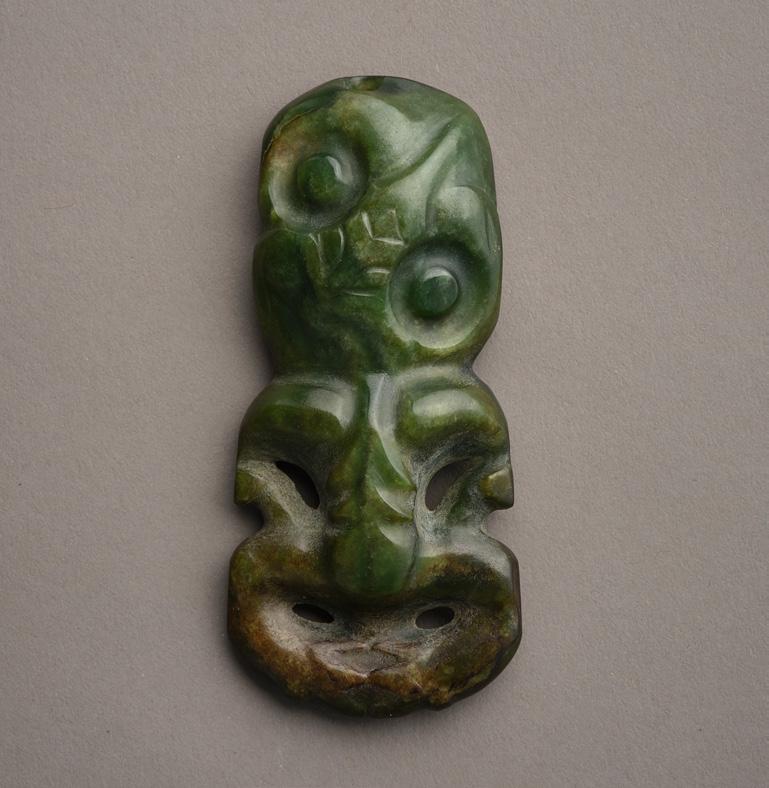
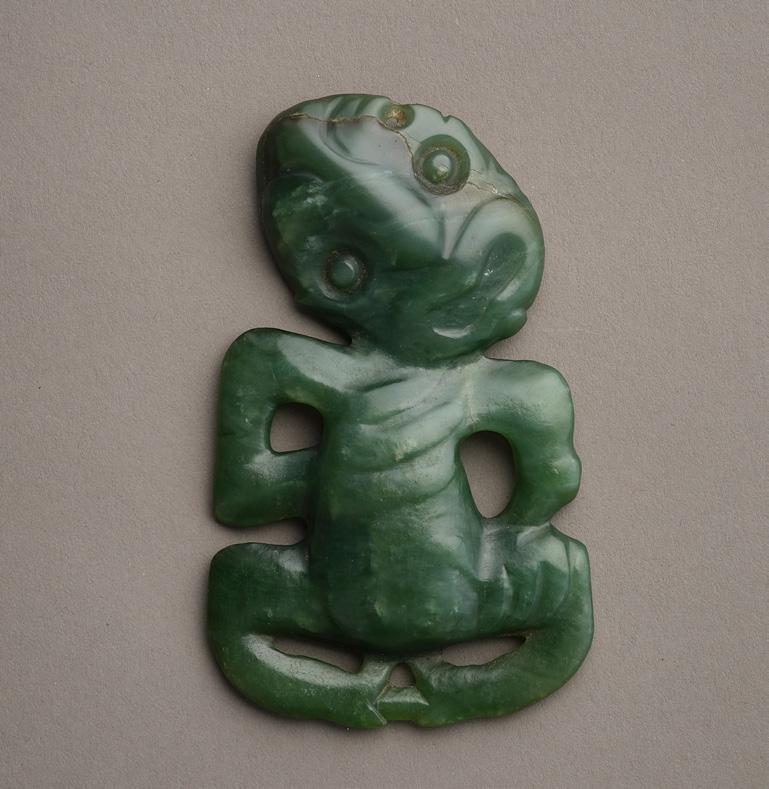
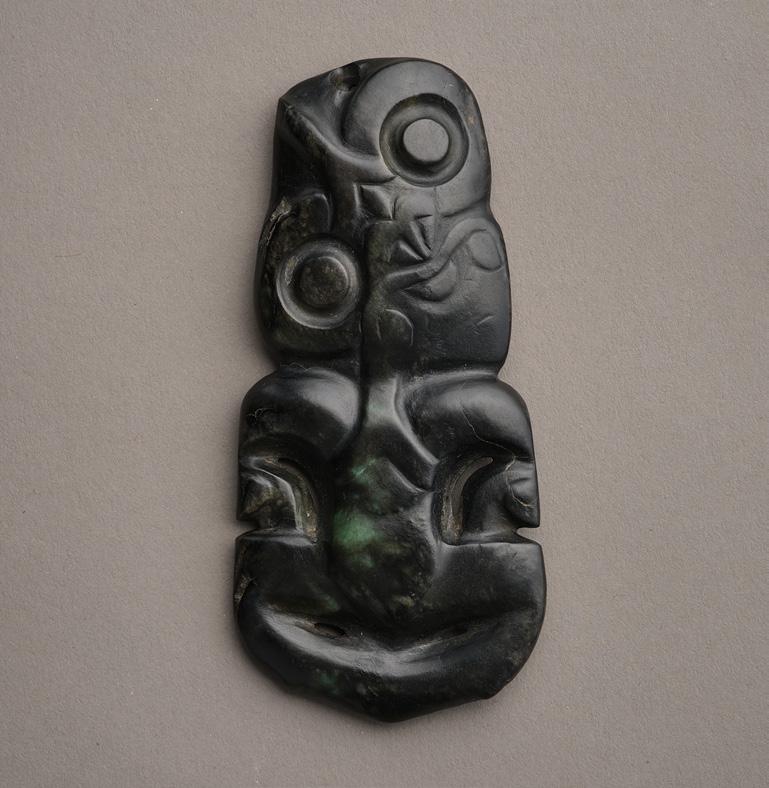
An historically important Kumete Whakairo (carved lidded presentation bowl)
Māori, Aotearoa, New Zealand, 19th century
Estimate: NZ$260,000–300,000
Sold for NZ$270,600 inc. bp (approx AUD$220,000)
FAR LEFT
An Impressive Pre-European Hei Tiki
Māori, Aotearoa, New Zealand, 18th century or earlier
Estimate: NZ$10,000–15,000
Sold for NZ$24,200 inc bp (approx. AUD$20,000)
LEFT
A Superb Large Pre-European Hei Tiki
Māori, Aotearoa, New Zealand, 18th century or earlier
Estimate: NZ$15,000–20,000
Sold for NZ$29,040 inc bp (approx. AUD$24,000)
LOWER LEFT
A Pre-European Hei Tiki Carved in Dark Kawakawa Pounamu
Māori, Aotearoa, New Zealand, 18th century or earlier
Estimate: NZ$12,000–18,000
Sold for NZ$27,060 inc bp (approx. AUD$22,000)
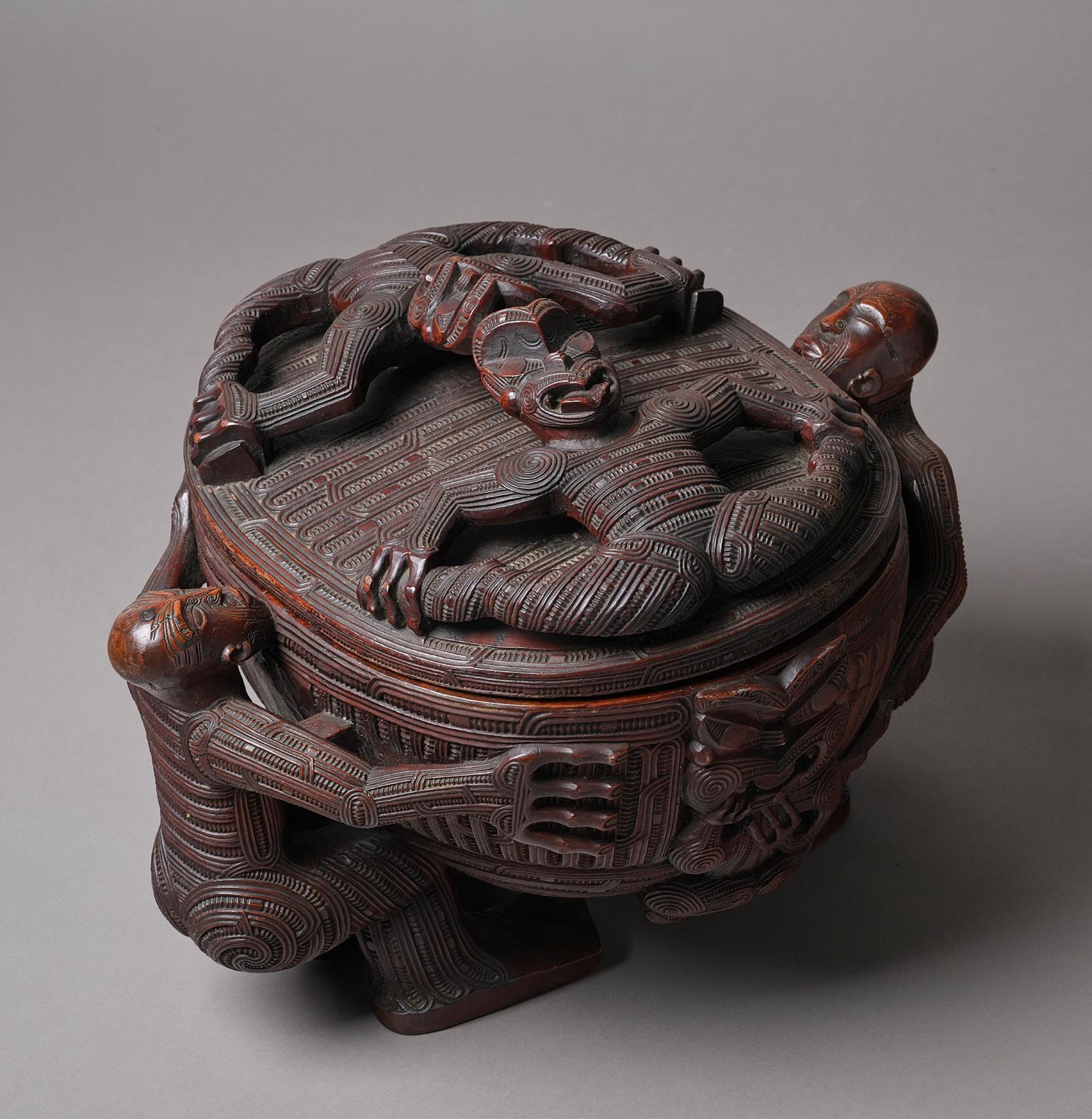
RIGHT
Patoromu Tamatea, New Zealand
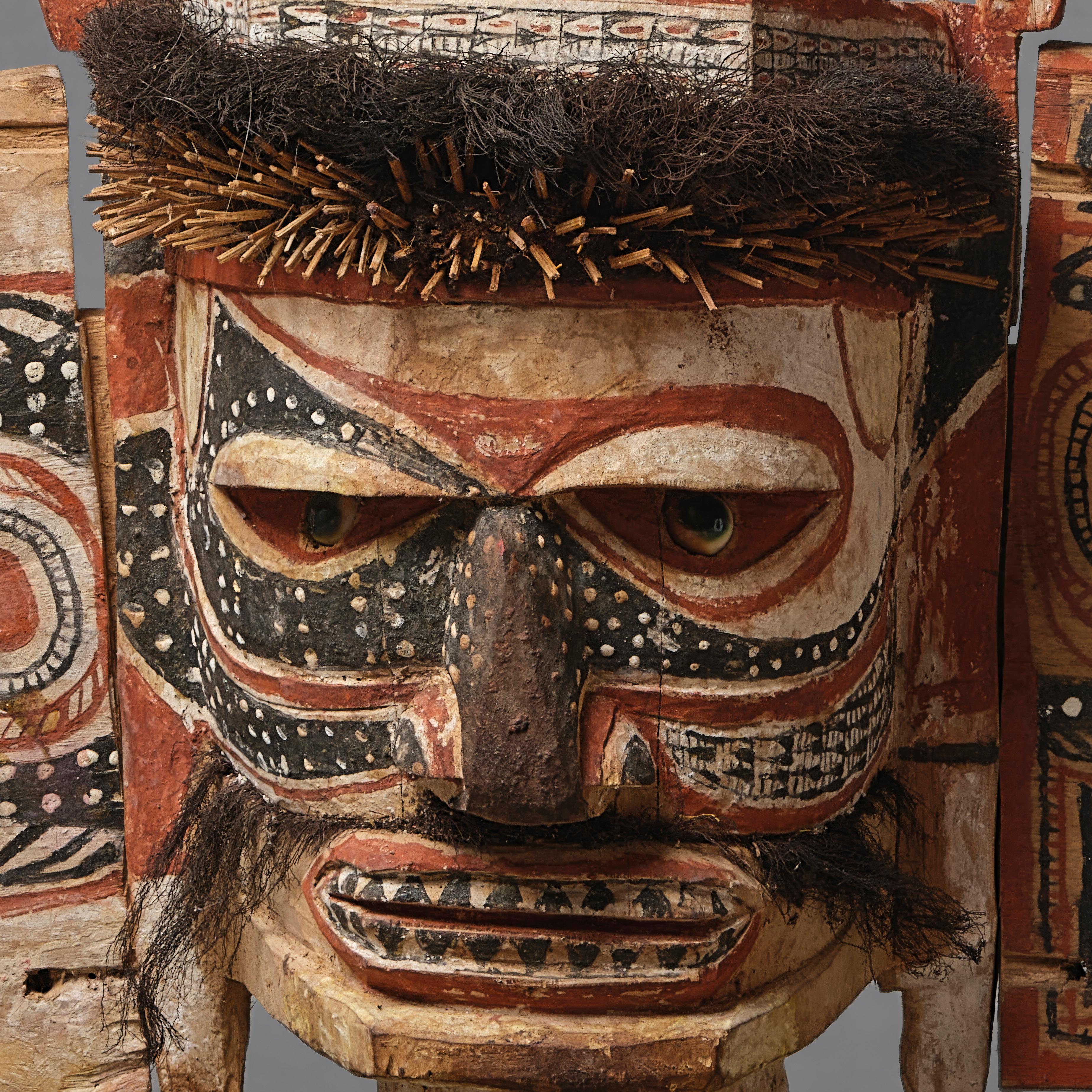
Specialists for this Auction

James Parkinson
+64 220 288 541
james@artvisory.com.au

Melissa Parkinson +64 211 581 454
melissa@artvisory.com.au
Auction administration

ACCOUNTS & AUCTION ADMINISTRATION
Amanda Swanson
+61 414 592 234
amanda@artvisory.com.au

COLLECTIONS & SHIPPING
Jennifer Hirst
+61 410 777 996

Paul Sumner
+61 412 337 827
paul@artvisory.com.au
jennifer@artvisory.com.au FOR NATIONAL AND INTERNATIONAL CRATING AND SHIPPING QUOTES
Phill Purchase phil@clipcrate.nz
022 565 9222 www.clipcrate.co.nz
ANNOUNCING THE LAUNCH OF
Artvisory – New Zealand
Targeting Single-Owner collections
Following the success of our recent and inaugural auction in Auckland, we are delighted to announce the launch of Artvisory-New Zealand, in association with James and Melissa Parkinson.
This move reflects our commitment to a market that is both unique in nature and also one that can only benefit from broader exposure.
Artvisory is the market leader for single-owner auctions in Australia and the company now takes this experience to New Zealand, creating a trans-Tasman marketing hub, that offers vendors with collections in New Zealand an opportunity to sell to a much broader market than before.
By linking up with well-known and trusted specialists in James and Melissa Parkinson from Found Objects, Artvisory can provide the local NZ relationships required for a new business to gain traction and we are thrilled that we can launch with one of the most incredible discovery stories of recent times — the important Tabar Island rain heads that James and Melissa have discovered in Auckland.
The new business is focused on single-owner collections in all of the fields in which we have expertise, from Asian art to Māori and Oceanic art and from European to Australasian art, jewellery and antiques. We look forward to being of service to our New Zealand clients.
www.artvisory.com.au
James Parkinson
+64 220 288 541 james@artvisory.com.au
Melissa Parkinson
+64 211 581 454 melissa@artvisory.com.au
Paul Sumner
+61 412 337 827 paul@artvisory.com.au
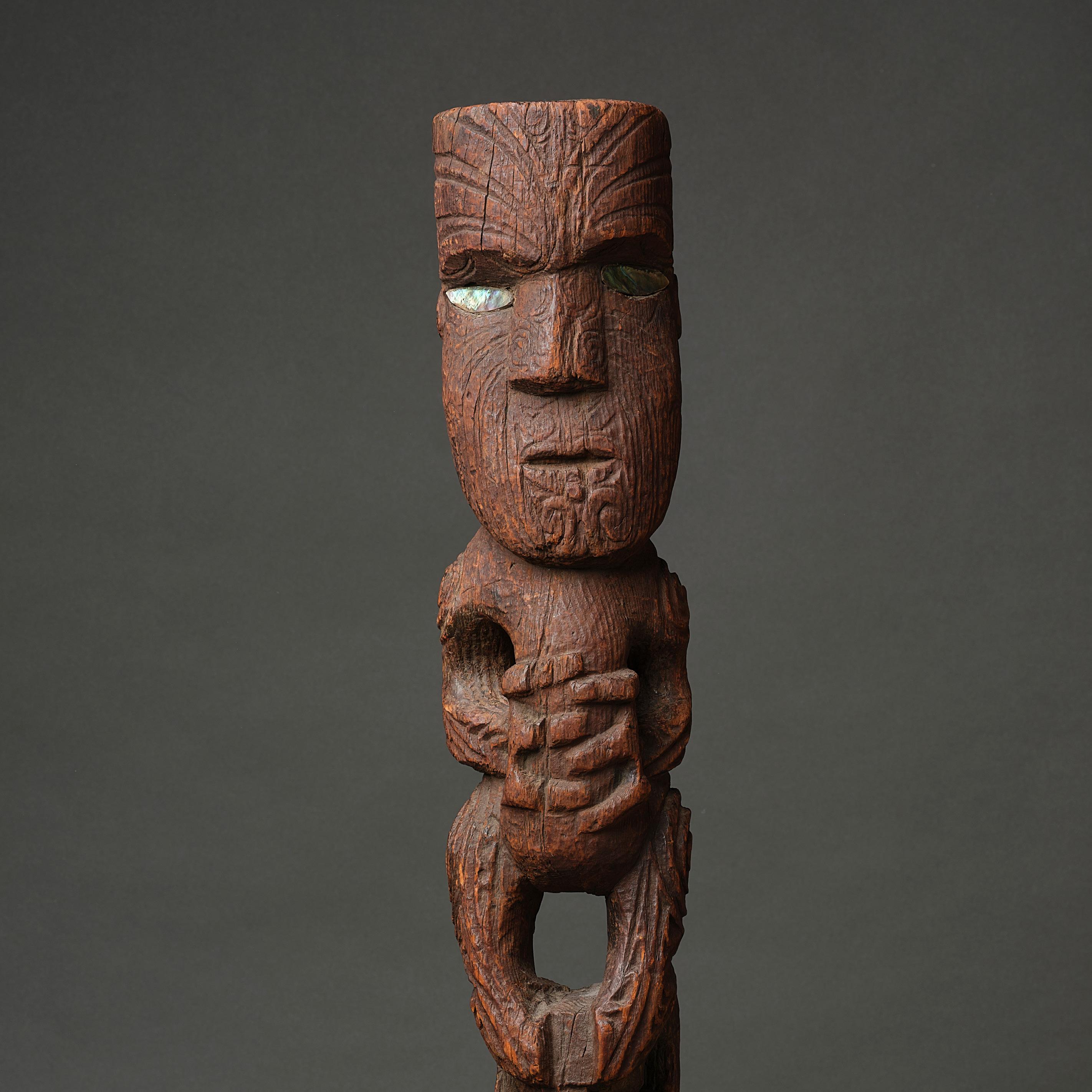
AUCKLAND APRIL 2027
The Dr Terence Barrow Collection
Important
Māori
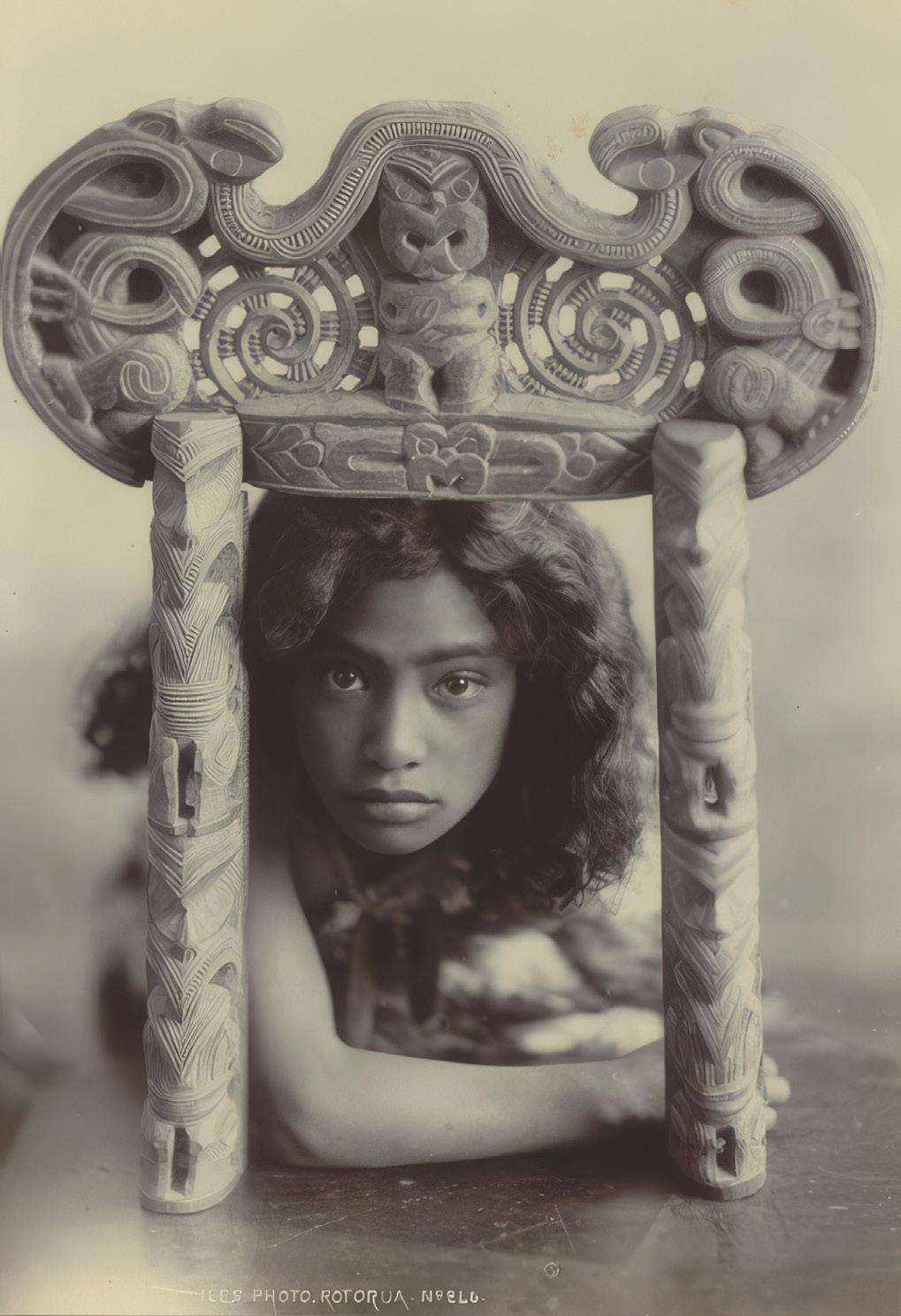
Photographs from the Mark Blackburn Collection
A rare auction of historically significant images from one of the most respected collectors of Māori photography.
Dr Terence Barrow was not only a leading ethnologist but one of the most trusted private scholars of Māori visual history. His eye for authenticity, context, and cultural nuance made his collection a benchmark for serious collectors and institutions alike. Barrow cultivated relationships with key photographers, families, and early collectors, allowing him to assemble images of exceptional rarity and integrity. Works that passed through his hands are valued for their accuracy of identification, depth of documentation, and the confidence they give to future custodians.
The association with Barrow places this group firmly within the lineage of the most respected collections of Māori photography, a lineage continued and strengthened by Mark Blackburn’s own connoisseurship of this important collection.
James Parkinson
+64 220 288 541
james@artvisory.com.au
Melissa Parkinson
+64 211 581 454
melissa@artvisory.com.au
MELBOURNE APRIL 2027
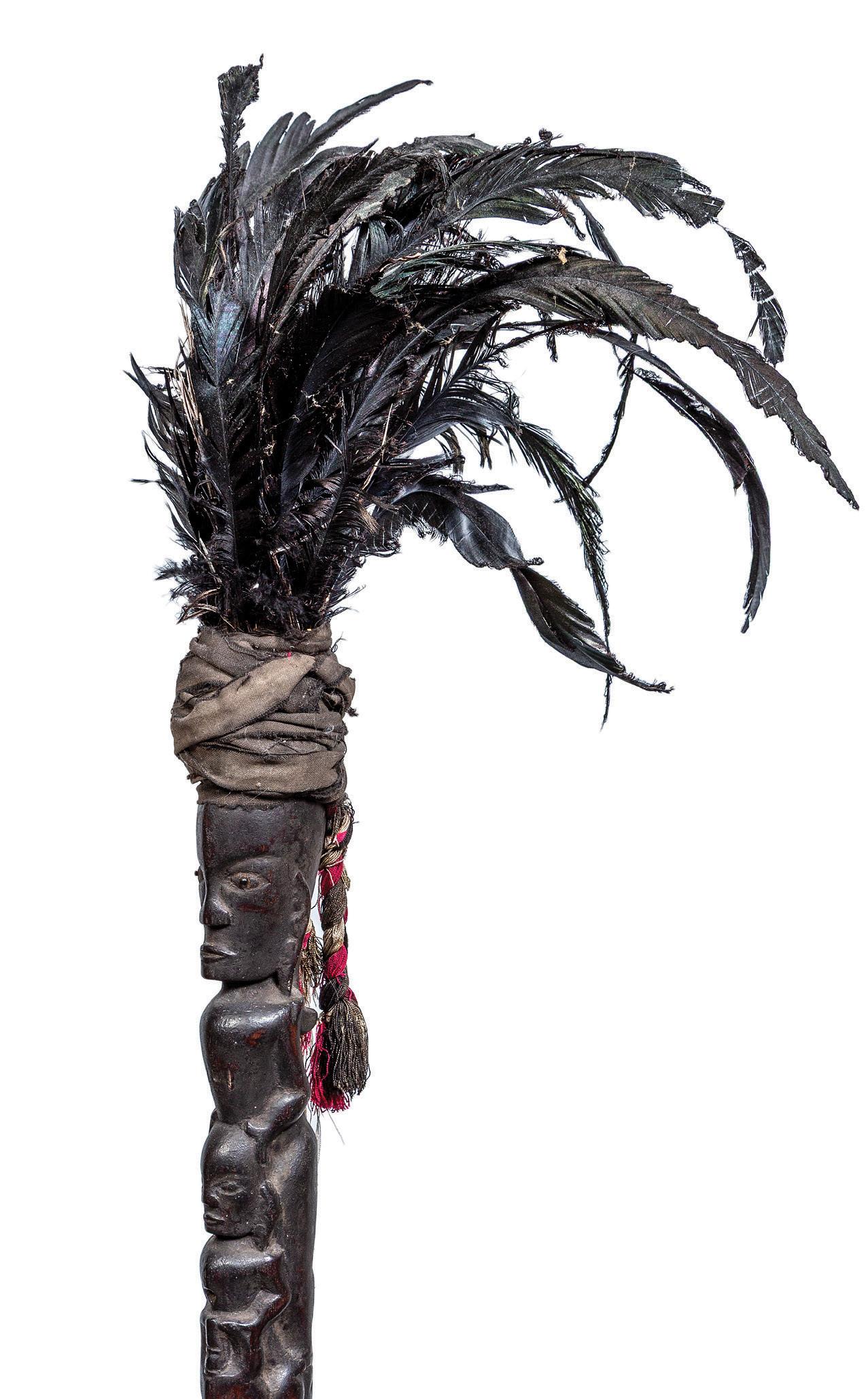
A Single Vendor Collection of Rare and Important Indonesian Art
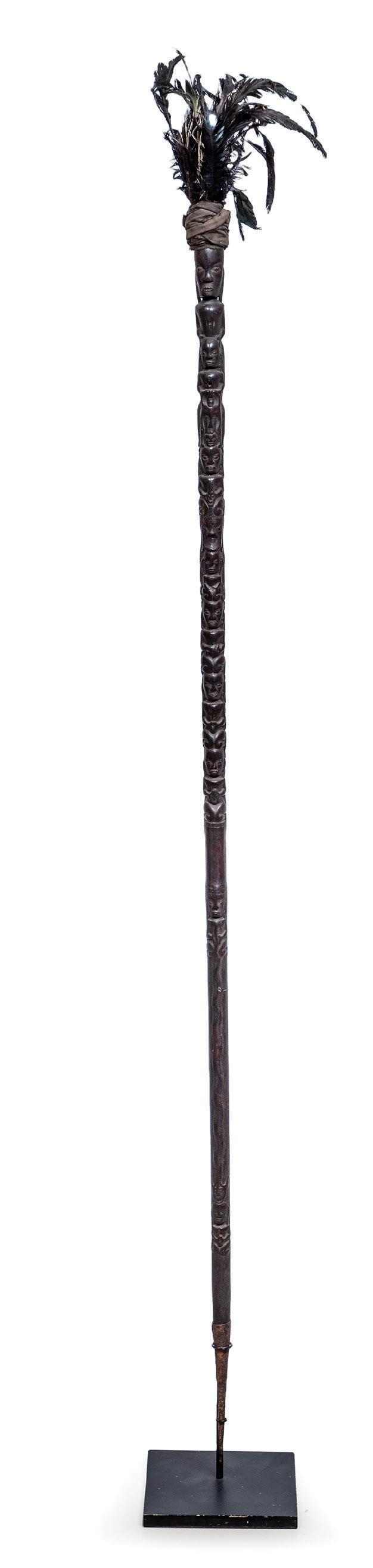
Magic Staff (Tungkot Malehat)
North Sumatra, Karo Batak, 19th Century
Provenance: From the collection of Helmet Paasch
This single owner collection of rare and important Indonesian art was assembled over more than three decades. The collection reflects acquisitions made through leading dealers and distinguished private collectors, representing a sustained and discerning engagement with the field. It represents one of the most focused and carefully built private holdings of Indonesian material to appear at auction in recent years.
James Parkinson
+64 220 288 541
james@artvisory.com.au
Melissa Parkinson
+64 211 581 454
melissa@artvisory.com.au
How to bid at our Auctions
Catalogues and Viewing
Auction catalogues can be viewed on the Artvisory website www.artvisory.com.au approximately three weeks prior to the published date of an Auction.
Printed catalogues will be available complimentary at the auction viewing.
The Auction viewing is open to the public and generally takes place during the three days prior to the Auction date, at the advertised location/s in the Auction catalogue.
Lot Descriptions
The Lot/Catalogue descriptions provide the overall information of an item including size, date or age, medium, attribution, quantity and if known, provenance.
Estimates
This auction will be conducted in New Zealand dollars. (NZD$)
The estimate accompanies each lot in the printed and online catalogue. This estimate takes into consideration the quality, condition, rarity, condition and provenance of the item. Each estimate also has a reserve, and the reserve is the undisclosed and confidential amount set at or below the low estimate. Please note the reserve will never exceed the low estimate at Artvisory.
Condition Reports
Condition reports supplement the lot/catalogue description and focus on the condition of the item. We strongly advise obtaining a condition report if you are unable to view the lot in person. Condition reports and additional images are available to view as part of the auction item listing at Invaluable.com or can be requested from Artvisory directly.
Symbols
Occasionally a symbol is printed next to a lot number in the catalogue, this indicates a special clause that is associated with the sale of that item. Please refer to the Terms and Conditions for specific symbol meanings and information.
Buyers Premium
Artvisory charges a Buyers Premium of 24% in New Zealand plus a GST charge of 15% on the hammer price of all Auction items unless otherwise stipulated.
Bidding
Artvisory offers four options for bidding at our Auctions:
Live Bidding
If this is your first-time bidding in person at an Artvisory auction you will be required to register with us, which requires you to fill out a buyer registration form in person at the viewing. To facilitate this, please bring along your Government issued photo identification, such as a driver’s licence or passport as this is the only form of identification that will be accepted. Please make sure you register in the name you want your final invoice to be made out to, as invoices once issued cannot be changed, and in certain cases a deposit may be required before you can bid.
Online Bidding
Online bidding is via the International Invaluable. com auction platform and allows you to bid via the internet in real time, whilst also allowing you to view the live feed of the Auction. You have two options to register for this service:
• Register via the Artvisory website as a Private Label customer and an Invaluable.com online bidding fee of 2% of the hammer price is added
• Register direct with Invaluable.com and an online bidding fee of 5% of the hammer price is added
Please make sure you register for online bidding at least 24 hours prior to the Auction to ensure you can login correctly so when the auction commences you can login without issues and you do not miss your lot.
Please note if you have not bid with Artvisory previously, then Government issued photo identification verifying your name and address will be also be required before you can be approved to bid with Artvisory via the Invaluable.com site, and in certain cases a bidding deposit (20% of the low estimate of each Lot you wish to bid on) may be required before you can bid.
Artvisory cannot be held responsible for any errors that occur with internet connectivity during an auction or buyer bidding errors and stipulates that either Chrome or Firefox are the recommended Internet Browsers for online bidding as Invaluable.com is not supported by Safari.
Bidding Deposits
Artvisory reserves the right to request a deposit for any buyer wanting to register for the auction, and this must be received in cleared funds 24 hours prior to the commencement of the auction. If the buyer is not successful, then it will be refunded in full by the third day after the auction.
Telephone Bidding
Complimentary telephone bidding is available at all of our live Auctions and involves an Artvisory representative calling you approximately 3–5 lots in advance of your nominated lot and you then instruct them to bid on your behalf.
Telephone Bids must be requested at least 24 hours prior to the commencement of the Auction and are provided on a first come, first served basis, as the number of phone lines available are limited.
See our website to download and complete a telephone bidding form and please note that if this is your first time bidding with Artvisory, we will require a clear, scanned copy of Government issued photo identification such as a drivers licence or current passport verifying your name and address and in certain cases a deposit may be required before you can bid.
Artvisory reserves the right to request a deposit for any buyer wanting to register for the auction, and this must be received in cleared funds 24 hours prior to the commencement of the auction. If the buyer is not successful, then it will be refunded in full by the third day after the auction.
Absentee Bidding
Absentee bidding offers convenience if you are unable to attend an Auction in person, bid over the telephone, or if you wish to stick to your budget.
An absentee bid should be set at the maximum amount you wish to bid on the lot/s you are interested in purchasing. Should the lot/s be knocked down at an amount lower than the bid recorded on your form, the lot will be sold to you for the lesser hammer price plus Buyers Premium. If identical bids are received for the same lot, then the first bid received will take precedence.
Absentee bids must be received by Artvisory at least 24 hours prior to the Auction commencing and the Company cannot be held responsible for activating any late bids that are received.
See our website to download and complete an absentee bidding form and please note if this is your first time bidding with Artvisory, we will require a clear, scanned copy of Government issued photo identification such as a drivers licence or current passport verifying your name and address and in certain cases a deposit may be required before you can bid.
Payment and Collection
If you are successful with your bid/s, an invoice will be emailed to you immediately after the Auction finishes.
For this Auction you will pay the hammer price, plus the Buyers Premium of 24% plus GST of 15% together with any additional charges such as the Invaluable.com online bidding fee.
As per our terms and conditions, payments must be made in full by three (3) days after the Auction has been completed as printed in the catalogue.
Payments must be made in NZD$ via Direct Deposit into the Artvisory NZ bank account – all details will be included on the invoice emailed to you after the Auction if you are a successful bidder. Cash and Cheques are not accepted.
All items must be paid for in full and collected within the collection times advertised for each individual Auction and if items are not collected within this time frame then Artvisory reserves the right to charge removal, storage and release fees.
Packing and Delivery
Artvisory has a list of recommended carriers specific to each auction that will be sent to you if you are a successful buyer.
CATALOGUE INTRODUCTION
The Tabar Island Rainmakers
The Dr A. A. Schiessel Collection of New Ireland and Oceanic Art
In 1949, a young doctor travelled from Australia to New Ireland with his wife and three sons. Dr Schiessel moved through remote communities across Tabar Island and northeast New Ireland as a physician, not as a dealer or collector. He travelled by boat, by vehicle and often on foot, reaching remote villages that few outsiders had ever visited. The trust that formed between a doctor and the people he served grew to shape everything that followed. The precious items that were entrusted to Dr Schiessel during these patrols were given to a man who was dedicated to the care of the communities he lived amongst.
The collection presented here is remarkable for two reasons. Firstly, the rarity and cultural significance of the works themselves. Secondly, the depth of their history and provenance, preserved through Dr Schiessel’s scholarly journals, maps, drawings and field notes –all created at the actual time of collection.
The Dr A.A. Schiessel Collection comprises 46 works from New Ireland, including five extremely rare Kovabat rain heads, the sacred wooden figures of the Marada Malagan tradition of Tabar Island. Two pieces from the 1949 patrols
– a Kovabat rain head and a friction drum, were sold by Dr Schiessel to the Auckland War Memorial Museum in 1952, where they remain today. The rain head was on display in the Pacific Masterpieces Gallery, and featured in the publication 150 Treasures (2001). The remainder of the collection stayed with the family, unseen by the public for almost 80 years. These extraordinary objects have never before been offered at auction.
Of significant importance are the Kovabat heads, known in the Tabar language as the heads of rain. Currently, only 15 examples are recorded in public and private collections worldwide. The Schiessel Collection adds another five. Due to their rarity, their market value is relatively unknown. The only example to have appeared at auction, sold at Sotheby’s New York, on 15 May 2015, for USD 1,054,000 (NZD 1,808,000).
All these works were field collected by a man who observed with all the discipline of a scientist and the true curiosity of a scholar, long before commercial collecting reached these isolated communities. Dr Schiessel’s maps, drawings and journals have been preserved, and are offered alongside the collection. Together, they
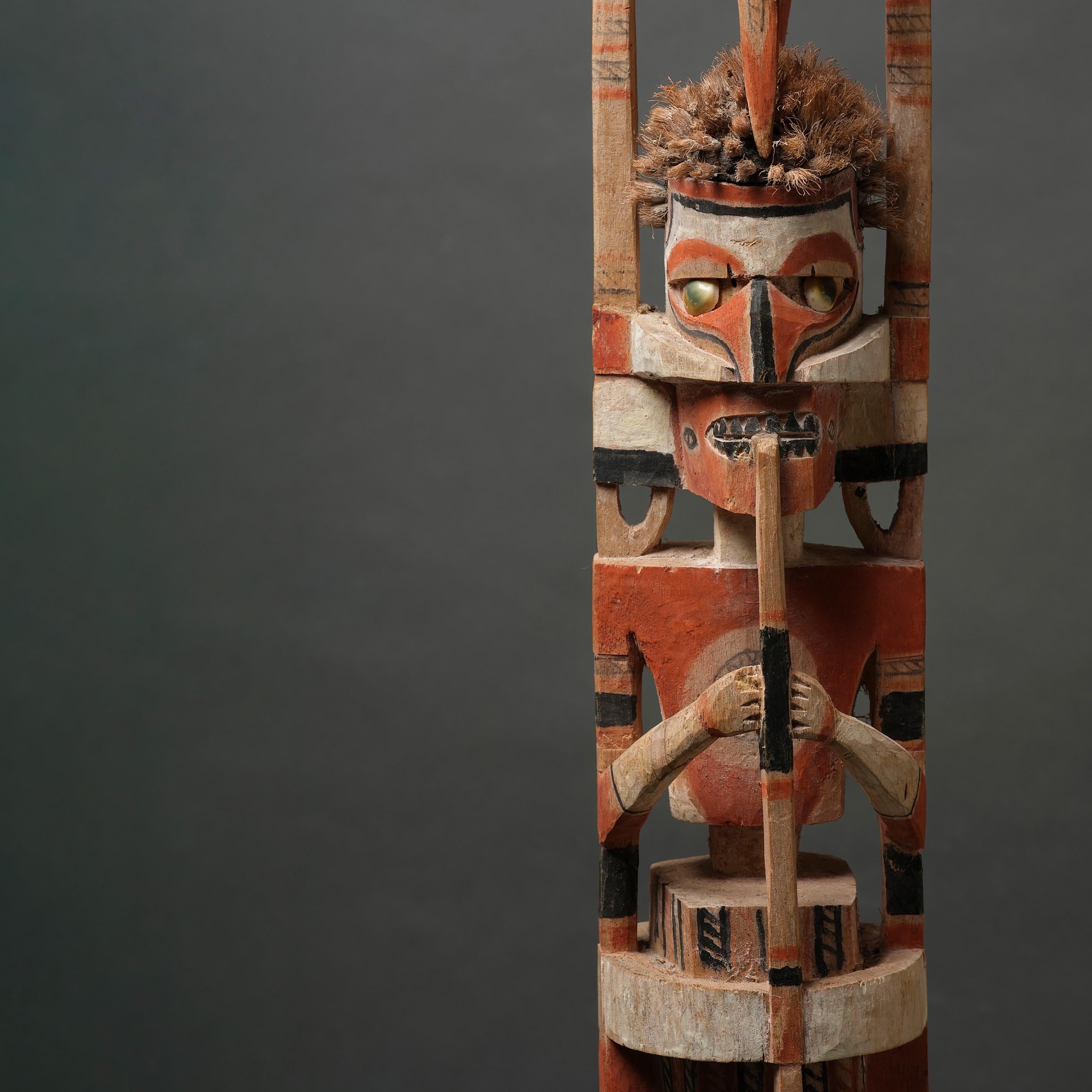
The art that created these works particular to the eastern and western regions of Oceania belongs to the great art of all times, it has no less right to recognition and praise than the art of the great sculptors of ancient and modern Europe. It is only in the light of poetry that one can approach the creative mystery of Oceanic art.
Tristan Tzara, Cahiers d’Art, 1929
provide an unrivalled depth of context, allowing this catalogue to present not only the objects, but also the world in which they were collected.
The maps trace patrol routes across terrain that few outsiders had ever navigated. The journals speak in the voice of a man who understood that what he was witnessing was singular. The drawings reveal his fascination with the vivid and complex forms of New Ireland Malagan and Tabar Island art. This archive elevates the offering beyond commerce to an event of historical importance.
We are grateful to the Schiessel family for their generosity in sharing Dr Schiessel’s story and for granting access to his journals, field notes and drawings. Their willingness to open this archive has enabled a level of scholarship rarely possible for material of this kind. Professor Jean Philippe Beaulieu, a leading authority on Oceanic art, has contributed two essays to this catalogue and undertaken the research and descriptions for the New Ireland objects. He has also generously provided some of the historical and contemporary photographs reproduced here. His contribution affirms the importance of the Dr A A Schiessel collection within the wider Oceanic art field.
In addition to the New Ireland material, Māori artefacts collected by Dr Schiessel, after he settled in New Zealand, are also included in this catalogue. Please note, these taonga Māori items can only be offered to registered New Zealand collectors under the provisions of the Protected Objects Act.
Beyond this collection, the auction includes other important Māori works, among them a pre European tekoteko figure and a poupou carved by the nineteenth century master carver Tene Waitere. A major contemporary highlight is Shane Cotton’s In the Valley of the Shadow, an important painting that anchors the sale’s modern component with its depth, scale, and cultural resonance. The auction also presents significant African and Indonesian pieces, extending the breadth of the offering, alongside a large schist Gandhara Buddha, 3rd century, from the collection of Rolf Renker, the German industrialist who settled in New Zealand and whose wider collection is currently being handled internationally.
The Dr A.A. Schiessel Collection marks a rare moment when a field collection, archived to this depth, moves from private stewardship into the public domain. These works, gathered through authentic engagement with remote communities, and uniquely available with their accompanying journals, maps and drawings, offer an integrity not often encountered in Oceanic material of this age.
This collection proudly stands as one of the most important Oceanic art offerings ever presented in Australasia. We are honoured to bring it to you, and to place it permanently in the Oceanic art historical record, where it belongs.
James Parkinson Head of Department Ethnographic Art Artvisory
From Vienna to Tabar Island
The Life of Dr A. A. Schiessel
In the second week of July 1950, Dr A.A. Schiessel left Kavieng for Tabar. The patrol he was embarking on, accompanied only by a small dog named Lumpi, would last almost two months. The journey would take him around three islands whose population had been tragically decimated by more than 80% in 40-years.
Dr Schiessel was 44-years-old, and his role was that of Medical Officer for New Ireland. He had been practising as a doctor for less than 18 months, having been formally licensed to do so, in a country that recognised his medical degree. He came to this role by a circuitous route nobody could have predicted: a Viennese childhood in a working-class household, a watchmaker's apprenticeship, a medical degree completed under the
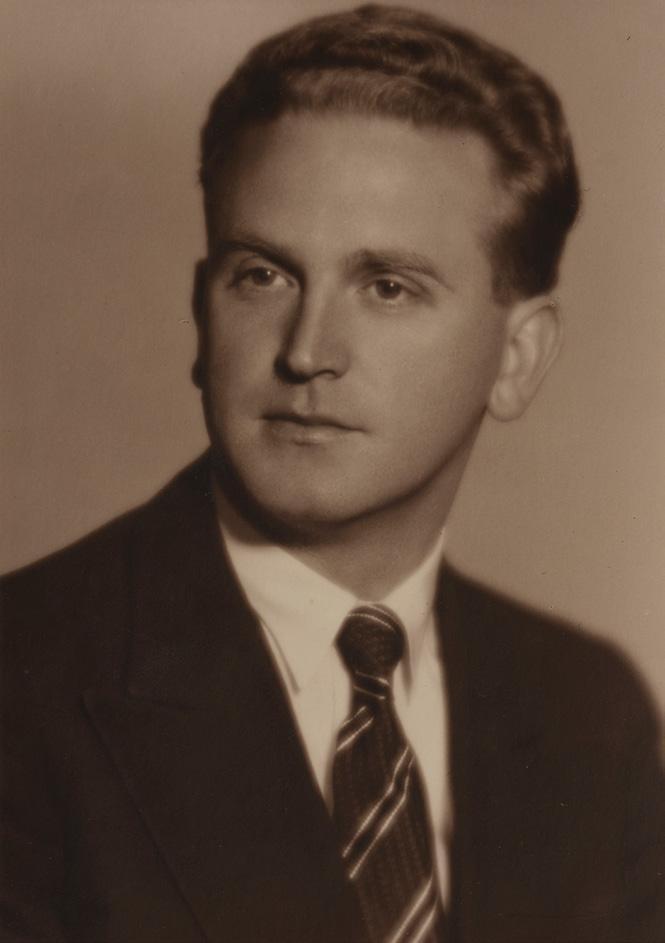
shadow of the Anschluss, flight from Austria, exile in London, deportation as an enemy alien, two years in an Australian internment camp, and a slow, deferred return to the profession he had qualified for in 1938.
The collection presented in this catalogue was gathered by Dr Schiessel during this patrol, and on the patrols that came before and after it, on the New Ireland mainland, and at Mussau. It was made by a man who saw what was in front of him, both as a dedicated doctor serving communities in demographic crisis and as a scholar with training in the careful observation of evidence. Dr Schiessel came to understand that he was witnessing something which, on its present trajectory, would not survive.
Vienna 1906–1938
Augustin Anton Schiessel was born in Vienna on 3 June 1906 and grew up under difficult circumstances. His widowed mother raised him, along with an elder brother and sister; he never knew his father. Augustin was described by his son William eight decades later as "a poor city boy from Vienna." Augustin Schiessel came through the First World War and the Depression, due in large part to the strength of both his mother and the labour organisations of Red Vienna. This great socialdemocratic civic project of the inter-war years ensured that the son of a working-class solo parent attended secondary school and the University of Vienna. Despite all this apparent opportunity, Augustin’s path to medicine was far from direct.
To learn a trade, Augustin was sent to a blacksmith relative; however, he was soon deemed too slight of build for the demands of the forge. Instead, he was apprenticed to a watchmaker. Augustin qualified as a horologist before becoming a doctor, and this skill would later serve him well, supporting him through the difficult years when his Austrian medical degree was not recognised. Augustin’s political views were formed in those early Viennese years and stayed with him for the rest of his life. His son recalls a father whose sympathies were "extremely left," not defined by doctrine but by an abiding memory of who had paid for his education and who had not.
Augustin Schiessel entered the University of Vienna in 1931, and he graduated in medicine in 1938, just weeks after Austria was annexed to the Reich in the Anschluss. Following these events, Austrian left-wing socialists, communists, and trade unionists were seen as ideological enemies. They were immediately targeted for arrest, facing imprisonment in camps such as Dachau or worse. Many were forced to flee alongside Jews and other persecuted groups. While living in Vienna, Augustin had married, and a daughter had been born; however,
given his political leanings, he fled the country shortly after graduating. He remained in contact with his mother and his first family for the rest of their lives.
London 1939 – 1940
In 1939, when Augustin was living in London as a refugee, he met and later married Elizabeth, a New Zealander, with whom he would raise a second family of three sons. Elizabeth Aitken MacCormick had arrived in Britain in 1935 with a degree from the University of Auckland, having spent the previous summer hitchhiking across Hitler's Germany with a Kiwi friend. They slept in fields and youth hostels, a journey her family in Auckland cannot entirely have approved of at the time. Elizabeth’s Auckland family had been settled in New Zealand since the 1850s, and like so many young people, she travelled abroad and found work in London. Elizabeth was employed by the Unity Theatre, a left-wing workers' theatre company, founded in 1936. It staged anti-fascist and agitprop plays, rallying socialists and refugees from fascism in the late 1930s. This radical theatre company would draw Elizabeth into the circles of Paul Robeson and Sean O'Casey, and it was there that she and Augustin Schiessel met.
When Churchill ordered the internment and deportation of "enemy aliens" in mid-1940, Augustin was brutally separated from a newly pregnant Elizabeth. Austrian by birth, and now German after the Anschluss, Augustin was classed as a national of the very regime he had fled. After being held briefly in an English camp, he was put aboard the Dunera at Liverpool on 10 July. The ship, carrying 2,500 men, reached Sydney, Australia, on 6 September 1940 after a 57-day sea voyage. The majority of these men were refugees from the Reich. Within months, the British government conceded that the deportation was a moral scandal.
Australia 1940 – 1949
Augustin was held for two years at Tatura Camp in rural Victoria, where the internees ran their own schools, dug tunnels, and built clandestine radios. He was eventually released to undertake fruit-picking work in the Goulburn Valley, before moving on to Melbourne. Here, he returned to the watchmaker’s bench while awaiting permission to study. Augustin’s eldest son, Donald, had been born in Glasgow in March 1941, and Augustin had never seen him, let alone held him in his arms.
Elizabeth made her way back to New Zealand with their young son, with the family reuniting in Australia after Augustin was released. William, their middle son, and the source of much of the surviving family history, was born in Brisbane in December 1943. Throughout the second half of the 1940s, Augustin worked in watchmaking and studied for a second medical qualification at the University of Melbourne, on the understanding that the Australian profession would not allow him to practice with a foreign degree. By 1946, he was 40 years old and had not practised as a medical doctor. The Australianadministered Territory of Papua and New Guinea offered the opportunity when it recognised his Viennese medical degree. In March 1949, Dr Schiessel boarded a plane which flew north to Port Moresby, having secured a three-year contract as a Medical Officer.
New Ireland 1949 – 1950
The rest of the Schiessel family followed by ship, up the New Guinea coast, through Rabaul to Kavieng. William, as a six-year-old, remembers black-and-white sea snakes swimming under the porthole on the way north, and the rusting hulls of abandoned Japanese landing barges still drawn up on the beach at Rabaul. By 1949, Kavieng had been bombed by the Americans, fought over, and fled by the Japanese only six years before; the ruins were still underfoot everywhere.
The Chief Medical Officer's house, where the Schiessels were accommodated, had a corrugated-iron roof, a timber floor, no electricity, and a kerosene refrigerator in which Elizabeth, to William’s enduring admiration, made ice cream. Five yards from the verandah stood a working Japanese Army coastal gun, with fully operational hand cranks for elevation and traverse. Sunken Japanese ships protruded above the water line in the harbour; abandoned aircraft sat beside the airfield. The boys' transport across to the picnic islands of Nusa and Nusa Lik was an outrigger canoe rigged with a sail made from red Japanese parachute silk. Elizabeth found time to paint; she was not considered to be a serious artist, William says; however, she was an educated woman with a good eye. One of Elizabeth’s paintings, of the islands opposite Kavieng Harbour, would be hung by Augustin in every house he lived in for the rest of his life.
The medical posting in Kavieng was substantial. As Chief Medical Officer for New Ireland, Dr Schiessel was in charge of the hospital at Kavieng, the leprosarium on a small offshore island – run by German Catholic nuns, and the medical patrols that took him out (by boat and on foot) to remote communities most government officials never reached. The fact that Dr Schiessel spoke German as his first language was critical to the work he was tasked to do. New Ireland had been a German colonial possession until 1914; many German settler families had stayed on through both wars, often acting as informal intermediaries between the administration and the inland villages. While the Catholic missions that operated across the province were largely German-trained and German-speaking. Whereas an Anglo-Australian doctor would have arrived as an outsider in such a network, Dr Schiessel arrived inside it, as a man whose family home, on his wife's side, was Auckland – rather than Berlin or Vienna, a circumstance that allayed most of the post-war suspicion that might otherwise have been attached to his appointment.
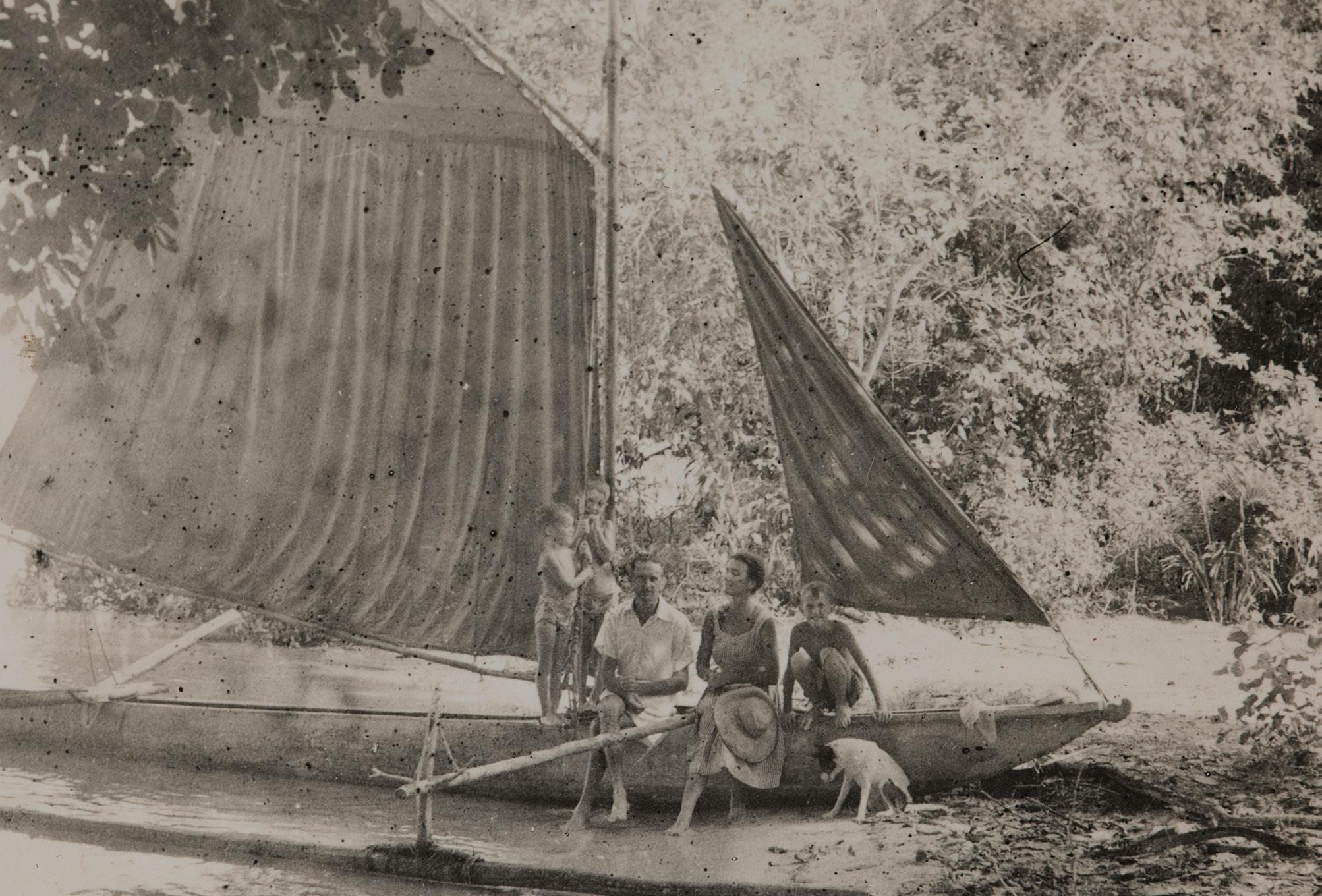
Dr Schiessel travelled with his children whenever he could; he travelled alone when he had to. At weekends, the family went down the coast to picnic with German plantation families who had stayed on through both wars, swimming together in a bomb crater pool 15 metres across, blown out of the limestone during the Allied invasion of the New Britain province, of Papua New Guinea.
Tabar Island
Dr Schiessel’s patrols took him to the islands and along the east coast of the mainland. The longest, and the one that produced the major works featured in this catalogue, was an arduous two-month circuit of the Tabar group in July, August, and early September 1950. By then, Elizabeth and the boys had gone south to New Zealand to wait for him. The Tabar patrol was undertaken alone, with only his canine companion Lumpi for company; its
official purpose was sombre. The group of three Tabar islands comprises Tatau, Big Tabar, and Simberi; their collective population had collapsed from approximately 8,000 people in 1908 to 1,507 by 1950, a fall of more than 80% over 40 years, a loss that previous administrators and ethnographers had not been able to account for. Dr Schiessel was being sent to investigate.
He travelled on foot and by canoe, village-to-village, with notebooks, sketches, sulphamerazine to treat the tropical ulcers and yaws he encountered everywhere, and a working knowledge of the ethnographic literature he was building on. As he wrote home from Napecur on 1 August, "The days flew quickly enough with the routine work of injecting and giving sulphamerazine to the Natives." The field records that survive, and are offered in this catalogue, are part medical, part demographic, part archaeological, and part personal letters home to his wife.
It is in these papers, and in a long, sectioned letter he wrote to Elizabeth across the weeks of the patrol, that we hear Dr Schiessel’s own voice most clearly: careful, observational, faintly amused at himself, classically educated, German-inflected in his English. He gives the carvings their names in the indigenous taxonomy as he meets them: kovambat, malangatsac, mandasia, vovali, klebmus. He documents the rituals surrounding the making of a malagan in remarkable detail, including the staged pig feasts that mark the cutting of the tree, the marking of the wood, the cutting of the head, and the cutting of the eyes. He records the Tabar belief in the Massalei, the totemic ancestral spirits attached to clan and place, along with the elaborate ritual structure that protected the relationship between the living, the dead, and the supernatural figures of the bush.
At Napecur, on 1 August, on a walk into the mountains accompanied by a small native boy – whose terror at the place is recorded with delicate respect – he climbed up to the abandoned village site of Berar. There, in the natural defensive position of a cliff overhang, Dr Schiessel found the skulls and scattered bones of a previous generation of villagers, one of the skulls pierced by a bullet hole that he dated to a period in the 19th century when there were trader-supplied firearms. He was an archaeologist before he was a collector, and an observer before he was either.
Collecting Philosophy
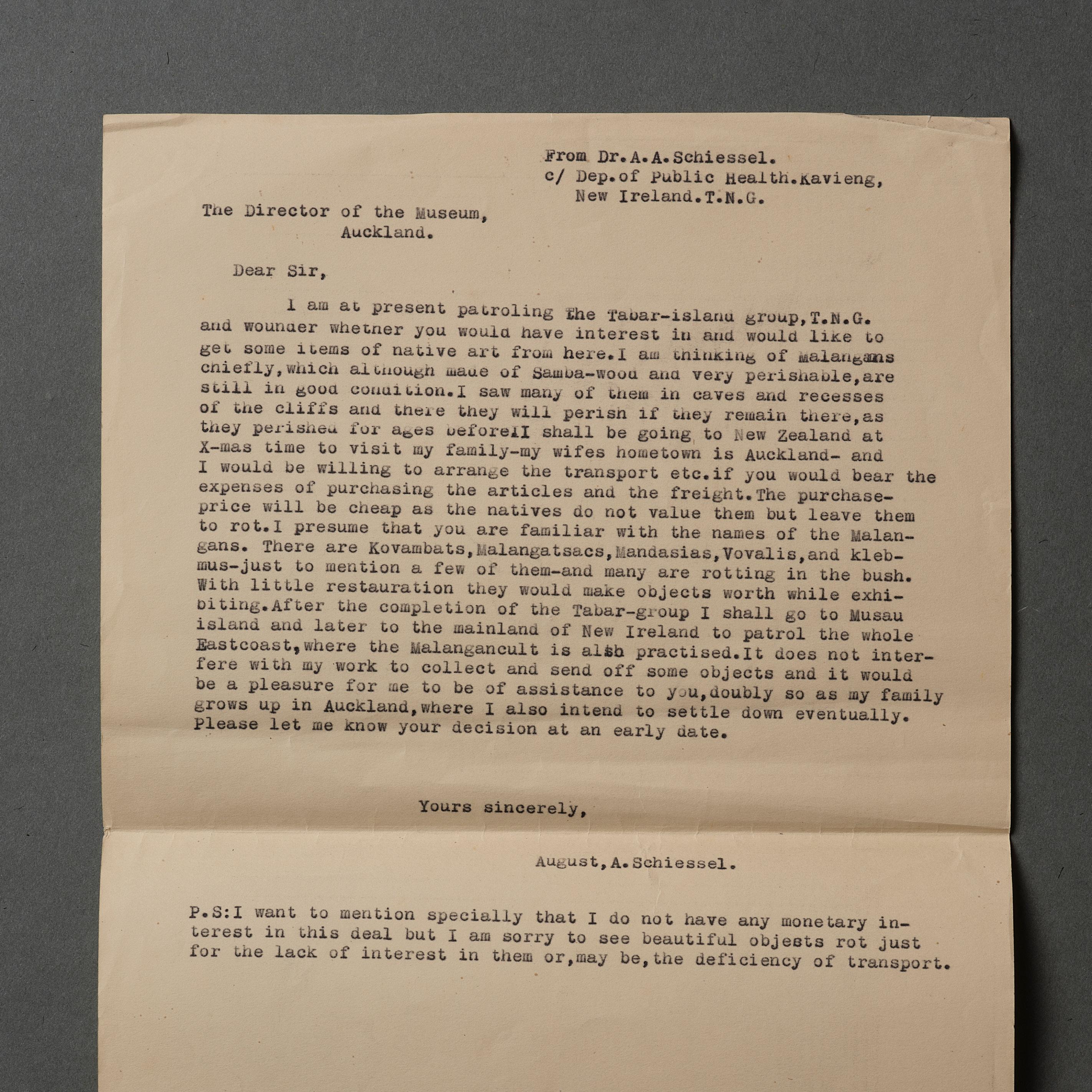
The document that most clearly establishes Dr Schiessel’s collecting ethic, that defines this catalogue, was not the letter to Elizabeth. It was a short, unsolicited letter he sent while still in the field, from Kavieng, in the mid-1950s, to the Director of the Auckland War Memorial Museum. In it, Dr Schiessel offered to act as the museum's agent on Tabar and along the New Ireland east coast: to identify, purchase from the villagers, and freight back to Auckland any of the Malagan works
the museum wished to acquire. He clearly set out one explicit condition: that he himself was to take no money from the arrangement. The villagers were to be paid; the museum was to bear the cost of purchase and of freight; he was to be the intermediary, on the strength of his patrol work and of his settled intention to make Auckland his eventual home. It was his wife's hometown, and his sons were growing up there. The letter is reproduced in full in this catalogue. It is the document on which the collection's ethical character rests.
Of the works he secured on Tabar in 1950, the Auckland Museum eventually acquired two: a Kovambat rain head and a friction drum. Both were sold to the museum in 1952 and have been held in the Pacific collection ever since, with the rain head on permanent display in the Pacific Masterpieces Gallery. The remainder of the works collected stayed with the family. It is these works that are offered here.
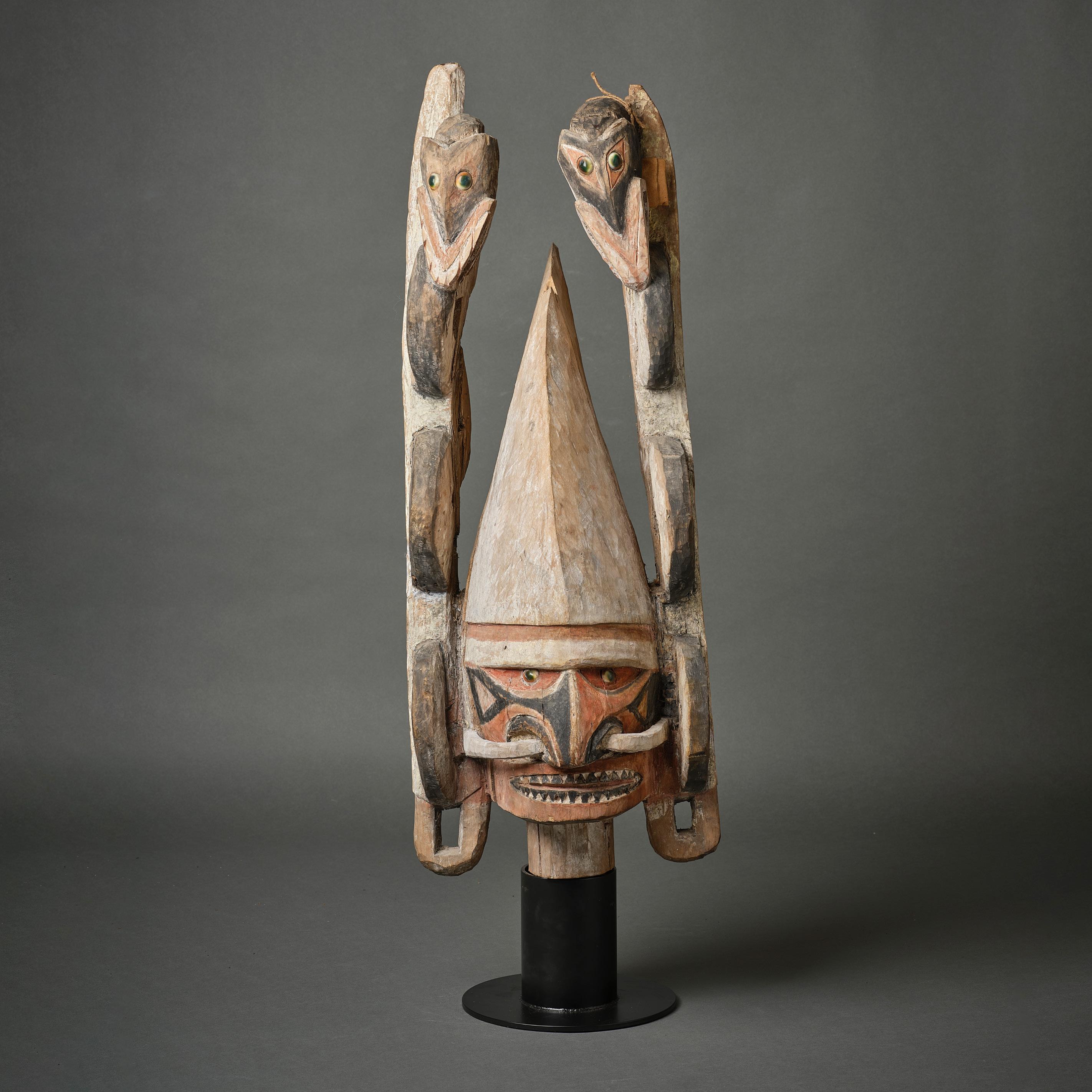
The phrase Heads of Rain preserves the Tabar people's own name for what he found. The Kovabat heads are not Malagan in the usual New Ireland sense; they are not single-use mortuary carvings made to be displayed at a feast and then ritually discarded. They are continuing sacred objects, held across generations within a clan, brought out to call rain and to ensure the fertility of the gardens that sustained the people of Tabar through cycles of crisis and renewal. Only 15 Kovabat heads are known in collections worldwide. Importantly, the Dr A. A. Schiessel collection contributes another five to this exceptionally rare group.
They came to Dr Schiessel from communities that had every reason to be cautious about what they entrusted to outsiders, at a particular moment in the province's cultural history when the Catholic missions were actively discouraging their continued production. His letter to Auckland states it calmly, unsentimentally, and with factual correctness: what he was seeing would, on its present trajectory, perish and be lost forever.
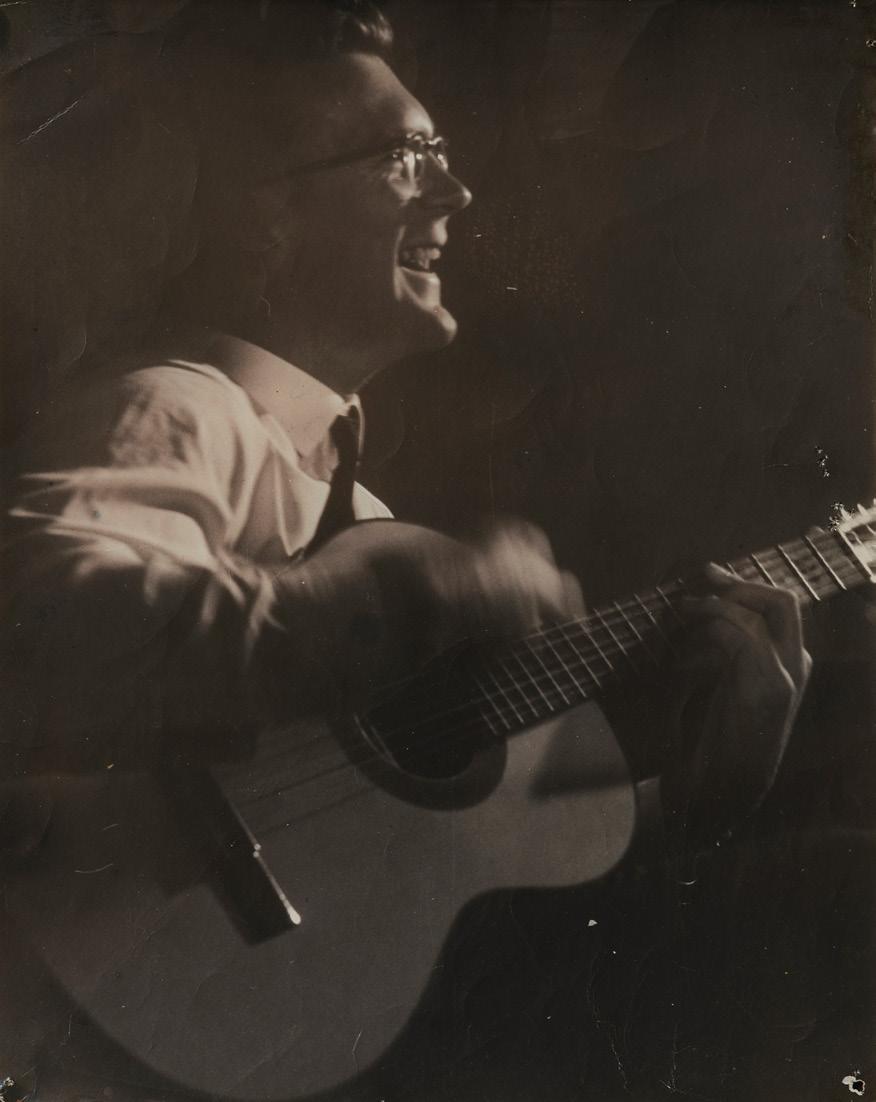
New Zealand 1950 – 1986
The Schiessel family returned to New Zealand just before Christmas 1950. Augustin spent the whole of the following year in Dunedin completing the final year of a New Zealand medical qualification at Otago University. From 1952 to 1954, he practised in Kaikohe, in the Far North, the second of the town's two doctors and the only one who made house calls. The ethnographic interest that had begun on Tabar deepened over these years into an avocational archaeology, leading to a friendship with Jack Goldson, the founding figure of professional archaeology in the South Pacific. The household library included books by Heyerdahl on the Mesoamerican and Andean civilisations, as well as early Pacific archaeological literature. On top of the kitchen cupboard at Kaikohe, William remembers, sat a great Malagan mask; over the hearth hung two winged figures from Tabar, both of which are offered in this catalogue.
Dr Schiessel moved his medical practice to Ponsonby in 1955, drove overland from India to Germany in 1958, kept a practice in Stuttgart for a time, returning to Auckland to work on Symonds Street through the 1960s, and at Vermont Street in Browns Bay through the 1970s, and into the 1980s. The travelling never stopped – ship's doctor to Europe, overland from Germany to Sri Lanka, Algeria, Senegal and Togo, Central and South America, Egypt, and the Trans-Siberian. A timeline of his later life reveals the same thirst for adventure that took him on the Tabar patrol in 1950. Dr Schiessel died at Albany, north of Auckland, on 31 March 1986, at the age of 79.
Legacy
The collection came to his middle son William, alone. The youngest of the three Schiessel boys, Richard, died young; the eldest, Donald, died of cancer while William was living overseas. For almost 80 years, William has been the steward of the collection, and it is from his dedicated care that it is now offered here. The maps, journals, sketches, and field correspondence that accompany the collection are offered with the works, on the understanding that the objects and their records belong together.
The works Augustin Schiessel collected on New Ireland, between 1949 and 1950, were lovingly crafted by the people he had been sent to serve, and were in turn given to a man whose own life had been defined by the precise fault-lines of the twentieth century: class, war, statelessness, exile, internment, and the late, slow return to the work he had qualified for in his own city before any of it began. The works are now entrusted, three-quarters of a century later, to the public record. That is what he wanted. That is the spirit in which they were collected, and that is the spirit in which they are now offered.
Melissa Parkinson
New Ireland
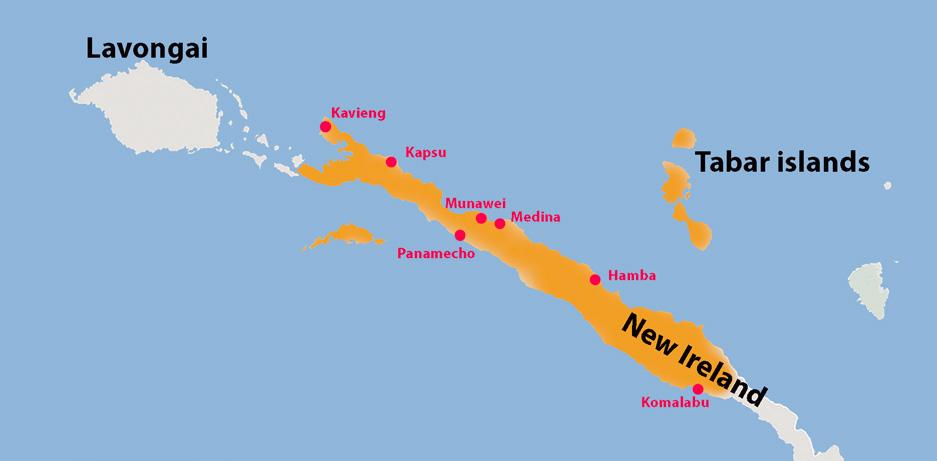
In the heart of the Bismarck Archipelago, New Ireland is a volcanic island stretching 340 km in length and varying in width from 10 to 50 km. The northern part of the island consists of limestone terraces formed from ancient coral reefs, gradually giving way to a chain of rugged hills. At the centre rises the Lelet Plateau, reaching an altitude of more than 1,000 metres and facing the Tabar Islands archipelago. Villages once situated on the slopes of karst hills have since been relocated to the coast at the beginning of the 20th century. The central plateau joins the volcanic massif of the south by way of a narrow isthmus approximately 10 km wide. The southern region, entirely volcanic in origin, is extremely rugged and largely impenetrable.
By the end of the nineteenth century, it is estimated that nearly 100,000 people inhabited the island and its surrounding archipelagos, divided among more
than 20 linguistic zones. Despite this diversity, the peoples of northern and central New Ireland shared a common cultural framework, reputedly originating in the Tabar Islands. Their ritual life and clan organisation were governed by long and highly complex funerary ceremonies known as Malagan. These elaborate and codified institutions were complemented by other rites and dances, the most important of which were the Kipong ceremonies. Within the Malagan and Kipong institutions, an extraordinary variety of sculptures, masks, and ritual objects with highly specific functions were created. Some were intended for single use, lasting only a few minutes, while others were stored and recharged for reuse multiple times.
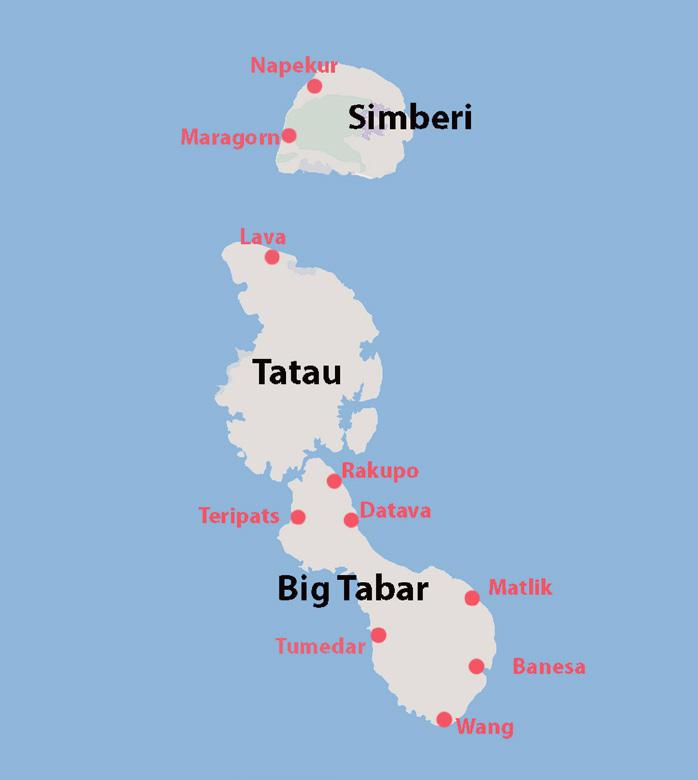
Tabar Archipelago. Dr Schiessel visited all the villages of the archipelago, although he specifically mentioned or collected artefacts from only a number of them. The Valik Malagan (lot 26) originates from Simberi Island. On Big Tabar, the Malaganchak figure (lot 20) comes from Datava village; the Kovabat heads (lots 14, 15) from Tumedar; the Kovakieto head (lot 11) from Wang village.
Figure: Northern New Ireland, with several villages visited by Dr Schiessel and mentioned in the text. The light brown area is where Malagan rituals govern ritual life.
The Malagan: Sculptures within a Strict System of Ownership
In their traditional context, Malagan sculptures derive meaning only through ownership, through the process of their creation, and through their presentation and activation by invocation during the funerary ceremonies also known as Malagan. With the exception of the uli figures of central New Ireland, livika friction drums (lot 23), and Marada heads (lots 11, 12, 13, 14, and 15), Malagan works were generally intended for a single ceremonial use. Afterwards, they might be kept temporarily in the men’s house, burnt, left to decay alongside the dead within funerary caves or in the bush.
These sculptures follow highly precise rules of manufacture and iconography within what may best be described as a system of ritual copyright. They
have been documented in Tabar by Edgar Walden and Augustin Krämer from the Naval Expedition sent by Berlin Museum in 1908-1910, William C. Groves in Tabar in the 1930s, Dr Schiessel in 1949-1950, Michael Gunn in 19821984 and myself since 2002. In his PhD thesis, Michael Gunn documented twenty-one Malagan sub-traditions encompassing nearly four hundred distinct types. These different sub-traditions are named Valik (lot 26), Lunet (lot 19), Malagachak (lot 20), Arum (lot 11), Kulepmu (lot 17), Mendis (lot 22), and Maradan (lots 12, 13, 14, 15).
Dr Schiessel has also made drawings of Malagans from other sub-traditions, such as Tangala and Turu, and has taken notes on art and traditions. It is a rare occasion to have such a diversity of Malagan sculptures in the same auction catalogue.
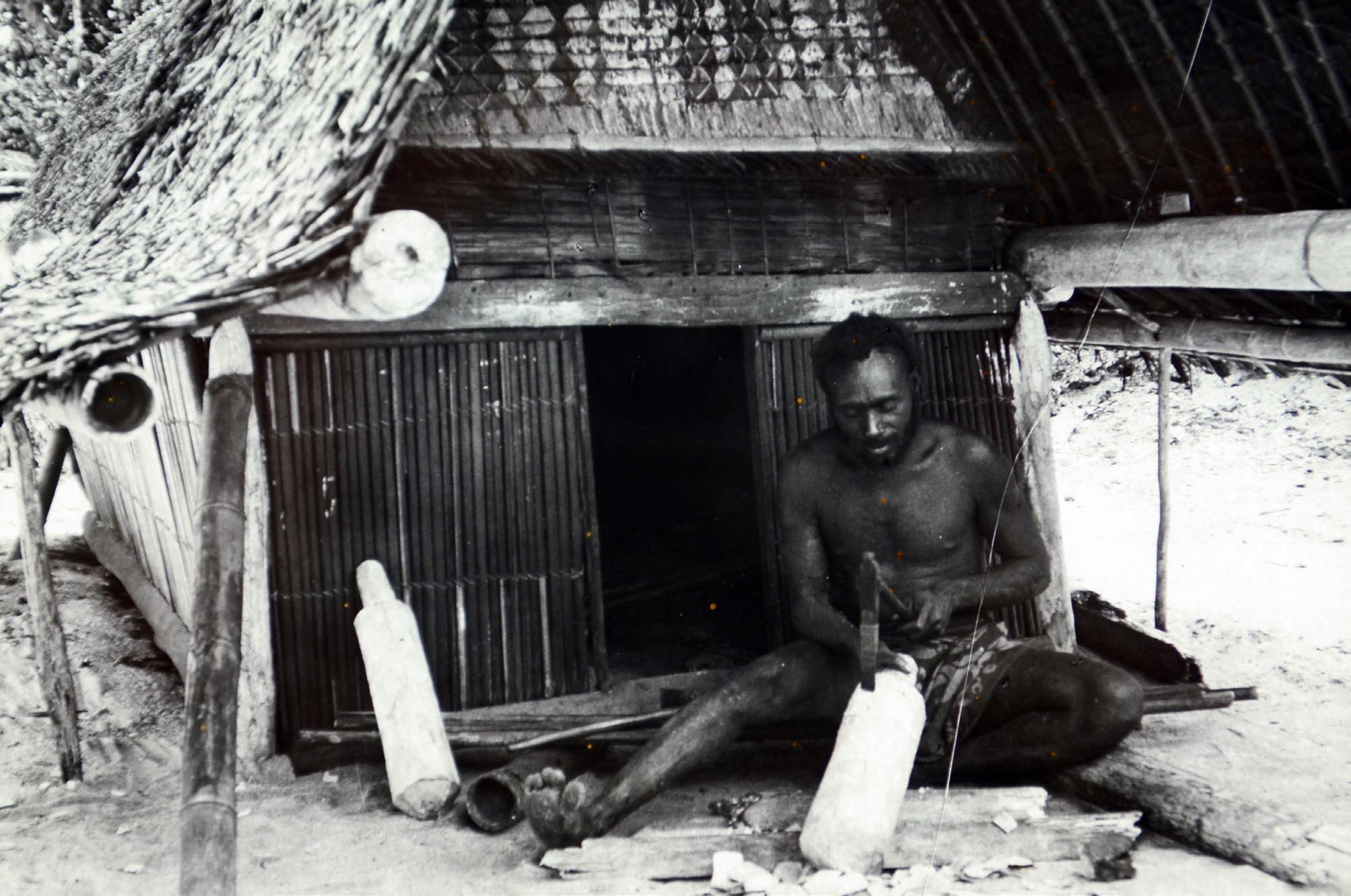
Figure: Man from Hemba village, East coast central New Ireland, carving a Malagan with an adze (see lots 5 and 35).
Photo by Augustin and Elizabeth Krämer in 1909, glass plate Tübingen 1408.
Malagan carvings and masks
Almost all Malagan sculptures and masks are carved from Alstonia scholaris, a soft wood belonging to the linden family. Until the widespread introduction of metal tools in the second half of the nineteenth century, carving was performed with stone or clam-shell adzes (lot 35). A Malagan owner possessing the rights to a particular image would commission its production for a ceremony. Such commissions honoured the deceased and their clan, while simultaneously affirming the patron’s authority and prestige within the community.
The owner would have inherited the rights to the Malagan years earlier, often in childhood, through his maternal uncle during a ceremony. The image and its name were preserved in memory until the time came to recreate it. Through dialogue with the sculptor, the patron determined the work to be produced in accordance with the artistic standards associated with the right held. Within a given sub-tradition and type, certain elements were rigorously prescribed: the number of figures, the shape of the head, and the presence of motifs such as a drongo, rooster, hornbill, flying fish, or pig’s head. Other details, including the ornamentation of the limbs, were left to the sculptor’s discretion.
This balance between codification and artistic freedom allowed for an infinite variety of forms, ensuring that no two sculptures were ever strictly identical, even among the more than four thousand examples preserved in the collections of the Ethnological Museum in Berlin and collected before 1914.
Once agreement had been reached and the first payments made, a suitable tree was selected and felled, after which the wood was left to rest in the forest. At a later stage, the trunk was carried in procession to the sculptor’s workshop, usually situated near a cemetery, accompanied by songs associated with the Malagan being created.
The trunk was then hollowed and carved into human figures, birds, fish, pigs, or geometric forms. After carving, the sculpture was left to dry for several weeks. Eyes made from the shell of the sea snail Turbo petholatus were subsequently inserted. At dawn, the sculpture was immersed in seawater and washed, then coated with a white lime mixture mixed with breadfruit juice. The remaining pigments consisted of black charcoal, red iron-oxide clay reduced to powder through burning, and yellow derived from a mangrove plant decoction. These colours were applied over the white ground. Yellow pigments are particularly sensitive to light and are therefore rarely preserved. Because the artefacts collected by Dr Schiessel remained in storage for nearly eighty years, traces of yellow pigment can still be observed on (lots 17, 20, and 26)
In the past, payments in shell money (lots 31, 32), as well as pigs, were made at each stage of the sculpture’s production. Members of the community maintained the sculptor’s gardens and cared for his pigs, while meals were provided to him daily.
Each sculptor worked on only a single Malagan at a time. Freed from material concerns, he was able to devote himself entirely to the expression of his artistic skill.
A Malagan is not a portrait of the deceased. Nourished through pig sacrifice and ancient incantations, it became, during the culminating phase of the ceremony, the temporary vessel of a primordial force associated with the deceased and their clan.
Malagan ceremonies
Malagan ceremonies followed a highly codified sequence of stages. The ritual began with the presentation of the deceased within the ceremonial enclosure, where clan members kept vigil, shared food, and accompanied the dead with songs, bullroarers, and the resonant sound of the Livika friction drum.
The deceased was then buried. In earlier times, the skull might have been retrieved several months later.
After a period of mourning, the clan leaders would decide to organise the subsequent phases of the Malagan cycle, whereby preparation could extend over several years. They determined which clans would be invited, which Malagan sculptures would be commissioned and displayed, which dances would be performed, and how many pigs would be sacrificed.
In earlier ceremonies, clan members would have received pigs in exchange for the rights to the Malagan
from friendly clans. It was important not to forget the obligation of reciprocity and to plan to transfer Malagan copyrights in return for the gift of pigs’ heads. By these subtle interactions, alliances between families and clans were cultivated over generations. Beyond its funerary dimension, the Malagan institution also served as a fundamental social regulator, a mechanism for conflict resolution, and a means of creating new ties. Major exchanges and transactions between clans were expected to take place within the framework of the final stages of a Malagan ceremony.
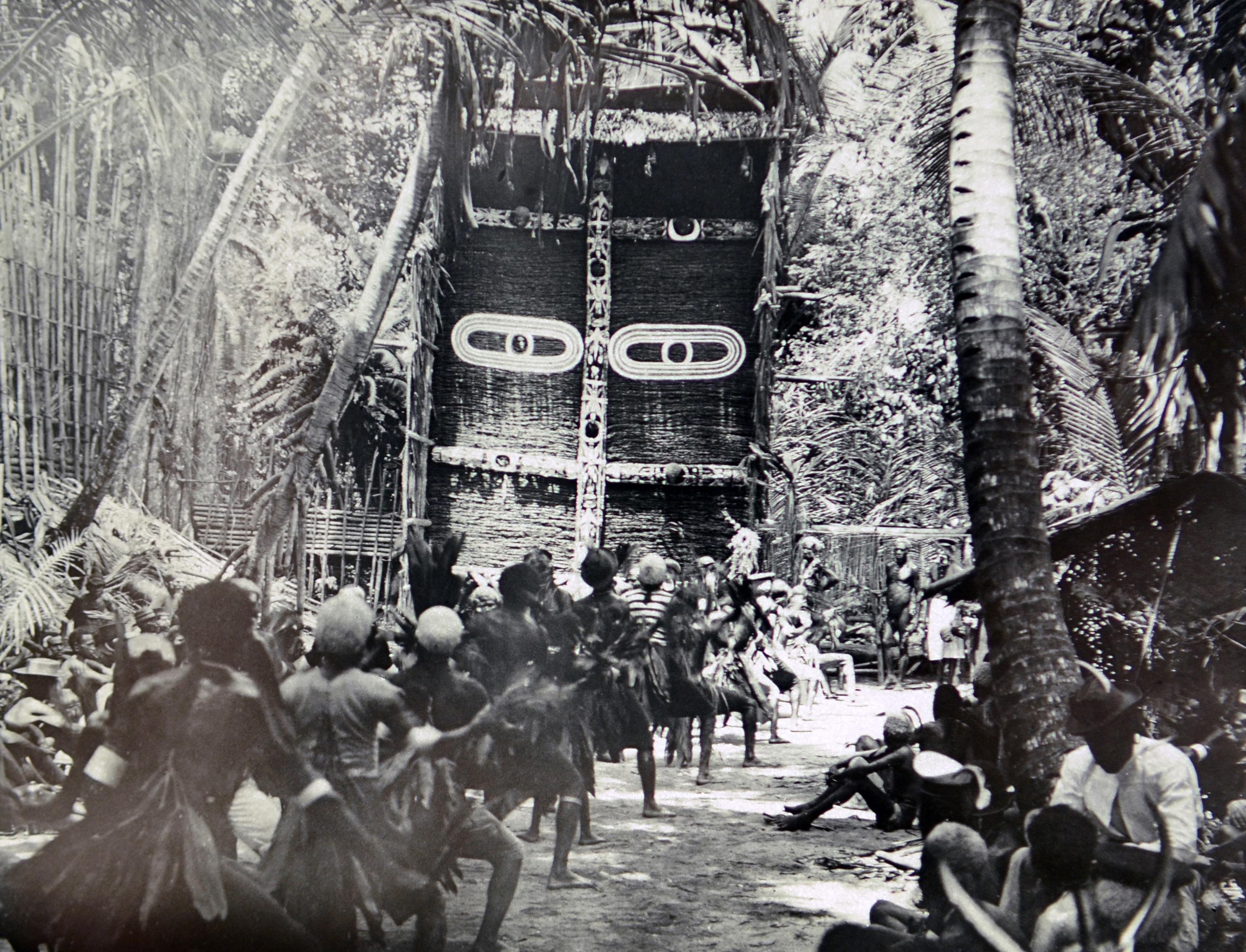
Figure: Photograph by Edgar Walden of a Mendis Malagan ceremony in Mapua in 1909 (published as plate 60 in Krämer, 1925, and preserved as glass plate Tübingen 1461). The Malagan display consists of a tall central post and a horizontal frieze, known as kobokobor, at the base. The dancers face both the Malagans and the ritual leader, who appears naked, as was appropriate during Mendis Malagan ceremonies.
The last days of a Malagan ceremony
After months of preparation, at dawn on the first day, the bearers of large wooden masks known as Matua or Vanis (lots 24, 25) led a procession of masked figures whose role was to chase away the wandering spirits of the dead and ritually purify the ceremonial ground. Their appearance lifted the taboos imposed since the death and marked the beginning of the final stage of the Malagan ceremony. After their dance, the masks are then put on display.
For each wood carving, a pig was sacrificed by strangulation in order to “activate” the sculpture, transforming it into a Malagan. Among the people of the Tabar Islands, this process was described as “starting the fire.” The Malagans were then installed upon display structures within the ritual enclosure.
Once all the statues were in place, the owners rose in turn to deliver their incantations, spoken rapidly and with great force. Each invocation was specific to an individual sculpture. Local people recount that, when these words were uttered with sufficient power, the eyes of the Malagan could be seen to blink.
Then, the Malagan owners delivered speeches asserting their rights, recounting the circumstances under which they had received their Malagans and explaining why they were being displayed on that particular occasion. They could subsequently choose either to transfer these rights or to retain them. Payments were made in shell money, pig heads, and garden produce.
The following day, additional pigs were sacrificed, and further dances were performed, culminating in the appearance of the Tatanua masks during the final dance. Another cycle of exchanges then took place before the participants returned to their respective villages. To use the customary expression, the death of the individual was then considered “finished.” Through the scale and splendour of the ceremony, the clans had demonstrated their love and respect for the deceased while simultaneously affirming their own power and prestige.
Most Malagans were subsequently burnt, abandoned in caves, in the forest, or stored among the beams of the men’s house. They could only be used once. Marada heads and masks, however, were preserved for reuse in future ceremonies, often after being repainted.
In 1949, Dr Schiessel arrived in New Ireland to care for the local population. There, he encountered a world still deeply shaped by ancestral ritual life. Displaying both genuine curiosity and sincere concern for the people and their culture, he also recognised the importance of preserving aspects of this rapidly changing artistic heritage.
Professor Jean Phillipe Bealieu
Marada Malagan and rain making
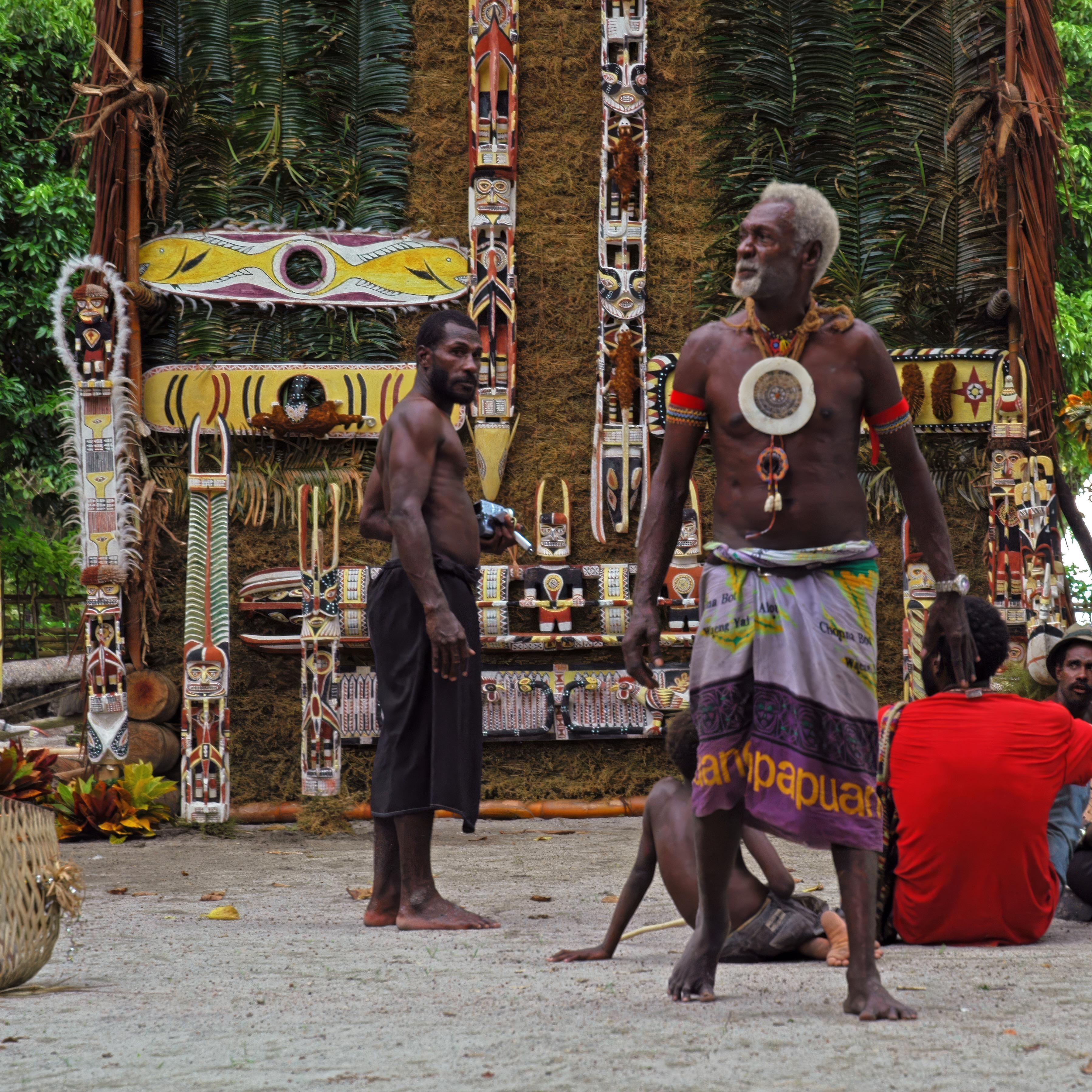
Rainmaking is an ancient and important practice in New Ireland, deeply rooted in cultural tradition. It typically takes place in a designated spot in the shade of a huge banyan tree, where the skulls of former rainmakers and powerful young warriors are kept in clam shells, displayed on small stone walls or platforms. When rain is needed, a living rainmaker who knows the name of a skull's former owner can summon the spirit of the dead to help control the weather. The practice matters greatly to a Malagan ceremony, which depends first on rain to grow the gardens, and later on a clear day for the rituals themselves.
The ritual sites used for rainmaking are called Maradan, and the Marada Malagan sub-tradition is closely associated with rainmaking ceremonies in New Ireland. This tradition is especially known for its large carved wooden heads, usually made from hardwood and painted with natural pigments. Unlike most Malagan sculptures, which were often destroyed after ceremonies, these heads were preserved and reused over many ritual cycles.
They were first described by Edgar Walden after his stay at Teripatz, on the west coast of Big Tabar, in 1909 (Walden and Nevermann, 1940, page 32). According to Walden, the tradition originates from Big Tabar, linked to a river spirit descending from the tallest hill on the island. It was also found in Tatau and on the mainland of New Ireland.
For the final stage of the Marada Malagan ceremony, Walden reported that ritual participants would retrieve the bones of the deceased and place them in a funnelshaped container made of bamboo splits, tightly woven with rattan and wrapped. It is then incorporated into a
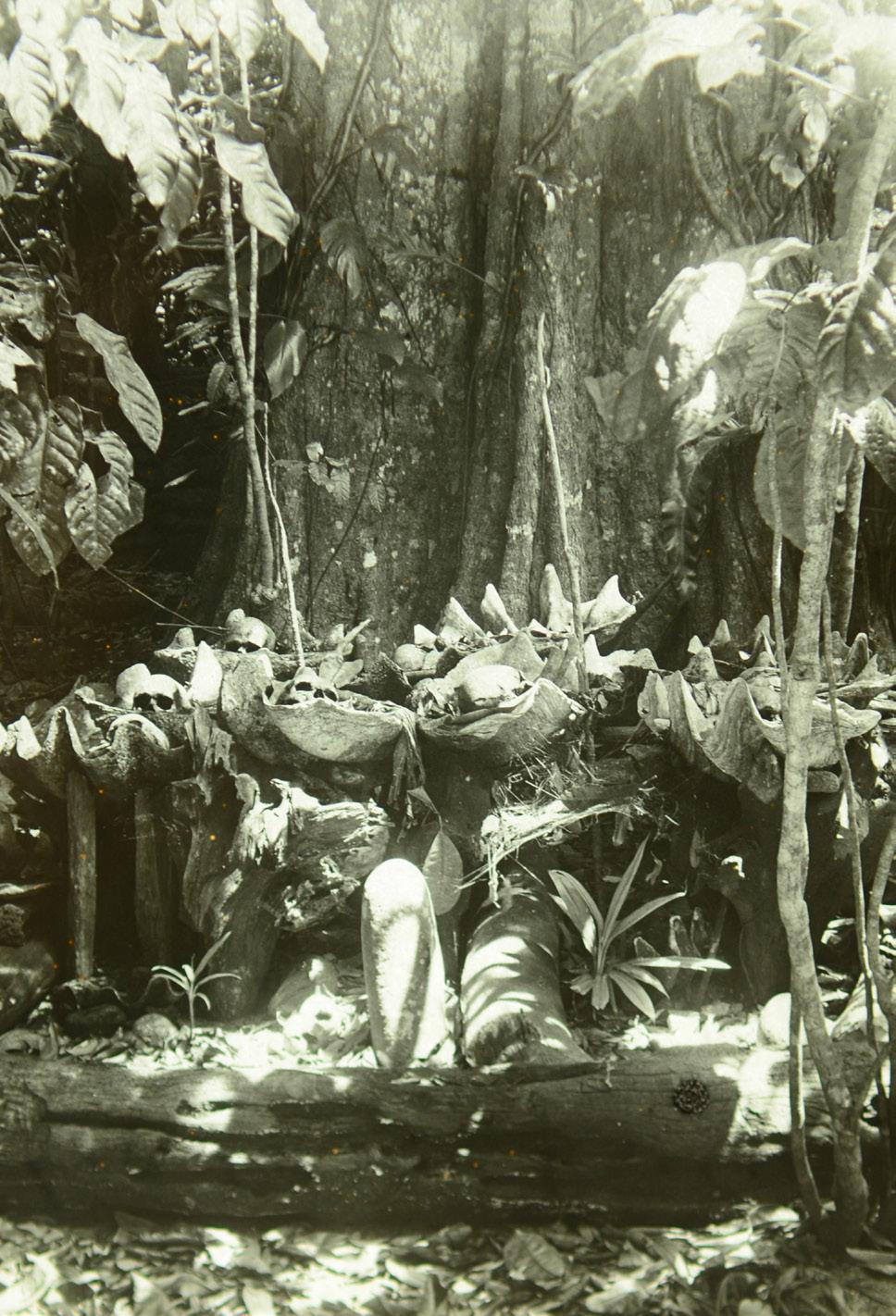
Figure: The rainmaker grove at Lamassong, in Central New Ireland, was photographed in 1909 by the ethnographers Augustin and Elizabeth Krämer (glass plate Tübingen 1466). In the grove, human skulls were displayed in large clam shells and accompanied by sacred magic stones associated with rainmaking rituals.
Figure: Ritual enclosure displaying Malagans in New Ireland, photographed during the Berlin Naval Expedition of 1908–1909. It was published as plate 34 by Augustin Krämer in 1925, and preserved as a glass plate (Tübingen 1411).
The photo has most likely been taken by Edgar Walden. In the foreground at right stands a human mannequin surmounted by a large Marada head. In the background, three Mendis Malagan heads are mounted on mannequins and sheltered from the rain. The four Marada heads (lots 12 and 13, 14, and 15), the Kovakieto head (lot 11), and the Mendis head (lot 22), collected by Dr Schiessel, were most likely displayed in a similar manner during rituals.
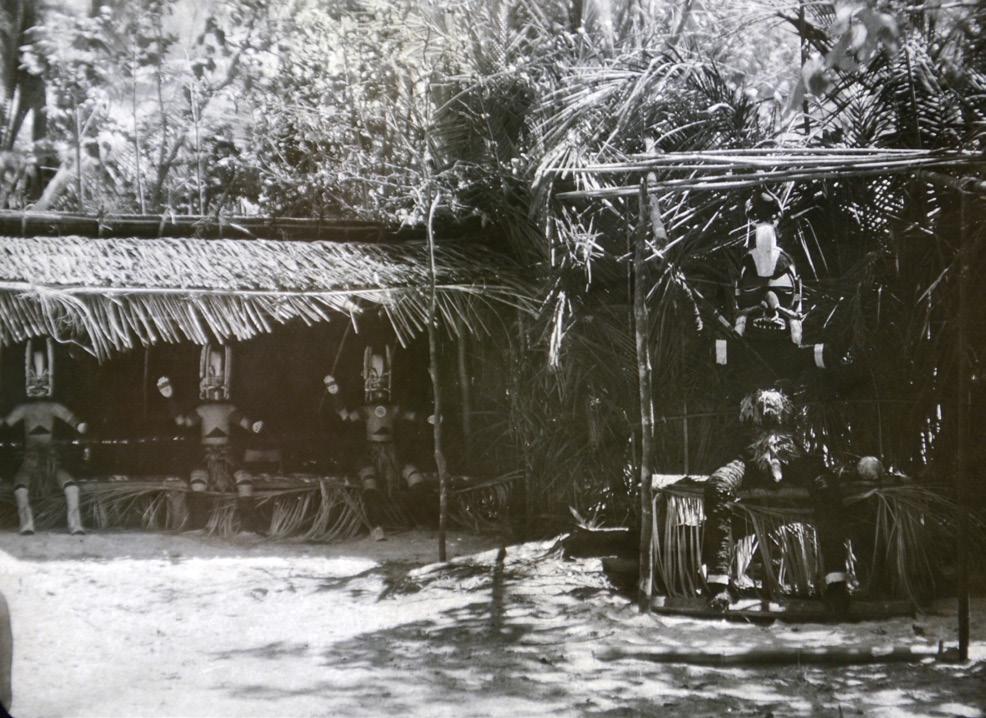
seated mannequin bearing a large wooden head known as Kovabat, a name derived from kova (“head”) and abat (“rain”). This association emphasises the connection between the Marada Malagan tradition and rainmaking rituals in New Ireland, where ancestral power, mortuary practices, and control over natural forces were closely intertwined. All Kovabat heads display closed eyes, a highly unusual characteristic in New Ireland mask traditions, where eyes are most often open and rendered with inset Turbo shell opercula. The closed eyes, together with the occasionally protruding tongue on these heads, may suggest that they incarnate the deceased.
After the ceremonies, the heads were carefully preserved and, unlike Malagans, which reverted to mere wood carvings once their ritual force had departed, they were believed to remain spiritually active. Elders in Tabar still refer to the Kovabat today as “talking masks,” recounting that they could be heard at night addressing one another. These heads appear to have occupied a dual status: they became Malagans during the ceremony, yet retained an active spiritual potency afterwards and could subsequently be employed in rainmaking practices.
Including the heads collected by Dr Schiessel, approximately twenty Marada heads of related types are known today in public and private collections. Among them is an example collected by Waite in 1918 on the mainland of New Ireland, now held by the South Australian Museum (inventory 10902). Another, collected by Richard Parkinson before 1908, is preserved at the Field Museum (137685), while one Kovabat forms part
of the Alain Schoffel collection, and one collected by Dr Schiessel in 1950 is held in the Auckland War Memorial Museum.
Information is also available for the example in the Musée du quai Branly – Jacques Chirac, collected by Langlois and Benoit at Tatau in 1970 (Sotheby’s, New York, 15 May 2015, lot 88). Other documented pieces include Beyeler nos. 173 and 177, as well as mask 64245 in the Néprajzi Múzeum, reportedly originating from Lemakot village.
Taken as a whole, the extant corpus of Marada and Kovabat heads constitutes a critically important, though exceedingly limited, body of material for the study of Malagan sculpture and its ritual functions in New Ireland. Their distribution across major institutional collections, combined with the scarcity of securely documented examples, underscores the significance of those recorded at the moment of collection. The heads gathered by Dr Schiessel in 1949–1950, supported by his contemporaneous field notes, provide rare primary evidence for the circumstances of production, use, and local attribution. The examples presented in this auction therefore assume particular scholarly value: they not only expand the comparative dataset for understanding the Marada tradition and its associations with rainmaking practices, but also contribute materially to ongoing efforts to reconstruct the regional and ceremonial contexts from which these forms emerged.
Professor Jean Phillipe Bealieu
Purchasers of Lots 1–45, from the Dr A. A. Schiessel Collection, will receive a complete digital copy of the Dr A. A. Schiessel archive. This corpus includes the primary field notes, correspondence, and documentary materials that substantiate the provenance and historical context of the works.
1
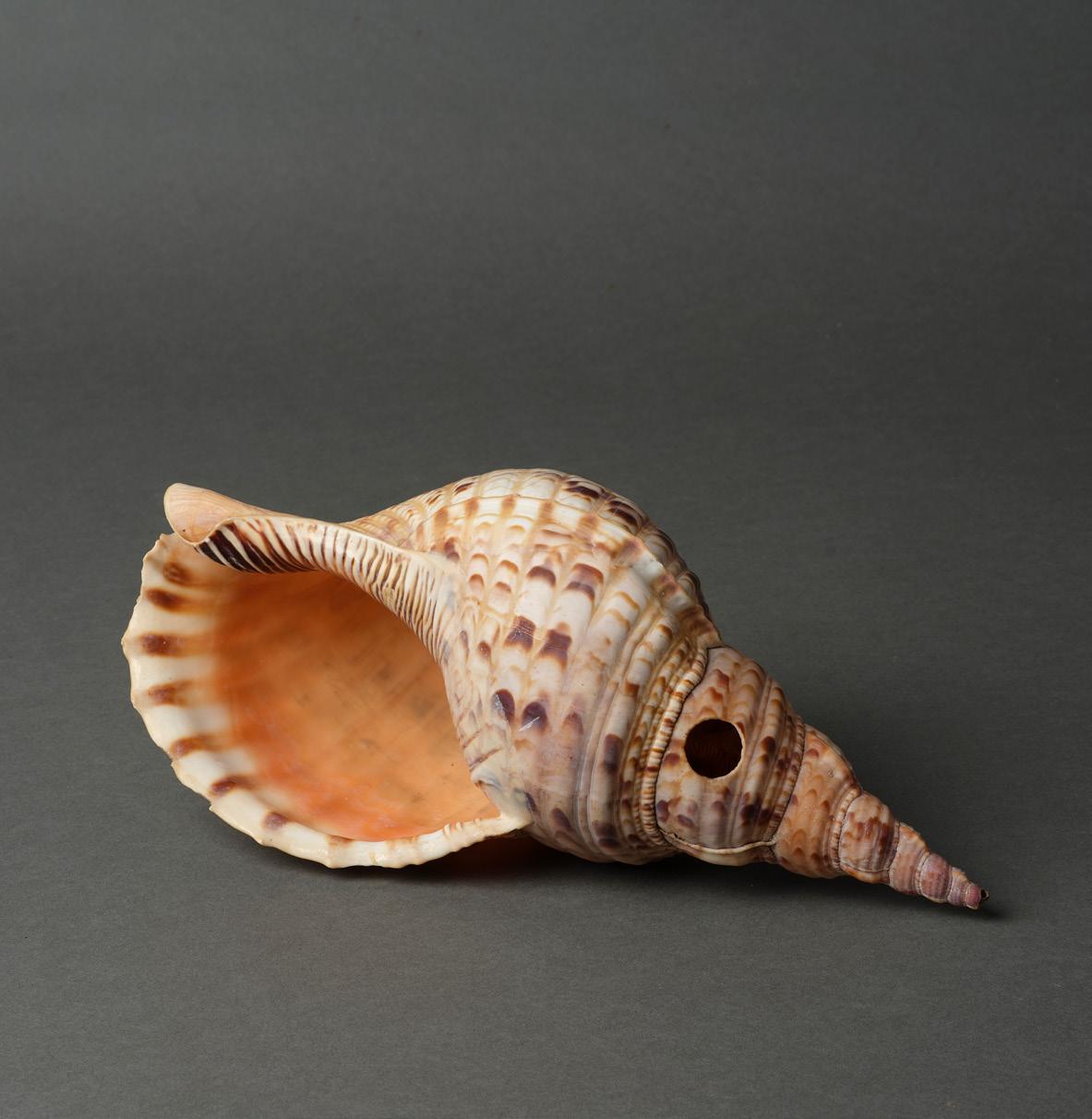
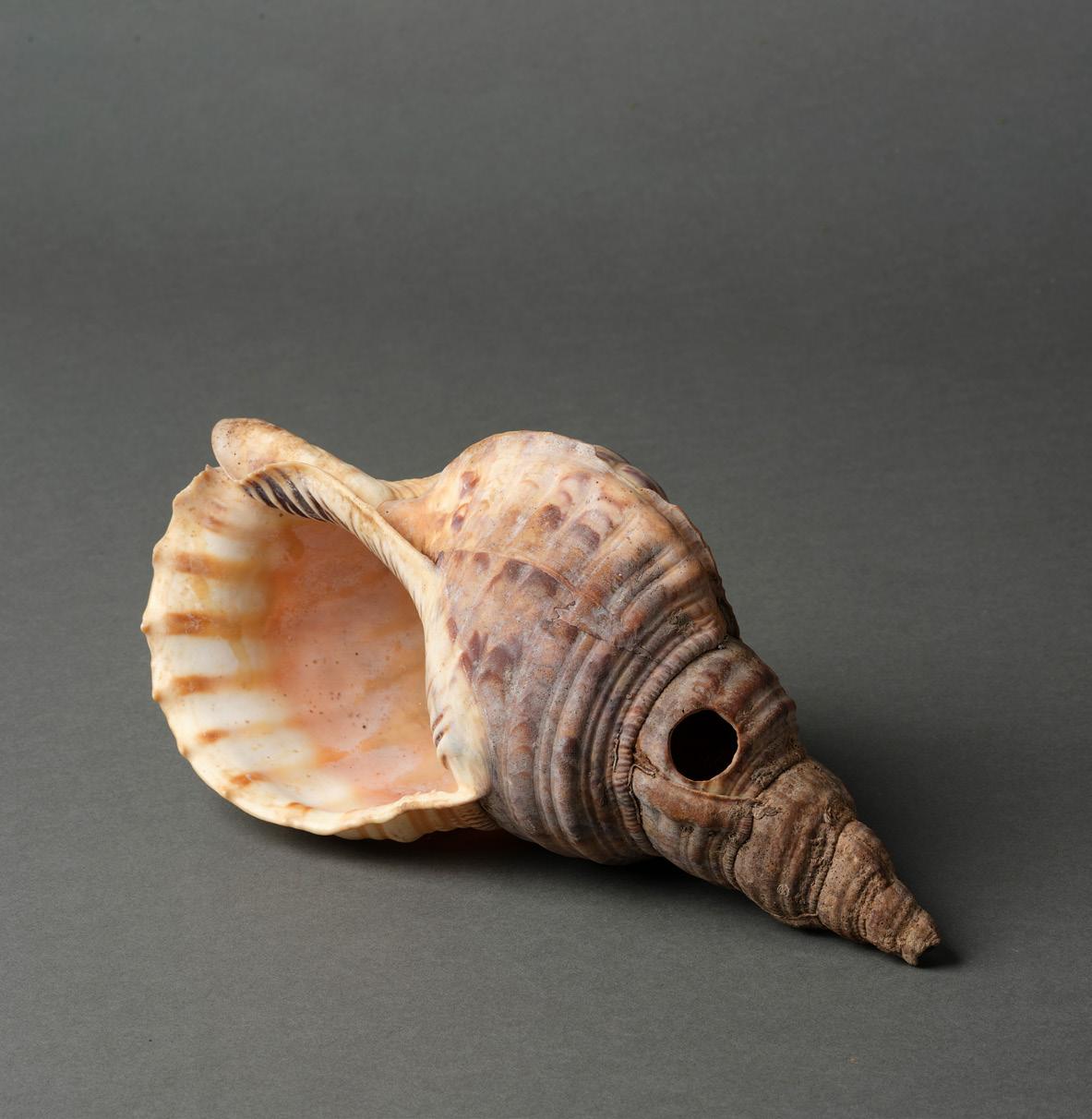
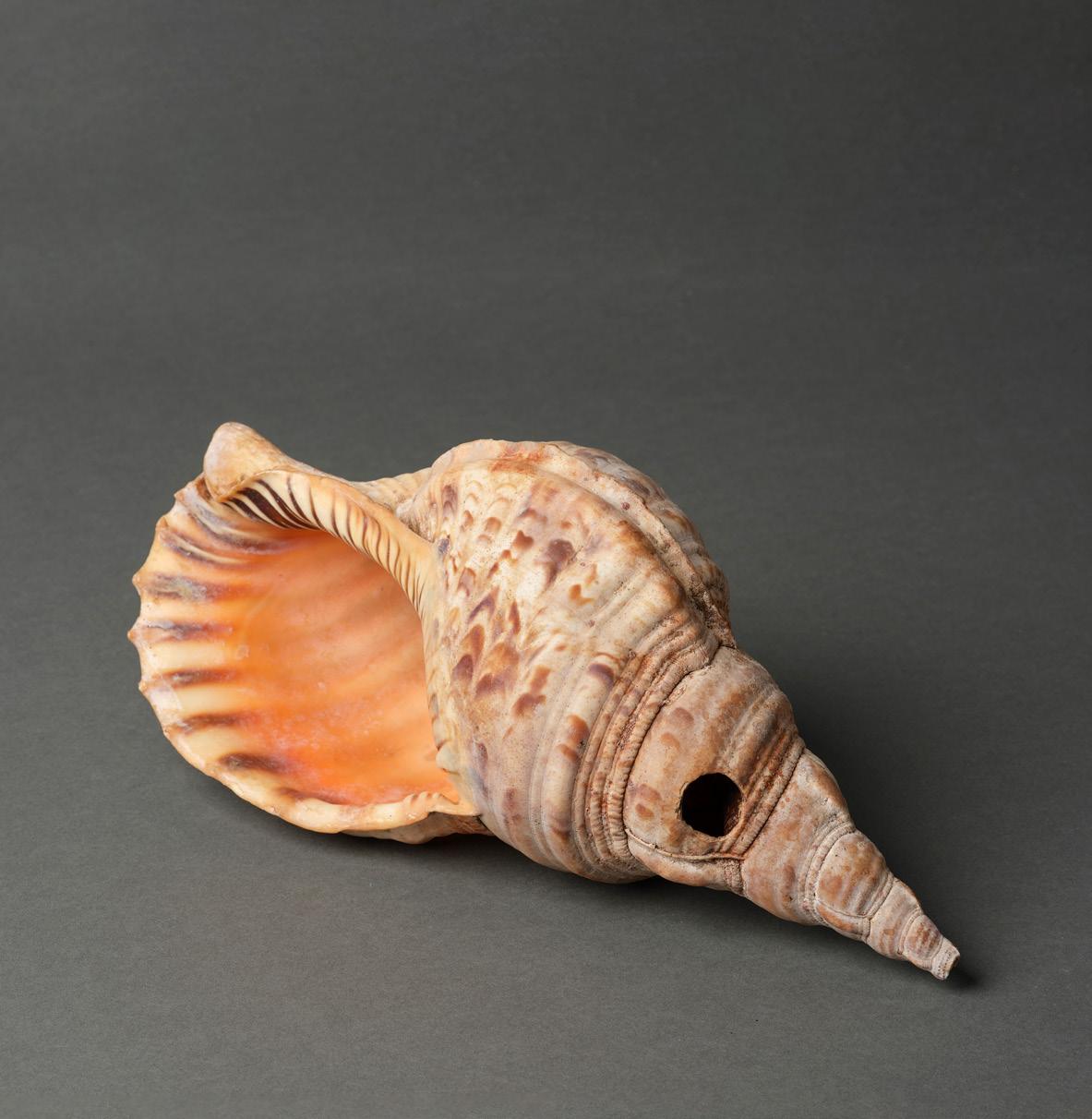
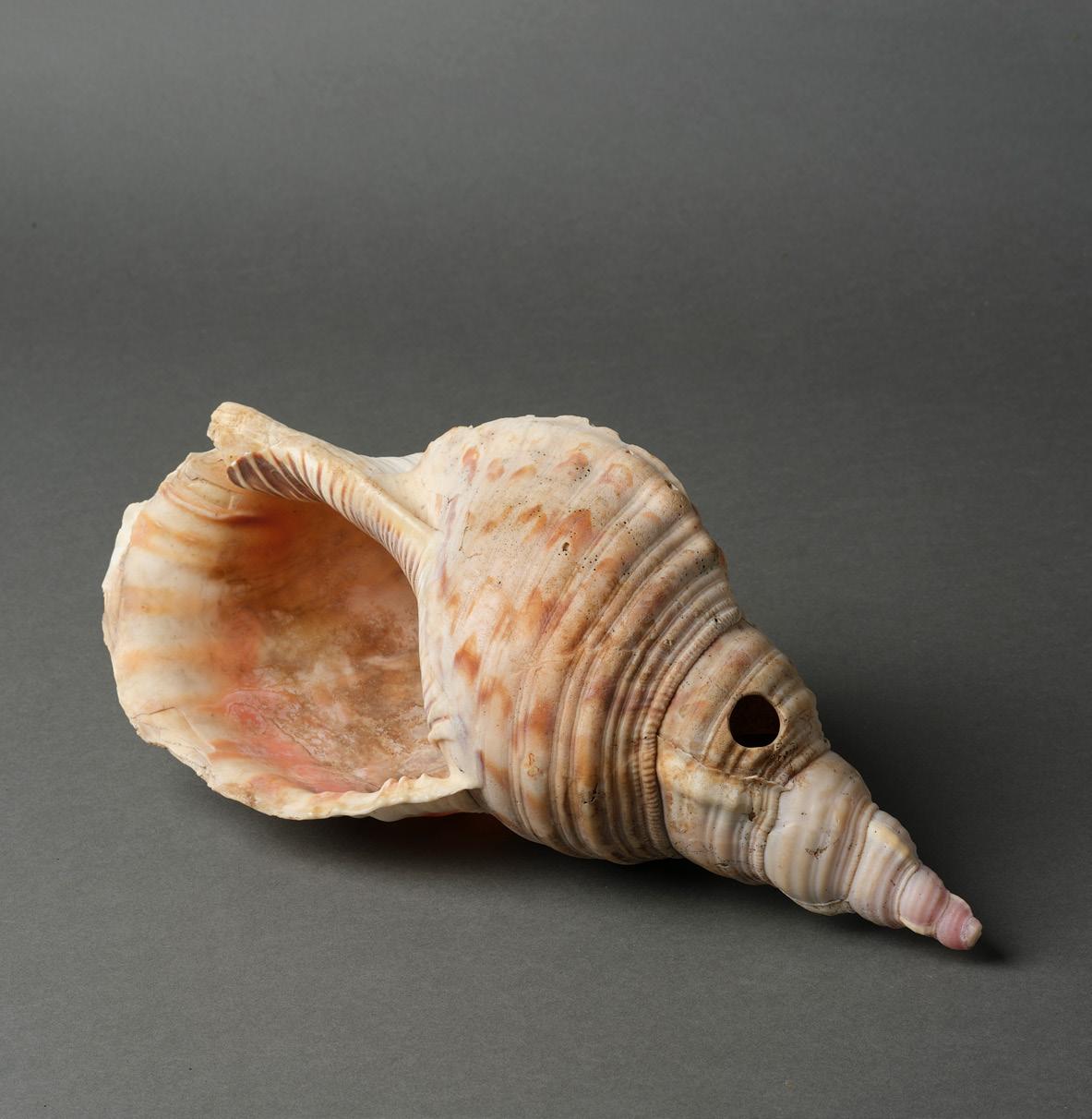
A Conch Shell Trumpet
New Ireland, Tabar Island, Early 20th Century
29cm length
PROVENANCE
Dr A. A. Schiessel Collection (1906 – 1986), Vienna
Field collected in New Ireland, 1949 – 1950
$400–800
2
A Conch Shell Tumpet
New Ireland, Tabar Island, Early 20th Century
31cm length
PROVENANCE
Dr A. A. Schiessel Collection (1906 – 1986), Vienna
Field collected in New Ireland, 1949 – 1950
$400–800
3
A Conch Shell Trumpet
New Ireland, Tabar Island, Early 20th Century
28cm length
PROVENANCE
Dr A. A. Schiessel Collection (1906 – 1986), Vienna
Field collected in New Ireland, 1949 – 1950
$400–800
4
A Conch Shell Trumpet
New Ireland, Tabar Island, Early 20th Century
32cm length
PROVENANCE
Dr A. A. Schiessel Collection (1906 – 1986), Vienna
Field collected in New Ireland, 1949 – 1950
$400–800
These Conch shells from New Ireland, known as tavuri, were used for a variety of purposes throughout the island. Shark callers would sound the conch to announce the successful capture of a shark, while it also played an important role in certain Malagan ceremonies, including the Valik rites, during which successive short blasts marked the different stages of the ritual.
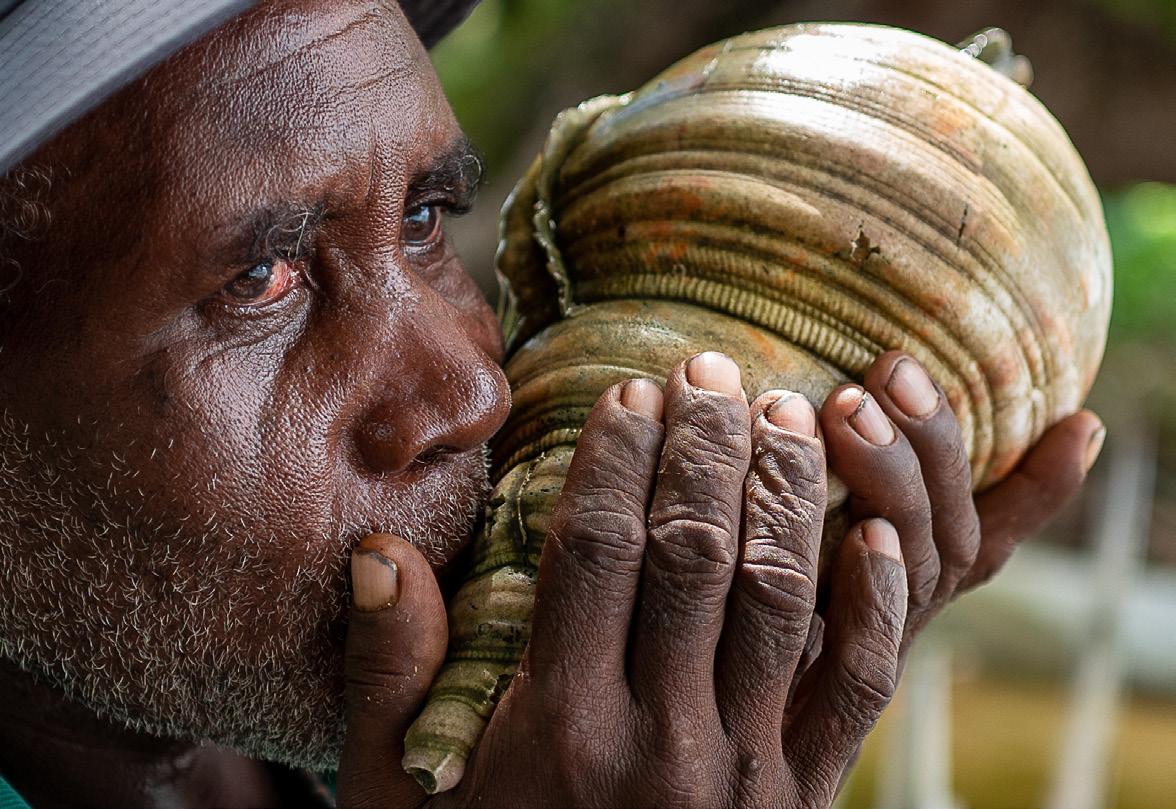
Shark caller Komalabu Village, 2018. Jean-Philippe Beaulieu
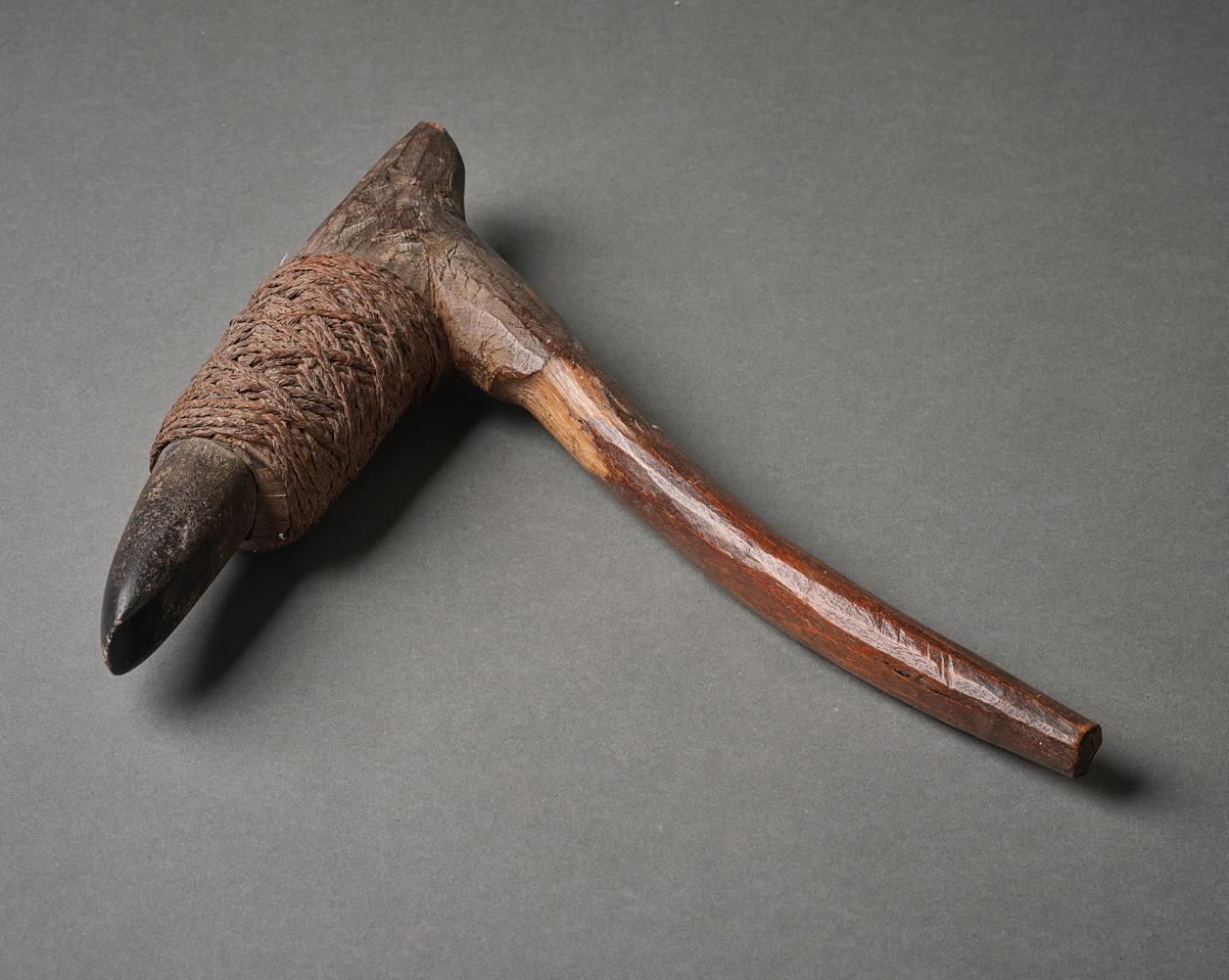
A Hafted Adze
New Ireland, Early 20th Century
Typical hafted adze used for carving canoes and Malagan figures.
35cm height x 29cm width
PROVENANCE
Dr A. A. Schiessel Collection (1906 – 1986), Vienna
Field collected in New Ireland, 1949 – 1950
$400–800
6
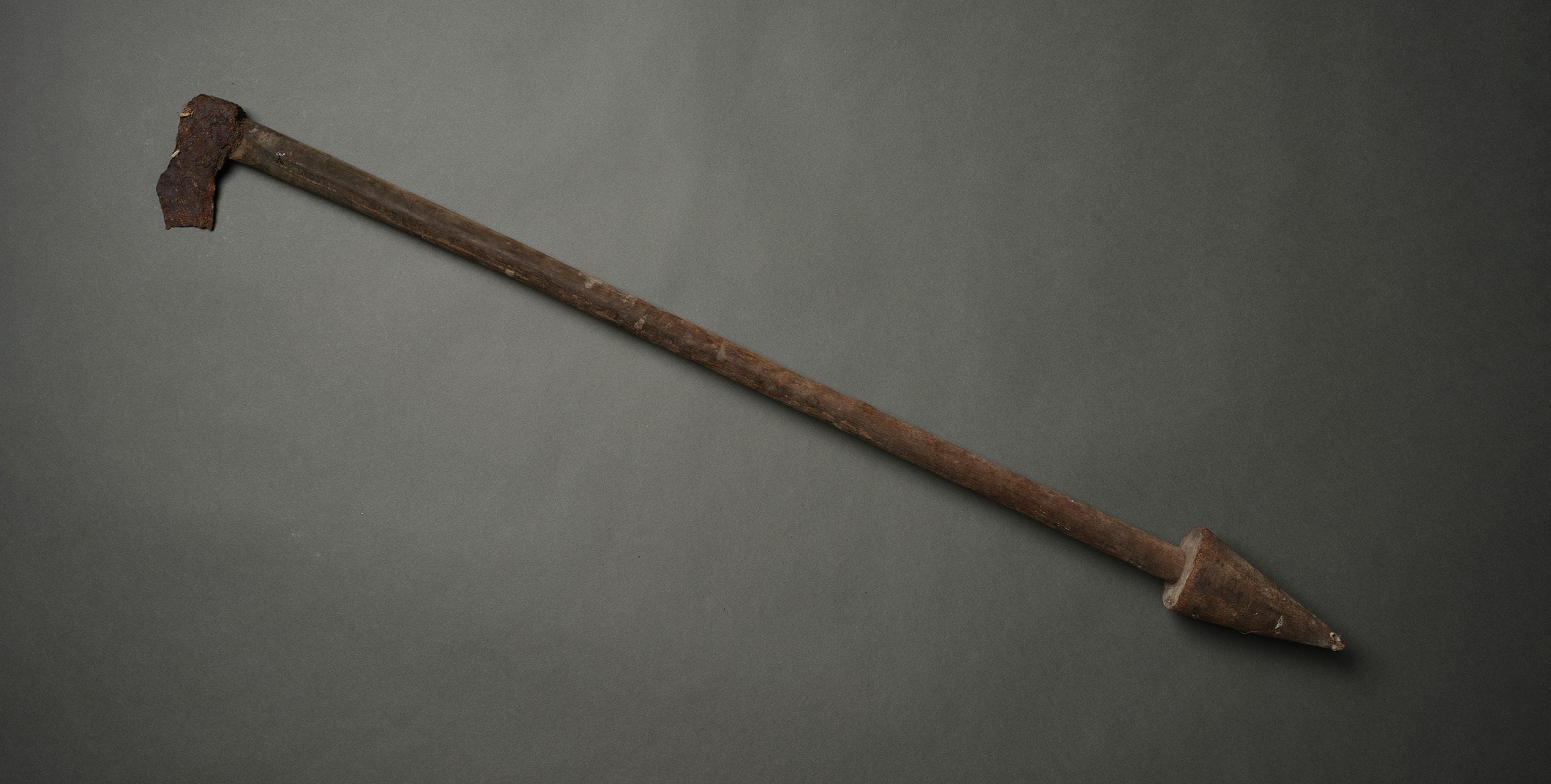
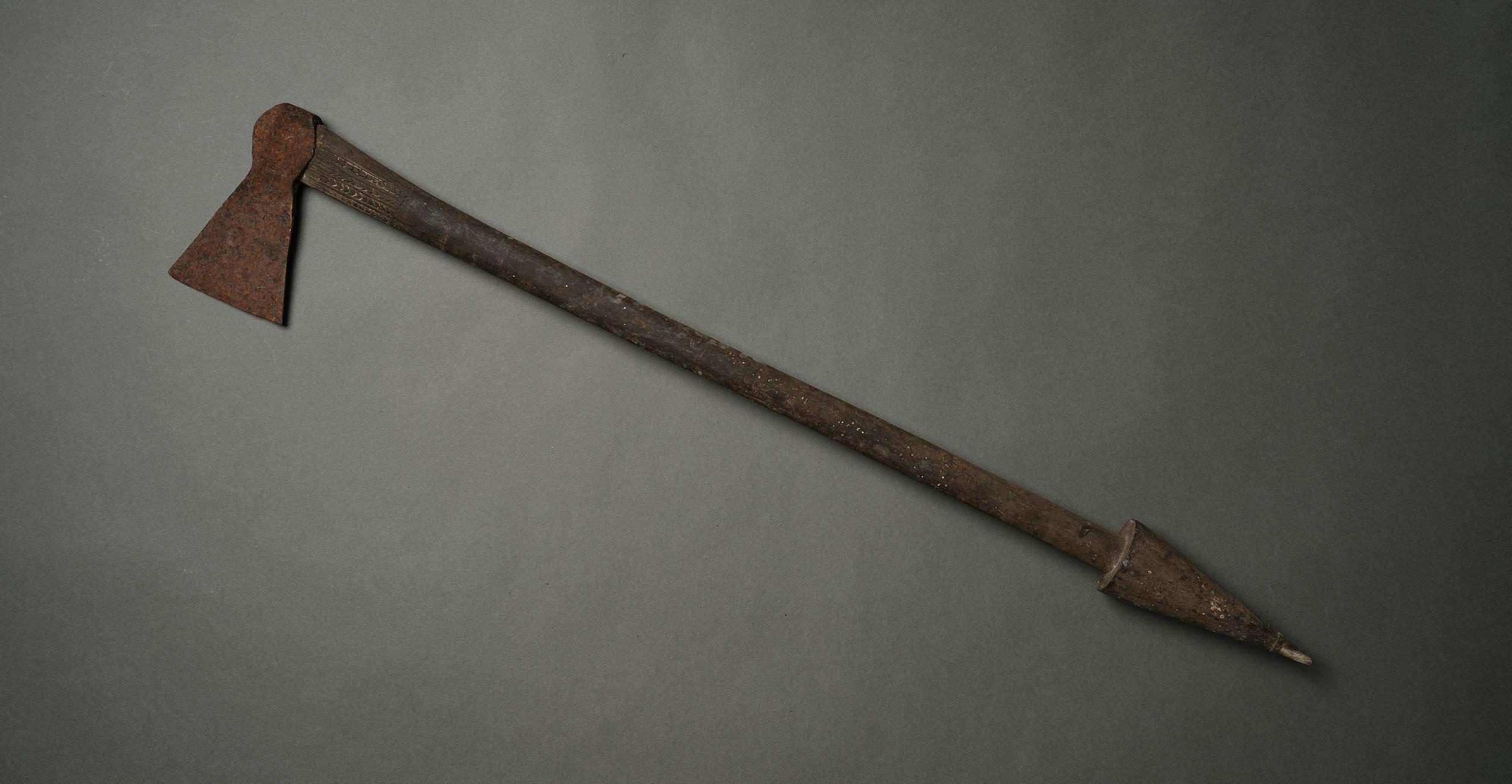
An Axe
New Ireland, West Coast, 19th – Early 20th Century
Similar to a New Britain axe, which features a long wooden shaft with a conical end and a metal adze blade, these clubs are also typical of those from the Komalabu area on the west coast of New Ireland. Komalabu faces the Duke of York Island and serves as a natural point of contact between New Britain and New Ireland.
100cm height
PROVENANCE
Dr A. A. Schiessel Collection (1906 – 1986), Vienna
7
An Axe
New Ireland, Tabar Island, 19th – Early 20th Century
89cm length
PROVENANCE
Dr A. A. Schiessel Collection (1906 – 1986), Vienna
Field collected in New Ireland, 1949 – 1950
$500–1,000
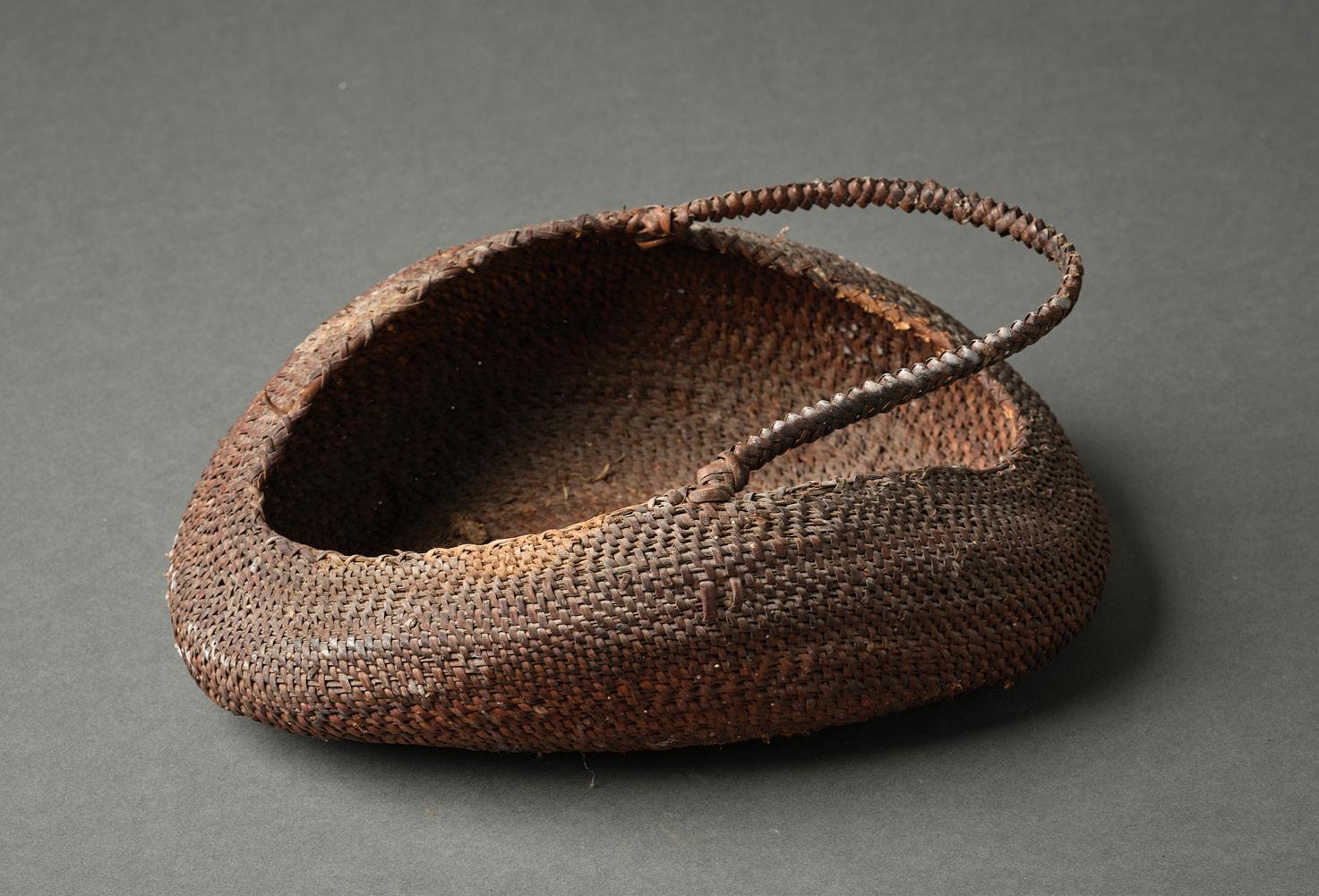
8
A Small Woven Basket
New Ireland, Tabar Island, 20th Century
29cm length
PROVENANCE
Dr A. A. Schiessel Collection (1906 – 1986), Vienna
Field collected in New Ireland, 1949 – 1950
$100–200
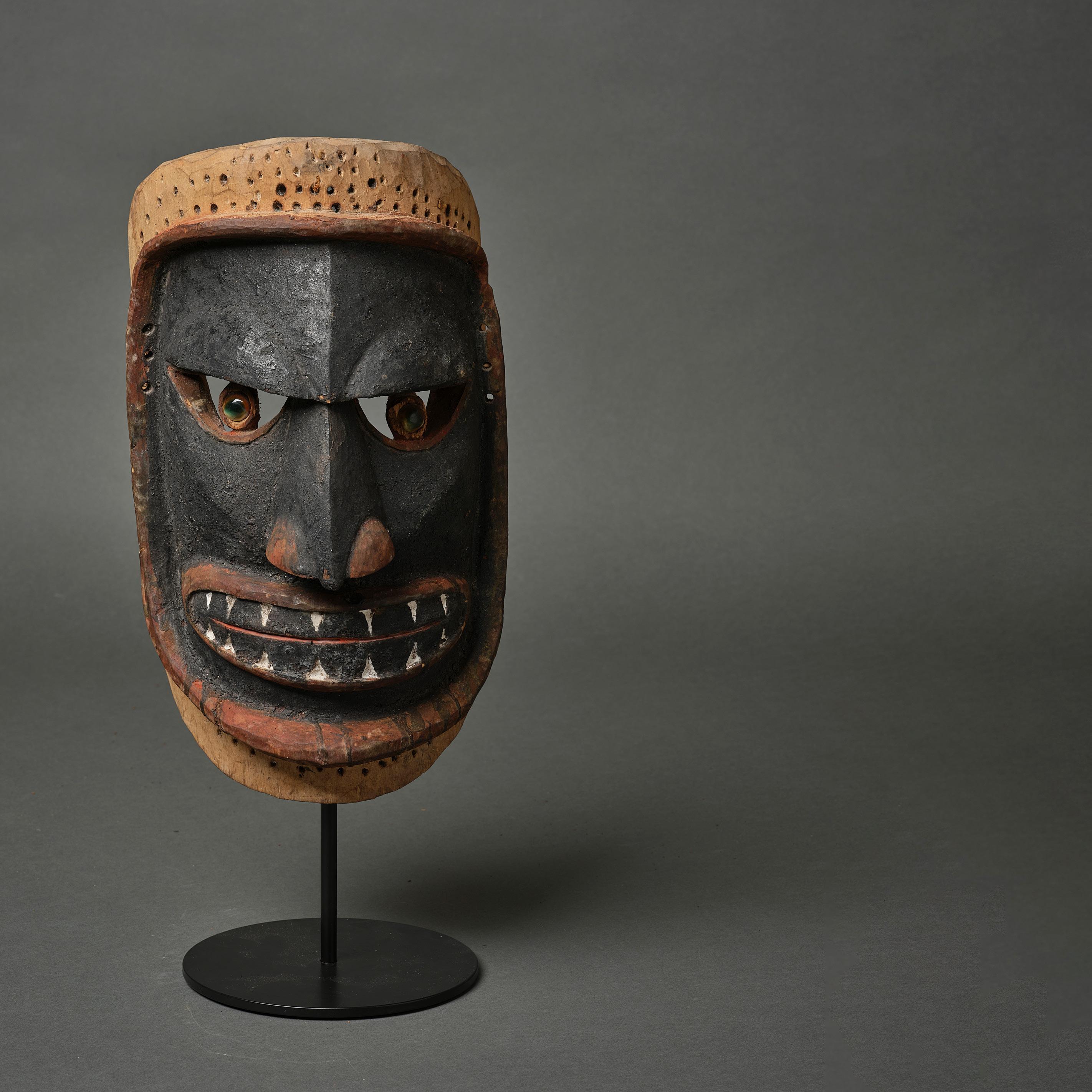
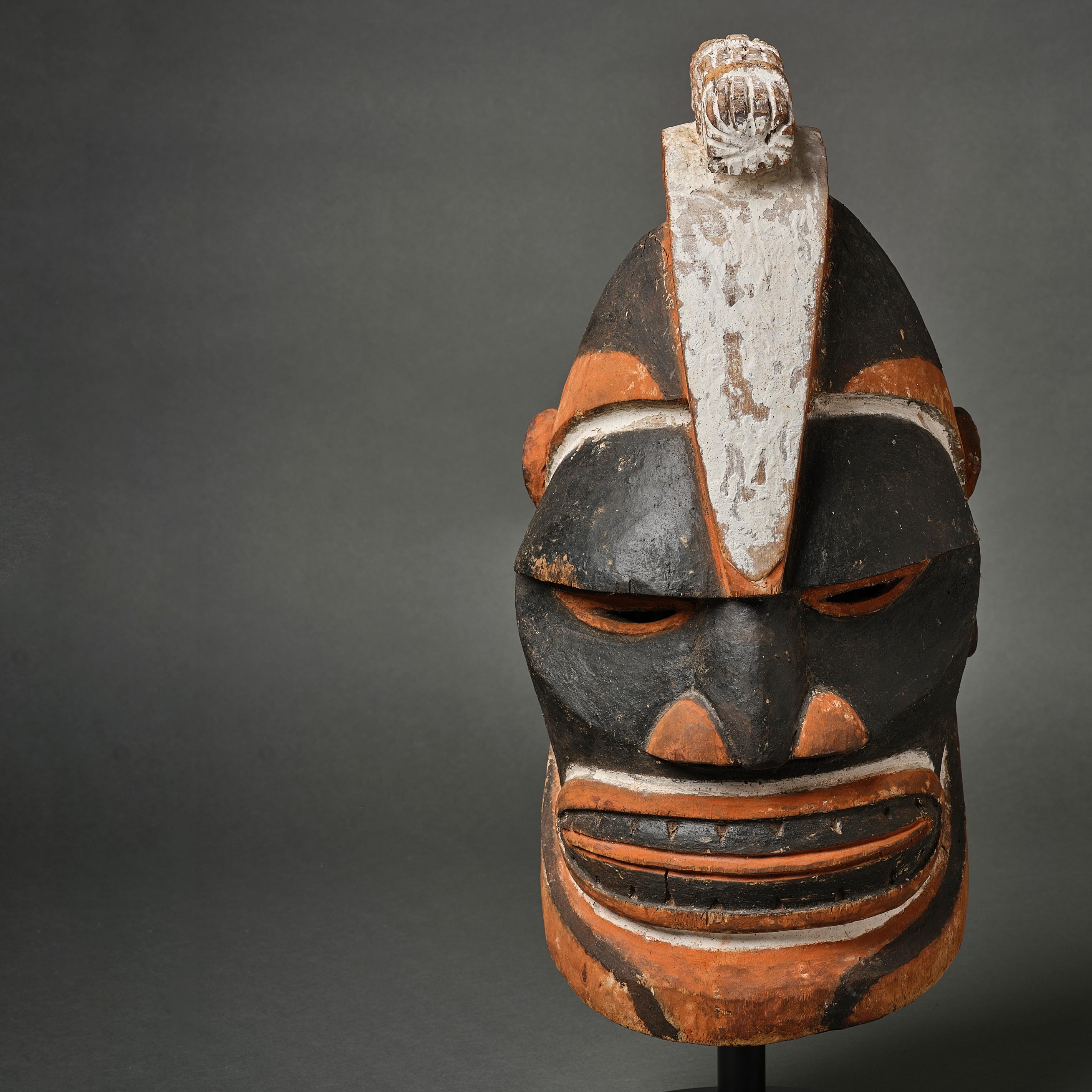
A Black Mask
New Ireland, Tabar Island, Early 20th Century
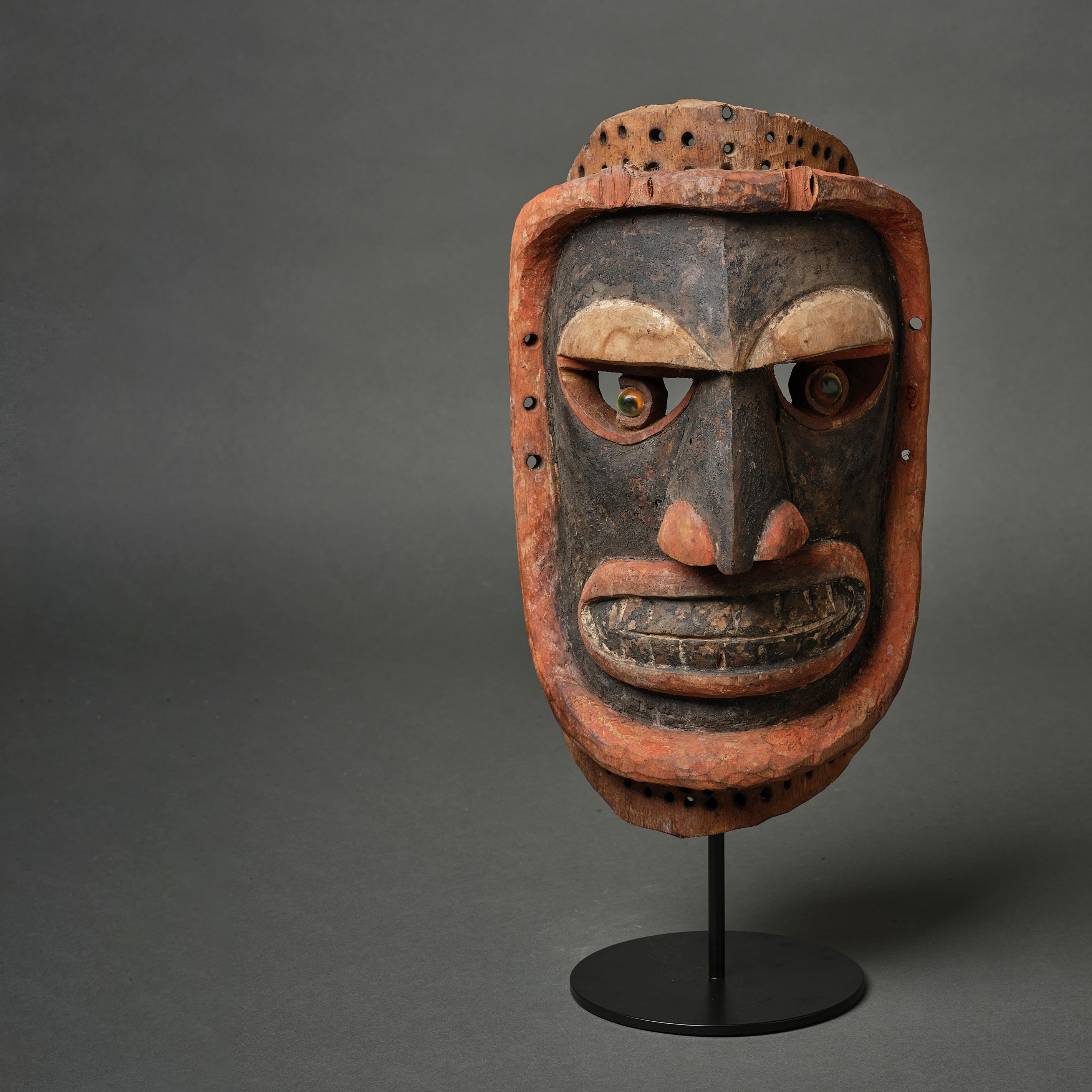
These black masks, lots 9 and 10, are highly unusual and rarely encountered in collections. At first glance, they would generally be attributed to the Kepong rituals and perhaps to New Hanover (Lavongai Island). However, their carving style is strongly reminiscent of the Tabar Islands, characterised by large wooden faces with prominent noses and broad, carnivorous smiles. The faces are framed by a red border; on lot 10, the eyebrows are highlighted in white lime, while on lot 9 they remain black. In both examples, the nostrils are accentuated with red pigment. A particularly unusual feature is the double row of perforations surrounding the face, likely intended for attaching a full-body costume or covering.
Malagan rituals are highly localised, with specific masks or Malagan forms often shared only among a small group, a single clan, or a cluster of closely affiliated clans. Both masks discussed here most likely originate from the same clan or community as a similar example that was collected by Paul Wirz in the village of Teripatz in 1950.
33cm height x 20cm width x 18cm depth
PROVENANCE
Dr A. A. Schiessel Collection (1906 – 1986), Vienna Field collected in New Ireland, 1949 – 1950
REFERENCE
A comparable mask was collected by Paul Wirz in the village of Teripatz in 1950 (Basel, Vb 12390). The principal difference is that the Basel example shows a closed mouth, whereas these examples show their sharp teeth.
$5,000–15,000
A Black Mask
New Ireland, Tabar Island, Early 20th Century
36cm height x 22cm width x 20cm depth
PROVENANCE
Dr A. A. Schiessel Collection (1906 – 1986), Vienna Field collected in New Ireland, 1949 – 1950
$5,000–15,000
A Rare And Important Kovakieto Head
New Ireland, Tabar Island, Wang Village, Early 20th Century
The celebrated wooden helmets of Tabar Island are most often attributed to the Marada sub-tradition. A small number, however, may instead belong to the closely related Arum tradition, which shares similar concepts and rituals. While Marada ceremonies focus primarily on rainmaking, Arum is concerned with crop fertility and is performed during times of food scarcity, addressing related ecological and spiritual concerns.
In the absence of detailed field documentation, distinguishing an Arum Malagan from a Marada example is challenging. Rare exceptions occur when supporting evidence survives, such as a detached label found among the crates of Dr Schiessel. This label reads: “Maradan with bundle of fire on head. Firewood = Kieto, Kova = head, called Kovakieto. Made by Wanelau from Wang village.”
Corroborating this information, the name *Kovakieto* was recorded on Tabar in 1982 by Michael Gunn, who documented an object in Morai village described as “a large wooden head with a bundle of firewood on the top of its head.” This distinctive feature identifies the type as an important Arum Malagan. Examples were historically distributed along the east coast of Big Tabar, from Morai to Matlik and Wang, the latter of which is named on the label.
This Kovabat was collected prior to the establishment of the Seventh-day Adventist mission in Wang village, an event that brought significant changes to ritual life and contributed to the decline of traditional Malagan practices, later supplanted by the production of objects for trade. Although the original label had become detached, lot 11 in the collection can be confidently identified as the *Kovakieto*, as it is the only example bearing the characteristic carved bundle of firewood on its crest, precisely matching the description on the label.
This rare and historically significant Kovakieto head is the only known surviving example and will be sold with the accompanying label written in Dr Schiessel's hand.
51cm height x 27cm width x 28cm depth
PROVENANCE
Dr A. A. Schiessel Collection (1906 – 1986), Vienna Field collected in New Ireland, 1949 – 1950
$25,000–125,000
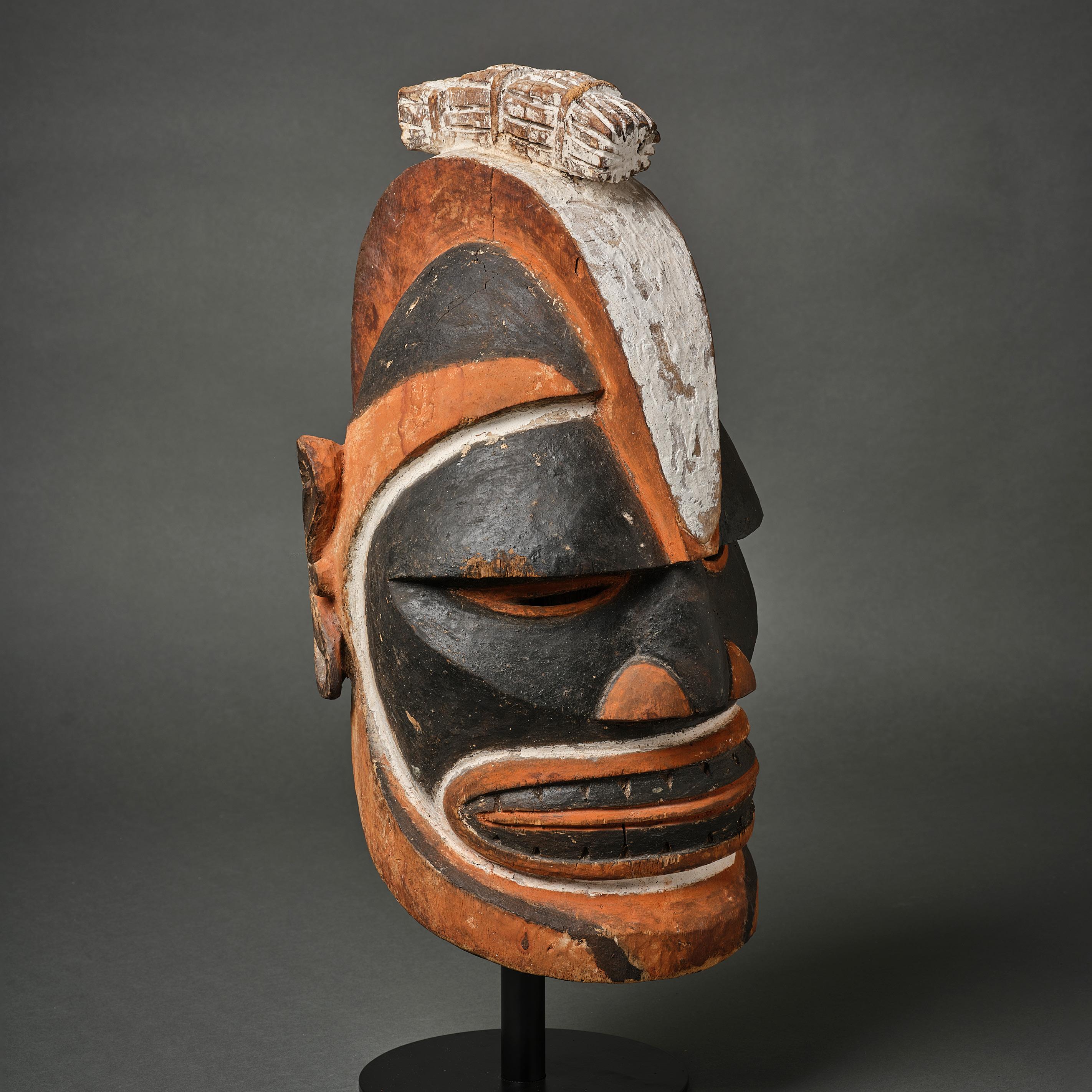
A Rare And Important Kovabat
New Ireland, Tabar Island, Wang Village, Early 20th Century
48cm height x 25cm width x 30cm depth
PROVENANCE
Dr A. A. Schiessel Collection (1906 – 1986), Vienna Field collected in New Ireland, 1949 – 1950
$25,000–125,000
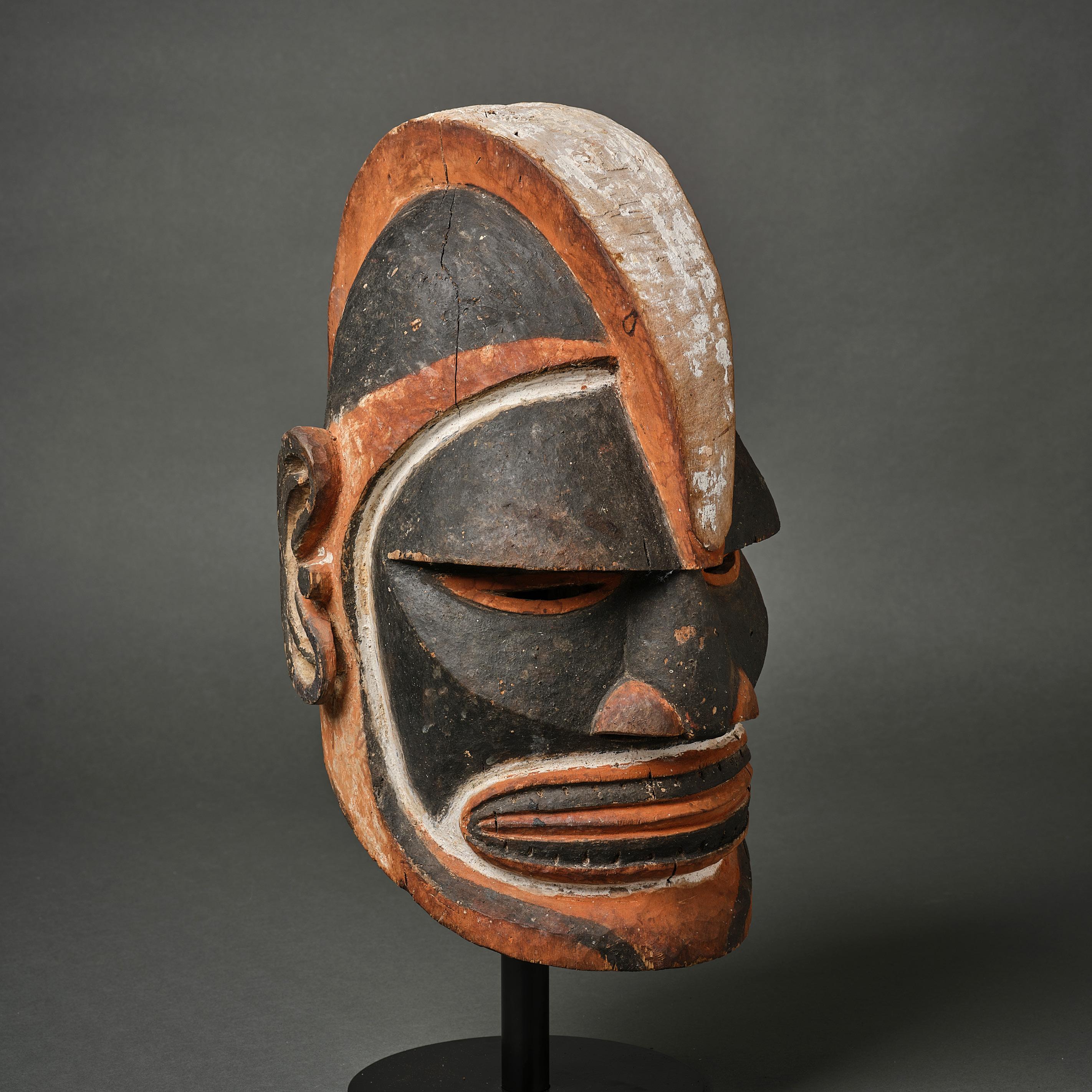
A Rare And Important Kovabat Head
New Ireland, Tabar Island, Wang Village, Early 20th Century
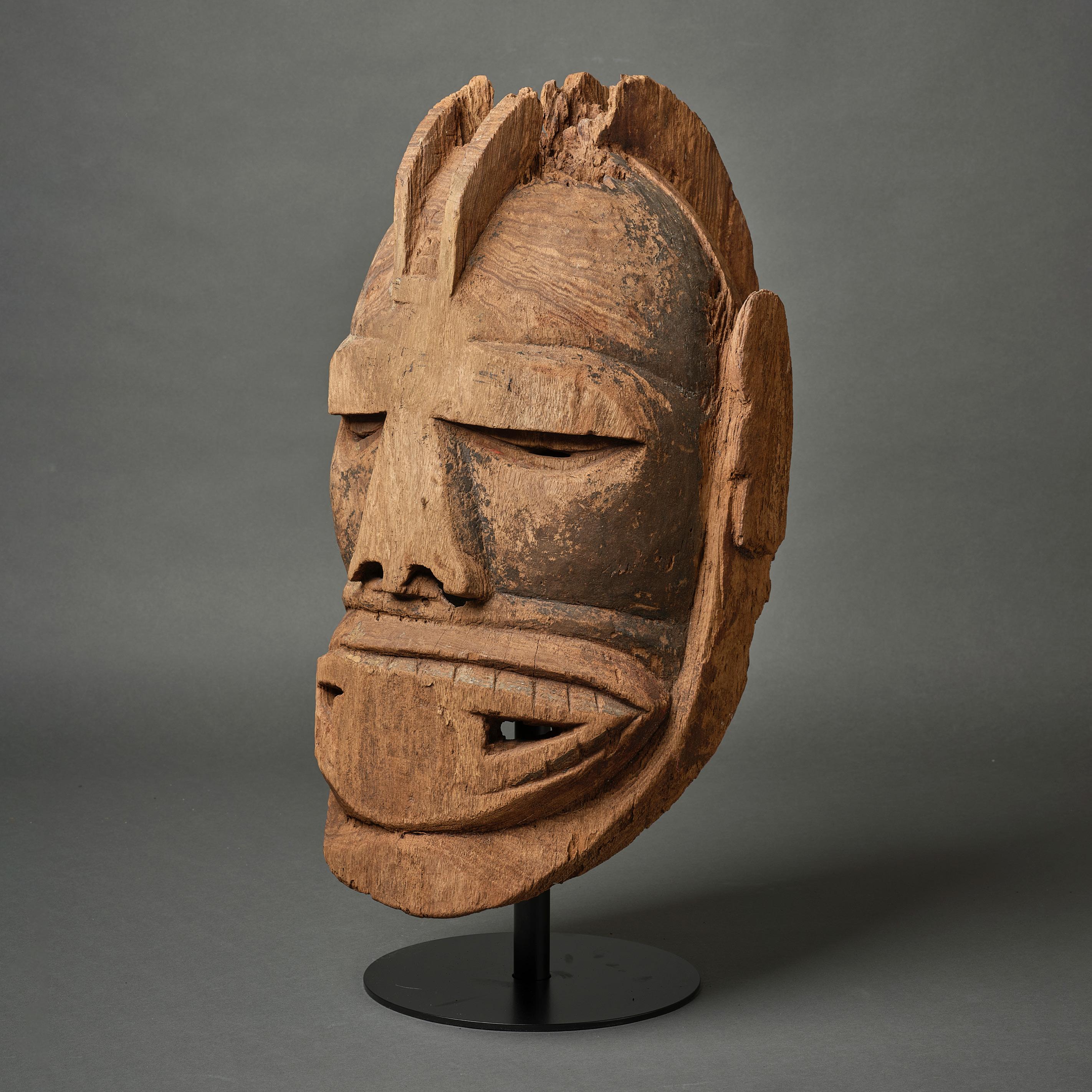
A monumental Kovabat head carved in hardwood, most likely from the Marada tradition, depicting a highly stylised face with a wide nose, closed eyes, and a large mouth with teeth and protruding tongue.
70cm height x 31cm width x 35cm depth
PROVENANCE
Dr A. A. Schiessel Collection (1906 – 1986), Vienna Field collected in New Ireland, 1949 – 1950
$20,000–40,000
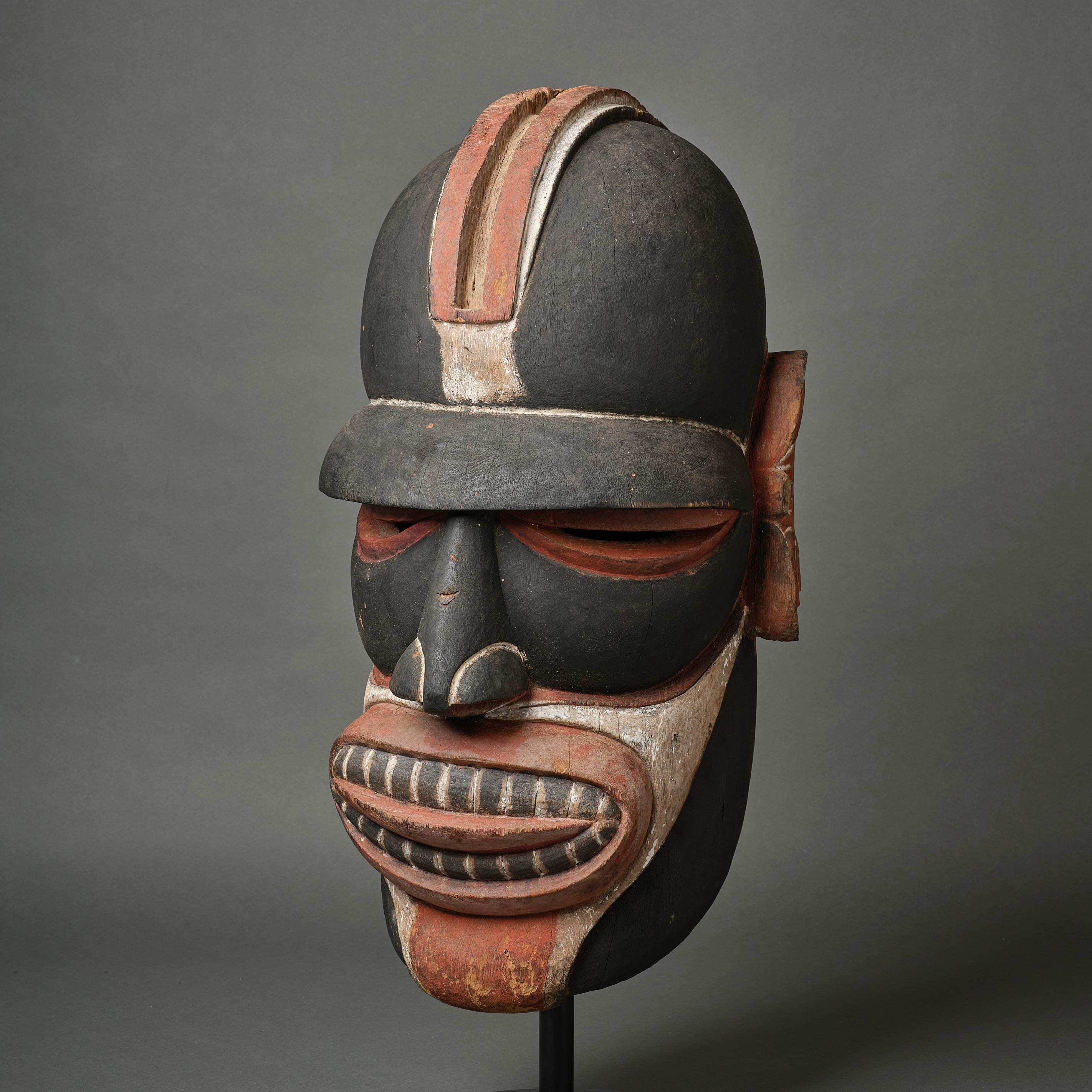
An Early Rare Kovabat Head
New Ireland, Tabar Island, Near Tumedar Village, Late 19th – Early 20th Century
Lots 14 and 15 are both monumental kovabats that feature large domed heads surmounted by crests marked by a central groove. Each displays closed eyes and a broad carnivorous grin, while one features a protruding tongue. Traces of pigments remain visible on both sculptures. Carved from hardwood, they show no significant insect damage, and their patina and surface wear are consistent with prolonged exposure to tropical weathering over many decades. Based on the carving style and material used, these two Kovabats most likely date from the nineteenth century.
Most likely conceived as a pair, they were reportedly offered to Dr Schiessel in Tumedar village by the village councillor, as described in the letter written to Elizabeth in September 1950.
61cm height x 40cm width x 36cm depth
PROVENANCE
Dr A. A. Schiessel Collection (1906 – 1986), Vienna Field collected in New Ireland, 1949 – 1950
$20,000–65,000
"I completed the whole west coast and shall approach the East Coast after surrounding the southern corner of the island. I had quite nice experiences with the natives, who as a whole are a very friendly people. I collected quite a number of things as Kovabats, Malagans, mask and other things which are nice to have and to look at. I can see you from your usual adversity to take things away from these people and thus deprive them of something of their cultural institutions etc. Well, it is not so. All these things as Malagans are thrown away after the feast into the bush where there is a special place for them. There, they rot away .
When I came through Tumedar village I sniffed around the place and the village councillor, who knew already that I am interested in Malagans, asked me whether I would like to have one Kovabat. Well, I did not show that I was very interested but we went into the bush straightaway and ,behold, under a tree there was, or there were two big Kovabats standing, dilapidated but still whole and
well-shaped, apart from minor "injuries" as cut off nose tips and missing ears. Whether I would like to have them? Why, yes very much so, and into the bag they went.
They both are badly rotted through exposure to the rain and sun etc. still out there they would be completely buggered up in no time. And I am sure that there are hundreds of them still laying somewhere in the bush ,just left behind on thee wanderings away from the original home sites.
These kovabats are as a rule not thrown away as the other Malagans are, but these two were in a village were no people lived anymore whose Malagan was a kovabat. All the people now have malagachaks, mendis, Wawara, etc. other kind of Malagan and they would even be afraid to go near them or play around with them, as happened in Wang were I got two nice Kovabats from a man who makes them. we paraded them through the village after they were newly painted."
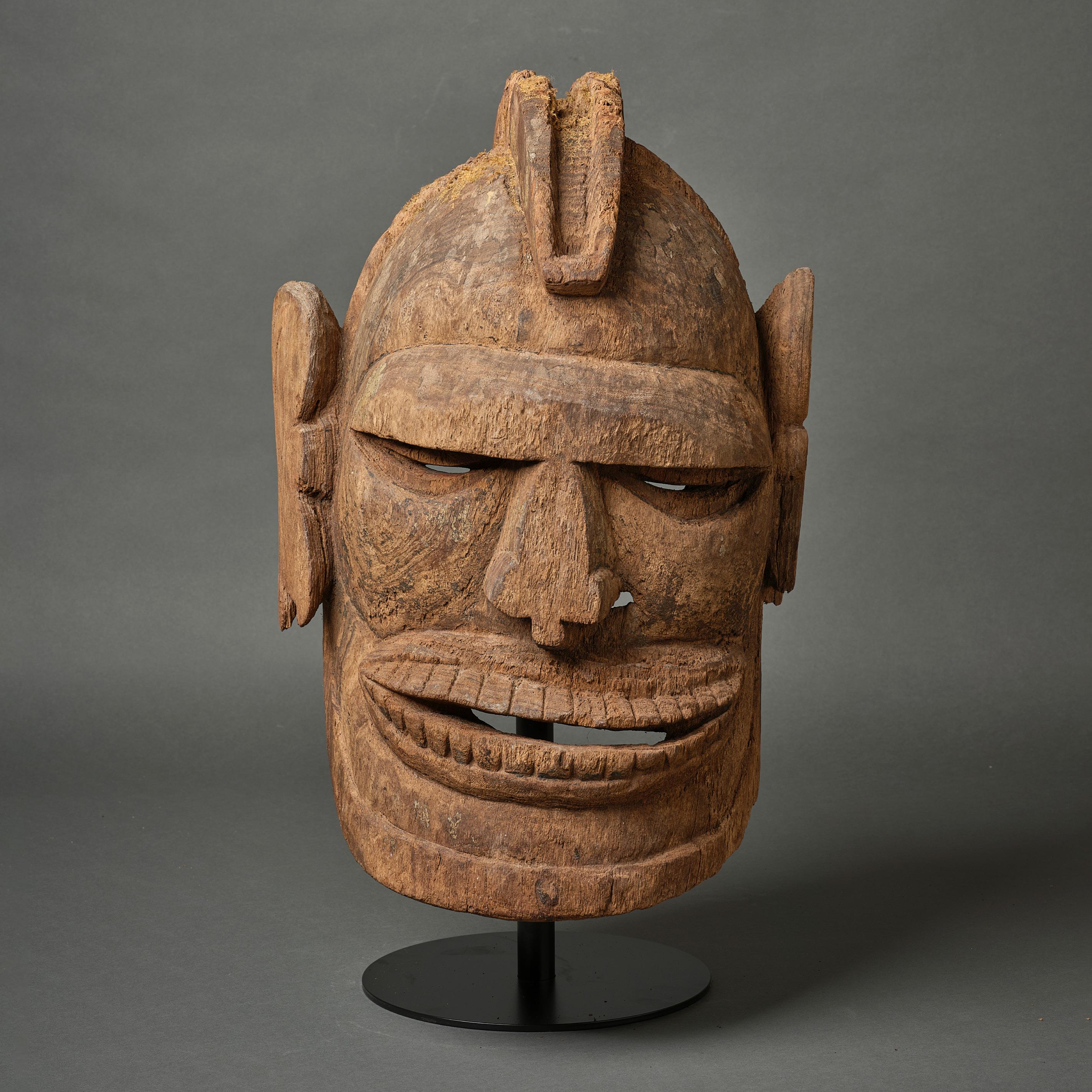
An Early Rare Kovabat Head
New Ireland, Tabar Island, Near Tumedar Village, Late 19th – Early 20th Century
58cm height x 30cm width x 32cm depth
PROVENANCE
Dr A. A. Schiessel Collection (1906 – 1986), Vienna Field collected in New Ireland, 1949 – 1950
$10,000–20,000
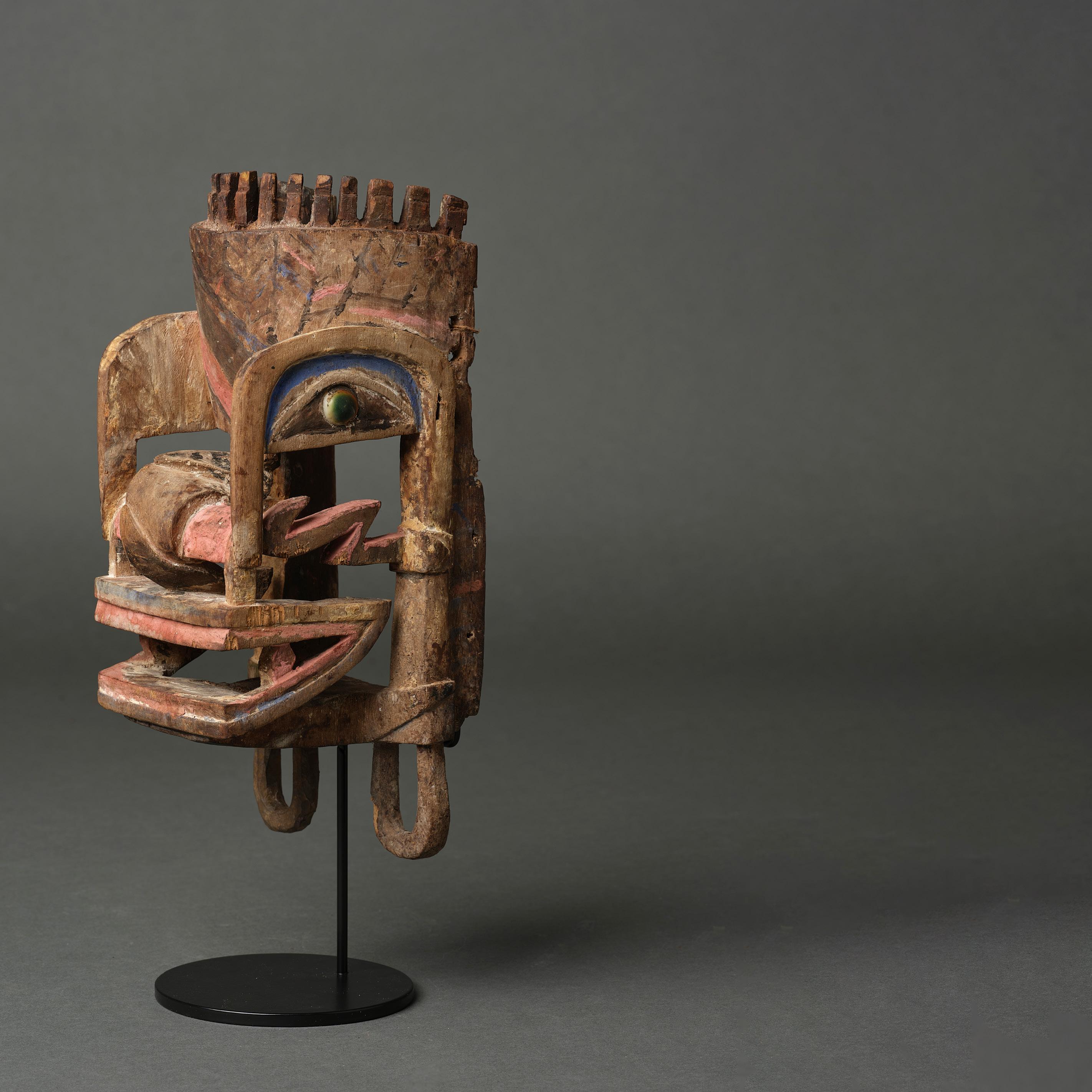
A Tatanua Mask
New Ireland, Northern Region, 19th – Early 20th Century
Tatanua masks are among the most iconic objects of Oceanic art. They are found throughout the northern region of New Ireland. They are invariably characterised by a highly stylised carved face with a broad jaw, painted motifs in red, yellow, and black, and surmounted by a prominent crest of fibre. This coiffure most likely evokes mourners who shaved the sides of their heads during periods of mourning. A remarkable diversity of Tatanua masks exists in museums and private collections. They play an important role in ritual life, bringing the cycle of the Malagan funerary ceremony for an important leader to its conclusion by lifting the final taboos. These masks are generally danced in groups, following a complex choreography. The movements are light and agile, while the accompanying music evokes birdsong.
Although Tatanua masks are not themselves Malagans, they form an essential component of important Malagan ceremonies, being performed just before the final exchanges between the clans.
The present mask is an archetypal example of the Tatanua style from the Tabar Islands. It is an early example, now lacking its original crest. The temples, carved with zigzag serpent motifs, are dominated by crescent-shaped eyes evocative of the mantis shrimp. The interplay between solid forms and openwork voids, combined with the intricacy of the carved design, offers a remarkable testimony to the artistic imagination of New Ireland sculpture.
Traces of blue pigment remain visible and are likely identified as Reckitt’s Blue, a commercially manufactured laundry pigment introduced into the Bismarck Archipelago through colonial trade networks during the late nineteenth century.
32cm height x 8cm width x 18cm depth
PROVENANCE
Dr A. A. Schiessel Collection (1906 – 1986), Vienna Field collected in New Ireland, 1949 – 1950
$4,000–8,000
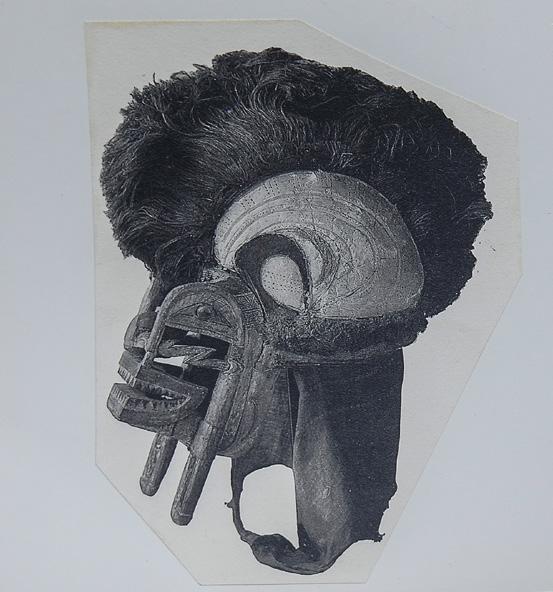
Historical photo from the Breton Eluard sale of 1931.
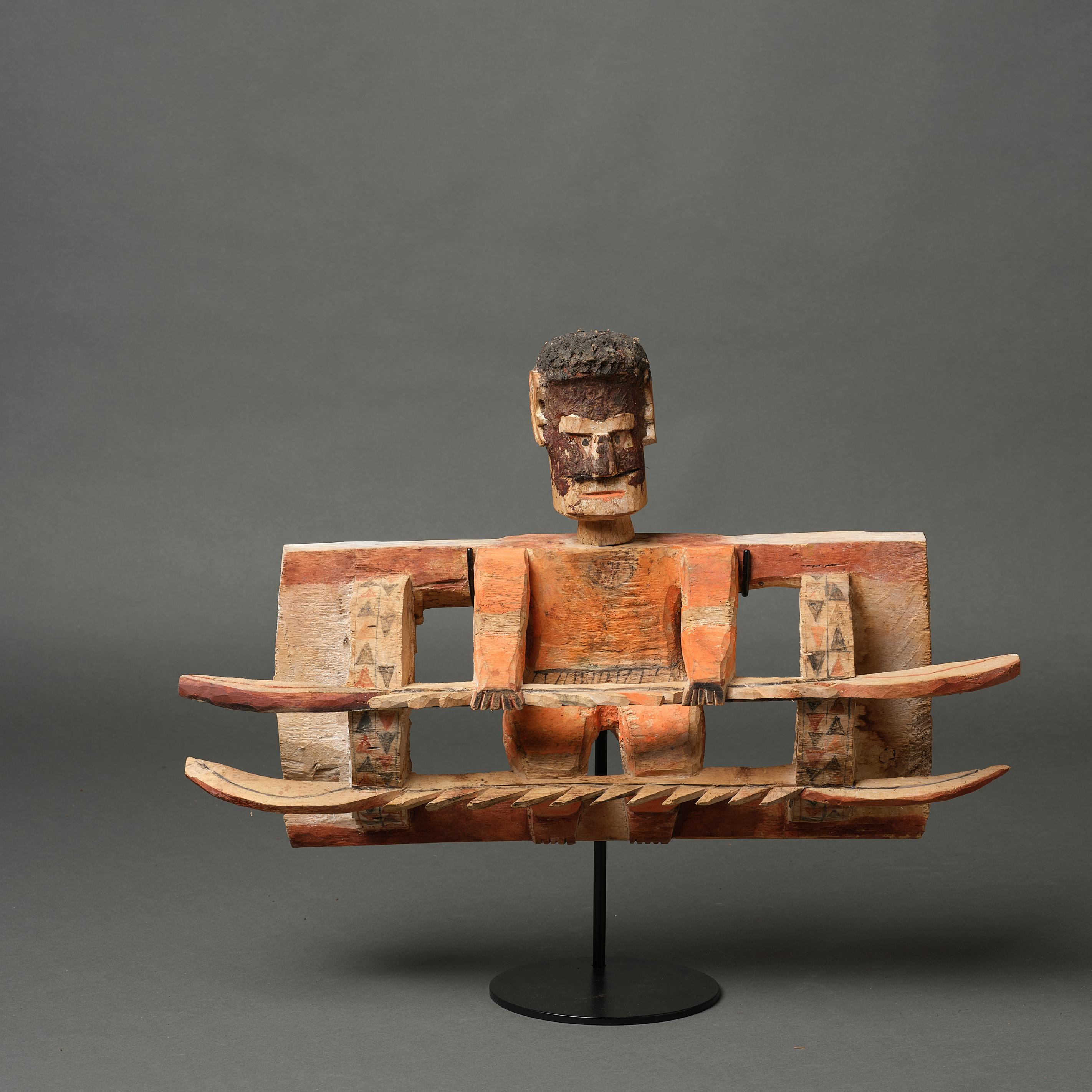
A Kokokobor Kulepmu Malagan Figure
New Ireland, Tabar Island, Early 20th Century
A traditional Kulepmu figure displaying broad shoulders and holding horizontal rods, carved from an Alstonia tree trunk. Kulepmu is an important Malagan tradition, first recorded in 1908 on Tabar and later throughout mainland New Ireland. In Tabar, they are mostly found on West Simberi, Northeastern Tatau, and the Rakupo area on Big Tabar, all of which were visited by Dr Schiessel. The Kokokobor is an important object, considered to be the central figure within the ritual enclosure of large Malagan displays.
33cm height x 40cm width
PROVENANCE
Dr A. A. Schiessel Collection (1906 – 1986), Vienna Field collected in New Ireland, 1949 – 1950
$3,500–5,000
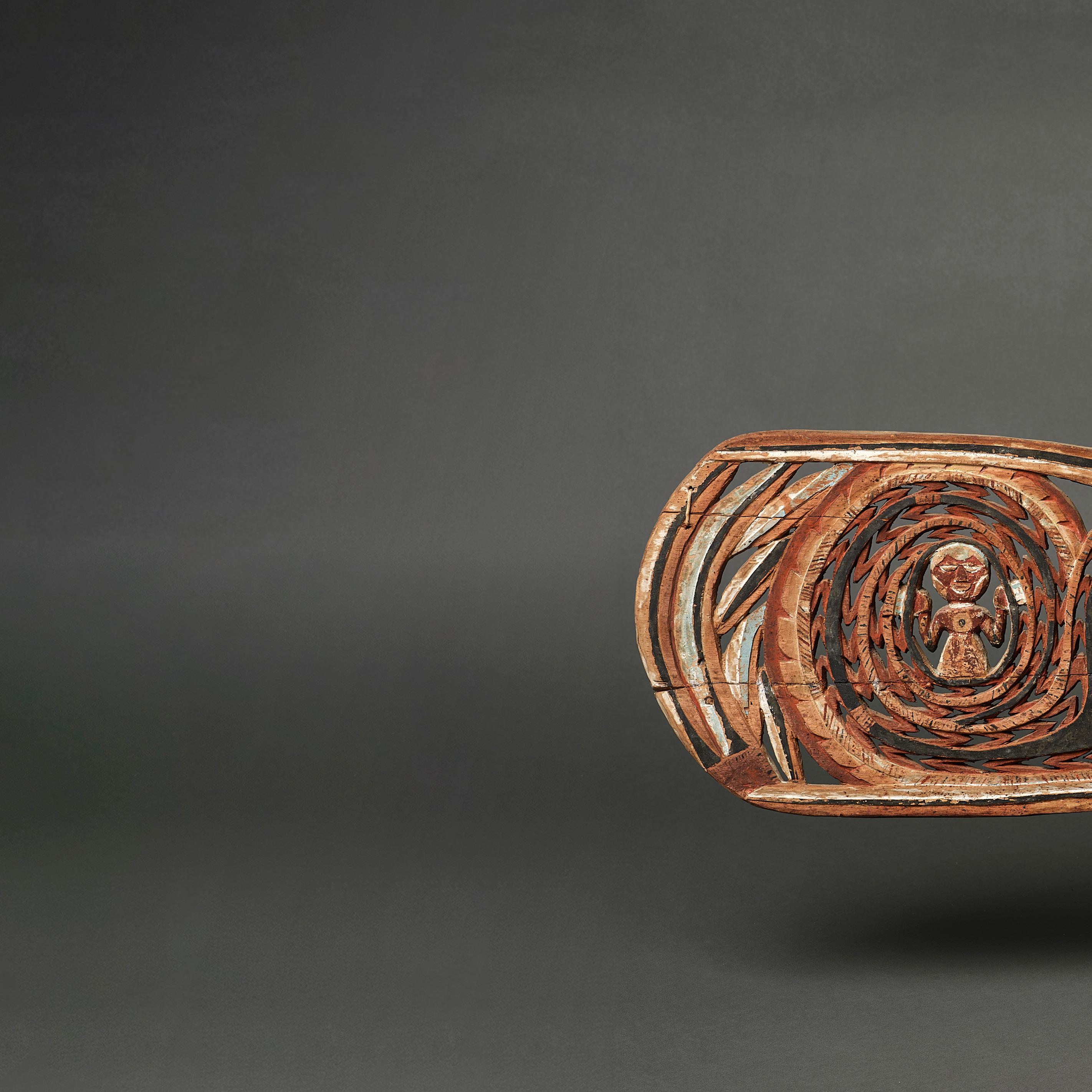
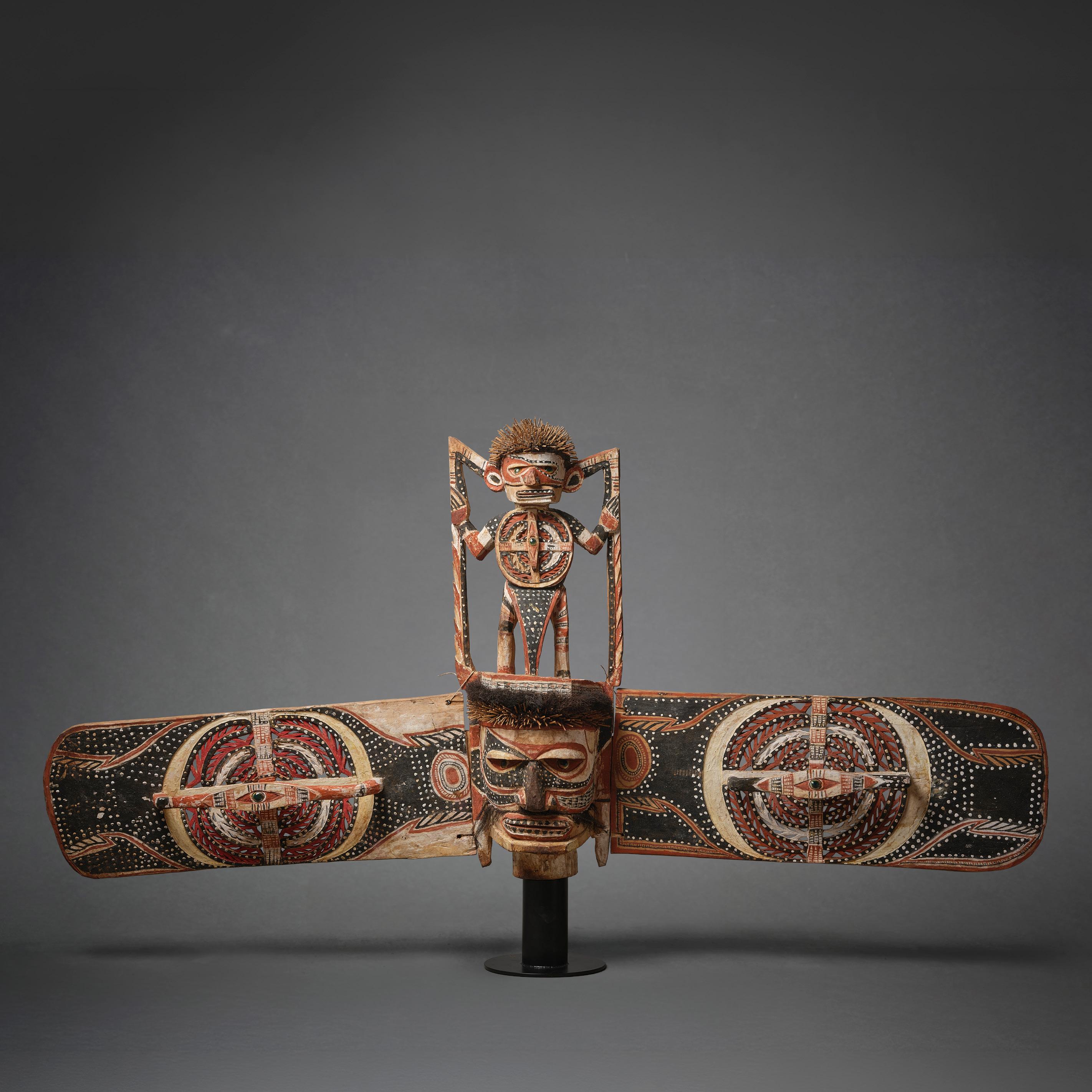
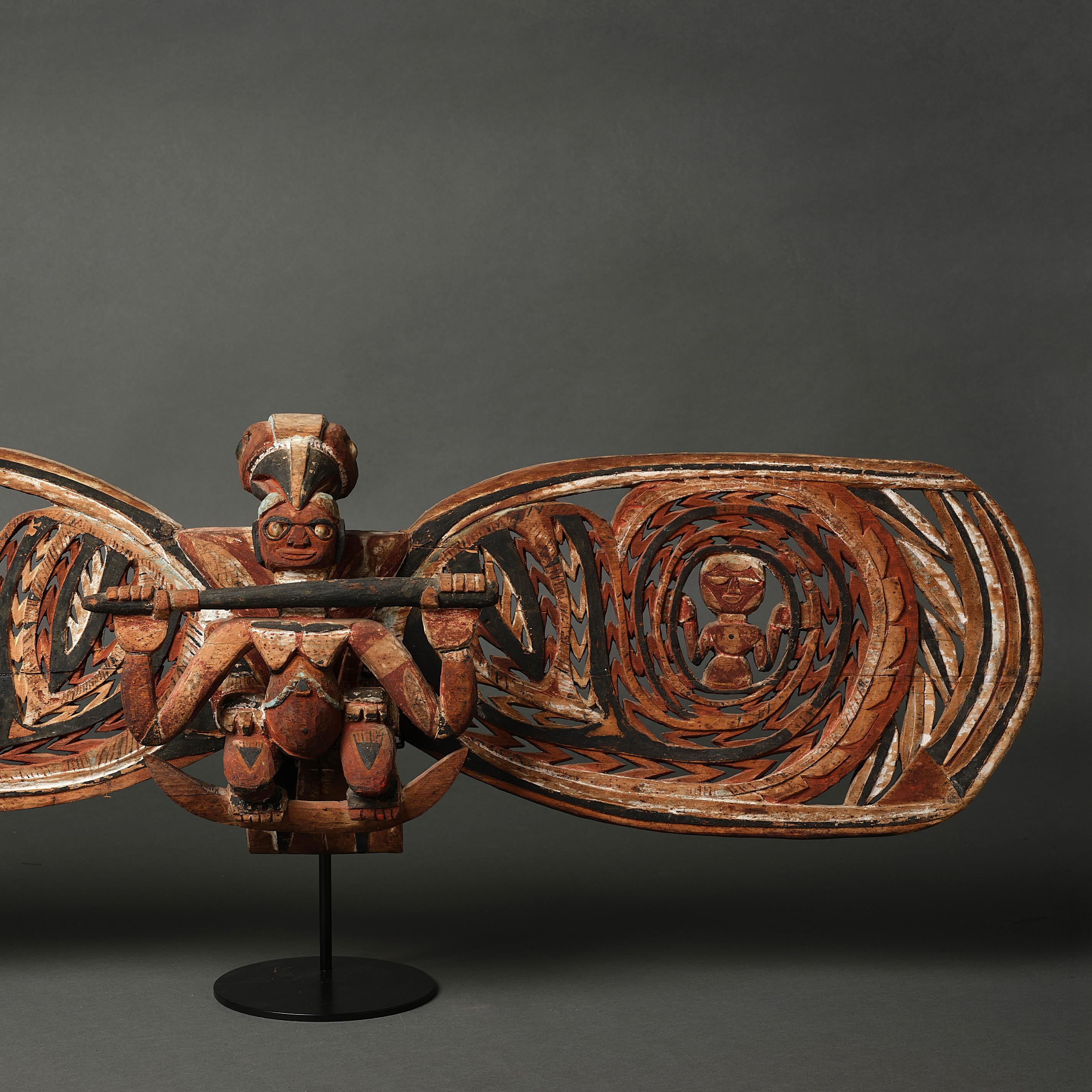
A New Island Freize New Ireland, Tabar Island, Early 20th Century
This unusual carving depicts a female figure squatting upon a crescent moon. She holds a war club horizontally across her throat, while her head is grasped within the beak of a large stylised bird. The bird’s wings are fully outstretched and adorned with intricate geometric spirals of remarkable complexity. At the centre of each spiral appears a small figure with raised arms. The bird’s claws rest upon the hips of the female figure, binding the composition into a powerful and highly symmetrical whole. All share the same fundamental composition: a squatting female figure with raised arms, her feet resting upon a crescent moon, while her head is held within the beak of a bird whose highly stylised wings are filled with concentric designs. Variations occur primarily in the central element of these spirals, which may depict either a small anthropomorphic figure with raised arms or a Turbo shell eye.
The present sculpture differs in its treatment of the crescent, rendered as a simple geometric form rather than as a series of carved betel nuts, as in the other recorded examples. The remarkable consistency of this iconography across the known corpus suggests a highly codified image belonging to a specific Malagan tradition.
27cm height x 96cm width x 13cm depth
PROVENANCE
Dr A. A. Schiessel Collection (1906 – 1986), Vienna Field collected in New Ireland, 1949 – 1950 REFERENCE
Only a small number of comparable sculptures are known. Closely related examples are preserved in the British Museum (Oc.+1287), the Museum am Rothenbaum in Hamburg (E1584), the Queensland Museum (E4518), the Weltmuseum Wien (25729), the Ethnographic Museum of Zurich (RMe 44), and in the figure published by Fischer in Cahiers d’Art (1929, fig. 16). All the others are early figures collected in the period 1870-1890.
$10,000–30,000
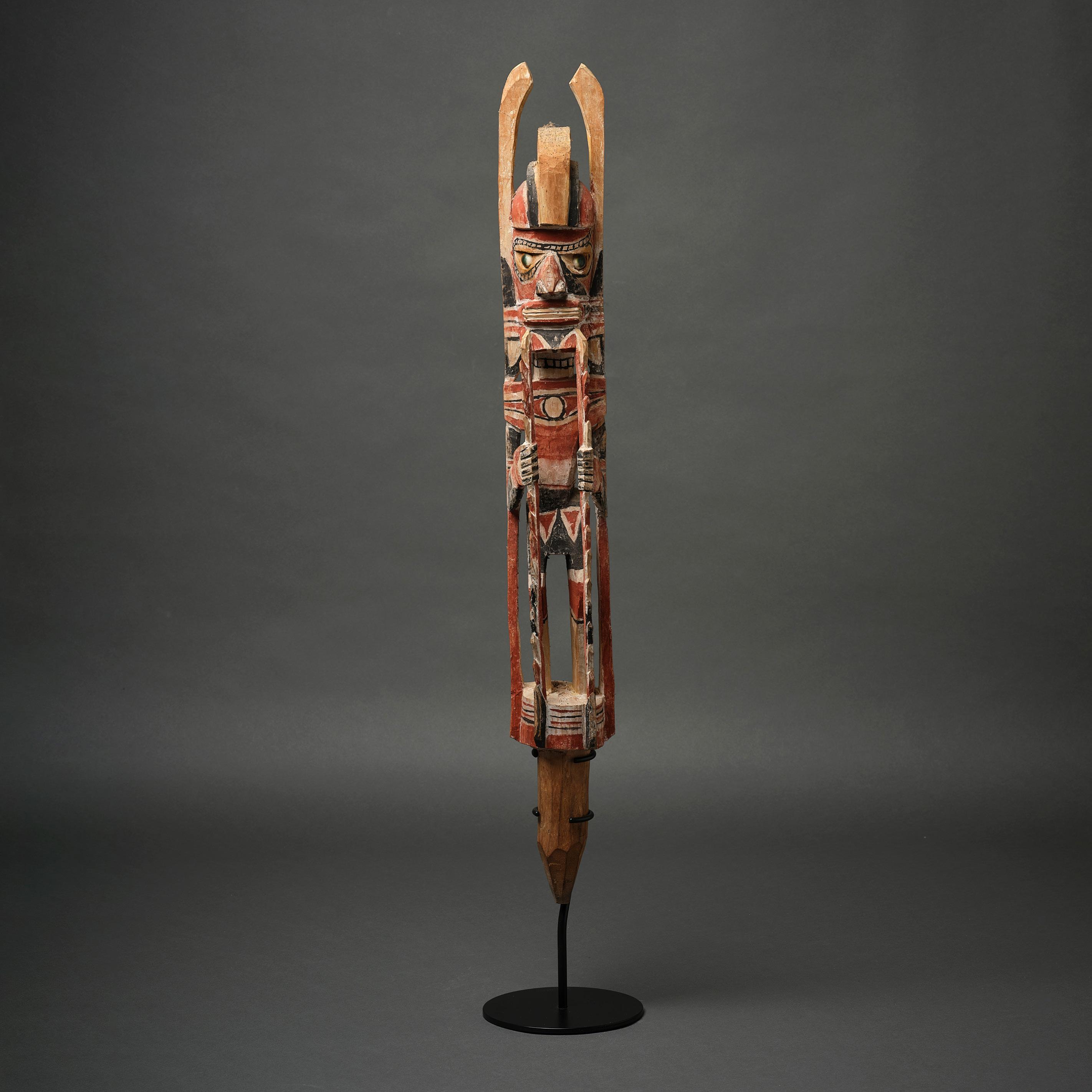
A Lunet Malagan
New Ireland, Tabar Island, Early 20th Century
Malagan sculptures are often carved from a single piece of Alstonia wood, depicting stylised human figures with eyes inlaid with turbo shell. The figure usually stands upright, its hands grasping two vertical sticks extending from the feet to the chin. This posture evokes the presentation of the deceased seated in a mortuary chair before burial. A kapkap ornament is represented on the chest, while the figure wears a distinctive crested helmet characteristic of the Lunet sub-tradition.
The Lunet sub-tradition is found in Tabar, on the Lelet Plateau, and in the central region of New Ireland. This sculpture depicts a Maruamarua figure bearing a kapkap ornament upon its chest. Its inverted hands grasp vertical supports, recalling the spears that upheld the deceased during their presentation on the funerary chair within the burial enclosure.
Moreover, Lunet is the only Malagan sub-tradition associated with the livika friction drum (lot 23), whose song is linked to the unseen world and to communication with ancestral spirits during mortuary ceremonies.
78cm height x 12cm width
PROVENANCE
Dr A. A. Schiessel Collection (1906 – 1986), Vienna Field collected in New Ireland, 1949 – 1950
REFERENCES
Early references to this tradition appear in the writings of Augustin Krämer (1925), Richard Parkinson (1907), Hortense Powdermaker (1933), and Alfred Bühler (1931). Several Malagan figures of this type have been published, including examples in the collections of the Field Museum and the Linden-Museum Stuttgart, as well as works formerly in the Heinrich collection, sold at Parke-Bernet in 1967, and in the Peter Hallinan exhibition of the early 1990s. A comparable example also appeared in the Vérité sale (lot 278).
$4,000–6,000
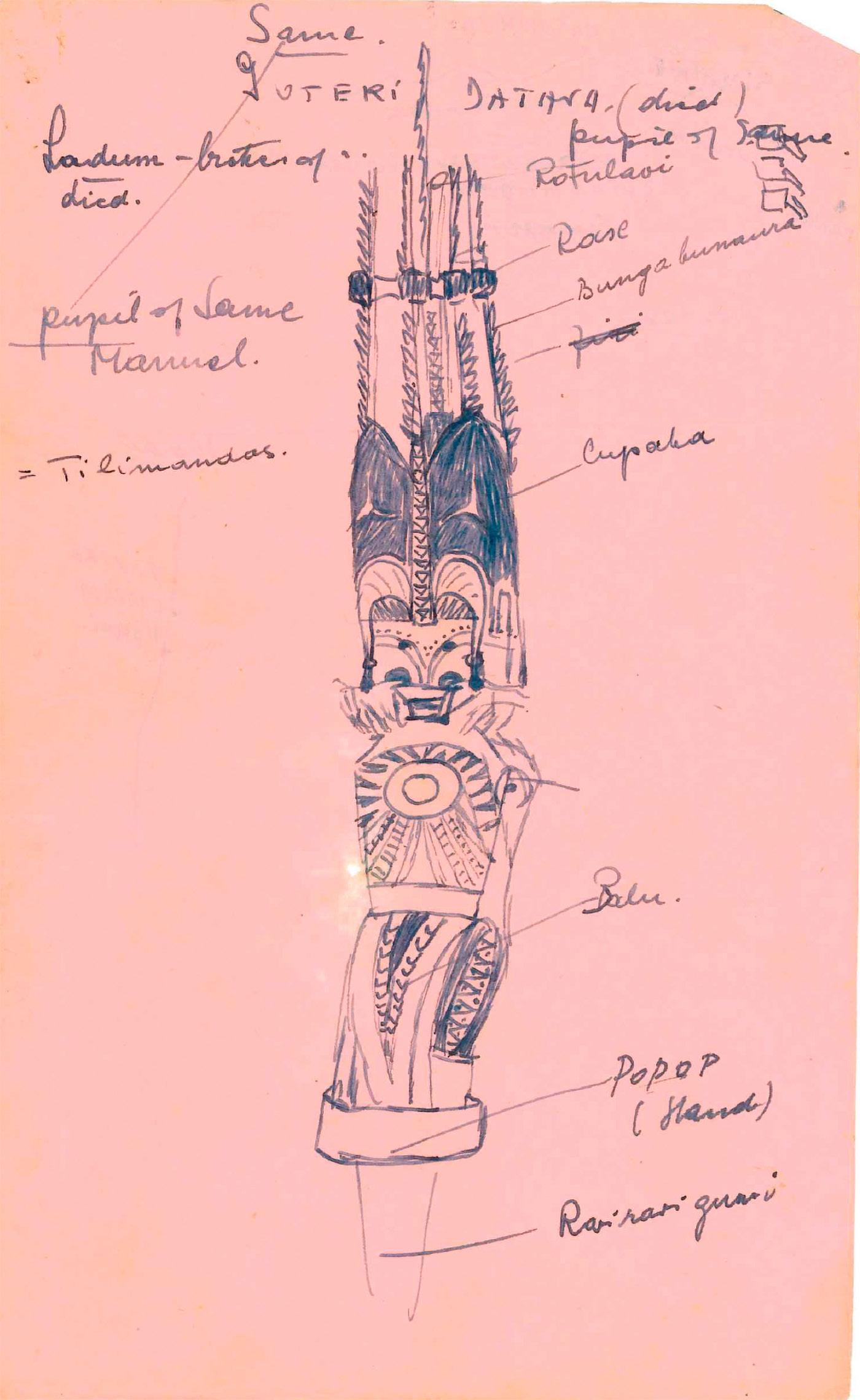
A Malaganchak
New Ireland, Tabar Island, Datava Village, Late 19th – Early 20th Century
Malaganchak is an important Malagan sub-tradition, said to have originated from Tabar. It depicts a powerful warrior wearing a black helmet, with stylised, carved snakes descending from the temple, usually painted in red. It is often surmounted by a headdress that ends in sharp, vertical wooden feathers. Malaganchak are linked to spirits, i.e., the reflected shadow of each human being that lives hidden in the forest, but also to the deceased.
This carving is a Malagan figure with extended arms (now missing) and a tall headdress topped with wooden feathers, features all the attributes of a Malaganchak. Moreover, it is very close to a figure documented by Michael Gunn in 1982 as a Tilimadas si mi Malaganchak from Sinikima hamlet, near Banessa on Big Tabar.
In the archives of Dr Schiessel, one label, not attached to any object, could be attributed only to this Malagan. It reads: “Malagan called Malaganchak made by SAME of Datava village, Big Tabar (died in 1926). Made of semba wood” 148cm height x 17cm width x 16cm depth
PROVENANCE
Dr A. A. Schiessel Collection (1906 – 1986), Vienna Field collected in New Ireland, 1949 – 1950 REFERENCES
Items of this type have been recorded in Tabar by Edgar Walden in 1909, Dr Groves in the 1930s, Schiessel in 1949-1950, and Gunn in 1982.
$3,000–6,000
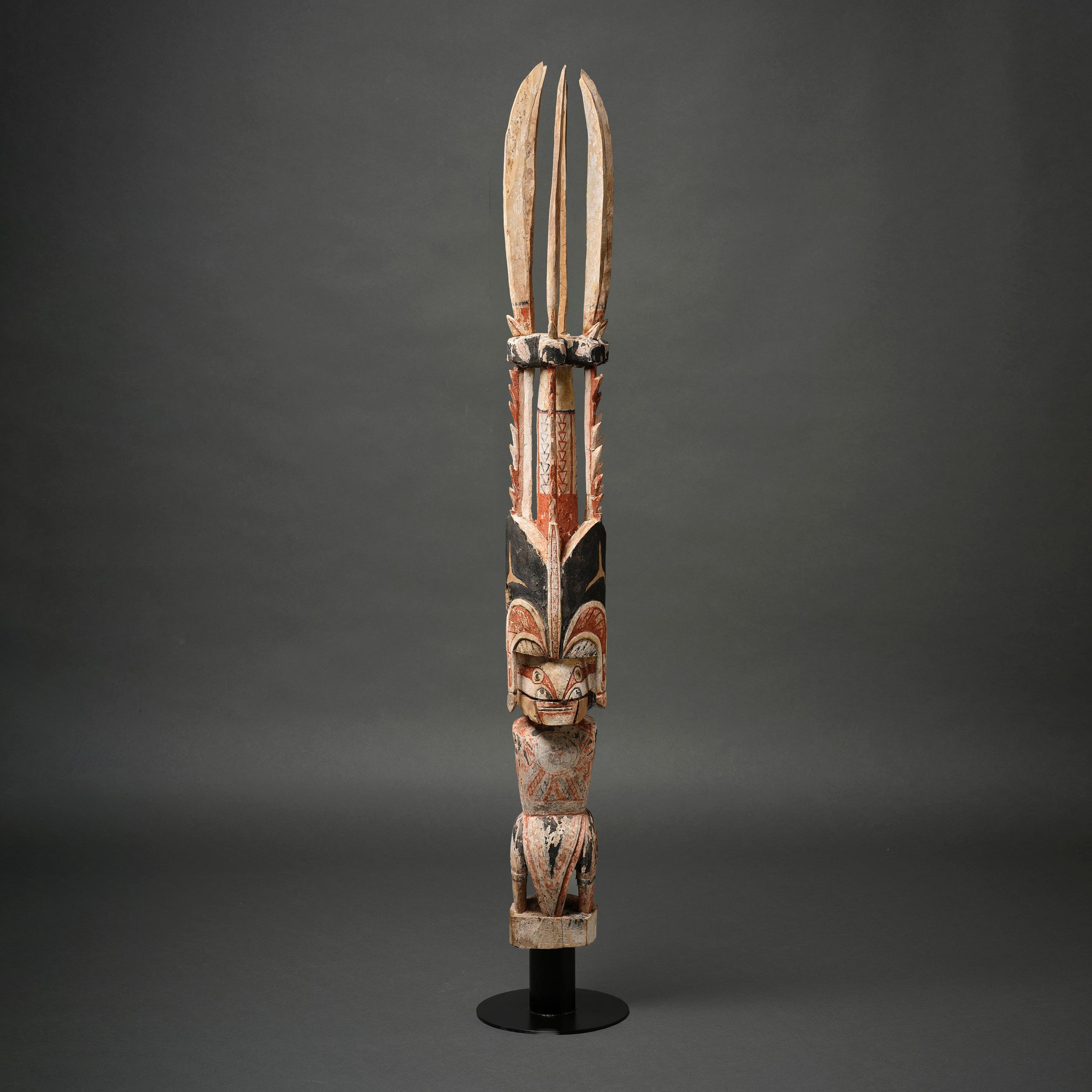
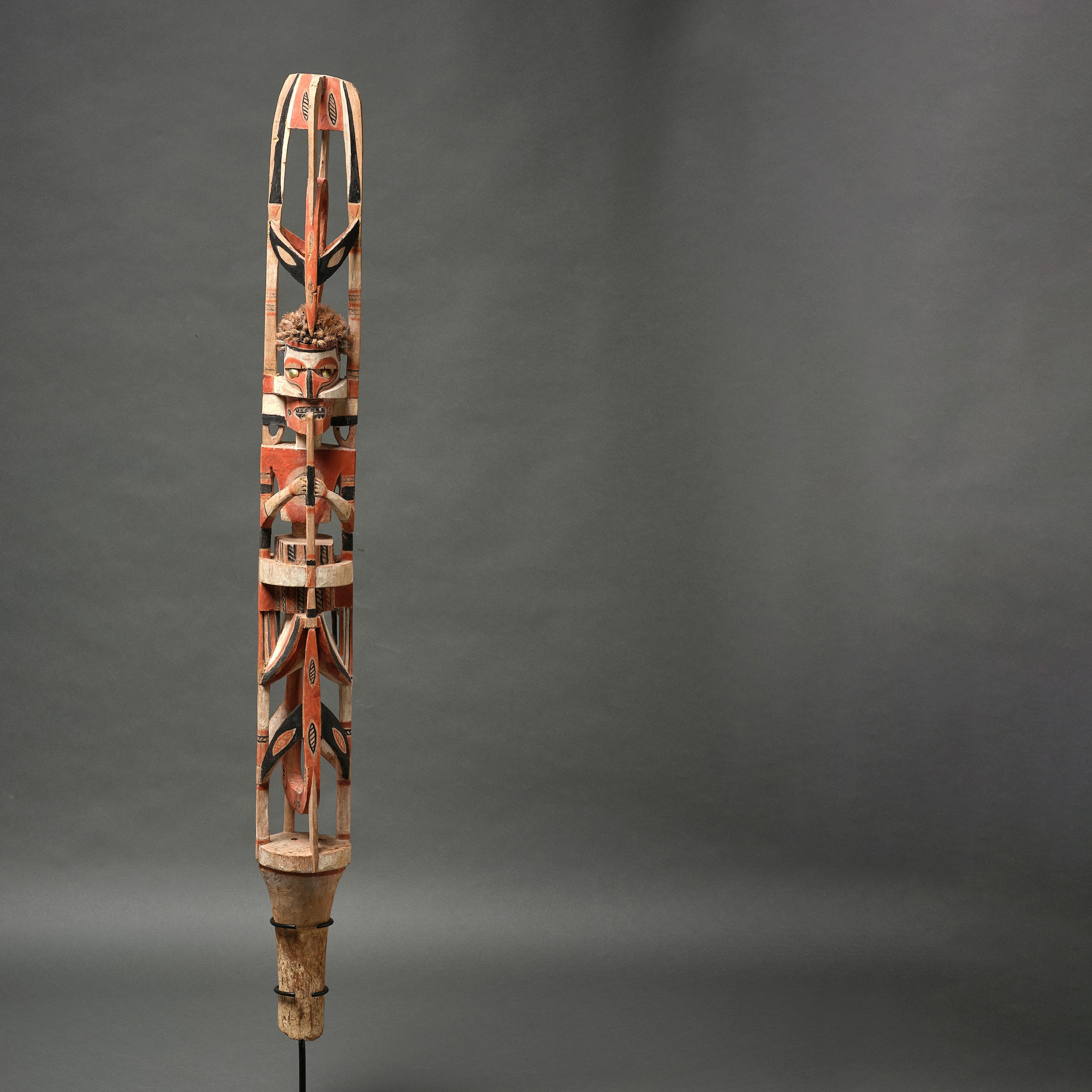
A Malagan Totem
New Ireland, Tabar Island, Early 20th Century
Malagan figure from New Ireland, carved in Alstonia wood, with opercula of the Turban shell sea snail (Turbo petholatus) inset as eyes and decorated with natural pigments. The traditional palette consists of white lime, black charcoal, and red ochre.
The figure is distinguished by pig tusks inserted into its nostrils and pierced ears extending into vertical feather-like wooden ornaments. Two sharks, arranged tail to tail, curve around the head, one biting the forehead and the other the back of the skull. The arms are attached beneath the elbows to two vertical poles, while the hands grasp the uprights that rise toward the chin. This configuration directly evokes the presentation of the deceased before burial, when the body was displayed seated, supported by poles.
The chest bears a kapkap ornament before opening into a stylised ribcage. A shark emerging from below curves upward and appears to devour the figure’s liver within the ribcage, while a second shark behind the figure seems poised to bite the spine.
The theme of a Malagan with an open ribcage and the absence of the pelvis and legs occurs in several Malagan traditions, including Malagachak, Valik, Verim, and Deganasi. In the Mandak language of the Tabar Islands, this motif is known as Bongamas. On stylistic and iconographic grounds, the present figure may be attributed either to the Verim or the Deganasi tradition, both of which were practised throughout the Tabar archipelago.
130cm height x 13cm width x 11cm depth
PROVENANCE
Dr A. A. Schiessel Collection (1906 – 1986), Vienna Field collected in New Ireland, 1949 – 1950
$3,000–8,000
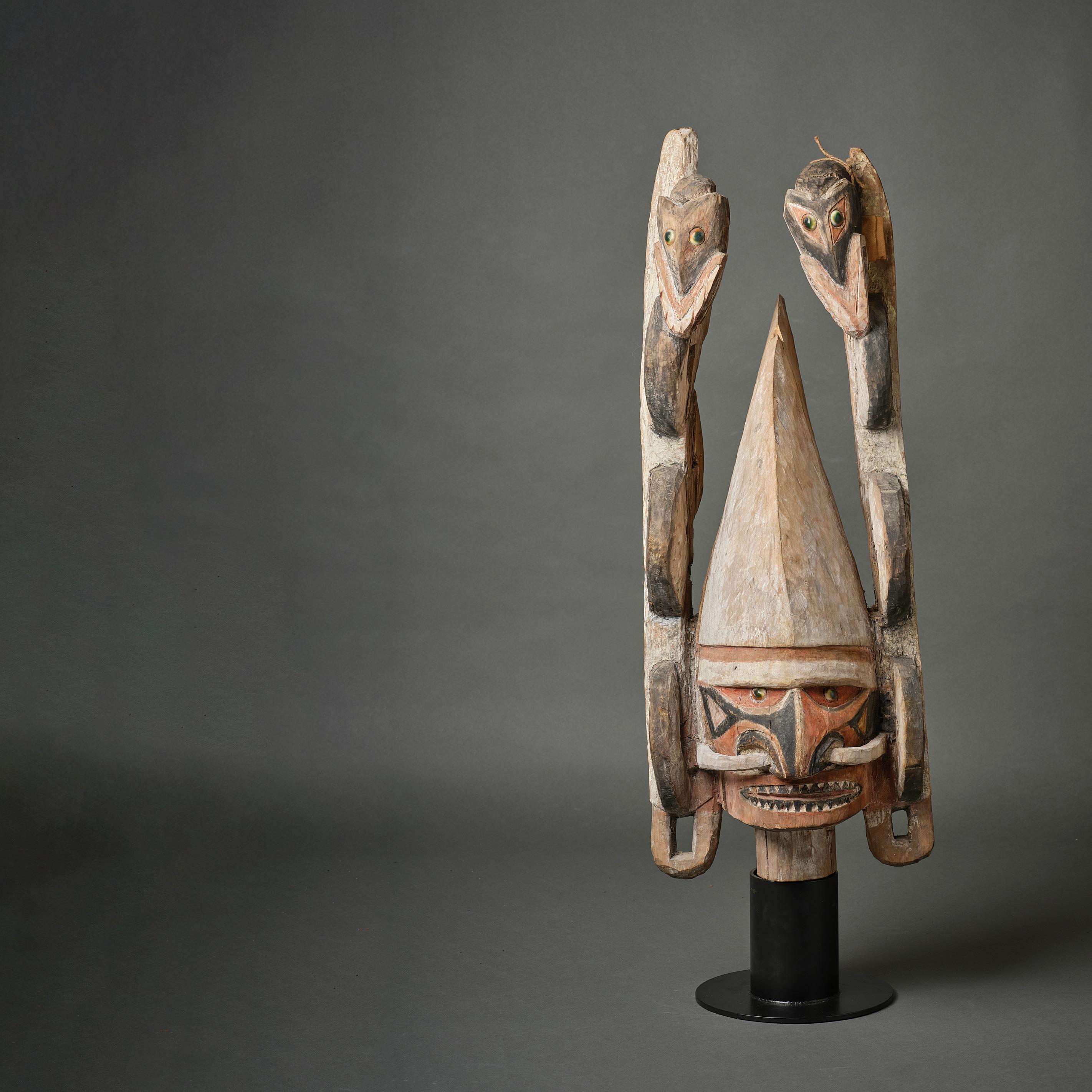
A Mendis Head
New Ireland, Tabar Island, Early 20th Century
This large wooden head depicts a face surmounted by a conical headdress, similar to those traditionally worn by women to protect against rain. The pierced ears are adorned with wooden, feather-like ornaments intertwined with serpents, each with projecting jaws, a characteristic feature of New Ireland art. The painted face is distinguished by a prominent nose, a wide mouth lined with pointed teeth, and wooden pig tusks inserted into the nostrils. This Malagan was most likely mounted upon a mannequin. It shares the iconography of several Malagans recorded in the Tabar Islands between 1982 and 2006, to which such a head most likely belonged, namely the Mendis Malagan sub-tradition. It would today be identified as Kovkov si mi Mendis. Mendis is among the oldest and most elaborate Malagan sub-traditions and carries strong sexual connotations. According to local traditions, the Mendis foundational myth recounts that the first Malagan was activated through the execution of a brother and sister who had been compelled to violate the taboo of incest. There is no label or explicit information about the origins of this piece, but Mendis is prodigious throughout the Tabar Archipelago, where such heads have been reported on Simberi, Tatau, and Big Tabar.
84cm height x 30cm width x 24cm depth
PROVENANCE
Dr A. A. Schiessel Collection (1906 – 1986), Vienna Field collected in New Ireland, 1949 – 1950
$3,000–8,000
A Small Livika Friction Drum
New Ireland, East Coast, Manuwei, Early 20th Century
At the heart of the flamboyant ritual culture of New Ireland stands the friction drum known to the Germans of the early twentieth century as the “violin of the dead.” Today widely referred to as Livika, this remarkable musical instrument was documented in 1909 by Augustin Krämer during the German Naval Expedition. Krämer wrote:
“The name Livika is derived from the hornbill, and usually its head is carved at the end of the drum. The underside of the beak and the underside of the Livika feature three tongues, two of which can be regarded as legs and the third as a tail turned inwards. One coats one’s hands with resin, as one would treat the strings of a violin. One strokes the Livika from head to tail, the hand passing over these three carved tongues which sing three distinct notes. […] These sounds are so powerful and piercing that they strike terror in the night.”
The area of use extended throughout the region in which ritual life was governed by Malagan rites, from central to northern New Ireland and into the Tabar Islands. The instrument was known by different names according to locality: lapka in Atlamau, lunet in Tabar, lonuat in Fezoa, and nayane among the Kuot. Unlike Malagan sculptures, which were typically made for a single ceremonial use, Livikas were carefully preserved within clans and passed down through generations, each instrument bearing its own individual name. Its voice was understood as the song of a bird associated with the chthonic powers of the underworld, where the primordial ancestor Moroa resides.
A corpus of one hundred examples is recorded in public and private collections, in some cases with well-documented collection histories that reveal regional stylistic variations. Livikas are generally 40–45cm in length, though examples from Medina can be considerably larger, while others may be as small as 10cm. The form and volume of the resonating chambers beneath the three tongues determine the piercing tones produced when the player’s hand, coated
with resin or breadfruit juice for adhesion, is rubbed rapidly across the surface. Measuring just 18.5cm yet featuring three deep resonance chambers, the present Livika produces a remarkably high-pitched sound. Its balanced, curvilinear form evokes a small, elusive creature curling into itself, as if to conceal its presence. A dark patina from prolonged exposure to smoke in the men’s house contrasts with the lustrous honey tones of the wooden tongues, indicating sustained ritual use.
The label attached to the present example reads: “Lonuat from Manuvat, East coast New Ireland”, referring to the hamlet today known as Munawei, situated approximately six kilometres north of Fezoa. In this region, such friction drums are known as Lonuat, as indicated on the label provided by Dr Schiessel. To be sold with the label.
18.5cm length x 8cm width
PROVENANCE
Dr A. A. Schiessel Collection (1906 – 1986), Vienna Field collected in New Ireland, 1949 – 1950
REFERENCES
The present example stands out for its pure geometric form, closely resembling a friction drum collected in Fezoa by Walden in 1908 (Berlin, Ethnologisches Museum, inv. VI 32843; Beaulieu 2025, p. 65).
A larger friction drum collected by Dr Shiessel was sold to the Auckland Museum in 1951
$3,500–7,000
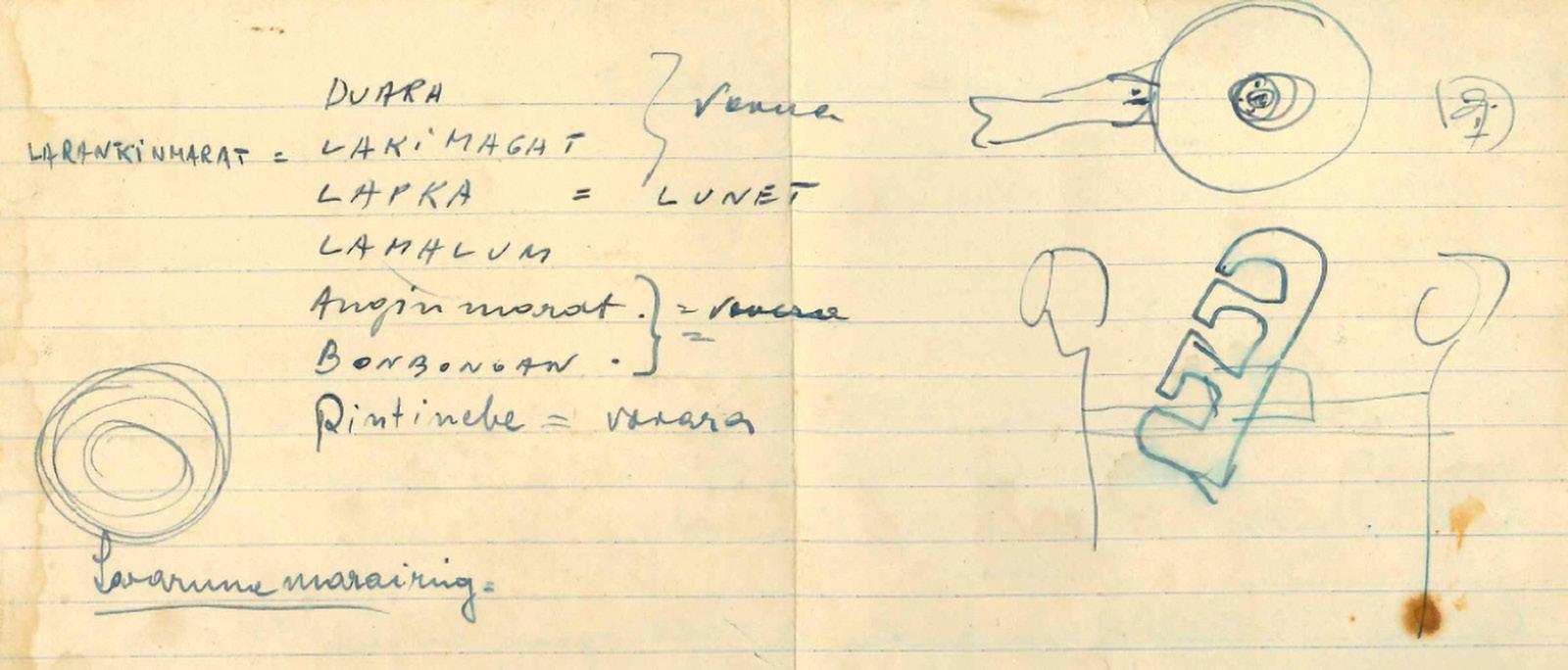
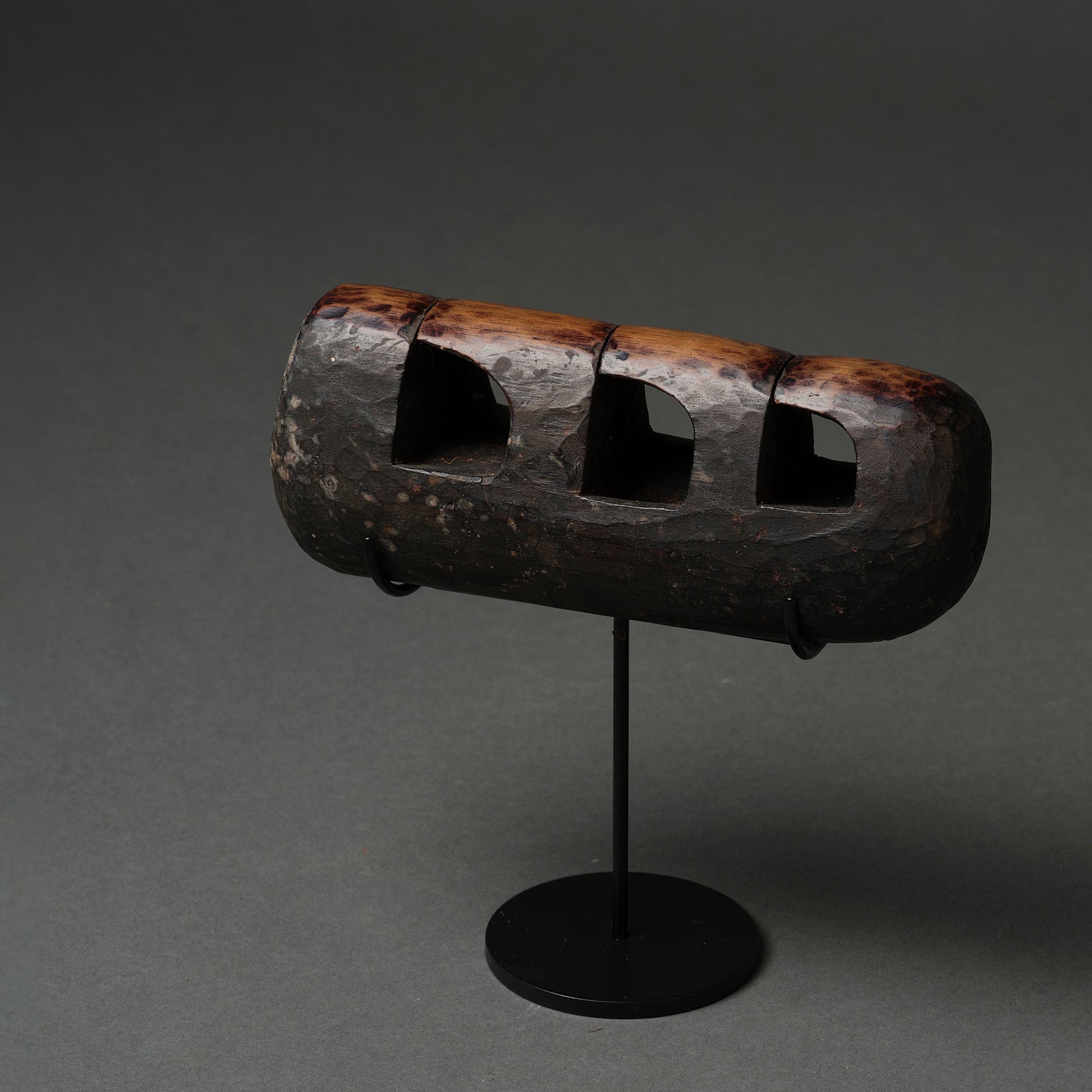
A Matua Vanis Mask
New Ireland, Tabar Island, Early 20th Century
This large wooden helmet mask is surmounted by a bird figure and features a face covered with black resin, inset with Turbo shell eyes. The ears are carved with intricate flying fish displaying projecting jaws, a characteristic motif of New Ireland art. Two stylised serpents converge toward the nostrils of the figure. The mask protrudes a long tongue, a motif commonly associated with death, while carved betel nuts appear beneath the chin. The bird crowning the mask is a hornbill, traditionally regarded as a symbol of eloquence. This type of mask was identified as Matua by Richard Parkinson, while communities in the Tabar Islands refer to it as Vanis. It is closely related in style to masks collected in Tatau in 1908.
Like all important Malagan works, this mask was created according to strict ritual copyrights within the Malagan system and its various sub-traditions. If previously danced, it may have been entirely repainted before being used again. It was regarded as the most important mask of the ceremony, leading and commanding the others. Its role was to lift the ritual taboos at dawn, marking the opening of the ceremony's final phase. The mask advanced slowly and hieratically through the village before dancing to the sound of rattles and drums, after which it returned to the ritual enclosure where it was placed on display.
80cm height x 50cm width x 47cm depth
PROVENANCE
Dr A. A. Schiessel Collection (1906 – 1986), Vienna Field collected in New Ireland, 1949 – 1950
REFERENCES
The central mask, surmounted by a hornbill figure, is closely related to an example in the Fowler Museum collection, published by Lincoln in Assemblage of Spirits (1987, no. 13, pp. 105–106). The two lateral ear ornaments are also characteristic, with their intertwining flying fish displaying projecting jaws combined with geometric motifs. Closely comparable masks, including examples incorporating hornbill imagery, are still used in the Tabar Islands today.
$25,000–50,000
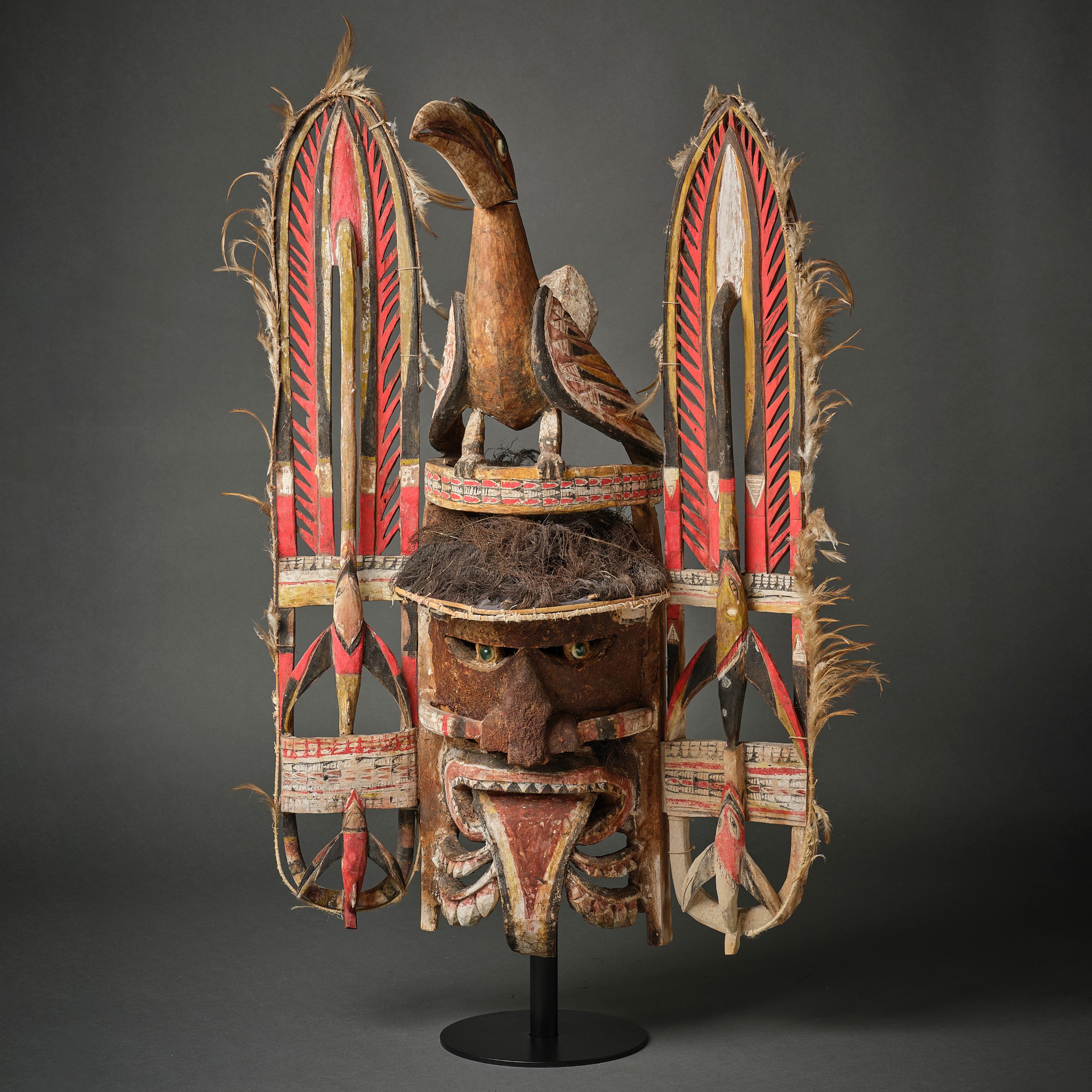
A Matua Vanis Mask
New Ireland, Tabar Island, Early 20th Century
Lot 25 is closely related in style, though instead of the intertwined flying fish motif, it displays a stylised serpent zigzagging like lightning and caught within the beak of the bird. The two lateral ear ornaments each depict serpents descending toward a central rooster figure. The lower section of the wooden ear plaques evokes the elongated pierced ears that were fashionable at the time. Both masks still retain their feather ornaments and were collected shortly after their final ritual use. From a Tabar perspective, the mask adorned with flying fish would be associated with the sea, while the example adorned with serpents and roosters would be symbolically associated with the bush.
76cm height x 56cm width x 40cm depth
PROVENANCE
Dr A. A. Schiessel Collection (1906 – 1986), Vienna Field collected in New Ireland, 1949 – 1950
$25,000–50,000
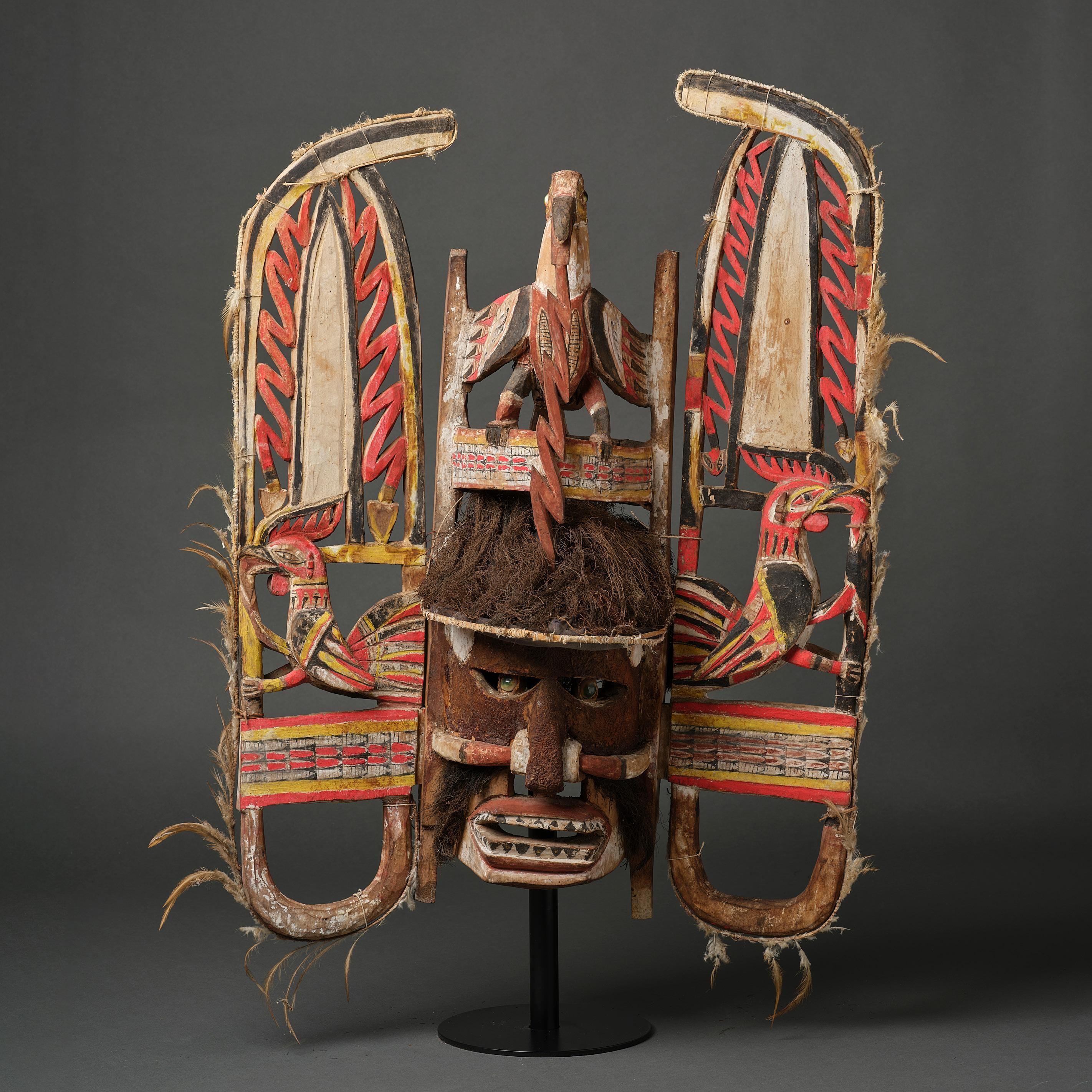
A Superb Rare Valik Malagan Mask New Ireland, Tabar Island, Early 20th Century
Valik is one of the principal Malagan traditions, originating in the Tabar Islands and also present at Hamba on the eastern coast of mainland New Ireland, facing Tabar. Valik carvings are distinguished by a circular, symmetrical motif known as Matalin, "the eye of the fire.” This element is understood to be the locus in which the “fire” resides, channelling the powers of the spirit world, and it was regarded as a particularly potent form of Malagan.
According to Michael Gunn’s fieldwork (1982–1984), three Valik ritual sites are recorded in the Tabar Islands: one on the west coast of Simberi and two on nearby North Tatau Island. Notes by Dr Schiessel indicate that this Malagan originates from Simberi Island.
This is a complex Malagan. First, there is a large head with a tenon, possibly for insertion into a mannequin. This head is nested in two horizontal extensions with very fine Matalin and geometric designs. On top of the head, a small figure is standing. It has raised arms and a torso with a Matalin.
Drawing by Dr Schiessel in his diary, indicating the type of the object “Valik Tavuri”. It gives the name of the subtradition, Valik. Tavuri is a conch shell horn sounded at critical stages during Valik ceremonies. It indicates that it originates from Simberi Island. The circular design with a small dome is designated as “Napurila”, usually known as Matelin nowadays Tabar.
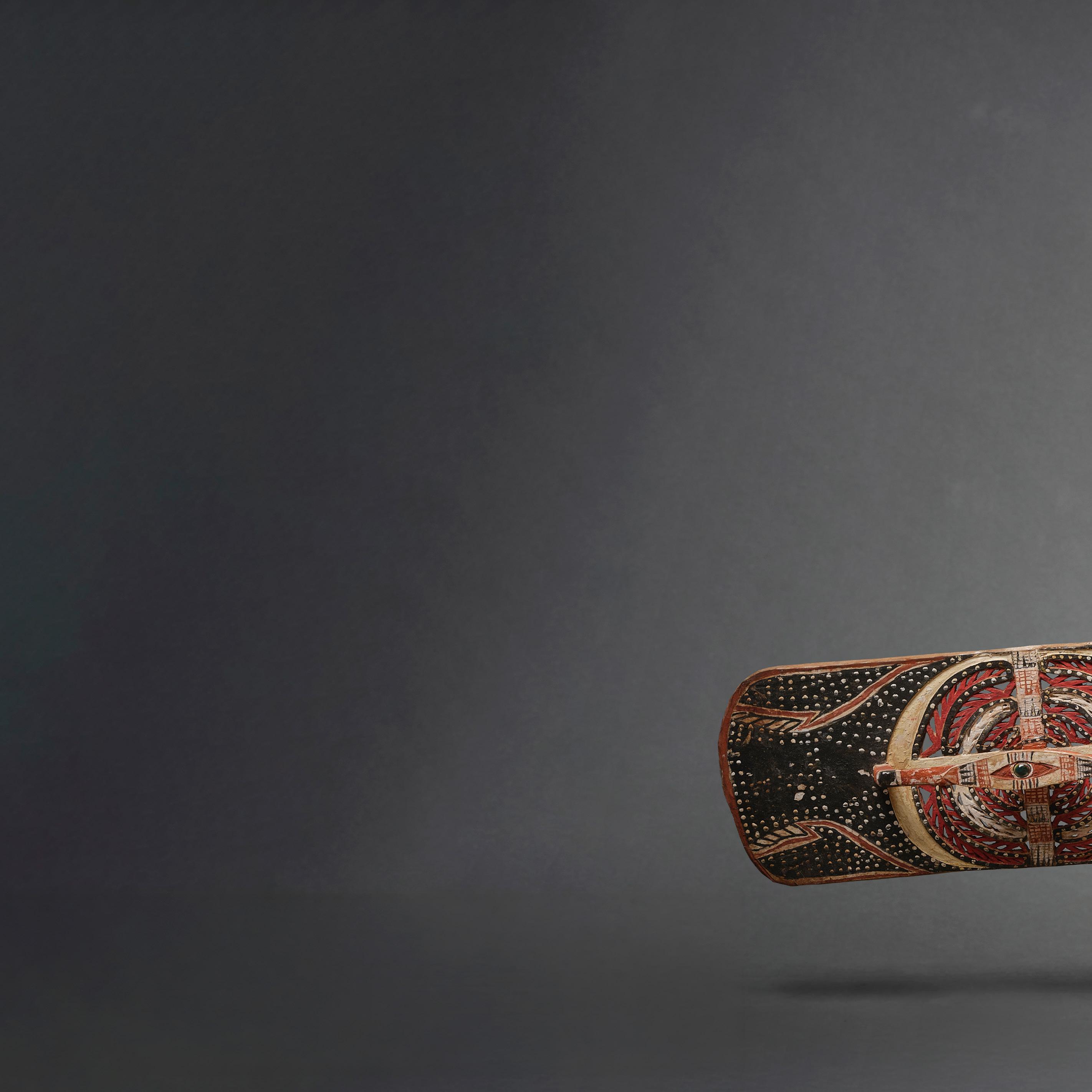
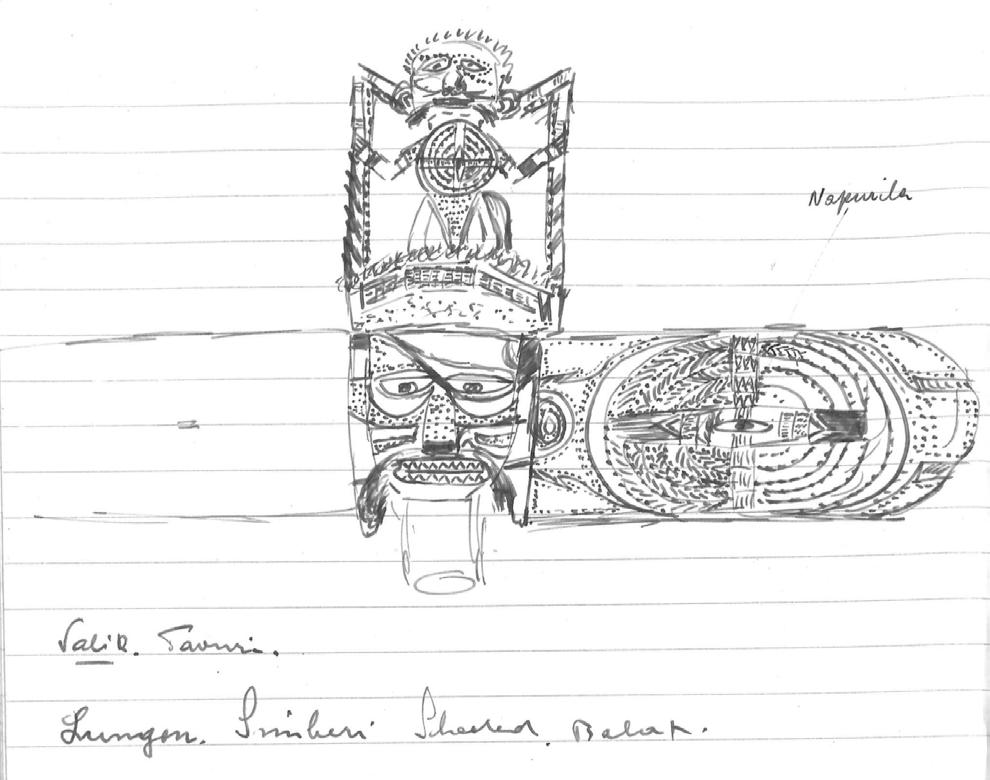
Valik Malagan were stored in the ritual enclosure at Hemba village on the East Coast of New Ireland in 1909. We can see standing figures, a horizontal kobokobor frieze. Most of the Valik Malagan are easily recognisable by their distinctive circular geometrical design, nicknamed by local people “the eye of fire” and also known as Matalin 90cm height x 160cm width
PROVENANCE
Dr A. A. Schiessel Collection (1906 – 1986), Vienna Field collected in New Ireland, 1949 – 1950
REFERENCES
An important comparative example was collected by Georg Friederici in northeastern Tatau in 1908 (Berlin, VI 28646 a, b, c). It depicts a human figure strikingly related to the present mask, notably by the treatment of the face and its angular jaw.
Valik was documented by Edgar Walden, Augustin Kramer, and Georg Friederici during 1908-1909. Augustin Krämer photographed rituals held in Hamba in 1909.
$25,000–40,000
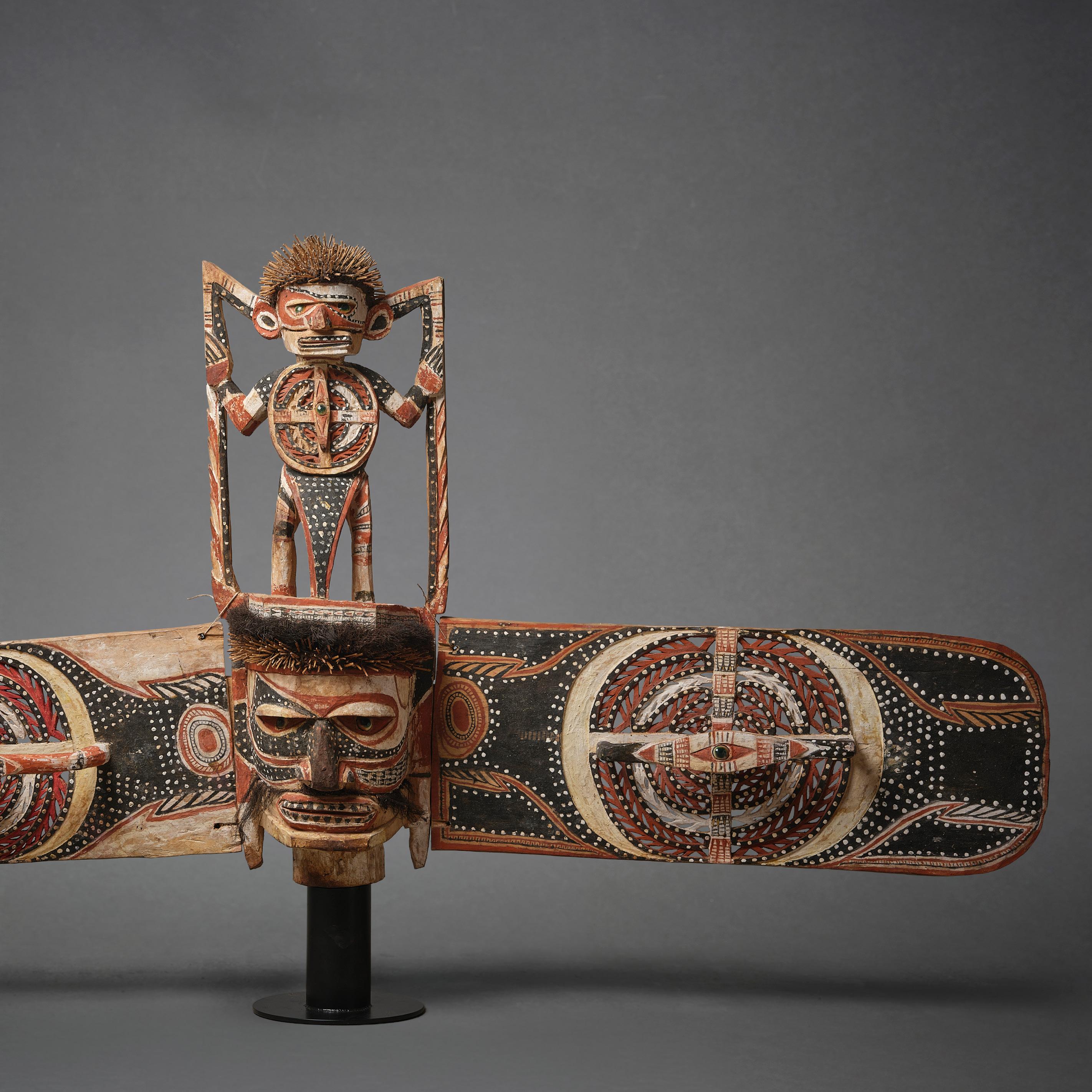
A Canoe Prow
New Ireland, 20th Century Or Earlier
While the ship of Abel Tasman sailed off the Tabar Islands on 6–7 April 1643, Isaac Gilsemans, supercargo and draughtsman aboard the vessel, sketched a canoe carrying three people. One man was blowing a conch shell, while the other two held paddles. Two shark-fishing floats could also be discerned. Both the prow and the stern were ornamented with carvings depicting stylised, grimacing heads. The three men wore distinctive headdresses, closely cropped above the temples, evoking the crests later associated with Tatanua masks. This drawing constitutes the Western world’s first recorded encounter with the art of New Ireland.
The artistic tradition of elaborately carved canoe prows continued throughout New Ireland into the 1930s, developing regional stylistic variations from one area to another. These prows share the same iconographic vocabulary as Malagan sculptures, as they were carved by the very same sculptors. Michael Gunn inspected sixty or so of them (see Michael Hamson, "Oceanic Art", 2018) and noted that they were frequently constructed along the same pattern. They are rare in collections.
Both canoe prow carvings collected by Dr Schiessel display extensive wear from prolonged exposure to the elements, while still retaining traces of their original pigments.
Lot 27 features a head closely related in style to a Tatanua mask, with stylised temples, a square jaw, and a projecting tongue. Eyes made from Turbo petholatus shell opercula lend the figure a striking and confrontational gaze. The head in relief is framed within a thin, elegantly arched wooden structure.
32cm height x 8cm width x 18cm depth
PROVENANCE
Dr A. A. Schiessel Collection (1906 – 1986), Vienna Field collected in New Ireland, 1949 – 1950
$2,000–4,000
28
A Canoe Prow
New Ireland, Tabar Island, Early 20th Century
Lot 28 likewise depicts a head, although its mouth more closely resembles a fish with an elongated projecting tongue surrounded by geometric motifs. Its composition recalls certain asymmetrical bird friezes from New Ireland, with subsequent striped arcs. The intricate form rising above the head appears to evoke a slithering serpent.
40cm height x 16cm width
PROVENANCE
Dr A. A. Schiessel Collection (1906 – 1986) Vienna Field collected in New Ireland 1949 – 1950
$1,500–3,000
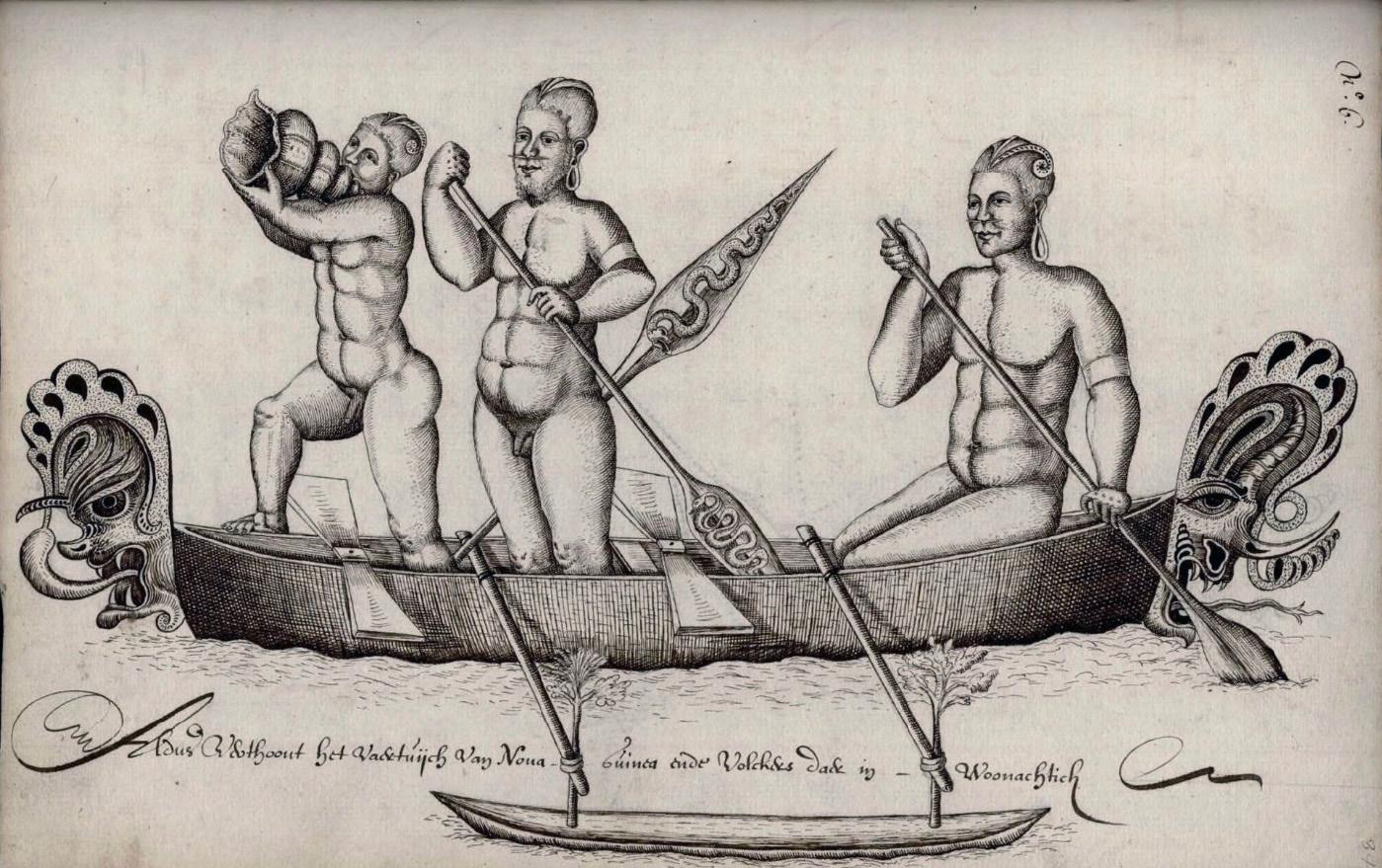
Figure: Sketch by Gilsemans, Isaac, 1.11.01.01, inv. nr. 121, p. 151, Nationaal Archief, The Netherlands
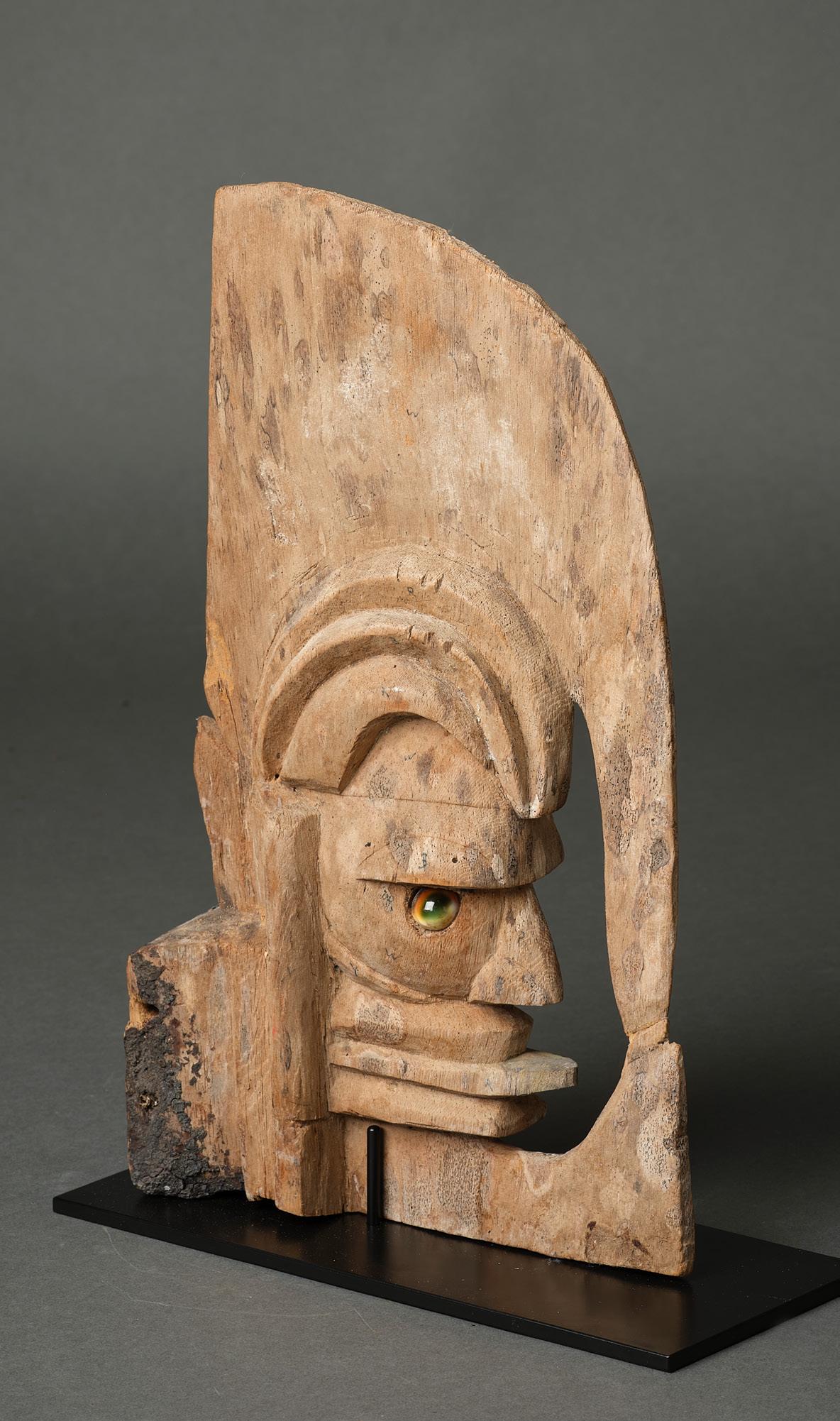
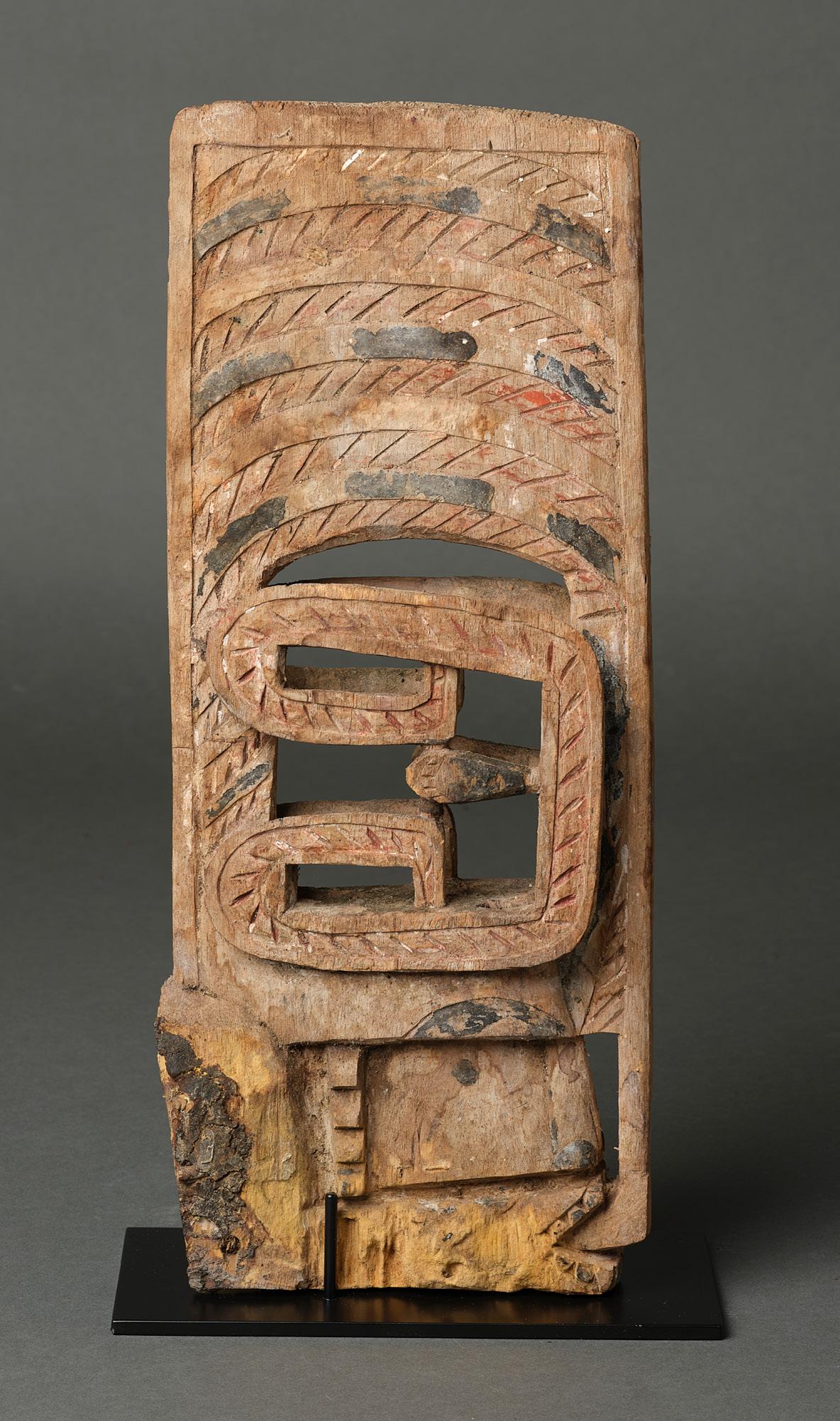
A Tattooing Tool
Papua New Guinea, 20th Century
Wood, bone, natural fibre binding. 12cm length
PROVENANCE
Dr A. A. Schiessel Collection (1906 – 1986), Vienna
Field collected in New Ireland, 1949 – 1950
$200–400
Illustrated online at artvisory.com.au
30
Two Cassowary Bone Daggers
Papua New Guinea, Early 20th Century
33cm, 27cm length
PROVENANCE
Dr A. A. Schiessel Collection (1906 – 1986), Vienna
Field collected in New Ireland, 1949 – 1950
$300–500
Illustrated online at artvisory.com.au
31
A Group Of Shell Currency Bands
New Ireland, Tabar Island, Early 20th Century
Approximately 8cm diameter
PROVENANCE
Dr A. A. Schiessel Collection (1906 – 1986), Vienna
Field collected in New Ireland, 1949 – 1950
$200–400
32
A Group Of Shell Currency Bands
New Ireland, Tabar Island, Early 20th Century
8cm-5cm diameter
PROVENANCE
Dr A. A. Schiessel Collection (1906 – 1986), Vienna
Field collected in New Ireland, 1949 – 1950
$200–400
Illustrated online at artvisory.com.au
33
An Assortment Of Shell And Dog Tooth Necklaces
New Ireland, Tabar Island, 20th Century
PROVENANCE
Dr A. A. Schiessel Collection (1906 – 1986), Vienna
Field collected in New Ireland, 1949 – 1950
$100–200
Illustrated online at artvisory.com.au
34
A Pair Of Paddles
New Ireland, Tabar Island, 20th Century 105cm, 104cm length
PROVENANCE
Dr A. A. Schiessel Collection (1906 – 1986), Vienna
Field collected in New Ireland, 1949 – 1950
$200–400
Illustrated online at artvisory.com.au
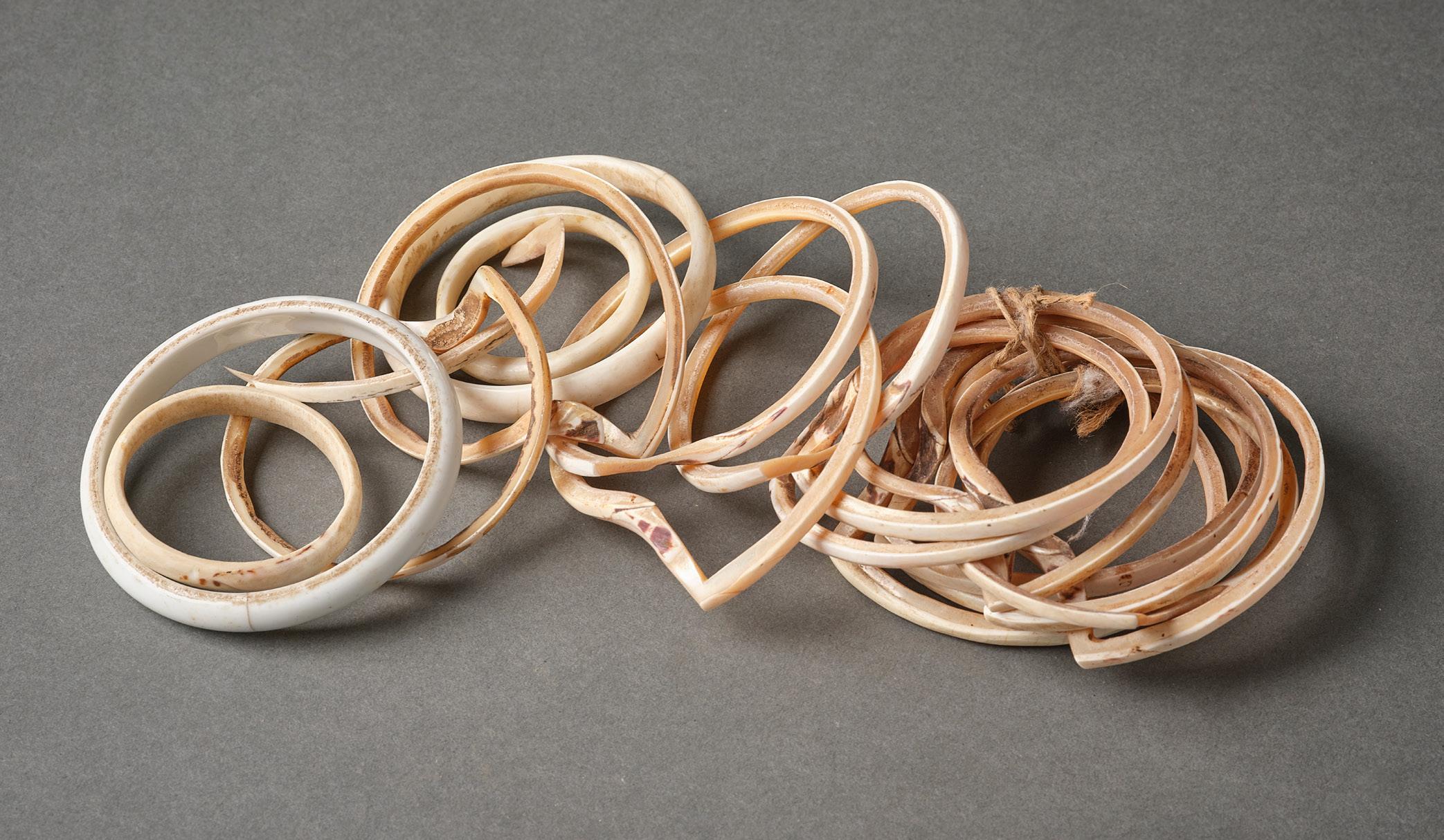
Two Shell Scrapers, A Stone Scraper, And An Adze Blade
New Ireland, 19th – Early 20th Century Scrapers made out of clam shell are among the suite of tools used by carvers in New Ireland in the 19th century and before. They were also using stone adzes, bones, pig tusks, coral graters and shark skins. Their usage decreased after the introduction of metal in the second half of 19th century, first by recycling the iron from the barrels brought by the transiting ships, then proper metal tools fixed on wooden shafts.
19cm, 12cm, 8.5cm, 8cm length
PROVENANCE
Dr A. A. Schiessel Collection (1906 – 1986), Vienna
Field collected in New Ireland, 1949 – 1950
$100–200
36
An Collection Of Shells
New Ireland, Tabar Island
PROVENANCE
Dr A. A Schiessel Collection (1906 - 1986), Vienna
Field collected in New Ireland, 1949 – 1950
$200–400
Illustrated online at artvisory.com.au
37
A Collection Of Shells
New Ireland, Tabar Island
PROVENANCE
Dr A. A. Schiessel Collection (1906 – 1986), Vienna
Field collected in New Ireland, 1949 – 1950
$200–400
Illustrated online at artvisory.com.au
38
A Collection Of Shells
New Ireland, Tabar Island
In original cloth bags and vintage tin box.
PROVENANCE
Dr A. A. Schiessel Collection (1906 – 1986), Vienna
Field collected in New Ireland, 1949 – 1950
$100–200
Illustrated online at artvisory.com.au
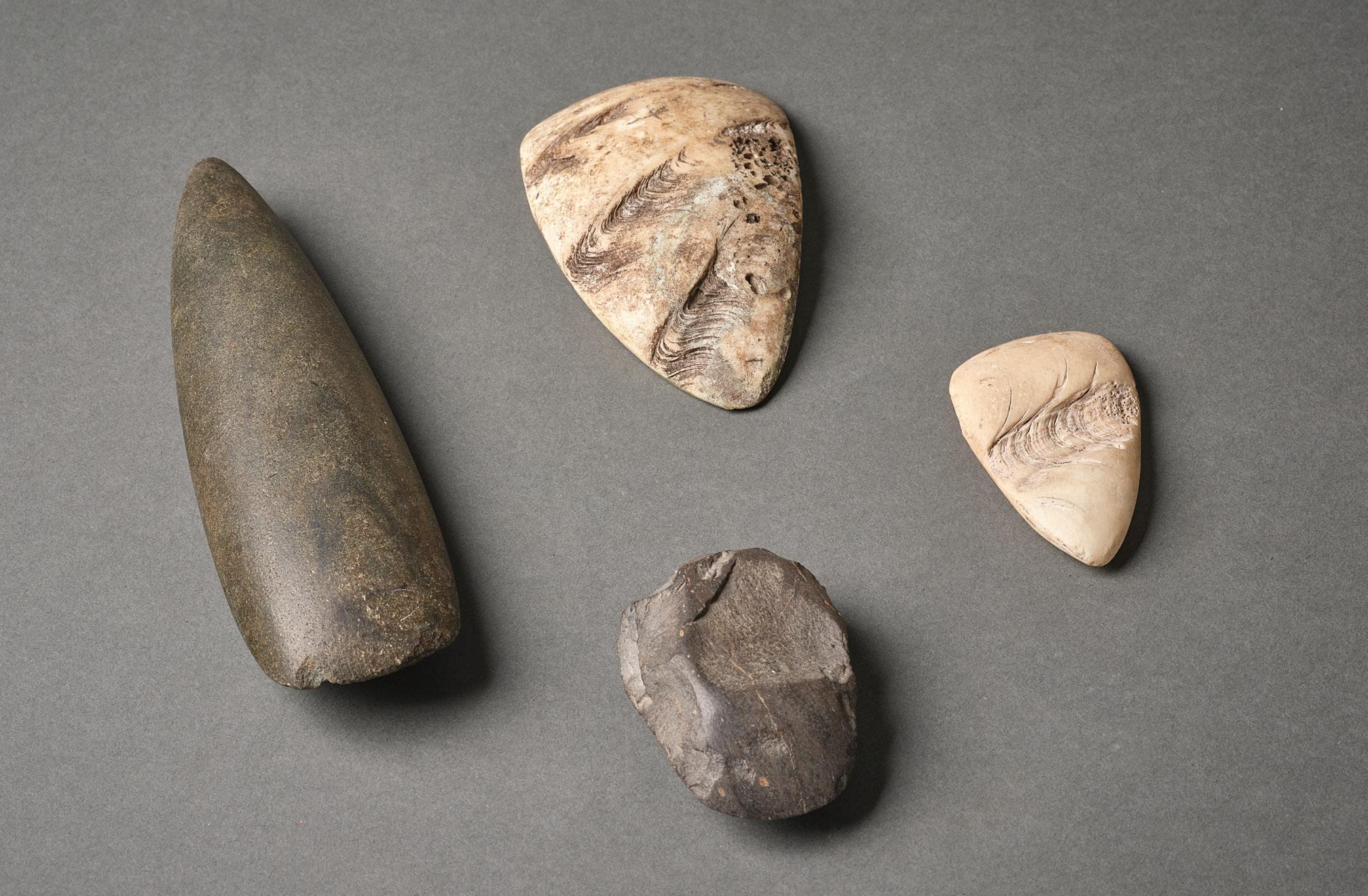
39
A Kapkap Pendant
New Ireland, Tabar Island, Early 20th Century
12cm diameter
PROVENANCE
Dr A. A. Schiessel Collection (1906 – 1986), Vienna Field collected in New Ireland, 1949 – 1950
$2,000–4,000
40
A Kapkap Pendant
New Ireland, Tabar Island, Early 20th Century
9cm diameter
PROVENANCE
Dr A. A. Schiessel Collection (1906 – 1986), Vienna Field collected in New Ireland, 1949 – 1950
$2,000–4,000
Kapkap ornaments rank among the most emblematic prestige objects of New Ireland. Traditionally worn by bigmen during ceremonial occasions, they signified authority, spiritual potency, and elevated social status; ownership could reside either with an individual or a clan.
A kapkap typically comprises a circular disc meticulously ground, polished, and perforated from giant clam shell—a process requiring many hours of skilled labour. This disc is paired with an exceptionally thin, openwork plaque carved from hawksbill turtle shell. The latter is softened through careful heating, then hammered to remarkable thinness and incised using shark tooth, bone, or later metal tools. The resulting filigreed surface often displays intricate geometric motifs associated with specific clan identities, testifying to a high degree of technical and artistic mastery.
Within New Ireland societies, kapkap ornaments held a significant role in Malagan ceremonial traditions. They
41
A Kapkap Pendant
New Ireland, Tabar Island, Early 20th Century
12cm diameter
PROVENANCE
Dr A. A. Schiessel Collection (1906 – 1986), Vienna Field collected in New Ireland, 1949 – 1950
$2,000–4,000
42
A Kapkap Pendant
New Ireland, Tabar Island, Early 20th Century
8cm diameter
PROVENANCE
Dr A. A. Schiessel Collection (1906 – 1986), Vienna Field collected in New Ireland, 1949 – 1950
$1,000–2,000
are frequently represented on sculptures and masks, prominently carved onto the chest or forehead of ancestral figures. In this context, the kapkap functioned not merely as an adornment but as a potent marker of prestige and a tangible link to the spiritual realm and ancestral power. Their use was documented by early European collectors and ethnographers, including Augustin Krämer and Richard Parkinson, in the late nineteenth and early twentieth centuries. Today, kapkap ornaments remain in ceremonial use in New Ireland, while historical examples are held in major museums and private collections worldwide. They stand as a testament to the creativity and virtuosity of New Ireland artists.
It should be noted that, as these examples were collected between 1949 and 1950, they are eligible for export under current CITES regulations.
A Kapkap Pendant
New Ireland, Tabar Island, Early 20th Century
6cm diameter
PROVENANCE
Dr A. A. Schiessel Collection (1906 – 1986), Vienna Field collected in New Ireland, 1949 – 1950
$1,000–2,000
44
A Kapkap Pendant
New Ireland, Tabar Island, Early 20th Century
8cm diameter
PROVENANCE
Dr A. A. Schiessel Collection (1906 – 1986), Vienna Field collected in New Ireland, 1949 – 1950
$1,000–2,000
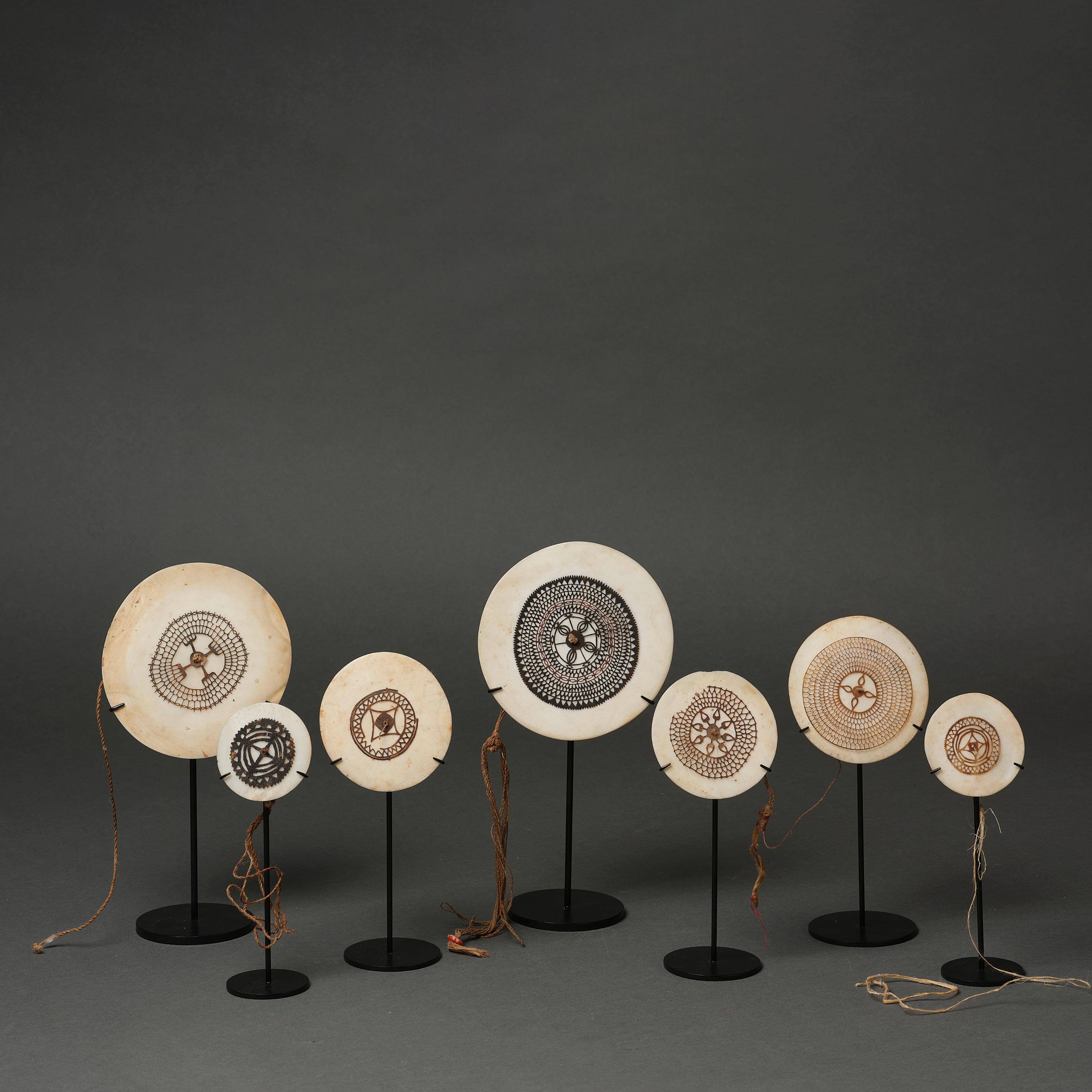
45
A Kapkap Pendant
Solomon Islands, Early 20th Century
5.5cm diameter
PROVENANCE
Dr A. A. Schiessel Collection (1906 – 1986), Vienna Field collected in New Ireland, 1949 – 1950
$1,000–2,000
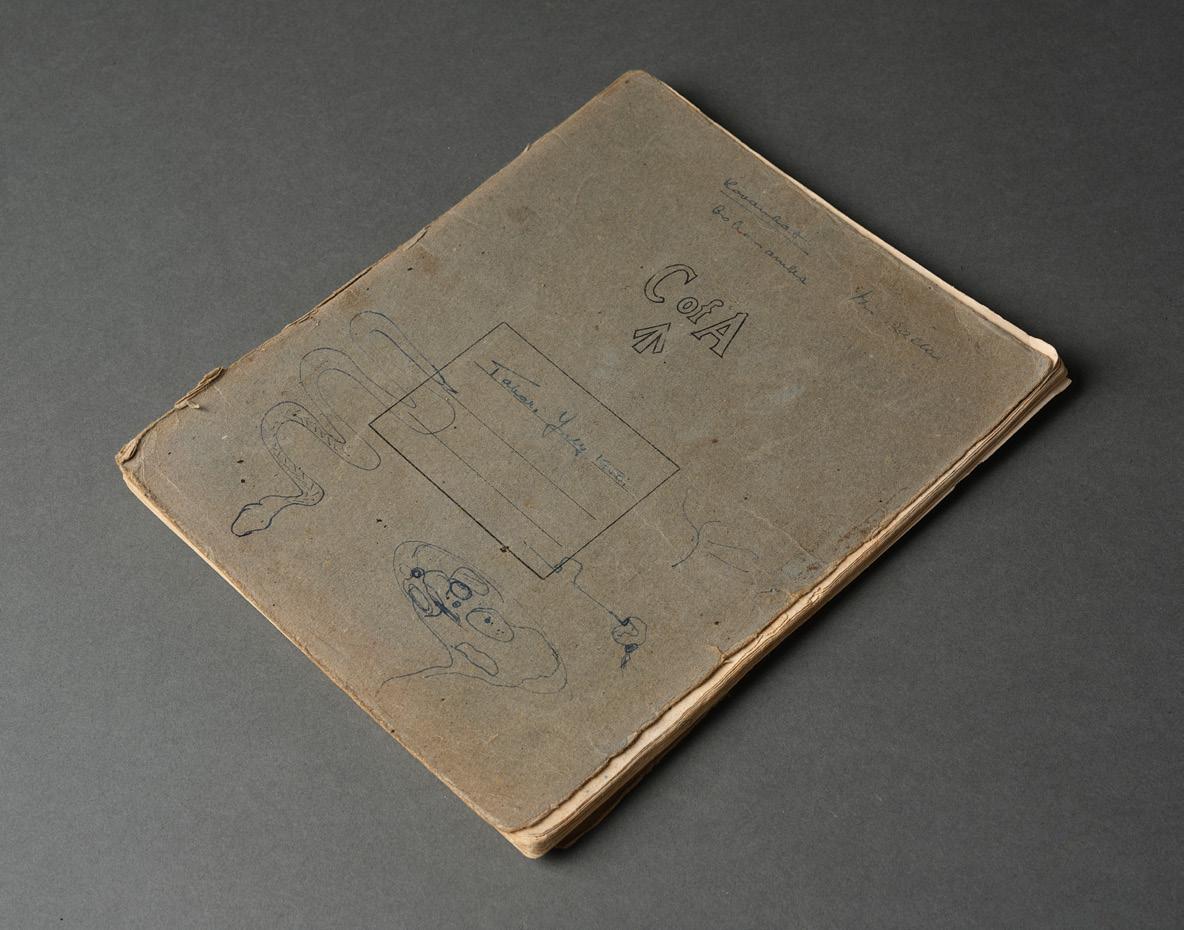
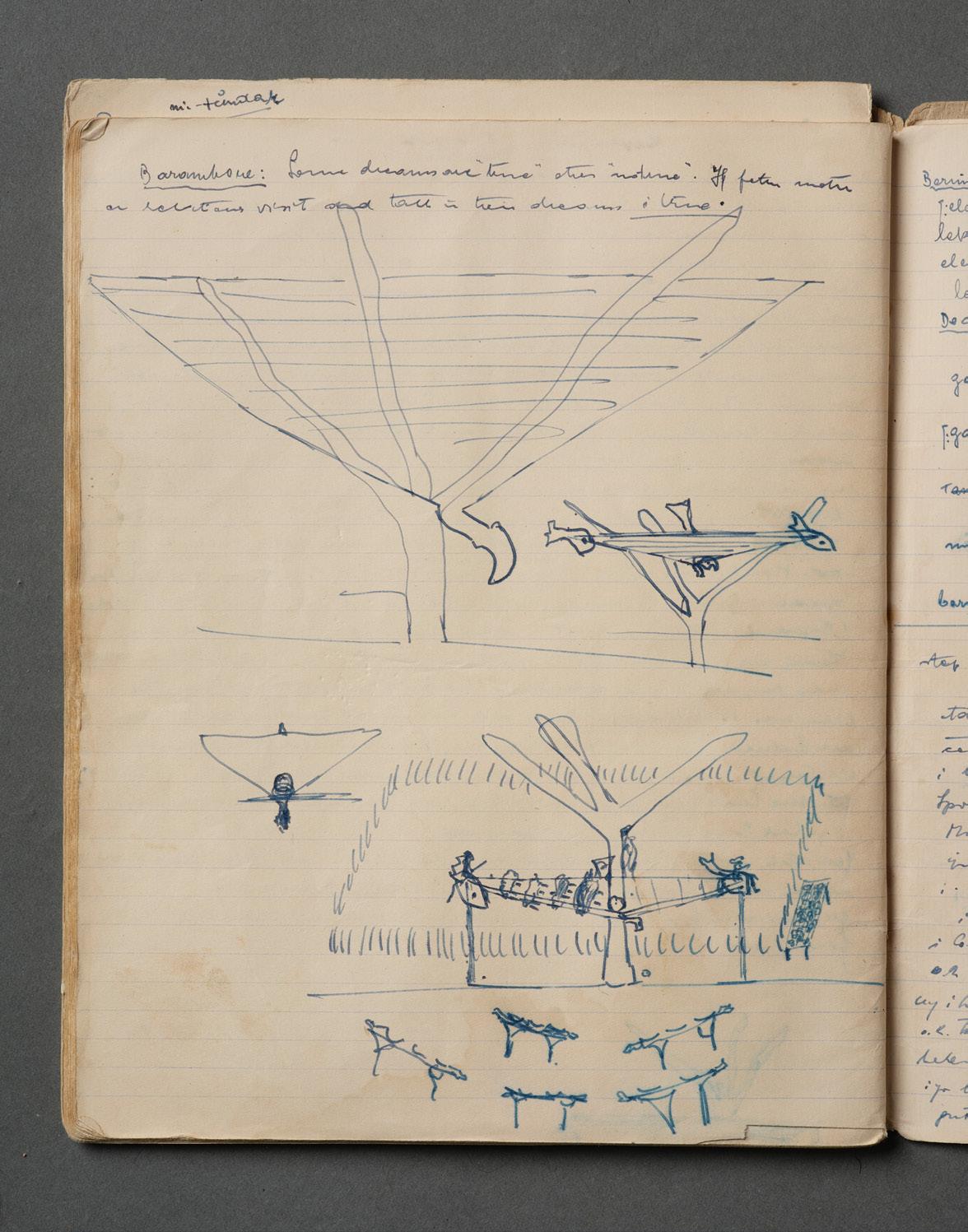
The Dr A. A. Schiessel Field Archive
New Ireland, 1949-1950
This extensive archive comprises journals, maps, field reports and drawings compiled by Dr A. A. Schiessel during his patrols on New Ireland and Tabar Island in 1949–1950. The material includes detailed medical notes alongside documentation of his field collecting activities, with sketches, observations and, in several cases, the identification of makers and precise locations where individual works were acquired.
$4,000–8,000
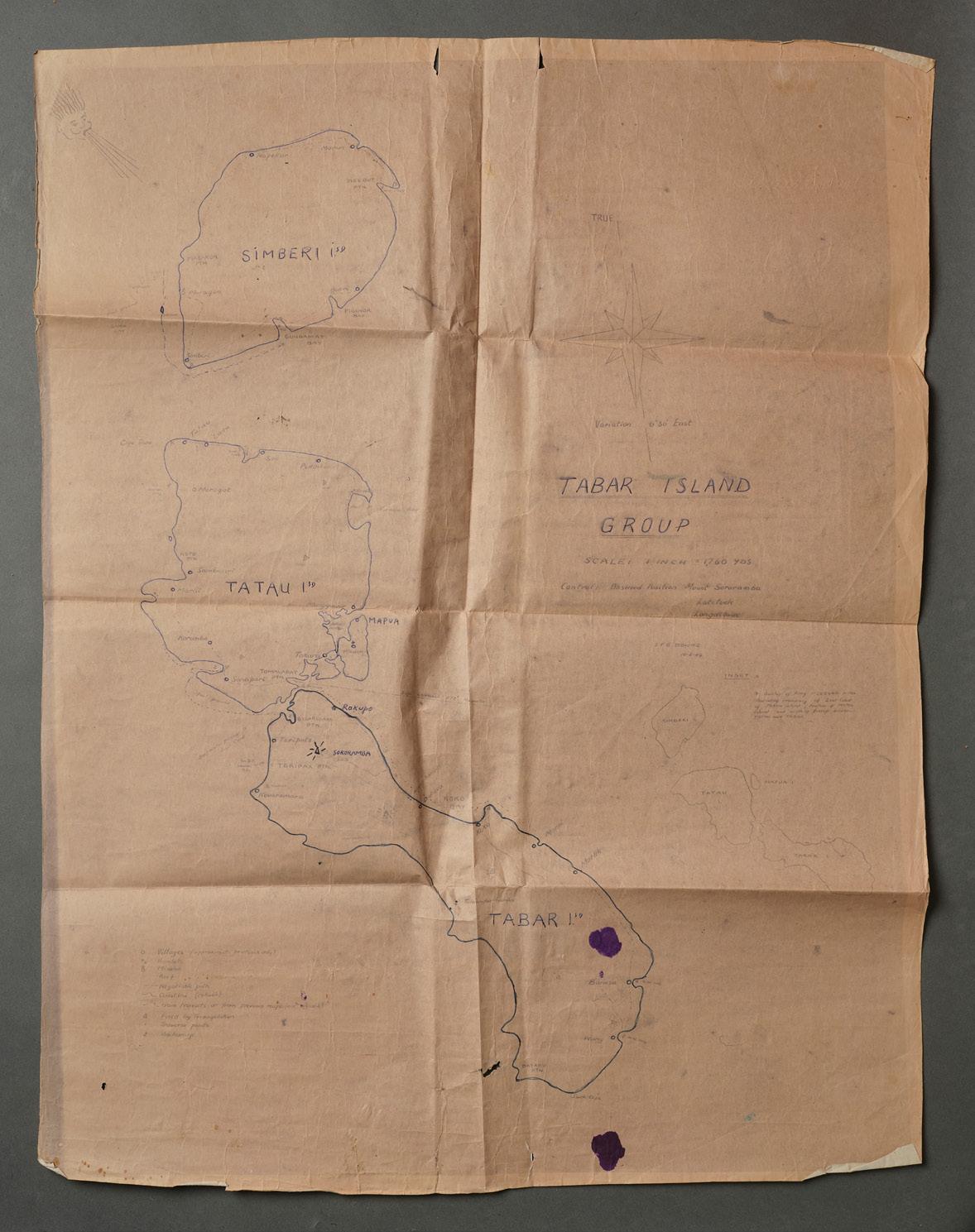
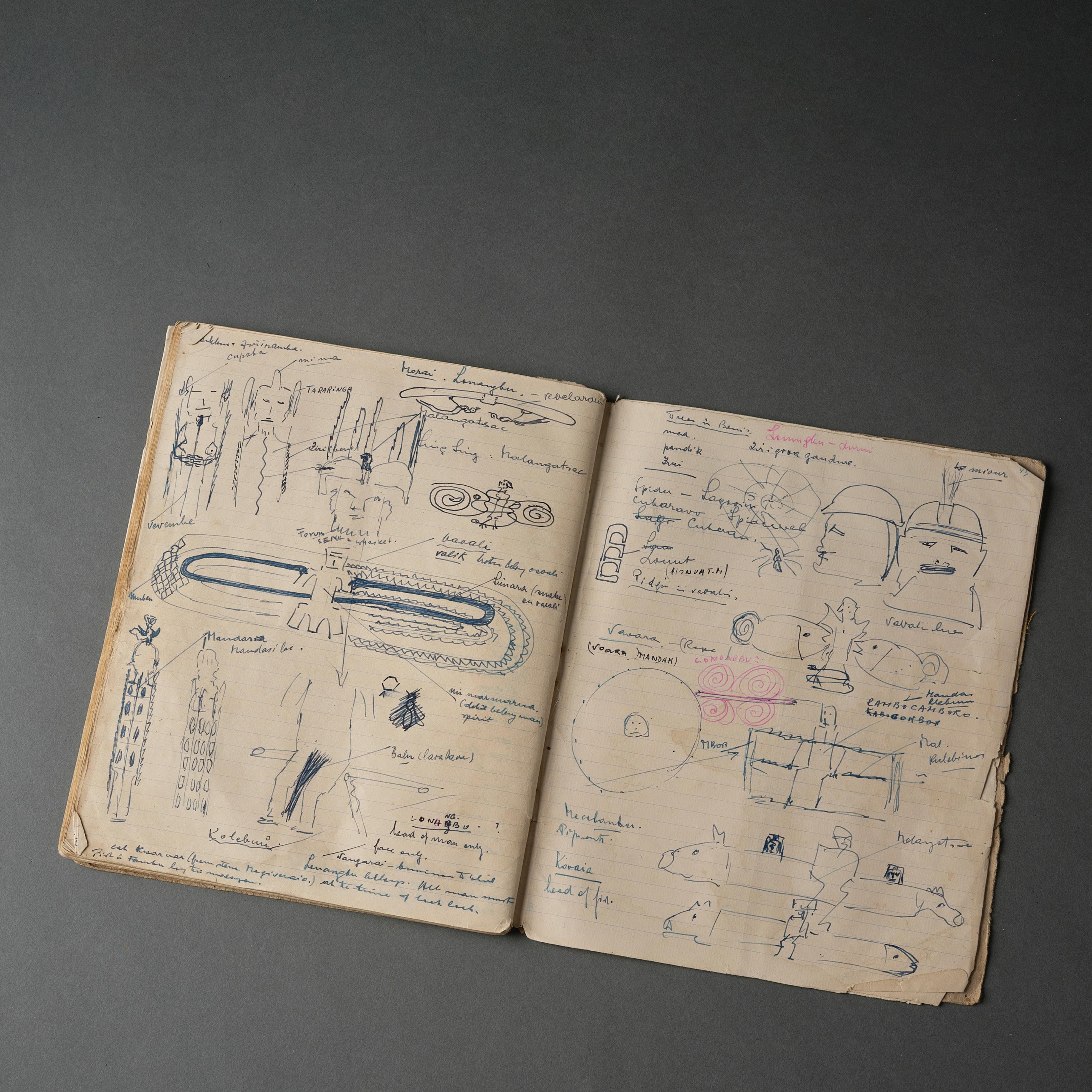
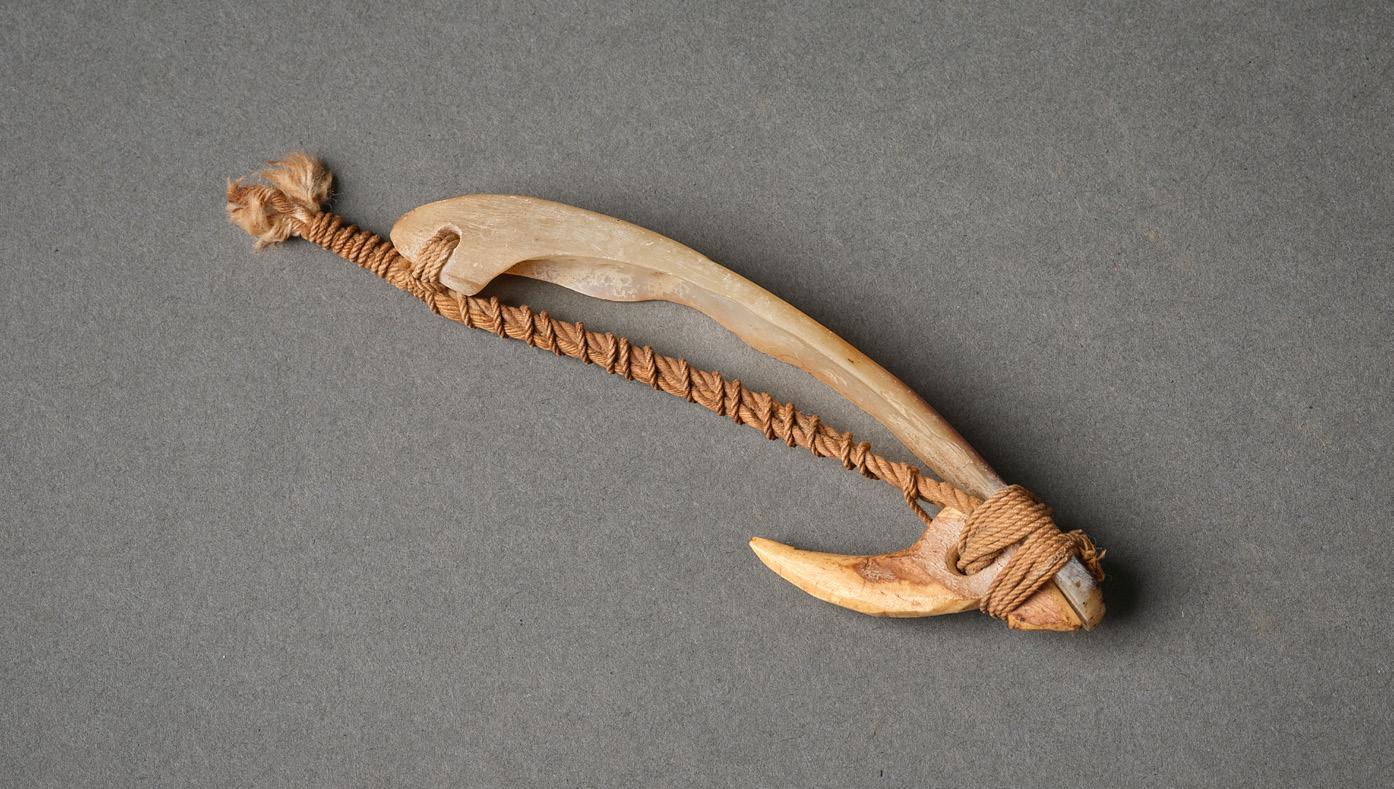
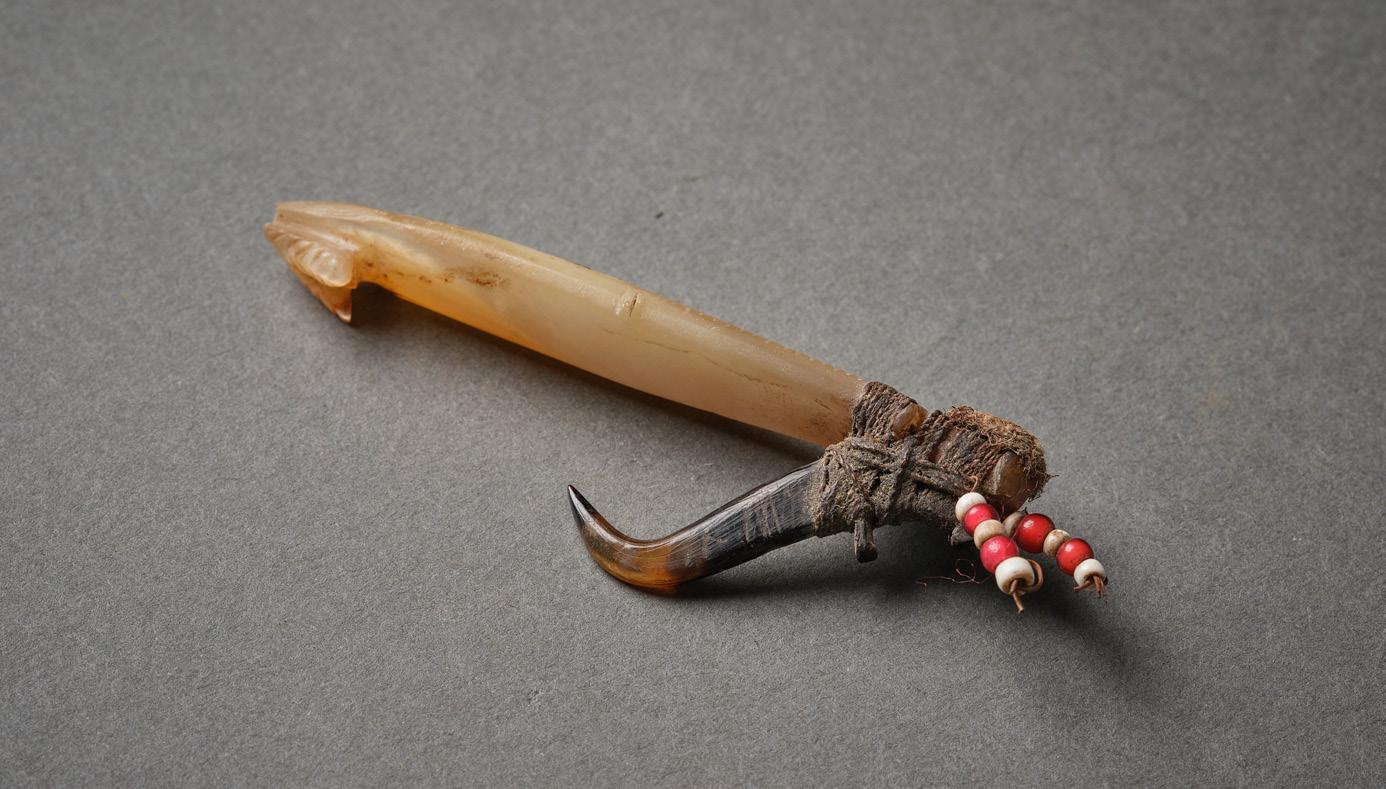
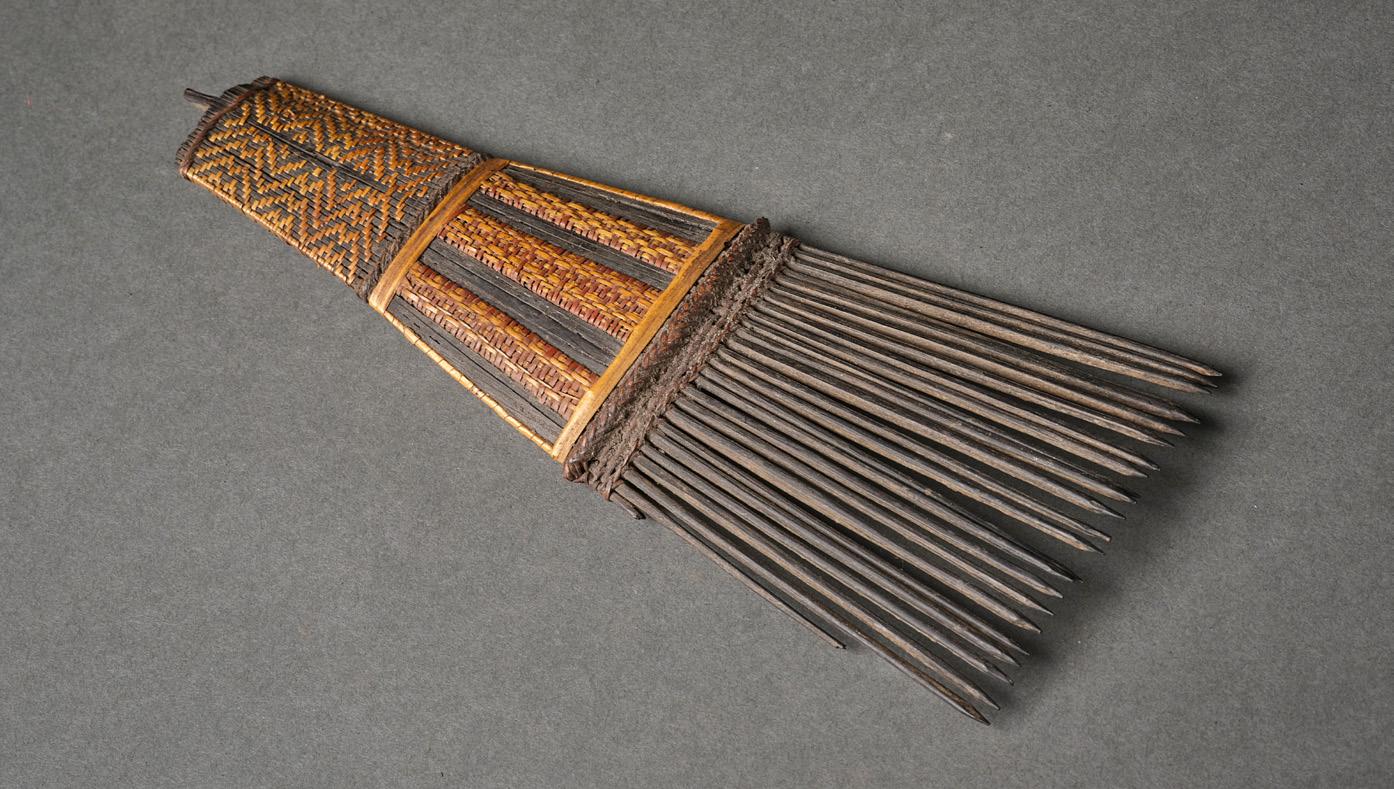
47
A Trolling Lure
Tahiti, Early 20th Century
11.5cm diameter
PROVENANCE
Dr A. A. Schiessel Collection (1906 – 1986), Vienna Field collected in New Ireland, 1949 – 1950
$600–1,200
48
A Trolling Lure
Solomon Islands, Early 20th Century
8cm length
PROVENANCE
Dr A. A. Schiessel Collection (1906 – 1986), Vienna Field collected in New Ireland, 1949 – 1950
$500–800
49
A Comb
Solomon Islands, Early 20th Century
21cm length
PROVENANCE
Dr A. A. Schiessel Collection (1906 – 1986), Vienna Field collected in New Ireland, 1949 – 1950
$400–800
50
A Comb Solomon Islands, Early 20th Century 23cm length
PROVENANCE
Dr A. A. Schiessel Collection (1906 – 1986), Vienna Field collected in New Ireland, 1949 – 1950
$400–800
51
A Comb Solomon Islands, Early 20th Century 27cm length
PROVENANCE
Dr A. A. Schiessel Collection (1906 – 1986), Vienna Field collected in New Ireland, 1949 – 1950
$300–500
52
A Flint Dagger Australian, Aboriginal, Early 20th Century 13cm length
PROVENANCE
Dr A. A. Schiessel Collection (1906 – 1986), Vienna
$200–400
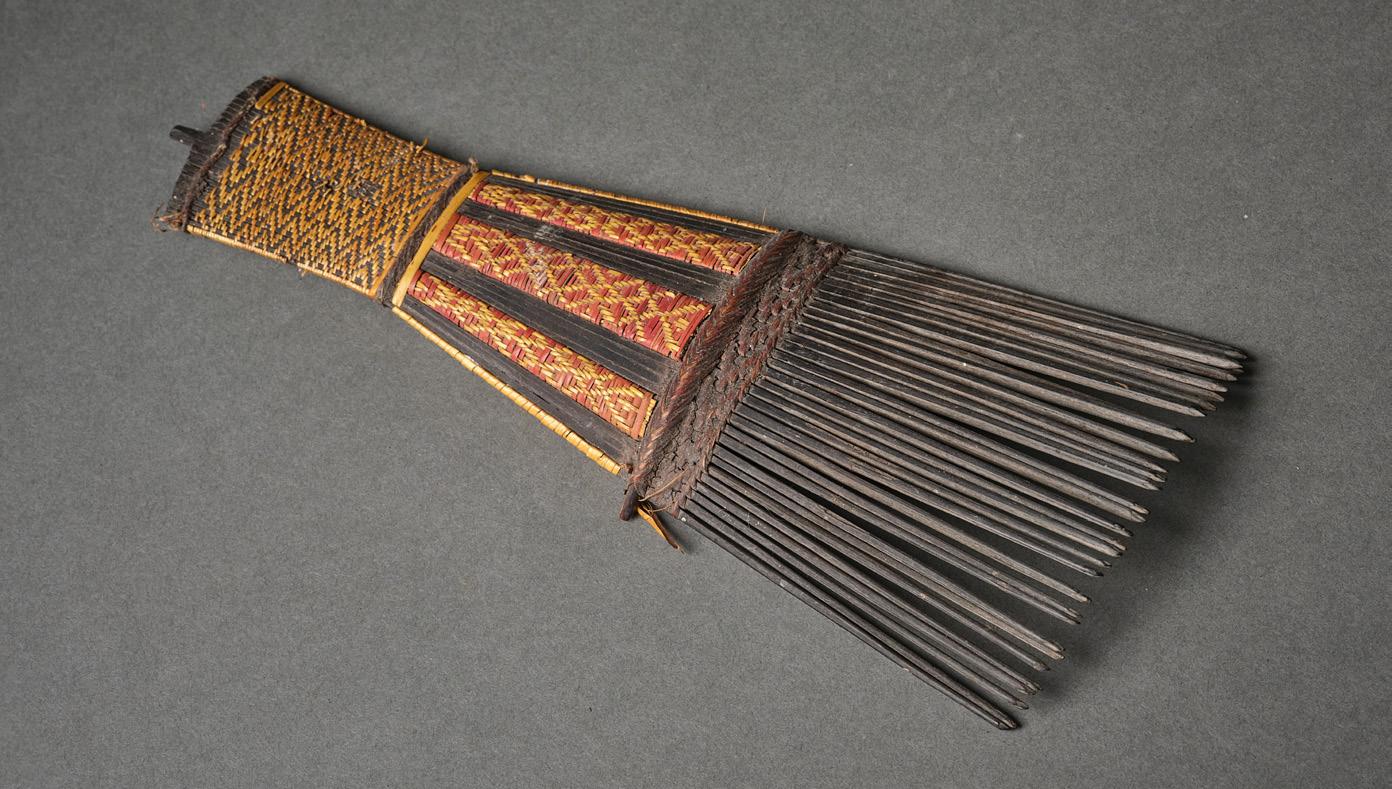
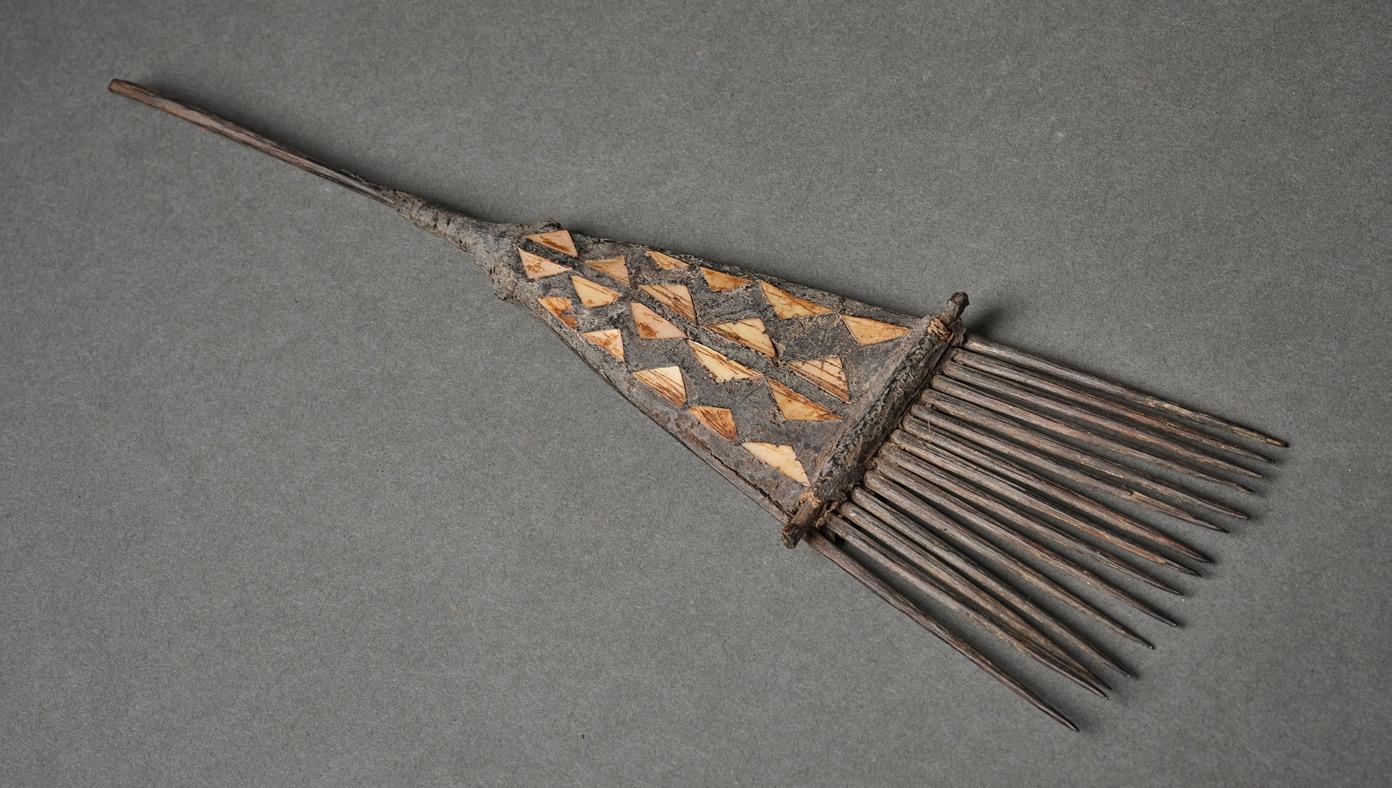
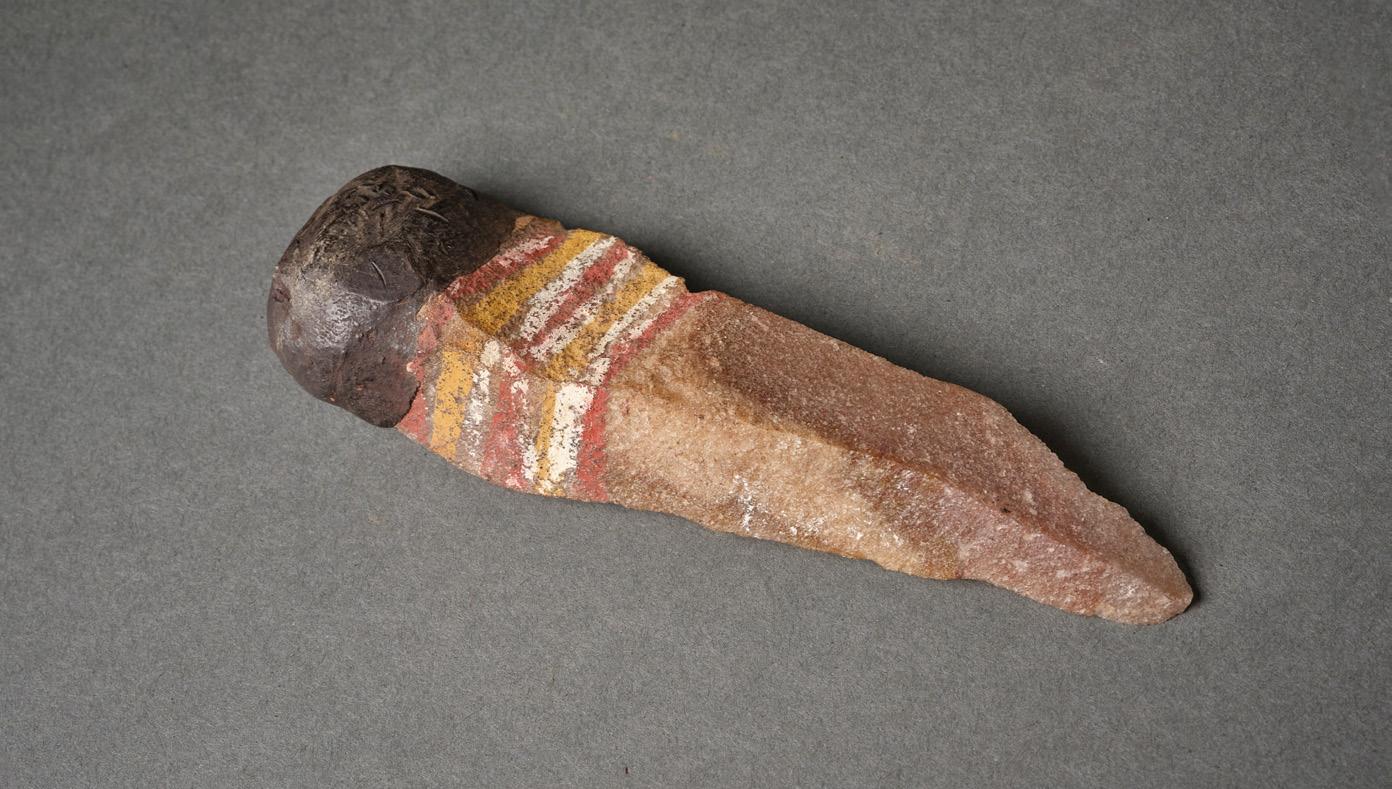
Note that the following taonga Māori is sold in strict accordance with the Protected Objects Act (1975) and can only be sold to New Zealand-registered buyers. (see page 113 for details)
53
Two Ketu
Māori, Aotearoa, New Zealand, 19th Century
Two carved wooden digging implements.
Protected Objects Act (1975) Registration Number Y 23236, Y 23237
45cm, 41cm length
PROVENANCE
Dr A. A Schiessel Collection (1906 – 1986), Vienna
$200–400
Illustrated online at artvisory.com.au
54
A Kotiate
Māori, Aotearoa, New Zealand, 20th Century
A wooden hand club carved with rauponga patterns to the blade and mania head to the handle with three paua eyelets, one missing.
Protected Objects Act (1975) Registration Number Y 23239
35.5cm length x 13cm width
PROVENANCE
Dr A. A. Schiessel Collection (1906 – 1986), Vienna
$300–600
Illustrated online at artvisory.com.au
55
A Wahaika
Māori, Aotearoa, New Zealand, 20th Century
A wooden hand club with a weku figure carved to the inside of the blade and manaia carved to the handle.
Inlaid with cut paua.
Protected Objects Act (1975) Registration Number Y 23235
36cm length x 10.5cm width
PROVENANCE
Dr A. A Schiessel Collection (1906 – 1986), Vienna
$300–600
Illustrated online at artvisory.com.au
56
Two Patu Aruhe Māori, Aotearoa, New Zealand, 19th Century
Two wooden fern root pounders.
Protected Objects Act (1975) Registration Number Y 232238, Y 23240
35cm, 32cm length
PROVENANCE
Dr A. A Schiessel Collection (1906 – 1986), Vienna
$300–600
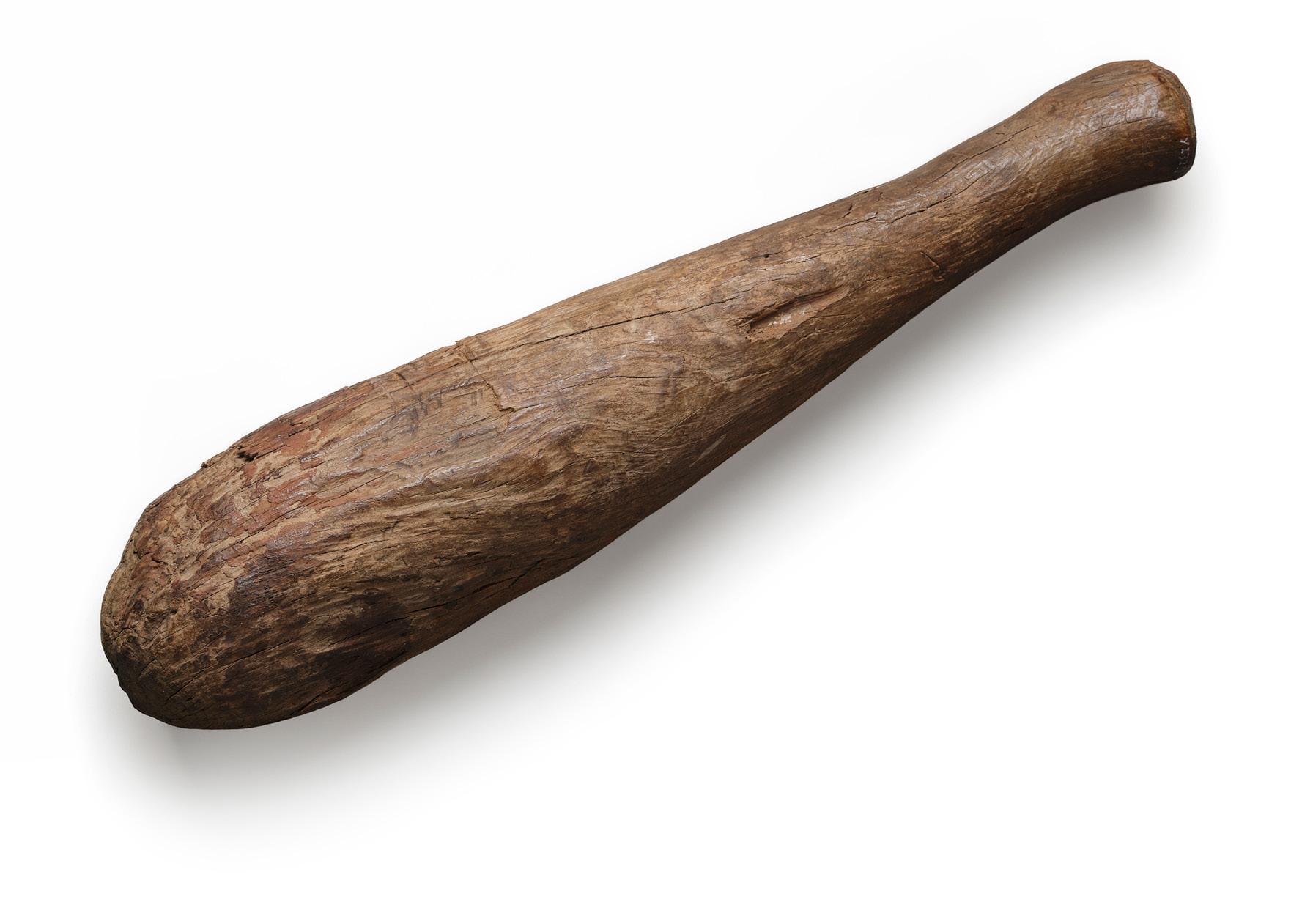
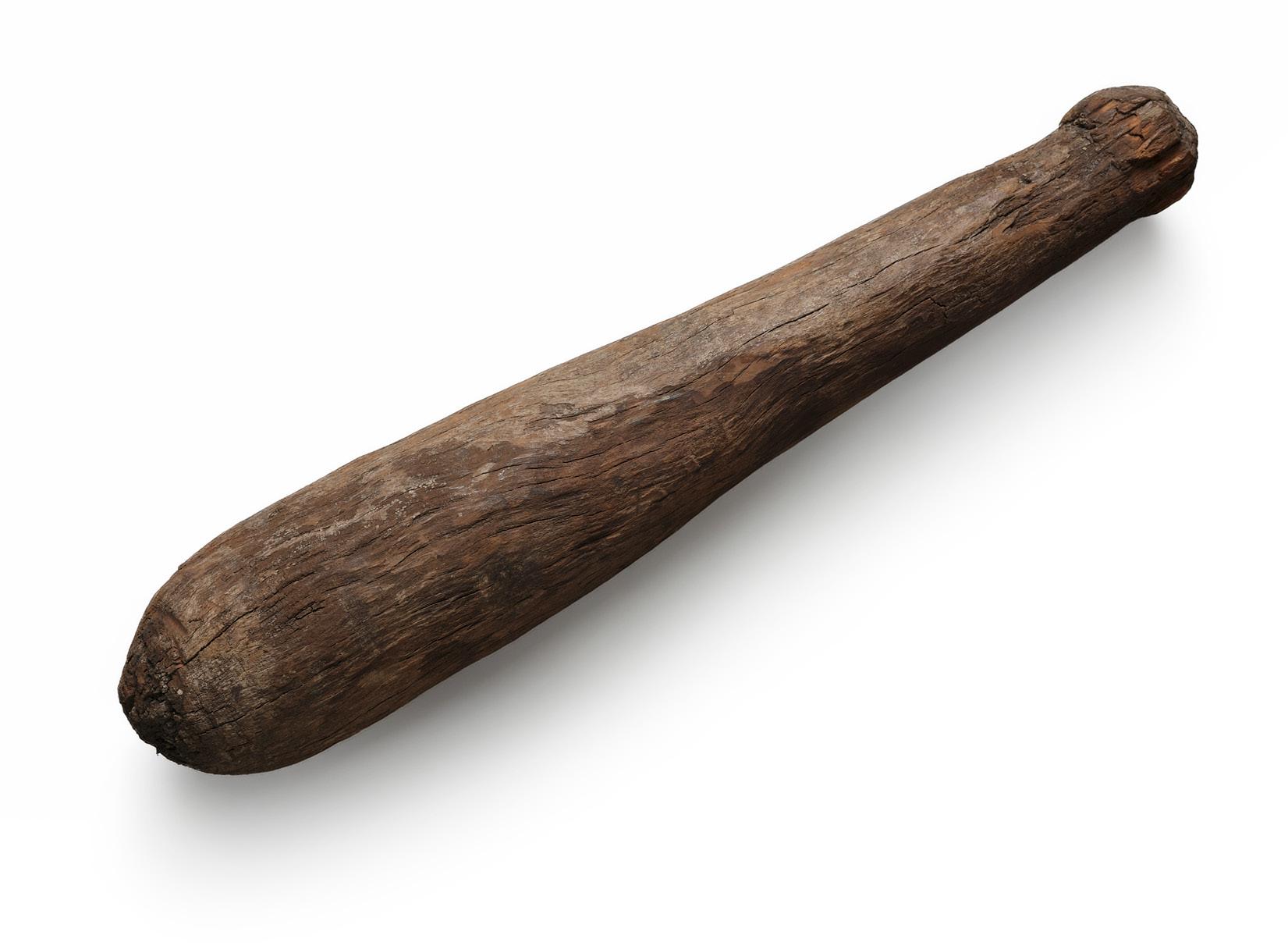
57
Two Small Poi
Māori, Aotearoa, New Zealand, 20th Century
Raupo (dried bulrush) poi lashed with twirled muka binding. Collected in Kaikoe 1952-1954.
Protected Objects Act (1875) Registration Number Y 232278, Y 23279
22cm, 16cm length (including binding)
PROVENANCE
Dr A. A Schiessel Collection (1906 – 1986), Vienna
$100–200
Illustrated online at artvisory.com.au
58
A Single Poi Awe
Māori, Aotearoa, New Zealand, 20th Century
Woven muka cover with embroidered crosses and diamonds in red, blue, and yellow. Muka tassels and twisted binding.
Protected Objects Act (1975) Registration Number Y 23253
9.6cm length x 4.7 width
PROVENANCE
Dr A. A Schiessel Collection (1906 – 1986), Vienna
$300–600
Illustrated online at artvisory.com.au
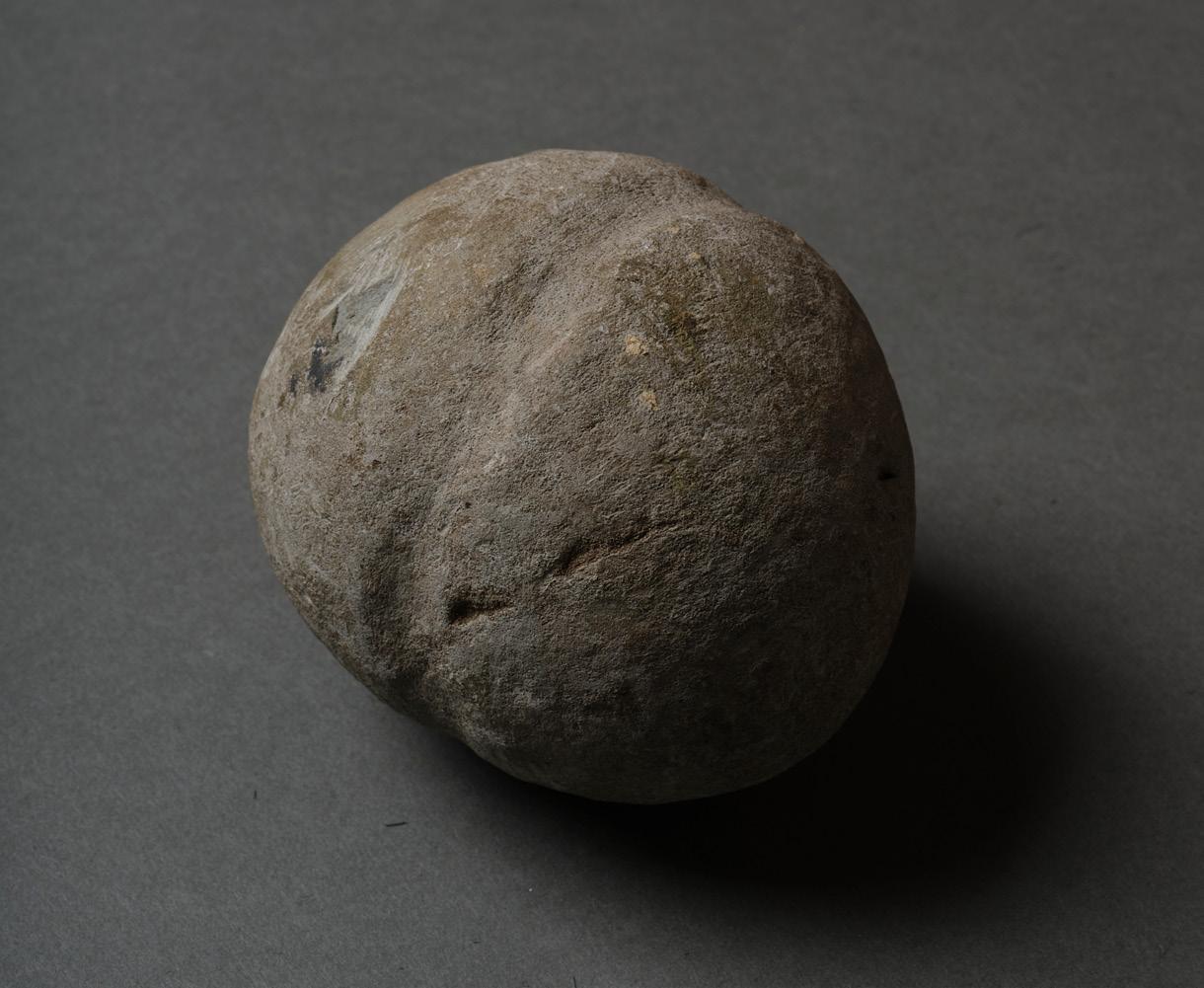
59
A Whale Bone Patu
Māori, Aotearoa, New Zealand, 20th Century
Protected Objects Act (1975) Registration Number Y 23241
16cm length
PROVENANCE
Dr A. A. Schiessel Collection (1906 – 1986), Vienna
$150–250
Illustrated online at artvisory.com.au
60
Two Mahe
Māori, Aotearoa, New Zealand, 18th Century
Each rounded stone sinker with lashing grooves to the circumference.
Protected Objects Act (1975) Registration Number Y 23242, Y 23243
9.5cm length x 8.8cm width, 8.5cm length x 6.2cm width
PROVENANCE
Dr A. A Schiessel Collection (1906 – 1986), Vienna
$500–800
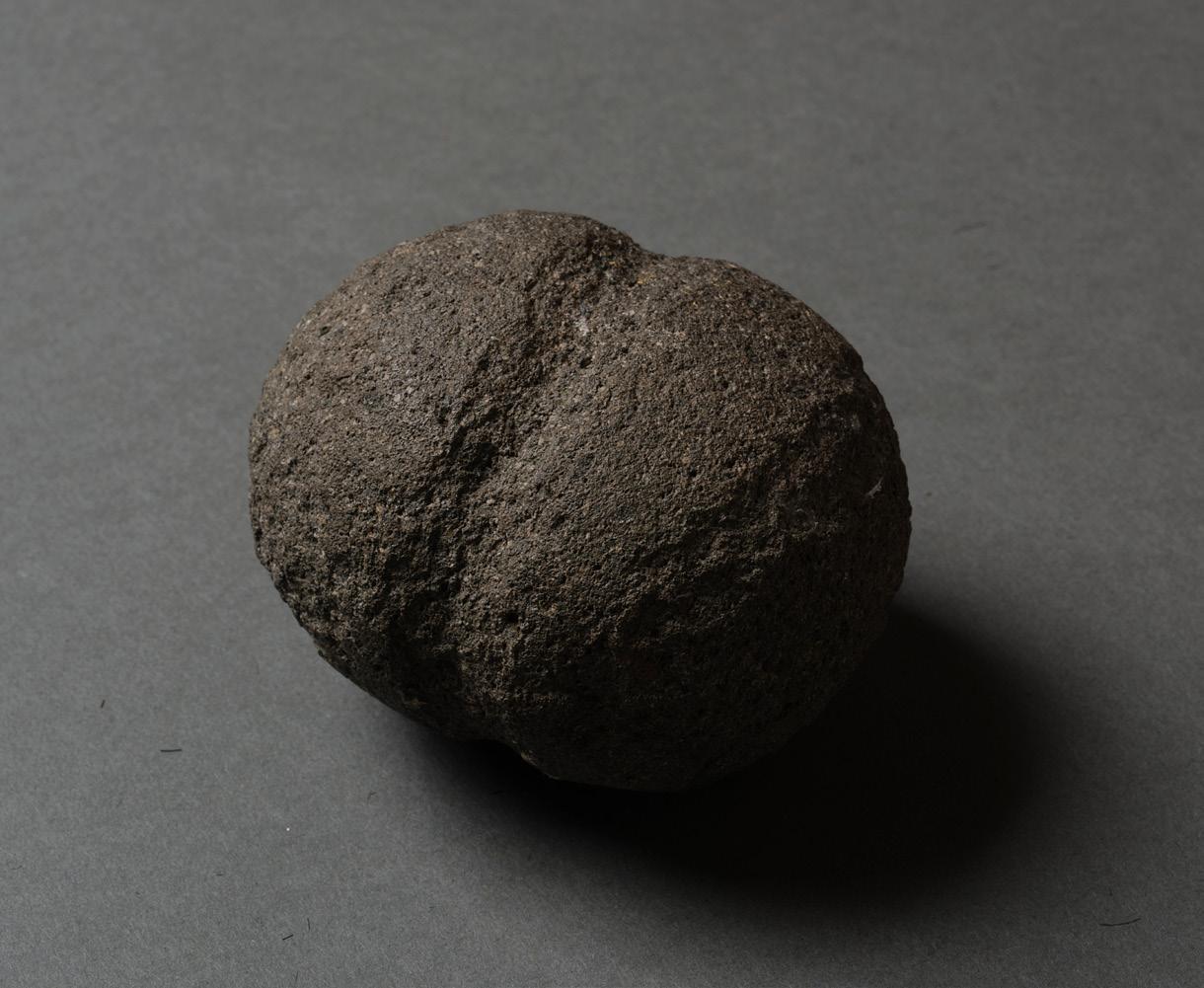
A Pre-European Hogback Toki
Māori, Aotearoa, New Zealand, 18th Century
Thick tapering quandrangular shape with uneven poll and hammer pecked tang, smooth polished bevel and blade. Some flaking to the tang underside.
Protected Objects Act (1975) Registration Number Y 23252
15cm length
PROVENANCE
Dr A. A Schiessel Collection (1906 – 1986), Vienna
$250–450
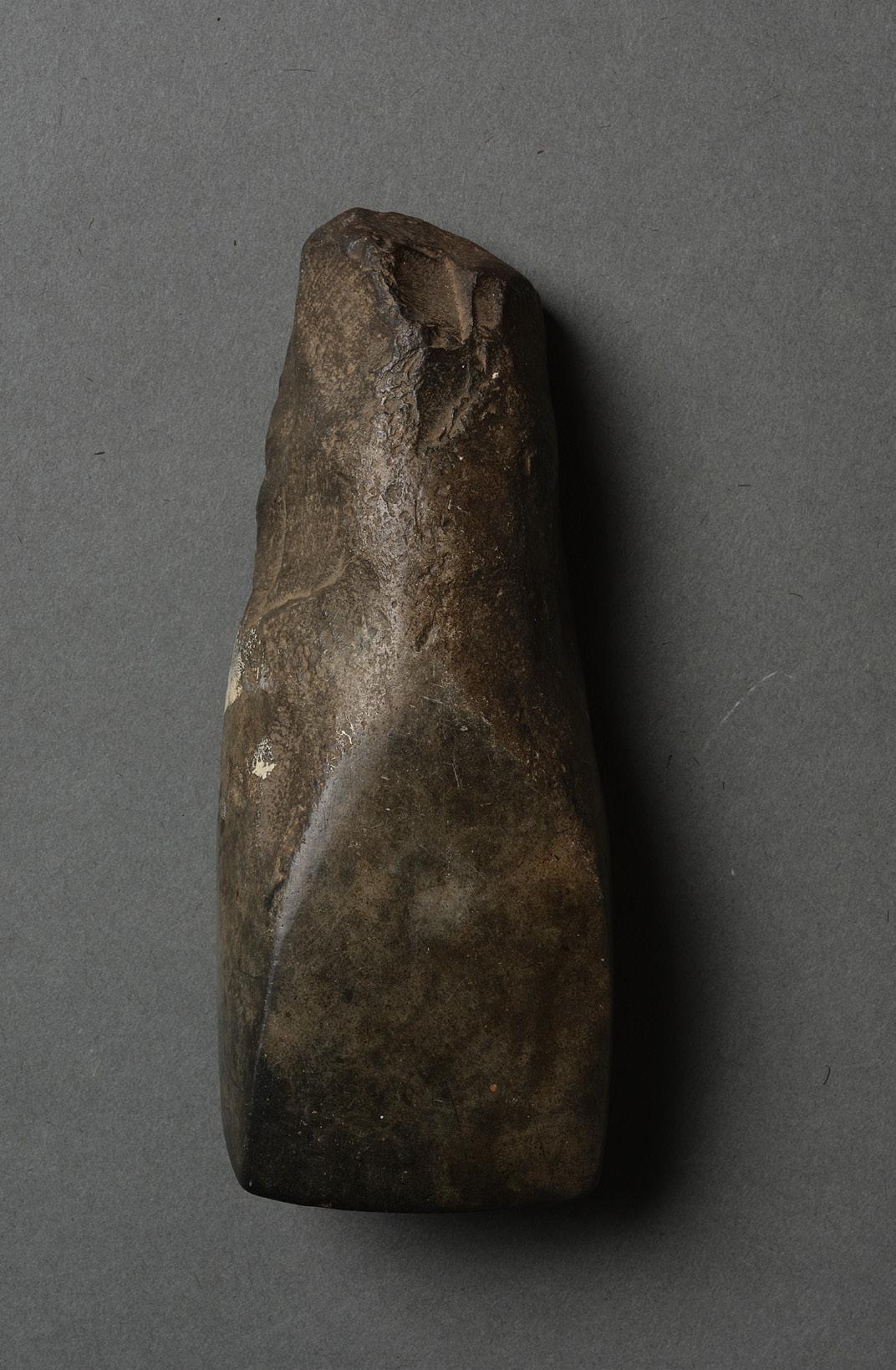
62
Four Pre-European Toki
Māori, Aotearoa, New Zealand, 18th Century
Protected Objects Act (1975) Registration Number Y 23244, Y 23245, Y 23247, Y23248
14.5cm, 10cm, 8cm, 8cm length
PROVENANCE
Dr A. A. Schiessel Collection (1906 – 1986), Vienna
$200–300
Illustrated online at artvisory.com.au
63
Four Pre-European Toki
Māori, Aotearoa, New Zealand, 18th Century
Protected Objects Act (1975)
Registration Number Y 23246, Y23249, Y 23250, Y 23251
15cm, 11.5cm, 10.5cm, 9cm length
PROVENANCE
Dr A. A. Schiessel Collection (1906 – 1986), Vienna
$200–300
Illustrated online at artvisory.com.au
64
A Small Piu Piu
Māori, Aotearoa, New Zealand, 20th Century
Made with harakeke, muka, flax fibre and natural paru dye. Woven muka waist band with plaited ties, most likely made for a child.
Protected Objects Act (1975) Registration Number Y 23276
30cm length x 50cm width
PROVENANCE
Dr A. A Schiessel Collection (1906 – 1986), Vienna
$100–200
Illustrated online at artvisory.com.au
A Mere Pounamu
Māori, Aotearoa, New Zealand, 19th Century
A short-bladed nephrite hand club, with a fine spatulate blade with a translucent edge, crafted from the Kawakawa variety of pounamu. The blade tapers to the reduced-grip section, with a countersunk suspension hole terminating in six reducing grooves.
Protected Objects Act (1975) Registration number Y 6544
30cm length
PROVENANCE
Dame Jenny Gibbs Collection, Wellington
Patrick O'Connor Collection, Auckland
$10,000–15,000
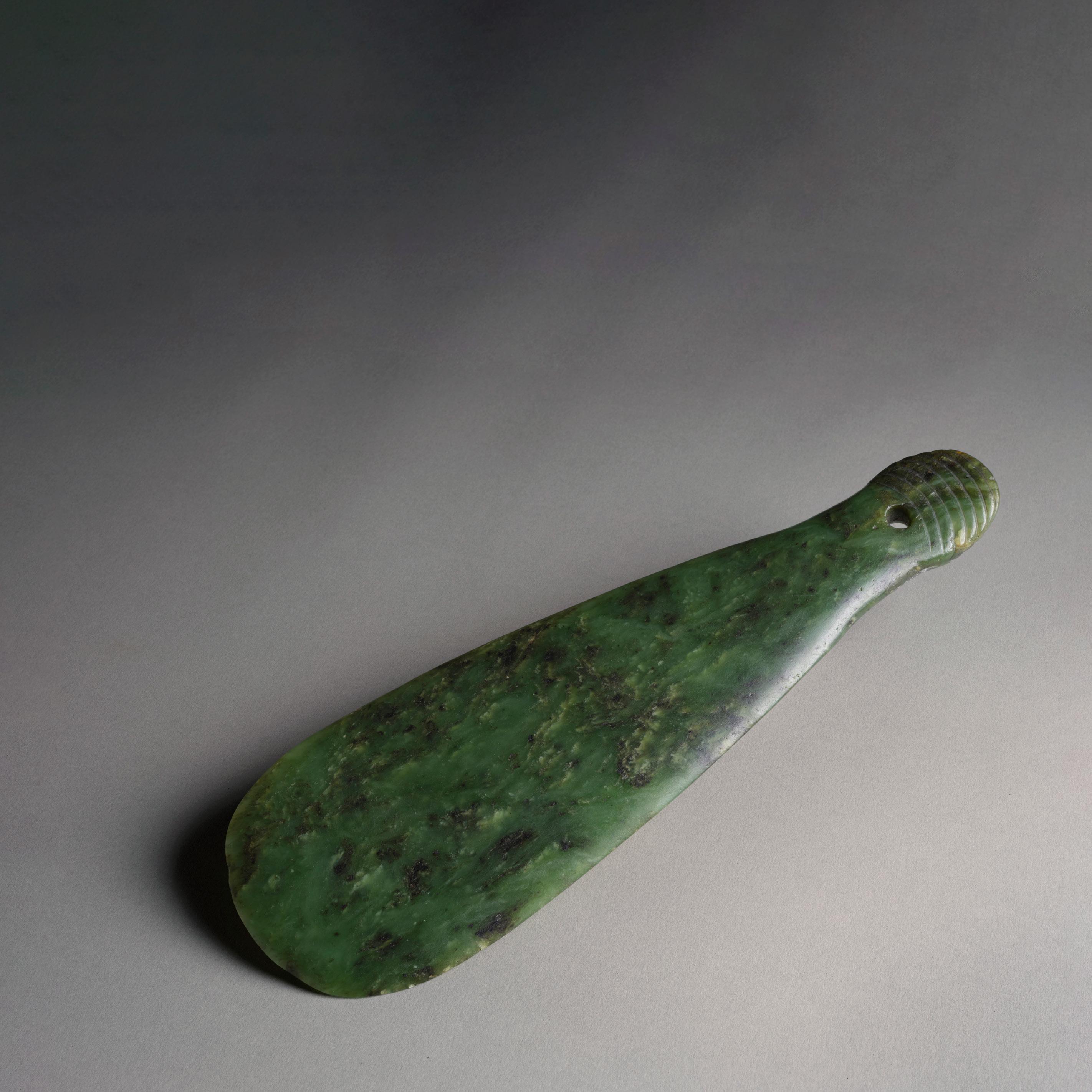
A Ngatai Tarawhai Pipe Attributed To Tene Waitere Māori, Aotearoa, New Zealand, Rotorua, Late 19th – Early 20th Century
The bowl carved with three wheku heads and fine rauponga, inscribed Kia ora to one side, with a sterling silver band. Marks for Birmingham 1900, with a later early bakelite mouthpiece. In original leather plush-lined case with old label.
15cm length
PROVENANCE
Patrick O'Connor Collection, Auckland
$2,000–3,000
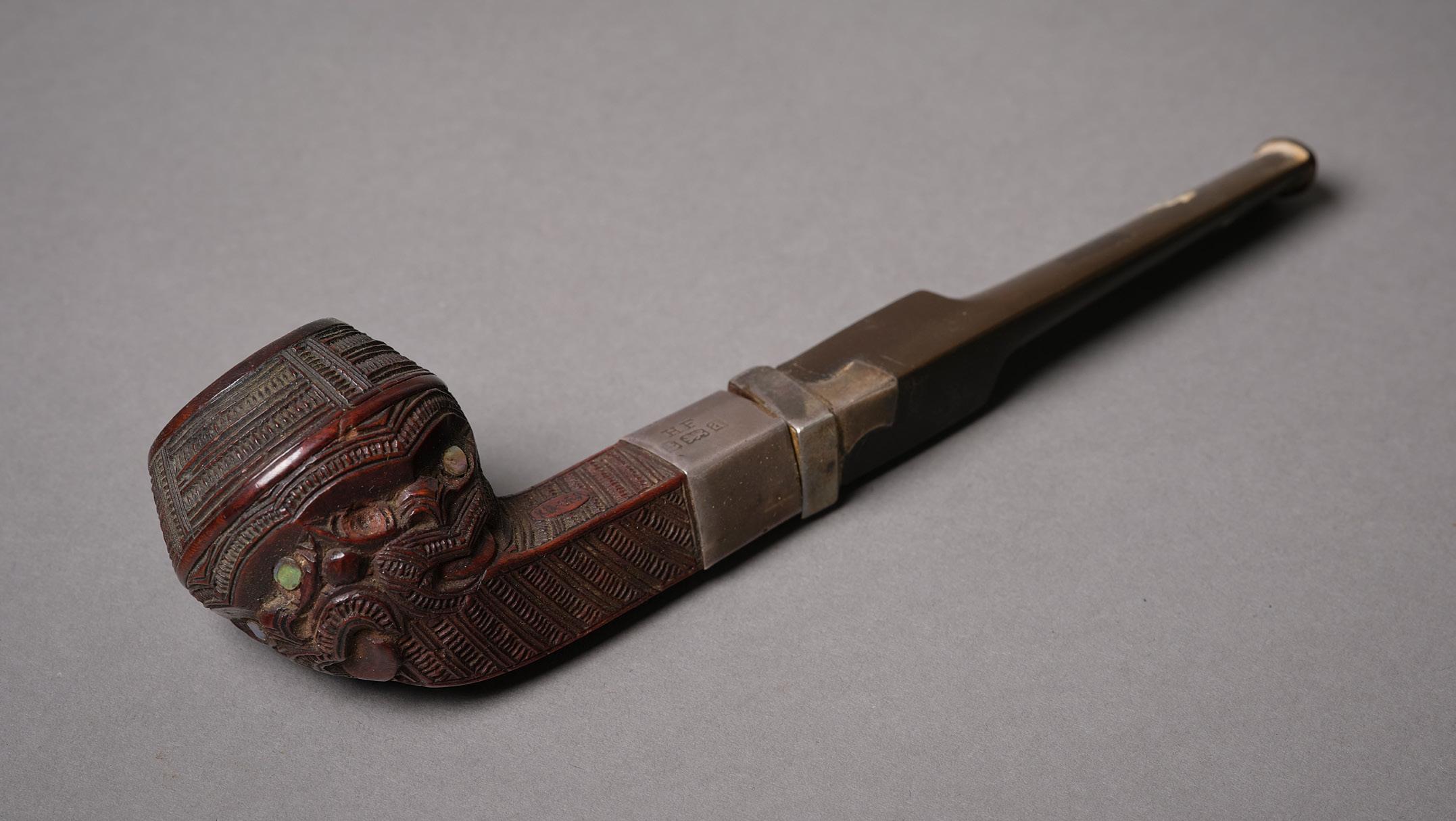
THOMAS PRINGLE
NEW ZEALAND, AOTEAROA, 1858-1931
Māori Girls, Whakarewarewa
Carbonette photo
Conservation mounted and framed. 18cm x 22cm
LITERATURE
Māori Studies by Thomas Pringle, 1907
$400–800
68
THOMAS PRINGLE
NEW ZEALAND, AOTEAROA, 1858-1931
Poi Dancer, Whakarewarewa
Carbonette photo
Conservation mounted and framed. 18cm x 22cm
LITERATURE
Māori Studies by Thomas Pringle, 1907
$400–800
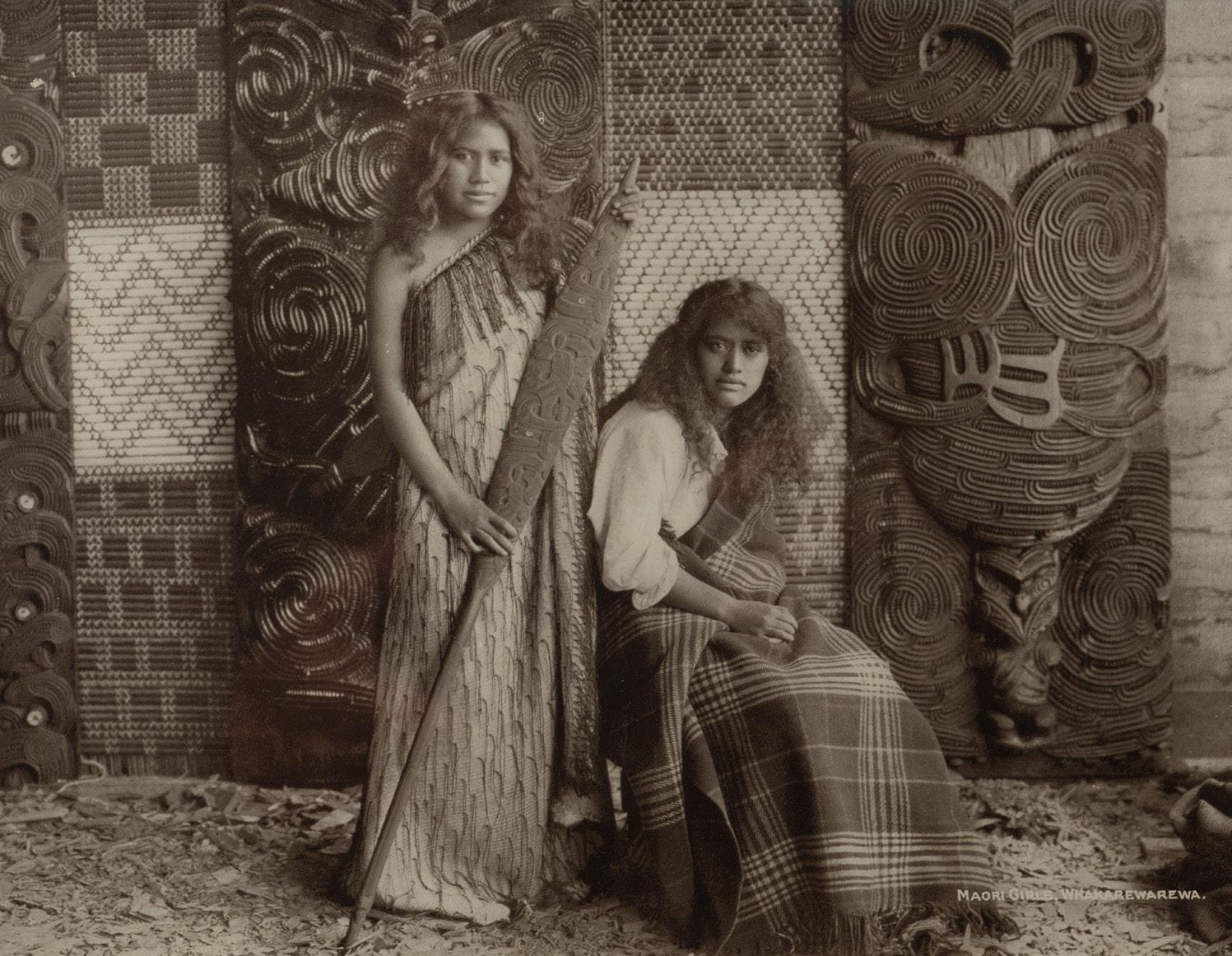
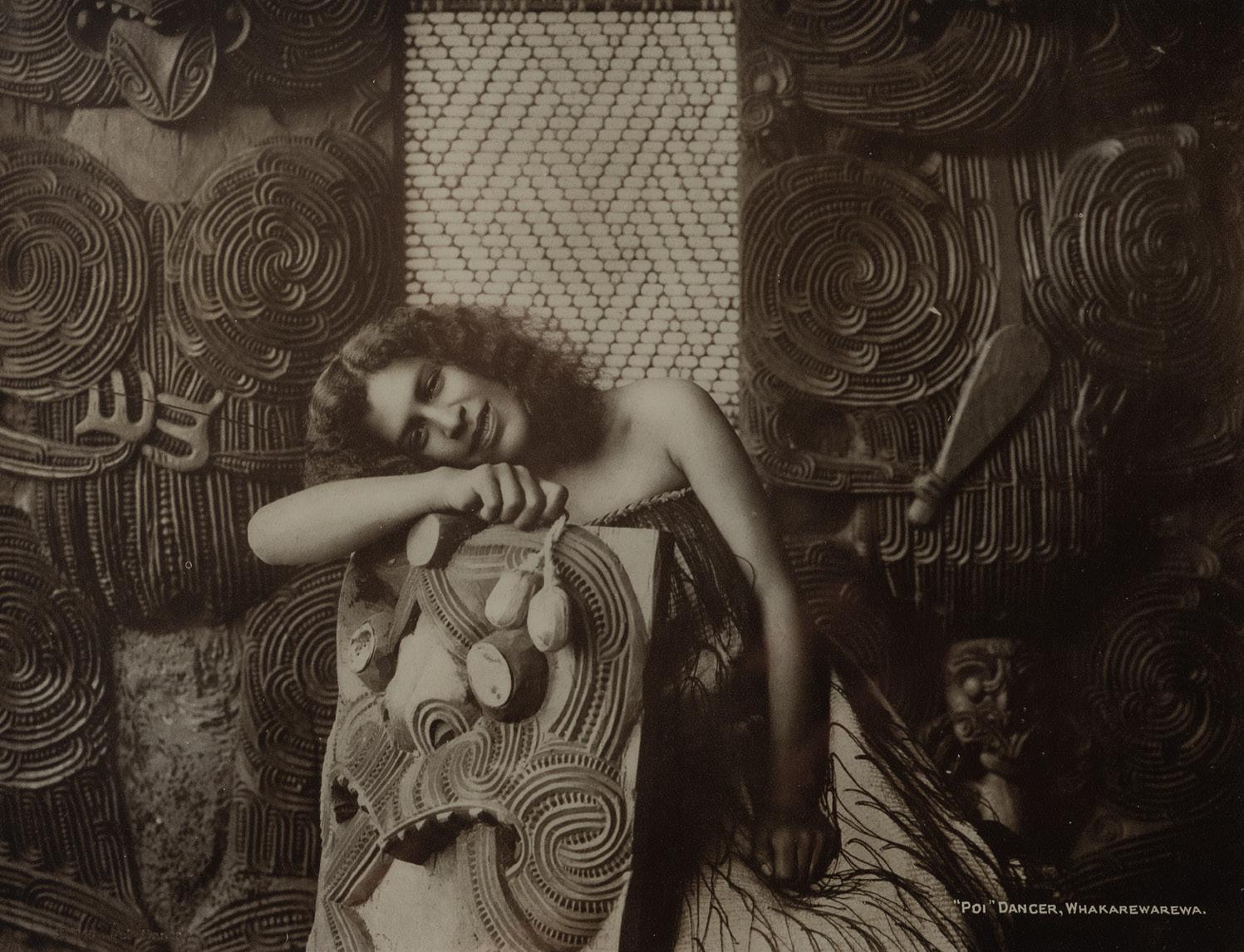
A Rare And Important Pre-European Tekoteko Gable
Figure
Māori, Aotearoa, New Zealand, Late 18th to Early 19th Century
Stone-tool carved, totara wood, paua shell inlay. This tekoteko, carved from totara, represents a standing ancestor figure that would have been lashed to the gable of a small whare or pataka. The ancestral figure is carved with stone tools, its surface bearing the deep weathering and patina consistent with long exposure to the elements. The face is naturalistic, with finely executed ta moko incisions and eyes inlaid with paua shell that retain their iridescent depth. The three-fingered hands are held to the abdomen. Although European contact had begun in parts of Aotearoa by the early nineteenth century, its influence on carving traditions in many regions remained limited. The restrained ornamentation, and stone-tool execution of this figure align with carving practices that continued largely uninterrupted by external materials or techniques at this time.
Tekoteko such as this were positioned at the apex of the gable, embodying the protective presence of the ancestors and asserting the mana of the house and its occupants. The survival of this example, with its original surface intact and its shell eyes still present, is exceptional. It stands as a powerful testament to the artistry and continuity of Māori carving during a period of limited but emerging external contact.
Protected Objects Act (1975) Registration number Y 21805
74cm height, 11cm width
PROVENANCE
Collected by John Nicholson, a Church of England missionary in the late 19th century Private Collection, England Repatriated to New Zealand, circa 1980s Peter Stratford Collection Private Collection, Auckland
$150,000–250,000
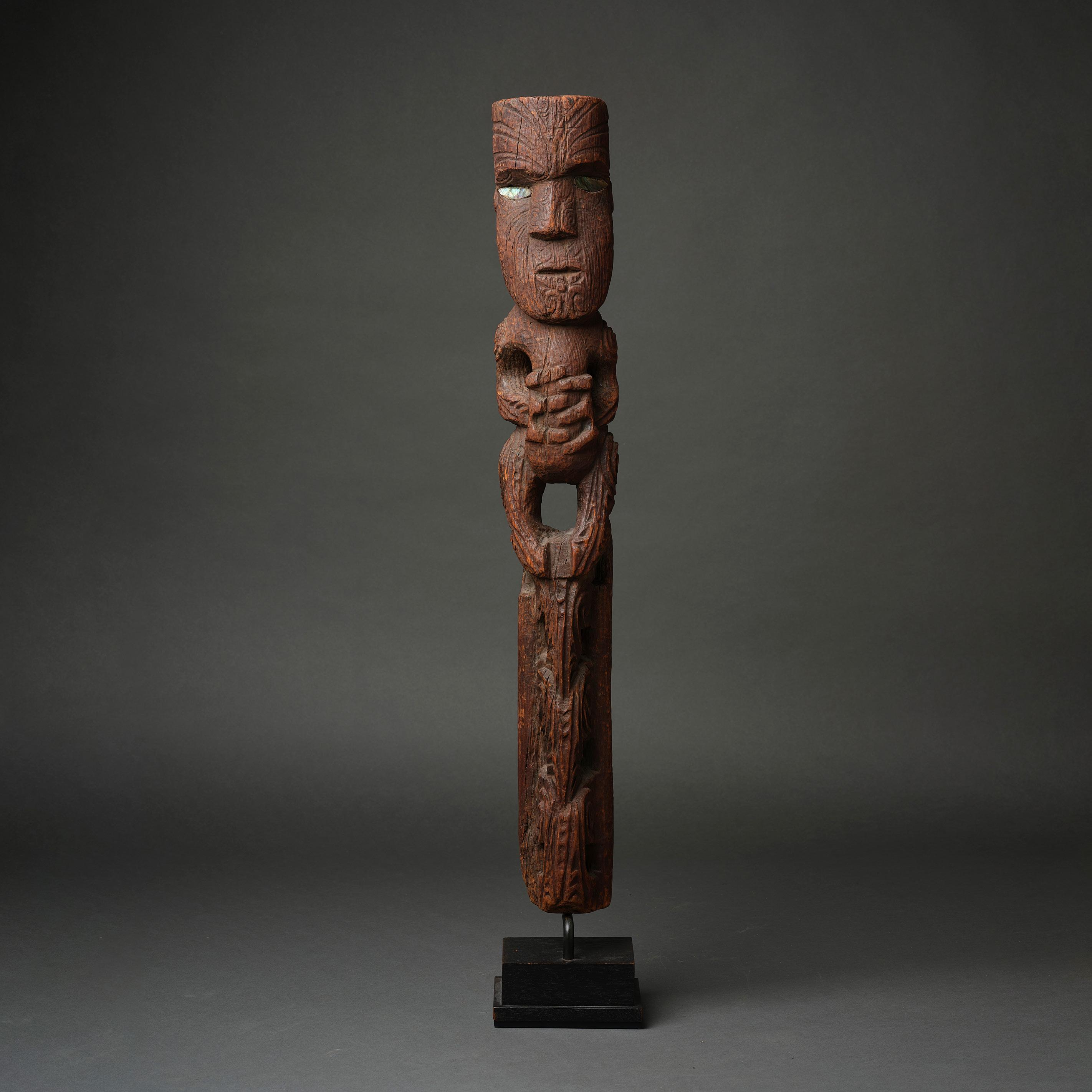
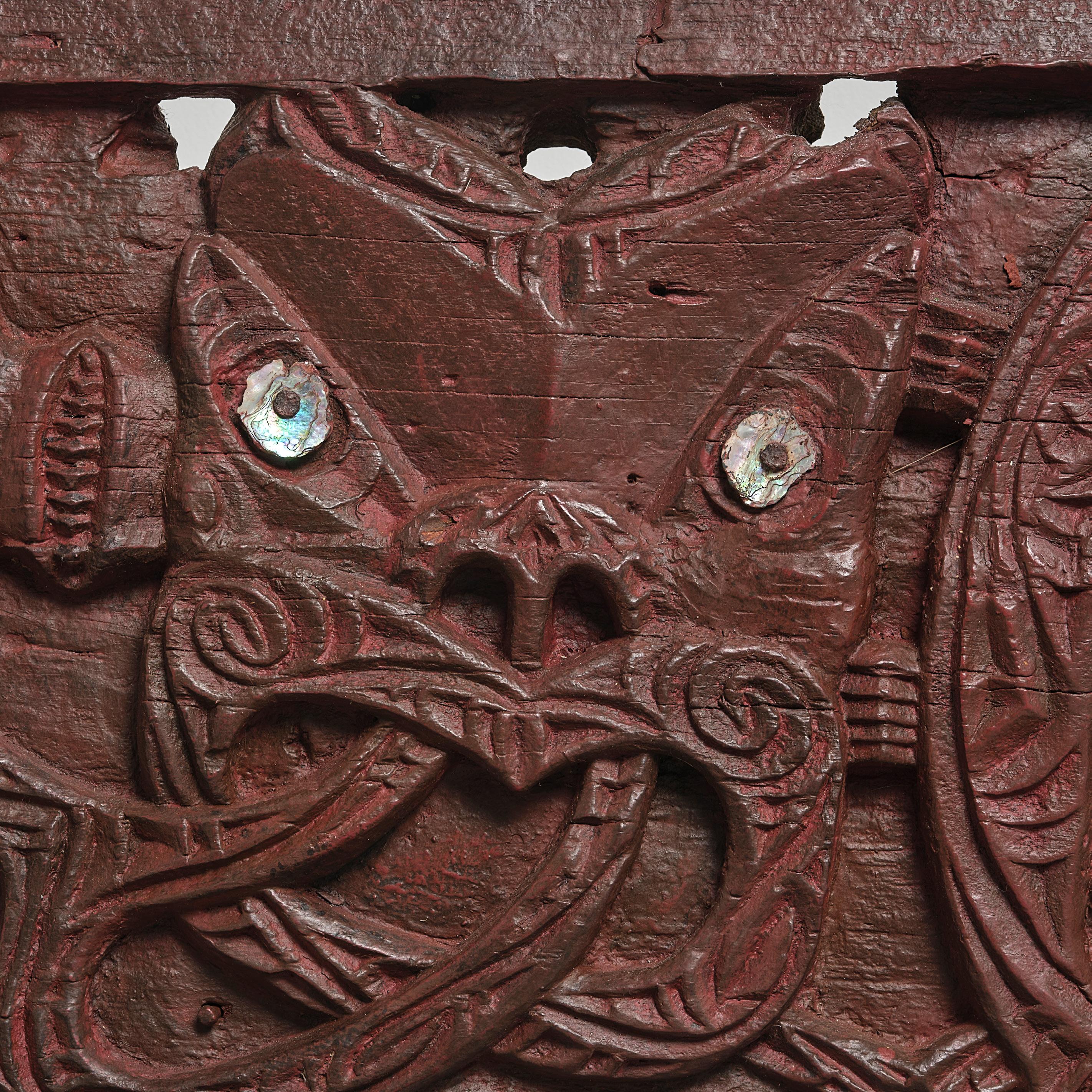
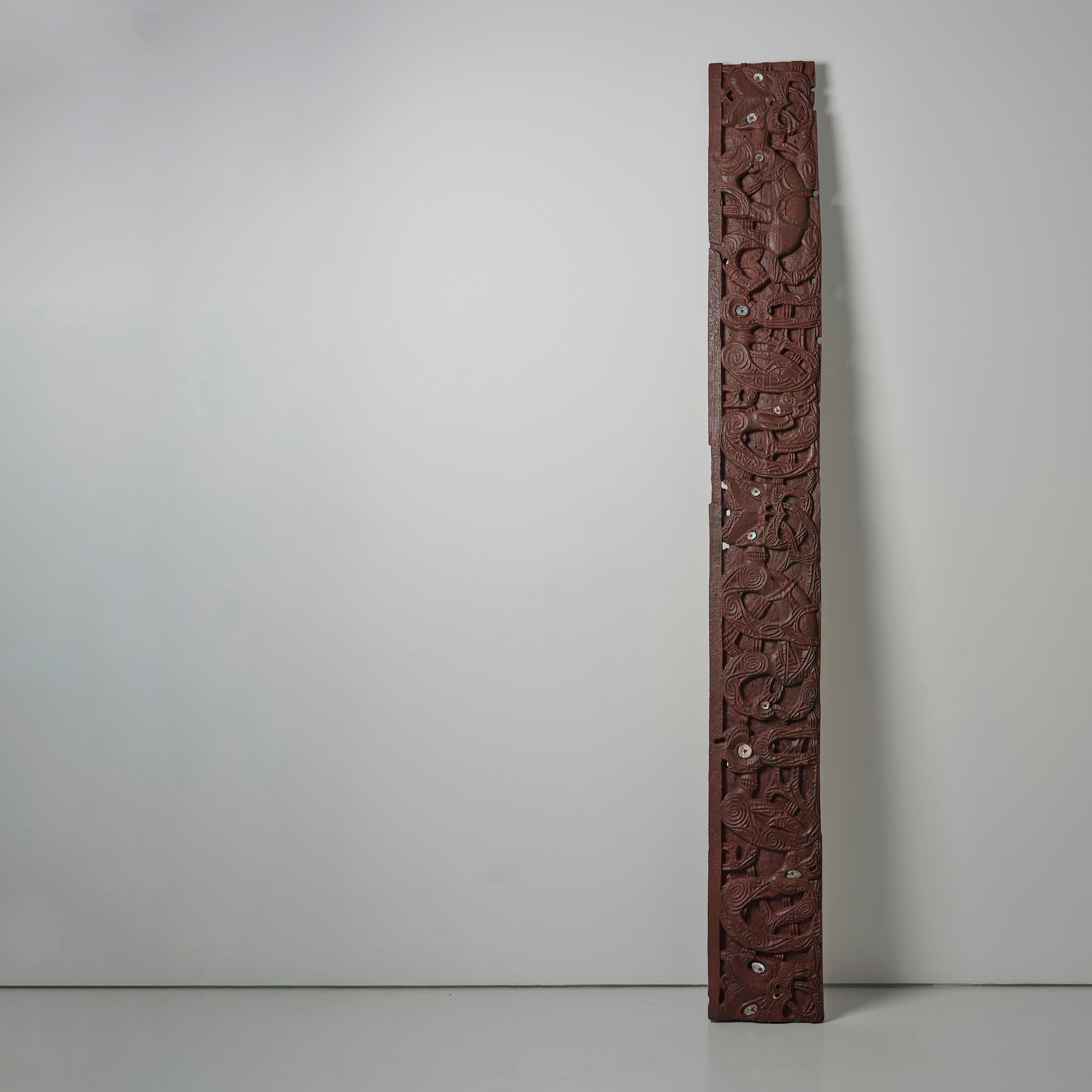
70
A Rare Waka Taua Rauawa (Gunwale)
Māori, Aotearoa, New Zealand, Early 19th Century
Carved with side profile ancestral figures with wheku heads interlinked with mania figures with cut paua shell eyes.
Pierced with holes to the upper and lower section to enable the board to be attached to the waka taua (war canoe).
Red ochre painted finish. Fully restored to museum standards.
Protected Objects Act (1975) Registration Number Y 22608
246cm length, 30cm width
PROVENANCE
Peter Stratford Collection, Auckland
Patrick O'Connor Collection, Auckland
$25,000–35,000
Cross-cultural Connections
A Major Architectural Poupou from the Thomas Darby Ryan House, Rotorua
A true polymath, Thomas Darby Ryan excelled across the sporting and artistic worlds and was also a soldier, adventurer, and entrepreneur. Selected in 1884 for the first national rugby team, Ryan became the first All Black to score points for New Zealand, a distinction that gave him considerable standing among Māori communities, many of whom were passionate followers of the sport. In 1892 this well known New Zealand artist and international rugby representative settled in the Rotorua-Taupō district.
During his years in Rotorua, Ryan’s admiration for Māori culture deepened, and he formed close relationships with local iwi. His sporting reputation opened doors, and through these connections he played a pivotal role in introducing his close friend, Charles F. Goldie, to prominent Te Arawa figures. This relationship would, in turn, lead to some of Goldie’s most celebrated portraits. Ryan also produced numerous portraits and sketches of local Māori, including Te Kooti, several of which are now held in museum collections such as in the national collection at Te Papa Tongarewa.
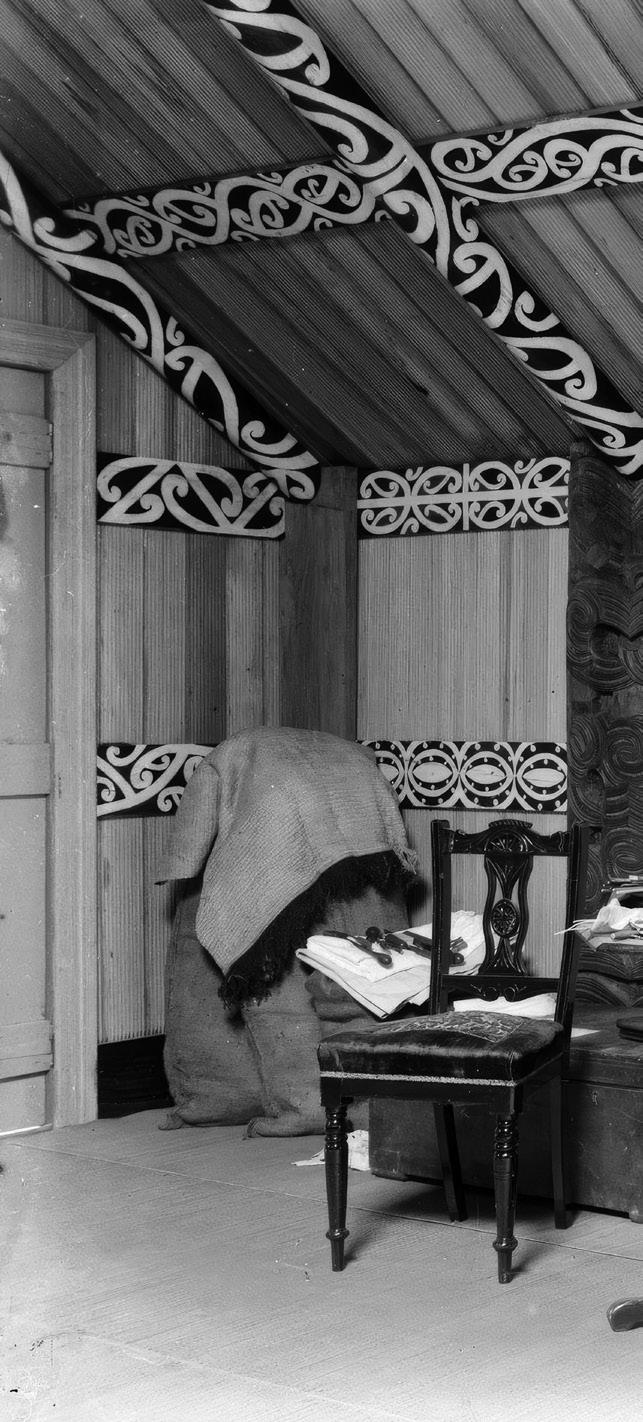
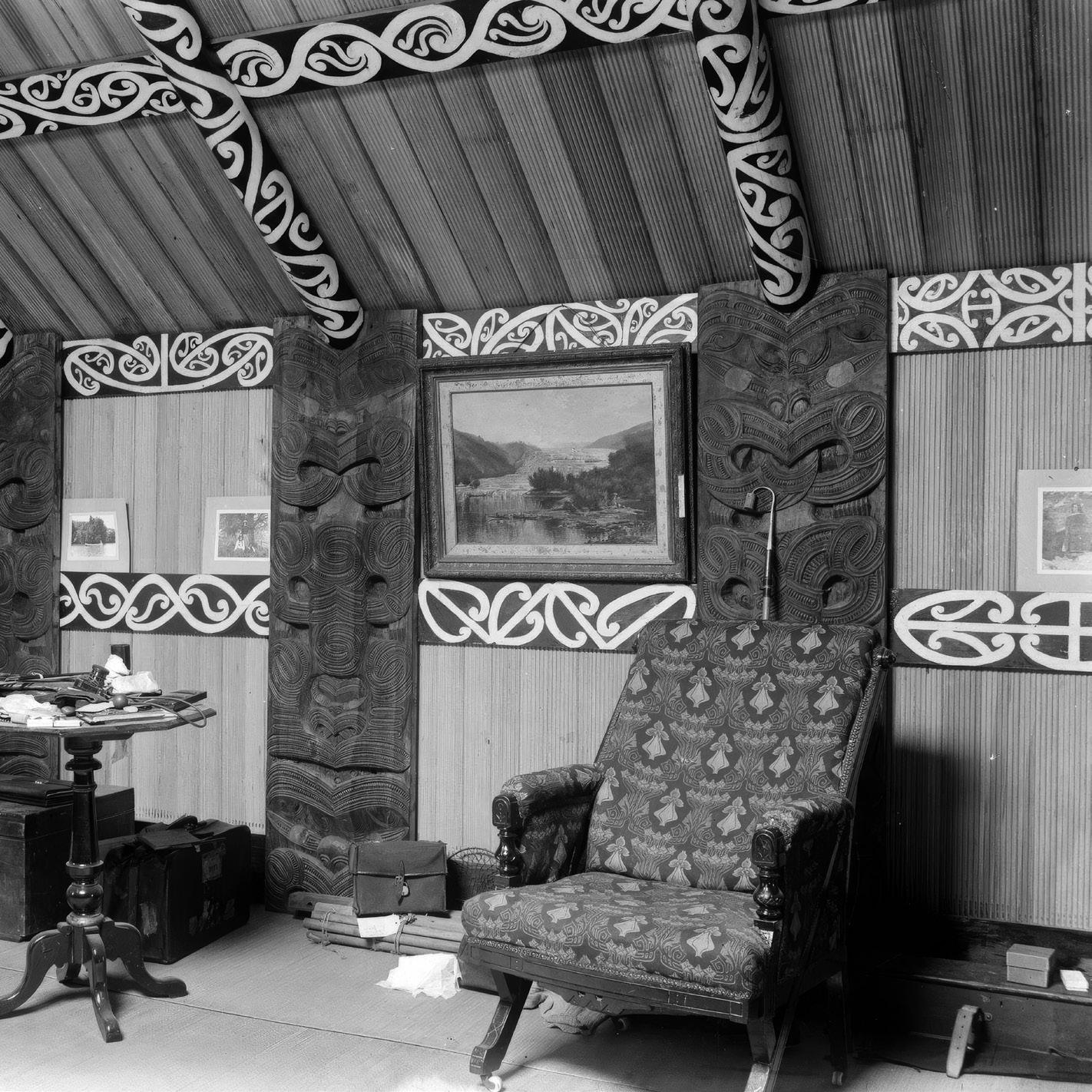
In 1901, Ryan married Mary Faith Murray, daughter of Ngāpuhi leader Kamareira Te Hautakiri Wharepapa, and in the same year secured a 99-year lease on land in Fenton Street, Rotorua. Ryan set about building a home, commissioning skilled Ngāti Tarāwhai carvers to incorporate traditional wharenui elements into the construction. The resulting building stood as an early and important example of cross cultural architecture, blending Western domestic design with Māori structural and decorative components. The exterior featured carved amo, maihi, and pāpāe boards, while the interior included a central tāhuhu, painted kowhaiwhai rafters, and superbly carved poupou. Later, Ryan was to commission a second, similar structure to be built in Taupō.
At the time the Rotorua Ryan house was built, a new phase of carving, shaped by both Māori innovation and Pākehā demand, was flourishing in the region.
A distinguished group of Ngāti Tarāwhai and related carvers, including Wero Tāroi, Ānaha Te Rāhui, Neke Kapua were producing a significant body of work. Their output was driven in part by the expanding tourism industry centred on Rotorua and, before their destruction, the famed Pink and White Terraces. Ryan himself became part of this thriving industry, working as a boat skipper ferrying visitors across Lakes Tarawera and Taupō.
The combination of large scale iwi building projects and European patronage for hotels and other structures created abundant opportunities for Ngāti Tarāwhai,
Ngāti Whakaue, and Ngāti Pikiao carvers to demonstrate their mastery across all forms of whakairo. Traditional forms were adapted to meet tourist and local demand.
New hybrid forms emerged: chalices, figural pipes with wheku heads, and tokotoko with anthropomorphic handles. Wakahuia, traditionally suspended from wharenui rafters, evolved into figural supported bowls designed to stand on European tables. Some of the finest works featuring this adaptive creativity were produced by Tene Waitere and Patoromu Tamatea, many fine examples of which now reside in major museum collections, including Te Papa Tongarewa and the Auckland War Memorial Museum.
Among the most remarkable expressions of this cross cultural period is Tene Waitere’s Ta Moko panel, carved in the late 1890s for Augustus Hamilton and now held in the national collection at Te Papa Tongarewa. Waitere was active across both monumental and small scale carving. At the time the Ryan house was constructed, he was simultaneously engaged in major projects including the wharenui Nuku te Apiapi, the Whakarewarewa observation rotunda, and Te Wharepuni a Māui, carved for Trade and Immigration Commissioner Thomas Donne. Waitere was also the principal carver of Tūhoromatakā, the home of Guide Maggie Papakura, completed in 1909.
Although no surviving documentation definitively attributes the carvings of the Ryan house to Tene Waitere, the case for his craftsmanship rests on several compelling lines of evidence. The timing aligns with
a period when Waitere was deeply engaged in large scale architectural work across both Rotorua and Taupō. This poupou is identical to the panels carved for the interior of the Ryan house in Taupō, and the stylistic correspondences are unmistakable. Waitere was the dominant carver active in Taupō during precisely the period Ryan was resident there. He regularly undertook commissions for culturally engaged European patrons and is known to have been associated with Ryan. These two houses represent major architectural projects commissioned by an important Pākehā patron and closely connected to the Ngāti Tarāwhai carving community.
Family provenance further strengthens the attribution.
The family who owned the house prior to its deconstruction maintained a strong oral history, passed down through generations, affirming that the carvings were by Tene Waitere and were produced at Whakarewarewa, the centre of Ngāti Tarāwhai carving activity. Many of the major architectural commissions of the era, wharenui, private homes, tourist structures, and exhibition pieces, were carved there. As with other large scale projects of the period, Waitere likely worked alongside fellow Ngāti Tarāwhai carvers on the two Thomas Derby Ryan houses, reflecting the collaborative nature of whakairo practice at the time. Taking into account the architectural context of the period and Waitere’s role within it, the structural parallels to the Taupō residence, and the familial testimony, a persuasive evidential chain emerges.
The Thomas Darby Ryan house in Rotorua remained in situ until 1962, when it was deconstructed. The carvings were then put into storage and remained there until 2023, when they were offered for sale at Dunbar Sloane by the family that had owned the property for generations. This is one of the poupou from that important collection.
Thomas Darby Ryan and Tene Waitere each moved with ease between Pākehā and Māori worlds, and the carvings from the Ryan house stand as material expressions of their shared space. These works are not simply architectural embellishments; they embody the relationships, negotiations, and mutual respect between Māori and Pākehā that shaped Rotorua in the late nineteenth and early twentieth centuries. In their form and function, they reveal a moment when Māori artistic knowledge and Pākehā patronage intersected. The poupou from the Ryan house is therefore more than a surviving fragment of a lost building. It is a testament to the creative partnerships that flourished in this period, to the adaptability and brilliance of Ngāti Tarāwhai carvers, and to the ways in which individuals like Ryan and Waitere helped forge new cultural landscapes. This taonga continues to speak to the enduring depth of those connections – a carved record of a shared history.
James Parkinson
A Ngatai Tarawhai Poupou Post Attributed To Tene Waitere
Māori, Aotearoa, New Zealand, Early 20th Century
Carved with an ancestral figure with wheku head with protruding tongue and circular disc eyes surmounting a wheku head at the base of the panel. Decorated with rauponga and pikorauru spirals
Protected Objects Act (1975) Registration Number Y 22399
186cm height x 48cm width
PROVENANCE
Private Collection, Rotorua
Patrick O'Connor Collection, Auckland
$30,000–40,000
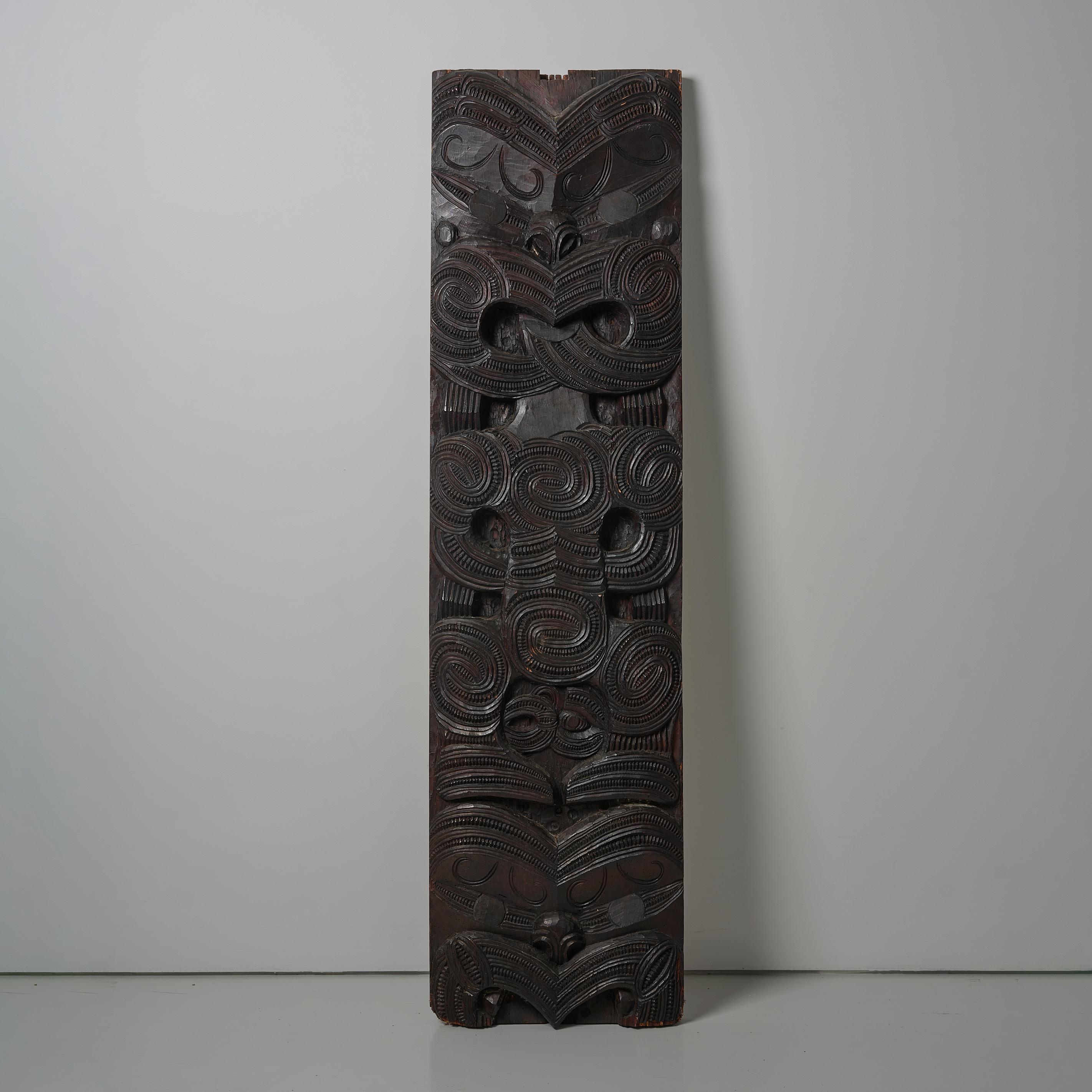
Shane Cotton
Aotearoa New Zealand, b.1965
Ngāpuhi, Ngāti Rangi, Ngāti Hine, Te Uri Taniwha, Māori
In the Shadow of The Valley, 2007
For more than twenty years, Shane Cotton has worked at the meeting point of written and carved language, of scripture and whakapapa. His paintings are sometimes the place where these elements all collide. His work, In the Shadow of the Valley (2007), presents one of the clearest and most direct examples of that argument. This important painting is one of three major works from that period, holding the same intensity and presence as Red Shift (Queensland Art Gallery) and Takarangi (Christchurch Art Gallery Te Puna o Waiwhetū)
The title of the work redirects the twenty-third Psalm, “I walk through the valley of the shadow of death”; however, Cotton is not painting the King James version. He paints the 1868 Paipera Tapu translation. That Bible carried the Psalms into Māori spiritual life and shaped Māori spiritual language to fit its own purposes. Cotton has been working inside that particular tension since the late 1990s. Powerfully, in The Shadow of the Valley, he lays it all bare. The text breaks into three colour bands, pale blue, bold red, and an acidic green, with the same scripture spoken three ways simultaneously. All of them, equally powerful, and none complete. This is what can
happen to language – after translation, settlement, conversion and recovery. It never comes back as a single voice. It returns empty of inherent meaning and can be used for very different purposes – to console or fracture, to heal, or to harm.
At the centre of the work stands an ancestral figure with a wheku face. Though painted, it has been crafted from the vocabulary of whakairo, takarangi spirals, koru, from the ridged brow and almond-shaped eye of a tekoteko, the full-frontal stance of a poupou. The ancestor is conjoined with a male human figure. Cotton has been bringing ancestor figures into his paintings for decades, and by this time, they have become a central presence. The figure dominating the painting is both monumental and powerful. The human figure has a penis, a detail that links directly to the biblical text running through the work. When early missionaries encountered carved palisade figures, they frequently removed the penis, seeing its presence as being incompatible with Christian teaching. Several early examples, with the penis cut away, survive in the national collection at Te Papa Tongarewa. Their altered forms remain as a testament to the cultural
pressures and moral frameworks imposed during that period by the arrival of Christianity in Aotearoa.
Two birds hang in the field, flanking the central figures, caught mid- fall or mid-flight, their bodies held in a charged pause that feels neither accidental nor resolved. They move within the orbit of the ancestor figure –close enough to matter, yet carrying a presence that the painting refuses to name, adding to the ambiguity of the message the work conveys. They come from the same world as Red Shift, in the Queensland Art Gallery collection. The bird recalls the manaia, the messenger, the intercessor, the protector. Whether they carry warning or blessing, the painting does not say.
Along the bottom edge the painting opens into whenua (land), low dark hills, the outline of what may be a pātaka perhaps. This is the valley of the title, the place the speaker walks. Cotton brutally flips the Psalm’s comfort on its head. There are no green pastures here, no still waters, no shepherd’s table. Everything in the valley is dark and foreboding. What remains, is the walking through the valley and the refusal to succumb to fear.
In the Shadow of the Valley defies resolution. While the Psalm offers some reassurance, the canvas does not. The ancestor holds the dominant position of strength within the work, while the text fractures around it. The scripture is in te reo and is also evidence of the burden te reo was made to carry – how scripture may offer consolation, while at the same time being fractious and divisive. Cotton, holds all of this to account, on one surface, at large scale. In the Shadow of the Valley is a truly impactful work, demanding your attention, while deliberate in its ambiguity. It asks what survives settlement and language translation and what does not, and what it means to keep walking through the valley, as Māori have done, since the arrival of European settlers in Aotearoa, unafraid with the birds still falling
James Parkinson
SHANE COTTON
NEW ZEALAND, AOTEAROA, 1965
In The Shadow of the Valley
Acrylic on linen
Signed S Cotton and dated 2007.
Inscribed In the Shadow of the Valley in brushpoint to the lower edge
180cm x 160cm
PROVENANCE
James and Melissa Parkinson Collection
EXHIBITED
Hamish McKay Gallery, The End of the Year – Group Show, 2007
LITERATURE
Paton, Justin, The Hanging Sky, Christchurch Art Gallery, Te Puna O Waiwhetu, Christchurch, 2013, p. 68,69
$100,000–160,000
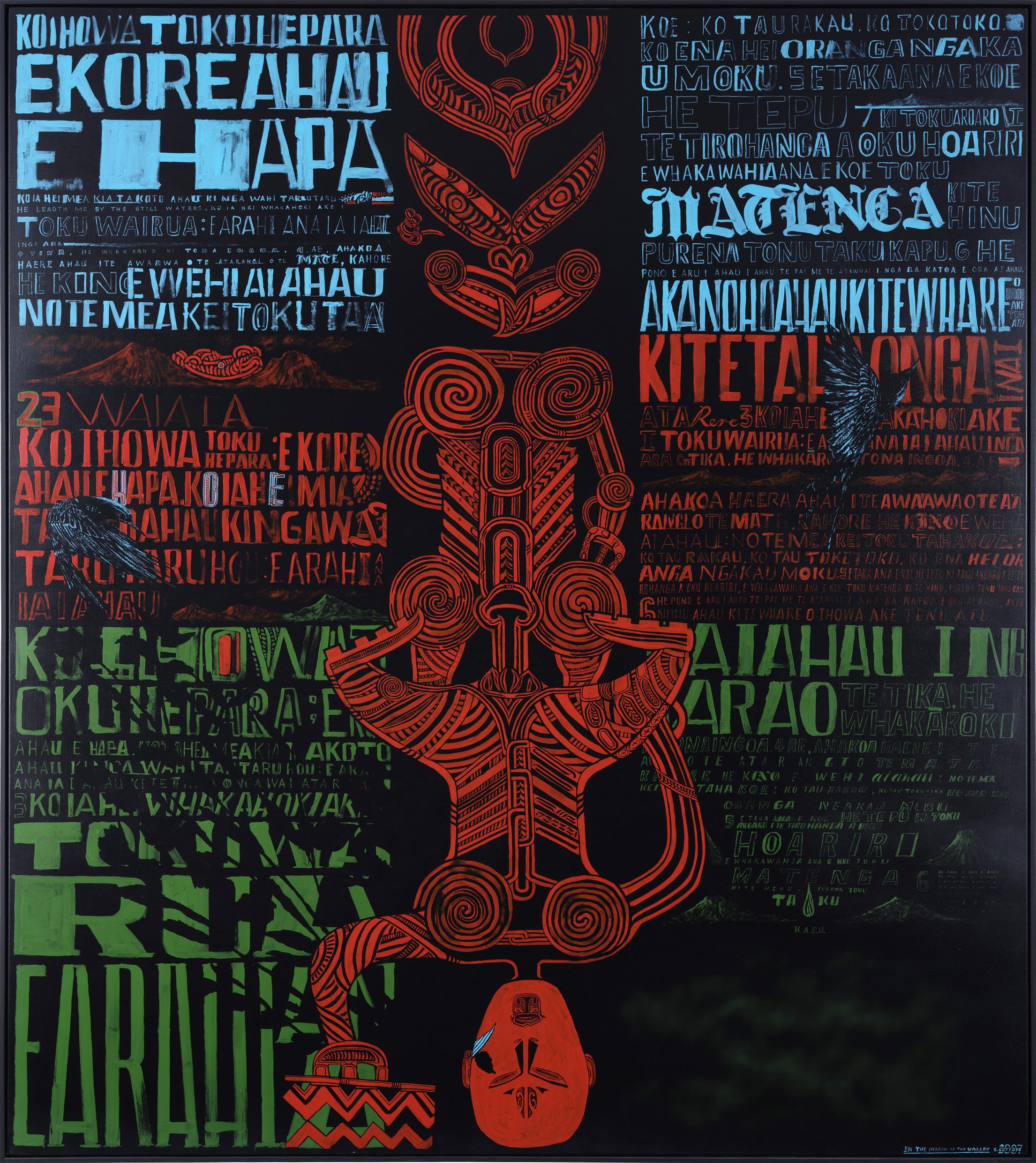
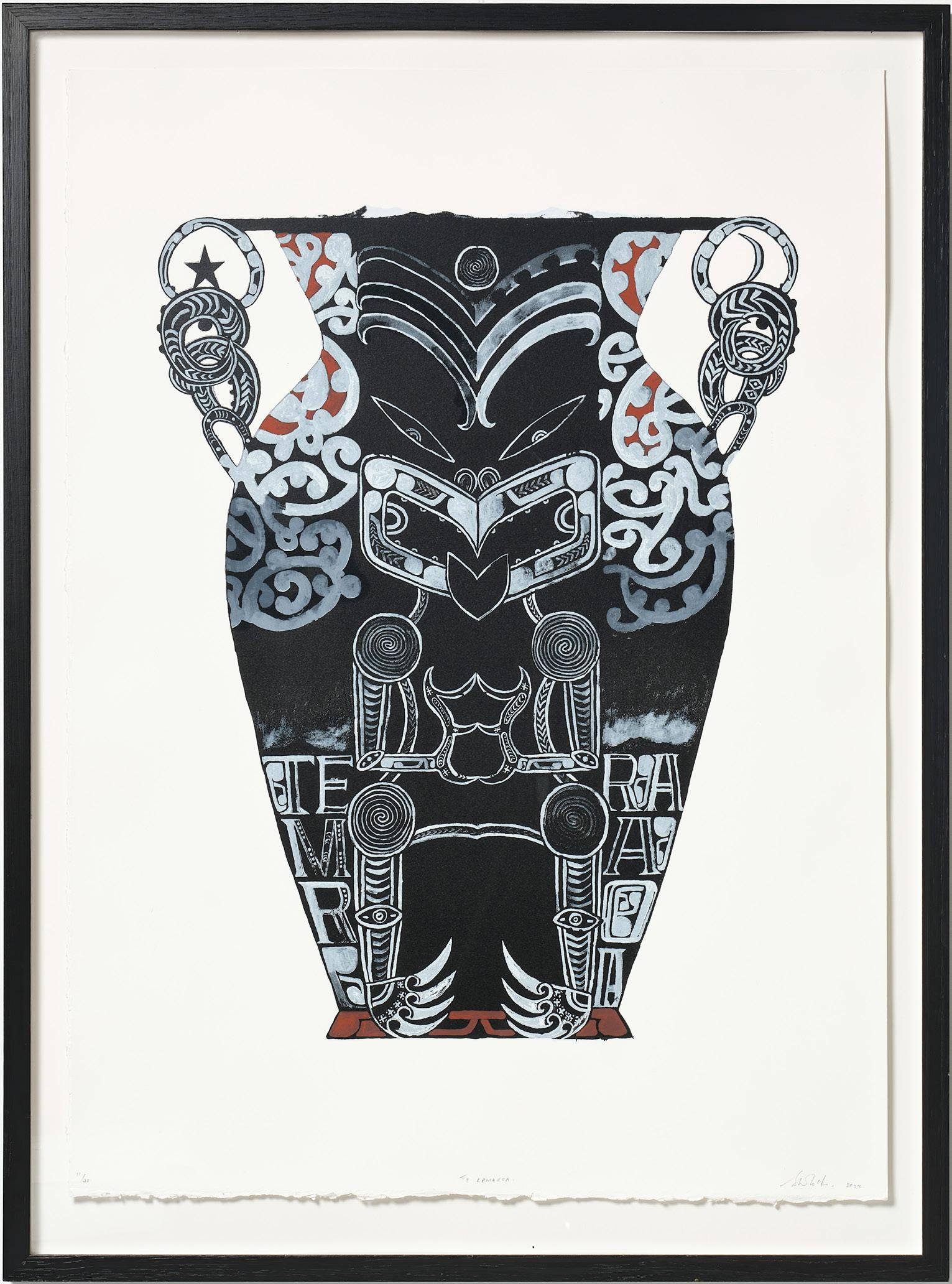
SHANE COTTON
NEW ZEALAND, AOTEROA, 1965
Te Ramaroa, 2022
Screenprint on Lanaquarelle 640gsm paper
Edition 11/40
Edition of 40 plus 10 artist's proofs
1050 x 760mm
PROVENANCE
Exhibited Tiki and Maunga: Shane Cotton, Auckland July 27th, 2022. Gow Langsford Gallery.
Collection Patrick O'Connor, Auckland.
$10,000–15,000
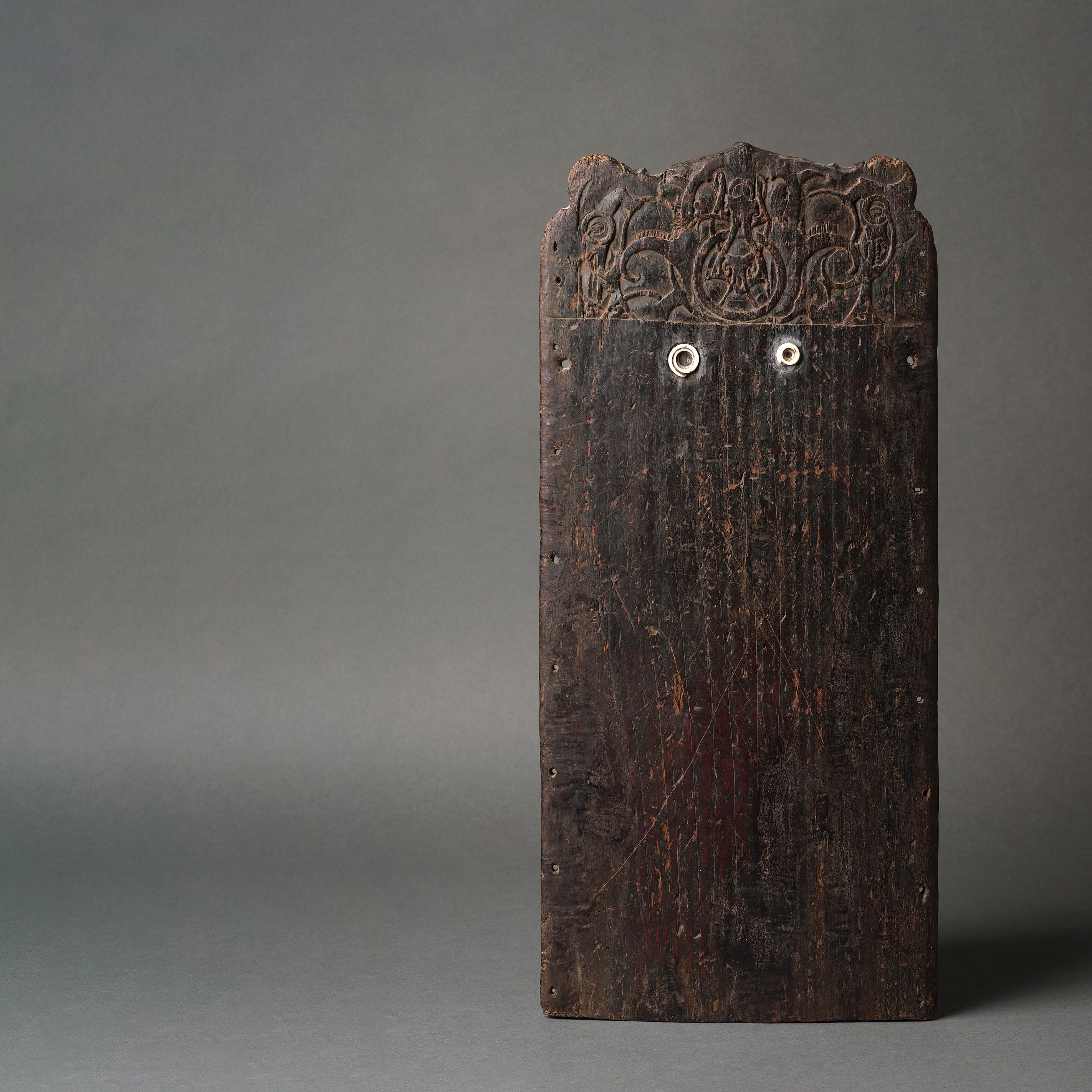
A Rare Backboard For A Carrying Basket
Indonesia, Kalimantan, Dayak People, Kayan, Bahau or Modang, 19th Century
The upper section with a protective figure and low relief carrying above inlaid circular shell discs. 54cm height x 27cm width
PROVENANCE
Marc Pinto Collection
REFERENCES
Similar but more extensively carved examples can be seen in the Yale Univeristy Art Gallery collection. Similar examples illustrated in Johnson, Mark A.
The Kayanic Tradition: Kayanic Dayak Art from Borneo. Volume II: Cultural Objects. Washington: Mark A. Johnson Tribal Art, 2024. Page 146, 147
$24,000–30,000
A Fine Naga Morsarang
Indonesia, Sumatra, Toba Batak, 19th Century
Ritual container made from buffalo horn, wood, iron and shell. The horn with carved finial depicting assorted totem like figures, the stopper in the form of a carved face surmounted by a diminutive human rider. Aged and varied black patina indicating great age and tribal use. 65cm length
PROVENANCE
John Graham Collection, Melbourne
$6,000–10,000
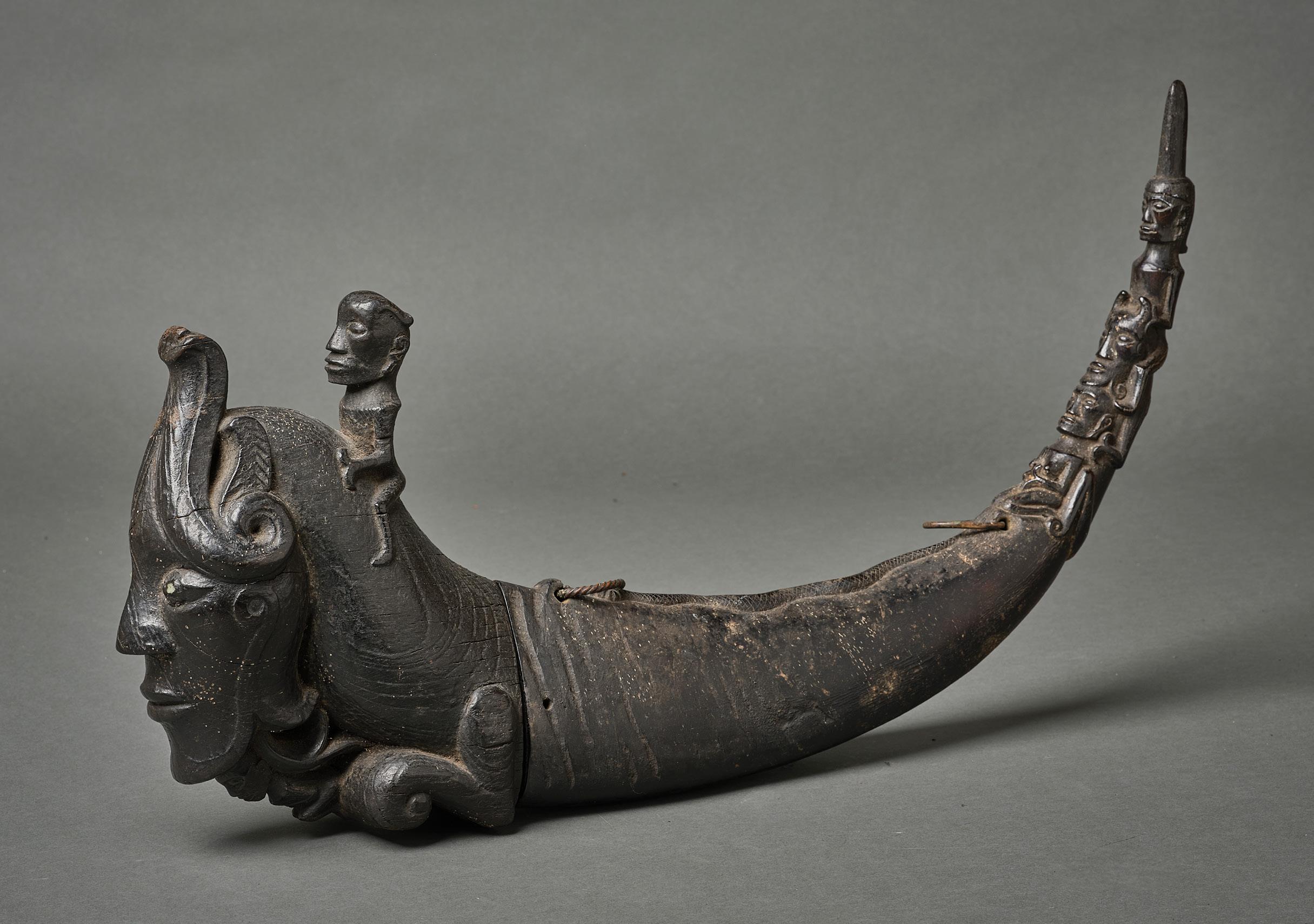
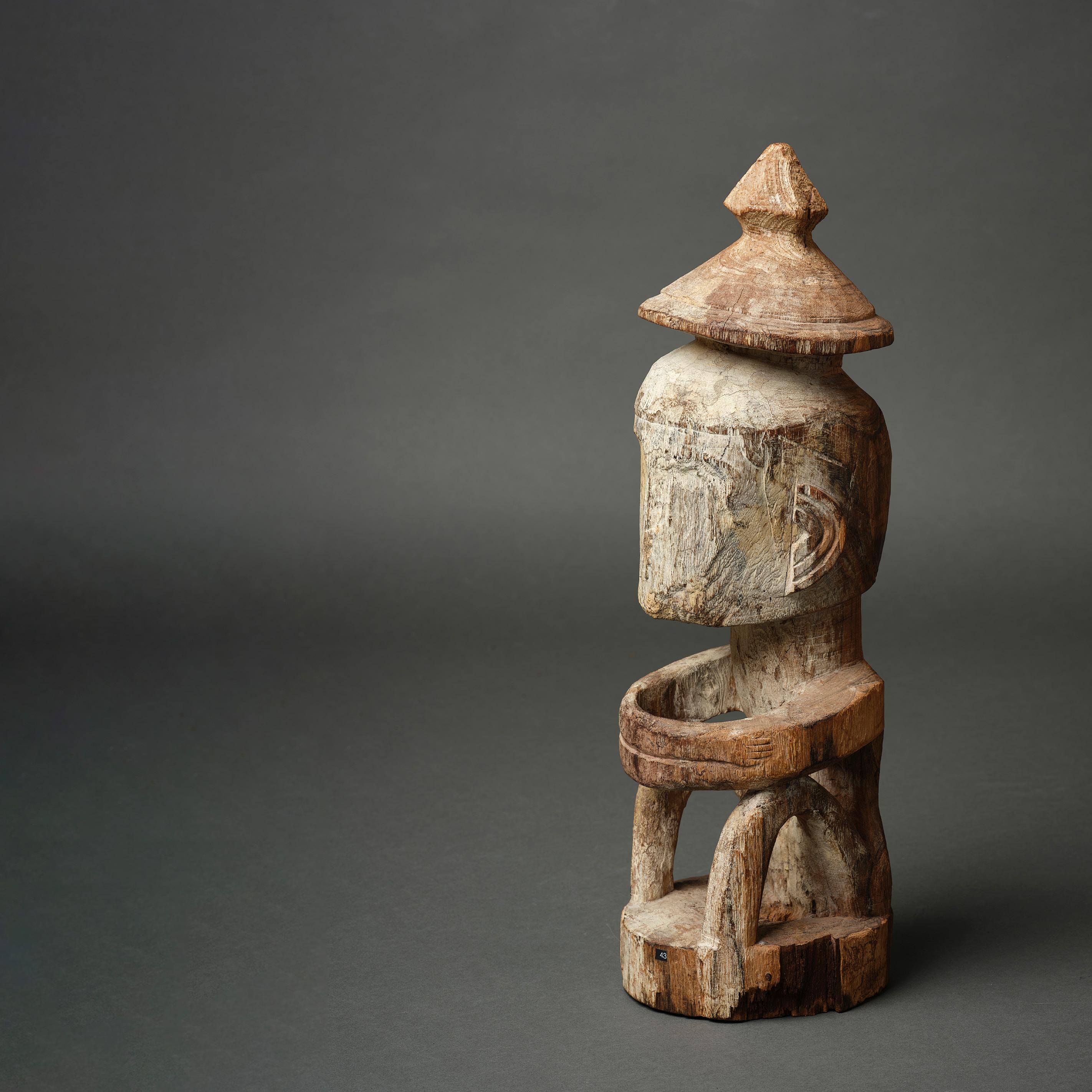
A Superb Rare Korwar Ancestor Figure Indonesia, Irian Jaya, Radja Ampat Islands, Waigeo Island, 19th Century or Earlier
This rare Korwar ancestor figure carries the unmistakable presence of the ancient world. Carved to house the spirit of a revered ancestor, Korwar figures were among the most sacred objects in the religious life of the Cenderawasih Bay and Radja Ampat people, consulted as oracles, kept close in moments of crisis, and treated as living embodiments of ancestral power.
This example displays the extraordinary patina developed from decades of concealment, the deep, silvered surface of wood long secreted in the darkness of a cave, emerging intact as both spiritual object and tribal sculptural masterwork. The tiered headdress the compressed architecture of the body, and the hollow basin at the figure's centre speak to a carving tradition of remarkable refinement. 47cm height x 12cm width x 13cm depth
PROVENANCE
Thomas Murray Collection, 2001
Marc Pinto Collection
PUBLICATIONS
Thomas Murray Asiatica, Ethnographic Catalogue 2001
$24,000–30,000
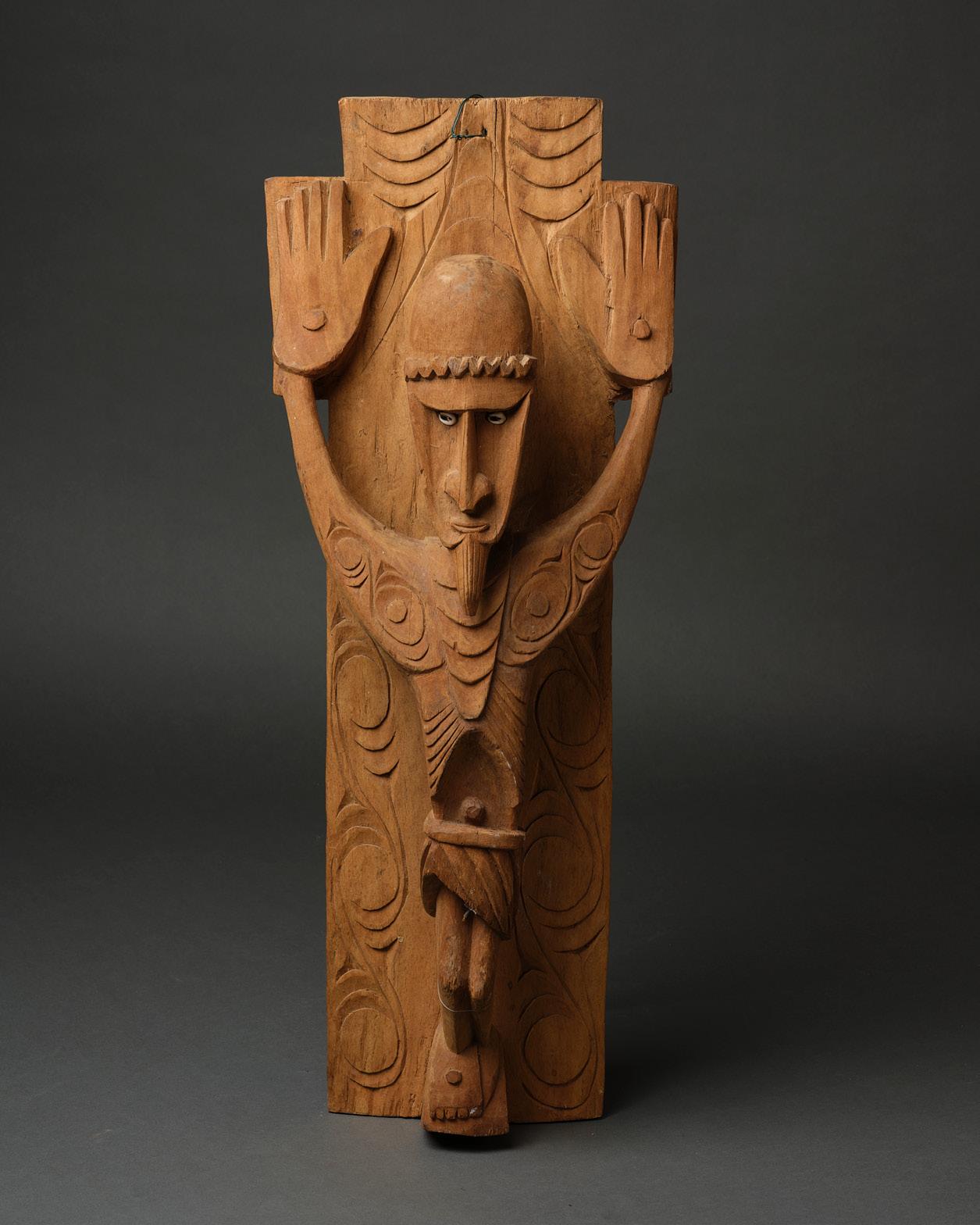
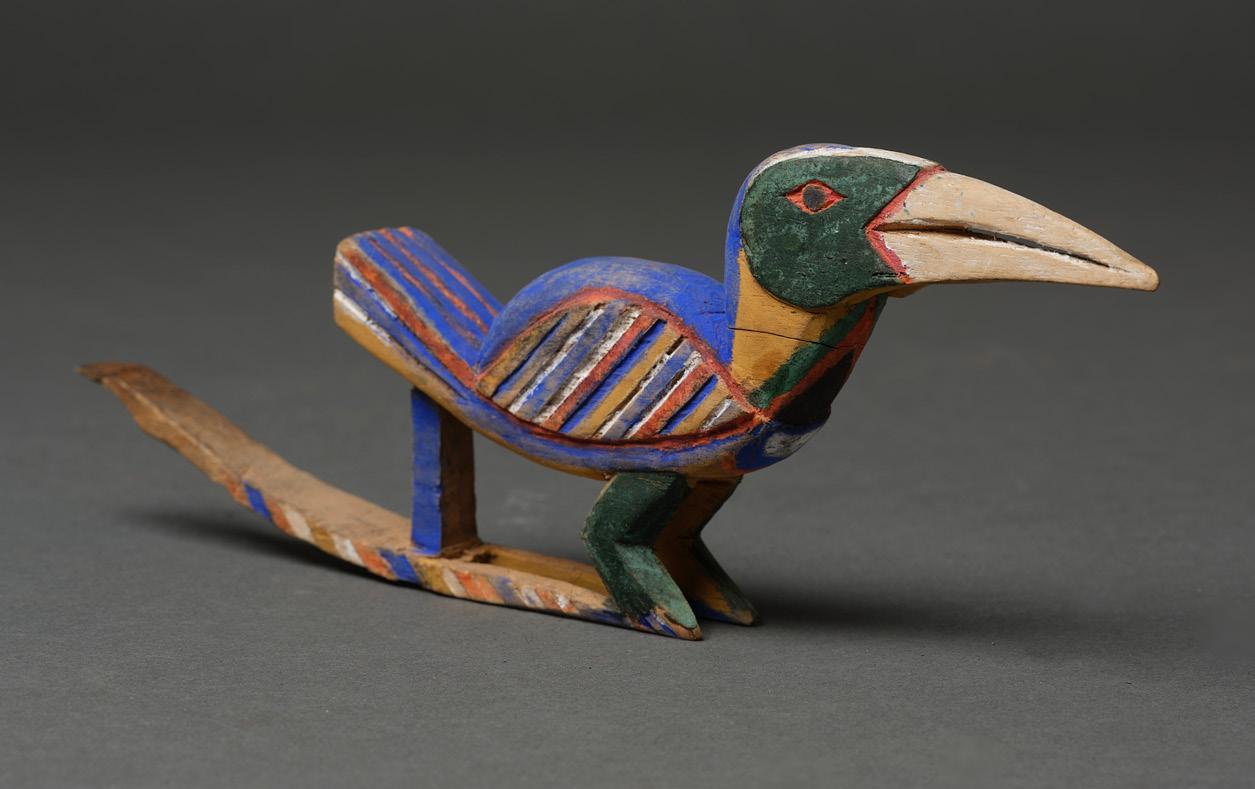
77
Sepik River Carved Crucifix
Papua New Guinea, Mid-20th century
Wood with pigment traces.
This expressive carving from the Sepik River region reflects the fusion of traditional carving aesthetics with introduced Christian iconography following the arrival of Catholic missionaries. The figure of Christ is rendered in a distinctly Sepik idiom, elongated limbs, stylised facial planes, and incised curvilinear motifs that echo ancestral design systems used on spirit boards and ceremonial posts. The hands and feet are exaggerated, the eyes inlaid to heighten presence, and the body framed by flowing scroll patterns symbolising vitality and spiritual continuity. Such works emerged as local carvers reinterpreted missionary imagery through their own visual language, creating hybrid devotional forms that speak to both conversion and cultural resilience. The piece retains its natural wood tone, with subtle surface patination from age and handling.
70cm height, 28cm width
PROVENANCE
Michael Graham Stewart Collection
Found Objects Collection
$450–800
78
A Malagan Mouth Ornament New Ireland, Early 20th Century
The carved Hornbill, symbolic of eloquence, painted in bold colours.
14cm length
PROVENANCE
Ivy Ashwin Collection (An Australian teacher living in Papua New Guinea 1921-1930)
$2,000–3,000
An Adu Zatua Figure Indonesia, Nias Island, 19th Century
The standing figure with conical shaped headdress and with hands resting on thighs. Mounted on a custom made stand.
35cm height x 7cm width x 6cm depth
PROVENANCE
William Zwiep Collection, The Netherlands
Mark Pinto Collection
$10,000–12,000 80
A Korwar Figure Indonesia, Irian Jaya, Geelvink Bay, 19th Century
25cm height x 11cm width x 12cm depth
PROVENANCE
Private Collection, The Netherlands
Marc Pinto collection
$16,000–18,000
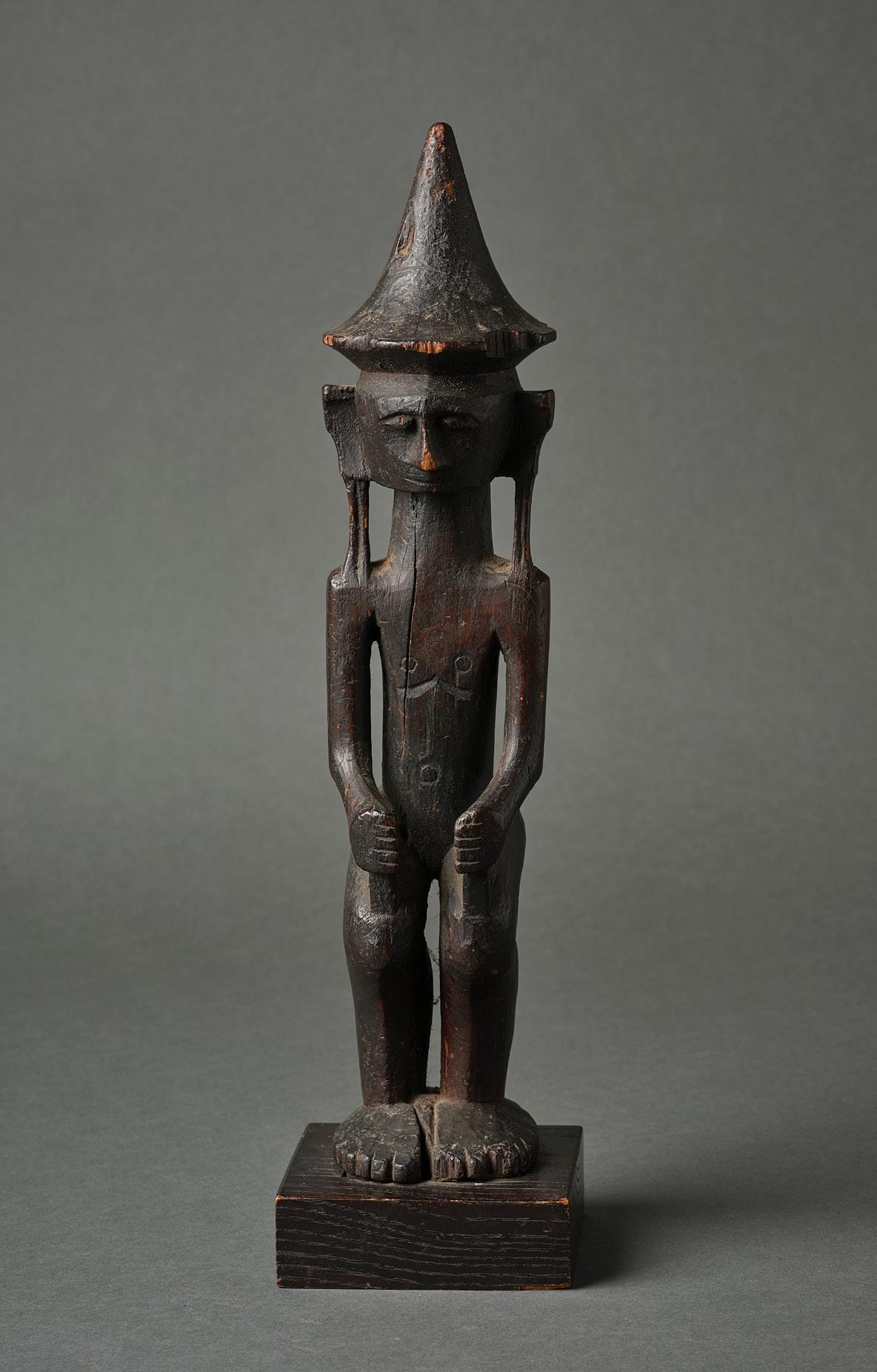
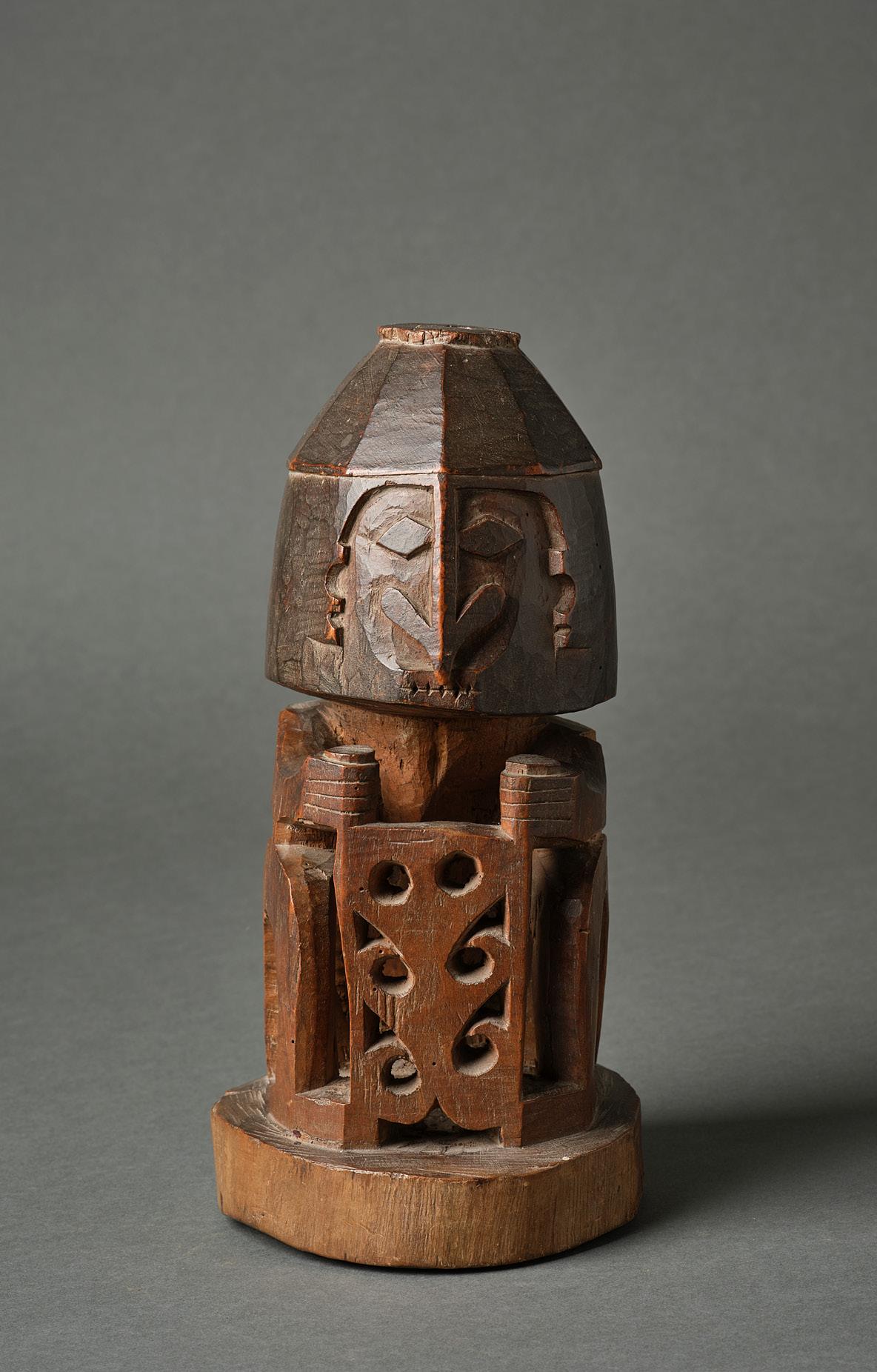
A Leti Figure
Indonesia, Leti Islands, 19th Century
The figure seated with arms folded. Raised on a custom made stand.
13.5cm height x 5cm width x 5cm depth
PROVENANCE
William Zwiep Collection, The Netherlands
Mark Pinto Collection
$16,000–18,000 82
A Batak Figure
Indonesia, Sumatra, 19th Century
13cm height x 2.5cm width x 3cm depth
PROVENANCE
Goldman Collection, Netherlands
Els Verheij Collection, Netherlands
Marc Pinto Collection
$2,000–3,000
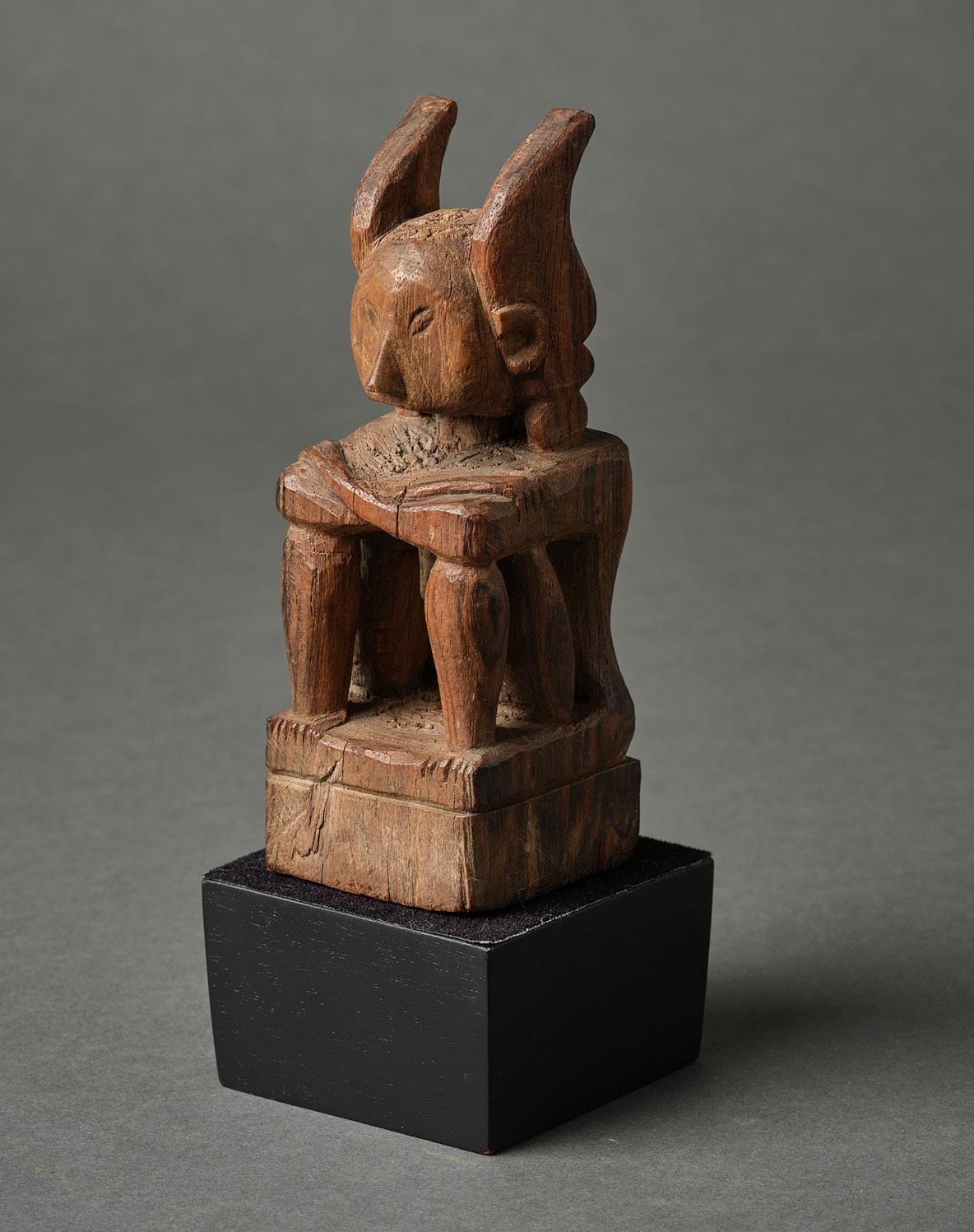
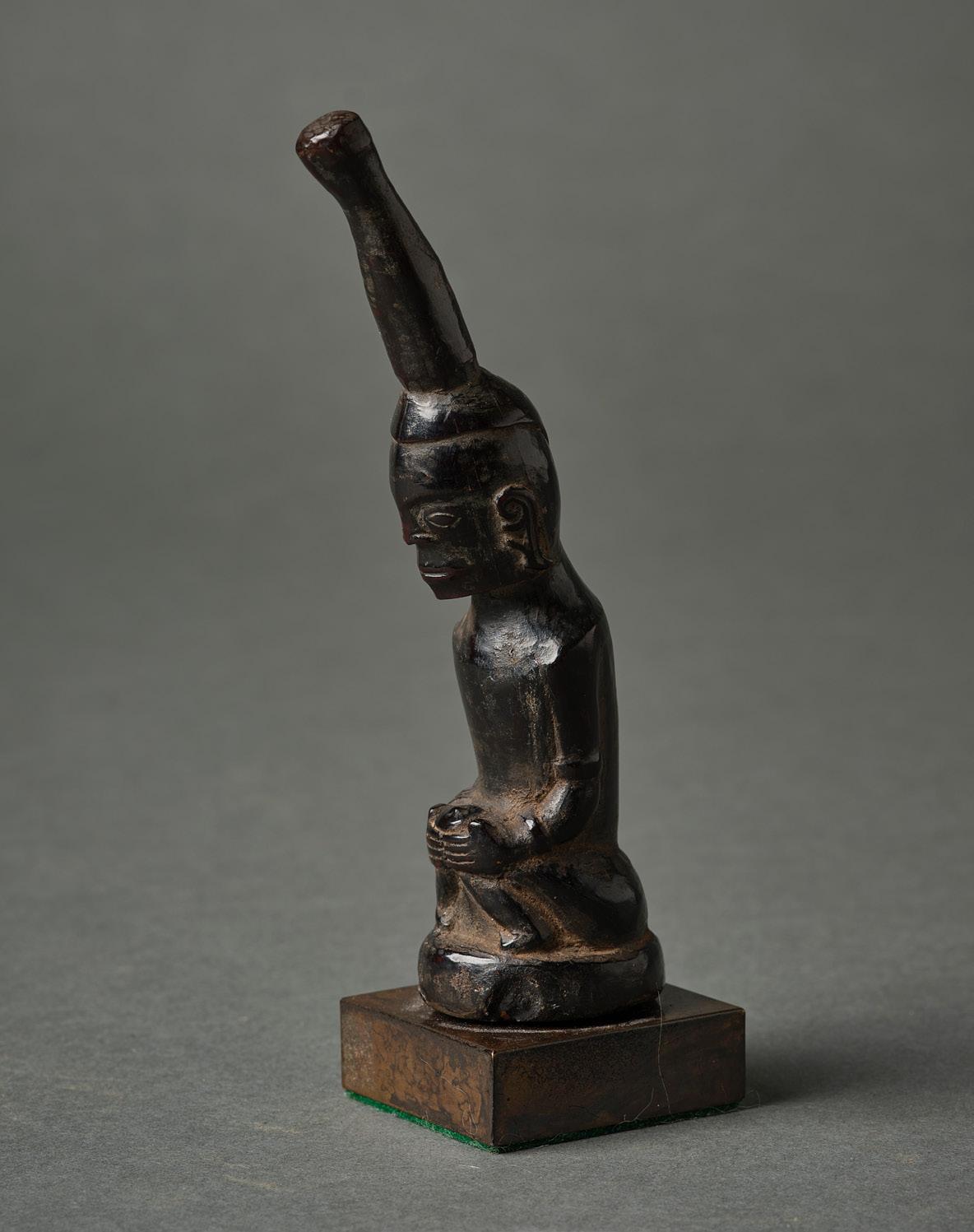
A Batak Figure
Indonesia, Sumatra, 19th Century
10.5cm height x 3cm width x 2cm depth
PROVENANCE
Goldman Collection, Netherlands
Els Verheij Collection, Netherlands
Marc Pinto Collection
$2,000–3,000 84
A Bone Figure
Indonesia, Flores Island, 19th Century
The standing figure with a deepened, rich, time-worn patina. 8.5cm height
PROVENANCE
Marc Pinto collection
$2,000–3,000
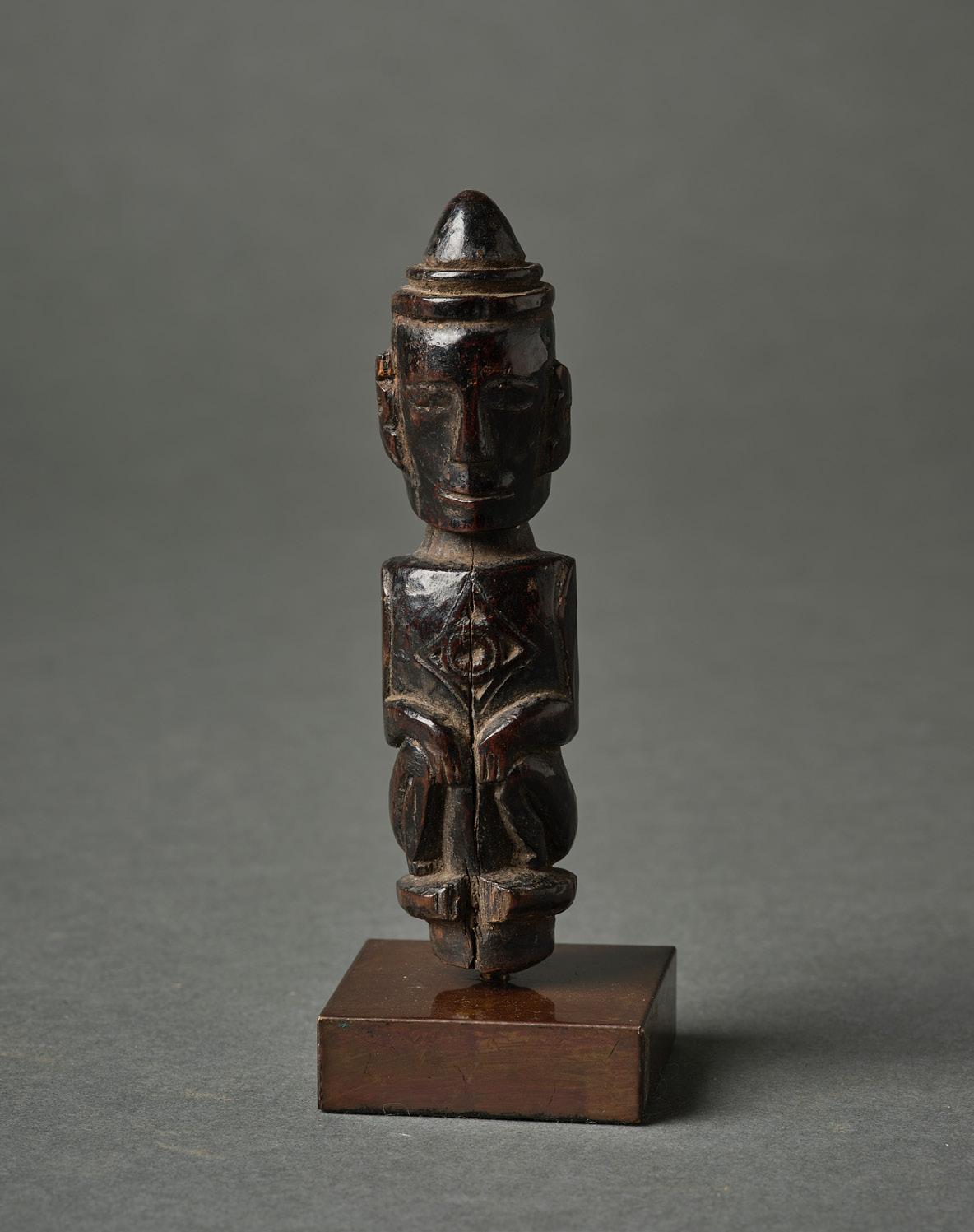
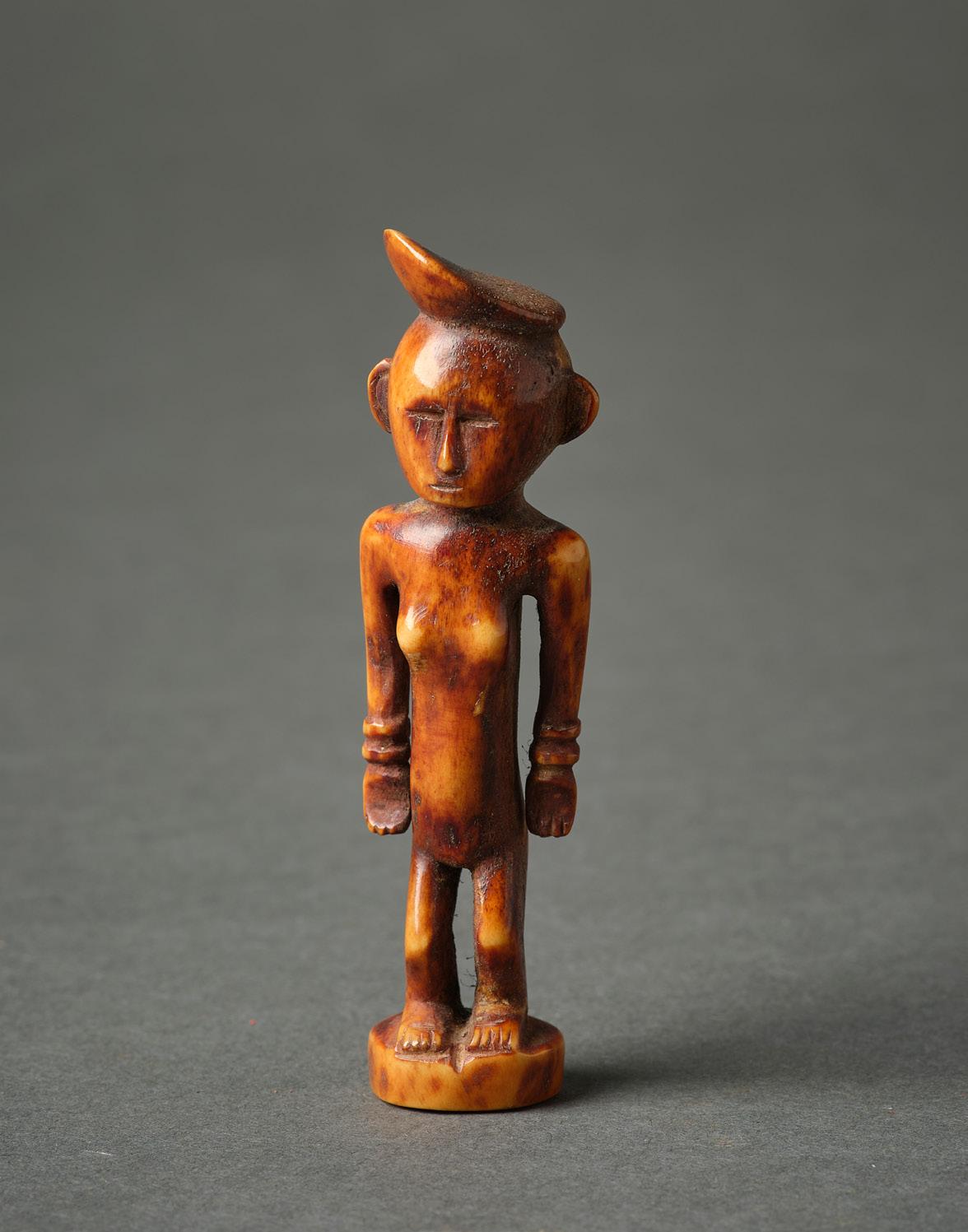
A Hudoq Mask
Indonesia, Kallimantan, Dayak People, Early 20th Century
Painted in red, black and white.
36cm height, 38cm width
PROVENANCE
Marc Pinto Collection
$4,500–6,000
A Rare Rice Guardian Figure Indonesian, Kailmantan, Dayak Peoples, Early 20th Century
The small anthropomorphic figure plaited from rattan. These rice-guardian figures sit at the intersection of agriculture and animism in Dayak culture.
30cm height x 15cm width
PROVENANCE
Marc Pinto Collection
$7,000–10,000
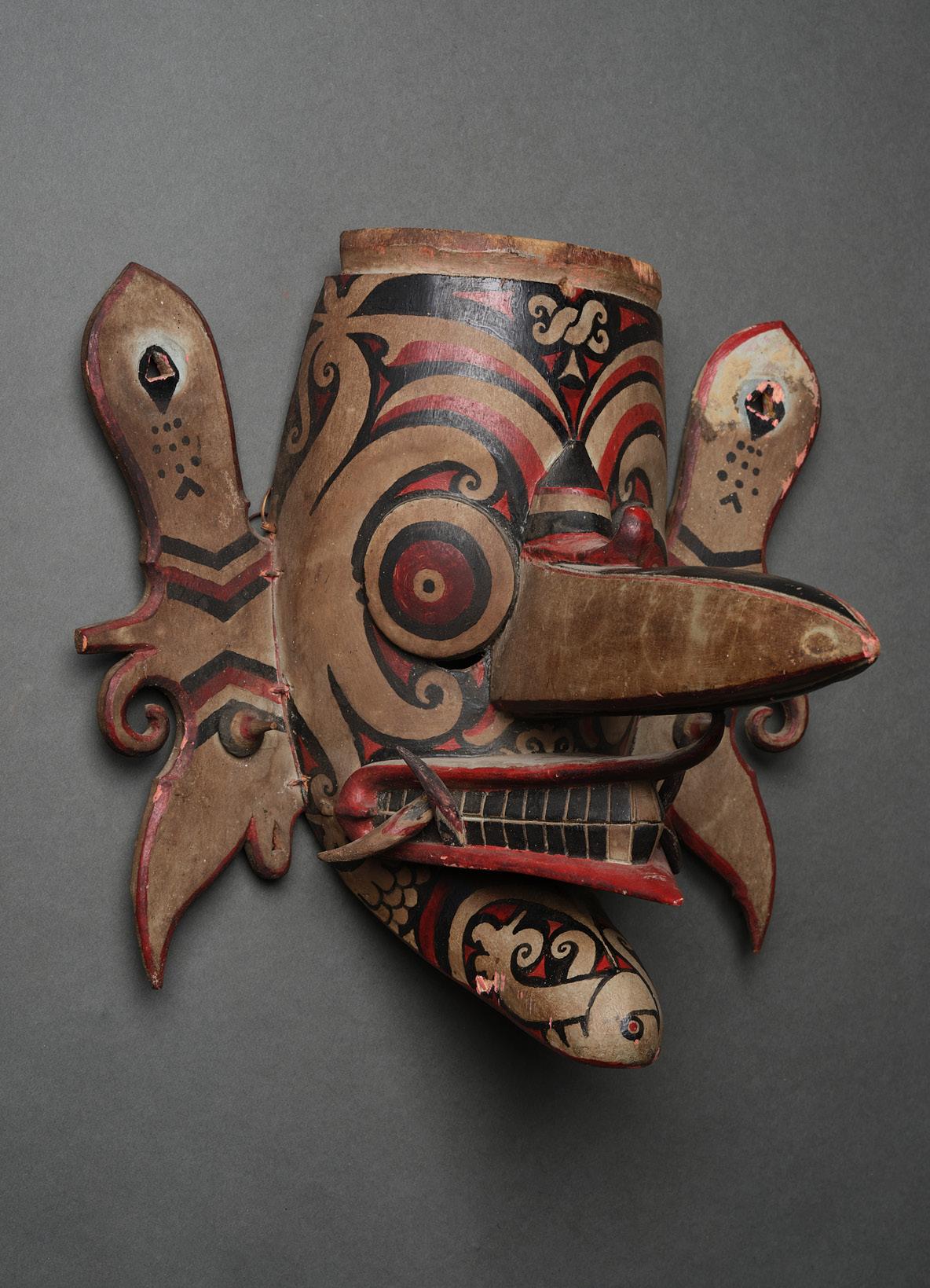
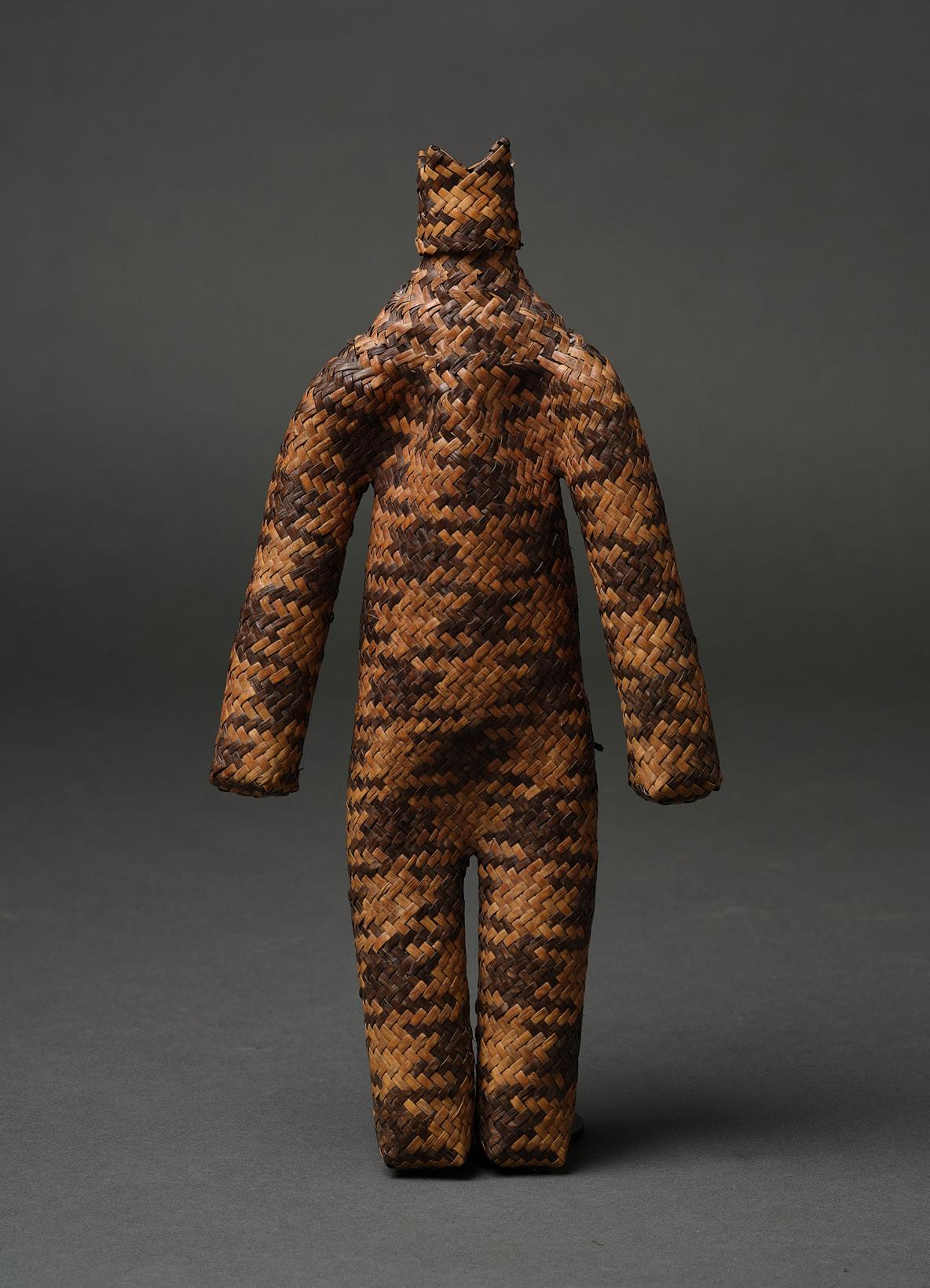
A Mask
Papua New Guinea, Lower Sepik, 19th Century
40cm height x 25cm width
PROVENANCE
Marc Pinto Collection
$12,000–15,000
88
A Mask
Papua New Guinea, Lower Sepik, Murik Lakes, 19th Century
50cm height x 17.5cm width
PROVENANCE
Michael Hamson Collection. Collection number MHM-47 affixed to the back of the mask
Marc Pinto Collection
$12,000–15,000
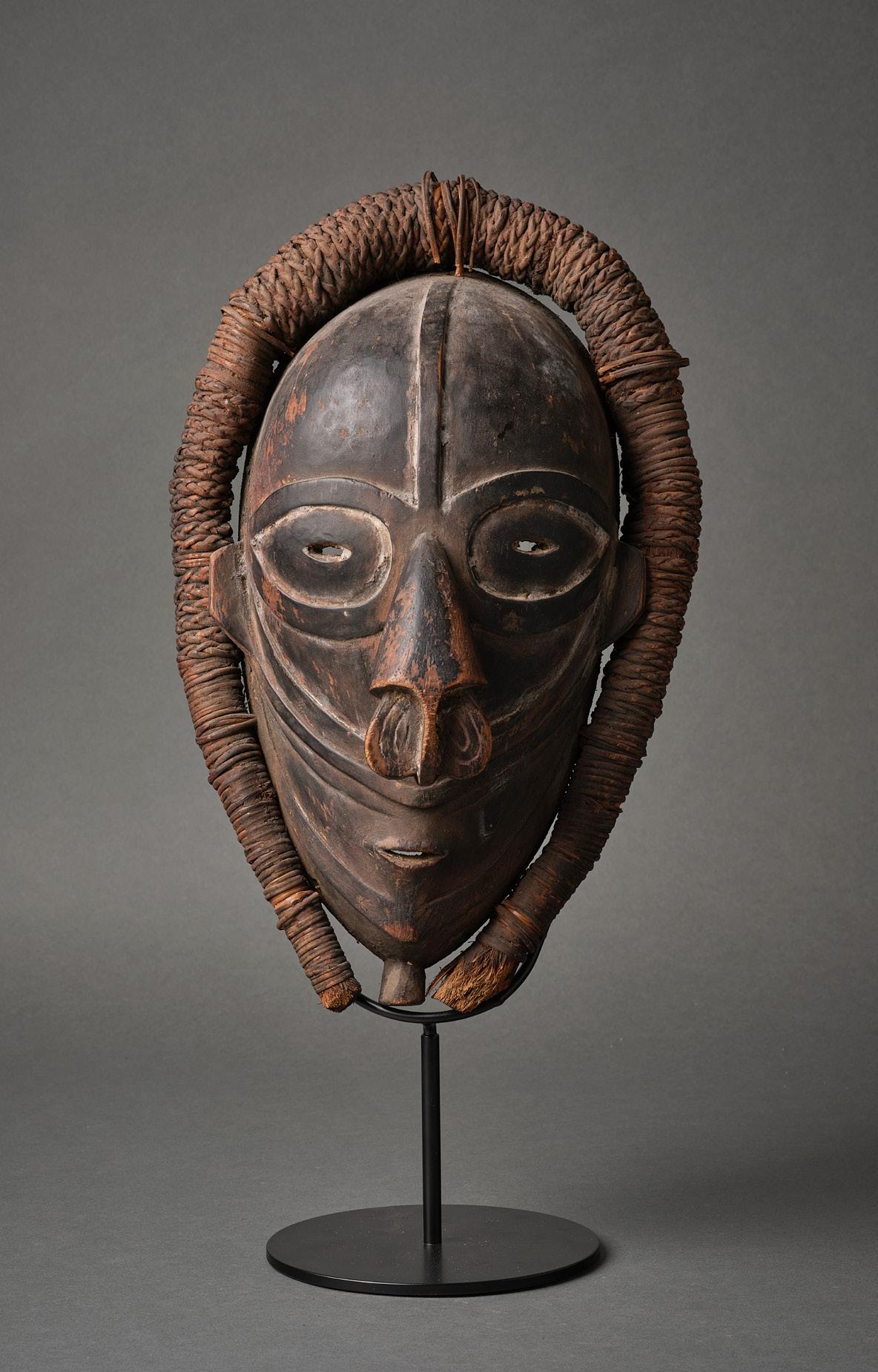
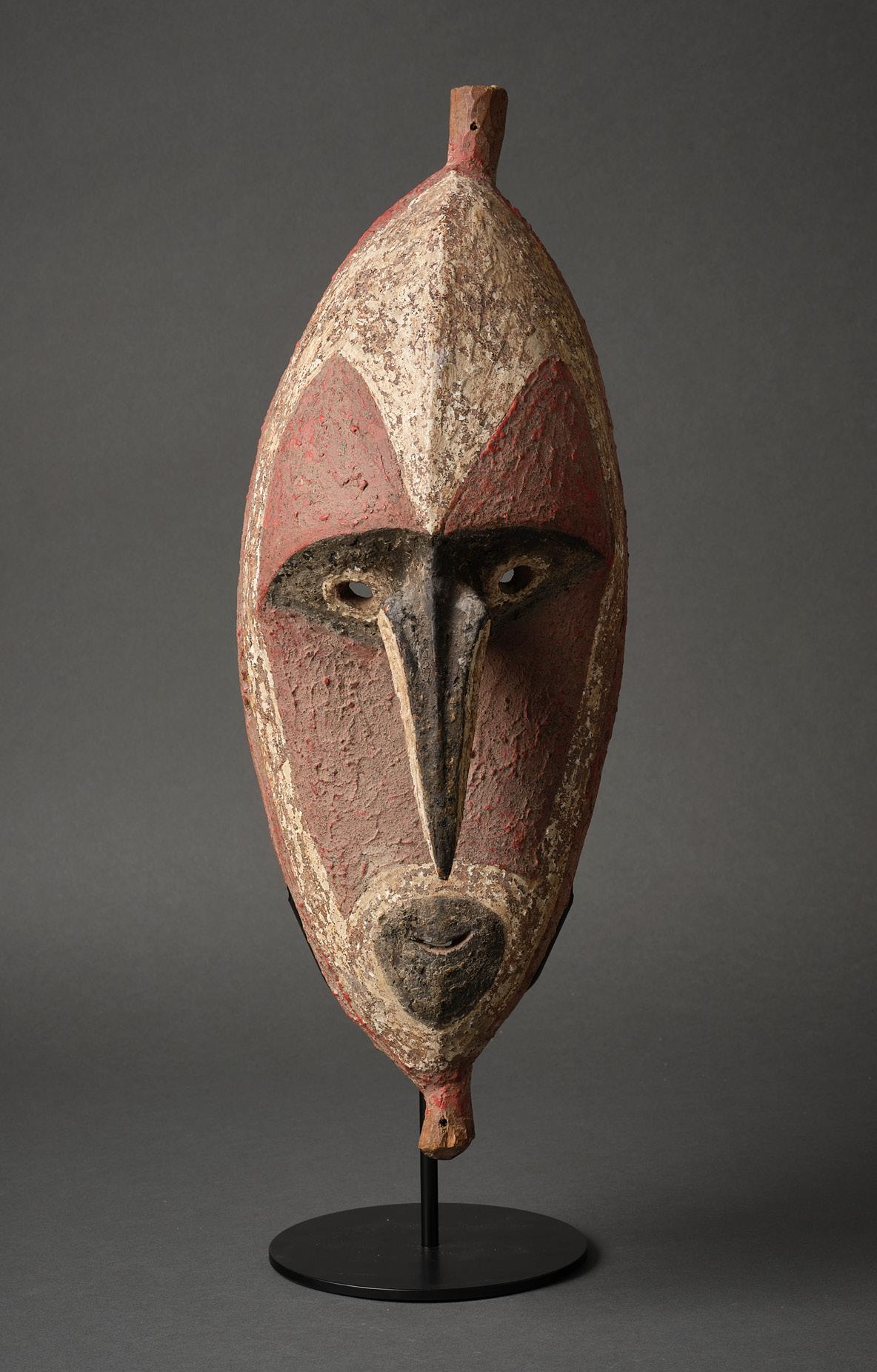
Meditating Buddha
Burma, 19th Century
The Buddha surmounting a plinth base on a custom-made stand. Traces of pigment and gilding remain on the surface.
38cm height x 11cm width
$200–400
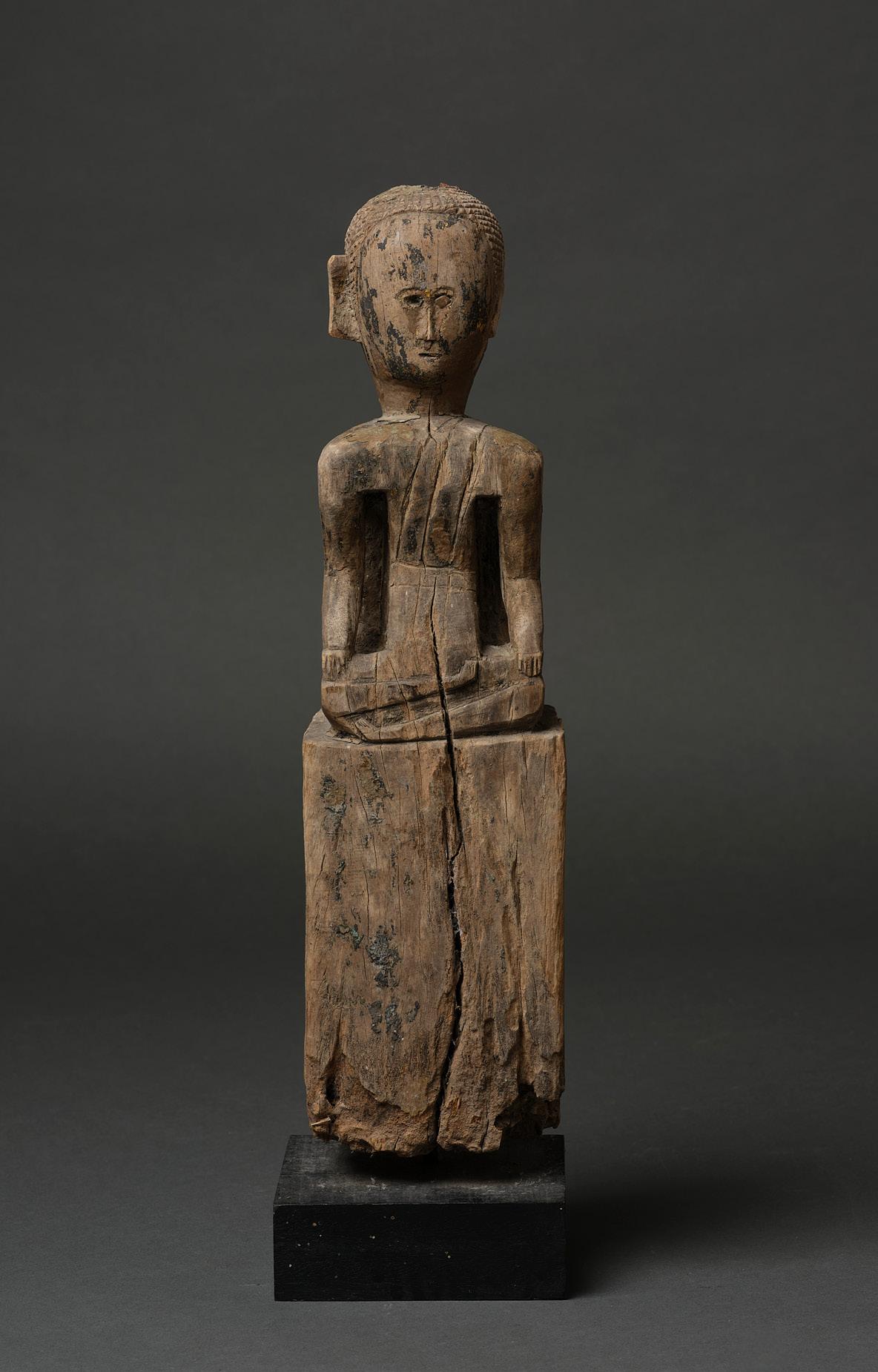
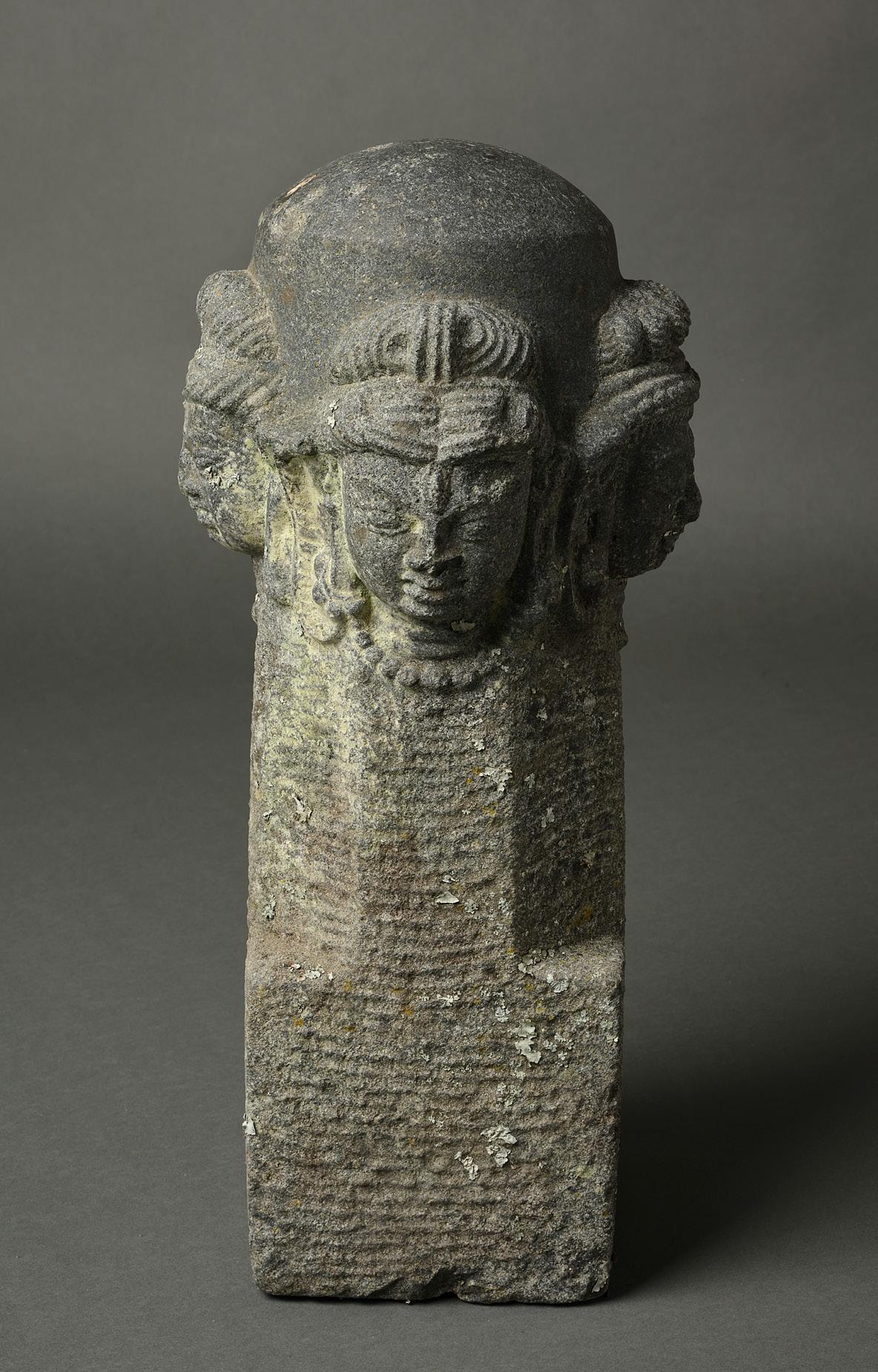
A Monumental Gandharan Grey Schist Figure Of The Standing Buddha
Ancient Region Of Gandhara (Present-Day North-Western Pakistan/Eastern Afghanistan), Kushan Period, 2nd–3rd Century CE
Finely carved from grey schist, the Buddha shown standing in samapada upon an integral rectangular plinth, the left hand lowered in varada mudra (the gesture of bestowing), the right hand missing. The monastic robe rendered with the characteristic Gandharan style of deeply incised, rhythmically cascading folds, drawn diagonally across the torso in the Hellenistic manner and falling in symmetrical swags over the lower body before terminating in a crisply pleated hem above the bare feet.
The serene idealised face with downcast almond eyes beneath gently arched brows, the hair arranged in undulating wavy locks carved in low relief from the same block.
The plinth carved in high relief with a frieze of devotional figures arranged between architectural divisions, in the manner of the Buddhist narrative reliefs produced for the monastic complexes of the Peshawar basin and Swat valley. 110cm height x 38cm width
PROVENANCE
Galerie Koller, Zürich, 1985
Rolf Walter Renker Collection (1927 – 2025), Düsseldorf Renker family by descent
REFERENCES
Closely comparable standing figures are held in the collections of the Musée Guimet, Paris; the Victoria and Albert Museum, London; and the Peshawar Museum.
$16,000–40,000
91
A Four-Headed Caturamuka Buddha Sculpture East India, Bihar, Pala Period, 10th Century
47cm height
PROVENANCE
Doris Wiener, New York, 1997, S928. Rolf Walter Renker (1927 – 2025), Düsseldorf Renker family by descent
$3,000–5,000
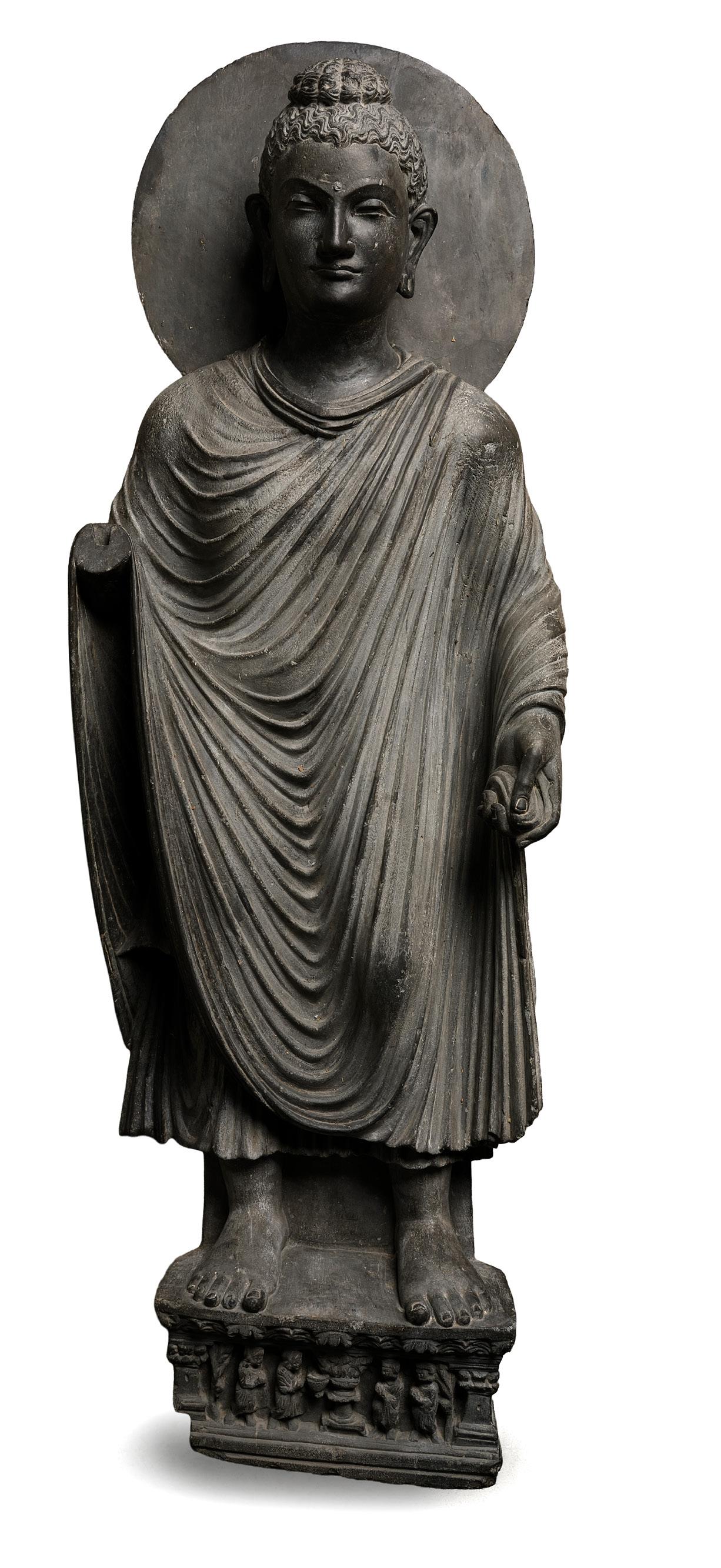
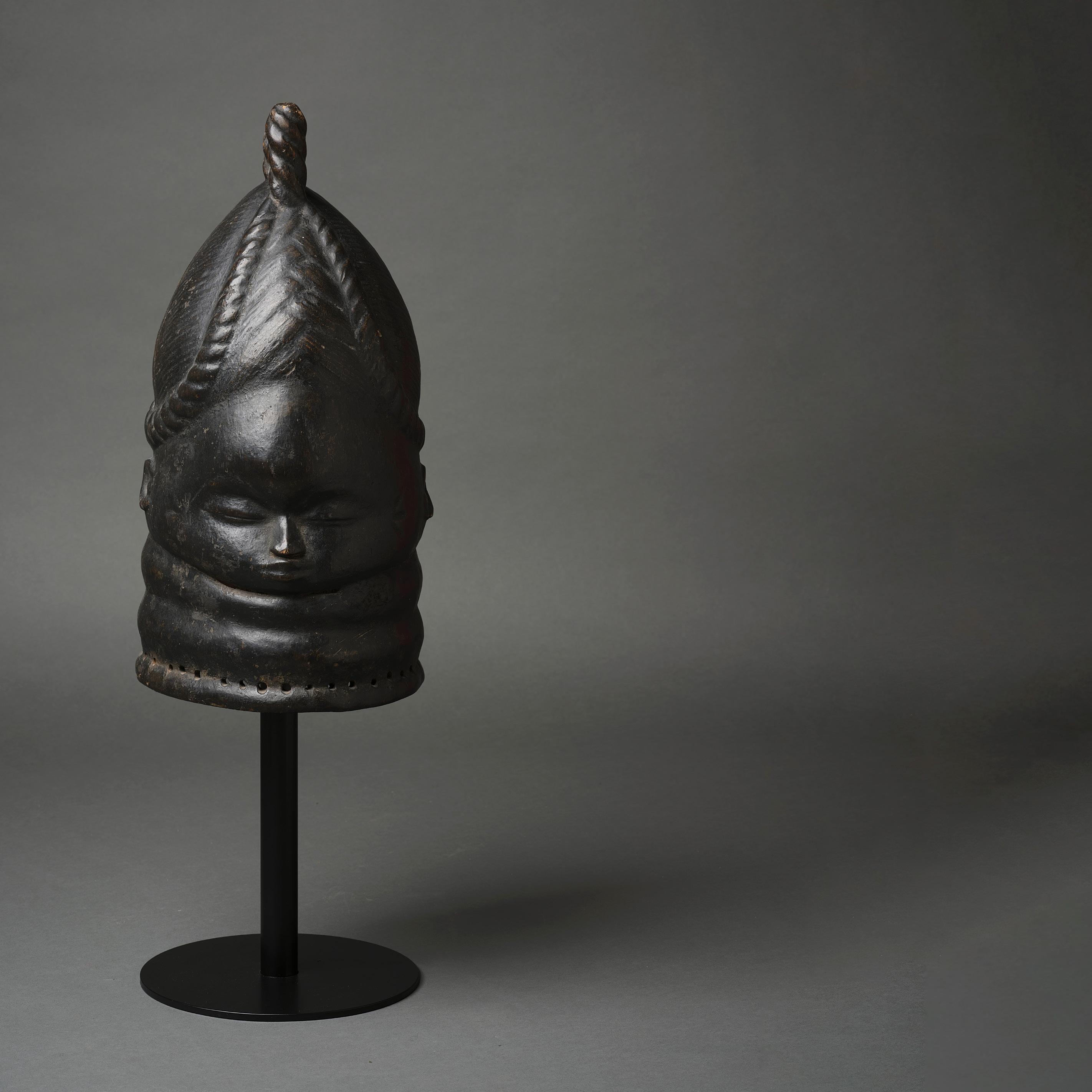
A Superb Sowei Mende Helmet Mask ‘Bundu’ Africa, Sierra Leone, Early 20th Century
Carved wood with dark stained patina. The domed coiffure features two central braided crests terminating in a twisted topknot, flanked by herringbone-patterned ridges. The face is serene, with heavy-lidded eyes, a small composed mouth, and a broad forehead, characteristic ideals of Mende feminine beauty. Multiple neck rings below the chin. A row of pierced holes around the base rim allowed attachment to a fiber costume.
Sowei masks of this type were worn by senior women of the Sande society during initiation ceremonies, one of the few African masking traditions exclusively owned and performed by women.
This is an exceptionally fine example with good signs of age and wear. Excellent condition appropriate to Antiquity and as represented in the photos. Comes with a bespoke stand. 41cm height
PROVENANCE
Private Collection New York
Source, Andrew Berz Nicole Silvertand Collection
$4,000–8,000
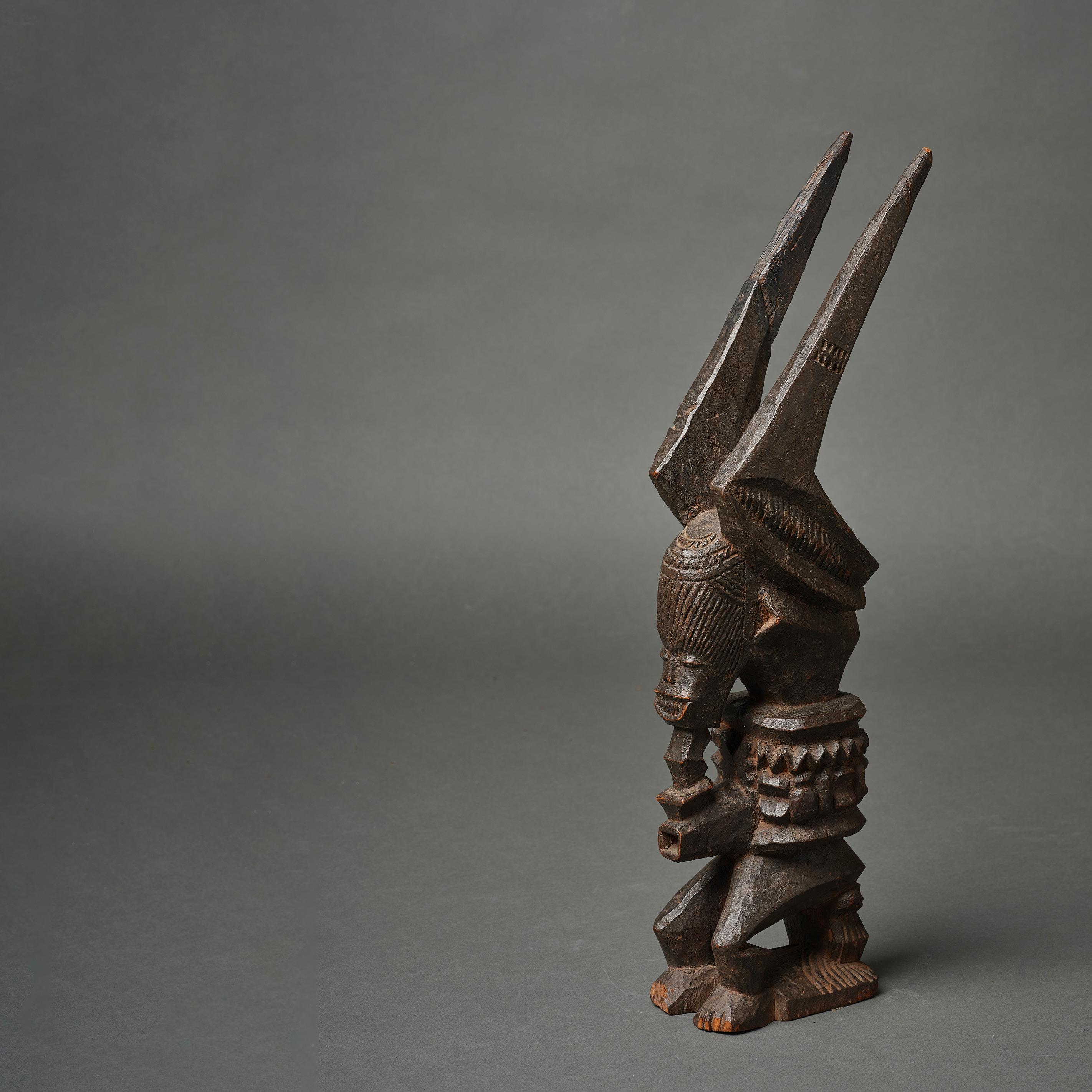
A Rare And Important Ikenga Figure
Africa, Nigera, Igbo, 19th Century
Carved hardwood sitting warrior figure with large horns, traditional scarifications to the forehead, and smoking a pipe. Rich dark aged patina indicating great age and use. Old label affixed to the base inscribed Miss Daisy Hermitage, further inscribed in ball-point "Bishop of Lagos". A second label reads “Brought back from Nigeria by Bishop Tugwell. Bishop of Nigeria. Kays Gt Uncle, Father of the Dotsie Dines”
Bishop Herbert Tugwell (1854–1936) was among the most influential Anglican churchmen in colonial West Africa, and his long service in the Niger region situates him as a significant early collector of Igbo material culture.
Born in Salisbury and educated at Corpus Christi College, Cambridge, Tugwell was ordained in 1881 and joined the Church Missionary Society, serving in the Yoruba mission at Christ Church, Lagos, from 1889. In 1894 he was consecrated Bishop of Western Equatorial Africa, a vast see embracing Yorubaland and the Niger territories, which he led until his retirement in 1920. From this base he oversaw the dramatic expansion of Church Missionary Society missions into Igboland, the very region in which the Ikenga cult flourished. Like many missionaries of his era, Tugwell encountered and acquired indigenous ritual objects in the course of his evangelical work, and figures of this type passed into European hands through such contact. An Ikenga bearing provenance to Bishop Tugwell carries a documented link to the formative decades of Anglican mission in southeastern Nigeria, lending the present lot both historical depth and a securely datable collecting context. 46cm height
PROVENANCE
Bishop Herbert Tugwell (1854 – 1936), UK
Given by Tugwell to a famliy friend, Dr Roberts, UK
John Graham Collection, Melbourne
REFERENCES
African Heritage Documentation & Research Centre Number, Van Rijn - OA - 0180298-001
$7,500–8,500
Female Attie Figure
Africa, Cote D'voire, Attie People, Early 20th Century
34cm height
PROVENANCE
Philippe Ancart Collection, France and Thailand
John Graham Collection, Melbourne
$3,000–4,000
A Fine Baule Male Standing Figure
Africa, Cote D'voire, Dimbokro, Agba Workshop, Early 20th Century
37.5cm height
PROVENANCE
John Graham Collection, Melbourne
$6,000–7,000
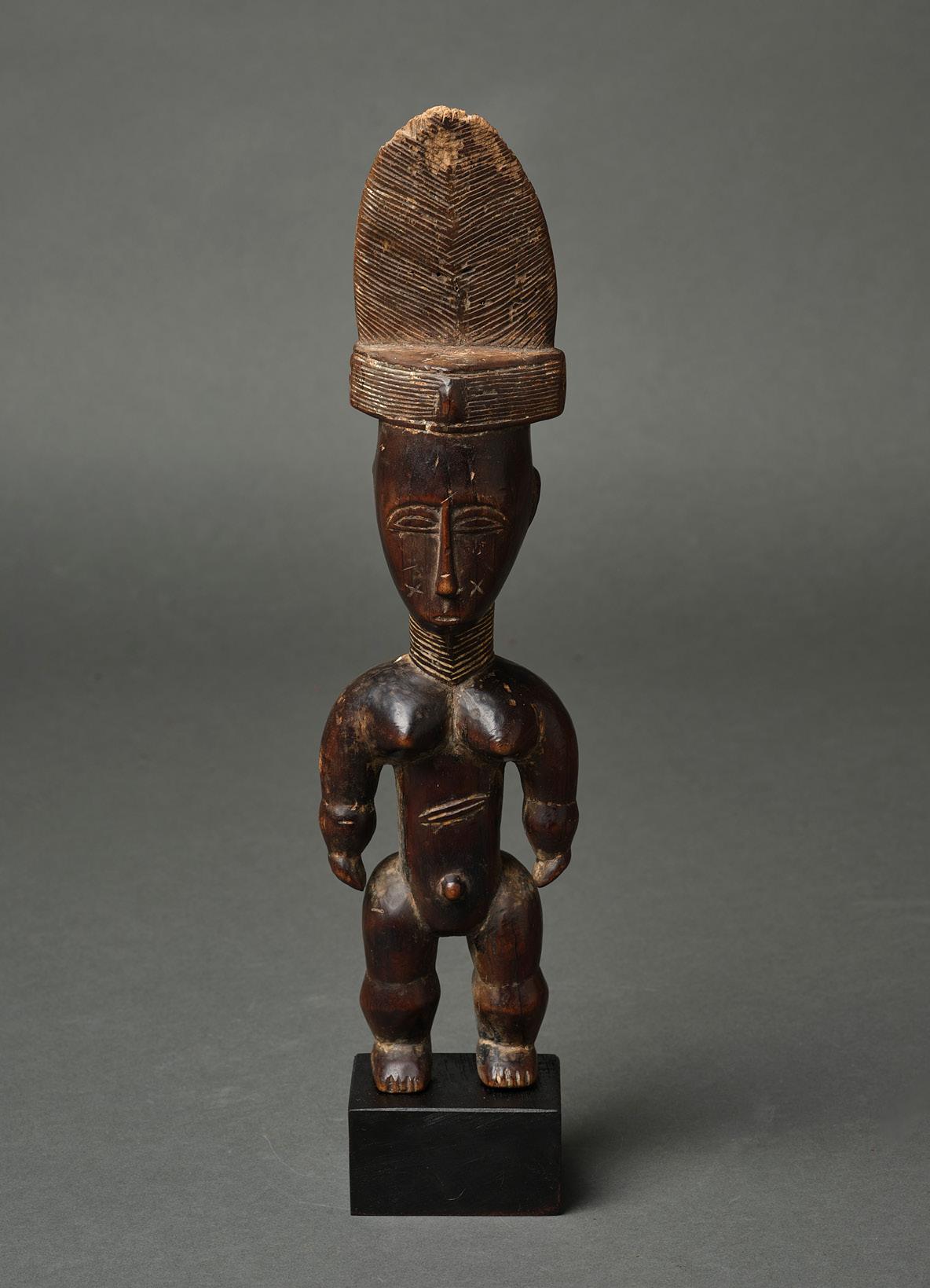
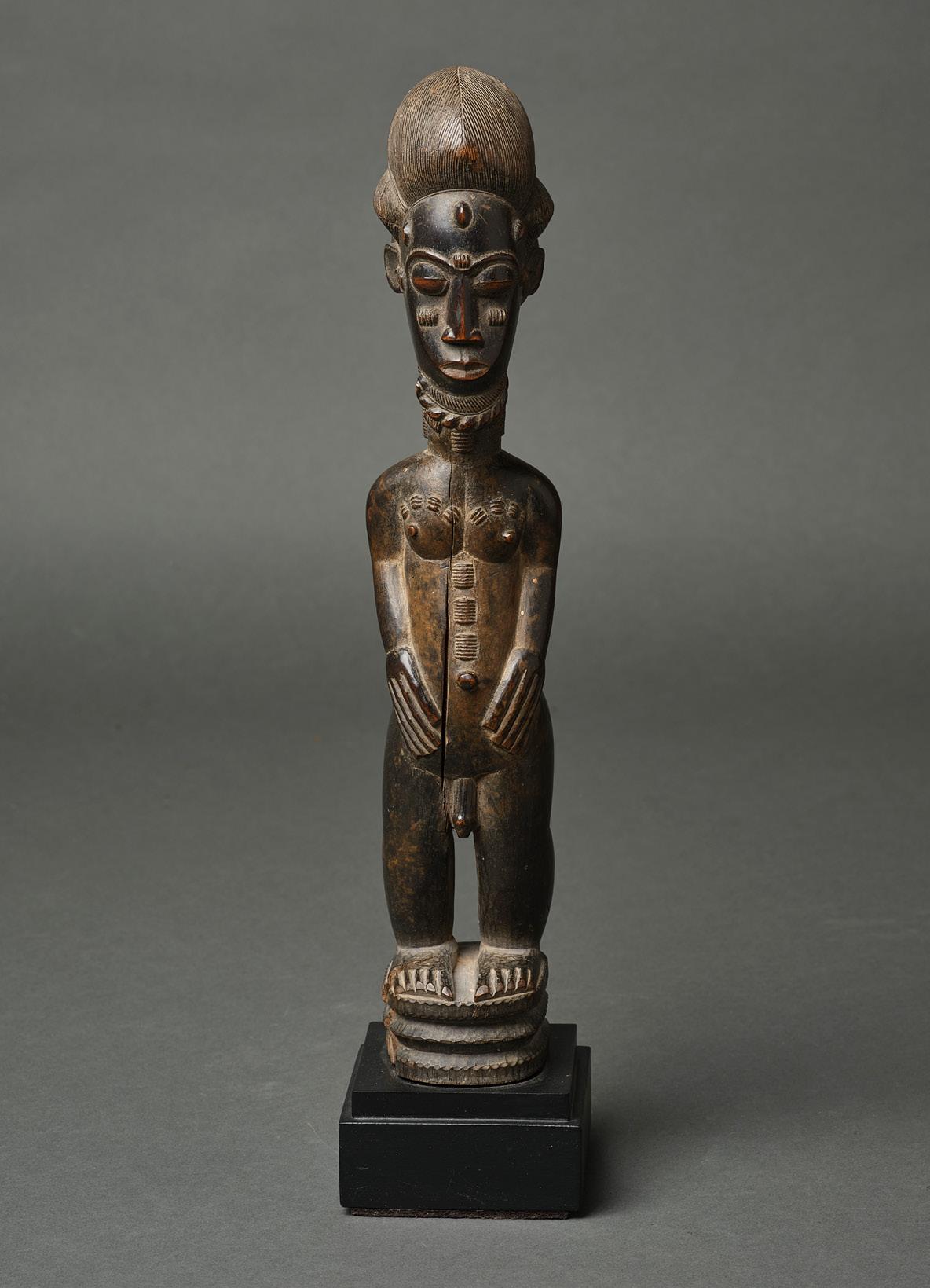
Male And Female Ibeji Twins
Africa, Nigera, Igbomina, Ajasse, Yoruba People, Late 19th Century
30.5cm, 30cm height
PROVENANCE
John Graham Collection, Melbourne
$3,000–4,000
97
Male Ibeji Twins
Africa, Nigeria, Yoruba People, Oyo, Early 20th Century
24.5cm, 23.5cm height
PROVENANCE
John Graham Collection, Melbourne
$2,500–3,000
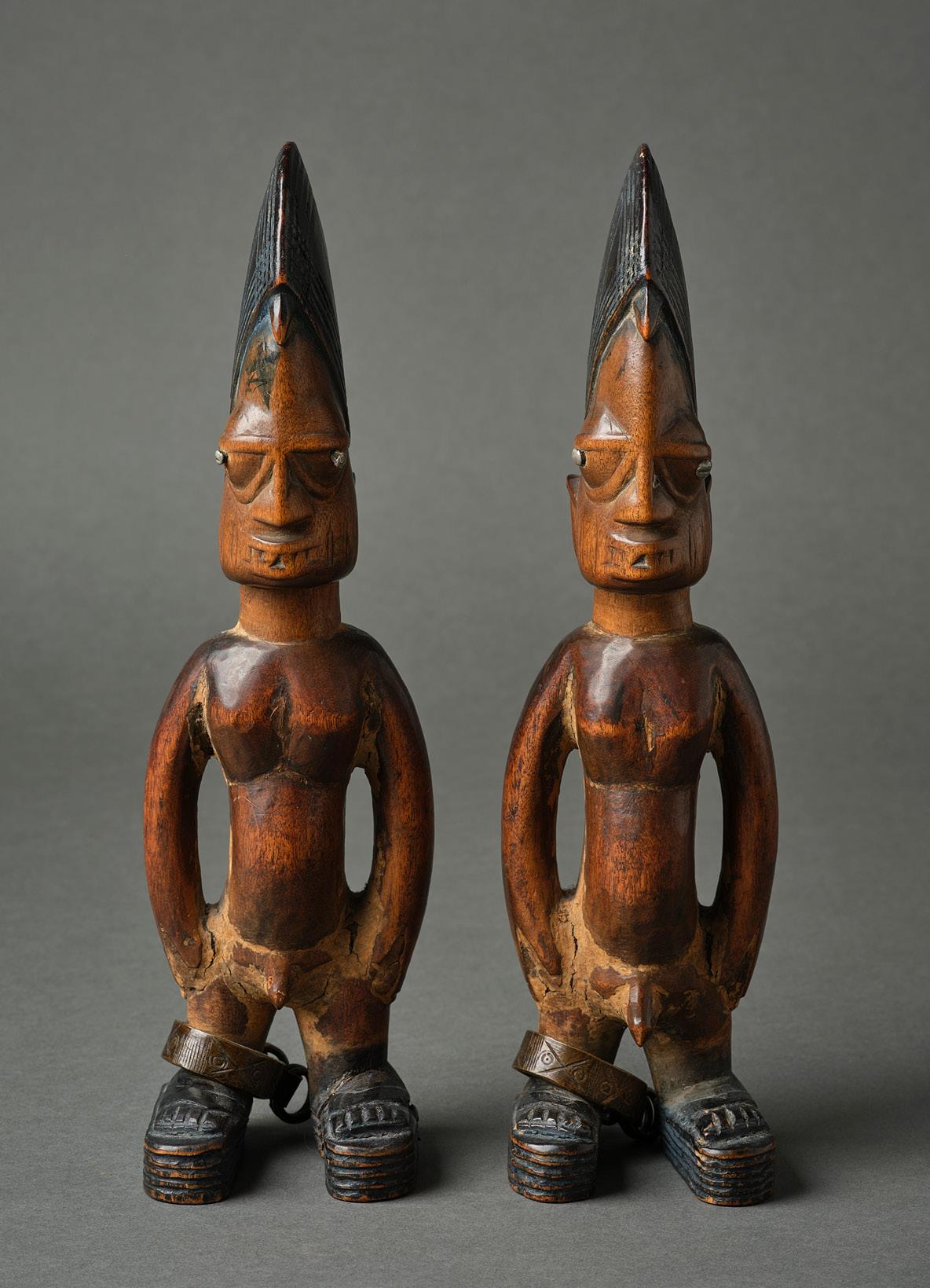
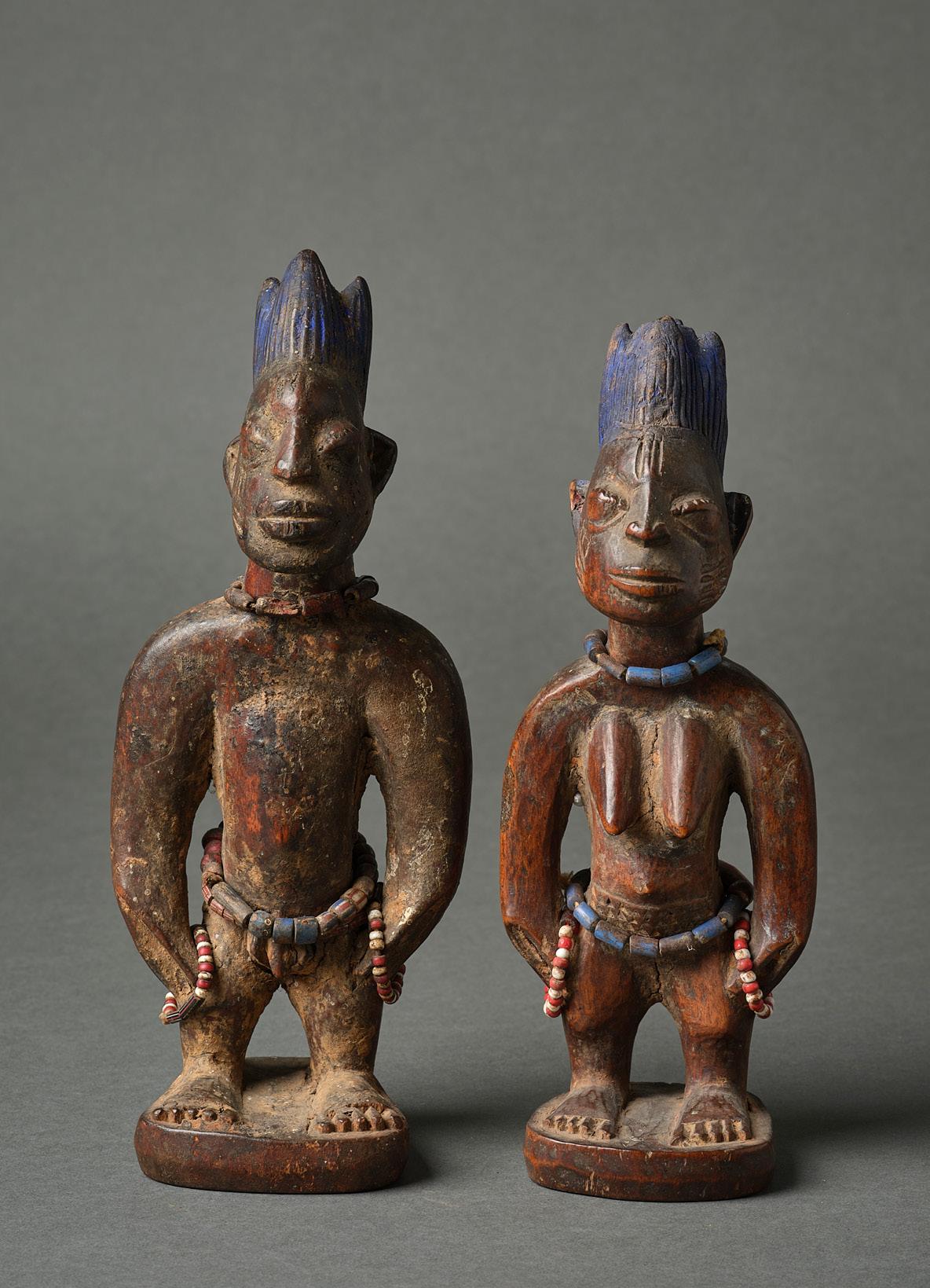
A Reliquary Figure
Mid 20th Century, Kota People Of Gabon, 20th Century
Stylised anthropomorphic figure made in wood, copper, and brass, mounted on a Perspex base. 43cm height
PROVENANCE
Michael Yoffe Collection, field collected in Africa, 1965
$600–1,200
99
Male Ibeji Twins
Africa, Nigeria, Oyo, Yourba People, Agobunde Of Ede Workshop, 19th Century
29cm, 28cm height
PROVENANCE
Private Collection, France
John Graham Collection, Melbourne
$3,000–4,000
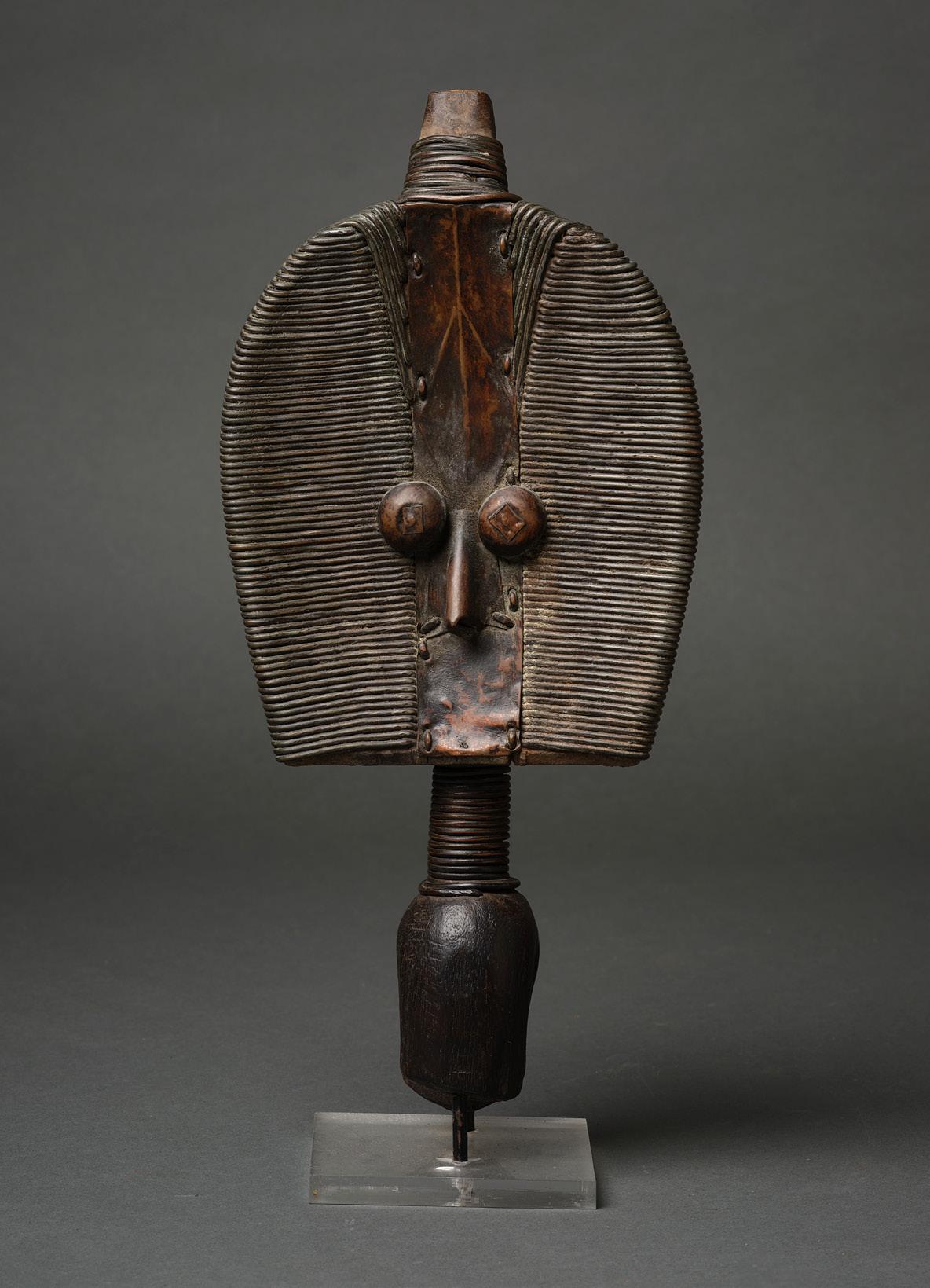
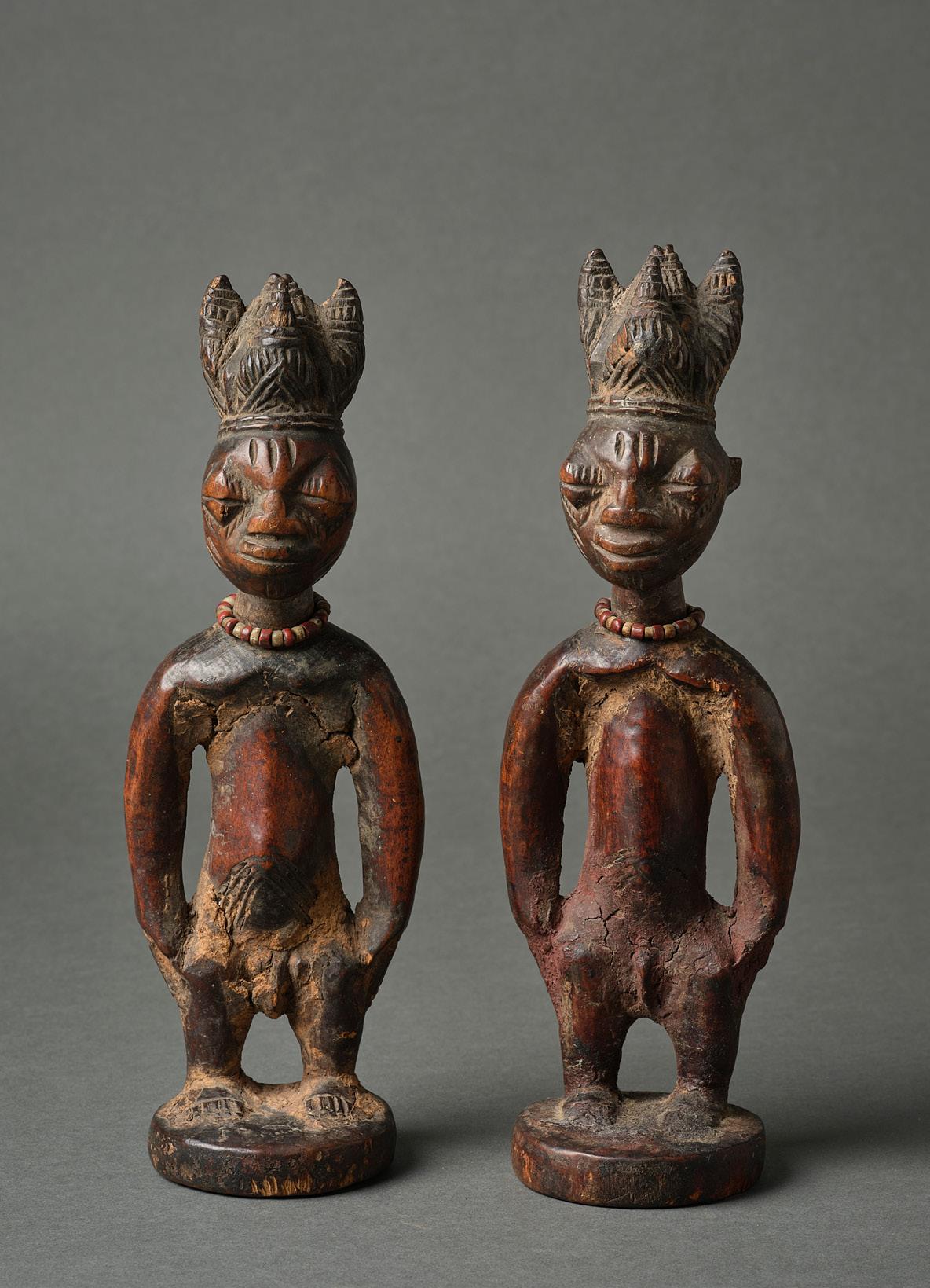
100
Four Stone Standing Figures
Africa, Togo, 20th Century
27cm, 23cm, 23cm, 21cm height
PROVENANCE
William Stephen Schiessel Collection
$200–400
101
A Lega Mask
Africa, Democratic Republic Of Congo, Mid 20th Century
Comes with a bespoke stand, made by StandingArt. 35cm height
PROVENANCE
Private Collection, New York
Source, Mark Eglinton, New York
Nicole Silvertand Collection
$2,000–3,000
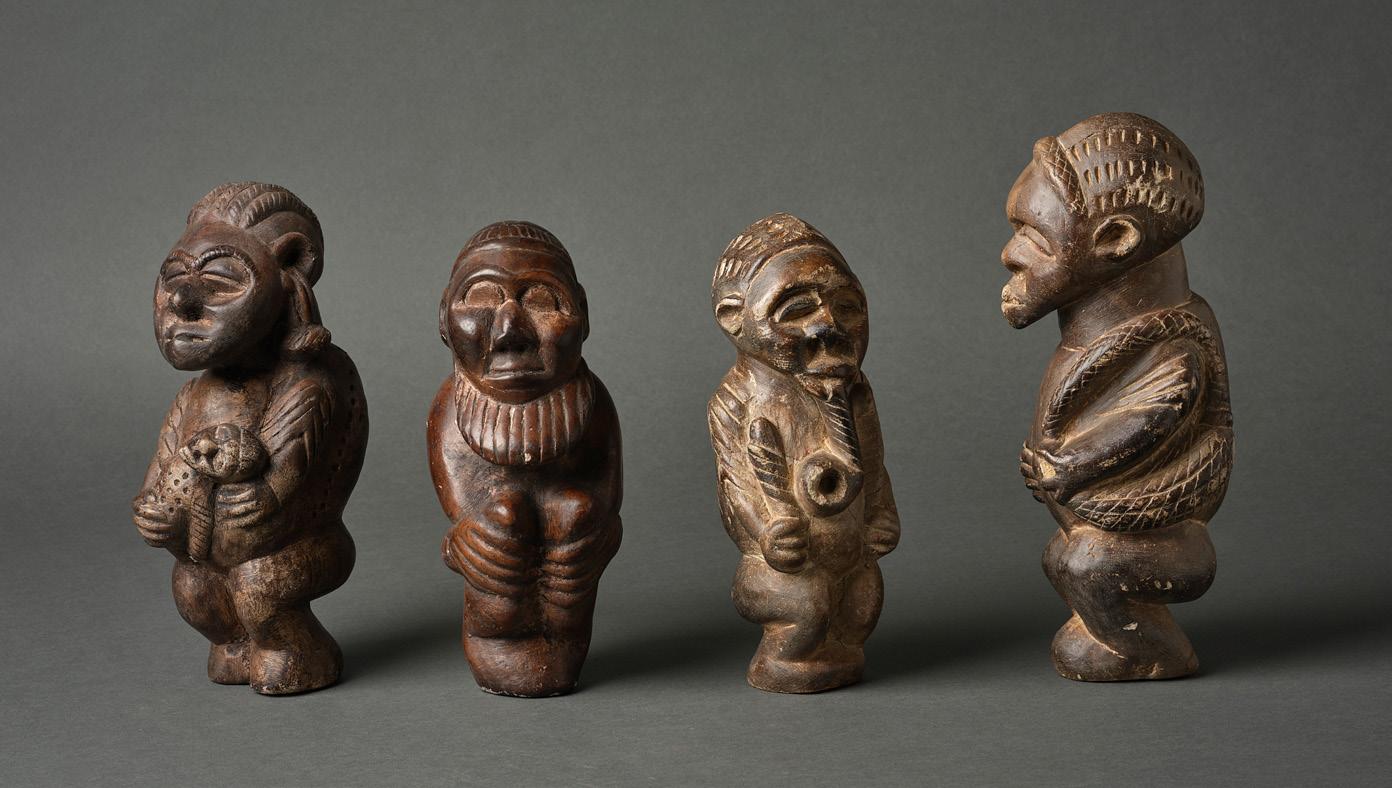
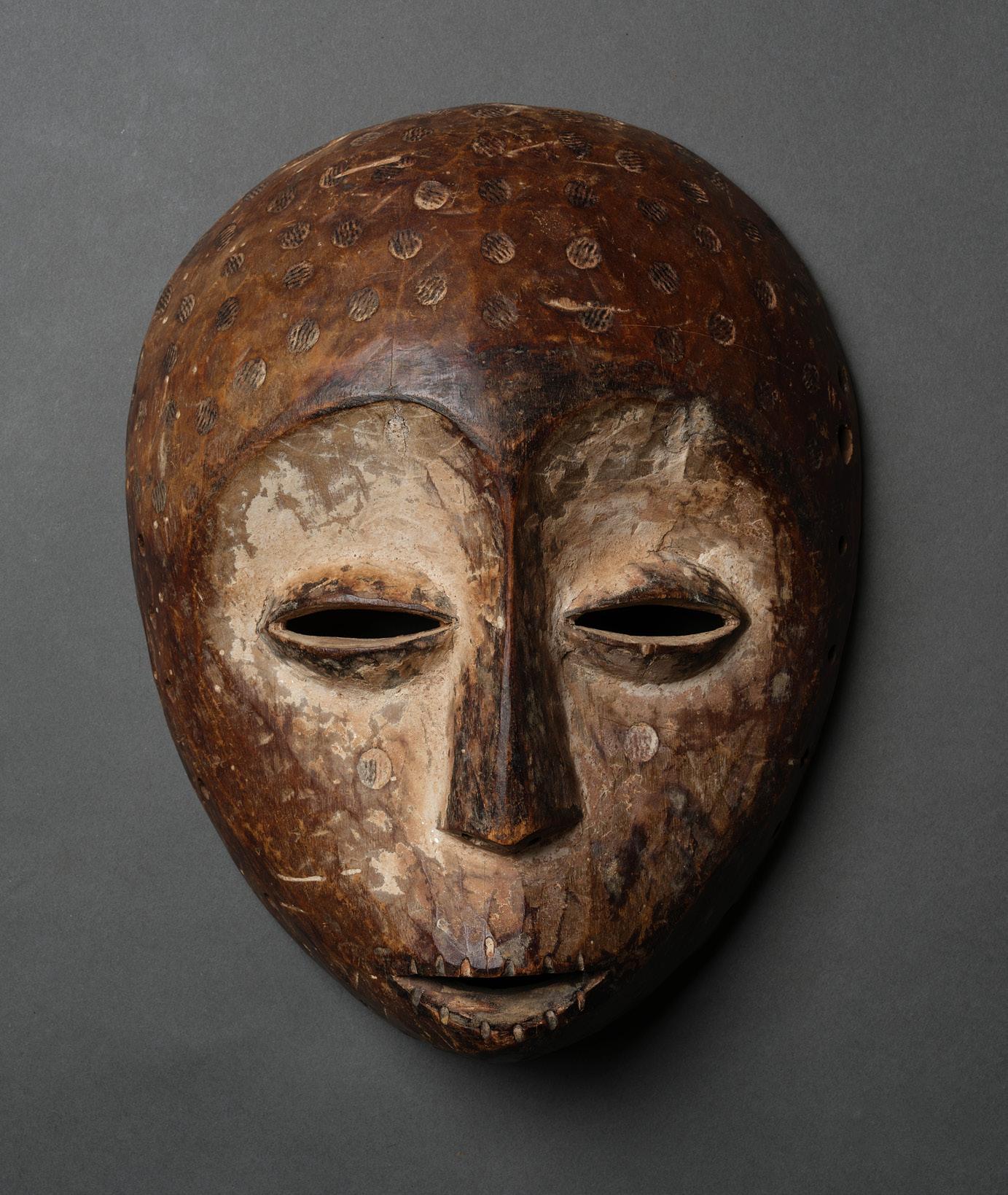
102
Four Fine Antique Kente Cloths Africa, Togo, 20th Century
PROVENANCE
William Stephen Schiessel Collection
$300–500
103
Four Kente Cloths Africa, Togo, 20th Century
PROVENANCE
William Stephen Schiessel Collection
$100–200
Illustrated online at artvisory.com.au
104
A Batik Cloth Africa, Togo, 20th Century
Featuring birds, big cats, and reptile motifs.
PROVENANCE
William Stephen Schiessel Collection
$200–300
Illustrated online at artvisory.com.au
END OF SALE
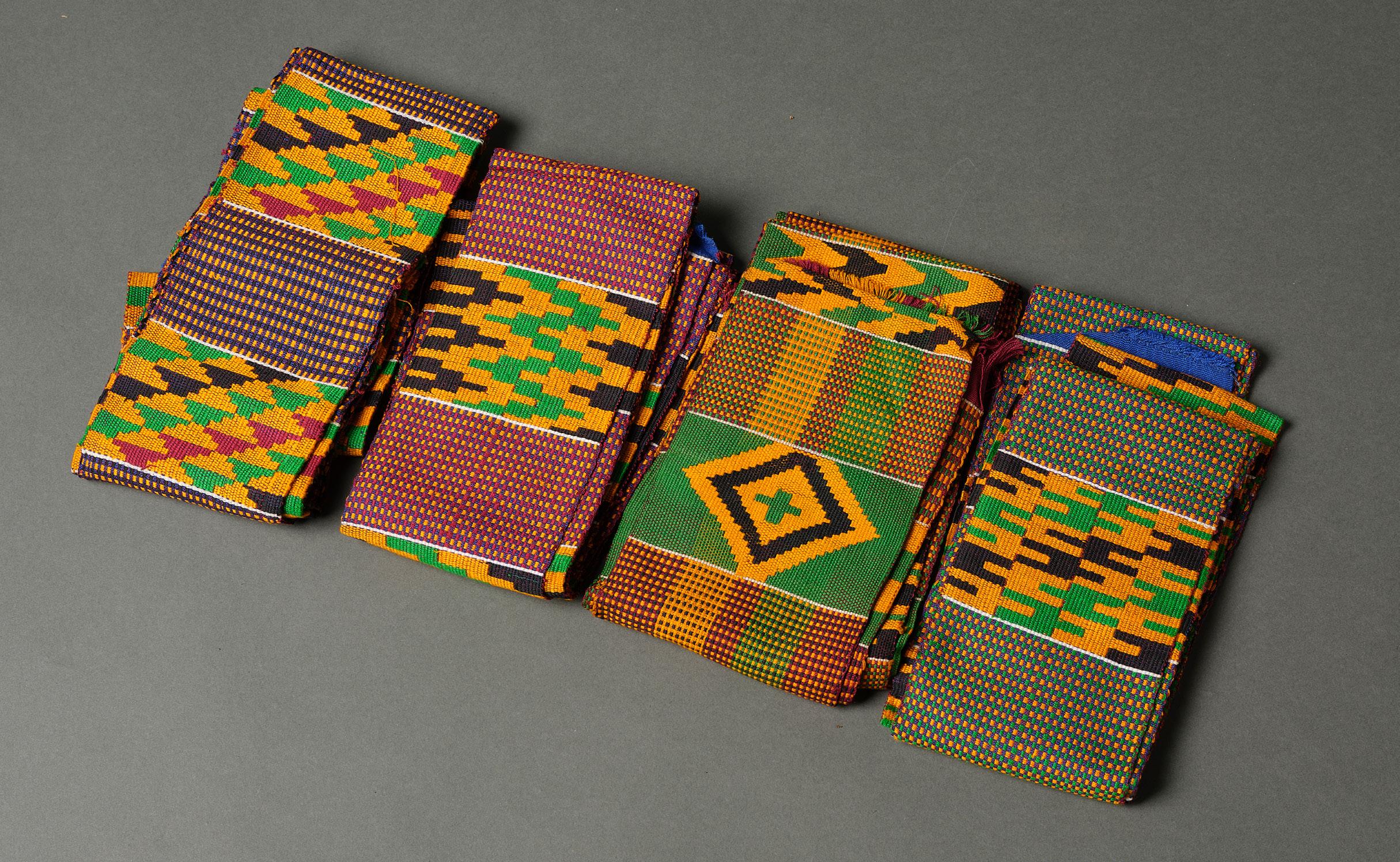
CITES Conditions New Zealand Protected Objects Act
1975
Please note that lots 53, 54, 55, 56, 57, 58, 59, 61, 62, 63, 64, 65, 66, 69, 70, 71 in this catalogue have been registered under the Protected Objects Act, this is referred to as Y registration.
Under the terms of this act items that are Y registered may not be sold to non New Zealand residents and may not leave the country without the consent of the Ministry of Culture and Heritage.
To purchase any Y registered item you must be a registered collector. To register as a collector you must apply to the Ministry of Culture and Heritage (info@mch.govt.nz).
For further information on Y registration and the registered items in this catalogue contact: James Parkinson james@artvisory.com.au
Catalogue assistance, thank you to Donna Hoyle. Stephen Brookbanks from Object Support and Joanathan Maze.
All items in this catalogue are offered in accordance with the Convention on International Trade in Endangered Species of Wild Fauna and Flora. Where an object contains material subject to CITES regulation, this is noted in the catalogue entry and the responsibility for obtaining any required export or import permits rests solely with the purchaser. Prospective buyers are advised to familiarise themselves with the relevant regulations in their own jurisdiction, as restrictions may apply to the movement of items containing ivory, tortoiseshell, certain timbers, or other protected materials. The auction house will provide guidance on the application process where appropriate, but cannot guarantee the granting of permits or the timing of their issue. Failure to secure the necessary documentation does not constitute grounds for the cancellation of a sale or the delay of payment. Purchasers are encouraged to make enquiries well in advance of bidding to ensure compliance with all applicable laws governing international cultural property and endangered species materials.
CITES regulations apply to the Kapkap collection in this auction due to the carved tortoiseshell elements.
As these examples were collected in 1949 and 1950, they qualify as pre Convention specimens under CITES and are therefore eligible for export without any restriction upon the issuing of the appropriate pre Convention certificate. Our specialists for this auction can assist purchasers with obtaining the necessary CITES documentation.
SO/ AUCKLAND STAY & SAVOUR OFFER
Book your event before 31st August 2026 and enjoy room rates from $295, including one buffet breakfast, for any residential meetings & events at The Vault.
Plus, enjoy a Day Delegate Package from only $85 per person for residential event bookings from 1st April 2026 to 31st August 2026.
Enjoy one complimentary guest room for every 20 paying rooms per day, a lunch venue upgrade to Harbour Society Restaurant, 2 valet car parking, 2X ALL Reward points and more. Terms apply.
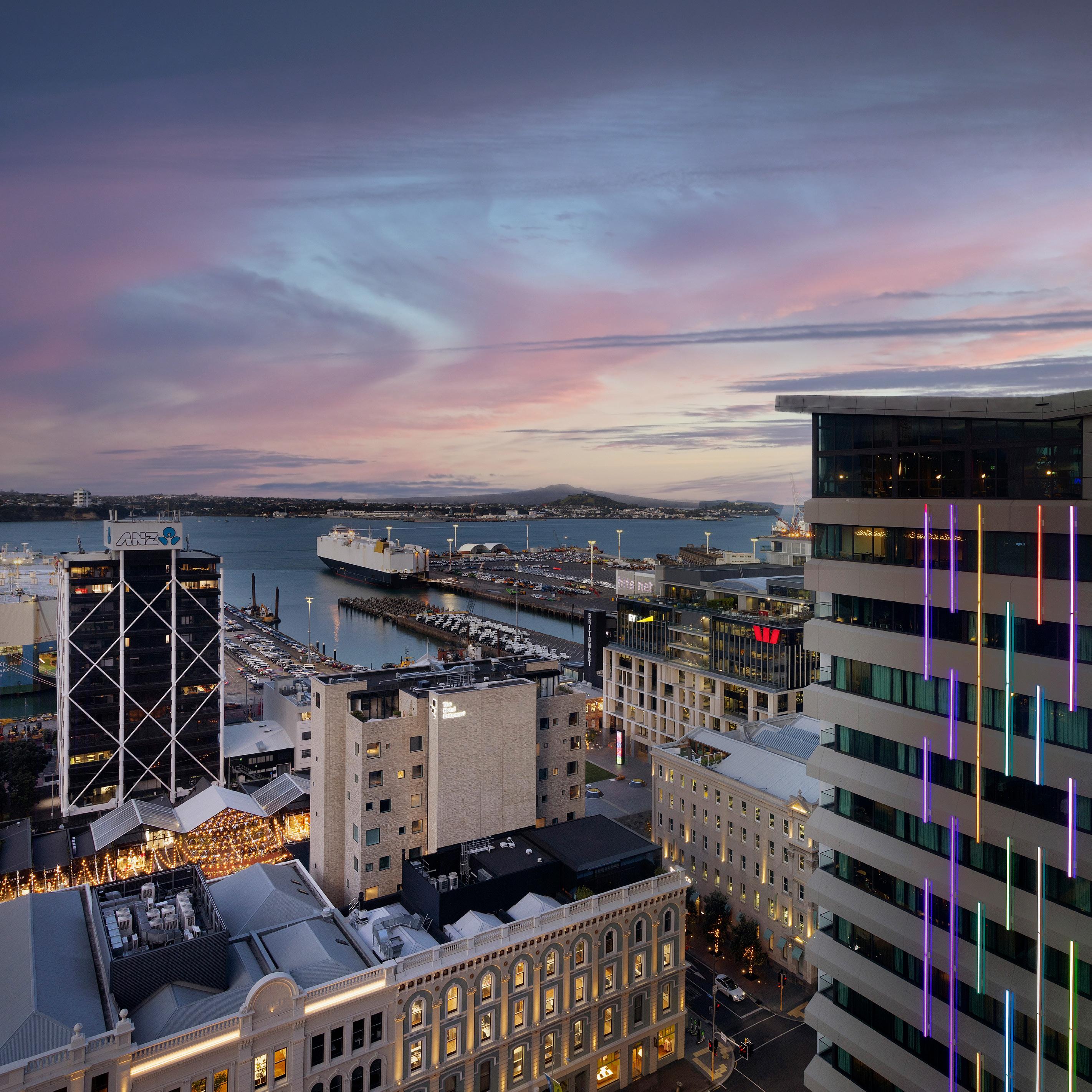
CLIPCRATE New Zealand’s premium solution. art shipping
Art is irreplaceable. The hours of skill, the years of craft, the cultural significance. None of it can be recovered if a piece is damaged in transit.
Clipcrate Art Crates were built on that understanding, and on the belief that the protection surrounding a work of art should reflect the value of what’s inside.
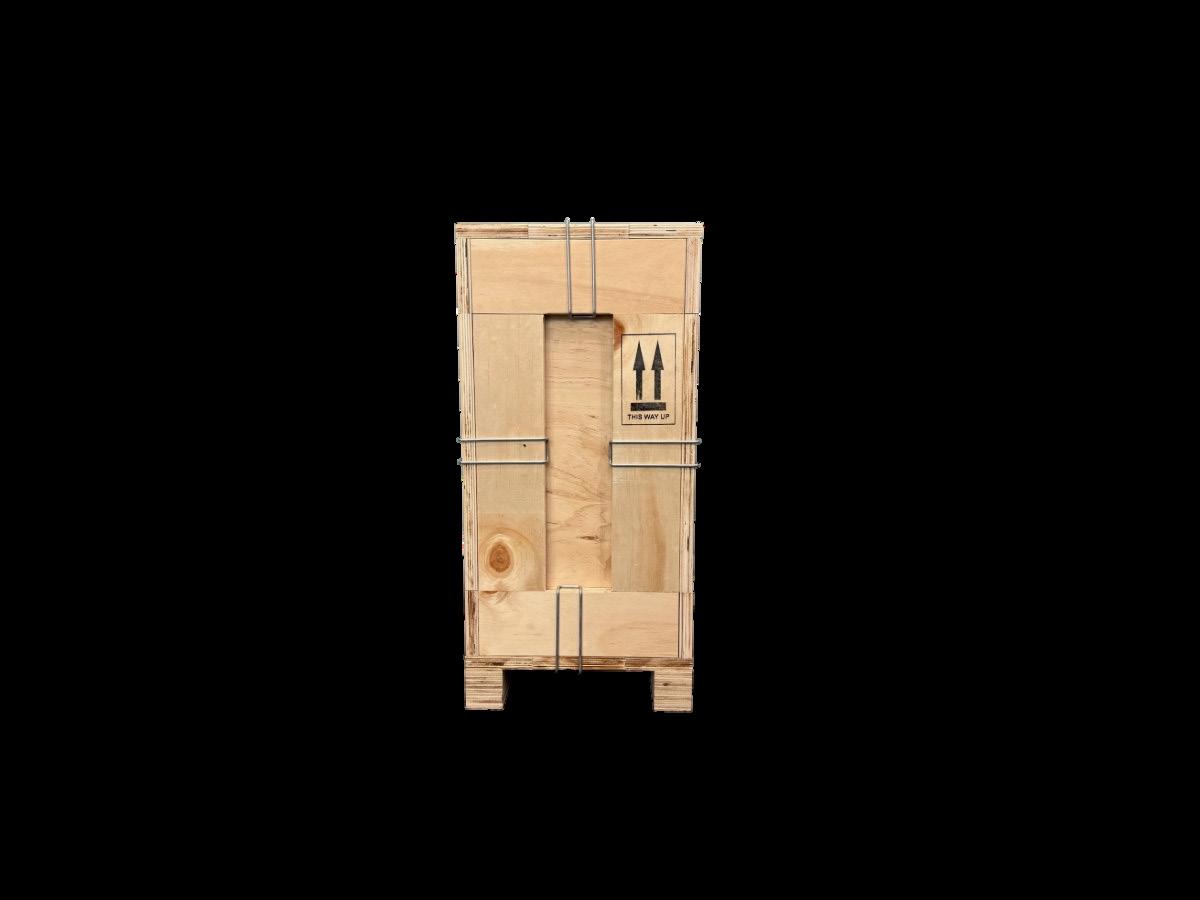
Clipcrate Art Crates are custom built around your piece. Not the other way around. Every crate is purpose engineered to the exact dimensions of the work it protects.
Specialist foam interior, premium structural plywood construction, and spring steel clips that require no tools to assemble.
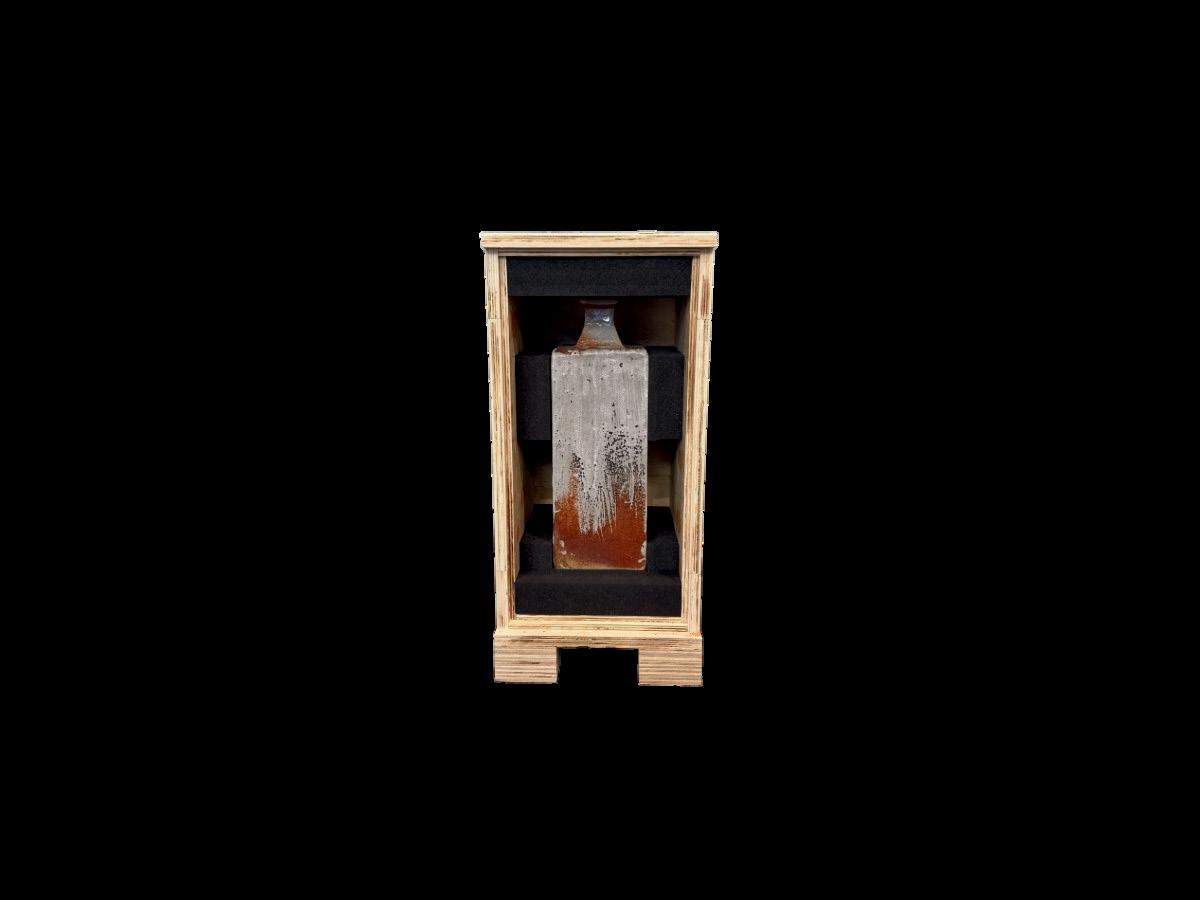
built to last. Collapsible when not in use, they store flat and reassemble in minutes.
The cost of a Clipcrate Art Crate is a single investment. The cost of single-use packaging is never-ending.
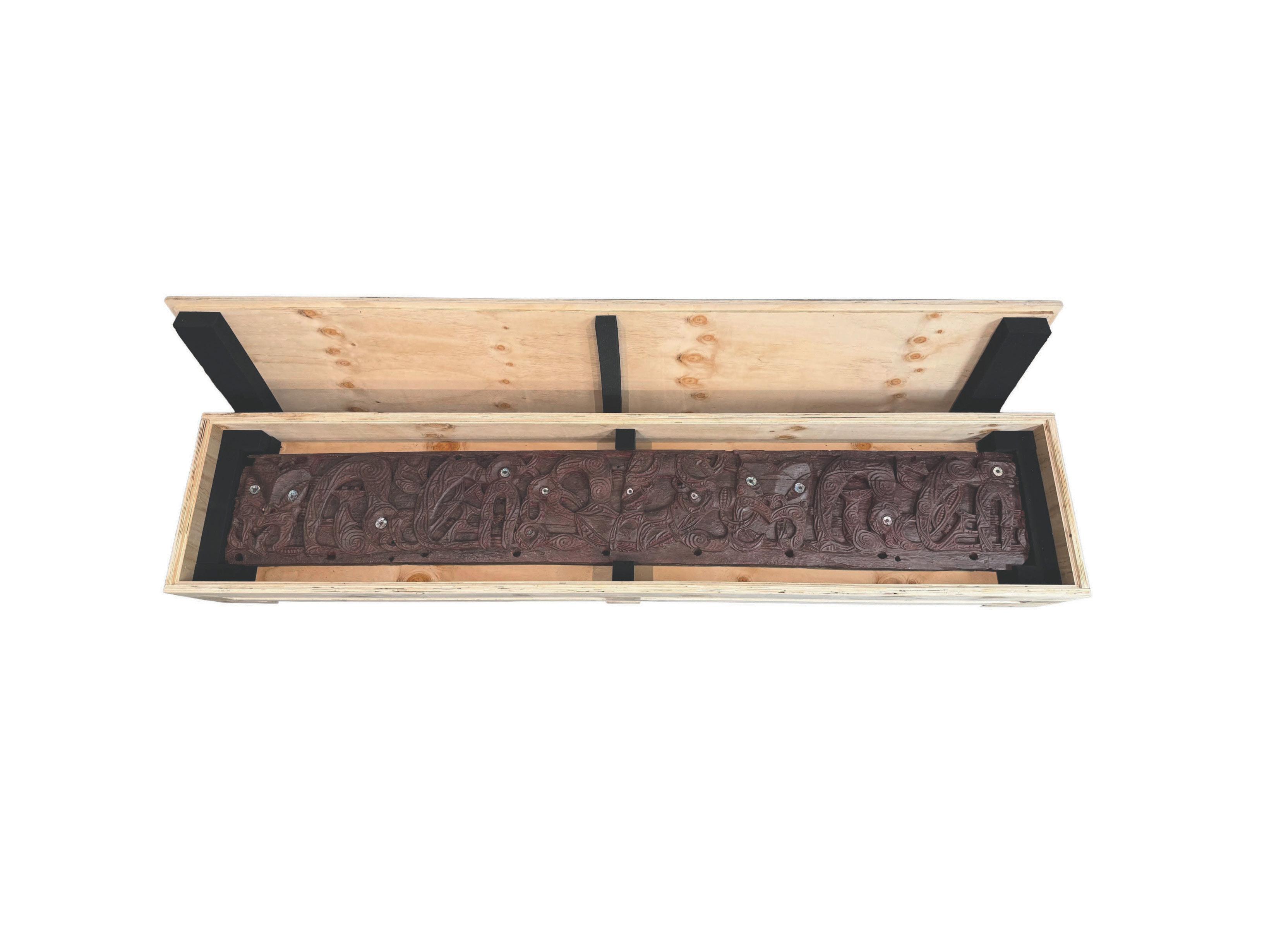
private collectors, artists, and exhibition companies across New Zealand.
Clipcrate customers report zero damage claims across years of repeated use. That record speaks for itself.
Protecting what you’ve created, collected, or curated is what we do. Talk to the Clipcrate team about your next piece.
phil@clipcrate.nz
022 565 9222
www.clipcrate.co.nz
Auckland I Wellington

Absentee Bid Form
In order to register to bid with Artvisory, please complete this form, scan and email to accounts@artvisory.com.au
Auction Title:
Name (please print clearly):
Email Address (for invoicing & correspondence):
Telephone (mobile): Telephone (home/work):
Invoice address (PO Box not accepted):
Please tick here if you do not want to receive special invitations and online auction catalogues by email.
310 Toorak Road South Yarra VIC 3141 +61 3 9826 4039 www.artvisory.com.au
We value your privacy and will not disclose your details to any third party. You may request that your details are removed from our database at any time.
If you have not previously purchased with Artvisory, please scan your photo ID (either a drivers licence or passport) and email to accounts@artvisory.com.au
Lot Number (in order)
Catalogue Description (please print clearly)
Cover Bid Not including buyer’s premium or GST (where applicable)
I authorise Artvisory to register bids on a per lot basis up to the maximum price I have indicated for each lot. I will not hold Artvisory responsible for any errors that occur. I understand that if I am the successful bidder, the purchase price will be the sum of my final bid (the hammer price) plus the Buyers Premium of 24%, plus 15% GST. I understand and accept that some lots may have additional amounts applicable and that these lots will be denoted with symbols in the catalogue. By signing this registration form I agree that I have read and accept Artvisory’s terms and conditions of sale, as per the printed catalogue and online at www.artvisory.com.au. Artvisory reserves the right not to process any bids until this form is signed. Your invoice will be emailed to the supplied email address immediately after the auction has finished and will contain all details pertaining to payment and collection.
I have read and accepted Artvisory’s terms and conditions as printed in the catalogue and online at www.artvisory.com.au. Bids will not be processed unless this form is signed.
Signature Date
Bidder Number (Office Use Only)
Telephone Bid Form
In order to register to bid with Artvisory, please complete this form, scan and email to accounts@artvisory.com.au
Auction Title:
Name (please print clearly):
Email Address (for invoicing & correspondence):
Telephone (mobile):
Invoice address (PO Box not accepted):
310 Toorak Road South Yarra VIC 3141 +61 3 9826 4039 www.artvisory.com.au
Telephone (home/work):
City State Post Code Country
Please tick here if you do not want to receive special invitations and online auction catalogues by email.
We value your privacy and will not disclose your details to any third party. You may request that your details are removed from our database at any time.
If you have not previously purchased with Artvisory, please scan your photo ID (either a drivers licence or passport) and email to accounts@artvisory.com.au
Lot Number (in order)
Catalogue Description (please print clearly)
Cover Bid Not including buyer’s premium or GST (where applicable)
Telephone bids must be received by Artvisory no later than 24 hours prior to the commencement of the Auction. Once received, your bid will be confirmed by email.
I authorise Artvisory to register bids on a per lot basis up to the maximum price I have indicated for each lot. I will not hold Artvisory responsible for any errors that occur. I understand that if I am the successful bidder, the purchase price will be the sum of my final bid (the hammer price) plus the Buyers Premium of 24%, plus 15% GST. I understand and accept that some lots may have additional amounts applicable and that these lots will be denoted with symbols in the catalogue. By signing this registration form I agree that I have read and accept Artvisory’s terms and conditions of sale, as per the printed catalogue and online at www.artvisory.com.au. Artvisory reserves the right not to process any bids until this form is signed. Your invoice will be emailed to the supplied email address immediately after the auction has finished and will contain all details pertaining to payment and collection.
I have read and accepted Artvisory’s terms and conditions as printed in the catalogue and online at www.artvisory.com.au. Bids will not be processed unless this form is signed.
Signature Date
Bidder Number (Office Use Only)
Terms and Conditions of Sale
The terms and conditions of sale listed here contain the policies of Artvisory Pty Ltd. They are the terms on which Artvisory Pty Ltd and the Seller contract with the Buyer. They may be amended by a printed Saleroom Notice or oral announcements made before and during the sale. By bidding at auction you agree to be bound by these terms and conditions.
1. Background to the Terms used in these Conditions
The conditions that are listed below contain terms that are used regularly and may need explanation. They are as follows:
“the Buyer” means the person with the highest bid accepted by the Auctioneer
“the Lot” means any item depicted within the sale for auction and in particular the item or items described against any lot number in the catalogue.
“the Hammer price” means the amount of the highest bid accepted by the auctioneer in relation to a lot
“the Buyers Premium” means the charge payable by the Buyer to the auction house as a percentage of the hammer price.
“the Reserve” means the lowest amount at which Artvisory has agreed with the Seller that the lot can be sold.
“Forgery” means an item constituting an imitation originally conceived and executed as a whole, with a fraudulent intention to deceive as to authorship, origin, age, period, culture or source, where the correct description as to such matters is not reflected by the description in the catalogue. Accordingly no lot shall be capable of being a forgery by reason of any damage or restoration work of any kind (Including re-painting).
“the insured value” means the amount that Artvisory in its absolute discretion from time to time shall consider the value for which a lot should be covered for insurance (whether or not insurance is arranged by Artvisory.)
All values expressed in this sale (in any format) are in New Zealand Dollars (NZDAU$). All bids, “hammer price”, “reserves”, “Buyers Premium” and other expressions of value are understood by all parties to be in New Zealand Dollars (NZD$) unless otherwise specified.
2. Artvisory Auctions as Agent
Except as otherwise stated Artvisory Pty Ltd acts as agent for the Seller.
The contract for the sale of the property is therefore made between the Seller and the Buyer.
3. Before the Sale
a) Examination of Property
Prospective Buyers are strongly advised to examine in person any property in which they are interested before the Auction takes place. Neither Artvisory nor the Seller provides any guarantee in relation to the nature of the property apart from the Limited warranty in the paragraph below. The property is otherwise sold “AS IS” and a condition report can be requested at any time prior to the sale.
b) Catalogue and other Descriptions
All statements by Artvisory in the catalogue entry for the property or in the condition report, or made orally or in writing elsewhere, are statements of opinion and are not to be relied upon as statements of fact. Such statements do not constitute a representation, warranty or assumption of liability by Artvisory of any kind. References in the catalogue entry to the condition report to damage or restoration are for guidance only and should be evaluated by personal inspection by the bidder or a knowledgeable representative. The absence of such a reference does not imply that an item is free from defects or restoration, nor does a reference to particular defects imply the absence of any others. Estimates of the selling price should not be relied on as a statement that this is the price at which the item will sell or it’s value for any other purpose. Neither Artvisory nor The Seller is responsible for any errors or omissions in the catalogue or any supplemental material.
Images are measured height by width (sight size). Illustrations are provided only as a guide and should not be relied upon as a true representation of colour or condition. Images are not shown at a standard scale. Mention is rarely made of frames (which may be provided as supplementary images on the website) which do not form part of the lot as described in the printed catalogue.
Foreign buyers should note that all transactions are in Australian dollars so there may be a small exchange rate risk. The costs associated with acquiring a good certificate will be carried by the purchaser. If the item turns out to be forged or otherwise incorrectly described, all reasonable costs will be borne by the vendor.
c) Buyers Responsibility
All property is sold “as is” without representation or warranty of any kind by Artvisory or the Seller. Buyers are responsible for satisfying themselves concerning the condition of the property and the matters referred to in the catalogue by requesting a condition report.
No lot to be rejected if, subsequent to the sale, it has been immersed in liquid or treated by any
other process unless the Auctioneer’s permission to subject the lot to such immersion or treatment has first been obtained in writing.
4. At the Sale
a) Refusal of Admission
Artvisory reserves the right at our complete discretion to refuse admission to the auction premises or participation in any auction and to reject any bid.
b) Registration before Bidding
Any prospective new buyer must complete and sign a registration form and provide photoidentification before bidding. Artvisory may request bank, trade or other financial references to substantiate this registration.
c) Bidding as a Principal
When making a bid, a bidder is accepting personal liability to pay the purchase price including the buyers premium and all applicable taxes, plus all other applicable charges, unless it has been explicitly agreed in writing with Artvisory before the commencement of the sale that the bidder is acting as agent on behalf of an identified third party acceptable to Artvisory and that Artvisory will only look to the principal for payment.
d) International Registrations
All International clients not known to Artvisory will be required to scan through an accredited form of photo identification and pay a deposit at our discretion in cleared funds into the Artvisory Company Trust Account (NZ) account at least 24 hours before the commencement of the auction. Bids will not be accepted without this deposit. Artvisory also reserves the right to request any additional forms of identification prior to registering an overseas bid.
e) Absentee bids
Artvisory will use reasonable efforts to execute written bids delivered to us AT LEAST 24 Hours before the sale for the convenience of those clients who are unable to attend the auction in person. If we receive identical written bids on a particular lot, and at the auction these are the highest bids on that lot, then the lot will be sold to the person whose written bid was received and accepted first. Execution of written bids is a free service undertaken subject to other commitments at the time of the sale and we do not accept liability for failing to execute a written bid or for errors or omissions which may arise. It is the bidder’s responsibility to check with Artvisory after the auction if they were successful. Unlimited or “Buy” bids will not be accepted.
f) Telephone bids
Please refer to the catalogue or the website for the Telephone Bids form. Arrangements for this service must be confirmed AT LEAST 24 HOURS PRIOR to the auction commencing. Artvisory accepts no responsibility whatsoever for any errors or failure to execute bids. In telephone bidding the buyer agrees to be bound by all terms and conditions listed here and accepts that Artvisory cannot be held responsible for any miscommunications in the process. The success of telephone bidding cannot be guaranteed due to circumstances that are unforeseen. Buyers should be aware of the risk and accept the consequences should contact be unsuccessful at the time of Auction. Artvisory will advise Telephone Bidders who have registered at least 24 hours before the auction of any relevant changes to descriptions, withdrawals or any other sale room notices.
G) Online and Timed Online Bidding
Artvisory offers an online bidding service via Invaluable.com. When bidding online the buyer agrees to be bound by all terms and conditions listed here by Artvisory and agrees to pay any fees charged in regard to any purchases made via Invaluable.com.
Artvisory accepts no responsibility for any errors, failure to execute bids or any other miscommunications regarding this process. It is the online bidder’s responsibility to ensure the accuracy of the relevant information regarding bids, lot numbers and contact details. Chrome or Firefox must be used as a web browser, as Safari does not support the Invaluable.com online platform. We recommend registering or logging at least 24 hours in advance prior to bidding in the sale to make sure there are no issues with customer log in.
H) Reserves
Unless otherwise indicated, all lots are offered subject to a reserve, which is the confidential minimum price below which the Lot will not be sold. The reserve will not exceed the low estimate printed in the catalogue. The auctioneer may open the bidding on any Lot below the reserve by placing a bid on behalf of the Seller. The auctioneer may continue to bid on behalf of seller up to the amount of the reserve, either by placing consecutive bids or by placing bids in response to other bidders.
I) Auctioneers Discretion
The Auctioneer has the right at his absolute and sole discretion to refuse any bid, to advance the bidding in such a manner as he may decide, to withdraw or divide any lot, to combine any two or more lots and, in the case or error or dispute and whether during or after the sale, to determine the successful bidder, to continue the bidding, to cancel the sale or to re-offer and resell the item in dispute. If any dispute arises after the sale, then Artvisory’s sale record is conclusive.
J) Successful bid and passing of risk
Subject to the auctioneer’s discretion, the highest bidder accepted by the auctioneer will be the buyer and the striking of his hammer marks the acceptance of the highest bid and the conclusion of a contract for sale between the Seller and the Buyer. Risk and responsibility for the lot (including frames or glass where relevant) passes immediately to the Buyer.
K) Indicative Bidding steps, etc.
Artvisory reserves the right to refuse any bid, withdraw any lot from sale, to place a reserve on any lot and to advance the bidding according to the following, at the auctioneers discretion: Increment Amount Dollar Range
$20
$50
$100
$200
$500
$1,000
$2,000
$5,000
$0–$500
$500–$1,000
$1,000–$2,000
$2,000–$5,000
$5,000–$10,000
$10,000–$20,000
$20,000–$50,000
$50,000–$100,000
$10,000 $100,000–$200,000
$20,000 $200,000–$500,000
$50,000
$500,000–$1,000,000
Absentee bids must follow these increments and any bids that don’t follow the steps will be rounded up to the nearest acceptable bid.
5. After the Sale
a) Buyers Premium
In addition to the hammer price, the buyer agrees to pay to Artvisory the buyer's premium. The buyer’s premium for this sale is 24% of the hammer price plus 15% GST. (Goods and Services Tax) where applicable.
b) Payment and passing of title
The buyer must pay to the company trust account managed by KK Partners Pty Ltd Chartered Accountants the full amount due (comprising the hammer price, buyer's premium and any applicable taxes and GST) not later than 3 days after the auction date.
The buyer will not acquire title for the lot until Artvisory receives full payment in cleared funds, and no goods under any circumstances will be released without confirmation of cleared funds received. This applies even if the buyer wishes to send items interstate or overseas. Payment can be made in NZD by direct transfer to the Company Trust bank account provided on the invoice. (KK Partners Group).
The buyer is responsible for any bank fees and charges applicable for the transfer of funds into Artvisory’s NZ company trust account.
c) Collection of Purchases & Insurance
Artvisory is entitled to retain items sold until all amounts due to us have been received in full in cleared funds. Subject to this, the Buyer shall collect purchased lots within 3 days from the date of the sale unless otherwise agreed in writing between Artvisory and the Buyer.
At the fall of the hammer, insurance is the responsibility of the purchaser.
d) Packing, Handling and shipping
Artvisory will be able to suggest local, national and international carriers and takes no responsibility whatsoever for the actions of any recommended third party carrier. Artvisory can pack and handle goods purchased at the auction by agreement, however will take no responsibility for damage, and a charge may be made for this service. All packing, shipping, insurance, postage & associated charges will be borne by the purchaser.
e) Cultural Heritage/Protected Object Art 1975
Please note that many of the pieces this auction have been registered under the Protected Objects Act (1975)
This is referred to a Y registration. Under the terms of the act, items that are y registered may not be sold to non-New Zealand residents and may not leave the country without the consent of the Ministry of Culture and Heritage . To purchase any Y registered taonga you must be a registered collector. To register as a collector, you must apply to the Ministry of Culture and Heritage (info@mch. govt.nz)
It is the Buyer’s responsibility to check New Zealand's Protected Object Art 1975 before purchase. We shall not be obliged to rescind a sale nor to refund any interest or other expenses incurred by the Buyer where prior approval for registration is not made and granted by the Buyer.
f) Remedies for non-payment
If the Buyer fails to make full payment immediately, Artvisory is entitled to exercise one or more of the following rights or remedies (in addition to asserting any other rights or remedies available under the law)
i) to charge interest at such a rate as we shall reasonably decide
ii) to hold the defaulting Buyer liable for the total amount due and to commence legal proceedings for it’s recovery along with interest, legal fees and costs to the fullest extent permitted under applicable law
iii) to cancel the sale
iv) to resell the property publicly or privately on such terms as we see fit
v) to pay the Seller an amount up to the net proceeds payable in respect of the amount bid by the defaulting Buyer. In these circumstances the defaulting Buyer can have no claim upon Artvisory in the event that the item(s) are sold for an amount greater than the original invoiced amount.
vi) to set off against any amounts which Artvisory may owe the Buyer in any other transactions, the outstanding amount remaining unpaid by the Buyer.
vii) where several amounts are owed by the Buyer to us, in respect of different transactions, to apply any amount paid to discharge any amount owed in respect of any particular transaction, whether or not the Buyer so directs.
viii) to reject at any future auction any bids made by or on behalf of the Buyer or to obtain a deposit from the Buyer prior to accepting any bids.
ix) to exercise all the rights and remedies of a person holding security over any property in our possession owned by the Buyer whether by way of pledge, security interest or in any other way, to the fullest extent permitted by the law of the place where such property is located. The Buyer will be deemed to have been granted such security to us and we may retain such property as collateral security for such Buyer’s obligations to us.
x) to take such other action as Artvisory deem necessary or appropriate
If we do sell the property under paragraph (iv), then the defaulting Buyer shall be liable for payment of any deficiency between the total amount originally due to us and the price obtained upon reselling as well as for all costs, expenses, damages, legal fees and commissions and premiums of whatever kinds associated with both sales or otherwise arising from the default.
If we pay any amount to the Seller under paragraph (v) the Buyer acknowledges that Artvisory shall have all of the rights of the Seller, however arising, to pursue the Buyer for such amount.
g) Failure to collect purchases
Where purchases are not collected within 3 days from the sale date, whether or not payment has been made, we shall be permitted to remove the property to a warehouse at the buyer’s expense, and only release the items after payment in full has been made of removal, storage handling, insurance and any other costs incurred, together with payment of all other amounts due to us.
6. Extent of Artvisory Liability
Artvisory agrees to refund the purchase price in the circumstances of the Limited Warranty set out in paragraph 7 below. Apart from that, neither the Seller nor we, nor any of our employees or agents are responsible for the correctness of any statement of whatever kind concerning any lot, whether written or oral, nor for any other errors or omissions in description or for any faults or defects in any lots. Except as stated in paragraph 7 below, neither the Seller ourselves, our officers, agents or employees give any representation warranty or guarantee or assume any liability of any kind in respect of any lot with regard to merchantability,
fitness for a particular purpose, description, size, quality, condition, attribution, authenticity, rarity, importance, medium, provenance, exhibition history, literature or historical relevance. Except as required by local law any warranty of any kind is excluded by this paragraph.
7. Limited Warranty
Subject to the terms and conditions of this paragraph, the Seller warrants for the period of thirty days from the date of the sale that any property described in this catalogue (noting such description may be amended by any saleroom notice or announcement) which is stated without qualification to be the work of a named author or authorship is authentic and not a forgery. The term “Author” or “authorship” refers to the creator of the property or to the period, culture, source, or origin as the case may be, with which the creation of such property is identified in the catalogue.
The warranty is subject to the following:
i) it does not apply where a) the catalogue description or saleroom notice corresponded to the generally accepted opinion of scholars and experts at the date of the sale or fairly indicated that there was a conflict of opinions, or b) correct identification of a lot can be demonstrated only by means of a scientific process not generally accepted for use until after publication of the catalogue or a process which at the date of the publication of the catalogue was unreasonably expensive or impractical or likely to have caused damage to the property.
ii) the benefits of the warranty are not assignable and shall apply only to the original buyer of the lot as shown on the invoice originally issued by Artvisory when the lot was sold at Auction.
iii) the Original Buyer must have remained the owner of the lot without disposing of any interest in it to any third party
iv) The Buyer’s sole and exclusive remedy against the Seller in place of any other remedy which might be available, is the cancellation of the sale and the refund of the original purchase price paid for the lot less the buyers premium which is non refundable. Neither the Seller nor Artvisory will be liable for any special, incidental nor consequential damages including, without limitation, loss of profits not for interest.
v) The Buyer must give written notice of claim to us within thirty days of the date of the Auction. The Seller shall have the right, to require the Buyer to obtain two written opinions by recognised experts in the field, mutually acceptable to the Buyer and Artvisory to decide whether or not to cancel the sale under warranty.
vi) the Buyer must return the lot to Seller in the same condition that it was purchased.
8. Severability
If any part of these Conditions of Sale is found by any court to be invalid, illegal or unenforceable, that part shall be discounted and the rest of the Conditions shall continue to be valid to the fullest extent permitted by law.
9. Copyright
The copyright of all images, illustrations and written material produced by Artvisory relating to a lot including the contents of this catalogue, is and shall remain the property at all times of Artvisory and shall not be used by the Buyer, nor by anyone else without our prior written consent. Artvisory and the Seller make no representation or warranty that the Buyer of a property will acquire any copyright or other reproduction rights in it.
10. Law and Jurisdiction
These terms and conditions and any matters concerned with the foregoing fall within the exclusive jurisdiction of the courts of the state in which the auction is held.
11. Pre-Sale Estimates
Artvisory publishes with each catalogue our opinion as to the estimated price range for each lot. These estimates are approximate prices only and are not intended to be definitive. They are prepared well in advance of the sale and may be subject to revision. Interested parties should contact Artvisory prior to auction for updated pre-sale estimates and starting prices.
12. Sale results
Artvisory will provide auction results as published on the website www.artvisory.com.au via Invaluable.com after the sale.
13. Goods and Service Tax
In accordance with New Zealand Goods and Services Tax Law Artvisory Auctions will collect on behalf of the New Zealand tax office a Goods and Service Tax (GST) of 15% on the buyer’s premium.
Overseas buyers and buyers non-resident in New Zealand will not be charged GST on the premium under the following conditions:
1. The items are exported through a Artvisory approved International freight company
2. The items are exported within 28 days of the date of the sale
The invoice supplied by Artvisory for purchases in NZD$ will be regarded as a Tax invoice for GST purposes.