The Mary Bloor Loser ’42 Music Series
The Wheaton College Chorale & Chamber Singers present
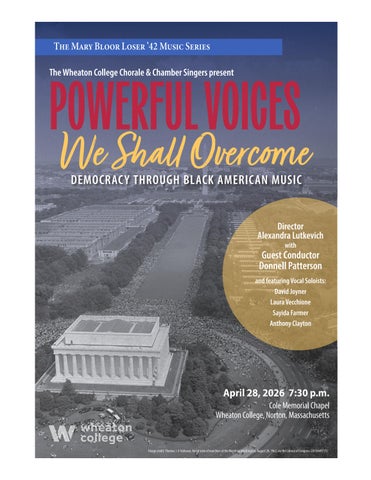
The Mary Bloor Loser ’42 Music Series
The Wheaton College Chorale & Chamber Singers present
Director Alexandra Lutkevich with Guest Conductor Donnell Patterson and featuring Vocal Soloists: David Joyner
Laura Vecchione
Sayida Farmer
Anthony Clayton
April 28, 2026 7:30 p.m.
Cole Memorial Chapel
Wheaton College, Norton, Massachusetts

In planning for this concert, I was inspired by a lecture that the students and I attended in the fall by visiting scholar Dr. Shannon Jackson entitled “The Arts, Democracy, and Public Life”. Professor Jackson called on our Wheaton community to consider the power of the arts in a democracy to resist oppression and maintain joy. In our work on this program, highlighting the musical and poetic contributions of Black American composers from the classical, gospel, and spiritual traditions, this idea has been a guiding force. Exploring this music, we have been reminded of so many of the best parts of the American spirit: ingenuity, creativity, hope in the face of adversity, and the continual fight for equality.
I would like to thank all of the musicians who are joining us in performance tonight for their collaboration and leadership; our collaborative pianist, Yuri Son, for her dedication, competence and flexibility; Jessica Kuszaj, Kristina Kalogeras and the Arts@ Wheaton staff for their help with programs, publicity, and logistics; George Lane for their supreme organizational skills as Chorale Assistant; and the Creative Arts faculty for their support.
A very big thank you to Donnell Patterson for his exceptional musicianship and generous spirit, and for bringing a huge dose of joy to our ensembles during his time here. And lastly, a heartfelt thanks to the student singers in these groups. Getting to make music with these thoughtful, intelligent, and joyful young adults brings me a lot of optimism for our future- something I hope that we bring you, as an audience, tonight. —Alexandra Lutkevich
Chorale
Aarti Addanki
Emily Bellows
Amanda Bergeron
Marin Binder
Mia Boudreau
Jill Brown*
Mallory Canning
Caleb Cascio
Hayla Davis
Lucy Dibble
Owen Dietrich
Sydney Esper
Alijah Gonzalez
Chloe Holliday
Dorothy Joseph
George Lane*
Anthony LaRocca*
Maggie Mercadante
Annabel Morris
Elizabeth Morrison*
Owen Moses
Shannon O’Leary
Sophie Packard
El Parks
Ryley Pitman
Jonathan Purvis
Isaiah Smith-Johnson
Shealyn Smyth
Simon Stanton*
Aidan Strovink
Fern Tamagini-O’Donnell
Lia Taylor
Serafina Velazquez
Anna Willi
Reymond Woessner
Anya Yigit
*indicates graduating senior
Marin Binder
Mia Boudreau
Mallory Canning
Caleb Cascio
Sydney Esper
George Lane
Anthony LaRocca
Annabel Morris
Owen Moses
Isaiah Smith-Johnson
Aidan Strovnik
Fern Tamagini-O’Donnell
Reymond Woessner
Alexandra Lutkevich, director
Yuri Son, collaborative pianist
Donnell Patterson, conductor
Donnell LaRoque Patterson is chair of the Gospel Music department in New England Conservatory’s (NEC) School of Preparatory and Continuing Education. He is also the founding director of the Millennium Gospel Choir. Since 2006, Donnell has served as the Director of Music for both the Upper and Lower Schools at Belmont Hill School in Belmont, MA.
From 2002 to 2006 prior to joining the Belmont Hill School, Donnell was Program Director of the Roland Hayes School of Music in the Boston Public Schools. Previously, Donnell was an elementary and high school music educator in the Cambridge Public Schools, beginning in 1982. He has also served as Acting Assistant Director of Music in the Cambridge Public Schools.
In 2014, Donnell joined as the Director of Boston community gospel choir, Joyful Voices of Inspiration. In addition, for over 20 years, he has been Minister of Music at St. Paul African Methodist Episcopal Church in Cambridge, MA.
In 1987, Donnell brought together a group of vocalists to form the Patterson Chorale, which specialized in and performs spirituals and traditional gospel. The chorale performed at the opening of the original House of Blues in Harvard Square and was the first gospel group to play its Sunday gospel brunches. For many years, Donnell served as accompanist for the Cambridge Community Chorus under the direction of Maestro William Thomas.
Performing and conducting music has allowed Donnell to travel extensively all over the world, including Armenia, France, South Africa, Puerto Rico, Toronto, Greece, Japan, Costa Rica, Uruguay and Argentina.
Anthony is an active member of the Greater Boston Gospel Community. Over the past 15 years, he has performed with various groups, including Joyful Voices of Inspiration, Millennium Choir, Boston Symphony, Boston Pops, and others. The joy he experiences singing this music is deeply connected to cherished memories of attending church with his grandmother. Closing his eyes transports him back to those precious moments.
Sayida Rivers Farmer was born in Harlem, New York. She is a graduate of the LaGuardia High School of Performing Arts where she was a vocal major. She continued her studies at Westfield State College, where she earned a Bachelor of Arts in psychology, English and music). Sayida earned an MSW (Masters of Social Work) degree at UCONN and is now a LCSW (Licensed Social Worker). She has been married to her college sweetheart Karl for almost 30yrs. Together, they have beautiful 23 year
old daughter, who recently graduated from Howard University summa cum laude.
Sayida continues to hone her craft and has performed in many choirs: The New England Conservatory of Music Gospel Choir, Joyful Voices of Inspiration, The Mystic Choral, The New Temple Singers, The SANS Choir (Sing A New Song) and The Boston Millennium Gospel Choir all under Music Director, Donnell Patterson. Sayida participated in 4 sold out dates, for the Boston Millennium Gospel Choir’s 25 anniversary concert at the Boston Museum of Fine Arts. She performed a number of solos. Sayida most joyfully expresses herself while singing. She enjoys all types of genres to reach and bring together all people.
David Joyner, vocalist
David Joyner is a relative newcomer to choir singing. At the great encouragement of a friend he auditioned for and was selected for his first choir experience in 2023, as a member of the Boston Pops Gospel Choir. After getting bitten by the choir bug, David joined two other choirs, Joyful Voices of Inspiration (JVOI) and Sharing a New Song (SANS), both international traveling choirs. Finally, David also joined the Millennium Gospel Choir which performs annually at the Museum of Fine Arts. David is also the lead singer of a neighborhood band.
Laura Vecchione, vocalist
Laura Vecchione is a versatile artist. She has recorded three studio albums in Nashville, worked with Grammy-award-winning producers, and her songs have received heavy rotation on the Americana charts and received TV placement. In addition to performing, Laura is a sought after voice teacher and Assistant Professor of Voice at Berklee College of Music. A Boston career highlight was singing in the Duke Ellington ensemble with the BSO. In addition to solo gigs, you can also find Laura this Christmas season in Boston’s Millennium Gospel Choir Concerts at the MFA.
For info and all social media links visit www.LauraVmusic.com
Jevon Garrett II, bass
David Langford, keyboard
Matthew Williams, percussion
Music: Rosephanye Powell (b. 1962)
Text: Langston Hughes (1901–1967)
I Dream A World is an inspiring and motivational piece that was composed in 2001 by Rosephanye Powell. This piece incorporates the words of Langston Hughes, a poet, playwright, novelist, and activist. The text comes from his poem also titled I Dream A World, written in 1941. It is said that this poem was developed while he was working on the opera Troubled Island about the Haitian War of Independence. In contrast to a variety of his other written works, the central focus of this poem is the act of moving toward something better and having hope for the future. In the form of a choral work, Rosephanye Powell was really able to bring another level of life into this incredible poem. —Jill Brown
Music: William Grant Still (1895–1978)
Text: Katherine Garrison Chapin (1890–1977)
Premiering at Carnegie Hall in 1941, Plain-Chant for America is a deeply moving piece that challenges the very idea of war as an inevitability using the ideals that have defined American identity for generations. The poem, written by Katherine Garrison Chapin in strikingly simple prose, was a response to increasing global and national tensions and debuted a few short months before the United States’ entry into World War II. Chapin posits that while the history of America is inseparable from fear, the fight for freedom within the American dream is how we will overcome it. Composer William Grant Still was widely acknowledged for his contributions to the African American symphonic canon, with his most well known work being his first symphony; Afro-American Symphony (1930). His orchestration of the poem serves to illustrate the intentions of Chapin’s text, rising and falling with the tension to create a striking painting of our country’s history. Although it has been 85 years since that original premiere, Plain-Chant for America remains relevant as we continue to fight for democracy and global equity. This collaboration between visionaries gives hope that the best way to combat injustice is through acceptance of pain and the conscious decision to evolve.
—George Lane
Music: Tara Mack (b. 1972)
Text: Langston Hughes (1901–1967)
Harlem Night Song is a composition based on a Langston Hughes poem. Tara Mack captures the vibrant energy of Harlem nightlife by drawing upon elements of jazz and contemporary choral writing, eliciting a sense of community, expression, and motion. The overall piece mirrors the cultural legacy of Harlem as the heart of artistic innovation; the Harlem Renaissance was a time where the arts flourished, especially music and poetry. The sonic picture of lively city streets and romance is painted with dynamic contrasts and melodic exchanges between voices. Harlem Night Song shows the enduring power of cultural identity and the artistic voice in molding community and resilience with love.
—Mallory Canning
Music: Christopher Harris (b. 1971)
Text: Samuel Barber (1884–1933)
I am Loved is a beautiful expression of love painted by the poetic words of Sara Teasdale and the harmonious melodies of Christopher H. Harris. The piece is based on the poem Joy written by Sara Teasdale, an American lyrical poet known for a multitude of lovely poems based on women’s perspectives of love and beauty. The poem Joy has text that showcases symbols of love through literary means such as imagery, specifically imagery through themes of nature. The words of this poem are truly brought to life using the amazing compositional techniques of Christopher H. Harris. Christopher H. Harris is an American chorale composer, performer, and educator acclaimed for his choral writing. I Am Loved features melodious moving harmonies as well as beautiful accompaniment composition that perfectly blossoms the feeling of powerful love echoed within Sara Teasdale’s poem. —Sydney Esper
Music and Text: Moses Hogan (1957–2003)
Hear My Prayer is an emotional and reverent spiritual that reflects themes of longing, faith, and perseverance. In the making of this piece, Moses Hogan drew from the historical experiences of enslaved African-Americans who used spirituals as a means of communication and hope. This arrangement includes rich harmonies, and intense dynamics that allow the plea for solace in the text to feel both personal and communal. The music effectively builds with a sense of urgency and faithfulness that embody both hardship and trust in divine guidance. Hear my Prayer continues to resonate as a testament to fortitude, spirituality, and the enduring strength that is found in collective expression.
—Mallory Canning
Music and Text: Richard Smallwood (1948–2025)
arr. Patrick Barrett and Doreen Rao
Total Praise, written in 1996 by Richard Smallwood, fuses gospel tradition with classical choral elements, making it a favorite of concert choirs. Renowned for rich harmonies and expressive intensity, Total Praise provides performers and audiences with a moving, uplifting musical experience. Its text, drawn from scripture, features phrases from Psalm 121, including “I will lift up mine eyes to the hills, from whence cometh my help.” This psalm declares faith and trust in divine guidance, a message that Smallwood’s setting heightens through gradual musical expansion, rising from humble reflection to a powerful, climactic praise. Throughout the piece, the repeated declarations, “You are the source of my strength” and “You are the strength of my life,” emphasize unwavering devotion and dependence on God, further uniting the musical and lyrical elements. —Isaiah Smith-Johnson
Music an Text: Traditional
arr. Keith McCutchen and Everett McCorvey
Laura Vecchione, soloist
Ol’ Time Religion arranged by Keith McCutchen and Everett McCorvey is an upbeat piece that combines the genres of spiritual, ragtime, and jazz music in a fun and wondrous display of musicianship. The piece is a medley of two classic American folk songs, the first being the hymn Ol’ Time Religion Ol’ Time Religion is a spiritual tune written in 1873, the piece is rooted within African-American culture specifically within gospel music. The second folk song featured in the piece is When the Saints Go Marching In. When the Saints Go Marching In is another gospel hymn that is rooted within African-American culture. The piece is known as a very popular spiritual which dates back to around 1923. This mashup of two classic gospel hymns spark an absolutely catchy and uplifting atmosphere heightened by its incredible composition. —Sydney Esper
Music and Text: John Bucchino (b. 1952)
Laura Vecchione, soloist
Music and Text: Carole Bayer Sager (b. 1944) and David Foster (b. 1949)
Sayida Farmer and David Joyner, soloists
Music and Text: Lionel Richie (b. 1949)
Anthony Clayton, soloist
Music and Text: Traditional, arr. Moses Hogan (b. 1957–2003)
Sayida Farmer, soloist
I Want Jesus to Walk with Me is an African-American spiritual and communal lament arising from the era of slavery with no known specific author. It serves as a song of invitation and assurance, focusing on companionship with Christ through life’s brokenheartedness and sorrow. This particular version was arranged by Moses Hogan, American composer, conductor, and pianist from New Orleans, best known for revitalizing African American spirituals through innovative choral arrangements. The music moves between moments of quiet introspection and powerful climaxes, mirroring the text’s journey from loneliness to spiritual assurance. —Dorothy Joseph
Music: Donnell LaRoque Patterson
Text: Isaiah 40:4
Anthony Clayton and Isaiah Smith-Johnson, ‘27, soloists
I Have a Dream, created by Donnell LaRoque Patterson, is a powerful piece inspired by Martin Luther King Jr. and his I Have a Dream speech. The song incorporates various elements of traditional gospel music, mixed with contemporary elements.
There are multiple references to Old Testament scriptures of Isaiah 40:4, which Dr. King used in his speech. This piece is very impactful in its portrayal of the fight for equality, expressing a strong sense of hope for a better future. Patterson blends an array of emotions through shifting tones between softer and bolder melodies. The themes presented include perseverance, unity, and hope. This piece honors the legacy of Martin Luther King Jr., and what he stood for. It encompasses the essence of the Civil Rights Movement by demanding attention towards injustices, and displaying the hope that can inspire future generations. I Have a Dream maintains its relevance, and will always be powerful in its universal message that under the protection of God, we can always continue to make our society better than it already is. —Aarti Addanki
Music and Text: Jerome Metcalfe and Kevin Young arr. Brandon Boyd
Written by Kevin Yancy and Jerome Metcalfe, and arranged by Brandon A. Boyd, Sign Me Up is a popular African American gospel song and spiritual, focused on salvation, and the preparation for Jesus’ return. It is often sung in church settings as a celebration of the “Jubilee of God’s Redemption,” a reference to the biblical tradition of setting slaves free and forgiving debts. The song has been recorded by various gospel artists and choirs, including notable versions by The Fountain of Life Joy Choir and Donald Lawrence & The Tri-City Singers. —Dorothy Joseph
Music and Text: Jason Clayborn
David Joyner and Aidan Strovink ’29, soloists
Better is a hopeful and triumphant gospel song, released in 2016 and written by Jason Clayborn, along with Hezekiah Walker and Gabriel Hatcher. This piece blends traditional gospel choir elements with a vibrant modern production style, the piece is led by Hezekiah Walker, whose inspiring direction brought the song to a wide audience. Better was nominated for a Grammy in Best Gospel Performance/ Song in 2017. It became a Number 1 Hit on the Gospel Airplay Chart on Billboard, showing its extensive reach and positive responses. This song radiates positivity, and highlights the power of faith and the belief that it will always get better. —Aarti Addanki
Based on a hymn by Rev. Charles Tindley (1901)
Arr. Donnell LaRoque Patterson
Sophie Packard ‘27, and Dorothy Joseph ‘29, Laura Vecchione and David Joyner, soloists
We Shall Overcome is one of the most enduring songs of hope and resilience in American history, with roots in the hymn of Charles Albert Tindley, often called the “father of gospel music.” Tindley’s early 20th-century hymn I’ll Overcome Someday laid the foundation for what would later evolve into We Shall Overcome, a song that became synonymous with the Civil Rights Movement. This arrangement by Donnell Patterson brings a contemporary choral perspective to the traditional melody while preserving its spiritual and emotional core. Rich harmonies, dynamic contrasts, and expressive phrasing highlight both the individual and collective voice, reflecting the communal strength embedded in the song’s history. The gradual build throughout the arrangement mirrors the journey from struggle to hope, culminating in a powerful affirmation of resilience. —Isaiah Smith-Johnson
The Mary Bloor Loser ’42 Music Series was established in 1987 through the generosity of Thomas N. Loser and Ann Bloor, husband and mother of the late Mary Bloor Loser, Wheaton Class of 1942, to honor her love of music and of Wheaton. For 39 years, the series has offered members of the Wheaton College community an opportunity to hear the work of major musical performers. We have been privileged to host these artists:
1988
Emmanuel Ax, piano
1989
The Vienna Choir Boys
The Canadian Brass
1990
Moscow Virtuosi, with Vladimir Spivakov, conductor
1991
Roberta Peters, soprano, with Warren Jones, piano
Yo-Yo Ma, cello, with Kathryn Stott, piano
1992
Paula Robison, flute, with Kenneth Cooper, harpsichord
The Saint Paul Chamber Orchestra
1993
Beaux Arts Trio
The Boys Choir of Harlem
1994
Alicia de Larrocha, piano
Empire Brass, with Douglas Major, organ
1995
Uptown String Quartet
Roberta Peters, soprano, with Linda Hall, piano
1996
Ani and Ida Kavafian, violins, with Jonathan Feldman, piano
Sweet Honey in the Rock
1997
Academy of St. Martin in the Fields, with Iona Brown, violin
William Brown, tenor, with Ann Sears, piano
1998
Nadja Salerno-Sonnenberg, violin, with Sandra Rivers, piano
The King’s Singers
1999
Victor Rosenbaum, piano
Los Angeles Guitar Quartet
2000
John Aler, tenor, with Martin Katz, piano
Carnegie Hall Jazz Band, with Jon Faddis, music director
2001
Apple Hill Chamber Players
Epic Brass, with Earl Raney, director
2002
Joshua Bell, violin, with Simon Mulligan, piano
Flautas Fantásticas
2003
The King’s Singers
Marian Anderson String Quartet
2004
Triple Helix
Christopher Parkening, guitar
2005
Awadagin Pratt, piano
The Boston Museum Trio
2006
Robert Honeysucker, baritone, with John Moriarty, piano
Borromeo String Quartet
2007
Imani Winds
Kronos Quartet
2008
The King’s Singers
Paquito D’Rivera Quintet
2009
Hilary Hahn, violin, with Valentina Lisitsa, piano
Cavani String Quartet
2010
Jonathan Biss, piano
Rockapella
2011
Bobby McFerrin
Dawn Upshaw, soprano
2012
Alicia Weilerstein, cello with Inon Barnatan, piano
Ann Hobson Pilot, harp
Tai Muray, violin
James Christie, organ
2013
The Silk Road Ensemble with Yo-Yo Ma
2014
Victor Rosenbaum, piano
2015
Hermitage Piano Trio
Roomful of Teeth
2017
Brooklyn Rider
Esperanza Spalding
2018
The Borromeo String Quartet
2019
Christian Lane, organ
2020
A Far Cry
2022
Angélique Kidjo
2024
Berklee Indian Ensemble
Dr. Samantha Ege, piano
2025
Chloé Arnold's Syncopated
Ladies
Lauren Henderson Quartet