Published for alumni and friends of the School of Music at the University of illinois at Urbana-Champaign
the School of Music is a unit of the College of Fine and Applied Arts at the University of illinois at UrbanaChampaign and has been an accredited institutional member of the national Association of Schools of Music since 1933.
Karl Kramer, director edward rath, associate director
Paul redman, assistant director, business
Joyce Griggs, assistant director, enrollment management and public engagement
Marlah Bonner-McDuffie, director, development
Philip Yampolsky, director, robert e. Brown Center for World Music
David Allen, coordinator, outreach and public engagement
Michael Cameron, coordinator, graduate studies
B. Suzanne Hassler, coordinator, alumni relations and development
Daniel Hassler, coordinator, enrollment management and student services
ruth Stoltzfus, coordinator, music events
B. Suzanne Hassler, editor-in-chief
Brendan Frank, student news editor
John Wagstaff, book news and reviews editor
Contributing Writers: David Allen, emanuele Battisti, Kathleen Foody, Brendan Frank, Joyce Griggs, Suzanne Hassler, Jeffrey Kimpton, Melissa Merli, Melissa Mitchell, Bruno nettl, edward rath, Philip Yampolsky
Special thanks to Christina Bashford, Shelli DrummondStine, Bruno nettl, edward rath, Matthew thibeault, John Wagstaff, and Philip Yampolsky
Graphic Design: Bonadies Creative inc.
Feature Photos: Chris Brown Photography
Ui School of Music on the internet: http://www.music.uiuc.edu
Share your good news! Send photos and submissions to: Sonorities, Ui School of Music
1114 W. nevada, Urbana, iL 61801 or sonorities@music.uiuc.edu, by September 8, 2009.
From the Dean
the School of Music is one of the most respected and visible units in the College of Fine and Applied Arts at the University of illinois, and it is also a vital component of what we are calling the new arts at illinois, our vision of the college as a leader in the arts of the future.
throughout the college, we are exploring new disciplinary combinations, new definitions of art, and new ways of thinking and creating. At the same time, we maintain a profound commitment to the historical traditions of our art forms. We embrace the notion that the knowledge arising from the study, interpretation, and creation of art is central to the intellectual enterprise of a great university and to the advancement of a great society.
the arts at illinois exist in a diverse and dynamic environment where collaborations among performing artists, visual artists, and environmental designers are encouraged, and where their connections spur creativity and inspire new synergies. We are a community of artists in a major research institution where teaching, research, and service often cross the boundaries of our college, weaving science, technology, the humanities, and the arts into a vibrant crossdisciplinary network. in training individual artists, composers, performers, and scholars, we also work to create new forms of art, to understand the arts of the past and present, and to pursue excellence in all our activities.
Above all, we aspire to be a college that contributes significantly to the future of culture, and a college that boldly shapes the evolution of the arts we practice by embracing the primacy of the creative process. As you read of the many musical accomplishments of the school in this edition of sonorities, please celebrate with us the school’s leadership in achieving this college-wide mission.
robert Graves Dean, College of Fine and Applied Arts
We have much to celebrate about the School of Music in this edition of sonorities. We are in receipt of the largest gift in the school’s history, given by Sheila C. Johnson (B.S. ’70); new faculty have joined us this year, enriching the school and the community; and our students in performance, education, musicology, and composition are blazing new paths in the profession. But first i must pause to report some sad news. For those of you who may not already know, on September 12, the School of Music lost a long-time friend and colleague, Dr. Michael ewald, who passed away after a sudden illness. not only was Mike admired and respected for his trumpet playing and teaching, we also gained much from the strength of his character and leadership. A memorial service is planned on campus on March 20, 2009, at 7:30 p.m. We all miss him terribly!
“Good pitching will always beat good hitting…and visa versa.” — Noted baseball analyst the great American pastime is a metaphor for music. Both already share some parlance—score, pitch, runs, coaching, and warming up. Have you ever noticed how baseball announcers love to observe how the game’s not over till the fat lady sings? And if it’s October, it’s time for both the World Series and the national Association of Music executives of State Universities (nAMeSU) annual meeting. Serendipitously, they both crossed paths this year in my hometown of Philadelphia from October 1 to 4. While many of the delegates went to see the Philadelphia Orchestra on thursday evening, i opted to hop the subway and take in the second game of the Phillies/Brewers national League Playoff Series. then on Saturday afternoon, about 50,000 people and i gathered on the Ben Franklin Parkway at a “Get out the vote” rally where Bruce Springsteen gave a free acoustic concert. i can’t remember a more productive administrators’ conference.
One of my most fascinating activities as director this year occurred when i had the privilege and pleasure to accompany 27 students and faculty to Bali, indonesia. in the spring of 2007, i sat down with Professors William Moersch, i Ketut Gede Asnawa, Chip Mcneill, and Stephen taylor to propose a year-long performance and composition project that would involve percussion, jazz, and composition students with the Center for World Music’s gamelan program. As a result, the east/West ensemble (east for gamelan; West for jazz quartet and computer-generated sound) was formed. the culmination of the project was a sold-out performance at the Bali Arts Festival in June. i was struck at how easily and quickly the Balinese, who practice an ancient culture, took to the newness of the fusion of gamelan, jazz, and computer-generated sound. the students and faculty performed beautifully and were great ambassadors for the University. i was incredibly proud of all of them.
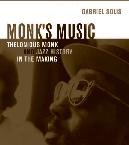
While my job does involve a fair amount of traveling, this past summer for pleasure my wife and i embarked on a 5,600-mile two-lane road trip to the Southwest and West Coast. i found on that trip further proof that the reach of the School of Music is far and wide. On one afternoon in San Francisco at the famed City Lights bookstore, i saw displayed prominently on the “Best of Jazz” table Professor Gabriel Solis’s book on thelonious Monk and Professor Jeffrey Magee’s book on Fletcher Henderson. Little do they know, both Gabriel and Jeff are now honorary beatniks.
i’m sure there’s not one of you out there who has not been affected in one way or another by the financial crisis that emerged in September. i can tell you that we are preparing for significant budget challenges during the spring semester and for several years to come. i want to thank you all for your generous support in the past and hope that i can count on your continued interest in the School of Music.
Karl Kramer Director, School of Music
Memorial Concert for Late Tenor Exceeds All
Melissa Merli, Arts Reporter, The News-Gazette
the following article originally appeared in the Sunday, February 3, 2008 issue of The News-Gazette
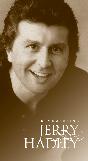
if you weren’t at the Jerry Hadley Memorial Concert at Krannert Center, you likely missed one of the best cultural events of the year. And i say that knowing that 2008 has just gotten underway.
University of illinois professors Jerold Siena, an opera singer, and eduardo Diazmuñoz, a conductor, came up with a fitting, tastefully done tribute to Hadley, replete with heart-felt songs and off-the-cuff, moving eulogies by renowned opera singers, backed by a university orchestra and chorus in top form.
One of my friends said the concert far exceeded her expectations. Another said he had been to a lot of memorial events, and this was one of the best. Hadley’s relatives told me they thought the concert was beautiful.
once. Still, i wept silently when the concert opened with a recording of him singing “Bring Him Home.”
i admit that my tears were prompted not just by the great loss but also because Hadley at his death in July was the same age as i am now. He was half-italian, like me, and we both grew up with that Old World heritage in the prairie provinces of central illinois. Unlike me, Hadley had great talent that he fulfilled.
i thought it achingly beautiful. From the Foellinger Great Hall balcony where i sat, my eyes were level with those of Hadley in a huge informal portrait projected onto a large screen. i had met and interviewed him only
For 20 years, he was America’s leading tenor, singing in all the major opera houses worldwide. Composers including Leonard Bernstein loved writing for him because of his flawless diction, not to mention great expressiveness. if Hadley had sung in the early or mid-20th century, his probably would have been a household name.
Like that of Mario Lanza. in the beautiful program notes for the concert, i noticed that Hadley had been a great admirer of the American tenor (1921-59), who also acted in movies. the morning after the Hadley concert, i played a CD i had purchased years ago of Lanza’s greatest hits. it made me feel
better, as i noticed that Lanza’s emotional singing is not unlike Hadley’s.
“He has that Lanza sob in his voice,” agreed director Jerold Siena, also a tenor. “it’s very italian. it’s heartthrob.”
Siena had worked with Hadley at the Metropolitan Opera and with the singers who agreed, when he asked, to perform in the Hadley memorial. Five months ago when Siena proposed doing the concert, he had a complete vision of how he wanted it to go.
“it came out better than i had thought it would,” he said. “When they got here, they knew exactly what would happen. the spirit was one of honoring Jerry. it was a tearful celebration of what i wanted it to be—a celebration of his career and personality.”
the singers—elizabeth Futral, thomas Hampson, richard Leech, Samuel ramey and Frederica von Stade—paid for their own airfare, sang for free and never mentioned it, Siena said. Ui opera coach tom Schleis said the singers also were gracious with Ui students, talking with them, signing autographs, giving them advice.
Schleis also considered the concert one of the best of many he has seen, in part because there was such a rapport between the performers and audience. He also praised how the visuals such as video and photos of Hadley were incorporated. Siena was pleased with the way that turned out, too.
“We sat for hours with Jeff Cunningham over at WiLL getting the exact timing of each of the visual sections with the music,” Siena said. “We had to time them out and blend them with the orchestra just right. We had
Expectations
very little time to do it, and we had just one dress rehearsal that afternoon with everybody. it went absolutely smoothly. We had wonderful cooperation from Krannert Center. everybody did such wonderful work.”
At the concert, Ui Chancellor richard Herman made the surprise announcement that the university would match funds given to the Jerry Hadley Memorial Fund. Concert coordinator Suzanne Hassler of the Ui School of Music said concertgoers gave her small-denomination bills, and afterward, a Champaign couple mailed a $1,000 check.
Hassler said the Hadley tribute drew fans from the four corners of the United States, among them Seattle resident Dean Pollack, who had become friends with Hadley when both were Ui students. Pollack also became a huge fan, traveling all over the world to hear the tenor sing.
Pollack brought a significant number of Hadley concert programs and memorabilia and expressed interest in giving them to the Ui’s Center for American Music. Others shared photos, reviews and favorite backstage stories, Hassler said.
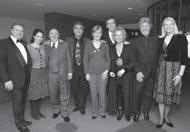
1 richard Leech, elizabeth Futral, Jerold Siena, eduardo Diazmuñoz, Frederica von Stade, thomas Hampson, Andrea Hampson, Samuel ramey, and Suzanne Hassler at the reception following the Jerry Hadley memorial concert in Krannert Center.
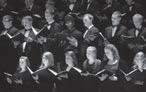
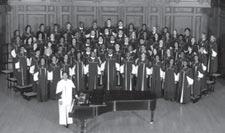
2 Massed choirs conducted by Professors Fred Stoltzfus and Chet Alwes.
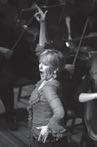
3 Frederica von Stade performs “i Am easily Assimilated” from Candide with UiSO.
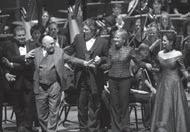
4 Artists receive extended ovation: tenor richard Leech, director Jerold Siena, baritone thomas Hampson, mezzo-soprano Frederica von Stade, and soprano elizabeth Futral.
University of Illinois Black Chorus Commemorates
40 Years on the U of I Campus
the University of illinois Black Chorus commemorated its 40th anniversary season with a ruby Anniversary reunion celebration during the All Classes Black Alumni reunion, november 6-8, 2008. the Black Chorus was formed in the fall of 1968 by four University students: Victoria Bostic (B.S. ’72), roy Haynes (B.S. ’73), Albert Moore, and Carol Pearson (B.S. ’74). One year later, in 1969, the ensemble received co-sponsorship from the choral division of the Ui School of Music and the African American Cultural Program. Over its 40 year history, the chorus has had five directors: robert ray, Phillip rogers (M.M. ’78, D.M.A. ’00), Deborah Banks (B.S. ’74), Andre J. thomas (D.M.A. ’83), and Ollie Watts Davis (M.M. ’82; D.M.A. ’88).
in addition to performances given this fall during the Black Alumni reunion, Youth Literature Festival (October 4, 2008), and its Annual Fall Concert (October 26, 2008), the Black Chorus will further commemorate its 40th anniversary year through appearances at the ninth Black Sacred Music Symposium (February 5-8, 2009), SAFeHouse Benefit Concert (February 22, 2009), and during its annual spring Moms Day Concert (April 17, 2009).
For more information about the Ui Black Chorus, contact director Dr. Ollie Watts Davis, owdavis@illinois.edu, or the Bruce D. nesbitt African American Cultural Center (217) 333-2092.
Giving Matters: How Your Gift Can Matter More
Since the concert held on January 25, 2008, $23,211 has been raised in support of the Jerry Hadley Memorial Fund. Once the fund reaches the $25,000 level, it will become permanently endowed and the first scholarship recipient can be named. to make the first scholarship award in spring 2009, your help is needed to meet our year-end goal of $25,000. Chancellor richard Herman will then match each dollar awarded by the fund—doubling the value.
Gifts to the Jerry Hadley Memorial Fund may be made online at www.faa. uiuc.edu/support_faa/gift.html. Checks should be made payable to UIF/School of Music with “Jerry Hadley Fund” entered in the memo line, and mailed to the UI Foundation, P.O. Box 3429, Champaign, Illinois, 61826. For questions or assistance in making a gift to the Hadley Fund, contact Suzanne Hassler (217) 333-6452 or shassler@illinois.edu.
Photo by Christian Steiner; program design by Jan McCracken.
All Photos by Darrell Hoemann, The News-Gazette
Wide-ranging Music Barn Festival Grows and Evolves
Melissa Mitchell, Arts Editor, UI News Bureau
After a successful inaugural event in 2007, the University of illinois School of Music augmented this year’s Allerton Music Barn Festival performance schedule with two additional concerts. the Labor Day weekend festival, with a line-up ranging from jazz to classical to klezmer, took place August 29 through September 1 in the refurbished Dutch hay barn on the southeast edge of the U of i’s Allerton Park and retreat Center near Monticello, illinois.
Plans for jamming in two extra concerts were right on track with music school director Karl Kramer’s initial vision of how he hopes the festival will evolve.
“Our plan all along has been to start out small, with the idea of growing the festival slowly in the first few years before eventually adding a 4,000- to 5,000-seat arena and an educational component,” Kramer said.
“Last year’s festival was a big hit. Our fiveconcert lineup was completely sold out, so that was a clear message that our audience is responding to what we’re offering.”
Once again this year, music lovers were able to satisfy their appetites for superb music and food. A major difference this year was that concert tickets and food could be purchased separately. A bistro-style menu and beverage service, provided by K-Spear Culinary Arts, Monticello, was available prior to each performance. in addition, on Friday and Saturday, festival-goers had the option of ordering from a fixed-price menu, with wine pairings, offered at Montgomery’s restaurant before the evening concerts.
Also new this year were improvements to the concert space, made possible through regional foundation grants. Upgrades include life-safety enhancements, the installation of new lighting, and a recording-quality surroundsound system.
All of this year’s festival performances were also recorded, and will soon be available for streaming from the School’s Media Center, on the School of Music main web site (www.music.uiuc.edu).
the festival’s opening-night program, “Beyond Cool,” showed off the talent of the U of i music school’s world-class jazz faculty, featuring the players on “Jeru,” “Moon Dreams,” “Boplicity” and newly commissioned works for the original instruments of the Miles Davis/Gil evans nonet.
“Bach Unaccompanied” was the theme for the Saturday-morning addition to the lineup. Performing at 10:30 a.m. were music faculty members Stefan Milenkovich, violin; Ani Aznavoorian, cello; and Charlotte Mattax Moersch, harpsichord. that evening, some of the music school’s brightest stars were out for the evening performance, “eine nacht in Wien,” featuring Pacifica, the U of i’s quartet-inresidence, with ian Hobson, piano.
A reception, open to concert-goers and sponsored by Montgomery’s restaurant in Monticello, followed the evening performance on Saturday at the Music Barn.
the next morning’s program, at 10:30 on Sunday, featured the Allerton Bach Choir and Soloists with the Allerton Festival Orchestra in a program titled “Bach Cantatas,” conducted by Professor Fred Stoltzfus. the rev. roger Digges delivered an ecumenical homily. the Pacifica Quartet returned to the barn’s stage that night at 8:30 for a program featuring compositions by Beethoven, Mendelssohn and Prokofiev. the festival took on a more ethnic tone on Labor Day, beginning with a 10:30 a.m. concert, “the Virtuoso Bandoneón,” featuring Peter
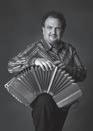
Soave on the bandoneón—a type of accordion indigenous to Argentina, with buttons instead of keys. Highlights included reconstructions of tangos by Astor Piazzolla.
“the Piazzolla tangos are rarely done,” Kramer said. “He (Soave) is the only guy out there going around the world playing his bandoneón.”
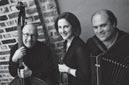
Wrapping things up with an “old country” bow was the klezmer ensemble Veretski Pass. the ensemble performed dances from Moldavia and Bessarabia; Jewish melodies from Poland and romania; Hutzul wedding music from Carpathian ruthenia; and rebetika from Smyrna, interwoven with original compositions.
As was the case last year, cooperation from the community of Monticello was an integral part of the four-day music festival. in addition to culinary support provided by rhonda Killian-Sinkosky, owner and executive chef of Montgomery’s and K-Spear Culinary Arts, the entire town, once again, rolled out the red carpet to festival visitors.
“the people and merchants of Monticello have really embraced the festival,” Kramer said.
More information about the Allerton Music Barn Festival, including performers and programs, is available on the festival Web site at www. allertonmusicbarn.com.
1 the klezmer ensemble Veretski Park
2 Peter Soave, “the Virtuoso Bandoneón”
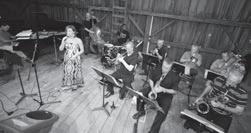
3 Ui Jazz faculty’s opening-night performance “Beyond Cool”
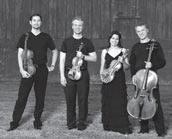
4 the Pacifica Quartet, U of i’s quartet-in-residence
Michael ewald (1948-2008): A reminiscence
Brendan Frank, Alumni Relations and Development Staff
the following article on Professor ewald was being prepared by Brendan Frank, a junior in instrumental music education, at the time of his teacher’s passing on September 12. We include it along with the following photos and tributes as a remembrance of this beloved faculty member.
in June 2008, Michael ewald, professor of trumpet at the University of illinois, was the featured soloist and clinician in the All-Poland trumpet Festival held in Kalisz, a town in southwest Poland. the festival, which took place June 25th through June 30th, was sponsored by the Deutsche Bank and Yamaha. Professor ewald was the only U.S. clinician and soloist invited. Serving with him on the trumpet jury was Krzysztof Bednarczyk, principal trumpet of the Warsaw Philharmonic and president of the jury; igor Cecocho, trumpet professor at the Academy of Music in Łodz; Stanisław Dziewior, professor of trumpet from Katowicach; Madgistar Marek Piatek, trumpet professor at Polonia University in Czestochowa; and Professor roman Siwek, chair of woodwind and brass instruments at the Fryderyk Chopin Academy of Music in Warsaw.
Students attending the festival came from all directions in Poland, including Łodz and Gdansk, with many coming from their respective music academies to continue their studies with their professors serving on the jury. Featured trumpet recitals were given each night by Krzysztof Bednarczyk and his accompanist Joanna Opalinska, and by tomasz Wozniak (a former student of Professor Bednarczyk) and pianist Adam Sychowski. Other recitals were given by Stanisław Dziewior and his accompanist Adam Gren.
Michael and Dorota Cholewa, winner of the orchestral competition, at the All-Poland trumpet Festival in June 2008.
During the festival, Michael ewald presented three fivehour master classes, served as a member of the jury, and performed on the final guest recital, playing telemann’s
Heroic Music for Trumpet, edited by Michael ewald with piano arrangement by Avis romm (wife of Ui trumpet professor ronald romm); Frank Campo’s Times opus 39 for solo trumpet; Suite Concertino by Arthur Frackenpohl, and other music by Maurice ravel and Leonard Bernstein.
Michael Ewald (B.A., M.M. California State University at Northridge; D.M.A. U SC), was a professor of trumpet at the University of Illinois and was the principal trumpet with Sinfonia da Camera and the Champaign-Urbana Symphony Orchestra. He performed with the Chicago Chamber Brass, Chicago Brass Quintet, Pasadena Symphony Orchestra, Burbank Symphony, Pasadena Chamber Orchestra, and with many touring groups throughout the United States, Great Britain, Austria, Hungary, Romania, and Poland. He studied for many years with John Clyman and Jimmy Stamp. During the summer of 1994, he was the host of the International Trumpet Guild conference, held at U of I. His former students hold positions in colleges and universities across the country, as well as in military bands of the United States, and orchestral and commercial groups throughout the U.S. and Europe. Dr.Ewald will be remembered as a wonderful musician, teacher, and friend to all who had the great fortune of knowing him.
Our dear friend and colleague, Michael Ewald, passed away from liver cancer on September 12, 2008. Michael was an exceptional individual, a wonderful musician, a fabulous teacher, a loving husband, father, and grandfather. He was tirelessly patient with all of us—a spiritual and musical leader. He was my best friend and a brother to me among my good friends and colleagues here at the University of Illinois. In a business as fickle as the music business is, Michael was respected universally. In his years at Illinois, he served on numerous committees, as a chair of the brass division, and was a mentor to hundreds of students around the world. He is irreplaceable. We will miss his smile, his even personality, and his positive attitude; all I can do is emulate the goodness he represents to all of us who knew him.
—Ronald Romm, Professor of Trumpet
I remember when I went to see Doc at a Sinfonia da Camera concert. They were playing Elgar’s Enigma Variations. Most of the music Sinfonia performs tends to be lighter, so this concert was the first time I really heard Dr. Ewald play loudly and robustly within the orchestra. Afterward, I went to greet him and I asked, “Doc, how did you do that? How can I do what you just did on stage?” He replied “Well, sometimes you just gotta hit ’em hard and kiss ’em goodbye.”
Dr. Ewald was truly an ideal role model for me. What I admired about him was not just his excellent musicianship, but also the sincere devotion he had toward everyone he came in contact with—his family, friends, colleagues, and students. Any social interaction you had with him just motivated you to be a better person. As a means of remembrance for this great man, we should always live up to his golden standard of commitment to others. The world would be a better place if we had more Dr. Ewalds around.
—Allen Chen, Senior, Trumpet Performance
Those who had the opportunity to know Michael Ewald as a colleague, friend, or teacher-mentor shared in a unique man’s life. His compassionate nurturing of his trumpet students, his positive “can-do” attitude made him a valued friend and admired mentor. A great listener, he had the ability to provide considered advice to students and colleagues alike. Michael was always there to show true concern and empathy when life threw those around him the inevitable curve. His passing was all too soon. His presence in the brass studio he helped to build with us at Illinois will endure for years to come. His students, former students, colleagues and friends will keep his memory alive.
—Elliot Chasanov, Brass Division Chair
Michael with colleague ronald romm and SoM alum John evans.
Michael (left) was a member of the illinois Brass Quintet with Professors Kazimierz Machala, Mark Moore, elliot Chasanov, and ronald romm.
Jazz Trombonist Jim Pugh is Guest Faculty Artist in Germany
in March 2008, Ui Jazz trombone Professor Jim Pugh traveled to the Bundesakademie in trossingen, Germany to serve as guest faculty member at the 41st Working Phase of the Youth Honors Jazz Band of Germany. Otherwise known as “BuJazzO,” this national youth jazz orchestra consists of the most talented young jazz artists from all over Germany. Starting bright and early at 9:15 a.m. every morning, the students worked closely with the faculty in individual lessons, sectionals, and big band rehearsals. they ended their intensive days with jam sessions that continued into the wee morning hours, leaving just a few hours of rest before having to start again the next day. the big band, under the direction of bass trombonist/composer, ed Partyka, wrapped up the week with a recording session of an all-American program with charts by Bob Brookmeyer, thad Jones, Maria Schneider, Jim Mcneely, and ed Partyka. Other faculty members included pianist Oliver Kent, bassist Marc Abrams, drummer Mario Gonzi, saxophonist Oliver Leicht, trumpeter Juraj Bartos, guitarist Guido Jesenski, and vocalist Dena Derose.
Sinfonia da Camera Celebrates Silver Anniversary
Melissa Mitchell, Arts Editor, UI News Bureau
the Ui’s Sinfonia da Camera marks its 25th season this year with a series of concerts featuring a musical mix of classical favorites, returning guest artists, highlights of past programs and performances of new works and orchestrations.
Since Sinfonia’s concert debut at the Krannert Center for the Performing Arts in August 1984, the ensemble has performed more than 600 works under the direction of Swanlund professor, pianist, and conductor ian Hobson. it has released 10 recordings on the Zephyr label and performed throughout the world, including a 2007 concert tour of China.
An anniversary gala kicked off the season as Friends of Sinfonia were invited to celebrate in style at a silver anniversary ball on September 6 at Krannert Center. the event began with a cocktail hour and piano bar featuring rick Murphy, followed by a four-course dinner, dancing and music by the ricardo Flores Jazz Quartet, and a performance by Sinfonia. the $125 per person benefit raised $10,000 for the Sinfonia.
the season officially began on October 4 at KCPA with a Spanish-themed concert featuring bass-baritone and music professor ricardo Herrera. Program highlights included Maurice ravel’s Bolero and the Toreador Song from Georges Bizet’s Carmen. Sinfonia’s november 8 concert harked back to its tenth season when all six of Johann Sebastian Bach’s Brandenburg concertos were performed, once again displaying the extreme virtuosity of the musicians through these legendary concertos.
Additional 2008-2009 performances, all at Krannert Center, are scheduled for February 7, March 7, April 3, and May 2. the encore performance on March 7 features rossini’s Barber of Seville Overture. Also on March 7, the program will include a guest appearance by pianist Menahem Pressler, who has performed with Sinfonia as a soloist and as a member of the Beaux Arts trio. Pressler, who will give one of his final performances before retiring, will present Mozart’s Piano Concerto No. 17 in G major, which the composer’s pet starling is said to have learned to sing. Also on that program will be The Machine Awakes, a new work by music professor Stephen taylor that was inspired by author and Ui english professor richard Powers’ novel Galatea 2.2
the season culminates with another premiere at KCPA on May 2: Hobson’s orchestration of ignaz Moscheles’ Piano Concerto No. 8, which the Sinfonia musical director orchestrated from notes found scrawled on an original piano score. the composition will be part of a four-volume set of piano concertos and other works by Moscheles that have never been recorded in their entirety. Following the premiere, there will be a joint performance on May 3 in Symphony Center’s Orchestra Hall in Chicago by the Sinfonia da Camera and the Ui Symphony Orchestra with Maestro eduardo Diazmuñoz conducting the UiSO in rachmaninov’s third Piano Concerto featuring the incomparable ian Hobson as soloist.
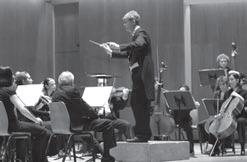
ian Hobson conducts the Sinfonia da Camera. in addition to its regular season concerts, Sinfonia will perform at Krannert Center with the Mark Morris Dance Group during the troupe’s inaugural tour of Romeo & Juliet, On Motifs of Shakespeare (March 13–14, 2009).
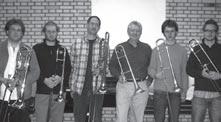
BuJazzO trombones (left to right): Johannes Oppec, Marcus Franzke, ed Partyka, Jim Pugh, Adrian Kleinlosen, and Christopher Sauloff.
Development Update
the Future Looks Brilliant for Music at illinois
Marlah Bonner-McDuffie, Director of Development, College of Fine and Applied Arts
it has truly been an exciting and productive year for the School of Music. in our second year of the “public phase” of Brilliant Futures: The Campaign for the University of Illinois, we continue to work diligently toward our goals and funding priorities in order to provide the best possible professional education to our talented students. Brilliant Futures is the largest and most ambitious campaign in the history of the University. We are grateful to those alumni and friends who have partnered with us by pledging support to the School of Music.
this year, the School is thrilled to announce the establishment of two new endowed chairs by one of the University’s most distinguished alumnae, Sheila C. Johnson. A noted entrepreneur, philanthropist, and musician, she has been a generous supporter of the University for the past several years. Her $4 million pledge, the largest gift in the School of Music’s history, will be used to create the Daniel J. Perrino Chair in Jazz Studies and the Susan Starrett Chair in Violin. Both Perrino
and Starrett mentored Sheila while she was a student in the School of Music, inspiring her to strive for excellence in all areas of her life, to work hard toward her personal and professional goals, and to never give up on her dreams. endowing these chairs is Sheila’s tribute to both teachers’ impact on her personal and professional life.
Our distinguished faculty continues to have this impact on our students’ lives. Many of our alumni credit the teaching and encouragement of their professors for their professional and personal accomplishments, regardless of which career path their music education takes them along. Sheila Johnson’s gift will allow the School to recruit and retain the most talented and sought-after faculty in the String and Jazz divisions, and will ensure that Professor Perrino’s and Susan Starrett’s legacy of inspiring others to greatness continues at the University of illinois.
We are also pleased to announce the establishment of a new endowed scholarship fund for the School of Music. James and Candace Frame of Gaithersburg, Maryland, have created the annual “Dee Wood Frame excellence in Music Award” for a high achieving student who is also a member of the
Marching illini. Jim (LAS ’73) and Candace (LAS ’72) have named this fund in honor of Jim’s mother. in addition to a generous scholarship, the Frame fund includes a gift of instruments to the Concert and Symphonic Bands, and the Frames have designated a residual portion of their estate for the benefit of the Marching illini.
We invite you to consider a gift in support of the School in the Brilliant Futures campaign. Perhaps you will consider a former faculty member who continues to inspire you. Or perhaps you simply want to encourage students to continue to pursue their goal of becoming professional musicians and music educators. Whether you consider a gift of support toward the Annual Fund, for student scholarships or fellowships, or for faculty support, your contribution will help to ensure that our talented students will realize their dreams.
For more information about Brilliant Futures, please visit www.brilliantfutures.illinois.edu. To learn more about the ways you can support the School of Music, please contact Marlah Bonner-McDuffie, Director of Development, College of Fine and Appllied Arts, at (217) 244-4119 or marlahb@illinois.edu.
The importance of private gifts to the School of Music increases every year. The State of Illinois provides basic operating revenue for the University of Illinois; however, support from the State accounts for less than 18 percent of the total budget. Thus gifts from alumni and friends help to provide the margin of excellence which distinguishes the UI School of Music.
We look forward to a very bright future for the School of Music, and we continue to evaluate new opportunities and programs that will help to ensure our position as one of the leading music schools in America today. In order for us to reach our goals and to provide the best possible education for our students, we must have the proper resources in place.
The following items represent the current needs and wishes of the School of Music in order of impact:
Chairs and Professorships: Endowed chairs and professorships serve as effective tools with which to recruit and retain scholars and performers. Renowned faculty attract the most talented students and the brightest minds to study at the University of Illinois. As artists and scholars, such faculty contribute to the world of research, creativity, and virtuosity, which are the University’s principal missions. This is vital to the continued success of the School of Music.
Scholarships and Fellowships: The continued excellence of the School of Music depends in part on attracting the most talented students from across the nation and around the world. For us to remain competitive among the leading schools in the country, we must be prepared to assist exceptional students.
Building Infrastructure and Equipment: Maintaining the facilities and equipment for our faculty and students takes considerable resources. To be competitive with our peer institutions, we must continue to have outstanding facilities and performance venues. Priorities in this area include modernization of the recording studio, renovation of Smith Memorial Hall, and continued development of the Allerton Park Music Barn.
Opera Sponsorship: The School of Music produces two full-length operas each year. An opera production takes considerable time, effort, and money. Current productions can cost in excess of $60,000. While ticket sales cover about half the cost of each production, additional support will assure both student performers and audience members of operatic experiences comparable to those found in major cities, while keeping ticket prices reasonable. There are several specific giving opportunities available for opera sponsorship each season.
The Robert E. Brown Center for World Music: This is a new institute within the School of Music. Its mission is to bring visiting artists in world music traditions to the University for extended periods to teach and demonstrate their arts to the University community, area schoolchildren, and the community at large. The underlying premise of the Center’s work is that serious involvement in the music of any culture fosters respect and admiration for the culture itself. In 2008-2009, the Center is offering Mande percussion music, Balinese gamelan, North Indian tabla, and Chinese instrumental music. Startup funding for the Center comes from the University of Illinois, but ongoing funding from outside sources is necessary.
If you are interested in funding projects such as these or would like to explore other opportunities, please contact Marlah Bonner-McDuffie, Director of Development, (217) 244-4119.
New Gifts
The School of Music is pleased to acknowledge the creation of the following new endowments as of October 2008:
AlumnA Contributes $4 million to sChool of musiC
Kathleen Foody, Managing Editor, The Daily Illini
When Dan Perrino asked Sheila Johnson why she would name an endowed chair after him instead of herself, she told him she already had enough awards in her name.
“She said it pleased her to share this with others,” Perrino said. “ that’s the nature of Sheila; she’s a remarkable lady.”
Johnson, a 1970 graduate from the University’s School of Music, announced her donation of $4 million to create two endowment chairs for her alma mater on May 10th. Both were named after members of the music education community who had been mentors to Johnson throughout her academic and professional career; the Dan Perrino Chair of
Jazz Studies and the Susan Starrett Chair in Violin. Starrett was Johnson’s orchestra director at Proviso east High School and contacted Perrino when she decided to attend the University. “She called me and said ‘i’m sending Sheila to you, and you need to take care of her,’ ” said Perrino, a former University administrator. “i kind of became a surrogate father or older brother. She called me a mentor. i’m not sure i was, but whatever makes her happy.”
the University
was struggling with racial divisions when Johnson began attending. there were only about 150 black students on campus in 1966, he says. the skills—both musical and personal—Johnson gained at the University came in handy when she left.
She began teaching private violin lessons in Washington, D.C. and evolved them into a program based strongly on methods she learned at the School of Music. Her students gained a national reputation.
Johnson is the CeO of Salamander Hospitality, was a founding partner of
Black entertainment television, and is the first woman to have a stake in three professional sports teams. “it’s a wonderful gift,” says Perrino. “Four million dollars is a lot of money, and when budgets are tight, gifts like hers make it possible for the school to enrich programs.”
the honor for Perrino has pleased other members of the School’s community, including Suzanne Hassler, coordinator for alumni
relations and development. “[Dan] has been a mentor to me as well,” she said. “So i was very pleased personally to see him be recognized.” the value to the school means more to Perrino than any individual honor. “Music schools are always competing for the most talented students,” he said. “Outstanding faculty attract outstanding students, and students attract more outstanding faculty.”
Used with permission of The Daily Illini
Sheila Johnson with Dan and Marge Perrino at the announcement of the Dan Perrino endowed Chair in Jazz Studies.
Celebrating the endowment of the Susan Starrett Chair in Violin with the Pacifica Quartet, (from left) Simin Ganatra, Brandon Vamos, Sheila Johnson, Susan Starrett, Sibbi Bernhardsson, and Masumi Per rostad.
James and Candace Frame Remember UI Bands Through Bequest
in October 2008, University of illinois alums
James r. Frame (B.A. ’73) and Candace M. Frame (B.A. ’72) of Gaithersburg, Maryland, announced their intention to include Ui Bands in their estate plans. the new “the James r and Candace Penn Frame endowment Fund” will create several deferred gifts at the University, including establishment of three named scholarship award funds, each at the $50,000 level: “ the Dee Wood Frame excellence in Music Award,” established in loving memory of James’s mother, Dee Wood Frame, director emerita of the U of i Housing Division, will benefit the Marching illini; “ the robert W. Frame Passion For Flying Award,” will ben efit the institute of Aviation; and “ the Henry Penn Scholarship For excellence in Civil engineering Award,” created in memory of Candace’s grandfather, Henry Penn, will benefit the College of engineering.
Once the fund is com pleted, the Dee Wood Frame excellence in Music Award will recognize a top-achieving student each year who is a member of the Marching illini. the Frame endowment will also include support for deserving Concert Band and Symphonic Band students through the gift of five fine instruments, including three professional model clarinets, a tenor saxophone, and an alto saxophone. the remainder of their estate gift will provide equal support to the University of illinois Marching illini and the institute of Aviation.
Geospatial-intelligence Agency in Bethesda, Maryland, was born in Sycamore and lived most of her life in normal, illinois, until completion of her bachelor’s degree in geography at U of i She graduated from normal Community High School and received a teaching certificate from illinois State University. in 1995, she completed a master’s degree in public administration from Auburn University, concurrently with graduating from the Air War College at Maxwell Air Force Base in Alabama.
James is senior sales executive with a leading healthcare technology company and president and co-owner of Gallery of Pearls, LLC, an international pearl jewelry dealer with locations in Atlanta and in Washington, DC. While a student at Champaign’s Centennial High School, Jim remembers attending illinois Summer Youth Music camps, later playing clarinet and saxophone in the Marching llini, and clarinet in the Symphonic Band in each of his four years at illinois. in addition, he was in the Ui Clarinet Choir for six years (two years while still in high school!). He is a 1986 graduate of the University of Louisville School of Business and a 2007 pearls graduate of the Gemological institute of America at Carlsbad, California. As a student, Jim flew frequently at the Ui institute of Aviation while working to become a licensed private pilot of fixed-wing aircraft. He also holds commercial and instructor licenses in hot air balloons.
The Midwest Clinic
62nd Annual Conference
thursday, December 18, 2008
rhapsody restaurant, Conductor’s room
65 east Adams Street, Chicago, illinois
5:30-7 p.m. Alumni reception
Illinois Music Educators Association
Friday, January 30, 2009
Père Marquette Hotel
501 Main Street, Peoria, illinois
6-8 p.m. reception, Cheminee room
Tenth Annual 21st Century Piano Commission Award Concert
Wednesday, February 25, 2009
Krannert Center for the Performing Arts
7:30 p.m. recital, Foellinger Great Hall
9:15 p.m. reception, Festival Foyer
ACDA 50th Anniversary Celebration
Friday, March 7, 2009
Oklahoma City, Oklahoma
6-7:30 p.m. Alumni reception, tBA
22nd Annual Awards Luncheon
tuesday, April 28, 2009
Alice Campbell Alumni Center
601 S. Lincoln Avenue, Urbana
12–2 p.m. Ballroom
Sinfonia da Camera and UI Symphony at Orchestra Hall
Sunday, May 3, 2009
Symphony Center, Orchestra Hall
220 South Michigan Avenue, Chicago
7:30 p.m. Concert, Orchestra Hall
(See page 6 for more detail)
School of Music Convocation
Sunday, May 17, 2009
Smith Memorial Hall
805 S. Mathews Avenue, Urbana
5:30–6:45 p.m. Smith recital Hall
if you are interested in knowing more about any of these events or about other activities for School of Music alumni, please contact Suzanne Hassler, Coordinator for Alumni relations and Development, at (217) 333-6452 or shassler@illinois.edu.
WATCH FOR THESE UPCOMING EVENTS
Both alumni donors are natives of central illinois. Candace, who is currently director of the GeOint integration Office at the national
the School of Music is grateful to James and Candace Frame for remembering University of illinois Bands through this outstanding bequest.
origins of the experimental music
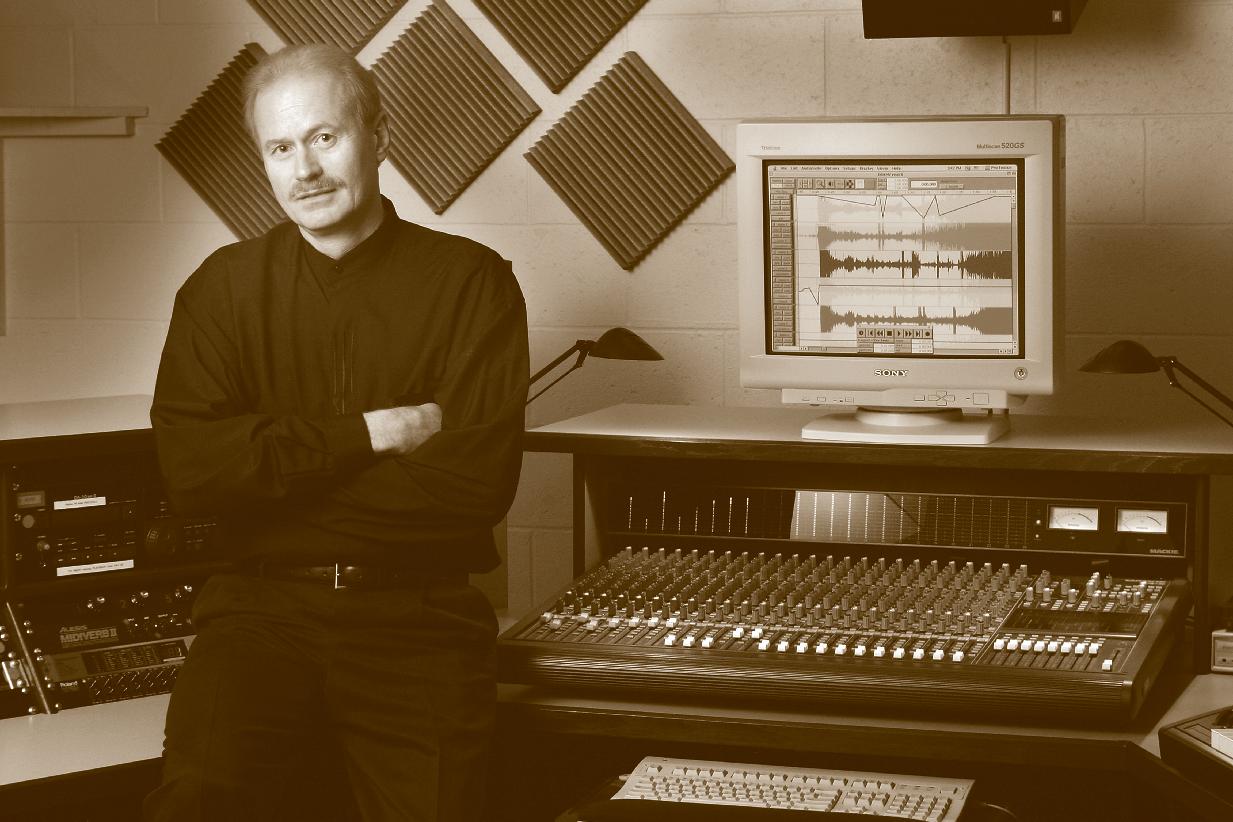
Professor Scott Wyatt, who began his appointment as director of the eMS in 1976, has led the innovative, award-winning studios for over 32 years.
by Emanuele Battisti with Suzanne Hassler
The University of Illinois Experimental Music Studio (EMS), the first formally acknowledged electro-acoustic facility in the United States, was created in 1958 and soon became one of the most important studios worldwide. Fifty years later, it is still in operation—although in a very different context. While the original studio was located in a small attic room and attended by just a few researchers and students, the current Experimental Music Studios (note the plural), under the guidance of Professor Scott Wyatt, now comprise nine specially designed studios that produce dozens of compositions every year, receive prizes in important national and international competitions, and provide a stimulating creative and academic environment for students and faculty. At the 50th anniversary of its founding, it is worth investigating the historical origins of the EMS and its first years of activity.
the urbana school studios at illinois
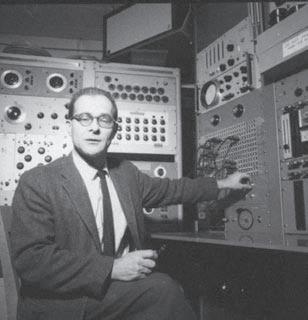
Composer Herbert Brün
beginnings of the ems
Many who attended the School of Music at the University of illinois at Urbana-Champaign during the period between 1946 and 1970 remember it as “an era of grandeur.”1 the quality of both the faculty and the academic programs improved tremendously in those years, and contemporary music played an important role in this growth. in particular, the Festival of Contemporary Arts, which first took place in 1948, established itself almost immediately as an event of international importance. Although in 1955 the Festival became biennial, it maintained its prestige through the 1960s, reaching a high point in 1969 with a performance at the U of i Assembly Hall of John Cage and Lejaren Hiller’s HPSCHD, a composition for seven harpsichords and fiftyone tapes, enriched by spectacular scenography.
Cage began to have a major influence on the Urbana-Champaign music scene in the early 1950s. A lecture-concert he gave in 1953 on “Music for Magnetic tape” was probably the first exposure people on this campus had to this new creative field, and it was also the occasion that supposedly awakened in Professor Hiller an interest in electroacoustic music.
Hiller, then a newly appointed research associate and assistant professor of chemistry, began experimenting with the iLLiAC—the first supercomputer built at U of i—to develop new compositional approaches. the result was the ILLIAC Suite for string quartet, a composition in four movements—or “experiments”—completed in 1957 with the help of Leonard isaacson. the first attempt ever made to produce a musical composition by means of a computer, the ILLIAC Suite initially received a warm response, putting Hiller in the spotlight. this sudden success, however, was followed by many negative reviews that ultimately convinced Hiller that he needed to become a professional musician in order to be accepted within the academic music community.
Hiller’s quest was a striking instance of the perennial search for balance between the two fields of science and music. He met his chief obstacle in the narrow-mindedness of certain composers, who felt they risked losing their caste privileges to machines. nevertheless, an association between music and computers was unavoidable at illinois, and Hiller was the person who realized this:
“Hiller’s music stands out as particularly characteristic of the University of Illinois. The University’s well-known Department of Electrical Engineering, home of twotime Nobel Prize winner John Bardeen, the inventor of the transistor, provided national leadership in the development of computer technology. Hiller established a long-term association between the music and engineering departments.”2
it is worth noting that some years later, in a scene in Stanley Kubrick’s classic film 2001: A Space Odyssey (1968), as the spaceship’s computer HAL 9000 is progressively deactivated by astronaut Bowman, it asserts that it “became operational at the HAL plant in Urbana, illinois”—further indication of the leading role Urbana-Champaign held in the computer science field.
stiven house (1958-1968)
At the end of 1957, Lejaren Hiller wrote to Duane Branigan, then director of the School of Music, suggesting that the University of illinois open a studio for experimental music in order to develop theoretical and compositional research, and that it initiate a new graduate course on these topics. He received a positive answer, thanks to the support previously given by Frederick Wall, dean of the Graduate College. the chosen location was an attic room in Stiven House, across the street from Smith Memorial Hall. After some months of preparation during the summer of 1958, the experimental Music Studio became operational at the beginning of the fall semester. it was the first studio of its kind to be established at an American university, and the second research project on electro-acoustic music ever attempted in the United States, following research carried out by Otto Luening and Vladimir Ussachevsky at the Columbia-Princeton electronic Music Center, which was initiated in 1952 although not formally established until 1959.
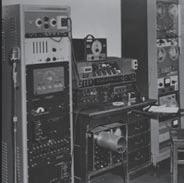
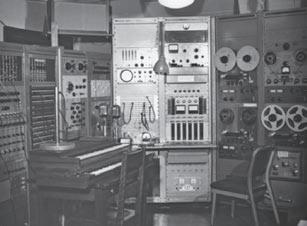
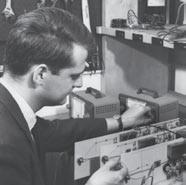
the experimental Music Studio in 1958.
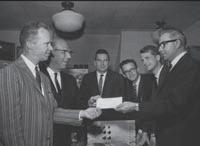
Director Duane Branigan (far left) receives a $30,000 grant for the eMS from the Magnavox Corporation in 1962, as James Beauchamp and Lejaren Hiller look on (second and third from right).
While I was a graduate assistant, my office mates were Chuck Mason (D.M.A. ‘82) and Paul Koonce (M.M. ‘83). The day that Chuck defended his dissertation and accepted a position in Birmingham, he taped a piece of notebook paper to the wall of our office with the heading “Famous Inhabitants of this Office” followed by all three of our names. I remember this act of optimism with great fondness, and I’ve heard that the list is still in the office (and that it has grown a lot longer by now).
(D.M.A. ‘84)
it is important to remember that in the United States, at that time, most research in acoustics was being conducted under the defense program.3 American composers lacked the support their european counterparts received from radio and television companies, and at the same time the industry was reluctant to invest in projects requiring a great deal of time to reach successful completion. the University of illinois originally invested only a few thousand dollars in the studio, so Hiller had to “search around the campus for discarded equipment in places like the broadcasting studio, the physics department and [the] music department shop.”4
His first assembly might seem primitive nowadays; nonetheless it proved sufficient to start the project. Hiller’s pragmatic approach allowed him to limit expenditures to only $8,000 during the period from 1958 to 1962. in this first phase, his equipment included two professional tape decks, an audio mixer, and various microphones, oscilloscopes, and amplifiers.
After a cautious beginning, a major change occurred in 1962, when Magnavox Corporation awarded a $30,000 grant to the eMS. this money was again used with parsimony: instead of acquiring commercial products, Hiller and his collaborators chose to build the instruments themselves, using published circuits.
As a consequence of this approach, the studio was provided with a theremin, a saw tooth wave generator, a white noise generator, and many
other devices for generating, processing, and recording sound. in 1965, another important grant of $53,100 was received from the national Science Foundation for a two-year project on the analysis and synthesis of musical sounds.
As director of the eMS, Hiller applied a prudent financial policy that enabled the studio to grow slowly but steadily during its first years. the quality of the results achieved and the seriousness of the approach attracted private investors and reflected the effectiveness of Hiller’s management in the central phase of the 1960s.
people in the studio
the first of Hiller’s many collaborators in music at U of i was Leonard isaacson, the co-creator of the ILLIAC Suite they had begun working together, however, before the opening of the eMS. in a letter dated April 1961 to Dean Wall, Hiller wrote a brief report of the activities carried out since 1958. in the first paragraph, he lists the people engaged in research projects: nicholas temperley (then a full-time post-doctoral research associate and later a professor of music at illinois), robert Baker (a halftime graduate research assistant), James tenney (a third-time graduate research assistant), and ernest Proemmel (a quarter-time electronics engineer). Proemmel was the first technician employed in the studio; he worked there until 1963, when he was replaced by russell Winterbottom. the other three were graduate or post-graduate students, all working with Hiller to prepare their master’s or doctoral theses. tenney had come to Urbana in 1959 specifically to attend Hiller’s class on electronic music: after completing his studies, he was hired by Bell Laboratories, and he went on to become an important name in contemporary composition. During this period, there were few members of the composition-theory division in the eMS, and it is important to remember that Hiller, though hired by the School of Music to direct the studio, was not part of the music faculty.
Between 1962 and 1964, these circumstances changed as new faculty members joined the composition division. James Beauchamp, the first to arrive, began working with Hiller in 1962 while a doctoral student
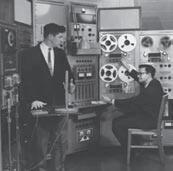
Ben Johnston (left, at the theremin) and Hiller in the studio (1963).
the eMS in 1962
John Cage and Lejaren Hiller working on HPSCHD with the iLLiAC ii system (1968).
Carla Scaletti
President, Symbolic Sound Corporation
Since leaving U of I in 1989, my entire career has followed a trajectory put in place by the Computer Music Project and the Experimental Music Studios. My research continues to be in the field of audio engineering and acoustics, and I’ve had the opportunity to work both in academia and as an entrepreneur in industry, taking advantage of the cross-disciplinary skills and insights taught to me by Jim Beauchamp, Scott Wyatt, Jack Melby, Sever Tipei, and by my many student friends and colleagues.
Robert C. Maher (Ph.D. ‘89, Electrical Engineering) Department Head, Electrical and Computer Engineering Montana State University-Bozeman
in engineering; he was appointed assistant professor in music and electrical engineering in 1969. in 1963, Herbert Brün and Kenneth Gaburo settled in Urbana-Champaign, followed one year later by Salvatore Martirano. All of them were interested in working on electro-acoustic music, and their presence gave great impetus to the studio’s activity.
this situation remained unchanged for four years, until 1968, when John Cage returned to U of i as an associate member of the Center for Advanced Study. He was particularly interested in collaborating with Hiller. Although Cage was not directly involved in the eMS, their collaboration was significant because it led to the composition of HPSCHD, the last piece Hiller worked on before moving to Buffalo in 1968. A few months later Gaburo moved to San Diego, but the eMS carried on its work much the same, albeit without its creator and one of its driving forces.
even more valuable than the many contributions of individual eMS composers in the years from 1963 to 1968 is the social network they built as a group. According to Hiller, his arrival at the School of Music in 1958 was somewhat “clandestine.” in fact, Director Branigan had suggested that he try to complete the preparation of the studio in the summer, when most faculty were out of town, as Hiller was considered by the academic composers to be a non-professional musician—a chemist-programmer who was trying to invade a field where he did not belong. this outsider status accompanied him throughout the decade he spent at U of i. He did, however, develop strong friendships in the Music Department during his first three years as director of the eMS: among them were Harry Partch and Ben Johnston. Although these com-
posers did not particularly share Hiller’s interest in electronic means— the first being devoted to microtonality, and the second to the aesthetics of just intonation—they were nonetheless good friends and supporters of his work. Hiller’s relationships with his assistants were also based on a high degree of reciprocity: they helped him with his research, but at the same time he allowed them to publish articles with him.
Between 1962 and 1964 the atmosphere in the eMS changed markedly, thanks to the arrival of the new faculty. A sabbatical leave in 1961 also gave Hiller the chance to visit all of the main european electronic studios. Presumably, it was during this trip that he met Herbert Brün and convinced him to move to illinois. in these years, Hiller and Brün both received repeat invitations to lecture at the Ferienkursen in Darmstadt, and, as their collaborations show, their friendship was based on a respectful and complementary meeting of two different musical cultures. this open-mindedness was shared by the others newly arrived in Urbana: Gaburo, Beauchamp, and Martirano. the sense of solidarity the men shared is exemplified in a letter dated 1963, which Gaburo asked Ben Johnston to edit; its intent was to ask for University sponsorship of the works of Harry Partch, who had left the Urbana faculty just a few months before. the friendship between the composers is also evident in a touching and powerfully expressive poem that Brün wrote after Martirano’s death in 1995:
“. . . there goes Sal: longs for and loves the opera yet avoids excessive drama— passionately throws himself into the embraces of his ideas musical poetic realistic daring ideas and experiments— then surfaces with that look of youthful curiosity— that provoking smile of a waiting waiting sense of humor— . . . there goes Salvatore: passionately alerted and alarmed facing the threats of environmental trivialization and contempt— indignant furious explicitly expressive he lends simmering rage without loud noise to his well-honed cutting voice— . . . there goes Salvatore Martirano: Listen!-----------------------------------And listen again!”5
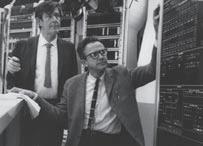
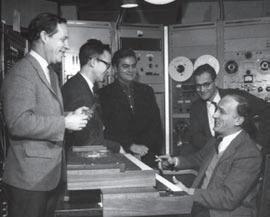
the smiles of Charles Hamm, Lejaren Hiller, Salvatore Martirano, Herbert Brün, and Kenneth Gaburo among the machines in eMS fill the studio with an irresistible touch of humanity (1965).
activity in ems
in the letter that Hiller wrote to Branigan in 1957, he presents a “proposal for research in experimental music,” listing some of the prospective activities to be carried out in the studio. Among them are the development of an automatic music printer, the use of appropriate technological equipment for recording and analyzing sound, the utilization of the computer for musicological and theoretical research, the development of new experimental compositions, and a new graduate course. recognizing that this project would require “considerable time and effort,” Hiller underlines that the initial expenses would be moderate, as would the space requirements. He also pragmatically suggests starting “with the simplest and most practical research.”
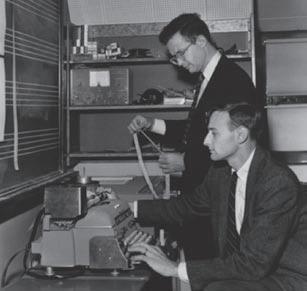
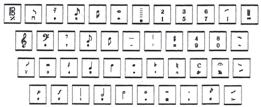
the first project was the programming of an automatic music typewriter, capable of writing full scores and individual instrumentation parts through information received by the iLLiAC computer. the core of this research was the changeover of a typewriter into a music printer. As Hiller relates in 1961 to the Graduate College dean, he and his assistant robert Baker had to write a number of programs in order to optimize the readability of the resulting scores. these operations required a continuous dialogue between the iLLiAC and the typewriter. in an article for the Journal of Music Theory in 1965, the two men describe the steps they followed, and explain why they considered this project meaningful—that the technology then available for music printing did not properly reflect the most recent compositional activities. this special typewriter, created by researchers from the University of Colorado, was thoroughly customized at the eMS, and had its typeface modified in order to include all the basic music symbols. the mechanical changes included in particular the free choice of length and dimensions of the staffs.
the second direction of research was the development of new methods and instruments for sound analysis and synthesis. the analytical approach was, once again, based on the programming of the supercomputer owned by the University (it may not be an exaggeration to say that the best collaborator Hiller had at U of i was the iLLiAC!). indeed, one of Hiller’s strengths was the ability to adapt the same digital medium to different kinds of research. the analytical power and flexibility of the iLLiAC led to at least a couple of remarkable theoretical results: the D.M.A. theses of Calvert Bean and of ramon Fuller, based respectively on the application of information theory to study four sonata expositions, and to analysis of Webern’s Symphonie op. 21. Both researches were based on calculations made by the iLLiAC. through these projects, it is possible that Hiller, who supervised these theses, was once more trying to fill the gap between his work and that of the composition-theory faculty in order to gain academic respectability.
On another level, the eMS was used to build new instruments for sound analysis and synthesis. One of the most interesting specimens of technological application was the “Harmonic tone Generator,” a device capable of controlling the attack, steady state, decay, and amplitude of six partials of a generated tone, created by James Beauchamp.
this modular voltage-controlled generator, based on the principles of additive sound synthesis, was completed during the same period that robert Moog finished his namesake synthesizer, acknowledged as the first to be commercialized in the 1960s. While Moog chose a userfriendly approach, providing his instrument with a manual in order to meet market requirements, Beauchamp’s synthesizer was specifically aimed at doing research on the nature of sound. it would have been possible to try to sell the tone Generator to the public, but Beauchamp and
Hiller and Baker at the custom-designed remington electric music typewriter (1958).
the keyboard of the music typewriter (from Hiller and Baker’s article in JMT, p. 135).
Hiller preferred to devote their efforts to pure research, and in 1965 they proudly published their results in an article for Science magazine.
From a compositional point of view, the first years were characterized by Hiller’s electronic experiments in Seven Electronic Studies, completed in 1962. Although made using two-channel tapes, the studies are clearly monophonic; at that time Hiller was unenthusiastic about the spatialization in the stereo field. Many elements confirm that compositional activity in the Studio increased dramatically after 1963, thanks to the contributions of the newly arrived composers. More specifically, the years between 1964 and 1966 were characterized by important works for instruments and tape, based on an extended use of the computer as generator of instrumental scores. important examples of this approach are Machine Music by Hiller, Soniferous Loops by Brün, and Underworld by Martirano. Hence, in this phase, electro-acoustic music was eventually integrated with instrumental sounds, with a resulting eclectic aesthetic through which the individual composers were free to develop their personal styles. Lectures by Hiller and Brün at Darmstadt in the mid-1960s acknowledged and affirmed the “Urbana School” as one of the most innovative music environments in the world.
At the same time, Hiller and Brün’s cultural perspectives were, to some extent, very different. While Hiller was clearly fascinated by information theory and the european theoretical approach, Brün was convinced that the genuine exaggerations and even the mistakes of young people, not yet arrived at a full theoretical knowledge of the art of music composition, had to be preferred. this meeting of different perspectives guaranteed the development of a vibrant and creative atmosphere.
the last proposal Hiller presented in 1957 to the director of the School of Music concerned the institution of a graduate course “covering material relevant to contemporary experimental music.” Once again the proposal was accepted. Before starting the class, though, Hiller had been advised by the director “to be circumspect about what [he] taught, since a large contingent of the faculty was out to get [him].” to avoid this problem, he began by teaching a course on traditional musical acoustics.
By 1962 there were three classes, open to both graduate and advanced undergraduate students, mainly majoring in composition and musicology. the first class, “Basic Music Acoustics,” was an introductory course that was not strictly related to electronic music. it had among its goals the use of technical principles of mathematics (such as sine and cosine tables, and calculations with logarithms). there was no laboratory for this course, because of the lack of space, but the material included demonstrations using the equipment in the studio. the second course, “electronics and Music,” pertained to basic electrical circuit theory and basic electronics.
the third offering was a “Seminar in Musical Applications of information theory, Computers, and related topics.” Hiller put great stress on the knowledge of electronic equipment, so that, before even starting to compose electro-acoustic music, the students were required to build or at least work on some piece of equipment. in 1965, a fourth class was added, so that the new series was composed of “Musical Acoustics i & ii” and “Seminar and Laboratory in Musical Acoustics i & ii.” At this time, the attendees were mostly composition majors, plus some students from musicology or theory, and a few from electronic engineering, physics, mathematics, speech, architecture, and even psychology.
thanks to this academic activity, in the late 1960s the eMS was eventually fully integrated into the School of Music. When in 1968 Hiller left the University of illinois to accept a position at SUnYBuffalo, complementarity between research, composition, and teaching had been successfully achieved.
Hiller’s departure led to an intermediate period from 1968 to 1974 that was characterized primarily by the move of the studio to the new Music Building in 1972, an event long anticipated, since the small room in Stiven House did not provide adequate space for research and teaching to be conducted at the same time. this transitional period concluded in 1974 with the arrival of Scott Wyatt, current director of the studios. the new facilities guaranteed more space and flexibility, and the new director opened a fresh chapter in the studios’ history—a history that, 50 years after the founding of eMS, is continued by Wyatt’s students who have won over 100 national and international honors.
some conclusions
Since the experimental Music Studios’ founding in 1958, its historical and social dynamic has undergone progressive growth, both quantitative and qualitative. the number of people involved has increased, and the projects have become more and more diversified. events such as the construction of the Harmonic tone Generator, among others, underline the inventiveness and resourcefulness of its contributors,
James Beauchamp working on his Harmonic tone Generator (1963).
who were used to dealing with technology in a pragmatic way, being at the same time composers and to a large extent engineers. the relation ship between the eMS and the Department of Computer Science con tributed to the excellence of computer music projects at illinois, while Hiller’s creative management provided the University with innovations,
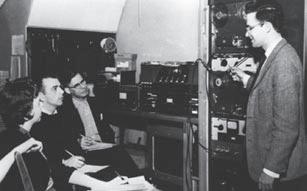
teaching the first class in the eMS (fall 1958).
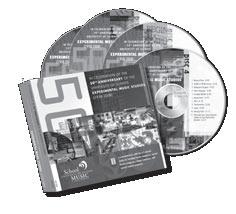
To listen to the EMS’s 50th Anniversary CD compilation, a commemorative collection of selected works by founding and current faculty, alumni and student composers, click on “MP3 format” found at: http://ems.music.uiuc.edu/history/music-cd/.
C E n TER FOR A MERICA n Mu SIC R ECEI v ES M ARTIRA n O C O ll ECTIO n
by Adriana Cuervo, Assistant Archivist for Music and Fine Arts
such as the musical typewriter, benefiting musicologists and theorists alike. Among the most significant activities, the analysis of classical repertoire, the studies of the nature of sound, and the creation of original compositions were, essentially, all facets of one brilliant prismatic structure. Last but not least, the presence of graduate classes allowed the studio to become increasingly integral to the School of Music, fascinating students with an intriguing mix of technology and creative inspiration. the participation, during the 1960s, of both Hiller and Brün in the Ferienkursen in Darmstadt established the international value of this environment; moreover, it suggests that the awareness eMS composers had of european contemporary music was probably higher than that possessed by many of their european colleagues regarding American music, a disparity that, in many cases, is still perceivable today. the eMS studio was born of an open-mindedness that was uncommon in the United States and europe, now as then.
to learn more about current eMS activities and achievements, visit their website (http://ems.music.uiuc.edu/).
the authors thank Professor Scott Wyatt, Director of the experimental Music Studios, for help with research, oral histories, and use of primary sources from his personal collection. in addition to University and School records, principal publications used in preparing this article were Ann L. Silverberg’s A Sympathy with Sounds (1995); Lejaren A. Hiller’s “electronic Music at the University of illinois” (1963, 1965) and “An integrated electronic Music Console” (1965); Journal of Music Theory, Journal of the Audio Engineering Society, Perspectives of New Music, Music Educators Journal, and Science magazine
1 Ann L. Silverberg, A Sympathy with Sounds: A Brief History of the University of Illinois School of Music to Celebrate Its Centennial (Urbana-Champaign: School of Music, University of Illinois at Urbana-Champaign, 1995), p. 53.
2 Silverberg, p. 68.
3 Otto Luening, “An Unfinished History of Electronic Music,” Music Educators Journal, Vol. 55, No. 3 (Nov. 1968): see p. 138.
4 Lejaren A. Hiller, Jr., “Electronic Music at the University of Illinois [1965],” in Im Zenit der Moderne, eds. Gianmario Borio and Hermann Danuser, Vol. 3 (Freiburg im Breisgau: Rombach GmbH Druck- und Verlagshaus, 1997), pp. 105-130; see p.109.
5 Herbert Brün, “. . . There Goes Sal,” Perspectives of New Music, Vol. 34, No. 1 (Winter 1996): pp. 170-171.
In June 2008, the Sousa Archives and Center for American Music acquired the music and personal papers of Salvatore Martirano, along with the “Sal Mar Construction.” Martirano (1927-1995) served as a professor of composition at the UI School of Music between 1963 and 1995, and was a driving force in the development of the University’s Experimental Music Studios. The collection contains correspondence between Martirano and renowned composers and performers, many of his original music manuscripts, audio and video recordings, concert programs and reviews, lecture and research notes, photographs, and software and hardware diagrams for the Sal Mar Construction and the YahaSALMaMac.
The Sal Mar Construction, completed in 1971 using circuits from the University’s pioneering ILLIAC supercomputer, was the first digital musical instrument of its kind that could generate dynamic improvisatory electronic music. The papers and Sal Mar Construction document Martirano’s personal and professional career as an award-winning composer, performer, and leader in the field of computer-generated music. This acquisition marks a milestone in the Center’s efforts to document the University’s and the School’s vital legacy as a national and international leader in the field of electronic and experimental music.
The papers and Sal Mar Construction are available for research and performance to all faculty and students of the University of Illinois, as well as to others outside of the campus community. A brief description of the collection is available online at www.illinois.edu/ goto/martirano. A complete finding aid will become available in spring of 2009, once the collection has been fully processed. For further information on and requests to use the collection, please contact the Sousa Archives and Center for American Music at (217) 244-9309.
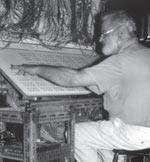
Sal Martirano performing on the Sal Mar Construction, ca. 1985.
Hiller
“You’re a what?” it was about 1953, and i had just told somebody at my university that i was a “musicologist.” that was a pretty typical reception, and it’s not all that unheard-of today, but it’s a fact that in the early 1950s, there weren’t many musicologists in the United States. in those days, even a large school of music might have only one person who taught everything required—music appreciation, a freshman course on music literature, a music history survey, some period courses, a specialized seminar. in the Ui School of Music in 1950, Professor William G. Hill, who had joined the faculty in 1932, was the only musicologist. He taught most of those courses, though he got a hand from organ professor russell Miles who gave an occasional seminar on Bach, and from distinguished theorist Hubert Kessler in a course on Beethoven, while George Hunter, famed performer and director of early Music, offered “Performance Practice” with a historical slant. the teaching of music history was largely in the hands of the practitioners of music. But then history took a different direction.
Contemplating Musicology
t illinois And in the World
by Bruno nettl, Professor Emeritus of Music and Anthropology
Above: Guido Adler, “father of musicology.”
Historical photographs courtesy of the national Archives and the University of illinois School of Music archives.
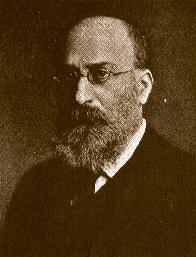
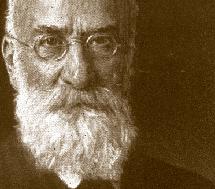
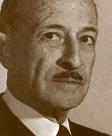
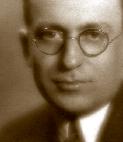
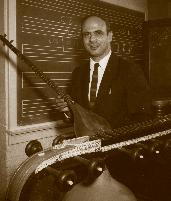
top to bottom: Guido Adler of Vienna, the first professor of musicology; Dragan Plamenac, founder of the School’s doctoral program in musicology; Professor russell Miles; Professor William G. Hill, one of the School’s first musicologists; Professor Hubert Kessler; Professor George Hunter; Professor Bruno nettl, with a collection of eastern instruments, in 1967.
now, i gotta tell you, in those early days musicologists didn’t always get very good press. their music history courses were considered irrelevant “mickeymouse” requirements by some, they were accused of holding performers’ feet to the fire for insufficient authenticity and taking a judgmental attitude when it came to some of everybody’s favorite music (like Liszt and tchaikovsky). i don’t know whether this reputation had ever been justified, but in any event, by the time i arrived at the School of Music over a decade later, there was a Division of Musicology with seven professors (still getting a hand from some performance and theory teachers), and it seemed that everybody must be taking a lot more courses in music history and getting a lot out of them.
And so, by the early 1960s, if someone said “i’m a musicologist,” people were more likely to ask, “oh, what’s your period? Baroque, or 19th century?” or even, “are you a historical musicologist or an ethnomusicologist, or some other kind?” And now, a half-century later, we have lots of musicologists, studying and teaching many different musics from a multitude of perspectives. Let me comment on the development of this field by giving a few vignettes from its history.
1885 And All thAt
Sometimes i think that the history of musicology began in 1885, because in that year there appeared two articles that have influenced us ever since. One was by Alexander John ellis, a distinguished British mathematician and all-around scientist who was interested in musical scales used around the world and, in an article titled “On the Musical Scales of Various nations,” asserted that the tone systems of all of the world’s musics were equally natural (or unnatural), thus laying the foundation for the kind of culturally neutral and scientific approach essential to the development of ethnomusicology.
But for my meditation here, the second 1885 article is the more important. it was by Guido Adler, a man considered by many as the “father of musicology.” Born in Moravia in what is now the Czech republic, Adler spent most of his life teaching at the University of Vienna, as its first real Professor of Musicology (but he succeeded eduard Hanslick, aesthetician and critic and famed opponent of Wagner, who was titled “Professor of Aesthetics”). My father, Paul nettl, worked as Adler’s assistant in the 1920s and found him a brilliant but exacting and sometimes pretty gruff teacher, not always easy to get along with.
Adler’s contributions were many, but his famed 1885 article (written when he was just 29), titled (i’m translating), “Scope, Method, and Goal of Musicology,” is important because it contains an outline of what musicology should contain. now, there had for long been scholars who wrote histories of music, and theoretical treatises, and even learned commentary about ancient and Asian musics. the reason Adler gets to be the “prime musicologist” is that he proposed that there should be one single discipline, “musicology” (“Musikwissenschaft” in German), that would include all types of research on music. His outline is divided into “historical” and “systematic parts”; “historical” is self-explanatory, while “systematic” contained what we now call theory, instrument research, acoustics, psychology, pedagogy, and even—it gets a tiny spot—the kind of study now called ethnomusicology. it’s because of Adler that all of us involved in music research regard ourselves as members of the same profession. to be sure, in America the
theorists and the music educationists have split off, and now our Division of Musicology has two main branches, of historical musicologists and ethnomusicologists, though some like to feel they belong in both. Our activities and our values may differ greatly, but i think i’m right in saying that here at U of i, historians and ethnomusicologists believe that they have learned a lot from each other.
Professor Adler, who died in his late 80s in 1941 in nazi-occupied Vienna, may seem awfully remote, but he was the teacher of a great many scholars who eventually took his kind of musicology to many parts of the world, including north America. He may have promulgated a many-sided, comprehensive profession of musicology, but he himself stuck with historical studies of european art music, and so did most of his students. One of these was the man who founded our graduate program in musicology, Dragan Plamenac. A Croatian, Professor Plamenac got his Ph.D. under Adler in Vienna, writing a dissertation on Johannes Ockeghem (a composer to whom he remained devoted the rest of his life), and he came to the United States in 1939 to attend an international musicological congress. By the end of that congress, he realized that things would go badly in europe, and so he simply stayed in new York, no doubt saving his life, and made his living for some years largely by working for the Office of War information and holding odd jobs, until finally, in 1954, he was appointed to the U of i (you can read about him in my colleague tom r. Ward’s article in The New Grove). He brought to our campus Adler’s careful methods of editing and of biographical work. By the time i arrived, in 1964, Plamenac had just retired, but he continued living in Urbana until the early 1980s, and i got to know him quite well. Along with many other older europeans teaching here in the 1960s such as Ludwig Zirner, Soulima Stravinsky, Hubert Kessler, and Paul Ulanowsky, he brought a component of old-world sophistication to the School. A life-long bachelor who never learned to drive (he was a famed solicitor of rides), he devoted much of his energy to building a library that contained numerous rare books, including early seventeenth-century prints, and if one was lucky one might be invited to his duplex on Michigan Street for coffee and a look at the rarities. A short, rather tiny figure with a prominent moustache, Dr. Plamenac was an inveterate concert-goer though, it must be admitted, an occasional snorer. He was a well-known figure on campus, usually eating his dinners in the cafeteria in the Memorial Union basement (long before the days of the “food court”), and older faculty members in many departments ask me whether he is remembered by the “old hands” in the School of Music. He certainly is.
1933
And
All
thAt that was the year Hitler took power in Berlin—also the year FDr was inaugurated—and things promised to get better in the USA but much, much worse in europe. As a result, a steady stream of european scholars, artists, and scientists fled or were forced out of Germany, Austria, Czechoslovakia, Hungary, and other countries for “racial,” ideological, and political reasons. in the long run, we all know, this led to enormous advances in American higher education, research, and cultural life. Musicology, under the leadership of Adler and others, had become an almost quintessentially German and central european field, and many musicologists, a lot of them of Jewish background, lost their jobs and, endangered, came to these shores in large numbers.
When they arrived, some of them wondered, perhaps snobbishly, whether there even were any musicologists in America before them. Actually, there was a small group of Americans doing musicological work from the late nineteenth century on, and the venerable magazine Musical Quarterly in its first issue (1915) ran an article titled “On Behalf of Musicology,” trying to introduce the concept to readers who were mainly performers and music lovers. American music scholars, at first pretty isolated from each other, joined in 1930 to form the new York Musicological Society, which in 1934 turned into the American Musicological Society. there were only about ten members. (Just think, the various musicological societies in the USA now have, together, over 10,000 members.) their research interests didn’t really conform to our stereotype of musicology. the leader was Charles Seeger, father of Pete Seeger, more a philosopher of musicology than a specialist, who tried to get people interested in American music, folk music, music in society, and in thinking further along the outline that Adler had proposed. Among the most active were Joseph Yasser, who was mostly into matters of music theory; Helen H. roberts, student of American indian music; Joseph Schillinger, promulgating a mathematical theory of the arts; and Henry Cowell, composer famed for tone clusters, who had studied ethnomusicology in Berlin. Very few historians of Western art music were there, but they included Oliver Strunk (later on the teacher of our Professor Herbert Kellman), and Harold Spivacke, long-time chief of the Music Division of the Library of Congress, who also had studied ethnomusicology in Berlin. this picture of American musicology changed dramatically as German and central european scholars began to feel the need to abandon jobs, homes, even families to escape the dictatorships, the coming war, and the Holocaust. the stream of emigrants to the United States, and also to the U.K., Canada, France, South America, Australia, and even russia, changed the complexion of humanistic scholarship, more in America than elsewhere. Many of the world’s most prominent artists and scholars, scientists and social scientists (Albert einstein, thomas Mann, Arnold Schoenberg were the tip of the iceberg) settled in the United States, beginning in the early 1930s and coming to a kind of climax in 1938–1940, and they joined American colleagues in turning the American academy from a position of relative isolation into the world’s arsenal of intellectual power, including musicological power (can there be such a thing?).
One day about thirty years ago my colleague Lawrence Gushee, who was teaching a course on the field of musicology and its history, stopped by my office to ask, “how many refugees do you think there were among the musicologists teaching in the USA about 1960?” i guessed, “twenty?”
We knew, of course, about the most famous—you’ll recognize their names: Manfred Bukofzer, author of the main text on Baroque music before 1970; Alfred einstein (no relation), who revised the Köchel catalog of Mozart’s works, Curt Sachs, who wrote many books about instruments and much else; Willi Apel, author of the Harvard Dictionary of Music. Here we knew Professor Plamenac, and of course also Alexander ringer, a concentration camp survivor, who emigrated after the war and joined the U of i faculty in 1958, providing leadership in the expansion of musicology in several directions in the 1960s and enlarging its scope.
Later on, Professor Gushee and i set about to make a comprehensive list of music scholars who had been forced out of europe by the nazis, and came up with at least 147, about half of whom came to the USA (the rest
mainly to Canada, england, South America, Australia). Virtually all of them were historians of european music. they were welcomed by their American colleagues, but their numbers were such that the character of musicology in America was overturned. it was like that in many fields, and when i was a student in the early fifties, european professors with their inexhaustible stores of knowledge, their unintelligible accents, and their courtly old-world manners were stock characters in each of our schedules. they were happy to be here. But don’t forget, these professors, who had had to leave behind their property, families and jobs, and a way of life, sometimes just barely escaping, who had to learn english in middle age and absorb a very strange system of university teaching and administration, they were the lucky ones. there were those who were never able to resume their academic careers and ended up selling insurance or accompanying dance classes in Manhattan. Of course they too were lucky, compared to the many who couldn’t escape and lost their lives in the Holocaust and the war.
After World War ii, and even more after 1950, many of the job-seeking scholars were absorbed into the enormous expansion of America’s universities and colleges, as the G. i. Bill made it possible for vast numbers of returning veterans who wouldn’t have been able to afford it otherwise to get a college education. these émigré scholars and scientists and artists and composers and performers about whom i’ve been speaking—the eighty or so musicologists among them who came to the United States are a tiny microcosm— rapidly transformed the world of higher education in America from looking to europe for leadership to being the world’s intellectual powerhouse.
At ui Around Y2K
it seems to me that coming from the fertile combination of european solidity and American innovativeness, several important things happened in American musicology after the war. the varied interests of musicologists at the U of i continue to illuminate Guido Adler’s concept of musicology as encompassing a multitude of subjects and approaches. Let me mention some directions in which the field has moved, and illustrate with examples from recent researches by our local faculty.
i’ll nickname one direction “back to basics.” After 1950, attention turned from searching for the obscure back to the greatest of composers, with musicologists studying the scores and the manuscript sources, trying to explain how these geniuses created, how their minds worked, analyzing the masterpieces and even their tiniest components. this movement, particularly strong in the 1960s, is of course still with us, and very much represented at the U of i in the work of a number of our historical musicology faculty—i’ll just mention, for example, Herbert Kellman’s continuing studies of the compositions in renaissance manuscripts, as illustrated in his edited book The Treasury of Petrus Alamire: Music and Art in Flemish Court Manuscripts 1500–1535 (1999) and in his work with biographical sources; as well as William Kinderman’s tracing of compositional processes in Beethoven’s sketches, illustrated in his comprehensive three-volume work about one sketchbook, Artaria 195 (2003).
But along with the detailed study and presentation of major works, “back to basics” may also include the way these works were (and maybe should be) performed. Professor Charlotte Mattax has devoted herself to the study of Baroque performance practice, and to sources for its dis-
covery, as in her book Accompaniment on Theorbo and Harpsichord: Denis Delair’s Traité of 1690 (1991). Professor Katherine Syer studies the history of performances of Wagner operas, as illustrated in her contributions on the history of Parsifal in the Companion to Richard Wagner’s ‘Parsifal’ (2005) edited by her and William Kinderman. in another part of the world, a set of twenty CDs titled Music of Indonesia, devoted to a large number of traditions from many of that nation’s islands, recorded, produced, and edited by Philip Yampolsky, provides another way of preserving and presenting significant sources. Further, the period after 1950 saw an expansion of sources and their availability, and along with it a great expansion of bibliographic work, as illustrated by tom r. Ward’s Polyphonic Office Hymn 1400–1520:A Descriptive Catalog (1980).
“ the world of music is a lot bigger than we thought” could be a slogan for the second direction of today’s musicology, but that sentence actually refers to a group of trends that have moved many kinds of music to the center of musicological concern. First, there are musics of Asia, Africa, Latin America, and other parts of the world; this is something that ethnomusicologists have done (although they don’t like to be defined as simply students of “non-Western” music). Second, of great significance here, is American music of all sorts—concert music; vernacular music such as marches, dances, hymns; and importantly, jazz. illinois musicologists participate very substantially in these studies, and i’ll try to give examples that alumni may have heard about when they took courses here, and that faculty and students in all of the School’s divisions may hear about in the halls.
Jazz studies have become a major component of musicological research and teaching, as is evident in recent books by U of i faculty—Lawrence Gushee’s Pioneers of Jazz: The Story of the Creole Band (2005), a book about jazz of the 1920s; The Uncrowned King of Swing: Fletcher Henderson and Big Band Jazz (2005) by Jeffrey Magee; and Monk’s Music: Thelonious Monk and the Making of Jazz History (2007) by Gabriel Solis.
then there is vernacular music—that term needs explaining, but it comprises—well—music that ordinary people use in their daily lives, just as vernacular language is a designation for our everyday speech. it includes things such as military music, marches at football games, dance music, congregational hymns, popular music, school songs, and lots more. Musicologists have become increasingly interested in vernacular music, and at the U of i, it is to be found in nicholas temperley’s distinguished Music of the English Parish Church (1979), which discusses the music of ordinary and small-town churches. there’s a related category—the music of composers whose works may have been heard frequently in their own time but who don’t play a role in today’s concert repertories. Finding obscure composers used to be standard fare of early German musicologists, and there is less about them now, but in temperley’s Bound for America (2005) you can read about three composers who, in the eighteenth century, emigrated from england to America and had varying degrees of success. And you also find such composers, respected in their time, now virtually forgotten, in John Walter Hill’s distinguished monograph, Roman Monody, Cantata, and Opera from the Circles Around Cardinal Montalto (1997)
“Music really matters to people.” that’s an awfully bland way of characterizing the interest musicologists take in the uses societies make of their music. the study of music in culture—which admittedly means lots of different things—has always been a central concern among ethnomusicolo-
gists (like me). More recently, historians of Western art music have increased their participation, and we certainly see it in much work by U of i musicologists of all stripes. i’ll cite just one example, Professor Christina Bashford’s recent work, The Pursuit of High Culture: John Ella and Chamber Music in Victorian London (2007), which is mostly about a major patron of music and his influence.
“Contemplating our navel” is a fourth, relatively minor trend. it’s what i’m doing here, a musicologist looking at the history of musicology. But some of us have studied the musicologies of other cultures, getting insight from the way scholars in different societies study their own music. i’ll mention the work of isabel K. F. Wong, who has written about music scholarship in China through the twentieth century, and of Charles Capwell, who has published several major articles about the work of the important indian musicologist Sourindro Mohun tagore (1840–1914); and i’ve been interested in music scholarship by iranian musicians and historians from the nineteenth century onwards.
A fifth trend: “it’s not only what happened that matters, but perhaps more, how it is (or was) interpreted—in its own time or place, and by musicology.” Maybe i’ve overstated it, but this movement, which most characterizes the recent past, involves the tendency to illuminate, to make sense (in lots of different ways) of the factual findings. Music historians participate in this interpretive approach to musicology. One example is Professor Gayle Sherwood Magee’s very recent book, Charles Ives Reconsidered (2008), which looks at the significance of ives’s works in the light of new findings about their chronology. But it is ethnomusicologists who have perhaps done the most to develop this approach. Let me mention thomas turino’s Nationalists, Cosmopolitans, and Popular Music in Zimbabwe (2000), which elucidates the role of music in politics, modernization, and the emergence of a cosmopolitan culture in a southern African nation; and Donna Buchanan’s Performing Democracy (2006), which interprets the course of various strands of Bulgarian folk and traditional music in the transformation from a communist dictatorship to a democratic republic. My own Heartland Excursions (1995) tries to explain the relationships among people and musics in Midwestern schools of music from an ethnomusicologist’s perspective. the interpretive strand may sometimes involve elements of advocacy, as is the case in “applied ethnomusicology,” which uses the findings of ethnomusicology for practical purposes such as conflict resolution and fostering intercultural tolerance. One of our recent visiting professors, Svanibor Pettan, from Slovenia, is a world leader in publishing in this area of research and taught a seminar here on the subject in 2006.
i’ve been able to mention only a small selection of publications, and to illustrate only a few of the many directions which musicology has taken; the colleagues i have listed also do lots of other things in their research and teaching. But i hope i’ve given a bit of a picture of musicology in the Ui School of Music. From a field with one full-time professor, it has turned into a major component of the University’s forces in humanistic scholarship. Musicology here at the U of i, many-sided and rooted in the expansive tradition of Guido Adler, maintains a position of leadership in many areas and helps musicians, scholars, and students in many fields understand what music is all about.
A small selection of publications show the many directions taken by the School of Music’s Musicology faculty throughout the years.
New Appointments
Dr. Edward Rath, Associate Director, Schoool of Music
Moussa Bolokada
Conde, Visiting Lecturer, Center for World Music
Bolokada Conde is a master djembefola (player of the djembe drum) and an expert in Malinke rhythms. As a young musical prodigy he was a sensation in the Sankaran region of Guinea, West Africa, becoming the premier djembe player in all the major village celebrations in the region for many years. Bolokada joined the world famous Les Percussions de Guinée to replace the famed Mamady Keita as the troupe’s lead drummer. He traveled and performed in major performance venues all over the world since 1996 and was featured in the iMAX movie PULSE: a Stomp Odyssey. Since 2004, he has been performing and teaching in the United States. He is the musical director and lead soloist of Ballet Waraba in north Carolina, Ballet Wassa-Wassa in Santa Cruz, California, and Les Percussions Malinké in the San Francisco Bay Area. He has conducted percussion workshops all over the U.S. and europe. He has released two musical CDs, Morowaya and Sankaran, and he is the subject of an upcoming documentary, “Bolokada Conde: Malinke Village Djembefola.” the great Mamady Keita calls Bolokada “a brilliant and entertaining performer, a patient and precise teacher, and one of the few masters of his instrument. Few others are able to captivate his audience as he does, and even fewer are able to clearly and concisely teach this music.” He was awarded immigrant status in the United States as an alien with extraordinary ability in the arts in 2007.
Dr. Julia S. Byl,
Visiting Assistant Professor of Musicology
Dr. Byl received her B.A. in english literature, religion, and historical musicology, and her Ph.D. in ethnomusicology from the University of Michigan with a dissertation entitled
“Antiphonal Histories: Performing toba Batak Past and Present.” She has received fellowships, awards, and honors from the American Philosophical Society of Philadelphia, the Fulbright-Hays Commission, Ford Foundation, and the University of Michigan. Her archival research in Singapore underlines her interests in historical ethnomusicology, and religion and music. Dr. Byl has presented papers on music of the islamic world and American popular music abroad. She has taught at Bowling Green State University, the University of Michigan, and Washtenaw Community College, and has made presentations of invited papers at Yale University; Society for ethnomusicology conferences in Hawaii and toronto; the international Council for traditional Music Conference in Sheffield, england; the American Anthropological Association conference in Chicago; Association for Asian Studies conferences in new York and Myanmar; the Society for American Music conference in Charleston, South Carolina; and the Feminist theory and Music 4 conference in London, england. She has played in Javanese gamelan and toba Batak gondang ensembles for over ten years.
Dr. Roby George, Visiting Associate Professor in the Band Division
Dr. George received his B.M. and M.M. degrees from Florida State University and the D.M.A. in wind conducting from the University of Cincinnati-College Conservatory of Music. Before assuming the position as Visiting Associate Professor of Bands at illinois, he served as Director of Wind Studies and Professor of Conducting at Florida international University, where he conducted the Wind ensemble and the Chamber Winds. Prior to his appointment at FiU, Dr. George held similar positions at the new World School of the Arts, University of Dayton, Fisk University, and Boston Latin School. High school, university, professional, and com-
munity ensembles under Dr. George’s direction have performed in numerous venues, including the Banff international Band and Orchestra Festival, the MidWest Clinic, Bands of America, and Carnegie Hall. He has also maintained a schedule of conducting responsibilities with the Bi-national Orchestra of Miami/Mérida and the Greater Miami Youth Symphony. His FiU Wind ensemble appeared at the 2000 and 2004 CBDnA Southern regional conferences in Greensboro, north Carolina and Atlanta, Georgia, respectively. His Summer Wind Conducting Symposium, hosted by FiU, has attracted some of the most respected wind conductors of our generation, including Gary Hill, Craig Kirchhoff, thomas Lee, Allan McMurray, H. robert reynolds, Jack Stamp, Frank ticheli, and Angela Woo.
Dr. Mary PaquetteAbt, Visiting Assistant Professor of Musicology Dr. Paquette-Abt received her B.A. from Drake University and both the A.M. and Ph.D. from the University of Chicago. Her research interests include sacred and secular vocal music in early seventeenth-century rome and the print culture responsible for its wide dissemination. the composers, contents, and organization of printed anthologies in particular reveal a network of professional musicians at the center of mainstream composition and performance practices. An additional teaching and research interest is music of the United States, particularly Detroit, in the nineteenth and early twentieth centuries. Both interests pursue the role of music in print and in performance as evidence of culture and society, and rely on local archival sources. Previously Dr. PaquetteAbt has taught at indiana University, Michigan State University, the University of MichiganDearborn, Louisiana State University, the University of the South, and Wayne State University, where she has also been a Visiting Scholar at the Humanities Center. She has lectured on Detroit music at Wayne State
University and at tulane, has published reviews in the Journal of Musicological Research and Early Music, and has presented papers at both national and chapter meetings of the American Musicological Society, the international Musicological Society Congress, the renaissance Society of America, and the Society for Seventeenth-Century Music. She is currently editorial Assistant for the on-line Journal of Seventeenth-Century Music.
Dr. Anne Prescott, Assistant Professor of Musicology; Associate Director, Center for East Asian and Pacific Studies
Dr. Prescott received her B.M. degree from Cornell College in Mount Vernon, iowa, and her M.M. and Ph.D. degrees from Kent State University. Professor Prescott’s primary research concentration is Japanese koto music and musicians. Her dissertation and other writings focus on Miyagi Michio’s achievements as a performer, composer, and teacher. Dr. Prescott has been playing the koto since she was an undergraduate at Cornell College, and she spent eight years in Japan studying koto and shamisen, including one year as a Japanese Ministry of education-sponsored research student at tokyo Geijutsu Daigaku (tokyo University of the Arts). She has performed in numerous concerts in Japan and the United States, and particularly enjoys introducing the koto to children in both countries. She has taught koto at Augustana College in rock island, illinois and in Bloomington, indiana. She is in demand for lecture-demonstrations on incorporating Japanese music into the classroom for music teacher organizations and workshops throughout the United States.
Dr. Abel Saldivar
Ramirez, Associate Professor of Bands and Acting Director of University Bands
Dr. ramirez is a doctoral graduate of UCLA in conducting and also holds two degrees in music education. earlier in his career, he was a highly successful 5A high school music educator in texas. each of his wind ensembles consistently earned sweepstakes awards and was frequently named “Best in Class” at numerous music festivals throughout the country. As Director of Bands, his marching bands also qualified for the texas 5A State Marching Band competition every year. As director of
jazz bands, his top ensemble was named Grand Champion at the St. Mary’s University Jazz Band Festival, where he also received the “Outstanding Jazz Band Director” award. From 2003–2008, Dr. ramirez was the Director of Bands, Head of the Conducting Division, and Chair of the instrumental Area at California State University, Los Angeles. While at CSULA, he established one of the largest graduate conducting studios in the country, averaging five to six graduate students yearly. As the conductor of the CSULA bands, Dr. ramirez raised the wind ensemble to a level of national prominence, receiving numerous invitations to perform at state and national conferences. in 2007, the CSULA Wind ensemble was invited to perform as the featured wind ensemble during the Fresno State University Wind Band Conference, as well as the California Music educators Association/ MenC Conference, which was held at the Ontario, California Convention Center. Most recently, the CSULA Wind ensemble accepted an invitation to perform at the 2008 College Band Directors national Association Western/ northwestern Division Conference hosted by the University of nevada, reno. Dr. ramirez’s musical knowledge, teaching experience, and artistic conducting expertise is diverse. He has conducted countless wind ensembles and symphony orchestras, opera, and numerous musicals. in addition, he maintains a highly active schedule as a consultant, clinician, and adjudicator for wind bands, orchestras, marching bands, and jazz bands from across the United States and in Australia and europe. He has served on the advisory boards for American Classic Music and Music America. Most recently, he was appointed to the advisory board for the institute for Latin American Music Study at Sam Houston State University in Huntsville, texas. in May 2007, Dr. ramirez made his Carnegie Hall conducting debut with the Santa Monica High School Wind ensemble during a shared spotlight evening concert with the national Wind Symphony. Shortly afterward, he was appointed resident Guest Conductor for the international Honors Wind Symphony, which he founded in a collaborative effort with Distinguished Concerts international new York. Dr. ramirez will conduct the premiere performance of the international Honors Wind Symphony at the Lincoln Center’s Avery Fisher Hall in May 2009.
Paul Redman, Assistant Director for Business Operations the Assistant Director for Business Operations and his staff handle all nonpersonnel business affairs for the School of Music. Mr. redman’s duties include management and administration of business practices, budget, and financial transactions, including the monthly accounting of revenue and expenditures. He additionally coordinates use and maintenance of School of Music facilities and equipment, information technologies, operations, and security. Prior to joining the administration of the School of Music, Mr. redman was the Associate House Manager at the Metropolitan Opera in new York and an instructor of trombone in the Juilliard School’s Music Advancement Program. He holds a Master of Music degree in trombone performance from Juilliard and an M.B.A. from Baruch College in new York. His performance career has included engagements with the Orchestra of St. Luke’s, the Metropolitan Opera Orchestra, the Long island Philharmonic, the Spoleto Festival Orchestra, and Orquesta Sinfónica Brasileira.
Yvonne Gonzales Redman, Associate Professor of Voice Ms. Gonzales redman is a graduate of Stephen F. Austin University and has enjoyed a 15-year career as a mainstage soprano at the Metropolitan Opera, including many radio and television broadcasts. Outstanding moments in her career include Zerlina in Don Giovanni (James Levine, conductor); Giannetta in L’Elisir d’Amore (with Luciano Pavarotti for his 30th anniversary gala); Jouvenot in Adriana Lecouvreur (in Mirella Freni’s final performances of this work); and in Parsifal with Plácido Domingo, to name only a few highlights. in addition, Ms. redman has captivated listeners on the stages of the Santa Fe Opera, Los Angeles Opera, Seattle Opera, Minnesota Opera, Pittsburgh Opera, Wolf trap, Opera illinois, and the Houston Grand Opera, where she sang the world premiere of Daniel Catán’s Florencia en el Amazones She was featured as Mimi in La Bohème in the Bregenz Festival in Austria. She has shared the stage with some of the greatest operatic artists of the past and
New Appointments
current centuries, including Plácido Domingo, Luciano Pavarotti, Samuel ramey, nathan Gunn, Bryn terfel, teresa Stratas, renée Fleming, Frederica von Stade, Susan Graham, Carol Vaness, Dawn Upshaw, Denise Graves, Paul Groves, Ben Heppner, Jerry Hadley, Dmitri Hvorostovsky, rené Pape, and thomas Hampson. Conductors with whom she has collaborated include James Levine, James Conlon (Music Director of ravinia, among other titles), Sir Charles Mackerras, Leonard Slatkin, richard Bonynge, and Murry Sidlin.
Dr. Rochelle Sennet, Teaching Associate, Piano
Dr. Sennet is one of our most recent doctoral graduates who also holds degrees from the San Francisco Conservatory and the University of Michigan, as well as the prestigious Artist Diploma from texas Christian University. Dr. Sennet is rapidly establishing herself as a well-known performer, teacher, and scholar. Her recital programs showcase her versatility at the keyboard, with frequent performances of works by Bach, Beethoven, and African American composers such as H. Leslie Adams, Adolphus Hailstork, and Pulitzer-Prize winning composer George Walker. As a doctoral student, she was chosen to perform John Corigliano’s Etude Fantasy at the Ui’s Corigliano Concert, with the composer in attendance. She has served on the piano faculty at the Blue Lake Fine Arts Camp since 2006, and has made guest appearances at the American Festival for the Arts in Beaumont, texas. Her research interests include the study of American music, and she has interviewed well-known music historians and composers. Her dissertation, entitled “African American Composers and the Piano Concerto,” highlights her pursuits. Dr. Sennet has won numerous competitions. in 2006, she was co-winner of the Krannert Center Debut Artist Competition. in 2002, she was a national finalist for the MtnA Collegiate piano competition. As winner of the 2001–2002 MtnA/tMtA Competition, she performed a Mozart concerto with the orchestra of the famed Houston High School for the Performing and Visual Arts at the tMtA Convention in Corpus Christi, texas. She has also performed John Corigliano’s Piano Concerto with the University Philharmonia Orchestra, Beethoven’s Concerto No. 2 with the Sewanee
Festival Orchestra, the Barber Piano Concerto with the San Francisco Conservatory of Music Orchestra, and Beethoven’s Concerto No. 1 with the Lamar University Chamber Orchestra. in addition to Dr. tamás Ungár (tCU) and Ui Swanlund Professor of Piano ian Hobson, Dr. Sennet’s teachers have included Logan Skelton, Mack McCray, the late Dr. John Paul, Hugh e thompson, Sr., and the late Hazel ruben. Dr. Sennet is a member of the Music teachers national Association, the College Music Society, the Center for Black Music research, the Society for American Music, and Phi Kappa Phi honor society.
Dr. Reynold Tharp, Assistant Professor of Composition-Theory Dr. tharp was Visiting Assistant Professor in C/t for the last two years. As a result of our national search this past year, he has been invited to join the permanent faculty in a tenure track position. in recent years, his music has been performed in the U.S. and europe by groups such as the Berkeley Contemporary Chamber Players, ensemble Diffraction (Paris), Orchestre Lyrique de région AvignonProvence, and nieuw ensemble (Amsterdam). Awards for his music include Columbia University’s George Bearns Prize for his orchestral work Drift, BMi’s William Schuman Prize, and Berkeley’s DeLorenzo Prize. Dr. tharp earned his Ph.D. in Composition at Berkeley, where he studied with Jorge Liderman, richard Felciano, and Cindy Cox. As recipient of Berkeley’s Ladd Fellowship, he spent two years in Paris studying composition with Philippe Leroux and orchestration with Marc-André Dalbavie and was selected for the Stage d’Automne at irCAM in 2000. He has also participated in international new music festivals and workshops, including Centre Acanthes and irCAM’s Académie d’Été. His orchestral work Cold Horizon was performed at the 2006 Minnesota Orchestra reading Sessions and Composer institute. He has recently written pieces for the Berkeley edge Festival and the irving M. Klein international String Competition in San Francisco. Dr. tharp was commissioned to write a work by the San Francisco Contemporary Music Players for its 2007-2008 season, a piece for Paris-based pianist ivan ilic, and a duo for Ui faculty flutist Jonathan Keeble and faculty harpist Ann
Yeung. Prior to his appointment at illinois, Dr. tharp also taught composition and theory at northwestern University’s School of Music, the University of California at Berkeley, and San Francisco State University.
Pr OMO ti O n S
John Dee (Oboe) to Professor (nugent Professor of Performance Studies)
Eduardo Diazmuñoz (Opera) to Professor with indefinite tenure
Gabriel Solis (Musicology) to Associate Professor with indefinite tenure
John “Chip” Stephens (Jazz Piano) to Associate Professor with indefinite tenure r etire M ent S
John Walter Hill Professor emeritus (Musicology)
James F. Keene Professor emeritus (Bands)
David F. Atwater, Assistant Director for Business Operations
FACULTY M ILESTO n ES
refleCtions on PeoPle, roCKs, And time
by Jeffrey S. Kimpton
The following article was originally given as an address at the School of Music Commencement Convocation at the University of Illinois on May 11, 2008.
thirty-five years ago i left illinois after my graduation ceremony through the underground tunnel of the Assembly Hall in my band uniform, because the band had played for graduation. that rather inauspicious exit started a career that has passed by me faster than i could ever have imagined, a non-linear but serendipitous series of opportu nities and experiences that i value every day.
it seems like yesterday that i was here, a life full of classes and rehears als, performances, a wonderful collection of friends who would gather at 10 a.m. in the lobby of Smith Hall to decide whether to skip the “required” recital hour and go for coffee at the where the owner would not give us a third cup of coffee until we bought something to eat. wonderful time—and i had a lot more hair.
i ’m sure that many of you graduates sit ting out there are hoping that i will be quick, and not spend too much time on my walk down nostalgia lane.
that admonition of quickness reminds me of the story of my favorite graduation address, given by the late great author Kurt Vonnegut at Harvard in the 1960’s, during the height of the Vietnam war. Vonnegut was a major anti-war activist, and the Harvard administration was very concerned he would incite a demonstration. When Vonnegut was introduced he took the podium and purport edly said, “Graduates, things are very very bad in this country and they are going to get worse. Good luck.” And he sat down.
i won’t be quite as succinct as that, but in these moments that we share together, with our only common bond being graduates of this great University, let me reflect on our mutual journeys, one leg that you finish today, the next that begins tomorrow, and its relationship with my own.
My friend and interlochen alumnus Aaron Dworkin, the founder of Sphinx, the organization that is working to identify and celebrate African American and Hispanic achievement in music performance and composition, shared a wonderful quote by Ashley Montagu:
“ The deepest defeat suffered by human beings is constituted by the difference between what one was capable of becoming and what one has in fact become.”
each of us has experienced this immense zone of uncertainty that lies between what you are capable of becoming, and what you in fact do become. On this day in which we have such high expectations for you in the future, let us explore three areas that you should think about as you contemplate the years ahead: the people you meet, the rocks in the path of life, and understanding the arts in uncertain times.
We all have people who provide defining experiences that have shaped our personal and professional lives. now to be honest, if someone had asked me 35 years ago to name the most significant people and experiences that would contribute to what i have become, i would have a list shorter than what i have today. But, with time, maturity and changing perspectives, and sometimes just a raw need to draw on life’s repertoire for survival skills, the value of one’s preparation in life is often linked most closely to people and experiences.
Some very important experiences for me happened at illinois, and while there have been other wonderful intersections of people and experience in my life, those that happened here are important to share because they were some of the first that mattered.
in some ways, my life and its work came from my genes. i was blessed with parents whose own love of the arts and remarkable teaching ability gave their three sons a strong foundation in life and work. they were members of this School of Music community, and my brothers are all alumni of hey taught us to value honesty and candor, to have high expectations for us and for others, to be thorough and always prepared, to ask good questions, and above all to stand for principle and integrity. they would be very proud of me today.
My first semester here i took Music 100 from Herbert Kellman, required at the time for all music majors, and his lectures were fascinating, running the gamut from renaissance to gamelan, Bach to Berio. Professor Kellman told me in a recent email that this course was designed to be different, even radical, and that it was—and i loved it. even better, Kellman sometimes showed up for the mandated evening listening sessions, and one evening gave a remarkable extemporaneous discussion on the future of music and entertainment, in which he described the merger of music and video as a powerful new force that would shape us in hugely different ways as a society, and he did it by linking it to the schauspiel of Wagner. it offended the artistic
“mY
exPerienCes here At illinois And through life rAised fAr more questions thAn eAsY AnsWers; theY Were A sYll Abus for life’s future homeWorK. theY helPed me eliminAte the unCertAint Y betWeen WhAt i Could beCome, And WhAt i did beCome.”
integrity of some, challenged others. When i reflect on the impact of media in the arts today, i think of this lecture nearly 40 years ago.
then there was ron Byrnside, a musicologist who taught the required Music History sequence. Byrnside would come in with his tousled hair, lecture notes and a pile of recordings falling out of his arms. He rarely spoke as the class began, but put on a piece of music and started writing key words on the board, thoughts, quotes, or an art slide on the screen, and then gradually launched into a lecture that tied music history into the socio-political, musical and artistic contexts of history in a way that captivated me. His comments on papers were a rich conversation back and forth about ideas to explore or question. i loved his courses so much i took 20th century music from him in graduate school, and a seminar on Debussy. He shaped my own views on the role of the arts in society tremendously.
Or Lillian Katz, a professor of education and one of the architects of the Federal Headstart program, who in a graduate seminar gave a series of stunning lectures about the desire or “disposition” to be a teacher-leader that i have used to shape my own work as a supervisor of hundreds of teachers and professors in my career. Once, during a discussion period a student fresh from student teaching said that she had burned out after eight weeks, and asked Professor Katz how to avoid burnout. Katz, who was very tall and imposing and from england, turned to the class and said in her wonderful accent, “my dears, one cannot burn out if one never had a fire.”
there were incredible lectures from a seminar on aesthetics that i took with Harry Broudy that shaped my ideas of why we teach the arts, to the demanding rehearsals from band director Harry Begian who helped every young conductor understand the role of raising expectations from rehearsal to performance.
Or the remarkable sessions at the demonstration lab school watching robert thomas teach and engage elementary children by literally saying nothing, just pulling them in to complex lessons through modeling, and pretending to smoke chalk. i have never seen anyone teach like that since, and it saved my life in an elementary general music class i taught in my first job, and gave me techniques of listening and modeling that i use to this day in my teaching and lecturing.
But there were also other experiences that shaped me as musician, thinker, creator, arts advocate, citizen. recitals by organist Marie Claire Alain, Wagnerian soprano elizabeth Schwarzkopf with pianist John Wustman, sneaking in to the back of the Great Hall at the brand new Krannert Center with our scores to watch Georg Solti rehearse the Chicago Symphony, wild jazz performances with John Garvey, lecture concerts by John Cage, and electronic compositions that challenged our viewpoints of the future of classical music. Foreign films in the Auditorium and Abbie Hoffman and eldridge Cleaver exhorting us to think about war and race on the Quad, the pain of Watergate and of the thrill every time coming onto the field of Memorial Stadium with the Marching illini, with the crowd
roaring as the Chief and the Block illini emerged—even if Michigan beat us 72-2 in the sleet.
Little did i know when i left illinois in August of 1973 full of optimism, with my little Magnavox portable stereo, and my Olivetti portable typewriter and headed off to upstate new York and my first teaching job, that all of these people and experiences, and so many more, would also come along for the ride and play a role in shaping the beliefs and philosophies that have guided my life’s work.
My experiences here at illinois and through life raised far more questions than easy answers; they were a syllabus for life’s future homework. they helped me eliminate the uncertainty between what i could become, and what i did become.
As i have worked with students over the last 30 years, i find them wanting quicker answers and more ready solutions. Posing complex questions that may be open-ended tend to make students itchy today; it takes so much time. in spite of the speed at which we want to solve the world’s issues, and the information we have available to do so, patience and time are critical to your own professional foundation, and to wise and strong leadership. in so many ways i wish i were sitting there with you, getting ready to start all over again. You are entering a world with remarkable creative tools and information technologies—a virtual network of web, video, and sound resources at your fingertips unthinkable 30 years ago that give you a capacity and extraordinary opportunity to create your professional futures and save the future of the arts.
But your professional journey will be no easier than mine, and i apologize if that disappoints you or your parents. What you have to hope is that your education has prepared you to stumble toward success. Let me clarify.
For a few of you, and i wish many more, your career and life path will be straight to stardom in your chosen field, unbending, linear, resolute and instantly distinguished. For the rest of you, remarkable and accomplished class that you are, your pathway in life, even for the most fortunate and successful, will be one laced with rocks that will cause you to stumble in your journey and for some, lose sight of your future. it is the ability to answer the questions posed to you throughout your life journey and in a world community that will allow you to get up and move in new directions.
think with me about what happens when you stumble. Your body reacts, hands or arms extending, legs bracing to keep you upright. After that initial reaction you immediately look down and take your eyes off your forward progress. You look for the cause of that missed step; you ask yourself questions about what happened and why. Humans are very analytical creatures, and so whether your reaction is scientific and reasoned, or emotional and one of embarrassment or anger, you figure out what you have to do to avoid stumbling again. it is our nature to walk upright and always forward. For me, it has been the diversity of the people and the experiences i have collected through life that have helped me right myself faster and with greater balance when i stumbled.
“i thinK thAt the greAtest ChAllenge for Your generAtion of leAdershiP Will be the issue of time, And esPeCiAllY, time for the Arts, hoW We estAblish meAsures of ArtistiC quAlit Y And exPerienCe in the rACe to the next ArtistiC exPerienCe.”
exciting as your future will be, the rocks you will find in your path will be different than mine. We are living in an amazing period in our history and culture, where the Y and Z generations, sometimes referred to as the digital and entitled generations, have more access to the arts, media, technology, and information than at any other time in human history. As these tools are used in new and different ways, we are changing the process of teaching, learning, and consuming in the arts at a terrifying speed absent much reflection.
Your work in the future must determine how our youngest generations are able to separate unreality and reality, MySpace for creative space, a Google search for research, and Facebook a substitute for face to face interactions. Your work as artist citizen leaders must confront the issues of how we are becoming more spectators in the arts than creators OF the arts, about creating artificial filters that are intermediaries to original artistic experience, about a parade of unsatisfying idols and phony survivors, and about how to help the next generations know that shows like “the real world” do not in fact become the real world. We are multiplying our sources of information and input so quickly that we have come to confuse surfing the web with work, entertainment with art, “content” with meaning. there is a growing gap between the integrity of the arts and our society’s expectations and understanding of the arts, in part because we live in a world of filters and interrupted experiences that prevent us from seeing our art in totality. One of the new things is “concert blogs” where you enter a website on your Blackberry or phone and share your views of what you are hearing or seeing or experiencing while you are experiencing it, and then share it with others and see what they are saying while the performance ensues. OK, raise your hands, how many of you have texted during my remarks so far? But what about the totality of the artistic experience itself? isn’t that the point of creating and experiencing an artistic whole? Will our creative process be limited because of what we think others might think along the way? My God, are we going back to the happenings that used to grace the Quad in the late ’60s?
i think that the greatest challenge for your generation of leadership will be the issue of time, and especially, time for the arts, how we establish measures of artistic quality and experience in the race to the next artistic experience; how much information we can process and possess in the smallest amount of time and the tiniest of devices. We have created an unreal world in which the newest thing is never quite new enough, in which we expect answers, success, achievement, thought, decisions—and creating and experiencing the arts—in nanoseconds.
this trend is not confined to the arts—but as is often the case, the arts serve as a lens to a larger reality. As i talk with and work with arts educators around the country, they share their deep concern over the lack of patience that young students in the arts have with learning the artistic and creative process. these early learners in the arts seem to lack the
ability to grasp the thought, craft, experience, layers of understanding and context, questioning and creative impulses that are intrinsic in the artistic experience. Where does the next generation of YOU come from? Will they want to patiently learn Hot Cross Buns on the clarinet, or a simple Bach invention, if they can download one thousand songs onto an iPod the size of their thumb? How do we value the craft of learning and experiencing in the arts against the demand for the quick and easy?
As you run off to your parties with family and friends, hurriedly pack your apartments and prepare for your journey tomorrow, i hope that as illinois graduates you will be committed to posing questions to these issues for the future, and not expect to get easy answers. i hope that you will place greater importance on depth over superficiality, focus over media frenzy, steady growth over immediate gratification. i hope you will seek consistent, structured, demanding artistic and academic experiences, for yourselves, but even more importantly for our children, that create new value in creativity and expression, breadth of understanding and appreciation. these must be the antidote to the stunning compression of both time and value we find in society and the arts today.
Graduation ceremonies are a great way to assign guilt and responsibility to the next generation, and i now do so to you. it is up to you to reaffirm the fact that meaningful experiences in the arts—either as a creator or a consumer—cannot be built on an artistic superficiality in which the pace of understanding, comprehension and synthesis is determined by the speed and bandwidth of an internet connection. it took time for the arts to become a part of our lives and culture. every culture, every society, needs the power of time and reflection to generate the images by which it is remembered. time, even at today’s speed, is a key ingredient that we need to reach the artistic vibrancy that we celebrate today. Demand the time in your lives that the arts deserve.
As we prepare to go our separate ways, i think back on those who touched my life here at illinois, and elsewhere. thirty years from now, when one of you might be here in my shoes, remember that the difference between what you were capable of becoming and what you in fact became was established by the questions you asked, and how you chose to seek the answers. this is a day of boundless expectations. You have the best wishes and greatest hopes of everyone in this room for your success in the years ahead.
Jeffrey Kimpton (B.S. ’73, M.S. ’75) on the right, with Steve reinwand (B.S. ’72) and the Marching illini in Memorial Stadium in 1971. Steve is now one of nashville’s top recording musicians. Jeff is president of the interlochen Center for the Arts in Michigan and is an active advocate for arts education. in 2006, he was invited to Washington DC to accept the national Medal of Arts in recognition of interlochen’s eighty-year contribution to national culture. He received his bachelor’s and master’s degrees in music education from the University of illinois.
Still YoUNG At HeArt
by Joyce Griggs with David Allen
illinois Summer Youth Music (iSYM) celebrates its 60th anniversary in 2009. As executive Director of iSYM, i feel particularly honored to be a part of this celebration and thank those who have made iSYM such a successful program for young musicians. Our Coordinator of Outreach Programs, David Allen, will be sharing his thoughts as well in this jointly written article.
iSYM is one of the most highly regarded and well-known musical programs of its kind in the United States. it has served students from as young as sixth grade to graduating high school seniors. the School of Music faculty and staff are excitedly planning tributes to the legacy of this program, at the same time as we celebrate our present offerings and look forward to creating outstanding programs and opportunities for many years to come!
iSYM alumni fondly reflect on their experiences with the camp. For many, the experience directly influenced their decision to attend the University of illinois, pursue music as a career, or maintain an appreciation of the arts into later life. Many alumni even have children and grandchildren who have also participated in iSYM. Many times when we meet iSYM alums, their facial expressions begin with a look of nostalgia, which soon melts into a smiling recollection of a moment or concert from their own iSYM days. One particularly poignant example occurred a few years ago, during my first year as executive Director. i met a father whose son had been accepted into the Senior Symphonic Band. that year, Don Wilcox was conducting the ensemble, and the father came up to me during registration and stated, “this is wild! i was in here in 1974 as a camper and Don Wilcox was my conductor then!” What an amazing moment in the circle of life—to contemplate a father and a son participating in the same program, 30 years apart, and having the same director!
THE HISTOrY: ISYM’S EArLY DAYS
the U of i Music extension, created in 1946 under the auspices of the Division of University extension, led by Dean Stanley robinson, served the state of illinois by providing educational opportunities for young musicians and teachers. in 1948-1949, extension staff members Paul Painter, robert L. Schaeffer, and tom richardson began iSYM as an annual event sponsored by Music extension, in cooperation with the U of i School of Music. Over the course of the next five decades, the name of Music extension went through a metamorphosis to better match the organizational structure of the University. today, it is the Office of Outreach and Public engagement, within the School of Music, that organizes iSYM.
Brushing the cobwebs off the earliest programs and documents from illinois Summer Youth Music revealed that the first concerts took place in the summer of 1949. the ensembles represented that year were All-State Chorus, Orchestra, and Junior Orchestra. the Concert Band was introduced the next year in 1950.
iSYM developed a core mission during its earliest days: to bring the highest quality of music education to pre-college students from the state of illinois. Particularly important to this mission was the belief that participation had to be affordable. Promotional materials stressed to prospective students and their parents that the cost of the program included only direct expenses resulting from room and board. the cost of education, recreation, and staff salaries was borne by Music extension. in 1950, a student could participate in iSYM at a total cost of only $32.50. though the
fee was low by today’s standards, iSYM administrative staff recognized that some students might not be able to afford it. Many outside organizations such as rotary and Lions Clubs, women’s organizations, and the American Federation of Musicians offered scholarships, and 1952 concert programs listed those organizations in gratitude—a tradition that continues today.
Central to iSYM’s educational mission was establishing a premier summer youth music camp. in 1950, iSYM produced a stellar line-up of conductors. Keith Wilson (Ui ’36 and Director of Bands at Yale) conducted the Senior Concert Band. thor Johnson (Cincinnati Symphony Orchestra) conducted the Orchestra, and r. Oscar Clymer conducted the Chorus. Space limitations preclude our listing the hundreds of outstanding conductors who were to follow these “pioneers” and to whom we owe our heartfelt appreciation.
When first setting forth on the journey to document the history of iSYM, we consulted Dan Perrino, Professor emeritus of the School of Music at the University of illinois, who was actively involved with iSYM during its earliest days. From our discussions with Dan, the challenges facing iSYM became apparent. For example, in the earliest summer seasons, polio outbreaks frightened many students and kept them from participating. During this period, Bernie Steiner, director of elementary bands in Waukegan, was instrumental in enrolling students in the first camps when significant numbers dropped out due to polio scares. As vaccines were more successful and as the camp’s popularity grew, iSYM attracted more participants and gained increased support from the University as well as the community.
At the beginning, each iSYM summer session lasted two weeks. each ensemble or small camp would present two concerts—one at the end of each week. As the camp expanded its offerings to include opportunities for high school and junior high school students, it grew to three two-week sessions so students could attend programs appropriate to their age and skill level. the organizers of iSYM arranged to host concerts to accommodate the large
Professor Paul Painter, the first director of U of i Music extension and founder of iSYM.
iSYM senior campers in the 1960s.
public audiences that attended the weekly concerts. in 1951, “Under the Big top”—a tent erected outside of Allen residence Hall—became the concert venue for iSYM performances. this tradition continued until the Krannert Center for the Performing Arts opened in 1969. A few performances occurred in other locations. For example, on July 4, 1959, the Senior Band performed a concert in Memorial Stadium. Other “camps” within the camp, such as those devoted to voice, operetta, and piano, held concerts inside Smith Music Hall or at the illini Union.
While iSYM initially provided only large ensemble opportunities for students, smaller specialty programs were soon added. in 1956, Paul rolland started a violin camp and the next year iSYM began a piano camp under the direction of James Lyke. two years later, the tenth anniversary year for iSYM saw an explosion of musical opportunities, with iSYM doubling its offerings with seven new programs: Junior and Senior twirling, Senior Voice Camp and Operetta Workshop, Wind instruments Camp, Percussion ensemble, Senior Dance Show Band, and elementary Strings.
By 1960, iSYM had more than 1,000 participants enrolled in its myriad of summer offerings. Much like today’s camp, the staff played an integral part in determining and supervising the educational growth, physical well-being, and safety of the participants. From the beginning, iSYM’s administrative staff has stressed the importance of having counselors assigned on the basis of a small student-to-counselor ratio. the work crew, which is the engine for iSYM’s organizational and logistical success, existed in the early years and remains a vital part of iSYM today. Another carryover from the early years is the Daily Downbeat. Anyone who has been involved with the camp has read the Daily Downbeat to determine the daily activities, weather reports, or other fun tidbits about camp life. the first edition was printed in 1957. More than 50 years later, our summer staff finds the same joy in creating a daily news source that is both informative and entertaining.
While not all of the history and persons involved with iSYM can be documented and described in this article, we thank all of those who have dedicated their time and energies to building a program that is known as the premier summer camp in the state of illinois. Currently, we are compiling important memorabilia that will be displayed for the 60th anniversary. if you are one of our many alumni, we invite you to share with us photographs, programs, or other items you may deem as historically relevant to the documentation of iSYM’s first 60 years!
THE PrESENT: CHALLENGING TODAY’S YOUTH THrOUGH MUSICAL ExPErIENCES
While many traditions remain, some changes have helped to enhance the iSYM experience for our current participants. the mission remains the same: to provide an interesting, exciting, and challenging environment with music as the central theme. today’s students, however, crave a variety of opportunities through which to explore their musical interests. thanks to the greater number of experiences offered in today’s iSYM, participants are able to choose activities that suit their individual interests in music. As an example, here is what the 2009 iSYM camp categories will include:
Senior Bands
Junior Bands
Senior Orchestra
Junior Orchestra/Strings
Senior Chorus
Junior Chorus
Senior Jazz
Junior Jazz
Musical Theatre
Senior Flute
Senior Trombone
Double Reed
Senior Saxophone
Advanced Piano Piano
Junior Piano Percussion
ensemble-based camp experiences make up the largest portion of iSYM choices. Double reed, Saxophone, and Musical theatre are recent revivals of earlier iSYM offerings. the splitting of the Jazz camp into two separate camps is also a recent occurrence that reflects both the increases in enrollment and the increased interest in combo-based jazz experiences. While some music camps in the nation are downsizing and limiting choices due to lack of enrollment, iSYM continues to expand in order to meet the greater expectations and variety of interests of its participants.
Some of the most exciting curricular additions in recent years can be found in the daily schedule of almost every iSYM camp. through a survey of our participants, we learned that students needed and wanted an opportunity to explore their musical abilities through non-performance outlets. Over the past four years we have added elective classes in Basic and intermediate Conducting, Music technology, Composition and theory, Careers in Music, Balinese Dance, and Balinese Gamelan ensemble. Additionally, many high school students now have the opportunity to participate in chamber music ensembles. these honors chamber ensembles, coached by University of illinois School of Music faculty throughout the week, perform in a chamber music recital on the last evening of the camp. Smaller ensembles, when combined with the traditional large ensemble experience, enhance the overall education and represent the newest and most effective additions to iSYM.
While interacting with our outstanding instructional faculty, participants are supervised by a counseling staff comprised of dedicated men and women. these energetic music educators are carefully selected from the summer graduate school program offered through the School of Music. each counselor has demonstrated outstanding leader-
At the suggestion of Dan Perrino, Professor Blaine edlefsen initiated and served as headmaster of iSYM’s first oboe camp, concurrently with Professor Sanford “Sandy” Berry who began the bassoon camp—creating what is thought to be the first double reed camp in the country (1966).
illinois Summer Youth Music participation in a telecast.
ship and counseling skills, and most counselors have at least three years of public or private school teaching experience. this background, combined with a rigorous interview and application process, guarantees that our participants will have an experienced and supportive counseling staff that is among the finest available.
One of the relatively recent logistical changes was relocating student housing for campers. Former iSYM participants will surely remember walking all the way across campus to rehearsal. indeed, the walk from the Florida Avenue or Pennsylvania Avenue residence Halls (appropriately abbreviated “FAr” and “PAr” respectively) to Krannert was a bit long, especially for those carrying large instruments. three years ago, iSYM made the move to the more modern and comfortable (can you say air-conditioned?) illinois Street residence Halls (iSr). these facilities are much nearer to iSYM instructional spaces and are within easy walking distance to the U of i Quadrangle and illini Union. By reducing travel time, we have added more time for music instruction in all camp schedules. resident participants, counselors, and instructional faculty all enjoy meals together in the iSr cafeteria. the move to iSr and the inclusion of meals for instructional faculty has added a wonderful opportunity for everyone associated with iSYM to interact in an informal setting.
THE FUTUrE: CELEBrATING ISYM’S LEGACY FOr GENErATIONS TO COME
Just as the founders of iSYM evaluated the needs of young musicians, so has the “new guard” taken a fresh look at how best to provide future iSYM participants with a top-quality musical summer program. Here are some of the many exciting plans underway for the future. iSYM will launch a new program in 2009 called the Academy. the Academy will target high-level performers who seek an even more rigorous musical experience during the summer. enrollment will be limited to only one or two participants per instrumental or voice area. All participants will be screened, and upon selection for the Academy, they will receive preference for a principal position within one of the three large ensembles. Small chamber ensembles, master classes, special topic classes, and expanded individual practice time will comprise the majority of the day for these students.
Academy students will also have the opportunity to participate in a special “super section” of iSYM lasting two weeks, thus providing a more in-depth experience for the highly talented young musician. the first week will, of course, be devoted to the large ensemble experience. then the schedule will move seamlessly into the second-week specialty camp most closely related to the student’s instrument or voice type. to offset the increased cost for participants in the Academy, iSYM is seeking individual and corporate sponsorship. if you or your company is interested in learning more about opportunities to support this innovative change, please see the contact information at the end of this article.
recent upgrades and updates to Smith Memorial Hall, the School of Music Computer Labs, and the Krannert Center for the Performing Arts have also provided improvements in facilities used for the iSYM experience.
One aspect of camp schedules that hasn’t changed, however, is the tradition that each participant completes his or her week of camp with a final concert. these exciting programs provide an exhilarating conclusion to the seven-day experience. Admission is free for parents and the community, and every participant receives a certificate of completion on the day of these memorable performances.
the support and resources of the faculty and staff of the School of Music, Krannert Center for the Performing Arts, the Division of Housing, and the Division of Facilities and Services have played crucial roles in making iSYM the important, exciting, and unforgettable musical experience that it is today. the planning by and cooperation of these agencies working together provide the allure, experience, and memories that iSYM offers to thousands of young musicians.
Complementing the Academy, iSYM will initiate several new elective courses, including Alexander technique and (by popular demand) Didgeridoo. Discussions for the future include expanding the types of specialty camp offerings, enhancing the website for greater interactivity for prospective students and parents, launching an online application process, creating an alumni database, and providing web-based audio streams of iSYM concerts.
it is truly a privilege to supervise and administer a program with such a rich and interesting history, one that attracts the brightest and best young musicians, and to work with the 150+ professionals and student workers who make up the educational and support staff for iSYM. As we forge ahead with our exciting plans for iSYM’s future, we thank everyone who has made a mark on its history. You have provided us with a program that has an incredible reputation, remarkable alumni, and fantastic music-making moments that thousands of participants will remember for a lifetime.
to the hundreds of people who have worked throughout the years to make iSYM the outstanding youth program this it is, we extend our sincerest thanks for all you have done.
Joyce Griggs is the Assistant Director for the School of Music and the Executive Director of Illinois Summer Youth Music. David Allen is the Coordinator of Outreach and Public Engagement for the School of Music and Director of Curriculum and Instruction for Illinois Summer Youth Music. To contact Joyce or David, please send an email to: ISYM@music.uiuc.edu.
A “Big top,” located north of Allen Hall, was the venue for iSYM concerts from 1951–1969.
Professor Joe Grant, Chair of the Music education Division, rehearses the iSYM Junior Chorus in July 2008.
l i K e A r o CK
“Like a rock!” that’s the expression often used to describe a person who is always there, ready and willing to give the extra effort to make something good happen. And, like a rock, William Heiles has been a part of the musical scene in ChampaignUrbana for more than 40 years as a faculty member in the Ui School of Music. it’s easy to understand Bill’s devotion to the piano. raised in toledo, he could not be torn away from the toy piano his parents bought him as a birthday present. they soon arranged for piano lessons. “i had excellent teaching throughout my elementary school and high school years, and i credit these teachers with laying the foundation for everything i have learned since then.” As a junior and senior high student, Bill became a devotee of piano music, especially Bach and Chopin, and he began giving yearly solo recitals.
Bill chose the Oberlin Conservatory for study toward an undergraduate degree in piano performance. He thrived in the surroundings of one of the country’s leading music schools as a student of edward Mattos. Like his other piano teachers, Mattos had no technical “method,” and indeed Bill has not developed such a teaching technique either. “i object to technical ‘methods’ for two reasons—the assumption that technique can be
interfaculty ‘politics’ created strains, caused us at times to take sides, and distracted us to an extent from the real purpose of our study. this experience, among many others, convinced me of the importance of faculty collegiality and, especially, the need to avoid involving students in interfaculty conflicts should they arise.”
After graduation, Bill went to Munich as a recipient of a coveted Fulbright Award. He had chosen to work with Friedrich Wührer (1900–1975), a teacher and pianist who was a favorite among American students. Bill recalls Wührer as a charming and deeply cultured musician who, perhaps like many european teachers, took a more authoritarian approach to teaching than was common in America. the Fulbright years were above all a personally broadening experience—living in a major uropean city, absorbing a different culture, learning to speak, think, feel, and even dream in a new language.
“Bach and Chopin have been favorite composers throughout my life. early on, i responded on some level to the affinity between these musical giants, and i experienced physical as well as musical pleasure in playing both. Bach’s music, in addition to its intellectual complexity and great emotional depth, is beautifully realized for keyboard, but that doesn’t make it any easier to play! Chopin’s piano music, of course, is supremely idiomatic for the keyboard, but also emulates Bach in its contrapuntal quality, its harmonic complexity, and its richness of ornamentation.”
separated from musicianship and the assumption that all students should be taught the same way. i would rather work with each student as an individual, and i prefer to see technical development as organically related to musical growth.” in his senior year at Oberlin, Bill won an annual student competition and performed the Brahms B-Flat Concerto with the Oberlin Orchestra.
He learned more than music and academics at Oberlin. “Like the other piano students, i was aware of the infighting that went on between certain faculty members. i believe our awareness of
“When i returned to the US and as a graduate student accompanied German Lieder, the poetry spoke to me in a direct way that wouldn’t have been possible without the Munich experience.”
When Bill returned to the States in 1960, it was the Ui that attracted him to an outstanding graduate program, and he began his master’s and stayed on in pursuit of the doctoral degree. Here, he studied with Soulima Stravinsky, a well-known pianist and teacher, and son of the famous composer (the elder Stravinsky visited the Ui campus many times).
By Dr. Edward Rath, Associate Director, School of Music
Heiles’s recollections of the younger Stravinsky are enthusiastic and focus on a trait that he himself has developed—an adherence to the intentions of the composer as exhibited in the musical score. “Much the same as toscanini was with his orchestral scores, Soulima was devoted to the piano score. Most of his suggestions and corrections were objective and detailed. though he was not lacking in musical imagination, he was reluctant to impose his imagination on his students. His demanding and highly objective teaching style actually freed his students to play in their own ways. those of us who studied with him took pride in the diversity of points of view evident in our performances. in my own teaching i have been influenced by Soulima’s close attention to the musical score, though i believe that subjectivity plays a greater role in my teaching than it did in his. i am inclined to see objectivity and subjectivity not as opposites but as complementary aspects of a fully developed musical awareness. i hope to inspire my students both to respect the composer to the greatest possible extent and to think and feel for themselves.”
for the weekends.” He maintained close contacts with illinois, however, and four years later he returned to the Urbana-Champaign area to settle in for one of the longest tenures of any music professor in recent times—forty years!
“What hasn’t changed in forty years is more important than what has changed. What i really liked about illinois, right away, was that people here really love music. i have always felt a supportive atmosphere among faculty, among students, and between faculty and students. the competition is healthy, as it should be at any great music school, but not destructive, and it never distracts us from our love for our art. As students here, we competed with one another, but we remained friends and, at the end of a long day of practic-
complicated modern music to a highly developed sense of hearing and listening, “and a great deal of patience!”. He admits to having a “good memory,” though it is not “photographic.” “Memorization of all music is part of the internalization that describes my approach to performing. With the score in front of me, there is more of a sense of distance and separation, but with memory the music can be part of me.”
What’s changed, though? “no single block on campus looks the same! the demographics have changed too. Forty years ago, many American musicians were going to europe to study. now it is the Asian students going to europe—and coming here. We also had more undergraduates in piano performance years ago than we have now, and, like many of my colleagues, i would like to see our undergraduate enrollment expand again.”
“i believe our goAl here is to develoP enlightened Performers, Who understAnd musiC in terms of its st Yle, struCture, And even its PhilosoPhY, And CAn bring this understAnding to eACh PerformAnCe.”
ing, would often go out for a beer and talk about music. the sense of camaraderie has continued throughout my years on the faculty.
Bill’s final year as a resident graduate student saw him achieve faculty status, and his D.M.A. in piano performance was the first to be awarded by the U of i
He moved to Kalamazoo in 1964, where he served as professor of piano for four years at Western Michigan University, playing concerts, developing a class of good undergraduate piano students, and enjoying numerous collaborative recitals with colleagues. “it was a different type of university, where most of the students left campus
“ the goals of the School have always appealed to me, just as they did at Oberlin. i am happier at illinois than i might be at a large conservatory. i believe our goal here is to develop enlightened performers, who understand music in terms of its style, structure, and even its philosophy, and can bring this understanding to each performance.”
Bill has also enjoyed the cutting-edge endeavors of the composition faculty at illinois. the contemporary musical scene here influenced his recital programming of “new” music, no matter how difficult. He credits his ability to play
As to future plans, Bill looks forward to continuing on- and off-campus performances, teaching, practicing, learning more about the process of playing the piano, and sharing it with his students. He also intends to pursue his love of mathematics, especially number theory. A recent birthday present from his wife, violist Anne Mischakoff Heiles, allowed him the privilege of summer study with a math tutor—a graduate student who also loves music, especially the music of Bach! He has now contacted a professor in the mathematics department with whom he plans to swap math and piano lessons.
He concludes: “i take great pride in the accomplishments of many hundreds of my students who now are teaching literally throughout the world. For the present, i’m having a very good time!”
Faculty News
Christina Bashford (musicology) had a new book, The Pursuit of High Culture: John Ella and Chamber Music in Victorian London, published by the Boydell Press in fall 2007, and contributed to an edited volume of essays, Music in the British Provinces Other publications included an essay entitled “Writing (British) Concert History: the Blessing and Curse of Ephemera,” published in Notes in spring 2008. She presented papers at a colloquium at the University of Iowa and at the Center for World Music’s Canons Symposium at U of I, and chaired sessions at the Anglo American Conference of Historians in London, England, and the North American British Music Studies Association meeting in Toronto, Canada.
James Beauchamp (professor emeritus, composition) has been working with graduate student Mert Bay on a research project to separate lines in a polyphonic recording. As part of the project, the UI Faculty Woodwind Quintet, led by Professor John Dee, recorded a Beethoven transcription in which each of the five instruments was recorded onto a separate track. This allowed measurement of the efficacy of attempts to separate the instruments from the ensemble. In addition, five-track playback from separate speakers proved to be an interesting way to listen to the quintet. Professor Beauchamp gave a talk on this approach at the fall 2007 meeting of the Acoustical Society of America in New Orleans.
Louis Bergonzi (music education) taught at Northwestern University, Duquesne University, and Vandercook College of Music this summer, in addition to giving clinic presentations at the Massachusetts Music Educators Convention. Conducting engagements included the Nebraska All-State Orchestra and performances at Davies Hall in San Francisco and at Lincoln Center as part of the Heritage Gold Festivals. At the Salem Orchestra Festival in Oregon, he worked with high school students of Brandon Correa, a doctoral student in music education. This fall, Professor Bergonzi conducted festivals at IMEA Districts #6 and #7 and served as a clinician at the UI Middle School Orchestra Festival, co-sponsored by Steven Katz (B.S. ’84, M.S. ‘90), Orchestra Director at Niles West High School. He also guest conducted Millikin University’s Fall Orchestra Festival, along with doctoral student Brian Kellum. He will conduct the UI Philharmonia Orchestra at IMEA in Peoria in a program shared with the Women’s Glee Club, conducted by Professor Joe Grant.
Zack Browning (composition-theory) gave several lecture-performances at institutions in Changchun, China: Jilin University, Northeast Normal University, and the Changchun American International School. He received a FAA Fellowship to go to China and was accompanied by pianist Jee-Ean Kim (D.M.A. student of Ian Hobson) and flutist Chihhsien Chien (D.M.A. ‘03). Professor Browning’s composition Profit Beater was premiered in Tampa by the University of South Florida Percussion Ensemble, which also recorded the work for a Capstone Records CD. His composi-
tion Execution 88 for solo piano was performed by Jee-Ean Kim at the Society of Composers, Inc. (SCI) National Conference in Atlanta, Georgia.
Donna Buchanan (musicology) spent 2007–2008 conducting fieldwork for three new projects concerning music, politics, minorities, and spirituality in Bulgaria. She also completed a book review for The World of Music, and an article, “Sonic Nostalgia: Music, Memory, and Mythography in Bulgaria, 1989–2005,” for the edited collection Post-communist Nostalgia. Her edited volume with VCD entitled Balkan Popular Culture and the Ottoman Ecumene: Music, Image, and Regional Political Discourse (Scarecrow Press), to which she also contributed three articles, appeared in October 2007. During the spring of 2009, she will host Bulgarian composer and musician Georgi Andreev under the auspices of a Frances P. Rohlen Visiting Artists Award.
Ollie Watts Davis (voice) has been named a University Scholar, one of the highest recognitions bestowed upon a UI faculty member. She was also honored with the U of I Black Alumni of the Year Award at the 2008 Black Congratulatory Ceremony. She presented “Let Our Rejoicing Rise: The Sacred Music of African Americans” at the BP Corporation North America headquarters in Naperville, Illinois, and appeared as soloist at the South Bend Symphony Holiday Concerts in Indiana and as soprano soloist in Bach cantatas at the Allerton Music Barn Festival. Professor Davis also celebrated her twenty-fifth year as Professor of Voice and Conductor of the UI Black Chorus in 2008.
B. Suzanne Hassler, Coordinator, Alumni Relations and Development
John Dee (oboe) performed the Mozart Oboe Quartet and Britten’s Fantasy Quartet with the Serafin String Quartet in Philadelphia in October 2008. In November, he performed Ralph Vaughan Williams’s Concerto for Oboe and String Orchestra in Krannert Center’s Great Hall as featured guest soloist with the UI Chamber Orchestra under the direction of Maestro Donald Schleicher. He will perform the Mozart Oboe Quintet in C minor with the Delray String Quartet in Palm Beach, Florida in January 2009, and a world premiere written for him and the Vega String Quartet by John Anthony Lennon on January 30 at Emory University in Atlanta, Georgia. He will also give performances and invited master classes at the University of Wisconsin and Arizona State University, and in Georgia, Nebraska, Nevada, and Ohio.
Eduardo Diazmuñoz (Opera/New Music Ensemble) was Artistic Director of the Bogotá Philharmonic Orchestra during its 40th Anniversary in 2007, programming the entire 42 week-season for this renowned organization and traveling to South America for 10 weeks of rehearsals and performances, which received rave reviews from the local press. A highlight of this engagement was the Colombian premiere of the Tuba Concerto by UI alum Neely Bruce (D.M.A. ‘71), featuring Professor Mark Moore as soloist. During 20072008, Maestro Diazmuñoz also adjudicated the prestigious Eduardo Mata Third International Conducting Competition, chaired by Gunther Schuller; collaborated with Ian Hobson and Sinfonia da Camera in conducting the recording of Roberto Sierra’s Variations on a Souvenir; guest-conducted the recently formed Sinaloa Symphony in a program featuring his own Danza for Large Symphony Orchestra; and composed the main theme for the Mexican film Padre Pro, which premiered nationwide last November.
Timothy Ehlen (piano) performed recitals for the SundaysLive chamber music series at the Los Angeles County Museum of Art Bing Theater, broadcast live on the web and on KCSN FM; for the Seoul National University Tuesday Concerts Series at the SNU Cultural Center; and at the University of Iowa in Iowa City. He presented lecture-recitals at the New England Conservatory of Music in Boston, Loyola Marymount University in Los Angeles (featuring six Beethoven Sonatas), and the Chautauqua Music Festival. Recent master classes were offered at the San Francisco Conservatory of Music, the University of Iowa, and on a tour of five universities in South Korea. A recording of Beethoven sonatas for the Azica label will be released in early 2009.
Ricardo Flores (percussion) was guest artist with the UI Latin Jazz Ensemble at the International Association of Jazz Educators Conference in Toronto, Canada, along with colleagues Chip McNeill and Tito Carrillo. In addition to playing with the ChampaignUrbana Symphony and Sinfonia da Camera, he presented clinics and concerts with the Illinois Brass Quintet at Waubonsie Valley, Downers Grove North, and Vernon Hills High Schools. He also served as Headmaster for the 2008 ISYM Percussion Camp. In November, he returned to perform with old friends in the Cleveland Jazz Orchestra. Other activities included recording Brazilian percussion on the recently released CD In the Middle, by the Craig Russo Latin Jazz Project; and drum set on Venus Notorious, soon to be released on a CD of music by faculty colleague and composer Zack Browning.
John Grashel (music education) presented “Graduate Music Education Faculty Members’ Graduate Degree Titles and Their Graduate Degree Institutions Teaching at Universities with Graduate Music Units Ranked by the National Research Council” at the national biennial meeting of the Music Educators National Conference (MENC). He had two papers published in the Bulletin of the Council for Research in Music Education, and his “State of the Art of Music Education in the Francophone Schools of New Brunswick” (with Anne Lowe) was published in From Sea to Sea: Perspectives on Music Education in Canada.
Larry Gray (double bass, jazz studies) has maintained an active national and international performance schedule since joining the faculty in 2007. Highlights from the past year include two trips to Poland, where he gave the world premiere of his composition Suite for the Chicago Bass Masters and worked with several notable jazz artists including Roscoe Mitchell. His summer schedule culminated in a ten-day tour to Japan with the Ramsey Lewis Trio and two performances at the Allerton Music Barn Festival. This fall he looks forward to performances with Mr. Lewis at The Town Hall in New York City, as well as appearances with jazz greats Benny Golson, Donald Harrison, Branford Marsalis, and others.
Peter J. Griffin (bands) directed the Marching Illini at Disneyland, Universal Studios-Hollywood, the Tournament of Roses Parade, and the Rose Bowl in late December and early January. In February and March 2008, he conducted the South Suburban Conference Honor Band, the Metro Suburban Honor Band, and the District 214 Honor Band in Arlington Heights, Illinois. The Marching Illini, under his direction, became the first non-Irish band to
lead the St. Patrick’s Day Parade in Dublin, Ireland. In April, Dr. Griffin presented a clinic at MENC in Milwaukee. Throughout the spring semester, he served as a clinician and adjudicator at various events in Illinois and West Virginia.
Dana Hall (jazz) presented master classes and concerts in St. Louis, Columbia, and Kansas City, Missouri, Minneapolis, and Philadelphia. He also concertized at Pittsburgh’s Manchester Craftsmen’s Guild with the Chicago Jazz Ensemble; at the Kennedy Center in Washington, DC with Terell Stafford; and in Calgary and New York with Ralph Bowen. In April, Professor Hall took his UI Jazz Sextet to the annual North Texas Jazz Festival, where each of his students received outstanding soloist awards and the ensemble was recognized as the outstanding combo of the festival. In addition, Mr. Hall served as a clinician in New York and Portland for several educational initiatives sponsored by Jazz at Lincoln Center, led ensembles in the performance of his original music at jazz festivals in Montalcino and Rome, Italy throughout the summer, and maintained an active recording, clinician, and performance schedule.
B. Suzanne Hassler (editor, coordinator for alumni relations and development) coordinated the “Jerry Hadley Memorial Concert“ held at KCPA in January 2008. She contributed to the BBC series “Musical Migrants,” which will feature an episode on School of Music alum Denise Gill (B.M. ’03), a professional singer and kanun player in Turkey. She also worked with conductor Dennis Shrock researching the forthcoming book ”America’s Choral Heritage” to be published by Oxford University Press. It will include a chapter dedicated to the University of Illinois and Professor
Harold Decker, founder of the first doctoral degree program in choral conducting and literature in the U.S. In June 2008, Suzanne attended the fifth annual Supporting Alumni in the Performing Arts conference at the Cleveland Institute of Music in Ohio.
Jonathan Keeble (flute) recently concluded his tenure as program chair of the 36th Annual National Flute Association Convention. In November, he assumed the position of the Association’s Chair Elect, the NFA’s highest elected position. Over the past year, Dr. Keeble was the featured guest artist at Flutemania in Sweden, in addition to giving solo concerts in Austria, at the Eastman School of Music, Northwestern University, and Rutgers. With U of I harpist Ann Yeung, he performed at harp festivals in Amsterdam, Netherlands, and in Belgrade, Serbia, also presenting a master class at the Belgrade Conservatory of Music. As a member of the Prairie Winds, he performed in concert series in Georgia, Michigan, Illinois, Indiana, and Wisconsin.
Herbert Kellman (professor emeritus, musicology) traveled to Tours, France in October 2007 for discussions on collaborative research projects between the UI School of Music Renaissance Archive and the Centre d’Études Supérieures de la Renaissance. In November 2007, he attended the American Musicological Society’s annual meeting in Quebec; he currently serves on the History of the Society Committee. In April 2008, Professor Kellman chaired a session on music and art during the UI conference The Aesthetics of Grandeur. He is currently writing (with Edward Houghton) a monograph for University of Chicago Press on the Chigi Codex, and assisting scholars with research projects in the Renaissance Music Archive.
William Kinderman (musicology) spent the 2007-2008 academic year in Munich, Germany. His work on Beethoven’s creative process was supported by the Humboldt Foundation and the German Academic Exchange Service (DAAD). During the spring of 2008, he held lecture recitals, concerts, and workshops on Beethoven’s later piano works in various European cities, including Munich at the “Residenz” Palace and Vienna at the Palais Lobkowitz, where Beethoven often performed. Professor Kinderman was invited for residencies at Louisiana State University and North Texas University, and his lectures on Beethoven at the University of Munich drew large and enthusiastic audiences. A new expanded edition of his comprehensive book Beethoven has just appeared from Oxford University Press.
A generous review of Bill’s public lecture-recital at the Beethoven-Haus at Bonn appeared on September 5, 2008 under the title “endlosschleife am Klavier” in the General-Anzeiger in Bonn.
Mei-Fang Lin (composition) completed an electronic tape piece titled Figurations, commissioned by the UI Experimental Music Studio for its 50th Anniversary Celebration. In 2008, her music was performed in the Alba Music Festival in Alba, Italy; Zeppelin Sound Art Festival in Barcelona, Spain; International Review of Composers in Belgrade, Serbia; SCI National Conference in Atlanta; Merkin Concert Hall in New York, and at the Manhattan School of Music, among others. Upcoming performances include three world premieres of new works commissioned by the National Chiang Kai-Shek Cultural Center in Taipei, the ChamberBridge Ensemble in San Francisco, and the Earplay New Music Ensemble in San Francisco.
Kazimierz Machala (horn) received second place and the Excellence in Composition Award for his Brass Quintet No.1, one of 52 new works entered from around the globe in the 2008 International Chamber Music Festival Composition Contest in Louisville, Kentucky. Winning pieces were performed at the International Brass Chamber Music Festival held in October 2008. Professor Machala was featured soloist, and presented clinics and master classes, at the Lugano Horn Workshop in Switzerland in July 2008, and was featured soloist with the Elgin Youth Symphony Brass Choir as a member of the Illinois Brass Quintet in April. In March, his Concerto for Horn, Winds and Percussion, published by Capo Tasto Music and distributed by Carl Fischer, was performed by the Dallas Wind Symphony. Earlier this year, The Four Hornsmen of the Apocalypse, Professor Machala’s student quartet, performed Concerto for Four Horns and Orchestra by Heinrich Hubler with the Saint Louis Symphony Orchestra.
Jeffrey Magee (musicology), an associate at the University’s Center for Advanced Study in Spring 2009, will speak on Irving Berlin at the Library of Congress’s Coolidge Auditorium as part of a lecture series co-sponsored by the Library and the American Musicological Society. His essay on Duke Ellington’s Cotton Club years will appear later this year in the Cambridge Companion to Duke Ellington
In a recent Chronicle of Higher Education report, U of I ranked #2 (out of 375) in scholarly productivity in the area of “music specialties.” Full report at: chronicle.com/stats/productivity/page.php
Joseph Manfredo (music education) presented an invited paper at the 18th International Society for the Investigation of Wind Music (IGEB) conference held in Echternach, Luxembourg. In addition, he presented five clinics at the 2008 Conn-Selmer Institute held on the campus of Notre Dame. Professor Manfredo also made presentations at state conferences of the Illinois and Ohio Music Educators Association, as well as for the 2008 Cape Cod Collaborative. In December 2008, he spoke at the Midwest Band Clinic, and in the spring of 2009, he has been invited to present a series of workshops at the Shanghai Conservatory of Music in China.
Timothy McGovern (bassoon) taught at the Indiana University Jacobs School of Music as Guest Associate Professor of Bassoon during the spring semester of 2008. In February, he presented a double reed workshop at the All-State Music Educators Conference in Peoria, Illinois. Tours with the Prairie Winds Woodwind Quintet included performances in Georgia, Illinois, Michigan, Ohio, and Tennessee. He continues his activities as principal bassoon of the Illinois Symphony Orchestra. Summer 2008 activities included teaching at the ISYM Double Reed Camp and the Madeline Island Music Camp in Wisconsin. He also presented master classes and performances during the annual Illinois Quartet outreach tour. The quartet worked with students from the Elgin Youth Symphony Orchestra, the Chicago Youth Symphony Orchestra, and a number of area high schools.
Chip Mcneill (jazz) recorded two new CDs for the Capri label this year. The first, “Four Steps-3,” features his original compositions, with UI jazz faculty Chip Stephens and Joan Hickey on piano, and is already getting
airplay across the country. The second CD, “The Whirl,” will be released in 2009. It features D.M.A. student Shawn Purcell on guitar and former Maynard Ferguson drummer Stockton Helbing on drums, and is again all original compositions. Professor McNeill traveled to Bali in summer 2008 with the UI East-West Ensemble. In November, he was featured guest artist with North Texas State University’s alumni tribute to Neil Slater and Jim Riggs in Denton, Texas, and with the East Tennessee State jazz and percussion ensembles. He also led the “Beyond Cool” concert for the Second Annual Allerton Music Barn Festival, which featured music from the “Birth of the Cool” era of jazz and new compositions by UI jazz faculty.
Gary McPherson (music education) retired from his presidential and Board of Directors positions with the International Society for Music Education after 24 years of involvement. During the previous year he was invited to present at international conferences in Portugal, Belgium, Germany, Australia and the United States, and gave a special presentation to deans and directors of European music schools on musical talent, young people, and the road to professional training at the annual conference of the Association Européenne des Conservatoires, Académies de Musique et Musikhochschulen. He also completed data collection for a study on children’s motivation to study music that involves eight different countries, and was awarded the 2007-2008 Faculty Award for Excellence in Research.
Rachel E. Mitchell (music theory), presented a paper titled “Roberto Gerhard’s Idiosyncratic Approach to Twelve-tone Sonata Form” at the annual meeting of the Society for Music Analysis. This international conference was held in September 2008, and was hosted by Cardiff University, Wales, United Kingdom.
Charlotte Mattax Moersch (harpsichord) recently completed a CD recording for Centaur Records of the harpsichord works of Charles Noblet, an 18th-century French harpsichordist and composer for the Paris Opera. She will complete a second recording, of the harpsichord suites of Charles Févier, in the summer of 2009. Performances for the 2008-2009 season include a concert of Spanish Baroque music in celebration of Hispanic Heritage Month in Houston, Texas. As part of Handel’s 250th anniversary, she will perform a concert of Handel organ concertos and concert opera arias with Canadian countertenor Daniel Taylor and soprano Christine Brandes for the Bach Choir of Bethlehem’s Spring Concert Series. In May 2009, she returns to the Bethlehem Bach Festival to appear with the Paul Taylor Dance Company.
William Moersch (percussion) performed with the UI East-West Ensemble, a gamelan/jazz crossover/ new music project, at the 30th Bali Arts Festival in June. He continues to serve on the Board of Directors of the Percussive Arts Society and was a judge for the PAS 2008 International Percussion Ensemble Competition. Professor Moersch is also a contributing author to the newly released Drum and Percussion Cookbook: Creative Recipes for Players and Teachers (Meredith Music), which offers performance and practice advice in the format of recipes. In October, he was a featured artist at the 1st Patagonia International Marimba Festival.
Mark Moore (tuba) was a soloist at the International Tuba-Euphonium Conference held at the Cincinnati Conservatory of Music in June 2008. He also adjudicated the tuba solo competition at ITEC. In July 2008, Professor Moore was a soloist with the Wheaton Municipal Band in Wheaton, Illinois. He was a
featured artist, with his quintet Sonus Brass, at the International Brass Chamber Music Festival held in Louisville, Kentucky in October 2008.
Bruno nettl (professor emeritus, musicology) published several articles, including “On the Concept of Evolution in the History of Ethnomusicology” in The World of Music (2006); “On the Concept of Improvisation in the World’s Musics” in the Dutch Journal of Music Theory (2008), also published in Chinese translation in the Journal of the Central Conservatory (Beijing); and “Comparative Study and Comparative Musicology: Comments on Disciplinary History” in the Hamburger Jahrbuch für Musikwissenschaft (2008). He delivered keynote addresses at conferences in Venice (June 2007), Illinois State University (March 2008), and Prague (May 2008), and served as Visiting Professor of Music at the University of Chicago in the spring quarter of 2008.
Susan Parisi (research scholar) completed “Transforming Classical Myth in SeventeenthCentury Opera: Cybele and Atys in the Libretti of Francesco Rasi and Philippe Quinault,” which appears in Re-reading Violence, Death, and Gender in Early Modern Literature and Culture edited by Mara Wade (Amsterdam: Rodopi Press), in press. The volume’s fourteen articles were first presented as papers in the interdisciplinary Mellon Conference held on campus last spring. Another extensive article by Dr. Parisi, examining activities of the court composers Monteverdi and Rasi during the Duke of Mantua’s travels, was published in the Yearbook of the Alamire Foundation in the summer of 2008. As series editor for Harmonie Park Press, she edited four books during the year.
Dana Robinson (organ) performed for the American Guild of Organists, Kansas City Chapter, and conducted a master class for the chapter with students from the University of Kansas and the University of Missouri, Kansas City. In July, he performed at the Organ Historical Society national convention held in Seattle, and taught at the 2008 Pipe Organ Encounter-Advanced, a week-long clinic for advanced high-school organ students. Pipe Organ Encounters is an educational outreach program of the American Guild of Organists conducted by the national Committee on the New Organist. The first such event ever held by the guild, the POE-Advanced took place at the University of Nebraska School of Music.
Ronald Romm (trumpet) traveled to Spain to participate in concerts and master classes with the Ronald and Avis Romm Trumpet and Piano Duo at the Spanish Brass Lurr Metalls Alzira Festival, where he was also soloist with the Alzira Concert Band. Professor Romm participated in the Rafael Mendez Brass Institute in Denver, Colorado, performing and soloing with members of the Summit Brass, then traveled to Minnesota for the 61-year-old Bemidji Music Camp to teach and coach along with son Aaron Romm in the trumpet studio, where the Romm Trio offered master classes in performance techniques as well as private lessons. Summer activities continued at the University of Manitoba in Winnipeg, Canada for the University of Manitoba Trumpet Symposium, where they coached trumpet players of all ages in performance technique and presented their popular recital “Melodie d’Amour.” In August, the Ronald and Avis Romm Trumpet and Piano Duo appeared with the York Symphony Orchestra in Pennsylvania. For upcoming performance dates, visit www.MusicRomm.com.
Gayle Sherwood
Magee (musicology) published an article on Robert Altman’s 2001 film Gosford Park in the fall 2008 Journal of the Society for American Music. She presented her research on Altman’s Nashville at the National Meeting of the American Musicological Society in Nashville, Tennessee, in November 2008. Both projects are part of her current book project, tentatively titled Listening to Robert Altman: Film, Music, and Genre. The University of Illinois Press published her most recent book Charles Ives Reconsidered in July, and a second edition of her book Charles Ives: A Guide to Research will be published by Routledge in 2009.
Gabriel Solis (musicology) published a new book, Monk’s Music: Thelonious Monk and Jazz History in the Making (University of California Press), to glowing critical response. In addition, he delivered a paper at the 2007 American Musicological Society meeting, and was an invited speaker at Duke University and for the HistoryMakers Foundation for African American Oral History. He received an Illinois Program for Research in the Humanities Faculty Fellowship and, with their support, is now writing a book titled “Tom Waits, Masculinity, Americana and Rock at the end of the American Century.” During the 2007-2008 academic year, Professor Solis also received a zero-percent appointment in the UI’s Department of African American Studies.
Sylvia Stone (voice) traveled to Italy this summer to teach young opera singers participating in Il Corso Estivo per Giovani Cantanti Lirici 2008, where she also directed opera scenes in the historic Teatro Bramante in Urbania (or Casteldurante, as it was called during the Renaissance).
Mezzo-soprano Sylvia Stone in the teatro Bramante. inaugurated in 1864 with a performance of Verdi’s Il Trovatore with the composer in attendance, teatro Bramante is one of the venues for performances of opera scenes presented by participants in the program for young opera singers that Professor Stone directs every summer in the medieval town of Urbania.
Katherine Syer (musicology) spent 20072008 based in Munich as a Humboldt scholar. Her work on the production history of Wagner’s Der Ring des Nibelungen involved research throughout Europe. She presented related conference papers and lectures at Oxford (November 2008) and will do so in Boston and San Francisco in spring 2009. Dr. Syer has two extended review essays in the July 2008 issue of The Wagner Journal and a chapter in the Wagner and his World volume published by Princeton University Press in conjunction with the 2009 Bard Festival. She was recently invited to join the advisory editorial board for the Londonbased journal Opera Now
Stephen Taylor (composition) received performances of his music in 2008 in Miami, Washington DC, Amsterdam, Belgrade, Toronto, and at the Bali Arts Festival, where he performed on laptop computer with the East-West Ensemble in his new work Silent Black Outside. The recipient of the 2008 Goddard Lieberson Fellowship from the American Academy of Arts and Letters, Professor Taylor continues to develop new operas with Tapestry New Opera in Toronto, and at the University of Illinois.
Reynold Tharp (composition-theory) had his new octet San Francisco Night premiered by the San Francisco Contemporary Music Players in May 2008. The Financial Times described it as “prismatic” and “tone painting at its most adroit,” and San Francisco Classical Voice called it “gorgeous…a sensuous evocation of the colors and atmospheres of the Bay Area.” In the fall of 2008, his piano piece Littoral was played by noted new-music pianist Julie Steinberg in San Francisco and Sacramento, and by Ivan Ilic in Paris.
Matthew Thibeault (music education) presented papers and workshops at the conferences of the American Educational Research Association and International Society for Music Education, and at multiple sessions at the Illinois Music Educators Association and Illinois Collegiate Music Educators Association. Professor Thibeault published in the Orff Echo, and co-authored an article in the journal Outlines, in addition to having several published book reviews. The forthcoming book Musical Experience in Our Lives will include a chapter on bluegrass music drawn from his dissertation. In January, Professor Thibeault was one of fifteen music educators invited to consult with Apple Computer at their Music Education Summit on music technology.
Sever Tipei (compositiontheory) is an NCSA/UIUC Faculty Fellow for the academic year 2008-09. As a Fulbright Senior Specialist, he lectured on Electroacoustic and Computer Music in May and June 2008 at the National University of Music at Bucharest, Romania. His Dux Markovians and Trees, for chamber ensemble and computer-generated sounds, was premiered at the 18th Contemporary Music Week festival in Bucharest, while Bfast, a computer work for eight channels, was premiered at
the Sonorities Festival of Contemporary Music held in conjunction with the 2008 International Computer Music Conference in Belfast, Northern Ireland. Both pieces were produced with DISSCO software for composition and digital sound synthesis, developed at the Computer Music Project of the UI Experimental Music Studios.
Christos Tsitsaros (piano pedagogy) performed and gave a series of workshops in California, Colorado, Idaho, Maine, and Michigan, and was the key speaker for the Hal Leonard showcase during the 2007 National Conference on Keyboard Pedagogy in Chicago.
In March 2007, Centaur Records released his second CD of original piano works. Hal Leonard Corporation published his Dances from Around the World and Throughout the Year, and several of his works were included in the 2008-2010 repertoire list of the National Federation of Music Clubs and the 2008 edition of the prestigious Celebration Series Perspectives (Frederick Harris Music). Dr. Tsitsaros’ article “How do Rhythm and Tempo Interact with Each Other” appeared in the 2007 winter issue of Keyboard Companion, and he edited and recorded First Lessons in Bach for the Schirmer Performance Edition.
“Christos Tsitsaros is a top-flight piano virtuoso who writes dense, difficult music that matches his own technique. . . you can hear the insights into technical matters in this music to which his own virtuosity led him. This is a strong and eloquent voice in the contemporary world of piano music.”
—Peter Burwasser, author, editor, music critic Fanfare Magazine, March 28, 2008
“Wailin’ with Wilson” aired April 13, 2008 and included samples of his recorded work with his own groups (including pianists Harold Danko and Steve Kessler, guitarist Rory Stuart, bassists Dennis Irwin and Jim Masters, and drummers Adam Nussbaum and Tony Martucci), the Bob Belden Ensemble, and the Bill Kirchner Nonet.
“ The baritone saxophone has been played by relatively few major jazz improvisers; one of the most underheralded of these is Glenn Wilson.”
—Bill Kirchner, author, educator, jazz historian The Oxford Companion to Jazz
Scott Wyatt (composition) released his recent composition, A Road Beyond (featuring Ronald Romm on trumpet), on volume 17 of the Music from SEAMUS CD series, in June 2008. On a Roll, All At Risk, and A Road Beyond were performed at the University of Louisville School of Music on February 20, 2008. His composition of gray twilight received its premiere at the UI New Music Ensemble Concert, KCPA Playhouse Theatre, in March 2008, and was also selected for performance at the 2008 SEAMUS national conference, hosted by the University of Utah, in April 2008.
Glen Wilson (jazz) taped a one-hour show for the “Jazz from the Archives” series presented by the Institute of Jazz Studies on WBGO-FM (88.3) in New York City. The show
Ann Yeung (harp) was the featured presenter at the 1st Elias Parish Alvars Festival in Teignmouth, England, on the 200th anniversary of Elias Parish Alvars’s birth, and gave a presentation on Henriette Renié at the Royal
Academy of Music in London. Her article on Renié’s Légende was subsequently published in the American Harp Journal. In April 2008, she was a featured performer and clinician at the Seventh International Harp Festival, where she and Jonathan Keeble gave several master classes at the University of Arts in Belgrade, and presented the world premiere of Stephen Taylor’s Agoraphobia for flute and harp (acoustic version). In July 2008, they also premiered the electroacoustic version of Agoraphobia, with interactive electronics and video, at the Tenth World Harp Congress in Amsterdam. In addition, Professor Yeung judged international harp competitions in England and in Serbia.
The Illinois Brass Quintet, comprised of Professors Michael Ewald and Ronald Romm (trumpets), Kazimierz Machala (horn), Elliot Chasanov (trombone), and Mark Moore (tuba), served as artists-in-residence at The Burgos Chamber Music Festival in Spain during the summer of 2007. They presented university concerts and master classes in Ohio in fall 2007 including, among others, appearances at Ohio State University, Ohio University, and Youngstown State University. The quintet presented their Fourth Annual Halloween Spooktacular Concert in KCPA Great Hall for families and children throughout central Illinois. In spring of 2008, they performed on a tour of the northwestern suburbs of Chicago. In addition, the quintet recorded Kazimierz Machala’s Quintet No. 1. Jake Walburn (trumpet) joined the quintet in the fall of 2008. In November, IBQ presented concerts and clinics at universities in Texas including The University of Texas at Austin, University of North Texas, University of Texas-Arlington, Baylor University, and Texas A&M University-Commerce.
Jonathan Keeble and Ann Yeung rehearse in Amsterdam for the premiere of Agoraphobia at the tenth World Harp Congress.
Student News
Brendan Frank, Alumni Relations and Development Staff
Chadley Ballantyne, D.M.A. candidate in vocal performance, sang the role of Zuniga in five performances of Carmen with the Union Avenue Opera theater in St. Louis in August. Chadley is a student of Professor Sylvia Stone.
Nathan Birkholz, a student of Swanlund Professor ian Hobson, participated in the 4th rachmaninov international Piano Competition held in Moscow in summer 2008. nathan was the only American in the competition, representing the United States as well as the Ui School of Music. in February 2008, nathan made his professional orchestral debut with the Fox Valley Symphony of Appleton, Wisconsin in its “rising Stars” concert. A review in the Northeast Wisconsin Music Review of his performance of Liszt’s Totentanz stated, “First measure to last, the young artist demonstrated as much concern for musicality as for virtuosity.” in March 2008, nathan received Second Prize at the Kankakee Valley Symphony Orchestra Concerto Competition. He will perform rachmaninov’s Piano Concerto No. 2 in April 2009 with the Green Bay Civic Symphony of Green Bay, Wisconsin.
Stephanie Chigas, mezzo-soprano and former student of Professor Sylvia Stone, sang Dorabella in Così fan tutte with the Boston Lyric Opera last January. in April, she sang Verdi’s Requiem, also in Boston, as well as in eastern Ohio. During the summer, again in Boston, she sang La Tragédie de Carmen in December, she will appear with the new York Philharmonic singing in richard Strauss’s Elektra.
Eun Sun Cho, D.M.A. student and soprano in the studio of Professor Sylvia Stone, sang the title role in Korea’s most famous opera, Chunhyang-jeon by Je-myung Hyun, in Daegu, Korea, at the Daegu Grand theater.
Shelley Culver, a master’s degree student of Professor Dana robinson, visited organs in north Germany and the netherlands on a tour last May with the Westminster Historic Organ Program. She performed on the historic Schnitger organ at the Ludgeri Kirche in norden, Germany.
Melissa Davis, graduate student in the voice studio of Professor Ollie Watts Davis, performed as the mezzo-soprano soloist in the Bach Cantatas concert at the 2008 Allerton Music Barn Festival, and in Mahler’s Symphony No. 2 with the Sinfonia da Camera.
Katherine Denler, a junior performance major in the harp studio of Professor Ann Yeung, was the harp assistant at the 2008 Blue Lake Summer Camp in Michigan.
Therese Fassnacht was appointed Director of Music in Campus Ministry at UCLA. therese is a D.M.A. student of Professor Fred Stoltzfus in Choral Conducting and Literature.
Moon Young Ha, a senior music composition major and the composer of The Mascot, was selected as a regional Winner of the SCi/ ASCAP Student Commission Contest. His work, written for string quartet, moved on to the national round. When he composed The Mascot, he studied with Dr. erik Lund; currently he is a student of Dr. Stephen taylor.
Karin Hendricks was awarded a $20,000 American Dissertation Fellowship through the American Association of University Women, which will cover her dissertation writing expenses during the 2008-2009 school year. She was one of 63 graduate students nationwide to receive this fellowship. Karin was also runner-up for the robert Ferber Dissertation Award, a university-wide award given through the Ui Survey research Laboratory. the SrL selection committee granted her $1,500 to help cover the expenses of her self-efficacy study. Last February, Karin was named Secondary teacher of the Year by the Utah Chapter of the American String teachers Association. Karin is a Ph.D. candidate in music education and student of Professors Gary McPherson and Louis Bergonzi.
Jing-I Jang, D.M.A. harp student of Professor Ann Yeung, received Honorable Mention in the 2007 Web Concert Hall Competition. She is currently the harp instructor and a staff accompanist at Wright State University in Dayton, Ohio.
Lissette Jimenez, who has been a regular soloist performing with the Miami Lyric Opera since 2007, was invited to join the faculty of Florida international University as an Adjunct instructor of Voice and Vocal Pedagogy.
Lissette is a mezzo-soprano and doctoral student in vocal performance and literature studying under Professor Sylvia Stone.
Joseph Jones, doctoral advisee of Dr. Katherine Syer, received the Jill McAllister Award for work on his dissertation “richard Strauss’s Der Rosenkavalier: Musical Genesis and Structure.” Joseph has assumed the role of co-editor, together with Dr. William Kinderman, for the volume titled Genetic Criticism and the Creative Process: Essays from Music, Literature, and Drama, which will be published by the University of rochester Press. He is also contributing a chapter to a book concerning the sketches for Der Rosenkavalier
Ingrid Kammin, soprano, appeared four times last spring in the title role of Armide with Concerto Urbano at Krannert Center for the Performing Arts, and appeared again at Krannert Center in July singing a concert for the Big ten Foundation members. ingrid is a doctoral student of Professor Sylvia Stone and a 2008 recipient of the illinois Opera theater enthusiasts Award for excellence.
Brian Kellum was selected for a Presser Foundation Fellowship and received a $10,500 award from the Foundation this fall. Brian is a doctoral student in music education. Professor Louis Bergonzi is Brian’s advisor and dissertation supervisor.
Rachel Klippel, senior in vocal performance and music education, performed in the Light Opera Works summer production of Gilbert and Sullivan’s Iolanthe in evanston, illinois. rachel is a student of Dr. Ollie Watts Davis.
Jacquelyn Kress, senior mezzo-soprano and this year’s winner of the Geraldine B. Cooke Opera Scholarship, was finalist in the Grand Concours de Chant in Austin, texas in January. this summer, she sang the title role in La Périchole by Jacques Offenbach in Périgord, France. Jacquelyn is a student of Professor Sylvia Stone.
Matthew Leese, D.M.A. student in choral conducting, made his professional debut with the Concord ensemble and Piffaro at the Berkeley early Music Festival in June, singing a Spanish secular program and an italian program of music for a Medici procession. Matthew also taught and performed last summer on the faculty of the Saint Andrews Arts Council in Saint Andrews, new Brunswick, where he directed the combined Millikin University and Community Choirs with the Saint Andrews Festival Orchestra in a performance of Vivaldi’s Gloria in addition, he directed and choreographed Handel opera scenes and choruses from Radamisto and Imeneo, including baroque gesture and dance.
Nicole Leupp has been appointed to the voice faculty of Millikin University School of Music as an adjunct member. She teaches voice and directs Millikin’s Junior-Senior Opera Studio. nicole, who is currently completing her doctoral degree in vocal performance, is a soprano and a student of Professor Sylvia Stone. While at U of i, she taught studio voice for two years and served on the faculty of Parkland College.
Sarah Long defended her Ph.D. dissertation, “the Chanted Mass in Parisian ecclesiastical and Civic Communities, 1480-1540: Local Liturgical Practices in Manuscripts and Printed Service Books” in March 2008. in July, she delivered two papers on music in late 15thcentury Parisian confraternity manuscripts: the first on monophonic votive Masses (Annual Medieval-renaissance Conference, Bangor, Wales), the second on the Mass and Office for St. nicholas (Conference on Music Sources in Private and Civic Contexts, 1480-1540, Bruges, Belgium). in 2008-2009, she will teach music courses for the Study Abroad Program of Southern Methodist University in Paris, France.
Charles Lynch, D.M.A. student of Professor Ann Yeung in the harp performance, was appointed as adjunct harp faculty at Valparaiso University in indiana this fall. He also teaches at Olivet-nazarene University where the OnU Harp ensemble gave its premiere performance this past spring.
Daniel McDavitt, doctoral student in choral conducting, was commissioned to write a series of compositions and arrangements for the Brigham Young University Men’s Chorus, the largest collegiate men’s chorus in the world. two of the pieces, Highland Cathedral and Inside Out and Kicking: A Medley of Welsh Folksongs, were premiered on October 7–8 at the annual BYU Homecoming Spectacular in Provo, Utah. the performances will be broadcast on public television next year. Four other pieces will be performed later in the concert season. Highland Cathedral is a setting of a popular bagpipe tune for men’s voices, piano, trumpet, and bagpipes. Inside Out and Kicking: A Medley of Welsh Folksongs, which is accompanied by a traditional Welsh folk ensemble (guitar, fiddles, flute, accordion, harp, and percussion), was performed with BYU’s renowned international Folk Dance ensemble. An estimated 30,000 people attended the two performances.
Molly McKenzie was one of ten finalists selected nationwide to compete in the 2008 American Harp Society Foundation Awards Auditions. Molly is a student of Professor Ann Yeung and a junior in harp performance.
Daniel Neuenschwander, doctoral candidate in music education, was recently appointed Professor of trombone and Bands at Kutztown University of Pennsylvania.
Sarah Olsen, a student of Professor Ollie Watts Davis and a junior in vocal performance, participated in Master Classes with richard Miller at Oberlin Conservatory’s Vocal Arts Center Symposium in June 2008.
Sergei Pavlov, D.M.A. student in choral conducting and literature, and assistant conductor in the Opera Division, was
invited guest conductor of the Classic FM radio Symphony for a concert in March 2008 during the annual european Music Festival in Sofia, Bulgaria. the program included Liszt’s Second Piano Concerto and Brahms’s First Symphony Sergei, who received a master’s degree in Orchestral Conducting from the U of i under Donald Schleicher in May 2007, has been invited back to conduct the same orchestra for a concert in April 2009, when he will collaborate with SoM violin faculty member Stefan Milenkovich. Other guest soloists and conductors who have appeared during this Festival include Gidon Kremer, Shlomo Mintz, Gennady rozhdestvensky, Maxim Vengerov, and Pinchas Zuckerman.
Casey Robards (M.M. ‘00, B.M. ‘98) has joined the faculty of the Jacobs School of Music at indiana University as Visiting Assistant Professor of Collaborative Piano; she is also on the faculty of the Bay View Music Festival as a collaborative pianist and coach. Casey recently accompanied Jacek Musyk, principal horn with the Buffalo Philharmonic, on a recording that will soon be released.
Hae Jin Song participated as an apprentice in the Young Artist program at SongFest 2008 held this summer at Pepperdine University in Malibu, California. Soprano Hae Jin is a D.M.A. candidate in vocal performance, and a student of Professor Ollie Watts Davis.
Timothy Spelbring performed two recitals for the 2008 institute on Worship, Preaching, and Church Music of the Lutheran Church, Missouri Synod, a national conference held on the campus of Concordia University in Seward, nebraska. timothy is studying with Professor Dana robinson while completing his doctoral degree in organ performance.
Jean-Sébastien Vallée, a D.M.A. student in choral conducting and literature studying with Professors Fred Stoltzfus and Chet Alwes, was appointed Assistant Professor of Conducting at the University of redlands in southern California. Beginning in the fall of 2008, he will conduct two ensembles and teach conducting at the undergraduate and graduate level. Prior to this, he served as assistant conductor for the national Youth Choir of Canada, an ensemble of Canada’s finest young singers between the ages of 18 to 25, and toured with the ensemble in May 2008, also performing at the national convention of the Association of Canadian Choral Conductors. in February 2008, he was chosen from several international candidates to conduct the Vancouver Chamber Choir as part of its national Conductor’s Symposium.
Kay Welch, soprano and winner of the Sara de Mundo Lo Award for outstanding performance and potential in vocal music, was a featured soloist last February with the Prairie ensemble in a program entitled “All the World’s a Stage.” Kay is a D.M.A. student of Professor Sylvia Stone.
Nick Wolny, senior horn major in the studio of Professor Kazimierz Machala, was named a Yamaha Young Performing Artist for 2008. Of the nine students chosen this year, nick was the only horn player selected for this distinction. He is also the winner of the 2008 international Horn Society Barry tuckwell Scholarship and the first runner-up in the 2008 John D. and Fern Hodge Armstrong Solo Competition for Outstanding Undergraduate Performance. this summer he attended the Sarasota Music Festival and the Kent/Blossom Music Festival, where he worked with the principal hornists of the Metropolitan Opera, Dallas Symphony, and Cleveland Orchestra. He also performed at the Bands of America 2008 Summer Symposium while competing for a grand prize of $5,000 in credit towards a new Yamaha horn and arrangements for a new York debut recital. in november 2008, nick participated in the Orchestral repertoire Workshop for Wind and Brass Players at Carnegie Hall, which included as faculty many first-chair players from the nY Philharmonic and the Metropolitan Opera orchestras. in addition to lessons and classes, he attended concerts and also participated in mock orchestral auditions.
Hwajung Yoo, soprano and D.M.A. student in vocal performance under Professor Ollie Watts Davis, attended the early Music Festival in Vancouver, British Columbia, and the Amherst early Music Festival in new London, Connecticut during July 2008. She also performed at the Bayview Music Festival in Michigan in August 2008.
Aaron Ziegel, doctoral student in musicology, presented a paper last fall at the national meeting of the American Musicological Society entitled “One Person, One Music: A reassessment of the Duke-Dukelsky Musical Style.” in it, he finds many previously unrecognized links between the concert works that Vernon Duke composed under his original name, Vladimir Dukelsky, and the popular songs (most notably April in Paris and Autumn in New York) that he wrote under the Americanized name he adopted on the advice of George Gershwin.
James Bunch and Samuel Gingher won the Tenth Annual 21st Century Piano Commission, based on their proposal for a new work titled “Labyrinth” for prepared piano, harpsichord, celesta, toy piano, and percussion. James Bunch is a D.M.A. candidate in composition. His principal teachers have been Keeril Makan, erik Lund, and Philipp Blume. in 2007, he served as a guest conductor for the Ui new Music ensemble. Prior to study at illinois, he was recipient of the Michael Plowman Award for Composition and winner of the University of toledo Composition Competition. Samuel Gingher is currently working towards a Master of Music degree in piano performance under Professor timothy ehlen and has received much recognition as an outstanding pianist, including having won the Ui Symphony Orchestra Concerto Competition, University of north Carolina at Chapel Hill Symphony Orchestra Concerto Competition, MtnA Young Artist Piano Competition, and David Arons Award for excellence in Musical Performance. the world premiere of the newly commissioned work will be presented at the 21st Century Piano Commission Award Concert on February 25, 2009.
After an extensive review process, five music education doctoral students were accepted to present papers at the 28th World Conference of the international Society for Music education, held in Bologna, italy (July 20-25): Naomi Copeland (the Brain, Music, and Cognitive Functions), Patricia Gonzalez (Children’s Motivation to Study School Music: evidence and Perspectives from Mexico), Karin Hendricks (Creating Meaningful and engaging School Music environments), Al Legutki (Motivation of the Music Learner), and Channing Paluck (Beyond the Pharaohs: the role of Music Literacy in Musical Development). Tawnya Smith also attended the conference as a delegate.
Opera Auditions held in the Foellinger Great Hall of the Krannert Center in October 2008. the winners will advance to the Central regional finals in Chicago.
The Four Hornsmen of the Apocalypse composed of (clockwise from left) Tony Licata, Gerald Wood, Paul Blackstone,and Audrey Good—made a solo appearance with the Saint Louis Philharmonic on
March 14, 2008. the quartet’s successful performance of Heinrich Hübler’s Concerto for Four Horns and Orchestra was considered the highlight of the 2007-2008 concert season. All four hornsmen are current or fromer students of Professor Kazimierz Machala.
The Harpcore 4, comprised of harp students Julia Kay Jamieson, Chen-Yu Huang, Charles Lynch, and Molly McKenzie, gave a rousing performance on St. Simons island, Georgia in March 2008, at the invitation of Ui alum and former faculty member Dr. Roslyn RenschNoah (M.M. ’59), seated second from left.
Lori Fisher, a student of Professor Jerold Siena, and Saul Nache, a student of Professor Cynthia Haymon-Coleman were both winners in the Central illinois District Metropolitan
the UI Jazz Combo, coached by Professor Dana Hall, was invited to attend the 8th Annual north texas Jazz Festival held in Addison, texas, April 2-4, 2008. the group consisted of Phillip Doyle (tenor saxophone), Zubin Edalji, (trumpet), Shawn Purcell (guitar), Benjamin Dockery (piano), Robert Meier (bass), and Brent Jordan (drums). All members of the ensemble received Outstanding Soloist awards for their performance of three selections. in addition, guitarist Shawn Purcell received an Outstanding Composer/Arranger award for his composition Sequoia. the combo was also selected from a group of over a dozen ensembles to perform on the April 4th evening concert, opening for saxophonist and Criss Cross recording artist Dave Binney and his quartet.
Congratulations to these fine students and their equally fine teachers!
(L to r): tawnya Smith, Patricia Gonzales, Matthew thibeault, Channing Paluck, Gary McPherson, Al Legutki, Karin Hendricks, and naomi Copeland.
Going Global
by Philip Yampolsky, Director, Robert E. Brown Center for World Music
After four years of preparation, the robert e. Brown Center for World Music officially opened in April 2008 with an elaborate inaugural weekend of concerts, receptions, and an international symposium. the vast collection of musical instruments and research materials given to the University upon the passing of the ethnomusicologist robert e. Brown (1927-2005) has been on campus since 2006, but the Center could not formally open until a director was in place. in the summer of 2007, the School of Music appointed this writer as the founding director of the new Center. though i say so myself, the choice made sense, for i knew first-hand the force of robert Brown’s vision. in 1971, Bob persuaded the California institute of the Arts to fund a four-month field trip for 18 students to go to indonesia to learn Javanese and Balinese gamelan music. At that time i had only just begun playing gamelan music and had as yet no special commitment to indonesia. But i went on that trip and found my life headed in an unforeseen direction. i spent the next 35 years professionally absorbed in indonesian music and culture. that was always Bob Brown’s secret goal—to introduce people to music that would redirect their lives—and the 1971 Bali trip succeeded admirably. At least nine of the students on that trip have remained involved with indonesia through much of their later careers.
With the director on board and with a Balinese gamelan teacher, i Ketut Gede Asnawa, already on the faculty, the Center was ready to offer classes and to plan for its official opening.
The Inaugural Weekend
the first event of the inaugural weekend was a workshop in mbira (the keyed metallophone of southern Africa, sometimes called a “thumb piano”), led by the Zimbabwe musician Musekiwa
Chingodza and an American colleague, Bud Cohen. Musekiwa was in the midst of a U.S. tour, and since many students have become devoted to the mbira, thanks to the ongoing ensemble led by Professor thomas turino of the School of Music, the Center invited Musekiwa to include Urbana in his itinerary. Musekiwa and Bud Cohen gave their workshop at the School of Music on thursday, April 17, and a performance the next evening at the iron Post, an off-campus pub and
performance space that is always hospitable to world music artists.
Friday, April 18 (which would have been Bob Brown’s eighty-first birthday, though we did not plan it that way), was the first day of the Center’s symposium on Canons in Musical Scholarship and Performance
there are at least 23 different senses of the word canon in the Oxford english Dictionary, but the symposium focused on three of them: canon as a selection of essential works (e.g. the Saint Matthew Passion or Round Midnight) or creators (Mozart, Louis Armstrong, thyagaraja) that constitute the core repertoire of one or another category of music; canon as the essential knowledge about a subject that all students must master; and canon as a set of rules for how to go about studying a given subject (transcription or fieldwork in ethnomusicology; formal analysis or manuscript study in historical musicology). these key meanings came up in paper after paper (along with the inevitable puns on canons in the sense of musical rounds like “row, row, row Your Boat,” cannons, and canines). the relevance of canons to the Center for World Music, or to musical scholarship in general, is that canons are always selective, necessarily excluding some kinds of music or some creators while including others; and these inclusions and exclusions always have some ideological or political content, or, at the very least, practical consequences, in that they serve to define the shape of a field. Consider, for example, the axiom, commonly heard 40 years ago, that there were no important black or female composers in the Western classical music canon. Or the fact that indonesian gamelan music is taught in countless university ethnomusicology programs in the U.S., including here at illinios, while, say, Uzbek maqam, Venezuelan harp, or Latvian kokle are hardly taught anywhere. Canons determine what will and will not be studied. Still, one cannot dispose of them, for teaching and learning inescapably involve selection. So it is necessary to understand how and why canons are formed and manipulated. And at the moment of inauguration of the Center for World Music,
Ramping Up World Music at New Center
it was highly relevant to enquire into the nature of the canons that might influence the Center’s choices of what to teach.
the symposium, held in Smith Memorial Hall, was free to the public. twelve scholars were invited by the Musicology Division of the School of Music to speak in four sessions. there were five participants from the University of illinois (Bruno nettl, who gave the opening talk; thomas turino; Gabriel Solis; Christina Bashford; and Philip Yampolsky); one former Ui professor (Charles Hamm, who was unable to attend but sent a paper that was read by Jeffrey Magee, Chair of Musicology); and six scholars from outside the University: ruth Stone, from indiana University; regula Qureshi, from the University of Alberta; Gage Averill, from the University of toronto at Mississauga; tomie Hahn, from rensselaer Polytechnic institute; Salwa el-Shawan CasteloBranco from the Universidade nova in Lisbon; and ted Solis from Arizona State University. this diverse group gave papers describing and analyzing the formation and effects of canons in the music of Haiti, india, late nineteenth-century Britain, Portugal, indonesia, and iran; these and other papers also considered the nature and function of canons in contemporary artistic and scholarly practice in dance, ethnomusicology, and jazz studies.
was an introduction to the performance the same group would give the following day in Krannert. that night the Center for World Music’s Balinese Gamelans gave their first performance in Krannert Center, to a large and enthusiastic audience. in the first part of the program, several types of traditional Balinese music were heard: music for three distinct types of gamelan (bronze orchestras), as well as the kecak (pronounced keh-chak) or “monkey dance,” which is performed by a large seated chorus chanting syllables such as “chak chak chak” in interlocking rhythms. (the syllables represent monkey noises.) the gamelans were directed by i Ketut Gede Asnawa, while the kecak was directed by i Wayan Dedik rachman, a graduate student in the School of Music.
As soon as the afternoon session of the symposium finished, participants were whisked away to the lobby of Krannert Center for cocktail-hour fieldwork at a performance by Folklore Urbano, a twelve-piece new York-based ensemble that combines Colombian folk music with jazz orchestration and harmony.
Saturday the 19th was the second and last day of symposium papers. At lunchtime a lecturedemonstration on bharata natyam, South indian classical dance, was presented by Aniruddha Knight and his accompanying ensemble. this
the second portion of Saturday night’s concert was devoted to works created for and performed by the Ui east-West ensemble. this group was established in 2007 at the suggestion of the School of Music’s director, Karl Kramer, who gave it its name. Formed with the participation of students and faculty from the jazz, percussion, and composition programs, as well as students of Balinese gamelan, and directed by i Ketut Gede Asnawa, the ensemble was a special project to explore the potential for collaboration between Balinese gamelan and Western music. it met three times a week in both semesters of the 2007–2008 academic year, rehearsing traditional pieces as well as new compositions. the last day of the inaugural Weekend, Sunday the 20th, began with a brunch in Levis Faculty Center to give students a chance to meet
and talk with the speakers from the symposium. the weekend’s final event was a concert of bharata natyam in Krannert given by Aniruddha Knight and ensemble. Bharata natyam is a rich South indian tradition in which poetic texts (sung by musicians in the accompanying ensemble) are interpreted through an astonishingly precise and detailed system of dance gestures and movements. Here again (as with the coincidence that the symposium began on robert Brown’s birthday) there was a hidden connection to Bob Brown and the early incarnation of the Center for World Music. Aniruddha Knight is the grandson of the great bharata natyam dancer Balasaraswati (1918-1984), whom Bob Brown championed and promoted in the United States; moreover, Aniruddha is the son of Douglas Knight, another of Bob Brown’s early students (at Wesleyan in the 1960s and then at Cal Arts in the early 1970s) who went on to shape his life around the music Bob Brown introduced him to. Douglas Knight was the drummer in the ensemble that accompanied Aniruddha Knight in Krannert, along with two singers, a flutist, and a nattuvanar or dance master.
Beyond the weekend
that was the inaugural weekend. now what? Where will the Center go from there? the first place it went was Bali, in June 2008. the east-West ensemble, after its performance at the gamelan concert in Krannert, continued rehearsing intensively in preparation for its ultimate goal: a two-week trip to Bali, culminating in a performance at the annual Bali Arts Festival in Denpasar. the group presented one classic gamelan piece, two new works for traditional gamelan composed by the Ui gamelan teacher, i Ketut Gede Asnawa, and four works by student and faculty members of the east-West ensemble: Reverberations, by graduate composition student
Dr. Ama Oforiwaa Aduonum, professor of ethnomusicology at illinois State University, in discussion with tomie Hahn, a speaker at the canon symposium.
Photo Credit: roxana ryan
Usha Shivakumar from Aniruddha Knight’s ensemble talking with audience members at the Saturday lecturedemonstration in Smith Hall. Photo Credit: roxana ryan
Ming-ching Chiu; Equilibrium by taylor Briggs (a newly minted Master of Music in jazz studies); Reng Gam-Jazz by Christopher reyman, a doctoral student in jazz studies; and Silent Black Outside, for gamelan, voice, and electronics, by Professor Stephen taylor of the composition faculty. One of Professor Asnawa’s gamelan works and the jazzgamelan pieces by Briggs and reyman featured guest artist Chip Mcneill, Chair of Jazz Studies, on saxophone; Professor Mcneill also played two jazz quartet pieces with members of the ensemble. Yet another faculty member, William Moersch, Chair of Percussion, played in all the gamelan pieces. He also directed a group of percussion students in a set of three contemporary percussion pieces for unusual ensembles: one featured cigarette lighters, another three flat boards, and a third used only drumheads, without the bodies they are usually attached to. this wonderfully varied program was further enriched by dancers: Professor Asnawa’s three daughters appeared in a welcoming dance played on the gamelan and also in a comic choreography for reyman’s Reng GamJazz, and two Ui dance students performed their own choreography for one of Professor Asnawa’s new gamelan compositions, Putri Salju (“Snow Princess”), inspired by the beauty of snow in north American winters.
After the Bali Arts Festival concert, the eastWest ensemble repeated most of its program in an open-air performance in Denpasar and again as an offering of entertainment for Professor Asnawa’s neighborhood in Denpasar. then, after one day of relaxation at the beach in east Bali, most of the group packed up and left for home, though a few stayed on in indonesia or headed off in other directions.
And now the Center for World Music begins its first official school year. the Center hopes to serve several different constituencies on campus and in the community. it will be directly coordinated with the ethnomusicology and music education offerings of the School of Music, adding a performance component to give students opportunities to play music they learn about in survey and area courses. the Center also hopes to coordinate concerts and workshops with the interests of area studies centers on campus, and with departments such as Anthropology and History. Performance classes at the Center are open to the entire University community (not only to music students), and we plan to offer community classes in evenings and children’s classes on weekends. this year we continue to offer Balinese gamelan, taught by i Ketut Gede Asnawa, and we also have a visiting artist, the superb jembe drummer Moussa
Bolokada Conde from Guinea in West Africa, teaching the drum music of the Mande people. (An optional seminar on African rhythm, crosslisted in both Music and Anthropology, is being offered in conjunction with Professor Conde’s ensemble.) in addition, students and faculty who are accomplished in one or another world music tradition will direct ensembles or teach individual instruments: this year Priscilla tse, a graduate of the China Conservatory of Music and a graduate student in ethnomusicology at Ui, is teaching classical Chinese instruments, and Anne Prescott, Associate Director of the east Asian and Pacific Studies Center, gives lessons in Japanese koto
Along with its course offerings and endof-semester concerts by student ensembles, the Center will mount at least one major concert every year: this year it will be a gala Mande concert, drawing in Guinean musicians from all over the U.S. to join Professor Conde. (Mark your calendars: February 4, 2009, in Krannert.) the Center also plans to provide music demonstrations (and, ideally, ongoing instruction) in a number of public schools in Champaign-Urbana, and to open a children’s Mande group. And, to top it off, a professional team is constructing the Center’s website, which will offer an on-going calendar of world music events in the ChampaignUrbana region. We also plan for the website to offer recordings of on-campus concerts as well as research materials posted by artists and faculty associated with the Center.
We expect to offer similar programs for the next several years. Gamelan will be a fixed course; accomplished musicians associated with the University will teach their instruments; and a featured visiting artist will be invited to teach for a year. this year it is a great drummer from Guinea; in the spring of 2009 we will add instruction in north indian tabla. Under discussion for the future are musicians from turkey and Venezuela, and there are countless possibilities beyond these. (Stay tuned!) When feasible, academic courses (like the African rhythm seminar) will be offered to complement the performancestudy offerings. Outreach to community schools and public concerts (large and small) will be regular activities of the Center. this year, Professor Conde has begun teaching Mande drumming to eighth-graders at Franklin Middle School in Champaign.
We hope that members of the University and Champaign-Urbana community will look to the Center for World Music for challenging and exciting new musical experiences from all over the world.
1
E. Brown Center for World Music culminates in a performance by Aniruddha Knight and Ensemble in KCPA’s Great Hall.
2-3 The University of Illinois East-West Ensemble at the 30th Bali
Denpasar, Bali, Indonesia. Photo: Institut Seni Indonesia (ISI), Denpasar
4 Laura Chiaramonte (left) and Melissa Pillarella perform in Putri Salju at the Bali Arts Festival. The music, for Balinese gamelan, was created by faculty composer I Ketut Gede Asnawa. The choreography was created by the dancers.
5 Left to right: Philip Yampolsky, director of the Center for World Music, Douglas Knight, drummer and former student of Bob Brown, singer Usha Shivakumar, dancer Aniruddha Knight, singer Vegavahini Vijayaraghavan, flutist T.R. Moorthy, and Charles Capwell, professor emeritus of ethnomusicology.
Photo: B. Suzanne Hassler
6 The jembe drummer Moussa Bolokada Conde from Guinea in West Africa is a visiting artist at the Center for World Music in 2008-2009. He teaches the percussion music of the Mande people.
7-8 Two of Professor Asnawa’s daughters dancing in the East-West Esnemble’s performance
9 The symposium on canons was the occasion for interesting papers, much good music, and a few bad puns. What is it? (Answer page 61)
Inauguration of the new Robert
Photo: B. Suzanne Hassler
Arts Festival in
in Denpasar. Left: Ni Made Nias Yunirika. Right: Ni Nyoman Nias Yonitika. Photo: Institut Seni Indonesia (ISI), Denpasar
Book News & r eviews
A Fresh look at an American Composer
the dust jacket of Gayle Sherwood Magee’s well-written and intriguing new study of Charles ives (1874-1954) features a photograph of the composer from ca. 1945, when he was about seventy years old. in it, ives, his eyes partly shaded by a hat, seems to be both looking at, and away from, the camera. His face is expressionless, the mouth closed, and the lower half of the face mostly hidden by a white beard. the overall effect is of a man who wishes to conceal rather than communicate, and, since his death, many scholars and commentators have struggled to explain who ives really was. Getting at the truth behind the image has been problematic both because ives himself, as Dr. Sherwood Magee notes, “actively continued to reshape his own narrative,” and also because others have wished to project on to him the image of an American composer who was considerably more modern and innovative than his european counterparts. the idea that ives himself later revised some earlier pieces to make them sound more daring has long persisted, and part of Professor Sherwood Magee’s reconsideration consists of an objective new dating of the works, based on a study of the paper on which they were written. this leads her to a recasting of ives’s works into three periods (1886–1902; 1907–1918; and 1919–29). Along the way there is much fascinating information on other topics, such as the insurance industry (in which ives made his fortune) and nursing practices (his wife, Harmony, was a nurse).
there are many published studies of ives’s life and work. this new book is an important reexamination of a composer about whom much surely remains to be written.
—John Wagstaff, Head, UI Music and Performing Arts Library
Charles Ives Reconsidered
Gayle Sherwood Magee illinois University Press iSBn 9780252033261 www.press.uillinois.edu
Gayle Sherwood Magee (Ph.D., Yale University), Assistant Professor of Musicology at Illinois, is a scholar of American music of the nineteenth- and twentieth-centuries. Her work has been widely published, including in such journals as the Journal of the American Musicological Society, Musical Quarterly, and 19th Century Music. Her book Charles Ives: a Guide to Research was published by Routledge in 2002.
uncovering Influences on Modern Culture
When we assemble in the Great Hall to listen to the Pacifica Quartet or a visiting chamber group, we settle down to read our program notes, and prepare for an intense and almost religious experience, typically with one or more of the great German classical masters. the musicians make a ritual entry, dressed with a formality rarely seen at other local functions. Latecomers are excluded, or creep in sheepishly after the first movement. People who sneeze loudly, or fail to turn off their pagers, or try to applaud between movements, are made to feel like spoilers or interlopers. this ethos of silent devotion is not a universal part of music making. it doesn’t even come from Mozart or Beethoven or their contemporaries, but from those who canonized them after their death. One of the most influential of these was John ella of London. He achieved his goal by educating and persuading the largely philistine upper classes to attend and support his chamber music series. the high status that classical music achieved in this way has been a major factor in the durability of european musical culture, which is still at the core of most of our professional careers.
Christina Bashford is the first scholar to fully recognize ella’s key role in building the modern culture of chamber music as the ultimate form of high art music, with the string quartet at the summit. this book is a product of her many years of research on Victorian concert life. She has already published numerous articles and pioneered a database recording the details of concert programs. But until now there has been little understanding of how ella achieved his daunting aim. Dr. Bashford uncovered entirely unfamiliar evidence in his personal papers, in institutional archives, and in newspapers, which has enabled her to explain how and why it happened. the result is an important book that will have wide implications for musical history in general.
Professor Bashford, who joined the U of i musicology faculty in January 2005, has also taught the String Literature class and is herself a gifted violinist. She is opening the eyes of many of our students to the history of their art.
—Nicholas Temperley, Professor Emeritus of Music
The Pursuit of High Culture: John Ella and Chamber Music in Victorian London
Christina Bashford the Boydell Press Series: Music in Britain, 1600-1900 iSBn 9781843832980 www.boydell.co.uk/43832984.HtM
Christina Bashford (Ph.D., University of London, King’s College) is Assistant Professor of Musicology at Illinois. Her main research interests are in performance history and the social and economic history of music and musical institutions. She has published articles and reviews in Music & Letters, the Journal of Victorian Culture, Musical Quarterly, and Eighteenth-Century Music, and has contributed to several volumes of essays, including The Cambridge Companion to the String Quartet and The Musical Voyager: Berlioz in Europe.
Charting a Jazz legacy
Gabriel Solis’s new book is a fascinating addition to the distinguished series of jazz monographs authored by University of illinois faculty over the past few years. Books about jazz, especially those that celebrate the jazz “greats,” are frequently based on interviews with their subjects or with people who knew them, and on the history and content of their recorded legacy. this is, not least, because there is today a generation of younger scholars who can know the musicians about whom they are writing only through recordings, being themselves too young to have attended a live concert played by their subject. this is certainly true of Monk, who stopped performing after 1974. Dr. Solis takes a different approach, by largely leaving aside Monk’s biography to examine what the posthumous treatment of his music can tell us, particularly in regard to the creation of a canon of jazz masterworks. Monk’s case is particularly interesting in this regard because of attempts by his son, t. S. (“ toot”) Monk, to create a published collection of authoritative scores of Monk’s music—an endeavor which, some might say, threatens to petrify a music that comes from a live-performance, improvisatory tradition. toot has also been responsible for the setting up of a thelonious Monk institute of Jazz, with all the overtones of academicism and the “establishment” that such a name evokes. Professor Solis’s methodology here provides an excellent model for other jazz scholars to follow; and his impres-
sive bibliography demonstrates how much good academic and non-academic writing on jazz is around these days.
—John Wagstaff, Head, UI Music and Performing Arts Library
Monk’s Music: Thelonious Monk and Jazz History in the Making Gabriel Solis indiana University Press iSBn 9780520252011 www.ucpress.edu
Gabriel Solis (Ph.D., Washington University in St Louis) is a recently-tenured Associate Professor of Musicology at Illinois. A specialist in African-American music, he has undertaken ethnographic and historical research with jazz musicians and capoeiristas in the United States. He is author of articles in The Musical Quarterly and the Journal of Popular Music Studies, among others. He has also worked with Aboriginal Australian musicians and dancers.
Spotlight on new Publications from English Music Authority
the scholarly career of nicholas temperley, Ui emeritus Professor of Music, stretches back over more than 40 years. in addition to his many authoritative books and articles about english music, Professor temperley has also produced several path-breaking music editions. these include, firstly, his score of Hector Berlioz’s Symphonie fantastique for the new Berlioz edition (1971). Secondly, between 1984 and 1987 he was general editor of the 20-volume series The London Pianoforte School, whose aim, spectacularly realized, was to republish the piano works of nineteenth-century english composers. Finally, his edition of Joseph Haydn’s Creation, published in 1988, combines a clear musical text with a carefully explicated history of the work. His books include The Music of the English Parish Church (1979) and The Lost Chord: Essays on Victorian Music ten years later. His Hymn Tune Index, a project begun at illinois and on which he continues to work, is a database of english-language hymn tunes in printed sources from 1535 to 1820. the database (at hymntune.library.uiuc. edu) is extensively consulted.
Professor temperley’s output since he received emeritus status has continued at the same high rate, as is confirmed by the three publications under review here. the earliest in date, Bound
for America: Three British Composers (Ui Press, 2003, reprinted in paperback in 2008) is, arguably, something that only an english immigrant to the USA such as temperley could have produced. the book is a case study of composers William Selby (1738-98); the distinctivelynamed rayner taylor (1747-1825); and George K. Jackson (1757-1822). After leaving england, Selby found success in Boston, taylor in Philadelphia, and Jackson in several centers but primarily new York and Boston. Alongside the thorough historical narrative we catch glimpses of the humanity (and frailty) of these three musicians. Professor temperley includes an amusing anecdote about taylor’s hat, which, having accidentally fallen into Handel’s grave while taylor was attending Handel’s interment, was buried with the great man. Jackson suffered from an ego whose size frequently matched that of his corpulent frame, and Selby seems to have had an unhealthy penchant for young women. the mixture of the human and the scholarly makes this a fascinating book.
the name of William Sterndale Bennett (1816-1875) is likely to be as little known, except to specialists, as those of Selby, taylor, and Jackson. But Bennett’s musical career was noteworthy, especially at its beginning. He attracted the attention of Mendelssohn, and was good friends with robert Schumann. His piano music and songs are fairly distinguished: probably his best-known song, “Musing on the roaring ocean” (text by robert Burns), was performed during a meeting of the Midwest Victorian Studies Association at Ui in 2007, organized by Professor temperley, emeritus Professor Walter Arnstein, and Ui Professor Christina Bashford. An authoritative figure in english musical life because of his position as director of London’s royal Academy of Music, Bennett surely attracted good audiences for his public lectures, which are the subject of temperley’s 2006 study Lectures on Musical Life. ranging in date from 1858 to 1871, they covered an equally broad range of topics, with such titles as “On the General Prospects of Music in england,” and “Fashions in Music.”
turning finally to Professor temperley’s anthology (with Sally Drage) of music for eighteenth-century english choirs, Sing We Merrily, we again encounter an example of his willingness to be an advocate for the music about which he writes. He and Drage have selected nineteen hymns and anthems from a larger collection that they published together in 2007. Probably the best-known name here is that of Joseph Haydn, whose “Maker of All! Be thou my God” originally appeared in 1794. Samuel Arnold’s 1791 setting of “Hark! the Herald Angels Sing” for three voice parts is tuneful and simple; William Knapp’s easter verse anthem “i heard a Great Voice,” more complex. taken together, these three recent works continue nicholas temperley’s commitment to english music. Having begun his career as something of a lone voice in this field, he is surely very satisfied to see how interest in it has exploded over the past 10-15 years, for example through the foundation of the north American British Music Studies Association [nABMSA]. He himself would likely reject being described as a “trailblazer”: but in his chosen field, that’s surely what he is.
—John Wagstaff, Head, UI Music and Performing Arts Library
Bound for America: Three British Composers
nicholas temperley illinois University Press iSBn 0252028473 (2003 hardcover); 9780252075957 (2008 paperback) www.press.uillinois.edu
Lectures on Musical Life: William Sterndale Bennett
edited with an introduction by nicholas temperley with the assistance of Yunchung Yang the Boydell Press iSBn 1843832720 www.boydell.co.uk
Sing We Merrily: Music for EighteenthCentury English Choirs edited by nicholas temperley and Sally Drage Stainer & Bell iSBn 9790220222108 www.stainer.co.uk
Alumni Notes
B. Suzanne Hassler, Coordinator, Alumni Relations and Development
Kim Cook named Penn State’s First Laureate
In July 2008, Kim Cook (B.M. ’79), Professor of Cello in the College of Arts and Architecture, was named the inaugural Penn State Laureate by the university’s president Graham B. Spanier. As the laureate, she brings an enhanced level of social, cultural, artistic, and human perspective and awareness to a broad array of audiences and is a highly visible representative of Penn State, appearing regularly throughout the Commonwealth at community and statewide events.
“As a child, i was inspired by musicians who visited my hometown of Lincoln, nebraska,” Cook said. “As laureate, i seek out opportunities to introduce music in informal settings to community groups and to communicate my excitement about music to people who may not have been exposed to the arts. i also encourage people to take advantage of the extensive arts and humanities outreach programming that is already in place.”
Professor Cook has been a faculty member of the Penn State School of Music since 1991 and has recorded several CDs of classical music, both as a member of Castalia trio and as a solo artist. Her latest
Elgin Symphony Orchestra Appoints Dale Lonis
Dr. Dale J. Lonis (B.S. ’77, ed.D. ’93) joined the eSO organization as its new CeO beginning in July 2008. Dr. Lonis was formerly executive director of the Winnipeg Symphony Orchestra, where he was responsible for revitalizing the Winnipeg Symphony, stabilizing its budget, and increasing revenues by over $1 million. He also built an education and Outreach program that was cited by Orchestras Canada as one of the most innovative and exciting community-oriented programs in the country.
Dr. Lonis grew up in the Fox Valley area of illinois, where he was a graduate of West Aurora High School. He earned bachelor’s and doctoral degrees in music education from the University of illinois, and a master’s degree in conducting from northwestern University. Dr. Lonis went on to teach in Crystal Lake and later at
northwestern, where he was on the conducting faculty. He is also a former member of the music faculty at the University of Missouri-Columbia, where he founded the Fine Arts residential College and was the Coordinator of Conducting and Performing Organizations and Director of Bands. in 2000, he became the Dean of the Faculty of Music at the University of Manitoba until he left for the position at the Winnipeg Symphony.
Dr. Lonis also maintains a career as a conductor and motivational speaker who works with educators, youth orchestras, and youth bands throughout the world. He is the founder and director of the Canadian Wind Conductors Development Program and the Australian Young Conductors Program. He has worked extensively over the past 25 years in israel, where he founded and conducted the israel Wind Orchestra and conducted the national Youth Bands and Orchestras there for many years.
recording of the concertos by tchaikovsky and Shostakovich with the Volgograd Symphony in russia was released this summer. She has also performed in concert for television and radio broadcasts, as well as with symphony orchestras and in recitals worldwide. in addition to her bachelor’s degree from the University of illinois at Urbana-Champaign, she holds a master’s degree from Yale University. Among her many honors is the 2006 Distinguished Service Award from the American String teachers Association, and, in 1996, she served as Artistic Ambassador for the State Department, presenting concerts and master classes in 22 cities in eight countries.
in response to his new appointment, Dr. Lonis said “i am proud of the work we accomplished in Winnipeg and believe the symphony will be left in good hands to thrive in the years to come. the opportunity to come home to Chicago, and particularly the Fox Valley, was just too tempting to pass up. to work with Maestro robert Hanson, the talented staff and musicians, the highly motivated board of directors, and the city of elgin to lead one of the most communityengaged and fastest-growing professional orchestras in the United States is an amazing opportunity. it will be good to be back home with family and life-long friends.”
With a budget of $3 million, the elgin Symphony Orchestra is illinois’s preeminent regional orchestra and the second largest in the state. Under the leadership of Maestro robert Hanson, it performs over 60 concerts a year to audiences totaling more than 50,000. in 2005, the illinois Council of Orchestras named the eSO “Orchestra of the Year” for an unprecedented third time.
Courtney Huffman Wins nATS
Soprano Courtney Huffman (B.M. ’05) and pianist tali tadmor won first place in the national Association of teachers of Singing Artist Award Competition during the 50th nAtS national Conference held in nashville, tennessee in June 2008. in the final round, Courtney, who is a former student of Professor Ollie Watts Davis, was the fourth to sing. “My goals for the evening were to sing my heart out and have the time of my life” said Courtney.
After a brief reception following the performances, finalists were gathered onstage for the awards presentation starting with 6th prize. “As the awards were being presented, my name continued to not be called and when it came down to being in the last two, i couldn’t believe what was happening!”
then they announced the second-place winner— and they didn’t call her name: “the woman who received second place had an enormous, incredible voice. i couldn’t believe it! i looked over at tali, and she was literally jumping out of her chair. it was surreal!” Courtney recalled.
she receives the tuition-free opportunity to attend the AiMS summer music festival in Graz, Austria, any summer she would like to attend.
While an undergraduate at illinois, Courtney also won several awards as a voice student, including, in 2005, the elizabeth Meier Frauenhoffer Memorial Award in Music. in 2004, she was awarded both the illinois Opera theatre enthusiasts Award for excellence, and the theodore Presser Undergraduate Music Award. the latter honor, provided by the Presser Foundation, is the School’s highest undergraduate award in music and is made following the student’s junior year, with the intention of helping the student not only financially, but also in his or her future career.
What does winning a nAtS competition entail? For the first prize, Courtney was awarded $5,000 up front and, as she also won the “Most Promising” award, she received an additional $1,500. in the summer of 2009, she will perform a solo recital in the Kurt Weill recital Hall in Carnegie Hall in new York. in 2010, she performs a recital at the next nAtS national Convention, which will take place in Utah. She will also be invited to perform in nAtS regional conventions throughout the country. in addition,
“Courtney Huffman gives me great cause for enthusiasm regarding the next generation of vocal artists,” said Ollie Watts Davis of her former student. “i was thrilled to learn of her recent achievement as the 2008 nAtSAA winner, and not at all surprised. She is brilliant in every way—in form and stature, artistically, and intellectually. Her wonderful art in song accurately reflects the warmth of her heart and spirit. it was my privilege and great joy to nurture her talent, share life and music with her, and guide her on her journey to personal and professional maturity.”
Courtney thanks everyone who has encouraged her to always sing her best. For details regarding her performance dates this season, visit www. courtneyhuffman.com.
“One for Doc” Recognizes Robert Morgan
Dr. Robert Morgan (Ph.D. ‘74), emeritus Director of Jazz Studies at the High School for Performing and Visual Arts (HSPVA), was honored on March 1, 2008, by a concert at the new Discovery Green Conservancy in Houston, texas. More than 3,500 people turned out to hear a stellar group of musicians take the stage to perform a tribute to their director in a concert featuring some of HSPVA’s most accomplished former students, including Grammy-award winning artists La Mafia and Al Jarreau.
“Discovery Green’s mission includes highlighting the amazing range of artistic talent we have in Houston with a special focus on education,” said Guy Hagstette, president of Discovery Green. “We could not imagine a better of way of introducing ourselves to Houston than by celebrating HSPVA, Dr. robert Morgan’s legacy in music education, and the artistic talent of those who studied under him.”
A native Houstonian, “Doc” Morgan joined the faculty of HSPVA in 1976 as Director of Jazz Studies, a position that he held until his retirement in 1999. in January 2005, Morgan was inducted into the international Association for Jazz education Hall of Fame for his accomplishments at HSPVA and his long-held devotion to training young musicians. Prior to attending the University of illinois, he received his bachelor’s degree in music, as well as his Master of Music degree, from the University of north texas, in 1963 and 1965, respectively. in 1999, he was named Honorary Doctor of Music by Berklee College of Music in Boston.
FrOM SYMPHOnY Center tO PASADenA
On December 19, 2007, the UI Wind Symphony performed a concert at Symphony Center’s Orchestra Hall in Chicago to rave reviews. The concert celebrated the career of Professor James F. Keene, who retired on August 31, 2008, after 23 years as Illinois’s fourth director of bands. Professor Keene, the director of the Wind Symphony, shared the podium with special guest conductors Professor Donald Schleicher and Dr. Kenneth Steinsultz. The program included Wild Nights by Frank Ticheli, Slalom by Carter Pann, Symphony in Bb by Paul Hindemith, Bells for Stokowski by Michael Daugherty, and Fantasia in G Major by J.S. Bach. In attendance were composers Carter Pann and Michael Daugherty, who were both treated to fantastic standing ovations after their respective pieces were performed. It was an outstanding evening and a truly memorable way to recognize Professor Keene’s career.
Fall 2007 saw the Marching Illini enjoying a great season in their new seating at the north end of the partially renovated Memorial Stadium. Although the stadium was not yet finished, fans enjoyed the energy of the band and the Block I student section in the five home wins that the Illini saw, including the take-down of both #23 Penn State and #5 Wisconsin. Accumulating nine total wins that season, the Marching Illini earned a great trip to the Rose Bowl game on New Year’s Day 2008 in Pasadena, California. There they had packed performances at Disneyland and Universal Studios, and were seen by over one million viewers worldwide at the famous Rose Bowl Parade that took place early New Year’s Day through downtown Pasadena. At the conclusion of the trip, the Marching Illini were treated to a wonderful day at the beach in Santa Monica Pier, where the band got to relax and enjoy the warm weather—a welcome change from polar temperatures back in Urbana.
In March 2008, band members, alumni, and families spent Spring Break in Ireland and London, including St. Patrick’s Day in Dublin, where the Illinois band, under the direction of Dr. Peter Griffin, was the first non-Irish band ever to lead the St. Patrick’s Festival parade through downtown Dublin, in front of over 600,000 attendees. The band spent a total of eight days and nights across the Atlantic with performances in Galway, Dublin, and London.
This fall, the Marching Illini traveled to St. Louis to perform in the Edward Jones Dome as part of the Arch Rivalry football season opener between the Fighting Illini and the Missouri Tigers. The band was also part of the Illinois Renaissance Celebration in the first home game and rededication ceremony of the newly renovated Memorial Stadium on September 6, 2008. The celebration featured on-field appearances by over 50 Illinois football greats, including Dick Butkus, Jeff George, and Kurt Kittner.
A FOND FArEWELL University of Illinois Bands bade fond farewells to two great friends and conductors, Dr. Ken Steinsultz (M.M. ‘91, D.M.A. ‘04) and Dan Neuenschwander, who left campus following the Spring 2008 semester to take up new positions at other institutions. Although it is always sad to see old friends leave, it is gratifying to see Illinois alumni advance in their careers and share the Illinois legacy with other programs.
Ken, a well-loved fixture at the Harding Band Building for the past 15 years, has become director of bands at the University of Evansville in Indiana. In addition to conducting the University Wind Ensemble, he is a professor of low brass and performs in the faculty brass quintet. Dan Neuenschwander, visiting lecturer in bands, was at Illinois for five years while working towards his doctoral degree. He received an appointment, effective August 2008, as assistant professor of music in trombone and music education, and director of the marching band at Kutztown University in Pennsylvania. Congratulations and best wishes to Ken and Dan.
Brendan Frank, Alumni Relations and Development Staff
Alumni News
1950–1959
John Haynie (B.S. ’49, M.S. ’50) received the 2007 edwin Franko Goldman Memorial Citation. this award, which was presented by the American Bandmasters Association, is given to those whose work represents a “significant contribution to bands and music education.” in 2006, John also received the north texan Lifetime Achievement Award for his involvement in all areas of trumpet performing and education. Professor Haynie, now retired, began teaching trumpet at the University of north texas in 1950. throughout the 56 years of his teaching career at Unt, he taught some of the most successful music graduates and conducted research involving the trumpet and the human body. He has published three books on trumpet playing and a book of essays, Inside John Haynie’s Studio: A Master Teacher’s Lessons on Trumpet and Life, with Anne Hardin, available through Unt Press.
“I
read a book like this and I come out the other end asking, ‘Why didn’t I try this long before now?’
All hail to
John Haynie and Anne Hardin.”
ray Bradbury, author of Fahrenheit 451 on Inside John Haynie’s Studio
robert Morgan (D.M.A. ‘74) presents Prof. John and Mrs. Marilyn Haynie of Denton, texas, with a framed photo of the engraved paver that friends and former students purchased in their honor for the Alice Campbell Alumni Center in Urbana.
Roslyn Rensch-noah (M.A. ’59) was a featured artist at the international Harp Museum Gala Concert held in May 2008 in Orlando, Florida, and was available to autograph the latest edition of her book Harps & Harpists. in March 2008, Dr. rensch sponsored a performance by Ui student members of the Harpcore 4 for the Mozart Society on St. Simons island in Georgia.
Mary Mayhew (B.S. ’46, M.M. ’50) found a teaching position she loved as a member of the music faculty at Del Mar College in Corpus Christi, texas, following completion of her master’s degree at illinois. in addition to teaching cello and music literature for 39 years at DMC, she was principal cellist with the Corpus Christi Symphony Orchestra. Mary retired from Del Mar College in 1989 and administered the Corpus Christi Young Artists international Concerto Competition for Piano and Strings from 1986 until 2004. She belongs to the Corpus Christi thursday Music Club and continues to teach privately.
1960–1969
Karyl (Lueck) Louwenaar (M.M. ’64) retired in May 2007 after 35 years on the faculty of the Florida State University College of Music, where she taught piano, harpsichord and related courses, and served as Coordinator of the Keyboard Area from 2001 to 2007. She was an Assistant Professor of Piano at Wheaton College in illinois from 1963 to 1968. in addition to receiving bachelor and doctoral degrees in piano performance from Wheaton College and the eastman School of Music respectively, Karyl holds a Performer’s Certificate in Harpsichord from the Musikhochschule Köln. She founded the tallahassee Bach Parley and the Mae and irving Jurow international Harpsichord Competition sponsored by the Southeastern Historical Keyboard Society.
Barbara Allen (Crockett) (D.M.A. ’68), retired professor of piano at California State University, Long Beach, is now head vocal coach in the opera department of the School of Music at Brigham Young University, Provo, Utah. She also frequently collaborates with other faculty members in chamber music events, which last season included performances of all the Beethoven sonatas for piano and violin, with faculty violinist Monte Belknap. the duo has recently recorded the entire cycle.
Robert Vandall (M.M. ’68) has published more than 400 works for piano, primarily with Myklas Music Press, now owned by Alfred Publishing. His compositions are featured on numerous piano organization required lists, as well as in the national Federation of Music Clubs Festivals Bulletin. As a clinician, Mr. Vandall has appeared frequently at the Music teachers national Convention (MtnA) and numerous state conventions. He was a faculty member of the international Workshops in Biarritz, France and was the featured clinician as “Composer of the Year” for the Goshen College Piano Workshop. in 2007, robert was featured on the cover of Keyboard Companion.
“One of the best of the long term, ‘tried and true’ composers of educational piano materials is Robert Vandall. Over the years, Bob has become a highly respected, consistently fine producer of first quality materials, while retaining a sense of what will appeal to a broad range of students.”
rebecca Johnson Keyboard Companion, Winter 2007
B. Suzanne Hassler, Coordinator, Alumni Relations and Development
Group. the CD also includes compositions by Chihchun Chi-sun Lee, André Jolivet, Zack Browning, David rogers, and Michael timpson. in May 2008, Where Does It End?, set for tenor voice and piano and composed in commemoration of the 38th anniversary of the shooting deaths of four students at Kent State University, received its world premiere in Houston,texas. Diffusion Two for snare drum quartet was premiered in May 2008 at California State University, Long Beach by the CSULB Percussion ensemble conducted by David Gerhart. in June, Between Stillness and Motion for solo piano was performed by Christopher Oldfather at the HewlettWoodmere Library in new York on a national Association of Composers USA concert, presented in conjunction with the Long island Composers Alliance.
Stephen Cary (D.M.A. ’88), tenor and Professor of Music at the University of Alabama, completed a new CD this spring with Professor Dennis Helmrich, Chair of Accompanying at the University of illinois. the recording, which will be marketed by MSr and sold by MSr, Amazon.com, and Albanymusic.com, will be available in January 2009. included on the CD are Schumann’s Dichterliebe and Beethoven’s An die ferne Geliebte. in 2008-2009, Dr. Cary will perform rossini’s Stabat Mater and Gounod’s St. Cecilia Mass as soloist with the tulsa Oratorio Chorus. He will make his Connecticut debut in December 2008 as soloist with the Danbury Choral Society in Handel’s Messiah
James Crowley (B.M. ’86), composer and Associate Professor of Music at University of Wisconsin-Parkside, was one of three winners in ravinia Festival’s first composition competition, dedicated this year to the literary subject of Abraham Lincoln. For his submission From the Earth, written for piano trio and narrator, Professor Crowley won $5,000 and will receive multiple performances of his composition through the 2009 season. the new work will be performed by the Lincoln trio from the Music institute of Chicago. During the 2009 Abraham Lincoln Bicentennial year, a Lincoln trio tour, lead by ravinia Festival President Welz Kauffman, will travel to numerous cities integral to the life of
America’s 16th president, including Springfield, Decatur, Lincoln, Champaign, Urbana, and Bloomington, illinois.
Lisa J. Lehmberg (B.S. ’78, M.M. ’80) graduated in May 2008 with a Ph.D. degree in Music education from the University of South Florida, tampa. Her dissertation was titled Perceptions of Effective Teaching and PreService Preparation for Urban Elementary General Music Classrooms: A Study of Teachers of Different Cultural Backgrounds in Various Cultural Settings. Dr. Lehmberg has accepted a position as Assistant Professor of Music at the University of Massachusetts Amherst beginning in the fall of 2008, where she will serve as a general music education specialist.
Marcello Sorce Keller (Ph.D. ’86) was a visiting professor of musicology at Monash University in Melbourne, Australia, during the spring semester of 2008. He is currently involved in research on musical practices in euro-Australian communities in Melbourne.
Jon Ceander Mitchell (M.S. ’72, ed.D. ’80) has just published a new book, Ralph Vaughan Williams’ Wind Works, available through Meredith Music Publications. it is his fourth published book. He continues as Professor of Music and Conductor of the Chamber Orchestra at University of Massachusetts Boston. in recent years, Dr. Mitchell has guest conducted in Poland, Bulgaria, and england.
Theodore Solis (Ph.D. ’83), Professor of Music at Arizona State University, presented the paper “iconic recordings Shape Our Careers” in the U of i Symposium Canons in Musical Scholarship and Performance, as part of the inaugural events for the robert e. Brown Center for World Music in April 2008.
1990–1999
Felix C. Chan (ed.D. ’92) teaches piano at the Conservatory of Central illinois and is the Assistant Choral Director and Accompanist for five choirs at Centennial High School in Champaign. During the past five years, he has played over 135 performances for 19 musicals at the Virginia theatre, Krannert
Center for the Performing Arts, and the Station theatre, where he was also the musical director for Jacques Brel Is Alive and Well and Living in Paris and You’re a Good Man, Charlie Brown
Laurence D. Chalem (B.A. ’86, M.M. ’94, M.B.A. ’96) is now a published author. His book Thrive with Diabetes: Lead an Optimistic, Fun, Challenging, Fit, Tenacious, Enlightened, Innovative, and Heroic Life, is available through BookSurge, a subsidiary of Amazon.com, inc. Laurence, who is a global sourcing manager with Cisco Systems, inc., in San Jose, California, is on a mission to serve as a mentor and to lead by example in helping people who suffer from diabetes feel better and live longer. Visit his website, www. thrivewithdiabetes.com, for an excerpt of his new release.
Barry Hearn (M.M. ’97) was appointed second trombone with the national Symphony Orchestra in Washington, DC after spending the 2007-2008 season as a member of the trombone section following the passing of Ui alumnus and principal trombonist Milton Stevens (M.M. ’66). Barry was previously a member of the United States Army Band “Pershing’s Own” stationed at historic Fort Myer in Arlington, Virginia.
Tim McGlynn (B.S. ’81, M.S. ’91), choir director for Schaumburg High School in Schaumburg, illinois, has published a new book. Now Playing at a Theater Near Me combines humor, insight, and true-life coming-of-age antics with backstories and personal recollections of films and theaters of the 1970s. reviewed by the Daily Herald, www.dailyherald.com/ story/?id=125200, and available through Virtualbook.com, Now Playing, includes stories from the Pickwick theater in Park ridge, the 53-Drive-in in Palatine, and the Meadows theater in rolling Meadows, illinois. the book was also selected by Cinema retro for “retro reading at its best”: www.cinemaretro.com/ index.php?/archives/2020-now-Playing at-atheater-near-Me-retro-reading-at-its-best.html.
Stéphane Potvin (M.M. ’98) was appointed Conductor in residence of the thunder Bay Symphony Orchestra beginning in September 2008. Mr. Potvin will work with Music Director Geoffrey Moull to shape the orchestra’s music education and Family Series programs, as well as lead some mainseries concerts. He comes to the role with experience on the podium of several ensembles, including Orchestra London Canada, Oakville Chamber Orchestra, and Oakville Chamber ensemble, which he founded in 2005 and continues to conduct. reconnect with Maestro Potvin through his website at www.spotvin.ca.
Laura Bischoff Renninger (Ph.D. ’99), Associate Professor of Music at Shepherd University in West Virginia, is serving as coordinator for music history.
Brett Terry (M.M. ’94) completed the audio soundtrack and video editing for the piece Open the Window, a work commissioned by Gothenburg University (Sweden) and realized in collaboration with artist Andrea Wollensak during a stay in Sweden last spring. the work was shown at the 2008 SeAMUS conference in Salt Lake City and the 11th Biennial Arts and technology Symposium at Connecticut College. Brett’s work as a singer/songwriter can be heard on itunes.
Dawson Weber (B.M. ’96) received his M.F.A. degree in studio art in 2005 from Art Center College of Design in Pasadena, California, and was invited to participate in the group exhibition “...drawling, stretching and fainting in coils...” for FeStSPieL+ at the Bavarian State Opera’s national theater and Pinakothek der Modern in Munich, Germany in 2007. the seven artists included in the exhibit were each commissioned to create a large scale work relating to Lewis Carroll’s Alice in Wonderland to coincide with the premiere of Unsuk Chin’s opera Alice in Wonderland. Dawson’s contribution, titled “Well! i’ve often seen a cat without a grin, but a grin without a cat! it’s the most curious thing i ever saw. . . ,” was comprised of 54 drawings that brought together quotes from over 50 operas and stage works and was installed throughout the Bavarian State Opera national theater. A book documenting the project was designed by Weber and published in 2008. in november 2007, he participated in PERFORMA07 in new York as a guest on
WFMU. He has exhibited in several group shows in Los Angeles, as well as contributed writings to WACK! Art and the Feminist Revolution and This Is Not To Be Looked At: Highlights from the Permanent Collection at the Museum of Contemporary Art, Los Angeles, both published by the Museum of Contemporary Art.
Patrick J. Wolfe (B.M. ’98, B.S. ’98), Associate Professor of electrical engineering at Harvard, held a Fellowship and College Lectureship jointly in engineering and Computer Science at Cambridge College, where he served as Dean before coming to Harvard. He also taught in the Department of Statistical Science at University College, London, and continues to act as a consultant to the professional audio community. He has published in the literatures of engineering, computer science, and statistics, and received honors from the Acoustical Society of American and the international Society for Bayesian Analysis. Professor Wolfe was a national Science Foundation Graduate research Fellow working on the application of perceptual criteria to statistical audio signal processing while earning his Ph.D. degree from the University of Cambridge, england.
Mei Zhong (D.M.A. ’99) received the Outstanding Creative endeavor Award for 2007 at Ball State University, where she is Associate Professor of Voice. At idaho State University, where she taught from 1998 to 2002, she received the Master teacher Award in 2002. Her book Tempo in the Soprano Arias of Puccini’s La Bohème, Tosca, and Madama Butterfly, was published in 2002. the first volume of her Newly Arranged Chinese Folk Songs appeared, with a CD of her own singing, in 2005. She is currently working on a new book on vocal pedagogy. Her D.M.A. research advisor, John W. Hill, continues to be Mei’s mentor.
2000–2009
Emanuele Battisti (M.M. ’08) was the Concert Scholar of the Westfield Center for early Keyboard Studies in 2007-2008. During this period, he was presented in recitals in Boston, San Francisco, and at Goshen College in indiana. While at U of i, emanuele studied organ with Professor Dana robinson, electroacoustic composition with Scott Wyatt, and taught italian. in 2007, he attended the electroacoustic summer course at the Centre Xenakis (CCMiX) in Paris. He recently moved in Paris to work on a project of visual mapping and sonorization of the city.
Kris Becker (B.M. ’04) won first prize in the Lee international Piano Competition in Sioux Falls, South Dakota in April 2008. this latest success, the most recent in a series of top prizes in over a half-dozen national and international competitions across the U.S. since 2007, includes a solo concert engagement in Sioux Falls. Check out the lead page of the “Guide to Summer Camps and institutes” feature in the March 2008 issue of Clavier for a photo of Kris with Dr. Jerry Wong taken during the 2006 Kent/Blossom Festival in Cleveland; listen to his interview and live performance on KUHF’s The Front Row (88.7FM) prior to his concert at the Shepherd School of Music at rice University in Houston on June 13, 2008 at www.kuhf.org; or hear his improvisations on the song “Listen to the Band” on The Literary Greats debut album at www.myspace.com/theliterarygreats.
Keturah Bixby (B.M. ‘08) is now in the Master of Music program in harp performance at Yale University.
Lauren Frankovich (B.M. ’07) attended OperaWorks in California as a young artist during the summer of 2008. Lauren, who is a former student of Professor Ollie Watts Davis, is currently working towards the Master of Music degree in opera at Manhattan School of Music.
Reed Gallo (D.M.A. ’07) accepted a new position at Lander University as Professor of trumpet and Director of Bands. Lander is a state-supported, four-year, liberal arts university located in Greenwood, South Carolina. Besides teaching trumpet, reed will conduct the Wind ensemble, Pep Band, and Brass ensemble, and teach music education courses. He is also freelancing with the Anderson Symphony and Augusta Symphony Orchestras.
Denise R. Gill (B.M. ’03) is currently living in istanbul. She first traveled to turkey on a Fulbright grant to do research and make music—and stayed on to make more music. After completing her bachelor’s degree at illinois, Denise received her master’s degree in ethnomusicology from the University of California, Santa Barbara, and began performing turkish, Arab, and Persian/iranian music professionally in southern California. She is now working on a doctoral degree from UC
in ethnomusicology and feminist studies, and is completing her dissertation research on the cultural politics of emotion in turkish musical practices in istanbul, where she has a professional career singing and playing the turkish classical kanun (trapezoidal zither).
Audrey Good (B.M. ’07), a former student of Professor Kazimierz Machala, won the second horn position with the Charleston Symphony Orchestra in Charleston, South Carolina. Following completion of her degree at illinois, she did graduate work at the Shepherd School of Music at rice University in Houston, texas.
Ingrid Gordon (D.M.A. ’00), Artistic Director of Percussia, a new Yorkbased contemporary chamber music ensemble with percussion as its driving force, celebrated the indonesian tradition of gamelan music in a concert at the Langston Hughes Library in Corona, new York in September 2008. Funded by the Queens Council on the Arts, “inspired by Gamelan” featured seven eclectic works by modern Western composers influenced by Javanese or Balinese gamelan. the program, played on percussion, flute, harp, and viola, included works by Gareth Farr, Colin McPhee, Steve reich, and Michael tenzer; an arrangement of a West Javanese gamelan piece by Dr. Gordon; and a world premiere by new York composer Matthew Welch. Photo Chris Brown
Claire Happel (B.M. ’04) was awarded a 2007-2008 Fulbright Scholarship to study in Prague after finishing her Artist Diploma in harp performance at Yale University. While in europe, she toured with the City of Prague Philharmonic, attended the Courchevel Music Festival in the French Alps, performed at the Fulbright Conference in Berlin, Germany, and performed contemporary works with the Ostravská Banda in the Czech republic.
Rebecca A. Hinkle (M.M. ’07), soprano and former student of Professor Sylvia Stone, has been appointed Assistant Artistic Administrator of the Lindemann Young Artist Program of the Metropolitan Opera Company in new York City.
J. Michael Holmes (M.M. ’06) completed his coursework for the D.M.A. degree in saxophone performance at Ui School of Music in spring of 2007 and has signed on to be both a Selmer Artist and Vandoren Artist. He also works for the Vandoren Corporation in the capacity of Artistic Consultant. With Vandoren, Michael travels around the U.S. presenting clinics and performances. He was recently featured on the SeAMUS volume 16 CD and married Joyce Griggs in the summer of 2007.
Stacey Jocoy Houck (Ph.D. ’05), Assistant Professor of Music History at texas tech University, presented “Chloris and the Potent Memory of Caroline Masquing” at the annual conference of the Society for SeventeenthCentury Music, held at the Huntington Library in San Marino, California in April 2008.
Daniel Kelly (M.M. ’00, D.M.A. ’04) toured thailand in June and July as a member of the Ambassador Brass. the tour included clinics at the thai royal navy School of Music (Bangkok), mini-residencies at several rajabhat (royal) universities, and nearly two dozen performances. A highlight of the tour was a concert with the current U.S. ambassador to thailand, Mr. eric John (trombone), at a national conference of rajabhat presidents in Phitsanulok. the quintet plans to return to thailand next summer as part of a cultural exchange program sponsored by the U.S. Department of State. Dr. Kelly is in his third year as Assistant Professor of trumpet at the University of Southern Mississippi, where his duties include studio teaching, conducting the Southern Mississippi trumpet ensemble, and performing with the Southern Arts Brass Quintet. His wife, Libby M. Vanatta (M.M. ’01, Piano Pedagogy), teaches class piano and maintains a busy accompanying schedule. they reside in Hattiesburg, Mississippi.
Elizabeth Jaxon (B.M. ’06) is studying towards her Concertiste diploma at the École normale de Musique in Paris. She won second prize and two special prizes for the best performance of the Hungarian harp concerto by Pál Járdányi at the 1st international Harp Competition in Szeged, Hungary. in February 2008, the Atlantic Harp Duo, her harp duo with Marta Power Luce, was a finalist in the international Chamber Music Competition with Harp in Madrid, Spain. in June 2008, they received second place in the UFAM chamber music competition in Courbevoie, France. During the past year, elizabeth also attended the Académie Musicale de Villecroze in France. to hear her in performance, visit www.atlanticharpduo.com.
elizabeth Jaxon in Szeged, Hungary.
Eunjin Lee (D.M.A. ’08) was a finalist in the Hugo Kauder Society international Piano Competition and Winners Concert in September 2008 in new Haven, Connecticut. Pianists were selected by jury in a competitive first round in which they performed repertoire from the 18th, 19th, and 20th centuries. in December 2007, Dr. Lee completed her dissertation on “Harmonic illusion in Ligeti’s Second Book of Piano Études: Galamb Borong, Der Zauberlehrling, en Suspens and entrelacs.” in March 2008, she gave a presentation examining four of György Ligeti’s études from the second book for the Yale Graduate Music Symposium; she was the only performer invited to present at the conference (www.yale.edu/yalemus/ygms/index.html). in november 2008, eunjin presented a lecturerecital on Ligeti’s piano études for the iSMtA/ MtnA conference at Wheaton College. While at Ui studying with Professor William Heiles, she won the School of Music Concerto Competition and performed Prokofiev’s third Piano Concerto as a guest artist with the Ui Symphony Orchestra.
Claire Happel in the Czech city of Prague.
Ruth Lenz (D.M.A. ’06) and Andrew Williams (M.M. ’01) are proud parents of a new baby girl, Sidonie Brianne Williams, born on november 28, 2007. ruth is currently the acting concertmaster of the reno Philharmonic and reno Chamber Orchestra, and concertmaster of the nevada Opera. She is also a violinist with the telluride Chamber Music Festival in Colorado and the nevada Chamber Music Festival. Andrew is second trombonist with the Philharmonic and Chamber Orchestra and bass trombonist with the nevada Opera. He also performs regularly with the Great Basin Brass Quintet.
Clint McCanless (B.M.e. ’02, M.M.’06) won the tuba solo competition at the international tuba-euphonium Conference held in Cincinnati, Ohio in June 2008. As the winner, McCanless performed the ralph Vaughan Williams Tuba Concerto with the Festival Orchestra in the closing concert of the conference. Clint is currently a D.M.A. student at Michigan State University, studying with Phil Sinder. While at U of i, he was a student of Professor Mark Moore.
Patrizia Metzler (D.M.A. ’07) presented a paper in Paris at the 2008 international Conference “Genèses musicales: méthodes et enjeux” organized by the institut des textes et Manuscrits Modernes (iteM) on compositional process in relation to questions of interpretation and performance. Her talk focused on Beethoven’s sketches for several choral-orchestral works. in her position as conductor of the Paris-based symphonic choir of the Choeurs et
Professor thomas Wisniewski received the 1996 illinois Music educators Association Presidential Award and was honored at the iMeA All-State Convention in 1991 with a Distinguished Service Award by the illinois State Chapter of the American String teachers Association.
Thomas J. Wisniewski: Mentor to Many
thomas Wisniewski, Professor emeritus of Music, died at his home in Champaign on June 4, 2008. He was a giant at our University and a mentor to many students, guiding us into a very uncertain profession and forcing us to discover our real musical selves. He did so in a direct and unabashed manner. What mattered to him was determining what kind of musician you were, and did you have what it took to teach kids. He had a great affection for his students, but had no tolerance for people who thought they knew it all and could only support themselves with words and attitude. if he knew you “had it,” he would go to any extreme to help you achieve your goal. Anyone who understood his philosophy of “there is no such thing as luck; luck is when preparedness meets opportunity” knew the real man.
When Prof. Wisniewski retired from illinois in 1998, he moved to Arizona. recently he had yearned to “come home” and returned to Champaign. i believe he planned to be more visible again and i had told my son, Andrew, who just completed his first year at the Ui School of Music, that he was someone i wanted him to meet. Alas, he left us quietly. in his time, he was a legend. Many of us remember and are appreciative.
edward r. Jacobi, Jr. (B.S. ‘79, M.S. ‘83) Director, Buffalo Grove High School Bands
Orchestres des Grandes Écoles, she conducted Carl Orff’s Carmina Burana in the théâtre du Châtelet in January 2008 and Anton Bruckner’s Mass in E minor in May at the Église Saint-eustache, both major performance venues in Paris.
Ian Phillips (B.A. ’02) studied saz-baglama, the long-necked turkish lute, with Murat Sincer, a local music teacher in izmir, turkey following completion of his degree at illinois in ethnomusicology under the instruction of Dr. Donna Buchanan. While continuing to learn saz in turkey, ian also taught english as a second language. He now lives in Vancouver, where he is enrolled at the University of British Columbia in a bachelor’s degree program in computer science and sings with a small choir.
Colleen Potter (B.M. ’06) was the harp fellowship recipient at the 2008 Aspen Summer Music Festival, where she performed ravel’s Tzigane with Joshua Bell. She is now in the Master of Musical Arts program at Yale University.
Professor Emeritus Edward Sanford (Sandy) Berry, Jr., a leading member of the U of i music faculty for 40 years, died on August 24, 2008. Memorial services were held in Hilton Head, South Carolina, on September 8, 2008. Professor Berry joined the faculty as Assistant Professor of Bassoon in 1953, and he rose to the rank of Professor in 1969. in addition to his faculty appointment at illinois, he taught at the national Music Camp at interlochen and at the Brevard Music Center. He attended San Francisco State College, where he majored in bassoon and organ, and transferred to the Curtis institute, from which institution he received his Diploma in Bassoon Performance. He received the B.M. (1958) and M.M. (1961) in Bassoon Performance from the University of illinois. Among his bassoon teachers were Leonard Sharrow, then of the Chicago Symphony, and Sol Schoenbach, then of the Philadelphia Orchestra. Sandy was a charter member of the ChampaignUrbana Symphony and a founding member of Sinfonia da Camera. He was also a member of the illinois Woodwind Quintet. throughout his life, he remained interested in
Saxton Rose (M.M. ’01) accepted the bassoon professor position at the north Carolina School of the Arts in Winston-Salem beginning in the fall of 2008. Prior to moving to north Carolina, he was principal bassoonist of the Puerto rico Symphony Orchestra and served on the faculty of the Puerto rico Conservatory of Music in San Juan from 2003 to 2008. in 2007, he was guest professor of bassoon for the UiUC Burgos Chamber Music Festival in Spain. While at illinois, Saxton was a student of Professor timothy McGovern.
Richard Rossi (D.M.A. ’08), Associate Professor of Music at eastern illinois University, defended his doctoral thesis “the Manuscripts of Joseph Matthias Kracher in the Wimmer Collection, St. Vincent Archabbey,” and presented a lecture-recital on the subject in Charleston, illinois in April 2008. He was awarded the D.M.A. degree during May 2008 commencement.
the pipe organ, and he rebuilt an instrument that was located in the Berry home on Galen Drive in Champaign. He is survived by his wife, elizabeth (Betty), son Michael, daughter Lisa, and grandchildren, other relatives, and many friends and bassoon students. the family has suggested that memorials in Sandy’s name be made to Sinfonia da Camera and the Champaign-Urbana Symphony.
Professor Emeritus Robert E. Gray died September 30, 2008 at Meadowbrook Health Center, Urbana. Memorial services were held on October 5, at First Presbyterian Church in Champaign, with the rev. rick Snyder and rev. Malcolm nygren officiating. Dr. Gray was born June 6, 1926 in Ambridge, Pennsylvania. He married Joan Lane on September 1, 1951 in Clarksburg, West Virginia. She passed away in March 2007. Survivors include a son, Dana of Champaign; a daughter, Alexis rasley of Oak Park, illinois; and five grandchildren. Dr. Gray graduated from Ambridge High School in Pittsburgh, Pennsylvania. He later attended Muskingum College in new Concord, Ohio, where he attained a B.S. in Music education. He furthered his education
Leann (Sechrest)
Schuering (M.M. ’06), a former student of Professor Ollie Watts Davis, was invited to join the faculty of Millikin University School of Music in Decatur, illinois as an Adjunct instructor in Applied Voice. in September 2008, she gave her debut faculty recital with fellow faculty member in piano, Dr. Grace Huang. the program consisted of art song and solo piano music from Spain and Latin America.
Roberta Freund Schwartz (Ph.D. ’01), Associate Professor of Musicology at the University of Kansas, served as chair of the Music History department in 2007-2008.
Jim Siders (B.M. ’04) was appointed bass trombonist of the river City Brass Band— often called the “Boston Pops in brass”—in Pittsburgh, Pennsylvania. While at illinois, Jim was a student of Professor elliot Chasanov.
by receiving master’s and doctoral degrees in music from the eastman School of Music. He served in the U.S. navy as a Musician First Class. Dr. Gray served many years as Professor of trombone at the University of illinois School of Music and was a director of the Ui Wind ensemble. He also served as Music Director of the Champaign Presbyterian Church, where his wife was the organist. Dr. Gray was a member of the international trombone Association, Musician’s Union #196 in Champaign, College Band Directors Association, and national Association of College Wind instruments. He was also a founding member of Sinfonia da Camera and a charter member of the Champaign-Urbana Symphony. He was awarded the Outstanding Band Director Award, Distinguished Alumni Award from Muskingum College, and the neil Humfeld Lifetime teaching Award from the international trombone Association. Memorials may be made to the robert Gray trombone Scholarship Fund at the University of illinois or the First Presbyterian Church Organ expansion Fund.
Ann (Ommen) van der Merwe (B.M. ’00) has been appointed Visiting Assistant Professor of Music at Miami University in Oxford, Ohio. Her book, entitled The Ziegfeld Follies: A History in Song, is also forthcoming from Scarecrow Press. Dr. van der Merwe earned a B.M. in voice at illinois and holds M.A. and Ph.D. degrees in musicology from the Ohio State University.
Eun-Jun Yoo (D.M.A. ’05), former harp student of Professor Ann Yeung, is now music director at the Gang-Seo Cultural Center in Seoul, South Korea.
C O rre C ti O n : in the article on the School’s 2007 chamber music program in Burgos, Spain (Winter 2008 issue of sonorities), the name of guest horn faculty member Gregory Flint was omitted. Professor Flint, of the University of Wisconsin-Milwaukee Department of Music, was an active contributor to the success of the 2007 Burgos Chamber Music Festival. He and his horn students’ performances were a welcome part of the concert schedule. We regret this omission.
Answer from page 49: A canondrum, naturally. (Drawing by Jessica Roberts; pun by P.
Florence Beidelman Adams (B.M. ’33) January 8, 2008
Margarette Sundwick Blakemore (B.S. ‘46) March 23, 2007
Donald L. Bryan (B.M. ’52, M.M. ’53) July 6, 2006
Mayer H. Channon (B.S. ’43, M.S. ‘45) December 2007
Dr. Michael E. Ewald (Professor of trumpet) September 12, 2008
Virginia Summers Harroun (B.M. ‘32) January 19, 2008
Fred M. Hubbell (B.S. ’49, M.S. ‘50) April 28, 2007
Robert W. Ingram, Jr. (M.M. ’71) December 20, 2007
Dennis A. Shaul (B.S. ’68) January 2, 2008
Patricia Smith Skarr (B.M. ’47) December 17, 2007
William O. Wilcoxon, Jr. (B.S. ’75, M.M. ’78, B.M.e. ’85) March 6, 2008
Yampolsky)
p artners in t empo
G IFTS I n S u PPORT OF T h E S C h OO l OF Mu SIC
(July 1, 2007–S EPTEMBER 30, 2008)
The following list represents contributions to the School of Music accumulated through the generosity of alumni and friends between July 1, 2007 and September 30, 2008. We thank you for your support of the talent, teaching ability, and dedication that abound within the School of Music.
Please note that members of the Presidents Council are designated with an asterisk (*). The Presidents Council, UIF’s donor-recognition program for those who give at the highest levels, is reserved for contributors whose outright or cumulative gifts total $25,000 or more.
This group of loyal School of Music supporters welcomes 237 new contributors to our 2007–2008 honor roll.
Questions or corrections may be directed to Suzanne Hassler, Coordinator for Alumni Relations and Development, via e-mail, shassler@illinois.edu, or by telephone, (217) 333-6452.
p re S ti SS imo
($15,000 and above)
Mrs. Doris Vance Harmon (Dec)*
Dr. Roslyn Rensch Noah*
p re S to ($1,000–$14,999)
James W. (Dec) and Beth L. Armsey*
Mr. John D. and Mrs. Fern Hodge Armstrong*
Mr. Bryan James and Mrs. Valerie W. Bagg
Mr. Paul T. and Mrs. Felice D. Bateman*
Dr. Alan R. and Mrs. Joyce L. Branfman*
Mr. Clark A. Breeze
Mr. Edward A. and Mrs. Helen E. Brooks*
Mr. Carl H. Buerger III and Ms. Sarah E. Chernick Buerger*
Mr. Michael P. Chu
Dr. W. Gene and Mrs. Lynd W. Corley*
Mr. William and Mrs. Eleanor M. Crum
Mr. Roger R. and Mrs. Shirley E. Cunningham
Prof. Eric L. and Mrs. Barbara L. Dalheim
Prof. Gert and Mrs. Anne A. Ehrlich
Mrs. Elizabeth W. and Mr. Edwin L. Goldwasser*
Ms. Sally Grossman
Mr. Nathan T. and Dr. Julie J. Gunn
Mr. Joseph R. Hanley and Mrs. Kristy L. Mardis-Hanley
Mr. Edward W. Harvey
Mr. John R. Heath*
Mary Elaine House Trust (Dec)
Dr. Raymond V. and Mrs. Lori L. Janevicius
Mr. Andrew R. Kehl
Mr. Robert G. and Mrs. Cynthia M. Kennedy*
Mr. Edward J. Krolick*
Wesley E. Madsen Estate (Dec)
Mrs. Helen A. Magnuski (Dec)*
Mr. John S. and Mrs. Virginia P. Mead
Mr. Craig R. and Mrs. Margaret Resce Milkint*
Mr. J. Michael Moore
Prof. Bruno and Mrs. Wanda M. Nettl*
Dr. Sharon Lenz Nix
Mr. Daniel J. and Mrs. Marjorie A. Perrino*
Mr. William G. and Mrs. Cynthia N. Petefish
Mr. Dean A. Pollack and Ms. Lizabeth A. Wilson
Mr. Steven F. and Mrs. Andrea C. Schankman
Mr. Arthur Lee and Mrs. Frances A. Schlanger
Dr. Paul K. and Mrs. Susan K. Schlesinger*
Mr. Richard H. and Mrs. Janet D. Schroeder*
Mr. Robert M. and Mrs. Kyra E. Shair*
Mr. Craig B. Sutter*
Mr. G. Gregory and Mrs. Anne D. Taubeneck*
Mr. Paul B. and Mrs. Virginia L. Uhlenhop*
Mr. John H. Walter and Mrs. Joy Crane Thornton-Walter*
Mr. Roger L. and Mrs. Dolores G. Yarbrough*
Vi VAC e ($500–$999)
Ms. Maureen H. Berry
Mr. Craig W. Branigan
Dr. Robert Stewart Bretzlaff
Mr. Michael A. and Mrs. Gloria Devacht Burson*
Mr. Ronald J. and Mrs. Melody J. Domanico*
The Honorable Ann A. Einhorn*
Mr. Cleve W. Fenley
Mrs. Anne F. Flynn*
Mr. David W. Fortner
Prof. Marvin and Mrs. Matilda Frankel*
Miss Melva F. Gage*
Mr. Nicholas Good
Mr. John Grande
Dr. Joe W. Grant
Mr. John J. and Mrs. Marilyn H. Haynie
Mrs. Margaret F. Henderson
Mr. Bruce C. Johnson*
Mr. Arthur R. Keller
Mr. David R. and Ms. Carol C. Larson
Dr. Sara de Mundo Lo*
Ms. Jacqueline Eva Lord*
Dr. Peter J. and Mrs. Elizabeth M. March*
Mr. Leonard G. and Mrs. Bridget G. Marvin*
Dr. Steven E. and Mrs. Jennifer S. Mather*
Dr. Gordon W. Mathie
Mrs. Mariana H. and Mr. Robert B. Meeker
Mrs. Anna J. Merritt*
Prof. William and Prof. Charlotte Mattax Moersch
Mark Scott and Margaret Evans Musselman*
Dr. Jeffrey Russell and Dr. Rebecca Kliewer Olson*
Mrs. Jean and Prof. Howard Osborn*
Mr. Michael W. Pressler
Mr. Joseph S. Rank
Dr. Edward and Mrs. Lois Beck Rath*
Mr. Bruce T. Rhodes
Dr. Edwin A. Scharlau II and Mrs. Carol A. Scharlau*
Mr. William R. Scott
Mrs. R. Janice and Prof. Donald R. Sherbert
Judge Lawrence A. Smith, Jr. and Rev. Donna Hacker
Smith*
Ms. Mary Ann Smith
Louise Taylor Spence Estate (Dec)
Mr. Burton E. and Mrs. Iris M. Swanson
Prof. Nicholas and Prof. Mary S. Temperley*
Mrs. Sandra Smith Volk*
Ms. Susan J. Williams
Alle G ro ($200–$499)
Mr. Charles A. Abbas
Prof. Carl J. and Mrs. Nadja H. Altstetter*
Anonymous
Ms. Forough Minou Archer
Dr. Anton E. Armstrong
Mr. Richard B. Biagi
Patrick J. Bitterman*
Dr. Charles W. Boast and Ms. Marsha Clinard
Dr. Philip V. Bohlman
Mr. Robert H. Brown
Mr. David A. and Ms. Rebecca E. Bruns*
Mr. James C. Cannon*
Mrs. Janet K. and Mr. Jeffrey M. Carter
Mrs. Marilyn K. Cicero
Ms. Phyllis L. Cline
Dr. John M. Cooksey
Dr. Gerard J. Corcoran
Ms. Mina M. Coy
Mr. James L. Davidson, Jr.
Mrs. Marguerite L. Davis
Mrs. Sandra L. Deardorff
Ms. Nancy Dehmlow
Ms. Marie-Elise Diamond
Mr. Evan and Mrs. Dixie L. Dickens*
Mr. Michael and Mrs. Carol A. Dikelsky
Dr. Delbert D. Disselhorst
Mr. Gerald R. and Mrs. Cathy L. Ditto
Dr. Kenneth O. Drake
Mr. Fred H. and Mrs. Adele G. Drummond
Mr. Scott W. Duff
Mrs. Ellen S. Eager
Dr. David Eiseman
Mr. James P. and Mrs. Lauren R. Emme
Mr. Michael D. Fagan
Ralph T. and Ruth M. Fisher*
Mrs. Linda C. and Mr. Roger C. Fornell*
Mrs. Margaret A. Frampton*
Mr. Thomas M. and Ms. Mary Jane Frank
Mrs. Roxanne C. Frey*
Ms. Dorothy E. Gemberling
Ms. Martha Ann Geppert
Dr. Linda L. Gerber
Dr. Gerald W. and Mrs. Barbara M. Grawey
Mr. Dale A. Hallerberg and Dr. Brenda L. Brak
Mr. Jack W. Hammel
Ms. Kathleen A. Harvey
Ms. Gaye Ann Hofer and Dr. Gregory Michael Cunningham
Mrs. June F. Holmes
Dr. Jesse E. Hopkins, Jr.
Dr. Albert C. Hughes, Jr. and Mrs. Charlotte E. Hughes
Ms. Jane Paul Hummel
Mr. Christopher A. and Mrs. Peggy S. Huson*
Dr. R. Bruce and Mrs. Sandra S. Huston
Mrs. Kathryn A. Janicek
Mr. Jeffrey R. and Mrs. Eileen M. Jasica
Mr. Rick R. Joellenbeck
Dr. Clifford B. Johnson, Jr.
Mrs. Maxine G. and Mr. James B. Kaler*
Mr. Thomas J. Keegan and Ms. Nancy L. Moskowitz
Mr. Howard V. Kennedy
Mr. Howard S. and Mrs. Barbara W. Kite
Mr. David W. and Mrs. Jennifer L. Knickel
Prof. Roger W. and Dr. Diane P. Koenker
Ms. Marilyn L. Kohl
Mr. Thomas M. and Mrs. Susan A. Koutsky
Mrs. Jean E. and Prof. Karl P. Kramer
Mr. David L. Krusemark
Mr. David D. Kullander
James E. Le Grand MD
Mr. David William Lembke*
Mrs. Helen Levin*
Ms. Jenny Y. Li
Ms. Anne E. Little
Ms. Ruth E. Lorbe
Mr. Stephen J. Madden III and Mrs. Janet M. Madden
Mrs. Diane Emiko Matsuura
Mrs. Joanne J. McIntyre*
Mr. Dennis R. McMillan
Mr. Bryan J. Meeker
Dr. Kenneth L. Modesitt
Mr. Jeffrey L. Modlin
Ms. Ruth A. Moore
Dr. Lorin I. and Mrs. Janet S. Nevling
Dr. Kenneth G. Nolte
Dr. Mary J. Palmer
Mr. Robert F. Pattison
Mr. Michael S. Pettersen
Dr. Lyneta Grap and Mr. Ronald A. Piela
Mr. Michael A. Pizzuto
Dr. Stephen L. and Dr. Esther Portnoy*
Dr. Michael J. and Mrs. Diane M. Potts
Mrs. Janet S. and Mr. Michael W. Preston Winifred Ehler Ramstad
Mrs. Karen D. Ranney
Mr. Richard W. and Mrs. Gertrude G. Reynolds*
Mrs. Marlyn Whitsitt Rinehart*
Mr. Ronald L. and Mrs. Linda L. Roaks
Donald and Gay Roberts*
Dr. Kevin W. Rockmann
Mr. Robert J. Rogier
Mr. Jeffrey L. Rohrer and Mrs. Joyce Kim-Rohrer
Mr. Martin L. Rosenwasser
Mrs. Janice F. and Prof. Melvin Rothbaum*
Mr. Kenneth W. Rubin
Mrs. Yvette Scheven
Mr. Herbert Schneiderman
Mrs. Christie B. Schuetz*
Dr. Dennis J. and Mrs. Patricia H. Schwarzentraub*
Dr. Thomas M. and Mrs. Cynthia H. Siler
Mr. Melvyn A. Skvarla
Constance W. Solberg Estate (Dec)
Mr. David D. Sporny
Dr. William J. Stanley
Mrs. Blanche J. Sudman*
Dr. John N. Sumrall, Jr.
Prof. Earl R. and Mrs. Janice E. Swanson*
Mr. Thomas C. Temple*
Mrs. Martha and Mr. Bill Thompson
Dr. Leon Thurman
Mr. Jason G. Tice
Dr. Bruce A. Tomkins*
Mr. Michael A. and Mrs. Olivia L. Tremblay
Prof. H. C. and Mrs. Pola Fotitch Triandis*
Mr. David A. and Mrs. Deborah M. Trotter*
Dr. A. Robert and Mrs. Mary K. Twardock*
Dr. Peter van den Honert
Mr. Michael E. Vitoux
Mr. Jeffrey D. Wahl
Ms. Diane K. Walkup
Miss Ruth E. Weinard
Mr. Donald F. and Mrs. Berta J. Wendel*
Mrs. Ellen M. West
Mr. John R. Wilcox*
Mr. Steven R. Williams
Mr. Keith L. Wilson
Dr. Marsha Cook Woodbury*
Mr. Robert L. Zarbock
Alle G retto
($100–199)
Mrs. Nancy C. Alban
Ms. Doreve Alde-Cridlebaugh and Mr. Richard B. Cridlebaugh
Montgomery M. Alger, Ph.D.
Mr. Robert N. Altholz
Mr. David G. and Mrs. Sharon M. Brace Anderson
Anonymous Anonymous Anonymous Anonymous
Ms. Dianna K. Armstrong
Ms. Pamela T. Arnstein
Mr. Charles C. Aschbrenner
Dr. David F. Atwater
Ms. Susanne L. Aultz
Mrs. Virginia A. Baethke
Mr. Robert M. and Mrs. Lisa-Ann Barnes
Mr. S. Eugene and Mrs. Kathleen Barton
Dr. Gordon A. Baym and Ms. Cathrine Blom*
Dr. Gretchen Hieronymus Beall
Mr. David A. Bender
Ms. Sharon Mae Berenson
Mrs. Phyllis A. Bergagna
Dr. Wayne J. Bjerregaard
Ms. Heidi H. Bohn
Mr. Robert B. Breidert
Ms. Helen K. Browning
Dr. L. Kathryn Bumpass
Dr. Wesley R. Burghardt and Ms. Angela M. Stramaglia
Mr. Ralph D. and Mrs. Marjorie H. Butler
Ms. Clara E. Castelo
Mr. Harry Clamor
Prof. Pauline A. Cochrane
Mr. Howard C. and Mrs. Elizabeth A. Cole
Dr. John W. Coltman
Ms. Catherine Connor and Mr. James H. Kuypers
Mrs. Ruth L. Cortright
Ms. Janet E. Cossa
Mrs. Laura J. Coster
Dr. Ron K. and Mrs. Rebecca Kaplan Cytron
Dr. Warren J. and Mrs. Marsha K. Darcy
Mr. John T. Daum
Ms. Susanne J. and Mr. Kent E. Davis
Mr. Richard N. DeLong*
Mrs. Annette F. Detwiler
Mrs. Susan B. DeWolf
Mr. David C. and Mrs. Roberta A. Dietrich
Mrs. Debbi L. Dillman
Mrs. Mary Angela Dimit
Mr. Bruce Doctor and Dr. Gail Schewitz-Doctor
Mr. C. William and Mrs. Kay W. Douglass
Mr. John P. Drengenberg
The Reverend Wyeth W. Duncan
Mr. John G. Dunkelberger II
Mr. Christopher L. and Mrs. Maureen A. Durack
Mrs. Ellen R. Elrick
Dr. Albert C. England III and Mrs. Barbara A. England*
Mrs. Laura B. and Mr. Thomas J. Evoy
Mr. Frederick D. and Mrs. Constance A. Fairchild
Dr. Virginia Farmer
Dr. Linda J. Farquharson
Mr. Scott D. Feldhausen
Ms. Judith A. Feutz
Mr. Timothy A. and Mrs. Anne Hastings Fiedler
Dr. Diane Foust and Mr. James A. Nelson
Mr. Sheldon S. Frank
Prof. Stanley and Mrs. Frances Friedman
Mr. Robert C. Gand
Nancy L. Gavlin*
Dr. Kathleen S. and Mr. Arthur S. Gaylord
Mrs. Marian B. Gebhardt
Mrs. Leslie J. Geibel
Mr. Richard M. and Mrs. Marsha G. Geller
Mr. Rex and Mrs. Carol A. Giesler
Mr. Matthew S. Gilmore
Dr. John S. and Mrs. Shirley V. Goin
Ms. Sarah J. Good
Fred Monroe and Diane Levitt Gottheil*
Prof. Robert B. Graves
Mr. Ronald E. Griesheimer
Mr. Charles E. Gullakson
Dr. Ernest N. and Mrs. Lois E. Gullerud*
Mr. John W. Hackett
Mr. Richard K. Haines
Mr. Mark Hamby
Ms. Kathleen T. Harleman*
Dr. Albert D. Harrison
Ms. Mary Ann Hart
Dr. Terry F. and Mrs. DiAnne W. Hatch*
Mrs. Jane Trishman Heaton*
Mr. Morris L. Hecker, Jr.*
Dr. Dennis O. and Mrs. Julie A. Heim
Dr. Gregg S. and Dr. Marlene A. Helgesen
Mr. Steven T. Henning
Ms. Sharon B. Hermann
Ms. Cynthia A. Heuer
Ms. Karen A. Higdon
Mrs. Kristine Hightshoe and Mr. Arthur Hightshoe, Jr.
Dr. James W. Hile
Mr. William A. and Mrs. Linda B. Holt
Mr. Alf S. Houkom
Mr. Fred and Mrs. Barbara Hoyne
Dr. Barbara H. Huglo
Mr. Allen E. and Mrs. Marilyn B. Hunter
Dr. Phyllis A. Hurt
Mr. Michael R. Hurtubise and Ms. Ann E. Murray
Mrs. Laurine Jannusch
Mr. William T. Jastrow
Mr. William C. Jennings
Mr. William A. and Mrs. Gail A. Jindrich
Mr. Wallace E. Jobusch
Mr. Michael B. Johannesen
Mr. Alan O. Johnson and Ms. Anne E. Kuite
Dr. James R. and Mrs. Bette L. Johnson
Mrs. Mary L. Johnson
Mr. Robert R. and Mrs. Bobbie S. Johnson
Mr. Vinson M. and Mrs. Linda G. Johnson
Mrs. Cheryl Lynn Johnson-Richt
The Honorable Charles E. and Mrs. Doris D. Jones
Mr. John E. and Mrs. Patricia L. Jordan
Mr. Victor and Mrs. Faye S. Jose
Mr. John H. Kalivoda*
Dr. Dennis K. M. Kam
Dr. Robert Lee Kidd III
Mr. R. Edward Kiefer
Ms. Myrna M. Killey
Dr. Robert E. and Mrs. Jean E. Koch
Mr. Michael K. Konrad
Ulrich E. and Mary U. Kruse
Mr. Andrew M. and Mrs. Susan M. Kunz
Mrs. Barbara A. Lanham
Dr. Peter J. LaRue
Ms. Dana L. LaSalle
Mrs. Sharon A. Leman
Dr. Mark H. Levin
Ms. Frances S. Levy
Mrs. June C. Levy
Linda L. Lorenz
Ms. Ann Lowry
Mr. David W. Madden
Dr. David M. Main*
Mr. Martin R. Mann
Prof. W. Gordon Marigold (Dec) and Mrs. Constance Y.
Marigold
Ms. Jane R. Marsh
Mr. Richard S. Marsho
Ms. Lezlee A. Masson
Mrs. Carolyn R. May
Mr. Stephen A. McClary*
Mr. Michael and Mrs. Mary M. McHugh
Mr. Myron D. and Mrs. Nancy F. McLain
Mr. James H. McNeely
Mr. Bruce J. and Mrs. Sharon H. Meachum
Mrs. Patricia A. Miers*
Dr. David W. and Mrs. Sharron P. Mies
Mrs. Elizabeth B. Miley*
Mrs. Diane K. and The Honorable George S. Miller*
Mr. James C. Miller
Mrs. Rita J. Millis
Mr. Danlee G. Mitchell
Mrs. Amy H. Mitsuda
Mrs. Cynthia M. Mogensen
Mr. G. Frederick and Mrs. Audrey A. Mohn
Ms. Phyllis Brill Munczek
Mrs. Gerda T. Nelson
Mr. Heinz G. Neumann
Mrs. Kim J. and Mr. Mitchell Newman
Mr. William J. Nicholls
Kim Nickelson, MD
Mr. David W. Norris
Dr. Eugene D. Novotney
Mr. Michael T. O’Connor
Mr. Edward M. and Mrs. Carolyn Oglesby Ogen
Dr. Gary J. Olsen and Ms. Claudia Reich
Mr. Aaron R. Osborn
Ms. Pamela J. Page
Mrs. Valerie R. Page
Mr. Robert M. and Ms. Paulette E. Pahlke
Mrs. Margene K. Pappas
Dr. Susan Parisi and Prof. Herbert Kellman
Dr. D. Randall and Mrs. Anne B. Parker
Dr. Karin A. Pendle
Dr. Russel A. and Mrs. Elaine L. Peppers
Ms. Anne M. Petrie
Mr. Gregory W. Pfeifer
Dr. Joe N. Prince
Mrs. Karyn A. Quandt
Mr. Jeffrey A. Randall
Mr. Stanley E. and Mrs. Zelma Ransom
Mr. Richard L. and Mrs. Alexis G. Rasley
Dr. Wallace J. Rave
Mr. Kenneth L. and Mrs. Kathy J. Reinhardt
Dr. Selma K. Richardson*
Dr. Franz Roehmann
Mr. Richard A. and Mrs. Phyllis W. Rohlf
Ms. Judith K. Rowan and Mr. Richard L. Schacht*
David T. Rubin, MD
Mr. Robert John and Mrs. Elda Louise Ruckrigel
Dr. John M. and Dr. Kathreen A. Ryan
Mrs. Jeanne D. and Mr. Ray K. Sasaki
Mr. Thomas Henry Schleis
Mr. John F. and Mrs. Nancy K. Schwegler
Mr. Ralph E. Shank
Prof. James B. Sinclair*
Mrs. Ellen Singer
Mr. Larry and Mrs. Barbara O. Slanker
Mr. Terry S. and Mrs. Katharine W. Slocum
Dr. William C. Smiley
Mr. Philip Smith
Mr. Phillip R. Smith
Ms. K. Sarah Spaulding*
Mr. M. Andrew Sprague*
Mr. J. Starker
Mrs. Janet N. Steffy
Mrs. Cecile G. and Mr. Allan L. Steinberg*
Mr. Wesley Q. Stelzriede
Dr. Virginia K. Stitt
Ms. Sylvia Stone
Prof. Victor J. and Ms. Susan C. Stone*
Mr. James R. Straub
Prof. Harrison and Mrs. Imogene C. Streeter*
Nancy E. Stutsman
Dr. Gary R. Sudano
Mr. Willie T. and Mrs. Valerian Summerville
Mr. Glenn W. Sunderland
Mrs. G. Jean Sutter
Ms. Terri M. Svec
Emile J. and Elizabeth M. Talbot
Mr. Lawrence E. Thee
Dr. Robert F. Thomas, Jr.
Mrs. Susan Kuriga Thorne
Dr. Russell L. Tiede
Mrs. Jacqueline A. Tilles
Mr. Jon K. Toman
Mr. Robert L. and Mrs. Mary Wilkes Towner
Dr. and Mrs. Arthur R. Traugott*
Ms. Christine A. Troglio
Prof. Albert J. Valocchi*
Mr. John A. Van Hook
Mrs. Angelija Vasich
Dr. Michael L. and Mrs. Diane L. Venn
Ms. Joan M. Vogen
Mr. Terry Alan and Mrs. Sondra Carole Wafler
Mr. David J. Wagstaff
Mrs. Alice K. and Prof. Leon Waldoff
Ms. Michelle T. Walker
The Honorable Ashton C. and Mrs. June B. Waller
Mr. Kenneth D. Walter
Mr. Earl J. Way
Mr. Richard K. Weerts
Mr. Gerald G. and Mrs. Mary Beth Weichbrodt
Mr. Sherman J. and Mrs. Marilyn J. Weiss
Dr. Wayne M. and Mrs. Betty L. Wendland
Mr. Duane H. Werner and Mrs. Bonnie Johansen-Werner