07
10
26
NE W S VICTORIA 2031 Gozo - Malta’s island looks to step onto the European cultural stage
V E N I C E B I E N N A L E 2026 DIAMONDS IN THE ROUGH The research and processes that shaped the Malta Pavilion in Venice
BERL IN ART W EEK ART, NOT ANGST Exhibitions, galleries, spaces, artists & Malta– Berlin connections worth crossing the city for
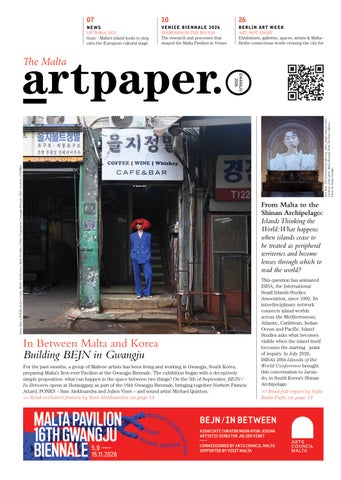
More Zmin x PONKS, Euljiro Lady, BEJN / In-Between, Malta Pavillion (Public Programme), Gwangju Biennale 2026. Courtesy of PONKS
Dew Kim, The Enchanting Offering, 2024, single-channel video. Courtesy of the artist. Malta Biennale 2024, Tal-Pilar, Valletta. Photo by Julian Vassallo
GWANGJU 2026
From Malta to the Shinan Archipelago: Islands Thinking the World:What happens when islands cease to be treated as peripheral territories and become lenses through which to read the world?
In Between Malta and Korea Building BEJN in Gwangju For the past months, a group of Maltese artists has been living and working in Gwangju, South Korea, preparing Malta’s first-ever Pavilion at the Gwangju Biennale. The exhibition began with a deceptively simple proposition: what can happen in the space between two things? On the 5th of September, BEJN / In-Between opens at Horanggasy as part of the 16th Gwangju Biennale, bringing together Norbert Francis Attard, PONKS – Sam Alekksandra and Julien Vinet – and sound artist Michael Quinton. >> Read exclusive feature by Sam Alekksandra on page 14
This question has animated ISISA, the International Small Islands Studies Association, since 1992. Its interdisciplinary network connects island worlds across the Mediterranean, Atlantic, Caribbean, Indian Ocean and Pacific. Island Studies asks what becomes visible when the island itself becomes the starting point of inquiry. In July 2026, ISISA’s 20th Islands of the World Conference brought this conversation to Jaeundo, in South Korea’s Shinan Archipelago >> Read full report by Sofia Baldi Pighi on page 19
Lily Agius
C
Contents / Word from the Editor
Founder + Editor Lily Agius Contributing Editor Dr. Joanna Delia Graphic Design Nicholas Cutajar Sales & Enquiries info@artpaper.press Website www.artpaper.press Instagram / Facebook artpaper.press
It is a privilege to see Malta represented on the international stage at the Gwangju Biennale, and we are proud to support the Malta Pavilion and the artists behind BEJN / In-Between.
that have shaped this ambitious pavilion, and to bring this significant moment to our readers.
READ MORE ON
F O L L OW
artpaper.press
artpaper.press
O N I N S TAG R A M & FAC E B O O K
This project marks an important moment for Malta’s contemporary art scene, creating a space for meaningful exchange between Malta and Korea through art, poetry, sound and collaboration. We are delighted to celebrate the artists, ideas and conversations
Here’s to Malta taking its place on the global cultural stage — and to the new connections, conversations and possibilities that emerge in between.
Image on left: PONKS x Romeo Roxman Gatt for Public Programme for Malta Pavillion Gwangju Biennale 2026
HIGHLIGHTS | SOUTH KOREA
14
MALTA PAVILION | GWANGJU BIENNALE BEJN / In-Between Malta meets Korea in BEJN, the first Maltese Pavilion at the Gwangju Biennale. Bringing together artists, poets and sound, the exhibition explores the space between cultures, languages and ways of seeing.
19
ISLANDS | CONTEMPORARY CULTURE From Malta to the Shinan Archipelago: Islands Thinking the World Sofia Baldi Pighi explores how islands can become lenses for understanding connection, coexistence and alternative futures—from Malta to South Korea’s Shinan Archipelago.
08
EXHIBITION | MALTA Inside Voices Inside Voices brings the thoughts, memories and emotions of young people at Malta’s juvenile detention centre into the gallery through a collaborative project led by artists Duška Maleševic and Pep Walls. Culminating in an exhibition that creates space for voices too often unheard.
10
EXHIBITION | MALTA Diamonds in the Rough: Inside Malta’s No Need to Sparkle Pavilion A look behind the scenes of Malta’s 2026 Venice Biennale Pavilion, exploring the research, archival material, sketches and experiments that shaped the final works. The exhibition opens up the pavilion’s creative process, revealing the ideas, uncertainties and material investigations.
12
EXHIBITION | PHOTOGRAPHY Confluences Two distinct Sicilian artists - Giovanna Brogna Sonnino and Fabio Sgroi - come together through photography in an exhibition exploring memory, identity, fragility and change. Their contrasting perspectives meet in a shared space between what is visible and what remains concealed.
26
BERLIN ART WEEK Berlin, Unfiltered Joanna Delia heads into Berlin Art Week 2026, where galleries, museums, project spaces and unexpected venues collide across the city. From major exhibitions and provocative new work to the Malta–Berlin connection at SEE/SAW, this is her personal guide to the artists, openings and places worth crossing Berlin for.
+ 07
EXHIBITION | ROME Mediterranean Souls Ray Pitré’s work goes to Rome in a posthumous exhibition exploring identity, memory, solitude and the Mediterranean. Mediterranean Souls reveals the intimate and emotionally charged side of one of Malta’s distinctive avant-garde artists.
09
BIENNALE | MALTA BIENNALE 2028 The Mediterranean as a Stage for Contemporary Art Following its 2024 and 2026 editions, the Malta Biennale returns in 2028 for its third edition, once again bringing contemporary art into dialogue with Malta’s historic architecture, museums, palaces and archaeological sites.
11
CULINARY SPONSOR Noni Restaurant Chef Jonathan Brincat transforms family recipes and Maltese culinary traditions into a contemporary dining experience. Set within Valletta’s historic streets, the Michelin-starred restaurant brings together memory, place and a deep connection to Malta’s gastronomic heritage.
22
INTERVIEW | CULTURE Divine / Profane In conversation with Dew Kim, the artist reflects on the space between religion, sexuality, devotion and power. From his Christian upbringing to his work across BDSM, fandom and queer identity, Kim explores the forces that shape belief - and his plans to immerse himself in Berlin’s culture during his upcoming residency.
artpaper Gwangju 2026 / 03
GWANGJU
04 / artpaper Gwangju 2026
STEPHANIE GALEA | REBOOT 3 | 150 X 100CM | LIMITED EDITION OF 5 | HAHNEMÜLE PHOTORAG PAPER
News / Malta / Gozo / Paris / Rome
VALLETTA BAROQUE FESTIVAL RETURNS FOR ITS 15TH EDITION
RAY PITRÉ: MEDITERRANEAN SOULS GOES TO ROME
F
R
rom 7 to 24 January 2027, Malta will once again become a stage for some of the finest Baroque music with the return of the Valletta Baroque Festival. Now in its 15th edition, the festival brings together leading international artists and ensembles in some of Malta’s most beautiful historic venues, including St John’s Co-Cathedral, Teatru Manoel, Verdala Palace, San Anton Palace, and historic churches and palaces across the island.
An untitled work on plywood by Ray Pitré signed and dated on the back Pitré/94. Photo by Lionel Cassola
Curated by Sandro Debono, the exhibition moves beyond Pitré’s well-known official portraits to reveal a more intimate and emotionally charged practice. Spanning works from the 1960s to the 2000s, it traces the artist’s increasingly raw and psychologically intense visual language. Pitré’s relationship with Italy was both personal and artistic. His participation in the 1999 Venice Biennale marked an important moment in Malta’s international artistic presence, while Italy remained a significant source of inspiration throughout his life. Ray Pitré: Mediterranean Souls | Anime Mediterranee is on view at Casa Museo Hendrik Christian Andersen, Rome, until 22 September 2026. Supported by the Ministry for Foreign and European Affairs of Malta and Arts Council Malta through the Cultural Diplomacy Fund.
COUTURE
AUTUMN/WINTER 2026-2027
F
or its Fall/Winter 2026– 2027 Artisanal Collection, Luke Azzopardi presents Salomé, an off-calendar collection examining one of history’s most enduring female figures as she moves between scripture, mythology, and seduction. Neither confined to history nor fantasy, Salomé exists as a cultural construct that has been continually rewritten across literature, painting, opera, film, and fashion. She becomes a lens through which to explore couture, craft, cultural memory and cross-border dialogue. Luke Azzopardi approaches Salomé as an act of research. Garments function as vessels of memory, constructed through extensive artisanal handwork and textile manipulation. Central to the collection is the language of veiling. Reimagined as fragmented, dismantled and reconstructed forms, veils are transformed into sculptural garments which blur boundaries of concealment. Drawing together the mythology of Salomé’s Seven Veils and the Maltese ghonnella, the collection establishes an unexpected dialogue between two distinct cultural narratives, examining how dress mediates identity, ritual and female representation across geographies.
Luke Azzopardi continues his exploration of couture and handcraft as multidisciplinary practices situated at the intersection of cultural research and theatrical production. The collection reconsiders historical archetypes through contemporary mindsets, demonstrating how artisanal fashion can become a medium for storytelling, memory, diplomacy and cultural exchange. With special thanks to the Ministry for Foreign and European Affairs: Cultural Diplomacy Fund, the Embassy of Malta in France, the Permanent Delegation of Malta to UNESCO, Arts Council Malta, Virgata Group, Alliance Malta, KM Malta Airlines, and Manolo Blahnik.
The 2027 programme offers an extensive celebration of Baroque music, featuring performances ranging from Pergolesi’s Stabat Mater by Le Poème Harmonique under the direction of Vincent Dumestre, to Vivaldi’s Quattro Stagioni performed by the Signum Saxophone Ensemble with violinist Charlie Siem, and J.S. Bach’s Six Brandenburg Concertos by {oh!} Orkiestra. The festival also continues its commitment to introducing younger audiences to Baroque music through family and school concerts. A major highlight of this year’s festival is Handel’s Giulio Cesare in Egitto, presented as a fully staged opera at Teatru Manoel on 22 and 24 January. The production features Cappella Neapolitana under the musical direction of Antonio Florio, with stage direction by Denise Mullholland, and a cast including Raffaele Pe, Claire Debono, Candida Guida and Giuseppina Fina. The programme also explores the breadth and continuing relevance of Baroque music, from intimate chamber performances and sacred works to contemporary interpretations. Among these is Inspired by Baroque, performed by the Malta Philharmonic Orchestra, as well as Oxymoron 1079, featuring a new composition by Bosgraaf, Armitage and Houtkamp based on Bach’s Musical Offering BWV 1079. The Valletta Baroque Festival is produced by Festivals Malta in collaboration with Teatru Manoel, and supported by the Ministry for Arts, Culture and National Heritage and VisitMalta.
Photo by Karina Movsesyanl - iStock
ay Pitré: Mediterranean Souls | Anime Mediterranee brings the work of one of Malta’s distinctive avantgarde artists to Rome in his first posthumous international exhibition. Presented by the Embassy of Malta in Italy at Casa Museo Hendrik Christian Andersen, the exhibition explores identity, memory, solitude and the Mediterranean.
VICTORIA 2031: Gozo’s European Cultural Ambition
V
ictoria, Gozo was officially pre-selected as Malta’s sole candidate for European Capital of Culture 2031, following the first phase of the national selection process in November 2025. As the capital of Gozo, Victoria sits at the heart of an island with a distinct cultural identity, rich heritage, and unique landscape. Its candidacy offers an opportunity to bring the cultural life of Victoria and Gozo to the European stage, while building on the legacy of Valletta 2018. Victoria’s European and international connections are already expanding, with the Victoria 2031 Foundation joining the Culture Next network alongside cities from across Europe. The city is now developing its cultural programme, supported by Victoria’s first Cultural Strategy, launched in July 2026, as it prepares for the final selection in September 2026. The ambition extends beyond securing the title: it is for the Victoria 2031 journey to act as a catalyst for lasting cultural development in Victoria and across Gozo, rooted in communities, participation, and long-term legacy.
artpaper Gwangju 2026 / 07
News / Residency / Exhibition
Less Dominant Narratives Emerge Around Centuries - Old Coastal Watchtowers
E
lyse Tonna’s long-term curatorial project Beyond What Drifts Us Apart continues during October 2026, leaning ever-more into the project’s ephemeral nature with a focus on the area around two coastal defense towers which have collapsed over centuries. This year’s chosen site invites an intense examination of Tal-Qortin, Marsalforn on the island of Gozo – a littoral site that is also multi-faceted, encompassing agricultural plots used for grazing, private fields, a nearby scrapyard and a recreational zone on a rehabilitated landfill site. At Tal-Qortin, the absence of a standing tower structure becomes the curatorial point of departure; the collapsed towers and their uncertain footprints foreground questions of territorial marking, land
A
rt has long been understood as a means of expression, but its potential to create dialogue, connection and social change becomes especially powerful when people are given the space to participate in it. Inside Voices explores this potential through a collaborative project led by artists Duška Maleševic and Pep Herrera, working with youths at CoRRS, Malta’s juvenile detention centre. The project began with a simple but significant belief: that everyone has the right to participate in culture, and that creative expression can offer a way to explore emotions, memories and experiences that are not always easily expressed through words. Across a series of workshops, Maleševic and Herrera encouraged participants to look inward, experiment and develop their own artistic language. Rather than approaching the workshops as traditional art lessons, the artists created
08 / artpaper Gwangju 2026
reprogramming and the afterlives of defence, communication and waste. Post-anthropocentric perspectives frame the project’s approach, prioritising climate justice, bio-cultural diversity and the dismantling of human-centred perspectives in favour of coexistence.
(DE), and Sébastien Schnyder (CH) to investigate how the site’s transformations affect both material conditions and collective memory and how non-human systems respond to engineered ground and reconfigured terrain. Beyond What Drifts Us Apart is a residency curated by Elyse Tonna, featuring artists Julian Micallef, Martina Georgina, Bettina Hutschek, and Sébastien Schnyder, taking
place from 5 October to 1 November 2026 in Marsalforn, Gozo. Produced by Unfinished Art Space as part of the Magic Carpets Platform and cofinanced by the European Union, the residency brings together artistic practices that explore what connects us beyond the forces that drift us apart. Learn more at www. unfinishedartspace.org
Guided by ecological thinking and a decolonial mindset, Beyond What Drifts Us Apart continually reconsiders inherited legacies of these landscapes, focusing on the interplay between the visible and invisible, the natural and de-/constructed. It addresses concepts related to extractive capitalism, contested land use, identity, and environmental degradation, asking how past infrastructures underpin today’s ecological instability. In 2026, the project residency invites artists Julian Micallef (MT), Martina Georgina (MT), Bettina Hutschek
The Beyond What Drifts Us Apart project flag flying from Dwejra Tower in 2025. Photo by Elisa von Brockdorff
INSIDE VOICES an environment built on listening, trust and openness. The process allowed participants to explore personal thoughts and emotions without the pressure of producing a predetermined outcome. For Maleševic, whose practice is rooted in photography, atmosphere, memory
and emotional expression, the project extended her interest in using restraint as a creative method. Herrera brought his extensive experience in socially engaged and participatory art, adapting the project as he came to understand the group’s individual needs and interests.
The resulting works bring together photography, text, drawing and mixed media. They are not simply records of the workshops, but independent works carrying traces of the conversations and experiences from which they emerged. Ultimately, Inside Voices asks its audience to look beyond assumptions and encounter individual voices with curiosity. It is a reminder that meaningful participation begins with listening and that art can create moments of recognition, dignity and connection. Inside Voices - What the Room Holds, runs from 18 September to 17 October 2026 at Valletta Contemporary, 15, 16, 17 East Street, Valletta, Malta. Inside Voices is funded through the Right to Culture call by Arts Council Malta, co-funded by Correctional Services Malta and supported by Valletta Contemporary.
News /Malta Biennale 2028
MALTA BIENNALE 2028
The Mediterranean as a Stage for Contemporary Art
T
here is something uniquely compelling about encountering contemporary art in Malta. Across an archipelago shaped by thousands of years of movement, conflict, trade and cultural exchange, the past is never far from the present. Ancient fortifications, palaces, churches, archaeological sites and Mediterranean landscapes become more than historical settings; they form part of the conversation. It is within this layered environment that the Malta Biennale has begun to establish its place on the international contemporary art calendar. Following its inaugural edition in 2024 and its second edition in 2026, the Malta Biennale will return in 2028 for its third edition, marking another significant chapter in the development of Malta’s contemporary art landscape. The success and growth of the 2026 edition have laid strong foundations for the next edition, while the establishment of the Malta Biennale Foundation within Heritage Malta further supports its longterm development. The Biennale has been shaped by a growing network of cultural leaders, curators and professionals, including Mario Cutajar, President of the Malta Biennale and Chairman of
international scope of the Biennale, while the participation of Maltese artists continues to place local practices within a wider global conversation. What makes the Malta Biennale distinctive is its relationship with place. Rather than being contained within a single purpose-built exhibition venue, it unfolds across Malta and Gozo, bringing contemporary artistic practices into dialogue with historic architecture and cultural heritage. Museums, palaces and archaeological sites become active spaces for contemporary artistic expression, creating encounters between different periods, narratives and ways of understanding the world. . Rosa Martínez at Ggantija. Image by Revo Studio for Heritage Malta
Heritage Malta. The first edition in 2024 was led by Sofia Baldi Pighi as Artistic Director and Head Curator, working alongside curators Elisa Carollo and Emma Mattei. Their programme established the Biennale’s distinctive dialogue between contemporary art, the Mediterranean and Malta’s cultural heritage. The first edition also quickly attracted attention beyond Malta, helping position the islands as a destination for contemporary art and culture. The Biennale’s growing international profile has continued to develop with each
edition, bringing together artists and audiences from across the world. The Biennale’s growing local and international profile has also been shaped by Sarah-Lee Zammit, who as Communications Director set the direction for its inaugural edition, and Lisa Gwen Chetcuti, who subsequently carried this work forward through the second. For its second edition in 2026, internationally recognised curator Rosa Martínez took the role of Artistic Director, supported by a curatorial team led by Antoine Borg Micallef and Alexia Medici. Under the theme Clean | Clear | Cut, the Biennale expanded across 11 historic sites and museums in Malta and Gozo, bringing together more than 130 artists through the international exhibition, national pavilions and thematic projects. Among the internationally recognised names participating were Maurizio Cattelan and the Guerrilla Girls, alongside artists including Emily Jacir, Halil Altindere, Austin Camilleri, Bettina Hutschek and Concetta Modica. Their presence reflects the increasingly
For the 2028 edition, anticipation is already building. While the artistic programme, theme, curator and participating artists are yet to be announced, the foundations are firmly in place for another international presentation of contemporary art across the Maltese Islands. For artists, curators and cultural practitioners interested in participating, the official Malta Biennale channels will provide announcements regarding open calls, applications, deadlines, participating artists and programme opportunities as preparations develop. In 2028, Malta will once again become a stage – not simply as a backdrop to contemporary art, but as an active participant in the conversation. Facebook, Instagram, LinkedIn: @maltabiennale.art www.maltabiennale.art DISCOVER MALTA BIENNALE Scan to explore latest updates:
The Malta Biennale’s growing international profile has continued to develop with each edition, bringing together artists and audiences from across the world. artpaper Gwangju 2026 / 09
News / Malta Pavilion / Biennale di Venezia
Diamonds in the Rough
Research processes in the context of No Need to Sparkle
B
efore a national pavilion assumes its final form on the hyper-visible platform of the Venice Biennale, it exists as a constellation of dialogues, research forays, tentative sketches, and archival incursions. The Malta Pavilion - No Need to Sparkle - brings this research to a Maltese audience with a rare look into the research mechanics and production processes behind the pavilion and the works within it. This research-driven exhibition focuses on the artistic research and development within the pavilion - the source materials, historical readings, ethnographic notes, and trial fabrications through which preliminary ideas are materialised into polished works. Visitors will first encounter the pavilion’s overarching curatorial and architectural frameworks - the many iterations of the pavilion’s layout, and the dialogue between its conceptual and tangible forms. From there, the exhibition moves into a series of focused spaces dedicated to each artist’s individual research. Each artist’s work stands fiercely distinct from its peers; however, viewers will see, too, that they share preoccupations; worrying at and grappling with ideas of authenticity, mythmaking, and autonomy.
Adrian MM Abela, preparatory drawings for Declaration of Dependence, 2025. Courtesy of the artist
The pavilion’s catalogue also steps into the spotlight here; with contributions from eighteen thinkers and writers, it digs deep into the pavilion’s themes of political agency, critical enquiry, and intellectual dissent, as well as doubt itself as an act of resistance. Crucially, Diamonds in the Rough also acknowledges the Venice pavilion as a temporal, living organism. Over its sevenmonth lifespan in the Venetian lagoon, the pavilion will dynamically interact with its immediate environment - yielding to shifting tides, fluctuating thermal conditions, and the unpredictable ebb and flow of daily visitors.
Architect’s impression of the Pavilion space. Courtesy of Mark Sullivan, SON Architecture Studio
010 / artpaper Gwangju 2026
Diamonds in the Rough will be open at R Gallery, Sliema, from 18-27 September 2026. Guided tours and interactive workshops will accompany the exhibition, along with the launch of the Pavilion’s catalogue, Experiments in Love and Revolution.
The Malta Pavilion at the 61st International Art Exhibition La Biennale di Venezia 2026 is commissioned by Arts Council Malta. Adrian MM Abela, Charlie Cauchi and Raphael Vella represent Malta at the 61st International Art Exhibition - La Biennale di Venezia 2026 taking place from the 9th of May until the 22nd of November 2026. The Malta Pavilion, titled No Need to Sparkle is curated by Margerita Pulè, with architects SON architecture, and project-managed by Tamara Burr, with Outreach by Kathrine Maj with visual identity by Alexandra Pace. It is produced by Unfinished Art Space with R Gallery. The Outreach Programme is supported in particular by Arts Council Malta and the Bank of Valletta Foundation.
Spotlight / Restaurant / Malta
A Taste of Malta, Reimagined
I
n the heart of Valletta, where centuries of history meet a rapidly evolving cultural and culinary scene, Noni offers a deeply personal interpretation of Malta through food. Founded by awardwinning chef Jonathan Brincat, the Michelin-starred restaurant takes its name from the chef’s childhood nickname, creating a dining experience that is as personal as it is refined. Located on Republic Street, Noni occupies a historic building whose character has become an integral part of the experience. The centuries-old space, with its stone vaults and original architectural details, provides a striking backdrop to Brincat’s contemporary
approach to Maltese cuisine. The restaurant brings together the character of its historic setting with a modern dining experience rooted in seasonality, local produce and Mediterranean influences. At the centre of Noni’s philosophy is a connection to memory. Brincat’s cooking draws on the food he grew up eating at home, particularly the dishes prepared by his mother and grandmother. Rather than simply reproducing these traditions, he transforms them through modern technique and years of experience gained across international kitchens. The result is cuisine that feels distinctly Maltese without being confined
Photos by Brian Grech
by tradition. Familiar flavours are reconsidered through contemporary techniques and presentation, allowing dishes to tell stories of childhood, family and place. Noni’s tasting menus continue to evolve with the seasons, highlighting local and artisanal ingredients while giving traditional Maltese flavours a contemporary voice. That voice recently travelled far beyond Malta. In March 2026, Jonathan Brincat took Noni to Melbourne as part of the Melbourne Food & Wine Festival’s Global Dining Series, becoming the first Maltese chef to participate in the prestigious programme. Collaborating with Maltese-Australian chef Shane Delia at Maha, Brincat created a menu inspired by Noni but adapted entirely to Australian produce.
Today, Noni remains a defining presence in Valletta’s dining scene and continues to hold its Michelin Star. More than a restaurant, it is an expression of place: a meeting point between heritage and innovation, memory and reinvention. Through Jonathan Brincat’s cooking, Malta’s culinary story is not simply preserved – it is continuously rewritten, one dish at a time. 211, Republic Street, Valletta. +356 2122 1441; info@noni.com.mt; www.noni.com.mt
“What I do and what I’ve always done at Noni, is my interpretation of what I grew up eating from my mother and grandmother. That’s when my real love for food began! When I was at home, I was always intrigued by cooking and for my family, going to a restaurant was very rare. For us it was all about homecooked meals. A good lunch and dinner every day.” JONATHAN BRINCAT
artpaper Gwangju 2026 / 011
News / Exhibition / Malta Society of Arts
CONFLUENCES Giovanna Brogna Sonnino & Fabio Sgroi
T
wo distinct artistic journeys find common ground through photography. Galleria Susanna Occhipinti, in collaboration with the Malta Society of Arts and thanks to Vivaio Ottone, presents Confluences, an exhibition bringing together the works of Giovanna Brogna Sonnino and Fabio Sgroi in the Basement Vaults of the Malta Society of Arts at Palazzo de La Salle, Valletta, from Thursday 17 September to Thursday 1 October 2026. At the heart of the exhibition lies a dialogue between two Sicilian artists whose deeply personal practices have evolved through distinct experiences, languages, and modes of expression. On one side is the multifaceted work of Giovanna Brogna Sonnino, shaped through photography, writing, collage, assemblage, and the layering of memory. On the other is Fabio Sgroi, whose gaze is directed outward, towards the transformations of reality and the points of tension where fragility, marginality, and unexpected vitality emerge. The exhibition’s title, Confluences, stems from the very nature of the gallery as both a place of passage and a space of encounter: a setting where artworks, artists, trajectories, and perspectives converge. Beyond its exhibition function, the gallery also retains its original architectural role as a transitional environment connecting adjoining spaces. As Salvo Incardona, author of the exhibition’s critical essay, observes; “On closer inspection, it is precisely a point of confluence, a crossroads where different movements, perspectives and intentions intersect: the visitor’s physical and mental journey, the historical trajectory of the artworks, and the curatorial path that situates them within the space. The gallery thus becomes a place where the transience of movement and the stillness of contemplation coexist, echo and define one another; or, borrowing a compelling insight from Maurice Merleau-Ponty, a space that is not merely the milieu in which things are arranged, but the medium through which their arrangement becomes possible.”
012 / artpaper Gwangju 2026
violent years of the Mafia war in Palermo. His engagement with Sicily later expanded to include the documentation of popular and religious festivals, while his research gradually broadened to encompass southern Tunisia, the Americas, and Europe, particularly the countries of Central and Eastern Europe emerging from the collapse of totalitarian regimes. Moving progressively beyond the conventions of photojournalism, Sgroi has developed a coherent and distinctive visual language, attentive to identities in transformation and to the traces of fragility, hope, and change that shape both places and people. The coexistence of the works of Giovanna Brogna Sonnino and Fabio Sgroi is therefore not intended to highlight formal similarities, but rather to reveal a shared ground upon which their distinct artistic trajectories unfold. Both artists operate on the threshold between what is visible and what remains concealed, between what reveals itself and what must be reconstructed. Giovanna Brogna Sonnino, Landscapes 1983/87, analog print
Beyond its exhibition function, the gallery also retains its original architectural role as a transitional environment connecting adjoining spaces. Born in Catania in 1955, Giovanna Brogna Sonnino is a filmmaker and photographer whose practice extends across a much broader range of artistic forms. After graduating in Florence and moving to Rome, she worked for Italy’s public broadcaster RAI, directing films, documentaries and docu-films, several of which received awards both in Italy and abroad. Her official photographic debut came in 1986 with two exhibitions entitled Portraits, presented in Rome and Catania. Malta already occupies a significant place within Brogna Sonnino’s personal and artistic history. One of the letters collected in her volume Letters to Dr. B. 1979–1987, dated 27 May 1982, was written in Malta, during the same
stay in which she produced one of the photographs now included in the exhibition. In the works presented in Confluences, images, texts and fragments drawn from different times and contexts enter into dialogue, giving shape to a compositional practice based on assemblage and on the possibility of generating new associations and alternative narrative paths. Fabio Sgroi, born in Palermo in 1965, began working as a photographer in the second half of the 1980s. His collaboration with the daily newspaper L’Ora—his first and only experience in journalism—led him to document student movements, demonstrations, anti-war and antinuclear protests, as well as the most
As Salvo Incardona concludes; “One traverses the world in search of its possible truths, while the other journeys inward to return an image of the world. It is precisely within these tensions and short circuits that the gallery finds its most authentic meaning, becoming the place where two divergent trajectories may indeed converge—not in order to resemble one another, but to reveal, each in its own way, the wavering intermittence of their respective ways of seeing.” Salvo Incardona was born in Vittoria (Ragusa, Sicily) and studied at the Universities of Pisa and Augsburg (Germany). He is a philologist, essayist, translator, and curator. Confluences opens on the 17th of September from 5 to 10pm and runs until the 1st of October, open Monday to Friday 10am to 12pm and 5pm to 8pm; Saturday 10am to 1pm and Sunday 5pm to 8pm, at the Basement Vaults of Society of Arts, Palazzo de La Salle, 219 Republic Street, Valletta, Malta. For more information email info@galleriasusannaocchipinti.it.
News / Exhibition / _axis
a
WHAT MOVES BETWEEN US
xis_ is pleased to announce What Moves Between Us. Curated by axis_ Artistic Director Elyse Tonna, the exhibition brings together twelve artists whose works consider the relationships that shape how we understand ourselves, one another and the worlds we inhabit.
Featuring Kamy Aquilina, Sarah Bonaci, Maria Borg, Giola Cassar, Martina Darmanin, Yana Fenech, Nina Gerada, Gulja Holland, Tina Mifsud, Lucia Seifert, Rasha Belle Zammit Cutajar and Jade Zammit, the exhibition presents new and existing works across painting, photography, cyanotype, print, textile and ceramics.
What Moves Between Us begins from the understanding that who we are is never formed in isolation. We carry experiences of people, places and histories with us, sometimes consciously and sometimes in ways that only become apparent over time. The exhibition looks at what is shared, inherited, absorbed or left behind, moving through memory, intimacy, care, desire and absence, alongside our relationships with landscapes, plants and other species. Beyond Ourselves, What We Carry and Where We Meet provide three points of departure across the exhibition. Together, they move between what lies outside the individual, what remains with us and what takes place through encounter. Their boundaries are deliberately loose. What we inherit enters the relationships we form, what we encounter can become something we carry and what surrounds us inevitably affects how we understand ourselves.
Jade Zammit, Try As You May, These Cracks Will Always Show (detail)
exhibition of axis_, and continues the development of its artistic programme. Located at The Butler’s House adjacent to Villa Bologna in Attard, axis_ is a contemporary art space presenting exhibitions, artistic commissions, public programmes and learning initiatives. Its programme brings together established and developing practices, with an emphasis on creating sustained opportunities for artists and bringing contemporary art into conversation with different audiences and fields of knowledge. A public programme will accompany the exhibition, including a children’s workshop on Saturday 26 September and a curatorial tour on Wednesday 14 October, alongside further events to be announced. The exhibition will conclude with a finissage on Sunday 15 November. For more information contact art@ axis.com.mt and hello@axis.com.mt
What Moves Between Us follows Nothing is Clear, the inaugural
artpaper Gwangju 2026 / 013
Exclusive Feature / Malta Pavilion / Gwangju Biennale
SAM ALEKKSANDRA
In Between Malta and Korea Building BEJN in Gwangju
T
here is a particular strangeness in travelling more than 9,000 kilometres to make work about what exists between things.
For the past months, a group of Maltese artists has been living and working in Gwangju, South Korea, preparing Malta’s first-ever Pavilion at the Gwangju Biennale. On the 5th of September, BEJN / In-Between opens at Horanggasy as part of the 16th Gwangju Biennale, bringing together Norbert Francis Attard, PONKS — the collective I share with Julien Vinet — and sound artist Michael Quinton. The exhibition began with a deceptively simple proposition: what can happen in the space between two things? For PONKS, the in-between has always signified possibility. It is an openness that poetry and contemporary art can facilitate: a state in which something has not yet resolved into one meaning. A poem changes according to who encounters it and when. The poem I read today is not necessarily the poem I read five years ago. I have changed, and therefore the poem has too. When we began working with poets from Malta and Korea, we became interested in extending this question across two cultures. What happens when a Korean poet writes about grief? What happens when a Maltese poet does? What lies between those experiences? What happens when the poems are brought into the same room? These questions became the starting point for an exhibition that now extends across installation, poetry, sound, performance and immersive film. But BEJN could never really be made from Malta. The residency in Gwangju was inherent to the project from its conception. All the artists are developing site-specific work, and being here has allowed the exhibition to be affected by encounters that could not have been planned from a distance. There is something particular about making work in a city so charged with histories of resistance, where art and poetry have themselves played a role in remembering and transmitting history. Gwangju has been allowed to interfere with the Pavilion.
014 / artpaper Gwangju 2026
FINDING PARALLELS Malta and Korea are not obvious counterparts. They occupy different regions, histories, languages and scales of imagination. Yet the longer we worked between them, the more parallels began appearing. I believe the role of the artist is to see parallels where some may not. Both are relatively small countries surrounded by much larger geopolitical forces. Both have strong traditions of collective ritual and street celebration. Rope carries symbolic and practical histories in both. And language itself produced another unexpected connection. What struck me were the parallels between Maltese and Korean. Both were spoken for centuries before the writing systems we recognise today took hold: Korean eventually finding its own script in Hangul, and Maltese developing a standard written form through a Latin alphabet adapted to its Semitic sounds. They come from entirely different linguistic worlds, yet both carry a tension between language as it is lived and spoken, and the way it eventually comes to exist on the page. These aren’t arguments that Malta and Korea are somehow the same. Quite the opposite. BEJN became interesting when we stopped trying to resolve difference. If you look closely enough, connections appear. When we first received the plans for Horanggasy, it took us some time to understand the place. The Pavilion is spread across structures a stone’s throw from one another, with dramatically different architectural characters. Once we arrived, the exhibition began finding its way through them quite naturally. We are all accustomed to working site-specifically, but this is the first time the four of us have worked together in this way. At different points throughout the summer, we have also been living together in Gwangju. Inevitably, practices begin leaking into one another. You see how someone else works. Conversations continue over meals, on site, on journeys through the city. Ideas migrate. Sound, initially concentrated in Michael Quinton’s work, has gradually begun moving through other parts of the Pavilion. Michael has become, in some
Julien Vinet in the making of Rope Temple for Malta Pavillion Gwangju Biennale 2026. Photo by Sam Alekksandra
ways, a kind of sonic glue between spaces. The result is not a subtle exhibition. These are large installations, but their scale conceals layers that reveal themselves through time and attention. The journey begins with celebration, harmony, suspension and devastation in Norbert Francis Attard’s works in Art Polygon; moves towards a huge collective act of making in PONKS’ ROPE TEMPLE in Glass Polygon; and eventually descends underground into quieter encounters with sound, language and place. I hope the initial encounter hits you, and I also hope staying with it changes that encounter.
SAM ALEKKSANDRA is a Maltese artist and poet. She is also one half of PONKS.
Norbert Attard, Peristyle (work in progress), Malta Pavillion Gwangju Biennale 2026. Photo by Julien Vinet
Alongside this sits Obangsaek, the traditional Korean system of five colours associated with directions, elements and principles of harmony. Attard places these different symbolic systems into proximity without forcing them to reconcile. This is what stays with me when I stand in his space: its scale, certainly, but also the collision between festa and Gaza. Between an image associated with celebration and one associated with destruction. There is something particularly meaningful for me in working alongside Norbert, one of the pioneers of contemporary artistic practice in Malta, while watching his eye remain restless enough to make these connections anew.
BETWEEN A FIREWORK AND A BOMB In the Art Polygon, Norbert Francis Attard brings together three realities that initially seem irreconcilable: the Maltese festa, the Korean philosophy of Obangsaek, and Gaza. An explosion explosion.
is
never
simply
an
To someone standing beneath a Maltese summer sky, an explosion might signify celebration: fireworks, a village feast, collective anticipation. Elsewhere, the
same sensory event means devastation.
BUILDING A TEMPLE Across the site, the Glass Polygon becomes ROPE TEMPLE, the work Julien Vinet and I have developed as PONKS.
Attard suspends the viewer somewhere between those realities.
Rope, poetry and the idea of the temple arrived almost simultaneously.
His work has evolved considerably since the Pavilion’s earliest proposals. Elements associated with the churches and festas of his beloved Gozo enter into conversation with a word that has become almost unbearably charged: Gaza. It is extraordinary how four letters can now contain so much division, grief and political meaning.
The beginnings of the work existed for another project, but when the opportunity to create the Malta Pavilion emerged, we began dismantling and rebuilding the idea. It became stranger, and it also began making more sense. Poetry has always anchored PONKS. We are interested in re-enchantment, the future and possibility: in what art can
temporarily permit us to imagine. In ROPE TEMPLE, hundreds of ropes transform the glass architecture into a room within a room. More than one hundred poems from Malta and Korea inhabit its surfaces. At its centre, rope gathers into a dense tree-like structure which the visitor can physically enter and ascend. The symbolism of rope emerged first through research and then developed through our work with our incredible curator Moon Hyun Jeoung and our time in Korea. In Malta, rope is inseparable from the sea. It binds vessels, pulls, secures, connects land to water and appears throughout the material language of an island formed by maritime movement. In Korea, we encountered the geumjul: sacred rope used to mark a threshold and traditionally associated with protection, boundaries and the division between every day and spiritual space. The rope became the line between worlds. Why a temple? Because we are interested in locating the sacred within the everyday. Poetry can be sacred. Attention can be sacred. Touch, labour and collaboration can be sacred.
artpaper Gwangju 2026 / 015
Exclusive Feature / Malta Pavilion / Gwangju Biennale
Continued
Korean eventually finding its own script in Hangul, and Maltese developing a standard written form through a Latin alphabet adapted to its Semitic sounds. The temple is built from their coexistence. At its centre, visitors encounter the rope tree. They ascend one at a time, their touch activating sonic elements within the work. Participation matters because the installation asks the visitor to undertake something resembling a rite of passage. You cannot experience it entirely from outside. You have to enter. BENEATH THE TEMPLE Below ROPE TEMPLE, the exhibition changes register. Three subterranean rooms — Trans/cription, Trans/ mission and Trans/portation — consider different roots from which poetry can emerge: word, sound and environment. If the Glass Polygon is the body of the temple, these rooms are its underground root system. Michael Quinton in Gwangju Market. Photo by Julien Vinet
Audre Lorde famously insisted that poetry is not a luxury. It is a means through which we illuminate and scrutinise our lives. That idea has remained close to the making of this work. The temple is therefore less a monument to poetry than an environment in which poetry is treated as something alive.
That is intentional. We live at a moment in which knowledge has become almost instantaneous. A device can translate a sentence in seconds; AI promises an answer before we have properly formulated the question. We have become accustomed to the idea that everything should immediately disclose itself.
In Trans/cription, the poems gathered through the project become an anthology of Maltese and Korean voices across languages, generations and traditions. In Trans/mission, Michael Quinton asks a different question: what does the in-between sound like?
ROPE TEMPLE asks for something slower. Sometimes feeling is more important than knowing.
His installation Koinonia (κοινωνία) is built from field recordings and archival sounds gathered across Malta and South Korea. Michael records almost compulsively — environments, incidental encounters, resonances, the things happening around him that most of us allow to disappear.
If someone really wants to discover what a poem means, they can. But for a moment, the poem can first exist as rhythm, gesture, shape, material and evidence of another person. It can remain partially inaccessible.
Koinonia is the Greek word for fellowship, participation and sharing. Here, listening becomes a means through which two distant environments can temporarily inhabit the same space.
That gap is also an in-between.
The third room, Trans/portation, turns outward again.
This has meant weeks of physical labour in Gwangju: reading, writing, painting, hanging, handling rope, adjusting structures and returning again and again to poems written in languages we do not necessarily understand.
With the help of Gwangju-based poetry curator Jeong Jae-yul, Inza from Girls Bookshop and countless others who generously opened their literary worlds to us, we encountered a Korean poetry scene of remarkable intricacy and vitality.
For this programme, PONKS invited artists from Malta and Korea to respond to specific locations through immersive 360-degree performances. In Malta, we deliberately avoided constructing the country through its familiar tourist image.
For me, the process is always more important than the final work. Every act of making changes the maker. Learning to write Korean has given me another small key into its mystery.
What particularly struck me was poetry’s relationship to memory here. In Gwangju, poetry has been used to hold moments in history, to give language to events that must not disappear. Poetry is palpably alive.
Instead, we chose places that might introduce Malta beyond the lens through which it is habitually presented to the world — places that could even be unfamiliar to Maltese people themselves.
Importantly, we decided not to make translation the solution to everything.
More than one hundred Korean and Maltese poets now occupy ROPE TEMPLE together. Each poem is treated as a world in itself rather than a fragment subsumed into one collective voice.
A Freeport normally inaccessible to the public. An abandoned chapel. The eighteenth-century National Library. A lighthouse in Gozo. An artist’s father’s garage.
MORE THAN ONE HUNDRED WORLDS We knew quite quickly that simply printing poems onto the architecture would not be enough. It would be too easy. Too designed. Instead, every poem is being transcribed by hand and accompanied by an abstract gestural work. Each becomes an individual artwork. Making them has become an act of devotion.
A visitor may encounter a poem they cannot read.
016 / artpaper Gwangju 2026
Artists Charlene Galea, Keit Bonnici, Martina Georgina, Romeo Roxman Gatt, Tara Dalli and Félix Deepen inhabit these spaces through their individual practices. In Korea, the exchange continues with Kim On at the historic Gwangju Theatre and More in Euljiro, Seoul, a district of workshops, industry and memory undergoing relentless transformation. Experienced individually through VR headsets, the works operate as portals. You do not simply watch another place; for a few minutes your sensory world is displaced by it. The speed with which we connected with the Korean artists surprised us. This has been true of the project more generally. Again and again, people we encountered here have offered their knowledge, time and energy and become contributors to the work. Perhaps that generosity is another material from which BEJN has been constructed. WHAT REMAINS BETWEEN There is inevitably something strange about making art under the banner of a nation.
More Zmin x PONKS, Euljiro Lady, BEJN / In-Between, Malta Pavillion (Public Programme), Gwangju Biennale 2026. Courtesy of PONKS
A national pavilion carries expectations: that it might somehow represent Malta,
explain Malta, export an image of Malta. But I am less interested in prescribing what a Korean visitor should understand about the country after walking through the exhibition. I prefer the multitude of things with which someone might leave. Perhaps Malta appears through the festa. Perhaps through a rope tied to the Mediterranean. Perhaps through the cadence of a poem they cannot understand. Perhaps through the interior of someone’s garage. Perhaps none of those things produce a coherent image at all. That incompleteness is important. The same is true in reverse. After months here, I would hesitate to offer a neat explanation of Korea. Gwangju has instead become accumulated encounters: artists, poets, bookshops, streets, histories, meals, gestures of generosity, resistance and the slow experience of trying to make something somewhere unfamiliar. The purpose of an exchange cannot be to emerge believing that we now completely understand one another. There must remain some distance.
Sam Alekksandra writing 80 Korean and Maltese poems in the atelier. Photo by Julien Vinet
Some mystery.
Somewhere between knowing and not knowing is the possibility of continuing to look. By the time BEJN / In-Between opens on 5 September, the exhibition will contain the work of far more people than the names listed as its principal artists. Poets, performers, curators, technicians, collaborators and people encountered along the way have entered it. The three-month residency has made that permeability possible. Perhaps this is ultimately what the in-between offers us: not compromise, not the flattening of difference into an easy declaration that two cultures are fundamentally the same. Rather, a place in which different worlds can approach one another without having to become one another. A poem can remain a poem even when I cannot read it. A rope can belong to the Mediterranean and carry an entirely different sacred history in Korea. An explosion can signify celebration to one person and devastation to another. The distance between those meanings is not empty. It is charged. And that is where BEJN exists. Because humans are capable of great things. BEJN / In-between runs from 5th September to 15th November. It is commissioned by Arts Council Malta, and supported by Visit Malta and the Ministry of Foreign Affairs.
artpaper Gwangju 2026 / 017
SOFIA BALDI PIGHI
From Malta to the Shinan Archipelago: Islands Thinking the World
Dew Kim, The Enchanting Offering, 2024, single-channel video. Courtesy of the artist. Malta Biennale 2024, Tal-Pilar, Valletta. Photo by Julian Vassallo
W
hat happens when islands cease to be treated as peripheral territories and become lenses through which to read the world?
This question has animated ISISA, the International Small Islands Studies Association, since 1992. Its interdisciplinary network connects island worlds across the Mediterranean, Atlantic, Caribbean, Indian Ocean and Pacific. Island Studies asks what becomes visible when the island itself
is taken as the starting point of inquiry. In July 2026, ISISA’s 20th Islands of the World Conference brought this conversation to Jaeun-do, in South Korea’s Shinan Archipelago. Part of the UNESCO Shinan Dadohae Biosphere Reserve, Shinan is shaped by tidal flats and marine ecologies. Fishing,
aquaculture and salt production coexist with renewable energy, ecological tourism and responses to demographic decline. Seen from the Mediterranean, Shinan offers a counter-image to the spectacular urban futures associated with Gulf
artpaper Gwangju 2026 / 019
Photo by Marija Grech
Feature / Islands / Conference
SOFIA BALDI PIGHI is a curator and researcher working between Italy and Malta. She is a practice-based PhD candidate in CriticalCuratorial Practices of Contemporary Creation at the Albertina Academy of Fine Arts in Turin. Her research investigates European borders, especially in the central Mediterranean, where artistic and civic practices of resistance contribute to new imaginaries of the sea. She was Artistic Director of Malta Biennale 2024 – Insulaphilia.
Feature / Islands / Conference
Continued
Dew Kim, The Holy Wounds, 2024, mixed media with metal and silicone. Courtesy of the artist. Commissioned for Malta Biennale 2024, Tal-Pilar, Valletta. Photo by Julian Vassallo
cities: dispersed rather than monumental, shaped through tidal ecologies and inhabited landscapes. Yet Shinan resists becoming an island utopia. In 2025, the Associated Press reported that US Customs blocked imports from Taepyung, South Korea’s largest salt farm on nearby Jeungdo Island, over indications of forced labour. For Maltese readers the field is close to home. A pioneering centre since 1989, the University of Malta is where the economist Lino Briguglio built his economic vulnerability index, distinguishing the structural exposure small economies inherit from the resilience they build through governance — an account of why small states so often prosper despite their vulnerability. The sociologist Godfrey Baldacchino, founder of Island Studies Journal, pushed further, arguing for “islandness” over “insularity”: islands grasped on their own terms and through their relations, not as fragments of a mainland. That lineage runs today through Stefano Moncada, director of the Institute and a keynote in Jaeun-do, whose work on climate adaptation in Small Island Developing States shows why smallness cannot be reduced to territory alone. At ISISA, I convened Archipelagic Futures: Art, Heritage and Situated Ecologies with Pedro Pombo of the University of Malta’s Islands and Small States Institute and Seoul-based artist Dew Kim. The panel explored how artists can contribute to civil resistance and alternative futures in insular territories. Pombo’s ECO-Heritages research examines how cultural heritage and vernacular knowledge contribute to ecological and social resilience across island societies. I arrived in Jaeun-do through contemporary art. My practice-based PhD, The Right to Joy in the Central Mediterranean, approaches the region as a political and aesthetic field where artistic and curatorial practices can generate situated knowledge, alternative
020 / artpaper Gwangju 2026
NASA Earth Observatory image by Lauren Dauphin, using Landsat data from the U.S. Geological Survey, 2021
imaginaries and civil resistance. It understands islands as relational and imaginative thresholds. Dew Kim approaches islandness through queerness, unsettling binaries of land and sea, island and continent, centre and margin. Malta had already provided a radical testing ground. Commissioned for Malta Biennale 2024 by the curatorial team I formed with Emma Mattei and Elisa Carollo, Kim’s The Enchanting Offering and The Holy Wounds occupied the vestry of the Church of Our Lady of Pilar in Valletta. Video and sculpture brought sexual desire, pleasure, suffering and devotion into proximity with Catholic iconography, while the K-pop ‘Ending Fairy’ pose echoed images of ecstasy, martyrdom and resurrection. That Malta could commission and host such a work within a sacred space matters. Rather than protecting heritage from contemporary friction, the exhibition allowed heritage itself to become the site of that friction. Queering the island may begin by refusing the assumption that an island starts where land emerges and ends where the sea begins. This refusal of the shoreline as a conceptual border resonates with Professor Emeritus Chun Kyung-soo’s notion of Oceopolitics. Against geopolitics organised around territorial possession, it shifts attention from land to sea, and from ownership towards coexistence among human and non-human life. Islands become epistemic instruments: observatories from which inherited oppositions — land and sea, centre and margin, ownership and coexistence — can be unsettled. From Malta to Shinan, they offer a position from which to think the world differently, through relation and interdependence rather than possession. And if the shoreline is no longer a border, perhaps neither is the political community it was once meant to enclose: it is from here that other forms of democracy might be imagined.
Laurie Brinklow, President of the International Small Islands Studies Association (ISISA), delivering the opening remarks at the 20th Islands of the World Conference, Shinan County, Jeollanam-do, South Korea, July 2026. Image courtesy of ISISA 2026
Sofia Baldi Pighi, curator and PhD candidate, at the 20th Islands of the World Conference, panel Archipelagic Futures: Art, Heritage and Situated Ecologies, International Small Islands Studies Association (ISISA), Shinan County, Jeollanam-do, South Korea, July 2026. Image courtesy of ISISA 2026.
artpaper Gwangju 2026 / 021
Interview / Dew Kim
JOANNA DELIA
Divine / Profane
In conversation with Dew Kim
T
here is a kind of childhood you never quite rinse out of yourself – the one lived inside the church rather than merely near it. Mine was spent almost drowning in Christian imagery - visual and auditory - in the constant company of a practising pastor and the whole apparatus of insider religious life, while somewhere underneath all of it a self was trying to form, and to surface. I have seldom met anyone raised the way I was – with a priest at the centre of the household – who came out the other side true to themselves, despite the struggle. Rarer still to find that person in a land and a culture as far from mine as could be. And yet, sitting down with Dew Kim to talk about growing up on the fine line between the divine and the profane, everything he described sounded uncannily like home. His work The Enchanting Offering, shown at the inaugural Malta Biennale
in 2024, sat flawlessly inside the Valletta chapel that held it. The pieces I was later lucky enough to see for myself in Seoul – at CR Collective, and an installation at the Seoul Museum of Art – do the same thing: they gather up the mental world of the devout and press it against idol culture and sadomasochism until you can no longer tell which is which. The adoration and the sacrifice, the flagellation, the celebrity, the elevated and the sublime, alongside debased props turned into instruments of profanity – all of it sat far too close to the machinery of my own childhood for comfort. I caught up with Dew Kim to understand how a person grows up inside all of that – and then makes art from it, honestly. [Dew Kim (b. 1985, Seoul) works across video, sculpture, installation and performance, dividing his time between Seoul and London. He holds an MA in Sculpture from the Royal College of Art, London, and a BFA in Metalsmithing
and Jewellery from Konkuk University, South Korea. Raised in a devout Christian family, his practice draws conceptual parallels between religious ritual and Christian iconography and those of BDSM, fandom and shamanism, moving through questions of sexuality, queerness, the body and power. He has spoken of saints and K-pop idols as the same kind of creature: “beings that exist on a stage.” His work has been shown at the Malta Biennale (2024); documenta 15, Kassel; the National Museum of Modern and Contemporary Art, Seoul; the Barbican, Camden Arts Centre and the Institute of Contemporary Arts, London; the Museum of Contemporary Art Busan and Daegu Art Museum; and Para Site, Hong Kong. Recent solo exhibitions include I Surrender (Various Small Fires, Seoul), The Last Scene (Alternative Space Loop, Seoul) and Sacrificium (CR Collective, Seoul).] JD: The sacred/profane dichotomy is well over a hundred years old, and yet contemporary artists keep returning to it – perhaps most of all those from countries where religion still holds the community tightly. Why do you feel you have to keep exploring it? DK: It’s an old subject – but for me it was never theory. It’s something I actually lived. Grow up in a religious society and that line decides what you wear, who you love, how you move. So it isn’t really a topic I picked; it’s a question already lodged in my body, and I can’t stop asking it: who draws that line, who gets left out, and how do you flip it? JD: Having exhibited in and visited Malta, do you recognise similarities between our two societies – in their recent moves towards secularisation – through the lifting of censorship and the removal of restrictions that have prevented
Dew Kim. Photo by Jiji Kim
022 / artpaper Gwangju 2026
same-sex couples from enjoying the same rights as heterosexual couples? DK: Malta and Korea look completely different, but in one way they’re alike – religion ran deep through everything in both. Catholicism in Malta; Confucianism and Christianity in Korea. Both shaped bodies, desire, even what a family was allowed to look like. What interests me is how fast that power is coming apart now, especially among the young. In Korea, religious affiliation is dropping sharply, and young people are finding belief and belonging in ways that have nothing to do with the old
JOANNA DELIA is a medical doctor who specialises in cosmetic medicine. She is also a cultural consumer and art collector who tirelessly supports Maltese contemporary art and culture.
dichotomy and about representing everything that went underrepresented in the past. Do you feel you have the power, as an artist, to keep expanding our understanding of how the human condition has been shaped by the split between the mundane and the spiritual? Put simply – does it still excite you to push boundaries, visually and materially? And do you feel a responsibility to do so? DK: Yes, it still excites me. My work doesn’t treat sacred and profane as a single axis. I mix shamanism, the queer body, religion, fandom, BDSM – they look unrelated, but they run on the same structure: devotion, repeated ritual, ecstasy, the exchange of submission and power. A shaman’s ritual, an idol fan chant, a BDSM session, a church mass – each is the body reaching for something beyond itself. The only difference is that some get called sacred and others get called perverse or childish.
When All Flesh Turns to Light, 2026, Stainless steel, latex, vacuum cleaner, sensor timer, CNC-machined styrofoam, sex toy, mixed media, dimensions variable
religion. But the laws, the institutions, the religious groups that still hold power – they haven’t caught up. That push and pull is what I find most compelling: a power that ruled for so long is collapsing quickly, and yet its leftovers are still lodged in the law and in people’s bodies, refusing to let go. I felt the same tension in Malta – secularisation moving forward on the surface, a strong religious inertia still holding on underneath. JD: I believe society and its institutions are far more permissive now, both about the sacred/profane
Growing up on the fine line between the divine and the profane, everything he described sounded uncannily like home.
What I’m curious about is who gets to decide that – who calls one ecstasy holy and another devotion a sickness. Society has grown more tolerant, sure, but tolerance is often just another word for taming something down. So I still need to smash these worlds together on one stage. It’s less a responsibility than a necessity – without this, my work simply doesn’t work. The moment those lines blur, you see how invented the sacred/ profane split always was, and how much of it was only ever about power. JD: How strongly do you believe artists should work alongside human rights movements – the LGBTIQ+ rights organisations, for instance – to keep giving visibility and representation to groups who remain marginalised, and who still do not enjoy full legal equality? DK: Honestly, I’m not an artist who works directly with those groups or lobbies. I deeply respect the people who
artpaper Gwangju 2026 / 023
Interview / Dew Kim
Continued
I Surrender, Installation Image, VSF Seoul, 2023. Photo by Siwoo Lee / OnArt Studio
do, but I don’t think every artist has to contribute in the same way. Every artist has their own place. Some fight in the streets and inside institutions; others speak through the work itself. I’m closer to the second kind. Showing which bodies get to stand on stage, and what power those bodies can hold – that’s the most honest politics I know how to make. Art changes how people imagine things before the law ever catches up. Organised movements and individual work move at different speeds, in different languages, but they can head in the same direction. JD: Do you feel well supported – by the lobby, by your community, by the international art world – to go on working with subject matter that exposes hypocrisy, not least within Christian organisations, some of which still stubbornly protect the traumatic marginalisation of people? DK: Far more supported than when I started. The community and the international art world have clearly gathered around artists working on this material.
024 / artpaper Gwangju 2026
But let me add something. The more solidarity grows, the greater the risk that each artist’s story gets flattened into a single label – “queer artist,” for example. We’re fighting the same oppression, but everyone’s wounds, desires and beliefs are different. I hope solidarity doesn’t erase what is specific to each story. Work that exposes hypocrisy has power precisely because it isn’t an abstract accusation – it’s what one actual body went through.
experiencing and researching this culture. I’d rather spend the time learning through my own body than finishing something. Collaborations, concrete plans – I’ll figure those out naturally, once I’m inside it. As this issue goes to print, Dew Kim is entering one of his busiest stretches yet. In September he takes part in a group exhibition at the MMCA Changdong Residency in Seoul, co-curated with Latvian and
Lithuanian artists; in November his work travels to Adult Material, a fascinating new gallery in Bangkok. And in 2027 he takes up a year-long place on the Künstlerhaus Bethanien residency programme in Berlin – the very move he describes at the close of our conversation, trading the pursuit of finished shows for a year of living inside the culture he wants to understand. Wherever he lands, the divine and the profane will not be far behind.
JD: You are about to spend a year in Berlin. Why Berlin? What are your plans for your practice while you’re there – what do you want to explore, and are there institutions you’re excited to get to know, perhaps to work with? DK: Because Berlin is a mecca for BDSM. I want to research that culture, and I’m genuinely excited about it – not just the clubs and dungeons, but the personal encounters and relationships that happen inside the community. In Korea I’ve always been focused on producing – shows, finished work. In Berlin, I want to live a little differently – focusing on the process itself rather than chasing outcomes, and actually
Kiss of Chaos, 2020, Single channel video (04’18). Commissioned by MMCA, Korea
Feature /Berlin Art Week 2026
JOANNA DELIA
Art, Not Angst at Berlin Art Week 2026
E
very September, Berlin drops the pretence of being anything other than one of the great art cities on earth. From 9 to 13 September, the fifteenth Berlin Art Week turns the whole ungovernable sprawl into a single exhibition – more than a hundred museums, collections and project spaces in the official programme, and behind them the small matter of the city’s five-hundred-odd galleries, all throwing their doors open at once. You cannot see it all. Nobody sees it all. That, I’ve come to think, is rather the point – and most of the pleasure. Five days of glorious, un-policeable chaos. I come to this year’s edition still buzzing from Venice. The 2026 Biennale was, to my mind, the best in years – the edition where artists finally stopped circling the world’s crises and reacted to them head-on, the politics of the moment translated straight into the work. That same current ran through the strongest shows of Berlin’s Gallery Weekend earlier in the year - the presentation at KOW chief among them. So I arrive in September genuinely impatient to see how this city answers. Because if anywhere reacts to the state of the world hardest, strongest, most viscerally and most subversively, it is Berlin – and I cannot wait to see what its artists make of this particular moment. I write this as someone whose love for the gallery gets quietly recharged every time I go to Berlin, and never more than during Art Week. As I write, the full programme isn’t online yet – which is itself very Berlin, half-improvised until the last minute, the city trusting that everyone worth knowing already knows where to be. So consider this less a map than a list of the things I’ll be forcing my way across town to see, because the other truth about Berlin is that it is enormous: an hour between two openings is normal, and the best evening is the one where you make it to three. It helps to understand why Berlin became a mecca in the first place. Two institutions did much of the quiet work: the DAAD Artists-in-Berlin Programme, which brings established and late-career artists to the city for a year, and Künstlerhaus Bethanien, with its year-long international studios. Artists come, and then they tell their friends, and the friends stay – a melting pot that Stefanie Moshammer, Book spread, Each Poison, A Pillow. Courtesy of the artist
026 / artpaper Gwangju 2026
keeps refilling itself. Add the production workshops you rarely find outside an art school, where you can cast a sculpture or pull a print, and you have a city built not just to show art but to make it. Here, then, is what I can’t wait to see. Maurizio Cattelan, NIGHT – Neue Nationalgalerie, Potsdamer Straße 50 (Tiergarten), 10 September to 7 March 2027. The blockbuster, and deservedly so. Cattelan – the great Italian provocateur of the taped banana and the meteorite-struck Pope – takes the 2026 Preis der Nationalgalerie with his first major solo show in Germany, staging historic works and new site-specific commissions inside Mies van der Rohe’s glass hall. There’s a lovely circularity to it: Cattelan last worked in Berlin twenty years ago, co-curating the fourth Berlin Biennale. Expect sharp humour and bitter seriousness in equal measure, in a building that will hold both. Walter Dahn, Let’s Get Married, Let’s Get Lost – Sprüth Magers, Oranienburger Straße 18 (Mitte), 11 September to 24 October. I’ll be going to this one with a lump in my throat. It’s a survey of Dahn – the punk-inflected co-founder of the Mülheimer Freiheit, pioneer of “Bad Painting,” student of Beuys – and the gallery’s first show of his work since his death in 2024. A chance to sit with a whole restless career at once. Grace Weaver – Galerie Max Hetzler, Bleibtreustraße 45 (Charlottenburg), 4 September to 24 October. Weaver’s large, tender, slightly awkward figures – bodies caught mid-gesture, full of feeling – are exactly the kind of painting I want to stand in front of for a while. Hetzler runs several spaces across the city, so check which address you’re heading to; this one’s in the west. Stef Heidhues, hook, line and sinker – Galerie Eigen + Art, Auguststraße 26 (Mitte), opening 10 September (6– 10pm), until 31 October. Full disclosure: Stef is a good friend, and she makes wonderful sculpture – objects borrowed from the everyday and the industrial, held in a state of suspension, always questioning the monumental rather than serving it. I’d flag this one even if I didn’t love her.
artpaper Gwangju 2026 / 027
Feature /Berlin Art Week 2026
Continued
Pick your openings, walk between them, and let the city do the rest.
Eric Meier & Stefanie Moshammer, Bittersweet Symphony – Galerie im Saalbau, Karl-Marx-Straße 141 (Neukölln), 12 September to 22 November. Two photographers circling the same subject – alcohol addiction – from opposite directions. Moshammer, the superb Austrian photographer, approaches it through her own mother, in a poetic, encrypted language of images, objects and video; Meier photographs alcoholic men in a residential home in Eisenhüttenstadt, many of them cast adrift by the upheavals that followed reunification, with a closeness that restores dignity to people society has made invisible. That last phrase will sound familiar to anyone who read my last piece – the impulse to make the unseen seen runs straight through this show. Thu-Van Tran, Write As Beasts Scream at Night – KINDL, Am Sudhaus 3 (Neukölln), 13 September to 14 February 2027 (opening 12 September). KINDL is reason enough to visit on its own: a former brewery with a twenty-metre boiler house, one of the most extraordinary industrial conversions in Europe. Tran’s work – colour, language, the residue of colonial history – should find room to breathe in it.
Maurizio Cattelan, Novecento, detail, 1997, Castello di Rivoli, Torino Photo by Paolo Pellion di Persano
And if you want architecture with your art, König Galerie shows inside St. Agnes, Alexandrinenstraße 118–121 (Kreuzberg) – Werner Düttmann’s Brutalist 1960s church, converted by Arno Brandlhuber in 2015 – with three exhibitions opening on 9 September (Christian Achenbach, Monira Al Qadiri and Rebecca Brodskis). Worth the trip for the building alone. And then there’s the one closest to home. My friends Madeleine Fenwick and Kane Calì open SEE/SAW at AOA;87 (Sophienstraße 5, Mitte), a collaboration between AOA;87 and R Gallery in Malta, with a private opening on Wednesday 9 September, at 7pm – the very first night of the week. Fenwick, British-born and Valletta-based, is a painter turned sculptor whose meditative, copper-led works trace rhythm, balance and movement, a practice she has developed between Malta and Mexico City, where she showed her largest installation to date at Salón ACME during Mexico City Art Week in 2025. Calì, born in Malta in 1983 and a Royal College of Art graduate, is an experimentalist who treats data like pigment – casting it into glass, ceramics, stone and 3D-printed forms from his studio in Valletta. Two artists, two galleries, two geographies: the show takes balance itself as its subject. Not instability, which it treats as a given, but the harder, quieter business of staying upright inside structures we did not choose and cannot leave. It is arranged, as the galleries put it, like a structure under load – each element holding because the others hold. A genuine Malta–Berlin co-production, and a neat illustration of how far the island’s galleries now reach. It’s the kind of two-hander I always find myself thinking about long after the crush of the openings has faded. This is my way into the wider Malta–Berlin traffic, as it runs in both directions. Andreas Blank, based between Aurach and Berlin, carves everyday objects – a jam jar, a pair of boots, a crumpled sheet of paper – by hand from marble, alabaster and sandstone, giving throwaway items monumental permanence and using the kind of stone once reserved for religious and political statuary. His practice is exactly what those rare Berlin production workshops make possible, and his work returns to Valletta Contemporary next year. For Berlin Art Week, he will show with Anne Jungjohann, Andreas Blank, Wolfgang Ganter and Ria Wank. The exhibition takes place within the Uferhallen Open Studios on the 12th and 13th of September, 2-8pm, Uferstraße 8-11, 13357. I’ll also be keeping an eye out for Nina E. Schönefeld, the Berlin artist whose charged, dystopian video installations – including RIDE OR DIE, which premiered at KINDL – turn post-apocalyptic cinema aesthetics onto the politics of the present.
Grace Weaver, Nightgown, 2024, acrylic on canvas. Photo by def image
028 / artpaper Gwangju 2026
Andreas Blank, Still Life with Bottles, 2025, Marble Alabaster, Limestone, Onyx. Photo by Cami Lakonic
The official list is only ever half the story, and, honestly, not the wild half. The city genuinely comes alive: the galleries that aren’t on the programme, the project spaces and off-spaces, the openings that spill into club nights in the old industrial halls of the former East – spaces like MaHalla, the vast ex-AEG turbine factory out in Oberschöneweide, which shows art by day and dissolves into DJ sets and dancing by night, the way only Berlin seems to manage. The week’s centre of gravity is Featured Night on Friday 11 September, 6–10pm, when everything opens simultaneously and the whole art world is out on the street at once. There are collections that only open on Saturdays, special projects tucked into astonishing buildings on the city’s edges, and – a personal favourite of the “only in Berlin” genre – the art programme rising inside Spreepark, the abandoned GDR amusement park in Plänterwald that the city has spent well over a decade bringing back to life, and which
Eric Meier, Journey Man 1994, 2025. Courtesy of the artist
is finally reopening its gates. This year the Kulturforum serves as the festival’s central hub, with the Hamburger Bahnhof (Invalidenstraße 50–51, Moabit) – the former railway station that opened as Berlin’s museum of the present in 1996, and turns thirty this year – anchoring the museum end of things. Five days, five hundred galleries, and no chance of seeing even a fraction. If you’re only there for the week, make your peace with that early – pick your openings, walk between them, and let the city do the rest. The full programme will be available on the Berlin Art Week website berlinartweek.de closer to the event time. I’ll see you somewhere in the crush.
Stef Heidhues, hook, line and sinker
artpaper Gwangju 2026 / 029