THE ART & CULTURE MAGAZINE
ISSUE 16
ARTIO
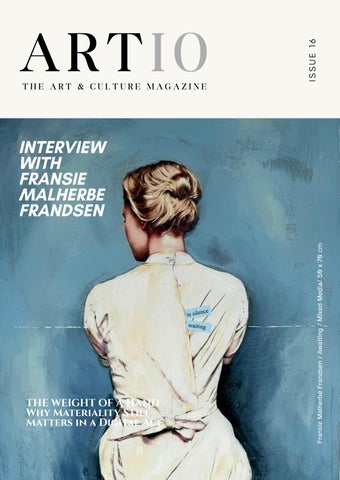
THE WEIGHT OF A HAND Why Materiality Still Matters in a Digital Age
Fransie Malherbe Frandsen / Awaiting / Mixed Media/ 50 x 70 cm
INTERVIEW WITH FRANSIE MALHERBE FRANDSEN
ARTIO MAGAZINE
INTRO
Director/Curator in Chief Bisa Bennett An accomplished and experienced artist herself, Bisa Bennett understands the importance of creating meaningful opportunities for artists to exhibit their work. As a curator and multimedia designer, she is also well-versed in creating engaging opportunities for viewers to experience art. “At our gallery, our vision is to serve as a dynamic and inclusive platform that fosters connections between artists and art enthusiasts, nurturing a vibrant and diverse artistic community,” she explains. Cover Photo Artist: Fransie Malherbe Frandsen
Instagram: artio.art.gallery Email: exhibit@artiogallery.com Copyright © Artio Gallery.Inc
01
CONTENTS JUN. 2026 Interview with Fransie Malherbe Frandsen
02
Why Materiality Still Matters in a Digital Age
10
Represented artists
12 After the white cube
40
02
FRAGMENTS OF MEMORY – AN INTERVIEW WITH
FRANSIE MALHERBE FRANDSEN “Through my work, I explore childhood memory and transformation, examining how fragments of the past linger beneath the surface to shape perception, emotion, and behaviour in the present,” explains artist Fransie Malherbe Frandsen. Born in South Africa and now based in Switzerland, Frandsen’s background includes studies in Graphic Design and Art Psychotherapy, as well as a creative practice that incorporates fine art, writing, and illustration. Creativity and the therapeutic power of art have long inspired the artist. She elaborates, “Working as an art psychotherapist strengthened my conviction in the transformative potential of art […] Over the years, I experimented with a wide range of materials and techniques. It was only when I attended a course in mixed media at Central Saint Martins that I found the medium and visual language that truly resonated with me.”
A R T I O
M A G A Z I N E
Awaiting / Mixed Media/ 50 x 70 cm
03
A R T I O
M A G A Z I N E
INTERVIEW FRANSIE MALHERBE FRANDSEN
Ambivalence / Mixed Media / 50 x 70 cm
04
A R T I O
M A G A Z I N E
05
Working in mixed media allows Frandsen to give visual form to an exploration of memory and reality; perception and emotion; past and present. Diverse materials and various artistic techniques inform an experimental and layered practice. Of her creative process, the artist explains, “The first step, when contemplating a new series, is to comb through available visual material in search of inspiration and ideas. More often than not, the image finds me rather than the other way around. I immediately know when the right image reveals itself and whether I can work with the concept.” From this point, the artist spends considerable time digitally altering the sourced images to develop a conceptual framework from which other works in the series emerge. The result is a visual language that mirrors the fragmented nature of memory; incorporating snippets of narrative and delicate infusions of colour, suggesting blurred recollections or half-remembered dreams.
A R T I O
M A G A Z I N E
INTERVIEW FRANSIE MALHERBE FRANDSEN
Here I am / Mixed Media / 50 x 70 cm
A R T I O
M A G A Z I N E
06
07
What lies beneath/ Mixed Media / 50 x 70 cm
Works such as Here I am and What Lies Beneath capture a feeling of introspection and vulnerability, while Lost While Hatching and Ambivalence exemplify the artist’s signature collage aesthetic. Frandsen plays with the viewer’s perception, combining photorealistic surroundings with text and delicate painterly surfaces. Each piece is an invitation to look closely at both the subject and the surface of the work. Light pastel colours counterbalance the emotional weight of the subjects depicted while three-dimensional elements are often used by the artist to draw the viewer into the work. A R T I O
M A G A Z I N E
INTERVIEW FRANSIE MALHERBE FRANDSEN
Lost while hatching #3/ Mixed Media/ 50 x 70 cm
Central to Frandsen’s practice is the role of the viewer: “The relationship between my artwork and the viewer is central to my practice. I regard the viewer as an integral part of the work and believe that each viewer, through their own life experiences, completes the artistic process by becoming part of the visual narrative.”
A R T I O
M A G A Z I N E
08
09
Shhh... no one cares / Mixed Media/ 70 x 100 cm A R T I O
M A G A Z I N E
10
THE COLLECTOR STEPS FORWARD HOW A NEW GENERATION IS CHANGING WHAT, WHERE AND WHY WE BUY
The contemporary collector is no longer defined by a single taste, medium, or path into the art market. Younger buyers and women are reshaping collecting through broader interests, digital discovery, and a desire for art that combines personal meaning with cultural participation. The Art Basel and UBS Survey of Global Collecting 2025, which examined 3,100 high-net-worth collectors across ten markets, reflects this shift. Millennials and Generation Z represented 74 per cent of respondents. Despite economic uncertainty, collectors reported allocating an average of 20 per cent of their wealth to art in 2025, up from 15 per cent in 2024. Paintings remain central, representing 27 per cent of fine-art spending, but collections are becoming increasingly diverse. Sculpture, photography, digital art, film, video, prints, and works on paper are attracting greater interest, particularly among younger collectors. Digital art saw especially strong growth, with more than half of respondents having purchased a digital artwork. Women are also becoming increasingly influential. Female high-net-worth collectors spent 46 per cent more on art and antiques than their male peers during 2024 and showed greater openness to emerging and previously unknown artists. Works by female artists represented an average of 49 per cent of the collections owned by women respondents.
A R T I O
M A G A Z I N E
11
How collectors discover and purchase art is changing as well. Galleries and dealers remain essential, with 83 per cent of respondents buying through them, while 58 per cent purchased through art fairs. Instagram has become another important channel, with 51 per cent reporting purchases through the platform. Direct purchases from artists have also increased significantly.Yet digital access has not replaced physical experience. Collectors continue to value exhibitions, art fairs, studio visits, and opportunities to meet artists. They
increasingly
want
to
understand
an
artist's
ideas,
materials,
development, and cultural context. This evolution is also redefining the role of galleries. Their value lies not simply in providing access to artwork, but in offering expertise, interpretation, trust, and lasting relationships between artists and collectors. The new collector is therefore not simply younger or more digitally connected. Collecting is becoming more participatory and personal. Ownership is part of a broader relationship with artists and culture, transforming a collection from a reflection of individual taste into a record of the art and ideas a collector has chosen to support and carry forward.
A R T I O
M A G A Z I N E
12
A R T I S T
ADRI TRENTIN
Adri Trentin is an abstract artist whose intuitive practice is guided by faith and by the movement of colour across matter. In Beach Wind, broad curves and compact shapes create a field that feels both structured and in motion. Turquoise, pink, yellow and deep blue move through one another like currents, while layers of acrylic and oil retain the physical trace of each gesture. The title suggests coastal air, but the painting does not describe a literal place. Instead, wind becomes a way of thinking about perception: an invisible force understood through the changes it produces. Trentin turns the canvas into a shifting environment where light, movement and material remain in active exchange.
A R T I O
M A G A Z I N E
13
A R T I S T
Beach Wind, 2026 Acrylic on canvas with oil over acrylic 80 × 80 cm
A R T I O
M A G A Z I N E
14
A R T I S T
CARRIE GANGWISH
Carrie Gangwish is an Omaha-based painter whose floral and figurative work considers resilience, healing and the hidden complexity of human relationships. In Deep Inside, the flower is brought so close that it begins to lose its familiar identity. Petals fold into narrow passages, shadows and small ruptures, directing attention towards what is concealed within the larger form. The bloom holds beauty and damage together; it carries traces of having once been a bud and of petals that have been altered or bruised. Gangwish uses this close view as a parallel for human experience, suggesting that every outward appearance contains histories that remain partly inaccessible. The work asks for patient looking rather than quick recognition.
A R T I O
M A G A Z I N E
15
A R T I S T
Deep Inside, 2024 Oil paint on canvas 61 × 61 cm
A R T I O
M A G A Z I N E
16
A R T I S T
JANIE ROBISON
Janie Robison is a fine art photographer based in Augusta, Georgia, whose work studies landscapes shaped by time, weather and solitude. In Drifting Out to Sea, a solitary driftwood tree stands at the edge of Jekyll Island, its exposed limbs set against water and open sky. Robison made the image in the middle of the day, outside the soft sunrise conditions she usually seeks. The direct light gives the tree an unsentimental presence. Weathered but still upright, it becomes an image of endurance without losing its specificity as part of the shoreline. The photograph connects resilience to impermanence, showing strength as the ability to remain present within continual change.
A R T I O
M A G A Z I N E
17
A R T I S T
Drifting Out to Sea, 2025 Archival pigment print on Somerset 330gsm archival paper 61 × 91.4 cm
A R T I O
M A G A Z I N E
18
A R T I S T
L. RENEE WILLIAMS
L. Renee Williams is a United States-based artist whose background in medicine informs a practice centred on empathy, memory and unseen human experience. In Malkia, a female figure emerges from a weathered mixed-media surface marked by cracks, earth tones and liquid gold leaf. The material appears excavated rather than newly made, as though the image has survived beneath layers of time. Williams uses this aged surface to address histories that have been obscured but not erased. Gold does not simply decorate the figure; it identifies what remains valuable and enduring within that inheritance. Malkia honours generations of women whose strength continues to shape identity, even when parts of their stories have been lost.
A R T I O
M A G A Z I N E
19
A R T I S T
Malkia, 2026 Mixed media and liquid gold leaf on canvas 91.4 × 91.4 cm
A R T I O
M A G A Z I N E
20
A R T I S T
MARINA AGOSTINI
Marina Agostini is a Rio de Janeiro-based painter whose background in fashion design informs her sensitivity to gesture, composition and atmosphere. In Evening Ride, two cowgirls move side by side through an open landscape as daylight begins to fade. The paired figures and horses create a steady lateral rhythm, while distant mountains and a broad sky give the scene a sense of space and release. Agostini avoids dramatic action, focusing instead on companionship and the calm confidence of shared movement. The American West appears less as myth than as a lived environment shaped by trust between rider, animal and land. The painting presents freedom as a quiet practice of moving forward together.
A R T I O
M A G A Z I N E
21
A R T I S T
Evening Ride, 2026 Oil on canvas 50 × 60 cm
A R T I O
M A G A Z I N E
22
A R T I S T
ZAZA HERZET
ZaZa Herzet is a Belgian visual artist whose intuitive practice developed in contrast to a 24-year career in information technology. Using charcoal, ink and layered mixed media, she explores the tension between structure and surrender. In Shadow Trace, dark pigment gathers, disperses and stains the surface without resolving into a fixed image. Areas of density feel weighted by the past, while thinner washes and open passages suggest movement in the present. Herzet uses charcoal and ink not only for their tonal range, but for their instability: both can spread, blur or resist control. The work treats memory as a material trace—altered over time, but never fully absent.
A R T I O
M A G A Z I N E
23
A R T I S T
Shadow Trace, 2026 Mixed media: charcoal and ink 80 × 80 cm
A R T I O
M A G A Z I N E
24
A R T I S T
ZAHRA GHAFERI
Zena Dabbous is a Lebanese-Canadian visual artist whose multicultural background informs a practice moving between conceptual figuration, drawing and mixed media. Women are central to her work, often appearing as carriers of memory, vulnerability and resilience. In Nostalgic, a direct female gaze is framed through visual references to the 1920s, linking a contemporary subject to an earlier image of womanhood. The enlarged eyes hold the viewer, while softer textured passages keep the portrait from becoming fixed or purely illustrative. Dabbous uses the past as a structure through which to examine the present. The work suggests that identity changes across generations but retains emotional traces of those who came before.
A R T I O
M A G A Z I N E
25
A R T I S T
Nostalgic, 2026 Mixed media on acrylic paper with a linen finish 30.5 × 30.5 cm
A R T I O
M A G A Z I N E
26
A R T I S T
ABDA FAYYAZ
Abda Fayyaz’s hand-drawn abstractions use repetition and controlled rhythm to examine time, memory, and transformation. In The Search Within (Red) 1, the square surface becomes a concentrated field rather than a conventional image. Repeated marks hold the composition between order and instability, while the red palette gives subtle changes in density an emotional charge. The work does not present transformation as a sudden or theatrical event. Instead, change develops through accumulation: one gesture follows another until the entire surface begins to shift. Fayyaz’s restraint makes looking feel meditative. What first appears fixed gradually reveals variation, suggesting that identity and perception are continually shaped by small movements that may begin long before they become visible.
A R T I O
M A G A Z I N E
27
A R T I S T
The Search Within (Red) 1 Acrylic on canvas 32 × 32 cm
A R T I O
M A G A Z I N E
28
A R T I S T
ANA CAROLINA BOSCOLI
Ana Carolina Boscoli, working as Ana Carolina Ceramics, approaches clay through intuition and close attention to organic growth. In Untitled, slabbuilding and pinching allow the form to develop through touch rather than a predetermined geometry. The sculpture occupies the space between vessel and organism: its volume appears to grow, fold, and open as though caught in a continuing process of formation. Boscoli’s interest in flowers is present without literal imitation. Fragility is balanced by the physical weight of stoneware, while the hand-built surface preserves evidence of pressure and movement. The result is a form that feels animated but materially grounded. By treating ceramics as a living structure, Boscoli turns the object into a record of transformation, where imagination emerges directly from the behaviour of clay.
A R T I O
M A G A Z I N E
29
A R T I S T
Untitled Stoneware, slab-built and pinched 23 × 20 cm
A R T I O
M A G A Z I N E
30
A R T I S T
NADA KELEMENOVA
Nada Kelemenova is a Czech painter whose practice connects intuitive abstraction with nature, energy, and inner awareness. In Wisdom of the Forest, the Amazonian landscape is approached as memory rather than topographical description. Deep greens and earthen tones create an immersive field in which vegetation, atmosphere, and emotion seem to occupy the same space. The forest is not presented as a passive background; it becomes an active presence carrying its own intelligence and duration. Kelemenova’s layered handling of oil paint encourages slow looking, allowing forms to emerge gradually rather than declare themselves at once. The painting presents nature as both an external environment and an inner condition—a place where human perception can become quieter, more receptive, and more aware of the living systems to which it belongs.
A R T I O
M A G A Z I N E
31
A R T I S T
Wisdom of the Forest Oil on canvas 90 × 60 cm
A R T I O
M A G A Z I N E
32
A R T I S T
GRACINHA “INHA” ARCEO
Gracinha “Inha” Arceo brings figuration and expressive colour into dialogue with the emotional life of everyday spaces. In In Her Courtyard, the domestic setting becomes a study of lingering. The work centres not on a dramatic event, but on the atmosphere that remains when conversation slows, tea cools, and silence no longer needs to be filled. Arceo uses oil and acrylic to keep the image poised between observation and memory: the setting is recognisable, yet its emotional tone carries greater importance than exact description. The courtyard functions as both a physical place and a state of mind, shaped by companionship, rest, and the permission to remain. Peace is presented not as something achieved through effort, but as something the body remembers when urgency briefly recedes.
A R T I O
M A G A Z I N E
33
A R T I S T
In Her Courtyard Oil paint and acrylic on canvas 50.8 × 76.2 cm
A R T I O
M A G A Z I N E
34
A R T I S T
CAMILLA FRANSRUD
Camilla Fransrud is a largely self-taught painter whose abstract and figurative landscapes are shaped by the sea, mountains, and the emotional experience of place. In The Mountains are my Anchor, nature is not treated as a distant view but as a source of psychological stability. Acrylic and soft pastel allow structure and atmosphere to coexist: firmer passages suggest the enduring weight of the mountains, while softer transitions keep memory and feeling in motion. The title connects geography with personal history, presenting the landscape as a constant across childhood and adult life. Fransrud does not simply depict mountains; she uses them to describe the inner strength found in returning to a place that continues to shape identity. The work locates calm not in escape from the world, but in renewed connection with it.
A R T I O
M A G A Z I N E
35
A R T I S T
The Mountains are my Anchor Acrylic on canvas with soft pastels 100 × 100 cm
A R T I O
M A G A Z I N E
36
THE RETURN OF CONVICTION WHAT THE LATEST SALES REVEAL ABOUT A RECALIBRATED ART MARKET After two years of declining values, the global art market has returned to growth. Yet the most revealing development is not the size of the recovery, but the kind of art attracting renewed confidence. Today’s buyers are looking beyond momentum towards rarity, provenance, quality and lasting cultural relevance. The art market entered 2026 with something it had been missing: measured confidence. According to the Art Basel and UBS Global Art Market Report 2026, worldwide sales increased by four per cent in 2025, reaching an estimated $59.6 billion. The rise followed two consecutive years of declining values, although the market remained below its 2022 peak. This was not a return to the rapid, speculative atmosphere that characterised parts of the post-pandemic market. Instead, it suggested something quieter and potentially more durable: buyers were returning, but with greater discernment. The market began to reward conviction over speed. Public auctions produced the clearest evidence of recovery. Auction sales rose by nine per cent in 2025 to approximately $20.7 billion, supported by several exceptional results at the upper end. Christie’s subsequently reported $3.5 billion in auction sales during the first half of 2026, an increase of 71 per cent year on year, alongside a sell-through rate of 91 per cent. Such figures are impressive, but they do not imply that every part of the market is rising equally. A small number of extraordinary works can transform the value of an auction season. What matters is why these objects succeeded. Across recent marquee sales, buyers have responded most confidently to works with strong provenance, limited availability, historical importance and compelling collection histories. Freshness has become a form of value. An artwork that has remained in the same collection for decades offers the possibility of discovery in a market where many familiar works circulate repeatedly. Provenance does more than confirm ownership; it creates a narrative of care, continuity and cultural association. When combined with rarity and condition, it can make an object feel singular. A R T I O
M A G A Z I N E
37
This renewed emphasis on history has benefited established market sectors. Dealers specialising in Modern art recorded an 11 per cent rise in sales during 2025, while those working with Old Masters reported growth of nine per cent. Sales among contemporary-art dealers, by comparison, remained broadly unchanged. This does not represent a rejection of contemporary art. It reflects a recalibration of risk. During uncertain periods, buyers tend to gravitate towards artists whose importance has been reinforced by exhibitions, scholarship and institutional recognition. The early and mid-20th century offer a particularly persuasive combination of scarcity, art-historical significance and continued cultural familiarity. For living artists, the shift carries an important lesson. The market is becoming less persuaded by sudden visibility alone. Exhibition history, critical writing, museum placement and coherent development now matter more than accelerated price growth. The strongest careers are being built through sustained attention rather than a single dramatic auction result. This may prove beneficial for artists and galleries alike. Rapid speculation can produce remarkable prices, but it can also distort an artist’s market before the practice has had time to mature. A more selective environment allows galleries to focus on context, placement and long-term support. It encourages collectors to follow an artist’s development rather than simply pursuing the most recognisable image. The way art is sold is also changing. Online-only sales declined to $9.2 billion in 2025, representing 15 per cent of the market and the lowest total since 2019. Digital platforms remain important for research, discovery and transactions at accessible price levels, but the highest-value sales have returned decisively to physical rooms and personal relationships. Art fairs similarly regained importance, accounting for 35 per cent of dealer turnover in 2025. Their appeal lies partly in concentration: collectors can encounter different regions, generations and artistic languages within a single setting. Yet their renewed strength also reflects the continuing importance of physical experience. Scale, texture and presence cannot be completely communicated through a screen. The geographical picture remains uneven. The United States retained its position as the largest market, representing 44 per cent of global sales by value. The United Kingdom followed with 18 per cent, while China accounted for 14 per cent. France increased its position to eight per cent, reinforcing its role as the European Union’s leading art market. These figures reveal a market that is global in reach but highly sensitive to local economies, regulation and confidence. There is no single art market moving in one direction. Different countries, price levels and artistic categories are experiencing distinct conditions. A record-breaking evening sale may coexist with caution elsewhere. Progress is also visible in gallery representation. Women accounted for 45 per cent of artists represented by dealers in 2025, with primary-market galleries reaching gender parity. Commercial outcomes remain less equal: works by female artists generated 37 per cent of dealer sales by value. The distance between representation and revenue has narrowed, but it has not disappeared. The current market is therefore best understood not as a boom, but as a return of conviction. Buyers are active, though increasingly selective. They are seeking works that can withstand changing taste and retain meaning beyond the moment of purchase. In this environment, knowledge becomes more valuable than noise. The market’s strongest results are being achieved by works that combine aesthetic power with rarity, history and intellectual substance. For collectors, this encourages patience. For galleries, it reinforces the importance of scholarship and trust. For artists, it offers a reminder that the most resilient careers are not constructed through urgency, but through the gradual accumulation of significance.
A R T I O
M A G A Z I N E
28
A R T I O
M A G A Z I N E
ARTIO THE ART & CULTURE MAGAZINE
www.artiogallery.com/magazine exhibit@artiogallery.com