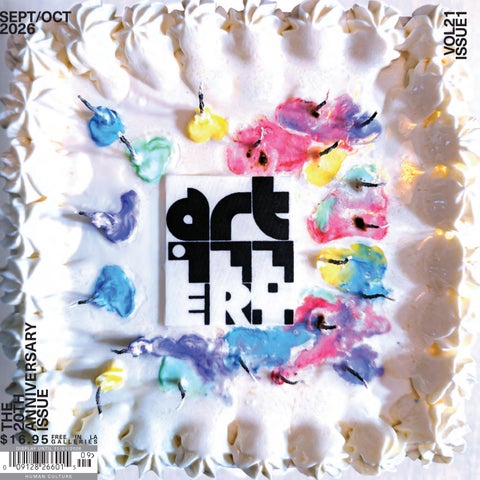
THE 20TH ANNIVERSARY ISSUE
IN LA ALLERIES $ 1 6 . 9 5 GFREE D I S P L AY UNTI L 11/01/2026
H U M A N C U LT U R E
VOL21 ISSUE1
Sept/Oct 2026
New York
Maia Cruz Palileo
The World Tangled in You September 10 - October 24, 2026
Tala Madani Control X
September 18 - October 24, 2026
Keith Sonnier
Inside Light, 1968–1970 September 18 - October 24, 2026
davidkordanskygallery.com
©
© 2026 Estate of Keith Sonnier / Artists Rights Society (ARS), New York.
Los Angeles
1
F E A T U R E S
BURBANK
19
ART IN THE AGE O F T H E A V ATA R Do you remember 2006? Do you remember STUDIO CITY
GLENDALE
yesterday?
Brittany Menjivar
BEL AIR
WEST HOLLYWOOD
PASADE
HIGHLAND PARK
LOS FELIZ
2026
HOLLYWOOD
BEVERLY HILLS
DTLA
BRENTWOOD
M
EAST LOS ANGELES
CULVER CITY SANTA MONICA
CONTENTS
Map data © OpenStreetMap contributors, under ODbL., openstreetmap.org/copyright
SEPT/OCT
THE 2 0 TH AN N IVE R SARY ISSUE
18
20 YEARS OF ART IN LA ACCORDING TO ARTILLERY A subjective timeline
24
REFLECTIONS ON CHINATOWN The groundbreaking scene as seen from the ground
HUNTINGTON PARK
John Pylypchuk
26
WHAT A RANDOM TEENAGER THINKS:
D ATALAND How an AI museum disappointed me, by a teenager who hates art
28
Milosh Soberman
THE HORROR OF TIME A fiction about one of Christian Marclay’s Tom Comitta
non-fictional interns
ARTIST TAKEOVER:
32 D Y N A T O N 42 MAX HOOPER S CH NEI DER DUELLING REVIEWS:
Two takes on “Dynaton: Convocation of Radiant Beings” at Château Shatto
Peter Frank, Brian Karl
70
THE ROCK MAKES A PARADE A traveling homage to Michael Heizer’s “Levitated Mass”
Chela Simón-Trench
S
76 78
Justin Gradin
C O M I C S
Tim Zeleny
COLLECTING THOUGHTS
72 75
82
G AL L E RY D O G S
66
T
Dr. C. Barnabas Westlake
JNew UL IA WE IST Theater Hollywood
P
VOL 21 NO1
64
T H E H AT S O F HEDDA HOPPER Counterpoint Records & Books
12
RO LL CAL L
62
ALONE, ALONE, ALL, A LL ALONE Ehrlich Steinberg
Ben Lee Ritchie Handler
Murmurs Gallery
10
IN SEARCH OF A CITY
F IN C H
E
STAYING SANE(ISH) WITH DR. TRAINWRECK
MONTEREY PARK
58 RODRIGO RAMÍREZ 60 RODRÍGUEZ S P ENCE R Lisson Gallery
D
Jacob Rosenberg
ALHAMBRA
50
AN ARTIST ANSWERS QUESTIONS
ENA
R E V I E W S
ALTADENA
L A’ S S U M M E R T H AT W A S Various Locations
FEATURED CONTRIBUTORS
BEN LEE RITCHIE HANDLER BRITTANY MENJIVAR
JOHN PYLYPCHUK MILOSH SOBERMAN TOM COMITTA
MAX HOOPER SCHNEIDER PETER FRANK BRIAN KARL
DIVA CORP
EZRHA JEAN BLACK HANNAH TISHKOFF
GREER SINCLAIR
MARIANNE FILARETOU CHELA SIMÓN-TRENCH
TIM ZELENY
JACOB ROSENBERG
Contemporary Art+Culture in Los Angeles+
artillerymag.com SUBSCRIPTIONS
artillerymag.com/subscribe FACEBOOK
artillerymag INSTAGRAM
@artillery_mag ARTILLERY MAGAZINE
Los Angeles, CA
Made in Los Angeles Artillery is a registered Trademark and California LLC Co-founded in 2006 by Tulsa Kinney & Charles Rappleye
CONTRIBUTORS
Ben Lee Ritchie Handler Brittany Menjivar John Pylypchuk Milosh Soberman Tom Comitta Max Hooper Schneider Peter Frank Brian Karl Diva Corp Ezrha Jean Black Hannah Tishkoff Greer Sinclair Marianne Filaretou Chela Simón-Trench Tim Zeleny Justin Gradin Jacob Rosenberg Dr. C. Barnabas Westlake
Daniela Soberman EDITOR / PUBLISHER
editor@artillerymag.com
Shawn Cheng DESIGN DIRECTOR
Jolivette Mecenas COPY EDITOR
Ezrha Jean Black
CONTRIBUTING EDITOR
Anna Bagirov SALES DIRECTOR
anna@artillerymag.com 408 531 5643
Beza Denget
ACCOUNT EXECUTIVE
beza@artillerymag.com 919 586 2721
Michael Becker WEBMASTER
Hana Cheng INTERN
Marilyn Cadena DESIGN INTERN
Eunice Tandiono ADVISOR
6
Frank M. Doyle Arts Pavilion Orange Coast College
” s k r a M d “Ba
w and o h s p u o r g A aking m k r a m f o celebration & Solo exhibit: rwood e h S e i n a h p e St
Open Oct. 5 - Nov. 25 Monday - Thursday 11 am - 5 pm
ROBERTA GENTRY: BLOOD ORANGE
East Hollywood, 706 Heliotrope Dr, Los Angeles
9/12 - 10/24
KATHLEEN HENDERSON: CLAPPERS
Downtown LA, 1206 Maple Ave, Suite 100, Los Angeles
9/26 - 11/21
7
8
Stephen Mirich: Stand by Me September 12 – November 14 | Palos Verdes Art Center | pvartcenter.org
9
“We need blood. Quite a bit of it.” I was growing desperate; this was probably the eleventh kosher deli I had called that morning. “Don’t worry, it’s not for anything antisemitic,” I clarified. “I’m Jewish, too.” They hung up.
LOS ANGELES
It was 2007, I was on the clock at my first gallery job at the now defunct Kim Light/LightBox in Culver City. We were prepping for “The Early 90s,” a group exhibition celebrating the greatest hits of the gallery’s previous incarnation. Kim’s first gallery had an inspired run, exhibiting IS burgeoning local talents like Kim Dingle, Anya Gallaccio, and Monica Majoli, so this exhibition was a bit of a “Don’t Call it a Comeback” flex. (Jeff Poe, her director in the ’90s, had since gone to partner with Tim Blum in Blum and Poe, who were still housed in a relatively modest structure 72 a few doors down on La Cienega—they’d open their behemoth flagship across the street a couple years later.) I was sourcing materials for an Anya Gallaccio piece which sandwiched a quantity of the red stuff between two large, clear panes of glass that rested atop a bed of SUBURBS rock salt. As a nice, somewhat naive Jewish boy, I figured that all the blood drained from kosher meats was stored somewhere safe in case someone like me came calling. I was wrong.
IN
As with each of my art world jobs over the past twenty years, I had stumbled into my role there. A year-and-change prior, Nick McCarthy was in town with his band Franz Ferdinand at the peak of their US popularity, and we bicycled to see a show at Kim Light/LightBox. When we arrived, Nick told a starstruck Kim that I was studying to be an archivist in graduate school at UCLA. Kim said she needed one of those. I started the next day and worked with her till I finished my masters.
SEARCH OF A CITY
Within my first week at the gallery, an artist walked in and handed me a folded piece of paper. I opened it. The words BLOW JOB were printed in large block letters. “We should do this,” he exclaimed in a thick Greek accent, enthusiastically. I politely declined. On his next visit, he handed me another note: HAND JOB, it read. We were a small operation, but the work we were showing and the community of which we were a part felt vital and important. The Los Angeles art scene, at least to my romantic, mid-20s self, stood on the shoulders of larger-than-life transplants from other places, artists too loose, too weird, and often too crass to fit within the confines of the stuffier, older money on the opposite coast. Los Angeles is the land where John Baldessari moved to start fresh after cremating his archive, where Ed Ruscha announced his wedding with a photo of himself in a threesome, where Raymond Pettibon elevated street punk poetry into fine art, where Lita Albuquerque’s Malibu Line (1978) merged her audience spiritually with the natural endpoint of Manifest Destiny.
(DOROTHY PARKER)
10
Existence within the Culver City art scene in 2005–2007 felt rich in that legacy, not to mention Kim’s own early ’90s legacy, like it was our duty to be provocative and a little dangerous. Reckless, even. Anyone who has created art as a means of income or worked in a smaller art gallery understands the fatalistic precarity of commercial existence. Emerging art, and art in general, has never been an easy sell. However, art dealers are so self-righteous and stubborn that, on a given opening weekend at Kim Light/LightBox, we honestly believed that a multichannel, heavy-metal ballet video piece by Kirk Nelson could reorient the contemporary
cultural compass, and while it probably wouldn’t make anyone rich, it might at least fill the coffers enough to allow us to stage another exhibition six weeks later. It was in this vein that our small but ambitious cohort of Los Angeles contemporary art lovers carried the banner against the status quo and east coast art hegemony. Some of my memorable early crusades include Analia Saban’s first solo exhibition with Kim; falling under the spell of Frohawk Two Feathers (aka Umar Rashid) at his first gallery show at the short-lived Taylor DeCordoba gallery in the adjacent building; being paid cash to jack off for a Dash Snow film at Peres Projects in Chinatown; discovering a stash of illicit Gregg Araki polaroids stuffed into an envelope on a bookshelf, initially believing I had uncovered an underground sex ring; procuring weed, cocaine, heroin, mdma, and other party favors for a number of artists and clientele; receiving a phone call from the cell someone found in the pocket of an artist who had just collapsed, dead; performing in a “synchronized swimming” video with Keith Boadwee where we filled our colons with jets from a hot tub and shot the water back out of our asses at each other. It’s very possible I did some archiving, too. Twenty years later, the landscape has evolved, some players have changed, and the city finally has its own established, major international art fair. Personally, after a seven-year stint as an archivist, librarian, and art book fair curator at Gagosian in Beverly Hills, then an eight-and-a-half year tenure as a partner and director at Nicodim in the Arts District, I’m a Senior Director at Perrotin in Mid-City. The Los Angeles art world (and my own place within it) may be on more stable ground than it was two decades ago in Culver City, but our existence within the world itself feels considerably more precarious—it was just a little more than a year ago that the federal government staged a military invasion of the city, and less than two years since a plague of hellfire tried to incinerate us. On top of it all, foreign wars, tariffs, geopolitical unrest, and political sensitivities have caused a national inclination to cocoon and play it safe in fear of provoking noisemakers on both the right and the left. But that’s never been how we do in Los Angeles. “It needs to rest directly on the floor, it’s kind of the point,” insists Isabelle Albuquerque. We’re at Perrotin installing “SUMMERLOVE SENSATION”—a hyper-sensual, hyper-sexual group exhibition. It’s the first one I’ve curated in the gallery. Isabelle has created To be the wood, to be the water, to be with you (2026) for the show, a gorgeous bronze hermaphroditic flower making love with itself that appears to grow out of a live oak wood burl cap. We expect a large turnout for the opening, and if we don’t place the piece on a platform, there’s a significant possibility it will be kicked, stomped-on, and damaged. We ditch the plinth and place the work directly on the floor. Over 800 people show up the next night, many of them drunk on free cocktails, and Isabelle’s contribution remains erect, in full bloom, unscathed. The piece sells to a brave collector who plans to display it in his new public art space located in Culver City, of all places. The world turns, fires burn, regimes change, but we’re still out here at the natural endpoint of Manifest Destiny, shopping for blood. BEN LEE RITCHIE HANDLER
11
L
A
B
E
A
S
T
G U T S
BILLIS WILLIAMS
K O R D A N S K Y D A V I D F A C E
OPENINGS
ROLL CALL PHOTOS BY ARTILLERY STAFF
TIP OF THE BERG
P
E
R
R
O
T
I
N
R U S H A
&
C O
14
Guild& Greyshkul 09.16 –10.31 2026 THE COOPER UNION SCHOOL OF ART 41 COOPER SQUARE NEW YORK, NY 10003
16
BY BRITTANY MENJIVAR Casually, colloquially—sifting through photo albums, sorting through obsolete tech in our parents’ homes, watching TikToks ironically warning of TikTok-induced brainrot—we refer to “Y2K” as the start of a new digital frontier. Yet a phenomenon far greater than any symbolic system error would follow just six years later—the genesis of social media as we know it. In July 2006, Twitter (now X) was launched. Come September, Facebook was made accessible to the public after a trial period for Ivy League 2026 ommi ssione rtist Students. Meanwhile in Cupertino, Apple wizards were developing Kim Manfre i the iPhone, although it wouldn’t be unveiled for some time. It was this same year, rather conveniently for your writer, that Artillery was founded.
2026 :
Takashi Murakami has a retrospective at MOCA signaling the embrace of contemporary art from Asia
Novem er 5–9, 2026
MOCA holds an exhibition titled “WACK! Art and the Feminist Revolution”
A Flag Walk for Our Future
2007
Banksy hosts “Barely Legal,” a three-day warehouse show off skid row in downtown Los Angeles, and erects a piece of guerilla art on the grounds of Big Thunder Mountain Railroad at Disneyland Park in Anaheim
California born Jason Rhodes (conceptual installation artist) dies in LA at the age of 41
Scan for more information lagunaartmuseum.org/art-nature @lag u naa rt m us e u m Photo y JenMarie an ig.
(painter, silhouettist, sculptor), and Matthew Barney (sculptor and filmmaker) are in the Whitney Biennial
Photo courtesy Banksy.
A rt + #Art Na tur e in the Age of the Avatar 1 — 9 NOV View with a Grain of Sand
Octo er 3, 2026–January 18, 202
19
20 YEARS OF
Artilllery Issue 0 Started by Tulsa Kinney, Charles Rappleye and others from the LA Weekly
ART IN LA ACCORDING TO
Artillery Issue 1 Catherine Opie (LA-based photographer who photographs LA's leather dyke communty and sexual identity) on the cover
ARTILLERY
Three Californiaborn artists: Mark Bradford (LA artist known for large abstract paintings), Kara Walker
Centre Pompidou holds an exhibition titled “Los Angeles 1955–1985:Birth of an Art Capital”
Michael Govan appointed director of LACMA
16 18
John Waters is Artillery’s very first subscriber
« Fold out to start
#Art
MOCA holds an exhibition titled “WACK! Art and the Feminist Revolution”
Takashi Murakami has a retrospective at MOCA signaling the embrace of contemporary art from Asia
2007
Banksy hosts “Barely Legal,” a three-day warehouse show off skid row in downtown Los Angeles, and erects a piece of guerilla art on the grounds of Big Thunder Mountain Railroad at Disneyland Park in Anaheim
California born Jason Rhodes (conceptual installation artist) dies in LA at the age of 41
BY BRITTANY MENJIVAR Casually, colloquially—sifting through photo albums, sorting through obsolete tech in our parents’ homes, watching TikToks ironically warning of TikTok-induced brainrot—we refer to “Y2K” as the start of a new digital frontier. Yet a phenomenon far greater than any symbolic system error would follow just six years later—the genesis of social media as we know it. In July 2006, Twitter (now X) was launched. Come September, Facebook was made accessible to the public after a trial period for Ivy League Students. Meanwhile in Cupertino, Apple wizards were developing the iPhone, although it wouldn’t be unveiled for some time. It was this same year, rather conveniently for your writer, that Artillery was founded. (painter, silhouettist, sculptor), and Matthew Barney (sculptor and filmmaker) are in the Whitney Biennial
Photo courtesy Banksy.
in the Age of the Avatar
19
Three Californiaborn artists: Mark Bradford (LA artist known for large abstract paintings), Kara Walker
Centre Pompidou holds an exhibition titled “Los Angeles 1955–1985:Birth of an Art Capital”
Michael Govan appointed director of LACMA
Artillery Issue 1 Catherine Opie (LA-based photographer who photographs LA's leather dyke communty and sexual identity) on the cover
John Waters is Artillery’s very first subscriber
2006
Things are always the way they are but they were not always the way they were. Since Artillery began chronicling the art world in 2006, that world has convulsed, expanded, metastasized and changed forever, but the big changes are always presaged by small ones. We offer here a bird’s eye view of the shifting winds of contemporary art as seen from Los Angeles, with a breakdown of what exactly has been going on during all the years we’ve been putting out a magazine. Its not exhaustive or even definitive, but nothing is. With any luck, we’ve missed all the most important emerging trends and we get to be as surprised as everyone else next season.
Artilllery Issue 0 Started by Tulsa Kinney, Charles Rappleye and others from the LA Weekly
#Art
MOCA holds an exhibition titled “WACK! Art and the Feminist Revolution”
Takashi Murakami has a retrospective at MOCA signaling the embrace of contemporary art from Asia
2007
Banksy hosts “Barely Legal,” a three-day warehouse show off skid row in downtown Los Angeles, and erects a piece of guerilla art on the grounds of Big Thunder Mountain Railroad at Disneyland Park in Anaheim
California born Jason Rhodes (conceptual installation artist) dies in LA at the age of 41
BY BRITTANY MENJIVAR Casually, colloquially—sifting through photo albums, sorting through obsolete tech in our parents’ homes, watching TikToks ironically warning of TikTok-induced brainrot—we refer to “Y2K” as the start of a new digital frontier. Yet a phenomenon far greater than any symbolic system error would follow just six years later—the genesis of social media as we know it. In July 2006, Twitter (now X) was launched. Come September, Facebook was made accessible to the public after a trial period for Ivy League Students. Meanwhile in Cupertino, Apple wizards were developing the iPhone, although it wouldn’t be unveiled for some time. It was this same year, rather conveniently for your writer, that Artillery was founded. (painter, silhouettist, sculptor), and Matthew Barney (sculptor and filmmaker) are in the Whitney Biennial
Photo courtesy Banksy.
in the Age of the Avatar
19
In 2006, I was seven years old and living in suburban Maryland. I wouldn’t move to Los Angeles full-time until 2022—and yet, I can visit digital archives to see museum exhibitions that took place long before my arrival. Using Google Earth’s historical imagery setting, I can even wander through Los Angeles neighborhoods as they existed years ago. Before the fires. Before COVID closures and renovations. Before I had any concept that Street View existed. An artist can copiously photograph their most recent show and post the pictures to their website, allowing audiences to bear witness to it without ever setting foot into a gallery. They can create work that forgoes three-dimensional space entirely, situated exclusively in the realm of the digital. I can review said work from the comfort of my bed (where I’m writing from right this minute). With a few taps on my phone screen, I can share the review with everyone I’ve ever met, plus a crowd of lurking strangers. As much as the world is at our disposal, so are we at the world’s.
#Artists, Anonymous My digital avatar strolls down Hunter Street, two blocks from the freeway in Downtown Los Angeles. The deadend alleyway’s quiet, primarily used for parking cars—and yet there are signs of life, of creative life. The occasional wall of street art pops up—a tag here, a mural there.
Is Banksy a man named Robin Gunningham, as a March 2026 Reuters investigation asserted? Considering his lawyer’s tight-lipped response to the article (“[Banksy] does not accept that many of the details contained within your inquiry are correct”), we might never know. Not too surprising, and not too disappointing, either. While some of Banksy’s projects might fall into “barely legal” territory, others would almost certainly warrant prosecution were he caught. Besides, the characters who come to life through his graffiti art and installations are continuously more intriguing than the man behind the proverbial mask. Case in point: “Barely Legal” featured a live elephant painted to match a wallpaper backdrop. The exhibition text read as such: There’s an elephant in the room. There’s a problem we never talk about.
Anybody want a free glass of wine?
Culver City and Chinatown are LA art world hubs
BCAM (Broad Contemproary Art Museum) designed by Renzo Piano opens at LACMA
Financial market collapse
Call it what you want, but with Banksy, the medium is the message, and when the medium is a 6,000-pound pachyderm, it’s pretty damn hard to ignore.
2008
Mara McCarthy, daughter of artist Paul McCarthy (LA-based artist known for his sculpture and unorthodox use of materials such as bodily fluids and food) opens The Box gallery
20
Art market reaches historic peak with rapid rise of art fairs, record auction prices, and growth of private musuems
LA edition of “Meeting of Styles,” an international graffitti festival to paint sanctioned murals along the LA river, solidifies street art’s entry into the mainstream
Several businesses share the space; I spy a movie set construction company, a gallery called Artbug, a screen printing shop. On September 15th, 2006, I might have walked this very path in search of “a three-day vandalized warehouse extravaganza” titled “Barely Legal.” Back then, Google’s archival footage tells me, the cement buildings were drab and colorless, plastered with “For Lease” signs. Yet one of them held a vibrant world within: the third major exhibition by the artist known as Bansky.
- 1.7 Billion people have no access to clean drinking water. - 20 Billion people live below the poverty line. - Every day hundreds of people are made to feel physically sick by morons at art shows telling them how bad the world is but never actually doing something about it.
Google Earth.
The fact is that life is not getting any fairer.
Image courtesy Brittany Menjivar.
Of course, artists need to make a living; some might go so far as to desire a comfortable living, even the anonymous ones. Just a month later, on October 19, 2006, Christina Aguilera purchased one of the simpler works from the exhibition—a piece depicting Queen Victoria engaged in a lesbian sex act—plus two prints for £25,000. Whether you found Banksy’s sales figures hypocritical or all part of the joke, you couldn’t laugh off his success. Commercialization breeds commendation. As graffiti fever spread throughout LA’s celebrities (Angelina Jolie and Keanu reeves were also reported to be fans), it also caught on with the city’s establishment. In 2007, the “Meeting of Styles: LA” event invited visiting artists to legally spray-paint a 10,000-foot section of concrete paneling alongside the Los Angeles River. Several years later, the Museum of Contemporary Art in Los Angeles would host its most widely attended exhibition to date: “the first major US museum survey of graffiti and street art,” aptly deemed Art in the Streets. Banksy took part with various contemporaries—including Shepard Fairey, who had already achieved institutional legitimacy via his “HOPE” poster for Barack Obama. But institutional embraces of outsider art rarely come by without controversy. As part of the show, MOCA commissioned the street artist BLU to paint a mural along the side of the building; when it depicted dozens of caskets wrapped in dollar signs (rather than the traditional
American flag for soldiers), then-director Jeffrey Deitch ordered its removal within 24 hours, citing insensitivity with respect to a local veterans’ hospital. Such clashes between daring and decorum happen often, and yet they are rarely so visually apparent. Today, as bootleg “Girl with Balloon” merchandise abounds and fellow LA-made street artist Alec Monopoly designs custom boxing shorts for Jake Paul, it’s tempting to dismiss Bansky and his ilk as trite. (Consider a meme I’ve had saved on my phone since 2018: a brick wall rendered in Microsoft Paint, emblazoned with the crudely scrawled slogan “they call em cell phones because they hold us prisoner and stuff —BANKY.”) Given Banksy’s elusive nature, it’s easy to forget the real stakes behind his stunts. Some of his slogans might now remind us of engagement-baiting social media posts, but he was spray-painting his thoughts onto brick and cement long before anyone posted their joys or grievances to a Facebook wall. When we look past graffiti’s co-opting, we can recognize how it might serve as a sort of public commons not unlike an online feed. Detached from the trappings of identity, artists can engage in the kind of dialogues that Internet censorship might not allow—their tags and crude caricatures not unlike usernames and profile pictures.
#Art in Abundance
MOCA suffers financial crisis
Chris Burden (LA-based artist known for his large scale installations including his lamp posts at LACMA) has an exhibition at the Rockefeller Center
Paul McCarthy has an exhibition at the Whitney
Ed Ruscha (LA-based artist known for hard graphic pop paintings of words and buildings) has a major retrospective at the Hayward Gallery in London
Machine Project stages a LACMA takeover offering experimental performances and programming
Frieze LA backlot at Paramount, 2019.
Shepard Fairey’s proclamation of Hope was fulfilled, not only for Obama but for the Los Angeles art scene. By the 2010s, a field trip downtown was no longer an absolute necessity for those who wanted to take in contemporary art. Pacific Standard Time helped to kick off the craze. Between 2011 and 2012, over 60 galleries united to present exhibitions encompassing “Art in LA 1945-1980”; shortly after, critic Kevin McGarry proclaimed via T Magazine that the “LA Art Invasion” had arrived. Here comes the part of this article that might easily be reworked into a new version of “We Didn’t Start the Fire” with some creativity. In 2014, Frieze announced its impending arrival in the city, marking it an art market to watch. In 2015, The Broad opened its doors—MOCA’s trendy younger cousin. In 2016, the Marciano Art Foundation and Hauser and Wirth followed. By 2017, Sprüth Magers had joined in; 2018 brought the Institute of Contemporary Art into the mix. In 2019, cue the fanfare, Frieze came to town, with Felix concurrently taking the Roosevelt Hotel by storm. Yet to the untrained observer, much of this remained invisible. Even the hottest new transplants—those who had the talent and momentum to secure a T feature in the first place—enjoyed a sense of surreptitiousness
21
in the shadow of the Hollywood sign. And they loved this “possibility of disappearing,” as Amalia Ulman put it. From McGarry’s piece: “In L.A., artists can test things out without the glare of the spotlight,” says Ali Subotnick, a curator at the Hammer Museum, who moved from New York in 2006. “The proximity to the entertainment industry guarantees that the art world will never be the main industry in this town, so artists are able to work on the sidelines.” Anonymity has become its appeal: Like no other place, L.A. offers artists the ability to be alone, together. Down the line in 2015, the NYT proper touted LA as potential paradise for Big Apple transplants in particular. A roundup of former Brooklynites shared their surprise at the freedom LA offered the average artist, allowing them to shed concerns about rent and reputation and focus on their practice. “On the east side, where we live, we know maybe four or five people who work traditional 9-to-5 office jobs, out of our entire friend circle,” said Hamish Robertson, an artist and designer who lives in Los Feliz with his wife, Andi Teran, a novelist. “And if they do have them, it hasn’t come up, because people rarely ask what you do for a living or where you went to school.” In other words: While the New York artist would perpetually find themselves keeping up with the Joneses in terms of industry success as well as expensive brunch orders, The Angeleno artist, hypothetically, could toggle between two parallel realms—the excitement of national, even global notoriety via newspapers and blogs, and the day-to-day solace of a retreat amidst the palm trees. Before “micro-celebrities” introduced the notion of a fame that isn’t pervasive, LA artists learned that there’s more than one way to be a star.
#Artists, Automated
John Baldessari (California born and LA-based artist known
What mattered was not the cartoon chimpanzee but the link and number attached to it, designating you as the image’s exclusive owner. The simplicity and seriality of the Bored Apes was perfectly attuned for a moment when so many of us Homo sapiens, reduced to our most animalistic nature in the captivity of the COVID-19 pandemic, found ourselves, well, ridiculously bored. Check this out—you can become an Art Collector without having to curate taste, or go out to a gallery, or figure out how to display it in your home in an interesting way. The rapid evolution of AI tools has led to a similarly individualistic obsession with identity amongst some users. Despite much progressive distaste for ChatGPT, Sora, et cetera, it is curious that many avowed devotees of Generative AI have co-opted the language of accessibility and inclusion to argue their cause—implying that the ability to claim a certain level of artistic “expertise” should be a right rather than a privilege. The end game is not necessarily to make art, but to declare that one has made it—and therefore, that one is a “real artist.” In criticizing the proliferation of AI-generated work, Downtown Los Angeles becomes an arts hub
Art world in recession
Eli Broad injects MOCA with $30M
2009
22
Sterling Ruby (LA-based multi media artist) has solo institutional show at MOCA
LACMA holds “Phantom Sightings” exhibition on Chicano Art
Return with me to Hunter Street, or its virtual analogue. Scrolling through the 2010s, we can witness the rise of Hunter Street Studios, a loft building providing studio space for various artists-in-residence; Print Renegades, the aforementioned screen printing atelier; a cutting and fusing service for textiles; more graffiti. Looking back from the future, we know when the hubbub would come to a halt. The offices closed. The schools closed. The galleries closed—and yet, supposedly, a new type of art was proliferating, one that could be purchased and experienced entirely online. Do you remember where you were when you heard the word “blockchain” for the first time? We were primed for the rise of NFTs, non-fungible tokens, by the hype around Bitcoin. Crypto bros were eager to extol the virtues of a decentralized and stable system of currency as they waved off environmental concerns; NFT heads, by and large, spoke less of such lofty matters. The art itself was unexceptional: who cares about the composition of Bored Ape #6969?
sense in an era where algorithms prioritize faces, yet privacy remains a concern for even the most forthcoming Internet users. Lacking a past, a social network, and a human sense of vulnerability, Heart could expose as much of her life as she wanted without risk of reputational damage or harassment—or even simple embarrassment. Perhaps in the near future, flesh-and-blood influencers will create digital copies of themselves just to get away from the discomfort of presenting themselves to their followers, trusting that the distinction between the real and the false will continue to hold some minor significance.
#Artists, Anonymous (Pt. 2)
Night Gallery opens its first space in Lincoln Heights
Artilery’s first Biennial Sex Issue
2010
Allen Ruppersberg (LA and NY based conceptual artist) has a retrospective at MOCA highlighting the importance of Los Angeles conceptual art
Mike Kelley (LA-based artist known for assemblage and performance art) has an exhibition at Museum of Contemporary Art, North Miami
Looking back at the past twenty years—with the clarity offered by the passage of time and the perspective of the algorithm—the trajectory of contemporary art in Los Angeles comes into focus. Hollywood was always built upon mythmaking. How logical that the city’s growing art scene should make itself in its image. LA’s capacity for reinvention exists in tandem with its tendency toward recursion. Although we might not be able to discern exactly who’s driving its future (or even its present), we can have some confidence in what that future will look like—a series of mysterious, archetypal avatars upon which the masses can project, whether they’re doing so by word of mouth, social media, or Neuralink. After all, La La Land loves a star, but even more so, it loves a promising nobody.
for work that incorporated found photography and combined narratives) has a landmark retrospective at Tate Modern
Cloudy Heart, in the exhibition “Jon Rafman, Proof of Concept,” Sprüth Magers, Los Angeles, 2025. © Jon Rafman, Photo: Robert Wedemeyer.
many artists find it important to investigate whether the art made by AI is bad, either through subjective surveys or the scientific method. This is a red herring. Excessive concern over the quality of AI writing reveals an obsession with proving oneself as one of the chosen few, gifted from birth with exceptional talent. A more thought-provoking task is to inquire why AI developments might be alluring in the first place, to creators as well as the consumers of their output. Consider the work of Jon Rafman, who lives in Los Angeles but refers to himself as a “post-studio artist” (and, incidentally, whose oeuvre makes frequent use of Google’s satellite imagery). Rafman has been invested in digitally-rendered alternate realities since he started giving tours of Second Life as the Kool-Aid Man in 2009. Fifteen years later, in 2024, he debuted Cloudy Heart, an AI-generated “popstar” who would go on to answer questions from Petra Cortright, Lucy Bull, and other creative SoCal “contemporaries” in an Interview Magazine roundtable—before achieving a single hit. In creating Cloudy Heart, Rafman was not aiming to conquer the entertainment industry like Tilly Norwood’s human handlers; his interest might safely be defined as exploratory rather than commercial. Before writing this article, I had never heard her music—just seen her likeness on my Instagram feed about a billion times, always mutating slightly, but with the same easily describable features. Heart’s niche popularity makes all too much
23
I came to LA in 1998. Fresh off the bus from Canada. Well, plane. But just as starry-eyed as anyone. I was a part of the Royal Art Lodge in Winnipeg so community meant everything to me. Now I’m just in LA and just trying to figure it out. A year later my best friend Paul moved to LA and we had each other as a bit of home here. Me and Paul Cherwick directors of the Robert Therrien Estate in 1998. Photo by Jon Pylypchuk.
For what it's worth, I just want to say that this account of my experience might not be accurate to everyone but this is what I remember.
Art market auction prices back up
LACMA expands contemporary art programming
Inaugural Art Los Angeles Contemporary (ALAC) art fair at the Pacific Design Center
MOCA appoints Jeffrey Deitch as director
In my first year of graduate school at UCLA I was lucky enough to meet Frances Stark, Laura Owens, and Pae White. The talk around UCLA was that Chinatown was the hot art scene at the time. They were connected to Steve and Giovanni at China Art Objects and soon I spent every weekend there and some weeknights. I saw a lot of things that got me so excited about art, and I was lucky to have a group of established artists to call my friends.
When Kevin and I had that conversation about when Chinatown started, it was prompted by me talking to somebody and saying Chinatown started in 2006. For me it was '99. And Chinatown started before even I was there — but I got to be a part of the of Chinatown in the late '90s and early 2000s, and I am grateful for that. China Art Objects opened, I believe, in '99. Roger Herman already had a gallery in Chinatown called Black Dragon Society, and I was a gallery sitter there. I had worked at Blum & Poe for two days and was let go (I was incompetent as an art handler). I was a student at UCLA, and Roger found money for me to sit in the gallery. At the same time, every Saturday, I would take a Trader Joe's bag of drawings to Chinatown, and collectors would be waiting to buy them. They were only $40, so anybody would have bought them. What I did resonated with some people, I think — but what resonated more was the spirit of Chinatown at the time. China Art Objects was started by Giovanni Intra — a Fulbright scholar from New Zealand — along with Steve Hanson, Amy Yao, Peter Kim, and Mark Heffernan. What I got jumped into was pretty special. I think about how many times I would spend
Paul McCarthy has a major international museum survey at Moderna Museet, Stockholm
# 1998
Me on Chung king rd circa 2002. Photo by Jon Pylypchuk.
JOHN PYLYPCHUK
This was the world that I walked into. These were the people I was friends with. Very strong beliefs. A very strong concept of what art was supposed to be. You lived, filtered, and produced.
Baldessari’s Tate Modern retrospective travels to LACMA
REFLECTIONS ON CHINATOWN
Twenty-some years later, at some event, I ran into Kevin Hanley(who was a part of that crew) and we commiserated about Chinatown — for me, it was the LA art scene when I got there; for him, the scene really started in '94, but likely earlier. In the early '80s they went to Madame Wong's in Chinatown to watch bands play. A really nice thing I remember Steve telling about that time was how Mötley Crüe played Madame Wong's — and the other bands were punks, so when they got the chance, they messed up the soundboard, and when Mötley Crüe went on, it was just a disaster.
Getty launches Pacific Standard Time (art biennial) a major initiative that brings together institutions across Southern California
Artillery’s first Queer Issue
2011
That same weekend, Giovanni Intra was in New York for Eric's opening — we were all so fucking proud of Eric, Eric should be a better recognized artist. Giovanni was coming off a spectacular Miami Basel, and God, you have to love a person who loved art that hard. This beautiful person had beautiful thoughts. Deep, deep, deep thoughts.
Royal Art Lodge 1996. Photo by Jon Pylypchuk.
Scenius (thank you, Emma): Brian Eno's term for collective genius. It doesn't start with one person — that person is immersed in an unplanned grouping of people who end up building a community of genius. Daniela asked me to write an end to this, and I was stuck. But two phone conversations with friends made me feel like I could stick a landing. First, chatting with my friend Emma Catacutan. Emma brought up a Brian Eno clip about Scenius — a potential title for a show she is curating. Emma is actively creating a scene in San Diego. Second was talking with Josh White, who is likely one of the foremost witnesses to the LA art scene from the '90s to the present. He has shot everyone’s work. Josh reminded me that we weren't professional in the sense we think about it now. We weren't trying to be strategic. We were both serious and not. We just lived and created. I am grateful for the people I have had the luck to be around.
Tulsa Kinney conducts Mike Kelley’s last interview.
because even though I had done a show at Petzel in New York, Metro Pictures was an established gallery. That meant something.
In 2006 Josh white invited me to the “Black Pussy” Jason Rhoades installation and I remember not knowing what I was about to experience and being a little nervous. Jason had created this incredible work and you would see people from every walk of life. Sadly Jason died a few weeks after I was there and when I look back, for me that was kind of the end of that era.
LA sees gallery boom
Me in the office at China Art objects circa 2003. Photo by Jon Pylypchuk.
All around the same time, crazy stuff started to happen, as written about in "The Jester" (LA Weekly). Eric Wesley, who is such a brilliant artist, had his first show at Metro Pictures. He got a little bit tipsy, somebody called him the N-word, they engaged, and Eric threw a chair through the glass door of Passerby, Gavin Brown's bar. At the time, Eric's thing seemed huge for us,
Giovanni, in his Prada shoes that he bought with money from Basel — died of a heroin overdose that same weekend.
“Art in the Streets” at MOCA, devoted to graffitti and street art, curated by Jeffrey Deitch, Aaron Rose, and Roger Gastman
hours in Chinatown during the week, just hanging out, and the people you'd see there — collectors, artists, musicians. One day the band The Cult came in and had themselves photographed in front of JP Munro's painting, which hung magnificently in the space at China Art Objects. This was the groundwork they laid, and I was lucky to be a part of it. My first round of Chinatown happened, in my recollection — and again, you can argue with me, but I don't think that I'm wrong — with spaces run mostly by artists who were half professional half feral. That vibe drew a lot of people in. The buzz. The freshness. The humanness.
DATA LAND
WHAT A RANDOM TEENAGER THINKS
HOW AN AI
Milosh Soberman is 14 years old and does not like art. He recently visited Dataland, “the world’s first Museum of AI Arts.”
With this being an AI museum, I thought I wouldn’t need to show up in order to write a review. “Dataland” isn’t what you initially picture when your friend pokes your brain with the phrase “It’s an AI museum.” Depending on what you’re seeing in each screenfilled room, a device that sits on your neck sprays cheap cologne on it. This experience may sound fantastic and flawless, but on top of being disappointing, it may cause nausea and epileptic seizures; it’s too immersive. At the beginning, the art is about HOW it’s displayed more than WHAT is displayed. At the end, the exhibit shows you a short video clip that is generated based on your actions in the building. I’m not quite satisfied with my actions because they gave me an anticlimactic clip of slime and a
MUSEUM DISAPPOINTED ME
Chris Burden’s “Metropolis” (matchbox cars racing through a metal metropolis) opens at LACMA
Global biennials become a launching platform for artists from Africa, Latin America, Asia, and the Middle East
“Ends of the Earth: Land Art to 1974” survey at MOCA, Geffen Contemporary
“Made in LA” debuts, organized in conjuction with the Hammer, LAXART and Los Angeles Municipal Art Gallery
Mike Kelley dies by suicide
26
PST Performance and Public Art Festival takes place
2012
MILOSH SOBERMAN
blurry leaf. The entire show was about nature, technology, and how they influence each other. One room of the exhibition continuously zoomed in on canyons with rivers inside of a bird’s eyes. Despite the experience’s beauty and details, it looked like AI-generated wallpapers with no variety. However, if created by humans it would seem like the greatest piece of media on the planet. I don’t like AI since it’s taking jobs and I can’t use it in school for subjects that it has already taken over.
Jeffrey Deitch shunned by art world (it was observed that people “literally walked the other way when they saw him approach”) at Richard Prince’s Gagosian pre-Oscar bash
Llyn Foulkes (LA-based artist known for satirical art) retrospective at Hammer Museum
James Turrell (LA-based artist born in Southern California known for his work in the Light and Space movement) has three museum major retrospectives: LACMA, Solomon R. Guggenheim Museum. and the Museum of Fine Arts, Houston
Night Gallery moves from Lincoln Heights to DTLA
2013
John Baldessari, Cathy Opie, Barbara Kruger, and Ed Ruscha resign from MOCA board
My final opinion of the exhibition is that the final room, no matter how anti-climactic, was still the most impressive piece in the exhibition. Looking back, the museum was still an interesting and cool concept.
27
Gender ratio and inequality central topic at Raid Projects
MOCA announces Philippe Vergne as director
2014
28
Jeffrey Deitch announces his resignation from MOCA
New York hosts six Paul McCarthy shows over the summer
In 2012, Daniel Zalewski profiled Christian Marclay and The Clock (2010) in The New Yorker. The piece includes a single, throwaway reference to an assistant: “One fellow, who offered little but gunshots and ‘guys getting their heads chopped off,’ was fired.” Over the next month, The Clock returns to LACMA. —TC
LA has become one of the fastest growing contemporary art markets
BY TOM COMITTA
Frieze announces LA edition to open in 2019
A SHORT STORY
From now till death do me part, from the moment my rigor-mortis-wracked corpse is tossed unceremoniously from the hollow arms of the crematorium to its fiery grave; from my non-death to the storybook end of all of our lonely days, when the last human takes their final parched breath, dreaming of that last drop of water fallen through the dusty air from that last withered leaf of the last climate-tortured tree; or, even better, when the sun finally gives up on its glowy pantomime, exploding in a nebula of suicidal bliss, a catastrophic chain reaction blooming from its nuclear heart, spreading in all directions at ungodly speeds, poisoning the void of space and pulverizing every planet and moon, asteroid and iceteroid, all land and sea, schools and cinemas, all moms and dads, kids and dogs, every clock, everything we’ve known and not known for all eternity, all time; until the end of endings, the abolition of beginnings, until then, I will be known solely as that “one fellow.” The fired one. “Ted with the bad taste.” “Ted who can’t follow the rules.” The passing reference. The footnote to “the greatest collage of all time.” Hah. They didn’t even beg-pardon the pun. Yes, it is I, the fellow who sourced “too many horror films” and was fired as an underpaid assistant from The Clock, the great Christian Marclay’s now-canonical 24-hour art film made of watches and clocks, from bedside alarms to Big Ben, anything having to do with time and shot for the screen. Elizabeth Taylor smoking before a cobwebbed grandpa clock. Crocodile Dundee studying the angle of the sun. The Clock is a durational meditation on film history and a literal ticking timepiece itself, synched to the very minute and second of the city wherever it is shown. And it was a sensation, winning that year’s Venice Boring-ale and luring scores of eager audiences into lines spanning blocks so they too could catch a few precious minutes, even just a glimpse of Marclay’s “greatest work of the 21st century.” Lol. I never got that far. No, after just a few weeks consuming hours upon hours of horror movies, scanning for dismembered watches and blood-splattered
F E ATU RE
THE HORROR OF TIME
Editor’s Note: This story is a work of fiction inspired by a real anecdote in Daniel Zalewski’s 2012 profile of Christian Marclay.
The Skid Row History Museum & Archive (launched by the Los Angeles Poverty Department) opens
The Broad opens in downtown Los Angeles
2015
Superchief (LA’s largest gallery focused on new contemporary and street art) opens an LA branch
MIke Kelly posthumous retrospective goes on international tour
29
Christian Marclay, Detail from The Clock, 2010, Los Angeles County Museum of Art, purchased with funds provided by Steve Tisch through 2011 Collectors Committee, © Christian Marclay, courtesy Paula Cooper Gallery, New York and White Cube, London, photo © Museum Associates/LACMA.
Betye Saar (famed Los Angeles assemblage artist who was part of the Black Arts
New wave of independent nonprofit art spaces emerges in LA (LAND and LAXART are part of this movement)
30
The late Noah Davis (founder of the Underground Museum) receives first museum survey at the Hammer
Mark Bradford’s first solo museum exhibition opens at the Hammer
Christian Marclay, Detail from The Clock, 2010, Los Angeles County Museum of Art, purchased with funds provided by Steve Tisch through 2011 Collectors Committee, © Christian Marclay, courtesy Paula Cooper Gallery, New York and White Cube, London, photo © Museum Associates/LACMA.
blown to smithereens (V for Vendetta, 2005). Christian just had to give the vulgar hordes the explosive ending they desired. This would all be fine and good—the give and take, the withholding then bestowing and back again, is the way of “good” art—if The Clock weren’t so disastrously ignorant of the root truth of the matter: that boredom is just the beginning. With Marclay, the clips follow one after another, some dissolving, some chopped and pressed together like lunch meat, but all devoid of meaning. They pass before us, and we watch them pass, trapped in our tiny cages of perception, audiences without the wherewithal to know they’re being duped. In essence, what we find is the banality of modern life confronting the banality of the clock: mirror facing mirror, emptiness reflecting emptiness, one frame after another after another after another until all that’s left is the same drab image. No more peaks. No more troughs. Just the stale beat of time. But those who only know boredom are stuck in the world’s infancy, when the true horrors of time were merely waiting to be born, when God rode rampant over his delusional fields, oblivious to existence, bathing in founts of naught, reclining on hills of nil, until one non-day He tripped over what at first appeared a simple nothing-rock but instead held the markings
of a sundial, the semicircular swing, the triangular lunge, the axiom that took an ax to the eternal bliss of nothing, and in that first objective instant brought death to the void, that fraction of a fraction of a fraction of a moment when the twin pillars of light and time were born, plunging out of nothing, setting off a chain reaction of quotidian terror and seasonal rot, the mute beat of yearly returns and epochal ruin. In that instant of time’s birth, God died and all shrieked into being, not in an idyllic, vegetal, manuscript-illuminating Eden, but a putrid swamp of motion and mood, blinking and body, person and place thinging, a horse neighing to no one in a wood that doesn’t care, the light slanting through imposing trees onto fronds that shit air and are forever tortured by the flat, incessant ring of water droplet after water droplet killing itself, one after another into the rivers of time. God died so we could have time. So we could go to the market. Then to the store. Then to Terry’s house. Maybe Ellen’s. He shattered into every ticking chime and dinging bell, every reminder to get going, go, hurry up please, it’s time. He left so that we could dance disco across the wastelands of life. So that each of our little, precious egos, our singular, non-angular “I”s could join in the circular, dumb dance, so that we might try our own hand ticking along to the beat, tocking a song or two, ignorant of the murderous origin of time and space, of the truth which transcends all clocks, which appears in those strange moments when the nothing breaks through at the edge of your eye, or in a sound humming from the bushes, or a billowing vibration of pain in an empty room, felt echoes of the truth of what was, of the time before time, the nontime , of God’s laughter seeping from the cracks in the walls of life, pitying the clock, its whole numbers and clean lines, its smooth, white facade betraying a tidy certainty, a mute pledge of allegiance to the sovereignty of time, time, who without reason or notice, might reach out and snap each of its own tiny twin hands before dragging them, us, mind and matter, body and soul, thought and non-thought through the vilest cesspools of time’s graveyard. Thus was to be my contribution to The Clock. A watch ticks. A wrist cracks. A clock tocks. The joint pops. Another ticks. The gun goes click. Another tocks. The head’s blown off. Tick. Lighting the wick. Tock. The concussive shock. Michael Myers raising his knife as the clock crawls toward twelve. John Malkovich playing John Silence bleeding out at the witching hour. For horror cinema tells the truth of time, capturing the contours of our disaster, our predicament in all its bloody, cosmic sincerity. And any self-respecting Clock would have given voice, or at least allusion, to this truth. That time is death. Death is time. To say otherwise is to speak fiction. To create a tidy story, however virtuosic, that is both about and of the mundanity of modern life but no more. Here we find a Clock devoid of time, ignorant of the hollow hours and minutes of the bone clocks clicking
Noah Purifoy (“Junk Dada” assemblage artist who co-founded the Watts Towers Art Center and who lived most of his life in SoCal) has a survey at LACMA
clocks which the maestro could then weave into his labyrinth of time and celebrity—of course giving credit to neither me nor my fellow broke assistants—I was let go before lunch. “We’re looking for the banal and plain,” said Christian. “Nothing outlandish,” said Christian. “Make it boring!” he said. And so The Clock the people got was the clock the people deserved: a mirror reflection of their dull days, with brief flashes of joy at the recognition of some actor, maybe some laughter at a clever juxtaposition. Then there was the infamous climactic midnight, the tick-tock chiming build-up into Big Ben
Hauser & Wirth (known then as Hauser Wirth & Schimmel) opens its Downtown Los Angeles complex
Bombay Beach Biennale starts
Clay being used as sculpture material surges among artist in Los Angeles
sliding by as Trevor walks past or Pat delivers yet another tidbit of “friendly feedback” on last week’s inventory fumbles. You might think such a scene would break me. That after hours, days, and years of such monotony I too would succumb to the hollow horrors of ennui, of life passing before one’s very eyes every second of the dull day, watching the hands wipe round and round that archaic analog surface. Thus would be the fate of one who lacked the truth, who had not done the work, who had not sought out the research and who was not moments away from getting up from one’s desk and grabbing the sharpies and the salt packets that Evan had so kindly refilled this morning, telling Kate you’re feeling kinda sick before shuffling off to meet Trevor and Liz in the bathroom, locking the door and accepting your cloak, drawing the circles on the floor, spreading the salt, hailing the four cardinal points before scribing the sigils and saying the blessing, raising the sacrificial bird and spilling the sacrificial blood, and yes, chanting the name of the great Choronzon, summoning the sleeping God to do his good work and finally, once and for all, truly killing time.
The Marciano Art Foundation opens
2016
Defend Boyle Heights (a coalition with Serve the People, Unión de Vecinos, Ovarian Psycos, the Brown Berets, and Backyard Brigade) forms to combat art organizations and art galleries they see as “artwashing” and gentrifying neighborhoods
Movement) has her first European solo exhibition at the Museum Het Domein in Sittard, Netherlands at the age of 88
and ticking, scraping and creaking across the chalkboards of the mind, deaf to the shrieks of seconds and half breaths as the élan vital squeaks from the pores of time’s facade, as the pulse of bloody seconds drains to naught. Ignorant of the throbbing weight of years, of centuries, epochs, of the space of no time, where time sinks into the quantum state of all time, that chopping-block universe of a theory slicing body after body, dicing soul after soul into the finest grains of erasure. And yet it went forth and will go on. For part of Marclay’s clever sale agreement was that any institution purchasing The Clock must exhibit it every ten years. Which is where we find ourselves today, with said film screening yet again at the Los Angeles County Museum of Art, Marclay profiles and think pieces popping up out of the digital ether by the hour, influencers lined up for selfies and hot takes, and your humble “fellow,” the one let go, “too-serious Ted” now working IT in an over-air-conditioned Stockley Park cubicle, keeping time with every jet passing over from our unfriendly neighborhood Heathrow next door, gazing up from time to time at the pale clock above Kate’s desk, its tiny hands spinning and swinging,
31
ARTIST TAKEOVER: M A X
H O O P E R
S C H N E I D E R
34
M
A
X
H
O
O
P
E
R
S
C
H
N
E
I
D
E
R
35
M A X
H O O P E R
S C H N E I D E R
36
37
INFO@ARTCOURIERS.US T: 323-207-8507 INSTALLAT
ION
TRANSPORT
PACKING & CRATING
INSURANCE STORAGE
FINE ART SERVICES 38
39
40
NARSISO MARTINEZ OPENING SEPTEMBER 25
cjamesgallery.com
|
213-687-0844
|
info@cjamesgallery.com
|
charliejamesgallery
Roy DeCarava
41
D Y N AT O N
DUELLING REVIEWS
Installation View, “Dynaton: Convocation of Radiant Beings,” 2026. Courtesy Château Shatto.
Two takes on “Dynaton: Convocation of Radiant Beings” at Château Shatto More Relevant Than Ever P E T E R
F R A N K
“Dynaton: Convocation of Radiant Beings,” a museum-level display of gratifying scholarship, would seem to be in the wrong place at the right time. Except that it’s not the wrong place. Château Shatto, one of LA’s hipper galleries, built out expansively like any good Melrose Hill showcase, provides plenty of light and space to the exhibit of an exhaustive but not exhausting survey of a modern, specifically postwar art movement called Dynaton (Greek for “the possible”). One gets the feeling that, drawing on the right archives, curator Laura Whitcomb could have presented a Dynaton survey twice this size (and may yet), but the gallery’s constraints made her focus on the movement’s story at least as much as on its artifacture. What is that story? Wolfgang Paalen, Austrian member of the Surrealist group in Paris, moves with French wife Alice Rahon to California and then Mexico, and starts formulating a post-Surrealist movement, bringing Bay Area Englishman Gordon Onslow Ford with his American wife writer Jacqueline Johnson and Oklahoma-born Angeleno Lee Mullican and his Venezuelan artist wife Lucita Hurtado into the fold. Dynaton peaks in 1951 with a show of the three men at San Francisco’s Museum of Modern Art and the movement dissolves not long after. But the concepts advanced by Dynaton’s principals and their contact with a wide range of artists (including writers, musicians, dancers, et al) they knew before, during, and after the movement’s flourish—especially its engagement with Mexican art – establish it as a key manifestation of avant garde thought in postwar American, and especially West Coast, art.
2017
Artillery celebrates 10 years in print
42
Young Joon Kwok (An LA-based Korean-American trans performance artist) holds multiple performances around Los Angeles
Lauren Halsey (LA-born artist whose sculpture focuses on South Central LA) designs and builds a community float for LA’s Martin Luther King Day parade
Continued on page 44
Gordon Onslow Ford, The Luminous Land, 1943. Oil on canvas. Courtesy Château Shatto.
Wormhole Cul-de-Sac B R I A N
K A R L
Running the gauntlet of discarded condom wrappers, takeout containers, and smiling delivery robots along East Hollywood’s Western Avenue to enter Château Shatto’s storefront and view “Dynaton: Convocation of Radiant Beings” was like passing through a wormhole into an alternate timeline. Gordon Onslow Ford’s stunning The Luminous Land (1943) greeted visitors, its small-scale muralismo infused with abstract structures, topographies, and biomorphisms overlapping avocado to forest green, mushroom brown and steely blue. The mythical/sci-fi landscape glowed, impelling past utopian visions distant from contemporary LA’s trashy letdown. The show gathered art and artifacts of Dynaton—the quasi-cultish, mid-20th century movement led by Wolfgang Paalen, who drafted Onslow Ford, Lee Mullican, and others into a loose collective during the 1940s and ’50s. Paalen, as lead thinker, articulated extraordinarily high-minded goals: to represent a fragmented universe’s imperceptible physical and temporal potentialities, cross-connecting subjective structuring forces of human psychology. Impeccably curated by Lauren Whitcomb and accessibly installed in Château Shatto’s airy, unpretentiously intimate galleries, the exhibition carried whiffs of past generations’ assertive yet anachronistic art-meets-science fervor. The residual effect wasn’t quite quaint—more like a cultural cul-de-sac where
“Desert X” (an art biennial in the Coachella Valley desert) begins
“Radical Women: Latin American Art, 1960–1985” exhibitions at the Hammer
Carlos Almaraz (LA born Chicano painter and Los Four co-founder) has a museum survey at LACMA
Sprüth Magers opens Los Angeles gallery
Patrick Martinez’s (SoCal-born neon artist and painter) first solo show with Charlie James displaying neons “All Season Portfolio”
Getty’s PSTLA focuses on Latin American, Latino, and Chicano art
Continued on page 45
43
Continued from page 42
Lee Mullican, Specter on New Sun (detail), 1949. Oil on canvas. Courtesy Château Shatto.
Re-establish it, that is. Dynaton has been looked at museologically before—LACMA, for instance, mounted a thoughtful survey, a bit smaller than this one, a half-century ago—but this iteration is special. Whitcomb’s respect and even passion for the work itself resonates through the gallery. Her enthusiasm is rewarded by the power of the Dynaton style, the tendency of all three men to work vibrantly with calligraphic strokes
Chief curator Helen Molesworth is fired from MOCA
Institute ot Contemporary Art Los Angeles (ICA LA) opens
2018
Martine Syms (LA born and based multimedia artist focusing on feminism and Black culture) has her first solo museum exhibition at MoMA
California Locos (a collective focused on counterculture surfing, skating, punk rock, graffiti, hot rods, and lowriders and started by Chaz Bojórquez, Dave Tourjé, John Van Hamersveld, Norton Wisdom, and Gary Wong.) has an exhibition in Chinatown
4 4
Mark Bradford represents the US at the Venice Biennale
and to invoke non-western cosmologies through graphic conjuration. (Dynaton itself began in Paalen’s fascination with the totemic forms of Northwest indigenous peoples.) At the same time, the metaphysics of modern life—quantum theory, nuclear energy, non-Freudian psychology—weighed heavily on their world view. You can feel that weight throughout the show, but as a counterbalance to the lofty speculations of mid-century artistic imagination, the momentous vision that so enthralls Whitcomb. And that’s the ultimate success of “Convocation of Radiant Beings”: not its academic rewrite of modern art history (although it does significantly broaden our knowledge of art in California), but its infectious embrace of what was once a blip on the timeline, an eighty-year-old art movement that now feels more vital than ever.
Continued from page 43
eddies of perception and cognition swirl faintly but lapse, ultimately becalmed. Given subsequent anti-object, anti-representational conceptualism, social practice art that engages with real-world challenges, and immersive digital media, creative invention has engulfed modes like painting and sculpture. However disappointingly, popular culture has discounted and superseded such attempted transcendence of image-making as in Paalen’s Nuclear Wheel (1942)—an awkwardly pentagonal, darkly explosive color gradient swirl—or Space Unbound (1941)—the pastel vortices of which portray not objects but invisible forces. These images could’ve easily graced last century’s sci-fi book covers. The assimilation of theoretical physics concepts into near-everyday usage (“alternate timeline” itself an online discourse staple) and the intense spectacles of CGI filmmaking have outpaced our wonder at extra-dimensionality rendered in ink, oil, and acrylics. How to advance Dynatonian ruminations in a cultural ecosystem colonized by inflated superhero multiverses or pursued pell-mell through film adventures like Everything Everywhere All at Once (2022)? Dynaton fired somewhat scattershot, not always portraying new logics or shifting cosmos. Mullican’s wall-mounted, untitled 1950s painted sculptures—arte povera avant la lettre—and his etch-y, horizontal paintings draw on experiences in the U.S. Southwest and observation of Indigenous American culture, veering into appropriative caricature, as does his inked Kachina (1948). Standards of cross-cultural awareness and respect have surged since Dynaton’s zenith of experimentation.
Charles Rappleye, one of the founders of Artillery, dies after battling cancer
Ed Moses (born and worked in SoCal and known for abstract paintings) dies
Marciano Art Foundation closes for several years after staff unionization efforts
David Hockney (who spent much of his career in California and Los Angeles) portraits exhibition at LACMA
Manny Farber (So. Cal-based painter) holds an exhibition focusing on Termite Art (against the ideas of masterpieces and creating ambitious art) at MOCA
Leaving this cultural outpost, we re-enter avenues where autonomous vehicles disgorge passengers thumbing their transactional devices. We’ve witnessed what-might-have-been but are now overwhelmed by futures Dynaton didn’t imagine. Their vision was genuine; their work remains often alluring. But beauty and intention aimed inward rather than the larger social world haven't yet bent history’s arc. Beyond the gallery, confronted with rising technocratic determinism, we mourn the real world-possible these artists couldn’t generate—and head in other directions seeking utopian visions and actualities.
Jeffrey Deitch opens his 15,000 square foot gallery on North Orange Drive
Downtown arts district grows with opening of Night Gallery in an expanded space. Vielmetter moves into the 1700 Santa Fe building
Lee Mullican, Kachina (detail), 1949. Ink on paper. Courtesy Château Shatto.
Wolfgang Paalen, Nuclear Wheel, 1942. Oil on canvas. Courtesy Château Shatto.
However striking their individual presences, these works don't persuasively synthesize Indigenous cosmic knowledge with Western Enlightenment science as much as the short-lived group, especially Paalen, had wanted. For every bold declaration of quantum physics shifting paradigms to infinity and beyond—as in Onslow Ford’s Birthing Anew (1946), Mullican’s Specter on New Sun (1949) or Paalen’s magisterial Messenger from the Three Poles (1949)—there are more down-to-earth references: Paalen’s Klee-like drawing of Mill Valley (1950), Mullican’s The Dust Bowl, Amiably (1948). Marvelous as it is to see so many works by Dynaton-affiliated artists Alice Rahon and Lucia Hurtado, their engagement furthering Indigenous design and Surrealist-tinged abstraction points to a larger challenge: for all his many declared “farewells” to surrealism, Paalen and company struggled to escape its gravitational pull. Dynaton’s cosmic addresses were made toward other artists and art-lovers, not a real world they could transform.
4
Gentle Nature ON VIEW AUGUST 1 – NOVEMBER 15, 2026
46
moahcedar.org
Anthony Hurd, The World is Our Garden (detail), 2026. Courtesy of the artist.
Ken Flewellyn, 2024. Location: Lancaster BLVD & 10th Street W. Photo: Bryan "Birdman" Mier.
ANTHONY HURD
Art Where We Are
Celebrating Ten Years of Antelope Valley WallsTM
A new group exhibition featuring over 30 muralists
47
217 S. Lemon Avenue, Ontario, CA 91761
Saturday, October 17 free admission
all ages
60+ Artist booths
workshops & demos
art experiences
two museums
live entertainment
food & Beverage
OntarioMuseum.org
ChaffeyMuseum.org
@OntarioMuseum_ArtsCulture
@ChaffeyCommunityMuseum
Fall art auctions set record prices and point to an art market bubble
Your opportunity to grow your art collection. Nonaka-Hill gallery in Los Angeles opens focusing on artists from Japan
48 48
1o AM – 5 PM
Alex Isreal (LA-based artist known for airbrushed paintings and fiberglass sculptural installations) installs giant luggage at the corner of La Cienaga and Melrose
Signs of art market slowing begin to appear with 14% drop at auction houses
Arthur Jafa (LA-based video artist) wins the Golden Lion at the Venice Biennale
LACMA breaks ground on new David Geffen Galleries
Gellerists start going West anchored by the launch of Frieze and Felix art fairs
2019
RE VIEWS LA’S SUMMER THAT WAS
SPENCER FINCH
RODRIGO RAM Í RE Z RODRÍGUEZ
ALONE, ALONE, A L L , A L L ALONE
T H E H AT S O F HEDDA HOPPER
JULIA WEIST
50 Patrick Jackson, Memorial, 2026. Billboard, scaffolding, steel, drywall, wood. Dimensions variable.
L A’ S SUMMER THAT WAS
A P A R A D E THROUGH THE VALLEY OF ASHES: Va r i o u s L o c a t i o n s
In 1969, just months before Neil Armstrong allegedly walked on the moon, Queen Elizabeth rang in London’s brand-new, ten-mile-long Victoria tube line with a ceremonial ride in the train’s front car. Her celebration was warranted: the line was the first of its kind to be built in London in over 50 years. It was also completed at an astounding pace, having been approved for construction by Parliament just seven years prior, in 1962. For context, that same year, California Governor Edmund G. Brown greenlit Los Angeles’s Wilshire Boulevard subway line, intending to connect Downtown to the Pacific. That line, of course, became the D Line, and it remains unfinished today, almost 65 years later. No matter, this summer, LA Mayor Karen Bass celebrated the grand opening of the D Line’s three-stop, 3.9-mile extension— which took twelve years to build—with a ceremonial ride in the train’s front car. Though much of the line’s political legwork was completed by the time she entered office in 2022, Bass nevertheless treated the photo-op as if she were the Queen, beaming as she waved for photos. Her jolly posture was curious: just days earlier, she’d lobbied against a much-needed subway extension on the city’s K Line, and, in spite of the billions spent on the D Line’s three new stops, the city continues to neglect almost all its other underground infrastructure. At the time of writing, for example, the Sunset Strip is literally underwater because a 110-year-old water main ruptured on Holloway Drive, creating a sink hole large enough to swallow up the ghosts of Spago, Tower Records, and Book Soup, legendary Hollywood hotspots that once dominated the intersection. Unearned celebrations are also par for the course in the art world, and, like Bass’s victory lap, they often mask the unhealthy, more insidious nature of things. A steady stream of record-breaking auction sales, for example—like the ones at Sotheby’s this summer that were celebrated widely in the press—haven’t necessarily correlated with trickle-down sales or even confidence among living artists, both of which have withered to the point that Josh Kline—a blue-chip artist himself—made the earnest suggestion this spring that everyone ought to pick up and move to Philadelphia. (Philadelphia!?) Kline’s advice came in a muchlauded article in October that blamed the art world’s livability crisis on systemic issues relating to real estate. His writing excused the choices of artists and art workers almost entirely— yes, the ones who choose to invest hundreds of thousands of dollars on arts education, rent property in the world’s priciest zip codes, and spend extra cash on expensive drinks and recreational
drugs. Instead of questioning those choices, Mr. Kline explicitly defended all of them, insisting that they’re “required to network and advance careers in the field.” Cocaine is in the job description, apparently—a cause for celebration, indeed. So, as you can see, it’s a rather confused time. The celebrations will carry on, justified or not. It’s only right, then, that we get in on the action, celebrate what was actually good this summer, and rain on a parade, as well. PATRICK JACKSON at François Ghebaly “Isn’t this just like old school François?” a woman pipes as we wander around the labyrinthine backrooms of Patrick Jackson’s Memorial (2026), two stories of scaffolding fronted by a fortyfoot-wide billboard that, together, serve as the centerpiece of his latest show “All Signs Fail” at François Ghebaly. She’s referring to the intrepid Ghebaly shows of yesteryear, the ones that centered large-scale sculpture and spatial intervention, hallmarks of the gallerist’s program in the early teens shaped by artists like Joel Kyack, Candice Lin, and Jackson himself. In recent years, however, against a backdrop of market volatility, Ghebaly’s program has leaned heavily on the more saleable asset of paintings, flattening what the gallery’s had to offer as a result. “All Signs Fail,” then, deploying readymade spectacle and immersive installation as an entrée into the subconscious, is a welcome rejuvenation for Ghebaly, and an ambitious, if somewhat familiar, effort from Jackson. The scaffolding is the star of the show. Though not visible upon entry, the multi-level structure props up Jackson’s billboard, which features only a massive pair of weary, presumably infected eyes, a visual sourced from the AIDS Healthcare Foundation’s “Eye Syphilis Is Serious” billboard that has dotted LA thoroughfares since 2024. Jackson’s image, exhibited in an America ravaged by unchecked capitalism, has a clear referent in the eyes of Dr. T.J. Eckleburg from F. Scott Fitzgerald’s The Great Gatsby. Those eyes, also on a billboard, loom over the depraved “ashheaps” of Queens amidst another era of unfettered capitalism in America, the Roaring Twenties. Whereas Eckleburg’s eyes act more as an impassive observer, however, a step removed from the world they watch, Jackson’s seem to be enduring it, their health afflicted by it. All-seeing though these eyes might be, they can’t speak, so how are we to uncover the truth? Continued on page 53
51
52 Michael Benevento, Kristina Kite Gallery. Photo credit; Ed Mumford.
Continued from page 51 After walking behind the billboard, the steel supports become visible and viewers can climb up into the stairwells, halls, and dead ends behind those weary eyes. Just as it was in “The Third Floor”— Jackson’s 2013 show at Ghebaly that used scaffolding to split the gallery into three stories—the invitation to explore here is very much a Freudian one. Viewers poke around the mind space for meaning, mining not to “see what the other sees,” but for latent impulses, clues for what might perpetuate the dread broadcast by the billboard. That the viewer finds nothing inside the structure’s clapboard halls, not even light, leaves the piece with a challenging self-implication: perhaps we are the object within. “PHANTOM, STILL” at Michael Benevento Michael Benevento has quietly put together one of the strongest years thus far of any gallery in LA. After Bjorn Copeland’s semiotic attack in “Boiled Alive” and Joan Jonas and Silke Otto-Knapp’s tightly wound duo show, the gallery opened “Phantom, Still” this summer, a co-production with Kristina Kite featuring seven artists whose work is at once inviting and ready to pounce, installed sparingly throughout the space. The show’s push-pull is no more apparent than in Devin T. Mays’s Flag (2025), a piece comprised of a taxidermy bobcat lounging on a branch affixed to a constructed wall. The animal, whose piercing gaze might otherwise signal an impending ambush and kill, is frozen here in form, its exotic appeal giving way to more somber and terrifying notions about a body without spirit, about an eternity in limbo. The bobcat’s initial charm is further upended by Flag’s insistence on falsehood, underscored not only by the piece’s critically-loaded title and uncanny subject, but by its use of a supporting wall flat mere feet from the gallery’s more permanent wall of the same color. (For what it’s worth, there’s another mischievous spirit haunting the room, too, that of a piece equally as alluring and shocking: Gozié Ojini’s 881.5 lbs (2025), which showed in the same corner during Benevento’s “Stitious” group show last year, baiting viewers to examine a deconstructed piano before startling them with a sonic jolt of discordant strings.) Elsewhere, enticing the viewer through the space are a couple pairs of bronze shoes by Fiona Connor, in one instance positioned heading toward the next room, in another waiting just outside of it. If the White Rabbit lures Alice into Wonderland, and Mr. Tumnus guides Lucy around Narnia, it is Connor’s shoes that urge us to go deeper into “Phantom, Still,” to wonder about what’s absent (here, the body), and to follow wherever it went. A final note: “Phantom, Still” is now the third show that Benevento has produced with Kristina Kite this year, all yielding stellar results. Both have previously run galleries with a co-principal—Benevento in New York with Michael Clifton and Kite in LA with Lisa Overduin. Will the two join forces more officially? Benevento & Kite, perhaps? Continued on page 57
53
George Floyd is murdered and Black Lives Matter explodes domestically and internationally
Art world is shuttered, museums and galleries close, fairs are postponed or cancelled
Frieze LA is one of the last art fairs held before global shutdowns
2020
Vielmetter moves from Culver City to downtown Los Angeles
Covid enters world stage
Thomas Houseago (LA-based artist known for large figurative sculpture) exhibition at The Broad
Betye Saar retrospective at LACMA
Artists start creating online/ virtual exhibitions including Dynasty Handbag’s (the alter ego/stage persona of LA-based Jibz Cameron) “Weirdo Night”
Exhibitions in response to BLM protests are numerous
Art sales more than double
John Baldessari dies
Gallery Platform LA (the online platform for the Gallery Association Los Angeles) begins during the pandemic
Courtesy of Jordan Rountree.
fifty six Courtesy of Marcel Alcalá.
Continued from page 53 “THE ART PARADE” at Jeffrey Deitch & LACMA As if responsible for upholding this industry city’s penchant for godless celebration, two of LA’s most influential art institutions— LACMA and Jeffrey Deitch—came together in June to produce a parade on Wilshire Boulevard, effectively a reboot of Deitch’s “Art Parade” held in New York from 2005 to 2008. The happening was the season’s marquee event, featuring more than 1,600 performers spread across 140-some-odd presentations, all marching down the half-mile stretch of Wilshire directly in front of LACMA. And, to be clear, to a certain extent, it delivered. The sidewalks were packed with an estimated 60,000 attendees, and there were a handful of memorable performances, including Marcel Alcalá’s Conquest Narrative (2026) in which the artist, wearing Payasa-inspired makeup, carried the burden of an oversized, American flag-painted cross, and Jordan Rountree’s DEVIL JACK IN A BOX WITH CROCODILE (2026)—in which Rountree, dressed as the devil with classic red horns, periodically popped out of a rolling black box emblazoned with a woodcut crocodile. Despite the procession’s successes, though, the mood felt subdued, and for good reason: there just wasn’t much to celebrate. Unlike Deitch’s previous New York parades, which fêted the start of the fall season for all galleries citywide, the LA parade’s celebrant was singular: LACMA’s new Peter Zumthor-designed David Geffen Galleries, which have been almost universally panned by critics and audiences alike, their near $750 million price tag notwithstanding. As such, while the parade no doubt carved out space for creative expression, it also had the air of a spectacle engineered in the boardroom—a photo-op for thee, but not me. To complicate the mood further, especially within LA’s immediate art community, the parade came in the wake of Celeste DupuySpencer’s show at Deitch, “Burning in the Eyes of the Maker,” which opened without delay on the Friday after the artist’s suicide. Notably, the text for Dupuy-Spencer’s show, written by the artist herself, begins with a reproach of commercial art for its extractive impulse, for prioritizing the bottom line and attention over more human concerns. —Diva Corp
fifty seven
Spencer Finch, Wreck (Raft of the Medusa), 2026. Commercial dumpster, paint, spray paint, paint marker, stickers, paper, wood, rope, messenger bag, hatchet and wooden cask. © Spencer Finch; Courtesy Lisson.
58 Spencer Finch, Gorgeous Nothing 26, Come slowly - Eden!, 2026. Archival inkjet print, ink, colored pencil and postage stamp on paper. © Spencer Finch; Courtesy Lisson.
Installation view of “Spencer Finch: Balboa of House and Garden,” Lisson Los Angeles, 26 June – 22 August 2026. © Spencer Finch; Courtesy Lisson.
S P E N C E R F I N C H L i s s o n
G a l l e r y
The soft, subtly enhanced lighting and sheer airiness of the main part of the gallery were the first indications that viewers were in for something slightly different in this exhibition — the artist’s first in Los Angeles (and first with this gallery). I had no idea what was intended in the exhibition title until the first work, Gorgeous Nothing 26, Come slowly—Eden! (all works 2026) reproduced the entire text of the famous Emily Dickinson poem—all but giving it away. The “Balboa of House and Garden” at one time (perhaps apocryphally) described Dickinson herself—intellectually adventurous, but preferring not to venture far from Massachusetts, or even her hometown of Amherst, yet regionally well-known for her no less botanically adventurous cultivation of the gardens and greenhouses on her family’s extensive property. Finch draws inspiration here not merely from Dickinson’s poetry, but the physical materials she used to compose that poetry —not infrequently envelopes she unfolded and kept after opening her mail. But what Finch does with Dickinson’s inspiration is a bit of magic entirely his own. Finch transforms the medium itself—in GN 26, a yellow International Red Cross (I think) donation request, with rows of black “URGENT” diagonally striping the ‘envelope’ (in actuality archival/artist papers cut to more or less duplicate the actual postal envelope or mailer)—into the ostensible subject of Dickinson’s elegiac arabesque. The resemblance may be closer to a yellowjacket than an actual “fainting Bee,” but we get where this “bee” is going. (Nor is the “urgency” inadvertent here—a subsidiary theme Finch develops throughout the show.) Or do we? Doubt and uncertainty softly color or cloud every illumination—occasionally by subtle calibrations. Finch’s mastery of atmospherics (well-known from prior work) is amply borne out here. But more importantly he grasps the tenuous uncertainty of transitory perception—the microsecond-by-microsecond leap between registration and perception, our conscious purchase on what is actually seen, or what we thought we saw—and what is recalled now in the “mind’s eye.” Consider the Gorgeous Nothing 38, Blindspots (left eye, right eye) that follows Dickinson’s fainting bee :the blind spots in gold leaf floating on a pale amethyst penciled ground simultaneously mask, signal, beacon. No rear or forward views, the sense of a split, or even suspension in perception, however fleeting, and what might escape entirely unseen. He plays this out explicitly with a contained scatter of pastel dots in GN 53, Trying to remember the color of a bougainvillea (7 attempts),with affixed postage stamp and reproduced cancellation. He’s messing with his viewers—but not without purpose or reward (or simply, pleasure). There’s a network of connections here, however elusive; somewhere between the optics and imagery, Finch constructs a kind of cartography of conscious perception and critical description.
(There are parallels here to what we know of Dickinson’s own method .) He picks up the bee’s loopy meander to and from a collaged wallpaper rose (oblivious to the paper’s pattern of repeating arrows) in GN 14, Following a bee; and similarly, the trace of a fly’s alternately arching loops and obsessive micro-dancing around his studio in the very first of these Gorgeous Nothings. (Finch takes the title from one of Dickinson’s envelope poem/fragments: “Afternoon and / the West and / the gorgeous / nothings / which / compose / the / sunset / keep”.) He also (speaking of sunsets) sees the willful disconnect. Contrast his magic hour solitary palm tree nod to Ruscha and a certain L.A. mythos in GN 28, Sunset from Sunset Blvd. 3/3/26, with the undulating and intersecting atmospheric waves of red, orange, yellow, cerulean blue and carnation pink he’s re-textured (in colored yarns) in GN 51, Sunset (Brooklyn)—dismissing that mind’s eye view for something entirely transformed. Where Dickinson uses her envelope flaps and folds for subtle psychological and philosophical cross-examination, Finch expands upon the simultaneously earth-bound and cosmos-seeking aspects of these works. He can be expansively ruminative, or gesturally compressed, almost offhanded. GN 9, LA Gutter (ketchup, flowers, cigarette butt, poop bag, oreo cookie pack) compresses the entire noxious slick into a mini-Pride rainbow. Yet he conjures music of the stars with a scatter of rhinestones on a shard of a black envelope in GN 36, Orion; or in GN 16—with a tiny dust-devil cluster of gold leaf flakes on a deep indigo field (returning to the domain of human pollutions in assisted drainage ditches)—the ephemeral dazzle of Sunlight on the Gowanus Canal. Still contemplating stars from the gutter, I almost missed the dumpster a few feet just outside the gallery’s entrance, graffititagged “MEDUSA”—the artist’s own. The connection between Finch’s pastiche (wood pallets, canvas, hemp rope, a cask, etc.— all piled into, or draping off of, a standard commercial dumpster) of Géricault’s 1819 masterpiece, The Raft of the Medusa and the ethereal delights I had just viewed, seemed obscure until I began to consider that envelope flap we call history: the events surrounding that epic disaster and the dumpster fire that was the not-so-distant backdrop to Dickinson’s literary maturity—the first American Civil War. But Finch covered that base, too—with a large black cloud pooling into a graphically cross-hatched security envelope interior in GN 12, “I see better in the dark.” E.D. This may be an essential 21st century survival skill—not that it makes it any easier to see where we’re going. —Ezrha Jean Black
59
Installation view, “Lonely Never Knows Jealousy, Only Despair,” 2026. Courtesy Murmurs Gallery. Photo by Indah Datau.
RODRIGO RAMÍREZ RODRÍ G U E Z Murmurs Gallery
When is a human no longer a human? When is the body no longer a body? These questions have been turned over by all manner of modern philosophers, from abortion activists to judges handling necrophilia cases to science fiction filmmakers. Now Mexican-American artist Rodrigo Ramírez Rodríguez enters their ranks. In “Lonely Never Knows Jealousy, Only Despair,” Rodríguez uses painting, sculpture, and the negative space of the gallery to make manifest our collective anxieties surrounding intimacy and longing. Indebted to German expressionism as much as contemporary horror, the exhibition excavates the grotesque from desire without forgetting what makes it so appealing in the first place. The ethereal figures in Rodríguez’s paintings push against loneliness with every inch of their indiscriminate frames. Formed with sweeping pale strokes, they appear as ghosts—people present emotionally but not physically, or vice versa. Abstracted bodies can be difficult to depict: some artists lean toward overly literal poses, resulting in figures that are abstract in style but not in concept, while others obscure their real or imagined subjects into oblivion, creating orgiastic jumbles that leave little room for relational allegory. Rodríguez’s subjects, by contrast, leave room for mystery in their surreal choreography. Desperate for closeness, even if imperfect, their non-limbs melt into each other, creating new entities. In some cases, the emotion is too great to be constrained to the canvas. Take Rodríguez’s That’s what wanting love is series, featuring sculptural protrusions whose irregular textures practically beg the beholder to break the touch barrier. In a work subtitled The only cure from agony, a white appendage made of metal, resin, and gauze dangles
from a pitch-black backdrop, resembling a cocoon or a phallus (which can seem equally alien in some contexts). In Cause Nothingness was Somethingness: For someone who didn’t want it, in which two lovers (?) are bound by a viscous white thread. Are we eyeing bodily fluid, ectoplasm, some supernatural soul tie? Through the gaze of the yearner, what’s the difference? Rodríguez’s larger installations feature slick-looking membranes stretched over steel—and yet, contending with their immediacy as one tiptoes around the gallery, it is impossible not to react to them as if they were fashioned with decaying bones. Your shadow at evening rising to meet you, hanging from a door, resembles a scene from an abattoir; another sculpture, splayed out on the ground, evokes a corpse, although a faint light emanating from within suggests the achievement of some postmortem solace. Paired with the paintings, they remind the beholder that whether or not one subjects oneself to the humiliations of tenderness, they’ll meet the same fate as all their fellow men. In the midst of writing this review, I was notified of Murmurs’s imminent closing. Rodríguez’s exhibition, it turns out, was the gallery’s last. How serendipitous that the show should gesture towards both the vulnerability of sensitive skin and the spiritual staying power of sensate memories—The Body Keeps the Score in a void, or in the world of Videodrome. Long live the new flesh, and the old flesh, too. —Brittany Menjivar
Ella Fleck, a zombie resurrected by a ghost, 2026. Glass cabinet, 100 borosilicate glass vials filled with Acetone (C₄H₈O), hair (keratin, α-helix polypeptide chains), saliva (aqueous mucin suspension, pH 6.2–7.6), urine-saturated cellulose substrate, chlorhexidine gluconate (C₂₂H₃₀Cl₂N₁₀ · 2C₆H₁₂O₇), coffea arabica aqueous extract, prunus amygdalus dulcis oil, androstenone (C₁₉H₂₈O), acetic acid (CH₃COOH), masticated polyisobutylene, mica (KAl₂(AlSi₃O₁₀)(OH)₂), MAC Retro Matte Lipstick (hydrogenated polyisobutene, pentaerythrityl tetra-di-t-butyl hydroxyhydrocinnamate, CI 15850, CI 77491), eyebrow hair (vellus keratin filament), polyethylene terephthalate fibre (PET, C₁₀H₈O₄) n, galaxolide 50 (1,3,4,6,7,8-hexahydro-4,6,6,7,8,8hexamethylcyclopenta[g]-2-benzopyran, C₁₈H₂₆O, in isopropyl myristate carrier), γ-octalactone (C₈H₁₄O₂), santalum album oil, velvione (15-pentadecanolide, C₁₅H₂₈O₂), α-ionone (C₁₃H₂₀O), methyl salicylate (C₈H₈O₃), cadaverine (pentane-1,5-diamine, C₅H₁₄N₂), hedione (methyl dihydrojasmonate, C₁₃H₂₂O₃), pogostemon cablin extract, citrus sinensis essence, Wild rose hand cream (aqua, glycerin, helianthus annuus seed oil, rosa canina fruit oil, parfum), Baby powder fragrance oil (geraniol C₁₀H₁₈O, phenylethyl alcohol C₈H₁₀O, lilial C₁₄H₂₀O, ethyl vanillin C₉H₁₀O₃, coumarin C₉H₆O₂, galaxolide C₁₈H₂₆O), Almond Milk & Honey fragrance oil (γ-undecalactone C₁₁H₂₀O₂, methyl anthranilate C₈H₉NO₂, phenylacetic acid C₈H₈O₂, benzyl benzoate C₁₄H₁₂O₂, ethyl maltol C₇H₈O₃, coumarin C₉H₆O₂, vanillin C₈H₈O₃), White Musk fragrance oil (iso E super C₁₆H₂₄O, habanolide C₁₆H₂₈O₂, ambroxan C₁₆H₂₈O, benzyl acetate C₉H₁₀O₂, methyl dihydrojasmonate C₁₃H₂₂O₃, coumarin C₉H₆O₂, indole C₈H₇N), Sweet Brazilian fragrance oil (ethyl vanillin C₉H₁₀O₃, γ-nonalactone C₉H₁₆O₂, coumarin C₉H₆O₂, tonalide C₁₈H₂₆O, δ-decalactone C₁₀H₁₈O₂, benzyl salicylate C₁₄H₁₂O₃, iso E super C₁₆H₂₄O), dried Gypsophila, pressed Narcissi. Image courtesy of Ehrlich Steinberg, Los Angeles. Photo: Evan Walsh.
Ant Łakomsk, Egyptian Wing, 2026. Oil and shellac ink on canvas. Image courtesy of the artist and Ehrlich Steinberg, Los Angeles. Photo: Evan Walsh.
62 Ramsey Alderson, Fascination, 2026, Stroll In Your Crypt, 2026, Quicksand, 2026. Oil on canvas. Images courtesy of the artist and Ehrlich Steinberg, Los Angeles. Photo: Evan Walsh.
ALO NE, ALONE , ALL, ALL ALONE E h r l i c h
S te i n b e rg
Everyone seemed to agree that “Alone, alone, all, all alone” was topical. The word hovered around the opening at Ehrlich Steinberg with the peculiar force of consensus: loneliness, online life, avatars, algorithms, the thinning distinction between connection and its simulation. One hardly needs convincing. The exhibition’s premise arrives already confirmed by the conditions outside it. Its title, borrowed from Coleridge’s “The Rime of the Ancient Mariner,” announces solitude as its subject, while the accompanying text locates that loneliness in the familiar conditions of contemporary life through phrases like “numbing connectivity” and communication “filtered through avatars and algorithms.” It also pauses over the etymology of alone: a contraction of all ane, “wholly oneself”—a strange phrase to carry into a group exhibition. To be alone is to be all one; to be complete, perhaps, or merely sealed. The difficulty is what happens next. An essay can name a condition; an exhibition has to produce relations between things. Across works by Ramsey Alderson, Ella Fleck, Ant Łakomsk and Erin Calla Watson, “Alone” circles questions of intimacy and distance, but the works do not always submit easily to that frame. At moments, this looseness feels productive. At others, the exhibition resembles four distinct practices waiting for the viewer to provide the connective tissue. Ramsey Alderson’s three paintings are the exhibition’s first encounter. Three elongated canvases transform reclining male figures into improbably vertical images. Bodies that should sprawl horizontally become upright, compressed into narrow columns that feel almost devotional. Faces disappear into shoulders, patterned clothing competes with flesh, and each sleeping figure seems suspended somewhere between vulnerability and withdrawal. Their scale lends them a quiet monumentality, but the paintings resist portraiture’s promise of full access. Rather than revealing their subjects, they seem content to let them remain unavailable. Ant Łakomsk’s Egyptian Wing (all works from 2026) and Egyptian Wing 2 approach distance differently. Their muted surfaces layer windows, architecture, and corporate-looking figures until looking itself becomes uncertain. An Egyptian sculpture occupies the same pictorial space as contemporary bodies; a wall clock quietly anchors the scene to ordinary
time while every other spatial cue slips out of focus. The paintings feel less interested in solitude than in mediation. Every encounter arrives through another surface. Erin Calla Watson’s photographs introduce another kind of remove. Their titles identify precise locations, while the images themselves remain oddly unspecific—a house with a boy looking out the window, a railroad with a face shape cut through stone. Human presence is registered indirectly, through architecture and infrastructure rather than through the body itself. Read together, the four artists seem to share an interest in what remains once direct presence has been interrupted. The loneliest object in “Alone, alone, all, all alone” may also be its most crowded. Ella Fleck’s a zombie resurrected by a ghost (2026) contains one hundred glass vials filled with the chemical and material evidence of a body: saliva, urine, hair, eyebrow hair, lipstick, hand cream, perfume oils, dried flowers. The checklist runs on for nearly half a page, moving promiscuously between the intimate and the industrial, from keratin and mucin to Baby Powder fragrance oil, cadaverine, and White Musk. It is an extravagant portrait assembled through residue rather than likeness. Perhaps the exhibition’s looseness is appropriate to its subject. Loneliness rarely presents itself as a single experience, and these artists approach it through distinct visual languages: Alderson through bodily intimacy, Fleck through bodily residue, Łakomsk through layered perception, and Watson through photographic fragments of landscape and domestic architecture. Still, there is a difference between withholding connection and failing to produce it, and “Alone” is most compelling precisely where that distinction becomes harder to maintain. It was difficult to look at the work without also looking at everyone else looking. For an exhibition about aloneness, the room was almost comically full. This may have been an accident of timing, but it clarified the exhibition’s central difficulty. Loneliness is easy to recognize and remarkably hard to exhibit. —Hannah Tishkoff
63
64 Photos by Greer Sinclair.
THE HATS OF HEDDA HOPPER Counterpoint Records & Books
Hollywood has always needed a narrator, because the creation of real-life mythology relies on being understood and, more importantly, being believed. The unscripted stories of backstage life were exclusive precisely because there appeared to be no obvious writer or director pulling the strings; the source material of the movie magazine and the gossip column was the secret and the real. From the 1930s through the 1950s, gossip columnist Hedda Hopper shaped the story of the private life of Hollywood for the public. For nearly thirty years, Hopper wrote with a kind of veiled power, living proof that access to information was currency in and of itself, as precious and integral to crafting a narrative as any skill of screenwriting. Her columns “Hedda Hopper’s Hollywood” and “From Under My Hat,” ran in dozens of syndicated metropolitan and regional newspapers from 1938 until her death in 1966. At her peak, her audience numbered over 35 million readers. Her career as a columnist mirrored the changing mores of America itself—from the wild, ungoverned sensuality of the silent era to the pendulum swing towards conservatism and the Hollywood blacklist in the late 1940s and ’50s. By the sheer influence of her role as a decisive cultural figure, Hopper could decide who “made it” in Hollywood—and for what reasons. She championed the early careers of film stars such as Joan Crawford and Ronald Reagan, hand-selecting their success in the public consciousness in return for their allegiance, on and off the screen. The title of Hopper’s Hollywood society column “From Under My Hat” implied a kind of intimate trust between herself and her readers. The motivations of Hedda Hopper could never really be questioned—the scoop was too good. From film sets to dinner parties, from bedsides to funerals, Hopper inserted herself at the crux of the real in a make-believe world. From that raw material she fashioned a narrative that presented itself as the very inside track, the “true story” of a young “movie colony” that needed legibility through publicity and mythology to ensure its endurance more than it needed privacy. If the humanity of the players was a second thought, then again this was show business, and Hedda Hopper was Hollywood’s one-woman Bureau of Vital Statistics. Such a figure needs a strategic silhouette, and Hedda Hopper perfected her signature through a recognizable accessory—her hats. Hedda Hopper owned hundreds of hats, of all varieties: hats for weddings, hats for press conferences, hats for divorces, hats for courtrooms. It must be said that Hedda Hopper wore many hats, and each represented an archetype that she played as well as any actress in her self-written and self-directed script. Hopper gained the trust and respect of her readers by telling them secrets no one else would, or at least she seemed to. And yet the question emerged—what was the truth? What was a secret,
and what was an industry plant presented as a piece of overheard gossip? As her media dynasty unfolded over the next thirty years, a darker question followed—did the truth matter? On Franklin Avenue in Beachwood Canyon (across the street from the Château Élysée, built in 1929 as housing for film actors and workers and now the Scientology Celebrity Center), Counterpoint Records & Books has stood as an anchor of culture and counterculture since 1979. Outside the landscape changes, the industry changes, but within Counterpoint there is a labyrinth of rare books, dime paperbacks, and records as far as the eye can see. One can be lost in time there, or at least a remix of time past contained in time present. And as a matter of local folklore, Counterpoint also holds the largest known collection of the hats of Hedda Hopper. There are nine hats in all, purchased at an estate sale in 1991 by Counterpoint founder and owner Susan Polifronio and her late husband John. In a storage room in the back of the store, amidst stacks of first editions and out-of-print marvels, sits a large painted portrait of Hedda Hopper, illustrated as she saw herself: powerful, seductive, knowing. Her hats sit in their original hat boxes, relics of a bygone era, waiting to be worn again. One with a black mesh and soft sequined veil evokes the funeral of Rudolph Valentino; another large pink hat with a wide brim suggests a summer garden party with Marion Davies and William Randolph Hearst, where she might have heard affairs of state discussed as pleasantly as asking for another iced tea. It is certain that for Hedda Hopper, each hat represented a different social occasion, and thus another secret observed, another scoop, another life illuminated or destroyed. A defining quality among the Hopper hat collection is the motif of birds—by feathers, by silhouette, but some by the literal incorporation of taxidermy. The most symbolic hat in the collection is a black velvet hat on which is pinned the clipped pale wings of a dove. Hedda Hopper presents herself as a bird of paradise, and yet, she wears her prey. If Hollywood is a jungle, she is an apex predator who wears the spoils of her hunt like trophies. What is beautiful and ornate is also terrifying; it must have struck fear into the hearts of many to see this creature descending into a social gathering—for unlike other reporters or journalists, she did not need to hide. The outlandish nature of her attire made her presence obvious, and thus anything that transpired before her would be fair game. Hopper was a vocal proponent of the Hollywood blacklist, that darkest hour in the 1950s when Hollywood turned on its own like never before and rewrote in human suffering the code of what would and would not be considered appropriate storytelling in Continued on page 74
65
Courtesy the artist, New Theater Hollywood, and Moskowitz Bayse. Photo by Max Pitegoff.
JULIA W E I S T
New Theater Hollywood
As a kid, spaghetti westerns made me sweat. Not the violence, the dubbing—that quality where a mouth moves at one rhythm and the voice lands just slightly off it, as if the sound had come loose from the body and traveled through some other room to reach me. I hadn’t thought about that in years until I sat down for Julia Weist’s Questioning at New Theater Hollywood and felt my whole body go back to being nine. I learned, the hard way, that reaching the bathroom means crossing the stage itself. I didn’t go. I sat there, close enough to touch the table, sweating a little, watching three actors lip-sync to a woman’s real interrogation—mouths and voice never quite belonging to the same body. It was that other room again, except now I was inside it. The theater was founded by two artists who never trained in theater, and I could feel that freedom everywhere. Julia Weist’s Questioning fits right in. She’s spent years getting access to information regular people never see, and this time the file was her own. In 2024, the New York Department of State called her into a room in Albany over exactly that. Weist had gotten a private investigator’s license two years earlier to access restricted, surveillance-grade data ordinary people never see, and used it as material for her art: years of license-plate camera photographs of her own car, taken at all hours in places she didn’t remember visiting, turned into diagrammatic collages shown in galleries. One earlier show even featured a photographic reproduction of her own PI license, down to the perforated edge, exploiting a loophole in the law that only bars displaying someone else’s license. When she went to renew hers, the State flagged it and brought her in, spending most of the hour deciding whether an artist could legitimately hold that credential, at one point pressing her on whether she’d improperly looked up information about her own neighbors. She recorded it on her phone. When she later asked the State for its copy, they said it couldn’t be found. So she made her own. Erika Mugglin, playing Weist, isn’t allowed to interpret a single line—only match it, the same discipline her co-star Adron Duell picked up from a friend who used to perform drag: run the tape everywhere, car, bathroom, feeding the cat, until the rhythm lives in you. Spaghetti westerns were often shot with actors speaking different languages on set, dubbed into one voice later, so the mythology I grew up scared of was never spoken by the people saying it. It was built secondhand. Watching Mugglin hold that beat felt less like grief than watching someone notarize it. Later, Weist mailed an investigator an invitation made from his own handwritten notes. It came back unopened, with a note saying it would be unethical to accept anything from someone he'd investigated. He wasn’t declining a play. He was filing another document. There’s a version of this story where the real subject isn’t the State, it’s the market’s appetite for authenticity, and Weist found the purest unit of it: someone’s real fear, ready to be installed in Miami. I don’t think that cancels anything out. I just don’t think it’s nothing. New York never brought charges. It renewed her license anyway, through 2027. This winter, a “lush” 4K version—her word—heads to Art Basel Miami Beach, through her gallery. I found this charming: fifty-five minutes taking apart one bureaucracy, then walking straight into another. —Marianne Filaretou
Gallery Hours Thursday – Saturday 10am – 5pm
R o o te d I n W h a t C a r ri e s U s S e p t e m b e r 12 – O c t o b e r 24 , 2 0 2 6 A group exhibition of Native and Indigenous Ar tists in c o nju n c t io n w i t h t h e Ma ny W i nte r s Gat h e r i ng of Eld e r s. Juried by Joe Horse Capture, Emma Robbins and Laurie Steelink. AngelsGateAr t + AngelsGateAr tGaller y
Indigenous Sisyphus, Ezra LoBianco, 2026
3601 S. Gaffey Street, Bldg. A San Pedro, CA 90731 angelsgateart.org | mwgoe.org
T H E 2 0 T H A N N UA L M A N Y W I N T E R S G AT H E R I N G O F E L D E R S: O C TO B ER 8 , 9, 10 & 11, 2 0 2 6 | AG CC
68
Paul Pfeiffer, Vitruvian Figure (LA Memorial Coliseum), 2026. 3D model. Courtesy of the artist and Perrotin.
PAUL PFEIFFER
OLYMPIA SEPTEMBER 18 – NOVEMBER 7, 2026
Sale of Beeple’s Everydays: The First 5000 Days for $69.3 million at Christie’s
NFTs explode in popularity
In the Spring, galleries, museums, and fairs are back running
Exhbitions are virtual during the first part of 2021
70
2021
Crenshaw Dairy Mart (an arts organization housed in a former dairy mart) opens its doors
CHELA SIMÓN-TRENCH
Eli Broad dies
My commute to work goes from Mid-City to Beverly Hills. Every morning, I look for two things on my drive down 6th. The first is a girl curled on her apartment building’s alley stoop, smoking a morning cigarette and swiping on her phone. She never looks up. The second is Levitated Mass (2012) by Michael Heizer. Over the past year, the two have become my good luck charms. The girl, however, is a bad charm. She doesn’t want a cigarette at the same time every day, so I’ll go weeks without seeing her and start to feel very unlucky. So there’s the boulder: ever reliable, an unmoving witness. It has watched the campus around LACMA dismantle and rebuild as the Academy Museum and the Geffen Galleries, while Wilshire Boulevard continues its endless procession. The city remakes and it watches. Originally staged outside Deitch’s SoHo gallery from 2005 to 2008, the Art Parade imagines the parade as an artistic medium, raunchy and rooted in the culture of the city. Revived by LACMA and Deitch to celebrate the opening of the David Geffen Galleries, the June 20th parade featured 146 human-powered projects, more than 1,600 participants , and over 60,000 spectators. I built a ten-foot cardboard replica of Levitated Mass as float number 144. Levitated Mass is a 22-foot, 340-ton boulder from a Riverside quarry. When it broke free during a 2007 detonation, land artist Michael Heizer recognized it as a megalith. For LACMA Director Michael Govan, transporting it to Los Angeles echoed the ancient practice of moving megaliths to mark the "center," the perfect groundbreaker for his vision of Miracle Mile as the city's cultural center. So the rock traveled 105 miles to Los Angeles atop a football-fieldsized truck with 206 wheels, passing through 22 cities over 11 nights. Crowds in each city lined the streets after dark to watch what was called “a pain in the neck,” “not art,” “phenomenal,” a “waste,” and “the coolest.” When it arrived on Wilshire Boulevard, hundreds of Angelenos greeted it with blaring horns and cheers, like a parade. Heizer buys acres of land to use as raw material, creates abstract ‘cities’ in the Nevada desert, puts craters in the floors and boulders in the walls of white cube galleries in New York. Geology takes forever. He makes geological miracles happen in the span of a few years. Levitated Mass condenses thousands of years into a minutes-long encounter. Levitated Mass depends on participation. The trench beneath the boulder asks us to walk through, recalibrate, look up, come back, until we are standing under all 340 tons. The artwork only reaches its impossible truth when a
Photos courtesy Chela Simón-Trench.
THE ROCK MAKES A PARADE
Emma Webster (LA based contemporary artist) has three exhibitions combining landscape painting with virtual reality
Angeles: an excuse to stop traffic, argue, cheer, follow strangers, chant, and play. Geology measures time in millennia. Art measures time in encounters. Los Angeles measures time in traffic. Levitated Mass exists in all three. The next Monday, I drove to work. The girl wasn't there, but thank god Levitated Mass was.
Ressurgence in zines anchored by the LA public library promoting six dedicated zine library locations and multiple zine fests across the city
The changing climate is seen as a possible reason for the pandemic and climate art rises in popularity
Ron Athey (LA-based body performance artist) has a landmark exhibition at the Institute of Contemporary Art
person walks beneath it. I think about Levitated Mass every day and find it impossible to finish thinking about. More than anything I’ve been stuck on the parade it created at its own arrival. Parading it down Wilshire again felt like another way of entering the work. To build mine, I threw rock parties. My friends came over on weeknights and we beat up cardboard, made our hands raw from ripping endless strips of Gorilla Tape (the World’s Strongest Tape), drank beer, grilled hot dogs, and inhaled spray paint. We actually never got too much done at any one rock party. The rock was the excuse to hang out. The cardboard boulder grew slowly, unevenly, around whatever else happened those nights. On June 20th, it was almost 80 degrees in LA’s direct, summer afternoon sunlight. The staging area was asphalt, and all 1,600+of us sort of melted onto it as we waited. Costumes, banners, materials, snacks, limbs, liquids spilled into the dark concrete, slowly obscuring it until one by one, we lined up and made the loop down Wilshire Blvd. About that one-mile loop, I remember it was loud. Underneath the new Geffen Galleries, sound is trapped and echoed. It was cheering, jeering, a marching band, music blasting from all directions. A few onlookers looked us dead in the eye to say, “That stupid rock!” or “God, it’s so ugly!” It all just washed over us. We played The Clash’s Combat Rock through a tiny speaker nobody could hear but us, spinning the rock and bouncing it off its wooden platform, yelling “ROCK ONNN!” It all creaked like hell and barely made it to the end of the parade. As 144 of 146 projects, the crowd dissolved in our wake. It was weird, but with the parade lines undrawn, we could easily take our rock to see its namesake. We blundered our way through the 60,000 people who were on LACMA’s campus that day, yelling “WE’RE GIVING IT BACK!” I looked back once and saw Michael Govan filming us and smiling. I looked back again and a group of almost 100 people were following us. The truth is Levitated Mass creates a parade wherever it comes and goes. As we descended the trench to take our mini mass directly underneath its mother, people lined either side, followed behind, recording and chanting “ROCK, ROCK, ROCK, ROCK!” We lifted it high above our heads to kiss the peak with the boulder’s base. What to do with a 10 ft cardboard rock when the parade is over? Destroy it in front of its namesake with a team of around ten small children who watched me take the first punch and had to get involved. Then ditch the scraps in the dumpster. It felt like the only possible ending. Levitated Mass was the best excuse. To invent rock parties, to build something ridiculous, to spend a month listening to Combat Rock. But it's also what the sculpture has always been to Los
71
Affordable & Access-Friendly Art. The democratization of art is accelerating. As collectors become more diverse and global, there’s a growing demand for works that are emotionally resonant yet accessible— both in price and aesthetic. This movement emphasizes sincerity over status, warmth over prestige, and connection over spectacle. It reflects a broader shift in how we value art: not just as luxury, but as part of everyday life.
What current art trends are you obsessed with?
Sterile corporate minimalism and algorithmic AI art generation are trends that need to fade away. These styles often prioritize superficial visual tricks or empty branding over genuine human expression.
What current art trends do you wish would die?
Native Californian who views myself as a frustrated artist. I have such an admiration for artists and their talent. Since I could not create art, I made the decision to collect art. My parents were collectors and got the bug from them. Once I started, I have not looked back.
What do you require from an artist you collect? Certificate of Authenticity with a signed paper from the artist with the title, date, medium, and size. A signature as the artist's mark on the front or back of the work. Quality and good materials like safe paint, paper, or ink that will not fade or fall apart quickly.
Weirdest material of an artwork that you’ve purchased?
From a visit to Cape Town, I went to District Six and bought some art that was created on bottle caps.
September 12–December 20 Opening Reception Saturday, October 10 • 6–8 pm Lewis deSoto Tahualtapa, Hill of the Ravens, Curatorial 1983–1986 walkthrough 5 pm
January 19–April 28, 2019
Barbara Kruger’s (LA and NY textbased muralist)
Sam Francis (California born and LA-based artist known for loose abstract expressionist paintings) retrospective at LACMA
Think you know Inland Southern California? Join us for the first major survey of a place that helped change the course of photography. Kim Abeles • Ansel Adams • Robert Adams • Lewis Baltz • Laurie Brown • Judy Chicago • Joe Deal • Lewis deSoto • John Divola • Christina Fernandez • Judy Fiskin • Anthony Hernandez • Sant Khalsa • Richard Misrach • Kenda North • Allan Sekula • Julie Shafer • Julius Shulman • Joel 3824 Main Street Sternfeld • Hiroshi Sugimoto • Larry Sultan • Kim Stringfellow and 32 more. Riverside, CA 92501 Curated by Douglas McCulloh. www.ucrarts.ucr.edu
Los Angeles gets digitallyimmersive Vincent Van Gogh exhibit
UCR ARTS: California Museum of Photography RIVERSIDE ART MUSEUM Catalogue published by INLANDIA INSTITUTE
2022
72
Tell us who you are.
COLLECTIN THOUGHT
Top 3 deceased artists? Lucian Freud David Hockney Georgia O’Keeffe
Strangest collecting experience?
...buy what they genuinely love, set a clear spending limit, and study the art market in person. Avoid rushing purchases or following short-term hype.
...buy art expecting a quick financial return, as the market is unpredictable and illiquid. Demanding massive discounts: Do not open a relationship with aggressive haggling or try to ask for steep price cuts unsuited to your buyer status. Trying to cut out the gallery: Do not attempt to buy directly behind a gallery's back from an artist they represent, which ruins professional trust.
...welcome casual visitors instead of making them feel unwelcome or judged for not buying. Support local art scenes by engaging with emerging talent outside elite circles. Focus on long-term mentorship rather than treating art strictly as a fast-cash retail commodity.
I’m in friendly competition with…
ChatGPT released to the public by Open AI
A list of 16,000 artists names used to train AI is leaked to the public
The Federal Reserve begins raising interest rates to combat post-pandemic inflation
Russia / Ukraine conflict begins
...me—spending less and obtaining more. Focusing on themes of local artists paintings and photography. Frieze held in temporary location in Beverly Hills
Lawsuits over copyright, fair use and appropriation hits a zenith when Lynn Goldsmith’s (who worked in Los Angeles) case alleging that Warhol infringed her 1981 portrait photo of Prince goes to the Supreme Court
New collectors should…
Please don’t…
I wish gallerists would…
A pencil sketch of two dress shirts on hangers. The piece was given to me in the early 80’s as a remembrance of my partner who passed from AIDS and myself.
Bought a painting in Santiago, Chile and carried it throughout South America and on the last flight home I ended up leaving it on the plane. Fortunately, when I ran back to the gate the flight attendant was holding it and handed it to me. It was a close one.
Photo by Herb Ritts. I have always been a fan of his work and thought I would not be able to afford his work. The gallery set up a payment plan (so grateful for their support) and was able to purchase the photograph.
First artwork ever purchased and why?
Buy what you love: Focus on emotional connection and pieces you want to see every day rather than short-term market trends. Start small: Build confidence and an eye for quality by purchasing prints, works on paper, or editions before investing in major pieces. Look in person: Visit local galleries, open studios, and smaller art fairs to experience texture, scale, and lighting up close. You can search for nearby spaces using platforms like Artsy to find current local exhibitions.
Any advice to new collectors?
The most valuable lesson learned from collecting art is that personal taste is a mirror and true value comes from emotional connection rather than financial status. Buying what you genuinely love matters far more than trying to predict market trends.
Most valuable lesson learned from collecting?
At artists-related events like concerts, live theaters, bar.
TIM ZELENY
What artwork do you have above your bed?
has largest exhibitions of her career at MOCA
Favorite or strangest places you meet with artists outside of their studio or your home?
Review: “The Hats of Hedda Hopper” at Counterpoint Records & Books Continued from page 65 Movieland. As it had been with her column for decades, Hopper’s advocation of the Hollywood blacklist represented an ideological narrative that was cast and paid for with human lives. Alone in the storage room with Hopper’s hat boxes and portrait, I turn off the lights and stand before her belongings, the flash of my camera occasionally illuminating the black feathers and veils like a portal to another woman’s private life. She is there still, waiting for the next story. But in the meantime, justice is served— she will have to wait out eternity in the backroom of a bookstore, her precious hat boxes stored between first-edition Dalton Trumbo and science fiction paperbacks decrying censorship and prophesying the end times. Her spirit is restless; Hollywood is amuck. The narrative thread has been lost, as has its mystery, but so too has the idea that any one person can exclusively control its meaning. Today the hats look on the verge of new life, expectant; they are in almost perfect condition. As a collection the hats can be interpreted as the most symbolic props to remain from the golden age of Hollywood; they were instrumental in the creation of the character of Hedda Hopper and in the manufacturing of a new kind of media empire. Like any relic of a complex history, the hats of Hedda Hopper ask where they belong now—it seems less dangerous for them to be displayed behind glass in a museum, rather than worn by a figure imitating her path. Polifronio turns on the lights, remarking, “Those hats have been on so many heads through the years now. People that knew nothing about Hedda Hopper, they just loved hats. All those different heads…that alone would get rid of any negative energy. [Hopper’s] wasn’t the last head that wore them.” Whatever secrets Hedda Hopper had under her hat are now available for purchase. Polifronio looks at the wings of the dove, frozen in mid-flight on the crushed velvet. “I haven’t tried them on. I’m not a hat person.”
The US Copyright Office rules that AI-generative programs may not apply for copyright registration of the resultant images
AI enters art world
David Zwirner opens Melrose Hill complex
2023
Henry Taylor (California born and LA-based figurative painter) major survey at MOCA
74
The Cheech Marin Museum for Chicano Art and Culture opens in Riverside
Judith F. Baca (Southern California born and based Chicana muralist) exhibits The Walk in its entirety at MOCA
—Greer Sinclair
Conflict between Hamas and Israel resurgents
Pace combines with Kayne Griffin to have an LA outpost
Martine Syms (LA-born “mundane afrofuturist” artist) holds an exhibition at Sprüth Magers focused on personal space and surveillance
Textile art is gaining in popularity anchored by LACMA’s exhibition “Woven Histories: Textiles and Modern Abstraction” and textile art on prominent display during The Hammer’s “Made In LA”
Ed Ruscha receives landmark MoMA retrospective
LA’s Metro system decides to include a public art program for its stations
75
Tell us about yourself? Midlife. Heavy on nostalgia.
Direct and tell stories, make photographs, make books, make commercials. Documented an incredible movement in skateboarding in the early 1990’s; somehow that always keeps coming back. I saved a lot of artifacts and ephemera. Had profound mentors/friends who now look down from above.
QU EST IO N S
A NSWE R S
ART IST
AN
JACOB ROSENBERG Top 3 songs? At this moment:
Nation of Language “Silhouette” Future Island “Corner of my Eye” Larry June “Life is Beautiful”
What’s your secret or favorite artist hang-out spot? It’s no secret, but museums
and galleries where you can see and feel art up close are infinitely inspiring. So is a solo morning movie at the cinema with a coffee.
How do you like your eggs? Italian fried with
Ed Ruscha retrospective at LACMA
3D printed sculptures increase in exhibitions
LACMA holds “Digital Witness: Revolutions in Design, Photography, and Film” exploring digital technologies
Whitney Biennial focuses on technology and AI
Venice Biennale focuses on migration
Perrotin opens an LA branch
76
2024
Jeff Poe announces he’s “stepping back” from Blum & Poe after almost three decades
medium yolk.
What is the most beautiful thing in the world? A child taking their first breath. Holding the hand of a loved one as they take their last. It’s the highest honor to be there when someone arrives and when someone leaves.
What is your greatest extravagance? Physical media and art books. Most valuable lesson learned in art school? Art history can calibrate your intellect
and taste and create discourse to find connection and community. Then you simply have to find and use your own unique voice. You don’t abandon that learned knowledge, but you have to put it away knowing that every artist has their own path. Letting influences exist subconsciously is a goal.
Why areToyou here? learn and to share. To reflect and connect. To keep moving forward. To love.
What conspiracy theories do you believe in? The NBA does not allow Stephen
Curry to get as many foul calls as he deserves.
Most valuable lesson you didn’t learn in art school? Artists feel the world with an often-crippling intensity. Look for a partner to balance your sensitivity and see you clearly through the ups and downs. Look for that same partner to receive your focus and selfless attention to find your own ego balance.
Any hard-won art world lessons?
LA fires destroy parts of Los Angeles and Southern
2025
Crenshaw Dairy Mart exhibits abolitionist pod (2021–ongoing) as part of their exhibition “Free the Land! Free the People!” as part of Getty’s PST
Elysian Theater is the center of emergence of clowning performance art
Tulsa Kinney sells the magazine and Artillery has a new owner
No one will promote or give voice to you and your work better than yourself. You will find cheerleaders and advocates, but only you can give an authentic voice to your work, and that definitely does not mean talking specifically about said work.
Diva Corp starts “critical/negative” exhibition reviews under a psuedonym
Images courtesy Jacob Rosenberg.
I always think I have more shelf space than I do.
77
“Monuments,” a historic exhibition featuring decommissioned Confederate and post-Civil War monuments is
LA Louver (one of Los Angeles’s longest running art galleries) stops public exhibitions after five decades
ICE increases presence in Los Angeles
Superchief holds an emergency fundraising campaign
Numerous gallery closures including closure of long-standing LA gallery Blum
Donald Trump takes office for a second time
California including Altadena (where many artists and gallerists had homes)
78
Staying Sane-ish with Dr. Trainwreck
Disruption commences in front of the Russian and Israeli pavillions at Venice Biennale
LACMA and Jeffrey Deitch co-host art parade
LACMA’s David Geffen Galleries open to the public
Giant 99cent group exhibition opens in a defunct 99 cent store on Wilshire during LA art week. Artist's who sold work complained they were never paid
2026
held at MOCA and The Brick
This month is a tough one. Because this month, I, your trustworthy bonafide font of wisdom and advice, have got nothin’. Yes, I still have my degrees and my experience and years of making mistakes so you don’t have to. But I am also someone’s daughter. Or I was. Because my father died. And it absolutely unravelled me. I tell my students all the time that it is just as important to know what you cannot do as what you can. And right now I cannot give sound advice. Or maybe I could. But in all honesty? I just don’t want to. Because my heart would not be in it. Because this month—this month I can barely dress or bathe myself. Much less be witty and insightful and help anyone else. See, the thing about therapists (and parents, for that matter) is that they are also just people. And usually pretty fucked up people at that. I am so very talented when it comes to seeing patterns in others, in dissecting the psyche of a client or testifying about a third party. But, just like almost everyone else in the world, I am oblivious to my own failings at times. Not, like, all the time, but I have shagged more than one dude who was bad for me. I have made the same mistakes over and over and over again. And not learned a damned thing. I call this optimism. What it really is might be a lot like wilful ignorance, or stupidity. I will never claim to have been through worse than you (any of you) or claim to have answers because I am so wise due to years of “working on it.” Yes, I have overcome a lot. Survived a lot. But I have also made such colossal errors in judgement as to be almost unfathomable. And it is this, this right here. This honesty and transparency that I hope lends just a bit more credence to my advice. Because were I to shout from the rooftops that I have the answers, I would a) be an asshole and b) be a liar and c) probably be a mediocre white dude with an ironic neckerchief. Yes. I know a lot, some of it useful, some of it not. I am even certain of some things. I know that grief makes us stupid. I know that love makes us stupid. And I know that life is pretty much comprised of those two things. Loving, and losing. And loving, and losing. Over and over until the darkness finally swallows us and we can just rest. I asked my father once, if that is what life is: waiting for the people we love to die or leave us. And he said: “Yes daughter. The best you can do is find joy in the in-between”. I was seven years old. Maybe not great parenting, or maybe it was. Because that is all we have. The in-between. The brief gaps between tragedies. Perfect nights and perfect mornings spent with loved ones. A nap beside your dying father. A cocktail with your best friend. A snuggle with your dog. A good fuck. Take what you can. And treasure it.
79
80
82 Catherine Opie will have a major retrospective at the National Portrait Gallery in London
Betye Saar dies at age 99
Closure of The Box (a joint venture between Mara McCarthy and her father, artist Paul McCarthy)
GALLERY DOGS Photos by Artillery staff.
HEIDE FASNACHT September 10, 2026
5247 W. Adams Blvd. • mail@shoshanawayne.com • (323) 452 9067
Two exhibitions open through January 3, 2027 Getty Center
Lotería de Muertos (detail), 1983, printed 1993, Ricardo Valverde. Hand-colored gelatin silver print. Getty Museum. © Esperanza Valverde and Christopher Jude Valverde. Text and design © 2026 J. Paul Getty Trust
FREE ADMISSION Plan your visit