VOLUME TWENTY FIVE, NUMBER FIVE
MAY 2011
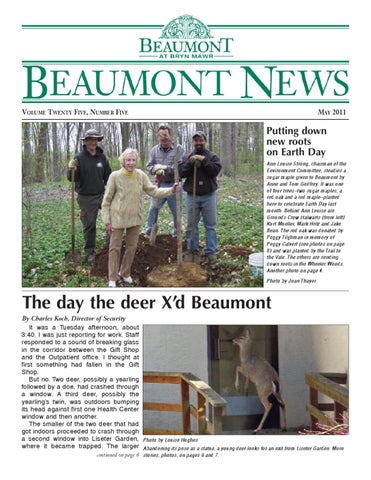
Putting down new roots on Earth Day Ann Louise Strong, chairman of the Environment Committee, steadies a sugar maple given to Beaumont by Anne and Tom Godfrey. It was one of four trees–two sugar maples, a red oak and a red maple–planted here to celebrate Earth Day last month. Behind Ann Louise are Grounds Crew stalwarts (from left) Kurt Mueller, Mark Hritz and Jake Bean. The red oak was donated by Peggy Tilghman in memory of Peggy Calvert (see photos on page 8) and was planted by the Trail to the Vale. The others are sending down roots in the Wheeler Woods. Another photo on page 4. Photo by Joan Thayer
The day the deer X’d Beaumont By Charles Koch, Director of Security It was a Tuesday afternoon, about 3:40. I was just reporting for work. Staff responded to a sound of breaking glass in the corridor between the Gift Shop and the Outpatient office. I thought at first something had fallen in the Gift Shop. But no. Two deer, possibly a yearling followed by a doe, had crashed through a window. A third deer, possibly the yearling’s twin, was outdoors bumping its head against first one Health Center window and then another. The smaller of the two deer that had got indoors proceeded to crash through a second window into Liseter Garden, Photo by Louise Hughes where it became trapped. The larger Abandoning its pose as a statue, a young deer looks for an exit from Liseter Garden. More continued on page 6 stories, photos, on pages 6 and 7.
DEAR EDITOR: I was interested to read the fine article in the March Beaumont News about the choice of acanthus leaves as Beaumont’s new logo. While fond of our old tree and bridge, I also admire the Greco-Roman use of acanthus leaves, and agree that Beaumont is appropriately bedecked with them. However, I have to take exception to one statement in the article concerning the Corinthian capital. This order, whether Greek or Roman, does not traditionally use the “deeply incised egg-and-dart” motif (symbolizing life and death), and there is nary an egg nor a dart in the capital illustrated. The egg-and-dart design appears in capitals in the Ionic order, both Greek and Roman, and in the Roman Composite order; in both orders it creates a straight horizontal band flanked by scrolled ram’s horn terminals. In the Ionic this stands alone; in the Composite it perches on top of Corinthian-style leafage, like an extra hat (the Romans always were a little over the top).
That’s not to say that tastemakers over the ages haven’t inserted the egg-anddart motif wherever they felt like it. I’ve seen it used in fireplace surrounds (Mt. Pleasant in Fairmount Park) and notably in the cornice of the main hallway at Independence Hall, the Pennsylvania Roman Composite capital State House, which is otherwise pure Doric. Obviously, local 18th Century politicians made their own rules. If you want to see a good example of Ionic egg-anddart and ram’s horns at Beaumont, take a peek out the hall window across from the bank. On the opposite wall are four stone pilasters whose capitals display it all. —Joan Roberts
DEAR EDITOR: Has the whole world gone nuts? What’s the score here? “Oil-eating bacteria to clean up oil spills”? “Scientists find microbes that eat garbage and excrete crude oil”? Your dollars and mine are supporting scientists for research (or what appears to be research) to develop bacteria to destroy and create crude oil. These are two opposing functions of single-celled organisms, which through the science of genetic modification are being created with apparently little thought given to outcomes. In the meantime, the opportunities for Beaumont are limitless. Think about it!
With the help of taxpayers’ money, Beaumont can clear 20 acres of forest and cover the area with windmills beneath which can be a panacea of solar panels. And with the help of genetically modified bacteria that will eat Beaumont’s garbage and poop crude oil, in 2,000 years Beaumont will have the potential of being completely energy independent. That is, assuming that the super-volcano in Yellowstone does not erupt to obliterate the sun, which is needed for electricity to operate the digesting plant that will produce the oil necessary to run an auxiliary generator in the event of no wind and total darkness. While we are at it, some gene splitter should be thinking about humans who can assimilate volcanic ash, in the dark. —Dean Snyder
Letters to the Editor:
The News invites letters from readers, including non-residents. Letters will be published or not, in full or in part, at the discretion of the editors. Letter-writers are asked to please:
BEAUMONT NEWS The Beaumont News is published by the residents and staff of the Beaumont Retirement Community, 601 N. Ithan Avenue, Bryn Mawr, PA 19010
1. Confine subject matter to articles that have appeared in the News (past News issues are on file in the Library). 2. Keep letters under 300 words–the shorter the better.
Managing Editor
3. Sign your own name, though requests for anonymity in print may be honored.
Production Editor
E-mail letters to Mary Graff at graffs@msn.com (home) AND mgraff@beaumontretirement.com (office); hand in at front desk, or mail to Beaumont at 601 N. Ithan Ave., Bryn Mawr 19010. Letters need not be typed (though typing is appreciated), but please write as legibly as possible and include your phone number (for the editors’ use only).
New Residents Editor
Editor Emeritus and Historian Photo Editor Events Manager Proofreader Circulation Manager
2
Mary Graff Christine Johnson-Hall Louise Guthrie Jean Kirk Louise Hughes Kim Norrett Jennie Frankel Barbara O’Brien
Reading A.A. Milne in the Health Center By Rena Burstein
fun to read, easy to understand, properly rhymed and down-to-earth even when referring to imaginary royalty or talking animals or talking furniture. Mrs. M, the resident, and I developed favorites which we read over and over many times. One afternoon, while I was carrying “When We Were Very Young,” I stopped to see Mrs. B, another resident I frequently visited, who immediately asked, “What are you carrying under your arm?” My explanation was followed by another poetry reading, to my joy. Beaumont’s library expanded its poetry shelf and I found a collection of 365 poems, one for each day of the year. Among the few poems deemed appropriate after eliminating the doom-and-gloom ones, the wildly experimental ones and the ones with unpronounceable vocabulary, my listeners and I enjoyed some mildly experimental haiku poetry, which can be read repeatedly at one sitting, experiencing the music of the words. Conversation was enhanced by the poetry readings. Mrs. M often referred to memories that were cropping up and that, in turn, brought some of my own long-forgotten memories to surface for us to share. AND I was learning to enjoy and appreciate poetry in ways I had not experienced before. We are now moving on to a 650-page volume of “Masterpieces of American Poetry,” edited by Mark Van Doren, which I happened upon in the Beaumont library after Mrs. M expressed a fondness for Henry Wadsworth Longfellow. We have tried T.S. Eliot’s “Old Possum’s Book of Practical Cats.” Yet to be explored are Walt Whitman, Robert Frost and Emily Dickinson, among others, as my education proceeds and my embrace of poetry becomes increasingly hearty.
I go to the Health Center to visit with some of the long-term residents. When I spoke to Jenny Hadfield, the Recreational Therapist there, about becoming a volunteer visitor, she suggested several residents who might welcome such visits. Then she added that one resident particularly enjoyed poetry, and she offered to lend me a volume of short poems she happened to have in her office. The borrowed book made a good start, but I soon ran out of poems I felt comfortable reading aloud and began looking for other sources. My own spare collection had very little to offer, mainly because I had never developed a fondness for poetry (possibly due to my impatience with the time it takes to understand and appreciate it), and the Beaumont library at that time was similarly under-stocked. On my husband’s bookshelf I found a beat-up paperback copy of Grooks, by Piet Hein, published by the MIT Press in 1966. Piet Hein was a Danish scientist, mathematician, designer, author and poet who, during the Nazi occupation of Denmark, created poems written in short, concise sentences which he named “grooks.” When he was in hiding as a resistance leader, “grooks” enabled Danes to talk to one another in a range just beyond German understanding and several octaves beyond Nazi sensitivities. This play of multiple meanings survives in later “grooks” as well. I enjoyed reading them aloud–multiple times–to my captive resident audience, who was pleasantly accepting. After a while I moved on to something a little more down-to-earth: “When We Were Very Young,” by A. A. Milne, a book of 44 poems dedicated to Milne’s son Christopher, first published in 1924. The poems were
Celebrating a milestone Beaumont President Joe Fortenbaugh surveys the surprise decorations staff members draped around his desk and office last month to mark his 60th birthday. Photo by Louise Hughes
3
Anne and Tom Godfrey plant a tree to mark Beaumont's Earth Day celebrations. They were among a team of residents and staff beautifying the grounds on April 22. Photo by Louise Hughes
End of life issues There are many questions to be discussed. Is it to be a traditional or a non-traditional service? Where is the service to be held? What songs, readings, hymns? Who should speak? Where do you want to be buried?
Practical steps to take now By Edward Madeira Esq. and the Rev. Ann Robb Smith Last month, in the first of the Health Care Committee’s five-part series on “End of Life Issues,” we recommended starting now to make some decisions in the fields we represent, law and religion. For the benefit of anyone who may have missed the program and our “To Do” lists, here is a summary: Meeting with your legal and estate-planning advisor is high on the list. You need not only to be sure that your will expresses your current wishes as to the disposition of your estate, but also to confirm your choice of executor. An in-depth discussion with your attorney can go a long way toward assuring an appropriate division of your estate and avoiding controversy and disputes among your heirs. Other information that can save your family much inconvenience includes the names of your accountant and your financial advisor and the location of valuable papers including deeds, birth certificates, veteran’s and insurance papers, and the like. Planning ahead for a funeral or memorial service will make things easier for the family when the time comes.
Decisions do not need to be made overnight. But advance planning gives us and our families time to reflect on the choices. Cremation? Since religious traditions vary, it is important to consult with a rabbi or a minister, for example, about the decisions to be made. It is also helpful to have a conversation with a funeral director. Decisions do not need to be made overnight. But advance planning gives us and our families time to reflect on the choices. Though many of us “really don’t want to talk about these things,” quiet conversations with our children and other relatives can help bring fear and denial about the end of life out of the dark and into the light of day. In so doing, such discussions can greatly ease our anxieties. The remaining sessions will take place May 4, 11 and 18 and June 1.
IN MEMORIAM
Louisa MacLaren Mirick, March 29, 2011 • T. Henry Dixon, March 30, 2011 Gordon V. Moyer, March 30, 2011 • Marian Struse Louderback, April 25, 2011 Members of the Beaumont Community extend deepest sympathy to their families and friends. 4
From newcomers to neighbors Her hobby is needlepoint. During the summer they will retreat to Milford House, a wilderness resort in Nova Scotia, John Hentz where John has Dee Hentz been going since childhood. John has two sons and they have a poodle named Katie.
New resident round-up By Jean Kirk Wistie and Binnie Miller are keeping family together by joining her brother, Jim Winsor, here at Beaumont. At the age of nine, Binnie moved to England with his parents when his father was invited to become Professor of Egyptology at Oxford University. They were there from 1938 to 1952, living through the London Blitz, which, as a teen-ager, Binnie found more exciting than terrifying. He served in the U.S. Army of Occupation in Germany, and studied history at Trinity Dublin in Ireland on the G.I. Bill. He then returned to the States and joined the Insurance Company of North America. Wistie grew up in this area, attended Agnes Irwin, and graduated from Miss Porter’s and Briarcliff. Her fondest memories are of unusual Wistie Miller travels during summers off when teaching at Irwin and Episcopal Academy, when she and a fellow teacher took a tramp steamer down the Amazon, crossed Lake Titicaca in a straw boat, and met the Royal Family of Thailand, all before she was 22. Wistie has long been a volunteer for the Philadelphia Orchestra, and Binnie Miller she and Binnie have traveled with the orchestra on some of their tours. They are collectors of folk art, specifically Ukrainian Easter eggs, and Wistie is collaborating on a children’s book she hopes to have published. They have two sons, one in California and one in upstate New York. *
*
*
*
*
George and Norma Fabian have lived in the neighborhood for 34 years, but they have both come a long way. George escaped from Hungary in 1948 and came to New York, where he spent four anxious days on Ellis Island before he was granted entry by the famous Judge Harold R. Medina. George’s parents did not get out of Hungary until the 1956 Revolution. He graduated from Columbia University, working his way through. He then got a Master’s Degree from the University of Chicago in Market Research and Strategic Planning. George is in the Market Research Hall of Fame. Norma was born in Edinburgh, Scotland. She was educated mostly in boarding schools and was studying to be a Children’s Nurse. When a friend offered to sponsor her, she decided to come to New York. She went to work in an ad agency, where she met George. They married and moved to Princeton when he went to work for Johnson & Johnson. Then George joined Chesebrough-Pond’s in Greenwich, Conn., and they moved to New Canaan. He later joined the Campbell Soup Company and they moved to Philadelphia. Norma worked in the Bryn Mawr College Admissions office for 22 years, and she has volunteered at the Animal Rescue Society. They both enjoyed tennis–Norma still plays–and skiing. She also enjoys gardening and cooking. George has a special interest in wines, and an extensive collection. He is now a member of the Wine Committee. The Fabians have traveled extensively to all parts of the world. They have two children and two grandchildren, and a well-mannered yellow labCorgi mix named Eloise.
*
Dee Hentz became acquainted with Beaumont when her mother was living here. She grew up in New Jersey, graduated from Centenary Junior College and was drawn to New York City, where she had a career as a Powers Model for 20 years. She met John Hentz on a blind date. They married and settled in Berwyn. John grew up in this area, graduated from Episcopal Academy and Wesleyan University and spent two years in the Army Counter Intelligence in Germany. He was a champion squash player. He and Diehl Mateer were National Doubles Squash Champions for four years. John worked in sales and marketing for Xerox. Dee worked in retail at Blums.
George Fabian
5
Norma Fabian
Why did they do it? By Mary Graff
Even well-informed sources differ in their opinions as to why a deer (or two or three) would want to break into Beaumont. Some, like Paul Conboy in Maintenance, an outdoorsman and known source of woodsy lore, suggested they might have been spooked–by a car, perhaps, or an aggressive male deer. Catching an inviting glimpse of the Liseter Garden through windows facing on the front driveway, this theory goes, they failed to notice the intervening glass until it was breaking around them. Dr. Dean Snyder, our resident veterinarian, had this to say: “In the spring a mother deer, heavily in calf, instinctively knows that her present offspring must be weaned. To protect her coming newborn’s first milk (colostrum), it is essential that she stop lactating far enough in advance of giving birth to allow her body to accumulate the antibodies resulting from her contacts with life-threatening organisms. “In deer the act of weaning is very abrupt and cruel. The nursing yearling, harshly rejected and never having prepared for this event, is often confused and likely to behave unpredictably in a manner demonstrated by the youngster who crashed through two windows at Beaumont to gain access to an area she envisioned as an oasis to comfort her in a time of despair. “One should dismiss her poor judgment and consider it as a part of her growing up, and hope she wises
up enough to live to become a mother herself and not another road kill.” Shortly after writing that opinion for the News, Dr. Snyder wrote again with a mea culpa for having
Deer at Beaumont . . . .
Services, drawing on her experience with horses, that deer finally left through the loading dock door. I followed the deer that had stayed outdoors until it ran into the sliding door of the Health Center dining room, fell, and then got up and ran off. The two deer that got in had left a trail of shattered glass and tufts from their coats, still thick though already shedding with the approach of warm weather. Housekeeping Director Brock Nichols and his staff, with the help of Paul Conboy and others from Maintenance, had the clumps of hair swept and vacuumed up, the glass removed and temporary windows installed, before most residents knew what had happened.
Two weeks later Dr. Snyder found and inspected the body of a young male deer in Wheeler Woods. implied that “only a female would react so irrationally to rejection and commit such an act unbecoming to a deer.” (Without closer inspection than was possible during the break-in, no one could have determined for sure the sex of any of the three, though they were generally assumed to be a doe and twin offspring.) “Oh,” Dr. Snyder confessed, “how wrong could I have been!” Dr. Snyder said that “almost two weeks to the day” following the break-in he had found and inspected the body of a young male deer in Wheeler Woods, possibly one of the twins, dead “from what must have been a hit-and-run accident on Ithan Avenue.” “Like it or not,” Dr. Snyder concluded, “the young buck died from stupidity. Please God forgive me for being a sexist. Girls are smarter than that!”
continued from page 1
one headed down the corridor past Outpatient, past the Beauty Shop and Classroom, and into the Recreational Therapy office, where it turned and backtracked toward the Health Center. It then made a right toward Physical Therapy, where it jumped out through a window, knocking out the frame and all without breaking the glass. The deer trapped in Liseter Garden had nowhere to go. At one point it froze so successfully, Trip Coordinator Jeanie Kim thought it was a new statue. Paul Conboy from Maintenance tried to get behind the frightened animal to try to steer it toward the door leading to the loading dock. (“I was mainly trying to protect the Mansion windows,” he said later. “The windows the two deer had already broken could be replaced fairly easily, but those Mansion windows on the other side of the garden are hand-crafted!”) After many attempts and help from staff members including Linda Lemisch, Vice President of Health
Corroborative identification of the three deer as a doe and twin yearlings came from Dr. Don Trachtenberg, whose villa backs into the Wheeler Woods. An enthusiastic observer and photographer of wildlife at Beaumont, he said he first noticed the threesome about a year ago, presumably soon after the birth of the twins, and is pretty sure they were the same as the three involved in the break-in. 6
As they remember it . . . Deron Dixon from Dining remembers that he was in the break room when Robert Foster, one of the cooks, ran in calling out, “Am I dreaming, or did I just see a deer?” “Everyone laughed, but I was curious, so I went out and toward Jenny Hadfield’s Recreational Therapy office. As I was walking in, the deer was coming out. As soon as we saw each other, I high-tailed back to the break room!” April Miszler, at the Front Desk, heard the smashing of glass and Vice President Linda Lemisch shouting “Close the doors! Close the doors!” April stayed at her post, Photo by Louise Hughes “preparing to hide After the cleanup, the Front Office helpfully marked the spot. under the desk.” “It all happened so fast,” recalled Kim Norrett, have remembered to go get it.” Louise Hughes, Marketing Assistant and chief whose Resident Services office gave her a fine view of Beaumont News photographer, did have her the action, “if I’d had my camera, I don’t know if I would camera–and also the presence of mind to take the pictures
As I was walking in, the deer was coming out. As soon as we saw each other, I high-tailed back to the break room! here and on page 1. “It was exciting, I’ll tell you that,” she said. Beaumont President Joe Fortenbaugh was in a meeting, discussing Beaumont’s plans for wireless computing, and missed it all.
CORRECTION: A story in the April News misstated the age of Sunshine, the Beaumont cat now living with Kathy Hesington. She will be 17 this month.
Photo by Louise Hughes Panicked young deer struggles to find a way out of Liseter Garden.
7
Celebrating an artist When Peggy Calvert died, on March 19, she was known at Beaumont not only as a friend and neighbor, widow of Admiral Jim Calvert, but also as the established painter whose work had been on display in the Beaumont Room for several weeks. The picture of her at right was taken on the show’s opening day; the painting, “Boat at Rest,” was chosen by her son John Battle (who took the pictures) as “the most magical.” She was honored here last month by the planting of a red oak, donated by Peggy Tilghman, on Earth Day.
The deadline for the June 2011 issue of the Beaumont News will be May 11. Please sign your story and either turn it in at the front desk or better, if you can, e-mail it to Mary Graff at graffs@msn.com. Please keep a copy for yourself! For back issues, please go to our website, www.BeaumontRetirement.com 8