Testing the Tools By Ross Isbell, DMD, MBA
Buffer the Pain Away
The Softer Side of Hemostasis
BufferPro™ Premier® premierdentalco.com
Ceramic Soft Tissue Trimmer Eagle Dental eagle-dental-burs.com
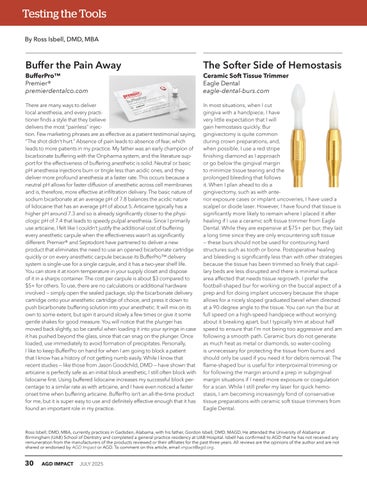
There are many ways to deliver local anesthesia, and every practitioner finds a style that they believe delivers the most “painless” injection. Few marketing phrases are as effective as a patient testimonial saying, “The shot didn’t hurt.” Absence of pain leads to absence of fear, which leads to more patients in my practice. My father was an early champion of bicarbonate buffering with the Onpharma system, and the literature support for the effectiveness of buffering anesthetic is solid. Neutral or basic pH anesthesia injections burn or tingle less than acidic ones, and they deliver more profound anesthesia at a faster rate. This occurs because a neutral pH allows for faster diffusion of anesthetic across cell membranes and is, therefore, more effective at infiltration delivery. The basic nature of sodium bicarbonate at an average pH of 7.8 balances the acidic nature of lidocaine that has an average pH of about 5. Articaine typically has a higher pH around 7.3 and so is already significantly closer to the physiologic pH of 7.4 that leads to speedy pulpal anesthesia. Since I primarily use articaine, I felt like I couldn’t justify the additional cost of buffering every anesthetic carpule when the effectiveness wasn’t as significantly different. Premier® and Septodont have partnered to deliver a new product that eliminates the need to use an opened bicarbonate cartridge quickly or on every anesthetic carpule because its BufferPro™ delivery system is single-use for a single carpule, and it has a two-year shelf life. You can store it at room temperature in your supply closet and dispose of it in a sharps container. The cost per carpule is about $3 compared to $5+ for others. To use, there are no calculations or additional hardware involved — simply open the sealed package, slip the bicarbonate delivery cartridge onto your anesthetic cartridge of choice, and press it down to push bicarbonate buffering solution into your anesthetic. It will mix on its own to some extent, but spin it around slowly a few times or give it some gentle shakes for good measure. You will notice that the plunger has moved back slightly, so be careful when loading it into your syringe in case it has pushed beyond the glass, since that can snag on the plunger. Once loaded, use immediately to avoid formation of precipitates. Personally, I like to keep BufferPro on hand for when I am going to block a patient that I know has a history of not getting numb easily. While I know that recent studies — like those from Jason Goodchild, DMD — have shown that articaine is perfectly safe as an initial block anesthetic, I still often block with lidocaine first. Using buffered lidocaine increases my successful block percentage to a similar rate as with articaine, and I have even noticed a faster onset time when buffering articaine. BufferPro isn’t an all-the-time product for me, but it is super easy to use and definitely effective enough that it has found an important role in my practice.
In most situations, when I cut gingiva with a handpiece, I have very little expectation that I will gain hemostasis quickly. Bur gingivectomy is quite common during crown preparations, and, when possible, I use a red stripe finishing diamond as I approach or go below the gingival margin to minimize tissue tearing and the prolonged bleeding that follows it. When I plan ahead to do a gingivectomy, such as with anterior exposure cases or implant uncoveries, I have used a scalpel or diode laser. However, I have found that tissue is significantly more likely to remain where I placed it after healing if I use a ceramic soft tissue trimmer from Eagle Dental. While they are expensive at $75+ per bur, they last a long time since they are only encountering soft tissue — these burs should not be used for contouring hard structures such as tooth or bone. Postoperative healing and bleeding is significantly less than with other strategies because the tissue has been trimmed so finely that capillary beds are less disrupted and there is minimal surface area affected that needs tissue regrowth. I prefer the football-shaped bur for working on the buccal aspect of a prep and for doing implant uncovery because the shape allows for a nicely sloped graduated bevel when directed at a 90-degree angle to the tissue. You can run the bur at full speed on a high-speed handpiece without worrying about it breaking apart, but I typically trim at about half speed to ensure that I’m not being too aggressive and am following a smooth path. Ceramic burs do not generate as much heat as metal or diamonds, so water-cooling is unnecessary for protecting the tissue from burns and should only be used if you need it for debris removal. The flame-shaped bur is useful for interproximal trimming or for following the margin around a prep in subgingival margin situations if I need more exposure or coagulation for a scan. While I still prefer my laser for quick hemostasis, I am becoming increasingly fond of conservative tissue preparations with ceramic soft tissue trimmers from Eagle Dental.
Ross Isbell, DMD, MBA, currently practices in Gadsden, Alabama, with his father, Gordon Isbell, DMD, MAGD. He attended the University of Alabama at Birmingham (UAB) School of Dentistry and completed a general practice residency at UAB Hospital. Isbell has confirmed to AGD that he has not received any remuneration from the manufacturers of the products reviewed or their affiliates for the past three years. All reviews are the opinions of the author and are not shared or endorsed by AGD Impact or AGD. To comment on this article, email impact@agd.org.
30
AGD IMPACT
JULY 2025