16 minute read
STRAIGHT TALK

Columns STRAIGHT TALK
Joe Marconi
Factors to consider before changing how much you bill you customers
Increasing prices is a hot topic these days among shop owners. The general feeling is that automotive repair shops have been undercharging what they’re worth for their services and repairs, making it difficult for shops to reinvest in their companies, maintain profitability, attract quality people, and pay their employees a decent wage. Surging inflation also factors into this discussion.
To complicate matters, many shop owners would like to increase their labor rates but feel that they can’t, claiming that an increase in their labor rate results in losing customers. So, the question is: Can auto repair shops simply raise their prices; is it really that easy? The answer is not as straightforward as some may think.
Some shop owners have done the math and set their prices according to what they determine is needed to earn a reasonable profit. However, these shop owners also know it takes more than just understanding their numbers. They identify and understand their ideal customer. They know that not everyone will become their customer, and they don’t worry about what other shops around them are charging. They price their services and repairs consistent with their business model.
As a former shop owner for over 40 years, I feel as an industry we have not been charging enough for the work we do. However, I am not a fan of raising prices without examining the issues. All boats don’t necessarily rise with the tide. Some boats may capsize. Establishing prices is a delicate balance between profitability and remaining competitive in your market. Although many repair shops may fall under the same umbrella with regard to what they do, pricing is not an arbitrary determination.
Every shop owner must do their homework, crunch their numbers, and set their prices accordingly. Shop owners must also consider the value they bring to their customer base. They need to consider the services and repairs they perform, which align with their business model. This means you cannot be everything to everyone. Maintaining productivity and efficiency is also critical to ensuring profitability. Your prices tell the story of your brand. I like to see it tell the story of quality, value, efficiency, and excellence.
Operating and owning a repair shop isn’t all about making a profit, but profit is needed for long-term success. Profit is required to provide for your family and allows you to pay wages that make your employees feel secure about providing for their families. Profit also enables you to reinvest in your company, which means you can continue to provide the best services and repairs for your customers.
As I mentioned earlier, pricing your services and repairs is a balancing act between being competitive and profitable. Ultimately, the customer determines if your prices are reasonable. If your customers don’t see the value in your services and repairs, they’ll be reluctant to pay your prices, whether or not you feel those prices are justified.
Another thing to consider is that labor rates and pricing differ by geographical area and business model. A shop that does highly technical work— specializing in Mercedes, Maserati, and Porsche—is different from a shop that performs basic service work on Asian and domestic vehicles. Different business models dictate different price structures.
Joe Marconi Joe Marconi has more than four decades of experience in the automotive repair industry. He is the former owner of Osceola Garage in Baldwin Place, N.Y., a business development coach for Elite Worldwide, and co-founder of
autoshopowner.com.
Reach him at
j.marconi@eliteworldwide.com
Lastly, if you fear you may lose customers by raising your prices, you’re not alone. However, what you charge may make the difference between success and financial failure. Understand your business model, then establish services and repairs that align with your model and the value you deliver to your customers.
Remember that not everyone in your market will become your customer. After doing your homework, you’ll know your ideal customer, establish the services and repairs you’ll offer, and determine your required profit margins. If a price increase is required, then only you should make that final decision.
KEEPIN’ IT RURAL
How small-town shops off the beaten path are prospering by staying true to their markets
BY CHRIS JONES
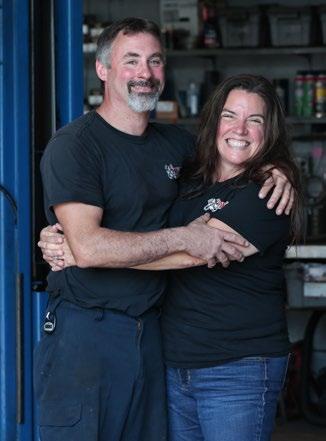
Hometown Hospitable
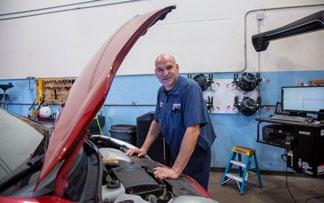
Mike and Jennifer Mikulski of Mike’s Auto Service LLC aim to grow and change with the industry while continuing to provide a personable small-town shop feel. Haddam, Connecticut, which rests on the Connecticut River, is an isolated but well-preserved town off the beaten path between Hartford—the state capital—and Long Island Sound, which runs along The Constitution State’s coast. Known for its wealth and regarded as one of the best places to live in Connecticut, Haddam, population 8,452, is also home to Mike’s Auto Service LLC.
A second-generation mechanic, Mike Mikulski grew up a shop kid “with a wrench in his hand,” tagging alongside his father. The pair opened Mike’s Auto Service together in 2004.
“He grew up in it; immersed in it completely and has never had another career,” says Jennifer Mikulsi, who has co-owned the shop since 2017 with her husband following her father-in-law’s retirement.
The shop, which sits on a little more than a half-acre, used to be a video store and could still be easily mistaken for such today if they existed. But that’s the Connecticut aesthetic. Even shops have to fit the cosmetic expectation of the uppermiddle-class communities they service.
Neatly tucked to the left of the shop are its three bays where Mike, Jennifer, and their team work on cars from 7 a.m. to 5 p.m. Monday through Thursday.
“My husband is a technician and we have another full-time technician. We have an apprentice from the apprenticeship program through the NAPA Auto Care Benefits. We’ve recently added a service advisor, and I do service writing as well,” Mikulski says.
‘Old-School Vibe with a Modern Touch’
When some people imagine rural shops, they envision mechanics who look like Cooter Davenport, the jovial grease monkey in a sleeveless work shirt, dirty blue jeans, and a worn trucker cap from the late ‘70s/early ‘80s television show “The Dukes of Hazzard.” While that aesthetic doesn’t match the Mikulski’s, the friendly, good-natured spirit of the Ben Jones character does.
“We’re trying to evolve with the times, but we are still maintaining that mom-andpop mentality. We have customers who come in, just to say, ‘Hi.’ They’re not coming in to get their vehicle work done. They’ll stop in and bring us cookies. The old retired guys in town will stop by [to talk to Mike]. It has that old-school vibe, but with a modernized touch,” Mikulski says.
PHOTO BY LINDSAY VIGUE
Big Fish, Small Pond
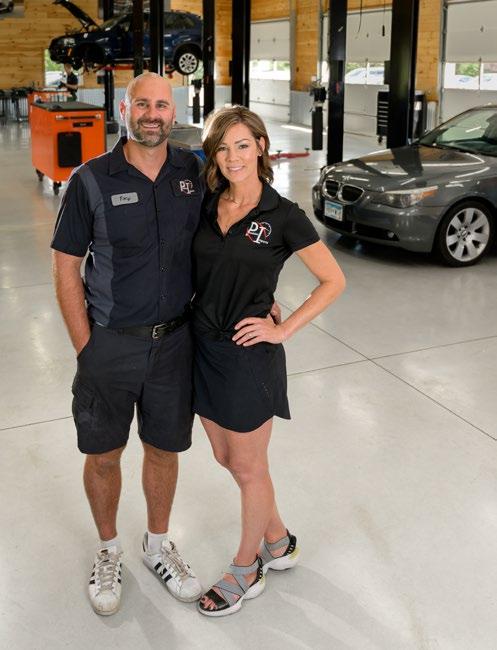
Tony and Jennifer Ringham have benefitted from being a specialty shop in rural area. Precision Imports gets referrals from other shops who choose not to work on imports.
Evolving times has a “new normal” connotation to it. For small shops like Mike’s Auto Service, changing times have the shop learning to handle the expectations of its most loyal customers and those of new customers.
“In the minds of locals, we’re an available resource at all times, which is a blessing and a curse. Everyone expects us to attend to their needs immediately. So, you have to learn to manage that level of service when there are not many other reputable options close by. It’s very convenient for them to say, ‘Let’s stop by and see if Mike and Jen can help out with our problems today,’” Mikulski says.
On the other side of the coin, an influx of customers accustomed to commuting into the cities to work are beginning to show up with their vehicles.
“We have new customers driving a lot of European, higher-end cars that make their way to us, and typically these people are commuters at work in Hartford. They’re having their Land Rover serviced at the dealership, and we’re finding more and more of that type of customer starting to leave the dealership environment and seek us out. I think they’re looking for that one-on-one feeling of community that they’re not getting from these dealerships,” she says.
Learning to Shift Paradigms
The reality that COVID could have a profound effect on the business jolted the Mikulskis. The couple scrambled to make adjustments to keep their business viable not knowing if or when people would have a need for auto repair during statewide restriction periods.
“We panicked at first like anyone else would have with the unknown impact that it was going to have. We tapped into social media and word of mouth, adjusted our business a bit, and started servicing our customers by offering a pickup and delivery service for their vehicles so that no one would have to leave their home,” she says.
It wasn’t long before she realized the industry was relatively pandemic proof.
“I felt that so many people were relying on their vehicles just to take a drive that our business segment didn’t take as large of a hit as other business segments did. People wanted access to their cars. They wanted to be able to travel with their families in a contained environment,” Mikulski says, recalling the time as one of her business’s most profitable.
She says supply chain issues have affected the shop most, causing her to change how the shop orders parts from vendors due to the unpredictability of shipment and arrival. The disruption within the supply chain meant something as common as brakes, which could be delivered within a half-hour from a parts supplier, could take two or more days to arrive, or force the shop to seek out alternative suppliers.
“We adjusted our mindset from ordering parts on an as-needed basis. It caused us to shift to a more proactive approach, as much as possible, to ordering and sourcing parts ahead of planned appointments so we weren’t caught stranding a customer,” she says.
Best Foot Forward
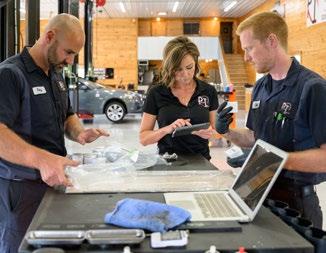
The Ringhams’ 4,000-square-foot shop is every bit as pristine and premium as the vehicles they service, which is by design.
Coming to Terms with Technology
One of the lessons from the pandemic and the growth spurt was the need to improve the shop’s marketing efforts online. With customers hearing about their shop from surrounding areas, Mikulski realized it was time to take advantage of technology to grow the business.
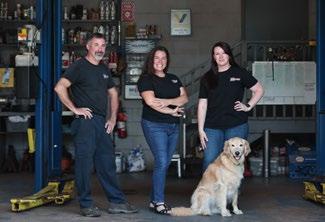
Keep ‘Em Movin’
The Mikulskis drum up substantial business from local residents who commute into New Haven for work. They take pride in keeping people on the road.
“We’ve just recently created a website for ourselves, and when I mean just, I’m talking [early spring 2022]. Social media was our primary. That’s our small town—Facebook groups and whatnot. That’s where I focused on. Now, I’m starting to evolve more into having our own website where I can have people start booking appointments. You know, automated,” she says, highlighting the limited resources of being a small shop as a factor in the shop’s previous lack of marketing.
Mikulsi, who handles the marketing, bookkeeping, service writing, and human resources, is now dipping her toe into shop management software, which has leveled the playing field making customer service and marketing easier and more fluid for small shops.
“Entering information is a click of a button. That’s allowing us to look at ways to fine-tune and improve our business, which is helping us get to the stage where we can start evolving with technology as we get ready for the future of automotive repair and what it will be in the next 10 to 15 years,” she says.
Within that same timeline, as Mike’s Auto Service gets up to speed with technology and stays in step with the growing number of cars they’re servicing, they face another technological event horizon—electrification. As we inch closer to what’s been called the electric future, affordability of EVs won’t be the issue for Haddam’s well-to-do residents—reluctance will be. Residents’ attitudes about electric vehicles could buy the Mikulsi’s precious time to get up to speed. It’s a challenge they’re now up to solving.
“I would say we’re not prepared for it, but it’s definitely on our minds. We have several customers with Teslas and tons of hybrids. It’s something that can’t be ignored,” Mikulski says. “We are forwardthinking … but I would consider us behind the curve a bit. But we’re going to have to make accommodations for it to service the clientele that requires it and to ensure a solid future for business long term.”
‘We’re Kind of a Destination Shop’
Precision Imports by all appearances is an outlier. Not only is it an import auto repair shop in a tiny Minnesota town— Milaca has 2,894 residents—but it yields an annual revenue of over $1.2 million a year. And that’s not by accident.
Tony and Jennifer Ringham, who grew up in Milaca, have successfully used their familiarity, the shop’s rural location, and lack of competition to their benefit.
“We’re located strategically between the Twin Cities and St. Cloud, which are bigger cities. I guess we’re kind of on a junction of two important arterial highways. There are a lot of your typical domestic repair shops in town— three or four of them—and we get along with all of them. But we were the only ones who did import cars. So, we get a ton of business from all of the other shops that don’t want to mess with those,” Tony says.
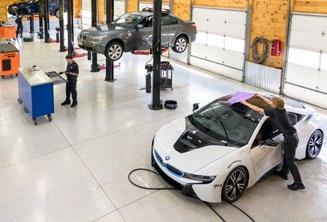
From its hobbyist beginning—Tony was selling real estate and flipping cars he purchased on Craigslist in his garage—Precision Imports has kept its down-to-earth, home-like garage feeling. After opening in 2006 with a three-car garage, the Ringhams have since built an HGTV-worthy, five-bay, 4,000-square-foot shop that looks more tech industry than auto industry.
“I always joked that for most of my life I’ve worked in the dark, the cold, and on the floor,” Tony says. “I hate that even nice shops are dark and dirty, and I didn’t want to work like that. So, we decided instead of doing white steel, which everyone does, we thought, Well, let’s do pine and silver steel instead. Then we did polished
white floors, which brightens it up a lot, and then lots of windows, solar tubes for sunlight, and air conditioning. Basically, it’s a house built for cars”
It’s that attention to detail and honoring the customer’s perceptions of what a premium European and Asian import shop should be that has import auto owners from St. Cloud and the Twin Cities heading to rural Milaca to get their cars repaired. The Ringhams data supports that claim. The shop has a 3:1 ratio on repeat to new customers and sees 1,560 cars annually. The couple credits automotive brand loyal customers—the “I only drive [insert foreign make here] cars types–word of mouth, and industry relationships to its success in a rural area.
“I think one of the advantages that we have is that people who drive German cars usually bought their car on purpose. They like their German cars. It’s not a daily necessity, like a Honda minivan,” says Jennifer. “I’ve been tracking for the last six weeks or so since we’ve been working with DRIVE, and 99 percent of the car referrals come from another shop who doesn’t want anything to do with a BMW or a Volkswagen. It’s a friend of a friend and even the bigger dealerships who will send us cars that come in on trade that they don’t want to fix.”
Not Shocked by Electrification
As European automakers race towards becoming all-electric, Tony’s conviction is that his business will thrive no matter what the future holds. He’s a gearhead focused on staying in front of emerging technologies that affect the industry and making sure his technicians do too. The pair have both owned electric cars, have a Level 2 charger at the shop, and are comfortable working with whatever the customer drives.
“We want to innovate and be prepared for that. We’ve owned electric cars ourselves—Teslas and BMW hybrids and electrics. If you watch the news, they say electric cars are coming and we’re going to wake up in a month and everything’s going to be electric. It’s going to be at least a decade, possibly two before these even reach 50 percent market saturation. So, even if everybody went out and bought electric cars tomorrow, which of course isn’t going to happen, we’ve still got a very large customer base out there that still is driving conventional gasoline or diesel cars,” he says.
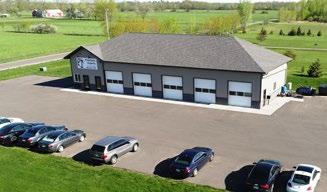
Built on Reputation
Precision Imports has become somwehat of a destination shop for European car enthusiasts who want top-flight repairs at an expert-level shop.
Discipline Begets Discipline
Until that day, Precision will focus on growth. Jennifer keeps her finger on the pulse of the shop’s goals and KPI on a weekly basis.
“We track our gross revenue. We track our car count every week. We track ARO. We also track our production hours and compare that to our technician’s clocked hours to get an efficiency rate. We track our labor cost and parts cost. And new customers, I look at our new customers every week,” Jennifer says.
She says the shop has done little to advertise beyond its Facebook page and website, and tips her hat to the shop’s customers who continually refer their friends and colleagues.
“We don’t do mailers; we don’t do coupons; we don’t do newspaper ads. I pretty much do nothing on the advertising side except for the billboard that is in Princeton we did that last year because we do see a fair number of cars on the highway that find us and say, ‘I didn’t even know you were here,” she says.
But as she’s gotten deeper into the data and seen how much greater the shop can become over time, she’s eager to put on the marketing hat.
“I know that this economy won’t last forever, right?” says Jennifer. “And I want to make sure to keep the car count up. We’ve been so lucky with cars constantly showing up that we really haven’t had to focus on marketing. So, that will be one of our next steps.”

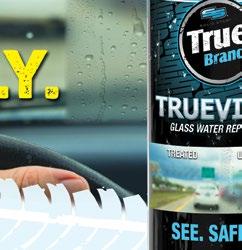
True Brand® TRUEVIEW™ GLASS WATER REPELLENT is engineered with TrueRepel Technology to create a super-slick invisible shield True Brand® TRUEVIEW™ GLASS WATER REPELLENT is engineered on glass surfaces that repels rain, sleet, and snow on contact and greatly improves wet weather visibility for a safer, clearer, and cleaner driving experience. Our TrueRepel Technology also aids in easy removal of ice, frost, salt, dirt, mud, and bugs. with TrueRepel Technology to create a super-slick invisible shield on glass surfaces that repels rain, sleet, and snow on contact and greatly improves wet weather visibility for a safer, clearer, and cleaner driving experience. Our TrueRepel Technology also aids in easy removal of ice, frost, salt, dirt, mud, and bugs.
• Greatly Enhances Visibility! • Greatly Enhances Visibility! • Repels Rain, Sleet, and Snow. • Repels Rain, Sleet, and Snow. • Helps Repel Ice, Frost, and Dirt. • Helps Repel Ice, Frost, and Dirt. • Fast and Easy Application. • Fast and Easy Application.
“Only if we understand can we care. Only if we care will we help.” - Jane Goodall Truth: “Only if we understand can we care. Only if we care will we help.” - Jane Goodall Truth: