
1 minute read
Workplace Inspections

10. STRETCHING AND MSI INJURY PREVENTION
An MSI (Musculoskeletal Injury) is an injury or disorder of the muscles, tendons, ligaments, joints, nerves, blood vessels or related soft tissue. They include sprains, strains, and inflammation that work related tasks may cause or aggravate. Hands, fingers, and wrists are susceptible to MSIs. To prevent sprains and strains from becoming debilitating injuries, supervisors and workers must be familiar with the risk factors and symptoms, along with controls and mitigations, of potential MSI’s.
Risk Factors
The risk factors that contribute to potential MSIs include: • Force: lifting / lowering, carrying, pushing, pulling, pinching or power gripping. Examples: holding a hammer, lifting a heavy box • Repetition: using the same muscles over and over without rest or recovery. Examples: turning a screwdriver, twisting with a pair of pliers • Awkward posture: any position where a body segment is angled outside the mid-point range of motion for that joint. Examples: installing plumbing or electrical fixtures in ceilings or cabinets • Contact stress: pressure from a hard or sharp object can damage nerves and tissues beneath skin. Examples: ridges / hard edges of hand tools pressing into hand, or sharp edges digging into wrists • Vibration Examples: power tools, vibration from hammer striking surfaces Often a task will expose workers to several risk factors, creating a cumulative effect and potential for injury not only to their hands or wrists but also to their arms and backs.
Controls and Mitigations
To reduce the potential for injury: • Identify and document risk factors in Job Hazard Assessments and Field Level Hazard Assessments • Implement controls to reduce the potential for injury Typical controls include using mechanical aids (screw gun instead of a screwdriver), reducing duration of work, having breaks, using ergonomically designed tools, and using specially designed gloves. Be aware that implementing controls to reduce one risk factor may expose workers to another. Try doing stretches at the start of each shift. Follow a series of hand stretches to lessen the likelihood of developing hand injuries from work. Warm Up (R, G, V): No holding positions.
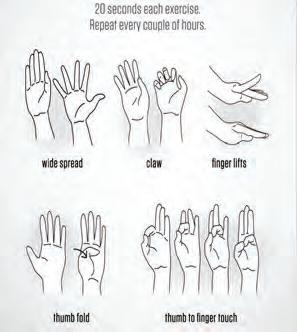
Repetitive Strain Injuries = R Excessive Gripping Injuries = G Vibration Oriented Injuries = V
