
6 minute read
INTERMEDIATE

NEXT STEPS
MASTER CHORD CHANGES
n my mind there is a massive difference between academic learning and practical application. You can sit and study as many scales as you like, but that doesn’t mean you can make music from them.
This is a problem that faces many developing bass players. More often than not, we find ourselves taught how to physically produce a scale rather than how to apply it.
Over the last few instalments of this page, we’ve been analyzing the construction of I7-IV7-V7 chord progressions, examining the relationships that exist within them and the melodic tools you need to interpret those changes—but most importantly, we’ve been investigating what to play and why to play it.
Let’s keep going with that approach!
EXERCISE ONE Phil Mann is a stage and session star and educator extraordinaire. Get ready to step up your bass game!
Georgia South of Nova Twins kicks up a bass storm
© Roberto Ricciuti/Redferns
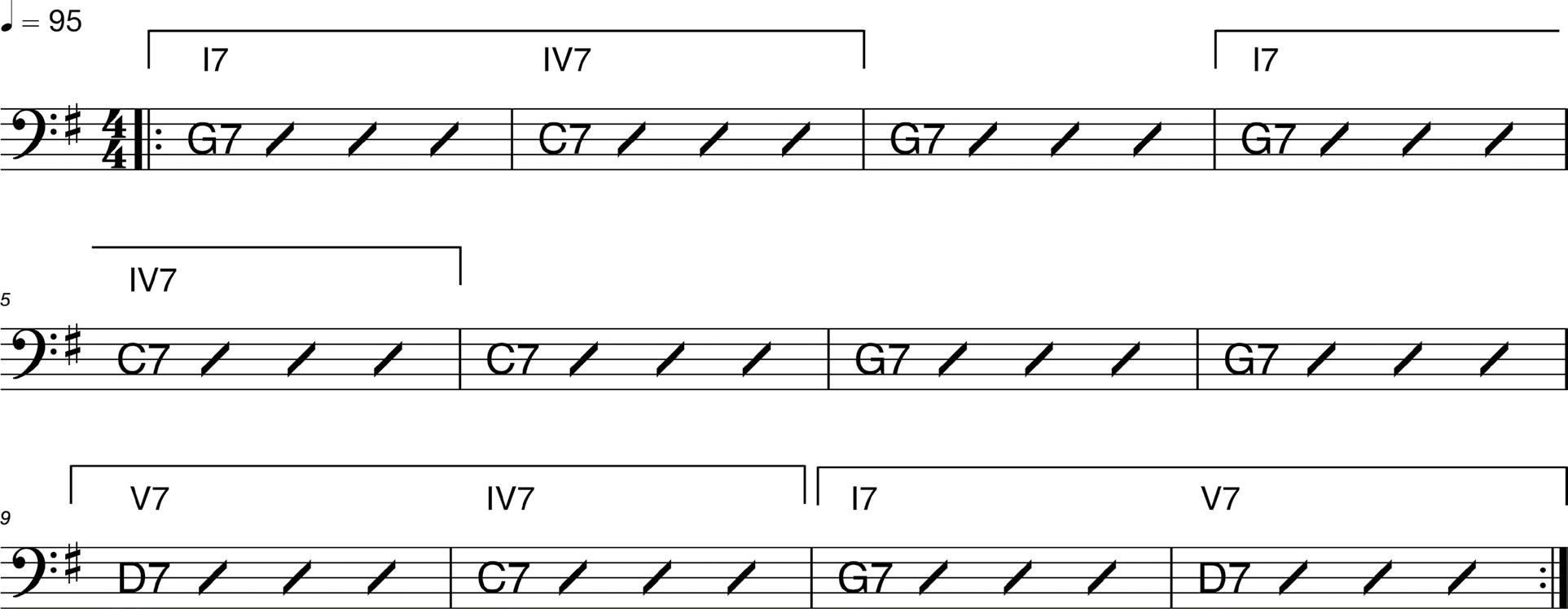
Let’s begin with a simple I7-IV7-V7 chord progression, delivered over 12 measures. The ‘volta brackets’ found above the stave highlight some of the relationships that we’ve already familiarized ourselves with. In the first two measures, they draw focus to the I7-IV7 ‘quick change’—see also measures four and five—and the V7-IV7 changes are reiterated in measures nine and 10, before we identify the half (or imperfect) cadence at the end of the progression in bars 11 and 12.
EXERCISE TWO

To help us become reacquainted with the last chord progression, Exercise 2 delivers a funky, Mixolydian-inspired motif in the key ofGmajor. Mixolydian is a wonderfully appropriate scale to use with dominant 7th chords, as it perfectly outlines the harmonic requirements of those structures. If you’re unfamiliar with the scale, the easiest way to interpret it is as a major scale with a flattened seventh degree. In the later measures, you’ll be required to play a number of sixteenth-note subdivisions. Although the permutations of four notes of equal value within a single beat are lengthy, for ease, the same rhythm has been used throughout the entire progression.
EXERCISE THREE
I7-IV7-V7 chord progressions are commonly associated with the harmonic portrayal of the blues. However, if you study them extensively, you’ll soon become aware of their use in an array of other styles, ranging from rock, funk, and R&B, to reggae. Given such anassortment of genres, you’ll encounter a number of variations to the rudimentary progression. Casting an eye over the opening measures of Exercise 3, you’ll find no real surprises. However, once you arrive at bar nine, you’ll discover a modification which identifies this chord progression as a jazz idiom. Bars nine and ten are usually associated with V7-IV7 movements, but in this example these measures have been revised to feature a IImin7-V7. This, plus the ensuing I7 chord, produces a II-V-I progression—a step towards creating a jazz blues.
EXERCISE FOUR




Exercise 4 revisits the melodic portrayal of the chord progression featured in Exercise 2. You’ll notice that the IImin7-V7 movement introduced in the last exercise has now become a staple of the ninth and tenth measures. To ease this alteration, the melodic motif employed in its portrayal uses the same rhythmic pattern as all of the other measures. Thankfully, the only additional diatonic information comes in the form of Dorian, a major mode commonly used to interpret IImin7th chords.
EXERCISE FIVE
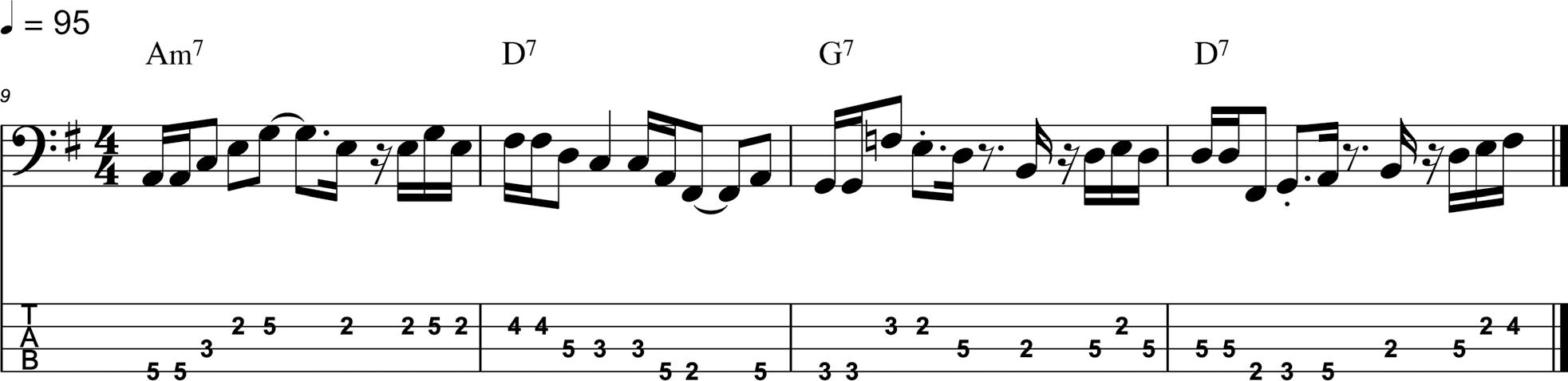
Exercise 5 now begins an investigation of the diatonic vocabulary associated with IImin7th—V7 chord progressions. Habitually, it’s verycommon to locate the root note of a chord with either the index or middle fingers of your fretting hand. However, by purposely employing alternative fingerings, it’s possible to unearth a wealth of inspirational melodic and articulation insights. For example, by employing your pinky to locate the root note of the IImin7 chord, it’s possible to deliver each interval of the associated minor triad onadifferent string, which greatly improves your comprehension of the entire structure. This approach has been employed throughoutthe following measures, which focus on the concluding four bars of the progression.
Adam Devonshire of Idles looks quizzical on stage in Seattle.

EXERCISE SIX
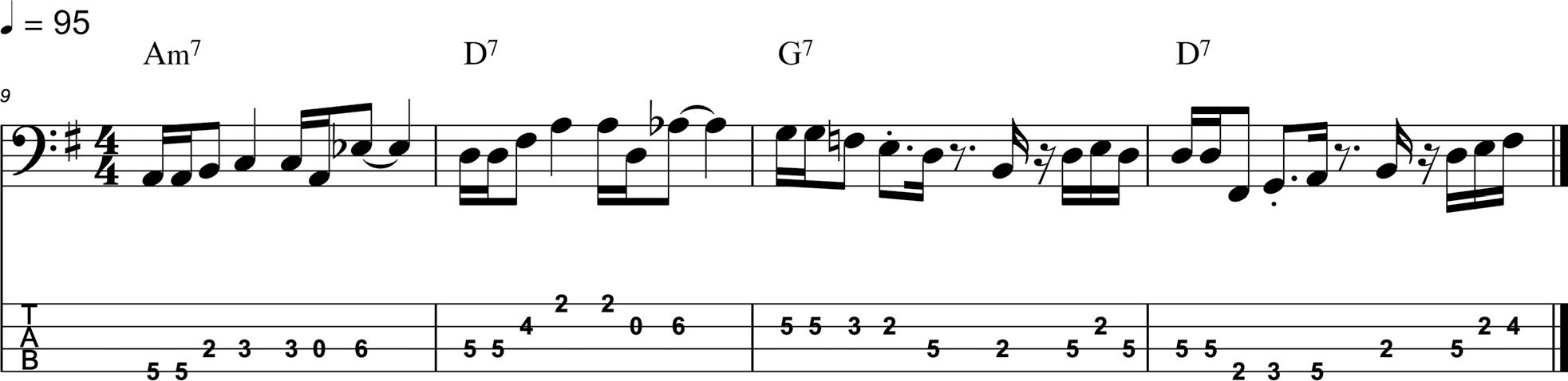
Chromaticism is a wonderful tool and can introduce some unexpected sonic textures. By its very nature, a lot of the desired tones are commonly located slightly out of position. This exercise investigates the application of the b5th interval over both the IImin7th and V7 chords. In both examples, try to cover frets two to five with the four fingers of your fretting hand, only moving out of position to deliver the aforementioned chromatic intervals with your pinky. You’ll find this movement easily achievable with the help of the open strings indicated in the tablature.
EXERCISE SEVEN
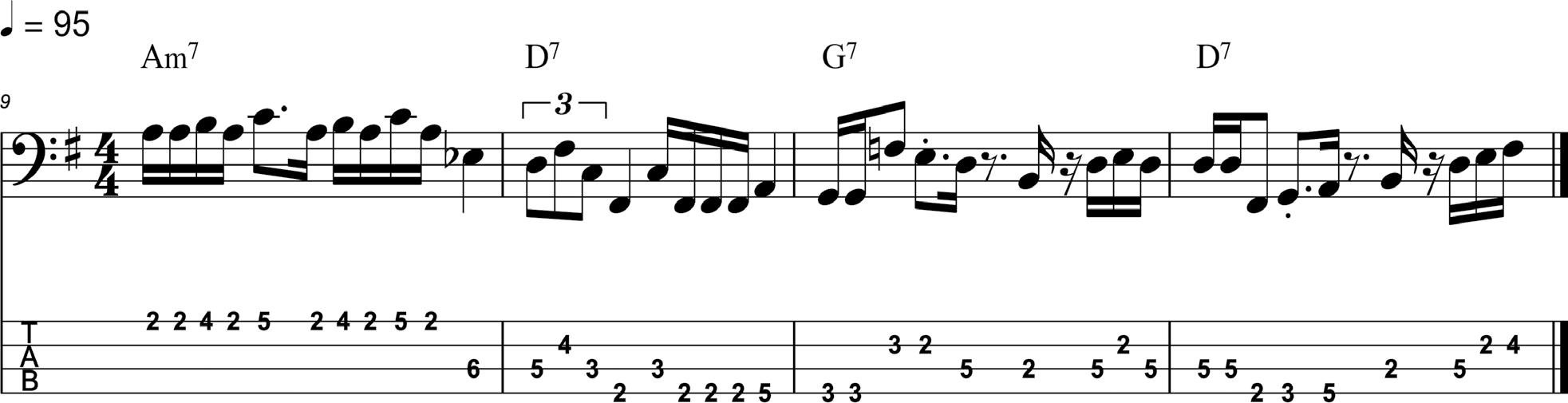
Let’s keep looking at our fretting-hand positioning. In this exercise, although the root note of the IImin7th chord has relocated to a higher register, the same approach of traversing your pinky by a semitone to reach the chromatic intervals has been retained from the last exercise. When attempting to interpret V7 chords, there are two essential melodic devices to be aware of: The first is the tritone between the 3rd and 5th intervals, and the second is a diminished triad, produced from the collation of the 3rd, 5th, and 7th intervals. This structure is a particularly dissonant sound that can be used to great effect.
EXERCISE EIGHT
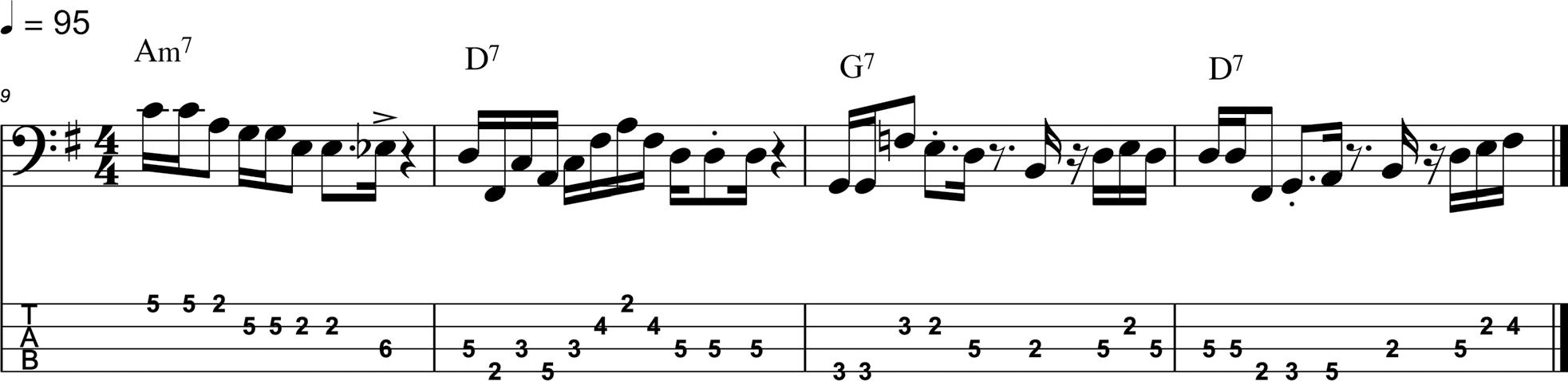
This month’s penultimate exercise is a good example of how fretting-hand positioning is essential to the efficient delivery of a motif. Although the fingering may initially seem a little odd, everything that you encounter over the Amin7th is about positioning your hand for the subsequent measures. When you arrive at the D7, you will be required to deliver a flurry of 16th notes: These have been devised using a fairly accessible diminished triad, as long as your hand is in position. If you can identify where the structure resides on your fretboard, you’ll find that the notes will land neatly under your fingertips.
EXERCISE NINE
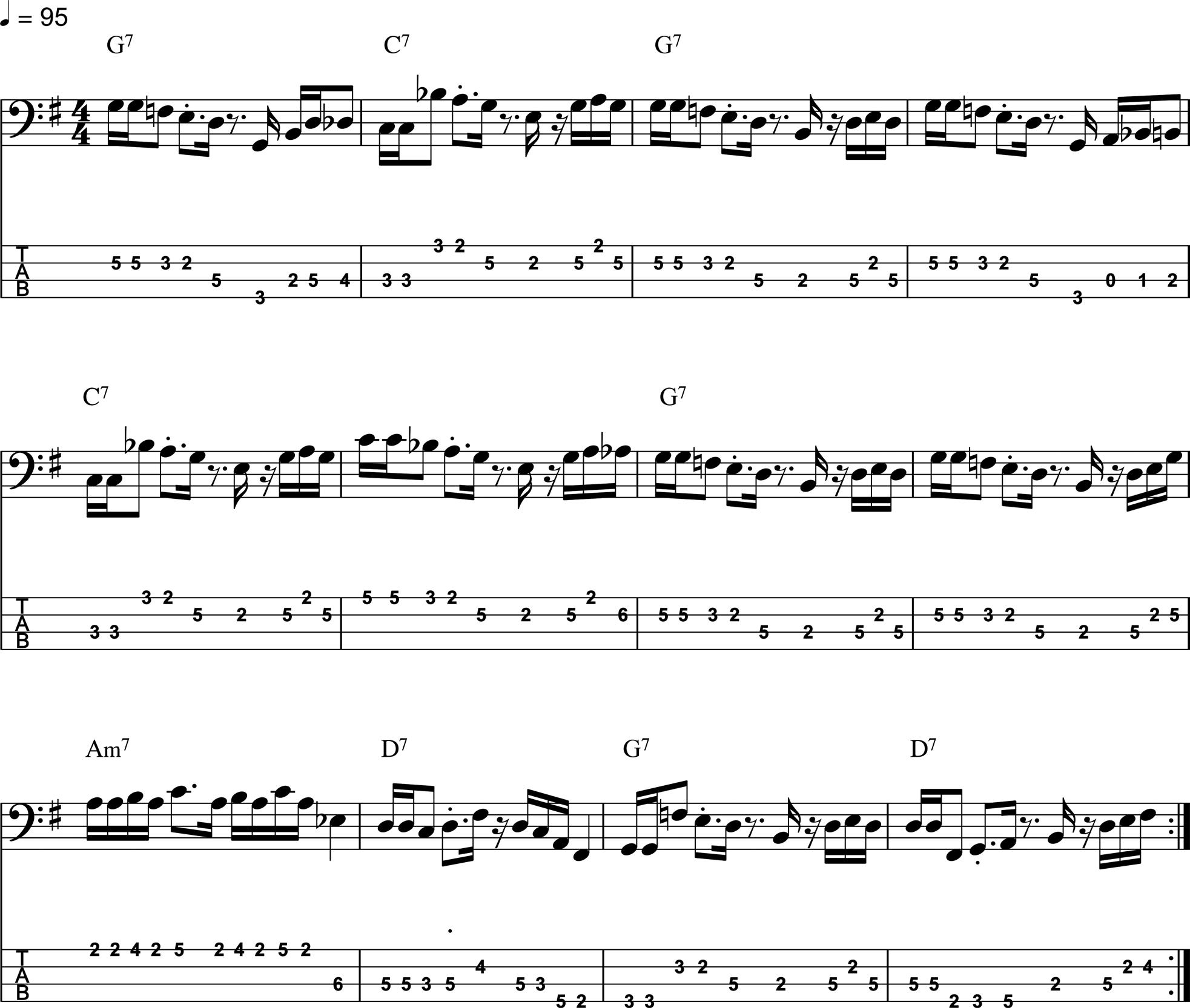
Exercise 9 is a combination of the miscellaneous melodic devices we’ve encountered here. Before attempting this final study, take some time to reflect on the disciplines we’ve celebrated thus far. Remember to keep your fretting hand in one position throughout, traversing only by a semitone when necessary to reach those chromatic intervals. Mastery of this exercise is not measured in the speed of delivery, it’s in the efficiency of its portrayal. Until next time, have fun!
If you only practice one thing this month...
Start by scoring out the notes associated with the A Dorian mode and D Mixolydian mode, respectively. Attempt to deliver both scales using the pinky of your fretting hand to access the root note of each structure at fret five of the appropriate string. A Dorian can be produced using the formula Tone, Semitone, Tone, Tone, Tone, Semitone, Tone, and D Mixolydian via Tone, Tone, Semitone, Tone, Tone, Semitone, Tone. Once you’ve established the diatonic pitches of both scales, try creating a number of different motifs tohelp you transcend between the two coinciding structures. As you move from one chord to the next, always be sensitive to the notes that could prove complementary to your direction of travel. Voice leading is the key.
