
5 minute read
I SPY

Ryan Madora
I SPY…
THE BLUES BOX In session and stage bassist Ryan Madora’s amazing column, we discover a stack of useful secrets hidden inside our favorite bass-lines
ey there, bass players! We’ve been exploring the world of rhythm for some time now and, while that concept is far from exhausted, I figured we were ready for a change of pace—perhaps something a bit more fun, and certainly very funky.
Let’s shift our focus to patterns, an element of music that bass players get to rely upon quite a bit. Thanks to our instrument being tuned in fourths, we have the luxury of a delightfully symmetrical fretboard. Since the relationship between the strings is the same across the board, it’s relatively easy to think in visual representations: Frets, fingerings, patterns, and shapes. The barrier to entry is quite low and you can learn how to
play a few grooves just by practicing patterns—and, while learning note names and understanding theory is absolutely critical to becoming a good musician, plenty of players get by with this pictorial perspective. Rather than relying solely on shapes, let’s bridge the gap between pattern and theory.
As I think back on some of my favorite grooves, there’s a common pattern that pops up on records of all genres: Classic blues, Eighties rock, Top 40, you name it! This shape is affectionately referred to as the ‘blues box’. I skimmed the surface of this pattern during our discussion of swung eighth notes, but it’s now time for a deep dive.
The blues box refers to a specific set of intervals: The root, fifth, flat seventh, and octave. Whether we play them ascending or descending, these notes will create the shape of a box on the fretboard, spanning three strings and three frets.
Let’s practice this box pattern in Exercise
EXERCISE ONE A



EXERCISE ONE B


1a. We’ll play through a 12-bar blues in the key of A and use swung eighth notes to establish the shuffle feel. Begin on A at the 5th fret of the E string, play the fifth of the chord (E) on the 7th fret of the A string, and then play the flat seventh (G) and octave (A) on the 5th and 7th frets of the D string. You’ll see that this creates the shape of a box on the fretboard. Following the blues form, move this pattern to the IV chord, beginning on D, and the V chord, beginning on E.
From a technical standpoint, I recommend playing this pattern with just two fingers: The index finger for the root and flat seventh (5th fret) and the pinky for the fifth and octave (7th fret). While this may not adhere to the conventional four-fret span, this positioning will keep your hand aligned with the fretboard and may prove to be less stressful on your muscles.
In Exercise 1b, we’re going to take the same group of notes, but flip the pattern. This time, begin on the root note, jump up to the octave (7th fret of the D string), and then descend to the flat seventh and fifth scale degrees. Both versions of this pattern should sound very familiar and quintessential to the blues genre. You can spy this on the Freddie King classic ‘I’m Tore Down’, among many other standards.
Now that we’ve worked this into our repertoire, let’s break down the theory of it, and try to apply it to other genres. You may notice that these notes would normally spell out an arpeggio, but there’s one omission: The third. The absence of the third means that we’re not clearly indicating major or minor. Lo and behold, this pattern enjoys a bit of harmonic ambiguity. It can be used over a dominant chord (A7) or a minor seventh chord (Am7). Coincidentally, these notes also exist within the minor pentatonic scale and the blues scale. How convenient!
As with any group of notes, such as a scale or an arpeggio, we can be flexible with order and register. Rearranging the notes of the box pattern will help us create countless bass-lines, especially as we get creative with rhythm. To gain some mental and physical flexibility in that area, let’s play through a few variations.
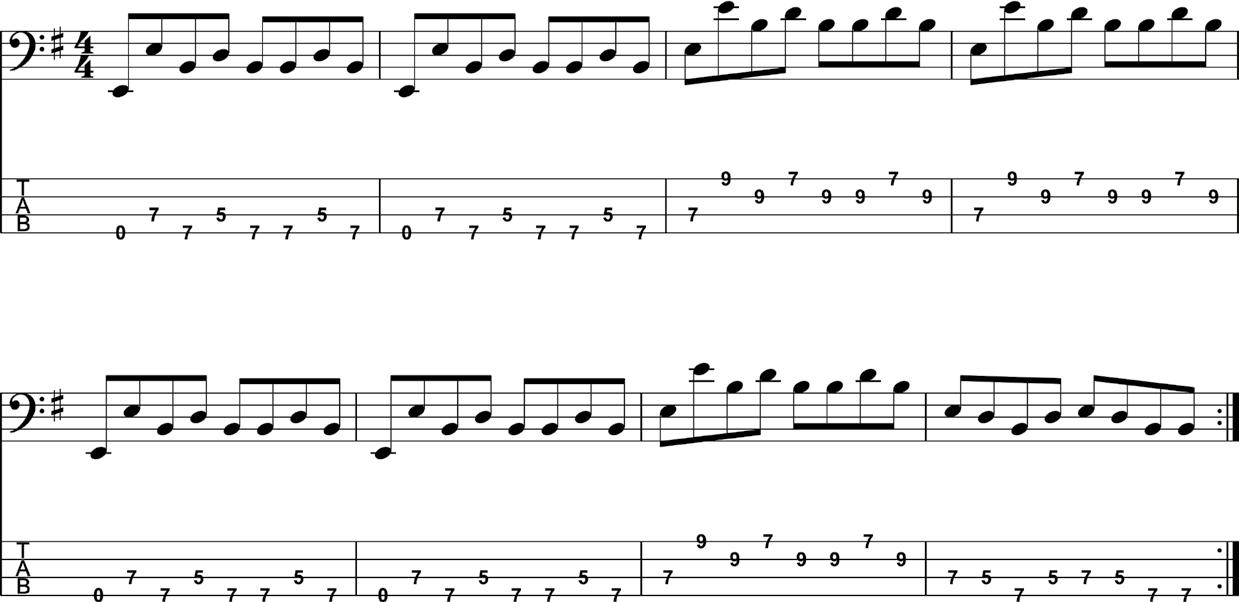
In Exercise 2, we’ll move to the key of E minor and practice playing with the box pattern over two registers, starting with our open E string or the 5th fret of your B string. For the first two bars, play an Eighties rock-inspired pattern using notes in the blues box. Then, mimic the pattern an octave higher in bars 3 and 4. In the second line of the exercise, bars 5 to 7 will repeat and the final bar will include yet another variation. This pattern should sound somewhat EXERCISE TWO
EXERCISE THREE
familiar and may remind you of Bon Jovi’s ‘Livin’ On A Prayer’. Try rearranging a few of these notes and you’ll be able to match the bass-line used in the verse.
While you’re practicing these patterns, you may realize that another note lives under your index finger: The fourth scale degree. While this note isn’t part of the arpeggio, it’s an easy and consonant addition to the blues box. It works especially well in the context of minor grooves or anything involving the minor pentatonic or blues scale.
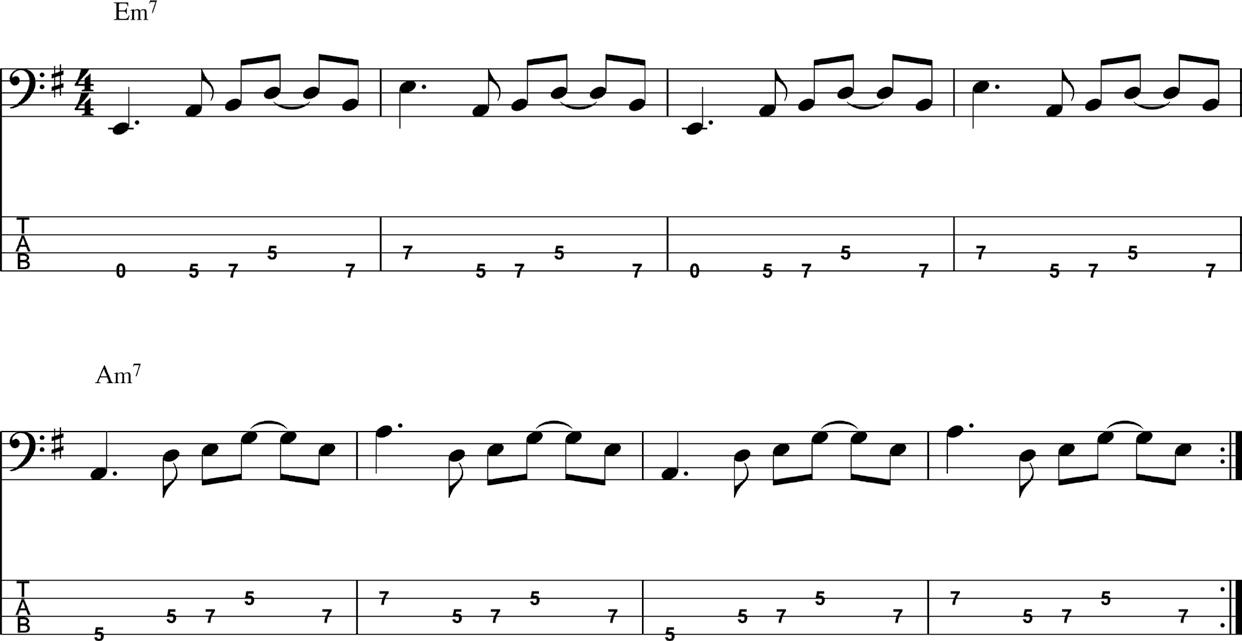
In Exercise 3, we’ll create another groove by adding the fourth scale degree to our blues box. Using the root, fourth, fifth, flat seventh, and octave, play the pattern twice over Em7—equalling a four-bar phrase— and twice over Am7. This may transport you to other familiar grooves, particularly those in the soul, R&B or pop/rock vein. Without doing too much rearranging, you’ll be able to play the bass-line to Sheryl Crow’s ‘All I Wanna Do’.
Once you’ve played through these examples, try making your own grooves by rearranging the notes and improvising with rhythm. You may even draw inspiration from other blues box bass-lines. I assure you that before long, you’ll have a full repertoire of grooves that take advantage ofthis shape. Enjoy playing these patterns and see you next month!
