5 minute read
Growing a culture of generosity in your church
Inspiring joyful giving rooted in God’s Word
Good stewardship lies at the heart of the command given to Adam and Eve in Genesis to be fruitful, subdue the earth and rule over everything. As God’s image bearers, they were to reflect God’s heart to the world with care and wisdom (Genesis 1:26-28). Stewardship requires us to manage well everything God entrusts to us: our money, time, abilities, relationships and even creation itself.
God is the ultimate giver. He gave us life, salvation and the promise of eternity through Jesus Christ. When we are generous, we therefore mirror God’s own nature. The Bible contains over 2,300 verses on money, wealth and possessions and 11 out of 39 of Jesus’ parables are about money. From these, we can extract three key points:
Generosity is a heart matter
“Each of you should give what you have decided in your heart to give, not reluctantly or under compulsion, for God loves a cheerful giver” (2 Corinthians 9:7).
True generosity is not about the amount, but the attitude. Giving with reluctance or out of guilt robs us of the joy God wants us to experience. The Bible encourages us to give cheerfully, motivated by love and a desire to bless others.
Generosity builds faith
“Bring the whole tithe into the storehouse, that there may be food in my house. Test me in this,” says the Lord Almighty, “and see if I will not throw open the floodgates of heaven and pour out so much blessing that there will not be room enough to store it” (Malachi 3:10).
God’s challenge in Malachi is one of the few times Scripture invites us to test Him. Generosity can require faith, but God’s promise is clear: He will provide. When we give, we declare our dependence on God rather than our possessions. This step of faith strengthens our relationship with Him and reminds us that all we have belongs to Him.
Generosity has an eternal reward
“Do not store up for yourselves treasures on earth, where moths and vermin destroy, and where thieves break in and steal. But store up for yourselves treasures in heaven” (Matthew 6:19-20).
Earthly treasures fade, but acts of generosity have eternal significance. Jesus teaches that when we give, we invest in God’s Kingdom. Every act of love, kindness and support contributes to His work on earth and brings glory to His name.

Teach on faith and finance
Generosity is an integral part of discipleship, so we need to teach on it regularly if we are to embed it in our church culture. In Stewardship’s Generosity Report 2025, 20% of those surveyed reported that they were first prompted to give by ‘understanding God’s generosity to me’. The data also demonstrated an appetite for teaching on generosity across the church community, with 24% of those who regularly attend church saying they would like to receive this quarterly.
Be transparent and enthusiastic
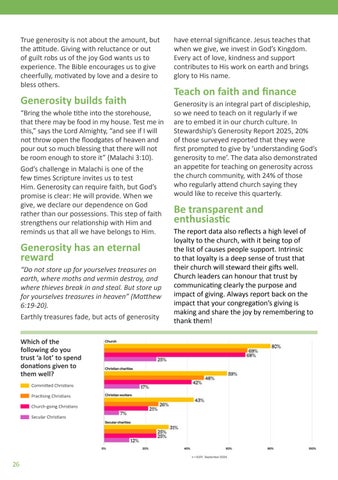
The report data also reflects a high level of loyalty to the church, with it being top of the list of causes people support. Intrinsic to that loyalty is a deep sense of trust that their church will steward their gifts well. Church leaders can honour that trust by communicating clearly the purpose and impact of giving. Always report back on the impact that your congregation’s giving is making and share the joy by remembering to thank them!
Take a financial health check
If your congregation is going to trust your church to wisely manage their financial support, then you need solid finance and governance processes in place. They will enable your church to operate effectively and efficiently and to demonstrate sound stewardship of its resources. Identify which areas of your finances and governance are healthy and which may need further attention. Review and encourage constructive conversations between your leaders, trustees and finance team, and use good independent advisers, examiners and auditors as required.
Nurturing major donors
Long-term relationships are key to engaging with potential large donors. Communicate your vision for your church clearly and bring them on the journey with you so they can see the very real difference their support makes along the way. Make it easy for them to give too by suggesting they partner with a Donor Advised Fund (DAF) like Stewardship, which can take the admin off their hands while also ensuring they are giving tax-effectively.
Giving over the long-term
A DAF can also facilitate longer term support in two ways: with legacy giving, whether that is leaving a gift in their will to their church or passing their fund onto a family member to continue their legacy on their behalf; and with social impact investing. This involves using funds from a DAF to provide a loan or other form of support—such as helping to renovate or extend your church building. It is a smart way to stretch a donor’s generosity, as any returns can be reinvested into future social impact projects or grants.
A call to be generous stewards
From the very beginning, God has called his people to live as wise, faithful and generous stewards. Churches have a special role to play in helping their congregations understand and live out this call and are uniquely positioned to do so. Let us therefore follow Jesus’ very good example in making sure we are teaching faithfully, boldly and often on these fundamental topics of stewardship and generosity.
Want to find out more?
The Stewardship Generosity Report 2025 reveals the latest perspective on the generosity of UK Christians, uncovering encouraging trends in financial giving and the growing impact of faith on stewardship.


