6 minute read
Honda HR-V, 2016-2018

PROGRAMMABLE UNIVERSAL TPMS
Honda HR-V, 2016-18
98 %
VEHICLE COVERAGE
TS508
( 855 ) 288-3587 autel.com / maxitpms.com SUBJECT VEHICLES: Honda HR-V 2016-2018. RELEARN PROCEDURE? No. SPECIAL TOOLS NEEDED? No.
he 2016-18 Honda HR-V is
Tequipped with an indirect tire pressure monitoring system (TPMS). It is not equipped with tire pressure sensors mounted on the wheels.
NOTE: Whenever the pressure has been adjusted on one or more tires, tires have been rotated, or one or more tires have been replaced, the TPMS must be calibrated. See “Reset procedures.”
TIRE PRESSURE MONITORING SYSTEM CAUTION: The TPMS may not function properly if the tire type and size are mixed. Make sure to use the same size and type of tire. Instead of directly measuring the pressure in each tire with pressure sensors, the TPMS on this vehicle is controlled by a VSA modulator-control unit and it monitors and compares the rolling radius and rotational characteristics of each wheel and tire while driving to determine if one or more tires are significantly under-inflated. Low tire pressure will cause the low tire pressure/TPMS indicator to come on and a message to appear on the multiinformation display.

TIRE PRESSURE MONITOR WARNING INDICATORS NOTE: The low tire pressure/TPMS indicator blinks for about one minute, and then stays on under the following conditions:
• A compact spare tire is used. • There is a heavier and uneven load on the tires, such as when towing a trailer, than the condition at calibration. • Snow chains are used.
CAUTION: If the low tire pressure/ TPMS indicator comes on even when the tires are properly inflated and the TPMS has been calibrated, see the appropriate manufacturer service information.
If the system detects low tire pressure in any of the four tires, the low tire pressure/ TPMS indicator comes on, as well as the message indicator. It will keep being turned on until calibration starts.
If a problem in the system is detected, the VSA indicator comes on, and CHECK SYSTEM message (TPMS) on the MID is displayed, and the low tire pressure/ TPMS indicator comes on after blinking for about 75 seconds.
TPMS RESET PROCEDURES NOTE: Whenever the pressure has been adjusted on one or more tires, tires have been rotated, or one or more tires have been replaced, the TPMS must be calibrated.
NOTE: If the system detects low tire
COURTESY OF AMERICAN HONDA MOTOR CO. INC.
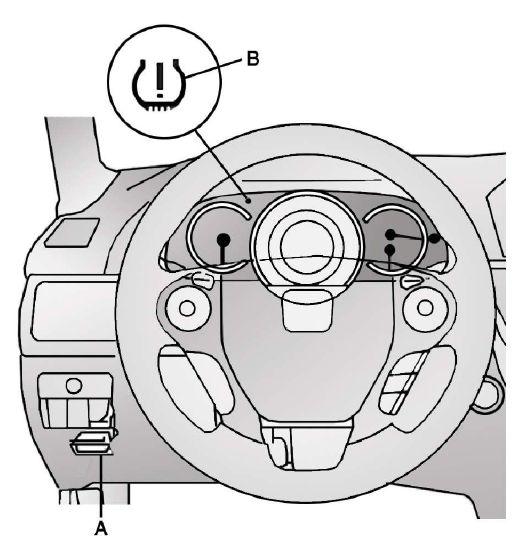
Figure 1: Identifying the tire pressure monitoring system (TPMS) button and information display indicator.
pressure in any of the four tires, the low tire pressure/TPMS indicator comes on, as well as the message indicator. It will keep being turned on until calibration starts.
TPMS CALIBRATION PROCEDURE The calibration begins when the TPMS switch is pressed. The calibration is completed after driving at 31 to 62 mph (50 to 100 km/h), steadily without much acceleration or deceleration, for about 18 minutes. Full functionality of the system cannot be performed properly if the calibration is not completed.
1) Make sure the tires are inflated to the specified tire pressure listed on the doorjamb label.
NOTE: The vehicle must be stopped with the transmission in neutral (M/T) or P or N (A/T, CVT). 2) Turn the ignition switch to ON (II), or press the engine start/stop button to select the ON mode. 3) Press the TPMS switch (A) for 3 seconds (see Figure 1). NOTE: If the indicator does not blink, check the TPMS switch. 4) When the calibration successfully begins, the indicator (B) blinks twice. NOTE: During this period, if the ignition is turned on and the vehicle is not moved within 45 seconds, you may notice the low tire pressure/TPMS indicator comes on briefly. This is normal and indicates that the calibration process is not yet complete. 5) The calibration process finishes automatically. It requires approximately 30 minutes of cumulative driving at speeds between 30 to 60 mph (48-97 km/h).
Torque specifications
Component Wheel nut 1 (N.m) (108)

Simply plug in and decode the VIN for faster, more accurate TPMS Diagnostics and Service!
Easier! Faster! Accurate!
Wi-Fi Updating Only on the Tech400Pro!
Bartec
Technical Support
Industry’s Best [866]407-TPMS

bartecusa.com [855] 877-9732
TPMS columns on demand
Tire Pressure Monitoring System (TPMS) columns are presented in each issue of Modern Tire Dealer, courtesy of Mitchell 1. Here is a rundown of the columns in 2018, available on www.moderntiredealer.com in the digital editions found at the bottom of our home page.
All of our TPMS columns are available on demand, covering well over 100 makes and models. Simply type in TPMS in the search bar.
January Porsche 911, vehicle model years 2006-2017
February Cadillac CTS, model years 2008-2015
March Volkswagen: 2004-2006 Phaeton and 2004-2017 Touareg
April Dodge Grand Caravan, model years 2011-2017
May Kia Sedona 2006-2014
June 2007-2014 Mazda3 and Mazda2 vehicles July Mercedes-Benz C-Class (204) – 2008-2015
August Chevrolet Cobalt 2008-2010, Pontiac G5 2008-2009, 2010 Pontiac G5 (Canada) and Pontiac G6 2008-2010
September 2011-2018 Ford Edge and Lincoln MKX October Volvo S-Series 2005-2015
November Toyota Corolla 2008-2018, and Corolla iM 2008-2017
December Fiat 500 Series 2012-2018
6) See “Calibration completion check.”
NOTE: The calibration check process will be interrupted if the vehicle moves. If the indicator does not go off after 2 seconds, keeps blinking, or stays on when the vehicle is in the ON mode, see the appropriate manufacturer service information.
CALIBRATION COMPLETION CHECK Check if calibration is completed by doing the following:
1) Stop the vehicle and shift into neutral (M/T) or P or N (A/T, CVT) position. 2) Turn the ignition switch to LOCK (0), or press the engine start/stop button to select the OFF mode. 3) Turn the ignition switch to ON (II), or press the engine start/stop button to select the ON mode and wait to see the low pressure indicator come on for 2 seconds and then off. 4) Do not drive the vehicle and wait for 45 seconds as is. 5) If the calibration is completed, the indicator does not come on.
If the calibration is not yet completed, then the indicator will come on for 2 seconds and then go off.
DEMOUNTING/MOUNTING PROCEDURES NOTE: This vehicle is equipped with an indirect TPMS. The vehicle is not equipped with tire pressure sensors mounted on the wheels, so there is no need for mount or demount instructions.
NOTE: Whenever the pressure has been adjusted on one or more tires, tires have been rotated, or one or more tires have been replaced, the TPMS must be calibrated. See “Reset procedures.”
CAUTION: The TPMS may not function properly if tire type and size are mixed. Make sure to use the same size and type of tire.
Information for this column comes from the tire pressure monitoring systems data in ProDemand®, Mitchell 1’s auto repair information software for domestic and import vehicles. Headquartered in Poway, Calif., Mitchell 1 has provided quality repair information solutions to the automotive industry since 1918. For more information, visit www.mitchell1.com. To read archived TPMS articles, visit www.moderntiredealer.com.