41 minute read
Commercially viable

Lack of inventory impacts truck market Despite posting a 9% increase from May’s lackluster sales levels, the Class 3-8 used truck market continues to be impacted by a shortage of available inventory, according to ACT Research Co. (ACT). Even with this most recent improvement, on a year-todate basis, the used market is 6% behind the 2010 sales pace.
“Used truck mileage continues to edge up, in response to fl eets holding onto their equipment longer,” says Steve Tam, ACT’s vice president-commercial vehicle sector. “Th e market is still awaiting some relief to the shortage of sellable inventory as well as upward price pressures. Improving new truck sales will result in increased trade-ins, and should provide some relief to the market.”
The update comes from ACT’s “State of the Industry: U.S. Classes 3-8 Used Trucks” report on the average used price for the top-selling Class 8 major truck OEM models. Th e OEMs include: Freightliner (Daimler); Kenworth and Peterbilt (Paccar); International (Navistar); and Volvo and Mack (Volvo).
Commercial Tire opens 35th outlet Commercial Tire Inc., one of the largest independent tire dealers in the country, has opened its 35th store.
Th e combination commercial and retail outlet is located in Rexburg, Idaho. Its Grand Opening is scheduled for Aug. 22.
“Th is community is growing at a rapid pace, and the new store fi lls a need for our commercial, agricultural and retail customers located in eastern Idaho,” says President Trent Schwenkfelder. Commercial Tire is a family-owned business based in Meridian, Idaho. It was established in 1968 by J.R. “Bob” Schwenkfelder.
With locations in Idaho, Utah, Oregon and Washington, Commercial Tire is 29th on the Modern Tire Dealer 100 list.
Titan establishes new mining subsidiary Titan International Inc. has formed a new company, Titan Mining Services. Th is new group will off er complete tire, wheel and track services for end users. Th e company’s fi rst location will be Fort MacKay, Alberta, Canada.
Titan says it chose the location to begin these services because of the great amount of equipment used in the region. Titan is partnering with Saskatoon Wholesale Tire Ltd., a company that has been in the area for a number of years and also represents Titan Tire.
“As we expand, Titan will be working with local businesses in all areas of the world,” says Titan Chairman and CEO Maurice Taylor Jr. “Titan is the only company worldwide who has the engineering expertise on wheels, tires and track components and we will be training many new technicians.”
Taylor states that Titan has been approached by a number of mines to off er this service and Titan plans to rapidly expand the business globally. Titan will announce shortly who will be heading Titan Mining Services. In the meantime, it will be operating out of corporate offi ces in Quincy, Ill.
Titan International Inc. is a holding company that owns subsidiaries that supply wheels, tires and assemblies for off -highway equipment used in agricultural, earthmoving/construction and consumer (including all-terrain vehicles) applications. ■
Severe-duty brake pads
Bendix Fleet MetLok disc brake pads from Honeywell Friction Materials are designed for emergency vehicles, tow trucks and other fleet vehicles subjected to extreme operating situations that require the maximum stopping power and reliability. The “fl eet tough” friction material is integrally molded. Pads include slots and chamfers to mirror the OE design and they come equipped with high-quality steel insulators to help ensure quiet braking.
HONEYWELL INTERNATIONAL INC. Quik-Link: (800) 687-1557, ext. 19160 www.mtdquiklink.com/19160
Commercial jump starter
The Solar Model No. HT1224 commercial jump starter from Clore Automotive is designed to exceed the challenges of frigid weather and deliver instant raw power to 12- and 24-volt commercial batteries. The HT1224 delivers 1,400 cold cranking amps in 12-volt mode, and 800 cold cranking amps in 24-volt mode, making it ideal for fl eet, industrial, construction, agricultural and commercial settings, the company says. It also features an onboard 10 amp automatic battery charger for quick and easy recharging.
CLORE AUTOMOTIVE INC. Quik-Link: (800) 687-1557, ext. 19161 www.mtdquiklink.com/19161
Two new Michelin on/off-road truck tires
Michelin North America Inc. says its X Works XDY commercial truck tire from Michelin Americas Truck Tires is designed for strong traction in on/off-road applications. The new Michelin XDY-EX2 tire (in photo) is Michelin’s most aggressive drive axle tire for extreme operating conditions, such as logging, oil fi elds and mining. The X Works XDY tire provides enhanced durability due to a robust tread design. The tire features extra-thick sidewall protection to guard against shocks, snags, impacts or other damage, and it is available in sizes 11R22.5 and 11R24.5. The XDY-EX2 tire improves on the last-generation XDY-EX tire, offering better off-road and mud traction from an aggressive tread design with more void area. With extra-thick sidewalls, the XDY-EX2 tire provides considerable protection from the shocks, snags and impacts typically associated with severe service. The tire is available in size 11R24.5.
MICHELIN NORTH AMERICA INC. Quik-Link: (800) 687-1557, ext. 19162 www.mtdquiklink.com/19162
Reaching the tech-savvy woman
How to attract the car maintenance decision makers
What are you doing in your business to attract the tech-savvy woman? Did you know, according to Delia Passi, CEO of womencertifi ed.com, 80% of all car maintenance decisions are made or infl uenced by women?
Most women are tech-savvy. And, that leads to a lot of buying decisions being made every day by tech-savvy women. Now the By Wayne Croswell question is not “if” or even “when” they will buy. Th e question is, “Will they buy from you?”
Traits of a tech-savvy woman
So, who is she? Th e tech-savvy woman has continuous access to the Internet. She probably has a Twitt er account and tweets or follows her favorite people and businesses regularly. She most likely subscribes to several blogs and possibly even contributes to them. She has a Facebook account and uses it daily. She has a cell phone that has e-mail, text and Internet access.
She loves a good bargain (81% of them look for the best possible deal) and belongs to multiple VIP clubs to receive text message marketing off ers from them. She doesn’t know what a Yellow Pages book is, but she has heard of yellowpages.com and probably uses it.
According to Passi, “Safety and security are very important for women; especially, if they have young children, or teenage or college drivers.
“Women tend to be more proactive and will respond favorably to safety issues and preventive maintenance.”
Here are some simple things you can do to entice the tech-savvy woman into doing business with you.
1. Equip your showroom with free Wi-Fi. Most likely, you already have an Internet connection in your business and even wireless accessibility. To add an additional wireless connection for customers to use is very inexpensive. 2. Install an Internet station (computer) with a printer in your showroom. Th is will provide your customers with the ability to print documents, and help them get through some of their to-do list tasks while waiting in the showroom.
3. Create a fun, clean and safe area for children to play in while they are waiting with their moms. 4. Provide complimentary beverages and snacks. 5. Off er loaner rides or loaner cars.
Th ose are only some basic actions that you need to consider. And, for the love of Pete (whoever Pete is), make sure you keep your rest rooms clean and family-friendly!
To really reach out to the tech-savvy woman, and the tech-savvy mom, visibly show that you participate in social networks like Twitt er and Facebook. Encourage them to sign up for your sites. Reward them with coupons for future services such as discounted oil changes and tire rotations; it has been proven that they will sign up solely for the free off ers being made.
Off er membership to a loyalty or VIP club, and use technology like text message marketing from MobiDitt o to keep them coming back for service time and time again.
Put on your technology face
Your business has a technology face. How does yours stack up to those seasoned at att racting the tech-savvy woman? You need to determine what your target audience wants and then make sure you deliver what they are looking for. Your technology face includes items like your Web site, Google Places, online advertisements, Facebook, Twitter, Yelp, coupons, Groupons, Buckaroo.com, Couptessa. com, reminder postcards with coupons and even billboard advertisements listing your Web site address.
Ask yourself, does your technology face do anything that speaks specifi cally to the needs of the tech-savvy woman? It’s time to make sure it does. I conducted a survey at the beginning of the year to all females in the marketing and technical writing departments of a Fortune 1000 technology company. Here were the top three things they looked for in choosing a shop to bring their car to for service or tires.
1. Web site: Specifically, the ease of fi nding your Web site from either their PC or smart phone. 2. Th e ability to see prices for standard services such as inspections and oil changes.
3. Th e ability to set an appointment online directly from your Web site. If not, a phone number that is very visible, even on smart phones where landscape is a premium.
Some additional comments worth noting include:
• Th ey wanted to receive a phone text notifi cation a day or two before the appointment confi rming the date and time. • Th ey preferred receiving a phone text notifi cation when the vehicle service is completed. • They would select one company over another if they were off ering some type of coupon for free or discounted service or items. • 100% of them indicated if the Site/ Dealer advertised that they were “Female Friendly” it would infl uence their decision to do business there.
When it comes to business soft ware, you need to make sure that your soft ware helps you in this process. Your soft ware can and should be able to send phone text messages to your customers reminding them of upcoming appointments and notifying them when services are complete. You should be able to send them reminders for future services that include coupons relevant to the customer’s needs.
Your soft ware should track information about the family such as major events in their family life, sports activities, big games, and likes and dislikes. Th is information should be used to create a welcoming experience when they are doing business with anyone in your company.
In the end, you want to create raving fans. You must exceed their expectations each time they do business with you.
Th ese raving fans will tell their friends about their experience. In fact, they will probably Tweet it or post about it on Facebook. So make sure what they say about you is what you want them to say. You can increase their loyalty and desire to continue to do business with you and ultimately they will bring you referral business. It’s all up to you. Will you proactively att ract this large segment of the market to your business, or will you leave it for the competition?
If you want to get the most out of this segment of the market, you should consider training for your staff . In addition, you might consider becoming “AskPatt y Certifi ed Female Friendly” by AskPatt y.com or fi nd out how to earn the “Women’s Choice Award” from womencertifi ed. com. In a national survey of 4,000 women, nine out of 10 women would choose a Women Certifi ed awarded business over the competition. ■
Wayne Croswell is CEO and president of WECnology LLC (see Web site www.wecnology.com) and is a “complimentary technology advisor” for independent tire dealers. He can be reached at (603) 249-5530 or wcroswell@wecnology.com.
Not just more business — business when you need it! Target how people react to your advertising to increase sales
The one thing about advertising is that it is very hard to “aim.” Not the outgoing part, the incoming part.
People have gott en very good about targeted advertising. With the Internet, businesses can target very specifi cally the precise demographics of the people they want to reach. What is not so easy is targeting how people will react to that advertising. By Roger McManus
Generally, advertising in the traditional sense (Yellow Pages, radio, newspaper, direct mail) will drive traffi c if executed well. But a tire dealer does not necessarily want more business on a Saturday. Same with golf courses, while dry cleaners are prett y busy on Mondays. You get the idea.
So, how do you drive traffi c to visit you on a Wednesday morning or a Friday aft ernoon? You make them a deal. You make it short-notice and make it for a specifi c time period. Most important, make sure the customer gets the message immediately before the target time when you want more business.
Th is is done using the latest technology sweeping the country (the world, for that matt er), text marketing. Also called mobile marketing, this phenomenon relies on the fact that most people always have their cell phone with them and almost all phones today receive text messages.
Mobile marketing has been around for about fi ve years, but the number of consumers who have phones which can fully utilize the technology is just now coming into the mainstream.
Over half of the population now has a “smart phone” and more than half of the balance have a “less smart” phone that still receives texts. All in all, over 85% of the U.S. population can technically participate.
So how does this help you?
Unlike e-mail, which is opened only about 18% of the time — and oft en days aft er it is sent, people who receive text messages open them within three minutes 90% of the time. Also, unlike e-mail, text messaging is rarely considered “spam” because (by law) the customer asks you to send them the text. Further, the consumer knows that to stop you from sending texts to them, they only have to reply “STOP” to your message, and the system (by law) will erase the consumer from the system that sends your texts.
It may be slightly diff erent in the tire and auto service business because of purchase patt erns, but, as was stated in Modern Tire Dealer last month, response rates for textdelivered off ers can reach a phenomenal 20%! Compare that with direct mail of around 1%!
You invite the customer to get texts from you by off ering them an “insiders club” of some sort, the members of which receive special, private messages from you when there is a deal going on or something of signifi cance they need to know. So, if you want a litt le more business on Wednesday mornings, send a text to 200 customers in your list off ering a deal on oil change, tire rotation or whatever you want to promote. You can send the message at noon on Tuesday and the deal can be good only from between 9 a.m. and 2 p.m. the following day. You decide!
Being a friend, not a vendor
By having a select group of customers who consider themselves special in your eyes, the relationship changes. Th ey feel special and your messages refl ect that. You do not always have to send sales messages, but can off er helpful hints that demonstrate your professionalism and caring.
Text messages are generally not sent more oft en than once per week. So during a given month, perhaps two of those messages are special sales opportunities and two others off er helpful information.
For example, a non-sales message might remind them when it is time to switch to winter tires — and run a deal for storing their summer tires “just for insiders.”
Th e point is, without being a pest, you are reminding your customers that you are in a special partnership with them to keep them safe. This goes a long way toward neutralizing the impact of “big box” advertisers trying to undercut your prices.
Mobile marketing is not free
One of the pluses with e-mail marketing is that it is virtually free. Other than the time it takes to build and cull the list, pushing the butt on to send out thousands

of messages doesn’t cost anything. Th e problem is, many of them are deleted without being read.
Mobile marketing has very high open rates because consumers know that they are not gett ing junk from people they do not know. Th e system is built so that only those companies that have been invited by the owner of the phone can send messages to them. And, the permission is easy to rescind if they made a mistake. Also, it costs for every text you send. Th e price depends on volume, but you can run a campaign with 500 customers for well under $100 per month. Imagine a

90% open rate with even a 10% response rate on an off er that yields only a $25 profi t. Th at one text would have a net return of over $1,000 — and that is just from one text. Your costs are for a whole month of texts, reasonably up to four.
Consult the experts
Let’s face it. Some people just are not cut out for the computer, cellular or Internet world. Others fi nd it easy. Regardless, you can get help with any campaign you might run. Th e process is easy, but it takes dedication to remember to send a message on a regular basis. Text messaging companies send messages for you, they do not write them. One company long associated with the tire business, WECnology, is in the business of making technology easy for those less familiar with it. Wayne Croswell, Tire Industry Association president last year, helps tire dealers specifi cally with the technology side of their businesses. He has become a quick study on the topic of text marketing (see his article in the July issue of MTD on the subject), and will help dealers who might be confused or intimidated by it. WECnology even has a service that writes texts for dealers and schedules them to get out on a regular basis. In a recent conversation with Wayne, he told me, “Text marketing is so new, only about 2% of all businesses are using it at this point. Th ose who jump in now will enjoy a relationship with customers unlike almost any of the other companies they deal with in their daily lives.”
What’s coming next
Right around the corner is a smart phone-based system that will allow you to make special off ers to pre-sell services at a discount, have customers pay for them right on the phone and let the customer take delivery later. Th e ramifi cations of this are signifi cant.
Groupon has made a big splash doing exactly that. You off er a $50 service for $25. Th e customer pays Groupon $25 and Groupon sends you $12.50. Th is is great for gett ing new customers, if you have a way of keeping them since receiving cash for only 25% of the retail price is usually a loss-leader. (Of course, one way to keep them coming back is to get the customer to opt-into your text marketing program! Groupon, and others like it, is a one shot deal.)
With the new technology, you will be
10 things you can do with mobile marketing in your tire store
1. Build a list of customers who have asked to be contacted. 2. Send special deals to your customers that are good at the precise times when your shop is slow. 3. Generate immediate capital by offering a Groupon-type deal where the customer pays a discounted amount for a future service. 4. Send a public-service message about a local road condition (like a tire-damaging pothole on Elm Street). 5. Send an interest-creating survey about a local issue — post results in your store – or text them to your list — generating more visibility for your store. 6. Create a loyalty program with a “punch card” program where a “punch” involves letting your customer scan a QR code (see below) with his or her phone. So many “punches” makes a selected service free. 7. Send your customers full color coupons — complete with barcodes, if your register reads them. 8. Cross-promote to your list of customers with another non-competing merchant with a list of his or her own. 9. Set a reminder appointment for some period on the future (oil change in four months) and let the system remind the customer automatically. 10. When the customer gets the reminder, let him or her use a single key to accept an appointment or postpone it or request that you call.
QR Code Practice:
If your smart phone does not have a barcode reader, download one for free by opening the Internet on your mobile phone and downloading a reader from http://www.getscanlife.com. (There are dozens available for free, this is just one.) Then use it to scan the QR code below. This will send you even more information about how to do everything described above. able to send an off er, get the customer to pay immediately on the phone and the system will automatically send back a full-color, bar-coded coupon that you can scan (and immediately disable) right from the customer’s phone. No Groupon-type fees — you keep all of the customer’s payment for the discount coupon.
Text marketing is a technology that will exceed the communication power of the Internet — certainly e-mails — in the near-term years to come. Pay att ention. It could make you lots of money. ■
Roger McManus is author of “Entrepreneurial Insanity in the Tire Industry,” a new book available through the Tire Industry Association’s Web site at www.tireindustry.org to or directly fr om Amazon. Write to him at roger@ensanitypress.com.
Sales horsepower Closing the deal more often begins with changing your culture
By Doug Trenary
Doug Trenary, president of Doug Trenary’s FastTrack Inc., is an award-winning author, speaker and teacher who since 1985 has helped companies of multiple sizes, including independent tire dealerships, increase sales and productivity. He was a featured speaker at the 2011 Goodyear Dealer Conference, and is developing a fast-growing presence in the automotive industry. His book, “Th e SalesMind,” focuses on how to maximize your time and establish strong positions with your team and your buyers.
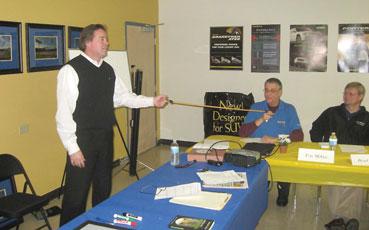

If you are an owner or manager, it’s no big secret: You want more sales. Faster sales. Less costly sales. All in a tight economy. “At Clark Tire & Auto, we have created a whole mix of If you are a store sales associate or commercial custom training approaches,” says Doug Trenary (left, representative who makes outside sales calls, pictured at a Clark Tire training seminar). you’re always in search of strategies to close more business. that you constantly remind your store or division team
Whether you are a retail dealer, supplier, wholesaler, about the endless opportunities with vehicles. You can have a commercial truck operation — or all of the above legitimately add-on sales of brakes, wipers, hot acces— sales issues are (or should be) always high on the radar. sories — the choices are endless. Opportunity abounds, Companies that weather the storms of an economy, yet so take advantage of it! continue to grow and prosper, without question have built Second, recruit and a certain culture of success. What is that culture? hire the right
For 26 years, my focus has been helping companies and people for the individuals build this atmosphere. Is it easy? Of course job. There is not. Is it defi nable? Yes. I call it being a “SalesMind.” In no substitute terms of your operation, one of your key missions every for talent. Th e day should be to maximize every possible aspect of a most elasticity SalesMinded culture. Let me challenge you to consider in productivand apply these thoughts. Th ey are proven to generate ity (more qualimmediate, measurable, fi nancial results. ity work every hour) you’ll ever Th ree steps to bett er results get is with an em
First, keep in perspective that you are in a great busiployee with the ness, and share that exciting view with your team! Your right capabilities. sector (something with wheels) is massive: an estimated With that baseline, one-tenth of the gross domestic product in the United you can train them m States. Th at’s approximately $1.5 trillion. Th e automotive to do the rest. business is fairly recession-resistant, not to say you haven’t Th ird, when you u taken some hits. People will give up a lot of things, but have the right team m not their car. At least your industry has not been blown mix, train them Through Doug Trenary’s book, Th h D T ’ b k to pieces by this economy, nor has it, like so many other and retrain them! “The SalesMind,” business ownindustries, been knocked out by technology. Th at way, you are ers and salesmen can strengthen
Th e car and truck are here to stay. Make sure as a leader taking talent and their business relationships.
stretching it to whole new levels. We have major manufacturer and dealer clients right now increasing sales and close rates, and dropping dollars to the bott om line, because they are gett ing their personnel focused, skilled, and profi table!
One of the worst mistakes, and I hear this all the time, is to “wait for the right time; slow season, etc., to do training.” Every minute you don’t sharpen saws, you’ll waste the greatest asset you have — the minds and talents of your team — and increase the greatest “hidden” cost you have — them not being able to sell as much as they can as fast as they can.
Let me say this again: You lose time and serious money when your employees’ skill saws are not razor-sharp. Th is is the essence of being a SalesMinded company.
Leveraging skills and more
So what can you do as a leader right now to increase sales and lower sales costs?
1. Leverage (get the most out of) att i
tudes. Maximize the drive, desire, optimism and energy of every one of your employees!
Every study ever done says that a buyer is influenced by sellers who have good att itudes, smile, show empathy, and off er great service because they really care. Th ere are a lot of things you can’t control, but the one standard in your company you can control is that “we will get the best out of ourselves!” 2. Leverage skills. You’re the seller, and customers and prospects are the buyers. You have products and services, and they have needs and money. Trade the two with skill. Some of the training keys I do in-house with clients are to role-play objections/answers at the counter to close sales instead of losing them, write scripts of what to say, practice asking key questions and listening, use the phone eff ectively to get buyers Doug Trenary, author of “The SalesMind,” has taught a number of independent tire sets. Here are three examples.
“At Clark Tire & Auto, an 18-store retail chain based in Hickory, N.C., we have created a whole mix of custom training approaches,” he says. “We’ve role-played answering ‘your price is too high’ (ever (sales) went up. I’ve been in the fi eld with their commercial trucking reps working on following up on proposals, smoking out hidden needs, and asking specifi c closing questions. The questions worked, in the door when they call in, and have reasons to call them back to get them back in — and the key is to do it all in a lowpressure way. Th is kind of training gets real monetary results. And real dealers are gett ing them (see sidebar).
3. Leverage associates’
time. Make sure your associates are doing the most productive things fi rst (not last), that they work on the things and situations they don’t like to do, and that each of them keeps making adjustments in how they speak and interact.
Finally, some words about information overload. You must make sure as an owner or manager that every member of your team is securing information on call-ins or walk-ins for follow-up and repeat business — and make sure there are simple systems in your company to make certain information is not drowning your employees. Un-captured, lost or unused information is lost money.
Next month, I’ll address how you, the leader, shape the sales eff ort. I refer to this as “here’s your role in developing a SalesMinded dealer team.” At the end of the day, the SalesMind wins. Make sure that’s you! ■
For a fr ee copy of Doug Trenary’s special report, “Five Hidden Keys for Dealers to Close More Sales,” send an e-mail to info@ dougtrenary.com. As Trenary would say, your bott om line will be glad you did! For more information on Trenary’s results-gett ing

Three dealers who ‘get it’ Trenary shows them how to maximize their selling skills
dealers the art of leveraging their skill
heard that?) in teams, and closing rates work, visit www.dougtrenary.com or call (404)-262-3339. and new retread customers were added that day instead of the reps having to call back.
“I asked owner John Clark why his teams were getting results from the training. His answer? ‘Because we are doing something different. If we just do the same things we always have, we’ll just get the same results, but we want to move up to the next level.’
“At Burggraf Tire Service, a retail and wholesale dealer based in Quapaw, Okla., we are in process with a multi-session training program that focuses on having their leaders incorporate ‘action plans’ with their associates. This, in turn, has led to these managers being able to reshape their own priorities, empower their store teams, and focus on sales growth and dealer support for their growing wholesale division.
“At Raffi eld Tire-Master, a nine-store retail and commercial dealership based in Macon, Ga., we incorporated a dual program of live training with their store managers accompanied by their use of my book and DVD products in their weekly meetings as brainstorming tools on how to creatively add more value for every customer.”
Has value lost its value? Your job is to convince customers a better tire is a better deal
In last month’s article, the topic was Michelin tires, Bayer aspirin and Fiji water: How are these manufacturers able to charge a premium price for their products when other products of similar quality and benefi ts are available at substantially less money?
Th e answers vary, of course, but the “perception of value” is key to “marketing for margin.” It’s hard to argue with success — By Wayne Williams having customers whose experience with a product meets or exceeds their expectations. If Bayer aspirin has been relieving your back pain for years, why would you switch to a “no-name” brand for $4 less? Most of us have had the experience of a consumer standing at the sales counter requesting a replacement set of Michelins because they received over 80,000 miles on their original set. Why “risk” more back pain or fewer miles on some other brand?
Michelin and Bayer have earned their reputations through quality products, margin-driven marketing, and decades upon decades of satisfi ed customers. Every business must make a reasonable margin to stay in business, and to stay in business, a business must off er value, real value! “Webster’s Dictionary” states the defi nition of “value” is the worth of a thing in money or goods at a certain time; the market price; a fair price; the quality of a thing according to which it is thought of as being more or less valuable, useful or desirable.
Because my clients are a combination of tire retailers and distributors, and because I hear a wide variety of comments and concerns every day, I feel I have a “feel” for the trends and what I might call the “emotional buzz” in the industry.
I’m sensing what I’m going to call a “heavy weariness,” a weariness beyond the normal daily grind, and it stems from two distinct and unique trends that we’ve not experienced
in recent decades. Usually, when business is down or growth is minimal, tire prices decline. Th is is certainly not the cause today with frequent price increases that are sticking.
Secondly, the economy has been struggling and continues to struggle. Unemployment is high, and wages are not keeping pace with infl ation. Th is current combination of events/trends is putt ing pressure on distributors, retailers and consumers. I have witnessed several irate customers who had purchased two particular tires months earlier and now felt they were being overcharged for the identical additional two tires. While speaking with an “informed, skilled and professional” management employee at a respected distributor, he blurted out in frustration, “Where’s the value of value? Everything seems to be price, price, price!” He’s feeling the pressure from the retailer, who’s feeling the pressure from the consumer. Manufacturers have been feeling the pressure from raw materials, shipping costs, emerging markets, etc.
My personal belief is that water seeks its own level, and products fi nd their value in the marketplace. Tires have been undervalued for decades, and there is a shift by worldwide producers of tires to stabilize reasonable operating margins and develop products that consumers and governments demand. We are in a new reality as vehicle and rubber manufacturers try to squeeze every mpg out of every vehicle, and governments continue to raise CAFE standards as tires and proper tire fi tments have, and will continue to become, substantially more complex and sophisticated.
Although tire manufacturers continue to attempt to communicate the additional value of their products to the variety of channels of distribution, the message has not really hit home yet.
I totally agree with my friend in the industry, “Where’s the value of value?” I believe that tires are worth the money, the current market price. What is needed is some hard-core selling, some real, hard-core value presentation.
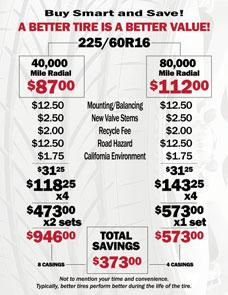
Yes, customers want a good price; surveys show they also want a good tire. All the surveys show that customers want value. Most customers don’t/can’t really understand the value unless it’s explained in terms that make sense, in ways they can understand. Th e gap or diff erence between the price of a 40,000-mile tire and an 80,000-mile tire is not as wide as it once was, and with all the additional fees and add-on charges, the gap gets smaller.
Consider the added value represented in this comparison (see chart) which represents real value to a customer: Bett er tires are a bett er deal. ■
Wayne Williams is president of ExSell Marketing Inc., a “counter intelligence” fi rm based in La Habra, Calif. He can be reached at exsellmkting@gmail.com.

Low- and high-line versions of TPMS receivers on the Hyundai Elantra An exciter scan tool is needed to perform TPMS service
SUBJECT VEHICLE: 2008-10 Hyundai Elantra. SENSOR IN TIRE? No, sensors are mounted in the wheels. SPECIAL TOOLS NEEDED? Yes, a TPMS exciter scan tool.
Th e tire pressure monitoring system (TPMS) on 2008-10 Hyundai Elantras uses a receiver that is available in lowline and high-line versions. Th ere are four radio frequency (RF) tire pressure sensors, two warning indicators on the instrument cluster and a data circuit to perform system functions. Vehicles with high line systems have three warning indicators and include four low-frequency initiators (LFIs). When tire pressure is below the allowed threshold, or a rapid leak is detected, the low pressure warning light on the instrument cluster will be illuminated. On vehicles with a high line system, a Figure 1 tire location light also will illuminate to indicate the faulty tire.
If the system detects a receiver or sensor fault, or if it detects a fault that is external to the receiver or sensor, the TPMS warning indicator on the instrument cluster will be illuminated. If the fault is considered “critical,” the light will stay on throughout the entire ignition cycle.
In order to remove an old sensor and install a new one, follow these steps:
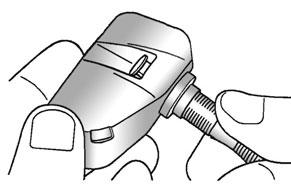
1. Remove the wheel and tire assembly. CAUTION: Avoid tire/tool contact with the valve while demounting the tire. 2. Defl ate the tire and remove the balance weights. Th e bead should be broken about 180 degrees from the valve side of the wheel. Th e bead breaker should not be set too deep. Demount should end near the valve. CAUTION: Th e valve nut should not be re-used. 3. While handling the sensor with care, remove the valve nut. 4. Discard the valve immediately. 5. Assemble the valve to the sensor, and turn the valve three times with the square part of the screw in the slot. See
Figure 2
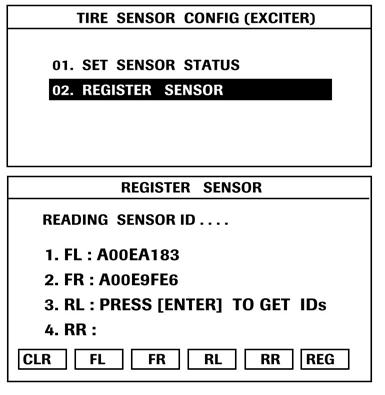
Figure 1. CAUTION: Ensure the sensor feet are against the wheel throughout the remainder of the assembly process. 6. Ensure that the valve hole and mating face of the wheel are clean. Mount the assembly to the wheel. Th e fi t should not be tight (it should still be possible to easily adjust the valve angle). CAUTION: Ensure the grommet remains in contact with the wheel. 7. Tighten the washer and nut by hand until the valve thread meets the nut’s built-in calibrated stop. 8. Using an appropriate torque wrench,
Figure 3
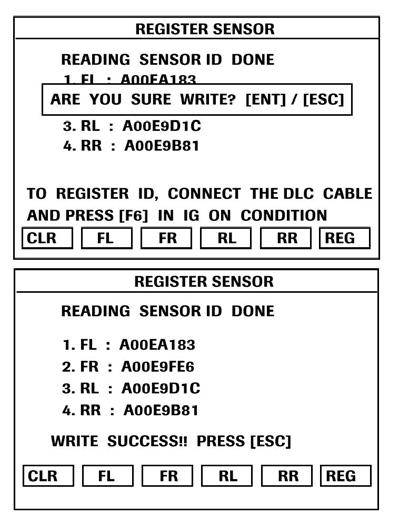
tighten the nut to 31 to 40 in.-lbs. (3.5-4.5 N.m). It is normal to feel a break as the 20 in.-lbs. (2.3 N.m) calibrated stop in the nut snaps and the torque falls. Increase the torque smoothly in order to achieve a clean break of the stop. 9. Lubricate the tire bead (not the rim). Do not use excessive lubrication. 10. Start mounting the tire about 5.9 inches from the valve. Move the mounting tool away from the valve. Avoid tire/ tool contact with the valve. Finish with the mounting tool near the valve. 11. Adjust infl ation pressure of wheels. Install the valve cap. 12. If installing a new sensor, it must be initiated.
To initiate the tire pressure sensor, follow these steps:
1. Holding the TPMS exciter scan tool within three inches of the sensor valve, read each tire pressure sensor ID in the following order: front-left , front-right, rear-left , rear-right. 2. Connect the TPMS exciter to the Data Link Connector located under the left side of the instrument panel. Register the four sensor IDs to the receiver. See Figures 2 and 3. 3. Disconnect the TPMS exciter from the diagnostic link. Cycle the ignition and wait four minutes. Ensure that “NORMAL RECEIVER STATE” is displayed. ■
Information for this column comes from Mitchell 1’s ”Tire Pressure Monitoring Systems Guide” for domestic and import vehicles through 2010. Headquartered in Poway, Calif., Mitchell 1 has provided quality repair information solutions to the automotive industry for more than 80 years. For more information, visit www.mitchell1.com.

2003 Mercedes SBC brake system A technician’s best tool is information on how the components work
SUBJECT VEHICLES: 2003 to 2006 Mercedes E, CLS, and SL Class vehicles. COMPLAINT: Message indicating worn brake pads. CAUSE/SOLUTION: Front/rear brake job needed on vehicle with Sensotronic Brake Control. See following directions for correct steps in servicing this system.
Th ey’re just brakes, right? I still remember the day some years ago when a customer came into the shop where I was working. He wanted to know why a warning message was displayed on the instrument cluster of his 2003 Mercedes E-class. Th e message indicated worn-out brake pads. Further inspection determined that a front and rear brake job was needed. Th e customer declined the work and took the car home.
Th e next day went a litt le like this: A customer went to the parts department and purchased front and rear brake parts for a 2003 Mercedes E-class. Within a few hours, the parts department received a call asking how much new front and rear brake calipers cost for that same vehicle. Th is was immediately followed by a call to the shop asking how much labor would be involved to replace all the brake calipers.
Anyone who is not fully aware of the type of brake system that is installed on the vehicle can make this mistake. Th e customer failed to read the safety warnings that came with the brake pads, or he would have noticed that this is not your average do-it-yourself job.
Th e Sensotronic Brake Control (SBC) is a type of brake system used by Mercedes, similar to the thrott le-by-wire
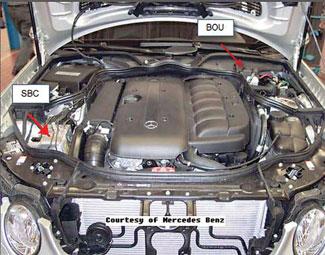
Figure 1
systems that most technicians are familiar with. SBC has several components that, visually, appear no diff erent from any other ABS-equipped car. SBC has a hydraulic pump/ control unit, normal brake calipers, and what looks like a master cylinder with fl uid reservoir. Although it may look like other ABS systems, there are more brake lines, hoses and wiring; no brake booster; and the pump runs a lot more. Th is is just what you see on the outside.
What you don’t see is that the complex operation of the SBC has the capability to perform all traction control and ABS operations that are needed at each wheel, separately from one another, without any feedback at the brake pedal. Not only does the SBC apply the brakes before you even get into the car but it can apply the brakes when the wipers are turned on so that the brake pads stay dry. Th e control unit for the SBC is in constant communication with all of the vehicle’s engine, transmission and body systems.
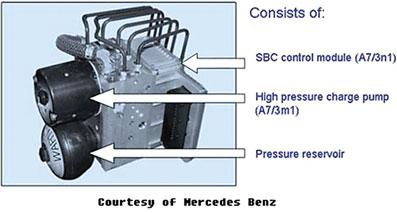
Several components located in the engine compartment are special to the SBC (see Figure 1). Th e Brake Operating Unit or BOU (Figure 2) is what most would call a “master cylinder.” Th e BOU contains a pedal sensor so the control unit knows how fast and how far the brake pedal is being depressed. It also has a brake pressure simulator that incorporates a couple of springs and a fl oating piston so that the brake pedal feels like a normal master cylinder to the driver. Th e simulator is needed since there is no direct hydraulic contact between the brake pedal and the brake calipers under normal operation.
Th e SBC hydraulic unit itself (Figure 3) contains the high pressure pump, pressure reservoir and the SBC control module. Like other Mercedes control units, this module is programmed to the car using factory tools.
A factory type scan tool is needed to correctly test and service the brakes on this system.
For example, if the brakes need to be fl ushed, a factory scan tool performs activations of the pump and solenoids in the hydraulic unit to remove all air, along with prompting the technician as to what bleeder screw to open and the pressures to set the pressure bleeder.
Th is takes us back to the beginning of this story. Th e customer did not deactivate the SBC before working on the brakes. It is necessary to deactivate the SBC to prevent buildup of brake pressure to the brake calipers. If any work being done on the car involves removal of the calipers, the SBC must be deactivated or the brakes may apply themselves during the repair.
All it takes for the system to apply the brakes is for
Figure 2
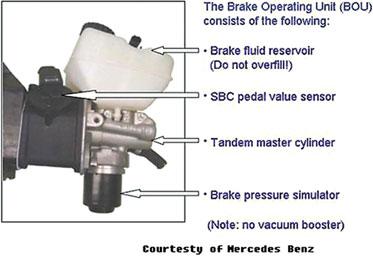
Figure 3
someone to open a door, operate the locks, open the trunk, depress the brake pedal, and, of course, turn the key on. You can only imagine what can happen if a hand is in the way when there is over 900 psi applied to the calipers.
Like the case of the customer performing his own repairs, you could end up with all four caliper pistons and 1.5 liters of fl uid on the garage fl oor.
Th e SBC is very expensive, so not every Mercedes is equipped with this system. It is mainly found on the 2003 to 2006 E, CLS and SL (Th e SL may include newer models). Th e trick is to know what to look for and how to safely repair these cars. Even if you don’t have a scan tool that does the deactivation and reactivation operations, a series of steps can be performed to manually deactivate and then reactivate the SBC.
Since the process is a bit long, I suggest reading the instructions completely before starting the work.
One other item to be aware of: noise. In order to maintain the proper amount of operating pressure, the hydraulic pump needs to run aft er a couple of pedal applications. Th is constant turning on and off of the pump can be questioned by customers as a possible problem. To help determine what is normal, Mercedes has provided some service bulletins on the subject.
Some noises that are not inherent to the design of the SBC system require updated hoses, possible bleeding of air trapped in the system, or a soft ware update of the control unit itself. Some require the factory tool to perform. Overall, the SBC system works quite well, but in order for it to be maintained properly, the technician’s best tool is information on how it works. ■
Information provided by Identifi x Inc. For more information, call (800) 997-1674 or visit www.identifi x.com.
A celebration of distribution
Kauff man Tire thanks its wholesale customers
Kauff man Tire Inc. had only two warehouse distribution centers in Ohio at the start of 2010. One is located in the Cleveland area in northeastern Ohio. Th e other is near Cincinnati in southwestern Ohio.
Th e distance between the two is 213 miles as the crow fl ies. As you might expect, the drive distance is longer.
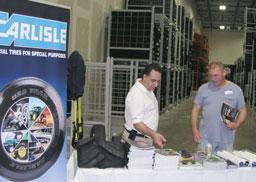
To bett er serve its customers in the center of the state, Kauff man Tire decided to open a warehouse in Lockbourne, Ohio, near Columbus. Th e company recently celebrated the warehouse’s fi rst anniversary in July with special pricing for its customers — and a tour of the 55,000-square-foot facility.
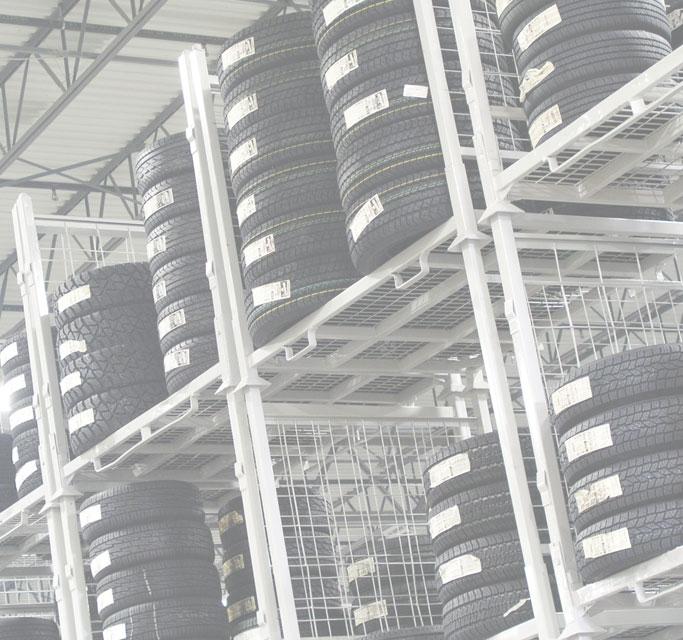
Th e Lockbourne warehouse has more than 20,000 consumer, truck, farm, small OTR, industrial and specialty tires in stock. It can store an estimated 50,000 tires. “When we start up a warehouse, we build to the customer base,” says Nelson Waynesboro, vice president of wholesale operations.
Kauff man Tire wholesales 16 brands: Goodyear, Cooper, Toyo, Pirelli, General, Dunlop, Kelly, Kumho, Alliance, Continental, Starfi re, Titan, Otani, Carlisle, Achilles and Gladiator. Wholesale Manager Brian Kelly says the facility was designed to give every manufacturer its own section.
Kauff man Tire has 13 warehouses in six states. ■
1
6
3 2
5
4
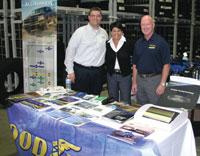
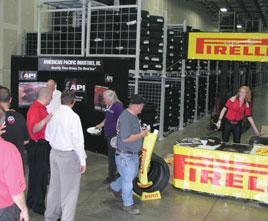
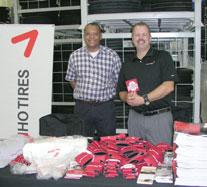
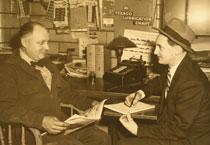
1. Marc Voskeritchian, left, north central regional sales manager for Carlisle Transportation Products, gives information about the company’s specialty tires to Bill Davenport, owner of Bill’s On Broadway Auto Repair & Service in Grove City, Ohio. 2. Ali Cardenas, area dealer manager for Continental Tire the Americas, shows off the company’s Continental ExtremeContact DWS UHP tire, in size 315/35ZR20. 3. Brian Barrows, right, regional sales manager for Kumho Tire U.S.A., is joined by Kauffman Tire’s Nelson Waynesboro, vice president of wholesale operations, at the Kumho booth. 4. Plenty of customers came by for swag from the booths, including signed Pirelli posters by model Namiah Covell (far right). 5. Harry Kauffman (left, negotiating with a Goodyear sales rep) founded the company in Wooster, Ohio, in 1936. Seventy-fi ve years later, his son, John, is CEO, while John’s son, Mark, is president. 6. From left to right: Luis Carbonell, district manager, consumer sales; Karen Zaro, account manager; and Ed McMahon, customer development manager, man the Goodyear booth.