8 minute read
Weighing in on on legislation

Weighing in on lead-free wheel weight legislation
Th e EPA wants lead wheel weights phased out nationally; 10 states have rules enacted or pending
By Bob Bissler
Alead-free movement is spreading across the country. Lead wheel weights are on the way out, and many tire dealers have been required to make the transition to lead-free.
Th e state of California enacted legislation that prohibits the manufacture, sale or installation of lead wheel weights. When it went into eff ect on Jan. 1, 2010, dealers weren’t given much time to make the transition. Some had to scrap their inventories of lead weights.
As a result, it was costly and ineffi cient, with inventory management problems and distribution issues for suppliers. And, penalties for those who did not comply.
Tire dealerships in areas where lead legislation is being considered can avoid such problems. Even in states where discontinuing the use of lead is being suggested, tire dealers may want to consider taking control of their own conversions to avoid problems. Another plus to making the switch to lead-free: Th e business can then be promoted as an environmentally friendly “green” shop.
Th ere’s another good reason to change over to lead-free alternatives. Th e United States Environmental Protection Agency (EPA) wants to eliminate the use of lead wheel weights. Th e EPA has requested the voluntary removal of lead wheel weights from commerce as soon as possible.
Another group in favor of phasing out the use of lead wheel weights is the Environmental Council of States (ECOS). ECOS is a national non-profi t, non-partisan association of state and territorial environmental agency leaders.
“Th e Environmental Council of States sent a resolution to the EPA acknowledging their research and encouraging them to phase out the use of lead weights nationally by 2013,” says Kevin Keefe, vice president of marketing for Hennessy Industries, supplier of Bada steel wheel weights. “We’ve been engaged with the EPA for the bett er part of almost seven years on this subject.”
Still, many states are banning lead weights, and a growing number of automotive original equipment manufacturers are using non-lead products. Today, every North American vehicle manufacturer has made the switch. GM started it and they were followed by Ford, then Chrysler.
Washington state’s lead wheel weight ban went into statewide eff ect on Jan. 1, 2011. Th e restriction states that anyone replacing or balancing wheels must replace lead wheel weights with environmentally preferred weights. Violators can be fi ned up to $500 for a fi rst off ense.
“For environmental reasons, 3M supports ECOS’ efforts to phase-out lead,” says Kyle Lasenby, business and marketing manager, 3M Automotive Division.
“To help keep customers up-to-date on the latest developments, 3M distributed a news piece on the ECOS eff ort. 3M is a charter member of the EPA’s National Lead-Free Wheel Weight Initiative — and the only member that has never manufactured or sold lead wheel weights. Th e initiative is a voluntary eff ort to accelerate the transition away from lead wheel weights.”
In addition to Washington and California, there are three other states where laws have been enacted. Four more states have wheel weight legislation that is pending.
Vermont enacted legislation prohibiting the use of lead wheel weights on state vehicles, eff ective Jan. 1, 2010. A second rule goes into eff ect Sept. 1, 2011, that prohibits the use of lead wheel weights on any new motor vehicle sold.
Maine also has two lead-free laws. Eff ective Jan. 1 of this year, the sale, distribution or use of wheel weights containing lead or mercury was banned. Another rule, which goes into eff ect Jan. 1, 2012, prohibits the sale of a new vehicle with wheel weights containing lead or mercury.
In New York state, legislation has been enacted that prohibits the sale, distribution or use of wheel weights containing more than .1% lead on all used vehicles. Th e legislation went into eff ect April 1, 2011.
On April 1, 2012, a second rule becomes effective
prohibiting the sales of a new vehicle with wheel weights containing more than .1% lead on all used vehicles would take containing more than .1% lead. eff ect Jan. 1, 2013. Th en on Jan. 1, 2014, a third rule would
Similar rules will go into eff ect Jan. 1, 2012, in the state of prohibit the sale or use of wheel weights containing more than Illinois. One of the rules prohibits the sale or distribution of .1% lead, on all new vehicles. wheel weights containing .1% lead. Th e other prohibits the sale Keefe notes that in the prior administration, the EPA mainly of a new vehicle with wheel weights containing .1% lead. took the stance of leaving the issue of banning lead up to the individual states. It was an issue that was bound to cause some Gett ing in on the enacting act backlash from the industry, and the EPA thought it would be
Iowa has legislation introduced that would prohibit the use of bett er left to the states to abdicate. And that’s what happened. lead wheel weights during the servicing, repair or maintenance “California, New York, Illinois, Maine, Vermont, Washington of a vehicle. While it specifi es no penalties, it also bans the and certain municipalities and other states have passed some use of lead wheel weights by car dealerships on new vehicles sort of lead-free wheel weight legislation,” says Keefe. “My guess for sale. Th e legislation is still pending. is there will eventually be some national-level legislation on
In Wisconsin a restriction is circulating it, but it will have a longer compliance that prohibits the sale, distribution or use of window than 2013.” lead wheel weights on motor vehicles. In order to help keep track of all the
Rhode Island has two rules pending. lead-free rule making, 3M has set up a One would prohibit the sale, distribution Web site, www.3m.com/lead-free. Th e or use of lead wheel weights. Th e second site provides a state-by-state rundown prohibits the sale of motor vehicles with on legislation that has been passed, and lead wheel weights. also introduced. It also lists states that
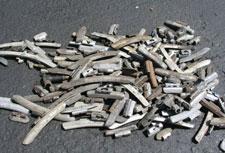
Th e state of Maryland has three rules have required the transition to lead-free that have been introduced. Th e fi rst would on city and state vehicles. Lasenby says take eff ect Jan. 1, 2012, and ensures that state vehicles shall be free from wheel Every year, 1.6 million pounds of lead wheel weights fall off of the site has been well-received by the automotive industry. weights containing more than .1% lead. vehicles and wind up in the environ“Th e response has been greater than A ban of the sale or use of wheel weights ment, according to the EPA. we had anticipated,” Lasenby explains.
“We continue to update it with product and legislative information that helps our customers facilitate the use of our lead- free, corrosion-free product off ering. It also off ers education on the current legislative status, by state, to ban lead use.”
Th e Tire Industry Association (TIA) also wants to educate the industry on the switch to green wheel weights. Th e group recently issued its Environmental Best Practices on how to transition away from lead wheel weights. It is available to TIA members at www.tireindustry.org.
“As part of our commitment to helping to make the tire industry more ‘green,’ we are proud to be launching the fi rst of a number of Environmental Best Practices on the important issue of how to transition away from lead wheel weights,” says Roy Litt lefi eld, TIA’s executive vice president.
TIA says the fi rst step is to contact suppliers and express a desire to transition away from lead. Th e most common alternative material is steel, but other non-toxic alternatives are also being used, including high-density polymers in specialty applications, and aluminum and zinc alloys.
TIA says to ask wheel weight suppliers if they have a program for recycling old wheel weights. Dealers can also check with an automotive batt ery supplier or a local scrap metal recycler for lead recycling.
TIA also suggests designating a storage space for the used lead wheel weights. Th e lead should be stored in a labeled container that is capable of handling the excessive weight of lead.
Another best practice is to ensure that no lead weights leave the shop as trash or litt er. Lead wheel weights should not be left on bay fl oors or parking lots. Th ey should not be allowed to fall into fl oor drains or storm water drains.
Last but not least, TIA says dealers should provide training to ensure that shop employees are conscientious about the need to treat lead wheel weights with special care. In addition, all employees who handle lead wheel weights should be instructed to wash their hands regularly for proper hygiene.
“Th e TIA Environmental Advisory Council (EAC) sees the creation of this fi rst Environmental Best Practices document as the logical continuation of our work to make being ‘green’ more practical and profi table for those in the tire industry,” says TIA EAC co-chair Dick Gust. ■
Eco-friendly wheel weights
Considering making the switch to lead-free wheel weights? These manufacturers offer alternative wheel weight options: • 3M Automotive Division: fl exible, tape-style wheel weights. • IMI: a thermoplastic cartridge that is fi xed in place; its free-moving steel particles readjust as the wheel moves. • Hennessy Industries Inc.: steel wheel weights • Perfect Equipment Inc.: zinc and steel wheel weights. • Plombco Inc.: zinc and steel wheel weights. • Wurth USA Inc.: zinc and steel wheel weights.