18 minute read
Glass Ceilings

July 22, 2020 * A reminder that under our summer schedule, our previous issue was dated June 24, and the next issue of Radio World is Aug. 19. The next Radio World Engineering Extra is Aug. 12.
www.radioworld.com
FOLLOW US www.twitter.com/radioworld_news www.facebook.com/RadioWorldMagazine
CONTENT Managing Director, Content Paul J. McLane, paul.mclane@futurenet.com, 845-414-6105 Senior Content Producer — Technology Brett Moss, brett.moss@futurenet.com Technical Advisors Thomas R. McGinley, Doug Irwin Technical Editor, RWEE W.C. “Cris” Alexander Contributors: Susan Ashworth, John Bisset, James Careless, Ken Deutsch, Mark Durenberger, Charles Fitch, Travis Gilmour, Donna Halper, Craig Johnston, Alan Jurison, Paul Kaminski, John Kean, Peter King, Larry Langford, Mark Lapidus, Jim Peck, Mark Persons, Stephen M. Poole, James O’Neal, Rich Rarey, Jeremy Ruck, John Schneider, Randy Stine, Tom Vernon, Jennifer Waits, Chris Wygal Production Manager Nicole Schilling Managing Design Director Nicole Cobban Senior Design Directors Lisa McIntosh and Will Shum
ADVERTISING SALES Senior Business Director & Publisher, Radio World John Casey, john.casey@futurenet.com, 845-678-3839 Publisher, Radio World International Raffaella Calabrese, raffaella.calabrese@futurenet.com, +39-320-891-1938
SUBSCRIBER CUSTOMER SERVICE To subscribe, change your address, or check on your current account status, go to www.radioworld.com and click on Subscribe, email futureplc@computerfulfillment.com, call 888-266-5828, or write P.O. Box 282, Lowell, MA 01853.
LICENSING/REPRINTS/PERMISSIONS Radio World is available for licensing. Contact the Licensing team to discuss partnership opportunities. Head of Print Licensing Rachel Shaw licensing@futurenet.com MANAGEMENT Chief Revenue Officer Mike Peralta Chief Content Officer Aaron Asadi Vice President/Group Publisher Carmel King Vice President, Sales, B2B Tech Group Adam Goldstein Head of Production US & UK Mark Constance Head of Design Rodney Dive
FUTURE US, INC. 11 West 42nd Street, 15th Floor, New York, NY 10036
All contents ©Future US, Inc. or published under licence. All rights reserved. No part of this magazine may be used, stored, transmitted or reproduced in any way without the prior written permission of the publisher. Future Publishing Limited (company number 02008885) is registered in England and Wales. Registered office: Quay House, The Ambury, Bath BA1 1UA. All information contained in this publication is for information only and is, as far as we are aware, correct at the time of going to press. Future cannot accept any responsibility for errors or inaccuracies in such information. You are advised to contact manufacturers and retailers directly with regard to the price of products/services referred to in this publication. Apps and websites mentioned in this publication are not under our control. We are not responsible for their contents or any other changes or updates to them. This magazine is fully independent and not affiliated in any way with the companies mentioned herein.
If you submit material to us, you warrant that you own the material and/or have the necessary rights/permissions to supply the material and you automatically grant Future and its licensees a licence to publish your submission in whole or in part in any/ all issues and/or editions of publications, in any format published worldwide and on associated websites, social media channels and associated products. Any material you submit is sent at your own risk and, although every care is taken, neither Future nor its employees, agents, subcontractors or licensees shall be liable for loss or damage. We assume all unsolicited material is for publication unless otherwise stated, and reserve the right to edit, amend, adapt all submissions.
NEWS They Overcame Radio’s Earliest Glass Ceilings Here are some of the women who excelled in the first half of the 20th century
BY JOHN SCHNEIDER
Before the dawn of broadcasting, women were frequently hired as wireless operators, and so it was not a surprise that women’s voices were heard as announcers and program hosts in the early days of broadcast radio. Sybil Herrold was perhaps the world’s first disc jockey; she played Victrola records on her husband Charles Herrold’s experimental station, which broadcast in San Jose from 1912 to 1917.
In Boston, Eunice Randall’s voice was heard on a variety of programs over AMRAD station 1XE (which became WGI in 1922). In New York City, WOR audiences regularly heard Jesse Koewing, who was identified on the air only as “J.E.K.” while Betty Lutz was the popular “hostess” heard on WEAF. At WAHG (now WCBS), 16-year-old Nancy Clancey was billed as the country’s youngest announcer.
Additionally, women were frequently hired as “program managers,” responsible for booking the live entertainment that filled their stations’ airwaves, and they often came before the microphone to introduce the entertainers.
But, by the start of the network era in the mid-1920s, there came to be a prejudice against women’s voices on the radio.
“FLAT” OR “SHRILL”
Broadcasters complained that the tone quality of early receivers and speakers made women’s higherpitched voices sound shrill and dissonant; but this prejudice remained even as higher-fidelity receivers became available in the early 1930s. The conventional wisdom was that “audiences don’t like or trust women as announcers” and “only male voices can speak with authority.”
An audience survey conducted by WJZ in 1926, with 5,000 respondents, determined that listeners of both sexes preferred the male voice by a margin of 100 to 1. In 1934, an article in the Journal of Social Psychology concluded that “the male voice is more natural, more persuasive and more likely to arouse interest over the air than the feminine voice.” In 1935, Cantril and Gordon Allport published “The Psychology of Radio,” and determined that 95% preferred hearing male voices over the radio.
This prejudice against female announcers was expressed by station managers of the day. In a letter to the editor in Radio Broadcasting Magazine, a station director wrote that “for announcing, a well-modulated male voice is the most pleasing to listen to. I have nothing against a woman’s announcing, but really do believe that unless a woman has the qualifications known as ‘showman’s instinct,’ it really does become monotonous.”
Another station executive from Pittsburgh wrote, “I would permit few women lecturers to appear [on the radio]. Their voices do not carry the appeal, and so whatever the effect desired, it is lost on the radio audience. Their voices are flat or they are shrill, and they are usually pitched far too high to be modulated
Photo: Author’s collection
In 1922, Jesse Koewing was one of the first announcers at WOR in Newark (later New York City). She identified herself on the air with just her initials “J. E. K.”
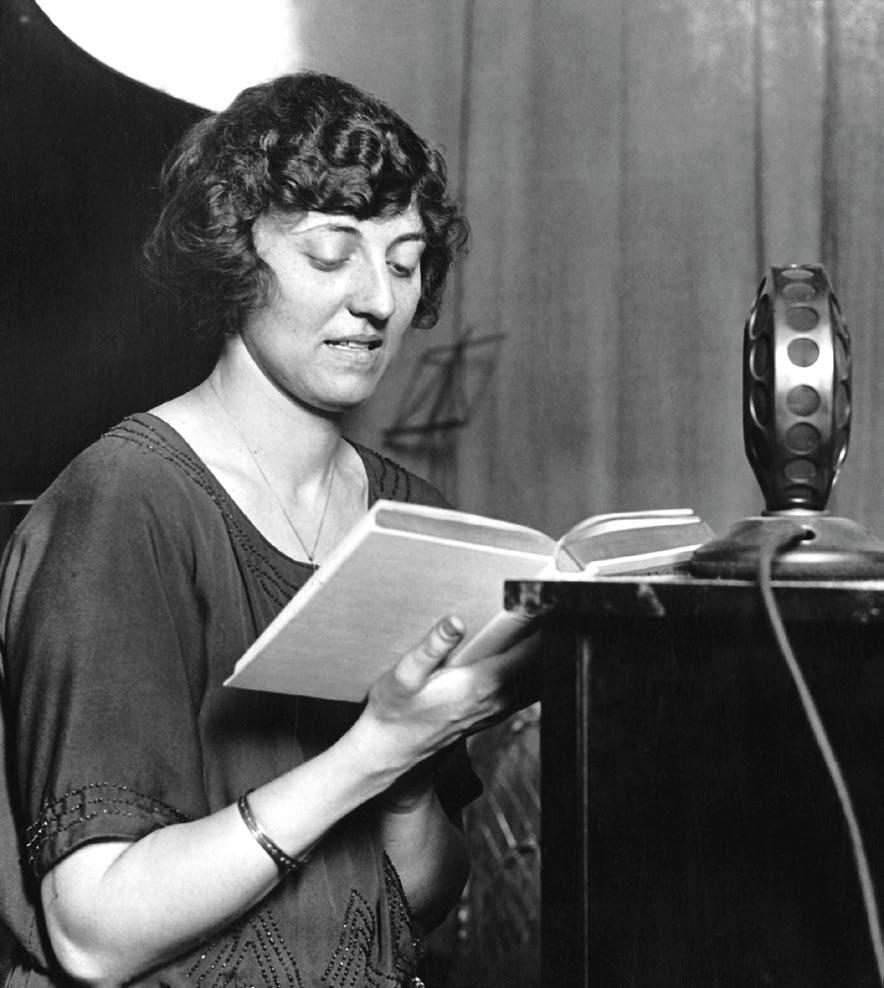
Photo: Author’s collection
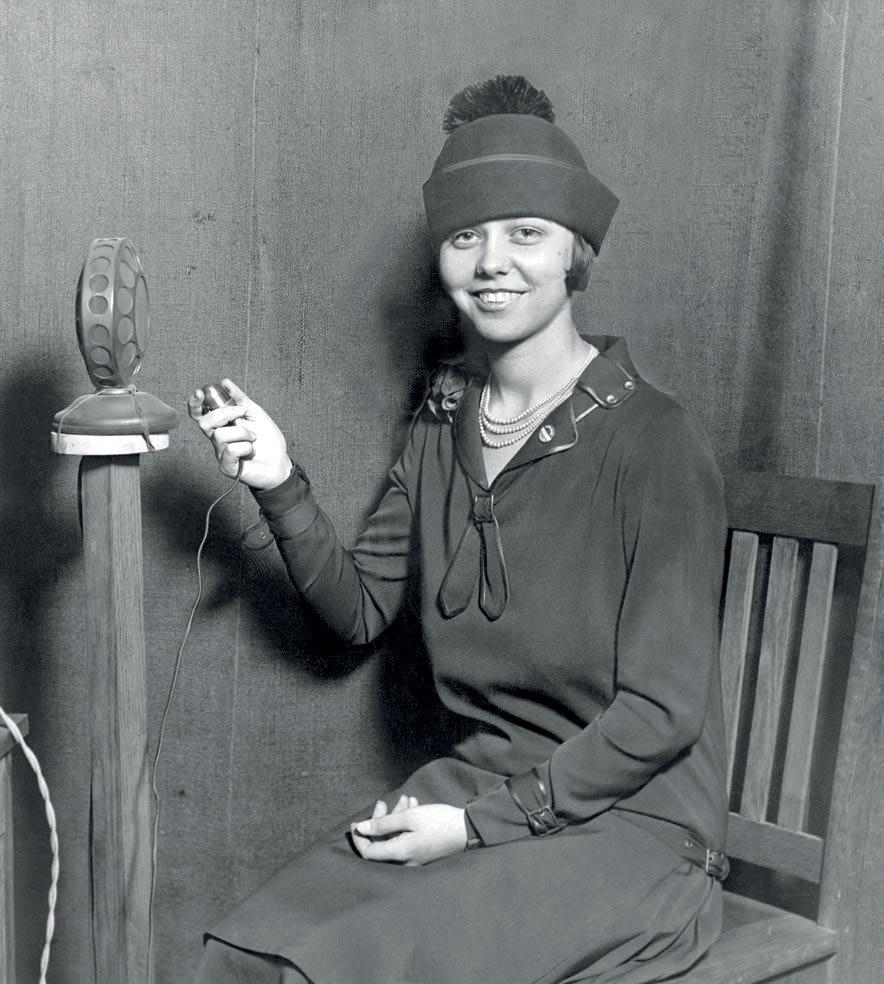
Sixteen-year-old Nancy Clancy was reportedly the youngest radio announcer in the country in 1924. Here she is shown in the studios of WAHG, the Alfred H. Grebe station in Richmond Hill, N.Y. WAHG grew to become today’s WCBS in New York City.
correctly.”
As a result, by 1930 women’s voices had virtually disappeared from the airwaves, except for mid-afternoon programs aimed at the housewife and discussing such banal topics as cooking, fashion and beauty tips. (continued on page 4)
WOMEN
(continued from page 3)
This was especially true in network radio, with rare exceptions. In a notable experiment, NBC hired the vaudeville comedienne Elsie Janis in 1934 to be the network’s first female announcer, joining a staff of 26 men. But when listeners complained that a woman’s voice was inappropriate for serious announcing work, an NBC executive commented that they were “not quite sure what type of program her hoarse voice is best suited for, but it is certain she will read no more press news bulletins.” Janis was relegated to announcing the weather and variety shows, and seems to have left NBC within a year.
Over at CBS, they paired radio actress Bernardine Flynn with Durward Kirby to host a daily newscast. But Kirby was assigned to read the “hard” news stories while Flynn reported only the “human interest” items.
Perhaps the only woman to break the taboo on women reporting serious news stories during the network era was Mary Margaret McBride. She began her radio career on WOR in New York in 1934, taking the air name Martha Deane and playing a grandmotherly-type woman
Photo: Author’s collection
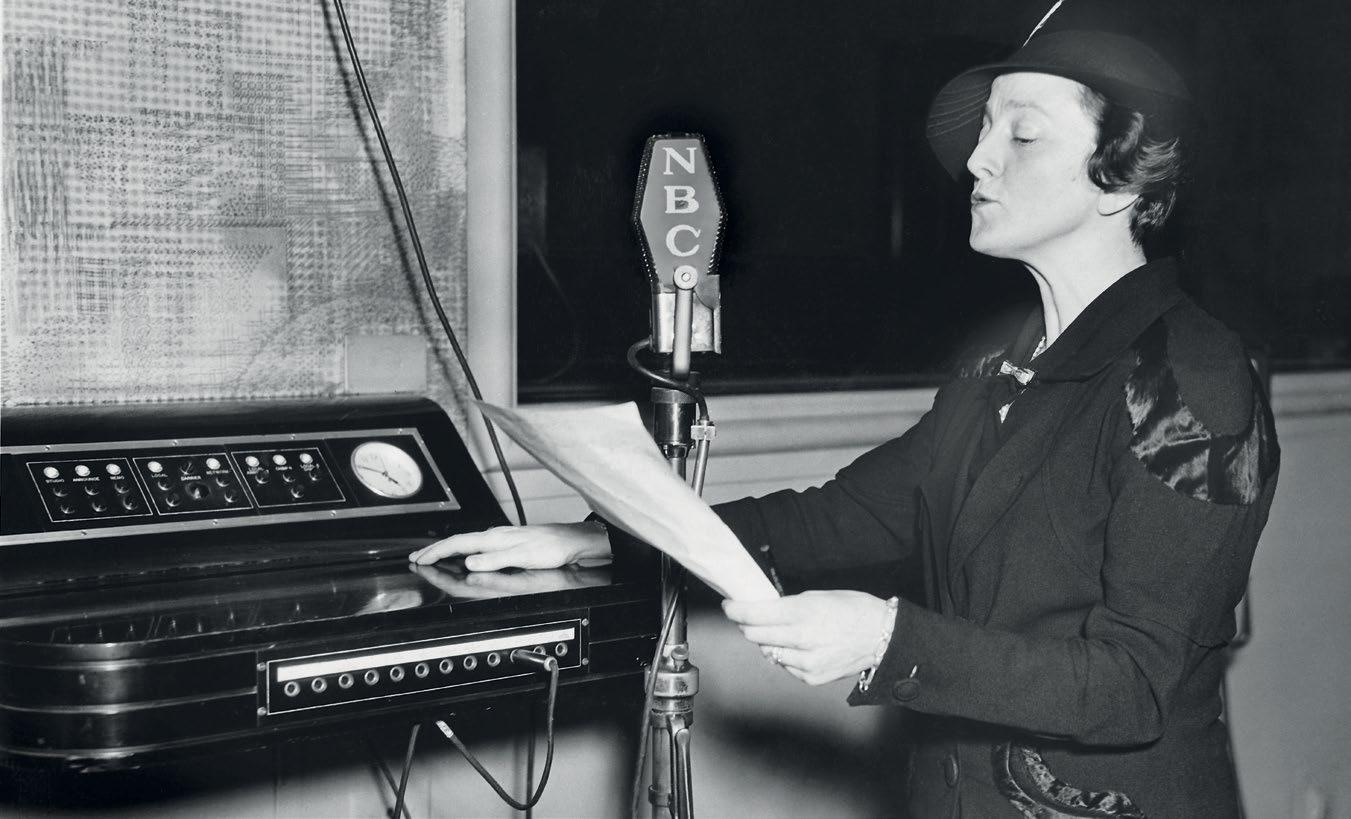
Elsie Janis, a well-known vaudeville comedienne, became NBC’s first staff announcer in 1934. But listeners complained that her voice was not suited for “serious announcing” and she was relegated to announcing weather forecasts and variety shows. She left the network after only a short while in her position.
who dispensed philosophy and common sense. In 1937, she moved over to the CBS network under her own name, and became recognized for her interviewing capabilities. Her daily afternoon program included high-level politicians, generals and movie stars. She moved to NBC in 1941, where her daily audience numbered in the millions. She remained a regular feature on network radio until 1960, and then continued in syndication.
WAR YEARS
World War II temporarily opened employment opportunities for women in radio, as the male staffs of the networks and local stations were siphoned off by the armed services. Women assumed the roles of announcers and
Mary Margaret McBride broke the mold that kept women from serious announcing work on the radio networks. Her afternoon NBC interview program commanded an audience of millions, and she enjoyed a reported $52,000 annual salary in 1941. Here she is seen interviewing General Omar N. Bradley on the first anniversary of D-Day.
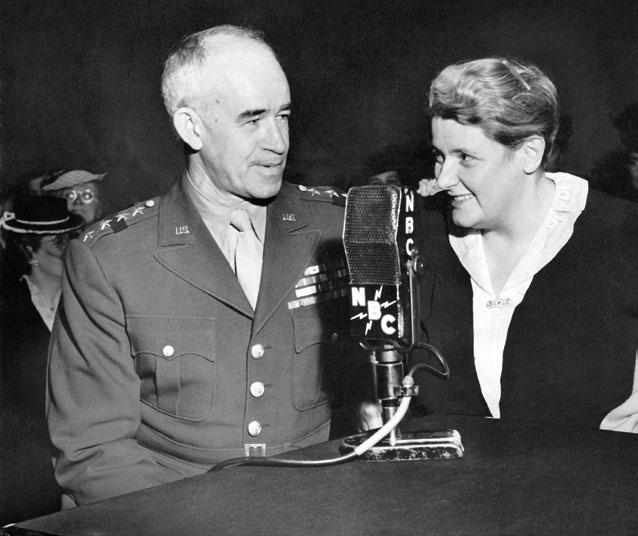
newscasters, studio engineers and sound effects specialists. In 1943, NBC hired 10 young “pagettes” to supplement its depleted staff of Radio City pages. Around the country, women were also hired as advertising sales persons, program directors, traffic managers, continuity directors and even station managers. But sadly, just as occurred in manufacturing plants, when the men returned
Work from Home with Burk Technology
The ability to remotely manage your broadcast facilities has always been a time saver. Now it can be a life saver.
Burk is here with equipment and expertise to keep your stations on the air. Short on time? Ask about a pre-configured system for your site.
ARC SOLO SPRING SPECIAL Now you can buy an ARC Solo at the special price of $2,995.00.

GET THREE FREE
Get SNMP Plus, Jet Active Flowcharts and AutoPilot ® for free when you buy an ARC Plus Touch with RSI.
Offers valid through July 31, 2020.
MADE IN THE USA
JULY 22, 2020
NEWS U.S. Radio Remains in
Pandemic Mode. . . . . . . . . . . . . . . . . They Overcame Radio’s Earliest
Glass Ceilings. . . . . . . . . . . . . . . . . . . Radio Doing Good. . . . . . . . . . . . . . . . . 1
3 7
8
FEATURES Audio Processing Before the Wars. . . . 8 Workbench: Welcoming a New World of Readers. . . . . . . . . . . . . . . . . . . . . 12 Lessons Learned in Houston Radio. . . 20

18
GLOBAL RADIO Switzerland Inches Closer to FM
Switchoff. . . . . . . . . . . . . . . . . . . . . 18
BUYER’S GUIDE New WheatNet-IP Studios Handle Recent
Events . . . . . . . . . . . . . . . . . . . . . . . 22 WXPN Upgrades With Logitek Helix. . 24 À Punt Radio Relies on AEQ. . . . . . . . 26
29
Radio actress Bernardine Flynn teamed up with announcer Durward Kirby for the program ”Daytime Radio Newspaper” in 1943. The 15-minute CBS radio program had Kirby delivering straight news items while Flynn handled human-interest reports. Flynn was best known for playing the character Sade in the whimsical afternoon serial “Vic and Sade.”
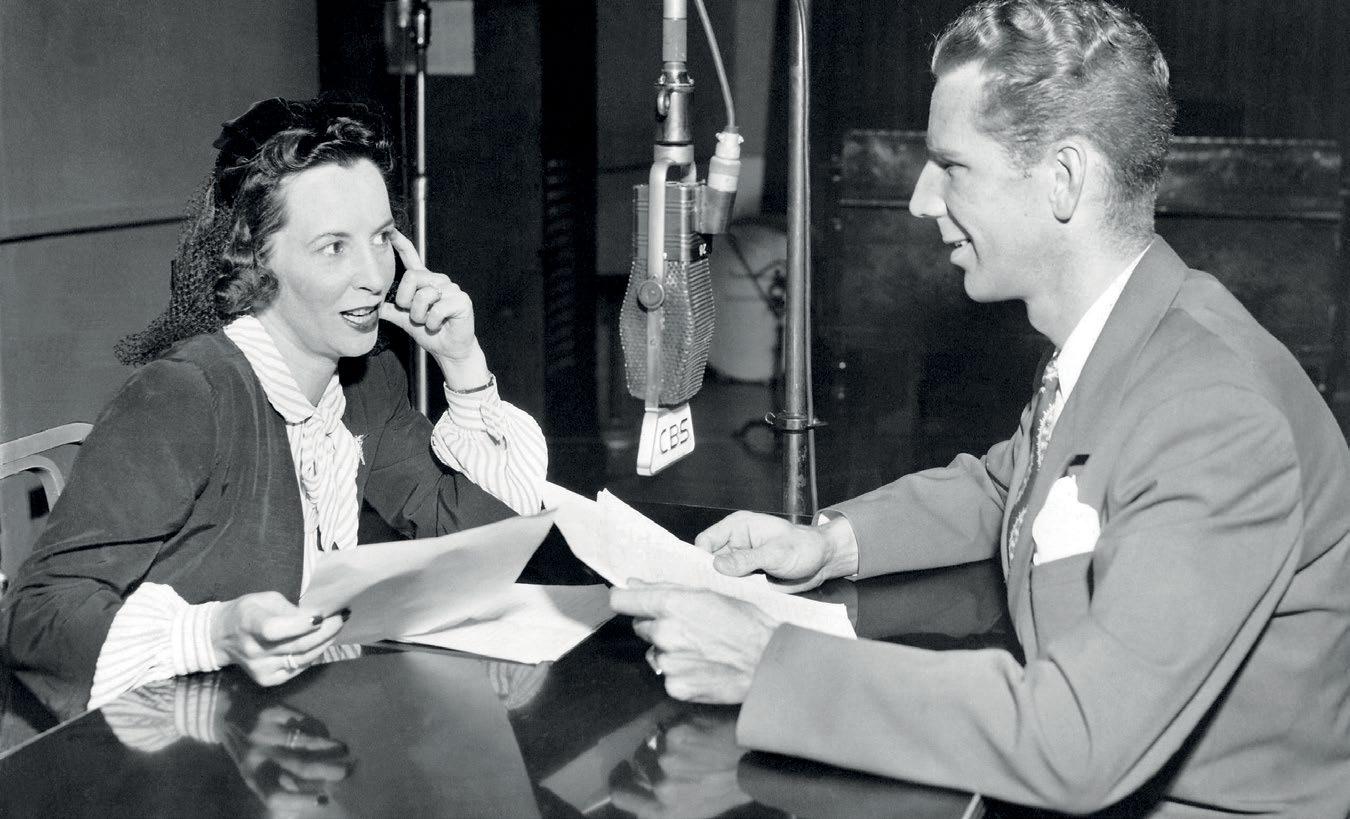
Photo: Author’s collection
home after the war the jobs reverted to men who “had to support their families,” and the women were told to go home and be happy homemakers.
In the 1950s, as the radio industry adapted to the new competition from television, many radio announcers turned into disc jockeys, but the prejudice against female voices on the radio continued. The big-name deejays at local stations around the country were all men. But there were a few exceptions. In 1955, Sam Phillips (of Sun Records fame) opened WHER in Memphis. Phillips enjoyed hearing women’s voices on the air, and he hired an all-female staff to run the station. WHER operated from studios in a Holiday Inn motel, and this led to a spinoff program, sponsored by Holiday Inn. WHER personality Dottie Abbott, taking the air name Dolly Holiday, hosted an overnight program of easy listening music syndicated to stations around the country. Her soothing voice and soft music could be heard across the AM band after midnight almost anywhere in the country into the early ’70s.
CHANGING TIMES
In the late 1960s, FM station WNEW in New York City experimented with an all-female format. Allison Steele won an audition against 800 other women and began working there as a disc jockey. She stayed on when the format
RESOURCES & MORE READING:
Women and Radio: Airing
Differences, edited by Caroline Mitchell
Fireside Politics: Radio and Political Culture in the United States, 1920-1940, by Douglas B. Craig “Remembering the Ladies—A Salute to the Women of Early Radio,” by Donna L. Halper, “Popular Communications,” January 1999
Broadcasting Magazine, July 1, 1934
“The Story of WHER, America’s Pioneering, First All-Woman Radio Station (1955),” www.openculture.com
“Dolly Holiday — A Dreamy Soothing Voice in the Night,” www.rumormillnews
“Mary Margaret McBride, American Journalist and Broadcaster,” by The Editors of Encyclopaedia Britannica Wikipedia: “History of Radio Disc Jockeys”
was abandoned 18 months later, and gained popularity as “The Nightbird.” Her overnight show drew an estimated audience of 78,000, and she was chosen by Billboard Magazine in 1976 as the “FM Personality of the Year.”
OPINION “COVID Virginia” Was a Volunteer
Miracle. . . . . . . . . . . . . . . . . . . . . . . 29 Digital Radio Has Expanded Community
Messaging. . . . . . . . . . . . . . . . . . . . 30

Radio World (ISSN: 0274-8541) is published bi-weekly with additional issues in February, April, June, August, October and December by Future US, Inc., 11 West 42nd Street, 15th Floor, New York, NY 10036-8002. Phone: (703) 852-4600, Fax: (703) 852-4583. Periodicals postage rates are paid at New York, NY and additional mailing offices. POSTMASTER: Send address changes to Radio World, P.O. Box 282, Lowell, MA 01853.
WOMEN
(continued from page 5)
PANDEMIC
(continued from page 1)
As the 1970s progressed, the barriers against hearing women on the air gradually faded away. CHIC in Toronto and KNIT in Abilene, Texas, both had all-girl deejay staffs, although the newscasts continued to be voiced by men. An all-woman format was tried at WSDM in Chicago, where Yvonne Daniels sharpened her chops before moving on to the AM powerhouse WLS in 1973. Also in Chicago, Connie Czersin debuted on WIND in 1974. Maxanne Sartori played progressive rock at KOL(FM) in Seattle before moving to Boston to take the afternoon slot at WBCN(FM). Donna Halper, whose written work has appeared in the pages of Radio World, played the hits at WMMS in Cleveland, where she was credited with discovering the rock band Rush in 1974. Liz Kiley started her career at WLAV in Grand Rapids in 1976, and within three years had moved up the ranks to WABC in New York.
The many who came after them benefited from the work of the women named above, and dozens of others, in challenging radio’s glass ceilings.
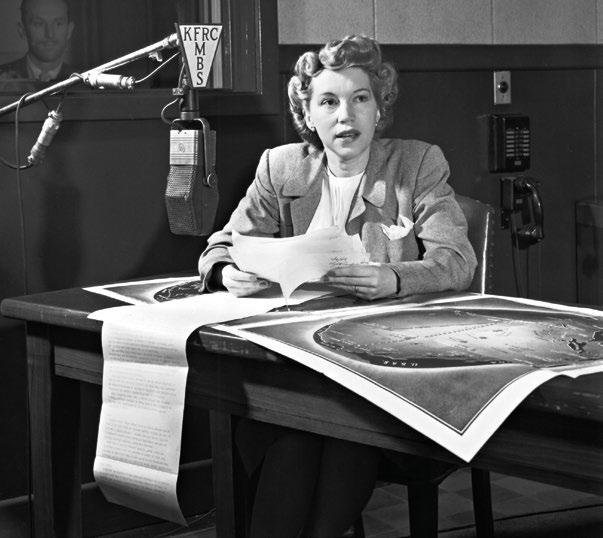
Ruth Anderson at KFRC was San Francisco’s only radio reporter, a choice role usually reserved for men. Previously limited to acting on soap operas, she was given the job of editing and reporting the news on a probationary basis in 1942 due to a shortage of male reporters during World War II. Her 15-minute program “Last Minute News” was heard six days a week, sponsored by a local department store.
REAL TIME BUILT-IN INSTRUMENTATION Comprehensive Monitoring & Control

100% Remote Access
employees inside buildings, avoiding the use of large meeting spaces, and limiting the return of employees considered at high risk of contracting the virus. In many cases salespeople will continue working off-site.
New work routines are still being carved out, with guidelines being adopted as office spaces and studios are realigned. Work models are being finetuned by many large broadcast groups but work from home for some employees is expected to be extended.
A top-market public radio executive noted that companies not only must create their own rules but also abide by those of buildings where they lease
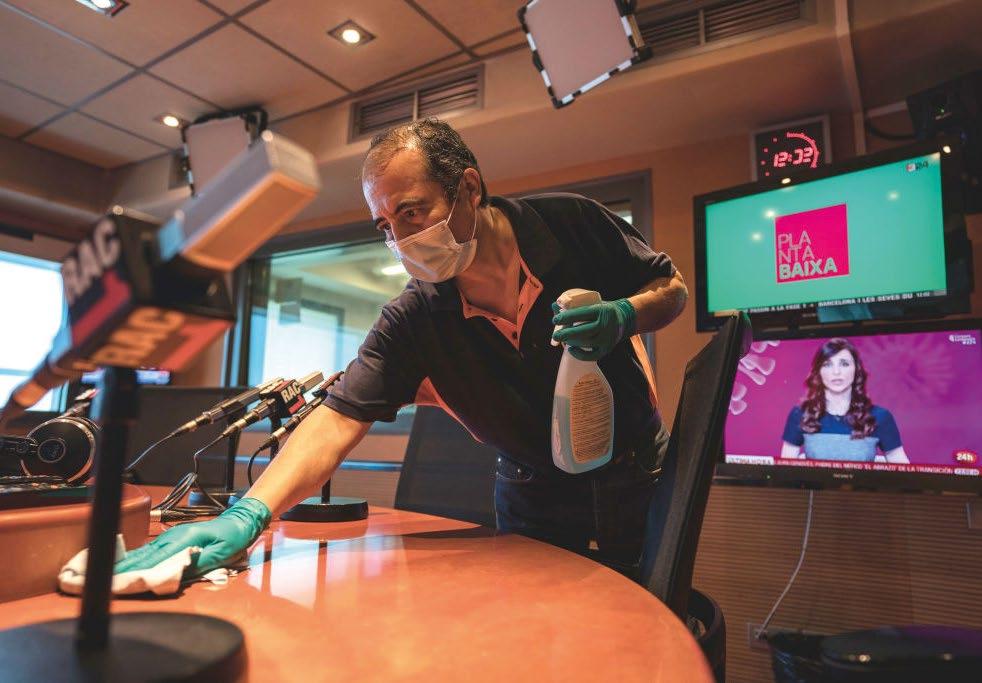
The experience of U.S. radio stations echoes that of broadcasters around the world. In Spain, a worker at RAC1 disinfected a radio studio this spring in Barcelona, Spain.
— An industry executive
space. This may raise additional issues involving maximum building occupancy, new “traffic patterns” such as oneway stairwells, and additional security card readers.
Also, if more air and IT staff are expected to work permanently from home, employers may need to provide those homes with uninterruptible power supplies for conditioning and backup power — and have plans in place for “passing the mic” to backup talent or support people if the home is hit by an extended power outage.
Longer-term, one high-ranking executive foresees a major shift to more centralized broadcast operations.
“It is pretty clear that corporate radio is trending to more centralized operations in general, similar to what iHeartMedia is doing. If anything, this pandemic proved remote operation could be achieved much more easily than first thought,” he said. “I think we will generally see facilities with fewer people and more on-air content being generated centrally instead of locally.” iHeartMedia announced earlier this year plans to create AI-enabled Centers of Excellence in order to consolidate some operations at its radio stations, according to those familiar with the development.
TOOLKIT
NAB Executive VP and Chief Technology Officer Sam Matheny said radio CEOs and other senior leaders he has spoken to have been pleasantly surprised at how well the shift to remote work has gone.
“In many cases 75 to 80% of the workforce is now, or was at one point, remote. The technology and engineering is there to enable it,” he said.
“I think a really important thing broadcasters can do right now is to have a plan for what happens when someone in their organization is diagnosed with COVID-19. This is especially true for stations that operate with a small staff where a single infection could cause a major disruption due to quarantine of multiple employees,” Matheny said.
The NAB has a toolkit (www.nab.org/ coronavirus) that offers station operation resources, educational resources and a link to the CDC’s guidelines on reopening.
“When it comes to returning to the office, the size and configuration of the broadcast facility and team will drive the physical considerations,” Matheny said. “Face masks are a major area of focus and were deemed the most needed Personal Protective Equipment item by broadcasters and others in the communications sector for critical employees.”
Hand sanitizer, gloves and supplies for regular cleaning of studio and other shared equipment are critical. “And an item that I believe is unique to broadcasters is the increased need for changeable microphone screens,” he said.
Other strategies being considered by broadcasters include barriers, modified work hours and alternating days in the office, Matheny said.
Cleaning crews will be necessary since wiping down all surfaces will be critical, he said. “And even staggered building entry times might be necessary since using elevators will be difficult while maintaining social distancing.”
LIMITED OCCUPANCY
One engineering executive at a major group said remote work at his company will continue for some time.
“Occupancy of air studios will be limited based on size,” the person said. “All air staff who are in the building will be at least six feet apart with clear dividers installed where necessary.”
Break rooms are likely to remain closed for some time, he said, and companies will emphasize regular cleaning and sanitizing of touch points.
Many broadcasters are operating with fewer employees after furloughs; the industry has also seen job cuts that predated or were not specifically tied to the health crisis. So one open question is how many such jobs might be recovered.
Smaller and medium-sized groups are affected as much as the biggest ones. Art Sutton, president/CEO of GA-Carolina Broadcasting, said his company furloughed nine employees and closed stations to the general public. “We won’t consider bringing our employees back before July 31, when the federal government’s $600 weekly unemployment benefit expires,” he said.
The broadcaster, which has 16 radio stations across five small and medium markets, saw major revenue declines the past several months.
“Since we are operating with fewer people, that helps to offset our revenue declines of 5% in March 2020 compared to March 2019,” he said. Sutton reported a “brutal” 33% decline in April, 20% in May and a projected drop in June of 15-16%.