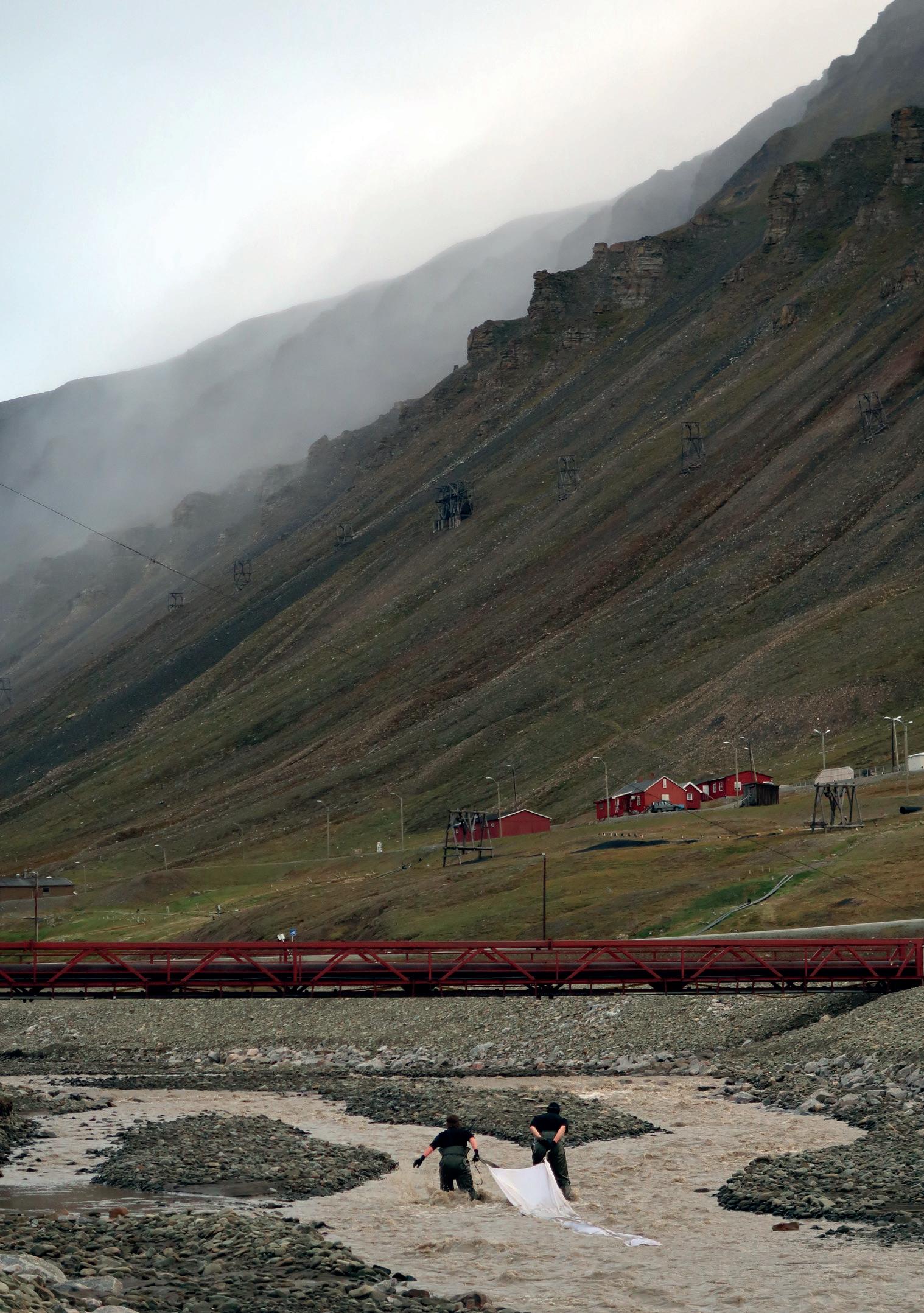
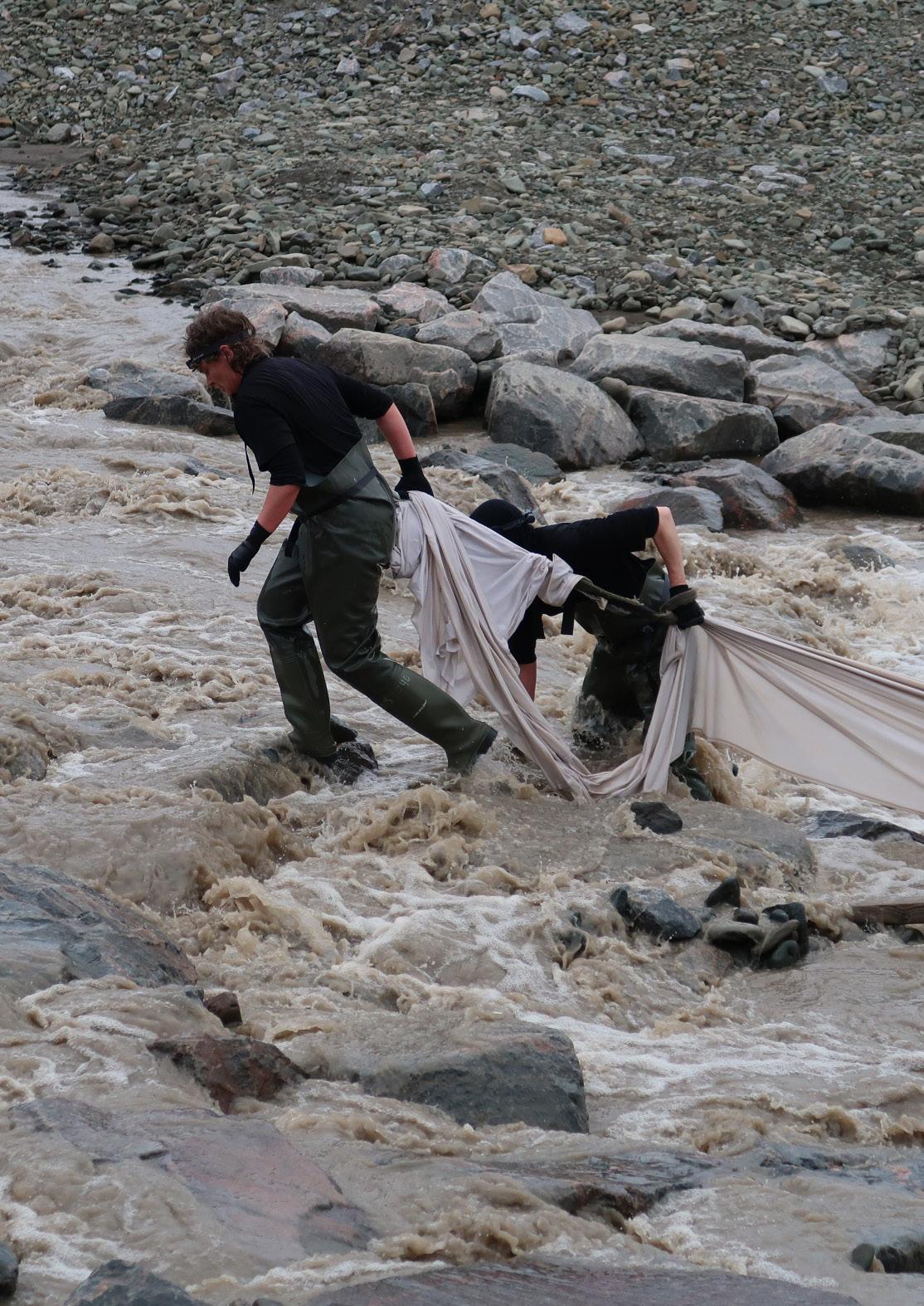
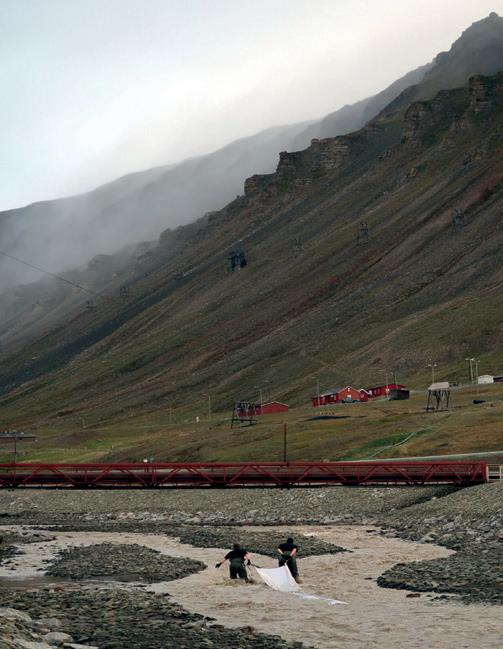
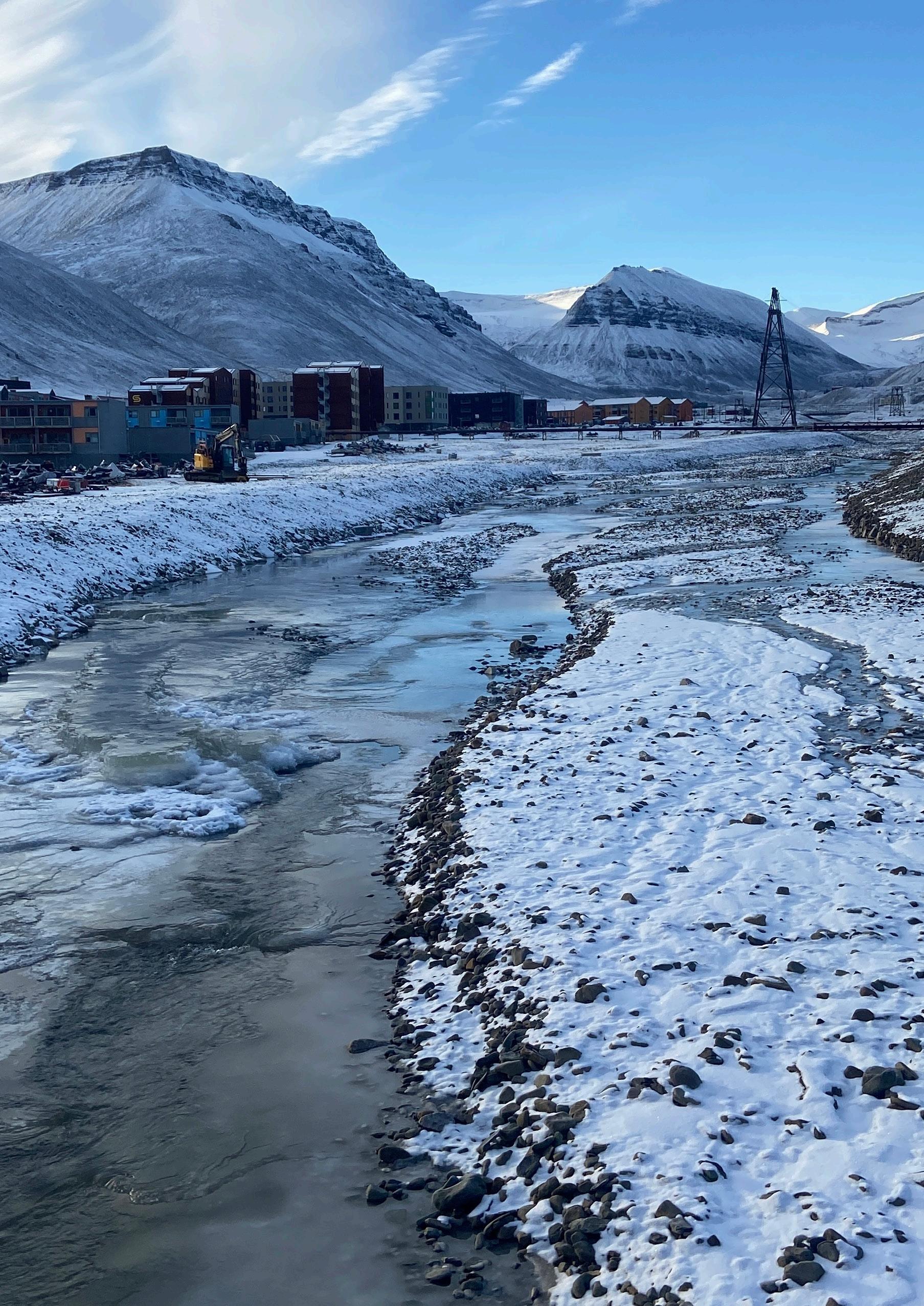
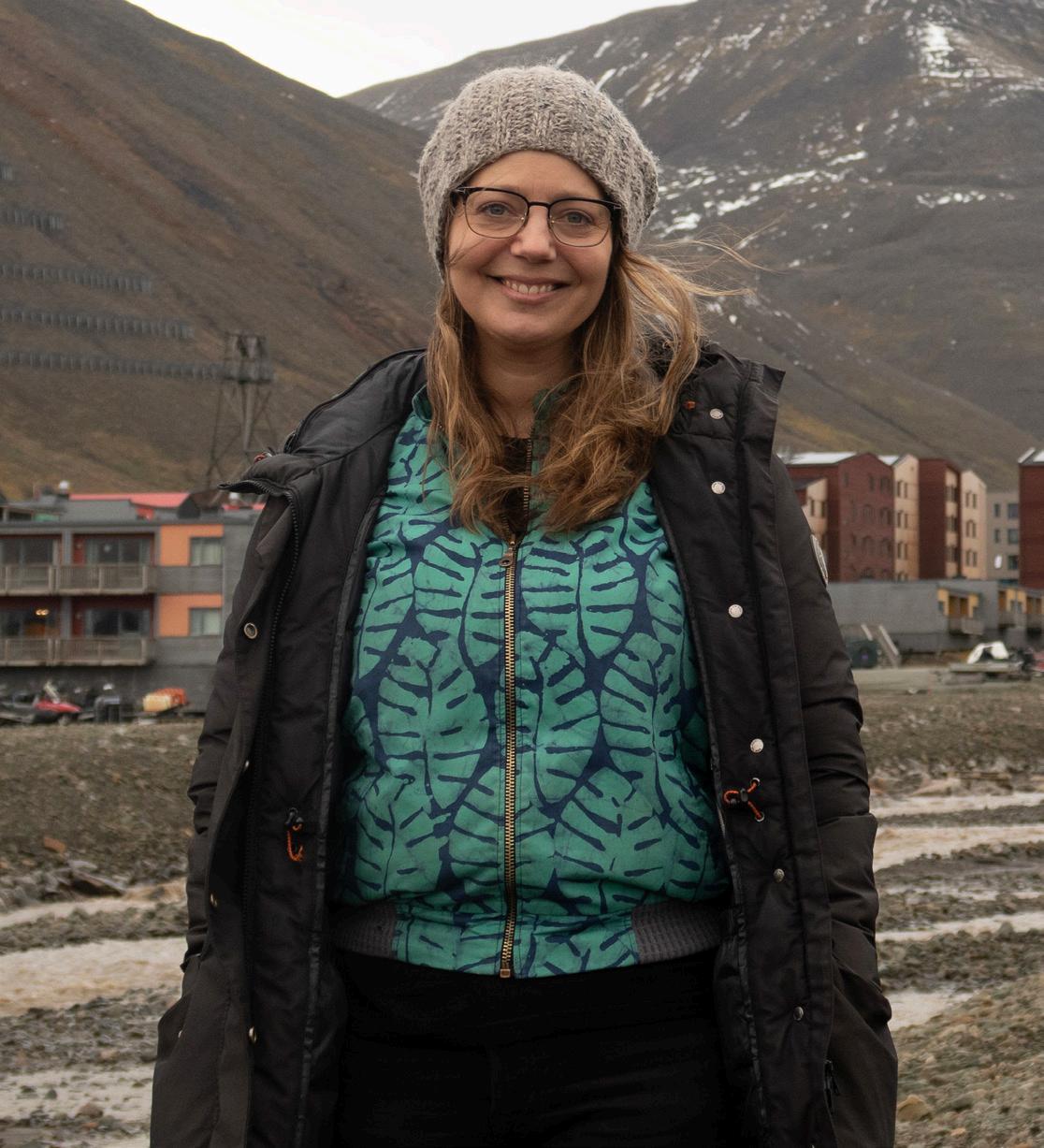
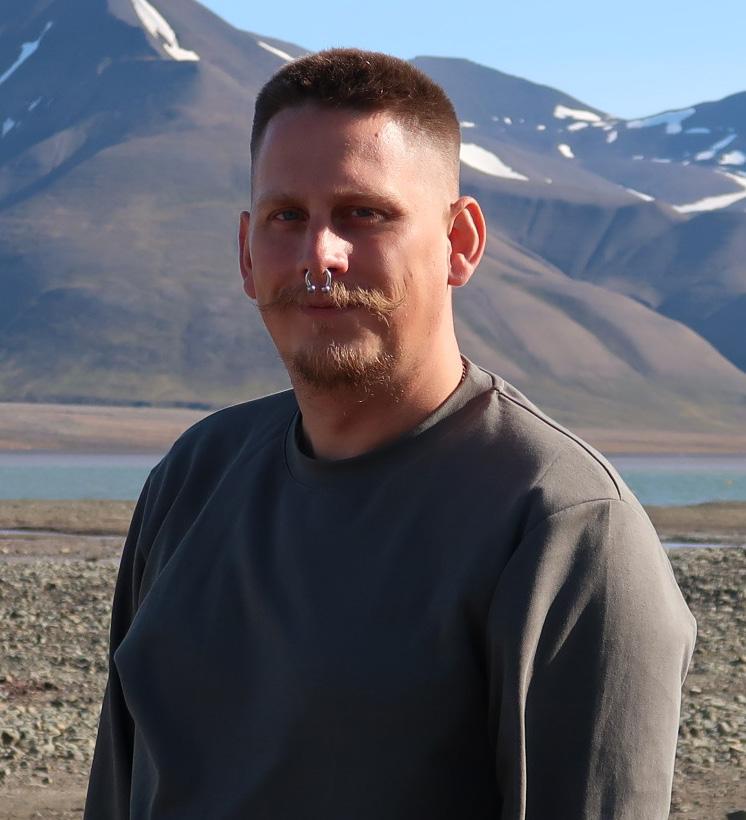
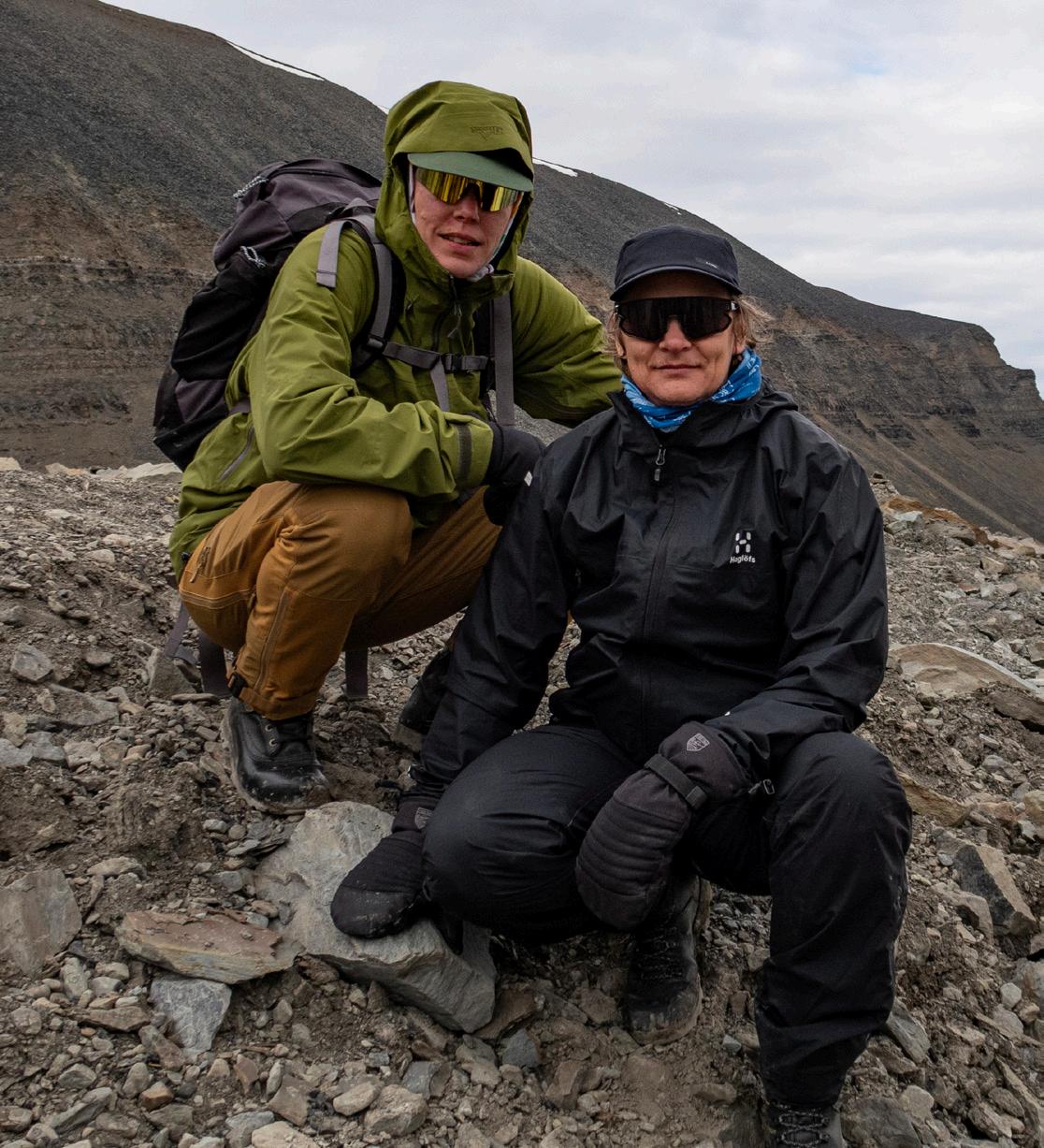
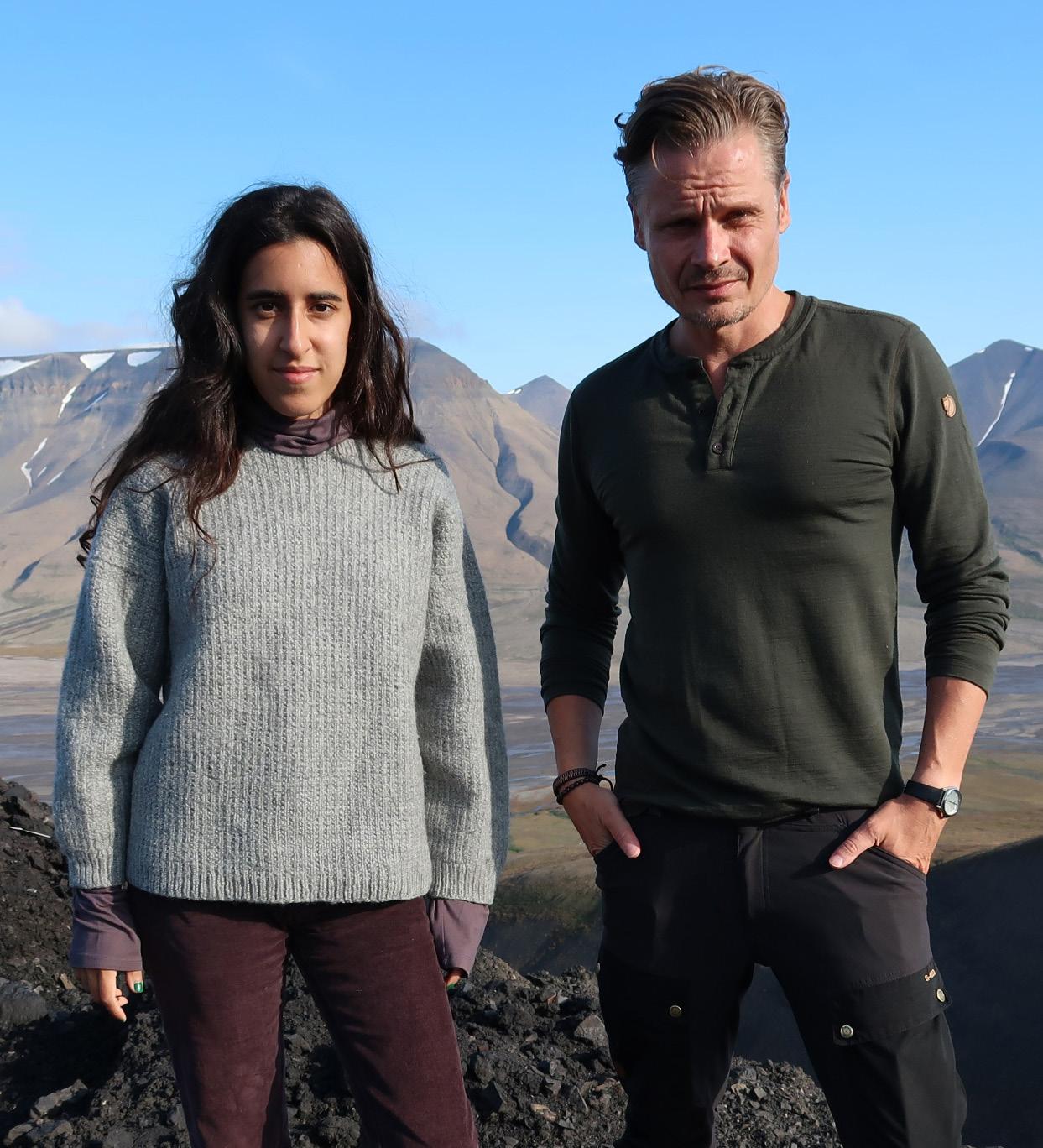
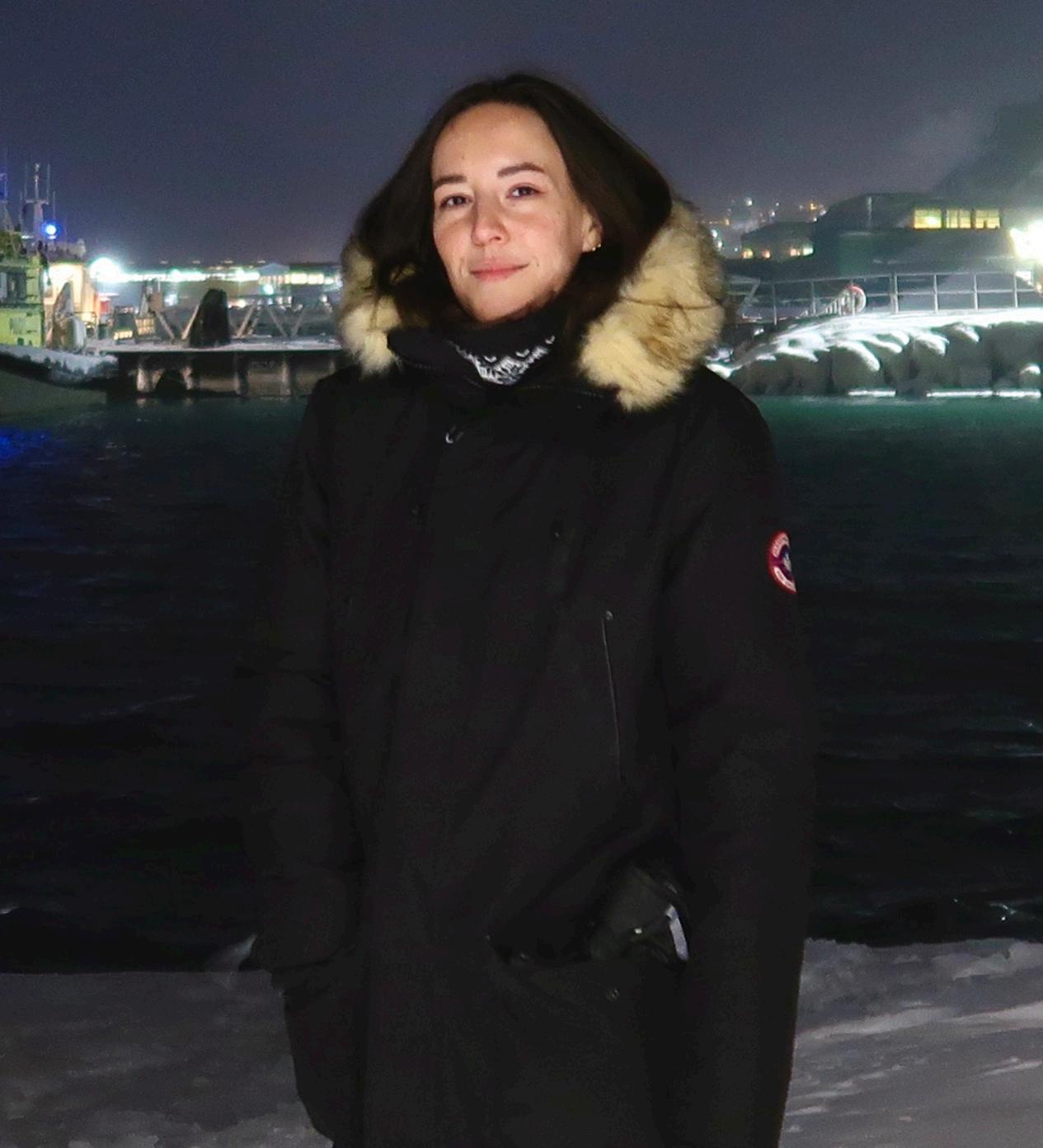
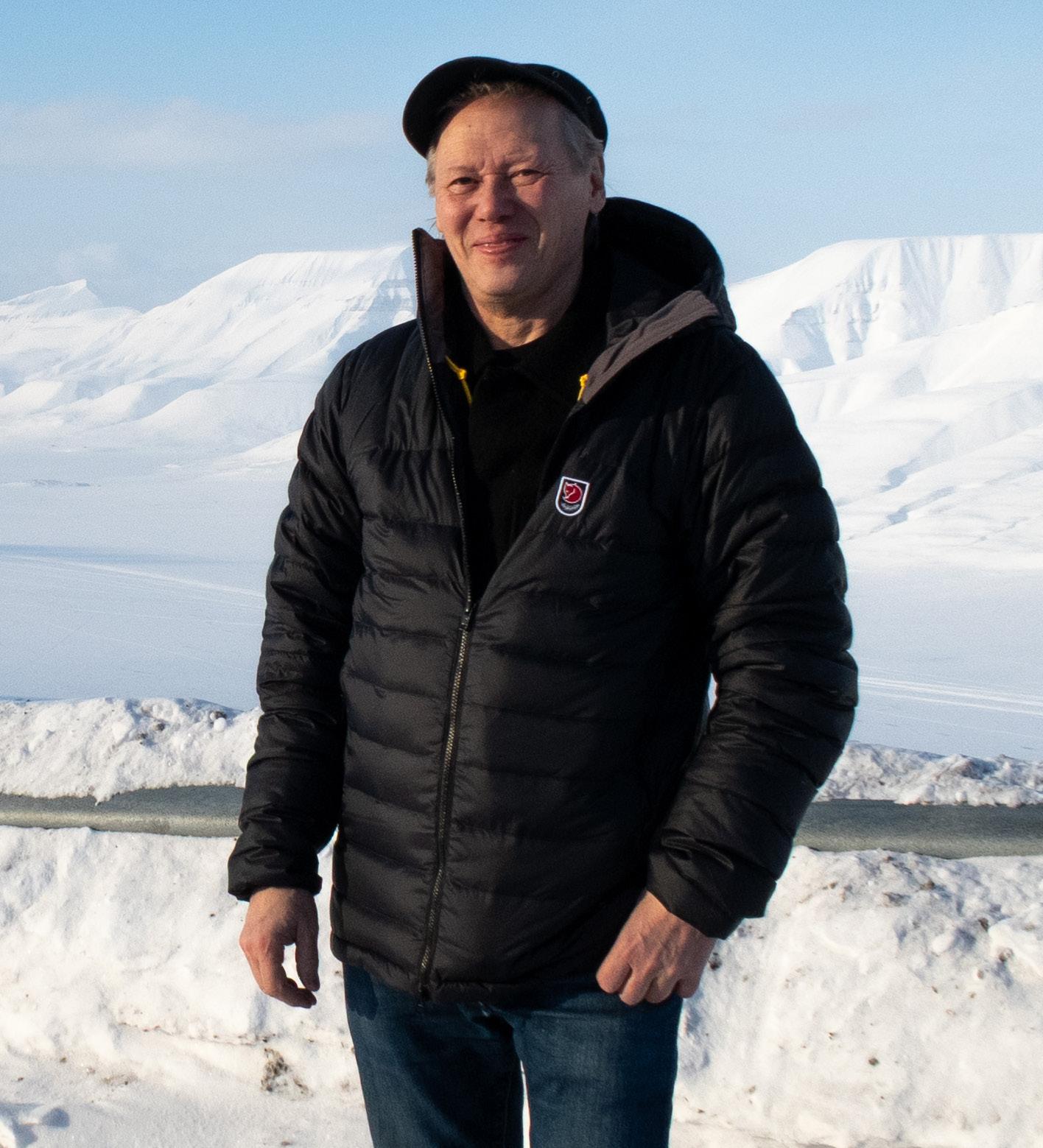
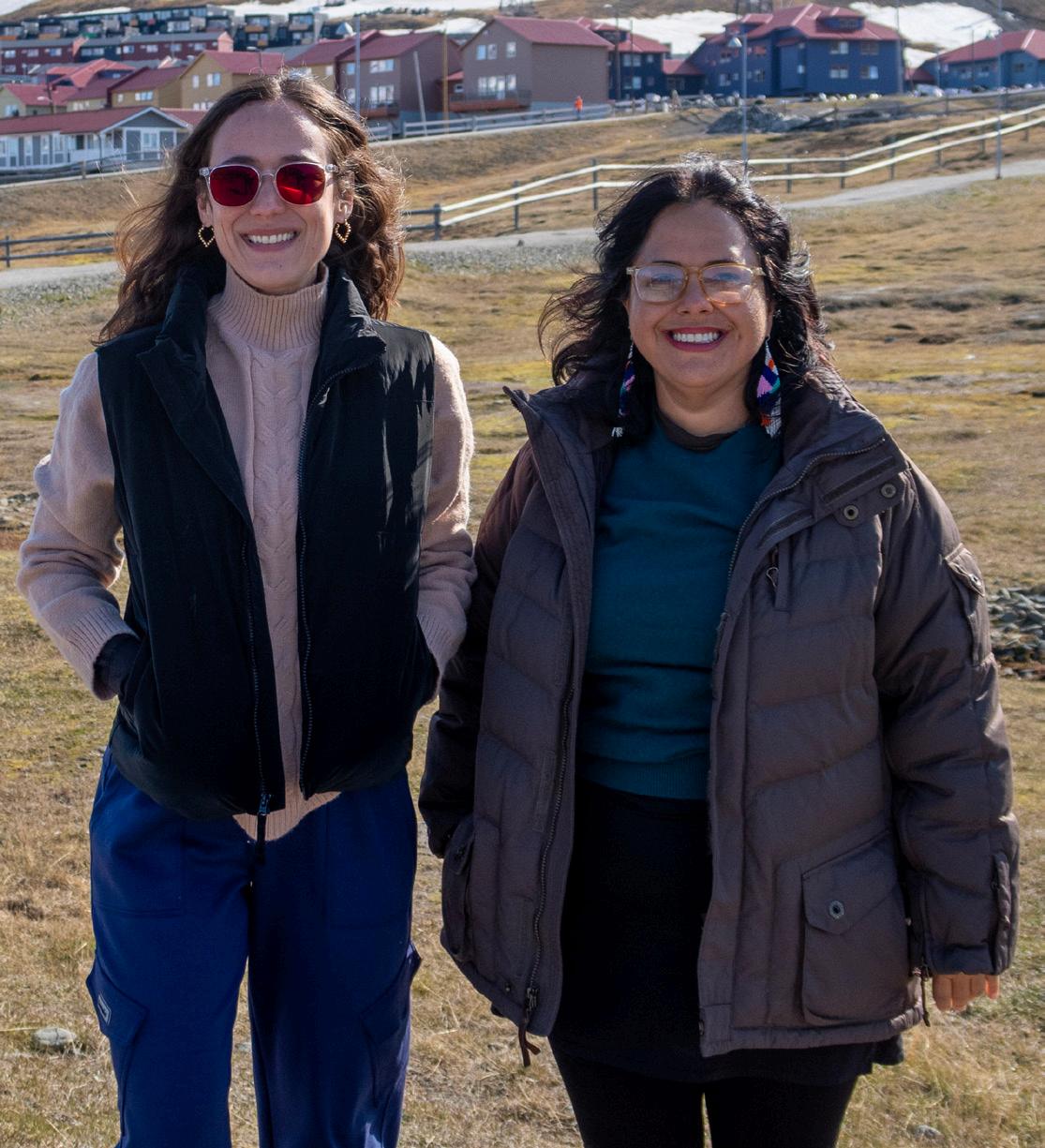
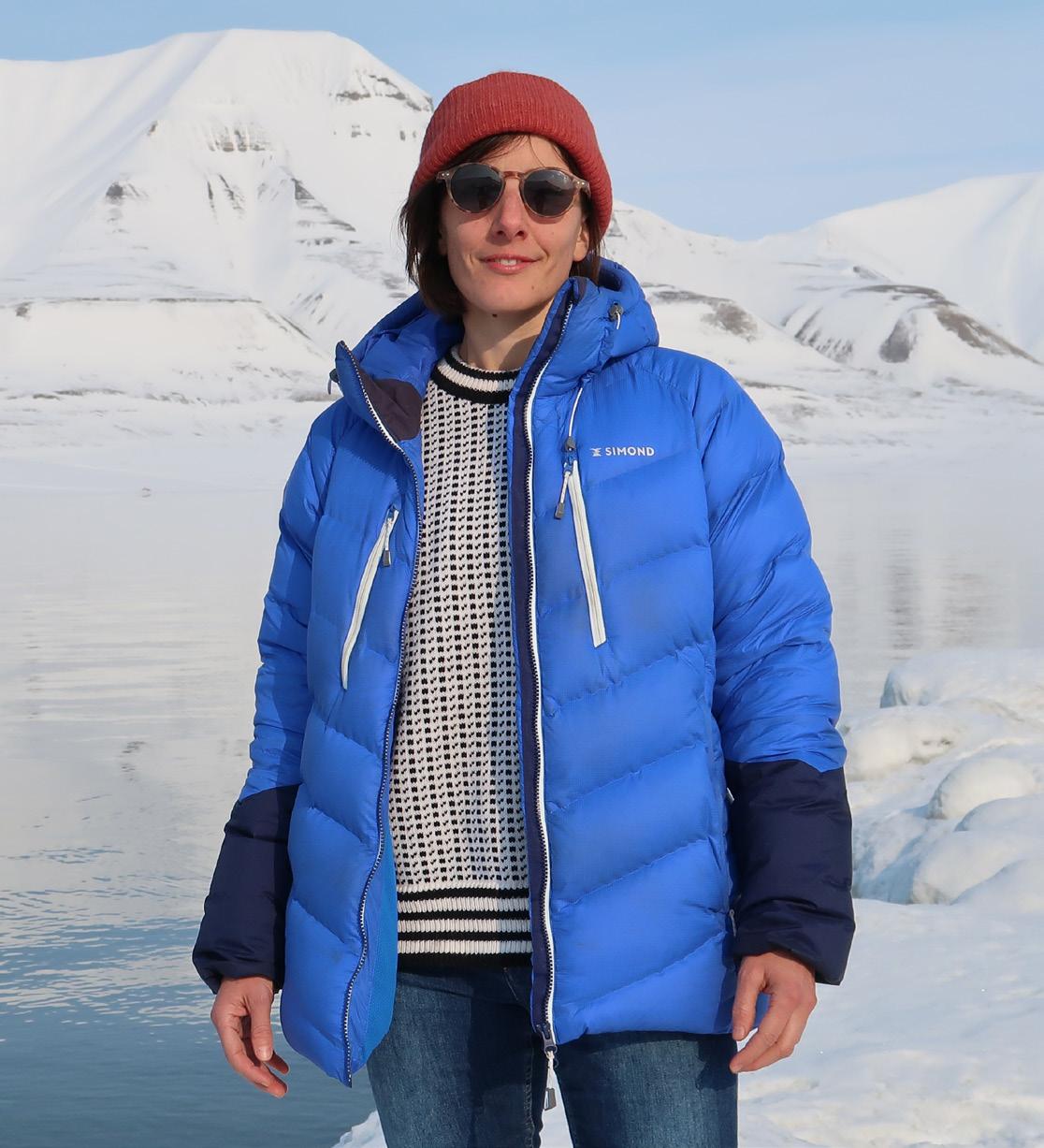
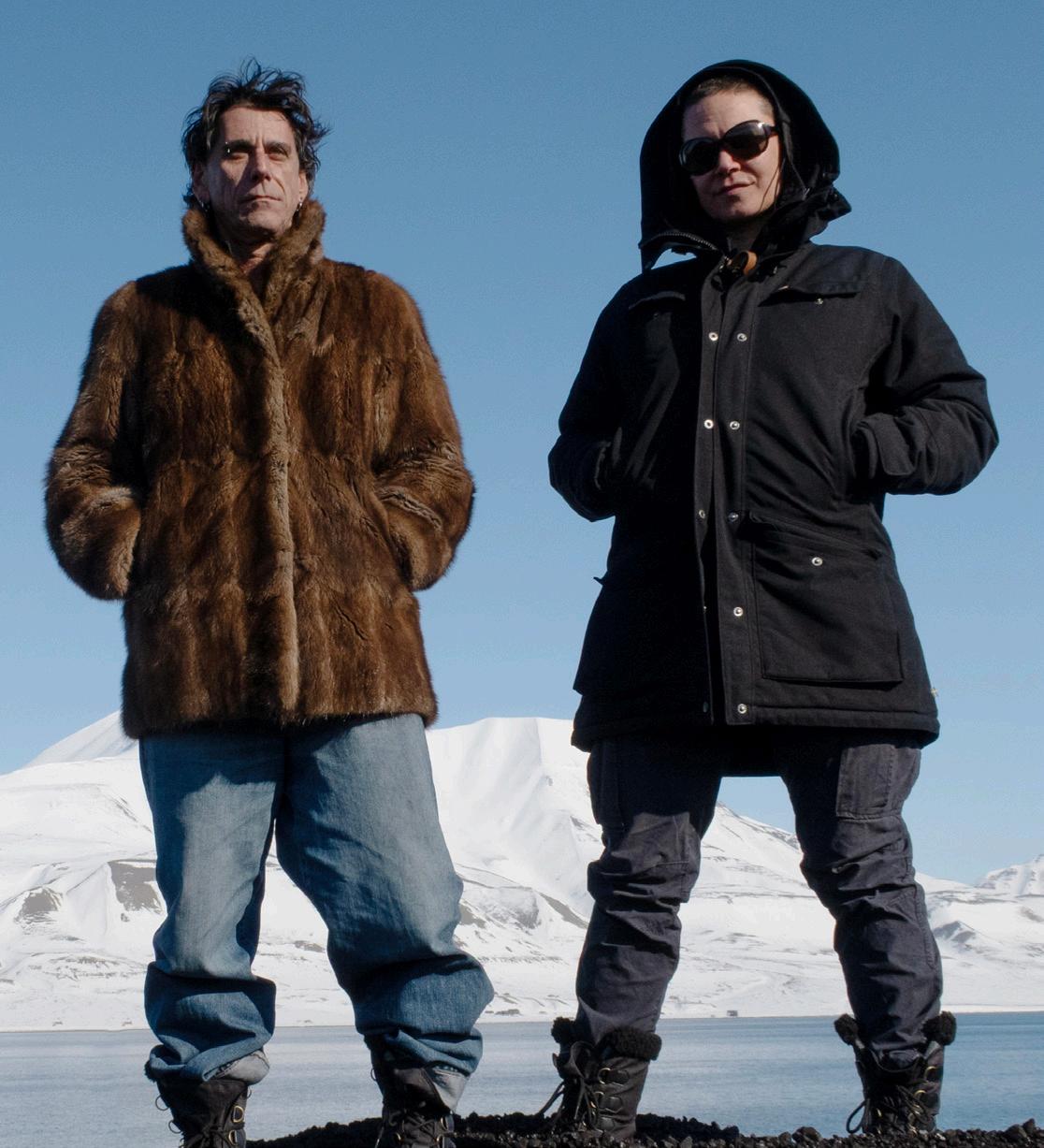
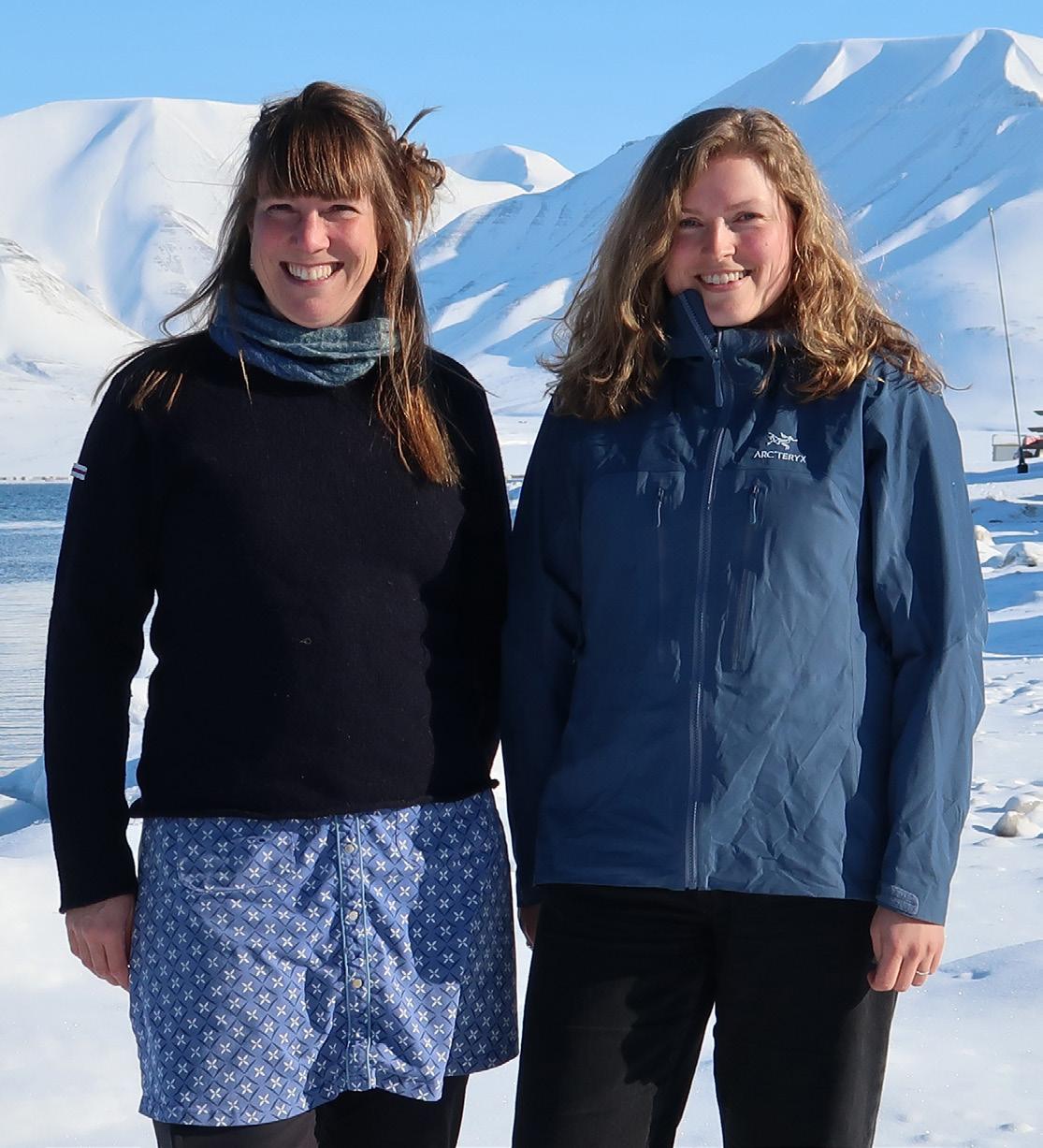
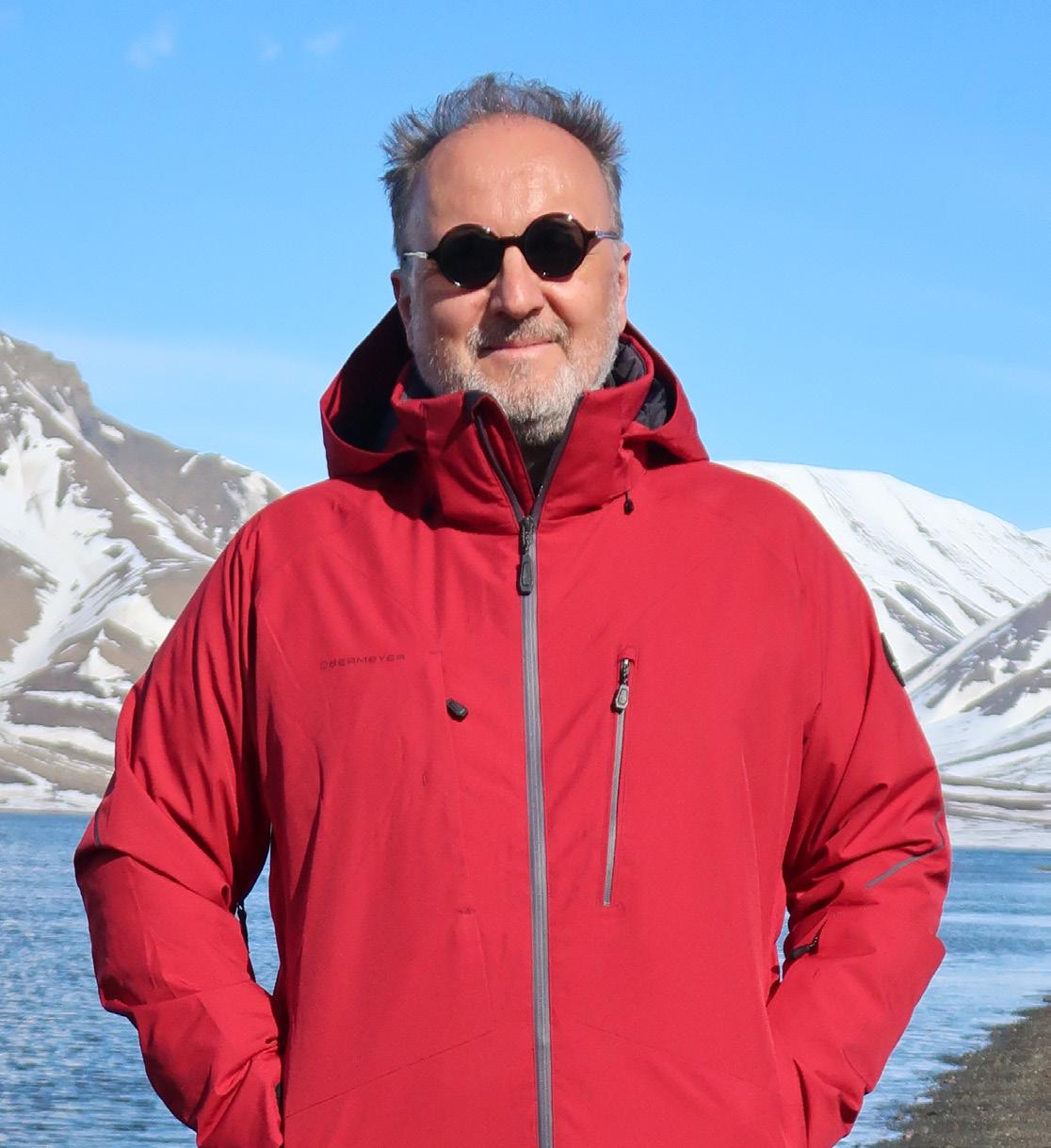
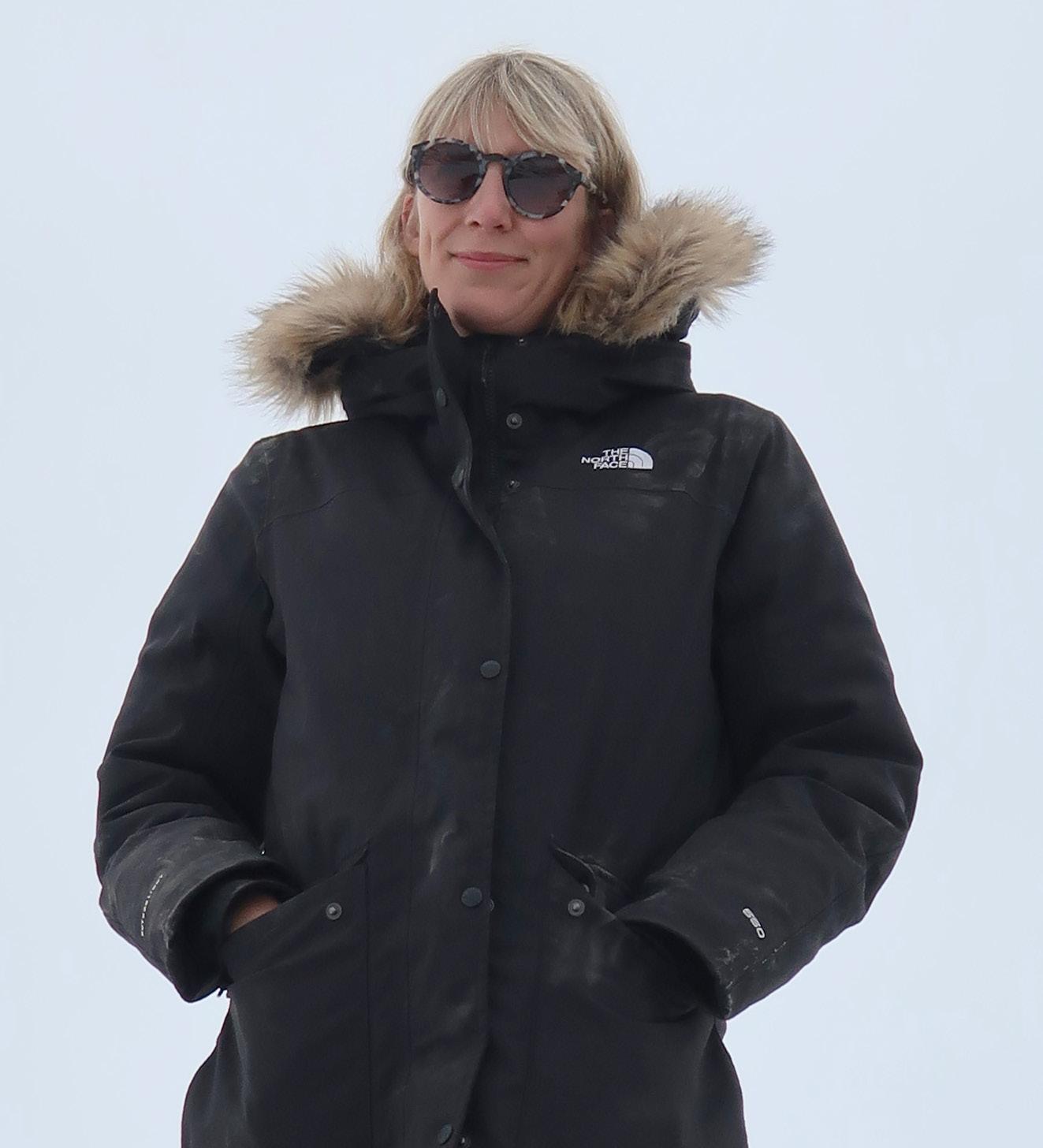
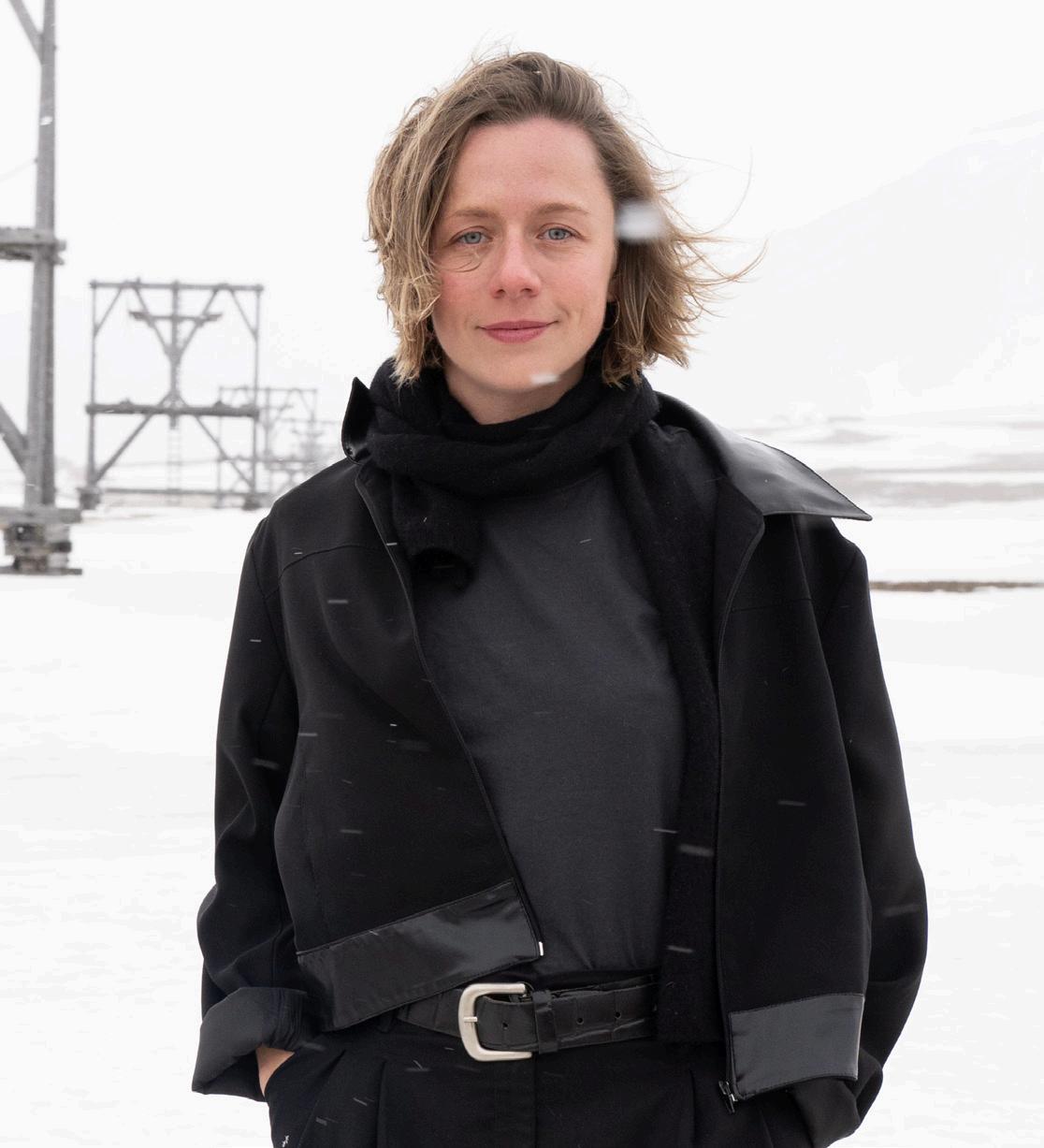
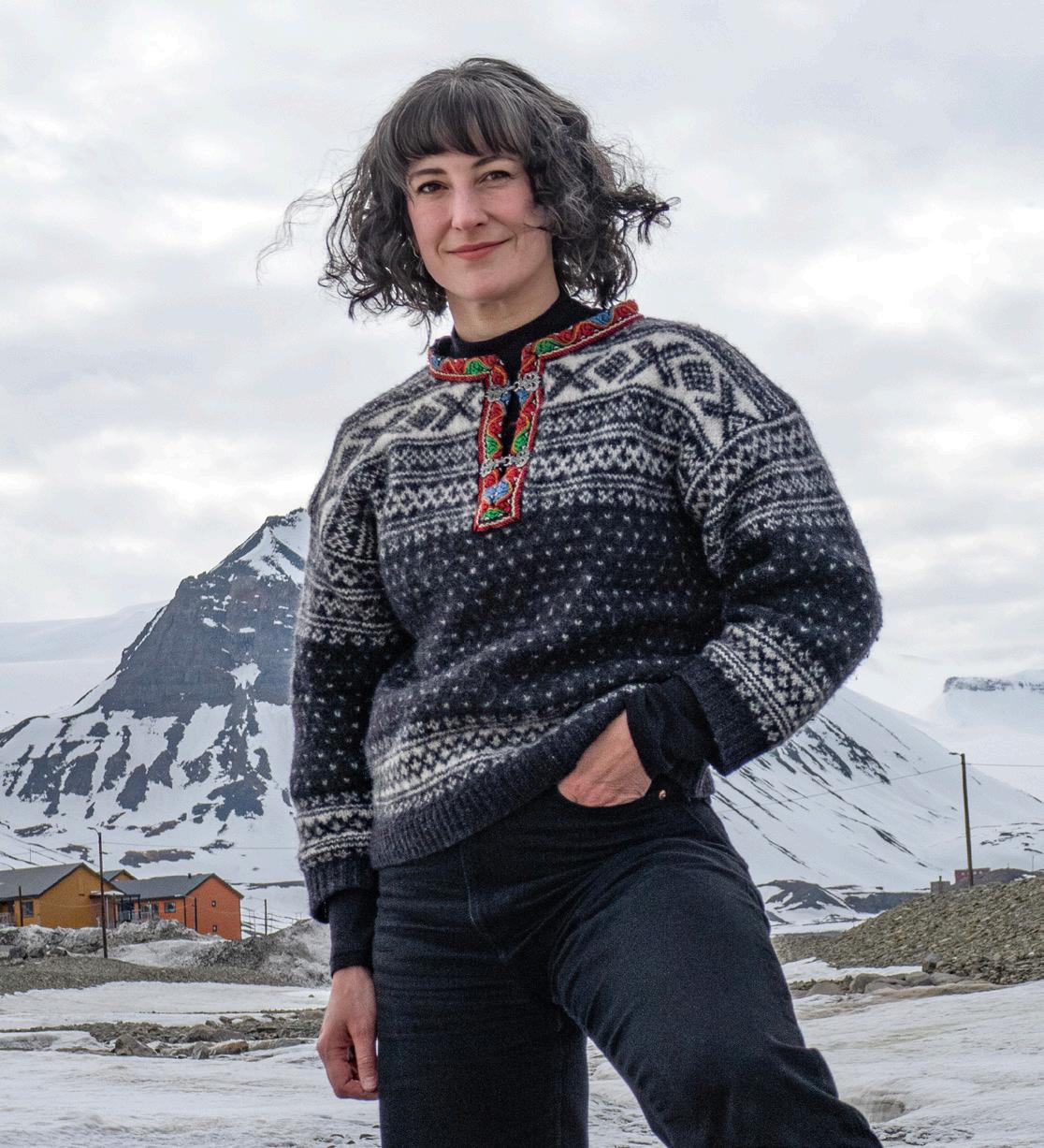
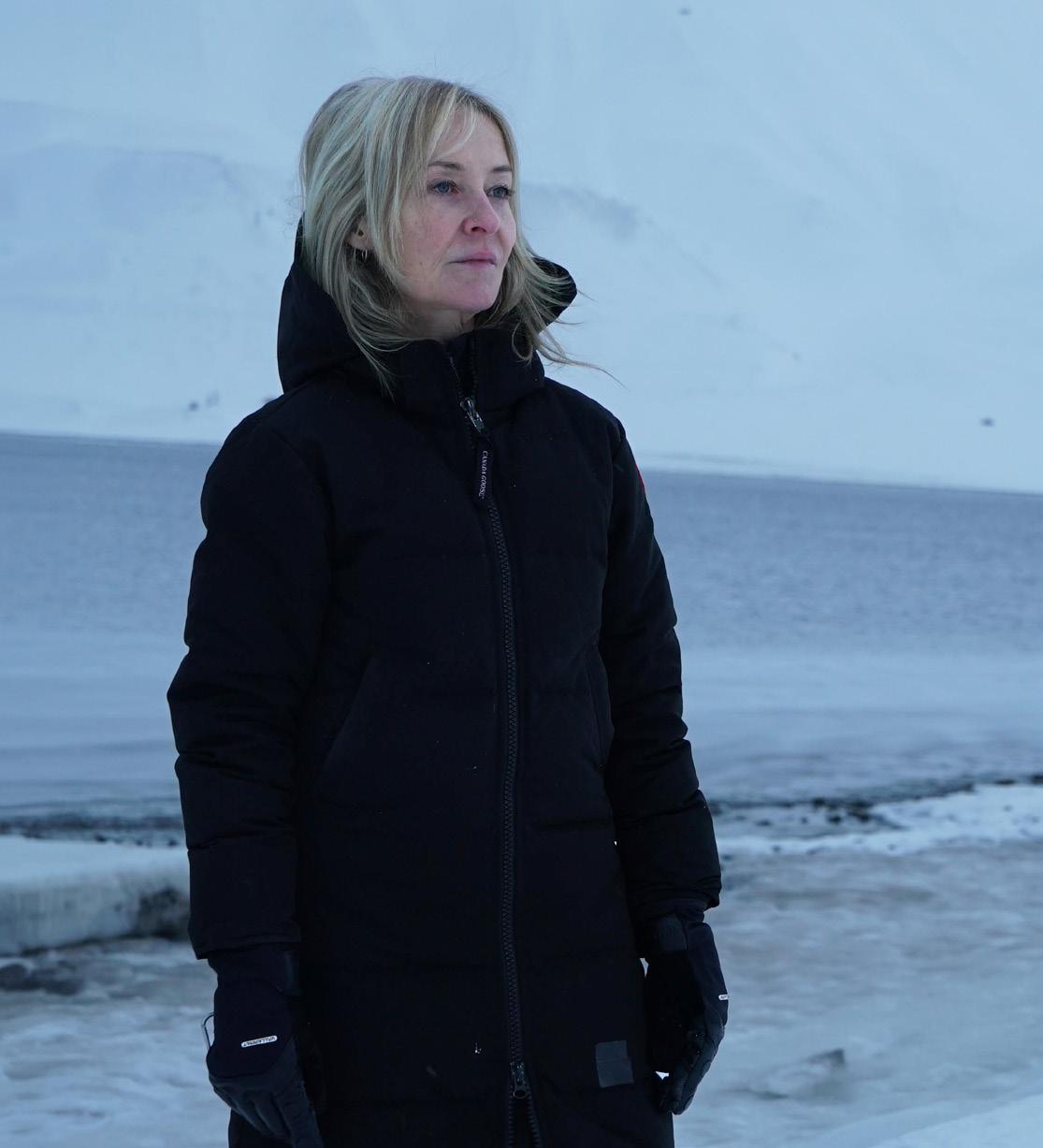
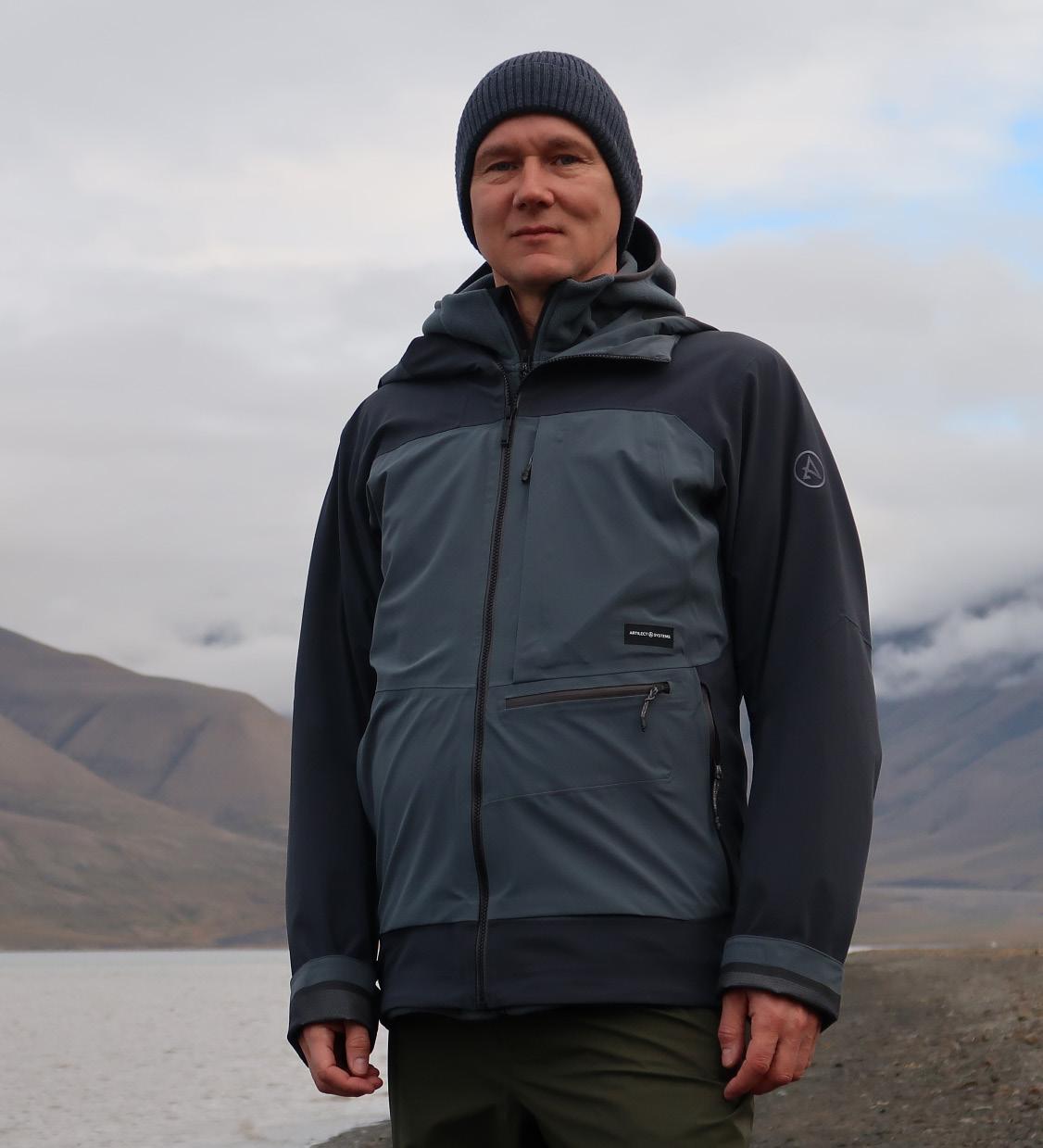
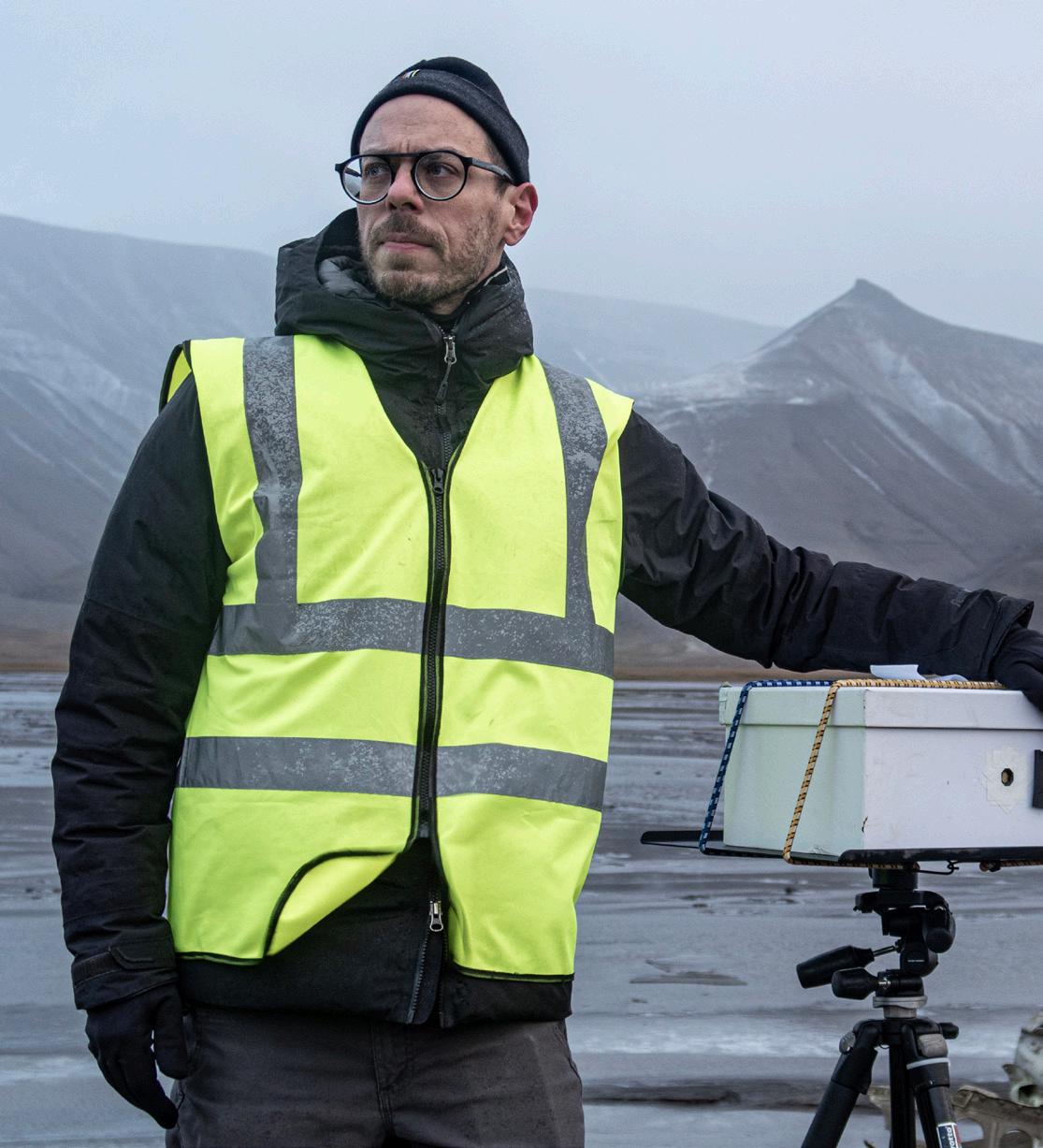
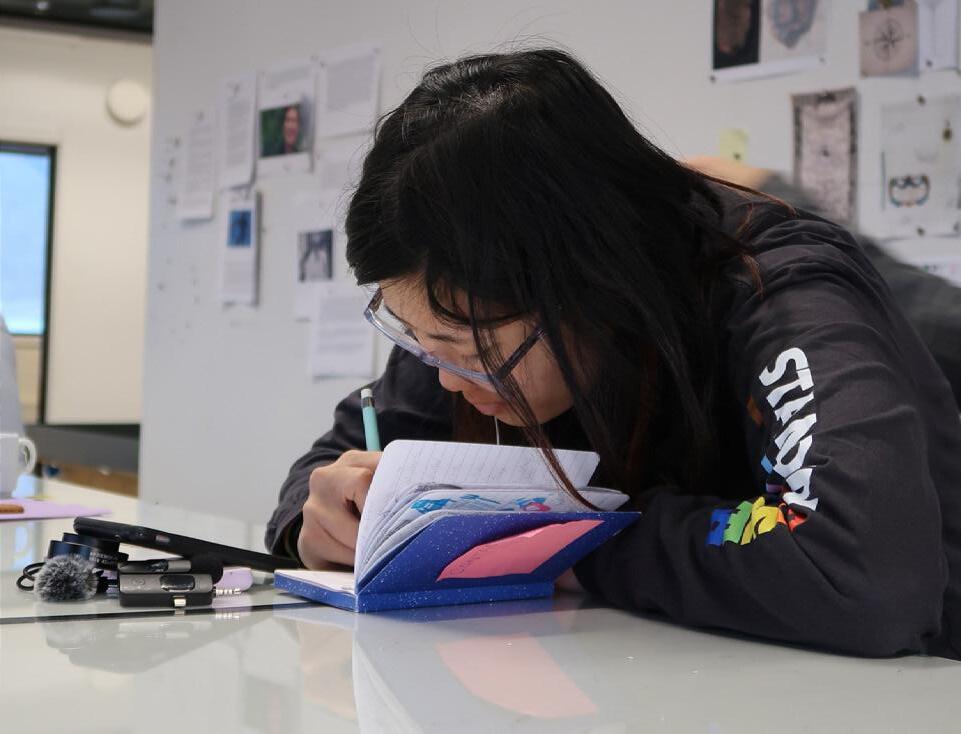
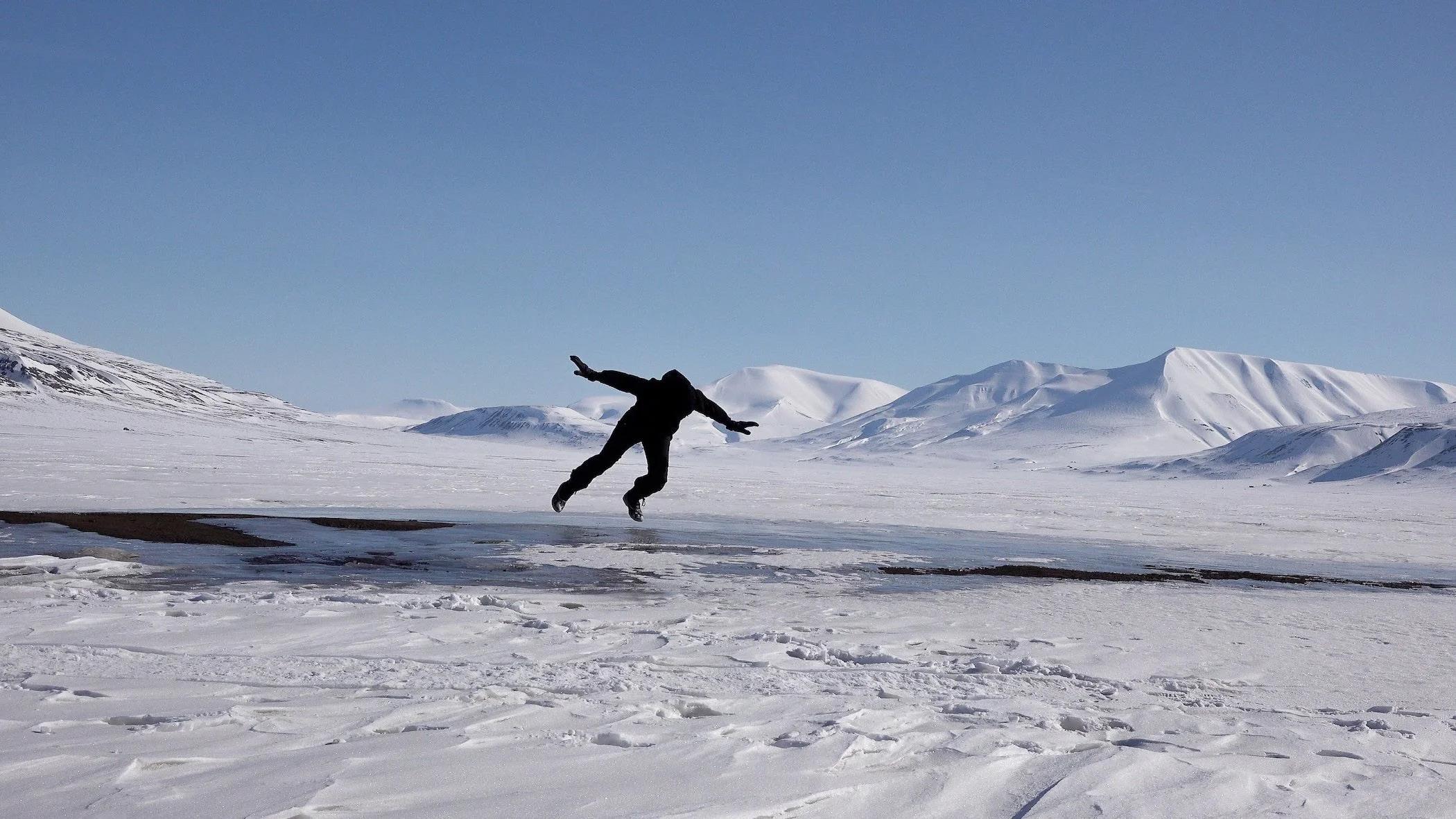
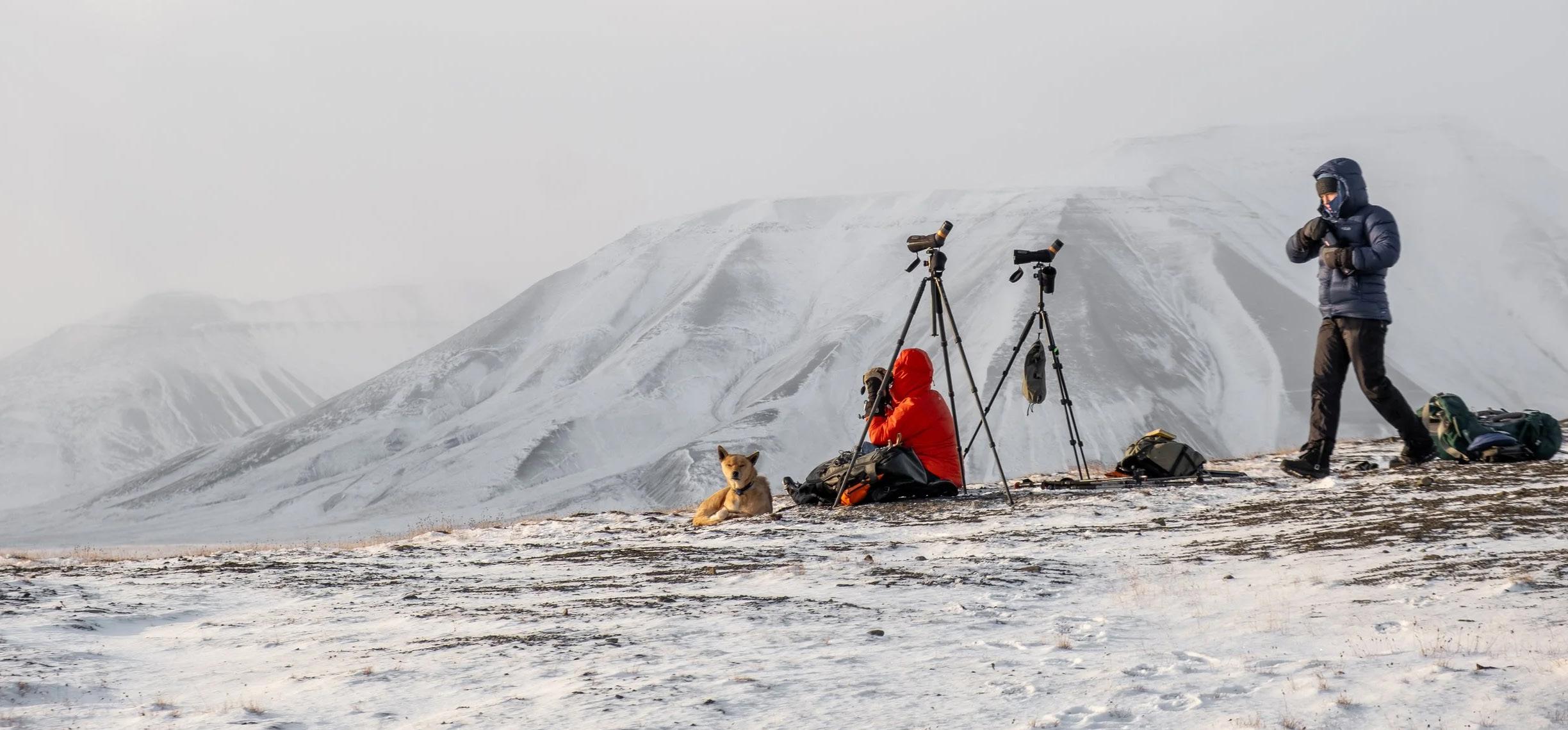
Longyear River, Longyearbyen, Svalbard. Photo: Charlotte Hetherington
INTRODUCTION
The Longyear River cuts through the centre of our town. It passes glacier meltwater down from Longyearbreen and Larsbreen, then out into Adventfjorden. To me, it is a daily marker — a beacon that tells me the weather as I walk to Artica. From the first frost in September, when the water slows and begins to still, to the deep winter months when it becomes a frozen highway for snow scooter journeys into the unknown. And then the days when it should be frozen, but a slight rise in temperature reveals movement again: trickling water, shifting stones, quiet persistence beneath the ice. In summer it roars, a constant, restless presence. For many of our residents this year, the Longyear River became a collaborator: through sound, performance, poetry, and film. It was our shared confluence, a place where practices, perspectives, and people flowed together.
2025 was an unprecedented year for Artica Svalbard. We welcomed 26 residents through our doors, each crossing the Longyear River on their way. Our workshop and studio space — our home and hub — mirrored the river in summer, alive and busy as we hosted 80 public events for our community. From drawing, printing, writing, and food workshops to film screenings, lectures, and open studios. These gatherings offered space to meet, talk, learn, care, and reflect together. More residents also meant more encounters — not formal meetings, but the kind that spark curiosity and friendship. Artists, writers, and researchers from different geographies and disciplines came together through daily conversations, shared walks, and moments of challenge at sea. The creative outcomes of these exchanges are still unfolding, but the personal transformations are already visible. The resident who arrives in Svalbard is not the same as the one who leaves. As Joyce Carol Oates writes in The Faith of the Writer, “The inspiration a writer takes from a predecessor is usually accidental, like the inspirations of our lives; those individuals met by chance who become integral to our destinies. We meet — we ‘fall in love’ — we are transformed. (If not always permanently, memorably.)”
As we move forward into a new year and prepare to welcome a new cohort to Svalbard, we are guided by Artica’s values: Supportive, Creative, Sustainable. These values continue to shape how we host, how we listen, and how we work. They shape an approach grounded in care, reciprocity, and attentiveness, allowing for the experiences formed here to continue their journey. Like the Longyear River, the narratives that emerge here are carried onward, shaped by many voices as they move into broader contexts.
I always want to express my gratitude to those who support Artica Svalbard. Funding from the Norwegian Ministry of Culture and Equality, Fritt Ord, Nordisk Kulturfond, Sparebankstiftelsen, and other trusts and foundations allows us to do what we do. Throughout the year, the Artica team, together with freelancers, volunteers, board members, partners, and collaborators, worked with commitment and care across all areas of the programme. The conversations, experiences, and works developed are grounded in Longyearbyen, strengthened through national, Nordic, and international collaboration, and sustained through trusted, long-term partnerships.
We remain committed to creating conditions where artists, writers, and researchers can engage with this place thoughtfully and responsibly. What happens here matters — not only for Svalbard, but for how we collectively understand connection, care, and resilience in a changing world.
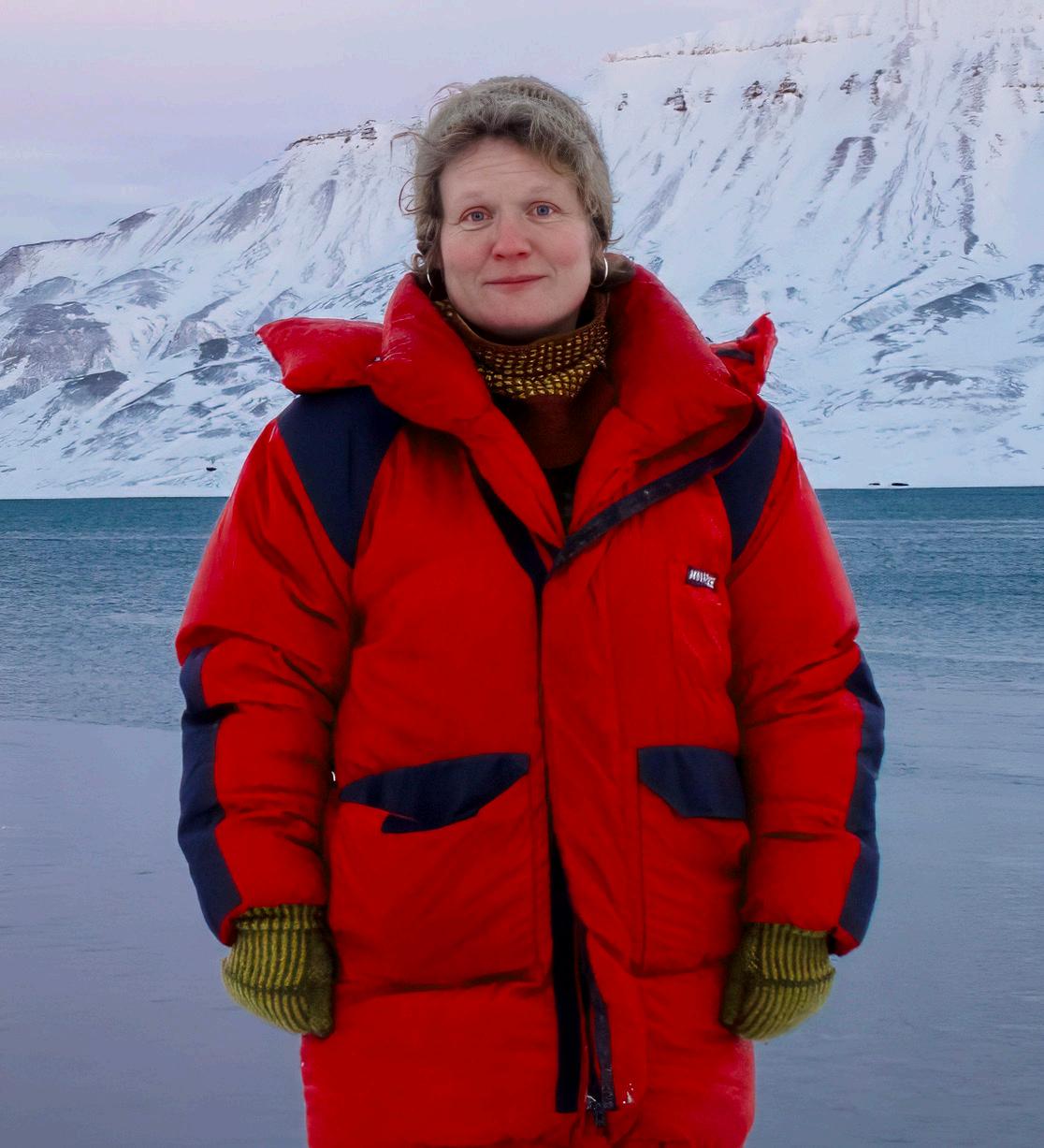
Charlotte Hetherington Director, Artica Svalbard
ABOUT ARTICA SVALBARD
Artica Svalbard is the leading non-profit art and cultural organisation in Svalbard. We facilitate artistic and cultural practice and support the development of Norwegian and international art and culture.
We seek to raise awareness of Svalbard, and the Arctic. We aim to create a platform for debate on topics that relate to our region such as culture, geopolitics, climate change, migration and minorities. Our mission is to challenge the perspectives of the Arctic, welcoming new knowledge and ways of thinking, to inspire change.
OUR VISION
Using art and culture to raise awareness of the unique challenges in the Arctic, spread knowledge and inspire change.
OUR VALUES
We believe in supporting communities, artists, and voices from all backgrounds. Artica strives to promote positive change through cultural expression and exploration. Through our support and advocacy, we aim to amplify voices, nurture talent, and promote tolerance and understanding.
We believe in the transformative power of creativity. Artica Svalbard strives to ignite creativity and promote cultural expression and exploration. By nurturing artistic innovation, we aim to inspire new perspectives and solutions to the challenges faced by our region and the world. Our commitment to creativity fosters an environment where imagination and originality can thrive, driving cultural and social progress.
At Artica Svalbard, we recognise that true sustainability encompasses ecological, social, psychological, and cultural dimensions. We are dedicated to fostering practices that respect and preserve the environment, promote social equity, support mental well-being, and celebrate cultural diversity.
OUR GOALS
IMPACTFUL RESIDENCIES
The residency programme emphasises that the residents should commit to deep engagement with the local community, fostering opportunities for residents to challenge and be challenged in their thinking while inspiring others through their work. The goal is to create lasting bonds, friendships, and knowledge exchange that endure beyond the residency, enriching both the residents and the local community.
Artica Svalbard aims to cultivate longer and more profound residency experiences by collaborating closely with partners to support artists, writers, and researchers visiting Svalbard. Through tailored onboarding programs and extended stays, residents are provided with ample time for reflection, exploration, and collaboration.
EMPOWERING THE COMMUNITY
TOP TIER COLLABORATIONS
Artica Svalbard aims to deepen its connection with the local community by actively involving residents in community life. Through organised events, debates and workshops for residents and locals, Artica will challenge the perspectives of the Arctic, contribute to new knowledge and new ways of thinking.
Artica fosters dialogue, collaboration, and cultural exchange, ensuring that residents benefit from local perspectives and knowledge while contributing meaningfully to the community.
Artica Svalbard seeks to expand its impact by cultivating long-term collaborations with like-minded organisations, institutions, and individuals locally and globally. Such collaborations not only amplify the reach and influence of each partner but also facilitate the sharing of knowledge, skills, and innovative practices. By working together, we can find better solutions, and drive cultural and social change across Svalbard and beyond.
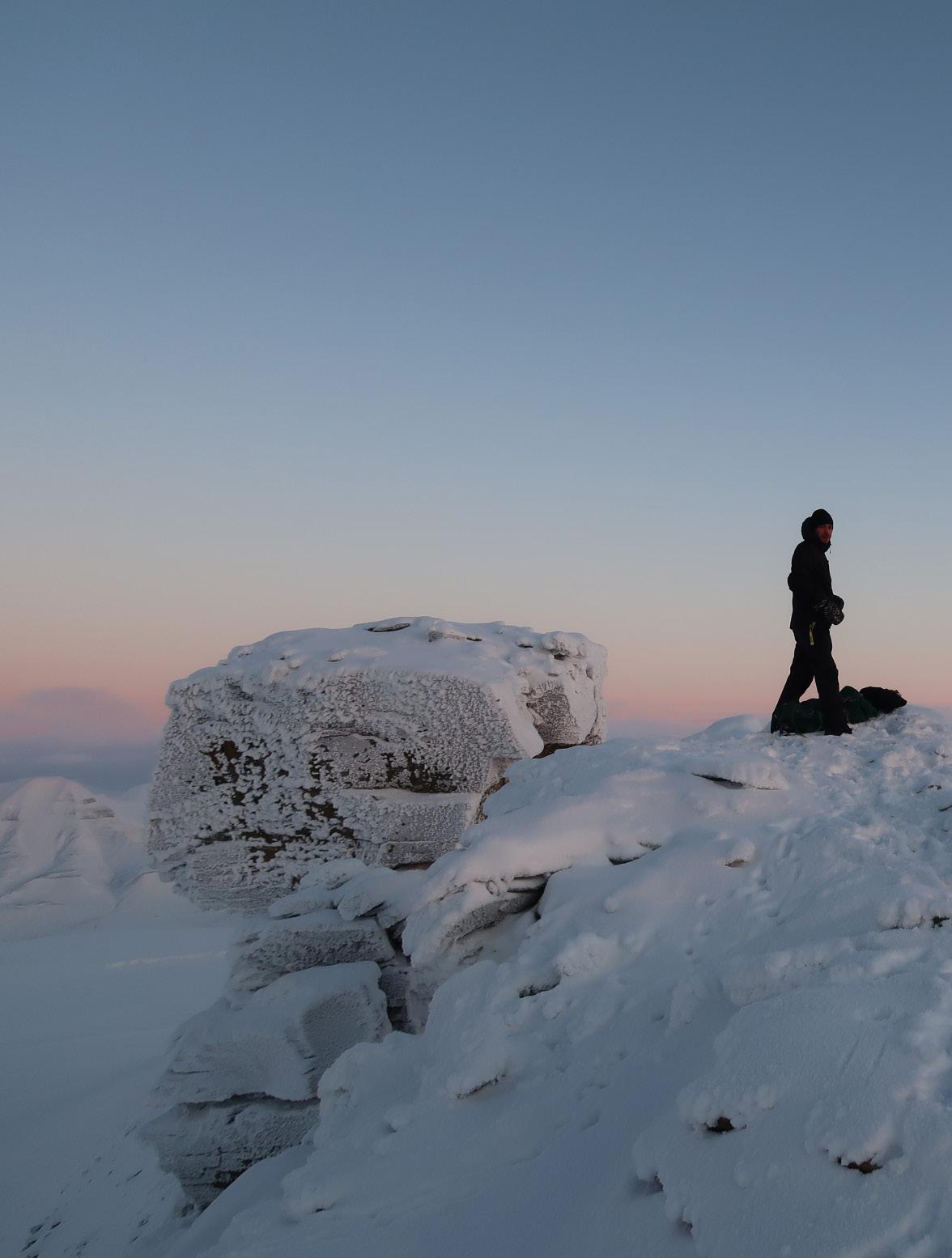
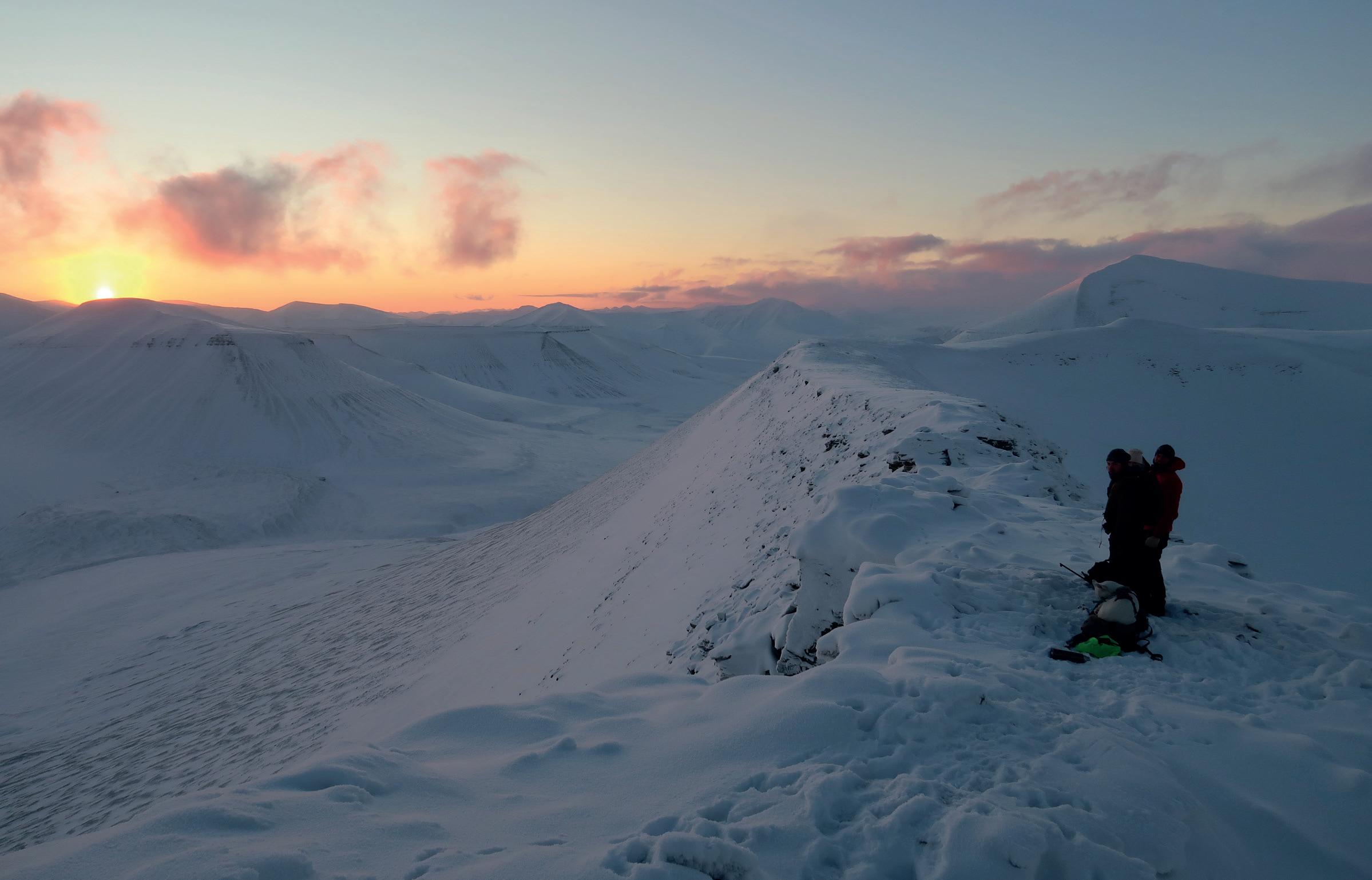
David Samuel Stern, at the summit of Trollsteinen, October 2025. Photo: Samantha Dwinnell
OUR RESIDENCY PROGRAMME
Artica Svalbard’s residency programme brings together artists, writers, and researchers from around the world, offering them time, space, and freedom to develop their work in the extraordinary environment of Svalbard.
The programme is shaped by Artica’s belief that culture has a role to play in how we understand the Arctic—by supporting artistic and literary work that is grounded in place, informed by context, and shared responsibly. In 2025, we expanded access to the residency through a combination of open calls, nominating partners, and independently funded residencies. This model enabled a wider range of practitioners to spend meaningful time in Svalbard— listening, learning, sharing, and developing projects rooted in local realities.
Expanding Access, Deepening Engagement
Following a successful trial in 2024, 2025 marked the full integration of independently funded residencies into Artica’s programme. This broadened the residency to additional practices and perspectives.
Interest in Artica’s open calls also grew significantly. The OCA open call received over 1,200 applications—its highest number to date—reflecting both the growing demand for sustained engagement in the Arctic and the relevance of Artica’s approach.
Supporting Long-Term Artistic Research
The programme also benefited from the return of Artica alumni, strengthening continuity and long-term exchange between residents and the local community. Returning residents reflect Artica’s aim to support residencies that extend beyond a single stay—building lasting relationships, shared knowledge, and ongoing collaboration over time.
Residencies with Care and Context
In 2025, residents arrived with a stronger understanding of Svalbard and of their responsibilities as visitors working in a small and sensitive community. This reflects the value of the Residency Resources section on Artica’s website, which supports residents before arrival with practical guidance, contextual knowledge, and clear expectations around engagement.
Several residents also completed polar safety training, enabling greater self-direction in the field and allowing them to engage more fully with both their research and the surrounding landscape. Together, these developments strengthened Artica Svalbard’s role in hosting thoughtful, well-prepared, and context-aware residencies—supporting both those who visit and the community that hosts them.
2025 Residents
In 2025, we welcomed 26 residents, who collectively spent approximately 166 weeks in residence at Artica Svalbard.
Nominated by Norwegian Non-Fiction Writers and Translators Association (NFFO):
Siri Helle
Ragnhild Holmen Bjørnsen
Nominated by Nordnorsk Kunstmuseum:
Simon Daniel Tegnander Wenzel
Malin Arnell and Mar Fjell
Nominated by OCA (Office for Contemporary Art Norway):
Bianca Hisse and Christian Danielewitz
Cléa Darnaud
Nominated by Queen Sonja Print Award:
Tomas Colbengtson
Nicole Cecilia Delgado and Amanda Hernández
Independently Funded Residents:
Mhairi Killin (returning alumni)
Clara Arnaud
Sanne Moedt and Floortje Zonneveld
VestAndPage
Katie Paterson
Lilian Kroth
Endi Poskovic
Nastassja Simensky (returning alumni)
Ashley Middleton (departs 2026)
• Janos Nieminen
David Samuel Stern
Amy Hoagland
Kathy Sirico
OUR 2025 RESIDENTS
Siri Helle is a non-fiction author and journalist whose work explores environmental responsibility, rural life, and practical engagement with the world around us. During her residency at Artica Svalbard she used Svalbard as a starting point for research into place attachment — how transient communities form belonging, and how that connection shapes environmental stewardship.
“To be a resident at Artica Svalbard is to be given the gift of time. Time to explore, get to know, ask questions, feel, sense, embrace and challenge an environment - both natural and human - like no other anywhere on earth or at any time in history. It goes without saying that to receive a gift like this comes with great responsibility. I’m humbled to have received it and will carry it with me like a baby – a starting point from which I can grow. I am no longer the same.”
As part of her contribution to the local community, Helle hosted a public evening at Artica centred on the question “What is a home?” Combining soup, readings, and facilitated discussion, the event invited participants to reflect on belonging in Longyearbyen — and how ideas of home are shaped by nature, society, buildings, and a place in constant change.
Ragnhild Holmen Bjørnsen is a researcher in childhood studies at Inland Norway University. Her work focuses on youth living with high mobility, and in Longyearbyen she investigates how frequent arrivals and departures shape friendships, social ties, and a sense of belonging.
“What made the Artica residency especially meaningful was its openness to the local community and its role as a meeting point for art, science, and societal questions relevant to Longyearbyen and the Arctic region. Engaging with residents and fellow researchers and artists created a unique setting in which my work as a social scientist could develop in dialogue with others offering diverse perspectives. This integration of work and social life, reflection and exchange, made the residency an exceptional and enriching experience.”
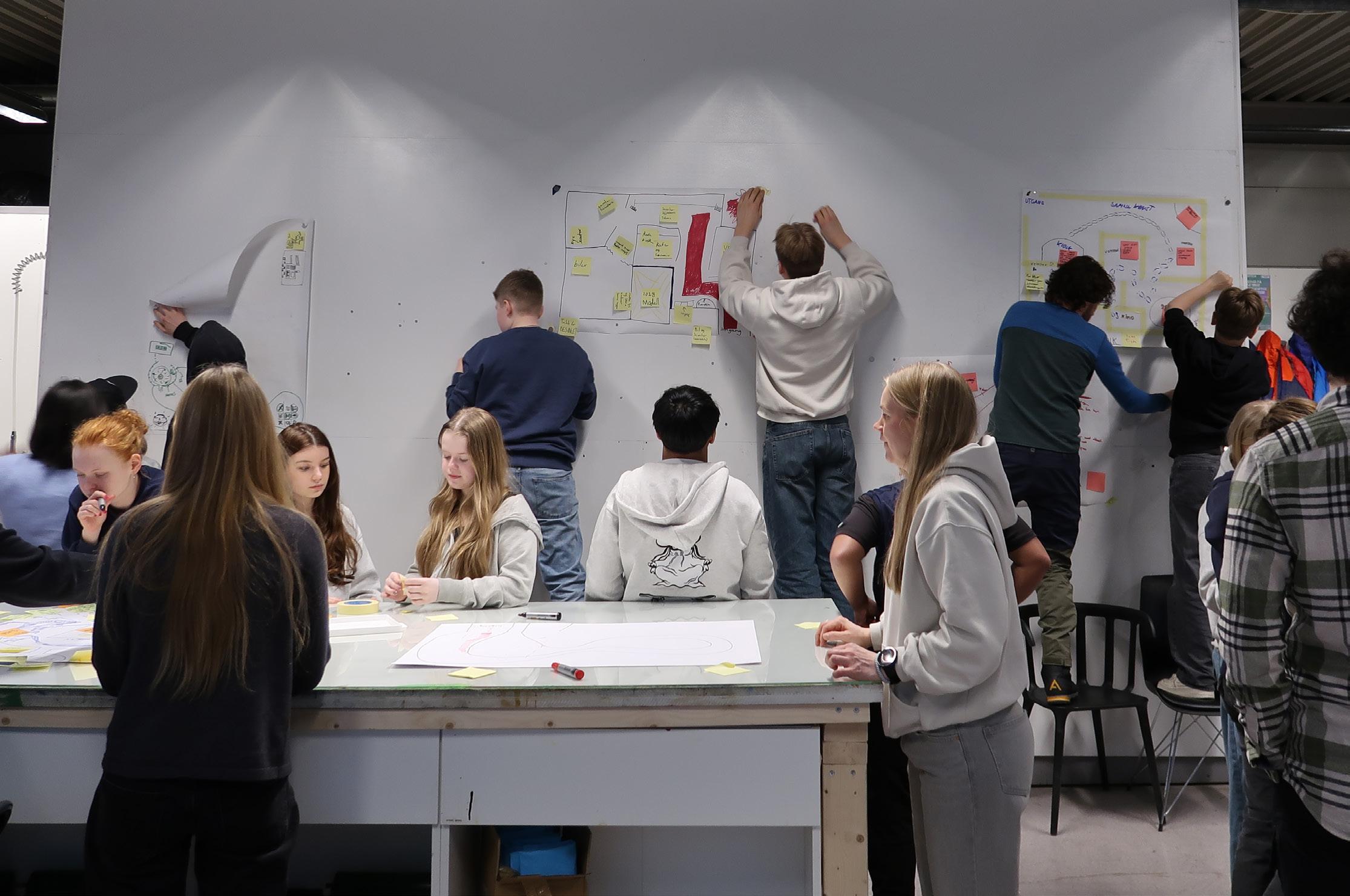
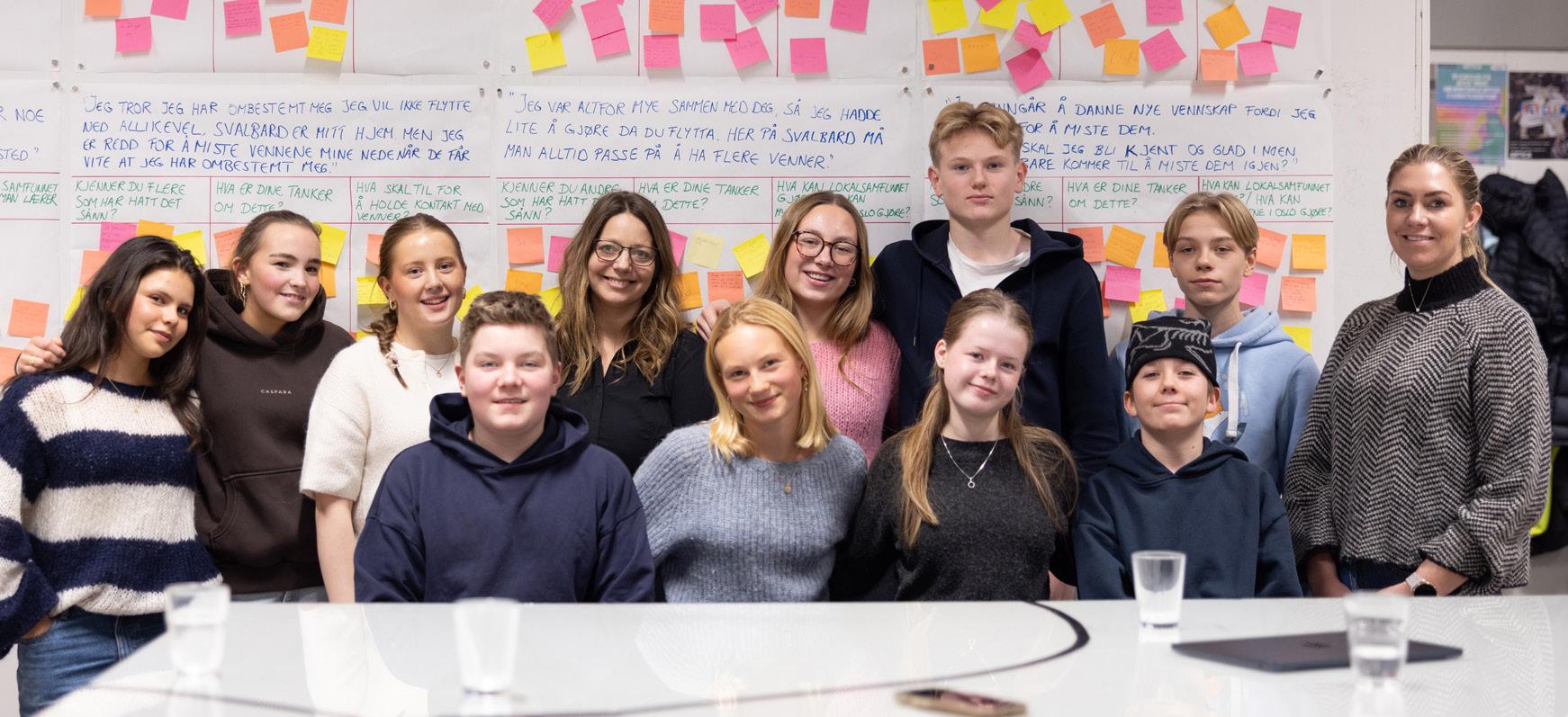
During her stay she gave back through dialogue-based formats that brought research into the open. She ran a workshop at Longyearbyen School where students responded to statements drawn from earlier youth texts and added their own experiences of inclusion, exclusion, and saying goodbye to friends who leave. The Longyearbyen Youth Council later met at Artica to continue the discussion, and she also held a public talk at Longyearbyen folkebibliotek, sharing excerpts and inviting feedback as the project develops.
Simon Daniel Tegnander Wenzel is an interdisciplinary artist working with performance, scent, moving image, sound, and installation. During his residency at Artica Svalbard, he developed his ongoing research into how scent can carry memory and history, and how olfaction might offer a different way of sensing place and environmental change through fieldwork, studio experiments, and local encounters.
“The residency at Artica gave me the freedom, resources, and support to experiment, explore, and connect. From new materials and field research to collaborative encounters with locals and other artists, it has enriched both my artistic practice and my understanding of the Arctic. My time at Artica Svalbard has been transformative, providing the space and community connections to develop projects I will continue to build on for years to come. Residencies like Artica are invaluable for artists, offering both the focus and the collaborative networks that are crucial for meaningful work.”
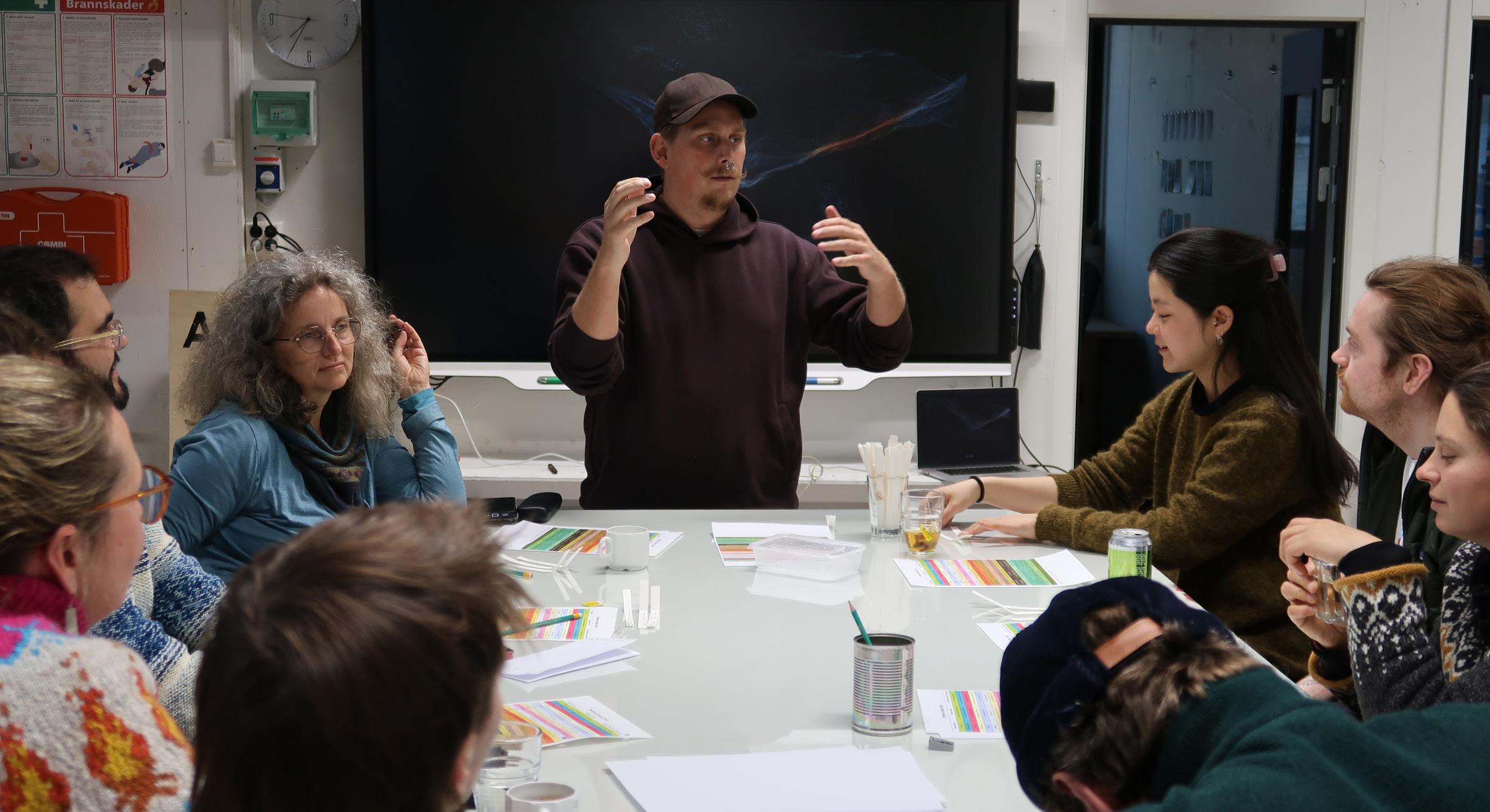
As part of his contribution to the community, Wenzel hosted the “Smelly Get-Together” at Artica—an intimate workshop where participants brought a perfume, an everyday smell, or a scent-memory to share, and tried simple exercises for sharpening attention to smell. Artica also produced a short film documenting his process, extending the work to audiences beyond the residency period.
Malin Arnell and Mar Fjell have shared a transdisciplinary practice since 2017, working across performance, research, and ecological inquiry. During their residency at Artica Svalbard, they immersed themselves in the rhythms of Longyearbyen and the surrounding landscape, with a particular focus on the Longyearelva river—walking, recording, observing, and returning repeatedly to the same sites as conditions shifted.
“We learned a great deal about the social and environmental fabric of Longyearbyen by immersing ourselves in the ebb and flow of everyday life. We met many generous and knowledgeable people across environmental humanities, science, and art, which broadened our perspectives and offered new ways of thinking and relating. Some of these encounters have grown into ongoing collaborations.”
They gave back through a public performance, It Passes, staged as a collective walk and gathering along the Longyearelva, inviting participants to move with the moraine water and reflect on care, vulnerability, grief, and connection in a changing environment. They also contributed a Field Notes text, articulating an ethics of “engaging without extracting or imposing” and sharing insights from their siteresponsive process with Artica’s wider audience.
OUR 2025 RESIDENTS
OUR 2025 RESIDENTS
Danish visual artist, researcher, and writer Christian Danielewitz and Brazilian visual artist and choreographer Bianca Hisse collaborated at Artica Svalbard on research-led work using listening and sound recording to think through extractive infrastructures, environmental change, and geopolitics in the Arctic.
“The residency supported deep, focused research while encouraging reflection and exchange across artistic and scientific contexts, making it a highly valuable environment for long-term artistic development. Residencies like Artica Svalbard are vital because they create the conditions for attention; time to listen, to observe, and to think with a place. Working in Svalbard reshaped how I sense and make sense of environmental crises, and will continue to inform my practice well beyond the residency.” - Danielewitz
“The residency opened a deeper entry point into working with sound recordings, especially as a way of thinking about extractive infrastructures and altered landscapes. It allowed us to test listening as a research method. We also gained a more layered understanding of the Arctic as a place where climate, geopolitics, and extraction are tightly entangled, which will inform both the conceptual and formal aspects of our work going forward.” - Hisse
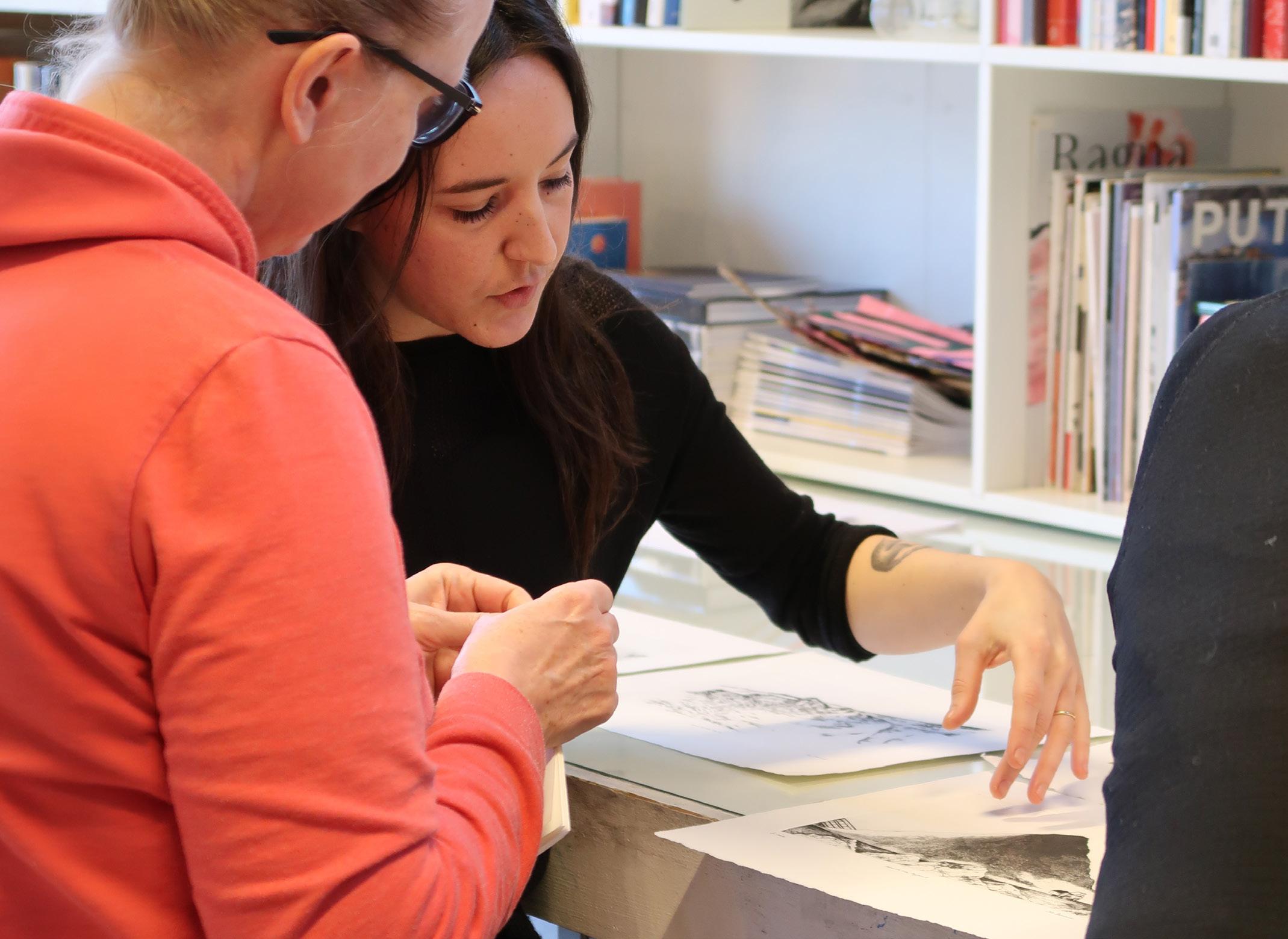
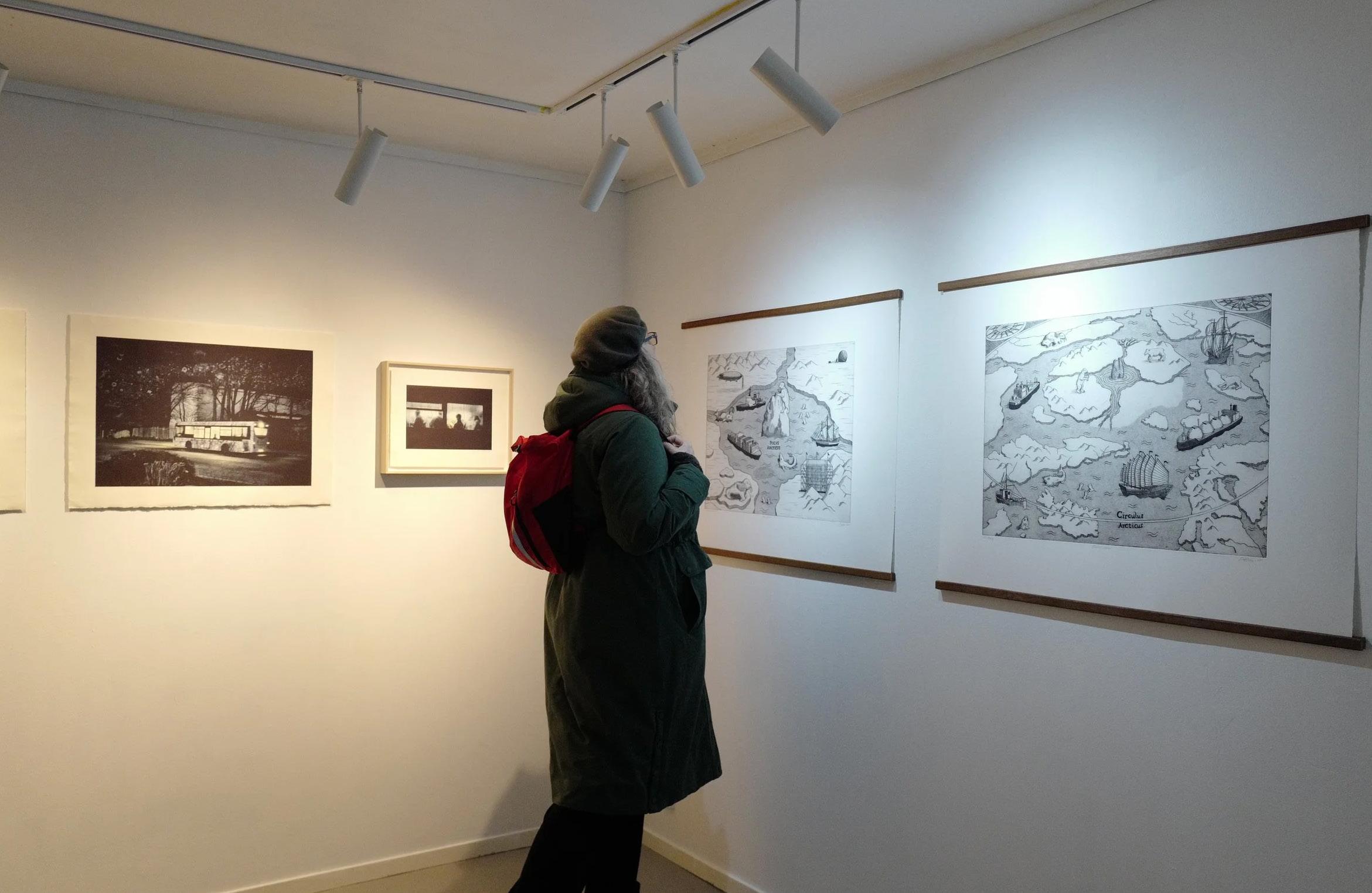
Cléa Darnaud is a French artist specialising in drawing and intaglio engraving. During her Artica Svalbard residency, she observed everyday life in Longyearbyen—through conversations, objects, landscapes and atmosphere—using these impressions to begin developing new narrative work in book form, bridging artist book and comics approaches.
“Over the weeks I had the chance to make new relationships that will last a lifetime and to discover life in Svalbard from a more intimate, but also more critical point of view. Little by little I began to develop two distinct projects that seemed to make sense to me in relation to what I learned about Longyearbyen. This residency taught me to let go and take more time to explore from an artistic point of view, something I do not really have time to do in my daily work.”
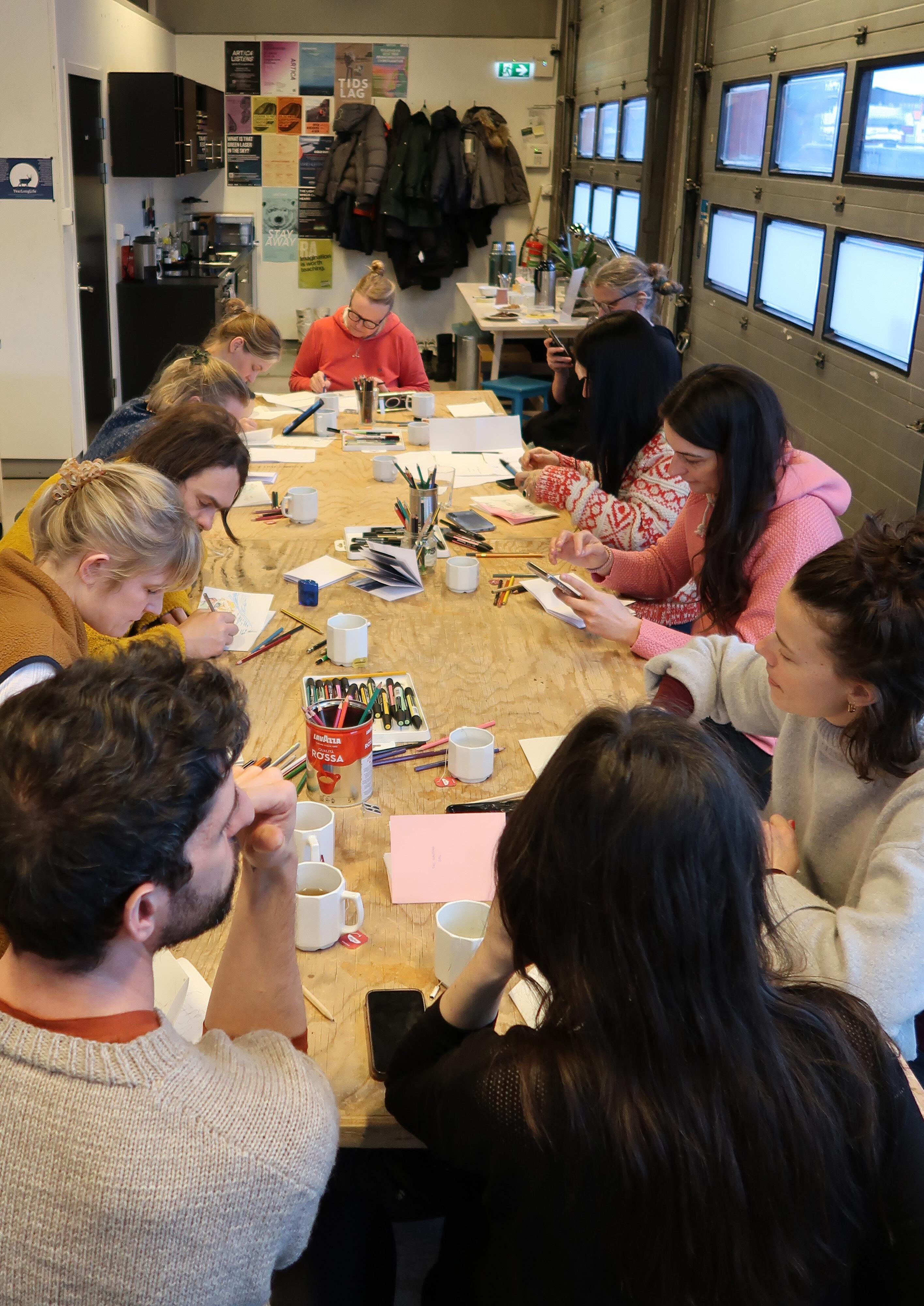
As part of what she gave back to the local community, Darnaud hosted a hands-on workshop at Artica, Drawing & Storytelling, introducing simple techniques for building a short visual narrative and turning it into a zine. Open to beginners, the session encouraged participants to draw from their own routines, hobbies, and the Svalbard landscape— leaving them with practical tools to continue experimenting at home.
Tomas Colbengtson is a Sámi artist whose practice examines the impact of colonialism on Indigenous communities, with a particular focus on Sámi history and collective memory. Winner of the 2024 Queen Sonja Print Award, he was in residence at Artica Svalbard during March–April 2025. Working primarily through printmaking—often using materials that cast shadows—he explores themes of visibility, loss, and resilience, and the relationship between Indigenous identity and the natural world.
“The Arctic landscape and animals was the reason I applied for the residency. I left with a deeper understanding of climate and how dependent we are on the Arctic and the need to protect it from colonisation.”
During his stay, Colbengtson spent time observing the local environment and community, with a particular interest in Svalbard’s reindeer. Alongside this research focus, his presence at Artica contributed to ongoing conversations around Indigeneity, place, and environmental responsibility, bringing perspectives shaped by Sámi experience into Artica’s wider programme of exchange.
OUR 2025 RESIDENTS
Nicole Cecilia Delgado and Amanda Hernández are the founders of La Impresora, an independent studio and small press in Puerto Rico working across poetry, printmaking, and artist-led publishing. In residence at Artica Svalbard they developed individual writing projects while expanding their publishing practice through analog print approaches and new connections between Caribbean and Arctic island ecologies.
“I am grateful for the opportunity to learn about and spend time in the Arctic Region, which has impacted and broadened my understanding of global geopolitics, climate change, and current colonial dynamics beyond the Caribbean. I appreciate the space to slow down, cut off daily distractions and focus on my own work that artist residencies provide, and I wish to be able to integrate them to my practice more frequently, to create a balance between my community driven work as an editor at La Impresora and dedicating more time focusing in my personal artistic work and individual poetic research and writing.” — Delgado
Alongside their studio work, they contributed to the local programme through a bilingual poetry reading at Artica with collaborator Elizabeth Torres Hansen, and a hands-on workshop, POEMA SUELTO, introducing low-cost, non-traditional publication formats using analogue design and collage.
OUR 2025 RESIDENTS
Clara Arnaud is a French writer and winner of France’s Ecology Novel Prize. She was in residence at Artica Svalbard twice in 2025, developing a new novel in which a glaciologist is a central character—and the glacier itself is treated not as backdrop but as a protagonist, giving voice to the cryosphere through a blend of field observation and fiction.
“The residency contributed a lot to my development. It made me grow in my approach to field investigation, exchanging with artists from other backgrounds and disciplines. It made me dig deeper into the topics my novels are investigating, the relations between humans and more than human entities, science in the making, reflections on the concept of wilderness in the time of anthropocene, extractivism, etc. It offered me a window on a more international artist community and a different approach to the role of art and narration for our troubled time.”
Alongside her writing, Arnaud contributed to Artica’s public programme through a series of creative writing workshops in Longyearbyen, inviting participants to experiment with storytelling beyond a strictly human-centred perspective and to explore how science, poetry, and lived experience can meet in narratives of environmental change.
VestAndPage (Verena Stenke and Andrea Pagnes) are interdisciplinary artists, writers, and curators who have worked internationally with collaborative, research-based performance art and film since 2006. In residence at Artica Svalbard (May 2025), they pursued site-responsive inquiry into Svalbard’s shifting ground—linking embodied practice to ecological, social, anthropological, and geopolitical questions through performance, moving image, and philosophical reflection.
“Our residency provided us with crucial new insights into the ecological, social, anthropological, and geopolitical nature of the Arctic region. We could implement interdisciplinary research processes that lead toward urgent and relevant artistic production. In the face of the climate crisis, we have no time to lose in finding urgent ways to adjust to the unstable grounds; in this, art is a tool for cultural adaptation as it allows for reflexive emotions if shared collectively.”
They also contributed to Artica’s public-facing knowledge sharing through a Field Notes text connected to their broader project A Desert of North, reflecting on performance in relation to environmental transformation, uncertainty, and the “porous tense”—a framework for thinking with melt, unfixing, and geological time.
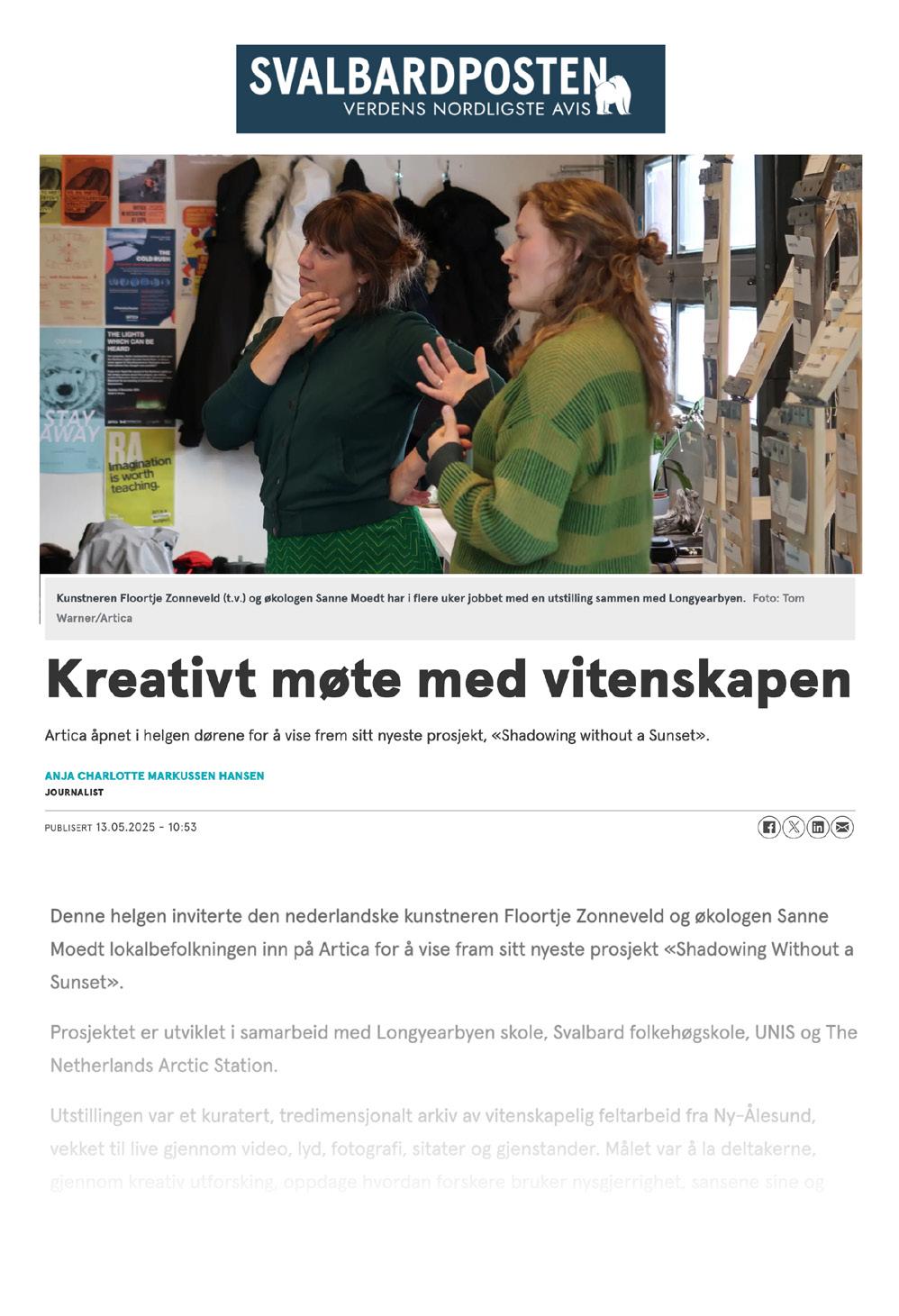
Sanne Moedt is an aquatic ecologist, researcher and educator interested in the ecology and evolution of algae in a changing Arctic. Floortje Zonneveld is an artist, educator and certified Arctic Nature Guide, known for time-based and participatory projects across Nordic and polar regions, and a long-time Artica collaborator. They first met on a Svalbard expedition in 2022 and returned to Artica Svalbard in spring 2025 to develop Shadowing Without a Sunset, a collaborative residency that brings field science into dialogue with artistic methods, creating shared ways of looking, sensing and asking questions with the local community—especially young people in Longyearbyen.
Sanne’s practice is grounded in Arctic fieldwork and teaching, while Floortje’s work centres on collaborative processes that translate lived experience into artworks, workshops and installations. Together they turned research traces from NyÅlesund into an accessible, hands-on archive and a series of sessions where scientific observation becomes personal, imaginative storytelling. The project reflects Artica’s aim to create conditions where different forms of knowledge can meet— through curiosity, care, and experimentation—so research is felt as well as understood.
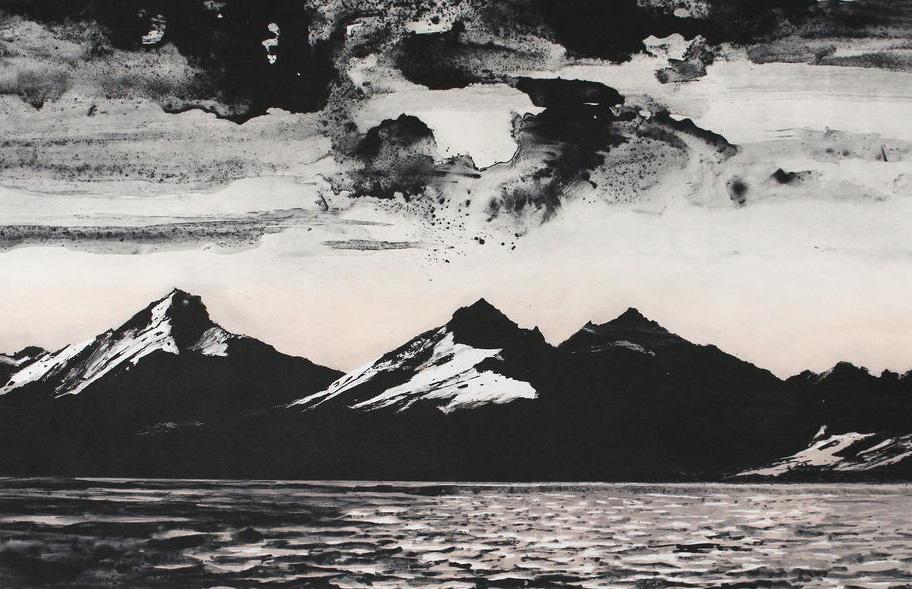
Endi Poskovic is a Bosnian-born artist whose work bridges printmaking, memory, and environmental consciousness. In residence at Artica Svalbard in spring 2025, he began developing Field, a project using relief woodcut and stencil processes to explore how landscapes—both physical and emotional—shape narrative, and how Arctic light, texture, and silence register in the work.
“Residencies like Artica Svalbard offer the rare gift of stepping fully into another world—one that speaks in light, texture, and silence. In the stillness of the Arctic, every horizon, shadow, and moment of quiet becomes part of the work. Such a place inspires, challenges, and nourishes creativity, allowing ideas to resonate and both art and self to be transformed long after the residency ends.”
Alongside his studio practice, Poskovic contributed to the local programme through an Open Studio evening, sharing works-inprogress and process with the community, and a hands-on workshop introducing relief printing and stencil techniques. Combining discussion, demonstration, and guided practice, the session invited participants to explore printmaking as a tool for intuition and storytelling, and to create their own images using his printing plates.
OUR 2025 RESIDENTS
OUR 2025 RESIDENTS
Katie Paterson is widely regarded as one of the leading artists of her generation. Working in close collaboration with scientists and researchers, her projects explore geological time, planetary change, and our place within vast temporal and cosmic scales. She was in residence at Artica Svalbard in June 2025 (independently funded), developing a new work titled True North
“My residency with Artica Svalbard in Longyearbyen allowed me to witness first hand a rapidly changing landscape. I am deeply grateful for this unique residency programme and for Artica Svalbard’s commitment to interdisciplinary practice and meaningful support for artists working in response to place. The knowledge, care, and practical expertise of the Artica Svalbard team were essential to the successful realisation of the artwork ‘True North’. The project involved travelling with a solar battery to collect light reflected from nearby glaciers and using that stored energy to develop photographs captured from orbit by Sony’s EYE nano-satellite. This process physically embedded the Arctic’s own light into the prints, creating works that act as both documentation and record. The resulting images reflect a fragile environment. Artica Svalbard’s residency programme provided the critical conditions - time, place, and support through which this work could be developed in direct dialogue with the landscape itself.”
True North combined nanosatellite imagery (captured over the polar north using Sony’s “EYE” camera as part of the STAR SPHERE project) with solar energy gathered in Svalbard during the midnight sun, linking remote sensing to place-based process.
Lilian Kroth is a postdoctoral researcher at the Department of Philosophy at the University of Fribourg (Switzerland), working at the intersection of the history and philosophy of science and art. In residence at Artica Svalbard (May–June 2025), she developed a drawing-based research project on how icy environments are “seen” through satellite imagery—from everyday tools like Google Maps to climate visualisations—foregrounding the mediation, processing, and interpretation behind images often taken as direct representations. Working across pencil and cold needle etching, her project examined spectral data, image compositing, and the metaphors used to describe satellite vision, aiming to build a more embodied and critical literacy around remote sensing.
«For meg har dette oppholdet vært svært fruktbart og berikende, med en kombinasjon av konsentrasjon, fellesskap, selvstendighet, samt tid både ute og inne — akkurat det jeg ønsker meg i et gjesteopphold.»
Nastassja Simensky is an artist whose work explores the unevenly distributed impacts of global energy regimes and extractive processes on specific geographies over time, using fieldwork as a central method. After an OCA-nominated residency in 2024, she returned to Longyearbyen twice in 2025 — extending her research in Svalbard and beginning a collaboration with the Svalbard Museum collection.
“The shape of residency programme and the experience at Artica has been completely transformative. Charlotte and the team have responded to early creative ideas with such support and openness to enable me to following threads of research and develop completely different ways of making work in the context of Svalbard. While the was no pressure to complete artwork within the residency period, the freedom this provided allowed me to respond in a genuine way, and rethink why and how one might make art on the archipelago at this moment in time. One of the unique things about the programme is the encouragement and commitment to build longterm friendships and collaborations with locals and institutions based in Longyearbyen. The research undertaken in my 2024 residency led to further funding in the UK, and a residency with Artangel to continue this work.”
OUR 2025 RESIDENTS
Mhairi Killin is a visual artist from the Isle of Iona in Scotland’s Inner Hebrides. Her work examines relationships between land, sea, humans, and other beings. In 2025 she returned to Artica Svalbard for a second time, extending research begun during her earlier OCA-nominated stay and continuing Svalbard & The Hebrides – Island Archipelagoes in the Anthropocene through situated drawing as a method of enquiry.
“Following so soon after the OCA-nominated residency, the opportunity to return to Artica Svalbard for a second, self-funded residency felt instinctive rather than strategic. It allowed me to step further into the archipelago of multitudes that is Svalbard and to spend more sustained time within the community of thinking and artistic practice fostered through Artica’s outreach work. This return deepened my development as an artist within this singular environment and embedded the first residency more firmly in my consciousness, transforming it from a geographically distant experience into a form of situated knowledge. This experience mirrored the creative process, being both reflective and iterative at once, and allowed confidence to grow around the possibility of building longer-term relationships and future collaborative projects.”
By returning, Killin strengthened Artica’s culture of exchange— bringing a comparative island perspective into conversations with local artists, researchers, and educators, and extending dialogue on belonging, extraction, and ecological change across archipelago communities.
OUR 2025 RESIDENTS
Janos Nieminen is a data scientist with a background in mathematics and theoretical philosophy, currently pursuing a PhD in philosophy focused on counterfactual reasoning. During his research residency at Artica Svalbard, he developed a non-fiction project examining “soft presence” in the Arctic—how states signal influence through architecture, infrastructure, and everyday routines rather than formal claims or military power. Working between Longyearbyen and the Russian settlement of Barentsburg, he studied how built environments, logistical systems, and inherited Soviet-era traces shape the political atmosphere of place.
“Artica Svalbard offered an inspiring residency for my project on soft presence. It strengthened my work by deepening my understanding of how ideas of presence and infrastructure take shape in the Arctic context and reminded me of the importance of connecting ideas with place.”
His residency research will inform a series of essays for an upcoming book on Svalbard, connecting philosophical inquiry to field observation and documenting how geopolitical strategies are embedded in the material and social fabric of Arctic settlements.
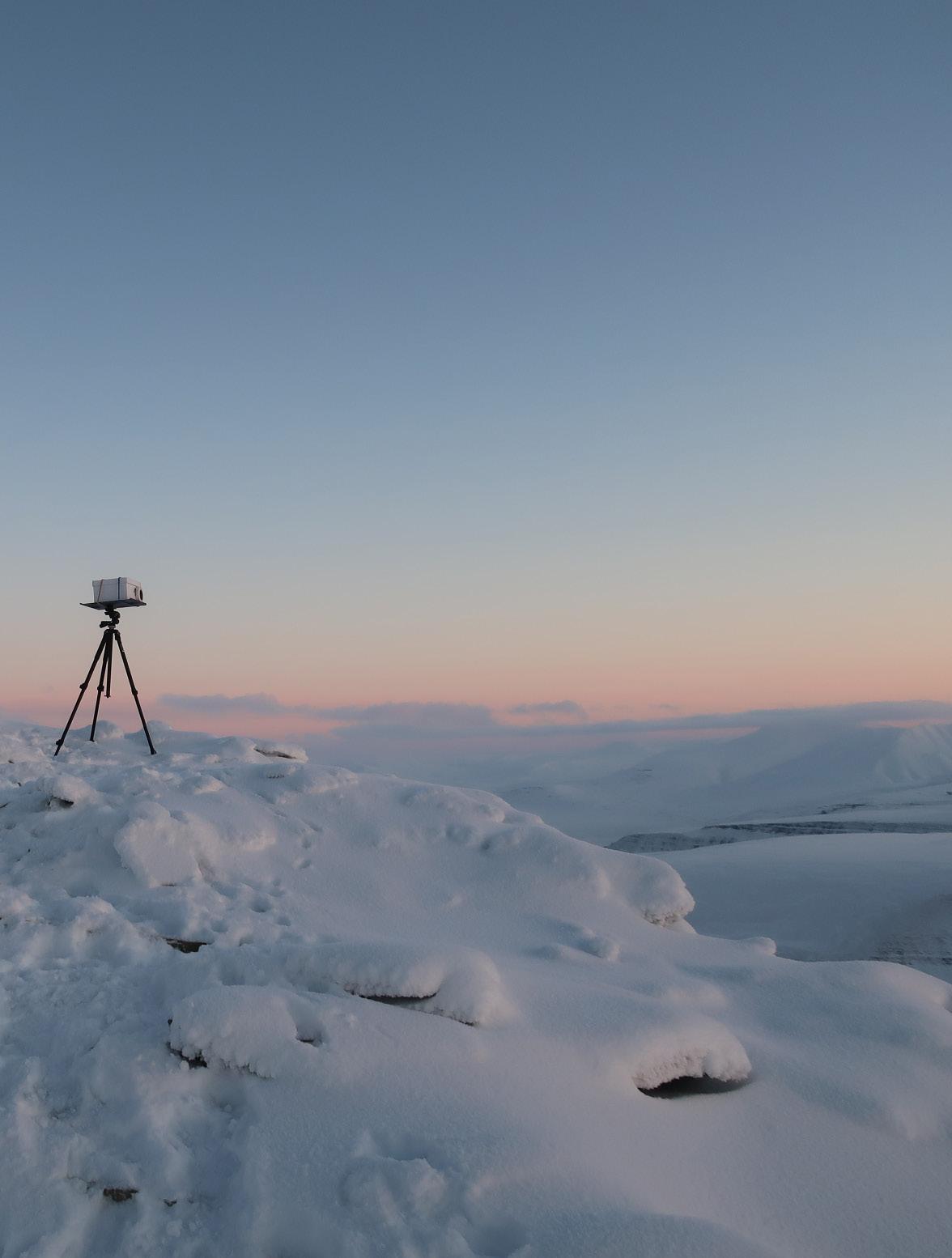
David Samuel Stern is an American photographer and visual artist whose practice approaches photography as a physical, craft-based process, with a sustained interest in portraiture, time, and place. During his residency at Artica Svalbard (autumn 2025), he continued his ongoing Winter Solstice Pinhole Photographs series, working with handmade cameras and long exposures through the transition from polar twilight into polar night—pursuing image-making at the edge of seasonal darkness.
“There’s a chapter of my work that wouldn’t have been possible without Artica Svalbard. Even if I had travelled to the geographical location on my own, I would not have had the resources and local expertise in order to execute the work I did there to the extent I was able to. In other words, as planned and prepared as I had been, Artica’s staff, facilities, and community are what made my time in Svalbard successful.”
Alongside his own work, Stern contributed to the local programme by leading a hands-on pinhole photography workshop during the dark season. Participants built simple cameras, made long-exposure images in dim Arctic light, and developed their negatives together—sharing a direct, tactile encounter with how light, time, and place imprint themselves onto photographic paper.
Amy Hoagland is a visual artist whose sculptural installations explore the human relationship with nature through the lens of geological time. In residence at Artica Svalbard (November–December 2025), she expanded ongoing Arctic research into slow environmental processes— wind, soil movement, shifting ice—using daily “acts of relationality” with the landscape, documented through writing, photography, video, and performance as material for new sculptural work.
“Artica Svalbard was a transformative residency for me. Research and place based residencies are critical, especially in a place like Svalbard, which is the fastest warming place on earth. The ability to attend Artica Svalbard allowed me to learn from experience, community, and the place itself. I felt extremely supported as a resident artist by Charlotte and Sally. The residency creates a fruitful environment for rich and responsive work.”
Alongside her studio practice, Hoagland contributed to Artica’s public programme by taking part in Messages in the Polar Night, an open evening of presentations and exchange with fellow resident Kathy Sirico, offering the local community insight into her methods and how her project was unfolding during the dark season.
OUR 2025 RESIDENTS
Kathy Sirico is a Brooklyn-based artist and poet working across painting, sculpture, textiles, and installation, with climate-conscious making and ecological grief at the core of her practice. In residence at Artica Svalbard (November–December 2025, independently funded), she developed two intertwined bodies of work: Svalbard Abstractions, a mixed-media painting and stained-glass series informed by Arctic geology and light, and Svalbard Mythologies, a poetic project imagining interspecies dialogues—voices of whale bones, melting glaciers, and iceberg soundscapes—calling for deeper non-human empathy.
“My time at Artica Svalbard was incredibly powerful. It gave me the opportunity to learn and grow artistically and personally. I value this residency experience immensely, and feel very grateful for the Artica staff and Longyearbyen community for their warmth, generosity, and inspiration. This residency experience will echo through my artistic practice for years to come, as I go forth in the world to communicate about Svalbard’s climate change and environment through art and writing.”
Alongside her studio practice, Sirico contributed to Artica’s public programme through Messages in the Polar Night, an open evening of presentations and exchange with fellow resident Amy Hoagland, sharing her works-in-progress and the ideas shaping them during the dark season.
PROJECTS, EVENTS & COMMUNITY ENGAGEMENT
In 2025, Artica Svalbard’s public programme became more continuous across the year, with an increase in activity shaped by community interest, audience feedback, and a growing need for shared spaces of learning, dialogue, and cultural exchange. Artica hosted 80 public events in 2025 and welcomed 1,712 in-person attendees, reflecting a sustained and active cultural presence in Longyearbyen.
Rather than changing direction, the programme developed through recurring formats, participatory events, and publicfacing initiatives that strengthened connections between visiting residents, local audiences, and wider cultural and research networks.
Deepening Engagement Through Impactful Residencies
Artica’s residency programme continued to prioritise meaningful exchange between visiting residents and the local community. In 2025, residents contributed to the public programme through
workshops, readings, performances, talks, and collaborative activities, extending artistic and literary practices beyond the studio and into shared spaces of participation.
This included selected public moments and residency-led initiatives across the year, while maintaining a focus on context, care, and responsible engagement. Alongside in-person activity, Artica Writings continued as a key strand of Artica’s programme, supporting longer-form communication and reflection across the year.
Responding to Community Needs & Participation
Audience feedback throughout 2024 and early 2025 highlighted a strong interest in adult learning opportunities and formats that support repeat participation. In response, Artica continued to develop participatory and knowledge-based programming that encouraged ongoing involvement rather than one-off attendance.
Recurring gatherings, workshops, and discussion-based formats created accessible entry points into the programme and strengthened continuity across the year. Lantern Lectures also continued as an important strand of public activity, supporting shared learning and conversation across artistic and research perspectives.
Artica Svalbard strengthened its national and international presence through partnerships and outward-facing events in 2025.
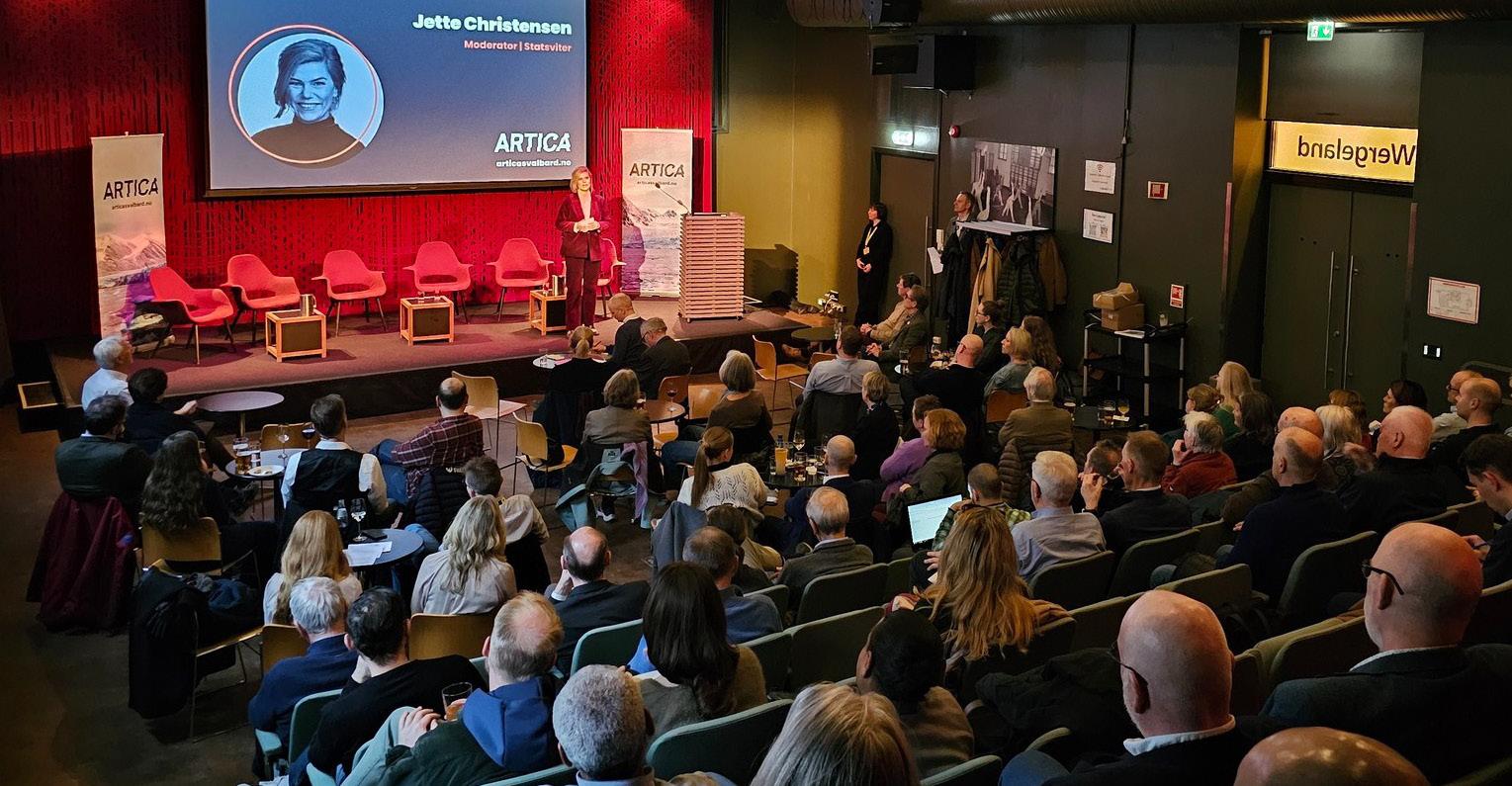
As part of Svalbard-dagen in Oslo, Artica hosted The Cold Rush: Geopolitics, Security and Strategy in the Arctic at Litteraturhuset, contributing to wider public discussion around Arctic geopolitics and strategy.
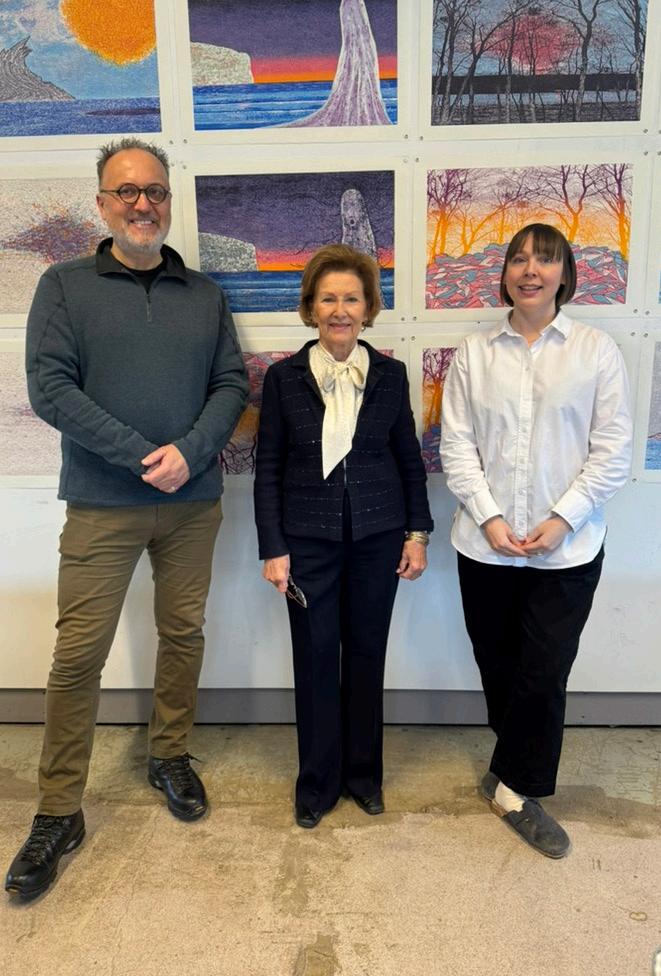
We were also honoured to welcome HM Queen Sonja to Artica Svalbard during the year. Her visit, including a meeting with artistin-residence Endi Poskovic and Director Charlotte Hetherington, reflected continued recognition of the role of arts and culture in communicating Svalbard’s global significance.
Throughout the year, Artica also welcomed visiting students and academic groups from DIS · Study Abroad in Scandinavia, OsloMet, Vanderbilt University (USA), Universität Bern, the Erasmus programme in Germany, and the University of Alaska Fairbanks, reinforcing Artica’s role as a site for cultural exchange and learning.
Overall Impact
In total, 1,712 people attended Artica Svalbard’s in-person events in 2025, compared to 1,265 in 2024. In a small community context, the year’s programme emphasised continuity, repeat participation, and regular opportunities to meet, learn, and take part.
Workshop: Smelly Get-Together with Simon Daniel Tegnander Wenzel, August 2025
How to present a project as an exhibition workshop, February 2025
HM Queen Sonja visits Artica Svalbard with Charlotte Hetherington and Endi Poskovic, June 2025
Nastassja Simensky working at Artica
Ragnhild Bjørnsen hosts a workshop with the Longyearbyen Youth Council at Artica, October 2025
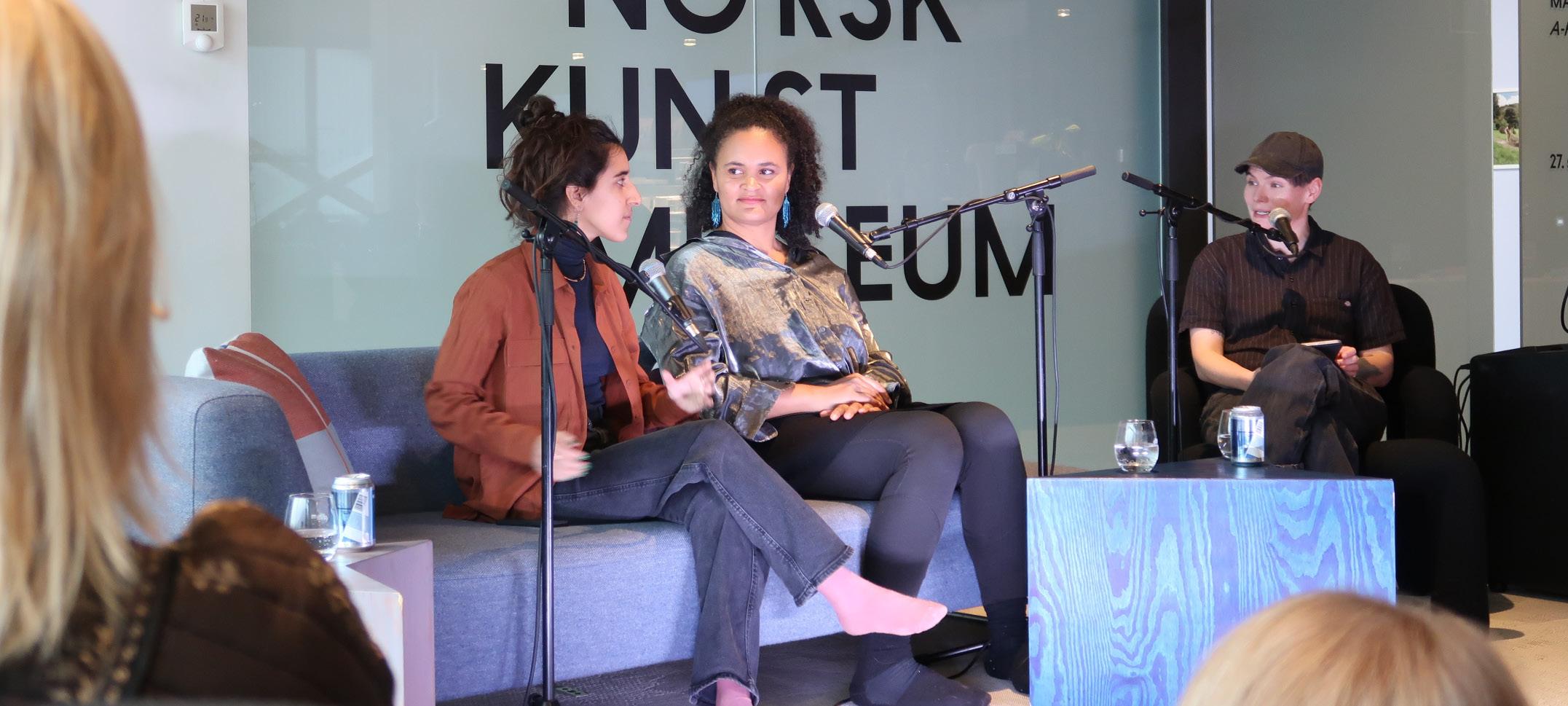
Bianca Hisse and Maritea Dæhlin take part in an artists take hosted by Liv Brissach, Curator at NNKM
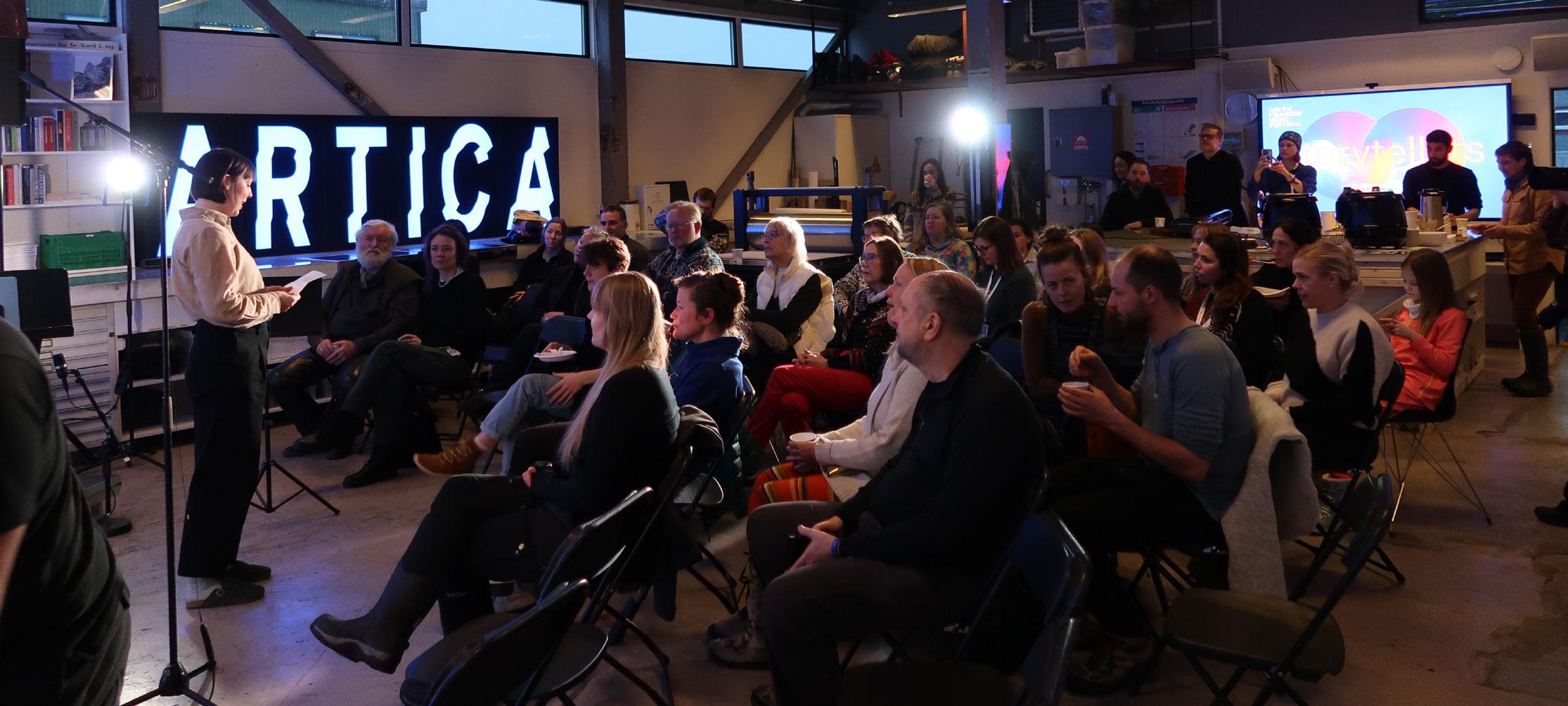
Arctic Chamber Music Festival at Artica, February 2025
The Cold Rush: Geopolitics, Security & Strategy in the Arctic
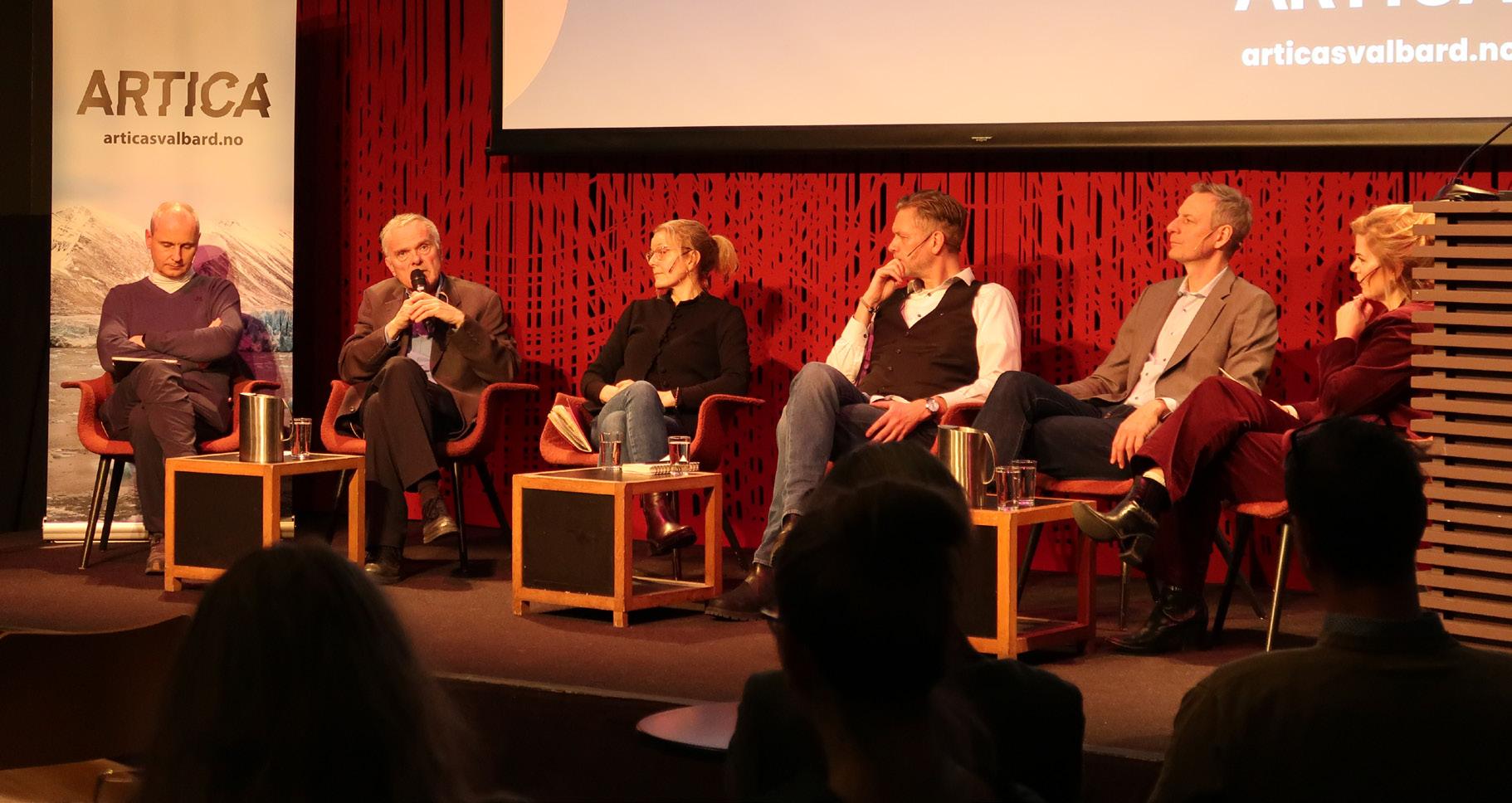
On 27 March 2025, Artica Svalbard presented The Cold Rush at Litteraturhuset in Oslo as part of Svalbard Day, organised by Svalbard Reiselivsråd and Visit Svalbard. The event brought together researchers and public voices working across Arctic policy, security, and history to examine how the region is changing—not only environmentally, but strategically. As sea ice retreats and access increases, the Arctic is no longer framed as a remote periphery. It is increasingly treated as an arena where infrastructure, military posture, resource interests, legal regimes, and symbolic presence overlap.
The discussion centred on a set of urgent questions: Are we entering a renewed era of great-power rivalry in the north? How are Russia and China positioning themselves in the Arctic, and what does this mean for Norway and regional stability? How is NATO adapting to new strategic realities in the High North, and how does U.S. attention—particularly in relation to Greenland— shape the broader security landscape? And, crucially for this context: what role does Svalbard play in these developments, given its distinctive legal status, international visibility, and proximity to Russian settlements and strategic sea routes? The evening opened with keynote presentations.
Karsten Friis (Norwegian Institute of International Affairs, NUPI) mapped wider geopolitical shifts, military trends, and the implications of NATO’s evolving posture, including how non-Arctic states are increasingly present in Arctic affairs. Arild Moe (Fridtjof Nansen Institute) followed with analysis of Russian and Chinese interests and strategic behaviour in the region, with particular attention to how Svalbard functions as both a practical site—through activity, logistics, and infrastructure—and a symbolic site within broader state narratives.
These perspectives fed into a panel discussion moderated by political scientist and former Member of Parliament
“In an uncertain time, the one thing we can be sure of is that we should focus on what we can control ourselves. And what we’re doing here tonight—creating space for researchers to speak freely, to disagree about security policy, and to share their reflections—that in itself is an act of resistance.”
—
Jette Christensen (moderator), The Cold Rush, Litteraturhuset, Oslo
Jette Christensen, whose background in democracy, security, and foreign policy helped bridge expert analysis with public-facing debate. The panel brought together Kari Aga Myklebost (UiT The Arctic University of Norway), Paal Sigurd Hilde (Norwegian Institute for Defence Studies, IFS), and Terje Aunevik (Leader of Longyearbyen Lokalstyre), ensuring the conversation moved between historical context, contemporary security policy, and the lived implications of governance in Longyearbyen.
A recurring theme was the tension between the Arctic as a space of international cooperation and the Arctic as a theatre of strategic competition. Speakers addressed how presence can be asserted through long-term research activity, civilian infrastructure, and cultural or administrative visibility as much as through defence policy—particularly in a region where legal frameworks and environmental conditions both constrain and enable activity. The discussion also highlighted that Svalbard’s strategic significance is inseparable from its human dimension: the realities of local governance, community turnover, critical services, and the practical infrastructure that makes settlement possible.
The event was open to the public, and recorded for later publication via Artica’s platforms—extending access beyond the room and supporting Artica Svalbard’s wider commitment to creating space for informed cultural discussion around Arctic futures.
EVENTS Lantern Lectures
2025/2026
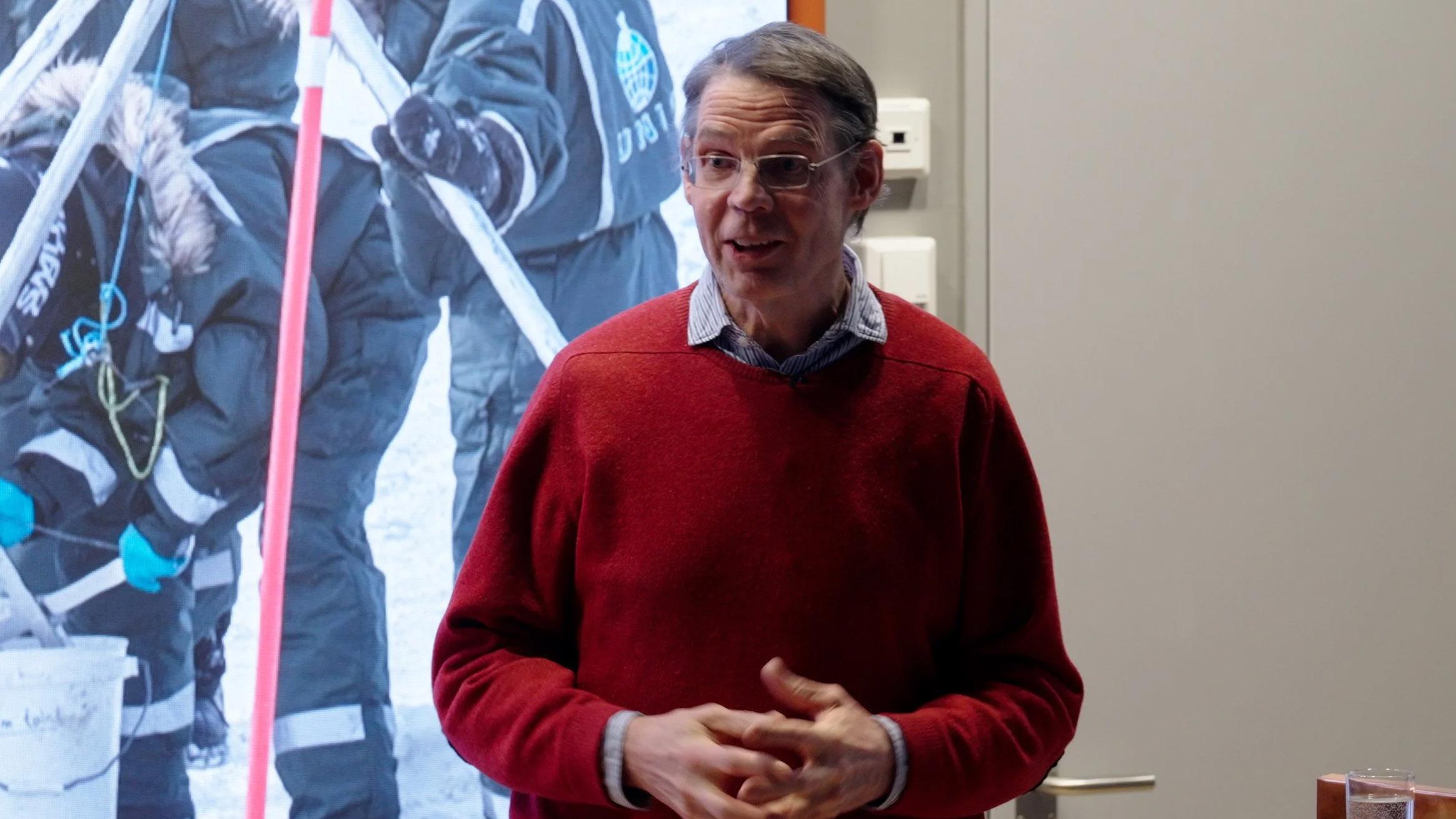
During the 2025–26 dark season, Artica Svalbard relaunched the Lantern Lectures series in partnership with Svalbard Museum, reviving the spirit of the 19th-century magic lantern lecture: community gatherings built around storytelling, projected images, shared knowledge, and discussion.
Presented across four public talks between November 2025 and January 2026, the series created a space for reflection on life in the Arctic at a time of rapid environmental, social, and political change. The programme brought together local voices and visiting experts from meteorology, archaeology, history, youth politics, and Arctic science, offering perspectives on climate change, heritage, identity, and risk in Svalbard.
Lectures were held at Artica Svalbard and Svalbard Museum, with all events taking place in the early evening and recorded for later online viewing. This helped extend the reach of the programme
beyond those able to attend in person, while also creating a growing archive of accessible public conversations rooted in Svalbard.
The 2025–26 series also strengthened collaboration between Artica and Svalbard Museum, demonstrating the value of shared programming between cultural and knowledge institutions in Longyearbyen.
2025–26 Programme
Why Is Svalbard Crying? Climate Change and its Human Impact in Svalbard
Ine-Therese Pedersen (State Meteorologist)
13 November 2025 — Svalbard Museum
Pedersen reflected on how climate change is reshaping everyday life in Svalbard, combining meteorological insight with lived experience from Longyearbyen. Her talk focused on the human consequences of warming temperatures, changing seasons, and increasingly unstable weather patterns.
Goodbye to Heritage: Svalbard’s Past Beyond Conservation
Anatolijs Venovcevs (Researcher in Historical Archaeology, Svalbard Museum)
11 December 2025 — Svalbard Museum
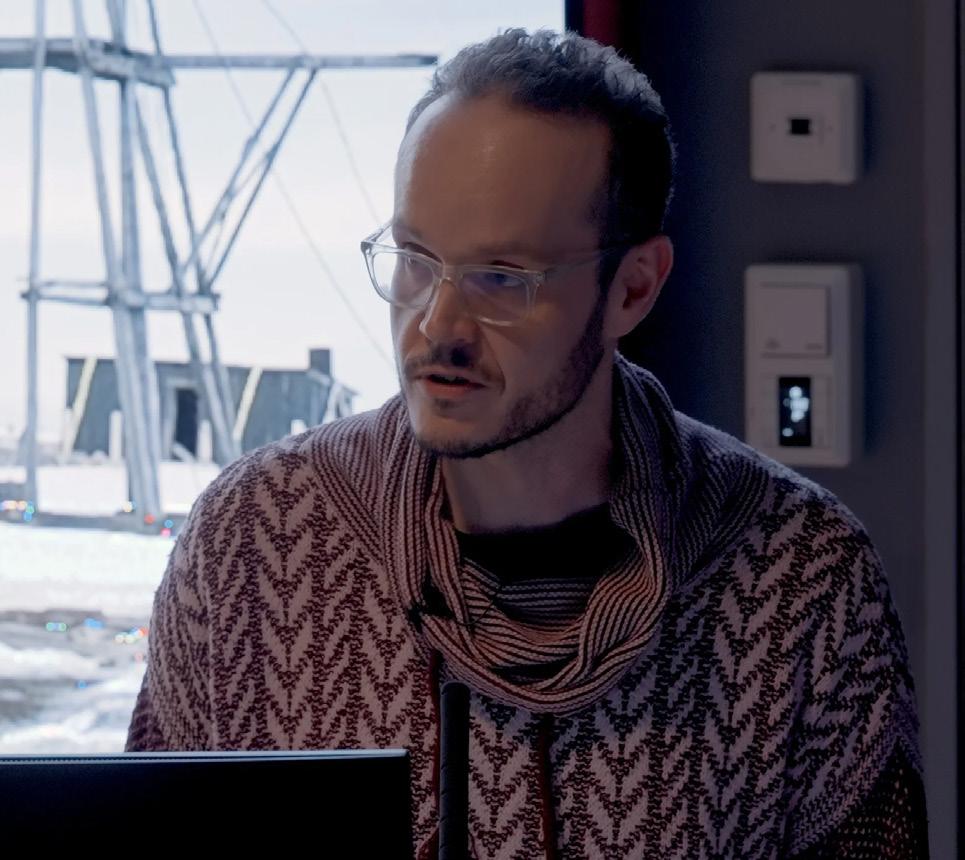
Venovcevs explored how Svalbard might pioneer new approaches to heritage management in an era of climate change and unavoidable loss. Drawing on contemporary heritage studies, he considered what it might mean to responsibly “let go” of certain forms of heritage, and why Svalbard is uniquely placed to host these conversations.
Anatolijs Venovcevs
My Arctic Home: Growing Up and Speaking Out in Svalbard
Embla Abild (Leader, Longyearbyen Youth Council)
16 December 2025 — Artica Svalbard
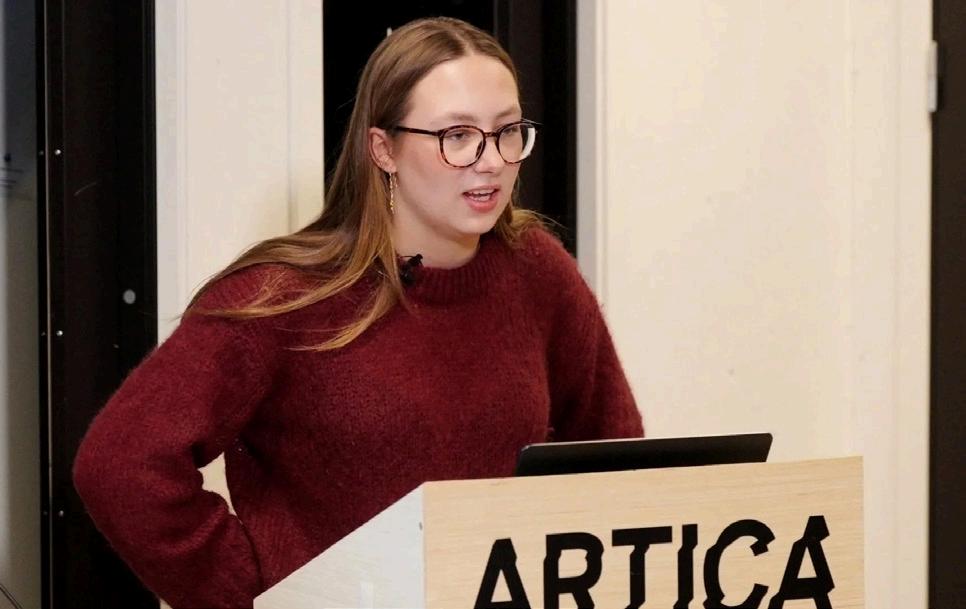
Abild reflected on growing up in Longyearbyen and how life in Svalbard shaped her values, political voice, and commitment to protecting an open and inclusive local community. Her lecture offered an important youth perspective on social change, belonging, and participation in local democracy.
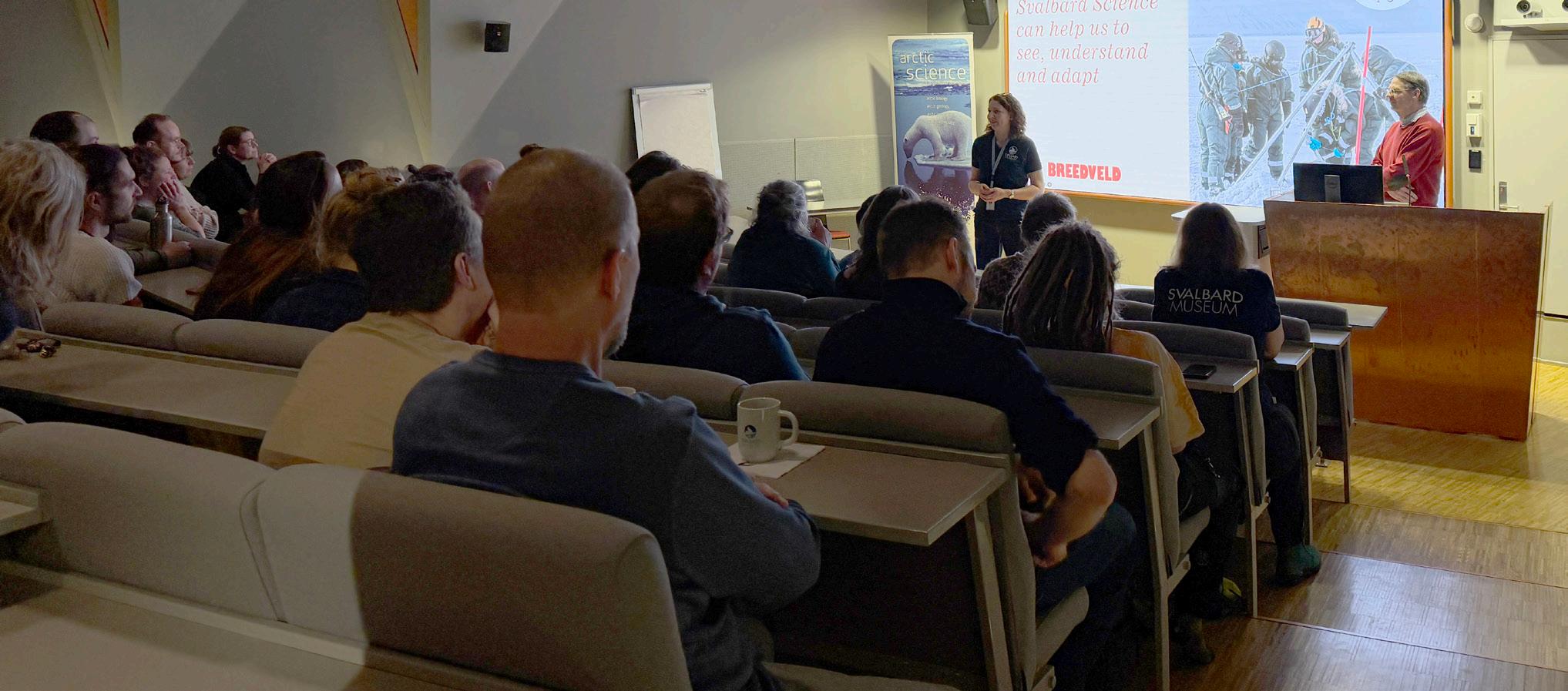
Creeping Risks of the Arctic: How Svalbard Science Can Help Us to See, Understand and Adapt
Gijs Breedveld (Head of Department of Arctic Technology & Research Leader, UNIS)
12 January 2026 — Svalbard Museum
Breedveld examined the Arctic as an early warning system for global environmental threats, focusing on “creeping risks” such as climate change, biodiversity loss, and pollution. His talk highlighted how Svalbard-based research can help identify slow-moving risks early and support more informed societal responses.
Online publication and access
All of the Lantern Lectures were recorded and published online after the live events, with subtitle support where relevant. This substantially increased accessibility and allowed the series to continue functioning as a public resource beyond the event dates. These recordings form part of Artica Svalbard’s wider effort to support public discourse and knowledge-sharing around Arctic life and change through both in-person and digital formats.
Programme significance
The Lantern Lectures series demonstrated how relatively smallformat events can generate meaningful public engagement when rooted in local relevance and presented in an accessible way. The partnership model with Svalbard Museum broadened the audience base, supported cross-institutional collaboration, and strengthened the programme’s connection to both cultural and scientific communities in Longyearbyen.
By bringing together climate science, youth perspectives, Arctic history, heritage studies, and environmental risk research within a shared format, the series created a coherent seasonal programme that encouraged reflection across disciplines and generations.
The programme was made possible with support from:
Sparebankstiftelsen SpareBank 1 Nord-Norge
Samfunnsløftet SpareBank 1 Nord-Norge
Embla Abild
Creeping Risks of the Arctic: How Svalbard Science Can Help Us to See, Understand and Adapt, Svalbard Museum
PROJECTS
Artica Writings 2025:
Beneath The Surface –
Deep-Sea Mining And The Arctic
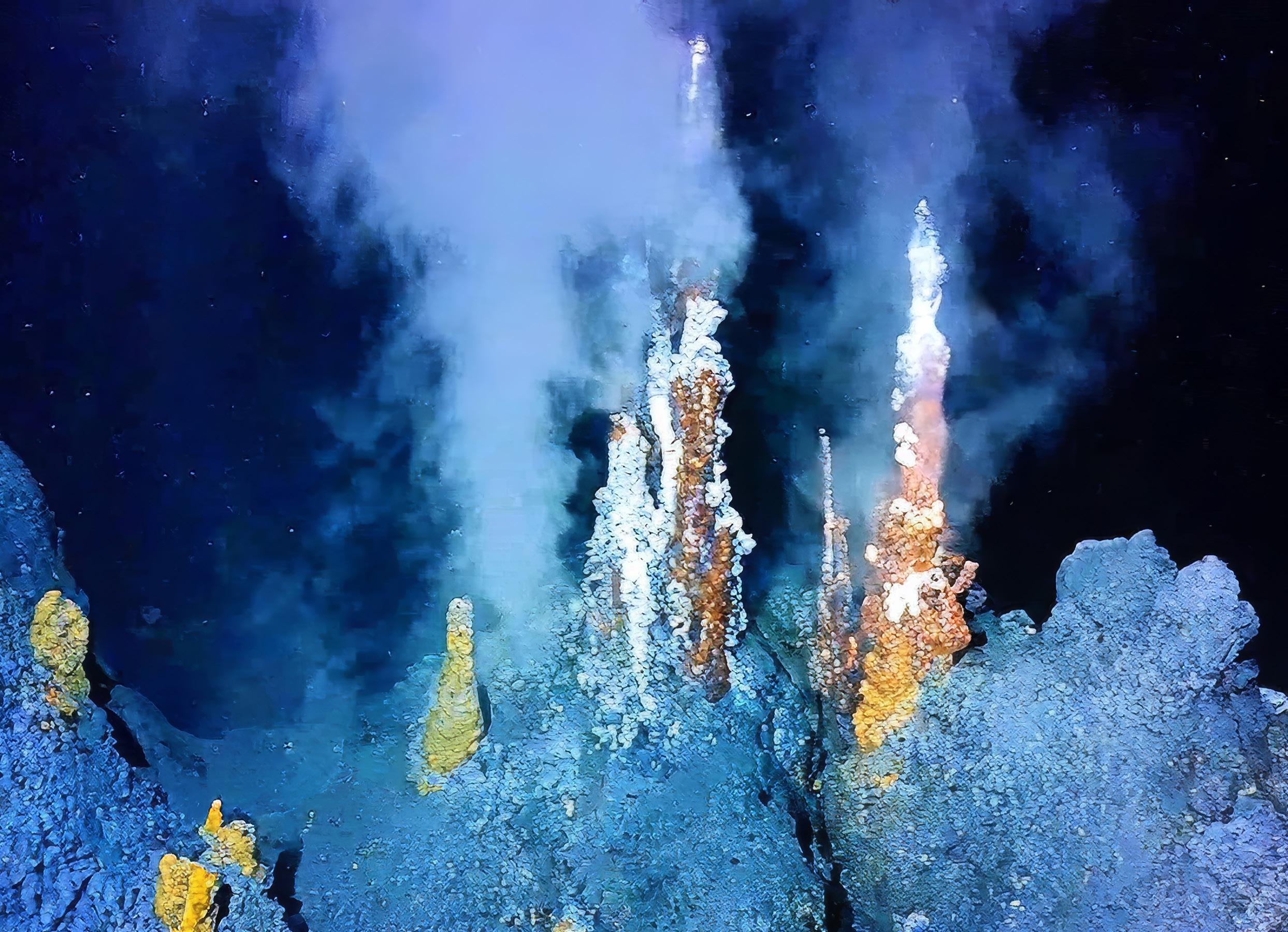
An active hydrothermal vent releasing mineral-rich particles into the deep ocean.
Hasenburg
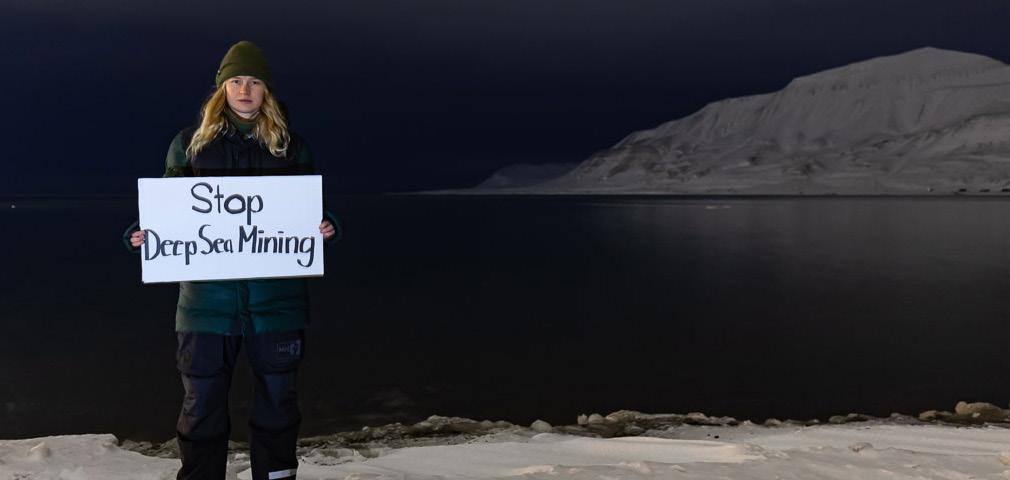
As Norway advances plans to explore its northern seabed for mineral resources, deep-sea mining has become a focal point in wider debates about environmental ethics, geopolitical power, and the contradictions of the green transition. While formal exploration has been approved, political opposition has paused further licensing—placing the issue in a state of tense uncertainty, both nationally and globally. What happens next is not simply a technical matter of mapping deposits and testing equipment; it is a question about how decisions are made when knowledge is incomplete and the consequences may be irreversible.
In 2024, the Norwegian government opened a large area of the continental shelf for mineral exploration, including zones in northern waters that extend towards the Svalbard region. The prospect therefore resonates here: Svalbard is already negotiating its identity between extraction, research, tourism, and heightened geopolitical attention—and the ocean around it is not a blank space on a map, but a lived and studied environment with competing claims, expectations, and vulnerabilities.
A central tension runs through the discussion. Critical minerals are routinely framed as necessary for electrification—batteries, grids, and renewable infrastructure—yet the deep ocean remains one of Earth’s least understood ecosystems. Baseline knowledge is limited, recovery times may span centuries, and risks such as sediment plumes, noise, light, and dissolved pollutants are difficult to model and harder to reverse. But uncertainty is not only empirical. Even as research reduces knowledge gaps, it can reveal new risks and sharpen the harder question: what should we do, given what we know—and don’t know? That is a question about values as much as evidence: what counts as acceptable harm, how we weigh welfare against nature, and whether the ocean is treated as resource, commons, or something with intrinsic worth.
Artica Writings 2025 brings together distinct voices to examine this moment from multiple directions: ethical uncertainty and the limits of quantification; ocean governance and the problem of treating volume like a surface; and public participation in shaping Svalbard’s future as the region “opens up” to increased activity. Taken together, the essays ask what lies beneath the surface of our pursuit of rare minerals—and what is displaced when extraction is pushed out of sight and offshore.
Project Contributors
• Hanna Mortensdatter Vandeskog is a human geographer examining extractive industries and ocean governance, with a focus on how “frontier” spaces are made legible—and contested—through policy and power.
• Siri Granum Carson is Professor of Applied Ethics at NTNU’s Department of Philosophy and Religious Studies, specialising in business ethics and corporate social responsibility, and the moral responsibilities that follow from high-impact decisions.
• Espen Dyrnes Stabell is Associate Professor of Ethics at HVL Business School and affiliated Associate Professor at NTNU. His research addresses ethical challenges in emerging technologies under uncertainty, including risk, evidence, and the responsibilities of institutions.
• Franziska Hasenburg is a climate activist, science communicator, and geoscientist in training, working at the intersection of public engagement, environmental justice, and the politics of “green” extraction.
This project was supported by Fritt Ord.
• Franziska
PROJECTS
Shadowing Without a Sunset
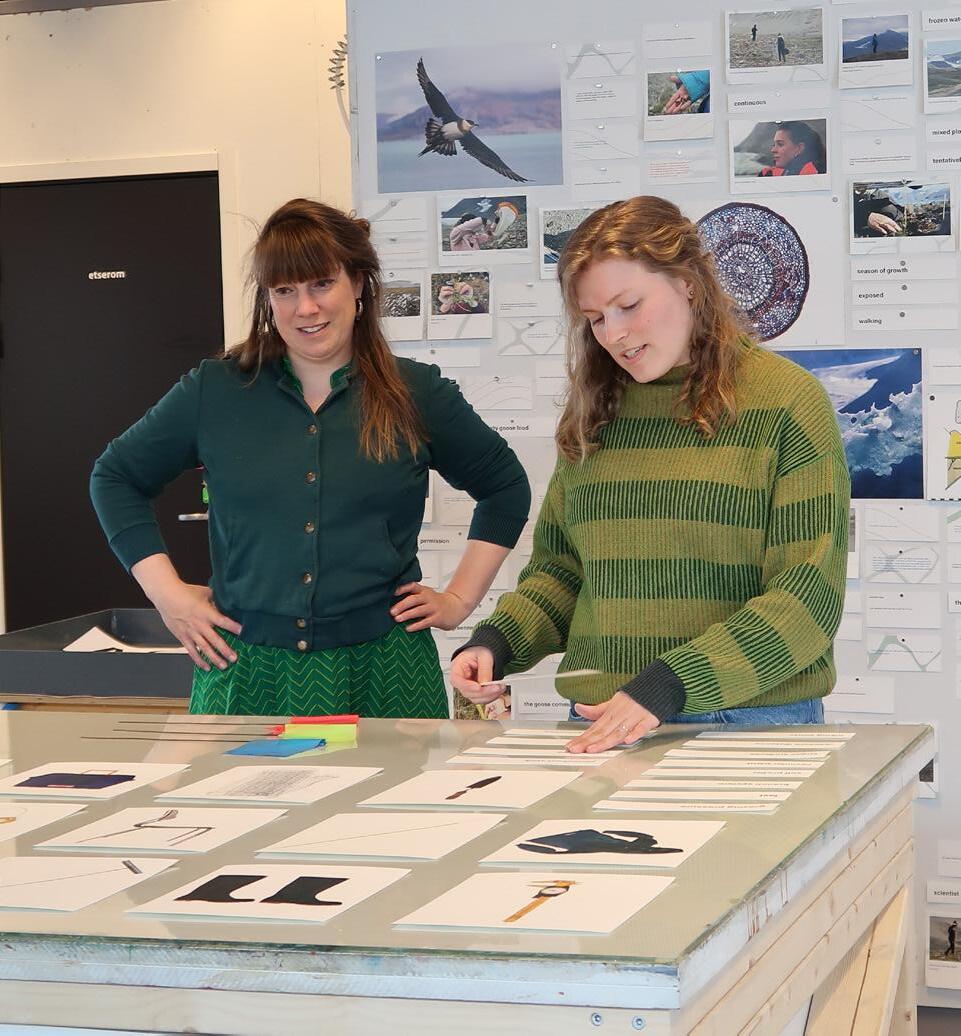
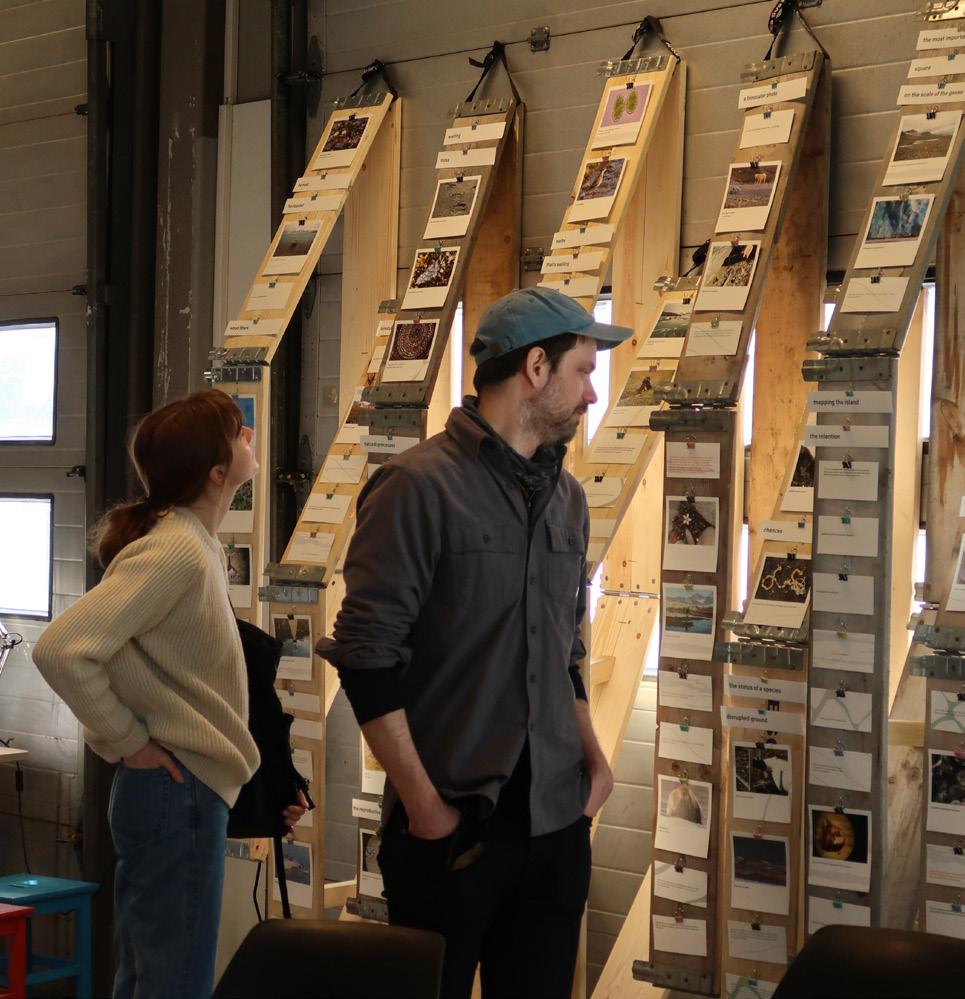
Shadowing Without a Sunset was a collaborative residency project by aquatic ecologist Sanne Moedt and artist/educator Arctic Nature Guide Floortje Zonneveld. Hosted at Artica Svalbard in spring 2025, the project was designed as a bridge between scientific research and everyday community life in Longyearbyen— inviting local residents, and especially young people, into an active, imaginative encounter with Arctic science.
The collaboration began with fieldwork in Ny-Ålesund in summer 2024. With support from Maarten Loonen at the Netherlands Arctic Station, Moedt and Zonneveld followed scientists during their daily work and gathered materials including microscopy footage, maps, field notes, recordings, photographs, quotes and small objects. They treated this as a living archive and brought it back to Longyearbyen as the basis for an interactive installation at Artica.
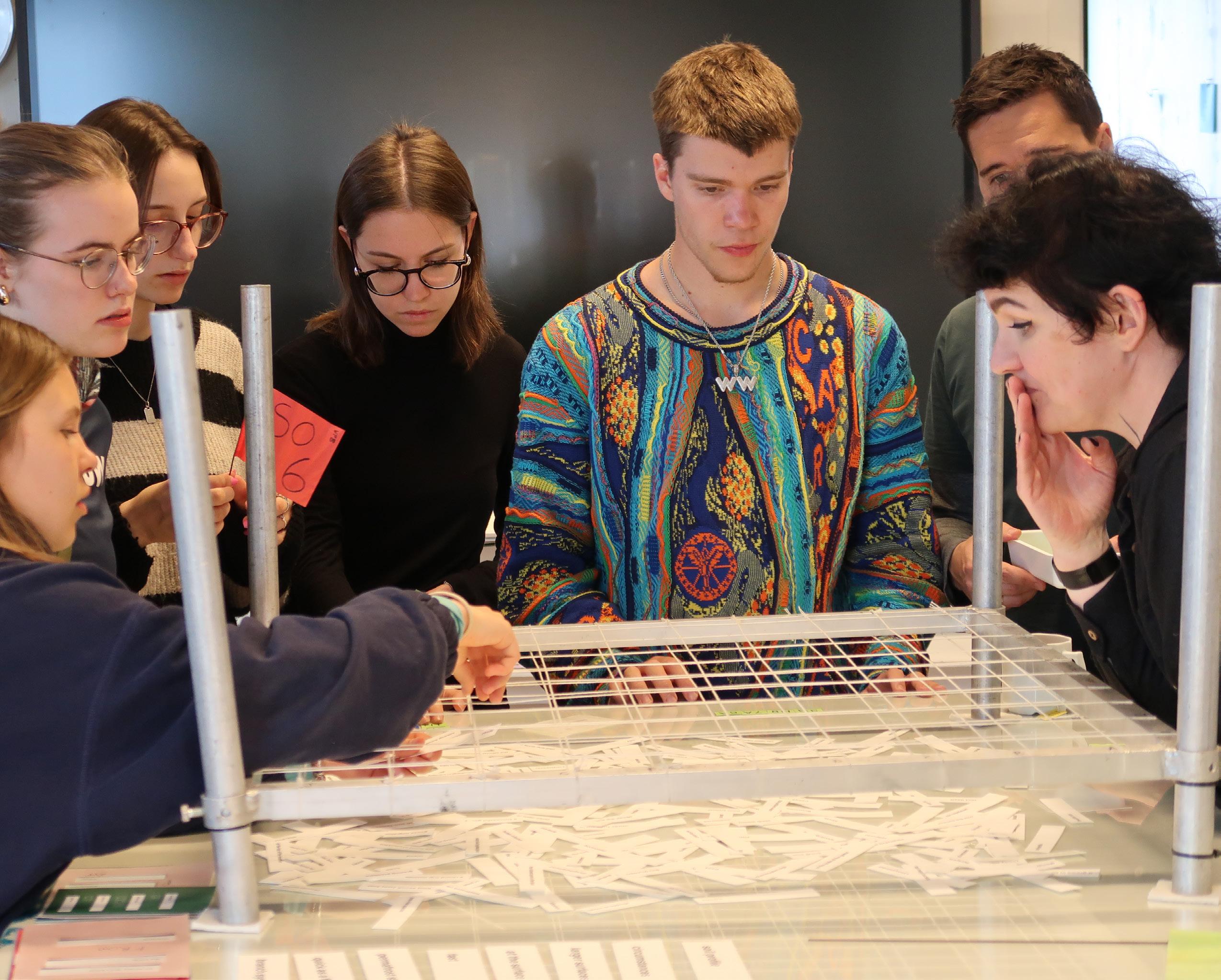
In the studio, these traces were transformed into a threedimensional archive that visitors could open, handle, listen to, annotate, and interpret. Workshops used methods drawn from both field and studio—observing, mapping, drawing, collecting, listening, sequencing, and storytelling—to help participants make their own sense of the material. The outcome was not a single “correct” explanation, but many viewpoints: zines combining text, sketches, data fragments and personal reflections.
Over the course of the residency, more than 195 participants engaged with the project, including students from Longyearbyen Skole (Grade 6 and the Design/Redesign programme for Grades 8–10), the Svalbard Folkehøgskole Art Group, visitors from UNIS
and Hurtigruten, and members of the general public. For the community, the project offered an accessible entry point into the “Svalbard not everyone gets to see”: the human, patient reality of research work—while also giving young residents a space to express their own experiences and questions.
By placing science alongside artistic process—rather than translating one into the other—the project created a shared language of attention: senses, curiosity, imagination, and care.
“During my residency at Artica Svalbard, I collaborated with artist Floortje Zonneveld to develop and host an interdisciplinary project with youth in Longyearbyen. At Artica, there was time to experiment and see what emerges. It became a space to explore the connections between scientists, artists and young people, and to recognise that we all rely on our senses, curiosity and imagination to understand the world. I leave with a deeper understanding of what my scientific practice can be, for which I am deeply thankful.” — Sanne Moedt
“Through Maarten Loonen’s support at the Netherlands Arctic Station, Sanne and I were able to follow six scientists during their fieldwork in NyÅlesund in the summer of 2024. This gave us a unique insight that we wanted to share with Longyearbyen; highlighting the human, curious, and dedicated side of Arctic science in an engaging and interactive way. It was our first collaboration together and we are grateful to continue working with Artica, building on existing relationships and strengthening community engagement as something that naturally happens in town.” — Floortje Zonneveld
Supported by Sparebankstiftelsen and the Netherlands Arctic Station Ny-Ålesund
PROJECTS
NAARCA Residencies Exchanges and Staff Exchange
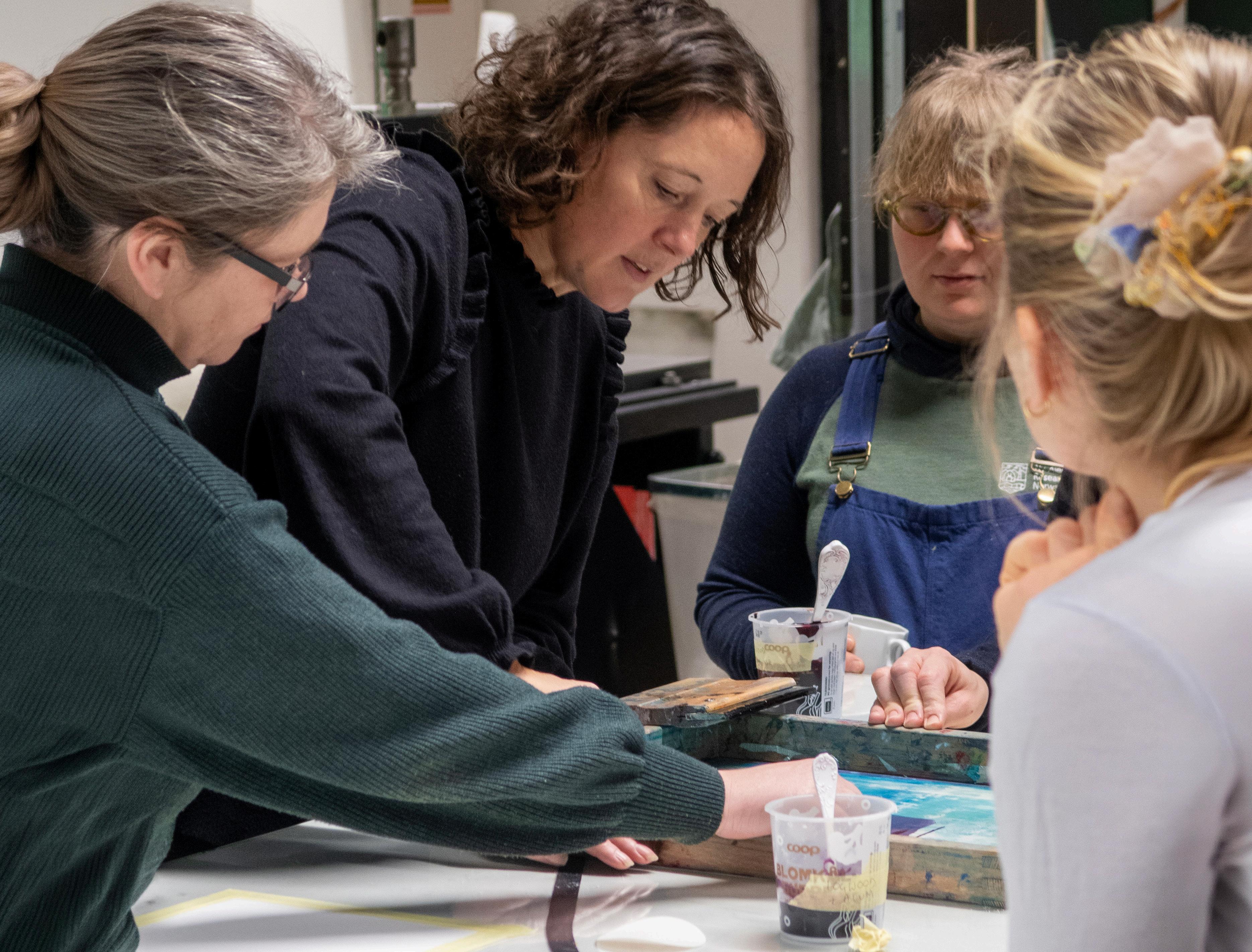
Emma Henderson, printing workshop at Artica Svalbard
In 2025, Artica Svalbard continued its involvement in The Nordic Alliance of Artists’ Residencies on Climate Action (NAARCA), an international network of residencies focused on climate-conscious practice, long-term collaboration, and knowledge-sharing across regions experiencing rapid environmental change.
In the same year, NAARCA was delighted to share that Nordisk Kulturfond had awarded the Alliance a two-year grant for the continuation of the network.
Co-devised by Cove Park (Scotland) and Saari Residence (Finland) in 2021, the Alliance aims to build a long-term bridge between Scotland and the Nordic countries around the most pressing global issue of our time. The collaboration was founded on the geological, cultural and linguistic similarities that united both regions, and was a starting point for an expansive and holistic network of international working around climate action.
In 2025 and 2026, with the support of Nordisk Kulturfond, NAARCA will focus on supporting artists through residency exchanges, capacity-building for staff to develop ways of working with a longterm perspective, translation of toolkits, and sharing knowledge from the commissioned essays, podcasts, and toolkits. Additionally, NAARCA is interested in exploring potential projects that expand our geographic focus from solely the Nordic and Scottish region to working with partners in other parts of the world.
Residency Exchanges in 2025
Hugo Llanes was selected for a four-week residency that took place at Cove Park in Scotland in August 2025. Llanes is a Mexican artist and cultural facilitator based in Reykjavík. Exploring political and social issues through artistic research and a wide range of media – including installation, performance, and expanded painting – his work examines themes such as migration and adaptation, belonging, power dynamics, and post-colonial identity.
Oslo-based filmmaker Silvia Rossi with visual artist and collaborator Elena Mazzi were selected for a four-week residency that took place at the Narsaq International Research Station in October 2025. During their residency, Silvia and Elena adopted a community-engaged approach to explore Rob Nixon’s concept of slow violence – the gradual, often invisible environmental harm inflicted over time. Facilitating workshops for young people, they examined the role of the Kvanefjeld mine within the local community, considering how it may become a symbol of the complexities and contradictions embedded in the Green Transition on a global level.
The selection process for the 2026 residency exchanges begins in January after an open-call in 2025.
Staff Exchange in 2025
In November 2025, Artica welcomed Emma Henderson—an artist, producer, and arts educator based in the west of Scotland—as part of the NAARCA staff exchange programme. She joined Artica from Cove Park, a partner residency located on Scotland’s west coast.
Henderson’s practice spans printmaking, textiles, and environmental learning, with a particular focus on natural inks developed through slow, experimental processes. Her work explores feminist craft legacies while advancing low-impact, circular approaches to image-making. Alongside her artistic practice, she produces creative projects for local and national arts organisations, often grounded in place-based work, nature connection, and sustainable living.
During her stay Henderson developed the foundations of a natural printmaking toolkit and began establishing a pigment library as a shared resource for current and future residents. Drawing on pigments gathered in both Scotland and Svalbard, the pigment library was conceived as an evolving archive of colour rooted in place. The toolkit will be published through NAARCA’s online resources, offering open-access guidance for sustainable, lowwaste printmaking practices.
As part of the exchange, Henderson also led a community workshop in Longyearbyen, inviting participants to explore natural printmaking techniques and ecological approaches to working with materials.
The staff exchange was supported by Nordisk Kulturfond and forms part of NAARCA’s ongoing commitment to fostering climateconscious practice across its international residency network. The exchange will continue in 2026, when Henderson will travel to Skaftfell – Center for Visual Art in Iceland, further strengthening connections and knowledge-sharing across the NAARCA network.
NAARCA is a collaboration between: Cove Park (Scotland), Saari Residence (Finland), Artica Svalbard (Norway), Skaftfell - Center for Visual Art (Iceland) and Narsaq International Research Station (Greenland).
The NAARCA project is generously supported by the Kone Foundation and Nordisk Kulturfond.
2025 EVENT CALENDAR
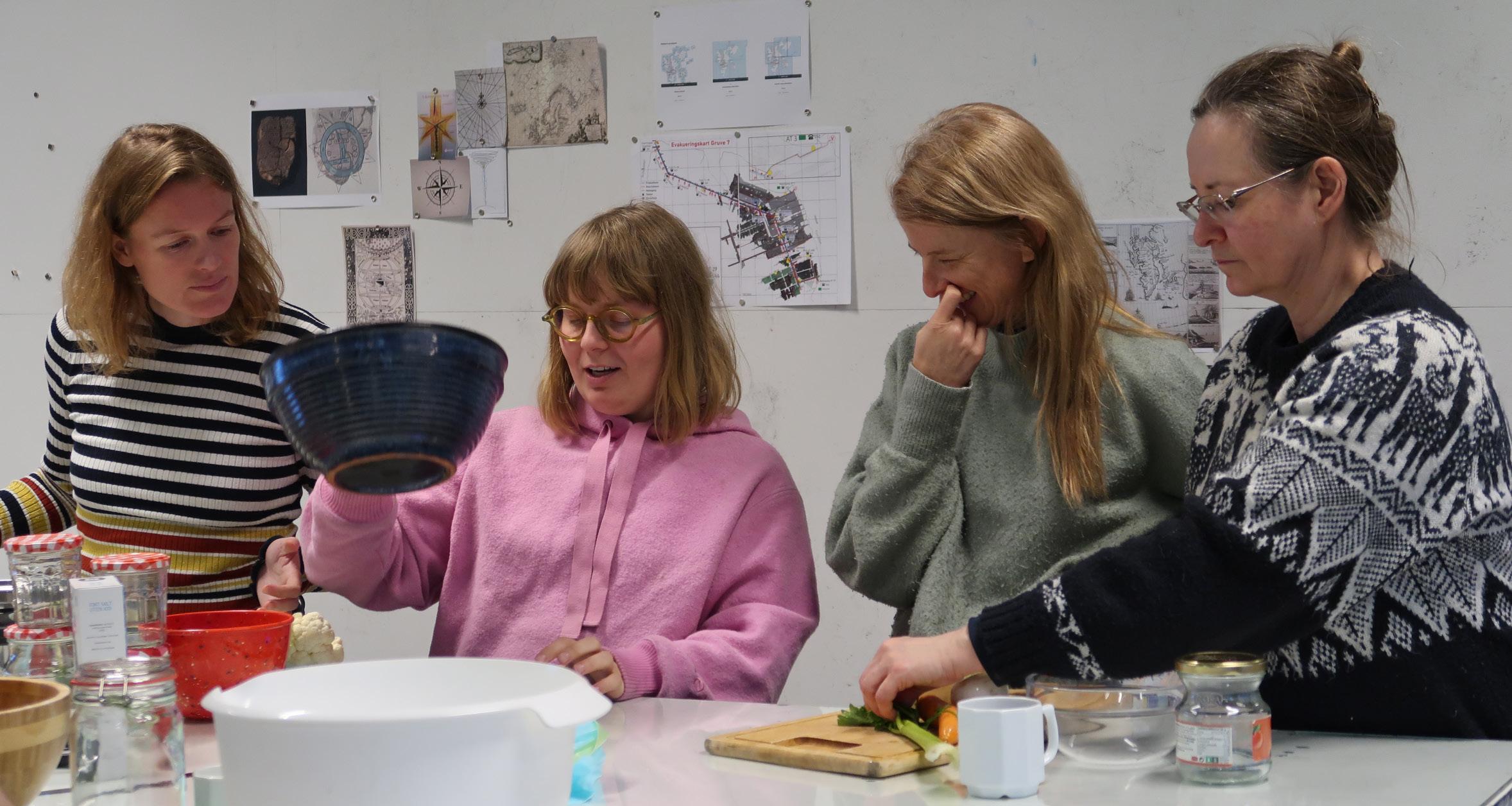
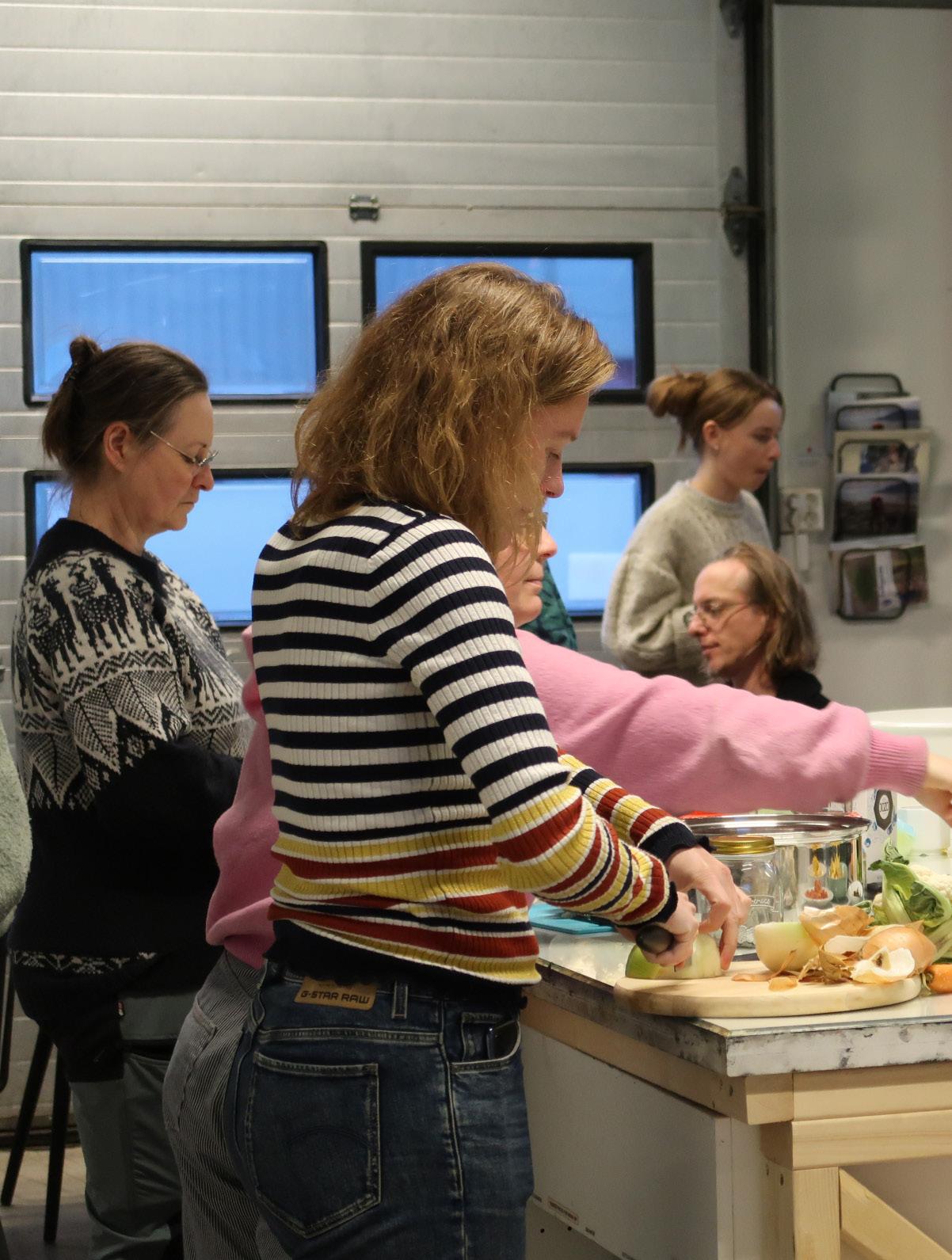
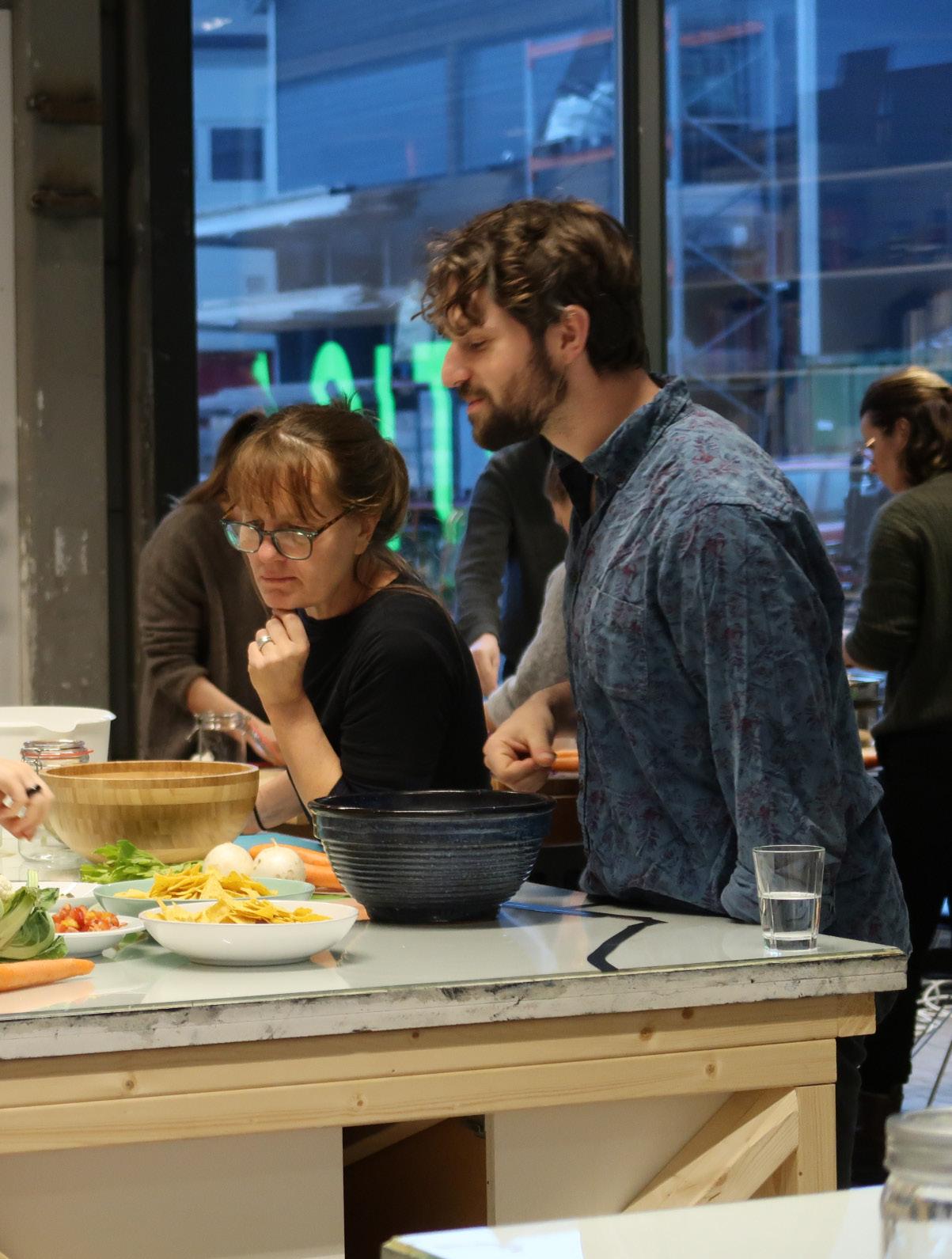
Workshop: An Introduction to Lacto-Fermentation
Regular gatherings formed the backbone of Artica’s programme in 2025, alongside workshops, readings, performances, talks, screenings, and one-off public events across the year. Together, these formats created a programme that prioritised continuity, accessibility, and variety.
Regular Programme Formats
In 2025, Artica hosted 12 First Friday Coffee Clubs, maintaining the monthly informal meeting place for artists, researchers, and local residents. Building on the success of Art Club in 2024, the fortnightly initiative continued during the dark season in 2025, with eight sessions offering adults a welcoming space to make, experiment, and socialise.
Artica also launched FIKA, a monthly gathering where scientists and artists present and meet over tea, cake, and conversation, creating a new platform for interdisciplinary exchange.
Workshops & Participatory Practice
Alongside recurring formats, Artica hosted 50 creative arts, crafts, cooking, movement, and writing workshops throughout the year. These events created practical, hands-on opportunities for local participation and enabled residents and invited contributors to share skills, methods, and ways of working.
This included a series of writing workshops led by writer Clara Arnaud, including a session held in collaboration with the Svalbard Museum.
Performances, Readings & One-Off Events
Beyond recurring activities, Artica curated a varied programme of one-off events, including bilingual poetry readings, a fermentation workshop, music and sound concerts, open studios, exhibitions, film screenings, and live performance.
Together, these events complemented the regular programme strands, creating space for both repeat participation and distinct public moments of sharing, experimentation, and exchange.
Event
Arctic Climate Action, brainstorming meeting
Arctic Climate Action, group meeting
Workshop: Lino Print for the TV-aksjonen
School visits: How to present a project as an exhibition
Local Film club event
Local Dance group meeting
Concert: Arctic Chamber Music Festival
Workshop: Siri Helle “home”
Workshop: Sun Festival - birds of Svalbard
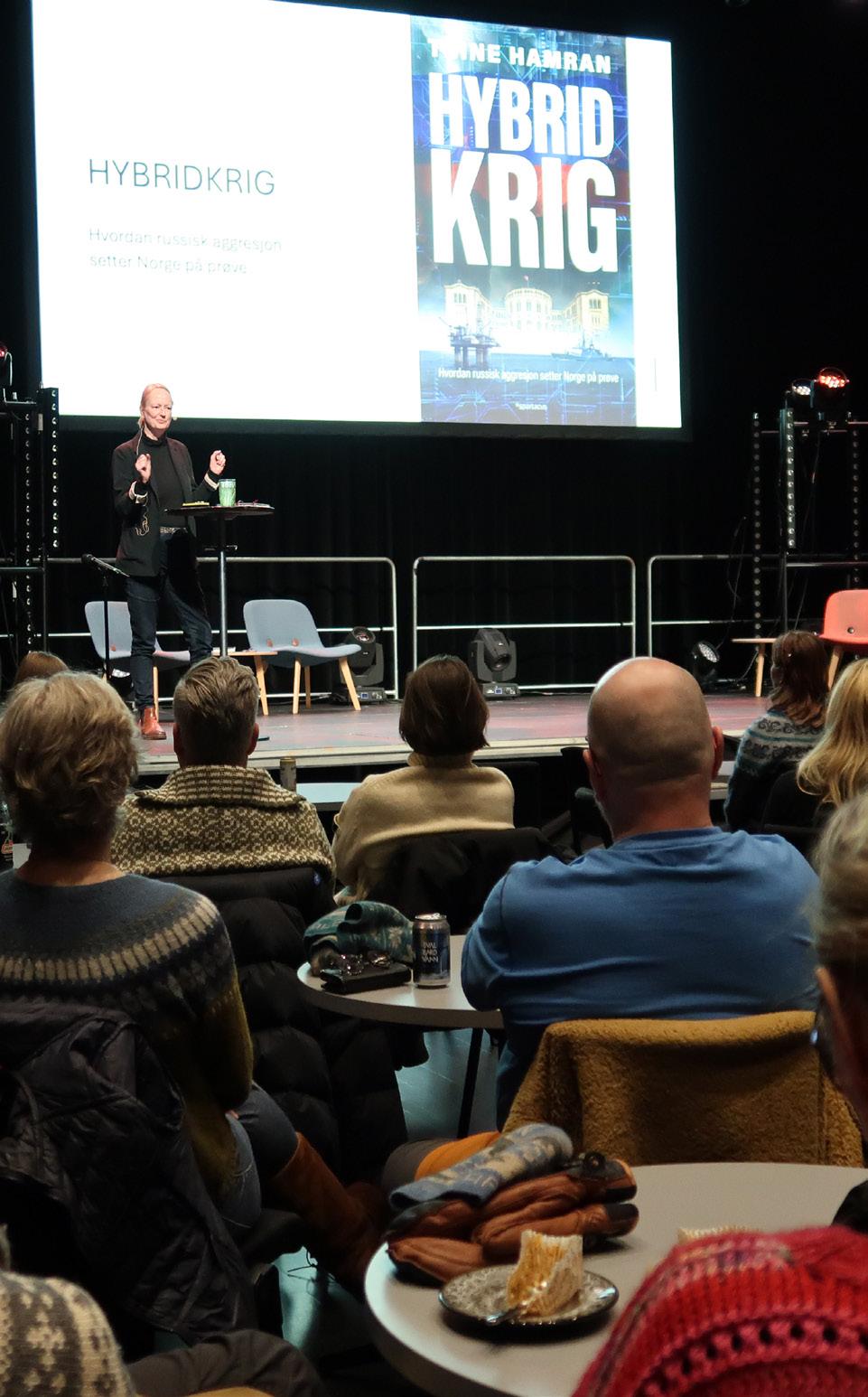
Talk:Spy War and Hybrid War: Trine Hamren and Wormdal
Workshop: Printmaking with artists Marieke & Kirsty
Talk & Workshop: Siri Helle at Folkehøgskole
Debate: The Cold Rush, Litteraturhuset, Oslo
Exhibition opening: Children’s Prints from Olaf Storø workshop, collaborative event with Nordover and Nordnorsk Kunstmuseum
Workshop: Drawing and storytelling with artist Cléa
Workshop: Arctic Climate Action, posters & banners making
Workshops: Shadowing without a sunset
Open Studio: Shadowing Without a Sunset
Writing Workshop: Beyond Nature with Clara Arnaud
Open Studio: with artist Endi Poskovic
Workshop: Relief printing and Stencil Techniques with artist Endi Poskovic
Bilingual Poetry Reading with Amanda Hernández, Elizabeth Torres Hansen and Nicole Cecilia Delgado
Workshop: POEMA SUELTO: Publication in Non-traditional Formats with Amanda Hernández and Nicole Cecilia Delgado
Performance: It Passes by Malin Arnell and Mar Fjell
Film Screening: Terhi Nieminen, Granada
Workshop: Pride Banner-Making Open Studio
Workshop: Bookmark Making with Lino Print
Workshop: Smelly Things with Simon Daniel Tegnander Wenzel
Workshop: Introduction to Lacto-Fermentation with Anatolijs Venovcevs
Writing Workshop: Creative Writing with Clara Arnaud
Talk: Samantha Dwinnell hosts the DIS Polar Biology group at UNIS
Workshop: Trial for Reimagining Arctic Landscapes with Ashley Middleton
Studio Visit & Talk: Artica hosts the DIS Study Abroad in Scandinavia
Artists Talk: James Welburn
Writing Workshop: with Clara Arnaud at Svalbard Museum
Talk: by writer in residence Ragnhild Bjørnsen at Longyearbyen Library
Talk & Workshop: writer in residence Ragnhild Bjørnsen at Longyearbyen school
Workshop: Reimagining Arctic Landscapes with Ashley Middleton
Workshop: Pinhole Photography in the Dark Season with David Samuel Stern
Lantern Lectures: Hvorfor “gråter” Svalbard? Klimaforandringer og deres menneskelige konsekvenser på Svalbard by Ine-Therese Pedersen
Workshop: Tracing Energies with Ashley Middleton
Artist talk: Messages in the Polarnight, Amy Hoagland and Kathy Sirico
Lantern Lectures: Goodbye to Heritage: Svalbard’s Past Beyond Conservation by Anatolijs Venovcevs
Lantern Lectures: Mitt arktiske hjem: Å vokse opp og heve stemmen på Svalbard by Embla Abild
Workshop: An Introduction to Lacto-Fermentation
DIGITAL GROWTH & GLOBAL ENGAGEMENT
In 2025, Artica Svalbard strengthened its digital presence, extending the reach of its programmes far beyond Longyearbyen and reinforcing digital platforms as important spaces for knowledge-sharing, dialogue, and connection. Through essays, films, podcasts, and filmed public events, Artica continued to share Arctic-based perspectives on culture, climate, geopolitics, and community with audiences internationally.
This work supported both visibility and access: expanding global reach while also making locally rooted conversations available to those unable to attend in person.
Digital Reach & Audience Growth
Growth in 2025 was reflected across Artica’s core digital channels. The website received 35,359 unique visitors (+111% from 2024) and 88,016 page views (+78%). The top five visiting countries were Norway, the United States, the United Kingdom, Germany, and Canada.
Artica’s films received 14,000 total views (+32% from 2024), reaching audiences in 140 countries. Social media visibility also remained strong, with 469,929 Facebook views and 447,263 Instagram views across posts, videos, stories, and related content.
NAARCA & Digital Knowledge Sharing
Digital engagement also remained a key part of Artica’s work through NAARCA. In 2025, the NAARCA website recorded 4,262 unique visitors and 8,332 page views. The Testing Grounds podcast reached listeners in 72 countries, with 7,908 downloads.
NAARCA’s digital resources continued to be used internationally, including 716 downloads of the Sustainability Toolkit and 472 downloads of the Creative Climate Champions Toolkit. Seven NAARCA essay commissions published in 2025 received a combined 2,079 views.
New Editorial & Filmed Public Programme
A key digital development in 2025 was the launch of Field Notes — a new editorial space for reflections, observations, and recommendations from Artica residents, collaborators, and members of the wider network. Field Notes brings together personal insights and critical perspectives connected to Artica’s programme themes, from life in the Arctic to art, research, and community.
Digital dissemination also played an important role in extending the reach of local public programming. In 2025, Lantern Lectures were filmed and shared online, enabling locally grounded knowledge and perspectives to reach audiences beyond Svalbard.
Still from Lantern Lectures 2025: Creeping risks of the Arctic: How Svalbard Science can help us to see, understand and adapt by Gijs Breedveld
PRESS & RECOGNITION
IN 2025
In 2025, Artica Svalbard continued to receive international recognition through press coverage and sector platforms that highlighted the organisation’s work and its role in supporting long-term, place-based artistic practice in Arctic contexts.
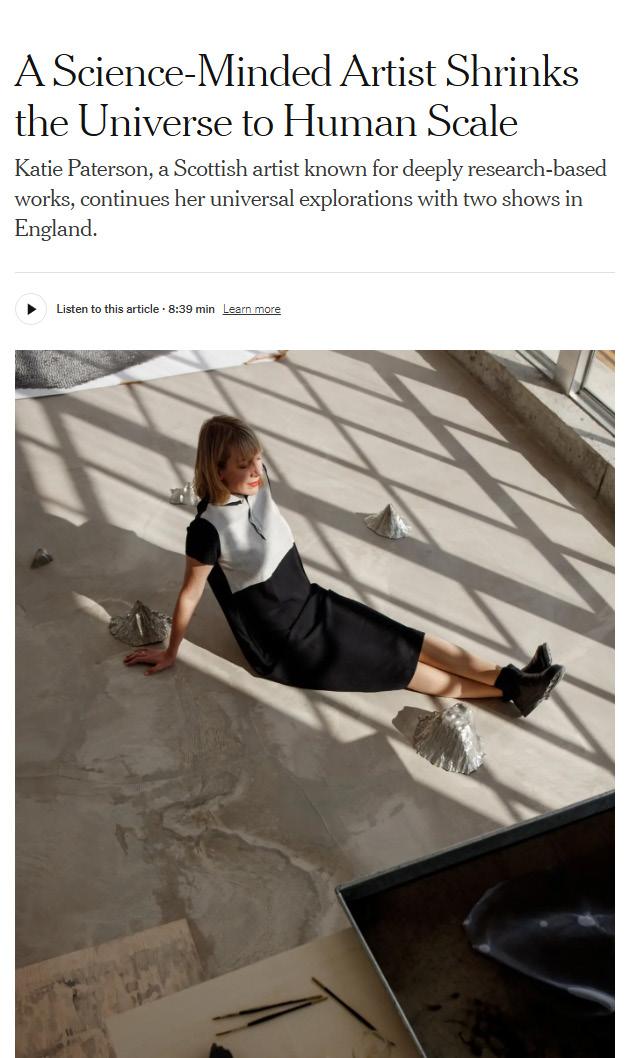
The New York Times featured artist Katie Paterson in a piece titled “A Science-Minded Artist Shrinks the Universe to Human Scale.” The article explored Paterson’s deeply research-based practice and ongoing international exhibitions, while tracing how time spent working in Arctic contexts has informed her approach. The feature also underscored the value of sustained, place-based residencies in enabling ambitious artistic development.
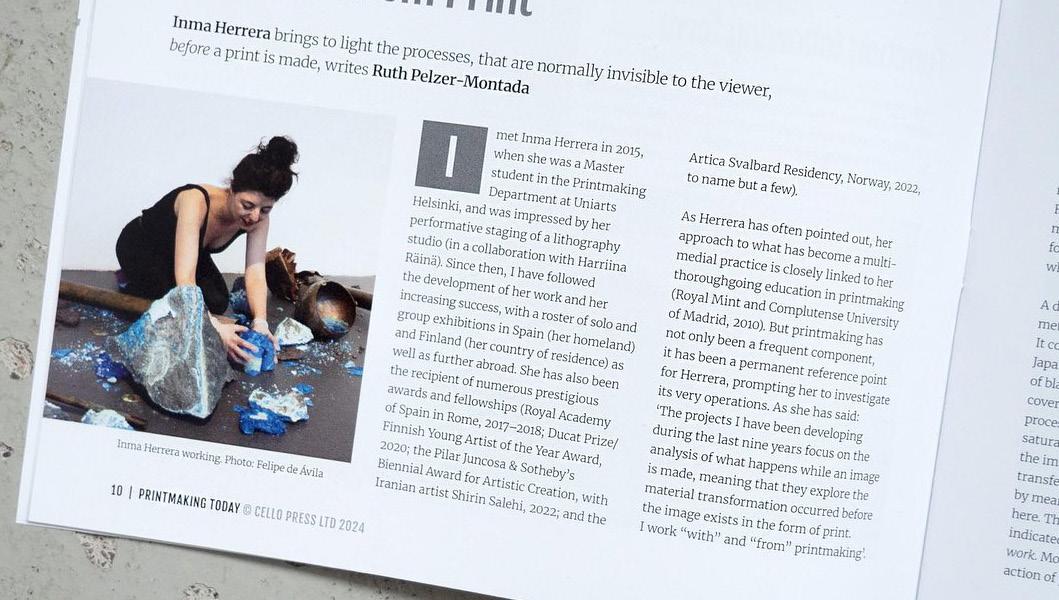
Artica’s engagement with process-led and environmentally responsive practices was also reflected in Printmaking Today through an interview with Inma Herrera, which brought material practice and printmaking into focus within a research-oriented residency context.
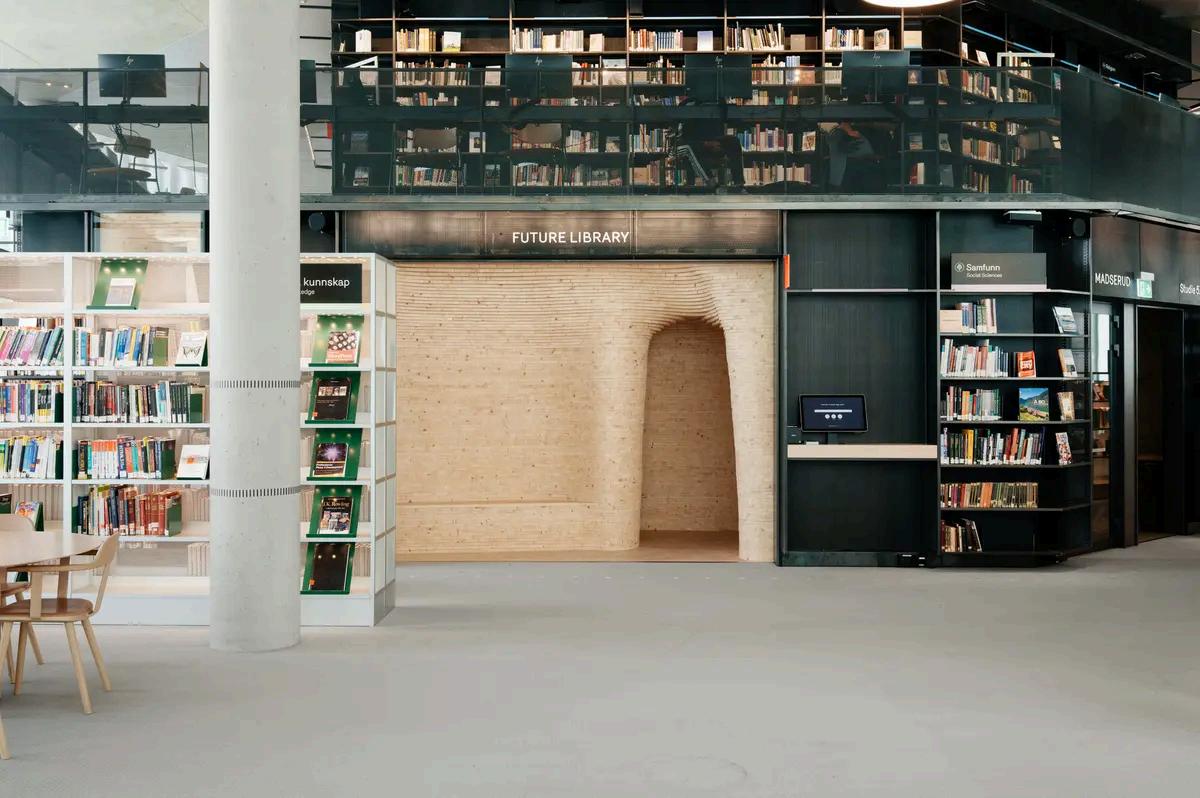
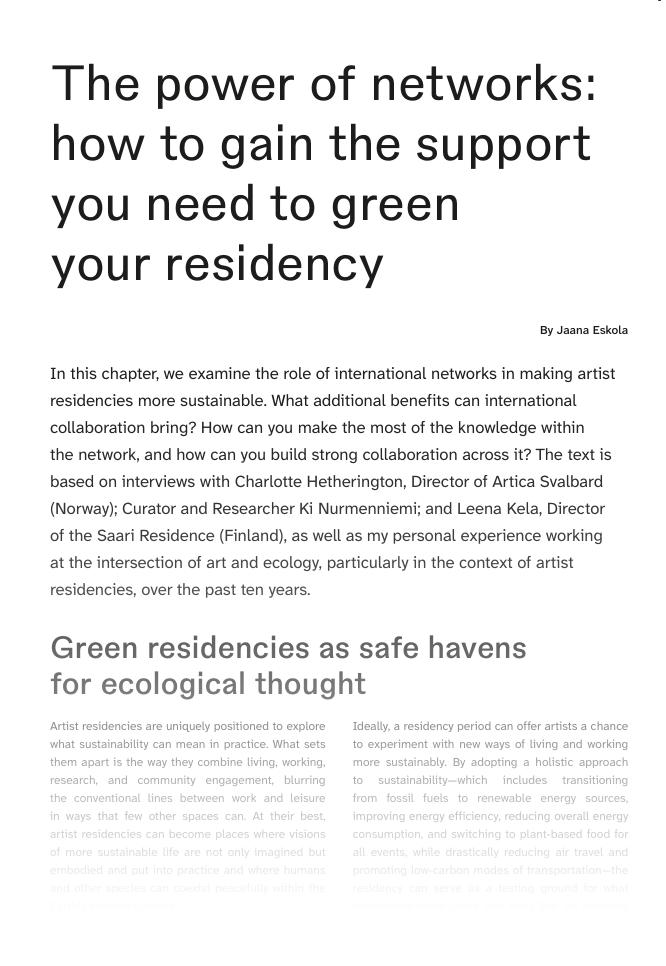
At a sector and policy level, Artica Svalbard was featured as a case study in the New European Guide on Greening Artistic Residencies. This inclusion recognised Artica’s long-term commitment to sustainability across ecological, social, and cultural dimensions, and positioned the organisation as a reference point for best practice within the European residency field.
Together, these moments of press coverage and professional recognition demonstrate Artica’s continued impact—not only as a residency programme, but as an organisation contributing meaningfully to international conversations on artistic practice, sustainability, and the role of culture in responding to the unique challenges of the Arctic.
As part of its ongoing commitment to environmental responsibility, Artica Svalbard calculates its carbon footprint annually in order to better understand its impact and guide future decision-making.
In 2025, Artica’s total carbon emissions decreased compared to the previous year, falling from 68.64 tCO₂e in 2024 to 60.93 tCO₂e in 2025. Although emissions from flights increased, this was offset by reductions in other areas, particularly energy and digital activity.
Artica continues to understand sustainability as encompassing four interconnected pillars: ecological, social, psychological, and cultural. During 2025, the residency programme included both nominated and independently funded residents, which led to a modest increase in travel overall, including more long-distance journeys by residents. At the same time, lower
emissions in other categories meant that Artica’s overall footprint was reduced despite this programme growth. This reflects the complexity of balancing ecological responsibility with a commitment to access, exchange, and meaningful time spent in place. All residencies continue to be structured around longer stays, helping to avoid the impact of shorter, more frequent travel while making the programme more accessible to practitioners working with smaller budgets.
2024 vs 2025 Carbon Footprint Comparison
Travel and Residency Practice
In 2025, French writer Clara Arnaud became the first resident to arrive in Longyearbyen by land and sea rather than by air. She documented her journey in the Field Notes series, writing:
“I thought Svalbard was one of those edges of the world that deserved to be approached with respect, consideration, and delicacy. An archipelago you have to ask permission to enter, and that you must approach only after an initiation rite: a crossing of the Barents Sea, measuring, in the meantime, its insularity and its remoteness.”
Her journey stands as an important example of how artists and writers can critically reflect on access, distance, and responsibility in Arctic travel — values that Artica actively encourages within its programme.
Energy Use and Building Improvements
Energy-related emissions were lower in 2025 than in 2024. This reflects a combination of more energy-efficient accommodation and continued efforts to improve the performance of Artica’s workshop space. In 2025, ceiling fans were installed in the workshop to help distribute warm air more effectively and support better energy use within the building.
Looking Ahead
Artica recognises that annual carbon reporting is an essential tool for making environmental impacts visible and informing future choices. While some fluctuations from year to year are shaped by small totals or changes in programme activity, the overall reduction in 2025 is encouraging. In 2026, Artica will continue to review and strengthen its environmental policies and action plan, building on recent learning to reduce emissions further, support sustainable practice, and advocate for improved infrastructure in Longyearbyen.
Trollsteinen, October 2025. Photo: Samantha Dwinnell
NEWS FROM ARTICA’S ALUMNI
Artica Svalbard’s residency programme continues to resonate beyond each residency period, with alumni presenting new work, receiving major institutional recognition, and contributing to international artistic and curatorial platforms. In 2025, alumni activity reflected the continued reach of Arctic-informed artistic practice across exhibitions, collections, publishing, and public programmes.
Emma Stibbon’s Svalbard Prints were acquired by the British Museum collection. Created following her Artica residency (to which she was nominated by the Queen Sonja Print Award in 2019), the work reflects on Svalbard as an “extraordinary place—although sadly at the forefront of climate change.” Produced using a polymer gravure process with a woodcut undercolour, the image exists only in its final printed form.
Nastassja Simensky was selected for Making Time, an 18-month artist development programme by Artangel that supports research and practice in relation to climate change, biodiversity loss, and environmental sustainability through partnerships with gallery and academic institutions in the UK. During the programme, Simensky is developing Dust, Static and Feedback Loops, a new body of research seeded through three Artica residencies in Svalbard in 2024 and 2025.
Maritea Dæhlin returned to Svalbard with her first solo exhibition, A-FI-SA. But it might not be tomorrow, presented at Nordover and curated by Nordnorsk Kunstmuseum. The exhibition grew out of work first developed during her Artica residency in 2023, and marked an important continuation of dialogue beyond the residency period—demonstrating how residency-based work can evolve into new public presentations within the local cultural landscape.
Work by Liryc Dela Cruz, produced during his time at Artica in 2024, was featured in TUTTAUNANOTTE, a screening programme curated by Francesco Urbano Ragazzi at the e-flux Screening Room in New York
Rikke Luther presented the exhibition Dust & Flow: Mud in the Earth System at Art Hub Copenhagen, expanding her long-term research into planetary change and sedimentary movement. Developed through collaborations with scientists and researchers, the project brings together film, fieldwork, and material investigations to explore mud as both substance and signal—evidence of accelerating shifts within the Earth system. The film Dust & Flow: Muds, Movement, Time, Scale was commissioned by NAARCA and developed in connection with a residency at Artica in 2023.
Cathrine Alice Liberg was invited to present work at the Northing Centre for East Asian Art and Culture as part of the Bergen Literature Festival. Imagined Memories features work developed during her Artica residency (March–June 2024), where she explored the historical and geopolitical significance of the Arctic. Drawing on ancient maps and narratives of exploration, the project reflects on Svalbard as res communis—a shared space where history, myth, and contemporary geopolitics converge.
Following her second residency at Artica Svalbard, Inma Herrera presented A Simple Gesture at F2 Galería, an exhibition shaped by her encounter with Arctic geology and deep time. Revisiting frottage during a visit to Svalbard, Herrera pressed paper against fossil-bearing stone to trace its surface. The resulting works emerge as quiet yet charged imprints— gestures of contact that bridge body and landscape, present and primordial past, while reflecting on extinction, memory, and the sovereign force of the Earth.
Emma Stibbon’s Svalbard Prints
Imagined Memories by Catherine Alice Liberg
LOOKING AHEAD: ARTICA SVALBARD IN 2026
10 years of Artica Svalbard
2026 marks the 10th anniversary of Artica Svalbard. Founded in November 2016, Artica was established with a clear vision: to use art and culture to raise awareness of the Arctic’s unique challenges, share knowledge, and inspire change.
The anniversary will be marked through a curated programme across 2026, including screenings of alumni work, a special edition of Artica Writings, Lantern Lectures, and a celebratory book launch weekend. Together, these activities will provide an opportunity to reflect on Artica’s first decade while setting direction for the next phase of the organisation’s work.
Field-based Artist Residency
In collaboration with the University Centre in Svalbard (UNIS), Artica Svalbard will launch a new Field-based Artist Residency in 2026, with the first cohort selected through an open call in late 2025. The residency is embedded within ongoing biological research on Svalbard reindeer and based at a remote field cabin (Tarandus), approximately 40 km south of Longyearbyen.
The residency introduces a new model within Artica’s programme, in which artistic research is developed in direct relation to fieldbased scientific work. Artist residents will live and work alongside researchers, contributing to observation and environmental data collection linked to reindeer research while developing their own artistic practice in response to the field context.
Reindeer observation in Reindalen. Photo: Maggie Coblentz
Depending on season and research priorities, activities may include behavioural observation, environmental sampling, and practical field tasks connected to climate-related changes in tundra ecosystems. The residency is intended for artists whose practice engages with ecology, climate, landscape, and human/non-human relations, and is designed to support sustained exchange between artistic and scientific approaches through shared field conditions and long-duration observation.
This represents a significant development in Artica’s art–science work and expands the organisation’s capacity to support embedded, place-based residency formats in Svalbard.
From the Mouths of the Caves, Listening to Hear Another Island’s Song
In February and March 2026, artists Mhairi Killin and Floortje Zonneveld will be in residence developing a collaborative project that explores how knowledge travels across island environments through art, sound, language, and community. This collaboration emerged through Artica Svalbard’s residency network and illustrates how the programme supports ongoing exchange and project development beyond the initial residency stay. Inspired by a sea cave on the Isle of Iona and an ice cave in Svalbard, the project considers ecological change and the interconnected futures of island communities.
Working with children in Longyearbyen and on the Scottish islands of Iona and Mull, the artists will develop a living archive of shared island knowledge to be presented in both regions. The residency will be joined by Siri Granum Carson, Professor of Applied Ethics at NTNU, supporting the project’s engagement with ocean ethics and transdisciplinary research. The project is supported by TIDAL Arts, the European Union, and Sparebankstiftelsen.
Confirmed Residents for 2026 (to date)
Nominated by Office for Contemporary Art Norway (OCA)
Jun Zhang and Yindi Chen
Annike Flo and Lexie Owen
Nominated by Norwegian Non-Fiction Writers and Translators Association (NFFO)
Auden Aagre
Marit Beate Kasin
Nominated by Nordnorsk Kunstmuseum
Nora Adwan
Apichaya Wanthiang
Nominated by The Queen Sonja Print Award (QSPA)
Soghra Khurasani
Todd Anderson
Independently Funded Residents
Ashley Middleton
Michelle Calcatelli
Kamil Kak (returning alumni)
Mhairi Killin (returning alumni)
Floortje Zonneveld (returning alumni)
Scott Carroll
Lea Kannar-Lichtenberger
Lilian Kroth (returning alumni)
Laura J. Lawson
Charlie Brinkhurst-Cuff
Andreas Philip Scholz
Tanya Park
Dina Brode-Roger
Lina Machida
Thomas Abercromby
Celine Charveriat
Jennifer Redfearn
Elize De Beer
Janos Nieminen (returning alumni)
Mhairi Killin and Floortje Zonneveld
Funding & Support
Artica Svalbard’s work is made possible through the generous support of our funders, whose commitment to arts, culture, and critical discourse enables us to sustain a dynamic residency programme, public events, and collaborative projects. We extend our sincere gratitude to:
• Norwegian Ministry of Culture and Equality
• Fritt Ord
• Nordisk Kulturfond
• Sparebankstiftelsen SpareBank 1 Nord-Norge
• Samfunnsløftet SpareBank 1 Nord-Norge
Residency Nominating Partners
Artica Svalbard’s residency programme is supported by leading cultural institutions that nominate artists, writers, and researchers whose work aligns with our mission of fostering artistic, literary, and cultural exchange in the Arctic.
• Nordnorsk Kunstmuseum (NNKM)
• The Norwegian Non-Fiction Writers’ and Translators’ Association (NFFO)
• Office for Contemporary Art Norway (OCA)
• The Queen Sonja Print Award (QSPA)
Together, these partners strengthen Artica’s ability to support diverse artistic and literary practices in Arctic contexts.
The Nordic Alliance Of Artists’ Residencies On Climate Action (NAARCA)
As a founding member of NAARCA, Artica Svalbard is part of a Nordic and Scottish network working to integrate climateconscious practice into the residency sector. In collaboration with:
• Cove Park (Scotland)
Saari Residence (Finland)
• Narsaq International Research Station (Greenland)
• Skaftfell Art Center (Iceland)
Together, these organisations drive cross-border artistic collaboration, knowledge-sharing, and climate action across the Nordic and Scottish Arctic regions.
Local Collaborators & Community Engagement
Artica Svalbard’s public programme and community outreach are enriched through collaborations with key local institutions:
• Arctic Chamber Music Festival
Arctic Climate Action
• Longyearbyen Library
• Longyearbyen Lokalstyre
• Longyearbyen Pride
• Longyearbyen School
• Nordover Arts Centre
• Svalbard Folkehøgskole
• Svalbard kirke
• Svalbard Museum
• Svalbardposten
• UNIS
• Visit Svalbard
These partnerships help facilitate talks, exhibitions, workshops, and knowledge exchange between visiting residents and the Longyearbyen community.
Staff Team (2025)
In 2025, Artica Svalbard continued to operate with a small but highly dedicated staff team. During the year, one full-time staff member was on parental leave, with the role covered by two colleagues on a temporary basis. This ensured continuity across Artica’s residency programme, public events, and partnerships during a particularly active year.
Throughout 2025, the team worked at full capacity, with evenings and weekends often required to meet the demands of an increasingly complex programme. While this commitment has been essential to Artica’s work, it also highlights the limitations of the current staffing model.
The scale and ambition of Artica’s programme increasingly exceed what can be sustainably delivered within existing resources. Strengthening staff capacity therefore remains a key priority, both to support a more balanced workload and to ensure Artica can continue to deliver high-quality programmes for artists, writers, researchers, and the local community.
In response to these challenges, 2026 will see the establishment of a structured volunteer programme to support local events and residency hosting, strengthen community involvement, and contribute to more sustainable delivery of Artica’s public activities.
• Charlotte Hetherington – Director
• Sally Hovelsø – Residency & Community Coordinator
• Tom Warner – Marketing & Communications Manager (part-time)
• Lena von Goedeke - Residency & Community Coordinator (3 month maternity cover)