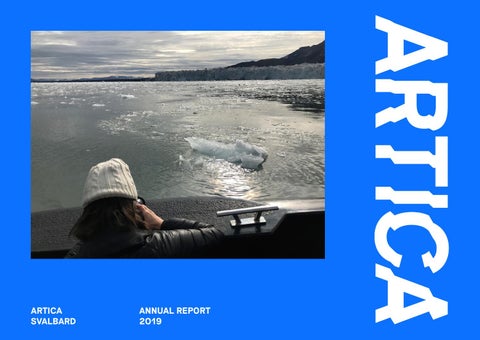
ARTICA 1 SVALBARD Artica Svalbard
Annual report 2019
ANNUAL REPORT 2019
3 ABOUT ARTICA SVALBARD 5 OUR ARTIST RESIDENCY PROGRAMME IN 2019 10 OUR PROJECTS AND EVENTS IN 2019 17 ORGANISATION AND KEY PARTNERS 19 WHAT ARE WE DOING IN 2020?
Front page: Cristina Lucas, fieldwork for Artica Listens 2019
This page: Giancarlo Scaglia in Pyramiden
English translation by Språkverkstaden
21 FINANCIAL STATEMENTS
ABOUT ARTICA SVALBARD
3
Artica Svalbard
Annual report 2019
ABOUT ARTICA SVALBARD The purpose of Artica Svalbard is to facilitate artistic and cultural production and activities on Svalbard, and to support the development of Norwegian art and culture by enabling artists in all genres to create and present their art. The foundation shall have an Arctic and international focus and shall use public events to increase knowledge about the High North and to highlight how art helps us to interpret the Arctic, as well as contributing to fields such as culture, geopolitics, climate change, migration and minorities. Artica Svalbard’s vision: Art is present wherever important questions are being asked. Svalbard is such a place in our time. Artica Svalbard was founded in 2016 by the Norwegian Ministry of Culture, Fritt Ord (the Freedom of Expression Foundation) and the Cultural Business Development Foundation of the bank SpareBank1 NordNorge. The work of the foundation has been made possible by their financial support.
4
Artica Svalbard
Annual report 2019
↑ Fieldwork, ArticaListens 2019 Photo credit: Alexander Lembke
OUR ARTIST RESIDENCY PROGRAMME IN 2019
5
Artica Svalbard
Annual report 2019
THE ARTIST RESIDENCY PROGRAMME AND NOMINATED ARTISTS IN 2019 Artists and authors from all over the world are invited to our artist residency programme to work on various projects related to the Arctic and the High North. We offer a well-equipped artist workshop and tailored research for artists and authors within a variety of disciplines. Our three Key Partners – Norwegian PEN, the Office for Contemporary Art Norway and the Queen Sonja Print Award – are responsible for nominating artists and authors for our artist residency programme. Our partners help to give greater credibility to the artist residency programme. With the help of Artica’s team, the artists who come here are all able to develop their projects and share them with the general public through our events. Nominated artists-in-residence who spent time at Artica Svalbard in 2019: Nominated by Norwegian PEN • Juni Dahr • Benedicte Meyer Kroneberg • Hans Olav Thyvold • Alena Kazlova Nominated by the Queen Sonja Print Award • Ellen Karin Mæhlum • Giancarlo Scaglia • Julie Ebbing • Emma Stibbon Nominated by the Office for Contemporary Art Norway (OCA) • Sille Storihle • Oswaldo Maciá (A Gift to Svalbard) • Cristina Lucas (Artica Listens 2019)
6
Artica Svalbard
Annual report 2019
↑ Oswaldo Maciá mixing sound at Artica’s workshop
BIOGRAPHIES OF ARTISTS IN RESIDENCE IN 2019
QUEEN SONJA PRINT AWARD
Giancarlo Scaglia Giancarlo Scaglia studied visual arts at the school of fine arts in Lima, which is also where he developed his career as an artist. Scaglia’s work reinterprets armed conflicts that took place in Peru in the 80s and 90s. His interest in recontextualizing these events within the field of art led him to question the origin of all that is avant-garde and to ask himself what determines whether an action or gesture is art. Since Scaglia won the Chandon prize for emerging artists in Buenos Aires in 2008, his work has been exhibited in various solo shows. In addition to his own work, Scaglia has also established Revolver Galeria in Lima. Julie Ebbing Julie Ebbing holds an MA in Art and Craft from Oslo National Academy of the Arts. According to Ebbing, the printed picture has a long history as a medium for social and political commentary. In today’s society we are living in a constant feed of pictures which easily lose their meaning. Through her graphics she can repeat and highlight different issues and fill the pictures with meaning again. Art becomes a medium for reflection and something to dwell on, so that we can become observers and producers again. Not only consumers. Ebbing has received grants from Nord-Trøndelag County Council, Billedkunstnernes Vederlagsfond and Norske Billedkunstnere.
7
Artica Svalbard
Annual report 2019
Emma Stibbon Emma Stibbon is a British artist based in Bristol, UK. She works primarily on paper, depicting environments that are undergoing change or transformation. Her approach to landscape is driven by a desire to understand how human activity and the forces of nature shape our surroundings. She does this through location-based research, often working alongside geologists and scientists, and in the studio where information is transformed into large scale drawn and printed artworks. She travels widely with her practice; previous work representing retreating glaciers and ice shelves has led her to Antarctica and the High Arctic. Stibbon has recently exhibited her work at Alan Cristea Gallery, London, New Art Gallery, Walsall, The Polar Museum, Cambridge and Galerie Bastian, Berlin.
OFFICE FOR CONTEMPORARY ART NORWAY (OCA)
NORWEGIAN PEN
Sille Storihle Sille Storihle (b. 1985, Tromsø) is an artist living in Berlin and Oslo and working with moving images and text. She holds a Bachelor of Fine Arts from Trondheim Academy of Fine Art and a Master in Aesthetics and Politics from CalArts. Her central areas of interest include gender politics, nationalism and history. With Liv Bugge, she runs FRANK, a platform to build community, exhibit contemporary art and generate discussions addressing hegemonic structures in society relating to gender, sexuality and desire. Her artistic and curatorial projects have been exhibited at Kunsthall Oslo, Kunstnernes Hus, Performa Biennial, Malmö Konstmuseum, The Norwegian Museum of Contemporary Art and The Gothenburg Biennial.
Juni Dahr The actress Juni Dahr founded Visions Theatre in 1988. Dahr has worked with medieval themes, Henrik Ibsen’s drama and modern experimental theatre over the course of her career. Through her many female roles in classical drama and the one-woman performances produced by Visions Theatre, she has contributed to a renewal of how female characters are portrayed in Norwegian theatre. Benedicte Meyer Kroneberg Benedicte was born in Oslo, 1972. She made her debut in 2010 with the novel Ingen skal høre hvor stille det er. This led to her being named debut author of the year by Aftenposten, Norway’s largest newspaper. Since then she has published several novels. Her latest novel deals with climate change, a theme she is working with at the moment. Benedicte has also been nominated for Sørlandets litteraturpris. She currently lives at Hisøy outside Arendal. Hans Olav Thyvold Hans-Olav Thyvold was born in 1959 and has published several non-fiction books and worked as a journalist and radio and TV host. In 2017 he published his first work of fiction, Snille hunder kommer ikke til Sydpolen, which deals with the fate of the 100 or so dogs that Roald Amundsen brought with him to the South Pole. Thyvold has previously written and published books about Amundsen as well as Fridtjof Nansen.
↖ Team Juni Dahr at the ropeway hub
Alena Kazlova Alena Kazlova (Anka Upala) is a Belarusian writer and translator of literature from English, Finnish and Swedish. She is a member of the Belarusian PEN Centre and a member of the Union of Belarusian Writers, where she also coordinated the work of the writing school. Her first book, a collection of poetry and short prose, was published in 2012, followed by the autobiographical novel To the Snow-covered Isle, which was shortlisted for the Jerzy Giedroyc Literary Award in 2018. The novel also took 3rd place in a poll where writers were asked to select their book of the year.
EXTRACTS FROM THE REPORTS WE’VE RECEIVED FROM THE ARTISTS IN RESIDENCE
I am curious of life that’s why working on Svalbard is something that I am really happy to have experienced. So many interesting not ordinary people – what spirits, what minds! (...) The Svalbard Treaty in itself is a situation causing stories that can become literature. I did not know about the treaty before but it is nice to learn. It adds something to what I know about our time. – Alena Kazlova (Nominated by Norwegian PEN, 2019)
First of all, I’d like to express my deepest thanks to the Queen Sonja Print Award for inviting me to be a resident artist at Artica Svalbard in the autumn of 2018. It was a very educational and inspiring experience. For part of the time, I coincided with the author Ole Robert Sunde and the fine artist Oswaldo Maciá. During the autumn I went on some amazing excursions – a boat trip, a glacier walk and a visit to an ice cave – booked through Visit Svalbard. The theme for my work was/is “melting sea ice and glaciers”. In conjunction with that, I wanted to meet glaciologists from UNIS. – Ellen Karin Mæhlum (nominated by the Queen Sonja Print Award, 2018 and 2019)
8
Artica Svalbard
Annual report 2019
↖ Artist talk with Sille Storihle
I used my time at Artica to learn about Svalbard’s history, society and numerous geopolitical questions through a combination of my own research, chance meetings and various organised excursions. It was particularly my meetings with people from the Norwegian Polar Institute and UNIS that gave me an insight into various aspects of Arctic history that I want to explore further, especially Hanna Resvoll-Hansen’s work as a botanist and environmentalist in the early 20th century. – Sille Storihle (Nominated by the Office for Contemporary Art Norway, OCA)
SUMMARY TABLE OF ARTISTS IN RESIDENCE SINCE THE BEGINNING
NAME
FEMALE
MALE
NATIONALITY
LENGTH OF STAY
WHEN THE RESIDENCY TOOK PLACE
ART FORM
QSPA Ellen Karin Mæhlum
1
Norwegian
2 months and 1 week
October–November 2018 and April 2019
Printmaking
Julie Ebbing
1
Norwegian
2 months
May 2019 and March 2020
Printmaking
Fuki Hamada
1
Japanese
2 months
April–May 2018
Printmaking
Emma Stibbon
1
British
1 month
September 2019
Printmaking
Tiina Kivinen
1
Finnish
1.5 months
April–May 2017
Printmaking
Haavard Homstvedt
1
Norwegian
1 month
October–November 2017
Printmaking
Ashur Etwebi
1
Libyan
2 months
June–July 2017
Printmaking
Giancarlo Scaglia
1
Peruvian
2 months
July–August 2019
Printmaking
Karo Akpokiere
1
Nigerian
2 months
May–June 2018
Printmaking
OCA Mette Henriette
1
Norwegian
3 weeks
December 2019
Musician
Sille Storihle
1
Norwegian
3 weeks
June 2019
Contemporary art
Cristina Lucas
1
Spanish
5 weeks
May, August and November 2019 + February 2020
Contemporary art
Oddvar I.N. Daren
1
Norwegian
3 weeks
July–August 2018
Contemporary art
Lars Paalgard
1
Norwegian
3 weeks
July–August 2018
Contemporary art
Carlos Casas
1
Spanish
1 month
September–October 2017
Sound art
Oswaldo Macia
1
Colombian
1 month
November 2019
Sound art
NORWEGIAN PEN Juni Dahr
1
Norwegian
1 month
April 2018 and September 2019
Actor
Benedicte Kroneberg
1
Norwegian
2 months
March, April, August, September 2019
Author
Teresa Grøtan
1
Norwegian
3 weeks
May, June, November 2017
Author
Kristina Quintano
1
Norwegian
3 weeks
September–October 2017
Author
Easterine Kire
1
Indian
1 month
March 2018
Author
Alena Kazlova
1
Belarusian
2 months
November–December 2019
Author
Ole Robert Sunde
1
Norwegian
2 months
October–November 2019
Author
Hans Olav Thyvold
1
Norwegian
1 month
August–September 2019
Author
Average: approximately 1 month and 11 days
January: 0 February: 0 March: 3 April: 5 May: 5 June: 4 July: 4 August: 5 September: 6 October: 5 November: 6 December: 2
SUM
9
Artica Svalbard
Annual report 2019
14
10
OUR PROJECTS AND EVENTS IN 2019
10
Artica Svalbard
Annual report 2019
ARTICA LISTENS 2019 In 2019, the lead artist behind Artica Listens was Cristina Lucas (born 1973, Spain). The theme was the Svalbard Treaty, which celebrates its 100th anniversary in 2020. In her work, Lucas aims to challenge the underlying mechanisms that govern the world’s power structures. The project was a collaboration with our Key Partner the Office for Contemporary Art Norway. It seems logical that everything with a beginning also has an end, but how easy is it to imagine that when you’re talking about our own species? Is it possible to reverse processes that would otherwise inevitably lead to our rapid demise? – Cristina Lucas Lucas took the almost 100-year-old Svalbard Treaty as her point of departure. Her project, created specially for Artica Listens 2019, consisted of interactive sculptures in public spaces as well as the new film The People That Is Missing, recorded on Svalbard during the artist’s visits over the past year. Lucas’ work explores the treaty’s utopian appeal to international cooperation, and puts the spotlight on the paradoxes that have come to light almost one hundred years after it was signed – at a time when there is little desire to build geopolitical alliances and take joint action to end humanity’s destruction of our planet. In 2019 we received project funding from SpareBank1 Nord-Norge’s charitable fund Samfunnsløftet for the projects in Artica Listens. Link to a live stream of the artist talk: https://vimeo.com/376316065
11
Artica Svalbard
Annual report 2019
↑ Artica Listens 2019 – Film screening on opening day: The People That Is Missing, Cristina Lucas 2019 Photo credit: Kanerva Karpo
ARTICA WRITINGS/ LIFE IS THE SVALBARD TREATY Throughout 2019, Artica Svalbard has published a curated series of texts on the theme of the Svalbard Treaty, entitled Artica Writings. At the event “Life is the Svalbard Treaty”, we examined and presented these texts through lectures and a panel discussion at the Longyearbyen arts centre. The event, which was a collaboration with our Key Partner Norwegian PEN, focused on the following questions: In 2020 it will be 100 years since the Svalbard Treaty was signed. Will it remain current and relevant for another 100 years? Artica will start its celebration of the anniversary with direct and more oblique explorations of the nature of the treaty, its history, and modern-day challenges. The treaty came into being during the peace negotiations after World War I. Can it survive the current international political climate? And what is the relevance of the treaty to the people of Svalbard? What about the surrounding seas? Can we control the fisheries and oil industry? What about the marine environment and climate? Could Norway use its “full and absolute sovereignty” to turn the archipelago into a massive nature reserve? Should it do that? The treaty could be called a work of art, so it’s natural for the art institution Artica to see how it’s standing up to the test of time in this age of climate change. Six speakers aged 16 to 67 with backgrounds from secondary school, mining, research and art put a many-faceted focus on the contents, function and force of the Svalbard Treaty. Panellists: Svein Jonny Albrigtsen, Vår Aunevik, Janike Kampevold Larsen, Irene Vanja Dahl, Sergey Gushchin, Randi Nygård and Geir Ulfstein. Moderators: Marit Anne Hauan and Anders Heger.
12
Artica Svalbard
Annual report 2019
↑ Life is the Svalbard Treaty, panel discussion
Link to a live stream of the event: https://vimeo.com/365784330
A GIFT TO SVALBARD The Colombian artist Oswaldo Maciá spent part of 2018 at Artica, nominated by our Key Partner the Office for Contemporary Art Norway (OCA). Maciá, who mainly works with sounds and smells, went on a number of local excursions to places in and around Longyearbyen to record the sound of the wind. His project culminated in a major presentation at Vinkelstasjonen in the Adventdalen valley in 2019. He called it A Gift to Svalbard, as it is about giving something back to a place that has traditionally been exploited in so many different ways. Maciá filled Vinkelstasjonen with sounds, light, smells and printmaking, and we ferried the local audience out to Adventdalen in buses for this “One Night Only” event. Link to a video about the project: https://vimeo.com/326038063
13
Artica Svalbard
Annual report 2019
↑ A Gift to Svalbard – Vinkelstasjonen on the opening day
PROJECT ISFJORDEN In June, the artists Floortje Zonneveld (Amsterdam), Kim Nekarda (Berlin), and the duo 44 Flavours (Julio Rölle and Sebastian Bagge) joined local residents on a beach clean-up organised by the voluntary organisation Aktiv i Friluft. The plastic waste they collected at Daudmannsodden in Isfjorden resulted in three temporary, public works of art created over the course of the autumn at workshops involving various groups of the local population. These works are lighting up the Polar night at three locations in town. The painter Kim Nekarda presented his mural at Lompensenteret. It was made in collaboration with the art club at Longyearbyen folk high school. The video artist Floortje Zonneveld presented her piece of stop-motion video art at the lighthouse at UNIS. It had been created at workshops with families. The art duo 44 flavours made a domeshaped sculpture that you can walk into, and which contains a large plastic mobile. This work, created through workshops with the art club at Svalbard folk high school, stands in Sjøområdet with views towards Hjortfjellet. In 2019, we received project funding from SpareBank1 Nord-Norge’s charitable fund Samfunnsløftet for Project Isfjorden.
14
Artica Svalbard
Annual report 2019
↑ Project Isfjorden – dome-shaped sculpture and mobile – created by 44 Flavours and Longyearbyen folk high school. Photo credit: Elizabeth Bourne
→ Project Isfjorden – Stop-motion video installation by Floortje Zonneveld created at family workshops. Photo credit: Elizabeth Bourne
120 HOURS 120 hours is the world’s biggest architecture competition, created by and for architecture students. In 2019, 500 participants from all over the world proposed designs for tomorrow’s settlements in Svalbard. The rules are that the students only have five days (i.e. 120 hours) to solve the task and that they must present their proposals on two sheets of A3. All of the proposals were carefully assessed by the jury, which was chaired by Kjetil Thorsen (Snøhetta), and had representatives from Svalbard, Norway, Hong Kong and Poland. Artica’s Managing Director Eli Skatvedt was also on the jury. The 500 proposals were exhibited in a soon-to-be-demolished empty house in the area below Mount Sukkertoppen that was hit by an avalanche. Video stream of the presentation: https://vimeo.com/346404779
15
Artica Svalbard
Annual report 2019
↑ Team 120 Hours
OTHER LOCAL EVENTS Artica Svalbard organised a number of other local projects and events in 2019. We cooperated with the Arctic Chamber Music Festival, where the sound artist Rubén D’Hers (Venezuela) presented a sound art installation in which guitars “play themselves”. Link to the artist talk: https://vimeo.com/341183049 We have had two chefs-in-residence: Mirja Finstad (Barcelona) and Johannes Gruber (Berlin). The latter held a performance at our workshop entitled Fragile dreams of Nam, which can be seen here: https://vimeo.com/337462343 The printmaker Emma Stibbon invited people to attend a drawing workshop called Drawing Out, and took the participants out with her to draw using nature’s own materials. The artist Sille Storihle held an inspiring artist talk in which she presented her oeuvre at Artica’s workshop to a fascinated audience. The local writer and dog sled driver Kelsey Camacho has continued her writing club “When ice is personal”, holding regular meetings at our workshop. The choreographer Jack Webb (Edinburgh) held a workshop with the Longyearbyen youth club, which has long been keen to learn more about dance. And last but not least: Spitsbergen Makerspace has become an independent association, which Artica supports by providing equipment (3D printer, laser cutting module, etc.), and it now holds regular workshops at the Longyearbyen arts centre.
16
Artica Svalbard
Annual report 2019
↑ The artist Kim Nekarda and students at Longyearbyen folk high school with plastic waste from Daudmannsodden
ORGANISATION AND KEY PARTNERS
17
Artica Svalbard
Annual report 2019
BOARD OF DIRECTORS
THE ARTICA TEAM
The Board is responsible for supervising that the foundation adheres to its purpose and manages its capital responsibly. The Board members are nominated by the founders, while the Chair is chosen jointly by them.
Director and Curator Eli Skatvedt
BOARD OF DIRECTORS 2019
Cultural worker Rikke Hoddø Steinbakk
Chair of the Board Anne Berit Figenschau
KEY PARTNERS
Board members Jan Martin Berg Moa Björnson Anne Katrine Dolven Marit Anne Hauan Kjetil Trædal Thorsen
18
Artica Svalbard
Annual report 2019
Coordinator Didrik Paulsen
Norwegian PEN, which was founded in 1922, is the Norwegian division of PEN International, the world’s largest organisation dedicated to promoting the rights of writers and freedom of expression. The organisation strives to increase public awareness of the value of free debate and free expression, both in Norway and internationally. The organisation helps authors, journalists and publishers in countries where freedom of speech and freedom of information are under pressure, and where colleagues are harassed, persecuted, monitored and imprisoned because they exercise their right to express their opinions. Norwegian PEN administers the Norwegian part of the international cities of refuge for persecuted writers. The network is run by ICORN (International Cities of Refuge Network). Today, there are 14 Norwegian cities of refuge; more than 60 persecuted writers have come to Norway as ICORN guest writers since 1995.
← Artica Listens 2019 – Artist Talk: Cristina Lucas, Line Nagell Ylvisåker, Artica’s Managing Director Eli Skatvedt. Photo credit: Alena Kazlova
The Office for Contemporary Art Norway (OCA) is a non-profit foundation created in 2001 by the Norwegian Ministries of Culture and of Foreign Affairs. Its principal aim is to foster dialogue between art practitioners in Norway and the international arts scene, and to support artists and cultural practitioners based in Norway in their activities around the world. To this end, through a programme of debates, exhibitions, publications, residencies (in Oslo and internationally) and visiting scholars, OCA aims to bring to Norway the plurality of practices and histories at the forefront of international artistic debates; they are very involved with actively participating in such debates nationally and internationally. OCA has been responsible for Norway’s contribution to the visual arts section of La Biennale di Venezia since 2001. The Queen Sonja Print Award (QSPA) was founded in 2011 by HM Queen Sonja of Norway and the renowned Norwegian artists Kjell Nupen and Ørnulf Opdahl, together with master printer Ole Larsen (of Helsingborg, Sweden). The QSPA Foundation’s objective is to generate interest in and elevate contemporary graphic art, especially among emerging artists. The foundation wishes to encourage the art of printmaking and inspire ambitious artists to establish themselves on the international art scene. QSPA bestows what is currently the world’s largest international print award on an emerging artist working within printmaking. In addition to this award, the Kjell Nupen Memorial Grant is awarded to a young and promising graphic artist from a Nordic country who is still in education or who has just finished his/her art training. The QSPA Foundation collaborates with prominent museums, artists, curators and fine art print publishers from around the world in order to support and stimulate this important artistic field.
WHAT ARE WE DOING IN 2020?
19
Artica Svalbard
Annual report 2019
Our organisation, the team that runs Artica Svalbard and the partnerships that we have forged give us a good, solid platform for developing an ambitious programme in 2020. There follows a brief presentation of a selection of the projects and events that we are looking forward to sharing with you over the coming year. THE ARTIST RESIDENCY PROGRAMME Artica Svalbard will continue working to become one of the world’s best artist residency programmes. Together with our Key Partners we are developing several new projects starting in 2020, some directly linked to the artist residence programme, others independent of it and some through joint working groups. Our partners’ knowledge and expertise are vital to us and our development. Nominated artists in 2020 Queen Sonja Print Award • Julie Ebbing • Ephrem Solomon • Heehyun Jeong • Miriam Rudolph • Mattias Härenstam Office for Contemporary Art Norway (OCA) • Raven Chacon • Susan Schuppli • Artspace – Australia Norwegian PEN • Liv Lundberg • Harald Bøckmann • Tacciana Niadbaj • Hans-Olav Thyvold
20
Artica Svalbard
Annual report 2019
↑ Opening day Artica Listens – Photo credit: Kanerva Karpo
↗ Johannes Gruber during his chef residency
EVENTS/PROJECTS Artica Listens 2020 In 2020 we will continue with our main project for the year Artica Listens, focusing on the 100th anniversary of the Svalbard Treaty, viewed in a global perspective. We will both mark the signature of the treaty on 9 February and hold a major event in Longyearbyen in the autumn of 2020. Local projects We will build on our established local partnerships and continue to use them to bring in high-calibre artists. As well as Spitsbergen Makerspace and the local writing club, we are looking forward to working with the Longyearbyen Literature Festival in September 2020, and to welcoming more chefs to explore local themes and ingredients. We will continue our excellent partnership with Longyearbyen film club, which brings films and filmmakers with an environmental agenda to Longyearbyen.
FINANCIAL STATEMENTS
21
Artica Svalbard
Annual report 2019