IMPORTANT NOTICE: COVID-19
We are all working from home – our digital services www.arthritis.org.nz and 0800 663 463 line are operational!
Support APRIL 2020
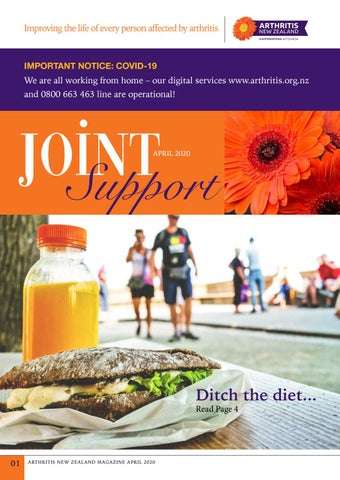
Ditch the diet... Read Page 4
01
ARTHRITIS NEW ZEALAND MAGAZINE APRIL 2020
The misunderstood and under-valued role of governance in a charity Recent examples of charities losing their way, having questionable expenditure and poor use of resources often can be attributed to poor governance and systems. The Board at Arthritis New Zealand has a strong focus on “improving the life of every person affected by arthritis” and ensuring an open and transparent organisation for all our stakeholders. Arthritis New Zealand has been operating for over 52 years and in 2018 converted from an incorporated society to a charitable trust. There are 11 trustees (including the Chair) on the Board who each volunteer their time to oversee the organisation. These trustees are highly skilled individuals who bring their expertise including accountancy, business, legal, marketing and community engagement to the board table. The maximum term a trustee can serve is six years. As part of this change to a Charitable Trust, an Electoral Council was formed, which provides independent advice to the current Board including reviewing prospective trustees. It consists of four
members (previous Board members and the past CEO) and meets as required. To ensure the organisation is tracking in the right direction and using funds effectively, which often have been donated by generous supporters, the Board: • Meet five times a year (via zoom or face to face) to - review the direction, progress and financial performance against a pre-approved strategic plan and budget - receive formal reports from the Chief Executive and Corporate Services manager - record formal minutes and resolutions • Operates several subcommittees (e.g. finance and audit) who meet three times per year via zoom to provide in-depth analysis of their specific area • Commissions an annual financial audit to ensure an objective review of the organisation and its systems – currently, KPMG conducts this • Provides strategic advice and guidance to the CEO and management and ensures their accountability All the members of the Board are dedicated to the vision and purpose of Arthritis New Zealand and I am extremely grateful to each person’s commitment and passion for the cause. We value comment from all our supporters – please do not hesitate to contact me if you would like to provide any feedback about our organisation. Ngā mihi Peter Larmer
Chairperson of the Board
Improving the life of every person affected by arthritis For more information about arthritis and living well, visit our website www.arthritis.org.nz Follow and Like us for ongoing updates on information, living well, surveys and events: Facebook: www.facebook.com/ArthritisNewZealand Twitter: @ArthritisNZ LinkedIn: www.linkedin.com/company/arthritis-new-zealand Instagram: arthritis_new_zealand YouTube: Arthritis New Zealand
02
ARTHRITIS NEW ZEALAND MAGAZINE APRIL 2020
Contact us call free 0800 663 463 Call our toll-free number and ask to speak to an arthritis educator
Make a donation
call 0900 333 20 to donate $20 Website www.arthritis.org.nz
‘Now I take my medication’ George Hadler reached out to Arthritis New Zealand after he was told to wait as long as possible before having knee replacement surgery for arthritis in the joint because his knee would “never be the same” after surgery.
George felt unable to hold out any longer, and his x-rays and scans indicated that a “half knee replacement” would be the ideal surgery for him and had it done in November 2014. After several weeks of recovery and rehabilitation, George was delighted with his new knee. “The pain had gone, and it felt quite strong and I had got back to being active again,” he said. But in January 2017 he started to experience severe pain and swelling in the knee, so he went to see his GP, who referred him to a specialist. “My specialist promptly booked me for a second keyhole operation where he carried out trimming of the meniscus and completed a synovectomy (inflamed membrane removal around the remaining joint). The operations made things settle down quickly, and I was pleased.” But, again, the joy was short-lived. In April 2018 George’s knee was back to the state it was before the keyhole surgery. This time it was even more inflamed, and there were also mild pains in both feet and ankles. Again, he approached his GP, who then wondered if the pains in the feet and ankles could be gout arthritis. George had suffered from a couple of gout attacks in his toe some 20 years prior and is on daily medication for this reason. “I was hoping that these uric acid tests would get to the bottom of things. I was very disappointed when my GP told me that my uric acid level test was normal”.
Finding someone to help
“I started looking on the Internet. I found lots of interesting information on arthritis, autoimmune conditions, and the like, but then I found a reference to Arthritis New Zealand and sent them an email. They invited me to call one of their educators which I promptly did,” he said. George then got to speak to Robyn, an arthritis educator, who asked several questions which included a history of his knee and associated discomfort. Robyn suggested things to ask the GP on his next visit, including being stern and asking his GP “If it isn’t gout arthritis, then what was it?” and being firm in his request to see a rheumatologist. His firmness worked and George got two visits to the rheumatologist. The rheumatologist gave a steroid injection to relieve the immediate pain and during the second visit, he increased George’s gout arthritis medication. “My knee was markedly improved and I had no pain at all within three weeks. My feet and ankle niggles have disappeared thanks to the gout arthritis medication and now one year on these improvements still exist.” “I want to thank Arthritis New Zealand and especially the arthritis educator. She has since proactively contacted me several times through the process and was very supportive, professional, and knowledgeable.”
There are two types of medicines used to treat and prevent gout arthritis respectively:
Uric acid medicine Uric acid medicines bring your uric acid levels down. You need to take them everyday, even if you are not having a gout arthritis attack.
As a progression the GP prescribed George with a lengthy and powerful course of anti-inflammatories which made a positive difference, he said. The downside to the medication was that they upset George’s stomach so much that he needed to stop and start them when he couldn’t stand the pain and discomfort. The intermittent use of the anti-inflammatories eventually led to the pain in his knee waking him at night.
Gout attack medicine Gout attack medicines treat an active gout arthritis attack. These are to be taken when you feel an attack coming on or if you are in pain from a gout attack. These medicines only treat the pain and swelling – they do not stop gout arthritis because they do not lower your uric acid levels.
ARTHRITIS NEW ZEALAND MAGAZINE APRIL 2020
03
Ditch the Diet By Jennifer Bowden, a registered nutritionist who has written a highly-regarded weekly nutrition column for the New Zealand Listener magazine for over 12 years, regularly appears on radio and has been a finalist in the Canon-Media Awards for health reporting. It’s time to ditch the diet and instead create a balanced lifestyle you love. A healthy lifestyle that is easily maintained is more helpful for chronic conditions like arthritis than the never-ending pursuit of weight-loss. Weight-loss is often heralded as an essential treatment for arthritis, with reminders that being overweight can worsen arthritis symptoms, and that body fat can make joint inflammation worse. But this ignores the simple fact that diets don’t work; around
04
95-98% of weight-loss diets fail, and the weight is regained. What’s more, between one-third to twothirds of dieters regain more weight than they lost; making them heavier after the diet than before they started. Acknowledgement of the massive failure rates of weight-loss diets is seemingly not widespread. With many patients in healthcare settings reporting that weightrelated advice from health professionals is delivered in a patronising manner, with health professionals implying there is a simple solution to patients’ excess weight. While there isn’t a simple solution to weight loss for everyone, there is a simple solution to weight discrimination: it needs to stop. Because, as the Royal Australasian College of
ARTHRITIS NEW ZEALAND MAGAZINE APRIL 2020
Physicians noted in 2018, weight bias not only causes mental and emotional distress but can also lead to patients avoiding healthcare and actively missing health appointments, to the detriment of their overall health and wellbeing. The Health At Every Size movement (HAES) challenges the weight-based focus of the medical community. Instead of focusing on body weight, shape or size, the HAES approach encourages us to create a “fulfilling and meaningful lifestyle” through intuitive eating, body acceptance (regardless of size or shape), adequate sleep and regular physical activity for movement, to optimise both our physical and mental health at any size.
HAES is not anti-weight-loss but instead doesn’t promote or focus on weight loss as a health strategy. A key reason why is that weight is not a behaviour, and HAES focuses on healthimproving behaviours. What’s more, focusing on weight while discussing healthy lifestyles, perpetuates the myth that weight is modifiable and the ongoing weight stigma many people experience daily. If someone loses weight while changing their health behaviours, that’s considered a side effect of HAES, but not the primary goal. Interestingly, this focus away from weight and onto modifiable health behaviours has produced some intriguing results. In one clinical trial those assigned to the HAES approach had improved metabolic health, with lower blood pressure and lipids; improved energy expenditure, eating habits and psychology (e.g. better self-esteem and body image, and less depression); while maintaining their body weight, for the duration of the 2-year trial. In contrast, the group assigned to a weight-loss diet did lose weight and see health improvements to start with, but by the two-year mark they’d gained the weight back, and little of their health improvements were maintained. A 2016 study, investigating the experience of patients with knee osteoarthritis who were obese, found health professionals who focused on helping patients to reduce pain, improve functionality and improve their health-related quality of life, naturally motivated those patients to make lifestyle improvements. That research team mentioned the HAES approach as a possible means of improving the healthrelated quality of life for patients with arthritis, instead of fixating on weight-loss. So, how do you create a diet-free
healthy eating style, that honours the HAES approach? Firstly, by focusing on and learning to trust your body’s signals for hunger, fullness, and satisfaction. Instead of focusing on external cues to direct your eating – such as meal plans, safe food lists, food rules, and set food portions.
The fact is, you’re more likely to crave permit yourself if you tell yourself you can’t have it or are ‘bad’ if you eat it. Removing the “restricted” label from foods typically reduces cravings in the long-term.
All babies are natural intuitive eaters that listen to their body’s cues for hunger and fullness, crying when they’re hungry and turning away when they’re full. But, most of us were taught to ignore those cues during childhood, by well-meaning caregivers who fed us by the clock and implored us to eat everything on our plate (even when we were full), for example.
Yes, eating more whole foods such as fruits, vegetables, whole grains, lean meats, seafood, nuts, legumes, low-fat dairy and good fats (such as olive oil, avocado and oily fish) will help with your health and potentially reduce the inflammation associated with arthritis.
TIP: Listen to your body’s hunger cues, rather than eating by the clock. Possible hunger signs can start with rumbling tummies and lack of energy, through to light-headedness, difficulty concentrating, uncomfortable stomach pains, irritability, feeling faint or even a headache. Ideally, eat when you’re comfortably hungry, rather than over-hungry. When we’re overhungry, we tend to overeat past comfortable fullness. TIP: Treat all food as equal don’t label foods as ‘good’ or ‘bad’. Nowadays it’s common to see ‘good’ and ‘bad’ food lists as part of diets. But the reality is, ALL foods can be part of a healthful lifestyle. One choice at one mealtime doesn’t make or break your health, so don’t feel guilty about enjoying a variety of foods. Instead, think of food as being on a spectrum from “more nutritious foods” through to “play foods” and allow yourself to eat freely in a way that nourishes your body and still satisfies you.
ARTHRITIS NEW ZEALAND MAGAZINE APRIL 2020
TIP: Eat more of the nutritious foods you enjoy.
But instead of forcing yourself to eat foods you don’t like, think about which of those whole foods are your favourites. Which vegetables and fruits are your favourites? Eat those! How do you prefer your vegetables: steamed, roasted, stir-fried or raw? Do you prefer chicken or beef tonight? Remember, your opinion matters. TIP: Eat until you are comfortably full, instead of eating everything on the plate. Forget those old family food rules about eating everything on your plate. Instead, listen to your tummy – when it says it's full – stop eating. Save leftovers for another meal or snack-time, rather than eating past full and not enjoying those last over-stuffed mouthfuls of food. The key is to eat in a way that is satisfying for you. You’re much more likely to stick with lifestyle habits that nourish your health and wellbeing long-term if they honour your tastes and are truly satisfying for you.
ARTHRITIS NEW ZEALAND MAGAZINE APRIL 2020
05
Children get arthritis too In the last few months, we have had three successful events for children with arthritis. These were: The Art Room, a collaboration with the paediatric rheumatology team, Teen Camp, and most recently, Children’s Camp.
The Art Room
The Art Room turned out to be an effective way to assist children with Juvenile Idiopathic Arthritis (JIA) to find ways to manage their anxiety around their diagnosis and the medication they have to take. All of the children take
Methotrexate weekly to help manage their arthritis. Each of the ten children who attended ‘The Art Room’ had required support from their paediatric rheumatologist and creative thinking to help them tolerate their Methotrexate better. Tolerance issues can occur in roughly 50% of patients taking the drug. The medicine can cause nausea and can lead to anticipatory anxiety about taking the medication orally, but also if taken by injection can cause anxiety related to having an injection. Therefore, the purpose of The Art Room was to use art to help modify the overwhelming feelings of anxiety. The theme for the sessions was 'My Happy Place', and the purpose of this was to allow the children to visualise, create and make their happy place by making a diorama. Being able to transport yourself to this happy place at times when you feel stress or anxiety is a wonderful skill to utilise and practise. The diorama was a multi-sensory activity and each child uniquely expressed themselves. Using a visual diary to help with mindfulness was also taught to the children, another lifelong skill that we hope the children will continue to practise. We shared how we use our visual diaries and that you don't need to be a skilled artist to be creative.
06
ARTHRITIS NEW ZEALAND MAGAZINE APRIL 2020
Teens Camp
Teens Camp took place in December last year. Tasmyn, who has attended the Children’s Camp a few times, says that the camp was a great opportunity to meet people in similar situations and ages. “It was good to learn what is to come going into adulthood. “I enjoyed the camp as there were so many cool things to do. My favourite activities were rock climbing and go-karting. Everyone who went was so lovely, and it was great being in an environment where having arthritis felt ‘normal’ as we could relate and share. Having Nicola [Grey], Rachel [Callear] and Philip [Kearney] there to talk to us was also very useful and answered quite a lot.” Tessa said that camp was terrific. “My favourite part was getting to know others who had similar experiences with their condition as me, the friendships that I can take away from this camp will be long-lasting, so I am grateful for the opportunity.”
Children's Camp
The 2020 Arthritis New Zealand Children’s Camp was a roaring success – again! It took place at Totara Springs Christian Centre in Matamata from Friday 28 February to Sunday 1 March. The children were full of smiles as they took part in all of the fun outdoor activities, including archery, wall climbing, big water slide, swimming, building river rafts and then racing them down the stream, kayaking, Burma trail, flying fox, flying kiwi, minigolf, and top town. The youth leaders did a panel discussion in which they shared what it’s been like to grow up with arthritis, and what it’s like to be a teenager with arthritis, to the camp parents, so that they might have a better understanding of what their children are going through or might go through later on. While the children had the time of their lives, parents had dedicated time with three members of the National Paediatric Rheumatology Team. They were specialist physiotherapist Haeley Mato, clinical nurse specialist Rosalie Olding, and paediatric rheumatologist Priscilla Campbell-Stokes. This year’s camp was the tenth consecutive Children’s Camp and saw camp co-ordinator Francesca Holloway get on a kayak as a signal to the end of her tenyear tenure as a camp co-ordinator as she steps back and hands camp over to another team within Arthritis New Zealand.
Thank you Francesca! ARTHRITIS NEW ZEALAND MAGAZINE APRIL 2020
07
Does exercise using the Wii Fit increase muscle strength and decrease instability in people with knee osteoarthritis? Research: By Dr Cathy Chapple, School of Physiotherapy, University of Otago. Co-investigators: Dr Prasath Jayakaran, School of Physiotherapy, University of Otago and Dr Rebecca Grainger, Wellington School of Medicine, University of Otago
We know that exercise is beneficial for managing the symptoms of knee osteoarthritis. One of the significant challenges is getting people to do the right amount of exercise to make a difference. So we were interested to see if making exercise more fun, by using video games (exergaming), would help to engage people in exercise. Exergaming using the Wii Fit™ gaming platform also had to produce measurable benefits such as increased muscle strength and decreased instability of the knee. The first step was to conduct some small scale research to test the feasibility of the study and to get some preliminary idea of effectiveness. We found that an exercise programme using the Wii Fit™ supervised once per week by a physiotherapist in a clinic setting, and repeated twice more per week at home, can result in increased strength of the muscles around the knee for people with osteoarthritis. To get the best gains, you need to exercise for 12 weeks at least three times per week. Higher levels of enjoyment and overall benefit were seen in those people who completed 12 weeks of exercise using the Wii Fit™. Some early results suggest the increase in muscle strength may decrease the impact of knee instability on everyday activities, and lessen the number of falls; however, a more extensive study is required to investigate this further. The results are broken down to muscle strength, knee instability, and overall change in the affected knee/s as evaluated by the participant:
08
Muscle strength There was a 37,5% difference in quadriceps muscle strength at 13 weeks for the group exercising with Wii Fit™ compared to the control group. Furthermore, looking at the 12 participants who completed 12 weeks of intervention with the Wii Fit™, there were significant increases in both quadriceps and hamstrings muscle strength. Knee instability At baseline, 17 of the total 23 participants in the study reported knee instability that interfered to some extent with everyday activities, four of these participants experienced daily episodes of instability. At the 13-week follow up 13 of the 17 participants still reported instability affecting their activity, but none reported daily episodes of instability. Looking at the 12 participants who completed the programme, 8 of them reported improvement in instability, four were the same, while none had worse instability. In the control group, about half the participants reported improved instability, while the other half were the same or worse. Falling is common in people with knee osteoarthritis, and knee instability may contribute to this. At baseline, four participants reported falls in the previous three month period (two in each group). At 13 weeks no falls were reported for the previous three months in the Wii Fit™ group, while the same two control group participants reported one further fall each. Both these participants went on to complete the Wii Fit™ intervention after the initial analysis. After 12 weeks of
ARTHRITIS NEW ZEALAND MAGAZINE APRIL 2020
exercising on the Wii Fit™, one of them reported a fall, and one had no falls during those three months. Overall patient rating of change in their affected knee (GROC) Retention of participants in the study clearly showed us that exercising with Wii Fit™ is not for everyone. Early on in the intervention phase people withdrew for a variety of reasons, meaning we had to modify our study design and analysis.
Of the total 12 participants who completed 12-weeks of Wii Fit™ exercise, 10 completed the GROC. Of these, nine of them reported meaningful change in the overall condition of their knee, only one out of ten reported very much worse, and two did not respond to this question. In the control group, only one out of nine who completed the GROC reported meaningful improved change, and all other respondents reported moderate, little or no change in the overall condition of the knee at the 13-week follow-up. These findings suggest that if participants were able to stick with the 12-week programme of Wii Fit™, their knees were stronger, more stable, and they felt better overall. Most people who completed the programme reported they enjoyed using the Wii Fit™ and found it was more fun than usual exercises. They also appreciated having an appointment once per week with the physiotherapist who could correct and encourage them with their exercises. The physiotherapist could also progress the programme by adding new games to keep things interesting and provide added motivation.
Everyday heroes
We have had several fabulous Everyday Heroes these past few months. Most of them are people with arthritis who have benefitted from Arthritis New Zealand’s services and support and decided to give back by choosing us as their charity to raise funds to help more people living with arthritis. Events covered by our Everyday Heroes are three people in Ports of Auckland Round the Bays, one for Brendon Foot Supersite Round the Bays, and one in Auckland Central Masters Swimming. Thank you Oscar, Katie, Mel, Anna, Sophie, Laura and Paul! If you would like to sign up with Everyday Hero to support Arthritis New Zealand, visit everydayhero.com/nz
GOLF DAY Another fun, hot day on the golf course for the Arthritis New Zealand and Sharp NZ annual golf day. A fabulous 18 teams of four enjoyed the rivalry and excitement, and we value their financial contributions at the auction and raffle. Looking forward to the next one!
IMPORTANT NOTICE: COVID-19
All face to face local activities suspended‌ In response to ongoing community preparedness for the spread of COVID 19 and particular concern for the vulnerability of the elderly and immune compromised populations Arthritis New Zealand has decided to suspend community presentations, workshops and face to face clinics at least until Easter. We will then reassess the situation based on the advice from key agencies such as the Ministry of Health. Our staff are working from home untill further notice. We continue to promote our 0800 telephone service
and encourage people to call us for support and advice about managing their arthritis. We will also work to provide more education and information on our website and social media. If you do not have internet access, can you arrange for family, friends or neighbours to check our website announcements for you? The situation is rapidly changing and we have a COVID 19 update on the home page of our website - check this regularly for a further changes or notifications.- www.arthritis.org.nz ARTHRITIS NEW ZEALAND MAGAZINE APRIL 2020
09
Snippets
Ambassador update: Neemia Tialata
Neemia continues his rugby playing in France and seems to be joined by more and more New Zealanders. He has been on our minds as we continue our focus on gout arthritis and how we might re-use some of the fantastic clips from the gout arthritis TV commercial.
Research findings
Research published in the Orthopaedic Journal of Sports Medicine found that knee arthroscopic surgery combined with an exercise programme provided no additional long-term benefit after five years compared with the exercise programme alone in middle-aged patients with meniscal symptoms. Surgical outcomes were better in patients without mechanical symptoms than in patients with mechanical symptoms during the preoperative period. Radiographic changes did not differ between treatment groups.
Election News
September 19th has been announced as the date for the general election and we are preparing questions that you can ask your local candidates and the Health Spokespeople for all the parties in Parliament. Our election information material will include a ‘How to lobby your MP’ guide, questions about osteoarthritis, gout arthritis and rheumatoid arthritis, and other inflammatory forms of arthritis. We will run a social media campaign encouraging all people with arthritis to ask questions - watch out for it on our website and our Facebook page.
We know that some people who have arthritis use Mobility Parking permits and are sometimes challenged about their eligibility to use disabled parking spaces. There is a lack of knowledge in the community that disability comes in many forms and that these permits aren’t only for people who use wheelchairs. The permits are issued by CCS Disability Action and usually allows people with disabilities to use specially marked mobility parking spaces. If you experience or know of people who experience problems when using their permits please call 0800 663 463 and speak to Advocacy Manager Francesca Holloway.
Ambassador update: MJ O'Reilly I'm enjoying life at the moment as we've moved into an inner-city apartment. I worked with 11 dancers for a contemporary ballet I made in the '90s: Giselle, what becomes of the broken hearted which was on at the Auckland Art Gallery in April 2019." MJ still enjoys teaching adult ballet classes says life is full and just busy enough.
Preliminary findings of survey
We are conducting an online survey to get your feedback on issues you would like Arthritis New Zealand to focus on in 2020. We also asked if you would be willing to help us raise important issues for people with arthritis with politicians given that this is an election year. The survey has not closed. We Arthritis New Zealand is grateful to be supported by:
10
Mobility Parking
ARTHRITIS NEW ZEALAND MAGAZINE APRIL 2020
encourage you to respond if you have not already. So far, the tops three issues are: Early intervention to limit damage to joints; Access to rheumatology services; and Access to medication. Other issues respondents have to date raised include: Support for people’s mental health given how tough living with arthritis can be; and Access to research finding on rheumatoid arthritis in readable form.
I want to support New Zealanders affected by arthritis.
Improving the life of every person affected by arthritis YES! Please add me to the Joint Support mailing list. I would like to receive updates by: Post
Enclosed is my donation of I am paying by: Visa
My details:
Expiry date:
Mailing address:
Email address:
$25
Other
$50
Cheque
please make out to ‘Arthritis New Zealand’
Mastercard
Amex
Diners
Email Card holder:
Last Name:
$80
Card number:
I would like to receive E news via email:
First Name:
$120
Signature:
I’m interested in more information on leaving a bequest to Arthritis New Zealand
Thank you for your generosity!
Please fill in this slip and post back to us: Freepost 157311, Arthritis New Zealand PO Box 10020, Wellington 6143
Did you know you can also donate online? Visit www.arthritis.org.nz
Local inventor creates gadget for people with arthritis Pete Chapman of Nelson has invented several devices aimed at assisting people with arthritis over the last 40 years. His latest masterpiece is a pump handle explicitly designed for people who use Nitrolingual spray and have arthritis in their hands. The device makes it much easier to pump the spray mechanism. The idea came about when Arthritis New Zealand received some requests for such a device, which prompted our philanthropy manager Dianne Armstrong to connect Pete with Douglas Pharmaceuticals to work on the project together, with Pete having
designed the pump handle. A blacksmith by trade, Pete’s first innovation for people with arthritis was the Milk Mate, which helps get the foil top from the old glass milk bottles. He then modified it for the plastic milk bottles we get today. Many years ago he also came up with the floating plug puller – a piece of
plastic that attaches to plugs and floats, making plugs easier to pull out. “I don’t look to make any money from my ideas. I want to help people, make life a little easier for people with arthritis or any other condition that affects the hands,” he says. Douglas Pharmaceuticals has given the pump handle to Arthritis New Zealand to sell, as a way of helping us raise much-needed funds. Please phone us on 0800 663 463 or email info@arthritis.org.nz if you would like to order one. You can also order it online by visiting www.arthritis.org.nz/shop
Order the Nitrolingual pump handle for $11 (incl postage). ARTHRITIS NEW ZEALAND MAGAZINE APRIL 2020
11
We need your feedback What articles and information do you want to see more of in Joint Support? Please tick all the boxes that apply to you Arthritis New Zealand organisational news
News about volunteer work
Research news
Income and expenditure updates
Personal stories from people with arthritis
Information about various medications
What Arthritis New Zealand is doing in government for people with arthritis
Stories and updates on how we’ve helped people with arthritis
Exercise tips
Features on specific types of arthritis
Nutrition tips News from experts around the world (e.g. Prof. David Hunter and Pete Moore)
12
ARTHRITIS NEW ZEALAND MAGAZINE APRIL 2020
Please post you answers back to us: Freepost 157311 Arthritis New Zealand PO Box 10020 Wellington 6143