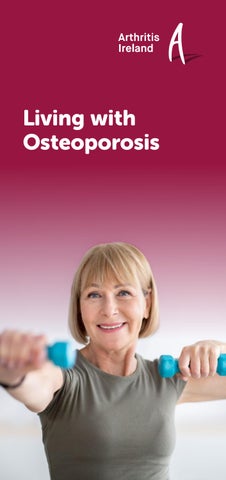
Living with Osteoporosis
www.arthritisireland.ie
1
Contents Introducing osteoporosis
4
The osteoporosis/arthritis link Symptoms Causes Risk factors Prognosis Diagnosing osteoporosis
12
Bone density test Treating & managing osteoporosis
14
Self-management Maintaining a healthy lifestyle Preventing falls Pharmacological treatment Non-pharmacological treatment Managing finances, rights and entitlements
32
Accessing the health service
36
Join the Arthritis Ireland community
38
Published September 2026 2
Arthritis Ireland
Arthritis Ireland: Building a better world for people living with arthritis today and a world without arthritis tomorrow Arthritis affects so many people in countless ways and at all stages of life. The experience of pain, stiffness and fatigue is all too real – as is the disruption it causes to lives. At Arthritis Ireland, we understand what it’s like to live with this chronic condition. Everything we do is with a view to supporting people living with arthritis. That includes investing in research as well as advocating on your behalf with policymakers and politicians. This publication is just one aspect of our work. We understand how important it is to be able to access trustworthy information about your health from a reliable source. That is why we work with healthcare professionals and other experts in producing these materials. There are lots of other supports also available to you, including our; ● Award-winning self-management programme, ‘Living
Well with Arthritis’. ● Helpline for practical information and emotional
support (call 0818 252 846). ● Website and online communication channels. ● Regular information events, podcasts and webinars. ● Volunteer-led local activities around the country.
If arthritis is affecting your life or the life of someone you love, please call or connect with us online (contact details on the back of this booklet).
www.arthritisireland.ie
3
Introducing osteoporosis What is osteoporosis? Osteoporosis is a condition in which bones become weaker and more likely to break after a minor fall, bump, twist, or even sometimes with everyday movement such as coughing or bending. These are called ‘fragility fractures’. Bone density is important, but it is only one part of the fracture risk. Some people who break a bone do not have a *DEXA scan result within the osteoporosis range. Around 10 per cent of fragility fractures occur in people with bone density within the normal range.
Many fractures occur before a DEXA scan reaches the osteoporosis range. That is why your healthcare professional should assess your overall fracture risk — not just your DEXA result.
This is why osteoporosis assessment should not rely on the DEXA scan alone. Doctors also consider age, previous fractures, family history, steroid use, menopause, falls risk, smoking, alcohol intake, body weight, the presence of inflammatory arthritis and other medical conditions. A DEXA scan remains very useful because it helps measure bone density and estimate fracture risk. However, the most important goal is not just to improve a scan result, it is to prevent fractures. *A DEXA scan is a quick, painless X-ray that measures bone strength and density. It is used to check for osteoporosis, assess fracture risk, and monitor bone health over time. 4
Arthritis Ireland
The osteoporosis/arthritis link Although osteoporosis is not a form of arthritis, the two conditions are closely connected for the following reasons. • Osteoarthritis (OA) and osteoporosis commonly occur in older adults. Reduced mobility due to OA may contribute to bone loss in some individuals. If you would like to read more about OA, visit our website (arthritisireland.ie). • Living with inflammatory arthritis, such as rheumatoid arthritis (RA), axial spondyloarthritis (axSpA), psoriatic arthritis (PsA) or lupus, can increase bone loss through chronic inflammation, and reduced mobility. • Corticosteroid drugs, often taken to treat RA and other types of inflammatory arthritis, put people at increased risk of osteoporosis and osteoporosisrelated fractures. • If you live with arthritis and face significant pain, stiffness and limited mobility, being sedentary can also lead to bone loss.
It is estimated that around half a million people in Ireland live with osteoporosis. The condition predominantly affects those over 50, with prevalence rates estimated at 20 per cent for women and 6.2 per cent for men in this age group, resulting in approximately 30,000 to 40,000 fractures annually.*
*Figures are taken from the University of Galway/DXA-MAP research (2023) and the International Osteoporosis Foundation SCOPE Ireland report (2019). www.arthritisireland.ie
5
Symptoms There are generally no symptoms of osteoporosis until a person breaks a bone, which is why it is often called a ‘silent disease’. It can sneak up on you because you could have it now without even realising it. If you do have osteoporosis, you’re more likely to fracture your hip, spine or wrist. As it progresses, osteoporosis can lead to symptoms such as: • Back pain. • Changes in posture. • Stooped posture or loss of height over time. • Fractures occurring after a minor fall or injury.
Osteoporosis is often called a ‘silent condition’ because it usually causes no symptoms until a bone actually breaks.
Bone is made up of a honeycomb-like network. With osteoporosis, the spaces inside the bone become larger and more porous, making the bone weaker and more likely to break.
6
Arthritis Ireland
Causes There is no single cause of osteoporosis - it often develops as a result of several contributing factors. The risk increases naturally with age, particularly after menopause in women due to lower oestrogen levels, although men can also develop osteoporosis. Other factors that may contribute include a family history of osteoporosis, low calcium or vitamin D intake, lack of physical activity, smoking, excessive alcohol consumption, low body weight, and certain medications such as long-term steroid use. Some medical conditions — including inflammatory arthritis, coeliac disease, thyroid disorders, and other long-term illnesses — can also increase the risk of developing osteoporosis. In many people, the condition develops gradually over many years, without symptoms, until a fracture occurs. Bones are living tissues that are constantly renewing themselves throughout life. In a healthy bone, old bone is continuously broken down and replaced with new bone. With osteoporosis, however, this balance changes — bone is lost faster than it can be rebuilt, causing bones to become weaker and more fragile over time. Because this process happens gradually and without obvious symptoms, many people only discover they have osteoporosis after experiencing a fracture from a minor fall, bump, or even everyday activities such as bending or lifting.
www.arthritisireland.ie
7
One in two women and one in five men over the age of 50 will break a bone in their lifetime due to osteoporosis.
Risk factors The below are a range of factors that could put you at risk of developing osteoporosis: • Gender: Being female puts you at higher risk, although men can develop osteoporosis too. The high-risk period appears to be around the time of perimenopause and menopause, where rapidly falling oestrogen levels lead to significant bone loss. • Age: The risk increases significantly after the age of 50 and continues to rise with advancing age. • Ethnicity: Osteoporosis is more common in postmenopausal women and in people of White or Asian ethnicity, but it can affect anyone. In Ireland, people with darker skin tones, and people who cover most of their skin for cultural, religious, medical or personal reasons, are at higher risk of low vitamin D because the skin receives less effective sunlight exposure. • Family history: Your risk is higher if a parent or close relative has had a fragility fracture following a minor fall, especially a hip fracture. 8
Arthritis Ireland
• Medical history: Having any of the following medical conditions can increase your risk of developing osteoporosis: rheumatoid arthritis, hyperthyroidism, parathyroid disease, liver or kidney disease, eating disorders, conditions that affect the absorption of food (like Crohn’s or coeliac disease) or conditions that cause poor mobility (like stroke or Parkinson’s disease). • Corticosteroid drug use: Long term regular or periodic use of steroids (even at low doses) can lead to osteoporosis. • Inactivity: Being sedentary or physically inactive can weaken your bones. • Dietary status: Low calcium intake, low vitamin D levels, poor nutrition, being underweight, or having a small body frame can increase the risk of osteoporosis. • Smoking and alcohol: Both increase your osteoporosis risk. Avoid smoking and heavy alcohol intake; keep within low-risk drinking guidelines.
www.arthritisireland.ie
9
Prognosis Many people with osteoporosis live full, active lives. The condition itself is not fatal, but breaking a bone — especially in the hip or spine — can cause serious, life-changing problems. Without the right care, bones continue to weaken over time, which greatly increases your risk of a painful injury from a simple trip or fall. The impact also goes far beyond physical pain. For older adults, a broken hip is a medical emergency. Sadly, about 20 per cent of older people who break a hip die within the first year. This is usually due to complications from surgery, existing health problems, or the dangers of being stuck in bed and unable to move. Even when it is not fatal, a break can completely change a person’s life. It often leads to a fear of falling, a loss of independence, and long-term walking difficulties. When you can no longer do the things you enjoy, it can easily lead to loneliness and depression.
10
Arthritis Ireland
The good news is that osteoporosis is highly treatable, and it is never too late to take action. You can stop your bones from getting weaker and protect your health. By working with your doctor, you can safely protect or even slightly improve your bone strength. This usually involves taking specific medications, getting enough calcium and vitamin D, making your home safer to prevent trips, and doing gentle exercises to improve your balance. These steps will lower your risk of a break, protect your independence, and help you keep living life to the fullest. Read on to find out how to care for your bones and prevent future damage.
Osteoporosis is treatable. The main goal is not just to improve bone density, but to prevent fractures and maintain a good quality of life and independence.
If you are worried about osteoporosis, or have been recently diagnosed with arthritis, you could benefit from calling Arthritis Ireland’s Helpline for support and information. The lines are open Monday to Friday, 10am to 4pm on 0818 252 846. www.arthritisireland.ie
11
Diagnosing osteoporosis A medical assessment is required to diagnose osteoporosis or to estimate your risk of breaking a bone. A GP usually performs the initial assessment for osteoporosis. This typically includes: • A review of your medical history, symptoms (if any) and risk factors. • A physical examination which may include checking height/ weight, posture, spine shape, balance, and mobility. • A fracture risk assessment is often required. This is usually done with an online tool. The most familiar one is called the FRAX® score, which assesses your fracture risk over the next ten years. • Blood tests to rule out other conditions, to check for causes of bone loss, including low vitamin D, calcium problems, thyroid, or kidney issues, and to check your suitability for different treatments. • Referral for a bone density test (DEXA scan), where appropriate. Your GP can often assess and start treatment for osteoporosis. Referral to a specialist may be needed if your bone density is very low, fractures are recurrent, or you require more advanced therapies.
12
Arthritis Ireland
Bone density test A DEXA scan is a safe, painless, low-dose X-ray scan measuring your bone density (a measure of bone strength and fracture risk). On the day, you will be asked to lie on your back on a bed or couch. A scanning arm will then be passed over your body to take images of your spine, hips or wrists (as these are the most common areas where bones tend to break). The results are given as a number called a ‘T-score’. This score compares your bone density to the normal range found in young, healthy adults.
Visit the ‘courses’ section of our website (arthritisireland.ie) to find out about our courses that teach you vital self-management skills which can significantly improve your quality of life and coping skills when living with a chronic condition.
www.arthritisireland.ie
13
Treating & managing osteoporosis In Ireland, patients are commonly managed initially by a GP, but many will also be referred to specialists such as a rheumatologist, endocrinologist, geriatrician, or a metabolic bone specialist. Those presenting to acute services with fragility fractures may additionally be reviewed through orthopaedic or fracture liaison services, which play an important role in secondary fracture prevention.
Self-management In addition to suitable treatment, self-management skills and techniques can, and do, make a positive impact on symptoms, wellbeing and the ability to live a full and active life for anyone living with osteoporosis. Lifestyle choices can also play an important role in reducing the risk of further complications. However, it is important to understand that osteoporosis cannot usually be reversed solely through lifestyle measures once significant bone loss has occurred. In this section, we will discuss self-management strategies for osteoporosis. While self-management can make a significant difference, it is still crucial to consult with your GP or specialist. This will help you better understand your individual fracture risk and whether medication may be required. As discussed earlier, fractures associated with osteoporosis can be serious and may lead to additional health complications. Selfmanagement focuses on protecting bone strength through lifestyle measures, in addition to preventing falls and reducing pain. The goal is always to maintain mobility and independence.
14
Arthritis Ireland
Maintaining a healthy lifestyle Key areas of lifestyle management include engaging in regular physical activity, following a balanced and nutritious diet, stopping smoking (if you currently smoke), and reducing alcohol intake where necessary. Engaging in regular physical activity
Regular exercise is one of the most important self-management strategies for people living with osteoporosis. It can help maintain bone strength, improve muscle mass, enhance balance, and reduce the risk of falls and fractures. We should all be mindful of the loss of muscle mass (and, therefore, strength and stability) as we age, which puts us at a higher risk of falling. Maintaining muscle mass, therefore, plays a crucial part in maintaining our quality of life as we age. Of course, physical activity can be challenging in the presence of significant knee or hip arthritis, but it is crucial. Some people are worried that physical activity will make their arthritis or osteoporosis worse*. However, inactivity is likely to make your condition worse. Moving your body regularly, on the other hand, has been proven to reduce joint pain and stiffness, improve flexibility and joint function, reduce fatigue, enhance overall physical and mental wellbeing, and, of course, improve bone health. The importance of monitoring symptoms: New out of ordinary back pain, height loss, or fractures after minor knocks should always trigger a medical assessment as soon as possible. *Although it is important to move your body in order to help your osteoporosis, it is also important to choose activities that are safe and appropriate for your individual level of bone and joint health. This is particularly relevant if you have experienced fractures, severe osteoporosis, significant pain, or mobility difficulties. If you have been diagnosed with osteoporosis, it is always advisable to consult a physiotherapist in order to obtain an exercise programme specifically tailored to address bone health and your own individual set of circumstances and health status. www.arthritisireland.ie
15
What type of physical activity? The good news is that many of the same exercises recommended for osteoporosis, including aerobic exercise, strengthening work, and balance training, are also commonly recommended for arthritis management. While it may seem counterintuitive, keeping active is often one of the most effective ways to protect joint function and maintain independence over time. Many people don’t realise that fractures of the spine can occur without a major injury and may cause back pain, loss of height, or a stooped posture.
A well-rounded exercise programme should include weight-bearing activities such as walking, dancing, or climbing stairs, as well as low-impact aerobics, together with resistance or strength-training exercises using weights, resistance bands, or body weight to help strengthen both muscles and bones (at home, or in a class or at a gym). Balance, flexibility, and posture exercises — such as Tai Chi, Pilates, stretching programmes, or physiotherapy-based exercises — are also important in helping to improve stability, mobility, posture, and confidence with movement, while reducing the risk of falls. Applying mechanical stress to bones stimulates the bone-forming cells, ‘osteoblasts’, to increase bone density and strength. This process, called ‘mechanical loading’ causes osteoblasts to rebuild bone tissue, making it more robust and helping to prevent conditions like osteoporosis and fractures. Visit the ‘courses’ section on our website (arthritisireland.ie) to register for a physical activity class. These classes are open to anyone who is living with osteoporosis, arthritis or a related condition. 16
Arthritis Ireland
How much is enough? Current guidance generally recommends aiming for at least 150 minutes (or a total of 2.5 hours, or 30 mins per day on five days) of moderate physical activity per week, along with muscle-strengthening activities on two to three days per week and balance exercises on at least two days per week. The key is consistency, so aim to find something that you’ll enjoy and that you are more likely to continue. In the case of the elderly, or those who are very unwell, or experiencing an arthritis flare, it’s important to remember that even brief movement breaks (such as walking around the room, taking a standing break or doing some simple stretches) can make a significant difference. Extended bed rest or sedentary behaviour accelerates bone loss rapidly.
www.arthritisireland.ie
17
How can I build it in? To build in enough physical activity for your health, always aim to be flexible and realistic with your plan. There are some days that you just won’t be able to fit your exercise in. If you miss a few days or even weeks, do not beat yourself up. Instead, learn from setbacks and aim to get back on track as soon as you can. Make sure to listen to your own body and what it needs, whilst also being aware that a lack of exercise is likely to make you feel more lethargic overall. Here are some other things to try; • Follow a stretching routine every time you get out of the bath or shower, which may be helpful in the morning or evening. • Schedule a ‘catch-up’ with a friend by choosing to walk or play golf together. • Collect your daily paper or milk on foot or by bicycle, if it’s safe and practical. • Sign up for a community exercise class and schedule it in your diary, just as you would schedule an important appointment. • Get off the dart, Luas or bus a few stops earlier and walk the rest of the way home. • Consider downloading an app that could motivate you, or try some free YouTube videos specifically focused on bone health (make sure to seek an appropriate level for your age and fitness).
Resistance or strength training is an important part of managing osteoporosis because it helps stimulate bone formation, slow bone loss, and improve overall bone strength. It also builds muscle strength, which supports the skeleton and reduces the risk of falls and fractures.
18
Arthritis Ireland
Following a healthy eating plan
There is no single ‘osteoporosis diet’. Aim for a balanced diet that provides enough calcium, vitamin D, protein and overall nutrition to support bones and muscles. A Mediterranean-style diet is a healthy option for many people, but diet alone is usually not enough to treat established osteoporosis. Fracture prevention may also require falls prevention management and medication, depending on your individual risk.
For bone health, focus on enough calcium, vitamin D and protein — but avoid taking unnecessary highdose supplements. Your GP, pharmacist, dietitian or specialist can help you decide what you need.
www.arthritisireland.ie
19
How much calcium, vitamin D and protein?
A healthy diet is important for bone and muscle health. For people with osteoporosis, the main dietary priorities are adequate calcium, vitamin D, protein and overall nutrition. Calcium Calcium is best obtained from food where possible. Good sources include milk, yoghurt, cheese, calciumfortified plant milks, calcium-set tofu, leafy green vegetables, nuts, seeds, and fish with edible bones such as sardines. Some people with osteoporosis may be advised to aim for a total calcium intake of around 1,000–1,200 mg per day from food and supplements combined, depending on age, diet and individual risk. If your diet does not provide enough calcium, your GP, pharmacist, dietitian or specialist may advise a supplement.
20
Arthritis Ireland
Vitamin D Vitamin D helps the body absorb calcium and supports bone and muscle health. In Ireland, low vitamin D is very common because sunlight levels are low for much of the year. HSE advice is that adults aged 13–64 take 15 micrograms of vitamin D daily from 31 October to 17 March. People with darker skin tone, reduced sun exposure, or pregnancy are advised to take it all year round. Adults aged 65 and older are advised to take 15 micrograms daily all year round. Some people with osteoporosis or proven vitamin D deficiency may need a different dose prescribed by their healthcare professional. Protein Protein is important for maintaining muscle strength and bone health. This matters because stronger muscles improve balance and reduce falls risk. Good sources include fish, eggs, dairy products, lean meat, beans, lentils, tofu, nuts and seeds. Older adults, people with poor appetite, weight loss or frailty may need to pay particular attention to protein intake. Can you take too much?
Yes. Too much calcium from supplements may increase the risk of kidney stones in some people, especially if total calcium intake is already high. Vitamin D toxicity is uncommon, but it can occur if high-dose supplements are taken for too long. Do not take multiple supplements containing calcium or vitamin D without checking with your GP, pharmacist or dietitian.
www.arthritisireland.ie
21
Alcohol, smoking and weight Alcohol Heavy alcohol intake can increase fracture risk by affecting nutrition, balance, muscle strength and falls risk. If you drink alcohol, aim to keep within low-risk drinking advice. Avoid heavy or frequent alcohol use. Smoking Smoking is harmful to bone health and increases fracture risk. Stopping smoking can help protect bones and improve overall health. Support is available through the National Smokers’ Quitline on 1800 201 203 or quit.ie. Weight Being underweight is linked to lower bone density, weaker muscles and higher fracture risk. Living with obesity may also increase the risk and can affect mobility and general health. The aim is not rapid weight loss, but a healthy, sustainable weight supported by good nutrition and regular physical activity.
22
Arthritis Ireland
Preventing falls Fall prevention is one of the most important ways to reduce fracture risk in osteoporosis, because most fractures occur due to falls rather than bone weakness alone. There are several practical steps that can help reduce the risk of falling. • Regular vision checks are important, as changes in eyesight can affect balance and awareness of hazards. • Review of medications – some medications can cause dizziness, drowsiness, or low blood pressure, all of which may increase the risk of falling. A GP or pharmacist can help assess whether any changes are needed. • Wearing supportive, well-fitting footwear can also improve stability when walking. • Making the home safer can further reduce risk. This includes improving lighting, removing loose rugs and trip hazards, and installing handrails on stairs or in bathrooms where needed. You could consider consulting an occupational therapist for this. Contact the Association of Occupational Therapists of Ireland. • Balance and strength exercises are also highly effective in reducing falls risk, particularly when done regularly as part of a structured programme such as physiotherapy or community exercise classes designed for older adults. Visit the ‘courses’ section of our website to find out more about a class that may be near to you, or which you can do online. A broken bone after a minor fall should never be ignored. A fracture following a low-impact injury may be the first sign of osteoporosis. If you are over 50 and have broken a bone after a simple fall or knock, ask your GP whether you should be assessed for osteoporosis.
www.arthritisireland.ie
23
If you are living with osteoporosis and are concerned about falling, you may find it helpful to download the HSE’s Take control: reduce your risk of falls PDF. Alternatively, you can pick up a hard copy from your local GP, Public Health Nurse, or local HSE community centre. If you have recently fallen, or feel you may be at risk of falling, speak to your GP or healthcare professional about a ‘Falls prevention and bone health assessment’. In Ireland, falls risk assessment and prevention services for older adults are commonly provided through the HSE by multidisciplinary teams, including physiotherapists, occupational therapists, public health nurses, and geriatric services. A falls risk assessment may include reviewing your balance, muscle strength, walking pattern, vision, medications, footwear, home environment, and overall mobility. Based on the assessment, you may be offered interventions such as balance and strength exercises, physiotherapy, mobility aids, home safety modifications, or referral to specialist services where appropriate. Some areas also offer community-based falls prevention exercise programmes for older adults through local HSE services and community organisations.
24
Arthritis Ireland
‘Fracture Liaison Service’ (FLS)
In Ireland, Fracture Liaison Services are usually accessed following a fragility fracture, such as a wrist, spine or hip fracture resulting from a minor fall or injury. In many hospitals, patients are automatically identified through fracture clinics, orthopaedic services or hospital admissions and referred for assessment. If you have experienced a fragility fracture, or are concerned about your risk of osteoporosis, speak to your GP or any other health professionals you interacted with at the hospital or in the community. They can advise whether a referral for further osteoporosis assessment or to an FLS is appropriate in your area. Not every hospital will have this service - availability of Fracture Liaison Services varies across Ireland, but services are expanding nationally.
Treatment should be focused on reducing the risk of fractures (by making bones stronger) in those diagnosed with osteoporosis.
www.arthritisireland.ie
25
Pharmacological treatment The pharmacological treatment and management of osteoporosis is tailored to the individual’s fracture risk, clinical profile and overall health status. The duration of treatment depends on the specific medication and an individual’s fracture risk. Some osteoporosis medications may be paused after several years (what is known as a ‘drug holiday’). Some treatments can be paused in selected people, while others require planned follow-on treatment to maintain bone protection. Decisions about continuing, pausing, stopping, or switching treatment should be made with a healthcare professional, who will regularly review fracture risk and treatment response. Please note that medications used to treat osteoporosis are intended to strengthen bones and reduce the risk of fractures; they do not provide direct pain relief.
Oral tablets
The first treatment offered to many people is a group of weekly or monthly oral medicines called bisphosphonates, such as alendronate/alendronic acid (Fosamax®, Fosavance®, Osteomel®), risedronate (Actonel®), or ibandronate/ibandronic acid (Bonviva®). Bisphosphonate tablets are usually taken on an empty stomach, first thing in the morning with a full glass of water, before food or other medicines. You usually need to stay upright — sitting, standing or walking — for at least 30 minutes afterwards. This helps the tablet absorb properly and reduces the risk of throat or stomach irritation. 26
Arthritis Ireland
These tablets may not be suitable for everyone, including some people with swallowing problems, significant reflux or oesophageal disease, reduced kidney function, or for people who have difficulty following dosing instructions. Your GP or specialist will help decide whether they are suitable for you. Intravenous and subcutaneous injections
For those who cannot tolerate oral bisphosphonates, alternatives used in Irish practice include an intravenous infusion of zoledronate/zoledronic acid (Aclasta®). This requires a half-day hospital visit every 12 to 18 months, or denosumab (Prolia®, Stoboclo®), a subcutaneous injection administered every 6 months at your GP surgery. Denosumab, while more potent that bisphosphonates, works similarly as an antiresorptive by slowing the breakdown of bone tissue. For more severe osteoporosis — particularly in patients with multiple fragility fractures or very low bone density — anabolic therapies may be recommended under specialist supervision. These are a class of medications that actively stimulate the formation of new bone tissue, such as teriparatide (Forsteo®, Sondelbay®, Movymia®). Teriparatide is a synethetic version of the human parathyroid hormone given as a daily subcutaneous injection for 24 months. Romosozumab (Evenity®) is a newer bone-building treatment recommended exclusively to postmenopausal women at very high fracture risk, especially after a recent major fracture within the last two years, who have otherwise no history of a heart attack or stroke. All anabolic drugs should be followed by a long-term antiresorptive agent, such as bisphosphonates or denosumab, to maintain gains in bone density.
www.arthritisireland.ie
27
Rare side-effects of some medications
It is important to look after your teeth and have regular dental check-ups before and while taking osteoporosis treatment. It is sensible to maintain good oral hygiene, and tell your dentist if you are taking osteoporosis medications, especially if invasive dental work such as root canal treatment, tooth extraction or implants is recommended. A rare jaw problem called ‘osteonecrosis of the jaw’ (ONJ) can occur with osteoporosis medication, but with standard osteoporosis doses it is very uncommon — affecting only about 1 to 10 people out of every 100,000 treated each year. Another rare side-effect is an unusual type of thighbone fracture called an ‘atypical femoral fracture’. This is also very uncommon, especially in the first few years of treatment, but the risk can increase with long-term use. Tell your GP or specialist if you develop new pain in your thigh, groin or hip. Before some osteoporosis treatments, especially denosumab or zoledronic acid, your healthcare team may check your calcium, vitamin D and kidney function. Low calcium or vitamin D should usually be corrected before treatment. Always take your prescribed calcium and vitamin D supplementation alongside the treatment as advised. For most people at higher risk of fractures, the benefits of osteoporosis treatment are much greater than the above rare risks.
28
Arthritis Ireland
Hormone replacement therapy (HRT)
HRT contains oestrogen, with or without a progestogen, depending on whether a woman has a uterus. As oestrogen helps to maintain bone strength, HRT can slow bone loss, improve bone mineral density and reduce the risk of fractures. In some cases, HRT may be used to help prevent and treat osteoporosis in younger postmenopausal women, particularly those who are also still experiencing menopausal symptoms. Treatment can be administered in several forms, including tablets, skin patches, gels and sprays. While HRT can be effective in protecting bone health, it is not suitable for everyone. The benefits and risks should be discussed with a healthcare professional to determine whether it is the most appropriate treatment option.
www.arthritisireland.ie
29
Non-pharmacological treatment Physiotherapy
Physiotherapy plays an important role in managing osteoporosis and reducing fracture risk. A physiotherapist can assess strength, balance, posture, walking pattern and mobility, and develop a personalised exercise programme to help maintain bone and muscle health. A good osteoporosis exercise programme usually includes weight-bearing activity, muscle-strengthening exercises, balance training and posture exercises. These can help maintain bone strength, improve physical function and reduce the risk of falls. Physiotherapists can also advise on safe movement, posture and spinalstrengthening exercises, which may be particularly helpful for people who have had vertebral fractures, height loss, back pain or fear of falling. Exercise should be tailored to the person’s fracture risk, pain, mobility, fitness level and other health conditions.
In Ireland, physiotherapy services may be available through hospital clinics, community services, primary care teams or private practitioners.
30
Arthritis Ireland
Occupational Therapy
Occupational therapists help people with osteoporosis maintain their independence and carry out everyday activities safely. They can assess how osteoporosis affects daily life and provide practical advice on reducing the risk of falls and fractures at home, at work and in the community. This may include recommendations on home modifications, safe movement techniques, energy conservation strategies and the use of assistive devices where appropriate. Occupational therapists can also advise on ways to manage daily tasks following a fracture and support individuals in returning to their usual activities as safely and confidently as possible. In Ireland, occupational therapy services may be available through hospitals, community healthcare services and private practice.
www.arthritisireland.ie
31
Managing finances, rights and entitlements A diagnosis of osteoporosis can be stressful enough, but equally worrying can be the costs for medical treatments, home renovations and other expenses associated with having the condition. Some people with chronic conditions may be forced to retire earlier than they had planned, resulting in a loss of income and potential retirement savings. That is why educating yourself about what supports are available is crucial in helping to manage your finances. Accessing benefits
The Citizens Information Board provides a comprehensive guide to entitlements for people with disabilities, including supports related to income, work, and daily living. You can access information by contacting your local Citizens Information Centre or by visiting www.citizensinformation.ie. You could also get in touch with the Department of Social Protection by calling the DSP Information Line on 0818 662 244/ 01 471 5802, or by visiting your local Intreo Centre.
32
Arthritis Ireland
Social welfare payments
You may be able to apply for social welfare payments if your condition affects your ability to work. These may include: • Illness Benefit – a short-term payment for people who are unable to work due to illness and have sufficient PRSI contributions. • Invalidity Pension – a long-term social insurance payment for people who are permanently incapable of work due to an illness or disability, and who satisfy the PRSI conditions. If you receive Invalidity Pension, and later return to work with a reduced capacity, you maybe be able to receive Partial Capacity Benefit, depending on your circumstances.
www.arthritisireland.ie
33
Other supports
Depending on your situation, you may also be entitled to: • Partial Capacity Benefit • Living Alone Increase • Free Travel Scheme • Household Benefits Package • Treatment Benefit Scheme (for dental, optical and hearing services). • Housing Adaptation Grant for People with a Disability – if you need changes to your home, your local authority may offer financial assistance for adaptations such as stairlifts, level-access showers or handrails. • Disabled Parking Permit – If your mobility is significantly restricted, you may be eligible for a Disabled Parking Permit. This permit is provided through the Disabled Parking Permit Scheme and is separate from Department of Social Protection supports.
34
Arthritis Ireland
Disability Allowance
Disability Allowance is a means-tested payment for people aged 16–65 whose disability significantly affects their ability to undertake suitable employment. Payment generally ends when you reach age 66, at which point you may qualify for either the State Pension (Contributory) or the State Pension (Non-Contributory), depending on your circumstances. People awarded Disability Allowance are generally entitled to a Free Travel Pass. People aged 70 and over who are entitled to Free Travel can also have a companion aged 16 or over travel with them free of charge. No medical assessment is required for the companion entitlement for people aged 70 and over. People under 70 who are unable to travel alone because of a medical condition may also qualify for a Companion Free Travel Pass, subject to medical assessment. Tax relief
You may be able to claim tax relief on certain medical expenses that are not covered by the HSE or medical insurance. Medical expenses that are not otherwise reimbursed may qualify for tax relief through Revenue, generally at the standard rate of income tax.
www.arthritisireland.ie
35
Accessing the Health Service Depending on your income and personal circumstances, you may be eligible for a range of healthcare supports. Medical card
A medical card helps cover the cost of many health services, including GP visits, prescribed medicines, public hospital care and certain community health services. Eligibility is generally based on a means test, although some people may qualify because of exceptional medical needs or financial hardship. Each application is considered on its own merits. GP visit card
If you do not qualify for a medical card, you may be eligible for a GP visit card. This covers the cost of visits to your GP but does not include other health services. The income limits for a GP visit card are higher than those for a medical card. Drugs Payment Scheme (DPS)
If you do not have a medical card, the DPS limits how much you or your family pay each month for approved prescribed medicines and certain other items. Anyone ordinarily resident in Ireland can apply. Public hospital care
Public hospital services are available to all people ordinarily resident in Ireland. While inpatient and outpatient care in public hospitals is publicly funded, charges may apply in some circumstances depending on your eligibility and the services you receive.
36
Arthritis Ireland
Useful contacts
The Irish Osteoporosis Society Website: www.irishosteoporosis.ie Email: info@irishosteoporosis.ie Phone: (01) 637 5050 The Irish Nutrition & Dietetic Institute (INDI) Website: www.indi.ie Email: info@indi.ie Phone: (01) 215 0508 The Irish Society of Chartered Physiotherapists (ISCP) Website: www.iscp.ie Email: info@iscp.ie Phone: (01) 524 0931 The Association of Occupational Therapists of Ireland (AOTI) Website: www.aoti.ie Email: info@aoti.ie Phone: 083 080 8311
If you have any questions about living with osteoporosis, please contact Arthritis Ireland’s Helpline on 0818 252 846, available Monday to Friday from 10am to 4pm.
www.arthritisireland.ie
37
Join the Arthritis Ireland community Not everyone knows about arthritis. About the pain, the frustration. Not everyone can see past the invisibility of arthritis.
Not everyone knows that arthritis affects all types of people. That it does not discriminate. It affects young and old, indifferent to gender and race, people from every type of background. Arthritis affects the human condition. With your help we can change this. With your support we can build a better world for people living with arthritis today, and a world without arthritis tomorrow.
€10
per month
With your help we aim to: • Help anyone looking to understand their arthritis. • Support anyone living with arthritis to live well, and to live as full and active a life as possible. • Advocate for improved and accessible services. • Ensure that arthritis is diagnosed as early as possible. • Invest in research to find a cure for arthritis. But we can’t do it without you, without your help. As a friend of Arthritis Ireland you can change the balance. As a friend of Arthritis Ireland you will be part of a strong and vibrant community. You can help win the fight against arthritis – for as little as €10 per month.
If you would like to sign-up to hear from us with news and updates about arthritis research, courses, events, campaigns and fundraising please visit arthritisireland.ie
Become a friend €10 per month Yes, I would like to help manage the pain of arthritis. Monthly payment of €10 (€120 per annum). Monthly payments by direct debit only. See reverse for details. Personal Details Name Address: Telephone: Email: Date of birth Yes
Do you have arthritis?
No
If Yes, what kind of arthritis?
Credit Card (Once off annual payment of €120) Amount per annum: €120 per annum
Other (€120 per annum + donation)
€20 per annum OAP
Please charge by:
VISA/VISA Debit
Mastercard
Card No Exp date
CVV
Signature Date
Cheques & Postal Orders Payable to Arthritis Ireland
Payment details SEPA Direct Debit Mandate
By signing this mandate form you (A) authorise Arthritis Ireland to send instructions to your bank to debit your account and (B) your bank to debit your account in accordance with the instructions from Arthritis Ireland. As part of your rights, you are entitled to a refund from your bank under the terms and conditions of your agreement with your bank. A refund must be claimed within 8 weeks starting from the date on which your account was debited. Your rights are explained in a statement that you can obtain from your bank.
Please complete all marked fields Debtor Name Debtor Address
City / County Debtor A/C Number IBAN
Debtor Bank ID Code BIC Recurrent
Type of Payment
One off
Signature(s*)
Date of Signature* Amount of Direct Debit *
€
Date of First Payment* * Arthritis Ireland will debit your account for the amount indicated above from the first day of each month until further notice. Creditor Name: Arthritis Ireland Creditor ID: IE90SDD360028 Creditor Address: 1 Clanwilliam Sq, Grand Canal Quay, D 2 Unique Reference No. (URM) For Office Use Only Note; If you are a PAYE taxpayer or are self-employed, gifts of €250 in one year (€21 per month) is worth an extra 44.9% to Arthritis Ireland at no additional cost to you.
Arthritis Ireland 1 Clanwilliam Square Grand Canal Quay Dublin 2, D02 DH77 www.arthritisireland.ie info@arthritisireland.ie Helpline: 0818 252 846
@Arthritisie ArthritisIreland.ie @arthritisie Arthritis Ireland
Scan the QR to join the Arthritis Ireland community
Arthritis Ireland acknowledges the support of Celltrion Healthcare Ireland in developing this resource. The content has been independently developed by Arthritis Ireland and reflects its own views and expertise.
RCN: 20011123; CHY: 6297; CRO: 7893. Published September 2026