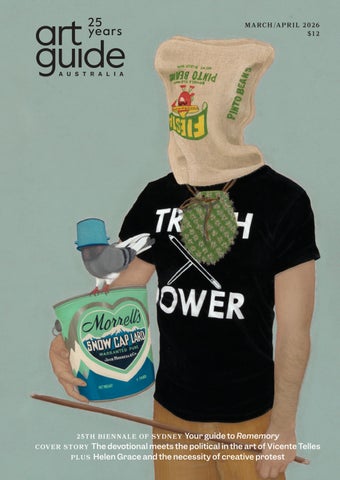
M A RCH /A PR I L 2026 $12
25T H BI EN N A LE OF S Y DN E Y Your guide to Rememory
C OV E R S T ORY The devotional meets the political in the art of Vicente Telles PLUS Helen Grace and the necessity of creative protest
EX HIBITION LISTINGS
V IC
NSW
QLD
AC T
TA S
SA
WA
NT
INSIDE THIS ISSUE A Note From the Editor
Chloé Wolifson PR EV IEW
Tom Moore: Natural Oddity
Barnaby Smith Judith Van Heeren: Moon Obscure
Rhianna Melhem Golshad Asami: Rhythms of Home
Briony Downes A soft space to stand
Louise Martin-Chew Gerwyn Davies: Shimmer
Barnaby Smith Soft Edges: Mapping the Human Condition
Briony Downes South West Biennial 2026: Tracework
F E AT U R E
Heaven and Earth: Vicente Telles
Oliver Giles STUDIO
Ema Shin
Anna Carlsson F E AT U R E
First Nations in Focus
Gok-Lim Finch F E AT U R E
Voices in the Mist: Nahom Teklehaimanot
Giselle Au-Nhien Nguyen PHO T O E S SAY
Burdens of Proof: Helen Grace
Tiarney Miekus F E AT U R E
When Bones Speak: Cannupa Hanska Luger
Sophia Halloway
Rosamund Brennan
Ngura Pulka—Epic Country
F E AT U R E
Louise Martin-Chew Parrtjima 2026
Sophia Halloway New South Vol. 2: Recent Sculpture and Installation Art
Rhianna Melhem 25TH BI EN NA LE OF SY DN EY
Rememory
Nature Nurture: A velvet ant, a flower and a bird
Josephine Mead 20 QUE STIONS W ITH
Marise Maas
Anna Carlsson E S SAY
In the Fold: The Offbeat Sari
Megha Kapoor F E AT U R E
A Bridge Over Troubled Waters: Kumarangk
Steve Dow MAPS 1 V I C T O R I A
9 & 10
D A R L I N G H U R S T, R E D F E R N ,
W AT E R L O O & PA D D I N G T O N
2
MELBOURNE CBD 11 & 12
G R E AT E R S Y D N E Y
3
FI T ZR OY & C O LLI N GWO O D
& N E W S O U T H WA L E S
4
G R E AT E R M E L B O U R N E
13 & 14
G R E AT E R B R I S B A N E & Q U E E N S L A N D
5 & 6
NORTHERN & SOUTHERN MELBOURNE
15 & 16
BRISBANE & CANBERRA
7 S Y D N E Y
17 & 1 8
HOBART & ADELAIDE
8
19 & 20
PERTH & FREMANTLE
SYDNEY CIT Y
+ON
NOW
Painting Itself 6 February → 29 March Presented in association with ANU Drill Hall Gallery and Perth Festival
Exhibition Partners
Tang Dixon, Yellow Peril (detail) 2013, oil on canvas, 50 x 40 cm. © Tang Dixon, courtesy Ota Fine Arts
Our exhibitions are always free
Ellen Auerbach R. Schottelius in New York 1953 (detail). National Gallery of Victoria, Melbourne. Gift of Krystyna Campbell-Pretty AM and Family through the Australian Government’s Cultural Gifts Program, 2023 © Ellen Auerbach. VG Bild-Kunst/Copyright Agency, 2025
A Note From the Editor March/April 2026
Vicente Telles, whose work commands Art Guide Australia’s March/April cover, began his career as a santeros (a painter of devotional art)—one of the oldest living folk art traditions in the United States. As Oliver Giles writes, the Nuevo Mexicano artist is one of only a handful of artists working today to sustain and expand this practice, making icon-like paintings that shed light on contemporary issues, alongside self-portraits that explore his experiences as a Nuevo Mexicano man living in a 21st-century US. Telles’ work features in the 25th iteration of the Biennale of Sydney, who we have proudly partnered with to bring you a guide to some of the many highlights. Exploring the theme of Rememory, a term used by author Toni Morrison, artistic director Hoor Al Qasimi looks to “explore the intersection of memory and history as a means of revisiting, reconstructing, and reclaiming histories. Through Rememory, artists from Australia and around the world reflect on their own roots while engaging with Sydney and its surrounding communities and histories, exploring global themes that connect us.” This edition of the Biennale seeks to “highlight marginalised narratives, share untold stories, and inspire audiences to rethink how memory shapes identity and belonging, amplifying stories from First Nations communities, and the divergent diasporas that shape Australia today.” In this issue, Tiarney Miekus writes about Sydney-based artist Helen Grace’s landmark photographic series of the late 1970s and early 1980s, capturing a turning point in a longstanding feminist struggle, while remaining relevant to present-day concerns. We also visit multidisciplinary artist Ema Shin at the Australian Tapestry Workshop to discuss her work for Rememory, speak to local and global participants in the Fondation Cartier pour l’art contemporain First Nations program, and delve into the practices of international Biennale artists Nahom Teklehaimanot, and Cannupa Hanska Luger. Elsewhere in this issue, Steve Dow speaks to some of the Ngarrindjeri women who fought the contested building of a bridge to Kumarangk (Hindmarsh Island) as a new exhibition pays tribute to their legacy, while Megha Kapoor contemplates the enduring power and appeal of the sari. Read on to learn more about the 25th Biennale of Sydney and the wonderful array of exhibitions taking place around the country. Chloé Wolifson Print editor, Art Guide Australia
59
Materiality is a focus for O’Shannassy—a Hobart-based artist—and he demonstrates this through an ongoing experimentation with polymer paints. In Anomalies (2026), his painted surface captures the fizz and bubble of frenetic movement suddenly stilled. Abstract in style, O’Shannassy’s work conjures the essence of how we engage with the world on a sensory and spatial level. “I aimed to experiment with the materiality of paint and its potential as a structure to synthesise a physical trace of my inner, subconscious world,” he explains. “As experiments, my paintings feel like cryptic and sensual objects excavated from a psychological ecosystem.” In comparison, Bradbury’s paintings are figurative, often depicting the human body interacting with nature, while La Paglia calls upon her background in art therapy to create works steeped in nostalgia. Looking inward, Hine, Yacomo and Phillips each reflect on the complex and shifting boundaries of gender binaries and identity through painting, self-portraiture and installation, bringing together what the curators refer to as “a collective approach to creatively unpacking the pressures of current times.” — B R I O N Y D OW N E S
Bunbury/ Noongar Country South West Biennial 2026: Tracework Bunbury Regional Art Gallery and surrounds 21 March—19 July The inaugural South West Biennial, Tracework, was conceived as a cartography of the creative landscape of southwest Western Australia. The biennial’s epicentre, Bunbury Regional Art Gallery, will host a survey exhibition of 28 artists from the region, with solo and collaborative installations by Jacobus Capone, Olga Cironis, Amber Cronin and Tom Borgas, Sharyn Egan and Andy Quilty, and other exhibitions taking place at six partner venues across the southwest, including Albany Town Hall, Arts Narrogin, Holmes à Court Gallery at Vasse Felix, Margaret River HeART, Southern Forest Arts and Vancouver Arts Centre. The biennial’s model is informed by curator Dr Michael Bianco’s experience working at the Venice Andy Quilty, Mandurah line #2 (E-scooter skid), Biennale and Marfa, Texas, and challenges the contem2025, carborundum and drypoint print on porary art world’s focus on major cities at the expense paper (unique state). of regional centres. “Rather than having a singular exhibition, we have a hub and spoke model that’s distributed over time. It’s a way to both activate communities but also draw attention to where artists are working anyway, in a more expansive model,” says Bianco (who co-curated the exhibition alongside Dionne Hooyberg). “The quality of the work that’s being produced in the region, and the ways in which it is unique of its own character, speaks not only to a Western Australian sensibility, but a southwest Western Australian sensibility.” Tracework charts the imprint that artists make upon both their medium and their community, in a way that is simultaneously idiosyncratic to the southwest region, and universal. “Whether it’s the trace of a tree once it’s been burned into ash in the kiln that is used to glaze a pot, or the trace of human impact on the environment,” says Bianco, “Artists not only visualise, but create opportunities to experience, that impact and to contemplate what it means to be human in this time.” — S O P H I A H A L L OWAY
68
Canberra/ Ngambri Country Ngura Pulka—Epic Country National Gallery of Australia 11 April—23 August The namesake work in the exhibition Ngura Pulka—Epic Country is indeed epic in scale. A large painting from the APY Men’s and APY Men’s and Women’s Regional Collaborative, Pitjantjatjara Women’s Regional Collaborative, the colour, people, Ngura Pulka- Epic Country (West Side), 2023. © the a rtjourneys, and dizzying detail of Ngura Pulka ists, courtesy APY A rt Centr e Collecti v e, South Austr a li a. (2023), trace the connections these artists have, both individually and collectively, to Country. Artists from this region convey a characteristically bold and distinctive aesthetic. In 2022, artist Yaritji Young related, “Our ancestors painted on the caves. This is where I learned my story as a child through the cave paintings around Cave Hill. I think about these caves when I am making a major work. The larger scale [canvases] allow me to invoke the cave as a celebration of my culture. They allow me the room I need to share my story”. It is this scale and ambition that the exhibition has offered artists, with collaborative canvases invoking Country to celebrate Tjukurpa (Aṉangu law/ cultural stories), and encourage a strengthening of cultural knowledge systems. Senior women artists, who are also community leaders, suggest that the paintings represent “the ultimate freedom of cultural expression, exploration and depiction of their Tjukurpa and Ngura (land)”. APY Art Centre Collective has its origins in the Pukatja (Ernabella) community which focused initially on craft from 1948, with painting developing strong momentum since 2000. Since 2017, the APYACC has represented seven Indigenousowned art centres and established galleries in Sydney, Adelaide and Melbourne. Questions about the authorship of paintings created at an APY Lands art centre led to the delay of Ngura Pulka—an NGA review validated the authorship of work included in the exhibition. When this ‘artist-led’ exhibition opens at the National Gallery of Australia in April, audiences will have the opportunity to view these vibrantly coloured and distinctive paintings that have already generated much discussion. — L O U I S E M A R T I N - C H E W
Alice Springs/ Arrernte Country Parrtjima 2026 Alice Springs Desert Park (Mparntwe) 10—19 April For a decade, the Parrtjima festival of light has illuminated Alice Springs Desert Park (Mparntwe) with installations by artists from across northern and Parrtjima, 2025, Grounded installation. Central Australia. In 2026, the ten-day festival is dedicated to language. “Aboriginal language, predominantly Arrernte language, will be interspersed throughout all of the installations,” says Paul Ah Chee, who has developed the festival program alongside curator Rhoda Roberts AO and a reference group comprised of people with connections to Mpartnwe. “People can hear storytellers in language, then experience the connection of language to the living landscape. It’s pulsing, it’s breathing, it’s ancient, and everything is connected through language.” 69
This year’s program will include reimagined festival favourites, including the expansive Parrtjima light show that will transform the MacDonnell Ranges, and Grounded, which immerses visitors in light and the landscape. There are new installations by Darrell Sibosado, known for his luminous light works that draw on the Bardi tradition of engraved riji (pearl shell) designs, and Corban Clause Williams, who tells the story of the soaks and waterholes that are the lifeblood of the desert. The light installations are complemented by dance and music, sandpainting and other workshops. Visitors can connect directly with artists to deepen their understanding of the ancient cultural knowledge that informs contemporary First Nations art practice. “It’s a continual process of learning and understanding,” says Ah Chee. “What I see people take away from Parrtjima is a better understanding not only of Aboriginal culture, but the connection and responsibility that they also have to Country, which informs their inner being, and that leads to wellbeing and a sense of healing. It allows people to connect with each other, but also to connect to themselves.” — S O P H I A H A L L OWAY
Gymea/ Dharawal Country New South Vol. 2: Recent Sculpture and Installation Art Hazelhurst Art Centre 24 April—21 June Originally conceived as a painting exhibition to follow on from its 2024 debut, Hazelhurst Art Centre’s New South Vol. 2: Recent Sculpture and Installation Art now brings together leading sculptors and installation artists from across southern Australasia. Curated by Victoria Wynne-Jones, the exhibition offers a ‘state of the arts’ glimpse into practitioners working in these mediums today, foregrounding debates around sculpture versus Matthew Griffin, Belief, 2020, bowling ball, installation. Wynne-Jones explains: bumper sticker, 40 x 20 x 20 cm. Courtesy “I’ve noticed ongoing discussions around the idea of the a rtist a nd Fine A rts, Sy dney. that we’re in a post-disciplinary moment—that sculpture Photogr a ph: Jessica M aur er. no longer exists or that everything is installation or conceptual—but many of the artists in this show are still deliberately choosing to describe their practice as sculpture.” One such internationally renowned artist, Claire Lambe, revels in calling herself a sculptor, embracing the tension of a medium some see as unfashionable. Lambe presents House of Bones (2017), which Wynne-Jones describes as “challenging what we think of as sculptural installation in that it’s quite cinegraphic and interrogates the boundaries of installation art.” The inclusion of established artists such as Hany Armanious and Alicia Frankovich is balanced by mid-career and emerging practitioners. Jacqueline Stojanović’s ephemeral suspended silk works engage with histories of craft, while Chunxiao Qu uses dark humour to explore the monstrous feminine and the strange fluidity of language. The intergenerational exhibition fosters lively dialogue, with resonances across generations creating a dynamic conversation defined by varying approaches, experiences and scale. With its playful and ambiguous title, New South Vol. 2 deliberately complicates definitions of “new” and “south.” The works presented are recent and have not previously been shown in a southern Sydney context, while “south” is considered less a geographical marker than a relational and conceptual frame. Together, the exhibition offers a fresh lens on contemporary sculpture and installation, revealing how artists experiment and play with space, form and concept today. — R H I A N N A M E L H E M 70
Matthew Harris, Late for Brunch, 2022, bronze Giacometti Walking Man, Jacquemus Le Chiquito Mini, cocaine, synthetic wig, 100 x 50 x 20 cm. Courtesy of the a rtist a nd FUTURES. Photogr a ph: Chr isti a n Ca pur ro.
71
“Many people have experienced what I’ve experienced. The more I reflect on my experiences, the more I feel I’m able to tell a broader story.” — V ICE N T E T E LL E S
Vicente Telles, La Guadalupana, 2022, natural pigment on wood with natural gesso and varnish, 24” x 14” x 1”. Photogr a ph: Chelsea Bena lly for Ga llery Hózhó.
Vicente Telles, Angelito, 2022, natural pigment on wood with natural gesso and varnish, 14” x 10” x 1”. Photogr a ph: Chelsea Bena lly for Ga llery Hózhó.
76
BoS Special
Vicente Telles, Los Tres Reyes, watercolor pigments, oil pastel, soft pastel, traditional gessoed masonite panel, 25” x 30”.
Vicente Telles
Campbelltown Arts Centre 25th Biennale of Sydney: Rememory 14 March—14 June 2026
One of them has been shortlisted for the Outwin Boochever Portrait Competition, a prestigious national portrait prize worth US$25,000, and is currently on display at The Outwin 2025: American Portraiture Today at the National Portrait Gallery in Washington, DC. For Rememory, Telles is tackling another topic. “I’m making a painting that deals with the idea of language loss and what that looks like in my community,” he says. “Why am I speaking English and not the language of my ancestors, which is Spanish?” For Telles, the answer lies in the fact that his parents were beaten for speaking Spanish in school and denigrated for speaking it in public, so they raised their children speaking English. “It weighs on me,” says Telles. “When I’m doing research, not being able to read documents that my family’s names are in... I’m missing half of my world.” While the painting reflects Telles’ own story, the pain of not speaking an ancestral language is something felt by millions around the globe. That is one of the reasons why Telles obscures his face in these works, which he sometimes refers to as universal self-portraits. “My face can distract from the message,” he says. “Many people have experienced what I’ve experienced. The more I reflect on my experiences, the more I feel I’m able to tell a broader story.” These political paintings might seem a world away from his religious icons but, to Telles, they’re two sides of the same coin. He uses the same traditional pigments in both, and both are products of the unique confluence of cultures in New Mexico. Through his research, he has also discovered how paintings of saints were historically used as political tools, noting how the number of depictions of Our Lady of Guadalupe—a Mexican story—exploded in the 1820s, when Mexico gained independence from Spain and New Mexico became a Mexican territory. “In my santos, I can add political messages, and in my political, more contemporary work, I’m trying to put a little taste of who I am as a santero,” says Telles. To him, the stories of saints remain relevant today, and a contemporary portrait might inspire the same admiration as an ancient icon. Ultimately, Telles aims for everything he makes to be “art for your mind and soul”.
BoS Special
77
78
BoS Special
STU DIO
Ema Shin
AS TOLD TO
Anna Carlsson
Visiting Ema Shin’s workspace at the Australian Tapestry Workshop in the middle of a Melbourne summer, makes for what feels like a brightly lit beehive. The ceiling extends into the sky, with big windows, showering sun on the artists and weavers that work meticulously below. Born in Japan, with Korean heritage, Shin now lives in Melbourne. Having initially studied traditional printmaking, she now practices as a multidisciplinary artist, working in sculpture, embroidery, beadwork and tapestry. Often depicting female bodily structures, Shin’s work is a steady yet slow act of resistance against the erasure of womanhood.
PHOTOGR A PH Y
Leah Jing McIntosh
Exploring not only the physical and anatomical aspects of femininity, Shin also interrogates the unspoken psychological burdens that continue within cultures across generations but also as they present in contemporary life. Ahead of the 25th Biennale of Sydney, Shin has worked in grandeur on a large-scale loom that stands tall and wide among her red- and pink- hued threads and sketches. Her work Heart of Absent Women (Tree of Family) (2026) is an act of rememory—with roughly 1,500 hours of weaving and sewing, Shin encourages her audience to stop and stand still, allowing them to embark on their own journeys of rememory.
BoS Special
79
“Through time, you start to adapt… But still, you feel the pain of being outside of your country… Even now, I’m learning to be a refugee.” — N A HOM T E K L E H A I M A NO T
top lef t Nahom Teklehaimanot, Aging Waves, 2024, acrylic on canvas, 200 x 200 cm. top r ight Nahom Teklehaimanot, Back and Forth Motion, 2024, acrylic on canvas, 200 x 195 cm. lef t Nahom Teklehaimanot, Window Sill of Old House, 2024, acrylic on canvas, 200 x 200 cm.
92
BoS Special
Nahom Teklehaimanot, Wishing for an End, 2024, acrylic on canvas, 150 x 250 cm.
The first painting, The House Forgets My Name, is rooted in the domestic sphere, but with an air of disruption: mother and child figures huddle beneath fallen chairs, with a white dove diving towards the ground. Importantly, the chairs are empty—a homely space that the figures, in their plight, can no longer occupy. “When someone is grieving, they are seated on the floor,” Teklehaimanot says. “So many mothers are holding their child and seeing through that open space… [It is a] chaotic way of composing so many broken objects.” Only the Cactus is Green traces the second part of the journey: the crossing of the desert. Faces crowd around one another with a bright green cactus punctuating the otherwise dark landscape. In the middle of the image is a Kanaga mask from the Dogon people of Mali, traditionally worn in rituals where the souls of deceased family members are transported away from the village. “The cactus shows the desert and the difficult terrain of the environment, and at the same time, the resilience and the fighting spirits of living in a difficult situation,” Teklehaimanot says, adding that the playfulness of the cactus provides a foil to the darker story of the mask. The last painting, No Shore for the Living, No Shore for the Dead, is inspired by Géricault’s The Raft of the Medusa (1818-19), replicating its use of many
figures against a violent sea. “[In that work], you see so many parties, so many figures. Some of them are hopefully looking for a rescue, and some of them are already dead,” Teklehaimanot says. “Some of them are fighting for survival at the same time as losing hope.” Similarly to the empty chair, a ghost-like figure hangs on the edge of this final piece. “Someone is there, but he’s not crossing,” the artist says. “It is not living... [it is] a way of escaping life.” As the overarching title of the work suggests, these images speak for those unable to use their own voices, just like Teklehaimanot himself once was. These are common stories all around the world—by sharing the sorrows and agonies of his own reflections, the artist hopes to break down arbitrary barriers. “It’s been this story for so many souls in this world, not only second-world countries or thirdworld countries,” he says, citing Ukraine as a recent European example. “No matter where you are, this thing can happen— so you have to give a voice equally, no matter what race you are [or] where you are from. I’m always looking for those voices.”
Nahom Teklehaimanot
Art Gallery of New South Wales 25th Biennale of Sydney: Rememory 14 March—14 June
BoS Special
93
BU R DENS P H O T O E S S AY
OF
PROOF
WRITER
Tiarney Miekus
It’s 1970s Sydney. Women protesters sit on the sidewalk in concentrated discussion. Large banners repeat the message, “Justice for Violet and Bruce Roberts.” A woman walks with a placard: “20 years of brutality 5 years in GAOL. Let them go!” Other protestors, in mid-action photographs, are carted away by police—the latter’s presence constant, autocratic. These scenes are from Helen Grace’s photographs of the late 1970s and 1980, covering demonstrations for the prison release of Violet and Bruce Roberts—a mother and son convicted in 1976 of murdering husband and father, Eric Roberts, in regional New South Wales. Yet during the court case, the severe domestic abuse Violet and Bruce endured was omitted: the defence of provocation was only relevant during an attack. For the 25th Biennale of Sydney, Grace will exhibit her recently resurfaced black-and-white proof sheets alongside large prints, presented off the gallery walls, hanging in space, for viewers to walk among: “The exhibition is about both movement and a [protest] movement,” explains Grace. Grace knew about the highly-publicised case the same way everyone did: the protest group Women Behind Bars, started in 1975 to underscore the conditions faced by female prisoners. “I knew some of the women because at the time I lived in inner-city Sydney, in feminist group households and networks,” recalls Grace. “It was my every day.” In the late 1970s, with no formal photography training beyond magazines, workshops in London, a connection to the Sydney filmmaker’s co-op at the Tin Sheds, and an editorial tenure at a student newspaper, Grace photographed the demonstrations. The protestors included journalist Anne Summers, women who eventually held significant legal positions, plus artists Jan Mackay, Vivienne Binns, Virginia Coventry, Janet Burchill and Jennifer McCamley. “They were very courageous, very daring and very outrageous,” says Grace. “My interest was in these women and the sheer creativity of the campaign they ran.” Their tactics, many of which Grace documents, included painted posters and banners—one of which resides in the National Museum of Australia collection.
94
BoS Special
A landmark photographic series by Helen Grace on show as part of the 25th Biennale of Sydney reflects a turning point in a longstanding feminist struggle—while speaking to how the faultlines of the past play out in the present day.
They graffitied walls, held occupations and all-night vigils, even covering the floor of Corrective Services with old, cracked eggs. The theatricality captivated the public and media. “There’s a narrative and dramaturgy to the demonstrations,” explains Grace. “It flows, it has structure, rhythm.” While some photographs cover protests outside Corrective Services, the centrepiece is a moving protest; a procession in which the group pasted together 12,000 signed petition forms supporting the Roberts’ release and walked the long scroll through the streets of Sydney to State Parliament. “We have to see this as part of the history of performance art,” says Grace. “Of course, a lot of the activists may not be interested in being counted [as performance art], but for artists or those in art history, this is part of it.” Underneath is an undeniable reality. “The thing we must not forget is that if the protests hadn’t happened, if it was too impossible, Violet Roberts would’ve died in prison.” Initially shown at Wagga Wagga Art Gallery in 2022, these photographs present a different side to Grace’s work. While her 50-year practice includes teaching, academia and writing, she’s best known for intimate series like Living Arrangements, 19492019, capturing lounge rooms over decades, and And awe was all we could feel, 1978-1980, detailing life in Amazon Acres, a women-only community in northern New South Wales. Like many women in 1970s Australia, rising feminism “struck me as being the truth… It began to shape us: how we lived our lives, formed relationships, lived in houses. It became obvious that we had to reorganise life to make it possible for women to live more fully; to find freedom.” But why has it taken so long for the protest images to resurface, for Grace to digitise her archive? In 1970s Australia it was difficult to make a living publishing images, plus Grace was busy with a young child and teaching career. And although her images bear conceptual traces, photographic trends shifted away from documentary and toward the studio. She was also “highly critical” of her photography. What changed is the key aspect of Grace’s life’s work: time.
Think of the photograph. “It starts out as a latent image, after it’s exposed but before it’s developed,” explains Grace. “Then you put it in the developing tray and it appears. Well, I think time is a developing agent.” Over 40 years later, her protest images felt differently charged, more politically and aesthetically significant. “And that’s a feature of the everyday, it is invisible at the time… until time develops it into another dimension.” Borrowing from theorist Ariella Azoulay, Grace sees her photographs as a collective moment, with the participants also the authors of the image. “I’m merely the archivist,” she says. She then quotes Azoulay—from the book Civil Imagination: A Political Ontology of Photography—as seeing photography as a “rehearsal” so “that we do not forget that the world we share could have been different, that the world we share could still be different.” Although Grace’s images illustrate an era in which the world was made different, one in four women in Australia will experience domestic violence today. Underneath the protest lies the hidden truth of abuse—as ordinary as Grace’s photographs of living rooms. “It allows us to look at that moment, the demonstrations, and the nature of democracy at that time,” says Grace. “I think now, it wouldn’t be possible to do what was done then.” Over the last decade, the changes to the law that allowed for defence of provocation in certain situations, prompted by Women Behind Bars and the Roberts’ case, were wound back. Men began weaponising the alterations, killing women and blaming them for it: “see what she made me do”. The Roberts' faced the impossible situation of today: living with their abuser, or leaving and risking homelessness, financial ruin, lack of child protection, even murder. An ABC radio documentary from 2012 features an archival recording of Violet (who died only four years after being freed). She’s asked how to stop domestic violence. Her answer, in her sweet plain voice, is to “get out” or “hope is that a miracle occurs and he stops beating you.” The justice system is not mentioned. It goes back to time, rememory, the necessity of creative protest, and for those in power to listen: Grace’s images speak to the 1970s and 2026.
BoS Special
95