Art+Object
Important Paintings & Contemporary Art
ART+OBJECT
Creating a home for art Pac PacStudio Studio Architecture Architecture Interior Design Interior Design 0909 973973 5050 5050 hello@ pacstudio.nz hello@pacstudio.nz pacstudio.nz pacstudio.nz
Proudly New Zealand since 1987 www.workingstyle.co.nz
Start Your Remarkable Life
Open Day 6 March 2027
stcuthberts.school.nz
A Collection Worth Owning 25 years of The Arts Foundation Te Tumu Toi Laureates — brought together in one beautifully designed book.
Available now $70 + freight thearts.co.nz
Exhibition Partners: Len Lye Zebra, 1965 (2009 reconstruction). fibreglass on motorised base, 2830 x 800 mm (dia), duration 5 minutes. Len Lye Foundation Collection, Govett-Brewster Art Gallery. Image: Bryan James
February, 2027
Rare Books including the Collection of John Quilter
"The book trade is a positive trade . . . it doesn't have a downside. I've always enjoyed and looked forward to coming to work." — John Quilter
Art+Object is privileged to be entrusted with selling John Quilter’s collection of literary books, pamphlets, manuscripts and private press publications. John established his first bookshop in Wellington at Plimmer Steps, later moving to Lambton Quay and Ghuznee Street where he cemented his legacy in New Zealand’s literary scene. John was highly respected as a specialist ‘bookman’, who possessed a deep knowledge of New Zealand print history and he specialized in collecting rare and unique items of elusive and historic literature including the Irish, Cuala and Dolmen private presses. Many of his pamphlets and books are association items which are signed and inscribed.
The catalogue is now in preparation and the online auction will be held in February 2027. Further quality consignments are now invited.
Pam Plumbly
Book Consultant
pam@artandobject.co.nz
+64 21 448 200
HORNABROOK MACDONALD LAWYERS A REPUTATION WELL EARNED. We are delighted to announce that Jeremy Whyte has joined the partnership at Hornabrook Macdonald Lawyers. Jeremy is a highly regarded commercial property lawyer with extensive experience advising institutional investors, major property developers, corporate owner-occupiers and private clients. He is recognised for his expertise in largescale land development and complex property transactions, with particular strength across residential and commercial projects. Jeremy provides commercially focused advice on acquisitions, developments, leasing, financing and divestments, helping clients navigate some of New Zealand’s most significant property and development opportunities. This appointment marks an exciting chapter for Hornabrook Macdonald Lawyers as we continue to build on our reputation for excellence, trusted advice and enduring client relationships.
HMLAW.CO.NZ
We are regularly commissioned to undertake large-scale and complex valuation advice to museums and public institutions as well as private collectors. In the past twelve months we have undertaken important valuation mandates for: Christchurch Art Gallery Te Puna o Waiwhetū, MTG Hawke's bay Tai Ahuriri, Te Whare o Rehua Sarjeant Gallery, Whanganui, Greymouth District Council, Invercargill Public Art Gallery, Auckland Council Te Kaunihera o Tāmaki Makaurau, Hocken Collections, Dunedin Public Art Gallery, Museum of New Zealand Te Papa Tongarewa, University of Waikato Te Whare Wānanga o Waikato, Taupō District Council, Te Manawa Museum of Art, Science and Heritage.
Michael Parekōwhai The Lighthouse: Tū Whenua-a-Kura (2017) Image appears courtesy of the artist and Auckland Council Art+Object this year conducted a valuation of Auckland’s public art collection of more than 400 public works. The collection celebrates the creativity of Tāmaki Makaurau, reflecting and expressing the diversity and character of our city.
Art + Object is the country's leading valuer of fine and applied art
To discuss commissioning an Art+Object valuation contact:
Leigh Melville Managing Director
+64 9 354 4646 +64 21 406 678 leigh@artandobject.co.nz
Ben Plumbly Director of Art +64 9 354 4646
+64 21 222 8183 ben@artandobject.co.nz
Exhibiting Queenstown’s finest landscapes
Boundary indicative
Terry Spice +64 21 755 889 terry@luxuryrealestate.co.nz Luxury Real Estate Limited (Licensed REAA 2008)
Nick Horton +64 21 530 000 nick@luxuryrealestate.co.nz
Important Paintings and Contemporary Art — August 3
Sale Total
$5 617 955
The highest auction total realised in 2025 and 2026
90% sold by volume 106% sold by value
December 10, 2026
Final select entries invited
New Collectors Art
Pat Hanly Figures in Light monoprint signed and dated '64 408 x 510mm
Leigh Melville leigh@artandobject.co.nz +64 21 406 678
22 OCTOBER 2026 - 17 JANUARY 2027
KARL FRITSCH AND GAVIN HIPKINS
Karl Fritsch and Gavin Hipkins, Die Ausgrabung, 2014 (detail). Image courtesy of the artists.
DIE AUSGRABUNG
The Arts House Trust at Pah Homestead ʪʥ ʻ˜˟˟˦˕ˢ˥ˢ˨˚˛ ˅ˢ˔˗ʟ ˇ͓ˠ˔˞˜ ˀ˔˞˔˨˥˔˨ artshousetrust.co.nz • @theartshousetrust KINDLY SUPPORTED BY:
Art+Object is delighted to bring you our final Important Paintings and Contemporary Art catalogue for 2026. The auction opens with the Collection of the Random Art Group, a Waikato-based collective which once again reminds us that with shared vision and collaborative interest – remarkable collecting takes place. Over the years, Random have assembled a wonderful overview of contemporary New Zealand practice, featuring significant works by artists including Gretchen Albrecht, John Pule, Anne Noble, and Shane Cotton. Beyond the Random collection, the main body of the auction brings together a premier selection of modern and contemporary works, including paintings, photography and sculpture by leading practitioners. We are particularly pleased to include major sculpture by Chris Bailey (whose dynamic new civic sculpture is featured on our cover), Tony Cragg, Kate Newby, Terry Stringer, and Yona Lee, together with paintings by Louise Henderson, Bill Hammond, Colin McCahon and Michael Smither. It has been a busy and eventful year for New Zealand artists, both on the international stage and at home. Fiona Pardington and Kate Newby continue to receive accolades for their work overseas and in August we celebrated Christchurch Art Gallery’s acquisition of Gretchen Albrecht’s monumental painting ‘Sunset after Turner’. The Auckland arts community has been mourning the loss of one of it’s most tenacious characters, Paul Hartigan. As a long-time ‘friend of the house’, Paul was one of our original vendors and a frequent buyer. He was a dedicated collector with a fine eye and a deep interest in art history, who persisted in making visits to auction viewings, even as his illness made life extremely difficult. Once he was no longer able to visit, Paul would occasionally request that the viewings come to him. He was a big fan of a homemade Christmas cake (with icing) and is fondly remembered for his sharp wit and unwavering determination. We look forward to welcoming you to our Abbey Street auction room viewing and look forward to celebrating the festive season with you. Season’s Greetings
ART+OBJECT 3 Abbey Street Newton Auckland 1010 PO Box 68345 Wellesley Street Auckland 1141 Tel +64 9 354 4646 Free 0 800 80 60 01 Fax +64 9 354 4645 info@artandobject.co.nz Instagram: @artandobject Facebook: Art+Object Youtube: ArtandObject artandobject.co.nz
Leigh Melville
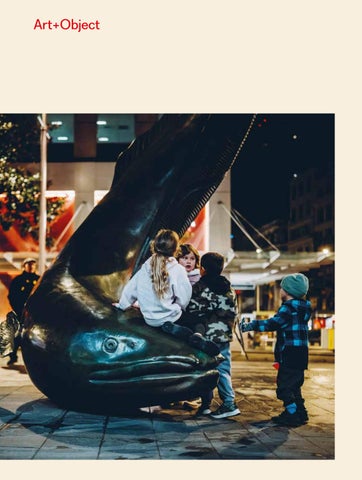
Cover: Chris Bailey and Sally Smith, tuna kūwharuwharu (longfin eel), installed on the intersection of Victoria and Queen Streets, Auckland. Image by David St George and appears courtesy of Te Kaunihera o Tāmaki Makaurau Auckland Council. Page 1: Lot 64, Louise Henderson, Jerusalem (detail), 1957
Important Paintings & Contemporary Art
PREVIEW Wednesday 18 November, 5–7pm 3 Abbey Street, Newton, Auckland
AUCTION Tuesday 24 November at 6pm 3 Abbey Street, Newton, Auckland
VIEWING Thursday 19 November
9am–5pm
Friday 20 November
9am–5pm
Saturday 21 November
10am–4pm
Sunday 22 November
10am–4pm
Monday 23 November
9am–5pm
Tuesday 24 November
9am–2pm
(lots 1–36) 1
Shane Cotton Stelliferous Biblia No. 29 acrylic on canvas title inscribed, signed and dated 2001 verso 357 x 357mm
The Collection of the Random Art Group, Waikato
$6500 – $9500
2
Shane Cotton Stelliferous Biblia No. 33 acrylic on canvas title inscribed, signed and dated 2001 verso 357 x 357mm $6500 – $9500
24
3
Fiona Pardington Huia Love Triangle gelatin silver hand print, edition of 5 (2006) 430 x 567mm $16 000 – $25 000
4
Anne Noble Dead Bee Portrait No. 2 pigment print on archival paper, 2/10 title inscribed and signed on original Two Rooms Gallery label affixed verso 740 x 988mm $5000 – $8000
25
5
Gretchen Albrecht Garden No. 14 acrylic on canvas signed and dated ’71; title inscribed on original catalogue label affixed verso and inscribed Cat No. 16 1510 x 1335mm $100 000 – $150 000
Completing a Diploma of Fine Arts with Honours in 1964, Gretchen Albrecht initially exhibited figurative works characterised by heavily built-up impasto oil surfaces. The accelerated evolution of her practice over the next decade occurred in the context of American cultural influence in New Zealand during the Cold War period, her own life experience as the mother of a young child, and the internationalisation of local painting practices. Her adoption of acrylic paint in 1970 allowed her to dilute and manipulate pigment, creating fluid passages of colour that could spread across the canvas rather than remain confined within the boundaries of drawn forms. This approach brought her into dialogue with American Colour Field painters, particularly Helen Frankenthaler and Morris Louis, whose work demonstrated how colour itself could become the principal subject of painting. An exhibition of Morris Louis’s work at Auckland Art Gallery in October-November 1971 with a catalogue introduction by Rosalind Krauss (a notable part of a cultural diplomacy programme promoting American modern art overseas) was especially influential. The Garden paintings are distinctive in retaining an association with the natural world. Albrecht’s garden imagery emerged from close observation and the experience of working outdoors, where flowers, foliage, changing light and the seasonal rhythms of growth provided an inexhaustible source of visual stimulation. Her approach here is spontaneous and intuitive, allowing the movement of the brush and the interaction of pigments to suggest the energy of organic life, with green arcs in the middle of the painting suggesting the burgeoning of spring growth. In this respect, the work is not a picture of a garden, but an exploration of the sensations that the garden produces - exuberance, vitality, dazzling colour - and the constantly changing relationship between light and matter. By identifying her subject as a garden, Albrecht provides a point of departure for the viewer without prescribing a particular location or identifiable arrangement of plants. A garden can be understood as both a natural environment and a constructed space: somewhere in which organic growth is cultivated, ordered and shaped by human intervention. This tension between nature and artifice suggests that the experience of a garden might be communicated more effectively through colour and form than through literal description. It reflects her emerging interest in abstraction as a means of translating an experience of nature into an independent visual structure and conveys the visual and emotional qualities of a garden through colour, rhythm, movement and the organisation of pictorial space. Albrecht was part of a generation of artists seeking to establish a more adventurous and internationally informed approach to abstraction, at a time when New Zealand painting was still strongly associated with landscape representation and questions of national identity. Her work demonstrated that abstraction need not abandon the local environment. Instead, it could provide a more personal and expressive response to the particularities of place. Her subsequent move to Titirangi in 1972–73, close to the bush and the dramatic western beaches of Auckland, would further develop this interest in atmospheric colour and the experience of landscape.
Linda Tyler
26
27
6
Roger Mortimer Mercury Bay acrylic and metallic pigment on canvas variously inscribed 800 x 895mm $6500 – $9500
7
James Ormsby Waikato II ink and graphite on paper title inscribed, signed and dated 2008 950 x 1410mm $6000 – $10 000
28
8
Roberta Thornley Pair archival pigment ink photograph, 1/3 title inscribed, signed and dated 2009 on original Tim Melville Gallery label affixed verso 542 x 468mm $2500 – $3500
9
Roberta Thornley Wrinkle archival pigment ink photograph, 3/3 title inscribed, signed and dated 2009 on original Tim Melville Gallery label affixed verso 715 x 625mm $3000 – $4500
10
Roberta Thornley Catch archival pigment photograph, 1/3 title inscribed, signed and dated 2009 on original Tim Melville Gallery label affixed verso 542 x 467mm $2500 – $3500
29
11
Paul Dibble Soft Flow (Fantail over Waterfall) cast bronze, two parts, edition of two plus an A/P signed and dated 2010 470 x 270 x 140mm $18 000 – $26 000
12
Fred Graham Kotuku stainless steel on artist’s base 1300 x 1000 x 600mm $15 000 – $22 000
13
Greer Twiss Tumbling Albatross cast iron (2007) 1260 x 600 x 600mm $14 000 – $20 000
30
14
Lonnie Hutchinson Tarot Queen builder’s paper title inscribed, signed and dated 2013 verso 660 x 300mm $1500 – $2500
15
Lonnie Hutchinson Comb (Red) powder-coated steel (2014) 980 x 1100 x 200mm $10 000 – $15 000
16
Elizabeth Thomson Agriculture Study for Flight Test patinated bronze on gessoed board title inscribed, signed and dated 2007 verso 850 x 1050mm $12 000 – $18 000
31
17
John Pule Maleua oil, enamel, polyurethane and inks on canvas signed and dated ‘Liku 2016’; original Gow Langsford Gallery label affixed verso 1520 x 1520mm $45 000 – $65 000
32
18
Reuben Paterson I don’t understand why you won’t wear my knickers glitter on canvas title inscribed, signed and dated 2003 verso 1015 x 1015mm $14 000 – $20 000
19
Robin White Palm natural dyes and pigments on bark cloth 1000 x 540mm $13 000 – $18 000
33
20
Linden Simmons Untitled (Vulkanwolke) watercolour on Hahnemuhle paper title inscribed, signed and dated 2010 on original Tim Melville Gallery label affixed verso 478 x 360mm $1000 – $2000
21
Liyen Chong Scale of the Pyramid on the Reverse of the US 1$ Bill embroidered hair on cotton (2008) title inscribed, signed and dated 2009 on original Tim Melville Gallery label affixed verso 40 x 40mm $1500 – $2500
22
Liyen Chong Memory of Hat embroidered hair on cotton 60 x 60mm $1500 – $2500
34
23
Simon Kaan Untitled oil on board signed and dated 2009 verso 1065 x 870mm $6000 – $9000
24
Richard Lewer The Fairfield Bridge enamel on metal signed verso 495 x 495mm $4500 – $6500
25
Wayne Youle The world is kind of flat, and I’m kind of satisfied, but I’m not a one trick pony acrylic on canvas title inscribed, signed and dated 2010 verso 1520 x 1010mm $8000 – $14 000
35
26
Gordon Walters Painting No. 7 silkscreen print on archival paper, 10/100 title inscribed 740 x 548mm $5000 – $8000
27
Gordon Walters Untitled (1978) screenprint on archival paper, 51/100 original Walters Estate chop mark; dated 2018 on catalogue label affixed verso 1065 x 800mm $5000 – $8000
28
Peter Robinson Untitled felt and wood 810 x 50 x 50 mm $1500 – $2500
36
29
Joanna Braithwaite Bush Ranger oil on canvas title inscribed, signed and dated 2011 verso 600 x 700mm $5000 – $7500
30
Martin Poppelwell Study for Jugs for All oil on linen canvas title inscribed, signed and dated ’07 – ’08; title inscribed, signed and dated verso 1120 x 1065mm $8000 – $12 000
37
31
Tim Croucher Gulf No. 3 acrylic on shaped canvas title inscribed, signed and dated 2013 verso 1490mm: diameter $1000 – $2000
32
Cathy Tuato’o Ross Reason: Shame hand-painted gouache on pigment photograph title inscribed, signed and dated 2019 verso verso 492 x 407mm $800 – $1200
33
Paul Martinson Electric Forest Dream III gouache and watercolour on paper title inscribed, signed and dated 2014 685 x 983mm $2000 – $4000
38
34
Mia Hamilton Form over Function knitted wool, five parts 300 x 430 x 300mm: overall (variable) $1000 – $2000
35
Matthew McIntyre Kete woven copper 240 x 475 x 50mm $3000 – $5000
36
Casey Moore 1936 Fantail Stamp fibre-based gelatin silver print 800 x 645mm $1500 – $2500
39
37
Yona Lee Succession No. 8 stainless steel, light shade and electrical fitting (2020) 640 x 500 x 400mm Exhibited ‘Yona Lee: Succession’, Dunedin Public Art Gallery, 22 February – 25 October, 2020. Provenance Private collection, Auckland. $15 000 – $22 000
38
Kate Newby See the sky about to rain glass, wire and rope, seven parts (2016–2017) dimensions variable: longest element 500 mm Provenance Private collection, Auckland. Purchased from Michael Lett. $10 000 – $16 000
40
39
Francis Upritchard Ghost Amelia kiln-dried lime wood and kilndried maple stand (A/P 1/2, from an edition of 5) title inscribed, signed and dated 2010 to underside 665 x 160 x 160mm Provenance Private collection, Auckland. $15 000 – $22 000
40
Francis Upritchard Clan of Rob kiln-dried lime wood, A/P 1/2 420 x 325 x 380mm signed with artist’s initials F. U to underside Provenance Private collection, Auckland. $15 000 – $22 000
41
41
Dale Frank The no win scenario was a jackpot at a safe distance varnish on linen canvas signed and dated 2010 verso 2000 x 2600mm Provenance Private collection, Auckland. $80 000 – $120 000
42
Barry Lett Alert Dog rough sawn wood and acrylic paint, edition of 6 (2003) 490 x 410 x 130mm Provenance From the collection of the artist’s estate. $6000 – $10 000
43
Barry Lett Woman and Child rough sawn wood and acrylic paint title inscribed, signed and dated 1996 verso 1470 x 700 x 300mm Provenance From the collection of the artist’s estate. $10 000 – $16 000
44
44
Barry Lett Large Standing Dog steel armature, fibreglass, paint, edition of 3 (2005) 1070 x 1660 x 540mm Provenance From the collection of the artist’s estate. $20 000 – $30 000
45
45
Julian Dashper Renovation at Silverdale acrylic, watercolour, pastel and collage on paper title inscribed, signed and dated 1987 verso 800 x 1200mm Provenance Private collection, Waikato. Purchased from Webb’s, Auckland, 3 April 2001, Lot No. 181. $10 000 – $16 000
46
Peter Robinson Mmmmmm oilstick and charcoal on paper title inscribed, signed and dated 2009 on original Coastal Signs label affixed verso 2000 x 1400mm Provenance Private collection, Auckland. $20 000 – $30 000
46
47
Yvonne Todd Clemence HD digital video, 11:12mins looped, on framed 55” LED flatscreen television, 1/3 (2015) 1235 x 710mm Provenance Private collection, Auckland. Purchased from Ivan Anthony Gallery, Auckland. $12 000 – $18 000
48
Reuben Paterson Orca glitter on canvas title inscribed, signed and dated 2014 verso 2000 x 2000mm Provenance Private collection, Auckland. $25 000 – $35 000
47
49
Fiona Pardington Huia Lovers gold-toned gelatin silver hand-prints, diptych, edition of 5 (2004) 565 x 440mm: each part $25 000 – $40 000
48
50
Fiona Pardington A76460 inkjet print on Hahnemühle rag paper, 5/10 title inscribed, signed and dated 2019 verso 1060 x 800mm Provenance Private collection, Auckland. $17 500 – $25 000
51
Fiona Pardington Portrait of a Life Cast of Matoua Tawai, Aotearoa, New Zealand, 2010 inkjet print on Hahnemühle paper 1445 x 1085mm Provenance Private collection, Auckland. $20 000 – $30 000
49
52
Gordon Walters Study for Auckland City Art Gallery Poster ink on paper title inscribed, signed and dated 17. 11. 82 and inscribed No. I, not used 775 x 550mm Provenance Private collection, Otago. Purchased from Art+Object, June 14, 2007, Lot No. 14. $50 000 – $75 000
To translate means many things, among them: to circulate, to transport, to disseminate, to explain, to make (more) accessible’ (Susan Sontag). Gordon Walters worked all his life to translate and pay tribute to the forms of traditional Māori art. His 1983 retrospective show at the Auckland City Art Gallery marked the first time a New Zealand audience got to see the full amazing results of Walters’ patient and solitary development of his oeuvre; in particular his thoughtful, painstaking, ingenious and respectful translation of the kowhaiwhai. For, notoriously, he did not exhibit his work at all for a period of 15 years for fear of the local scorn of abstraction. This impressive black and white ink drawing is a preparatory study for a poster for that 1983 exhibition (in the event not used); it is a kind of summary of Walters’ work with the koru up until that point. It also reflects his sophistication and knowledge as a graphic designer (for Te Ao Hou, New Zealand School Journal and Landfall among others). For viewers familiar with Walters’ black and white koru works, and used to an array of even-sized koru elements set out in parallel rows, this drawing with its four large koru balls mixed with smaller elements, several pushed to the edges of the composition, may seem anomalous. But for Walters the koru series was an on-going testing, at times refining and repeating a chosen arrangement, at others pushing the compositional limits already immanent in the originals of the forms he chose. The koru is used to form a table in a mathematical sense: a matrix: an array of elements set out in rows or parallel columns which may be used to generate one set of signals from another. The mechanics of the production of each image indicate this: Walters literally cut out versions of the motifs on paper; he then juggled these paper forms to achieve what he felt were convincing relationships of proportion and scale. This procedure involved a kind of ‘assemblage’ that allowed different threads and different lines of sense and force to come together in new combinations and then to separate out again. We can imagine him here shifting and ‘collaging’ the elements of this very drawing. This is not to imply his practice was deterministic or ‘calculating’ for, as Walters himself notes, his ‘feeling alone dictates the placing of the motif’. With its perpetual dance between figure and ground, its related elements inside the composition, and outside with other members of the koru series, this drawing announces – as a good poster should – the many voices with which Gordon Walters still speaks to us.
Laurence Simmons
50
51
53
Shane Cotton 1995 – Revisited oil and acrylic on canvas title inscribed and signed; title inscribed, signed and dated 1995 – 2002 verso 775 x 1362mm Provenance Private collection, Manawatu. Purchased from Gow Langsford Gallery, 16 December 2017. $100 000 – $150 000
Shane Cotton’s 1995 – Revisited, an oil and acrylic painting in burnt sienna, was begun in Palmerston North when the artist had recently left secondary teaching and became a lecturer at Putahi-a-Toi, the Māori Visual Arts Programme at Massey University where scholar Robert Jahnke was Head of Department. Cotton was to remain working there for the next 13 years, immersed in research as an academic which led to many series of works investigating Māori and European histories in Aotearoa New Zealand, particularly those related to his own iwi in Northland, where the Ngāpuhi, Ngāti Rangi, Ngāti Hine and Te Uri Taniwha artist now lives.
the Ngāpuhi chief Hōne Heke Pōkai (1808–1850) spent his last years travelling around volcanic strongholds such as this one. Evident in the overhead banner are the shapes of a diamond, a heart, a cross and a star, symbols which blend traditional Māori spiritual concepts with adapted Christian iconographies to represent sovereign power, suffering, and divine protection. These shapes were deployed by Māori leaders who led movements to resist colonisation and are also found in the work of contemporary artist Para Matchitt (1933–2021). Cotton’s work features a flag labelled “Te Wepu” (meaning ‘the whip’), a reference to a long, thin and triangular nineteenth-century Māori battle flag, sewn by Napier nuns for a local Ngāti Kahungungu rangatira, but captured by Te Kooti Arikirangi (1832–1893) in 1868. Two years later “Te Wepu” was seized by Gilbert Mair in 1870, who copied its design in an ink drawing before depositing the flag in the Colonial Museum in Wellington. “Te Wepu” was frequently referenced in Matchitt’s work.
At its centre, this painting features Maungaturoto, a 282-metre-high basaltic scoria cone, part of the KaikoheBay of Islands volcanic field, which is where a Māori pā was situated (maunga for mountain, tū for to stand, and roto for lake or lagoon). Famous for protesting British authority by cutting down the flagstaff at Kororāreka, Cotton’s ancestor,
52
The insertion of numbers (and even a television aerial) erected on platforms dug into the mountain’s contours introduces another layer of meaning. Numbers suggest measurement, classification and the systematic ordering of territory. They evoke the processes of surveying and mapping through which European settlers transformed the landscape into parcels of privately owned property. Cotton repeatedly interrogates the differences between Māori and European understandings of land, particularly the colonial systems that imposed new boundaries and ownership structures upon an existing cultural landscape. For Māori, whenua is not simply a commodity to be surveyed, divided and owned; it is fundamental to whakapapa, identity and collective belonging.
oil and acrylic also contributes to the layered character of the image, in which the landscape becomes a surface for the accumulation of signs and meanings. Reworked in 2002, the 1995 painting gained another dimension. It’s new title 1995-Revisited suggests an act of looking back, reconsidering or reassessing an earlier moment. Given the importance of 1995 in Cotton’s exploration of Māori land rights and the politics of the Treaty settlement process, the title invites consideration of how historical events continue to resonate in the present.
Linda Tyler
Historical associations are reinforced by the predominantly brown tonality of the painting. Its earthy, muted surface evokes aged documents, archival material and the appearance of something recovered from the past. The combination of
53
54
Tony Fomison Head of Christ after Morales oil on canvas laid onto board signed and dated 28. 7. 70 – 4.8.70, 17.8.70 and inscribed Rolleston, Christchurch 305 x 230mm Provenance Collection of John Quilter of Quilters Bookshop, Wellington. $150 000 – $250 000
This small head of Christ, started in a prison cell in Rolleston in 1970, had its beginnings four years earlier in a bedsit in Battersea. There, in October 1966, Tony Fomison made his own version of a painting by the sixteenth-century Spanish painter Luis de Morales. He was on the brink of a breakdown – within months he would be in Banstead Hospital – yet there was something in Morales’ Ecce Homo, ‘Behold the man’, that held him. The words are Pilate’s, in John’s Gospel, as he presents Christ to the crowd, crowned with thorns; the reed in painters’ versions comes from Matthew, where the soldiers give it to him as a mock sceptre. It is the moment Christ is put on display, a prisoner of the authorities. Fomison was not a believer: he thought Jesus a profound philosopher, a scapegoat for the religious powers, and said he painted him every Easter because Christ was ‘a convenient victim’. What he wanted from Morales’ image was the force of its grief, its promise of transcendence – without the belief. When he finished his version, he said it was the first piece he had been satisfied with in about two years. It marked a turn away from the gestural paintings of his art-school years towards form built out of light and shadow, the careful modelling that would define his work. The image clearly mattered to him. Over the next four years he painted it six more times, rarely the same way twice. Some versions he gave to friends. Christchurch sculptor Llew Summers’ was among the most closely cropped – nothing but the face and its crown of thorns – and Summers hung it high on his bedroom wall, where an icon might go. The present painting, the sixth, opens the frame out again. Morales’ reed returns, but as a bulrush, growing up the right edge rather than held as a sceptre, and a hand lies along the lower edge, free of the rope in the original. The modelling is deeper, the background sinks into black, and the thorns are picked out in flat gold. It is the most fully worked of the series. Where Morales’ Christ lifts his eyes, blood running from beneath the thorns, Fomison’s are shut, the head bowed and tilted slightly away, as though the man on display has withdrawn from the crowd, and from us. The painting is inscribed ‘Rolleston 28.7.70–4.8.70’ and, below, ‘Christchurch 17.8.70’: it was begun in the final weeks of a six-week sentence for opium possession, and finished after he walked free. A month later he painted the seventh, a replica of the first, for Phillip and Chan Woollaston – Phillip had visited him in prison – and with that the series came full circle. In the years that followed, Fomison moved from Christian imagery towards gods of his own imagining – guardians and watchers brooding over the land. But what remained was the stillness he had found in a bedsit in Battersea – never quite at rest, as if his figures were holding their breath. In the winter of 1970, in a cell in Rolleston, it was what he went back to.
Mark Forman
54
55
55
Brent Wong Siren acrylic on board signed and dated 1970; title inscribed, signed and dated verso 910 x 1220mm Provenance Private collection, Auckland. Collection of Ron Sang, Auckland. Purchased from Webb’s, 21 September 2004, Lot No. 40. Private collection, Auckland. Acquired in October 2012. $300 000 – $450 000
Brent Wong was born in Otaki in 1945 but, apart from a brief and traumatic sojourn in Hong Kong as a child, grew up in inner city Wellington, on Vivian Street between Cuba and Taranaki Streets, where the family business was situated. His father was Chinese, albeit raised in California; his mother was Pakeha; they met in Whanganui. Apart from a couple of months at Wellington Polytechnic, he was self-taught. Early drawings explore architectural themes, including views through windows of the Victorian and Edwardian ornaments he saw on the buildings around where he lived. At some point in the later 1960s he began suspending these, and other figures, in a blue sky above an arid landscape. His inaugural show, in 1969, was a revelation. Those first paintings are both serene and disturbing. The landscapes are unpeopled, though they often include old wooden houses from which the paint on the roofs and walls has faded; the devices in the sky, meticulously rendered, are enigmatic and vaguely threatening; while the blues are heavenly. In 2025 Wong told Megan Dunn that they were painted in the spare room at his sister’s place on nearby Ghuznee Street. He said that, during this period, he was taking anti-depressants, drinking black coffee and smoking cigarettes, crouched down at the easel, painting for hours on end. He wasn’t eating properly, sleeping badly, anxious about money, and suffering from terrible headaches. A perfectionist, he could spend three years painting layer after layer of the acrylics he favoured, one upon the other, until he was either satisfied, or abandoned the work (he has Exhibited abandoned works). It seems likely that he was not addressing an audience so much as engaging in a therapeutic process that might or might not produce a saleable work. If so, it worked; soon he was painting abstracts which, pace Walter Pater, ‘aspire to the condition of music’. By 2008 he had stopped painting altogether and was composing instead. Siren, dated 1970, is one of those early works. In this painting the ominous object, a sunlit pearly grey, floats on a blue sea, beneath a blue sky, off a sandy cove which resembles those of Terawhiti, on the coasts south and west of Wellington. We can see in the foreground the rusty corrugated iron roof of a house, jammed between two cliffs, behind an open gate, and what might be an oil drum and a couple of railway sleepers protruding from the earth of a nearby hillside. A solitary twig pokes from the sand where, perhaps, a stream once ran down to the driftwood on the shore; while the reddish rocks in the strata beneath the dry brown grass, if it is grass, are scrupulously detailed. Given the title, it is impossible not to think of the episode in The Odyssey during which the hero has himself tied to the mast of his ship so that he might listen to the songs the sirens sing, otherwise fatal to all who hear them. Wong told Megan Dunn that the houses were images of himself, and also that ‘there’s something about blue, you can look endlessly at it, it has a depth and a spirituality, the infinite.’ He did not say what the complex objects signified; Dunn suggests they are ‘new circuits’ replacing those which have become redundant or outworn. It is not beyond the bounds of possibility that the one in this work, at least, represents the ineffable songs that Odysseus heard, which Brent Wong now attempts to express in the music he composes.
Martin Edmond
56
57
58
56
Colin McCahon Black and Red enamel on board signed and dated April ’61; title inscribed verso 1220 x 765mm Exhibited ‘An Exhibition of Recent Paintings by Colin McCahon’, 31 August – 15 September 1961. ‘The Gate Series by Colin McCahon’, Durham Street Gallery, Christchurch, 9–19 September, 1962. Reference Colin McCahon Database (www. mccahon.co.nz) cm001196. Provenance Private collection, Auckland. $300 000 – $400 000
When Colin McCahon moved house, which happened fairly often during his 45 year career, there was often a gap of months before he resumed painting, as when he moved from Christchurch to Auckland in 1953, and again from Titirangi to Newton in 1960. In the latter case the gap was exacerbated by controversy surrounding his being jointly awarded first prize in the inaugural Hay’s Competition of that year for Painting (1958, Fletcher Trust), his most severely abstract painting to date. He told Charles Brasch: ‘No painting to report[;] am having a long dry spell. For the first time ever I have been really depressed with constant bad reviews’ (30 November 1960). The main difficulty was that despite derision in the newspapers this was the direction he now wished to follow. However, doggedly sticking to his guns (he was nothing if not courageous), McCahon persisted and found his mojo again in the majestic and innovative Gate series of 1961 – first shown at The Gallery, Symonds Street (later called Ikon Gallery) in 1961 and later (with additions) in Christchurch in 1962. Black and Red was in both of these exhibitions. Two contrasting factors facilitated these paintings. First was McCahon’s exploration of abstract art in the galleries and museums of the United States for four months in 1958, being exposed there (in the flesh rather than in books and magazines) to Mondrian, Malevich, Hans Richter, Rothko, Newman and Kline, among others. He called one of the key Gate series paintings Here I give thanks to Mondrian (AAG, 1961), painted a month before Black and Red. The second factor was moving to Newton in central Auckland. In 1969 McCahon wrote of Here I give thanks: ‘The painting reflects the change I felt in shifting from Titirangi with its thick native bush and the view of French Bay to that of the urban environment. This picture belongs to a whole lot of paintings that were, believe it or not, based on the landscape I saw through the bedroom window’. (ACAG Quarterly, No. 44, 1969, p. 13). Later he commented: ‘The compositions all come from a tree outside our bedroom window, and inner city roofs’ (A Survey, 1972, p. 29). On the face of it the influence of abstraction as seen in America is much more evident in paintings such as Black and Red than any cityscape influence. We have to take his word for that. In Black and Red, as in most of his Gate paintings, geometric forms and colours (primarily black, red and pale ochre in enamel paints), are distributed irregularly around the rectangular space of the hardboard support. Dark oblong or rectangular shapes press into the picture space at oblique angles to the vertical and horizontal edges and are cropped by the frame of the picture, as if they extended beyond it. Space in the picture is made ambiguous by the absence of any horizon and further by the ‘corners off’ triangulation at lower left. Figure and ground are rendered uncertain. Some edges are hard, as if ruled or created by masking-tape, while others are soft or blurred such as the grey stripe extending to the right edge of the picture that sits on top of the oblong shape – divided from corner to corner into black and red triangles –which gives the painting its title. In such pictures McCahon seemingly ‘gives thanks’ by completely ignoring Mondrian’s exclusive adoption of primary colours and a regularly gridded structure. In Black and Red verticals and horizontals are strictly avoided. Formal and colour relationships are dynamic and asymmetrical and to some extent disorienting and disconcerting (though also beautiful and absorbing) to the viewer, who searches in vain for a harmony either lost or yet to be attained. It’s as if a known and orderly world has somehow gone awry – perhaps for political, spiritual or social reasons – and the painting is part of an attempt (fascinating to engage with) to put Humpty together again.
Peter Simpson
59
So The Last Waterfall is definitely an outlier in terms of chronology, and in several other respects too it differs from almost all other works in the Waterfall series: in shape, dimensions, support, medium, imagery, colour and style.
57
Colin McCahon The Last Waterfall
As noted above, the shape and dimensions of the work were obviously governed by the size of the wardrobe door on which it was painted. There is even a shape to the upper left of the painting which references the hand-hold for the sliding door. Only one other Waterfall painting was comparably tall and (relatively) narrow – a work now in Auckland Art Gallery of similar dimensions (cm000670). It is also painted in newly available acrylics, not oils.
synthetic polymer paint on board (1972) 1830 x 942mm Provenance Private collection, United Kingdom. Purchased from FHE Galleries, Auckland, circa 1995. Collection of the artist’s friend and author, Gordon H. Brown. The two first met in 1952 and Brown went on to write the landmark publication Colin McCahon: Artist (1984). Purchased along with the artist’s house from Colin McCahon in 1985.
In terms of the imagery and internal structure of the work, The Last Waterfall is also somewhat unusual in that, unlike the vast majority of McCahon’s waterfall works, the falling water does not inscribe a graceful curve (some from left, some from right) but is instead a vertical shaft, gradually widening from top to bottom. The effect is somewhat reminiscent of the vertical zip in a Barnett Newman colour-field abstract. Not that such vertical falls are unknown within the Waterfall series; there are at least a dozen other examples, some small, some large. Brown tells the story of viewing with McCahon such a fall in Whakatane and of their both being struck by the words of a bystander child saying, ‘Oh look the water’s standing up!’ Such vertical structured waterfalls also anticipate a 1971-72 series entitled Light falling through a dark landscape.
Reference Colin McCahon database (www.mccahon. co.nz) cm001190. $300 000 – $450 000
Colour is another factor in which this painting is divergent. Most of McCahon’s waterfall paintings depend for their effect on a strong contrast between, dark and light, white and black – the falling water being brightly contrasting with the dark cliffs or rocks down which it falls. In a well-known comment McCahon remarked: ‘I look back with joy on taking a brush of white paint and curving through the darkness with a line of white’ (A Survey, 1972).
In the catalogue for his 1972 Survey exhibition at Auckland Art Gallery Colin McCahon wrote: ‘The waterfalls started flowing in 1964 and there were hundreds of them…’ This was something of an exaggeration as on the McCahon website there are a few more than 100 known works listed in the Waterfall series. More than 80 of them are dated 1964, while a scattering was added in the years 1965-67. However, there were a couple of aberrant outliers, one early and one late. The First Waterfall dates from 1956, though rather confusingly there was a second of that name painted in 1964 as if McCahon had forgotten all about the 1956 work. And The Last Waterfall, as offered in this sale, dates from 1972, years after the main series had ended.
In The Last Waterfall, however, such strong contrast is avoided; the cataract is painted in various shades of ochre and brown, executed so as to suggest variations in movement and light on the moving water. The effect is not static but kinetic. The surrounding rockface is in darker shades of brown, and not matte in texture but brushy and atmospheric. The effect depends less on contrast than on more subtle orchestration of subdued harmonies and colour relationships. The painting is a kind of visual symphony in a concatenation of browns.
The Last Waterfall was made under very particular circumstances. It was painted on the sliding door of a wardrobe in the small house the McCahons had built for them at Muriwai in 1972 where Colin had already constructed for himself a large studio in 1969. It is these conditions which determined the size and shape of the painting. The details are known through the late Gordon H. Brown, the art writer who wrote the seminal Colin McCahon: Artist (1984, 1993), and who purchased the Muriwai house (and the wardrobedoor painting) from the McCahon family in 1985. Brown remembered first seeing the painting when he visited at Muriwai in 1973.
Peter Simpson
60
61
Art historian and curator Gordon Brown, January 2012. Photo: Jim Barr & Mary Barr.
In spring 1965, I accompanied McCahon to Whakatane. McCahon was involved in a weekend-school with the local Art Society. Our rooms in the hotel were above the public bar and as the noise from below interrupted the ease of our conversation we decided to go for a stroll. Within a short distance, a promontory juts into the town. From its cliff face descends a thin waterfall. As McCahon had temporarily abandoned his curved ‘Waterfall’ series and had begun painting waterfalls that descend in a vertical drop, this particular waterfall held relevant interest. As we stood watching, a woman with a young child stopped near us. “Oh look!” said the child, “the water’s standing up.” The innocence of this description struck us both, for its aptness was relevant to many of the waterfalls McCahon was then, and later, to paint.
McCahon had apparently painted the door quite early in 1972, more for relaxation, as a spiritual form of reaction against the stresses of an intense and worrying period of artistic activity. Such a re-visitation to an earlier theme, however, was not that unusual for McCahon; a temporary change being as good as a rest. Shortly after New Year 1985, I moved into the Muriwai house, having just purchased it from Mrs McCahon. For nearly nine years (other than when I was away working on projects or visiting friends) I woke with the ‘Waterfall’ panel in sight, even if I was not always fully aware of its existence. There is, however, no greater test for any work of art than to live with it over a prolonged period. In the shadowy light of the morning, waking up to its emerging visual presence, its shapes at first dimly perceived, its imagery simplified, your own imagination enhancing what the mind remembers and, in doing so, allowing the work’s totality to settle more firmly into the depths of one’s consciousness. Thus, over the years, nuances of tonal modulation, of hinted-at colour, the flexible shape of seemingly fixed images and the ambiguity of what the light absorbing, falling water represents as it cleaves the dark expanding rock face over which it glides and occasionally splashes against, become mobile elements that continually renewed the panel’s validity as a perceived work of art; always cohesively static, yet expansively alive in time.
The description is certainly applicable to this, probably the last ‘Waterfall’ McCahon painted where a waterfall is the sole subject. The panel on which it is painted originally formed part of a double-sliding door-system for a built-in wardrobe in the bedroom of McCahon’s small, second house, situated on the inland edge of the Muriwai beach settlement. Halfway through October 1972 the house was up, but as the sub-contractors lagged behind, it was well into November when the McCahons moved in. At the end of the year I travelled north from Dunedin and, with work to do in Auckland, stayed with the McCahons. We drove to Muriwai Beach to spend the long Christmas and New Year weekends in the house. Even with the bedroom in use, and with no more than a brief look, I am sure I would have recalled seeing the ‘Waterfall’ wardrobe door had it been painted by then. It was not until the following October that I again visited Muriwai, this time just with Colin and for the day only. And there, in the bedroom, the ‘Waterfall’ stood tall.
Gordon Brown January 1995
63
58
Colin McCahon Northland oil on canvas signed and dated 11.9.62 885 x 885mm Provenance Private collection, Auckland. Purchased by the current owner from Webb’s, Auckland, 30 March 2009, Lot No. 39. Reference Colin McCahon database (www.mccahon.co.nz) cm000635. $250 000 – $350 000
Colin McCahon’s mature style was already well-established when he made this striking work in 1962. The intense involvement with biblical narrative seen in the Elias works of the late ‘50s was temporarily behind the artist, replaced by an equally immersive preoccupation with formal concerns, notably stimulated by the paintings of Mondrian and his abandonment of the conventional picture plane. This prolonged investigation resulted in McCahon’s famous Gates series of 196162, in which the artist very consciously explored various methods of upsetting the pictorial window-frame, while continuing to address his visceral response to the essential landforms of New Zealand. Northland belongs stylistically as much with the Gates works as with the closely related Northland series, and is powered by a strong motivation to find non-traditional perspective techniques. As with other works of this period, McCahon is ‘coming at’ the land from an off-centre angle, as though swooping down from above. This is a theme he had previously explored in a commission from Tasman Empire Airways Ltd (TEAL), and here there is definitely a feeling of the flyover treatment. The orientation of the viewpoint, or the angle of the viewfinder, to put in another way, changes radically from work to work during this period of McCahon’s production, as the artist grapples mightily to wrestle the grandeur of the landscape into his frames. In fact the angle of approach is always very carefully considered in McCahon’s oeuvre, whether the subject is landscape or figurative, and is never haphazard. It is fascinating to see how, through a sequence of works like the Gates series, the artist takes a variety of angled approaches to the subject in the frame, sometimes sharply inclined as though banking in an aircraft, at other times pulling up squarely and re-orientating his viewfinder so it’s level and front-on to the horizon. This pilot-like engagement persists throughout the mature period of McCahon’s work, but it emerges most boldly during the breakthrough years of the late ‘50s and early ‘60s, when he effectively restructured his whole vision and performance to find new ways to express the impact of the land on his psyche. In this important work, looming and luminous hill forms, emerging from the blackness of a possibly moonlit scene, evoke a sense of abstract, natural forms, encountered in the setting of Northland hills at night. The low, spectral lighting reduces the hills to their most elemental geometry, suggesting planetary phenomena, while the collateral absence of any human traces emphasizes the loneliness of the narrow, high peninsula suspended between two oceans, rugged earth, and ominous sky.
Oliver Stead August, 2012
64
65
59
Imi Knoebel (Germany, 1940–) Pure Freude No. 21 acrylic on aluminium signed and dated 2001 verso 1600 x 1150mm Provenance Private collection, Auckland. $55 000 – $85 000
66
60
Callum Innes (Scotland, 1962–) Exposed Painting: Ivory, Black, Gold, Green oil on linen signed and dated 2007 verso 1750 x 1705mm Provenance Private collection, Auckland. $40 000 – $65 000
67
61
Milan Mrkusich Fire of Eternity oil on canvas signed and dated 62–20; title inscribed, signed and dated 1962 verso 1070 x 865mm Provenance Private collection, Auckland. Purchased by the current owner from Webb’s, Auckland, circa 1989. $100 000 – $150 000
From 1962 to 1964, Milan Mrkusich worked on a series of paintings he called Emblems, of which Fire of Eternity is one of the finest examples. He introduced circles, squares, isolated lines, and parallelograms over freely brushed areas. The works were very different from the gestural paintings that had occupied him during the previous two years. Mrkusich now launched a greater degree of calculation into his work via the positioning of hard geometric and linear elements. It has been suggested that he was aware of the work of American painter Jack Tworkov, who at the same time explored the opposition between intellectual calculation and gestural techniques. Tworkov co-founded the New York School of Abstract Expressionism and had initially painted with dense, gestural, and expressive brushwork. However, by the late 1960s, Tworkov grew fatigued by the romanticism of the expressionist brushstroke. He radically pivoted toward highly disciplined, rule-based, and gridded geometric abstractions heavily influenced by mathematics, chess, and the Fibonacci sequence. Likewise, Mrkusich’s early gestural painting attempted to free itself from purely emotional or ‘transcendental’ meanings now giving structure to the formless. He continued to use the fluid brushwork that characterised his earlier work from 1960, but now each colour area is bound within a tight compositional frame, and note it is a frame, rather than allowed to spread. The formality of the frame deliberately jars with the free-handed painterliness, the visceral colour, prehensile line and insinuative brushwork of the interior. In Fire of Eternity the carefully curated frame of gold squares and circles surround and contain a void. There is a hole in the middle of this painting but it is not an empty void. Rather blasts of pure chroma and kinetic squiggles in layered impastoes of glowering colour quietly struggle with the defining problem of pictorial representation — the reduction of three dimensions to two. The tones vary from shouts (the light blues and greens of the upper centre) to whispers (the dark blues and red flickers of the lower source of the fire). Fire of Eternity with its apocalyptic title, retains the violence of Mrkusich’s early gestural works. The phrase ‘eternal fire’ (Greek: pyr aiōnion) in the Bible refers to divine judgment, punishment, or destruction with everlasting consequences. St Augustine, whose City of God we know Mrkusich read, addresses the concept of ‘eternal fires’, primarily in Book XXI, where he defends the reality of literal, everlasting bodily torment for the damned. As with much of his later work, Mrkusich brings to everything an attitude of formal rigour but it has become apparent over the years that plenty of emotion, like banked-up fire, underlies his compositions. The composition of Fire of Eternity is deliberately split between a tumultuous interior and a geometric frame and thus it opens up a schism into which we either look or fall (as if into the ‘fire of eternity’?) — or perhaps both. An important part of the meaning of the painting is the fact that within the process of looking, the surface becomes ambivalent and the viewer is left uncertain, off balance. This is modernism experienced as a moment of simultaneity — we might say that abstract expressionism and geometric minimalism collide. The notion of a sequential history also collapses. Mrkusich does not move sharply from one style or period to the next. Here one can observe a new way of working emerging out of the old. In looking at Fire of Eternity, one can see Mrkusich moving away from the influence of the often violently worked canvasses of American abstract expressionism towards a more linear style, which — one can recognise in hindsight — is where his work had always been leading. In the case of this work, despite the gestural application of paint at its centre, an ‘emblematic’ geometric structure is already discernible at its edges. What links the two is touch. Mrkusich was later to confess in 1976 that in his painting ‘The surface density comes about from the artist’s touch, and the touch is, to my mind, the most important thing in art. It provides the identity of the work and the identity of the artist. The surfaces […] and their uniqueness, I think, is my own uniqueness, which has been brought about from the painting I’ve done over a number of years and arriving at a solution to all the problems I’ve had.’ Rather than look at this painting you almost watch as if some ultimate secret were in the offing if you wait, not to be missed when it reveals itself. Mrkusich has painted a zone of reality that is within reach yet cannot be touched, infusing vision with a delicate frustration of tactility.
Laurence Simmons
68
69
70
62
Bill Hammond Bird Table acrylic on brocade fabric (1994) title inscribed, signed and dated 1994 1000 x 1000mm Provenance Private collection, United Kingdom. Purchased by the current owner from Gregory Flint Gallery, Auckland. $80 000 – $140 000
This perfectly square 1994 painting by Bill Hammond, executed in acrylic on brocade, brings together two seemingly incongruous worlds: nine anthropomorphic, albatross-headed figures and a small, elegant Georgian piecrust table. The juxtaposition is characteristic of Hammond’s visual imagination, in which familiar conventions of human society are displaced into an unsettling imaginary world inhabited by hybrid creatures. Beneath the apparent simplicity lies a complex meditation on New Zealand’s natural history, colonial encounters and the relationship between humans and the environment. The nine figures stand as silent witnesses facing the table. One crosses his arm over his chest as if pledging his troth, another curls a tiny hand towards his armpit, while a third stands casually with arms at his sides. Arranged in an L-shape around two sides of the composition, they are individuals formed into a collective arrangement which evokes a gathering, congregation or audience, although their purpose remains ambiguous. Are they observing something, participating in a ritual or contemplating an object whose significance is beyond our understanding? Theirs is an imposing yet strangely passive presence with a stillness which lends the scene an air of solemnity. Their bird heads and human bodies collapse the distinction between animal and human, suggesting a mysterious evolutionary transformation. Following his 1989 expedition to the Auckland Islands, Hammond became fascinated by the birdlife of these remote subantarctic islands, especially the Southern Royal albatrosses nesting on Enderby Island. For Māori, the tōroa connotes beauty, strength and high status, however English poet Samuel Taylor Coleridge’s 1798 The Rime of the Ancient Mariner made the albatross a symbol of guilt. Carrying this dual legacy, bird-people in Hammond’s paintings inhabited an alternative Aotearoa in which the natural world appeared to have reclaimed its territory from the 1990s on. The Georgian pie-crust table introduces a historical reference. Characterised by its circular top and delicately scalloped, carved edge, this eighteenth-century English furniture form was commonly made from polished mahogany and associated with tea drinking and fashionable domestic entertaining. It embodied the refinement, prosperity and social conventions of Georgian life. Here, however, it appears almost absurdly out of place. The imposing bird-people face this diminutive object as though it possessed extraordinary importance, creating an enigmatic encounter between European cultural traditions and an imagined indigenous or pre-colonial world. Hammond’s choice of brocade as a painting surface further complicates this relationship. Associated with upholstery, curtains and bourgeois interiors, the richly patterned fabric introduces an element of domestic luxury. Rather than functioning as a neutral background, its ornamental character creates tension between European refinement and the darker implications of colonial history. Hammond frequently experimented with unconventional supports, including wallpaper and fabric, allowing their material associations to contribute to the meaning of his work. With characteristic wit and unease, Hammond reverses the conventional hierarchy between human and animal, making his bird-people the dominant presence and European furniture the curious object of their attention. What initially appears an eccentric or humorous gathering becomes a quietly unsettling reflection on colonisation, extinction and the fragility of cultural and natural inheritance.
Linda Tyler
71
63
Tony Cragg (United Kingdom, 1949–) Taurus cast bronze, edition of 5 (1998) 914 x 1067 x 1829mm Exhibited ‘Tony Cragg’, 20 March – 25 April, 1998, Paris, France. Illustrated David Batchelor, Lynne Cooke, Peter Schjeldahl, Tony Cragg: Signs of Life (Richter Verlag, 2003), Cat No. 392, p. 443. Barry Schwabsky, ‘Tony Cragg’, Artforum, October 1998, Vol No. 37, p. 122. Provenance Private collection, Sydney, Australia. Purchased by the current owner from Marian Goodman Gallery, Paris, 1998. $250 000 – $400 000
Very few artists have had a career as distinguished as Tony Cragg. Born in Liverpool in 1949, Cragg originally studied science and was trained as a laboratory technician. His father was an aerospace engineer. He has lived and worked in Germany since 1977, forging over decades a unique three-dimensional visual vocabulary which mines the fertile territory that exists in the space where the natural and industrialized worlds uneasily intersect. The artist has described himself as a ‘materialist’, and his early work utilized found plastics, glass bottles, metal waste and refuse, to investigate the aesthetic and formal possibilities of the everyday and the utilitarian. Transforming waste materials into valuable commodities served as a political critique of the Margaret Thatcher era in Britain, as well as undermining what the artist viewed as the conceptual dogma of land art and minimalism. The artist remarked: “I left Britain in 1977 at the beginning of the Thatcher period, and the destruction of the arts schools here, and a lot of other developments. It was a very extreme form of capitalism that paid no regard to the needs of the wider population.”
Turner Prize and represented Britain at the 42nd Venice Biennale. Around this time he began work on his ‘Signature Forms’ series in which the often-hollow vessel forms of his earlier works transformed into twisting, morphing visual forms which feel like metaphors for the human body and for existential struggle. Taurus (1998) is an excellent example of his trademark style. Taking its cue from one of the oldest and most recognizable constellations in the night sky, Taurus represents the Bull of Heaven, a giant creature that was slaughtered by Gilgamesh, the King of Uruk, to protect his people. Cragg represents the mythological bull as a mass of writhing, twisting and bulging form, in a state of flux. The sculpture, with its smoothly polished black-blue bronze wall, represents a frozen moment of movement and evokes visual forms as disparate as a mollusc shell, a breaking ocean wave and a rubber tyre turned inside out and rotated. Taurus appears to twist, turn, and perhaps to even yearn. Despite its solid mass of material form its materiality does not appear to be a stable thing. Its rest is an uneasy one.
In the 1980s the sculptor began to move away from found objects and the installation-based practice which announced his presence to the artworld, in favour of a wider range of more permanent ‘high art’ materials, such as wood, bronze, stainless steel and cast iron. In 1988 he was awarded the
Ben Plumbly
72
73
be depicted not from a single fixed viewpoint but rather as they are experienced through movement and successive observations. The painting, said Metzinger, should ‘nakedly present its raison d’être.’
64
Louise Henderson Jerusalem
Proof that Louise Henderson was a major figure in 1950s New Zealand art is the fact that Colin McCahon had chosen to write, for his first public appearance as a critic and theorist, a spirited review of her work. In the magazine Home and Building, he admitted that her works might seem strange at first. Yet we should look at them, so he suggests, ‘as the scientist looks at the minute world in a drop of water, prepared to accept the new aspects of reality, rather than turn away from discovery fearful that past theories may now be invalid.’ McCahon’s defense of Henderson is interesting on two counts: one, that he should use science to defend the incomprehensibility of the new cubism (which Henderson had studied in Paris and he was following here); and, second, his description of Henderson’s process as one in which forms are built up to create a new pictorial whole is, as Gordon H. Brown notes, a result of McCahon’s absorption of current theory which defined painting as the articulation of ‘architectural form’. It is the connection with architecture here (and Henderson’s subject matter in the Jerusalem series) that strikes us: for it is now apparent that in New Zealand while it was the literati who supported a tradition of nationalistic regional landscape painting, it was the architects here, like Imre Porsolt, who truly supported modernism. The 1950s were critical years of New Zealand art, when artists engaged with modernism not only to come to grips with their unique identity in New Zealand, but also to enter more fully into the discourse of modernity as it had evolved (and was still evolving) in Europe and America. For Henderson the impetus, as is so often the case, had initially been charged by the double stimulus of overseas study, and then the excitements and incitements of common endeavour with like-minded peers.
oil on canvas signed and inscribed Hebro N6 Galilee verso; title inscribed and dated 1957 on original Auckland Art Gallery Toi o Tāmaki label affixed verso 600 x 790mm Exhibited ‘Louise Henderson: From Life’, Christchurch Art Gallery Te Puna O Waihetū, 27 June – 11 October 2020. ‘Louise Henderson: From Life’, Auckland Art Gallery Toi o Tāmaki, 2 November 2019 – 8 March 2020. Provenance Private collection, Auckland. $45 000 – $65 000
Louise Henderson was born in Paris in 1902, from 1919 to 1921 she studied at l’École de la broderie et dentelle de la ville de Paris, graduating as a designer in 1921 and she was later employed to draw blueprints and write articles on embroidery design and interior decoration for the weekly journal Madame. After marrying a New Zealander, Henderson migrated to New Zealand in 1925. In 1952, she returned to Paris for a year to study under Jean Metzinger, one of the founders of the Cubist movement who had co-authored Du Cubisme in 1912 with Albert Gleizes, creating the movement’s first major theoretical text and public manifesto. In 1956 the Hendersons travelled to Beirut and the Middle East, where her husband worked for UNESCO as an advisor on compulsory education. Living among new cultures allowed Henderson to develop her figurative and architectural cubism and she produced a substantial body of highly accomplished artwork.
There exist interesting connections with Milan Mrkusich, for instance. Henderson worked on a commission, at the same time as Mrkusich (1959-60), for the Church of the Holy Cross in Henderson; in March 1965 she showed at the Ikon Gallery, Auckland, her abstract Elements: Air and Water alongside Mrkusich’s Emblems — an exhibition which then travelled to London, Brussels and Paris; and her third solo show was in the place which granted Mrkusich his first exhibition — the Architectural Centre, Wellington. And so there it is, ‘architecture’ again. Henderson had moved out of her loosely defined cubist phase by the middle of the 1960s. As dramatically as she had adopted a range of cubistderived strategies, she then moved into a period of painterly abstraction, which saw her terms of reference shift from Europe to America. But, as Francis Pound noted, ‘Henderson was in the nineteen-fifties right up there in the crisp, pure air, and vertiginous heights, with New Zealand’s best: with Walters, Mrkusich, and McCahon.’
Jerusalem (1957), one of her Jerusalem series, composed of rectangular shapes and forms drawn from ancient Middle Eastern architecture, is probably no. 6 given the inscription on the verso of the canvas (no. 4 is in the Auckland Art Gallery Toi o Tāmaki collection). Here Henderson edges the white shapes of mosques, churches and building walls in blue. Her tones are reduced: a brown ochre ground reminding us of earth, white buildings with shadow edges in blue. What appears at first as a jagged array of shapes — arcane contrasts between domes and verticals, and edges of discontinuity — begin to cohere as Henderson’s cubist forms start to lock into place. As they begin to achieve an architectonics. We start, that is, to see the stacks of buildings nested together as we progress up a hill, heavier and more dense at the bottom, lighter and smaller because more distant at the top, the guise of a hillside city in its fullness. Henderson’s painting thus illustrates the concept of ‘mobile perspective’ which Metzinger had introduced — the idea that objects should
Laurence Simmons
74
Gordon H. Brown, ‘The Pursuit of Modernism in the 1940s and 50s,’ Art New Zealand, no. 30, (Winter 1984), p. 29. Colin McCahon,’Louise Henderson,’ Home & Building, February 1954, pp. 40-41, 69. Francis Pound, ‘Louise Henderson: The Cubist Years,’ Art New Zealand, no. 61, (Summer 1991/1992), pp 62-67.
75
65
Ralph Hotere Oputae – Cut burnished and blowtorched baby iron with lead head nails in artist’s original frame title inscribed, signed and dated ‘Port Chalmers ‘89’ 805 x 627mm Provenance Private collection, Auckland. $90 000 – $140 000
76
66
Ralph Hotere Untitled acrylic and brolite lacquer on board signed and dated ’77 and inscribed for Alan Harris verso 585 x 590mm Provenance Collection of Yvonne and Alan Harris, Dunedin. Private collection, Auckland. Purchased August 2016. $45 000 – $65 000
77
67
Frances Hodgkins Spring watercolour and bodycolour on paper signed; artist’s name and title inscribed on original exhibition card affixed verso 570 x 590mm Exhibited 'Frances Hodgkins', Bloomsbury Gallery, London, United Kingdon, November 1929.
Literature Linda Gill, Letters of Frances Hodgkins (Auckland University Press, Auckland, 1993), p. 419. Reference Frances Hodgkins Database (www.completefranceshodgkins. com) Cat. No. FH1326. Provenance Private collection, Auckland. $65 000 – $85 000
78
68
Gretchen Albrecht Small Sea Painting acrylic on canvas title inscribed, signed and dated ‘73 on artist’s original label affixed verso 1130 x 850mm Exhibited ‘Women as Artists’, Zonta Club of Auckland, Auckland Society of Arts Galleries, 10 – 28 September, 1973. Part of the Convention Festival, planned to coincide with the Workers Educational Association (W.E.A), sponsored by the United Women’s Convention, 15–16 September 1973. An occasion marking the 80th anniversary of women’s suffrage in New Zealand. $50 000 – $70 000
79
69
John Pule Epilogue to a Winter’s Night oil, varnish, ink and enamels on canvas title inscribed, signed and dated 2011 1850 x 1850mm Provenance Private collection, Auckland. $60 000 – $80 000
80
70
Shane Cotton Papa Hurihia acrylic on canvas title inscribed, signed and dated 2020 verso 1500 x 1000mm $60 000 – $80 000
81
71
Allen Maddox Randy Grid oil and mixed media on canvas, triptych signed with artist’s initials A. M and dated 4. ’78; inscribed 3 Sacks, Randy Grid 1268 x 975mm: each panel 1268 x 2925mm: overall Provenance Private collection, Auckland. $80 000 – $120 000
82
83
72
Colin McCahon Night Fishing, French Bay monoprint title inscribed and signed 196 x 125mm Provenance From the collection of the film-maker, writer and historian Peter Wells (1950– 2019). Thence by descent to the current owner. $5000 – $8000
73
Colin McCahon Wood Bay graphite on paper title inscribed, signed and dated 1956 200 x 250mm Provenance From the collection of the film-maker, writer and historian Peter Wells (1950– 2019) . Thence by descent to the current owner. $14 000 – $18 000
84
74
Colin McCahon Nine ink and wash on paper signed and dated 1970; title inscribed, signed and dated verso 630 x 500mm Exhibited ‘Colin McCahon: Recent Paintings’, Gallery 91, Christchurch, 6–18 October 1959. Reference Colin McCahon database (www.mccahon.co.nz) cm001134. Provenance Collection of John Quilter of Quilters Bookshop, Wellington. $60 000 – $85 000
85
75
Sandy Adsett Ma Rua acrylic on canvas title inscribed, signed and dated 2005 verso 1015 x 1015mm $16 000 – $24 000
86
76
Shane Cotton Sun Portrait acrylic on canvas signed and dated 2019 1200 x 1000mm Exhibited ‘Sun Portrait’, Michael Lett, Auckland, 13 November – 14 December 2019. Provenance Private collection, Central North Island. $40 000 – $55 000
87
77
Terry Stringer Love in Bloom cast bronze, edition of 2 plus an A/P signed and dated 2016 2150 x 600 x 600mm Provenance Private collection, Auckland. $60 000 – $80 000
88
78
Terry Stringer Behold cast bronze, 2/3 signed and dated ’93 900 x 400 x 260mm Provenance Private collection, Auckland. $25 000 – $40 000
79
David McCracken Nice Round Figure stainless steel (2008) 1200mm: diameter Provenance Private collection, Sydney, Australia. $20 000 – $30 000
89
80
Robert Ellis Motorway Journey oil on board signed and dated 1970; title inscribed, signed and dated and inscribed B.L Ex No. 6 verso 896 x 890mm $50 000 – $70 000
90
81
Robert Ellis River Bend and City oil on canvasboard signed and dated ’64 905 x 700mm Provenance Private collection, Auckland. $25 000 – $35 000
91
92
82
83
Michael Smither Untitled
Michael Smither Portrait of my Aunt
oil on board signed with artist’s initials MDS and dated ’74 614 x 750mm
oil on board signed with artist’s initials MDS and dated ’71 304 x 918mm
Provenance
Provenance
Private collection, Wellington.
Private collection, Wellington.
$40 000 – $60 000
$45 000 – $65 000
93
84
Max Gimblett Shunryu Suzuki’s Light acrylic and vinyl polymer on shaped canvas title inscribed, signed and dated 2003 verso 1270mm: diameter Provenance Private collection, Auckland. $45 000 – $65 000
94
85
Max Gimblett The Secret Garden – After Graham Sutherland gesso, acrylic and vinyl polymers, epoxy, aqua size, Japanese blonde silver leaf on wood panel title inscribed, signed and dated 2014 verso 1524 x 1524mm Provenance Private collection, Auckland. $55 000 – $75 000
95
86
Dick Frizzell Large Still Life with Cheese Grater oil on board title inscribed, signed and dated 14/2/87 935 x 950mm Provenance Private collection, Wairarapa. Purchased from Jensen Gallery, 1997. $20 000 – $30 000
96
87
Dick Frizzell Country Butchery oil on canvas title inscribed, signed and dated 10. 9. 90 900 x 1200mm Provenance Private collection, Auckland. $35 000 – $50 000
97
88
Chris Bailey Te Wherowhero cast bronze, edition of 2 (the other edition belonging to the people of Waiheke Island and permanently installed on the island at Matiatia Wharf) 1850 x 1000 x 740mm $130 000 – $180 000
89
Gordon Walters Rauponga acrylic on paper artist’s name and date (15.2.74) on original catalogue label affixed verso 312 x 234mm Provenance Collection of John Quilter of Quilters Bookshop, Wellington. $16 000 – $25 000
90
Gordon Walters After a Work of 1955 acrylic on paper title inscribed, signed and dated 26.4.80 415 x 340mm Provenance Private collection, Auckland. $20 000 – $30 000
99
91
Judy Millar Snake Gate VI acrylic and oil on canvas title inscribed, signed and dated 2013 verso 1600 x 1340mm Provenance Private collection, Auckland. $25 000 – $40 000
100
92
Judy Millar Iris acrylic and oil on canvas signed and dated 2017 verso 1800 x 1240mm $25 000 – $40 000
101
93
Michael Hight Plein Air – Mamaku Plateau acrylic on canvas title inscribed, signed and dated 2014 1370 x 1115mm Provenance Private collection, Manawatu. Purchased from Page Blackie Gallery, Wellington, 13 November 2015. $14 000 – $22 000
94
Jenny Dolezel Night Shift oil on canvas signed; title inscribed, signed and dated 2000 verso 1520 x 1830mm Provenance Private collection, Manawatu. $20 000 – $35 000
102
95
Tomislav Nikolic (Australia, 1970–) Something we can share, understood acrylic, marble dust, 12ct white gold leaf, 24ct gold leaf on paper and wood title inscribed, signed and dated 2016 verso 765 x 765 x 60mm Exhibited ‘The Anatomy of Gesture’, Fox Jensen McCrory Gallery, Auckland, March 2017. Provenance Private collection, Auckland. $10 000 – $15 000
96
Richard Killeen Man in a canoe with tree acrylic on powder-coated aluminium, 36 parts title inscribed, signed and dated 2001; inscribed Cat No. 3500 on artist catalogue label affixed each part verso 880 x 900mm: overall (installation size variable) Provenance Private collection, Auckland. $25 000 – $35 000
103
97
Pat Hanly Mt Eden acrylic and enamel on board signed and dated ’74; title inscribed on original Warwick Henderson Gallery label affixed verso 343 x 343mm Provenance Private collection, Auckland. $22 000 – $28 000
98
Charles Tole Road to the Dam oil on board signed and dated ’69; title inscribed on artist’s original catalogue label affixed verso 390 x 493mm Provenance Private collection, Auckland. $10 000 – $15 000
104
99
Allen Maddox Untitled oil and acrylic on canvas signed with artist’s initials A. M and dated ’95 verso 610 x 610mm Provenance Private collection, Auckland. $13 000 – $18 000
100
Philip Clairmont Interior with Geraniums oil on board title inscribed, signed and dated 1977 verso; original Elva Bett blind stamp applied verso 340 x 330mm Provenance Private collection, Auckland. $12 000 – $18 000
105
101
Richard Killeen Figure in Interior oil on board signed and dated ’68 280 x 280mm Provenance Collection of the Rata Group, Auckland. Private collection, Auckland. Purchased from Webb’s, Auckland, April 2, 2007, Lot No. 2. $16 000 – $22 000
102
Richard Lewer Portrait of a Woman in Red Beanie oil on canvas 500 x 505mm Provenance Private collection, Auckland. $4500 – $6500
103
Michael Stevenson Virginia oil on board title inscribed, signed and dated Nov 12 1992; title inscribed, signed and dated 1992 verso 700 x 700mm Provenance Private collection, Manawatu. Purchased from Darren Knight Gallery, Sydney, 1992. $6000 – $9000
106
104
Richard McWhannell Head to Suzanne Irvine oil on linen title inscribed, signed and dated verso 2140 x 1530mm Provenance Private collection, Auckland. $15 000 – $25 000
105
Fiona Pardington Toutouwai Robin gelatin silver hand-print, edition of 5 (2004) 455 x 570mm Provenance Private collection, Canterbury. $12 000 – $18 000
107
106
Bill Hammond Job Search acrylic on wallpaper, two panels title inscribed, signed and dated 1989 and inscribed No.3 and No. 4 on each panel 1100 x 1900mm: overall Provenance Private collection, Manawatu. Purchased from Loft Gallery, Christchurch, circa 1990. Exhibited ‘Gruesome!’, Robert McDougall Gallery, Christchurch, 3 April – 23 May 1999. $30 000 – $45 000
108
107
Hugo Koha Lindsay Figure No. 6 graphite compound, synthetic polymer and enamel on cotton canvas artist’s name, title and date (2016) inscribed on original Gow Langsford Gallery label affixed verso 2000 x 1600mm Provenance Private collection, Auckland. $9000 – $14 000
108
Hugo Koha Lindsay Untitled (2020) graphite compound, synthetic polymer and enamel on cotton canvas signed with artist’s initials and dated ’20 verso 1500 x 1200mm Provenance Private collection, Auckland. $6000 – $10 000
109
André Hemer These Days (June 18 19:51 CEST) acrylic and pigment on canvas title inscribed, signed and dated 2020 verso 670 x 500mm Provenance Private collection, Auckland. $5000 – $8000
109
110
Reuben Paterson Gourd sequins and gourd (2022) 570 x 250 x 250mm Provenance Private collection, Auckland. $2500 – $4000
111
Reuben Paterson Gourd sequins and gourd (2022) signed with artist’s initials and dated ’20 verso 320 x 215 x 215mm Provenance Private collection, Auckland. $3000 – $5000
112
Reuben Paterson Gourd sequins and gourd (2022) acrylic and pigment on canvas 380 x 210 210mm Provenance Private collection, Auckland. $2500 – $4000
110
113
Seung yul Oh Pokpo fibreglass and two-pot paint 720 x 400 x 450mm $15 000 – $25 000
114
Gregor Kregar Road Cone lead crystal glass (2020) 870 x 355 x 355mm Exhibited ‘Divided We Fall’, Gow Langsford Gallery, Auckland, September 9 – 26, 2020. Provenance Private collection, Auckland. $12 000 – $18 000
111
115
Dale Frank The crotch swelling of the crochet king No. 10 varnish and epoxyglass on Perspex signed and dated 2019 verso 1500 x 1000mm Provenance Private collection, Auckland. $40 000 – $55 000
112
116
Louise Henderson Untitled – Bush Series oil on canvas in original frame signed and inscribed Cat No. 12 verso 550 x 915mm $16 000 – $25 000
117
Ann Robinson Scallop Bowl cast glass signed and dated ’99 and inscribed No. 33 to underside 260 x 380 x 380mm $20 000 – $30 000
113
Conditions of sale
via Eftpos, cash (under $5000.00) and direct credit. Visa and MasterCard credit cards are accepted, however a surcharge of 2.5% will be added. Payments over $10,000.00 must be made by direct credit to our bank account. Our bank details for deposits are 12–3107–0062934–00. Please use your buyer number as transaction reference. Please refer to point 7 of the Conditions of Sale in the catalogue for a detailed description of payment terms.
PLEASE NOTE: it is assumed that all bidders at auction have read and agreed to the conditions described on this page. Art+Object directors are available during the auction viewing to clarify any questions you may have. 1.
2.
REGISTRATION: Only registered bidders may bid at auction. You are required to complete a bidding card or absentee bidding form prior to the auction giving your correct name, address and telephone contact and supplementary information such as email addresses that you may wish to supply to Art+Object.
8.
BIDDING: The highest bidder will be the purchaser subject to the auctioneer accepting the winning bid and any vendor’s reserve having been reached. The auctioneer has the right to refuse any bid. If this takes place or in the event of a dispute the auctioneer may call for bids at the previous lowest bid and proceed from this point. Bids advance at sums decreed by the auctioneer unless signaled otherwise by the auctioneer. No bids may be retracted. The auctioneer retains the right to bid on behalf of the vendor up to the reserve figure.
FAILURE TO MAKE PAYMENT: If a purchaser fails to make payment as outlined in point 7 above Art+Object may without any advice to the purchaser exercise its right to: a) rescind or stop the sale, b) re offer the lot for sale to an underbidder or at auction. Art+Object reserves the right to pursue the purchaser for any difference in sale proceeds if this course of action is chosen, c) to pursue legal remedy for breach of contract.
9.
COLLECTION OF GOODS: Purchased items are to be removed from Art+Object premises immediately after payment or clearance of cheques. Absentee bidders must make provision for the uplifting of purchased items (see instructions on the facing page).
3.
RESERVE: Lots are offered and sold subject to the vendor’s reserve price being met.
4.
Lots offered and sold as described and viewed: Art+Object makes all attempts to accurately describe and catalogue lots offered for sale. Notwithstanding this neither the vendor nor Art+Object accepts any liability for errors of description or faults and imperfections whether described in writing or verbally. This applies to questions of authenticity and quality of the item. Buyers are deemed to have inspected the item thoroughly and proceed on their own judgment. The act of bidding is agreed by the buyer to be an indication that they are satisfied on all counts regarding condition and authenticity.
5.
BUYERS PREMIUM: The purchaser by bidding acknowledges their acceptance of a buyers premium of 19% + GST to be added to the hammer price in the event of a successful sale at auction.
6.
ART+OBJECT IS AN AGENT FOR A VENDOR: A+O has the right to conduct the sale of an item on behalf of a vendor. This may include withdrawing an item from sale for any reason.
7.
PAYMENT: Successful bidders are required to make full payment immediately post sale – being either the day of the sale or the following day. If for any reason payment is delayed then a 20% deposit is required immediately and the balance to 100% required within 3 working days of the sale date. We accept payment
10. BIDDERS OBLIGATIONS: The act of bidding means all bidders acknowledge that they are personally responsible for payment if they are the successful bidder. This includes all registered absentee or telephone bidders. Bidders acting as an agent for a third party must obtain written authority from Art+Object and provide written instructions from any represented party and their express commitment to pay all funds relating to a successful bid by their nominated agent. 11. BIDS UNDER RESERVE & HIGHEST SUBJECT BIDS: When the highest bid is below the vendor’s reserve this work may be announced by the auctioneer as sold ‘subject to vendor’s authority’ or some similar phrase. The effect of this announcement is to signify that the highest bidder will be the purchaser at the bid price if the vendor accepts this price. If this highest bid is accepted then the purchaser has entered a contract to purchase the item at the bid price plus any relevant buyers premium.
Important advice for buyers The following information does not form part of the conditions of sale, however buyers, particularly first time bidders are recommended to read these notes. A. Bidding at auction: Please ensure your instructions to the auctioneer are clear and easily understood. It is well to understand that during a busy sale with multiple bidders the auctioneer may not be able to see all bids at all times. It is recommended that you raise your bidding number clearly and without hesitation. If your bid is made in error or you have misunderstood the bidding level please advise the auctioneer immediately of your error – prior to the hammer falling. Please note that if you have made a bid and the hammer has fallen and you are the highest bidder you have entered a binding contract to purchase an item at the bid price. New bidders in particular are advised to make themselves known to the sale auctioneer who will assist you with any questions about the conduct of the auction. B. ABSENTEE BIDDING: Art+Object welcomes absentee bids once the necessary authority has been completed and lodged with Art+Object. A+O will do all it can to ensure bids are lodged on your behalf but accepts no liability for failure to carry out these bids. See the Absentee bidding form in this catalogue for information on lodging absentee bids. These are accepted up to 2 hours prior to the published auction commencement. C. TELEPHONE BIDS: The same conditions apply to telephone bids. It is highly preferable to bid over a landline as the vagaries of cellphone connections may result in disappointment. You will be telephoned prior to your indicated lot arising in the catalogue order. If the phone is engaged or connection impossible the sale will proceed without your bidding. At times during an auction the bidding can be frenetic so you need to be sure you give clear instructions to the person executing your bids. The auctioneer will endeavour to cater to the requirements of phone bidders but cannot wait for a phone bid so your prompt participation is requested. D. NEW ZEALAND DOLLARS: All estimates in this catalogue are in New Zealand dollars. The amount to be paid by successful bidders on the payment date is the New Zealand dollar amount stated on the purchaser invoice. Exchange rate variations are at the risk of the purchaser.
114
Absentee & Phone Bid Form Auction No. 219 Important Paintings and Contemporary Art Tuesday 24 November 2026 at 6.00pm
Lot no.
This completed and signed form authorises Art+Object to bid on my behalf at the above mentioned auction for the following lots up to prices indicated below. These bids are to be executed at the lowest price levels possible.
Lot Description
Payment and Delivery Art+Object will advise me as soon as is practical that I am the successful bidder of the lot or lots described above.
Please indicate as appropriate by ticking the box:
I understand that if successful I will purchase the lot or lots at or below the prices listed on this form and the listed buyers premium for this sale (19%) and GST on the buyers premium. I warrant also that I have read and understood and agree to comply with the conditions of sale as printed in the catalogue. Bid maximum in New Zealand dollars (for absentee bids only)
I agree to pay immediately on receipt of this advice. Payment will be by Eftpos, cash (under $5000.00) or direct credit. I understand that there is a 2.5% surcharge for payment by Visa or MasterCard credit cards. I understand that payments over $10,000.00 must be made by direct credit to Art+Object’s bank account as shown on the invoice.
Phone Bid
I will arrange for collection or dispatch of my purchases. If Art+Object is instructed by me to arrange for packing and dispatch of goods I agree to pay any costs incurred by Art+Object. Note: Art+Object requests that these shipping arrangements are made prior to the auction date to ensure prompt delivery processing.
Absentee Bid
Mr/Mrs/Ms: First Name:
Surname:
Address: Home Phone:
Mobile:
Business Phone:
Email:
Signed as agreed:
To register for Absentee or Phone Bidding this form must be lodged with Art+Object by 2pm on the day of the published sale time in one of three ways: 1. 2. 3.
Email a printed, signed and scanned form to Art+Object: info@artandobject.co.nz Fax a completed form to Art+Object: +64 9 354 4645 Post a form to: Art+Object, PO Box 68345 Wellesley Street, Auckland 1141, New Zealand
Artists
Albrecht, Gretchen Adsett, Sandy
5, 68
75
Hodgkins, Frances 67
Oh, Seung Yul
113
Hotere, Ralph 65, 66
Ormsby, James
7
Hutchinson, Lonnie Bailey, Chris
14, 15
88
Braithwaite, Joanna
Chong, Liyen
29
21, 22
Clairmont, Philip
100
Innes, Callum 60
Kaan, Simon
23
Killeen, Richard
Cotton, Shane 1, 2, 53, 70, 76
Knoebel, Imi
Cragg, Tony 63
Kregar, Gregor
Croucher, Tim
Pardington, Fiona
3, 49, 50, 51, 105
Paterson, Reuben
18, 48, 110, 111, 112
Poppelwell, Martin
30
Pule, John
17, 69
96, 101
59
Robinson, Ann 117
114
Robinson, Peter
31
28, 46
Ross, Cathy Tuato’o
32
Lee, Yona 37 Dashper, Julian 45
Lett, Barry
Dibble, Paul
Lewer, Richard
11
Dolezel, Jenny
94
42, 43, 44 24, 102
Lindsay, Hugo Koha
107, 108
Simmons, Linden
20
Smither, Michael
82, 83
Stevenson, Michael Stringer, Terry
Ellis, Robert
80, 81
103
77, 78
Maddox, Allen
71, 99
Martinson, Paul
33
Thomson, Elizabeth
16
54
McCahon, Colin
56, 57, 58, 72, 73, 74
Thornley, Roberta
8, 9, 10
Frank, Dale
41, 115
McCracken, David
79
Todd, Yvonne 47
Frizzell, Dick
86, 87
McIntyre, Matthew
35
Tole, Charles
98
Twiss, Greer
13
Fomison, Tony
McWhannell, Richard Gimblett, Max
84, 85
Millar, Judy
Graham, Fred
12
Moore, Casey
Hamilton, Mia
34
Hammond, Bill
62, 106
Hanly, Pat
97
Hemer, André
109
Henderson, Louise
91, 92 36
Mortimer, Roger
6
Mrkusich, Milan
61
Newby, Kate
Noble, Anne
Upritchard, Francis
Walters, Gordon
38
Nikolic, Tomislav 64, 116
104
White, Robin
19
Wong, Brent
55
Youle, Wayne
25
95
4
Hight, Michael 93
116
39, 40
26, 27, 52, 89, 90
Important Paintings and Contemporary Art
November 24