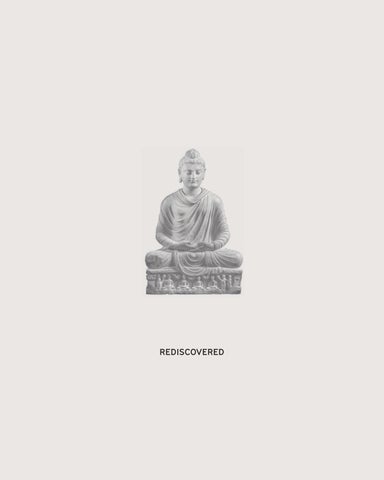
REDISCOVERED
2
REDISCOVERED
‘They have been moved from one place to another, and in consequence have often found their way into remote and inaccessible hiding-places; indeed a certain number of specimens have been utterly lost sight of, so that only a happy chance can bring them back to light...' Adolf Michaelis, Ancient Marbles in Great Britain, 1888
CONTENTS 9
INTRODUCTION
13
GANDHĀRAN FIGURE OF BUDDHA
33
ATTIC KYLIX FRAGMENT ATTRIBUTED TO DOURIS
47
EGYPTIAN FIGURE OF AN IBIS
59
CHALCEDONY BUST OF AN INFANT BOY, 'ANNIUS VERUS'
75
EGYPTIAN HEAD OF SEKHMET
91
EGYPTIAN QUARTZITE RELIEF
103
ROSA DE PECHO JEWEL FROM THE SHIPWRECK OF THE NUESTRA SEÑORA DE LAS MARAVILLAS
125
EGYPTIAN FIGURE OF ISIS AND HORUS
135
ROMAN STATUE OF BACCHUS
148
FOOTNOTES
154
APPENDICES
8
REDISCOVERED Lost. Misattributed. Forgotten. Such is the fate of many masterpieces from antiquity. When Cyriac of Ancona — merchant, wanderer, and the first great rediscoverer — set sail for Greece in the fifteenth century, his purpose was to rescue antiquity from oblivion; ‘I go to wake the dead’. Four centuries later, Adolf Michaelis took up the same task, writing of the ancient marbles of Britain, cataloguing what survived and mourning what had already slipped beyond reach. In their work, both men acknowledged an undeniable truth — that history is fragile. Works of art that once stood before pharaohs and kings, that graced the gardens of Rome and the symposia of Athens, can slip quietly from view. Often nothing dramatic happens — a crate is mislabelled, a collection is dispersed, a history is lost. Recovering it sometimes takes years of patient work. And sometimes it never happens at all. This catalogue and accompanying exhibition are devoted to the moment of rediscovery. Some rediscoveries are the result of dedicated research, their early lives traced through obscure journals and family archives — the Egyptian Sekhmet returned to its findspot at Abydos, the bronze Ibis to its exhibition at the Fogg Art Museum. Some rediscoveries are made during the conservation process, when later restorations are pared back revealing an ancient surface beneath — as with the Roman Bacchus and Egyptian Isis and Horus. And some are moments of serendipity, a familiar shape glimpsed among the contents of a forgotten storeroom — as with the unidentified ‘emerald brooch’, revealed to be from the wreck of one of the wealthiest treasure ships of the Spanish Golden Age. Each chapter regained adds a new layer of meaning, and each layer changes what the object is — deepening its context, its importance, and ensuring that its history is secure. But rediscovery does not always last. The Attic fragment attributed to Douris has been lost and found not once, but twice. The emerald jewel was likely shipwrecked twice over, salvaged in the modern era, and lost yet again. Sometimes it seems that objects are only ever on loan from oblivion. What helps to break that cycle is publication — that, more than anything, is why this catalogue exists. For we are what owners of antiquities have always been — custodians. As John Ruskin wrote of the monuments of the past, 'they are not ours… they belong partly to those who built them, and partly to all the generations of mankind who are to follow us.' The rediscoveries in these pages are not merely stories; in today’s art market, they can be decisive. The 1970 UNESCO Convention remains the benchmark against which the legitimacy of an antiquity's history is measured. A provenance that cannot be traced before the Convention is considered incomplete and the object insecure. Our research, set out in these pages, has pushed these histories back decades: the Gandhāran Buddha to 1960; the Ptolemaic relief to 1914; the bronze Ibis to 1953. Such work not only rescues these histories from obscurity; it reopens these works to academic study, museum loan and acquisition. None of this is the work of one person. These recoveries belong to the whole gallery — and to conservators, scholars, archivists and families who opened their records to us. Presented here are our rediscoveries of the past year. Each one awoken from the dead, and brought back into the light once again.
9
A COVER LOT FORGOTTEN
12
GANDHĀRAN FIGURE OF BUDDHA Kushan Period, c. 2nd — 3rd century AD Grey schist Height: 67.7 cm
PROVENANCE Collection of the Honourable John Edward Bingham of Sussex, England, by 1960 (1904—1992); Sotheby’s, London, Important Egyptian, Near Eastern, Iberian, Greek, Roman and Anglo-Saxon Antiquities... including a Seated Gandhāra Grey Schist Buddha... 12 December 1960, lot 65; Collection of Kenneth J. Hewett (1919-1994), London, acquired from the above. Collection of composer, Richard B. Gump (1906-89); Sotheby’s, New York, Indian, Himalayan and Southeast Asian Art, 6 October 1990, lot 258; Collection of poet and publisher, Stanley Moss (1925-2024), acquired from the above sale.
PUBLISHED ‘A Portfolio of Collectors’ Pieces,’ Oriental Art, Vol. VI, No. 4, (Winter, 1960), p. 136 and 146. Sotheby’s advertisment, The Burlington Magazine, Vol. 102, No. 693 (December, 1960), p. iv.
One of the finest Gandhāran sculptures known, masterfully carved and of the most iconic and canonical sculpture type from early Buddhist art, depicting the seated Buddha in dhyāna mudrā (a gesture of meditation). Likely hailing from the celebrated Mardan region — one of the major centres of Buddhist artistic production, famed for the masterpieces of Gandhāran art in renowned museum collections today. Probably made for the same temple as the less well-preserved yet much admired example now in the Seattle Art Museum, and with a recently rediscovered and illustrious provenance dating back to 1960.
13
Provenance matters everywhere in our field, but nowhere more than Gandhāran sculpture.. Here, documented early histories are genuinely rare. This Buddha surfaced with a history reaching back only to 1990. Recognising it was luck: we had sold another head from the Bingham collection in 2017, and we had rediscovered that provenance too. Both were sold at Sotheby’s in December 1960 — a sale that thought this Buddha important enough to name on its title page.
14
15
16
At the crossroads between the sophisticated civilisations of the Mediterranean and those of South Asia, Gandhāra — the ‘Land of Fragrance’ — forged one of the most unique and distinctive artistic traditions of the ancient world, giving rise to the visual form of Buddhist spirituality that is so instantly recognisable today. Masterfully carved and depicting the seated Buddha in the meditative pose known as dhyāna mudrā, the present figure is one of the finest surviving examples of the most celebrated and canonical sculptural type of Buddhist art. Representing the mature synthesis of Buddhist spirituality, Kushan-period prosperity, and Greco-Roman naturalism, it likely hails from the ‘heart of Gandhāra’, the Mardan area — one of the principal religious and artistic centres of the region.1 Refined not only by its stylistic superiority, the present figure also boasts an unusually long and illustrious provenance, which distinguishes it from the majority of Gandhāran sculpture on the market today.
The Mardan region was one of the great centres of Buddhist art, yielding many masterpieces that define ancient Gandhāra today.
The Life of the Historical Buddha The historical Buddha was born Prince Siddhārtha Gautama near the ancient city of Kapila-vastu, to the king and queen, Śuddhodana and Māyā, between the 6th and 5th centuries BC. Amid a life of luxury, he began to contemplate the inevitability of human suffering, death, and the cycle of rebirth, eventually leaving his wife and son in search of liberation (known as the Renunciation or Great Departure). After six years of meditation, he finally attained bodhi (the Enlightenment). From a Bodhisattva (one destined to achieve Enlightenment), he now became the Buddha, or the Enlightened One, attaining nirvāna — the ultimate state in which man is free of all worldly concerns. The religion that emerged from his teachings was founded upon the possibility of release from samsāra (the cycle of rebirth) as dictated by karma (actions), by following the Middle Way, a path which rejected both extreme asceticism and worldly indulgence.2 ‘The Land of Fragrance’ Gandhāran art — itself inherently Buddhist art — reached its zenith under the Kushan Dynasty, which ruled the region from the first to the third century AD. During this period, the region’s relative peace from successive foreign invasions coupled with the financial prosperity afforded by an enviable position along the Silk Road, produced the perfect environment for the emergence of a distinctive artistic language that gave visual form to the Buddhist spirituality of the region.3 Emerging in the Ganges basin, Buddhism was embraced by the Gandhāran people under King Aśoka (272-237 BC), and despite the region’s shifting domination by foreign rulers — beginning with the conquest of Alexander the Great in 330 BC — had remained a great unifying power among the populace. The Mardan region, located in the heart of ancient Gandhāra in the fertile valley between the Swat and Kabul rivers, was one of the great centres in which this Buddhist art flourished. In its years of production, it yielded many of the masterpieces that define Gandhāran art today, such as the British Museum’s seated Buddha (no.1895,1026.1) and the Bodhisattva torso now in the Metropolitan Museum of Art in New York (no. 1995.419).
17
In the early stages of Gandhāran art, narrative scenes from the Buddha’s life were carved as architectural elements for the walls of the stūpa — the main shrine of the religious centre that housed the relics of the Buddha.4 By the third century AD, individual shrines were being added to the complex to contain large-scale, classicising images of the Buddha.5 These non-narrative figures soon became the centre of worship, and were designed to portray the major tenets of the religion. Some portrayed the historical Buddha as a Bodhisattva, wearing the luxurious clothes of his former life as Prince Siddhārtha. But far more numerous and important for spiritual worship were those of him after his enlightenment. Of the three main types, the seated Buddha with hands in dhyāna mudrā — the meditative pose — is the most well-known and celebrated of all.6 The present sculpture sees the historical Buddha just after he has attained enlightenment. The elongated earlobes (stretched by heavy gold earrings) and tamed, wavy hair remind the viewer of his rejection of the wealth and opulence of his past life. He is depicted with the specific signs (lakshana) of the enlightened being, which distinguished him from other mortals. The cranial protuberance (ushnisha) is portrayed here by the top-knot, symbolising supreme wisdom, while the auspicious mark (urna) sits on the forehead between the eyebrows. The pedestal is also decorated to further reinforce the spiritual message of the figure. The incised lines on the cushion refer to the bundles of grass which the Buddha famously scattered on the spot he had chosen for his final meditation — landing on the ground, a beautiful seat appeared, where he then sat to attain enlightenment.7 On the base, three images of the meditating Buddha are flanked by attendants on either side. Possibly representing the donors of the statue itself, it has been suggested that such figures were placed there in order to mediate between the mortal realm of the worshipper and the spiritual realm of the Buddha himself.8 An Exceptional Example The present example is one of the finest surviving Gandhāran images of the meditating Buddha known (cf. Appendix). Its impressive scale, style and material suggests that it was an important devotional commission for a major monastic or shrine setting.9 Indeed, it has been suggested that it likely hails from the Mardan region, one of the principal religious and artistic heartlands of ancient Gandhāra, encompassing major monastic centres such as Takht-i Bāhī, Sahrī Bahlol, and Jamāl Garhī, whose excavations have yielded many of the finest and most influential examples of Gandhāran sculpture known today. The unmodelled reverse of the present piece further indicates that the sculpture was originally conceived as an architecturally integrated devotional image rather than a freestanding statue, as can be seen at archaeological sites such as Takht-i Bāhī.10 The material — soft grey-blue schist quarried from the hills of the Swat Valley — is typical of Gandhāran sculpture from this period.11 While stucco became more frequently used from the fourth century onwards on account of its affordability, schist is associated with the most impressive carvings and the more skilled workshops. These skilled artists could exploit the workability of the stone to create the deep, ‘terraced’ folds, and precise facial features seen here. In particular, the subtle modelling of the face, the plump cheeks, the wavy hair and flowing drapery betray a serene naturalism in which the influence of Hellenistic sculpture — brought to Gandhāra by the conquest of Alexander the Great — has been identified.12
18
Right The ruins of Takht-i Bāhī, Pakistan. Above Torso of Bodhisattva, probably Sahrī Bahlol workshop, c.5th century AD. The Metropolitan Museum of Art, New York, no. 1995.419.
19
20
The present piece also shows traces of polychromy — a rare survivor on schist works from this period. Indeed, on account of the relative porosity of the surfaces, pigment more often survives on stucco works. But traces of red pigment here, particularly on the robes, provide an insight into the original appearance of the piece, where this was likely intended as a ground layer for gilding.13 Red bole pigment was often used as an adhesive under the gold leaf, while also enhancing the vibrant colour of the reflective surface.14 In Kushan times, gilding was outstandingly important in architecture and sculpture. Gold may have represented light — which itself has obvious links with the Buddha’s experience of enlightenment. Indeed, in the sixth century AD, Chinese pilgrim Song Yun reported seeing at the temple of To-Lo more than 6000 golden images decorating buildings that shone in the midday sun. As a large and elite commission, the present piece would have been similarly gilded to highlight the spiritual transcendence of the historical Buddha, as well as to generate merit — and thus favuorable karma — for the donor.
Above Gandhāran figure of seated Buddha in dharmachakra mudra — the gesture of preaching — from the Mardan region, c. 2nd - 3rd century AD. Grey schist, The British Museum, no. 1895,1026.1.
'One of the Most Perfect Representations of its Kind' The present sculpture is comparable only with some of the finest examples of Gandhāran sculpture. Notably, this example strikes a delicate balance between naturalism and creating a sense of the Buddha’s spirituality and otherworldly beauty, as befitting the post-Enlightenment being. It exemplifies what archaeologist Peter Stewart has said of the finer Gandhāran sculptures — it captures ‘his essential humanity, supramundane physical qualities and his mental and moral detachment from the worldly emotions and impulses all at the same time.’15 In its serene, Greco-Buddhist style, the present piece surpasses even the modelling of the renowned seated Buddha from the Mardan region, today in the British Museum.16 Notably, the treatment of the drapery on the British Museum piece, the idealised face, and the hands — raised there in the gesture of preaching (dharmachakra mudra) — lack the sophistication and subtlety achieved in the carving of the present figure. Indeed, the only other Gandhāran sculpture of the same type to convey such masterful rendering is now in the collection of the Seattle Art Museum. Close comparison of the ArtAncient Buddha and that in the Seattle Art Museum reveals that they were likely made in the same workshop in antiquity. Aside from the differing pedestal design, the overall style, execution and composition is inherently the same. The serene, idealised expression, the arched eyebrows, gently closed eyes, youthful, fleshy cheeks, and pursed lips display the idiosyncrasies of a skilled workshop, and of possibly the same sculptor.17 The deeply carved, sweeping folds in the drapery are particularly close, even down to the precise way the fabric is draped over the left shoulder. This similarity was noted by the Seattle Museum researchers. In their cataloguing, ours is singled out as a unique parallel, ‘so similar’ — ‘even to the number of folds in some places’ — ‘that it must have come from the same temple...’18 Seattle’s Gandhāran Buddha — purchased by the founding director, Dr Richard Fuller, for the Museum in 1933 — was noted by renowned curator and art historian Alfred Salmony (1890-1958) to be ‘one of the most perfect representations of its kind’ on the opening of the museum in June of that year.19 However, taking into account its significant damage to the hands and the drapery on the left side, the ArtAncient Buddha — unknown at the time of the museum’s opening — is arguably a finer and certainly better preserved example.
21
22
Left Gandhāran figure of seated Buddha, c.2nd-3rd century AD. Grey schist, Seattle Art Museum, no. 33.180.
Right The ArtAncient Buddha.
23
Rediscovered Provenance When the present sculpture was acquired its given provenance was simply: Collection of Richard E. Gump (d.1989). Sotheby’s New York, 6th October 1990, lot 258. Since the Antiquities Act of 1975, as well as the later Export of Antiquities Rules 1979, ownership of Pakistani cultural heritage has been vested in the state.20 Gandhāran art in general has further been highlighted by international organisations (notably ICOM) to be an area of particular concern on the international art market. This is due to the heightened risk of illicit excavation, trafficking, and the circulation of unprovenanced material caused by the widespread looting of archaeological sites and museums during and following the Soviet occupation of Afghanistan (1979—1989), as well as the continuing political instability in the region.21 Sadly, very few Gandhāran pieces appear on the art market with documented provenance prior to UNESCO 1970. The problem stems in part from the circulation of illicit objects but also from the large number of orphaned works that have lost their earlier collection history due to incomplete documentation standards that characterised much early scholarship and collecting in the field. On spotting the present piece at auction, we suspected that the figure had an early provenance due to its old base, with the lack of accompanying provenance appearing consistent with incomplete record-keeping. Having handled a piece from the collection of the Honourable John Bingham (1904- 1992), we knew that his collection was a legitimate and renowned source of masterful Gandhāran works. Returning to the Sotheby's sale catalogue of his collection from December 1960, we immediately recognised the present piece as Lot 65, which was noted on the title page to be the highlight of the sale. Indeed, further research identified that the present sculpture was used as an advertisement of the aforementioned sale in both The Burlington Magazine and Oriental Art, consolidating this piece as a star lot. In particular, Oriental Art noted it as ‘an outstanding example of its period,’ highlighting the ‘calm benignity of the face’ and the ‘skilful modelling.’22 John Edward Bingham was born on 29 February 1904, the younger son of Colonel George Charles Bingham, 5th Earl of Lucan (1860-1949) and Violet Sylvia Blanche Spender Clay (c.1878-1972). The second son of an aristocratic family, he joined the military, and it was likely through his travels and military postings abroad that he encountered and became enamoured with Gandhāran art, reflecting the broader fascination among British collectors of this era with these works. Amassing an impressive collection, he even published a book on Gandhāran sculpture in 1954, illustrating it with his own pieces.23 While he notes that he purchased several of these pieces while travelling in Pakistan, it remains unclear where he acquired the present figure.
24
Right The present Buddha being used in The Burlington Magazine's advertisement for the 1960 Sotheby’s sale.
25
26
‘In here I’ve got very important Gandhāra pieces... you can spot the Greek influence right away. Like in those three Buddhas over by the window; that’s a good example.’
Caption Richard Gump in 1989, describing the Buddhas in his San Francisco apartment. The present was likely among them. Left Richard Gump and the ‘Gump Buddha’ — the monumental, two-and-a-half metre tall bronze figure of the Shakyamuni Buddha that welcomed visitors to Gump’s shop floor. It was famously the ‘only item displayed in the store that wasn’t for sale’.
Tracking down the buyer list from the 1960 sale of Bingham’s collection identified the purchaser as the prominent London dealer, Kenneth John Hewett (1919-1994), who also traded as K. J. Hewett Ltd. Active through the 1950s to 1980s, he specialised in antiquities and ethnographic works of art, becoming an influential figure within the London market, as well as overseas, supplying important private and institutional collections. Hewett was formative in assembling the renowned collection of Sir Robert (1906-2000) and Lady Sainsbury (1912-2014), now held at the Sainsbury Centre for Visual Arts at the University of East Anglia. Other works that passed through his hands are held today in the British Museum, London, and the J. Paul Getty Museum, Los Angeles.24 A Cosmopolitan Collector Our sculpture then found its way into the collection of American collector, composer, interior designer and businessman, Richard B. Gump (1906-89). Trained as a musician and artist at the California School of Fine Arts, he became a prominent twentieth-century tastemaker, serving as the president of the celebrated San Francisco-based decorative art and interior design firm, Gump’s. Under his leadership, Gump’s became ‘one of the world’s most cosmopolitan stores in one of the world’s most cosmopolitan cities’.25 Starting out as an art gallery dealing in fine paintings — from the Old Master paintings of Brueghel, to the Impressionist canvases of Renoir and Cézanne — by the early twentieth century, they had expanded to include Asian and decorative art.26 As one of the most significant importers of Asian artwork into America before the Second World War, the firm helped popularise Asian-inspired interiors among elite West Coast collectors. Richard Gump’s particular interest in Asian art was echoed in his private pursuits. A member of the Society for Asian Art and a long-term supporter of the Asian Art Museum in San Francisco, he was part of the generation of collectors who helped transform Asian art from a niche collecting category into a major museum field. His own collection heavily featured Asian and in particular Gandhāran sculpture. In an interview towards the end of his life, Gump described his ‘very important Gandhāra pieces’, which he displayed in the living room of his San Francisco penthouse. He singled out the ‘three Buddhas over by the window,’ in which ‘you can spot the Greek influence right away.’27 He likely acquired the present piece from K. J. Hewett shortly after its sale at Sotheby’s in the 1960s — the masterful carving and Greco-Roman style of the present piece clearly attracting his attention. On Gump’s death in 1989, his collection was sold at Sotheby’s, New York, where our sculpture was acquired by poet, publisher and art dealer, Stanley Moss (1925-2024). The son of a schoolteacher, Moss came from humble beginnings. His cultural expertise was fostered by his travels in Europe as well as his broader literary interests, and it was noted later in his life that his ‘love of art was very much a love of life.’28 The present Gandhāran sculpture remained with him until his death in 2024, before it came up for sale at Sotheby’s, New York once again in 2026. By this time, it had sadly been parted with its early history.
27
‘This piece... an outstanding example of its period... is notable for its elegant proportions, the calm benignity of the face, and the skilful modelling.’ ‘A Portfolio of Collectors’ Pieces,’ Oriental Art, Vol. VI, No. 4, (Winter, 1960), p. 136
29
LOST, FOUND AND LOST AGAIN
32
ATTIC KYLIX FRAGMENT ATTRIBUTED TO DOURIS Classical Greece, c.470 BC Terracotta, black and red slip Length: 19.1 cm
PROVENANCE Reputedly found in Tarquinia, Italy; Collection of Josef von Kopf (1827–1903), Rome. Collection of Comtesse Martine-Marie-Pol de Béhague (1870–1939), Paris; Thence by descent to her nephew, Octave Marie Hubert, 7th Marquis de Ganay (1888–1974); Thence by descent to his son, Jean-Louis Sébastien Hubert, 8th Marquis de Ganay (1922–2013); Sotheby’s, Monaco, Antiquités et Objets d’Art, Collection de Martine, Comtesse de Béhague, provenant de la Succession du Marquis de Ganay, 5 December 1987, lot 146; With Robin Symes Limited.
EXHIBITED & PUBLISHED See Appendix.
An exquisitely painted fragment of a kylix attributed to one of the greatest, most prolific and best-documented artists of the ancient world — Douris. Painted in the red-figure technique, it vividly preserves an intimate scene from a symposium, with the inscription above reading HΕ ΠΑΙΣ ΚΑΛΕ — 'the girl is beautiful'. A poignant composition, masterfully executed from one of the greatest watershed moments in art history — the dawn of the Classical age. Continuously published for more than a century, this fragment was once in the famed collection of the Comtesse Martine de Béhague, passing by descent to her nephew, Octave Marie Hubert, 7th Marquis de Ganay. First brought to public attention in 1898, mourned as lost in 1946, before being triumphantly rediscovered in 1949, it was later sold in 1987 and exhibited for years at Princeton University Art Museum before disappearing into storage. Rediscovered once again by ArtAncient in 2026, it is a masterpiece of Classical Greek pottery with an impressive and illustrious provenance stretching over 128 years.
33
Some objects are lost once. This fragment has made a habit of it. Published in Rome in 1898, admired by John Beazley, it vanished for long enough that Gisela Richter’s 1949 article in the Journal of Hellenic Studies was titled, simply, ‘A Lost Fragment by Douris Found Again.’ It passed through one of the great collections of the twentieth century — that of the Comtesse de Béhague — before disappearing once more after the celebrated Monaco sale in 1987. We found it where a surprising amount of art history has been hiding: in the storage of the disgraced dealer Robin Symes, where it had sat in darkness for over two decades until the liquidation of his company. A fragment of a drinking cup from the pioneering years of the Classical style, painted by an artist who signed his name — with a publication history running from Hartwig to Beazley to Richter.
34
35
36
Between Two Worlds The turn of the fifth century BC saw some of the most dramatic years of Greece’s history. Between 499 and 493 BC, the Ionian Revolt drew Athens into conflict with the Persian Empire. Initial successes at Marathon in 490 BC made Athenian hoplites a legendary fighting force in the Mediterranean. But a decade later, Xerxes' great invasion swept into Greece. Athens itself was sacked and the Acropolis burned, along with many of the commercial districts in the city. Returning and rebuilding their city, the Athenians repelled the Persians at Salamis in 480 BC and again at Plataea the following year. Soon, Athens founded the Delian League and stood as the richest and most powerful city in the Greek world. During this period, Athens, galvanised by external threats, emerged with unprecedented influence across the Aegean, developing its newly established democracy and transforming the relationship between individual and state. Cleisthenes’ reforms of 508–7 BC had reorganised the citizen body into ten tribes, changing the balance between state and citizen as well as restructuring military conscription. These changes were felt not only in the mechanics of war and the formal institutions of the city, but also in its social life. The popularity of the symposium — the private drinking party at the heart of elite male society — reached its height during this period. As a space for conversation, performance and competition, ideas of citizenship, politics, and identity could be explored, developing the cultural and philosophical landscape of a city whose influence has resonated across the ensuing millennia. This period of profound social and political change also fostered one of the great stylistic watersheds of Western art: the transition from the Late Archaic to the Early Classical. In the space of a generation, the stylised conventions of the Archaic world gave way to a new and increasingly naturalistic vision of the human form. Following the sack of Athens, monumental wall painting became the prestige art form of the rebuilt city. While none of it survives today, its innovations in composition, perspective, and foreshortening filtered down to the painters of pottery. Here, in the defining art form of ancient Greece, artists began to explore movement and anatomy with unprecedented confidence, replacing the Archaic smile and rigid symmetry of earlier art with figures that appear poised and dynamic. This transformation, now known as the emergence of the Classical style, would establish an artistic language whose influence has endured for more than two millennia. The present fragment, painted around 470 BC, belongs to the first decade of that new style.
Left Hydria, 470-460 BC, from Puglia, Italy, attributed to the Leningrad Painter, depicting the potter's workshop, with potters and painters garlanded by Athena and two winged victories. Intesa Sanpaolo Collection, Palazzo Leoni Montanari, Vicenza.
Douris Egrapsen The present fragment was first attributed to the painter Douris by Paul Hartwig in 1898.1 First catalogued by eminent classicist Sir John Beazley, Douris is one of the very few artists of antiquity we know by name, and among the best documented of them all. His signature — ΔΟΡΙΣ — survives on over 50 vases, and on account of stylistic affinities over three hundred vases have been attributed to him, making him the most prolific painter of the age. Beginning his career in the workshop of Euphronios, pioneer of the red-figure technique, Douris established his own style, working with a single potter, Python, for most of his lifetime. This collaboration was recorded on the vessels themselves — 'Python epoiesen' (Python potted), 'Douris egrapsen' (Douris painted) — giving us a remarkable insight into the division of labour in Athenian workshops.2 While some cups were both potted and painted by Douris himself, it is on account of his excellent draughtsmanship and prolific production that he has become known as one of the best artists of antiquity. Working at the height of the red-figure technique, Douris inherited the hard-won mastery of his predecessors — Euphronios, Phintias and Euthymides — and refined it into something entirely his own: drapery, anatomy and gesture rendered with a calligraphic precision that
37
later painters emulated but never surpassed. So consistent was he in his style that Beazley — the founder of modern attribution studies — used Douris as the benchmark for painters, dividing his long career into four periods in which we can see his development.3 The present fragment was placed by Beazley into the artist's Middle Period — the phase in which the symposium was his main subject, and in which his style is at its most idiosyncratic.4 Douris’ fame during his lifetime was clear. His contemporary, the Triptolemos Painter, is known to have signed at least two of his own cups with Douris’ signature — indicative that his name and cups by him had real commercial value. 5 This was a value that extended far beyond Athens. As symbols of Athenian society, painted pottery was a popular export throughout the Mediterranean — and there was a particular market for Douris’ own work. Many cups and fragments attributed to — or indeed signed by — Douris survive today because of their export in antiquity to Etruria, where wealthy elites prized Athenian cups as status symbols, often being buried with them in their tombs at Vulci, Cerveteri and Tarquinia. Our fragment reputedly comes from Tarquinia, where it was likely imported.6 The fragment originally formed part of a wine cup called a kylix — the vessel of the symposium, and the pottery type for which Douris was renowned. As the aristocratic drinking party that stood at the centre of Athenian social life, the symposium remained a defiantly elite institution, despite the democratisation of the city that followed the Persian Wars. Reclining on couches, citizens drank wine mixed with water, sang, debated, played music, flirted, and performed their status amongst friends. In painting the kylix, Douris was, in essence, setting the stage for this phenomenon. The exterior scene was visible to fellow drinkers as the cup was raised, while the interior tondo revealed itself only gradually to the drinker as the wine was drained. Painters delighted in placing surprising, intimate images here, that mirrored what might be happening at the party itself. This satirical duality is masterfully executed on the present fragment. ‘The Girl is Beautiful’ First attributing it to Douris in 1898, Hartwig counted the present fragment among ‘the best achievements of his later period’.7 Its composition is certainly typical of this stage in Douris’ career, when he returned to depicting everyday scenes from Athenian life — motifs which marked his early years. The scene on the interior — part of the tondo of the kylix — depicts the symposium itself. While a typical motif of Douris, the specific scene is particularly unique amongst his oeuvre. The symposiast, reclining on a kline and wreathed for the evening’s festivities, still holds his skyphos, but his attention has left the wine entirely. He gazes at the woman seated before him, his right hand laid gently on her shoulder. Meanwhile, she is absorbed in her own quiet task, both arms raised as she ties — or unties — a band around her sakkos. Douris deliberately leaves this act ambiguous, suggestive of dressing, or undressing, to make the scene feel intimate. This is a unique depiction, with the closest parallel for the gesture seen in the renowned Esquiline Venus.8 The lady depicted here has been identified as a hetaera — a professional companion. Unlike their lower-class counterparts, the pornai, the hetaerae were courted rather than hired; their company was won through gifts and favours, with nothing as vulgar as money ever being discussed. Known for their ‘flattery and skillful conversation’, they beguiled men with their Siren-like conversation, wit and musical ability as much as with their beauty. Considered the only women capable of an 'honest love,' they were also the only women admitted to the symposium as guests in their own right.9 Her depiction here belongs to the latest and most private hour of the party, positioned delicately between what has just passed and what is likely to come.10
38
‘A nd then if one of us happens to come in feeling troubled, She greets him with pleasant flattery... she sits him down, she soothes him and cheers him, and soon takes away all his trouble and makes him happy again.’
Caption A description of the hetaerae from Ephippus, Empolē fr. 6 K.-A. (PCG V, p. 138) preserved in Athenaeus, Deipnosophistae, 13.571f.
39
40
Above the figures in red slip is the inscription, HΕ ΠΑΙΣ ΚΑΛΕ — 'the girl is beautiful.' Such kalos-inscriptions — conventional acclamations of beauty — appear on hundreds of Attic vases from this period, but they are overwhelmingly masculine, typically praising the aristocratic youths of the gymnasium. The feminine kale is far rarer, and where it does appear, it is typically on sympotic cups such as the present — praising the beauty of the hetaerae as if participating in their courtship. The exterior of the cup depicts three pairs of draped men and women in conversation between scrolls of palmettes. Here, we see — as would have been plainly visible to other attendees — the negotiations and flirtations of the evening; while inside, in the private realm of the drinker, is depicted their intimate conclusion. This cup was cleverly intended as a mirror to the evening itself.
'As one might expect, it is greatly superior to the careful drawing... a comparison between the two makes one realise the sensitivity of Greek craftsmanship.'
Caption From Gisela Richter, 'A Lost Fragment by Douris Found Again', The Journal of Hellenic Studies, 69 (1949): p. 73.
A Master Draughtsman The fragment is a tour de force of Classical draughtsmanship, showing the hand of a master painter working at the height of his powers. In its fine lines, delicate modelling and intimate suggestiveness, it shows the full realisation of the emerging Classical style. The most celebrated feature is the woman’s chiton — the folds of the diaphanous fabric are rendered entirely and exceptionally in dilute glaze of varying thickness, over which the painter laid a red wash.11 This layered technique resulted in an astonishing impression of transparency and texture, through which the forms of her body are clear. Hartwig, examining the piece in the 1890s, observed that examples of drapery rendered in this way are exceedingly rare, and the practice harks back to the experiments of Douris' Early Period and of the red-figure pioneers from whose workshops he emerged. 12 Gisela Richter, who knew the fragment only from a drawing until 1948, noted that it was precisely this quality that struck her on seeing the original. The comparison, she wrote, makes one realise 'the sensitivity of Greek craftsmanship' — for the texture and substance of the folds, drawn in lines of various shades, was utterly lost in the flat uniform line of the drawing.13 Around this virtuoso depiction exist the hallmarks of the master: the eyes drawn as a circle with a dot; wavy hair applied in relief lines over a black ground; the treatment of the man’s nape and beard; and the meandering border — all details that Hartwig used to attribute the fragment to Douris and justify ranking it ‘among the best achievements’ of the painter.14 To these may be added the delicate relief line at the woman's throat — representing the collar of her chiton rather than a necklace — and the characteristic hook used by Douris for the inner end of the man’s collarbone, one of the most reliable of all his anatomical signatures.15 In style and composition, it is certainly an exquisitely painted fragment bearing all the hallmarks of the emerging Classical style, and the idiosyncrasies of one of the greatest draughtsmen of the age. Lost and Found Few Greek vases can boast a modern biography as illustrious as this piece. Published countless times over its modern history, its provenance stretches back well before the UNESCO 1970 benchmark. Indeed, it is first documented in the collection of the celebrated sculptor, Professor Josef von Kopf (1827-1903), who worked in Rome from 1852 onwards. It was in his collection that archaeologist Paul Hartwig studied the fragment and published it in 1898, accompanied by a drawing by Count Ludwig von Thurn-Valsassina.16 Ludwig Pollak also catalogued it twice among Kopf's collection, and Beazley later included it in his own publications of 1925 and 1942 in which he laid out the varying phases of Douris’
41
career.17 However, by then its provenance was listed simply as 'formerly the Kopf collection', and the fragment itself had vanished.18 For the following half a century, it was known only from Thurn-Valsassina's drawing. Writing in the Journal of Hellenic Studies in 1946, Martin Robertson discussed it as a lost work of the artist's middle period, reproducing the drawing as his only illustration.19 Then in 1949, Gisela Richter of the Metropolitan Museum of Art published an article in the same journal: 'I am glad to be able to report that I came across the fragment in the summer of 1948 in a private collection in Paris.'20 The owner had requested to be kept anonymous, but allowed Richter to publish a photograph of the piece, revealing at last the texture and delicate lines that the old drawing had flattened. Four decades later, in December 1987, the fragment appeared at a landmark Sotheby’s sale as part of the collection of the Comtesse Martine de Béhague (1870—1939). The anonymous owner, it turned out, was the Comtesse’s nephew, Hubert, 7th Marquis de Ganay, who belonged to one of the great French collecting dynasties and had inherited the collection on his aunt’s death in 1939. Béhague was a collector of the very first rank — in antiquities, numismatics, illuminated manuscripts and Old Master paintings alike — and her name alone is an illustrious addition to a work's provenance. Pieces from her collection are today found in the great museums of the world, among them the Louvre, the British Museum, the Metropolitan Museum and the J. Paul Getty Museum. Research by ArtAncient further identified the fragment on display — pride of place — at the Comtesse’s home at 123 Rue Saint-Dominique in the 1920s-30s.21 After her nephew’s death in 1974, the collection passed to his son, Jean-Louis Sébastien, and remained in Paris.22 Jean-Louis later described the ‘portion of “Auntie’s” treasures’ which he consigned to auction — the present fragment among them. From the 1987 sale, the fragment was purchased by disgraced dealer Robin Symes (1939-2023), who with his partner Christos Michaelides placed it on long-term loan at Princeton University Art Museum. There it was exhibited to the public alongside the permanent collection, while also being included in the 1997 exhibition In Celebration: Works of Art from the Collections of Princeton Alumni and Friends of the Art Museum.23 In 2010, the bankruptcy and liquidation of the Symes estate saw the loans recalled, and the fragment packed up and placed into storage nearby, awaiting collection that never came. Published one last time in 2011, it was listed simply as ‘London, private collection’ — its true location fading once again into obscurity. Rediscovered by ArtAncient among the Symes collection, the fragment now re-emerges into public view for the first time in a generation. Lost, mourned, and rediscovered twice over, it has been discussed by every great name in vase scholarship over the last three centuries; few ancient works of art carry such an illustrious history. Richter’s words of 1949 and the joy at its first rediscovery are particularly poignant, for we are also glad to report that a masterpiece of Classical art has come to light once again.
42
'I am glad to be able to report that I came across the fragment in the summer of 1948 in a private collection in Paris.'
Caption From Gisela Richter, 'A Lost Fragment by Douris Found Again', The Journal of Hellenic Studies, 69 (1949): p. 73. Right Our fragment displayed in the collection of the Comtesse de Béhague at 123 Rue SaintDominique, photograph taken in the 1920s-30s. Photo courtesy of Jean-David Jumeau-Lafond and the Archives Béhague.
43
AN ICONIC EXHIBITION
46
EGYPTIAN FIGURE OF AN IBIS Late Period to Ptolemaic, c.664—30 BC Cast Bronze Height: 16.1 cm
PROVENANCE With Dikran Kelekian (1867-1951); Collection of Clifford B. Hartley (1896-1953), New York, by 1953; Thence by descent to his wife, Jane Hartley, New York, on consignment to Charles Kelekian and sold through him in the 1960s. Weschler’s, Washington D.C., Estate Auction, 10-12 June 1983, lot 384; Collection of Lloyd and Jeanne Raport, Washington DC and Florida, acquired at the above sale.
EXHIBITED Fogg Art Museum, ‘A ncient Art in American Private Collections,’ 28 December 1954—15 February 1955.
PUBLISHED Fogg Art Museum, Ancient Art in American Private Collections, Cambridge MA, 1954, no. 39, p. 19 (ill.).
A fine and particularly large example of the moon god, Thoth, in one of his most symbolically charged forms — that of the sacred ibis — dating to the height of Egyptian bronze production. Its early history, lost for decades, has now been traced to the Fogg Art Museum's landmark 1954-55 exhibition, Ancient Art in American Private Collections.
47
We saw this ibis at Bonhams last year. Its old marble base was a clue — mounts like that mean an early collection, and the provenance felt too short. The hunch proved right: we found it in the Fogg’s 1954 exhibition catalogue, a book we know well and have consulted for years. Hunting for photographs of the installation while preparing this publication made the catalogue come alive once again. For there was the exhibition, with cases, plinths, visitors — and our ibis standing among them.
48
49
50
The Moon God Revered and worshipped throughout Egypt, from the predynastic period through to the Roman occupation, the ibis remained a consistent archetype in Egyptian religious iconography. A common bird in the Nile Valley, it was believed to be the earthly manifestation of one of the principal gods in the Egyptian pantheon — the god of wisdom, knowledge and the lunar cycle, Thoth. Considered sacred, the birds themselves were bred in great numbers at the god's cult centres, cared for by dedicated priests, and after death mummified and interred as offerings as part of great rituals. The millions of ibis mummies deposited in the subterranean galleries of necropoleis such as those at Saqqara and Tuna el-Gebel attest to the extraordinary scale and endurance of this veneration, which reached its height in the Late period.1 Herodotus, writing in the fifth century BC, noted the reverence in which the birds were held, recording that to kill an ibis, even accidentally, was a capital offence.2 As the living manifestation of Thoth, the image of the ibis was reproduced in considerable quantities throughout ancient Egypt to serve as votive offerings. Such figures were commissioned by pharaohs or wealthy officials, as well as purchased by pilgrims to be dedicated at temples and shrines. Displayed alongside their living counterparts in the hope of securing the god's favour, they formed a crucial part of the ritual environment of cult sanctuaries. The association of the ibis with Thoth was the result of the Egyptians' careful observation of the natural world and the perceived characteristics of the animal itself, which were believed to mirror the traits of the deity. The ibis’ curved beak was linked with the crescent moon and lunar cycle, while the bird’s bald head resembled that of the priests that cared for them. It is also believed that, to the Egyptians, the gentle, probing movements of the bird’s beak searching for food evoked the actions of a scribe dipping a reed into ink.
Left The present ibis on prominent display in Fogg Art Museum's Ancient Art in American Private Collections, 1955-56.
Temple Workshops Alongside increasing cult practice, the first millennium BC witnessed the great flourishing of Egyptian bronzeworking. Although metal statuary had been produced in Egypt since at least the Old Kingdom, it reached its height in the Late and Ptolemaic periods, when foundries attached to the great sanctuaries began to produce divine images of sacred animals on an unprecedented scale. The finest of these bronzes display not only the technical skill of the maker but also the Egyptian devotion to depicting the anatomical realism of these sacred animals. While small-scale votive bronzes survive in some numbers, large examples are notably rare. To economise on production, larger figures were most often conceived as composite sculptures, with a gessoed wooden body and separately cast bronze head and legs. Made from more perishable materials, large-scale ibises rarely survive today. However, cast entirely in bronze, the present ibis is a fine example of Egyptian devotional sculpture of the Late to Ptolemaic period. Likely commissioned by a wealthy patron for dedication in a shrine or temple, its mastery of proportion and refined, naturalistic form reflect the temple workshops at the height of their production. In scale, material, and quality, this ibis is an exceptional survivor from antiquity.
51
Rediscovered The present ibis came to the market with Bonhams, London, in December 2025, however, the given provenance stretched back only as far as the Weschler’s sale in June 1983. While this placed the work just before the enactment of Egypt's Antiquities Law No. 117 in August of that year, it fell considerably short of the 1970 benchmark of the UNESCO Convention. However, further research by ArtAncient pushed this date back to 1953 — and to some of the greatest dealers and exhibitions of the twentieth century. Archival research revealed that the ibis once belonged to the American collector Clifford B. Hartley (1896—1953), and that it featured prominently in the acclaimed exhibition Ancient Art in American Private Collections.3 Held at the Fogg Art Museum at Harvard University from December 1954 to February 1955, the exhibition was described as the ‘most important exhibition’ held at the museum since before the war, and praised in popular and scholarly circles for bringing to public attention ancient masterpieces whose existence until then had been entirely unknown.4 Displaying artworks from across antiquity, the exhibition aimed to give a complete picture of ancient art and ‘demonstrate the importance of individual collectors’ in civic philanthropy and public education.5 The present ibis was illustrated in the sold-out exhibition catalogue, as well as in black and white photographs of the installation and the opening night.6 It was one of seven pieces 'lent from the Collection of the Late Clifford B. Hartley' — all Egyptian, indicating the focus of his collecting — alongside a faience shabti and a sunk relief of Cleopatra.7 Deeper research into Hartley’s collection also revealed that he and his wife were loyal clients of the renowned art dealer, Dikran Kelekian (1867—1951). Known as the 'dean of antiquities dealers', Kelekian built an influential business dealing in Islamic, Persian, Coptic, and ancient Near Eastern art, with galleries in New York, Paris, and Cairo.8 Playing a major role in shaping American and European museum collections — such as that of the Metropolitan Museum of Art — he also advised prominent private collectors, including the Hartleys. Research in the Onassis Library archives at the Metropolitan Museum, which holds Kelekian's own gallery records, revealed that it was Kelekian who sold the present Ibis to Hartley — although the exact date remains unknown.9 On Hartley's death in 1953, his collection passed to his wife, Jane, who lent the ibis to the Fogg exhibition the following year. In the 1960s, she placed the whole collection on consignment with Charles Kelekian, who had taken over the business after his father’s death in 1951. The present piece is listed as sold on 17 November of either 1964 or 1965 — two different inventories show differing years — before appearing again at the Weschler’s estate sale in 1983.10 Revered and worshipped in antiquity as an embodiment of the god Thoth, this bronze ibis was similarly prized in modern times, passing through some of the great hands of the golden age of twentieth-century connoisseurship.
52
‘The exhibition brought to public attention the world over hundreds of important objects whose existence had hitherto been unknown, even to specialists.’
Caption Director of the Fogg Art Museum, John Coolidge, in ‘[Report of the] William Hayes Fogg Art Museum, 1954-1955,’ Annual Report (Fogg Art Museum), No. 1954/55.
53
54
Top Right The present ibis photographed in the Kelekian Archives. Bottom Right Opening night of Ancient Art in American Private Collections held at the Fogg Art Museum, 1954-1955. Left Entrance to the exhibition.
55
AN OVERLOOKED LABEL
58
CHALCEDONY BUST OF AN INFANT BOY, ‘ANNIUS VERUS’ The 'Hayford Peirce' Chalcedony Roman Empire, Antonine, c. AD 150—200 Blue-grey ('sapphirine') chalcedony with russet inclusions Height: 7.3 cm
PROVENANCE With the Kalebdjian Frères, Paris; Collection of Hayford Peirce (1883—1946), Paris and Bangor, Maine, acquired from the above, November 1929; Thence by descent to his widow, Pauline ‘Polly’ Brown Peirce (1911—1994), San Diego, California. With Robin Symes Limited, by 2000.
EXHIBITED Robin Symes Limited, 'Bull Leapers to Picasso,' New York, 6—16 December 2000.
PUBLISHED Royall Tyler, letter to Robert Woods Bliss, 24 May 1937, in The Letters of Royall Tyler and Robert Woods Bliss, ed. Dumbarton Oaks Research Library and Collection, with n. 2 (the piece recorded as unidentified). Robin Symes Limited, Hardstones from the Ancient World, New York, 2000. no 40.
An exceptionally fine Roman bust of an infant boy, carved in the round in highquality translucent chalcedony — among the finest of a small group of examples of this type and the only one in private hands, with the others held in the Louvre, the Cabinet des Médailles, Dumbarton Oaks, The State Hermitage Museum and the Treasury of San Marco. Formerly in the collection of the eminent Byzantinist Hayford Peirce (1883—1946), and documented in 1937 in the correspondence of Royall Tyler published by Dumbarton Oaks, where it has remained unidentified until now.
59
Some objects come with a whole file; this one only came with an label. There was no dealer or auction specialist to ask either, as it was from a liquidated estate. 'HP 23', inked on the sticker, was the only clue. Research eventually pointed to Hayford Peirce, and a letter in the Bliss—Tyler correspondence which mentioned a fine chalcedony bust that once belonged to him, since lost. Dumbarton Oaks holds his records, and his photographs of the bust were there, lying where he’d left them — beside his purchase note from Paris, November 1929, and newspaper cuttings of American babies he evidently thought looked like his Roman prince.
60
61
62
'If a man were called to fix the period in the history of the world, during which the condition of the human race was most happy and prosperous, he would, without hesitation, name that which elapsed from the death of Domitian to the accession of Commodus.'
Caption Edward Gibbon, The History of the Decline and Fall of the Roman Empire, Vol. I Chapter 3, 1776. Left 'Adoption scene' relief from the Parthian Monument showing the Antonine dynasty: Marcus Aurelius, Antoninus Pius, Lucius Verus, and Hadrian (left to right), c.2nd century AD. Now in the Ephesos Museum, Vienna.
Happy and Prosperous The rule of the Antonine dynasty is often considered the apogee of the Roman Empire. Beginning with the peace of the reign of Antoninus Pius, this age was referred to by Edward Gibbon as the time in which 'the human race was most happy and prosperous.'1 Regarded as a just and diligent administrator, Pius devoted himself to strengthening the structure of the Imperial government, and balancing the authority of the Senate with that of his own office. His legacy continued under the co-rule of his adoptive sons Marcus Aurelius and Lucius Verus. While Verus is known for his military campaigns in the East, Aurelius became immortalised as the philosopher-king, whose Meditations conveyed the Stoic ideals of duty, discipline and pursuit of virtue. As sole Emperor after Verus' death, Aurelius exemplified the statesmanship and philosophical enlightenment that came to define the dynasty's legacy. In particular, Aurelius’ marriage to Faustina Minor gave the Empire a strong political alliance, providing the foundations for the dynasty's continuity. As the daughter of Antoninus Pius and Faustina Major, Faustina was both Aurelius's cousin and adoptive sister, with their marriage uniting the reigning house's bloodlines. Honoured with the title Augusta upon the birth of her first child, Faustina was celebrated on coinage as the embodiment of fecunditas and concordia, the fertility and marital harmony upon which the stability of the state was seen to rest. Faustina bore thirteen children, though most would not survive to adulthood. Among them was Marcus Annius Verus, born in 162 AD. Verus was raised to the rank of Caesar alongside his elder brother Commodus in October 166 on the occasion of the Roman triumph over the Parthians. In celebration, medallions were struck with the baby profiles of Verus and his brother — Verus’ chubby cheeks and small pursed lips have come to define his portraiture.2 However, his death in 169, at the age of seven, following an operation on a tumour, cut short this dynastic promise. The Historia Augusta records that Aurelius grieved for only five days before returning to the business of the state.3 In private, he continued to mourn. In Meditations, he repeats a line from Epictetus: ‘As you kiss your son good night, whisper to yourself: he may be dead in the morning.’4 Aurelius’ ensured Verus’ posthumous commemoration in a public display of pietas — duty owed to family, gods, and state. The Senate decreed statues in his honour, and a golden portrait of the young Caesar was carried in procession at the Circus games.5 Rome answered such grief with transformation. Bereaved families commemorated children who died young by assimilating them in death to the gods, clothing their small bodies in divine attributes on altars, busts, and sarcophagi. Among these divine guises, the twice-born god, Dionysos held particular importance. His ivy wreath, heavy on their small chests, symbolised the promise of joy and revelry in the afterlife — a popular image seen on children's sarcophagi of the Antonine age. 6 'The Little Verus' The present bust belongs to a small, and until now entirely institutional, group of comparable figures carved in translucent chalcedony during the height of the Roman Empire. With the other surviving examples held in great museum collections — the Cabinet des Médailles and the Louvre in Paris, Dumbarton Oaks in Washington, the Treasury of San Marco in Venice, and the State Hermitage in St Petersburg (cf. Appendix) — the present bust is, to our knowledge, the only example remaining in private hands.7 The traditional identification of the sitter hangs on an inscription on a bust in the Cabinet des Médailles; VERINUS CONSULIS PROBAT TEMPORA. In the 1890s, French numismatist and classical archaeologist Ernest Babelon read this as a reference to ‘the little Verus’, identifying the bust as a consular gift, and the child as Annius Verus, whose dates suit a toddler alive in the 160s AD. Depicted with a thick ivy wreath around his neck, the depiction certainly aligns with the Dionysian imagery associated with Verus’ veneration. On account
63
of the shared resemblance of the group, and of all of them to the medallions of the young Caesar, the name has therefore been attached to every similar bust, including our own.8 An alternative reading sees in these round-cheeked, ivy-wreathed infants the divine child himself — Eros in the Dionysiac circle.9 The two readings are not as far apart as they seem. In the present fleshy-cheeked face, an imperial child deified as a Dionysiac god, and a Dionysiac god given the features of a beloved child, meet. Both belong to the same Antonine moment, when a mourned child and a young god had come to resemble one another. Here, we retain the name under which the piece has been known for a century and a half, while noting that the identity remains open to interpretation.10 Sapphirine The material of the present bust is particularly noteworthy. A microcrystalline form of quartz, chalcedony is composed of crystals so fine that light entering the stone does not pass directly through, but is scattered inside, resulting in the soft glow that makes carved flesh feel alive. The ancients, who classified stones by eye rather than chemistry, prized exactly this quality in chalcedony. It was what the philosopher Theophrastus demanded of a ‘noble stone’ — smoothness, lustre, and translucency.11 Fresh from the mine, before the heat that reddens it to carnelian, chalcedony is a cloudy, luminous blue-grey. To the ancients the stone was iaspis — defined in the Suda lexicon simply as 'a stone of great price' — and its smoke-blue variety had a name of its own: capnias, the 'smoke-stone'.12 This was this material that was chosen for the present bust. Hayford Peirce, who lived with it for the rest of his life, described it as blue-grey 'sapphirine chalcedony,' with passages of 'leek' or 'stewed celery' brown.13 Hailing from the East, with known deposits in Syria, Arabia, Egypt and India, chalcedony was traded as a luxury good among ancient cultures. Shipped down the Narmada River in India to the port of Barygaza, The Periplus of the Erythraean Sea — a Greek merchantcaptain’s handbook of the Indian Ocean — lists onyx and agate (the names by which the ancients knew the stone) among the cargoes brought downriver ‘for trade with us.’14 From there the monsoon carried the trading ships, their holds heavy with pearls, pepper and other luxury goods, to the Red Sea ports of Egypt before being sent to Rome. A popular import, Pliny writes of dishes and statuettes carved from the agates of India.15 But value also lay in the material itself. Precious stones were traded at record prices; the senator Nonius was proscribed by Mark Antony on his refusal to surrender an opal valued at two million sesterces, while Nero reportedly paid one million sesterces for a single cup of myrrhine — centuries worth of pay for a common soldier.16 The Gem-Engraver's Workshop Harder than a steel blade, chalcedony cannot be carved in the traditional sense. Unyielding to chisel or point, the surface must be worn away, particle by particle, with abrasives. As such, the fleshy modelling and delicate detail of the present bust betray the hand of a master sculptor. Yet the men who made these busts were not sculptors in the traditional sense, but gem-engravers — considered in antiquity to be creators of one of the highest art forms. When Alexander regulated his own image, Pliny records he licensed one painter, Apelles; one bronze-caster, Lysippos; and one gem-engraver, Pyrgoteles.17 Among the most celebrated artisans of antiquity, Pyrgoteles established a legacy that reverberated down the ages, with his art of gem engraving revived and revered anew in the Renaissance. Nor have the tools and techniques used by modern lapidaries changed much in the two thousand years since Pyrgoteles was working. He and his contemporaries worked by attrition; a bow-spun drill, its metal points fed with a slurry of emery, abraded the surface as the form emerged, grain by grain, from the stone. Under the modern electron
64
Right In Sandro Botticelli's celebrated portrait of Simonetta Vespucci (1480, Städel Museum, Frankfurt), he hung at her neck a pendant modelled on the famed Sigillo di Nerone, the ancient carnelian of Apollo and Marsyas – a gem that Lorenzo de' Medici, the great Renaissance patron of the arts, would later acquire for the staggering sum of 1000 florins.
65
66
microscope, the micro-furrows left by each rotating tip betray the shape of the point, its angle, and even the direction of the craftsman’s stroke.18 Nineteenth- and twentieth-century discoveries at Pompeii also revealed their workshops. The House of the gem-cutter Pinarius Cerialis held over a hundred stones, both finished and unfinished, while the House of the Gemmarius revealed two bronze boxes preserving gems and the tools side by side — jasper, carnelian, rock crystal, blue chalcedony, and three chisels.19 From finials for sceptres, busts for priestly crowns, and images for household lararia, the use of such small scale, precious sculpture has been debated. The flattened or high-relief backs of the present bust and its parallels show they were intended to be fastened to something in antiquity.20 Whatever its setting, an object of this workmanship in a stone from the edge of the world, was meant to be publicly admired. In modern scholarship, our bust belongs to a rare class that sits between two arts — too sculptural for the students of gems, yet too small for the students of sculpture. Gathered into a corpus in 2006 by Elisabetta Gagetti, such pieces were identified under the happy name of preziose sculture: small sculpture in the round, in precious, non-metallic materials.21 Of the 458 examples in her catalogue, chalcedony is by far the favoured stone, and the infant busts of the present type stand among the most ambitious productions of the entire class. The Hayford Peirce Chalcedony Hayford Peirce (1883—1946) was a particularly notable figure — a scholar-collector of the first rank, and in a field he helped to create. Born to a Bangor lumber dynasty, his milieu was inherently artistic; his brother was the painter Waldo Peirce (1884—1970), and close friend of writer Ernest Hemingway (1899-1961). Settling in Paris, Peirce produced L’art Byzantin (1932— 34) with his friend and co-author Royall Tyler (1884—1953) as well as a series of studies that placed Byzantine art among the foundations of art history. Tyler was at the same time the guiding eye behind the collection of diplomat and philanthropist, Robert Woods Bliss (1875—1962), held at Dumbarton Oaks. Between the three men, objects, photographs and opinions circulated for more than three decades. Peirce bought the present bust from renowned dealers, the Kalebdjian Frères in Paris in November 1929, several decades before the UNESCO 1970 benchmark. His file on the piece, kept in the Dumbarton Oaks archives, records the purchase simply as, ‘HP XI-29 Kaleb.’22 Richard Delbrück, the great historian of the late-antique imperial image, examined the bust in June 1931.23 The file shows the collector at work: notes on chalcedony comparanda such as the Saint Agnese slab; the trail of a chalcedony phalera through the Paris art market; and, filed among the scholarship, an array of newspaper cuttings, among which a ‘yodeling baby,’ and a foundlings’ charity brochure show the American infants the scholar evidently thought resembled his Antonine prince. On 24 May 1937, writing from Budapest, Tyler urged Bliss to cable Kalebdjian and secure another chalcedony boy — ‘a holy marvel in colour’ — for 25,000 francs. That bust is now in Dumbarton Oaks, under the accession number BZ.1937.20. In the same letter, Tyler noted that ‘Hayford Peirce also has a fine one, for which he paid, if I remember, not much less than the price asked for this.’24 The two busts had passed through the same Parisian dealer, eight years apart, into the collections of the two friends. Peirce died in Bangor in March 1946, and Dumbarton Oaks acquired his coin collection in 1948, but not his objects. When Gisela Richter catalogued the Dumbarton Oaks bust in 1956, she illustrated the two Paris busts as comparanda, yet she made no mention of Peirce’s. By this time, it had already vanished from scholarly view.25 Half a century later, the
67
editors of the published Bliss—Tyler correspondence, annotating the letter of 24 May 1937, could only write of Peirce's piece: ‘This chalcedony cameo has not been identified.’26 The bust had, in fact, never left the family. Following Peirce’s death, his widow, Polly Brown Peirce, kept the collection together for four decades. Only in 1987 was the collection dispersed, with groups of gifts to two departments of the Metropolitan Museum, whose provenance records preserve the line: ‘Hayford Peirce Collection; Mrs. Hayford Peirce, San Diego (until 1987).’27 By 2000 the bust was with Robin Symes (1939—2023), who exhibited it in Hardstones from the Ancient World, and published it in the accompanying volume — which, characteristically, gave no provenance at all. The bust remained inaccessible through the long collapse of the Symes estate until 2026, when ArtAncient acquired it from the liquidators. On its arrival at the gallery, a small paper label on the reverse, inked 'HP 23’, gave the first clue as to its long history. That label, the comparanda scattered across the world's great museums, and Tyler's letter of 24 May 1937, led us to the archive at Dumbarton Oaks, and to Peirce's own research file on the piece. There, photographs of the present piece on its old display stand are stapled to his notes, detailing its purchase, chalcedony comparanda, and its real-life comparisons.28 Ninety-seven years after Peirce carried it home, the object and its history have been reunited.
Left Newspaper cutting from Peirce's file on the present bust, in Hayford Peirce Research Papers and Photographs, 1883—1946 (MS. BZ.008), ICFA, Dumbarton Oaks, Box 12, Folder 29. Right Peirce's research file on the present bust, in Hayford Peirce Research Papers and Photographs, 1883—1946.
68
69
70
'The Greeks called it boria— like the morning sky in autumn.' Pliny the Elder, Naturalis Historia, XXXVII, 116. Pliny describes a blue-grey gem called boria, or 'north-wind stone,' identified with sapphirine chalcedony; its colour said to recall the sky on an autumn morning.
A FAMILY LEDGER
74
EGYPTIAN HEAD OF SEKHMET New Kingdom, 18th Dynasty, reign of Amenhotep III, c. 1390—1352 BC Polished granodiorite Length: 30 cm
PROVENANCE Reportedly discovered in Abydos, by French archaeologist, Émile Amélineau (1850—1915); Private Collection of Monsieur L., Paris; Hôtel Drouot, Paris, Collection de M. L... Objets Antiques provenant des Fouilles faites par M. Amelino a Abydos en Haute-Égypte... 3 December 1923, lot 30; Collection of Lucien Allez (1868—1935), acquired from the above sale and thence by descent.
Masterfully carved from sparkling granodiorite and finished to a rare mirrorpolish, the present head is an exquisite example of Egypt’s most celebrated sculptural type — the lion-headed goddess Sekhmet. Commissioned by golden-age pharaoh Amenhotep III, this statue belongs to the largest and most impressive sculptural programme undertaken in antiquity, showcasing the artistic and technical virtuosity of Egypt’s New Kingdom sculptors. Of the hundreds of Sekhmet statues that survive, nearly all are to be found in museum collections, and only a select few — including the present — display the commission at its zenith. Remaining in the family collection of the Parisian businessman Lucien Allez (1868-1935) since its acquisition in 1923, this head combines the epitome of ancient Egyptian sculpture with a recently rediscovered provenance reaching back more than one hundred years.
75
Seeing a Sekhmet in person is always impactful due to the scale and the power they seem to radiate. Around twenty-eight substantial examples have appeared on the market in the last fifty years, and we know most of them, if only from catalogues we covet. We first saw this head last year, in a dark office at a French auction house — even in poor light, the quality of the carving and polish was startling. Back in London, we must have rewatched the video we took a hundred times. The provenance, though, was known only ‘by repute’ to Lucien Allez, with a single undated photograph. Six months of research later, the family ledger produced what we always hope for but almost never find: an entry — ‘fragment tête de lion’ — with an acquisition date. That date was the key. Trawling through sale catalogues, we located the source: ten days earlier, Allez had raised his hand at Drouot, for Lot 30 of a sale of antiquities from Amélineau’s excavations at Abydos. One of very few Sekhmets anywhere with an unbroken line back to its excavation.
76
77
78
Egypt's Greatest Commission Few sculptural commissions in the history of the ancient world rival the monumental series of Sekhmet statues created for Amenhotep III. Produced at the height of Egypt’s political, economic and artistic power, these figures comprised the largest sculptural production ever undertaken in antiquity and remain among the defining masterpieces of New Kingdom art. Though discovered principally in two temples — at Kom el-Hettan and the Temple of Mut at Karnak — the statues are believed to have been commissioned on the occasion of the King’s great Sed festival, the jubilee marking the thirtieth year of his reign. From surviving statues and fragments, archaeologists have suggested that a total of 730 of these figures were produced in antiquity — one seated and one standing for each day of the year.1 At Kom el-Hettan, one of the principal ceremonial arenas for the Sed festivities, they are thought to have lined the great peristyle courtyard, forming a crucial part of the ritual environment. Here, as a visual representation of the Litany of the Sekhmet, they acted to invoke the protection of the goddess during the King’s symbolic renewal of his jubilee.2 Many statues are thought to have been relocated to the Temple of Mut at Karnak, where they continued to serve an important role in the ritual environment of the Festival of Drunkenness, held annually at this temple to commemorate the pacification of Sekhmet in the Myth of the Destruction of Mankind.3 In the shadowed depths of the covered peristyle, rank upon rank of over-life-size lion-headed goddesses, their eyes gleaming with red pigment, must have been an awe-inspiring spectacle for any worshipper. Of the approximately 700 statues produced during Amenhotep’s reign, the survivors are now mostly held in institutional collections around the globe. The unprecedented scope of the commission inevitably meant that the sculptures vary in execution, from unfinished works, to naive carvings and those rare few of excellent quality.4 Within the group of excellent carvings, only a further subset was completed to a true mirror-polish — a technique requiring an elite sculptor. It is in this select company that the present head belongs.
Top Map of the Temple of Mut, Karnak, Description de l’Égypte... 1809, Vol. III, pl.16. Bottom View of the Temple of Mut in the nineteenth century with Sekhmet statues still lined up against the temple walls, by Henri Bechard.
A Master Sculptor Carved from shimmering granodiorite — one of the hardest and most expensive stones to carve — the present head represents the pinnacle of New Kingdom sculpture, demonstrating the extraordinary technical mastery of royal workshops during this period. Drawing on their remarkable ability to imitate the natural world, the sculptors chose a stylised formality to define the image of the goddess. As seen in the present head, her powerful, leonine features were distilled to their essential forms: broad cheekbones, watchful, almond eyes, and a prominent muzzle. The complete figure would have once held the attributes of her power, a papyrus sceptre and an ankh, the symbol of life, as well as a sundisk and uraeus atop her head — the flattened top behind the ears, and the notch for receiving it are still visible at the back.5 She would also have been decorated with vibrant pigment, as traces of red on the sclerae of the present piece testify — a reminder of her searing power.6 Reserved for elite commissions, granodiorite had particular importance. The intense black of the stone reflected the fertile earth of Egypt, rejuvenated by the flooding of the Nile, while the red and gold inclusions emphasised the solar power of the goddess.7 Once carved and finished, the complete statue was thought to be inhabited by the deity herself.8
79
With its exquisitely modelled features, subtle attention to detail, and finely polished surface, the present head is one of the rare few sculptures in which the artistic ambition of the Sekhmet programme is most clearly realised.9 The crisp definition of the facial muscles, the prominent cheekbones, and the remarkable fleshiness of the muzzle and lips, betray the hand of a master sculptor, achieving naturalism, while keeping within the defined parameters of the sculptural type. The result is a remarkable timelessness, an immediately recognisable visual identity, so unique to the New Kingdom, yet so impactful it appears at the same time inherently modern. Whether originally intended as standing or seated, it is clear that the sculpture from which the present head derives ranks among the finest of the Sekhmet commission — and among the finest of New Kingdom hardstone sculpture. The Powerful One With her name meaning ‘the Powerful One’, Sekhmet was one of the most significant deities in the Egyptian pantheon. As the lion-headed manifestation of the sun god Ra’s divine power (known as the Eye of Ra), she was worshipped as one of the principal forces in maintaining ma’at — the cosmic order of the universe. Embodying the power of the sun, she was revered as the bringer of destruction, chaos, and plague, but was equally respected as a healer who could cure the sick and protect against illness. This intense duality made Sekhmet both a feared avenger and a powerful guardian, whose favour was sought by successive pharaohs to safeguard their reign. Her fierce character is best illustrated by the Myth of the Destruction of Mankind, in which she is sent to punish humanity for plotting against the ageing sun god. Consumed by bloodlust, she embarked on a rampage that laid waste to Egypt and almost destroyed all of mankind. To halt her massacre, Ra ordered 7000 jars of beer be dyed with red ochre, and poured over the land. Mistaking it for the blood she so desired, Sekhmet became so drunk that she gave up on her slaughter and peacefully returned to Ra. The myth was remembered each year during the Festival of Drunkenness at the Temple of Mut, where worshippers drank beer and wine in honour of the goddess, whose dark, imposing figure loomed over the worshippers. The traces of pigment that survive on the sclera of the present head’s eyes are a direct reference to this myth, and the power of the Eye in rebuking humanity. Egypt's Golden Age The 18th Dynasty is widely regarded as the apogee of ancient Egyptian political and artistic power. The successive military campaigns of Ahmose I and his successors established Egyptian control over the Near East and Nubia as far as the Fourth Cataract, while the dynastic alliances forged by Thutmose IV with the rival kingdom of Mitanni, laid the foundations for a lasting peace across the empire.10 In this new age of peace and prosperity, the pharaohs of the New Kingdom commanded unimaginable wealth, sparking a flourishing of the architectural and decorative arts. Of all the great 18th Dynasty rulers, the artistic and cultural legacy of Amenhotep III stands unparalleled. Prolonged peace allowed him to invest lavish wealth and manpower into the arts, financing sculptors, glassmakers, jewellers and architects to produce temples and palaces the length and breadth of the Nile, as well as remarkable objects used in worship, diplomacy and trade.11 Egypt’s wealth was proverbial among its neighbours: writing to the Egyptian court, King Ashur-uballit of Assyria requested gold to adorn his palace, remarking that in Egypt it ‘is dirt; one simply gathers it up.’12 Nothing displayed that wealth more emphatically than his mortuary temple at Kom el-Hettan — the largest ever built in Egypt, guarded by the famed Colossi of Memnon, approached
80
81
82
'Gold in your country is dirt; one simply gathers it up.'
Caption King Ashur-uballit of Assyria writing to Amenhotep III or IV. Left Colossi of Memnon at Kom elHettan, Francis Frith, 1857.
by a processional avenue of sphinxes, and decorated with brightly painted reliefs and hundreds of over-life-sized statues of Sekhmet.13 Known today as ‘Amenhotep the Magnificent’, his cultural impact is perhaps paralleled in later times only by that of the Sun King, Louis XIV (1638-1715).14 His reign and those of his immediate successors yielded more masterpieces of Egyptian art than any other age in the country’s history, among them the painted bust of Nefertiti in Berlin, the Metropolitan Museum’s fragment of a queen’s face in yellow jasper, the head of Amenhotep III in the Cleveland Museum of Art, the paintings from the lost tomb-chapel of Nebamun in the British Museum, and the gold mask of Tutankhamun. Carved in this context, the present head is a remarkable testimony to Egyptian artistic practice at its height. 'Idols of Egypt' Few works of ancient Egyptian sculpture have enjoyed such a long history of admiration as the Sekhmet statues of Amenhotep III. Their importance was recognised immediately in antiquity, when, following Amenhotep’s death, subsequent rulers dismantled and dispersed them from Kom el-Hettan and the Mut Temple to adorn their own temples across Egypt. Several were even reinscribed by later rulers, including Ramesses II and, remarkably, Pinedjem I and Shoshenq I, some three and four centuries after Amenhotep’s death. Ramesses’ appropriated statues have been discovered at various sites across Egypt from Leontopolis and Tell Nebeshah, to Bubastis and Antinoe.15 Still imbued with divine power long after Amenhotep’s Sed festival, many also became victims of iconoclasm. Mutilated noses, solar discs, eyes, arms and legs all testify to the power she was perceived to possess and its ritualised suppression. Others display damage from where they were likely toppled during the devastating earthquake that occurred between 1200 and 900 BC.16 Modern fascination with these statues began after Napoleon’s Egypt Expedition (17981801) when French savants travelled around Egypt, studying its flora and fauna, mapping ancient monuments — including the Mut Temple — and collecting antiquities as they went.17 In the nineteenth century, excavators and explorers such as Giovanni Belzoni (1778-1823), Henry Salt (1780-1827), and Auguste Mariette (1821-1881) became particularly fascinated with these statue types after uncovering hundreds in the Mut Temple. Swiftly dispersed into private and museum collections across Europe and North America, they became seen in the popular imagination as ‘idols of Egypt’, counted among those monumental Egyptian sculptures that inspired Percy Shelley’s famous poem, Ozymandias.18 Today, Sekhmet statues can be seen in the collections of all major museums; the British Museum, the Louvre, The Metropolitan Museum of Art, the Vatican Museums, and the Ägyptisches Museum in Berlin. Few ancient sculptures have been so admired, collected, relocated, and reinterpreted across history than Amenhotep’s statues of Sekhmet — and few, like the present head, remain in private hands. Indeed, of the roughly 730 statues originally commissioned, the surviving corpus — now the subject of the Vatican Museums’ international Sekhmet Project — resides almost entirely in museum collections. A review of published auction and exhibition records from the last fifty years documents just 28 statues or substantially complete heads of Sekhmet outside institutional collections (cf. Appendix).19 Of these, only four carry provenance documented before 1930, and among them the present head. Moreover, of the 28, none but the present head survives with such quality of modelling — or is finished to such a mirror-polish.
83
'From Alexandria to Aswan' The present Sekhmet head resurfaced in 2025, having been in the collection of French collector and businessman, Lucien Allez (1868-1935). Following its acquisition by ArtAncient, further research into the family archives revealed the date of its purchase in a ledger. The head entered Allez’s collection on 13 December 1923, and its provenance was then traced back further to its appearance ten days earlier at Hôtel Drouot in Paris. This sale was notably comprised of items from the excavations of French Archaeologist, Émile Amélineau (1850-1915) in Abydos. Undertaking the first exploration of the royal cemetery at Umm elQa’ab, his excavations here laid the foundations for later archaeologists such as Flinders Petrie, and established the location as an important archaeological site. Whether brought here by later pilgrims, or relocated when the Temple of Ramesses II was built nearby, it is not unusual for a Sekhmet statue to have been discovered so far from Kom el-Hettan. As archaeologist, Arielle Kozloff notes, they have been uncovered at diverse sites in Egypt, ‘from Alexandria to Aswan,’ a testament to their enduring prestige throughout Egyptian history.20 A Century in One Collection Lucien Allez, of the celebrated Parisian department store, Allez Frères, was a passionate collector who amassed a remarkable and wide-ranging collection. With an exceptionally discerning eye, he assembled a collection spanning medieval, Renaissance, and ancient art. He is particularly known for collecting masterful Egyptian works. A rare photograph of his Paris apartment captures the present Sekhmet prominently displayed alongside a monumental granite head of Nectanebo I. The Nectanebo head was sold by the family in 1972 and acquired by the Musée du Louvre, where it remains today.21 The present head of Sekhmet, however, remained in the family collection for a further half-century. Its documented sale in Paris in 1923 places the head on the European market almost half a century before the 1970 UNESCO Convention, and completes its ownership chain from the present day back to its reported excavation site — a depth of provenance that is increasingly rare, and increasingly prized. Given the enduring fascination with the type, the head’s re-emergence is of considerable scholarly importance. It is now being incorporated into the Vatican Museums’ international Sekhmet Project, where its details will inform future research on this most enigmatic and celebrated of sculptural commissions.
Left The entry in the Allez family ledger recording the purchase on 13 December 1923.
84
Right The present Sekhmet head and the head of Nectanebo I on display in Allez’s Parisian apartment, before the latter was acquired by the Louvre in 1972.
85
86
‘The goddess returned after she had slain mankind in the desert... and said "As you live for me, I have overpowered mankind, and it was a pleasure to my heart"... Thus Sekhmet came into being...’ The Myth of the Destruction of Mankind
A SACRED STONE
90
EGYPTIAN QUARTZITE RELIEF Early Ptolemaic Period, c.332—246 BC Carved red-orange quartzite Height: 30.7 cm
PROVENANCE Collection of Arthur Sambon (1867—1947); Galerie Georges Petit, Paris, Objets d’art et de haute curiosité de l’antiquité, du Moyen Âge, de la Renaissance et autres... formant la collection de M. Arthur Sambon, 26-28 May 1914, lot 5 (ill.). Collection of French interior designer, Georges Geffroy (1906—1971); Thence by descent.
PUBLISHED J. Málek, Topographical Bibliography of Ancient Egyptian Hieroglyphic Texts, Statues, Reliefs and Paintings, VIII: Objects of Provenance Not Known: Reliefs and Paintings (Oxford: Griffith Institute, online working files), no. 804-075-390. A. Ostier, Plaisir de France, N° 394, November 1971, p. 43.
One of the most exquisite hardstone reliefs known, from one of the most extraordinary collections of ancient art ever formed — the Arthur Sambon collection. Depicting a regional personification surrounded by hieroglyphs in sunk relief.
91
If we could choose to own any historical collection, Arthur Sambon's would be high on the list — full of masterpieces, with very few fillers. We acquired this piece at Artcurial in Paris with a provenance reaching back to Georges Geffroy. At the viewing it was totally black and shiny — so much so that we couldn't tell it was quartzite. Only a small sliver at the bottom hinted at the original stone, which after cleaning emerged a stunning orange-yellow. Hoping that it had passed through the Paris market, we checked Sambon's sumptuous catalogue and were startled to find it there, with a fullpage plate. Further digging revealed that Belle da Costa Greene had singled it out as one of her favourites.
92
93
94
The Sculptor's Workshop Following the conquest of Egypt by Alexander the Great in 332 BC, the country passed on his death to his general Ptolemy — from 305 BC, Ptolemy I Soter — who inherited not merely a territory but a civilisation with three millennia of religious and artistic tradition. The dynasty he founded — which would rule until Cleopatra's death in 30 BC — faced the delicate task of legitimising itself in a foreign land. Macedonian Greek by blood and language, the Ptolemies undertook a policy of cultural and artistic assimilation, restoring temples, embarking on impressive construction campaigns and emulating the Egyptian artistic canon to present themselves as pharaohs, heirs to Egyptian tradition and upholders of ma'at.1 For the Ptolemies, no material carried greater authority than hardstone.2 Prized in Egypt for millennia and long reserved for the most sacred of royal commissions, granite, basalt and quartzite offered the new dynasty a means of inscribing itself into the deepest traditions of pharaonic kingship. Yet such stones demanded extraordinary skill; on account of their hardness, they were significantly more difficult to quarry and carve. Fortunately, the sculptors who served these new Hellenistic rulers were heirs to a workshop tradition of extraordinary technical refinement, and from these stones they carved both monumental statuary and relief work of the highest quality. The hardstone relief work of the Ptolemaic period became distinguished by subtle, fleshy modelling, naturally rendered musculature, and exquisite attention to detail. Some of the finest Ptolemaic hardstone reliefs can be found at Behbeit el-Hagar, whose construction — entirely in granite — began under the last of the native kings, Nectanebo II, and was finished by Ptolemy II.3 It is to this esteemed milieu that the present relief belongs.
Quartzite was sacred in ancient Egypt — its warm, golden hue thought to evoke the power of the sun god, Ra.
A Sacred Stone Among all the hardstones prized in Pharaonic Egypt, red quartzite stands out as the hardest, the most challenging to work, but also the most beautiful. Quarried at Gebel el-Ahmar near the ancient city of Heliopolis, the cult centre of the sun god Ra, its warm, golden hue was considered sacred.4 With its brilliance thought to evoke the regenerative properties of the sun’s cycle, statuary and relief sculpture carved from the stone were endowed with particular significance. When used in royal statuary, it stressed the solar aspect of kingship, emphasising the pharaoh’s divine authority. Known as ‘the Red Mountain,’ Gebel el-Ahmar was the leading quarry for red quartzite in Egypt. Used for royal sculpture from as early as the Old Kingdom, quartzite reached its apogee in the 18th Dynasty, when it became synonymous with the most exquisite statuary and temple decoration Egypt had ever seen. The ultimate expression of its beauty is the Red Chapel of Hatshepsut at Karnak, constructed almost entirely of red quartzite above a base of black diorite. A Quartzite Masterpiece Home to some of the finest quartzite reliefs produced in Pharaonic Egypt, Hatshepsut’s Chapel was carved in intricate sunk relief — an Egyptian technique which increased the interplay with natural light and shadow. A particularly hard skill to master, the present relief is carved in the same way. It was therefore likely carved originally for the outside of a temple wall, the figures dancing in the harsh, shifting light of the strong North African sun. The figure depicted here is the personification of one of Egypt’s regions (or nomes). It likely formed part of a wider scene depicting a procession of similar figures, all bearing agricultural produce from their regions as offerings to the gods to whom the temple was dedicated. The figure wears a wig topped by a nome standard, once representing the god Andjety of Andjet, of the ninth nome of Lower Egypt. In front of him, he would have held a
95
tray carrying various offerings, while the hes vase holding a lotus flower is the offering of the figure behind him. A crucial feature in royal temple decoration, such depictions represented the unity of Egypt’s constituent parts under the pharaoh. A series of these figures would have been particularly impressive to the lay worshipper, the carving coming alive in the midday sun, and the quartzite glistening with the power of the sun god. A relief of truly exquisite craftsmanship, parallels of this quality in quartzite are difficult to find. The ball-playing ceremony relief in the Metropolitan Museum of Art (no. 47.34), while modelled in raised rather than sunk relief, is the only comparable example in a museum.5 It is, however, considerably less fine, lacking the depth and crispness of carving seen in the present relief. The finest hardstone reliefs of the Ptolemaic period are associated with Behbeit El-Hagar. While some of these are similarly carved in sunk relief, they are rendered in granite, and the present relief exceeds even these well-known examples.6 Rediscovered Provenance In 2024, the present relief came up for sale with the Parisian auction house, Artcurial. Its illustrious history, however, had been long forgotten, and its earliest recorded provenance fell just shy of the UNESCO 1970 benchmark. Furthermore, its true surface lay concealed beneath a thick layer of blackened residue — a patina of accumulated cigar smoke from decades spent hanging in a Parisian apartment. The relief had been reframed in recent years, and at the edges, the original colour of the stone was visible, having been long protected beneath the shape of the previous frame. On seeing the true colour of the stone, it was clear to us that this was a rare hardstone carving, executed by an exceptionally skilled sculptor. Upon its acquisition by ArtAncient, careful conservation restored it to its true condition. Extensive archival research also revealed that its provenance in fact stretched back over 100 years, and that it once formed part of one of the most distinguished collections of ancient art ever formed — that of Arthur Sambon (1867—1947). A prominent archaeologist, numismatist, collector and dealer, Sambon is famed for his academic expertise as well as his connoisseurial eye. As president of the French Chamber of Art Experts, he was a highly sought after consultant for auction houses and museums, and throughout his professional career, assembled an exceptional private collection housed at his townhouse at 7, rue du Docteur Lancereaux. His collection spanned millennia, from antiquity to the Renaissance, capturing the attention of scholars, dealers and collectors alike. The first auction of his collection was held in 1914, at Galerie Georges Petit in Paris. On offer were many masterpieces that are now key highlights of museum collections around the world. The Metropolitan Museum of Art in New York holds around thirty objects from the Sambon collection, including an impressive bronze Roman portrait head, traditionally identified as Marcus Agrippa (MMA acc. no. 14.130.2), as well as Donato de’ Bardi’s early Renaissance masterpiece, Madonna and Child with Saints Philip and Agnes (MMA acc. no. 37.163-1-3). Other museums to house pieces from the Sambon sale of 1914 are the Musée du Louvre, the Walters Art Museum, the Cleveland Museum of Art and the British Museum, to name a few. Further research revealed that of all the treasures in the Sambon collection, this relief caught the eye of Belle da Costa Greene (1879—1950), American tastemaker and advisor to one of the century's greatest collectors, J. P. Morgan. On 18 April 1914, she wrote to close friend and Renaissance scholar Bernard Berenson (1865—1959) saying that she would 'love to have the Egyptian plaque...'7 Carved for the walls of a great temple where it stood before worshippers and pharaohs, this relief had captivated a new devotee over two thousand years later.
'I should love to have that Egyptian plaque...'
Above Galerie Georges Petit, Paris, Objets d’art... formant la collection de M. Arthur Sambon, 26-28 May 1914, Lot 5. Caption Belle da Costa Greene writing about our relief to Bernard Berenson, 18 April 1914.
96
97
98
Above The letter from Belle da Costa Greene to Bernard Berenson, 18 April 1914, in which she praises our relief. Top Right The present relief photographed in George Geffroy's appartment for Plaisir de France, N° 394, November 1971, p. 43. Bottom Right Belle da Costa Greene, May 1911. Left The cover of the sale catalogue for Arthur Sambon's collection held 26-28 May 1914.
99
A FORGOTTEN JEWEL
ROSA DE PECHO JEWEL FROM THE SHIPWRECK OF THE NUESTRA SEÑORA DE LAS MARAVILLAS Spanish Golden Age, c. 1650 Gold with Colombian emeralds Diameter: 5 cm Weight: 50.5 g
PROVENANCE Lost in the shipwreck of the Nuestra Señora de las Maravillas, on the western edge of Little Bahama Bank, Bahamas, on 4 January 1656; Salvaged by Captain Herbert Humphreys on 15 July 1988 (inv. no. 3051); Christie’s, London, Rings, Antique and Historical Jewellery, 3 October 1990, lot 392 (ill.); With Robin Symes Limited by 2000.
EXHIBITED Robin Symes Limited, 'Bull Leapers to Picasso,' New York, 6—16 December 2000.
PUBLISHED G. Lee Tippin, In Search of the Golden Madonna: The Treasure Finders of the RV Beacon, Canton, Ohio, 1989, inv. no. 3051, p. 154-6. Robin Symes, Bull Leapers to Picasso, New York, 2000.
An exquisite gold and emerald rosa de pecho — among the finest jewels discovered from one of the richest shipwrecks ever salvaged, the Spanish treasure galleon Nuestra Señora de las Maravillas, which foundered in the Bahamas in 1656. Recovered on the 15th July 1988 by Captain Herbert Humphreys, it soon faded into obscurity after its sale at Christie's in 1990. Rediscovered by ArtAncient in 2026, its history is now documented from the moment it left the seabed.
103
This jewel may have been lost and rediscovered three times. It first likely sank off Ecuador in 1654, aboard the treasure ship Jesús María. The Maravillas was dispatched to carry the salvaged treasure home to Spain — and itself sank en route in 1656, taking it down a second time. There it waited three centuries, until divers brought it up in July 1988; two years later it was sold at Christie’s. Its third disappearance was less romantic. It was probably bought at that sale by Robin Symes, shortly before his own fall, and it sat in storage for over two decades with its provenance lost, catalogued only as an 'emerald brooch.’ We recognised it as one of the two star pieces from the Maravillas.
104
105
106
‘Did you know, sir,’ he asked, smiling, ‘that the sea contained such riches?’
Caption Captain Nemo in Jules Verne’s Twenty Thousand Leagues Under the Sea, Chapter VIII. During this chapter, the Nautilus visits the wrecks of the Spanish treasure galleons sunk during the Battle of Vigo Bay on 22 October 1702. Left Americae Sive Quartae Orbis Partis Nova Et Exactissima Descriptio, 1562. The earliest wall map of the Americas created by Spanish cartographer Diego Gutiérrez and Flemish engraver Hieronymus Cock.
Sunken treasure occupies a unique place in the human imagination, drifting somewhere between history and legend. In Shakespeare’s Richard III the doomed Duke of Clarence dreamt of an ocean floor strewn with ‘a thousand fearful wrecks… wedges of gold, great anchors, heaps of pearl, inestimable stones, unvalued jewels, all scattered in the bottom of the sea.’1 Yet of all such tales, none compares with that of the Spanish treasure fleets. Lost in a bygone age when explorers and pirates ventured across uncharted oceans and when encounters with distant peoples captivated the European mind, their story is one of adventure, danger and of riches beyond imagination. At the height of the Spanish Empire, the treasure galleons sailed between Seville and the Americas, their holds heavy with Peruvian silver and the emeralds and gold of New Granada. Yet between 1500 and 1820, hundreds of these ships were lost — to hurricanes, reefs, and conflict — claiming thousands of lives and scattering untold riches across the ocean floor, the vast majority never to be recovered. Spanish divers salvaged the wrecks for years, but the sea kept most of what it had taken, and with each passing storm, sand came to cover the rest. What remained became legend, inspiring explorers, scholars and poets for years to come. In the 19th century, Jules Verne imagined their recovery, sending Captain Nemo down among the wrecks of the Spanish galleons to gather up ‘what man had lost’.2 Few objects encapsulate this allure like the present jewel — lost in the wreck of the famed ship Nuestra Señora de las Maravillas, and salvaged in 1988. However, by 2026 it had faded into obscurity as part of a notorious collection, and its remarkable history entirely forgotten. The Golden Age of Spain In 1492, Christopher Columbus’s voyage to the New World sparked the Age of Discovery, opening the Americas to Spanish exploration. In the decades that followed, the famed conquistadors extended the Crown’s reach across the continent. Hernán Cortés in Mexico and Francisco Pizarro in Peru brought the Aztec and Inca Empires under Spanish control, along with territories that would yield the richest silver strikes on earth. But the New World held a second prize. Emeralds had been treasured since antiquity, yet the celebrated mines of Egypt — the Mons Smaragdus — had long been exhausted. That changed in 1537 when, while campaigning in the highlands of what is now Colombia, the men of Gonzalo Jiménez de Quesada came upon some strange stones, so ‘green and so radiant that no other creation so delights the eye.’3 The conquest of the region gave Spain the greatest source of emeralds the world has known — the mines of Muzo and Chivor — which produced crystals of a size and saturation no lapidary had ever seen, astonishing the royal courts of Europe and transforming the European gem and jewellery trade. Not only did these discoveries provide jewellers with unprecedented access to raw materials, but European-trained goldsmiths arriving in the New World also encountered cultures with their own sophisticated traditions of metalworking.4 Workshops flourished in colonial cities where European masters trained mestizo apprentices and indigenous craftsmen, producing not simply imitations of Spanish Baroque jewellery but a style unique to the New World. Its hallmark was deference to the gemstone — high collets, open-back frames, and minimal metalwork. The present rosa de pecho, with its gold pared back and emeralds front and centre, is the result of this moment.
107
Spanish Treasure Fleets To transport this newfound wealth back to Europe, Spanish galleons sailed between Spain and America for more than two centuries. As Spain’s empire expanded, so too did the bureaucracy that governed it. Every ingot, coin, and gemstone was meticulously weighed, recorded, and taxed before embarkation, with the Crown claiming its quinto real — the royal fifth — on all precious metals. As a result, smuggling flourished and a great many fortunes slipped past New World tax collectors entirely. Shipwrecks occasionally exposed the scale of this illicit trade, when salvors recovered far greater quantities of treasure than had ever appeared on a vessel’s manifest.5 Aware of the vast wealth crossing the ocean, pirates and privateers, as well as the navies of other European empires, began to target Spanish ships. In response, vessels were gathered into armed convoys escorted by powerful galleons, all financed through the avería, a tax on transatlantic trade. The Capitana (the flagship) proceeded at the front of the convoy and was in charge of navigation, while the Almiranta (vice-flagship), in charge of defence, usually sailed at the rear. From 1565 onwards, two fleets departed for the New World annually: the Flota de Nueva España sailed to Veracruz in Mexico, while the Galeones de Tierra Firme called at Cartagena and Porto Bello, where the riches of South America were loaded before both convoys reunited at Havana for the homeward voyage.6 But there were other threats from which the treasure fleets could not be so easily defended. The homeward route ran north from Havana through the Straits of Florida, where Spanish pilots had discovered the Gulf Stream.7 This strong current ran for about 600 miles, and was powerful enough to surge a heavy, treasure-laden galleon northwards. Setting the flota’s course just right could mean making an impressive headway of 75 miles in one day. Getting it wrong, or veering out of deep water, could mean wrecking on the reefs and banks that lined the passage. With hurricanes frequent and navigational systems still in their infancy, the channel that made the voyage possible was often its undoing. Our Lady of Wonders When the Nuestra Señora de las Maravillas set sail from Cádiz on 10 July 1654, she was one of the finest ships in the Tierra Firme Fleet.8 Built in the Basque Country only a few years earlier, the 981-ton, two-deck galleon served as the convoy’s Almiranta — the vice-flagship — and, armed with thirty-six bronze cannons, was charged with protecting one of the wealthiest treasure fleets in Spanish history. Arriving in Cartagena on 22 August, she expected only a brief stay before being loaded with her first consignment. But in October, the Jesús María de la Limpia Concepción, Capitana of the Armada del Mar del Sur, was wrecked on reefs off Ecuador.9 An immediate salvage operation took place, forcing the Maravillas to wait for both the recovered bullion of the Concepción and her own consignment. As a result, she remained in Cartagena throughout the hurricane season, pushing her departure ever deeper into winter. By the time the fleet was ready to sail, the Maravillas was one of the richest ships ever to leave the Americas. Officially, her hold contained treasures destined for the Spanish Crown, the private consignments of merchants and noble families, as well as the salvaged treasure from the lost Concepción. Unofficially, she carried much more, for like every ship before her, the Maravillas was also laden with contraband. Contemporaries estimated her cargo at around 5 million pesos — the Maravillas was thus one of the wealthiest treasure galleons ever to sail under the Spanish flag.10
108
Right Indigenous people presenting gold and jewels to Spanish conquistadores. Theodor de Bry, Christopher Columbus arrives in America, print 1594. Rijksmuseum, no. RP-P-BI-5278.
109
110
With the treasure stowed, last-minute repairs complete, and the ships blessed by the Archbishop, the fleet set course for the journey home, departing Havana on New Year's Day 1656. On board the Maravillas were 650 passengers and crew, from nobility to merchants, among them Father Diego Portichuelo de Rivadeneyra, a cleric returning home after several years in the Indies. He recalled that the Maravillas ‘set sail in such favourable weather that we all foresaw a very happy voyage.’ 11 Fast under her new sails, the Almiranta ran ahead of the Capitana — contrary to her usual station at the rear.
‘The Almiranta was lost with the treasure along the edge of the channel... and the water is so clear and the sand so white that everything on the bottom can be seen very clearly…’
Caption Eyewitness account by Father Diego Portichuelo de Rivadeneyra. Left Adam Willaerts, A Shipwreck in Stormy Waters, c.1656. Oil on panel.
A Doomed Voyage Shortly before midnight on 4 January 1656, the Tierra Firme Fleet approached the western edge of the Little Bahama Bank, where the deep water of the Gulf Stream gives way abruptly to shallow coral reefs. Believing they had cleared the bank, the navigators of the Maravillas altered course eastward for the Atlantic crossing to Spain. Then, peering over the side, passengers spotted the waters beneath the hull ‘whitish and washing’. ‘Everyone was in uproar,’ wrote Portichuelo, ‘I jumped from the bed, dressed hurriedly and went on deck where I found some alarmed, others confused and everyone giving opinions about what should be done.’ A cannon shot was fired to warn the rest of the fleet. On hearing the warning, most ships turned back for deeper water — but in the darkness the Capitana ‘didn’t see us until they were too close.’ She drove into the Maravillas, her bowsprit piercing the ship ‘from port to starboard’ and splintering the planks below the waterline. As the sea poured in, Portichuelo climbed to the highest point, atop the sterncastle. There, he found the ‘great lanterns of the galleon still lit, reflecting an unearthly glow against the pitch-darkness.’ The ship soon settled in the shallows of the Bank, and for a moment the passengers, crew and treasure seemed safe. But then a violent storm blew in. Large waves crashed against the ship and broke it apart: ‘as I clung to the hatch cover trying not to be washed overboard, the entire sterncastle of the Maravillas, all three decks of it, crashed in a tumbling fall, astern to starboard’. More than 600 souls were lost as the Maravillas broke up in the storm, her precious cargo strewn across the seabed.12 Portichuelo clung to the hatch cover overnight — he was one of only forty-five survivors. As the sun rose over the calm waters in the morning, the chaos of the previous night would have been hard to comprehend. For the Maravillas — and her treasure — lay just 30 feet down, in some of the clearest water in the world. The Hunt for the Maravillas The loss of the Nuestra Señora de las Maravillas was unlike any other of the 17th century. Carrying her own consignment and the salvaged treasure of the Concepción, she took with her one of the richest cargoes ever assembled in the Spanish Empire. When the Capitana reached Cartagena with the news, the Governor dispatched six frigates and forty divers from the pearl fisheries of Venezuela under the command of the military engineer, Captain Juan de Somovilla Texada.13 Reaching the site in June, they managed to recover 480,000 pesos' worth of treasure before rough seas ended their mission. On the return journey, four of the six ships were claimed once again by storms. Over the following three years, successive expeditions recovered perhaps a quarter of the treasure. In the ensuing decades, English, French, Dutch and Bahamian ships — hearing tales of her immense wealth — made salvage attempts of their own, while the Spanish crown went to great lengths to protect the site. One Captain Iriarte was sentenced to death by hanging for concealing the gold he had raised in 1657, while in 1661, the Spanish crown sued Texada himself, together with Dominican friar, Gaspar de los Reyes Palacio, over an undeclared one million pesos.14 In time, the wreck was covered by sand and her location lost, with tales of her treasure becoming nothing more than legend.
111
‘The business of recovering sunken treasure is, at times; boring, tedious, expensive and dangerous. But it is also one of the most exciting adventures left on earth. To dive beneath the sea and find and hold in your hand, a weapon, a coin, a piece of jewellery, or a tool that belonged to some unknown man or woman long dead to the search, is an experience few people can have. Fortunately I have been one of those few people. I have seen the stuff that dreams are made of.’ Captain Herbert Humphreys
113
114
Three hundred years later, in 1961, the diver and marine archaeologist Robert Marx was researching a forthcoming book in the Archive of the Indies in Seville when he came across three nautical charts marking the location of the Maravillas wreck. The ship’s original cargo manifest, which he located soon after, confirmed her to be one of the richest wrecks known. Eleven years later, on 24 May 1972, he found her scattered bow section. But he too failed in his mission. Accused of withholding and mishandling salvaged treasure by the Bahamian Government — a charge he disputed to the end of his life — he had his discoveries confiscated and salvage licence revoked. Like Iriarte and Texada before him, he had learned that the Maravillas did not change hands cheaply.15
Top The Maravillas emerald jewel and other treasure discovered in the 1988 season. Bottom Left Humphreys and Colonel G. Lee Tippin with the gold. Humphreys (right) holds the Maravillas jewel. Bottom Right The Maravillas emerald jewel and matching ring discovered on 15 July and 7 August 1988 respectively.
The Discovery The 1980s saw a new age of pioneering maritime archaeology. Advances in sonar and underwater imaging transformed exploration of the seabed, allowing archaeologists and explorers to locate shipwrecks at depths that had previously been impossible. Henry VIII’s flagship, the Mary Rose was raised from the Solent; the wreck of RMS Titanic was located deep in the North Atlantic; and the main wreck site of the Spanish treasure galleon Nuestra Señora de Atocha was discovered off the Florida Keys. Spurred by these discoveries and aided by new technologies, American treasure hunter Herbert Humphreys set out to find the legendary Maravillas. In 1986, Humphreys negotiated salvage rights over a 160-square-mile area of Little Bahama Bank — in return he agreed to give a quarter of everything recovered to the Bahamian Government.16 His ship, the RV Beacon, was a 130-foot steel-hulled vessel, equipped with state-of-the-art navigation, conservation and communication systems.17 However, after several weeks of searching, they had found no more than a few musket balls and fragments of ceramic. Occasionally a gold coin or two would emerge, but the arduous search reaped little reward. Working in three-week rotations, their dives dictated by the weather, they were often forced to abandon their missions ahead of incoming storms. It was a race against the clock, for they only had a matter of months each year in which it was safe to dive. Two years later, on 15 July 1988, their fortunes changed. An anomaly flashed up on the magnetometer — an instrument used to detect ferrous materials in the seabed — a little further from where they were excavating. Before long, a 2000-pound anchor was discovered and hoisted aboard. Humphreys and his team surmised that the crew of the Maravillas had likely tossed it overboard in a last attempt to hold her off the reef; dragged across the coral, one of its flukes had been bent almost straight.18 Widening the search area, Humphreys clung to a small rock as the ship’s blowers stripped away the sand of the seabed: ‘then just as the ocean bottom began to be exposed… I spotted a flash...'19 Returning to the surface, clutching a cast bar, the team on board the Beacon were stopped in their tracks by the cry that followed: ‘Gold!’ Returning to the bottom, ‘it seemed almost as if the Maravillas was trying to repay him’, for he ‘surfaced clutching a huge gold brooch set with large-cut emeralds.’ Every other diver ‘surfaced to take a look at the unusual find.’ As it was brought on board, the sand and algae cleared away, ‘a strange quiet fell over the crew as they realised they had never seen
115
anything quite like it. It was heavy and almost as wide as Humphrey’s hand; the brilliant green emeralds sparkled in the morning sun.’ It ‘looked as if it had just fallen over the side’ of the ship yesterday. A few weeks later, on 7 August, a gold ring set with eleven emeralds was discovered; ‘there was no doubt that not only were they made by the same jeweler, they were definitely a matching set.’ Discovery followed discovery; a large ring set with pearls, two gold lockets, a reliquary pendant, another emerald ring and a 26-inch gold chain, all pulled from the sand beneath the Beacon. But the present jewel remained the star find. As Humphreys recalled, he had ‘never seen anything like it in any museum.’ The team believed it to be among the ‘most valuable artifact yet recovered from any Spanish shipwreck.’20 Shipwreck Gold The present jewel is a remarkable survivor from one of the wealthiest treasure galleons ever to cross the Atlantic. Crafted from high-carat gold and originally set with twenty-five table-cut Colombian emeralds, it embodies the treasure that captivated Spanish and European courts for two centuries. In style and composition, it is unmistakably a product of the New World, but the influence of the Spanish mainland is also clear. Created for a Spanish market, it belongs to one of the most celebrated categories of Spanish Baroque jewellery, which became a fashionable element of court dress during the reign of Philip IV (1621—1665) — the rosa de pecho (or joya de pecho, breast jewel).21 Worn at the centre of the bodice, it was the commanding centrepiece of a matched set, the aderezo. It was the jewel around which the entire ensemble was composed, and to which every other ornament answered. As portraits of noble and royal women attest, the present jewel would likely have been accompanied by matching pieces — a diadem, earrings, necklaces, rings. The stylistically similar gold and emerald ring discovered by Humphreys was likely part of that ensemble. As these sets were handed down the family line, they were often dismantled and reworked to suit changing fashions, and as such few complete sets survive. However, Spanish veneration of the Virgin Mary included dressing her statues in aderezos of their own, and it is in these Marian treasuries — together with contemporary portraiture — that comparisons for the jewel type and intended ensemble survive today. 22 The Virgen de las Nieves, patron saint of La Palma, for example, boasts a gold and emerald jewel similar to the present Maravillas jewel. This Spanish influence extends beyond its courtly function to its design. Its symmetrical composition mirrors the form of two intersecting crosses, evoking the cross of the Order of Calatrava, the highest military-religious order of the age. Founded in Castile in 1164 during the Reconquista, the order’s distinctive cross became an enduring emblem of Spanish religious and military authority. This same motif appears on coins minted by the Spanish colonies in Potosí in the mid-seventeenth century, examples of which were on board the Maravillas at the time of her sinking and have been salvaged from the wreckage.23 Loaded onto the Maravillas, the present jewel may have been part of the salvaged treasure from the wreck of the Concepción the year before. Or, as no emeralds were listed on the Almiranta’s manifest for the return journey to Spain, it may even have travelled as contraband. Fated to go down with one shipwreck, perhaps two, it never reached Spain.
116
Above Design for a rosa de pecho by Gaspar Collell in 1629, in Libros de Pasantías, in Archivo Histórico de la Ciudad de Barcelona. Below The back of the Maravillas jewel. Right Portrait of Isabella of France (16021644), wife of Philip IV and Queen of Spain, wearing a gold and diamond rosa de pecho. Frans Pourbus el Joven, c.1615, oil on canvas. Museo del Prado, Madrid.
117
118
‘This time, he surfaced clutching a huge gold brooch set with largecut emeralds. Closer inspection revealed 22 large, table-cut emeralds and three empty bezels. Everyone surfaced to take a look at the unusual find. A strange quiet fell over the crew as they realised they had never seen anything quite like it. It was heavy and almost as wide as Humphrey’s hand; the brilliant green emeralds sparkled in the morning sun.’ G. Lee Tippin, In Search of the Golden Madonna, 1989, Chapter 12.
‘What Man Had Lost’ Of the treasure that did reach Spain, little survives in its original form: jewels were melted, stones recut and reset, and objects scattered onto the market, severed from their histories. What the sea took, it kept — and what it kept, it preserved. Treasure salvaged from a documented wreck such as this therefore represents a time capsule of a kind that almost nothing on land can match. Yet despite its remarkable history, by 2026 the present jewel sat unidentified in the storage of the former antiquities dealer Robin Symes (1939—2023), described in the liquidation of his estate simply as an ‘emerald brooch’. But its combination of heavy gold and vibrant emeralds — familiar to us from objects recovered from historic shipwrecks — suggested something more. Research into the great Spanish galleon wrecks revealed jewels of strikingly similar character among the treasures of the Nuestra Señora de las Maravillas, with the trail leading to an account of the 1988 expedition written by G. Lee Tippin, a member of the team aboard the RV Beacon.24 There, among the photographs of treasure emerging from the seabed, was the present jewel, captured moments after its recovery. Its identity re-established, it is offered once again as what it was: a jewel of the Spanish Golden Age, lost with its richest galleon.
120
Left A diver from the RV Beacon recovering the Maravillas treasure from the seabed. Right The Maravillas jewel and matching ring catalogued and photographed right after discovery.
121
A CONCEALED REPAIR
124
EGYPTIAN FIGURE OF ISIS AND HORUS Ptolemaic Period, c.332—30 BC Blue faience Height: 17.2 cm
PROVENANCE Comtesse Martine-Marie-Pol de Béhague (1870—1939), Paris; Thence by descent to her nephew, Octave Marie Hubert, 7th Marquis de Ganay (1888—1974); Thence by descent to his son, Jean-Louis Sébastien Hubert, 8th Marquis de Ganay (1922—2013); Sotheby's, Monaco, Antiquités et Objets d'Art, Collection de Martine, Comtesse de Béhague, provenant de la Succession du Marquis de Ganay, 5 December 1987, lot 82; Private collection, Paris and Geneva, acquired at the above sale; thence by descent.
One of the finest examples of Egyptian faience sculpture in private hands, depicting the great mother goddess Isis and her son Horus. Rendered in exquisite detail, remarkably preserved, and exemplifying the heights achieved by Ptolemaic craftsmen. Once part of the renowned collection of Martine, Comtesse de Béhague.
125
Re-conserving an already-restored piece is usually just for peace of mind and you expect to learn nothing new. This time we were rewarded. Beneath the modern restoration lay a far older one: a repair made in antiquity. This is the only ancient repair on faience we have ever seen. Faience was not a precious material; no one mended it unless the object itself was precious.
126
127
128
This devoted image of mother and child was one of the most popular depictions of the goddess, invoked by pharaohs, officials and priests for its apotropaic qualities.
A Faience Masterpiece This important faience sculpture of Isis and Horus exemplifies the finest craftsmanship of the Ptolemaic period. Although faience had been produced in Egypt for millennia, under the Ptolemies the medium reached a technical and artistic zenith.1 Flourishing workshops at Memphis and in the Nile Delta enjoyed renewed royal patronage as Egypt’s new Greek rulers sought to establish their legitimacy through the visual arts. The industry similarly benefited from its close relationship with glass production, whose innovations during this period translated readily into faience manufacture.2 Refined raw materials and production processes gave the faience figures of the period a more lustrous, glassy surface than before, as well as a richer, more saturated palette, with vibrant blues and greens becoming prominent. These innovations also enabled exceptionally crisp modelling and high relief, which have come to define the faience production of the period.3 The present statuette displays all the hallmarks of this golden age. Isis' tripartite wig, her delicate cosmetic lines and the sides of her throne are rendered in exquisite detail, a clear testament to the skill of the craftsman. Such precision of modelling, retained through the glazing and firing process, is typical of the period’s finest works. The statuette stands out further for its remarkable preservation, notably the fully surviving figure of the Horus child. In both style and preservation, it is certainly one of the finest faience statuettes in private hands, surpassing similar votives seen in the collections of the Metropolitan Museum of Art, the Louvre and the Brooklyn Museum.4 It is also clear that this piece was particularly prized at the time of its creation. Conservation post-acquisition revealed an ancient repair had been made to the proper left arm. Broken in antiquity and returned to the workshop, a replacement had been separately fired and fixed into place with two small perforation holes.5 An X-ray revealed that into these holes two tiny twisted wire pegs were inserted, and the joins covered with ancient plaster. Ancient repairs such as this are particularly rare survivals, and indicative of an object’s importance in antiquity. Rebirth, Renewal and Regeneration For the ancient Egyptians, the image of the goddess Isis suckling her son Horus was a powerful symbol of motherhood, renewal and rebirth. In Egyptian mythology, Isis gave birth to Horus after a long and difficult labour in the papyrus thickets of the Nile Delta. As her child grew, she protected him from his uncle and rival, Set, and from natural dangers, such as snakes, scorpions and disease. In some texts, she even walked among humans to seek their help. This devoted image of mother and child was one of the most popular depictions of the goddess, invoked by pharaohs, officials and priests for its apotropaic qualities. The present faience group, distinguished by its refined execution, was clearly made for a wealthy patron, and intended to be deposited in a sanctuary as a votive offering, to invoke the protection of the goddess. Its symbolic purpose is further reinforced by the chosen material — faience. With its vibrant blue-green colour, faience was closely associated with the life-giving waters of the Nile, evoking concepts of regeneration and eternal life, and complementing the significance of Isis as the mother goddess. This striking image, born in Egypt, adopted by the Ptolemies and later spread throughout the Roman Empire, held meaning across the whole ancient world — and the present votive is a particularly poignant and magnificent example of it.
129
Comtesse Martine de Béhague (1870—1939) The present faience was once part of the collection of the Comtesse Martine de Béhague, one of the most distinguished private collectors of the late 19th and early 20th centuries. Celebrated for its exceptional quality and scholarly ambition, her collection ranged across medieval, Islamic, Asian and Impressionist art; yet it is for her antiquities that she is best remembered today. Devoting particular attention to Greco-Roman and Egyptian works, the Comtesse assembled one of the most celebrated antiquities collections of her time. The present piece was displayed at her Paris residence at 123 Rue Saint-Dominique, where her vast collection made the house a renowned centre of intellectual and artistic exchange. Indeed, post-acquisition research has identified a photograph of the present faience on display there in the 1920s—30s. Few works of ancient art carry such a complete record of their own esteem. Prized in antiquity — accidentally damaged, and thought worthy of a skilled and costly repair rather than replacement — it was then chosen two millennia later by one of the great connoisseurs of the age, and displayed among the treasures of the Béhague Collection.
130
Left The faience statuette while in the collection of the Comtesse Béhague, photographed at 123 Rue Saint-Dominique, Paris, c. 1920s-30s. Our statuette is on the second shelf from the bottom, far left. Photo courtesy of Jean-David Jumeau-Lafond and the Archives Béhague. Right X-ray of the present statuette, showing the repair and twisted pegs of the proper left arm.
131
THE RESTORER'S ART
134
ROMAN STATUE OF BACCHUS Roman Imperial, c.1 st—2nd century AD Marble Height: 1.39 m
PROVENANCE With Augusto Jandolo (1873—1952), Rome; Collection of Louis Théodore Brinquant (1848-1945), acquired from the above in July 1900, under the guidance of Count Giuseppe Primoli (1851-1927); Thence by descent to his wife, Suzanne de Violaine (1877-1918); Thence by descent to her daughter, Beatrice Brinquant (1905-1992); Gifted to her daughter in the 1980s. With CBC 257771 from the French Ministry of Culture permitting export, and EU licence no. 2026 DMF 0258.
An impressive Roman marble sculpture of Bacchus, god of wine, notable for its completeness and illustrious provenance. Once gracing the garden of a Roman villa, it was rediscovered and restored during the great age of collecting, before being acquired in 1900 from Rome's most celebrated antiquities dealer, Augusto Jandolo.
135
Grand Tour marbles cut both ways: magnificent collection histories, but they often come with centuries of restoration, and it can be genuinely hard to say what stone is ancient and what's modern.The risk with this Bacchus was serious — that the entire upper section was a later completion. Conservation settled it in the best way possible: inside the join, the original burial encrustation was still there on both sides.
136
137
138
‘This was the beginning of Roman admiration for Greek works of art...'
Caption Livy, Ab Urbe Condita, 25.40 Left Detail of a fresco showing the lush vegetation of a Roman garden. House of the Golden Bracelet, Pompeii, 1st century AD.
The Roman Art Market After Macellus’ capture of Syracuse in 211 BC, the city of Rome was inundated with the statues and other works of one of the richest Greek cities in the West. For Livy and Plutarch, this moment was transformative, marking ‘the beginning of Roman admiration for Greek works of art’, for Rome ‘neither had nor even knew of these exquisite refined things'.1 Over the ensuing decades the conquests of Tarentum, Macedon and Corinth brought masterpieces of the Greek world flooding into the city. Paraded in triumphs and dedicated in temples and public places, Greek statuary had become a major part of the Roman environment.2 As Greek thought and philosophy followed the same path, conquest gave way to connoisseurship, and the Roman elite came to desire not merely the spoils of Greek culture, but the ideas they represented. When the plunder ran dry, upper class Romans began to buy Greek originals, as well as commission Greek artists and Roman copyists to create sculptures that would adorn their townhouses and villas.3 An art market emerged not too dissimilar from today’s. In the 1st century BC, Cicero’s letters to Atticus, his friend and agent in Athens, convey his excitement at a new acquisition, his impatience for its arrival, and his dreams of how it will look in his villa at Tusculum.4 As demand grew, so did the prices. Lucullus was reportedly prepared to pay as much as one million sesterces for a single statue, while Cicero records paying 20,400 sesterces for a shipment of marbles.5 Then as now, an art collection was a reflection of the owner’s status and education. The Roman townhouse, or countryside villa, was both a private and public venue where sculpture would be chosen and displayed to convey to the visitor the status of its owner. Unwritten rules governed the placement of every piece. According to Cicero, statues of Muses belong in the library, while a Hermathena adorned his garden so beautifully that ‘the whole gymnasium looks like a votive offering.'6 Under the Empire, this culture of collecting reached its height. Vast palaces — such as Hadrian’s at Tivoli, built in the second century AD — filled their colonnades, peristyle gardens and galleries with works of art in the Greek style, spurring wealthy Romans and nobility to acquire art of their own. It was in this environment — under Hadrian and the Antonines — that the present Bacchus was made. The God of Wine Bacchus was among the most beloved and most frequently represented of all the gods of the Roman world. Originally the Greek god Dionysus, his myths and iconography were absorbed into the Roman pantheon and associated with the native Italian god Liber, likewise the deity of wine, fertility and freedom. Born of Jupiter and the mortal princess Semele, Bacchus entered the world under extraordinary circumstances. Tricked by the jealous Juno into asking Jupiter to reveal himself in his full divine splendour, Semele was consumed by his lightning; her unborn child, however, was rescued by Jupiter and sewn into his thigh, until he was ready to be born again. Raised in secret by the nymphs and satyrs of Mount Nysa, far from Juno's vengeance, the young god discovered the vine and the art of making wine, and travelled the world to spread that knowledge. To both the Romans and Greeks, wine was the entry point to everything he governed. He represented the loosening of inhibition and the wild side of human nature, in contrast to the rank, status and rational self-control that ordered civilised society. Through the vines, he was also god of fertility, and with it the cycle of death and rebirth, and the promise of a blessed afterlife.
139
The Sculptor’s Workshop Our statue presents the fusion of Greek and Roman myth, iconography, and technical virtuosity. In iconography, it depicts Bacchus as he was inherited from the Greeks, with three of his traditional attributes. Firstly, crowning the loosely curled hair is a wreath of vine leaves and grape clusters, the emblems of wine and fertility. Secondly, his raised left hand once carried a thyrsus — a sacred staff of fennel topped with a pine cone. Used to carry fire in antiquity, fennel stalks were associated with the god’s wild, untamed nature. Thirdly, knotted diagonally across his torso, hangs the nebris — a fawn skin — in which the infant god was wrapped for protection against Juno. The slender, adolescent physique with its soft musculature, almost androgynous in style, similarly follows Classical and Hellenistic depictions of the youthful god, while the graceful contrapposto derives from the posture perfected by Praxiteles in the fourth century BC.7 Seen in the Dionysus-Narcissus type and the Apollo Sauroktonos, in Roman hands, this dynamic pose became the natural posture of a drunken and relaxed Bacchus. Roman workshops adapted this foundational image in many ways, changing the deity to suit the taste of the commissioner. Our Bacchus is depicted with the thyrsus, while others hold a wine cup or a bunch of grapes — such as those in the collections of the Capitoline Museums, the Louvre, the Museo del Prado and the Galleria Borghese.8 In technicality, the present statue is also inherently Roman. The deeply carved folds of the nebris and the drill-work on the wreath are the technical signatures of statuary from the height of Hadrianic and Antonine workshops. Sculpture of this period was aided by technical developments of the drill, which allowed for deeply carved drapery and curled hairstyles.9 While Greek originals were often made in bronze, Roman sculptors frequently worked versions in fine marble, assembling full-scale statues from pieces carved from separate blocks, and joined together with iron dowels. This managed both the fragility of outstretched limbs and the shortage of high-quality marble. Where possible, joins were made invisible by aligning them with a natural feature such as a fold of drapery. The present statue is a remarkable demonstration of this technique — here, the nebris serves to disguise the join line of the upper torso to the leg section.10 Similarly, the tree trunk is a Roman innovation — a practical strut which enabled sculptors to achieve elongated forms beyond the natural capabilities of the medium.11 In both style and manufacture, the present sculpture displays the technical skill and virtuosity of the ancient sculptor. The Roman Garden On account of its skilled modelling and iconography, the present sculpture was likely commissioned by a wealthy or noble patron for the gardens of their townhouse or villa. Fully modelled in the round — the back as sensitively modelled as the front — our Bacchus was clearly conceived to be appreciated from every angle, and intended to be displayed in the open, rather than in a niche or against a wall. The peristyle garden — its colonnades deliberately recalling the stoa and the palaestra of an ancient Greek city — was the heart of the villa’s private sphere. This was the setting for otium, the cultivated leisure of reading, conversation and outdoor dining that the Roman elite prized as the reward of public life (negotium).12 Like every part of the villa, it was a curated landscape, where statuary was carefully selected to mirror its purpose, and no deity dominated Roman garden decoration like Bacchus.13 The god and his retinue of satyrs, sileni and maenads populated the peristyles of houses and villas across the empire, such as those found in the garden of the House of the Vettii at Pompeii.14 As the deity of vines, rejuvenation, wine and revelry, the Romans found Bacchus his traditional setting in a garden filled with lush vegetation and intended for private leisure.
140
141
142
The Age of the Grand Tour Just as the fall of Syracuse had awakened Rome to the masterpieces of Greek art, so the Renaissance awakened Europe to their Roman predecessors. As scholars and philosophers began to read Plato, Aristotle and Cicero, artists turned once again to ancient models. The discovery of Laocoön and his Sons on the Esquiline hill, the Farnese Hercules in the Baths of Caracalla, the Apollo Belvedere, and the Belvedere Torso sparked a market for ancient sculpture, and inspired artists such as Michelangelo and Bernini. The great Roman families — the Medici, the Farnese, and the Borghese — began to fill their palazzi and gardens with ancient marbles and modern copies, just as wealthy Romans had done in antiquity. By the eighteenth century, Rome had cultivated a thriving market for ancient sculpture. In this age of the Grand Tour, wealthy Europeans would complete their classical education in Italy, often taking home souvenirs and maintaining relationships with dealers in Rome.15 Neoclassical taste demanded that sculptures be as they were in antiquity — complete. Dealers therefore worked with sculptors — such as Bartolomeo Cavaceppi (1716-1799) — who restored ancient sculptures to the standard the market required. To satisfy the growing market, handbooks were published to instruct workshops on suitable techniques for restoring marbles from parts, and the sculpting of suitable replacements from new blocks of marble, ensuring the style was in keeping with the original.16 It is in this golden age of collecting that our Bacchus was discovered, restored and likely entered the market for the first time.
Left Plates from a nineteenth century handbook instructing sculptors on restoration of ancient marbles. Carradori, Francesco. Istruzione elementare per gli studiosi della scultura. Pisa: Tipografia della Società Letteraria, 1802.
An Illustrious Provenance The statue's documented history stretches back to July 1900 — nine years before Italy's comprehensive Antiquities Law of 1909 declared all newly discovered antiquities the property of the state, and a full seven decades before the UNESCO benchmark of 1970. In that month its purchase was recorded in the ledger of a wealthy French family, who acquired it from one of the foremost Roman dealers of the day, Augusto Jandolo (1873— 1952). Brought into the antiquities trade by his father, Jandolo belonged to one of the great dynasties of the Roman art market. Their clients included Baron Giovanni Barracco (18291914), founder of Rome's Museo Barracco, and Carl Jacobsen (1842-1914), whose antiquities collection became the Ny Carlsberg Glyptotek in Copenhagen. Augusto himself, who kept his celebrated studio on the Via Margutta, was also a poet and memoirist; his Le Memorie di un Antiquario remains an essential source for the Roman art market of the period.17 As with other dealers of his age, he worked closely with the great restorers of Rome, who prepared ancient marbles for sale.18 The buyer of our statue was Louis Théodore Brinquant (1848—1945), a prominent figure in Parisian society and member of the Society for the History of Paris and the Île-deFrance. He was introduced to Jandolo through their mutual connection, Count Giuseppe Primoli (1851—1927) — great-grandson of Lucien Bonaparte, and founder of Rome's Museo Napoleonico. After purchasing it for the sum of 700 lire, it was transported to France where it was displayed. And so a cultivated French buyer was introduced to a trusted Roman dealer to purchase works of art — just as Cicero acquired sculptures through Atticus two millennia earlier. Positioned in the grounds of the Brinquant family home, our Bacchus resumed the role for which it had been carved in antiquity. It remained there for a century and a quarter — passing down four generations of the same family, recorded in family photographs and even a watercolour painting, celebrating its display among the greenery. Commissioned for a Roman garden, restored for the collections of the Neoclassical age, and returned to private display two thousand years later: few ancient marbles can claim such an illustrious provenance and continuity of purpose.
143
Rediscovery When the present sculpture arrived at the gallery, its layered restorations made clear its long collecting history. As we have seen, Neoclassical restorers tended to ‘finish’ ancient statues before their presentation on the market, and ours was undoubtedly restored in that period. Missing parts were often carved anew, or, with equal skill, sculptors reused whatever they could find — discarded fragments of other ancient works were appropriated to make a statue whole again.19 During such restoration, the nebris of our Bacchus had been carefully extended to cover the god’s modesty, and the surface thoroughly cleaned of burial encrustations. These factors, as well as even later layers of restoration, made it difficult to interpret which parts of the statue were ancient and which modern — a common problem with marbles from historic collections, and one that often remains unresolved. However, a 6 month conservation project commissioned by ArtAncient has revealed that an impressive 85% of the marble seen here belongs to the original, ancient figure. The later base — cemented onto the sculpture — was first removed, together with its iron pin, and the plaster join holding the torso and leg section together explored. On removing this join and hoisting the torso from the legs, original burial encrustations were visible — untouched by cleaning — together with the ancient dowel hole, and the claw-chiselled surface the Roman sculptor had prepared to piece the two sections expertly together. The break at the waist was thus not a restorer's marriage of unrelated fragments, but the ancient join itself, cut in the Roman workshop and concealed above the nebris exactly as described earlier. Study of the carving methods also confirms this conclusion — the drill holes and the deep carving of the nebris being typical of Hadrianic and Antonine workshops.20 This process also provided an insight into the work of our Neoclassical restorer. One small fragment of marble used to complete the supporting strut proved to be spolia — a recycled piece of an entirely different ancient monument, bearing part of a finely lettered Roman inscription. Examined by Roger Tomlin, the eminent authority on Roman epigraphy, the surviving letters have been identified as the final two lines of the original inscription, giving us a name of the person to whom it was dedicated — Herculanus.21 Carved for a Roman garden, rediscovered in the Neoclassical age, and cherished by a single family for over a century, our Bacchus is a rare survivor with an illustrious provenance and layered history.
Above The spolia fragment discovered in the Bacchus during restoration. Right Glass plate photograph of Mrs. Suzanne de Violaine admiring the sculpture, early 1900s. 144
145
146
Top right The entry in the Brinquant family ledger recording the purchase in July 1900 from A. Jandolo for 700 lire. Bottom right Watercolour of the Bacchus in the garden by Mrs. Suzanne de Violaine (1877-1918), wife of Louis Brinquant, before 1918.
147
FOOTNOTES
Seattle, WA. 8 A. Lakshminarayanan, ‘Exploring Gandhāran Relic Rituals and Veneration II: Ritual Vignettes on Gandhāran Pedestal Reliefs,’ Acta Asiatica Varsoviensia, 38 (2025); Jinah Kim, ‘Faceless Gazes: Silent Texts: Images of Devotees and Practices of Vision in Medieval South Asia,’ Ars Orientalis, no. 46 (2016), p. 206. 9 Private email correspondence between ArtAncient and L. M. Olivieri, dated 13 May 2026. 10 See also: L. Olivieri, A. Filigenzi, ‘On Gandhāran Sculptural Production from Swat: recent archaeological and chronological data,’ Problems of Chronology in Gandhāran Art, W. Rienjang, P. Stewart, eds., Archaeopress: 2017, Fig. 6, p. 75.
GANDHĀRAN FIGURE OF BUDDHA 1 See private email correspondence with Luca M. Olivieri, dated 13 May 2026. See also: W. Jun, M. Cavayero, ‘The Jamāl Garhī Monastery in Gandhāra: An Examination of Buddhist Sectarian Identity Through Textual and Archaeological Evidence,’ Religions, Vol. 16, No. 7, (2025). 2 H. Ingholt and I. Lyons, Gandharan Art in Pakistan, Pantheon Books: New York, 1957, pp. 18-20.
11 L. M. Olivieri, ‘Stoneyards and Artists in Gandhāra: The Buddhist Stupa of Saidu Sharif I,’ Marco Polo: Studies in Global Europe-Asia Connections 1, 2022, p. 67. 12 P. Stewart, Gandhāran Art and the Classical World, p. 13. 13 S. Pannuzi, F. Talarico, G. Guida, ‘Polychromy and gilding in the Gandhāran sculptures from Pakistan and Afghanistan...’ RA, (2019), p. 10; M. Zaminga, I. Angelini, et al, ‘Investigating gilding techniques on Gandhāran stone sculptures and architectural components: a preliminary note,’ RA, (2019), p. 94.
3 K. Behrendt, The Art of Gandhāra in the Metropolitan Museum of Art, Metropolitan Museum of Art, New York, 2007, pp. 3-4.
14 M. Zaminga, I. Angelini, et al, ‘Investigating gilding techniques on Gandhāran stone sculptures and architectural components: a preliminary note,’ RA, (2019).
4 P. Stewart, Gandhāran Art and the Classical World: a Short Introduction, Oxford: Archaeopress, 2023, pp. 10-11.
15 P. Stewart, Gandhāran Art and the Classical World, p. 13.
5 K. Behrendt, The Art of Gandhāra... p. 111. 6 For examples of the Bodhisattva, see nos. 276-282; for the Buddha seated in abhaya mudra, the pose of reassurance, nos. 195-228; for the Buddha seated in dharmachakra mudra, the gesture of teaching, see nos. 245-261 in H. Ingholt and I. Lyons, Gandharan Art. 7 See object file for Seated Buddha, accession no. 33.1 80, Seattle Art Museum, 148
16 For more on the Greco-Buddhist style of Gandhāra works, see: V. Dehejia, ‘Buddhism and Buddhist Art’, Heilbrunn Timeline of Art History, The Metropolitan Museum of Art, URL: https://www. metmuseum.org/essays/ buddhism-and-buddhist-art 17 For studies on the division of labour in Gandhāran workshops, see: J. Pons, ‘Gandhāran art(s): Methodologies and preliminary results of stylistic analysis,’ The Geography of Gandhāran Art, W. Rienjang, P. Stewart, eds., Archaeopress
Archaeology, 2018; L. M. Olivieri, ‘Stoneyards and Artists in Gandhāra...’; D. Faccenna, ‘Sculptors’ Trial Pieces in Gandhāran Art,’ East and West, Vol. 47, no. 1/4 (1997), pp. 67-93; A. Lone, ‘The Scope of Buddhist ‘workshops’ and artistic ‘centres’ in the Swat Valley...’ in The Geography of Gandhāran Art, W. Rienjang, P. Stewart, eds., Archaeopress Archaeology, 2018. 18 See object file for Seated Buddha, accession no. 33.180, Seattle Art Museum, Seattle, WA. 19 A. Salmony, ‘The Seattle Art Museum’, Parnassus, Vol. 7, No. 3, March 1935, p. 17. 20 See Antiquities Act 1975, and Export of Antiquities Rules 1979. 21 See for example: ICOM Red List of Afghanistan Antiquities at Risk, 2006, URL: https://icom.museum/wp-content/ up- loads/2018/05/RedList_Afghanistan_ english.pdf 22 ‘A Portfolio of Collectors’ Pieces,’ Oriental Art, Vol. VI, No. 4, (Winter, 1960), pp. 136, 146 (ill.). 23 John Bingham, A Collection of Gandhāra Sculpture, 1954. 24 For more information on K. J. Hewett, see: H. Waterfield and J.C.H. King, Provenance: Twelve collectors of ethnographic art in England 1760-1990, Paris, Somogy Art Publishers, 2006. 25 C. Wilson, Gump’s Treasure Trade, Thomas Y. Crowell Company, 1962. 26 Archives of American Art, ‘Gump’s Gallery records, circa 1877-circa 1958’, Smithsonian Museum, URL: https://www. aaa. si.edu/collections/gumps-galleryrecords-8296 27 ‘Richard B. Gump: Composer, Artist and President of Gump’s San Francisco,’ Berkeley, CA, Regional Oral History Office, 1989. URL: https://digicoll.lib.berkeley.edu/ record/217692?l- n=en&v=pdf 28 J. S. Marchus, ‘American poet Stanley Moss’s passion for Old Masters comes to the fore at Sotheby’s,’ The Art Newspaper, 2026, URL: https://www.theartnewspaper. com/2026/02/03/ american-poet-stanleymosss-passion-for-old-masters- comes-tothe-fore-at-sothebys
ATTIC KYLIX FRAGMENT ATTRIBUTED TO DOURIS 1 P. Hartwig, 'Ein Schalenfragment im Stile des Duris,' in Festschrift für Otto Benndorf zu seinem 60. Geburtstage, gewidmet von Schülern, Freunden und Fachgenossen. Vienna: Alfred Hölder, 1898, p. 86. 2 H. Bloesch, Formen attischer Schalen, Bern, 1940, pp. 96—101; D. Buitron-Oliver, Douris: A Master-Painter of Athenian RedFigure Vases. Kerameus, Band 9. Mainz am Rhein: Philipp von Zabern, 1995, pp. 9—10. 3 See D. Buitron-Oliver, Douris, Chapter 2, for a detailed discussion of Douris's stylistic phases, following Beazley's division of the career into four periods: AV 204.53; ARV1 286.86; ARV2 436.97. 4 J. D. Beazley, Attische Vasenmaler des rotfigurigen Stils, Tübingen, 1925, p. 204, no. 53; Attic Red-Figure Vase-Painters, Oxford, 1942, p. 286, no. 86; Attic Red-Figure VasePainters, 2nd ed., Oxford, 1963, p. 436, no. 97. 5 K. Gex, ‘Admirers of Douris in Athens and Elsewhere: The Cartinello Painter,’ Proceedings of the Colloquium Held at the Universities of Lausanne and Basel, 20-23 September 2012, pp. 29-42. 6 P. Hartwig ('Ein Schalenfragment im Stile des Duris', 1898, p. 86) records that the fragment came from the vicinity of 'Corneto', the old name for Tarquinia; Sotheby's, Monaco, Antiquités et Objets d’Art, Collection de Martine, Comtesse de Béhague, provenant de la Succession du Marquis de Ganay, 5 December 1987, Lot 146, records the piece was 'found near Tarquinia.' 7 P. Hartwig, 'Ein Schalenfragment im Stile des Duris', 1898, p. 87; The depiction of a man tying a headband is also seen in Douris’ Vienna arming cup (Vorlegeblätter, series VII, 1) as well as on the Parthenon frieze; C. Ellinghaus, Die Parthenonskulpturen, Der Bauschmuck eines öffentlichen Monumentes der demokratischen Gesellschaft Athens zur Zeit des Perikles, Techniken in der bildenden Kunst zur Tradierung von Aussagen, Hamburg, 2011. 8 P. Hartwig, 'Ein Schalenfragment im Stile des Duris', 1898, p. 87. 9 Athenaeus, Deipnosophistai, 571b, 577-
585f. See also, L. McClure, ‘Subversive Laughter: The Sayings of Courtesans in Book 13 of Athenaeus’ Deipnosophistae,’ The American Journal of Philology, Summer 2003, Vol. 124, No. 2, (Summer 2003), pp. 259-294; D. Hamel, Trying Neaira: The True Story of a Courtesan's Scandalous Life in Ancient Greece. New Haven & London: Yale University Press, 2003. 10 M. Robertson, 'A Lost Cup by Douris with an Unusual Scene', The Journal of Hellenic Studies 66 (1946): p. 124. 11 Report by Leonie Defontayne, 23 August 2026. 12 P. Hartwig, 'Ein Schalenfragment im Stile des Duris', 1898, pp. 87—88; G. Richter, 'A Lost Fragment by Douris Found Again,' The Journal of Hellenic Studies 69 (1949), p. 73; D. Buitron-Oliver, Douris..., p. 34. 13 G. Richter, 'A Lost Fragment by Douris Found Again,' 1949, p. 73. 14 P. Hartwig, 'Ein Schalenfragment im Stile des Duris', 1898, p. 88. 15 It is based on these stylistic features that the fragment has been attributed to Douris. It was attributed to Douris by Paul Hartwig upon its first publication (Hartwig, 'Ein Schalenfragment im Stile des Duris', 1898, pp. 86—98), and the attribution was maintained by John Beazley across all three editions of his corpus, where it is placed in the artist's Middle Period (AV 204.53; ARV1 286.86; ARV2 436.97). Martin Robertson discussed it as a work of Douris' middle period (M. Robertson, 'A Lost Cup by Douris with an Unusual Scene', 1946), and Richter published it as such upon its rediscovery in 1948 (G. Richter, 'A Lost Fragment by Douris Found Again,' 1949). Ingeborg Peschel likewise catalogued the tondo as 'a cup by Douris' (I. Peschel, Die Hetäre bei Symposium und Komos in der attisch rotfigurigen Malerei des 6.-4. Jhs. v.Chr. Frankfurt, 1987, p. 101, pl. 59). The attribution was, however, reconsidered by John Guy in his unpublished Oxford D.Phil thesis (J. Guy,'The Late Manner and Early Classical Followers of Douris,' 1982, p. 11) where he reattributed the fragment to a close pupil and imitator, the Painter of London E 55. Guy never published his full study, but his opinion was followed by Dyfri Williams (CVA British Museum 9, London, 1993) accepted by Christian Ellinghaus (C.
Ellinghaus, Die Parthenonskulpturen.. 2011), and recorded by Diana Buitron-Oliver (D. Bruiton-Oliver, Douris...1995). The attribution ultimately rests on a distinction Beazley himself warned may not be feasible — having explicitly highlighted the difficulty of distinguishing the master from his close imitators in Douris' circle (ARV2 426). We consider the designation ‘attributed to Douris’ — rather than ‘by’ — to correctly encapsulate these debates. 16 P. Hartwig, 'Ein Schalenfragment im Stile des Duris', 1898, pp. 86—98. 17 L. Pollak, Professor Joseph von Kopf als Sammler antiker Kunst, Stuttgart & Leipzig, 1903, p. 98, pl. V; L. Pollak, Joseph v. Kopf als Sammler, Rome, 1905, no. 98, p. 26, pl. IV. 18 Ibid. 19 M. Robertson, 'A Lost Cup by Douris with an Unusual Scene', 1946, pp. 123—124, fig. 2. 20 G. Richter, 'A Lost Fragment by Douris Found Again,' 1949, p. 73: 'The present owner, who wishes to remain anonymous, has generously given me permission to publish the photograph that he had specifically taken for me.' 21 Image courtesy of the Archives Béhague and Jean-David Jumeau-Lafond. 22 Sotheby’s, Monaco, Antiquités et Objets d’Art, Collection de Martine, Comtesse de Béhague, provenant de la Succession du Marquis de Ganay, 5 December 1987, introductory text. 23 Princeton University Art Museum, In Celebration: Works of Art from the Collections of Princeton Alumni and Friends of the Art Museum, 1997, p. 14, no. 12. EGYPTIAN FIGURE OF AN IBIS 1 D. Kessler and Abd el Halim Nur el-Din, ‘Tuna el-Gebel: Millions of Ibises and other Animals,’ Divine Creatures: Animal Mummies in Ancient Egypt, Ikram, S. ed. 2005. 2 Herodotus, Histories, II.65 (penalty for killing sacred animals) and II.75—76 (description of the ibis). 3 Fogg Art Museum, Ancient Art in American Private Collections, Cambridge MA, 1954, no. 39, p. 19 (ill.) 149
4 J. Coolidge, ‘[Report of the] William Hayes Fogg Art Museum, 1954-1955,’ Annual Report (Fogg Art Museum), No. 1954/55, p.1 -7. 5 Fogg Art Museum, Ancient Art in American Private Collections. 6 John Coolidge, Director of the Fogg Art Museum, noted that ‘two editions of the lavishly illustrated catalogue were sold out before the objects had been returned to their owners’. See, J. Coolidge, ‘[Report of the] William Hayes Fogg Art Museum, 19541955. For the black and white photographs of the exhibition, see; Ancient Art in American Private Collections, December 28, 1954-February 15, 1955. Photographs of the Harvard Art Museums, HC 22, 1.3361.337, Box 6; Folder 1.336-1.337. Harvard Art Museums Archives, Harvard Art Museums, Harvard University. 7 See, Fogg Art Museum, Ancient Art in American Private Collections, Nos. 5, 21, 26, 30, 31, and 48. 8 'Charles Dikran Kelekian, 82, Major Dealer in Ancient Art,' New York Times, 18 January 1982. URL: https://www.nytimes. com/1982/01/18/obituaries/chalres-dikrankelekian-82-major-dealer-in-ancient-art.html 9 Metropolitan Museum of Art, New York, Department of Greek and Roman Art, Onassis Library for Hellenic and Roman Art, Kelekian Archive. Email correspondence, 5 June 2026. 10 Email correspondence with the Onassis library: ‘Following his death, the widowed Jane Hartley placed the entire collection on consignment with Charles D. Kelekian. “Bronze Ibis” appears as number 5 in both a typed list (undated) and a handwritten list (December 3, 1961) of Hartley’s inventory; however the date of sale is listed as “sold Nov 17, 1965” on the typed list and “sold 11/17/64” on the handwritten list.’ CHALCEDONY BUST OF INFANT BOY, 'ANNIUS VERUS' 1 E. Gibbon, Decline and Fall of the Roman Empire, Vol. 1, Chapter 3, 1776. 2 H. Cohen, Description historique des monnaies frappées sous l’Empire romain, 2nd ed., III, pp. 132, 169; see J. Bernoulli, Römische Ikonographie, II.2, pl. V, 4—5, for the medallions struck for M. Annius Verus 150
as Caesar. 3 Historia Augusta, Vita Marci, 21.3—5. The biographer records that Marcus mourned five days only, consoling mainly the surgeons, and returned to public business. 4 Marcus Aurelius, Meditations, XI.34, quoting Epictetus. 5 Historia Augusta, Vita Marci, 21.3—5 6 On Dionysiac imagery as funerary consolation: R. Turcan, Les sarcophages romains à représentations dionysiaques, Paris: De Boccard, 1966; P. Zanker and B. C. Ewald, Living with Myths: The Imagery of Roman Sarcophagi, trans. J. Slater (Oxford: Oxford University Press, 2012), with discussion of children's sarcophagi. 7 Cabinet des Médailles, Bibliothèque Nationale de France, Paris, no. 1828; Musée du Louvre, Paris, no. 2115 (MR 75); The Dumbarton Oaks Collection, Washington, no. 37.20; Basilica di San Marco, Tesoro, Venezia, no. 118; State Hermitage Museum, St Petersburg, no. Ж 364 (Digital collection record no. 1002602).
translucency as the virtues of the prized stones; Pliny, Naturalis Historia, XXXVII, the final book of the encyclopaedia, reserved for the gemmae 'so that nothing be wanting to the work.' 12 For the ancient nomenclature — iaspis for chalcedony stricto sensu, with the smoke-coloured variety termed capnias — see E. Gagetti, Preziose sculture di età ellenistica e romana (Il Filarete. Pubblicazioni della Facoltà di Lettere e Filosofia dell'Università degli Studi di Milano, 240), Milano 2006, pp. 50—51; Pliny, Naturalis Historia, XXXVII 37, 118 and 56, 151; Alexander of Tralles, Therapeutica, I. For its value: Suda ι 54 Adler, s.v. ἴασπις (λίθος πολυτελής) (ed. A. Adler, Suidae Lexicon, II, Leipzig 1931); Gagetti, Preziose sculture... 2006, p. 51 n. 84. 13 Hayford Peirce Research Papers and Photographs, 1883—1946 (MS.BZ.008), Image Collections and Fieldwork Archives, Dumbarton Oaks, Box 12, Folder 29. 14 Periplus Maris Erythraei, 48—49, 15 Pliny, Naturalis Historia, XXXVII.140.
8 Babelon’s contemporary Johann Bernoulli identified Verinus as a perfectly good independent name, not a diminutive of Verus at all, while Gisela Richter of the Metropolitan Museum of Art, cataloguing the Dumbarton Oaks bust in 1956, would concede only that the identification was ‘possible’ but only ‘in a general way.’ E. Babelon, Catalogue des camées antiques et modernes de la Bibliothèque Nationale, Paris, 1897, no. 298; A. de Ridder, Catalogue sommaire des bijoux antiques du Musée du Louvre, Paris, 1924, no. 2115. For the caution, J. J. Bernoulli, Römische Ikonographie, II.2, Stuttgart, 1891, p. 200; Gisela Richter (Catalogue of Greek and Roman Antiquities in the Dumbarton Oaks Collection, Cambridge MA, 1956, p. 14). 9 Ittai Gradel and Jeffrey Spier, private correspondence with ArtAncient, February and August 2026. 10 M.-L. Vollenweider and M. AvisseauBroustet, Camées et intailles, II: Les portraits romains du Cabinet des médailles, Paris, 2003, for the inscribed Paris bust and the history of its interpretation. 11 Theophrastus, De Lapidibus, 8, naming smoothness, density, lustre and
16 Pliny, Naturalis Historia, XXXVII.81—82 (the opal of Nonius); XXXVII.20 (Nero’s myrrhine cup). 17 Pliny, Naturalis Historia, VII.125: Alexander decreed that only Apelles should paint him, only Lysippos cast him in bronze, and only Pyrgoteles engrave him in gems. 18 On the micro-traces ("microglifi") left by the rotating tips and their abrasives, legible under the electron microscope, see G. Devoto in Gagetti 2006, Introduction. 19 Pompeii III.4.b, excavated by V. Spinazzola, 1916—17 and 1926; the find comprised 114 gems, both polished and unworked: V. Spinazzola, Pompei alla luce degli scavi nuovi di Via dell'Abbondanza (anni 1910—1923), ed. S. Aurigemma, 3 vols. (Rome: La Libreria dello Stato, 1953); thirty of the gems are published in U. Pannuti, Museo Archeologico Nazionale di Napoli: Catalogo della collezione glittica, vol. I (Rome: Istituto Poligrafico e Zecca dello Stato, 1983). For Pompeii II.9.2, where two bronze boxes containing gems and work tools were recovered: A.
M. Sodo, 'Regio II, insula 9', Rivista di Studi Pompeiani 2 (1988), 195—202, at 200 and 202 n. 12. A further workshop attributed to a gemmarius is recorded at Herculaneum, Ins. Or. II.1 0: A. Maiuri, Herculaneum, 7th English ed., Guide-Books to the Museums, Galleries and Monuments of Italy, no. 53 (Rome: Istituto Poligrafico dello Stato, 1977), 57. 20 E. Gagetti, Preziose sculture... 2006, chapter IV, on the functions of the class.
provenance records for the 1987 Peirce gifts, e.g. Head of a Barbarian: "Hayford Peirce Collection; Mrs. Hayford Peirce, San Diego (until 1987)"; and a Sangiorgi textile: "Mrs. Hayford Peirce, San Diego, CA (1934—87; gifted to MMA)." 28 Hayford Peirce Research Papers and Photographs, 1883—1946 (MS.BZ.008), Image Collections and Fieldwork Archives, Dumbarton Oaks, Box 12, Folder 29: autograph note "HP XI-29 Kaleb.".
(ca. 1550-1070 B.C.),’ Metropolitan Museum of Art, 2000. URL: https://www.metmuseum.org/toah/hd/nking/hd_nking.htm; L. Berman, ‘Overview of Amenhotep III and His Reign,’ in Amenhotep III: Perspectives on his Reign, D. O’Connor and E. Cline eds., Ann Arbor: University of Michigan Press, (1998), p. 3. 11 A. Kozloff, Egypt’s Dazzling Sun, p. 3. 12 El Amarna Letter 16 (Cairo Museum accession number 4746) in W.L. Moran (ed.) The Amarna Letters, Baltimore, 1992, p. 39.
21 E. Gagetti, Preziose sculture... 2006, the foundational corpus of the class (458 examples), chalcedony the most favoured material; for the functions — sceptre finials, crown busts, lararia and domestic display — see chapter IV.
EGYPTIAN HEAD OF SEKHMET 1 J. Yoyotte, ‘Une monumentale litanie de granit: les Sekhmet d’Amenophis III et la conjuration permanente de la déesse dangereuse,’ BSFE, (1980), p. 64.
13 T. Draper-Stumm, ‘Treasure Hunting...’, p. 3.
22 Hayford Peirce Research Papers and Photographs, 1883—1946 (MS.BZ.008), Image Collections and Fieldwork Archives, Dumbarton Oaks, Box 12, Folder 29: autograph note "HP XI-29 Kaleb.", with the owner’s mounted photographs of the present bust, his description of the stone, and his notes on the type.
2 T. Draper-Stumm, ‘Treasure Hunting, Museum Exhibits and Souvenirs: The History and Dispersal of Sekhmet Statues in the 19th and 20th Centuries,’ PhD Thesis, Cardiff University, 2024, pp. 267-270; P. Germond, Sekhmet et la Protection du Monde, Geneva: Aegyptiaca Helvetica., (1981), pp. 177-9, 206-8, 239-40.
15 T. Draper-Stumm, ‘Treasure Hunting...’ pp. 346-48.
23 MS.BZ.008, Box 12, Folder 29: "Delbrück saw it VI-’31." Richard Delbrück (1875—1957), author of Spätantike Kaiserporträts (1933).
3 T. Draper-Stumm, ‘Treasure Hunting...’ p. 213.
24 Royall Tyler to Robert Woods Bliss, 24 May 1937, in The Letters of Royall Tyler and Robert Woods Bliss, ed. Dumbarton Oaks Research Library and Collection: "Hayford Peirce also has a fine one, for which he paid, if I remember, not much less than the price asked for this — but his is broken in part." https://www.doaks.org/ resources/bliss-tyler-correspondence/ letters/24may1937 25 G. Richter, Catalogue of Greek and Roman Antiquities in the Dumbarton Oaks Collection, Cambridge MA, 1956, no. 10, pp. 14—15, pl. V, A—B (BZ.1937.20), with the Louvre and Bibliothèque Nationale busts as comparanda, pl. V, C—D. The present bust is absent from Richter’s discussion — by 1956 it had already dropped from scholarly view. 26 Royall Tyler to Robert Woods Bliss, 24 May 1937, in The Letters of Royall Tyler and Robert Woods Bliss, ed. Dumbarton Oaks Research Library and Collection., editors’ n. 2: "This chalcedony cameo has not been identified." 27 Metropolitan Museum of Art,
4 For some unfinished works, see: Royal Ontario Museum, no. 2007.68.1; Turin Cat.259, 261; Vatican Museo Gregoriano Egizio, 22663 inter alia.
14 A. Kozloff, Egypt’s Dazzling Sun, p. 3.
16 T. Draper-Stumm, ‘Treasure Hunting...’ pp. 353-4. 17 Description de l’Égypte... 1809, Vol. III, pl.16. 18 The Gentleman’s Magazine, ‘Egyptian Antiquities,’ March,1833, pp. 265-7. 19 A survey was taken of sale and exhibition catalogues of all major auction houses and dealers active in the market since 1980. The results are in the Appendix. 20 A. Kozloff, Egypt’s Dazzling Sun, p. 225.
5 For the separately carved sundisk, see for example, the unfinished statue in Museo Egizio, Turin (Cat. 264). 6 Others have been found with red and blue pigment still visible. See for example, National Archaeological Museum, Athens (NAM inv. no. 15). T. Draper-Stumm, ‘Treasure Hunting...’ p. 324. 7 T. Draper-Stumm, ‘Treasure Hunting...’ p. 308. 8 A. Kozloff and B. Bryan et al. Egypt’s Dazzling Sun: Amenhotep III and His World, 1992, p. 136; G. Robins, The Art of Ancient Egypt, 1997, p. 44. 9 For others finished to a similar degree, see: Museo Egizio Cat. 253, MET 15.8.3, and British Museum EA 57, Liverpool World Museum M11810. 10 C. Roehrig, ‘Egypt in the New Kingdom,
21 Tête de Nectanebo I, no. E27124. Musée du Louvre, URL: https:// collections.louvre.fr/ ark:/53355/cl010004048. EGYPTIAN QUARTZITE RELIEF 1 G. Robins, The Art of Ancient Egypt, Harvard University Press, 1997, p.231; M. Hill, ‘Egypt in the Ptolemaic Period,’ The Metropolitan Museum of Art, Heilbrunn Timeline of Art History, 2016, URL: https:// www.metmuseum.org/en/essays/egypt-inthe-ptolemaic-period 2 T. Chezum, ‘On the Endurance of Indigenous Religious Culture in Ptolemaic and Roman Egypt: Evidence of Material Culture,’ PhD Thesis, (University of Oxford, 2014), pp.1 25-128. 3 For more information on Behbeit elHagar, see: Christine Favard-Meeks, Le temple de Behbeit el-Hagara: Essai de 151
reconstitution et d'interprétation, Studien zur Altägyptischen Kultur Beihefte, 6, Hamburg: Helmut Buske Verlag, 1991.
Simon and Schuster, 2006, p.8-9.
4 G. Robins, ‘Color Symbolism,’ in D. B. Redford (ed.), Oxford Encyclopedia of Ancient Egypt, Vol. 1, (Oxford), p. 292.
8 J. Fine, Treasures of the Spanish Maine, Simon and Schuster, 2006, p.76; ‘Nuestra Señora de las Maravillas,’ Bahamas Maritime Museum, URL: https://www. bahamasmaritimemuseum.com/maravillas
5 From a survey taken of all major online museum collections, exhibition catalogues and collection publications.
9 S. Kingsley, ‘The Race to Preserve Treasures from a Legendary 17th-Century Shipwreck.’
6 See for example, Brooklyn Museum, relief of Ptolemy II Philadelphos, c.285-246 BC, acc. No. 3816; The Metropolitan Museum of Art, relief of seated Osiris-Anedjty, c.285246 BC, acc. no. 12. 182.4a.
10 Ibid.
7 Belle da Costa Greene to Bernard Berenson, 18 April 1914, Bernard and Mary Berenson Papers, Belle da Costa Greene Correspondence, Box 61, Folder 19, Biblioteca Berenson, Villa I Tatti — The Harvard University Center for Italian Renaissance Studies. https://bellegreene. itatti.harvard.edu/resource/letter/00309. ROSA DE PECHO JEWEL FROM THE SHIPWRECK OF THE NUESTRA SEÑORA DE LAS MARAVILLAS 1 Shakespeare, Richard III, Act 1, Scene 4. 2 J. Verne, Twenty Thousand Leagues Under the Sea, Chapter VIII: Vigo Bay, 186970. 3 The Spanish engraver Arfe y Villafañe (1535—1603), in K. Lane, Colour of Paradise: The Emerald in the Age of Gunpowder Empires, Yale University Press, 2010, p.261. 4 P. Muller, Jewels in Spain, 1500-1800, Madrid, 2012, p. 35-45.
11 Translation of Diego Portichuelo de Rivadeneyra’s account of the sinking (Relación del viaje y sucesos que tuvo desde que salió de la ciudad de Lima, hasta que llegó a estos Reynos de España el Doctor Don Diego Portichuelo de Rivadeneyra. Madrid: Domingo García y Morrás, 1657), in J. Fine, Treasures of the Spanish Maine, p.78-9. 12 J. Fine, Treasures of the Spanish Maine, p.78. 13 Robert Marx, ‘Spanish Galleons: Salvage of the Maravilla,’ Reprinted from Skindiver Magazine, Grand Bahama Museum, URL: https://www.grandbahamamuseum.org/ images/ pdfs/gbm-spanish-galleonssalvage-of-the-maravilla. pdf 14 S. Kingsley, ‘The Race to Preserve Treasures from a Legendary 17th-Century Shipwreck.’ 15 J. Fine, Treasures of the Spanish Maine, p.81. 16 G. Lee Tippin, In Search of the Golden Madonna: The Treasure Finders of the RV Beacon, Canton, Ohio, 1989, p. 119.
24 G. Lee Tippin, In Search of the Golden Madonna... 1989. EGYPTIAN FIGURE OF ISIS AND HORUS 1 P. T. Nicholson, ‘Pre-Roman Faience,’ in Working in Memphis: The Production of Faience at Roman Period Kom Helul, EES, 2013. 2 W. M. F. Petrie, Memphis I, London: BSAE, 1909; W. M. F. Petrie, ‘The Pottery Kilns at Memphis’, in Petrie et al, Historical Studies I, London: BSAE, 1911, pp. 34—3; P. T. Nicholson, Egyptian Faience and Glass, Shire Egyptology 18, Princes Risborough, 1993. 3 A.J. Shortland and M.S. Tite, 'A technological study of Ptolemaic — early Roman faience from Memphis, Egypt', Archaeometry, 47/1, (2005): pp. 31—46. 4 See for example, The Brooklyn Museum, acc. no. 37.332E; Metropolitan Museum of Art, acc. No. 2021.41.133; The Louvre, Paris, acc. no. AF 2315. See also: Sotheby's. The Christos G. Bastis Collection, New York, December 9, 1999, Lot 33.
19 Ibid., p. 154. 20 Ibid., p. 154.
6 Ibid.
21 J. P. Morera, ‘La Joya Antigua en Canarias. Análisis Histórico a Través de los Tesoros Marianos [ii],’ Anuario de Estudios Atlánticos, (2018): pp. 28-29.
7 Jean-David Jumeau-Lafond, Martine de Béhague: Une esthète à la Belle Époque, Flammarion, 2022
17 Ibid., p. 14-5.
6 For an overview of the arrangement and regulation of the treasure fleets, see: E. Hamilton, ‘Imports of American Gold and Silver into Spain, 1503-1660,’ The Quarterly Journal of Economics, Vol. 43, No. 3, (1929): 436-472.
152
23 Such coins from the wreck of the Maravillas can be found in the British Museum, no. 1992,0611.4.
5 C. Riccardelli discusses faience modelling fired in separate parts, in: ‘Egyptian Faience: Technology and Production,’ Metropolitan Museum of Art, Heilbrunn Timeline of Art History, 2017. URL: https://www.metmuseum.org/en/ essays/egyptian-faience-technologyand-production
5 S. Kingsley, ‘The Race to Preserve Treasures from a Legendary 17th-Century Shipwreck,’ Smithsonian Magazine, 31 July 2022. URL: https://www.smithsonianmag. com/history/ inside-the-race-to-preservetreasures-from-a-legendary- 17th-centuryshipwreck-in-the-bahamas-180980492/
7 J. Fine, Treasures of the Spanish Maine,
in Garachico (figs. 81, 83 and 89), and among those of the titular Virgins of the old parishes of the city of La Laguna: that of La Concepción (fig. 82) and that of Los Remedios, in J. P. Morera, ‘La Joya Antigua en Canarias.’
18 Ibid., p. 153.
22 See for example: the trousseaux of the patron saint of the island of La Palma (figs. 91 and 92), of the Virgin of El Rosa- rio
8 With thanks to Jean-David JumeauLafond, and Archives Béhague.
ROMAN STATUE OF BACCHUS 1 Livy, Ab Urbe Condita, 25.40; Plutarch, Marcellus 21.1 . 2 J. Pollitt, ‘The Impact of Greek Art on Rome,’ Transactions of the American Philological Association, Vol. 108, (1978), p.1 55. 3 Ibid., p.1 62. 4 J. Pollitt, The Art of Rome, c.753 BC - 337 AD: Sources and Documents, New Jersey, 1966, pp. 76-78. 5 Cicero, Ad Atticum, I, 8, 2. 6 Cicero, Ad Atticus, I, 8, 5; Stéphanie Wyler, 'Dionysos domesticus: Les motifs dionysiaques dans les maisons pompéiennes et romaines (IIe s. av. — Ier s. ap. J.-C.),' Mélanges de l'École française de Rome. Antiquité 116.2 (2004), p. 949. 7 Dionysus-Narcissus, Museo Archaeologico Nazionale, Naples inv. No. 5003; Lucian Apollo, The Louvre, Paris, inv. No. MA928. 8 Young Dionysos, Imperial period. Marble, Capitoline Museums, Palazzo Nuovo, Rome, Inv. S 268; Museo del Prado, Madrid, inv. No. 190-210; The Louvre, Paris, inv. No. MA 87; Museo Archaeologico di Napoli, inv. 6314; Galleria Borghese, Rome, inv. No. XLIX; Liverpool Museum, UK, inv. no. 59.148.32. 9 J. Fejfer, Roman Portraits in Context, New York, 2008, p.278. 10 A. Claridge, ‘Marble Carving Techniques, Workshops and Artisans,’ Oxford Handbook of Roman Marble Sculpture, Oxford: Oxford University Press, 2015, p.109.
‘Ancient Roman Spaces that Served as Museums’, Berkeley Undergraduate Journal of Classics, 6(2), 2018. 13 Stéphanie Wyler, 'Dionysos domesticus: Les motifs dionysiaques dans les maisons pompéiennes et romaines (IIe s. av. — Ier s. ap. J.-C.),' Mélanges de l'École française de Rome, Antiquité, 116.2 (2004), 933—951. 14 House of the Vettii, Soprintendenza Archeologica di Pompei, inv. 53505. 15 J. Sorabella, ‘The Grand Tour,’ Metropolitan Museum of Art, Heilbrunn Timeline of Art History, (2003), URL: https:// www.metmuseum.org/en/essays/thegrand-tour 16 Carradori, Francesco. Istruzione elementare per gli studiosi della scultura. Pisa: Tipografia della Società Letteraria, 1802. 17 A. Jandolo, Le Memorie di un Antiquario, Ceschina, 1938. 18 See pages 53 and 342 for his relationship with restorers: Jandolo, Le Memorie de un Antiquario, Ceschina, 1938. 19 Janet Burnett Grossman, Jerry Podany & Marion True (eds.), History of Restoration of Ancient Stone Sculptures, J. Paul Getty Museum, 2003. 20 J. Fejfer, Roman Portraits in Context, New York, 2008, p.278. 21 All information here is from private correspondence with Roger Tomlin concerning the present fragment.
11 M. Hollinshead, ‘Extending the Reach of Marble: Struts in Greek and Roman Sculpture,’ Memoirs of the American Academy in Rome. Supplementary Volumes Vol. 1, The Ancient Art of Emulation: Studies in Artistic Originality and Tradition from the Present to Classical Antiquity (2002), pp. 117-152; S. Anguissola, Supports in Roman Marble Sculpture: Workshop Practice and Modes of Viewing, Cambridge University Press, 2018. 12 Jones Frederick, 'Roman Gardens, Imagination, and Cognitive Structure,' Mnemosyne 67 (2014): 782; R. Smith, 153
APPENDICES
10 Staatliche Museen zu Berlin, Museum für Asiatische Kunst No. I 34. 11 Staatliche Museen zu Berlin, Museum für Asiatische Kunst No. I 66. 12 Staatliche Museen zu Berlin, Museum für Asiatische Kunst No. I 570. 13 Staatliche Museen zu Berlin, Museum für Asiatische Kunst No. I 540. 14 Staatliche Museen zu Berlin, Museum für Asiatische Kunst No. I 406. 15 The British Museum, London, no. 1880.71. 16 The British Museum, London, no. 1913, 1108.18. 17 Yale University Art Gallery, no. 1934.1 46. 18 Miho Museum, Japan. Acc. no. unknown. 19 Private Collection. The Huntington Archive, no. 57848.
searchform.html P. Hartwig, 'Ein Schalenfragment im Stile des Duris', In Festschrift für Otto Benndorf zu seinem 60. Geburtstage, gewidmet von Schülern, Freunden und Fachgenossen. Vienna: Alfred Hölder, 1898, pp. 86—98 (ill.). L. Pollak, Professor Joseph von Kopf als Sammler antiker Kunst. Stuttgart & Leipzig: Deutsche Verlags-Anstalt, 1903, p. 98, pl. V. L. Pollak, Joseph v. Kopf als Sammler: Beschreibung der von ihm hinterlassenen Sammlung, Rome: Loescher, 1905, no. 98, p.26, pl. IV. J. Beazley, Attische Vasenmaler des rotfigurigen Stils. Tübingen: J. C. B. Mohr (Paul Siebeck), 1925, p. 204, no. 53. J. Beazley, Attic Red-Figure Vase-Painters,. Oxford: Clarendon Press, 1942, p. 286, no. 86.
GANDHĀRAN FIGURE OF BUDDHA
20 Private Collection. Art market: David Aaron Ltd.
M. Robertson, 'A Lost Cup by Douris with an Unusual Scene', The Journal of Hellenic Studies, 66 (1946): p. 123—124, fig. 2.
Examples of Gandhāran Figures of the Buddha in dhyāna mudrā in Leading Museums and Private Collections
21 Private Collection. Sotheby’s, New York, Indian, Himalayan & Southeast Asian Works of Art, 20 September 2025, Lot 357.
G. Richter, 'A Lost Fragment by Douris Found Again', The Journal of Hellenic Studies, 69 (1949): p. 73, fig. 1.
1 Seattle Art Museum, Seattle, Washington. No. 33.1 80.
22 Japanese Private Collection, probably from Sahri-Bahlol. I. Kurita, Gandharan Art II, 2003, no. 204.
J. Beazley, Attic Red-Figure Vase-Painters, 2nd ed. Oxford: Clarendon Press, 1963, p. 436, no. 97.
ATTIC KYLIX FRAGMENT ATTRIBUTED TO DOURIS
J. Guy, ‘The Late Manner and Early Classical Followers of Douris’, Oxford D.Phil thesis, 1982, p. 11.
2 National Museums of Scotland, Edinburgh, No. A. 1933,155. 3 The Davis Museum at Wellesley College, MA. No. 1957.27.
EXHIBITED
4 The Peshawar Museum, Pakistan, no. 1008 (head), no. 1160 (torso).
Princeton University Art Museum, c.19972010.
5 The Peshawar Museum, Pakistan, no. 1436.
Princeton University Art Museum, ‘In Celebration: Works of Art from the Collections of Princeton Alumni and Friends of the Art Museum’, (no. 12), 22 February — 8 June 1997.
6 The Peshawar Museum, Pakistan, no. 1789.
I. Peschel, Die Hetäre bei Symposium und Komos in der attisch rotfigurigen Malerei des 6.-4. Jhs. v.Chr. Frankfurt, 1987, p. 101, pl. 59. Sotheby’s, Monaco, Antiquités et Objets d’Art, Collection de Martine, Comtesse de Béhague, provenant de la Succession du Marquis de Ganay, 5 December 1987, Lot 146, (ill.).
7 The Peshawar Museum, Pakistan, no. 1928.
PUBLISHED
8 Victoria & Albert Museum, London, no. IS. 108- 2001.
Beazley Archive Pottery Database, no. 205143. URL: https://www.beazley.ox.ac. uk/record/7EDA89D3-446D-42AE-B5D5C50C7CD4A01B
D. Williams, Corpus Vasorum Antiquorum. Great Britain, Fascicule 17; The British Museum, Fascicule 9 (Attic Red-Figure Cups of the Late Archaic Period). London: British Museum Press, 1993.
Attic Vase Inscriptions Online, ID 6749a. URL: https://www.avi.unibas.ch/DB/
D. Buitron-Oliver, Douris: A Master-Painter of Athenian Red-Figure Vases, Kerameus,
9 Museum für Asiatische Kunst, Berlin. Acc. no. unknown.
154
Band 9. Mainz am Rhein: Philipp von Zabern, 1995, pl. 120, no. E4, p. 86-87. Princeton University Art Museum, In Celebration: Works of Art from the Collections of Princeton Alumni and Friends of the Art Museum, p. 14, no. 12 (1997) C. Ellinghaus, Die Parthenonskulpturen, Der Bauschmuck eines öffentlichen Monumentes der demokratischen Gesellschaft Athens zur Zeit des Perikles, Techniken in der bildenden Kunst zur Tradierung von Aussagen, Hamburg, 2011, p.1 22, fig.1 65. CHALCEDONY BUST OF AN INFANT BOY, 'ANNIUS VERUS' Known corpus of chalcedony busts of infant boys identified as Annius Verus in museum collections 1 Cabinet des Médailles, Bibliothèque Nationale de France, Paris, no. 1828. 2 Musée du Louvre, Paris, no. 2115 (MR 75). 3 The Dumbarton Oaks Collection, Washington, no. 37.20. 4 Basilica di San Marco, Tesoro, Venezia, no. 118. 5 State Hermitage Museum, St Petersburg, no. Ж 364 (Digital collection record no. 1002602). [Listed in E. Gagetti, Preziose sculture... as Renaissance, no. P39, p.568].
Islamic Works of Art, 30 May 1986, Lot 63. Provenance: Collection of John Lennon (1940-1980).
15 Sotheby’s, New York, Antiquities, 7 December 2001, Lot 21. Provenance: Ofner Collection, Germany.
5 Sotheby’s, New York, Antiquities and Islamic Art, 24-25 November 1987, Lot 43. Provenance: The First Marquess of Dufferin and Ava, Sir Frederick Temple (b. 1826), Clandeboye, county Down; The Fourth Marquess of Dufferin and Ava (Christie’s, London, Catalogue of Egyptian and Classical Antiquities from the Collection of Frederick Temple, First Marquess of Dufferin and Ava, K.P., P.C., now removed from Clandeboye, co. Down, May 31st, 1937, no. 41, illus.)
16 Jean-David Cahn, AG, Auktion 3, 18 October 2002. No. 117. Provenance: Formerly in the collection of Kurt Lange.
6 Christie’s, London, Fine Antiquities, 12 December 1990, Lot 230. Provenance: ‘Property of a Lady.’ 7 Sotheby’s, London, Antiquities, 21 May 1992, Lot 101. Provenance: Property from the Estate of Alfred Hecht. 8 Sotheby’s, London, Antiquities, 9-10 December 1993, Lot 315. Provenance: From the collection of Professor Julius Mayr, Munich, and by descent to the present owner. 9 Charles Ede, London, Small Sculpture from Ancient Egypt, 4 February 1993. No. 1. Provenance: ‘in a private English collection for over 100 years.’
Review of Sekhmet Statues Offered on the Market since 1980.
10 Christie’s, New York, Antiquities, 10 June 1994, Lot 39. Provenance: ‘This sculpture was originally acquired by Mr. Walter V.R. Berry, a judge of the International Tribunal in Cairo, through Gaston Maspero. Mr. Berry later gave it to the present owner’s mother, Marthe Leishman Hyde, the former Mrs. James Hazen Hyde.’
1 Münzen & Medaillen, Ägyptische Kunst, Auktion 59, 16 June 1981, Lot 22. No provenance given.
11 Christie’s, New York, Antiquities, 14 June 1996, Lot 20. Provenance: Gallery Perpitch, Paris, 1970.
2 Sotheby’s, New York, Antiquities and Islamic Art including the Collection of the Late Lester Wolfe, 1 and 2 March 1981, Lot 145. ‘Other properties,’ no further provenance given.
12 Christie’s, New York, Antiquities, 18 December 1998, Lot 20. No provenance given.
EGYPTIAN HEAD OF SEKHMET
3 Sotheby’s, New York, Antiquities and Islamic Art, 24 November 1986, Lot 57. Provenance: Spink & Son, London; Property of Lee Radziwill (1933-2019). 4 Sotheby’s, New York, Antiquities and
17 Sotheby’s, New York, The Charles Pankow Collection of Egyptian Art, 8 December 2004, Lot 63. Provenance: Alan Brandt, New York, 1985; Charles Pankow Collection. 18 Axel Vervoordt, Belgium, Catalogue III, January 2005. No. 3. Provenance: Private Collection, France. 19 Christie’s, London, Fine Antiquities, 18 October 2005, Lot 101. Provenance: Formerly in a Dutch private collection; acquired in Paris in the mid-1960s. 20 Bonhams, London, Antiquities, 27 April 2006, Lot 44. Provenance: Formerly the property of the Fran and Ray Stark Foundation. 21 Sotheby’s, New York, Egyptian, Classical and Western Asiatic Antiquities, 12 December 2013, Lot 9. Provenance: British Private Collection (Christie’s, London. July 12th. 1977, no. 52, illus.) Jack Josephson Collection. New York (Sotheby’s, New York. March 1st and 2nd, 1984, no. 145, illus.) acquired by the present owner, circa 2001. 22 David Ghezelbash Archéologie, Paris, Catalogue 10, April 2015. No. 12. Provenance: Old French private collection from M. François Lang (1908-1944), from the abbey of Royaumont. 23 Sotheby’s, New York, Ancient Egyptian Sculpture & Works of Art... 15 December 2016, Lot 29. Provenance: Galerie Jean Larcade, Paris acquired from the above by Joyce and Samir Mansour on March 7th, 1974.
13 Christie’s, New York, Antiquities, 13 June 2000, Lot 219. Provenance: German Private Collection.
24 Christie’s, London, Antiquities, 5 July 2017, Lot 6. Provenance: Acquired in Egypt in 1938-39. Münzen und Medaillen, Basel, Auktion 49,27 June 1974, lot 31. Elsa BlochDiener collection, Bern, acquired from the above.
14 Royal-Athena Galleries, New York, Art of the Ancient World, Vol. XI, No. 75, January 2000. No. 120. Provenance: Ex-French Collection.
25 Galerie Chenel, Paris, Reflection, February 2019, No. 7. Provenance: Former Swiss Private Collection, Zurich; purchased from P. Zervudachi Gallery in Vevey, 155
Switzerland, in the early 1980s. Then Belgian Private Collection. 26 Galerie Eberwein, offered at TEFAF Maastricht, March 2020. TEFAF Maastricht 2020 Catalogue, no. 164. Provenance: Private Collection Y. P. France, acquired in the 1970s at Mohamed el-Hassan Mohamed Hassan, Luxor. 27 Private collection, USA (examined by ArtAncient, 2025; archive ref. 1762268839673). Previously New York art market; ex-private collection, BaarleNassau, Netherlands, acquired before 1983. 28 Sotheby’s, New York, Collection André Mourgues / Alexandre Iolas et ses Artistes, 17 March 2022, Lot 28. Provenance: Alexandre Iolas, Paris, acquired on the Paris art market in 1960s/70s.
156
Published by ArtAncient Ltd Rediscovered Frieze Masters October 2026 ArtAncient 31 Imperial Rd London SW6 2FR info@artancient.com +44 (0)20 3621 0816 ISBN 978-0-9930370-9-2 Published by ArtAncient Ltd Text & Design: Olivia Longhurst Photography: Costas Paraskevaides Jethro Sverdloff Printer: Gemini Print Solutions
157
158