Over many years Arnold Bloch Leibler enjoyed a close working relationship with the ground breaking Jirrawun Arts and its group of master Gija artists of the East Kimberly, including Paddy Bedford, Freddie Timms, Peggy Patrick, Hector Jandany, Rammey Ramsey, Goody Barrett, Rusty Peters and Phyliss Thomas. We helped establish Jirrawun two decades ago to protect and promote the interests of these Gija artists. With the passing of many of its artists, including Mr Paddy Bedford, Jirrawun was wound down several years ago. Public Interest Law Partner Peter Seidel is now the co-executor of Mr Bedford’s Estate. The works displayed in this publication have been reproduced with the permission of his Estate.
Message from the co-chairs
We are proud to present Arnold Bloch Leibler’s fourth Annual Progress Report on the firm’s Indigenous Solidarity Statement of Commitment, first published in 2021 (the Statement of Commitment).
Each year, this report serves as a moment to pause and consider the work we have undertaken in solidarity with First Nations peoples. It also enables us to evaluate how we have advanced against our stated priorities and to consider the next steps in our ongoing journey of learning and action. While previous reports have outlined our upcoming priorities, in 2025 we have chosen a different approach for identifying our focus for 2026, which is outlined later in this report.
Throughout the year, both the Arnold Bloch Leibler Indigenous Solidarity Network (AISN) and the firm have continued to make meaningful contributions toward meeting our 2025 commitments. We also recognise that progress is not always linear. In some areas, we have encountered challenges that have slowed our momentum, and this report provides an important opportunity to acknowledge, reflect and learn from those experiences.
As we look ahead, we reaffirm our steadfast support for the Uluru Statement from the Heart and its vision for Voice, Treaty and Truth. Since the Statement’s release, Arnold Bloch Leibler has stood alongside Aboriginal and Torres Strait Islander peoples, embracing the invitation to walk together towards a more just and inclusive future for all Australians.
Following the deeply disappointing outcome of the Voice referendum in October 2023, and after the period of reflection and mourning called for by many First Nations Peoples, the AISN has reoriented its focus towards supporting implementation of the remaining two aspects of the Uluru Statement, Treaty and Truth Telling. In 2025 we have focused, in particular, on education regarding the Treaty process currently occurring in Victoria. Victoria has made significant strides with the advancement of landmark legislation, the passing of the first Treaty in Australia between a state government and First Nations Peoples, and a renewed commitment to genuine partnership and self-determination for First Peoples.
We will continue to support the ongoing Treaty and Truth Telling processes in 2026 and consider the best ways in which we can further the firm’s ongoing commitment to Indigenous solidarity more broadly. In doing so, we will continue to be led by First Nations leaders, organisations, clients and friends who inform the ways in which we pursue that commitment.
We extend our sincere gratitude to all members of the AISN for their ongoing dedication and contributions throughout the year, with special thanks to Peter Seidel and Bridgid Cowling for their unwavering and invaluable support. We are also grateful to the partnership of Arnold Bloch Leibler, particularly Mark Leibler AC, Henry Lanzer AM, and Christine Fleer for their steadfast support of the AISN and its initiatives. Our thanks also go to the marketing, events, human resources, IT and catering teams, whose hard work and commitment have been essential to the success of our events, initiatives, and publications.
Max Griffin and Kalinda Scheef
AISN Co-Chairs
Executive Summary
In 2025, Arnold Bloch Leibler (ABL) and the AISN marked the firm’s fourth year of commitments under the Indigenous Solidarity Statement of Commitment. The year was shaped by a focus on education about the Treaty process in Victoria. Guided by the ABL Impact Model, the firm continued to combine legal advocacy, education, cultural engagement and procurement to stand in solidarity in support of the ongoing efforts of First Nations peoples’ for justice and self-determination.
Key Highlights from the Year:
o Standing with Treaty and Truth in Victoria: the AISN hosted a firmwide Q&A with First Peoples’ Assembly Co-Chair, Rueben Berg following the passage of the Statewide Treaty Bill 2025 (Vic). The event was well attended and attracted strong participation from staff, clients and community members and reinforced ABL’s long-standing commitment to allyship. The AISN also held an inoffice screening and discussion of the Victorian Government’s historic apology to First Peoples in December.
o Public interest law impact: ABL delivered approximately 13,765 pro bono hours, averaging 81.5 hours per lawyer and valued at $10.5 million. This represents the highest average among large firms nationally. Approximately 2,750 hours, or 20 per cent, supported First Nations causes, alongside significant low bono engagements. Key matters included the Whyman Stolen Generations settlement and apology, advice to the Self-Determination Fund, long-standing support for Yamatji Marla Aboriginal Corporation, and assistance to Indigenous-led organisations such as Winda-Mara, Killara Foundation, Blak & Bright and Potential First Foundation.
o Cultural learning and engagement: Cultural awareness training continued in Melbourne and Sydney, with 22 participants in 2025. As at year end, 72 per cent of legal staff completed training. The AISN also facilitated cultural engagement by attending events such as the Birrarangga Film Festival screening of Tinā and the Deadly Funny National Grand Final, as well as hosting two Book Club sessions focused on Close to the Subject and Ablaze, catering sourced from First Nations businesses.
o Visibility and place: Indigenous place-name plaques were designed and manufactured by Wathaurong Glass and installed in the Melbourne and Sydney reception areas. These installations represent a visible and permanent expression of the firm’s commitment to standing shoulder to shoulder in support of the ongoing efforts of Indigenous Australians for justice and self-determination.
o Procurement and supplier engagement: During the reporting period, ABL spent over $13,500 directly with Indigenous-owned businesses, in addition to further procurement of products, performances and the like that were manufactured by First Nations businesses but which were purchased through non-First Nations third parties. As a new initiative, NAIDOC Week at ABL was reimagined as a week-long showcase of First Nations suppliers in ABL’s Melbourne and Sydney cafes, introducing new vendors daily throughout the week such as Yaru Water and The Unexpected Guest.
o Membership: Membership of the AISN grew to 26, representing approximately 10 per cent of the firm, supported by structured outreach to new starters.
In 2026, the AISN plans to renew leadership, and focus on a smaller number of higher-impact initiatives aligned with Treaty and Truth Telling.
The AISN remains committed to work that is realistic, sustainable and led by the priorities of First Nations peoples, with transparent reporting and clear measures of success.
Executive Summary
Introduction to the 2025 Annual Progress Report
Introduction
Arnold Bloch Leibler published the Statement of Commitment in 2021. The Statement of Commitment captures the responsibilities and obligations of the firm’s Partners and staff in support of First Nations People’s self-determination. It tells the story of the firm’s longstanding commitment to Aboriginal and Torres Strait Islander communities, organisations and individuals over more than 30 years. It sets out the AISN’s initiatives, activities and annual priorities and features some of the clients Arnold Bloch Leibler works with and the causes we work towards in solidarity with First Nations Australians.
Read the full statement
Read the 2022 report
Read the 2023 report
Read the 2024 report
Launch of the
the launch as an occasion that speaks to the culture of the firm which places a high value on our privilege and responsibility to use the law as an instrument for social justice.
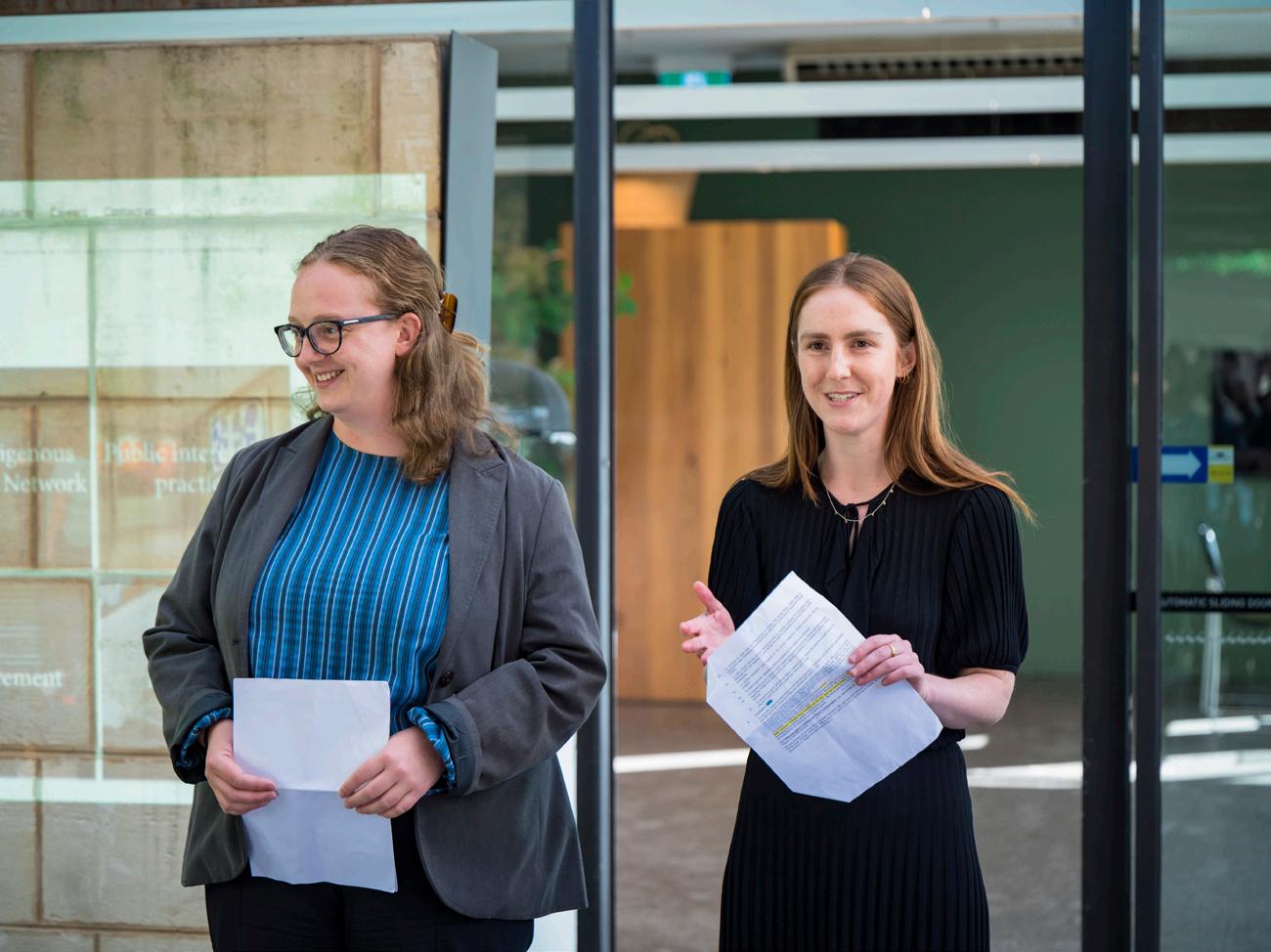
[Left] Launch of the first Annual Progress Report (2022)
AISN Co-Chairs Annie Ward-Ambler (2021-2024) and Julia Heyward (2021 - 2025) launch the first Annual Progress Report at the one-year anniversary of the Indigenous Solidarity Statement of Commitment at Heidi Museum.
[Above]
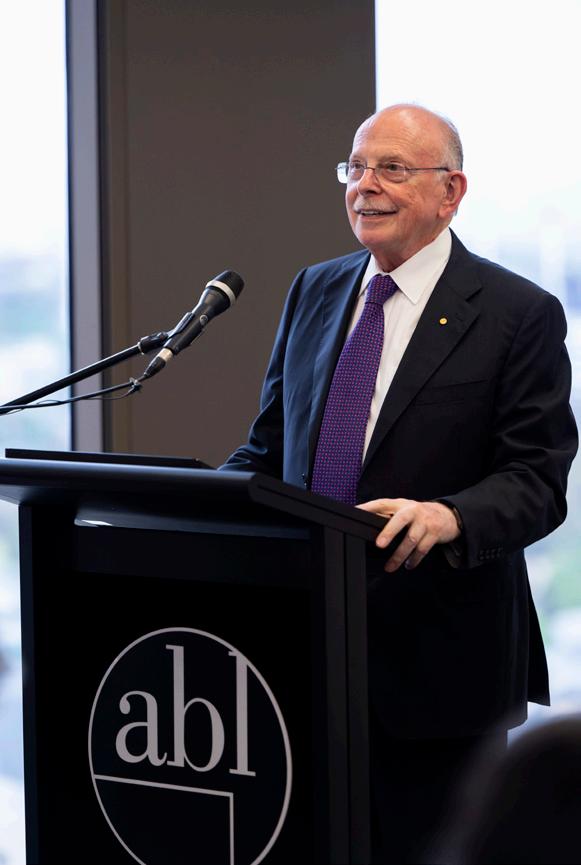
Indigenous Solidarity Statement of Commiement (2021)
Pictured: Senior partner Mark Leibler AC describes
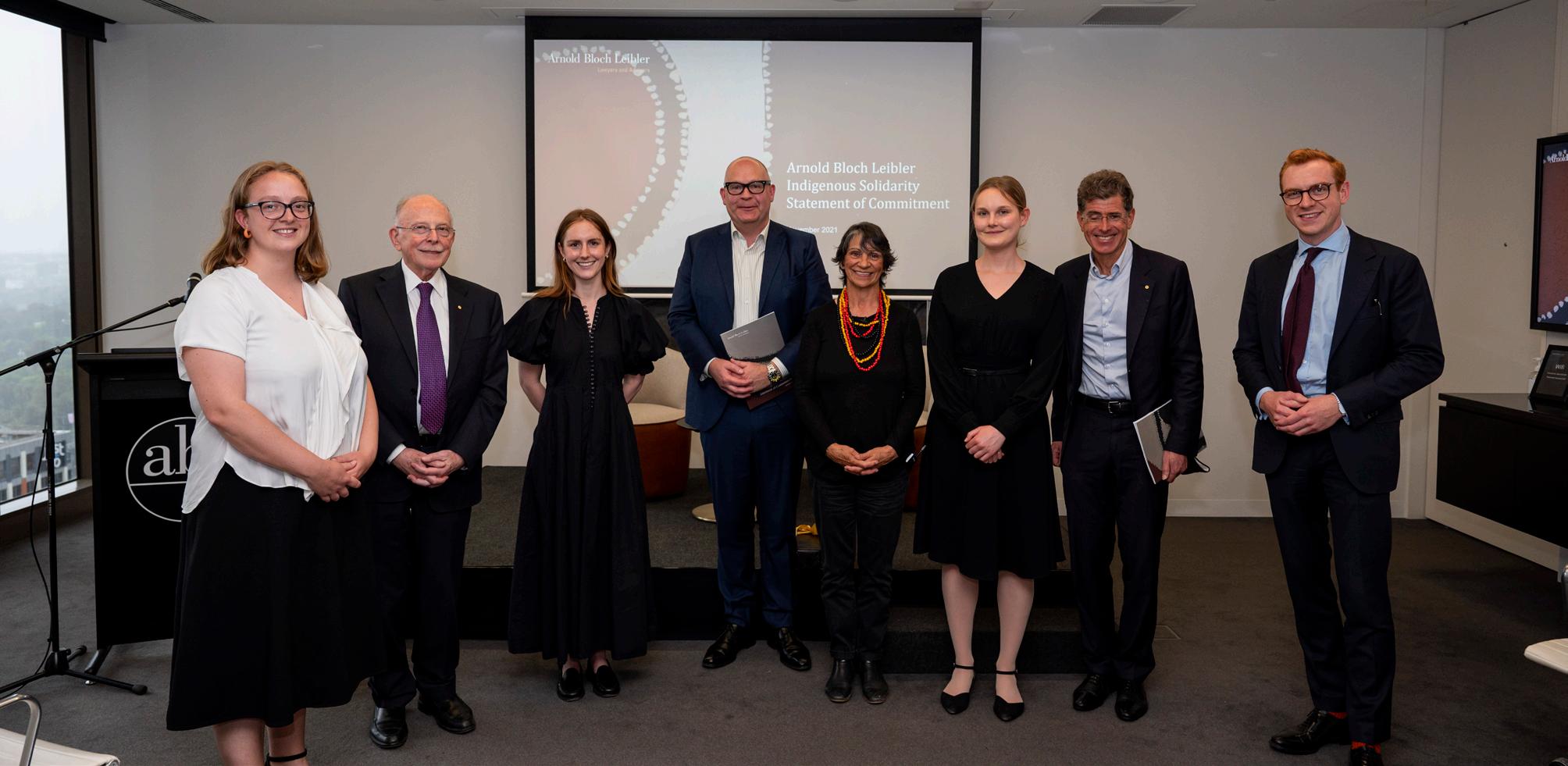
Arnold Bloch Leibler launches its first Indgenous Solidarity Statement of Commitment, with special guest Monica Morgan from the Yorta Yorta Nation Aboriginal Corporation (2021)
Pictured (L-R): Annie Ward-Ambler, Mark Leibler AC, Julia Heyward, Peter Seidel, Monica Morgan, Emma Ffrench-Mullen, Henry Lanzer AM, Max Griffin
Reporting
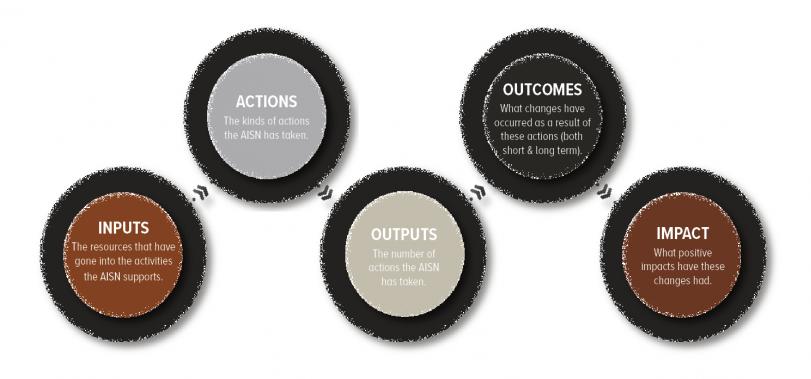
To ensure we measure the impact of the actions taken in line with annual priorities, the Statement of Commitment includes a commitment to report annually on the firm’s progress against our stated objectives and priorities, using a specifically designed impact model (ABL Impact Model). This requires the AISN to monitor, review and report on activities and analyse them qualitatively and quantitatively using the ABL Impact Model.
As set out in the Statement of Commitment, the ABL Impact Model is designed to assist the firm and the AISN to:
o identify the rationale/objective of an activity so we can analyse the cause-and-effect relationship between activities and their longer-term impact;
o guide planning, design and execution of activities;
o identify where resources are best utilised; and
o encourage all staff members to view AISN projects within the wider organisational context.
This Annual Progress Report uses the framework of the ABL Impact Model to seek to meaningfully track and report on our stated “inputs”, “activities” and “outputs”. In doing so, we have collected, reviewed and reported on both qualitative and quantitative data sources. This process has enabled us to analyse our stated outputs and, ultimately, the impact the firm and the AISN have had over the course of the fourth year since the launch of the Statement of Commitment.
The ABL Impact Model continues to assist us to reflect on our achievements and strengths, as well as areas we can improve on next year and in the years to come. In previous years, we have included our priorities for the following year in each report. In 2025, we decided to reflect as a committee over the summer break and to decide in early 2026 on the approach to our priorities and set those priorities.
The ABL Impact Model stems from “Theory of Change” methodology which seeks to comprehensively map out
the steps required to achieve long-term goals. In the 2023 and 2024 progress reports, we acknowledged that this methodology has its limitations and should never be used to position us as a law firm as the central ‘change makers’. We remain conscious of the fact that meaningful change for the better should be informed and led by First Nations peoples and communities, with their representative organisations providing support where appropriate. We acknowledge that, as an internal committee, we are often required to make decisions without direct involvement from First Nations peoples but we remain committed to ensuring our overarching purposes and objectives are informed by the views of First Nations peoples, particularly the views of the many First Nations clients and friends of the firm.
In addition to committing to producing an Annual Progress Report, in 2021 the AISN committed to providing monthly updates to the firm’s Partners on the implementation of the Statement of Commitment. In 2025, the AISN provided seven updates to Arnold Bloch Leibler’s public interest partner, Peter Seidel, who reported on the progress of the AISN to the partners at each monthly partners’ meeting.
The tabling of these updates at the partners’ meetings continues to provide an effective mechanism that connects the AISN directly to the ABL partnership. Informed discussion at those meetings often follows the tabling of the reports, which again reinforces the fact that the important work of the AISN is recognised and highly valued by the ABL partnership and reflects a ‘whole of firm’ approach to that work.
Priorities for 2025 and progress measure
Priorities
To listen to First Nations perspectives on implementing Treaty and Truth at state and national levels and facilitate events that continue to assist to educate ABL partners, staff and friends of the firm on these elements of the Uluru Statement from the Heart.
Progress achieved
In furtherance of this priority, the AISN hosted an event with Rueben Berg, co-chair of the First Peoples’ Assembly, on 5 October 2025. The event, held in person in Melbourne and broadcast online in Sydney, had approximately 35 attendees, 8 of whom were clients and friends of the firm. The event was held a week after the first treaty between the State of Victoria and First Nations Victorians was passed through both houses of parliament. Rueben discussed this historic achievement for First Nations self-determination, his experience representing First Nations People of Victoria and his hopes for what Treaty can achieve for all Victorians into the future.
To review the frequency and format of the AISN Book Club with a view to increasing attendance and engagement.
In 2025, the AISN Book Club reduced the number of events it held to two, each attracting between 7 and 10 attendees from both AISN members and non-members. The sessions explored Daniel Browning’s Close to the Subject and the documentary Ablaze The AISN will continue to consider how to increase engagement with the Book Club program.
To continue to update and promote the First Nations Procurement List and Procurement Questionnaire to increase the percentage of spending by the firm with First Nations businesses.
The First Nations Procurement List was not updated in the 2025 reporting period and use of the Procurement Questionnaire dropped significantly in the reporting period. The AISN Procurement Sub-Committee will update the First Nations Procurement List and consider how to promote and increase the use of the Procurement Questionnaire.
To make at least one large-scale (one off or ongoing) spend with a First Nations business or host a large event with a First Nations supplier or suppliers.
In 2025, in place of the NAIDOC Week morning tea, each day during NAIDOC week, the cafes in Sydney and Melbourne offered different snacks and beverages sourced from a range of First Nations businesses, some of which the firm had not previously purchased from.
To implement a process whereby every three months, the AISN connects via email to new starters for the preceding threemonth period.
The AISN did not implement this process. However, the AISN discussed with the CoChairs of the ABL Women’s Network and the ABL Pride Network implementing a joint process to tell new starters about all networks available to members of the firm and will look to implement that process next year.
For the AISN Recruitment Working Group, in collaboration with ABL Human Resources, to continue the firm’s efforts to:
• Identify channels for the firm to source First Nations candidates, and to maintain focus on:
• both recruitment and retention of First Nations employees; and
• including measures to ensure a culturally safe workplace for First Nations employees, with a particular focus on ABL’s clerkship program.
• Build relationships with organisations and contacts that will facilitate recruitment of First Nations employees, including through universities and referral networks.
During 2025, the AISN and Human Resources worked to strengthen ABL’s recruitment and engagement with Aboriginal and Torres Strait Islander candidates.
Human Resources efforts included expanding outreach to universities and community organisations across Victoria, New South Wales and the ACT to raise awareness of ABL’s clerkship, paralegal and employment opportunities and to promote culturally safe pathways into the legal profession.
As part of this work, the AISN re-engaged with Tarwirri, the Victorian Aboriginal and Torres Strait Islander Lawyers and Law Students Association, to explore opportunities for collaboration and to support increased participation of First Nations students and graduates in the firm’s programs.
These initiatives form part of ABL’s ongoing efforts to increase First Nations representation across the firm and to foster an inclusive and equitable workplace that reflects the values set out in the firm’s Indigenous Solidarity Statement of Commitment.
Priorities Progress achieved
To install plaques next to artwork created by First Nations artists in Arnold Bloch Leibler offices providing information about the artists and the meaning of the artwork.
To continue to provide opportunities for AISN members and other staff and partners to engage with Indigenous culture and art, history and contemporary experiences, including by organising external excursions to events showcasing First Nations artists.
In 2025, the AISN finalised and installed permanent plaques with First Nations place names for the Melbourne and Sydney office reception areas. The process and design will inform the AISN’s approach to the installation of artwork plaques, which it will progress in 2026.
In March and April 2025, AISN members attended two significant cultural events celebrating Indigenous and Pasifika storytelling. The first was the Birrarangga Film Festival screening of Tinā, a Samoan drama exploring themes of grief, resilience and community, followed by a Q&A with the film’s creators. The second was the Deadly Funny National Grand Final at the Melbourne International Comedy Festival, showcasing Aboriginal and Torres Strait Islander talent in stand-up comedy. Both events provided valuable opportunities for cultural engagement and reflection on the strength and diversity of First Nations and Pasifika voices.
Treaty for Victoria Q&A
For many years, Victoria has led the way nationally in progressing Treaty with First Peoples, establishing a formal process for truth-telling, self-determination, and partnership between Traditional Owners and the State. Since early 2024 the AISN has sought to engage the firm in deeper education and dialogue about this historic reform. We are fortunate to live and work in a state where a Treaty is not just being discussed, but actively realised - a development that has, on the whole, been approached with collaboration and respect, rather than political division. In accordance with our deep commitment to the Uluru Statement from the Heart, ABL and the AISN have been reflecting on how best to support and contribute to the success of the Treaty process, recognising its role in advancing Voice, Treaty and Truth for First Peoples in Victoria.
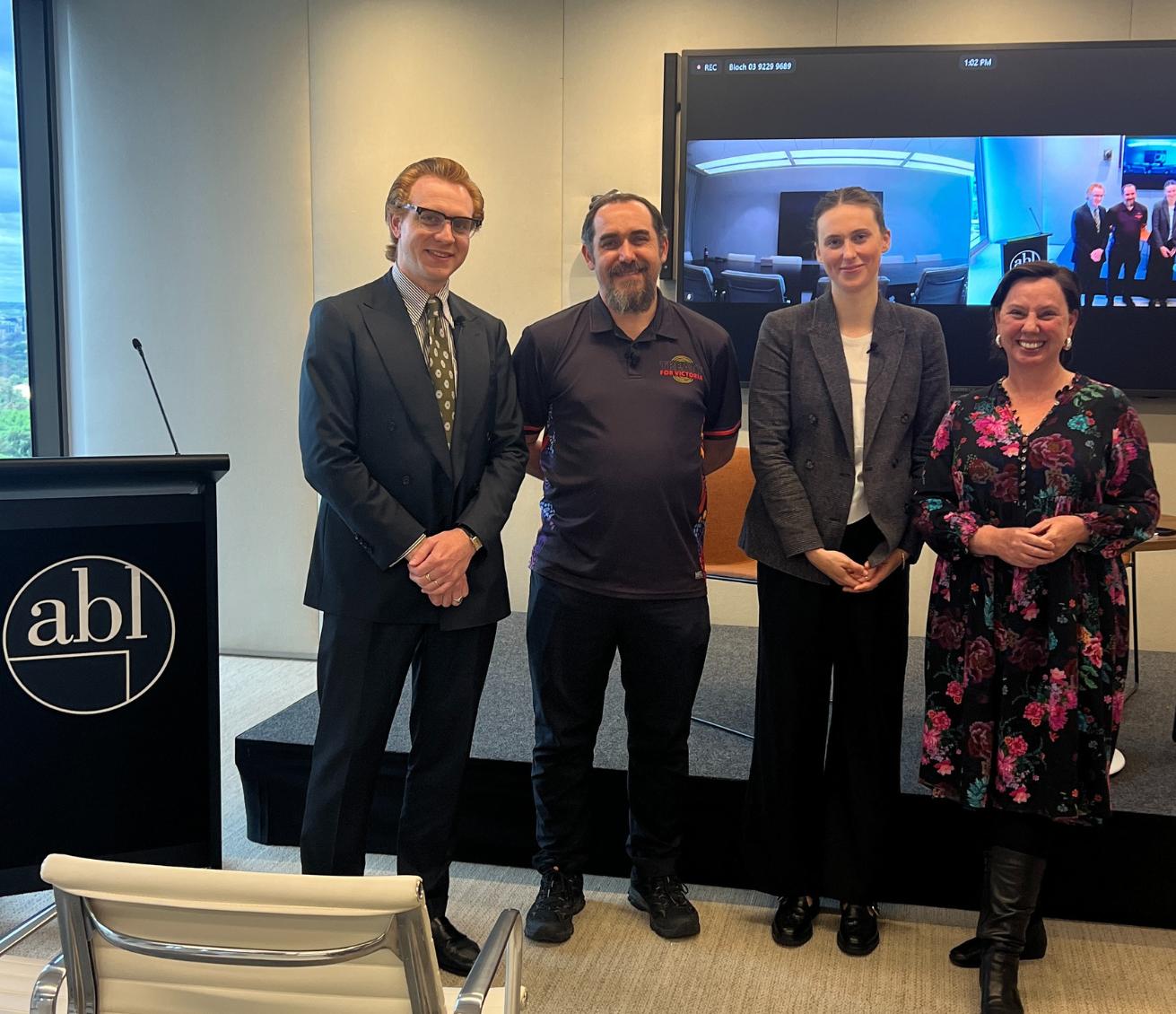
On 5 November 2025, one week after the Statewide Treaty Bill 2025 (Vic) (Treaty Bill) passed both houses of parliament, the AISN hosted an event for the firm and friends of the firm focused on the Treaty process in Victoria. The event featured Rueben Berg, Co-Chair of the First Peoples’ Assembly, as guest speaker. Mark Leibler provided introductory remarks on Rueben’s long-standing relationship with the firm and ABL’s enduring commitment to supporting First Nations progress and self-determination.
AISN Co-Chairs Kalinda Scheef and Max Griffin facilitated an engaging Q&A discussion with Rueben, followed by audience questions from attendees. Rueben explored the principles, progress, challenges and opportunities of Treaty-making in Victoria, highlighting the First Peoples’ Assembly’s achievements to date and the passage of the Statewide Treaty Bill as a historic milestone.
Rueben outlined the structure of the Treaty process, explaining the roles of statewide and Traditional Owner treaties, and discussed the ‘possum skin cloak’ approach, drawing inspiration from treaty models around the world while tailoring the process to reflect the unique identity and aspirations of Victoria’s First Peoples. He also spoke about the Self-Determination Fund and Negotiation Framework, which aim to ensure Traditional Owner groups can engage in negotiations on an equal footing through access to resources, legal advice, and governance support.
The discussion delved into how the Treaty process gives practical effect to the Uluru Statement from the Heart, encompassing Voice, Treaty and Truth within a Victorian framework. Rueben reflected on the realities of negotiating with government, the need to build genuine partnerships based on respect and open communication, and the importance of political and community support to sustain the process over time.
A key theme of the conversation was the importance of allyship and education. Rueben encouraged non-Indigenous Australians and the legal profession to play an active role in supporting the success of Treaty through learning, advocacy and partnership.
Concluding remarks were provided by Bridgid Cowling, who reflected on the preamble to the Statewide Treaty Bill 2025 (Vic) and its powerful acknowledgment of the deep history, resilience and continuing presence of First Peoples in Victoria. She spoke about how the preamble recognises both the enduring harm of colonisation and the courage of Victorians to face these truths with honesty and respect. In closing, Bridgid emphasised that the spirit of the preamble - truth-telling, partnership and pride in the world’s oldest living cultures - should guide how we, as a firm and as individuals, continue to walk alongside First Peoples in pursuit of a more just and shared future.
The event drew approximately 35 attendees across ABL’s Melbourne and Sydney offices, including staff, clients and friends of the firm. Feedback was very positive with attendees describing the session as inspiring, insightful and timely, and reinforcing ABL’s long-standing role as an ally and advocate for First Nations justice.
The Treaty process in Victoria has been a core focus of the AISN’s work throughout 2024 and 2025, with the network providing updates to staff and facilitating discussions aimed at deepening understanding of self-determination and Treaty-making. The success of this event reflected the AISN’s ongoing commitment to fostering meaningful dialogue and supporting the firm’s engagement with one of the most significant and positive developments in the journey of self-determination for First Peoples in Victoria and Australia.
ABL Indigenous Solidarity Network
Growth, inclusion & accessibility
One of the AISN’s stated goals is to continue to make membership of the AISN available to all members of the firm.
There are currently 26 members of the AISN, which represents approximately 10% of the firm.
In 2025, 2 new members joined the AISN.
The AISN also seeks to engage with seasonal clerks during their clerkship program by:
o Scheduling events during their program (for example, book clubs, excursions and other external events); and
o Continuing to inform seasonal clerks of the AISN’s purpose and activities, and ways in which they can become involved as Law Graduates, including by the co-chairs of the AISN running a session with each cohort of seasonal clerks addressing these matters.
The AISN continues to reach out to new starters at the firm to connect and provide details and resources about the AISN. There were 36 new starters at ABL between the months of January and November 2025. 8 of the new starters were law graduates who commenced in March 2025 and the AISN co-chairs reached out to those law graduates to provide details regarding the AISN and membership in June 2025. The AISN sent emails to the remaining new starters in November 2025.
"I was excited to join ABL's Indigenous Solidarity Network because of its important impact by way of education and engagement with First Nations peoples.
The first step to reconciliation is learning, and the AISN facilitates understanding of the unique parts of Indigenous culture which we celebrate, as well helping us recognise the challenges faced by Indigenous peoples. I wanted to contribute to this impact, and it has been fantastic being involved in my graduate year already."
Daniella Cosentino, 2025 Graduate Lawyer
AISN newsletter
The AISN has previously circulated quarterly newsletters to provide information to Arnold Bloch Leibler staff on recent legal and policy developments, to share relevant upcoming events and to increase awareness and firm-wide engagement with Indigenous social issues.
Each newsletter generally includes the following sections:
o news and law updates;
o a spotlight on a current Arnold Bloch Leibler client;
o a spotlight on an Indigenous supplier that Arnold Bloch Leibler has engaged;
o upcoming events;
o a collection of podcasts, music, movies and other entertainment by Indigenous artists or focused on Indigenous issues/culture; and
o events/reading materials for children.
For 2026, the AISN intends to integrate AISN content into the quarterly ABL Voice newsletter. This approach will ensure that AISN initiatives and events reach a broader audience across the firm and help to strengthen ongoing engagement with the Committee’s work.
Book club
The AISN Book Club is a key feature of the AISN and the firm’s commitment to deepening community engagement with and celebrating Aboriginal and Torres Strait Islander cultures and histories. To date this year, the AISN has held two sessions of Book Club, each discussing texts or media by Indigenous authors.
This year, the AISN Book Club read, watched and discussed:
o Close to the Subject by Daniel Browning – a collection of previously unpublished poetry, memoir, art writing and play script spanning Browning’s career as a journalist, radio broadcaster, critic and interviewer.
o Ablaze – documentary which tells the story of opera singer, Tiriki Onus who sets out to uncover the mystery surrounding an untitled 75-year-old silent movie believed to be made by his grandfather, Aboriginal leader and filmmaker, Bill Onus.
The AISN Book Club has retained two key changes it made in 2022:
o Sourcing snacks and beverages from Indigenous-owned businesses (snacks from Mabu Mabu and Bunji Catering, craft beers from Henry Street Brewhouse, wines from Mt Yengo wines, and non-alcoholic beer from Sobah); and
o Sourcing copies of the books from Indigenous-owned book sellers where possible.
On average, 30 people expressed interest and 7 to 10 people attended each Book Club. Both AISN members and non-members have attended.
“Having the opportunity to read and engage with Browning’s collection of written works, Close to the Subject, provided a unique opportunity for the AISN Book Club to engage with the work of a writer that we had previously heard speak at the Blak and Bright Literary Festival in 2024. Winner of the 2024 Prime Minister’s Literary Award for Non-Fiction, the book largely reflects Browning’s experiences working as a journalist, broadcaster and interviewer, and explores the challenges of amplifying Indigenous voices within traditional media frameworks, and how cultural and structural barriers can limit genuine representation. It prompted thoughtful reflection on the role of storytelling, authorship and agency in shaping public discourse. It was a highly engaging and thought-provoking session.”
Aaron Bronitt, Lawyer
Public Interest law practice
Public Interest law practice
In FY25, Arnold Bloch Leibler carried out approximately 13,765 hours of pro-bono work, the production value of which totalled $10.5 Million.
Of this, approximately 2,750 hours or 20% of time spent on public interest law engagements was for First Nations causes, with an estimated production value in excess of $2 Million.
Averaged out across the firm, the 13,765 hours total of pro-bono work amounted to an exceptional 81.5 pro bono hours per lawyer. According to the Australian Pro Bono Centre’s 17th Annual Performance Report statistics, in terms of the average hours per lawyer, Arnold Bloch Leibler then is the highest performing large law firm in Australia for FY25.
In addition, the firm carried out a significant number of hours on First Nations-related client engagements at significantly reduced fees, or ‘low bono’ rates. The nature of the relationship between the firm and its clients is not always linear fee-paying or pro-bono. Some instructions with the same First Nations client may be pro-bono, while other instructions may be fee-paying. Decisions on the nature of the retainer are made jointly by the firm and the client. It is never imposed on the client unilaterally by the firm. Rather, it’s always by mutual agreement to reflect the importance to our firm of the public interest law nature of the work and the firm’s honouring of the cornerstone First Nations’ principle of free, prior and informed consent
Arnold Bloch Leibler places significant value in the time our lawyers spend working on public interest law work. It includes advising traditional owner organisations, individuals and groups across a comprehensive range of native title, land rights, reconciliation and wealth management areas. We are actively involved in public policy initiatives and advise government agencies on their interactions with First Nations groups.
A small slice of the First Nations causes and projects we proudly supported in 2025 are highlighted below.
Our work
Potential First Foundation
ABL has been proud to advise the Potential First Foundation, an emerging Indigenous-led charity dedicated to empowering young, marginalised Aboriginal and Torres Strait Islander people through holistic, wrap-around support services designed to help them gain and sustain meaningful employment.
ABL has assisted the Foundation with governance and structuring advice, including preparing and submitting its charity registration application to the ACNC. We are pleased to have secured successful ACNC registration and Deductible Gift Recipient (DGR) endorsement, enabling the Foundation to expand its impact through philanthropic support.
Winda-Mara Aboriginal Corporation
In late 2024, ABL was retained by Winda-Mara Aboriginal Corporation on a pro-bono basis to make an application for land tax exemption including seeking refunds in respect of social housing properties (all providing below market concessional rent to Aboriginal people), medical clinics, an Indigenous Protection Area a working on country depot and administration offices.
We achieved a successful outcome for an organisation doing critically important work for and on behalf of Aboriginal and Torres Strait Islander people living in the Portland and surrounding areas. Winda-Mara provides health, education and employment opportunities for these communities, as well as social housing and crisis accommodation. Winda-Mara’s key focus is to provide opportunities for Aboriginal and Torres Strait Islander people and their families to access and participate in culturally appropriate services and community activities.
Read more about Winda-Mara Aboriginal Corporation here
Self-Determination Fund
ABL has been proud to play a part in the Victorian Treaty process over the years, from advising the Aboriginal Treaty Working Group on Australia’s first treaty legislation, to more recently advising the Self-Determination Fund on its funding arrangements.
Using our legal skills to contribute to the rights of First Nations peoples of Victoria is an immense privilege. Our work with The Self-Determination Fund has been cross practice, involving the public interest team and the tax team.
Yamatji Marla Aboriginal Corporation
We are incredibly proud to continue our enduring 20-year relationship with YMAC, providing advice on technical native title matters as well as assisting YMAC in relation to its governance and statutory obligations.
YMAC is the native title representative body for the Yamatji and Pilbara regions of WA. YMAC provides legal assistance to native title claimants and holders in its region in relation to a wide array of matters that include some of the country’s largest mining and renewable energy projects.
YMAC provides a range of support functions to native title claimants and holders and is a leader in ensuring best practice standards are met by proponents wanting to work on country. In working with YMAC we are pleased to provide our expertise in tax for native title payments, governance and native title law to ensure positive outcomes for native title holders.
Killara Foundation
ABL is advising the Killara Foundation, an Indigenous-owned and operated organisation dedicated to supporting Aboriginal and Torres Strait Islander peoples through pathways to employment, cultural connection and mentoring, and assistance in navigating the housing and labour markets. The Killara Foundation is a registered charity with the Australian Charities and Not-for-profits Commission and a Public Benevolent Institution.
Over the past year, ABL has supported Killara across a range of commercial and governance matters, including advising on tax and regulatory issues and commercial ventures.
These matters have involved a cross-practice collaboration between ABL’s Property, Banking & Finance, and Public Interest Law teams, reflecting the firm’s ongoing commitment to supporting Indigenous-led organisations that deliver meaningful social impact.
Blak & Bright First Nations Literary Festival
ABL is advising Blak & Bright First Nations Literary Festival in relation to various public interest law advice. Blak & Bright is Australia’s premier organisation dedicated to showcasing and elevating First Nations literary voices. Established in 2016 as their primary event, the Blak & Bright First Nations Literary Festival now includes year-round programming through partnerships with similar organisations across Australia.
Over the past 12 months, ABL has supported Blak & Bright in drafting various commercial agreements to formalise their collaborative partnerships which aims to amplify First Nations voices within Australia’s literary and cultural landscape.
ABL has also recently developed template contractor agreements for Blak & Bright’s management team, covering roles such as General Manager, Artistic Directors, Program Coordinators, and Marketing Managers.
ABL has also provided general governance advice to Blak & Bright, and has recently worked with Blak & Bright to submit a charity application for registration with the Australian Charities and Not-for-profits Commission.
Awareness raising
Indigenous place name plaques
In 2024, the Partners approved the installation of Indigenous place name plaques in the reception areas of each of the ABL Melbourne and Sydney offices. The wording on the plaques reflects the firm’s commitment to standing in solidarity with First Nations Australians. The plaques have been designed and crafted by Wathaurong Glass, a 100% First Nations-owned and operated not-for-profit business. In 2025, with the assistance of the ABL Marketing and Facilities teams, the design and placement of these plaques was finalised and installed.
Indigenous artwork information plaques
One of the priorities for 2025 was to install plaques next to artwork created by First Nations artists in Arnold Bloch Leibler offices providing information about the artists and the meaning of the artwork. The process of designing, procuring and installing the place name plaques took longer than expected but it will inform the approach to the artwork plaques and will allow the AISN to efficiently progress this priority in 2026.
Cultural awareness training
Arnold Bloch Leibler continues to ensure our current Indigenous cultural awareness training program is provided to staff, including as part of the firm’s Internal Graduate Training program for law graduates.
The program has to date been facilitated by Leon Egan of Bundyi Giilang Indigenous Education Consulting. Leon is a Wiradjuri, Yorta Yorta, Bangerang and Gundiitjmara man and an Indigenous education professional and mentor. Leon is highly respected and has a wealth of experience in the sporting, corporate, not-for-profit and community sectors.
In 2025, one cultural awareness training session was conducted in Melbourne and one session was conducted in Sydney. A total of 22 staff participated in the training in 2025.
As at the date of writing, 72% of legal staff at Arnold Bloch Leibler have completed cultural awareness training, which includes 20% of Partners. This is an increase from 68% of legal staff in 2024.
Lawyer, Jasper Gotterson provided the following reflection on the cultural awareness training:
“In 2025, Arnold Bloch Leibler’s junior lawyers had the privilege of learning from Leon Egan of Bundyi Giilang Indigenous Education Consulting, a proud Wiradjuri, Yorta Yorta, Bangerang and Gunditjmara man whose candour and generosity in sharing his story continue to leave a deep impression. Leon guided us through a program that explored Aboriginal culture, self-determination and Australia’s shared history, confronting us with the continuing legacies of colonisation and their impact on First Nations communities today.
Although Leon’s seminar was not aimed specifically at the legal system, the themes he covered resonated strongly with our work as lawyers. His storytelling, lived experience and unfiltered honesty prompted us to reflect critically on how legal frameworks, language and institutional practices intersect with cultural identity and historical injustice. The discussion was not abstract, it was personal, often confronting, and ultimately optimistic about the potential to push for impactful change.
In recent years marked by ongoing national debate about voice, treaty and truth, Leon’s message was clear: reconciliation requires more than passive support. It demands active truth-telling and cultural competence within our institutions. As young lawyers entering the profession, we are part of the generation that will shape how these conversations play out in courtrooms, boardrooms and communities. Leon’s session reminded us that understanding the past is not an academic exercise; it is the foundation for building a fairer future and repairing Australia’s troubled history.”
Employment & recruitment
Employment & recruitment
As a firm, Arnold Bloch Leibler attracts legal talent predominantly through our clerkship program which results in graduate offers for penultimate year law students. We are also committed to developing relationships with First Nations student groups at universities in Victoria, ACT and New South Wales to build brand awareness with First Nations law students, so they are familiar with the variety of legal practice experience our firm offers, and also of our public interest law work and our support in solidarity of First Nations peoples.
Over the past year, led by ABL’s Director of Human Resources Shaneen Argall and her team, Arnold Bloch Leibler has continued to make concerted efforts to connect with Aboriginal and Torres Strait Islander candidates for both legal and non-legal roles. In 2025, these activities, described in more detail below, have focused on building relationships with universities, First Nations student groups and community organisations to promote awareness of employment opportunities and pathways within the firm.
At the University of Melbourne, First Nations law student engagement continues to occur through the university’s careers and graduate services team. The law faculty has confirmed that there is a small cohort of First Nations students within the juris doctor program. As has occurred for many years now, in 2025 ABL again offered paralegal and seasonal clerkship opportunities and sought introductions to the First Nations student network.
At Monash University, student associations and faculty representatives were again approached to identify opportunities to connect with First Nations law students. Similar to University of Melbourne, these groups advised there are currently relatively few First Nations-identifying students in the law program and that privacy restrictions prevented maintaining data on student backgrounds, which limited opportunities for direct outreach.
The past year saw us establish a partnership with Western Chances to provide paralegal work opportunities to law students, including those students identifying as First Nations. This collaboration helps create early professional exposure and experience within the legal sector.
At the Australian National University, we shared information with the university’s First Nations community about ABL’s 2025 Winter Clerkship and paralegal opportunities in Melbourne and Sydney. The programs are designed to accommodate student schedules and offer financial support for travel and accommodation, encouraging participation from First Nations students.
Meetings were held between Peter Seidel and Shaneen Argall and representatives from the Australian Catholic University’s First Nations unit to promote clerkship, paralegal and work experience opportunities for Indigenous students. Fruitful connections and relationships are now being forged. Peter and Shaneen toured the campus and visited the First Nations unit to help build our partnership with the university, as well as the Killara Foundation, with the aim of exploring partnership opportunities to support First Nations job seekers and promoting employment pathways within both legal and business support roles at ABL. Killara is now an important public interest law client of the firm.
We also explored potential collaboration with Deakin University’s First Nations institute in respect of student engagement opportunities.
Finally, ABL has recently renewed our collaboration with Tarwirri, a not-for-profit membership body based in Victoria, Australia, which is comprised of Aboriginal and Torres Strait Islander legal professionals, law graduates and law students. Tarwirri aims to support and enhance its members’ representation, professional profile and excellence within the Victorian legal landscape and broader communities. ABL is excited to collaborate with Tarwirri to encourage and support First Nations candidates applying for legal positions at the firm in the year ahead.
This range of targeted activity over the course of 2025 resulted in the firm receiving an increase over previous years in seasonal clerkship applications from First Nations candidates, with each candidate being interviewed in accordance with our established practice of offering all First Nations candidates an interview.
ABL First Nations Procurement
In 2024, the AISN Procurement Sub-Committee’s priorities were:
o to continue to update and promote the First Nations Procurement List and Procurement Questionnaire to increase the percentage of spending by the firm with First Nations businesses; and
o to make at least one large-scale (one off or ongoing) spend with a First Nations business or host a large event with a First Nation supplier or suppliers.
Historically, during NAIDOC Week, the firm has hosted a morning tea in the Sydney and Melbourne offices catered by a First Nations caterer. In 2025, in place of this morning tea, each day during NAIDOC week, the cafes in Sydney and Melbourne offered different snacks and beverages sourced from a range of First Nations businesses, some of which the firm had not previously purchased from. The AISN circulated an email ahead of NAIDOC week providing details of the suppliers and the cafes displayed signage each day with information about the offering and the relevant suppliers.
This change was positively received. It generated engagement throughout the week and exposed members of the firm to First Nations suppliers we had not previously purchased from, including Yaru Water and the Unexpected Guest.
In 2026 the Procurement Working Group will consider whether to:
o update the First Nations Procurement List; and
o promote the use of the Procurement Questionnaire
o review these mechanisms are the most effective and efficient means of ensuring the firm is capturing and tracking its spend with First Nations businesses.
Procurement in the reporting period
In the 2025 reporting period, the firm spent over $13,500 with Indigenous-owned businesses, including gifts, food and drinks and cultural awareness training.
We include details of the purchases from the 2025 reporting period below.
Event
Cultural awareness training
AISN Committee Meeting
Chocolate test
AISN Book Club: Close to the Subject
AISN clerk session
AISN Committee Meeting
AISN Committee Meeting
First Nations businesses supported
Bundyi Gilang.
Jarrah Catering
Chocolate on Purpose
Jarrah Catering
Pawa Catering
Jarrah Catering
Pawa Catering
Event First Nations businesses supported
NAIDOC Week Fruit Box Group
AISN Book Club: Ablaze Mt Yengo Wines
AISN Book Club: Ablaze Jarrah Catering
Chocolate test Only Mine
NAIDOC Week My Dilly Bag
NAIDOC Week Jala Jala treats
NAIDOC Week IndiBrew
NAIDOC Week The Unexpected Guest
In the 2025 reporting period, the firm also spent over $1,100 on products that were manufactured by First Nations businesses, authored by First Nations authors or events that included line ups of exclusively First Nations performers, but which were purchased through non-First Nations third parties. We include details of the purchases from the 2025 reporting period below.
Item Purchased
First Nations Business or individual
Tickets to Horizon at Bangarra Dance Deborah Brow, Moss Te Ururangi Patterson, Bangarra Dance Theatre Dancers
Birrarangga Film Festival tickets to Tinā Miki Magasiva, director of Tinā
Deadly Funny comedy tickets Daniel Newchurch, Dhinawan, Errolyn Strang, Kimberley Benjamin, Matthew Bonson, Ngaire Pigram, Teresa Moore, Yindyamarra Johnson
Notepads, books, hand sanitizer and folders Muru Office Supplies.
Third party non-First Nations business
Bangarra Dance Theatre Australia
Birrarangga film festival
Arts Centre Melbourne
COS Office Supplies.
10 x copies of Close to the Subject Daniel Browning Dymocks
Events
Tinā – Birrarangga Film Festival
On 18 March 2025, the AISN attended the Birrarangga Film Festival (BFF) at ACMI in Melbourne to view a screening of Tinā as part of this internationally recognised celebration of Indigenous storytelling through film.
The Birrarangga Film Festival showcases global Indigenous films that explore the curatorial themes of strength, resilience and the environment. Curated by Wurundjeri (Woiwurrung)/Yorta Yorta screen creative and actor Tony Briggs—creator and writer of The Sapphires—the festival features over 150 feature-length, short and immersive works from Indigenous filmmakers across the world, including from Australia, Canada, Aotearoa New Zealand, the United States, Mexico, Peru, Norway, Finland, Sweden and Greenland.
Tinā is an inspiring, light-hearted yet emotional Samoan drama that follows Mareta Percival, a teacher struggling with grief after losing her daughter in the Christchurch earthquakes. Taking on a substitute role at an elite private school, Mareta discovers students yearning for connection and purpose. Drawing on the rhythms of her culture, she forms a choir that unites the children and helps her rediscover her passion for teaching and motherhood. The screening was preceded by a short film, Lea Tupu’anga – Mother Tongue, which explored themes of language, identity and reconnection.
The event concluded with a Q&A hosted by Tony Briggs, featuring Tinā’s director Miki Magasiva and lead
actor Anapela Polataivao, followed by a moving performance from a Samoan choir. All AISN attendees found the evening to be a powerful and engaging celebration of Indigenous and Pasifika storytelling, creativity and resilience.
Caroline Conan-Davies offered the following reflection on the evening:
"The film’s portrayal of Samoan culture and community life within Christchurch was both beautiful and eye-opening, offering powerful messages of strength, resilience, and identity. Hearing directly from director Miki Magasiva and lead actress Anapela Polataivao during the Q&A made the evening even more special, deepening my appreciation for the film and its celebration of Samoan culture."
Caroline Conan-Davies, Lawyer
Deadly Funny – Melbourne International Comedy Festival
On 14 April 2025, members of the AISN attended the Deadly Funny National Grand Final at the Melbourne International Comedy Festival. Hosted by comedy legend Kevin Kropinyeri, the event celebrated Aboriginal and Torres Strait Islander talent in stand-up comedy and storytelling.
The Grand Final brought together eight finalists from across the country — Dhinawan Baker (Magandjin QLD), Errolyn Strang (Woolyungah NSW), Yindyamarra Johnson (Wagga Wagga NSW), Matthew Bonson (Garramilla NT), Daniel Newchurch (Guuranda SA), Teresa Moore (Naarm VIC), Kimberley Benjamin (Rubibi WA) and Ngaire Pigram (Rubibi WA).
Dhinawan Baker from Magandjin (Brisbane) was crowned the 2025 Deadly Funny winner, with Yindyamarra Johnson and Errolyn Strang named joint runners-up. The performances reflected a diverse mix of humour, lived experience and sharp cultural commentary, highlighting the vibrancy and depth of First Nations voices in comedy.
Deadly Funny remains Australia’s only national comedy competition dedicated exclusively to Aboriginal and Torres Strait Islander comedians. Since its inception, it has served as a vital platform for emerging voices and helped launch the careers of artists such as Steph Tisdell, Andy Saunders, Janty Blair, Ghenoa Gela, Jalen Sutcliffe and Shiralee Hood.
Victoria’s Historic Apology to First Nations People
On 9 December 2025, the Premier of Victoria, Jacinta Allen, made a formal apology to First Peoples in the Victorian Parliament. The apology is a key recommendation of Victoria’s nation-leading Yoorrook Justice Commission and was committed to in the first Treaty, following the Statewide Treaty Act 2025 becoming law.
To mark this milestone event, the AISN arranged for a live screening of the speech at ABL. This was attended by members of the AISN committee, ABL staff and by several summer clerks. This viewing was followed by an open and frank discussion on the importance of the apology as a step towards achieving better outcomes for First Peoples in the future.
As Premier Allen said in closing her speech:
So to those who held the truth close, both present and gone, and to those yet to carry its weight and wisdom, we offer this promise: Victoria will not look away – not from the truth, not from the work, not from you. I commend this apology to the house.
Next steps for the AISN
Next Steps for the AISN
As we close 2025, the AISN is taking a pause to reflect on how we can in 2026 and beyond have the greatest impact with the resources and time that our volunteer committee members can realistically commit. The breadth of our work continues to grow. Our effectiveness will continue to depend on us making clear choices about what we focus our efforts and energies on.
We will use the coming months to streamline our activities, consolidate what works and sunset or redesign initiatives that deliver relatively lower impact.
A key part of this reset is leadership renewal. In early 2026, the AISN will seek to engage new CoChairs. We see this transition as an opportunity to renew our strategic focus and ensure that our activities are in line with the firm’s ongoing commitment to First Nations solidarity.
To support a thoughtful handover and prioritisation process, other than the priorities from 2024 that require ongoing effort, we will not publish our 2026 priorities in this report. Instead, once the new Co-Chairs are appointed, the AISN will seek to publish a clear set of 2026 priorities and measures of success.
In practical terms, our approach into 2026 will:
o concentrate on a smaller number of relatively high-impact initiatives aligned to Treaty and TruthTelling;
o seek to sequence events and communications to match committee capacity and maximise participation;
o continue to work in alignment with ABL’s public interest practice and procurement to continue to leverage the firm’s strengths; and
o remain transparent reporting against targeted outcomes, so we can learn and adjust quickly.
The AISN remains committed to walking alongside First Nations peoples and organisations in solidarity. And so, in 2026 and beyond, we will continue to do our very best to honour that commitment with work that is realistic, sustainable, impactful and, carried out with the free, prior and informed consent of First Nations Peoples.
We look forward to sharing our refreshed priorities and implementation plan following the appointment of the new Co-Chairs in 2026.