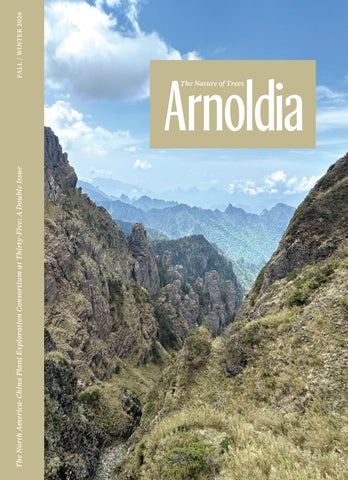
The North America-China Plant Exploration Consortium at Thirty-Five: A Double Issue
FALL / WINTER 2026
GUEST EDITORIAL
Collaborative Bounty
By Tony Kirkham
ARNOLDIA | N AC P EC S P EC I A L I S S U E | FA L L / W I N T E R 2 0 2 6
I NS I DE F RON T A ND BACK C OVE R S L LU STR AT IO N BY EM ILY CAU L F IE L D
T
hirty years ago, in September 1996, I journeyed to China on my first plant collecting expedition, leading a small team of plant collectors in the mountains of Dabashan, northeast Sichuan. This was part of a plant-exploration program by the Royal Botanic Gardens, Kew, to find living plant material (germplasm) to replenish the gaps in the scientific collections after the loss of over 700 specimen trees in the “Great Storm of 1987 ” that felled over fifteen million trees across the south of the British Isles in one night. Prior to 1996, I had been busy collecting germplasm and herbarium specimens in South Korea, Taiwan, Japan, the Russian Far East, and Sakhalin. The work in China was part of a collaboration with the Royal Botanic Gardens, Kew; Quarryhill Botanical Garden, California (now Sonoma Botanical Garden); Howick Arboretum in Northumberland, England; and the Crown Estate (Windsor). This collaboration and agreement of scientific cooperation—or Memorandum of Understanding (MOU)—began in 1988. Working with scientists and guides at the Chengdu Institute of Biology, we began to undertake the introduction of Chinese plants into European and North American gardens for the purpose of amenity as well as education, scientific research, and ex situ conservation. With ten field expeditions into China successfully completed over a fifteen-year period, this collaboration has greatly increased the integrity and number of new natural source collections with high conservation and educational value, which bear the collector’s code SICH, growing in all the above living collections and many others as well. A strong bond of personal and professional friendships was also formed that remains strong long after the last field trip. In 1991, a similar program was formed across the pond and on the other side of the world. The North America-China Plant Exploration Consortium (NACPEC), a multi-institutional group of North American and Chinese botanical gardens, shared the same objective of increasing ex situ conservation of natural-sourced plants from the temperate zones of China that would grow successfully in the United States and Canada. Current consortium membership includes a host of leading gardens and arboreta from the United States and Canada in partnership with the National Botanic Garden (Beijing) in China.
1
FA L L / W I N T E R 2 0 2 6 | N AC P EC S P EC I A L I S S U E | ARNOLDIA
One of the golden ages of plant collecting in China comprised the decades around the turn of the last century, when explorers and collectors like Ernest Henry Wilson, George Forest, William Purdom, and Frank Meyer introduced many new species to European and North American gardens. I consider another golden age to be the end of the twentieth century, from the late 1980s to the present day (the SICH and NACPEC era), when plant collecting was still permitted under international and local agreements. Today, obtaining local and national collecting and export permits, material supply agreements, MOU’s, and other legal documentation from the relevant government offices in China that conform to the Convention of Biological Diversity is often difficult and complicated. Despite the emphasis on non-commercialization of material and prioritization of scientific research and global conservation, collection is far more difficult, and collecting germplasm and herbarium vouchers for our gardens and arboreta is restricted in many parts of the world, including China. Unfortunately, there are also still individuals—bio-pirates—collecting germplasm and seed without the necessary permits which make things more difficult for responsible organizations seeking these permissions. However, I believe that the collaborative approach to plant exploration which has been adopted by botanic gardens and arboreta in both North America and Europe has reduced the need for this style of plant collecting and placed greater emphasis on legal collecting. Since the formation of NACPEC, twenty expeditions have been carried out by multiple generations of scientists and horticulturists. Some of those first-generation names include old friends of mine—the late Paul Meyer and Rick Lewandowski of the Morris Arboretum, Peter Del Tredici of the Arnold Arboretum, and Kevin Conrad of the U.S. National Arboretum. The next generation of passionate and collaborative plant collectors and curators includes Tony Aiello, formerly of Morris Arboretum, Michael Dosmann of the Arnold Arboretum, and Kris Bachtell of Morton Arboretum, to name a
2
few. I often wondered if there was a desire to match these new collections with Gray’s disjunct-flora hypothesis, the biogeographical phenomenon of the closely related plant species found in the temperate forests of eastern Asia and eastern North America, like Liriodendron, Nyssa, and Sassafras. We know that the legal collection of living plant material is becoming more difficult. During the last NACPEC expedition in 2025, no germplasm or herbarium vouchers were collected by North American gardens. This trip could be termed “botanical tourism,” but anyone who has collected in China knows that these trips are just as valid and important; they’re a means to build faceto-face “people trust” and forge ongoing relationships with our Chinese counterparts, helping with training and information exchange. While the expedition didn’t include germplasm collection for North American Gardens, it did serve as a scouting trip for National Botanic Garden Beijing and an herbarium and DNA sampling opportunity for Zhejiang University botany students. This demonstrates some of the ways NACPEC expeditions support in situ conservation and research initiatives for Chinese partners, even when traditional seed collecting isn’t an option. The impact and legacy of NACPEC is huge and can be witnessed in the new collections of genotypes growing successfully at the many arboreta and gardens in North America. For example, I was bowled over by the highly ornamental bark when I first met Corylus fargesii (NACPEC 05-047), growing so well in the Morris Arboretum and, more recently, in the Morton Arboretum. As with many past plant collecting expeditions, long target lists were generated to bring back large numbers of diverse collections— which was once the definition of a successful trip. Now, “number bagging” is to be avoided, with greater emphasis on fewer, targeted, high-quality collections of good provenances with robust field notes, all of which gives the plant a valuable place and a guarantee of future utility in any arboretum. Several NACPEC expeditions targeted single taxa that could be used in the landscape
LEAVE A LEGACY THAT GROWS
| N AC P EC S P EC I A L I S S U E | FA L L / W I N T E R 2 0 2 6
Tony Kirkham retired as head of the arboretum at Royal Botanic Gardens, Kew, in 2021. Among other honors, he was appointed to the Most Excellent Order of the British Empire and received the Victoria Medal of Honour in 2019.
ARNOLDIA
to improve disease resilience, like Tsuga chinensis collected in 1998 and 1999 to help manage woolly adelgid infestations on Tsuga canadensis, and various Chinese species of Fraxinus collected in 2008 and 2010, landscape trees that replaced American native ash lost to the Emerald ash borer. In 2015, diverse populations of Acer griseum were targeted to understand and improve the genetic diversity of the paperbark maple growing in our gardens and the landscape in both North America and Europe. The value of cross-institutional collaboration and partnership is extremely strong, providing so many benefits supporting biodiversity, plant collections, and conservation. The SICH partnership ensured unbroken knowledge of the Chinese flora and collecting locations and built trust and forged relationships with our Chinese counterparts. The dissemination of horticultural propagation and knowledge learned from the living collections growing in the collaborating gardens ensures their long-term survival and security for science and education. Despite China restricting the exchange of germplasm at the present time, I am confident that NACPEC will continue growing from strength to strength, adjusting to new international protocols and institutional needs and strengthening relationships between North America and China. In so doing, it will renew and extend opportunities for the next generation of horticulturists, plant explorers, and botanists while safeguarding its history and methods by maintaining high standards of documentation and plant records, and archiving historical correspondence, journals, maps, slides, and images for future expeditions with the continued collaboration of Chinese science.
Support the Arboretum’s long-term vitality. Help shape our future today.
arboretum.harvard.edu/support/ make-a-gift/planned-giving
3
TABLE OF CONTENTS
FA L L / W I N T E R 2 0 2 6
58
ARNOLDIA
|
N AC P EC S P EC I A L I S S U E
|
8
FEATURES
1 GUEST EDITORIAL
Collaborative Bounty
8
26
By Tony Kirkham
INTO THE FUTURE
FIELD AND FOREST
20
A Vision for the Next Five Years of NACPEC
Fraxinus: Aiding North American Forests through Exploration in China
By Miles Schwartz Sax and NACPEC Members
By Kim Shearer, Kris Bachtell, Fredric Miller, and Nathan Maren
SPACE AND TIME
NACPEC Endeavors 1991–2026
PLANT PORTRAITS 36 EMMENOPTERYS HENRYI 38 QUERCUS ALIENA 40 ACER DAVIDII SUBSP. GROSSERI ‘DAWES EMERALD TIGER’
38
4
54 MAGNOLIA SINICA 56 ASTILBOIDES TABULARIS
70 ACER SUTCHUENENSE 72 TAPISCIA SINENSIS 74 KIRENGESHOMA PALMATA 86 ACER GRISEUM 88 EPIMEDIUM COLLECTIONS 90 ROSA ROXBURGHII
Volume 83 | Number 3-4
96
27 ARNOLDIA |
100
N AC P EC S P EC I A L I S S U E
58
76
COLLECTIONS IN PRACTICE
PAST AND PRESENT
GROWTH RINGS
By the Numbers, Redux: Thirty-five years of NACPEC Collections
The NACPEC Archival Project
Another Sino-American Sampler: Revisiting the 2010 NACPEC Expedition
By Todd Rounsaville and Anthony S. Aiello
By Michael S. Dosmann
FIELD CHECKS 92 VISUAL ESSAY
100 PROPAGATIONS
108 SEASON IN PRACTICE
What Stopped Us in Our Tracks?
The Benefits of Exchange
Handling Seeds Collected in the Field
By Madeline Schill
98 POETRY
People Like Us By Kim Shearer
By Wang Kang, Quan Jian, and Ma Jinshuang
New NACPEC Member Profile: University of California Botanical Garden at Berkeley By Andrew S. Doran and Lewis J. Feldman
By Charles Tubesing
Cover Daba Mountains, Shennongjia, Hubei Province, May 2025. NACPEC Archives
5
FA L L / W I N T E R 2 0 2 6
By Madeline Schill
|
42
NACPEC Special Issue Volume 83 | Number 3-4 | 2026
Editor Matthew Battles STATEMENT OF OWNERSHIP, MANAGEMENT, AND CIRCULATION (Required by 39 U.S.C. 3685)
Designer Emily Caulfield Editorial & Production Coordinator Nina MacLaughlin NACPEC Issue Editor Miles Schwartz Sax
ARNOLDIA
|
N AC P EC S P EC I A L I S S U E
|
FA L L / W I N T E R 2 0 2 6
NACPEC Consultants Anthony S. Aiello Kim Shearer Editorial Committee Anthony S. Aiello Yota Batsaki Peter Del Tredici Michael S. Dosmann Rosetta Elkin William (Ned) Friedman Jon Hetman Jonathan Shaw Arnoldia (ISSN 0004–2633; USPS 866–100) is published quarterly by the Arnold Arboretum of Harvard University. Periodicals postage paid at Boston, Massachusetts. Subscribe to Arnoldia by becoming a member of the Arnold Arboretum. For more information, visit arboretum.harvard.edu/support/membership or contact the membership department at 617.384.5766 or membership@arnarb.harvard.edu. Send all other Arnoldia queries to Editor, Arnoldia, Arnold Arboretum, 125 Arborway, Boston, MA 021303500. Telephone 617.384.5454; email arnoldia@arnarb.harvard.edu. Postmaster: Send address changes to Arnoldia Circulation Manager The Arnold Arboretum 125 Arborway Boston, MA 02130–3500 Copyright © 2026. The President and Fellows of Harvard College
6
rnoldia welcomes A your ideas, questions, and feedback. You can reach us via email (arnoldia@arnarb. harvard.edu). For submission guidelines, see arboretum. harvard.edu/arnoldia/ arnoldia-guidelinesfor-contributors/. We are grateful to an anonymous donor for creating the first endowment to support the publication of Arnoldia: the Hu Xiansu (H. H. Hu) Endowment Fund. Additional funds for this issue have been provided by the Harvard China Fund. Find us online arnold_arboretum arnoldiamag ArnoldArboretum ArnoldArboretum. Harvard
1. Title: Arnoldia. 2. Publication number: 0004–2633. 3. Filing date: September14, 2026. 4. Frequency: Quarterly. 5. Number of issues published annually: 4. 6. Annual subscription price: $65.00 domestic; $65.00 foreign. 7–8. Address of offices of publication, publisher, and editor: The Arnold Arboretum of Harvard University, 125 Arborway, Boston, Suffolk County, MA 02130–3500. 9. Full names of publisher, editor, and managing editor: The Arnold Arboretum of Harvard University, publisher; Matthew Battles, editor. 10. Owner: The Arnold Arboretum of Harvard University. 11. Known bondholders, mortgagees, and other security holders owning or holding 1 percent or more of total: None. 12. The purpose, function, and nonprofit status of this organization and the exempt status for federal income tax purposes have not changed during the preceding 12 months. 13. Publication name: Arnoldia. 14. Issue date for circulation data below: August 31, 2025. 15. Extent and nature of circulation. a. Average number copies each issue during preceding 12 months: 2,700. Actual number copies of single issue published nearest to filing date: 2,800. b. Paid and/or requested circulation: (1) Paid outside-county subscriptions: Average: 1480. Actual nearest to filing date: 1548. (2) Paid in-county subscriptions. Average: 833. Actual nearest to filing date: 879. (3) Sales through dealers and carriers, street vendors, and counter sales: None. (4) Other classes mailed through the USPS: None. c. Total paid and/or requested circulation. Average: 2,527. Actual nearest to filing date: 2,363. d. (1)(2)(3) Free distribution by mail. Average: 16. Actual nearest to filing date: 76.(4) Free distribution outside the mail: Average: 200. Actual nearest to filing date: 200. e. Total free distribution: Average: 216. Actual nearest to filing date: 276. f. Total distribution: Average: 2,313. Actual nearest to filing date: 2,427. g. Copies not distributed. Average: 200. Actual nearest to filing date: 300. h. Total. Average: 2,529. Actual nearest to filing date: 2,703. i. Percent paid and/or requested circulation. Average: 91.46%. Actual nearest to filing date: 89.79%. I certify that all information furnished on this form is true and complete. Matthew Battles, Editor.
IN MEMORIAM Paul W. Meyer (1952–2023) By Anthony S. Aiello
M
ARNOLDIA | N AC P EC S P EC I A L I S S U E | FA L L / W I N T E R 2 0 2 6
uch of the success of NACPEC stems from the foundational work of Paul W. Meyer. Successively Curator, Director of Horticulture, and Executive Director of the Morris Arboretum of the University of Pennsylvania, Meyer was instrumental in the resurgence of plant exploration in Asia starting in the late 1970s. Following a series of highly successful collecting trips to South Korea, Paul co-founded NACPEC in 1991 along with the U.S. National Arboretum and the Holden Arboretum. He understood that developing longstanding relationships with Chinese botanical institutions was the key to success. With the cooperation of these institutions, a sequential plan of collecting destinations was developed to capture the breadth of plant diversity across a broad swath of central and northeast China and to link these areas to analogous climates of NACPEC member gardens, thus laying the groundwork for a long run of successful expeditions. Paul thoroughly understood the importance of preserving plant diversity and deeply appreciated that botanic gardens and arboreta serve both as libraries and as arks. He realized the need for purposeful collecting, whether it was for increased urban tolerance, improved disease and insect resistance or ornamental traits, greater heat and cold tolerance, or preserving plants of conservation value, so that botanic gardens could assemble, conserve, educate, carry diversity through to the future, and serve as a repository for unknown or unexpected needs. Paul’s life and career were greater than the sum of their parts. He was instrumental in working with the U.S. National Arboretum and the American Public Gardens Association to build networks for preserving plant diversity. And although Paul’s work in developing these networks was important, his role as a mentor was even more significant. He was a boundless source of positivity, encouragement, and enthusiasm who appreciated nothing more than seeing someone take on new challenges and stretch their boundaries.
Paul W. Meyer stands with an Acer griseum in the Wudang Mountains in Hubei, China in 1994.
Before my first expedition to China in 2002, Paul mentioned that these trips were as much about personal growth and building cultural bridges as they were about collecting new and unusual plants. That remarkable sentiment has remained central to me for a quarter-century, and speaks to Paul’s core values of developing relationships in pursuit of mutual goals. Looking back, the foresight of Paul and his American and Chinese colleagues has served NACPEC’s efforts remarkably well over these decades. When considering the long-running success of NACPEC, I am reminded of Paul’s oft-mentioned adage to “stick to the knitting,” advice that has successfully woven the fabric of relationships allowing this consortium to focus on China and to flourish for thirty-five years.
7
8
Arnoldia |
Summer 2025
I N TO T H E F U T U R E
A Vision for the Next Five Years of NACPEC By Miles Schwartz Sax and NACPEC members
ARNOLDIA |
I
Dramatic views of cliffsides, roads, and hanging foot paths within the Taibaishan National Forest Park in Shaanxi Province, China. Photograph by the author
N AC P EC S P EC I A L I S S U E | FA L L / W I N T E R 2 0 2 6
n 2026, the North America-China Plant Exploration Consortium (NACPEC) turns thirty-five years old, and as with any major milestone this has fostered introspection. NACPEC is the longest continuously running international plant exploration consortium of its kind. Its archives are replete with rich histories of plant exploration that tell the stories of a diverse cast of characters involved in collaborative partnerships and the ever-evolving landscape of botanical scholarship. In 2010, a special issue of Arnoldia (Vol. 86, #2) was devoted to NACPEC’s activities over its first twenty years. This issue is the next chapter of this story, sharing perspectives on NACPEC between 2010-2026 and a vision of consortium activities for the next five years. Over the last sixteen years, NACPEC has stayed focused on collecting plants for conservation, research, and cultivation in botanic gardens. The expeditions in this period addressed contemporary challenges and embraced emerging opportunities. This included the expeditions to Shaanxi, Hebei, and Beijing, in 2010, and Shaanxi, Gansu, in 2011, both focused on general collecting. The 2015 expedition was dedicated to paperbark maple (Acer griseum) and focused on collecting germplasm and documenting populations of this endangered species. Expeditions to Sichuan (2016, 2017) and Hubei (2018) were a mix of general and targeted collecting focusing on acquiring taxa identified in collections’ development plans like the Arnold Arboretum’s Campaign for the Living Collections (Friedman,
NACPEC MISSION STATEMENT The preservation of Chinese and North American botanical biodiversity through cooperative and collaborative plant exploration, exchange of germplasm, scholarly research, and professional development to enhance genetic diversity of living collections and secure plants for the future. It has achieved this through multi-institutional, multi-generational partnership between North American and Chinese botanic gardens.
9
FA L L / W I N T E R 2 0 2 6 | N AC P EC S P EC I A L I S S U E | ARNOLDIA
2025 Expedition Team (L to R) Deng Tao, Miles Schwartz Sax, Kim Shearer, Madeline Schill, Andy Hill, Tony Aiello, Lin Yan, Llu Qun, Michael Dosmann, Tom Arbour, Connor Ryan, Li Pan, Wang Kang, Shen Zhuomin. Photograph by Zhang Xuteng (Image NACPEC archives)
Dosmann et al., 2016). The 2019 expedition across the Appalachian range trod new ground as the first North American trip in the consortium’s history. On this expedition, U.S.-based NACPEC gardens hosted Chinese partners for two weeks in the field and created the opportunity to study, explore, and collect plants within the flora of North America. This expedition set a precedent for future trips in North America and provided the opportunity to show reciprocity to our Chinese colleagues for the many excursions they’ve hosted. The 2025 expedition to Zhejiang, Hubei, Shaanxi, and Beijing focused on relationship building, scouting, and making formal records of plants observed in the field. These trips have infused NACPEC living collections with a diverse set of new germplasm, deepened relationships, and introduced new models for expeditions focused on biodiversity documentation. During the last fifteen years, NACPEC has achieved many accomplishments outside of its expeditionary work. Across the eleven member gardens, 1,793 individual accessions of plants acquired on NACPEC expeditions are growing, providing opportunities for evaluation and study. The official
10
NACPEC herbarium, housed at the U.S. National Arboretum, has been fully digitized and is now accessible online. A special two-year project focused on the archives of NACPEC has been underway to catalogue the consortium’s collections and make them accessible to the public. A searchable, public-facing database is being constructed to provide data on all NACPEC acquisitions from the wild and an inventory of the living metacollection of plants across member gardens. A new set of archival and biodiversity documentation standards was developed and field tested during the 2025 expedition to China. In 2026, NACPEC welcomed University of California Botanical Garden at Berkeley (UCBG Berkeley) into the consortium as its newest member, adding another collection with deep connections to the flora of China (see article on page 103). Lastly, NACPEC formalized its governance structure when it developed and ratified the first official mission statement and set of bylaws. While NACPEC has accomplished much over the last thirty-five years, the organization must continue to grow and evolve to remain relevant and address contemporary needs. Challenges posed by climate change, habitat degradation, and the
article is a synthesis of what was learned through the collective planning process. It is focused on two main themes: the benefits NACPEC members receive from being part of the consortium, and the goals and opportunities for the group for the next five years (2027-2032).
NACPEC Membership Benefits Since NACPEC was founded in 1991, it has grown from three gardens (Holden Arboretum, U.S. National Arboretum, and Morris Arboretum) to eleven members today. The longevity and continued expansion of the group demonstrates that member institutions find value in being part of a consortium. But what specifically are the benefits that members derive? Based on survey results, members identified five core areas of benefit.
1. Enrichment of living collections: From
| FA L L / W I N T E R 2 0 2 6
11
N AC P EC S P EC I A L I S S U E
2. Collaboration and knowledge sharing: The consortium has fostered a stable yet ever-evolving set of relationships among colleagues in botanical institutions across North America and China for over three decades. With NACPEC’s longevity, the opportunity for garden staff to cycle through the consortium has created a community that fosters mentorship and knowledge sharing. Instances of multiple member gardens working together on shared endeavors create a platform for networking and collective problem-solving. Working together within the NACPEC community has created a virtuous cycle where member gardens are more likely to collaborate on projects, even when they are non-NACPEC related. This has
|
biodiversity-loss crisis put increased pressure on global plant communities and ex situ collections. Changes in geopolitics and international policy surrounding the sharing of genetic resources impose restrictions on the exchange of plants. While these headwinds can make the fundamentals of plant exploration more challenging, they also shine a light on the importance of collaborative organizations like NACPEC. To ensure NACPEC is collectively looking towards the future and responding to current needs, the consortium undertook a strategic planning process in 2025-2026. This included the distribution of a questionnaire and guided discussions during meetings and on the 2025 expedition. This was the first time in the consortium’s history that a formal strategic planning process was implemented, but not the first time NACPEC’s future activities were considered. Notable past articulations were discussed by Lawrence Lee in a NACPEC founding document (Lee, 1991) and by Kunso Kim, Kris Bachtell, and Kang Wang in 2010 as they described their thoughts on future activities of NACPEC in the Consortium’s 20th anniversary issue of Arnoldia (Kim, Bachtell, et al., 2010). This current
NACPEC’s inception, the acquisition and cultivation of novel, wild-collected germplasm of known provenance from China have been central to the consortium’s mission. The growing of NACPEC plants is the most tangible result of consortium activities, allowing garden staff, researchers, and the public to interact with these plants and the fruits of the consortium’s labor. Multiple gardens growing the same collections create a metacollection framework, allowing for comparative studies of how individual species sourced from the same wild populations respond to cultivation across multiple garden sites. This model ensures plants of high value or conservation concern are safeguarded. Adopting and maintaining high data standards across the consortium has created secondary benefits, such as improving curation practices within member gardens.
ARNOLDIA
NACPEC stands poised to make unique contributions to conservation and the discipline of plant exploration.
been particularly beneficial to members in the realms of research, propagation, and horticulture.
3. Staff development & professional growth: NACPEC participation creates the condition for members to develop new skills and knowledge. Examples include opportunities to learn expedition methods, new plant species in the field, novel propagation methods, and data-management strategies. The opportunity to travel internationally and immersively allows participants to expand their cultural perspectives and understanding of plant ecology. Growing plants from expeditions allows staff to engage with novel germplasm and extends participation in NACPEC more broadly within member gardens.
ARNOLDIA
|
N AC P EC S P EC I A L I S S U E
|
FA L L / W I N T E R 2 0 2 6
4. Plant conservation and biodiversity missions: NACPEC is seen by consortium members as a platform to advance biodiversity research and conservation within international frameworks like the Global Strategy for Plant Conservation (GSPC, 2025).
On expeditions, populations of rare plants are documented and monitored in support of in situ conservation. Collecting threatened plant species and growing them in member gardens supports ex situ conservation.
5. Institutional profile and credibility: NACPEC members identified that being part of an internationally recognized organization raised the visibility and status of their institution. Thanks to NACPEC’s “brand” recognition and internal practices, association with the consortium enhances members’ bona fides in plant exploration and international collaboration.
Future Directions In the future, NACPEC can rely on its established strengths while developing new initiatives addressing contemporary needs of its members. Over the next five years, NACPEC will focus its efforts on four core areas including the following:
Table 1.
Priority genera
Acer, Amentotaxus, Carya, Cladrastis, Clematis, Fagus, Fraxinus, Ginkgo, Magnolia, Quercus, Rhododendron, Stewartia, Syringa, Tilia, Tsuga, Viburnum
Priority Species
Member gardens have identified specific taxa of interest based on collections development plans and research priorities (e.g., Morton Arboretum collecting Fraxinus mandshurica, F. chinensis, F. insularis, etc., to support research on emerald ash borer resistance)
East Asia – North America disjunct genera
Priority target genera that have species representation in both China and North America (e.g., Aesculus, Carpinus, Cornus, Hamamelis, Hydrangea, Illicium, Ostrya)
Conservation taxa
Globally rare species in China and North America; supporting in situ documentation and conservation of rare, endangered plant species; priority taxa for Global Conservation Consortia that NACPEC members are part of (e.g. Acer, Fraxinus, Magnolia, Quercus, Rhododendron)
Seed banking
Collecting species from North America and China for deposition in National Botanic Garden Beijing’s seed bank and/or the seed repository in USDA’s National Plant Germplasm System
Underrepresented herbaceous taxa
Increasing emphasis on herbaceous plant acquisition, which has historically been underrepresented compared to woody plants
Germplasm for resiliency
Focusing on taxa that are adaptable to abiotic stressors associated with climate change, such as heat and drought tolerance; plant species with pest and disease resistance; collecting in warmer regions to find plants that will be adapted to future climate scenarios.
Collecting in climate regions analagous to NACPEC gardens
Using Köppen-Geiger climate classification models to match garden locations with plants growing in analogous climates, i.e., mid-Atlantic gardens collecting in southeastern China, or National Botanic Garden Beijing collecting in humid regions of northeastern and central USA
12
|
1. Plant Exploration & Collections Development
13
FA L L / W I N T E R 2 0 2 6
UCBG Berkeley to the consortium, Chinese gardens and researchers associated with NACPEC can gain access to their expert knowledge, familiarity with the region, and extended resources, like the Jepson Herbarium, focused on California plants. University of British Columbia Botanic Garden has been focusing on exploration of rare West-Coast North American conifers and facilitating international seed exchange of this critical germplasm. Chicago Botanic Garden holds a seed bank focused on the flora of the Midwest that already holds over 1800 native plant species. A focus on North American taxa can increase participation by gardens who are currently prioritizing domestic collecting over international work, such as the U.S. National Arboretum or the Morris Arboretum. With National Botanic Garden Beijing seed bank's global focus, this initiative provides ample opportunity to ensure North American taxa are represented within this important repository. As new regulations on the export of Chinese germplasm come into effect, NACPEC is ready to adapt. In situations where seed acquisition in the field is not possible, expeditions can shift focus to new initiatives like scouting, biodiversity documentation, and research. Such trips are still highly valuable in supporting staff development and NACPEC’s
|
Plant exploration continues to be a NACPEC’s primary focus. There is strong interest across the consortium in continuing to mount expeditions that acquire new germplasm and herbarium vouchers and document floristic biodiversity. NACPEC has identified prioritizing themes to guide these efforts (see Table 1). Over the next five years, expeditions to North America will create opportunities for Chinese colleagues to join North American partners in the field and promote continued bi-directional exchange of germplasm. A precedent was set for North American collecting during the 2019 expedition to Appalachia, breaking new ground for NACPEC while upholding the organization’s principal mission. This expedition was the realization of a vision articulated at NACPEC’s founding (Lee, 1991) and supports the consortium’s commitment to plant exploration and reciprocal exchange. The majority of NACPEC gardens focus on North American collecting in addition to their international work. These established programs could be a significant asset for NACPEC partners. For example, UCBG Berkeley has a field program focused on the plants of the endemic-rich California floristic province. With the addition of
N AC P EC S P EC I A L I S S U E
M AP S OU RCES : ESR I, VAN TOR , AI R B U S DS, U SGS, NGA , N ASA , CGIAR , GE BCO, N RO BIN S O N , N CE AS, N LS, O S, N M A , GEO DATASTYRE LS EN, E A RT HSTA R G EO GR AP HIC S, TOMTO M, G AR M IN , OP EN ST R E E T M AP CO N T R IBU TO R S, M IL ES S CH WA RT Z SAX , AN D T H E GIS US E R CO MMUNI TY.
ARNOLDIA
Density of formal plant observations overlayed with hiking trail used by the 2025 China expedition team while in Tainmu Shan (Zhejiang). Warmer colors indicate larger number of photos taken per plant taxon. Image by the author
FA L L / W I N T E R 2 0 2 6 | N AC P EC S P EC I A L I S S U E | ARNOLDIA
Top: The rich arboreal diversity of the Shennongjia Forest District as seen on the 2025 trip to Zhejiang, Hubei, and Shaanxi. Photograph by the author. Bottom: Davidia involucrata (dove tree) in flower from the same trip. Photograph by Tom Arbour
14
FA L L / W I N T E R 2 0 2 6
15
|
Along with the acquisition of new plant material, there is a strong recognition of the importance of the plants already growing within member gardens. These plants represent the most tangible results of past NACPEC expeditions, fostering public engagement while offering the opportunity to observe, study, and conserve these organisms and their genetic lineages.
N AC P EC S P EC I A L I S S U E
2. NACPEC Collections Maintenance & Evaluation
|
Beijing’s seed bank are ideal sites for seed deposition and long-term maintenance. Conservation horticulture has become a tradition for NACPEC gardens as they develop methods to cultivate rare and novel germplasm. Conservation horticulture is defined as “the application of horticultural knowledge and skills to the conservation of rare and threatened plants… within the context of developing ex situ collections” (Hughes, 2025). In recent years, institutions such as Longwood Gardens (Zale, Turner-Skoff et al., 2025) and University of British Columbia Botanic Garden have started to formalize conservation horticulture as discrete programs. These programs can have beneficial downstream effects, as NBG Beijing has observed, by raising awareness of the importance of biodiversity conservation. These combined activities make significant contributions towards individual gardens’ programs, but also align NACPEC’s activities with those of broader initiatives, like the ex situ goals described in China’s National Botanical Garden biodiversity conservation scheme (He, Zhou et al., 2025) or GSPC Targets 1, 4, 5, 13, 20, 21. Considering NACPEC’s new paradigm and priorities, funding proposals going into the future will need to reflect the consortium’s goals described in this article. To qualify for funding, an expedition in North America or China must be focused on one of the following activities: Germplasm and/or herbarium voucher collections, scouting and/or capturing observational occurrences, collecting samples for research, or partnership development and maintenance. These activities should be associated with NACPEC priority themes (Table 1) and at least a portion of the acquisitions should of interest to both North American and Chinese partners. Expedition teams should include members from both North America and China whenever possible or have a plan to distribute collections to partners in reciprocal regions. To document the shared benefits derived from NACPEC participation, bi-directional distributions of North American and Chinese germplasm will be tracked going into the future.
ARNOLDIA
goals. For example, the 2025 expedition to China occurred in May, outside the typical expedition season. During this trip, a new set of documentation methods was trialed with the aim of capturing meaningful biodiversity data. This included formally creating species checklists, taking photographs of observed plants, and tracking their exact positions using GPS. These images and locations were associated with each other; taxa names were verified; and resulting files were uploaded to iNaturalist, creating a public repository of georeferenced datapoints for observed plants in the field, furthering efforts to document global biodiversity. This is one example of how NACPEC can shift its expedition paradigm to reach the consortium’s multifaceted goals. Expeditions will continue to provide opportunities for NACPEC members to undertake field work together and demonstrate the consortium’s deep commitment to the flora of China and global plant conservation. Observational occurrence data is a great starting place, but herbarium vouchers remain the gold standard for primary documentation of plants in the field. Historically during NACPEC expeditions, vouchers have been collected concurrently with germplasm acquisition. This has yielded 3,547 vouchers that are now held within herbaria at the U.S. National Arboretum, Harvard University, the Morris Arboretum, and the Morton Arboretum, as well as in Chinese institutions. Going forward, herbarium collecting will continue to be prioritized during germplasm expeditions. Herbarium voucher collection should also be considered when making observation occurrences for NACPEC priority genera. Expeditions focused on biodiversity documentation provide the opportunity to collect earlier in the season and capture vouchers at key phenophases, like flowering. A focus on herbarium collecting during expeditions will ensure NACPEC continues to make meaningful contributions to plant-biodiversity documentation and floristics. Across the consortium, supporting in situ and ex situ plant conservation continues to be counted a priority. A few recent past examples of conservation-focused exploration include the 2015 Acer griseum project, or the 2025 expedition where populations of Acer sutchuenense (see the Plant Portrait on page 70), Davidia involucrata and Kirengeshoma palmata (see the Plant Portrait on page 74) were found in the field. In instances where seed germplasm can be collected, NACPEC can support ex situ efforts such as conservation horticulture and seed banking. For example, the USDA’s National Plant Germplasm System and NBG
FA L L / W I N T E R 2 0 2 6 | N AC P EC S P EC I A L I S S U E | ARNOLDIA
Across the field of public horticulture there is a growing recognition of the vulnerability of living collections to loss and attrition. A recent meta-analysis study of botanic gardens suggests that the mean survival probability of an accession is only fifteen years (Cano, Powell et al., 2025). Growing awareness of such vulnerability has arisen concurrently with efforts to create multi-garden metacollections focused on a single genus or thematic group. Examples include multi-site Plant Collections Network (PCN) Gardens (e.g. Acer, Magnolia, Quercus) within the American Public Garden Association framework or the Global Conservation Consortium’s (GCC) model, sponsored by Botanic Garden Conservation International. Over its history, NACPEC has developed its own metacollection model organically, with multiple gardens growing the same seed collections acquired on expeditions. As attrition occurs within member gardens, there is a recognized need to holistically consider the maintenance of these collections across the consortium. This has prompted an interest in developing a process to review NACPEC holdings from a metacollection perspective and ensure unique lineages are preserved, when appropriate. NACPEC has catalogued its metacollection through an annual survey that records in spreadsheet form the presence or absence of plants in each garden based on their original collecting number. While this provides a baseline level of data, it limits possibilities for deeper analysis. To expand consortium-wide record-keeping capacity, a new online database will be released in 2026. Hosted by the Arnold Arboretum, this database will compile collecting data from the field and living accessions records of NACPEC plants across member gardens. It will provide search functionality across multiple living collections and provide opportunities to take deeper dives into the data. For example, the database will have the capacity to compare growth metrics like plant height, DBH, or condition in a single collection and across multiple gardens, allowing for quantification of tree performance within and among sites. Incorporating accession records of both living and dead specimens across the metacollection can be used to establish demography trends of individual collections or taxa. The database will flag lineages that are only represented within a single living collection. This will allow the consortium to determine if lineages should be repropagated or de-accessioned. While preservation is the goal, instances will occur where a lineage is no longer maintained. For example, with the
16
impending closure of the USDA’s Woody Landscape Plant Germplasm Repository site in Beltsville, MD, in 2026, NACPEC plants housed on this property will likely be removed. In preparation, the consortium has assessed the NACPEC lineages in this collection. At the time of publication, no member has opted to request propagules of a wild collected Buddleja davidii (QL252), among other lineages. The combination of this species being common throughout China, of low conservation concern, and having invasive tendencies in parts of its cultivated range make it a low priority for metacollections preservation. While NACPEC works together to maintain the metacollection, individual members ultimately maintain collections sovereignty and choose to grow individual taxa based on their policies and goals. The consortium has reaffirmed research and evaluation as a priority for the next five years. Research activities are well aligned with the metacollection model and are already occurring on an ad-hoc basis in some NACPEC gardens. Examples include documentation of propagation protocols for rare plants new to cultivation (e.g., Corylus fargesii or Tsuga chinensis); performance of novel plants in horticulture, like the Acer davidii subsp. grosseri ‘Dawes Emerald Tiger’ cultivar introduced by the Dawes Arboretum (see Plant Portrait on page 40); plants’ susceptibility to pests (e.g., Tsuga chinensis resistance to Hemlock Wooly Adelgid) or diseases (e.g., Corlyus fargesii and Eastern Filbert Blight (Capik and Molnar 2012)). The routine curatorial practices of taxonomic review and verification can also yield import results (e.g., review of Longwood Garden’s NACPEC Epimedium spp. collections (see Plant Portrait on page 88)). Across the consortium, a formal evaluation program of NACPEC plants has been highlighted as a goal. Leveraging the NACPEC metacollection framework offers a novel approach to evaluation and unique opportunity to compare plant performance across geographic regions. To this end, NACPEC has identified a list of evaluative themes for particular attention: • Evaluation of pest and disease resistance of NACPEC accessions in general and with a focus on Fagus spp., Fraxinus spp., Tsuga spp. and Ulmus spp. • Evaluation of plants for stress tolerance and climate change adaptation • Evaluation of plant invasive tendencies and traits that pose risk factors for escape from cultivation
• A conservation horticulture focus, i.e., compilation of propagation, production, and landscape-management methods focused on growing and preserving rare and endangered species for ex situ conservation • Evaluation of NACPEC plants and their performance in the landscape with the goal of horticultural introduction in alignment with the Conventions of Biological Diversity (CBD) framework • Comprehensive synthesis of propagation records from across NACPEC collections • Capturing photographs of NACPEC plants within living collections
| FA L L / W I N T E R 2 0 2 6
17
N AC P EC S P EC I A L I S S U E
One oft-cited benefit of NACPEC membership is access to a group of like-minded gardens engaged in a common pursuit. Having a group focused on a shared mission allows for collaboration, engagement, and community building. Opportunities for engagement are built into the consortium model, with annual meetings and expeditions. However, engagement could be deepened through coordinating consortium activities like the creation of a formal multi-garden evaluation program. In 2026, NACPEC will be hosting its first-ever symposium at the Arnold Arboretum in celebration of the consortium’s thirty-fifth anniversary. Current NACPEC members, alumni, and an expanded group of Chinese guests will attend. To strengthen internal engagement, NACPEC is also aligning its priorities with member gardens’ strategic goals. This alignment allows NACPEC to bring direct value to its member institutions, while encouraging participation in the consortium. For example, the Chicago Botanic Garden’s (CBG) strategic plan expresses the aspiration to be a global leader in conservation science. A NACPEC working group focused on conservation horticulture, plant evaluation, and resiliency would support CBG’s science goals as well as those defined by the consortium. The Morton Arboretum sees their engagement with NACPEC as a way to address their strategic goal of building “regional and global capacity in elevating trees and their role in thriving ecosystems.” The Morton Arboretum serves on the steering committee for the GCC for Ash (Fraxinus spp.). While the Ash GCC has many European and North American partners, it doesn’t currently include any from East Asia. With China being one of the centers of diversity for Fraxinus and the genus being a priority for
|
With thirty-five years of experience, NACPEC offers a model for international collaboration.
3. Consortium Engagement & Partnership Development
ARNOLDIA
While living plants have often been the focus of NACPEC scholarship, the consortium also maintains herbarium and archival collections. These provide a rich source of scholarly material, and are becoming more accessible thanks to the U.S. National Arboretum’s efforts to digitize herbarium records and the
Arnold Arboretum’s archival project (see NACPEC Archival Project article on page 58). The archives are a particularly rich source of information on plant exploration in China over the last thirty-five years. Scanned photographs show images of Chinese landscapes and how the practices of plant exploration have changed over time (e.g., physical vs. digital maps, correspondence and photographs, the advent of high-speed rail or the reduced presence of livestock for local transport, etc.). These resources facilitate scholarship on the practice of plant exploration and archival management as discrete endeavors.
FA L L / W I N T E R 2 0 2 6 | N AC P EC S P EC I A L I S S U E | ARNOLDIA
2019 NACPEC Appalachian Expedition Team collecting herbarium specimens of a Sorbus americana along the Appalachian Trail in Tennessee. L to R: Angela Magnan, Jared Rubinstein, Gao Xinfen, and Wang Kang. Photograph by Andrew Gapinski
NACPEC, this creates natural synergies with the GCC. Engagement by the Morton Arboretum with NACPEC partners on Chinese ash would support their goal of elevating trees on a global scale and align consortium activities with an international conservation framework. While NACPEC currently includes ten North American members and one Chinese garden, NBG Beijing, the consortium has conducted field expeditions and developed collaborative partnerships with a series of other Chinese botanical institutions over its history (see Expedition Table on page 22). Professor He Shan’an, of Nanjing Botanical Garden, summarized the general benefits that Chinese collaborators have received from being part of NACPEC in a 2010 Arnoldia article (He, 2010). Additional benefits to Chinese partners highlighted from NACPEC’s archives include staff exchange to US botanic gardens; research collaborations (e.g. the Chinese hemlock project (He, 1998)); financial support for field research in China by Chinese institutions; and the transmittal of North American germplasm to China
18
(e.g. 2019 Appalachian expedition). Such efforts continue today. For example, faculty, staff, and students from Zhejiang University’s College of Life Sciences and Kunming Institute of Botany joined the 2025 expedition, giving students and staff the chance to gain field experience and develop their own research collections (DNA samples and herbarium vouchers). These past examples provide inspiration for future activities and recognize the mutual benefits received by NACPEC partners and members. Over the next five years, NACPEC aims to continue to foster collaborative partnerships with the broader botanical community in North America and China. To this end NACPEC welcomes opportunities to expand membership to botanic gardens in China and North America that meet eligibility requirements and have an institutional commitment to the flora of China.
4. Sharing Knowledge With NACPEC’s thirty-five years of activity, the organization has amassed a significant number of records, archival items, and experiences in the field. A natural
References Cano, Á., Powell, J., Aiello, A. S., Andersen, H. L., Arbour, T., Balzer, A., ... & Brockington, S. F. (2025). Insights from a century of data reveal global trends in ex situ living plant collections. Nature Ecology & Evolution, 9(2), 214-224.
Global Partnership for Plant Conservation (2025), The Global Strategy for Plant Conservation 2020-2030. Botanic Gardens Conservation International (BGCI), London, UK He, S. 2010. Sharing and Enjoying the Joint Botanical Expeditions. Arnoldia, 68(2): 12–15. He, S. 1998. Summary of 1998 Tsuga Expedition. North America-China Plant Exploration Consortium (NACPEC) Papers, III.B.1, Box 6; Folder 11; Item 4. Arnold Arboretum Archives. He, T., Zhou, Z., Dong, H., Yuan, L., Guo, L., Wang, Y., ... & Ren, H. 2026. China’s National Botanical Gardens: An innovative model to support global biodiversity conservation and sustainable development. Plant Diversity, 48(1), 219. Hughes, K. 2025. An investigation into the components of conservation horticulture projects. Sibbaldia: the International Journal of Botanic Garden Horticulture, 24(24). Kim, K., Backtell, K., Wang, K. (2010). Planning Future NACPEC Plant Exploration: Challenges and Opportunities. Arnoldia. 68(2): 40–47; Lee 1991; Zale et al. 2025
19
FA L L / W I N T E R 2 0 2 6
Friedman, W., Dosmann, M., Boland, T. M., Boufford, D., Donoghue, M. J., Gapinski, A., & Pfister, D. (2016). Developing An Exemplary Collection: A Vision For The Next Century At The Arnold Arboretum Of Harvard University. Arnoldia. 73 (3), 2 -18.
|
Capik, J. M., & Molnar, T. J. (2012). Assessment of host (Corylus sp.) resistance to eastern filbert blight in New Jersey. Journal of the American Society for Horticultural Science, 137(3), 157-172.
N AC P EC S P EC I A L I S S U E
Thirty-five years of NACPEC activities, and an openness to evolution, has prepared the organization for the complex moment we find ourselves in. As we face the global biodiversity-loss crisis and climate change, the need for plant exploration in support of conservation is larger than ever. At the same time, changes in geopolitics are making
Miles Schwartz Sax is the assistant curator of living collections at the Arnold Arboretum and the current chair of NACPEC.
|
Conclusion
fieldwork and collaboration more challenging than in the past. Despite these headwinds, NACPEC stands poised to make unique contributions to conservation and the discipline of plant exploration by demonstrating a collaborative model for botanical scholarship. The paradigm for NACPEC activities will undoubtably shift over the next five years in response to these current realities. Staying focused on the organization’s mission, along with a newly identified set of core priorities, will enable NACPEC to continue its critical work and demonstrate the power of collective action around a core vision.
ARNOLDIA
result of this knowledge accumulation is an interest in sharing stories and lessons learned through speaking at conferences, writing articles, and celebrating plants within the landscape. Over the next five years, NACPEC will continue to seek ways to share its accumulated knowledge and make this information more accessible. The two-year NACPEC archival project has taken substantial steps toward making information about the consortium more broadly available. This includes the development of a website that will provide information about the consortium with links to various collections such as the NACPEC metacollection database; scanned archives and photos housed in Harvard University’s library portal (Hollis); plant occurrence data in iNaturalist and the Global Biodiversity Information Facility; as well as records of consortium protocols, archival standards, field methods, by-laws, and publications. Having this information centralized on a public platform will continue to increase NACPEC’s visibility and provide a greater depth of resources for members and those interested in the consortium’s activities. The consortium also has an interest in finding more opportunities for internal knowledge sharing, particularly related to the horticultural practices of growing, propagating, and maintaining NACPEC collections. Finding opportunities to publish NACPEC activities and present at conferences will continue to be important in reinforcing the work of the consortium. NACPEC should target opportunities to present at venues such as the American Public Garden Association annual conference, Botanic Garden Conservation International’s global botanic congress, and relevant horticultural and plant-biology conferences. Finding opportunities within China to present on NACPEC activities should also be targeted. With thirty-five years of experience, NACPEC offers a model for international collaboration, and should use its platform to advocate for responsible plant exploration within the botanical, horticultural, and public-garden communities.
20
Dajiuhu Lake National Wetland Park, Shennongjia Forest District from 2025 trip to Zhejiang, Hubei, and Shaanxi. Photograph by Miles Schwartz Sax
S PAC E A N D T I M E
NACPEC Endeavors 1991–2026 The table and maps on the following pages chart the tempo, scope, and biogeographic reach of NACPEC exploration over the last thirty-five years. Drawn from the records and data of the NACPEC Archival Project and the contributions of many individual NACPEC member affiliates, this information reflects the energy and growth of the community throughout its history, and serves as a resource for the articles throughout this special issue and for the consortium as it charts the path to come in this anniversary year.
21
|
FA L L / W I N T E R 2 0 2 6
This list is a compilation of expeditions the North America-China Plant Exploration Consortium (NACPEC) has conducted over the last thirty-five years. Data presented includes expedition names and abbreviations, locations, dates, and participants. A formal list of NACPEC members and partners is included. Members are defined as institutions who have formally joined the consortium, adhere to the bylaws, and are active participants. Partners are defined as botanical institutions who supported or participated on expeditions but have not officially joined the consortium.
ARNOLDIA
|
N AC P EC S P EC I A L I S S U E
Expeditions and Participants (1991-2025)
NORTH AMERICA-CHINA PLANT EXPLORATION CONSORTIUM
Member Gardens
Partners
1. Morris Arboretum 2. U.S. National Arboretum 3. Holden Forest and Gardens 4. Morton Arboretum 5. National Botanic Garden Beijing 6. Arnold Arboretum 7. Longwood Gardens 8. Chicago Botanic Garden 9. University of British Columbia Botanical Garden 10. Dawes Arboretum 11. University of California Botanical Garden at Berkeley
A. Heilongjiang Academy of Forestry B. Nanjing Botanical Gardens C. Xi'an Botanical Garden D. Shenyang Institute of Applied Ecology E. Changbaishan Forestry Department F. Forestry College of Gansu Agricultural University G. Tianjin Flowers and Trees stock service Center H. Baoji Botanical Garden I. Taingshui Forestry Institute J. Jishou University K. Chengdu Intitute of Biology L. Zhejiang University M. Kunming Institute of Botany N. Norfolk Botanical Garden O. Harvard University
22
PARTICIPANTS
October 11 – November 2
Meyer, Paul 1; Lee, Lawrence2; Bristol, Peter3
1993 Expedition to Heilongjiang (HLJ)
August 25 – September 29
Bachtell, Kris4; Bristol, Peter3; Meyer, Paul1; Gao Shi XinA ; Jiu JunA; Jin Tae ShanA
1994 Expedition to Beijing (BJG)
September 8 – October 4
Bachtell, Kris4; Garvey, Edward J2; Lewandowski, Rick J.1; Tubesing, Charles3
1994 Expedition to Hubei (WD)
September 6 – October 11
Conrad, Kevin2; Meyer, Paul1; Thomas, Bill7; Mao CailaingB; Hao RimingB
1995 Expedition to Xian (SHX)
March 31 – April 17
Garvey, Edward2; Lewandowski, Rick1
1996 Expedition to Shaanxi & Gansu (QLG)
August 30 – August 18
Ault, Jim8; Conrad, Kevin2; Kim KunsoN; Lewandowski, Rick1; Cui TiechengC
1997 Expedition to Changbai Shan (NACPEC97 (CBS))
August 25 – September 27
Meyer, Paul1; Bachtell, Kris4; Lynch, Jeff7; Tubesing, Charles3; Xianli, WangD; Wei, CaoD; Sheng NingB; Zhao ShuqingD; Sun Long XingE
1998 Expedition to Southeast China (NACPEC98 (TS98)) – Anhui, Guangxi, Jiangxi
October 5 – October 22
Lewandowski, Rick1; Garvey, Edward2; Li WeilinB; Wang QingB
1999 Expedition to Sichuan (NACPEC99 (TS99))
September 29 – October 26
Belt, Shawn2; Garvey, Edward2; Stites, Jerry 7; Wang QingB
2002 Expedition to Shaanxi (NACPEC02)
September 9 – September 30
Aiello, Anthony1; Bachtell, Kris4; Bordelon, Carole2; Bristol, Peter3, 8; Tang Yudan5
2005 Expedition to Gansu (NACPEC05)
September 13 – October 12
Aiello, Anthony1; Bachtell, Kris4; Scanlon, Martin2; Wang Kang5; Sun Xue-gangF
2008 Expedition to Shaanxi (NACPEC08)
September 16 – October 8
Aiello, Anthony1; Bachtell, Kris4; Carley, Chris2; Wang Kang5
2010 Expedition to Shaanxi, Hebei & Beijing (NACPEC10)
September 14 – September 3
Aiello, Anthony1; Dosmann, Michael6; Wang Kang5
2011 Expedition to Shaanxi to Gansu (NACPEC11)
September 17 – September 12
Kim Kunso4; Meyer, Paul1; Wang Kang5; Zhou Dakang5; Quan Jian5; Cui Zhi Hou5; Wang Ting G. ; Bai FangfangH
2015 Expedition for Acer griseum (NACPEC15)
September 1 – September 18
Aiello, Anthony1; Bachtell, Kris4; Wang Kang5
2016 Expedition to Sichuan (NACPEC16)
September 10 – September 25
Aiello, Anthony1; Wang Kang5
2017 Expedition to Sichuan (NACPEC17)
September 21 – September 28
Dosmann, Michael6; Gapinski, Andrew6; Li HuaichengK; Quan Jian5; Wang Kang5; Shaw, JonathanO
2018 Expedition to Hubei (NACPEC18)
September 9 – September 29
Gapinski, Andrew6; Liang Chengyuan; Lobdell, Matt4; Quan Jian5; Wang Kang5; Zale, Peter7; Zhang DaiguiJ
2019 Expedition to Appalachia (NACPEC19) – Ohio, Kentucky, Tennessee, Georgia, South Carolina, North Carolina
September 7 – September 19
Gapinski, Andrew6; Halloran, Sean6; Rubinstein, Jared6; Xinfen GaoK; Wang Kang5; Magnan, Angela2; Deng TaoM
2025 Expedition to Zhejiang, Hubei, Shaanxi & Beijing (NACPEC25)
May 9 – May 24
Aiello, Anthony7; Arbour, Tom3; Shearer, Kim4; Hill, Andy9; Ryan, Connor3; Wang Kang5; Li PanL; Deng TaoM
|
DATES
1991 Negotiating Trip (LL) – Beijing, Heilongjiang, Jilin, Shaanxi, Jiangsu
ARNOLDIA
EXTENDED TITLE (ABBREVIATION)
N AC P EC S P EC I A L I S S U E | FA L L / W I N T E R 2 0 2 6
23
Collector
NACPEC collections_3 Expeditions in China and North America
M AP S O U RCES : ES RI , MICHAEL BAUER RESEARC H GMBH 2024, N AT IO N AL BU R E AU O F STAT IST IC S O F CH IN A ; M A XA R , EART H STAR G EOG RA PHIC S, U.S. CEN SUS BUREAU, UNITED STAT ES CE N S U S BU R E AU ; CE N T E R S FO R D IS E AS E CO N T RO L A ND PREVENT I ON/G EOSPATIAL RESEARCH, ANALYSIS, AND S E RV ICES P RO GR A M
The following maps depict locations and quantity of taxa acquired on germplasm collecting expeditions between 1991–2006, with darker circles indicating more acquisitions with a geographic area. All germplasm collections (N = 1612 ) that had GPS data are represented. Acquisitions were made over the course of twenty expeditions.
NACPEC collections_3
CHINA
0
290
580
1060 mi
0
460
920
1840 km
0
PEC_Collector
145
1:22,013,864 290
0
210
420
840 mi
0
340
680
1360 km
UNITED STATES
580 mi
25
Cb 2019 us state 20m NoCoast
FA L L / W I N T E R 2 0 2 6 | N AC P EC S P EC I A L I S S U E | ARNOLDIA
C O L L ECT I O N S I N P R ACT I C E
Fraxinus: Aiding North American Forests through Exploration in China By Kim Shearer, Kris Bachtell, Fredric Miller, and Nathan Maren
26
Arnoldia | Fall 2025
(Left) Fraxinus pennsylvanica (1.10020) in fruit at the Morton Arboretum in June, 2018. Known as green ash or red ash, F. pennsylvanica is acutely susceptible to emerald ash borer. (Right) Dried samaras of Fraxinus mandshurica with larvae that will be removed from the seedlot through the cleaning process. Photographs by Kris Bachtell
T
he Morton Arboretum (Morton) is located in the suburbs west of the Chicago metropolitan area of northeastern Illinois. Joy Morton, founder of Morton Salt, established it in 1922, with a desire to create a “foundation . . . for practical scientific research work in horticulture and agriculture” (Morton, 1922), and Morton has been committed to the development of living collections representing flora from around the world since then. Historically, efforts were primarily focused on ensuring representation of species and cultivars for the purposes of research, education, and display through acquisition of single individuals and with less emphasis on wild provenance. As science and our understanding of the plant kingdom have progressed, modern living collections have evolved to support research and conservation efforts more robustly. Now, acquisition of more comprehensive representation of a given species is prioritized through application of gap analyses and targeted plant exploration efforts ensuring wild provenance coverage within a given collection or across a metacollection.
27
Morton’s participation in NACPEC
ARNOLDIA
|
N AC P EC S P EC I A L I S S U E
|
FA L L / W I N T E R 2 0 2 6
Morton received an invitation to join NACPEC in early 1993 during a U.S. National Arboretum (USNA) meeting attended by then-President and CEO Gerald Donnelly. Illness had struck a USNA staff member scheduled to participate in the Heilongjiang Expedition in the fall of 1993, so Morton was invited to join NACPEC for the first time, and sent Kris Bachtell, propagator and nursery manager. Bachtell participated in the five-week collecting trip with Peter Bristol (Holden Arboretum) and Paul Meyer (Morris Arboretum). This was the first trip organized under the auspices of NACPEC, and the first of many NACPEC expeditions involving Morton staff participation.
Living Collections Development in Support of Conservation and Research Up until the mid-twentieth century, plant exploration expeditions for collections development were largely isolated events and not part of a larger, comprehensive strategic plan to capture genetic diversity across species’ geographic distributions. This began to change with early expeditions to South Korea by the USNA, in collaboration with Korean partners from Chollipo Arboretum, focusing on targeting taxa such as Camellia japonica and Cornus kousa for cold hardiness and Tsuga chinensis for resistance to the introduced invasive insect pest hemlock woolly adelgid (HWA, Adelges tsugae). In an era of horticulture with a greater emphasis on planting native species that are regionally and locally adapted, and a strong public interest in native plants, one may wonder why we continue to focus on acquiring and conserving non-native Asian plant taxa in North American public gardens. Certainly, there are North American species that serve the needs of the American landscape. Historical landscape plantings include monocultures of American elm (Ulmus americana) and green ash (Fraxinus pennsylvanica), both species indigenous to North America. Being native to a broad geographic range of flood plains and riparian habitats, and tolerant of abiotic stresses such as flooding, drought, and extreme temperatures presented by the built landscape, both American elm and green ash were ideal for street tree and park plantings. As a result, they were planted ubiquitously, and some would argue, to a fault. In a globalized economy with the mass transit of goods, it is essential to note that points of introduction for non-native pests and diseases are not limited
28
to the trade of horticultural products. These pests and diseases can be transported on packing material and other wood products. Invasive insect pests have already been introduced in this way and have devastated entire ecosystems across the eastern United States, affecting both urban and natural forests. Dutch elm disease (DED, Ophiostoma ulmi and O. novo-ulmi), a fungal disease vectored by elm bark beetles (Scolytus scolytus and Hylurgopinus rufipes) essentially eliminated the American elm (Ulmus americana) along streets and greatly diminished the presence of elm in riparian forests after being introduced to North America on wood products. Research and breeding efforts for DED-resistant American elms increased as a result. Other researchers and breeders considered the potential use of Asian elms to address the issue of DED in the urban forest. This effort was initiated when a specimen of Ulmus davidiana received as seed by Morton from Arnold Arboretum in 1926 was seen to be symptom-free and thriving in the early 1970s, after DED had decimated forests surrounding Morton (Shearer, 2021). As a result, Asian elms became target taxa for plant exploration and germplasm acquisition in years to come.
Host plant resistance can potentially offer a long term, sustainable approach for managing EAB in both urban and natural forests.
Fraxinus in North America
FA L L / W I N T E R 2 0 2 6
29
|
Since the introduction of EAB, several species of ash once considered to be ubiquitous in both natural and urban forests have become designated as species of conservation concern. Six of the fifteen North American taxa listed on the International Union of Conservation of Nature (IUCN) Red List are currently categorized as either endangered (EN) or critically endangered (CR), while two species are listed as near threatened (NT) due to their likely susceptibility to EAB (Table 1). In all cases, the species are noted as being particularly vulnerable to EAB, while land use, habitat fragmentation, deer browse, and logging are rarely attributed as threats. Systemic chemical insecticides have shown to be effective in protecting ash trees from feeding by EAB. However, this is not a sustainable long-term solution, and is primarily recommended for large established high-value trees in urban and park plantings. In some cases, classical biological control such as the three parasitoid non-stinging wasp species Oobius agrili, Tetrastichus planipennisi, and Spathius agrili shows promise (Bauer et al., 2015). Host plant resistance can potentially offer a long term, sustainable approach for managing EAB in both urban and natural forests. Progress has been made in determining the mechanisms of resistance in Fraxinus spp. Interspecific variability in levels of phenolics, volatiles, nutritional quality, and proteins has been found within the genus (Poland et al., 2015). Analyzing a broader range of the more resistant Asian taxa for these same qualities may help discern how these compounds contribute to resistance in Fraxinus.
N AC P EC S P EC I A L I S S U E
Native to east Asia, the emerald ash borer was most likely introduced to North America via shipping material such as wooden crates and pallets. Since its discovery in Michigan in 2002, EAB has killed millions of ash trees in North America in both natural and urban forests, resembling the case of American elms and DED. Although all North American ashes are susceptible to EAB, they vary in their susceptibility. Fraxinus pennsylvanica and F. nigra are highly susceptible, followed by less susceptible F. americana, and least susceptible F. quadrangulata (Tanis and McCullough, 2015). White ash cultivars with intermediate susceptibility include ‘Autumn Purple’ and ‘Rosehill’, and these have been preferentially
Conservation status and outlook for North American ashes
|
Introduction of EAB
planted in urban settings. North American ash trees commonly planted in Asia, where they suffer high EAB infestations and mortality, include green ash (F. pennsylvanica), white ash (F. americana), and velvet ash (F. velutina) (Wei et al., 2004). In the twenty-four years since it was first detected in North America, EAB has radiated from Michigan into the northeast; west to North Dakota, Colorado, and Oregon; and south into Texas, Louisiana, Alabama, and Georgia (USDA-APHIS, 2026). In Oregon, EAB is likely to spread across the distribution of ash in urban forests and natural Oregon-ash forests in riparian low elevation areas throughout the Willamette Valley, home to much of the Oregonian tree nursery industry, and the source of many commercially produced trees in North America. ARNOLDIA
Today, the emerald ash borer (EAB, Agrilus planipennis) an established threat to North American ash species (Fraxinus spp.). Following the Dutch elm disease devastation, dead elms were often replaced with green ash (Fraxinus pennsylvanica) in urban forests across the United States and in riparian forests throughout the Midwest. Though the intrinsic value of trees transcends their commodity value, the economic impact of an invasive insect pest or disease on the nursery industry and urban forest composition can be considerable. Data compiled by the USDA Census of Horticultural Specialties (2026) exhibits a significant decline in the production and sale of ash (Fraxinus spp.) with an 81 percent reduction in nursery operations growing ash and a 70 percent reduction in total dollar value of ash tree sales from 1998 to 2019. EAB affects communities and municipalities directly and indirectly, with costs reported to exceed one billion dollars annually. These costs are incurred by municipalities and property owners through treatment, removal, and replacement of trees (Aukema et al., 2011). The loss of millions of North American ash trees impacts ecosystem services as well. Gandhi and Herms (2010) reported that forty-three native arthropod species in six taxonomic groups (Arachnida: Acari; Hexapoda: Coleoptera, Diptera, Hemiptera, Hymenoptera, and Lepidoptera) have known obligate relationships with ash trees for either feeding or breeding purposes, placing them at high risk of endangerment. Another thirty arthropod species are associated with one to two host plants in addition to ash, and herbivory on these hosts may increase as these arthropods shift from declining ash trees.
FA L L / W I N T E R 2 0 2 6 | N AC P EC S P EC I A L I S S U E | ARNOLDIA
Studies conducted since the introduction of EAB have consistently demonstrated that Fraxinus pennsylvanica may kill a portion of larval infestation in vascular tissue, but higher levels of larval mortality are observed in less susceptible Asian EAB-tolerant species. Egg bioassays revealed that Asian species F. chinensis, F. floribunda, F. lanuginosa, F. mandshurica, F. paxiana, and F. spaethiana were found to be more tolerant and less susceptible compared with F. pennsylvanica for larval development and mortality. In the tolerant and less susceptible species, most of the EAB larvae were killed by host defenses and surviving larvae appeared stunted and showed slower development as observed by researchers at the USFS Northern Research Station. In contrast, larvae feeding on susceptible hosts had lower mortality and most completed development. While F. mandshurica is much less susceptible to EAB, hybrid progeny resulting from crosses with the North American F. nigra exhibited EAB susceptibility indicating there is more work to be done in understanding host plant resistance mechanisms and its heritability (Rebek et al., 2006). While the vast majority of the North American Fraxinus pennsylvanica have demonstrated susceptibility to EAB, there has been identification of EAB tolerance in some trees. Trees expressing tolerance in heavily infested areas with high mortality are referred to as “lingering ashes.” Since their discovery in U.S. Forest Service forestry plots and natural forests of Michigan and Ohio, lingering ashes have been used as germplasm in USFS ash breeding programs. While there have been many lingering ashes identified and acquired, the hunt continues! Efforts to locate and acquire lingering ashes have expanded into the northeastern United States. Once these trees are identified,
Table 1. IUCN Red List status of North American ash species threatened by emerald ash borer. TAXON
IUCN CONSERVATION STATUS
Fraxinus albicans
Near threatened
F. americana
Critically endangered
F. caroliniana
Endangered
F. pennsylvanica
Critically endangered
F. profunda
Critically endangered
F. quadrangulata
Critically endangered
30
scionwood is collected and grafted onto seedling rootstock to be used as breeding parents. Grafts from surviving ash trees and hybrid ashes continue to be evaluated for susceptibility to EAB by researchers at the USFS and their partners, including Morton. Transgenic techniques are also being considered to develop resistant ash selections (Pijut et al., 2010). The identification of the genes encoding defensive compounds confirmed to have a role in EAB-resistance will greatly facilitate the development of EAB-resistant ash through both breeding and transgenic approaches. Some Asian ash taxa have demonstrated tolerance to EAB; these should be considered when developing further breeding objectives and designing EAB tolerant planting trials. Additional characteristics to consider include cold hardiness and drought and heat tolerance. For example, in an experiment at the Ohio State University, Showalter (2017) demonstrated that larval survival was generally lower in Fraxinus mandshurica compared to F. americana; however, when F. mandshurica was stressed by reducing water availability, both tree growth and EAB tolerance decreased. Based upon both North American and Chinese comparative studies of Fraxinus, EAB is known to only attack stressed Asian Fraxinus (Rebek et al., 2008; Wei et al., 2004).
Potential solution: Asian Fraxinus? Ash host preference is likely driven by a combination of factors including overall tree condition, species identity, and physical tree traits. In its native range, EAB feeds on Fraxinus mandshurica and F. chinensis, but is considered a secondary pest because it only attacks stressed trees growing on poor sites, rarely causing tree mortality. As a result, F. mandshurica has been studied extensively in an attempt to elucidate mechanisms of resistance. Additionally, F. chinensis, and F. chinensis ssp. rhynchophylla have also shown resistance to EAB, suggesting that there are additional taxa yet to be examined that could contribute to a better understanding of resistance in Fraxinus. During the first decade of NACPEC expeditions, collecting Fraxinus species was not a primary focus. Typically, there were too many charismatic species to justify a primary collection focus on ash. But priorities changed with the introduction of EAB. Since EAB originated in Asia, there was the possibility that the insect and local ash species had co-evolved and that there may be resistance in Chinese ash taxa. The 2005 NACPEC expedition to Gansu Province
N AC P EC S P EC I A L I S S U E
(Left) Colby Borchetta collects scionwood from Fraxinus mandshurica at the Morton Arboretum. (Right) Cloned plants produced from drone-collected scionwood. Photographs by Kim Shearer
|
hosted by Botanic Garden Conservation International (BGCI); taxonomic representation of Fraxinus in North American public gardens found in the PlantSearch database is summarized in Table 2. In North America, Fraxinus mandshurica is currently grown and used in relatively low numbers by the horticulture industry. The species and the clonal selection F. mandshurica ‘Mancana’ demonstrate a good level of tolerance to EAB. This selection was developed and introduced in 1976 by Dr. Wilbert Ronald at the Morden Research Station in Manitoba, Canada, long before the introduction of EAB to North America. Within the Morton living collections, there are many healthy specimens of F. mandshurica that have never been treated to prevent infestation. Testament to the longevity of this taxon, the accession 590-39 is represented by three mature specimens that are now over eighty-seven years old! Currently in the green industry, there are two hybrid clonal selections with North American and Asian parentage. Fraxinus ‘Northern Treasure’ and ‘Northern Gem’ were introduced by Morden Research Station and developed through controlled crosses conducted in 1959 using F. nigra as the seed parent
ARNOLDIA
yielded collections of Fraxinus chinensis and F. platypoda. The following year, a NACPEC-sponsored project funded by the USDA supported contract collecting from 2007 through 2010 of wild Fraxinus seeds in China by Wang Kang of National Botanic Garden Beijing. Additionally, the 2008 NACPEC-sponsored expedition to Shaanxi Province in the botanically rich Qinling mountain region yielded several thousand seeds of five Fraxinus species growing there: F. chinensis, F. insularis, F. mandshurica, F. paxiana, and F. stylosa. With the exception of F. mandshurica, all other species currently have relatively low representation in North American living collections. NACPEC-sponsored expeditions have contributed to building the taxonomic diversity of Chinese Fraxinus growing in living collections with the acquisition of F. baroniana in 2011 and 2015; F. bungeana in 2010 and 2016; and F. chinensis ssp. rhynchophylla in 1994, 2006, and 2016. Both F. mandshurica and F. platypoda grow to become large, dominant, overstory trees, whereas F. chinensis, F. insularis, F. stylosa, and F. paxiana grow to become small- to medium-sized mid-story trees. Today, representation for Fraxinus species in public gardens across the world can be found in the PlantSearch database
| FA L L / W I N T E R 2 0 2 6
31
FA L L / W I N T E R 2 0 2 6 | N AC P EC S P EC I A L I S S U E | ARNOLDIA
(Clockwise from top left) Kris Bachtell and Bai Genlu investigate fallen Fraxinus fruit in China. Red fall color of Fraxinus baroniana during the 2008 Shaanxi Expedition. Ripening samaras of Fraxinus paxiana. Field data collection is an essential part of the exploration process. Photographs by Kris Bachtell
32
Number of North American gardens with holdings
Years collected by NACPEC
Fraxinus baroniana
12
2011, 2015
Fraxinus bungeana
14
2010, 2016
Fraxinus chinensis
16
1994, 1997, 2005, 2016
Fraxinus chinensis ssp. rhynchophylla
24
1994, 2006, 2016
Fraxinus insularis
18
2008, 2011
Fraxinus mandshurica
32
2000, 2008, 2009, 2011
Fraxinus paxiana
16
1993*, 2008, 2011, 2016
Fraxinus platypoda
10
2010*
Fraxinus stylosa
7
2008
*Indicates collections made by partners in China. 1993: Shanghai Botanic Garden; 2010: Beijing Botanic Garden
33
FA L L / W I N T E R 2 0 2 6
TAXON
|
Table 2. Fraxinus holdings in North American public garden collections listed in the BGCI PlantSearch database
N AC P EC S P EC I A L I S S U E
The correct identification of Fraxinus species to ensure validity of feeding preference research is essential. Previous and ongoing work by researchers has confirmed the misidentification of several species from botanic garden collections and
|
Research and development applied to NACPEC acquired germplasm
commercial seed sources. NACPEC source seed collections have proven invaluable in enabling correct species identification. In addition to collections development, these seed collections, along with some scion, led to the establishment of two Midwest research plots of Asian Fraxinus—one in the tree breeding nursery of Morton and the other established by the USFS to support research at the Northern Research Station in Delaware, Ohio. Access to this germplasm by researchers at Morton, the USFS, and other partners continues to be invaluable in developing a greater understanding of taxonomy, genomics, and host-pest interactions. Trees in the USFS plot were more recently included in a Nature: Ecology & Evolution paper exploring the evolution of EAB resistant genetics within Fraxinus (Kelly et al., 2020). Asian species included in their study were F. baroniana, F. chinensis, F. floribunda, F. mandshurica, F. platypoda, and a not-yet identified Chinese Fraxinus referred to as D2006-0159. Based on their genetic analysis of resistant species that are known hosts in the native EAB range (F. chinensis and F. mandshurica) as well as those Asian species that do not currently overlap ranges with EAB (F. baroniana and F. floribunda), they found evidence of likely convergent evolution occurring between Asian Fraxinus and EAB. The research plot established at Morton has been used to assess adult and larval feeding and development. Based on the adult feeding preference studies, adult EAB foliar feeding preference was found to be variable when comparing taxa native to a given region. For example, in Asian taxa, the percent leaf tissue consumed was significantly greater for F. baroniana and F. longicuspis relative to all other Asian taxa and was comparable to the North American F. pennsylvanica. Based on the findings of this research, further studies could be conducted on a broader representation of Asian taxa to elucidate EAB adult feeding preference. Larval feeding studies of the same block of trees at Morton showed that larvae consumed a greater amount of phloem tissue in F. pennsylvanica compared to F. mandshurica, F. chinensis and F. chinensis ssp. rhyncophylla, while larvae also had substantially lower survival and development in the Asian species (Miller and McMahan, 2022). Selections of Asian ashes were made from the Morton research plot in 2017 and 2018. Selections were based upon overall canopy health paired with absence of larval galleries and/or evidence of wound response via callus tissue that compartmentalized
ARNOLDIA
and F. mandshurica pollen acquired from the USDA research station located in Beltsville, Maryland (Davidson, 1999). Unfortunately, both clones are susceptible to EAB. Tolerance to EAB is a quantitative response, meaning resistance is determined by the interaction of multiple genes and expressed as a spectrum. In contrast, qualitative resistance is determined by a single gene resulting in a binary response: resistant or susceptible. In a system with quantitative resistance, the resulting progeny, or seedlings, of hybridization can exhibit a wide range of resistance to susceptibility, from fully resistant to fully susceptible and everything in between. Given that EAB tolerance in ash is a quantitative resistance rather than qualitative, and with access to Asian germplasm, it would be worthwhile to conduct many more controlled crosses in a reciprocal manner rather than in one direction as resistance breeding is a numbers game.
FA L L / W I N T E R 2 0 2 6 | N AC P EC S P EC I A L I S S U E | ARNOLDIA
EAB larvae. These selections were cloned via cleft grafting onto green ash rootstock and maintained in containerized production at Morton for continued evaluation, research, and breeding in the Haerther New Plant Development and McQuaid Tree Genomics programs. This includes evaluations for street tree selections, micropropagation protocol establishment, comparative genomics and gene expression analyses, and application in traditional breeding facilitated with molecular tools. Selections of Fraxinus from the research plot have the potential to be introduced to the North American landscape as street tree plantings to support the resiliency of green spaces. Molecular research at Morton has been focused on optimizing RNA extraction protocols that could enhance our understanding of low-abundance gene expression in systemic defense responses. Whether these species have any potential for municipal use in North America is a question that could be further evaluated through experimental street tree and urbanized landscape plantings. In order to do so, both seedling and clonal selections should be planted out in a variety of municipal landscapes in replicate on urbanized sites similar to municipal evaluations developed by George Ware for Ulmus spp. and Platanus × acerifolia in the 1990s. Currently, work at Morton is aimed toward this goal in collaboration with the USFS and is in the developmental stages of producing plants for future evaluation. Regarding clonal propagation of these potentially EAB tolerant Chinese species, development propagation methods will be essential. Currently, there is very little Fraxinus being commercially produced due to EAB. Traditionally, most Fraxinus selections were cloned through grafting desirable scion onto the most EAB susceptible F. pennsylvanica, preferred rootstock due to its tolerance of urban conditions and the vigor it instills in the resulting tree. However, EAB attacks susceptible rootstock. One potential approach is to grow seedlings of EAB tolerant species for rootstock crops. While Fraxinus has a broad range of interspecific graft union compatibility, a potential challenge is sourcing seed for EAB-tolerant species. Micropropagation of EAB tolerant species to produce own root plants could be a viable option as it does not rely on the need for a rootstock seed source and enables the transport of clean material circumventing the issue of quarantines.
Conclusion When NACPEC was developed thirty-five years ago, many of the challenges that we face in natural and
34
urban forests were well established. The recognition of the introduction of Dutch elm disease to North America occurred in the 1930s. Well-intended and cherished monoculture plantings of a native tree species were devastated by the 1970s along with natural floodplain forests. Rachel Carson’s Silent Spring inspired generations to participate and advocate for conservation and climate action to protect the natural world from the impacts of humans in the 1960s. By the 1990s, climate change had become an international focus through the formation of the UN Framework Convention on Climate Change. And by early 2002, EAB was found in North America by a group of entomologists in Michigan. Today, we recognize that climate change coupled with global interconnectedness will lead to the continued introduction of invasive pests and diseases that impact natural ecosystems, likely leading to an increase in conservation and research needs. We have yet to solve the challenges of EAB in North America, and the most recent introduction of beech leaf disease is further compromising our eastern North American forests, creating need for expanding collections of Fagus from Asia for further research, evaluation, and development. Rising temperatures and shifts in precipitation patterns will also impact how we develop urban forests and the health and continuity of natural forests. All of these challenges combined will require creative and thoughtful solutions for the health of global forests, both natural and urban. This is a call for NACPEC to expand its latitudinal breadth of coverage both in collection targets and partner organizations. Public gardens committed to plant exploration, research, and conservation efforts including members of NACPEC and their many varied partners have certainly demonstrated they play a significant role in effectively addressing challenges and supporting solutions through targeted exploration and conservation efforts across the globe. What were once considered pleasure and education gardens of the 1900s may prove to be a global reservoir of life for the future of humans and our forests.
At the Morton Arboretum, Kim Shearer is director of collections and curator; Kris Bachtell is the retired vice president of collections and horticulture; Fredric Miller is a senior scientist in entomology; and Nathan Maren is a woody plant breeder and genomics specialist.
ARNOLDIA |
References
Davidson, C.G. 1999. ‘Northern Treasure’ and ‘Northern Gem’ hybrid ash. HortScience 34: 151-152. Kelly, L.J., W.J. Plumb, D.W. Carey, M.E. Mason, E.D. Cooper, W. Crowther, A.T. Whittemore, S.J. Rossiter, J.L. Koch, R.J.A. Buggs. 2020. Convergent molecular evolution among ash species resistant to the emerald ash borer. Nature Ecology & Evolution 4: 1116-1128. Miller, F. and E. McMahan. 2022. Examining resistance of Asian, European, and North American ash (Fraxinus) and elm (Ulmus) taxa to the emerald ash borer (Agriulus planipennis) (Coleoptera: Buprestidae). The Great Lakes Entomologist. 55: 21-44.
Rebek, E.J., D.A. Herms, D.R. Smitley. 2008. Interspecific variation in resistance to emerald ash borer (Coleoptera: Buprestidae) among North American and Asian ash. Environmental Entomology 37(1): 242-246. Shearer, K. 2021. George Ware and the Thornhill Elm: A vision of trees for the future. Arnoldia 78(4): 38-47. Showalter, D.N. 2017. The nature and role of host defenses in forest pest invasions: a case study using emerald ash borer (Agrilus planipennis). Electronic dissertation. The Ohio State University, Columbus, Ohio. Tanis, S.R. and D.G. McCullough. 2015. Host resistance of five Fraxinus species to Agrilus planipennis (Coleoptera: Buprestidae) and effects of Paclobutrazol and Fertilization. Environmental Entomology 44(2): 287-99. Doi: 10.1092/ee/nvu005. USDA-APHIS. Map of emerald ash borer (EAB) known infested counties. https://www.aphis.usda.gov/plant-pestsdiseases/eab/eab-infestation-map Accessed March, 2026.
The Morton Arboretum. Indenture. 14 December 1922. Identifier 3.36415 The Morton Arboretum Records. ACORN & Collections of the Sterling Morton Library, The Morton Arboretum, Lisle, IL. https://acorn.mortonarb.org/Detail/objects/36730.
USDA National Agricultural Statistics Service. USDA Census Horticultural Specialties. https://www.nass.usda.gov/Surveys/Guide_to_NASS_Surveys/Census_of_Horticultural_Specialties/index.php Accessed March, 2026.
Poland, T.M., Y. Chen, J. Koch, D. Pureswaran. 2015. Review of the emerald ash borer (Coleoptera: Buprestidae), life history, mating behaviours, host plant selection, and host resistance. The Canadian Entomologist 147(3): 252-262.
Wei, X., D. Reardon, W. Yun, S. Jiang-Hua. 2004. Emerald ash borer, Agrilus planipennis Fairmaire (Coleoptera: Buprestidae), in China: a review and distribution survey. Acta Entomologica Sinica 47(5): 679-685.
35
FA L L / W I N T E R 2 0 2 6
Bauer, L.S., J.J. Duan, J.R. Gould, R. Van Driesche. 2015. Progress in the classical biological control of Agrilus planipennis Fairmaire (Coleoptera: Buprestidae) in North America. The Canadian Entomologist 147: 300-317.
|
Aukema, J.E., B. Leung, K. Kovacs, C. Chivers, K.O. Britton, J. Englin, S.J. Frankel, R.G. Haight, T.P. Holmes, A.M. Liebhold, D.G. McCullough, B. Von Holle. 2011. Economic impacts of non-native forest insects in the continental United States. PLoSONE 6: e24587 https://doi.org/10.1371/journal. pone.0024587
Pijut, P.M., R.R. Beasley, K.J. Palla. 2010. Genetic transformation of Fraxinus spp. for resistance to the emerald ash borer. In: Michler, Charles H.; Ginzel, Matthew D., eds. 2010. Proceedings of symposium on ash in North America; 2010 March 9-11; West Lafayette, IN. Gen. Tech. Rep. NRS-P-72. Newtown Square, PA: U.S. Department of Agriculture, Forest Service, Northern Research Station: 18-19.
N AC P EC S P EC I A L I S S U E
Anthony Aiello wields pole pruners as he approaches Fraxinus platypoda (NACPEC 05-058) in its natural habitat during the 2005 Gansu Expedition. Photograph by Kris Bachtell
ARNOLDIA
|
N AC P EC S P EC I A L I S S U E
|
FA L L / W I N T E R 2 0 2 6
香果树
PLANT PORTRAIT
Emmenopterys henryi By Paul W. Meyer and Anthony S. Aiello
36
S
ARNOLDIA |
(Opposite) the Chestnut Hill tree. (Above) Persistent, creamy-white bracts. Photographs by Anthony Aiello
Paul W. Meyer (1952-2023) was the executive director of the Morris Arboretum. Anthony S. Aiello is the associate director of horticulture at Scott Arboretum & Gardens.
37
FA L L / W I N T E R 2 0 2 6
This article was originally prepared by Paul Meyer for the Chestnut Hill Local. It has been modified and expanded for use here.
|
Without any correspondence from the previous owner, we could not determine which of these the tree represented. No plants exist from either of the 1994 collections nor the most recent one, NACPEC 18-004, in 2018. Fortunately, Emmenopterys can be rooted readily from cuttings or grown from seed, although individual trees appear to be self-infertile. As a result, plants circulating throughout the U.S. are derived from the 1980s distributions or from more recent collections from Sichuan (SICH 1847) and Hunan (DJHHU 15037). And although NACPEC introductions have not been successful, the willingness of other collectors to share plants has allowed this remarkable tree to slowly infiltrate private and botanic garden collections.
N AC P EC S P EC I A L I S S U E
ome fifteen years ago, a large tree came into flower near the Morris Arboretum in Philadelphia’s Chestnut Hill neighborhood that stunned local tree connoisseurs. After some pondering and debate, we realized that we were looking at a specimen of Emmenopterys henryi. Once we realized what we were witnessing, a bigger question arose: where did this tree come from? Emmenopterys henryi is widely distributed throughout southern and central China but is scattered and rare across its range, making it a plant of conservation value, threatened by habitat modification and loss. Discovered in 1887 in the Three Gorges region of central China by plant explorer Augustine Henry, it was introduced to Western cultivation by E. H. Wilson on behalf of the Arnold Arboretum in 1907. Wilson later called it “the most strikingly beautiful of Chinese trees.” Since then, only a few plants have been cultivated in Western botanic gardens, occasionally in the U.S., but mostly in the U.K. and elsewhere in Europe. Despite the beauty of its delicate clusters of cream-colored flowers, this species has never become more broadly cultivated, perhaps because it has a habit of flowering so rarely. Although handsome in foliage, without flowers, it doesn’t command much attention. Some have observed that flowers seem to follow an exceptionally hot summer. Individual white flowers are small but borne in large, sweetly fragrant clusters surrounded by creamy white bracts. After the flowers fade, the attractive bracts persist and continue to draw attention to the tree. Since the Chestnut Hill tree was first spotted, its flowering has been erratic. In the summer of 2023, it flowered so heavily that the plant appeared completely white; 2024 held no blooms; in 2025, only half of the crown flowered; and at this writing (summer, 2026), it looks like it will be fully in flower! The origin of the Chestnut Hill tree is a mystery. A previous owner of the property was known to be a collector of rare trees with several other interesting specimens. We knew that tree was too large to have come from either of the 1994 NACPEC collections (WD045 and WD174). Further possibilities were other modern introductions: seed received at the Arnold Arboretum through the Nanjing Botanic Garden (AA# 579-79*A; subsequently sold by Woodlanders Nursery); a 1985 collection by Clifford Parks (85C-31); or a pre-NACPEC USNA collection (SAS 040/SAT 88058).
槲栎
ARNOLDIA
|
N AC P EC S P EC I A L I S S U E
|
FA L L / W I N T E R 2 0 2 6
Close up of terminal buds and acorns of Quercus aliena (18522004*1). Photo by Scott McNeil.
PLANT PORTRAIT
Quercus aliena By Ben Schuessler and Jess Goehler
Ben Schuessler is an assistant curator at the Chicago Botanic Garden. Jess Goehler is the curator at the Chicago Botanic Garden
38
O
ne joy of working at a botanic garden is watching unusual trees not only transform through the seasons but to witness their journey to maturity over time. The Asian white oak (Quercus aliena), or galcham oak as it is known in Korea, is a lesser-known tree not commonly found in the North American nursery trade. It caught our eye this spring at the Chicago Botanic Garden as a structural anchor in the Waterfall Garden (771-1981*2). This attractive shade tree, and its varietal relative Q. aliena var. acutiserrata, changes coloration and texture as it ages across the seasons and the years. New growth is olivegreen and resinous and produces young chartreuse leaves and graceful catkins. The older growth darkens progressively from olive brown to dark gray. The tree transitions over the season with glossy, obovate leaves forming a statuesque, rounded form. Native to China, Japan, Korea, and Taiwan, Asian white oak grows in mixed pine and oak forests along with other broadleaf deciduous trees and shrubs
ASIAN WHITE OAK Detail of inflorescence in early spring (1892-2002*2). Photo by Jess Goehler
ARNOLDIA | N AC P EC S P EC I A L I S S U E
found Q. aliena v. acuteserrata near modern-day Nampo, North Korea, and brought seeds and specimens to the Arnold Arboretum. In 1908, seeds and specimens of the non-varietal species were collected in the modern-day county of Xiangshan in Hubei Province of China, brought to the Arnold Arboretum by E. H. Wilson, and soon thereafter shared with the Royal Botanic Gardens, Kew. While the Arnold Arboretum continued to send expeditions to China and the far east often to collect Asian white oak and its varieties, it wasn’t until the late 1970s and early 1980s that other institutions, like the U.S. National Arboretum and Morris Arboretum, started collecting Asian white oak from Korea and Taiwan. Germplasm from these expeditions was distributed to partnering institutions. With the formation of NACPEC in 1991, Asian white oak was collected on five expeditions (1996, 2002, 2008, 2011, 2018) and fifty-one accessions are currently alive across eight member gardens.
39
FA L L / W I N T E R 2 0 2 6
(e.g., Pinus armandii, P. tabuliformis, Q. variabilis, Q. wutaishanica, Q. serrata, Sorbus alnifolia, Carpinus cordata, and Betula platyphylla). It is commonly found in the loamy and clay rich soils of mountainous regions and in alluvial lowlands typically between the elevations of 100 and 2400 meters. Such a range of elevations lends versatility to where the Asian white oak can grow in ex situ sites. It prefers the temperate climate that falls in the range of USDA cold hardiness zones 5 to 8, and seems to tolerate alkaline soils of the upper Midwest, loam soils of the Pacific Northwest, and sandy soils around the Great Lakes. It’s even managed to thrive in Central Florida. Historically, the galcham oak was of local value for lumber in ship building, for gall tannins in ink making, and for ground acorns in flour and a brewed beverage resembling coffee. It wasn’t introduced to the Americas and Europe until the twentieth century. In 1905, the American dendrologist John George Jack
|
Quercus aliena in the Waterfall Garden (7711981*2). Photo by CBG Photography Team.
葛萝槭 PLANT PORTRAIT
Acer davidii subsp. grosseri ‘Dawes Emerald Tiger’
Greg Payton i s curator of living collections at the Dawes Arboretum.
ARNOLDIA
|
N AC P EC S P EC I A L I S S U E
|
FA L L / W I N T E R 2 0 2 6
By Greg Payton
O
ne of the integral missions of NACPEC is to introduce superior genetics from Chinese taxa into cultivation and conservation within North American arboreta and botanical gardens. In September, 1994, a NACPEC group traveled to the Wuling Shan Preserve in Beijing Municipality, where seeds of Acer davidii subsp. grosseri (Grosser maple) were collected (NACPEC BJG-017). Acer davidii subsp. grosseri (syn. Acer grosseri) is in the Section Macrantha of the genus Acer, known as snakebark maples for their smooth, mostly greenish bark with lighter striations, which also is cool and leathery to the touch. Acer davidii subsp. grosseri is a smaller shrub/ tree than the typical A. davidii (David maple), with greener shoots, less prominent bark stripes, and leaves often three-lobed (or unlobed) with double serrations. The typically larger A. davidii has more distinct white-striped, reddish-brown bark, and sometimes deeper leaf lobes.
‘Dawes Emerald Tiger’ in its fall foliage. Photograph by Greg Payton
40
SNAKEBARK MAPLE
| N AC P EC S P EC I A L I S S U E | FA L L / W I N T E R 2 0 2 6
1. The name was officially published in 2008, in Larson, R. A. 2008. Introducing Acer davidii ssp. grosseri ‘Dawes Emerald Tiger’-…. Maple Soc. Newsletter 18(1).
ARNOLDIA
One drawback of Section Macrantha maples is the thin bark, subject to sun scald, which can then develop into bark cankers. One solution is to place them in a partly shady, protected site and maintain lower limbs to better shade the trunk. At the Dawes Arboretum, seeds from the 1994 NACPEC collection were grown to add to our maple collection as the first acquisition of wild-origin plants of this taxon to be held here. We added this plant to our maple collection area, with its rich soils and high overstory that allows for filtered sun. Three specimens were planted in 1998-1999. One of the three specimens (D1995-0157.003) grew exceedingly fast and displayed a unique form. By the early 2000s, Dawes staff recognized that this tree was superior in habit, fall color, and bark character. This selection stands out as a small, dense-growing, conical tree with prominent bark striping and small, durable leaves. In 2007, it was decided that we would register this specimen as a cultivar, and the appropriate paperwork was submitted to the Maple Society, which serves as the International Cultivar Registration Authority for the genus Acer.1 The name chosen, ‘Dawes Emerald Tiger’, honors the striped bark characteristic. Unfortunately, the original specimen was lost as the result of storm damage. Many selected plant specimens being released in recent years have had restrictions, namely trademarks and plant patents, attached to them. We chose to release this selection as free to propagate and allow for the unhindered use of the name. Asia, and China in particular, holds a great diversity of species with many new potential taxa of plants to cultivate and preserve. One can only imagine the prospect of improved genetics and new species introductions to come!
(Top) Its bark vivid and delicate, ‘Dawes Emerald Tiger’ needs special care to thrive Photographs by Greg Payton
41
By Todd Rounsaville and Anthony S. Aiello
42
SAJA D NOR I (L E A F) , KEVIN B U T Z (D OGWOO D)
S OU RCE I MAG ES : U N SP LAS H;
By the Numbers, Redux: Thirty-Five Years of NACPEC Collections C O L L ECT I O N S I N P R ACT I C E
ARNOLDIA
|
N AC P EC S P EC I A L I S S U E
|
FA L L / W I N T E R 2 0 2 6
| FA L L / W I N T E R 2 0 2 6
43
N AC P EC S P EC I A L I S S U E
Data acquisition A total of sixteen pre-existing combined annual inventories spanning 1998–2025 were used in analyses of the NACPEC metacollection. Data contained in combined inventories had been self-reported by each institution. Each combined inventory reported the total number of extant
|
Photoillustration by Emily Caulfield
Materials and methods
ARNOLDIA
T
he adventurous aspects of plant exploration and fieldwork are only the beginning of a process that, with care and luck, can last for decades. Along with seed and herbarium collecting, a string of curatorial activities starts in the field and becomes attached to those collections in perpetuity. This article gives insight into how one curatorial activity—assigning a collector number in the field—starts a process that allows long-term tracking of these plants and highlights the power of collections shared across institutions, hereafter known as the NACPEC metacollection. This article provides a data-driven review of the North America-China Plant
Exploration Consortium (NACPEC) metacollection over time, charts the variations in survival among collections, and summarizes internal/external research usage of NACPEC collections. Starting in 1991, NACPEC has organized twenty-two expeditions to various regions across China, resulting in over 1,800 collections of seeds, plants, associated field data, and herbarium specimens (see Expedition Table on page 22 and Table 1 below). Since 1998, NACPEC members have been tracking all of these collections through a combined inventory file—a recurring data call to each institution to report living NACPEC collections. This inventory has been compiled sixteen times since 1998, resulting in a robust set of data that show collective holdings across institutions and time. Utilizing the collector number, NACPEC members can pool their inventories in a standardized fashion. What is the collector number and why is it important? For each distinct germplasm-collecting event, a unique number is assigned in the field and becomes the universal identifier connected with these collections. For example, the 2005 collections of Tsuga chinensis (NACPEC05-022 and -063) are each held at four institutions, each of which gives this plant their own unique accession number. With the collector number, we can track the progeny from each collection (i.e., wild population) across all institutions, eliminating confusion with disparate accession numbers. This article builds on the information presented in a previous Arnoldia NACPEC special edition (Aiello and Dosmann, 2010) and provides a more robust analysis of the subsequent fifteen years of cultivating NACPEC plants. The shared model of inventorying the NACPEC collections has allowed us to simultaneously look backwards and ahead, aiding curation within and among NACPEC institutions and informing future collecting efforts. As far as we can tell, this effort is unique among groups of affiliated collecting institutions and provides insight into the power of metacollections, the longevity of plant collections, and the need for continual sharing and propagation of valuable material.
ARNOLDIA
|
N AC P EC S P EC I A L I S S U E
|
FA L L / W I N T E R 2 0 2 6
individuals among all NACPEC collections of germplasm and were reported at the institution level, for which quantities were further subset by the number of individuals in production and propagation locations versus those planted out within living collections. In addition, distribution records of NACPEC collections were solicited from each institution in January, 2026, to capture the historical dissemination of germplasm and data with external audiences. At a minimum, distribution records included a NACPEC identifier (collector number), distribution date, and distribution type (cuttings, seed, leaf tissue). Geographic information system (GIS) data pertaining to each collection’s in situ source location were identified from plant records software, archived trip reports, and herbarium records at the Arnold Arboretum and U.S. National Arboretum. Data preparation Summary data were generated for each of the sixteen combined inventories. Specifically, we tabulated the number of plants held at each institution (total propagation + planting) to derive the number of plants for each collector number (sum within institutions) followed by the total quantity in the metacollection (sum among institutions). Where “mass” was reported for plant quantity, we adjusted each mass to represent five plants. We then summarized holdings at the collection level as a binary response (living vs. non-living) for each NACPEC collector number, at each institution, for each annual Table 1: Expedition collection outputs TYPE
QUANTITY
Seed
1556
Observation only
96
Plant/Seedling
80
Tissue sample
74
Cuttings
19
Spores
14
Herbarium specimen only
7
Division
5
Root cutting
4
Bulb or Corm
3
Scion
1 TOTAL
44
1859
inventory. Distribution records from each institution were collated, and where applicable, we manually corrected the format of collector numbers, dates, and tissue types to provide consistency in analysis. Data analysis Data compiled from combined inventories and distribution records are presented using descriptive statistics to reflect the qualitative aim of this metacollection review. The most recent combined inventory from December, 2025 was used to summarize the current NACPEC metacollection. To examine how extant collections are distributed among institutions, we used the binary, collection-level data to identify the number of institutions (between 0 and 9) actively cultivating at least one plant for each NACPEC collector number. Here, the redundancy of collections across institutions is presented graphically using the UpSet argument in the ggVennDiagram package in R (R Core Team, 2026). Additional figures were prepared using base features from the ggplot2 environment of R. We depict the scope of the metacollection over time by treating each expedition as a categorical variable, with the sum of living plants across institutions presented for each expedition during each combined inventory. To investigate the trajectory of collections over time, we first considered plant survival at the expedition level. Given that the number of surviving field collections varied from seven to 217 across expeditions, we standardized plant quantities to relative proportions within each expedition. Proportions of surviving plants across combined inventory years were made relative to the maximum quantity reported for each expedition. We then looked more specifically at collections over time by utilizing genus-level trends for six well-sampled genera (Acer, Cornus, Fraxinus, Quercus, Rhododendron, and Viburnum (n = twenty-nine to 141 collections)), given that individual collections (i.e., collector numbers) were poorly replicated across institutions, and item numbers displayed volatility due to repropagation efforts. For expedition-level and genus-based survival, data were modeled by standardizing plant age, such that t = 0 corresponded to the year of field collection. To account for censored data (extant collections between six and thirty-four years old), we derived the mean number of plants (±95 percent CI) among collections within genera alongside total number of living and non-living collections at each time point. Similarly, distribution event data were standardized by collection age (year of distribution – year of collection) to assess the usage of collections over time.
Figure 1: Total Plants (in thousands) 14
Expedition
12
10
8
6
4
2
0 1998
2001
2004
2007
2010
2013
2016
2019
2022
2025
ARNOLDIA
2019 (NACPEC19) 2018 (NACPEC18) 2017 (NACPEC17) 2016 (NACPEC16) 2015 (NACPEC15) 2011 (NACPEC11) 2010 (NACPEC10) 2008 (NACPEC08) 2005 (NACPEC05) 2002 (NACPEC02) 1999 (TS99) 1998 (TS98) 1997 (NACPEC97) 1997 (CUI) 1996 (QLG) 1995 (SHX) 1995 (PRC) 1994 (WD) 1994 (BJG) 1993 (XBG) 1993 (HLJ) 1991 (LL)
|
Cumulative number of plants in the NACPEC metacollection, categorized by source expedition and reported in combined-inventory datasets between 1998-2025.
Results and Discussion
45
FA L L / W I N T E R 2 0 2 6
Trends over time Available space and resources will always apply a logistical constraint on the number of plants that can be cultivated at any one time. After twenty-two NACPEC expeditions, the total number
of plants in the metacollection fluctuated from year to year as a function of recent expeditions and did not result in a steady, cumulative increase over time (Figure 1). Although nearly fourteen-thousand individual plants were reported during the year-2000 combined inventory, by 2002 the metacollection quantity had declined to about eleven-thousand plants without additional acquisitions. Since that time, the number of plants in the metacollection has remained below ten thousand. Over the 1998-2025 reporting interval, the average number of plants (mean ± sd) in the metacollection was 7,164 ± 3,054 (Figure 1). In general, we found that the number of plants was at its highest shortly after each expedition, because a large number of individuals had germinated and filled greenhouses with plants. (The annual inventories include plants in propagation along with those planted out.) Averaged across the twenty-two NACPEC expeditions, the maximum number of plants held in the metacollection peaked at 5 ± 3.5 years (Figure 2; proportions (y-axis) are relative to the maximum number of plants reported at any one time, within each expedition). After this propagation-driven zenith, plant quantities decreased
|
We were fortunate to have twenty-seven years of recurring, combined-inventory data to review and evaluate. Overall, we found a trend of relative equilibrium in the metacollection size (total number of plants) over time, even as number of collections (and therefore, accessions) increased from successive expeditions. Plant quantities spiked immediately following expeditions, and then over a short period of time, selections were made for permanent collections and excess plants were winnowed and distributed. With time, plants lost to attrition or construction were repropagated. The combined inventory serves as a critical resource for evaluating persistence of important collections within and among institutions. While replication within collections and institutions is often low, these values appeared to stabilize after fifteen to twenty years, indicating high levels of survival once a “base collection” was established.
N AC P EC S P EC I A L I S S U E
COMBINED INVENTORY YEAR
Figure 2: Living Plants Per Expedition
0.7
0.5
ARNOLDIA
|
N AC P EC S P EC I A L I S S U E
|
FA L L / W I N T E R 2 0 2 6
0.3
0
10
20
30
YEARS SINCE COLLECTION EVENT (X)
Plants maintained over time, averaged over expeditions (n=22). Time (x-axis) standardized such that t=0 represents the year of collection for each collection. The proportion of surviving plants (y-axis) are displayed with 95 percent confidence interval.
at a similar rate as they were winnowed down and planted into collections. What may seem a tremendous loss of plant material was really the result of over-propagation to ensure sufficient quantities of largely irreplaceable germplasm, and excess plants were frequently distributed to other public gardens as part of an extended, unofficial metacollection. Further plant losses occurred over time as a function of the experimental nature of trialing new taxa and new provenances in North America, with some of these losses being intentional and others due to environmental conditions. For example, collections of Philadelphus pekinensis and P. schrenkii were made on several expeditions (1993, 1994 BJG and WD, 1997, and 2002). At the Morris Arboretum, multiple plants of both species were evaluated, and the lack of variation in flower size and fragrance among them all led to many of these being removed. Also at the Morris, Leptopus chinensis (BJG-054), an unassuming shrub in the Phyllanthaceae, was found to be aggressively stoloniferous, and was removed after less than two years in the ground. At the Morton Arboretum, a hard freeze in April, 2012 caused severe bark injury on Betula davurica (BJG-121) and Juglans
46
mandshurica (BJG-028) that had de-acclimated from winter dormancy; both of these species had originated in an area without the freeze-thaw cycles they experienced in Chicagoland. On the other hand, we also found evidence of proportional increases in plants between twenty to thirty years post-expedition (Figure 2). Further inspection of the raw data indicates this is the result of repropagation efforts within existing collections. For example, twenty-two years after the WD expedition a subset of perennials, including Polygonatum cirrhifolium (WD015), Tricyrtis macropoda (WD-044), and Epimedium lishihchenii (WD-092c) doubled in quantity, presumably via divisions. Similarly, targeted efforts were made in 2020 to propagate Tsuga chinensis from the QLG expedition in 1996. Between the 2020 and 2021 inventories, the six QLG collections of T. chinensis collectively doubled from eighty-four to 168 plants. Repropagation efforts ultimately generate no new genetic diversity but rather serve to back up important lineages that may be failing or threatened by changes in the landscape, often on a one-to-one replacement basis. This may partially account for the small, twenty- to thirty-year peak in plant quantities as excessive propagation takes place to ensure the survival of a particular accession. For instance, the aforementioned QLG Tsuga chinensis cohort had been reduced to eighty plants by 2025, exemplifying the active, curatorial safeguarding process via repropagation. Some of the expeditions from the 1990s resulted in many collections, with corresponding large numbers of resultant plants. For example, there were 143 collections made on the NACPEC97 expedition, for which 3,517 plants were reported after three years in 2000. Over the next two decades, the NACPEC97 holdings had declined to 780 plants in 2010 and then 379 in 2020. For this expedition, the metacollection appears to have now stabilized with 375 plants (2025 combined inventory), indicating that institutions had “digested” these collections and reached appropriate numbers for their institutions. It is noteworthy that even after thirty years, significant numbers of plants are still held among all NACPEC members, pointing to the value of shared collections among several institutions. At the genus-level, we find more nuance in metacollection dynamics which we attribute to the value placed on these unique taxonomic groups, as well as the environmental filtering of plants on a new continent. Similar to expedition-level trends, we found that generic groupings experienced a rapid spike in
Figure 3: Collection trajectory over time for six well-sampled genera.
Acer
Cornus 20
150 15
30 15
100
10
20 10
50
0
0
10
UNIQUE COLLECTIONS (Y)
LIVING NON-LIVING
30
10
0
0
5
0
10
20
Fraxinus
0
30
Quercus
40
30
15
20
10
10
5
30
30
ARNOLDIA
AVERAGE PLANTS PER COLLECTOR NUMBER (SECONDARY Y)
20
5
20 20
10
20
30
0
0
0
10
Rhododendron
20
30
0
Viburnum 30
50
30
|
20
40 20 20
10
10
30 10
20
10 0
0 0
10
20
30
0
0
10
20
0
30
YEARS SINCE COLLECTION EVENT (X)
plant quantities during initial propagation activities followed by declining numbers as items are selected for planting, and then relative stability in quantities after about ten years (Figure 3). In Quercus spp. (oak), whose large acorns and seed pests can make importation challenging, we found evidence that a high value was placed on seedlings. Here, roughly twelve seedlings germinated per collection, and after more
than thirty years, there are still about five living plants to represent each of those collections. By contrast, Rhododendron collections began with close to twenty-five plants, and after twenty years most collections had no replication to speak of (only one plant in the metacollection). We also see a high rate of loss among Rhododendron collections (Figure 3, yellow bars) relative to other taxa. Although we did not have access
47
FA L L / W I N T E R 2 0 2 6
T=0 represents the year of collection for each accession. Height of bars (Y1) indicates NACPEC collections for each year, where green and yellow bars indicate living and nonliving collections respectively. Black line (Y2) indicates replication within collections, displayed with 95 percent confidence interval.
0
N AC P EC S P EC I A L I S S U E
0
|
10
10
ARNOLDIA
|
N AC P EC S P EC I A L I S S U E
|
FA L L / W I N T E R 2 0 2 6
to deaccessioning records to investigate further, it stands to reason that non-replicated collections are at greater risk for permanent loss. In Fraxinus spp. (ash), there is a comparatively higher rate of replication and lower rate of attrition. These results are not unexpected, given that NACPEC made Fraxinus collecting a priority to introduce novel germplasm to support resistance breeding against Emerald Ash Borer and conservation efforts in the U.S. (Koch et al., 2012). In Fraxinus there were four early collections made of F. chinensis ssp. rhychophylla in 1994 and 1997 which still persist with an average of twelve plants per collection nearly thirty years later. Ash then became a priority during 2008-2011 expeditions, accounting for the jump in thirty-five collections, now between fifteen and eighteen years old.
State of the metacollection After thirty-five years of NACPEC stewardship and refinement, what is the current state of the metacollection? There have been 1,682 total collections made of propagative material. Across all the inventories in our survey, 1,502 collections were reported to be alive at some point; as of December, 2025, precisely 800 of these were reported to be alive, for a survival rate of 53 percent. The overall taxonomic diversity originally captured by the original living collections (and in herbarium specimens) compared to that of extant collections is shown in Table 2. The metacollection exists as the sum of its parts. In 2025, it consisted of nine North American botanical gardens and arboreta, each with its own mission, values, and environmental conditions that influence respective collection goals and abilities. Each institution plays a vital role maintaining unique NACPEC collections, with varying levels of replication within and among institutions (Figure 4). In Figure 4 we present the metacollection at the site level, graphically demonstrating what is unique at each institution and what is shared among them. “Set ALL COLLECTIONS
PLANTS ACTIVE IN 2025
Families
110
80
Genera
324
199
Species (and lower taxa)
1035
539
Table 2. Taxonomic Summary of NACPEC Collections
48
Assigning a collector number in the field starts a process that allows longterm tracking of these plants and highlights the power of collections shared across institutions. size” (Figure 4A) indicates the total number of different NACPEC collections at each institution ranging from eighty-two to 348. Vertical bars (Figure 4B) display the number of collections held by each institution or combinations thereof revealing how much redundancy there is at the collection-level. The four largest bars (Figure 4B1) each represent unique collections held within single institutions and not replicated elsewhere. They amount to 287 collections, or 36 percent of the 2025 extant total. Among all nine institutions, 43 percent (346) of extant collections are held by just one site, but were generally represented by multiple plants. Gray bars (Figure 4B1), conversely, indicate collections (or ‘sets’) duplicated at two or more sites, which are indicated by the corresponding linked circles in Figure 4B2. For example, the tallest of the gray bars denotes that thirty-two collections are held only at Morris Arboretum and the U.S. National Arboretum. There were no collections held among all institutions. However, two
B1. Unique (colors) and shared (gray) accessions
Figure 4. Intersections of shared and unique accessions in the NACPEC metacollection
80
60
40
20
A. Total accessions
B2. Collection intersections
towards plants of more northern origins, which likely reflects its regional climate. University of British Columbia Botanic Garden, Chicago Botanic Garden, and Longwood Gardens are skewed toward the southern collections. For UBC, this likely represents a convergence of climate and collections focus; for CBG and Longwood Gardens this is probably a result of curatorial decisions or the availability of plants as they were adding to their collections.
Distribution and usage Ultimately, the time and effort taken to collect and preserve NACPEC plant material is carried out to allow active and passive usage of the collections. Usage can be a difficult metric to capture as it includes everything from our visitors’ admiration of a plant’s horticultural beauty to the use of NACPEC germplasm in state-of-the-art plant breeding and genotyping projects. While each NACPEC institution is committed to making plants and germplasm
49
FA L L / W I N T E R 2 0 2 6
collections were reported among eight institutions: Corylus fargesii (QLG231) and Carpinus pubescens (NACPEC18-048). Across all collections, for all sites, the average number of extant plants per collector number (generally, unique genotypes) was 3.1. We also looked at the distribution of living collections at each NACPEC institution based on the original location of the wild collection (Figure 5). A distinct bimodal distribution on the Y axis (latitude) of living plants relates to NACPEC’s focus on two predominate regions of China: the far northeastern provinces, north from Beijing, and throughout central China along the Qinling Mountains and in adjacent provinces (see map on page 24). The living collections of several NACPEC members, including the Arnold Arboretum, Dawes Arboretum, Morton Arboretum, Morris Arboretum, and the U.S. National Arboretum, strongly show this bimodality, reflecting the breadth of their NACPEC holdings. The pattern at the Holden Arboretum is skewed
|
Inventory of the NACPEC metacollection. (A) Shows the total number of NACPEC accessions held at each institution. Colored bars (B1) and corresponding independent circles (B2) indicate collections only maintained at one institution. Gray bars (B1) and circles connected with lines (B2) indicate collections held jointly by two or more institutions.
N AC P EC S P EC I A L I S S U E
SET SIZE
|
200
ARNOLDIA
300
0 Arnold CBG Dawes Holden LW Morris Morton UBC USNA 100 0
FA L L / W I N T E R 2 0 2 6 | N AC P EC S P EC I A L I S S U E | ARNOLDIA
Seedlings in various stages of growth at the Dana Greenhouse at the Arnold Arboretum. Photographs by Michael S. Dosmann
50
Figure 5: Geography of accessions and collections
50°N
40°N
30°N
Morton (88°W)
CBG (87°W)
DA (82°W)
HA (82°W)
USNA (77°W)
LW (75°W)
Morris (75°W)
AA (71°W)
NORTH AMERICAN INSTITUTION
ARNOLDIA
UBC (123°W)
|
51
FA L L / W I N T E R 2 0 2 6
in favor of the resulting seedlings and plants (Figure 6). This cohort of excess, distributed plants largely accounts for the decline in metacollection numbers found during years five through ten, post-collection (Figure 2). As plants matured in living collections, a comparatively smaller but steady stream of distribution occurred for germplasm resources that only come with age starting around year five: pollen was requested by plant breeders; fruits were requested for taxonomic study; and budwood was requested by the nursery industry for grafting projects. The field of genetic sequencing was revolutionized during NACPEC’s lifespan and use of living collections to supply fresh tissue for DNA endures for genomic characterization efforts. Interestingly, we found evidence that seed distributions had a noticeable increase roughly fifteen to twenty-five years post-collection (Figure 6). A small number of “fresh,” open-pollinated seeds were sent from living collections, but 98 percent (n=702) of seeds distributed fifteen to twenty-five years post-collection came from USDA seed storage. Although the U.S. National Arboretum serves as the formal USDA genebank for woody plants, twenty other USDA genebanks
|
publicly accessible, they capture these data in unique ways as a function of their plant records systems and stakeholder needs. By assembling these distribution records, we found significant utilization of NACPEC germplasm occurred, and requests appeared to persist long after the initial collection event. In total, distribution records solicited from NACPEC institutions indicate that 5,884 distribution events were formally captured in plant records software. As some institutions had only recently begun tracking external distributions, we suspect this number is just a fraction of distributed germplasm, but nonetheless useful for examining trends in requests and usage. Distribution events typically involved propagative germplasm (seeds, cuttings, scions), but also included living plants, herbarium vouchers, images, and data associated with field collections (Figure 6). Examining the temporal trend of distribution, we found that most distributions occur as seed within the first year of collection, as wild-collected material is shared among NACPEC institutions and externally to other horticultural professionals. Over the next five to eight years, the proportion of seed decreased
N AC P EC S P EC I A L I S S U E
Distribution of living collections at each NACPEC institution based on the latitude at the location of the wild collection. The x-axis is the longitude of institution; the red dot is the latitude of institution (y-axis).
FA L L / W I N T E R 2 0 2 6 | N AC P EC S P EC I A L I S S U E | ARNOLDIA
focus on agronomic crops including their wild relatives, and many of these sites received wild material from NACPEC collections, which are tracked in the shared USDA database Germplasm Resources Information Network-Global (GRIN-Global). For example, the most distributed NACPEC collection was a Chinese plum, Prunus salicina (QLG-087), maintained by the Prunus genebank in Davis, California, and the second most distributed collection was Amaranthus hypochondriacus (HLJ-037), maintained by the smallgrain genebank in Ames, Iowa, as USDA Plant Introduction (PI#) 649305. Other agronomic relatives from NACPEC, including Actinidia spp. (kiwi), Asparagus spp., Malus spp. (apple), Pistachia chinensis, and Ribes spp. (currant), are held in USDA germplasm repositories and continue to be publicly available for research requests via GRIN-Global. For taxa that can be successfully preserved as seeds, the delayed distribution events were sometimes shipped as original, wildsourced seeds, but in many cases these seeds were the product of controlled seed-regeneration. As seed viability decreases over time in storage, genebanks select a subset of seeds to grow as maternal plants to produce new seeds. Many of the taxa distributed as seeds after fifteen to twenty-five years were conducive to such regeneration—Clematis, Hydrangea, Spiraea, etc.—as they reach maturity quickly and yield large volumes of seed. In total, we found that 954 unique NACPEC collections had been distributed at least once, representing 697 unique taxa and 64 percent of all collections that had previously been reported as living within combined inventories. Although in most cases we do not hear how distributed germplasm are used by external researchers, it is rewarding to find that requests were frequent and that collections remain relevant to breeders of ornamental and agronomic crops, botanical researchers, and horticulture and conservation professionals, among others. Occasionally we do hear about specific outcomes from the use of NACPEC collections including biological research, cultivar introduction, and contributions to herbaria. In total, 5,374 herbarium specimens have been added to herbaria in China and North America, providing permanent botanical documentation of the collecting efforts since the early 1990s. Research projects using samples from living NACPEC plants include phylogenetic and breeding work for several taxa, including Fraxinus, Cornus, Castanea, Hamamelis, and Tsuga (Koch et al., 2012.; Nowicki et al., 2020; Zhou and Xiang, 2022; Thammina et al., 2019). And
52
in addition to the introduction of broader taxonomic and genetic diversity into our member gardens, many other institutions, and general horticulture, specific introductions included Acer davidii ssp. grosseri ‘Dawes Emerald Tiger’ (BJG 017), Fraxinus bungeana ‘Sunflash’ (NACPEC10-042), and Loropetalum chinense ‘Snow Panda’ (WD121; NA75507; PI66065).
Conclusions The continued acquisition and stewardship of living collections over the past thirty-five years resulted in an overall increase in the depth and breadth of the NACPEC metacollection, leading to a greater understanding of the botanical diversity and horticultural merits of a wide diversity of species. Along with increasing the genetic diversity of a broad range of Chinese taxa in North America, NACPEC collections over the past several decades have helped to relieve genetic bottlenecks of species and provide more diverse breeding opportunities for native taxa facing serious pest threats. Among the best examples of this has been the influx of Chinese Fraxinus, providing genetic diversity to North American congeners threatened by emerald ash borer. Similarly, the influx of Tsuga chinensis since the mid-1990s has greatly increased the diversity of germplasm held collectively in North America. Our metacollective process speaks to the concerns outlined in Cano et al. (2025) which points to a plateau in wild-collected diversity held across the international botanic garden community. And the simple, effective, and continual assemblage of NACPEC’s collective holdings lays the groundwork for more sophisticated integrative databases and modeling approaches as recommended by Brockington et al. (2026). For continued curation of the metacollection, we benefit significantly from the foresight of nearly annual combined-inventory data to aid in ongoing decision making. For example, without the combined inventories, institutions would not be independently aware of the sobering statistic that 46 percent of collections are held at one site. What can we do with that information? Prioritizing rare and important accessions for propagation and redundancy among other sites would be a valuable exercise in disaster preparedness. In other cases, we can learn from what has failed or been lost and consider future collection efforts for more cold-hardy or heat-tolerant provenances, where warranted. The genetic library that has been assembled through the Consortium’s collective efforts may hold
Figure 6. Collections distribution Type Seed Seedling
600
Plant Cutting/stems
550
Budwood
the key to addressing future crises while simultaneously increasing the horticultural and taxonomic value of North American and Chinese botanical holdings. These broad, deep, and devoted efforts at germplasm documentation, assembly, and stewardship have provided the greatest contribution of this consortium.
Flowers/Pollen Fruit Dried tissue (DNA sample) Image/Voucher
500
450
400
Anthony S. Aiello is the associate director of horticulture at Scott Arboretum & Gardens. Todd Rounsaville is the manager of the Woody Landscape Plant Germplasm Repository at the U.S. National Arboretum.
350
300 ARNOLDIA
250
References 200
|
Brockington, S.F., Malcolm, P., Aiello, A.S., et al. 2026. High-performance living plant collections require a globally integrated data ecosystem to meet twenty-first-century challenges. Nature Plants 12, 18–25. https://doi.org/10.1038/ s41477-025-02192-6
100
50
0
5
10
15
20
25
30
Figure 6. Distribution records (n=5884) of NACPEC germplasm and associated data. Time (x-axis) standardized such that t=0 represents the year of collection for each accession.
FA L L / W I N T E R 2 0 2 6
YEARS SINCE COLLECTION EVENT (X)
Cano, Á., Powell, J., Aiello, A.S., et al. 2025. Insights from a century of data reveal global trends in ex situ living plant collections. Nature Ecology Evolution 9, 214–224. https://doi. org/10.1038/s41559-024-02633-z
|
0
N AC P EC S P EC I A L I S S U E
Aiello, A.S., Dosmann, M.S. 2010. By the Numbers: Twenty Years of NACPEC Collections. Arnoldia 68 (2): 28-35.
150
Griffith, M.P., et al. 2019. Toward the Metacollection: Safeguarding Plant Diversity and Coordinating Conservation Collections. Botanic Gardens Conservation International US (San Marino, USA). Koch, J.L., et al. 2012. Breeding Strategies for the Development of Emerald Ash Borer-Resistant North American Ash. Proceedings of the 4th International Workshop on Genetics of Host-Parasite Interactions in Forestry. Gen. Tech. Rep. PSWGTR-240. Albany, CA. Nowicki, M., Houston, L.C., Boggess, S.L., et al. 2020. Species diversity and phylogeography of Cornus kousa (Asian dogwood) captured by genomic and genic microsatellites. Ecology and Evolution 10:8299–8312. R Core Team. 2026. R: A Language and Environment for Statistical Computing. R Foundation for Statistical Computing, Vienna, Austria. https://www.R-project.org/ Thammina, C., Conrad, K.P., Pooler, M.R. 2019. Genetic diversity of the U.S. collection of Chinese hemlock Tsuga chinensis (Franch.) E. Pritz. based on simple sequence repeat markers. Genetic Resources and Crop Evolution 66:847–855. Zhou, W., Xiang, Q.Y. 2022. Phylogenomics and biogeography of Castanea (Chestnut) and Hamamelis (Witch-hazel)— Choosing between RAD-seq and Hyb-Seq approaches. Molecular Phylogenetics and Evolution 176: 107592.
53
ARNOLDIA
|
N AC P EC S P EC I A L I S S U E
|
FA L L / W I N T E R 2 0 2 6
华盖木
PLANT PORTRAIT
Magnolia sinica By Eric Hupperts
54
N
estled in the hilly terrain above the city of Berkeley, the University of California Botanical Garden often catches the fog east of the San Francisco Bay. Walking through the cool, humid pathways that snake around creeks and enormous trees, it’s easy to imagine wandering in faraway places, those with misty mountains harboring compelling botanical treasures. Tucked away amid this landscape are many accessions that further that whimsy, including our Magnolia sinica (97.0542).
| FA L L / W I N T E R 2 0 2 6
55
N AC P EC S P EC I A L I S S U E
Eric Hupperts is Asian collection museum scientist at the University of California Botanical Garden.
|
Native to southeastern Yunnan Province, China, this magnolia species occupies subtropical broadleaf forests in a region of dramatic karst landscapes and ancient floristic lineages. A complex topography of limestone mountains, humid valleys, and the resulting elevational gradients create a mosaic of habitats. Stitched across this landscape is a transition zone between the southern reaches of the East Asian temperate floristic realm and the Indo-Malay tropical flora. This combination of factors has led to
ARNOLDIA
Magnolia sinica (97.0542) lends its distinctive signature to the canopy at the UC Botanical Garden.
an exceptionally diverse botanical heritage in southeastern Yunnan. Many relict species are sustained here, after eons of climatic upheavals impacted their survival elsewhere. Associated tree species include members of Lauraceae, Fagaceae, and Theaceae. Magnolia sinica is a very rare species, listed as Critically Endangered by the IUCN, reflecting broader ecological pressures in the region. The impact of habitat loss and overharvesting were drivers in reducing its population. In 2016, researchers from the Kunming Botanical Garden published field surveys indicating that a mere fifty-two trees had been identified in the wild, highlighting the importance of propagation efforts as well as research into the species’ reproductive biology. That research has shown that Magnolia sinica flowers are in the open pistillate stage for just one to two hours, meaning that low densities of trees appear to impact how effectively beetles can pollinate the species. Furthermore, poor seedling recruitment may be a result of reduced populations of birds or other frugivorous fauna that distribute its seeds. That information is critical in developing conservation strategies for this species. Our specimen in Berkeley grows on a shallow slope with morning sun exposure and the afternoon shade cast by nearby coast redwoods. The Bay Area’s notoriously mild temperatures are quite similar to those of southeast Yunnan. An understory of Strobilanthes, Hedychium, and Kadsura surround the tree, framing its textured bark as it reaches high above. Our Magnolia sinica was collected as seed in 1995 from Xichou County, Yunnan. While not a NACPEC collection, it highlights the University of California Botanical Garden’s rich history of nurturing species originating in Yunnan Province. When I look at our specimen, I see hope. I see botanical gardens and academic researchers working together to identify underlying challenges and addressing these challenges with effective solutions. I see a species that fosters interest both in itself and in the broadleaf evergreen forest in which it evolved. I see ideas and collaboration and opportunities for more. Magnolia sinica is an icon for a botanically fascinating region in southern China.
大叶子 PLANT PORTRAIT
Astilboides tabularis
ARNOLDIA
|
N AC P EC S P EC I A L I S S U E
|
FA L L / W I N T E R 2 0 2 6
By Ethan Johnson
A
stilboides tabularis is a monotypic species in the saxifrage family prized for its enormous foliage. Its leaves are peltate—circular with the petiole attached near the center, like lotus (hence the Chinese common name, “mountain lotus”). The trip report from the 1997 Changbai Shan Expedition tells the story of a memorable NACPEC collection of the plant. “We awoke in our hotel looking out across the Yalu River,” it begins, with expedition participants struck by the “total treelessness” of the hills on the North Korean side of the river compared to the Chinese side. The group drove out that morning, keeping the river to the north, stopping before midday to climb along “a small stream up a steep ravine” where they made their “first collections, including Astilboides tabularis, NACPEC97-002.” Throughout the day the expedition team climbed higher into mountains seeing rich woods full of Astilboides along the way. Reaching a bluff at around 1,000 meters, the team found itself looking down upon a Korean town along the Yalu. The nearby forest was full of Abies sp., Larix sp. and an Acer spp. understory. Six days later, the team visited the same site again, adding more seeds to their collection of Astilboides tabularis. Having seen this species several time in the field over the course of the week, the team noted that it always occured on “north slopes out of direct sun in moist soils with excellent drainage.” These habitat observations would prove informative as NACPEC gardens started growing Astilboides tabluaris when the seeds shipped to North America. At Holden Forests & Gardens, cultivation has been a matter of trial and error. The most success has been found at sites that evoke the moisture and understory
56
light of the habitat where it was collected. Our most successful planting of Astilboides tabularis is along a babbling brook in the arboretum’s Helen S. Layer Rhododendron Garden. There are two groupings: one to the east, shaded by tall deciduous trees in the afternoon, while those downstream to the west experience high shade with dappled sunlight throughout the day. These plants suffered frost damage in the spring of 2026 due to unusually sunny and warm weather in March and April followed by a hard frost in the fourth week of April. Nonetheless, a fascinating leaf emergence worthy of being captured by time-lapse imagery began during the second week of April, and leaves continued to dramatically push up, petiole-first, turn upward, and unfold in May. Small, creamy-white flowers in globose panicles appear in June and finish in July on stalks up to four and a half feet in height. The bold leaves are undoubtedly the most remarkable feature of this quietly satisfying plant for gardens where adequate moisture and shade are provided. At Holden, mortality has been very high in sites that dry out seasonally; even in spots that don’t dry out entirely, plants have achieved only about one foot in height. Only on constantly moist sites such as the edge of a pond or along a perennial stream has the foliage grown to heights of two feet or more.
Ethan Johnson is plant records curator at Holden Forests & Gardens.
ARNOLDIA | N AC P EC S P EC I A L I S S U E | FA L L / W I N T E R 2 0 2 6
Astilboides tabularis splay their impressive leaves at the Holden Arboretum. Photographs by the author
57
PA ST A N D P R E S E N T
The NACPEC Archival Project
ARNOLDIA
|
N AC P EC S P EC I A L I S S U E
|
FA L L / W I N T E R 2 0 2 6
By Madeline Schill
O
n my first day at the Arnold Arboretum as the new collections fellow in November, 2024, I met manager of plant records Kyle Port and curatorial assistant Gillian Ehrman beneath a century-old silver maple (Acer saccharinum #12560*C) as they meticulously recorded the tree’s condition using a computer strapped to Gillian’s shoulders. Six months later, #12560*C was removed from the collection due to decay, the space where its wide trunk stood replaced by hip-high ostrich ferns (Matteuccia struthiopteris) and New England blazing stars (Liatris scariosa var. novaeangliae). Thanks to plant records, people in the future will know there was a tree there; thanks to archives, they stand to know why it was removed. Like the living collections they steward, the institutional entities that are public gardens are constantly evolving with new personnel, research, programs, and plans. Many public gardens maintain formal archives, often coupled with their libraries, where institutional materials are preserved permanently for current and future use. But like the curation necessary to maintain useful plant records for the living collection, archival materials require thorough processing to make them accessible for their many uses and users. Whether you are organizing institutional files, developing a collections policy, getting inspiration for a new public program, or hoping to understand the life of an early director, processed archives are the greatest tool gardens and arboreta have to support and enhance their mission-centric activities. In this article, I share the lessons learned from the North America-China Plant Exploration Consortium (NACPEC) Archival Project in two parts: the purpose and methodology of processing modern-era exploration archives at the Arnold Arboretum, and the insights into NACPEC history gleaned as a result.
58
Top left: Chinese anemone, Eriocapitella hupehensis, from the 1994 trip to Wudang Shan. Photograph by Paul Meyer. Bottom left: An alpine village in Wudang Shan in Hubei Province from the 1994 expedition. Photograph by Paul Meyer. Above right: Roadside Cosmos on the way from Shenyang to Tonghua during the 1997 expedition to Changbai Shan. Photograph by Kris Bachtell, courtesy of the Morton Arboretum Library & Archives.
The Challenges Facing Archives The broader initiative to digitize archival collections coincided with the rise of open-access research literature and data through infrastructure like the Biodiversity Heritage Library (BHL) and Global Biodiversity Information Facility (GBIF). Even so, access to archives is limited to what materials have been processed (acquired, inventoried, arranged, catalogued, shared) and summarized in a finding aid, an accessible document that describes the scope, source, history, arrangement, and location of an archival collection in its repository. Such processing requires effort and expertise from trained archivists who compete for relatively few positions at institutions that employ dedicated archival staff. A survey I conducted in March, 2026, revealed that 90 percent of the botanical and horticultural archival
59
of the living collections by selecting 395 target taxa to acquire over ten years. With up to five expeditions per year since its establishment, the Arnold has seen an influx of both plant germplasm and archival materials integrated into its collections annually. This high rate of new acquisition into the archives presented a perfect opportunity for a distinct archival processing project targeting the Arnold’s modern-era plant-exploration collections. Of special focus were the archival materials from the North America-China Plant Exploration Consortium (NACPEC), giving rise to what is now called the NACPEC Archival Project.
Origins of the NACPEC Archives In 1991, three North American garden representatives toured fourteen botanical institutions in China with the hope of forming partnerships to deepen the understanding of Chinese biodiversity as the country began to enter an era of unprecedented industrialization. Paul Meyer (Morris Arboretum), Peter Bristol (Holden Arboretum, now Holden Forests and Gardens), and Lawrence Lee (U.S. National Arboretum) spent four weeks solidifying relationships and planning the next five years of expeditions to mountainous areas of China known to be biodiversity hotspots. NACPEC was created, and over the next thirty-five years, it resulted in almost 1,800 germplasm collections across twenty-two expeditions in China and North America. Today, eleven member gardens participate in the collection, sharing, and stewardship of NACPEC germplasm. Extensive expedition documentation has been a core tenet of NACPEC’s mission since its inception. This value is emphasized in founding documents and proposals for the first negotiating trip in 1991,
Figure 1. Percentage of Archives Processed 12
The majority of horticultural libraries and archives surveyed in March 2026 reported having 50% or less of their archives fully processed; this table shows the full distribution across survey respondents.
60
10
Number of institutions
FA L L / W I N T E R 2 0 2 6 | N AC P EC S P EC I A L I S S U E | ARNOLDIA
repositories that responded had 50 percent or less of their archives fully processed with a completed finding aid, meaning more than half of archival materials were in a state of limited access to staff, researchers, and any other potential users (Figure 1). These same institutions indicated that they acquire new materials frequently, every six months or less (see Figure 2). Challenged by limitations in trained staff, funding, and difficulties prioritizing collections, archival repositories face towering backlogs of processing that hinder access to archival materials. This survey only touched the surface of processing backlogs in formal archives. In reality, many public gardens and arboreta house informal archives in filing cabinets, boxes, shelves, and shared drives. These are easily overlooked, but intentional organization and development would reveal the wealth of information they contain that supports garden initiatives and institutional development. My goal as collections fellow was to process the existing modern-exploration archival collections and create a procedure to prevent backlogs of new documentation that would inhibit the Arnold’s archival materials from remaining accessible. At the Arnold Arboretum, our archival collections document the history of the organization since its beginning in 1872, and the decades of plant exploration that have occurred since then. Since 1977, the Arnold has acquired germplasm from 123 collecting trips to over sixty countries, much of which now grows in the living collections, with expedition-related materials housed in the archives. Thirty-four of those expeditions have contributed to the Arnold’s current collection-development plan, the Campaign for the Living Collections. Established in 2015, the Campaign aims to increase the scientific and horticultural value
8 6 4 2 0
0%
25%
50%
75%
90%
100%
ARNOLDIA |
Figure 2. Frequency of New Acquisitions 14 12 10 8 6 4 2 0
NEVER
EVERY 3+ YEARS
EVERY 2 YEARS
EVERY YEAR
EVERY 6 MONTHS
FREQUENTLY (less than every six months)
Botanical libraries and archives acquire new materials frequently, according to a March 2026 survey. While growth is positive for repositories, it compounds the backlog of unprocessed materials.
61
FA L L / W I N T E R 2 0 2 6
displayed increased vigor, climatic tolerance, disease resistance in areas threatened by habitat loss, and to beautify urban spaces by broadening the genetic pools of taxa in cultivation. Bachtell wrote extensively on data collection and documentation during expeditions, even sharing templates for NACPEC field-collecting notebooks to exemplify comprehensive field data. The motivation then is the same now: good data increase the scientific value of a collection, which amplifies its research value, the chance of propagation success, and knowledge of in situ habitats and
|
and it became an expected practice for all NACPEC expeditions. In a corner of the Arnold Arboretum’s Horticultural Library, a bound copy of the proceedings from the 1999 symposium on “Plant Exploration: Protocols for the Present, Concerns for the Future,” held at Chicago Botanic Garden, revealed the perspectives on plant exploration from NACPEC’s major players: Meyer, Bristol, Kris Bachtell, Peter Del Tredici, Charles Tubesing, Kevin Conrad, Rick Lewandowski, and other leaders in the world of horticulture. Meyer emphasized the importance of collecting plants that
N AC P EC S P EC I A L I S S U E
Paul Meyer (center) pauses with a group on the 1991 Negotiating Trip likely in the Heilongjiang Forest Botanical Garden.
FA L L / W I N T E R 2 0 2 6 ARNOLDIA
|
N AC P EC S P EC I A L I S S U E
|
Lawrence Lee, one of the founding members of NACPEC. Right: The late Paul Meyer from the 1991 Negotiating Trip. NACPEC archives.
habits that informs ex situ conservation and growing practices. In its first twenty years (1991–2011), NACPEC collected germplasm, herbarium vouchers, correspondence photographs, journals, and ephemera from thirteen expeditions. Archival materials were spread across North American member institutions in filing cabinets and personal files. Recognizing the benefit of having these materials in one place, during its 2012 annual meeting hosted by the U.S. National Arboretum, NACPEC selected the Arnold Arboretum as the official repository for its archival records. A consortium-wide call went out for materials, which were sent to or dropped off at the Arnold. This initial archival collection underwent processing in 2016 to produce a finding aid that officially placed it in the Arnold Arboretum’s archival collections; but with no digital presence, it remained obscured to potential users and difficult for NACPEC members to access except by specific request. The consortium investigated options to fund a comprehensive archival project to curate and digitize the NACPEC archives so they could be accessible to all NACPEC members and the public, but these conversations soon lost momentum and became recurring “old business” at subsequent annual meetings after 2012. In 2023, NACPEC leader Meyer’s untimely passing revealed the risk of permanently losing first-person
62
knowledge of the consortium’s early years. With newfound urgency, the archival project became a priority. Funding was secured through a generous benefactor of the Arnold, and I was hired in late 2024 to embark on a two-year NACPEC Archival Project with a goal to create a comprehensive and accessible archive and form a strategy that would ensure archival processing could keep up with the influx of new exploration materials.
What Makes an Archive? Similar to preparing for an expedition, processing an archive involves a huge amount of pre-work where the collection is assessed and researched. When I first encountered the NACPEC archival collection in November, 2024, it had been organized into six archival boxes measuring about 3.75 linear feet of shelf space. The best way for me to get to know the contents of the collection was to conduct an inventory. I began poring through what was considered the most well-documented expedition in the archive, the 1994 expedition to Wudang Shan, which was also the first NACPEC expedition with an Arnold Arboretum participant, Peter Del Tredici. The first item I pulled from the box was a preliminary report of the entire expedition, a day-by-day narrative describing the people, places, and taxa encountered in Wudang Shan—my first example of the standard NACPEC
Peter Bristol embraces a massive trunk in 1991.
trip report. In subsequent folders I found plant lists, diaries, research, letters and faxes, photographs, and articles created for activities before, during, and after trips. I learned the names of NACPEC members and matched them to faces in photographs. Their personalities emerged in correspondence and journal entries, as did the excitement to embark on expeditions. It was evident both Chinese and North American colleagues placed a great deal of trust in one another to plan these weeks-long expeditions through faxes and snail mail. In the weeds of inventorying the 1994 expedition, I counted 461 sheets of paper, sixty-one printed photographs, and twenty-one film contact sheets, and learned how they were arranged into folders by subject. Using the existing order as a springboard, I worked with the curatorial and library teams to create an intuitive arrangement ideal for the end user (chiefly NACPEC members, staff, and researchers). Items were organized into these subject-matter folders: Correspondence; Meetings and Minutes; Administrative; Resources and Research; Maps; Plants; Collecting Books; Trip Journals and Reports; Publicity and Publications; Photographs; and Ephemera. Within their folders, items were arranged chronologically when possible, or alphabetically when no date could be inferred.
Bennington College interns Jester Wren and Jay Clark sift through archival items.
With a folder structure in place, the rest of the entire NACPEC collection—twenty-one expedition’s worth of material—was inventoried in the first six weeks of 2025 by Bennington College interns Jester Wren and Jay Clark. Jay and Jester counted and arranged over 2,000 archival items and scanned 800 slides by the end of their field work term. At this time, we also put out a call to NACPEC member gardens for any additional documentation that could fill in gaps we had identified in the archival collection, in the hopes of creating as comprehensive an archive as possible. We received these as digital scans, files, and physical items, collaborating closely with archival staff to bolster an already robust archive, which increased the size of the collection to over 3,000 items—a growth of 1.7 times, expanding the collection from six to nine archival boxes. Vital to this project was the addition of descriptions for each item, a summary of what the item was, who created it, and
63
FA L L / W I N T E R 2 0 2 6 | N AC P EC S P EC I A L I S S U E | ARNOLDIA
why. These descriptions, titled “Scope and Contents,” are ripe with archival context and completely searchable in the digital finding aid. Funded by a grant through Harvard Libraries, the entire NACPEC archival collection was digitized through Harvard Imaging Services and can be accessed online through HOLLIS for Archival Discovery. We wrangled and processed the physical NACPEC archives within the first year, but our work remained incomplete. The rise in digital documentation after the 2002 expedition resulted in fewer physical archival holders and more, much more, digital material. We compiled over 40,000 digital images taken on expeditions since 2008 with little to no descriptions, plant tags, or other associated metadata. On top of these were hundreds of planning materials, plant lists, presentations, and meeting minutes preserved only in digital formats. Our processing protocol was adjusted slightly for the digital images, opting for folder-level descriptions instead of item-level, but that did not solve the problem of preventing the archives from acquiring thousands of photographs that could never be properly processed or contextualized in the future without great effort. As it turned out, an upcoming NACPEC expedition proved to be the ideal testing ground for a new method of documentation that would stymie the dreaded archival backlog and encourage a cooperative approach to expedition documentation in the future.
Addressing the Archival Challenge The 2025 Scouting Expedition In May of 2025, NACPEC embarked on a scouting expedition to observe taxa in three mountain ranges in Zhejiang, Hubei, and Shaanxi Provinces in China, and I was fortunate to join as the Trip Archivist. Differing from the standard collecting expedition, the goal was to document observed taxa in their native habitats and create a target list for our partners in China to collect seed from later in the fall. In the months leading up to the trip, Miles Schwartz Sax, Assistant Curator of Living Collections, and I worked on a protocol for assigning roles and documentation responsibilities to participants on the expedition to foster what we coined a “preservation mindset.” The months of archival processing that made the NACPEC archival collections accessible could easily be undone if future expeditions continued to yield thousands of uncontextualized archival items from every participant. By having the 2025 participants adopt a preservation mindset and take
64
NACPEC archives, boxed here, expanded by 1.7 times between 2024-2025 as a result of the NACPEC Archival Project.
an active role in the creation, selection, and description of documentation destined for the archives, they would, in a way, adopt the role of cataloger for their own archival materials, removing the need for an archivist ten years down the line to infer context on their own. Using the existing archives as a guide for what type of documentation should be acquired from every trip, we summarized trip responsibilities into eight roles found in Table 1. Eight North American representatives from five NACPEC gardens participated on the expedition, a combination of veteran and first-time travelers to China that I had come to know over Zoom meetings and while diving into the archives (see the expeditions table for details). Coordinating in-country logistics were Wang Kang of the National Botanical Garden Beijing, NACPEC’s long-standing Chinese member garden, and Li Pan of Zhejiang University, a
trip report, compiled and edited within one year of the expedition, features the perspectives and firsthand accounts of all eight participants, instead of just one. For the public and potential users, data were disseminated through multiple avenues: documents and images through HOLLIS for Archival Discovery; species lists, images and localities available in iNaturalist; and a complete trip narrative through the trip report.
Accessing NACPEC’s Meta-Collections
N AC P EC S P EC I A L I S S U E
Table 1. Roles and Responsibilities
|
NACPEC’s collections extend beyond the archival, and the purview of my collections fellowship included consolidating its living and preserved collections data to facilitate access. Germplasm collected on expeditions has been propagated and grown across member gardens and distributed more broadly, tracked through a living plants inventory across all NACPEC gardens. Herbarium vouchers prepared in the field now reside in the U.S. National Arboretum (fully digitized in 2021), their official depository, with duplicates housed in Chinese and North American herbaria. It’s been a long-held hope for the living NACPEC plant inventory and digitized herbarium vouchers to be hosted, or at least accessible, in one centralized place. As one of the final
ARNOLDIA |
ROLE
RESPONSIBILITIES
Expedition Leader
Manages logistics for the expedition and coordinates trip activities.
Treasurer
Manages finances and creates a budget for the expedition.
Plant Recorder
Records a checklist of all identified plants seen at each field site in the observation log.
Germplasm Collector
Prepares for and collects germplasm.
Herbarium Collector
Prepares for and collects herbarium vouchers.
Chronicler
Completes a detailed journal entry for every day of the trip.
Photographer
Captures images that focus on Core Content (People, Places, Notable Sights/Events, Exemplar Plants), Plant Observations, Germplasm or Voucher collections.
Trip Archivist
Manages documentation roles, document creation, and submission to the archives post-trip. Creates the trip report.
65
FA L L / W I N T E R 2 0 2 6
new partnership formed through the Arnold’s China Conservation Collaborative. Our team fell into a routine after a few days of botanizing. The Plant Observation Photographer, tasked with capturing diagnostic species photographs, tended to shadow Pan and his eagle-eyed students who were usually the first to spot a previously unseen plant and, with the help of iPlant, a Chinese AI plant identification application, identify it to species almost immediately. The Plant Recorder would write down the names of taxa others were calling out. When we fractured into smaller groups, team members acted as runners to dictate the species their group had seen so they could be officially captured by the Plant Recorder. The Chronicler had their head down much of the day jotting down the names of the places and people we met, what we did, and when we did it. The Core Content Photographer captured people, places, notable sights, and exemplar plants. With eight participants, roles could be assigned to different individuals each day so they could experience a variety of responsibilities while having scheduled “days off” throughout. After the expedition, all this documentation underwent a round of processing and metadata creation. Chroniclers stitched their fragmentary notes together into eloquent narratives. Photographers vetted their images and added captions and species tags to the ones they selected for the archive, aiming for fifteen to thirty images per day for all fifteen days of field work. The Plant Recorders compiled all the species they’d recorded into neat spreadsheets. By the time documentation got to me as the Trip Archivist, it had been vetted, described, and organized by those who created it, which allowed me to deposit it into the NACPEC archive and to the finding aid. In total, 398 core content images were submitted with full descriptions, dates, and full credit information, and 572 plant images were submitted with species tags and GPS track information, totaling 970 images for the expedition altogether. For comparison, the past nine NACPEC expeditions had an average of 4,385 digital images per expedition, with no vetting, tags, or descriptions submitted by the participants (compared to the average of 203 film slides taken per expedition before the rise of digital photography). This process cut the number of digital photos deposited to the archives by almost five times, greatly reducing the amount of processing time required to add each image to the NACPEC collection because photographers had already added their own descriptions catalogers would otherwise have to infer. The
outputs of this NACPEC Archival Project, I updated the NACPEC webpage on the Arnold Arboretum website to include all of NACPEC’s meta-collections with links to digitized herbarium vouchers (including the 447 vouchers digitized at the Harvard University Herbaria during this project), the living plant inventory search, and the archival collections.
During the course of this project, I was fortunate to travel to all NACPEC member gardens and see their collections first-hand. This journey took me first to Vancouver through the old growth forests of the University of British Columbia Botanical Garden, across the midwestern United States to the prairies and woodlands of Chicago Botanic Garden, the Morton Arboretum, Holden Forests and Gardens, and Dawes Arboretum, back to the East Coast along carefully-curated pathways at the Morris Arboretum, Longwood Gardens, and the U.S. National Arboretum, and ended with a visit to NACPEC’s newest member, the University of California Botanical Garden at Berkeley. The purpose of these visits was threefold: to see NACPEC member gardens, visit their archives and retrieve NACPEC materials, and conduct oral history interviews with current and past NACPEC participants to
An example of a Core Content photograph deposited into the NACPEC archive with a description provided by the photographer, Kim Shearer (Morton Arboretum): “The group collects data and images along the trail while watching LI Pan venture upslope in search of new plants as ZHANG Xuteng observes from the right side of the frame. These trails are near the abandoned facility in the Guangmen Mountain Museum park.”
ARNOLDIA
|
N AC P EC S P EC I A L I S S U E
|
FA L L / W I N T E R 2 0 2 6
Lessons from the Archive
record their experiences first-hand. When I had sent out a call for archival materials in early 2025, I learned for the first time about an expedition to Huangshan in 1988 that involved Peter Bristol (Holden), Lawrence Lee (U.S. National Arboretum), and Peter Wharton (UBC Botanical Garden) through digital scans sent to me by librarian Marisha Sullivan at Holden Forests and Gardens. Its familiar cast of characters piqued my curiosity, and I wondered about the potential role this trip may have had in the creation of NACPEC just a few years later since two of its participants were NACPEC co-founders. I began to pull the threads about the Huangshan expedition, but couldn’t unravel much until I visited UBC in June, 2025, where I was given the freedom to dig into Wharton’s files and began to piece together a comprehensive narrative about the trip. I was stationed at a wooden picnic table behind UBC’s administrative building by the David C. Lam Asian Garden, a lush, green Kirengeshoma palmata on the cusp of blooming behind me. My primary goal was to find anything in Wharton’s files about NACPEC, but my secret hope was to uncover more about the 1988 expedition. As I flipped through pages of correspondence, my eyes spotted a familiar name: He Shan-an. He Shan-an was involved in the
66
ARNOLDIA |
67
FA L L / W I N T E R 2 0 2 6
participating in further formal discussions to create a collecting consortium in the coming years. It was the first mention I’d found of what would evolve into Meyer’s co-founding of NACPEC and confirmation that the 1988 trip to Huangshan was a steppingstone into what would become NACPEC. A year after uncovering these archival materials in UBC’s files, I sat down across from Lee at a WeWork office in Oakland, California, to conduct an oral history interview—the first one with a founding member of NACPEC. Our introduction was serendipitous—a former staff member at the U.S. National Arboretum had bumped into him at a lecture a few months prior, acquired his contact information, and shared the exciting news with her colleagues back in D.C. who had not been in touch with Lee in over thirty years. When I visited the National Arboretum soon after and included photos of Lee in a NACPEC presentation, members of the staff recognized him and excitedly shared his contact information with me. Unknown to me, the teeming slopes of the National Arboretum’s China Valley garden had been developed by Lee to provide a haven for wild-collected, well-documented materials from SABE and the 1988 Huangshan
|
1980 Sino-American Botanical Expedition (SABE) and later became one of NACPEC’s leading Chinese collaborators in the 1990s when he was director of Nanjing Botanical Garden. His name appeared in dozens of pieces of correspondence in the NACPEC archives, and it was clear to me already that without his influence, NACPEC would not have made it out of the planning stage. Wharton and He were jointly planning the 1988 International Symposium on Botanical Gardens, which was hosted in late September in Nanjing with twelve sessions covering plant conservation, introduction, breeding, and natural resource management. Following the symposium, Wharton, Lee, and Bristol conducted ten days of field work in Huangshan in Anhui Province. In Wharton’s summary of the expedition, he recalls conversations he, Bristol, and Lee had regarding the need for a “coordinated approach to plant collecting activities in China” in the coming years. Bingo! It was better than what I had hoped to find—evidence of early ideas that developed into NACPEC, all tucked away in a filing cabinet in UBC’s curatorial offices. In these files, too, was another piece of correspondence dated January 19, 1989, to Meyer, inviting him to consider
N AC P EC S P EC I A L I S S U E
For the public and potential users, expedition data is disseminated through multiple avenues including iNaturalist, noting species lists, images, and localities.
A photograph from the 1991 negotiating trip.
expedition. Its steep valley and boulder-studded slopes were directly inspired by the vistas he saw in the mountains of Huangshan. I met with Lee in San Francisco, where he recalled his first visit to China during the 1988 expedition to Huangshan—the hospitality of their Chinese hosts; the glorious flora; the amazement of seeing Emmenopterys henryi in the wild. He joined this expedition a year after he began working at the National Arboretum, fulfilling a lifelong dream. He remembered a moment when the group was scaling the narrow path along the Carp’s Back in Huangshan, when Wharton exclaimed, “I could die a happy man!” The rest of the party agreed. Moments like those, Lee said, were the fulfilling professional experiences they wanted to perpetuate. At that time China’s botanical institutions functioned independently, each with their own purview in different geological areas of interest. To facilitate collecting trips they would have to focus on target collecting areas and work with the institutions that had the knowledge and influence in those areas.
68
Lee, Bristol, and Meyer’s goal in 1991 was to build trust. Cooperating with people in mutually beneficial ways was the most important purpose of the trip. Lee recalled being taught how to respectfully accept a business card: take it with two hands, look and pronounce the name, then ask the person about their position to begin conversation. They were optimistic about the trip’s outcome, excited at the potential of more collecting trips into rural areas as China industrialized and botanical diversity was threatened. After the success of the 1991 negotiations, Lee planned the 1993 expedition to Heilongjiang; but he never had the chance to go on that trip, as he left the National Arboretum that same year to serve inner-city communities in D.C. before continuing his career as a landscape designer, professor, and rare plant nursery owner. When I had reached out to Lee about doing this interview, he had no idea NACPEC continued during those years. At the end of the interview, Lee brought out two decks of slides from the 1988 Huangshan and 1991 NACPEC trips to submit to the Arnold archives with photos of Meyer, both Peters, and landscapes I had never seen from this perspective before. These photos, in addition to Lawrence’s oral history interview, are perpetually housed in the NACPEC archives. He Shan-an, an avid proponent of international collaboration for the advancement of Chinese botanical institutions and the conservation of native Chinese flora in the late 20th-century, was instrumental in creating successful collaborations beginning with his involvement with 1980 SABE. Since 1980 SABE, he had maintained a friendship with Theodore Dudley (who had also worked for the U.S. National Arboretum) and was instrumental in planning the NACPEC negotiating trip to China that occurred in 1991. His perseverance in maintaining relationships with international botanical gardens opened the door for the bountiful collections made and distributed since then, and you can find his name associated with almost every major expedition to China after 1980. Sadly, we learned the news of his passing during the 2025 NACPEC scouting expedition. I encourage readers to visit his reflection of NACPEC’s success in the 2010 special edition of Arnoldia.
Fostering a Preservation Mindset Our knowledge of NACPEC and its long history is possible because of the documentation saved in its archives and the dedicated effort to consolidate, arrange, and digitize it. The early founders of
ARNOLDIA |
Citations HE Shanan. 2010. Sharing and Enjoying the Joint Botanical Expeditions. Arnoldia 68(2): 12-15.
Acknowledgements This project was made possible by the generosity of an anonymous donor; the guidance of Miles Schwartz Sax, Lisa Pearson, and Michael Dosmann; the efforts of interns Jay Clark, Jester Wren, June Meuser, Jocelyn Spickard, and Avery Schanbacher. I also appreciate the assistance of Danielle Castronovo and the library and archival staff at Harvard Botany
NACPEC Expeditions. Arnold Arboretum Website. https:// arboretum.harvard.edu/plants/plant-exploration/ nacpec-expeditions/ Images and insights courtesy of: North America-China Plant Exploration Consortium (NACPEC) Papers, III.B.1. Arnold Arboretum Archives. https://id.lib.harvard.edu/ead/ajp00106/ catalog
69
FA L L / W I N T E R 2 0 2 6
Madeline Schill is collections fellow at the Arnold Arboretum.
Libraries; Marisha Sullivan at the Holden Forests and Gardens Library and Archives; Robin Stark, Rita Hassert, and Jennifer Pontrelli at the Morton Arboretum Library and Archives; Lindsey Worcester at the Morton Arboretum Herbarium; Harlan Svoboda at the US National Arboretum Herbarium; Anthony Brach and the curatorial staff at the Harvard University Herbaria; Andy Hill for access to the papers at UBC Botanical Garden; and the contributions and oral histories of NACPEC members, alumni, archivists, and affiliates who provided their time, stories, documents, and keepsakes for the benefit of the archive.
|
NACPEC—Meyer, Bristol, Lee—instilled a preservation mindset that’s been passed down to succeeding members and gave the consortium its standing in the world of modern plant exploration. It is my hope that the pursuit of knowledge and the joy of unexpected discovery will inspire more gardens to investigate their unprocessed archives, organize their overflowing filing cabinets, and prioritize the careful and intentional creation of documentation for greater access in the decades ahead.
N AC P EC S P EC I A L I S S U E
He Shan-an became one of NACPEC’s leading Chinese collaborators in the 1990s. Photograph by Paul Meyer
四川槭
ARNOLDIA
|
N AC P EC S P EC I A L I S S U E
|
FA L L / W I N T E R 2 0 2 6
A towering Acer sutchuenense grows between a rocky outcrop. Photograph by Miles Schwartz Sax
70
SICHUAN MAPLE PLANT PORTRAIT
Acer sutchuenense By Miles Schwartz Sax
I
| FA L L / W I N T E R 2 0 2 6
71
N AC P EC S P EC I A L I S S U E
Miles Schwartz Sax is the assistant curator of the Arnold Arboretum.
|
A. sutchuenense were first collected by missionary and botanist Paul Guillaume Farges in Sichuan and introduced to science in 1894. In the 132 years since, only eighty-seven herbarium vouchers have been collected, and in the scientific literature, a scant few papers have been published with it as a primary subject. I personally had no knowledge of this cryptic species until 2023 when Wang Kang sent us a small packet of seed collected by Lu Rongsen in Hubei. Looking at it with plant propagator Sarah Shank, the seeds looked bleak, showing questionable signs of life. Despite their appearance, Shank devised a series of treatments to attempt to coax these precious seeds to germinate, ranging from simple (cold stratification) to complex (embryo excision). After months of waiting, all treatments failed except for one: five seedlings emerged from seeds cast into growing media and left outside in a cold frame. This was the least controlled method, but it allowed for natural fluctuations of temperature and humidity to take their course. Their emergence demonstrates that, sometimes, the serendipity of nature bests our most educated guesses. These seedlings offered a glimmer of hope that the Arnold Arboretum may be the second garden in the world to grow this species. Standing under the canopy of Acer sutchuenense in its native habitat a year-and-a-half later put into perspective the importance of these botanical expeditions. With each photograph, GPS point, and record of occurrence taken, we add pieces of traceable data that paint a picture of global biodiversity. We don’t know all the ways these data will be used, but hope they aid future explorers, researchers, and conservationists engaged in the pursuit of documenting and protecting rare and wild trees.
ARNOLDIA
t was our first full day exploring the Shennongjia Forestry District in Hubei during the 2025 NACPEC expedition to China. As we ventured throughout the day, we saw an array of botanical diversity, sorting itself by elevation, aspect, and soil characteristics. Barreling down winding roads at around 2,050 meters, we pulled the van over to inspect a specimen of the elusive Acer sutchuenense. The tree was growing out of rich organic soils on a steep, north-facing slope between rocky outcrops. Towering some fourteen meters tall and equally wide, the main trunk was covered in ancient moss and opened into a vase-shaped canopy. This tree had witnessed the passage of time and possessed the quiet radiant energy of an old being. Peering up through the boughs, we could make out dense, yellow-green corymbose inflorescences born from terminal and axillary nodes. Examining the lower branches, we could easily see the trifoliate, oblong-lanceolate leaves of this maple, enchantingly emerald juxtaposed against bright red petioles. Acer sutchuenense belongs to the maple Section Trifoliata, distinguishable because of their compound leaves in groups of three, which it shares with four other species (A. griseum, A. triflorum, A. maximowiczianum, A. mandshuricum). This group is native to East Asia, with A. griseum and A. sutchuenense both endemic to China and endangered (IUCN). Acer griseum, with its blood-red exfoliating bark, is the definition of charismatic flora, possessing both highly ornamental traits and scarcity in the wild. Acer sutchuenense is arguably rarer in nature, less known among the botanical community, and with its tan-gray stippled bark, lacks the showy appeal of paper bark maple. Acer sutchuenense is virtually unknown in cultivation, and is only found in a single collection, that of the Wuhan Botanical Garden. Herbarium vouchers of
瘿椒树 PLANT PORTRAIT
Tapiscia sinensis By Andy Hill and Douglas Justice
ARNOLDIA
|
N AC P EC S P EC I A L I S S U E
|
FA L L / W I N T E R 2 0 2 6
D
uring the 2025 NACPEC expedition to China, we encountered Tapiscia sinensis (Chinese false pistache) in the Huoshan Dashigu Scenic Area near Hangzhou, Zhejiang—a landscape shaped by water and stone. Growing in an unusually crowded position, the individual was rooted among boulders along a narrow waterway and pressed against the concrete wall of a raised path. With little room to spread, it had grown upward and outward, extending over the handrail to reach open air. The tree had clearly been cut back to the ground multiple times, yet it persisted. When we saw it, it stood about twenty-three feet (seven meters) tall, healthy and well established—an impressive presence given the constraints of its setting. It was striking to see such a rare tree in a setting like this, making use of whatever space was available. Encounters like this serve as a reminder of how adaptable some species can be. Seed collected from this specimen may, over time, help expand the representation of the species at UBC Botanical Garden. Three plants were received in 2000 from Piroche Plants nursery, with the note “originally from wild collection.” One, supported by regular summer irrigation, is now approximately forty feet (twelve meters) tall, with a stem diameter of about 2.6 feet (eighty centimeters) at breast height. The other two, planted in unirrigated parts of the garden, succumbed in 2010 and 2025 after struggling through exceptionally dry summers. Tapiscia sinensis is one of two species in a genus of tall deciduous trees native to the mountains of southern China, Laos, and Vietnam. It belongs to the family Tapisciaceae, whose only close relative is the tropical genus Huertea, a group of timber trees from the Caribbean and northwestern South America. Members of the family have spirally arranged (alternate) compound leaves and are androdioecious, with separate plants bearing either staminate or
72
bisexual flowers. The flowers are small (the staminate ones smaller still), barely fragrant, pale yellow, and produced in small, congested panicles in late spring, appearing after the leaves have expanded. The fruit is a small drupe-like berry. Smooth and grey when young, the bark becomes finely vertically fissured and ridged with age. Overwintering buds are yellow, and young shoots emerge purple-brown before fading in the second year to a lustrous light brown with a speckling of whitish lenticels. The leaves are typically unblemished, ten to twelve inches (twenty-five to thirty centimeters) long, red-stalked, and pinnately to partly bipinnately compound; the basal pinnae are sometimes replaced by a set of trifoliate leaflets. They fall in autumn a pale yellow, or without coloring. Although T. sinensis is the more widespread of the two species, it remains little known in cultivation outside its native range. Tapiscia is an anagram of Pistacia (pistache), a genus to which it bears a passing resemblance. Reports from the wild suggest it tolerates a range of conditions, growing in both sun and shade on moist, organic soils. According to BGCI Plant Search, there are ten institutions outside of China with a Tapiscia sinensis collection although UBC Botanic Garden is the only institution in North America. While our cultivation experience is still limited, existing specimens have proven hardy to at least Zone 8, showing no apparent winter damage since planting. This suggests the species may have broader horticultural potential than is currently recognized and highlights the value of future wild collections and conservation efforts.
Andy Hill is curator of the David C. Lam Asian Garden at the UBC Botanical Garden. Douglas Justice is associate director of the UBC Botanical Garden.
CHINESE FALSE PISTACHE
ARNOLDIA | N AC P EC S P EC I A L I S S U E | FA L L / W I N T E R 2 0 2 6
Red-stalked Tapiscia sinensis with its small, pale-yellow flowers. Photograph by Douglas Justice
73
ARNOLDIA
|
N AC P EC S P EC I A L I S S U E
|
FA L L / W I N T E R 2 0 2 6
黄山梅
PLANT PORTRAIT
Kirengeshoma palmata By Zhang Xuteng
74
I
n the summer of 2022, deep in the Tianmu Mountains, I first encountered Kirengeshoma palmata beside a damp, shaded rock face. Its large, palmate leaves emerged from the crevices—soft, glossy, and vibrant—while the inflorescences hung like clusters of golden bells, not yet in bloom. It is a relict species, a survivor from the ancient subtropical deciduous broad-leaved forests of East Asia. Belonging to Hydrangeaceae, the Kirengeshoma contains only two species, exhibiting a classic disjunct distribution across China, Japan (K. palmata), and Korea (K. koreana). Because of its elegant foliage and striking flowers—which bloom in July when few other woodland plants are in season—the genus quickly gained popularity in the horticultural world following its introduction in the late 19th century. It remains a star of temperate woodland gardens today. But in its native habitats, K. palmata is a fragile and endangered species. It’s currently listed as a Class II protected species in the China Biodiversity Red List, designated as threatened in Japan, and classified as Endangered by the International Union for
YELLOW WAX BELLS
ARNOLDIA | N AC P EC S P EC I A L I S S U E
Kirengeshoma palmata shows its yellow blooms. Photograph by Xuteng Zhang
|
this narrative, colleagues from the Arnold Arboretum have also been gathering samples from South Korea and various botanical garden collections around the world. Building on our team’s recently published reference genome for K. palmata, we are now using these samples to compare the genetic diversity and mutation load between wild populations across countries and cultivated materials globally. Collectively, these will be invaluable for tracing the genetic connections across the species’ range and informing our long-term conservation efforts. Kirengeshoma palmata is not a flamboyant plant; its golden blossoms open only briefly in the dim light of the forest understory. But these easily overlooked plants play a vital role in maintaining the ecological resilience and biodiversity of our mountains. Through continuous monitoring, scientific propagation, and international collaboration, we can ensure that this ancient species continues to endure in the heart of the mountains. Zhang Xuteng is a graduate student at Zhejiang University.
75
FA L L / W I N T E R 2 0 2 6
Conservation of Nature red list. The species is highly specialized, relying on damp, rocky, and humus-rich microhabitats at elevations of 3,280 to 4,593 feet (1,000 to 1,400 meters). Consequently, all remaining natural populations are extremely small. To study and protect this vulnerable plant, my team and I established four long-term monitoring plots in the Tianmu Mountains in 2022. Every year, during the flowering and fruiting seasons, we trek through dense forests to reach these slopes. The plant’s phenology is remarkably stable: the shoots emerge from the rhizomes in March; it reaches full bloom in July; and bears fruit in October. During the 2025 NACPEC expedition, we had the opportunity to revisit one of these sites with our colleagues from North America. In the fall of 2025, I made a trip to the mountain valleys of Honshu, Japan to observe the K. palmata populations there. These populations were larger, with even more prolific flowering than those I had seen in China. The subtle differences between the two regions felt like reading different chapters of the same ancient botanical history book. To complete
Another Sino-American Sampler: Revisiting the 2010 NACPEC Expedition By Michael S. Dosmann
ARNOLDIA
|
N AC P EC S P EC I A L I S S U E
|
FA L L / W I N T E R 2 0 2 6
GROWTH RINGS
W
hen I first wandered the Arnold Arboretum’s collection over twenty-five years ago, I was drawn to mature plants collected from past expeditions— Charles Sargent’s Hydrangea paniculata ‘Praecox’ from Japan (1892); Walter Siehe’s Cedrus libani from Turkey (1900); or Ernest Wilson’s Acer griseum from China (1907). There’s nothing like seeing original specimens to set your horticultural heart a-thumping. I also took a deep dive into plants—youngsters by comparison—collected by the explorer-botanists on the more recent 1980 Sino-American Botanical Expedition (SABE) to Hubei Province, China. This was not just a casual pursuit, but part of a research project and curatorial review that Peter Del Tredici and I undertook to track the fate of those SABE plants some twenty years after their introduction. In “A Sino-American Sampler,” written for Arnoldia in 1991, SABE participant Steve Spongberg reflects on early successes (and challenges) with the hundreds of seeds and seedlings collected, and highlights the performance of a few acquisitions growing in the Arboretum landscape. Now, in a similar position to Steve’s at the time of his writing, I figure it’s time to reflect on one of my trips. In May of 2025, as part of the North America-China Plant Exploration Consortium (NACPEC) visit to China, we returned to southern Shaanxi where some of us explored in 2010, my very first expedition as a NACPEC collector. In 2025, I was accompanied by two of my co-collectors from 2010: Wang Kang from the National Botanical Garden Beijing, and Tony Aiello, who had been at the Morris
76
A collage of plants and places (clockwise from upper left): A new temple in Xiao Wu Tai, Hebei Province, in 2010; Tilia mongolica leaves in autumn; Wang Kang collects fruits of Rosa roxburghii in Pingwu, Sichuan, in 2016; pink flower heads of thistle (Cirsium sp.) in Xiao Wu Tai; drying inflorescence of Hydrangea bretschneideri; a trail in Pingwu in 2017.
FA L L / W I N T E R 2 0 2 6 | N AC P EC S P EC I A L I S S U E | ARNOLDIA
Arboretum in 2010. It was a poignant reunion, the three of us retracing fifteen-year-old steps, even seeing the exact same specimen plants, and sharing them with others. That 2025 trip got me thinking about that earlier expedition. Reflecting on the 2010 trip and a sampling of the plants we collected led me also to think about observation and inventory. At the Arboretum, our field check team, led by manager of plant records Kyle Port, formally inventories about a fifth of the living collections annually. They assess plant health, record phenology and notable life history events, and make standardized measurements. Many of their check notes also comprise vivid descriptions of horticultural value, the taste of a fruit, or the presence of notable pollinators. Other members of the Arboretum team, including myself, also make ad hoc field checks on the plants, and these notes are added to the database. All these checks rely on keen observation, what Nobel laureate Barbara McClintock described as developing a “feeling for the organism.” A plant “isn’t just a piece of plastic,” she told her biographer, Evelyn Fox Keller. “(I)t’s something that is constantly being affected by the environment, constantly showing attributes or disabilities in its growth.” This is great advice for all who work with plants, particularly those who curate and study plants in living collections. When it comes to a plant that might possess traits of value to horticulture, one never knows when a lineage will show its true colors. For physiological traits like cold hardiness or drought tolerance, it might take decades to learn them; for other characteristics, you know immediately. A great example comes from a species collected on the 2010 expedition, the shrubby Fraxinus bungeana, NACPEC10-042. While growing the multi-plant accession at the Morris Arboretum, Tony Aiello noticed in the autumn of 2014 that one young plant produced variegated leaves, patterned with deep green, yellow, and cream hues. It proved to be stable and easy to propagate, and the Morris introduced it as ‘Sunflash’, as Aiello reported in Arnoldia in 2017. We have a half-dozen plants of this cultivar at the Arnold, and it’s been wonderful watching them dazzle in full sun and deeper shade. What about other plants collected in 2010 that grow at the Arnold? The trip yielded forty-two unique collections—and by “collection,” I mean a distinct action of collecting seeds and/or herbarium vouchers of a species, which is assigned a unique number for record-keeping purposes. For instance, NACPEC10-025 (the 25th collection event of the 2010
78
expedition) was a collection of seeds and vouchers we made of Acer ceriferum on September 23, 2010, in Niu Bei Liang, Shaanxi Province. Of the forty-two collections, thirty-nine were seeds for our various gardens to grow while the remaining were only herbarium vouchers, including one of Acer griseum. After the expedition, the seeds were grown by the participating gardens and distributed to other NACPEC institutions based on their priorities and interests. Surplus seedlings were reshared among the consortium later to fill in gaps. NACPEC maintains an inventory updated every year or so that allows at-a-glance calculations of what is growing where. (See feature on page 42 for a comprehensive review of NACPEC collections across all expeditions to date.) After reviewing the latest inventory and confirming data with a few gardens, thirty of the thirty-nine (77 percent) collections are still alive across eight different NACPEC institutions. Among these thirty, eight (27 percent) are growing only in a single garden, including three (NACPEC10-008, Syringa pubescens; NACPEC10-014, Fraxinus insularis; and NACPEC10-023, Carpinus turczaninovii) just at the Arnold, with multiple plants of each. Notably, two of the eight are represented by just a single plant: NACPEC10-002 (Acer pectinatum ssp. maximowiczii) at the Morris Arboretum and NACPEC10-017 (Kerria japonica) at the University of British Columbia Botanical Garden. The Arnold accessioned thirty-six of the thirty-nine germplasm collections (we skipped the three herbaceous ones); twenty-four (67 percent) of these remain alive and well, represented by eighty-two individual tree and shrub specimens. Of the twelve dead or missing, eleven never germinated or quickly perished during the greenhouse phase. Though coarse, and just representing fifteen years after the trip, the stats for the 2010 expedition are similar or slightly better than others: 77 percent of the collections are still alive, most (73 percent) live in multiple gardens, and just 7 percent survive as single plants. These numbers compare favorably to the 1980 SABE, where we found that 42 percent of the collections were still alive after twenty-two years, with 45 percent of them represented in a single garden, often by single plants (Dosmann and Del Tredici, 2003). In 2010, when Tony and I reviewed for Arnoldia the 1,350 NACPEC collections acquired between 1991 and 2008, we found that 56 percent were alive, 42 percent were single-garden grown, and 15 percent existed as single plants.
A NACPEC10 Sampler
79
FA L L / W I N T E R 2 0 2 6
Hydrangea bretschneideri is the first hydrangea to flower at the Arnold; it was also the first acquisition we made in 2010. On the morning of September 18, we hiked up the steep and crumbling roadside in Shaanxi Province’s Hong He Gu Forest Park. During the ascent, we tied colorful flagging tape to the branches of plants we would collect from during our walk back down. The incredible diversity of the Chinese flora astounded us, but around 2,500 meters in elevation the vegetation became less diverse and less ideal (it was too high) for our respective gardens. So we stopped, took in the incredible views, and began to descend. Not far was the first of three individual H. bretschneideri we collected under this number. At that time of the year, the two-meter-tall shrubs
|
Hydrangea bretschneideri (NACPEC10-001)
N AC P EC S P EC I A L I S S U E
Woody plants, particularly trees, take their sweet tree time to resemble the mother plant in the wild.
|
Left to right, Michael Dosmann, Anthony Aiello, and Wang Kang harvest seeds of Fraxinus chinensis (NACPEC10-037) in the mountains west of Beijing. Photograph by Cui Zhijao
Each of the NACPEC 2010 plants at the Arnold has been a wonderful addition. Five species of Acer and two of Syringa strengthened our holdings for these genera accredited through the Plant Collections Network (PCN). Similarly, the addition of new material of Carpinus turczaninowii and Ostrya japonica bolstered what I hope will be new PCN collections someday. And let’s admit it: spring looks better with new provenances of Cercis chinensis and Stachyurus chinensis gracing the grounds. I could easily have written about them all (and I still might!), but as I have wandered the Arnold’s landscape the past few years, a few specific collections have caught my eye.
ARNOLDIA
What contributed to the success? The consortium’s initial distribution of seeds and later seedlings or cuttings among partners ensured coverage far and wide. In fact, three of the 2010 collections are alive in the Arnold’s collections only because we received duplicate seedlings from the Morris after our initial plants died. The initial starting number is also a factor—the entire expedition yielded thirty-nine priority collections of germplasm, in contrast to trips that may yield hundreds. This lowers the opportunity costs and made it easier to absorb the 2010 material during the propagation phase as well as in final landscape positions where spatial resources are at a premium. Another factor relates to where we collected—by and large they were environments like our gardens’ conditions in Boston and Philadelphia where the largest shares of the material continue to grow. All good lessons to apply to future expeditions.
FA L L / W I N T E R 2 0 2 6 | N AC P EC S P EC I A L I S S U E | ARNOLDIA
The crumbling, serpentine road through Hong He Gu Forest Park was fit for walking but not cars. Photograph by the author
had little ornamental appeal. The lanceolate, greenish leaves were coarse in texture, while the sporadic inflorescences bearing light-tan-to-gray sterile florets were about as appealing as the grayish-brown, flaking bark. At the Arnold, we grow four individuals (638-2010*A, B, C and E): three on the north side of the Weld Hill Research Building, and the fourth in full sun in the Explorers Garden. And by luck I have a deaccessioned plant of this lineage (which also grows at the Morton Arboretum and the University of British Columbia Botanical Garden) in my home garden where I have plenty of opportunity to admire it. It’s safe to say that cultivation does this species good. Every year, the plants put on a floral show in early-to-mid June, although a few times the show began in late May. The large, dome-shaped inflorescences typically cover the plants from top to bottom. In some years, the clusters are more than twenty cm
80
across. At their peak, the sterile florets are a bright white, whereas the fertile ones in the middle have a creamier cast. From the end of June and through July, the sterile florets fade to creamy peach to rose, particularly on their exposed undersides which later twist and reflex. At home, I have a tall Monarda didyma planted next to my shrub, and in early summer, the beebalm’s purply-red blasts mingle with the rose-colored fading hydrangea florets. On all plants, fall leaf color is a yellowish-brown. Our individuals are vigorous, rounded-to-upright shrubs akin to wild-type Hydrangea paniculata, with dense thickets of arcing stems arising and spreading from the base. It isn’t unusual for root suckers to erupt a half meter from the base; these can be easily snipped off (or dug out and given to friends). The stems are stout, and I have not seen any of them bend or break despite the overloaded flowers (unlike other
| FA L L / W I N T E R 2 0 2 6
81
N AC P EC S P EC I A L I S S U E
The day after we collected Bretschneider’s hydrangea in Hong He Gu, we made two collections of another: Hydrangea longipes. Despite some superficial similarities (notably the size of the infructescences), there are notable differences. The loose, rounded H. longipes rarely grow above a meter in height, and have large, rounded leaves born on exceedingly long leaf petioles (a trait captured in the specific epithet longipes). The shrub was common,
|
Hydrangea longipes (NACPEC10-007 and NACPEC10-013)
growing variably under shade and in canopy gaps. We intentionally made two collections to capture distinct genotypic differences as a function of elevation: collection number 007 was at 2,164 meters in elevation whereas collection 013 was at 1,978 meters. Although 200 meters might not seem like a lot, our hope was that at least one of the collections would prove to be a better grower for us and other NACPEC institutions. Despite a century’s worth of attempts, this hydrangea evaded successful cultivation at the Arnold. Ernest Wilson made various collections of Hydrangea longipes while working for Veitch Nursery and later the Arnold Arboretum, but none was accessioned. We tried to cultivate other lineages, including the first by Joseph Rock in 1927, but all of them (including NACPEC collections in 2005 and 2008) failed to survive until 2010. After getting the 2010 seedlings over a few production challenges (including susceptibility to damping off and showing low vigor in containers), multiple plants of the two accessions (AA 639-2010 and 640-2010 for collections 10-007 and 10-013, respectively) went out into the Explorers Garden the spring of 2015; a few more of 640-2010 went into the Shrub and Vine Garden in 2016. NACPEC10-007 and 10-013 are alive at the Morris Arboretum, while 10-013 grows at Longwood Gardens. Here in Boston, I first noticed a floral explosion in the early summer of 2019; flowering has been relatively consistent ever since. Both 007 and 013 have inflorescences queued up by the end of May, but do not reach anthesis until the end of June. They solidly flower for a week or two into July depending upon the season’s heat. The broad-domed inflorescences usually reach about fifteen to twenty centimeters across depending on the plant’s vigor. Each cluster comprises creamy-white fertile flowers to the interior and brighter florets on the outside that bear large petaloid sepals about an inch (2 cm) across. The shrubs from both collections are similar, rounded, and 1 to 1.5 meters tall and 1.6 to 2 meters wide. Their textures are coarse due to the large, ovate leaves attached to those extra-long pipes, and the foliage offers nothing in the autumn. But those blooms in some years fully make up for it. In most years, the two lineages have performed similarly, although the lower elevation collection has been more consistent in performance (AA640-2010*D has been a showstopper in most years). Because of 640-2010’s slightly better success, for further evaluation we’ve rooted cuttings to grow on. Softwoods in
ARNOLDIA
hydrangeas). The bark is peeling and mildly interesting. The three plants growing on the north side of Weld Hill get a bit of shade and are about as tall (2.9 meters) as they are wide (3 meters), while the full sun plant in the Explorers Garden is more compact, twice as wide (4.4 meters) as tall (2.2 meters). Plants show high tolerance to New England’s winters and summers, which include dropping to -11°F (-23.9°C), as well as serious drought (according to the Commonwealth of Massachusetts’ Drought Monitor, Boston has experienced Critical or Significant Drought often since 2024, and the drought of 20162017 was one of the most severe in recent memory). I’ve generally not seen them miss a beat vegetatively, although flowering in 2026 was diminished. The drought the previous summer and fall seems to have minimized bud set, and the prolonged winter stressed them further. The full-sun plant in the Explorers Garden put on fireworks (thanks to a bit of artificial irrigation) but, due to the hot and dry spells, exhibits some leaf chlorosis. Dappled shade, or protection from intense midday and afternoon sun, is preferred. I think it’s an ideal and charming garden plant, particularly when it can tower over taller shrubs or perennials. But I’m not the first to fawn over this species. Over a century ago, Charles Sargent commented on plants growing in the old Shrub and Vine Garden. He noted in 1912 that it was the first of the hydrangeas to bloom (just like now); and in 1919, he said it was “one of the best exotic shrubs which flower here in the middle of June.” He was referring to material collected in 1881 (as Hydrangea vestita pubescens) by Emil Bretschneider from the mountains around Beijing; a decade later it was recognized as a new species named after said collector. Although often lumped within a broader Hydrangea heteromalla complex, recent phylogenetic work (Yang et al., 2024) distinguishes H. bretschneideri as a legitimate species more closely related to Hydrangea paniculata.
FA L L / W I N T E R 2 0 2 6 | N AC P EC S P EC I A L I S S U E | ARNOLDIA
Left: Hydrangea bretschneideri is the first of the hydrangea to flower at the Arnold. Right: fruiting Hydrangea longipes with exceedingly long leaf petioles. Photographs by the author
early July treated with 5,000 kIBA + Cleary's 3336F fungicide produced decent yields ranging from 60 to 90 percent. Dappled, high shade is perfect, and a few plants have languished in deeper shade or full sun. Consistent moisture is key throughout the growing season and going into winter. I’d describe this as a solid Zone 7 plant, but with protection they’re happy in Zone 6. The 2016-17 and 2022-23 winters were both cold, with temperatures dipping to -11°F (-23.9°C), but the plants survived in the more protected Explorers Garden.
Styrax hemsleyanus (NACPEC10-018) The first collection of the cold, wet morning of September 21 was Styrax hemsleyanus growing in the Tai Bai Shan Forest Park, in the same general vicinity of Shaanxi Province’s Hong He Gu. We encountered the specimen above a stream just off the road in a valley at 1,759 meters. Once back in the U.S., I learned how unusual it was in cultivation, limited to a few living collections and specialty private gardens. Despite past attempts, the 2010 collections are the only ones we have successfully grown. Wilson’s introduction in 1900 (Veitch 915) was the species’ initial introduction into western cultivation. We received a plant from
82
Veitch Nursery in 1913, but it was never seen again after planted out in 1916 (I assume it died overwinter soon thereafter). Likewise, other material (including seeds collected on the 1980 SABE) didn’t survive long enough to grab anybody’s attention. Either we got lucky with the 2010 Shaanxi material, or the more northern provenance and higher elevation translated into greater hardiness. Maybe a bit of both. We have two plants alive and well: 622-2010*A in the Explorers Garden and 622-2019*B in the Shrub and Vine Garden. The Morris Arboretum and Longwood Gardens are also growing this lineage. Our trees flower for a week or two in late May and produce loads of dangling racemes that drip with a dozen or more white-petaled flowers, each centered with egg-yolk yellow stamens. They are brightly scented as well, something I can sometimes smell from a distance. The large, ovate leaves (particularly the terminals) are coarse in appearance, and similar in landscape effect to Styrax obassia. The plant in the Shrub and Vine garden is more robust in almost every way. It stands 5.9 meters tall and has a spread of 4.3 meters; it is low branching and double-leadered with a basal diameter of 22.5 centimeters. It is a dense plant, no doubt due to the
ARNOLDIA |
Tilia mongolica (NACPEC10-036 and NACPEC10-041) The two Tilia mongolica came from the Hebei and Beijing legs of the journey at the end of the expedition. This linden is no stranger to cultivation among botanical gardens and, to a limited extent, in the nursery trade (‘Harvest Gold’ is a wonderful cultivar introduced by Jeffries Nursery in Manitoba, Canada). The Arnold accessioned its first Mongolian linden in 1882 (another shipment of seeds gathered near Beijing by Emil Bretschneider), and more than a dozen others from a range of sources would follow. Unfortunately, neither the Bretschneider lineage nor another collected by William Purdom from a similar area ever survived beyond the early 1900s. Although we grow a nice looking tree from Hillier Nurseries, all others living at the Arnold (five in total) came from the 2010 NACPEC expedition. The first collection (NACPEC10-036) was on 28 September in Xiao Wu Tai Shan, a mountainous
83
FA L L / W I N T E R 2 0 2 6
successfully rooted softwood cuttings of this accession, using 5000 ppm aqueous KIBA as well as Hormodin 3 8000 ppm IBA in talc. I look forward to seeing more plants in the landscape in a few years’ time.
|
full-sun environment. Some years, the flowering of this tree was so prolific that each branch appeared ladled with melting vanilla ice cream. Both 2025 and 2026 were incredible years. The Explorers Garden plant grows under a high canopy of oaks that provide dappled light, and has a different habit. This single-stemmed, open, and lightly branched tree with a DBH of 11.2 centimeters is taller than the Shrub and Vine tree, reaching 7.7 meters tall and 3.9 meters wide. It flowers well, though nothing like its sibling. Both individuals have thin, smooth, dark-gray bark. We planted a third specimen (622-2010*C) at the edge of the Shrub and Vine Garden in the spring of 2015; by the spring of 2016, it developed a substantial frost crack and was dead within months. The other plant in the same garden (622-2010*B) never suffered the same fate. I suspect it enjoyed more consistent moisture in the initial and subsequent years. Growing in an irrigated planting bed is an advantage over a perimeter edge, and the nice skirt of Cephalotaxus harringtonia ‘Duke Gardens’ below provided the thin bark a modicum of protection—at least in the early days, before its own branches could shade itself. Because it such a showstopper, we’ve bulked up our holdings. In June, our propagation team
N AC P EC S P EC I A L I S S U E
Left: Styrax hemslyanus dripping with its white-petaled bright scented flowers. Right: Creamy aromatic flowers on the Tilia mongolica. Photographs by the author
FA L L / W I N T E R 2 0 2 6 | N AC P EC S P EC I A L I S S U E | ARNOLDIA
locality in Hebei Province. The habitat here was far different from what we experienced in southern Shaanxi the week before. In contrast to the rich, mesic valleys and deciduous forests, here we trudged through dry and rocky canyons sparse in vegetation. The seeds came from a modestly sized tree about five meters tall growing in a north-facing canyon at 1,351 meters. The following day, we collected the second (NACPEC10-41) from a tree about six meters tall on Bai Hua Shan, a mountainous spot in Beijing Municipality. This collection’s site—a north-facing slope at 1,187 meters—was more mesic and supported a greater amount of tree and shrub diversity around it. Tilla seeds can sometimes be a challenge to germinate, and we failed to get any of NACPEC10-041 to sprout. Although we were able to germinate over fifty of the NACPEC10-036 seeds, only one of them survived long enough to be planted. Luckily, our friends at the Morris came through in 2015 and gave us a few finished seedlings of both collections. Currently we grow 648-2010*A, 323-2015*A and *B from the Hebei collection (NACPEC10-036), and 324-2015*A and *C from Beijing (NACPEC10-041). Both collections are also growing at the Morris Arboretum. So far, there have been few discernable distinctions between the two populations. They’ve both performed well in our landscape; several are in light gaps under relatively closed canopies while others receive morning to midday light or full sun. All are
84
(Left) The author prepares an herbarium voucher of one of the Hydrangea longipes collections. Photograph by Anthony Aiello. (Right) The fruits of the collectors' labor dry in a hotel room. Photograph by the author
There's something to be said for watching a woody plant grow season after season, year after year.
Michael S. Dosmann is the keeper of living collections at the Arnold Arboretum. Acknowledgements
Aiello, A.S. 2017. Fraxinus bungeana. Arnoldia 75(2):32-33. Aiello, A.S. and M.S. Dosmann. 2010. By the numbers: Twenty years of NACPEC collections. Arnoldia 68(2):20-35. Aiello, A.S., M.S. Dosmann, P. Morris Olshefski, and E.I. Goff. 2011. North America-China Plant Exploration Consortium, 2010 Shaanxi, Hebei, and Beijing Province, Plant Exploration Trip Report. Dosmann, M.S. and P. Del Tredici. 2003. Plant introduction, distribution and survival: A case study of the 1980 Sino-American Botanical Expedition. BioScience 53:588-597. Keller, E.F. 1983. A feeling for the organism. The life and work of Barbara McClintock. W.H. Freeman and Company, San Francisco. Rounsaville, T. and A. S. Aiello. 2026. By the Numbers Redux: Thirty-five Years of NACPEC Collections. Arnoldia 83(3):38-48. Sargent, C. S. 1912. Bulletin of Popular Information 27: 3. Sargent, C. S. 1919. Bulletin of Popular Information, New series 5 (9): 34-35. Spongberg, S.A., 1991. A Sino-American Sampler. Arnoldia 51(1):2-14. Yang, X., Xue, T., Gao, T., Liang, Y., Smets, E.F., Gadagkar, S.R. and Yu, S. 2024. An updated infrageneric classification based on phylogenomics and character evolution in Hydrangea (Hydrangeaceae). Taxon 73: 503-518.
85
FA L L / W I N T E R 2 0 2 6
References
|
I’m grateful for the chance to share the time in the field with Tony Aiello and Wang Kang in 2010, as well as many trips since and to come. Thanks go to members of the Arnold Arboretum staff who have dedicated much time and effort propagating, growing, and documenting these and other NACPEC plants. Special thanks to Isaac Adnan who gathered new data on some of these NACPEC plants in June, 2026.
N AC P EC S P EC I A L I S S U E
Woody plants, particularly trees, take their sweet tree time to resemble the mother plant in the wild. After about a decade, I feel like I’ve finally started to know a new tree accession. There’s something to be said for watching a woody plant grow season after season, year after year. You witness a first flowering, you see how well it’s adapted to the climate. And in some cases, you become one of the very first to look deeply at an obscure species new to cultivation. Curatorial reviews can take many forms. Sometimes you review an entire genus or part of the landscape to identify gaps, target
|
Coda
new acquisitions, or cull individuals no longer needed. Along the way, you note unique features of the plants examined, conduct verifications to identity, and clean up messy or missing data in the records. All par for the course. When you use an expedition as the review’s focus, you can do those things and more, treating it as a mini-case study. The plants represent a cohort of species and siblings collected from similar regions that experienced similar growing conditions upon arrival. When the explorer has the chance to evaluate the fruits of their labor years later, the observations take on another layer. It’s an opportunity to associate the knowledge and memories of local field conditions with the progeny at hand, to gain richer feelings for the organisms. Perhaps this sort of "check-in" ten to fifteen years after the expedition should occur at every botanical garden engaged in plant exploration. It not only helps ensure the stewardship of the collections made, but it keeps the expedition alive.
ARNOLDIA
healthy except for one individual that we planted in a low spot among the lindens. It declined rapidly due to the wet feet, became infested with Ambrosia beetles, and was promptly removed. The most prominent (648-2010*A from Hebei) grows at the edge of the Tilia collection just steps from Meadow Road. Ever since it was planted in the spring of 2016, it has become a frequent stop for tours and casual passersby who take notice. On tours, this young and handsome tree surrounded by mature ones is where I stop to explain that we are actively collecting plants from around the world. Maybe all the praise has encouraged its growth, for even in its first summer, I was confused if it was a Tilia or a Vitis due to vigorous extension growth akin to a scandent grapevine. And, well, its grape-like leaves were also a factor. The dentate margins are irregular and deeply cut, with some teeth extending so far out that the leaves look lobed. It’s not unusual for emerging leaves to be bronzy red. Autumn foliage has been impressive, with clear, golden-yellow color that approaches that of Ginkgo biloba. They usually color up a bit earlier than most nearby trees in early October. Flowering occurs at the end of June and into early July, and has been consistently robust on all plants, but more so on the full-sun trees. The inflorescences usually comprise a half-dozen creamy white, aromatic flowers, each about a centimeter in size. The trees range from 5.8 to 8 meters in height and spread to 2.8 and 4.7 meters wide, creating a pyramidal-to-upright form. The DBH values range from 8.6 to 14.9 cm, the largest tree at Weld Hill. At maturity, the species develops exfoliating bark, and a few of our trees are just starting to develop that trait at the base. I’m looking forward to seeing how much this develops as the trees mature. If their youth is any predictor of the future, they’re all going to be incredibly handsome and stately specimens.
ARNOLDIA
|
N AC P EC S P EC I A L I S S U E
|
FA L L / W I N T E R 2 0 2 6
血皮槭
A massive Acer griseum specimen in Shaanxi Province, China. Photograph by Anthony Aiello
86
PAPERBARK MAPLE PLANT PORTRAIT
Acer griseum By Anthony S. Aiello, Kris R. Bachtell, Michael S. Dosmann, and Wang Kang
N AC P EC S P EC I A L I S S U E | FA L L / W I N T E R 2 0 2 6
87
|
Anthony S. Aiello is the associate director of horticulture at Scott Arboretum & Gardens. Kris R. Bachtell is the retired vice-president of collections and horticulture at The Morton Arboretum. Michael S. Dosmann is keeper of living collections at the Arnold Arboretum. Wang Kang is curator and head of education at the China National Botanical Garden Beijing.
ARNOLDIA
C
alled by one author “a sight for the gods,” the striking ornamental characteristics of Acer griseum (paperbark maple) make it a beloved addition to any garden. Less known is that this species is endangered in its native habitat in China, and there have been a limited number of introductions into Western cultivation. With this in mind, NACPEC-member arboreta Morris, Morton, and Arnold, with the China National Botanical Garden Beijing together initiated the Paperbark Maple Conservation Project to determine whether the diversity of cultivated plants in the U.S. and U.K. accurately reflects the genetic diversity of plants in the wild, or if further conservation efforts are needed. This project brought us to both coasts of the U.S., across England, Wales, and Scotland, and across the species’ native range in central China, where we gathered leaf DNA samples of cultivated trees of known origin and compared them to plants from native Chinese populations. In September, 2015, a NACPEC expedition visited these wild populations, whose ranges cover much of central China, appearing in Gansu, Sichuan, Chongqing, Hubei, Hunan, Shaanxi, Henan, and Shanxi provinces. Among these provinces, the subpopulations are disjunct from each other, and plants are often scarce within a given area. The group visited nine localities of paperbark maple in five provinces, resulting in sixty-six trees sampled, along with two seed collections. Individual locations were often fewer than 100 kilometers apart as the crow flies, but the mountainous terrain often made for a day’s drive, even with modern highways and numerous tunnels. At some locations, isolated individual trees were scattered throughout the forests, often occupying precipitous situations where the conditions would not allow other trees to survive. In other sites, trees
were abundant and actively recruiting seedlings. An enduring highlight from these travels was visiting the “Holy Hannah” tree in southern Shaanxi (NACPEC15-036). First visited on the 1995 NACPEC expedition (SHX-018), this massive specimen was by far the largest that we saw in China or anywhere in cultivation (diameter at breast height (DBH) = 33 inches (84 centimeters); height = 98 feet (30 meters)). Despite having seen photographs of this tree, it was still remarkable to encounter such a massive specimen, and we lingered at the site, taking photos and appreciating its presence. Based on our as-yet-unpublished molecular data, all the cultivated and commercially available trees are derived from a 1901 E. H. Wilson seed collection from Hubei Province, and these trees represent only one of the several remaining Chinese populations. As a result, there is little genetic diversity among the plants within the U.S. or Europe, representing minimal ex situ conservation value. Many of the wild populations are at locations with conservation status—either provincial or national— and a subsequent phase of the project aimed to create ex situ groups of trees to help preserve those from unprotected areas. In 2019, we received and grafted scions from two unprotected populations (rural Chongqing Municipality and Henan Province). These grafts were distributed to gardens in China and to NACPEC members in the U.S. Similarly, the Morton Arboretum has developed a conservation grove comprised of plants derived from a 1994 NACPEC collection (WD-172). Although germplasm acquisition was one aspect of this conservation project, the overall goal was a departure from traditional work undertaken by NACPEC. This involved a systematic approach to sampling, understanding the conservation status and preserving threatened populations, and developing a model for future collaboration with our Chinese colleagues.
淫羊藿 PLANT PORTRAIT
Epimedium Collections
ARNOLDIA
|
N AC P EC S P EC I A L I S S U E
|
FA L L / W I N T E R 2 0 2 6
By Peter Zale
O
nly thirty-three species were recognized in the genus Epimedium when NACPEC formed in 1991. In the thirty-five years since, the genus has doubled in size to sixty-seven taxa, with more likely in the coming years. Plant exploration in China in the last twenty-five years of the twentieth century helped reveal unknown species diversity that fueled the taxonomic and horticultural recognition the genus currently holds. Soon after its formation, NACPEC also played a role in introducing epimediums to cultivation in the U.S. by bringing in collections of Epimedium stellulatum and E. lishihchenii in 1994 and the former again in 1996. Further NACPEC epimedium collections did not occur until 2018. Like the collections from the 1990s, the 2018 collections have proved to be valuable and distinctive additions to the cohort of NACPEC epimediums already in cultivation. Epimedium franchetii (NACPEC18-117). Photographs by Peter Zale
88
In 2018, NACPEC returned to western Hubei, a region prime for finding epimediums in the wild. Although not specifically an expedition target, the abundance of epimediums at many field sites proved to be a strong temptation and resulted in five collections of rhizomes. The availability of only vegetative plants meant that identifications at the time were provisional. Since then, the collections have become established in cultivation, allowing confirmation of the identifications and evaluation of the plants for garden performance. Among the five Epimedium collections made on the expedition, three of them have since been confirmed as Epimedium franchetii (NACPEC18-061, NACPEC18-083, and NACPEC18-117). These collections exhibit the compact rhizome, strigose hairs on the abaxial leaf surface, glandular pubescent petioles, and large yellow flowers characteristic of this species. Most of the collections bear bright, greenish-pink emerging leaves typical of the species, but one of the individuals from NACPEC18-117 is noteworthy for its mottled, coppery-red new growth that contrasts nicely with the yellow flowers and distinguishes it from the others. Originally collected Epimedium sp. nov., NACPEC18-058 has recently been identified as the widespread Epimedium sutchuenense. A noteworthy feature of this species is its exceptionally spiny leaf margins. In our experience, it produces relatively few flowers each year, but its distinctive foliar qualities differentiate it from the few selections of this species available for use as a ground cover in woodland gardens. Collection 18-015 was originally collected as E. baojingense but is not that refereable to that highly distinctive species due to differences in
EPIMEDIUMS
ARNOLDIA | N AC P EC S P EC I A L I S S U E | FA L L / W I N T E R 2 0 2 6
foliar characteristics. The foliage is comparable to E. franchetii, but differs substantially in rhizome morphology, in having long, creeping rhizomes instead of the typical short, compact rhizomes. With foliage reaching only four to eight inches tall, this form behaves more like a ground cover than a clumping specimen plant. We originally thought it could be E. epsteinii, but that species is known only from the type location in Hunan and has not been collected elsewhere. Epimedium guru Darrell Probst believes it could be a species new to science. Most epimediums are exceptional herbaceous perennials for dry, shady gardens, and the collections
made during this trip are no exception. Epimedium franchetii is an early-flowering species that typically begins flowering in late March in Southeastern Pennsylvania. Once established, flowering will persist through April, and the evergreen foliage provides interest throughout the year. These plants have the same rugged constitution and adaptability to garden conditions as those collected during previous expeditions, a good indication that they will be long-term additions to the NACPEC collections legacy. Peter Zale is director of conservation horticulture and collections at Longwood Gardens.
89
ARNOLDIA
|
N AC P EC S P EC I A L I S S U E
|
FA L L / W I N T E R 2 0 2 6
刺梨
1
PLANT PORTRAIT
Rosa roxburghii By Pam Morris Olshefski
The fruit of the Rosa roxburghii tastes a little like apple. Photographs by Anthony S. Aiello (1 & 3), Pam Morris Olshefski (2), and Michael S. Dosmann (4).
90
2
R
osa roxburghii is native to the temperate regions of Eastern Asia and is found in mountain forests, thickets, and stream sides. It’s not your average rose by any means. It has fragrant, delicate, five-petaled pink flowers in springtime in lovely combination with its diminutive green leaflets. In the fall, the ornamental flaky bark adds elegance to the large yellow decorative rosehips, making this shrub rose an appealing addition to any garden. Commonly known as the chestnut rose for its spiny edible fruit, R. roxburghii is unique in that it’s both a hardy landscape plant and a valuable edible crop. In China, Rosa roxburghii is known as cili, which translates to “spiny pear,” and its history in traditional Chinese medicine dates back over 400 years. All parts of the plant are used—roots, fruits, leaves, and flowers. This rose was first documented in literature in the Chronicles of Guizhou written by Ming Dynasty scholar Tian Wen (1635–1704) and published in 1690. He noted that the edible wild fruits resemble small pomegranates and aid digestion, with a slightly sour, astringent flavor.
CHESTNUT ROSE
ARNOLDIA | N AC P EC S P EC I A L I S S U E
3
4
|
Province in China, participants came upon this lovely rose while taking side roads up the south-facing slope of a mountain. They stopped at a small hamlet in Mian Yang Prefecture, Pingwu County, where they only collected Rosa roxburghii (NACPEC16-034). Michael Dosmann described the rose in the 2016 NACPEC Sichuan trip report as being “covered with yellow, sea-urchin like hips. We collected (034) quite a few of the spiny things, even opening up a few to sample the flesh within—it was similar to apple in taste.” This NACPEC collection from 2016 is prominently displayed in the Morris Arboretum Rose Garden. Planted in 2020, it anchors the garden bed at our accessible entrance. No matter what name you use, Chestnut rose, cili, or Rosa roxburghii, this rose will not disappoint. It adds beauty and nutritional benefits to the garden!
Pam Morris Olshefski is the plant records and living collections manager at the Morris Arboretum & Gardens
91
FA L L / W I N T E R 2 0 2 6
Scottish botanist Dr. William Roxburgh (1751– 1815), director of Calcutta Botanic Garden, encountered a cultivated form of this rose in a garden in Canton (now Guangzhou), China, during the botany boom of the 1800s. He gave it the name Rosa microphylla to describe its small leaflets when it was formally published in 1820. Unbeknownst to Dr. Roxburgh, the name Rosa microphylla was already published for an unrelated European rose in 1798 by French botanist René Louiche Desfontaines (17501833). It wasn’t until 1823 that Austrian botanist Leopold Trattinnick (1764–1849) formally renamed the rose Rosa roxburghii in honor of Dr. Roxburgh. In the 1940s, Rosa roxburghii was named the “King of Vitamin C” by Luo Dengyi (1907–1983), a Chinese agronomist and horticulturist, after he conducted research that confirmed the fruit’s exceptionally high vitamin C content. It’s also a powerhouse of superoxide dismutase activity and has a rich diversity of bioactive compounds. Research continues on the tremendous health benefits and uses. In 2016, during a NACPEC trip to Sichuan
92
Arnoldia
| Fall 2025
V I S U A L E S S AY
What Stopped Us in Our Tracks? By Madeline Schill
I
Arnoldia
f you’ve had the pleasure of accompanying a nature enthusiast on a walk, you know
| Fall 2025
the experience of being halfway through an
anecdote before realizing your walking partner is crouched fifty feet behind you staring at a leaf. It’s a little like going for a jog with a terrier who must stop to smell every streetlight. The world moves fast, we speed through our days, and suffer a dreadful anxiety at the thought of falling behind. But what do we miss when we careen full tilt? What do the terriers and nature enthusiasts notice that stops them in their tracks? What happens when we slow down and stop to really look?
A scouting expedition to China in 2025 had Madeline Schill and the group of botanists and researchers taking in and taking note of much more than plantlife, finding that curiosity begets curiosity. Illustrations by Madeline Schill
93
FA L L / W I N T E R 2 0 2 6 | N AC P EC S P EC I A L I S S U E | ARNOLDIA
I
n May of 2025, I accompanied seven individuals from NACPEC’s member gardens on a scouting expedition to China. The goal was to observe plant species that might be of interest to acquire germplasm from later that fall with the help of our Chinese partners Wang Kang (National Botanical Garden Beijing) and Li Pan (Zhejiang University). You can imagine the pace at which a dozen botanists, curators, and researchers walked beneath towering canopies of ancient Cryptomeria japonica var. sinensis and down roads with six species of maple (Acer) within fifty feet of each other. It was slow. But despite the primary focus being the observation of woody plants in their native habitats, the group stopped to observe much, much more. We were set loose on our first day of botanizing in the old growth mixed woods of Tianmu Shan (天目山), just over eighty kilometers northwest of Hangzhou in Zhejiang Province. With fifteen members of the party, including five undergraduate and graduate students, we soon fractured into smaller groups. I was keeping pace with the first group, tugged forward by the echoing squeaks and meows of what I discovered were various species of bulbul—hook-billed
94
songbirds, ranging from Africa to Asia, ornamented like cardinals with crests atop their heads. Having developed a passion for ornithology as an undergrad, I had a personal quest to spot as many new species of bird as I could. And it was easy to do when our daily task was to look up at the trees! I paused beneath an 800-year-old Cryptomeria after seeing the flutter of wings on a branch overhead. I had just enough time to spot the yellow vent, streaked chestnut breast, and rusty eye of a mountain bulbul (Ixos mcclellandii) before it swooped deeper into the woods. As I confirmed the ID with my trusted digital field guide (a blog post from ShanghaiBirding.com), I heard a voice exclaim nearby: “Look at that sedge!” Sedges are notorious for the challenge they present to botanists trying to identify them. More than 5,000 species are described with over 2,000 in the genus Carex alone. The mnemonic “sedges have edges” helps distinguish their stems from grasses and rushes but that’s about as much as most students of botany will learn. So when I heard this great enthusiasm over a sedge, I knew it had to come from Tom Arbour (formerly of Holden Forests and Gardens), the sole self-proclaimed sedge-head in the group. He was kneeling beside an unassuming tuft of green a few feet from where I was tracking the mountain bulbul, taking pictures, observing the tiny spikelets and narrow blades of an unknown species of Carex. For the rest of the trip, anyone who saw a sedge would excitedly alert Tom, and the sedge agenda spread (even if the identification skills did not!). It was remarkable to see
ARNOLDIA
During the trip, he embarked on a special hunt for Lepidoptera to bring home to his butterfly-infatuated daughter. While walking down an abandoned road in Guanmen Mountain Scenic Area in Shennongjia, Hubei Province, Araschnia davidis, striped black and orange like tiny flying tigers, settled onto our hats, cameras, and hands—easy targets for Pan’s bag o’ butterflies. In the Qinling (秦 岭) mountains in Shaanxi Province, Mycalesis francisca and Neope pulaha seemed to peer back at us with false eyespots on their wings called ocelli as they puddled on the ground. At the bottom of the trail leading to the Doumu Waterfall in Honghegu Forest Park, Kim Shearer (Morton Arboretum) found a red butterfly net at a souvenir vendor and bestowed it upon Pan, who spent the rest of the afternoon testing it out. Reunited at dinner, he reported the successful capture of eighteen different species using his new red net.
| N AC P EC S P EC I A L I S S U E
enthusiasm beget enthusiasm, to watch curiosity sow itself among the group. Curiosity was embodied by Li Pan, Associate Professor at Zhejiang University and one of our gracious hosts. Rather than stopping in his tracks, curiosity propelled him forward, even in places he’d spent time botanizing before. He went to great lengths to encounter a plant: he scaled steep slopes, perched on rocks, sprinted ahead and returned five minutes later with an uprooted Asarum or particularly gruesome gall for undergraduate student Luo Yuhong. Nothing was outside the scope of his interest.
| FA L L / W I N T E R 2 0 2 6
Curiosity embodied: Li Pan collected butterflies with the red net he was given as a gift.
95
N AC P EC S P EC I A L I S S U E
|
FA L L / W I N T E R 2 0 2 6
“ I will remember the joy sparked by a sedge, a butterfly net, and a mandarin.”
ARNOLDIA
|
But the thing that united us the most in our curiosity was food: our nightly banquet dinners where we shared a dozen courses of stir-fried Amaranth leaves, steamed fish, and crunchy lotus root around a lazy Susan; the crisp Polygonatum filipes flowers that Pan found on Tianmu mountain; the cucumber-flavored potato chips (a team favorite) and savory Senbei rice crackers from convenience stores that powered us through long days on the road. We began and ended every day seated at round tables sharing warm meals, leaving energized in the morning after breakfast and rolling to bed stuffed after dinner. All these food experiences
96
were communal and celebratory—a symbolic testament to NACPEC’s dedication to collaborative partnerships over the last thirty-five years. In the valley of Jiuhuping (酒壶坪), we pulled off into a quiet campsite to botanize along the river when we encountered a woman sitting below a tree peeling loquats (Eriobotrya japonica, 枇杷, pípá). She handed us several and we shared them together, a delicious drupe. In Shennongjia, we drove past groves and groves of ripe mandarins (Citrus reticulata). The team members in my van developed a craving for the fruit that intensified over a series of hot, humid days in Shennongjia National Park. Every evening when we returned to Muyu Town, we passed roadside vendors with carts loaded with mandarins and dreamed of reaching out and plucking one for ourselves. Our craving was finally
Paul Meyer. Although no longer with us, Paul’s legacy in NACPEC rests in part in how he embraced these “life experiences” to inspire friendship, collaboration, and curiosity among NACPEC participants that continues to this day. Many owe the trajectory of their career to learning how to look, listen, savor, and share their life experiences. So, what are the terriers and nature enthusiasts noticing that is so enthralling it stops them in their tracks? Why should we care about pausing to look with them? I’m guilty of striving for the next thing without looking back at what’s already passed. But ask anyone who has lived more life than you what they remember and what they regret: they don’t wish they’d skimmed through life faster than they did. The moments they remember are intentional, slow, full of wonder and humility. We are grounded in our humanity through connection, and we stand to gain when we remain open to another’s curiosity. If pride compels us to stay in the race, then humility teaches us to be a sponge soaking up all that we can from the world and people around us. In thirty-five years, I will not be able to remember all the places and plants we saw during the 2025 expedition, but I will remember the joy sparked by a sedge, a butterfly net, and a mandarin.
ARNOLDIA | N AC P EC S P EC I A L I S S U E
satisfied when on our last evening in the town, Wang Kang (National Botanical Garden Beijing) purchased a bagful from a streetside vendor operating out of his truck bed as we watched on like eager children waiting for candy. Nearing the end of our journey, we had one full day that was wide open for exploring the historic city of Xi’an. We woke to a welcome rain that had broken the ninety-five degree heat from the day before and wandered to the heart of the Muslim Quarter under our umbrellas. Kang took us to a stall with a steaming vat of zèng gāo, sticky rice with sweet jujube jelly. Further down the bustling streets on our way to visit the Great Mosque, fiery red chili oil in dozens of pots prompted a tasting and shopping spree. Each oil offered complex aromas and tastes—nutty sunflower seeds and peanuts, crispy garlic. We all left with at least one jar, and I’m still savoring the last of mine at home. When I’ve asked retired NACPEC participants what they remember most about their expeditions, they describe the impact similar experiences had, teaching them profound lessons about the value of curiosity, human connection, and the pursuit of knowledge. The phrase they most often use to name these exciting, funny, and sometimes uncomfortable moments is “life experience,” coined by
| FA L L / W I N T E R 2 0 2 6
Madeline Schill is a collections fellow at the Arnold Arboretum working on NACPEC archives.
97
POETRY “Only a forest knows how to grow a forest.” -W.S. Merwin
People Like Us By Kim Shearer
We seek to be the forest To learn and know the secrets the forest carries In its branches, held within its leaves The fibrous vasculature of its trunks The reticulated networks of its roots How does the petiole grasp a twig for an entire season? More importantly, how does it let go? “But garden is a relation, which is one of the countless reasons why it is never finished.”
FA L L / W I N T E R 2 0 2 6
We seek the wisdom of the ancestors of so many peoples held within trunks of trees Spoken through the rings that surround one’s heart Somewhere in these seeds lies a future that we will not have time to know Yet we seek to secure what we can for a future we can hardly imagine
N AC P EC S P EC I A L I S S U E
|
And so we ride the horses wild, restless, residing in our hearts. Who might we be, you may wonder These people who wander in search of novel green beings Flung across the globe seeking satisfaction in little packets of seeds What drives this urgency to explore, this insatiable curiosity to know more
ARNOLDIA
|
Many hands make light work, we say as we pluck the leaves from stems late into the night stuff them into small bags, folding them just right translucent, perforated with pores allowing exchange of air, the desiccant does its labor– DNA for a young researcher not yet born, yet already dreaming of releasing mysteries detangled from the helical history of our earth. Life’s experiences are all that we have to offer ourselves and each other “What is the grass?” a man whispered to me across time’s pages And the ramblings of the network of atoms that once were contained within the body of a man, or the tears of a woman, or the leaves of grass at once struck a chord that resonated within this wooden heart
98
People like us dream of pruning cherries While wandering the woods And being immersed in the fragrances of rain, spring, autumn, and dormancy People like us walk the dog, raise the kids, watch baseball Drive our friends, colleagues, families from place to place Wash fruit from the roadside stand by pouring water into a plastic bag and generously offer up plump, red cherries to our comrades
ARNOLDIA
People like us Sit in massage chairs at airports after traveling half way across the world and traversing halfway across the Mother of Gardens while eating popsicles and musing
|
People like us Piece together samples Of music and stems Or stems of music Woven, wrapped until Something emerges A name, it has two parts Familiar sounds of a song Is that…
N AC P EC S P EC I A L I S S U E |
People like us relish a bowl of noodles swimming in the simmer of bone and spice crowned by green-white leaves of bok choy, freshly plucked from a forested garden
FA L L / W I N T E R 2 0 2 6
People like us, within our cupped hands, Carry the forests Close our fists Bring them up to our lips, kiss Wish, hope, and dream For a future. Life’s experiences are all that we really have to offer ourselves and each other
kim shearer is director of collections and curator at the Morton Arboretum.
99
| Summer 2025 Arnoldia
A grove of wild-collected dawn redwoods enchants the landscape of National Botanic 100Garden Beijing.
Propagations COMMON GOODS
The Benefits of Exchange: Horticultural Collaboration in North America and China By Wang Kang, Quan Jian, and Ma Jinshuang
ARNOLDIA | FA L L / W I N T E R 2 0 2 6
101
|
Photograph by Tom Arbour
study of plants with a particular focus on the flora of China and disjunct taxa. These collaborations continued even when world events interrupted reciprocal travel from 1950 to 1970. A noteworthy example of this was the production of the first Flora of China in English, a joint effort by botanists from China and around the world, including chief editors Cheng-Yi Wu and De-Yuan Hong of the Chinese Academy of Sciences and Dr. Peter H. Raven of Missouri Botanical Garden. The North America-China Plant Exploration Consortium (NACPEC) is another example of modern botanical collaboration, starting after China opened its doors to the West and continuing since 1991. In the past thirty-five years, teams of botanical explorers from North America have traveled to China over twenty times, visiting more than fourteen provinces and forty-one locations. This has included over twenty-six Chinese and thirty American botanists working together to acquire 1,808
N AC P EC S P EC I A L I S S U E
T
he floristic relationship of east Asian and North American plants has been a subject of botanical interest dating back to the mid- to late-nineteenth century, when Harvard professor Asa Gray undertook the first rigorous herbarium studies. Though Gray proposed the disjunction thesis unifying the floras of East and West, the first to apply this theory to practical horticulture was Charles Sprague Sargent, founding director of the Arnold Arboretum. Plants collected by Sargent in 1892 in Japan and in later expeditions to China by researchers including Earnest Henry Wilson, Frank Nicholas Meyer, and Joseph Rock, were shipped back to Europe and the United States showed Gray’s disjunction theory in action. These newly introduced species had a profound impact on both botanical sciences and horticulture, introducing novel plants never encountered outside their places of origin. The benefits of exchange went both ways. Just as this introduction of plants from China was making an impact on North American botany, Chinese students took the opportunity to study in the United States and learn contemporary botany. Among the most notable Chinese scholars to train in the U.S. was Hsen Hsu Hu (胡先驌 Hu Xiansu, 1894–1968), the first Chinese scholar to receive a doctorate in botany from Harvard University, earning his ScD in 1925. Since then, botanical scientists and institutions from China and the U.S. have cooperated in the
ARNOLDIA
|
N AC P EC S P EC I A L I S S U E
|
FA L L / W I N T E R 2 0 2 6
Chinese plants have made an indelible impact on the global botanical and horticultural stage through the sharing of the country’s rich floristic heritage with the rest of the world. collections of plants and 3,547 herbarium vouchers. These plants are treasures in the living collections wherein they reside. They increase the genetic diversity held for ex situ conservation, research, and public enjoyment. While the plants themselves have been important, so has the research and collaborative relationships built between Chinese and North American botanists (He, 2010). In the future, it would be good to expand these partnerships to other Chinese botanic gardens and arboreta, creating opportunities for learning, conservation, and sharing of ideas around topics of field botany, botanic garden management, and conservation research. Chinese plants have made an indelible impact on the global botanical and horticultural stage through the sharing of the country’s rich floristic heritage with the rest of the world. This history of the remarkable contribution of horticultural plants from China has been recorded in the publication China, Mother of Gardens, in the Twenty-first Century, a ten-volume series published between 2022-2025 (Ma, 2023-2025, Ma et al., 2022) by China National Botanical Garden (North Garden). These publications tell the rich and complex histories of horticultural plants from China and the
102
Wang Kang is the director of public education for National Botanic Garden Beijing and the sole organizer in China for NACPEC since 2005; Quan Jian,also at ChNBG, is the acting registration authority of Malus (Crabapple) and has joined field collections of NACPEC several times from 2011 through 2025; Ma Jinshuang is a taxonomist and chief scientist who joined the North Garden in 2020.
people and institutions who studied and championed them. Among these volumes not only is the activity of NACPEC included (Yin, 2022), but also the gardens and arboreta who have focused on plant exploration such as Royal Botanic Garden, Kew, Royal Botanic Garden Edinburgh, and the Arnold Arboretum. The books also focus on famous collectors such as E. H. Wilson, F. N. Meyer, and W. A. McNamara, among many others (Ma et al., 2022, Ma, 2023-2025). We sincerely hope that NACPEC and similar collaborations will continue to usher in a new era of cooperation, enabling the next volumes of books like Wilson’s famous work, China, Mother of Gardens (1929), to be written. We are excited to continue to align priorities and research goals between Chinese and North American gardens, furthering this history of cooperation. We also hope to create opportunities for Chinese scholars to take plant exploration trips to North America for research and education. This was modeled in 2019 when Chinese botanical institutions joined NACPEC partners exploring the flora found within the Appalachian region of the United States. Moving into the future, we look forward to continued engagement with NACPEC and building off the foundation established by the consortium over the last thirty-five years.
Bibliography He, S. A. 2010. Sharing and Enjoying the Joint Botanical Expeditions. Arnoldia 68(2): 13-15. Ma, J. S. (ed.). 2023-2025. China, Mother of Gardens, in the Twenty-First Century [M], volumes three through ten; Beijing, China Forestry Publishing House. Ma, J. S, He, R., Wei, Y. (eds.). 2022. China, Mother of Gardens, in the Twenty-First Century [M], volumes one and two; Beijing, China Forestry Publishing House. Wu, C. Y., Raven, P. H. & Hong, D. Y. (eds.). 19962013. Flora of China [M], 1-25 volumes in text & 2-25 volumes in illustration, Beijing: Science Press, and St. Louis: Missouri Botanical Garden. Yin, Q. 2022. In Ma, J. S, He, R., Wei, Y. (eds.), China, Mother of Gardens, in the Twenty-First Century, volume 1, pages 578-616.
ARNOLDIA | N AC P EC S P EC I A L I S S U E | FA L L / W I N T E R 2 0 2 6
NEW MEMBER PROFILE
University of California Botanical Garden at Berkeley: History, Collections, and Future By Andrew S. Doran and Lewis J. Feldman
Woodblock print by Tom Killion, used with permission.
T
he University of California Botanical Garden at Berkeley (UCBG) was formally established in 1890 (Ornduff, 1997), although a botanic garden had existed on campus since at least 1875 (Baker, 1980). From its inception, the Garden served as a resource for teaching and research, initially emphasizing the flora of California and ethnobotanical collections (Constance, 1978). Over time, its mission expanded to include plants from across the globe, reflecting both the University’s growing research scope and the increasing importance of ex situ conservation.
103
FA L L / W I N T E R 2 0 2 6 | N AC P EC S P EC I A L I S S U E
discovered growing in central China. In 1949, seeds and seedlings of this “living fossil” collected under the direction of Ralph W. Chaney were planted at the Garden (Newsletter, 1977), representing one of the earliest introductions of the species into North American botanical collections. An intriguing Berkeley connection predates the formal description of the fossil genus. According to Diane Irwin (personal communication, November 15, 2018), one of Chaney’s students, James Ashley, recognized two distinct leaf arrangements, alternate and opposite, and labeled them Taxodium 1 and Taxodium 2, one of which turned out to be the soon-to-be-described Metasequoia with an opposite leaf arrangement. These early plantings established the foundation of UCBG’s conifer collections, which have since been expanded to include species such as Podocarpus pilgeri and Xanthocyparis vietnamensis. Both are uncommon in cultivation, would be unlikely to thrive at many NACPEC institutions on the
ARNOLDIA
|
The Garden relocated to Strawberry Canyon in the mid- to late-1920s and a geographically organized system of collections was established, a defining moment in the Garden’s evolution. This move enabled the development of regionally focused plant assemblages, including a significant emphasis on Asian flora (Newsletter, Winter, 1979). Early accessions of Rhododendron, collected in southwestern China and Tibet by Joseph Rock, and a gift from alumni to create a Rhododendron dell (Baker, 1980), formed the nucleus of what would become one of the Garden’s most important collections. Among these, Rhododendron protistum, a George Forrest collection (Kaza, 1990) from 1924, continues to thrive, providing a living link to this formative period. The Garden also played a role in the early introduction of Metasequoia glyptostroboides to Western cultivation. The species had attracted worldwide attention after Metasequoia was described as a fossil genus in 1941 (Miki, 1941) and subsequently
The UC Botanical Garden at Berkeley has a long history of collecting in China. Above, Joseph Rock’s field-book entry from the Botanical Garden’s 1932 expedition to southwestern China, recording his collection of Acer pentaphyllum (collection number 23,716, as Acer sp. nov.), with his voucher below. This digitate-leaved maple, now threatened in habitat (McNamara, 2002), thrives in the Garden collection. The Garden has a close relationship with the University & Jepson Herbaria, having vouchered over 700 Chinese accessions. University & Jepson Herbaria, University of California, Berkeley; living plant. Photograph by Andrew Scott Doran
104
East Coast, and the latter is listed as critically endangered (Farjon et al., 2002). The expansion of Asian collections continued through the mid-twentieth century, with a notable phase of development in the 1970s. In 1977, a new Himalayan section was established, incorporating material collected by then-curator Bruce Bartholomew during expeditions to Bhutan. Species such as Exbucklandia populnea and Primula capitata remain established in the collection today (Bartholomew, 1977; Schroter, 1977). Bartholomew’s work also fostered enduring institutional relationships, including collaborations with Chinese botanists, who visited the Garden for scholarly exchange and public lectures (Newsletter, 1979, 1980). These included a Garden-sponsored lecture on Camellias of Yunnan by Professor Yü Te-sun (Dejun Yu, 1908–1986), then director of Peking Botanical Garden and deputy director of the Institute of Academy of Sciences in Peking. Visiting researchers and research requests from Chinese scientists have made extensive use of the Garden’s collections. Plant material supplied to institutions including the Chengdu Institute of Biology, the Kunming Institute of Botany, and Fudan University in Shanghai has supported collaborative research resulting in numerous scientific publications on topics including the evolution of fruit types in the Rosaceae (Xiang et al., 2016), phylogenetic relationships within Leymus (Liu et al., 2008), and the diversification of the Rosaceae (Zhang et al., 2017). These relationships were strengthened through UCBG’s participation in the 1980 Sino-American Botanical Expedition to western Hubei Province (Bartholomew, 1981). This expedition marked a significant moment in the renewal of scientific collaboration between China and the United States and resulted in the introduction of numerous taxa into cultivation, including Silene fortunei, Eriocapitella tomentosa, Aquilegia yabeana, and Dianthus superbus var. longicalycinus. Continued institutional engagement followed, including a 1987 agreement with the American College of Traditional
Craig Brodersen (left) of Yale University works with researchers Beatrice Harrison-Day and Vanessa Tonet, and horticulturist Eric Hupperts (right). Providing staff with experience in the field and being able to collect and observe plants in habitat has been a recent focus of the Garden. Photograph by Andrew Scott Doran
Chinese Medicine and the Guangzhou College of Traditional Chinese Medicine, culminating in the establishment of a Chinese Medicinal Herb Garden under the guidance of Professor Xu Hong Hua (Affolter, 1987). Today, UCBG’s Asian collections reflect both historical depth and contemporary scientific relevance. The Garden maintains 776 accessions of Chinese origin, representing 686 taxa across 112 families; approximately 93 percent are of wild provenance, 54 percent of living accessions have been vouchered, and sixty-four taxa are considered rare or endangered in the wild. Across Asia more broadly, the Garden holds more than 1,900 accessions representing 1,542 taxa, approximately 90 percent of which are wild collected, with 136 taxa recognized as rare (University of California Botanical Garden, 2026).
105
FA L L / W I N T E R 2 0 2 6 | N AC P EC S P EC I A L I S S U E | ARNOLDIA
The Asian collections are equally notable for their horticultural and design qualities. A naturalistic planting style, combined with geographic organization, creates landscapes that are both scientifically informative and aesthetically compelling. At the heart of the collection is the Japanese Pool, developed in the early 1940s using boulders and lanterns from the 1939 Golden Gate International Exposition on Treasure Island (Sedlack, 1998). These elements were assembled at the Garden by landscaper and nurseryman Kaneji Domoto (Oakland Tribune, 1941), creating a space that continues to anchor the Asian collections. Recent restoration efforts, including relining completed in 2023 (Annual Report, 2024), have supported the establishment of aquatic taxa such as Nuphar pumila subsp. sinensis, Nymphaea candida, and Iris sanguinea, sourced through collaboration with Dr Qing-Feng Wang from the Wuhan Botanical Garden. Additional cultural features enrich the Garden’s interpretive landscape. The Obata Gate, a traditional Japanese-style mountain gate installed in 1988, honors artist and UC Berkeley professor Chiura Obata. Ongoing restoration of historic lanterns, along with planned accessibility improvements, including a new overlook, reflect the Garden’s commitment to making its collections more inclusive and engaging. The Garden views NACPEC as a complementary partnership founded on shared expertise, plant conservation, and scientific exchange. Alongside safeguarding Chinese plant diversity, the Garden maintains one of the world’s most diverse documented collections of California native plants and welcomes opportunities to share both expertise and germplasm with Chinese partners through reciprocal exchange and collecting in California. One of the Garden’s goals within NACPEC is to develop nationally significant conservation collections of Chinese plants that capitalize on our Mediterranean climate and the diverse microclimates of Strawberry Canyon. We aim to focus on
106
Andrew Scott Doran is the director of collections and Lewis J. Feldman is the director of the University of California Botanic Garden at Berkeley and professor emeritus of plant biology.
underrepresented taxa and habitats that are especially well suited to cultivation in the San Francisco Bay Area, strengthening the consortium’s overall species diversity. This objective is best achieved through expeditions and collaborations in climatically compatible, floristically rich regions such as southeastern Yunnan, while remaining open to comparable areas with similar ecological conditions. Such regions offer the greatest potential to introduce species that cannot be cultivated successfully at many other NACPEC gardens. Collecting priorities emphasize both taxonomic and conservation needs. The Garden’s nationally accredited fern collection and longstanding campus expertise provide an exceptional foundation for developing one of North America’s most comprehensive ex situ collections of Chinese ferns. Existing accredited collections of Quercus, Magnolia, alongside a diverse conifer collection provide a framework for targeting threatened and underrepresented species, while opportunities exist to expand holdings of Fagaceae especially Lithocarpus. Herbaceous taxa of horticultural and conservation value such as Musaceae are also of interest. China’s twenty-two native cycad species (World List of Cycads, 2026) represent another priority, with Berkeley’s climate offering the potential to establish one of the consortium’s most comprehensive living collections of Chinese cycads. Looking to the future, the Garden continues to expand and refine its Asian collections. A recent addition of approximately one-quarter acre is being developed with new plantings, including material sourced from the Rhododendron Species Botanical Garden, Far Reaches Farm, and seed distributed from the Arnold Arboretum. These efforts build upon more than a century of plant exploration, horticulture, and scholarship, ensuring that the University of California Botanical Garden remains a vital center for the study, conservation, and appreciation of Chinese and Asian flora and a two-way street for collaboration between North American and Chinese institutions.
Calonje, M., D. W. Stevenson, and R. Osborne. 2026. “The World List of Cycads” (Version 2026.03.10). Coral Gables, FL: Montgomery Botanical Center. (accessed July 24, 2026) https://doi.org/10.5281/ zenodo.18940728 Constance, L. 1978. Botany at Berkeley: The First Hundred Years. University of California, Dept. of Botany, Berkeley. Farjon, A., Nguyen Tien Hiep, Harder, D. K., Phan Ke Loc, Averyanov, L. “A new genus and species in the Cupressaceae (Coniferales) from northern Vietnam, Xanthocyparis vietnamensis”. Novon. vol. 12 no. 2 (2002): 179–189. Kaza, S. “The Rhododendron Legacy.” Newsletter, (Spring 1990).
McNamara W. “Making a Last Stand,” Pacific Horticulture, vol 63 no 2. (2002).
|
Miki, S. Japanese Journal of Botany vol. 11 no. 3 (1941): 262.
Ornduff, R. “Historical Note.” Newsletter, Vol. 22 no. 4 (Fall, 1997), 5. Schroter, M. “Plant Highlights.” Friends of the Botanical Garden Vol. 1, No. 2 (Fall, 1977): 3.
“Botany of the People’s Republic of China.” Newsletter (Winter, 1979), 5. References Affolter, J., “Chinese Medicinal Herb Garden Dedicated,” Friends of the Botanical Garden (Newsletter), vol. XII no. 2. (Fall 1987): 1, University of California Berkeley. “The Garden’s Plant Collections,” University of California Botanical Garden at Berkeley Annual Report (2023/24): 4-5. Baker, H. G. “The University of California Botanical Garden; the First Half-Century,” Pacific Horticulture, vol 41 no. 1. (1980). Bartholomew, B., “New Himalayan Display.” University of California Berkeley Botanical Garden Quarterly (July-Sept. 1977): 1-2. Bartholomew, B. “Upcoming Events,” Newsletter, (Fall 1980): 6. Bartholomew, B. “Plant Collecting in China.” University of California Botanical Garden Quarterly (Spring 1981): 6-8.
“Chinese Botanists Visit Garden.” Newsletter (Summer, 1979), 1. “Expedition to the People’s Republic of China.” Newsletter (Winter, 1980), 1. University of California Botanical Garden at Berkeley, “Plant Collections Database,” CollectionSpace, https://webapps.cspace.berkeley.edu/botgarden/ search/search/ (accessed July 1, 2026) Xiang, Yezi, Chien-Hsun Huang, Yi Hu, Jun Wen, Shisheng Li, Tingshuang Yi, Hongyi Chen, Jun Xiang, and Hong Ma, Evolution of Rosaceae fruit types based on nuclear phylogeny in the context of geological times and genome duplication. Molecular Biology and Evolution vol 34 no. 2 (2016), 262–281. Zhang, Shu-Dong, Jian-Jun Jin, Si-Yun Chen, Chase, M. W., Soltis, D. E., Hong-Tao Li, Jun-Bo Yang, De-Zhu Li, Ting-Shuang Yi. Diversification of Rosaceae since the Late Cretaceous based on plastid phylogenomics. New Phytologist vol. 214 no. 3 (May, 2017), 1355-1367.
107
FA L L / W I N T E R 2 0 2 6
“Metasequoia Introduction History Linked to UCB and Botanical Garden.” Newsletter (Spring, 1977) 3-4.
|
Sedlack, E. “A History of the Garden’s Japanese Pool and Its Renovation,” Newsletter, Vol. 23, No. 1 (Winter, 1998), 3.
N AC P EC S P EC I A L I S S U E
“Japanese Give Garden to University,” Oakland Tribune, November 2, 1941
A much-loved treasure, this small grove of dawn redwoods (Metasequoia glyptostroboides) features Ralph Chaney’s collections made in the late 1940s. It has recently been the subject of woodcut prints by acclaimed California artist Tom Killion (page 103). Photograph by Andrew Scott Doran
ARNOLDIA
Liu, Zhipeng, Zhongyue Chen, Jin Pan, Xiaofeng Le, Man Su, Lijuan Wang, Hongjie Li, Gongshe Liu, Phylogentic relationships in Leymus (Poaceae: Triticeae) revealed by the nuclear ribosomal internal transcribed spacer and chloroplast trnL-F sequences. Molecular Phylogenetics and Evolution vol. 46 (2008): 278-289.
ARNOLDIA
|
N AC P EC S P EC I A L I S S U E
|
FA L L / W I N T E R 2 0 2 6
SEASON IN PRACTICE
Handling Seeds Collected in the Field By Charles Tubesing, curator of woody plants (retired) at the Holden Arboretum, Kirtland, Ohio.
25-30%
The percentage of time on an expedition spent cleaning seeds.
108
C
ollection of seeds is the most efficient and practical way for the introduction of plants from the field. Various fruits—cones, pods, capsules, and fleshy varieties—are collected and their seeds are extracted for transport. Besides reducing the bulk to be transported, extraction yields the cleaned seeds required for importation into the U.S. Fruits collected before release of seeds are spread to dry on trays or paper plates. This is enough to allow some fruits to open on their own; others require opening by hand. Seeds are then picked out or separated with the use of sieves. In the case of fleshy fruits like berries, the fruits are soaked in water for a few days to allow the pulp to soften. The softened fruits are then rubbed over a screen and the seeds are separated by flotation. When placed in water, sound seeds will sink, and the skins and pulp of the fruit are skimmed off the surface. After the water is removed, the seeds are spread out to dry. Seeds such as magnolia, which lose viability in dry storage (referred to as “recalcitrant”) are mixed with moistened milled sphagnum moss and placed in self-sealing poly bags for transport home. The sphagnum moss inhibits mold growth and is accepted for this use for importation. Finally, seeds to be shipped dry are placed into labeled envelopes and dropped in the mail.
A seed-collecting scene. Photograph from the NACPEC Archives
“Somewhere in these seeds lies a future...”
125 ARBORWAY BOSTON, MA 02130-3500
— p. 98