By William (Ned) Friedman
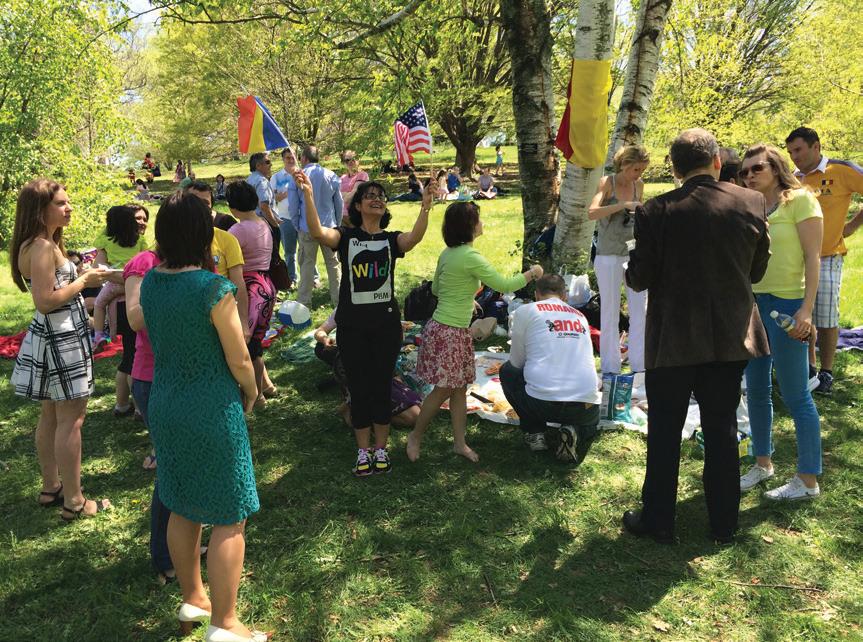
On May 8, 2011, my very first Lilac Sunday at the Arnold Arboretum, I learned something profound about plants. Lilac Sunday is the only day of the year when picnicking is allowed in the Arboretum. Many families and groups of friends gather on the grounds, with homemade meals brought in tote bags and picnic baskets. Often, these clusters of people gravitate to the slopes of Bussey Hill, behind the lilac collection. As I wandered from the lilacs into the birch collection that day, I encountered a group of people who had hung a national flag from one of the Arboretum’s birch trees. I introduced myself and asked what country the flag represented. It was the flag of Romania.
So, why this spot, why this birch? It was an accession of downy birch (Betula pubescens), a widespread native of northern Europe and Asia. Some consider there to be a subspecies, the Carpathian birch, which grows in the Carpathian Mountains, including in Romania. This spot was where the Association of Romanians in New England gathered to delight in the beauty of the Arnold Arboretum, each other’s company, and to conjure memories of an ancestral homeland far away, with all manner of Romanian delicacies to be shared. That wonderful threetrunked “Carpathian birch” was the tree that brought everyone and everything together.
My visit with my Romanian American friends has now become a Lilac Sunday tradition. I join them every year next to the Romanian flag, hung from the downy birch, and they ply me with amazing food. Interestingly, the Arnold Arboretum has recently added wild-collected common lilac (Syringa vulgaris) from Romania to its living collections. The seed originally hailed from Mehenditi, Romania, and these shrubs now augment the three near-centenarian common lilacs collected in the wild in Romania in 1934. Of the ten species and 120 wild-collected accessions of the lilac genus (Syringa) to grace the grounds of the Arnold Arboretum, you will find specimens that come from China, South Korea, North Korea, Romania, Afghanistan, India, and Bulgaria. Each has a story to tell.
This initial chance interaction with New England Romanian Americans in 2011 marked the beginning of my education about what a living collection of trees from around the world can do to connect people with each other and with biological and cultural history around the world. Visit the Bradley Rosaceous Collection at the peak of cherry blossom
season and you will see Japanese and Japanese Americans delighting in memories of cherry blossom festivals in Japan. Stop by the dove tree (Davidia involucrata) from China and imagine how wonderful it is to see Chinese and Chinese Americans, especially those who grew up in its native range in central and eastern China, visiting with a tree that signifies “home.” The seeds that gave rise to our living collections hail from 55 different countries. It is the very stories of native homelands and ecologies, cultural affinities, and journeys to the Arnold Arboretum that make the our living collections the equivalent of botanical ambassadors.
Just as I have come to understand the ambassadorial role that plants can play in the human world, I am now committed to helping the broader public see international botanical collections not just as scientific or horticultural collections for aesthetic display, but as living, breathing (well, photosynthesizing) plants that can play a powerful role in reminding us that we are all citizens of the world. This story has roots that go back over a century, and it continues to reverberate today.
It is the very stories of native homelands and ecologies, cultural affinities, and journeys to the Arnold Arboretum that make our living collections the equivalent of botanical ambassadors.
In 1902, Tomijiro Uchiyama, a Japanese botanist, plant collector, and director of the Koishikawa Botanic Garden (now the Botanical Garden of the University of Tokyo) travelled to Korea (this was his second journey to Korea, the first being in 1900) to collect plants, typically in the form of herbarium specimens and germplasm (seeds), for scientific description and basic taxonomic work. Ultimately, 41 of the taxa collected by Uchiyama would represent species newly described to science. All of these collected plant materials would be sent to the University of Tokyo.
In December of 1904, Arnold Arboretum plant records show the receipt of seeds of 32 species from Uchiyama’s 1902 plant collecting trip to Korea. More than 120 years later, most have perished, but 14 accessions representing seven species from these seeds still grace the grounds of the Arnold Arboretum, including two wonderful ginkgo trees that frame the historic gate at Walter Street.
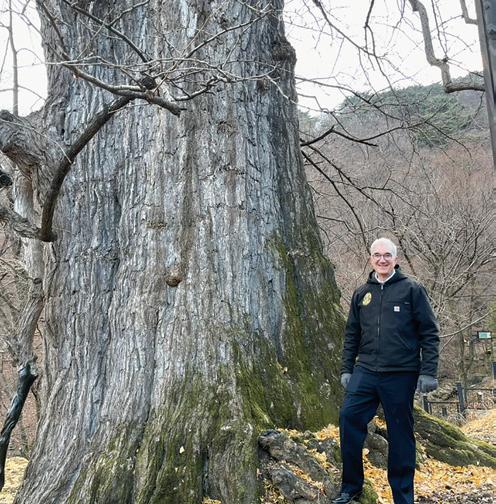
When we examine the list of species Uchiyama shared with the Arnold Arboretum, we discover that only one of these 32 species, Ginkgo biloba, was not native to Korea. However, this relictual native of China had already thoroughly embedded itself in Korean culture and horticulture, a result of a much earlier human-assisted plant journey in the sixth century from China to Korea. The seeds of Ginkgo biloba that were received by the Arnold Arboretum from Uchiyama’s botanical expedition in Korea may well have come from a tree in a Buddhist monastery. Many Korean monasteries have iconic and often very ancient ginkgo trees. Indeed, last December, when I was in the Republic of Korea, my very gracious hosts from the Korea National Arboretum took me to Yongmunsa Temple (established in the year 913), where I had the amazing experience of spending time with a 1,000 plus year-old seed-bearing ginkgo tree (see page 7).
How do two ginkgo trees collected as seeds by a Japanese botanist in Korea in 1902 and received at the Arnold Arboretum in 1904, probably planted in 1915,
relate to the story of plants as ambassadors? Fast forward to 2023 and my firstyear seminar “Tree.”
Each week, the students read a selection of materials relating to trees—ranging from fiction, cultural narratives, poetry, environmental law, biogeography, the evolutionary history of arborescence (yes, there once was a time when there were no trees), and scientific literature centered on the mysteries of why eastern North American trees have more vibrant colors in the fall than do comparable species in Europe. Importantly, each student must choose one tree (among the 16,000+ woody plant accessions at the Arnold Arboretum) to observe every week and provide an annotated set of images of what they “see.” On one of our first walks as a class in the Arboretum, I mentioned the story of these two wonderful trees from Korea. When each student wrote to tell me which tree they
These trees draw me to places far away and encourage me to learn of the cultures around the world that are their native homelands.
would be observing, one of the students, a Korean American student, had chosen the male (the other being female) Korean ginkgo tree by Walter Street Gate.
As I learned later in the semester, this student’s parents and his grandmother visited on Parents’ Weekend at Harvard College. He brought them to the Arnold Arboretum to see his Korean ginkgo tree. It was there that his grandmother, who had grown up in South Korea after the Korean War, related a story of her girlhood, when she and her friends would collect the golden ginkgo leaves after they had fallen to the ground in the autumn. Amazing. A ginkgo tree, not a sentient being, not able to “think” or “talk” to us, was connecting a grandson to his grandmother and to Korean culture and heritage—surely a beautiful symbol of plant ambassadorhood!
This plant diplomacy goes well beyond connecting the world’s diasporas in the
Mason Heberling on a hometown expedition to observe knotweed; Miles Schwartz Sax explores the biodiversity of harsh environments on the slopes of Mount Tarumae; Kim Shearer (Kim Bora) revisits
Korean forest scenes from childhood and finds wonder rekindled.
Trinh
By Jacob S. Suissa and Ben Goulet-Scott
By Michael S. Dosmann and Rodney Eason
Lisa Pearson
Volume 83 | Number 1 | 2026
Editor
Matthew Battles
Designer Emily Caulfield
Editorial & Production Assistant
Claire Neid
Editorial Committee
Anthony S. Aiello
Yota Batsaki
Peter Del Tredici
Michael S. Dosmann
Rosetta Elkin
William (Ned) Friedman
Jon Hetman
Jonathan Shaw
Creative Consultants
Point Five
Arnoldia (ISSN 0004–2633; USPS 866–100) is published quarterly by the Arnold Arboretum of Harvard University. Periodicals postage paid at Boston, Massachusetts. Subscribe to Arnoldia by becoming a member of the Arnold Arboretum. For more information, visit arboretum.harvard.edu/support/membership or contact the membership department at 617.384.5766 or membership@arnarb.harvard.edu. Send all other Arnoldia communications to Circulation Manager, Arnoldia, Arnold Arboretum, 125 Arborway, Boston, MA 02130-3500. Telephone 617.524.1718; fax 617.524.1418; email arnoldia@arnarb.harvard.edu.
Postmaster: Send address changes to Arnoldia Circulation Manager
The Arnold Arboretum 125 Arborway Boston, MA 02130–3500
Copyright © 2026. The President and Fellows of Harvard College
Arnoldia welcomes your ideas, questions, and feedback. Letters should be sent with the writer’s name, address, and phone number via email to arnoldia@arnarb. harvard.edu. Letters may be edited for length and clarity.
Find us online
ArnoldiaMag ArnoldArboretum ArnoldArboretum. Harvard




Boston area to their native or ancestral homelands or cultures. I have lived my entire life in the United States, but I love ginkgo trees (I even did my Ph.D. dissertation on Ginkgo biloba), and cannot imagine a world where I would not get to be with ginkgo trees and their amazing fall foliage or smelly seeds. Or a world where I could not regularly witness some of my favorite winter barks, such as the Korean stewartia (Stewartia pseudocamellia) or the lacebark pine (Pinus bungeana—a native of China, but with magnificent specimens that grace the grounds of the Secret Garden of Changdeokgung Palace in Seoul and the Arnold Arboretum in Boston). Or a world that did not offer me the opportunity to witness the Chinese dawn redwood (Metaseqouia glyptostroboides ) as its needles turn a magnificent copper before dropping from the tree. These trees draw me to places far away and encourage me to learn of the cultures around the world that are their native homelands. Trees from around the world can reciprocally serve as plant ambassadors to their native homelands, inviting the rest of the world to query the botanical and cultural riches of countries far away.
Just this past month, a package bearing seeds from the Arboretum’s fall 2025 plant-collecting expedition to South Korea (with our keeper of the living collections, Michael Dosmann, working alongside colleagues from the Korea National Arboretum, Mokpo University, and Sunkyunkwan University) arrived at the Arnold Arboretum. Imagine the stories these trees will tell at the Arnold Arboretum for centuries to come: of the biodiversity of Korea and cultural associations that Koreans have with these plants.
In these highly nationalistic times, plants serve as a powerful counternarrative to the notion of each nation unto itself. When the Arnold Arboretum goes into the field to collect, we never go alone. We
Ned with an enormous, seed-bearing, thousand year-old ginkgo tree at Yongmunsa Temple in the Republic of Korea (see page 2).
always partner with local botanical experts: in China, with our friends and colleagues from the National Botanical Garden in Beijing, Zhejiang University, Kunming Institute of Botany, Chengdu Institute of Biology; in Japan, with our amazing friend and colleague Professor Mineaki Aizawa and his graduate students from Utsunomiya University; in the Republic of Georgia with botanists from the National Botanical Garden of Georgia (in Tbilisi) and the Batumi Botanical Garden; and so many others, with more and more to come. Meals are shared, culture is shared, the joys of collecting and sharing plants with the world are shared. Every journey is one of utter devotion to the beauty of plants. Just as importantly, every journey crosses national borders and binds us to each other in ways that reinforce our commonalities while also celebrating our botanical and human cultural differences.
Yes, plants may actually be the ultimate ambassadors!
william (ned) Friedman is the eight director of the Arnold Arboretum and the Arnold Professor of Organismic and Evolutionary Biology at Harvard University.

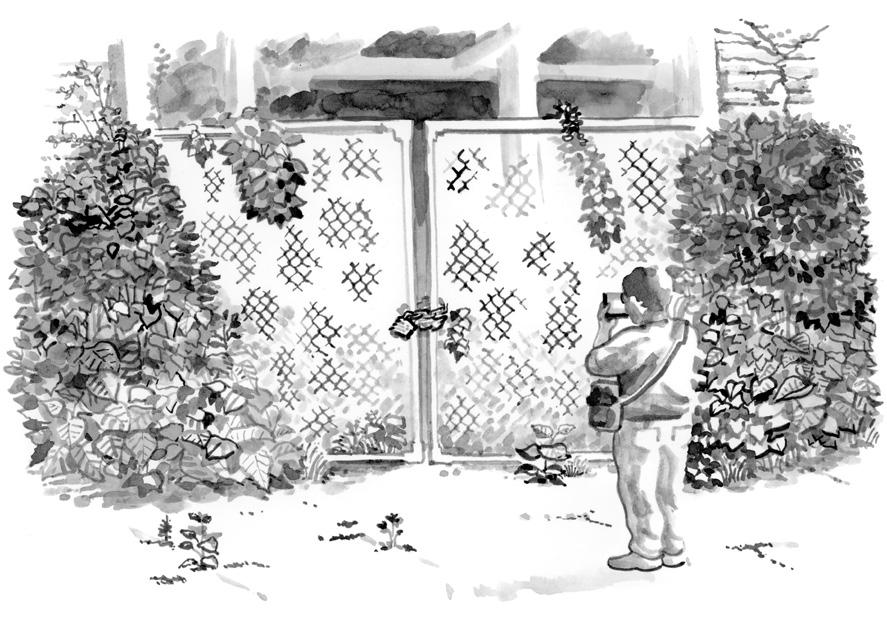
Mason Heberling on a hometown expedition to observe knotweed alongside an artist dedicated to witnessing this notorious plant’s global life.
Mason Heberling is a plant ecologist and herbarium curator at Carnegie Museum of Natural History in Pittsburgh, PA, where he served as the content lead for the exhibition
Uprooted: Plants Out of Place, which runs through summer 2027.
It was a late summer morning, and we were on the hunt for a special plant species that finds its home in Northern Appalachia. We have been studying the species for a while but still had so much to learn. My colleague, Koichi Watanabe, whom I had only known through email, had flown from across the world from Japan to join us for this day of exploration, motivated by wonder and curiosity. Along with my graduate-student collaborator, Abby Yancy, now we were off.
But we weren’t going deep into Penn’s Woods. Or searching for a rare plant. We hardly left the museum, spending most of
our time in Pittsburgh. Our first stop was mere blocks away. We had a few specific sites to visit, which we had scouted beforehand, but we were fully expecting to slam the brakes and pull off at a moment’s notice. This urban expedition was not the exotic collecting trip you imagine. It was so close to home, yet a trip that not only had a big impact on my career, but in many ways, my worldview.
We weren’t just documenting plants in our usual way of making herbarium specimens, but also through a new lens (both metaphorically and physically): fine art
photography. Our new colleague joining us, Koichi, was not a professional botanist, but rather, an artist.
But Koichi was no stranger to our study species. Over a decade ago, he launched his text and photography project Moving Plants (also the title of his 2016 book), where he uniquely documents the story of Japanese knotweed in its native Japan and across the world. His fascination with the species started with his landscape photography in Japan. He noticed the same large plants showing up in his images. Not knowing what these plants were, he looked them up to learn not only what species it was, but that it was found around the world. His curiosity sparked what would become a long-term, ongoing project to document the species’ presence and its plant-human entanglements around the world. I was excited for his visit to Pittsburgh.
We were searching for knotweed. Reviled as one of the most problematic invasive species of the world, knotweed is a common sight in Pittsburgh, lining roadsides and waterways, including the region’s iconic three rivers. It was first introduced from Japan to Europe by Philipp von Siebold in the 1820s, subsequently distributed across Europe in the decades that followed, and eventually brought to North America. The plant is perhaps best known in English as Japanese knotweed, but I learned from Koichi that in Japan, it is called itadori, a name I try to use more regularly now. And it has many more names. Over 680 local names exist in Japan for the plants we often singularly call Japanese knotweed. Botanists mostly call it Reynoutria, but also Fallopia, and occasionally its former classification, Polygonum. Beyond that, across eastern North America, we now recognize three taxonomic entities, Reynoutria japonica (itadori, or Japanese knotweed), Reynoutria sachalinensis (o-itadori, or giant knotweed), and their hybrid, Reynoutria × bohemica (Bohemian knotweed). The abundance of the hybrid was only appreciated more recently. In fact, most of the herbarium specimens collected in our area, dating back to 1920, were first recorded as itadori knotweed
but later recognized to be hybrid forms. The revised specimen labels have only been added in the last decade. We clearly have a lot left to learn about these plants.
We weren’t just documenting plants in our usual way of making herbarium specimens, but also through a new lens: fine are photography.
Our primary goal in the field with Koichi was to gain insight and gather materials for Uprooted: Plants Out of Place, a forward-thinking exhibition on invasive plants in development at Carnegie Museum of Natural History, which subsequently opened in spring 2025. Though Koichi has traveled the world, to places such as Nagasaki, Leiden, London, Boston, and beyond, we were excited to show him “our” knotweed. Did he find it different from “his” knotweed in Japan? What aesthetic or emotions does Pittsburgh bring? With dense stands as far as the eye can see and a wide range of diversity of forms, we speculated that Pittsburgh, for some reason or another, must be an exceptional melting pot for the knotweed species complex. Later in his trip, Koichi confirmed our suspicion that the thick stands in Pittsburgh were indeed incredible, denser and more diverse than any he’s seen in his travels. He said the plant here rival if not exceed the remarkable thickets he observed near slag heaps of Swansea, Wales. Given our industrial histories, the similarities between the UK and the Steel City are probably not a coincidence.
Never working with an artist in this way before, this was new ground for Abby and me. We took Koichi to various neighborhoods in and around Pittsburgh. Koichi said his English was a bit rusty, but it did not matter. We had a language interpreter at the ready for later during his visit (he also gave an artist lecture), but in the field, we did not need to communicate much. Our facial expressions and the plants themselves spoke volumes. We walked up and down the historic public stairways that cut through Pittsburgh’s Polish Hill neighborhood, lined by itadori knotweed. We stopped at Pittsburgh’s North Shore, with downtown skyscrapers and the confluence of the three rivers in view. We visited a dilapidated, large vacant lot where a prominent brewery once stood, now flanked by luxury apartments and an abundance of giant knotweed. We
traveled to a field site where we have been monitoring the changing bloom times of spring wildflowers outside of town, the site of a former coal mine just across the river from Springdale, home of Rachel Carson. At each stop, Abby and I made herbarium collections in our normal fashion, carefully inspecting leaves and flowers. Meanwhile, Koichi worked by quietly inspecting not only the plants, but the broader landscape. Framing his camera to capture not only the plants, but the context, including signs of past and present entanglement of humans and knotweed. There were at least a few times Koichi wandered off, which we assumed meant he found something interesting.
When we made it back to the museum, the field work continued. In the days that followed, Koichi organized, edited, and printed his artwork at a local studio. It was a tall ask, as we could only include a few images to tell his story for the exhibition. Koichi joined a local roundtable meeting we hosted on public communication strategies around the invasive species topic. Koichi shared his experiences in the field and explained his art, both during this meeting and at a special artists lecture we hosted in the nearby Carnegie Museum of Art lecture hall.
With limited space, we settled on two artworks for the exhibit—a large format landscape image of knotweed sprouting up at the base of castle ruins in Osaka, Japan, strikingly juxtaposed next to an image taken during our field day of the same species here in Pittsburgh, emerging from the ruins of a brick building. The contrast shows similarities and differences, but it is the viewer that decides whether the differences or the similarities prevail. The heading on the exhibition wall poignantly features a quote from Koichi: “As people move, plants move with them.” It might seem simple, but it shifts the common narrative that plants are the drivers of invasion, while they are in fact the passengers. This sentiment is one we highlighted throughout the exhibition. The artist statement further reads, “Across the spaces included in these two photographs, the times of humans, of buildings, and of plants entangle.” On the adjacent wall,
I gained a new appreciation for a species’ stories—their roles and relationships with humans in context.
framed itadori knotweed herbarium specimens collected from our field day, complement photographs of the same plants in the field. The wallpaper is filled with Japanese and English words reflecting the many names for the same species. Between the specimens and the art, there is a quote from a local project partner Meining Wang: “Asian immigrants, no matter how long they’ve been in this country, are still treated as foreign.” This section of the exhibition focuses on cultural perceptions of language and how we talk about invasive species. This nuance does not downplay the importance of invasive species management, but highlights the reality that many narratives in invasion biology are often myopic.
I learned a lot that week in the field with Koichi, not necessarily about the species’ biology (though certainly that too). I gained a new appreciation for species’ stories—their roles and relationships with humans in context. This nuanced view of plant invasions is reflected throughout the exhibition, even though his artwork is just one component. The Uprooted project allowed space for me to step back from the depths of my research —the measurements and analyses—and consider the broader picture. Just a few years ago, I did not appreciate the nuance. To me, invasive species were bad and native species were good. The response was simple—remove the invasives, right? But it is more complicated than that. From my work at the museum, the hysteria and xenophobia inherent in invasive-species rhetoric became apparent. It took me time to realize this. Yet on the other hand, introduced species are an undeniable conservation concern in many cases. These environmental impacts cannot be ignored. I wanted to interrogate both extremes of the argument.
A main goal of the Uprooted project was to provide a new perspective on plant invasions, moving beyond “good” and “bad” plants, or “native” and “invasive.” We came to the realization that the common themes of invasive species communication that relied on pointing fingers and vilifying individual species was neither scientifically accurate nor effective at motivating real
change. We were relying on too much on fear appeals, oversimplification, and xenophobic language. We were not highlighting the underlying cause, human action. After all, it is human activity that led to species introductions, further compounded by other disturbances and changes to the land. The “good” and “bad” narrative is an oversimplification at best, and at worst, missing the mark altogether. The species are not to blame. Human activities are. Koichi ended his artist lecture during his visit with a quote that has stuck with me: “At what point do we start to see knotweed as blending into the landscape? Or does it not happen that way? How we negotiate our relationship to knotweed is up to us.”
Through an interdisciplinary lens, Uprooted aims to provide a nuance perspective, not downplaying the damages that invasive species may cause while also centering humans as the agents of cause— and as agents for solutions, too. In addition to sharing introduction histories and basic
FROM THE LAB
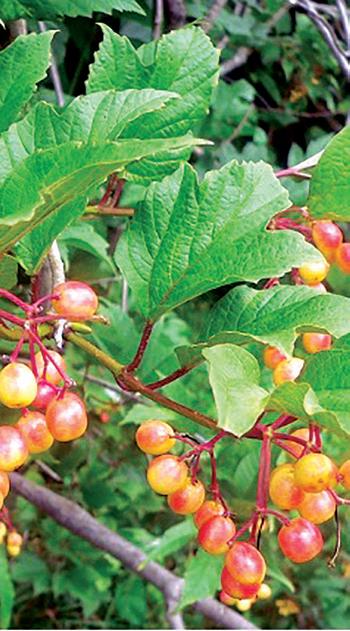
The scope of biodiversity conservation efforts hinges on the accuracy of taxonomic definitions. A recent study from the University of Minnesota explored this in the context of American highbush cranberry (Viburnum trilobum). The highbush cranberry group has been subject to taxonomic debate for centuries, and UMN researchers sought to examine whether American highbush cranberry (V. trilobum) is genetically distinct from its European (V. opulus) and Asian (V. sargentii) relatives, which they note “have received numerous taxonomic treatments as species, subspecies, and varieties due to their morphological similarities” and the naturalization of the latter two species in North America. Using a high-volume genomic sequencing technique, researchers found these taxa are in fact genetically distinct. These results suggest that conservation efforts should seek to preserve genetic diversity in V. trilobum and prompt the development of refined techniques for distinguishing it from its close relatives in the field.
TORK, D. G., ANDERSON, N. O., BRUSA, A., & SMITH, A. G. (2025). AMERICAN HIGHBUSH CRANBERRY MAINTAINS STRONG POPULATION STRUCTURE DESPITE NATURALIZATION OF EURASIAN RELATIVES IN NORTH AMERICA. AMERICAN JOURNAL OF BOTANY, 112(11), E70124. HTTPS://DOI.ORG/10.1002/AJB2.70124
biological facts, we wanted to provide space for the diverse cultural perceptions around invasive species. What should we do? We did not seek to provide answers, but to provide context. Although it’s becoming more common, commissioning artwork is a bit nontraditional for natural-history museum exhibitions, and I admit I hesitated at first. But the success of Uprooted was in many ways possible through Koichi’s work, highlighting the multiple perspectives needed for complex biological and societal challenges.
Just a few years ago, I would not have guessed I would be exploring the streets of Pittsburgh with an artist, documenting knotweed, and questioning the meaning of “invasive.” These days in the field with Koichi energized and inspired my worldview and motivated new directions for my research. Driven by observation, curiosity, and asking questions, the lenses of art and science aren’t different after all.
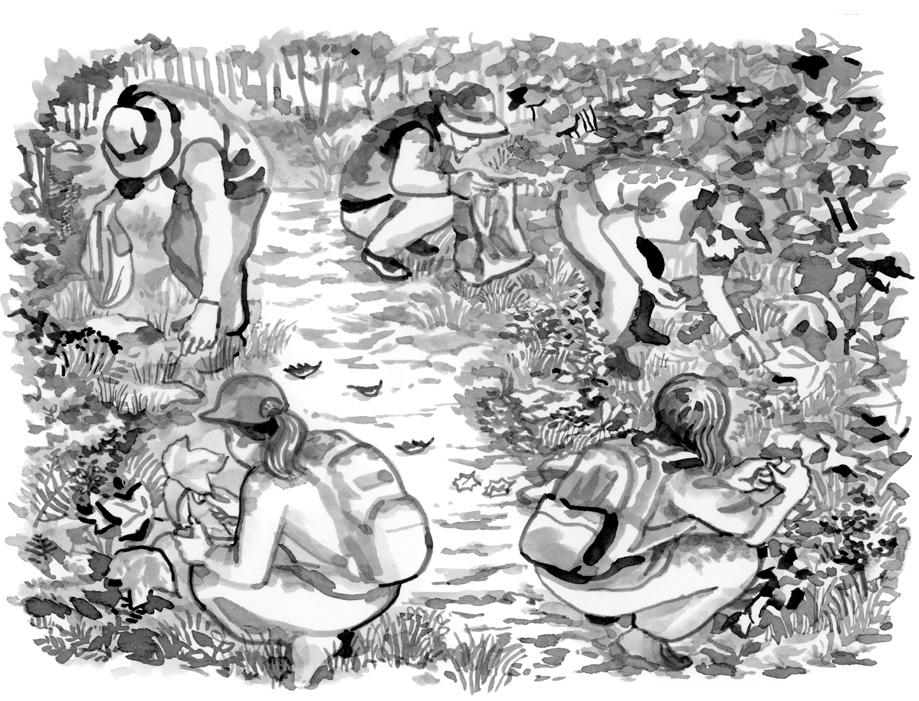
Kim Shearer (Kim Bora) revisits Korean forest scenes from childhood and finds wonder rekindled.
Kim Shearer is director of collections and curator of the Morton Arboretum, where her goals include strengthening relationships with Korean horticulture and botany communities while supporting conservation efforts of native Korean plants in collaboration with the Center for Species Survival: Trees.
January 2026.
We are a party of six, three who traveled from North America and three locals in Korea—in addition to myself, Amy Byrne (Oh Sarang), Adam Black (No Adam), Kim Seong-Hwan, Kim Young-Soo, and Yi JaeSun. Our steps are carrying us up wooden stairs, crafted from lumber. These are not stairs made of hewn stone or wood by Buddhist monks to create a path to a temple built a 1000 years ago. These are brand new, fresh-cut wooden stairs. Pine, perhaps? And they are built up the slope, all the way to the top, keeping our tread elevated up off of the precious soil.
This is Korea.
We are exploring Nagok-ri san, a small
peak overlooking the East Sea of the Korean peninsula and the quaint fishing village of Nagok-ri in Uljin County. At 379 ft in elevation, it is not a particularly high peak relative to the long-cherished Baekdu Mountain range, backbone of the Korean peninsula, and home to the coastal trail known as Haeparang Trail. However, we find it is a botanically rich site with an unmatched view.
The last time I set foot on the peninsula was not long after the fall of East Germany, “Mr. Gorbachev, tear down this wall!” My father being one of the US troops stationed in West Germany, we were relocated to yet another border in 1989. One that continues to separate the people of the land my
Illustration by Matt Huynh
mother called home. At the time, I found solace with new friends in the surrounding mountains and forests, seeking out adventures on rope swings hung from pines overhanging steep slopes and in the mysteries of shrines filled with earnest offerings and candlelight.
Now, more than 30 years later, I find myself climbing these freshly milled stairs to the top of this coastal peak on a hunt for dotori ( 도토리 ), or acorns. Equipped with some botanical knowledge and on a mission to learn more about this peninsula’s flora through the lens of horticultural experience, I am perpetually in awe of the beauty, the joy, and the kinship I feel with the people and the forest. As we walk along, we can see active restoration efforts taking place up and down the slope to our left. A devastating forest fire has charred the landscape. Little saplings are carefully planted and protected from being browsed and sunscald. Everywhere there is evidence of that conflagratory destruction. We encounter Styrax, Zanthoxylum, Quercus spp., and Rhododendron that have either survived the fire or have been rejuvenated by it. Even oaks that were burned to stumps have re-sprouted and are already offering up acorns on what we generally assume to be juvenile tissue.
Hiking along the service road from the parked vehicle, one of the first plants we stumble upon is a familiar friend—pokeweed. Friend to me as I am interested in using it as a textile dye. Foe to gardeners due to its toxicity and voluntary nature. Is this Phytolacca americana volunteering itself in this disturbed site of coastal Korea? Or is this a native pokeweed? Phytolacca insularis, P. esculenta? The American species was introduced to the Korean peninsula in the mid-twentieth century and has been classified as a harmful species by the Ministry of Environment. It competes with native Korean species in the sandy soils of the coastal region and has been researched in Korea for its impact on native species in their habitats.
Further along the trail we come across a most impressive specimen of Styrax
Everywhere we look, the forest is determined to revive itself.
growing on the edge of the ditch on the north side of the gravel service road. Is this multi-stemmed specimen Styrax japonicus or S. obassia? The bark gray with fissures showing lighter, not quite orange inner bark. The leaves are not large enough to fit into the S. obassia box. The branching is upright and ascending, not exactly like the specimens that Adam and I have experience with in cultivation. We each grab some capsules, some seeds beginning to emerge as the invisible sutures of the dehiscent capsules have been unbound by the fall season. It must be S. japonicus. The leaves are just too small for S. obassia. We discuss the need to capture more genetic diversity of this species from the wild as we continue hiking along the service road.
We do not make it far before we stumble upon another familiar floral friend— Zanthoxylum . By stumble upon I mean Adam’s eagle eyes pick it out immediately on the slope just above us to the south of the road. We have captured it at just the right moment. Loaded with peppercorns, the specimen is leaning towards us, inviting us to take a bite of the fruit and a nibble from the leaves. We do—the fruit betray their familial ties to Rutaceae, while the foliage suggests it to be a perennial replacement for arugula in a summer salad.
Wrapping up our photography with a tingle on our lips, we move along to catch up with the rest of the scouting group. They are making their way up the stairs! As we follow them up, we note an alder (Alnus sp.). Oh, and look at that cascade of Carex growing out of the dry earth. And there’s Quercus serrata! Pointed, and prominent teeth; elongated acorns. True, the fire has done severe damage to the pines that once shaded the slopes to our north and south; and yet, everywhere we look, the forest is determined to revive itself.
At the pinnacle of the staircase, we are met with our reward. In Korea, there are a variety of public outdoor shelters exhibiting the beauty of traditional Korean architecture while also complementing the natural beauty of their surroundings through strategic positioning. At the summit of Nagok-ri
san sits a hexagonal pavilion known as a jeongja (정자). These are open-air pavilions intended to provide a peaceful respite with a view. As we walk up the steps to enter the jeongja, our hosts Jae-Sun Yi and SeongHwan Kim instruct us to remove our shoes. We comply, take the last step up into the pavilion, and admire the view from all six sides. To our east, the blue water of the East Sea reflects the sun back at us; to the west the supporting beams of the jeongja frame the silhouette of a Pinus skeleton with the permanent impression of northbound winds, layers of aged mountain peaks providing a backdrop crowned with a diversity of clouds generated by the forests SeongHwan has dubbed cloud factories. We take in the breeze and the view. Gazing north the Baekdu Mountain range can be seen fading into the distance towards a place not yet accessible to any of us along the red ribbon of a trail traversing the mountaintops.
After taking about 30 group photos, it is time to move along. We have more botanizing to do! More oaks to be found and learned. But wait—is that a Sanguisorba officinalis?
There are many distractions along the way. Not least of which are the coconut coir woven trail mats (yajamaeteu, 야자매트) laid out along the ridge we are hiking. These are also used in the arboretum throughout the
WELL SAID
“The goal is not to resist change, but to become more open to changes made by species other than ourselves.”
gardens and along hiking trails. They provide a soft sustainable and biodegradable surface to walk upon, while protecting the earth from our footsteps.
The most fascinating find along this ridge are the oaks— Q. mongolica , Q. serrata, Q. dentata. “Come back,” Adam calls us, “I think I found a hybrid.” There are at least a couple of hybrids on top of this small mountain. Based on the intermediate characters of the foliage and the fruits, these are likely hybrids of Q. serrata and Q. dentata. We all gather around Adam as he holds his palms out, cupping the cupules in place with their acorns. We snap photos, furiously type our notes, and are excited by the chance of seeing natural hybrids where the consummate professor Dr. Yong-Shik Kim had suspected they would be. “I think there are a lot of hybrid oaks in Korea, but they are not well documented,” he had told us before our journey to Korea. And low and behold, our last day in the field Adam has found them.
Oh look! Rhododendron schlippenbacchii, and there’s Pinus thunbergii. As we walk along the coco-coir trail and make our way towards a second set of stairs to climb down, Seong-Hwan walks beside me. “What do you think, Bora? Does this make you sad?” He gestures towards the burnt remains of the old pine forest. “Hmmm, maybe a little. And also, I think mostly it gives me hope. Yes, of course the fire was devastating. However, look around. There are so many plants coming back. There’s so much diversity.”
Dan McKanan in “Thoreau’s ‘Succession of ForestTrees and the Challenge of Change,” page 55.
It’s heartening to look back and see how far we’ve come, to take it all in. More than 30 years ago, I knew no plant names while adventuring through these woods, and here I am hiking the mountains of Korea as a woman and exploring forests for the purpose of conservation. More than 70 years ago, a war ended, forests were devastated, and have since been restored, lost, and revived yet again by the perseverance of the Korean people. All is not lost. There can always be more to learn. And today you’ve learned the Korean word for acorn—dotori (도토리.)
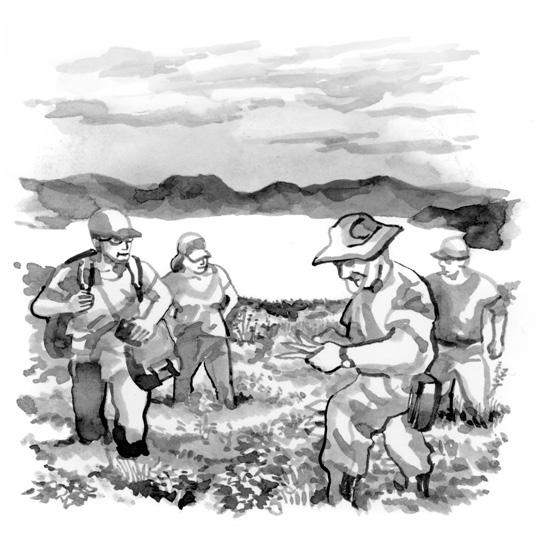
With a familiar crew, Miles Sax explores the biodiversity of harsh environments on the slopes of Mount Tarumae in Japan’s far north.
It was a sunny, breezy day in mid-September as we started our hike up the road to the subalpine zone of Mount Tarumae. Normally, the collecting area could be reached by a short walk from a high elevation parking lot, but today we were forced to hike the extra distance due to recent rainstorms having washed out a portion of the road. It was the second day of our field expedition to northern Japan, and with bags packed full of collecting supplies, water, and snacks, we were eager to set eyes on the volcanic mountain peaks for which Hokkaido is known. Michael Dosmann (keeper of living collections, Sarah Shank (plant propagator), and I had returned to Japan in hopes of ticking a final set of species off our desiderata list for the Campaign for Living Collections. We were once again graciously hosted by professor Dr. Mineaki Aizawa, a professor of forest botany at Utsunomiya University, and his
graduate student, Yoshinari Hata. This was the Arnold Arboretum’s fifth expedition to Japan with Dr. Aizawa, and the team easily fell into a familiar cadence of hiking, chatting, and botanizing together.
This was our first expedition to Hokkaido for the Campaign, however, and we were adjusting to the scenery and field hazards that come with exploring this part of the country. On trips in Honshu, we had grown accustomed to wearing leech socks and watching your step for mamushi (pit vipers, Gloydius blomhoffii), but Hokkaido features another notable hazard: the Ezo brown bear (Ursus arctos lasiotus), which is closely related to North America’s grizzly. Bear activity has been increasing in recent years, with frequent sightings and attacks throughout the island. As we hiked, we each wore a small bell that rang a shrill tone in contrast to the typical murmurs of forest. We also had acquired a can of pepper spray, ensuring we had a backup plan should our acoustic shield fail us.
While the washout pushed us back by about a mile, the hike up the road to the trailhead gave us ample opportunity to study the composition of the forest. Differing from forests of central and western Japan, the trees of Hokkaido shared floristic elements from Korea, Sakhalin and Kuril Islands, and the Russian Far East, with hints of circumboreal taxa.
As we climbed, the forest became less diverse and more diminutive in height, with the canopy thinning and trees becoming scarce. Twisting and stunted Sorbus commixta clung to the forest edge, making a last arboreal stand before giving way to a shrub-dominated landscape. As we ventured onward, expansive views of mount Fuppushi, Lake Shikotsu, and the lowland plains opened before us as we finally set eyes on the full view of Mount Tarumae’s volcanic caldera.
Due to a combination of harsh winter conditions, high elevation, and repeated volcanic activity, this landscape regularly sees disturbances. The plants that grow here have evolved adaptative strategies that allow them to establish and persist in
this difficult and often changing environment. From our vantage point we could see a vegetative gradient starting with the plant free, rock-strewn upper edge of the caldera transitioning into the herbaceous and shrub-dominated mid slope giving way to the forest below.
It was this mid zone, full of the shrub species Eubotryoides grayana, Rhododendron diversipilosum and Weigela middendorffiana, that we had come for. We made collections of all three before setting eyes on another prize, Gaultheria miqueliana, an evergreen ground cover in the heath family (Ericaceae). These small plants were visible in the breaks between the shrubs, easily making themselves at home wherever open ground could be found. Although the G. miqueliana plants are rather small, they were easy to spot thanks to their white inflated fruits that look like miniature mochi or snowballs. Gaultheria miqueliana is a classic example of East Asia/ North America disjunction, with the American Wintergreen (Gaultheria procumbens) being commonly found throughout New England growing in rocky outcrops. While searching for the white, marble-sized fruit, we also came across the round-leaved sundew ( Drosera rotundifolia ), a sticky, flytrap–like carnivorous plant with circumboreal distribution, which I had seen a few months before on a field trip to Ponkapoag bog in Boston’s Blue Hills.
After completing our collections, we made our way down the mountain and back to the car, counting ourselves lucky not to have encountered an Ezo bear. We were grateful to have experienced a handful of new species in the wild and to have made abundant collections for the Campaign. Hokkaido was the first place in East Asia that the Arnold Arboretum visited on a collecting expedition, with founding director Charles Sprague Sargent having conducted a trip here in 1892. With the 2025 expedition being perhaps our last visit to Japan to collect plants for the Campaign for Living Collections, it felt appropriate to end where a love for East Asian flora was born for C.S. Sargent more than 130 years earlier.
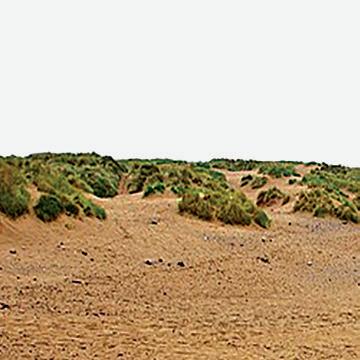

Along the Lancashire coast in the UK, volunteers gathered this winter to repurpose hundreds of thousands of Christmas trees into sand dunes to protect coastal communities and rare species from sea-level rise. Since the mid-1800s, the Lancashire coast has lost over 80% of its sand dunes to rapid development, a February Guardian article describes. Volunteers dig shallow trenches in which the trees are placed, and within weeks the trees morph into sand dunes for miles along the coast. The tree-bolstered sand dunes can run up to 10 feet (3 meters) high, and in some places offer purchase for new growth of marren grass (Ammophila spp.) whose extensive roots stabilize the mounds and have allowed threatened populations of sand lizards Lacerta agilis to rebound. The festive tradition, which has been growing for over three decades, is increasingly crucial to shore up the sand dunes’ efficacy as natural barriers to climate-induced sea-level rise.

Kerry and Caleb Evanter, Arnold Arboretum Members
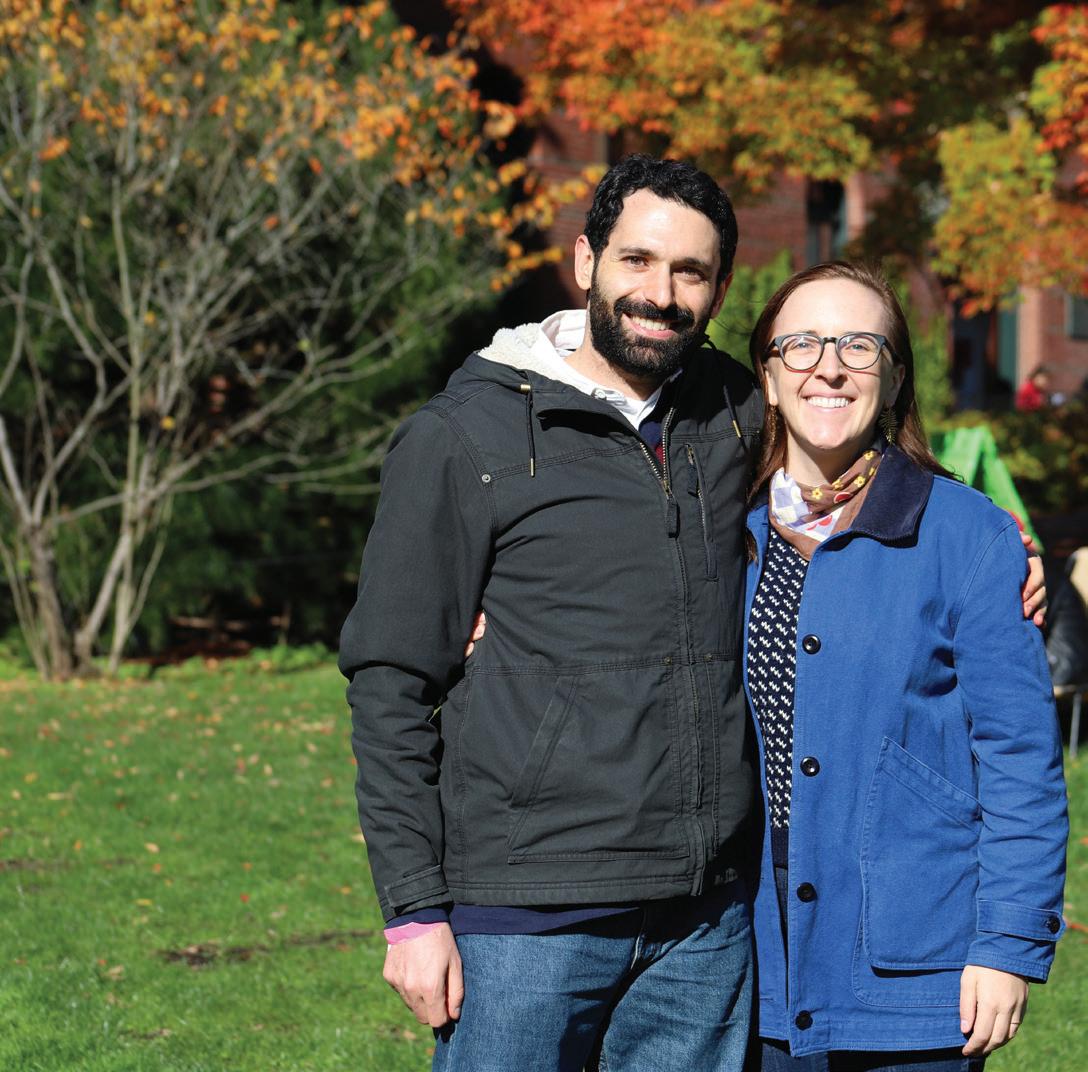
With Arnoldia, members like Kerry and Caleb discover new layers of meaning in every path, leaf, and season.

Explore how their visits became a shared adventure, deepening their bond to each other, our landscape, and the community.
Nurture what connects you to nature—join or renew your membership today. arboretum.harvard.edu/support/membership
By My Trinh
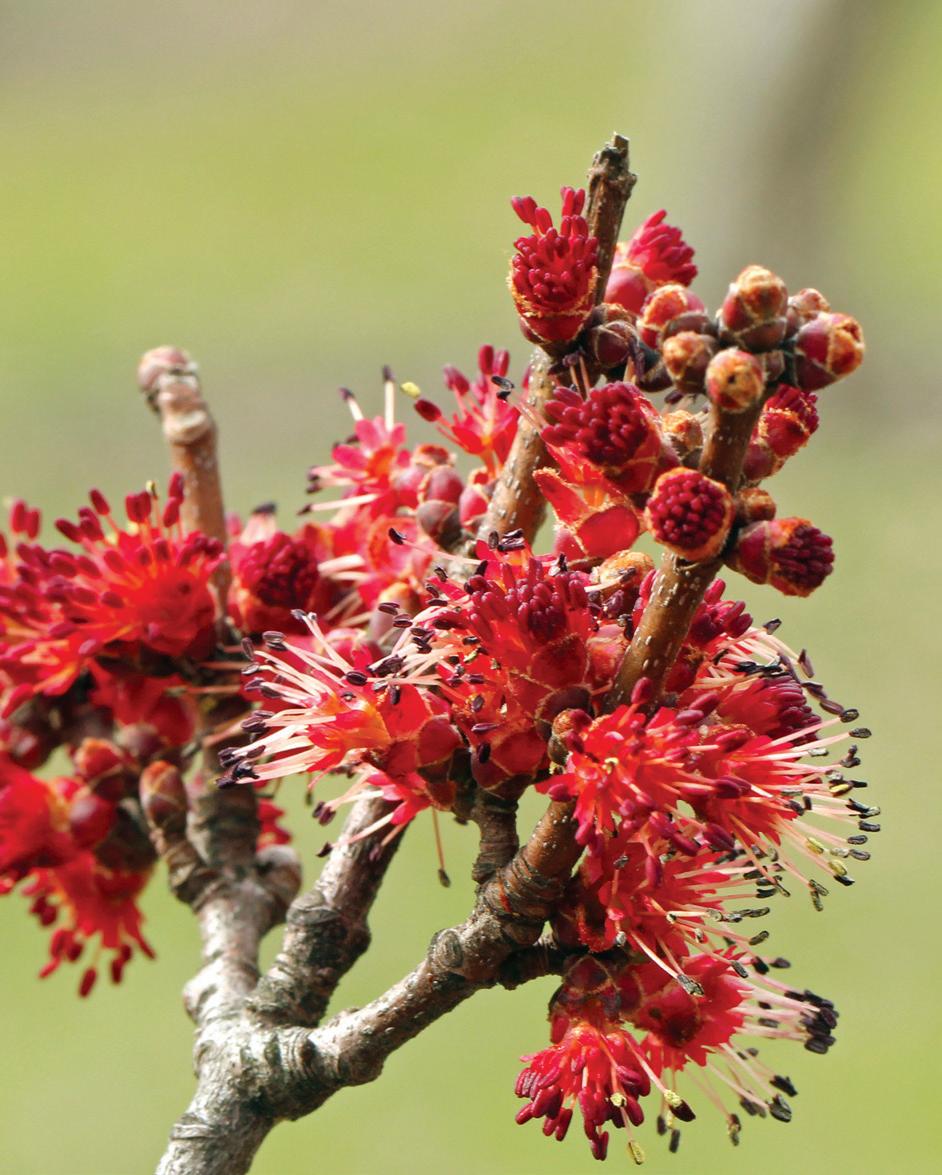
Each fall, the red maples (Acer rubrum) of the Arnold Arboretum attract thousands of visitors with their magnificent display of scarlet foliage. Yet, this species does not merely conclude its growing season with a flush of red; it begins that way, too. From early March to April, even before the first leaves break from buds, these trees signal the end of dormancy with clusters of small, deep red flowers. Appearing as a crimson haze against the gray spring sky, the red maple blossoms add one of the very beginning splashes of color into the muted, post-winter woods.
Red maple is such a generalist—it’s easy for us to spot them in someone’s backyard, an urban street, wet swamps, or dry uplands. It’s also easy for us to overlook their complexity. I never fully appreciated red maples until I looked past the foliage color strokes and leaned towards those tiny flowers on seemingly bare spring twigs. These blossoms do not arrive with the fanfare of large petals; instead, each individual floret is diminutive— barely three millimeters across, emerging in dense clusters from the axillary buds. Male flowers bear delicate, spindly filaments that extend outward, tipped with golden, pollen-heavy anthers that quiver in the slightest breeze. Female flowers are equipped with prolonged, y-shaped stigmas, reaching into the cool spring air to intercept wind-borne pollen.
The red maple’s sexual identity is famously fluid—a phenomenon that has intrigued botanists since Charles Darwin’s seminal 1877 work, The Different Forms of Flowers on Plants of the Same Species. A single tree may bear just male flowers, female flowers, or both on separate branches. Even more remarkable is the ability to switch sexual expression over time: a tree can bloom all male this year and switch to entirely female next. This occurrence remains an active subject in our work, but botanists believe that this might be a “leaky” reproductive strategy triggered by environmental stress, age, or resource availability. When such events occur, the tree may pivot its reproductive energy to ensure that at least some seeds reach the forest floor.
Because the blossoms appear before the foliage, there is nothing to obstruct our view of those red maple flowers. This spring and many springs to follow, pause beneath the trees, and take a closer look at the tiny, crimson florets that hold a story spanning 60 million years of evolution. It reminds me every day that even the most common species surrounding us still harbor fascinating mysteries, waiting for curious eyes to look up…
My Trinh is a graduate student in Organismic and Evolutionary Biology with the Friedman Lab and a fellow of the Arnold Arboretum.
Acer rubrum (15350*A) showing male flowers, April 2018. Photograph by Suzanne Mrozak.

By Matthew Battles
Start with the leaves, the small twigs, and the nests that have been shaken, ripped, or broken off by the fall; these must be gathered and attached once again to their respective places.—W. S. Merwin, “Unchopping a Tree”
It seems true to say that, for many poets, at some point it becomes necessary that they should take up horticulture. They might seek a brighter garden where not a frost has been, or find fair quiet there, and innocence, her sister dear, or pluck chrysanthemums at the eastern hedge and gaze long at distant summer hills. From the start, W. S. Merwin’s work wove in and out of gardens and landscapes from Pennsylvania backyards to the fields of Provence. And then he settled on Maui and cultivated a garden of palms in a landscape that had been scourged by the extractive agriculture that accompanied—no, that was—the Americanization of the Hawai‘ian archipelago.
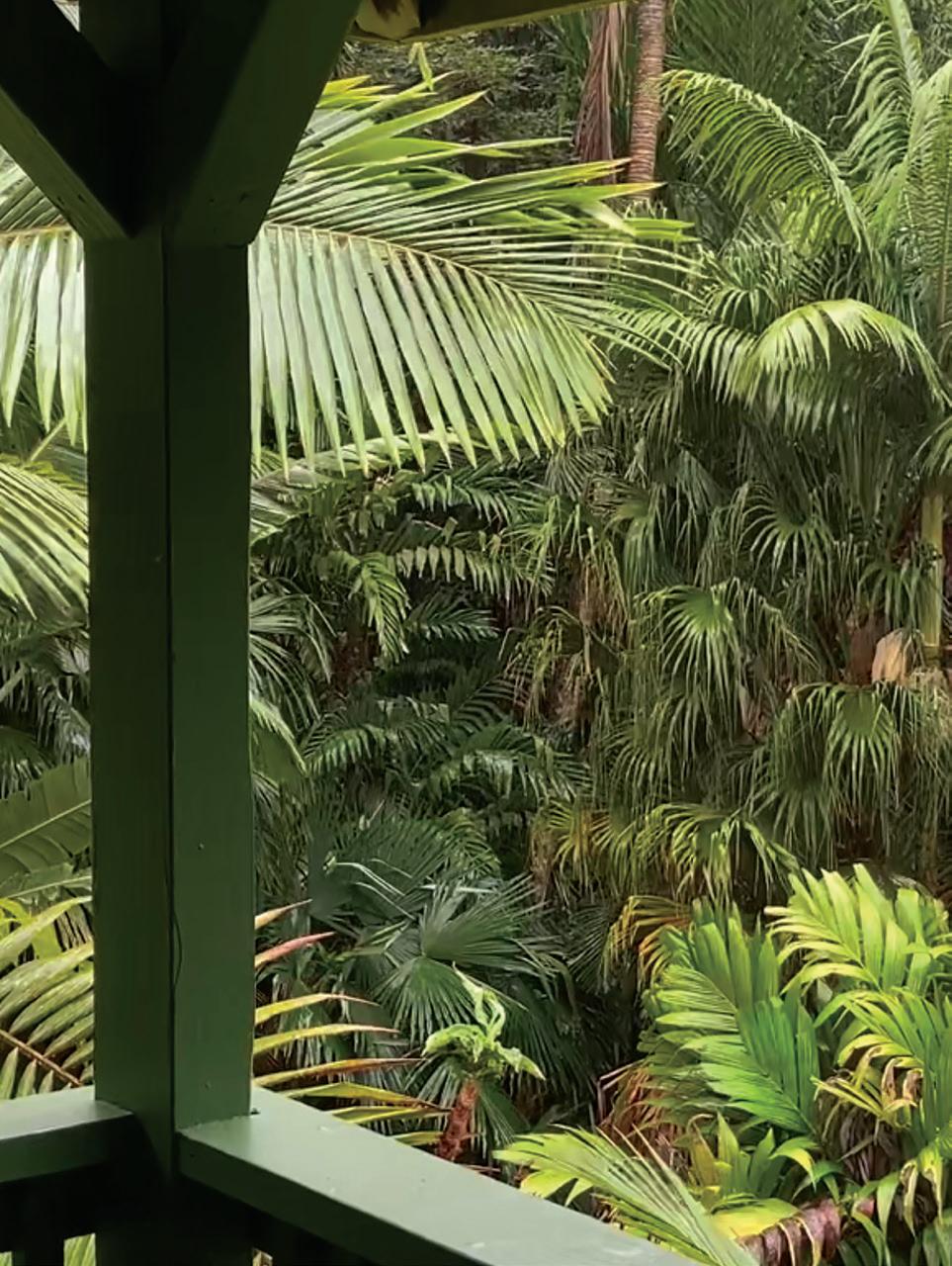
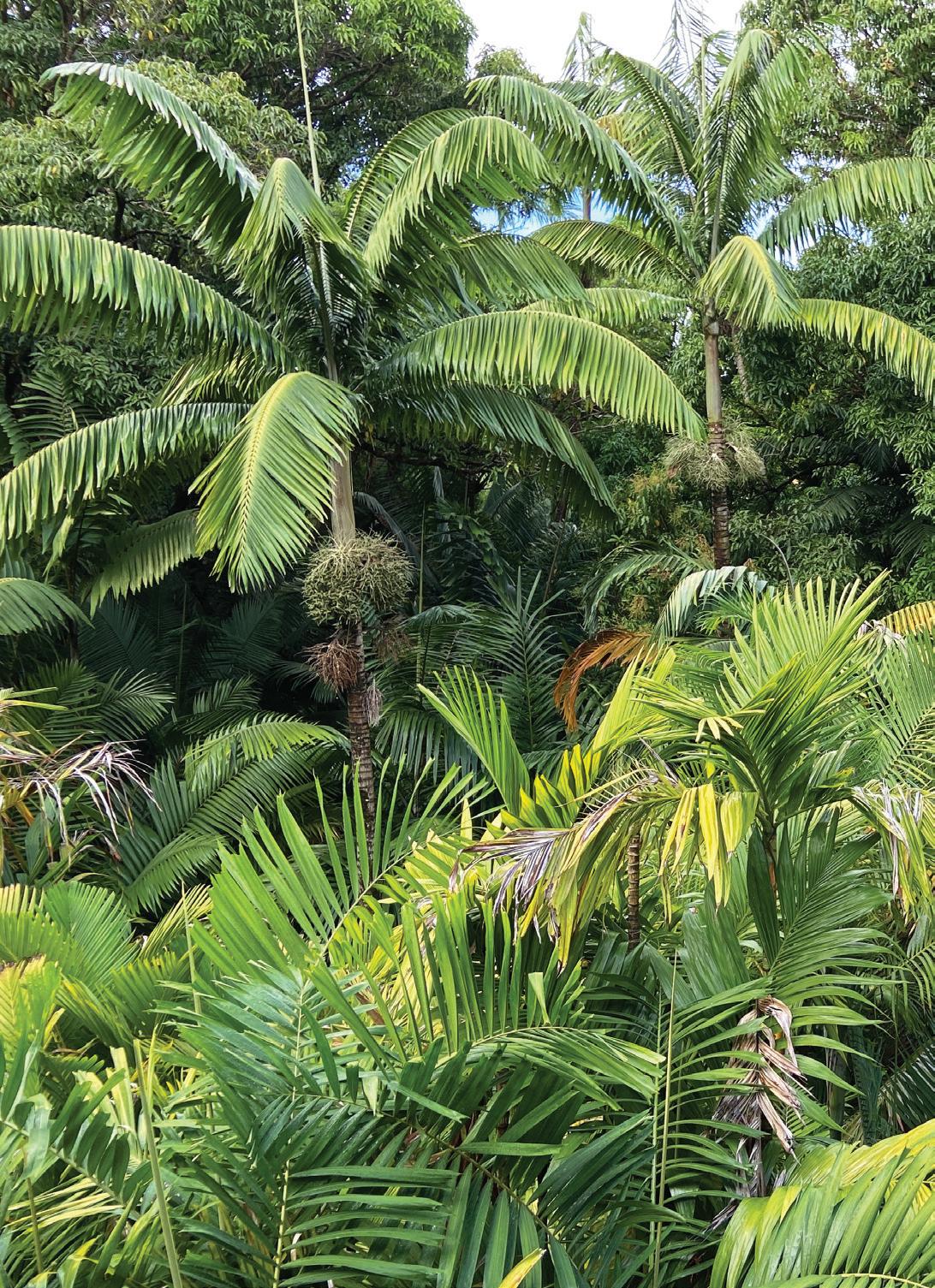
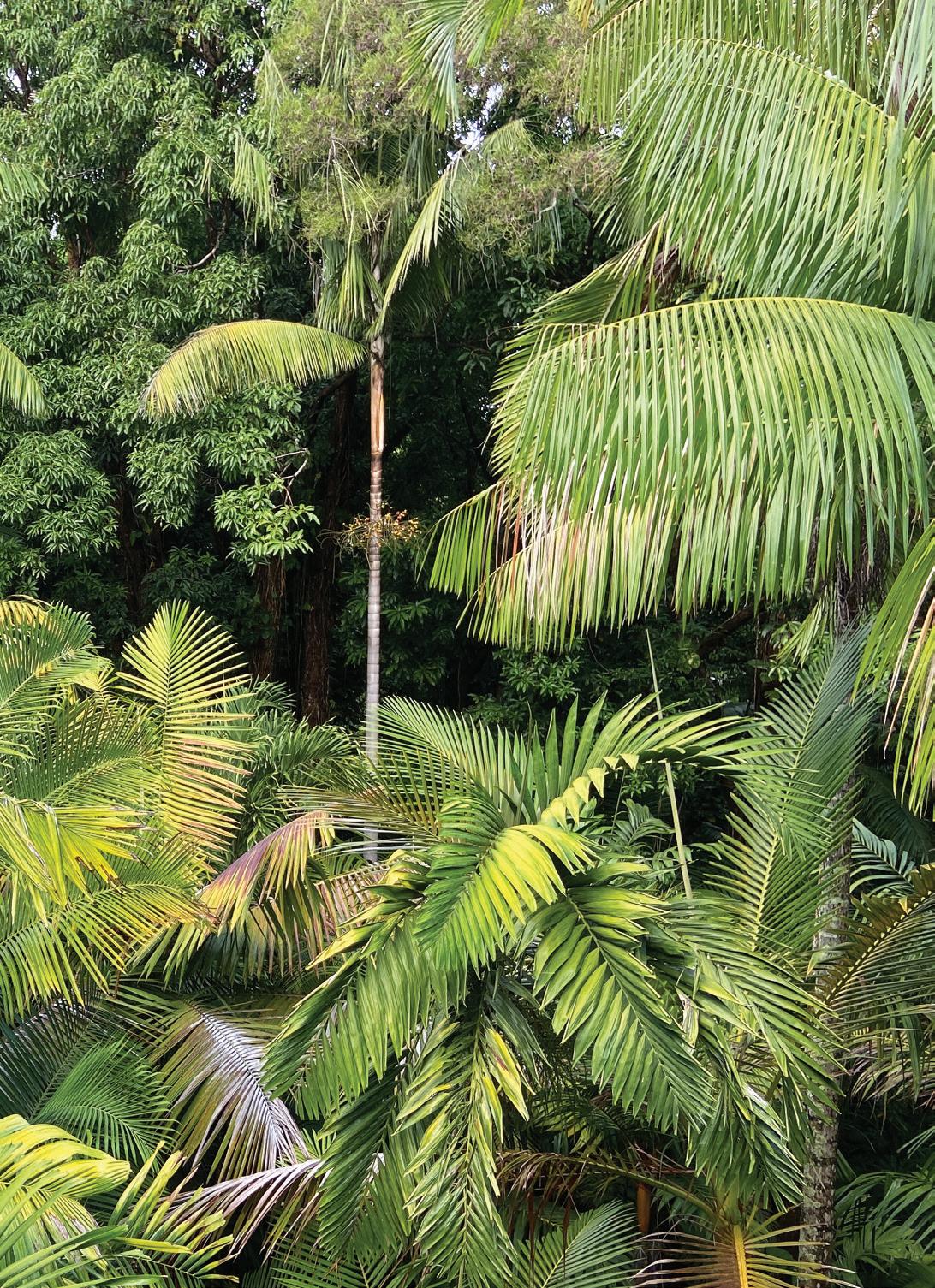
From the Merwins’ porch, the world is an interwoven texture of palms. Photographs by Matthew Battles
We discover that the garden has been unchopping the poet as well, reassembling something long lost in him.
Poetry; gardening—they analogize each other. In perhaps his most famous poem, Seamus Heaney recalls his father and grandfather in the garden, their strain and stooping; of “the coarse boot nestled on the lug” of the spade, its bright edge buried deep to open the earth. And yet, although “(t)he curt cuts of an edge/Through living roots awaken in my head,” the poet has “no spade to follow men like them.” And then, remembering the “squat pen” resting in his grip: “I’ll dig with it.”
W. S. Merwin (1927–2019) won the National Book Award, two Pulitzers, Yale's Bollingen Prize for Poetry, and the PEN Translation Award, as well as being named Poetry Consultant (1999) and Poet Laureate (2010) by the Library of Congress. Such laurels carry little currency in the broader culture, however; well-read, non-literary friends rarely recognize Merwin's name or lines, and it's rare even for my literary friends to know his work well. Merwin had a grace about this marginality, seeking margins where he could be in fruitful relation to the world and his work. It feels as though where Merwin chose to write—and as much, where and what he chose to cultivate—matters.
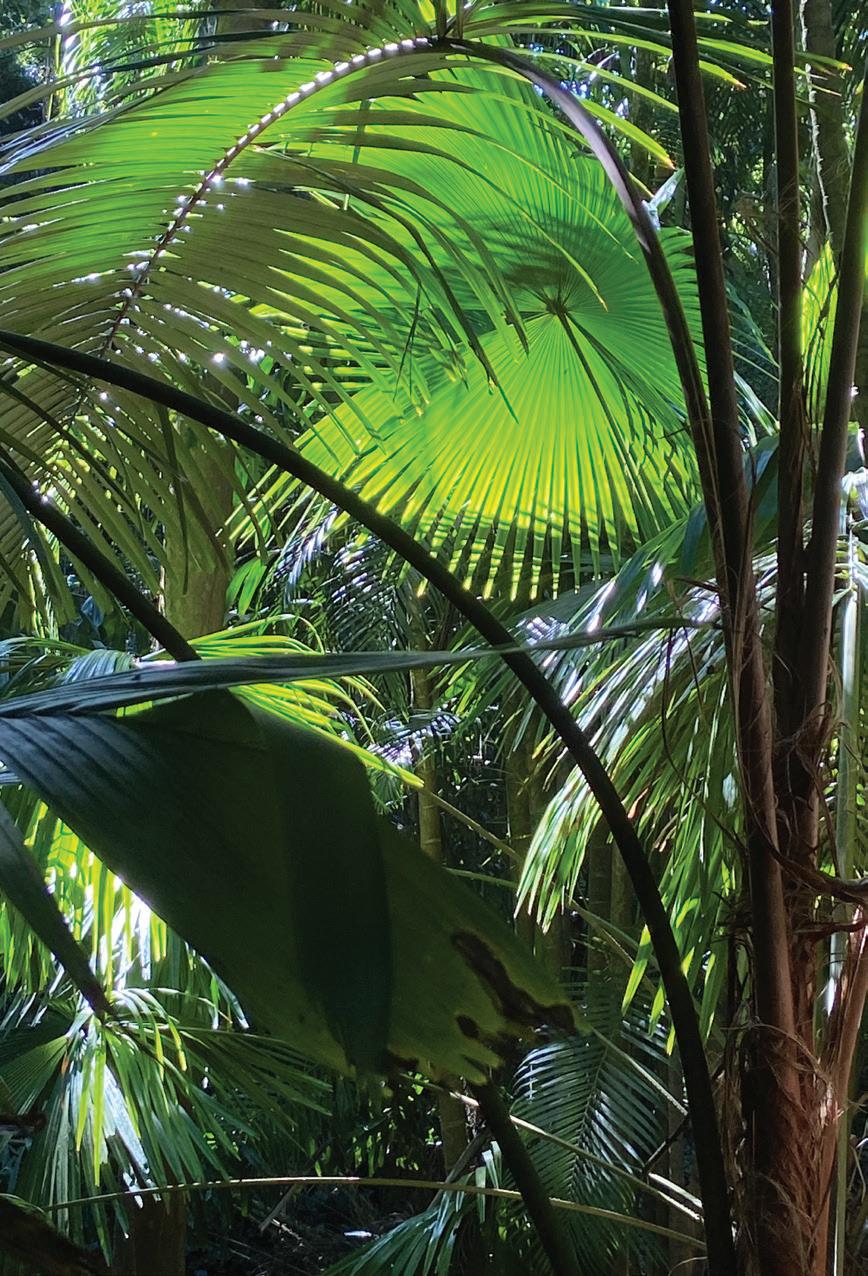
If you don’t know Merwin’s work, how can I help you understand what the prospect of his garden holds? What’s the promise of a landscape tended by this poet, by dint of this imagination, this reckoning with the flickering powers of language and cultivation? A view of his palm trees will get you at least partway there: standing on the porch, looking out into a frond-ful world, across a steep sweep of lively foliage that rakes and sighs in the breeze, fronds and fruit streaked and glossy, brimming into the sky, while birdcalls ring out like temple bells through the soft doors of the rain.
In Merwin’s case, arboreal commitments go farther than mere anaology. Beyond the tree-specific imagery that haunts his poems, which have the stillness and suppleness and restful longevity of trees, and an intimacy, much as his palms crowd into one another with the kind of intimacy only trees can know. Merwin's cultivation of palms is an “unchopping” of the kind he describes in his deceptively lighthearted poem, “Unchopping a Tree,” where he imagines arboreal reincarnation as a methodical practice, a re-forestry: summoning of ghost limbs, beckoning broken roots to grasp again the ragged soil, applying stitchery to blades of leaf, gathering them into fans and whorls, inviting them once more to stretch, creak, and reach out to one another. We must seek this poet in his potting and tending, cutting and planting, whose logic of the seed reattaches wood to world. And perhaps along the way, we discover that the garden has been unchopping the poet as well, reassembling something long lost in him, whose presence could not be felt unless it got in under the fingernails, unless it seamed his hands with stain of soil.
Somehow I found myself muddied in these matterings. When I was a young writer trying my hand at translation, Merwin’s poem “Learning a Dead Language” offered not only a method but a metaphysics, an experience of living and lanuage enlivened by “what passion may be heard/When there is nothing for you to say.” As the losses of adulthood accrued, there came the solace of “Rain Light,” with its flowers that are “forms of water” blooming under a sun that “touches the patchwork spread on the hill/the washed colors of the afterlife/that lived there long before you were born.” And so, after much pondering and planning, when I had the chance to visit his Maui garden, it felt like a kind of pilgrimage.
Tucked away along a winding farm road leading toward the roar of Maui’s legendary surf breaks, the place is hard to find. I got as far as the Jaws General Store on Maui’s Hana Highway, where I met up with
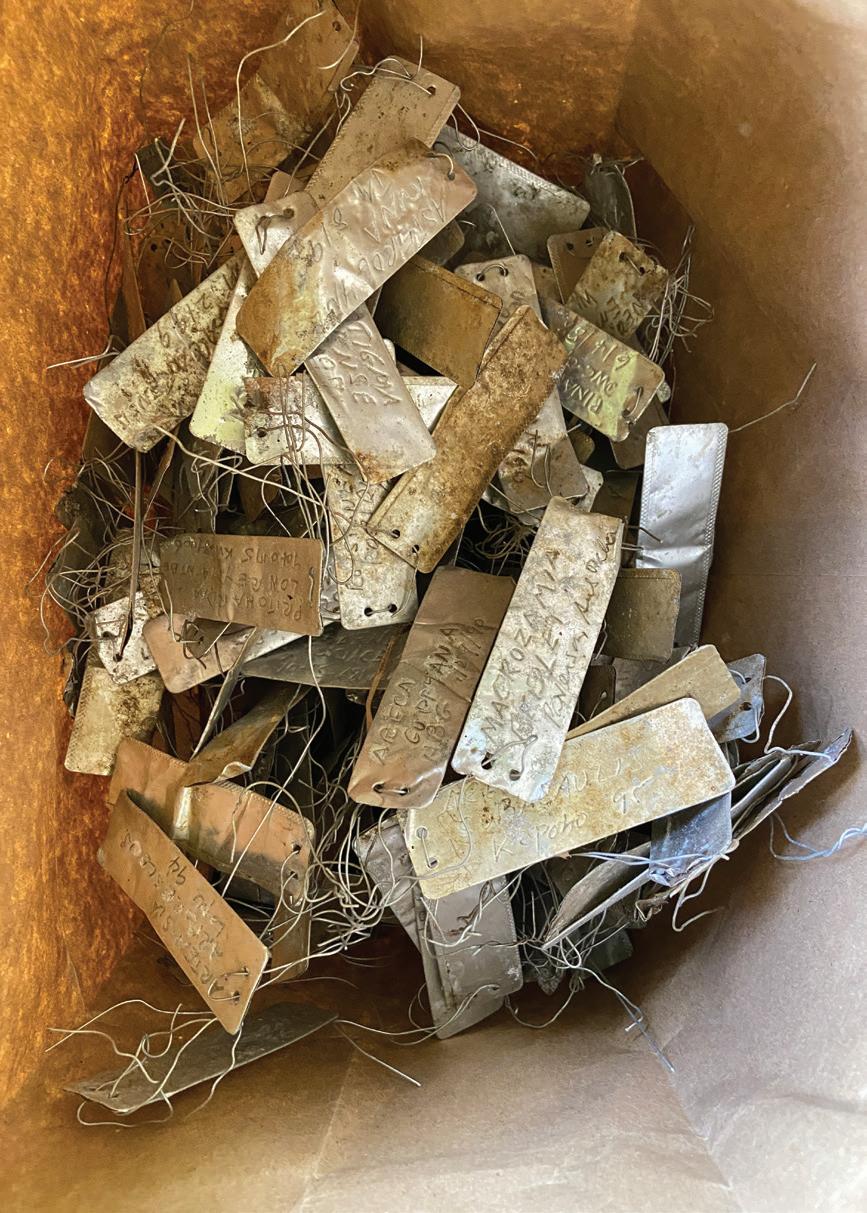
Gathered in paper bags, the names of species and cultivars on Merwin's horticultural tag rattle with a kind of palm-poetry.

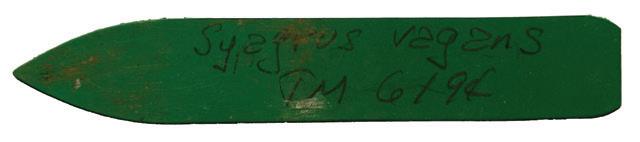
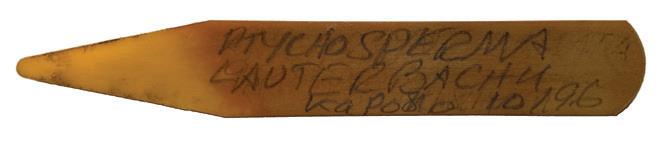
Linnaean namings invoke the proliferating powers of living things through their strange etymologies, their intimations of order, their elisions of memory and temporal specificity. And at the same time, they dapple and overspread the lost and minor forms of knowledge of living things (traditional, indigenous, practical, horticultural—all rich in their minority, in their glossy flowerings and particulars).
Sonnet Coggins, the Merwin Conservancy’s extraordinary director, who drove me down into the shady redoubt where the house shelters amid the palms. Coggins, a longtime museum leader whose family story is woven into the history of Hawai‘ian cultural and political resilience, then led me on a tour of the palms, shouldering a great satchel full of Merwin’s books, opening them here and there to read lines with affection and generosity.
We visited the potting bench, where seedlings spring from pots like spry emoji, belying the gravity into which they will grow; we peered into Merwin’s zendo, a simple screened shelter looking out into the garden, where I later sat zazen in the rain.
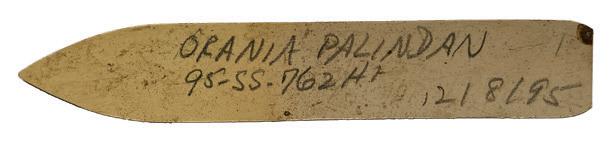
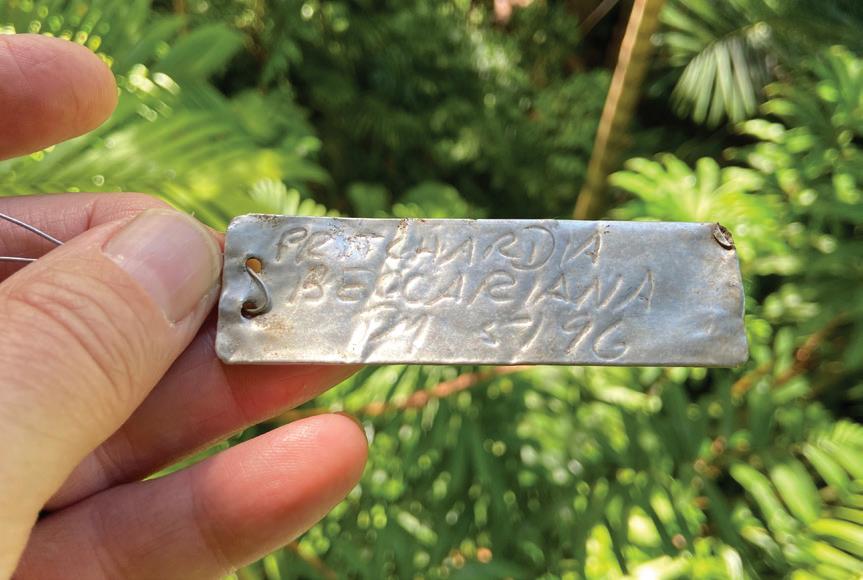
Eventually, Sonnet led me into the house and left me with boxes of typed letters in original and carbon copy arrayed on the dining table. Before setting to work on these, however, I spent a long time piecing through the tags Merwin made for his trees—standard-issue horticultural tags of aluminum, resin, and zinc, purchasable by the bundle at garden centers or online, upon which Merwin scratched the scientific
names of the trees he planted. In time he planted more than 3000 palms from around the world, cultivating them with care and curiosity; and the culture of palms flourishes there today, some seven years after his death.
Tangled together in paper sacks, dust-settled on benches, or used in sly decoration here and there throughout the house, the tags bewitched me. The names emblazoned on them rattle with a fossil poetry. Like botanical taxonomy, Merwin’s poems were nourished by many languages, and the fragments and echoes of the nomenclature chime with the passions of the dead, their sense of what is memorable in encounters with the living world.
Merwin first traveled to Hawai‘i in the 1970s to study with Robert Aitken, a Zen teacher with a literary bent. For many years, he lived as a globetrotting academic poet, alternating long stays in rural France with stints in Majorca, London, New York, and Boston; Maui would become his home for the rest of his life. What did he find there? “Clover does not think about
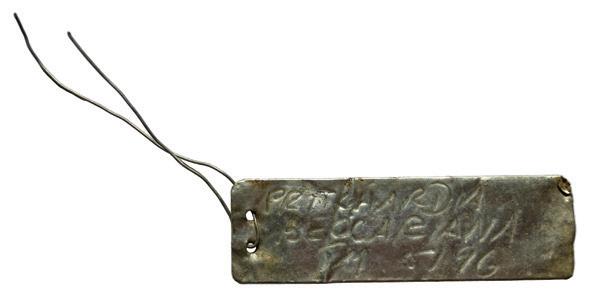
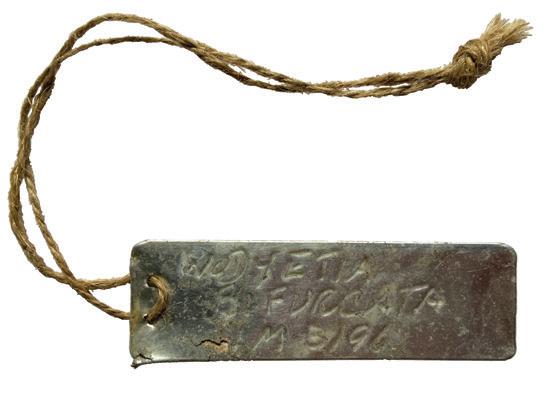
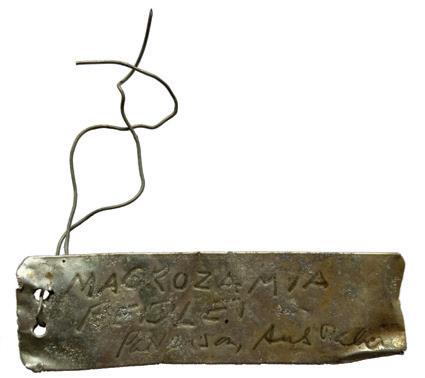
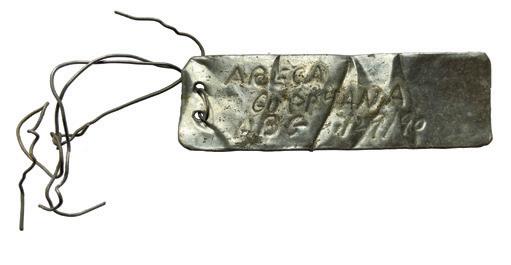
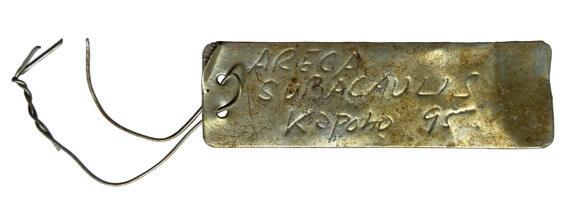
And as things made of written words, these names are haunted by utterance and by the glowing literary art Merwin made. They scatter through the poet’s words, his translations, and his travels, sowing a lyric into the taxonomic tilth.
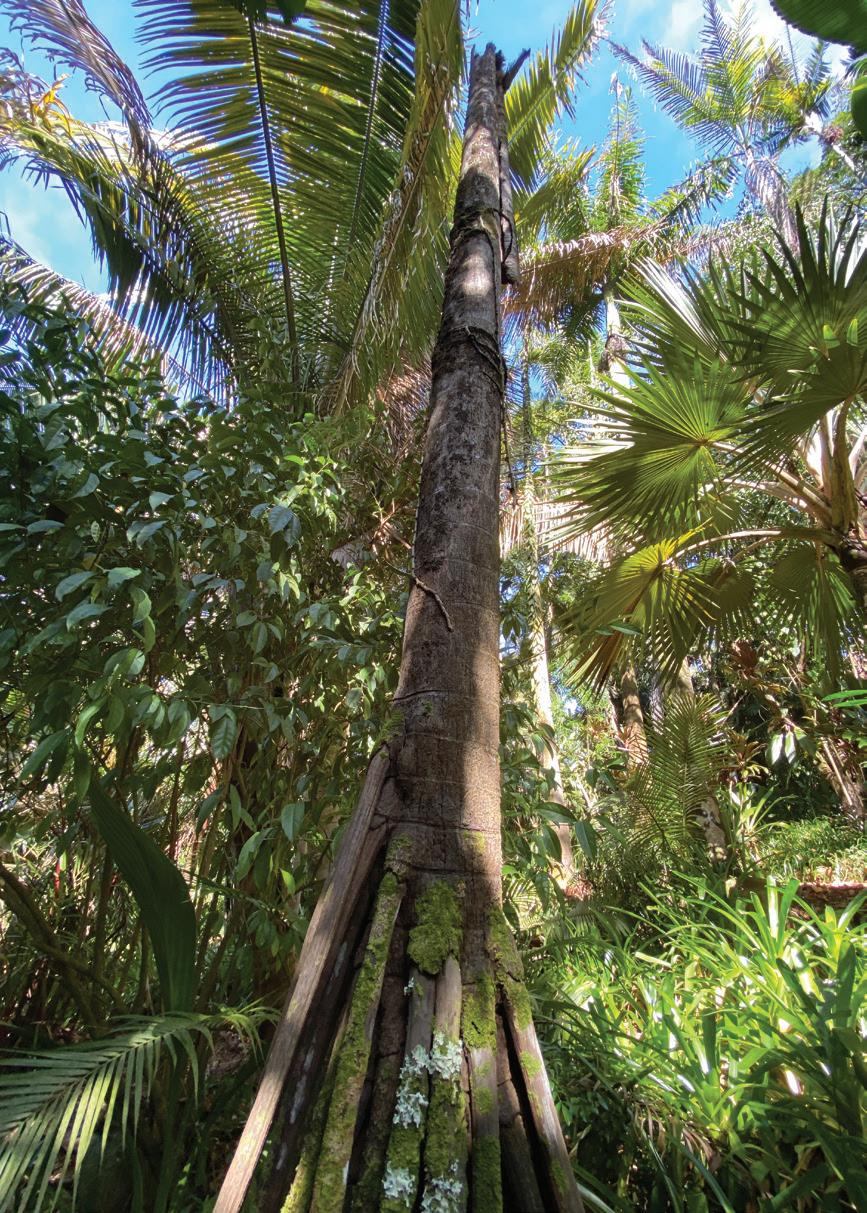
He began his journey with
palms— "so ignorant," he writes, "that I scarcely knew other palms existed."
from volcanic slopes down to the sea, encompassing streams, forested uplands, and cultivated ground. As ethnographers Kepā and Onaona Maly point out in the ethnohistorical study they prepared for William and Paula’s trust in 2021, the word pe‘ahi, which also names a fragrant local fern (Microsorum spectrum, known elsewhere in Hawai‘i as laua‘e) is “often associated with the light winds which blow from the ocean and across the land causing leaves of the niu (coconut palms) to nod or flutter as if waving.” The word, like the place, thrums with the energy of dancing leaves.
responsibility,” Aitken wrote in a book called Mind of Clover, “and neither did Shakyamuni (a name for the Buddha). He simply arose from his seat and went looking for his friends.” Perhaps it was in search of friends—if light and landscape and trees may be counted as friends— that Merwin came to Maui. He bought the land for his garden in 1977, a used-up pineapple farm in the Pe‘ahi Valley on Maui’s north shore. A few years later, an adjoining parcel became available, and through the interest and generosity of the seller and friends, Merwin and his wife, Paula, were able to add this property to the garden. Tremendous work remained to transform the landscape from its desolate condition into a living forest. At the time, the land there was barren and grassy, with long corrugations in the soil running steeply to seaward, indicating that the pineapple growers had plowed the fields downslope, which had allowed a great deal of topsoil to run off with the rains.
Long before the pineapple growers and cattle had come and gone, however, The Merwins’ parcels were counted part of Pe‘ahi, an ahupua‘a or traditional district—typically a sector of land running
Merwin had hoped to replant this landscape with native forest species. The complexity of such ecological restoration is daunting throughout the islands, however, and the koa trees he tried to reintroduce would not thrive. The soil “had been leached out,” he writes in What Is a Garden?, a volume of photographs, essay, and verse celebrating his work with palms, and the land proved “unwelcoming to what had once grown there.” He found his way to a successional approach instead, beginning with introduced casuarina trees, choosing varieties not prone to invasive growth. “Even in the conditions here they began to grow rapidly,” he continues, “and within a few years they began to form a miniclimate as they shaded the ground, added humus with their fallen needles, held the water after heavy rains, and put nitrogen back into the soil.” Eventually, termites took apart the casuarinas, further feeding the soil and laying the groundwork for palms to flourish toward forest.
He began his journey with coconut palms—“so ignorant then,” he writes, “that I scarcely knew other kinds of palms existed.” He marveled to learn of “a whole lore of coconuts” tracing their origins “from the heads of children who died of hunger,” or “the heads of fishermen who had dangled their hair in the sea as bait, and of some that sprang from the heads of gods,” suggesting that “(f)rom the moment they began to grow, they would be native to the spot, in one sense at least, as I could never be.”
By the mid 1980s, Merwin was committed fully to the culture of palms—not only to their planting and propagation, but to correspondence with a farflung network of fellow palm fanciers, horticulturists, and palm specialists. “It’s clear that we have come home to Christmas,” Merwin writes in a letter to one of his chief palm correspondents, Inge Hoffman, dated June 18, 1987, “whatever the calendar may say.” Hoffman ran the International Palm Society, which she describes in her letters to Merwin as a
shoestring affair held together by her and her husband. Inge comes across as gritty and irascible in the face of money woes, the competitive throes of palm culture, and constant oversight from the USDA. She and Merwin had an affectionate correspondence, full of bluster and brio, and when Merwin returns from a long mainland tour, the presence of a shipment of many seeds from Inge is magnificent to him. “The joys of being among our overgrown trees and garden, instead of in a city, were quite heady enough, but then, among the mountains of mail, these white muslin (seed) bags with the attached cards, that always make the heart (this one) leap up.” Abashed, he suggests that he might not have the skill to germinate them and bring them all to maturity. “But the number of seedlings, the variety, grows, and the number of young trees in the ground, and thriving, grows, and our hopes with them.”
Reaching out to gardeners throughout the tropics in search of new seeds, he maintained his amateur poise. “I should tell you at once that I am not a professional botanist and still less a commercial nurseryman,” he offers Maria Horton of Loja, Ecuador, in a letter dated January 18, 1989. “I am a writer by profession, and my love of the natural world, the tropics, forests, and gardens and palms is that of a rather ignorant amateur, learning as he goes. But the seriousness of my love of these things is quite plain in my writing.”
But he also was keen to avoid public entanglement, to preserve his energies for his poetry. When asked to serve on a “Conservation Committee,” Merwin drew a line: “I am certainly deeply sympathetic with its goals,” he wrote in a letter dated July 14, 1989. “But after a couple of weeks pondering it, I am certain that I must respectfully ask to be excused from that honorable post. I am not in any respect an administrator and have neither the experience, the gift, nor any of the other qualities needed for committee work, I fear.” Instead, he offers the enterprise of the poet and the artist to cultivate and conserve through inspiration: “I will have to content myself, and you too, I trust, in trying to do some things for the same goals, in private, as I have always done— and as writers, artists, poets, you know, are always more likely to do.”
There is a way Merwin’s correspondence about the garden emerges like gardening, unfurls like seedlings into leaf and limb. A mid-twentieth century writer near the turn of the millennium, working amid the advent of the personal computer, Merwin’s
practice still followed the prior rhythms of manuscript, correction, typescript. This isn’t unusual or distinctive for a writer of his time, of course. But it’s worth recalling the patience, the repetition, the slow cultivation: the first draft in longhand, hoeing the earth, finding the lines, turning the soil; next, the editing, like thinning and weeding; finally, the typescript, which is perhaps a harvest, or a long, slow tour down the rows to survey the fruits of this labor. Or not yet the fruits—those come with the sending, the receipt, the reply. And to keep a copy is to save seeds, so that this foison may be sown elsewhere another time. Both trees and typescript pages sequester carbon.
A letter to Scott Lucas, curator of living collections at the National Tropical Botanic Garden on Kauai in the 1980s and ‘90s, offers the suggestion that Merwin occasionally would share poetry with his palm correspondents. “I am often hesitant about sending such things to people if I don’t know them well,” he confesses to Lucas—and he offers an aching assessment of the limit of poetry’s reach: “Not everyone reads such literature in our society, and some are embarrassed to have to respond. But your response, and then the manner in which you conveyed the other treasures give me the image of someone careful, thoughtful, inventive and so on—I trust you know the rest yourself, though it’s not safe to assume either that people really know themselves.”
It’s tantalizing to imagine how this exchange unfolded in full. Had he sent a book, or chosen some especially relevant verses to enclose with a packet of seed? Did he inadvertently write up his recipe for diatomaceous earth on the back of a galley proof or carbon copy of typescript essay or verse, as he does with many of these letters? What verses might they have been? I like to think it might have been a slip of draft from The Folding Cliffs, Merwin’s epic telling of the story of Pi‘ilani Kaluaiko‘olau and her family, who lived on Kaua‘i at the end of the nineteenth century. Though her family’s tale is framed as epic here, their suffering was very real: When her son Kaleimanu contracted leprosy, they fled with the boy's father Ko‘olau, disappearing into the Kalalau Valley backcountry. They feared that Kaleimanu would be sent to the concentration camp for leprosy victims on Moloka‘i, set up by the Provisional Government created by US-born settlers and businessmen after the overthrow of Queen Lili‘uokalani in 1893. Long before Merwin turned his attention to it, their story was a great epic of Hawai‘ian cultural survival—best
told by Pi‘ilani herself, who wrote it in Hawai‘ian for a book published in 1906, after her son and husband had died and she came out of hiding.
Pi‘ilani’s own telling is terse and urgent; Merwin lingers over the imagined interfusion of primeval Hawai‘ian life, evoking the life he wished to kindle in his garden, of “voices never heard before singing out of/ a source in the yolk of their unmeasured morning”; of the “undisturbed” trees that keep “beginning and beginning.”
I think of Merwin's words to Scott Lucas: It’s not safe to assume that people really know themselves. Some critics denounced The Folding Cliffs as an act of cultural appropriation. And there is real danger
from around the world together, here, into a new kind of relation. It’s a palm garden for our time, for islands in the Anthropocene, islands which can never truly be islands again.
The first shadow was beginning to surface in the darkness through a net of trees when she came to the swollen stream of Halemanu the house of birds where in earlier dawns the birds had the forest to themselves waking there into plumage and colors never seen anywhere crests and feathers heads and motions never before entered upon voices never heard before singing out of a source in the yolk of their unmeasured morning inexhaustibly beginning and beginning as the undisturbed trees and flowers kept beginning around them
—from The Folding Cliffs
here, that the word-weaving of an eminent haole poet might eclipse a story Pi‘ilani already had told in her own words. In the same way, there was a forest on Merwin’s land before he made a garden for palms there. And then, people came from over the ocean, and the relations with the land were sundered or challenged by change: by the cattle they brought, by the pineapple their mainland confreres craved. Living relations in the land, relations of native plants and Polynesian introductions, once interwoven in lively equillibrium, were frayed, then unwoven altogether—the land denuded of vegetation, of soil, of life, stripped to the substrate, the living matrix washed down to the sea, gnawed upon by rolling Pacific. What Merwin created here was a garden, which is to say a kind of poem—a new speaking of the place. He realized very quickly that recreating a native forest here would not be possible. And what would it have meant to try, anyway? For in the end, even the most hopeful poet knows that there is no unchopping that will reknit the trees, restore the land, resurrect all its relations. So he brought palms
Can The Folding Cliffs be understood in the same way? Can we read Merwin’s account of Pi‘ilani, Ko‘olau, and Kaleimanu as a tale told alongside, and not instead of, the original? I think of the Vietnamese documentary filmmaker Trinh Minh-ha, who describes her work as “speaking nearby instead of speaking about” her subjects—“a speaking that does not objectify…. A speaking that reflects on itself and can come very close to a subject without, however, seizing or claiming it.” I fear that The Folding Cliffs, for all its flow and formal grandeur, does not take this stance; for my part, I feel it standing between me and Pi’ilani. In the garden, by contrast, Merwin did achieve this effect of standing nearby. Propagating, planting, and tending his palms, Merwin was gardening nearby the Hawai‘ian living world, not in tension or opposition or contrast, but in tribute, in solace, in care.
I think of “Rain Light,” perhaps Merwin's greatest poem, published in 2008. In it there is an oblique intimacy, at once murmuringly nearby and vast, porous:
All day the stars watch from long ago my mother said I am going now when you are alone you will be all right whether or not you know you will know
We’re in a place that could be anywhere, a time that could be any time, but also deeply here and now, close as heartbeat and immediate as breath, wherein the person, too, is a place. A place nearby, wherever we are. There is such spaciousness in this verse, such openness, the vast vertical span of the stars watching —watching whom or what? Are we visible to them? Visible as we are to trees, I suspect. And the mother’s speech bubbling up like a murmur, like a thing overheard, without explanation. when you are alone.../ whether or not you know.... The plenitude and possibility are the point.
Merwin’s style, which long had been spare, begins to reach toward a lucid austerity. His lines shake loose
from punctuation, capitals are mostly banished. Not unlike Dickinson, Merwin invites us to slow down, to rest in the emptiness and liquid syntax of his lines, to let their grammar blossom for us in its own time. There is an invitation to tranquility, but also to rigor, the rigor of attention, to precision and seriousness. And in “Questions to Tourists Stopped by a Pineapple Field,” first published in 1983, there is the gleam of this rigor, even a severity:
did you like your piece of pineapple would you like a napkin who gave you the pineapple what do you know about them
... what do you think was here before the pineapple fields would you suppose that the fields represent an improvement
The poem is long, a litany of unpunctuated questions, dripping and astringent, the poet exposing the tourist to a dose of their own relentless interrogations, ringing the changes from pineapple rings to land plowed and scarred to the casual pondering of investment possibilities. when you look at things in rows | how do you feel, asks this poem of rows and feels. Each line is broken by a pause, a long space called a “caesura.” Such breaks often have metric and rhythmic purpose. Here, the caesurae feel more than merely structural; with each pause, there is a weight, a discipline, patient and severe. They begin to feel to me a bit like swings of the kyosaku, sometimes known as “the encouragement stick,” traditionally wielded by Zen Buddhist teachers to cultivate attention in the meditation hall.
I read the poem “Questions to Tourists Stopped by a Pineapple Field” and think of a fruit stand where we once stopped on O‘ahu’s North Shore: mounds of pineapple and mango sheltering under a canopy in a park looking out across Kaneohe Bay, the weathered pyramid of Mokoli‘i rising green and quiet away across the waters. The vendor chatted away with a friend in Hawai‘ian as she sliced our fruit, piling slices of mango and pineapple and great rough-edged potsherds of coconut meat. And when the fruit-seller’s friend heard we were from Boston, she sat with us while we ate our fruit and told us about her granddaughter, a student at Brown University, and the juices ran into sticky streaks down our hands and wrists, and we talked about the bigness and smallness of the world.
Merwin was a prolific translator, and often mentioned to interviewers that he turned to translation as a young writer, when he found he didn’t yet have much to write about (following a dictum handed down by Ezra Pound, he often said). It strikes me that gardening also is an act of translation, trying to intensify, interpret, and carry over plant meaning in ways that matter to humans. I want to say that gardening, and in particular working with a garden that hopes one day to be a forest, played a role in Merwin’s late art much like the catalytic effect of translation on his early poetry. Merwin’s late lyric has a vegetal quality: shorn of punctuation and mostly undivided into stanzas, the lines seem at once unruly and reposeful, sprung forth without animal starts and stops. There’s something twitchy about punctuation, I’ve begun to feel—twitchy and grasping, the way it bends the reader into stops and pauses, bursts of exclamatory or interrogative busyness (it’s worth noting that in the Hawai‘ian language, the okina, which looks to a reader of western languages like an apostrophe, is not a punctuation mark, but a letter of the alphabet). Merwin’s lines root, twine, hold fast; the reader must sit with them awhile in patient regard before their activity makes itself apparent. The way the promise of the flower steals forth for a gardener, the bloom and ripening of possibility.
Before the coming of modernity, the ahupua‘a of Maui’s north shore supported a water-intensive horticultural lifeway of great ecological and social sophistication. The people planted along the streams, carved terraces into the slopes of the ravines running down from the flanks of Haleakala to the ocean, fringed them with bananas, and flooded them for taro. In What is a Garden?, Merwin calls the landscape of the north shore “a testament of water,” its flowing force “the origin and guide of its contours and gradients and of all the lives—the plants and small creatures and the culture—that evolved here.” Rain comes to this coast with the trade winds; and “in the poetry of the Hawai‘ians,” Merwin notes, “rain almost always is the rain of a particular place, with a specific character and an allusion to an erotic element of some story draped with names…. The sound and touch and smell of the rain, the manner of its arrival, its temper and its passage are like a sensuous visit to the garden, and the light among the trees after rain, with its own depth and moment, iridescent, shifting and unseizable, is an intensified image of the garden at that instant.”
Or to say it in verse, from “Rain at Night”:
but the trees have risen one more time and the night wind makes them sound like the sea that is yet unknown the black clouds race over the moon the rain is falling on the last place
Elsewhere in What Is a Garden?, Merwin reflects on how modernity has changed the role of gardens, which “from the beginning ... existed as enclaves designed and maintained to keep out the wilderness, to guard what was inside for human use or pleasure.”
Now that it is possible for “human beings to destroy environments anywhere on earth, the situation (has) turned around, and anyone who want(s) to protect and save any remaining bits of the natural environment (is) acting in the role of a gardener.... to keep encroaching human exploitation and disturbance out. The model for this garden has always been the forest itself, even though I know that the word ‘reforestation’ is generally meaningless, and that only a forest knows how to grow a forest.”
Only a forest knows how to grow a forest. Merwin’s
late vision offers a loosening of the hand closed on pen and trowel—a recognition that this writing, this garden, this forest, ultimately makes itself. For even as the garden takes shape as a made thing, “it is only the humans in it who think of it as a garden,” he notes in What is a Garden. “But a garden is a relation, which is one of the countless reasons why it is never finished.” And this relationality draws not only plant and plant, but plant and poet, poet and poem, into intimacy. “The practice and art of gardening are remarkable pure forms of the element of paradox underlying all human art and language,” he notes. “A plant in a garden is at once the natural world itself and an object of human arrangement. In a garden we draw something of nonhuman life into our history.”
Would I love it this way if it could last?
—Merwin, “Morning” (from Garden Time, 2016)
Under Coggins’ creative leadership, the Merwin Conservancy has become a marvel. Merwin’s rough zinc tags have been replaced and supplemented by a collections database catalogued by John Dransfield,
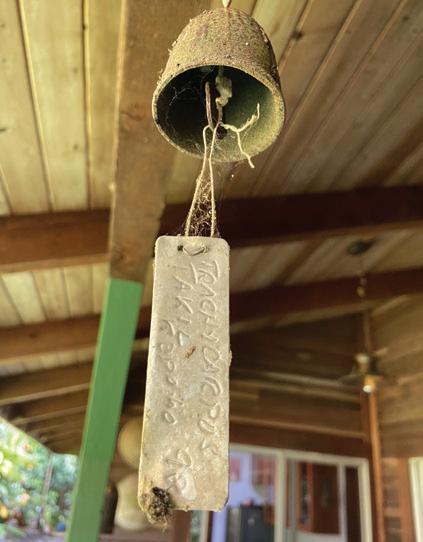
A tag from a Trachycarpus takil, a Himalayan fan palm, animates this bell hanging on the Merwins’ porch.
former head of palm research at Royal Botanic Gardens, Kew. The garden also hosts a residency program giving artists and writers the nourishment of the place. And the arboriculture is strong, too—with the support of the Garden Club of Honolulu and guidance from scientists at the National Tropical Botanic Garden, they’re breeding loulu (Pritchardia glabrata) palms, which are native to western Maui, in hopes of offering them as part of revitalizing Lahaina in the wake of the devastating 2023 wildfire.
“A garden is made of hope,” Merwin writes in What is a Garden? “It cannot be proven, nor clutched, nor hurried. And the hope of a palm garden is to be a palm forest.” Coggins tells me that she and the community that supports the Conservancy are not merely seeking to preserve, but looking for the ways its tenancy might speak to the heritage and future of Hawai‘i, the palms, and the living world. A speaking nearby; a speaking here.
At the end of my day at Merwin’s house, I was putting on my shoes on the front porch, waiting for Zirque Bonner, the Conservancy’s caretaker at the time, who would give me a ride back up to the Hana Highway and Jaws Country Store. He was locking the front door, its suave brass fox doorknocker rattling resonantly as the door heaved to. A small stone fountain burbled by the side of the porch; in the garden, which is also a forest, a bird was calling, ringing out with a sonorous, liquid thwick that ricocheted among the palms. I remarked how complex the beauty of the place was. “I tell people I get to work inside a poet’s imagination,” Bonner replied, his arms outspread in a gesture that took the home, the bird-and-fountain song, and the trees in its embrace.
references
Opening paragraph: “a brighter garden, where not a frost has been”—from “There is Another Sky” by Emily Dickinson (1830–86), first published in Poems by Emily Dickinson, First Series (1890); “find fair quiet there, and innocence, her dear sister”—from “The Garden” by Andrew Marvell (1621–78), first published in Miscellaneous Poems, ed. Mary Marvell (1681); “pluck chrysanthemums at the eastern hedge and gaze long at distant summer hills”—from an untitled poem by Tao Qian (c. 365–427) in A Hundred and Seventy Chinese Poems. Arthur Waley, translator. New York: Alfred A. Knopf, 1919.
Chen, Nancy. "A Conversation with Trinh Minh-ha. Visual Anthropology Review vol. 8 no. 1: Spring 1992.
Heaney, Seamus. 1966. “Digging.” Death of a Naturalist Farrar, Straus, & Giroux.
Jarman, D., & Sooley, H. 1995. Derek Jarman’s Garden. Thames and Hudson.
Kaluaiko‘olau, Pi‘ilani, and Frances N Frazier. 2001. The True Story of Kaluaikoolau. Lihue, Hawai‘i : Honolulu: Kaua‘i Historical Society ; Distributed by University of Hawai‘i Press. Kepā & Onaona Maly. 2021. He Wahi Mo‘olelo No Pe‘ahi A Me Hāmākua Loa, Maui/A Resource Guide Through the History of of Pe‘ahi and Hāmākua Loa on the Island of Maui. Kumu Pono Associates LLC.
Merwin, W. S. 1998. The Folding Cliffs: a Narrative (1st ed.). Knopf : Distributed by Random House.
Merwin, W. S., Wutz, M., & Crimmel, H. 2015. Conversations with W. S. Merwin. University Press of Mississippi.
Merwin, W. S. and Cameron, L. (ed.) 2016. What Is a Garden? The University of South Carolina Press.
acknowledgements: Many thanks to Merwin Conservancy director Sonnet Coggins and to Nina C. Peláez, associate director, for assistance in matters of fact, reference, and Hawai‘ian culture and orthography.
Merwin, W. S. 2016. Garden Time. Copper Canyon Press.
Merwin, W. S, and Michael Wiegers (ed.). 2017. The Essential W. S. Merwin. Port Townsend, Washington: Copper Canyon Press.
Merwin Conservancy, “palm correspondence” files, unprocessed archives.
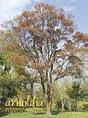
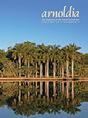
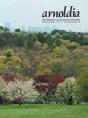
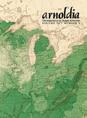
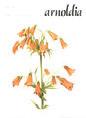
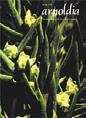
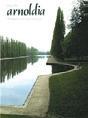
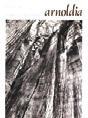
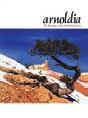
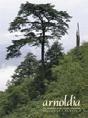
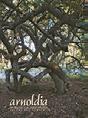
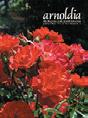
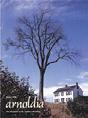
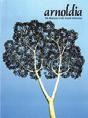
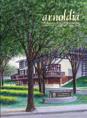
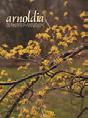
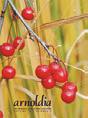
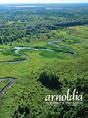
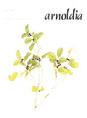
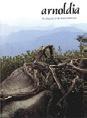
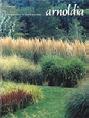
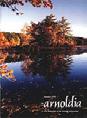
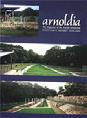
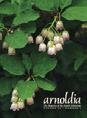
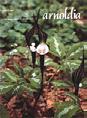
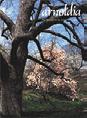
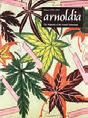
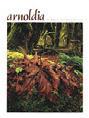
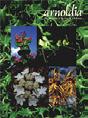
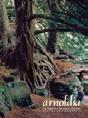
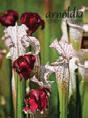
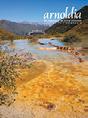
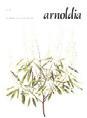
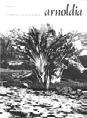
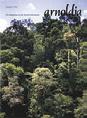
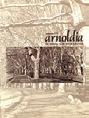

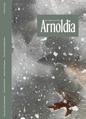
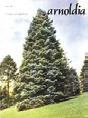
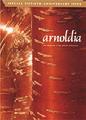
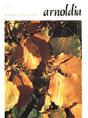
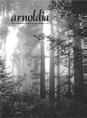
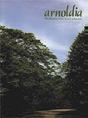
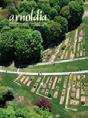
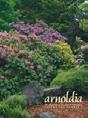
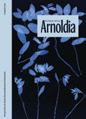
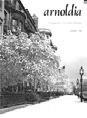
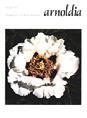
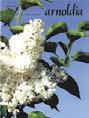
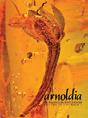
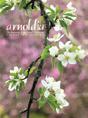
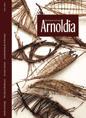
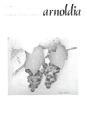

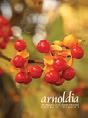
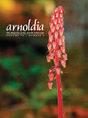
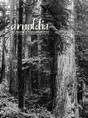
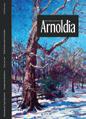

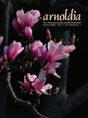
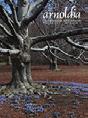
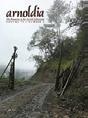
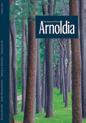
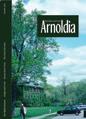
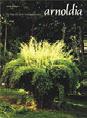
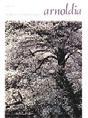
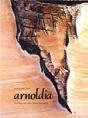
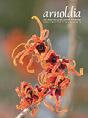
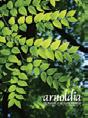
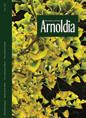
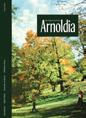

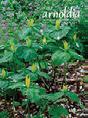
With its glacial landscape and a renewable, thousand-year lease, the Arnold Arboretum is a millennial, multigenerational project. People build lifetime relationships with this place, some of them more visible than others. And it’s often the least visible work here that produces results everyone can see, offering delight and discovery for decades and more to come. It’s true of the landscape; it’s true of the plants our colleagues propagate, plant, and tend from seedlings to specimens of mighty age and stature. We think of the plants in the collection in terms of provenance: the origin of the organism in place and time, woven with the hands and minds who chose, cultured, and tended it. Provenance is a story of belonging, the intergenerational relay of expertise and care that characterizes the life of this place, that adds to its aura. In this sense, Arnoldia too has an aura, a story of those who have belonged to it and to whom the work of care and crafting have belonged.
One of the longest chapters in this story of belonging belongs to Andrew Winther, Arnoldia’s longtime graphic designer, who retired in December of 2025 after some forty years. While most of Andy’s service to the Arboretum took place away from the landscape, his impact on the life of the place is visible through the 147 issues he touched as designer. His career with the Arnold saw three directors (Peter Shaw Ashton, Robert Cook, and William [Ned] Friedman) and no fewer than seven Arnoldia editors. In conversations with the most recent in that lineage, Andy reflected on all that has changed, and much that endures.
While botanical and horticultural knowledge have advanced at academic pace, the transformations in print design and production have been head-spinning. When Andy began working with editor Edward A. Schofield (who helmed the magazine from 1983 to 1989) he was serving as a designer with Harvard’s Office of the University Printer, an office that no longer exists; a magazine, then, was a material object from its inception, constructed through multiple rounds of printing, proofs, and paste-up, of cutting and trimming and photographing and measuring and marking by hand. “We would take an old issue of the magazine,” Andy recalls, “and (the typesetting department) would run out galleys of type, and we would just stick it, tape it, whatever, into the columns, and Ed (Schofield) would say, ‘we probably have a photo for this, let’s do a half page;’ ‘let’s do a one-column;’ and we would rough in the flow with rough galleys. That was cool, and it was collaborative, working with the editor and what he had in mind for imagery.”
At this time—the mid 1980s—these type and image elements were “pasted up” using rubber cement or wax, then photographed with a giant camera, from which large negatives would be produced forraphy. “We

“It just felt righteous to me. [Arnoldia] was my own little National Geographic.”
would get our type in galley form (long column-width sheets), wax it up and burnish it down,” Andy recalls. This was done with a wax machine, an appliance much like a laminator, which would coat sheets of printed paper in liquified wax. “At OUP we never had to use rubber cement,” Andy remarks. “For designers, the wax machine changed our lives.”
The end of Schofield’s editorship brought a parade of folks in editorial roles, with Peter Del Tredici eventually assuming editorship of the magazine in spring 1989 (an issue which features a photograph of bamboo Fargesia murielae on the cover). For Andy, working with Peter was dispositive—“he was charismatic,” he recalls, “and I really dug working with him. And we had some common interests…. He connected with me by coming to the reception desk at the University Printing Office—they don’t like clients to have a direct connection with the designer, they prefer them to work with an account manager—but Peter walked in and asked, where’s the art department? And from then on, we worked very directly together.”
Peter not only influenced the direction of the magazine, but Andy’s own budding horticultural interests as well, which developed in line with Del Tredici’s own
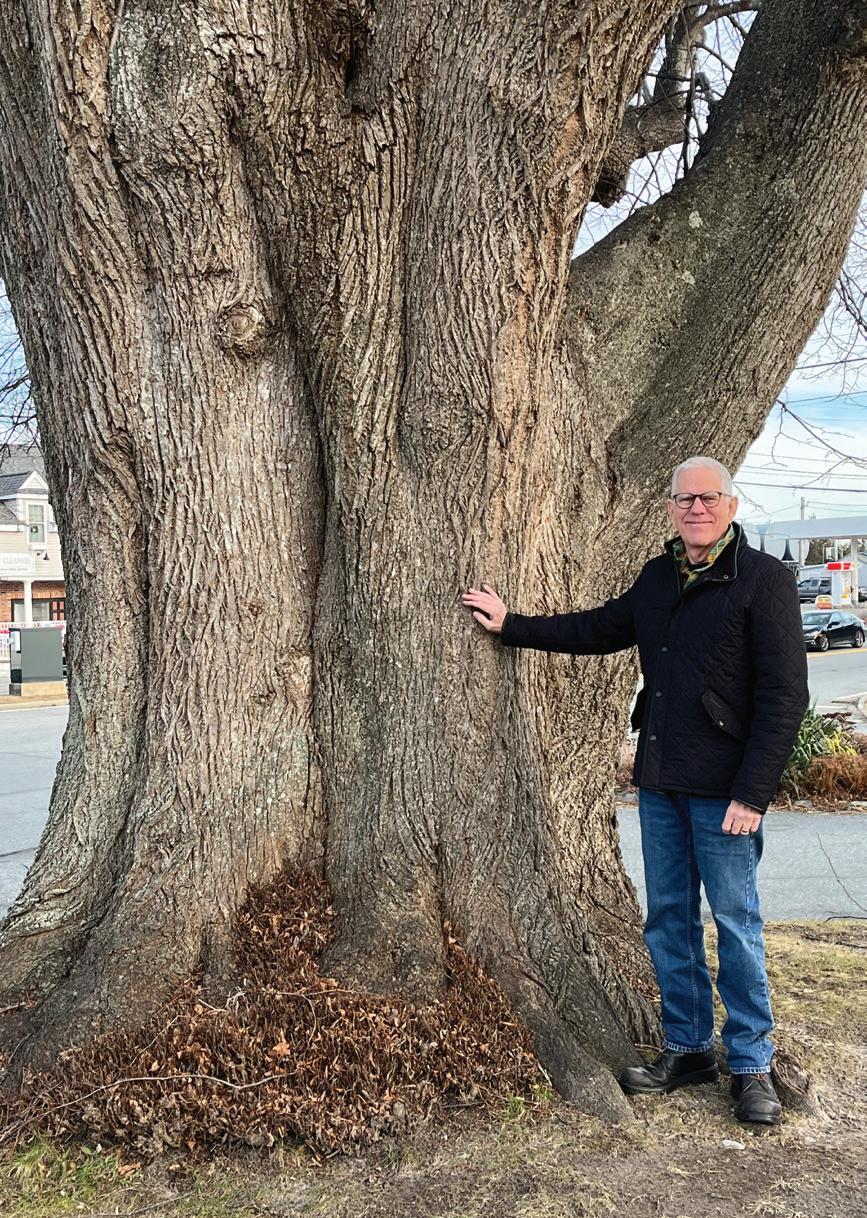









thinking and research on the nature of cosmopolitan plants in the city. “He helped me to establish two or three invasive species in our yard in Hyde Park,” Andy admits. “One was porcelain berry (Ampelopsis glandulosa)—there was this low, spreading tree growing in front of the University Publishers office, it was infested with porcelain berry, and I was obsessed with it, it was so incredible looking.
“I told Peter how I much I admired it, and he showed me how to take cuttings and put them in the freezer and plant them. So, I took a bunch of cuttings and I planted them along my chain-link fence. And he never said anything about them being invasive, because he’s all about wild urban plants. So then, we did a cover that had a beautiful clumping bamboo that’s in his Watertown backyard. And I said, oh, I’d love to have that in my yard, that’d be so great.
“So one day, he comes into the printing office, and he’s got two plastic bags with roots and two kinds of
Tools of the trade in the 1980s: Pantone swatches (page 32) and rulers in points and picas (above). Below: Porcelain berry (Ampelopsis glandulosa). Photograph by Olivier Vanpé via Wikimedia Commons, CC BY-SA 3.0
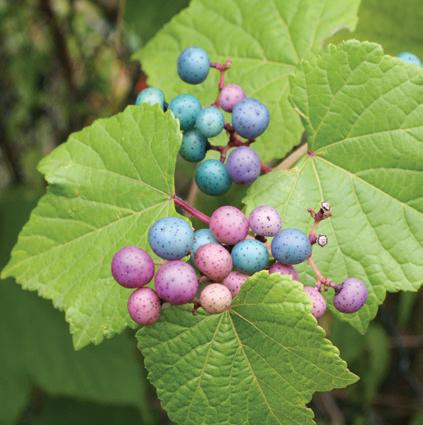








bamboo that are six, seven feet tall dragging across the ceiling, and hands them off to me. Fortunately— one of them was quite invasive, but the other was a big black bamboo, a (Phyllostachys) nigra ‘Hale’; it spread slowly. We sold the house to friends of ours—and they’re still friends! Our friend loved that bamboo, and when it grew big enough, he cut out a place in the center and put a chair in there.”
By the time Andy went freelance, wax machines and pots of rubber cement were being replaced by personal computers on the designer’s desktop. “When I decided I need to leave the publisher’s office, I bought a computer on the educator’s discount and went freelance,” Andy recalls, “and Peter immediately agreed to stick with me. And I’m very grateful for that—that’s what I needed.” And yet the work was still very hands-on, with many changes in form as content went from finished drafts to printed page. Working from home, Andy would receive copy on floppy disks or via file transmission, which he would print to pages and fax back to the editors at the Arboretum. Those faxes would get marked up with corrections and layout suggestions and faxed back to Andy. And then the editor (by this time it would have been Karen Madsen, who assumed the editorship in 1992) would visit Andy, who by then was living nearby in Jamaica Plain. Madsen would bring “a big cardboard box full of glossy photos, slides, archival material,” Andy recalls. “I would size things with my proportional wheel, working in points and picas, make crop marks on slides and glossies, and calculate percentages of enlargement, and those would go to our printer to make the negatives (big sheets of film for printing).
The pace of change has been astonishing; now, any cellphone will furnish images that are more or less ready to print. “That’s the big story,” Andy says. “So many processes, the typesetting department, the camera, the color-separation process, all went from expensive operations to something a punk could do on a desktop. I was part of a clump of boomers that experienced this technological revolution in printing.”











Most recently, Andy helped see the magazine through its 2022 relaunch, with the most substantial makeover of the look, feel, and content of the magazine in a generation. But it’s been changing all along, Andy notes. “Karen Madsen—her interest and influences in landscape design and the history of it, including the Arboretum, the Emerald Necklace, and (Frederick Law) Olmsted’s work more broadly; that was an interesting trend. But the focus of the magazine has been expanding as long as I’ve been there. And it’s been holding my interest all along. I see themes repeating and being furthered. The bigger boost, the real growth, was Jonathan Damery, who envisioned the (2022) relaunch… and since I’m skeptical by nature, I pushed back on a lot of the ideas. But at the same time, Jonathan had great ideas for content, and he was open to me trying things. And more recently, it’s just blasted off! I can imagine some people not getting the focus on the arts, but the magazine has stayed grounded in trees, and it’s such an interesting publication. Hopefully the membership thinks so, too! It should be an impetus for people to support the Arboretum, with all that’s going on in the world.”






For Andy, it always came back to the plants, their forms and beauty, their ways of being and surviving in the world. “It just felt righteous to me. [Arnoldia] was my own little National Geographic.” And with this, Andy remembers the obituary of Howard Paine, the graphic designer who stewarded National
Geographic through the “gradual, multi-decade transformation,” of its iconic cover, going from a decorative frame and table of contents on the cover to its now-classic photograph-centric approach. Of this evolution, Paine said, “we proceed with glacial speed.” Like the landscape of the Arboretum, Arnoldia is a story of belonging that makes haste slowly. Andy’s chapter is a long and eventful one; the story is still unfolding.
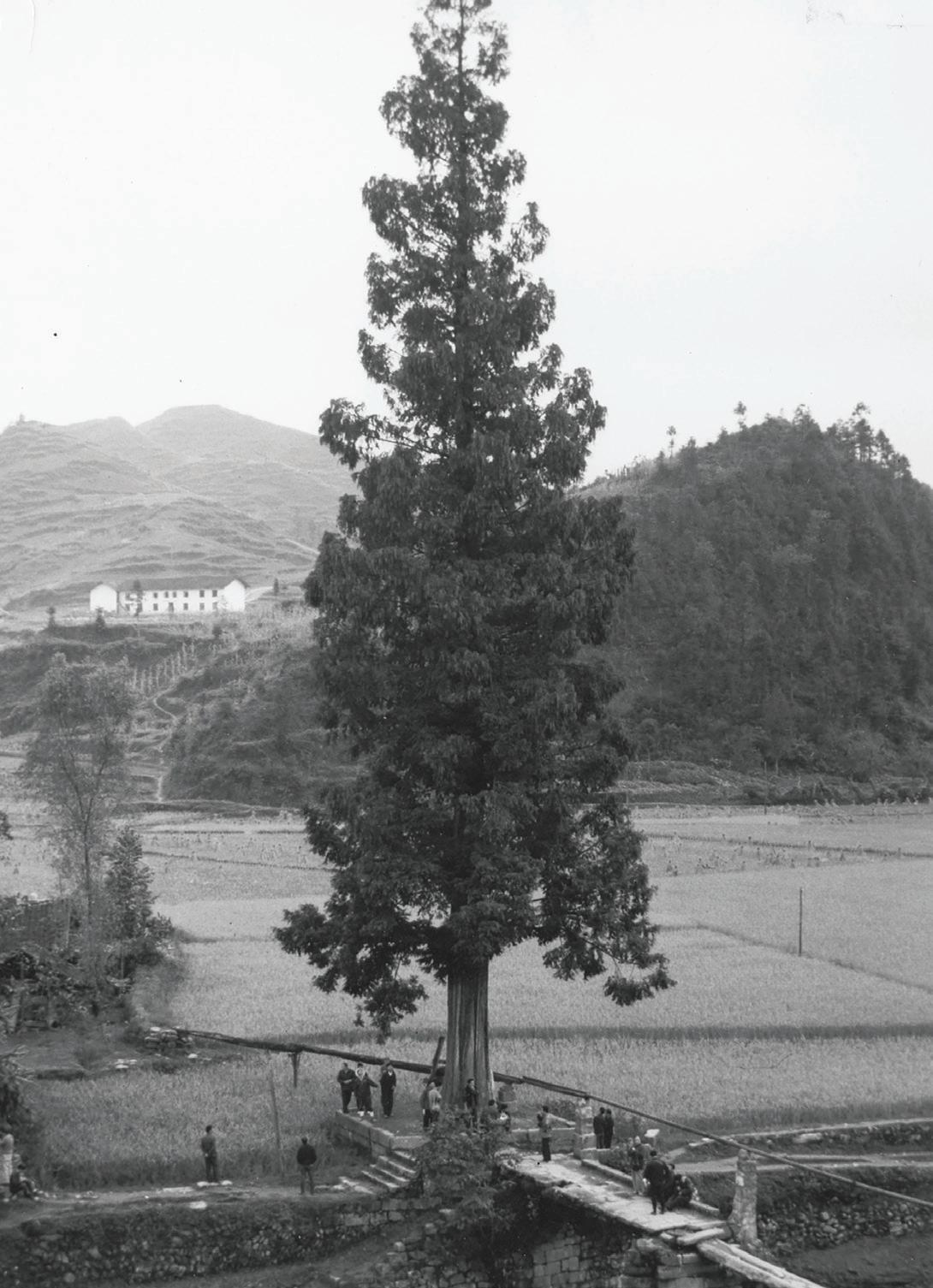
By Lisa Pearson
On December 2, 2025, the Arnold Arboretum hosted a virtual symposium celebrating the life and legacy of Hu Xiansu (Hu Hsen-Hsu), who earned his doctorate from Harvard University in 1925. The centennial of his achievement offered the opportunity for reflection on the longstanding institutional, scientific, and cultural collaborations between Harvard and China paved by Hu throughout his career. Arnold Arboretum director William (Ned) Friedman was joined by colleagues Ma Jinshuang, chief scientist at the China National Botanical Garden (North Garden); Hu Xiaojiang (granddaughter of Hu) professor of sociology at Beijing Normal University; Mark C. Elliott, vice provost for international affairs and Mark Schwartz Professor of Chinese and Inner Asian History at Harvard University; and William C. Kirby, Spangler Family Professor of Business Administration, T. M. Chang Professor of China Studies, and chairman of the Harvard China Fund. Michael S. Dosmann, Keeper of the Living Collections at the Arnold Arboretum, and Lisa Pearson, Head of the Library and Archives at the Arnold Arboretum, both took part in the symposium as well, and this article draws from Pearson’s remarks. —Editors
Many readers of Arnoldia are familiar with the magnificent Dawn Redwood, Metasequoia glyptostroboides, Shui Shan, and the part played by Hu Xiansu, (H.H. Hu) in bringing it to the world. Thanks to Dr. Ma Jinshuang, whose work publishing Hu’s writings and correspondence is invaluable, we can also tell the inspiring story of collaboration among the scientists who collaborated in its rediscovery and horticultural dissemination.
Metasequoia glyptostroboides, Hubei Province, China, 1980. The tallest (420 feet) and oldest specimen visited by the Sino-American Botanical Expedition.
Ancient metasequoia grew over the northern hemisphere during the Late Cretaceous Period, about 100 million years ago, down through the Miocene Epoch, 5 million years ago, then it vanished from the fossil record. This we know from its fossils, which were published as a new genus, Metasequoia, by Japanese paleobotanist Miki Shigeru in 1941. We know that Hu Xiansu had Miki’s paper, as well as a 1928 paper by S. Endo entitled “A New Palaeogene Species of Sequoia,” in which Endo described a new fossil species, Sequoia chinensis. Endo wrote further on Sequoia chinensis in 1933. In comparing the descriptions and plates in the articles, Hu noted the striking similarities of the specimens described in all three papers, and in a 1946 article he proposed changing the name Sequoia chinensis to Metasequoia chinensis for the ancient trees.
Chinese forest scientists conducted extensive fieldwork during the 1930s and 40s. They collected specimens throughout the country to identify indigenous species, and used them to create national forest
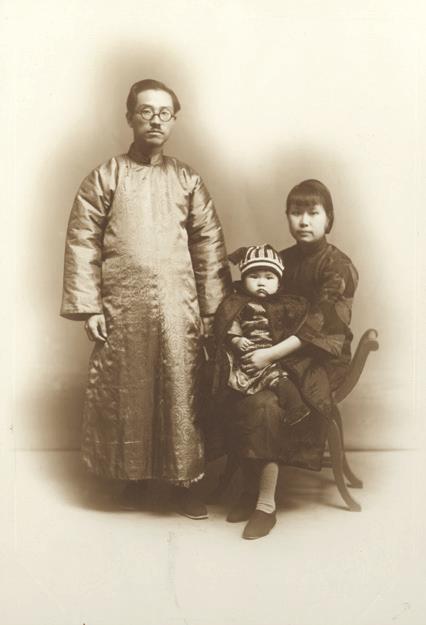
surveys, as well as to identify resources for the war effort. In the early 1940s, foresters observed what they thought might be a new species in an area on the Sichuan-Hubei border near Wanxian. It took several years to get samples, and for those specimens to be presented to Professor Zheng Wanjun (W. C. Cheng). His curiosity was piqued, to him the sample was clearly not Glyptostrobus (a conifer found in southern China), but he needed more plant material to be sure. He dispatched a colleague to gather more material and then sent the samples to Hu Xiansu at the Fan Memorial Institute of Botany in Beijing for identification. Hu’s detailed knowledge of Metasequoia from the fossil record was no doubt critical in “connecting the dots” to link the ancient trees with the specimens which had been recently collected. In 1948, Hu and Zheng published their article describing the new tree in the Bulletin of the Fan Memorial Institute of Biology
Stepping back two years to the spring of 1946, Hu had written to Elmer Drew Merrill, then Director of the Arnold Arboretum, to tell him about the newly recognized tree. Merrill and Hu had had a long relationship, dating back to the early 1920s when Merrill, then with the United States Department of Agriculture in the Philippines, often verified or determined the identities of plants for his colleagues in China. Their collaboration grew over the decades; and after Merrill came to Harvard University in 1935, he wrote Hu about continuing exchanges of plant material and publications, a practice they had shared when Merrill was at the University of California and the New York Botanical Garden. In a letter soon after, Merrill tells Hu that he had authorized a bank draft of $500.00, equivalent to nearly $12,000 today, to subsidize collections in Yunnan the next year. The subsidies continued until 1940, by which time the war had caused huge upheaval and made communication very difficult; they would resume in 1946.
Hu’s April 20, 1946 letter to Merrill discussed losses at the Fan Institute and the huge task of rebuilding the Lushan Botanical Garden (which Hu also had founded in 1934) after the destruction of the war. But it also contained this exciting news: “Have you received a communication from Dr. Wan-Chung Cheng announcing his discovery of a new genus of Cupressaceae,” Hu began, “which consists of a monotopic gigantic deciduous tree, found around Wanhsien in Szechuan? What a wonderful discovery it is! Only three lofty trees of 34 meters are living. Casually I also found a few small trees of Glyptostrobis
After [Elmer Drew] Merrill came to Harvard in 1935, he wrote Hu about continuing exchanges of plant material and publications.
pensilis in the back yards of a small village about 40 miles from Nanchang. This proves conclusively that this conifer can easily be planted in the 6th zone in the States. When we have collected seeds from these trees, I shall send some to you. I hope this tree be more widely planted in the States.” Hu here is writing not about USDA Hardiness Zone 6, but its forerunner, the Arnold Arboretum’s hardiness zone system developed by Alfred Rehder. The Arnold was in Rehder’s Zone V; Hu hoped that the tree that would become our signature plant would prove hardy to our south. Metasequoia has shown itself to be hardier, however (and with climate change, the zones are on the move as well).
By late that year, Hu had seen a complete specimen of Metasequoia, which he describes in a December 2nd letter to Merrill as “really a striking tree,” promising to send seed the following year to the Arnold for distribution. Merrill responded several weeks later saying, “That is good news regarding the Metasequoia. As I told you when you first announced the find we would eventually like to have specimens and, if possible, seeds also.”
In Hu’s May 3, 1947, letter to Merrill, he enclosed his paper on the Paleogene species of Metasequoia, and asked for funding to collect seeds later that year.
Letter sent from Hu to Merrill in June 1938 detailing reception of funds.
Merrill quickly responded, promising $500 for the dual purpose of collecting seeds and sending botanical material that had been stored during the war when shipping was impossible. In this letter, Merrill takes up the topic of the binomial, Metasequoia viva, which Zheng and Hu had been using for the living tree. In discussions with Arnold Arboretum taxonomist Alfred Rehder, both men felt that viva was too ambiguous and should not be used. Merrill also mentions that Zheng hoped to participate in the Metasequoia fieldwork and offered to send an additional $500 should Hu feel it was advisable.
Hu agreed, and told Merrill in a June 4th letter that he would use the money for the seed collection and also to send the stored specimens by air, the most reliable form of transport, to the American embassy in Nanjing for shipment to the US. He adds, “Concerning the name Metasequoia, Dr. Cheng at first proposed the specific name glyptostroboides, which seems very good to me.”
The funding soon arrived, paving the way for seed collections in the Metasequoia Valley. In his September 29th letter, Hu reports that seed production was lean that year, but that an additional stand of Metasequoia was found nearby. He says, “It will take another month for the fruits to ripen. When the seeds have been collected, I shall send them by air if possible.” A week later, Merrill responds, pleased to learn that “the expedition has been successful and that we might expect the seeds in the not distant future. If there be a sufficient number I shall distribute to Edinburgh, Kew and selected institutes on the West Coast including the Save the Redwoods League.”
In early January 1948, Hu reports that “the expedition to collect seeds of Metasequoia has been successfully concluded… the seeds were collected by one of the graduate students of Professor Cheng from both the type tree and a tree of Li-Chuan Hsien of Hupeh province. Professor Cheng wrote that a large
By Hu Xiansu
Between Guo and Wu, the perfection of this realm— Both Tianmu peaks lifting east and west. How can mountains rise so high?
A sea of clouds, ten thousand peaks Range in ranks along the sky.
All night a pine wind weeps, The long swell of autumn in the dark.
The stream encircling, the valley holding close the orchids Where vines entwine and creepers tangle And sway with gibbons in the trees.
When I go to the Dragon Pool to rinse my two eyes I see the down of autumn in my hair.
“西天目.” Hu Xiansu. 2022. Hu Xiansu quan ji = H. H. Hu: Complete Works 第1版. Nanchang: Jiangxi ren min chu ban she. Hu was born into perhaps the last generation to be schooled in the literati way, and for anyone so trained writing poetry in classical style was a must. This poem depicts a landscape that figured prominently in his scientific work, and in the collections of the Arboretum, too. Thanks to Victoria Lin for help in translation.
package of seed will be sent to you via a graduate student, and a small package will be sent to you via mail directly.” Later that month, Merrill writes, “I received the first shipment of Metasequoia seeds on January 5th, a larger lot expected through a graduate student enroute to the United States either late this month or in February.”
Hu sent more Metasequoia seed, collected in Lichuan, by airmail in mid-February with the instructions to distribute them to large nursery companies. He hoped to interest those companies in contributing to further fieldwork as only $250 of the $1000 sent by Merrill had been used for the field collections. By early March 1948, the seeds had all been received and Arnold Arboretum staff had sprung into action preparing and sending packets to various institutions and nurseries. Metasequoia was on its way to the world!
Merrill had retired from the directorship of the Arnold in 1946 and became Professor Emeritus in
1948. He was no longer in a management position at Harvard University, and his ability to aid Hu ceased. Through 1948, his correspondence with Hu lessened as he began his retirement. Reorganizations in China due to the Communist Revolution in 1949 further disrupted their communication, and sadly, a 25-year correspondence ceased.
Hu and Merrill’s decades-long support of each other’s academic missions was exemplary. Both men worked collegially to advance their personal scholarship and institutional goals, despite laboring a world away from each other, in an age where communications were not instantaneous as they are today. We should all take a lesson from their dedication and perseverance in the collaborative pursuit of botanical knowledge.
lisa pearson is head of the library and archives at the Arnold Arboretum.
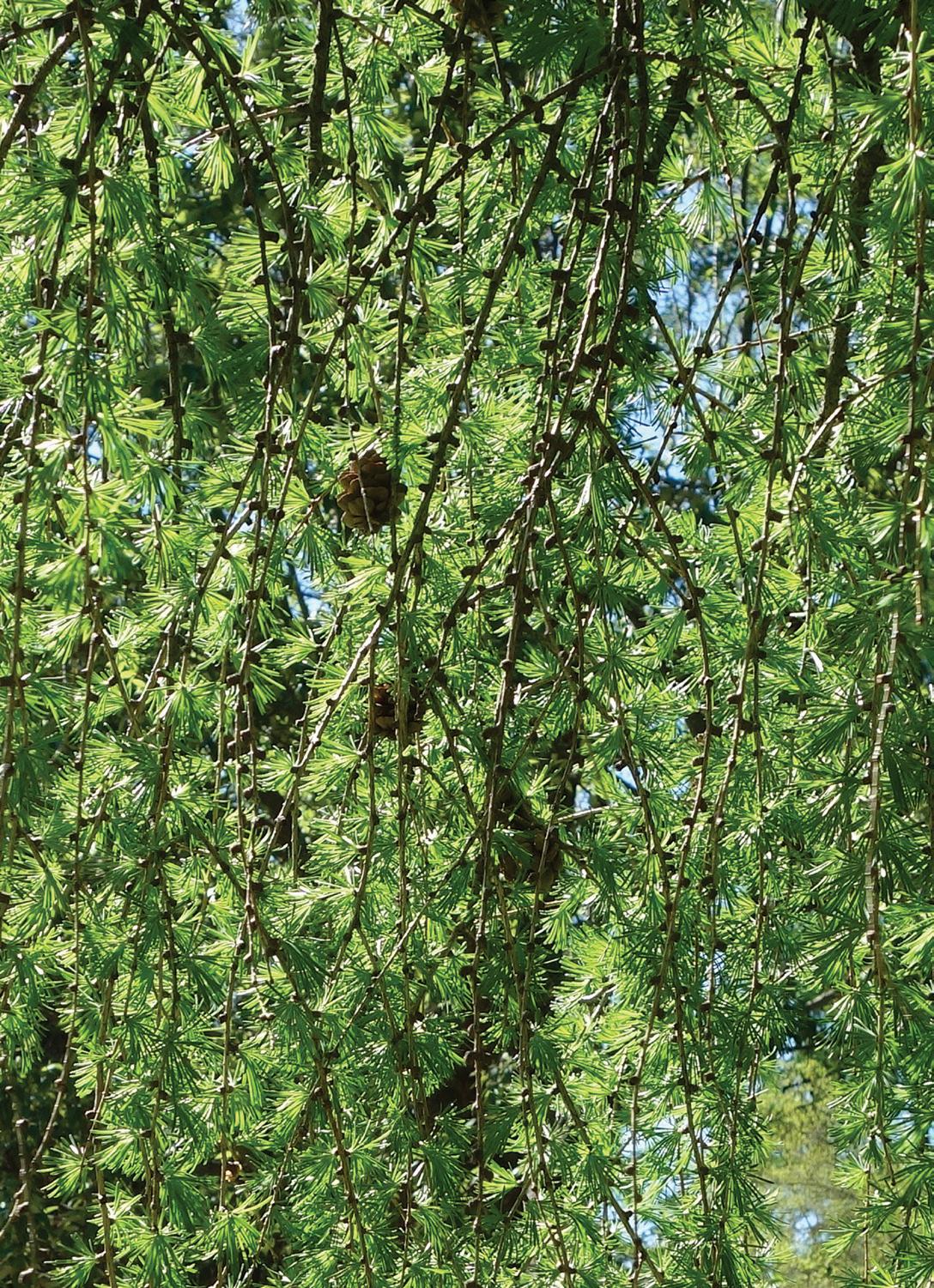



by Kathleen McDermott
















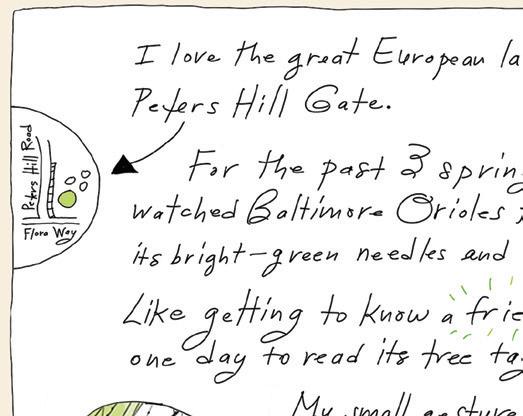
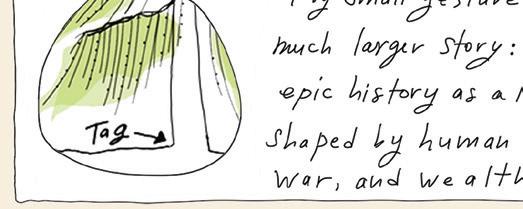
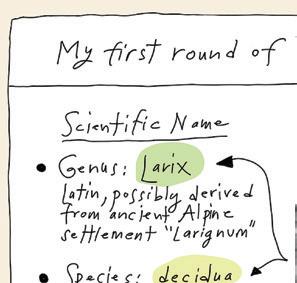
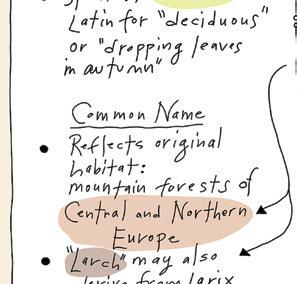
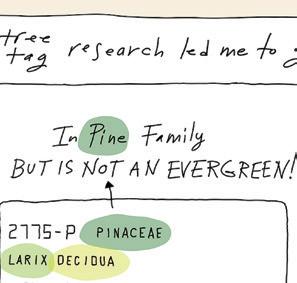
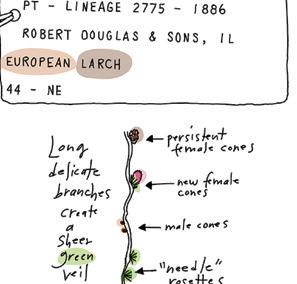
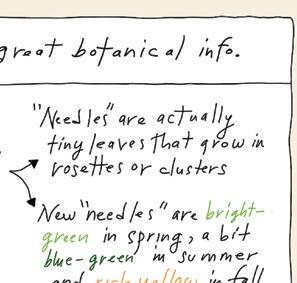
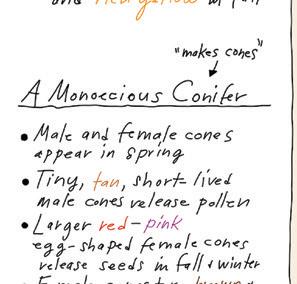
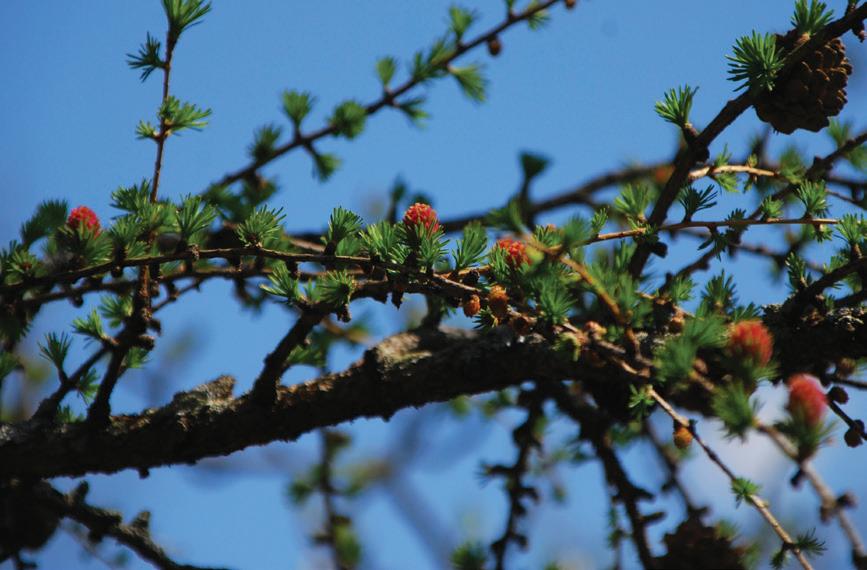
The blush of spring on female cones mingles with last year’s mature cones and new foliage. Photograph by Meng Li
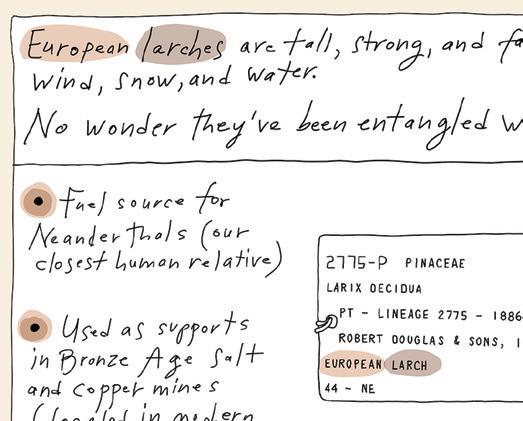
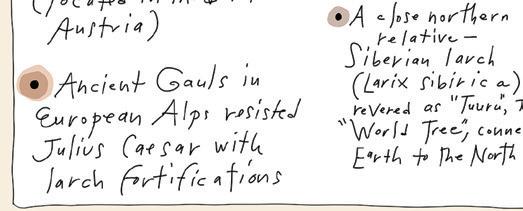
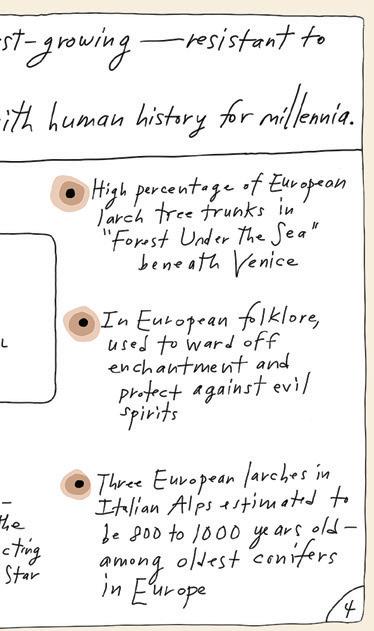
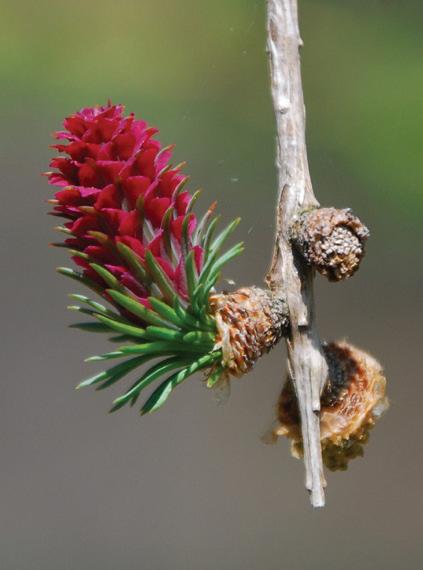
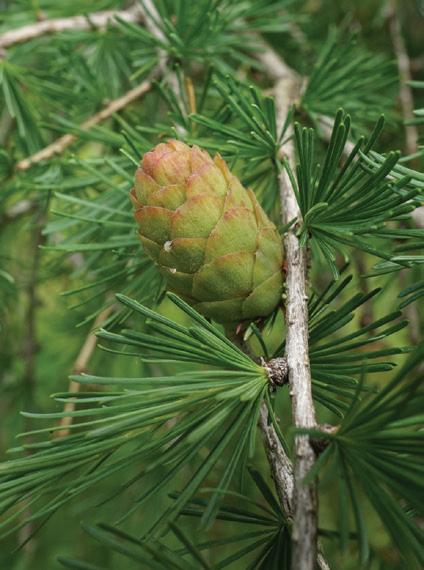
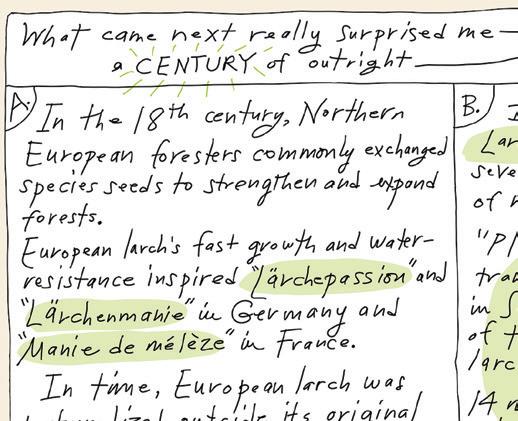
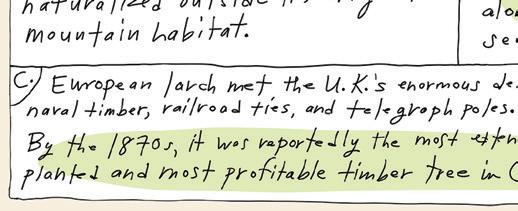
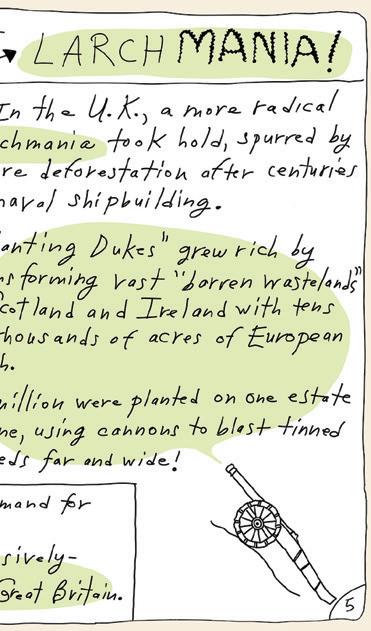
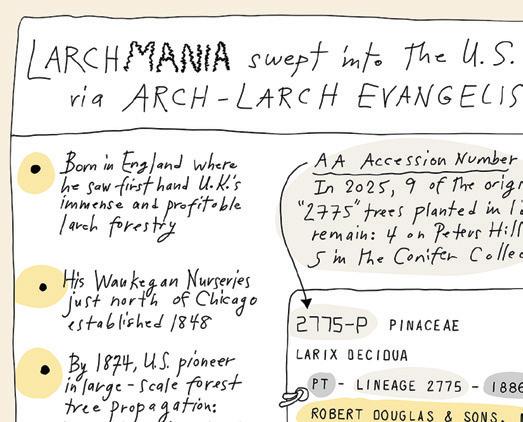
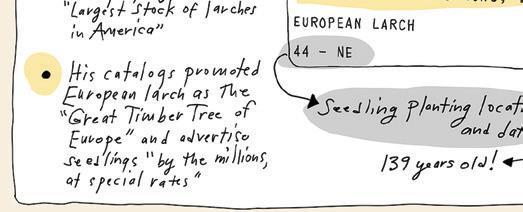
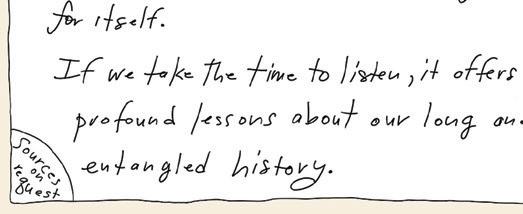
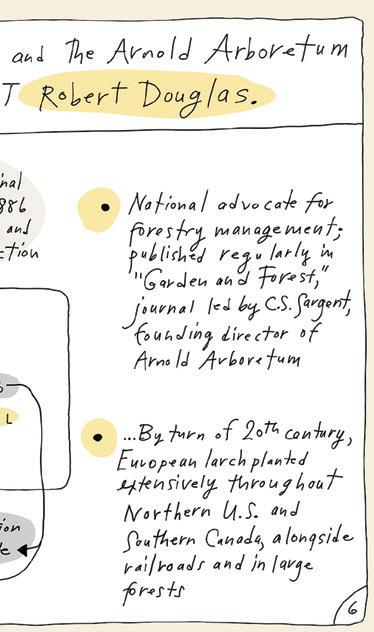
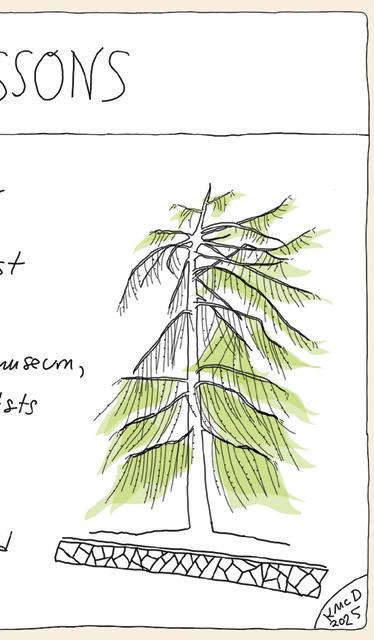
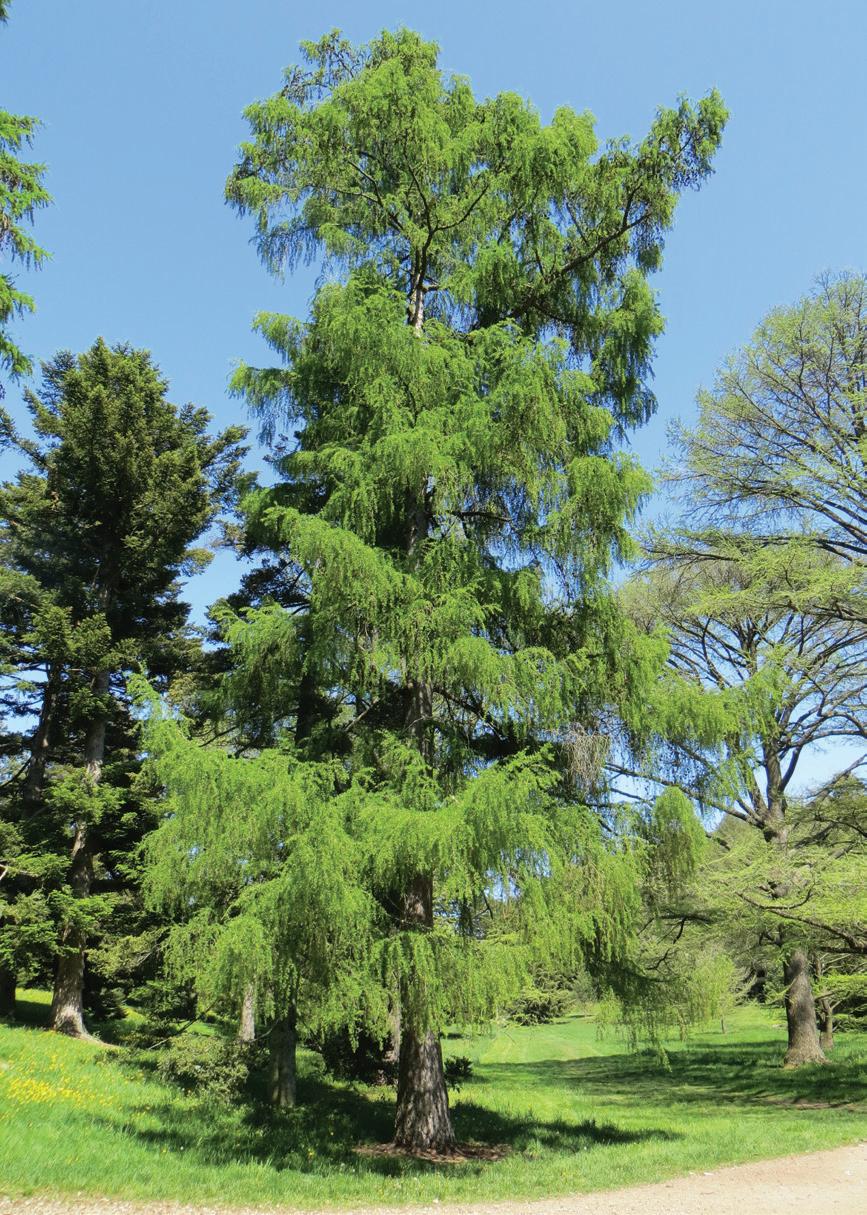
mcdermott loves to learn and share from the full range of Arnold Arboretum programs, building on 40 years as an historian, artist, and urban cyclist (see www. hautehistory.com).
By Sarah Cahalan
Broken places bloom in time with galls the plant grows as protection, where a wasp has claimed herself a nursery, here come the saffron babies flowing as one body from the womb the tree created from rejection.
The woodpecker (I think?) grows out of the vertex of a frozen cone of maple sap.
It is so cold up in the forest. The ice’s origin a plastic spigot bored into the sapwood of the tree.
Inside, sugar moves like weather:
Warm weeks, cold snaps, now another blast down from the Arctic. Other taps drip Icicles. Only this one has this bird, nursing.
Is it one well-lit day
One fish, glistening in the shallows
One pinprick memory of cobblestones
Imagine if just one tree remained
How transfixed, by it, we’d be
Sarah Cahalan writes about natural history, faith, and related topics. She has poems, current and forthcoming, in Image, Psaltery & Lyre, and Tar River Poetry
Sarah is from Massachusetts and is currently based in Dayton, Ohio (USA).
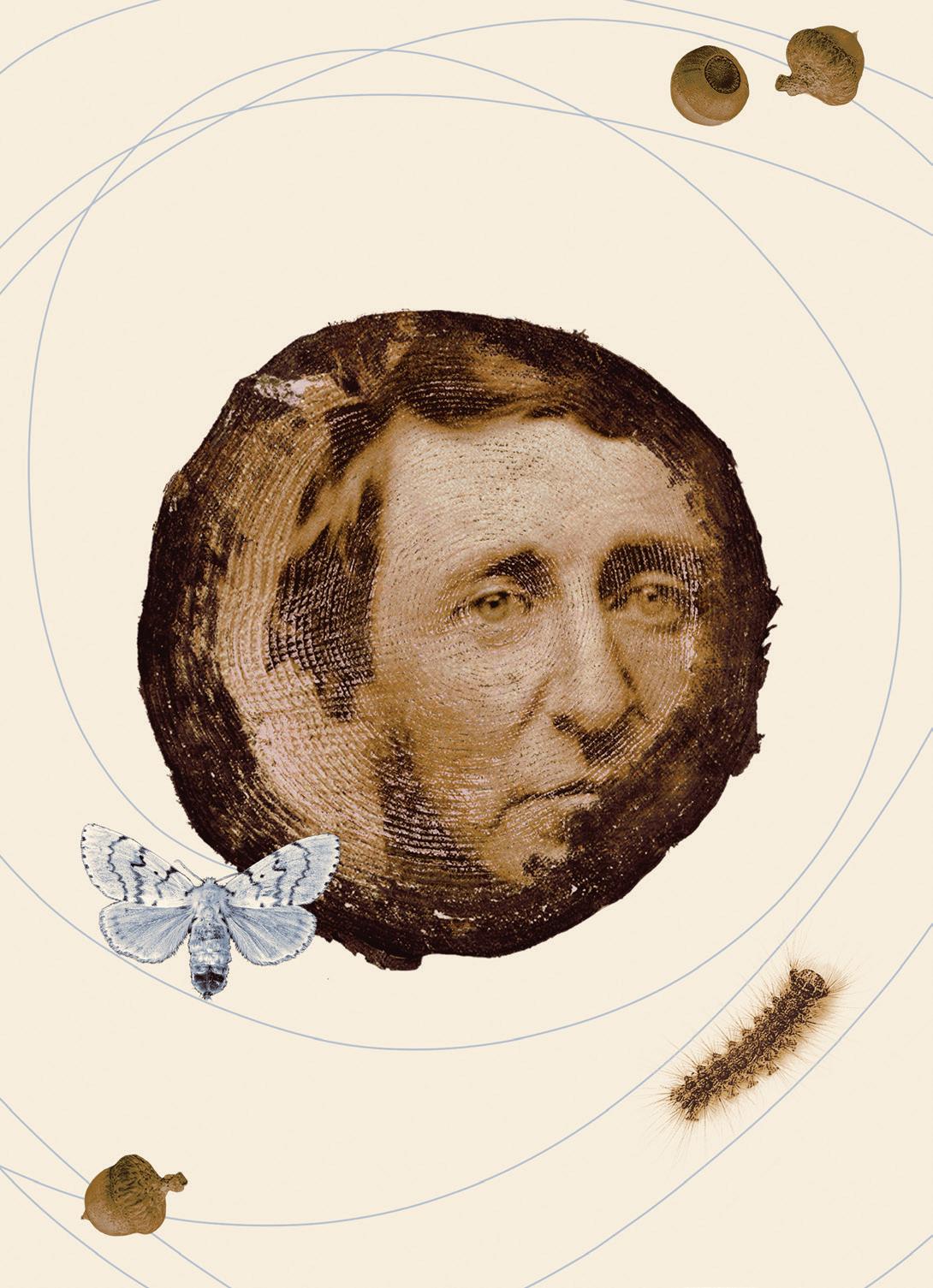
By Dan McKanan
Henry David Thoreau is many things to many people: an apostle of simplicity, a brilliant nature writer, a theorist of civil disobedience, one of the first Americans to turn to Asia for spiritual insight, and a creative interpreter of Darwin whose scientific career was cut all too short. Each of these legacies has caught my attention at different points in my scholarly career, but in recent years I’ve been especially drawn to his late scientific writings, such as his essay on “The Succession of Forest Trees.”1 In that essay, first delivered at an agricultural fair, Thoreau seeks to answer a question that many of his neighbors had asked: why is it that when you chop down a forest of one sort of tree, a different sort of forest sprouts up in its place?
Thoreau lived at a special time in the history of New England forests. For the previous two hundred years, the area around Boston had become progressively less forested, so that in Thoreau’s time it was almost entirely pasture, neighborhood, and cropland. But in the nearly two hundred years since Thoreau’s time, New England has been largely reforested, in part because Thoreau was not the only New Englander who believed that “each town should have... a primitive forest of five hundred or a thousand acres, where a stick should never be cut for fuel.”2 And yet, the forest today is not at all the same as it was four hundred years ago. So we might well ask the same question as Thoreau’s farmer friends: why is tomorrow’s forest so different from yesterday’s?
This question is important to me because I have been researching the Boston forest movement of the late nineteenth century. In the generation after Thoreau’s death, a movement rose up of forest lovers who were radically democratic in their belief that all people should have a vital relationship to the forest. They were also interspecies democrats who believed that trees and birds have intrinsic value and the capacity to
contribute to the well-being of the forest. The most inspiring of these activists, from my perspective, were the former abolitionist editor Elizur Wright, the nature writer Wilson Flagg, and the botanist Cyrus Tracy. All devoted their elder years to the cause of the forest. They built a movement by inviting their neighbors into the woods for festivals that blended citizen science, speechmaking, and pageantry. Their efforts led to the preservation of the first large cityowned forest in Lynn, Massachusetts, and of the first metropolitan park network in the rocky hills surrounding Boston.
Yet the professional park managers who took control of the forests in the 1890s narrowed these activists’ vision of preservation and allowed the popular movement to die. The Metropolitan Park Commission preserved ten thousand acres of forest, but also caused significant ecological harm by building Boston’s first highway network, damming the Charles and Mystic Rivers, and spraying pesticides to eliminate invasive moths. “The Succession of Forest Trees” reveals some Thoreauvian wisdom that, if further developed, might have helped prevent this outcome.
Thoreau’s answer to his neighbors’ curiosity may seem too simple to carry much wisdom. There was no real mystery to forest succession, he said; it was simply the result of seeds being carried from one place to another by wind, water, birds, and squirrels. Each year, animals planted the very seeds that they also consumed, but only when old forests were cut down could the recently planted trees grow to maturity. He also suggested that when one species of tree had depleted the nutrients it needed from the soil, it left behind a soil that might be more suitable for another.
This answer contains two insights that are often neglected by conservationists, both in Thoreau’s time and our own. First, Thoreau’s explanation of forest succession is radically ecological: he saw that forests change because of the interaction of all the different species that inhabit them. Thoreau was one of the first American readers of Darwin, and while other readers found in Darwin a message about “red in tooth and claw” competition, Thoreau recognized the evolutionary importance of cooperation among species.
To see the significance of this ecological approach, we can compare Thoreau’s view with that of his contemporary George Perkins Marsh. Many timelines of conservation history identify Thoreau and Marsh as the two nineteenth-century founding fathers,
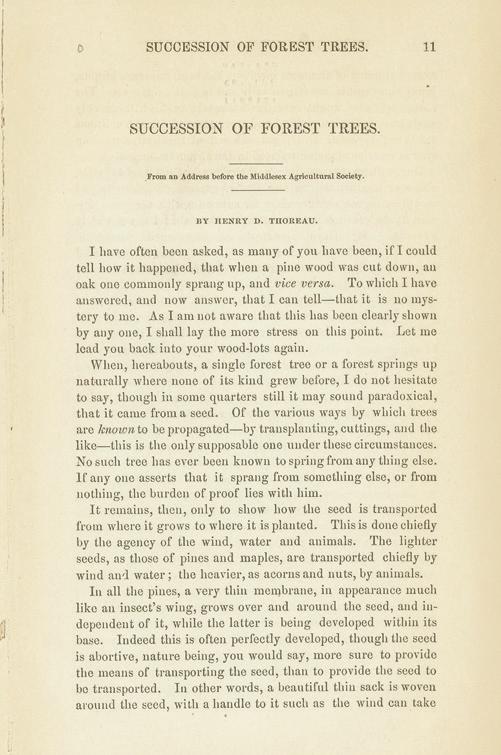
while entirely omitting the activists that are the focus of my current research.
In an 1847 address and an 1867 book, Marsh acknowledged that humans were to blame for the loss of the forest. But even more so, he affirmed that deforestation was a problem that only “civilized man” could solve. By “restor[ing] disturbed harmonies” and “improv[ing] waste and exhausted regions,” humans could demonstrate that we are “a power of a higher order than any of the other forms of animated life.”3 For Thoreau, on the contrary, deforestation was a problem that humans could best solve by apprenticing ourselves to all the other creatures that have been replanting forests since time immemorial. “When we experiment in planting forests, we find ourselves at last doing as Nature does. Would it not be well to consult with Nature in the outset?”4
More specifically, Marsh’s vision hinged on the idea that both animals and “savages” have a purely destructive relationship to nature: they take without giving anything in return. Echoing the anti-Indigenous rhetoric of a genocidal culture, Marsh wrote that “the arts of the savage are the arts of destruction.” Only with the rise of agriculture, he asserted, did humans begin to “repay to the earth all that we reap from her bosom.”5 In keeping with this vision, early foresters and park managers took an agricultural approach to the forest: it was a space to be managed according to scientific insight, not a community of fellow beings deserving of mutual relationship.
Thoreau saw things differently. Agricultural humans were no better, and perhaps not all that different, from their Indigenous neighbors or from any number of other species. This insight flowed from his careful observation of the red squirrels in his neighborhood. In keeping with its Latin name, Tamias, the squirrel was a good steward, consuming many seeds but also dispensing and planting them in sufficient numbers to replenish the forest. In every case, he
Opening page of “Succession of Forest Trees” from its initial publication in 1861. Harvard Library
Thoreau was one of the first American readers of Darwin, and while other readers found in Darwin a message about “red in tooth and claw” competition, Thoreau recognized the evolutionary importance of cooperation.
wrote, “the consumer is compelled to be at the same time the disperser and planter and this is the tax which he pays to nature.”6
Thoreau’s contrast with Marsh is still instructive for us today. We often assume that because humans caused climate change, we bear sole responsibility for mitigating it. I certainly agree that we should not evade that responsibility, but I suspect Thoreau would begin by looking for the ways in which other species might have already begun the work.
That brings me to a second bit of Thoreauvian wisdom. For him, the first thing to notice about forests is that they are always changing. And yet many conservationists and preservationists who honor Thoreau as the ancestor of their tribe assume that the goal is to hold the forces of change at bay. The forest managers of the 1890s believed that the “best” forest would consist of pine trees sprouted from seeds, so they concocted elaborate plans to chop down stumpsprouted hardwoods and replace them with pine seedlings. They had scarcely begun to implement those plans when a different species emerged with a different idea. Lymantria dispar , which was given the racist name “gypsy moth,” began its North American journey just a few miles from the place where Elizur Wright gathered tree-loving neighbors for annual “Forest Festivals.”7 It changed the forest far faster than the managers could, and in its wake arrived other
newcomers: the fungi known as chestnut blight and Dutch elm disease, as well as the plants known as Japanese knotweed and black swallowwort. Each threw forest systems off balance, as was perhaps inevitable given the enormous disruption of deforestation that had already taken place. But all the same, the forests of New England came back, just not according to the foresters’ blueprint. It is impossible to know exactly what Thoreau would have to say, in detail, about all of this. What side would he take in the ongoing debate about “invasive species”? Might he have been the first to poke holes in the theory of “climax forests” characterized by stable harmony? Would he have endorsed theories of “chaos ecology”? But I think he would bring a healthy dose of humility to our current challenge of fostering new patterns of biodiversity in a permanently warmer world. Perhaps, Thoreau might say, the goal is not to resist change, but to become more open to changes made by species other than ourselves.
A version of this article first appeared online in the Transcendentalism essay series of the Center for the Study of World Religions at Harvard Divinity School, at cswr.hds.harvard.edu.
notes
Dan McKanan serves as the Ralph Waldo Emerson Unitarian Universalist Senior Lecturer at Harvard Divinity School. He is the author of six books, including Prophetic Encounters: Religion and the American Radical Tradition (Beacon Press, 2011), which won the Frederic G. Melcher Book Award.
1. Henry David Thoreau, The Succession of Forest Trees and Wild Apples, with a biographical sketch by Ralph Waldo Emerson (Boston: Houghton, Mifflin, 1887), 33-52.
2. Henry David Thoreau, Journal, October 15, 1859, in The Writings of Henry David Thoreau: Journal, ed. Bradford Torrey (Boston: Houghton Mifflin, 1906), 12:387.
3. George Perkins Marsh, Man and Nature: or, Physical Geography as Modified by Human Action (London: Sampson Low, 1864), iii.
4. Thoreau, Succession, 46.
5. Marsh, “Address, Agricultural Society of Rutland County, 1847,” in So Great a Vision: The Conservation Writings of George Perkins Marsh, ed. Stephen C. Trombulak (Hanover, NH: University Press of New England, 2001) 5.
6. Thoreau, Succession, 47, 51.
7. Dan McKanan, “Between John Brown and Eugenics: The Radicalism of Forest Preservation in Nineteenth-Century Massachusetts,” Journal for the Study of Radicalism 17/2 (Fall 2023): 21-50.
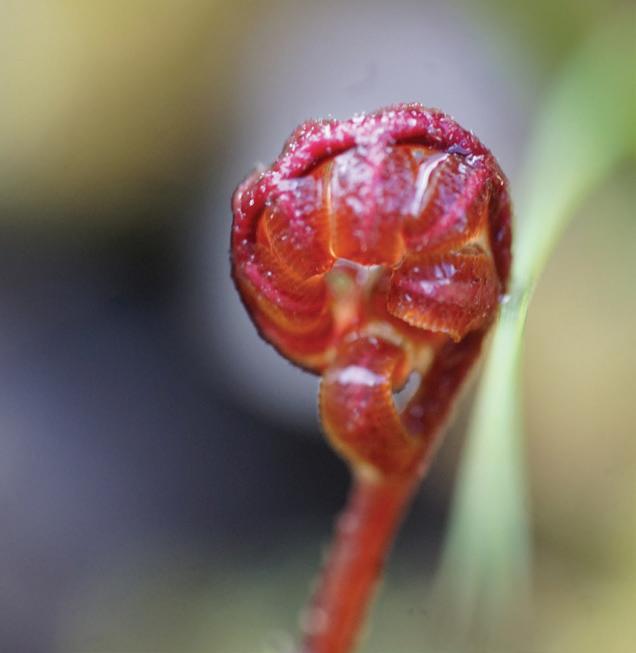
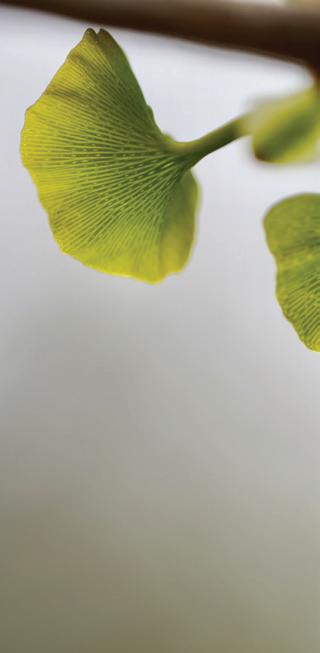
By Jacob S. Suissa and Ben Goulet-Scott
It’s 8:30am on an early spring morning, and the understory air is heavy with moisture from yesterday’s rain. The angle of the sun is low enough to illuminate the steam rising from a carpet of last year’s oak and maple leaves. Ringlets of mist carry the musty odor of innumerable microbes waking up for another season of digestion and growth. We tread forward along the damp trail, coffee and tea in hand, eyes turned down, heads sweeping from side to side. Suddenly, emerald green bursts out of the background of red-brown leaves.
“Wow, check out that patch of lycophytes, there must be hundreds!”
“Nice, Dendrolycopodium obscurum, right?”
We shuffle off the trail and crouch down, hand lenses out, for a closer look at these diminutive plants with needle-like leaves that reach just half a foot off the ground. Some of them still have spore-bearing strobili attached to their tops, remnants of last year’s reproductive effort.
“Do you think this is all one genetic individual?”
“Yeah, probably all one clonal stand, or just a few individuals growing on top of each other. Look at how dense they are.”
“It’s crazy to think this lineage used to produce giant trees. A lot can change in a few hundred million years.”
“Sure can. So, should we film a video? This patch would make
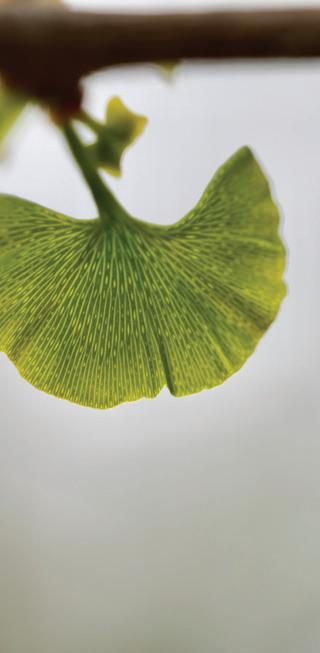
a great visual, and we can talk about how lycophytes have changed through evolutionary time.”
“Yeah… how should we get started?”
Over the last five years, we have enjoyed hundreds of moments just like this one as we’ve worked to create engaging, scientifically accurate educational videos through our organization, Let’s Botanize. What we were doing then—and what we continue to do now—is best described as “botanizing”—a word that was quite popular in the 19th century, but has become a vestige of the English vernacular. It is a verb meaning to spend time among plants with the specific intention of observing them as organisms. It is a natural history hobby, like birdwatching, but for plants. We think a revitalization of botanizing is long overdue, and here we share our views on the hobby, the backstory of our organization, and a preview of our new book, which we hope will contribute to the growth of this fantastic hobby.
We are not the creators of botanizing, merely its missionaries.
While humans have been carefully observing plants for thousands of years, we can start to clearly think about botanizing as a pastime in the 18th century, when the Swedish naturalist, Carl Linnaeus, developed his typological classification system of plants (and for animals and minerals, too). His contemporary, the French naturalist Georges Buffon, wrote Histoire Naturelle, providing a more holistic view of nature and even articulating aspects of evolution. Both were spreading an interest in natural history hobbies—botanizing among them. Subsequently, in the late eighteenth and early nineteenth centuries, the German playwright and botanist, Johann Wolfgang von Goethe, coined the term “morphology”, focusing on plant form and evolution in his work The Metamorphosis of Plants . This provided a different lens for appreciating
plants, not just through their identification, but in appreciating their form. The interest was not confined to Europe; Thomas Jefferson was interested in the naturalist endeavor, writing to both Buffon and Linnaeus, and even spending time with Buffon during his trips to Paris. There were of course many more players involved—and the historical links are more meandering than straightforward—but this interest in natural history and botany in Europe and the United States culminated in its popularity during the Victorian era.
In nineteenth-century England, botanizing was at its height as a natural-history hobby. As Gavan Daws and Marty Fujita observe in Archipelago: The Islands of Indonesia, ‘Britain was full of nature ramblers. To enjoy nature, to observe, collect, classify, and arrange “natural productions”—this
was a flourishing national pastime. Botanizing had its roots in every aspect of society from art to science and even economics. Amateur naturalists botanized the English hillsides writing floras of their local plants; artists created botanically-inspired paintings, poetry, and glasswork; and collectors cultivated plants from all over the world. The precursor to the modern terrarium (called a Wardian box), too, birthed out of this early botanical boom. From the farmer to the aristocrat, botanizing was woven into all levels of Victorian society
This boom was reflected in the popular use of the word “botanize,” which peaked in 1842, according to data compiled by Google. Manuals and magazines devoted to natural history. Guidebooks were written on how to identify, press, and cultivate plants. Natural history markets sprang up, where those who
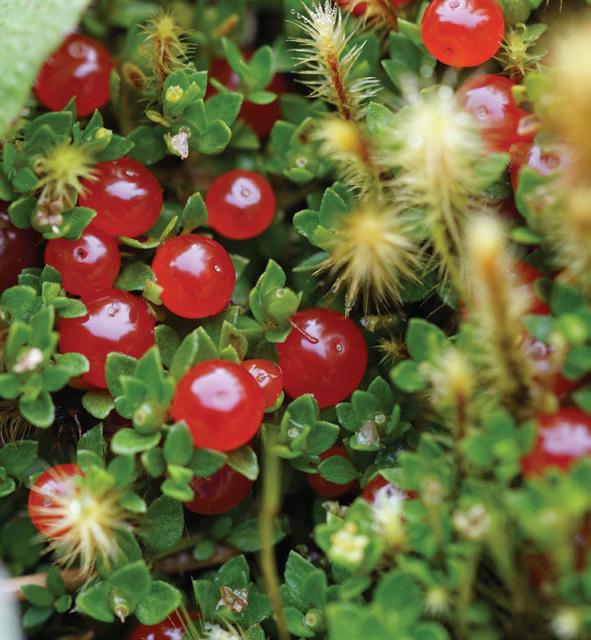
could afford would trade and purchase their spoils. Victorian England saw a spike in botanizing and natural-history hobbies more broadly, and “[i]t became a favorite occupation with the learned, and indeed of the relatively unlearned, to examine flowers, and refer them to their classes and orders… To every ramble was thus super-added a source of pleasure before unknown.”—Drummond 1849 (cited in Every Living Thing p. 193). The pure pleasure that botanizing added to life was widely recognized.
This is not to say that all was good and well. Much of the interest in natural history and botanizing was fueled by extractive colonial endeavors. The desire for new and ‘exotic’ plants like tea, coffee, and spices helped to justify violence and oppression around the world. Closer to home, native populations of plants in Britain were affected by over- collecting and over- harvesting. Botanizing is enriching to the mind, body, and soul, and the colonial legacies of botanizing practices and
cultures are important to remember and reflect on, especially as we commit ourselves to this practice here in the 21st century as a hobby that seeks to understand and establish relationship with plants and we seek to remediate its colonial past and work to be more inclusive today. We hope to bring the hobby back into fashion, not as a resurrected version of its colonial history, but as a revamped and inclusive 21st century pastime.
When we first met in graduate school back in 2017, we were both studying plant evolution at the Arnold Arboretum. During lunch breaks in between experiments, we sat at the wooden picnic tables behind the Weld Hill Research Building gazing at the buzzing hillside alive with goldenrods, toadflax, lupine, wild carrot, and countless animals that interact with them. After lunch, we often rambled around the hillside identifying lycophytes and discussing evolutionary trajectories. During one ramble in the fall of 2020, we came up with the idea to start filming these botanizing adventures. Might others enjoy chasing botanical curiosities in the field and exploring the rich biodiversity of the ecologies in which we are enmeshed And so, Let’s Botanize was born.
Botanizing had its roots in every aspect of society from art to science and even economics.
Today, the practice of Let’s Botanize looks a lot like the dialogue of our rambles through the hillsides of the Arboretum. We venture into the field without a script. We simply observe, after finding an organism that interests us, we craft the story in off-camera conversation and start filming to bring it to public audiences through our social media channels where we post videos and photos with educational captions. How we started this essay is usually how it goes. Each post is a free, bite-sized plant story based on evidence from scientific literature. We do not compromise scientific accuracy, but we also do our best to explain complex topics in an accessible and digestible way. We have a clear process, albeit rooted in our curiosity and pure passion for plants. While filming, we try to model
this excitement for plants and what it looks like to botanize. This approach—balancing rigor and spontaneity—seems to connect with people, and we’ve now grown an audience of over 250,000 followers across social media.
Let’s Botanize is our passion project. We both have full-time jobs, so the work happens on the weekends and in the evenings. Over many years in the field and during our evening discussions, we realized that simply sharing our passion for plants with people was not enough. We are driven by the broader mission of preserving and protecting our planet’s biodiversity. We think education plays a critical role in this effort. And so, we incorporated Let’s Botanize as a formal educational nonprofit 501(c)(3). Our passion is green, and we dedicate ourselves to spreading curiosity and knowledge about plants through the hobby of botanizing in order to make the world a better place.
Our view on the hobby of botanizing
Botanizing may be the most accessible natural history hobby. Plants form an
Education calibrates and expands curiosity, which in turn motivates closer attention, and this is the gateway to wonder.
overwhelming abundance of life on our planet (roughly 82% of terrestrial biomass). They are not only abundant but also some of the most species rich lineages on Earth. Just on land, there are over 400,000 species, from mosses to oaks. If we take a dip, we can find nearly 20,000 algae (freshwater and marine). Their morphological diversity is also staggering, ranging from the single-celled aquatic alga Chlamydomonas , to Pando, a clonal stand of quaking aspen (Populus tremuloides) which is one of the largest organisms on the planet. This diversity and abundance reflect the role plants play as the foundational organisms of nearly every ecosystem on Earth. Plants are important, and they are everywhere, making them accessible to engage with. Our view of the hobby of botanizing emphasizes this accessibility, and is best summarized by our “Five Tenets of Botanizing”:
1. Botanize any time, any place. Plants, wild or cultivated, and plant products are around you every day, no matter where you are. The forest, sidewalk, and kitchen are all exciting places to botanize.
2. Get as close as possible. Plants don’t move, and this allows us to access the intricacy of their minute details. Use a hand lens or magnifying glass to observe their minutiae. The hand lens is to the botanist as the binoculars are to the bird watcher.
3. Engage all of your senses. Plant variation is chemical as well as physical; observe with more than just your eyes.
4. Identification is not the end game Identification is a fun challenge and can help elevate the intimate relationships you build with plants, but the core of botanizing is observing plant form and function.
5. Rediscover the familiar. There is a special joy that comes from noticing new details in familiar plants, and there’s always something new to discover.
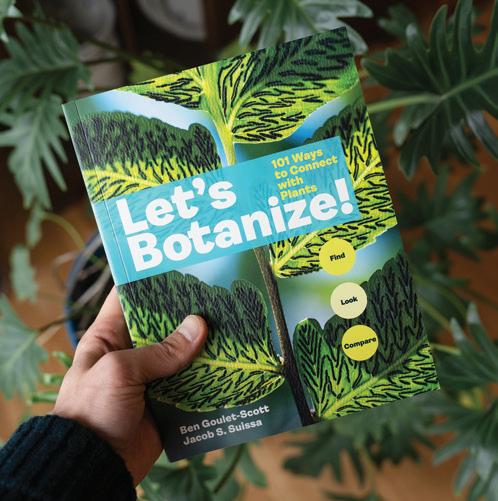
The book: a physical manifestation of our mission
One question that we are continuously asked is, “Which book can I use to get started or deepen my experience botanizing?” While there are many amazing technical guides, floras, and botany books, we realized there wasn’t one that provided a clear entry point into the hobby as we understand it. So, over the past two years we have focused on writing that book. Entitled Let’s Botanize! 101 Ways to Connect with Plants, it conveys our vision of the hobby of botanizing through 101 brief, open-ended exercises designed to resensitize attention towards plants and activate botanical curiosity.
The core of botanizing is careful and active observation. The prompts we present in the book highlight particular ways of seeing. For instance, prompt 24 asks: “Can you see the veins in the petal of a flower?”; prompt 55 asks: “What is the smallest repeating unit you can find in a sunflower?”; and prompt 92 asks: “Can you find an herbaceous plant that is taller than you?” These prompts are accompanied by botanical images and detailed text that highlight the scientific
patterns or processes that we aim to highlight. The botanizing prompts can be done in the order they are numbered, building in scale from specific to grand, or they can be explored haphazardly based on time of year or particular interest. They can be done alone, or with others. Following prompts can be the primary goal of an outing or be done in tandem with other nature-based activities like rock climbing or bird watching. Over time, they are designed to lead to new perspectives, as you begin to think about plants on their own timescales and their own ways of being. Looking at plants through the lens of these prompts can be a reflective and deeply personal experience, or it can be a highly social one. The collection of prompts in the book will never expire. Each can be revisited in different places, different seasons, and at different levels of experience, with ever more to notice and enjoy.
Ben GouletScott manages and designs higher education programming at the Harvard Forest and Jacob S. Suissa is an Assistant Professor of evolutionary biology at the University of Tennessee, Knoxville. Both earned their doctorates in evolutionary biology at Harvard University and are the directors of Let’s Botanize. Find them @letsbotanize.
Botanizing is enormously fun and enriching. It is deeply rewarding to get to know the plant life around us. We hope botanizing can perhaps once again be as popular as birding. As with birding or other natural history hobbies, it can make you feel part of a world more expansive, more mysterious, more beautiful than one many encounter in everyday life. With plants as our partners, we aim to co-create these instances of wonder. A primary objective of practicing natural history, then, is to accurately and intimately make observations about nature that surprise and delight. Committing attention and actively attuning your senses to the nonhuman world maximizes the potential for these instances of wonder. While you are actively observing, you are most likely to notice details and patterns that we are already curious about. This curiosity mixed with knowledge of the topic tends to form a positive feedback loop—the more you learn about a subject, the more questions you have, the more you want to learn, and the more you realize there is to learn. Thus, a causal chain leading to wonder begins with education. Education calibrates and expands curiosity, which in turn motivates closer attention, and this is the gateway to wonder.
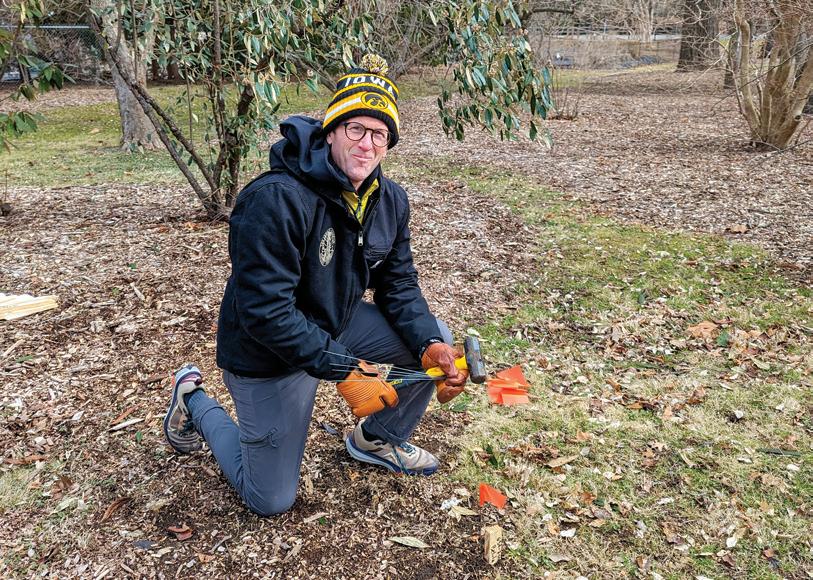
By Michael S. Dosmann Keeper of the Living Collections and Rodney Eason Director of Landscape and Horticulture
W497 plants sited annually (tenyear average). 6 planting bulletins in spring 2025.
hen Olmsted and Sargent started the Arnold Arboretum’s design in 1878, they established a planting scheme that we still use. We site most accessions by genus, although there are locations without taxonomic organization. Spring is our most intensive planting season; when the ground thaws, we set off to find permanent homes for pre-selected nursery plants from the Dana Greenhouses. Within a collection area, we deliberate about the best specific locations for each plant. We consider cold hardiness, light and moisture requirements, and each plant’s ultimate size. With the exact spot picked, we write the plant’s name and accession number on a wooden stake using a black permanent marker, drive it into the ground, and add a bright orange flag so the horticulture and landscape team can easily spot them. Using the map on our smartphones, we note each stake’s grid location. After a group of plants is sited, we issue a planting bulletin so they can be labeled and installed in this ever-chaning, 148 year-old landscape design.
Rodney siting a new Betula nigra, 634-2016*A

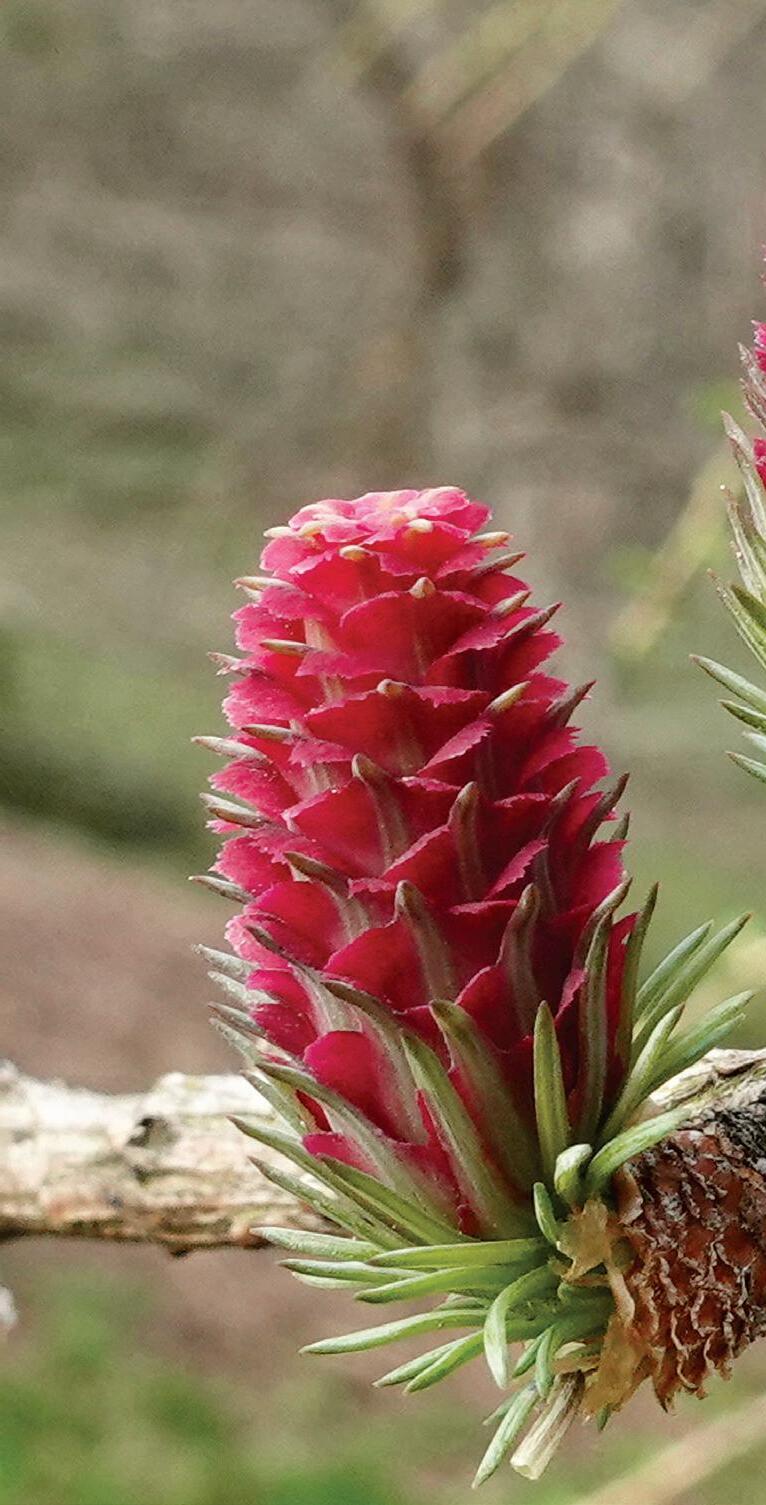
“A garden is a relation, which is one of the countless reasons why it is never finished.” — p. 32