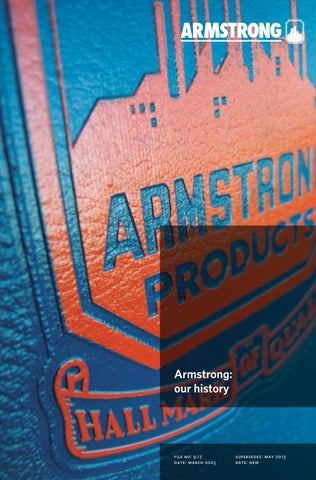
Armstrong: our history
file no: 9.17 date: march 2025
supersedes: may 2013 date: new
established a design and engineering company with the belief that quality, service, innovation and building community are the underlying values that foster lasting success. It is a commitment that set a standard from the beginning and has continued to guide Armstrong today and into the future.
A
We aim to elevate the industry to a high plane, and to sell not merely so much cast iron but an engineering service.
l aw g r a d uat e , Samuel Allan
Armstrong served as Assistant Provincial Secretary in Ontario. In 1916, he was given the opportunity to move to the capital to create the first Department of Veterans Affairs Canada, which administers care, benefits and pensions for war veterans. In 1925, he became president of Jones Underfeed Stoker in Detroit, afterwards becoming Canadian president of the newly-formed Riley Engineering and Supply Company in Toronto. reco manufactured steam and boiler feed products. In 1934, the Depression closed reco but ushered in the beginning of a new company under the leadership of S. A. Armstrong.
samuel allan armstrong, 1920
Reminiscing, Mr. Armstrong smiles when he tells you that three circulating pumps per week was big production in those days.
With a handful of staff, a few machines and much determination, Armstrong made its debut in a basement at 720 Bathurst Street in Toronto. The adversity facing the beginning of Armstrong during a serious depression was significant; three circulating pumps a week was considered big production in the time of an international economic crisis. While scores of factories were closing their doors, Armstrong grew slowly but surely by virtue of the dynamic leadership of Allan and the determined cooperation of his staff.
heating and sanitary age april, 1949
]
1925
Riley Engineering and Supply Company founded, with S.A. Armstrong as president
]
1929
Service values presented to reco sales force in Niagara Falls
samuel allan armstrong on sustainable business To foster lasting growth Armstrong will build from our three values:
service Service to the world, who by reason of such service will become our customer.
community Building trust to collaborate with oneanother to enable us to build relationships with customers, suppliers and our broader technical and social community.
learning & innovation Building organizational capability through listening and learning from our customers to evolve even more innovative solutions to meet their changing needs.
]
1934
S.A. Armstrong founded in Toronto
Armstrong’s first products were confined to circulating pumps manufactured under licence, in addition to heating systems for domestic installation and materials handling equipment. Production grew to include a variety of heaters, coolers and engineering specialties for industrial, commercial and domestic purposes. Manufacturing with Canadian rights to various products allowed Armstrong to improve in a fast-growing protected market and to expand virtually without serious competi-
“ tion. It also allowed Armstrong to build in quality assurances in its products and processes that would set the standard for excellence in the future. Quality and Service were the values that every employee understood and practiced. The trademark “Hallmark of Quality” was proudly emblazoned on the company symbol, and Armstrong products became established as the best that money could buy.
Now, our circulating pump output runs into
many thousands per year to say nothing of the production of numerous other lines manufactured by our company. s.a. armstrong
]
1930s
First products: circulating pumps, Monoflow heating systems and materials handling equipment
]
1940s
Armstrong manufactures factory equipment for the war effort
”
]
1949
New plant built for 125 employees to better service customers and increase innovation
innovation & expansion
James Armstrong served as Lieutenant engineer on the hmcs Haida (shown here docked in Toronto) in the English Channel in World War II.
In 1952, James A.C. Armstrong succeeded his father as president. James graduated from the University of Toronto as a mechanical engineer, and served in the Royal Canadian Navy during the Second World War, and later as Chief Engineer of pipe line divisions at Imperial Oil Limited. He began to institute bold initiatives across the entire spectrum of Armstrong activities that set the course for the next 30 years. He correctly read the business landscape and initiated our drive to serve international markets. Further, he grasped the need to make pumps easier and more cost effective to maintain. He is responsible for vertical pumping in hvac applications, an Armstrong idea that has lead the market not only in Canada but around the world. During the Second World War, Armstrong produced specialized war work, such as lift trucks constructed out of bronze for use in munitions factories. By the beginning of the 1950s, having since advanced to a larger premises, Armstrong’s expanding business and the need for maximum efficiency necessitated another move. A new office and factory were constructed for Armstrong’s employees, which now numbered over one hundred. The 20,000-square-foot building grew to 70,000-square-feet over four decades, and the increase in working space made possible an increase of service to customers as well as an increase in engineering staff.
Bronze lift truck manufactured by Armstrong for use in munitions factories. Bronze does not spark, making it safe to use around explosives.
]
1952
James A.C. Armstrong becomes president
1957: expanding on the new factory with james armstrong and dorothy beach, who managed the company for a time upon the passing of samuel allan armstrong
Armstrong fostered its own research and development department, and developed its own hydraulic hand-operated lift truck, portable elevator, and a new jet pump water system series to complement the line of centrifugal purpose pumps. In the 1960s, Armstrong invested heavily in new designs, producing
“
Armstrong’s new plant at 1400 O’Connor Drive, 1950
all Armstrong products, with a small export trade just beginning to take shape. By 1966 Armstrong had set up operations and manufacturing in the United Kingdom and the United States of America, initiating its first steps towards the goal of being a global business.
Armstrong owns a recently-erected singlestorey brick building with addition added during 1954 to handle manufacture of larger heat exchange and refrigeration packages. Present premises are wellequipped and enable a highly efficient operation.
”
armstrong financial report, 1957
building a condenser for imperial oil, c. 1960
brochures c. 1940 − 1970
heat exchanger drafting room, 1950s
were like partners “ They to us – they were pump
“
experts. They really knew their business. long-term customer
]
1958
Armstrong becomes the largest manufacturer of centrifugal pumps in Canada
]
1960s
Armstrong promotes residential installations with “The Hydronic Home”
The Armstrong sales force became experts in their field; they worked to develop a relationship with their customers to such an extent that they were considered a partner in the enterprise. They took ownership for the products they sold, visiting sites, attending start-ups, and helping to solve any opera-
From the earliest products, Armstrong saved businesses time, money and space with compact and flexible solutions.
tional problems they encountered. Customer relationships were nurtured, cultivated, and often became long-lasting friendships. Armstrong employees were proud to be associated with a company so highly respected, and customers noted that pride of association.
armstrong’s first national training and education meeting, 1962
]
1965
Armstrong begins international operations in the United Kingdom
accelerated growth
i
n a s e n s e , Armstrong
changed from a small to a big business after two big contracts – First Canadian Place and the Ontario Hydro building in the 1970s. Growth accelerated as Armstrong commenced a major program of product marketing and promotion across Canada. In 1965, two subsidiaries were established in the United Kingdom and the United States: Colchester, Essex, and North Tonawanda, New York.
expanding tubes in a heat exchanger, c. 1960
In 1992, Armstrong acquired Darling Duro, a Montreal-based manufacturer of fire pumps and other fluid systems, bringing fire systems into Armstrong’s group of competencies.
Technical sales department in the 1960s
As well as being known as a respected and dependable manufacturer of quality plumbing and heating products, Armstrong was now involved in a period of intense product development, and became known for several innovations. As early as the 1940s, fractional horsepower motors made their appearance on products; in the 1950s, Armstrong’s Monoflo Tees changed the way residential and commercial buildings were heated; and now, the introduction of large vertical in-line pumps to the hvac market made a major impact on the industry, leading global change in the fundamental design of pumping equipment.
]
1966
Armstrong begins operations in the United States of America
Packaging circulators
“Armstrong changed from a small company to a big company after two big contracts − First Canadian Place and the Toronto Hydro Building.”
With expanded markets, Armstrong could now justify the investment in modern automatic machine tools, and a 50,000-square-foot building was added in Toronto. In 1987, Armstrong moved into the architectural award-winning 130,000-square-foot building which serves as corporate headquarters, a symbol of how far Armstrong had come from its beginnings on Bathurst Street.
long-term employee
250 hp condenser water pumps were installed in First Canadian Place in 1975.
]
1970
Facility growth: Armstrong adds a second building of 50,000-squarefeet in Toronto
Artist’s rendering of proposed First Canadian Place, early 1970s.
“Engineers knew that Armstrong made a better product. They grew up with Armstrong and they specified our products.”
long-term customer
By the 1970s, the most modern numericallycontrolled machine tools were utilized at Armstrong for quality and cost control.
During this period, Armstrong introduced its first fire pump for use in commercial buildings.
]
1971
Armstrong develops the world’s first Vertical In-Line centrifugal pumps for hvac markets
]
1972
Introduction of Suction Guides and Flotrex Valves
]
1980
Introduction of Circuit Balancing Valves
armstrong facility, products and installations, 1970s
]
1987
Armstrong builds a new 130,000square-foot headquarters and plant
Becoming international: early Armstrong locations 1950
International headquarters and principal manufacturing plant toronto, canada
1955
1965
High-volume production facilities toronto, canada
Offices and plant colchester, essex, engl and
1966
1970
Offices and plant north tonawanda , usa
Castings division belleville, canada
Symbol of an expanded global reach Armstrong headquarters, designed by the architect Edward Jones, has a resemblance to Bauhaus founder Walter Gropius’ Fagus factory in Germany. The design has a layered, technological appearance, with an impressive double storey glazed hall, open to the activity of arrival and departure and beyond to the industrial landscape of the surrounding area. Externally, this large screen acts as a representational device for the business as a whole — a Canadian portico. architect edward jones
The third generation of ownership: Jim and Charles Armstrong, 1990s.
Armstrong staff, 1995
In the 1990s, leadership passed to James and Charles Armstrong, the third generation of Armstrongs. They set out an infrastructure plan for focused factories and a global information technology backbone to enhance collaboration amongst operations.
expansion equipment, fire products, and the concept of eco:nomics – with the first Intelligent Variable Speed (ivs) pumps being developed in its wake. In 2004, Armstrong boldly committed to a truly global product line for both 50Hz and 60Hz electrical markets. In the UK, Armstrong combined a 150 year old pump company, Holden Brooke Pullen, and a plant integration specialist and systems builder, Plant Energy Systems into
Innovations occurred on many fronts. New developments in heat transfer products, vertical pumping systems,
]
1988
Armstrong delivers its first plate and frame heat exchangers
]
1990
Introduction of doublewall heat exchanger
one full service entity now operating as Armstrong Integrated Limited. Armstrong’s 50Hz market capability was now launched. Also in 2004, Armstrong made its first acquisition in India, a bronze foundry in Bangalore. A year later, the Indian Capabilities Centre was fully launched. In 2007, a full-fledged manufacturing facility was opened to serve Indian local and export markets.
]
1994
Dual Arm: the first truly integrated parallel multi-head pump is introduced
Expansion abroad continued in 2010 with the opening of a plant with full production and testing capabilities in Shanghai, China. A year later, Armstrong opened sales offices in Lyon and São Paulo, expanding Armstrong’s presence in France and Brazil.
]
2003
Launch of the highly efficient E-Series circulator
]
2004
Launch of the Indian Capabilities Centre
The ivs Sensorless pump: a world first and a new generation of intelligent pumps that integrate demand-based control and variable frequency drives into an integrated system yielding 65% in energy savings.
]
2005
Introduction of Intelligent Variable Speed (ivs) pump
By 2009, Armstrong had ten years of practice in the application of two fundamental technologies: demand-based control and variable-frequency drives. Our experience had led us to understand that engineering practice needed to change substantially in order to optimize and leverage the combination of these two technologies. Based on the eco:nomics principle we could now steer our product management and development towards solutions that yielded truly significant first cost, life cost, and energy savings. Considered a watershed moment in the industry, this changed the economic underpinnings of hvac applications. Not only did we achieve pumping efficiency levels previously unheard of, we also reduced design and operating risks through increased performance flexibility of our equipment.
The chilled water Integrated Plant Package (ipp-chw) brings today’s most spaceefficient, energy-efficient and environmentally-sustainable cooling solution to customers.
]
2005
Armstrong’s intelligent control system (ipc 11550) sets a new global standard in driving energy savings of 50% or more by full integration of cooling system component control
]
2006
Chilled water line of Integrated Plant Package introduced, with an energy savings of 60%
Greenbuild visits Armstrong – Toronto, 2010
]
2007
Armstrong introduces second generation ivs Sensorless pump with an energy savings of 65%
a global company n 2 0 1 1 , Lex van der Weerd joined
i
Armstrong to serve as the company’s first Chief Executive Officer, taking up the challenge of driving the evolution and execution of our global strategy. Over his eight year tenure, Lex’s drive and determination ensured that Armstrong outpaced the growth of competition and improved profitability. Like Allan Armstrong, today’s Armstrong leadership understands that the key reason for continued
]
2007
success can be found in quality and the Company’s values of service, community, innovation and learning. That dedication has been a part of Armstrong’s corporate culture since the beginning, and is as strong today, augmented by innovations in customer service, technology and manufacturing to ensure Armstrong’s products offer even greater value, quality and durability to the world.
Establishment of manufacturing facility in India
]
2009
Development of eco*pak mbs™ integrated heating solution
]
2010
Armstrong opens an office and plant in Shanghai
In 2009, Armstrong’s Design Envelope pumps were introduced as a complete solution for heating and cooling systems. Through advanced integration of demand-based control with variable-speed capability, the next generation of intelligent pumps is born. Design Envelope technology further increases energy savings as well as design and operating flexibility – yet again pushing application risks far below common practice levels.
]
2010
Armstrong Holden Brooke Pullen and Armstrong Integrated Systems Limited are merged into one company, Armstrong Integrated Limited
]
2011
Armstrong introduces Design Envelope across fluid technology product lines
Design Envelope technology on display at the ashrae trade show, Chicago, 2012
1p eff
2p eff
3p eff
4p eff
ps
p
o cc
nt
ro
u lc
rv
e
efficiency (eff)
head
Charles Armstrong receiving the Frost & Sullivan award for best practices, 2014
4 pumps 3 pumps 1 pump
2 pumps
flow
]
2013
Armstrong introduces and then patents parallel sensorless pump control, achieving peak efficiency levels in pumping with multiple units
]
2014
Armstrong wins Frost & Sullivan’s award for Customer Value Leadership, winning the award again two years later
]
2016
Armstrong introduces a fifth generation of Design Envelope pumps with smart motor technology, wireless connectivity and integrated touchscreen controls
]
2017
Armstrong introduces Cloud-based performance management services, allowing for proactive and informed decisions for best-possible hvac performance
head
tr con
1 pump
2 pumps
ol c
urv
e
efficiency
2p eff
1p eff
Armstrong’s development of Parallel Sensorless pump control, featuring bestefficiency staging, earned multiple industry awards for innovation
pump stages on/off
flow
]
2018
Launch of Design Envelope Tango pumps, with shared casing and volutes for two motors and and on-board Parallel Sensorless Pump Control
]
2019
Launch of the first variable-speed fire pump, offering cost savings and performance improvements that result from eliminating many pressure-reducing valves from the sprinkler system
2021
]
Opening of new facility in Droitwich, U.K.
]
2024
Launch of the Envelope, a revolutionary optimization platform for building mechanical systems
ver the course of Armstrong’s history, we have become a global organization. We have become a multi-faceted customer-focused business. And above all, we have embarked on a journey that allows our expertise in producing fluid flow products to carry over into the engineering and support of intelligent building energy technologies. Armstrong is proud to have forged a leadership position globally for fluid technologies.
O
The results are energy applications that make sense – technically, financially and environmentally – which makes our customers’ lives easier.
Where we stand today would not have been possible without the nearly 80 years of growing expertise and participation in the industry. Armstrong’s past is an intrinsic part of our present and future. Today, as Armstrong serves customers globally, the original commitments are unchanged: that creating customer experiences second to none is part of a long-standing family tradition.
creating customer value
learning & innovation Listening and learning are the fundamental elements of Armstrong’s pursuit of innovation. We continue to lead our marketplace in innovation by listening intently to our customer’s technical communities.
community
service
You can’t build strong community partnerships without customers, suppliers, and technical/ social communities gathered through trust and collaboration inside the company. Our industry is our global strength. We wish to be a contributing partner to all the communities we serve and operate within.
Our most sustainable value is service; service to the world who by reason of such service will become our customer. It is our purpose to serve and to contribute through learning, understanding, acting and innovating to meet the world’s and our customer’s needs.
What makes Armstrong different? No other company integrates demandbased controls, heat transfer, fluid flow and variable speed as well as Armstrong, adding value to your project.
Only Armstrong offers intelligent, self-aware and self-optimizing solutions that combine to deliver optimum building performance.
Only Armstrong has patented, awardwinning, proprietary Parallel Sensorless pumping technology, delivering unmatched efficiency with multiple pumps.
Only Armstrong can deliver both the lowest installed cost and the lowest operating cost time after time.
Armstrong’s integrated capability offers unmatched scalability and flexibility, opening up significant application opportunities.
Only Armstrong factory tests and programs each unit, resulting in the accuracy and repeatability of all our solutions from custom large plants to small components. Armstrong is privately held, allowing us to take a long-term perspective on the success of your project.
armstrong fluid technology established 1934
armstrong fluid technology.com