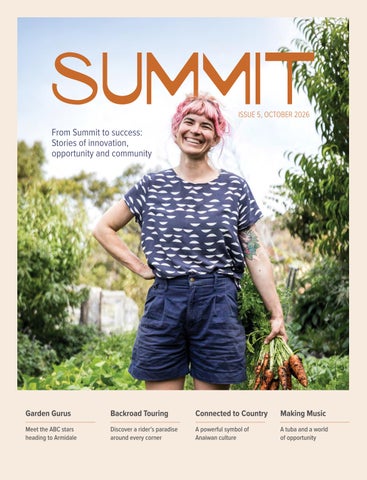
Garden Gurus
Backroad Touring
Connected to Country
Making Music
Meet the ABC stars heading to Armidale
Discover a rider’s paradise around every corner
A powerful symbol of Anaiwan culture
A tuba and a world of opportunity
From Summit to success: Stories of innovation, opportunity and community Summit magazine has been produced by Armidale Regional Council’s Communications and Engagement team Paulette Chavez-Henry, Jo Harrison, Cherene Spendelove, Dane Townsend and Rochelle Tubb Editor: Rochelle Tubb Photography: Simon Scott, Jo Harrison, Paulette Chavez-Henry and Tony Bennett. Design: Kassandra Hunt Cover photo: Hannah Moloney from ABC’s Gardening Australia. Image supplied.
Summit isn’t your average council newsletter. It’s a vibrant, people-first magazine that delves into the heart of Armidale and Guyra, showcasing how council services and upgrades are making a real difference in everyday lives. Summit tells the stories behind the services – through the voices of the people who benefit from them. You’ll meet inspiring locals who go above and beyond for their community and discover how council initiatives are helping shape a more connected, resilient, and thriving region. Whether it’s infrastructure, events, tourism or essential services, Summit brings it all together in a compelling read that celebrates the power of community and the role council plays in supporting it. Real stories. Real impact. Real community.
As the days grow longer and the cold grip of winter gives way to warmer weather, spring is one of the most beautiful times of year across the Armidale region. Our gardens burst into colour, our parks and open spaces come alive, and there is a renewed sense of energy and optimism throughout our communities. Spring is also a wonderful time to explore everything our region has to offer. Whether you’re a local resident rediscovering your backyard or a visitor experiencing the New England High Country for the first time, there is no shortage of reasons to get out and enjoy the season.
MAYOR’S RAMBLE WITH SAM COUPLAND
Welcome to the spring edition of Summit Magazine
One of the highlights on our calendar is the New England Garden Festival, a much-loved event that showcases the incredible creativity, expertise and passion of gardeners from across the region and beyond. The festival continues to grow each year, attracting visitors who come to experience beautiful displays, inspiring speakers and the unique charm of our spring gardens. We’re also looking forward to the return of Creative Streets, an exciting celebration of arts, culture, music and community that transforms our public spaces into vibrant hubs of activity. Events such as these not only enrich the lives of residents but also support local businesses and help showcase the unique character that makes our region such a special place to live, work and visit. In this edition of Summit, you’ll find stories that celebrate the people, projects and initiatives helping shape the future of the Armidale region. From community achievements and local events to developments that support growth and opportunity, there is plenty happening across our towns. I hope you enjoy this spring edition of Summit and take the opportunity to embrace the season, connect with your community and enjoy all that our beautiful region has to offer.
Summit is a people–first magazine that shares the stories behind council services and initiatives in Armidale Region, highlighting real locals, real impact, and the vibrant community they help to create.
04
06
Armidale will be welcoming some big celebrities at this year’s garden festival.
A dedicated community group New public art project that saved an important chapter serves up fresh look for local of railway history. tennis court.
Back roads and breathtaking landscapes that make the New England a rider’s paradise.
14
16
18
20
Volunteer John Schuman has North Hill stands as a powerful helped bring Armidale’s biggest symbol of Anaiwan culture, celebrations to life. heritage and custodianship.
Crafty Quilters is all about weaving friendship, creativity and community support.
Building stronger communities at Armidale Regional Council.
22
24
26
28
Community voices help shape the future of safety in Armidale.
Just beyond the township of Guyra lies one of the Northern Tablelands’ best-kept secrets.
PACT is building community resilience through connection and preparedness.
A tuba, a wheelie bin and a world of opportunity awaits at NECOM.
30
32
Armidale’s Classic & Specialist Car Club celebrates 50 years of heritage.
A historic Guyra building is being restored to ensure its stories endure.
Garden Gurus
Community Champion
In Safe Hands
On Track
Connected to Country
08
10
Reclaiming Space Off the Bitumen
A Common Thread
Women in STEM
Birds of a Feather Stronger Together Making Music
Driving Motoring Preserving History History Summit is published by Armidale Regional Council. © 2026, Summit. All rights reserved. No part of this publication may be reproduced, distributed, or transmitted in any form or by any means, including photocopying, recording, or other electronic or mechanical methods, without the prior written permission of the publisher. Disclaimer: While every effort has been made to ensure the accuracy of the information contained herein, Armidale Regional Council assumes no responsibility for errors, omissions, or outcomes resulting from the use of this material. All content is provided for general informational purposes only and should not be construed as professional advice. Readers are encouraged to seek independent advice before acting on any information contained in this publication.
Page 3
A
BC’s Gardening Australia celebrities will be the star attraction at this year’s New England Garden Festival.
Hannah Moloney and Jerry Coleby-Williams will hold workshops and participate in a joint Q&A at the festival, as well as tour selected Armidale gardens. Further afield, Costa and the rest of the Gardening Australia team will tour the New England region and film selected gardens for the popular gardening show. Armidale Regional Council Mayor Sam Coupland said the festival, now in its fourth year, reflected the city’s growing reputation as a cool climate destination for visitors and people seeking a tree change. “The New England climate is ideal for growing many native and exotic species, making our gardens a key attraction,” said Mayor Coupland. “We also have beautiful green parklands and playing fields that remain the pride of our city.” Mayor Coupland said he was looking forward to visiting the festival, which will be held on Saturday, October 31, and Sunday, November 1, at Armidale Racecourse in Barney Street, Armidale. During the festival, Jerry and Hannah will encourage gardeners to plant a crucial oasis around their homes in response to the current drought. They will offer advice on cool climate and dry gardens, answer questions from fellow gardeners and each tour a New England garden to provide one-on-one guidance. In the week leading up to the festival, the entire Gardening Australia team will film selected gardens that will feature on an episode of the popular series. The team will also set up a live studio at the festival, where they will interview visitors and film at the event. While in Armidale, Jerry and Hannah will be staying at Petersons Guesthouse and Winery, an historic homestead surrounded by lush gardens and a vineyard. Jerry will travel from Brisbane for the festival and expressed enthusiasm for visiting New England. “One of the topics I will discuss is watering plants with grey water during a drought,” said Jerry. “The type of detergent used significantly impacts plant and soil health. Some plants are easily harmed by common detergent brands, and one of my workshops will discuss the best practices for using recycled water in your garden during drought.”
Hannah will discuss growing fruit and vegetables during the climate emergency.
“Whether you are starting with a pot or growing a plot, I want to demonstrate to festival visitors how to enhance their gardening skills to cultivate healthy, fresh vegetables year-round.” She will also be discussing her latest book, Why We Garden, and will be signing copies. Run by volunteers, the non-profit annual event attracts up to 4000 visitors over two days. Additional attractions at the event include up to 100 stallholders selling goods from beds to secateurs; Horticultural workshops catering to enthusiasts from 11 to 100 year old; Food vendors offering a variety of treats, including hot dogs and locally grown produce; Local performers to entertain families. The New England Garden Festival’s acting president Marie Colless encouraged early planning to ensure visitors could meet Hannah and Jerry. “It is a significant honour for our region to have two highly experienced and popular gardening experts as special guests at our festival,” said Marie. The committee was keen for Hannah to travel from Tasmania to discuss cool-climate gardening. Jerry, an internationally experienced curator and sustainable horticulturist with extensive experience in cool climates, has been a familiar voice on ABC talkback radio gardening in the New England region for over 15 years. All funds raised from the festival will be used to support local charities. Armidale Regional Council has supported the New England Garden Festival since its inception. It recently received a grant of $3,800 through council’s Community Small Grants, Community Support Grants and Armidale Regional Village Grants program which support groups and services within the local government area. They are offered regularly throughout the year. Community groups, not-for-profit organisations, arts and cultural organisations, sporting clubs, and individuals are encouraged to apply. Visit www.armidale.nsw.gov.au Page 5
| Page 6
I
t takes a special kind of community to save a piece of history.
More than three decades ago, when plans were announced to demolish the Black Mountain Railway Station following the closure of the rail line north of Armidale, local residents refused to let that happen. Instead of watching an important landmark disappear, they came together, fought for its future, and ultimately preserved a unique piece of the region’s heritage for generations to come. Today, the Black Mountain Preservation Society stands as a testament to what can be achieved when passionate, community-minded people work towards a common goal. Their story began in the late 1980s when a call for tenders was issued to demolish the railway station. Community opposition was swift and determined, leading to the formation of a committee under the Guyra Shire Council. Their efforts were rewarded in June 1988 when the station and stationmaster’s cottage were successfully listed on the NSW Heritage Register. In January 1999, the committee became the incorporated Black Mountain Preservation Society. Since then, the society has leased the station buildings, platform and stationmaster’s cottage from Transport for NSW and has dedicated itself to preserving the precinct for community use. “The society oversees the maintenance of the grounds around the station, employing contractors or running member working bees as required,” said society president Anne Symons. “Rental income from the stationmaster’s cottage helps fund insurance, maintenance and upkeep of the heritage buildings, while the station itself continues to serve as a venue for community gatherings, meetings and special events.” The impact of those efforts is clear from the visitors’ book on the station platform. Travellers from across New South Wales, interstate and overseas regularly stop to explore the site, leaving glowing comments about the opportunity to experience such a well-preserved example of a small country railway station. School groups, railway enthusiasts and local history organisations also make regular visits. Over the years, the society has delivered a range of projects that have enriched the station precinct and helped tell the story of the region. These include replacing the water tank on the shed, installing a memorial to workers who lost their lives during construction of the Great Northern Railway between Tamworth and Tenterfield, creating interpretive panels that share the history of the railway and surrounding district, and developing a heritage walk through the village beginning at the station. Like many community organisations, the society has evolved over time.
“Our earliest priority was restoring the stationmaster’s cottage, which had fallen into disrepair,” said vice president Ian Reeve. “Guided by local resident Henk Raanhuis and supported by a Community Development Employment Projects grant, volunteers worked hard to return the building to a safe and usable condition.” Members were also committed to preserving the gardens established by the last stationmaster, Fred Knight. While maintaining the gardens entirely through volunteer labour proved challenging, the society adapted its approach. Today, the focus is on practical, sustainable maintenance that keeps the grounds attractive and welcoming for visitors. “The organisation has also benefited from new residents moving to Black Mountain in recent years,” said Ian.
“These newcomers have brought fresh energy, ideas and a growing interest in the area’s railway heritage, reflected in the expanded historical information now available around the station precinct.” Looking ahead, the society’s priorities remain clear: preserving and maintaining the railway station and stationmaster’s cottage, ensuring the precinct continues to impress visitors, and keeping the site available for community use. The society is also working closely with government agencies and other stakeholders on issues that may affect the precinct’s future, including discussions around a potential rail trail and the possibility of restored rail services. “A rail trail, if established, could bring significantly more visitors to Black Mountain,” said Anne. “For the society, this presents an exciting opportunity to share the station’s remarkable history with a broader audience.” In the meantime, thanks to the work of the Black Mountain Preservation Society, this important chapter of regional history remains firmly on track. Page 7
W
hen some hateful graffiti was sprayed across a local tennis court, Tremane Patterson saw an opportunity to build community and create a positive mark.
The Guyra Central School Aboriginal Education Officer devised a plan to involve students in a collaborative mural project that would foster community pride and ownership over public spaces. The Guyra Recreation Ground mural project was awarded an Armidale Regional Council community small grant, and the plan to design and create a public artwork through a collaborative process involving Guyra Central School students and the wider community has become a reality. “The council grant was instrumental in bringing this project to life,” said Tremane, who has had great support and input from Guyra Central School’s other Aboriginal education officer Eunice Blair and well-known local artist Kay Smith.
“It enabled us to provide a highquality, community-led mural experience by covering the costs of materials, equipment, and the collaborative workshops that engaged students and community members throughout the design and creation process.” Tremane believes that public art strengthens a sense of belonging and identity by creating a shared space that reflects the values, stories, and experiences of the people who live there. “While hate can leave a mark, it is wiped away when community comes together to create something that reflects their shared values and builds connection.”
Tremane genuinely enjoys connecting with people and making a positive difference. “What draws me to community-based work is the opportunity to build meaningful relationships while helping individuals access the support and resources they need to achieve their goals,” said Tremane. “Together, through this mural project people have shared ideas and explored themes that are meaningful to them. “By encouraging collaboration, valuing every contribution, and creating a supportive environment where all ideas are respected, students and others in the community have had the chance to develop a strong sense of ownership and pride in the finished mural.” The mural has been designed and delivered during August and is now part of the Guyra community streetscape. “I hope people feel a sense of pride, connection, and belonging when they see the finished mural,” said Tremane, who believes that investing in creativity in schools and communities is an investment in people. “Public art projects like this create opportunities for learning, inclusion, and cultural expression, while leaving a legacy that fosters pride, belonging, and a stronger sense of community for generations to come.” Community Small Grants, Community Support Grants and Armidale Regional Village Grants support groups and services within the local government area. They are offered regularly throughout the year. Community groups, not-for-profit organisations, arts and cultural organisations, sporting clubs, and individuals are encouraged to apply: • Community Small Grants ($0-$2000) • Community Support Grants ($2000-$5000) • Armidale Regional Village Grants – up to $3500 Visit www.armidale.nsw.gov.au Page 9
| Page 10
F
or adventure motorcycle enthusiasts, the Armidale region offers something increasingly rare: hundreds of kilometres of open roads, rugged trails, spectacular scenery and a strong sense of camaraderie. From winding back roads and forest fire trails to breathtaking lookouts and country pubs, the New England is a paradise for riders looking to explore beyond the bitumen. Few people know the region’s adventure riding scene better than Armidale Adventure Riders member Tony Bennett, who has spent decades exploring the backroads of the New England. “If you’ve got an adventure bike and enjoy the dirt, the region offers a whole new world of beautiful rides in all directions,” said Tony. While many visitors know Waterfall Way for its dramatic waterfalls and panoramic views, Tony believes the real magic begins when riders venture off the main highways. “Armidale is surrounded by national parks and state forests which offer some awesome tracks and fire trails,” he said. “Many of the minor back roads are not much more than tracks and make a great choice for adventure bike riders.” The variety of terrain is one of the region’s biggest drawcards. Riders can spend one day traversing rolling grazing country and the next winding their way through dense forests, rugged ranges and remote valleys. Among Tony’s favourite rides is Baldersleigh Road between Armidale and Bundarra. “It’s isolated, incredibly scenic and offers perfect riding conditions for an enthusiastic adventure bike rider,” he said. “It’s a great short ride with a decent meal available at the Bundarra pub.”
For those seeking longer adventures, Baldersleigh Road opens the door to memorable rides through Inverell, Warraba, Crow Mountain and Manilla, before returning home via the spectacular Burringbar Spur Road. Closer to Armidale, Chandler Road offers a very different experience. “This is my go-to ride when I’m feeling stressed and just need to unwind and renew my sanity,” said Tony. “Stock and wildlife abound so it’s a good place to reduce the pace and enjoy the view.” From Wollomombi, riders can branch out onto iconic routes such as Wongwibinda Road, Kookabookra Road and Forest Way through Styx River State Forest. The appeal of the New England changes with every season. Spring brings fresh growth and vibrant landscapes, autumn colours transform the region, while winter adds a rugged beauty to the high country. “The New England is like four different worlds depending on the season,” said Tony.
“My favourite is probably spring. Not too hot and not too cold, but it’s all the signs of new life that I love. The country comes to life if you take the time to look.” Tony’s passion for adventure riding began more than 50 years ago growing up on a property near Guyra, riding what he describes as “very cheap and nasty dirt bikes”. After spending three decades away and developing a love for touring motorcycles on the roads around the Tweed and Gold Page 11
Coast hinterland, he returned to Armidale and discovered adventure bikes. “I bought my first adventure bike and before long I was hooked,” he said. “It opened up a whole new world and I began to appreciate the immense beauty of the region.” That passion eventually led to the formation of the Armidale Adventure Riders Facebook group, which today has more than 800 members. Despite the incredible scenery, Tony says the group’s greatest strength is its people. “I’ve met and ridden with some great people over the years,” he said. “Group rides are great because if anyone is in trouble, everyone else is there to help, encourage and of course remind people of their antics at an entirely inappropriate time.” Like any adventure activity, riding comes with challenges. Dust, mud, flat tyres and unpredictable weather are all part of the experience. “The weather probably provides us with most of our challenges,” Tony laughed. “Having said that, it’s the
| Page 12
camaraderie and sharing that these things bring that makes it all worthwhile. In reality, the worst experiences have left me with the best memories.” For Tony, Armidale Adventure Riders is more than a riding group.
“It is just a group of like-minded people who choose to ride together and experience the beautiful New England in a spirit of sharing and co-operation, I would trust them with my life.” For adventure riders looking for their next unforgettable journey, the Armidale region offers exactly that: diverse landscapes, endless roads to discover and a welcoming community ready to share the ride.
Page 13
For more than 20 years, volunteer John Schuman has helped bring Armidale’s biggest celebrations to life
F
or more than two decades, John Schuman has been a familiar face behind two of Armidale’s most loved community events, Australia Day and the Autumn Festival.
While thousands of people have enjoyed the celebrations over the years, few would realise just how much volunteer effort goes on behind the scenes to make these events possible. John’s journey began around the time of the amalgamation of Armidale Dumaresq Council. Inspired by memories of traditional community celebrations, he suggested bringing back classic children’s activities such as egg-and-spoon races and sack races to Australia Day festivities. “The organisers suggested I come along to a committee meeting,” recalled John. “There were some wonderful people on the committee who supported the idea.” That first meeting sparked what would become more than 20 years of service to the community for John. It also helped that organisers were looking for someone comfortable speaking into a microphone, a role John quickly embraced and one he still enjoys today. For John, Australia Day and the Autumn Festival each hold a special place in the community, but for different reasons. “Australia Day is all about celebrating people,” he said. “Seeing the excitement on the faces of new citizens and recognising award recipients, most of whom are volunteers themselves, is something very special.” The Autumn Festival, meanwhile, is a celebration of community spirit in its purest form. From colourful parade floats to families gathering in the park, John says there is something remarkable about seeing so many people come together simply to enjoy being part of the community. That sense of connection is also why volunteering has remained such an important part of his life. “I grew up in a family that valued giving back to the community,” he said.
“Dad has dedicated a great deal of his life to volunteering and that certainly rubbed off on me.”
For John, volunteering is not about obligation. It is about helping shape the activities and events that bring people together. “I really love this town,” he said. “It’s satisfying to be involved and hopefully make someone’s day a little bit brighter.” After more than 20 years, John has accumulated plenty of memorable moments. One standout was the Australia Day camel races, an unusual addition that drew plenty of laughs and enthusiastic spectators. “My camel chose to walk rather than run,” he laughed. Another unforgettable moment came in 2016 when X-Factor performer Michaela appeared in Civic Park. “It was the first time I’d seen more than 3,000 people in the park. It was amazing.” The 21st anniversary Autumn Festival also stands out, particularly the opportunity to interview festival founder John Cannon in front of a huge crowd. Like many community events across Australia, Armidale’s celebrations faced challenges during the COVID years. However, John believes recent festivals have shown a strong resurgence in community participation. “People are looking for these types of events where everyone can be involved and it’s affordable,” he said. “Whether it’s the Autumn Festival, Creative Streets, Big Chill or Christmas in the Mall, people genuinely look forward to them.” Looking ahead, John hopes more people, particularly younger generations, discover the rewards of volunteering. “There’s no age limit on volunteering and young people bring great ideas,” he said. “Just do it. It’s incredibly rewarding when someone says thank you for brightening their day.” For John, that simple act of bringing people together remains what community events are all about. While John serves as a volunteer committee member, his work is closely connected to Armidale Regional Council’s commitment to supporting vibrant community events and celebrations. For more than 20 years, John has contributed countless volunteer hours to the planning and delivery of Australia Day celebrations and the Armidale Autumn Festival, two events that council proudly supports through funding, coordination and operational assistance. Page 15
F
or many people, North Hill is a familiar landmark overlooking Armidale. For Aboriginal people, it is something far greater: a living cultural landscape carrying the stories, knowledge and connections of countless generations.
On 29 March 2022, the Hon. James Griffin MP, then NSW Minister for Environment and Heritage, formally declared areas of North Hill an Aboriginal Place under Section 84 of the National Parks and Wildlife Act 1974. The declaration recognises North Hill as a place of special significance to Aboriginal culture, including its importance as an Aboriginal living place with a long history as a traditional campsite that continued to be used into the post-contact period until the 1950s. Anaiwan Elder Steven Ahoy said the gazettal marked a significant milestone in recognising the enduring connection between Aboriginal people and Country. “North Hill is not just a place on a map,” said Mr Ahoy.
“It’s a living part of who we are. This recognition acknowledges the deep connection our people have maintained with this country for countless generations.” The declaration acknowledges both the physical and cultural significance of North Hill. The area contains evidence of long-term Aboriginal occupation and use, while also holding important cultural values expressed through songlines, dreaming stories, language, lore and continuing cultural practices. For Anaiwan people, North Hill represents an interconnected cultural landscape where knowledge has been passed between generations and where community members continue to gather, learn and connect with country. “People often think heritage is about a single site or artefact,” said Anaiwan Elder Steven Ahoy.
“For us, it’s the whole landscape. The stories, the waterways, the plants and animals, the sky above us and the country beneath our feet are all connected. North Hill tells that story.” North Hill’s recognition as an Aboriginal Place is the culmination of years of work by Anaiwan Elders, Cultural Knowledge Holders and the broader Aboriginal community. Through sharing oral histories, cultural knowledge and lived experiences, community members helped demonstrate the area’s outstanding significance and its ongoing role in Aboriginal life. The Aboriginal Place declaration provides formal recognition and protection for the site’s cultural values. It helps ensure that future planning and land-use decisions acknowledge the significance of the area and consider the voices of Aboriginal people who maintain cultural connections to it. Mr Ahoy said the recognition is about much more than preserving the past. “We’ve always known how important this place is,” he said. “What this declaration does is ensure that future generations will know it too. It’s about protecting culture so it can continue to be practised, shared and passed on.” The gazettal also provides an opportunity for the wider community to deepen its understanding of local Aboriginal history and culture. Recognition of North Hill as an Aboriginal Place formally acknowledges a continuous connection to country that has endured despite the impacts of colonisation and changing land use. As a recognised Aboriginal Place, North Hill stands as a lasting acknowledgement of Anaiwan culture, heritage and custodianship. More than a significant landmark, it remains a living cultural landscape where stories, knowledge and connection to Country continue to thrive, just as they have for generations. Page 17
I
n a back room of the historic Kent House, a dozen women sit around tables scattered with brightly coloured fabric squares while sewing machines hum in the background.
Conversation ebbs and flows as handiworks are compared and admired, tips and advice are shared, and a quiet camaraderie fills the room. Together, the women stitch not only intricate quilts but also lasting friendships. On the day of our visit, the beginnings of a large quilt featuring dozens of colourful tiny houses lay spread across the floor. The project, still taking shape beneath many skilled hands, will eventually be donated to Can Assist, helping support local people undergoing cancer treatment. For members of Crafty Quilters, Thursday mornings are about much more than fabric and thread. They are an opportunity to create, connect and support one another in a welcoming environment that has become an important part of their weekly lives. Founding member Jenny Thomas has been part of the group since its beginnings in 2018. “The original group met every Thursday morning at Get Stitched in Dangar Street,” said Jenny. “When the business closed in mid-2018, we wanted to continue meeting because we enjoyed both the quilting and the friendships that had developed.” A search for a new venue led the group to the councilowned Kent House, where they began meeting in the Garden Room before moving to a larger activities room in 2019 to accommodate growing membership and additional workspace. “What started as just five of us has grown to around 12 members,” said Jenny. “Kent House has been the perfect location for us. The size, parking, kitchen facilities and large floor space make it ideal for what we do.” Each Thursday morning, the room is transformed into a creative workspace. Members arrive with sewing machines, fabric, knitting needles, crochet hooks and embroidery projects. Tables are arranged so everyone can work together while enjoying the social atmosphere that is just as important as the craft itself. “We set everything up so we can all work around one another and be part of the conversation,” said Jenny. “The social side is a really important part of the group.”
The group prides itself on being welcoming and inclusive, with no expectations placed on members’ skill levels. Experienced crafters willingly share their knowledge and assist beginners with more challenging techniques. “One of the joys of the group is that people feel comfortable asking for help,” said Jenny.
“Everyone is happy to share ideas, resources, patterns or tips. We learn from each other all the time.” Beyond the crafting, strong friendships have developed among members. The group supports one another through life’s challenges and milestones, celebrating birthdays, Christmas gatherings and other special occasions with regular social outings and lunches. The group also maintains a strong community focus, donating handmade quilts and craft items to local causes and supporting the patchwork and quilting sections of the Armidale Show through entries and sponsorship. Looking ahead, the members hope Crafty Quilters will continue to thrive and welcome new faces for many years to come. “Our doors are always open,” said Jenny. “Anyone interested in crafting is welcome to join us.
Crafty Quilters is grateful for the ongoing support of Armidale Regional Council through its Community Grants and In-Kind Support Program. This assistance helps ensure the group remains accessible to everyone, regardless of financial circumstances. To find out more about council’s Community Grants and In-Kind Support Program visit www.armidale.nsw.gov.au Page 19
B
ehind every road, water network, community facility and major infrastructure project delivered by local government is a team of skilled professionals working to improve the lives of residents. At Armidale Regional Council (ARC), women in Science, Technology, Engineering and Mathematics (STEM) are playing a leading role in delivering essential services while helping create a more inclusive workforce for the future. According to Erin Smidt (acting executive manager people and culture) council’s focus extends beyond representation. “Careers in local government are varied, and council has focused on building a sustainable and more inclusive workforce that represents the diversity in our community,” said Erin.
“Our employment initiatives are not just about filling roles. It is about building capability, supporting communities and creating meaningful career pathways.” Among those making a difference is senior engineer Irene Chetty. Irene oversees council’s water and wastewater treatment plants and storage infrastructure, ensuring residents have access to safe drinking water and reliable wastewater services. “I am responsible for the oversight of water and wastewater treatment plant operations and storage infrastructure, including the provision of safe and compliant drinking water, the effective treatment of sewage, and the reliable operation and maintenance of critical water and sewerage assets,” said Irene. Inspired by a love of chemistry at school, Irene pursued chemical engineering and now applies those skills to protect one of the community’s most vital resources. Project engineer Nabila Nawshin also contributes to the delivery of essential infrastructure. Working within ARC’s Water and Wastewater team, she helps plan and coordinate projects that support residents every day, from concept through to completion. “What I’m most proud of is being part of a team that works tirelessly to provide safe, reliable drinking water while maintaining and improving critical infrastructure,” said Nabila.
Her interest in engineering stemmed from a passion for mathematics and physics, which developed into a career focused on solving problems and serving the community. Design engineer Susan Tucker followed a similar path. Drawn to maths, science and problem-solving, she now helps shape infrastructure projects including roads, intersections and future developments that support regional growth. A trainee placement with council during her first year of university provided valuable practical experience and confirmed she had found the right career. Manager business improvement Lizzie Attwood brings more than 30 years of engineering experience to council. She has helped lead teams through the successful delivery of major grant-funded projects while balancing competing priorities and tight deadlines. “Engineering offered me the opportunity to solve real-world problems, work in different environments, and contribute to valuable projects,” said Lizzie. Through career pathways, mentoring and a commitment to inclusion, ARC is building a workforce where women can thrive, lead and make a lasting contribution to the communities they serve. A key part of ARC’s commitment to building capability, supporting communities and creating meaningful career pathways is the Building Futures program, a construction apprenticeship initiative that forms part of council’s Blueprint to Balance plan. The strategy includes plans for an all-female road maintenance crew, targeted recruitment through partnerships with local training providers and women’s organisations, and comprehensive training and mentoring from experienced staff. Page 21
Community voices help shape the future of safety in Armidale
W
hat makes a community feel safe? The answer is often more complex than crime statistics alone. It lies in how people experience their neighbourhoods, their sense of connection, and the issues they see and face in their daily lives. Over recent months, residents across the Armidale region have had the opportunity to share their perspectives through a community survey that formed the first stage of developing a new Crime Prevention Plan for the local government area.
Led by Armidale Regional Council and researchers from the University of New England’s Centre for Rural Criminology, the project has focused on gathering local knowledge and lived experience to help shape future approaches to community safety. The consultation process recognised an important reality: those who live and work in a community every day often have the clearest understanding of its strengths, challenges and opportunities. While crime data plays an important role in identifying trends and informing policy, it does not always tell the full story. How residents feel about safety in their streets, parks and public spaces can influence their quality of life, their willingness to participate in community activities and their sense of belonging. That is why community consultation has become a key component of modern crime prevention planning. By seeking direct feedback from residents, councils and researchers can gain a richer understanding of local concerns while identifying practical solutions that reflect the unique needs of the region. Mayor Sam Coupland said community participation was central to the development of an effective Crime Prevention Plan.
“Understanding how people feel about safety in their neighbourhoods is an important part of creating communities where people feel secure, connected and supported.” The survey invited residents to share their views on a range of issues, including perceptions of safety, concerns about crime and opportunities to strengthen community wellbeing. Responses will
now help guide the next stage of work as researchers analyse the findings and develop recommendations for council’s consideration. Importantly, the process is not solely focused on crime itself. Crime prevention plans often examine broader social and environmental factors that contribute to safer communities, including community engagement, youth participation, access to services, neighbourhood design and social connection. The project also recognises that different communities can experience safety in different ways. A regional city such as Armidale faces unique opportunities and challenges, and local feedback helps ensure future strategies are grounded in the realities of the area rather than relying on one-size-fits-all approaches. The research is being led by Dr Kyle Mulrooney, Dr Alistair Harkness and Dr Tarah Hodgkinson from the University of New England, whose work examines community attitudes and perceptions relating to crime, safety and prevention across the Armidale Regional Local Government Area. Once analysed, the survey findings will contribute to recommendations and a draft Crime Prevention Plan designed to support a safe, connected and resilient community. For Dr Mulrooney, one of the most valuable aspects of the project is the opportunity to learn directly from residents themselves. “People are the experts in their own neighbourhoods,” he said. “Feedback from the community will help us better understand perceptions of safety across Armidale region and identify ways to strengthen community wellbeing and crime prevention.” As the project moves forward, the voices captured through the survey will help provide a foundation for future decision-making. The resulting Crime Prevention Plan will draw on both research and community experience, creating a roadmap that reflects the priorities of local residents. The consultation period may now be complete, but its influence is only beginning. Every survey response represents a local perspective, a lived experience and a contribution to the future of the region. Together, those insights will help shape a plan aimed not only at reducing crime, but at building a stronger, safer and more connected Armidale community for years to come. Page 23
A
t first glance, Mother of Ducks Lagoon Nature Reserve appears serene and unassuming. But spend a little time beside the water and the wetland reveals itself as a vibrant refuge for wildlife, where black swans glide through reeds, spoonbills sweep the shallows for food, and migratory birds pause during epic journeys stretching thousands of kilometres. Home to at least 57 recorded waterbird species, Mother of Ducks Lagoon offers birdwatchers, photographers and nature lovers a unique opportunity to experience one of New South Wales’ rare upland wetlands. “What makes Mother of Ducks special is that it’s an upland lagoon,” said Peter Berney team leader rangers, New England Area, NSW National Parks and Wildlife Service. “Unlike many inland wetlands that fill during flood events, this lagoon sits high in the landscape and is mainly fed by rainfall. It’s also one of the few remaining examples of a type of wetland that was once much more common across the Northern Tablelands.” The lagoon occupies a natural low point in the landscape, capturing and holding water long after surrounding areas have dried out. This makes it an essential refuge for wildlife, particularly during droughts and dry seasons. “It provides food, water and shelter when resources elsewhere become scarce,” said Peter. “A huge range of birds depend on the lagoon, and it also supports wetland plants that need soils to stay wet for long periods.” Visitors can expect to encounter an ever-changing cast of feathered residents. Ducks, grebes, cormorants and swans gather in deeper water, while egrets, ibis, stilts and spoonbills forage across shallow mudflats. Overhead, swamp harriers and white-bellied sea eagles patrol the skies in search of prey. Among the reserve’s most remarkable visitors is Latham’s snipe, a migratory shorebird that travels annually between Australia and Japan and the Korean Peninsula. “Mother of Ducks provides important habitat for migratory birds,” said Peter. “Wetlands like this act as stepping stones, giving birds a place to feed and rest before continuing their migration.” The reserve has also recorded six threatened species, highlighting its significance as a biodiversity hotspot.
But the lagoon’s value extends well beyond its wildlife. Wetlands perform an important environmental role, filtering water as it moves through the landscape. Plants slow water flow, trap sediment and absorb nutrients, helping improve water quality downstream. Like many wetlands, however, Mother of Ducks faces modern challenges. Changes to water levels, rubbish washed in from surrounding areas and invasive predators such as foxes and feral cats can all affect the delicate balance of the ecosystem. National Parks and Wildlife Service staff undertake pest-control programs and ongoing management to help protect the reserve’s wildlife. For visitors, though, the experience is one of tranquillity. A viewing platform on the lagoon’s eastern edge provides sweeping views across the water, while a walk along the levee bank offers glimpses into different wetland habitats and the chance to spot species ranging from common waterbirds to elusive rarities such as blue-billed ducks and Australasian bitterns. And you don’t need to be an experienced birder to appreciate what makes the place special. “Large wetlands like Mother of Ducks provide the conditions for so many different plants and animals to exist together,” said reserve ranger Jack Dodd.
“You often see species here that rarely occur together elsewhere in the landscape. It’s also simply a peaceful place.” For those willing to slow down and look closely, Mother of Ducks Lagoon is a reminder that some of nature’s greatest spectacles occur far from the spotlight, hidden in plain sight on the edge of a country town.
Page 25
W
hen disaster strikes, recovery is about more than rebuilding infrastructure. It is about supporting people, strengthening communities and ensuring they are prepared for whatever comes next.
That philosophy sits at the heart of the Preparing All Communities Together (PACT) Committee, a collaborative initiative coordinated by Armidale Regional Council (ARC). PACT brings together community organisations, emergency services and stakeholders to strengthen disaster preparedness and resilience across the region. Originally established through the NSW Storm and Flood Recovery Package as part of the Community Recovery Officer (CRO) program, PACT was created to support flood-affected communities while laying the groundwork for long-term resilience. The CRO program operated across 15 flood and storm-affected local government areas, helping councils and communities identify recovery needs, improve access to information and ensure local voices informed planning and decision-making. According to council’s divisional assistant operations, Belinda Ackling, PACT was co-designed as a community-led initiative from the outset.
“The group focuses on building and reinforcing local networks, empowering existing community strengths and fostering resilience.” While recovery remains important, PACT’s focus extends across all stages of disaster management, including prevention, preparedness, response and recovery. Although the original funding has ended, the committee continues to play a vital role in connecting council, emergency services, and organisations working in community wellbeing and mental health. Its success reflects a simple but important principle: resilience is not built by a single organisation. It depends on strong relationships, shared knowledge and a coordinated community effort. One of PACT’s key messages is that disaster preparedness is everyone’s responsibility. While emergency services are critical during emergencies, they cannot be everywhere at once during large-scale events. The committee encourages residents to take practical steps to prepare themselves, their families and their neighbourhoods before disasters occur. “Communities that are better prepared are generally able to recover more quickly and with reduced mental, emotional and
financial impacts,” said Rebecca Wykes, ARC grants officer. “Community members can work on their own Bushfire and Evacuation Plan any time. These plans can then be discussed with family, friends and neighbours.” Rebecca, who works alongside Belinda to coordinate PACT meetings and follow-up actions with stakeholders and community, stressed that there are great resources available to help, including from the NSW Government and Australian Red Cross. Strong community connections can make a significant difference during difficult times. Checking on neighbours, supporting vulnerable residents and sharing important information all help strengthen community wellbeing while reducing pressure on emergency services. “By creating a space for organisations to connect, share information and learn from one another, PACT has helped strengthen local networks and improve coordination across the region,” said Belinda. Over the next 12 months, PACT will focus on improving access to information, exploring communication options when telecommunications fail during emergencies and supporting community-led resilience initiatives. As severe weather events continue to challenge communities across Australia, PACT demonstrates that resilience begins with connection, helping communities not only respond to disasters, but recover and thrive afterwards. According to New England Regional Emergency management officer Kendal Ward, PACT is filling an invaluable role connecting communities, councils and emergency services. “It formalises the connections that enable information and resources to be shared efficiently and effectively, supporting the response to disaster emergencies and the recovery, as well as building the networks that enable resilience and preparedness.” PACT was codesigned as a community initiative, building connections and communication channels between organisations, agencies and community. It continues with support and coordination from ARC. ARC works closely with emergency services in the event of a disaster or emergency, and is an integral part of the Local Emergency Management Office. Some great resources are available to help: nsw.gov.au/emergency/prepare redcross.org.au/prepare Page 27
A
large tuba travelling from Adelaide to Armidale inside a 360-litre wheelie bin might sound like the beginning of a joke, but for the Armidale Youth Orchestra (AYO), it is the latest chapter in a long-standing commitment to making music accessible for local young people. Thanks to a Community Support Grant from Armidale Regional Council, the AYO has purchased a quality second-hand tuba that is now available through The New England Conservatorium of Music’s (NECOM) free brass instrument hire program. The initiative is part of a broader effort to ensure that no child misses out on the opportunity to learn music because of financial barriers. “Students are often unable to learn an instrument because they cannot afford the cost of instrument hire and lessons,” said Presh Ward from AYO and NECOM. “AYO and NECOM are working together to provide a free instrument program with brass instruments. This gives students a more affordable option to learn the instrument of their choice.” The newly acquired tuba joins a growing collection of instruments that AYO has contributed to NECOM’s hire program over the years. As students develop their skills, many progress into AYO’s ensembles, strengthening the region’s vibrant musical community.
The instrument program is already helping young musicians begin their musical journey. For many families, having access to an instrument at no cost can be the difference between participating and missing out. Established in 1968, the AYO has nurtured generations of musicians. The organisation now offers three ensembles: the Armidale Youth Orchestra, Armidale Youth Strings and the Armidale Youth Winds Ensemble, providing weekly performance opportunities for musicians aged 8 to 21. For Presh, the benefits of music extend far beyond learning notes and rhythms. “It has been proven that learning an instrument creates pathways in the brain that support many areas of a person’s development,” Presh said.
“It builds confidence, motivation, discipline and emotional regulation.” Equally important are the friendships and social connections formed through ensemble playing.
“These NECOM students, as they progress, often play in the AYO groups and add to the great depth of musical talent in our region,” said Presh.
With a newly arrived tuba and a commitment to removing barriers, AYO and NECOM are ensuring more young people can discover the lifelong joy of making music, one note at a time.
The tuba itself has already had quite a journey. To maximise value for money, AYO purchased the instrument second-hand. Transporting such a large and delicate instrument from Adelaide to Armidale required a creative solution.
Armidale Youth Orchestra received an Armidale Regional Council Community support grant to purchase the instrument.
“To get the tuba, we bought a 360-litre oversized wheelie bin to transport it,” said Presh. “The hard case of the bin was perfect to protect the tuba during transport with padding and careful packing.” Now safely delivered, the instrument is ready for its next adventure. “The tuba has now arrived and is looking for a new tuba student to enjoy,” said Presh.
Community Small Grants and Community Support Grants support groups and services within the local government area. Community groups, not-for-profit organisations, arts and cultural organisations, sporting clubs, and individuals are encouraged to apply for these grants which are offered regularly. Visit www.armidale.nsw.gov.au for more information. Page 29
F
or half a century, a dedicated group of motoring enthusiasts has been preserving a unique piece of Australia’s automotive heritage. As the Classic & Specialist Car Club Armidale Inc. celebrates its 50th anniversary in 2026, the club continues to showcase the vehicles, stories and friendships that have connected generations of enthusiasts across the New England region.
participated in the famous Bay to Birdwood Run in South Australia, and featured in Armidale’s Autumn Festival Parade since its inception.
The club’s origins date back to September 1976, when a convening committee led by Robert Penn Bradley and Lyndon Hardman advertised an inaugural meeting at the New England County Council Auditorium in Rusden Street, Armidale. Invitations were sent throughout northern New South Wales, with the aim of creating a club dedicated to the restoration, preservation and use of rare and unusual vehicles.
Mr Willis said the appeal of heritage motoring continues to evolve.
At the time, the local classic car scene was relatively small, centred largely around the renowned Hardman Collection and a handful of privately owned vehicles. Since then, the club has grown to 165 members caring for more than 300 heritage vehicles. Club president Bob Willis said the organisation has evolved considerably while remaining true to its purpose. “What started as a small group of enthusiasts has grown into one of the region’s most respected heritage motoring clubs,” said Mr Willis. “We’ve seen enormous growth in both membership and the variety of vehicles represented, but our commitment to preserving motoring history remains exactly the same.” Today, the club caters for cars, trucks and motorcycles. Eligible vehicles must generally be at least 30 years old and maintained as closely as possible to their original factory specifications. The club has played an important role in heritage motoring in NSW, transitioning from the original permit system to the state’s conditional registration scheme introduced in 2002. Through its affiliation with the Council of Heritage Motor Clubs, the club remains connected to heritage motoring issues across the state. Over the years, the club has hosted the prestigious CHMC State Rally three times, welcomed visitors from across NSW,
Among the notable vehicles owned by members are an Aston Martin DB5, a 1921 Isotta Fraschini, vintage Ford and Dodge models, an almost complete range of Holden and Falcon vehicles, historic trucks and motorcycles.
“People tend to connect most strongly with the vehicles they remember from their childhood.” “They see a car their mum or dad drove and it brings back memories. That’s what keeps attracting new people to the hobby and why preserving these vehicles is so important.” he said. Looking ahead, Mr Willis believes the club is well placed for the future. “The passion is still there,” he said. “As younger members become more involved and continue building on the strong foundations already in place, we’ll ensure the heritage of Australian motoring remains alive for future generations to enjoy.”
Armidale Regional Council has played a key role in helping bring the Australian Transport Museum a step closer to reality, supporting the project for more than a decade and providing a future home within the Armidale Airside Business Park. The museum, which received development approval from the Northern Regional Planning Panel, is planned as a major tourism attraction celebrating Australia’s transport heritage. To support the project, council leased land within the Airside Business Park to the Australian Transport Museum Limited at a peppercorn rate. The support reflects council’s commitment to growing tourism, preserving local heritage and encouraging investment in the region.
Page 31
W
hen the Rotary Club of Guyra identified the need to restore the town’s former Scout Hall, it was David Kanaley who stepped forward and became the Project Manager to help turn the vision into reality.
embarked on an ambitious restoration program. Supported by the grant from the Crown Reserves Improvement Fund and from a grant of $5,000 from the Armidale Regional Council’s Community Support Grants the project has delivered extensive improvements throughout the building.
Drawing on his extensive experience working in government, David worked with fellow Rotarians Wendy Mulligan and Martha Weiderman in preparing a funding application through the Crown Reserves Improvement Fund that would secure the resources needed to preserve one of Guyra’s most significant historic buildings. The Rotary Club of Guyra became the Crown Land’s Manager for the Hall and its surrounding land. It is the first Rotary club in NSW to take on such a role.
Works completed to date include plumbing, electrical rewiring and upgrade, repainting, installation of new guttering, replacement and repairs to windows and external timberwork, restumping, roof insulation, the addition of reverse cycle airconditioning, and the fitting of security screens.
Their efforts were rewarded when funding was successfully obtained, providing the financial support necessary to undertake major restoration works. The grant marked a significant milestone in the Rotary Club’s commitment to preserving local heritage and ensuring the building remained an asset for the wider community. Situated on the corner of Nincoola and White Streets, Guyra, the former Scout Hall is much more than just a building. It represents more than a century of local history and reflects the evolution of education, community service and youth development in the Guyra district. The hall’s northern section began life as the Everett School, which first opened its doors in 1886 to educate children from the surrounding rural area. Nearly 80 years later, in 1965, the building was carefully relocated to its current site by the 1st Guyra Scout Group, providing Scouts with a permanent meeting place after decades of gathering in a variety of venues across town. The southern section has an equally rich story. Originally known as Mogg’s Swamp School, it was established in 1911 to serve families living in the district. In 1971, after the school building was gifted to the Scouts, it was relocated and joined to the existing hall, creating the structure that stands today. Scouting itself has a long and proud history in Guyra. The movement first became established in the town in 1920, helping generations of local young people develop leadership skills, confidence and a sense of community service. For more than four decades, Scout groups met in borrowed halls, schools and community buildings before finally gaining a permanent home in the former Everett School building. Scouting ceased in Guyra some 20 years ago and the hall has had minimal maintenance since. Often it was left unused, largely abandoned. Recognising the historical significance of the hall and its important role within the community, the Rotary Club of Guyra
David said the project was about more than simply repairing an old building.
“Preserving the hall means protecting an important part of Guyra’s history while ensuring it continues to serve the community well into the future.” The alternative, he said, “was demolition as the hall did not meet current health, building and safety standards and was essentially not fit for any community purpose in its former condition” While substantial progress has already been achieved, the restoration journey is not yet complete. Plans include the installation of a new kitchen, improved furnishings and the construction of a disability access ramp to make the facility more welcoming and accessible for all community members. There is also a proposed garden to make the outside of the hall more attractive and usable for outdoor activities. The Guyra Garden Club has developed a list of suitable plant species for this garden. Thanks to the dedication of Rotary volunteers, community supporters and the successful grant application championed by the Rotary Club of Guyra, this treasured piece of Guyra’s heritage has been given a new lease on life. The restored hall, renamed Rotary Hall, now stands ready to continue serving local groups, organisations and residents, ensuring its remarkable story can be shared and appreciated for generations to come. The Rotary Club welcomes enquiries from community groups, organisations and individuals about using the hall. The Club also welcomes new member’s interested in serving the local community. Contact: Wendy Mulligan, President or Hans Hietbrink, Secretary at: guyrarotary@gmail.com
Page 33
Black Gully Festival 7 November, 10am – 7.30pm, Black Gully Reserve This free family-friendly event celebrates Armidale’s environment, art and community. • Live music • Makers’ market • Food vans • Arts and craft • Science activities
• Talks and workshops • Clothes swap • Creek bug collecting • ... And more!
Highlights include: • Live local music livestreamed by 2ARM Community Radio, featuring regional bands, soloists and small groups presented by The Musicians of Armidale. • Cultural recognition and activities, including dance, theatre and Yidaki performance with the Aboriginal Cultural Centre & Keeping Place. • Night-sky viewing with UNE and the Northern Tablelands Astronomical Society from 7.00pm to 9.00pm outside the NERAM Café. Follow the Black Gully Festival on Facebook for the full program and the event page on the Creative Streets, SLA and NERAM websites.
Christmas Celebrations Christmas in the Mall Thursday, 3 December 2026 | 4:30pm to 8:30pm Beardy Street Mall, Armidale Join us for a magical evening filled with festive cheer. Meet Santa Claus, enjoy roving entertainers and live stage performances, and keep the kids entertained with a range of fun activities throughout the evening. It’s the perfect way to celebrate the start of the Christmas season with family and friends. Guyra Christmas Carnival Friday, 4 December 2026 | 4:00pm to 8:00p Bradley Street, Guyra The popular Guyra Christmas Carnival returns, transforming the heart of Guyra into a festive wonderland. Hosted by Rotary, this community celebration offers a fun-filled evening for residents and visitors, with plenty of Christmas spirit and entertainment for all ages.
| Page 34
Your library More than books. A world of possibilities.
Free membership • No overdue fines • Endless possibilities Whether you want to read, learn, create, work, study or connect with others, Armidale Regional Libraries has something for everyone. What we offer: Borrow books, magazines, large print, DVDs, audiobooks, launchpads, science kits and more.
Use free Wi-Fi, public computers and affordable printing.
Access free eBooks, Audiobooks and digital magazines & newspapers, including The Armidale Express.
Find the perfect space to meet, study, work, read or simply relax at your local library.
Attend programs and events Storytime, Baby Time, Book Clubs, Craft & Chat, Lego Club, Digital Creative Club, school holiday programs and special events like author visits.
Access our Home Library Service for housebound community members.
Create, record and learn in our state-of-the-art Digital Creative Studio. Open to all library members — absolutely free. Connecting our community through learning, creativity and discovery.
Armidale War Memorial Library 1/182 Rusden Street, Armidale 6770 3636 | library@armidale.nsw.gov.au
Guyra LT Starr Memorial Library armidale.nsw.gov.au 158 Bradley Street, Guyra 6770 7123 | gsclibrary@armidale.nsw.gov.au