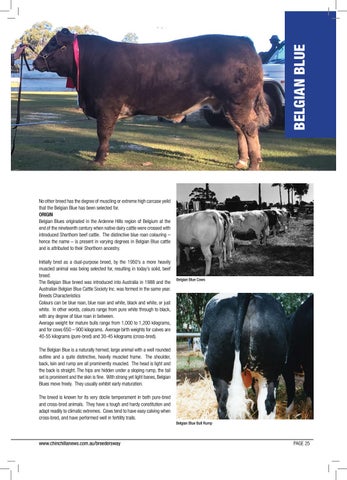
BELGIAN BLUE No other breed has the degree of muscling or extreme high carcase yeild that the Belgian Blue has been selected for. ORIGIN Belgian Blues originated in the Ardenne Hills region of Belgium at the end of the nineteenth century when native dairy cattle were crossed with introduced Shorthorn beef cattle. The distinctive blue roan colouring – hence the name – is present in varying degrees in Belgian Blue cattle and is attributed to their Shorthorn ancestry. Initially bred as a dual-purpose breed, by the 1950’s a more heavily muscled animal was being selected for, resulting in today’s solid, beef breed. The Belgian Blue breed was introduced into Australia in 1988 and the Australian Belgian Blue Cattle Society Inc. was formed in the same year. Breeds Characteristics Colours can be blue roan, blue roan and white, black and white, or just white. In other words, colours range from pure white through to black, with any degree of blue roan in between. Average weight for mature bulls range from 1,000 to 1,200 kilograms, and for cows 650 – 900 kilograms. Average birth weights for calves are 40-55 kilograms (pure-bred) and 30-45 kilograms (cross-bred).
Belgian Blue Cows
The Belgian Blue is a naturally horned, large animal with a well rounded outline and a quite distinctive, heavily muscled frame. The shoulder, back, loin and rump are all prominently muscled. The head is light and the back is straight. The hips are hidden under a sloping rump, the tail set is prominent and the skin is fine. With strong yet light bones, Belgian Blues move freely. They usually exhibit early maturation. The breed is known for its very docile temperament in both pure-bred and cross-bred animals. They have a tough and hardy constitution and adapt readily to climatic extremes. Cows tend to have easy calving when cross-bred, and have performed well in fertility trails. Belgian Blue Bull Rump
www.chinchillanews.com.au/breedersway
PAGE 25