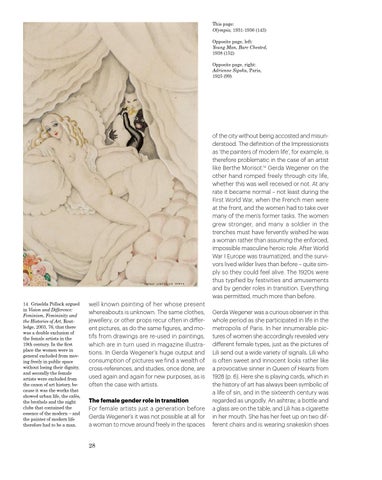
This page: Olympia, 1931-1936 (143) Opposite page, left: Young Man, Bare Chested, 1938 (152) Opposite page, right: Adrienne Sipska, Paris, 1925 (99)
of the city without being accosted and misunderstood. The definition of the Impressionists as ‘the painters of modern life’, for example, is therefore problematic in the case of an artist like Berthe Morisot.14 Gerda Wegener on the other hand romped freely through city life, whether this was well received or not. At any rate it became normal – not least during the First World War, when the French men were at the front, and the women had to take over many of the men’s former tasks. The women grew stronger, and many a soldier in the trenches must have fervently wished he was a woman rather than assuming the enforced, impossible masculine heroic role. After World War I Europe was traumatized, and the survivors lived wilder lives than before – quite simply so they could feel alive. The 1920s were thus typified by festivities and amusements and by gender roles in transition. Everything was permitted, much more than before. 14 Griselda Pollock argued in Vision and Difference: Feminism, Femininity and the Histories of Art, Routledge, 2003, 76, that there was a double exclusion of the female artists in the 19th century. In the first place the women were in general excluded from moving freely in public space without losing their dignity, and secondly the female artists were excluded from the canon of art history, because it was the works that showed urban life, the cafés, the brothels and the night clubs that contained the essence of the modern – and the painter of modern life therefore had to be a man.
well known painting of her whose present whereabouts is unknown. The same clothes, jewellery, or other props recur often in different pictures, as do the same figures, and motifs from drawings are re-used in paintings, which are in turn used in magazine illustrations. In Gerda Wegener’s huge output and consumption of pictures we find a wealth of cross-references, and studies, once done, are used again and again for new purposes, as is often the case with artists. The female gender role in transition For female artists just a generation before Gerda Wegener’s it was not possible at all for a woman to move around freely in the spaces 28
Gerda Wegener was a curious observer in this whole period as she participated in life in the metropolis of Paris. In her innumerable pictures of women she accordingly revealed very different female types, just as the pictures of Lili send out a wide variety of signals. Lili who is often sweet and innocent looks rather like a provocative sinner in Queen of Hearts from 1928 (p. 6). Here she is playing cards, which in the history of art has always been symbolic of a life of sin, and in the sixteenth century was regarded as ungodly. An ashtray, a bottle and a glass are on the table, and Lili has a cigarette in her mouth. She has her feet up on two different chairs and is wearing snakeskin shoes