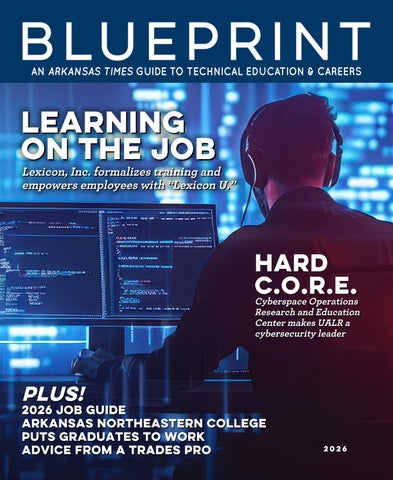
Learning on the job
Lexicon, Inc. formalizes training and empowers employees with “Lexicon U.”
Hard C.O.R.E. Cyberspace Operations Research and Education Center makes UALR a cybersecurity leader
Plus!
2026 job guide Arkansas Northeastern College puts graduates to work Advice from a trades pro
2026
Invest in a high-demand skill for a rewarding career.
Technical and Professional Studies- Advanced Manufacturing • Aviation Maintenance • Construction Technology • Cybersecurity • Information Technology • Professional Truck Driving
Allied Health- Dental Assisting • Emergency Medical Sciences • Health Information Technology
• Respiratory Therapy • Surgical Technology
Break Free From Expected
UAPTC.EDU/APPLY
6
9
GOOD PARTNERSHIPS
SCRATCH-OFFS FOR SCHOLARSHIPS: ARKANSAS SCHOLARSHIP LOTTERY
ANC grad blazing a trail at Big River Steel
8
STEEL LEARNING
Students win when grown-ups play
Little Rock industry leader Lexicon empowers employees through onthe-job learning, training
10
PROFESSIONAL PIPELINE
COURTESY LEXICON
IN THIS ISSUE
11
KEYBOARD WARRIORS
UALR is at the vanguard of cybersecurity education with opening of new center, curriculum
12
Arkansas Northeastern College putting alumni directly to work in region’s booming steel industry
USE ONLY AS DIRECTED
Conflicting state, federal laws cloud certainty of medical marijuana protections for trades professionals
13 2026 JOB GUIDE
Potential salaries and opportunities in the trades
13 Agri-Timber
17 Cad/Cam Drafter
20 Plumbers
22 Truck Driver
14 Allied Health Workers
18 Carpenter
21 Process Technician
22 Welder
16 Aviation Technician
19 Diesel Technician
21 Surveyor
20 PEER TO PEER
Veteran plumber and business owner has advice for making it on your own ON THE COVER: © SITTAKAN - STOCK.ADOBE.COM Individual job information, descriptions and state job growth and salary projections per the U.S. Bureau of Labor Statistics and careeronestop.org, sponsored by the U.S. Department of Labor.
LOOKING TO REACH NEW CUSTOMERS?
Learning on the job
From print to web, we have all the demographics covered.
Lexicon, Inc. formalizes training and empowers employees with “Lexicon U.”
Hard C.O.R.E. Cyberspace Operations Research and Education Center makes UALR a cybersecurity leader
ARKANSAS
Plus!
ARKANSAS
2026 job guide Arkansas Northeastern College puts graduates to work Advice from a trades pro
2026 M A G A Z I N E
BLUEPRINT | 2026 | arktimes.com 1
BROOKE WALLACE Publisher brookewallace@arktimes.com
A
R
K
A
N
S
A
S
MATT MCNAIR Editor MANDY KEENER Creative Director/Production Manager mandy@arktimes.com MIKE SPAIN Art Director
CONTACT BROOKE WALLACE AT BROOKE@ARKTIMES.COM ABOUT ADVERTISING.
LESA THOMAS LUIS GARCIAROSSI Senior Account Executives LYNDSEY HUDDLESTON Digital and Marketing Director SARAH RICHARDSON Digital Ad Coordinator / Customer Service ROLAND R. GLADDEN Advertising Traffic Manager KATIE HASSELL Graphic Design ROBERT CURFMAN IT Director CHARLOTTE KEY Accounting ANITRA LOVELACE Circulation Director
PUBLISHED BY
ALAN LEVERITT Publisher alan@arktimes.com ©2026 ARKANSAS TIMES LIMITED PARTNERSHIP 201 E. MARKHAM ST., SUITE 150 LITTLE ROCK, AR 72201 501-375-2985
Claim Your Ticket to
A BETTER FUTURE APPLY NOW FOR THE SCHOLARSHIP THAT FITS YOU BEST.
LEARN MORE AT MYARKANSASLOTTERY.COM
© JT JEERAPHUN - STOCK.ADOBE.COM
ANC grad blazing atrail at Big River Steel
A
rkansas Northeastern College — with its emphasis on vocational education in the industrial trades — is ideally situated in the midst of Northeast Arkansas’s steel-production boom, and ANC takes full advantage of that proximity to potential employment and industry expertise with robust industry partnerships that yield both instructors and internships for students willing to put in the work. Here’s one ANC success story:
NAME: Alyssa Summerville AGE: 20 EDUCATION: Osceola High School, Class of 2024 Arkansas Northeastern College, May 2025
DEGREE: Associate of Applied Science – Steel Technology PROFESSION: Crane Maintenance Technician for Big River Steel (Osceola)
Best thing about Arkansas Northeastern College: “The teacher-to-student ratio. It was easy to get one-on-one time with your teachers and professors.” Education-to-employment advantage: Alyssa began an internship with Big River Steel while still enrolled at ANC, utilizing the institution’s close relationship with area industries. “ANC has connections with any big company around,” Alyssa says of the opportunities available.
SUCCESS STORY: Alyssa chose vocational education and
ANC, knowing she didn’t want to “go off” to college, but that she wanted something, and ANC appeared to offer both – and did. “It’s a great choice,” Alyssa says of vocational education generally and ANC particularly. “It can help you go in so many directions you didn’t even realize you wanted to go.” It helped Alyssa get her AAS in Steel Technology, a field that she had not considered previously. “And now,” Alyssa says, “I’m the first female in my department at this major steel company.”
LEAD THE FUTURE OF
CYBERSECURITY
UA Little Rock is home to the Cyberspace Operations Research and Education (CORE) Center, giving students hands-on experience in cyber defense, forensics, and digital operations. With a nationally recognized cybersecurity program and the Trojan Guarantee, eligible students can earn a tuition-free degree. Start building your future in one of the fastest-growing fields in the country.
Learn more at ualr.edu/core
manufacturing
Lexicon U.
an internal training program to advance employees in their careers. By matt mcnair
T
COURTESY LEXICON
he late Tom Schueck, along with his wife, Marge, started Lexicon Inc. in his garage in 1968. What began as a small industrial construction company soon expanded into steel fabrication – a way to custom-build materials the rapidly growing company needed to complete its own projects while also removing a link in the supply chain, which both streamlined projects and cut costs. Now, 57 years later, Lexicon is recognized as a global leader in steel fabrication, specializing in the kinds of steel components needed to erect the massive industrial facilities that, not coincidentally, Lexicon also specializes in as a company considered among the global elite.
Mentorship and scholarship at Lexicon U. Not to put too neat a bow on it, but even within that very specific world of large-scale fabrication and construction, the area of expertise for which Lexicon is perhaps best known is the construction of steel plants, facilities that more often than not end up producing the very same steel that Lexicon then fabricates into the giant components needed to construct the next steel mill on its project docket. “We don’t make steel,” Jeff Weatherly, Lexicon’s chief financial officer, has been known to say, “but we make the places that make the steel.” Intentionally or not, one of Lexicon’s newest projects seems of a piece with that philosophy, a corporate strategy that looks within the company itself for the things it needs and strives as much as possible to implement its own high standards on every step of any project. This project, however, isn’t a new fabrication center or a renovated corporate
campus (although you’ll find both are well underway should you drive by Lexicon’s headquarters, situated on Fourche Dam Pike near the Port of Little Rock), or a lucrative new contract or expansion into a new area of construction. Rather, it is its school. Lexicon University — or “Lexicon U.” as the folks in HQ phrase it — isn’t a building that’s being built, or even a university or school in the traditional sense. It’s an internal training program meant to advance Lexicon employees in their careers. And while an internal training program isn’t a revolutionary concept in and of itself, the way it has come about and is being executed at Lexicon is definitely of a piece with that company’s ethos of trusting in its own expertise, its own corporate culture and its own people, from C-suite to shop floor. That ethos has been influencing upward mobility in the company since its inception in many ways — for instance, Lexicon has a tradition known as the “20 Year Club,” wherein employees, regardless of position, are rewarded for 20 years of employment with a company-wide party and a generous bonus check. More than 200 active employees claim membership. Lexicon employees have always been able to receive training for new responsibilities, but the inception of Lexicon U. marks a new commitment to training, retention and advancement at the company. “It’s not like Lexicon wasn’t doing training before,” Catherine Brumbaugh, Lexicon’s Director of Training and Development, said. “It just wasn’t as formalized as Lexicon U. is now.” That formalization, which was executed in 2022, provides a set of protocols for employees to follow and clear paths for advancement. The induction process is simple: Managers nominate employees for participation in the program, and if they accept, then they’re off. While many employees will be trained for advancement in a position they already occupy, it’s not unheard of for a manager to see in an employee potential to excel in another facet of the fabrication process than the one they’re currently doing, and earn a trip to Lexicon U. in that other field. Regardless of starting point, Lexicon U. focuses primarily on welding, fitting and industrial maintenance, with numerous iterations of those job classifications nested in the curriculum. There are, however, technical writing classes as well, and also courses that cover legal language and legal concepts, primarily as that language and those concepts pertain to contract law. That’s not to say that Lexicon U. is offering a pre-law curriculum, but there is opportunity to gain competence in the kinds of dense and high-stakes contracts that are part and parcel in heavy industrial construction and maintenance. Lexicon U. is set up to train and graduate two cohorts per year, with the goal being 35-40 students per graduating class. The most recent
COURTESY CJRW
graduation came in August 2025, with 39 Lexicon employees earning industrial certifications that qualify them for more responsibility and higher wages going forward. While some certifications can be earned from Lexicon U. without leaving Little Rock, more advanced certifications for specialized forms of welding might require a bit of travel, with students finishing up their training in Blytheville, where Lexicon has formed a partnership with Arkansas Northeastern College. That partnership doesn’t mean that a prospective Lexicon U. student or even a prospective Lexicon employee must attend a 2- or 4-year college. A high school diploma or, barring that, GED certification clears the bar for educational requirements, and after that, it boils down to attitude and aptitude, qualities that Lexicon emphasizes in all facets of onboarding, training and advancement. “We talk about the 70-20-10 approach,” Brumbaugh said, referencing a concept often used in corporate settings and other pursuits where on-the-job learning is a given. It means that in a good and productive working environment, a person will learn 70% of what they need to know from doing their job, 20% from interacting with their co-workers, supervisors and others, and 10% from classroom instruction. That means that Lexicon places great emphasis on both know-how and a willingness to work on one’s craft, but also acknowledges the importance of interpersonal interactions and, yes, a little bookwork to boot.
Reid Erwin, ASU-Newport Scholarship Recipient
Jumpstart Your Career With a Win!
COURTESY LEXICON
T The shop floor is also a classroom at Lexicon U. For her part, Brumbaugh exudes the esprit de corps that Lexicon’s meritocratic corporate culture seems to inspire; a fairly recent Lexicon hire herself, she’s there not because her career is just now getting started — far from it, as she comes to the company with 25 years of industrial training and development expertise under her belt — but because it’s a good place to be, and she’s particularly excited about Lexicon U. and its ethos of camaraderie and hard work. “I was incredibly excited to help build this development program,” she said of Lexicon U., and of the company that’s investing so many resources in the future success of its employees, no matter where they end up. It’s a place where, Brumbaugh said, “If you want to work … we’ll give you that chance.”
he Arkansas Scholarship Lottery is helping students across the state build winning futures – especially those pursuing technical education and hands-on career paths. Since 2009, the scholarship lottery has raised more than $1.5 billion in proceeds to support Arkansas students, opening doors to training programs that lead directly to in-demand jobs. With over 822,000 scholarships funded, students seeking careers in skilled trades, health care, technology, manufacturing and other high-demand fields are getting the support they need to move forward with confidence. Scholarships supported by the lottery help cover tuition at two-year colleges, technical schools and certificate programs throughout Arkansas, making career-focused education more accessible and affordable. For students looking to jump straight into the workforce, the Arkansas Workforce Challenge Award offers additional financial assistance for certificate programs in critical, highgrowth industries. From welding and HVAC to nursing assistants and IT certifications, these opportunities help Arkansans gain the specialized skills that employers are seeking. Whether you’re training for a technical trade, earning a specialized certification or preparing for a hands-on career, the Arkansas Scholarship Lottery can help you claim your ticket for a better future. Learn more and apply today at MyArkansasLottery.com.
EDUCATION
Arkansas Northeastern College
Entering its fifth decade of providing access to careers in the state’s northeast corner By matt mcnair
S
© SITTAKAN - STOCK.ADOBE.COM / FOR ILLUSTRATION ONLY
erving the needs of both traditional and nontraditional students in Arkansas’s northeast corner since its 1975 founding (as Mississippi County Community College), Arkansas Northeastern College (ANC) is entering its fifth decade of providing access to practical degrees and improved career opportunities. With an eye toward accommodation, innovation, and affordability, ANC serves students in the region and beyond. Situated in Blytheville, the Mississippi County seat—and with satellite campuses in Osceola, Wilson, and Leachville—ANC finds itself in the heart of Arkansas’s steel-production industry. By extension, it is also part of the heart of the nation’s steel industry, as counties along northeastern Arkansas’s Mississippi River have become an epicenter of a reinvigorated U.S. steel sector, powered by new technical innovations and a broader push toward re-industrialization in rural America. Given its proximity to both industry and a wealth of industrial employers, it makes sense that ANC places strong emphasis on degrees and certifications applicable to modern industry, along with a curriculum that stresses hands-on training alongside classroom instruction. According to Stacey Walker, ANC’s associate vice president ANC’s Division of Allied Technologies is dedicated to delivering for workforce development, the college’s Division of Allied Technolhigh-quality technical education and customized workforce ogies is dedicated to delivering “high-quality technical education solutions. and customized workforce solutions” to meet the needs of students and their future employers amid “the evolving needs of industry.” that end, the college currently supports 10 active student organizations, Through a disciplined focus on an “employer-driven curriculum”— each open to all students and dedicated to a wide range of interests which includes strong industry partnerships and instructors who are and philanthropic efforts. subject-matter experts with long commitments to their fields—ANC and While the campus does not have housing, students have access its Allied Technologies Division are able to “strengthen productivity to amenities comparable to those found at larger, four-year instituwhile empowering individuals to advance in high-skill, high-wage tions. One highlight is the Sun Room, where students can socialize, careers,” Walker says. relax, play air hockey, or enjoy video This focus on industry-aligned instrucgames between classes. The college ANC’s mission centers on tion, combined with ANC’s location in one also boasts the Briggs/Sebaugh delivering useful degrees of the fastest-growing industrial areas in Wellness Center, which is open to all that prepare students for the country, has made the college “a vital students and includes facilities for employment in high-skill, talent pipeline for the region’s growing basketball, pickleball, weightlifting, high-wage industrial jobs. industrial sector,” according to Walker. and walking. Students enrolled in Allied Technologies courses can also expect a Ultimately, ANC’s mission centers on delivering useful degrees that high level of individual attention, with the student-to-instructor ratio prepare students for employment in high-skill, high-wage industrial currently sitting at 17:1. jobs. Reflecting its place in a steel-manufacturing hotbed, the college As a two-year institution, ANC is a commuter college and does not offers an associate’s degree in Steel Industry Technology—a unique offer student housing. That said, the campus maintains a robust student course of study. Additional programs include aviation maintenance, culture. According to Rachel Gifford, vice president for development industrial maintenance, welding, industrial electrical infrastructure, and college relations, ANC recognizes that even commuter schools computer science, and office management, along with numerous need a strong campus community for students to fully “explore their degrees and certifications in the large and growing field of allied talents, develop leadership skills, and pursue personal interests.” To health services.
The entire operation is supported by ongoing student feedback through ANC’s nationally recognized use of EdSights, a technology platform that allows students to provide real-time feedback to administrators. That data is then used to tailor the student experience in a dynamic way befitting a college operating at the forefront of a rapidly evolving industry and region. Beyond improving student experience, ANC also seeks to serve its students and the broader region by offering quality education at the lowest possible tuition cost. The college provides numerous avenues for financial assistance, including Pell Grants, VA education benefits, Arkansas Lottery scholarships, the Arkansas Futures Grant, and the Arkansas Workforce Challenge and Access to Acceleration scholarships. According to Gifford, ANC also offers institutional scholarships and support from a privately funded foundation, which typically distributed between $250,000 and $300,000 in aid to students each year. Those interested in working in the trades—or looking to build on existing industrial skills—can learn more about what ANC has to offer at www.anc.edu. ANC Allied Technologies delivers high-quality technical education and customized workforce solutions designed to meet the evolving needs of industry. Through hands-on training, modern equipment, and employer-driven curricula, Allied Technologies prepares individuals for high-demand careers in steel industry technology, aviation maintenance, industrial maintenance, welding, industrial electrical systems, computer science, office management, and related fields. With strong industry partnerships and a commitment to skill development, ANC Allied Technologies serves as a vital talent pipeline for the region’s growing industrial sector. Its instructors are subject-matter experts with long-standing experience and commitment to their industries. The ANC Solutions Group is the workforce-training arm of Arkansas Northeastern College, providing fast, flexible, and industry-validated training for both new and incumbent workers. Leveraging expert instructors, state-of-the-art equipment, and close employer collaboration, the Solutions Group delivers tailored programs in safety, industrial maintenance, mechanical systems, heavy equipment, and specialized technical skills. Focused on rapid upskilling and real-world readiness, the ANC Solutions Group helps companies strengthen productivity while empowering individuals to advance in high-skill careers.
COURTESY UA LITTLE ROCK
© KEITMA - STOCK.ADOBE.COM / FOR ILLUSTRATION ONLY
The Briggs/Sebaugh Wellness Center includes facilities for the highly popular sport of pickleball.
Dr. Philip Huff, associate professor of cybersecurity at UA Little Rock.
T
Cyber secure
he Cyberspace Operations Research and Education (CORE) Center at UA Little Rock is reshaping how Arkansas understands, prepares for and responds to cybersecurity threats. As cyber risks grow more complex and more consequential, CORE stands at the intersection of education, research and real-world application, helping strengthen the state’s digital defenses. Launched with support from a $1 million grant from the Arkansas Attorney General’s Office, the center serves as a statewide resource for advancing cyber knowledge and building a workforce ready to protect critical systems. Through hands-on learning, applied research and collaboration with government and industry partners, CORE helps meet critical cyber needs across Arkansas. “Cybersecurity has become an indispensable part of our national infrastructure, and UA Little Rock is committed to leading in this field,” Philip Huff, Ph.D., associate professor of cybersecurity at UA Little Rock, said. “In recent years, UA Little Rock has also become a hub for high-impact research in cybersecurity.” That research includes protecting energy infrastructure and applying advanced AI techniques to secure critical systems, with direct, real-world implications for the state. CORE’s impact is also visible in the classroom. “Over the past few years, our program has expanded to meet the growing demand for cyber expertise across Arkansas,” Huff said. “Today, we have over 100 students majoring in cybersecurity, with our graduates filling critical roles across local businesses and industries.” By pairing cutting-edge research with workforce development, the CORE Center is helping ensure Arkansas is better informed, better prepared and better protected in an increasingly digital world.
JOB TIPS
Medical Marijuana and the Trades Info for Job Seekers.
A
By matt mcnair
s of December 2025, nearly 113,000 Arkansans have an active medical marijuana card. With that many cardholders, it’s a pretty fair bet that plenty of tradespersons, employed or seeking employment, are legal users of marijuana. The trades, of course, constitute several professions that involve operating heavy equipment, and working around dangerous materials in dangerous situations. Considering these conditions and the liability issues they raise, there’s a good chance a prospective tradesperson will be subject to a pre-employment drug screen, and a drug test in the wake of an accident, no matter who’s at fault.
THE FEDERAL ANGLE
© H KO - STOCK.ADOBE.COM / FOR ILLUSTRATION ONLY
The “federal angle” isn’t really an angle at all: Marijuana is still an illegal substance under federal law. A federal employee — of which there are more than 20,000 in Arkansas — is allowed by state law to possess a medical marijuana card, but that will not protect them from disciplinary action by their federal employer under any circumstance. It is also important to consider the ramifications of federal prohibition even if a worker is not employed directly by the federal government, as certain professions and many projects fall under the purview of one or more federal agencies — regardless of who CAN I HAVE A MEDICAL MARIJUANA CARD AND BE EMPLOYED IN signs the check — and once again, this disproportionately impacts THE TRADES? the trades. The short answer is “yes.” State law prohibits discrimination against A good example is commercial trucking. All truck drivers, no people who hold medical marijuana cards. Written into the law is a matter their employer, are subject to U.S. Department of Transprovision that disallows employers from withholding employment portation regulations, including those pertaining to marijuana. from a medical marijuana patient Likewise, many large construction on the sole grounds that he or and industrial projects and workshe has been issued a medical places are covered by both state marijuana card in accordance law and federal regulations. The with Arkansas law. resulting patchwork can be complicated, but for any tradesperson “SAFETY-SENSITIVE” working on a project with federal POSITIONS funding, in a federal jurisdiction Arkansas’s medical marijuana law or in any other way potentially contains protections for workers affected by federal rules, it is best who already have a medical marto presume the federal prohibition ijuana card upon employment or on marijuana consumption is in receive one after employment. The play and that it supersedes the most important of these protecprotections afforded an Arkansan State law prohibits discrimination against people who hold tions is the simple fact that it is by Amendment 98. medical marijuana cards. illegal for an employer to refuse to hire a cardholder or to fire an existing employee who obtains one. SUMMARY This protects an employee’s right to have a card and to use it, but While Arkansas law protects your right to possess a medical marithe law also gives employers wide latitude to enforce drug policies in juana license and associated medicine regardless of your profession, the workplace, especially those officially labeled “drug-free” (i.e., most the wide latitude afforded employers to enforce drug-free workof them). The legality of the drug doesn’t matter; only the potential place policies in any way they see fit — particularly in the context for intoxication. of safety-sensitive positions, which will include a vast majority of For tradespeople, the most common impediment to using positions in the trades — means that even legal, off-hours use of medical marijuana — even off work — is their job being labeled medical marijuana could have a negative outcome in the event of “safety-sensitive.” Job descriptions for safety-sensitive positions a drug test, whether pre-employment, random or post-accident. include language that prohibits the use of marijuana at any time It’s best to read Amendment 98 and vigorously research any job for any reason, owing to the very specific responsibilities, tasks, for which you might apply. Know your rights and ask questions — etc., associated with that job. The equipment, conditions and tasks cardholder status is legal, not the same as current use — but also commonplace for a professional tradesperson will almost always know that as a tradesperson, you’ll likely face more restrictive fit this description. drug policies on the job and less legal recourse to challenge them.
Technical and skilled Careers
Professional Jobs in Arkansas With every issue of Blueprint, we dutifully seek out the current data, salary and information to highlight the multitude of career opportunities found here in The Natural State. Using information provided by the U.S. Bureau of Labor Statistics, we've listed some of the most sought-after careers in the following section to provide future health workers, plumbers, welders and more with the information they need to start their career journey.
AGRI-TIMBER WHAT DOES AN AGRI-TIMBER WORKER DO? • Management of forest resources • Harvesting of trees in an environmentally responsible manner. • Processing wood into a variety of products at a mill or factory. WHAT PRIMARY JOBS ARE OUT THERE? • Logging equipment operator • Log graders and scalers WHAT RELATED JOBS ARE NEEDED IN THE FIELD OR AT A PLANT? • Computer programmer/coder • Diesel tech • Electricians • Industrial maintenance worker • Plumber IDEAL WORKER • Likes to be outside • Safety-first mindset • Enjoys working on a team
LEARN YOUR CRAFT • High school diploma • 1-12 months on-the-job training • College coursework in forestry/forest technology WHERE CAN I GO? • Related college coursework in Arkansas can lead to a career in: • Surveying • Forest conservation • Natural resources management
HOW MUCH CAN I MAKE? Log Graders • Lower Range Wages (bottom 10%) —
$35,050 annually/$ hourly
• Middle Range Wages (median) —
$46,710 annually/$ hourly
• Higher Range Wages (top 10%) —
$63,370 annually/$ hourly
Allied Health Workers WHAT DOES AN ALLIED HEALTH WORKER DO? • Support staff, serving alongside doctors, dentists, behavioral health specialists and even veterinarians. • In addition to hospitals and clinics, may work in the pharmacy, medical lab or rehabilitation room. • Operate medical equipment that helps physicians and nurse practitioners diagnose injuries and illness. IDEAL WORKER • Strong desire to help people and improve their health • Great communicator with highly refined people skills • Detail-oriented and thorough JOB DEMAND • Home health aide - projected increase • Physical therapist - projected increase • Medical assistant - projected increase LEARN YOUR CRAFT • Ready to start your career NOW? The allied health field provides many rewarding careers that can move you from classroom to workplace — fast. The following is a sample of jobs that can typically be trained for in 12 months or less (Training periods listed are approximate; actual time to certify will vary.) WHAT PRIMARY JOBS ARE OUT THERE?
Cardiac Technician
• Variants: Cardiac Monitor Technician, Cardiac Catheterization (Cath) Technician, Cardiopulmonary Technician, Electrocardiogram (EKG) Technician. • Certification: About 3-6 months • Perform cardiovascular tests using medical imaging equipment. • Record results of cardiological tests, generate reports for doctors. • Assist physicians during noninvasive cardiovascular procedures.
HOW MUCH CAN I MAKE? • Lower range wages (bottom 10%)—
$37,890 annually/$20.15 hourly
• Middle range wages (median) —
$67,260 annually/$35.78 hourly
• Higher range wages (top 10%) —
$108,900 annually/$57.93 hourly
Home Health Aide
• Assist patients in their homes with a variety of health and wellness tasks. • In addition to medical and personal care, tasks may include shopping or companionship. • Some medical training is helpful, but generally, no degree is required.
HOW MUCH CAN I MAKE? • Lower range wages (bottom 10%)—
$25,600 annually/$13.62 hourly
• Middle range wages (median) —
$34,900 annually/$18.56 hourly
• Higher range wages (top 10%) —
$44,190 annually/$23.51 hourly
Physical Therapist
• Help patients recover through physical movement in hospitals, clinics or in their home. • Assist patient after surgery or injury; promote patient wellness by improving strength and balance. • May require more schooling than other jobs on this list..
HOW MUCH CAN I MAKE? • Lower range wages (bottom 10%)—
$74,420 annually/$39.59 hourly
• Middle range wages (median) —
$101,020 annually/$53.73 hourly
• Higher range wages (top 10%) —
$132,500 annually/$70.48 hourly
Medical Assistant
• Assists doctors and nurses • Typically works in hospitals, clinics or doctor’s offices. • Become certified in less than a year of college.
HOW MUCH CAN I MAKE? • Lower range wages (bottom 10%)—
$25,600 annually/$13.62 hourly
• Middle range wages (median) —
$34,900 annually/$18.56 hourly
• Higher range wages (top 10%) —
$44,190 annually/$23.51 hourly
Phlebotomy Technician (Phlebotomist)
• Certification: About 2-6 months • Draw blood for medical tests • Once received in the lab, prepares blood sample for testing. • Job is a good stepping-stone to other medical professions.
HOW MUCH CAN I MAKE? • Lower range wages (bottom 10%)—
$ 34,860 annually/$18.54 hourly
• Middle range wages (median) —
$ 43,660 annually/$23.22 hourly
• Higher range wages (top 10%) —
$57,750 annually/$30.72 hourly
Neurodiagnostic Technologist (NDT)
• Certifications: About 12-18 months • Uses specialized equipment to record electrical activity in the body’s nervous system. • Tests are used to diagnose and treat brain disease, stroke, seizure disorders and epilepsy. • Can also help doctors diagnose the cause of mental and behavioral disorders.
HOW MUCH CAN I MAKE? • Lower range wages (bottom 10%)—
$37,290 annually/$19.84 hourly
• Middle range wages (median) —
Audiologist
• Median Annual Salary: $87,740 • Works with patients suffering from a variety of hearing issues. • Helps treat patients of all ages, from children to seniors. • Typically works in a clinic or as part of a larger health system.
HOW MUCH CAN I MAKE? • Lower range wages (bottom 10%)—
$61,930 annually/$32.94 hourly
• Middle range wages (median) —
$92,120 annually/$49 hourly
• Higher range wages (top 10%) —
$129, 830 annually/$69.06 hourly
Orthotists and Prosthetists
• Work with patients who have lost limbs to illness, accident or birth defect. • Create prosthetic devices to replace missing limbs; fit to individual patients. • Support patients over time by replacing, repairing or adjusting prosthetics.
HOW MUCH CAN I MAKE? • Lower range wages (bottom 10%)—
$46,220 annually/$24.59 hourly
• Middle range wages (median) —
$78,310 annually/$41.65 hourly
• Higher range wages (top 10%) —
$118,730 annually/$63.15 hourly
$48,790 annually/$25.95 hourly
• Higher range wages (top 10%) —
$81,290 annually/$43.24 hourly
Occupational Therapist
• Work with patients born with a condition or following a medical incident or accident. • Help patients learn or relearn to perform everyday tasks. • May work in a hospital, clinic or home setting.
HOW MUCH CAN I MAKE? • Lower range wages (bottom 10%)—
$49,070 annually/$26.10 hourly
• Middle range wages (median) —
$68,340 annually/$36.35 hourly
• Higher range wages (top 10%) —
$86,930 annually/$46.24 hourly © IQRA - STOCK.ADOBE.COM
Aviation Technician WHAT DOES AN AVIATION TECHNICIAN DO? Perform a wide variety of duties on private and commercial aircraft including: • Inspections of aircraft systems. • Repair or replace aircraft components. • Install, diagnose and fix the aircraft’s electronics/navigation systems. WHAT PRIMARY JOBS ARE OUT THERE? Airframe • Perform inspections of airflow frames, mechanical components and electrical systems. • Test aircraft functions using diagnostic equipment. • Repair or replace components using hand or power tools. Avionics • Responsible for all the electronics onboard an aircraft. • Run cables, mount antennas and connect instruments for navigation. • Test onboard equipment to ensure it’s working properly. WHAT RELATED JOBS ARE NEEDED IN THE FIELD OR AT A PLANT? • Aviation technicians may specialize in certain categories of aircraft, such as passenger jetliners, propeller-driven airplanes or helicopters. • Technicians may also focus on different systems such as engines (also known as the power plant) or hydraulics. • Avionics technicians are specialists focusing exclusively on an aircraft’s various electronic systems.
WHERE CAN I GO? • Aircraft technicians’ workplaces include fixed-base operations at airports servicing corporate jets and private planes, aircraft manufacturers and commercial airlines. • Once a technician receives an associate degree, they can opt to complete a four-year degree, which opens up several other job opportunities with greater earning power.
HOW MUCH CAN I MAKE? Aircraft Mechanic and Service Technician • Lower Range Wages (bottom 10%) —
$47,790 annually/$26.47 hourly
• Middle Range Wages (median) —
$78,680 annually/$41.85 hourly
• Higher Range Wages (top 10%) —
$120,080 annually/$63.87 hourly
Avionics Technician • Lower Range Wages (bottom 10%)
$49,770 annually/$22.38 hourly
• Middle Range Wages (median) —
$81,390 annually/$43.29 hourly
• Higher Ranger Wages (top 10%) —
$113,580 annually/$60.41 hourly
IDEAL WORKER • Highly detailed • Complex problem-solver • Comfortable with electronics and computers LEARN YOUR CRAFT • High school diploma filled by Federal Aviation Administration-approved college coursework, typically completed at a community college or specialized aviation technical school. • Following training, individuals must pass an FAA certification exam to be able to work in this field. • Continuing education is ongoing to help technicians stay on top of changing equipment and regulations.
© ANTON - STOCK.ADOBE.COM
CAD/CAM DRAFTER WHAT DOES A CAD/CAM DRAFTER DO? In manufacturing applications, CAD and CAM are the most effective at working together. CAD provides the informationdense digital models that a CAM system needs to program manufacturing. CAM writes intuitive G-code that, in turn, makes CAD models real. In construction, CAD provides detailed drawings to exacting specifications, reducing miscalculations and costly do-overs. WHAT JOBS ARE THERE? CAD/CAM drafting includes several subspecialties, including: Architectural Drafter • Draw architectural and structural features of buildings for construction projects. • May specialize in a specific category of building (residential, commercial, industrial, etc.) or by materials used (steel, wood, reinforced concrete, etc.). Civil Drafter • Work with engineering firms, highway construction firms or within city planning departments. • Prepare maps used in municipal construction projects, such as highways and bridges. Electrical Drafter • Prepare wiring diagrams for installation and repair of electrical equipment in power plants, residential and commercial buildings. • Employed by a wide range of job fields, including construction, electrical firms and manufacturers. Electronics Drafter • Produce wiring diagrams for circuit boards. • Produce layout drawings used in manufacturing and in installing and repairing electronic devices and components. Mechanical Drafter • Prepare layouts detailing a wide variety of machinery, mechanical tools and devices. • Employed in a wide variety of manufacturing companies.
IDEAL WORKER • Precision thinker; creative problem-solver. • Proficient in computers and mathematics. • Knowledge of manufacturing, machinery or construction a plus. LEARN YOUR CRAFT • High school graduates typically hold an associate degree in drafting. • Training programs are generally easy to find among Arkansas’s two-year colleges. • American Design Drafting Association (ADDA) offers certification for drafters in several specialties, which may increase hireability and boost pay.
HOW MUCH CAN I MAKE? • Lower range wages (bottom 10%) —
$46,500 annually/$24.73 hourly
• Middle range wages (median) —
$68,510 annually/$36.44 hourly
• Higher range wages (top 10%) —
$107,600 annually/$57.23 hourly
RELATED FIELDS • Building Information Modeling — In construction applications, BIM drawings take CAD drafters’ work to the next level by adding a plethora of other data, including partand material-based information, procurement, logistics, cost figures and operational budgets.
© LEREMY - STOCK.ADOBE.COM
CARPENTER WHAT DOES A CARPENTER DO? • Construct, repair and install building frameworks, remodel and rehab existing buildings. • Performs finishing work, such as interior trim and flooring. • Some carpenters are more specialized, such as those who insulate office buildings, install dry-wall or kitchen cabinets in homes, or focus on outdoor structures.
WHAT RELATED JOBS ARE IN THIS FIELD? • Construction management • Brick mason • Concrete worker • Roofer • Outdoor/landscape construction (decks, patios outdoor kitchens)
WHAT JOBS ARE THERE? Carpentry isn’t just one specialty; it’s a skill that breaks down into various subspecialties. Being proficient in more than one of the following boosts your employability and pay range: Rough carpenter • Primarily work on the initial stages of a project. • Focus on framing and structural work, such as building foundations, walls, floors and roofs. • Often work with larger pieces of lumber using power tools to create the framework of a structure. Finish Carpenter • Craftspeople who focus on detailed, aesthetic aspects. • May install doors, windows, trim, molding and cabinetry. • Must possess a keen eye for precision and craftsmanship, ensuring the final product looks polished and visually appealing. Cabinetmaker • Specializes in designing, building and installing custom cabinets and other storage solutions. • Works with various materials such as wood, plywood and laminates, and has expertise in joinery techniques and cabinetry design. • May create other furniture pieces, such as bookshelves, entertainment centers and vanities. Formwork Carpenter • Builds temporary structures, molds or frameworks used in concrete construction. • Forms hold concrete in place until it sets and hardens. • Skilled in accurate measuring, cutting and assembly to ensure the proper shape and structure of the concrete Trim Carpenter • Focuses on installing decorative moldings, trim and architectural features in a building. • May include installing baseboards, crown molding, chair rails, window casings and staircases. • Must have strong attention to detail and the ability to work with precision. Restoration Carpenter • Specialize in the restoration and preservation of historic structures. • Must have extensive knowledge of traditional building techniques and materials used in the historic building. • May repair or recreate damaged or deteriorated elements using traditional methods and materials.
IDEAL WORKER • Detail-oriented • Creative problem-solver • Math skills • Physical strength/stamina LEARN YOUR CRAFT • A high school diploma • Many community colleges offer carpentry curricula from a few weeks to two years in length • Carpentry apprenticeships, sponsored by employers, unions or contractor associations, can take two to four years to complete
HOW MUCH CAN I MAKE? • Lower range wages (bottom 10%) —
$38,760 annually/$27.76 hourly
• Middle range wages (median) —
$59,310 annually/$31.55 hourly
• Higher range wages (top 10%) —
$98,370 annually/$52.32 hourly
© LEREMY - STOCK.ADOBE.COM
DIESEL TECHNICIAN WHAT DOES A DIESEL TECHNICIAN DO? • Make major and minor engine repairs by repairing or replacing parts and components. • Perform routine and preventative maintenance of systems, including mechanical, electrical and exhaus. • Test-drive vehicles to diagnose malfunctions or to ensure that they run smoothly. WHAT JOBS ARE THERE? Diesel technicians inspect, diagnose, repair and maintain any machine with a diesel engine, including: • Aircraft support equipment, Farm equipment, including tractors, harvesters, dairy and irrigation systems, Marine equipment, ships and yachts. • Over-the-road trucks (semis), Buses and dump trucks • Earth-moving equipment, such as bulldozers, loaders, backhoes and graders. • Road construction/highway paving equipment • Industrial/factory machines, including cranes, pumps and drilling equipment. IDEAL WORKER • Problem-solver, mechanically and electronically inclined. • Able to deliver quality work with minimal supervision.
LEARN YOUR CRAFT • High school diploma and on-the-job training. • As engines become more sophisticated, employers prefer some training, which can be completed at many Arkansas two-year colleges ranging from six months to two years. • Continuing education is a given; some employers may require (and pay for) certification by various groups, including the National Institute for Automotive Service Excellence (ASE). WHERE CAN I GO? • Diesel techs are employed by (among others): manufacturers, trucking companies, equipment dealerships, farm operations, cities and counties. • Diesel technicians work in a repair, maintenance or garage-type facility. Some are mobile and travel to the site of a breakdown or jobsite to provide service.
HOW MUCH CAN I MAKE? • Lower range wages (bottom 10%) —
$39,020 annually/$18.75 hourly
• Middle range wages (median) —
$58,970 annually/$28.35 hourly
• Higher range wages (top 10%) —
$82,430 annually/$39.62 hourly
Work families and Work forfor families and become part one. become part of of one.
“I helping love helping youth, “I love youth, and Iand loveI love whatwhat I do. I do. This isn’t work to me. This is a passion.” This isn’t work to me. This is a passion.”
Join Youth Join Youth Villages to find Villages to find a family and a family and a a forever career. forever career.
– Thurmeisha Villages employee – Thurmeisha White,White, YouthYouth Villages employee
It takes a family to just findwhere just where you belong. It takes a family to find you belong. Creative, adaptable, focused, resilient and determined. Is you? this you? Creative, adaptable, focused, resilient and determined. Is this
The path right feels path feels lessalike job more and more a calling. Is you? this you? The right less like jobaand like alike calling. Is this Doesn’t shy away a powerful payoff. Is you? this you? Doesn’t shy away from from hard hard workwork with awith powerful payoff. Is this
A company with national that feels a family. That’s Youth Villages. A company with national reachreach that feels like alike family. That’s Youth Villages.
youthvillages.org/careers youthvillages.org/careers
peer to peer
Joseph Kelsheimer AGE: 35 OCCUPATION: Master Plumber EMPLOYER: 4K Plumbing LLC YEARS WITH EMPLOYER: 2 (self-employed) HOMETOWN: Sulphur Springs
How long have you been a plumber? I’ve worked as a plumber for 16 years and have held my Master Plumber license for the past eight years. What’s your background? I have experience in commercial and residential plumbing, including new construction, new homes and custom-built homes. Before entering the plumbing trade, I worked in metal fabrication. What’s your typical day like? As a business owner, my day involves scheduling and managing multiple jobs, typically attending at least three jobsites daily. I prioritize work from urgent to nonurgent while keeping availability open for emergency calls, such as sewer stoppages, leaks or burst pipes. I also plan dedicated days for new construction and remodeling projects, as these require the most time and coordination. Whenever possible, I complete each job and issue billing the same day. What education and/or training did you receive before becoming a plumber? Have you received any additional education or training (besides on-the-job experience) after beginning your career? I completed a registered plumbing apprenticeship that included both classroom instruction and extensive on-the-job training under licensed plumbers. My formal education covered plumbing codes and regulations, blueprint reading, plumbing math, pipe sizing, system design and safety practices. I completed thousands of supervised work hours, passed the Journeyman Plumber exam, gained the required years of experience as a Journeyman, and successfully passed the Master Plumber exam. In addition, I received specialized septic system education, including septic system design and layout, soil evaluation and site requirements, installation and repair of septic systems, and state health and environmental regulations. I passed the septic system licensing exam and continue to complete ongoing code updates and safety training to maintain licensure and industry standards. If you could go back to your high school and talk about what it takes to be successful on the job, what would you tell students? I would tell them that showing up on time is critical and being late is not an option. I would emphasize the importance of clear and respectful communication with co-workers and customers, as well as being honest and transparent in all situations. I would also remind them that selflessness is essential when providing a service to others; putting the needs of the customer first builds trust, professionalism and long-term success.
PLUMBERS VARIANTS: PIPE FITTER, STEAMFITTER, PIPE WELDER, DRAIN TECHNICIAN WHAT DO PLUMBERS DO? Residential • Build and maintain piping systems for moving liquid, steam, natural gas, liquid fuel or waste • Install and connect piping and fixtures, including welding metal components • Develop blueprints to plan pipes and fixtures within a structure • Make connections between the city’s water supply and homes and businesses • Install bathtubs, showers, sinks, toilets, dishwashers and water heaters Industrial • Perform inspections, maintenance, new installation, handling fuel, wastewater and coolant • Minor carpentry to repair or reconfigure systems • Install and service septic systems • Perform functions related to gas lines, including installation, maintenance and replacement and proper installation of gas appliances LEARN THE CRAFT • High school diploma • Two-year college degree • Most learn and advance through an apprentice program, the first of three levels of professional training, with a corresponding rate of pay • Apprentice — a beginner, enrolled in a training program lasting on average 4-5 years • Journeyman — completed apprentice training and passed the license test administered by the state • Master — served as a journeyman for a period of years and passed the license test by the state
HOW MUCH CAN I MAKE? • Lower range wages (bottom 10%) —
$40,670 annually/$21.63 hourly
• Middle range wages (median) —
$62,970 annually/$33.49 hourly
• Higher range wages (top 10%) —
$105,150 annually/$55.93 hourly
PROCESS TECHNICIAN WHAT DOES A PROCESS TECHNICIAN DO? • Looks for ways to build or produce things better • Identify inefficiencies in production and find ways to improve the process • Prepare machinery and equipment layouts, plan workflows, conduct statistical production studies and analyze production costs WHAT JOBS ARE THERE? Chemical technician • Use laboratory instruments and techniques to help chemists and chemical engineers research, develop, produce and test chemical products and processes • Monitor chemical processes and test the quality of products • Set up and maintain laboratory instruments and equipment • Troubleshoot production problems or malfunctioning instruments Industrial engineering technician • Assist industrial engineers in devising efficient systems to make a product or provide a service • Revise methods of operation, material handling or equipment layout • Interpret engineering drawings, schematic diagrams and formulas • Prepare charts, graphs and diagrams to illustrate workflow, routing, floor layouts, how materials are handled and how machines are used WHAT DOES IT TAKE TO BE SUCCESSFUL? Chemical • STEM concepts, Critical thinking, Information ordering, Monitoring • Deductive/inductive reasoning Industrial • Mechanical skills, Engineering/technology concepts • Production/processing concepts, Mathematics and Design • Complex problem-solving
HOW MUCH CAN I MAKE? Chemical Technician • Lower range wages (bottom 10%) —
$90,990 annually/$48.40 hourly
• Middle range wages (median) —
$57,790 annually/$30.74 hourly
• Higher range wages (top 10%) —
$93,340 annually/$49.65 hourly
Industrial Technician/Technologist • Lower range wages (bottom 10%) —
$46,370 annually/$24.66 hourly
• Middle range wages (median) —
$64,790 annually/$34.46 hourly
• Higher range wages (top 10%) —
$97,670 annually/$51.95 hourly
SURVEYOR WHAT DOES A SURVEYOR DO? • Make exact measurements and determine property boundaries. • Provide data relevant to the shape, contour, gravitation, location, elevation or dimension of land or land features on or near the earth’s surface for engineering, mapmaking, mining, land evaluation, construction and other purposes. WHAT JOBS ARE THERE? • Surveyors are an integral part of virtually any development project, whether private or public. Common roles for surveyors include City Surveyor, County Surveyor, Land Surveyor, Licensed Land Surveyor, Mine Surveyor, Professional Land Surveyor, Registered Land Surveyor, Staff Land Surveyor and State Surveyor. WHERE DO SURVEYORS WORK? • Surveyors may be employed by government agencies at the local, state or federal level; many architectural and engineering firms employ dedicated surveyors, and self-employed surveyors can hire out their services as contractors. LEARN THE CRAFT • Surveying requires an aptitude for mathematics and, increasingly, technology. GPS and related technologies undergird modern surveying techniques. • Although not required to work on a surveying crew, professional surveyors in Arkansas must be licensed by the state. Applicants must possess at least an Associate of Applied Science (AAS) degree, which consists of a two-year college curriculum. • Apprenticeships and other training programs are available in Arkansas, but will vary by firm and still require at least an AAS in order to work toward licensure.
HOW MUCH CAN I MAKE? • Lower range wages (bottom 10% of field) —
$43,680 annually/$23.23 hourly
• Middle range wages (median of field) —
$72,740 annually/$38.69 hourly
• Higher range wages (top 10% of field) —
$116,330 annually/$61.88 hourly
TRUCK DRIVER
WELDER
VARIANTS: COMMERCIAL DRIVER’S LICENSE (CDL) DRIVER, LINE HAUL DRIVER, OVER THE ROAD (OTR) TRUCK DRIVER, PRODUCTION TRUCK DRIVER
WHAT DOES A WELDER DO? • Skilled professionals who join two pieces of metal using heat and gas. • Perform the right type of welding for the materials being joined used on any given job depending on the materials.. • Welding is the most durable way to join two parts, using electrical currents to create heat and bond metals together.
WHERE DO TRUCK DRIVERS WORK? • Over-the-road truck drivers may follow a set territory or they may go anywhere in the lower 48 states, plus Canada and Mexico. • Truck routes range from a few days out and back to crosscountry runs that keep drivers out for several weeks at a time. LEARN THE CRAFT • Learning to operate a semi generally happens at schools set up for that purpose, although some community colleges also offer this instruction. • On average, trucking school takes 3-5 weeks to complete, while two-year schools’ programs can be completed in a semester or two. • Once training is completed, drivers must pass a test to get their commercial driver’s license (CDL), which requires them to operate semis, buses and other heavy, oversized vehicles. • In Arkansas, 18-year-olds can drive commercial motor vehicles within state lines. Drivers must be 21 to drive commercial vehicles across state lines, haul hazardous materials or operate a vehicle with double or triple trailers.
HOW MUCH CAN I MAKE? • Lower range wages (bottom 10%) —
$38,640 annually/$20.55 hourly
• Middle range wages (median) —
$57,440 annually/$30.55 hourly
• Higher range wages (top 10%) —
$78,800 annually/$41.91 hourly
Earning power varies widely with the type of loads handled, as some drivers have earned special certifications and therefore command more money. The current shortage of drivers has driven up wages all over the country, with some companies offering handsome sign-on and retention bonuses to keep their fleets running.
WHAT JOBS ARE THERE? Cutter • Utilize heat from an electric arc, plasma stream or burning gases to cut and trim metal objects. • Cutters also take apart large objects such as ships, railroad cars, boilers and aircraft. Solderer/brazer • Use heat to join two or more metal objects together. • Soldering is used to make electrical and electronic circuit boards, such as computer chips. • Brazing is used to connect cast iron and thinner metals. WHERE DO WELDERS WORK? • Industrial and manufacturing • Plumbing • Body shops, sheet metal, shipyards, and boilermaking • Building or bridge construction LEARN THE CRAFT • High school welding programs as part of automotive or shop classes. • Two-year college welding curriculum. • Designated apprenticeship welding program sponsored by unions or trade associations.
HOW MUCH CAN I MAKE? • Lower range wages (bottom 10% of field) —
$36,830 annually/$19.59 hourly
• Middle range wages (median of field)
$48,940 annually/$26.03 hourly —
• Higher range wages (top 10% of field) —
$75,850 annually/$40.35 hourly
© MASUD - STOCK.ADOBE.COM
WHAT DO TRUCK DRIVERS DO? • Operate heavy-duty trucks to transport load from Point A to Point B. • Follow time schedules to meet delivery deadlines, balanced with road conditions, speed limits and other variables to ensure safety.
•