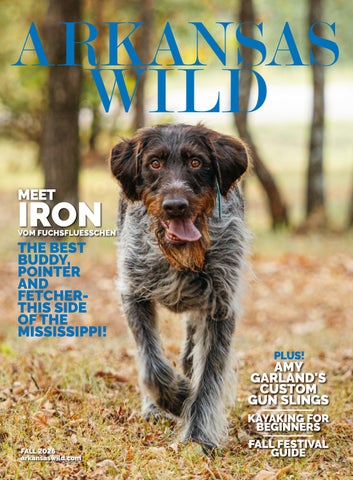
ARKANSAS WILD MEET
IRON
VOM FUCHSFLUESSCHEN
THE BEST BUDDY, POINTER AND FETCHERTHIS SIDE OF THE MISSISSIPPI! PLUS!
AMY GARLAND'S CUSTOM GUN SLINGS KAYAKING FOR BEGINNERS FALL 2026 arkansaswild.com
FALL FESTIVAL GUIDE
DRIVE OR FLY IN TODAY! Year-round fishing, lodging and food. One of the most productive trout fisheries in the world!
First Class Guide Service | Lodging | One Of The South’s Finest Restaurants | Private Club Pickleball | Swimming Pool | Nature Trail | Conference Lodge Landing Strip For Fly-in Guests
870-431-5202 1777 river road | lakeview, ar | lat 36 20’ 55” n | long 92 33’ 25” w GASTONS.COM
ARKANSAS DEPARTMENT OF PARKS, HERITAGE, AND TOURISM
Buckles waiting for a belt in Amy Garland Angel's leathersmithing shop.
BRANDON MARKIN
FALL 2026
IN THIS ISSUE
29
32
CHILL WATERS Fall is a great time to learn the kayaking basics.
10 GEAR GUIDE
See and think more clearly with our well-read gear guide.
12
THE CONSERVATION REPORT
Local author Ragan Sutterfield wants homeowners to make room — and habitat — for birds.
WILD TAIL
Local show dog's fetching game is on point.
16 LOCAL FARE
Make your rice twice as nice with a down-home duck gravy.
18
20
24
CROSSWORD
WILD CANVAS
PASSPORT
A fall crossword to make you feel festive.
38 END OF THE TRAIL Petey keeps an eye out. 4 ARKANSAS WILD FALL 2026
Arkansas Wild gets a custom gun sling from local musician and leathersmith Amy Garland Angel.
Your Arkansas fall festival guide.
ON THE COVER: Iron Vom Fuchsfluesschen, Fort Smith wunderhund. Photography by Novo Studio.
READERS
CHOICE
A ARDS FINALIST 2025
BEST BUTCHER
BEST GROCERY STORE
BEST WINE SELECTION
FAMILY OWNED AND OPERATED SINCE 1959! There are many brands of beef, but only one Angus brand exceeds expectations. The Certified Angus Beef brand is a cut above USDA Prime, Choice and Select. Ten quality standards set the brand apart. It's abundantly flavorful, incredibly tender, naturally juicy. LITTLE ROCK: 10320 STAGECOACH RD 501-455-3475 • 7507 CANTRELL RD 501-614-3477 7525 BASELINE RD 501-562-6629 • 20383 ARCH ST 501-888-8274 BRINKLEY: 1413 PINECREST ST 870-589-2369 • BRYANT: 2203 N REYNOLDS RD 501-847-9777 HARRISBURG: 605 N ILLINOIS ST 870-578-2434 • MARIANNA: 460 S ALABAMA ST 870-295-9311 NORTH LITTLE ROCK: 2727 LAKEWOOD VILLAGE DR 501-918-0228 www.edwardsfoodgiant.com
SAVE TIME. ORDER ONLINE. DELIVERED TO YOUR CAR. FALL 2026 ARKANSAS WILD
5
ARKANSAS WILD BROOKE WALLACE Publisher brooke@arktimes.com
MANDY KEENER Creative Director mandy@arktimes.com
Matt McNair Editor wild@arktimes.com
KATIE HASSELL Art Director/Digital Manager
LESA THOMAS Senior Account Executive
LUIS GARCIAROSSI Senior Account Executive
WENDY HICKINGBOTHAM Senior Account Executive
MIKE SPAIN Advertising Art Director
ROLAND R. GLADDEN Advertising Traffic Manager
ANITRA LOVELACE Circulation Director
ROBERT CURFMAN IT Director
CHARLOTTE KEY Administration
ALAN LEVERITT President
CONTRIBUTORS RAGAN SUTTERFIELD
BRANDON MARKIN
BUCK SPARKEE
HEATHER IACOBACCI-MILLER
Ragan Sutterfield is the author of Watch and Wonder: Birding as a Spiritual Practice. He lives in Little Rock with his wife, two daughters, and a menagerie of animals, wild and domestic.
Buck Sparkee is a hunter, cook and lifelong advocate for eating anything that can be (legally) shot in Arkansas. His hobbies include brown liquor, rendered animal fat and making his editors nervous.
©2026 Arkansas Times Limited Partnership 201 E. MARKHAM ST., SUITE 150, LITTLE ROCK, AR 72201 501-375-2985 All Contents © 2026 Arkansas Wild
6 ARKANSAS WILD FALL 2026
Brandon Markin is a photographer who has spent his life exploring near and far, always compelled by what’s just around the bend.
Heather IacobacciMiller, a Hot Springs native now rooted in Little Rock, is a freelance writer fueled by her love of healthy living and the outdoors. A dedicated runner and fitness enthusiast, she finds joy simply being outside and sharing her passion for wellness through her writing.
Pinnacle Mountain State Park
A SHORT DRIVE leaves the REAL WORLD BEHIND. When you’re that close to outdoor adventures this epic, you’ve got everything you need for the perfect getaway. You won’t just like your time here, you’ll love you some Little Rock.
FALL 2026 ARKANSAS WILD
7
FROM the editor
Howdy once again from within the sturdy walls of our beloved Catfish Tower, where the air conditioner remains on full blast despite the fact it is halfway through September and we’re putting out our Fall issue. The incongruity is every bit as bad as the heat, if you ask me. But nobody did ask me, and if past experience is any predictor of future performance, they will not ask me. Which is just as well, as things like “knowing answers” and “having solutions” aren’t really my line. That’s nothing to brag about, of course, and I sure wish I was more useful to society generally, or even just folks around me particularly, but I’m old enough to know that I’m more or less stuck with what I am and everybody else is stuck with what they got, vis-a-vis yours truly. Which, considering they keep me around, really speaks to their character. I’m pretty good about feeding the dog, I guess. So I’ve got that going for me. Speaking of dogs, we’ve got lots of quality dog stuff for you in the magazine this go-round, including the cover story. I wrote that one, and in so doing ending up thinking a lot about dogs — like my wife’s dog (mine too, I guess, but you know how that goes), Chester, that you always see on this page. That picture was taken not too long after we got him, which seems like yesterday but was longer ago than I care to think about. Anyway, I recommend palling around with a dog whenever possible, because you’ll be happier and also other people will probably treat you better. Works out pretty well! In the course of writing the cover story, I found out that I don’t know near as much about dogs as I thought I did, and that ended up being what a good chunk of the story is about. That’s how things go sometimes, and that’s fine, but I was disappointed at some of the stuff I had to leave out, particularly the help I received from the folks on the “Huntin’ Dogs” forum at arkansashunting. net, and even more particularly from Billy Joe Hoots, who talked squirrel hunting with me and got me a little bit educated on his other area of expertise, West Siberian Laikas. We’ll hopefully have a little more material on some of the folks I’ve run into the last few weeks, but one never knows with me. I’m bad to throw a wheel now and again. Hoho! Besides the cover story about a dog, there’s a little bit of theorizing in here about dogs and how they may or may not be fully tethered to this plane of existence. There is also a recipe for duck gravy submitted by a new correspondent who, come to think of it, might have some insight into matters that do not lend themselves to scientific inquiry. I’ll have to ask him if I can track him down, which might be a tall order, but we’ll see. There’s more too, from learning the ABCs of kayaking to finding the best fall festivals in the state, and learning how you can be a part of the Homegrown National Park. You’re right! It is a great idea! Can’t wait for you to read about it and get started. Thanks as always for reading. Now go pet a dog.
BRANDY McNAIR
DOG DAYS ... STILL
See ya out that way,
Matt McNair 8 ARKANSAS WILD FALL 2026
Experience the Holidays in
Jacksonville
Christmas Parade & Tree lighting Christmas
Holiday Craft Holiday Craft & Gift Sale
December 5 December
November 20-21 November
www.jacksonvilleparks.com www.jacksonvilleparks.com
FALL 2026 ARKANSAS WILD
9
GEAR GUIDE
TAKE A GANDER PLENTY TO SEE HERE.
When you think about it, just about anything can be “gear,” and speaking of thinking, the Fall 2026 edition of Arkansas Wild is stuffed with stories that make you do just that: think. So put on your thinking caps and your reading glasses (and a pocket full of shells, too, we’re still gonna go hunting), and get ready to expand your horizons with a little help from our Gear Guide!
Invest in a vest.
Local f lora. When you’re ready to start rewilding your own yard, the first step will be to get some native plants. You can find just what you need — and get some helpful advice too — at local nurseries. In Little Rock, a good place to start is River Valley Horticultural Products. If you’re in the Ozarks, go have a visit with the folks at White River Nursery and Garden Center in Fayetteville.
Spot them all!
10 ARKANSAS WILD FALL 2026
Homegrown author. If you enjoyed this issue’s “wild yards” essay by Ragan Sutterfield, you’ll want to read Watch and Wonder, his book-length treatise on birding and spirituality. You can find it — along with the book that began the Homegrown National Park movement — at WordsWorth Books in Little Rock.
Can you see me now? Whether you’re hunting with a gun birding journal, a good set of binoculars is crucial. If you’re doing a little bit of both, or just looking to upgrade your optics without dropping four figures, these Diamondback HD binoculars from Vortex might be your best option. Selling for under $250, they’re widely considered the best value in optics by both hunters and birders. Find your set at Bass Pro Shops.
COURTESY VENDORS
Hound essential. We don’t have a lot of upland birds — quail, pheasants, etc. — anymore, but this upland vest is also perfect for a dove hunt or a squirrel trip, especially in lingering warm weather. Filson is considered one of the finest manufacturers of upland gear and hunters in the high plains and out west swear by it. Find this vest and other Filson gear at Dog & Hunt Supply in Quitman, Arkansas’s premier dog and upland outfitter.
FALL 2026 ARKANSAS WILD
11
ThE CONSERVATION REPORT
WELCOME TO THE WILD HOSPITALITY BEGINS AT HOME.
STORY AND PHOTOGRAPHY By RAGAN SUTTERFIELD
Native bees like this one are key to pollination.
S
itting on my porch, drinking my first cup of coffee, I looked to the sky and saw a small bird descending to my yard. It landed, not far away, in an elderberry tree I’d planted several years back. Yellow, with black streaks along the side, I didn’t need my binoculars to know that this was a Prairie Warbler: a bird that nests in Arkansas and surrounding states in the summer, and winters (lucky little bird) on the islands of the Caribbean. Though they nest in Arkansas, seeing such a species in my urban yard was a surprise. These warblers are most commonly found in their eponymous prairies, or in patches of forests recovering from a recent clearcut. Cities are not their scene. No sooner had I recognized my surprise Prairie Warbler than another warbler dropped from the sky to my yard. This one was a brownish olive, with a striped head and an orange wash from its face to its belly. It was a Wormeating Warbler—a ground nesting species that I first encountered in my childhood in the foothills of the Ozarks. It too was a surprising bird for my Little Rock yard, a couple of blocks from the interstate and half a mile from downtown. Why had these two birds, flying high above on their migration south, decided to stop by my front porch? The answer is in that stereotypical Southern value: hospitality.
12 ARKANSAS WILD FALL 2026
LANDSCAPING FOR HABITAT For nearly a decade now, my family has been working to make our yard a place that welcomes the wild. Instead of monkey grass, we planted switchgrass; instead of azaleas, Missouri ironweed; instead of sod, inland sea oats. Plant after plant, bed after bed, we’ve worked to create a haven for the wildlife we love. The result is that — with the Worm-eating Warbler, the latest addition to the list I’ve been keeping —I now have seen 110 species of birds in my yard, or from it. That’s over a quarter of all the bird species recorded in Arkansas. Not bad for a lot of less than a quarter of an acre. Marveling at the wonders of the bird world from our front porch is, for me and my family, a great deal of fun. But our reason for making our yard a place of hospitality was not simply for the sake of pleasure. We began our urban re-wilding project in an effort to offer a small refuge for birds and other wild creatures from the destruction of the natural world. At every turn a forest is being bulldozed for a development, a wetland is being filled for an industrial site, a stream is being silted by runoff. As a result, wild animals have fewer places to live, eat, raise their young, and rest. For birds — the creatures I know the most about — the result has been devastating. Since just 1970 we have lost nearly 30% of the North American bird population. Numbers like that are hard to take, and it is easy for a sense of futility to set in. What can we do in the face of such loss? Plant things. It was from Dan “The Birdman” Scheiman — former director of bird conservation at Audubon Delta, renowned ornithologist, and not one to sugarcoat things — that I was introduced to this hopeful, yet practical, response: Just plant things. Yes, the situation is bad for the wild world, and yes, habitats are being lost in every direction, but there is meaningful work to be done on whatever little patch of ground you can control, be it a backyard or a balcony, a church lawn or a corporate campus. And what if a lot of people did this? Just planted things. And what if after that even more people planted things, just a few things on what little space they had? According to etymologist Douglas Tallamy, it would be the first grassroots national park, one that snakes across the entire country: He calls it Homegrown National Park. Tallamy, in his book, Nature’s Best Hope: A New Approach to Conservation That Starts in Your Yard, introduces the basic idea: “What if each American landowner made it a goal to convert half of his or her lawn to productive native plant communities? Even moderate success could collectively restore some semblance of ecosystem function to more than twenty million acres of what is now ecological wasteland.” Twenty million acres — one patch of yard after another — that’s what makes up Homegrown National Park. This process is sometimes called “re-wilding,” but Tallamy isn’t advocating for an un-mown mess. Re-wilding is landscaping, but landscaping with the purpose of providing
An outpost of Homegrown National Park at Allsopp Park in Little Rock.
TWENTY MILLION ACRES — ONE PATCH OF YARD AFTER ANOTHER — THAT’S WHAT MAKES UP HOMEGROWN NATIONAL PARK. FALL 2026 ARKANSAS WILD
13
The purple fruit of American Beautyberry plants provide food for migrating birds.
habitat. A lawn of sod grass and a few ornamental plants, while nice-looking, probably doesn’t offer much hospitality for wild creatures. Sure, you might have an American Robin hunting worms now and again, or a squirrel digging through your flower beds, but at its base, the typical yard provides little room for diverse life. This lack of life in the typical lawn starts with the plants. Plants and insects have a long history together, a mutual dependence that has come about over millennia. Most plants want to protect themselves from insects, while insects want to eat plants. In order for neither to be completely killed off by the other, a kind of ecological truce has been struck. Insects (especially caterpillars for moths and butterflies) have adapted to eat only a very specific plant, while the plants create toxins that keep all but a few adapted species away; that’s why, for example, a Monarch caterpillar can only eat toxic milkweed, and a Gulf Fritillary caterpillar can only eat the leaves of a passion vine. Each butterfly you see, and marvel at, perched upon a flower has a very specific “larval food plant” that it fed on as a caterpillar. No larval food plant, no butterfly. The more native plants, and the greater variety of those plants, the wider the variety of insects they support. From caterpillars to crickets, birds need insects to feed their young. While many birds eat seeds as adults, they feed their young calorie-dense insects. Lots of insects. Chickadees have been observed feeding their young between 350 and 570 caterpillars every day. That adds up to between 6,000 and 9,000 caterpillars for a single clutch from hatching to fledging. When we have plants that aren’t native, they don’t have that long relationship with native species of insects and so support very few caterpillars and other insects. The result is that many birds simply won’t nest in areas where there isn’t enough food to feed their young, or they lay fewer eggs. The result over time is a decrease in bird populations. There is much more to making your yard a place that is hospitable for wildlife than planting natives, but starting with 14 ARKANSAS WILD FALL 2026
plants is the best place to start. It may well be that you already have some of the key native plants in your yard. Oak trees, for instance, are one of the plants that host the widest variety of caterpillars. If you have an oak, you are well on your way to being a part of Homegrown National Park. The process of re-wilding doesn’t have to all happen at once, either, and it doesn’t mean that you must get rid of every plant that isn’t native. My wife has some calla lilies from her grandparents’ house that she loves, and we have a nice lantana plant from the previous owners that is hardy and always attracts butterflies. We’ve let both plants stay. The key thing is to remove non-native invasive plants like privet and nandina, and then slowly replace other plants with natives. In my own yard, I still have much work to do before I can offer the hospitality for the wild for which I hope. But as the author Oliver Burkman has said, it is better to begin with “messy hospitality” than to offer none at all. If we open ourselves to the process, there is good work to do, and much beauty to enjoy along the way. As I look from the window of my writing shed, I see Jerusalem artichokes growing high, almost ready for their yellow fall flowers. Beside those, there are three American beautyberries ripe with the purple fruit that will feed migrating Gray Catbirds. And just the other day, I discovered a red oak sapling in my front yard, likely planted last fall by a squirrel or Blue Jay. I plan to let it grow so that the tree can provide food for birds and caterpillars alike. There is good we can do for the wild, and it starts, as most good things do, with a seed. In this case, a literal one. Information and resources for creating habitat in your own space can be found at: Many Arkansas Master Naturalists (arkansasmasternaturalists.org) Arkansas Bird Alliance (arbirds.org/BFA) Audubon Delta (audubon.org/little-rock)
MODERN ELEGANCE
IN THE MURPHY ARTS DISTRICT Located in historic downtown El Dorado, and a short walk away from dining and shopping. Situated across from the Murphy Arts District, First Financial Music Hall, MAD Outdoor Amphitheater, and the El Dorado Conference Center. Enjoy contemporary, colorful rooms and a relaxed full-service bar. Our breakfast cafe, outdoor courtyard with lounge seating, firepit, and spa pool make for a great stay.
El Dorado
BeechwoodHospitality.com | BWHsales@lrar.com
STAY FIERCE. STAY LOCAL. STAY MOXY.
Bold bedrooms, buzzing social spaces, & Razorback energy day and night.
At Moxy Fayetteville, our bright, open lobby doubles as your living room with cozy nooks and 55-inch TVs. Spin our video wall for local art or sports highlights, snack on flatbreads or regional favorites, and sip local brews, wine by the glass, or enjoy signature cocktails at Bar Moxy. Bonus: you’re one mile from the University of Arkansas and steps from the Razorback Greenway. Chill around the fire pits and vibe out.
On the Razorback Greenway & next to Meteor Café & Bike shop!
HOTELS BeechwoodHospitality.com | BWHsales@lrar.com
FAYETTEVILLE FALL 2026 ARKANSAS WILD
15
LOCAL FARE
Oh, Good Gravy
NEED A DUCK RECIPE? WE'VE GOT YOU — AND THE DUCKS — COVERED. STORY AND PHOTOGRAPHY By BUCK SPARKEE
From left to right: Each duck can make a single serving. Cooking down celery, onions, and peppers for gravy. Almost there! Serve over rice with whole or pulled duck.
R
ice and gravy is most often associated with the Cajun cooking traditions of Acadiana, but Arkansas has a pretty good claim to the dish itself. Our state has long ranked first in the nation in rice production, accounting for nearly half of the U.S. crop, and Arkansas is also widely regarded as the top destination in the world for duck hunting. With both duck and rice so deeply rooted here, perhaps it's time for Arkansas to lay some claim to rice and gravy. This meal is a standard in our house and the typical way we prepare wild duck. You can certainly use duck breasts, but I prefer to pluck and halve the birds. It takes a little more time, but the end result is much better. Before cooking his signature dish, the author (pictured here) goes on an "Arkansas Grocery Run."
16 ARKANSAS WILD FALL 2026
Wild Duck Rice and Gravy
2 small ducks (such as wood duck or teal) cleaned, plucked and halved Bacon grease 1 small yellow onion, chopped 2 celery stalks, chopped 1 green bell pepper, chopped (for a spicy gravy, mix in some jalapeño ) 1 bunch green onion, chopped 1 to 2 tablespoons flour 3 cups (approx.) liquid stock (duck, chicken, or beef) Cajun seasoning 1 cup white rice (I like Zatarain’s long grain parboiled rice, sometimes marketed as New Orleans style)
Season all four halves of the birds on both sides with your favorite Cajun seasoning. Brown them off in a large, heavy-bottomed pot in bacon grease on medium heat. Remove the birds when well-browned and set aside. For a richer gravy, ensure that there are plenty of brown bits in the bottom of the pot. Add the chopped vegetables and sweat them down a bit, about 5 minutes. Once soft, add the flour and stir until well combined. It should be slightly paste-like. Cook, stirring often, until the flour takes on a light golden color. Return the birds to the pot, and enough stock to just cover. Season again to taste. Bring to a boil, reduce the heat to low and cover.
While the birds are simmering, prepare the rice according to the package instructions. I typically prepare rice in a high-walled skillet with a ratio of 1 cup of rice to 1½ cups of water for 20 minutes. Simmer until the meat begins to fall from the bones. (Though some folks pull all the meat from the bone and mix into the gravy before serving, I prefer to leave the halves intact, as each makes a well-proportioned serving.) If the gravy is too thin for your liking, remove the birds and reduce the liquid, uncovered, until desired thickness. Spoon the duck and gravy generously over rice, garnish with chopped green onion, and enjoy! FALL 2026 ARKANSAS WILD
17
https://puzzleme.amuselabs.com/pmm/crossword-p Crossword
HOT TO TROT 1
2
3 4
dog. dog.
6
7 8
nd er tch 11
12
ars in
13
14 15
and
Winner ant wn) ans
9
10
craft? call an
estival
5
16 17
18 19
gram , but a 't. one, n't
20
18 ARKANSAS WILD FALL 2026
ACROSS 1. "It's the __________, Charlie Brown." (classic Halloween TV special) 4. With 10 across, early immigrant group in the Ozarks 6. Classic music festival or cartoon bird. 8 The _______ State (Arkansas nickname) 10. With 4-across, early immigrant group in the Ozarks 11. Something to help Luke Duke understand his cousin? 13. Can be done to a judgement or to animal fat. 14. __________ game bird (e.g., pheasant) 16. With 8-across, a cluster of water bodies near Hot Springs 17. One putting shoes on horses. 19. Kind of brush or dog. 20 Kind of finger or dog.
DOWN 1. With 19-across and 20-across, another name for a Deustch Drahthaar. 2. Minimalist watercraft?3 What you might call an Early Arkansaw Reenactor. 5. Beagle that appears in 1-across. 7. Marion County festival once visited by a "Phantom Pilot" (and the FAA) 9. "Miss ______" (Winner of a beauty pageant held during 7-down) 12. Where to drive sans seatbelt, or a LR Public Radio program 15. A kayak has one, but a Scotsman doesn't. 18. A Scotsman has one, but a kayak doesn't. Hint: Some answers can be found in this issue.
Answers in the Fall 2026 issue of Arkansas Wild and online at arktimespubs.com. Summer 2026 issue's answers.
ACROSS: 1. Whattaburger 5. Driveins 6. Valley 8. Louisiana
9. Hope 11. BoggyCreek 13. Windows 14. MumbledyPeg
DOWN: 2. Turner Bend 3. Cossatot 4. Watermelon 7. BassReeves
8. Levon Helm 10. Purchase 12. Foggy
Endless Adventure at Turkey Creek STAY, PLAY, AND UNWIND ON BULL SHOALS LAKE, MO.
700-Acre Ranch on Bull Shoals Lake • 20 Furnished Cottages with Full Kitchens • Ranch Trail Rides Indoor/Outdoor Pools and Rec Rooms • Private Dock • Free Use of Kayaks, Canoes and Paddle Boats • Boats for Rent • Tennis/Pickleball Court, Basketball & Volleyball • And More! turkeycreekranch.com | 1389 County Rd., 634 Theodosia, MO 65761 | (417) 273-4362 FALL 2026 ARKANSAS WILD
19
WILD CANVAS
Gun Slinger LOCAL MUSICIAN AND LEATHERSMITH CRAFTS
CUSTOM SLINGS EASY ON THE SHOULDER AND THE EYES. By MATT McNAIR
photography by brandon markin
The author's trusty .308 sports a custom sling from Amy G.
A
my Garland Angel—or “Amy G.,” as she’s known to friends and fans—is not exactly an unknown quantity around these parts. A prominent figure in Arkansas’s country music scene, Amy G. is a regular presence in juke joints across the state (whether flying solo, playing with frequent collaborator Nick Devlin, or teaming up with local supergroup The Wildflower Revue) and also Central Arkansas’s weekly reminder to thank the good Lord it’s Friday (and 5 o’clock!) as the host of “Backroads” on KABF, Little Rock’s community radio station. She is also an accomplished leathersmith, specializing in— appropriately enough—custom handcrafted guitar straps. We here at Arkansas Wild—big fans one and all of “Backroads,” and enthusiastic attendees, when bedtime permits, of Amy G.’s Central Arkansas sets—have been aware of her cottage-industry leathersmithing for some time. What we were not aware of, until recently, was the relative similarity of guitar straps and rifle slings. Once that information came to light, we decided to pose a few questions to Amy G. regarding her craft … and to order a
20 ARKANSAS WILD FALL 2026
custom strap for our own trusty deer rifle, a Ruger .308. The following conversation has been lightly edited for length and clarity, and the trusty .308 is looking sharp. - ed. How long have you been working with leather, and how'd you get into it? I have always enjoyed using my hands to create art as a musician, quilter, dressmaker, and mom. I was really fortunate to have my creativity nurtured from a young age. My mother taught me to sew and I would enter 4-H contests with my “Sew With Cotton” creations. My dad was a farrier and a horse trainer, and I grew up as his “official assistant.” I learned the value of a good leather halter and lead when trying to hold on to some of the more nervous horses we were trying to put shoes on. And growing up with more time spent in a saddle than the classroom, I got to learn the feel of leather reins in my hands, and truly appreciate a quality saddle! And I guess all that, combined with necessity, led me to using leather to make things. Useful things. I have played guitar since I was 8 years old, and so I have spent a lot of my time holding a 5 lb. block of wood over my shoulders.
“My goal in making any strap is that it is comfortable, it fits, it looks good, and that it lasts a long dang time.”
Amy G. in her studio. SPRING 2026 ARKANSAS WILD
21
Amg G. at work in her Argenta studio, where she keeps an inventory of standard straps in additon to custom pieces.
An array of tools are used to add detail and decoration. 22 ARKANSAS WILD FALL 2026
I had long been complaining about the strap I was using, and my neck after a 4-hour gig ... I knew there had to be a better way. So I set out to make myself a new guitar strap. Have you always made gun slings, or had you been doing guitar straps for quite a while before you started doing slings? I have been making guitar straps for 10 years or so. I made my first sling for my son’s BB gun when he was just big enough to carry it. I have since made over 600 guitar straps. Straps are what I know how to make. The main difference between a guitar strap and a rifle sling is in how you create your end pieces so that they work with the respective hardware, are semi-adjustable, sturdy, and can attach and detach safely and easily. I also like to use the raw side of the hide so there isn’t a whole lot of slipping and sliding across the shoulder. Ultimately, you want something you can trust with your prized tool, whether it’s a guitar or a gun.
LET'S RIDE. Join us on adventures throughout the natural state.
What's your process? How do you go about making a custom sling? I’d want to see some pictures of the piece, including a closeup of the fastening hardware. I also like to know the length of their current sling in its ideal position. For aesthetic purposes, seeing the wood and metal in the gun, along with any carved etchings help narrow things down … knowing a person’s style and preferences makes it a true collaboration. And that’s the best part: I know the person who is getting one is getting a true custom, heirloom piece that will hopefully be passed down. You’ve said your work contains only re-used leather. How do you source it? My Ma-Maw, who was a child of the Great Depression, taught me to thrift early on, so I have long seen the value of using recycled materials. I am by no means cheap, though, and recognize a nicer hide lasts longer. When I first decided to try my hand at making a strap, I used an old leather skirt I found buried in the back of my closet. The next one was from the leather of my MaMaw’s old ripped leather jacket (which I named “My Strap of Many Colors That I Made for Me”). I’ve used the leather from old, beyond-repair cowboy boots, leather baseball gloves, and footballs in my designs. I had a buddy who was getting a new couch, and he stripped the old leather one for me. (There’s a lot to be said about the leather from a high-dollar sofa!) I find good sources of recycled leather in all kinds of places … a couple months ago I found a bucket of free saddle leather on the street in Eureka Springs, and thought to myself, “I must be living right.” Do you hunt? Have you made yourself a sling? I am more of the “get all the gear and snacks ready for the deer stand” type of gal. But I have made myself a sling for a single-shot .410 that’s pretty great. Ultimately, my goal in making any type of strap, whether it's for a guitar, a rifle, a camera or a purse is that it is comfortable, it fits, it looks good, and that it lasts a long dang time. If you’d like to see about getting a custom-made rifle sling—or any other kind of sling or strap—from Amy Garland Angel’s Stone County Strap Company, send an email to stonecountystrapco@gmail.com, find her on facebook at facebook.com/stonecountystrapco, or check out her Instagram: @stonecountystrapco
bikearmag.com FALL 2026 ARKANSAS WILD
23
NATURE'S PASSPORT
I
t’s autumn again, which means it’s Festival Season in Arkansas! The might happen year-round, but it’s in the fall we get really fired up about festivals and fairs and frolics, with all their attendant frivolity. (Though it’s not unheard of for folks to get pretty heated when there’s a blue ribbon on the line.) It’s no mystery as to why: Festivals and fairs are fun, fall’s weather is the fairest, and the holidays, with all their attendant obligations (and, sure, joys), are still a few months off; folks are looking to be both outside and sociable. Along with all the obvious things that make festivals incredible — all the people-watching, ring-tossing, overeating, pickin’, grinnin’, etc. — festivals, especially those a ways off from your own little neck of the woods, offer another thing of great worth: old-school oddity. Local festivals and fairs we enjoy today grew out of ancient customs related to the harvest; in America, the county fair (and, through that, the local festival) as we know it began in New England, evolving from ancient annual custom into a celebration of bountiful harvest as well as a showcase for all manner of products and talents an agrarian people have in abundance … and a chance to show off for their neighbors a 24 ARKANSAS WILD FALL 2026
Arkansas Scottish Festival and Homecoming little bit. The modern world gives us many good things, and has taken away many things that are quite bad. But in taking the bad, modernity also seems busy taking away a sense of locality, a sense of place … flattening the world into carbon-copy interstate hubs, interchangeable strip malls and coffee huts sprouting from barren pavement like jittery fairy rings. But the local festival can help hold the line, for it’s in little outof-the-way places that people hold onto their sense of place, and remember, however faintly, how odd and singular a place — or group of places — America was. And still is, deep down. So with that, let’s take a look at the (non-exhaustive) festival calendar. We’re an outdoor magazine, so we’ll mainly stick to outdoor-themed festivals … but this being Arkansas, plenty of festivals that stretch the “outdoor themed” criteria nevertheless abut the great outdoors, so they’re here, too. Since we contend that festivals are bastions of local culture, we’ve clustered selected festivals by region … so pick a few counties and a weekend or two, set up base camp, and take in a passel of awesome Arkansas oddities this autumn!
ARSCOTTISHFEST.COM
LET YOUR FEST FLAG FLY GET A TASTE OF VERY LOCAL FLAVOR THIS FALL AT AN ARKANSAS FESTIVAL.
NWA/OZARKS Fifty years ago, “Northwest Arkansas” wouldn’t even have been capitalized, much less constituted its own regional marker and abbreviation (NWA), as it just would have been a description, i.e., the northwest corner of the state of Arkansas. Now, of course, it’s one of the fastest-growing metropolitan areas of the country, and one of the most desirable, with the University of Arkansas holding down the southern edge of the NWA Metroplex and Walmart and the rest of the Forbes Gang holding court up the I-49 corridor. Still, the vast (for these parts) urban landscape retains quite a bit of that old bohemian-hillbilly Oct. 1-3 Wakaan Music Festival (Mulberry Mountain) Is this an outdoors festival? Not really. Is it outdoors? Oh, buddy. Indeed it is. The Wakaan Music Festival takes place at Mulberry Mountain Lodging & Events, a 400-acre events center and campground that has seen its fair share of bigger-than-you-think musical todos. Along with a robust lineup of musical acts that our core readership may or may not have heard of, the festival will feature art installations, artists-in-residence practicing their craft, and a wide array of vendors. Oct. 3: Botanical Garden of the Ozarks International Festival (Fayetteville) One of the state’s better examples of the-outdoors-in-the-city facilities, the Botanical Garden of the Ozarks, in Fayetteville, is a volunteer-maintained complex of 12 themed gardens (e.g., Ozark Native Garden, Japanese Garden, Butterfly Garden, etc.) connected by walking paths. If you visit on October 3, you can take in the gardens while also learning about the many different international cultures that make up the fabric of our state’s most diverse region. Oct. 9-10 Yellville Turkey Trot Festival If you’re talking about aggressively-local festivals, you’re talking about something like the Yellville Turkey Trot. (But not just like it, because it is a singular event, and never mind the numerous Thanksgiving-adjacent 5k or whatever that bill themselves as a “turkey trot,” which they most certainly are not.) Some of the more spectacular elements of the festival have been relegated to the past, but the tales are still told (good and tall, just like they like’em up there, and freely when the folks are feeling jolly), and the festival is still the social event of the year in Marion County, and the main stage still as good a pickin’ circle as any to be found in the state. Oct. 9-11 Crown Mountain Rendezvous (Leslie) Forget the DeLorean … take a real trip back in time with the Early Arkansaw Reenactors, a living-history group dedicated to recreating life as it was like in Arkansas’s pre-statehood era. It’s like a Renaissance Faire with Bowie knives! Oct. 10 Mount Judea Heritage Fall Festival Named for the range in the Bible but not pronounced like it (much to the amusement, we’ve found, of folks From Off), Mount Judea is a little mountain town that keeps its history alive without much extra effort, which makes it worth the effort to head up around Sam’s Throne and check out their Heritage Fall Festival.
vibe, and the Ozark Mountains proper — while seeing the steady creep of change and modernity — are still, after all that, the Ozark Mountains. Were only Lil’ Abner on his throne, and all of Dogpatch in her bloom, still around to bear witness. But ‘til we all meet again Over Yonder, friends, let’s all meet at a few fall festivals, where new generations of uplanders still celebrate the end of summer and start of the harvest much the same as the oldtimers way back when, and even the cityfolk — move-ins included! — get in character and in on the act. Oct. 10 Ozark Square Gathering A river town and a mountain town at the same time, Ozark has something for history buffs, art patrons, sportsmen, and pretty much anyone who enjoys Arkansas’s past and present. Oct. 15-17 Heart of the Ozarks Craft Fair and Fall Festival (Fayetteville) Sure, Fayetteville is a bona fide Big City and cosmopolitan as all get-out, but that doesn’t mean it’s not an Ozark hamlet at heart. And all that progress has brought in a bunch of artists From Off, the better to complement all the homegrown artisans keeping material folkcraft alive and well in Washington County. Oct. 17 Eureka Springs Oktoberfest Come for the beer, stay for the … well, everything else. With Beaver Lake, White River, Kings River, the winding and wooded lanes of Eureka Springs itself, and much more right outside your tent flap (or cabin door, or hotel lounge), you’ll wish they could stretch it out to Novemberfest. Oct. 23-24 Mountain View Bean Fest and Championship Outhouse Races It’s all right there in the title. You’re either going or you’re not, and it ain’t gonna matter one whit what we say about it one way or the other. We’ll see you there. Oct. 23-25 Arkansas Scottish Festival and Homecoming (Batesville) D’ye reckon th’eeldest town in th’state entire is liable ta turn, from jest th’year o’19-and-81 uptae now, a wee Scottish fair inta th’finest Scots-Irish frolic west o’th’ Appalachians? Och, aye! F’r shor’n Ah swear th’n, if ye dinnae press y’kilt an’ hie up t’Batesville jest prior t’Samhain this year, ye’ll have nae t’blame but ye’self … forswear, t’willnae be th’fault of ye fait’ful scribes hard a’work a’th’ Arkansas Wild, aye, th’ same wee pamphlet y’hold in y’hands this very second! Nov. 12-14 Mountain View Fall Bluegrass Festival Along with showcasing some of the finest pickin’ and grinnin’ to be found anywhere in the country, Mountain View sits right on the edge of the Leatherwoods, one of the most remote and rugged sections of the Ozark National Forest. For a less-arduous taste of outdoor adventure, the White River is just north of town, with dozens of fishing guides and outfitters ready to get you on the water.
FALL 2026 ARKANSAS WILD
25
Terrapin Derby Festival
Oct. 3 Terrapin Derby Festival (Lepanto) Calaveras County might have a mighty fine jumpin’ frog out California way, but in Arkansas, the folks in Poinsett County — Lepanto, to be exact — are partial to their racin’ terrapins, and get together every year to see their little green-shelled buddies do their thing. FanDuel has yet to get ahold of it, so far as we know, so you’ll have to do your betting under the bleachers or behind the concession stand, like God intended. Oct. 9-10 Trumann Wild Duck Festival That’s right, there’s another duck festival to be had in Arkansas. That’s a good thing, in our considered opinion, so get quackin’ and get your tailfeathers out to Trumann to see what their take on teal looks like … they’re first on the calendar, after all! Oct. 23-24 Lake Village Fall Festival Lake Village is a fascinating place at any time of the year, but in our experience the best time to visit a small town is festival time. Like most everything else in Lake Village, their fall festival revolves around Lake Chicot, the largest freshwater lake in Arkansas and the largest oxbow lake in the entire United States. It’s a sight to behold and full of fish, to boot. Nov. 27-28 Wings Over the Prairie (Stuttgart) There’s plenty of room in the Arkansas Delta for as many duck festivals as anybody’s got a mind to throw, but they’ll all be measured against the granddaddy of ’em all. A legitimate national draw, Wings Over the Prairie is an annual celebration of the Duck (and Rice) Capital of the World, as well as the host of the World Duck Calling Championship.
26 ARKANSAS WILD FALL 2026
Trumann Wild Duck Festival
ARKANSAS DEPARTMENT OF PARKS, HERITAGE, AND TOURISM
DELTA Willard B. Gatewood, Jr., renowned scholar of American history and geography, once referred to the Arkansas Delta as “the deepest of the Deep South.” This is not only fascinating to contemplate on account the state of Mississippi is right there across the river, but also because just about half of the whole state of Arkansas isn’t the Deep South at all. For all the distinct cultural regions in the state, Arkansas can be broken down, broadly, into the uplands and lowlands, each as distinct from the other as they are from whole other states. And just as local festivals in the hill country retain distinct local customs shaped by their environment, so too do the festivals found in the Delta, both the southern end (the one most folks think of when they hear “Arkansas Delta”) and the northern (including the Missouri Bootheel, which we got rooked out of a long time ago and is more our Delta than theirs, anyway). If you want to see a big blue sky with nary a hill in sight (but maybe a duck or three!), head toward the Delta and see what the folks down in the flats are up to this fall.
CENTRAL ARKANSAS As an ecological region, Central Arkansas sits at the juncture of all the other ecological regions that make up Arkansas (except Crowley’s Ridge, which is always the exception in these discussions, not just in Arkansas but the entire North American continent). It was also the primary jumping-off site of Territorial-era EuroAmerican explorers and settlers and, concomitantly, a primary staying-put site for the same. The result is a cultural region that is also a juncture, a place where many strands of what would become distinct regional cultures elsewhere in the state mixed together … not blending, necessarily, but definitely conversing. Defined more than anything by the capital city and surrounding metroplex, outdoor-themed festivals in Central Arkansas tend to reflect the culture of the rural regions just off the bleeding edge of the growing cityscape. Which, in our opinion, makes it a handy region for seeing a little bit of everything the state has to offer, with a little nightlife left over if a body’s got a notion.
Arkansas Goat Festival
Oct. 2-3 Timberfest (Sheridan) Even if you’ve never felled a tree or sawed a log in your life, chances are you’ve seen something like Timberfest on television (particularly if you had both insomnia and ESPN in the 1990s). The lumberjacking contests are only part of the fun, though … head down to Sheridan, on the northern edge of the Gulf Coastal Plain and its vast pine plantations, to get a taste of local culture formed during the great timber runs of the late 19th and early 20th centuries. Oct. 3 High Cotton at Scott Connection (Early Arkansaw Reenactors) Just southeast of Little Rock, headed toward the Delta proper, the community of Scott was the site of both plantation-scale cotton production and the frontier culture epitomized in an earlier era by the French voyageurs, who would set out from the Delta to explore the vast woodlands of the south-central part of the state and the liminal upland-lowland region to the north. See examples of both when the Early Arkansaw Reenactors set up shop amid the preserved agricultural structures in Scott.
Mountain View Fall Bluegrass Festival
Wings Over the Prairie
Oct. 3 Arkansas Goat Festival (Perryville) Fifty miles and a world away from Little Rock, Perryville sits on the eastern edge of the Ouachita Mountains, and every year celebrates one of the animals most entwined with the life of early mountaineers in the region: the (sometimes) humble, (always) ornery goat. Nov. 27-29 Petit Jean Rendezvous (Early Arkansaw Reenactors) The intrepid Early Arkansaw Reenactors take over a little chunk of Petit Jean Mountain, where Native Americans hunted in a time immemorial, French explorers left their mark even before the American Revolution, and the State of Arkansas ultimately began one of the finest state park systems in the country. SUMMER 2026 ARKANSAS WILD 27
SOUTH ARKANSAS / OUACHITAS Plenty of folks probably think that the Ouachitas are no different than the Ozarks and that South Arkansas is no different than the Delta, and those folks are definitely wrong. Granted, we’re grouping these two groups together for the purposes of this guide, and we know better — they’re two very different places! — but sometimes concessions must be made to formatting. Besides, the two regions are complementary to each other inasmuch — for reasons of geography and history too involved for an aside in the introduction to a subsection of a festival guide — the Ouachitas were home to a mountaineer culture leavened by plantation culture, and South Arkansas was a plantation culture leavened by that of the mountaineers just to the north and west. But more importantly, this big swath of the state is as beautiful and fascinating as anyplace in the country … and if you’re unfamiliar, there’s no better time to get to know the place, and the people, than festival time.
Paris Frontier Day Festival
Oct. 3 Paris Frontier Day Festival The one in France has the Eiffel Tower, but our Paris has Mount Magazine, the tallest mountain between the Appalachians and the Rockies, and the namesake state park atop it. (Also an Eiffel Tower, actually, but it’s not very tall.) See Paris was, and how it is now, during Frontier Days. Oct. 7-10 Turkey Track Bluegrass Festival II (Waldron) Come for the bluegrass, stay for some outdoor adventure … more than 60% of Scott County, of which Waldron is the seat, is in the Ouachita National Forest. Oct. 8-10 Birding Festival of the South (Hot Springs) The Delta gets all the glory when it comes to ducks, but another migratory route — the Central Flyway — passes over the Ouachitas, and combined with the vast tracts of the Ouachita National Forest this makes Hot Springs a crackerjack spot for a birding conference (non-duck divison). This multi-day birding extravaganza includes workshops, live music, and field trips, all in the middle of historic Hot Springs and the surrounding Diamond Lakes region. Oct. 9-10 Ouachita Bigfoot Festival and Conference (Mena) Mena is a hotbed of Bigfoot sightings (really!), and you’ll see why once you climb to the top of Rich Mountain and realize just how much wooded country is out that way. If you prefer the view without the 8-foot-tall cryptid, book a room in the lodge at Queen Wilhelmina State Park, lock the door, and pull a chair up to the window. Oct. 16-17 Hot Spring County Museum Pioneer Days (Malvern) (Early Arkansaw Reenactors) Another quality reenactment put on by the Early Arkansawyers. They’ll be re-creating a world that pre-dates the city of Hot Springs as we know it, but gambling was a big part of life on the frontier, so… Oct. 31 Gurdon Forest Festival Just like Sheridan to the northeast, the town of Gurdon has always been a timber town. While you’re there learning how 28 ARKANSAS WILD FALL 2026
Holidays Light at Garvan Gardens
life was lived in an Arkansas lumberjacking town, be sure and learn the ways of the Concatenated Order of Hoo-Hoo, founded in Gurdon in 1892. And, seeing as how the festival takes place on Halloween, it might be a good idea to enlist a local and set out to look for the Gurdon Lights. Nov. 14 Buck Fever Festival (Banks, Bradley Co.) A festival that hearkens back to the days of game-check stations and the communal nature of deer season, Buck Fever is held in Banks every year on the opening day (modern gun) of deer season. Blaze-orange attire not required. (But perhaps a good idea!) Nov. 22-23 Holiday Lights at Garvan Gardens (Hot Springs) Garvan Gardens, on Lake Hamilton south of Hot Springs, is a 210-acre wonderland of paths, plants, and peacefulness, and that’s before they string up the lights. Enjoy some manicured nature before seeing the wilder stuff outside of town, or just head back into Hot Springs for hot cider. Nov. 6-8 Prairie D’Ane Rendezvous (Early Arkansaw Reenactors) This get-together of the Early Arkansaw Reenactors is liable to include a little bit of Civil War history, as Prairie D’Ane, near Prescott, was the site of a skirmish in 1864.
ARKANSAS DEPARTMENT OF PARKS, HERITAGE, AND TOURISM
Horner Bend Lake
A BEGINNER’S GUIDE TO KAYAKING IN ARKANSAS. BY HEATHER IACOBACCI-MILLER FALL 2026 ARKANSAS WILD
29
ARKANSAS DEPARTMENT OF PARKS, HERITAGE, AND TOURISM
W
ith the dog days of summer in the rearview mirror, it’s a great time to load up your kayak and head out to one of Arkansas’s many lakes or rivers. Summertime is often associated with boating, floating, and rafting, but fall is an excellent time to enjoy kayaking. Let’s start with the fact that the temperatures are finally cool enough to enjoy being outside without feeling like you’re paddling through a sauna. The waterways are generally less crowded, the bugs less enthusiastic, and the changing leaves add a new dimension to the scenery. And if you’ve always thought kayaking looked fun but felt a little intimidated by the idea of balancing in a tiny boat on a giant body of water, fall might be the perfect time to give it a try. The best part: You don't have to be an expert paddler. You don't need to conquer whitewater on your first outing. In fact, one of the best things about kayaking is that you can start small and work your way up (or even just continue to keep it low-key). Why Kayak in the Fall? There’s something wonderfully peaceful about being on the water in autumn. Cooler temperatures make paddling more comfortable, particularly when you’re putting in a few miles. There’s also less boat traffic on most lakes, which can make the experience feel considerably more relaxed (and quieter) for newer paddlers. Then there’s the scenery. This is what makes us The Natural State. Arkansas is famous for its forests, mountains, bluffs, and waterways, and fall brings all of those together. From the Ouachita Mountains to the Ozarks and the Delta, paddling on the water gives you a different perspective than you get from a hiking trail or scenic drive. You can drift beneath colorful trees, explore quiet coves, stop along a gravel bar for lunch, or simply spend a few hours enjoying the beauty that The Natural State has to offer. Fall kayaking can also be a great way to build confidence. Calm water gives beginners an opportunity to learn basic paddle strokes, practice turning and changing directions, and
30 ARKANSAS WILD FALL 2026
Lake Chicot get comfortable getting in and out of a kayak before tackling more challenging conditions. First Things First: Don't Let the Kayak Intimidate You The first time you sit in a kayak, it's perfectly normal to think you’re going to immediately tip over. And if most of what you know about kayaking comes from white-knuckle YouTube videos or overheard creekside conversations between serious paddlers, filled with mysterious, terrifying words — “pinned, “flushed,” “pulling a skirt,” “rolling” — you might reasonably assume that’s the whole point. It’s not! Recreational kayaks are designed with stability in mind, and you don't have to know everything before you get on the water; those aforementioned skills are crucial for advanced kayaking in big, fast water, but not for learning the ropes in beginner-level spots. That being said, it is always possible to fall out of a kayak just like any other boat, so always wear your lifejacket (also known as a personal flotation device or PFD) no matter how calm the water seems or how strong a swimmer you are. Starting somewhere calm like a lake or protected cove is a much better place to learn than a fast-moving river. Give yourself time to get comfortable with your paddle and learn how the kayak responds when you turn, stop, and change direction. It's also smart to check the weather and water conditions before heading out. River levels can change quickly, and a river that looks inviting from shore may be considerably different once you're on it. If you're completely new to kayaking, consider renting from an outfitter that provides basic instruction or joining an experienced paddler for your first trip. There's no prize for figuring everything out the hard way. Best Places for Beginner Kayakers If you're new to kayaking, look for relatively calm, protected water where you can concentrate on enjoying the experience rather than fighting the current. With its clear water, forested shoreline, and hundreds of islands, Lake Ouachita offers plenty of room to explore.
The lake's numerous coves and protected areas can provide calmer conditions for paddlers, particularly when the wind is cooperating. Fall is an especially appealing time to visit, when the surrounding Ouachita Mountains begin showing off their autumn colors. If you’re new to kayaking, choose a calm day, stay close to shore, and avoid venturing too far into open water, especially if you're still getting comfortable with your kayak. Located in southeast Arkansas, Lake Chicot offers a completely different kayaking experience. Lake Chicot is Arkansas's largest natural lake and the largest oxbow lake in North America. It’s surrounded by cypress trees and uniquely Delta scenery, providing a peaceful setting for a leisurely paddle. Lake Chicot State Park (at the north end) and Connelly Bayou are known for relatively sheltered water, making it an appealing choice for beginning kayakers who want to spend more time enjoying the scenery and less time worrying about waves. Beaver Lake, with its limestone bluffs and forested shoreline, makes it one of Northwest Arkansas's most scenic places to paddle. Rather than immediately heading into the lake's larger, more exposed areas, beginners can look for protected coves to practice basic paddle strokes and become comfortable maneuvering the kayak. As with any large lake, keep an eye on wind and boat traffic. Conditions can change quickly on open water. Looking for a Little More Adventure? Once you've mastered the basics and feel comfortable controlling your kayak, you may be ready to graduate from flatwater to moving water. Class I and some Class II water can offer a little more excitement without necessarily requiring advanced whitewater skills. But don't let those classifications fool you into thinking every river trip will be easy. Water level, weather, obstacles, and your own experience all matter. The Buffalo National River is one of Arkansas's signature paddling destinations for good reason. Towering limestone bluffs, wooded shorelines, and clear stretches of river make it a special and unforgettable place to explore by kayak. For intermediate paddlers, some sections offer the chance to experience moving water and small rapids while still providing plenty of opportunities to stop and take in the scenery. Before launching, check the current river conditions and choose a section appropriate for your experience level. The Buffalo can change considerably depending on water levels. The Spring River, fed by Mammoth Spring, is known for its clear, cool water and constant flow thanks to the spring. Its current provides more of a challenge than flatwater paddling, making it a good option for paddlers ready to learn how a kayak behaves in moving water. The most ideal route for beginners to intermediates is to put in at Dam 3 and kayak to Many Islands Camp, which avoids the high-risk drops found further downstream. The river also offers plenty of beautiful scenery along the way, so you don't have to choose between adventure and enjoying the view. Another great river choice for Class I and Mild Class II rapids is the Caddo River. Its clear water, wooded shoreline, and gentle current make for a scenic paddle. Keep in mind that, depending on water levels, you may experience small rapids and quickermoving sections that require more kayak control than a typical lake paddle. Keep It Simple One of the biggest mistakes new kayakers make is thinking their first outing needs to be an epic adventure. It doesn't. And that’s not a bad thing! Your first trip might be an hour on a quiet
lake. You might paddle a mile, stop for a snack, and decide that's plenty. That's perfectly fine. The goal isn't to cover the most miles or conquer the biggest rapid. The purpose of your first few kayaking adventures is to get comfortable on the water. Part of the joy of kayaking is enjoying the beauty of your surroundings, the sounds of the water dripping off your paddle blades, the breeze as you skim across the water. It’s a wonderful way to simply enjoy being outdoors. Once you get comfortable with kayaking, Arkansas gives you plenty of opportunities to keep going. And fall makes a pretty good invitation. How could it not? The leaves are changing. The temperatures are comfortable. The summer crowds are thinning out. All that's left to do is grab a paddle and see where the water takes you.
A Few Things
to Know Before You Go Fall kayaking is wonderfully low-key, but as always, a little preparation before heading out goes a long way. • Check the weather. A beautiful autumn morning can turn windy quickly, creating waves that can be surprisingly challenging for kayaking. • Check water levels. This is especially important when paddling rivers. Know the conditions before you launch and choose a section appropriate for your experience. Try sites like riverleveltracker. com/ or americanwhitewater.org/content/River/ state-summary/state/AR • Wear a personal flotation device (PFD)/life jacket. Even strong swimmers should wear a properly fitted PFD while kayaking. • Dress for the water, not just the air. Fall days can sometimes be warm, but the water may be considerably colder. Don’t assume that a sunny day means the water is warm and pack dry clothes just in case you end up getting wet. • Bring water and snacks. Kayaking may look leisurely, but paddling is exercise. You'll work up an appetite and a thirst. • Protect your phone. A waterproof case or dry bag is a small investment that can save you from a costly phone replacement. • Tell someone where you're going. Let a friend or family member know your planned route and approximate return time, especially if you're paddling alone. • Visit the Arkansas Game and Fish Commission's website where you can download and study a map of the lake or river (agfc.com/resources/maps). FALL 2026 ARKANSAS WILD
31
FORT SMITH PHEASANT SPECIALIST SPORTS IMPRESSIVE PEDIGREE, BUT ISN'T AFRAID TO GET HIS PAWS DIRTY.
BY MATT MCNAIR PHOTOGRAPHY BY NOVO STUDIO FALL 2026 ARKANSAS WILD
33
Michael Keener and his dog, Iron, do a little mock training for Iron's big photoshoot.
Confessions of a (dog-loving) dilettante “Why don’t we do a story about hunting dogs? Could you write that?” That was the question put to me earlier this year by the Arkansas Wild editorial board as we planned out the contents of the fall issue, the very one you’ve got in your hands. Nobody on the board, including myself, hunts with dogs, but we didn’t have a cover story and there are, famously, no bad ideas in brainstorming. Further, there are few things under the azure heavens so universally beloved as dogs, and — just as importantly in this case — one of the board members, the one asking the question about a hunting-dog story, has a brother who has a hunting dog, a good one by all accounts, with impeccable (and documented) breeding, photogenic as all get-out and quite available for a photo shoot. Done and done. Of course I can write the story and of course I will, because that’s the deal we’ve got going in the conference room where the editorial board meets: They know about magazines and how to get them printed and out the door, and I know about the outdoors and how to string enough words together to tell a story about what all goes on out there. And the outdoors — heckuva generalization, sure, but we’re a heckuva general-interest outfit around here — of course includes dogs, and hunting, and also hunting with dogs. Knowing a little bit about one of those things and quite a bit more about the other thing, whether or not the twain ever hath properly met, and being a fair hand at word-stringing, should be quite sufficient for getting a proper handle on a story about hunting dogs. Except it really isn’t, as anybody who actually hunts with dogs — as opposed to having a dog, and also hunting — will tell you. I should’ve known all that, known that I was about to wade into a story that was simultaneously too broad and too specific to properly address in a relatively short piece with its origins in, essentially, a bunch of classy photos of a very good and cool dog. But word-stringing will go to your head sometimes, or at least trick you into mistaking description for expertise; besides, this can be a real siren-song of a gig, getting paid (a little bit, anyway) to hit the creek or go hunting or whatever else and then, basically, report back. In this case, it would be sort of like that, but also with dogs, and like all sensiblethinking persons with the capacity to feel things, even just a little bit, I love dogs, because they are awesome and fun to hang out with, and all the other things that folks say about dogs. So of course I’m going to do the story. All dogs are squirrel dogs when you’re 10 I was also suffering, I suspect, at least a little bit and deep down, from a delusion that I knew a thing or two about hunting dogs (and hunting with dogs) on account I really did used to hunt with dogs, or with one dog at a time anyway. It was just squirrel hunting though, and not the serious kind of squirrel hunting, but the kind that every country kid did up there and back then, very much a boy-and-his-dog idyll
34 ARKANSAS WILD FALL 2026
in which a boy (or a girl, nobody cared, and anyway, nothing promotes gender equality like squirrel gravy) and his dog, whatever kind of dog it happened to be, just wandered through the woods until the dog treed a squirrel. I had some dogs that were better at squirrel hunting than others, but that would just get them remembered as a “good squirrel dog,” which distinguished them from other dogs who were squirrel dogs by dint of being a dog at all. Back here in the present day, it only took me about five minutes of serious thinking about the assignment I’d so readily accepted to realize how far out of my depth I was about to get; in my experience, if you’ve strung enough words together in such a way as to get yourself in a bind, the best thing to do is see how somebody else has strung together words addressing whatever it is that’s got you bound up, and so I trotted off to the library. It’s dogs all the way down I’m fairly certain that if I came upon an actual card catalogue I’d still be able to use the Dewey Decimal System, but I haven’t seen one of those in the wild for ages, and they certainly don’t have one (not that I saw, anyway) in our newly-renovated Central Arkansas Library flagship facility in downtown Little Rock. (That’s not a knock, kudos to CALS, the new library is tip-top.) And though I tend to be a devotee of obsolescence, especially obsolete tech, I have to admit that the digital card catalogues are much more convenient. Well, mostly, except when you show up looking for “dog.” “Dog” is a job for the Dewey Decimal System, not the cut-rate Mr. Jeeves running on a computer by the study room. Might as well just wander the stacks thinking, with great sarcasm and even more selfloathing, that maybe they’ll just have something like a dog encyclopedia, which seems faintly ridiculous to me, but not as ridiculous as I find myself. Anyway, Encyclopedia of Dog Breeds (Coile, C. 1998. Dewey System call no. 636.71) is a wealth of information and not ridiculous at all, and told me all that I needed to know about dogs, which was that I was never going to learn enough about dogs to write about them without making a lot of people that know way more about it than I ever will very annoyed with me, or worse. But I did find an entry for the German Wirehaired Pointer, also known as a Deutsch Drahthaar, which is the very same photogenic and available dog that got this whole train a’rollin’ in the first place, and is also a real word that my colleague had not invented for fun at my expense, and one which she had been pronouncing correctly the whole time to boot, which was a surprise to me and just one more humbling incident in a story assignment full of them. Who’s the subject of this article? The very best subject of any article? You! Yes, you are! Before I headed out to Fort Smith to meet Iron, our very good and handsome cover boy, I tried to learn at least a little bit about Deutsch Drahthaars, as again, I’d never before heard of the breed, much less met one.
Iron is a great family dog, too. He just wants to curl up in your lap.
FALL 2026 ARKANSAS WILD
35
The basics are just that, pretty basic: As the name implies, the specific breed originated in Germany and, according to the Verein Deutsch-Drahthaar Group of North America (VD-DGN), is “the most frequently used hunting dog by the German hunting establishment.” They are Pointers, which means just what you think: They get a bead on a bird (they’re mostly used to hunt upland game birds, such as quail or pheasant or other birds, sometimes known in Arkansas as “not-duck”), freeze, and go into a point position to try and help their poor, hapless, woefully-human hunting companion — with the inferior sight, sub-par hearing, and essentially-nonexistant sense of smell common to that breed — spot the bird and blast it, after which our hero will shift from “point” to “retrieve,” and fetch up the prize, which gets the human one step closer to getting down to the serious business of getting our hero some kibble. That’s about as far as I got with regard to Drahthaar Studies, as I kept getting distracted by other pictures of other dog breeds, and thinking about how, even though I’ve never been around many dogs with “papers” — the record of a dog’s lineage and breeding and everything else that goes into a dog’s real-deal pedigree and makes them capital-R Registered — lots of the dogs in the encyclopedia reminded me of other dogs I’d known in real life, or still do, and even the Drahthaars and a few other Pointers reminded me of the bird dogs my paternal grandfather had when I was very young (there were still quail back then, and everybody hunted them and a lot of folks had bird dogs), though they surely didn’t have papers. But I figured that was enough to get me started, and I really just wanted to go meet the dog anyway, because of course I did. So it was off to Fort Smith, the home of Iron Vom Fuchsfluessche. (Drahthaars must be registered in Germany, regardless of where they’re from; in the States, you register a Drahthaar with the VD-DGN, who will then get the dog registered with the parent organization in Germany. When the Germans add your dog to the rolls, they translate the dog’s surname into German, and that’s your dog’s name from there on out. Iron was born in Pennsylvania, and his surname is a reference to the breeder.) I met up with Michael Keener in Fort Smith on a typically-sweltering but otherwise-lovely day in August; as we exchanged pleasantries the photographer arrived (dogs with papers get real photo shoots, not thumbsmudged smartphone pics bungled by overconfident word-stringers), and soon enough the star of the show was out of the house and making the rounds. Iron Vom Fuchsfluessche (hereafter just “Iron”) is a sure-enough bird dog, but he’s also a dog-dog, in that he’s friendly and cute and, when not on the job, happy just to hang out and pal around with whatever besotted human happens to be in the vicinity, and as such I kind of forgot I was supposed to be there getting the scoop on this hunting dog. Michael snapped me out of it, though. “So what does she want me to have him do?” he asked, referencing his sister, who is my boss and also in charge of the whole shooting match, so far as the photo shoot goes. “Hunting picture,” I replied, to which he asked, “What kind of hunting picture,” but I didn’t know and said as much with a little shrug and I thought again about how I’m really not very useful in editorial meetings and that I should work on that. 36 ARKANSAS WILD FALL 2026
Michael and Iron discuss strategy durning an outing to Lake Torraine near Fort Smith.
“But what kind?” asked Emme, Michael’s daughter. Emme was in the middle of the first week of the sixth grade, but she was out for the day and had joined the crew. “There’s, like, a thousand kinds of hunting.” I agreed that indeed there was, but also that it didn’t really matter all that much so long as we got some good shots of Iron, which was really the point of the whole exercise, pictures of dogs being more or less guaranteed to move way more magazines than anything I would add to the proceedings. And there just so happened to be a lake righ down the road, so Emme gathered up some of Iron’s gear — training decoys, vests, tracking collar, etc. — and then Iron himself, and we piled into Michael’s truck and headed out to see Iron in action. Keener hasn’t always had Drahthaars, but like a lot of folks who keep registered dogs and become enamored of a particular breed, he ended up with one — before Iron, he had a Drahthaar named Viggo vom Wiredhaus (a.k.a. Jim) — and that was all she wrote. You get a little hint of evangelism from certified one-breed dog people when they get on-topic, and a five-minute conversation on the way to our photo shoot told me more about Deutsch Drahthaars than I could’ve gleaned from a hundred encyclopedia entries. Pointers, like Iron and his ilk, are most at home hunting upland game birds; Keener is a dedicated pheasant hunter, and he and Iron make frequent journeys to South Dakota and similar environs. Drahthaars are able retrievers as well, and while it's not their primary bag, Keener reports that Iron can fetch up a duck as well as any labrador, and duck season often finds him doing just that. And while he’s never had to enlist Iron’s skills in pursuit of a lost deer, Keener is confident his trusty bird dog would make short work of finding a downed deer lost to the underbrush, Drahthaars being keen trackers by both sight and smell; until the need arises, Keener has some evidence to back up his claim, as Iron has completed the Verbands-Jugenprufung (VJP), one of two rigorous tests administered by the VD-DGN as part of the certification process, with the VJP testing for proficiency in “Nose, Field Search, Pointing, and Cooperation.” Iron’s proficiency in the “cooperation” bit was on full display during our little photo shoot, consenting to let two of his people and two more new ones have him go this way and that, and run toward cameras and away from cameras, and look at cameras or peer off in the other direction, and hit the water over and over again, first from one spot then another, and coming to shore here or there or here again. (He did all this gamely enough, but I got the distinct impression he knew not only that this wasn’t a hunting trip, but that it also wasn’t practice or training, or even really playing, never mind the fact his buddy Emme was in tow … which probably also speaks to that high cooperation score.) And then it was back into the truck and off for the house. Iron jumped right up and in, and I asked if Iron lived inside like a pet most of the time or if, like some working dogs, he lived apart from the family and only came out to work. Keener reported it was the former, that being away from his people was a misery to Iron, and if not in the field, said Keener, “he just wants to curl up in your lap.” He is, according to Keener, as good a pet as you could want, to go along with all the rest of it. “This dog is a Swiss Army knife of a dog,” Keener says warmly. “Well, a German Swiss Army knife.” FALL 2026 ARKANSAS WILD
37
The ballad of Petey and Bo
RETROVECTOR.STOCK.ADOBE.COM
END OF THE TRAIL
By MATT McNAIR
“W
ell, looks like camp’s got a Bo.” This from my friend Rusty, who a few years ago went in with his in-laws and bought a cabin up in Pope County that can be described, roughly, as Not-Russellville, but it might also be in Johnson County, and is actually in the part of one of those counties or any county that can best be described as Not-Important, because county lines don’t matter to pine trees and WMA lines are more important than county lines out there regardless. Anyway, all that to say that Rusty is a heckuva guy and I’d be tickled for him even if he didn’t invite me out to the cabin, but he does and so that makes me tickled for me, too, and he’s been inviting me (and a few other fellas) around to hunt long enough that we’ve got a little deer camp going (as opposed to merely a camp from which to hunt), and even before the cabin came along, me and Rusty had already logged twenty-some-odd years on our run-around-ometer, which is a whole lot of fishing trips and canoe floats and misadventures, enough to say I know Rusty pretty well, and well enough to know a dog had found our camp. I know this because Rusty is always being found by dogs instead of the other way around, and according to Bo Theory, their names are Bo. I first learned about Bo Theory years and years ago, on a float trip down the lower Buffalo. It was a group trip with lots of stops for swimming and picnicking, and on one such stop a dog came bounding out of the woods to see if we had some decent chow we’d share, which we did, but we also had a mystery, because we were way off down in the Lower Buffalo Wilderness Area and we’d seen nary a soul for two or three days. When it was time to go I felt kind of bad for the dog, way out there in the woods by himself and all, but didn’t see where there was much to be done, and then I saw Rusty just put the dog in his boat and shove off. “Can’t leave Bo, wouldn’t be right,” he said. “We’ll take shifts, you’re next.” Rusty commenced to explain Bo Theory — or the Dao of Bo maybe, Rusty’s a sneakily-philosophical dude — in which dogs that are lost or have run off or somesuch would eventually show up on the creek, and all of those dogs are Bo. And based on his personal experience — creek after creek, all across the Ozarks — Bo is legion, because Rusty’s met Bo a lot. Or, if Bo is not legion, then Bo has found Rusty enough times to beggar probability. Rusty didn’t let on like there might be theosophic implications, for him personally, of Bo Theory and his repeated Bo encounters. But like I said, he’s always had a real still-waters-run-deep vibe
38 ARKANSAS WILD FALL 2026
going on, so I have my doubts. Anyway, Bo run off on us before the trip was out, and I was just as bummed out — upset, even — as the girls on the trip, who had really took to loving on Bo and mothering him and feeding him extra treats and all that, and I figured the fellas would tease me about being busted up over Bo, and they did. But Rusty told me that was just the way Bo operates, and not to worry. Which proved true the last day of the trip, with our whole crew laid out on a gravel bar, exhausted from pulling through the long, dead pools down toward the river’s mouth and thinking about the ones yet to go, and me nearly tired enough to forget about Bo, and I had until we heard the johnboat coming down the river — how they kept from shearing the prop I’ll never know, but oddly enough I also don’t remember seeing them go up the river in the first place — and in the front, atop the prow just as comfy as you please, was Bo. “Told ya,” said Rusty. So fast forward back to Not-Russellville, and I knew all about Bo and was glad to have him at camp. We fed him little and he stuck around, which was good, but when it was time to head back to town he wouldn’t melt back into the woods like he was supposed to, and this deviation from Bo Theory — which had come pretty close to Bo Law all these years down the line — nearly shook Rusty. Nearly. But he brushed it off and said Bo’d be fine and that was just the way of it. Turns out the way of it is that Bo’s name, this time, is Petey, and while he’s a real dog with a real sort-of owner, he adheres pretty close to Bo Theory so far as I reckon it, coming around to our camp whenever we’re around — he gets to stay in the cabin these days, which we have quit pretending has anything to do with him maybe running off the deer — and also up and down the valley, turning up on game cameras (Rusty keeps his on too, and will occasionally issue a Petey Report) and even the internet, where the local canoe outfitter might get an extra Yelp star when a mysterious white dog swims the last mile to the takeout with them, and on the neighborhood facebook page where the locals keep each other abreast of Petey’s comings and goings and general status. Now I’m not saying that Petey is Bo or Bo is Petey, or that they’re anything except regular old dogs, which they almost certainly are, and I certainly wouldn’t say they’re, like, a manifestation of the Divine or anything like that, or anything at all for certain, because I don’t trust myself when I’m certain and so I don’t hold to many certainties. I do, however, have a theory.