4 8
Plan to attend the APA advertising awards ceremony on March 11 Guest Column: Examine, evaluate reporting shortcuts By Jim Pumarlo
Arkansas Press Association
Publisher Weekly Vol.17 | No. 7 | Thursday, February 17, 2022 | Serving Press and State Since 1873
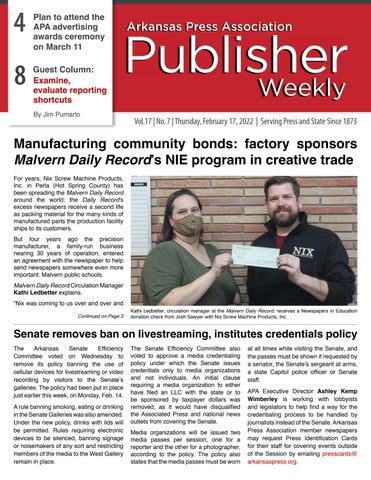
Manufacturing community bonds: factory sponsors Malvern Daily Record’s NIE program in creative trade For years, Nix Screw Machine Products, Inc. in Perla (Hot Spring County) has been spreading the Malvern Daily Record around the world: the Daily Record’s excess newspapers receive a second life as packing material for the many kinds of manufactured parts the production facility ships to its customers. But four years ago the precision manufacturer, a family-run business nearing 30 years of operation, entered an agreement with the newspaper to help send newspapers somewhere even more important: Malvern public schools. Malvern Daily Record Circulation Manager Kathi Ledbetter explains. “Nix was coming to us over and over and Continued on Page 2
Kathi Ledbetter, circulation manager at the Malvern Daily Record, receives a Newspapers in Education donation check from Josh Sawyer with Nix Screw Machine Products, Inc.
Senate removes ban on livestreaming, institutes credentials policy The Arkansas Senate Efficiency Committee voted on Wednesday to remove its policy banning the use of cellular devices for livestreaming or video recording by visitors to the Senate’s galleries. The policy had been put in place just earlier this week, on Monday, Feb. 14. A rule banning smoking, eating or drinking in the Senate Galleries was also amended. Under the new policy, drinks with lids will be permitted. Rules requiring electronic devices to be silenced, banning signage or noisemakers of any sort and restricting members of the media to the West Gallery remain in place.
The Senate Efficiency Committee also voted to approve a media credentialing policy under which the Senate issues credentials only to media organizations and not individuals. An initial clause requiring a media organization to either have filed an LLC with the state or to be sponsored by taxpayer dollars was removed, as it would have disqualified the Associated Press and national news outlets from covering the Senate. Media organizations will be issued two media passes per session, one for a reporter and the other for a photographer, according to the policy. The policy also states that the media passes must be worn
at all times while visiting the Senate, and the passes must be shown if requested by a senator, the Senate’s sergeant at arms, a state Capitol police officer or Senate staff. APA Executive Director Ashley Kemp Wimberley is working with lobbyists and legislators to help find a way for the credentialing process to be handled by journalists instead of the Senate. Arkansas Press Association member newspapers may request Press Identification Cards for their staff for covering events outside of the Session by emailing presscards@ arkansaspress.org.
Manufacturing community bonds: factory sponsors Malvern Daily Record’s NIE program in creative trade Continued from Page 1
buying our leftover newspapers for $3 per bundle. Every time they came to pick them up, they’d have to stop and give me money,” Ledbetter says. So she approached Nix with a proposal: For an annual donation of $600 to the paper’s Newspaper in Education program — about what it was spending on bundles — the Daily Record would give its print overruns to the manufacturer to use in their shipping. Instead of processing multiple purchase transactions, the one corporate donation each year would supply both parties with the resources they needed. In Malvern’s NIE program, teachers throughout the local public schools, kindergarten through 12th grade, can request a weekly newspaper to use in their curriculum. Every week, the participating teachers receive copies of Tuesday’s edition. Ledbetter says they deliver 250 newspapers to the local schools each week. Nix is joined by six other local companies that sponsor the local NIE program.
Teachers use the free newspapers in their classrooms in many ways, from practicing reading with students and learning about current events and stories from the community to teaching journalism. Ledbetter says her kids’ teachers have used the ads and sales sections to teach students about retail costs, as part of a larger lesson on learning to develop and stick to a household budget. The educational applications are limited only by instructors’ time and imaginations. Josh Sawyer, Nix’ sales and production manager, says he likes that the Newspaper in Education program shows students they can find information from sources beyond their screens. “Everything’s digital now, so I think it’s good some of the kids get to see and read the news in print rather than just sitting on their devices.” Sawyer says he’s happy the company can support the Malvern Daily Record, which, he says, is strongly connected to and involved in their local community. He says he’s noticed, “They’re at most every function, have a representative there
M SS
reporting on anything that happens in our community.” He adds that the original choice to use newspaper overruns for packing its new parts in boxes instead of investing in expensive bubble wrap and other packing materials was an innovation in itself. “It’s kind of a recycling deal,’’ he says. “We found a way to repurpose the extra copies and save on having to buy packing supplies.” Being able to continue that costsaving process while adding the direct community support component through NIE just made it sweeter. Brittany Pulley is CFO and office manager at Nix. She says the company is pleased with the past four years of sponsoring NIE and plans to continue. “I think the program is a good way for us to support the community,” she says. “When the paper offered us a new way to be able to do that, we knew we wanted to support the program. It’s a win-win for everyone.” Especially, as Ledbetter says, for the students.
(888)844-MASS (6277)
THIS IS HOW WE DO IT.
inthooz.com
DESIGN
ADVERTISING
DIGITAL
A strong corporate identity is rooted in impactful design. Our talents get noticed, and get results.
From traditional to tomorrow’s media, we’ll strategize, plan, implement and track your next campaign.
We’ll design and build your next site and bring you up to speed on social media and beyond.
Naming Logos Website Design Packaging Branding Sales Collateral Point of Sale Tradeshow Photography
Strategic Planning Campaign Management Campaign Reporting Printed Collateral Apparel Promotional Products Outdoor Direct Mail Digital
Application Development E-Commerce Solutions Business Solutions Web Development Social Media Management Content Development Search Engine Optimization Google Adwords Videography
Arkansas’s Leading Communications Agency Arkansas Publisher Weekly
2
February 17, 2022
Arkansas Press Association Virtual Advertising Conference March 11, 2022 Registration cost is $25 | arkansaspress.org/event/2022AdConference
BILL OSTENDORF President and Founder Creative Circle Media Solutions
Schedule 9:30 A.M.
“Creating Ads that Create Revenue” Presented by: Bill Ostendorf
Bill Ostendorf is president and founder of Creative Circle Media Solutions, a network of talent he has been building for more than 30 years. He founded Creative Circle, a consulting firm, in 1984 at the tender age of 28. Over the course of his newspaper career Bill worked as a reporter, photographer, news editor, features editor, copy desk chief and graphics director at a number of newspapers, including the Chicago Tribune, Paddock Publications in suburban Chicago, The Times-News in Twin Falls, Idaho, The Standard-Examiner in Ogden, Utah, and The Plain Dealer in Cleveland. He taught copy editing at Utah State University and has guest lectured at dozens of other universities. Bill holds a BSJ in magazine writing and an MSJ in newspaper reporting and management from Northwestern University’s Medill School of Journalism. After 16 years of balancing part-time consulting and fulltime newsroom work, Bill left The Providence Journal to manage Creative Circle full time in June 2000. Since then, he has worked with more than 300 media companies on three continents as a trainer or management consultant, and has led redesigns of more than 700 print publications and more than 300 web sites.
Welcome & Introductions Ashley Kemp Wimberley, APA Executive Director
1:00 P.M.
2022 APA Better Newspaper Advertising Contest awards presentation Emcee: Roby Brock
Plan to attend the APA advertising awards ceremony on March 11 Winners of the 2022 APA Better Newspaper Advertising Contest will be announced in the afternoon on Friday, March 11, in conjunction with the APA Annual Advertising Conference. The conference will be held virtually again this year.
press ARKANSAS ASSOCIATION
The contest, in which APA member newspapers submit their best advertising work from the past calendar year, honors the most innovative and effective ads and campaigns. This year, 731 entries were received for the 2022 contest. Entries were judged by volunteers from the Wisconsin Press Association.
2020 Better Newspaper Advertising Contest
Congratulations!
Prior to the awards ceremony Bill Ostendorf of Creative Circle Media Solutions will present a session on creating eye-catching, visually appealing ads that get the message across and result in more revenue. Plan to make it a day of training for your sales, art and production team to learn how to better meet the advertiser’s goals and improve communication among all parties.
March 11, 2022
The cost to attend is $25 per attendee. Register now at arkansaspress. org/event/2022AdConference.
Court rules against FOIA request for Arkansas state troopers’ photos
President
Executive Director
SAVE THE DATE
FOR THIS SUMMER’S
The Arkansas Supreme Court has ruled against a Freedom of Information Act request for photos of all Arkansas State Police troopers who do not work undercover, ruling that releasing the photos could identify undercover troopers and compromise their work. Blogger Russ Racop of Little Rock made the initial request in 2020. Last year a Pulaski County judge ruled ASP must release the photos, but this month the Arkansas Supreme Court overturned that ruling. The Pulaski County judge found that the photos in question did not fall under an exemption in the public records law for undercover officers. Racop noted that State Police regularly post photos of the same troopers on social media and argued that interpreting the exemption to include the photos requested would “swallow the public records rule.” But the Supreme Court justices interpreted the case differently. They ruled that because the photos could be compared against other open sources, such as Arkansas’ transparency website that lists the names, salaries and other identifying information of state employees, they could indeed be used to identify undercover troopers and undermine their investigations.
Arkansas Publisher Weekly
Tri-State Press Convention June 23 - 25, 2022 Sheraton Downtown Memphis
LET US KNOW We want to know about your new hires, retires and promotions! Send your staffing changes to info@arkansaspress.org to be updated online and included in the Arkansas Publisher Weekly. 4
February 17, 2022
Bipartisan Act would empower publishers to collectively negotiate compensation from Facebook, Google for use of their original content A Feb. 7 editorial in the Dallas Morning News, written by the paper’s editorial board, urges readers to support the Journalism Competition and Preservation Act bipartisan legislation now before Congress. The JCPA would allow publishers and broadcasters to collectively negotiate with online platforms (Facebook, Google, etc.) that currently use their original content with no compensation. The act would also mark a four-year antitrust exemption that would give local news sources the chance to get back on their feet, staff their newsrooms and resupply their communities with vital information. The act is co-sponsored by Sens. John Kennedy (R-LA) and Amy Klobuchar (D-MN). Opponents of the act, some of whom have accepted substantial campaign donations from Big Tech companies, have expressed concern that the legislation would create a “news cartel.” The Morning News writes, “This is not a serious scenario. Instead, the opposite is more likely. This would give more publishers, with different points of view, the opportunity to set up news organizations that reflect what their communities want.” Other opponents have said that local newspapers are obsolete institutions that, like the horse and buggy, should fade away as technology progresses. The Dallas Morning News asserts that digital news sharing has actually brought more readers to the newspaper than at any time in its history, averaging more than 10 million unique visitors monthly throughout 2021.
once supported the work of our journalists flows instead to a duopoly that even a company as strong as ours — one of the largest regional papers in the U.S. — cannot negotiate with singularly. Imagine what it must be like for mom-and-pop publishers in rural areas of this country.” It continues, “We need a better news and information system in our country that empowers a multitude of publishers, not only a handful of national papers and cable news channels, but a healthy ecosystem of local journalists who go to city halls and police stations, who are there for the high school football games and the opening of the new businesses in town.” The editorial cites a Washington Post study that found that since 2005, about 2,200 local newspapers have shuttered in this country. It notes that in many areas of the U.S., “local news coverage has been reduced to its thinnest form, if it hasn’t disappeared entirely.” The Morning News’ editorial board puts much of that blame squarely on the shoulders of Facebook and Google, which now dominate news dissemination. It says that in 2008, the entire U.S. newspaper industry collected $37 billion in advertising revenue. By 2020 that number fell to less than $9 billion. Yet in a single quarter last year, Google reported $61 billion in ad revenue. Likewise, Facebook, despite its recent stock stumbles, is poised to remain the other leader in digital advertising, the editorial asserts.
Yet, traditional advertising models need help adapting to the current digital environment. The Morning News writes, “... most of the advertising revenue that
“Much of this revenue is collected off the clicks and page views these companies gather from hosting the work of journalists. Most Americans now get their news through either or both of these companies. Yet Google and Facebook have not fairly compensated the news producers who
Our-Hometown, a content management & digital subscription software company, is hosting a live interview & AMA (Ask Me Anything) with Paul Farrell Jr. of Farrel & Fuller, LLC and Bob Fitzsimmons of Fitzsimmons Law Firm PLLC, two of the legal professionals leading an antitrust lawsuit against Google and Facebook on behalf of newspapers across the country.
Farrell and Fitzsimmons provide an update on the ongoing efforts in the lawsuit centered around allegations that Google and Facebook have monopolized the digital advertising market and conspired to manipulate online ad auctions. At the conclusion of the interview, publishers in attendance will have the opportunity to ask questions about the case and what it means for
Arkansas Publisher Weekly
5
drive a large share of content on their sites,” the editorial continues. It says that reaching a wide audience without using Facebook or Google has become nearly impossible, so the argument often made that news publishers have the choice to publish their original content elsewhere is unrealistic. The editorial concludes that failure to regulate the internet economy has “wrecked” what was once a robust journalism landscape full of local, regional and national news publishers. “[The Journalism Competition and Preservation Act] is a chance to bring part of it back, and we should all support it.”
the future of digital advertising. The interview will be at 11am on Thursday, February 24. Attendance is free, but registration is required. Register at https://our-hometown.com/ our-hometown-to-host-interview-andama-with-the-lawyers-behind-thegoogle-facebook-anti-trust-lawsuit/
February 17, 2022
Entry period now Excellence on editorial page to be open for $3,000 recognized by America’s Newspapers The prize is named for the late Benjamin Brechner Award Carmage Walls, whose newspaper
career spanned seven decades. Walls primarily owned community newspapers and advocated strong, courageous and positive editorial page leadership. Southern Newspapers, Inc, which is led by Walls’ daughter Lissa Walls Cribb, underwrites the cost of the awards.
The 2022 Brechner Center for Freedom of Information Award, recognizing excellence in news reporting across all media platforms that was aired or published during 2021, is now open for entries. The $3,000 cash award seeks to reward journalism published by a U.S.-based news organization, or collaborative of organizations, that advances the public’s right to know.
The Carmage Walls Commentary Prize will be awarded in two circulation brackets. First place carries a cash prize of $2,000, and second place winners will receive $1,000.
The annual Award has been presented since 1986 by the Brechner Center at the University of Florida. The prize money is
made possible by an endowment created by the family of radio broadcaster Joseph L. Brechner, who was one of the first in the country to run on-air editorials and inspire dialogue on issues such as civil rights, political and social extremism, and freedom of information. The award is primarily intended to reward journalism that is about the public’s rightto-know and about government secrecy, not just journalism that uses public records as a means to an end. The deadline for entries is Tuesday, March 1. Stories or series of stories related to these topics and published in a general circulation (non-academic) news medium (print, online or broadcast) will meet contest eligibility. For more information on the award, visit brechner.org/about/ awards or call 352-392-2273.
INDUSTRY QUOTE “There’s no rule on how it is to write. Sometimes it comes easily and perfectly. Sometimes it is like drilling rock and then blasting it out with changes.” —Ernest Hemingway Arkansas Publisher Weekly
America’s Newspapers will recognize editorial page excellence with the presentation of the 2022 Carmage Walls Commentary Prize at its annual meeting this fall. The award recognizes outstanding commentary on local issues and encourages thoughtful, courageous and constructive editorial page leadership on issues specifically relevant to each newspaper’s primary readership. The contest is open to members of America’s Newspapers.
“My father, Carmage Walls, believed a newspaper was a semi-public trust which should reflect and serve its community by providing constructive criticism and positive leadership,” said Walls Cribb. “Central to providing that leadership are local editorial pages. Editorial pages that are relevant, insightful and engaging should be the ‘town hall’ for a community and serve a role that no other institution or organization can.” The deadline for entry is Monday, May 2. To learn more about the prize and to enter the contest, go to form.jotform. com/212456682581158.
Support the future of Arkansas journalism through the Arkansas Newspaper Foundation. Your donation will help: • •
Promote the welfare of the community newspaper industry. Fund legislative efforts to protect transparency in state government.
•
Cultivate educational opportunities for future journalists.
•
Ensure the viability of the newspaper industry for years to come. Donate securely at: arkansaspress.org/page/aboutanf or mail a check to: Arkansas Newspaper Foundation 411 South Victory Street | Little Rock AR 72201
The Arkansas Newspaper Foundation is a 501(c)(3) organization. All donations are tax-deductible to the extent allowable under law.
6
February 17, 2022
1 BILLION+
$
RAISED FOR COLLEGE SCHOLARSHIPS. THE FUTURE’S LOOKING BRIGHT IN ARKANSAS! Since 2009, the Arkansas Scholarship Lottery has helped raise more than $1 billion in scholarship proceeds for Arkansas students. All over our state there are professionals who got their start with one of three lottery-funded scholarships. Together, lottery players and retailers are empowering students and creating winning futures!
SCAN TO LEARN MORE ABOUT SCHOLARSHIPS.
Guest Column: Examine, evaluate reporting shortcuts By Jim Pumarlo I fondly characterize newsrooms as organized chaos. I witnessed that firsthand, guiding staff when resources were plentiful and community newspapers had captive audiences. Dynamics are even more frayed in today’s changing media landscape as editors grapple with diminished resources and increased constraints on news gathering. Editors and reporters necessarily must explore and implement shortcuts, but you should keep two questions at the forefront: Are you really saving time considering the extra legwork that might be required to produce complete and compelling reports? Most importantly, are stories still relevant to readers and advertisers? Brainstorm with your staff, examining the pros and cons of each tool. Shortcut: Reporters depend more on web streaming of government meetings. Reporters benefit by being able to multitask during the “dead time” of meetings, and still give full attention to those items of highest interest. Broadcasts also can be reviewed later. On the flip side, how often have broadcasts run into technical difficulties such as poor audio? Are reporters accurately recording all votes and quotes, correctly identifying all individuals who address a body? Without being there in person, reporters can easily fall into the trap of writing for “those in front of the room” instead of translating what actions mean for “those in back of the room.” Shortcut: Reporters depend more on phone interviews. Reporters still have the ability to gauge the temperament of interviewees: i.e., cooperative, combative, evasive. It’s easier to schedule interviews amid demanding schedules. But reporters can be challenged to control the environment. Interviewees can more easily cut short conversations or refuse to Arkansas Publisher Weekly
answer uncomfortable questions. Phone interviews also are a missed opportunity to capture elements essential to fleshing out a story – especially a feature – such as describing a scene or a person’s body language.
that may be required to get a stringer’s draft ready for publication. Editors also should consider potential conflicts of interest such as hiring someone to cover city council who unsuccessfully sought office.
Shortcut: Reporters depend more on Zoom for interviews.
All of these tools can likely be used in varying degrees, but substantive reports must remain a priority. Don’t let shortcuts undermine the credibility of your product.
Zoom provides the opportunity for face-toface interviews and follow-up questions. Reporters may confront technical difficulties here, too. Interviewees also may short-circuit an exchange by limiting the length of a session. Shortcut: Reporters depend more on email for interviews. Interviewees typically have more time and flexibility to respond to questions, thus producing a better story. It’s likely easier for reporters to write a story versus sifting through and transcribing notes. Q&As can be a clear and concise way to present some stories, especially profiles on individuals. At the same time, email interviews limit the opportunity, or at least make it more difficult, to ask follow-up questions. Responses often are published verbatim with no attempt at editing and thus lack a conversational flow; they may even be written by a communications specialist. The most important information often is buried if answers are simply published in the order the questions were asked. Shortcut: Newsrooms depend more on correspondents and freelancers. A good stringer corps can effectively stretch resources. Correspondents do not necessarily have to write a full story but can assist in collecting essential information such as soliciting instant feedback from citizens attending a meeting. Freelancers may have a particular interest or expertise, thus minimizing the preparation for an assignment. On the other hand, skill levels can vary greatly. Don’t underestimate the extra work 8
For example: What message are you sending to readers if you report a 4-3 vote by the city council without identifying the votes? What message are you sending by relying on a press release, published verbatim, from the fire department – accompanied by a photo also submitted by the department – as your sole report on a downtown fire? An injured firefighter remains nameless. What message are you sending if the city’s biggest property taxpayer announced a proposed change in its operations – both in virtual and in-person meetings promoted by a full-page ad – and the newspaper attends neither meeting? The story appears nine weeks later after the company makes a presentation to the city council. Solid reporting means delivering the 5 Ws and H. Sticking to the tenets of journalism is essential if you are to promote yourselves as the newspaper of record in your communities. Jim Pumarlo is former editor of the Red Wing (Minn.) Republican Eagle. He writes, speaks and provides training on community newsroom success strategies. He is author of “Journalism Primer: A Guide to Community News Coverage,” “Votes and Quotes: A Guide to Outstanding Election Coverage” and “Bad News and Good Judgment: A Guide to Reporting on Sensitive Issues in Small-Town Newspapers.” He can be reached at www. pumarlo.com and welcomes comments and questions at jim@pumarlo.com.
February 17, 2022