2 5
Register now for 2020 APA Convention Guest Column:
Protecting the U.S. Postal Service Also Safeguards Your Access to Information
By Dean Ridings
Arkansas Press Association
Publisher Weekly Vol. 15 | No. 35 | Thursday, August 27, 2020 | Serving Press and State Since 1873
Ostendorf, Slimp eager to share expertise with APA major benefit of online training is that it eliminates the time and expense of travel to a location. He’s facilitated hundreds of webinars, and one important aspect of many of them is that they are often recorded and used as a resource for later (or for registrants who may not have been able to attend.)
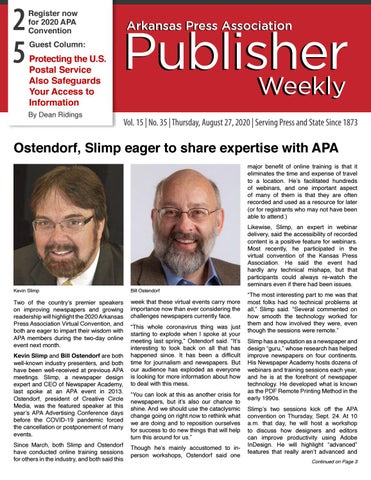
Kevin Slimp
Bill Ostendorf
Two of the country’s premier speakers on improving newspapers and growing readership will highlight the 2020 Arkansas Press Association Virtual Convention, and both are eager to impart their wisdom with APA members during the two-day online event next month.
week that these virtual events carry more importance now than ever considering the challenges newspapers currently face.
Kevin Slimp and Bill Ostendorf are both well-known industry presenters, and both have been well-received at previous APA meetings. Slimp, a newspaper design expert and CEO of Newspaper Academy, last spoke at an APA event in 2013. Ostendorf, president of Creative Circle Media, was the featured speaker at this year’s APA Advertising Conference days before the COVID-19 pandemic forced the cancellation or postponement of many events. Since March, both Slimp and Ostendorf have conducted online training sessions for others in the industry, and both said this
“This whole coronavirus thing was just starting to explode when I spoke at your meeting last spring,” Ostendorf said. “It’s interesting to look back on all that has happened since. It has been a difficult time for journalism and newspapers. But our audience has exploded as everyone is looking for more information about how to deal with this mess. “You can look at this as another crisis for newspapers, but it’s also our chance to shine. And we should use the cataclysmic change going on right now to rethink what we are doing and to reposition ourselves for success to do new things that will help turn this around for us.” Though he’s mainly accustomed to inperson workshops, Ostendorf said one
Likewise, Slimp, an expert in webinar delivery, said the accessibility of recorded content is a positive feature for webinars. Most recently, he participated in the virtual convention of the Kansas Press Association. He said the event had hardly any technical mishaps, but that participants could always re-watch the seminars even if there had been issues. “The most interesting part to me was that most folks had no technical problems at all,” Slimp said. “Several commented on how smooth the technology worked for them and how involved they were, even though the sessions were remote.” Slimp has a reputation as a newspaper and design “guru,” whose research has helped improve newspapers on four continents. His Newspaper Academy hosts dozens of webinars and training sessions each year, and he is at the forefront of newspaper technology. He developed what is known as the PDF Remote Printing Method in the early 1990s. Slimp’s two sessions kick off the APA convention on Thursday, Sept. 24. At 10 a.m. that day, he will host a workshop to discuss how designers and editors can improve productivity using Adobe InDesign. He will highlight “advanced” features that really aren’t advanced and Continued on Page 3
Register now for 2020 APA convention The Arkansas Press Association will host an unconventional annual convention this year, with two days of online meetings culminating with the annual Better Newspaper Editorial Awards to recognize the best work of APA reporters, photographers, designers and columnists. The 2020 convention theme, “Arkansas Newspapers: We’ve Got You Covered,” focuses on the strength of Arkansas newspapers to keep readers informed and hold government accountable during a world health pandemic and economic crisis. The theme is also a nod to the need for individuals to wear face masks to help fight the pandemic. Custom-made cooling face masks with the convention logo and theme are available for $10 each at the APA’s online store. Visit ArkansasPress. org/store to preorder. The virtual convention will have a significantly lower registration cost for attendees this year compared to years when the association has assembled in person. The cost is $50 per registrant for APA members and $75 for nonmembers. Much of the convention programming that had initially been scheduled for an in-person event in June will now
Members select new APA board be presented online, including two presentations by newspaper “guru” and design expert Kevin Slimp. Slimp kicks off the convention at 10 a.m. on Thursday, Sept. 24, with two consecutive workshops. On the afternoon of Sept. 24, participants will see a panel discussion regarding how newspapers may maintain trust with readers, followed by the past presidents’ gavel passing and installation of Rusty Turner of the Northwest Arkansas Democrat-Gazette as APA president. Recipients of the APA Educator of the Year and Freedom of Information awards will also be recognized on Thursday afternoon. Friday’s main presenter, Bill Ostendorf of Creative Circle Media, starts immediately after a 9:45 a.m. APA business meeting. Ostendorf will lead two sessions Friday morning, starting at 10 a.m. Following Ostendorf’s sessions on Sept. 25, attendees have the option to visit and network during an online luncheon prior to the presentation of the annual Better Newspaper Editorial Awards. To register for the convention, visit ArkansasPress.org/ events/2020convention
Sheridan Headlight offices relocate
Members of the Arkansas Press Association have elected seven members to the APA Board of Directors. The annual board election was conducted by mail earlier this month. The seven candidates on this year’s ballot included three new candidates, Frank Leto, publisher of the Log Cabin Democrat in Conway; Jim Perry of the Harrison Daily Times; and Britt Talent of the Cleveland County Herald in Rison. The three new members along with four returning members were elected to a year’s term on the APA board. All seven will be installed during the APA’s annual convention, being held online this year on Thursday, Sept. 24, and Friday, Sept. 25. The other four directors re-elected were: Jennifer Allen Commercial
of
the Pine
Bluff
Kelly Freudensprung of the Saline Courier in Benton Eliza Gaines of the Arkansas DemocratGazette John Robert Schirmer of the Nashville News-Leader The APA officers and executive board, which do not appear on the ballot, will also be installed during the convention. They are: President Rusty Turner of the Northwest Arkansas Democrat-Gazette; VicePresident Ellen Kreth of the Madison County Record in Huntsville; and Lori Freeze of the Stone County Leader in Mountain View. Congratulations to this year’s APA Board of Directors.
The Sheridan Headlight informed readers last week it will be moving its offices over the next month. The office will relocate to 204 N. Oak St., Suite B, in Sheridan, from its current location at 101 N. Rose St. The newspaper did not state a reason for the change, but did ask its readers
Arkansas Publisher Weekly
to “please bear with us as we make this transition, as we know, we may hit a few bumps along the way. We appreciate your business over the years and hope to give you many more years of our local news.” The Headlight is owned by former Arkansas Press Association President Byron Tate.
2
LET’S GET SOCIAL
@ArkansasPressAssociation
@ARPressAssoc
August 27, 2020
Ostendorf, Slimp eager to share expertise with APA
Continued from Page 1
guide participants through building an automobile advertisement. The second session, at 11:15 a.m., is called “Getting People to Pick Up Your Paper.” The subject is Slimp’s most requested and most popular topic for conventions. In it, he will discuss new research, focus groups and his experience as a consultant for thousands of newspapers to talk about how newspapers can attract new readers. “We will look at everything from content, to design, to customer service and more. The time will fly by,” he said. Ostendorf’s company, Creative Circle Media, provides custom web design and programming for newspaper clients, as well as hosts hundreds of media websites. They launched the industry’s first integrated paywall and first usercontributed content platform in 2005. The Arkansas Democrat-Gazette was one of the company’s first clients. Ostendorf, a former managing editor for visuals and new product development for The Providence Journal who has helped redesign more than 650 print publications and 350 websites, will lead two sessions on Friday, Sept. 25, starting at 10 a.m. He will focus on alternative, creative story ideas in addition to better kinds of headlines that will attract readers. “We have a very different philosophy about headlines that hopefully will shake up your thinking about both how important headlines are and how to make yours better,” he said. “My session on alternative story forms won’t just cover how to cover stories differently. I’ll also focus on changing what you cover because there are hundreds of great stories out there that newspapers are completely missing because they are so out of touch with readers.”
Senate GOP floats bill to provide U.S. Postal Service assistance Senate Republicans last week offered draft legislation to move forward with negotiations with the House and the President over relief to Americans because of the economic crisis tied to the coronavirus pandemic. Among the encouraging provisions in the draft is aid to the U.S. Postal Service, a financially strapped institution vital to the newspaper industry. The National Newspaper Association, which represents the newspaper industry in Washington, has not yet taken a provision on the Senate GOP plan but supports “unrestricted aid to the Postal Service.” The Senate plan would infuse the USPS with $10 billion in aid. Proponents hope the money will keep the Postal Service from reducing worker hours and eliminating some mail-sorting machines, as it has this summer. A House bill that allocated $25
billion to the USPS is not likely to pass the Senate. According to the NNA, the Senate GOP plan includes several items the newspaper industry supports. Those include loan forgiveness for small businesses that use their Paycheck Protection Program loans to pay printing and production costs (a “long-sought” provision, NNA said) for Internet and software contracts entered into before Feb. 15, costs of PPE and preparation for COVID-19. Borrowers who did not receive the maximum allowable PPP loan in the first round of funding, and whose status was changed by interim rules, could re-apply for that money. The legislation also includes multiple provisions protecting employers from lawsuits if someone contracts COVID-19 on the job, the NNA said.
Ad spending moderates in July After monumental declines in U.S. advertising spending in April and May, advertisers steadily trickled back into the ad market, according to a report from MediaPost. In July, ad spending declined by only 13.9 percent compared to July 2019. While still a significant drop, the decline pales in comparison to the 35 percent hit in April and 31 percent decline in May when compared to last year. According to MediaPost, “The July data is yet another positive indicator that the U.S.
ad recession is indeed bottoming out as many predicted in the third quarter.” March was the first month of 2020 to go into an ad recession, when sales fell 11 percent, according to the report. That coincides with the mid-March halt to many businesses and events at the onset of the coronavirus epidemic in the United States. In June, the decline was 17 percent. The report said digital ad spending actually rose in July, by 3.6 percent, compared to spending on digital ads in July 2019.
Registration is now open for the online convention. Registration fees for the two-day event are $50 for APA members and $75 for nonmembers. To register, visit ArkansasPress.org/ event/2020convention Arkansas Publisher Weekly
3
August 27, 2020
Arkansas Publisher Weekly
4
Date
Guest Column: Protecting the U.S. Postal Service Also Safeguards Your Access to Information By Dean Ridings (Editor’s note: The following column and accompanying cartoon may be reproduced in order to inform readers about the importance of the U.S. Postal Service. The Arkansas Press Association and America’s Newspapers encourages its members to use this editorial or write one of its own.) Facing a fierce public outcry, the U.S. Postal Service is “suspending” its sudden cost-cutting moves — tossing out high-speed sorting machines, uprooting collection boxes, reducing Post Office hours and eliminating carrier overtime — that have slowed mail delivery and threatened the on-time delivery of mail-in ballots for the presidential election. That’s all to the good, but it’s important to understand that the changes to USPS that Postmaster General Louis DeJoy and the current administration have in mind for after the election could permanently damage this quintessentially American institution — and citizens’ access to far more than ballots for November 3. Already, the controversy over the go-slow edicts have aroused public alarm about the effects on nearly every household. These effects aren’t just theoretical: Many have experienced delayed or missing deliveries of prescription medication, paper Social Security or payroll checks, legal documents, packages of the wide array of purchases during the pandemic lockdown and more. To these impeded services, add a vital source of local news for many Americans — the daily or weekly newspaper delivered to their mailboxes by a postal carrier. In the public imagination, kids on bikes Arkansas Publisher Weekly
could bring information quickly to the Colonies in the throes of revolution. But just as the newspaper is a local business, the local Post Offices and distribution centers are staffed not by faceless bureaucrats but neighbors and community residents. Newspapers’ partnership with the USPS has so far ensured that readers usually get their copies the same day that’s printed on the front page. Delivering newspapers is just one of the important services of an institution that has “service” in its very name. earning a bit of money before or after school still toss the local newspaper to the doorstep of subscribers. They were long ago replaced by adults with cars — but even that has changed at many local newspapers. Finding the independent contractors willing to deliver before dawn is a challenge for many newspapers, and sometimes the shrinking sizes of their routes make no economic sense for the newspaper or the driver. Newspapers discovered over the years, too, that their “alternative delivery” strategies for distributing advertising materials were becoming prohibitively expensive. The most cost-effective alternative for these newspapers is often the Postal Service. Newspapers and the USPS over the years have had their “frenemy” moments, with publications ever alert to changes in postage rates — with their arcane distinctions such as “in-county carrier routed sorted” or “Saturation/High Density Plus/High Density flats” — that have their roots going back to 1775 when the Post Office founded by Ben Franklin set purposely low rates so that newspapers 5
Unfortunately, the USPS is being treated as if it is a commercial enterprise that now “loses” money, a standard never applied to the Department of Defense, say, or FEMA. Nor has another agency, or private enterprise for that matter, been forced by law to pay upfront the cost of postretirement health benefits going 75 years into the future. The Institute for Policy Studies, a non-partisan think tank, figures this mandate costs the USPS more than $4 billion a year. Delivering the mail, including delivering newspapers, throughout the nascent and soon to be sprawling United States was so important to the framers of the Constitution that in its Article I they empowered Congress “To establish Post Offices and Post Roads.” With this crisis that’s been forced upon an already wounded United States Postal Service, it’s time to remind Congress that it also has a duty to sustain this vital wellspring of democracy and American identity. Dean Ridings is CEO of America’s Newspapers
August 27, 2020