2 6
Benji Hardy joins ProPublica’s Local Reporting Network
Guest Column: Between the Lines
By Brenda Blagg
ARKANSAS
PRESS
Ar kansas
Publisher Weekly
ASSOCIATION
Serving Press and State Since 1873
Vol. 14 | No. 25 | Thursday, June 27, 2019
2019 APA Convention kicks off in Hot Springs The 2019 Arkansas Press Association Convention in Hot Springs kicked off Wednesday with the annual Arkansas Newspaper Foundation golf tournament and is now in full swing at the Hotel Hot Springs.
to Incoming president John Bland of The Times Dispatch in Walnut Ridge during the ceremonial Passing of the Gavel at Friday’s luncheon. The main purpose of Friday’s luncheon will be to recognize the 2019 Headliner of the Year, Louis A. Cella of Oaklawn.
honored.
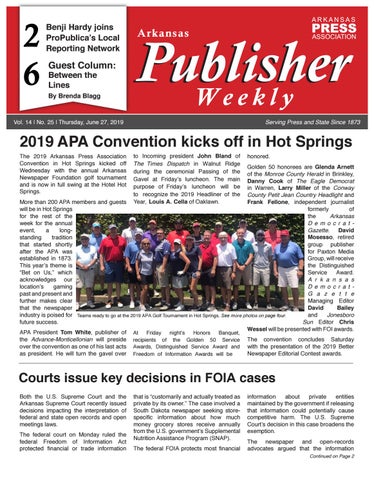
Golden 50 honorees are Glenda Arnett of the Monroe County Herald in Brinkley, Danny Cook of The Eagle Democrat in Warren, Larry Miller of the Conway County Petit Jean Country Headlight and More than 200 APA members and guests Frank Fellone, independent journalist formerly of will be in Hot Springs the Arkansas for the rest of the D e m o c r a t week for the annual Gazette. David event, a longMosesso, retired standing tradition group publisher that started shortly for Paxton Media after the APA was Group, will receive established in 1873. the Distinguished This year’s theme is Service Award. “Bet on Us,” which A r k a n s a s acknowledges our D e m o c r a t location’s gaming G a z e t t e past and present and Managing Editor further makes clear David Bailey that the newspaper and Jonesboro industry is poised for Teams ready to go at the 2019 APA Golf Tournament in Hot Springs. See more photos on page four. Sun Editor Chris future success. Wessel will be presented with FOI awards. APA President Tom White, publisher of At Friday night’s Honors Banquet, the Advance-Monticellonian will preside recipients of the Golden 50 Service The convention concludes Saturday over the convention as one of his last acts Awards, Distinguished Service Award and with the presentation of the 2019 Better Newspaper Editorial Contest awards. as president. He will turn the gavel over Freedom of Information Awards will be
Courts issue key decisions in FOIA cases Both the U.S. Supreme Court and the Arkansas Supreme Court recently issued decisions impacting the interpretation of federal and state open records and open meetings laws. The federal court on Monday ruled the federal Freedom of Information Act protected financial or trade information
that is “customarily and actually treated as private by its owner.” The case involved a South Dakota newspaper seeking storespecific information about how much money grocery stores receive annually from the U.S. government’s Supplemental Nutrition Assistance Program (SNAP). The federal FOIA protects most financial
information about private entities maintained by the government if releasing that information could potentially cause competitive harm. The U.S. Supreme Court’s decision in this case broadens the exemption. The newspaper and open-records advocates argued that the information
Continued on Page 2
Courts issue key decisions in FOIA cases
Continued from Page 1
should be disclosed, as it shows how the federal government is spending taxpayer money.
The state’s justices overturned a lowercourt decision that said Fort Smith violated FOIA. The lower court determined that
the email exchanges did not make for a public meeting because there was no vote and no decisions made in the emails. Instead, the court noted that the city board acted only at its public meetings.
The South Dakota newspaper, the Argus Leader, is owned by Gannett. In a statement, an executive with the news organization said the ruling: “effectively gives businesses relying on taxpayer dollars the ability to decide for themselves what data the public will see about how that money is spent.”
Joey McCutchen, the Fort Smith attorney who brought the lawsuit, said the decision demonstrates that the Legislature should further define what constitutes a meeting, according to media reports.
In the Arkansas case, a divided Arkansas Supreme Court ruled last week that members of the Fort Smith Board of Directors did not violate the state’s Freedom of Information Act by exchanging emails about city business.
Industry Quote "News is history shot on the wing." -Gene Fowler
Mark Your Calendar The APA will be closed on Thursday, July 4 for Independence Day!
Have a safe and fun holiday! Arkansas Publisher Weekly
the discussions in the email constituted a public meeting. However, the state Supreme Court said
Associate Justice Courtney Hudson Goodson wrote the majority opinion. To view the decision, as well as dissents, visit https:// opinions.arcourts.gov/ark/supremecourt/ en/item/417225/index.do
Benji Hardy joins ProPublica’s Local Reporting Network
Benji Hardy, a reporter and editor for the Arkansas Nonprofit News Network and the Arkansas Times, has accepted a fellowship with the news organization ProPublica and will be joining the ProPublica team in New York for one year.
people I love. I plan to be back in a year, but, plans, who knows?” ProPublica’s Local Reporting Network is at: https://www.propublica.org/localreporting-network/
Hardy will work with ProPublica’s Local Reporting Network. According to Hardy, the network is “a partnership that allows local and regional news organizations to carry out investigative projects they’d otherwise be unable to do.” Last year, he earned a reporting fellowship on Heath Care Performance from the Association of Health Care Journalists, and he spent a year covering Arkansas’s first-in-the-nation Medicaid work requirements. Hardy is a past winner of the Association of Alternative Newsmedia’s award for best investigative reporting. He is an Arkansas native and graduate of Hendrix College. “I am thrilled to have the chance to work with ProPublica and learn from some of the best reporters and editors in the business,” Hardy said in a social media post. “I’m also sad to leave Arkansas, which is my home and is filled with 2
Benji Hardy
June 27, 2019
ARFarmCredit.com
THE BEST SOURCE FOR AGRICULTURAL INFORMATION.
Financing agriculture and the rural lifestyle is all we do. We’re experts. Understanding the complex needs of Arkansas farmers, ranchers and rural homeowners means we’re the best source for agriculture information. AgHeritage Farm Credit Services Cole Plafcan • 501-210-4000
Farm Credit Midsouth
Michael Clayman • 870-932-2288
Farm Credit of Western Arkansas Jill Robertson • 479-567-4548
Arkansas Publisher Weekly
3
June 27, 2019
2019 APA Golf Tournament
1
The annual Arkansas Press Association Golf Tournament was held on Wednesday, June 26 at the Hot Springs Country Club. Everyone enjoyed the beautiful weather and had a great time. 1. Melinda Faubel of AT&T Arkansas, Andrea Peel of UAMS, Leslie Taylor of UAMS, tournament sponsors. 2. APA Past Presidents golf team 3. Rabo AgriFinance golf team 4. The Saline Courier and Malvern Daily Record golf team 5. Centennial Bank golf team 6. Trace Strategies golf team 7. Sponsors AT&T Arkansas and UAMS provided swag bags for each golfer.
2
Arkansas Publisher Weekly
3
4
5
6
7 4
June 27, 2019
Slimp’s “Adobe Extravaganza” webinar set for July 18 Design software expert Kevin Slimp will host a second webinar focusing on how newspapers can most effectively use Adobe software products. This webinar, scheduled for July 18 at 10 a.m., will be a followup to his successful June presentation on the same topic.
Buying or Selling? I can help you with a new purchase or the sale of your publication.
LEWIS FLOYD Senior Associate
During the webinar, Slimp will provide tools and tips for Adobe InDesign, Acrobat and Photoshop that will help designers improve their skills.
Kevin Slimp
(850) 532-9466 lfloyd@mediamergers.com
Among the topics to be covered in the 100-minute session: Creating and Working with Tables in InDesign (switching first/last name, etc); scripts and how to use them; data merge in InDesign; advanced photo editing techniques; embedding cutlines; dealing with four-color text and other problems in PDF files. The cost is $69. Register at: https://newspaperacademy.com/ webinar/kevinextapart2/
What’s Growing on in Arkansas?
Our team of experts can help you tell the story of our state’s #1 industry Public Relations Contacts:
For photos, video, news, commentary and more: arfb.com Facebook
Flickr
SoundCloud
YouTube
Guest Column:
Between the Lines By Brenda Blagg Historically, the Arkansas Supreme Court has been a strong defender of the public’s right to know. Last week, the current court fell short of the example set by its predecessors. In a 5-2 decision, the court ruled that two email chains among Fort Smith city directors in 2017 did not violate the Arkansas Freedom of Information Act. The emails discussed proposed change in the city’s Civil Service Commission rules or even its elimination. The discussions were related to a city initiative to diversify its Police Department. Obviously, the subject was sensitive. The email communications among directors happened before a public meeting on the matter. Did the emails themselves constitute a “meeting” under the state law? That was the underlying question in the lawsuit brought against the city of Fort Smith by a local citizen. A lower court ruled the email was subject to the state’s open-meetings law. The city subsequently appealed, resulting in last week’s Supreme Court decision. An earlier Supreme Court had determined that communication by telephone can be defined as a meeting under the law, which requires “all meetings, formal or informal, special or regular” of most governing bodies to be open to the public. Justice Courtney Goodson wrote the majority opinion, concluding that the justices “do not see any material difference” between the use of email exchanges and telephone conversations to conduct public business.
Arkansas Publisher Weekly
So far, so good for the majority’s reasoning.
secret. Secrecy is poison to democracy.”
That changed, however, when the majority also considered the specific content of the emails.
That’s exactly the point.
“The emails here contain information, a recommendation, and unsolicited responses with no decision,” wrote Goodson for the majority, asserting that the communication does not violate openmeeting provisions of the FOI Act. That was this Supreme Court’s dagger to the public’s right to know. As Justice Jo Hart wrote in dissent, the court’s majority effectively created a new test for judging email communication of public business. While she concurred with the majority that email can constitute a public meeting, Hart rejected the majority conclusion on content. “Perhaps unwittingly, the majority has imposed a requirement that, to constitute a meeting, an email must: (1) directly solicit a response; (2) render a decision; and (3) involve more than three-sevenths of a city’s board of directors. Worse still, these determinations will almost certainly require a lawsuit to resolve,” Hart wrote. That argument led to her further assertion affirming predecessor courts’ liberal interpretation of the FOI Act. The Fort Smith city email group was established to discuss public business, “which the directors obviously did,” wrote Hart. The “majority opinion denies the electorate in Fort Smith insight into the performance of its elected officials and allows those public officials to make their decisions in
6
The issue here isn’t just the decisions made in government. Equally important is the decision-making process, including the discussions that go into setting direction for a government. It is the “why” behind the votes for and against whatever a government does. Those discussions — no matter what form they take — serve to reveal what interests are driving decisions. And they invite different perspectives that might not otherwise be heard. John Tull, an attorney who represents the Arkansas Press Association, rightly predicted misuse of this new opinion “to the detriment of the public.” He observed, as many can, that governing boards around the state have attempted from time to time to circumvent publicmeeting requirements of the FOI Act. The city of Fort Smith is a multiple offender. Citizens there can certainly expect officials to push the envelope with future email communication that the citizenry won’t see. Other governmental bodies around the state, or individuals serving on them, may do so, too, waving this latest Supreme Court decision as some sort of permission slip for secrecy. Brenda Blagg is a freelance columnist, and has been writing “Between the Lines”, her weekly syndicated column, for 40 years. News outlets wishing to publish the column may reach her at brendajblagg@ gmail.com.
June 27, 2019