3 5
COVID-19 pandemic threatens government transparency
Guest Column:
In times of crisis, local papers should reconnect with the community
Arkansas Press Association
Publisher Weekly
By Jennifer L. Harker
Vol. 15 | No. 15 | Thursday, April 9, 2020 | Serving Press and State Since 1873
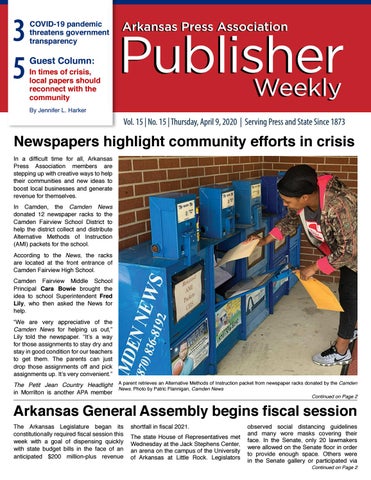
Newspapers highlight community efforts in crisis In a difficult time for all, Arkansas Press Association members are stepping up with creative ways to help their communities and new ideas to boost local businesses and generate revenue for themselves. In Camden, the Camden News donated 12 newspaper racks to the Camden Fairview School District to help the district collect and distribute Alternative Methods of Instruction (AMI) packets for the school. According to the News, the racks are located at the front entrance of Camden Fairview High School. Camden Fairview Middle School Principal Cara Bowie brought the idea to school Superintendent Fred Lily, who then asked the News for help. “We are very appreciative of the Camden News for helping us out,” Lily told the newspaper. “It’s a way for those assignments to stay dry and stay in good condition for our teachers to get them. The parents can just drop those assignments off and pick assignments up. It’s very convenient.” The Petit Jean Country Headlight in Morrilton is another APA member
A parent retrieves an Alternative Methods of Instruction packet from newspaper racks donated by the Camden News. Photo by Patric Flannigan, Camden News
Continued on Page 2
Arkansas General Assembly begins fiscal session The Arkansas Legislature began its constitutionally required fiscal session this week with a goal of dispensing quickly with state budget bills in the face of an anticipated $200 million-plus revenue
shortfall in fiscal 2021.
The state House of Representatives met Wednesday at the Jack Stephens Center, an arena on the campus of the University of Arkansas at Little Rock. Legislators
observed social distancing guidelines and many wore masks covering their face. In the Senate, only 20 lawmakers were allowed on the Senate floor in order to provide enough space. Others were in the Senate gallery or participated via
Continued on Page 2
Newspapers highlight community efforts in crisis Continued from Page 1
newspaper reaching out to the community by donating newspaper boxes for AMI work.
the two banks, Talent said. The giveaway is conducted with an entry form created through Google Docs and the use of an online random name picker for each daily drawing.
Students in the South Conway County School District in prekindergarten through eighth grade can pick up school work in the Headlight’s unused newspaper racks located in front of Morrilton Elementary School. In Rison, the Cleveland County Herald is directing money back to local, independently owned and operated restaurants through an “Eat Local Food Giveaway.” Herald Publisher Britt Talent sought sponsorships from two local banks to cover the costs of a total of 13 $25 gift certificates to local restaurants. The gift certificates are being given away in a drawing taking place each weekday until April 17. The newspaper is promoting the giveaway in three consecutive editions.
“The ad in the paper promotes each food establishment as well as the two banks,” Talent said. “Each day, our Facebook promotion features the restaurant for that day’s drawing. It’s been a huge success for everyone: The restaurants, the banks, us, and most of all, it’s a little local distraction to our readers.” It only took a couple hours to sell the promotional package, which directly helps local businesses and represents a goodwill gesture on behalf of the newspaper and
The giveaway parallels another initiative launched by the Herald at the time a health emergency was declared last month. The newspaper started an “Eat Local” campaign on its Facebook page at that time. These examples are just a few of the ways the newspapers are keeping community trust and weathering the pandemic. Publishers who have revenue-generating ideas or content they would like to share with other APA members, contact Ashley Wimberley at ashley@arkansaspress. org. The idea may be featured in an upcoming edition of Arkansas Publisher Weekly.
Arkansas General Assembly begins fiscal session Continued from Page 1
livestream from Senate offices.
Legislative leaders signaled a desire to end the session within 10 days, which means lawmakers will act on the flurry of budget bills with little or no debate or discussion. That said, the Arkansas Press Association plans to continue to review all bills and closely monitor the proceedings.
“Typically, fiscal sessions are more or less formalities and the newspaper industry is not affected,” said Ashley Wimberley, APA executive director. “Nevertheless, we are keeping a close eye on the Capitol and will keep our members abreast of any developments during the next few weeks.” The fiscal session is scheduled to conclude April 17. Arkansas Publisher Weekly 2
April 9, 2020
COVID-19 pandemic threatens government transparency Government entities across the United States and the world denied public access to information during the COVID-19 crisis, putting records and public meetings all on lockdown, according to a report from David Cuillier, president of the National Freedom of Information Coalition.
Cuillier, in a post on theconversation. com, noted that the University of Florida is “hiding its emergency response plan under a legal loophole intended to keep terrorists and enemy combatants – not viruses – from exploiting government weakness.”
same kind of pushback as was seen in Florida from several school districts. The schools refused to provide Moritz with their pandemic response plans, equating them with the homeland security assessments shielded by the FOIA.
The state benefits, too, from the Legislature’s move last year to require recordings of all public meetings of governing bodies. Those recordings must be made available to Arkansas residents and must be kept for at least a year.
Ashley Wimberley, executive director of the Arkansas Press Association, said Arkansas’s open records and open
On a larger scale, Cuillier and the National Freedom of Information Coalition have suggested the following to government entities as the crisis continues. The recommendations: · Postpone all nonessential government business decisions until after the pandemic
In a Texas community, a journalist was prohibited from attending a city council meeting, even though there were less than 10 people in the room. He said that although Texas law permits the public to listen in on meetings through a toll-free number, that same council failed to follow the laws. In the District of Columbia and in Michigan, governments have changed the method and duration of time for public employees to respond to records requests.
· Make sure necessary votes are made online in livestreamed meetings that are accessible to everyone · Stay out of social media, texting and phone calls when conducting the public’s business
As to the federal government, the FBI does not accept email or online requests for information. Citizens must now send requests through the U.S. mail.
meetings law remains in effect during the crisis, and said that most government entities have made sure to follow the law and stay accessible to the public.
Cuillier noted that, ironically, many entities moved to stifle the flow of information to the public during Sunshine Week in mid-March. Globally, reporters in the Philippines, Venezuela, Niger and India have been arrested or threatened with arrest because of their coronavirus coverage.
Mainly, entities have ensured their meetings remain publicly accessible either through conference calls or livestream over social media. The Arkansas Freedom of Information Act requires meetings be open to the public, though courts have consistently ruled that meetings can be conducted by teleconference as long as the public is provided with a call-in number to access the meeting.
In Arkansas, John Moritz with the Arkansas Democrat-Gazette faced the
· Provide journalists greater access to hospitals and health clinics while applying safety precautions and protecting victim privacy. “Arkansas’s strong Freedom of Information Act is helpful in difficult times like these, but we as a newspaper industry need to remain vigilant in ensuring the public’s right to know is protected during this time of crisis,” Wimberley said. “In an emergency, it’s more important than ever to have accountability and transparency within our government.”
LET’S GET SOCIAL
MARK YOUR CALENDAR
Follow us on Facebook & Twitter
APA Annual Convention September 24 & 25, 2020 Little Rock Marriott Arkansas Publisher Weekly
· Post documents and data online so that it’s already accessible. The public need not take time to request it and government workers don’t have to collect and deliver them.
@ArkansasPressAssociation
3
@ARPressAssoc
April 9, 2020
Facebook promotes Arkansas newspapers cut publication $100 million news frequency in response to pandemic grant program Several Arkansas newspapers this week days a week, will suspend its Saturday and Democrat-Gazette, Saline Courier among newspapers to have already received funding The Arkansas Democrat-Gazette and Saline Courier are among 400 news organizations that have received grant funding from the Facebook Journalism Project to defray the costs of reporting on the COVID-19 crisis in their communities. Each grant is $5,000.
The awards were the first phase in Facebook’s rollout of grants to assist news organizations in covering the crisis. On Monday, April 13, newspapers will be eligible to apply for grants ranging from $25,000 to $100,000. The grants will provide immediate support to help publishers address community needs and revenue shortfalls that would help an organization maintain its long-term stability.
scaled back their publication days in direct response to the economic downturn caused by the COVID-19 pandemic.
Monday editions starting Saturday, April 11. The newspaper will be on a Tuesday through Friday and Sunday schedule.
Paxton Media Group newspapers in Jonesboro, Searcy, Conway, Batesville, Paragould and Marion told readers this week they were decreasing the number of days the newspapers are printed each week.
In Crittenden County, the Evening Times will publish only once a week, on Wednesdays.
Jonesboro Sun Publisher Reece Terry, in a letter to readers on Wednesday, said; “…The business climate we are operating in is changing on a daily basis due to the COVID-19 outbreak and like most businesses in our community, The Jonesboro Sun is being negatively impacted.” Terry continued, “The decision to change our print frequency was not an easy one, but to do nothing simply is not an option. Instituting these changes now will help put us in a position to continue to serve our readers and communities for the long term.” The Sun, which had been printed seven
The Daily Citizen in Searcy is altering its publication schedule to three days per week – Tuesday, Thursday and Saturday – and independent carriers will no longer deliver the publication. Now, subscribers will receive that newspaper through the U.S. Postal Service. The Log Cabin Democrat in Conway is moving to delivery to the Postal Service as well, that newspaper announced. It is reducing its publication schedule to Tuesday through Saturday. There will be no Sunday or Monday newspapers. The Paragould Daily Press is also converting to three days a week: Tuesday, Thursday and Saturday; and The Batesville Daily Guard’s new publication dates will be Monday, Wednesday and Friday.
Siemers named to head Jonesboro Sun circulation department
The Sun in Jonesboro announced the hiring of Tom Siemers as its circulation director. Applicants in the Facebook Journalism Project COVID-19 Local News Relief Fund Grant Program will get preference if they:
Siemers was previously the circulation director at the Tribune Chronicle in Warren,
He was editor of his student newspaper in college, but enjoyed working in circulation, he said in an article in The Sun.
• Serve immigrant, rural, underserved or economically disadvantaged communities • Are located in areas where COVID-19 is “particularly acute”
“It’s not the same every day, there are a lot of things that can happen and a lot of people don’t like that,” he told the newspaper, adding “I’m reliant not just on a staff of a dozen people or more, but on a hundred and something carriers, too, and if they don’t do their job that can totally impact our day here.
• Explain how the grant will contribute to an organization’s long-term viability • Are family- or community-owned or independent • Have an established digital presence For more details and to learn about a webinar scheduled for Friday, April 10, regarding applications and eligibility, visit https://www.facebook.com/ journalismproject/programs/grants/ coronavirus-local-news-relief-fund Arkansas Publisher Weekly
Ohio, and the Vindicator in Youngstown, Ohio. He has more than two decades of newspaper circulation experience. He said his experience ranged from working at a major metropolitan daily, the Minneapolis Star-Tribune all the way to a newspaper in North Dakota that has a circulation of about 3,500.
“You have to take care of customers. If I don’t take care of customers, I don’t have a job, nobody has a job.” Siemers started work at the newspaper this week. 4
April 9, 2020
America’s Newspapers launches campaign America’s Newspapers has crafted marketing materials for free use by newspapers in print and online. The campaign both thanks subscribers and community members on the front lines of the fight against the coronavirus while reminding readers of the importance of local newspapers. The materials read “Newspapers have your back” and note that “We are grateful for those who have our back in this important time.” The series of print and social media ads may be acquired at no cost from America’s Newspapers, and local news organizations are free to add their own subscription marketing messages to the ads. America’s Newspapers reminded publishers that “readers are counting on you to bring them the news they need, when they need it. And the importance of the work that you do has never been more critical.”
We are grateful for those who have our back in this important time. The list is long, but we want to thank our first responders and front-line workers.
To download the advertising package, visit https://conta.cc/2VhL6rG
Especially in critical times, newspapers have your back.
INDUSTRY QUOTE
COVID-19 is a national story that is impacting you at home and at work. Your local newspaper is keeping you informed with current events in your neighborhood and is bringing communities together in these challenging times. From the actions your local government is taking, to lists of local stores that are delivering and tips on what to do while you’re at home, your local newspaper is committed to bringing you the news you need, when you need it.
“In the English language, it all comes down to this:
WE ARE IN THIS
Twenty-six letters, when combined correctly, can create magic. Twenty -six letters form the foundation of a free, informed society.”
Support your local newspaper. Subscribe in print or online.
― John Grogan Arkansas Publisher Weekly
TOGETHER
America’s Newspapers is a national association supporting journalism and healthy newspapers in our local communities. Find out more at www.newspapers.org or follow us on Twitter @newspapersorg or on Facebook @americasnewspapers.
5
April 9, 2020
Daily COVID-19 Arkansas Press Women to host updates posted annual contest awards online to APA website Arkansas Press Women will
Newspaper industry leaders in Arkansas are encouraged to visit the Arkansas Press Association website, arkansaspress.org, to read the latest and most up-to-date industry- and Arkansas-specific updates on the COVID-19 crisis.
ARKANSAS
press ASSOCIATION
The updates feature articles about resources available to business owners, grant opportunities and scheduled webinars that would benefit APA membership. To view the updates, visit ArkansasPress. org and click on the “Latest News” icon.
announce the winners in its annual communications contest during an event streaming online on April 25.
The annual awards will be broadcast via a Zoom conference call at 4 p.m. that day. The event will recognize participants in the yearly competition for Arkansas writers. Winners of the Arkansas Press Women awards are eligible to compete in the national contest, and those honorees will be recognized at the annual National Federation of Press Women conference still scheduled for June 1820 in Little Rock. Everyone who submitted an APW contest entry should receive an emailed invitation to the April 24 Zoom event.
Others may request an invitation at arkpresswomen@yahoo.com
¯¯¯¯
Subscribe today – to keep up with the outdoors in The Natural State. Call 800-283-2664 or visit www.agfc.com.
ARKANSAS WILDLIFE calendar issue
$12 per year $20 for two years $25 for three years
JULY 2015-JULY 2016
That’s six issues per year – including the July-July calendar.
Arkansas Publisher Weekly 6
April 9, 2020
Guest Column: In times of crisis, local papers should reconnect with the community By Jennifer L. Harker Crisis situations offer organizations an opportunity to reconnect with its community in new and refreshing ways. Crisis recovery also offers an opportunity to re-establish an organization’s reputation, which is a perception-based construct made up of the organization’s own actions, as well as the thoughts and word-of-mouth of that organization’s community. For example, ask yourself how your community perceives its local newspaper (if you’re reading this newsletter, that probably means the one you own or work for). What does the community say about media in general? A positive reputation is an organization’s first step in building a shared community identity and mobilizing that community for support. Mobilization of community is missioncritical to any business. For local newspapers, the same rings true because local newspapers need readers, subscribers and advertisers. Which actions has your local newspaper taken to mobilize its community to support the newspaper? I can assure you the number one way to mobilize your community is by building a shared identification within it. In fact, the local newspaper is the best vehicle for shared community identity and once that identity couples with a positively perceived reputation, your community will rally to support its local newspaper. Here are a few actions local newspapers can take to reach out to the community, build identification and mobilize support for the newspaper—even while a global pandemic rages. Build Identification First, you must know who your audience is and where your audience is engaging with your content and products. Precise targeted messaging is critical. This is important regarding social media, too. We researched one newspaper conglomerate where news managers assumed readers were on Twitter but the conglomerate’s Arkansas Publisher Weekly
senior leadership targets Facebook with subscription advertisements. This divergence of efforts is not a successful strategy, so communicate across the so-called “wall” and discuss with all departments who your target audiences are and where they engage. 1. Explain to your community that the local newspaper is a small business and therefore needs support. Let them know the local newspaper has been there for them throughout this crisis and that the community should also be there for you (and other local businesses). Offer tangible, specific ideas on how the community can support you: purchase a subscription, give a gift subscription, buy an ad. 2. Create niche subscriptions. The New York Times offers a subscription for only its crossword puzzle—and it is a big seller. Local sports sells, too. One conglomerate offers a niche subscription to sports content for a discounted rate but at the one-year renewal costs go back up. They have reeled in subscribers with this promotion and renewal rates so far look promising. Of course, sports aren’t being played right now, so this would be a chance to brainstorm to see what other types of niche subscriptions you could offer your audience. Local newspapers can do the same with advertising sales. Not only do consumers want to feel like they are getting a great deal in any purchase but with the financial ripple effect of this crisis, professionals will need to justify where their advertising dollars are landing and why. Offer a match, even if it is just a 1-1 deal. Use your social media platforms or your online advertising space for these matches. In the end, this is value added for both the local newspaper and the advertiser. 3. Show your community that you are their living history museum. The local newspaper’s morgue is incredibly rich with community history. Highlight this gem. Pull something from decades or even centuries past and rerun it. Get your community 7
to interact with that content and ask the community for requests. Each time you feature this historical content, explain how no one knows and understands the community more deeply than the local newspaper. Mobilize Support 1. There is power in numbers. There is also power in saturation and continuity of messaging. Create a mobilization campaign among your readership by partnering with another local media outlet (think radio) to promote and highlight each other’s work. 2. Strengthen your bench: -- Set up an anonymous tip hotline. The Los Angeles Times recently followed suit of the New York Times in introducing capabilities for people to submit anonymous tips for investigative work. Local newspapers should offer this capability. Set up the hotline in several formats: via text by using a privacy application like Signal, online via a secure drop box, and via phone or mail. Encourage your community to leave news tips that matter. Make sure you cycle through fact checking these tips and, when it results in a story, note that in the article. Show your community you are listening. -- Invite columns from people who have moved away from the community. Ask these people to share something important to them, to share a recent success, or to write about how where they came from shaped who they have become in their new city. Susan Ager, former features writer for the Detroit Free Press once taught me, “Humans are just like every other mammal. We like to sniff each other out.” Let your community members sniff each other out. Empower them with success stories they can relate to best. This is the one true richness of the local newspaper. -- Reach out to your state’s media schools. We are happy to take on communitybased media outlets throughout the state as clients for our PR, advertising and journalism students. We can help
Continued on Page 8
April 9, 2020
In times of crisis, local papers should reconnect with the community Continued from Page 7
with strategic planning, market research, public and community relations, and even advertising and design work for online or print. Just ask. Programs generally run by semester time period so you may need to exercise patience but we will help you if we can. 3. Finally, seek out grant money for financial support. There are numerous foundations and professional associations that financially support journalism, small businesses and even historical community document preservation. Research these opportunities and then seek out past
Arkansas Publisher Weekly
recipients and ask a few of them to share their application materials with you so you can create a strong request for support of your local newspaper. Crisis situations, including global pandemics, present a myriad of challenges but crises also can offer the opportunity for communities to reconnect. Local newspapers can utilize this opportunity to re-establish trust through actions and communication that shows the community all the ways in which the local newspaper serves them, and has served them for decades or even centuries. Remind your
8
community: we are all in this together. Jennifer L. Harker, Ph.D. is an assistant professor of strategic communication in the Reed College of Media at West Virginia University. You can find her on Twitter @jennifer_harker. This column first appeared in NewStart’s free newsletter, which covers community journalism trends and offers advice for those who own (or want to own) their own media publication. Sign up at https:// newstart.media/newsletter
April 9, 2020