3 5
Got Content? Great Ideas? Guest Column:
The coronavirus crisis has lessons about service journalism
Arkansas Press Association
Publisher Weekly
By Pete Pechal
Vol. 15 | No. 14 | Thursday, April 2, 2020 | Serving Press and State Since 1873
Newspapers highlight community efforts in crisis Sometimes, the worst situations bring out the best in people and that’s no less evident in the newspaper industry, where Arkansas Press Association members are highlighting their resilient communities during the COVID-19 epidemic.
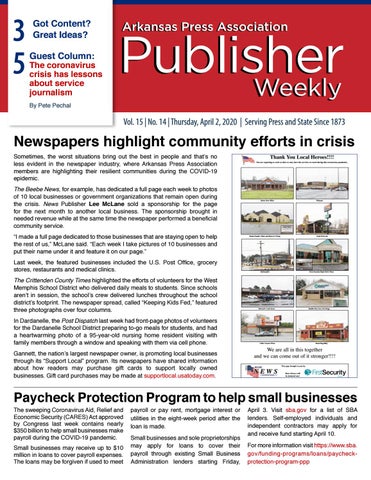
The Beebe News, for example, has dedicated a full page each week to photos of 10 local businesses or government organizations that remain open during the crisis. News Publisher Lee McLane sold a sponsorship for the page for the next month to another local business. The sponsorship brought in needed revenue while at the same time the newspaper performed a beneficial community service. “I made a full page dedicated to those businesses that are staying open to help the rest of us,” McLane said. “Each week I take pictures of 10 businesses and put their name under it and feature it on our page.” Last week, the featured businesses included the U.S. Post Office, grocery stores, restaurants and medical clinics. The Crittenden County Times highlighted the efforts of volunteers for the West Memphis School District who delivered daily meals to students. Since schools aren’t in session, the school’s crew delivered lunches throughout the school district’s footprint. The newspaper spread, called “Keeping Kids Fed,” featured three photographs over four columns. In Dardanelle, the Post Dispatch last week had front-page photos of volunteers for the Dardanelle School District preparing to-go meals for students, and had a heartwarming photo of a 95-year-old nursing home resident visiting with family members through a window and speaking with them via cell phone. Gannett, the nation’s largest newspaper owner, is promoting local businesses through its “Support Local” program. Its newspapers have shared information about how readers may purchase gift cards to support locally owned businesses. Gift card purchases may be made at supportlocal.usatoday.com.
Page 8, The Beebe News, Thurs., March 26, 2020.
Community
Thank You Local Heroes!!!!
You are reporting to work so that we may have the services we need during this coronavirus pandemic.
Beebe Post Office
Walmart
Beebe Family Clinic and Burrow’s Drug
Sonic Drive-In
McDonald’s
First Security Bank Drive-Thru
Edward’s Cash Saver
Health-Way Save On Drugs
Little Caesars Pizza
Road Hog BBQ
We are all in this together and we can come out of it stronger!!!! This page brought to you by: More Heroes will be featured next week! Stay Safe!
Paycheck Protection Program to help small businesses The sweeping Coronavirus Aid, Relief and Economic Security (CARES) Act approved by Congress last week contains nearly $350 billion to help small businesses make payroll during the COVID-19 pandemic.
Small businesses may receive up to $10 million in loans to cover payroll expenses. The loans may be forgiven if used to meet
payroll or pay rent, mortgage interest or utilities in the eight-week period after the loan is made.
Small businesses and sole proprietorships may apply for loans to cover their payroll through existing Small Business Administration lenders starting Friday,
April 3. Visit sba.gov for a list of SBA lenders. Self-employed individuals and independent contractors may apply for and receive fund starting April 10. For more information visit https://www.sba. gov/funding-programs/loans/paycheckprotection-program-ppp
MEDIA Your NewspaperName Persons engaged in the dissemination of news via newspapers, television, radio and other media are exempt from “shelter at home” or curfews because these business are deemed Essential Businesses. Government at all levels recognize the vital role media plays in keeping the public informed. The holder of this letter is an employee or contractor of (your newspaper name/group.) (Your newspaper group name) is a media company and the publisher of (your newspaper name), thus falling under the exception to travel restrictions afforded to “essential businesses.” The holder of this letter is performing a critical function for (your newspaper name) and this person’s presence outside or on the road is a legal exception to current travel restrictions. If you have any questions please contact (owner or publisher name and phone number). In the event authorities issue a shelter-in-place or stay-at-home order as a result of the COVID-19 pandemic, above is a template Arkansas Press Association members may choose to adapt from or copy to disseminate to newspaper employees/contractors.
Coronavirus Q-and-A with attorney John Tull As the coronavirus pandemic enters its second month, Arkansas Press Association members face unprecedented challenges along with unique circumstances regarding how to cover the pandemic and how to address workplace concerns.
Q) Do provisions of the federal HIPAA guidelines pertain to newspaper coverage? Tull: The Health Insurance Portability and Accoutability Act (HIPAA) only applies to covered entities, like hospitals and medical clinics. However, if a newspaper learns of information concerning one of its own employees through the newspaper’s health plan provider, the newspaper could not share that information without the employee’s specific, written permission. A covered entity (a hospital, for instance), may disclose patient information under the law without permission as necessary to treat the patient, to treat a different patient, or in case of an imminent threat to the public. In the case of a threat, the entity may provide patient information to government officials such as the police, the mayor or the governor. When asked by media, a hospital or clinic may provide limited information about a patient such as his or her general condition and location at the facility.
John Tull, attorney for the APA, graciously took the time this week to answer a few frequently asked questions from APA members.
Q) Is it appropriate or legal for a newspaper to publish information about an individual who has tested positive for the COVID-19 virus? Tull: If a newspaper receives general information from a governmental entity or
hospital about positive tests, the age of the patient, or deaths it is, of course, free to publish the information. A hospital or clinic should not release information about individual patients like name, address or underlying conditions but if such information is provided to a newspaper, there is no legal impediment to publishing that information.
Q) What legal implications do newspapers face when publishing health information of coronavirus victims? Tull: A newspaper is safe to rely on information from a hospital, the policy or the government. For information received from another citizen or an anonymous source, I would suggest verification of the information. A person could be sued for false light or invasion of privacy claims if false information is published; if the information is received from the police or the government It should be covered under the fair reporting privilege. Q) What can be done if an employee is displaying symptoms of the coronavirus? Tull: If an employee shows symptoms or has been exposed to someone who has tested positive for COVID-19, an employer may ask an employee to be tested and request the employee leave the workplace. The Centers for Disease Control and Prevention (CDC) has state that employees who exhibit symptoms Continued to Page 3
Arkansas Publisher Weekly 2
April 2, 2020
Coronavirus APA convention now slated for Q-and-A with September 24-25 in Little Rock attorney John Tull The 2020 Arkansas Press Association of the coronavirus epidemic. This year’s Continued from Page 2
should leave the workplace. Employers may require employees to notify their employer if they have been exposed to, have symptoms of, or have tested positive for the coronavirus. Employers may also take the temperature of an employee, but this testing must be uniform for all employees in similar positions. If temperatures are taken, the employer should provide appropriate
Convention is now scheduled for Thursday, Sept. 24, and Friday, Sept. 25, in Little Rock, APA officials announced.
convention
will begin on Thursday morning, Sept. 24, and end the next day in order to give APA members and participants enough time to get home for typical fall weekend activities.
ARKANSAS
press
The APA Board of Directors last week voted to postpone this year’s convention, typically held the last weekend in June or July. The new dates reflected a truncated schedule because
The convention site in Little Rock is also changing. The convention will now be at the Little Rock Marriott, located downtown. Additional details will be announced in the coming weeks.
ASSOCIATION
Got content? Great ideas? Personal Protective Equipment (PPE) to the person taking the temperature. Q) If the crisis worsens and layoffs are required, do employers face liability? Tull: Arkansas is an “at-will” state, meaning that an employer may terminate employment for any reason or no reason at all. Keep in mind, though, that employees may not be terminated for unlawful reasons such as age or sex discrimination or being a whistleblower. An individual employer should ensure an implied employment contract does not exist through an employee manual or other writing, but implied contracts are not usually found absent unusual circumstances. Q) Are employers required to provide paid sick leave? A) The Families First Coronavirus Response Act, which was recently signed into law, provides up to 80 hours of emergency paid sick leave for workers who are unable to work while they are sick or complying with COVID-19 restrictions or caring for school-age children due to the closure of schools or child-care facilities. Family and medical leave (FMLA leave) may be used be employees to care for family members affected by COVID-19. The mandatory paid leave provisions apply to employers with fewer than 500 employees and government employers. Payroll tax credits have been made available to assist employers who are required to provide emergency paid sick leave or FMLA under these programs. Arkansas Publisher Weekly
The newspaper industry faces new challenges daily, and counterparts across the state may have answers to those challenges. Let us know if you have some great, timely editorial work to share or if you have an advertising idea that can be utilized by other Arkansas Press Association members. “We usually come together a couple times a month to exchange ideas and share great work with others in the newspaper industry, but this
is a time where we need to emphasize the ‘hot ideas’ and best work from all of us,” said APA Executive Director Ashley Wimberley. “We will put together everyone’s content or advertising ideas and feature them in upcoming editions of Arkansas Publisher Weekly and on our website.” Send your best ideas for growing revenue and generating advertising to ashley@arkansaspress.org. Likewise, any great articles, investigative pieces or photos you’d like to share with colleagues, email ashley@arkansaspress.org.
Carroll County News suspends publication of weekend edition
The Carroll County News in Berryville has temporarily suspended its weekend edition, the newspaper announced last week. The newspaper will continue to publish midweek edition, and the standing features that are typically printed in the weekend edition – including the Faith page and detention center intake logs – will be included in the midweek publication.The lobby for the Carroll County News is also closed to the public. The newspaper is currently doing business via phone, email and fax.
3
April 2, 2020
Webinars to help newspapers grow revenue during COVID-19 crisis being offered in April Kevin Slimp, director of NewspaperAcademy.com and a newspaper design expert, is offering two webinars to help newspapers during the COVID-19 crisis. The webinars are focused on helping newspapers become “vanity” book publishers to aid authors who now are at home with time to finish their books.
According to Slimp, the publishing solution is a “win-win” for newspapers and local residents. Authors will be able to get their books published and newspapers may utilize resources they already have. Slimp has been a book publisher for years. The Arkansas Press Association will pay the registration fees of the first 10 APA members to email or call the APA to request registration for one of the seminars. Otherwise, the seminars are $59 apiece. The first, “Earn Significant Revenue Publishing Vanity Books: What you need
to know to begin right now,” is Thursday, April 9, at 2 p.m. Slimp will explain the insand-outs of the book publishing process and answer important questions, including how to start, how much to charge and how to make money publishing books. All newspapers need are software like InDesign or Quark, Photoshop and a good copy editor. To register for that webinar, visit https://newspaperacademy.com/ webinar/vanity01/. The second webinar is a followup to the first one. It is scheduled for Friday, April 17, at 11 a.m., will be able the technical aspects of designing and printing vanity books. Participants will learn how to design, edit and print books right away. The webinars plan to tell participants in an hour “what it took Kevin weeks to figure out on his own when he entered the publishing world.”
Buying or Selling? I can help you with a new purchase or the sale of your publication.
LEWIS FLOYD Senior Associate (850) 532-9466 lfloyd@mediamergers.com
Arkansas Publisher Weekly
Local Media Association sets fundraiser webinars The Local Media Association has scheduled webinars two webinars to help publishers establish a 501(c)(3) foundation to solicit donations to support the work of journalists in their communities. The program – available to only independent and familyowned media companies – will go step-by-step through the ways organizations can establish a COVID-19 Local News Fund. LMA will discuss how it can assist implementation of such a fund, how to market and fundraise and how to establish the fund. The webinar is available at 11 a.m. on Friday, April 3, and again at 11 a.m. on Monday, April 6. To learn more and register, visit https://www.localmedia.org/ covid-19-local-news-fund-webinar-information/.
4
April 2, 2020
Guest Column: The coronavirus crisis has lessons about service journalism By Pete Pachal If service journalism has a time to shine, it’s during a crisis. When things are going wrong, people need good, specific information to deal with the situation, they need to know that the information is trustworthy, and they need it fast — being able to make decisions quickly is fundamental to crisis management. As COVID-19 spreads around the globe, almost all news organizations have stepped up their output of service journalism. That was inevitable: It’s no exaggeration to say the coronavirus and the world’s response to it is affecting the lives of every person on the planet, and the essence of service journalism is to provide practical advice to make life more manageable, and in the midst of this pandemic that advice is more essential than ever. That doesn’t mean all the service journalism produced in the wake of COVID-19 is of equal quality, or that every media outlet should necessarily create their own disease FAQ, symptom guide, or hand-washing tutorial. The essential questions of service journalism in this crisis, which are being answered in real time, are whether readers are getting the specific information they need and whether the media is playing the right role. “There really is a thirst for news, but there’s also a thirst for service,” Elisabeth Goodridge, who heads up coronavirus service journalism for The New York Times, told me. “We thought that before, but now it is just pounded in — people really having questions. One big takeaway is understanding the value readers have on service, but also the extraordinary importance of making sure our service journalism is right.” Now that it’s been a coronavirus world for several weeks, we have a clearer picture of what works as effective service journalism in a crisis, and how those takeaways might inform the practice more generally. And while this situation is clearly an outlier — not to mention far from over — some lessons are emerging: Arkansas Publisher Weekly
1. With centralized information, the role of the service journalist is to add context: With coronavirus, the sources of raw information — for example, the number of infected, the incubation period of the virus, or what current local laws are in effect to combat the disease — are few, and are typically public or governmentsupported agencies. While a few large media organizations (like The New York Times) will be able to recreate some of that information in continually updated hubs, the role for most newsrooms is to use their sites to point readers to the trusted sources, and updating as often as they can. That doesn’t mean service journalists are demoted to mere middlemen; adding context relevant to your audience is important. The Guardian’s FAQ page on symptoms, which ranks highly in Google search, brings in information relevant to the paper’s largely UK-based audience with advisories from the country’s National Health Service (NHS) as well as relevant top-level information about the spread of the disease, testing, and how COVID-19 compares to seasonal flus and other pandemics historically. The Guardian also keeps the page current with the latest statistics, which is a good reminder that resources that resonate with readers (and rank highly in search) should be treated as living pieces of content, updated regularly. Be transparent about changes, but don’t shy from making them — the internet makes it easy to preserve history while ensuring readers have the best, most current information. “There’s a tremendous amount of information that, you know, six weeks ago no one knew and are desperate for now,” says Goodridge. “Some people don’t know where to go to sign up for unemployment benefits or mortgage relief, so let’s put that all in one spot and continue to update it.” 2. Google’s role is becoming more active: Big Tech has taken a lot of heat the past few years, in part because of their propensity to allow algorithms to dictate 5
what appears on their (very influential) services. Google was one of the hardest hit, but it responded by playing a more active role in what appears in search. While it’s still algorithm-driven, it’s made adjustments to demote undesirable content while elevating authoritative sources. It’s also created more tools that allow good information to surface to the top. This is readily apparent when you Google anything related to coronavirus. Results from the CDC, WHO, and state health agencies are almost always the top results, and if there are news sites listed, they’re usually “safer” mainstream brands like CNN or ABC News (there are exceptions, though). Search results pages (or SERPs, if you want to talk the talk) for coronavirus terms typically include Google’s myriad widgets, such as the news carousel, “common questions,” and sections linking to popular tweets or videos. Google’s also gone the extra, unusual step of creating a fully curated resource page about the disease, complete with a map, a list of common searches, and tips on working remotely. It’s clear that when the stakes are high, Google takes a more active role in ensuring the best results have every chance to surface. This is a double-edged sword for content creators. A SERP now has many different ways to reach readers, but larger sites and central authorities (like government sites) tend to win out, even for tangential search terms around a big topic. To compete for a spot on page 1 of Google, editors need to be more targeted than ever (not just which terms but which widgets), with content that truly is the best resource for readers. 3. Influencers and celebrities are effective messengers: As the crisis has worsened and many countries have transitioned from heightened concern to complete lockdown, information on how to cope with staying home has become almost as essential as information about the disease itself. But anyone following April 2, 2020
The coronavirus crisis has lessons about service journalism Arnold Schwarzenegger, Selena Gomez, or dozens of other celebrities on Instagram didn’t need to seek out a tutorial on hand-washing — it just appeared in their feeds. Celebrity influence is nothing new, of course, but in the context of service journalism, they can be effective at activating their followers, amplifying a specific message and giving it both a wider reach and a longer tail — potentially providing rocket fuel to a generally slowto-rank-on-Google content strategy.
on a piece with good visuals as opposed to one without.
area to how to more effectively work from home.
5. Newsletters can be a great tool for cultivating loyal readers: A host of publications have launched “pop-up” newsletters in response to COVID-19. Since the crisis is relatively new, the newsletters have a dual role of informing and educating, helping readers understand the virus and its effects, in a way that gets pushed out to them every day.
“We’ve been astonished with the response to our coverage,” says Lynn Jacobson, deputy managing editor at the Seattle Times in Washington state, which has been one of the hardest hit by COVID-19. “Our traffic has been about three times its normal volume. This experience is underscoring a transition for us that was already underway: opening as many channels of communication as possible [with readers] to find out what they want to know.”
4. Data visualizations make good service journalism great: Service journalism is typically concerned with SEO, and that means optimizing things like keywords, titles, bulleted lists, tags, and more. In the race to perfect all that text, graphical elements are often treated as little more than afterthoughts. But if the coronavirus has taught us anything about online resources, it’s that they’re better with a map.
This kind of topic-based, educational newsletter is a great model for service journalism outside of a crisis. Often, being of service means guiding a reader through something complex, like buying a car. Many readers don’t just want to make a decision and go; they also want to get a base level of knowledge, and a planned newsletter “journey” — one designed and crafted to gradually baby-step readers through a topic — can be an effective tool at not just educating those readers, but also winning their loyalty as well.
Or, more broadly, they’re better with great data visualizations — a given for most service journalism as well. Whether it’s recommending the best vacuum or guiding you through a complex password change, a good service piece doesn’t just tell you what to do; it shows you as well. Google might not technically “recognize” a well-made chart or graph, but readers do, and they’ll typically spend more time
6. Listening to your readers is always the answer: The golden rule of service journalism is that the reader is the customer, and the customer is always right. Whatever your audience is searching for, you should seek to answer, or at least point to the right answers. If anything, the coronavirus crisis has deepened this truth as people seek more answers about everything from store closings in their
Arkansas Publisher Weekly
6
It’s one thing to do the bare minimum of reading comments and Twitter feedback, but many brands are stepping up by reaching out to their audience directly by proactively soliciting questions on social media or even hosting live panels with experts, as CNN has done. More than anything, this crisis has emphasized that journalists are part of the communities they serve. In a time where there’s so much we can’t control, it’s doubly important to have good information about the things we can. Pete Pachal is the executive editor of CoinDesk and has been the chief tech editor for several prominent media brands. Email him at ppachal@gmail.com
April 2, 2020