SUMMER 2026
°004
The
America
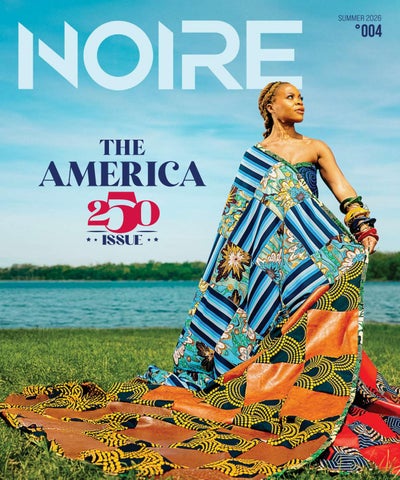
Model: Dr. Tamara Glover Photographer: Angie Walton Shot on Location: Regional Park in Pine Bluff Makeup: Eye Candy by Amari/Amari Briggs Quilt: Crystal C Mercer Watson Accessories: Bruce Brown
OnThe 2
NOIRE MAG A ZINE
SHE IS SOUTH
20 ft. x 6 1/2 ft.
(Quilt NOIRE) 2026
210 hours machine and hand stitched
Commissioned as both cover image and cultural artifact, She is South (QUILT NOIRE) created by Crystal C. Mercer Watson anchors Issue 004 of NOIRE in a tradition where story, survival, and self-definition are stitched into form. Designed as an enveloping garment and photographed as a contemporary reimagining of the Statue of Liberty, the piece reframes a national symbol through a distinctly Black, Arkansas-rooted lens that centers lived history. Watson, whose very name traces lineage to the work of textiles, approaches the quilt as both maker and historian. Constructed mostly by hand, with hundreds of hours of stitching, the piece draws from Pan-African textiles, vintage
Black life is fully seen and fully free. Its geometric
cottons, leather, and reclaimed materials to map a layered
patterns and textured surfaces position the
narrative of place, people, and possibility. Each fragment holds
modern Black Arkansan as both grounded and
intention, reflecting Arkansas’s landscape, the endurance
expansive, rooted yet oriented toward the stars.
of Black communities, and the creative force that has long
In this way, the quilt does double duty—it adorns
shaped American culture, often without recognition.
the cover and embodies the issue’s central inquiry, standing as a tactile declaration that
The quilt resists nostalgia and instead asserts continuity,
Black presence in America is not peripheral to the
honoring ancestral knowledge while imagining a future where
story. It is the fabric of it.
I SS UE 004
3
WHY QUILT NOIRE?
The American story has always been strengthened by citizens willing to challenge the nation so that it lives ups to its founding ideals of liberty and the pursuit of happiness. For many African Americans, patriotism has meant believing in the promise of America strongly enough to pursue, protect, and expand it, while not yet fully obtaining it. This issue is rooted in that belief. So when we began planning NOIRE’s America 250 issue, we knew the cover needed to reflect our place in American history. We choose to celebrate the anniversary of the signing of the Declaration of Independence not despite our complicated history, but because of it. Black Americans have helped build, defend, enrich, challenge, and improve this nation from its earliest days. Our fingerprints can be found on every chapter of the American story, from agriculture and industry to science, education, business, military service, government, sports, music, literature, and the arts. Our labor, ingenuity, faith, activism, and imagination are woven into every chapter of the nation’s history. That understanding led us to commission an original quilt, one of the most enduring symbols of how individual stories, struggles, and triumphs come together to create something larger than themselves. Much like America, a quilt is built piece by piece. The choice was also deeply personal and deeply Southern. Across Arkansas and throughout the South, quilts have long served as family archives, preserving memories that were often absent from official records and history books. Our grandmothers, aunts, and church mothers transformed scraps of fabric into objects of beauty, utility, and remembrance. These quilts carried stories of migration, perseverance, celebration, and loss. They represented a form of creativity born from necessity and a tradition of making something meaningful from what others overlooked. In many ways, that mirrors the African American experience itself and reflects how generations of Black Americans helped shape a nation that did not always fully recognize their contributions. The quilt featured on this cover helps reimagine the Statue of Liberty through that lens. Rather than presenting liberty as a finished monument, the artwork invites us to see freedom as an ongoing act of creation, one stitched together across generations by ordinary people doing extraordinary things. As America marks 250 years, we believe the most honest celebration is one that acknowledges complexity, honors sacrifice and recognizes the countless Black hands that helped build the country we know today.
This cover is both a tribute and a reminder: the American story, with its contributions by African Americans, reveals a richer, fuller, and more beautiful national tapestry.
Clean rivers and flowing streams don’t happen by chance. At LRWRA, we treat and reclaim used water to protect the natural spaces you love – whether for quiet nature walks or family outings. We work behind the scenes to protect Little Rock’s outdoor spaces because public health & a healthy environment go hand in hand.
NATURE WALKS Questions? 501.376.2903
LRWRA.com I SS UE 004
5
QUILT NOIRE: Denim, vinyl, African wax fabric, cotton, Italian wool, leather, mesh sequins, gold chain, custom enamel pin
6
NOIRE MAG A ZINE
I SS UE 004
7
What is NOIRE
®
NOIRE® is the premiere publication and online space for news and culture for, by, and about African-Americans in Arkansas. NOIRE® is the voice of black folk desperate to see, hear and share stories from our perspective. And we show and tell these stories, beautifully. NOIRE® fills the void for rich, beautiful content in written and pictorial form in both print and online mediums and is a work of art everyone will be proud to display. Established in 2022 and published quarterly by communications and media executives Stephanie Bass Jackson and Myron Jackson through Jackson and Jackson Publishing, LLC, NOIRE® brings us stories of triumph, heartache, celebration, grief, hope, and aspiration, and always leaves us wanting more. Each issue, NOIRE® features content that’s hot and relevant for the culture, of course. And we always keep the content fresh, thought-provoking, and exciting at NOIRE. This is our news, our culture, our time.
Find us at NOIREArkansas.com and on Facebook, Instagram, and X (formerly Twitter) @ArkansasNOIRE
8
NOIRE MAG A ZINE
Mission To unapologetically share the beauty and rich heritage of amazingly diverse Black Arkansans and to better foster cooperative and collective advancement of the people.
Vision To inspire all to a deeper collective love and appreciation for the contributions of Black Arkansans to the culture of Arkansas.
I SS UE 004
9
Content
28 FEATURE
Healing from the Margins
How Black physicians and medical schools helped shape the nation’s health, science, and future.
20 We Freed Ourselves FEATURE
Reframing emancipation through Black resistance and self-determination.
22 Emancipation Endures FEATURE
The story of Arkansas’ oldest continuously observed Juneteenth dinner.
26 The Institutions That Built Us FEATURE
How HBCUs became vital to American life.
10
NOIRE MAG A ZINE
30 The Lawsuit That FEATURE
Changed Arkansas Justice
A landmark victory for voting rights and representation.
34 The Faith That Helped FEATURE
Shape a President
Arkansas-born theologian James Cone’s influence on Barack Obama’s pastor.
FEATURE
38
The Work Beyond the Whistle Nolan Richardson on opportunity, power, and the unfinished promise of American progress.
FEATURE
42
The Image that Changed America
How Black media documented America’s contradictions and helped propel a movement.
FEATURE FEATURE
46
The Inheritance A conversation between generations on leadership, democracy, public service, and the unfinished work of America.
54
Where the Sound Began
Dazz “King Honey” Murry returns to Cotton Plant to trace the Black Southern roots of rock and roll.
50 Bending the Arc FEATURE
Citizenship, community, and the pursuit of justice.
58 AfriCOBRA FEATURE
64
FEATURE
Angelou & Ayana
One Arkansas literary giant helped create space for the next generation to tell their stories unapologetically.
A movement that placed Black life, beauty, and community at the center of American art.
62 Rhythm & Roots FEATURE
How Black language shaped America.
I SS UE 004
11
Founders / Publishers Stephanie Bass Jackson Myron Jackson Creative Director Myron Jackson Art Direction Kavish Hardowar Issue Contributors Chance Bradford Crystal C Mercer Watson Dazzmin “King Honey” Murry Karama Neal Katrina Dupins Shana Woodard Graves Stephanie Bass Jackson Tameka Lee Tanisha Joe-Conway Victoria Mays Issue Photographers Angie Walton Ebony Blevins Katie Childs LaQuan Williams
Vol. 001, Number 004 NOIRE Magazine is published quarterly by Jackson & Jackson Publishing, LLC Copyright 2026 NOIRE All Rights Reserved. Printed in the USA 400 W. Capitol Ave., Suite 1802 Little Rock, AR 72201
Cover and contents may not be reproduced or reprinted in any form or medium without prior written permission. While effort has been made to verify the accuracy of information presented in this issue, neither NOIRE nor its staff is responsible for omissions or information that has been misrepresented to the magazine.
Contact Us: Phone : 501.492.4900 | Fax: 501.492.4905 Mail: 400 West Capitol Suite 1802, Little Rock, AR 72201 Publisher: sjackson@arkansasnoire.com Sales: mjackson@arkansasnoire.com Editor: snelson@arkansasnoire.com Join our mailing list to see and read new content: ArkansasNOIRE.com
12
NOIRE MAG A ZINE
Find us wherever you are! Facebook, Instagram, and X @ ArkansasNOIRE
CONTRI BUTORS Angie Walton Angie Walton is a community‑focused media strategist and co‑owner of K & C Media with her husband, Ty. She creates stories that highlight the strength and potential of underserved communities, using media as a tool for visibility and empowerment. Angie’s work is grounded in care, accuracy, and a commitment to positive representation. She beautifully photographed our cover image and Dazzmin “King Honey” Murry during her trip to Cotton Plant for NOIRE 004.
Dr. Joseph Jones Dr. Joseph L. Jones is a political scientist, author, and nationally recognized scholar whose work explores Black political thought, higher education, and the evolving role of Historically Black Colleges and Universities. He serves as Executive Director of the W.E.B. Du Bois Southern Center for the Studies in Public Policy and Associate Professor of Political Science at Clark Atlanta University. A graduate of Philander Smith University and Clark Atlanta University, Dr. Jones is the author of Black, Not Historically Black: Towards the Pan-Black College and University and has held fellowships at both Harvard University and Stanford University. For this issue of NOIRE, Dr. Jones contributes to the “We Freed Ourselves” curation, helping frame a collection of literary works that document the ways enslaved Americans resisted bondage and pursued freedom on their own terms. He also lends his scholarship to NOIRE’s examination of HBCUs, tracing their historic significance, policy foundations, and enduring relevance in shaping Black intellectual, political, and cultural life in America.
Tanisha Joe-Conway A storyteller at heart, Tanisha Joe-Conway returns for NOIRE 004 where she joins New York Times bestselling author and Arkansan Ayana Gray in tracing the literary and cultural legacy of one of Arkansas’s most influential writers, Maya Angelou, examining how that voice helped shape the American imagination and Gray’s own. Joe-Conway, from Stephens in Ouachita County, is a longtime producer with Arkansas TV, shaping culturally significant work that has earned national and regional recognition over her decades-long career.
Katie Childs Katie Childs is an Arkansas-based photographer whose work centers on people and storytelling. Since 2011, her photography has been defined by intentional light, honest moments, and an instinctive connection with her subjects. For this issue of NOIRE, she photographed Little Rock Mayor Frank Scott Jr. and renowned gallery owner Garbo Hearne
Dr. Tamara Glover Dr. Tamara Glover is an educator, advocate, and titleholder whose work bridges scholarship, service, and representation. She serves as Associate Professor of Social Work at the University of Arkansas at Pine Bluff, is the co-owner of Fulfilled Life Counseling, and founder and CEO of Level Up Social Work, where her work focuses on community impact, empowerment, and the development of future social work professionals. Crowned Mrs. USA International Global, Dr. Glover is preparing to represent the United States at the Mrs. International Global competition in Malaysia. For NOIRE 004 as the cover model, she embodies a visual interpretation of liberty, resilience, and Black American identity at the center of the magazine’s America at 250 exploration. I SS UE 004
13
PUBLISHERS’
NOTE H
ow do you attempt to tell a story as vast as Black contribution to America in a single magazine? How do you choose which names, which histories, which voices, which victories, which wounds? And perhaps most difficult of all, how do you do it honestly without pretending the work could ever be complete? From the beginning, this issue was never intended to be definitive. It couldn’t be. There are too many people whose labor, brilliance, sacrifice, artistry, intellect, organizing, innovation, and courage shaped this nation and, in many cases, the world itself. There are names we know and names history tried to bury. There are stories passed through archives and stories passed only through families, churches, kitchens, porches, and memory. So let this be stated clearly: these pages do not represent it all. What they represent is an offering. A reflection. A starting point for deeper conversation about what America is, who built it, and who continues to move it forward.
14
NOIRE MAG A ZINE
When we began conceptualizing this issue last year in preparation for America’s 250th anniversary this question, “What is America’s story without Black people?,” kept coming back to us. We were extremely excited but also nervous. Not because there was a lack of stories to tell, but because there were too many worthy ones. Every feature felt consequential. Every omission felt noticeable. We spent months discussing not only who should appear in these pages, but why their stories mattered now.
It has always required vision, discipline, creativity, and persistence, often in the face of tremendous resistance. We hope this issue leaves you with pride. Not performative pride, but grounded pride. The kind rooted in knowing that Black Arkansans have consistently built, imagined, healed, taught, cultivated, defended, and transformed this country, even when denied full access to it. We also hope it leaves you with hope.
That same careful thought shaped the cover. We knew we did not want a traditional interpretation of patriotism or liberty. We wanted something rooted in memory, inheritance, and Black Southern life. We kept returning to quilts. For many Black families, quilts aren’t just fabric. They are warmth. Preservation. Resourcefulness. Beauty made from what was available, and they are often among the first works of art we ever encounter, even before we know to call them art.
Because if our ancestors could create beauty while carrying burdens we can scarcely comprehend, if they could build institutions while excluded from them, if they could preserve dignity while fighting to be recognized as fully human, then surely there is still reason to believe in what we are capable of now. This issue is for them. And for us. And for everyone still stitching together a future worthy of what came before.
Our grandmothers made quilts for their families. So did countless Black women whose creativity rarely entered museums, though it shaped generations of homes and lives. We began imagining the Statue of Liberty reinterpreted through that lens. What would liberty look like if envisioned through the hands, textures, and traditions of Black Southern makers? What would it look like wrapped not in copper or stone, but in something stitched together with care, endurance, memory, and survival? The result is the extraordinary quilted work by Crystal C Mercer Watson featured on this cover, transformed into a garment and photographed as both art and statement. It reflects exactly what we hoped this issue would hold: history and imagination existing together. Inside these pages are people who challenged institutions, changed culture, preserved truth, expanded opportunity, and created pathways where none existed. Some names are nationally recognized. Others should be. Together, they remind us that progress has never been accidental.
I SS UE 004
15
HBCU1873 DEAR MOTHER 150 YEARS OF EXCELLENCE BRANCH NORMAL COLLEGE
WE TAKE
IN OVERALL EXCELLENCE Since 1873, the University of Arkansas at Pine Bluff has educated and inspired some of the world’s greatest minds to reach beyond their circumstances and become who they want to be.
Scan here
to APPLY!
I SS UE 004
17
Getting to know YOUrself through substantive information, illuminating insights, and meaningful experiences.
ORIGIN & SELF-DETERMINATION :
• We Freed Ourselves • A Celebration of Emancipation Endures
INSTITUTIONS THAT BUILT AMERICA :
• The Institutions That Built Us • Healing from the Margins
voTING RIGHTS:
• The Lawsuit That Changed Arkansas Justice
FAITH & MORAL IMAGINATION :
• The Faith That Helped Shape a President
FRE
we
Written By Stephanie Bass Jackson
T
here is a version of American history that suggests freedom was given. That emancipation arrived as policy. That liberty was signed into existence. It is a tidy narrative. It is also incomplete.
Enslaved people in America did not wait passively for freedom. They resisted, organized, fled, fought, negotiated, and in countless ways, freed themselves. From the earliest days of bondage, there were uprisings on plantations, slowdowns in the fields, sabotage of tools, and the preservation of language, culture, and belief systems that refused erasure. Freedom was not a moment. It was a sustained, dangerous practice.
The Underground Railroad was not simply a network of helpers. It was powered by the courage and decisionmaking of enslaved people who chose to leave, often without a map, toward uncertain safety. Selfemancipation during the Civil War further reshaped the nation. As Union lines advanced, thousands of enslaved people fled plantations, forcing the federal government to confront the reality that the war could not be won without addressing slavery directly. Their movement changed policy, not the other way around. Even after the Emancipation Proclamation, freedom was neither immediate nor guaranteed. It had to be claimed, defended, and lived into existence.
To understand America at 250 years, we must interrogate who drove its transformation. The truth is not simply that slavery ended. Rather, it is that enslaved and formerly enslaved people played a
20
N O IRE MAGA ZINE
defining role in ending it through relentless pressure, resistance, and self-determination.
This issue of NOIRE invites you to go deeper. The books curated by Dr. Joseph Jones, associate professor of Political Science and executive director of the W.E.B. Du Bois Southern Center for the Studies in Public Policy at Clark Atlanta University, offer a more complete record, one that restores agency to those who have too often been written as recipients rather than architects of their own freedom. Read them. Sit with them. And reconsider what you think you know.
EED OURSELVES
KNOW YOU
FREED OURSELVES
Book recommendations from Dr. Joseph Jones, Associate Professor of Political Science and Executive Director of the W.E.B. Du Bois Southern Center for the Studies in Public Policy at Clark Atlanta University
• Day-to-Day Resistance: There is a River by Vincent Harding explores how small acts of defiance, like secret movements and reclaiming time, were vital forms of internal and physical liberation. • The General Strike: * Black Reconstruction in America by W.E.B. Du Bois is essential for understanding how enslaved people effectively crippled the Confederate economy by withdrawing their labor. • Maroon Communities: * Slavery’s Exiles by Sylviane A. Diouf. This is the definitive history of those who escaped and built independent, free lives in the American wilderness. • Military Service: * I Freed Myself by David Williams documents how Black soldiers and refugees forced the Union to make emancipation a primary goal of the Civil War. Freedom! Lest We Forget by Ronnie A. Nichols explores the history of Black Civil War soldiers from Arkansas including his own family. • Organized Insurrections: * Force and Freedom by Kellie Carter Jackson provides a deep dive into how Black abolitionists used and justified political violence as a necessary path to freedom. • The Underground Railroad: * Gateway to Freedom by Eric Foner. This book reframes the network as a sophisticated, Black-led intelligence and escape system.
Books can be purchased at Pyramid Art, Books and Custom Framing. *Available for checkout at CALS
A Necessary Correction I SS UE 004
21
A Celebration of
EMANCIPATION EMANCIPAT ION ENDURES THE TOWN OF WILMAR KEEPS THE
Table Set for ‘June Dinner’ E
22
N O IRE MAGA ZINE
B
B
I
E
K
E
N
D
R
I
C
K
KNOW YOU
E
very summer for more than 100 years, on the third Saturday of every June, the city of Wilmar swells from its normal population of just over 300 people. It’s a result of the throngs of beautiful, proud Black people who descend upon the small Drew County, Arkansas, town to participate in its annual Juneteenth celebration – dubbed the June Dinner. In 2021, Juneteenth became a federal holiday that commemorates the end of slavery in the United States. It is observed on June 19, which is the day that news of the Emancipation Proclamation finally reached Galveston, Texas, in 1865. Even before its designation as a holiday, communities across the country marked Juneteenth with parades, festivals, and other activities. But what separates Wilmar’s event apart from many others is that it has been taking place for more than a century. While no one knows the exact date of the first June Dinner, Wilmar mayor Toni Perry says the narrative of its genesis has been passed from generation to generation through oral history. She learned the story from her grandfather, Arton Ragland. “My grandfather, he couldn’t read or write, but what he did was tell stories. And he would always tell his grandkids that someone in his family brought June Dinner back to Wilmar,” the Wilmar native recalls. With a little more research, she was able to piece together the account she had heard many times growing up, learning that an enslaved couple from the Ozment Bluff area of Drew County was sold to a plantation in Texas sometime before 1865. “The husband and wife had to leave their baby at the plantation (in Drew County) with the older mama slave lady.” The locals believe that the enslaved couple worked in Texas for many years – long enough for the child to grow up and no longer remember their parents. Once the news of the signing of the Emancipation Proclamation finally reached Texas, the newly freed couple reportedly returned to Wilmar on foot and recounted those first freedom celebrations in Texas. Thus, the summer tradition of June Dinner was born.
EMANCIPATION
“ All the free slaves got together, and they contributed to this big dinner that everybody was having so they can get together and eat and celebrate freedom. ” That tradition has continued for generations, right up to the present day. Perry says the early years centered on dinner and sack races for entertainment. In its current iteration, a committee of ten people collects donations, sells vendor spaces, and holds fundraisers throughout the year to fund June Dinner concerts, bonfire pageants, and other events that annually beckon people back to the area and boost the local economy. The evolution is something that long-time attendee and Wilmar native John Hammock, 89, loves to see. He recalls coming out of the fields as a young man to fellowship and have June Dinner. “I enjoy seeing old friends and family members. For me, it’s about fellowship and celebrating our freedom.” While the times have changed since the early days of June Dinner, the heart of the revelry remains the same: never letting the next generation forget the need to return to Wilmar in remembrance of the period of America’s history when Black people were enslaved, and of course, to celebrate freedom. Perry says the committee is committed to keeping the June Dinner flame going for years to come. “We can’t just let it go quietly into the night. We have to keep making a noise. We’ll never let them forget.”
I SS UE 004
23
OUR
NEW S. O
UR C
ULT
URE
. OU
FALL
R TIM
E.
ADVERTISE WITH US!
2024
°002
°001
What is NOIRE ? ®
Fatima R
SUE RE IS 23 REMIENOVEMBER 20
THE P
obinson
NOIRE® is the premiere publication and online space for news and culture for, by, and about African-Americans in Arkansas. NOIRE® is the voice of black folk desperate to see, hear and share stories from our perspective. And we show and tell these stories, beautifully. NOIRE® fills the void for rich, beautiful content in written and pictorial form in both print and online mediums and is a work of art everyone will be proud to display.
NOIREArkansas.com
@ArkansasNOIRE
THE LIBRARY IS
CULTURE | CRE CREATIVITY A TIVITY | COMMUNITY Find your language. Share your voice.
100 Rock Street, Little Rock 501.918.3000 | cals.org
Written By Stephanie Bass Jackson There is a reason Black people talk about our colleges the way we do.
was vision, urgency, and ownership. They made them matter.
It is not just pride. It is memory. It is inheritance. It is the understanding that what we have built in this country did not come easily and was never guaranteed.
“They were essential in rebuilding this country,” said Dr. Joseph Jones, Executive Director of the W.E.B. Du Bois Southern Center for Studies in Public Policy and Associate Professor of Political Science at Clark Atlanta University.
In the years after the Civil War, formerly enslaved people worked alongside religious organizations, missionaries, and philanthropic supporters to establish institutions that could educate a newly freed population. But what Black communities brought to those institutions
26
N O IRE MAGA ZINE
That rebuilding was not symbolic. It was structural. HBCUs account for roughly 3% of colleges and universities in the United States,
yet they enroll nearly 10% of Black undergraduates and produce about 20% of Black college graduates, according to federal education data. In fields that hold communities together—education, engineering, and public service—their impact is even more pronounced. In Arkansas, that legacy is concentrated in four institutions: the University of Arkansas at Pine Bluff, Philander Smith University, Arkansas Baptist College, and Shorter College. Founded in the decades following emancipation, they were part of a broader national effort to stabilize Black
KNOW YOU
life in a country that had not yet decided what to do with Black freedom. “And so it basically accelerated and created the middle class,” Jones said. “It created the first set of leaders that would go on to help challenge and bring into fruition the laws needed to dismantle Jim Crow.”
“ These institutions did not simply educate. They built infrastructure. “
They Built More Than Degrees To reduce HBCUs to academic outcomes is to misunderstand their purpose. “Black colleges are Black communities,” Jones said. “If the community is doing well, then the institution is doing well. If the institution is not doing well, then the community is not doing well.” These campuses have long served as some of the most effective engines of upward mobility in American higher education, particularly for first-generation and low-income students, with research from Opportunity Insights showing that many HBCUs rank among the strongest institutions for moving students from the lowest income brackets into the middle class. “I had brilliant professors who held me to a standard,” Jones said. “They pulled something out of me that I didn’t even know was there … and convinced me that I could be great.”
That kind of formation is not incidental. At HBCUs, students encounter a full spectrum of Black life in a single space— different class backgrounds, ideologies, geographies, and lived experiences. In that environment, identity is not something to be explained. It is something to be developed.
How “Historically Black” Became Policy The term “historically Black” is not descriptive. It is legislative. Following the Civil Rights Movement, the Higher Education Act of 1965 formally designated these institutions as historically Black as part of a broader compromise tied to desegregation. “So the compromise … the Higher Education Act of 1965 basically designated that these Black colleges would become historic,” Jones said. “Meaning from this point forward, they’re no longer just Black. That was the compromise for desegregation.” “We stopped talking and having public conversations about our colleges,” he said. “It shifted toward survival.” Even within that constraint, HBCUs continued to produce outsized results. Today, they generate more than $16 billion in annual economic impact and support well over 100,000 jobs nationwide, according to the United Negro College Fund.
INSTITUTIONS
“Who stands in the gap to do this work?” Jones said. “It’s got to be us … because this is something we’ve always done.” In Arkansas, the University of Arkansas at Pine Bluff alone contributes nearly $100 million annually to the state economy and supports more than 1,100 jobs, according to UNCF economic impact data.
What Comes Next “A Black college ought to be a space where we’re in community, wrestling with one another, dealing with one another,” Jones said. HBCUs have already done what few institutions in America have done. They built a middle class. They produced leadership. They created continuity where there was none. They built us. Because institutions like these are not just part of history. They are infrastructure.
Data Sources National Center for Education Statistics; United Negro College Fund; Opportunity Insights; University of Arkansas at Pine Bluff economic impact data; U.S. Department of Education.
Why They Remain Necessary “As long as this country is committed to the racism that’s going on, Black colleges are always going to be necessary,” Jones said.
Photography courtesy of Arkansas Baptist College, Philander Smith University, Shorter College, University of Arkansas at Pine Bluff
I SS UE 004
27
Written By Katrina Dupins
Dr. James E.K. Hildreth President | Meharry Medical College
28
N O IRE MAGA ZINE
M
ore than half of the country’s Black doctors come from one of four Historically Black Medical Schools which include Howard University, Meharry Medical College, Morehouse School of Medicine, and the Charles R. Drew University of Medicine and Science. Each of the schools was created to combat discrimination in medical education and train Black physicians.
KNOW YOU
These institutions continue to serve to combat health disparities and advance healthcare in critical ways. Dr. James E.K. Hildreth, the 12th president of Meharry Medical College, is an immunologist, physician and one of the most recognized voices in American public health. He built a career on the study of how viruses invade the body from HIV to COVID-19. Dr. Hildreth’s joy for discovery can be traced back to his childhood. The youngest of R.J. and Lucy Hildreth’s seven children could be found taking apart toys to see the inner workings. Some days, he’d capture insects outside his Camden, Arkansas, home to examine them more closely. He was especially interested in space travel and had a particular passion for building model rockets, sometimes with a clear payload and an insect inside, dreaming of becoming an astronaut one day. In 1968, R.J. Hildreth died of renal cancer when James Hildreth was 11. In his grief, he felt an allconsuming rage. He viewed his father’s passing as a health disparity issue, realizing that being Black and poor was likely the reason his family received little medical attention despite the presence of a local hospital and doctors. “For months I didn’t speak to another human being because I didn’t understand,” Hildreth said. “But I tell people I’m so grateful I had a praying mother. My mother prayed, encouraged me, and sat with me. She challenged me to do something about it.” Lucy Hildreth told her son,”
Photography courtesy of Meharry Medical College
“ God has given you
some amazing talents. If you just remember where those talents came from, you can go and do some amazing things.”
That’s when the young Hildreth decided he would become a physician. As an undergrad at Harvard, he met his first professional and scientific mentor, the late Dr. R. Michael Williams, who inspired him to study immunology. The first time he designed a successful experiment, Hildreth was hooked. “In that moment, I realized I knew something
that had never been known before,” Hildreth said. “And until I tell somebody, I’m the only human being alive who knows what I know. It was an awesome feeling. I was hooked and knew then that research would be a part of my path.” As the United States marks its 250th anniversary, Hildreth’s life and work is one of many examples of how American medicine would look radically different without Black scientists and medical professionals. “When the medical workforce reflects the population it serves, outcomes improve,” Hildreth said. “It comes down to trust. When there’s trust between the provider and the
HEALING
patient, the patient will comply. They’ll fill the prescriptions. They’ll come back.” There are also the discoveries. Vivien Thomas, working without a formal degree at Johns Hopkins, developed the surgical technique behind the Blalock-ThomasTaussig shunt, which saved the lives of thousands of children born with heart defects. Charles Drew’s research made modern blood transfusions possible. Otis Boykin’s refinements to the pacemaker’s control unit are still beating in chests today. Then there is former Meharry president Dr. David Satcher. Like Hildreth, Satcher grew up Black and poor in the South with little access to medical care. He nearly died of whooping cough as a toddler because the local hospital turned his family away. A Black doctor walked miles to their home on his day off and saved his life. He went on to lead Meharry, then became the first African American director of the CDC, and in 1998, the 16th Surgeon General of the United States where he fought to eliminate racial health disparities and released the first-ever Surgeon General’s report on mental health. When asked what he would tell his eleven-year-old self, the grief-stricken boy, consumed with rage, Hildreth says to give yourself permission to find your passion. “The world needs you to pursue it, because your achievements will be most significant when you’re passionate about what you’re doing. There are people out there who don’t look anything like you, who come from totally different backgrounds, but they are there to help you along the way.” The boy who once launched insects toward the sky in a hand-built rocket grew up to spend his life studying what the naked eye cannot see and finding, at every turn, that the joy of not yet knowing is exactly what pulls us all forward.
I SS UE 004
29
The Lawsuit That Changed Arkansas Justice BY MARION HUMPHREY, JR. & STEPHANIE BASS JACKSON
The Hunt Decree stands as one of Arkansas’ most significant Voting Rights Act victories and transformed representation on the Bench. Today, as courts continue to narrow Voting Rights Act protections and make votedilution claims more difficult to pursue, Hunt stands as both a legacy of the Act’s power and a question about its future: Would a case like Hunt still be possible today?
E
ugene Hunt remembers a time when there were only two Black people regularly seen on the second floor of the Jefferson County Courthouse.
How Eugene Hunt’s landmark Voting Rights Act lawsuit transformed judicial representation in Arkansas.
30
N O IRE MAGA ZINE
“
“
THE LAWYER WHO CHANGED WHO SITS ON THE BENCH
Neither wore a robe or decided cases or signed orders. They were janitors.
The irony was difficult to miss. Jefferson County was home to a substantial Black population. Black residents appeared in courtrooms as litigants, jurors, witnesses, and defendants. Yet when it came time to take a seat behind the bench and decide cases, Black representation was nearly nonexistent. It was simply the way things were. Hunt, an attorney who began practicing law in Pine Bluff in the early 1970s, could not ignore the contradiction. And eventually, he decided to challenge it. Today, most Arkansans have never heard of Hunt v. Arkansas. Yet its impact has quietly reshaped Arkansas courtrooms across the state. The lawsuit began in 1989 with a question that was as simple as it was uncomfortable: If Black citizens make up a significant share of a community, why are they almost entirely absent from the bench?
KNOW YOU At the time, the imbalance was stark. In the judicial districts at issue in the case, approximately 27 percent of residents were Black. Yet only one of the 41 judges serving those districts was Black. Finding plaintiffs willing to participate proved difficult. Some feared retaliation. Others doubted the lawsuit could succeed. Hunt eventually became a plaintiff himself. By the late 1980s, voting rights lawyers across the country had developed a growing body of litigation challenging electoral systems that diluted Black voting strength. The legal framework emerged from Section 2 of the Voting Rights Act of 1965, one of the most consequential civil rights laws in American history. Section 2 prohibited voting practices that resulted in minority voters having less opportunity than others to participate in the political process and elect representatives of their choice. The Arkansas lawsuit would become part of that larger national struggle. To build the case, Hunt and a colleague, Lisa Kelly, assembled an extremely accomplished legal team. Among them was Arkansas attorney Arkie Byrd, who brought significant voting-rights experience and relationships developed through her work with the NAACP Legal Defense Fund. That connection proved critical. Through Byrd, the litigation gained the involvement of Lani Guinier, one of the nation’s foremost votingrights scholars and strategists. While the lawsuit still required painstaking legal work and negotiation, participants in the case recall that Arkansas’s political leadership did not approach the matter with the hostility that often accompanied voting-rights litigation elsewhere in the South. More significantly, the state ultimately acknowledged that the existing judicial election system violated the Voting Rights Act. That admission changed everything. Hunt and his colleagues still had substantial work ahead of them, but Arkansas’s concession allowed the litigation to focus less on whether a problem existed and more on how to solve it. That solution became known as the Hunt Decree, and it created real power—ten judicial electoral subdistricts in areas where Black voters could meaningfully participate in the election of judges.
Five were established in Perry and Pulaski counties. Two were created in Jefferson and Lincoln counties. Two more were formed in eastern Arkansas across Cross, Lee, Monroe, Phillips, St. Francis, and Woodruff counties. And another was established in southeast Arkansas in Ashley, Bradley, Chicot, Desha, and Drew counties. Over time, representation on the bench increased dramatically, moving from one Black judge among forty-one judgeships to ten. Former Pulaski County Circuit Judge Marion Humphrey Sr. was one of the first judges elected under the Decree and remains convinced that the decree strengthened public confidence in Arkansas courts. “I believe that Hunt has been good for the state and for the administration of justice, because more people believe in the fairness and integrity of the judiciary when they observe people who look like them presiding over cases,” he said. “The presence of diversity leads to more respect for the system of justice we have in Arkansas.”
THE LAWSUIT
The Hunt Decree by the numbers
1989 Filed
1991 Settlement Reached
10 Judicial Subdistricts Created
15
His view reflected findings that scholars and judicial reform advocates have noted for years. Public confidence in courts tends to increase when judicial institutions better reflect the populations they serve. A more representative judiciary can strengthen perceptions of fairness, legitimacy, and trust in the administration of justice.
Counties Impacted
Today, however, the Decree exists within a dramatically different legal landscape than the one that produced it.
10
When Hunt was negotiated in 1991, the Voting Rights Act enjoyed broad bipartisan support. Courts regularly enforced it, and states understood that voting systems producing discriminatory outcomes could face legal challenges.
1 of 41 Black Judges Before the Decree
Black Judges After the Decree
Section 2 Voting Rights Act of 1965
Today, that consensus is weakened. A series of court decisions and political battles have narrowed portions of the Voting Rights Act. Advocates argue that many of the legal tools used to secure representation in the late twentieth century would face far greater obstacles if pursued today. Byrd is among those who believed the environment had fundamentally changed. “That lawsuit wouldn’t go anywhere today,” she said. Whether one agrees with that assessment or not, it highlights the significance of Hunt’s lawsuit and the age-old question—whose voice is important to hear? Who gets a seat at the table?
ARKIE BYRD Arkansas attorney whose voting-rights experience and relationships with the NAACP Legal Defense Fund were vital to the case.
I SS UE 004
31
From Lots of Questions to Lots of
Business
Every business starts with questions. At FBT, we help you find the answers and the financing to move forward. We handle the details, explain your loan options, and guide you from grand idea… to grand opening. Whether you are starting out or growing fast, work with bankers who will help you build a plan that works. Let’s get you started. Scan the QR code to connect with an FBT banker today.* Disclaimer: Loans subject to credit approval. *Third-party data charges may apply.
Member
FDIC
fbtbank.com fbtbank
NMLS# 766443
I SS UE 004
33
L
ong before I ever heard the name Dr. James H. Cone, I understood the kind of faith he would spend his life describing. I grew up between two expressions of Black faith. My father was a United Methodist pastor, grounded in a more traditional church structure, while my mother raised me in the deeply emotional and spirit-filled world of Church of God in Christ worship. In both spaces, Christianity was tied to community, dignity, and justice.
The That Helped Shape a President
My father had been a community organizer during the Civil Rights Movement. He helped drive the nine Black students to Little Rock Central High as they integrated the school. So, faith was never presented to me as something separate from what was happening in the world. Christianity was about God and people, about standing for liberation, about standing beside folks even if it cost something. Dr. Cone gave words and structure to a belief many Black Christians had lived for generations: that faith and freedom belong together.
How Black liberation theology moved from Southern churches to the center of American political life
Born in Fordyce in 1938 and raised in nearby Bearden, Cone told NPR’s Fresh Air in 2008 that church was “that force in my life that… transcended the racial segregation I had to endure every day… we were God’s children… Church was the place that affirmed your somebody-ness in a world that treated you as nobody.” Cone would go on to challenge the American church and is considered the father of Black liberation theology. Through works such as Black Theology & Black Power and The Cross and the Lynching Tree, Cone insisted that a gospel disconnected from racism, poverty, segregation, and violence against Black people was morally bankrupt. Faith, he argued, was not only about personal salvation, but also about justice for the poor and the weak—the “heart of what Christian Gospel is about.”
Photography courtesy of Scott Olson
34
N O IRE MAGA ZINE
BY STEPHANIE BASS JACKSON
“ Faith had to mean something in real life.”
KNOW YOU
FAITH & MORALS
Cone’s influence entered one of the defining political stories of modern America through the Rev. Dr. Jeremiah Wright. Wright pastored Trinity United Church of Christ in Chicago and was heavily influenced by Cone’s work and Black liberation theology. Rev. Wright challenged racism directly, preached unapologetically about Black identity and justice, and rejected the belief that patriotism required silence about America’s failures. Among those sitting in Wright’s congregation for more than two decades was the man who would make history as the first Black person elected president, Barack Obama. Trinity was one of the places where Obama encountered a version of Christianity rooted not just in personal salvation, but also in justice and collective responsibility. Wright helped introduce a national audience to a tradition of Black faith shaped in part by Cone’s Black liberation theology. When Obama ran for president, that tradition suddenly found itself under intense public scrutiny. Wright’s sermons became a national controversy during the 2008 campaign, often framed as evidence of anti-American sentiment rather than part of a longstanding Black religious tradition that challenged the nation to confront its failures as well as its ideals. For Cone, the controversy surrounding Wright revealed a deeper discomfort. He argued that America often embraced Black culture while resisting Black critiques of racism and inequality. What many critics heard as anger, Cone understood as a response to generations of injustice. The backlash to Wright’s sermons demonstrated how difficult it remained for the nation to hear criticism when it came from Black churches. The path from Cone to Wright to Obama traces how ideas rooted in Black churches moved into the center of America’s political and moral conversation. By insisting that faith should not only comfort people but also call the nation to account, Cone permanently altered American religious and political thought.
Dr. James H. Cone
I SS UE 004
35
Exploring the nuances of African American culture by highlighting the diverse narratives, concerns, aspirations, and accomplishments that make us uniquely US.
• The Work Beyond the Whistle
Power & Using our voice
• The Reckoning Lens and the Image that Changed America • The Inheritance • Bending the Arc: Three Actions for Strengthening our Success
38
N O IRE MAGA ZINE
KNOW BETTER
BEYOND THE WHISTLE
BY STEPHANIE BASS JACKSON Photography by LaQuan Williams t 250 years, the United States has no shortage of narratives about its progress. Those narratives are supported by real change: expanded rights, broader access, and institutions that look different than they once did. Less often examined is how that progress has functioned in practice, how recognition and limitation have existed at the same time, shaping who advances and how far that advancement goes. The life of Nolan Richardson sits squarely within that reality. The outline of Nolan Richardson’s career is familiar, so this is not a story about what Nolan Richardson accomplished. That record is well established. It is a story about what his career reveals when you listen closely to how he describes it. “What makes mine more important than those who have stories to tell?” Nolan Richardson asked, the question arriving without performance, as if he were placing his life alongside others rather than above them. It was not modesty for its own sake. It was calibration. Richardson understood that his career, for all it represents, does not stand alone. It sits within a larger reality, one shaped by access and its limits, by opportunity and the uneven ways it has been distributed.
formalized but were deeply understood.
And still, that influence had limits.
“I was assistant athletic director for at least 10 years,” he said. “Nobody knew it. I wasn’t invited to none of their meetings. But it looks good on a piece of paper… how many Blacks do you have employed… well, we got one.” The distinction was structural. Richardson was central in moments that required judgment and perspective, particularly when race was involved, yet positioned at a distance from where authority was formalized. “I’ve seen a lot more,” he said. “I’ve been able to do a minimum, even though I may be qualified, because of a racial difference.” Richardson grew up in El Paso, Texas, where segregation defined what was accessible and what was not. You could see its presence in everyday routines. “I remember being the leading scorer… and you could come to town and say, ‘Who’s your best basketball player?’ and they would say Nolan Richardson… but he can’t even go to the movies.” The gap between recognition and access was clear. It informed how he understood opportunity.
His story is singular in its achievement. It also reveals something broader about how progress has worked in practice, who has been recognized, and who has been allowed to decide.
“We have a dream… the American dream everyone has,” he said, “which is given the opportunity to be able to do the best they can possibly do.”
Coach Richardson described what it felt like to live inside the tension of being the first Black man to coach at the University of Arkansas.
By the time he entered coaching, some of those opportunities had begun to expand. That did not lessen the stakes. His early career reflects both
“You know, coaches have had a lot, a lot of influence on the life of… much more than just his basketball team,” he said. “Some days I thought I was the chancellor of this university, ’cause every problem that was major, that had Black in it, there comes Nolan. ‘Bring Nolan in. Let’s see what he thinks.’” Nolan’s job extended far beyond basketball. It carried visibility across campus and into the broader community, a presence that shaped how people responded, what they expected, and where they looked for direction. The title coach held weight in ways that were not
I SS UE 004
39
movement and constraint. He was hired into roles that had not previously been available to Black coaches. At the same time, he understood what those opportunities required. “If you don’t succeed,” Richardson said, “the people that’s coming behind you will never get an opportunity.” Performance carried consequence. Success was not only personal. It was proof, and each outcome carried consequence for those who would follow. Before arriving in Fayetteville, Richardson had established a record of success. At Western Texas College, he led his team to the 1976 NJCAA national championship. At the University of Tulsa, he rebuilt a struggling program into a national contender, culminating in the 1981 NIT championship and multiple NCAA tournament appearances. At the University of Arkansas, that trajectory accelerated. His teams played with a pace and intensity — “40 Minutes of Hell” — that forced attention, reshaped expectations and defined an era. In 1994, Arkansas won the NCAA national championship, making Richardson one of the first Black head coaches to win a Division 1 men’s basketball national championship. The program returned to the national championship game the following year, with conference titles and Final Four appearances reinforcing its place at the top of the sport. Success, by any measure, was clear. But success did not resolve everything. Almost exactly 20 years after his firing in 2002, the university moved to formally recognize what had long been evident. The playing surface inside Bud Walton Arena now bears his name, Nolan Richardson Court, a permanent acknowledgment of his impact. Richardson was surprised by the university’s announcement earlier this year to construct a statue in his likeness outside the arena, a physical marker that will place him within the institution’s landscape that reflects both his success and his significance. When asked what he hoped people would carry forward from his story, Richardson returned to something simpler. “If you don’t stand for what you believe in, you won’t stand for nothing,” Richardson said. “I’ve always felt like I had to
40
N O IRE MAGA ZINE
KNOW BETTER
BEYOND THE WHISTLE
stand up and be counted. I’m not always going to make the right decision… but I can sleep at night if I know that what I said was true to me.” In 2014, he was inducted into the Naismith Memorial Basketball Hall of Fame, a recognition of a career that reshaped the game and expanded what was possible within it. His style of play, his approach to leadership, and the expectations he set continue to resonate through the sport. “I was blessed to be able to get as far as I’ve got.” Looking back, the coach not only measures his life only by what he accomplished. He also acknowledges what remains unfinished. “I’ve always prayed that I see the day that we all become human beings without being racial… understanding,” he said. That statement was not framed as certainty. It was framed as hope. And in that space, between what has changed and what remains unsettled, his story finds its place.
“
I’ve always prayed that I see the day that we all become human beings without being racial.
“
I SS UE 004
41
The Reckoning Lens & The Image that Changed America Written by Victoria Mays
“
“
The obscenity wasn’t the photograph; it was the murder. John H. Johnson
42
N O IRE MAGA ZINE
KNOW BETTER
A
s the country marks its 250th anniversary of the signing of the Declaration of Independence, there is a record of segregation, violence, and systemic exclusion, but how that record has been told, and by whom, has shaped what the nation understands about itself. For much of the 20th century, mainstream media did not consistently document the lived reality of Black life in America, particularly its most brutal truths. It was omitted in ways that allowed the national narrative to remain intact, even as it was incomplete. It is within that gap that John H. Johnson made one of the most consequential editorial decisions in American media. With courage, a small magazine, and a budding media dynasty, he separated American myth from American reality, ensuring that the lives of Black folks wouldn’t be diminished or erased. Johnson’s journey was the quintessential Great Migration story. He was born in 1918 in Arkansas City, Arkansas, a river town where the Mississippi River dictated the economy, and Jim Crow dictated the culture of humanity. Johnson’s early life wasn’t short of challenges—the death of his father, the Great Depression, and limited education access— that led to his family’s move to Chicago in search of better opportunities. There, he attended Du Sable High School where he served as editor of the school newspaper and yearbook and graduated with honors. While attending the University of Chicago on a full tuition scholarship, Johnson met Harry H.
THE IMAGE
Pace, the president of the Supreme Life Insurance Company. Johnson was offered his first editorial job compiling weekly news clippings, and within two years became editor of the company’s newsletter. His experience at the company provided direct insight into running a business, publishing, and economic sustainability. Eventually, this led to his first publication, Negro Digest, and a seed investment from his mother who gave her furniture as collateral for a $500 loan. By the early 1950s, Johnson Publishing Company became an example of Black autonomy. While mainstream media treated Black citizens as invisible or criminal, Johnson’s Ebony and Jet documented Black life with a radical sense of dignity. They showed Black thinkers, Black entrepreneurs, Black doctors, Black debutantes, and Black families. Over time, he built a media institution that was financially independent. He didn’t need permission to tell the truth.
“ Let the People See.” By the mid-1950s, Johnson Publishing Company’s independence was put to its ultimate test. In late August 1955, 14-year-old Emmett Till was lynched near Money, Mississippi. A white woman claimed Till whistled and made inappropriate advances toward her. When his body was pulled from the Tallahatchie River, it was unrecognizable. Till’s body was returned to Chicago and his mother, Mamie Till-Mobley, made a decision that altered the course of American history. The state of Mississippi wanted a quick, quiet burial. But, Emmett’s mother had a different vision. She demanded an open-casket funeral in Chicago: “Let the people see what I’ve seen.” While the mainstream white press hesitated, paralyzed by the “graphic” nature of the violence, Johnson and his editors at Jet recognized the moment for what it was.
On September 15, 1955, Jet published the photograph of Emmett Till’s mutilated face. Photo Credit: David Jackson *
I SS UE 004
43
*
The Risk and the Reckoning
When those who have been excluded from the national narrative finally control the camera, the reality of the country changes.
The decision to publish Emmett Till’s photo and story in Jet was a staggering editorial risk in an era where the media ecosystem was heavily regulated by the Comstock laws (“decency” laws). The Comstock laws granted the U.S. Postmaster General broad authority to seize and destroy “obscene, lewd, or lascivious” materials sent through the mail. For Black publications like Jet, these postal regulations were often used to suppress political dissent and reports of racial violence. In 1955, sending such an image through the U.S. mail could have been deemed “obscene.” But the obscenity wasn’t the photograph; it was the murder. Johnson also risked financial loss from skittish advertisers due to graphic “political” content, and physical threats to his distributors in the South who supplied white-owned newsstands. In the midst of those challenges, Jet was unique for its time—small enough to fit in a back pocket or a purse, and full of information. It bypassed the white-controlled newsstands of the South and was passed hand-to-hand in barbershops, beauty salons, and church pews. Within weeks, an estimated several million Black Americans had seen the photo. For Black Americans, the image was a confirmation of their vulnerability; for the rest of the country, it was an unavoidable indictment. Since the Black community saw Till’s photo first through strategic distribution and circulation, this illustrated the power of the Black community and provided the evidence required to force a national reckoning and transformation. History often credits the Montgomery Bus Boycott as the start of the Civil Rights Movement, but the fuel for that fire was found in the pages of Jet. Emmett Till’s photo didn’t just document history, it accelerated it and provided a visual moment for the brewing Movement. By documenting Black Life with both its triumphs and its tragedies, Johnson ensured that Black Americans were the authors of their own struggle. As we reflect on 250 years of America, the story of John H. Johnson and Emmett Till serves as a stark reminder of the power of the lens.
44
N O IRE MAGA ZINE
Without Johnson’s media empire, the murder of Emmett Till might have remained a local Mississippi tale; the “moral consciousness” of America might still be asleep. Johnson’s magazines did more than report news; they acted as a corrective lens for a nation that was legally blind. They ensured that Black Americans were not just subjects of the American story, but its authors. Looking ahead, the responsibility is clear: our stories must be recorded on our terms, preserved with integrity, and told without distortion. That is where our power lies.
*
The Inheritance
A rising public servant asks Little Rock Mayor Frank Scott, Jr. about leadership, legacy, and what 250 years of American democracy still owes its people
Photography by Katie Childs
By Chance Bradford, sophomore at Philander Smith University
“ We have to own that history,
cope with that history, and not revise that history so we don’t repeat that history.
“
Mayor Frank Scott, Jr.
Some leaders are built by their cities. Mayor Frank Scott, Jr. is one of them. For nearly eight years, Little Rock residents have watched him carry the weight of this city’s future with a kind of quiet steadiness — not loud about it, just consistent. That consistency has meant something, especially for the people who needed to see it most. This moment is bigger than Little Rock, though. Two hundred and fifty years ago, the Declaration of Independence put freedom on paper. What it didn’t do was make freedom equal. African Americans have spent every generation since then doing that work ourselves — through our churches, businesses, Greek affiliations, and on and on. We refused to stop pushing. The 250th anniversary isn’t
46
N O IRE MAGA ZINE
just a national milestone. It’s a reminder of who kept showing up even when the country wasn’t showing up for them.
about who you’re becoming. When we look at someone like Mayor Scott, we’re not just admiring the title. We’re studying the path.
That’s the world HBCUs were built inside of. And being a student at one changes how you see leadership. At Philander Smith University, it’s not really an extracurricular. It’s more like a proving ground — the kind of environment that doesn’t let you be passive
In the conversation that follows, he opens up about his wins, his hard moments, his vision, and the parts of his journey we don’t hear a lot about. This one’s for the people who’ve been paying attention.
Frank Scott Jr. Mayor · Little Rock, Arkansas
8
Years in office
#1
First popularly elected Black Mayor in the City of Little Rock
KNOW BETTER
Chance: So what’s one thing that you feel like America has to get right in order to honor the identity that it’s trying to build for itself?
Q A &
Mayor Scott: Here we are, today, as you know, yesterday, we had a very critical blow to the Voting Rights Act. SCOTUS’ 6-3 decision will dilute voting power. 61 years ago, Black men and Black women, by and large, couldn’t vote. We had to literally take a big jar of jelly beans and try to guess what number of jelly beans there were to even have the opportunity to try to vote. But we got our full rights and privileges in 1965… and so to have that blow and to also have legislatures trying to stop African American history from being taught in schools… we have to own that history, cope with that history, and not revise that history so we don’t repeat that history.
THE INHERITANCE
many others, to bring the school district back under local control by the city engaging in the process and creating a community schools model, which is now a statewide model. It’s in eight of our schools in the Little Rock School District, and we’re back under local control. Why do I say that? Be decisive on policies that are for the right reasons. And more than likely, that’s gonna probably be one of the most impactful policies we’ve ever made. We’re saving their lives along the way because of the community school model. If you do what’s right, it’s gonna impact the present and the future.
do the right thing, and to also chip away at [the unfairness] so that those coming behind us don’t have to deal with as much.
Chance: You’re a part of a generation of people that are the very first to hold these types of offices. So what exactly is drawing the line between being a burden bearer in comparison to a trailblazer?
attacks on your family, attacks on you personally, attacks potentially on your family. People don’t see that.
Chance: So what is something that this role in specific has required of you to sacrifice that you didn’t expect? Mayor Scott: My mental health. I probably didn’t think a lot about seeing a therapist until I got in this role. And that’s dealing with, you know, everybody calling you everything but a child of God—the impact it has on your family, the
Arkansas has never had a Black Congressman or woman. And then quite frankly, even before SCOTUS’s decision came down, two to three years ago, we had what they call cracking and stacking the 2nd [Congressional district] to try and prevent that from ever happening. Chance: So how exactly do you balance the work that you’re trying to do to make an impact right now with the kind of things that you want to set in place for future generations? Mayor Scott: I have a vision for our administration, and that’s unite, grow, and transform. Ernest Green graduated from Central High in 1958. I was first elected December 4th of 2018, and at that point in time, 60 years after Ernest Green graduated as the first Black student from Little Rock Central, the Little Rock School District was under state control. And so when we got into office, we worked with Governor Hutchinson alongside Senator Joyce Elliott, Chesterfield,
Mayor Scott: The level of scrutiny that Black leaders have to deal with that our white counterparts don’t, it’s just a fact, and I can share countless examples on how things are treated in the press, treated in the community that aren’t the same as it was done. Because of that, it creates mental stress, it creates a burden that we have to bear. But we know that because we’re in these positions to
Chance: What’s still difficult about the role of mayor even eight years into it? Mayor Scott: Well, I’ve grown to expect is to the unexpected. Every day is a new thing.
I SS UE 004
47
Chance: I wanna know, what don’t people see about you? When they look at the mayor, what’s something that goes on behind the scenes that the people typically don’t have the opportunity to know? Mayor Scott: They don’t see the constant interaction with people at their lowest moments. They don’t see the 2:00 and 3:00 AM phone calls. They don’t see the calling of the mothers and the fathers of [those] who recently lost their children. They don’t see the swift decisions you have to make with little information that is gonna impact hundreds of thousands of people… Many times people see, you know, the social media posts, they see the ribbon being cut, but they don’t see the late nights and the early mornings. They don’t see the exhaustion. They don’t see the impact and the sacrifices you’re making with your family or the things that you’re putting off. They don’t see the missed family reunions, the missed time with your siblings, the missed time with your parents, the missed time with your significant other because you have chosen to put the people first. Chance: Not too long down the line, you’re gonna be the person that came before the next generation, right? Hopefully a long time from now. Mayor Scott: I ain’t old. Long time, long time. Chance: Hey, hey I didn’t say it. Um, so what is the defining, unique thing that future leaders will have to deal with that generations before us didn’t have to?
48
N O IRE MAGA ZINE
Mayor Scott: I think my generation and those coming behind me, we’ve been too comfortable. And I think while the discomfort will be different than slavery, Jim Crow, it will have a different kind of pain that I don’t think we’ve ever fathomed if we don’t get our stuff together. Chance: And along that road,what’s something that you would caution the next generation to avoid? Mayor Scott: Apathy. This can’t happen to me. It will. It can. There are so many things we thought never could happen that was never in the realm of possibility. Nobody could do that. And we see a president and a Congress that do it every day. So much so you got leaders now like, “Oh, if they can say that, I want to say it too.” We’ve seen a period of time— racism never left us— racism was covert, but these last five years we’ve seen racism become more overt. Chance: If you could give my generation one piece of advice about how to lead change, what would it be? Mayor Scott: Be present. Be present. Consistency. So much has happened to this damn world because people showed up and the difference is who showed up and who didn’t. Chance: So you are the first popularly elected Black mayor in the city. When exactly does that distinction, if it does, stop mattering as far as your leadership goes? Mayor Scott: Well, my leadership isn’t because I’m the first Black elected
mayor. My leadership is because of how I serve and how I lead. But is important because it took until 2018 for that to actually happen. I stand on the shoulders of Charles Bussey and Lottie Shackleford, who were appointed before me. If they, if, if they weren’t successful in their roles as appointed mayor, as city directors, you have nothing to build from. Chance: If there’s one thing about your time in office that lasts far, far after your time out of office, what do you want that thing to be? Mayor Scott: What I know that our time in office has done is increased the overall civic engagement in this city. Whether for this administration or against this administration. And that civic engagement is great irrespective of the political party, the partisanship, or the ideology, because more people are engaged in their city.
Finish… for your family. Finish your journey.
You’re just one test away ® from your GED Sometimes life can get in the way, But there’s nothing more important than you gaining the educational credentials that can put you on a path toward a better career, better pay and a better quality of life. We encourage you to finish and Finish Strong. Visit your local Arkansas Adult Education Center to find out more.
Scan here to find your local center.
501.682.1970 dws.arkansas.gov/adult-education
BENDING Three Actions for
R
Strengthening our Success
ecently, on an early morning walk with my dad, I asked about my grandmother, who I never knew. He shared a story about her membership in the NAACP. “It was a secret,” he said, before noting how she punished him for mentioning her membership at home with just family around. “She’d have been fired if the superintendent found out.” I think often about all she risked to improve opportunities and outcomes for her family. Five years ago, I was humbled, honored, and frankly stunned, when I received a Presidential appointment to lead a national agency in the US Department of Agriculture. My colleagues - career and appointed - and I worked hard for rural Americans strengthening the
50
NOIRE MAG A ZINE
Karama Neal, PhD
food supply chain, facilitating renewable energy access, and supporting rural small businesses. We saw tremendous impact but after the November 2024 elections, most of our progress was erased. After leaving USDA in 2024, I volunteered in support of women’s health, collecting signatures in support of the Arkansas Abortion Amendment. I traveled the state, attending meetings and festivals, talking to people and seeing their eagerness to sign. The volunteers collected 10,000 signatures more than required and I stood proudly with the group as we delivered the petitions to the capital. But the Attorney General’s office broke with precedent and policy and did not provide an opportunity to correct a small error in the filing paperwork. They refused to count the signatures, so the
people of Arkansas were denied the right to vote on the issue and the efforts of more than 100,000 volunteers and signers were erased. Growing up after the heights of the civil rights and women’s rights movements, I had become used to social progress, even if bumpy and intermittent. Now, I’m not so sure. These two recent disappointments reminded me that for most of our time on this side of the Atlantic, Black people have not relied solely (if at all) on government infrastructure or the political process to improve our condition. We have relied on ourselves.
KNOW BETTER
BENDING THE ARC
In this 250th year of the US, I’m still voting, still collecting signatures for the Arkansas Ballot Measure Rights Amendment, but I now give much more of my attention to the longstanding institutions, media, and methods that have sustained our people and powered our progress for many generations. Together, we can:
01
02
03
Actively participate in organizations
Subscribe to, advertise in, or create
Learn from the methods of our Arkansas past.
that have an explicit focus on improving opportunities and outcomes for the Black community, a national network that facilitates work in Arkansas and enables collaboration nationwide, and a long history and foundation for stable, effective operations. Consider historically Black church denominations, historically Black fraternities and sororities, NAACP and other institutions.
media that speak primarily to the Black community and are created by the Black community. While social media has its place, some ideation, deliberation, and preparation may be best in more private spaces.
For example, women in the Southern Tenant Farmers Union used what they learned in their labor organizing and economic justice to inform their work in civil rights. The Marianna Economic Boycott showed the power of collective, sustained, place-based action. These legacies remind us to ask ourselves not only if our dollars are supporting our values but also if our dollars are working against our values. Joe Biden said, “Don’t tell me what you value, show me your budget, and I’ll tell you what you value.”
When working to promote passage of the Uniform Partition of Heirs Property Act, I turned first to the national NAACP which had endorsed the legislation and used that to communicate with local units.
The arc of the moral universe is long, but it bends toward justice.
“ “
“
Whether through news, nonfiction, creative works, or other media, Black Arkansans continue to build not only on the legacy of the Arkansas State Press and our great Black writers, but also on the history of pamphlets, phone trees, and other formal and informal means of communicating about the issues of the day and what we’re doing about it.
FOR THAT TO BE TRUE, WE MUST DO THE BENDING OURSELVES. KARAMA NEAL, PHD is principal of Neal Firm Consulting and Mediation and writes Southern and speculative fiction.
I SS UE 004
51
16
Knowing and understanding our community’s struggle strengthens our identity and empowers collective action.
• Where the Sound Began: The Black Southern Roots of Rock & Roll
Culture is Power
• AfriCOBRA & the Art that Spoke Back • Rhythm & Roots: The Language of Black America • Angelou & Ayana: Arkansas Storytellers
17
54
N O IRE MAGA ZINE
KNOW YOUR PEOPLE
WHERE THE SOUND BEGAN
Photography by Angie Walton
F
or contemporary rock artist Dazz “King Honey” Murry, the road forward led back to Sister Rosetta Tharpe and the Arkansas Delta town of Cotton Plant where the “Godmother of Rock and Roll” first began shaping a sound that would change music forever. In this photo essay, Murry reflects on what it meant to stand on the same soil that produced a Black woman bold enough to blend gospel, electric guitar, and performance into something the world had never heard before. Raised in the Black Baptist church herself and now creating music in a genre that has often overlooked Black women, Murry sees Tharpe not as a distant icon, but as a spiritual and artistic inheritance. Her reflections are rooted in Southern memory, church tradition, resistance, experimentation, and the quiet realization that Black women have always been architects of American sound, even when history failed to name them as such. Through her lens, Sister Rosetta’s story becomes larger than music. It becomes a reminder that innovation often begins in overlooked places, carried by people who create anyway.
There are women who are not only creating music but doing so with a vigor & force that can’t be contained nor denied.
In Cotton Plant, the legacy of Sister Rosetta Tharpe isn’t treated as distant history. Each year, Sister Rosetta Tharpe Day, held on her birthday, March 20, transforms the small Delta town into a gathering place for musicians, historians, artists, and admirers who return to honor the woman widely recognized as the “Godmother of Rock and Roll.” What began as remembrance has grown into restoration. Community leaders and supporters are now working to construct a permanent statue in Tharpe’s hometown, an effort rooted in the belief that the place where her story began should permanently reflect the magnitude of her influence. The proposed monument stands not only as a tribute to a musical pioneer, but as a declaration that Black Southern innovation, particularly the creativity of Black women, belongs visibly and permanently within the American story. Learn more on Facebook at Cotton Plant Historical Museum.
Dazzmin “King Honey” Murry
I SS UE 004
55
56
N O IRE MAGA ZINE
F
African Commune of Bad Relevant Artists
The Art That Spoke Back How a collective of Black artists redefined the visual language of American art and why their legacy still resonates today. BY SHANA WOODARD GRAVES Photography by Katie Childs, Nina Robinson, Adger Cowans Art images courtesy of Kevin Cole, Garbo Hearne
ounded by visionary artists including Arkansas native Jeff Donaldson, Wadsworth Jarrell, Jae Jarrell, Barbara Jones-Hogu, and Gerald Williams, AfriCOBRA, the African Commune of Bad Relevant Artists, emerged in 1968 as the visual arm of the Black Arts Movement. Formed in Chicago following the assassination of Dr. Martin Luther King Jr. and during the height of the Civil Rights and Black Power movements, the collective rejected European academic traditions that had long defined American art. In their place, they developed a visual language rooted in the soul, struggle, and beauty of Black life. While the broader movement established the literary and theatrical framework for Black selfdetermination, AfriCOBRA defined what it would look like. That vision took shape in public and unmistakable ways. The Wall of Respect, a mural honoring Black “heroes and sheroes,” marked a turning point in both visibility and authorship. It signaled that Black communities would no longer wait to be represented. They would define their own image. From that moment forward, AfriCOBRA extended the reach of the movement beyond the page and stage and into everyday life. At its core, AfriCOBRA was guided by a principle that was both simple and transformative. Art must serve the people. The collective rejected the idea of art as something reserved for elite spaces, instead creating work that lived in homes, community centers, and gathering places. Screenprints, posters, and silkscreens made their work accessible and immediate. These were not objects meant to be admired at a distance. They were meant to be lived with.
AfriCOBRA members 1989 (standing, left to right) Adger Cowans, Michael Harris, Jeff Donaldson, Murray DePillars, (on ladder) James Phillips, (seated, left to right) Napoleon Jones-Henderson, Wadsworth Jarrell, Akili Ron Anderson, Frank Smith, (on floor) Nelson Stevens.
58
N O IRE MAGA ZINE
KNOW YOUR PEOPLE
AFRICOBRA
AfriCOBRA’s goal was clear—to counter distorted representations of Black life and replace them with images of dignity, pride, and collective identity. In doing so, they created a shared visual language that spoke directly to Black audiences without waiting for institutional validation. That language was unmistakable. AfriCOBRA’s aesthetic was defined by what they called “Coolade Colors,” vibrant, saturated hues drawn from the energy of urban Black culture. These colors were not decorative. They were intentional, designed to command attention and convey vitality. Combined with rhythmic patterns, bold text, and community-centered imagery, the work demanded to be felt as much as seen. AfriCOBRA’s influence extended beyond the United States. Artists within the collective engaged global struggles for liberation, including apartheid in South Africa. Works such as Soweto by Adger Cowans reflected solidarity across borders and were presented in international forums, including discussions at the United Nations. The message was clear. Black artistic expression was not confined to one place. It was part of a global conversation. Though the movement took shape in Chicago, its Arkansas roots run deep. Jeff Donaldson, born in Pine Bluff, carried with him the cultural imprint of the South.
The Wall of Respect
I SS UE 004
59
That influence is visible in the collective’s use of pattern, rhythm, and “shine,” drawing from traditions like quilting and the blues. In 1954, Donaldson became the first student to earn an art degree from Arkansas AM&N, now the University of Arkansas at Pine Bluff. He later carried that vision to Howard University, where he served as Dean of the College of Fine Arts and shaped generations of artists. That legacy continues through artists like Kevin Cole, also an Arkansas native and UAPB alumnus, whose work extends AfriCOBRA’s philosophy into the present. In Little Rock, Hearne Fine Art has played a critical role in sustaining that visibility, ensuring that Black contemporary art and AfriCOBRA’s influence remained present in the South even when major institutions were largely silent.
A global reassessment of the Black Arts Movement has placed AfriCOBRA at the center of modern art history. Major exhibitions, including Soul of a Nation: Art in the Age of Black Power, organized by the Tate Modern museum in London and presented in the United States at institutions including Crystal Bridges Museum of American Art, have reintroduced their work to broader audiences. Works like Soweto, now held in the collection of the Smithsonian’s National Museum of African American History and Culture, are presented within permanent galleries, affirming their place in the American canon. AfriCOBRA did more than create images. The collective expanded the definition of American art. Who it represents. Who it serves. And who gets to define it. AfriCOBRA members 2018 (from left) Akili Ron Anderson, James Phillips, Kevin Cole, Napoleon Jones-Henderson, Renée Stout, Michael Harris, Adger Cowans and Nelson Stevens. The 2018 exhibition RESPECT: Celebrating 50 Years of AfriCOBRA at the Mosaic Templars Cultural Center marked a significant homecoming. Curated by Garbo Hearne and Auna Hearne, the exhibition brought together works from across the collective, connecting its Chicago origins to its Southern roots. It was both recognition and reaffirmation. For decades, AfriCOBRA artists were overlooked by major American museums, often dismissed by an art world that prioritized European abstraction and exclusivity. Their commitment to accessibility and community was, at times, used to diminish their significance. That has changed.
60
N O IRE MAGA ZINE
What began as a collective response to crisis became a lasting standard. Not just for how art is made, but for who it is made for.
“
All art is political.”
Kevin Cole
REBECCA “BECKY” & DARRELL FINNEY
FRANK A. JAMES, Ph.D.
JOE MARCUS
RAYMOND P. MILLER, M.D.
HAZELL REED, Ph.D.
SHIRLEY N. WEBER, Ph.D.
VISIONARY ENTREPRENEURS, PHILANTHROPIC LEADERS
CIVIL RIGHTS ICON AND EDUCATOR EXTRAORDINAIRE
NBA LEGEND & PHILANTHROPIST
(POSTHUMOUS) TRAILBLAZING MEDICAL, SCIENTIFIC & BUSINESS LEADER
LEGENDARY AGRICULTURAL LEADER, EDUCATOR & MENTOR
CALIFORNIA SECRETARY OF STATE & CHAMPION FOR SOCIAL JUSTICE
JOHNSON
Save th Date 24 the
Oct.
2026
7:30 PM
Robinson Performance Hall | Little Rock, AR ARKANSAS BLACK HALL OF FAME FOUNDATION
501.503.1092
ARBlackHallofFame.org
O
ur words provide rhythm and beat. We are the heart, the music, the news, the comedy, and the culture. Our slang and colloquialisms move from family to familiar, shaping not only how we speak to one another, but how the world learns to speak. Language has always done more than describe our reality. It has created it.
R
hythm & OOTS
THE LANGUAGE OF BLACK AMERICA
62
N O IRE MAGA ZINE
BY TAMEKA LEE Director of Communications Central Arkansas Library System.
KNOW YOUR PEOPLE
As the nation approaches its 250th anniversary, there is a renewed focus on how American identity has been shaped and who has shaped it. Museums, schools, and libraries across the country are revisiting the founding documents, political milestones, and well-known historical figures. But the story of America is also written in the everyday language people use. Black communities have consistently given America new ways to express joy, frustration, humor, and truth. Yet, as Black language and accompanying gestures move into the broader culture, they often do so without acknowledgment. When I consider how words flow through my own family and village, I am reminded that language is dynamic. The phrases we use and the stories we tell reflect who we are and where we come from. We encourage, “You go, girl.” We compliment, “ate and left no crumbs.” We critique, “clock it.” The tone, rhythm, and cadence are as meaningful as the words themselves. We see it in music, where language becomes both art and archive. When Kendrick Lamar received a Pulitzer Prize for DAMN., it marked more than a personal achievement. His work, like that of many artists before him, demonstrates how words born in community can shape national conversations. We see it in literature and memoir. In Becoming, Michelle Obama writes, “Your story is what you have, what you always have. It is something to own.” We see it in critical thought. bell hooks reminds us that “without the capacity to think critically about ourselves and our lives, none of us would be able to move forward, to change, to grow.” Even when facing impossible circumstances, our language has allowed us to articulate who we are, to question what is, and to imagine what could be. History offers powerful examples of this agency. In 1833, Black Philadelphians established the
Library Company of Colored People, recognizing the importance of access to information and ensuring that Black voices could be read, heard, and preserved on their own terms. That legacy continues in libraries today. Like many longstanding institutions, libraries have a complicated history and are still reckoning with inequity. I must confess that, as a member of the senior leadership team for a public library system, I believe libraries across the country are striving to change both the reality and the narrative—work that goes beyond which books are on the shelves. We have an obligation to ensure that the ways communities express themselves are recognized as legitimate, valuable, and worthy of exploration, and that we consider how information is framed and whose perspectives are represented. Every day, in small ways, it is clear how our efforts are received, and it is an honor to be part of—and help drive—that cultural shift. As America reflects on 250 years, it is worth examining whose words have shaped the way we speak, think, and understand one another. The language Black folks have given America tells a story of impact that’s bigger than any trend; it has shaped art forms that define entire eras. The movie quotes, phrases, and lyrics that often begin within the culture can be felt in the rhythm of American expression.
WORDS WE GAVE AMERICA COOL
“
Black communities have consistently given America new ways to express joy, frustration, humor, & truth.
1930s
Originally Black jazz and music culture
HIP
1940s
BAD
1960s
(GOOD)
Bebop musicians and their world
Flipped meaning from negative to positive
THROW 1980s
SHADE GOAT
“
For Black communities in America, language has been a tool of survival, a form of resistance, and an act of creativity. It has named experiences that had no formal recognition, carried stories when access to written records was denied, and preserved culture across generations. We love through storytelling. What begins in intimate spaces, such as kitchens, churches, and front porches, often travels outward and embeds itself in mainstream culture.
RHYTHM & ROOTS
Ballroom & drag Culture
1990s
From rap to mainstream acronym
WOKE
2010s Rooted in Black social justice awareness
NO CAP
2020s Internet and youth culture
Black language doesn’t just enter the culture, it shapes it.
I SS UE 004
63
Angelou & Ayana Arkansas
“
The work can’t stop with her. She’s given us—Black writers, especially— this beautiful foundation.
“
Ayana Gray
Storytellers
T
he pen wields influence and power. Sometimes to persuade. Sometimes to inspire. The greats who master that pen are often recognized by one name. Among them, Hughes, Baldwin, Morrison, and Arkansas’s own - Angelou.
Marguerite Annie Johnson (who adopted the name Maya Angelou in the early 1950s) was born in St. Louis, Missouri, but lived in Stamps, Arkansas, with her grandmother during her formative years. It was in her first autobiographical book, “I Know Why the Caged Bird Sings,” that Angelou spoke to the impact of Arkansas in her life. With the story of those years in Stamps included, the book was a foundational moment in her pivotal ascent in writing. Induction into the inaugural class of the Arkansas Black Hall of Fame, more than 50 honorary degrees and numerous other awards attest to the power of her prose. She stands as a true artist with author, singer, dancer, poet, playwright, screenwriter and actor all in her impressive repertoire. Angelou’s legacy stands tall as she did and motivates generations including another Arkansan and New York Times best selling author, Ayana Gray. Born in Atlanta, Georgia, Gray moved to Little Rock at 13. While attending Pulaski Academy, her writing prowess on a research paper landed her in the Concord Review. She currently has a mythical trilogy (“Beasts of Prey,” “Beasts of Ruin,” “Beasts of War”), and a reimagining of the story of Medusa (“I, Medusa: A New Kind of Villain Origin Story”) under her belt as well. Accolades continue to pour in. Gray says Angelou’s influence on her was instant. “Her voice. It pulls you in. That is a rare gift when you can make people stop and listen.” That effect continued during a family presentation for her grandmother’s birthday. “My dad wanted me to read a poem,” she said. “I was scared. It was ‘Phenomenal Woman.’ Once I read it, the words literally made me stand a little taller. I just remember how her words made me feel at that age.” Angelou wrote autobiographies and poetry while Gray’s writing tackles mostly fantasy. Still, the greatness of Angelou’s words came through. “I think what speaks to me and what’s spoken to a lot of people is how raw her writing is, Gray said. “Her turns of phrase are beautiful, but it’s not flowery. It’s not purple. It’s authentic. It’s honest.“ Angelou used her power to push issues forward. She did it by working with people and organizations like Martin Luther King, Jr., Malcolm X, and the Student Nonviolent Coordinating Committee (SNCC). Some main themes of her writing were racism, identity, inclusivity, justice, and femininity. Gray tackles some of the same. While not necessarily the same genre, the themes come through.
64
N O IRE MAGA ZINE
KNOW YOUR PEOPLE
ANGELOU & AYANA
“ Her voice. It pulls you in. That is a
rare gift when you can make people stop and listen.
“
“I’m black, and I’m here, and the stories I write are going to be black, and I’m not sorry for it, “Gray said. “I’m not going to soften it.” Guided by Angelou, Gray continues to push and propel literary roots to new depths. She acknowledges the strength of Arkansas’s influence in both her and Angelou. “I don’t know that Maya Angelou would be who she was if she was not from Arkansas, even though there was trauma and pain in her childhood while she was here, that ultimately gave her voice,” Gray said. Angelou is quoted as saying, “I learned in Arkansas at a very young age from my grandmother who taught me when you learn, teach, and when you get, give.” Indeed, Angelou faced trauma from racism, to poverty, to sexual abuse, but she rose above it all. Gray acknowledges that Angelou is a light on how to move through things and keep going. Angelou’s words were a testament to her actions: “We may encounter many defeats, but we must not be defeated.”
“The work can’t stop with her, she said. “She’s given us- black writers, especially - this beautiful foundation. The work is never done. We’re continuing to talk about marginalized communities and be champions and be advocates.” Gray’s work continues with more projects including a Netflix film coming soon on her book “Beasts of Prey.” Her legacy is continuing to be written. Her voice is continuing to grow in the light of Maya Angelou’s brilliance. A brilliance that will continue to guide the way for future generations.
Ayana Gray’s upcoming young adult novel Hawk & Sparrow combines fantasy, romance, and high society intrigue through the story of a young reporter determined to save her newspaper. Inspired by the opulence and social tensions of late 19th century America during the Gilded Age, the novel follows a Black newspaper reporter who agrees to help a wealthy sorcerer clear his name in a high society murder scandal in exchange for the money needed to save her newspaper. Gray describes the story as “whimsical and romantic,” while also intentionally creating space for Black girls and women in worlds often reserved for others. This reflects Gray’s broader commitment to expanding representation in fantasy literature.
Gray emphasizes what she feels her place is in Angelou’s legacy. “I think Maya Angelou is one of the people who hasn’t allowed Arkansas to be forgotten, she said. “So, I guess my responsibility as an Arkansas author is to make sure that we are not forgotten and that we have a seat at the table.” She wants people to remember what Angelou represented.
Written by Tanisha Joe-Conway Photography of Ayana by Ebony Blevins
I SS UE 004
65
OUR BRAND:
At Southern Legacy of Life, we believe in the power of generosity, compassion, and second chances. Our mission is not just about organ, eyes and tissue recovery— it’s about the gift of life and the enduring legacy that donation creates.
As we transition from ARORA to Southern Legacy of Life, our new name reflects a deeper purpose: not just what we do, but why we do it. We are here to inspire, to educate, and to foster a culture where every Arkansan understands their potential to leave a lasting impact.
Because life is the greatest legacy of all.
BACK COVER
68
NOIRE MAG A ZINE