
Hello, Arkansas Traveler.
SUMMERTIME IN THE NATURAL STATE IS SYNONYMOUS WITH ADVENTURE. FROM CORNER TO CORNER, ARKANSAS IS TEEMING WITH BEAUTIFUL SCENERY THAT IS RIPE FOR EXPLORATION. A day spent traversing Scenic Highway 7, our longest continuous highway at 298 miles, or the Great River Road, one of only 37 All-American Roads nationwide, will leave the explorer with a renewed sense of the natural beauty and diversity that our state has to offer. Shorter trips along the Pig Trail, the Talimena National Scenic Byway, or your own favorite stretch of road can be just as rewarding.
Arkansas’ economy is strong largely due to the 16,300-mile highway system that links us all. Our highway system is the lifeline that 3 million Arkansans rely on to connect us with loved ones, employment, goods, healthcare, and recreation. Over 50 million tourists use our highways each year to access the endless number of great destinations that lie adjacent to or at the end of an Arkansas highway. In this edition of the magazine you will learn more about some of those places, including a feature on five of the most intriguing spots to stop and take a picture for your highlight reel.
I hope you have noticed ARDOT’s increased emphasis on litter abatement and prevention. After all, this is the Natural State and litter is unnatural and unnecessary. Our litter letters have made their way through all ten ARDOT districts raising awareness about the problem. Community leaders are adopting highways and helping to amplify our message. State lawmakers noticed the impact we are making and Keep Arkansas Beautiful is now part of the ARDOT team. We welcome them into the fold. Our employees will continue to make an impact - one bag of trash after the other.
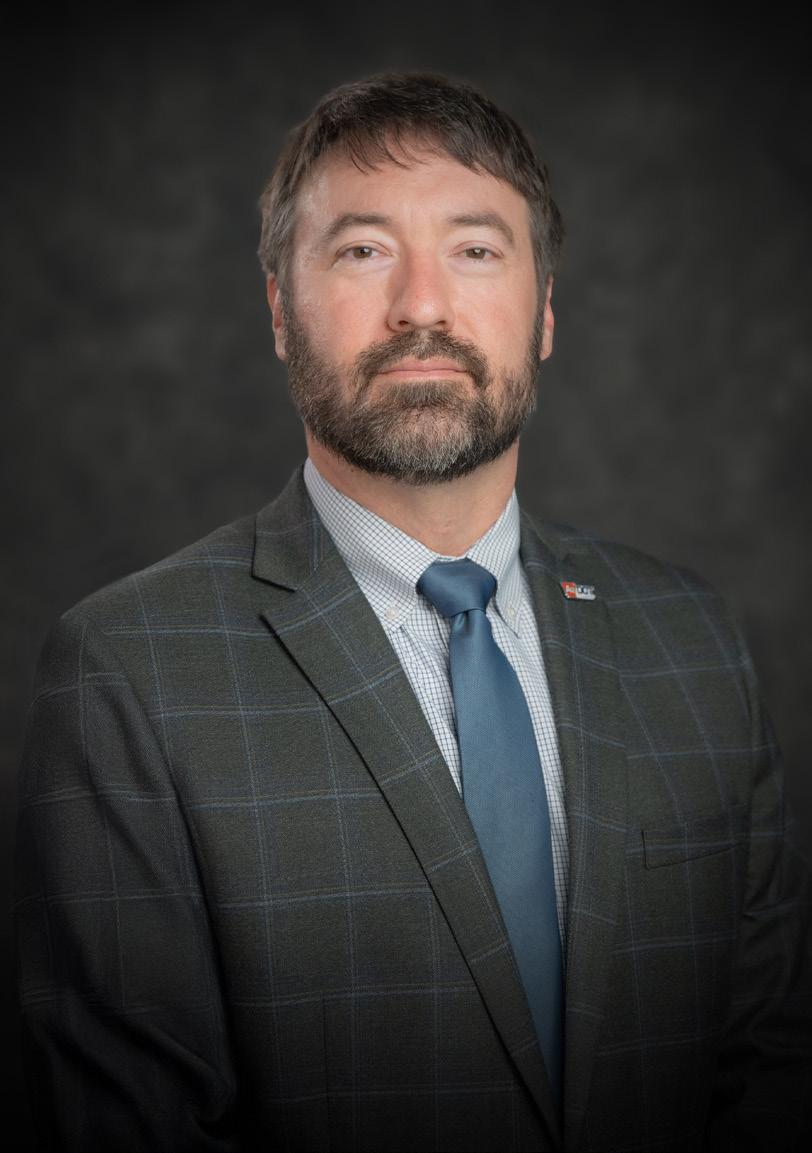

As I close, I challenge you to ask yourself this, “Am I part of the littering problem, or part of the solution?”
Safe travels this summer.

Jared D. Wiley, P.E., Director
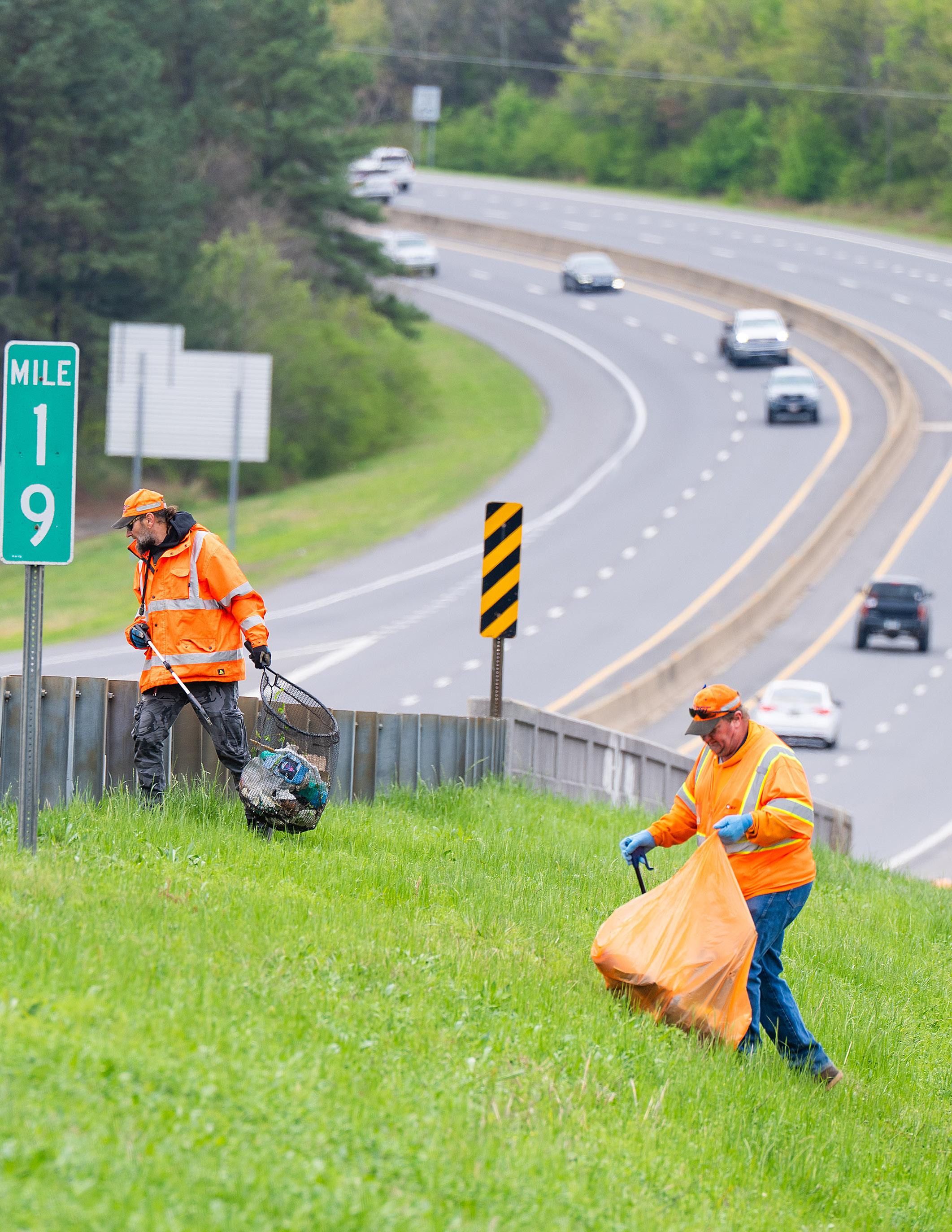
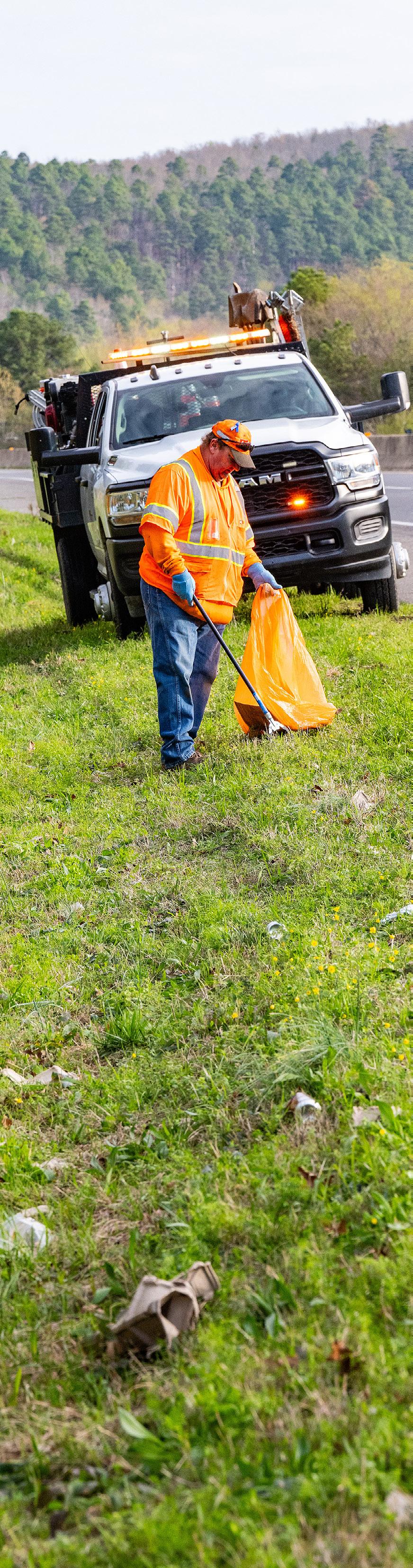
FRONT COVER: ARDOT employees pick up litter alongside Highway 270 in Garland County.
BACK COVER: Showy evening primrose wildflowers near Interstate 30.
EDITOR
Ruthie Berryhill
Ruthie.Berryhill@ardot.gov
STAFF WRITERS
Emma Goad
Emma.Goad@ardot.gov
Kaitlin Worley Kaitlin.Worley@ardot.gov
GRAPHIC DESIGNERS
Marrissa Brickey
Marrissa.Brickey@ardot.gov
Aimee Goode Aimee.Goode@ardot.gov
Lamarie Rutelonis
Lamarie.Rutelonis@ardot.gov
PHOTOGRAPHER
Rusty Hubbard
Russell.Hubbard@ardot.gov
Correspondence should be directed to: Ruthie.Berryhill@ardot.gov
ARKANSAS HIGHWAYS
Communications P.O. Box 2261 Little Rock, AR 72203-2261
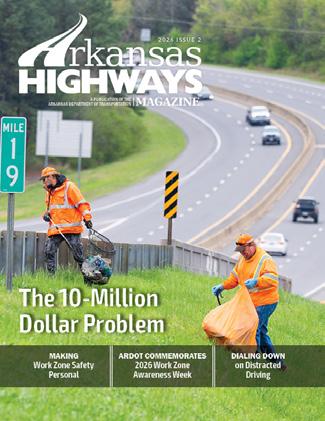
Arkansas Highways is published by and for employees of the Arkansas Department of Transportation as a medium of departmental news and other information. It is also distributed free of charge to the public upon request.
The Arkansas Department of Transportation (ARDOT) complies with all civil rights provisions of federal statutes and related authorities that prohibit discrimination in programs and activities receiving federal financial assistance. Therefore, ARDOT does not discriminate on the basis of race, sex, color, age, national origin, religion (not applicable as a protected group under the FMCSA Title VI Program), or disability in the admission, access to and treatment in ARDOT’s programs and activities, as well as ARDOT’s hiring or employment practices. Complaints of alleged discrimination and inquiries regarding ARDOT’s nondiscrimination policies may be directed to the Civil Rights Division (P. O. Box 2261, Little Rock, AR 72203, (501) 569-2298, (Voice/ TTY 711), or the following email address: Civil. Rights@ardot.gov. Free language assistance may be available upon request. This notice is available from the ADA/504/Title VI Coordinator in large print, on audiotape, and in Braille.

ARKANSAS STATE HIGHWAY COMMISSION

PHILIP TALDO Chairman
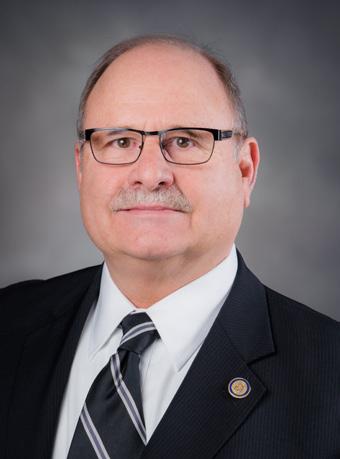


MARIE HOLDER Member
KEITH GIBSON Vice Chairman
JERRY L. HALSEY, JR. Member
DAVID HAAK Member

THE 10-MILLION DOLLAR

BY HOLLY BUTLER
IF YOU’VE TRAVELED ARKANSAS’ HIGHWAYS RECENTLY, YOU MIGHT HAVE NOTICED SOMETHING NEW AND EYECATCHING ALONG THE ROADSIDE: EIGHT OVERSIZED LETTERS AND PUNCTUATION SPELLING OUT A SINGLE QUESTION – NATURAL?
Leading up to the display is a series of signs meant to grab your attention. First, a surprising fact: “ARDOT spends nearly $10 million per year combating litter.” Second, a question to consider: “Are you part of the problem or the solution?” Third, and most important, a call to action: “Please do your part to keep Arkansas Natural.”
The message is intentional. Fighting litter in Arkansas isn’t a one-day effort. It’s a year-round operation that relies on contractors, county programs, nonprofit partners, volunteer coordination, and countless hours from ARDOT maintenance crews across the state. Due to increased efforts within these existing programs, ARDOT spent $9.7 million on litter prevention in 2025, up from the $8 million it spent in 2024.
DESIGNATED CREWS
Street sweeping has always been part of ARDOT’s maintenance operations, but until 2024, it wasn’t the primary focus of a designated crew. The street sweeping crew started as a pilot program in August 2024 and quickly showed how effective it could be at clearing debris from the shoulders of heavily traveled routes in the Little Rock area. The impact was easy to see in the consistently clean, well-maintained shoulders. In September 2024, the street sweeping crew became a permanent part of operations.
“I knew from the beginning I wanted to grow this crew,” Jonathan Meek, Assistant Maintenance Supervisor, District 6, said. “When I started, I quickly saw the passion in the crew and that they were proud to be part of this new effort.”
Today, the full-time operation includes 12 positions, all fully staffed, with Meek serving as supervisor. The program has continued to evolve through the addition of personnel and new equipment.
“The new sweeper trucks received in June 2025 have completely changed the ballgame,” Meek said. “We have three brand new crash attenuator
trucks coming soon, and we’ll be able to handle our own rolling lane closures. With the sweeping crew being out daily, we can prevent the buildup of debris and hazards that could potentially hinder motorists.”
The results are rewarding.
ARDOT sweeping crews collected 54,420 cubic yards of debris over the past year, demonstrating how this focused effort continues to make a measurable difference along highways in central Arkansas.
CONTRACTS, PARTNERSHIPS, AND VOLUNTEERS
Mowing contractors pick up trash before and after completing a mowing cycle, and all highway routes are mowed at least three times per year. There are currently about 100 active mowing contracts across the state.
The County Jail Inmate Litter Program participation is voluntary, and currently, seven counties participate.
Partnerships with nonprofits such as Pathfinder, Inc., and Abilities Unlimited provide an opportunity for adults with disabilities to give back to the community through continued litter pick-up efforts.
(continued on page 6)
Individuals and groups volunteer through the Adopt-A-Highway (AAH) program which has been around since 1987.
But beyond the cost and despite the efforts lies a more important question for the general public to consider: Are you part of the problem – or the solution?
N-A-T-U-R-A-L-?
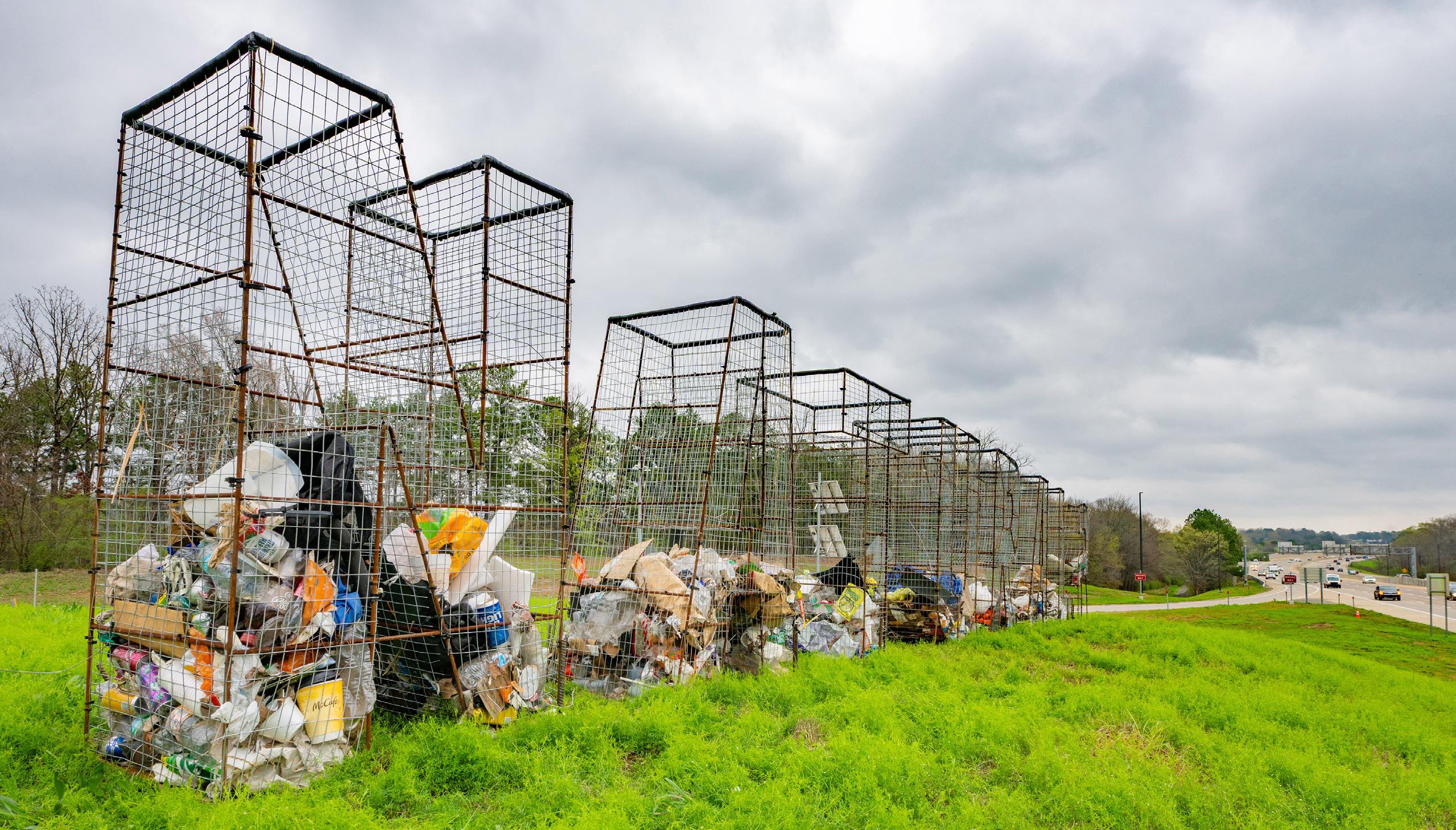
The 5-foot-tall “Litter Letters” serve as both a visual wake-up call and a reminder that keeping Arkansas natural requires more than words. It requires action. Each letter, made from wire mesh, holds approximately 1 cubic yard of litter. When filled, the entire installation represents nearly 8 cubic yards of trash collected from Arkansas roadways. In December 2025, ARDOT first displayed the two sets of Litter Letters in Bella Vista and Jonesboro.
“We started with Bella Vista and Jonesboro, as these are two of our fastest growing areas of the state,” Steve Frisbee, ARDOT Assistant Chief
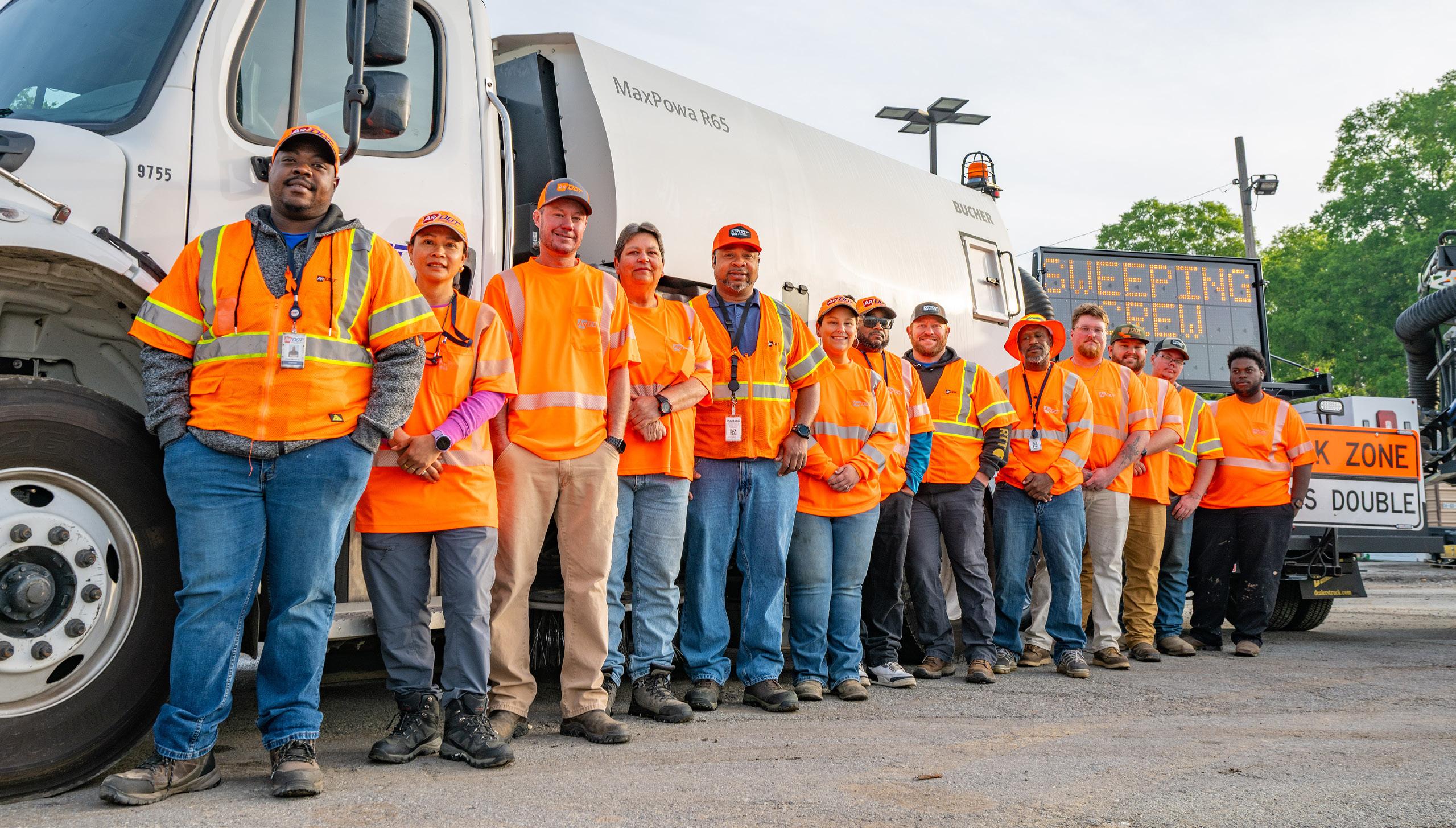
District 6 street sweeping crew. (L. to R.) Chris Worsham, Seeda Oonphong, Britten Umholtz, Anja Stokes, Caleb Bryant, Stephanie Murphy, Derrell Jones, Jonathan Meek, Steven Calhoun, Greg Anderson, Mason Henley, Austin Johnson, Andy Scott
Engineer for Maintenance, said. “We wanted to be sure to get high visibility and strong media attention as we kicked off the program.”
The response was immediate. Within days, ARDOT crews had collected enough litter to completely fill the letters. Several weeks later, the letters were relocated to be displayed in Arkadelphia and Pine Bluff. The letters then moved to Little Rock and Springdale, and will continue to move throughout the state until they make their way to all 10 districts, carrying the same message. The litter problem can be easy to overlook. Seeing 8 cubic yards of it on display is not.
FROM ONE DAY TO ONE WEEK
In March 2025, ARDOT launched its first-ever Spring Clean-Up Day event. This was a single-day effort where ARDOT crews from all 75 counties committed to picking up litter on the highways and interstates. In total, crews picked up about 6,500 bags. This effort made such a difference that Spring Clean-Up Day became Spring
Clean-Up Week in 2026. Although ARDOT still had one day dedicated to clean-up efforts, the Department utilized the entire week to educate the public on the importance of a clean and beautiful highway system.
On March 17, ARDOT’s dedicated Spring Clean-Up Day for 2026, crews picked up more than 14,000 bags of litter. That’s more than double what was picked up in 2025.
“I think we had nearly 10 percent of our Central Office workforce volunteers to help. It's a very proud moment for me to see that it's reaching our entire force,” ARDOT Director Jared Wiley said.
Because of this expanded vision, ARDOT had over 2,000 employees participate in Spring Clean-Up Week. Clean-up efforts looked a little different this year. For some, it was routine work. For others — particularly office staff — it was a new perspective. Robert Farley, ARDOT Maintenance Specialist in Clark County, District 7, is no stranger to this effort. Trash pick-up
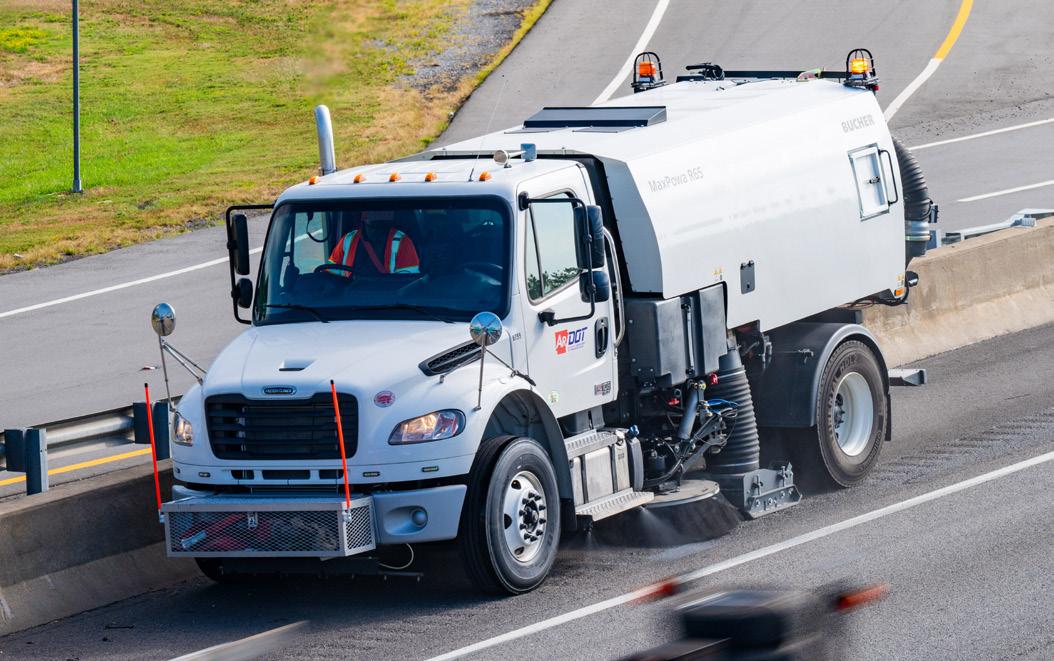
Street sweeper truck
is part of his regular duties, but this event meant something different for him.
“Everyone can do their part to help out,” Farley said. “Trash can wait to be thrown away at home or at a gas station, and I hope people can see that more as they see us out here cleaning the roads up.”
Marrissa Brickey, ARDOT Advanced Graphic Design Specialist, was able to get out of the office to volunteer in the Little Rock area.
“It was rewarding to feel like I was making an impact in a different way than I normally would,” Brickey said. “Specifically, as someone coming from the Communications Division, picking up the kind of trash we found made me want to ensure we really strengthen our message.”
Seeing firsthand the volume and type of litter collected offered a deeper understanding of the ongoing challenge maintenance crews face daily. From fast food packaging to discarded furniture, the experience
made one thing clear: litter doesn’t disappear on its own.
“I just want to say thank you to the District and office staff who helped get this done, not just on that day and week, but all year long,” Wiley said. “Thank you for helping make an even bigger impact on Spring Clean-Up Day.”
LEADING BY EXAMPLE
One of ARDOT’s primary initiatives this year is bringing more awareness to litter and finding ways to increase litter prevention. For Wiley, the message behind the campaign became personal. While the Department works daily to maintain Arkansas highways, Wiley recognizes that leadership also means participation.
“I think it’s good for people to understand how big the problem is, and even with the inmates, Adopt-A-Highway, and Keep Arkansas Beautiful and all of our staff and nearly 10 million a year, we still can’t keep up,” Wiley said.
Alongside his family, Wiley spent time cleaning up litter in his own community — not as Director, but as a citizen. He described his experience that day as a day spent with his family doing what he’s passionate about – keeping Arkansas beautiful.
“The area we picked up, it wasn’t that big, but there was so much trash. It looked like a trash truck had exploded over there. We spent probably an hour and a half or two hours cleaning. And it took us every bit of that to pick up that area. But it was a great feeling when we got done. My kids were excited about it,” said Wiley. “And it's funny, when we drive through there now, they're like, ‘Oh, our piece is getting dirty again. We need to go back out there and pick it up.’ They felt a sense of pride and ownership.”
REVITALIZING ADOPT-A-HIGHWAY
The AAH Program has been around for nearly four decades. Over that time, thousands of volunteers have
(continued on page 8)
ARDOT's "Litter Letters" located near Interstate 630 in District 6.
spent countless hours picking up trash across miles of state highways. The AAH volunteers remain one of the most important components of the Department's fight against litter. Recognizing the need to make participation easier, ARDOT launched a new interactive Adopt-A-Highway website in March. One of the most common questions prospective volunteers ask is, “What highways are available in my area to adopt?” The website’s interactive map allows users to see which highway sections are adopted and which remain available. With just a few clicks, individuals and organizations can begin the process of adopting a section of highway and being part of an effort to keep The Natural State looking … well, just that! Natural!
“We were excited to be able to build a digital map from the data so that everyone can see where groups have already adopted highways and, of course, where opportunities remain across the state,” Sharon Hawkins, ARDOT Staff GIS and Mapping Administrator, said.
ARDOT’s GIS and Mapping team conducts regular checks to ensure that each AAH group is accurately represented on the map and works with partners to ensure that when a highway is requested for adoption, the information is entered into the database correctly so every AAH group appears in the right location.
Internally, the database also serves as a tool for ARDOT staff to track cleanup activity, including how many volunteers participate, how many hours are spent cleaning, and how many bags are collected during each pickup.
“Making the data visible to the public and more useful internally through this platform has transformed how we share the story of Adopt-A-Highway while also strengthening how we track and support the program behind the scenes,” Joseph Jordan, ARDOT Lead Geospatial Specialist, GIS and Mapping Section, said.
Wiley praised the GIS and Mapping Section for their hard work in bringing the new web map to life.
“It's easy for anybody who can read a map to open that up. ‘Where's my favorite stretch of highway? I like this one. Can I adopt it?,’” Wiley said. “It’s quick, and they can send the Department an email. ‘Hey, I want this piece.’ And then that process is simplified and streamlined. So, I'm excited about that.”
Safety remains the Department’s top priority. That’s why, when individuals or groups join the AAH program, volunteers are provided with orange safety vests, trash bags, and roadside signage to alert motorists. The Department’s goal is to have at least one section of highway adopted in all 75 counties. Currently, 71 counties have adopted highway sections. Whether it’s a towering set of roadside letters, a volunteer in an orange vest, or a maintenance crew filling bag after bag, the message remains the same. Keeping Arkansas natural is not a one-day event or a single program. It is an ongoing effort that depends on partnerships between Department staff, volunteers, and the community. Getting involved is easy, and commitment is manageable. The next time you pass the display of Litter Letters on the roadside spelling NATURAL?, challenge yourself: Am I part of the problem, or part of the solution?


Robert Phillips ARDOT Employee


MAKING WORK ZONE SAFETY
PERSONAL PERSONAL::
The Fifth and Final Year of the ‘Slow Down, Phone Down’ Campaign
BY ELLEN COULTER
IT’S OCTOBER 7, 2024. ARKANSAS DEPARTMENT OF TRANSPORTATION (ARDOT)
EMPLOYEE TERRY SKAGGS’ ALARM GOES OFF AT 4:30 A.M., AS IT DOES EVERY MORNING. He swings his feet off the bed and onto the floor, stretching his arms above his head. He showers, dresses, puts on his work boots, gives his wife Sandra – who is still sleeping – a kiss goodbye, and he’s off to work before the sun comes up.
This had been Terry’s routine every day for the better part of a decade. He never thought it might be the last time he’d be able to swing his feet off the bed, button a shirt, or walk unassisted. In just an instant, a careless decision by a reckless driver on October 7 dramatically changed the rest of Terry’s life.
Terry was mowing along the side of Highway 365 in a mobile work zone when a dump truck hit him from behind, crushing him and the John Deere mower he was on. A year and a half later, Terry is still on the road to recovery. He relies on a wheelchair for mobility and struggles with the use of his right arm. His speech is labored as he continues to recover from the traumatic brain injury he sustained that day. He completes daily therapy sessions in the hope of one day recovering enough to get back to work at ARDOT.
For Terry, Sandra, and everyone within their world, there is life before October 7 and life after.
Terry’s story is a stark reminder of how vulnerable our road workers are every day – how the line between work and tragedy is no wider than a centerline stripe.
While what caused the individual who hit Terry to be distracted and reckless that day is still unknown, it’s not difficult to imagine what might be the cause in our own lives. Whether it’s skipping the ads on a podcast, sending a quick text, or speeding because you’re late for work, any possibility seems insignificant in the face of Terry Skaggs’ current reality. For the driver, there is also life before and after the crash. It often involves heavy fines, license revocation, or even jail time.
Hard-hitting perspective is what the fifth and final year of the Slow Down, Phone Down work zone safety campaign is asking of its audience.
Terry’s story and others’ will be shared on digital, broadcast, and radio platforms statewide this year as ARDOT focuses on making work zone safety personal.
THE CAMPAIGN
The idea for the Slow Down, Phone Down campaign began in 2021, which was the worst year in recent history for number of work zone crashes, fatalities, and injuries.
Alarmed by the numbers, Lorie Tudor, ARDOT’s Director at the time, asked the Arkansas Highway Police (AHP) and (continued on page 10)
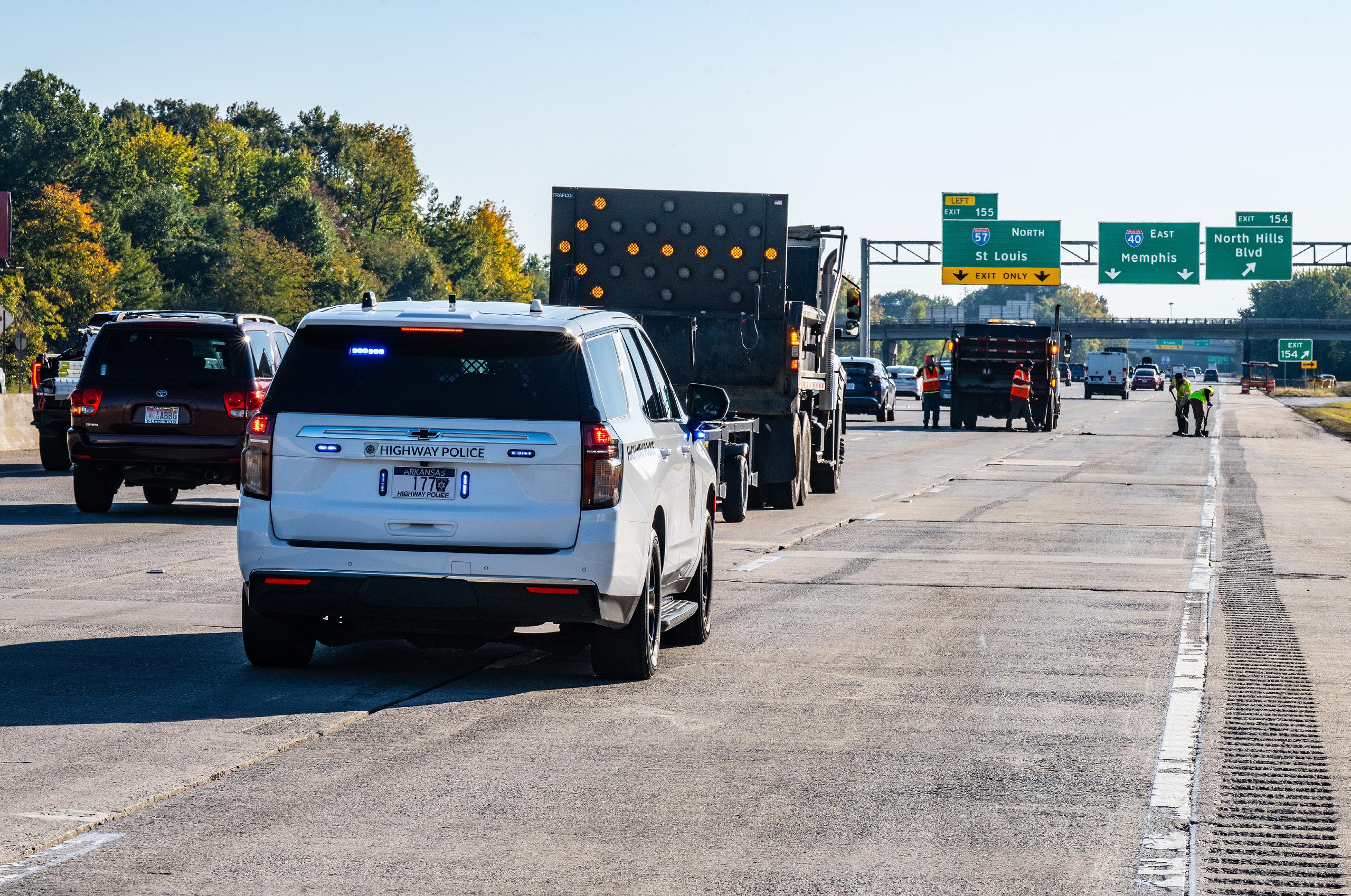
Workers make repairs in a work zone on Interstate 40.
ARDOT’s Communications Division to begin planning a comprehensive work zone safety campaign.
“In 2021, the Arkansas Highway Police had discussions with Director Tudor about introducing low-profile police vehicles into our work zones, aiming to reduce crashes through strict enforcement of traffic laws. During those discussions, we also developed the idea for what would become our High Enforcement Area Team, or ‘HEAT’ team,”
AHP Chief Jeff Holmes said. “Director Tudor shared her concept for a new media campaign, which evolved into what is now recognized as the Slow Down, Phone Down work zone safety campaign.”
“Director Tudor came to me and said work zone crash numbers are high, both nationwide and here in Arkansas, and we need to do something about it,” said Dave Parker, ARDOT Communications Division Head. “I knew we would need a big awareness campaign and fortunately we were able to secure enough funding to get this campaign off and running.”
ARDOT received a National Highway Transportation Safety Administration (NHTSA) grant through the Arkansas State Police Highway Safety Office – paving the way for the official launch of the campaign.
“Getting the NHTSA grant funding allowed us to expedite the process and opened up additional opportunities for the
campaign as far as quality, scope, and reach,” Parker said.
The need for comprehensive work zone safety reform and awareness became even more pressing when ARDOT lost two of its own employees in work zone incidents within a matter of weeks – Kurt Cottier in December 2021 and Winfred Petty in January 2022.
In February 2022, the Slow Down, Phone Down campaign was launched – and not a minute too soon. The campaign included professionally produced television and radio commercials, social media content, billboards, school partnerships, and other paid media advertisements both online, in print, and outdoors.
“The launch of the Slow Down, Phone Down campaign marked a monumental moment for both our work zone safety enforcement and the beginning of my leadership within the Arkansas Highway Police,” Holmes said, whose official tenure as Chief began in March 2022. “AHP has played an active role in every phase of the Slow Down, Phone Down campaign – starting with the initial media advertisements and extending through the development and implementation of enforcement initiatives. As our employment numbers have increased, our officers have steadily been able to increase their visibility within all work zones, making a noticeable impact on the number of crashes.”
With increased awareness and enforcement of the laws, the Slow Down, Phone Down campaign laid the foundation for a renewed emphasis on work zone safety, but numerous supplemental initiatives in the years since the launch of the campaign propelled those efforts.
CONCURRENT INITIATIVES
“The Slow Down, Phone Down campaign helped us get the word out about the dangers of distracted driving, and it allowed us to tell the story about how distracted driving affects our workers,” ARDOT Director Jared Wiley said. “That was five years ago when the campaign first started, and since then, our numbers have improved a lot. There are other factors that have contributed as well.”
Chief among those other factors was the implementation of cameras in Arkansas work zones. Thanks to a law passed during the 2023 Arkansas General Assembly, ARDOT was able to implement work zone speed enforcement cameras later that year.
“A huge milestone was the implementation of speed enforcement cameras in work zones. This led to another significant reduction in crashes across our interstate highway work zones,” Holmes said.
In 2026, ARDOT began using additional cameras that can detect handheld device usage in work zones – which are hands-free by law.1
“I believe the heightened enforcement through these handheld device cameras promises to further reduce crashes,” Holmes added.
Other work zone safety initiatives that have been implemented in the time since the Slow Down, Phone Down campaign began include:
• adding a work zone safety section to the Arkansas Driver’s License Manual.
• adding green lights to ARDOT maintenance vehicles for better visibility.
• doubling fines in mobile work zones as well as standard work zones.
• chartreuse work vests for new employees.
• additional conspicuity stickers on vehicles.
• shadow vehicles ahead of work zone operations.
• investing in new safety equipment such as lane blades.
Many of these initiatives were made possible through bills passed by the Arkansas State Legislature.
“Slow Down, Phone Down has been just one part of the package,” Wiley said. “It's been a concerted effort to try to improve safety for everyone. We talk about safety being our most important core value. It's always been at the top of our strategic plan, and we don't want to just give lip service to that. We want to put it into action. The Slow Down, Phone Down campaign was one of the early ways we did that.”
(continued on page 12)
1
THE FINAL YEAR
In February 2026, the Slow Down, Phone Down campaign began its fifth and final year. Although the lifespan of this successful campaign is winding down, the messaging is ramping up – crescendoing into a final year with hard-hitting perspective.
“We have produced two rounds of commercials prior to the new ones this year. The first two rounds were about awareness. Some even had a little bit of humor. But this year we are going in a different direction,” Parker said.
“For this last year of Slow Down Phone Down, we decided to make it more hard-hitting, more serious,” Wiley said.
“You could be the one behind the wheel that caused the fatality, that caused the injury, that ends somebody's career or changes their quality of life forever. I think it's time to get hard-hitting. It's time to get in your face and end this campaign in a big way with a big impact.”
This year’s campaign provides three new, poignant video messages – law enforcement’s perspective told through AHP Sergeant Shufford Day about the cost of breaking the law in a work zone, the perspective of ARDOT employee Robert Phillips who tragically witnessed a colleague and friend’s death in a work zone by an errant driver, and the story of ARDOT employee Terry Skaggs who was severely injured in a work zone by a distracted driver.
Three stories from three different perspectives with one overarching message: work zone safety is personal.
THE CURRENT STATE OF WORK ZONE SAFETY – AND WHAT’S NEXT
According to ARDOT’s Traffic Safety Analysts within the Planning and Research Division, there were 2,594 crashes and 84 fatalities or suspected serious injuries in Arkansas work zones in 2021. In 2024 (the most recent year for which finalized data is available), there were 1,648 crashes and 54 fatalities or suspected serious injuries in Arkansas work zones. This marks a 36 percent reduction overall in crashes, fatalities, and suspected serious injuries in Arkansas work zones since 2021.
Although numbers are trending in the right direction, and the Slow Down, Phone Down campaign is phasing out, the work is far from finished. In fact, Slow Down, Phone Down has set the foundation for a movement that is only beginning.
“We're always looking for new ways to innovate, new ways to improve safety for workers,” Wiley said. “We have to stay on the cutting edge of technology. You'll see the Department adapt and make some changes over the next year or two to be bolder in this space. We just can't give all the secrets away just yet.”
You could be the one behind the wheel that caused the fatality, that caused the injury, that ends somebody's career or changes their quality of life forever.
— ARDOT Director Jared Wiley

America Celebrates 250 Years
BY RUTHIE BERRYHILL
THIS JULY 4TH, AMERICA’S INDEPENDENCE DAY CELEBRATIONS WILL BE BIGGER THAN EVER AS THE COUNTRY CELEBRATES ITS SEMIQUINCENTENNIAL, THE 250TH ANNIVERSARY OF THE SIGNING OF THE DECLARATION OF INDEPENDENCE.
In 2016, Congress appointed the U.S. Semiquincentennial Commission and its nonprofit arm, America250.org, Inc., together known as America250, to plan for this momentous occasion. The America250 initiative aims to celebrate America’s history, accomplishments, and future. All 50states and territories are participating in this nationwide effort with parades, interactive exhibits, historical tours, and reenactments. You can learn more about the America250 initiative at america250.org.
To coordinate Arkansas’ participation in the America250 initiative, Governor Sarah Huckabee Sanders established the Arkansas250 Commission in July 2024. The Arkansas250 Commission’s mission is to honor the rich history and beauty of the Natural State, inspiring Arkansans to appreciate and protect our state and our nation’s heritage through educational programs and service opportunities. This 14-member commission is working with local communities as they create local semiquincentennial celebrations.
Whitnee V. Bullerwell, Local Project Administration Section Head, is representing the Arkansas Department of Transportation (ARDOT) on the Arkansas250 Commission Outreach Committee.
“Working with the Arkansas250 Commission has been a joy and privilege,” Bullerwell said. “The Commissioners are dedicated to ensuring Arkansas celebrates this milestone throughout the year. This anniversary is more than a
moment in time—it’s an opportunity to reflect on the ideals that shaped our nation and to recommit ourselves to building an even stronger future. Director Wiley’s steadfast support has made this work all the more meaningful.”
Since its creation, the Arkansas250 Commission has introduced multiple initiatives to celebrate our nation’s anniversary, with more than 20 activities and events occurring throughout the state this year, including a historical marker initiative, an Arkansas250 flag initiative, a lecture series, a quilt show, a time capsule installation, concerts, a “Before Us, Beyond Us” exhibit at the Old State House Museum, Independence Day parades, and other celebrations.
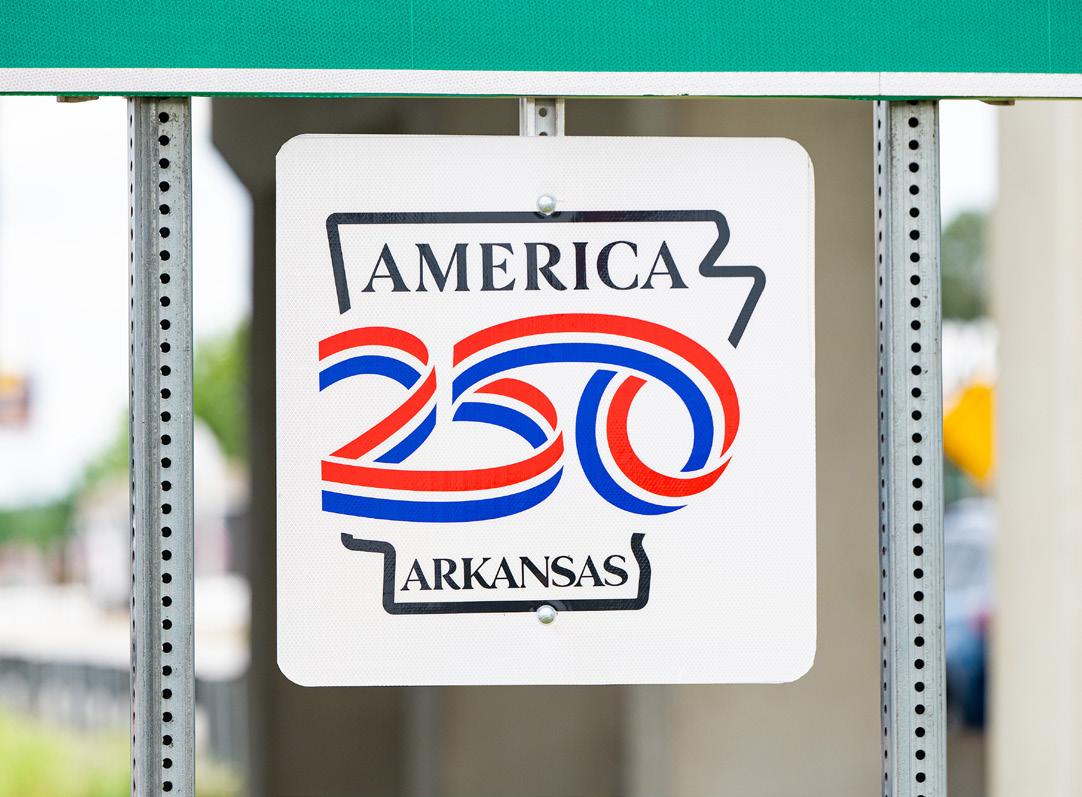
As part of these efforts, ARDOT is honoring America’s historic milestone with more than 350 Arkansas250 highway signs. In addition, ARDOT is flying 126 Arkansas250 commemorative flags at all district offices, welcome centers, rest areas, and the Central Office.
“We are partnering with the Arkansas250 Commission by producing Arkansas250 signs,” ARDOT Director Jared Wiley said. “We are installing those signs at strategic locations around the state, welcoming people into Arkansas and showing our support for America’s 250th birthday.”
As we approach America’s semiquincentennial, the Arkansas250 Commission and Arkansas communities celebrate how Arkansas has shaped America’s story. We continue to honor our past, while looking forward to the future. To learn more about the Arkansas250 Commission and local efforts, visit arkansasheritage.com/arkansas-250.
Top Photo: ARDOT is honoring America's historic milestone with Arkansas250 highway signs.
WORK ARDOT COMMEMORATES 2026
WORK ZONE AWARENESS WEEK
BY RUTHIE BERRYHILL
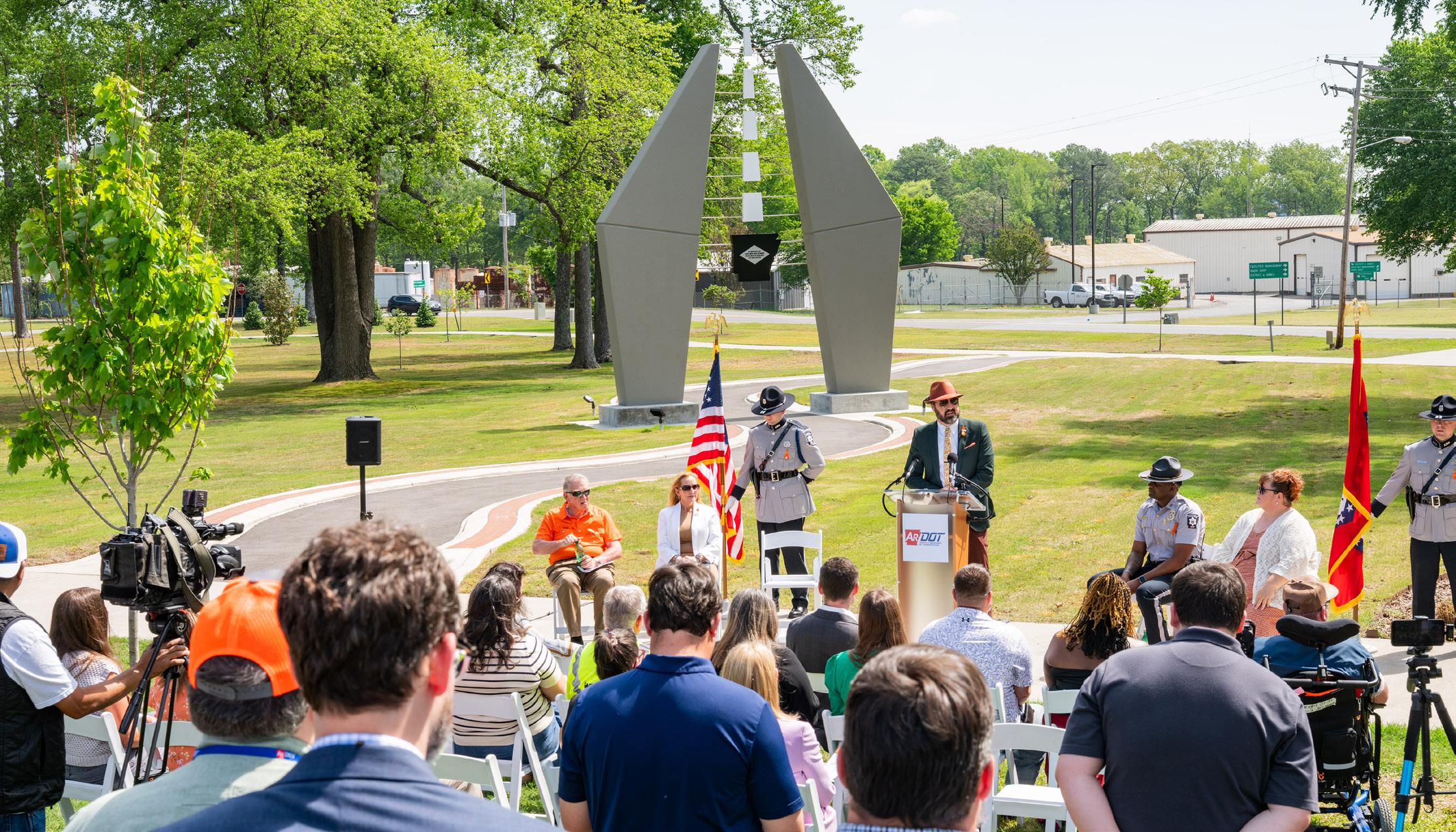
THE ARKANSAS DEPARTMENT OF TRANSPORTATION (ARDOT) KICKED OFF ARKANSAS’ WORK ZONE AWARENESS WEEK (WZAW) ON APRIL 17 WITH AN EVENT AT ARDOT’S FALLEN WORKER MEMORIAL IN LITTLE ROCK. WZAW, a national awareness campaign to encourage safe driving in highway work zones, is commemorated by State Departments of Transportation across the country each spring at the start of construction season.
Dedicated in October 2025, ARDOT’s Fallen Worker Memorial honors the 92 ARDOT and Arkansas Highway Police (AHP) employees who lost their lives while on the job. In addition to providing a place for quiet reflection that honors the memory of those employees, it also serves as a permanent reminder for all drivers to slow down and avoid distractions while driving.
“It seemed like a natural place to kick off Arkansas’ Work
Zone Awareness Week, a week that calls attention to the safety of the men and women who spend their days working in highway construction and maintenance zones,” ARDOT Director Jared Wiley said. “We ask drivers to remember to slow down, exercise caution, and stay alert when driving through a work zone.”
Arkansas Lieutenant Governor Leslie Rutledge read Governor Sarah Huckabee Sanders' proclamation in honor of WZAW and provided remarks. The event also featured remarks from Director Wiley; AHP Sergeant Shufford Day; and Sandra Skaggs, speaking on behalf of her husband, ARDOT employee Terry Skaggs. Terry was severely injured in a work zone crash that nearly took his life.
Sandra spoke about the day that forever altered the path of her family’s life. She pleaded with drivers to practice safety in work zones.
“Terry and I would like everybody to realize how dangerous a work zone is,” Sandra said. “He still wishes and tells me all the time, ‘I wish that person would have paid attention.’ If
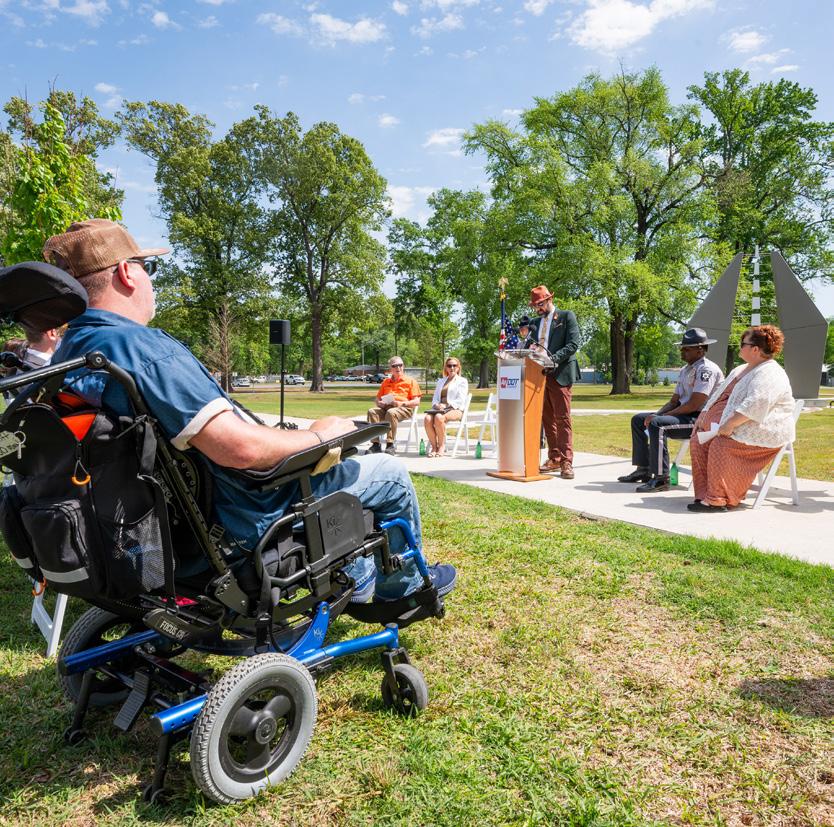
ARDOT hosted a media event at the ARDOT Fallen Worker Memorial in Little Rock to kick off Arkansas Work Zone Awareness Week.
WORK ZONE
you take anything from today, pay attention, slow down, phone down, move over.”
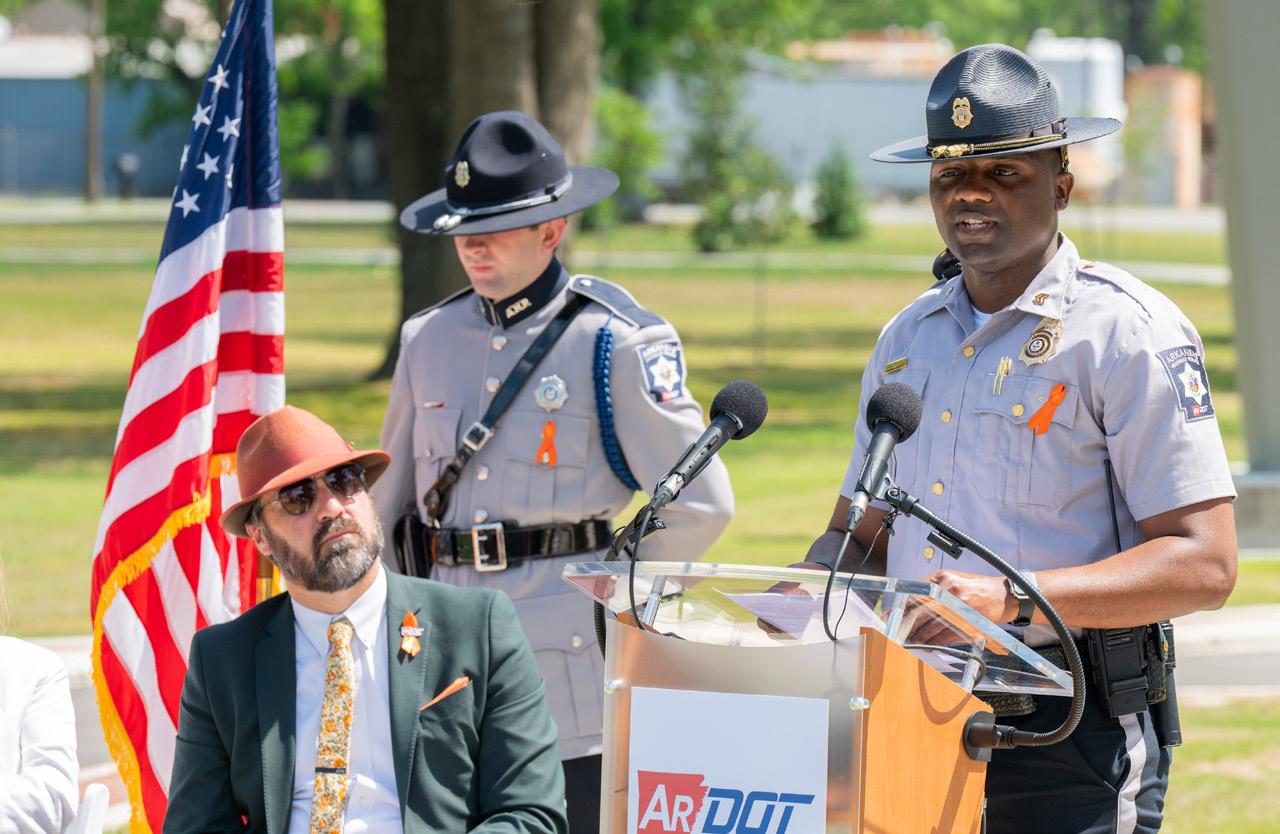
Sergeant Day spoke from law enforcement’s perspective on the cost of committing an offense in a work zone. “Crashes can be life altering,” Sergeant Day said. “The individuals working in these areas are not just employees—they’re fathers, mothers, brothers, sisters, and grandparents. Our objective is to ensure every worker returns home safe each day.”
Director Wiley unveiled a new documentary produced by ARDOT called “The Making of a Memorial” about the Fallen Worker Memorial and the individuals it honors. The documentary follows the construction of the memorial, but it also includes interviews with the loved ones of fallen workers.
“As we step into Work Zone Awareness Week, we felt there was no better time than today to release this documentary,” Wiley said.
To view the documentary, visit ARDOT.gov/memorial/ documentary.
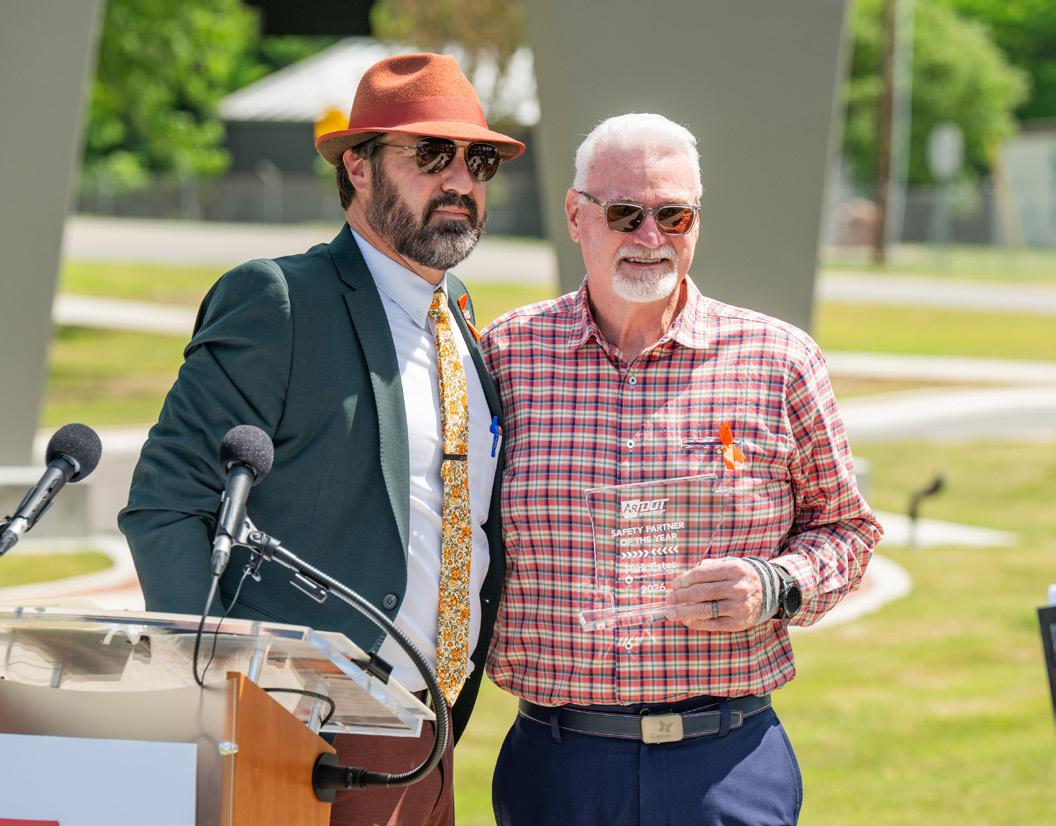
Director Wiley closed out the event with the presentation of the first-ever Safety Partner of the Year award – a special recognition given to an individual or entity that has helped advance work zone safety in Arkansas.
“My hope is that this special recognition will highlight those who are helping keep our coworkers and the traveling public safe,” Wiley said. “This year’s recipient is someone who actively supports ARDOT safety initiatives and industry-wide safety advancement efforts.”
This year’s Safety Partner of the Year award was given to Park Estes, Executive Director of the Arkansas Asphalt Pavement Association (AAPA). Estes has advocated for
key safety legislation and regularly includes safety-focused presentations at every industry conference. He was instrumental in developing the “Safety Award for Excellence (SAFE)” program under AAPA leadership to recognize companies with strong safety performance.
Following ARDOT’s kick-off event on Friday, April 17, National WZAW took place Monday, April 20, through Friday, April 24. Each day of WZAW was assigned a specific theme. This year’s schedule included: “Work Zone Safety Training Day” on Monday, the national kick-off event hosted by the Connecticut Department of Transportation on Tuesday, “Go Orange Day” on Wednesday, “Social Media Storm Day” on Thursday, and a moment of silence observed nationally on Friday to remember the men and women whose lives were lost in a work zone incident.
In addition, ARDOT hosted an internal Work Zone Awareness Coloring Contest for children and grandchildren of employees. Children ages 12 and under could draw a scene of their choosing as long as it carried the theme “Work Zone Safety at ARDOT.” Submissions can be seen at ardot.gov/coloring-contest.
In its 27th year, this year’s WZAW theme was “Safe Actions Save Lives.”
“Your choices matter, and the decisions you make behind the wheel affect the lives of not just you, but those around you,” Wiley said. “I want to implore you all to remember our workers and our families, like Terry and Sandra Skaggs, as you approach a work zone. I hope you’ll let their story remind you of how important your actions and decisions are and how impactful those actions in a work zone can be.”
Park Estes, Executive Director of the Arkansas Asphalt Pavement Association (AAPA), accepted the Safety Partner of the Year award.
AHP Sergeant Shufford Day spoke about the cost of work zone offenses.
Dialing Down on Distracted Driving–
ARDOT’s New
Handheld Device Detection Technology
KAITLIN WORLEY
FOR THE ARKANSAS DEPARTMENT OF TRANSPORTATION (ARDOT), SAFETY
ISN’T JUST A PRIORITY, IT’S A CONSTANT PURSUIT AS THE FIRST COMPONENT OF ARDOT’S STRATEGIC PLAN. From safety campaigns, like Slow Down, Phone Down and Street Smart, to innovations in roadway construction and design, ARDOT consistently puts safety at the forefront. In the quest to optimize roadway safety, ARDOT has turned to advanced technology capable of detecting the use of handheld devices in work zones.
In 2023, Arkansas legislators made transportation safety a priority through the passage of two laws: Act 445, also known as “Ashton’s and Abbie’s Law,” was named after two victims of fatal crashes due to distracted driving in work zones. In addition to broadening language to prohibit any
use of a handheld wireless communication device in active highway work zones, Act 445 also increased the associated penalties. Act 707 authorized the use of cameras to enforce traffic laws in highway and interstate work zones. ARDOT and the Arkansas Highway Police (AHP) began using cameras for speed enforcement in August 2023 and for handheld device detection in January 2026.
“The goal of the Arkansas Department of Transportation and the Arkansas Highway Police is to decrease the number of crashes caused by distracted driving within state work zones by implementing stricter enforcement and increasing public awareness through campaigns,”
AHP Chief Jeff Holmes said.
DISTRACTED DRIVING
According to the National Highway Traffic Safety Administration, 3,275 people were killed nationwide in crashes due to distracted driving in 2023. This figure highlights a critical reality: distracted driving is a preventable contributor to roadway deaths.
“Crashes can often be prevented by modifying driver behavior,” John Lasley, ARDOT Assistant Division Head for Planning and Research, said. “The use of these cameras with the supplementation of law enforcement is a specific example of modifying behavior in action.”
WORK ZONES
In work zones, the risk of distraction is even greater. Work zones may introduce unique conditions, such as reduced number of lanes, traffic cones, heavy machinery, or workers on foot, which require increased focus from drivers to navigate the area safely.
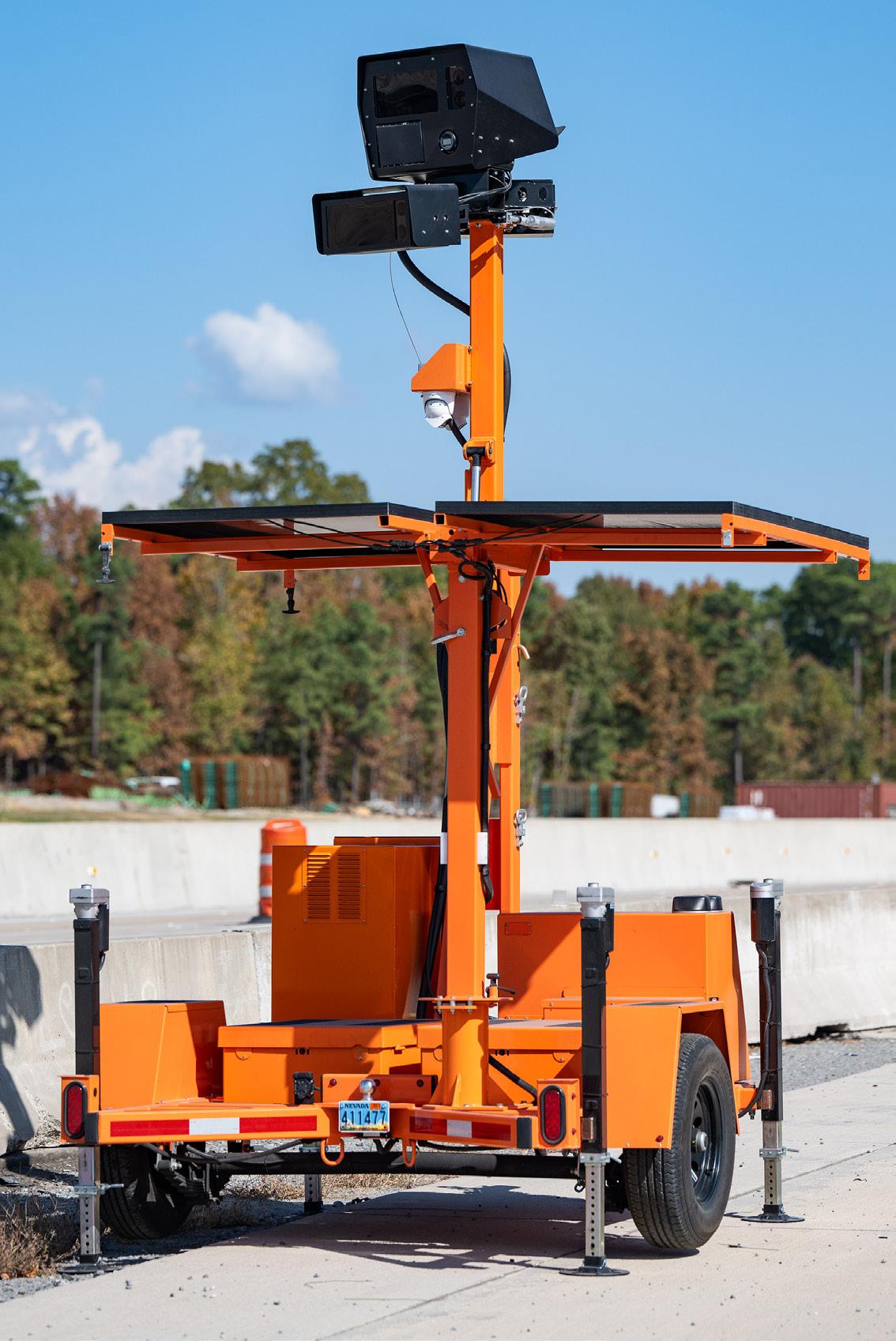
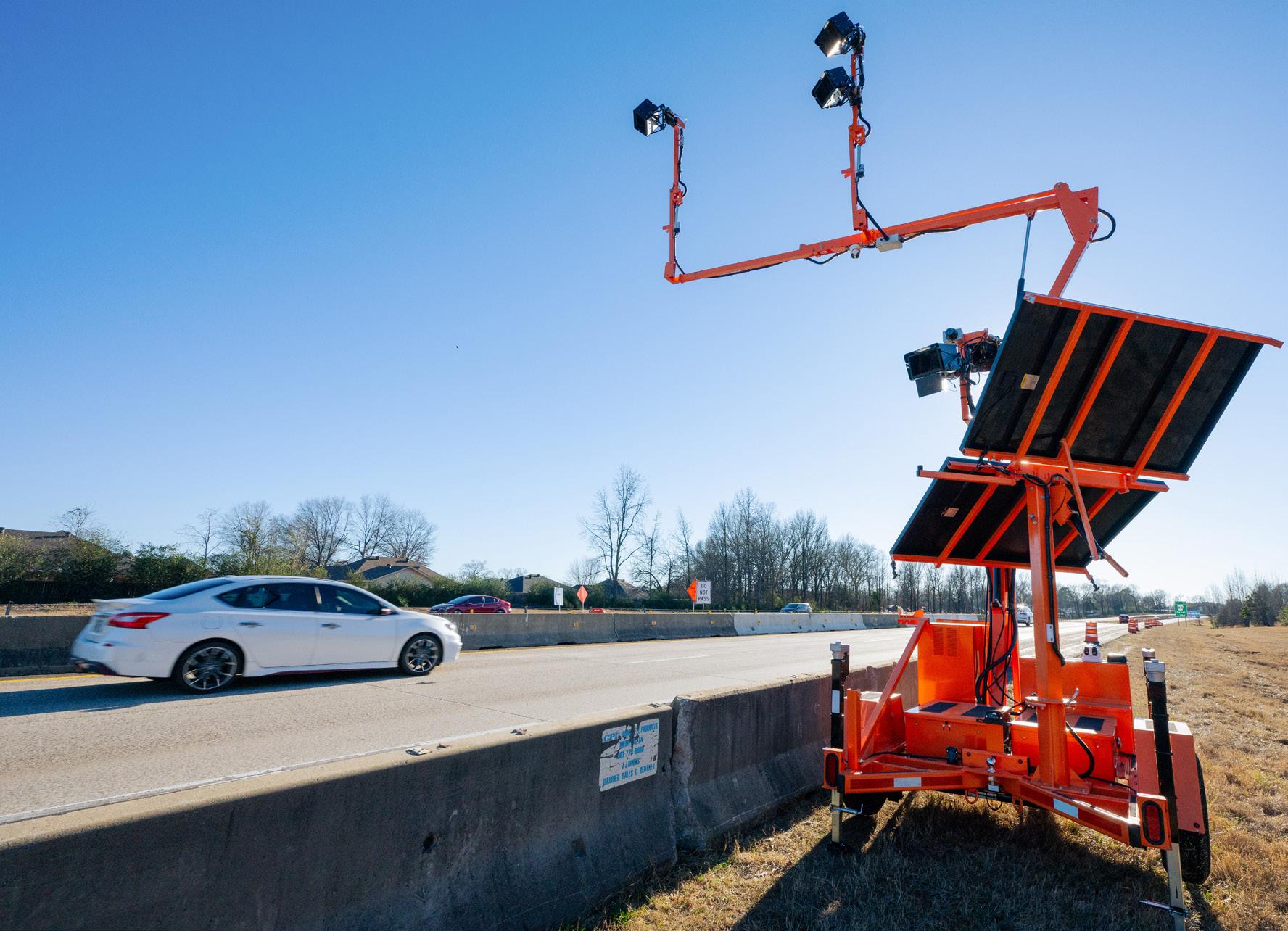
An ARDOT handheld device detection camera in a work zone on Interstate 57.
It’s about changing behavior, so motorists and workers get home safe every day.”
— AHP Chief Jeff Holmes
and handheld device detection cameras in work zones on Interstate 49 and Interstate 57.
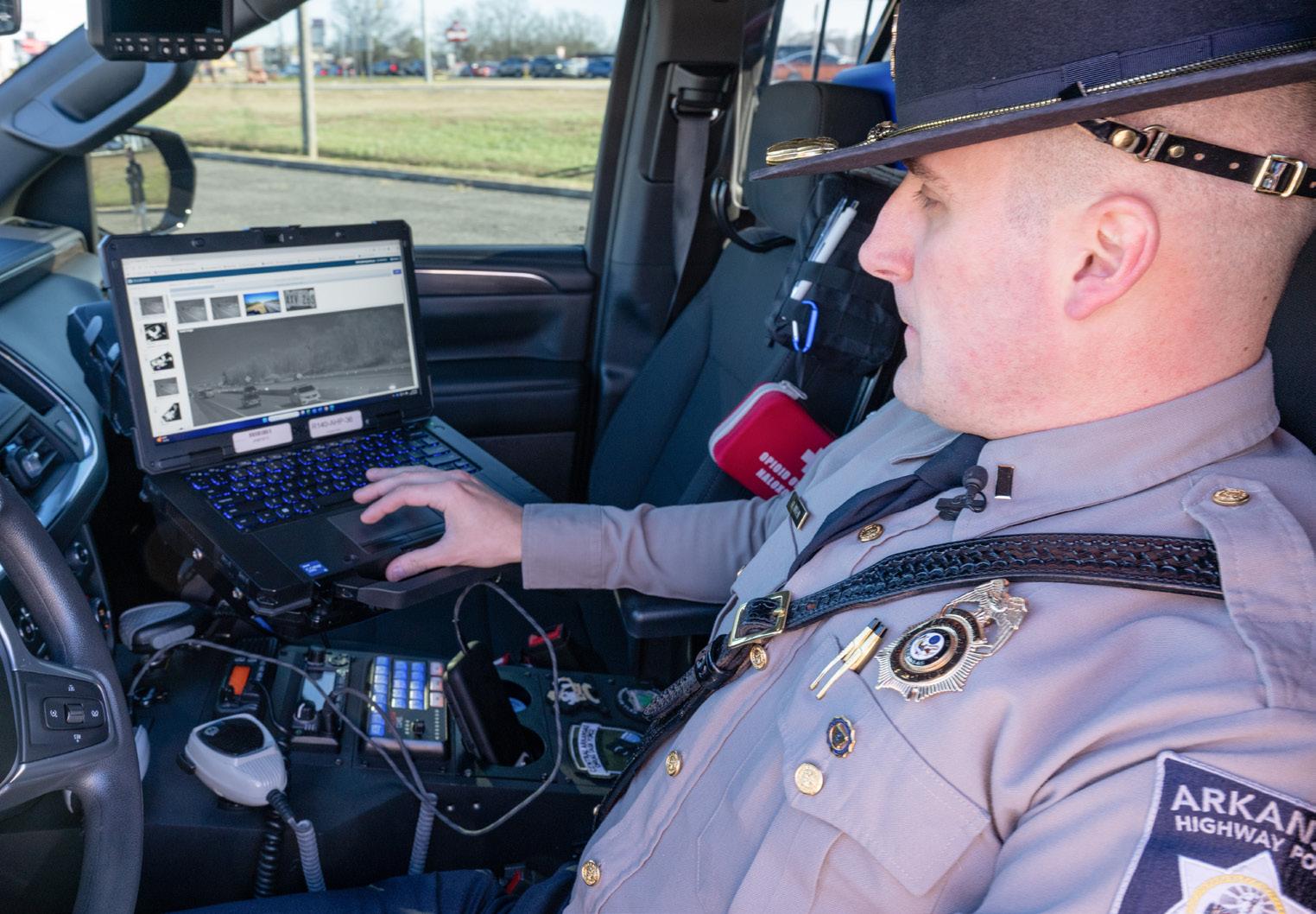
When drivers travel through a work zone, the cameras detect if the driver is speeding or holding a handheld device. If the software detects a device in the hand of the driver, it takes and sends a photograph to an officer stationed at the end of the work zone. The officer views the photo, verifies if a handheld device is in use, and then the officer can safely pull over the driver when they exit the work zone.
COMMON MISCONCEPTIONS
In just the first week after the announcement of the handheld device detection system, ARDOT conducted over 20 interviews with local news sources. At the same time, social media comments and questions flooded in.
“Any distraction, especially from cell phone usage, can compound any negative driving decisions that may occur,” Lasley said. “This makes it vitally important that drivers be free of distractions while ARDOT and construction personnel are on foot working nearby. These individuals are especially vulnerable to high-speed traffic.”
Work zone crashes in Arkansas reached an all-time high in 2021, with 2,594 recorded crashes. Thanks to the passage of Act 707 in 2023, ARDOT was able to implement cameras in work zones as part of its multifaceted response. The number of work zone crashes was reduced to 1,648 in 2024, which resulted in a 36 percent decrease in crashes over that time. While a number of factors contribute to this decrease, work zone cameras played an important role.
HOW IT WORKS
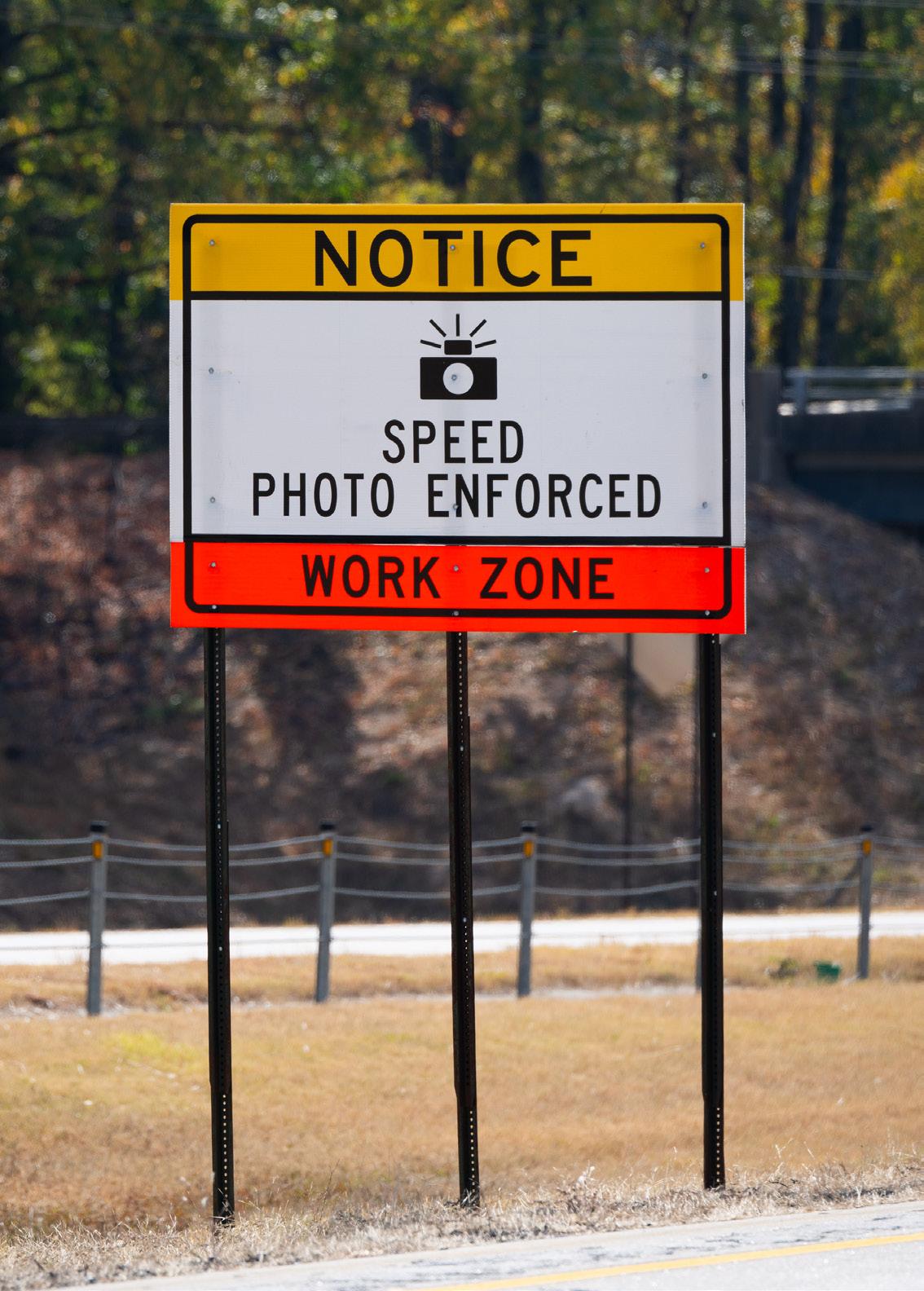
As drivers approach a work zone that utilizes camera technology, signs are posted to give notice that cameras are present. ARDOT currently uses speed enforcement
One common question was whether the use of Bluetooth or handsfree technology will be detected by the cameras. Other questions included whether non-driving passengers can use handheld devices.
“The camera only detects a device in the driver’s hand,” Holmes said.
Others were concerned about the technology wrongly detecting a handheld device when there is none, but according to Holmes, “Having a phone in your hand is the violation, and it is verified by a law enforcement officer, who then decides whether to pull the violator over and issue a citation or warning.”
Many people were also concerned about privacy and worried that the cameras would store their photo or data. “No images are retained, except in cases where a citation is issued,” Holmes explained.
A final concern that some members of the public had about the new system is that its purpose is to generate revenue. The fines for citations are set by local courts and paid to local jurisdictions, not AHP or ARDOT.
ARDOT does not receive any revenue from issuing these citations.
“It’s not about revenue,” Holmes said. “It’s about changing behavior, so motorists and workers get home safe every day.”
CONTINUED COMMITMENT TO SAFETY
ARDOT remains committed to the safety of everyone on the roads, both in and out of work zones. The new handheld device detection technology will make a significant difference in the safety of the public, but ARDOT will continue to strive to make improvements until the number of injuries, fatalities, and other safety issues reaches zero.
Arkansas Highway Police Lieutenant Jamie Glanton reviews camera footage in a work zone.
FOLLOW THE YELLOW BRICK ROAD
BY RUTHIE BERRYHILL
THE ARKANSAS DEPARTMENT OF TRANSPORTATION (ARDOT) HAS ITS OWN VERSION OF THE “YELLOW BRICK ROAD,” THE PATH DOROTHY AND TOTO FOLLOW TO FIND THE WIZARD OF OZ. It won’t lead you to the Wizard, but it has its own magic.
The Yellow Brick Road, as it is fondly called by ARDOT staff, is a stretch of pavement at the Maintenance Annex in Little Rock where ARDOT’s striping crews practice using the complex striping machines that paint the lines on Arkansas’ highways. Crews also use this area to clean out the paint guns after a day of striping.
“We use it to test the striping equipment to make sure it is functioning properly,” John Brown, ARDOT Striping Superintendent, said. “Anywhere else could create a mess.”
ARDOT’s transportation system, consisting of more than 16,300 miles of highways and bridges, utilizes stripes to mark travel lanes. Since the 1970s, yellow has been the standard color marking the centerline, separating opposing highway traffic lanes in the United States, while white is typically used only to mark the edge line of the highway and to delineate lanes traveling in the same direction.
ARDOT’s eight striping crews cover the entire state, painting approximately 7,000 miles per year. This includes restriping faded or worn pavement markings in addition to installing new pavement markings on routes that have been chip sealed or paved by District maintenance crews.
Each striping crew has six members, including crew leaders, maintenance specialists, tractor trailer drivers,
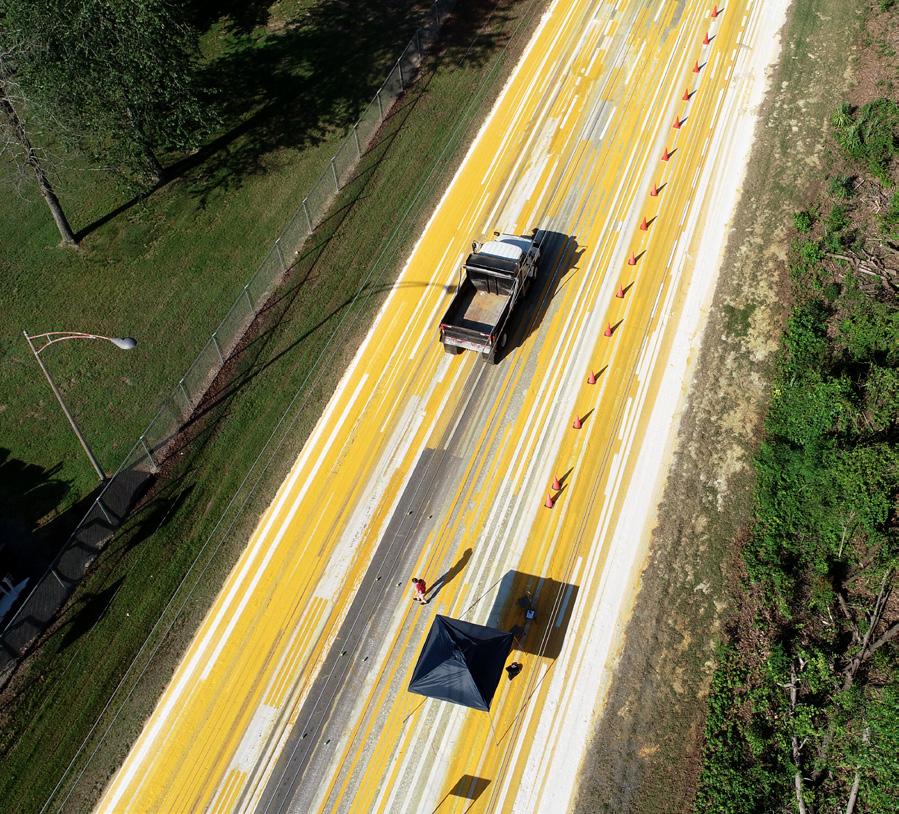
Ardot's very own Yellow brick road
and maintenance aides. The statewide striping team also has a road mechanic, two highway zoners, two assistant superintendents, and the superintendent. The “highway zoners” establish the passing and no-passing zones on twolane roads based on sight distance from hills and curves, and layout turn lanes at intersections. In addition, they can operate a striping machine if a crew is short-handed.
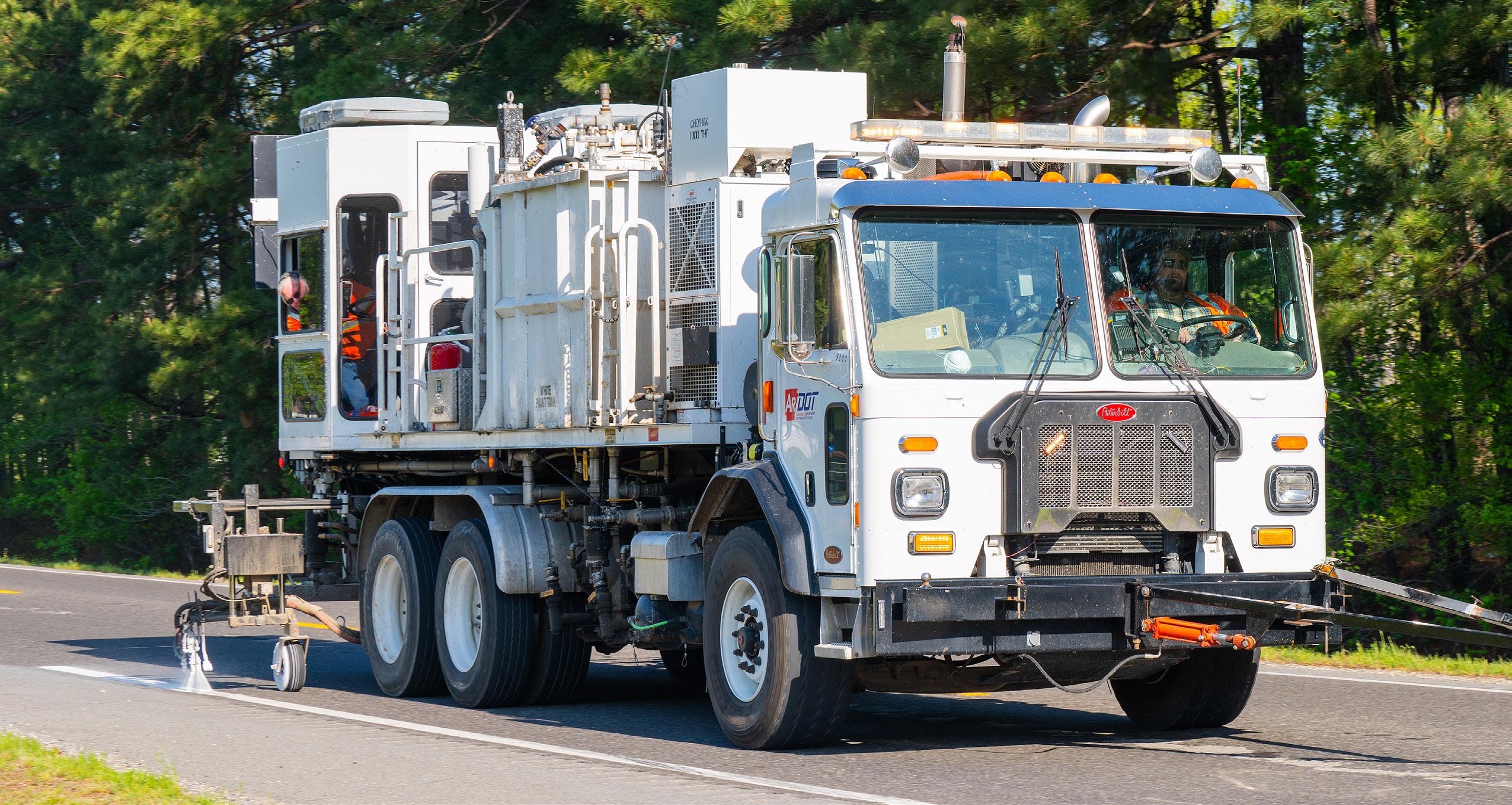
The striping machines are highly complex pieces of equipment. Each machine has a large volume air compressor, two 500-gallon paint tanks, an 8,000-pound glass bead tank, and a 100-gallon water tank. The rear of the machine has a climate-controlled shelter the operators ride in while striping. Operators turn toggle switches at the correct moments to control the paint guns, which apply the paint to the surface of the roadway. The driver of the machine uses the guide on the front to keep the machine straight, which results in a straight line.
This is no ordinary paint, however. To be seen at night and in varying types of weather, the lines need to have reflective properties.
“Glass beads are dropped onto the wet paint,” Brown said. “The beads are embedded into the paint when it dries, giving the paint reflective properties when light hits it.”
Every route in the system is inspected annually for visibility and is classified as pass or fail. These inspections are done at the District level under cover of darkness to check for reflectivity, looking for routes that may need restriping.
ARDOT’s Maintenance Division is making use of innovative technology to assess the retroreflectivity of highway pavement markings, which is the amount of light reflected from a vehicle's headlights back to the driver.

An ARDOT striping machine paints lines while an operator ensures the paint is placed properly.
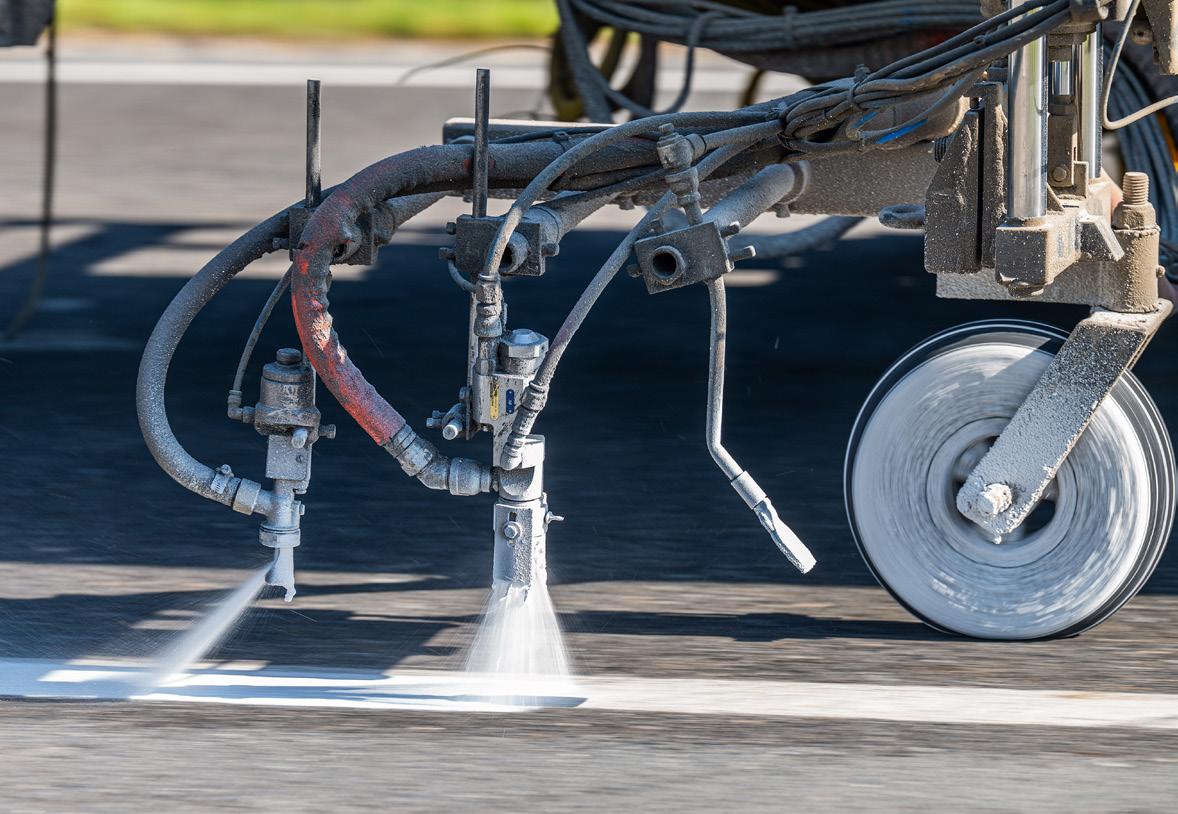
A closeup of the paint gun on one of ARDOT’s striping machines.
"We are using mobile retroreflectometers to help us quickly measure retroreflectivity loss caused by winter weather and everyday traffic. This data can now be collected during the daytime and is used to help determine which routes to prioritize for restriping each year,” Deric Wyatt, ARDOT Maintenance Division Head, said. “The pavement markings may look good during the day, but the glass beads that give pavement markings their nighttime reflectivity may become damaged by traffic or snowplows during winter weather events.”
There are a variety of factors that affect the distance a striping crew can cover in a day. If the road is a divided four-lane highway, it takes more passes by the striping truck to cover the same number of miles as a two-lane route. Weather is also a major factor in how many miles are covered in a week.
“Optimal striping is May to October, when we try to stripe all high-traffic routes due to faster drying times. It is never too hot to paint – the hotter the better,” Brown said.
However, it can be too cold to paint. The pavement needs to be above 40 degrees for the crew to paint. If it is too cold, the paint will not stick to the road’s surface. Humidity can also be a problem, so crews schedule striping for days with no rain in the forecast for at least 8 to 12 hours. If rainfall is in the forecast, the striping crews must suspend operations—otherwise, the paint will need additional time to cure to prevent bleeding across the pavement. If operations are suspended, the crew performs equipment maintenance, checks paint and bead gun calibrations, transports paint and glass beads to restock supplies, and

conducts crew training. On occasion, they assist county maintenance crews in the area they are working in or assist other statewide crews. During winter months, they clean and flush out the paint tanks and paint systems on the striping trucks, perform annual preventative maintenance, and conduct crew training. Crews are on standby to operate the strike team trucks for winter weather events.
With the large number of highway miles to maintain, chances are high that motorists will encounter a striping team in their travels, especially during warm weather. When striping, crews utilize a rolling lane closure which is a shortterm traffic control method that temporarily slows or stops traffic in advance of the work zone. The striping trucks operate at approximately 8 miles per hour.
“Our crews try not to impede traffic flow more than we must,” Brown said. “We must block oncoming traffic for sharp right-hand turns, because otherwise the guide on the front of the striping machine would encroach into the oncoming traffic lane. We also must block intersections.”
Despite efforts to warn motorists about the upcoming striping work in the area and advise caution, there are still instances of drivers passing the striping machine as it paints the pavement. It’s important for motorists to exercise caution when approaching a striping vehicle to avoid damage to their vehicle and to avoid tracking the lines. Like everything ARDOT does, safety during the process is top of mind for our crews and the traveling public.
ARDOT’s Yellow Brick Road may not lead to a wizard, but it does lead to safer roads and cleaner lines on Arkansas’ highway system.

DEEPENING REGIONAL ROOTS: ARDOT’s Northeast Arkansas Satellite Office
BY EMMA GOAD
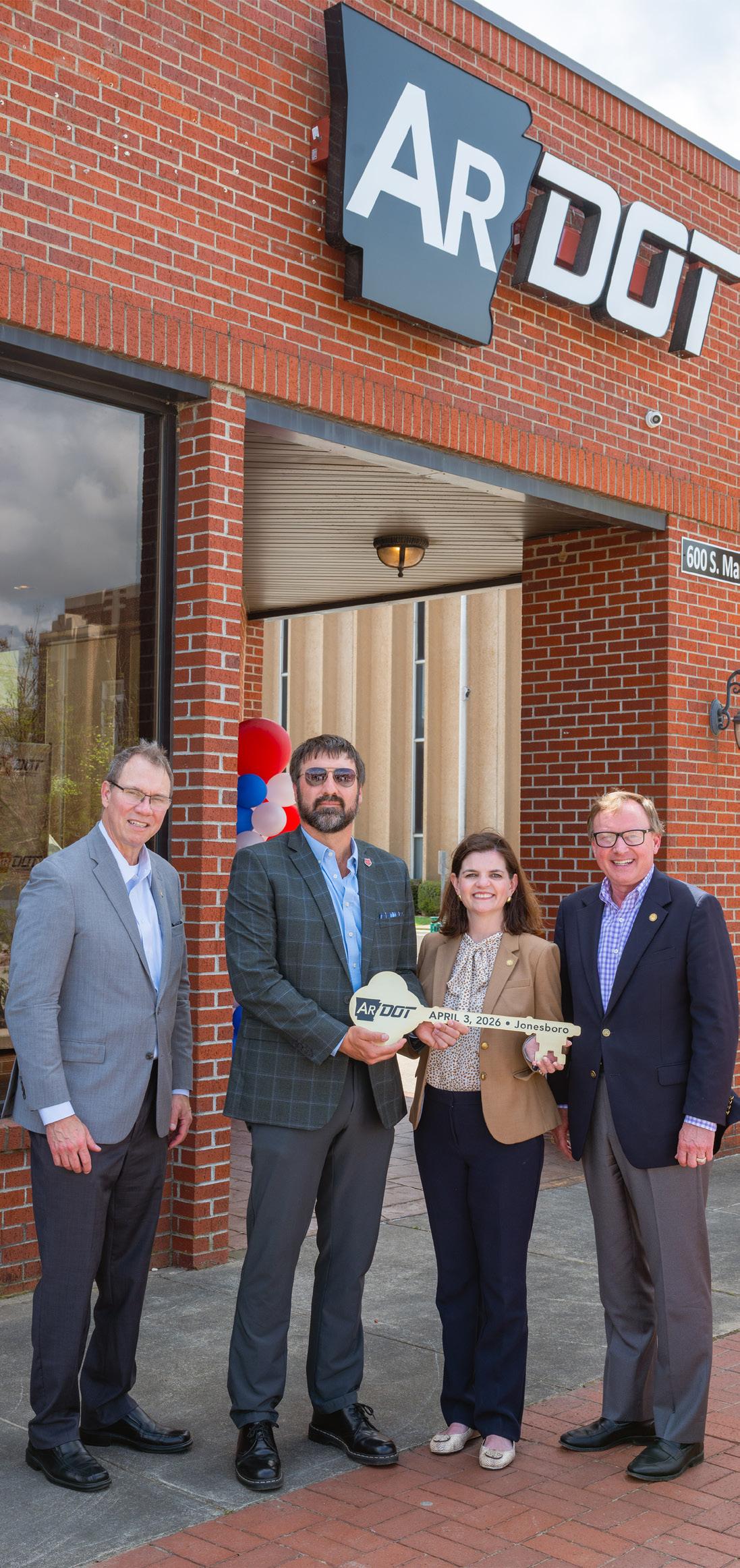
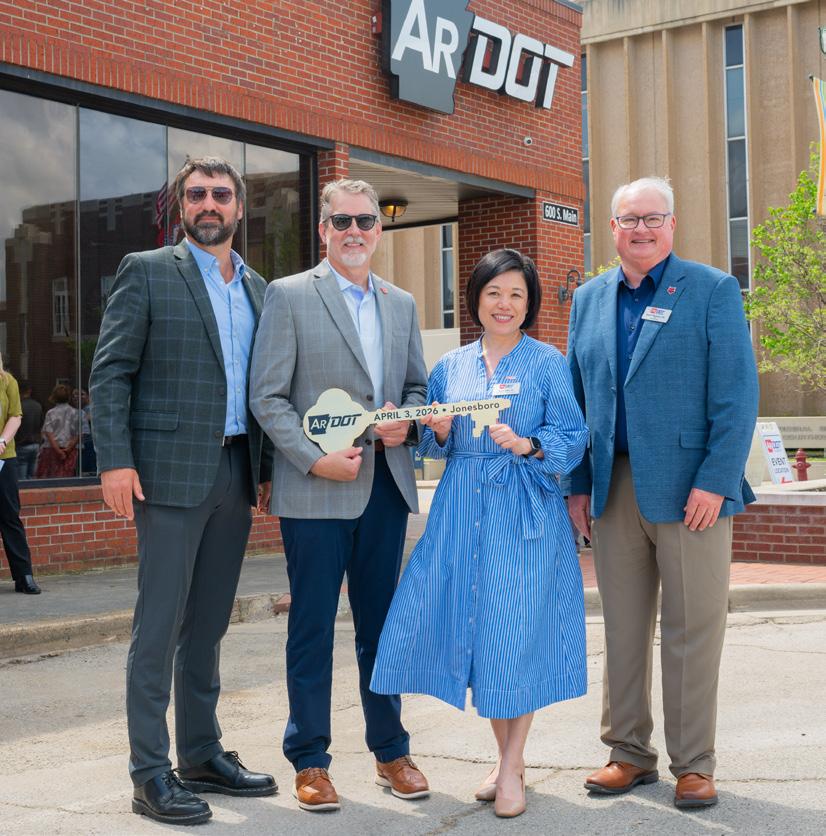
(L. to R.) Former Arkansas Highway Commission (AHC) Chairman Alec Farmer, ARDOT Director Jared Wiley, AHC Member Marie Holder, and AHC Member Jerry L. Halsey, Jr.
ON A BUSY STRETCH OF MAIN STREET IN DOWNTOWN JONESBORO, A NEW CHAPTER FOR THE ARKANSAS DEPARTMENT OF TRANSPORTATION (ARDOT) BEGAN IN APRIL WITH THE OPENING OF ITS NORTHEAST ARKANSAS SATELLITE OFFICE. Located at 600 S. Main Street, the office will function primarily as a design hub, with engineers performing roadway and bridge design work. Students, community and national leaders, and transportation partners gathered over a two-day span as ARDOT celebrated the grand opening.
AN INNOVATIVE APPROACH TO RECRUITMENT
The idea for the new office was inspired by the success of ARDOT’s first satellite office in Northwest Arkansas, which opened in Bentonville in 2022. The Northwest Arkansas Satellite Office was created to better position ARDOT to attract engineering students from the University of Arkansas, giving students the opportunity throughout the year to get to know ARDOT and experience first-hand the work culture. It also provided an option for engineering graduates or ARDOT staff to live among and serve a growing region of the state.
“Because our Northwest Office has been so successful, we wanted to have that same opportunity in Northeast Arkansas,” Mike Fugett, ARDOT Assistant Chief Engineer for Design, said. “We wanted to reach the engineering graduates from Arkansas State University and the surrounding areas.”
INVESTING IN THE NEXT GENERATION
The spotlight for the grand opening fell on the future workforce as students from Arkansas State University (A-State) attended an open house on Thursday, April 2. ARDOT welcomed those studying engineering, computer science, and construction management to explore what a career with the Department would look like. Food trucks kept the atmosphere relaxed and welcoming, while ARDOT professionals were on hand to answer questions, share their own career journeys, and connect with students in a lowpressure setting.
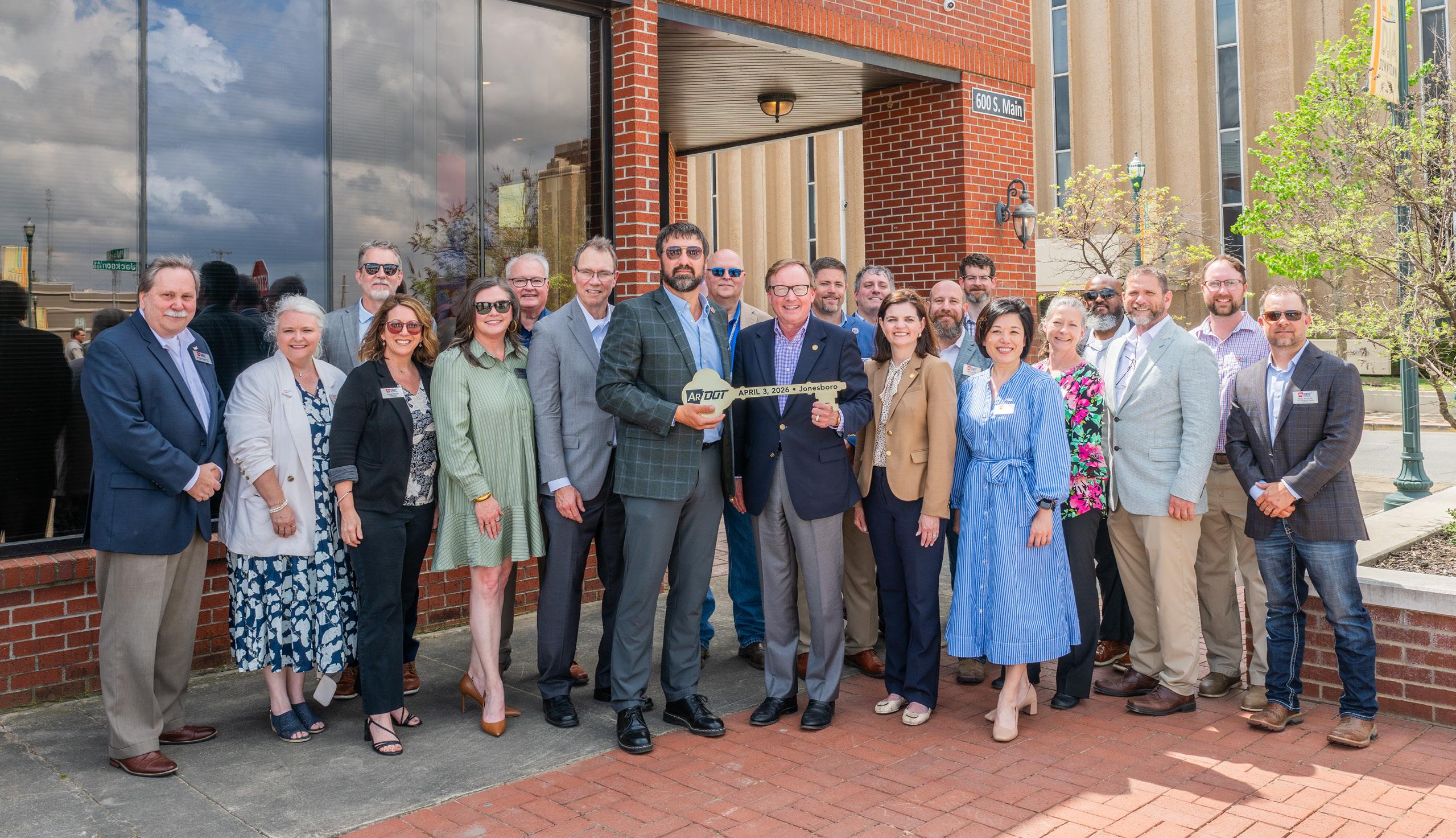
ARDOT staff, as well as former and current Arkansas Highway Commission members, gathered for a photo at the grand opening.
ARDOT hosted this event to shine a light on the future of its workforce – showing students that they could have a home at the Department only a stone’s throw away from the school where they prepared for the future.
A MILESTONE FOR THE REGION
The day after the student open house, ARDOT welcomed local, state, and national officials, industry partners, and community members from the region to formally celebrate the grand opening of the Northeast Arkansas Satellite Office.
The program featured remarks from Arkansas Highway Commission Member Jerry L. Halsey, Jr., A-State Chancellor Dr. Todd Shields, Jonesboro Mayor Harold Copenhaver, Craighead County Judge Marvin Day, and U.S. Congressman Rick Crawford, with opening and closing remarks from ARDOT Director Jared Wiley.
“By establishing a stronger regional presence in Northeast Arkansas, we can work more efficiently with local partners and better recruit and retain local talent,” Wiley said. “This office will help ARDOT advance its mission to deliver a quality transportation network in every region of the state.”
“I’m happy to be able to work with ARDOT in that capacity because I think it’s important, as your representative, to be able to bring resources back to you so that we can improve economic opportunities and outcomes here in an important part of our state,” Crawford said.
With an emphasis on the future of A-State students, Shields said the new location would strengthen the connection
between the school and ARDOT as well as the regions that they both serve.
“We’re excited about the work ahead and are grateful to continue this partnership,” Shields said.
A permanent ARDOT presence in the region speaks to a greater relationship with the City of Jonesboro, and the local impact will be felt for generations to come.
“Everybody has to get to Jonesboro through a highway,” Copenhaver said. “That is the importance of this partnership and this opening today to what it means to not only the Jonesboro community, but Northeast Arkansas as a whole.”
“I’m just really proud to see ARDOT here in our community and just want to recognize how wonderful that’s going to be for us,” Day said. “Bringing those jobs, giving us the ability to develop projects, to partner with Arkansas State, and help find creative solutions to our traffic needs going forward.”
Following the event, attendees toured the facility and learned more about how the office will support transportation initiatives throughout Northeast Arkansas.
STRENGTHENING CONNECTIONS
By establishing a stronger presence in Northeast Arkansas, ARDOT has positioned itself to better address the region’s unique needs while providing opportunities for recent graduates in the area. The new office is not just an expansion of ARDOT’s footprint, but reflects a continued commitment to improving work, fostering partnerships, and enhancing transportation systems across the state.
DRIVING FORWARD:
ARDOT’S TECH-FIRST APPROACH TO MODERN TRANSPORTATION
BY EMMA GOAD

THE ARKANSAS DEPARTMENT OF TRANSPORTATION (ARDOT) MISSION STATEMENT, TO DELIVER A MODERN TRANSPORTATION SYSTEM TO ENHANCE SAFETY AND QUALITY OF LIFE IN ARKANSAS, IS A COMMITMENT THAT DRIVES INNOVATION AND COLLABORATION. ARDOT strives daily to leverage cutting-edge technology to solve real-world transportation challenges across the state.
“We’re not looking at technology just for novelty’s sake,” Joseph Hawkins, ARDOT Transportation Systems Management and Operations (TSMO) Division Head, said. “We’re always evaluating today’s technology and what’s coming down the line to enhance the safety and operation of the highway system.”
This philosophy drives ARDOT to continuously implement innovative solutions that improve traffic flow, protect workers and motorists, and prepare Arkansas highways for the future. From intelligent lane management to AI-powered safety systems, the Department is proving that smart technology can deliver big results.
MANAGED LANES: FLEXIBILITY MEETS CAPACITY
When traffic congestion proved to be an issue on Interstate 430 between Maumelle and Little Rock during peak traffic hours, ARDOT was able to look for creative opportunities in technology to address traffic needs. The solution came in the form of managed lanes. Managed lanes converted the already existing wide shoulders on the bridge into an additional travel lane that can be used during peak travel times. The project cost approximately $15 million, a stark contrast to the estimated $250-300 million that would have been required to add permanent
lanes to widen the bridge.
“We’re using technology to add capacity when you need it,” Hawkins said. “If we’re adding capacity full-time every day of the week, that’s Roadway Design Division’s role. TSMO is looking at using technology for peak hour-type problems.”
The system works through careful monitoring and active management. Before opening the managed lane each day, employees in ARDOT’s Traffic Management Center (TMC) review the traffic cameras to ensure the shoulder is clear of debris or disabled vehicles. If the lane is not clear, it will not be opened until crews are able to remove any materials. Lane control signals, enhanced lighting, and additional cameras all work together to keep the system running safely.
Since the inaugural use of managed lanes in Arkansas has proven effective, ARDOT is now seeking out additional locations across the state where managed lanes could ease congestion. Using Geographic Information System (GIS) mapping, ARDOT has identified a few areas with wide shoulders and high traffic volumes, overlaying that data with crash reports to prioritize where technology could make the biggest impact.
WRONG-WAY DETECTION: SAVING LIVES WITH SMARTER SYSTEMS
Wrong-way drivers on highways account for approximately 500 deaths annually in the United States. To combat this issue, ARDOT has tested a detection system that works 24/7 to catch drivers in the act before their mistake becomes a tragedy.
One of the currently operational systems on Interstate440 at the England exit just north of the Arkansas River, the wrong-way detection system uses advanced sensors and


cameras to identify vehicles entering ramps in the wrong direction.
When a wrong-way driver is detected, the system alerts the driver by activating LED signs with flashing borders, illuminating a spotlight. The spotlight is particularly important, since most wrong-way incidents occur at night. Color cameras capture identifying information about the vehicle and, within seconds, alert the crews in the TMC.
“The TMC operator can decide, is this a real wrong-way driver?” Hawkins said. “If it’s a yes, did they self-correct? If they don’t self-correct, the TMC operator will immediately call state police or other first responders.”
Of 13 confirmed wrong-way drivers detected since August 2024, the system convinced 10 to turn around before reaching high-speed lanes. That’s a 77 percent success rate.
This detection system is already promising, and ARDOT isn’t stopping there. TSMO is working to integrate the wrong-way detection system with the TMC’s advanced traffic management system. Once complete, TMC operators will be able to push alerts to digital message boards throughout the affected corridor with the push of a single button, warning right-way drivers of the potential danger ahead.
Additional wrong-way detection sites are currently being installed by contractors across Interstate 40 with more than 150 locations planned.
SAFETY ROLLING BARRIERS: A GENTLER GUARDRAIL
At the on-ramp from Highway 35 north (Carpenter Road) to the Interstate 30 eastbound frontage road in Benton, ARDOT is piloting the Safety Rolling Barrier (SRB) — a new type of guardrail system that uses plastic rollers to absorb

impact energy and guide vehicles to a safer stop.
“We’re hoping the system will be cost-effective and that it should require less maintenance,” Mark Headley, ARDOT Special Projects Coordinator, said. “There should be less damage to vehicles but also less damage to the system itself when it’s impacted, and therefore, we should be repairing it less frequently.”
ARDOT maintenance personnel identified this location as an area with frequent impacts to the traditional guardrail system, making repairs costly and time-consuming. It was the perfect test location for evaluating whether rolling barriers can reduce high maintenance demands, while still keeping safety top of mind.
The barriers feature yellow barrels mounted on steel posts. When a vehicle strikes the barrier, the barrels absorb the impact force by contracting slightly, then springing back to their original shape. The rolling motion helps redirect the vehicle along the roadway before bringing it to a controlled stop.
At 39 inches tall, significantly taller than the traditional 27- to 31-inch guardrails, the impact-absorbing barrels mean most vehicle bumpers strike the energy-absorbing section rather than vaulting over the barrier.
This is the first time this kind of SRB has been installed on a state-owned roadway in the United States. ARDOT plans to monitor the pilot installation for approximately one year. If the rolling barriers prove their worth in reducing crash severity and maintenance costs, they may be considered at additional locations across the state.
(continued on page 24)
Managed lanes on Interstate 430.
The SRB's real-world debut came quickly. The very next day after installation, a vehicle struck the barrier. Thanks to the system's energy-absorbing design, the crash left behind only minor dents on the vehicle. Benton Mayor Tom Farmer sent ARDOT a thank-you note after the accident.
WORK ZONE SAFETY CAMERAS
Technology is also making Arkansas work zones safer with the addition of AI-powered cameras that detect both speeding and handheld device usage. These systems use AI to identify violations, with images then verified by Arkansas Highway Police (AHP) officers who can pull over the offenders in realtime. This is not a ticket by mail system.
These images are deleted if no citation was issued, and neither AHP nor ARDOT profit from tickets written. While several states have work zone cameras, ARDOT is one of the first to use this technology for cell phone detection.
“Around 17 percent of all fatal crashes at work zones involve cell phones or distracted driving,” AHP Chief Jeff Holmes said. “If you have a phone in your hand, you’re looking down at the screen, you’re not paying attention to the road, and in a work zone, a split second can change the world.”
See page 16 for the full story on our work zone safety cameras and how they’re protecting both motorists and highway workers.
THE REAL DIFFERENCE
“Our role is to find technological solutions to solve real-world safety and capacity problems using low-cost, quick-to-procure options,” Hawkins said. “With technology, we can be much more nimble in responding to conditions.”
The TSMO team is dedicated to finding technological solutions for challenges presented to the Department.
“With technology, it’s like dog years or worse,” Hawkins said. “As soon as we get comfortable, it’s already old technology, so we’re always having to look to the future.”
Every technology adoption at ARDOT is evaluated through the lens of three key questions: How can this improve what we do? How can we integrate it with systems we already have? And most importantly, how can it help the traveling public and ARDOT staff?
From managed lanes that add capacity when it’s needed most, to wrong-way detection systems that catch wrong-way drivers before they become involved in fatal crashes, to innovative barrier designs that protect both vehicles and budgets, ARDOT is proving that using technology intelligently is the best way to keep Arkansas moving safely forward.

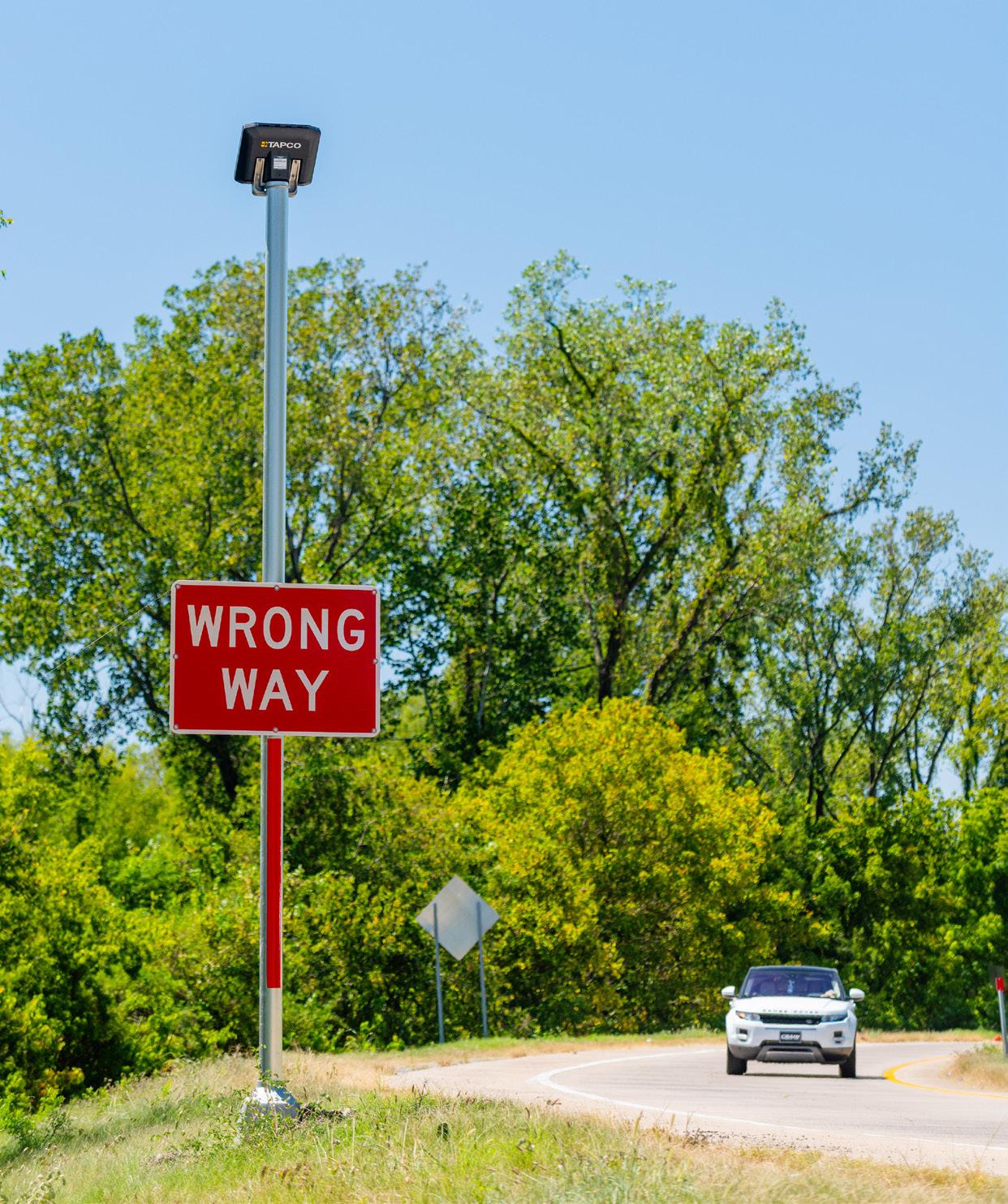

A wrong-way detection site at an off-ramp on Interstate 440
The Safety Rolling Barrier pilot site at the on-ramp from Highway 35 north to the Interstate 30 eastbound frontage road in Benton.

SMOKE. SERVE. REPEAT.
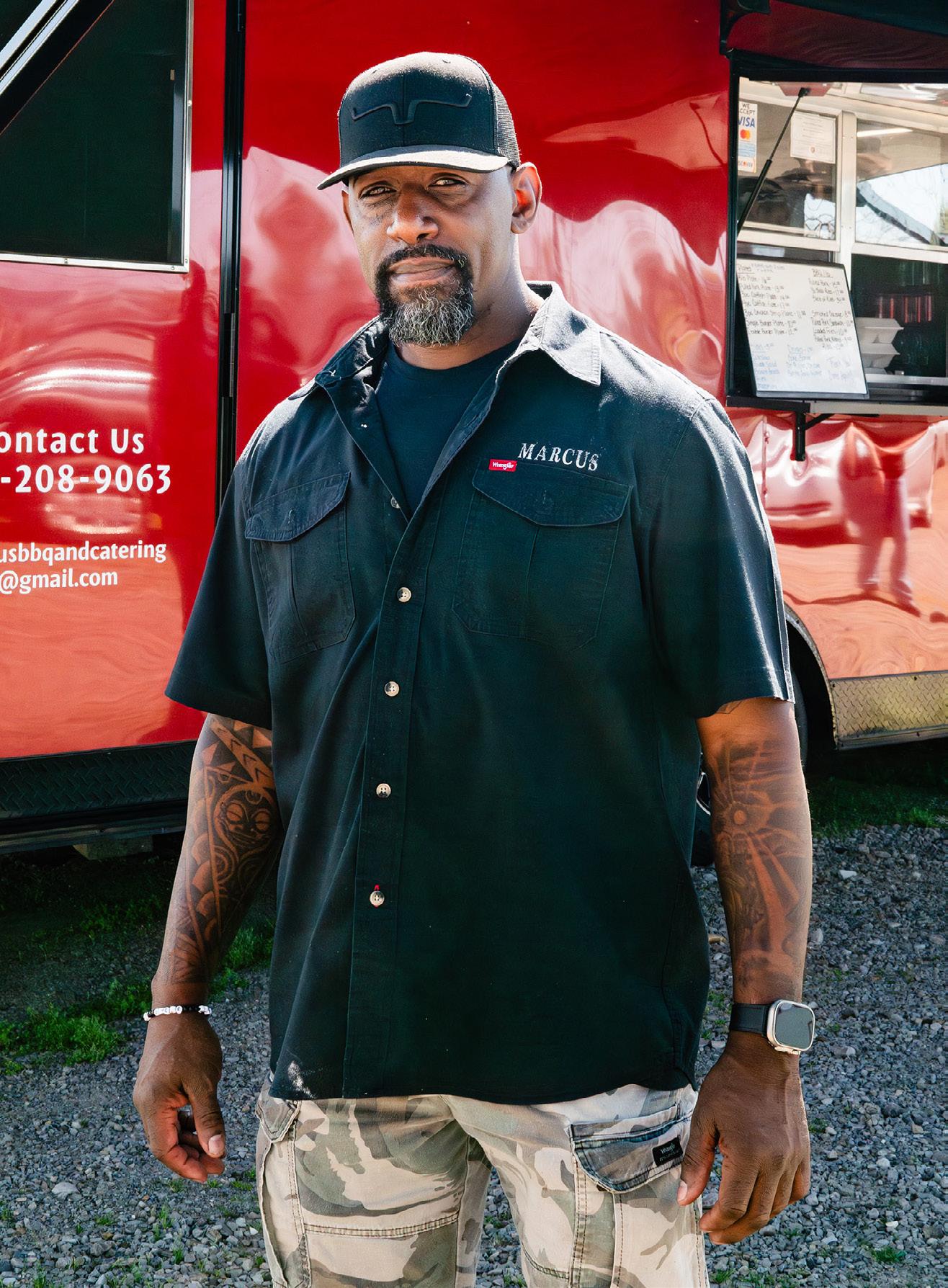


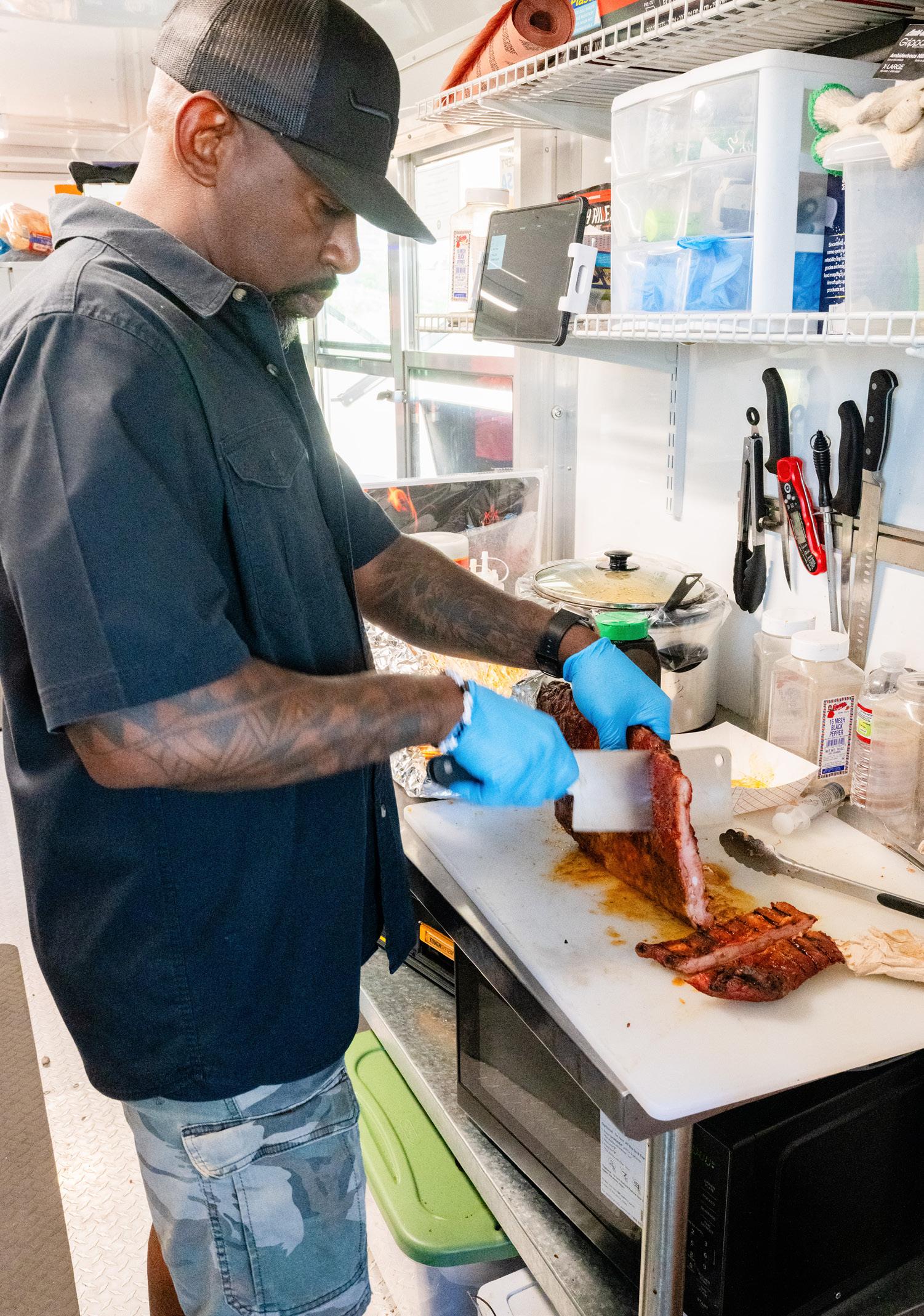
BEFORE THE SUN COMES UP IN MORRILTON, THE SMOKE IS ALREADY BUILDING. While most people are still buried under their covers, Marcus Canady is already on his second act of the day – up at 3:00 a.m. to hit the gym, then back to his food truck by 5:00 a.m. to get the smoker lit ahead of the weekend rush. By the time his neighbors pour their first cup of coffee, Canady has already put in hours of work. It is not a schedule for the faint of heart.
But Marcus Canady is not a man who does things halfway.
Canady is a District 8 Electrical, Plumbing, and Mechanical Repairman for the Arkansas Department of Transportation (ARDOT). He is also a 31-year firefighter with the City of Morrilton, a deacon at his church, and, for the past six months, the owner and pitmaster of Marcus's BBQ & Catering, a food truck that has quietly become a fixture in the community. He manages all of it simultaneously, without bragging and without failure. He wouldn’t use the words “community hero” to describe himself. In fact, he would probably change the subject.
“I don’t try to be like anybody else,” Canady said. “I just do what I do and hope and wish that people come back for a second round.”
RAISED IN THE KITCHEN, FORGED BY
FAMILY
Morrilton has been home for most of Canady’s life. He was born in Saline County and raised by his grandparents, moving to Conway County when his grandfather retired. The town became permanent for him, and he’s been there ever since. He raised his own son there, who recently turned 27, and has built the kind of deep, unhurried roots that only come from choosing to stay.
“It’s a tight-knit community,” Canady said.
The roots of Marcus's BBQ & Catering trace back not to a culinary school or a cooking competition, but to a grandmother’s kitchen and a boy who learned to pay close attention. His grandmother, like many great home cooks, kept her secrets close to her chest. She wouldn’t tell you what went in the pot, she would only show you.
“She wouldn’t tell me the recipes or the secret,” Canady said. “But I’m more of a hands-on person anyways. Don’t tell me. Just show me. And I watched.”
He is quick to add that his early attempts at recreating those meals were not exactly a triumph. He started cooking for his coworkers, and the reception was honest.
(continued on page 26)
“That wasn’t too good,” Canady said. “Let’s try this again.”
He kept at it. He brought meals into ARDOT offices here and there, and slowly, people started to notice. For two or three years, friends and coworkers told him he needed to go into the food business. He listened politely and resisted, knowing there was a considerable gap between being a talented home cook and actually running an operation.
“It’s easy to say you can until you jump off into it,” Canady said. “And then it’s a whole different ballgame. Having a fulltime job, you have to be tough-minded and strong-willed.”
Despite the challenges, he started throwing things together, testing combinations in the kitchen, and letting the results speak for themselves.
“Will this work? Will that work? No, this is not going to work,” Canady said. “But so far, the community has accepted it.”
ALL IN OR ALL OUT
Marcus's BBQ & Catering opened in fall of 2025 and operates on Fridays and Saturdays. The menu is deliberately tight: ribs, baked beans, and loaded fries just to name a few. His signature offering is the baked beans – what he calls “cowboy baked beans,” made with hamburger meat, sausage, onion, and pepper. The rest of the recipe, according to Canady, is a secret.
“They’re not your usual store-bought baked beans,” Canady said. “Everybody loves the baked beans.”
Running the truck has been a learning experience for Canady. One week he can over-prepare, and a slow crowd leaves food to spare. The next week, he can scale back and get slammed. Canady has learned to adapt, and more importantly, to make the most of what doesn’t sell. When leftover food began accumulating after slower weekends, he reached out to local shelters in Morrilton to see if they would accept donations. They said yes and he’s been doing it ever since.
During the holidays, he went further. A coworker and friend of his, Robert Garrett with the Arkansas Highway Police, encouraged Canady to help him with organizing a meal giveaway for families in the community who were struggling. He did not announce it. He did not post publicly about it. He just did it. One of the families ran into him at Walmart afterward and told him they were coming back to the truck.
“I was like, no,” Canady said. “I didn’t want them to feel like it was an obligation. It wasn’t.”
The family came back anyway. When they did, Canady said they told him something that stayed with him: their children had come away from the experience understanding what it really means to look out for the next person.
“It wasn’t about color. It didn’t have anything to do with politics,” Canady said. “It was just a stranger taking care of a family in need.”

Ask Canady if he considers himself a community servant, and he’ll deflect almost immediately.
“In a way, but to me, and people will tell you, I don’t like being out there in the forefront,” Canady said. “I like to sit back in the corner and just watch things come to fruition. I like knowing I had a part in something good.”
Marcus Canady prepares food to serve from his food truck.
LESSONS FROM ARDOT APPLIED AT THE WINDOW
Thirty-one years as a firefighter have a way of shaping a person. Canady plans to step back from that role this year. His body, he said, is telling him it’s time to start slowing down. But the discipline, the composure under pressure, and the habit of showing up no matter what are traits that have translated directly into the food truck operation.

So has his time at ARDOT. Canady is candid about the fact that patience does not come naturally to him. But working with the public through the Department has taught him something he now applies to his work every time he steps up to the ordering window.
“I’m not a person of patience, but I’ve learned that dealing with the public. The lessons carry over from the ARDOT family to here,” Canady said. “You treat people how you want to be treated. If I’m rude to them in that window, I know I just lost a customer. But if I come out and thank them for coming, make a little small talk, it kind of drops the temperature down and we’ll have a nice conversation out here for 30 minutes.”




His crew at the truck is small but loyal. The team includes a woman named Lisa, who Canady said “stepped up, and stepped up in a big way,” and his mother. He has plans to build a team of six to 10 people so Marcus's BBQ & Catering can eventually take on larger catering ventures. The vision is a well-oiled operation where everyone knows their role.
“I work and I want others to do the same,” Canady said. “Get in, let’s get it done.”
He is not, it should be noted, a man who likes to repeat himself.
STAYING TRUE TO THE RECIPE
Ask Canady what keeps him going on mornings when he worked past midnight the night before only to wake again at 3:00 a.m., and the answer is immediate and uncomplicated: repeat customers.

“I think the best thing for me thus far is seeing a repeat customer,” Canady said. “That tells me I’m onto something.”
He has resisted the urge to constantly tinker with what is working. A customer, who happens to be his banker, recently stopped by the truck and suggested a chicken bacon loaded fry: fries topped with grilled chicken, bacon, ranch, and cheese. Canady was skeptical, but he tried it anyways.
“Boy, was it good,” Canady said.
While he didn’t add it to the rotation, he appreciates the chance to play around with the recipe. The core of Marcus's BBQ & Catering remains unchanged, and he intends to keep it that way.
“I’ve stayed true to how I’ve been doing things and the


menu I have available,” Canady said. “And I don’t see me changing any time soon.”
He acknowledged a weakness of his is that he does not write anything down. Every recipe lives in his head, measured by instinct and feel rather than tablespoons and timers. He knows he needs to change that, especially as he builds his team, but it’s how his grandmother cooked. It’s how he learned to cook.

Speaking of his grandmother, Canady is still working on getting her fried apple pie recipe out of his family. He asked his mother. He asked her sister. Neither one will tell him.
“Somebody is going to tell me that recipe,” Canady said, with the quiet certainty of a man who does not have much practice at giving up.
Father-Son ARDOT Team Perform Icy
Exemplify Public Service
BY RUTHIE BERRHILL
WINTER STORM FERN CAME BLOWING INTO ARKANSAS ON JANUARY 23, IMPACTING THE ENTIRE STATE FOR DAYS. ARKANSAS DEPARTMENT OF TRANSPORTATION (ARDOT) CREWS WORKED AROUND THE CLOCK DURING THE WINTER WEATHER EVENT, UNTIL ALL PRIMARY ROUTES WITHIN THE STATE WERE 100 PERCENT CLEAR. During the weather event, Brad McCurry, ARDOT Maintenance Specialist, and his son, Charlie McCurry, ARDOT Maintenance Aide I, were working 12-hour shifts plowing Arkansas highways. Four days into the event, the father-son duo were assigned to plow Highway 375 in Polk County, a mountainous, narrow road with sharp turns.
Brad was driving a road grader, a heavy machine equipped with a long, adjustable blade to clear roads of ice and snow. Charlie was following behind his father in another truck functioning as the grader’s escort. They had stopped to add tire chains to the grader before continuing up Highway 375 when two men in a Jeep drove past them.
“The Jeep went around us, and we made eye contact and waved at them as they went by,” Brad said.
That day was extremely cold, and Highway 375 was covered in a thick layer of solid ice. Once they attached the chains, Brad and Charlie headed up Highway 375, plowing their way to the top. As Brad was making his way down the mountain, plowing the south side of the highway, he saw movement out to his left.
“Somebody was down under the ravine trying to flag me down,” Brad said. “When I got a little closer, I realized the Jeep was off the road down in the bottom of the ravine and rolled over on its top.”
At that point, Brad pulled over to see what had happened and if he could help. He got out of the grader and soon discovered that it was impossible to stand upright without holding on to something.
“Once I got out, my feet immediately went up underneath me, and I hit the ground,” Brad said. “That’s when I realized how serious it was.”
Charlie pulled up behind Brad and got out of his truck, but soon had the same problem with the icy surface.
“His feet went out from under him and with the bank of the road he shot over the edge,” Brad said. “He was gone in a matter of seconds.”
Charlie had fallen down the ravine and landed near the others.
“When I finally stopped down there, I was within a few feet of the older gentleman,” Charlie said. “There was nothing to grab onto, and I was just trying to get to him and help him.”
Brad went back to the grader to see if he had anything in the cab that could help. He didn’t have a rope, but he had jumper cables and a tow strap. He tied it all together and attached it to a sign on the opposite side of the road.
“That was the only way you could cross the road to get down toward where they were,” Brad said. “That’s how we all had to maneuver to get to them.”
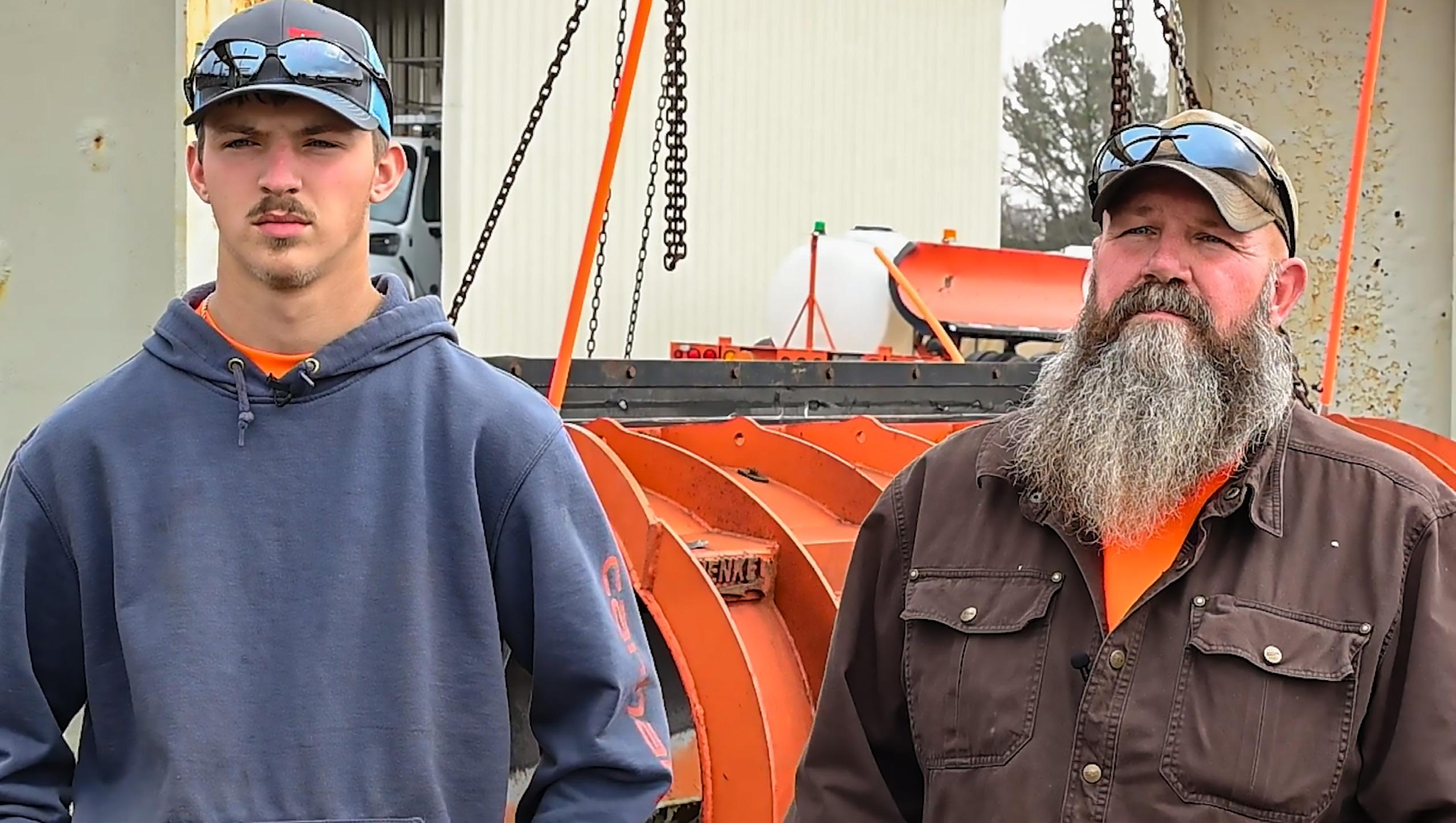
(L. to R.) Charlie McCurry, ARDOT Maintenance Aide I, and Brad McCurry, ARDOT Maintenance Specialist.
When I got a little closer, I realized the Jeep was off the road down in the bottom of the ravine and rolled over on its top.”
— Brad McCurry, ARDOT Maintenance Specialist
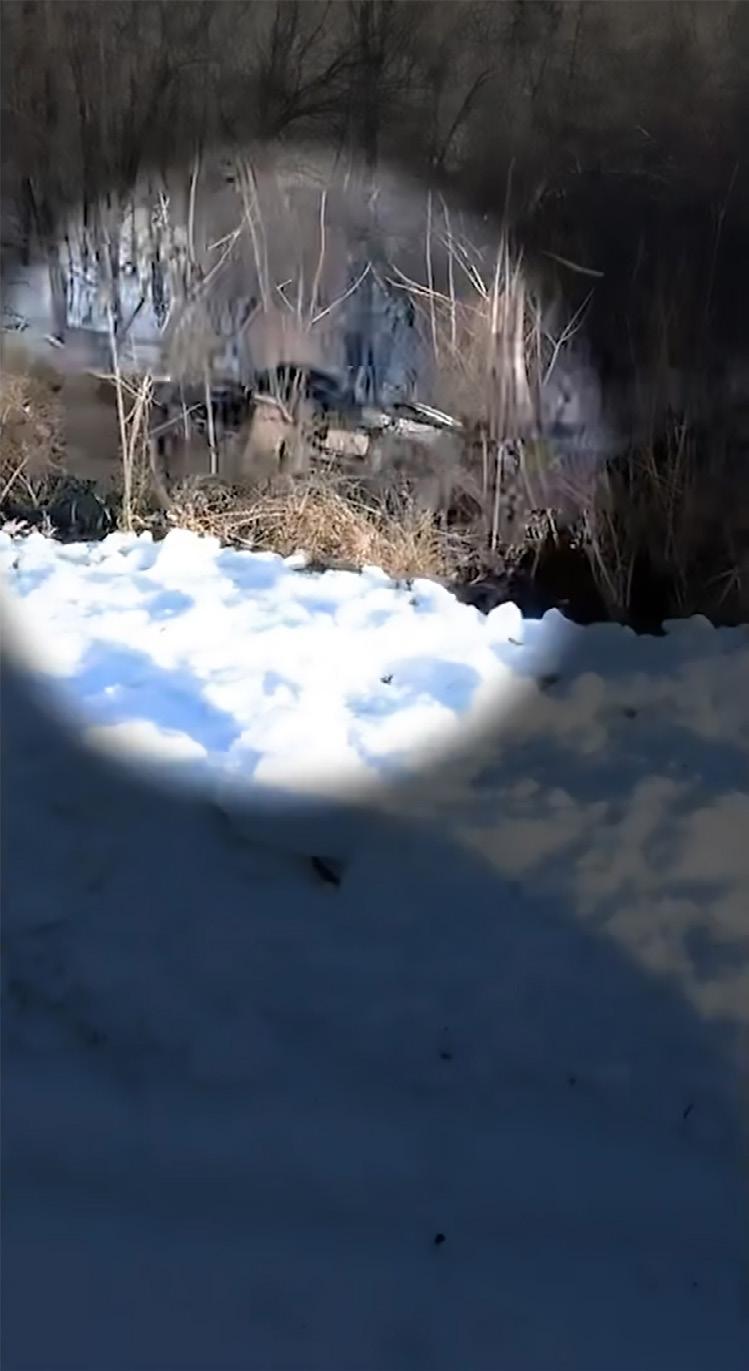
At this point, Brad didn’t know that the situation in the ravine was even more severe than he had originally thought. When the Jeep left the road, it had turned over two or three times before it came to a stop against an oak tree. The driver, an 87-year-old man, had been ejected from the vehicle and was seriously injured.
“The older gentleman was shaking and had trouble talking,” Charlie said. “I was just trying to reassure him that he’d be all right and we’d get him some help. In the meantime, emergency services arrived and were trying to get the rope down to us.”
No one on the scene had a rope in their vehicle, so Brad’s cobbled-together “rope” made of jumper cables and a tow strap was the only way to reach Charlie and the motorists. The road was so icy that even with Brad’s improvised rope, everyone had to find something to hold onto – the grader, the grader blade – anything they could use to stabilize themselves.
The older man was taken out of the ravine and transported away for medical treatment. In this type of emergency, a backboard (also called a spine board) is typically used to carry the patient to the ambulance.
“It was so slick that we couldn’t carry him up on the backboard,” Brad said. “We drug him up onto the highway with the tow strap tied to the ambulance.”
After the rescue was complete, Brad and Charlie went back to plowing the highway.
“We had to plow down the mountain just to get them
a place to turn around,” Brad said. “I’ve been with the Department nearly 25 years, and this was the hardest of any material I’ve ever tried to stand on or drive on.”
While helping the stranded motorists, Brad and Charlie discovered that they had something in common – the motorists were father and son, just like Brad and Charlie. Brad and Charlie aren’t usually assigned to the same team. Charlie normally works on the Bridge Maintenance crew, but during winter weather events, like many other ARDOT employees, he is assigned to work in whichever area ARDOT most needs him. On this day, they happened to be assigned to the same route.
Although Brad and Charlie were concerned about the man’s injuries and wanted to know how he was doing, they were unable to learn about his condition due to federal Health Insurance Portability and Accountability Act (HIPAA) privacy laws. However, both Brad and Charlie say they were glad they were there to help that day.
“I’d do it again,” Charlie said.
Brad and Charlie’s actions that day might cause some to call them heroes. However, they say it was just part of their role as public servants.
“I’ve always felt like we work for the public,” Brad said. “Everybody talks about how they work for ARDOT or for the state of Arkansas. We do, but we work for the public. They’re the reason we’re here. It’s part of our duties, and I was just glad I was there to do it.”
The view from the road of the Jeep in the ravine.
CHECKING THE REARVIEW: Piggott Roundabouts
BY KAITLIN WORLEY
PIGGOTT, ARKANSAS, IS A SMALL, LAID-BACK, CLOSE-KNIT FARMING COMMUNITY LOCATED IN THE NORTHEAST CORNER OF THE STATE. It is perhaps most known for being the location where author Ernest Hemingway worked on his famed novel, "A Farewell to Arms."
Despite the city’s calm and cozy atmosphere, Highway 62, running through the middle of downtown, had a history of creating challenges for both the local community and those traveling through. Due to the way the highway was situated, it forced drivers to navigate sharp, awkward turns that proved especially troublesome for large trucks and commercial motor vehicles.
“We had 90-degree turns for many years, and we were trying to figure out what to do with them,” Clay County Judge Mike Patterson said.
Because roundabouts keep the flow of traffic steady without sudden stops and provide more room for turns, they were proposed as a solution to the tight turns on Highway 62 in downtown Piggott.
“Roundabouts give more room for turns,” RyanBlankenship, Arkansas Department of Transportation (ARDOT) Resident Engineer, District 10 Resident Engineer Office 04, said.
A public involvement meeting was held in June 2018 to hear from the public about the proposed improvements. As a city that, at the time, only had one stoplight (26 miles away from the only other stoplight in the county), there was some initial resistance to the idea of these changes.
“I know that the roundabouts included in this project are going to be something new for motorists driving in the Piggott area,” Former ARDOT Director Lorie Tudor said at the groundbreaking on November 18, 2021. “Once this project is complete, I think motorists here will find them to be advantageous and a great help with traffic flow.”
Construction began in fall 2021. The project included three 100-foot roundabouts, new sidewalks, new curbs, improved drainage, and an improved traffic signal.
“The construction phase was hard, as we were still having to maintain traffic, and it was hard for people to see the progress being made,” Blankenship said.
TODAY
The community was relieved when construction was completed in December 2023. While there was some initial resistance to the roundabouts, local opinions changed once the work was completed.
“Once we were finished, pretty much all of the calls and complaints just went away,” Blankenship said.
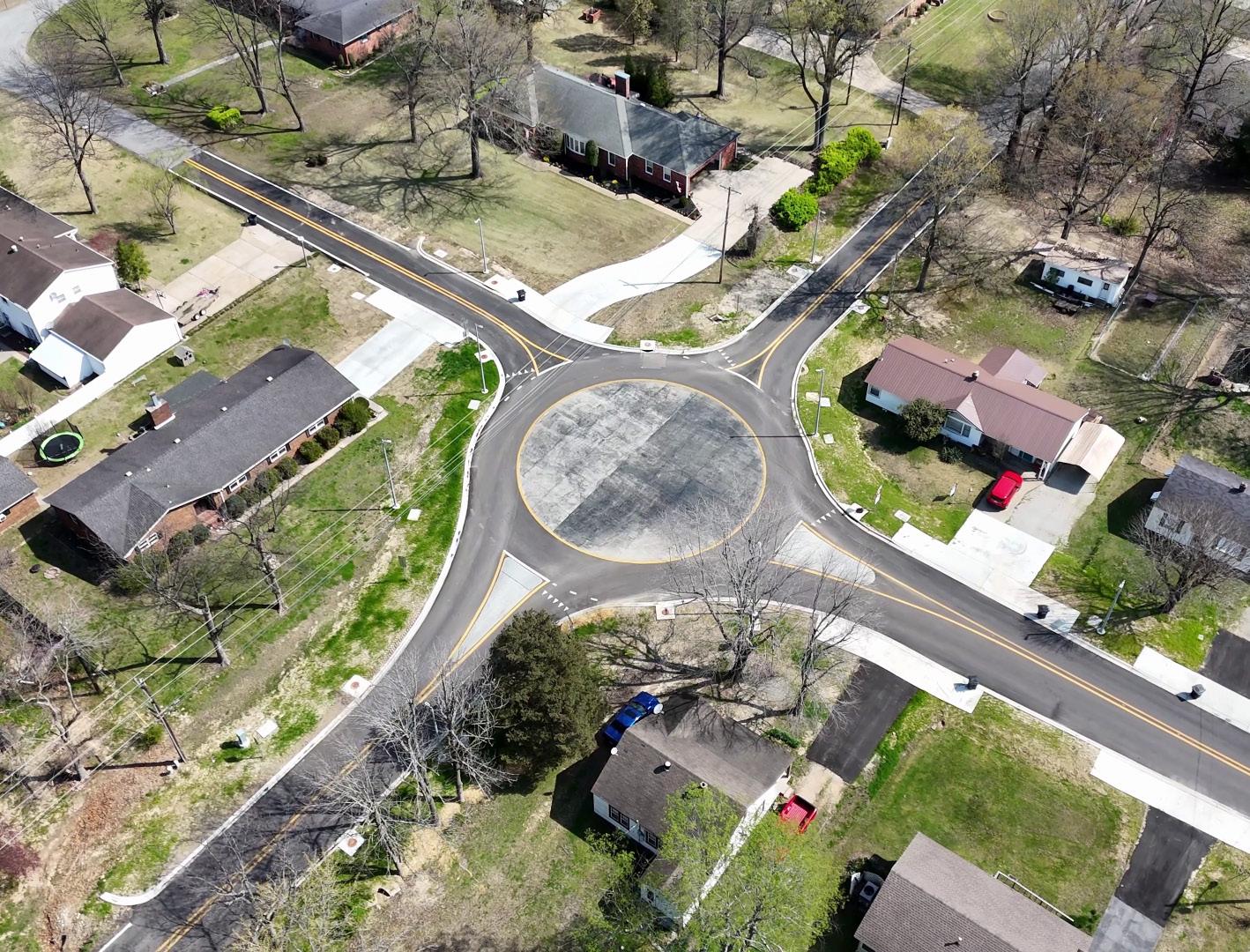
Local leaders noticed the change as well. According to a statement from the Piggott Chamber of Commerce, "The completion of the three roundabouts in Piggott has made a noticeable difference in our community. Traffic flows smoothly, and intersections feel significantly safer for drivers, farmers, and big trucks alike.”
“It’s a great asset to the community,” Patterson said.
One of the previous concerns about the change was that it might clash with the city’s more traditional infrastructure, but residents were happy that the contemporary design blended well with the city’s historic character.
“The roundabouts have given our city a more modern look while maintaining the charm that makes our city special,” a representative from the Piggott Chamber of Commerce said. “Overall, the roundabouts have improved both safety and efficiency that our residents appreciate.”
Safety remains one of the biggest benefits resulting from
the switch to roundabouts. Crashes not only occur less often, but they are also less severe.
“If you have a wreck, it will most likely be a fender bender and not a head-on collision,” Blankenship said.
Local businesses also benefited from the roundabouts.
According to Rajat Suri, owner of the Mohawk Mini-Mart located along the roundabout at West Jackson Street and North Scurlock Avenue, the increased road safety in the area has been a major benefit, along with an increase in business due to the improved accessibility.
“It was hard while they were doing the work, but now it’s great,” Suri said. "It looks nice, and it’s better than it was before.”
The completed roundabouts in Piggott successfully blended modern infrastructure with small-town character, creating a safer, smoother, and more welcoming experience for everyone who drives through its historic downtown.
A drone photo of a roundabout in Piggott.
BY RUTHIE BERRYHILL
WINNING THE UPHILL BATTLE:
EQUIPMENT FEATURE
Specialized Mowers Conquer Tough Terrain
AREMOTE-CONTROLLED MOWER MAY SOUND FUTURISTIC, BUT FOR THE STEEP SLOPES AND PRIMARILY INACCESSIBLE AREAS OF THE INTERSTATE 49 (I-49) AND U.S. HIGHWAY 71 INTERCHANGE IN DISTRICT 9, IT IS AN INVALUABLE TOOL AND AN INVESTMENT IN THE SAFETY OF THE ARKANSAS DEPARTMENT OF TRANSPORTATION’S (ARDOT) MAINTENANCE CREWS.
“District 9 needed a safe way to mow the steep slopes and areas that have limited accessibility due to the retaining walls at the I-49 and Highway 71 interchange,” Deric Wyatt, ARDOT State Maintenance Engineer, said. “Our normal mowing equipment would not be able to safely mow these

areas, and it was not cost-effective for our employees to use string trimmers on these large areas.”
Remote-controlled mowers are designed to traverse rough terrain, steep inclines, and wetland areas while minimizing ground impact due to the lighter weight of the mower, its high maneuverability, and use of tracks rather than wheels. These mowers can climb slopes up to 50 degrees and the remote control has an operating range of 1,000 feet.
“The first tractor I ran with the Department was a 1970s John Deere, and I remember being excited to mow with it,” Cole Moore, ARDOT Benton County 1 Area Maintenance Supervisor, District 9, said. “I never dreamed we would be where we are today with the remote-controlled mower.”
The mower is equipped with a camera system. The operator has a screen on the top of the remote control for real-time
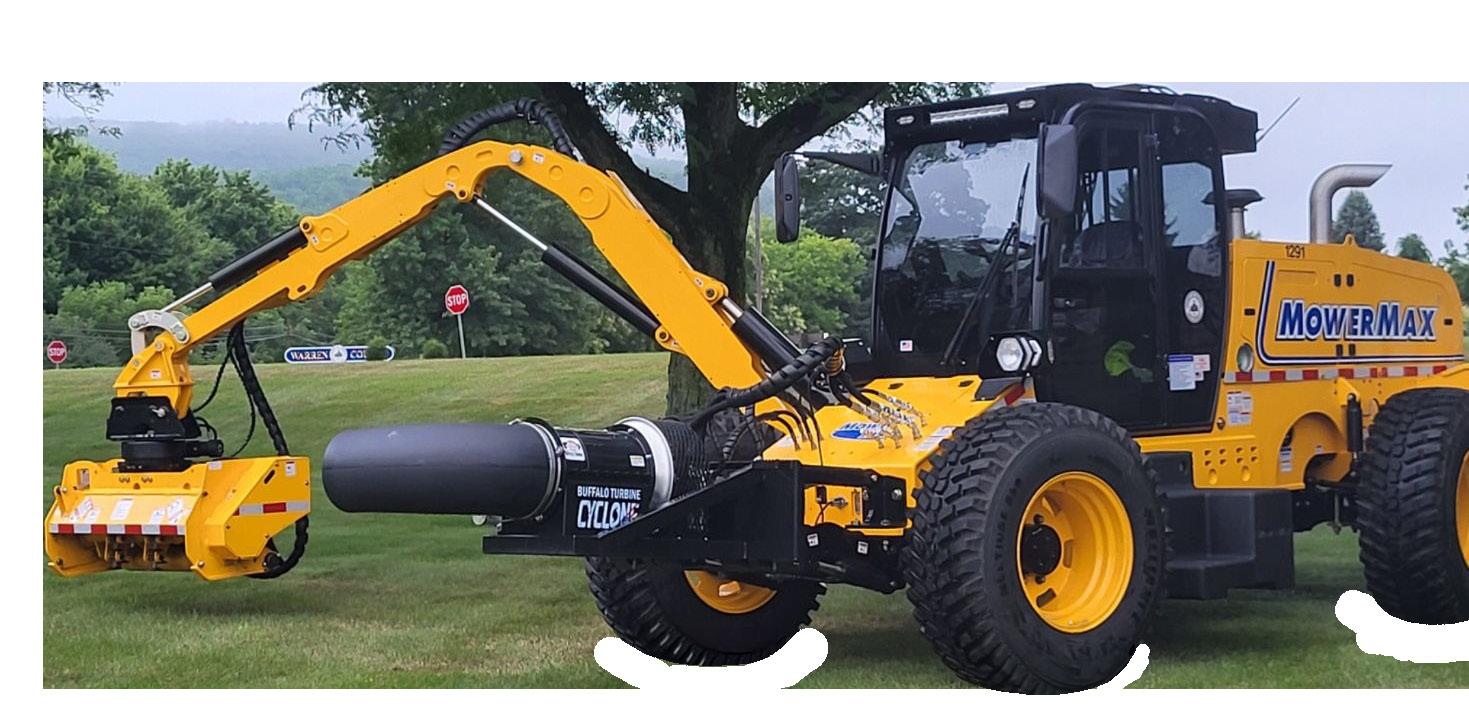
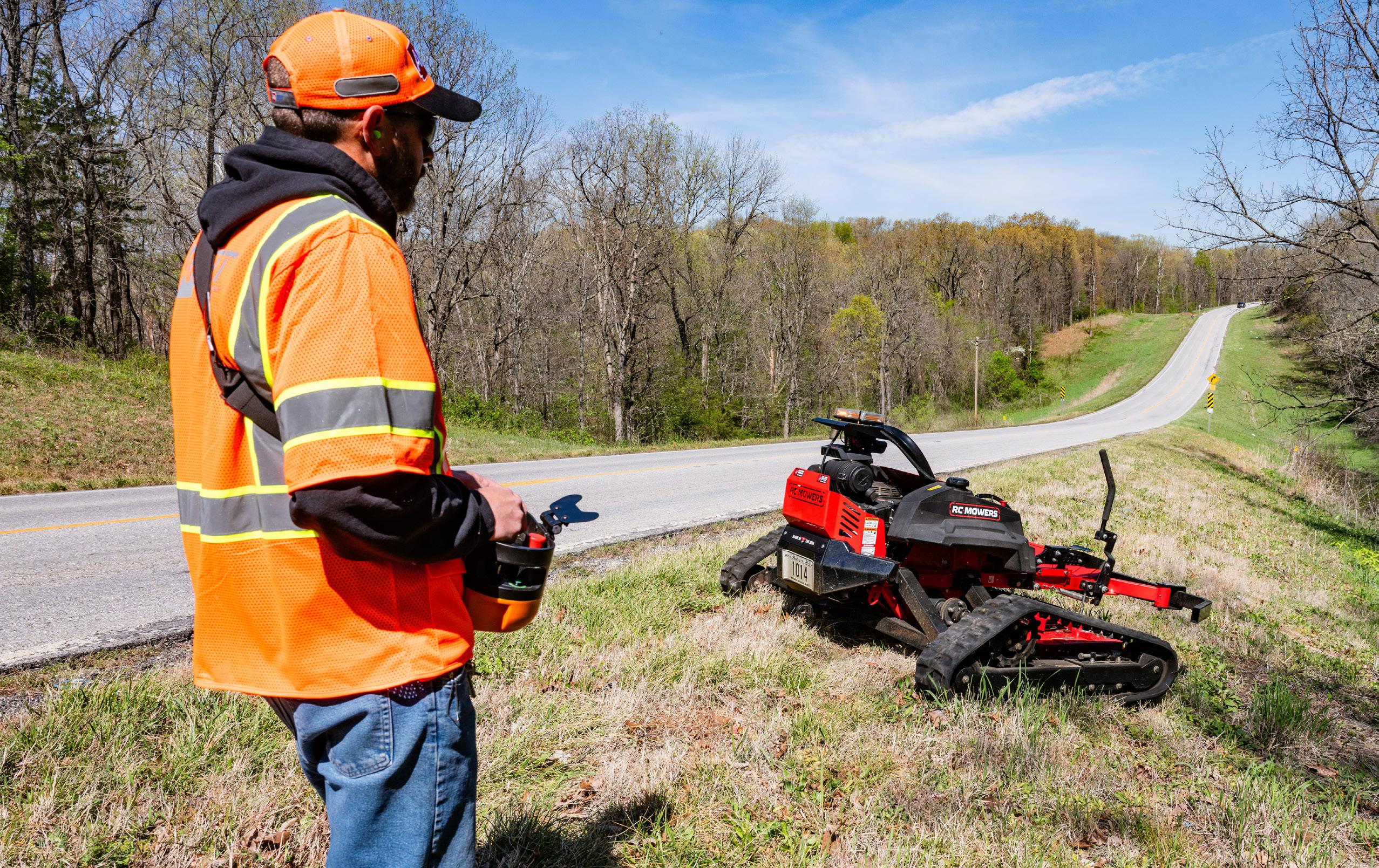
visibility, which assists with navigation. If the mower exceeds its operating range or loses communication with the remote control, it will immediately shut down for safety purposes. Typically, the operator stays within 100 to 200 feet of the mower while operating it.
Operators say the mower isn’t difficult to use. A person with experience driving a remote-controlled car or flying a drone can become familiar with its operation relatively quickly.
“Operating the mower is very simple,” Moore said. “The one thing that stands out is the safety aspect. Some of the areas that we mow can be treacherous, but with the remotecontrolled mower, the operator is out of harm’s way and still able to get the job done.”
Currently, ARDOT only owns one remote-controlled mower, assigned to District 9. However, District 9 isn’t the only place ARDOT encounters mowing challenges. Some districts use a MowerMax Boom mower to reach difficult terrain.
“These machines are able to reach over guardrails and other objects to safely mow areas that would not be easily accessible to our normal mowing tractors,” Wyatt said. “They are designed to operate on terrain that is not too steep.”
The MowerMax has a variety of attachments that can be used on the boom arm. When paired with a skid steer-type
front attachment such as a rotary broom, brush grapple, plow blade, blower, trencher, stump grinder, or snow blower, they make it possible to perform multiple functions with one piece of equipment.
The MowerMax Boom mowers have 4-wheel drive and a low center of gravity, like a front-end loader (tractor-mounted or heavy machinery attachment featuring a wide bucket) with large rubber tires. Unlike the remote-controlled mower, the MowerMax Boom machines require an experienced operator who is familiar with operating similar equipment with a hydraulic boom arm controlled by a joystick.
ARDOT owns eight MowerMax Booms and they are used in seven of ARDOT’s 10 districts. Each district chooses what mowing equipment to purchase. Many have purchased the MowerMax Booms because they offer more attachments than traditional boom arm mowers still in use by some districts.
Specialized equipment like the remote-controlled mower and the MowerMax Boom mower help keep ARDOT crews safe while eliminating the uphill battle of mowing on difficult terrain.
See “Entertainment Corner” on Page 38 for a mower-themed word search.
RC Mower
in Arkansas 5
Most Instagrammable locations
BY EMMA GOAD

THE ARKANSAS DEPARTMENT OF TRANSPORTATION (ARDOT) MAINTAINS MORE THAN 16,300 MILES OF HIGHWAY, MANY OF WHICH WIND THROUGH SCENERY THAT PROVES WHY ARKANSAS IS CALLED THE NATURAL STATE. From the tree-lined ridges of the Ozarks to the wide, glittering bends of the Delta, the Arkansas Highway System connects travelers to a breathtaking array of sights. Whether you’re looking to capture a perfect social media shot or simply enjoy the scenery, Arkansas offers plenty of sights worth slowing down for.

HIGHWAY 7 SCENIC BYWAY | CENTRAL/WEST
ARKANSAS
Highway 7 truly captures the soul of Arkansas roadways. Stretching almost the entire length of the state from the Louisiana State Line south of El Dorado north to Bull Shoals Lake, this designated National Scenic Byway earned its reputation through sheer visual variety. This route offers views of both the Ouachita and Ozark National Forests, as well as several lakes and rivers. Pull-offs along this stretch are particularly breathtaking. Highway 7 also passes through several cities including Hot Springs, Arkadelphia, Camden, and Harrison, offering a blend of small-town architecture and riverside scenery.
CITY ROCK BLUFF | NORTH CENTRAL ARKANSAS
Sitting high above the White River near Calico Rock, City Rock Bluff offers a dramatic view of the Ozarks. The overlook sits on a towering rock formation that rises above the river valley, providing views of the water below and the surrounding forested hills.
Standing at the edge of the bluff, you can see the White River winding through the valley while the town of Calico Rock sits quietly in the distance.
What makes City Rock Bluff appealing for travelers is its accessibility. Located just off Highway 53 on a short gravel road, the overlook requires little hiking.
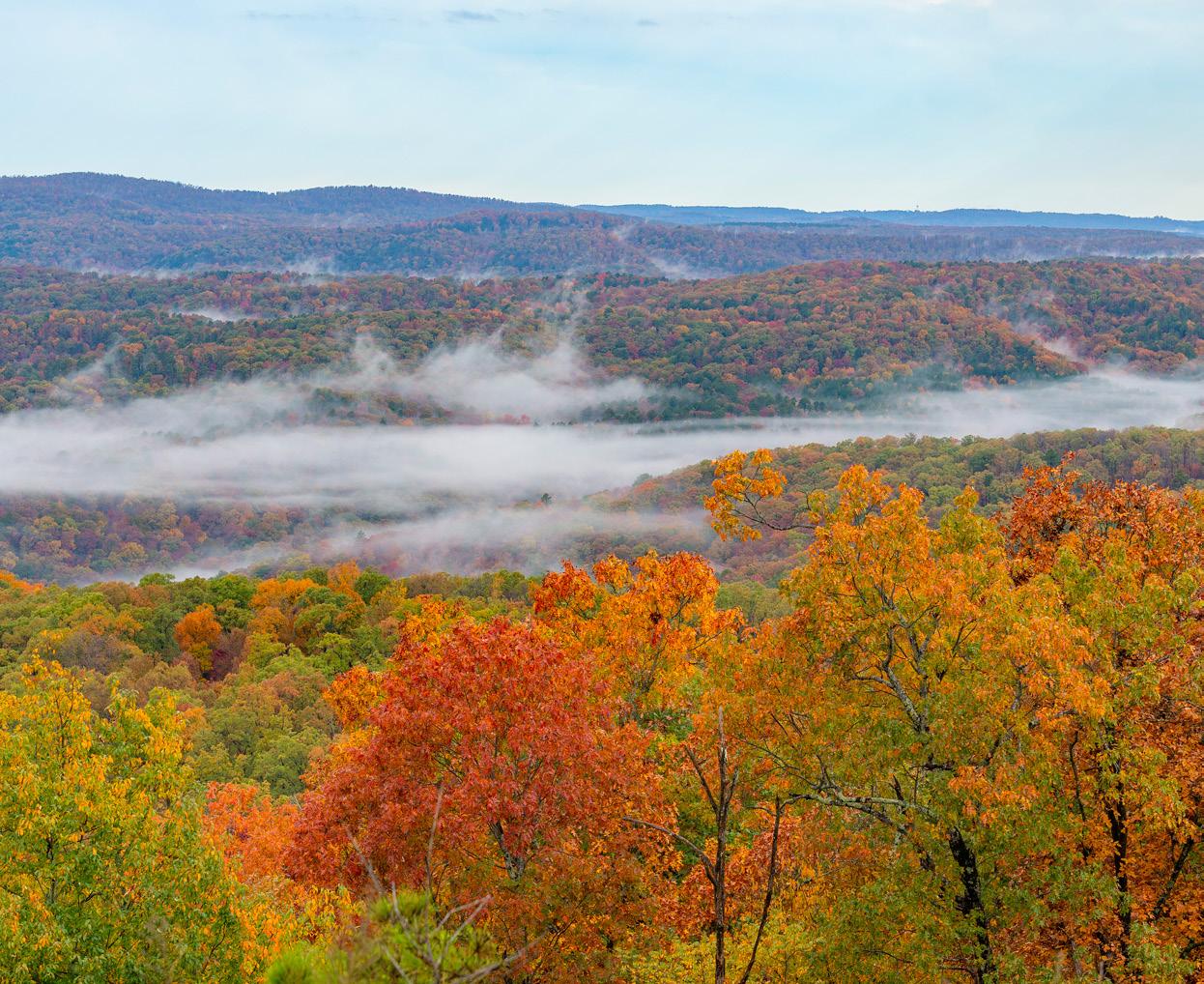


PIG TRAIL SCENIC BYWAY | NORTHWEST ARKANSAS
One of the most well-known routes in Arkansas is the Pig Trail Scenic Byway. Running through the Ozark National Forest along Highway 23, the route winds through the rugged Boston Mountains with steep inclines and sharp curves.
Dense forests line the roadway, creating a tunnel of greenery during the warmer months and a fiery display of color in the fall. The byway also crosses the Mulberry River, a popular destination for kayaking and outdoor recreation.
Photographers frequently stop along the route to capture misty mountain mornings, winding forest roads, and scenic river crossings. During autumn, fall foliage blankets the mountains.

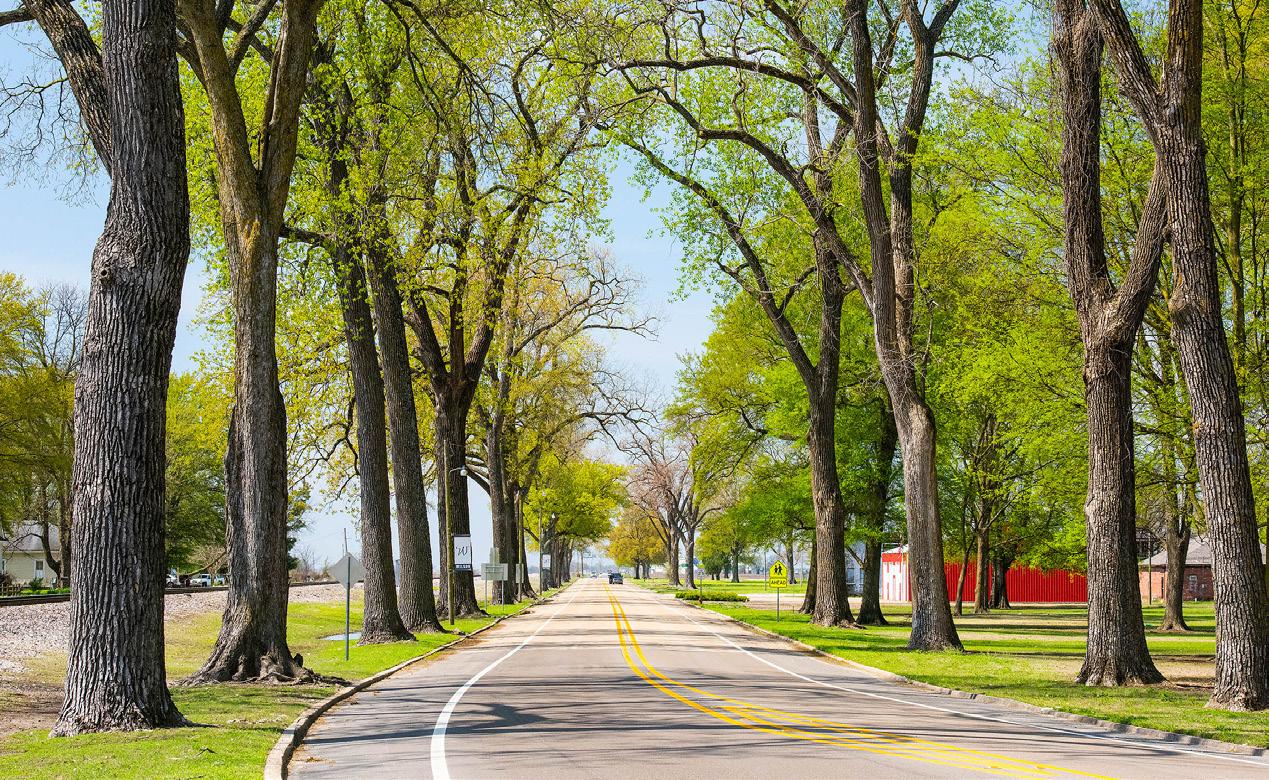
GREAT RIVER ROAD | EASTERN ARKANSAS
On the eastern edge of Arkansas, the landscape reveals the wide-open spaces of the Delta. The Great River Road follows the Mississippi River through this region, telling the story of the river that helped shape the state’s history and landscape.
Designated as a National Scenic Byway and an All-American Road (a sub-category of National Scenic Byway that’s only awarded to select outstanding byways), the route runs through the counties bordering the Mississippi River and offers views of expansive farmland, historic river towns, and towering levees.
COSSATOT RIVER | SOUTHWEST ARKANSAS
Running wild through the Ouachita Mountains of Southwest Arkansas, the Cossatot River’s tumbling, rock-strewn character makes it one of the most visually dramatic waterways in the state.
Highway 278 traces the river through the Cossatot River State Park-Natural Area. The access points along this route deliver travelers directly to the river's most spectacular stretches. Several stretches of Highway 278 pass directly over the Cossatot River, providing a view worth photographing. Along the drive, visitors will find several access points and overlooks where they can catch glimpses of the river winding through the mountains.
Massive boulders smoothed by rushing water fill the riverbed and create natural compositions. The surrounding Ouachita hardwood forest frames the view in rich green in summer and brilliant varieties in fall.
BEFORE YOU GO
These five locations represent just a glimpse of what travelers can experience along Arkansas highways. The Natural State is one worth seeing, but it’s important to travel safely. Cell phone service can be limited in rural mountain areas, so grab a state highway map and let someone know your route.
Use designated pull-offs and overlooks for photography. Never stop on travel lanes and be mindful of traffic when composing your shots. The most beautiful photograph isn't worth compromising your safety or the safety of other drivers. Now get out there, Arkansas, and capture the moments that are best seen right off the roadway.
UP FOR A CHALLENGE?
When you visit these scenic spots, be sure to document it with a selfie and tag us in your photos @ myARDOT. Stay tuned for an interactive quest that will debut later this year — your photos might just get you a prize!
TURNER BEND BRIDGE
I want to extend my sincere appreciation to you and your team for completing the repairs to strengthen the Turner Bend Bridge on Highway23 near Cass. We recognize that ARDOT maintains an exceptionally demanding workload, and your willingness to prioritize this project does not go unnoticed.
Because of the timely and effective repairs, the load restrictions can now be removed. This will allow us to resume hauling timber, materials, and equipment with fully loaded trucks which is an important improvement for our operations and for the communities we serve.
Thank you again for your dedication, responsiveness, and commitment to maintaining the infrastructure we all rely on. Your support and the hard work of your team are genuinely appreciated.
Sincerely,
Dan Olsen, Forest Supervisor Ozark-St. Francis National Forest Forest Service • United States Department of Agriculture
CAREER DAY
ARDOT employees participated in Career Day at Roberts Elementary School in March by bringing a bridge inspection “Snooper” truck for the children to learn about. (L. toR.) Demetric Jones, Bridge Operations Statewide Bridge Inspector; Aaron Thomas, Bridge Operations Inspector; and Andy Nanneman, Bridge Operations Division Head, visited with Ms. Brianna Goode’s class.
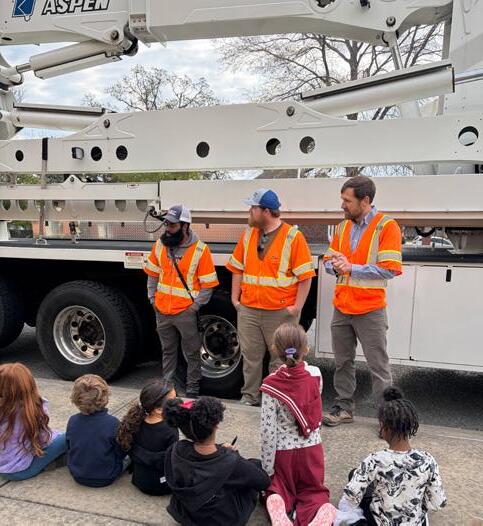

Thank you again for helping with career day. It was so fun! My class loved learning about what ARDOT does.
Sincerely,
Brianna Goode
Roberts Elementary School Little Rock
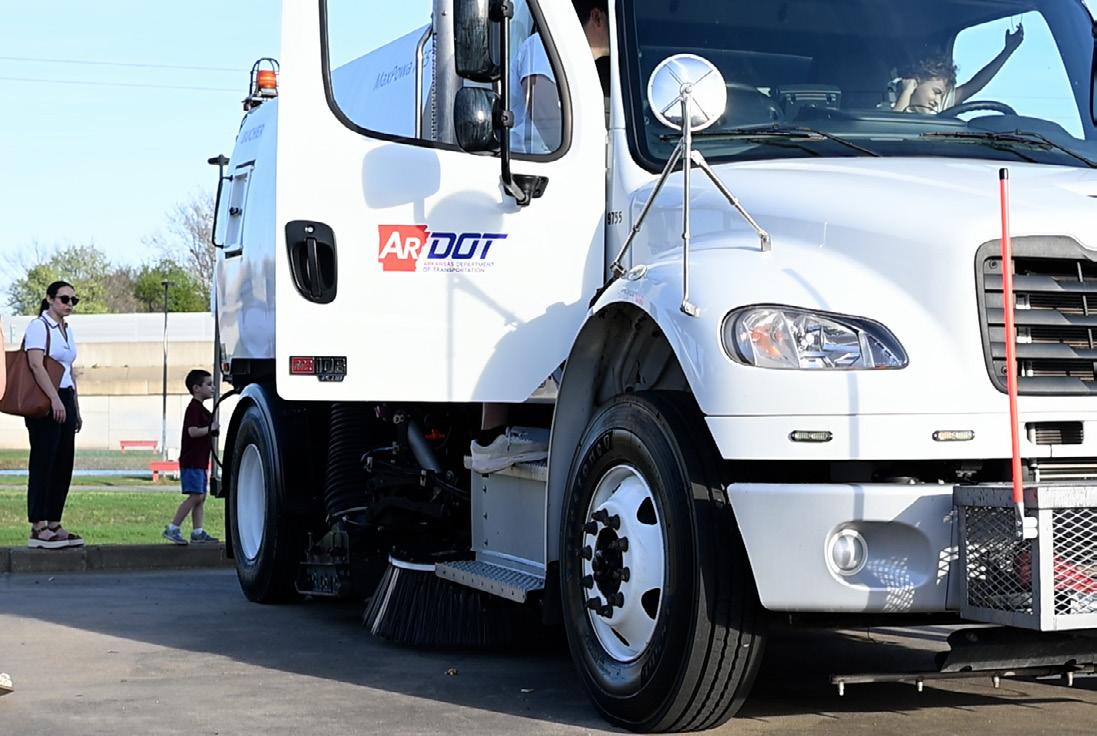
TOUCH-A-TRUCK
On March 13, ARDOT employees participated in the City of Jacksonville’s Touch-A-Truck event by bringing a Sweeper Truck. The event provided families and children with the opportunity to explore large vehicles up close, meet the operators, and learn more about the work that keeps our roadways safe and maintained. The following is an excerpt from a thank you email to ARDOT from Kiaera Williams, Events and Marketing Coordinator for Jacksonville Parks and Recreation. The employees she recognized are Caleb Bryant, ARDOT Crew Leader, District 6; Steven Calhoun, ARDOT Maintenance Aide II, District 6; and Kevin Luthringer, ARDOT Multimedia Specialist, Communications.
I just want to say how much we appreciate ARDOT being part of the event. ARDOT WAS THE BEST! Caleb, Steven, and Kevin were AMAZING. They were so patient and engaging with everyone who came by the truck.
The kids (and honestly a lot of adults too) absolutely loved getting to honk the horn. I kept thinking they might get tired of letting people do it, but they never did. They were attentive, kind, and made the experience so special for everyone who stopped by. It was truly heartwarming to see.
Thank you again for supporting our community and helping make the event such a success. We are so grateful!
Kiaera Williams, Events and Marketing Coordinator Jacksonville Parks and Recreation

RESPECTFUL CREW MEMBERS
ARDOT Director Jared Wiley received the following email complimenting the ARDOT Hempstead County crew that was washing bridge decks on April 9, 2026, between Emmett and Perrytown. That crew included: Andrew Barnett, Maintenance Aide II; Jesse Barton, Maintenance Aide II; Michael Crossno, Maintenance Aide I; Rustin Flowers, Maintenance Aide I; Charles James, Maintenance Specialist; Michael Ogden, Maintenance Specialist; and Michael Williams, Maintenance Aide II.
Good Morning Jared,
I’d like to thank and compliment the ARDOT crew working on a bridge on Hwy 67 West between Emmet and Perrytown in Hempstead County on Thursday, April 9.
Around 11:30 a.m., a funeral procession was en route from Hope to Reader, Arkansas. The ARDOT crew working on a bridge in a one-lane area stopped their work, removed their caps, stood quiet and reverent while the procession passed by. After arrival at the cemetery, people were talking about the respect ARDOT employees showed to those in the procession. The procession was for my sister-inlaw Susan Henley Powers from Hope. From the first car to the last car in the procession, the ARDOT crew showed their respects.
On behalf of my family, I want you to thank ARDOT leadership for instilling the importance of respect in the ARDOT culture and to the employees who showed respect in a profound memorable way.
Representative Dolly Henley
Arkansas House District 88

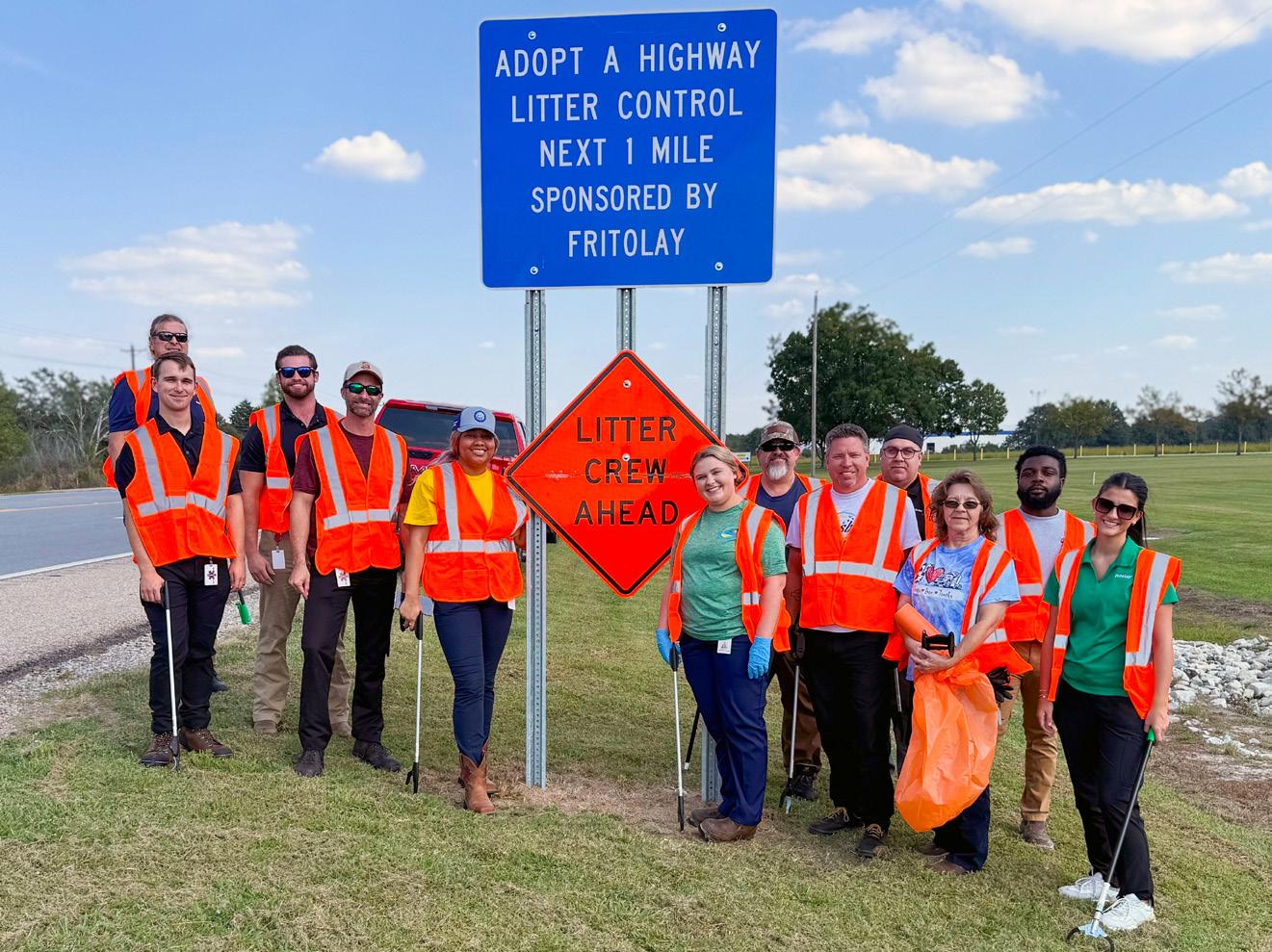
VOLUNTEER SPOTLIGHT
ARDOT’S ADOPT-A-HIGHWAY PROGRAM WAS CREATED IN 1987 TO SOLICIT PUBLIC INVOLVEMENT IN CONTROLLING LITTER ALONG SELECTED SECTIONS OF STATE HIGHWAYS. Since that time, more than 4,500 organizations have adopted stretches of Arkansas highways. The program has the impact that it does because of its exceptional volunteers.
In each edition of the Arkansas Highways magazine, we spotlight an Adopt-A-Highway volunteer. This edition’s volunteer spotlight features Frito Lay. A part of the program since April 2024, the group adopted a portion of Highway 18 in Arkansas County.
We extend a warm thank you to Frito Lay for their dedication and service to the Adopt-A-Highway Program.
Learn more about Adopt-A-Highway
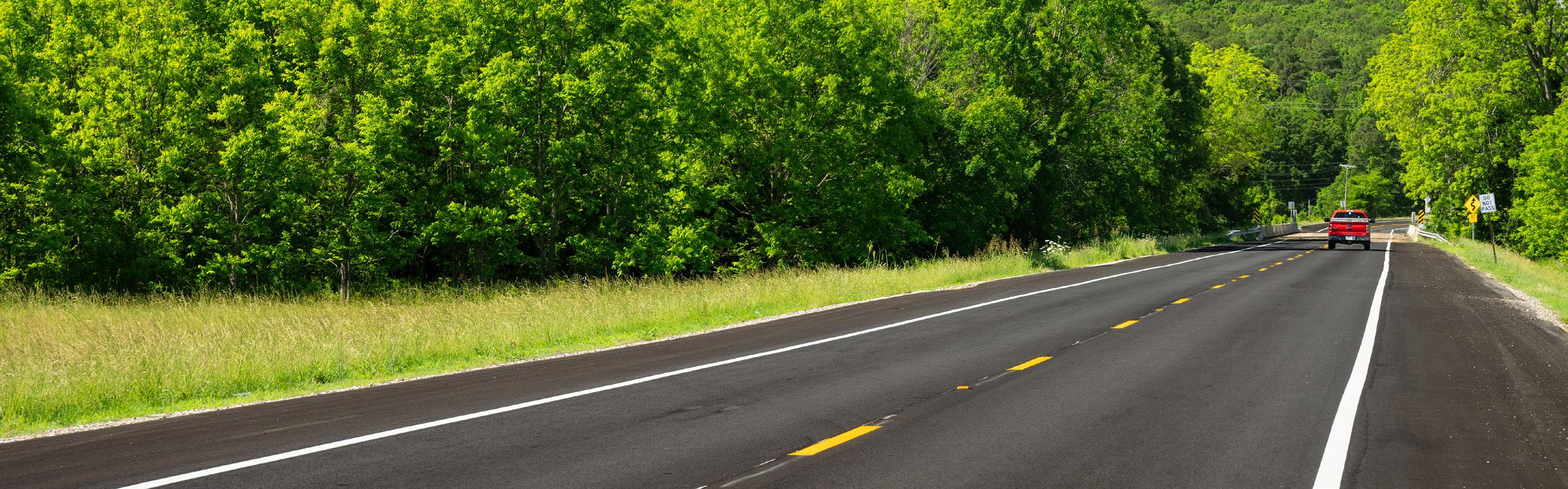

MASTERING THE TERRAIN:
Wordsearch Edition
After reading “Winning the Uphill Battle: Specialized Mowers Conquer Tough Terrain” on page 32, see how many terms from the story you can spot in this word search.
Word Search
DISTRICT 2
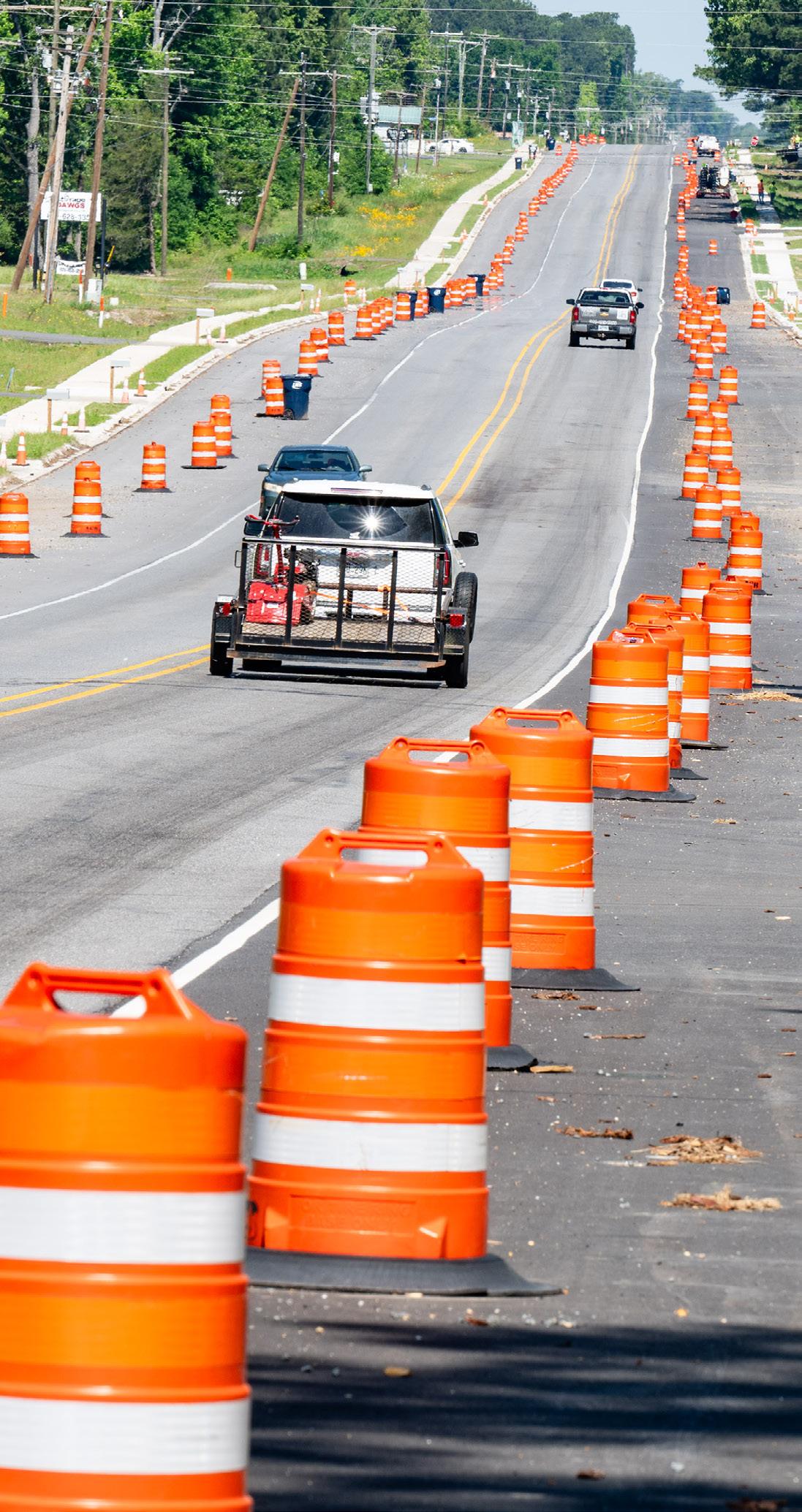
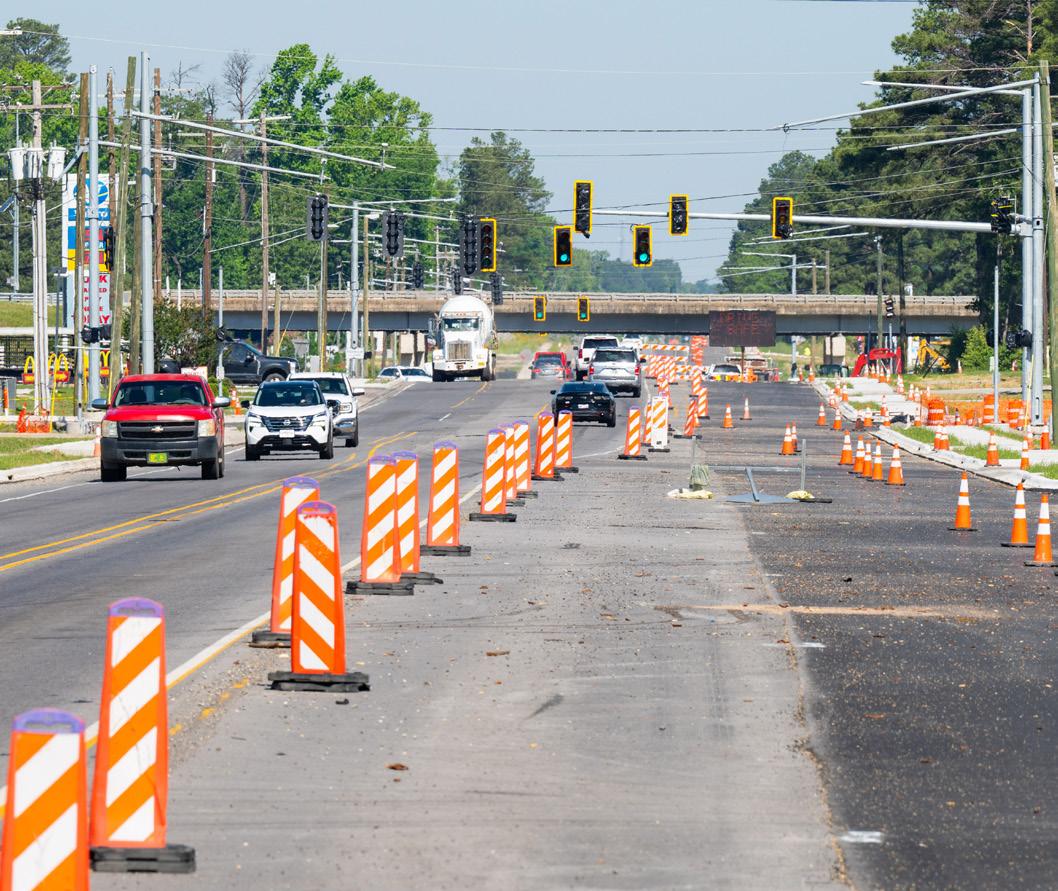
CORNER
JOB 020626 IS UNDERWAY TO WIDEN 4.7 MILES OF U.S. HIGHWAY 270 AND HIGHWAY 365 SPUR FROM HIGHWAY 365 IN PINE BLUFF WEST TO HIGHWAY 104 PAST WHITE HALL IN JEFFERSON COUNTY. H ighway270 and Highway 365 Spur will be widened from two lanes to four lanes with a center turn lane. This busy corridor serves approximately 12,000 vehicles per day.
Highway 365 Spur is the primary east-west route through White Hall and is designated as Highway 270 west of Interstate 530. Highway 365 is the primary north-south route. Increased commercial and residential growth and heavy truck traffic on Highway 365 Spur created the need for a major widening project to help reduce traffic congestion and improve mobility for motorists.
Redstone Construction Group, Inc. of Little Rock was awarded the $45 million contract for this project in August 2023 and construction started in January 2024. The original project completion was estimated for late 2025. However, project work has been delayed at different times due to the discovery of unknown utilities that were in conflict with construction.
“Utilities can affect any project, but urban projects are more susceptible to these issues,” Jared Bymaster, ARDOT District 2 Maintenance Engineer, said. “We revised sequencing of the project to progress work as fast as possible.”
The project is now expected to be completed by late 2026. “We look forward to its completion and the benefit it will bring to traffic in this area,” Bymaster said.
Arkansas Department of Transportation
P.O. Box 2261
Little Rock, AR 72203-2261