GOOD ROADS The Award-Winning Magazine of the Arkansas Good Roads Foundation
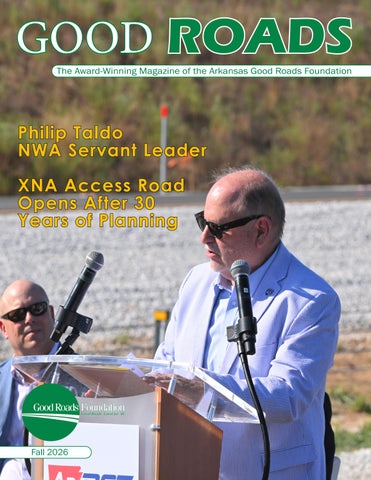
Philip Taldo NWA Servant Leader XNA Access Road Opens After 30 Years of Planning
Foundation Good Roads. Good for All. All.
Fall 2026
Contents
6 From the Executive Director Roads Leads Transportation 10 Good Conversation The State of Infrastructure Funding in Arkansas
Summer Meeting Features Member Discussions with Highway Commissioners
18 Summer Policy Meeting Sponsors Dedication Event in NWA 20 Huge Celebrates Airport Bypass Road and Philip Taldo
10
24 Arkansas Ranks First in National Road Rage Incidents
Vehicle-Related Gun Incidents Also Increasing
28 30 Crossing Park Made Possible by ARDOT and Jeff Bezos
35 Important Meeting Dates 37 Arkansas Good Roads Foundation Supporters GOOD ROADS The Award-Winning Magazine of the Arkansas Good Roads Foundation
Philip Taldo NWA Servant Leader
On the Cover: Arkansas Highway Commissioner Philip Taldo. (Photo by Rusty Hubbard, ARDOT Senior Photographer.)
XNA Access Road Opens After 30 Years of Planning
Foundation Good Roads. Good for All. All.
Fall 2026
Fall 2026 | Good Roads Foundation
3
From Vision to Reality: Designing Safe, Sustainable Infrastructure
I-49 RAZORBACK Greenway Re-route Regional Extension - ArDOT (TAP-20)(S) F.A.P TAPF-9036(27), Bentonville, AR
From roadways to transit networks, we specialize in designing and implementing infrastructure solutions that enhance mobility, promote safety, and support economic growth.
CEI Engineering Associates, Inc. www.CEIeng.com | 800.433.4173
4 Good Roads Foundation | Fall 2026
AGRF Executive Board
Robert Moery President, Little Rock Broadview Startegies
Lance Lamberth Vice President, Batesville Atlas Asphalt Company
D.B. Hill, III Secretary/Treasurer, Little Rock D.B. Hill Contractors, Inc.
Harold Beaver Rogers Former ARDOT District 4 Engineer
Graycen Bigger Pocahontas NEA Intermodal Authority
JoAnne Bush Lake Village Former Mayor of Lake Village
George Cress Little Rock President and CEO, Riggs CAT
Curt Green Texarkana Curt Green and Company
Mark Hayes Little Rock Exec. Dir., AR Municipal League
Jerry Holder Little Rock Senior Vice President, Garver
Shannon Newton Little Rock President, Arkansas Trucking Association
Philip Taldo Springdale
Chris Villines Little Rock Exec. Dir., Association of Arkansas Counties Seat
Jim Wooten Beebe Arkansas House of Representatives
(Non-Voting Member)
Arkansas Highway Commission Chair Seat
Joe Quinn, Executive Director goodroadsfoundation@gmail.com
Kathryn Tennison, Editor kathryn@bestmanagement.net
Celia Blasier, Designer graphics@bestmanagement.net Fall 2026 | Good Roads Foundation
5
Executive Director’s Message
The State of Infrastructure Funding in Arkansas Joe Quinn, AGRF Executive Director
Constructing bridges, repairing roads, and designing and building new roads is expensive. No one questions that. Then there are exceptionally large projects that are hugely expensive and vastly different than a county repairing two miles of neglected road. Think 30 Crossing, the new bridge over the Arkansas River at Barling, the new Springdale bypass, and the Broadway Bridge in downtown Little Rock that really gave the city a new centerpiece. Each of those projects has improved life in a specific region of Arkansas, created jobs and economic growth, and made it easier for families to get the kids to a dental appointment, dance competition, or basketball practice, and then swing by the grocery store to pick up dinner. Every single person on the Arkansas Highway Commission, in leadership roles at ARDOT, and working for the hundreds of contractors who design, build, fund, and repair roads takes the work of building new projects seriously. Planning and budgeting are done thoughtfully to maximize federal and state tax dollars entrusted to the department. At the 2026 Good Roads Summer Meeting, ARDOT Director Jared Wiley presented economic trend numbers that gave our members a better sense of the discussions ahead. To be very clear, the department is getting work done every day and is not suggesting this is an immediate crisis, but in terms of strategic thought over the long term, there are issues we all should be considering.
Cost Fiscal priorities for most states are generally education, prisons, healthcare, and infrastructure development. These core issues make it complex at times for most state budgets to make state needs match available budget. In the Arkansas infrastructure world, labor costs are up 59%, the cost of moving utility lines to repair or build new roads has doubled, national construction costs have jumped 70%, and heavy-duty road equipment costs 40% more than it used to. In 2010, the cost of building a mile of new road in Arkansas was $6.6 million; today, it is $26.1 million. Widening a road from two to five lanes cost $3.9 million in 2010, and that cost jumped to $11.6 million in 2026. In a state full of outdated bridges, the construction cost of a new bridge has jumped from $106 per square foot in 2010 to $350 today. That’s a 300% increase in 16 years. Inflation continues to push up the price of any road or bridge project, and available federal and state revenue streams to pay for the work are under pressure. In 1980, state general revenue was one billion dollars. Of that amount, 14.4% was spent on roads. The 2020 budget was just shy of eight billion in general revenue, and 10.3% of that went to infrastructure work. Something that sometimes gets lost in this larger discussion is the fact that the state passes along significant funding to Arkansas
ARDOT Director Jared Wiley
6 Good Roads Foundation | Fall 2026
Executive Director’s Message cities and counties. This funding supports local infrastructure work in communities like Monticello, Conway, El Dorado, and Warren. The projection for fiscal year 2029-2030 is that the state will send $162 million to cities and $162 million to counties. If the Issue 1 sales tax extension statewide vote had not passed in 2022, every city and county would have lost roughly 30% of their local road budget. The funding headed to cities and counties doesn’t pay for projects that “would be nice to have”. It pays for the fundamental year-to-year repair work that is critically important to mayors and county judges trying to stretch their budgets to deal with aging infrastructure. Most county judges will tell you they spend more time on road issues than anything else they do. More than anyone, mayors across the state certainly understand that people who pay taxes are as worried about the potholes in their neighborhood as they might care about a massively complex project to build a new bridge over the Arkansas River. More than ever before, the $324 million the state gives gives to communities and counties is critically important. Local Input Matters As Arkansas leaders contemplate thoughtful strategies to deal with growing needs, increasing inflation, and the cost of labor and materials increasing monthly, ARDOT is constantly hosting community meetings. These early-stage discussions about proposed work in an area are an opportunity to have face-to-face conversations with ARDOT staff. As the number of community meetings associated with projects has increased, the department has also put a dashboard on its web page allowing easy access
to work that has been promised, paid for, and completed. It’s worth a look. These community meetings are just part of a larger ARDOT strategy. Since taking on the role of ARDOT Director, Jared Wiley has dramatically increased communication efforts across the board to make the spending at the department more understandable and transparent than ever. Discussing infrastructure funding issues in Arkansas is always, to some degree, a geographic issue. More than ever, we are a state with massive differences in growth issues. At the summer meeting in July, Mike Malone of Economic Leadership LLC Consulting gave a presentation on economic trends in the region, the state, and the country. From 2019 to 2024, Northwest Arkansas grew its population by 68,290 people. Little Rock’s population increased by 26,827. Jonesboro grew by 2717 while Fort Smith, Pine Bluff, and Texarkana saw population decreases. Northwest Arkansas leaders will tell you that the unprecedented growth in the region means the area always has a shopping list of needed projects and improvements. But spend a day in the Delta, and communities will tell you with equal intensity that the region desperately needs certain roads upgraded to help a struggling economy. There are no simple answers to tough questions about how resources should be allocated. Convening the Conversation On the next page, you will see two key slides; you will see some of the budget Wiley used in his presentation at the Good Roads Summer Meeting. One shows ARDOT revenue trends against state budget growth over the years. The other shows increasing Fall 2026 | Good Roads Foundation
7
Executive Director’s Message
GoodRoads_JDW_V16
8/12/202
National Highway Construction Cost Index General Revenue
$8.0 $10.0 $7.0 $9.0
Billions
create the jobs that are important to our state. We need to build a state where young people want to live. And 8/12/202 we need to remember the simple reality all states face now: thousands of bridges and roads are simply old and getting older each day. Stay engaged, stay informed. And put that5 phone down when you drive. 4 5
Highway Revenue
$6.0 $8.0
3 4
National Highway Construction Cost Index
$5.0 $7.0
Billions
$4.0 $6.0
$3.0 $5.0
2017 Act 1 funding begins
$2.0 $4.0 $1.0 $3.0 $0.0 $2.01980
1985
$1.0
1980 14.4%
$0.0 1980
1990
1995
1990 9.8% 1985
2000
20172010 Act 1 funding begins
2005
2000 9.2%
1990
1995
2000
2020 Act 416 funding begins 2020 Act 416 funding begins 2015
2010 7.8% 2005
2010
2015
2023 ½ cent sales tax funding begins 2023 ½ cent sales tax funding begins
2 3
1 2
2020
0 1
2020 8.7%
2024 10.3% 0
NHCCI (Base Year = 1) (Base Year = 1) NHCCI
costs in bridge and road work. They will give you more context on these funding and cost trends. GoodRoads_JDW_V16 At Good Roads, we remain committed to convening thoughtful discussions about the future. Infrastructure development is something we will be talking a lot$10.0 about in the next couple of years and General Revenue beyond. We need to take steps now to do the work and $9.0 Highway Revenue
2020
Arkansas Highway Revenue as a Percentage of General Revenue per Year 1980 14.4%
1990 9.8%
2000 9.2%
2010 7.8%
2020 8.7%
2024 10.3%
Arkansas Highway Revenue as a Percentage of General Revenue per Year
CONSTRUCTION COST COMPARISON CONSTRUCTION COST COMPARISON Roadway Cost Per Mile Type Work
2010
New Location
$6,600,000 Roadway Cost Per Mile $13,400,000
Widening 2Type to 5 Work Lanes Pavement Preservation New Location ($/Lane Mile) Widening 2 to 5 Lanes Pavement Preservation ($/Lane Mile) Type Work New Bridge
2020
$26,100,000
$3,900,000 2010
$6,500,000 2020
$11,600,000 Today
$6,600,000 $91,000
$13,400,000 $129,000
$26,100,000 $190,000
$3,900,000
$6,500,000
$11,600,000
$91,000 2010
$129,000 2020
$190,000 Today
$106
$175
$350
2010
2020
Today
Bridge Cost Per Square Foot
Bridge Cost Per Square Foot
Work 8 Good RoadsType Foundation | Fall 2026
Today
Why Should You Join the AAPA?
Networking
Education
Advocacy
Representation
Resources
Partnership
Information Safety Contact AAPA at: office@arasphalt.com (501) 224-4840 Ext. 102
Unity And more! More information at: www.arasphalt.com Summer 2019 | Good Roads Foundation
27
Fall 2026 | Good Roads Foundation
9
Budget Challenges Ahead
10 Good Roads Foundation | Fall 2026
Budget Challenges Ahead
Good Roads Drives Discussion on Trucking Issues at Summer Meeting in Rogers
Fall 2026 | Good Roads Foundation
11
Summer Meeting Overview
Good Roads Leads Transportation Conversation
Summer Meeting Features Member Discussions with Highway Commissioners by Deborah Horn All photos by Rusty Hubbard with ARDOT
A dog named Drake stole the show at the Arkansas Good Roads Foundation’s annual summer policy meeting. This year, the two-day event was held at the Embassy Suites Northwest Arkansas in Rogers. This is the fifth year that Good Roads has hosted a gathering of local and regional leaders to talk about issues and opportunities in their part of the state. The meeting kicked off with the Arkansas Highway Patrol discussing new approaches to make Arkansas roads safer. Part of that effort involves a focus on finding drugs hidden in trucks on interstates. If a cartel is shipping its product to the East Coast, there is a good chance those shipments are hidden deep within trucks or other vehicles on Arkansas roads. Jeff Holmes, AHP Chief, cautioned the audience before K-9 Officer Drake took the stage with his partner, AHP Corpsman Brandon Bybee. “They’re fantastic animals,” he said, “and they do great work, but they’re not pets.” Despite the warning, the room was completely enthralled as one of the newest members of the AHP K-9 unit took the stage. Drake joined four other 12 Good Roads Foundation | Fall 2026
canines, all weighing between 65 and 85 pounds, on a newly re-established K-9 team. The canines are highly trained in areas such as illicit narcotics, cash and contraband detection, human trafficking, and other patrol duties. Drake also participates in public K-9 demonstrations. AHP Captain Tyrone Dillard said, “Each K-9 officer has its own personality.” Drake has a friendly, social demeanor but is totally focused and intense when it’s time to go to work. Bybee added, “When he is not working, Drake enjoys relaxing at home and playing with his favorite toys.” Holmes said, “The K-9 handlers undergo intensive instruction alongside their canine partners. Drake is a standout member of the force, helping interdict major illegal drug shipments across Arkansas highways.” Bybee added that tracking a suspect can lead anywhere, including wooded areas and swamps. “When a suspect sees a big dog, they tend to give up.” Chief Holmes brought back the AHP K-9 program in February 2025 after the last canine officer retired in 2006, and, Holmes said, “The K-9 units have already proven their worth.” He
Summer Meeting Overview also believes the renewed program brought energy and enthusiasm back into the agency, and judging by the Thursday afternoon audience’s response to Drake’s demonstration, it’s no surprise. In 2025, the K-9 unit seized 9,100 AHP Chief Jeff Holmes pounds of illegal THC (tetrahydrocannabinol) gummies; 6,538 pounds of illegal marijuana; 108 pounds of cocaine; 60 pounds of illegal mushrooms; 40 pounds of illegal methamphetamines; and 9 pounds of fentanyl. Additionally, K-9 Officer Mack assisted the Arkansas State Police with drug interdiction and the seizure of 311 pounds of illegal marijuana and 180 pounds of illegal methamphetamines totaling a street value of $21,764,097. Joe Quinn, Good Roads Executive Director, said, “In terms of day-today operations and public discussions about what the department is doing, Jared Wiley is doing a lot to integrate the Highway Police and ARDOT. In the past, some people didn’t even understand that the Joe Quinn work done by the police is part of the overall ARDOT mission. Everyone loved Drake, but the session was also a reminder that the work of this police force matters more than ever now.” Holmes said AHP officers are already enforcing English-proficiency laws designed to improve highway safety, starting at the entry-level driver training certification programs. He said, “These are really important and worthy of enforcing and investing in.” According to Fox News, more than 24,000 to 28,000 of the nation’s commercial truck drivers have been removed from the road or had their licenses revoked for failing federal English proficiency standards. In Arkansas, about 1,251 commercial truck drivers lost their licenses for failing the English proficiency
requirements under 2025’s Arkansas Act 604, and 386 were arrested for fraudulent Commercial Driver’s Licenses (CDLs). The state’s legislature was the first in the country to pass this type of English proficiency requirement law. Once Holmes and Bybee wrapped up the session, the audience peppered them with about 20 questions about the K-9 program and Drake. Marie Holder, Arkansas Highway Commission Member, said, “I greatly enjoyed the Highway Police Canine Unit demonstration. The skill and training required of the dog and handler were very impressive. It’s even more impressive when you consider that these searches often happen near a busy roadway or at a weigh station. Our brave officers do not know what they may encounter inside these trucks or how the scene may rapidly become more dangerous.” Going Hog Wild It was no small feat getting the University of Arkansas’s football team transport semi-truck into the Embassy Suites Convention Center. J.B. Hunt Transport Services, Inc. has an agreement with the university to move all the Razorback gear and equipment to road games. But it’s as much a personal relationship as it is a business agreement. The J.B. Hunt drivers who travel with the team are close to the players and coaches and eat meals with them on the road. It’s a unique partnership of two iconic Arkansas brands. Greer Woodruff is the Executive Vice President of Safety, Sustainability, and Maintenance for J.B. Hunt. Woodruff introduced the Razorback truck’s driver, Rodney Collins, who is beloved by the Razorback players, trainers, and coaches. Woodruff said Collins has logged three million safe miles, adding, “Rodney’s built an impressive, professional driving career through a commitment to safe operations. And his success demonstrates exactly what we believe in these changing times.” Greer Woodruff Fall 2026 | Good Roads Foundation
13
Summer Meeting Overview Technology in Trucking The Razorback truck is a Peterbilt 589 tractortrailer with a Cummins engine producing 450 horsepower and 1,750 foot-pounds of torque, and an automatic transmission, stability control, braking, and anti-lock systems. It incorporates the latest technology. For example, this model has front radar with a 300foot sweep and side radar that monitors both sides of the trailer, alerting the driver to other vehicles. It can accelerate and decelerate based on following distance and includes a lane departure warning system. This model lets a company set a truck’s top speed through a governor, and it integrates advanced driver-assist and safety technologies throughout the vehicle. Additionally, there are cameras. Woodruff said, “Seventy percent of the accidents that happen with cars and large trucks are typically the fault of the automobile driver. These cameras help us exonerate the driver and the company in many cases. They also help us see a lot of dumb things people do around trucks.” Woodruff continued, “This Razorback truck represents exactly where our industry’s headed… While it’s impressive, it reinforces an important belief that we have at J.B. Hunt, and that the best safety outcomes happen when advanced technologies are paired with exceptional professional drivers.” J.B. Hunt Intermodal is the largest intermodal shipping service in North America, combining rail and truck transport to move freight efficiently across the United States, Canada, and Mexico, along with other services. Woodruff said, “We have dedicated contract services, where we operate essentially as a private fleet, with assets, drivers, and management on site with a customer, providing their transportation needs. Cindy Williams, President of Time Striping Inc., said after the dog and truck demonstrations, “I loved it. It was very informative.” For example, she was particularly interested in the latest transport technologies and the safety initiatives within the industry. J.B. Hunt is constantly partnering with the Arkansas Trucking Association (ATA) on a variety of issues. Woodruff told the audience, “We are working really hard to make our highways as safe as we can.” In Arkansas, trucks move most manufactured goods produced here, and many communities depend on 14 Good Roads Foundation | Fall 2026
them to bring in goods and supplies and ship products out. He said, “So when we’re talking about safety, technology, and infrastructure, we’re really talking about the systems that keep our economy running. And the trucking industry is the heart of America’s supply chain.” This year is especially meaningful for J.B. Hunt. The Arkansas trucking company, which started with five trucks and seven trailers and has grown into the largest in the country, with about 31,000 personnel, 20,000 trucks, 170,000 trailers, and an intermodal service, celebrated its 65th anniversary on Aug. 10. Northwest Arkansas Update On Friday, Robert Moery, Good Roads Executive Board President, opened day two of the meeting. Moery said, “It’s a great opportunity for our Board Members, our sponsors, the highway commission, and our leadership to get away from Little Rock and hear directly from you about issues that are important to your transportation vision.” During Highway Commission Chair Philip Taldo’s Robert Moery introduction, Moery said, “I have tremendous respect for Philip’s work. He’s passionate about Northwest Arkansas and wants to see it grow. He’s a fierce advocate of infrastructure and development. He and other leaders have worked aggressively to that end.” Taldo isn’t shy about his support for Northwest Arkansas, saying, “The rapid growth we’ve seen here has created both opportunities and challenges. And I’ve been proud to champion projects that support the area.” He continued, “One of my priorities has been the Springdale Bypass (Ark. Hwy. 612), the XNA Connector (Ark. Hwy. 642), and Highway 112. The bypass is a game changer.” Both the Springdale Bypass and XNA Connector are four-lane, controlledaccess freeways, and once all four phases of the
Summer Meeting Overview Springdale Bypass are complete, it is expected to cost about $1 billion. Phase two of the bypass and the connector open this year, and work on phase three is underway. Phase two of the Springdale Bypass, about $180.8 million, started at its easternmost point at Interstate 49 and ends at Ark. Hwy. 112 at its western end, continuing westward and ultimately merging into U.S. Highway 412 west of Tontitown. The XNA Connector, about $127.7 million, will branch off the Springdale Bypass about one mile west of the current bypass terminus and continue northwest before meeting Highway 264 and Airport Boulevard at a traffic signal. It provides a direct link between the Springdale Bypass and XNA. The Interstate 49 corridor has been a major focus of ARDOT since the late 1980s, and ARDOT has spent millions on this corridor from Alma to the Missouri line. If those projects were built today, they would cost nearly $4.2 billion, Taldo said. The I-49 Extension, which is underway, is estimated to cost approximately $1.3 billion from design through construction. According to ARDOT, connecting Texas to the Missouri state line would cost an estimated $5 billion to $6 billion. Over the last 10 years, ARDOT has invested nearly $1.8 billion in Benton and Washington counties, with 49 projects currently under construction. Taldo added, “To put that in perspective, ARDOT has invested a total of $13 billion statewide during that time frame, with about 14 percent spent in that two-county area.” Taldo reminded the group that his 10-year term on the AHC will end in December. “Serving in this role has allowed me to see tremendous progress in Arkansas, and I’m grateful for the trust placed in me. I worked alongside dedicated commissioners, ARDOT staff, elected officials, and community leaders who share a commitment to improving transportation across our state. While there is always more work to be done, I Philip Taldo
am proud of what we have accomplished together and excited about the projects that will continue to shape the future of our community and state. It has been my honor.”
Jared Wiley
Revenue vs. Cost Jared Wiley was named ARDOT Director more than 18 months ago, and as important as their recent accomplishments are, at the Friday policy portion of the meeting, he said ARDOT is always working to maximize the resources it has to work with. Road construction costs have risen significantly since the pandemic, with key indicators showing cumulative increases of roughly 65 percent to over 70 percent between late 2020 and early 2026. He said, “We’ve seen costs rise dramatically over the last five years. It’s affected the cost of jobs in Northwest Arkansas and across the state. Its impact has caused price increases, or projects are delayed.” Construction material prices for items such as steel, asphalt, fuel, labor, and more have skyrocketed, possibly by more than 40 percent since 2020, which in turn is causing construction costs to continue to surge at about a 12.6 percent annual rate through early 2026, in part driven by higher energy and labor costs. Wiley added, “Another factor driving up highway construction costs is rising right-of-way (ROW) acquisitions, which are rising faster than construction expenses.” ARDOT’s 2026 Construction Program includes about $375 million for widening and new work; $300 million for pavement preservation; $150 million for bridge improvements; $100 million for miscellaneous projects; and $10,000 for safety improvements. Fall 2026 | Good Roads Foundation
15
Summer Meeting Overview ARDOT budgeted $300 million each for pavement preservation, widening, and new work; $125 million for miscellaneous projects; $100 million for bridge improvements; and $15,000 for safety. Lance Lamberth, Vice President of Operations of Atlas Asphalt and AGRF Executive Board Vice President, said Jared Wiley’s presentation and the early round table breakfast discussion were of particular interest to him. Commissioner Holder found Wiley’s presentation informative: “Director Wiley detailed our budget challenges and gave insights into our economic future. The issue of rising costs is of great concern to the commission. But I’m confident that the Director and our team will continue to do everything they can to take advantage of internal efficiencies and federal funding programs to be sure the taxpayer’s dollar is stretched as far as possible to meet our needs.” Telling the Story Together Quinn echoed the themes Wiley referred to as he reminded the audience of the need to work together and remain focused. He said, “A lot of large and meaningful infrastructure projects in Arkansas have been completed in recent years, but it’s not a time to celebrate previous wins. We have to be focused on future opportunities and challenges. We have great relationships with the Arkansas Society of Professional Engineers, the Arkansas Trucking Association, and the Arkansas Asphalt Pavement Association. We will always be in a better position to tell our story if we are aligned and working together.” Quinn said in terms of meaningful communication, much of that work starts at meetings like this. “We need a vision for the future, realistic goals, and
16 Good Roads Foundation | Fall 2026
thoughtful strategies. Good Roads is 100 percent committed to telling our story and will use all our resources to help. All of the companies in this room have impactful stories to tell.” The Economic Outlook for the Region and State As if to reinforce Wiley’s earlier message of rising costs of gas and groceries, flat revenues, and the impact of tariffs, Mike Malone’s initial message during his session titled “The Economic Outlook for the State and Region” echoed the Director’s concerns. Malone is an economic development professional with nearly three decades of experience bridging government, private sector, and educational organizations, driving Mike Malone community and economic growth. Most recently, he served as Vice Chancellor for Economic Development at the University of Arkansas from 2022 until 2025, and he also served as President and CEO of the Northwest Arkansas Council. He is currently a partner at Economic Leadership LLC. During his remarks, he talked about the impact of AI and automation on the Arkansas workforce, noting that automation affects manufacturing more than artificial intelligence. In fact, he said, referring to a projected chart, “This is kind of a depressing chart, because almost every state in the South lost manufacturing jobs, including Arkansas.”
Summer Meeting Overview Another drag on the state: Arkansas ranks 49th in the nation in workforce participation. This means a significant number of people of working age are not employed or even looking for jobs. Malone said the reasons could include transportation, affordability, or even access to childcare. But economic outlooks and opportunities vary by region. For example, Southeast Arkansas is struggling economically, while Northwest Arkansas has seen phenomenal growth. According to the U.S. Bureau of Labor Statistics, about 23 percent of the state’s nonfarm jobs are in Northwest Arkansas, while the Fayetteville/Springdale/Rogers area has an estimated population of almost 650,000. Malone said other regions need to ask themselves, “Why are we not growing as fast?” For more than 35 years, several Northwest Arkansas cities have “worked together as a region, promoted and worked to solve the problems as a region, because no one town had enough resources to solve all their problems on their own.” The Northwest Arkansas Council was formed in 1990 by prominent regional business leaders, including Sam Walton of Walmart, Don Tyson of Tyson Foods, and J.B. Hunt of J.B. Hunt Transport Services. Malone said they identified their shared goals and priorities, including
the critical infrastructure needed to support major growth. “They said, we need an airport, we need some four-lane highways, and we need running water.” This spurred private and public growth, and Malone said, “There are job opportunities in Arkansas.” This has and will continue to create more economic opportunities for future generations and provide an incentive to remain in Arkansas. At that time, the combined population of Benton and Washington counties was about 250,000, and it’s projected that in 2025, about 1 million people will call it home. Moery said, “Mike Malone’s presentation was informative. Learning what trends are taking place at the local, state, and regional levels was interesting to me and helped me better understand what those trends mean for long-term infrastructure planning.” Before the Rogers summer meeting, Good Roads has hosted this gathering in Fort Smith, Jonesboro, Mountain Home, and Hot Springs. Moery added, “We host this meeting because it’s a unique opportunity for leaders representing different aspects of our industry to have one-onone conversations with members of Good Roads leadership, Arkansas Highway Commission members, and the Arkansas Department of Transportation.”
Fall 2026 | Good Roads Foundation
17
Thank Meeting Sponsors! Thank YouYou Summer Meeting Sponsors! Presenting Sponsors
Platinum Sponsors
Gold Sponsors
D.B. Hill, III Bronze Sponsors
18 Good Roads Foundation | Fall 2026
Fall 2026 | Good Roads Foundation
19
NWA Airport Bypass Road
Huge Dedication Event in NWA Celebrates Airport Bypass Road and Philip Taldo by Joe Quinn, AGRF Executive Director
There are many ways to measure the success of a highway project: costs, tons of materials used in construction, daily usage numbers, jobs created, and finishing ahead of schedule are just a few metrics. But another might be the number of people willing to show up for a dedication event when the temperature is near 100 degrees, and there is no shade anywhere on site. This was the case in Rogers recently for the very long-awaited moment when traffic would start to flow on the Springdale-Northwest Bypass / XNA Connector Road. After years of planning, it is now officially faster and easier to access the Northwest Arkansas National Airport. More than 1,000 people turned out for one of the largest project dedication celebrations in Arkansas history. These two projects are unique in that they will
20 Good Roads Foundation | Fall 2026
both have significant local impact, but as ARDOT Director Jared Wiley told an enthusiastic crowd, “It is rare for two projects of this size, scope, and impact to literally come together at the same time. ARDOT and the Arkansas Highway Commission are committed to delivering highway projects that better connect us all.” Aaron Burkes has been the CEO of XNA since 2018. He says most airports in the United States probably operate at a blend of roughly 50% business travelers and 50% leisure travelers. At XNA, on any given Thursday, that number is probably closer to 70% business travelers. These business road warriors bring their products and investment dollars to this region in a way that creates jobs and economic growth. Better integrating this thriving airport into the overall economic equation here is a milestone event. More
NWA Airport Bypass Road
Jared Wiley addresses the crowd gathered for the opening of the Airport Bypass Road.
than 1.3 million people are expected to travel in or out of the airport this year. The airport opened in 1998, and the first congressional earmark to study the creation of the access road came out of Washington in 1999. It has been a long road to get to this celebratory Friday morning moment. But if there is one person who has consistently been in the middle of this effort to get these two roads open, it is Arkansas Highway Commission Chairman Philip Taldo. Being Chairman of the commission means your time in the appointment is nearing an end. This day was about celebrating regional progress but also about celebrating this humble, funny, kind man who always puts the work well ahead of his own ego. He is not your typical personality in a position of power like this. In classic Taldo fashion, he made it clear to ARDOT leadership that he did not want to make this dedication about him. He was adamant that it be
about celebrating a meaningful partnership between the airport and the region. He is also determined to maximize his final months as chairman and move on to the next thing. “At the dedication, it was great to see a lot of old friends. And it was good to see so many people who have helped bring this project to completion. But honestly, I am ready to move on to the next big thing.” Whenever possible, Taldo gives credit to others. He says Congressman Steve Womack has worked for years to bring federal funding to infrastructure projects in his district: “Congressman Womack has done a lot over the years to find the funding and resources for roads we need, utilities, and water infrastructure. He has done a lot for small towns in this region, and I always try to remind people of the difference he has made.” Taldo says that when he joined the highway commission, there were three primary regional projects he wanted to see brought to completion. Fall 2026 | Good Roads Foundation
21
NWA Airport Bypass Road
These were the Springdale Bypass, the XNA Connector Road, and the Highway 112 expansion and improvement. He has now checked off all of them on his list. Wiley says, “As Chairman, Philip is always there when I need him. I appreciate how steady he is. His opinion on any issue is not going to change when the winds blow. In any situation, he is going to have a consistent outlook. He is always strong and steadfast in terms of the work we do together.” Taldo is a Springdale real estate broker also involved in development and construction projects. He attended Springdale High School and the University of Arkansas at Fayetteville after growing up in Tontitown. He has three daughters and nine grandchildren. One of his granddaughters is Ashlyn Brothers, a reporter and anchor at KNWA TV in Northwest Arkansas. She graduated from the University of Arkansas broadcasting department and did stints on TV in Tulsa and New Orleans before coming home to work closer to her family. It might be safe to say that on this historic dedication day, Philip Taldo is prouder of his granddaughter covering the event than any other part of the celebration. The love obviously goes both ways. Brothers is 22 Good Roads Foundation | Fall 2026
clearly proud of her grandfather, maybe most proud of the things he does that no one ever sees: “People don’t realize how much he quietly does for others behind the scenes. He is a two-time cancer survivor who genuinely cares about people. There are very few people who have his combination of heart and brains.”
“He is one of the kindest, most humble people I know. He comes from a modest background, and his first job in life was pumping gas. To see him doing what he does now is really a full-circle moment. He always wanted to be involved with this work because highways and roads touch every community in the state.” — Ashlyn Brothers, KNWA TV reporter and anchor and Taldo’s granddaughter
NWA Airport Bypass Road Ashlyn followed her career path back home for a great opportunity at KNWA, but also because it meant she would be closer to her large family and her grandparents. She says of her grandfather, “He is one of the kindest, most humble people I know. He comes from a modest background, and his first job in life was pumping gas. To see him doing what he does now is really a full-circle moment. He always wanted to be involved with this work because highways and roads touch every community in the state.” While some people in public life post confrontational themes in Facebook comments, Philip often starts Saturday or Sunday by posting pictures of the healthy breakfast with fresh ingredients he and his wife put together. (Taldo tip: Guacamole always goes well with eggs and toast.) He breaks a lot of stereotypes about what political power looks like. Ashlyn works a morning news shift at KNWA. On
the day we talk about her grandfather, she is about to grab four or five hours of sleep, get up at 1:00 a.m., and then start a new shift in the newsroom. Hard work comes naturally to her siblings and cousins. As we close our phone conversation, Brothers offers wisdom perhaps beyond her years when she says, “He doesn’t do any of this for the accolades. He genuinely believes his time on the commission has been about creating opportunities for future generations.” When we were planning a Good Roads meeting in Rogers in July, Taldo would call me a couple of times a week to see what he could do to help. He runs a thriving business, sits in one of the most powerful political appointments in the state, and is the loving patriarch of a sprawling family, but always finds time for others and for his beloved Arkansas. In the angry, often conflicted world we live in, we need more servant leaders like this.
Philip Taldo and granddaughter Ashlyn Brothers.
Fall 2026 | Good Roads Foundation
23
Road Rage in Arkansas
Arkansas Ranks First in National Road Rage Incidents Vehicle-Related Gun Incidents Also Increasing by Deborah Horn At the July 23 and 24 Arkansas Good Roads Foundation’s Summer Policy Meeting, a great deal of discussion focused on safety on roads and highways. Both Chief Jeff Holmes of the Arkansas Highway Police and Greer Woodruff, J.B. Hunt Transport Services, Inc.’s Executive Vice President of Safety, Sustainability and Maintenance, talked about the importance of safety going forward. It benefits the driving public as well as the commercial trucking and road construction industries.
24 Good Roads Foundation | Fall 2026
Jared Wiley, Director of the Arkansas Department of Transportation (ARDOT), discussed areas where ARDOT is focusing on safety, especially technology, messaging, and children’s driving safety classes. ARDOT is designing safer roads, and the transportation industry is adopting safer, easier-todrive vehicles outfitted with technology that warns drivers of upcoming conditions. With new systems in place that test drivers’ English proficiency, law enforcement is asking the traveling public to do its
Road Rage in Arkansas part. But less talked about than technology and policy issues is the fact that road rage incidents in Arkansas continue to increase. Matt Judah, a UA associate professor of psychology and a licensed clinical psychologist, said, “We spend so much time in our cars. It becomes an extension of ourselves, and we have strong feelings associated with it.” On the other hand, and much like the autonomy online interactions allow, Judah said, “When driving, we don’t always see a person. We don’t process the encounter as a social interaction.” Matt Judah, a UA associate In late May, a major professor of psychology consumer watch group and a licensed clinical psychologist. announced that Arkansas had pushed Louisiana out of its top road-rage spot, and Arkansas is now ranked number one in road rage and fatal aggressive driving incidents per 100,000 drivers. According to ConsumerAffairs, research released in May in an article titled “States With the Worst Road Rage,” Arkansas leads the nation in both accidents and accident-related deaths tied to aggressive or careless driving. Road rage accounted for about 47 percent of “all fatal crashes” in Arkansas, while about 48 percent of “all crashes” resulted in all traffic fatalities in the state. Both are the highest in the nation. Judah says when it comes to people in rush hour traffic, there is a fine line between impulsive behavior and anger: “Angry people are more likely to act impulsively, to grab a gun or a baseball bat.” One of the ways to eliminate or slow this behavior is through the presence of law enforcement. Judah said, “People drive more carefully when seeing a police car and the (traffic) rules are enforced.” The ConsumerAffairs Research Team analyzed data on fatal crashes related to aggressive or careless driving, dangerous driving violations, and traffic incidents involving gun violence. The study identified New Mexico, Louisiana, Colorado, and New Jersey as rounding out the top five states.
Key Findings The study indicates that nationally there are about 8.35 fatal crashes involving aggressive driving per 100,000 residents, with a fatality rate of about 9.33 deaths tied to aggressive behaviors per 100,000 residents. This may not be surprising, as Arkansas has been inching upward in road-rage incidents over the last few years. In 2024, the state ranked fifth, and in 2025 it ranked fourth, according to law enforcement experts. In Arkansas, these incidents are tied to angerrelated behaviors and are responsible for nearly half of all fatal crashes and traffic fatalities in the state. Traffic incidents involving gun violence are also up more than in any other state. This year, Consumer Affairs reports that traffic incidents in Arkansas involving gun violence are about 0.36 per 100,000 people, and that traffic incidents involving weapons or gun violence increased more in Arkansas than in any other state. State Police Statistics In 2025, there were at least three non-workzone-related road rage shootings resulting in deaths in Arkansas. These happened in Hot Springs, Bentonville, and near Bono. According to the Arkansas Department of Public Safety, Arkansas State Police (ASP) Troopers investigated more than 440 road rage incidents during the first half of that year. Of these incidents, 153 have involved one of the parties displaying a weapon, while 294 incidents were reported without a weapon. In 2024, ASP investigated a total of 800 road rage incidents, including 333 cases involving weapons. These reported cases reflect a significant increase from 2023, when ASP investigated 284 road rage cases. Why All the Rage? In a sense, our vehicle becomes “our armor, our shield.” Moreover, Judah said, “Road rage isn’t just about anger, but we perceive aggressive driving as a threat, and at the moment, we live in a stand-yourground culture.” The anger may have begun prior to the driver climbing in behind the wheel, Judah said. According to recent research from the AAA Foundation for Traffic Safety, a staggering 96 percent Fall 2026 | Good Roads Foundation
25
Road Rage in Arkansas
While the widening of Sheridan Road in White Hall has been a long project, White Hall Mayor Noel Foster is asking drivers to be patient.
of drivers reported engaging in aggressive driving or road rage behavior within the past year. In the ConsumerAffairs article, Matthew Bernarda, a licensed therapist in Orange County, California, said, “When another driver cuts you off in traffic or drives too close, your brain does not detect this as a minor inconvenience, but as a serious threat.” He added, it’s “not just bad manners or impatience. It is a complex psychological event that can escalate in a matter of seconds.” Judah agreed, adding that whether changing lanes or driving too slowly is unintentional, it doesn’t always align with another driver’s perception of the situation. “They may see it as a threat, or a comment on their status or honor.” The driver who believed he has been wronged or slighted may “go so far as to chase them down and hold them accountable.” Road Rage on Our Streets Dave Parker, spokesperson for ARDOT, said that since the COVID-19 pandemic and its restrictions, society may be feeling more stressed, and this could manifest on our roadways. Road rage can be made worse by road construction zones, when drivers are often forced to slow down or stop, change or merge lanes, and many are frustrated or in a hurry. The number of road rage incidents directed at other drivers or construction workers has been on the rise. In 2023, ASP officers investigated 284 road rage incidents involving weapons, a significant number highlighting a growing trend, with some incidents 26 Good Roads Foundation | Fall 2026
turning deadly, like the fatal Bentonville shooting of Daniel Davidson after a verbal fight escalated in a parking lot. In 2024, the state police reported more than 300 road rage incidents involving weapons out of a total of 708 cases by late November, with nearly 45 percent of incidents involving the brandishing or firing of a gun. As of late June 2025, the ASP reported investigating over 440 road rage incidents, with 153, or about 34 percent, of those likely involving a weapon. In March in Craighead County, Allan Brown, 45, died at the hospital after a road rage shooting on U.S. Highway 63 west of Bono, and a few months later, in September, Michael Mahan, 47, was killed in a shooting after an altercation with another driver in Hot Springs. The next month, Daniel Davidson, 29, was shot and killed after a verbal road rage argument in traffic escalated and continued into a coffee shop parking lot in Bentonville. Rising Gun Violence The numbers aren’t going down, according to data from the Gun Violence Archive, a group that tracks gun violence incidents. In fact, they find that road rage incidents involving firearms have increased nationally every year since 2018. Every 18 hours in 2023, a person was wounded or killed in a road rage incident that involved a gun, and unfortunately, these incidents have doubled from around 58 in 2018 to 118 in 2023. While overall crime trends varied, road rage shootings remained high post-
Road Rage in Arkansas pandemic, with some reports showing a 400 percent increase in incidents between 2014 and recent years. Also adding to the numbers could be a documented rise in gun ownership and changes in carry laws, including inside vehicles and public spaces. Putting the Brakes on Road Rage The state police said they continue to investigate and prosecute incidents involving aggressive driving and encourage motorists to avoid engaging with hostile drivers, maintain distance from vehicles displaying aggressive behavior, avoid roadside confrontations, and contact law enforcement if they believe they are being followed or harassed. From the national to the street level, workplace violence is a hot topic. Washington State’s Department of Transportation has held safety talks with contractors on awareness and de-escalation following violent incidents, while groups like the Associated General Contractors of America advocate for more robust data collection on work zone crashes to better inform safety policies. ARDOT and groups such as the Arkansas Good Roads Foundation focus on safety, including protecting road construction workers from road rage. D.B. Hill, III, owner and president of D.B. Hill Contractors Inc., says, “The issue of creating a safer work zone environment for roadway construction employees and the traveling public is a top priority of the construction industry. It remains an objective.” Jeff Holmes, Arkansas Highway Police Chief, said technology is also playing a key role in safer work zones and roadways. One example is the Arkansas Highway Police’s (AHP) use of a Jenoptik Speed Trailer, which can be set up at roadway construction or other sites and is Jeff Holmes, Arkansas Highway proven to effectively Police Chief, recommended slow drivers. Holmes slowing down in work zones and recommended that being courteous and patient with drivers slow down in other drivers, especially during rush hour work zones and be
“Road rage isn’t just about anger, but we perceive aggressive driving as a threat, and at the moment, we live in a stand your ground culture.”
— Matt Judah, UA Associate Professor of Psychology and licensed clinical psychologist
courteous and patient with other drivers, especially during rush hour or while traveling through work zones. What You Can Do The ASP suggests practicing patience and courtesy and following these guidelines to prevent road rage incidents on Arkansas highways. Here are some common-sense tips to avoid getting into an incident with an angry driver. • Avoid engaging other drivers, even if they have done something to make you angry, or you have made them angry. • Put as much distance between you and the other driver as possible. • Try not to make eye contact with them. • Never, ever pull off the roadway to confront them. They could have weapons. • Avoid creating a competitive situation with another driver, even if he is at fault. • Try not to take another person’s aggressive driving personally. • If a speeding driver is tailgating you or trying to engage you in risky driving, safely steer your vehicle out of the way. • Call law enforcement if you believe a driver is following you or harassing you. • ASP urges motorists not to hesitate to call authorities if they witness road rage. If you are a victim of road rage or aggressive driving that puts you or other motorists at risk, please follow through and make a report. Call 911 or, in nonemergency incidents, call *ASP (*277) to be connected to your local Troop Headquarters. Fall 2026 | Good Roads Foundation
27
30 Crossing Park
30 Crossing Park Made Possible by ARDOT and Jeff Bezos by Deborah Horn It had been almost three decades since Charles R. “Chuck” Scott was in the River Market. As he made his way from the former Heifer International Headquarters’ parking lot on Clinton Avenue for the July 4th fireworks celebration, he was shocked by what he saw. At that point in the mid-1990s, Scott said, “It was basically deserted,” with only a few calling it home, like Arkansas Times, CALS, Iriana’s Pizza, the Capital Hotel, and a very few others. He added, “Especially after-hours.” The Farmer’s Market had just opened on Saturdays, and the possibility of a Clinton presidential library being built downtown was still just a rumor. Then a teenager, Scott worked as a cook for the Excelsior Hotel (now the Little Rock Marriott) for a time, and remembered, “There were so many good shows downtown, especially blues greats like Buddy Guy, Etta James, and B.B. King. The Arkansas River was a great backdrop for musical acts, and on those evenings, downtown came alive. “It was a cool vibe.” He left Arkansas for Tennessee around that time, where he followed his dream and landed a job as a creative video content producer in Dyersburg, Tennessee. Downtown Rehab As Scott and his friend walked under the Interstate 30 Crossing overpass, heading to the fireworks show, he noted the number of vacant lots; however, a lot of upgrades were on the way. The Clinton Presidential Library became reality. The former Heifer headquarters came to the neighborhood, as did the $36 million Artspace Windgate Campus and the $25 28 Good Roads Foundation | Fall 2026
million River Market project. All that was followed by the Ottenheimer Market Hall redevelopment and the Central Arkansas Library’s $31 million renovations. Fast forward to 2026, and the big new development for the neighborhood is the announcement that Little Rock was awarded a $30 million Bezos Earth Fund grant to help build 30 Crossing Park downtown, a large portion sitting on Arkansas Department of Transportation (ARDOT)-owned land left over after the reconstruction of I-30. Kyle Leyenberger, Downtown Little Rock Partnership Executive Director, describes the Jeff Bezos grant as a “once in a generation” opportunity. It’s about a quarter of the total amount needed, so the city will have to get busy fundraising. Because of the grant’s requirements, the park Kyle Leyenberger is the Downtown Little must be completed within Rock Partnership three years. Executive Director and Scott said, “The planning has been involved in people in Little Rock are the development of 30 Crossing Park. absolutely crushing it.” The Park’s Footprint On July 7, Tom Taylor, Bezos Earth Fund President and CEO, publicly announced the grant for the development of an approximately 20-acre 30 Crossing Park in downtown Little Rock that stretches from the William J. Clinton Library and Museum along
30 Crossing Park President Clinton Avenue, connecting to the Arkansas River Trail, crossing Second Street and hugging the backside of 300 Third Tower. Taylor was joined by Little Rock Mayor Frank Scott, Rep. French Hill, and Gov. Sarah Sanders for the announcement. Without the recently completed 30 Crossing interstate project, the large park wouldn’t be possible. ARDOT acquired the property to build the interstate and cloverleaf ramp, and off- and on-ramps starting in the 1950s. The latest renovation, now named 30 Crossing, consolidated and streamlined the cloverleaf and its feeders. Keli Wylie, ARDOT Assistant Chief Engineer for Design, said they had been talking to the city of Little Rock and its Board of Directors about the property’s potential usage for more than 10 years. “They expressed interest in developing the green space into a park.” The agreement that the Arkansas Highway Commission and the city reached allows ARDOT to retain ownership of the property while allowing the city to develop the green space. Virgil Miller, Ward 1 Little Rock Board of Directors member, said this agreement will allow the city to turn the now-empty lots near and under 30 Crossing into a place where kids and adults can play. Jared Wiley, ARDOT Director, said, “The plans must be approved by Virgil Miller strongly us.” The city must also supports developing a 30 pay for development Crossing Park in downtown and maintenance of the Little Rock. property. “We could have held onto the property, but we elected to do it for the greater good of the state. I think the partnership shows the public what’s possible.” Wylie oversaw the construction of 30 Crossing, which wrapped up at least six months ahead of schedule. “It’s nice to see the final chapter of 30 Crossing as something more. The plan is better than I imagined.” Both Wylie and Wiley are residents of Little Rock, and both see it as a great opportunity for the city to create something unique for its residents. Wiley said
the response to the project has been positive, adding, “People are talking about it and asking questions.” Wylie said, “I am thrilled for the city. It’s the catalyst for something big.” Leyenberger said both ARDOT and state leadership are fully on board with the project and are actively working with the city to move it forward. Part of a Larger Plan 30 Crossing Park is part of the Downtown Master Plan announced last fall by Frank Scott Jr. and Leland Couch, Parks and Recreation Director. Couch said at the time, “We’ll have art walks, abilities to connect with cafes down their trail systems,” wetlands, trees, open spaces, and more pathways, and they believe with additional play areas, eateries, and shopping, it will bring more entertainment venues to the area. The called-for master plan development would extend beyond the 30 Crossing Park south to MacArthur Park. Leyenberger had a hand in developing the city’s 2024 master plan, and estimates put the park’s total cost at up to $128 million to complete. While plans for the park are being detailed, they can begin raising money to cover the remainder of the cost. Like the city officials, Leyenberger expects “once we make this investment, we can expect to see private dollars flow in.” The Bezos grant was made possible by the development of the master plan, and Leyenberger said, “We are really thrilled with this gift,” and like Miller, he sees it and the ARDOT vacant property as a rare opportunity for additional development, adding, “Downtown is the heart of Little Rock, and we want to keep it vibrant, fun, exciting, safe.” A Walk Along the River The city will need to raise more money, and the city and the Little Rock Chamber of Commerce are already in fundraising mode as design work begins in earnest. Leyenberger said, “It will take over a year” to finalize it. But he’s also thrilled at the short construction timeline required by the Bezos money. He said, “It will be substantially completed in three years, and my son will get to play on it.” Miller would like to better capitalize on the Arkansas River itself, perhaps by incorporating it into downtown’s appeal. For example, he said, “Visitors Fall 2026 | Good Roads Foundation
29
30 Crossing Park
Planned location of 30 Crossing Park in downtown Little Rock on Second Street between Cumberland Street and River Market Avenue. It extends through about 20 acres in the downtown area; much of it will be developed on Arkansas Department of Transportation property that was left vacant after the completion of the 30 Crossing project.
could rent a kayak and spend the day on the water. Stopping off at a restaurant for lunch or to shop.” Leyenberger also sees the river as an unrealized asset. “The city turned its back on the Arkansas River, with the backs of the buildings facing it…We need to create new ways to enjoy the river. More Than Music Miller sees the master plan and the park as a way to grow the whole downtown area from the River Market to 21st Street, not just entertainment venues in the River Market. He said, “We need more residential housing, so we can attract more retail, like a grocery store. Retailers chase rooftops, and without residents, real growth isn’t going to happen.”
Victoria Fender is a downtown resident and is aware of 30 Crossing Park, saying, “I am very excited about it. I think it’s going to drive a lot more traffic to downtown, which will help sustain existing businesses and encourage new businesses and residents to move to the area.” Currently, the downtown population is about 45,000 Monday through Friday from 8 a.m. to 5 p.m., but in reality, only about 4,500 call downtown home. Already, Miller said, some development is happening in areas such as SOMA, the Pettaway area, and East Village, with its marina and homes, but he wants to see more. Miller said, “We all hope to create a desirable downtown where people want to live.”
Planned location for 30 Crossing Park under 30 Crossing on President Clinton Avenue.
30 Good Roads Foundation | Fall 2026
Fall 2026 | Good Roads Foundation
31
Beautiful Roads Begin With All of Us
At HNTB, our commitment to transportation goes beyond the services we provide and projects we help deliver. We proudly commit to cleaner roads through ARDOT’s Adopt-a-Highway program. Through ARDOT, we collect litter along a one-mile stretch of I-430, and encourage others to do the same. Four times a year, our team rolls up its sleeves to remove litter and help keep Arkansas roadsides clean and beautiful. It is a small way we give back to the communities where we live and work. Learn more about the Adopt-a-Highway program and see ARDOT’s new interactive map at ARDOT.gov. If you’d like to join HNTB in making ARDOT roads beautiful, apply here.
HNTB.com
32 Good Roads Foundation | Fall 2026
Arkansas State Highway Commission
Keith Gibson Vice Chairman
Philip Taldo Chairman
David Haak Member
Marie Holder Member
Jerry Halsey Member
Rock-solid Resources. Real-world Results. Providing superior materials and service for nearly 50 years. • Industrial Sand • Slurry • Crushed Stone
• Concrete Aggregate • Ballast • Asphalt Aggregate
• Rip Rap • Seal chips • Roadbase
Patrick Sullenger, Sales Manager 501-490-1535 / patrick.sullenger@gmqrock.com P.O. Box 138 / Sweet Home, Arkansas 72164 / gmqrock.com
Fall 2026 | Good Roads Foundation
33
Atlas Asphalt and White River Materials provide
Start-to-finish asphalt production
all-in-one asphalt production and paving services
and paving.
statewide. From complex infrastructure to specialized work, we’re on a mission to make
Top-quality asphalt, aggregate, and
Arkansas the best-paved state in the nation.
ready-mix products.
AWARD -WINNING ASPH ALT FROM PL ANT TO PAV EMENT.
34 Good Roads Foundation | Fall 2026
atlasasphaltinc.com (870) 251-2371 Batesville, AR
Important Meeting Dates
AGRF Board Meetings, Highway Commission Meetings, and Advertising Deadlines for AGRF Magazine Jan. 12 Feb. 10 Feb. 18 April 7 April 9 June 16 June 17 June 21 Aug. 25 Sept. 16 Oct. 11 Oct. 13 Dec. 1 Dec. 16
Advertising deadline for Spring Good Roads Magazine Highway Commission #1 AGRF Executive Board Meeting #1 Highway Commission #2 Advertising deadline for Summer Good Roads Magazine Highway Commission #3 AGRF Executive Board Meeting #2 Advertising deadline for Fall Good Roads Magazine Highway Commission #4 AGRF Executive Board Meeting #3 Advertising deadline for Winter Good Roads Magazine Highway Commission #5 Highway Commission #6 AGRF Executive Board Meeting #4 Fall 2026 | Good Roads Foundation
35
Bridging the gap between idea + achievement At HDR, we’re helping our clients push open the doors to what’s possible, every day. hdrinc.com
36 Good Roads Foundation | Fall 2026
AGRF Supporters
Platinum Partners $10,000 and Over
Gold Partners $5,000 and Over
Silver Partners $2,500 and Over
American Concrete Pavement Assoc. OK/AR APAC-Tennessee The Cashion Company CPC Midsouth David Haak D.B. Hill, III APAC-Central Arkadelphia Alliance Arkansas Concrete Arkansas Farm Bureau Ash Grove Cement Bank of Delight Bob Crafton Clark Machinery Commercial Bank - Monticello Contractor’s Specialty Service Co. Cowling Title Curt Green & Co.
Corporate Members $1,000 and Over
Emery Sapp & Sons First Community Bank of Batesville Forsgren, Inc.
Golden Triangle Economic Development Jeffrey Sand Company Jim Wooten Lorie Tudor
Friends
$500 and Over
Dermott Industrial Dev. Duffield Gravel Company Dumas Chamber of Commerce Eagle Bank and Trust FM Structural Plastic Technology Farmer Enterprises Inc . Harold Beaver Hines Trucking Inc. Horatio State Bank I-49 International Coalition Jack Buffington Jensen Construction Co.
Jerry Holder JoAnne Bush Jonesboro Chamber of Comm. LaCroix Optical Company Larco, Inc. Lawrence Co. Chamber of Comm. M & T Paving and Construction Maxwell Hardwood Flooring Midwest Lime Company Mobley General Contractors Monticello Econ. Dev. Comm. NEA Intermodal
McGeorge Contracting Co. Natural State Consulting and Strategies NWA Council Riceland Foods Rogers Group Walmart Ohlendorf Investment Co. Paragould Regional Chamber Philip Taldo Pickering Firm Razorback Concrete Robert Moery Ryburn Motor Company Scott Equipment SN Contractors Springdale Chamber of Comm. SW AR Plan & Dev. District
Fall 2026 | Good Roads Foundation
37
Join Us, Please! Good Roads works with our members to tell the story of the need for funding and financing to help all communities develop, build and maintain roads and bridges. This drives the local economy and makes the roads safer for all of us. We have corporate and individual membership rates available. The award-winning Good Roads magazine reaches more than 1,200 key stakeholders. If you want to put your message in front of an elite audience of state legislators, mayors, county judges, Good Roads members, engineers and the companies that build roads and bridges, this is the best way to do it. This is the only in-state publication that offers you an easy way to reach this very specific audience. Arkansas Good Roads Foundation goodroadsfoundation@gmail.com 479-426-5931 P.O. Box 25854 Little Rock, Arkansas 72221 38 Good Roads Foundation | Fall 2026
Arkansas Good Roads @arkansasgoodroads AR Good Roads @ARGoodRoads
Building a better Arkansas For Jacob Falkoff, improving Arkansas isn’t just a job — it’s a commitment to the place he calls home. As a Resident Engineer with Garver’s Field Services Team, he helps turn vital infrastructure plans into reality, guiding projects from construction through completion and creating lasting benefits for communities across The Natural State.
Jacob Falkoff, PE Resident Engineer
GarverUSA.com
Arkansas Good Roads Foundation P.O. Box 25854 Little Rock, Arkansas 72221
ROADS LEAD TO WHAT’S IMPORTANT. It’s not just about getting from Point A to Point B. It’s about having the freedom to get out there, live your life, and make memories happen. At Ergon, we’re proud to deliver the right paving, preservation, and maintenance and solutions designed to keep your road networks safe and strong. Because you have places to go and people to see. Don’t let inferior road conditions get in the way of life’s adventures.