GOOD ROADS The Award-Winning Magazine of the Arkansas Good Roads Foundation
Foundation Good Roads. Good for All. All.
Winter 2025
Hot Springs Roads Keep Tourism and Manufacturing Running Strong
Contents
16
6 From the Executive Director Collaboration Introduces New 10 Agency Safety Curriculum to Schools in Arkansas Highway 112 Memories Run Deep
13 Millions to Go 16 Growing Hot Springs Into a Hot Spot 20 Hot Springs is More Than a Spa City – Offering Great Jobs, Quality of Life 23 Road Rage 26 Orange Vests and Love 30 AGRF Fall Annual Meeting Recap & Event Sponsors 34 Side Roads The Cost of Litter in Arkansas
Tourists Coming in Cars Hit Record Levels
Passing Vehicles Not the Only Threat to Road Workers
Reflections from the Fallen Workers Memorial Dedication
ARDOT Transportation Grants Awarded to Three Community Colleges City of Texarkana, Arkansas Receives Grant Money for Sidewalks, Recreational Trail Award Recipients Announced for ARDOT Transportation Alternatives Program and Recreational Trails Program
37 Arkansas Good Roads Foundation Supporters GOOD ROADS The Award-Winning Magazine of the Arkansas Good Roads Foundation
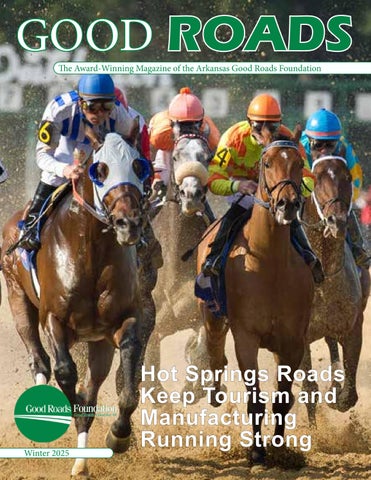
On the Cover: Oaklawn Racing Casino and Resort. (Photo courtesy of Visit Hot Springs) Foundation Good Roads. Good for All. All.
Winter 2025
Hot Springs Roads Keep Tourism and Manufacturing Running Strong
Winter 2025 | Good Roads Foundation
3
From Vision to Reality: Designing Safe, Sustainable Infrastructure
I49 Tunnel and Trail, Bentonville, AR
From roadways to transit networks, we specialize in designing and implementing infrastructure solutions that enhance mobility, promote safety, and support economic growth.
CEI Engineering Associates, Inc.
4 Good Roads Foundation | Winter 2025 www.CEIeng.com | 800.433.4173
Executive Board
2025 EXECUTIVE BOARD Robert Moery President Lance Lamberth Vice President D.B. Hill, III Secretary/Treasurer Harold Beaver Graycen Bigger JoAnne Bush George Cress Curt Green Mark Hayes Jerry Holder Shannon Newton Philip Taldo Chris Villines Jim Wooten
Robert Moery President Little Rock
Lance Lamberth Vice President Batesville
D.B. Hill, III Secretary/Treasurer Little Rock
Harold Beaver Rogers
Graycen Bigger Pocahontas
JoAnne Bush Lake Village
ARKANSAS GOOD ROADS FOUNDATION The Arkansas Good Roads/Transportation Council was established in 1975 as a 501(c)(3) non-profit, tax-exempt and tax-deductible organization. In 2015, the council was re-established as a foundation in order to be a more visible and credible voice on behalf of the mission of the Arkansas Highway Commission and the Arkansas Department of Transportation. The purpose of the foundation is to promote adequate funding and financing for the planning, development, construction, and maintenance of a safe and efficient highway, street, road, and bridge system, including transportation enhancements. The work increases statewide economic growth, private sector job creation and retention, and improves the quality of life in all Arkansas counties, municipalities, and communities.
George Cress Little Rock
Curt Green Texarkana
Mark Hayes Little Rock
Jerry Holder Little Rock
Shannon Newton Little Rock
Philip Taldo Springdale
Chris Villines Little Rock
Jim Wooten Beebe
Joe Quinn, Executive Director goodroadsfoundation@gmail.com Kathryn Tennison, Editor kathryn@bestmanagement.net Celia Blasier, Designer graphics@bestmanagement.net
Arkansas Good Roads Foundation P.O. Box 25854 Little Rock, Arkansas 72221
(Non-Voting Member)
Winter 2025 | Good Roads Foundation
5
Executive Director’s Message
Highway 112 Memories Run Deep Joe Quinn, AGRF Executive Director
We all have a road or drive in our memories that stays with us. A road you drove at a very specific time in your life. A road that represents when life seemed simpler, or a drive that you associate with the loss of a job or a divorce, or traveling to a job you didn’t really like. Memories are often tied to the roads we traveled, the places we went, the people we drove with, the cars we bought and sold and wrecked. Roads and cars are also often tied to the days when we were falling in love and the places we went in the early days of a relationship. My first car was a 1968 Ford Fairlane that I paid $400 for. I earned the money working as a night disc jockey at a small radio station. The car was eight cylinders of muscle on the highway without seat belts. Gas was cheap, the Ford had an AM radio, and some of my best memories involve driving to
6 Good Roads Foundation | Winter 2025
that little radio station in that beat-up brown car. I thought I had the best minimum wage job on the planet, spinning the hits and reading the news. In Northwest Arkansas, the memories of cars and roads are often associated with young people heading to the University in Fayetteville from Little Rock, Conway, Pine Bluff, or Crossett. University of Arkansas students from the 1970s and 1980s all have vivid memories of driving the winding and dangerous “Pig Trail” to get from I-40 north to Fayetteville. Other people remember getting back to campus from Christmas break, coming down Highway 112 from Bentonville. Arkansas Highway Commission Chairman Philip Taldo remembers his grandmother from Italy driving on 112 in her earliest days in this country. Taldo has vivid memories of how Highway 112 was
a part of his teenage years. Long before he chaired the Highway Commission, he was advocating for upgrading Highway 112, one of the few north-south roads in the region. On a beautiful November morning, local, state, and federal leaders gathered to celebrate the first stage of a multi-stage set of improvements to be made to Highway 112. Taldo told the crowd, “I drove 112 to get to the University of Arkansas, and I drove this road to get to my first job at Walmart.” The renovation work will be done in four stages, and it will involve four lanes and 27 new roundabouts. The four lanes will include a median. Federal funding totaling $25 million will help pay for the project. The new version of the old road will be both scenic and functional. US Congressman Steve Womack was at the dedication ceremony. He said the newly renovated 112 will be a classic example of Northwest Arkansas regional leaders working together: “No one here cares who gets the credit when we succeed. Everyone is focused on results.” While Congress has members focused solely on national party line talking points, Womack is different. He is an ex-mayor with a deep understanding of the people, issues, and roads in the region where we grew up. He understands road funding, grant writing, clearing snow for commuters on December mornings, welcoming new businesses, and supporting quality schools. One speaker at this event said Womack is “mayor-centric”, and we could use more of that in Washington. The Northwest Arkansas Council supported regional efforts to improve the highway by funding a cost-benefit analysis that showed the new road will generate $1.66 in public benefits for every $1 spent on construction. Nelson Peacock, President and CEO of the council, said, “This project is a win for the entire region. This transformation will improve safety, reduce travel time, and create new opportunities for active transportation that make the region a great place to live and work.” Everyone at this event had memories of this road. State Senator Greg Leding was a close
Scenic look at Highway 112 near Cave Springs.
friend of the son of an auto dealer who lived across the street from the parking lot where the news conference took place. He remembered racing the auto dealer’s cars on 112 at night. State Representative Robin Lundstrum vividly remembered driving this road with her husband in their early days together. Northwest Arkansas is the 18th fastest growing metropolitan region in the United States, but there is still something of a small-town culture here. ARDOT events like this are reminders that this is a true region in far more ways than it is a set of different communities. Everyone seems to have childhood memories of Highway 112, and no one really needs to be convinced that its renovation matters. Tim Conklin is the Executive Director of the Northwest Arkansas Regional Planning Commission. He remembers local leaders commissioning a study of the road in 2012, and Winter 2025 | Good Roads Foundation
7
Executive Director’s Message in 2017, recommendations based on the study were formally made on what needed to be done to integrate the road into the overall long-term Northwest Arkansas traffic strategy. Womack thinks a new and improved Highway 112 will take pressure off I-49. He said, “People want alternatives when they are sitting in bumperto-bumper traffic. This is exactly how the federal government should operate to improve the quality of life of all our citizens.” State Senator Bart Hester is the president pro tempore of the Senate and a lifelong resident of Northwest Arkansas. He is now an active leader in complex discussions about the region’s ability to meet future water and sewer infrastructure needs. But he has been following road development closely for more than a decade. Hester said, “The need for good roads here has never been greater. But I think what has changed from ten years ago is that the region is now getting its share of the road resources. There is more of a statewide realization of the clear need here.”
8 Good Roads Foundation | Winter 2025
In infrastructure circles, there is often a discussion along the very general lines of….do new roads lead to more traffic, or does heavy traffic come first and better roads follow? During the ceremony, a short distance from I-49, Congressman Womack was one of the last to speak. He began his remarks with a comment that resonates. Womack said, “I was sitting here listening to speakers and watching cars, dump trucks, and large trucks roll by without a break. It’s a reminder that Northwest Arkansas doesn’t wait for new infrastructure to push for growth. Northwest Arkansas keeps growing on its own, and it’s then the government’s job to provide better infrastructure through projects like this.” Infrastructure projects like this matter and are a reminder that some roads are deeply embedded in the culture of a region or community. Roads we remember driving in high school, or going to our first job, or falling in love. Highway 112 is clearly one of those legendary Arkansas roads. Safe travels. Put that phone down when you are driving.
In a work zone, it’s not a game. For more information, visit:
ARDOT.GOV/SLOWDOWNPHONEDOWN
#SLOWDOWNPHONEDOWN @myARDOT @idrivearkansas
Winter 2025 | Good Roads Foundation
9
Street Smart
Agency Collaboration Introduces New Safety Curriculum to Schools in Arkansas By Emma Goad
Reprinted with permission from ARDOT
ARDOT is preparing to roll out a new statewide safety initiative, Street Smart, aimed at educating K-12 students about road safety. Set to launch during the 2025–2026 school year, the program will be geared toward grades six through eight, equipping students with essential skills and knowledge before they become drivers. The goal is for the program to expand to include additional grades in subsequent years. The program will focus on pedestrian, bicycle, passenger, and motor vehicle safety, delivering ageappropriate materials in a format that engages students through multiple learning styles. It is being developed collaboratively by ARDOT and the Arkansas Department of Education (ADE). This is coming on the heels of the Slow Down, Phone Down campaign, now in its fourth year. Slow Down, Phone Down is a work zone safety campaign that encourages drivers to slow down and minimize distractions while driving in work zones to protect both themselves and road workers. Recently, advertising for this campaign has been focused toward 18 to 24-year-olds. To reach people in this age range, ARDOT is pushing this campaign on social media platforms like Snapchat and Instagram, gaming websites such as Twitch, and streaming services like Crunchyroll, among others. While the Slow 10 Good Roads Foundation | Winter 2025
Down, Phone Down campaign is currently targeting young drivers specifically in work zones, the Street Smart campaign shapes the next generation of drivers, those who are still passengers and observers, to prepare them before it’s their turn behind the wheel. “The K-12 educational program is trying to instill safety conscious behavior in young people,” Jessie X. Jones, ARDOT’s Chief Engineer for Preconstruction, said. “We want Arkansas students to possess the skills needed to be more than just safe drivers. We want them to also be safe passengers, cyclists, and pedestrians when they are traveling.” The inter-agency collaboration between ARDOT and ADE brings together transportation expertise and relevant educational standards to ensure success in the classroom. ARDOT utilized data and statistics to determine which transportation-related topics should be addressed, and ADE provided recommendations on how best to deliver the message to students. “We’re looking at several delivery modes to engage students in different ways,” Travis Brooks, Division Head of ARDOT’s Planning & Research Division, said. “Some of the materials are lecture-style, but we’ll also have handson exercises, traditional testing objectives, and shortform videos designed for a student body that is used to platforms like Instagram.”
Street Smart
The Street Smart curriculum will progress by grade level. In sixth grade, students will learn the basics of pedestrian, bicycle, and bus safety. In seventh grade, more advanced safety principles are introduced, including how to be a safe passenger and how to avoid distracting the driver. In eighth grade, students will begin preparing for the responsibilities of being behind the wheel. “We started with sixth to eighth graders because that’s the age group that would be the best to target at the beginning,” Jones said. “They haven’t started driving yet.” Educator Panel Shaped Early Development To ensure the curriculum would be practical and effective in real-world classroom settings, ARDOT hosted a panel of educators in the early stages of development. Adam Stage, the principal of Fountain Lake Middle School and panelist, helped provide insights into how the curriculum could be implemented and what would resonate with students. “We really dealt more with the implementation,” Stage said. “How do we actually get it into a classroom effectively? What class do we put it in?” The panel helped shape the curriculum by categorizing it into pedestrian, bicycle, and driver safety modules, with the goal of keeping the educational material relevant to the grade-level. The panel also determined the lessons would be best suited under the health curriculum, although the content is designed to be cross-curricular. Stage described the collaboration as “very productive,” noting that former educators involved in the project had already contributed valuable foundational work. “ARDOT worked very well with us. They brought in the transportation expertise, and we brought in the classroom perspective,” Stage said. Stage was inspired to participate due to a personal
experience that underscored the curriculum’s importance. “I remember there was a kid when I was a teacher at Magnet Cove who died in a car accident. The whole community was heartbroken. That stuck with me,” Stage said. “If we can get this in their hands year after year before they start driving, I really feel like it could save lives.” He emphasized that while students currently study for a driver’s test by memorizing answers from a handbook, Street Smart offers a deeper, more meaningful engagement with safety. “I don’t think we’ve ever had a curriculum that really focused on what you do as a bicyclist or pedestrian,” Stage said. Hands-On Learning and Real-World Applications The curriculum will include interactive web-based games, as well as short videos featuring teen actors from Arkansas to present safety messages in a relatable way. To create the videos, actors spent a week filming at various locations across Little Rock with the video production company Waymack & Crew. Six Arkansas teens learned and recorded ten scripts, which were then edited and produced for the curriculum. Some videos were shot at a crosswalk downtown, others on a neighborhood sidewalk, and some inside a car Winter 2025 | Good Roads Foundation
11
Street Smart
mounted on a trailer. These teens are the face of Street Smart. The educational materials will be designed for use in several subject areas. One example Brooks cited is a hands-on physics experiment designed to show how speed impacts crash outcomes, which connects road safety to science education. The program draws inspiration from a successful curriculum implemented by the Georgia Department of Transportation. After seeing Georgia’s results presented at a national conference, ARDOT initiated its own campaign, adapting the concept to fit Arkansas’ educational standards. Under the direction of previous ARDOT Director Lorie Tudor, Jones was put to the task of learning from Georgia’s experience. “She thought it was a great idea that could potentially benefit Arkansas,” Jones said. “So, she asked us to look into it, and the Commission authorized us to proceed.” Georgia’s perspective was eye-opening for ARDOT, but Jones wanted to be sure that the program was tailored to Arkansas specifically to be successful. “We want to make sure this material is developed and meets the standards that Arkansas has, whether that’s in social studies, health, or science,” Jones said. “The Department of Education is reviewing everything just like ARDOT is,” Brooks said. “Educators from across the state provided early feedback on educational objectives, opportunities for integration into the curriculum, and the tools for engaging with students.” Funding and Future Expansion Funded through the Highway Safety Improvement Program (HSIP), ARDOT has committed $500,000 to the development of the sixth through eighth grade phase. Pending success with phase one, future phases, including full K-12 implementation, will be supported through additional HSIP funds. “Arkansas receives approximately $40 million per year in HSIP funds,” Brooks said. “Most of that goes to infrastructure projects, but educational programming is also eligible, and that’s what we’re doing here.” Early measures of success will focus on distribution and implementation, such as how many classrooms and students the curriculum reaches. Long-term, the 12 Good Roads Foundation | Winter 2025
goal is to impact behavior and reduce injuries and fatalities. “That is daunting,” Jones said of the current crash statistics. “If we instill safety in the minds of students before they get behind the wheel, we expect to see a reduction in crashes.” Brooks echoed this goal. “There are certainly some very concerning trends in the safety data—distracted driving, seat belt use, impaired driving. We’re going to be educating students about all of those.” ARDOT and ADE have formed a working group that meets regularly to review the program’s development. “It’s really a team effort,” Brooks said. “Everyone’s bringing something essential to the table, whether it’s safety, academic standards, or creative content. That collaboration is what will make this successful.” Street Smart is a program that encourages students to not just be safe drivers someday, but also to understand the importance of being a safe pedestrian, bicyclist, or passenger. Instilling this knowledge at the educational level will ensure students see that they’re just as impacted by road safety as anyone else. “We hope this will resonate with students, and that they will go home, talk to their parents, siblings, and neighbors about this,” Jones said. “It could be something propagated through them, and we hope to really see a difference in people’s behavior.”
The Cost of Litter in Arkansas
MILLIONS TO GO The Cost of Litter in Arkansas By Emma Goad
Reprinted with permission from ARDOT
Each day, motorists travel millions of miles on highways and interstates, largely unaware of the effort required to keep those roads clean. Beneath the rumble of tires and the blur of passing landscapes is a quiet but costly struggle against litter. In 2024, ARDOT spent approximately $8 million on litter-related cleanup efforts across the state. The costs come from a variety of programs and contracts aimed at keeping Arkansas roads clean including mowing contractors, inmate labor, organizations serving adults with disabilities, volunteers, and ARDOT crews themselves. Breaking Down the Bill Of that $8 million, around $2 million was spent through mowing contracts that include litter pick-up requirements. “We mow all of our highway routes at least three times per year,” Steve Frisbee, Assistant Chief Engineer for Maintenance, said. “About half of our 16,000-mile system we mow with our own crews. The other half — really the bigger routes, the interstates and major U.S. highway routes — we contract out.” The contractors bid by acre for mowing services, but they must also include litter removal both before and after mowing. Another leg of the effort is the County Jail Inmate Litter Program, which began in 2007. While participation is voluntary, seven counties currently take part. The inmates involved do this as a part of their commitment to the court system. It can be used as community service.
“We’re not paying the inmates themselves,” Frisbee said. “We are paying the county for their cost. It’s at a rate of $2 per inmate per hour.” In 2024, $20,000 was allocated to support the County Jail Inmate Litter Program. ARDOT includes this program in its annual budget and has set aside additional funds to accommodate participation from more counties as the program expands. Additionally, about $400,000 goes toward contracts with work centers through a state law that allows public agencies to partner with organizations serving adults with disabilities. Nonprofits like Pathfinder, Inc. in Little Rock and Abilities Unlimited in Fort Smith employ individuals who are able to assist with litter collection. While partnerships and contracts play a critical role, most of the cleanup cost comes from ARDOT’s own workforce and totals just over $5 million annually. “We spent over 118,000 crew hours of work in 2024 just picking up litter across our 75 counties,” Frisbee said. “That’s a lot of hours.” In previous years, $5 million was the total amount spent by ARDOT on all methods of litter management. Rising costs in labor, fuel, equipment, and contractor rates have all contributed to the increase to the current $8 million litter cost. Safety and Innovation The job doesn’t stop at plastic bottles and fast-food wrappers. “A big chunk of our litter pickup is that debris you see on the side of the road — tires, mattresses, shovels, grills,” Frisbee said. “Especially in urban areas like Little Rock, where it collects on the inside shoulder of an interstate and becomes a safety issue.” Because of this, ARDOT invested in Lane Blade devices. Lane Blade devices are truck attachments that allow crews to safely push large debris out of traffic lanes. ARDOT has the largest fleet of these safety devices in the United States. “We got a $1 million grant last year that’s going to allow us to buy 31 more Lane Blades,” Frisbee Winter 2025 | Good Roads Foundation
13
The Cost of Litter in Arkansas said. “We’re going to have enough to cover the entire interstate system in the State.” Though vital, these high-tech safety measures are not included in the $8 million annual litter budget, making ARDOT’s true cost of addressing roadway debris even higher. A Statewide Issue While urban areas with high average daily traffic see more litter, no district is immune. “Litter is really an issue from the largest highway down to the lowest-volume routes,” Frisbee said. Some crew areas dedicate a full week in spring to litter cleanup, while others strive to clean up every few weeks. But with limited staffing, efforts are often dependent on availability. “The crews picking up litter are the same crews that mow, they’re the same crews that patch potholes, repair cable barriers, and clean ditches. We don’t have special litter crews available,” Frisbee said. “It’s just a challenge with so many priorities.” Arkansas Initiatives One bright spot in ARDOT’s cleanup strategy is the Adopt-A-Highway program, which includes 688 volunteer groups across the state. This effort is helpful, but with the amount of highway and interstate miles ARDOT manages, there is a constant need for more Adopt-A-Highway groups. “Oh, it’s been a great help,” Frisbee said. “There are some districts that only have 20 or 30 active groups, and when you have 2,000 miles of highway, you could literally have up to 2,000 groups to keep up. So, the need is still there.” Frisbee also praised the ongoing partnership with the Keep Arkansas Beautiful Commission, which plays a key role in engaging the public through educational campaigns and community events. The Commission promotes litter prevention, encourages personal responsibility, and helps organize large-scale cleanup efforts like the annual Great American Cleanup and the Keep Arkansas Beautiful Cleanup. These statewide initiatives mobilize thousands of volunteers to remove litter and beautify public spaces, 14 Good Roads Foundation | Winter 2025
which helps ARDOT’s day-to-day efforts. “Those are always a big help to raise awareness and rallying our communities to pitch in,” Frisbee said. Getting the Public’s Attention Despite the Department’s efforts, Frisbee believes Arkansans still don’t realize the cost or scope of the litter issue in the State. “No, I don’t believe the public really has a clue how much litter is costing them,” Frisbee said. “I think they just think we have crews that have just nothing to do but pick up litter.” To raise awareness, ARDOT launched a cleanup campaign in March called Spring Clean-Up Day. “On March 19th, we picked up about 6,500 bags in one day across 75 counties,” he said. “We picked up over 10,000 bags of litter just that one week.” One of the most creative awareness initiatives came from a group called the Bella Vista Litter Patrol. They approached ARDOT with a concept called “Litter Letters,” which are wire-framed letters filled with trash, spelling out a message. “They actually spell out the letters “W-H-Y” he said. “To ask the public, you know, why do you litter?” Looking Ahead Frisbee is working to expand partnerships with centers for adults with disabilities and increase participation in county inmate programs. But the ultimate solution, he believes, lies in prevention. “I’m not sure what else as far as a change other than just get the litter stopped,” Frisbee said. “And I’m not sure that’s feasible.” Until then, the effort continues bag by bag, mile by mile, at a cost that affects every Arkansan.
ARKANSAS MADE ARKANSAS PAVED
Our Vision
To make Arkansas the best-paved state in the nation. With more than 35 state and regional awards under our hard hats, we’re heading in the right direction! We provide Arkansas with quality-inspected ready mix concrete, asphalt mixes, and crushed stone. Our work doesn’t stop there. We also proudly pave the roads that lead us home.
atlasasphaltinc.com Winter 2025 | Good Roads Foundation
15
Growing Hot Springs
Growing Hot Springs Into a Hot Spot
Tourists Coming in Cars Hit Record Levels By Deborah Horn
Growing up in the 1980s, Terri Roberts remembers walking and shopping with friends along Central Avenue, swimming in Lake Hamilton, spending the day at Magic Springs, or grabbing a quick meal at the Dairy Queen on Grand Avenue. The family lived in North Little Rock, but her parents had a timeshare on Lake Hamilton in Hot Springs, where they spent summers. She said, “I so enjoyed my summers there,” and added, “The town moved at a slower pace then.” In the years since, Hot Springs has picked up the pace. Several large and small attractions have opened, including Garvan Woodland Gardens, while others have expanded: Oaklawn racetrack added a casino and resort, and the Mid-America Science Museum added a treehouse and skywalk. It’s home to the Hot Springs Documentary Film Festival and hosts the World’s Shortest St. Patrick’s Day Parade each year. Grand and Central avenues are abuzz with folks, and Steve Arrison, CEO of Visit Hot Springs, is optimistic about Hot Springs’ continued tourism growth. We have golf courses and national parks to an alligator farm, the oldest roadside attraction in the
area, and lots of colorful history, Arrison said. There are live music venues, boutiques, and a wide variety of dining options – from traditional Southern and modern fare to Asian and European. Where else can one get freshly made, authentic Italian cannoli or enjoy high tea, English-style? Arrison said, “Over the last 10 years, Oaklawn (Racing Casino Resort) has had some of the largest purses in the world, and that has given us a big shot in the arm.” Additionally, “We have great hotels and short-term rentals.” In October, Frommer’s, the award-winning travel brand, named Hot Springs as one of its “Best Places to Go in 2026.” Bill Solleder, Visit Hot Springs Marketing Director, said, “That selection will place us among an elite number of destinations for years to come.” Even as an adult, Roberts continued her annual summer vacations in Hot Springs, saying, “The whole place is special, magical.”
World’s Shortest St. Patrick’s Day Parade; World’s Largest Leprechauns.
Garvan Woodlands Gardens. (All photos courtesy of Visit Hot Springs)
16 Good Roads Foundation | Winter 2025
Tracking the Growth In fact, the latest tourism numbers are encouraging, Arrison said. Last year, Hot Springs welcomed 9.7
Growing Hot Springs three towns is about 63,500. When Pam Cantrell and her husband moved to Hot Springs in the mid-2000s, she said she felt that the town was undergoing a change, from a sleepy resort town to a bustling one with plenty to do. Over the last 15 years, she noticed increasing downtown congestion at certain times of year, especially during the summer and racing Horse Racing in Hot Springs at Oaklawn Racing Casino Resort seasons. In 2019, the horse racing venue was expanded and renamed million visitors, about 6 million day-trippers, and 3.7 million overnight visitors, up by about 4.3 percent over Oaklawn Racing Casino Resort with the opening of a casino. the 2022 numbers, Arrison said. He added, “We’re not Previously, it was only allowed to operate “electronic far behind Branson,” known as a popular American tourist destination, which was estimated to have about games of skill”. Although the year-round population hasn’t grown – hovering around almost 36,000 since 10.29 million visitors in 2023, according to Missouri’s latest numbers. Numbers for 2024 are not yet available. 2000 – Cantrell and her husband travel the back streets whenever possible because of traffic congestion on the That’s only a difference of about .59, or 590,000 roads popular with the tourists. visitors. But like Roberts, the Cantrells “love” Hot Springs, Hot Springs, with a population of about 37,000, has about three times the population of Branson, with a population of about 13,000. Also, it’s getting hard not to include the impact of Malvern, 20 miles southwest, with a population of nearly 11,000, and Hot Springs Village, 18 miles north of the city, with a population of more than 16,512. The Village, with more than 26,000 acres in the Ouachita Mountains, is often cited as the nation’s largest gated community and has an impact on the Hot Springs economy. Many of Malvern’s and the Village’s residents shop and play in Hot Springs, and the Downtown Hot Springs Holiday Lights combined population of the Winter 2025 | Good Roads Foundation
17
Growing Hot Springs Interstate 30 between Benton to the Hwy. 70 exit was widened to six lanes and completed in early 2025. Also of note, the new 5.8-mile Arkansas Highway 5 bypass, connecting 70 East to Arkansas Highway 7 North, opened in 2023. It was designed to reduce incity congestion. For now, Arrison said his wish list has been filled, saying he is pleased with the recent road improvements in the area and cites these as having a positive impact on tourism numbers, adding, “We now have the infrastructure of a major city. I expect we will see new developments and new attractions.” The Numbers Dalaney Thomas, Arkansas Department of Parks, Heritage, and Tourism Director, said counting tourists is more than just counting cars on the highway. Before publishing a number, the state considers a variety of factors, including official data, surveys, estimates, and hard numbers. For example, state and national Garvan Woodland Gardens Tulip Extravaganza in Hot Springs
which they both describe as unique. Cantrell asks, “Where else can you hike up a mountain in a national park inside the city, and then take a long soak in a natural hot springs bath?” Takes More Than Attractions Arrison credits much of the recent increase in tourism, estimated at about 2 million visitors in 2015, to infrastructure improvements, including upgrades to in- and outbound highways. For example, U.S. Hwy. 270, which provides easy access around and through parts of the city, underwent a major expansion in 2023, widening a section of the highway near the Ark. Hwy. 227 interchange. It increased capacity and safety, according to the Arkansas Department of Transportation. Highway 270 now has a business loop, designated as US 270B, in the Hot Springs area, which alleviates through-town congestion. Another key route in and out of the area is U.S. Highway 70, a divided roadway that runs between Interstate 30 to Hot Springs proper. It underwent a major renovation, widening an 18-mile stretch from two to five lanes, which was completed in June 2018. Arrison said, “Highway 70 was redone to perfection.” 18 Good Roads Foundation | Winter 2025
It is believed Babe Ruth trained in Hot Springs and hit a 573-foot home run in 1918 while playing there. He was playing for the Boston Red Sox at that time, and is believed to have trained in Hot Springs nine times.
Growing Hot Springs organizations, such as the National Park Service and the Arkansas Department of Parks, Heritage, and Tourism, track data through a variety of methods, including visitor and traffic counts and spending, distance traveled to attractions, and overnight accommodation occupancy. From these sources and more, Arkansas produces reports on the economic impact of tourism, and some attractions, like Hot Springs National Park, release their Hot Springs Convention Center Bank OZK Arena own visitor and economic impact reports. The Arkansas Department of Parks, million visitors visited in 2024, a 2.6 percent increase Heritage, and Tourism (ADPHT) reports that 52 from 2023. They spent $10.3 billion, resulting in a total economic impact of $17.4 billion, supporting more than 70,000 direct jobs. Key spending categories – food and beverage, retail, and lodging – experienced increases, Thomas said. Cities often collect taxes, often known as hamburger taxes, on restaurant purchases and overnight accommodation, which can be used to accurately reflect the numbers collected and drill down into them. With all the travel metrics trending in the right direction for Hot Springs, there is probably no city anywhere that is a better example of road improvements leading to more jobs and more economic growth. This is also a city that is deeply embedded in Arkansas culture. The place where many drove for childhood vacations, the city that hosts the Arkansas Derby as part of the road to the Kentucky Derby, and the city that is the home of a lake region that has provided wonderful summer days for generations of children. It’s also a place surrounded by lakes and bridges over water that are key to access to the region. Good Roads Executive Director Joe Quinn says, “When our kids were small, I remember driving over every Christmas Eve to spend the holiday in Hot Springs. My wife and I drove Highway 70 in her convertible to Saturdays at the track for years, my father-in-law Hot Springs is widely known as “Spa City” for its natural hot owns a Hot Springs restaurant. We are like thousands springs and its history as a health resort and spa destination. of other families where the roads to Hot Springs have The city’s identity is deeply rooted in the thermal waters of Hot Springs National Park, which have drawn visitors for centuries. always led to good memories.” Winter 2025 | Good Roads Foundation
19
Hot Springs Manufacturing
Hot Springs is More Than a Spa City – Offering Great Jobs, Quality of Life By Deborah Horn
While most Executive think of Hot Director, said Springs as one about the reason of the South’s for featuring most celebrated Troutman as a playgrounds, and guest speaker: the Spa City’s “Hot Springs growing popularity is one of the is evidenced by its largest tourist increasing annual destinations in tourist base, now All photos courtesy of the Greater Hot Springs Chamber of Commerce and Hot the Southeastern Springs Metro Partnership) some 9.7 million United States, strong, there’s and integrating another, less glamorous, more serious side – a strong infrastructure planning with future economic growth manufacturing and industrial base. is a top priority for the infrastructure community in “Hot Springs is known as a tourist attraction, but Arkansas. Gary has a great perspective on Hot Springs’ we’re working to make sure people are aware that we needs and its future goals.” have more to offer,” Gary Troutman said in July when addressing a hundred attendees at the Arkansas Good Building a Diverse Economic Base Roads Foundation (AGRF) Summer Policy Meeting. There are about 1,000 members on the Hot Springs The annual two-day meeting was hosted by the Chamber of Commerce metro side, which focuses Arkansas Good Roads Foundation. on business endeavors such as manufacturing, while Troutman is President and CEO at Greater Hot a second, Visit Hot Springs, focuses on tourism, Springs Chamber of Commerce and Hot Springs Troutman said. Metro Partnership. For more than two years, “Manufacturing has long played an important role Troutman has served as Vice President at First Security in Hot Springs. We have about 35 manufacturing Bank in Hot Springs, and he previously served as partners,” Troutman said. For example, the Keith Smith General Manager at The Sentinel-Record of Hot Company is a third-generation operation and the Springs. largest independent producer and provider of broiler Joe Quinn, Arkansas Good Roads Foundation hatching eggs in the U.S., and Mountain Valley Water has been bottling natural Ouachita Mountains water since 1871, Troutman said. But manufacturers continue to set up shop here and offer employees competitive salaries and benefits. In fact, he added, there are five aerospace manufacturers located here, as well as Baggo Inc., which opened in 1990 and produces cornhole equipment, and Vulcan Sporting Goods Co., which opened in 2015 and produces a full line of pickleball equipment. In fact, Troutman said, “We are ground zero for pickleball.” Additionally, there are 239 new businesses in 20 Good Roads Foundation | Winter 2025
Hot Springs Manufacturing downtown, and the area has a business retention rate of about 74 percent. Troutman said, “We expect to be the state’s next great growth area.” A Boom Beyond Tourism The same improvements that benefit the area’s tourist industry are good for a city’s economic engine, said Steve Arrison, CEO of Visit Hot Springs. Troutman agreed. In 2024, Hot Springs saw a 4.3 percent increase in tourist numbers over 2022. Of the nearly 10 million visitors, 6 million were day-trippers and 3.7 million were overnight visitors, up about 4.3 percent from 2022, said Arrison, who focuses on the tourist side. He added, “We’re not far behind Branson,” a popular American tourist destination estimated to have had about 10.29 million visitors in 2023, according to Missouri’s latest numbers. But the city has a few things that Branson doesn’t. Hot Springs, with a population of about 37,000, has about three times the population of Branson, about 13,000, and a solid manufacturing base, Troutman said. Plus, it’s getting hard not to include the impact of Malvern, 20 miles southwest, with a population of nearly 11,000, and Hot Springs Village, 18 miles north of the city, with a population of more than 16,512, on Hot Springs. The Village, with more than 26,000 acres in the Ouachita Mountains, is often cited as the nation’s largest gated community and has an impact on the Hot Springs economy. Many of Malvern’s and the Village’s residents work, shop, and play in Hot Springs, and the combined population of the three towns is about 63,500, which expands the employee pool that commercial concerns can draw from, Troutman said. Unique Offerings Hot Springs also has quick access to two northsouth and east-west interstates and other major highways, and it is about 40 minutes or less from the Bill and Hillary Clinton National Airport. It has two major hospitals and excellent public high schools, including the Arkansas School for Mathematics, Sciences, and the Arts (ASMSA), which is part of
the University of Arkansas System, as well as postgraduate educational opportunities. Many of these are geared toward the local industry’s needs, Troutman said. “We have about a 98 percent broadband connectivity rate, and there are plenty of activities such as fishing, boating, hunting, festivals, horse races, gaming, dining, and shopping that add to the quality of life here,” Troutman said. It was his role with the local newspaper that brought him home from Little Rock, a decision he says was an “obvious choice.” Paving the Way for Bigger Opportunities Troutman said, “If you’re not planning ahead, you’re falling behind.” The city takes that philosophy to heart and is upgrading its water treatment infrastructure with a new Lake Ouachita Water Treatment Plant and major improvements at the Davidson Drive Wastewater Treatment Plant, Troutman said. The new water plant will draw from Lake Ouachita and is set to be operational by the end of this year. The wastewater treatment plant upgrades include a new chemical building, UV disinfection, and new aeration equipment, with a planned completion date of April 2026. “It will double our water capacity. This has kept us from growing significantly, but this will allow for new neighborhoods and new industries going forward,” Troutman said. In 2016, voters approved a 5/8-cent sales tax to fund specific city road improvements, and the city worked with ARDOT on road improvements and upgrades in and around the city. “The completion of 70 and 30 was huge,” Troutman said about the widening of U.S. Highway 70 that runs from Hot Springs proper to Interstate 30, which also underwent a major upgrade and widening, including the exit to Hwy. 70. Improvements on U.S. Highway 270 and Arkansas Highway 7 are also making it easier to get around the area. A greatly improved infrastructure is a great reason for industries to stay and for others to consider moving to this area, Troutman said. Winter 2025 | Good Roads Foundation
21
Bridging the gap between idea + achievement At HDR, we’re helping our clients push open the doors to what’s possible, every day. hdrinc.com
22 Good Roads Foundation | Winter 2025
Road Rage
Road Rage
Passing Vehicles Not the Only Threat to Road Workers By Deborah Horn For Guy Washburn, it’s all about his guys getting home each evening, but in the last year or so, his employees have reported at least two real “gun threats in their work zones.” Now, it’s about getting them home alive. Washburn, General Manager for Cranford Construction Company in North Little Rock and former Arkansas Asphalt Pavement Association Executive Director, said, “It’s becoming a bigger and bigger concern. We’ve had two scary incidents.” At a Caddo Valley worksite, near Arkadelphia, Washburn said “an employee reported having a
gun pointed at him while on the job.” On Arkansas Highway 7, just south of Hot Springs, another employee reported that an angry motorist was pointing an AR-15-style rifle at him. The company hired an offduty deputy to remain on the job site for several days until the work was complete. He also had a story about a driver pointing a laser beam at a worker’s chest. “This kind of behavior has no place on our roadways,” Washburn said. It’s not just an Arkansas problem of road-raging while armed. In Colorado, there were reports of incidents when road construction workers were shot.
Road rage issues are often associated with rush hour traffic. (All photos courtesy of Rusty Hubbard, ARDOT)
Winter 2025 | Good Roads Foundation
23
Road Rage Other workers report being yelled at, punched, and vehicles being used as weapons to ram into work trucks. It’s already a dangerous work environment, with employees dealing with rain, snow, ice, summer heat, night work, rush hour, and holiday traffic, not to mention drivers talking, texting, drugging, and drinking. Guns significantly compound the problem and often escalate the situation to a violent outcome, Washburn said. What This Means to Road Workers In road construction zones, drivers are often forced to slow down or stop, change or merge lanes, and many are frustrated or in a hurry. It’s Friday afternoon after a long week, and many think the rules of the road at work sites, such as merged lanes or speed limits, don’t “really” apply to them. Washburn said, “This is not uncommon. We had a woman drive around the flagger and through the construction site because (she said) she was in a hurry to get to the hospital.” He added, “Her emergency was bigger than other people’s safety.” Rising Gun Violence Since the COVID-19 pandemic and its restrictions, society may be feeling more stressed, and this could manifest on our roadways, said Dave Parker, spokesperson for the Arkansas Department of Transportation (ARDOT), in a late 2023 interview with Good Roads magazine about work zone safety. The numbers aren’t going down. According to data from the Gun Violence Archive, who track gun violence incidents, road rage incidents involving firearms have increased nationally every year since 2018. Every 18 hours in 2023, a person was wounded or killed in a road rage incident that involved a gun, and unfortunately, these incidents have doubled from around 58 in 2018 to 118 in 2023. While overall crime trends varied, road rage shootings remained high post-pandemic, with some reports showing a 400 percent increase in incidents between 2014 and recent years. 24 Good Roads Foundation | Winter 2025
Many states, including Arkansas, use the media to emphasize driver safety and promote patience in work zones. Examples include the Colorado Department of Transportation (CDOT) and the Washington State Department of Transportation (WSDOT), as well as others using message boards to urge drivers to stay calm, allow extra travel time, and practice patience when navigating construction zones. They also warn of increased law enforcement presence and strict enforcement of existing traffic laws, such as speeding and aggressive driving. Road Rage in Arkansas While lower than in many other states, the number of road rage incidents against other drivers or construction workers is on the rise. In 2023, the Arkansas State Police (ASP) investigated 284 road rage incidents involving weapons, a significant number highlighting a growing trend, with some incidents turning deadly. • In 2024, the Arkansas State Police reported more than 300 road rage incidents involving weapons, with 45 percent of incidents involving the brandishing or firing of a gun. • As of late June 2025, the ASP reported investigating over 440 road rage incidents, with 153, or about 34 percent, of those involving a weapon. There have been three non-work-zone-related road rage incidents resulting in deaths in Arkansas since March, and none involved road construction workers.
Road Rage
• In March in Craighead County, Allan Brown, 45, died at the hospital after a road rage shooting on U.S. Highway 63 west of Bono. • In September, Michael Mahan, 47, was killed in a shooting after an altercation with another driver in Hot Springs. • In October, Daniel Davidson, 29, was shot and killed after a verbal road rage argument in traffic escalated and continued into a coffee shop parking lot in Bentonville. Why Track the Numbers Workplace violence is a hot topic in most states. Washington’s State Department of Transportation has held safety talks with contractors on awareness and de-escalation following violent incidents, while groups like the Associated General Contractors of America advocate for more robust data collection on work zone crashes to better inform safety policies. ARDOT and groups like Good Roads focus on safety, including protecting road construction workers from road rage. D.B. Hill, III, owner and president of D.B. Hill Contractors Inc., is a lifelong member of the Associated General Contractors of Arkansas; as an AGC Lifetime National Director/Governor, he has worked at multiple levels as an advocate for safety on the job. Hill was the first Chairman of the National AGC Workzone Safety Committee. Hill said, “The issue of creating a safer work zone environment for roadway construction employees and the traveling public” is a top priority of the construction industry. “It remains an objective.” Hill believes a collaboration of ideas and resources, as well as education, is an effective means of
accomplishing this goal. ARDOT developed a Slow Down, Phone Down campaign and designed a curriculum for Arkansas K-12 students. It’s not a traditional driver’s ed handbook, but it covers a broad range of safe driving topics, including navigating highway work zones. Washburn agrees with Hill on education and information, but adds, “A law enforcement presence at work sites is a big deterrent.” Technology is also playing a key role in safer work zones and roadways. One example is the effective use of permanent wrong-way detection systems on interstate on- and off-ramps. Another is the Arkansas Highway Police’s (AHP) use of a Jenoptik Speed Triler that can be set up at roadway construction sites throughout the state. Capt. Louis Hatchett, Arkansas Highway Police (AHP) Commander of Special Services, said about the system, “It’s precision laser technology. It’s an automated, semi-stationary (speed) enforcement device.” For example, Hatchett said, “When a driver goes over 70 mph through a work zone, it will take a photo that can be downloaded. Once the vehicle leaves a work zone, it’s immediately pulled over, and an officer can issue either a ticket or a warning.” Communication campaigns have likely made the public more aware of the need to slow down and pay attention as they approach any work zone, but new issues like drivers pointing guns at work crews mean the issue isn’t going away. Improving safety for road workers will take a complex blend of technology, policy, new laws, driver awareness, and enforcement in the years ahead. Winter 2025 | Good Roads Foundation
25
Fallen Workers Memorial
Orange Vests and Love Reflections from the Fallen Workers Memorial Dedication By Joe Quinn The orange vests were everywhere at the dedication of the Fallen Workers Memorial on the ARDOT campus in Little Rock. For more than 18 months, an effort has been underway to put together the funding for this project, design it, and then build it on a wooded section of property behind the ARDOT headquarters. The dedication was held on a beautiful October day. ARDOT leaders made a realistic guess that no event or meeting has ever attracted as many ARDOT workers to a single location as this dedication did. The monument is stunning, elegant, and simple. It looks better in person than it did on the countless artist renderings we all looked at for so many months. On the walkways leading up to the monument, there are 92 bricks with the names of deceased workers over the course of 80 years. The men and women who died working on Arkansas roads are a diverse group; they were young and much older, and they 26 Good Roads Foundation | Winter 2025
lived in small towns and crowded cities. They died working on or near road projects. They died when hit by vehicles that ignored warning signs, and they died mowing the grass beside the roads. They coached Little League teams and went to church with their grandchildren and drank coffee with family members on Christmas morning. They were no different, really, than any of us. The speeches at the dedication were thoughtful and kind, but the real moment that captured what this project is about was when family members and loved ones grabbed paper and pencils and made renderings of their loved ones’ names on the freshly laid walkway. Watching family members do this was moving. ARDOT leadership has always said this monument was about the department employees before it was about anything else. This was the moment that made that clear.
Fallen Workers Memorial Employees across the state held barbecue lunches and sold t-shirts to help raise the funding to build this. They did that quietly and effectively, and frankly, they raised more than anyone expected. Good Roads members quietly wrote large checks to help with the cost of the memorial, and they did that without any questions about who would get credit or who was giving how much. The Arkansas infrastructure world is full of smart, tough people, but this day was another reminder that it’s also a business filled with decent people who treat each other with respect. At its core, the memorial is what we hoped it would be – a quiet place where families can come and say a prayer. A place where
they can sit on what would have been a birthday or wedding anniversary for the deceased worker. A solidly built place that reminds people that their loved one mattered and is not forgotten. With the memorial designed, built, and paid for, ARDOT will go back to the ongoing effort to create policies, change laws, and buy new equipment that makes the job safer. The effort will continue to remind motorists to slow down and pay attention when they approach a work zone. The new memorial will likely continue to be the backbone of that effort. A solid and elegant reminder that we need to protect current ARDOT workers and remember those who paid the ultimate price.
ARDOT estimates that the dedication pulled together a record number of ARDOT employees in one place.
Winter 2025 | Good Roads Foundation
27
Fallen Workers Memorial
28 Good Roads Foundation | Winter 2025
Arkansas State Highway Commission
Keith Gibson Vice Chairman
Philip Taldo Chairman
David Haak Member
Marie Holder Member
Jerry Halsey Member
Rock-solid Resources. Real-world Results. Providing superior materials and service for nearly 50 years. • Industrial Sand • Slurry • Crushed Stone
• Concrete Aggregate • Ballast • Asphalt Aggregate
• Rip Rap • Seal chips • Roadbase
Patrick Sullenger, Sales Manager 501-490-1535 / patrick.sullenger@gmqrock.com P.O. Box 138 / Sweet Home, Arkansas 72164 / gmqrock.com
Winter 2025 | Good Roads Foundation
29
Fall Meeting Recap
AGRF Fall Meeting The Good Roads developments in all Annual Meeting in regions of the state. November again Jared and the brought together dynamic leadership a unique mix of team at ARDOT influential Arkansas continue to work infrastructure closely with Good leaders. Mike Roads on everything Preston, the new we do. It’s a great CEO of CDI partnership that gets Contractors, spoke stronger and more to the audience effective each year. about the state’s The meeting was economic and job also an opportunity outlook for 2026. to honor and thank Preston previously engineering legend Joe Quinn (AGRF Executive Director), D.B. Hill, III (AGRF SecretaryTreasurer), Bob Crafton (founder of Crafton Tull), Robert Moery (AGRF led economic Bob Crafton for President). (All photos courtesy of Rusty Hubbard, ARDOT) development in more than four Arkansas for former Governor Hutchinson, and he decades of service on the Good Roads board. Bob worked at Stephens Inc., where he was involved in left ARDOT to form Crafton Tull in 1963. He led creating bonds and financing projects that created the company from a small operation to a company economic growth for the state. that today has 350 employees and is now companyJared Wiley outlined the work at ARDOT during owned. It’s a long way from the days in the early 60s the past year and the challenges and opportunities that when Crafton Tull did its initial work, created by lie ahead in 2026. Wiley talked to the audience about opportunities associated with the flooding of Beaver the major steps the department has taken in recent Lake. Bob correctly guessed that the new lake would years to rebuild the ARDOT communication strategy. be a fundamental reason for Northwest Arkansas’ More than ever, ARDOT is using technology and new rapid growth. policies to better inform citizens about road issues and The Annual Meeting is also a chance to brief
D.B. Hill, III, and longtime friend Bob Crafton
30 Good Roads Foundation | Winter 2025
Bob Crafton and Highway Commissioner Keith Gibson
Fall Meeting Recap
Mike Preston, CEO of CDI Contractors
members on the key accomplishments of the organization during a busy 2025. None of this work is possible without your support each year. Key accomplishments during the past year included:
Good Roads helped raise $185,000 for the Fallen Workers Memorial. We published four magazines that reach a unique audience of 1,500 leaders paying attention to infrastructure development in Arkansas. Our summer meeting in Hot Springs attracted a large crowd to a blend of social events and policy discussions. Highway Commission members and ARDOT leadership spent a lot of time over two days talking with our members about issues that matter. Our summer meeting in 2026 will be in Springdale, where the region’s tremendous growth continues to drive a discussion about smart infrastructure development decisions that will support communities in the decades ahead. Our strategic posts on Facebook about issues that matter to our members reached over 1.7 million people. Our members build, repair, design, and transport cargo on Arkansas roads. These members run companies that create jobs and economic development every single day. Our well-attended Annual Meeting in Little Rock in November created a conversation about the political, budget, and policy issues that we will be tracking in 2026.
ARDOT Director Jared Wiley outlined the work at ARDOT during the past year and the challenges and opportunities that lie ahead in 2026.
Winter 2025 | Good Roads Foundation
31
Fall Meeting Recap
ARDOT Director Jared Wiley
AGRF Executive Director Joe Quinn
AGRF Board President Robert Moery
32 Good Roads Foundation | Winter 2025
ThankAnnual You Event Sponsors! AGRF Meeting Sponsors Gold Sponsors
Silver Sponsors
Bronze Sponsors
D. B. Hill, III Winter 2025 | Good Roads Foundation
33
Side Roads
ARDOT Transportation Grants Awarded to Three Community Colleges Three community colleges in Arkansas have been awarded Transportation-Related Research and Workforce Development Program grants from the Arkansas Department of Transportation (ARDOT). The University of Arkansas Community College at Morrilton (UACCM) received $306,000; the University of Arkansas Community College at Batesville (UACCB) received $90,000; and the University of Arkansas – East Arkansas Community College (UAEACC) received $60,000, totaling $456,000 in grant money. These grants are to help support the study of materials and sources to provide resilient and sustainable logistics, processes, materials, and methods to ensure cost-effectiveness and the furtherance of education and economic development in transportation. The grant program also supports industry training, apprenticeship, and educational programs for transportation-related personnel development. “The ARDOT funding will support a new short-
term, stackable degree and certificate pathway,” University of Arkansas Community College at Morrilton Chancellor Lisa Willenberg said in the system’s news release. “It builds upon the success of UACCM’s prior ARDOT funded training programs in Commercial Driver Training and Heavy Equipment Operations. This additional program offering introduces flexible entry points and a clear pathway to meet industry demand for cross-trained workers who cannot only operate heavy machinery but also transport it safely to and from job sites.” Some plans for the grants include: • Triple-axle dump truck, which will be an instructional asset for Heavy Equipment Operations (offering a 15-credit certificate of proficiency and 22-credit technical certificate) and Class A/Class B CDL training programs (University of Arkansas Community College at Batesville). • Continued development of one of the nation’s top diesel technology programs (University of ArkansasEast Arkansas Community College).
City of Texarkana, Arkansas Receives Grant Money for Sidewalks, Recreational Trail The Arkansas Department of Transportation (ARDOT) has awarded two grants to the city of Texarkana, Arkansas: • $455,000 to construct sidewalks on County Avenue between Arkansas Boulevard and Realtor Road. • $433,000 to extend Nix Creek Recreational Trail. County Avenue has long been considered dangerous due to lack of sidewalks, but funding was a major roadblock. “It’s unsafe because sometimes people come through there driving fast. We just wanted to give our nonmotorized citizens a way to get to and from Walmart
34 Good Roads Foundation | Winter 2025
and other stores safely,” said Tracie Lee with Texarkana Arkansas Public Works. Now, with public funding on the way, construction is expected to begin late next year on the busy stretch of roadway on County Avenue between Arkansas Boulevard and Realtor Road. “It would be wonderful to have the sidewalk. The road is entirely too busy,” said Kelly Harrison, Texarkana, Arkansas resident. Funding for the sidewalks is part of about $18.9 million awarded by ARDOT for 60 projects through the Transportation Alternatives Program.
Side Roads
Award Recipients Announced for ARDOT Transportation Alternatives Program and Recreational Trails Program ARDOT News Release
ARDOT has announced the award recipients for the 2025 Transportation Alternatives Program (TAP) and Recreational Trails Program (RTP). The TAP was reauthorized by the Infrastructure Investment and Jobs Act (IIJA) and provides funding for programs and projects defined as “transportation alternatives” for pedestrians, bicyclists and other non-motorized forms of transportation. The TAP is a reimbursement-type grant program that provides for an 80% federal share and a 20% local match from eligible applicants. Under the TAP, eligible projects can include construction of on-road and off-road trail facilities that include sidewalks, bicycle infrastructure, pedestrian
and bicycle signals, lighting and other safety-related infrastructure. Conversion of abandoned railroad corridors for pedestrian and bicycle trails is also eligible. The RTP is funded through a portion of TAP funds set aside specifically for recreational trails. These funds are eligible for maintenance and restoration of existing trails, development and rehabilitation of trailside and trailhead facilities and trail linkages, and construction of new trails. For 2025, a total of 60 TAP projects were awarded for approximately $18.9 million and a total of 7 RTP projects were awarded for approximately $1.8 million.
Winter 2025 | Good Roads Foundation
35
Happy Holidays from Good Roads & Best Association Management!
36 Good Roads Foundation | Winter 2025
AGRF Supporters
Platinum Partners $10,000 and Over
Gold Partners $5,000 and Over
Silver Partners $2,500 and Over
American Concrete Pavement Assoc. OK/AR APAC-Tennessee The Cashion Company CPC Midsouth D.B. Hill, III Emery Sapp & Sons Alec Farmer APAC-Central Arkadelphia Alliance Arkansas Concrete Arkansas Farm Bureau Ash Grove Cement Bank of Delight Bob Crafton Clark Machinery Commercial Bank - Monticello Contractor’s Specialty Service Co. Cowling Title Curt Green & Co.
Lorie Tudor
Corporate Members $1,000 and Over
First Community Bank of Batesville Golden Triangle Economic Development
Jeffrey Sand Company Jim Wooten McGeorge Contracting Co. Michael Baker International
Friends
$500 and Over
Dermott Industrial Dev. Duffield Gravel Company Dumas Chamber of Commerce Eagle Bank and Trust Fayetteville Chamber of Comm. FM Structural Plastic Technology Farmer Enterprises Inc . Forsgren, Inc. Harold Beaver Hines Trucking Inc. Horatio State Bank I-49 International Coalition Jack Buffington
Jensen Construction Co. Jerry Holder JoAnne Bush Jonesboro Chamber of Comm. LaCroix Optical Company Larco, Inc. Lawrence Co. Chamber of Comm. M & T Paving and Construction Maxwell Hardwood Flooring Midwest Lime Company Mobley General Contractors Monticello Econ. Dev. Comm.
Natural State Consulting and Strategies NWA Council Riceland Foods Rogers Group Walmart NEA Intermodal Ohlendorf Investment Co. Paragould Regional Chamber Philip Taldo Pickering Firm Razorback Concrete Robert Moery Ryburn Motor Company Scott Equipment SN Contractors Southern LTG Springdale Chamber of Comm. SW AR Plan & Dev. District Western AR Intermodal
Winter 2025 | Good Roads Foundation
37
Join Us, Please! Good Roads works with our members to tell the story of the need for funding and financing to help all communities develop, build and maintain roads and bridges. This drives the local economy and makes the roads safer for all of us. We have corporate and individual membership rates available. The award-winning Good Roads magazine reaches more than 1,200 key stakeholders. If you want to put your message in front of an elite audience of state legislators, mayors, county judges, Good Roads members, engineers and the companies that build roads and bridges, this is the best way to do it. This is the only in-state publication that offers you an easy way to reach this very specific audience. Arkansas Good Roads Foundation goodroadsfoundation@gmail.com 479-426-5931 P.O. Box 25854 Little Rock, Arkansas 72221 38 Good Roads Foundation | Winter 2025
Arkansas Good Roads @arkansasgoodroads AR Good Roads @ARGoodRoads
Moving communities forward Garver’s century-long reputation as a leader in the transportation industry is built on the promise of safe, sustainable solutions for our interstates, roadways, bridges, and environmental studies. That reputation is amplified by the efforts of Transportation Team members like Project Manager Colton Wylie.
Colton Wylie, PE | Project Manager
GarverUSA.com Winter 2025 | Good Roads Foundation
39
Arkansas Good Roads Foundation P.O. Box 25854 Little Rock, Arkansas 72221
PRSRT STD US Postage PAID Tucson, AZ Permit No. 271
ROADS LEAD TO WEEKEND ESCAPES. Roads are literal and metaphorical connectors. They provide essential delivery of our daily needs – they also lead us to the things that matter most. As Americans, we depend on them for our safety and for our livelihoods. At Ergon, we are proud to work in communities across America helping build and maintain vital infrastructure that connects us all to what matters most.