ARKANSAS
The Magazine of the Arkansas Alumni Association Inc. The Magazine of the Arkansas Alumni Association Inc. Fall 2026 Vol. 76, No. 1
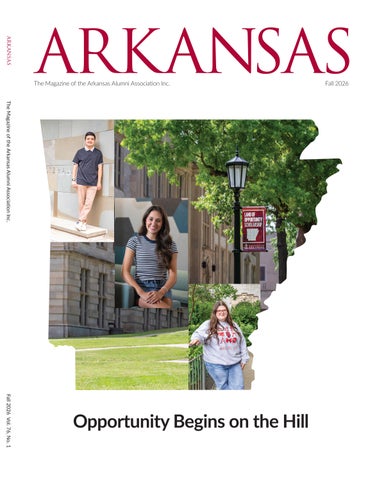
Opportunity Begins on the Hill
Fall 2026
This is just the beginning.
More than 100 students in the inaugural class of Land of Opportunity Scholars have started their paths to Senior Walk.
landofopportunity.uark.edu
For Arkansas students with high financial need, the right support can make the difference between stopping short and reaching graduation. The Land of Opportunity Scholarship helps them succeed on campus and into their careers. Help us extend that opportunity to more Arkansas students. Make your gift today.
arkansas
FALL / Vol. 76, No. 1
The Magazine of the Arkansas Alumni Association Inc.
4 Opportunity Begins on the Hill 14
A Lasting IMPACT Educational Leadership Alumni Shape the Future of Arkansas Schools. Three Members of the First Land of Opportunity Scholars Cohort Began Their Razorback Journeys with Big Plans, Strong Support and the Determination to Make a Difference.
22 36 Teaching, Research and Service
Using Fashion as a Tool for Connection Art Education Graduate Student Edward Berchie Osei.
2026 Faculty Award Recipients Facilitate Life-Changing Opportunities.
2 Chancellor’s Corner 10 Campus 40 Alumni 48 Events 52 Yesteryear 54 Senior Walk Above: Dean Kate Mamiseishvili welcomes the crowd at an IMPACT event celebrating the program’s success. Photo by Karen Segrave.
Cover: The U of A campus welcomes the first Land of Opportunity Scholarship cohort. Image design by Catherine Baltz.
FALL 2026 / ARKANSAS / 1
Chancellor's Corner
ARKANSAS Publisher Arkansas Alumni Association
harles F. Robinson C Chancellor
Dear Alumni and Friends, One of the most rewarding parts of leading the University of Arkansas is seeing how a single opportunity can change the direction of a life. That idea runs throughout this issue of Arkansas magazine. You will meet members of the first cohort of Land of Opportunity Scholars, students pursuing graduate study in the School of Art through tuition-free programs, participants in IMPACT Arkansas, accomplished faculty members whose work is creating new possibilities and firstgeneration students forging paths that may have once seemed out of reach. Each story is different, but they share something important: trajectories are shaped not only by talent and hard work, but by opportunity. Creating more of those opportunities is central to our land-grant mission and to 150 Forward Reaching Higher. You can read more in this issue about the goals and priorities that will guide that work in the years ahead. At its core, Reaching Higher is about building on the university's tremendous 2 / ARKANSAS / FALL 2026
momentum and translating it into even greater impact. We want more students not only to enroll at the U of A, but to earn their degrees and leave prepared for lives of meaning and impact. We want more Arkansas students to see a path to a world-class education, regardless of their family’s financial circumstances. We want to accelerate research that strengthens industries and helps solve problems that matter to Arkansas and the nation. And we want to continue attracting and supporting exceptional faculty and staff who make all of that possible. The stories that follow show the kind of life-changing impact we want to extend to even more people. A scholarship can change whether a student believes college is possible. A graduate program can open a professional path that otherwise might have been out of reach. A dedicated professor or mentor can help a student see future possibilities they had never considered. A discovery made by our researchers can improve lives around the world. That is why we are Reaching Higher: to create more opportunities for more people and to ensure that the University of Arkansas continues changing trajectories across our state, nation and world for the better for generations to come. We are able to Reach Higher because of the strong foundation built with the help of alumni and friends like you. Thank you for believing in the University of Arkansas and in the life-changing opportunities we can create together. I hope you enjoy this issue of Arkansas and the stories that show what your support makes possible.
Executive Director Brandy Cox M.A.’07, Ph.D.’23 Associate Executive Director/COO Kevin Trainor B.A.'94, M.A.'05 Editorial Director Lisy McKinnon B.A.’97 Managing Editor Catherine Baltz B.S.’92, M.Ed.’07 Creative Director D.J. Hurlocker Writers Samantha Ahlfs Contributors DeLani Bartlette B.A.’06, M.A.’08 Mark Camarigg Jessica Cervantes Kelsey Lovewell Lippard B.A.’13, J.D.14 Shannon Magsam Favor Price B.A.'25 Dominic Rossetti B.A.’23 Mark Rushing B.A.’93 Bethany Tilley M.A.’26 Tammy Tucker B.A.’97, M.A.’03 Shoshiana Vang Heidi Wells B.A.’88, M.A.’13 Timothy R. Williams B.A.’14 Advertising Sales alumniad@uark.edu MEMBERSHIP SYMBOLS 1871 Member Life Member Student Member All U of A graduates are standard members of the association. This status is indicated by the degree letters and years following the first instance of their name within an article. LETTERS TO THE EDITOR Letters to the editor are accepted and encouraged. Send letters for publication to Arkansas magazine, Arkansas Alumni Association, at PO Box 1070, Fayetteville, AR 72702. Letters should be no longer than 250 words and may be edited for length. Typewritten letters are preferred. Anonymous letters will not be published. Submission does not guarantee publication. Arkansas, the Magazine of the Arkansas Alumni Association Inc. (ISSN 1064-8100) (USPS 009-515) is published quarterly by the Arkansas Alumni Association, Inc. at 491 North Razorback Road, Fayetteville, AR 72701. Life membership dues are a lump sump payment per household, a portion of which is allocated for the subscription to Arkansas. The total payment is between $500 and $1,000 depending upon length of time since graduation and other factors. All other membership levels may access the magazine digitally. Single copies are $6. Production is provided through the Richland Group. Direct inquiries and information to P.O. Box 1070, Fayetteville, AR 72702-1070, phone (479) 575-2801, fax (479) 575-5177. Periodical postage paid at Fayetteville, AR, and additional mailing offices. POSTMASTER: Send address corrections to P.O. Box 1070, Fayetteville, AR 72702-1070. ARKANSAS ALUMNI ASSOCIATION Mission Statement The Arkansas Alumni Association connects and serves the University of Arkansas Family.
Warm regards,
Vision Statement The Arkansas Alumni Association will be nationally recognized as a model alumni relations program.
Charles F. Robinson Ph.D. Chancellor
Value Statement The Arkansas Alumni Association values: • service • excellence • collaboration • relationships • learning • creativity Arkansas Fall 2026 Please recycle this magazine or share it with a friend.
Apartments
Cottages
Village Homes
For 40 years, Butterfield Trail Village has set the standard for active senior living in NWA. Situated on 45 beautifully maintained acres, residents enjoy independence, connection, and a vibrant lifestyle with a vast array of activities and amenities at your fingertips. Planning ahead has its privileges. Carriage Club membership offers early access to select amenities while you prepare for your move. Call to schedule your private consultation and tour today.
1923 E. Joyce Blvd. | Fayetteville, Ark. | 479.695.8011 | butterfieldtrailvillage.org
Go HOG WILD with the Arkansas Alumni Association! 1. Drop-In Tailgate Open to Everyone. Enjoy the most affordable gameday snacks and beverages just yards from Donald W. Reynolds Razorback Stadium. Tailgates open two hours before each home game and end 30 minutes before kickoff. Janelle Y. Hembree Alumni House 491 N. Razorback Rd. Fayetteville, AR 479-575-2801 888-275-2586
2. Life Members! The Red Zone has expanded this season. Private Seating • Full Catered Meal • Dedicated Bar Area • Single Game Red Zone Passes are available!* * You must be a Life Member to register for The Red Zone.
ARKANSASALUMNI.ORG/HOGWILDTAILGATES FALL 2026 / ARKANSAS / 3
Feature
Aja Ramsay of cohort 10 snaps a group photo at a recent IMPACT event. Photo by Karen Segrave.
A Lasting IMPACT
Educational Leadership Alumni Shape the Future of Arkansas Schools BY SHANNON MAGSAM
Since 2014, the IMPACT Arkansas Principal Fellows Program has cultivated visionary leaders for high-needs schools in the state’s rural or geographically isolated communities. Every year, the program identifies talented educators in communities across Arkansas and provides the leadership development and training they need to flourish where they are. Those selected for IMPACT receive extensive support and coaching throughout the 18-month program, culminating in a master’s degree in educational leadership from the College of Education and Health Professions. Program alumni say the IMPACT experience has changed the trajectory of their lives. 4 / ARKANSAS / FALL 2026
Alumna DaLecia Jones hugs mascot Sue E. at her IMPACT graduation reception. Photo submitted.
The Confidence to Step Into Leadership A total of 161 fellows across nine cohorts had completed the program as of December 2025, graduating from the University of Arkansas with a master’s degree in educational leadership, ready to transform their educational environments and significantly boost student achievement. Those alums are currently serving in 145 Arkansas public schools representing 94 districts and eight charter schools. IMPACT, supported by the Walton Family and Windgate foundations, has a 99% completion rate among fellows who enrolled in at least one course. A full 100% of new fellows in cohorts 1 through 9 were working in high-poverty schools when they started the program, and 92% are still serving in high-poverty schools today. At the beginning of the fall 2026 school year, 35 IMPACT graduates were promoted to new leadership roles in districts throughout Arkansas. Among them is DaLecia Jones M.Ed.’24, who, along with Meredith Jeter B.S.E.’13, M.A.T.’14, M.Ed.’24 — both alums of cohort 8 — will double the impact in the Stuttgart School District starting this fall. They were recently hired as assistant principals at Park Avenue Elementary, where Jeter will serve K–2 students, and Jones will oversee grades 3–4. “Looking back, IMPACT Arkansas has had a tremendous impact on my journey into school leadership,” Jones said. “It definitely prepared me for my role as an assistant principal, but what has surprised me most is how much it continues to shape the leader I’m becoming every single day.” Jones often reflects on the conversations, experiences and leadership practices her cohort explored throughout the program. “IMPACT gave me the confidence to step into leadership knowing that great leaders aren’t the ones with all the answers, they’re the ones who are always willing to learn,” she said. One of her most significant takeaways from the program was understanding that adult learning and student success are deeply connected. “When we invest in growing teachers and leaders, we’re ultimately creating better outcomes for students,” she said. “That mindset has become the foundation of how I approach leadership and professional learning.” FALL 2026 / ARKANSAS / 5
Feature
James Copeland, a cohort 8 alumnus, shares his story at a recent IMPACT event. Photo by Karen Segrave.
From Burned-Out Teacher to Teacher of the Year IMPACT alumnus James Copeland M.Ed.’24 was also promoted to an assistant principal role for the fall. He’ll help lead the elementary and high schools for the Marvell-Elaine School District. Copeland was on the brink of burnout when he started the IMPACT program. “After more than a decade in education, I wasn’t sure I had anything left to give,” he said. The prospect of joining IMPACT felt like being thrown a lifeline, but he almost missed out on the experience. He had submitted his application and completed the first round of interviews, but his school district was facing potential closure. “Because of the uncertainty surrounding the district’s future, I was no longer able to continue in the selection process, even though I had been a strong candidate,” he explained. “Thankfully, the activism of our community, the work of our state legislators and the passage of the LEARNS Act gave our district a path forward and kept our schools open.” Even then, Copeland wasn’t sure he would have another opportunity. Another candidate had already been selected in his place. “As fate would have it, that person declined the fellowship, and I was invited back into the selection process,” he said. “Whether you call it luck, timing or providence, it’s hard for me not to see the significance of how everything unfolded. One of my favorite memories from the fellowship was standing beside Secretary Oliva, holding my acceptance certificate.” Last year, Copeland was named Marvell-Elaine High School Teacher of the Year, Marvell-Elaine School District Teacher of the Year, and one of Phillips County’s Teachers of the Year for 2025. Simply put, he said: “IMPACT is transformative.” 6 / ARKANSAS / FALL 2026
Abby McMillan officially joins IMPACT during cohort 11 signing day. Photo submitted.
The experience motivated Copeland to participate in policy work, professional learning, and now, school leadership. “I honestly don’t know if I would have pursued these opportunities had IMPACT not encouraged me to think beyond my own classroom and see myself as a leader,” he said. Copeland has continued to use many of the adult facilitation strategies he learned through IMPACT. He recently led a professional development session at the Arkansas Public School Resource Center in Little Rock. “As I prepare to step into this administrative role, I feel more prepared than ever to help strengthen my district,” he said. “I’m excited to apply what I’ve learned through IMPACT to build teacher capacity and ultimately improve student outcomes. I’ve seen firsthand that it works.”
A Positive Difference for Students Across Arkansas IMPACT’s 11th cohort launched in June 2026. During the program’s summer symposium, new fellows participated in professional development, explored the program’s expectations, and reflected on the challenges and opportunities facing today’s schools. They also became part of the ever-growing IMPACT community that makes the program so strong. “Although we all come from different schools, districts and backgrounds, there is a genuine culture of collaboration within the entire program, not just cohort 11,” said Abby McMillan, one of IMPACT’s 31 new fellows. “Everyone is willing to share ideas, encourage one another, and celebrate each other’s successes because we all have the same goal — to make a positive difference for students across Arkansas. It’s encouraging to be part of a group that believes we are stronger when we learn from one another, and I know these relationships will continue long after my time in the program is over.” McMillan is in her 12th year as a certified teacher and currently teaches fifth and sixth-grade math at Oscar Hamilton Elementary in the Foreman School District. She has always wanted to grow beyond her classroom and eventually pursue a career in school leadership. While looking for opportunities available to teachers in Arkansas, she discovered the IMPACT program. FALL 2026 / ARKANSAS / 7
Photo submitted.
Feature
Cohort 8 fellows pose for a group photo after their December 2024 graduation.
“I was searching for a way to develop my leadership skills while continuing to make a difference for students and teachers in my community,” she said. “One of the things that really drew me to IMPACT was the emphasis on hands-on learning. In a small rural district, there are fewer opportunities to gain administrative experience before stepping into an official leadership role. IMPACT provides authentic experiences, mentorship and opportunities to learn alongside experienced school leaders, which made it the perfect fit for where I am in my career.” Taylor Swygert, another new fellow from cohort 11, first learned about IMPACT while enrolled in the Arkansas Teacher Corps (ATC), a different initiative in the College of Education and Health Professions that provides a non-traditional pathway to full licensure for aspiring teachers in rural communities. Kevin Beaumont, director of outreach for IMPACT, spoke about the program at an ATC professional development session. “While I was initially interested, I didn’t plan on applying this year and simply saved a flyer for later,” Swygert said. “However, about a month later, Mr. Beaumont emailed me to share that I had been recommended for the program. I took that as a sign, stepped out on faith, and applied.” 8 / ARKANSAS / FALL 2026
Cohort 11 fellow Taylor Swygert teaches in her classroom. Photo submitted.
Joyvin Benton from the Carl B. and Florence E. King Foundation visits with IMPACT team members Kevin Beaumont and John Bacon. Photo by Karen Segrave.
Marcia Smith M.Ed.'95, Ed.S.'10, Ph.D.'13, who teaches in the educational leadership master’s program, chats with Megan Duncan, executive director of the Arkansas Association of Educational Administrators. Photo by Karen Segrave.
Swygert graduated from the three-year ATC program in May and recently accepted a new role as the parent facilitator for the 2026-27 school year in the Osceola School District, where she teaches fourth-grade English Language Arts at Carroll Smith Elementary. She was also voted Teacher of the Year for her district. She wants to keep growing and learn new leadership skills through IMPACT. “I feel blessed to be a part of these programs and would recommend them to any educators or aspiring educators in Arkansas,” she said. As part of the new cohort’s training this summer, they learned directly from cohort 10 fellows, who shared their yearlong action research projects that led to meaningful improvements in their schools. McMillan noted that one of her biggest takeaways from the summer symposium revolved around being more intentional with relationships. She said the professional development reinforced the idea that a positive school culture is built through day-to-day interactions with students and colleagues. “It also challenged me to embrace teacher leadership in a new way,” she said. “I was reminded that you don’t need a leadership title to make a meaningful impact on your school. I plan to seek opportunities to encourage and support the teachers around me. I believe strong schools are built by educators who lead wherever they are.” FALL 2026 / ARKANSAS / 9
Photo submitted.
Campus
Mandy Armstrong attends the national Crimes Against Children conference in Dallas, Texas, in August.
Spotlight on Mandy Armstrong
Bachelor’s Degree Puts Bumpers Graduate into Dream Job of Helping Vulnerable Children BY HEIDI WELLS B.A.’88, M.A.’13
(Carolyn) Mandy Armstrong B.S.H.E.S.’25 of Genoa (Miller County) is passionate about children. A mother of three, she formerly worked as an administrative assistant at Arkansas High School in Texarkana. She volunteered for Court Appointed Special Advocates and, with her husband, was a former foster parent. It wasn’t enough. Armstrong, 37, wanted to focus on children in crisis. “We had been fostering for a while, and I saw the system was broken in Arkansas,” she said. “I knew I had to go back and at least earn my bachelor’s, if not more, so that I could make a positive impact on a more professional level.” 10 / ARKANSAS / FALL 2026
Photos submitted.
Left, Mandy Armstrong works in her office at Arkansas High School before moving to a new position as a trauma screening specialist. Right, Mandy Armstrong studies at a park in Texarkana.
Her Own Path After high school in Mississippi, Armstrong had enrolled in community college but left after one semester. She started a family and stayed home with her children while they were little. As they got older, she began researching college programs. “When I went back to get my associate’s degree and eventually my master’s, I did it fast because I was ready to,” she said. “I was mature enough in my 30s. I was ready to have something I was proud of. I was able to take five classes a semester, which not everybody can do.” Her husband, Chance, took on more family responsibilities to help her reach her academic goals. Armstrong earned a Bachelor of Science in Human Development and Family Sciences, delivered online by the Dale Bumpers College of Agriculture, Food and Life Sciences in May 2025. She was hired soon after as a trauma screening specialist for the Texarkana Children’s Advocacy Center. She works with children who come through the center for a forensic interview. After their interview, she does a mental health workup and screens them for signs of trauma and suicidality. “I use 100% of my degree every day,” Armstrong said. She started with an associate’s degree in human services delivered online by the University of Arkansas at HopeTexarkana before transferring to the U of A for her bachelor’s degree. With her daughter and twin sons now in their teens, she’s enrolled in the Master of Arts in Interdisciplinary Studies delivered online by the U of A. She is focusing on social work and leadership. “Obviously, you have to want it, and you have to have determination,” Armstrong said. “The great thing about these online courses, or just going back to school as a nontraditional student, is you can do it as slow or as fast as you want to.”
Relating to Teens In her new job, Armstrong shares her experience with her young clients. “I love to say there is no certain way to do your adult life,” she said. “You do not have to follow this formula of school, college, start your family and be done. You do what’s right for you and your family at the time, and it’s never too late to get started on your educational path if you choose to do so.” Helping children with mental health issues or other struggles has made her a better parent, Armstrong said, more understanding and laid back, open to conversations about anything. She often speaks with the teens she works with about how to talk to their families. “I’ve developed a way to talk with the teenagers and to help my own children in a way that feels like I’m positively impacting them,” Armstrong said. “So that’s something you feel good about at the end of the day.”
FALL 2026 / ARKANSAS / 11
Campus
From Left to Right, Katheleen Guzman, Kevin Trainor and Gary Peters.
A New Name for a Broader Vision: Estate & Strategic Giving Responding to the Changing Landscape of Charitable Giving BY MARK CAMARIGG
The University of Arkansas Office of Planned Giving has been renamed to the Office of Estate & Strategic Giving, reflecting the evolving nature of philanthropy and the office’s expanded role in helping donors create lasting impact. While the mission remains unchanged, the new name better represents the range of charitable strategies available today. For more than three decades, the office has helped alumni and friends create lasting impact through thoughtful charitable planning. “The focus of this office has always been supporting those who want to make a difference through philanthropy and helping them maximize their impact,” said Nate Looney B.A.’09, executive director, Office of Estate & Strategic Giving. “Strategic giving brings together generosity and intentionality by considering timing, personal financial goals, family priorities and the role charitable investments can play in advancing the University of Arkansas. Today, there are more opportunities than ever to support the university, and we are here to serve as a resource for individuals and their advisors.” Although many people associate planned giving with bequests and other legacy gifts, these conversations often consider tax implications, wealth planning and long-term outcomes. The name Estate & Strategic Giving better reflects the office’s collaborative approach, working with individuals and their professional advisors to explore giving strategies aligned with their philanthropic goals. “Philanthropy continues to evolve alongside the ways individuals and families think about what they want to accomplish through their giving,” said Scott Varady B.A.’85, vice chancellor for advancement. “As those conversations encompass a broader range of considerations, our responsibility is to be a partner — helping connect those goals with opportunities to create impact through the University of Arkansas.” The new name also recognizes the changing ways individuals and families create charitable impact. Many donors today hold assets beyond cash, including appreciated securities, real estate, business interests and other investments. Through thoughtful planning, these assets can provide meaningful support for the university and help donors achieve their financial and charitable objectives. 12 / ARKANSAS / FALL 2026
Strengthening Partnerships Through Collaboration As the Office of Estate & Strategic Giving expands its vision, the office is also strengthening partnerships with the professional advisors who help individuals and families navigate financial, estate and charitable decisions. Recently, the team hosted its second annual continuing education program for estate planning attorneys, CPAs and financial advisors from across Arkansas. Presented in partnership with HootOwl Legal, the Arkansas Bar Association and the Arkansas Society of CPAs, the program provided an opportunity for professionals to learn, collaborate and build stronger connections with the university. The event featured a panel discussion with interim School of Law Dean Katheleen Guzman B.S.B.A.’87, J.D.’91, Walton College Senior Associate Dean Gary Peters, and Arkansas Alumni Association COO Kevin Trainor B.A.’94, M.A.’05, followed by a tour of the Fred W. Smith Football Center.
begins with understanding an individual’s goals and financial circumstances, and he emphasizes the importance of starting the process early. “The earlier the planning process starts, the better,” Kincaid said. “I recall working with a young couple who had substantial equity stock from their family. It was growing in value but producing a very limited income — about 1%. We worked with their attorney and helped them place the stock in a Charitable Remainder Trust. The stock was sold, and they chose a 6% payout. The increased income was life-changing, while also creating a very generous long-term gift for the U of A.” With decades of experience in thoughtful charitable planning, the Office of Estate & Strategic Giving helps individuals and families connect what matters most to them with opportunities to make a meaningful difference through the University of Arkansas. As the university advances the goals of 150 Forward Reaching Higher, philanthropy can help expand opportunity for students, accelerate research and innovation, and strengthen the university’s impact across Arkansas and beyond.
Honoring the Foundation of Planned Giving As the university embraces the future of philanthropy, it also recognizes the individuals whose leadership helped build the foundation for today’s success. Among them is Hugh Kincaid B.S.B.A.’56, J.D.’59, who played a significant role in establishing and strengthening the university’s planned giving program during its formative years. A University of Arkansas alumnus with degrees in business and law, Kincaid returned to Fayetteville in 1963 to begin his legal practice while also teaching business law at the university, a role he continued for 32 years. From 1993 to 2002, he served as director of the Office of Planned Giving, combining his knowledge of estate planning, law and higher education to help alumni and friends create charitable gifts that generated tens of millions of dollars in support for the U of A. Asked about his initial vision for the office, Kincaid said, “My hope was to dramatically increase both current and deferred giving for scholarships, programs and improved facilities by utilizing a variety of gift techniques.” That vision helped expand charitable giving opportunities while creating long-term support for students, faculty and the university. Kincaid believes effective philanthropic planning
A State of Possibilit y Tomorrow’s teachers, healthcare professionals, engineers, entrepreneurs, and community leaders are studying at the University of Arkansas today. Through the Land of Opportunity Scholarship, students are preparing to make an impact. A gift to the U of A through your will, trust, or appreciated assets will strengthen Arkansas’s workforce for generations. To learn more, contact the Office of Estate & Strategic Giving 479-575-7271 • legacy@uark.edu
FALL 2026 / ARKANSAS / 13
Photo by Whit Pruitt, University of Arkansas.
Photo by Chieko Hara, University of Arkansas.
Photo by Whit Pruitt, University of Arkansas.
Feature
Land of Opportunity Scholars (Left to Right), Anabel Flores, Noe Juarez-Escamilla, Corrie Kinney.
Opportunity Begins on the Hill
Three Members of the First Class of Land of Opportunity Scholars Began Their Razorback Journeys with Big Plans, Strong Support and the Determination to Make a Difference BY DOMINIC ROSSETTI B.A.’23
Every student’s journey to the University of Arkansas is unique. Some arrive on campus as the first in their family to attend college. Others are carrying on a tradition of higher education. Some come from just down the road, while others travel hundreds of miles to call the Hill home. This fall, three Arkansas students arrived in Fayetteville as members of the inaugural Land of Opportunity Scholars cohort. While their experiences and ambitions differ, they share a common opportunity: the chance to pursue their dreams as Razorbacks. “Land of Opportunity Scholars are surrounded by people who want to see them succeed,” said Don Nix B.A.’05, director, ASAP Bridge Program & 360 Advising Program. “Through peer support, professional mentoring and meaningful connections with faculty and staff, students become part of a community that helps them navigate new opportunities and achieve their goals.” 14 / ARKANSAS / FALL 2026
Nix said the Land of Opportunity Scholarship helps make a large university feel smaller for students arriving from communities across Arkansas. By connecting scholars with peers, faculty and campus resources early in their college experience, the program helps students build a sense of belonging and better navigate their path from enrollment to graduation.
Anabel Flores Pearcy, Arkansas (Garland County) Biology Major Class of 2030 Anabel Flores began her journey at the University of Arkansas as a biology major on the pre-med track. She chose the U of A not only for its academic opportunities but also for the chance to experience a new environment while remaining close to home. An excellent student, Flores also built an impressive record of community involvement outside the classroom, including 11 years in Girl Scouts and more than 600 hours of community service. Flores believes those experiences helped distinguish her as a Land of Opportunity Scholarship candidate and encourages future applicants to embrace their interests beyond academics. “Students need to be able to highlight all the things that are unique about themselves,” Flores said. “I think that means not just showing off your academic abilities but showing off who you are as a person.” For Flores, the Land of Opportunity Scholarship means more than financial support. It removes a significant financial hurdle from her family and offers the freedom to focus on making the most of her college experience. The scholarship allows her to pursue a degree in biology, prepare for medical school and participate in campus life through student organizations and community involvement. “I am extremely grateful for this opportunity and for the people who have helped make it possible,” Flores said. “A lot of families, including my family, struggle to send their kids to college. The Land of Opportunity Scholarship will help me live out my dream of attending the University of Arkansas.”
Noe Juarez-Escamilla Springdale, Arkansas (Washington County) Supply Chain Management Major Spanish Minor Class of 2030 Noe Juarez-Escamilla grew up just down the road from campus in Springdale. His path to the University of Arkansas reflects years of determination. Juarez-Escamilla’s parents did not have the opportunity to complete high school. He found inspiration in his older sister, Perla, who graduated from high school and went on to attend the U of A, showing him that the same path was within reach. “Attending the University of Arkansas has always been my dream,” Juarez-Escamilla said. “I knew that I wanted to get an education, especially since my parents never had that opportunity. And when I’m done, I want to give back to the community who gave so much to my family and me.” While a student at the Don Tyson School of Innovation, Juarez-Escamilla was inspired by professionals from across the community who were regularly invited to speak with students about their careers and experiences. Those conversations helped shape his own goals. He hopes to build a career in Northwest Arkansas’ business community and one day return to his high school to inspire future students in the same way. While at the U of A, Juarez-Escamilla’s plans extend well beyond the classroom. He is eager to dive into campus life, explore student organizations and make connections with peers who share his interests. He is especially interested in joining the Volunteer Action Center, the student-led division of the Center for Community Engagement that connects students at the University of Arkansas to service opportunities on and off-campus. Receiving the Land of Opportunity Scholarship reinforced for Juarez-Escamilla that his hard work had paid off and made it possible to pursue his goals at the U of A. “The scholarship gets me one step closer to my dreams,” he said. “To becoming the professional I want to become and eventually giving back and making a difference in my community.” FALL 2026 / ARKANSAS / 15
Feature
Corrie Kinney Hamburg, Arkansas (Ashley County) Criminology Major Class of 2030 Growing up in Hamburg, Corrie Kinney was involved in many aspects of student life at her high school. She participated in choir and theater and held leadership roles, helping organize community events and embracing opportunities to serve others. Her experiences helped her build the confidence she brings to the U of A this fall. Kinney is studying criminology on the pre-law track and sees the university as a place to experience something different from the small town she knows so well. Here she will meet people from different backgrounds, learn from new perspectives and prepare for a future career in law. The personal connections she makes will be just as important as what she learns in the classroom. “I love meeting new people and learning about them. It’s part of the reason I want to be a lawyer,” Kinney said. “You build your character by getting to know people and listening to their experiences.” Kinney is also excited to get involved in programs such as the Honors College Path Program and the Accelerate Student Achievement Program (ASAP), which will connect her with mentors and other students as she adapts to college life. As the first person in her family to attend a four-year university, she sees the experience as an opportunity not only to create a future for herself, but to set an example for others back home. Growing up in a single-income household with her mother, Kinney knew paying for college would be an important part of her decision-making process. The Land of Opportunity Scholarship helped make it possible for her to attend the university she had always hoped to call home. “It allows me to attend the university I wanted to attend, pursue the career I’ve dreamed about and show other students that college is possible, even if you don’t come from money,” she said.
Just the Beginning “One of the most rewarding things about the work that I do is getting to know individual students from all over the state and learn from them about what they want to achieve,” Nix said. “Then work with them to help them discover how to do that here.” The Land of Opportunity Scholarship is built around that philosophy. Beyond financial assistance, the program helps students connect with the people, experiences and resources that can shape both their time on campus and their futures. Through a network of peers, faculty and staff, scholars receive mentorship, academic coaching and financial guidance while gaining access to opportunities such as undergraduate research, study abroad and internships with Arkansas companies. These experiences help students explore potential career paths, build professional networks and prepare to contribute to Arkansas’ workforce after graduation. For Flores, Juarez-Escamilla, Kinney and the rest of the inaugural Land of Opportunity Scholarship cohort, the scholarship has opened doors to opportunities that might otherwise have been out of reach, ensuring that financial circumstances do not stand in the way of opportunity. But the first cohort is only the beginning. The U of A is working toward a $200 million goal to expand the Land of Opportunity Scholarship and create pathways for students from all 75 Arkansas counties. Continued support from alumni and friends will help more students discover their home on the Hill. To learn more or support the Land of Opportunity Scholarship, visit landofopportunity.uark.edu.
16 / ARKANSAS / FALL 2026
Photo courtesy of Jazmin Scheitel Photography.
Ally Hodges.
From the Classroom to Collection
Student Designs Arkansas Gameday Apparel for Online Retailer BY DELANI BARTLETTE B.A.’06, M.A.’08
For Ally Hodges, a junior studying Apparel Merchandising & Product Development at the U of A, fashion has always been more than clothing — it has been a way to tell stories. Growing up in a small town in Arkansas, Hodges dreamed of one day working in the fashion industry. This past year, that dream became reality when she collaborated with rapidly growing online retailer, Cocolillys, to design an exclusive Arkansas gameday-inspired collection. The collection was born from a vision to reimagine traditional Southern gameday style through a more timeless, elevated lens. Drawing inspiration from both the traditions she grew up with and her elegant eye for fashion, Hodges designed pieces that celebrate Razorback spirit while remaining versatile enough to be worn well beyond football season. Throughout the collaboration, Hodges relied heavily on the knowledge and skills she has gained through the Apparel Merchandising & Product Development program. From trend forecasting and consumer research to product development and merchandising, the project challenged her to balance creativity with commercial viability while designing for a real customer and market. "One of the most rewarding parts of the experience was seeing the concepts I had envisioned become tangible products," Hodges said. "It reinforced why I chose this field and showed me how the skills I've learned in the classroom translate directly into the fashion industry."
Working alongside the Cocolillys team also provided valuable insight into the collaborative nature of product development. Throughout the design process, Hodges experienced the many stages involved in bringing a collection to life — from initial inspiration and design revisions to fabric selection, fit adjustments, production and launch preparation. The opportunity reflects the experiential learning that defines the Apparel Merchandising & Product Development program, allowing students to apply classroom concepts to meaningful industry experiences before graduation. As Hodges continues working toward a career in the fashion industry, she hopes her experience encourages other students to pursue opportunities beyond the classroom. "You never know where one conversation or one opportunity might lead," she said. "The Apparel Merchandising & Product Development program has given me the confidence and foundation to pursue experiences I once only dreamed about. This collaboration reminded me that with hard work, curiosity and a willingness to say yes, incredible opportunities can happen while you're still a student." The exclusive Arkansas gameday collection launched through Cocolillys in September, marking an exciting milestone in Hodges' journey as an emerging fashion designer and showcasing the real-world opportunities gained by students in the U of A's Apparel Merchandising & Product Development program. FALL 2026 / ARKANSAS / 17
Campus
Shoshianna “Shoshi” Vang. Photo by Favor Price.
Why not Shoshi?
Behind-The-Scenes CEO Shoshianna Vang BY FAVOR PRICE B.A.'25
Shoshianna “Shoshi” Vang has found her way into 11 programs and organizations during her time at the University of Arkansas. Some caught her attention because they aligned with interests she already had, while others simply made her curious enough to find out more. Again and again, that curiosity led her to stay, take on more responsibility and eventually step into leadership positions, all while balancing a double major, a minor and departmental honors. Vang grew up in Hensley, about 30 minutes south of Little Rock. Her father is from Laos, and her mother is from Thailand, and although both had experience with higher education, navigating an American university still came with plenty for Vang to discover. “I only knew it as U of A,” Vang said. “Everybody was, like, telling me, ‘Oh, you’re going up to the hills.’ I was so confused.” Once she arrived in Fayetteville, she understood. “I was thinking, oh, this is what they mean by the hills.” As a freshman, Vang remembers hiding behind her roommates and feeling intimidated around people she did not know. But with an unusual amount of room in her schedule, she began exploring what lay outside her classes. “I was really shy, really scared all the time,” Vang said. “Very intimidated and timid.” Still, that did not stop her from getting involved. Only a month into her freshman year, Vang joined the Razorback yearbook as a writer, beginning one of the longest-running commitments of her college career. 18 / ARKANSAS / FALL 2026
Left, Shoshi Vang working as an A-week team leader. Right, Vang hands out t-shirts during A-week. Photos by Favor Price.
Vang had expected to pursue print journalism before learning at orientation that she had been placed in broadcast. Rather than switching tracks, she chose to stay and see where it went. She moved through the journalism curriculum and found something she genuinely enjoyed. Borrowing from Bob Ross, she calls broadcast journalism a “happy little accident.” “The biggest thing I learned from journalism is learning how to have conversations, and making those people you’re having conversations with comfortable,” Vang said. Across her campus roles, much of Vang’s work involves students, honors students, high school students and others trying to figure out where they belong and what is available to them. “I signed up to be a peer mentor because I want to be a better peer mentor,” Vang said. That willingness to learn by doing has shaped much of her involvement. She often entered an organization because something caught her attention, only to find herself taking on greater responsibility as she became more invested. She moved from writer to copy editor with the Razorback yearbook, from peer mentor to lead peer mentor with 360 and from peer mentor into leadership with the Fulbright College Honors Peer Mentor Program. Alongside those roles, she worked with UATV, Student Ambassadors, A-Week, Upward Bound and other campus programs, all while continuing her double major in broadcast journalism and music, history minor, and departmental honors work. “I think I have a misconception about myself,” Vang said. “I like to think that I’m a follower.” Her friends and mentors view her differently. Vang said she often notices when something needs to be done and finds herself stepping forward, even if she would rather let someone else take the visible role. She has come to describe herself as the “behind-the-scenes CEO.” “There’s so many resources people don’t realize,” Vang said. “Counseling, library collections, student organizations, creative spaces and programs designed to connect students with other opportunities.” But despite an active academic life, Vang does not tell students to say yes to everything. “Because you’re gonna get overwhelmed if you say yes to everything.” Instead, her advice is to “explore your curiosity.” As she prepares to leave the university, she is thinking about what she can leave behind. For her departmental honors thesis, Vang is producing a documentary centered on her Hmong culture, a project that began with a desire to preserve her grandmother’s memories. She plans to donate the finished documentary to the University of Arkansas Special Collections, giving the project a life on campus beyond her own graduation. After graduation, she plans to attend graduate school and continue developing the documentary, with a longer-term goal of eventually establishing a Hmong collection at the university. After spending four years exploring the opportunities, communities and resources she found at the U of A, Vang now hopes to leave something behind for others to discover. FALL 2026 / ARKANSAS / 19
Photo submitted.
Campus
Finding My Place
Mentors, Meaningful Opportunities and a Summer in Journalism Helped One Student Discover a Future Beyond Anything Previously Imagined
Photo submitted.
BY JESSICA CERVANTES
20 / ARKANSAS / FALL 2026
Uncertainty. That is the word I would use to describe how I felt before coming to the University of Arkansas. As a first-generation college student, I wasn’t just preparing for classes; I was stepping into a world my parents had never experienced. My parents’ education ended in elementary school, so there was no exact roadmap to higher education waiting for me at home. Although my older siblings shared advice from their own college experiences, they started that journey years before I did. College had changed, and many of the questions I had couldn’t be answered by a simple conversation. I arrived on campus wondering if I would be able to find my place or take advantage of the opportunities around me. Everything felt unfamiliar. One of the biggest turning points in my college experience was becoming part of the Honors College Path Program. More than financial support, Path gave me something I didn’t realize I needed: people who believed in my potential before I fully believed in it myself.
Photo submitted.
The program offers scholarships, mentorship and academic advising for students who come from underserved areas of Arkansas, have significant needs or are first-generation college students. Through Path, I built meaningful relationships with faculty who essentially became my mentors. They encouraged me not only to pursue opportunities but also to envision myself as someone capable of achieving goals I once thought were out of reach. One of those relationships led to an internship with the Northwest Arkansas Democrat-Gazette this summer. With my professor’s guidance, I interviewed and was fortunate enough to receive an offer. Throughout the summer, I covered local politics and community events, meeting people from across Northwest Arkansas. I witnessed firsthand how meaningful storytelling can be in giving a voice to the people and events that might otherwise go unnoticed. Every story has value, no matter its size or subject. There were moments when I found myself interviewing local leaders or attending events and quietly thinking, “I never imagined I’d be here.” As someone who once questioned whether I belonged on a college campus, those experiences became powerful reminders of just how much had changed. Those moments were not just professional milestones. They were reminders of how much my world had expanded since arriving at the University of Arkansas. The internship changed how I view myself. It gave me confidence to speak up and trust that I belonged in rooms that once felt out of reach. Being a first-generation college student, there are still many moments of uncertainty. I continue to encounter experiences my family has never navigated before. The difference is that I no longer face those moments alone. Now, I have found a community that has helped turn uncertainty into opportunity. When I think about what the University of Arkansas has made possible for me, I don’t just think about scholarships or internships. I think about how this institution has given me the confidence to imagine a future that once felt distant. The trajectory of my life changed the day I stepped onto campus, and every opportunity since has shown me just how far that first step can lead. FALL 2026 / ARKANSAS / 21
Feature
Osei models his designs. Photo by Philip Thomas, Novo Studio.
Using Fashion as a Tool for Connection Art Education Graduate Student Edward Berchie Osei BY BETHANY TILLEY M.A.’26
Edward Berchie Osei, a second-year graduate student studying Art Education, stands proudly in front of a group of community members at a fashion show with renowned Nigerian designer, Peju Layiwola, who visited the School of Art for a series of workshops with students. Over the course of a week, Osei studied resist dye techniques with Layiwola. A line of students clapped behind him, wearing the outfits Osei designed using multicolored textiles with unique patterns and textures. It’s moments like these where Osei is both surprised and not at all surprised by where his studies have led him. “I’m from a family of educators, which is something from which I was always running,” Osei said. As someone wanting to pursue a career in fashion, he explained that this was a future he didn’t envision for himself, not considering that there might be another entry point into education beyond solely teaching in the classroom. Osei is a member of the Asante community in Ghana, West Africa. From a young age, he enjoyed art and fashion and began designing pieces with upcycled fabrics. He was drawn to the stories and cultures behind each piece and how fashion could be used as a tool for connection. 22 / ARKANSAS / FALL 2026
“My practice is very versatile and conceptual. I focus on narrative textiles,” he said. “Though, these aren’t just any textiles — they must have a story. I love to work with denim and fabrics from my mother. I have worked with scraps of fabrics from clothing and accessories from when she got married. Some are even from when she had her first child. I feel very connected to my family and my culture through my work.” That conceptual, versatile work has resulted in Osei working with paint in addition to, and even with, textiles. One of his most striking pieces is titled Emotional Coding, an acrylic and Akosombo textile print that “translates a year of lived experience into a visual language,” with each block representing emotions such as intensity, renewal and growth. In this work, Osei wove his mother’s first child’s christening cloth in the “dominating emotion,” creating a physical link to lineage, memory and identity. It truly encapsulates the interdisciplinary nature of his art and of the School of Art as a whole. After earning a degree in Integrated Rural Art & Industry from Kwame Nkrumah University of Science & Technology, Osei found himself wanting to teach others how to design, sew, dye and style textiles. He founded SIR EDWARDS gear, a fashion brand that values community engagement. He came across the School of Art’s M.A. in Art Education program, which was relatively new at the time, and was Emotional Coding by Edward Berchie Osei. impressed by how customizable the degree could be for someone working with textiles. “I was drawn to the School of Art because of its robust artistic community,” he said. Osei also noticed that what set School of Art students apart from others was how they were able to fully dedicate themselves to their studies more than traditional programs, given the tuition-free nature of the graduate programs. “You have the freedom to become who you are and who you want to be,” he noted. The funding package offered to graduate students at the School of Art — which includes a full tuition waiver, graduate assistantship stipend and opportunities for fellowships and scholarships to attend conferences and workshops — was a gamechanger for his studies. Osei also considers the flexible nature of the school to be a plus, considering his interests lie in both artmaking and art education. As part of his graduate work, he curated a series of workshops called Stitch and Style, hosted for Northwest Arkansas community members. “The workshops were transformative learning experiences for me,” said Osei, who put the pedagogical research learned in classes in motion through teaching beginners sewing skills. “As I taught, people would share stories and connect with one another during the workshop. This gave them a space to be themselves, even if they had no artistic or sewing experience before.” Participants represented a wide range of the people the M.A. in Art Education prepares students to teach: K-12 students, teachers, professional artists, retired community members and many others. This is the M.A. in Art Education program’s goal: to blend theory, research and socially engaged practices. Students engage in an innovative research-based curriculum and hands-on learning experiences in communities across the state. “Our program is strengthened by the interdisciplinary exchange that happens across the School of Art,” said Christopher Schulte, interim program director and endowed professor of art education. “Students work closely with studio artists, graphic designers and art historians, as well as leading scholars across campus, developing their research and establishing theorypractice relationships that test the pliability of art and its educational potential.” The program is tied to the Northwest Arkansas arts ecosystem and has collaborated with numerous schools and community programs, such as the Arkansas Arts Academy and the Fayetteville Public Library, where students created an inclusive project with the nonprofit Life Styles Inc. FALL 2026 / ARKANSAS / 23
Feature
Top, School of Art students showcase Osei’s line at the school fashion show. Bottom, A resist dye workshop, part of the Art History and Art Education programs’ joint visiting artist program with Peju Layiwola. Photos by Philip Thomas, Novo Studio.
24 / ARKANSAS / FALL 2026
Alumni have pursued careers in K-12 education, museum and community arts programming, nonprofit leadership and higher education, and many continue into doctoral programs. As demand for educators grows, the School of Art’s M.A. in Art Education provides a dynamic space with time, support and mentorship to grow. Osei says he’s among many students in the graduate programs at the School of Art who have found new passions, thanks to the support the school offers. His advice to incoming students? “Come as you are and focus on your passion.” “Don’t worry about what you bring to the table — open yourself up and let the art find you,” Osei said. “The faculty here truly care about you, and they want to see your growth and to see where you came from and where you go. I would choose it over and over again.”
More About the School of Art Graduate Programs The University of Arkansas School of Art offers tuition-free graduate programs in Art Education, Art History, Graphic Design and Studio Art. Applications for the 2026-27 academic year are open now through January 15, 2027. Students accepted into a School of Art graduate program will have access to funding support through graduate assistantships, fellowships, and research and travel grants. More information on applications can be found at art.uark.edu.
Osei speaking at a School of Art fashion show. Photo by Philip Thomas, Novo Studio.
FALL 2026 / ARKANSAS / 25
Photo submitted.
Campus
Jared Phillips plowing.
The Historian Who Calls Himself a Hillbilly
From Farm to Faculty: A Hillbilly Historian’s Case for the Ozarks BY SHOSHIANNA VANG
“I’ve sort of accidentally become the go-to person for the Ozarks at the college,” Jared Phillips B.A.’06, Ph.D.’13 said. What was once accidental became a reality as Phillips spent years building a dedicated academic home for the region he calls home, starting with one class at a time. Now the University of Arkansas is launching an Ozark Studies minor with Phillips as the program director. Semester after semester, Phillips watched the same pattern play out in his Ozarks history class. A handful of students would arrive already knowing him as “a kind of Ozarks ride-or-die” person, but there are always 10 or 15 other students with no idea about the region. As a teaching associate professor in the Department of History, Phillips said he would start telling stories about the rich history of the Ozarks. Maybe it’s about a feud, a flood or a forgotten Ozarker who connected the hills to the wider world in ways no one in the room had considered. “It’s super fun to get to watch students come alive with a question –– a research question,” Phillips said. 26 / ARKANSAS / FALL 2026
Photo submitted.
Jared Phillips on a sickle mower.
That spark, more than any single lecture, is what Phillips has built his teaching around. He wants students to leave with better questions piqued by both history and their interests. “It’s a new way to help students be excited and to maintain their excitement in the questions that they come upon in a class,” he said. Phillips’ Ozark roots began to matter to him in a new way when he noticed that the university sat at the geographic heart of the Ozarks, yet was, in some ways, academically disconnected from it. The pieces were all there. Historians, literary scholars, anthropologists and archaeologists across campus were already doing Ozark-focused work. The University Libraries held rich special collections, including papers from some of the region’s most prominent figures. “I just thought this is wild that we don’t have any kind of dedicated thing for students,” Phillips said. “There’s a lot of interest and excitement in the Ozarks in general right now, so we thought this would be really cool time to try to put something together.” That thought turned a familiar place into an academic source of wonder that has driven Phillips for years. From folk traditions and local history to the landscapes and people that define the region, the university’s location offers students a rich field of study in the Ozarks region for the new minor. “I’m a proud hillbilly, but there’s so much more to the Ozarks than hillbillies,” he said. “We’re also way different than people think. We’re way more interesting.” FALL 2026 / ARKANSAS / 27
Campus
One aspect that makes the minor unique, Phillips said, is the access students have to field-based learning opportunities with historic sites like Historic Cane Hill and organizations such as Canopy Northwest Arkansas. In nearby parts of the region, they serve as an extension of the classroom, not as stereotypes but as real contradictions. “It’s not meant to be a caricature of the place,” Phillips said. “We are globally connected and are influential in these weird ways that a lot of people don’t think about when they think about the Ozarks.” To untangle that complexity, Phillips worked across departments to build the program as an interdisciplinary opportunity. He audited four years of course offerings, surveyed students and secured commitments from faculty scattered across the university. “It just takes time to do a good job,” Phillips said. “It takes time, and if we’re going to do it, let’s do it right.” It’s a philosophy he traces straight back to the farmers in his family, who taught him that a job worth doing is worth doing right the first time — a lesson that took on new weight as he waded through the slow process of building an academic program from scratch. “It was a growth moment for me,” Phillips said. “Do it right, dude. Slow down, do it right. There’s a process.” With the Ozark Studies minor launch, Phillips hopes it draws students well beyond the history department and students who consider themselves Ozarkers because even if they declare the minor, it doesn’t mean they are Ozark-bound. “Anything you learn about this place or how to think about it is applicable everywhere,” Phillips said. Many of the students who’ll fill those seats came to Fayetteville from somewhere else entirely, with no particular tie to the region beyond four years of college. Phillips sees that as a chance for students to think seriously about what it means to arrive somewhere, even temporarily, and truly pay attention to it. “What I hope is that it’ll help students really think about what it means to come into a place,” he said. For a man whose family has called these hills home for generations, that question isn’t academic. It’s personal — and it’s the same question he’s been asking, one story at a time, for years.
Top, Jared Phillips with a horse. Bottom, Jared Phillips smiling with two plow horses. Photos submitted.
28 / ARKANSAS / FALL 2026
Arkansas OER Directory
Making College More Affordable, One Course at a Time BY KELSEY LOVEWELL LIPPARD B.A.’11, B.A.’13, J.D.’14
For many college students, the cost of a course goes far beyond tuition. Textbooks and other required course materials can add hundreds of dollars to a semester’s expenses, creating another barrier between students and the education they came to the University of Arkansas to pursue. The University of Arkansas Libraries are helping change that equation, while also making it easier for instructors across the state to find high-quality, affordable alternatives to traditional commercial textbooks. One of the newest efforts is the Arkansas OER Directory, a statewide project maintained by the U of A Libraries. OER, or open educational resources, are teaching and learning materials that are openly licensed, allowing them to be used and, in many cases, customized without the costs associated with traditional commercial textbooks. The new directory creates a public, searchable record of these resources that faculty at Arkansas colleges and universities have already adopted for their courses. Finding an open textbook can be challenging for an instructor who is already balancing teaching, research and service. National repositories contain thousands of resources, but determining whether a particular textbook is a good fit for a specific course can take considerable time. The Arkansas OER Directory offers a more practical starting point: What are other Arkansas instructors already using? The directory organizes materials by Arkansas common course numbers, giving faculty a familiar way to search. An instructor can look up a course number and see resources that colleagues at other institutions have adopted and taught. Each entry includes information such as the course title, resource title and type, licensing status and adopting institution. In other words, the directory isn’t simply a catalog of materials. It is a way for educators to share what works. That statewide approach could have an especially meaningful impact on high-enrollment courses, where
a single textbook adoption can affect hundreds or even thousands of students. It also has implications beyond four-year universities. Under Arkansas’ 2025 ACCESS Act, students and families are not responsible for tuition, fees or materials for high school courses with concurrent college credit, shifting the cost of course materials to the institutions delivering those courses. Open resources offer a sustainable alternative to purchasing commercial textbooks for every student. For alumni, the impact is easy to picture. When an instructor replaces a costly textbook with an open resource, students can begin the course without first deciding whether they can afford the required materials. When faculty can more easily discover resources their peers have successfully used, adopting those materials becomes more feasible. The benefits extend beyond the students enrolled in a single course. By making adoptions visible across Arkansas, the directory allows institutions to identify collaborators, share successful practices and avoid duplicating work that another faculty member or campus has already completed. The Arkansas OER Directory (libraries.uark.edu/ oer/directory) was refined and made its public debut on Oct. 16, 2026, at Open Arkansas 2026. The project will continue to grow as more institutions contribute their course adoptions, particularly in concurrent enrollment and high-enrollment courses. It is a distinctly library-led contribution to student success: connecting people with information, reducing barriers to access and helping knowledge move more freely across the state. For U of A alumni, it is another example of how the Libraries’ work reaches far beyond the shelves. Sometimes, making a difference for students begins with making sure they can afford to open the book.
FALL 2026 / ARKANSAS / 29
Photo submitted.
Campus
Katheleen Guzman has been appointed interim dean of the University of Arkansas School of Law through June 2028.
Coming Home
Interim Dean Katheleen Guzman Returns to Arkansas Law BY TAMMY W. TUCKER B.A.’97, M.A.’03
For Katheleen Guzman B.A.’87, J.D.’91, interim dean and Clayton N. Little Professor of Law, returning to the University of Arkansas School of Law began with a desire to teach. After a long career at the University of Oklahoma College of Law, Guzman envisioned spending the 2026-27 academic year in Fayetteville as a visiting professor, teaching two of her favorite subjects: Property and Decedents’ Estates. The idea emerged during three trips to Fayetteville in 2025, which reminded her how deeply connected she remained to the place that helped shape her life. “I’d already gotten the University of Arkansas Alma Mater stuck in my head, and there is something about football season on Razorback Road that is just exhilarating,” Guzman said. The opportunity to teach evolved into an invitation to serve as interim dean, placing Guzman in a role she had never anticipated but one she embraced wholeheartedly. “This faculty is incredible, and they do incredible things,” she said. “I’ve admired many of these people since I was a student here, and others from afar through their professional and academic accomplishments. To have the opportunity to work alongside them in a different way than I anticipated is a privilege.” For many leaders, the path to a deanship begins with a carefully planned career trajectory. For Guzman, it is a story nearly six decades in the making. 30 / ARKANSAS / FALL 2026
Growing Up with Arkansas Law Long before she was a law student, professor, administrator or interim dean, Guzman was a kid growing up in Fayetteville. Her family moved from Ann Arbor, Michigan, to Maxwell Drive in the late 1960s. The neighborhood included University of Arkansas faculty members, and the law school was a constant presence in her daily life. Her father, Ray Guzman, then a School of Law professor, regularly welcomed colleagues and students into the family’s home, where legal debates often continued around the dinner table long after class had ended.
Katheleen Guzman is pictured with her father, Ray Guzman, emeritus professor of law. Photo submitted.
“I loved listening to what those ‘big kids’ were arguing about,” she recalled. Sometimes her father brought her to class. While she sat quietly reading comic books, he taught criminal law. The law school became part playground, part classroom. She danced to Rolling Stones songs at law school gatherings, climbed the law building stairs, chatted with Dean Ralph Barnhart without fully understanding a dean’s role, and listened as students discussed the challenges and rewards of law school. Without realizing it, she was absorbing lessons that would stay with her for the rest of her life. Although the family eventually moved to Pennsylvania, Fayetteville never quite left her.
The Question That Changed Everything When Guzman returned to the University of Arkansas as an undergraduate, she was not entirely certain where her future lay. She studied political science and history, Spanish and communications, and changed majors more than once, exploring possibilities and searching for direction. Throughout those years, she often asked her father what seemed like a practical question: What could she do with a law degree? His answer never changed. “You’re asking the wrong question,” he would tell her. “It’s not what can you do with a law degree, but what can’t you do with that much more insight, perspective, depth and compassion?” Eventually, she stopped asking and started listening. That decision led her to Arkansas Law, where she discovered much more than a professional pathway. She found lifelong mentors, a phenomenal moot court partner in her brother-inlaw, Chuck Harris J.D.'91, and on the first day of law school her 2L year, met the man who would later become her husband, Bill Foster J.D.’92. She also discovered a passion for teaching. One pivotal experience came when Professor Al Witte invited her to help develop and teach part of a Law and Society course. “It was terrifying to be responsible for teaching the material,” she said. “And exhilarating to be responsible for teaching the material.” The experience planted a seed that ultimately grew into a distinguished career in legal education.
A Career Built on Excellence After graduating with highest honors from Arkansas Law and earning an LL.M. from Yale Law School, Guzman joined the University of Oklahoma College of Law in 1993. Over more than three decades, she built a national reputation as a scholar, teacher and administrator. Her scholarship exploring the intersections of culture, property and law has appeared in numerous publications, and her work influenced legal scholarship, case law, statutory
interpretation and tribal legal systems. She served as a co-reporter for the Uniform Law Commission’s Model Tribal Probate Code and as a special justice on the Cheyenne and Arapaho Supreme Court. At Oklahoma, she held several leadership roles, including associate dean for research and scholarship and associate director of the law center. In 2019, she became the 13th dean of the OU College of Law, the first woman fully appointed to that position. Along the way, she earned numerous honors for both teaching and leadership. Yet even as her career expanded, her connection to Arkansas remained strong. Now, that connection has brought her home.
Listening First Ask Guzman why she accepted the opportunity to serve as interim dean, and her answer is straightforward. “It was a chance to work with people I admire and serve an institution and profession that I love,” she said. At the heart of that answer is a deeply held belief about the purpose of legal education. Law schools, she said, do far more than teach doctrine and procedure. They help students understand people, communities, institutions and the responsibilities that come with leadership. “The study of law teaches us how to think about people,” she added. “It teaches us about responsibility, relationships and service.” Before identifying major initiatives, Guzman plans to spend significant time listening to faculty, staff, students, alumni and friends of the law school. She believes Arkansas Law already possesses one of its greatest strengths. “This is a fantastic school that marries head and heart,” she said. “Students come here for an outstanding education, but they stay because of the relationships they build and the purpose they discover.”
Returning Home to The Hill Outside of work, Guzman finds renewal through reading, music and spending time outdoors. In 2024, she walked nearly 250 miles along the Camino de Santiago, an experience she describes as transformative. “It reminded me to slow down and pay attention,” she said. The lesson feels particularly relevant now. For all the places she has lived and all the roles she has held, Arkansas Law remains the thread connecting every chapter of her story. It shaped her as a child, challenged her as a student, supported her as a scholar and now welcomes her back as interim dean. “No time or place is perfect,” she said. “And not every place is special, but this place is.”
FALL 2026 / ARKANSAS / 31
Campus
Reaching Higher
University Recommits to Maximizing Its Impact to Arkansas BY MARK RUSHING ✪ B.A.’93
Even while leading in an interim capacity starting in 2021, Chancellor Charles Robinson ✪ began rallying the campus around three strategic priority areas. Student success, research excellence and enhancing the status of the University of Arkansas as an employer of choice became the pillars of the university’s strategic plan, fueling record-breaking momentum and success for the U of A in the last few years. “We’re serving Arkansans like never before,” Robinson said. “We’re supporting our students like never before. We’re at an all-time high for research expenditures and that research is improving lives for Arkansans throughout the 32 / ARKANSAS / FALL 2026
state. But when you achieve success, when you have record breaking success, you don’t rest, you run, you reach higher.” The launch of 150 Forward Strategic Plan created a guide for colleges and units to align their strategic plans with the university’s top priorities, and then the second phase of the plan, 150 Forward Reaching Higher, defined specific goals of reaching an 80% graduation rate and growing to $500 million in annual research expenditures. In January, focused on continuous improvement and accelerated progress, the university prepared to fully activate the plan with campuswide engagement and external guidance.
This fall, the third phase, the 150 Forward Reaching Higher activation, launched with refined transformational goals, a clear path to reaching them and a newly established office to support the effort. “We’re recommitting ourselves to achieving even more because doing more means that we’re serving more people,” Robinson said.
Transformational Goals The 150 Forward Reaching Higher activation includes two core transformational goals: • Achieving an 80% graduation rate. • Reaching $500 million in annual research expenditures by 2032. To reach the research goal, the university will need to double its current record annual research of $252.9 million in six years. Increasing the six-year graduation rate for undergraduates will require a few more years to achieve, but student success initiatives have already increased the rate from 69.25% to more than 72% in the last few years. The current phase includes three more new or refined goals: • Growing graduate student enrollment by 2,000. • Providing at least one experiential learning opportunity for every undergraduate student. • Ensuring AI literacy for all undergraduates. Growing graduate student enrollment will help bolster the university’s growth in research and innovation while increasing the number of highly-skilled workers ready to serve the Arkansas workforce, helping drive the state’s economic growth. Ensuring AI literacy and experiential learning opportunities will help better prepare students for success after graduation.
Clear Roadmap The roadmap for achieving the goals includes growing research in five priority areas, implementing an integrated student success approach and optimizing the use of data on campus to better support strategic decision-making. While continuing to support all of the university’s research, scholarship and creative endeavors, the focus on growing specific research areas includes college and unitlevel plans, disciplined investment, and greater support for researchers.
Five Years of Progress Building on the record-breaking momentum of the 150 Forward Strategic Plan, the University of Arkansas is Reaching Higher to improve lives, boost student success and grow its impact on the state of Arkansas and beyond.
Student Success • Record Graduation Rate • #1 Graduation Rate in Arkansas • #1 Retention Rate Growth in Arkansas • #2 in SEC for Retention Rate Growth • #1 for Pell Recipient Growth Rate in Arkansas • #5 in SEC for Pell Recipient Growth Rate • #4 in SEC for Most Affordable Tuition and Fees • $200M Land of Opportunity Scholarship • #1 in Enrollment for Arkansas • #11 in SEC for Enrollment • #5 in SEC for Enrollment Growth
Research Excellence • Only Top-Tier ‘R1’ Research Institution in Arkansas • Record Investment in Applied Research Facilities • Record $252.9M in Research Expenditures • #4 in SEC for Research Growth Rate • #3 in SEC for Federal R&D Growth Rate • Record $3 Billion Annual Economic Impact on Arkansas
Employer of Choice • $18M ‘Class and Compensation’ Increases • $11.9M Graduate Assistant Compensation Increases • 90% Tuition Waivers for Employees • 50% Tuition Waivers for Family Members • Consistently Ranked Among Best Employers in Arkansas
FALL 2026 / ARKANSAS / 33
Campus
The integrated student success approach includes targeted financial assistance, increased academic support and opportunities aligned with the state’s workforce needs, and comprehensive wrap-around student services. Embracing data-enabled decision-making will require a transformational shift focusing on continuous improvement and the use of shared data reporting and dashboards, allowing better visibility into performance, faster risk assessment and timely adjustments.
Transformation Managers A newly created Transformation Management Office or “TMO” is supporting the 150 Forward Reaching Higher activation by helping ensure strategic alignment, coordinating campuswide collaborations, tracking and reporting milestones, and discovering and implementing ways to accelerate the work.
Historic Undertaking Achieving the transformational goals of the current phase of the plan won’t be easy, but Chancellor Robinson believes reaching the goals is not only possible but necessary if the university is to maximize its impact on the state. “As a historian, I’ve always loved reading about history and understanding what has happened in the American past,” Robinson said. “But as a chancellor, I don’t want to just read about history. I want to be part of making it. And when we come together, working as one Razorback family, when we’re organized, when we’re determined, we know that we can do things that have never been done before.”
ReachingHigher.uark.edu
hancellor Charles Robinson introduced the third phase of the 150 Forward Reaching Higher strategic plan to the campus C community during a launch event this fall at the Faulkner Performing Arts Center. He was joined by fellow presenters (from left to right) Kevin Hall B.S.C.E.’86, M.S.C.E.’90, director of the new Transformation Management Office; Amy Ochoa, senior vice chancellor for human resources; Provost Indrajeet Chaubey M.S.B.A.E.’94; and Margaret McCabe, vice chancellor for research and innovation. Photos by Whit Pruitt.
34 / ARKANSAS / FALL 2026
FALL 2026 / ARKANSAS / 35
Feature
Teaching, Research and Service
2026 Faculty Award Recipients Facilitate Life-Changing Opportunities BY CATHERINE BALTZ ✪ B.S.’92, M.ED.’07
Photo courtesy of Shannon Magsam.
The Arkansas Alumni Association and the University of Arkansas honor faculty whose work creates life-changing opportunities for students and exemplifies the university’s land grant mission, highlighting excellence in teaching, research and service. These awards recognize outstanding contributions that advance the university’s mission and inspire community pride.
evin Brady co-authored a book, Legal Issues in Special Education: Principles, Policies, and Practices, to help educators and parents K navigate Special Ed Law. Brady noted that the book goes beyond legal knowledge and helps educators and parents develop a deeper understanding of the many legal considerations impacting students with disabilities attending schools.
Kevin P. Brady 2026 Faculty Distinguished Achievement Award for Service Kevin P. Brady is a professor of educational leadership at the University of Arkansas College of Education and Health Professions. He joined the Department of Curriculum and Instruction in 2015, coordinated the graduate educational leadership program from 2018 to 2022, became a professor in 2019 and now serves in the Department of Counseling, Leadership and Research Methods. 36 / ARKANSAS / FALL 2026
eft, Kevin Brady was awarded the College of Education and Health Professions Superior Service L Award in 2025. His visionary leadership led to the creation of the ELA Early Career Fellows Program, a pioneering initiative that mentors emerging professionals in educational law and policy.
Brady views public service as an extension of his teaching and research. His scholarship examines the intersection of education and law, with a focus on special education, First and Fourth Amendment issues, and school finance. He has authored more than 70 journal articles and eight books. A Faculty Senate member since 2017, he served as chair of the senate for the 2025-26 academic year. He is also a certified mediator and director of the University Council of Educational Administration’s Center for the Study of Leadership and Law, and he served as president of the Education Law Association in 2024.
Kristofor R. Brye Faculty Distinguished Achievement Award for Research eft, In November 2025, Kristofor Brye received a career ranking of the most-cited researchers L globally from 1996 to 2024. The rankings are calculated by Stanford professor John P.A. Ioannidis using Elsevier’s Scopus, a database of scientific citations in high-quality peer-reviewed academic journals.
Kristofor R. Brye is a University Professor of applied soil physics and pedology in the Dale Bumpers College of Agricultural, Food and Life Sciences. He joined the Department of Crop, Soil and Environmental Sciences in 2001 and has advanced the university’s LandGrant mission for more than 25 years through teaching, research and service.
Brye’s students engage in hands-on learning in a crop field.
Brye addresses farmers on-site.
Brye’s work focuses on soil physics, biogeochemistry, and agricultural sustainability, examining how land management and production systems affect soil function, water dynamics and greenhouse gas emissions. His field-based, multi-year research benefits farmers in Arkansas, across the nation and globally. He has secured funding from a wide range of sources to support a highly productive research program. As a dedicated teacher and mentor, Brye integrates research into the classroom and engages students in field studies, inspiring appreciation for faculty commitment and fostering a sense of community among students and colleagues. FALL 2026 / ARKANSAS / 37
Photo submitted.
Feature
Meredith Neville-Shepard Faculty Distinguished Achievement Rising Teaching Award
Left, Meredith Neville-Shepard held a 2025-26 Robert C. and Sandra Connor Endowed Faculty Fellowship. Robert and Sandra Connor established the Connor Endowed Faculty Fellowship in 2004 to provide essential faculty development opportunities to up-and-coming academic experts in the college. These faculty members are selected annually by a college committee, including the dean, for their contributions to the college and their departments.
Photo by Ryan Neville-Shepard.
Meredith Neville-Shepard is an assistant professor of communication in the Fulbright College of Arts and Sciences. She joined the University of Arkansas in 2016 as a teaching assistant professor, became the department’s first teaching associate professor in 2022, and transitioned to a tenure-track position in 2023.
Advised by assistant professor Meredith Neville-Shepard, Madison McBride, a 2025 graduate of the M.A. program, received the Master’s Education Section’s Top Thesis Award in Rhetorical Methods at the 2025 National Communication Association Conference.
Meredith Neville-Shepard was recognized as an Extraordinary Women Honoree by the Chancellor’s Commission on Women in 2025. Photo submitted.
A dedicated educator and curriculum leader, Neville-Shepard designed online versions of two gateway communication courses, redesigned the popular University Core course Media, Community, and Citizenship, and led development of the department’s capstone course. Since 2021, she has served as development director and now also serves as undergraduate director. Recognized for teaching excellence, she has taught 2,310 students across 54 courses, completed more than 60 pedagogical workshops, earned seven TFSC Commendations, advised 20 graduate student projects, and received honors, including Teaching Academy induction (2025) and the Fulbright Outstanding Teaching Award (2026). 38 / ARKANSAS / FALL 2026
Photo submitted.
Christian Z. Goering Charles and Nadine Baum Faculty Teaching Award Left, Christian Goering was honored by his alma mater, Kansas State University, as an Alumni Fellow in 2024. Goering earned two degrees in curriculum and instruction from Kansas State’s College of Education: a master’s degree in 2005 and a doctorate in 2007.
Photo submitted.
Christian Z. Goering is a professor of English education in the College of Education and Health Professions who joined the University of Arkansas in 2007. He has demonstrated sustained excellence in teaching, graduate student mentoring, innovation and service, earning numerous honors, including induction into the University of Arkansas Teaching Academy in 2016. In 2025-26, he served as the inaugural COEHP Dean’s Fellow, focusing on mentoring doctoral students.
Holly Riesco, Meg Grizzle, Katie Hill and Chris Goering celebrate the release of their new book, Joyful Literacies in Secondary English Language Arts.
Goering’s leadership includes serving as the founding director of the Center for Children and Youth and as a leader of the National Writing Project. His scholarship on teaching and learning has advanced the field while creating meaningful opportunities for students. Known for rigorous, engaging courses, he challenges and supports students throughout their academic journeys. He will serve as chair of the Faculty Senate for the 2026-27 academic year.
(Continued on page 62)
FALL 2026 / ARKANSAS / 39
Alumni
Creating Pathways for Razorbacks Photo by Russell Cothren.
President’s Message
Dear Alumni and Friends, Every fall, the return of students to the Hill reminds us that the University of Arkansas is more than a destination. It is a place where trajectories begin, change direction and gain momentum. A single scholarship, a faculty mentor, an affordable textbook, a new academic program or a well-timed opportunity can shape not only what a student does next, but who they become and how they serve others. That idea is at the heart of this issue, which focuses on trajectories made possible at the U of A. Throughout these pages, you can see how access, innovation and purpose create pathways for Razorbacks at every stage of their journey. Across the pages of this issue are stories of students who are the first in their families to pursue new possibilities, of graduate programs designed to remove barriers, of leaders preparing to strengthen schools and communities, and of initiatives supporting the university’s bold vision for the future. Together, they illustrate the many ways a university education can open doors, expand perspectives and prepare people to make a meaningful difference. As president of the National Alumni Board of Directors, I also see another important trajectory taking shape: the Arkansas Alumni Association’s future role. Our mission is to connect and serve the U of A family. To do that well, we must continue to define our work not only by the programs we lead, but by the partnerships we build across campus. When the association collaborates with colleges, units, 40 / ARKANSAS / FALL 2026
faculty, staff and students, we help extend the reach of the university’s work and strengthen the lifelong connection between Razorbacks and the place that helped shape them. I am very fortunate to have built a strong network of colleagues, friends and clients across the country over the years. These relationships did not happen by chance. Growing up in a country with different mindsets and ideals, I found a true sense of belonging at the University of Arkansas. The community, guidance and experiences on campus helped me develop confidence and self-assurance. Participating in campus activities taught me how to connect with strangers, build meaningful friendships and appreciate people from diverse backgrounds. The University of Arkansas played a significant role in shaping both my personal life and career. I would love to see continued involvement from fellow alumni in coaching, mentoring and supporting students and recent graduates as they navigate their personal and professional journeys. I believe the Arkansas Alumni Association is an excellent avenue for strengthening these connections and providing meaningful guidance and support throughout the Razorback community. My story is a reminder that the U of A’s impact is deeply personal but never limited to one person. Every trajectory shaped here continues outward into families, professions, communities and future generations. That is why our alumni network matters. Through advocacy, mentorship, engagement and generosity, alumni help make the next opportunity possible for someone else. As you read this issue, I hope you will see your own story reflected in these pages. Whether your time at Arkansas changed your career, your confidence, your relationships or your sense of purpose, you are part of a larger Razorback family committed to making those same possibilities real for others. Thank you for helping us connect and serve the U of A family, and for ensuring that future Razorbacks can look back and say the University of Arkansas helped make their trajectory possible. With gratitude, Faheem Khan B.S.B.A.’91 President, National Board of Directors Arkansas Alumni Association
THANK YOU New Life Members
By becoming life members, U of A alumni and friends help lay a strong foundation for the future of the Arkansas Alumni Association. We welcome the newest life members, listed in alphabetical order: Barbara S. Amass Edward Thurston Amass Jr. M.S.O.M.’13 Prince Anagbonu Kayla B. Andrews B.S.I.B.’25, B.S.I.B.’25 Nathan A. Bartle B.S.N.’07 Juliana G. Bratcher B.S.B.A.’20 Payne Brewer B.S.B.A.’84 Tina J. Brewer B.S.E.’86 Barry Bryan B.S.B.A.’81, M.B.A.’83 Stephen Chaffin B.S.B.A.’80 Tricia Chaffin Beverly Chapman Rick D. Chapman B.S.B.A.’76 Christopher Scott Clouse B.S.M.E.’97 Heather Hensley Clouse B.S.E.’99, M.S.’02 Michael T. Coker M.A.’80 Sharon M. Coker Alex K. Collier B.A.’09 Katy A. Collier Karen L. Doshier Ally A. Easley Jeff V. Easley B.S.C.E.’86 Justin Eichmann B.A.’99, J.D.’03 Sara Eichmann Carolyn Kim Eiler M.P.A.’11 Matt Eiler Joaquin Jose Esquivel Vergara
Erin Leigh Feller Jennifer Fernandes Michael James Fernandes M.A.’96 George Fraley Wilma Fraley Nina Franceschi B.S.N.’17 Joshua A. Fuller Donald C. Giles B.S.B.A.’73 Allen Glover Stacy Glover Lisa E. Hammad Tamim D. Hammad B.Arch.’79 Andrew Hickam B.S.B.A.’97 Julie Hickam Ora E. Hubbart Jr. B.S.B.A.’86 Denice Jeter B.S.B.A.’92 Cole Allen Johnson Kealey N. Johnson Matthew P. Johnson B.S.B.A.’16 Robert O. Joy M.S.’90 Austin T. Kersey B.S.B.A.’21, B.S.B.A.’21, M.S.’22 Suzanne R. Lake Kelly Marschewski Lasseigne B.A.’96 Wesley Lasseigne B.S.B.A.’94 Deborah Magness Alyse S. Mandelblatt Isaac Dane Mann
The Magazine of the Arkansas Alumni Association Inc.
Fall 2026
The Magazine of the Arkansas Alumni Association Inc.
Please read Arkansas Fall 2026, in print or digital format, and share your feedback.
ARKANSAS
We Value Your Voice
Beth L. McCarter B.S.H.E.’93 Kevin McCarter Katy R. McDonald B.S.B.A.’23, M.S.O.M.’25 Kirk Meyer B.S.B.A.’03 Lindsey Meyer B.S.H.E.S.’04 Randy K. Norvell M.S.’80 Terry L. Norvell Giovanny Ortiz B.S.M.E.’21 Brandon Govan Patterson Shelly May Pryor Kyleigh Elle Rifas Glenda Sattler Mark J. Sattler B.S.B.A.’79 David L. Schneider J.D.’83 Nancy Schneider B.S.E.’78, M.Ed.’84 Jason Selle B.A.’00, M.Ed.’21 Laraine Smirl M.Ed.’86 Xavier Smith B.S.’19, B.S.’19, M.S.’21 Becky Speight B.S.B.A.’86 Zandra Springs Brandon L. Thompson Connie Toland John D. Toland B.S.M.E.’72 Sarah Anne Waller Caitlynn J. Weaver Grace E. Workman B.A.’98 Richard Workman Jr. B.S.A.’97
1. Scan the QR code or follow the link below. 2. Complete the short reader survey.
Fall 2026 Vol. 76, No. 1
Opportunity Begins on the Hill
bit.ly/Arkansas-Fall26 FALL 2026 / ARKANSAS / 41
Alumni
Alumni Leaders Summit 2026 Official Group Photo. Photo by Russell Cothren, University Relations.
Arkansas Alumni Cinema
Now Showing: The Alumni Leaders Summit BY TIMOTHY R. WILLIAMS ✪ B.A.’14
The Arkansas Alumni Association rolled out the red carpet July 16-18 for its biennial Alumni Leaders Summit, welcoming more than 50 volunteer leaders representing nine alumni chapters and 11 alumni societies from across the country. Inspired by the theme “Arkansas Alumni Cinema: Now Showing, The Alumni Leaders Summit,” the event celebrated the alumni volunteers whose leadership and dedication help keep Razorbacks connected long after graduation. The weekend began with “Opening Night: Lights, Camera, Cocktails,” a summit happy hour that set the stage for two days of learning, networking and collaboration. Alumni leaders arrived in Fayetteville ready to share ideas, strengthen relationships and explore new ways to engage fellow Razorbacks in their communities. Friday’s opening keynote featured retired University of Arkansas journalism professor Larry Foley B.A.’76, who took attendees on a journey through the university’s rich history. Through stories of the university’s traditions, milestones and defining moments, Foley created a sense of nostalgia that resonated throughout the room. His presentation reminded alumni leaders of the generations of Razorbacks who have shaped the institution and reinforced the pride that comes with being part of the University of Arkansas family. Throughout the day, leaders participated in sessions designed to strengthen alumni engagement and organizational success. During “State of the Studio: Alumni & Advancement Update,” Brandy Cox M.A.’07, Ph.D.’23, associate vice chancellor and executive director of the Arkansas Alumni Association, and Sandy Edwards , associate vice chancellor for development outreach for advancement, provided updates on the association’s work and the university’s continued momentum towards the Land of Opportunity Scholarship Program. Their presentations reinforced the important role alumni play in supporting student success, advancing the institution and strengthening Razorback pride. 42 / ARKANSAS / FALL 2026
Photo by Kyle Payne.
Alumni Leaders receiving an exclusive tour of the Marsha and Marty Martin Family Basketball Performance Center.
Attendees then split into specialized tracks during “The Director’s Cut: Societies & Chapters,” where chapter, affinity society and college-based society leaders discussed best practices, volunteer recruitment, programming ideas and emerging opportunities for engagement. The collaborative sessions encouraged leaders to learn from one another while sharing innovative approaches that can be adapted within their own organizations. The afternoon featured additional educational opportunities, including “The Social Network: Marketing & Social Media Guidelines," presented by Lisy McKinnon B.A.'97 and Jeri Thorpe, which focused on effective branding and communications strategies. “Investing in the Sequel: Scholarships & SAA,” highlighted the impact of alumni scholarship programs. Leaders also heard from admissions representative Chad Cox M.S.O.M.'19 about current recruitment initiatives and ways alumni can support future Razorbacks. A special behind-the-scenes tour of the Marsha and Marty Martin Family Basketball Performance Center gave attendees an insider’s look at one of the university’s premier athletic facilities. At the same time, informal networking throughout the weekend provided valuable opportunities to build relationships with volunteers from across the Razorback family. Saturday’s programming continued with sessions focused on sponsorships, finances and organizational sustainability before one of the summit’s most anticipated events, “Box Office Hits: Athletics Coaches Panel. Former Arkansas gymnastics head coach Jordyn Wieber, women’s golf head coach Shauna Taylor and women’s soccer head coach Colby Hale shared insights on leadership, culture and developing successful teams. Their experiences resonated with attendees who lead volunteer organizations and demonstrated the importance of communication, accountability and
collaboration in achieving long-term success. The summit also featured a university update from Chancellor Charles F. Robinson , who shared news about the university’s continued growth and success. He thanked alumni leaders for their service and emphasized the important role they play as ambassadors for the University of Arkansas in communities across the country. As with any awards-season production, one of the weekend’s highlights was the recognition of the individuals and organizations whose efforts have made a lasting impact. During “The Oscars: Lunch Buffet & Awards Ceremony,” the Arkansas Alumni Association presented its highest honors to outstanding alumni groups and volunteers. This year’s Mace Excellence Award recipients were the Tulsa Alumni Chapter and the Armed Forces Alumni Society. The award recognizes alumni groups that demonstrate excellence in programming, services and support while striving to best serve alumni and friends of the University of Arkansas. The association also presented the Morris Fair Heart Award, which honors individuals who exemplify the volunteer spirit, enthusiasm and commitment that form the foundation of successful alumni organizations. Often working behind the scenes, recipients are recognized for giving their time, talents and energy in service to others. This year’s honorees were John Berry , president of the PRIDE Alumni Society, and Justin Lewis B.A.’10, head volunteer for the Dallas Alumni Chapter. As the final scene concluded and the credits rolled, attendees left Fayetteville with new ideas, renewed enthusiasm and stronger connections with fellow alumni leaders. More importantly, they departed with a shared commitment to continuing the work of engaging alumni, supporting the University of Arkansas and strengthening the Razorback network. FALL 2026 / ARKANSAS / 43
Alumni
Alumni Leaders Calling the Hogs with the athletic coaches panel. Photo by Catherine Baltz.
The theme “Arkansas Alumni Cinema: Now Showing, The Alumni Leaders Summit” served as a fitting reminder that every successful alumni event, scholarship fundraiser, networking opportunity and service project depends on dedicated volunteers willing to take a leading role. Throughout the summit, those volunteers were celebrated not only for their accomplishments but also for the lasting impact they have on the university’s alumni and friends. Gold sponsors the Alumni Insurance Program, Experience Fayetteville, and First Security Bank supported the event.
2026 Alumni Volunteer Awards Morris Fair Heart Award The Arkansas Alumni Association created the Morris Fair Heart Award to honor a unique individual who exemplifies the volunteer spirit, enthusiasm and commitment that is the core of an alumni group’s involvement.
“This recognition isn’t just mine. It belongs to the countless alumni, volunteers, students, faculty, staff and friends who have served alongside me, challenged me, encouraged me and reminded me why this work matters.” - John Berry John Berry is the epitome of the Morris Fair Heart Award. He exemplifies the volunteer spirit, enthusiasm and commitment that is the core of alumni involvement. He truly gives his “heart” to the PRIDE Alumni Society in many ways. He has been instrumental in providing leadership to the society, serving as president and chairing their successful Drag Brunch, which raises money for scholarships. Berry leads by example and encourages others to get engaged and stay involved. 44 / ARKANSAS / FALL 2026
“To be recognized for serving alongside so many passionate volunteers is an honor I won’t soon forget. It’s a reminder that the relationships we build and the time we invest in others can have a lasting impact.” - Justin Lewis Justin serves as the lead volunteer for our Dallas Alumni Chapter and has been instrumental in the chapter’s continued growth. He has demonstrated remarkable dedication and leadership, taking on responsibilities and roles that weren’t necessarily his but needed to be done. Lewis has been instrumental in expanding the chapter’s network and visibility throughout the Dallas area. His proactive attitude is evident in his contributions to event planning and execution, as well as his commitment to serving others.
The Tulsa Alumni Chapter was established in 2013. They continue to grow and develop a cohesive board dedicated to promoting volunteerism and engaging current alumni and friends. They currently have five board members, with Kristine Stover B.S.B.A’81 serving as president during the nomination period. During the period of evaluation, the chapter held many events, including: • Basketball Preview Event with Matt Zimmerman B.S.E.’90 and Kevin Trainor B.A.'94, M.A.'05. • Many football, basketball, and baseball watch parties. • Annual participation in the Alumni Homecoming Scholarship Auction to raise funds for the chapter’s scholarship. This past academic year, the chapter awarded scholarships to four students from the Tulsa area to aid in student success and retention.
MACE Excellence Award The Mace Excellence Award recognizes the outstanding alumni groups. It is a prestigious accomplishment and fitting recognition for the hard work of our alumni volunteers. One chapter and one society can be recognized in each evaluation period. The purpose of this award is to recognize an alumni group that has produced excellence in programming, services, engagement and support while striving to best serve all alumni and friends of the University of Arkansas in their local communities. These groups would be considered “role model groups” for their peers and exemplify a spirit of teamwork with the association and the University of Arkansas in achieving greater, more dynamic alumni and constituent engagement. The Mace Excellence Award is on display at the Janelle Y. Hembree Alumni House, and a recognition plate has been added for all to see. The awarded alumni groups also received a $1,000 stipend to support alumni programming in the upcoming year.
The Armed Forces Alumni Society was established in 2018. During the period of evaluation, the Armed Forces Alumni Society: • Held two Military Balls where Razorback Armed Forces Alumni were honored. • Hosted two tailgates, partnering with other campus units. • Collaborated on four recruiting events with Army and Air Force ROTC. • Made 42 Challenge Coin Presentations. The Armed Forces Alumni Society also awards scholarships annually to military-affiliated students, demonstrating its commitment to student success. FALL 2026 / ARKANSAS / 45
Alumni
Alumni Day of Service
U of A Volunteers Show Up for Others Across the Country On Aug. 8, 2026, Razorbacks around the country came together for the inaugural Arkansas Alumni Day of Service, a nationwide effort to strengthen our communities while celebrating the spirit that connects us all. The second Arkansas Alumni Day of Service will be Aug. 14, 2027.
Dallas, Texas 1. 2.
Arkansas alumni and friends assemble sandwiches at Feed the City Dallas. Dallas Alumni Chapter leader Justin Lewis B.A.’10 and Cameron Woods B.A.’14.
Tulsa, Oklahoma 3. 4. 5. 6.
Brandy Cox M.A.’07, Ph.D.’23 joins the Tulsa Alumni Chapter to pack items for the Food Bank of Eastern Oklahoma. Tulsa Alumni Chapter leadership, Carol Bunch Milanoski B.S.B.A.’86 and Darcy Stevens B.A.’13. Sealing packed boxes at the food bank. Volunteers at the warehouse.
1
Northwest Arkansas 7.
8. 9.
The Armed Forces Alumni Society served at the Arkansas State Veterans Home in Fayetteville. AFAS wanted to engage Veterans in meaningful conversations and entertain them with music. Northwest Arkansas Alumni Chapter and friends were Welcome Hogs at the U of A’s Move-In 2026. The Latino Alumni Society assisted families and students on The Hill for Move-In.
1
2
Little Rock, Arkansas 10. The Central Arkansas Alumni Chapter volunteered at the Ronald McDonald House, supporting families and strengthening the community.
Baxter County, Arkansas 11. Project leader Sara Czeschin Zimmerman B.A.’85 organized a group from Baxter County to work at the Food Bank of North Central Arkansas — pictured are Debby Poynter St. Clair B.S.E.’86, M.Ed.’88 with Jill B.S.E.’95 and Tom Czanstkowski B.S.B.A.’96. Photo by Sara Czeschin Zimerman.
3
5
4
6
Memphis, Tennessee 12. The Black Alumni Society volunteered at The Memphis Junior League’s “Repeat Boutique” in Memphis, Tennessee. The thrift store sells gently used clothing, shoes and accessories for all ages; home furnishings; housewares; and children’s items. Junior League of Memphis members donate most of the items sold at the store.
Charleston, South Carolina 13. Frank Eversole B.S.B.A.’72, Mary Eversole, Bill Stovall B.S.B.A.’72 and Chris Eversole B.S.B.A.’97 of the Charleston Alumni Chapter assisted Habitat for Humanity. 46 / ARKANSAS / FALL 2026
10 7
10
10
7
10
7
11 8
12
8
9
12
13
FALL 2026 / ARKANSAS / 47
Events
2026 Arkansas Art Educator ArtLab The School of Art, housed in the Fulbright College of Arts and Sciences, hosted the second annual Arkansas Art Educator ArtLab this summer, where over 100 art educators from across the state participated in free multi-day workshops led by school faculty. ArtLab also included a new partnership between the School of Art and the Crystal Bridges Museum of American Art, in which members of the first session attended the museum’s national teacher conference on campus alongside school-curated programs. The School of Art is investing in educators across Arkansas through free programs like ArtLab, supporting them as they help raise the next generation of Razorbacks. Applications for the 2027 ArtLab will open in the spring. For information, visit art.uark.edu.
48 / ARKANSAS / FALL 2026
Alumni Gathering in Austin The association hosted an Austin Razorback Social on July 30. 1. The group gathers behind the flag. 2. Drinks, chips and great conversations. 3. Ashton B.M.’20 and Graham Johnson B.S.N.’23 with the blow-up hog at Austin Beerworks. 4. Susan B.S.N.’74 and Robert Patton B.A.’69, J.D.’12 sport We Care caps. 1.
2.
3.
2. 4.
FALL 2026 / ARKANSAS / 49
Out on the Hill The PRIDE Alumni Society hosted alumni, friends and area LGBTQIA+ individuals for a networking event celebrating NWA Pride Week. Associate Vice Chancellor for Student Success Leslie Yingling B.A.’05, Ph.D.’18 and Justice of the Peace Evelyn Rios Stafford gave remarks at the event.
THE F
UT
I
G
T
O
AP
N
DA
SH
Y
RE
FO
NG
U
I RG
T OMORROW
BLACK ALUMNI SOCIETY
WWW.ARKANSASALUMNI.ORG/BASREUNION 491 N. RAZORBACK ROAD FAYETTEVILLE, ARKANSAS 72701 ALUMSOCI@UARK.EDU | 888-ARK-ALUM 50 / ARKANSAS / FALL 2026
Welcome to Northwest Arkansas The Northwest Arkansas Alumni Chapter held a welcome event for area alumni and friends in June at Bugsy’s on Dickson Street.
Summer Send-Off
From The Hill to the Hill
St. Louis Alumni Chapter president Lindy Eberhardt (second from right) and Razorback friends at the Chesterfield Regional Chamber’s Outdoor Concert Series College Night for the Summer Send-Off.
Members of the Washington, D.C. Alumni Chapter welcomed new interns to the area.
FALL 2026 / ARKANSAS / 51
Yesteryear
Yesteryear Sports broadcaster George Mooney interviews Clyde Scott B.S.E.’49 and Alton Baldwin of the 1946 Arkansas Razorbacks football team and congratulates them for being the Razorbacks of the Year. Scott and Baldwin earn first-team honors from the Associated Press and United Press, as well as All-Southwest Conference Recognition. Photo courtesy of the 1947 Razorback Yearbook.
150 Years Ago
• Professor Benjamin J. Borden is described as one of the best teachers in America, and the Board of Trustees approves his hiring.
140 Years Ago
• University President George M. Edgar orders that male and female students remain separated during class, while changing classes and at all other times. 52 / ARKANSAS / FALL 2026
130 Years Ago
• The University of Arkansas reports a 184% increase in students from 1886 to 1896.
120 Years Ago
• The first student newspaper, The University Weekly, which eventually became The Arkansas Traveler, begins publishing under the editorship of Joseph Othel York, a student from Bellefonte near Harrison.
• The enrollment of R.J. Nelson brings the number of students to 1,000.
100 Years Ago
110 Years Ago
• Carnall Hall’s governing board, which intends to uphold the highest standards of honor, scholarship and loyalty to the university, imposes financial penalties on women who violate the “lights-out” and “silence” policies.
• Students in the College of Agriculture begin publishing an annual journal, The Arkansas Agriculturist, with information about agricultural research and practices at the university. Paul Miller is the first editor.
• Fire escapes are attached to the exterior of Old Main.
90 Years Ago
• The ROTC Cadet Band is invited to lead the SMU band at the Rose Bowl Parade in Pasadena, California. • The Traveler staff, with backing from the athletic department, searches the state for a live razorback hog, eventually found in a 30-mile stretch of woods next to student John Clark Riley’s grandfather’s farm at Hamburg. The foreman of the farm, Shorty, explains the difficulty of catching the razorback: “These Razorbacks just roam wild, you know, and they’re kind of hard to get to. You’ve got to lasso ’em from a horse.” • The Razorbacks earn their first undisputed Southwest Conference championship and a 6 to 0 victory over the University of Texas one cold, rainy Dec. 5 day. Bowl games were turned down because they would “make inroads on the basketball squad.”
80 Years Ago
• Any woman interested in athletic activity may pay dues of one-half dollar to join the campus Women’s Athletic Association. • Xavier Cugat and his swing band play at the Field House in November.
70 Years Ago
• University of Arkansas students Joe Carter and Thomas Rimmer B.S.’70, M.S.’75 are honored as presidential scholars at the White House by President Lyndon B. Johnson. • During “Beat Texas Week,” a helicopter drops mini-footballs to a crowd gathered on the lawn outside of Old Main.
50 Years Ago
• The Razorbacks football team signs quarterback Houston Nutt, who led Little Rock’s Central High School to a 12-0 season, to play for the university. Nutt was also promised the chance to play on the basketball team. • Fifteen Vietnamese refugees are among the 245 international students attending the University of Arkansas. The nation with the largest representation is Iran with 38 students.
20 Years Ago
• Jose Lopez B.A.’08, M.A.’12 is the first student of Latino heritage to become editor of the student newspaper, The Arkansas Traveler. • The university initiates the Silas Hunt Legacy Awards, honoring 10 alumni and professors “whose contributions to the university and to society have been felt the world over.” These awardees are Gerald B. Alley B.S.B.A.’73, Margaret Clark M.A.’68, Ed.D.’78, Randall C. Ferguson Jr. B.S.B.A.’74, George W. Haley LL.B.’52, E. Lynn Harris B.A.’77, Bobby W. Jones B.S.’84, Edith Irby Jones B.S.’52, M.D.’52, Janis F. Kearney B.A.’77, Gordon Morgan M.A.’56 and Rodney Slater J.D.’80.
10 Years Ago
• The first issue of The Arkansas International, a new literary magazine produced by graduate student and faculty member Geoffrey Brock in the U of A Creative Writing and Translation program, was released in October 2016.
40 Years Ago
• Three members of the Hog Wild Band — Kevin Miller, Cathy Matson (Wahl) B.S.E.’88, M.Ed.’91 and Stan Barnhill B.M.’89 — perform with a band at ceremonies unveiling the refurbished Statue of Liberty in New York.
30 Years Ago
• The first digital version of The Arkansas Traveler is produced on the Internet.
• The Razorback Band hires Richard Worthington to direct the band. Worthington, who became known as “Doc,” served as director of bands until 1970. • The Arkansas Razorback Hall of Fame is opened during Homecoming festivities. Portraits of 81 all-time Razorback greats are unveiled.
60 Years Ago
• Alan Sugg B.S.B.A.’60, M.Ed.’67, manager of the Student Union and later a president of the university, outlines plans for building a new student union on campus.
U of A senior Savvy Shields is crowned Miss America on Sept. 11, 2016. She is the first Arkansan to win in 35 years. Photo courtesy of Arkansas Winter 2015.
FALL 2026 / ARKANSAS / 53
Senior Walk
From Senior Walk Let us know about your milestones and anything else you would like to share with your classmates — births, marriages, new jobs, retirements, moves and more. Please include your degree, class year, and when applicable, your maiden name. To provide the most thorough coverage of alumni news, we publish notes about graduates and other members of the Arkansas Alumni Association and
54 / ARKANSAS / FALL 2026
will indicate membership status for reference. You may send us news or simply update your information. Since the next issues of Arkansas are already in production, it may be a few issues before your item appears. Submit your news online at www.arkansasalumni.org/classnotes; by mail: From Senior Walk, Arkansas Alumni Association, P.O. Box 1070, Fayetteville AR 72702; or by email: alumnews@uark.edu.
These symbols indicate Alumni Association membership: Student Member 1871 Member Life Member All U of A graduates are standard members of the association. This status is indicated by the degree letters and years following the first instance of their name within an article.
1970s
Photo submitted.
Dave Johnston Jr. BSCE'73 received the Distinguished Alumni Award at the 2026 College of Engineering Awards Banquet.
Bob Crawford BSPA'74 was inducted into the U of A Army ROTC Hall of Fame. John Marshall BSEE'76 was inducted into the College of Engineering Hall of Fame at the college’s 2026 Awards Banquet.
Vickie Lynn Fielitz BA'91 is the founder of The Leadership Lab, whose first client was Booking.com. She has reconnected with Fulbright College to help create more study abroad and international education opportunities for students.
Photo submitted.
Charles Hill Jr. BARCH'73 gifted $100,000 to create the Charles C. Hill Endowed Scholarship in Healthcare and Wellness Design and the Charles C. Hill Endowed Lecture in Healthcare and Wellness Design, each in the amount of $50,000. The endowment scholarship provides financial support to students in the Master of Design Studies program with a concentration in healthcare and wellness design.
Bert Greenwalt MS'80 received the 2026 Arkansas State University Provost’s Medal for Excellence in Instruction. Greenwalt is a professor of agricultural economics in the College of Agriculture, where in 1995 he co-founded and now directs the annual A-State Agribusiness Conference.
Doug Hurley BARCH'88 and Melodie Hurley BA'92 BSHE'94 gifted $50,000, establishing an endowed scholarship to support architecture students in the Fay Jones School of Architecture and Design at the U of A. Charles King BSIE'88 MSIE'90 received the Distinguished Alumni Award at the 2026 College of Engineering Awards Banquet. Peter Opper BSME'89 received the Distinguished Alumni Award at the 2026 College of Engineering Awards Banquet. Photo submitted.
Photo submitted.
Cami Jones BSE'71 MED'74 gifted $500,000 to establish the Fay and Gus Jones Legacy Endowment in Architecture and Design. This endowment provides funding for publications, exhibitions and other events in the Fay Jones School.
Greg Nesmith BSCHE'90 received the Distinguished Alumni Award at the 2026 College of Engineering Awards Banquet.
Doug Thacker BSME'89 retired from Los Alamos National Laboratory after 32 years of service and from U.S. Navy Reserve after 21 years of service.
Kati Migliaccio PHD'05 received the Distinguished Alumni Award at the 2026 College of Engineering Awards Banquet. Dwayne Bensing BA'07 is an attorney at Schloemer Law Firm S.C. He received his Juris Doctor from the University of Pennsylvania in 2012. Photo submitted.
Mac Hogan BSME'65 was inducted into the College of Engineering Hall of Fame at the college’s 2026 Awards Banquet.
1990s
Photo submitted.
1960s
1980s Photo submitted.
Class Notes
Joe Moore BSA'93 retired from a 25-year career in education, teaching agriculture, STEM and industrial technology. He now resides on his family farm in Lawrence County, Missouri. Patrick McAlpine BA'96 is the director of human resources at Stephens Inc. He graduated with a law degree from the University of Arkansas at Little Rock and completed the Master of Laws program at Texas A&M School of Law in 2023.
2000s Tea Williams BSEE'02 MSEE'04 received the Distinguished Alumni Award at the 2026 College of Engineering Awards Banquet. Christopher Meier Esquire BA'04 is the senior vice president, Lead Product Counsel at GreenSky. He earned a Juris Doctor from Southern Methodist University. Jonathan Schisler BSCMP'04 MSCMP'05 received the Distinguished Alumni Award at the 2026 College of Engineering Awards Banquet.
Alex Foster BSBA'07 is the CEO and executive director of the Ozark Natural Science Center (ONSC) in Huntsville. Her connection with ONSC goes back to her childhood when she attended camp there as a fifth grader, and now she returns to lead the organization. Patrick Bowen BA'08 of Dallas, Texas, is a senior vice president at Merrill Lynch. Whitney Holden BS'09 is the dean of the College of Education and Applied Human Sciences at Eastern Kentucky University. She received her Ph.D. in microbiology and immunology from Vanderbilt University in 2014.
2010s Kenneth Cason BS'10 received the Distinguished Alumni Award at the 2026 College of Engineering Awards Banquet. Alexander Lopez-Rosa BSCHE'11 PHD'15 received an Early Career Alumni Award at the College of Engineering Awards Banquet. Ben Onukwube BSCMP'11 received an Early Career Alumni Award at the College of Engineering Awards Banquet.
FALL 2026 / ARKANSAS / 55
Edward Amass Jr. MSOM'13 received the Distinguished Alumni Award at the 2026 College of Engineering Awards Banquet. Andrew Binder BSEE'13 received an Early Career Alumni Award at the College of Engineering Awards Banquet.
Photo submitted.
Michael Hartman BA'13 published his first book, Reenvisioning Histories of American Art: Transforming Museum Practice. He earned his M.A. in the history of art from Williams College in 2018 and his Ph.D. in art history from the University of Delaware in 2024. He is a Jonathan Little Cohen Associate Curator of American Art at the Hood Museum of Art at Dartmouth College.
Ginny Monk BA'17 won the 2026 Pulitzer Prize for Local Reporting. She is the children's issues and housing reporter for the Connecticut Mirror. Keiron Durant BSCHE'14 graduated from Stanford University, receiving his MBA in 2026.
Spencer Welch BA'17 is a founder and attorney at Welch & Khan LLP following his 2020 graduation from Harvard Law.
Amy Miller BS'14 is a pediatrician who traveled to Sweden and Belize during her time at UAMS, which sparked her passion for global health.
Colin Byrd BA'18 is an attorney with Berger, Cohen & Brandt L.C., following his Juris Doctor from the University of Missouri School of Law.
Kelly Simpson BA'14 MSOM'23 received an Early Career Alumni Award at the College of Engineering Awards Banquet. Ryan Marshall BA'15 is an acquisitions manager at NorthPoint Development and holds a master's degree in urban planning from the University of Louisville. Tyler Beneke BSIE'16 received an Early Career Alumni Award at the College of Engineering Awards Banquet.
Kemmian Johnson BS'13 completed his Gastroenterology/Hepatology Fellowship. Matthew Rich BSA'13 MS'18 is an environmental specialist with the Beaver Water District, where he contributed to monitoring and managing water quality in the Beaver Lake watershed, which provides drinking water to more than 400,000 residents.
56 / ARKANSAS / FALL 2026
Jessica Joyce BSBME'16 is a medical assistant and office manager at Reimagined Health after returning from India after seven years. Madeline Meier BS'17 is a postdoctoral fellow at the Chicago Center for Scientific Studies in the Arts (a collaboration between Northwestern University and the Art Institute of Chicago). In 2026, she graduated from the California Institute of Technology with her Ph.D. in chemistry.
Ali Karr BSBE'18 received an Early Career Alumni Award at the College of Engineering Awards Banquet. Nikki Kuhn BSIB'19 is the associate legal counsel of consumer banking at UMB Bank, following her 2022 graduation from the University of Kansas School of Law. Esere Nesiama BS'19 is an orthopedist with the Prisma Health Midlands Department of Orthopedic Surgery at the University of South Carolina. Tasha Repella BSBME'19 received an Early Career Alumni Award at the College of Engineering Awards Banquet. Sarah Smith BA'19 JD'22 is an associate attorney with Friday, Eldredge & Clark LLP.
2020s Nicholas Broadbent BA'20 BSME'20 developed artificial-intelligence-based autonomous racing and drifting control algorithms for Portugal's Autódromo Internacional do Algarve in Portimão.
Logan Hearp BA'20 is an injury and violence prevention evaluator and epidemiologist at the New Mexico Department of Health after receiving her M.P.H. with a concentration in epidemiology at the University of New Mexico in 2022. Mackenzie Hill BA'20 is an assistant attorney general at the Office of the Oklahoma Attorney General after graduating from the Oklahoma City University School of Law in 2022. Earl Neel IV BS'20, of Tulsa, Oklahoma, is a physician assistant in neurosurgery at Saint Francis Hospital. Christina Barnes MA'21 PHD'24 and Josh Tebow BSA'21 MS'25 married on October 10, 2026. They met at the U of A and will reside in Fayetteville. Davis Campbell BS'21 BS'21 BS'21 is a resident anesthesiologist at the University of Michigan. Photo submitted.
Connie Walden BSCE'12 MSCE'14 PHD'17 received an Early Career Alumni Award at the College of Engineering Awards Banquet.
Photo by Shahrzad Rezekh.
Jon Hammer BS'12 MS'16 PHD'18 received an Early Career Alumni Award at the College of Engineering Awards Banquet.
Photo submitted.
Senior Walk
Acadia Kandora MFA'21 is an assistant professor of printmaking in the School of Art. She has been selected to represent Arkansas in Women to Watch 2027: A Book Arts Revolution, which is an internal exhibition organized by the National Museum of Women in the Arts. Emma Wiest BS'21 is a resident emergency medicine physician at the Medical College in Wisconsin. Margaret Woodruff BS'21 BA'21 is a resident physician at St. Elizabeth Family Medicine Residency Program. Patience Billingsley BSHES'22 is an associate merchant in women's fashion at Walmart.
Elizabeth Petrie BA'22 is the digital editor for the Georgetown Journal of International Law while she works towards a Juris Doctor at Georgetown University. Gabi Gies BA'23 is an administrative director in the office of Senator John Boozman and will continue her education at Georgetown Law in fall 2026. Walkiris Mejia Ortega MED'23 participated in a Study Abroad fair in the Dominican Republic, sharing her study abroad experiences at the U of A. She is a tenured professor at the Universidad Autonoma de Santo Domingo in the Dominican Republic. Photo submitted.
Daria Hall BID'24 was featured in the Metropolis magazine's Future 100 list. She is originally from Yekaterinburg, Russia. She came into design later in life after relocating to the United States and returning to school. Jackson Walton BSBA'24 BA'24 is a finance manager for Sam’s Club fuel at Wal-Mart. Annie Carter BID'25 is a hospitality design intern at AvroKO in New York. She was named the winner of the Gensler Brinkmann Scholarship in 2024 and has a passion for creating a sense of belonging in her designs. Olivia Everett BID'25 was awarded $30,000 from the Angelo Donghia Foundation, the most prestigious scholarship in interior design education. This award was founded by the late international designer, Angelo Donghia.
Photo submitted.
Cassandra Roberts BID'25 was awarded $30,000 from the Angelo Donghia Foundation, the most prestigious scholarship in interior design education. This award was founded by the late international designer, Angelo Donghia. Photo submitted.
Anthony Ming BSME'22 received an Early Career Alumni Award at the College of Engineering Awards Banquet.
Emilie Luce BID'25 was featured in the Metropolis magazine's Future 100 list. She prioritizes her clients' visions to create one clear focal point for her design.
Sydney Slaughter BID'25 was featured in the Metropolis magazine's Future 100 list. She commits her work to creating spaces where people can thrive.
Photo submitted.
Max Kane BSBA'22 is a financial analyst at the Bolton Wanderers F.C.
Madeline Gwinner BA'26 was accepted into the Congress Bundestag Youth Exchange (CBYX) and the Fulbright English Teaching Assistantship in Germany. The CBYX program consists of 65 American and 65 German young professionals who spend a year in each other's countries. Austin McKechnie BSBA'26 is a legislative correspondent for Congressman Derek Schmidt of the U.S House of Representatives.
BOARD OF DIRECTORS
─ CALL FOR NOMINATIONS ─ Submit alumni nominations for the Association’s National Board of Directors by Nov. 20*.
WWW.ARKANSASALUMNI.ORG/BOARDNOMS
* To be eligible for the FY28 (Class of 2030), nominations must be received by Nov. 20, 2026. Nominations received after this date will be considered for the next board class. Board selection will be made by the Nominating Committee of the Arkansas Alumni Board of Directors at the winter meeting each year. Nominations are kept in a pool for a minimum of three years and life membership in the Arkansas Alumni Association is required.
UNITED STATES POSTAL SERVICE STATEMENT OF OWNERSHIP, MANAGEMENT AND CIRCULATION 1. Publication title: Arkansas 2. Publication number: 9515 3. Filing date: 09/09/26 4. Issue Frequency: Quarterly 5. Issues published annually: 4 6. Annual subscription price: 24 7. Office of publication: 491 N Razorback Rd, Fayetteville, AR, 72701-3945 8. General business office: Same as 7. 9. Publisher: Brandy Cox, 491 N Razorback Rd, Fayetteville, AR 72701-3945 Editor: Same as publisher. Managing Editor: Catherine Baltz, 491 N Razorback Rd Fayetteville, AR 72701-3945 10. Owner: Arkansas Alumni Association, Inc. 491 N.Razorback Rd, Fayetteville, AR 72701-3945 11. Known bondholders, mortgagees, or other security holders holding one percent or more of total amounts of bonds, mortgages, or other securitites: none. 12. Tax Status: Has not changed during the preceding 12 months. 14. Issue date for circulation data: 07/25/2026 15. Extent and nature of circulation A* B* a. Total number of copies (net press run) b. Paid Circulation (1) Mailed outside county (2) Mailed in-county (3) Paid distribution outside mail (4) Other paid distribution c. Total paid distribution d. Free or nominal distribution (1) Outside county (2) In-county (3) Other classes (4) Outside mail e. Total free or nominal rate distribution f. Total distribution g. Copies not distributed h. Total i. Percent paid
6,294
7,200
5,610 0 0 33 5,643
6,509 0 0 36 6,545
0 0 9 384 393 6,036 259 6,294 93.49%
0 0 8 365 373 6,918 282 7,200 94.61%
*A. Average number of copies each issue during the preceding 12 months. *B. Number of copies of single issue published nearest to filing date.
FALL 2026 / ARKANSAS / 57
Senior Walk
In Memoriam 1940s Virginia Newsom BA'47 of Hendersonville, North Carolina, on April 13.
1950s Agnes Phillips BSBA'51 of Fordyce on March 28. Tom Coleman BSA'52 of Midlothian, Texas, on May 14, 2022. Ethel Curry FS’53 of Little Rock on April 2. Bill Nieburg BSBA'53 of Hot Springs on April 15. Henry Osterloh FS’55 of Little Rock on April 14. Patricia Sargent BSE'55 of Tulsa, Oklahoma, on June 16. Jamie Christian BSE'56 of Jonesboro on June 9. Mary Jane Pryor BSE'56 of Topeka, Kansas, on April 5. Myra Garrett BA'57 of Richmond, Virginia, on March 30. Mary Gray BSBA'57 of Fayetteville on May 3. Mary Killough FS’57 of Searcy on May 1. Carol Patterson BSE'57 of Little Rock on April 21. Richard Webber BSBA'57 of Dallas, Texas, on March 18. Dorothy King MED'58 of Petit Jean Mountain on March 29. Richard Phillips BSME'58 of Lawrenceville, Georgia, on April 3. Jim Gaston BSBA'59 of Leesburg, Virginia, on June 9. Orville Hall Jr. BSME'59 MSEM'61 of Fayetteville on May 4. Nancy Norton FS’59 of Little Rock on April 6.
1960s
1970s
1990s
Jimmy Bonner BSBA'61 of Paragould on June 19.
Alan Cox BS'71 of Benton, Louisiana.
Ann Womack BS'91 of Fayetteville on April 8.
Stuart Dixon BSBA'61 of Fayetteville, North Carolina, on May 10.
Edward Paschal BSBA'71 of Greenland on May 29.
William Patterson FS’99 of Lepanto on May 29.
Jack Rash BA'71 of Fayetteville, on June 27.
2000s
Jerry Stone BSA'61 of Pine Bluff on June 10. Col. Roy Whitehouse BSBA'61 of Fredrick, Maryland, on June 17. Martha Cooley BSE'62 of Hot Springs on April 17. Eloise Faur BA'62 MED'76 of Fayetteville on March 18. Gary Gross BSBA'62 of Fayetteville on June 10. Ann Martin BA'62 of Louisville, Colorado, on May 27, 2024. Billy Watson MED'62 of Warren on April 15. Stokely Hays, IV BSBA'64 of Tallahassee, Florida, on June 5. Tim Hinkle BS'64 of Center Harbor, New Hampshire, on July 28. William Rogers BSBA'64 of Fayetteville on June 4. Milton Feltch Jr. BA'65 of West Yarmouth, Massachusetts, on April 27. Richard Orintas BSE'65 JD'69 of Little Rock on June 20. Frank Funk Jr. BSBA'67 of Little Rock on June 20. Harold Hill BSEE'68 of Monroe, Louisiana, on May 10. Melvin Milholland BSCE'68 of Fayetteville on May 3. Eduard Scharff Jr. BA'68 BARCH'68 of Memphis, Tennessee, on April 11. Marion Crider BSBA'69 of West Fork on June 12. Nancy McNair BSE'69 MED'70 of Maumelle on March 27. Janet Newton MED'69 of Little Rock, on Dec. 8, 2025.
58 / ARKANSAS / FALL 2026
Harold Barr MED'72 of Russellville on Jan. 9. Kenneth Carter BSCE'73 of Granada Hills, California, on April 14. Jim Spears JD'73 of Fort Smith on May 5.
Austin McAllister BSBA'05 of Fort Smith on April 8. Brian Kirby BSE'06 of North Little Rock on April 15. Shelly Smith FS’06 of Fayetteville on April 9.
2010s
Rhonda Woodruff BSE'73 of Rogers on June 8.
Cashen Arrington FS’11 of Little Rock on April 30.
John Finnicum MS'74 of Albany, Georgia, on March 29.
Friends
Gary Shelton JD'74 of Little Rock on June 12. Arthur Murray Jr. MS'76 of Greenwood, South Carolina, on May 5. James Roth MED'76 of Covington, Louisiana, on May 9. Sharon Gragg BSBA'77 of Little Rock on Oct. 15, 2025. David Triplett BSBA'78 of Hot Springs on April 13. Emma Watts MED'78 MBA'91 of Fort Smith on April 12.
1980s Patrick Ferguson BSE'81 of St. Simons Island, Georgia, on June 8. Richard Collier MS'82 of Little Rock on June 17. Mark Schlesinger BSPA'82 of Little Rock on May 7. Rich Hughen PHD'83 of Fayetteville on April 13. Jesse Pennington FS’85 of Jackson, Mississippi, on May 2. Donald MacIntyre LLM'87 of Helena, Montana, on April 16. Jill LeCompte BSE'88 MED'92 of Cassville, Missouri, on April 5. Patrick Stauber BSEE'89 JD'91 of Bonham, Texas, on April 13.
Mary Lib White of Fayetteville on June 23.
Jack Buffington B.S.C.E.’61 Photo submitted.
April 28, 1938-July 25, 2026
Rear Adm. Jack Eugene Buffington, Civil Engineering Corp, U.S. Navy (Retired), of Rogers died on July 25, 2026, at the age of 88. He was born to Maxine and the late Ernest Buffington of Westville, Oklahoma. After graduating from the University of Arkansas with a Bachelor of Science in Civil Engineering, Buffington enlisted in the U.S. Navy. Buffington served a distinguished 34-year career in the Naval Civil Engineer Corps, reaching the rank of commander of the Naval Facilities Engineering Command and chief of civil engineers, the Navy’s highestranking Civil Engineer Corps officer. He also commanded Seabee operations in both the Atlantic and Pacific fleets. Buffington’s decorations include the Distinguished Service Medal with gold star, Legion of Merit with three gold stars, Meritorious Service Medal, Navy Commendation Medal with two gold stars, Navy Achievement Medal, Vietnamese Medal of Merit Second Class and various other personal, campaign and service medals. After the military, Buffington joined the faculty of the University of Arkansas Department of Civil Engineering. He helped lead the Mack-Blackwell Transportation Center and taught construction management.
Buffington was honored many times in his career, including: • Elected to the National Academy of Engineering (NAE) in 1996. • Elected to and later president of the National Academy of Construction. • Inducted into the U of A College of Engineering Hall of Fame in 2009. • Awarded the Golden Eagle Award for Engineering from the Society of American Military Engineers in 2009. • Inducted into the Georgia Tech Academy of Distinguished Engineering Graduates. For 20 years, Buffington served as a volunteer fireman and first responder for the Rocky Branch Fire and Rescue. Buffington was a life member of the Arkansas Alumni Association and a former member of the association’s National Board of Directors. He was a member of the Arkansas Academy of Civil Engineering from 1981 to 2026. He served on the Architecture Professional Advisory Board for 14 years. In October 2024, the association honored him with the Citation of Distinguished Alumni. In 2024, he also served as the keynote speaker for the Armed Forces Alumni Society’s Veterans Day Military Ball. Buffington dedicated his time and resources to his alma mater by supporting initiatives in the College of Engineering, the Arkansas Alumni Association, and various other units. Jack is survived by his wife of 62 years, Robin; a sister, two daughters; four grandchildren; and a great-grandson.
egina Hopper B.A.’81, J.D.’85 presents Jack Buffington R with the Citation of Distinguished Alumnus at the 2024 Alumni Awards Celebration. Photo by Chieko Hara, University of Arkansas
FALL 2026 / ARKANSAS / 59
Senior Walk
James Edgar “Jim” Lindsey B.S.E.’68 Photo submitted.
Nov. 24, 1944-July 19, 2026
James Edgar “Jim” Lindsey, 81, of Fayetteville, died at home on July 19, 2026, following a lengthy illness. Lindsey was born on November 24, 1944, in Wynne, to Elmer Earl Lindsey and Ida Cary (Busby) Lindsey. He was the youngest of six children and spent his childhood on the farm with his family, playing ball. He attended Forrest City High School and played his last high school football game at the young age of 16. After graduation, he accepted a football scholarship to the University of Arkansas, where his leadership and commitment helped the Razorbacks win a national title in 1964. Lindsey graduated with a degree in mathematics. On May 21, 1967, he married Nita Kaye Vanhook of Newport. Lindsey signed with the Minnesota Vikings in 1966 and was the special teams captain from 1967 to 1972. Lindsey helped lead the Vikings to Super Bowl IV. At the same time, he proudly served his country in the Arkansas Army National Guard from 1966 to 1970. Lindsey had a natural love for land and decided to invest his NFL signing bonus in property that would later become the site of the Northwest Arkansas Mall, demonstrating a vision that would shape the real estate market of Northwest Arkansas for decades to come. After his NFL career, he returned home to Arkansas with his growing family and founded Lindsey & Associates in 1974, Lindsey Construction Company in 1981, and Lindsey Management Company in 1985. Through these companies, he helped transform the real estate and apartment landscape in Arkansas and surrounding states, with many properties featuring golf courses. Lindsey loved the University of Arkansas and was grateful for the opportunities it provided to him. He was devoted to giving back to the Razorbacks. Alongside his coach and dear friend Frank Broyles, he helped establish the Razorback 60 / ARKANSAS / FALL 2026
Foundation and served on its board, forever changing the future of Razorback Athletics. He helped build the Jerry Jones/Jim Lindsey Hall of Champions in the Broyles Athletic Complex. As co-founder of the Brandon Burlsworth Foundation, he helped create the Burlsworth Trophy, awarded annually to the nation’s most outstanding college football player who began his career as a walk-on. He also established the Ferrell and Weber Scholarship, providing opportunities for future athletic trainers at the University of Arkansas. His desire to serve extended to his community. He served on the Arkansas Board of Corrections, the boards of Peoples Bank & Trust and First Security Bank, and the University of Arkansas Board of Trustees from 1999 until 2009. He was a member of the university’s Campaign for the 21st Century Steering Committee, the Campaign Arkansas Steering Committee and the Campaign Arkansas At-Large Regional Committee. He was a life member of the Arkansas Alumni Association. He was a lifetime member of the Salvation Army. Lindsey received many honors, including induction into the Arkansas Sports Hall of Fame in 1987, the United States Department of Justice Award for Public Service in 1993, the Arkansas Golf Hall of Fame in 2005, and the Arkansas Business Hall of Fame in 2010. He was inducted into the Towers of Old Main giving society in 2005. On Dec. 2, 2009, Lindsey participated in the Arkansas Memories Project with The David and Barbara Pryor Center for Arkansas Oral and Visual History. He is survived by his beloved wife of 59 years, Nita Kaye Vanhook Lindsey; a sister; two sons, James Earl “Lyndy” Lindsey B.S.E.’91, M.Ed.’97, and John David Lindsey B.S.E.’96; a daughter, Sarah Lindsey Clark Hyneman B.S.P.A.’99; nine grandchildren, including Jack Lindsey B.S.’20; and a great-grandson.
Screen capture of video interview with The David and Barbara Pryor Center for Arkansas Oral and Visual History. Scan the QR code to watch his interview series.
Mary Elizabeth Quarles White Nov. 2, 1937-June 23, 2026
Mary Elizabeth Quarles White, known to all who loved her as Mary Lib, of Hilton Head Island, South Carolina, died on the morning of June 23, 2026. She was born in White Pine, Tennessee, and studied at East Tennessee State University, obtaining a degree in Home Economics and double-minoring in English and Sociology. She taught Home Economics at Dobyns Bennett High School in Kingsport, Tennessee, before marrying John A. White Jr. B.S.I.E.’62 in 1963, embarking on a life of service that led them through leadership roles at Virginia Tech, Ohio State University, Georgia Tech, the National Science Foundation and, ultimately, the U of A. For more than a decade, White served as first lady of the U of A during the tenure of her husband, Chancellor emeritus John A. White Jr. While that role brought a public presence, those who knew her understood that her greatest contributions often came through quiet acts of service, thoughtful leadership and a genuine commitment to making the university and broader community stronger. Throughout Chancellor White’s leadership, the university experienced significant academic growth and philanthropic momentum. Mary Lib was an active partner in that work. “Mary Lib White’s legacy at the University of Arkansas is reflected not only in the programs she strengthened and the opportunities she helped create, but also in the many people she encouraged and inspired,” Chancellor Charles Robinson said. “Her kindness, humility and generous spirit left a lasting impression on all who had the privilege of knowing her. We extend our deepest condolences to Chancellor White and the White family as we honor a life so well lived.” The Whites also demonstrated that commitment through their own philanthropy. Their support included establishing
the John and Mary Lib White Systems Integration Chair in Industrial Engineering and creating an endowed Access Arkansas scholarship to help future educators pursue a U of A degree. Their generosity reflected a long-standing belief in expanding opportunity through education and investing in the people who would shape Arkansas’ future. “Mary Lib always had a smile that would light up the room,” said Kim Needy , dean of the College of Engineering. “Her kindness and genuine care for all those she met will be sorely missed. Her impact continues to be felt across campus by our students, faculty and staff.” White was a charter member of the Women’s Giving Circle, served on the University House renovation committee, participated in the Women in Philanthropy Committee and was recognized as an honorary alumna by the Arkansas Alumni Association in 2004. She represented the university at countless campus and community events and became known for welcoming visitors with kindness and genuine interest in others. “Mary Lib White was an extraordinary person who enriched countless lives through a lifetime of service,” said Scott Varady B.A.’85, vice chancellor for advancement. “She gave generously of her time, her encouragement and her leadership, making a lasting impact on the university and broader community. We are deeply grateful for her remarkable life and the example she leaves for all of us.” White is survived by her husband of more than 60 years, John A. White Jr.; a brother; two children; four grandchildren, including Sara Elizabeth Brakmann B.A.’16, and John Austin White IV B.S.B.A.’22; and a great-granddaughter.
FALL 2026 / ARKANSAS / 61
Alumni
(Faculty Awardees 2026 continued from p. 39)
More About the Faculty Awards The Faculty Distinguished Achievement Awards recognize exceptional faculty members in three crucial areas of the university’s land grant mission. The Arkansas Alumni Association has been bestowing faculty awards since 1961. • Research: recognizes, rewards and encourages the faculty members who are basically teachers but exhibit outstanding achievement in research, scholarship or creative activity. • Service: recognizes, rewards and encourages the faculty members who are basically teachers but whose professional service activities are particularly successful and outstanding. • Rising Teaching: recognizes, rewards and encourages the superior classroom teachers, the faculty members whose ability, personality and methods are responsible for the highest success in teaching and the inspiration of their students. This award is for a faculty member who is an assistant or associate professor. These faculty members are early in their careers, but have brought distinguished results. The Charles and Nadine Baum Faculty Teaching Award is designated for a faculty member whose status is a full, University or Distinguished Professor. Supported by the Charles and Nadine Baum Foundation, the university has awarded this honor since 1997. To learn more about the Arkansas Alumni Association Awards Program and see past award recipients, visit arkansasalumni.org/awards or scan the QR code.
Hogging the Road
Hog Tags help fund scholarships awarded by the Arkansas Alumni Association. 62 / ARKANSAS / FALL 2026
HOGTAGS.COM
Past Presidents of the Arkansas Alumni Association Board of Directors 1923-24 Joseph Kirby Mahone B.A.’07
1955-56 Louis L. Ramsay Jr. LL.B’47, LL.D.’88
1924-25 Robert Hill Carruth B.A.’11
1956-57 Stanley Wood B.A.’23
1925-26 James E. Rutherford B.A.’22
1957-58 A.L. Whitten M.S.’40
1926-27 Winston Lee Winters B.S.C.E.’06
1958-59 W.R. “Dub” Harrison B.A’.20
1927-28 J.L. Longino B.S.E.E.’03
1959-60 E.M. “Mack” Anderson B.A.’32
1928-29 Alfred Boyde Cypert B.A.’12
1960-61 Warren Wood LL.B.’32
1929-30 James William Trimble B.A.’17
1961-62 Owen Calhoun Pearce B.S.B.A.’38, LL.B.’41
1930-31 G. DeMatt Henderson B.A.’01, LL.B.’03
1962-63 James C. Hale B.A.’33
1931-32 Dr. Jasper Neighbors M.D.’18
1963-64 Jack East Jr. B.S.B.A.’48
1932-33 Scott D. Hamilton B.A.’24
1964-65 J. Fred Patton B.A.’29 M.A.’36
1933-34 Charles A. Walls B.A.’07
1965-66 P.K. Holmes Jr. B.A.’37 LL.B.’39
1934-35 Arthur D. Pope B.A.’06
1966-67 William H. Bowen LL.B.’49
1935-36 John C. Ashley B.A.’11
1967-68 Guy H. Lackey B.S.B.A.’49
Class of 2029 Stacy Fujii '98, '02, Smryna, GA Vickie Fielitz '91, Daniel Island, SC Janie Hipp '96, Edmond, OK Donald (DK) Keels Jr. '04, Fayetteville Reese Rowland '90, Conway Jissel Esparza '21, '24, St. Louis, MO Joy Secuban '99, Little Rock Charles Zimmerman '85, Springdale
1936-37 Beloit Taylor B.A.’19
1968-69 Robert P. Taylor B.S.B.A.’47, M.S.48
1937-38 John P. Woods B.A.’09
1969-70 John Ed Chambers B.A.’39, LL.B.’40
1938-39 Glen Rose B.S.E.’28, M.S.’31
1970-71 Chester H. Lauck ’25
1939-40 Claude J. Byrd B.S.A.’25
1971-72 Nathan Gordon J.D.’39
STAFF
1940-41 Charles Frierson Jr. ’29
1972-73 Charles E. Scharlau LL.B.’51
1941-42 John B. Daniels B.S.A.’33
1973-74 Carl L. Johnson B.S.B.A.’47
1942-44 G. DeMatt Henderson B.A.’01, LL.B.’03
1974-75 R. Cecil Powers B.S.B.A.’30
1944-45 Dr. M. L. Dalton M.D.’32
1975-76 J.C. Reeves ’25
1945-46 Jack East B.S.E.’24
1976-77 E lizabeth (Sissi) Riggs Brandon B.S.E.’55
1946-47 Steve Creekmore B.S.B.A.’11
1977-78 Roy Murphy B.S.I.M.’49
1947-48 Maupin Cummings B.A.’32
1978-79 J. Fred Livingston B.S.B.A.’55
1948-49 Roy Milum B.A.’04, LL.D.’58
1979-80 Tracy Scott B.S.E.’53
1949-50 Paul Sullins J.D.’37
1980-81 Edward W. Stevenson B.S.B.A.’60
1950-51 Francis Cherry LL.B.’38
1981-82 J. Fred Livingston B.S.B.A.’55
1951-52 J.C. Gibson B.A.’24, M.S.’38
1982-83 Don Schnipper B.A.’63, J.D.’64
1952-53 George Makris B.S.B.A.’37
1983-84 Mary Trimble Maier B.A.’49
1953-54 Edward B. Dillon Jr. LL.B.’50
1984-85 Bart Lindsey B.S.B.A.’67
1954-55 Beloit Taylor B.A.’19
1985-86 W. Kelvin Wyrick B.S.E.’59
OFFICERS President Faheem Khan ’91, Lewisville, TX Past President Regina Hopper '81,'85, Alexandria VA Treasurer Amy May Hopper '91, Belton, MO BOARD OF DIRECTORS Class of 2027 Amber Bynum ’08, Shenzhen, Guandong, China Drew Goesl ’98, Washington, DC Amy May Hopper ’15, Belton, MO Faheem Khan ’91, Lewisville, TX Darrin Malone ’88, ’90, Paragould Oliver Sims III ’85, Carrollton, TX Kristine Stover ’81, Tulsa, OK Cedric Williams ’93, of Forrest City Ebony Wyatt ’03, Minneapolis, MN Class of 2028 Heba Abdelaal ’11, Belleville, IL Kimberlea Archer ’84, Manhattan Beach, CA Judy Simmons Henry ’81, ’84, Little Rock Erica Holliday ’84, ’95, ’02, West Fork Daniel McFarland ’15, Memphis, TN Elizabeth Lilly McLaughlin ’96, Fayetteville John Monroe B.A.’90, Little Rock Baxter Sharp ’91, Brinkley
Associate Vice Chancellor for Alumni and Executive Director of the Arkansas Alumni Association Brandy Cox M.A.’07, Ph.D.’23 Associate Executive Director and Chief Operating Officer Kevin Trainor B.A.’94, M.A.’05 Chief Business Officer Vickie Marler Director of Alumni Programs and Special Events Deb Euculano Director of Strategic Alumni Services Lisy McKinnon B.A.’97 Becky Afonso , Assistant Director of External Relations Catherine Baltz B.S.’92, M.Ed.’07, Associate Director of Collaborative Services Tim Barker, Fiscal Support Analyst Katie Leonard Chance B.S.B.A.’19, Assistant Director of Scholarships & Student Programs Michelle Donohue, Associate Director of Accounting Dylan R. Hollums B.S.E.’10, Executive Project Manager Rebecca Mason , B.S.E.’96, Assistant Director of Facilities & Revenue Kyle Payne B.S.E.’09, Assistant Director of Internal Relations Patti Sanders B.S.A.’08, Associate Director of Alumni Scholarships and Student Programs Joni Thompson B.S.H.E.S.'26, Administrative Assistant Timothy R. Williams B.A.’14, Associate Director of Alumni Programs & Special Events
1986-87 Larry G. Stephens B.S.I.E.’58 1987-88 Rebecca Shreve B.S.E.’60, M.Ed.’63 1988-89 Robert T. Dawson B.A.’60, LL.B.’65 1989-90 G regory B. Graham B.S.B.A.’70, J.D.’72 1990-91 Blake Schultz B.A.’51 1991-92 Chuck Dudley B.S.B.A.’76, M.B.A.’77 1992-93 Harriet Hudson Phillips B.A.’72 1993-94 Richard Hatfield B.S.B.A.’65, LL.B.’67 1994-95 Jenny Mitchell Adair B.A.’62 1995-96 Jack McNulty B.S.B.A.’67 J.D.’70 1996-97 Sylvia Boyer B.S.E.’63 1997-98 Morris Fair B.S.B.A.’56 1998-00 H. Lawson Hembree IV B.S.A.'82 2000-02 Jeffrey R. Johnson B.A.’70 2002-04 Edward Bradford B.S.E.’55, M.Ed.’56 2004-06 Brian M. Rosenthal B.S.B.A.’84 2006-08 Kenny Gibbs B.S.B.A.’85 2008-10 Gerald Jordan B.A.’70 2010-12 Steve Nipper B.S.B.A.’71, M.B.A.’73 2012-14 John Reap B.S.B.A.’70 2014-16 Stephanie S. Streett B.S.’91 2016-18 Don Eldred B.S.B.A.’81 2018-20 Teena Gayle Gunter J.D.'92, LL.M.'97 2020-22 R on Rainey B.S.A.’91, M.S.’93, Ph.D.’01 2022-24 Don Walker B.S.A.’74 2024-26 Regina Hopper B.A.'81, J.D.'85
FALL 2026 / ARKANSAS / 63
Last Look
Photos by Crystal Gooding.
A New Class Learns to Call the Hogs Bud Walton Arena glowed Razorback Red as members of the Class of 2030 gathered for the annual New Student Pep Rally, the spirited finale of A-Week and a beloved tradition marking the start of the academic year. Dressed in red and decked out in Razorback gear, incoming students rose to their feet as the Razorback spirit squads and the Razorback Marching Band led them through the fight song, cheers and one of the university’s most recognizable traditions: calling the Hogs. Chancellor Charles Robinson and head football coach Ryan Silverfield joined the celebration, helping welcome the newest Razorbacks into the campus community. Held on the eve of the first day of classes, the Pep Rally gives each new class its first shared experience as Razorbacks. For many students, it is the moment when traditions become their own and the excitement of a new semester officially begins. 64 / ARKANSAS / FALL 2026
Members, alumni, friends and family – anyone can travel with R azorbacks on Tour.
Village Life Italian Lakes | April 24-May 2, 2027
Village Life Cotswolds | May 2-10, 2027
Tour Operator: Gohagan & Company Starting from $5,495/pp
Tour Operator: Gohagan & Company Starting from $5,995/pp
Ancient Greece: With Santorini and Crete
Royal Cities of Central Europe | June 5-15, 2027
May 18-31, 2027
Tour Operator: Odysseys Unlimited Starting from $8,092/pp
Tour Operator: AHI Travel Starting from $5,995/pp
Baltic Sea Beauty
Southeastern Conference Cruise June 10-21, 2027 Tour Operator: Go Next | Starting from $4,499/pp Join fellow Razorbacks and alumni host Kevin Trainor, COO and associate executive director, on the Baltic Beauty cruise from June 10-21, 2027. Sail 11 nights from Stockholm to Copenhagen onboard Oceania Cruises’ Insignia. Experience bustling open-air markets, Art Deco treasures, Viking traditions, and more.
RAZORBACKS ON TOUR
PRICES AND ITINERARIES ARE SUBJECT TO CHANGE.
ARKANSASALUMNI.ORG/TRAVEL
ARKANSAS ALUMNI ASSOCIATION PO BOX 1070 FAYETTEVILLE, AR 72702-1070 WWW.ARKANSASALUMNI.ORG
Elevate Your Impact GIVE TO TH E F U N D O F EXCEL L EN CE TO DAY Gifts to the Fund of Excellence help the association achieve its mission to connect and serve the U of A Family. Your generosity allows us to support students, strengthen lifelong connections and create meaningful experiences for generations to come.