Volume. 1 Issue. 3
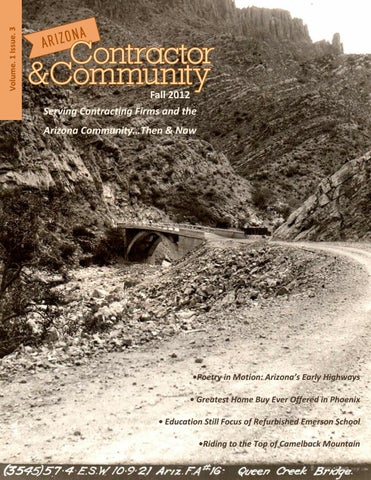
Fall 2012 Serving Contracting Firms and the Arizona Community…Then & Now
•Poetry in Motion: Arizona’s Early Highways • Greatest Home Buy Ever Offered in Phoenix • Education Still Focus of Refurbished Emerson School •Riding to the Top of Camelback Mountain
Volume. 1 Issue. 3 Fall 2012
CONTENTS
4. 6. 16.
Established 1978
Editor’s Column: Aerial Tramways - Douglas Towne Construction Around Arizona - William Horner Poetry in Motion: Arizona’s Post-Statehood Highways -
DDI EQUIPMENT, INC 3615 S. 7ᵀᴴ Ave Tel: 602-243-5243 Phoenix, AZ, 85041 Fax: 602-276-8819
Douglas Towne
18. 20. 23. 24. 26. 28.
DDI Equipment sells, rents and services high quality new and used forestry, recycling & aggregate crushing and screening equipment. We offer exceptional product support as well as product safety training.
Education Still Focus of Emerson School Surrey Heights: Built to Last - John Bueker Arizona 811 Safety Summit Winterizing Your Business - Paul Beaulieu Building Tomorrow’s Workforce Today - Connie Corder
WOODGRINDERS
MULCHING EQUIPMENT
FORESTRY
SCREENING & CRUSHING
Digging Through the Archives: The Smith Booth Usher Company - William Horner
Publisher William Horner azcc.publisher@hotmail.com
Editor Douglas Towne azcc.editor@gmail.com
Marketing & Sales Consultant Chuck Runbeck
Advertising Barry Warner barrywarner@cox.net
Production Manager Laura Harley azcc.design@hotmail.com
Advertising
Contributors Paul Beaulieu John Bueker
602-881-0907 / 602-920-7325
View our online magazine at: www.arizcc.com Printed at Lithotech Arizona Contractor & Community (ACC) magazine is published quarterly (Spring, Summer, Fall, & Winter). ACC is a professional publication designed for the contracting industry, engineers, architects, and others interested in Arizona and its history. Content including text, photographs or illustrations may not be reproduced without the written permission from the publisher. The publisher does not assume responsibility for unsolicited submissions. ACC reserves the right to reject any editorial and advertising material and assumes no responsibility for unsolicited material. Arizona Contractor & Community Copyright © 2012 All rights reserved.
Front Cover Queen Creek Bridge on the Miami - Superior Highway, 1921. Photograph courtesy of Elaine Hagen McBride, granddaughter of contracting pioneer Harry J. Hagen.
WWW.DDIEQUIP.COM
Arizona Contractor & Community
Editor’s Column Douglas Towne
Architecture,
construction, and wealth; the three are irretrievably linked. Those in the business of creating big ticket, awe-inspiring structures know the current global hot spots include Shanghai, China where skyscrapers sprout like desert flowers after a wet winter and Abu Dhabi in the United Arab Emirates where humans are pushing the boundaries of land reclamation in the Persian Gulf by creating palm tree-shaped islands. In Arizona, some of the most innovative recent large construction projects are on Native American lands. For a $30 fee at the Hualapai tribe’s Sky Walk, trusting, non-acrophobic tourists can stand above the Grand Canyon with nothing but a clear glass floor between them and a 4,000-foot plummet. Completed in 2007, the $31 million dollar project uses a cantilevered system to hold up a U-shaped walkway that extends 70 feet over the canyon’s edge, seemingly without any means of support. The structure’s designers claim the viewing platform can support the weight equivalent of almost six dozen 747 jetliners and withstand the seismic forces unleashed by a nearby 8.0 magnitude earthquake.
The Navajo Nation also has dramatic plans to attract tourists to the Grand Canyon at a remote location 30 miles west-northwest of Tuba City. The tribe recently proposed a new resort hotel, shops, and cultural center called Grand Canyon Escalade at the undeveloped East Rim just northeast of the national park. An aerial tramway would ferry visitors down to a restaurant and amphitheater along the Colorado River near its confluence with the Little Colorado River. Although the tribe has signed a nonbinding agreement with a Scottsdale developer, Confluence Partners, L.L.C., whether the $120 million project will ever be built will depend on negotiations among the Navajos themselves, the Hopi Tribe, and the National Park Service. At stake is an estimated $70 million a year in revenue and 2,000 jobs to be created by the development. The economic benefits of the project, however, will be weighed against losing the sacred character and wilderness of the last undeveloped portion of the Grand Canyon. The high water mark of aerial tramway popularity was during the 1960s. Prospectors surveyed mountains not for their mineral wealth but for their potential to attract visitors who would pay a
“Prospectors surveyed mountains not for their mineral wealth but for their potential to attract visitors who would pay a nice fee to be comfortably ferried to high places for spectacular views and overpriced food and gifts”
Four
Images courtesy of Douglas Towne
Above, left to right: Aerial tramway support structure at 15th Avenue, Palm Springs Aerial Tramway, Hualapai Tribe’s Sky Walk. Opposite page: Palm-tree shaped island, Abu Dhabi, Shanghai skyline.
nice fee to be comfortably ferried to high places for spectacular views and overpriced food and gifts. The Palm Springs Aerial Tramway that carries passengers up Mt. San Jacinto in California was finished in 1963 while the Sandia Peak tramway opened outside Albuquerque in 1966. In the tramway’s peak decade, there were even plans to construct one within Crater Lake National Park in Oregon that would transport visitors to Wizard Island. Spectacular construction schemes involving cable cars to boost tourism were also proposed for the Valley. One idea was to construct an aerial tramway to a restaurant planned atop Camelback Mountain. However, the tramway’s embarkation point was to be in front of Paradise Valley businessman, Bill O’Brien’s house. Not happy about the potential impacts to his neighborhood, O’Brien formed a partnership with his friend, Russell Jackson, and purchased 56 acres on Camelback Mountain in 1967. They gave 26 acres around the summit to the city for use as a preserve, forever eliminating the possibility of construction above 1,800 feet on the mountain. Another proposed aerial tramway would have toted passengers to a visitor’s center atop Shaw Butte, just north of Sunnyslope in the North Phoenix Mountains. In the late 1950s, mechanical whiz Richard Barker, who had operated businesses repairing everything from televisions to airplanes, built a structure on a small, flat area just below the summit of Shaw Butte. The building initially served as the Barker’s home and later, the Cloud Nine Restaurant. Barker ferried passengers up to the restaurant by the carload along a steep road he had carved out of a hill with liberal amounts
of dynamite. He also constructed two towers on the butte that were rumored to be support structures for an aerial tramway that would transport customers up to the restaurant. One of the support structures still stands near the base of the mountain at 15th Avenue. The tower’s size makes it appear more likely it was designed to haul restaurant supplies rather than customers. Although the restaurant was destroyed by fire in 1964, its foundation remains a popular hiking destination. Aerial tramways are not in much demand these days, although one opened in Portland in 2006. The tramway services mostly commuters, not tourists, and is part of the city’s metropolitan transportation system and required municipal funding. Public transportation focus in Phoenix has shifted from hauling visitors up mountains to moving residents around the Valley via light rail, a project that was started before today’s tight financial budgets. In this challenging fiscal environment, it will be interesting to see what future big ticket construction projects the Valley will become renowned for-but it won’t be aerial tramways. Mountaintops within the city are havens for hikers and bikers and now off limits to commercial development. Rather than whisking people up to amazing vistas, the only cable connections in Phoenix these days are a different variety that allow users vicarious access to incredible worlds via the internet. Douglas Towne
Arizona Contractor & Community
Construction Around Arizona
Construction Around Arizona Schools • Freeways • Roadways • Commercial
Right: 2501 Building at Continuum in Chandler that features precast concrete columns, beams, and double T floor framing. Six