Volume. 1 Issue. 2
Summer 2012
Housing Construction on Roosevelt Row The Glory Days of Chris-Town Mall Arizona Roads at Statehood in 1912 Architects Predict the Future Work Starts on New East Valley Freeway
Volume. 1 Issue. 2 Summer 2012
CONTENTS
4. Editor’s Column - Douglas Towne 6. Valley Contracting 12. ADOT 2012 Updates 16. Territorial Trails - Douglas Towne 18. Heart and Try - Paul Beaulieu 22. Architects Predict the Future - Taz Loomans 23. Get Arizona Back to Work - Doug Click 24. The Glory Days of Chris-Town Mall - John Bueker 28. Do You Dig Arizona? - Connie Corder 30. Digging Through the Archives - William Horner Publisher William Horner azcc.publisher@hotmail.com
Editor Douglas Towne azcc.editor@gmail.com
Marketing & Sales Consultant Chuck Runbeck
Advertising Barry Warner
Production Manager Laura Harley azcc.design@hotmail.com
Contributors Paul Beaulieu John Bueker Taz Loomans
Advertising
Established 1978
DDI EQUIPMENT, INC 3615 S. 7ᵀᴴ Ave Tel: 602-243-5243 Phoenix, AZ, 85041 Fax: 602-276-8819 DDI Equipment sells, rents and services high quality new and used forestry, recycling & aggregate crushing and screening equipment. We offer exceptional product support as well as product safety training. WOODGRINDERS
MULCHING EQUIPMENT
FORESTRY
SCREENING & CRUSHING
602-881-0907 / 602-931-0069
View our online magazine at: www.arizcc.com Printed at Lithotech Arizona Contractor & Community (ACC) magazine is published quarterly (Spring, Summer, Fall, & Winter). ACC is a professional publication designed for the contracting industry, engineers, architects, and others interested in Arizona and its history. Content including text, photographs or illustrations may not be reproduced without the written permission from the publisher. The publisher does not assume responsibility for unsolicited submissions. ACC reserves the right to reject any editorial and advertising material and assumes no responsibility for unsolicited material. Arizona Contractor & Community Copyright © 2012 All rights reserved.
Front Cover
WWW.DDIEQUIP.COM
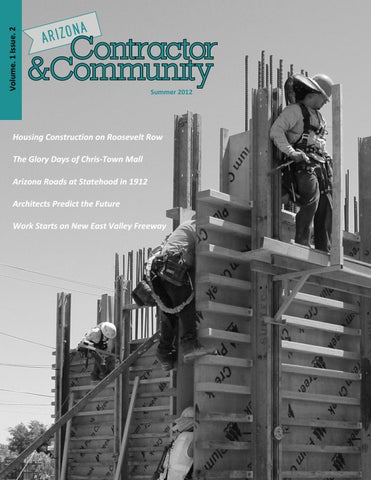
Suntec Concrete prepares south building shear wall for concrete pour on Hardison Downey’s Roosevelt Row project. p. 11
Arizona Contractor & Community
Editor’s Column Douglas Towne
If you happen to observe Arizona Contractor & Community
to form intricate, eye-catching designs. Such striking flooring was common in stores located downtown which had heavy foot
magazine staff walking around with their heads hanging low, don’t worry. We’re probably just on the lookout for inscriptions left on the sidewalk by Arizona’s construction industry. Publisher Billy Horner’s interests are the imprints embedded in concrete that provide the name of the construction firm and the date of the pour. These concrete stamps reveal a history of construction companies in Arizona and provide important clues as to the age of a particular building or housing development. My own underfoot fixation is an outgrowth of decades-long research of commercial signs. Besides neon, plastic, or handpainted signs hung from poles or buildings, a store’s entryway was an important advertising location. These speckled and polished terrazzo walkways featured the business name embedded into the floor, sometimes inlaid with brass borders,
traffic. The terrazzo reached from the front door to the sidewalk to draw in potential customers with its strong graphic qualities and beautiful color combinations. Terrazzo has a long construction history. In ancient times, it was made using otherwise discarded marble chips that were bound together with clay and goat milk. The more modern terrazzo entryways you’re likely to see around Phoenix were made with cement and an aggregate of quartz and marble, then sanded and buffed for a matte shine. Besides creating a beautiful piece of art that you can walk on, terrazzo’s use of waste materials make it a “green” product too. More than their inherent beauty and sustainability, my favorite feature of terrazzo floor signs is their unsurpassed Left: Concrete imprint in downtown Phoenix. Below: Hanny’s Department Store postcard, late 1940s. Above left: Hanny’s terrazo entryway.
“More than their inherent beauty and sustainability, my favorite feature of terrazzo floor signs is their unsurpassed optimism. “ Four
“Architects and craftsman of an earlier era likely created an amazing terrazzo floor that’s sure to compliment even the most elegant footwear.”
Douglas Towne
Images courtesy of Douglas Towne
optimism. Imagine the proprietors’ conviction in the future prosperity of their stores that they had the names of their businesses carved in stone to welcome customers for eternity. Did these shopkeepers ever envision a time when their enterprise would not be a part of the business community? Many of these signs have, not surprisingly, outlived the businesses they advertised. Along with their buildings, a lucky few have been rehabilitated. Perhaps the best example of this in Phoenix is Hanny’s, the International Style former department store located downtown at the southwest corner of Adams and 1�� Streets. Opened in 1947, the department store had an almost 40-year run before closing in 1986. The building was eventually refurbished and reopened a few years ago with a new life as a swank nightspot. Hanny’s not only retained their terrazzo entryways, they feature them on complimentary postcards provided to customers with each check. The sense of permanence provided by terrazzo entryways stands in stark contrast to many commercial buildings that have been constructed over the past 30 years. These businesses seem to have a lack of conviction in their future, especially those which advertise themselves using vinyl banners tied to their facades. A strong wind is seemingly all that is necessary to blow away these transient businesses. Perhaps the current skittish economic climate has something to do with the implied lack of permanence in commercial construction, but it can’t be worse than what was encountered during the Great Depression of the 1930s when some of these terrazzo entryways were created. Maybe there are other reasons though. Certainly in the internet age, brick and mortar businesses have to be spry and respond quickly to
the marketplace, which doesn’t bode well for expensive commercial buildings. Like so many “disposable” items available for household use, are recently constructed buildings with too few outstanding features, unconsciously destined to only be used for a limited period? Does this factor influence decisions to demolish rather than renovate them? Should these buildings come with a “raze by” date like many food products that have a “sell by” date? As with many things we eventually come to appreciate, will the passage of time allow us to become nostalgic for these structures? Or will trends again flip so commercial structures will again be built with such faith in their future that they will emblazon their name in a terrazzo floor? Only time will tell but I don’t think I’ll be hedging my bet…. So as you gaze up at some of Arizona’s most beautiful buildings, don’t forget to look down as you enter the structure. Architects and craftsman of an earlier era likely created an amazing terrazzo floor that’s sure to compliment even the most elegant footwear.
Arizona Contractor & Community
Valley Contracting ASU West Hungers for Dining Facility Completion
There’s nothing like the wrath of hungry students to spur a construction project to stay on schedule. “It’s a race to the finish to make sure meals are ready for students,” says Hardison Downey Construction Supervisor Eric Williams. His company is striving to open the ASU West Dining Facility in time for the start of the fall semester. There are some unique aspects of the work such as the jumbo bricks used in the dining area to match the existing police building and moving the Jamba Juice outlet on campus into the new facility. To create an “industrial feel,” all concrete and ceilings are exposed. “Probably the biggest challenge though is building in the midst of an operational school and keeping everyone coordinated safely,” says Williams. FIRMS INVOLVED: Architect - Hanbury Evens Wright Vlattas & Company. YARDS OF EXCAVATION/ABC/AMOUNTS: Minimal, mostly taking out of existing parking lot. ARCHITECTS/ ENGINEERS: SCA Houston (structural), TME Inc. (MEP) Dibble Engineers (Civil), Webb Development (food service,) Jeremiah Associates (Telecom) FUNDING/ OWNERS: American Campus Communities & ASU COMPLETION DATE: August 8, 2012.
Dorm Construction Dodges Courtyard Problems
The old adage, “don’t paint yourself into a corner,” proved good advice for the construction of the Casa de Oro student housing complex at ASU West in Glendale. “To avoid a fiasco at the end of the project, trees and granite were added to the courtyard area early in the project so we did not close ourselves out,” says Hardison Downey Project Engineer Rebecca Freitas. Other interesting aspects of the construction work were after the building was framed in wood, a thick brick veneer was added to match the existing campus facilities. PROJECT NAME/LOCATION: ASU West Student Housing “Casa De Oro” Glendale AZ FIRMS INVOLVED: Architect - Todd and Associates OWNERS: American Campus Communities & ASU
Top: Interior view of exposed mechanical work and ceiling in the main dining facility. Second: View from east side of ASU West housing project, exterior skin includes stucco, red brick veneer, and precast concrete bands. Third: Maverick Masonry, El Mirage laying out for install of 4x4x16 brick veneer on west face of the ASU West Dining Hall. Bottom: ASU West SRC project being built by Haydon Building Corp. Six